
A English
Male reproductive system Questions in English
Class 12 Biology · Human Reproduction · Male reproductive system
325+
Questions
English
Language
100%
With Solutions
Showing 50 of 325 questions in English
251
MediumMCQ
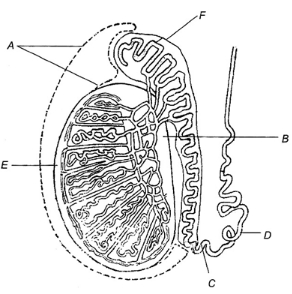
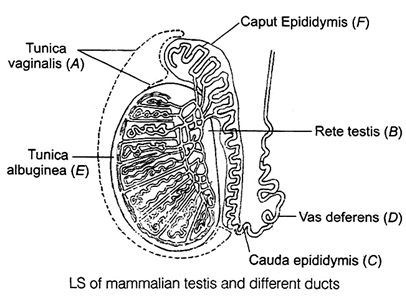
Identify $A$ to $F$ in the diagram given below.
A
$A-$Tunica vaginalis,$B-$Rete testis,$C-$Caput epididymis,$D-$Vas deferens,$E-$Septa of testis,$F-$Cauda epididymis
B
$A-$Tunica vaginalis,$B-$Rete testis,$C-$Cauda epididymis,$D-$Vas deferens,$E-$Tunica albuginea,$F-$Caput epididymis
C
$A-$Tunica vaginalis,$B-$Rete testis,$C-$Cauda epididymis,$D-$Vas deferens,$E-$Tunica albuginea,$F-$Caput epididymis
D
$A-$Tunica vaginalis,$B-$Rete testis,$C-$Caput epididymis,$D-$Mediastinum testis,$E-$Vas deferens,$F-$Cauda epididymis
Solution
(B) Based on the anatomical structure of the mammalian testis:
$A$ represents the Tunica vaginalis,which is the outer serous covering.
$B$ represents the Rete testis,a network of tubules in the mediastinum testis.
$C$ represents the Cauda epididymis,the posterior part of the epididymis.
$D$ represents the Vas deferens,the duct that transports sperm.
$E$ represents the Tunica albuginea,the tough fibrous capsule surrounding the testis.
$F$ represents the Caput epididymis,the anterior head region of the epididymis.
Therefore,the correct labeling is $A-$Tunica vaginalis,$B-$Rete testis,$C-$Cauda epididymis,$D-$Vas deferens,$E-$Tunica albuginea,$F-$Caput epididymis.
$A$ represents the Tunica vaginalis,which is the outer serous covering.
$B$ represents the Rete testis,a network of tubules in the mediastinum testis.
$C$ represents the Cauda epididymis,the posterior part of the epididymis.
$D$ represents the Vas deferens,the duct that transports sperm.
$E$ represents the Tunica albuginea,the tough fibrous capsule surrounding the testis.
$F$ represents the Caput epididymis,the anterior head region of the epididymis.
Therefore,the correct labeling is $A-$Tunica vaginalis,$B-$Rete testis,$C-$Cauda epididymis,$D-$Vas deferens,$E-$Tunica albuginea,$F-$Caput epididymis.
0 likes
View Solution252
MediumMCQ
$A$ pair of bulbourethral glands, also called $...A...$ glands, are present on either side of the $...B...$. They secrete $...C...$ fluid and $...D...$ for lubricating the penis. Here $A, B, C$, and $D$ are:
A
$A-$Cowper's, $B-$Urethra, $C-$Alkaline, $D-$Mucous
B
$A-$Prostate, $B-$Urethra, $C-$Acidic, $D-$Mucous
C
$A-$Cowper's, $B-$Scrotum, $C-$Acidic, $D-$Mucous
D
$A-$Prostate, $B-$Scrotum, $C-$Alkaline, $D-$Mucous
Solution
(A) The bulbourethral glands are a pair of small glands located on either side of the $Urethra$ in males.
They are also known as $Cowper's$ glands.
These glands secrete an $Alkaline$ fluid and $Mucous$ which helps in the lubrication of the penis during sexual arousal.
Therefore, $A = Cowper's$, $B = Urethra$, $C = Alkaline$, and $D = Mucous$.
They are also known as $Cowper's$ glands.
These glands secrete an $Alkaline$ fluid and $Mucous$ which helps in the lubrication of the penis during sexual arousal.
Therefore, $A = Cowper's$, $B = Urethra$, $C = Alkaline$, and $D = Mucous$.
0 likes
View Solution253
MediumMCQ
Primary sex organs differ from the secondary sex organs in all the following,except
A
They produce gametes
B
They secrete sex hormones
C
They are concerned with the conduction of gametes
D
Testes in male and ovaries in female are the examples of primary sex organ
Solution
(C) Primary sex organs (testes in males and ovaries in females) are responsible for the production of gametes and the secretion of sex hormones. Secondary sex organs,such as the vasa deferentia,epididymis,and fallopian tubes,are involved in the conduction and storage of gametes. Therefore,the conduction of gametes is a function of secondary sex organs,not primary sex organs.
0 likes
View Solution254
MediumMCQ
Why are the testes in human beings and mammals situated outside the abdominal cavity within a pouch called the scrotum?
A
There is not enough space in the pelvic area for the testicles to be housed internally.
B
The scrotum helps in maintaining the low temperature of the testes, $2.5^{\circ}C$ lower than the normal body temperature, which is required for spermatogenesis.
C
The scrotum helps in maintaining the high temperature of the testes, $2.5^{\circ}C$ higher than the normal body temperature, which is required for spermatogenesis.
D
Providing more space for the growth of the epididymis.
Solution
(B) The testes are located outside the abdominal cavity within the scrotum because the process of spermatogenesis requires a temperature approximately $2.5^{\circ}C$ lower than the normal internal body temperature. This lower temperature is essential for the viability and proper development of sperm cells.
0 likes
View Solution255
EasyMCQ
Read the following paragraph with two blanks: Each testis has about $A$ compartments called as testicular lobules. Each lobule contains $B$ highly coiled seminiferous tubules in which the sperms are produced. The correct option for the two blanks is
| $A$ | $B$ |
A
| $50$ | $1-3$ |
B
| $100$ | $1$ |
C
| $250$ | $1-3$ |
D
| $500$ | $3$ |
Solution
(C) According to the $NCERT$ textbook, each testis in a human male contains approximately $250$ compartments known as testicular lobules.
Each of these testicular lobules contains $1$ to $3$ highly coiled seminiferous tubules.
These seminiferous tubules are the sites where spermatogenesis (production of sperms) occurs.
Therefore, the correct values for $A$ and $B$ are $250$ and $1-3$ respectively, which corresponds to option $C$.
Each of these testicular lobules contains $1$ to $3$ highly coiled seminiferous tubules.
These seminiferous tubules are the sites where spermatogenesis (production of sperms) occurs.
Therefore, the correct values for $A$ and $B$ are $250$ and $1-3$ respectively, which corresponds to option $C$.
0 likes
View Solution256
EasyMCQ
Which of the following cells secrete testicular hormones called androgens and form the endocrine part of the testis?
A
Leydig cells
B
Interstitial cells
C
Sertoli cells
D
Both $(a) \; \& \; (b)$
Solution
(D) Leydig cells are also known as interstitial cells because they are located in the interstitial spaces between the seminiferous tubules.
These cells synthesize and secrete testicular hormones,which are collectively known as androgens (primarily testosterone).
Since these cells release hormones directly into the blood,they constitute the endocrine part of the testis.
These cells synthesize and secrete testicular hormones,which are collectively known as androgens (primarily testosterone).
Since these cells release hormones directly into the blood,they constitute the endocrine part of the testis.
0 likes
View Solution257
EasyMCQ
Vas deferens receives a duct from the seminal vesicle and opens into the urethra as . . . . . . .
A
Urethral meatus
B
Ejaculatory duct
C
Ureter
D
Epididymis
Solution
(B) The path of sperm is as follows:
Seminiferous tubules $\rightarrow$ Rete testis $\rightarrow$ Vasa efferentia $\rightarrow$ Epididymis $\rightarrow$ Vas deferens.
The vas deferens dilates to form an ampulla,which receives the duct from the seminal vesicle to form the ejaculatory duct.
This ejaculatory duct then opens into the urethra.
Seminiferous tubules $\rightarrow$ Rete testis $\rightarrow$ Vasa efferentia $\rightarrow$ Epididymis $\rightarrow$ Vas deferens.
The vas deferens dilates to form an ampulla,which receives the duct from the seminal vesicle to form the ejaculatory duct.
This ejaculatory duct then opens into the urethra.
0 likes
View Solution258
EasyMCQ
Fructose is present in the secretion of
A
Corpus spongiosum
B
Seminal vesicles
C
Urethra
D
Tyson's gland
Solution
(B) The secretion of the seminal vesicles contains fructose,inositol,prostaglandins,and clotting proteins. Fructose serves as the primary energy source for sperm cells.
0 likes
View Solution259
EasyMCQ
Male accessory glands include
A
Paired seminal vesicles
B
$A$ prostate gland
C
Paired bulbourethral glands
D
All of these
Solution
(D) The male accessory glands consist of paired seminal vesicles,a single prostate gland,and paired bulbourethral glands (also known as Cowper's glands). These glands secrete fluids that form the seminal plasma,which is rich in fructose,calcium,and certain enzymes.
0 likes
View Solution260
MediumMCQ
Each seminiferous tubule is lined on its inside by two types of cells $A$ and $B$. Which of the following options is correct,w.r.t. the type of cell and its function?
| $A$ | $B$ |
A
| $A$. Male germ cells: Undergo meiotic division | $B$. Sertoli cells: Provide nutrition to germ cells |
B
| $A$. Spermatogonia: Undergo mitosis | $B$. Sertoli cells: Secrete testicular hormones |
C
| $A$. Male germ cells: Leading to sperm formation | $B$. Leydig cells: Secrete androgens |
D
| $A$. Sertoli cells: Provide nutrition to germ cells | $B$. Leydig cells: Secrete inhibin |
Solution
(A) The inner lining of each seminiferous tubule consists of two types of cells: male germ cells (spermatogonia) and Sertoli cells.
Male germ cells undergo meiotic divisions finally leading to sperm formation.
Sertoli cells provide nutrition to the germ cells.
Leydig cells (interstitial cells) are located outside the seminiferous tubules in the interstitial spaces and synthesize and secrete testicular hormones called androgens.
Male germ cells undergo meiotic divisions finally leading to sperm formation.
Sertoli cells provide nutrition to the germ cells.
Leydig cells (interstitial cells) are located outside the seminiferous tubules in the interstitial spaces and synthesize and secrete testicular hormones called androgens.
0 likes
View Solution261
EasyMCQ
Which of the following is a set of male accessory ducts?
A
Rete testis,vasa efferentia,tubuli recti
B
Rete testis,vasa efferentia,epididymis and vas deferens
C
Epididymis,ejaculatory duct,urethra
D
Seminiferous tubules,vasa efferentia,epididymis and vas deferens
Solution
(B) The male sex accessory ducts include the rete testis,vasa efferentia,epididymis,and vas deferens.
These ducts are responsible for the transport and storage of sperms produced in the seminiferous tubules.
These ducts are responsible for the transport and storage of sperms produced in the seminiferous tubules.
0 likes
View Solution262
EasyMCQ
Trace the correct path of movement of the sperms up to the urethra.
A
Seminiferous tubules $\rightarrow$ Vasa efferentia $\rightarrow$ Rete testis $\rightarrow$ Epididymis $\rightarrow$ Vas deferens $\rightarrow$ Ejaculatory duct $\rightarrow$ Urethra
B
Seminiferous tubules $\rightarrow$ Rete testis $\rightarrow$ Epididymis $\rightarrow$ Vasa efferentia $\rightarrow$ Vas deferens $\rightarrow$ Ejaculatory duct $\rightarrow$ Urethra
C
Seminiferous tubules $\rightarrow$ Rete testis $\rightarrow$ Vasa efferentia $\rightarrow$ Epididymis $\rightarrow$ Vas deferens $\rightarrow$ Ejaculatory duct $\rightarrow$ Urethra
D
Seminiferous tubules $\rightarrow$ Rete testis $\rightarrow$ Vasa efferentia $\rightarrow$ Epididymis $\rightarrow$ Ejaculatory duct $\rightarrow$ Vas deferens $\rightarrow$ Urethra
Solution
(C) The correct pathway of sperm transport in the male reproductive system is as follows:
$1$. Sperms are produced in the $Seminiferous \text{ } tubules$.
$2$. They move into the $Rete \text{ } testis$.
$3$. From the $Rete \text{ } testis$, they pass through the $Vasa \text{ } efferentia$.
$4$. They then enter the $Epididymis$ for maturation and storage.
$5$. From the $Epididymis$, they travel through the $Vas \text{ } deferens$.
$6$. The $Vas \text{ } deferens$ joins with the duct from the seminal vesicle to form the $Ejaculatory \text{ } duct$.
$7$. Finally, the $Ejaculatory \text{ } duct$ opens into the $Urethra$.
$1$. Sperms are produced in the $Seminiferous \text{ } tubules$.
$2$. They move into the $Rete \text{ } testis$.
$3$. From the $Rete \text{ } testis$, they pass through the $Vasa \text{ } efferentia$.
$4$. They then enter the $Epididymis$ for maturation and storage.
$5$. From the $Epididymis$, they travel through the $Vas \text{ } deferens$.
$6$. The $Vas \text{ } deferens$ joins with the duct from the seminal vesicle to form the $Ejaculatory \text{ } duct$.
$7$. Finally, the $Ejaculatory \text{ } duct$ opens into the $Urethra$.
0 likes
View Solution263
MediumMCQ
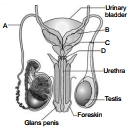
Given below is a diagrammatic sketch of a portion of the human male reproductive system. Which of the following parts contributes to the maximum portion of semen?
A
$D$
B
$C$
C
$B$
D
$A$
Solution
(C) In the human male reproductive system,the seminal vesicles (labeled as $B$) contribute about $60-70\%$ of the total volume of semen.
$A$ represents the vas deferens.
$C$ represents the prostate gland.
$D$ represents the bulbourethral gland.
Therefore,the seminal vesicles $(B)$ contribute the maximum portion of semen.
$A$ represents the vas deferens.
$C$ represents the prostate gland.
$D$ represents the bulbourethral gland.
Therefore,the seminal vesicles $(B)$ contribute the maximum portion of semen.
0 likes
View Solution264
MediumMCQ
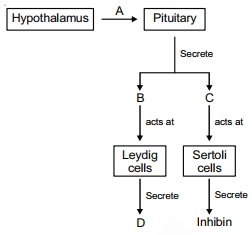
Study the flow chart. Name the hormones labelled as $A, B, C, D$ at each stage.
$A \quad B \quad C \quad D$
$A \quad B \quad C \quad D$
A
$GnRH \quad ICSH \quad Androgen \quad FSH$
B
$GnRH \quad LH \quad FSH \quad Androgens$
C
$Gonadotropins \quad LH \quad FSH \quad Testosterone$
D
$GnRH \quad FSH \quad LH \quad Androgens$
Solution
(B) $GnRH$ (Gonadotropin-releasing hormone) is a hypothalamic hormone that acts on the anterior pituitary to stimulate the secretion of gonadotropins,which are $LH$ and $FSH$.
$LH$ (Luteinizing hormone) acts on the Leydig cells and stimulates the synthesis and secretion of androgens.
$FSH$ (Follicle-stimulating hormone) acts on the Sertoli cells and stimulates the secretion of some factors which help in the process of spermiogenesis.
Therefore,$A = GnRH$,$B = LH$,$C = FSH$,and $D = Androgens$.
$LH$ (Luteinizing hormone) acts on the Leydig cells and stimulates the synthesis and secretion of androgens.
$FSH$ (Follicle-stimulating hormone) acts on the Sertoli cells and stimulates the secretion of some factors which help in the process of spermiogenesis.
Therefore,$A = GnRH$,$B = LH$,$C = FSH$,and $D = Androgens$.
0 likes
View Solution265
MediumMCQ
$A$: Failure of testes to descend into the scrotum causes sterility in man. $R$: Higher internal body temperature is not suitable for sperm development.
A
Assertion and Reason both are correct and Reason is the correct explanation of Assertion.
B
Assertion and Reason both are correct but Reason is not the correct explanation of Assertion.
C
Assertion is correct,but Reason is incorrect.
D
Both Assertion and Reason are incorrect.
Solution
(A) Spermatogenesis,the process of sperm formation,requires a temperature that is $2 - 2.5^{\circ}C$ lower than the normal internal body temperature.
If the testes fail to descend into the scrotum (a condition known as cryptorchidism),they remain inside the abdominal cavity where the temperature is too high for effective spermatogenesis.
Consequently,this leads to the production of non-viable sperm or a complete lack of sperm production,resulting in sterility in men.
Therefore,both the Assertion and the Reason are correct,and the Reason provides the correct explanation for the Assertion.
If the testes fail to descend into the scrotum (a condition known as cryptorchidism),they remain inside the abdominal cavity where the temperature is too high for effective spermatogenesis.
Consequently,this leads to the production of non-viable sperm or a complete lack of sperm production,resulting in sterility in men.
Therefore,both the Assertion and the Reason are correct,and the Reason provides the correct explanation for the Assertion.
0 likes
View Solution266
MediumMCQ
$A$: The male urethra is longer than the female urethra.
$R$: It carries both urine as well as semen.
$R$: It carries both urine as well as semen.
A
Assertion and Reason both are correct and Reason is the correct explanation of Assertion.
B
Assertion and Reason both are correct but Reason is not the correct explanation of Assertion.
C
Assertion is correct,but Reason is incorrect.
D
Both Assertion and Reason are incorrect.
Solution
(A) The male urethra is approximately $20 \; cm$ long,whereas the female urethra is much shorter,measuring about $2-4 \; cm$.
In males,the urethra serves as a common pathway for both the urinary and reproductive systems,transporting both urine and semen.
In females,the genital tract and the urinary tract have separate openings.
Therefore,the Reason correctly explains why the male urethra is longer and structurally different from the female urethra.
In males,the urethra serves as a common pathway for both the urinary and reproductive systems,transporting both urine and semen.
In females,the genital tract and the urinary tract have separate openings.
Therefore,the Reason correctly explains why the male urethra is longer and structurally different from the female urethra.
0 likes
View Solution267
MediumMCQ
$A$: Leydig cells synthesize and secrete testicular hormones called androgens.
$R$: Leydig cells are located between the Sertoli cells.
$R$: Leydig cells are located between the Sertoli cells.
A
Assertion and Reason both are correct and Reason is the correct explanation of Assertion.
B
Assertion and Reason both are correct but Reason is not the correct explanation of Assertion.
C
Assertion is correct,but Reason is incorrect.
D
Both Assertion and Reason are incorrect.
Solution
(C) The Assertion is correct because Leydig cells (interstitial cells) are responsible for the synthesis and secretion of androgens,primarily testosterone.
The Reason is incorrect because Leydig cells are located in the interstitial spaces outside the seminiferous tubules,not between the Sertoli cells. Sertoli cells are located inside the seminiferous tubules.
The Reason is incorrect because Leydig cells are located in the interstitial spaces outside the seminiferous tubules,not between the Sertoli cells. Sertoli cells are located inside the seminiferous tubules.
0 likes
View Solution268
MediumMCQ
$A$: The secretions of male accessory glands constitute the seminal plasma,which is rich in fructose,calcium,and certain enzymes. $R$: Fructose serves as a source of energy for the sperms.
A
Assertion and Reason both are correct and Reason is the correct explanation of Assertion.
B
Assertion and Reason both are correct but Reason is not the correct explanation of Assertion.
C
Assertion is correct,but Reason is incorrect.
D
Both Assertion and Reason are incorrect.
Solution
(A) The seminal plasma is secreted by the male accessory glands (seminal vesicles,prostate gland,and bulbourethral glands).
It is rich in fructose,calcium,and certain enzymes.
Fructose is a monosaccharide sugar that provides the primary energy source for the motility of sperms as they travel through the female genital tract.
Therefore,the Reason correctly explains why the presence of fructose in seminal plasma is significant.
It is rich in fructose,calcium,and certain enzymes.
Fructose is a monosaccharide sugar that provides the primary energy source for the motility of sperms as they travel through the female genital tract.
Therefore,the Reason correctly explains why the presence of fructose in seminal plasma is significant.
0 likes
View Solution269
MediumMCQ
$A$: The scrotum acts as a temperature regulator for the testes.
$R$: The wall of the scrotum is supported by dartos muscles,which help in the positioning of the testes.
$R$: The wall of the scrotum is supported by dartos muscles,which help in the positioning of the testes.
A
Assertion and Reason both are correct and Reason is the correct explanation of Assertion.
B
Assertion and Reason both are correct but Reason is not the correct explanation of Assertion.
C
Assertion is correct,but Reason is incorrect.
D
Both Assertion and Reason are incorrect.
Solution
(A) The scrotum maintains the temperature of the testes $2-2.5^{\circ}C$ lower than the normal internal body temperature,which is necessary for spermatogenesis.
This temperature regulation is achieved by the contraction and relaxation of the dartos and cremaster muscles.
The dartos muscle is present in the wall of the scrotum,and its contraction causes the scrotal skin to wrinkle,thereby reducing the surface area to conserve heat.
The cremaster muscle helps in pulling the testes closer to or further from the body cavity to regulate temperature.
Since both the assertion and the reason are scientifically accurate and the reason explains the mechanism behind the temperature regulation mentioned in the assertion,the correct option is $A$.
This temperature regulation is achieved by the contraction and relaxation of the dartos and cremaster muscles.
The dartos muscle is present in the wall of the scrotum,and its contraction causes the scrotal skin to wrinkle,thereby reducing the surface area to conserve heat.
The cremaster muscle helps in pulling the testes closer to or further from the body cavity to regulate temperature.
Since both the assertion and the reason are scientifically accurate and the reason explains the mechanism behind the temperature regulation mentioned in the assertion,the correct option is $A$.
0 likes
View Solution270
MediumMCQ
Select the correct option for Leydig cells.
A
Located in the interstitial spaces.
B
Also known as interstitial cells.
C
Secrete androgens.
D
All of the above.
Solution
(D) Leydig cells,also known as interstitial cells,are located in the interstitial spaces outside the seminiferous tubules in the testis.
These cells synthesize and secrete testicular hormones called androgens,primarily testosterone.
Therefore,all the given statements are correct.
These cells synthesize and secrete testicular hormones called androgens,primarily testosterone.
Therefore,all the given statements are correct.
0 likes
View Solution271
EasyMCQ
Identify the correct pathway of sperm transport.
A
Seminiferous tubules $\rightarrow$ Rete testis $\rightarrow$ Vasa efferentia $\rightarrow$ Epididymis $\rightarrow$ Vas deferens $\rightarrow$ Ejaculatory duct $\rightarrow$ Urethra
B
Seminiferous tubules $\rightarrow$ Rete testis $\rightarrow$ Epididymis $\rightarrow$ Vasa efferentia $\rightarrow$ Vas deferens $\rightarrow$ Ejaculatory duct $\rightarrow$ Urethra
C
Seminiferous tubules $\rightarrow$ Rete testis $\rightarrow$ Epididymis $\rightarrow$ Vasa efferentia $\rightarrow$ Ejaculatory duct $\rightarrow$ Vas deferens $\rightarrow$ Urethra
D
None of these
Solution
(A) The correct pathway of sperm transport in the male reproductive system is as follows:
$1$. Sperm are produced in the $\text{Seminiferous tubules}$.
$2$. They move into the $\text{Rete testis}$.
$3$. From there, they pass through the $\text{Vasa efferentia}$.
$4$. They then enter the $\text{Epididymis}$ for maturation and storage.
$5$. They travel through the $\text{Vas deferens}$.
$6$. They enter the $\text{Ejaculatory duct}$ (formed by the duct of the seminal vesicle and vas deferens).
$7$. Finally, they are released through the $\text{Urethra}$.
$1$. Sperm are produced in the $\text{Seminiferous tubules}$.
$2$. They move into the $\text{Rete testis}$.
$3$. From there, they pass through the $\text{Vasa efferentia}$.
$4$. They then enter the $\text{Epididymis}$ for maturation and storage.
$5$. They travel through the $\text{Vas deferens}$.
$6$. They enter the $\text{Ejaculatory duct}$ (formed by the duct of the seminal vesicle and vas deferens).
$7$. Finally, they are released through the $\text{Urethra}$.
0 likes
View Solution272
EasyMCQ
Identify the ejaculatory duct from the given diagrammatic representation of the male reproductive system.
A
$P$
B
$Q$
C
$R$
D
$S$
Solution
(C) In the standard diagram of the human male reproductive system,the ejaculatory duct is formed by the union of the duct from the seminal vesicle and the vas deferens. It passes through the prostate gland and opens into the urethra. Based on standard anatomical labeling in $NCERT$ diagrams,the structure typically labeled as the ejaculatory duct is represented by $R$.
0 likes
View Solution273
EasyMCQ
Which of the following secretions helps in the lubrication of the penis?
A
Seminal vesicle
B
Prostate gland
C
Bulbourethral gland
D
Epididymis
Solution
(C) The bulbourethral glands (also known as Cowper's glands) are a pair of pea-sized exocrine glands located on the sides of the urethra just below the prostate gland in the male reproductive system.
These glands secrete a clear,alkaline,mucus-like fluid into the urethra.
This secretion serves two primary functions: it neutralizes the acidity of the urine remaining in the urethra and acts as a lubricant for the penis during sexual intercourse.
These glands secrete a clear,alkaline,mucus-like fluid into the urethra.
This secretion serves two primary functions: it neutralizes the acidity of the urine remaining in the urethra and acts as a lubricant for the penis during sexual intercourse.
0 likes
View Solution274
EasyMCQ
How much lower is the temperature of the testes maintained by the scrotum compared to the body temperature?
A
$2-2.5^{\circ} C$
B
$1-1.5^{\circ} C$
C
$3-4^{\circ} C$
D
$5-6^{\circ} C$
Solution
(A) The testes are situated outside the abdominal cavity within a pouch called the scrotum.
The scrotum helps in maintaining the low temperature of the testes,which is necessary for spermatogenesis.
The temperature of the testes is maintained at $2-2.5^{\circ} C$ lower than the normal internal body temperature.
The scrotum helps in maintaining the low temperature of the testes,which is necessary for spermatogenesis.
The temperature of the testes is maintained at $2-2.5^{\circ} C$ lower than the normal internal body temperature.
0 likes
View Solution275
MediumMCQ
Select the incorrect option regarding the testes.
A
They are situated outside the abdominal cavity within a pouch called the scrotum.
B
In adults,each testis is oval in shape,with a length of about $4$ to $5$ $cm$ and a width of about $2$ to $3$ $cm$.
C
The testes are covered by a dense covering.
D
Each testis has about $250$ compartments called testicular lobules.
Solution
(B) According to the $NCERT$ textbook,the testes are situated outside the abdominal cavity within a pouch called the scrotum. In adults,each testis is oval in shape,with a length of about $4$ to $5$ $cm$ and a width of about $2$ to $3$ $cm$. The testes are covered by a dense covering. Each testis has about $250$ compartments called testicular lobules. Comparing these facts with the given options,option $B$ states the dimensions as $2$ to $3$ $cm$ in length and $4$ to $5$ $cm$ in width,which is the reverse of the actual anatomical dimensions ($4-5$ $cm$ length and $2-3$ $cm$ width). Therefore,option $B$ is incorrect.
0 likes
View Solution276
EasyMCQ
What is the location and function of the interstitial cells or Leydig cells?
A
Inside the seminiferous tubules,secretion of androgens
B
Outside the seminiferous tubules,secretion of testosterone
C
Inside the seminiferous tubules,secretion of testosterone
D
Outside the seminiferous tubules,secretion of androgens
Solution
(D) The interstitial cells,also known as Leydig cells,are located in the interstitial spaces outside the seminiferous tubules within the testes.
These cells synthesize and secrete testicular hormones called androgens,primarily testosterone.
Therefore,the correct location is outside the seminiferous tubules and the function is the secretion of androgens.
These cells synthesize and secrete testicular hormones called androgens,primarily testosterone.
Therefore,the correct location is outside the seminiferous tubules and the function is the secretion of androgens.
0 likes
View Solution277
EasyMCQ
The duct of the vas deferens joins with the duct of the seminal vesicle to form the $........$.
A
Urethra
B
Urinogenital duct
C
Ejaculatory duct
D
Epididymis
Solution
(C) The vas deferens emerges from the epididymis and enters the abdominal cavity.
It loops over the urinary bladder.
The duct from the seminal vesicle joins with the vas deferens to form the ejaculatory duct.
This duct stores and transports sperm from the testes to the outside through the urethra.
It loops over the urinary bladder.
The duct from the seminal vesicle joins with the vas deferens to form the ejaculatory duct.
This duct stores and transports sperm from the testes to the outside through the urethra.
0 likes
View Solution278
EasyMCQ
Which of the following is the external genitalia of the male?
A
Seminal vesicle
B
Penis
C
Clitoris
D
All of the above
Solution
(B) The male reproductive system consists of a pair of testes,accessory ducts,glands,and external genitalia.
The external genitalia of the male is the penis.
It is a copulatory organ made up of special tissue that helps in the erection of the penis to facilitate insemination.
The seminal vesicle is an accessory gland,and the clitoris is a part of the female external genitalia.
The external genitalia of the male is the penis.
It is a copulatory organ made up of special tissue that helps in the erection of the penis to facilitate insemination.
The seminal vesicle is an accessory gland,and the clitoris is a part of the female external genitalia.
0 likes
View Solution279
EasyMCQ
The enlarged end of the penis is called the ..........
A
Urethral meatus
B
Glans penis
C
Foreskin
D
None of these
Solution
(B) The human male reproductive system includes the penis, which is the external genitalia. The penis is composed of special tissue that helps in erection to facilitate insemination. The enlarged end of the penis is covered by a loose fold of skin called the foreskin (prepuce) and is known as the $Glans penis$.
0 likes
View Solution280
MediumMCQ
What is the composition of the seminal plasma?
A
Fructose $+$ Calcium $+$ Enzymes absent
B
Fructose $+$ Calcium $+$ Certain enzymes present
C
Sucrose $+$ Calcium $+$ Enzymes absent
D
Sucrose $+$ Calcium $+$ Certain enzymes present
Solution
(B) The seminal plasma is the fluid component of semen,which is secreted by the accessory glands,specifically the seminal vesicles,prostate gland,and bulbourethral glands.
Seminal plasma is rich in fructose,calcium,and certain enzymes.
Fructose serves as the primary energy source for the sperm cells,while calcium and various enzymes help in the motility and survival of the sperm within the female reproductive tract.
Therefore,the correct composition includes fructose,calcium,and certain enzymes.
Seminal plasma is rich in fructose,calcium,and certain enzymes.
Fructose serves as the primary energy source for the sperm cells,while calcium and various enzymes help in the motility and survival of the sperm within the female reproductive tract.
Therefore,the correct composition includes fructose,calcium,and certain enzymes.
0 likes
View Solution281
EasyMCQ
The secretion of the . . . . . . helps in the lubrication of the penis.
A
Bulbourethral gland
B
Prostate gland
C
Seminal vesicle
D
Leydig cells
Solution
(A) The bulbourethral glands (also known as Cowper's glands) are a pair of pea-sized exocrine glands located along the sides of the urethra just below the prostate gland in the male reproductive system.
Their primary function is to secrete a clear,alkaline fluid into the urethra.
This secretion serves two main purposes: it neutralizes the acidic environment of the urethra caused by urine,and it acts as a lubricant for the penis during sexual intercourse.
Their primary function is to secrete a clear,alkaline fluid into the urethra.
This secretion serves two main purposes: it neutralizes the acidic environment of the urethra caused by urine,and it acts as a lubricant for the penis during sexual intercourse.
0 likes
View Solution282
EasyMCQ
Identify the diagram given below.
A
Cross-section of vas deferens
B
Cross-section of seminiferous tubule
C
Cross-section of epididymis
D
Cross-section of ejaculatory duct
Solution
(B) The diagram typically shows a circular structure lined with germinal epithelium containing spermatogonia, primary spermatocytes, secondary spermatocytes, spermatids, and spermatozoa, with Sertoli cells interspersed. This characteristic structure is the cross-section of a $seminiferous \text{ } tubule$ found in the testes. The $seminiferous \text{ } tubules$ are the sites of spermatogenesis.
0 likes
View Solution283
MediumMCQ
Select the correct option regarding the composition of semen.
A
Semen $=$ Seminal plasma $+$ Sperm
B
Semen $=$ Seminal plasma $+$ Sperm $+$ Testosterone
C
Seminal plasma $=$ Semen $+$ Sperm $+$ Testosterone
D
Seminal plasma $=$ Semen $+$ Sperm
Solution
(A) Semen is composed of sperm and seminal plasma.
Seminal plasma is the fluid secreted by the accessory glands (seminal vesicles,prostate gland,and bulbourethral glands) along with the sperm.
Therefore,the correct composition is: Semen $=$ Seminal plasma $+$ Sperm.
Seminal plasma is the fluid secreted by the accessory glands (seminal vesicles,prostate gland,and bulbourethral glands) along with the sperm.
Therefore,the correct composition is: Semen $=$ Seminal plasma $+$ Sperm.
0 likes
View Solution284
MediumMCQ
The region outside the seminiferous tubules which contains small blood vessels,Leydig cells,and other immunologically competent cells is called $:-$
A
Perivitelline space
B
Peritesticular space
C
Interstitial space
D
Inguinal space
Solution
(C) The testes are composed of seminiferous tubules where sperm production occurs.
Outside these tubules lies a region known as the interstitial space.
This space contains small blood vessels,Leydig cells (interstitial cells),and immunologically competent cells.
Leydig cells are responsible for the synthesis and secretion of testicular hormones called androgens,primarily testosterone.
Outside these tubules lies a region known as the interstitial space.
This space contains small blood vessels,Leydig cells (interstitial cells),and immunologically competent cells.
Leydig cells are responsible for the synthesis and secretion of testicular hormones called androgens,primarily testosterone.
0 likes
View Solution285
EasyMCQ
The seminiferous tubules are lined by two types of cells,which are $:-$
A
Sertoli cells and nurse cells
B
Sertoli cells and Leydig cells
C
Spermatogonia and Sertoli cells
D
Spermatogonia and Leydig cells
Solution
(C) The seminiferous tubules are the structural and functional units of the testes where spermatogenesis occurs.
Each seminiferous tubule is lined on its inside by two types of cells:
$1$. Male germ cells (Spermatogonia): These undergo meiotic divisions finally leading to sperm formation.
$2$. Sertoli cells: These are also known as nurse cells,which provide nutrition to the developing germ cells.
Leydig cells (interstitial cells) are present in the interstitial spaces outside the seminiferous tubules,not inside them.
Therefore,the correct option is $C$.
Each seminiferous tubule is lined on its inside by two types of cells:
$1$. Male germ cells (Spermatogonia): These undergo meiotic divisions finally leading to sperm formation.
$2$. Sertoli cells: These are also known as nurse cells,which provide nutrition to the developing germ cells.
Leydig cells (interstitial cells) are present in the interstitial spaces outside the seminiferous tubules,not inside them.
Therefore,the correct option is $C$.
0 likes
View Solution286
DifficultMCQ
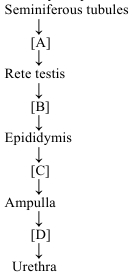
Pathway of sperm: Find out '$A$','$B$','$C$',and '$D$' respectively in the given flow chart:-
A
$A \rightarrow$ Vasa efferentia,$B \rightarrow$ Vas deferens,$C \rightarrow$ Ejaculatory duct,$D \rightarrow$ Penis
B
$A \rightarrow$ Tubuli recti,$B \rightarrow$ Vasa efferentia,$C \rightarrow$ Vas deferens,$D \rightarrow$ Penis
C
$A \rightarrow$ Tubuli recti,$B \rightarrow$ Vas deferens,$C \rightarrow$ Vasa efferentia,$D \rightarrow$ Ejaculatory duct
D
$A \rightarrow$ Tubuli recti,$B \rightarrow$ Vasa efferentia,$C \rightarrow$ Vas deferens,$D \rightarrow$ Ejaculatory duct
Solution
(D) The correct pathway of sperm transport in the male reproductive system is as follows:
$1$. Seminiferous tubules produce sperm.
$2$. Sperm move into the Tubuli recti $(A)$.
$3$. From there,they enter the Rete testis.
$4$. Then,they pass through the Vasa efferentia $(B)$.
$5$. They are stored and matured in the Epididymis.
$6$. Sperm then travel through the Vas deferens $(C)$.
$7$. The Vas deferens joins with the duct of the seminal vesicle to form the Ejaculatory duct $(D)$.
$8$. Finally,the sperm enter the Urethra.
Therefore,the correct sequence is $A \rightarrow$ Tubuli recti,$B \rightarrow$ Vasa efferentia,$C \rightarrow$ Vas deferens,$D \rightarrow$ Ejaculatory duct.
$1$. Seminiferous tubules produce sperm.
$2$. Sperm move into the Tubuli recti $(A)$.
$3$. From there,they enter the Rete testis.
$4$. Then,they pass through the Vasa efferentia $(B)$.
$5$. They are stored and matured in the Epididymis.
$6$. Sperm then travel through the Vas deferens $(C)$.
$7$. The Vas deferens joins with the duct of the seminal vesicle to form the Ejaculatory duct $(D)$.
$8$. Finally,the sperm enter the Urethra.
Therefore,the correct sequence is $A \rightarrow$ Tubuli recti,$B \rightarrow$ Vasa efferentia,$C \rightarrow$ Vas deferens,$D \rightarrow$ Ejaculatory duct.
0 likes
View Solution287
EasyMCQ
Measurements of the testis are $:-$
A
$4-5 \ cm$ length $\& \ 2-3 \ cm$ width
B
$2-4 \ cm$ length $\& \ 10-12 \ cm$ width
C
$2-4 \ cm$ length $\& \ 4-5 \ cm$ width
D
$10-12 \ cm$ length $\& \ 2-4 \ cm$ width
Solution
(A) The testes are oval-shaped organs located outside the abdominal cavity within a pouch called the scrotum.
Each testis has a length of approximately $4-5 \ cm$ and a width of approximately $2-3 \ cm$.
The scrotum helps in maintaining the low temperature of the testes ($2-2.5^{\circ}C$ lower than the normal internal body temperature),which is necessary for spermatogenesis.
Each testis has a length of approximately $4-5 \ cm$ and a width of approximately $2-3 \ cm$.
The scrotum helps in maintaining the low temperature of the testes ($2-2.5^{\circ}C$ lower than the normal internal body temperature),which is necessary for spermatogenesis.
0 likes
View Solution288
MediumMCQ
In the given statements,choose the incorrect one.
A
Spermatogonia are immature male germ cells.
B
Testis is covered by a dense covering.
C
Each testis has about $250$ compartments called rete testis.
D
Germ cells receive nutrition from Sertoli cells.
Solution
(C) The correct answer is $C$.
In the human male reproductive system,each testis is divided into about $250$ compartments known as testicular lobules.
The rete testis is a network of tubules located within the testis that receives sperm from the seminiferous tubules,not the compartments themselves.
Therefore,the statement that each testis has about $250$ compartments called rete testis is incorrect.
In the human male reproductive system,each testis is divided into about $250$ compartments known as testicular lobules.
The rete testis is a network of tubules located within the testis that receives sperm from the seminiferous tubules,not the compartments themselves.
Therefore,the statement that each testis has about $250$ compartments called rete testis is incorrect.
0 likes
View Solution289
MediumMCQ
The unpaired male accessory gland$(s)$ include:-
A
Seminal Vesicle
B
Prostate gland
C
Bulbourethral gland
D
All of the above
Solution
(B) The male accessory glands include paired seminal vesicles,a single prostate gland,and paired bulbourethral glands.
Seminal vesicles are paired structures.
Bulbourethral glands (also known as Cowper's glands) are also paired.
The prostate gland is a single,unpaired gland that surrounds the urethra.
Therefore,the correct answer is the prostate gland.
Seminal vesicles are paired structures.
Bulbourethral glands (also known as Cowper's glands) are also paired.
The prostate gland is a single,unpaired gland that surrounds the urethra.
Therefore,the correct answer is the prostate gland.
0 likes
View Solution290
MediumMCQ
Given below are two statements:
Statement-$I$: The scrotum helps in maintaining the low temperature of the testes.
Statement-$II$: Low temperature,compared to the normal internal body temperature,is necessary for spermatogenesis.
In the light of the above statements,choose the most appropriate answer from the options given below.
Statement-$I$: The scrotum helps in maintaining the low temperature of the testes.
Statement-$II$: Low temperature,compared to the normal internal body temperature,is necessary for spermatogenesis.
In the light of the above statements,choose the most appropriate answer from the options given below.
A
Both Statement-$I$ and Statement-$II$ are incorrect.
B
Statement-$I$ is incorrect but Statement-$II$ is correct.
C
Statement-$I$ is correct but Statement-$II$ is incorrect.
D
Both Statement-$I$ and Statement-$II$ are correct.
Solution
(D) Statement-$I$ is correct because the scrotum is a pouch of skin that holds the testes outside the abdominal cavity,which helps in maintaining the temperature of the testes $2-2.5^{\circ}C$ lower than the normal internal body temperature.
Statement-$II$ is also correct because this lower temperature is essential for spermatogenesis,the process of sperm production.
Therefore,both statements are correct.
Statement-$II$ is also correct because this lower temperature is essential for spermatogenesis,the process of sperm production.
Therefore,both statements are correct.
0 likes
View Solution291
MediumMCQ
If for some reason,the $vasa$ $efferentia$ in the human reproductive system get blocked,the gametes will not be transported from
A
epididymis to vas deferens
B
ovary to uterus
C
vagina to uterus
D
testes to epididymis
Solution
(D) In the human male reproductive system,the $vasa$ $efferentia$ are ductules that lead from the $rete$ $testis$ to the $epididymis$.
They are responsible for transporting sperm from the $testes$ to the $epididymis$ for maturation and storage.
If the $vasa$ $efferentia$ are blocked,the transport of sperm from the $testes$ to the $epididymis$ will be obstructed.
They are responsible for transporting sperm from the $testes$ to the $epididymis$ for maturation and storage.
If the $vasa$ $efferentia$ are blocked,the transport of sperm from the $testes$ to the $epididymis$ will be obstructed.
0 likes
View Solution292
MediumMCQ
Which of the following statements is correct regarding the histology of the seminiferous tubule?
A
The region inside the seminiferous tubule has Leydig cells.
B
About $250$ seminiferous tubules are present in each testicular lobule.
C
The seminiferous tubule on its inside is lined by spermatogonia.
D
Leydig cells and Sertoli cells are found in the interstitial space.
Solution
(C) The seminiferous tubules are the structural and functional units of the testes.
Each seminiferous tubule is lined on its inside by two types of cells: male germ cells (spermatogonia) and Sertoli cells.
Spermatogonia undergo meiotic divisions to produce sperm,while Sertoli cells provide nutrition to the germ cells.
Leydig cells (interstitial cells) are located in the interstitial spaces outside the seminiferous tubules,not inside them.
Each testis contains about $250$ testicular lobules,and each lobule contains $1$ to $3$ highly coiled seminiferous tubules,not $250$ tubules per lobule.
Each seminiferous tubule is lined on its inside by two types of cells: male germ cells (spermatogonia) and Sertoli cells.
Spermatogonia undergo meiotic divisions to produce sperm,while Sertoli cells provide nutrition to the germ cells.
Leydig cells (interstitial cells) are located in the interstitial spaces outside the seminiferous tubules,not inside them.
Each testis contains about $250$ testicular lobules,and each lobule contains $1$ to $3$ highly coiled seminiferous tubules,not $250$ tubules per lobule.
0 likes
View Solution293
MediumMCQ
Assertion $(A) :-$ Sperm production occurs in the seminiferous tubules.
Reason $(R) :-$ The seminiferous tubules are lined on their inside by spermatogonia and Sertoli cells.
Reason $(R) :-$ The seminiferous tubules are lined on their inside by spermatogonia and Sertoli cells.
A
Both $A$ and $R$ are true but $R$ is not the correct explanation of $A$
B
$A$ is true but $R$ is false
C
Both $A$ and $R$ are true and $R$ is the correct explanation of $A$
D
Both $A$ and $R$ are false
Solution
(C) The process of spermatogenesis (sperm production) takes place within the seminiferous tubules of the testes.
Inside each seminiferous tubule,the germinal epithelium is composed of two types of cells: spermatogonia (male germ cells) and Sertoli cells (nurse cells).
Spermatogonia undergo meiotic divisions to produce spermatozoa,while Sertoli cells provide nutrition to the developing germ cells.
Since the presence of these specific cells is the structural basis for sperm production,the reason correctly explains the assertion.
Inside each seminiferous tubule,the germinal epithelium is composed of two types of cells: spermatogonia (male germ cells) and Sertoli cells (nurse cells).
Spermatogonia undergo meiotic divisions to produce spermatozoa,while Sertoli cells provide nutrition to the developing germ cells.
Since the presence of these specific cells is the structural basis for sperm production,the reason correctly explains the assertion.
0 likes
View Solution294
MediumMCQ
$A$ sperm cell moving from the lumen of the seminiferous tubule to the exterior of the body passes through all the following structures except:
A
Seminal vesicle
B
Epididymis
C
Ductus deferens
D
Urethra
Solution
(A) The pathway of sperm transport from the seminiferous tubules to the exterior is as follows:
$1$. Seminiferous tubules
$2$. Rete testis
$3$. Vasa efferentia
$4$. Epididymis
$5$. Vas deferens (Ductus deferens)
$6$. Ejaculatory duct
$7$. Urethra
$8$. Urethral meatus
While the seminal vesicle contributes fluid to the semen,the sperm cells themselves do not pass through the lumen of the seminal vesicle. Therefore,the seminal vesicle is the correct answer.
$1$. Seminiferous tubules
$2$. Rete testis
$3$. Vasa efferentia
$4$. Epididymis
$5$. Vas deferens (Ductus deferens)
$6$. Ejaculatory duct
$7$. Urethra
$8$. Urethral meatus
While the seminal vesicle contributes fluid to the semen,the sperm cells themselves do not pass through the lumen of the seminal vesicle. Therefore,the seminal vesicle is the correct answer.
0 likes
View Solution295
EasyMCQ
Match the structures/parts of the human male reproductive system in Column $I$ with their respective explanation in Column $II$ and select the correct answer from the given options.
| Column $I$ | Column $II$ |
| $i$. Prepuce | $a$. Fibromuscular band that retains testis in scrotum. |
| $ii$. Penis | $b$. Primary male reproductive gonad. |
| $iii$. Testis | $c$. Loose fold of skin covering glans penis. |
| $iv$. Gubernaculum | $d$. Male copulatory organ. |
A
$i-c, ii-d, iii-b, iv-a$
B
$i-a, ii-b, iii-d, iv-c$
C
$i-b, ii-a, iii-d, iv-c$
D
$i-c, ii-d, iii-a, iv-b$
Solution
(A) The correct matching is as follows:
$i$. Prepuce: It is a loose fold of skin that covers the glans penis $(c)$.
$ii$. Penis: It is the male copulatory organ $(d)$.
$iii$. Testis: It is the primary male reproductive gonad responsible for producing sperm and hormones $(b)$.
$iv$. Gubernaculum: It is a fibromuscular band that helps in the descent and retention of the testis in the scrotum $(a)$.
Therefore,the correct sequence is $i-c, ii-d, iii-b, iv-a$.
$i$. Prepuce: It is a loose fold of skin that covers the glans penis $(c)$.
$ii$. Penis: It is the male copulatory organ $(d)$.
$iii$. Testis: It is the primary male reproductive gonad responsible for producing sperm and hormones $(b)$.
$iv$. Gubernaculum: It is a fibromuscular band that helps in the descent and retention of the testis in the scrotum $(a)$.
Therefore,the correct sequence is $i-c, ii-d, iii-b, iv-a$.
0 likes
View Solution296
EasyMCQ
Semen produced by the human male reproductive system contains the following components $EXCEPT$ . . . . . . .
A
prostaglandins
B
calcium and bicarbonates
C
fructose
D
fertilizin proteins
Solution
(D) Semen is composed of secretions from the seminal vesicles,prostate gland,and bulbourethral glands.
These secretions contain fructose (an energy source for sperm),prostaglandins (which stimulate uterine contractions),and calcium and bicarbonates (which help neutralize the acidic environment of the female reproductive tract).
Fertilizin is a glycoprotein present on the surface of the egg (ovum),not in the semen.
It acts as a receptor for sperm-binding proteins (antifertilizin) during the process of fertilization.
These secretions contain fructose (an energy source for sperm),prostaglandins (which stimulate uterine contractions),and calcium and bicarbonates (which help neutralize the acidic environment of the female reproductive tract).
Fertilizin is a glycoprotein present on the surface of the egg (ovum),not in the semen.
It acts as a receptor for sperm-binding proteins (antifertilizin) during the process of fertilization.
0 likes
View Solution297
EasyMCQ
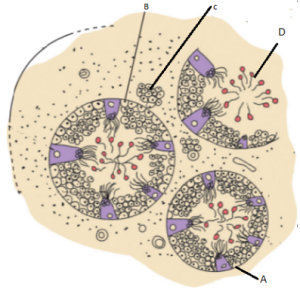
Given below is a diagram of the $T.S.$ of a testis. Select the option which gives the correct identification of the function of cells labeled $A, B, C,$ and $D$ from the options given below.
$A$ - cells undergo spermatogenesis to produce spermatozoa.
$B$ - cell responsible for the development of male secondary sexual characters.
$C$ - heads of sperms remain attached to these cells.
$D$ - haploid male gamete.
$A$ - cells undergo spermatogenesis to produce spermatozoa.
$B$ - cell responsible for the development of male secondary sexual characters.
$C$ - heads of sperms remain attached to these cells.
$D$ - haploid male gamete.
A
$D$ only
B
$A$ and $B$ only
C
$C$ and $D$ only
D
$A$ and $D$ only
Solution
(D) Based on the diagram of the $T.S.$ of the testis:
$A$ represents the Germinal epithelium (spermatogonia),which undergoes spermatogenesis to produce spermatozoa.
$B$ represents the Sertoli cells,which provide nutrition to the developing sperms.
$C$ represents the Interstitial cells (Leydig cells),which are responsible for the production of testosterone,the hormone responsible for the development of male secondary sexual characters.
$D$ represents the spermatozoa,which are haploid male gametes.
Evaluating the given statements:
- Statement $A$: Correct,as germinal epithelium cells undergo spermatogenesis.
- Statement $B$: Incorrect,as Sertoli cells provide nutrition,while Leydig cells $(C)$ produce testosterone.
- Statement $C$: Incorrect,as sperms are attached to Sertoli cells $(B)$,not Leydig cells $(C)$.
- Statement $D$: Correct,as $D$ represents the haploid male gamete (spermatozoa).
Therefore,statements $A$ and $D$ are correct.
$A$ represents the Germinal epithelium (spermatogonia),which undergoes spermatogenesis to produce spermatozoa.
$B$ represents the Sertoli cells,which provide nutrition to the developing sperms.
$C$ represents the Interstitial cells (Leydig cells),which are responsible for the production of testosterone,the hormone responsible for the development of male secondary sexual characters.
$D$ represents the spermatozoa,which are haploid male gametes.
Evaluating the given statements:
- Statement $A$: Correct,as germinal epithelium cells undergo spermatogenesis.
- Statement $B$: Incorrect,as Sertoli cells provide nutrition,while Leydig cells $(C)$ produce testosterone.
- Statement $C$: Incorrect,as sperms are attached to Sertoli cells $(B)$,not Leydig cells $(C)$.
- Statement $D$: Correct,as $D$ represents the haploid male gamete (spermatozoa).
Therefore,statements $A$ and $D$ are correct.
0 likes
View Solution298
EasyMCQ
Select the mismatch pair, with respect to the Human Male Reproductive system.
A
Scrotum - pouch containing testes
B
Inguinal canal - passage through which testes descend
C
Sustentacular cells - small cuboidal cells lining urinogenital duct
D
Interstitial cells - secrete androgen
Solution
(C) The correct answer is $C$. Sustentacular cells, also known as $Sertoli$ cells, are large, pyramidal-shaped cells found within the seminiferous tubules of the testes. They provide nourishment to developing spermatozoa. They are not small cuboidal cells lining the urinogenital duct. The other options are correctly matched: $Scrotum$ is the pouch containing the testes, the $Inguinal$ $canal$ is the passage through which testes descend into the scrotum, and $Interstitial$ cells ($Leydig$ cells) are responsible for the secretion of androgens.
0 likes
View Solution299
EasyMCQ
Which one of the following acts as a urinogenital organ in human males?
A
Urethra
B
Epididymis
C
Ureter
D
Urinary bladder
Solution
(A) In human males, the $Urethra$ serves as a common pathway for both urine and semen.
It originates from the urinary bladder and extends through the penis to its external opening called the urethral meatus.
Because it transports both urine (from the urinary system) and semen (from the reproductive system), it is referred to as the urinogenital organ.
$Epididymis$ is involved in sperm maturation, $Ureter$ carries urine from the kidney to the bladder, and the $Urinary bladder$ stores urine.
It originates from the urinary bladder and extends through the penis to its external opening called the urethral meatus.
Because it transports both urine (from the urinary system) and semen (from the reproductive system), it is referred to as the urinogenital organ.
$Epididymis$ is involved in sperm maturation, $Ureter$ carries urine from the kidney to the bladder, and the $Urinary bladder$ stores urine.
0 likes
View Solution300
EasyMCQ
Given below are two statements with respect to the prostate gland in males.
$Statement-I$: These are large paired glands, located underneath the urinary bladder.
$Statement-II$: Milky white, slightly acidic prostatic fluid is secreted into the urethra.
Choose the most appropriate answer from the options given below.
$Statement-I$: These are large paired glands, located underneath the urinary bladder.
$Statement-II$: Milky white, slightly acidic prostatic fluid is secreted into the urethra.
Choose the most appropriate answer from the options given below.
A
Both $Statement-I$ and $Statement-II$ are incorrect.
B
$Statement-I$ is incorrect but $Statement-II$ is correct.
C
Both $Statement-I$ and $Statement-II$ are correct.
D
$Statement-I$ is correct but $Statement-II$ is incorrect.
Solution
(B) $Statement-I$ is incorrect because the prostate gland is a large single gland, not a paired gland. It is located underneath the urinary bladder.
$Statement-II$ is correct because the prostate gland secretes a milky white, slightly acidic fluid into the urethra, which contributes to the formation of semen.
$Statement-II$ is correct because the prostate gland secretes a milky white, slightly acidic fluid into the urethra, which contributes to the formation of semen.
0 likes
View SolutionHuman Reproduction — Male reproductive system · Frequently Asked Questions
1Are these Human Reproduction questions useful for JEE and NEET?
Yes. All questions in this section are mapped to JEE Main and NEET exam patterns. Previous year questions from JEE Main, NEET, GUJCET and state-level exams are included with full solutions.
2Can I switch to Hindi or Gujarati for these questions?
Yes. Use the language tabs in the hero section or the sidebar to view the same questions and solutions in English, Hindi or Gujarati.
3How do I generate a question paper from this subtopic?
Use the Vedclass Exam Paper Generator — select the chapter and subtopic, set difficulty, and generate Sets A, B, C, D automatically. First 3 chapters of every subject are free.
Vedclass Products
For Students
Vedclass Test Series
Mock tests in real JEE/NEET style with performance analysis. 5-day free trial.
Start Free TrialFor Teachers
Exam Paper Generator
Generate Set A/B/C/D papers from this chapter in 2 minutes. 3 chapters free.
Try FreeFor Institutes
Online Exam Module
Live online exams with unlimited students, 360° analytics & white-label branding.
See DemoFor Teachers & Institutes
Generate a Human Reproduction Exam Paper in 2 Minutes
Select subtopic & difficulty — Sets A, B, C, D auto-generated with No Repeat logic.
First 3 chapters of every subject are free — no payment required.