
A English
Immunity Questions in English
Class 12 Biology · Human Health and Disease · Immunity
636+
Questions
English
Language
100%
With Solutions
Showing 47 of 636 questions in English
351
EasyMCQ
Which of the following is not included in secondary lymphoid organs?
A
Lymph node
B
Spleen
C
Tonsils
D
Thymus
Solution
(D) Lymphoid organs are the sites where origin and/or maturation and proliferation of lymphocytes occur.
Primary lymphoid organs include the bone marrow and thymus,where immature lymphocytes differentiate into antigen-sensitive lymphocytes.
Secondary lymphoid organs provide the sites for interaction of lymphocytes with the antigen,which then proliferate to become effector cells.
Examples of secondary lymphoid organs include the spleen,lymph nodes,tonsils,Peyer's patches of the small intestine,and the appendix.
Since the thymus is a primary lymphoid organ,it is not included in the secondary lymphoid organs.
Primary lymphoid organs include the bone marrow and thymus,where immature lymphocytes differentiate into antigen-sensitive lymphocytes.
Secondary lymphoid organs provide the sites for interaction of lymphocytes with the antigen,which then proliferate to become effector cells.
Examples of secondary lymphoid organs include the spleen,lymph nodes,tonsils,Peyer's patches of the small intestine,and the appendix.
Since the thymus is a primary lymphoid organ,it is not included in the secondary lymphoid organs.
0 likes
View Solution352
EasyMCQ
Which cells are responsible for the production of antibodies?
A
$B$-lymphocytes
B
$T$-lymphocytes
C
Leucocytes
D
Erythrocytes
Solution
(A) Antibodies are specialized proteins produced by the immune system to identify and neutralize foreign objects like bacteria and viruses.
In the human body,$B$-lymphocytes (or $B$-cells) are the specific type of white blood cells responsible for the production of antibodies.
When $B$-cells encounter an antigen,they differentiate into plasma cells,which then secrete large quantities of antibodies into the blood and lymph.
$T$-lymphocytes are involved in cell-mediated immunity but do not produce antibodies directly.
Leucocytes is a general term for all white blood cells,and Erythrocytes are red blood cells,which do not produce antibodies.
In the human body,$B$-lymphocytes (or $B$-cells) are the specific type of white blood cells responsible for the production of antibodies.
When $B$-cells encounter an antigen,they differentiate into plasma cells,which then secrete large quantities of antibodies into the blood and lymph.
$T$-lymphocytes are involved in cell-mediated immunity but do not produce antibodies directly.
Leucocytes is a general term for all white blood cells,and Erythrocytes are red blood cells,which do not produce antibodies.
0 likes
View Solution353
EasyMCQ
In our society,....... is an auto-immune disease.
A
Typhoid
B
Rheumatoid arthritis
C
Malaria
D
Common cold
Solution
(B) An auto-immune disease occurs when the body's immune system fails to distinguish between 'self' and 'non-self' cells,leading to the destruction of healthy body tissues.
Rheumatoid arthritis is a classic example of an auto-immune disease where the immune system attacks the joints.
Typhoid and Malaria are infectious diseases caused by pathogens (Salmonella typhi and Plasmodium,respectively).
The Common cold is a viral infection caused by rhinoviruses.
Therefore,the correct option is $B$.
Rheumatoid arthritis is a classic example of an auto-immune disease where the immune system attacks the joints.
Typhoid and Malaria are infectious diseases caused by pathogens (Salmonella typhi and Plasmodium,respectively).
The Common cold is a viral infection caused by rhinoviruses.
Therefore,the correct option is $B$.
0 likes
View Solution354
MediumMCQ
$A$ - The vaccines generate memory $B$ and $T$ cells. $R$ - In vaccination,activated pathogens are introduced into the body.
A
$A$ and $R$ both are correct.
B
$A$ and $R$ both are incorrect.
C
$A$ is correct,$R$ is incorrect.
D
$A$ is incorrect,$R$ is correct.
Solution
(C) Assertion $(A)$ is correct: Vaccines work on the principle of memory of the immune system. They induce the production of antibodies and generate memory $B$ and $T$ cells that recognize the pathogen upon subsequent exposure.
Reason $(R)$ is incorrect: In vaccination,either weakened (attenuated) or inactivated (dead) pathogens,or antigenic proteins of the pathogen,are introduced into the body,not 'activated' pathogens. Introducing activated (virulent) pathogens would cause the disease.
Reason $(R)$ is incorrect: In vaccination,either weakened (attenuated) or inactivated (dead) pathogens,or antigenic proteins of the pathogen,are introduced into the body,not 'activated' pathogens. Introducing activated (virulent) pathogens would cause the disease.
0 likes
View Solution355
EasyMCQ
Interferons are ...........
A
Antiviral proteins
B
Antibacterial proteins
C
Anticancer proteins
D
Complex proteins
Solution
(A) Interferons $(IFNs)$ are a group of signaling proteins made and released by host cells in response to the presence of several viruses.
They are a type of cytokine that acts as an innate immune response.
When a cell is infected by a virus,it secretes interferons,which signal neighboring cells to heighten their antiviral defenses,thereby preventing the spread of the viral infection.
Therefore,they are classified as antiviral proteins.
They are a type of cytokine that acts as an innate immune response.
When a cell is infected by a virus,it secretes interferons,which signal neighboring cells to heighten their antiviral defenses,thereby preventing the spread of the viral infection.
Therefore,they are classified as antiviral proteins.
0 likes
View Solution356
EasyMCQ
Small proteins produced by vertebrate cells in response to viral infection,which inhibit further viral multiplication,are known as.............
A
Immunoglobulins
B
Interferons
C
Antitoxins
D
Lipoproteins
Solution
(B) Interferons are a group of signaling proteins made and released by host cells in response to the presence of several viruses.
They act as a type of cytokine.
When a cell is infected by a virus,it secretes interferons,which signal neighboring cells to heighten their antiviral defenses,thereby inhibiting further viral multiplication.
Thus,they provide innate immunity against viral infections.
They act as a type of cytokine.
When a cell is infected by a virus,it secretes interferons,which signal neighboring cells to heighten their antiviral defenses,thereby inhibiting further viral multiplication.
Thus,they provide innate immunity against viral infections.
0 likes
View Solution357
MediumMCQ
Antibodies are ........
A
Germs
B
Carbohydrates
C
Proteins
D
Lipids
Solution
(C) Antibodies,also known as immunoglobulins,are specialized $Y$-shaped proteins produced by the immune system in response to the presence of antigens (foreign substances like bacteria or viruses).
These proteins recognize and bind to specific antigens to neutralize them or mark them for destruction by other immune cells.
Therefore,antibodies are classified as proteins.
These proteins recognize and bind to specific antigens to neutralize them or mark them for destruction by other immune cells.
Therefore,antibodies are classified as proteins.
0 likes
View Solution358
EasyMCQ
Antibodies in our body are complex of ........
A
Lipoproteins
B
Steroids
C
Prostaglandins
D
Glycoproteins
Solution
(D) Antibodies,also known as immunoglobulins $(Ig)$,are specialized proteins produced by the immune system to identify and neutralize foreign objects like bacteria and viruses.
Structurally,antibodies are $Y$-shaped molecules composed of four polypeptide chains: two heavy chains and two light chains.
These polypeptide chains are covalently linked to carbohydrate moieties,making them glycoproteins.
Therefore,the correct answer is $D$.
Structurally,antibodies are $Y$-shaped molecules composed of four polypeptide chains: two heavy chains and two light chains.
These polypeptide chains are covalently linked to carbohydrate moieties,making them glycoproteins.
Therefore,the correct answer is $D$.
0 likes
View Solution359
MediumMCQ
Which cells are involved in the immune response?
A
Red blood cells
B
Lymphocytes
C
Acidophils
D
Platelets
Solution
(B) The immune system is primarily composed of specialized cells that recognize and eliminate pathogens.
Lymphocytes are the key cells of the immune system.
They are a type of white blood cell $(WBC)$ that includes $B$-lymphocytes and $T$-lymphocytes.
$B$-lymphocytes produce antibodies to fight pathogens,while $T$-lymphocytes help activate other immune cells and directly destroy infected cells.
Therefore,the correct option is $B$.
Lymphocytes are the key cells of the immune system.
They are a type of white blood cell $(WBC)$ that includes $B$-lymphocytes and $T$-lymphocytes.
$B$-lymphocytes produce antibodies to fight pathogens,while $T$-lymphocytes help activate other immune cells and directly destroy infected cells.
Therefore,the correct option is $B$.
0 likes
View Solution360
EasyMCQ
Who discovered passive immunity?
A
Edward Jenner
B
Emil von Behring
C
Robert Koch
D
Louis Pasteur
Solution
(B) Passive immunity was discovered by $Emil \text{ } von \text{ } Behring$ and $Shibasaburo \text{ } Kitasato$ in $1890$. They demonstrated that immunity could be transferred from an immunized animal to a non-immunized one through the serum, which contained antibodies. $Emil \text{ } von \text{ } Behring$ was awarded the first Nobel Prize in Physiology or Medicine in $1901$ for his work on serum therapy, particularly its application against diphtheria.
0 likes
View Solution361
EasyMCQ
Interferons are synthesized in response to which of the following?
A
Mycoplasma
B
Bacteria
C
Viruses
D
Fungi
Solution
(C) Interferons $(IFNs)$ are a group of signaling proteins made and released by host cells in response to the presence of several pathogens,such as viruses,bacteria,parasites,or tumor cells.
However,they are most characteristically known for being produced by virus-infected cells to protect non-infected neighboring cells from further viral infection.
Therefore,among the given options,the synthesis of interferons is primarily associated with the response to viral infections.
However,they are most characteristically known for being produced by virus-infected cells to protect non-infected neighboring cells from further viral infection.
Therefore,among the given options,the synthesis of interferons is primarily associated with the response to viral infections.
0 likes
View Solution362
MediumMCQ
Which of the following is true regarding $T$-lymphocytes in mammals?
A
They clean up injured cells and cellular debris.
B
They originate in the thyroid.
C
They have three main types: cytotoxic $T$-cells,helper $T$-cells,and suppressor $T$-cells.
D
They originate from lymphoid tissues.
Solution
(C) $T$-lymphocytes are a type of white blood cell that plays a central role in cell-mediated immunity.
They originate in the bone marrow and mature in the thymus gland.
There are three main functional types of $T$-lymphocytes:
$1$. Helper $T$-cells $(T_h)$: These activate other immune cells.
$2$. Cytotoxic $T$-cells $(T_c)$: These directly kill infected or cancerous cells.
$3$. Suppressor $T$-cells $(T_s)$: These regulate the immune response and prevent autoimmunity by suppressing the activity of other immune cells.
Therefore,option $C$ is the correct statement.
They originate in the bone marrow and mature in the thymus gland.
There are three main functional types of $T$-lymphocytes:
$1$. Helper $T$-cells $(T_h)$: These activate other immune cells.
$2$. Cytotoxic $T$-cells $(T_c)$: These directly kill infected or cancerous cells.
$3$. Suppressor $T$-cells $(T_s)$: These regulate the immune response and prevent autoimmunity by suppressing the activity of other immune cells.
Therefore,option $C$ is the correct statement.
0 likes
View Solution363
EasyMCQ
Which type of barrier includes the various barriers of innate immunity such as saliva in the mouth and tears from the eyes?
A
Cytokine barrier
B
Cellular barrier
C
Physiological barrier
D
Physical barrier
Solution
(C) Innate immunity consists of four types of barriers:
$1$. Physical barriers: Skin and mucus coating of the respiratory,gastrointestinal,and urogenital tracts.
$2$. Physiological barriers: Acid in the stomach,saliva in the mouth,and tears from the eyes prevent microbial growth.
$3$. Cellular barriers: Polymorphonuclear leukocytes ($PMNL$-neutrophils),monocytes,and natural killer cells in the blood,as well as macrophages in tissues.
$4$. Cytokine barriers: Virus-infected cells secrete proteins called interferons which protect non-infected cells from further viral infection.
Therefore,saliva and tears are classified as physiological barriers.
$1$. Physical barriers: Skin and mucus coating of the respiratory,gastrointestinal,and urogenital tracts.
$2$. Physiological barriers: Acid in the stomach,saliva in the mouth,and tears from the eyes prevent microbial growth.
$3$. Cellular barriers: Polymorphonuclear leukocytes ($PMNL$-neutrophils),monocytes,and natural killer cells in the blood,as well as macrophages in tissues.
$4$. Cytokine barriers: Virus-infected cells secrete proteins called interferons which protect non-infected cells from further viral infection.
Therefore,saliva and tears are classified as physiological barriers.
0 likes
View Solution364
EasyMCQ
What does $T$ stand for in $T$-lymphocytes?
A
Thalamus
B
Tonsils
C
Thymus
D
Thyroid
Solution
(C) In the immune system,$T$-lymphocytes are a type of white blood cell that plays a central role in cell-mediated immunity. The letter '$T$' in '$T$-lymphocytes' stands for 'Thymus'. This is because these cells originate from stem cells in the bone marrow and then migrate to the thymus gland,where they mature and differentiate into functional $T$-cells.
0 likes
View Solution365
MediumMCQ
Which of the following can be used to provide immunity to a person who is at risk of developing tetanus?
A
Preformed antibodies
B
More effective antibiotics
C
Attenuated pathogens
D
Killed pathogens
Solution
(A) Tetanus is caused by the bacterium $Clostridium$ $tetani$,which produces a potent toxin. When a person is at risk of developing tetanus (e.g.,after a deep wound),they require immediate protection. This is achieved through passive immunization by administering preformed antibodies (antitoxins). This provides immediate immunity,which is crucial because the body does not have enough time to produce its own antibodies through active immunization.
0 likes
View Solution366
MediumMCQ
Consider the following four statements $(i-iv)$ regarding kidney transplantation and select the two correct ones.
$(i)$ Even if a kidney transplant is successful,the recipient needs to take immunosuppressants for a long time.
$(ii)$ Cell-mediated immune response is responsible for the rejection of the graft.
$(iii)$ $B$-lymphocytes are responsible for the rejection of the graft.
$(iv)$ The acceptance or rejection of a transplanted kidney depends on specific interferons.
$(i)$ Even if a kidney transplant is successful,the recipient needs to take immunosuppressants for a long time.
$(ii)$ Cell-mediated immune response is responsible for the rejection of the graft.
$(iii)$ $B$-lymphocytes are responsible for the rejection of the graft.
$(iv)$ The acceptance or rejection of a transplanted kidney depends on specific interferons.
A
$(i)$ and $(ii)$
B
$(ii)$ and $(iii)$
C
$(iii)$ and $(iv)$
D
$(i)$ and $(iii)$
Solution
(A) Statement $(i)$ is correct: The body's immune system recognizes the transplanted organ as 'non-self' or foreign,so the recipient must take immunosuppressants for life to prevent rejection.
Statement $(ii)$ is correct: The cell-mediated immune response,primarily driven by $T$-lymphocytes,is the main mechanism responsible for the rejection of transplanted organs (graft rejection).
Statement $(iii)$ is incorrect: $T$-lymphocytes,not $B$-lymphocytes,are responsible for graft rejection.
Statement $(iv)$ is incorrect: Graft rejection is based on the recognition of self vs. non-self antigens ($MHC$ molecules),not on interferons.
Therefore,statements $(i)$ and $(ii)$ are correct.
Statement $(ii)$ is correct: The cell-mediated immune response,primarily driven by $T$-lymphocytes,is the main mechanism responsible for the rejection of transplanted organs (graft rejection).
Statement $(iii)$ is incorrect: $T$-lymphocytes,not $B$-lymphocytes,are responsible for graft rejection.
Statement $(iv)$ is incorrect: Graft rejection is based on the recognition of self vs. non-self antigens ($MHC$ molecules),not on interferons.
Therefore,statements $(i)$ and $(ii)$ are correct.
0 likes
View Solution367
MediumMCQ
Which of the following statements is correct regarding immunity?
A
Injection of preformed antibodies is required for the treatment of viper snake bites.
B
$T$-lymphocytes produce antibodies against smallpox pathogens.
C
Antibodies are protein molecules consisting of four light chains.
D
Rejection of a transplanted kidney is the function of $B$-lymphocytes.
Solution
(A) The correct answer is $A$.
$1$. In the treatment of viper snake bites,'passive immunity' is utilized,where preformed antibodies (antivenom) are injected directly into the patient's body.
$2$. $T$-lymphocytes do not produce antibodies themselves; instead,they assist $B$-lymphocytes in the immune response.
$3$. An antibody molecule consists of two light chains and two heavy chains,not four light chains.
$4$. The rejection of a transplanted organ (graft rejection) is primarily mediated by cell-mediated immunity,which is governed by $T$-lymphocytes,not $B$-lymphocytes.
$1$. In the treatment of viper snake bites,'passive immunity' is utilized,where preformed antibodies (antivenom) are injected directly into the patient's body.
$2$. $T$-lymphocytes do not produce antibodies themselves; instead,they assist $B$-lymphocytes in the immune response.
$3$. An antibody molecule consists of two light chains and two heavy chains,not four light chains.
$4$. The rejection of a transplanted organ (graft rejection) is primarily mediated by cell-mediated immunity,which is governed by $T$-lymphocytes,not $B$-lymphocytes.
0 likes
View Solution368
MediumMCQ
Select the option that correctly matches the example with its specific type of immunity barrier.
A
Polymorphonuclear leukocytes $(PMNL)$ and monocytes - Cellular barrier
B
Anti-tetanus and anti-snake venom injections - Active immunity
C
Saliva in the mouth and tears in the eyes - Physical barrier
D
Mucus coating of the urogenital tract and $HCl$ in the stomach - Physiological barrier
Solution
(A) The human body has innate immunity consisting of four types of barriers:
$1$. Physical barriers: Skin and mucus coating of the respiratory,gastrointestinal,and urogenital tracts.
$2$. Physiological barriers: Acid in the stomach,saliva in the mouth,and tears from eyes.
$3$. Cellular barriers: Polymorphonuclear leukocytes ($PMNL$-neutrophils),monocytes,and natural killer cells.
$4$. Cytokine barriers: Virus-infected cells secrete proteins called interferons which protect non-infected cells.
Option $A$ is correct because $PMNL$ and monocytes are examples of cellular barriers.
Option $B$ is incorrect because these are examples of passive immunity (pre-formed antibodies).
Option $C$ is incorrect because saliva and tears are physiological barriers,not physical.
Option $D$ is incorrect because mucus coating is a physical barrier,while $HCl$ is a physiological barrier.
$1$. Physical barriers: Skin and mucus coating of the respiratory,gastrointestinal,and urogenital tracts.
$2$. Physiological barriers: Acid in the stomach,saliva in the mouth,and tears from eyes.
$3$. Cellular barriers: Polymorphonuclear leukocytes ($PMNL$-neutrophils),monocytes,and natural killer cells.
$4$. Cytokine barriers: Virus-infected cells secrete proteins called interferons which protect non-infected cells.
Option $A$ is correct because $PMNL$ and monocytes are examples of cellular barriers.
Option $B$ is incorrect because these are examples of passive immunity (pre-formed antibodies).
Option $C$ is incorrect because saliva and tears are physiological barriers,not physical.
Option $D$ is incorrect because mucus coating is a physical barrier,while $HCl$ is a physiological barrier.
0 likes
View Solution369
MediumMCQ
In the human body,cell-mediated immunity is mediated by which of the following?
A
Erythrocytes
B
$T$-lymphocytes
C
$B$-lymphocytes
D
Thrombocytes
Solution
(B) Cell-mediated immunity $(CMI)$ is an immune response that does not involve antibodies.
Instead,it involves the activation of phagocytes,antigen-specific cytotoxic $T$-lymphocytes,and the release of various cytokines in response to an antigen.
$T$-lymphocytes are responsible for $CMI$,whereas $B$-lymphocytes are responsible for humoral immunity (antibody-mediated immunity).
Therefore,the correct option is $B$.
Instead,it involves the activation of phagocytes,antigen-specific cytotoxic $T$-lymphocytes,and the release of various cytokines in response to an antigen.
$T$-lymphocytes are responsible for $CMI$,whereas $B$-lymphocytes are responsible for humoral immunity (antibody-mediated immunity).
Therefore,the correct option is $B$.
0 likes
View Solution370
MediumMCQ
$A$ patient rejects a transplanted kidney because of ..........
A
Innate immunity
B
Humoral immunity
C
Cell-mediated immunity
D
Passive immunity
Solution
(C) The body's immune system is capable of differentiating between 'self' and 'non-self' cells.
When an organ like a kidney is transplanted from a donor,the recipient's immune system recognizes the foreign tissue as 'non-self' due to the presence of different antigens on the surface of the donor cells.
This rejection is primarily mediated by $T$-lymphocytes,which are responsible for cell-mediated immunity $(CMI)$.
$CMI$ is the branch of the immune system that does not involve antibodies but rather the direct action of specialized cells to destroy foreign grafts or infected cells.
Therefore,the correct answer is cell-mediated immunity.
When an organ like a kidney is transplanted from a donor,the recipient's immune system recognizes the foreign tissue as 'non-self' due to the presence of different antigens on the surface of the donor cells.
This rejection is primarily mediated by $T$-lymphocytes,which are responsible for cell-mediated immunity $(CMI)$.
$CMI$ is the branch of the immune system that does not involve antibodies but rather the direct action of specialized cells to destroy foreign grafts or infected cells.
Therefore,the correct answer is cell-mediated immunity.
0 likes
View Solution371
MediumMCQ
In higher vertebrates, the immune system can distinguish between self and non-self cells. Due to genetic or other unknown reasons, the immune system sometimes loses this property and starts attacking self-cells, resulting in:
A
Graft rejection
B
Autoimmune disease
C
Active immunity
D
Allergic reaction
Solution
(B) The immune system of higher vertebrates has the ability to differentiate between self and non-self cells.
When the immune system fails to recognize self-cells and starts attacking them, it leads to a condition known as an $Autoimmune \text{ } disease$.
Examples include $Rheumatoid \text{ } arthritis$ and $Type-1 \text{ } diabetes$.
When the immune system fails to recognize self-cells and starts attacking them, it leads to a condition known as an $Autoimmune \text{ } disease$.
Examples include $Rheumatoid \text{ } arthritis$ and $Type-1 \text{ } diabetes$.
0 likes
View Solution372
MediumMCQ
Transplantation of tissues or organs often fails because the patient's body rejects them. Which type of immune response is responsible for this rejection?
A
Autoimmune response
B
Cell-mediated immune response
C
Humoral immune response
D
Physiological immune response
Solution
(B) The rejection of transplanted tissues or organs is primarily caused by the $T$-lymphocytes of the recipient's immune system.
This specific type of immune response is known as the $Cell-mediated$ $immune$ $response$ $(CMIR)$.
$T$-cells recognize the transplanted tissue as 'non-self' or foreign and initiate an attack to destroy the graft,leading to rejection.
This specific type of immune response is known as the $Cell-mediated$ $immune$ $response$ $(CMIR)$.
$T$-cells recognize the transplanted tissue as 'non-self' or foreign and initiate an attack to destroy the graft,leading to rejection.
0 likes
View Solution373
EasyMCQ
$MALT$ constitutes about ................. of the lymphoid tissue in the human body. (in $\%$)
A
$50$
B
$20$
C
$70$
D
$10$
Solution
(A) $MALT$ stands for Mucosa-Associated Lymphoid Tissue.
It is a major component of the immune system located within the lining of the mucosal surfaces of the body,such as the respiratory,digestive,and urogenital tracts.
It is estimated that $MALT$ constitutes about $50\%$ of the total lymphoid tissue in the human body.
It is a major component of the immune system located within the lining of the mucosal surfaces of the body,such as the respiratory,digestive,and urogenital tracts.
It is estimated that $MALT$ constitutes about $50\%$ of the total lymphoid tissue in the human body.
0 likes
View Solution374
MediumMCQ
Which of the following immune responses is responsible for the rejection of a kidney graft?
A
Auto-immune response
B
Humoral immune response
C
Inflammatory immune response
D
Cell-mediated immune response
Solution
(D) The rejection of a transplanted organ,such as a kidney graft,is primarily mediated by the recipient's immune system recognizing the donor tissue as foreign.
This process is driven by $T$-lymphocytes,which are the key components of the cell-mediated immune response.
Specifically,cytotoxic $T$-cells identify the $MHC$ (Major Histocompatibility Complex) antigens on the surface of the transplanted cells as non-self and initiate an attack to destroy the graft.
Therefore,the cell-mediated immune response is responsible for graft rejection.
This process is driven by $T$-lymphocytes,which are the key components of the cell-mediated immune response.
Specifically,cytotoxic $T$-cells identify the $MHC$ (Major Histocompatibility Complex) antigens on the surface of the transplanted cells as non-self and initiate an attack to destroy the graft.
Therefore,the cell-mediated immune response is responsible for graft rejection.
0 likes
View Solution375
MediumMCQ
The antigen-binding site in an antibody is found between:
A
two light chains
B
two heavy chains
C
one heavy and one light chain
D
either between two light chains or between one heavy and one light chain depending upon the nature of antigen
Solution
(C) An antibody molecule is $Y-$shaped and consists of four polypeptide chains: two identical heavy $(H)$ chains and two identical light $(L)$ chains. The antigen-binding site,also known as the paratope,is located at the variable region of the antibody. This site is formed by the interaction between the variable domain of one heavy chain $(V_H)$ and the variable domain of one light chain $(V_L)$. Therefore,the antigen-binding site is found between one heavy and one light chain.
0 likes
View Solution376
MediumMCQ
Where is the antigen-binding site present on the antibody molecule?
A
On light chain as well as on heavy chain
B
On light chain only
C
On variable region and constant region of light chain
D
On heavy chain only
Solution
(A) The $Y$-shaped antibody molecule is composed of $4$ polypeptide chains: two identical light chains and two identical heavy chains,held together by disulphide bonds.
The antigen-binding site (paratope) is formed at the $N$-terminal end of the antibody molecule,where the variable region of a heavy chain and the variable region of a light chain come together.
Therefore,the antigen-binding site involves both the light chain and the heavy chain.
The antigen-binding site (paratope) is formed at the $N$-terminal end of the antibody molecule,where the variable region of a heavy chain and the variable region of a light chain come together.
Therefore,the antigen-binding site involves both the light chain and the heavy chain.
0 likes
View Solution377
MediumMCQ
Antigen is a substance which
A
lowers body temperature
B
destroys harmful bacteria
C
triggers the immune system
D
is used as an antidote to poison
Solution
(C) An antigen is a foreign substance that enters the body and triggers the immune system to produce specific antibodies.
These antibodies then neutralize the antigen through an antigen-antibody reaction,which is a fundamental mechanism of the body's adaptive immunity.
These antibodies then neutralize the antigen through an antigen-antibody reaction,which is a fundamental mechanism of the body's adaptive immunity.
0 likes
View Solution378
MediumMCQ
Which of the following is a pentameric immunoglobulin and is produced first in a primary response to an antigen?
A
$IgG$
B
$IgM$
C
$IgA$
D
$IgE$
Solution
(B) $IgM$ is a pentameric immunoglobulin,meaning it consists of five monomeric units joined together by a $J$-chain.
It is the largest antibody and is the first immunoglobulin to be produced during the primary immune response to an antigen.
$IgG$ is a monomer,$IgA$ is typically a dimer in secretions,and $IgE$ and $IgD$ are monomers.
It is the largest antibody and is the first immunoglobulin to be produced during the primary immune response to an antigen.
$IgG$ is a monomer,$IgA$ is typically a dimer in secretions,and $IgE$ and $IgD$ are monomers.
0 likes
View Solution379
MediumMCQ
Which of the following is an autoimmune disorder?
A
Myasthenia gravis
B
Osteoporosis
C
Muscular dystrophy
D
Gout
Solution
(A) An autoimmune disorder occurs when the immune system mistakenly attacks the body's own healthy cells.
$A$. Myasthenia gravis is a chronic autoimmune neuromuscular disease that causes weakness in the skeletal muscles.
$B$. Osteoporosis is a condition where bones become weak and brittle due to loss of tissue.
$C$. Muscular dystrophy is a group of genetic diseases that cause progressive weakness and loss of muscle mass.
$D$. Gout is a form of arthritis caused by the accumulation of uric acid crystals in the joints.
Therefore,the correct option is $A$.
$A$. Myasthenia gravis is a chronic autoimmune neuromuscular disease that causes weakness in the skeletal muscles.
$B$. Osteoporosis is a condition where bones become weak and brittle due to loss of tissue.
$C$. Muscular dystrophy is a group of genetic diseases that cause progressive weakness and loss of muscle mass.
$D$. Gout is a form of arthritis caused by the accumulation of uric acid crystals in the joints.
Therefore,the correct option is $A$.
0 likes
View Solution380
MediumMCQ
Assertion : Organ transplantation patients are given immunosuppressive drugs.
Reason : Transplanted tissue has antigens which stimulate the specific immune response of the recipient.
Reason : Transplanted tissue has antigens which stimulate the specific immune response of the recipient.
A
If both Assertion and Reason are correct and the Reason is a correct explanation of the Assertion.
B
If both Assertion and Reason are correct but Reason is not a correct explanation of the Assertion.
C
If the Assertion is correct but Reason is incorrect.
D
If both the Assertion and Reason are incorrect.
Solution
(A) The success of an organ transplant depends on the proper matching of histocompatibility antigens present on the surface of all body cells.
Because the transplanted tissue contains foreign antigens,it is recognized as 'non-self' by the recipient's immune system.
These antigens stimulate the recipient's $T-$cells and antibodies to attack the graft,leading to rejection.
Therefore,patients undergoing organ transplantation are administered immunosuppressive drugs to suppress the immune response and prevent the rejection of the transplanted tissue.
Because the transplanted tissue contains foreign antigens,it is recognized as 'non-self' by the recipient's immune system.
These antigens stimulate the recipient's $T-$cells and antibodies to attack the graft,leading to rejection.
Therefore,patients undergoing organ transplantation are administered immunosuppressive drugs to suppress the immune response and prevent the rejection of the transplanted tissue.
0 likes
View Solution381
MediumMCQ
Assertion : $A$ person who has received a cut and is bleeding needs to be given anti-tetanus treatment.
Reason : Anti-tetanus injection provides immunity by producing antibodies for tetanus.
Reason : Anti-tetanus injection provides immunity by producing antibodies for tetanus.
A
If both Assertion and Reason are correct and the Reason is a correct explanation of the Assertion.
B
If both Assertion and Reason are correct but Reason is not a correct explanation of the Assertion.
C
If the Assertion is correct but Reason is incorrect.
D
If both the Assertion and Reason are incorrect.
Solution
(C) The Assertion is correct because wounds can be a portal of entry for $Clostridium$ $tetani$ spores,which cause tetanus.
However,the Reason is incorrect. Anti-tetanus serum $(ATS)$ provides passive immunity by introducing pre-formed antibodies directly into the body,rather than stimulating the body to produce its own antibodies (which would be active immunity). Therefore,the correct choice is $C$.
However,the Reason is incorrect. Anti-tetanus serum $(ATS)$ provides passive immunity by introducing pre-formed antibodies directly into the body,rather than stimulating the body to produce its own antibodies (which would be active immunity). Therefore,the correct choice is $C$.
0 likes
View Solution382
MediumMCQ
Assertion $(A)$: Antigen can be easily recognized because it has antigenic determinants.
Reason $(R)$: The recognition ability is innate.
Reason $(R)$: The recognition ability is innate.
A
If both Assertion and Reason are correct and the Reason is a correct explanation of the Assertion.
B
If both Assertion and Reason are correct but Reason is not a correct explanation of the Assertion.
C
If the Assertion is correct but Reason is incorrect.
D
If both the Assertion and Reason are incorrect.
Solution
(B) Antigens are substances that,when introduced into the body,stimulate the production of antibodies.
They are mostly proteins but can also be carbohydrates,lipids,or nucleic acids.
Every antigen possesses specific sites called antigenic determinants or epitopes,which allow the immune system to recognize them.
The recognition ability of the immune system (specifically innate immunity) is present from birth and does not require prior exposure to the antigen.
Therefore,both the Assertion and the Reason are correct,but the Reason does not explain why antigens have antigenic determinants; it describes the nature of the immune system's recognition capability.
Thus,the correct option is $B$.
They are mostly proteins but can also be carbohydrates,lipids,or nucleic acids.
Every antigen possesses specific sites called antigenic determinants or epitopes,which allow the immune system to recognize them.
The recognition ability of the immune system (specifically innate immunity) is present from birth and does not require prior exposure to the antigen.
Therefore,both the Assertion and the Reason are correct,but the Reason does not explain why antigens have antigenic determinants; it describes the nature of the immune system's recognition capability.
Thus,the correct option is $B$.
0 likes
View Solution383
MediumMCQ
Assertion: Interferons are a type of antibodies produced by body cells infected by bacteria.
Reason: Interferons stimulate inflammation at the site of injury.
Reason: Interferons stimulate inflammation at the site of injury.
A
If both Assertion and Reason are correct and the Reason is a correct explanation of the Assertion.
B
If both Assertion and Reason are correct but Reason is not a correct explanation of the Assertion.
C
If the Assertion is correct but Reason is incorrect.
D
If both the Assertion and Reason are incorrect.
Solution
(D) Interferons are not antibodies; they are a class of glycoproteins known as cytokines produced by cells in response to viral infections,not bacterial infections. Therefore,the Assertion is incorrect.
Interferons do not primarily stimulate inflammation at the site of injury; their main function is to inhibit viral replication and induce an antiviral state in neighboring cells. Therefore,the Reason is also incorrect.
Since both the Assertion and the Reason are false,the correct option is $D$.
Interferons do not primarily stimulate inflammation at the site of injury; their main function is to inhibit viral replication and induce an antiviral state in neighboring cells. Therefore,the Reason is also incorrect.
Since both the Assertion and the Reason are false,the correct option is $D$.
0 likes
View Solution384
MediumMCQ
Assertion: The antibodies separated from serum are homogenous.
Reason: Monoclonal antibodies are homogenous immunological reagents.
Reason: Monoclonal antibodies are homogenous immunological reagents.
A
If both Assertion and Reason are correct and the Reason is a correct explanation of the Assertion.
B
If both Assertion and Reason are correct but Reason is not a correct explanation of the Assertion.
C
If the Assertion is correct but Reason is incorrect.
D
If both the Assertion and Reason are incorrect.
Solution
(D) Antibodies isolated from the serum of hyperimmunized animals are typically polyclonal,meaning they are heterogeneous because they are produced by multiple $B$-cell clones in response to an antigen.
Conversely,monoclonal antibodies $(Mabs)$ are produced by a single clone of hybridoma cells,making them homogeneous immunological reagents with defined specificity.
Since the antibodies separated from serum are generally heterogeneous,the Assertion is incorrect,while the Reason is correct.
Conversely,monoclonal antibodies $(Mabs)$ are produced by a single clone of hybridoma cells,making them homogeneous immunological reagents with defined specificity.
Since the antibodies separated from serum are generally heterogeneous,the Assertion is incorrect,while the Reason is correct.
0 likes
View Solution385
MediumMCQ
Assertion: Interferons are effective against viruses.
Reason: Proteins which can be synthesized only by genetic engineering are effective against viruses.
Reason: Proteins which can be synthesized only by genetic engineering are effective against viruses.
A
If both Assertion and Reason are correct and the Reason is a correct explanation of the Assertion.
B
If both Assertion and Reason are correct but Reason is not a correct explanation of the Assertion.
C
If the Assertion is correct but Reason is incorrect.
D
If both the Assertion and Reason are incorrect.
Solution
(C) Interferons are antiviral proteins produced by virus-infected cells. They protect non-infected cells from further viral infection by inhibiting viral protein synthesis.
While interferons can now be produced using genetic engineering,they are naturally synthesized by the body's cells in response to viral infections. Therefore,the claim that they can be synthesized 'only' by genetic engineering is false.
Thus,the Assertion is correct,but the Reason is incorrect.
While interferons can now be produced using genetic engineering,they are naturally synthesized by the body's cells in response to viral infections. Therefore,the claim that they can be synthesized 'only' by genetic engineering is false.
Thus,the Assertion is correct,but the Reason is incorrect.
0 likes
View Solution386
MediumMCQ
Assertion: Artificially acquired passive immunity results when antibodies or lymphocytes produced outside the host are introduced into a host.
Reason: $A$ bone marrow transplant given to a patient with genetic immunodeficiency is an example of artificially acquired passive immunity.
Reason: $A$ bone marrow transplant given to a patient with genetic immunodeficiency is an example of artificially acquired passive immunity.
A
If both Assertion and Reason are correct and the Reason is a correct explanation of the Assertion.
B
If both Assertion and Reason are correct but Reason is not a correct explanation of the Assertion.
C
If the Assertion is correct but Reason is incorrect.
D
If both the Assertion and Reason are incorrect.
Solution
(A) Artificially acquired passive immunity is a type of immunity where pre-formed antibodies or sensitized lymphocytes are introduced into the host's body.
This provides immediate protection but is short-lived because the host's immune system does not produce these antibodies itself.
Bone marrow transplantation involves the transfer of stem cells that can differentiate into immune cells,which is a form of adoptive immunotherapy.
Since the introduced cells (lymphocytes/stem cells) are produced outside the host and provide immunity,it is classified as artificially acquired passive immunity.
Therefore,both the Assertion and the Reason are correct,and the Reason correctly explains the Assertion.
This provides immediate protection but is short-lived because the host's immune system does not produce these antibodies itself.
Bone marrow transplantation involves the transfer of stem cells that can differentiate into immune cells,which is a form of adoptive immunotherapy.
Since the introduced cells (lymphocytes/stem cells) are produced outside the host and provide immunity,it is classified as artificially acquired passive immunity.
Therefore,both the Assertion and the Reason are correct,and the Reason correctly explains the Assertion.
0 likes
View Solution387
EasyMCQ
Humans have an acquired immune system that produces antibodies to neutralize pathogens. Still,the innate immune system is present at the time of birth because it
A
is very specific and uses different macrophages.
B
produces memory cells for mounting a fast secondary response.
C
has natural killer cells which can phagocytose and destroy microbes.
D
provides passive immunity.
Solution
(C) The innate immune system is present from birth and provides non-specific defense against pathogens.
It acts as the first line of defense through various barriers such as physical,physiological,cellular,and cytokine barriers.
Natural killer $(NK)$ cells are a type of lymphocyte that belongs to the innate immune system.
These cells are capable of recognizing and destroying infected or abnormal cells through phagocytosis and the release of cytotoxic granules,thereby providing immediate protection before the acquired immune system is activated.
It acts as the first line of defense through various barriers such as physical,physiological,cellular,and cytokine barriers.
Natural killer $(NK)$ cells are a type of lymphocyte that belongs to the innate immune system.
These cells are capable of recognizing and destroying infected or abnormal cells through phagocytosis and the release of cytotoxic granules,thereby providing immediate protection before the acquired immune system is activated.
0 likes
View Solution388
EasyMCQ
Which of the following provides passive immunity?
A
Endogenous supply of antibodies
B
Endogenous supply of antigens
C
Exogenous supply of antibodies
D
Exogenous supply of antigens
Solution
(C) Passive immunity is defined as the immunity conferred by the introduction of pre-formed antibodies into the body.
Since these antibodies are produced outside the host (exogenous) and then administered,the host's own immune system is not actively involved in their production.
Therefore,the exogenous supply of antibodies provides passive immunity.
Examples include antibodies transferred from mother to fetus through the placenta $(IgG)$ or through colostrum $(IgA)$.
Since these antibodies are produced outside the host (exogenous) and then administered,the host's own immune system is not actively involved in their production.
Therefore,the exogenous supply of antibodies provides passive immunity.
Examples include antibodies transferred from mother to fetus through the placenta $(IgG)$ or through colostrum $(IgA)$.
0 likes
View Solution389
Medium
Name the primary and secondary lymphoid organs.
Solution
(N/A) Primary lymphoid organs are the sites where lymphocytes originate and/or mature and become antigen-sensitive. These include the $Bone \, marrow$ and the $Thymus$.
Secondary lymphoid organs provide the sites for interaction of lymphocytes with the antigen, which then proliferate to become effector cells. These include the $Spleen$, $Lymph \, nodes$, $Tonsils$, $Peyer's \, patches$ of the small intestine, and $Appendix$.
Secondary lymphoid organs provide the sites for interaction of lymphocytes with the antigen, which then proliferate to become effector cells. These include the $Spleen$, $Lymph \, nodes$, $Tonsils$, $Peyer's \, patches$ of the small intestine, and $Appendix$.
0 likes
View Solution390
Difficult
Differentiate between the following and provide examples for each:
$(a)$ Innate and acquired immunity
$(b)$ Active and passive immunity
$(a)$ Innate and acquired immunity
$(b)$ Active and passive immunity
Solution
(N/A) Differences between Innate and Acquired Immunity:
$(b)$ Differences between Active and Passive Immunity:
| Innate Immunity | Acquired Immunity |
| $(1)$ It is present from birth. | $(1)$ It develops after birth upon exposure to pathogens. |
| $(2)$ It provides non-specific defense barriers. | $(2)$ It involves specific $T$-cells,$B$-cells,and antibodies. |
| $(3)$ Example: Skin,mucous membranes,fever. | $(3)$ Example: Vaccination,immunity after recovery from disease. |
$(b)$ Differences between Active and Passive Immunity:
| Active Immunity | Passive Immunity |
| $(1)$ Host produces antibodies in response to antigens. | $(1)$ Ready-made antibodies are directly introduced. |
| $(2)$ It is slow but long-lasting. | $(2)$ It is fast but temporary. |
| $(3)$ Example: Natural infection or vaccination. | $(3)$ Example: Colostrum $(IgA)$,anti-tetanus serum. |
0 likes
View Solution391
Medium
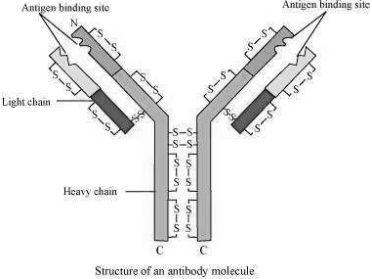
Draw a well-labelled diagram of an antibody molecule.
Solution
(N/A) An antibody molecule is $Y$-shaped and consists of four polypeptide chains: two small chains called light chains and two longer chains called heavy chains. The structure is represented as $H_2L_2$. The chains are held together by disulfide bonds $(-S-S-)$. Each antibody molecule has two antigen-binding sites located at the tips of the $Y$-shaped structure,which are specific to particular antigens.
0 likes
View Solution392
Medium
Define immunity and state its types.
Solution
(N/A) Our body is protected against most of these foreign agents (pathogens or antigens). The ability of the host to fight against these disease-causing organisms,conferred by the immune system,is called $immunity$.
Immunity is of two types:
$(i)$ $Innate$ $immunity$
$(ii)$ $Acquired$ $immunity$
Immunity is of two types:
$(i)$ $Innate$ $immunity$
$(ii)$ $Acquired$ $immunity$
0 likes
View Solution393
Medium
Describe innate immunity.
Solution
(N/A) Innate immunity is a non-specific type of defense that is present at the time of birth. This is accomplished by providing different types of barriers to the entry of foreign agents into our body. Innate immunity consists of four types of barriers:
$(i)$ Physical barriers: Skin on our body is the main barrier which prevents the entry of micro-organisms. Mucus coating of the epithelium lining the respiratory, gastrointestinal, and urogenital tracts also helps in trapping microbes entering our body.
$(ii)$ Physiological barriers: Acid in the stomach, saliva in the mouth, and tears from the eyes all prevent microbial growth.
$(iii)$ Cellular barriers: Certain types of leukocytes $(WBC)$ of our body like polymorpho-nuclear leukocytes $(PMNL-neutrophils)$, monocytes, and natural killer cells (a type of lymphocyte) in the blood, as well as macrophages in tissues, can phagocytose and destroy microbes.
$(iv)$ Cytokine barriers: Virus-infected cells secrete proteins called interferons which protect non-infected cells from further viral infection.
$(i)$ Physical barriers: Skin on our body is the main barrier which prevents the entry of micro-organisms. Mucus coating of the epithelium lining the respiratory, gastrointestinal, and urogenital tracts also helps in trapping microbes entering our body.
$(ii)$ Physiological barriers: Acid in the stomach, saliva in the mouth, and tears from the eyes all prevent microbial growth.
$(iii)$ Cellular barriers: Certain types of leukocytes $(WBC)$ of our body like polymorpho-nuclear leukocytes $(PMNL-neutrophils)$, monocytes, and natural killer cells (a type of lymphocyte) in the blood, as well as macrophages in tissues, can phagocytose and destroy microbes.
$(iv)$ Cytokine barriers: Virus-infected cells secrete proteins called interferons which protect non-infected cells from further viral infection.
0 likes
View Solution394
Difficult
Explain Acquired immunity.
Solution
(N/A) Acquired immunity is pathogen-specific. It is characterized by memory.
When our body encounters a pathogen for the first time,it produces a response called the primary response,which is of low intensity.
Subsequent encounters with the same pathogen elicit a highly intensified secondary or anamnestic response. This is due to the fact that our body retains a memory of the first encounter.
The primary and secondary immune responses are carried out by two special types of lymphocytes in our blood: $B$-lymphocytes and $T$-lymphocytes.
$B$-lymphocytes produce an army of proteins in response to pathogens to fight them; these proteins are called antibodies.
$T$-cells do not secrete antibodies themselves but help $B$-cells produce them.
Each antibody molecule has four peptide chains: two small 'light chains' and two longer 'heavy chains',represented as $H_2L_2$.
Different types of antibodies are produced in our body,such as $IgA, IgM, IgE,$ and $IgG$.
Because these antibodies are found in the blood,this response is called the humoral immune response.
The second type of acquired immune response is the cell-mediated immune response or cell-mediated immunity $(CMI)$,which is mediated by $T$-lymphocytes.
$CMI$ is responsible for graft rejection in organ transplants,as the body can differentiate between 'self' and 'non-self' cells.
When our body encounters a pathogen for the first time,it produces a response called the primary response,which is of low intensity.
Subsequent encounters with the same pathogen elicit a highly intensified secondary or anamnestic response. This is due to the fact that our body retains a memory of the first encounter.
The primary and secondary immune responses are carried out by two special types of lymphocytes in our blood: $B$-lymphocytes and $T$-lymphocytes.
$B$-lymphocytes produce an army of proteins in response to pathogens to fight them; these proteins are called antibodies.
$T$-cells do not secrete antibodies themselves but help $B$-cells produce them.
Each antibody molecule has four peptide chains: two small 'light chains' and two longer 'heavy chains',represented as $H_2L_2$.
Different types of antibodies are produced in our body,such as $IgA, IgM, IgE,$ and $IgG$.
Because these antibodies are found in the blood,this response is called the humoral immune response.
The second type of acquired immune response is the cell-mediated immune response or cell-mediated immunity $(CMI)$,which is mediated by $T$-lymphocytes.
$CMI$ is responsible for graft rejection in organ transplants,as the body can differentiate between 'self' and 'non-self' cells.
0 likes
View Solution395
Difficult
What is active immunity and passive immunity?
Solution
(N/A) $(1)$ Active immunity: When a host is exposed to antigens,which may be in the form of living or dead microbes or other proteins,antibodies are produced in the host body. This type of immunity is called active immunity. It is slow and takes time to give its full effective response. Injecting microbes deliberately during immunization or infectious organisms gaining access to the body during natural infection induces active immunity.
$(2)$ Passive immunity: When ready-made antibodies are directly given to protect the body against foreign antigens or agents,it is called passive immunity. The yellowish fluid colostrum secreted by the mother during the initial days of lactation has abundant antibodies $(IgA)$ to protect the infants. The fetus also receives some antibodies $(IgG)$ from the mother through the placenta during pregnancy.
$(2)$ Passive immunity: When ready-made antibodies are directly given to protect the body against foreign antigens or agents,it is called passive immunity. The yellowish fluid colostrum secreted by the mother during the initial days of lactation has abundant antibodies $(IgA)$ to protect the infants. The fetus also receives some antibodies $(IgG)$ from the mother through the placenta during pregnancy.
0 likes
View Solution396
Medium
Provide information about vaccination.
Solution
(N/A) The principle of vaccination or immunization is based on the property of 'memory' of the immune system. In vaccination,a preparation of antigenic proteins of pathogen or inactivated/weakened pathogen (vaccine) is introduced into the body.
The antibodies produced in the body against these antigens neutralize the pathogenic agents during actual infection. The vaccines also generate memory $B$ and $T$-cells that recognize the pathogen quickly on subsequent exposure and overwhelm the invaders with a massive production of antibodies.
If a person is infected with some deadly microbes to which quick immune response is required,as in tetanus,we need to directly inject the preformed antibodies or antitoxin (a preparation containing antibodies to the toxin).
Even in cases of snakebites,the injection given to the patient contains preformed antibodies against the snake venom. This type of immunization is called $passive$ $immunization$.
Recombinant $DNA$ technology has allowed the production of antigenic polypeptides of pathogen in bacteria or yeast. Vaccines produced using this approach have been made on a large scale and have been increasingly available for immunization,e.g.,Hepatitis-$B$ vaccine produced from yeast.
The antibodies produced in the body against these antigens neutralize the pathogenic agents during actual infection. The vaccines also generate memory $B$ and $T$-cells that recognize the pathogen quickly on subsequent exposure and overwhelm the invaders with a massive production of antibodies.
If a person is infected with some deadly microbes to which quick immune response is required,as in tetanus,we need to directly inject the preformed antibodies or antitoxin (a preparation containing antibodies to the toxin).
Even in cases of snakebites,the injection given to the patient contains preformed antibodies against the snake venom. This type of immunization is called $passive$ $immunization$.
Recombinant $DNA$ technology has allowed the production of antigenic polypeptides of pathogen in bacteria or yeast. Vaccines produced using this approach have been made on a large scale and have been increasingly available for immunization,e.g.,Hepatitis-$B$ vaccine produced from yeast.
0 likes
View Solution397
Easy
Define: Autoimmunity.
Solution
(N/A) Autoimmunity is the system of immune responses of an organism against its own healthy cells and tissues.
Any disease that results from such an aberrant immune response is termed an "autoimmune disease".
Any disease that results from such an aberrant immune response is termed an "autoimmune disease".
0 likes
View SolutionHuman Health and Disease — Immunity · Frequently Asked Questions
1Are these Human Health and Disease questions useful for JEE and NEET?
Yes. All questions in this section are mapped to JEE Main and NEET exam patterns. Previous year questions from JEE Main, NEET, GUJCET and state-level exams are included with full solutions.
2Can I switch to Hindi or Gujarati for these questions?
Yes. Use the language tabs in the hero section or the sidebar to view the same questions and solutions in English, Hindi or Gujarati.
3How do I generate a question paper from this subtopic?
Use the Vedclass Exam Paper Generator — select the chapter and subtopic, set difficulty, and generate Sets A, B, C, D automatically. First 3 chapters of every subject are free.
Vedclass Products
For Students
Vedclass Test Series
Mock tests in real JEE/NEET style with performance analysis. 5-day free trial.
Start Free TrialFor Teachers
Exam Paper Generator
Generate Set A/B/C/D papers from this chapter in 2 minutes. 3 chapters free.
Try FreeFor Institutes
Online Exam Module
Live online exams with unlimited students, 360° analytics & white-label branding.
See DemoFor Teachers & Institutes
Generate a Human Health and Disease Exam Paper in 2 Minutes
Select subtopic & difficulty — Sets A, B, C, D auto-generated with No Repeat logic.
First 3 chapters of every subject are free — no payment required.