
A English
Immunity Questions in English
Class 12 Biology · Human Health and Disease · Immunity
636+
Questions
English
Language
100%
With Solutions
Showing 49 of 636 questions in English
301
EasyMCQ
Which of the following is the correct representation of an antibody molecule?
A
$H_4L_4$
B
$H_2L_2$
C
$H_2L_1$
D
$H_3L_2$
Solution
(B) An antibody molecule is a $Y$-shaped structure composed of four polypeptide chains.
These include two identical light chains $(L)$ and two identical heavy chains $(H)$.
These chains are held together by disulfide bonds.
Therefore,the correct representation of an antibody molecule is $H_2L_2$.
These include two identical light chains $(L)$ and two identical heavy chains $(H)$.
These chains are held together by disulfide bonds.
Therefore,the correct representation of an antibody molecule is $H_2L_2$.
0 likes
View Solution302
EasyMCQ
Which cells are responsible for cell-mediated immunity?
A
$T$-cells
B
$B$-cells
C
Both $(A)$ and $(B)$
D
None of these
Solution
(A) Cell-mediated immunity $(CMI)$ is mediated by $T$-lymphocytes (or $T$-cells).
$B$-lymphocytes (or $B$-cells) are responsible for humoral immunity by producing antibodies.
Therefore,the correct answer is $T$-cells.
$B$-lymphocytes (or $B$-cells) are responsible for humoral immunity by producing antibodies.
Therefore,the correct answer is $T$-cells.
0 likes
View Solution303
EasyMCQ
What are $IgA$ and $IgM$?
A
Types of $T$-cells
B
Types of $B$-cells
C
Types of antibodies
D
Types of antigens
Solution
(C) $IgA$ and $IgM$ are types of immunoglobulins,commonly known as antibodies.
Antibodies are glycoprotein molecules produced by plasma cells (differentiated $B$-lymphocytes) in response to an antigen.
There are five main classes of antibodies in humans: $IgA, IgD, IgE, IgG,$ and $IgM$.
Therefore,the correct option is $C$.
Antibodies are glycoprotein molecules produced by plasma cells (differentiated $B$-lymphocytes) in response to an antigen.
There are five main classes of antibodies in humans: $IgA, IgD, IgE, IgG,$ and $IgM$.
Therefore,the correct option is $C$.
0 likes
View Solution304
MediumMCQ
Which of the following statements is false?
A
An antibody molecule consists of four nucleotide chains.
B
An antibody molecule consists of two light chains and two heavy chains.
C
$B$-cells are responsible for humoral immunity.
D
$T$-cells are responsible for cell-mediated immunity.
Solution
(A) The correct answer is $A$.
An antibody molecule is a protein,not a nucleic acid. It consists of four polypeptide chains,not nucleotide chains.
Specifically,it has two light chains and two heavy chains,represented as $H_2L_2$.
$B$-cells produce antibodies and are responsible for humoral (antibody-mediated) immunity.
$T$-cells do not produce antibodies but are responsible for cell-mediated immunity $(CMI)$.
An antibody molecule is a protein,not a nucleic acid. It consists of four polypeptide chains,not nucleotide chains.
Specifically,it has two light chains and two heavy chains,represented as $H_2L_2$.
$B$-cells produce antibodies and are responsible for humoral (antibody-mediated) immunity.
$T$-cells do not produce antibodies but are responsible for cell-mediated immunity $(CMI)$.
0 likes
View Solution305
EasyMCQ
What is the full form of $CMI$?
A
Cell-Mediated Immunity
B
Cell Maturity Immunity
C
Central Membrane Immunity
D
Cell Membrane Input
Solution
(A) $CMI$ stands for Cell-Mediated Immunity.
It is a type of immune response that does not involve antibodies but rather involves the activation of phagocytes,antigen-specific cytotoxic $T$-lymphocytes,and the release of various cytokines in response to an antigen.
It is a type of immune response that does not involve antibodies but rather involves the activation of phagocytes,antigen-specific cytotoxic $T$-lymphocytes,and the release of various cytokines in response to an antigen.
0 likes
View Solution306
MediumMCQ
$S -$ Statement: An antibody is represented as $H_2L_2$.
$R -$ Reason: Each antibody molecule consists of two light chains and two heavy chains.
$R -$ Reason: Each antibody molecule consists of two light chains and two heavy chains.
A
$S$ and $R$ are both true,and $R$ is the correct explanation of $S$.
B
$S$ and $R$ are both true,but $R$ is not the correct explanation of $S$.
C
$S$ is true and $R$ is false.
D
$S$ is false and $R$ is true.
Solution
(A) An antibody molecule is a $Y$-shaped structure composed of four polypeptide chains.
These include two identical light chains $(L)$ and two identical heavy chains $(H)$.
Because of this composition,the antibody is represented by the formula $H_2L_2$.
Therefore,both the statement $(S)$ and the reason $(R)$ are true,and the reason correctly explains why the antibody is represented as $H_2L_2$.
These include two identical light chains $(L)$ and two identical heavy chains $(H)$.
Because of this composition,the antibody is represented by the formula $H_2L_2$.
Therefore,both the statement $(S)$ and the reason $(R)$ are true,and the reason correctly explains why the antibody is represented as $H_2L_2$.
0 likes
View Solution307
EasyMCQ
What do antibodies fight against?
A
Hunger
B
Stress
C
Thirst
D
Infection
Solution
(D) Antibodies are specialized proteins produced by the immune system,specifically by $B$-lymphocytes (plasma cells),in response to the presence of foreign substances known as antigens. These antigens are typically components of pathogens such as bacteria,viruses,or fungi. Therefore,antibodies function to identify and neutralize these pathogens,effectively fighting against infections.
0 likes
View Solution308
MediumMCQ
Which of the following is not a component of innate immunity?
A
Antibody
B
Interferon
C
Complement proteins
D
Phagocytic cells
Solution
(A) Innate immunity is non-specific type of defense that is present at the time of birth. It consists of four types of barriers:
$1$. Physical barriers (e.g.,skin,mucus coating).
$2$. Physiological barriers (e.g.,acid in stomach,saliva,tears).
$3$. Cellular barriers (e.g.,phagocytic cells like $PMNL$-neutrophils and monocytes).
$4$. Cytokine barriers (e.g.,interferons).
Antibodies are a part of acquired (adaptive) immunity,which is specific and developed after exposure to antigens. Therefore,antibodies are not a component of innate immunity.
$1$. Physical barriers (e.g.,skin,mucus coating).
$2$. Physiological barriers (e.g.,acid in stomach,saliva,tears).
$3$. Cellular barriers (e.g.,phagocytic cells like $PMNL$-neutrophils and monocytes).
$4$. Cytokine barriers (e.g.,interferons).
Antibodies are a part of acquired (adaptive) immunity,which is specific and developed after exposure to antigens. Therefore,antibodies are not a component of innate immunity.
0 likes
View Solution309
EasyMCQ
How many peptide chains are present in an antibody molecule?
A
Two
B
Four
C
Six
D
Eight
Solution
(B) An antibody molecule is $Y$-shaped and consists of four polypeptide chains.
These include two identical light chains $(L)$ and two identical heavy chains $(H)$.
Therefore,the antibody molecule is represented as $H_2L_2$.
These include two identical light chains $(L)$ and two identical heavy chains $(H)$.
Therefore,the antibody molecule is represented as $H_2L_2$.
0 likes
View Solution310
MediumMCQ
Which of the following is the function of $T-$cells?
A
To produce antibodies
B
To help $B-$cells in antibody production
C
To develop the thymus gland
D
To develop the bone marrow
Solution
(B) $T-$cells ($T$-lymphocytes) are a type of white blood cell that plays a central role in cell-mediated immunity.
They do not produce antibodies themselves; instead,they assist $B-$cells in the production of antibodies by releasing cytokines.
$T-$helper cells recognize antigens presented by antigen-presenting cells and stimulate $B-$cells to proliferate and differentiate into plasma cells,which then secrete antibodies.
Therefore,the primary function among the given options is to help $B-$cells in antibody production.
They do not produce antibodies themselves; instead,they assist $B-$cells in the production of antibodies by releasing cytokines.
$T-$helper cells recognize antigens presented by antigen-presenting cells and stimulate $B-$cells to proliferate and differentiate into plasma cells,which then secrete antibodies.
Therefore,the primary function among the given options is to help $B-$cells in antibody production.
0 likes
View Solution311
EasyMCQ
How many types of antibodies are produced in our body?
A
Four
B
Five
C
Six
D
Three
Solution
(B) In the human body,there are $5$ main classes of antibodies (immunoglobulins) based on the type of heavy chain they contain. These are $IgA$,$IgD$,$IgE$,$IgG$,and $IgM$.
0 likes
View Solution312
EasyMCQ
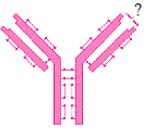
What does the indicated part in the given figure represent?
A
Light chain
B
Heavy chain
C
Antigen binding site
D
Antigen
Solution
(C) The given figure represents the structure of an antibody molecule,which is $Y$-shaped.
Each antibody molecule consists of four polypeptide chains: two small chains called light chains and two longer chains called heavy chains.
The region indicated by the question mark at the tips of the $Y$-shaped structure is the variable region where the antigen binds.
Therefore,the indicated part represents the antigen binding site.
Each antibody molecule consists of four polypeptide chains: two small chains called light chains and two longer chains called heavy chains.
The region indicated by the question mark at the tips of the $Y$-shaped structure is the variable region where the antigen binds.
Therefore,the indicated part represents the antigen binding site.
0 likes
View Solution313
EasyMCQ
What is it called when the body attacks its own cells,causing damage to the body?
A
Evolution
B
Allergy
C
Autoimmunity
D
Vaccination
Solution
(C) Autoimmunity is a condition in which the immune system of the body fails to recognize 'self' cells from 'non-self' cells and starts attacking its own tissues or cells. This leads to damage to the body,resulting in autoimmune diseases such as Rheumatoid arthritis.
0 likes
View Solution314
EasyMCQ
The protein that possesses the property of immunity is .........
A
Hemoglobin
B
Immunoglobulin
C
Myosin
D
Actin
Solution
(B) The protein that possesses the property of immunity is known as $Immunoglobulin$ (also called antibodies).
$Immunoglobulins$ are specialized proteins produced by the immune system,specifically by $B-lymphocytes$ (plasma cells),in response to the presence of antigens (foreign substances like bacteria or viruses).
They recognize and bind to specific antigens to neutralize them or mark them for destruction by other immune cells.
$Hemoglobin$ is involved in oxygen transport,while $Myosin$ and $Actin$ are contractile proteins found in muscle fibers.
$Immunoglobulins$ are specialized proteins produced by the immune system,specifically by $B-lymphocytes$ (plasma cells),in response to the presence of antigens (foreign substances like bacteria or viruses).
They recognize and bind to specific antigens to neutralize them or mark them for destruction by other immune cells.
$Hemoglobin$ is involved in oxygen transport,while $Myosin$ and $Actin$ are contractile proteins found in muscle fibers.
0 likes
View Solution315
EasyMCQ
Which of the following represents the property of immunoglobulins?
A
$Vg$
B
$Pg$
C
$Ig$
D
$Ag$
Solution
(C) Immunoglobulins,also known as antibodies,are glycoprotein molecules produced by plasma cells (white blood cells). They act as a critical part of the immune response by specifically recognizing and binding to particular antigens,such as bacteria or viruses,and aiding in their destruction. The standard abbreviation for immunoglobulins is $Ig$.
0 likes
View Solution316
MediumMCQ
Transplantation of tissues/organs often fails due to non-acceptance by the patient's body. Which type of immune response is responsible for such rejections?
A
Cell-mediated immune response
B
Hormonal immune response
C
Physiological immune response
D
Autoimmune response
Solution
(A) The correct answer is $A$.
Transplantation of tissues or organs often fails due to non-acceptance by the patient's body.
Therefore,tissue matching and blood group matching are essential before undertaking any graft or transplant.
When the immune system recognizes the proteins in the transplanted tissue or organ as foreign,it initiates a cell-mediated immune response.
This response is primarily carried out by $T$-lymphocytes,which attack the transplanted tissue,leading to the rejection of the organ.
To suppress this immune response during transplantation,immunosuppressants are administered to the patient.
Transplantation of tissues or organs often fails due to non-acceptance by the patient's body.
Therefore,tissue matching and blood group matching are essential before undertaking any graft or transplant.
When the immune system recognizes the proteins in the transplanted tissue or organ as foreign,it initiates a cell-mediated immune response.
This response is primarily carried out by $T$-lymphocytes,which attack the transplanted tissue,leading to the rejection of the organ.
To suppress this immune response during transplantation,immunosuppressants are administered to the patient.
0 likes
View Solution317
MediumMCQ
$MALT$ constitutes about . . . . . . percent of the lymphoid tissue in the human body.
A
$20$
B
$70$
C
$10$
D
$50$
Solution
(D) $MALT$ (Mucosa-Associated Lymphoid Tissue) represents significant aggregations of lymphoid tissues located in the lining of major tracts,such as the respiratory,digestive (alimentary canal),and urogenital tracts.
It constitutes approximately $50$ percent of the total lymphoid tissue in the human body.
It constitutes approximately $50$ percent of the total lymphoid tissue in the human body.
0 likes
View Solution318
MediumMCQ
In higher vertebrates,the immune system can distinguish self-cells and non-self. If this property is lost due to genetic abnormality and it attacks self-cells,then it leads to
A
autoimmune disease
B
active immunity
C
allergic response
D
graft rejection
Solution
(A) : Autoimmunity is a disorder of the body's defence mechanisms in which an immune response is elicited against its own tissues,which are thereby damaged or destroyed.
Autoimmunity may be caused due to genetic or environmental factors.
Autoimmunity may be caused due to genetic or environmental factors.
0 likes
View Solution319
MediumMCQ
If you suspect a major deficiency of antibodies in a person,to which of the following would you look for confirmatory evidence?
A
Haemocytes
B
Serum globulins
C
Fibrinogen in plasma
D
Serum albumins
Solution
(B) : Serum globulins are proteins that include gamma globulins (antibodies) and a variety of enzymes and carrier/transport proteins.
Serum protein electrophoresis $(SPEP)$ is used to analyze the profile of these globulins by separating them based on size and charge.
There are four major groups identified: alpha-$1$ globulins,alpha-$2$ globulins,beta globulins,and gamma globulins.
Since the gamma fraction primarily consists of immunoglobulins (antibodies),a deficiency in antibodies is directly reflected by a low level of serum globulins.
Serum protein electrophoresis $(SPEP)$ is used to analyze the profile of these globulins by separating them based on size and charge.
There are four major groups identified: alpha-$1$ globulins,alpha-$2$ globulins,beta globulins,and gamma globulins.
Since the gamma fraction primarily consists of immunoglobulins (antibodies),a deficiency in antibodies is directly reflected by a low level of serum globulins.
0 likes
View Solution320
MediumMCQ
Which of the following immunoglobulins constitutes the largest percentage in human milk?
A
$IgA$
B
$IgG$
C
$IgD$
D
$IgM$
Solution
(A) $IgA$ is the primary immunoglobulin found in human milk,particularly in colostrum. It provides passive immunity to the infant by protecting the mucosal surfaces of the gastrointestinal tract from pathogens. While $IgG$ is the most abundant immunoglobulin in human serum,$IgA$ is the predominant antibody in secretions,including breast milk.
0 likes
View Solution321
MediumMCQ
Grafted kidney may be rejected in a patient due to
A
passive immune response
B
innate immune response
C
humoral immune response
D
cell-mediated immune response
Solution
(D) The correct answer is $(d)$.
Cell-mediated immune response $(CMIS)$ is primarily mediated by $T$-lymphocytes.
These cells are responsible for graft rejection because the immune system recognizes the proteins present on the surface of the transplanted tissue or organ as foreign (non-self).
Upon recognition,the $T$-cells initiate a specific immune attack against the transplanted organ,leading to its rejection.
Cell-mediated immune response $(CMIS)$ is primarily mediated by $T$-lymphocytes.
These cells are responsible for graft rejection because the immune system recognizes the proteins present on the surface of the transplanted tissue or organ as foreign (non-self).
Upon recognition,the $T$-cells initiate a specific immune attack against the transplanted organ,leading to its rejection.
0 likes
View Solution322
EasyMCQ
Lysozyme present in perspiration,saliva,and tears,destroys:
A
certain types of bacteria
B
all viruses
C
most virus-infected cells
D
certain fungi
Solution
(A) $Lysozyme$ is an antibacterial enzyme with natural antibiotic properties.
It is present in tears,nasal mucus,milk,and saliva in most animals and acts as part of the body's first line of innate defense.
$Lysozyme$ functions by degrading the polysaccharide protective cell wall of certain bacteria,thereby causing their lysis.
It acts as a non-specific innate opsonin by binding to the bacterial surface,which reduces the negative charge and facilitates phagocytosis by white blood cells.
Therefore,it primarily targets and destroys certain types of bacteria.
It is present in tears,nasal mucus,milk,and saliva in most animals and acts as part of the body's first line of innate defense.
$Lysozyme$ functions by degrading the polysaccharide protective cell wall of certain bacteria,thereby causing their lysis.
It acts as a non-specific innate opsonin by binding to the bacterial surface,which reduces the negative charge and facilitates phagocytosis by white blood cells.
Therefore,it primarily targets and destroys certain types of bacteria.
0 likes
View Solution323
EasyMCQ
Antibodies in our body are complex:
A
glycoproteins
B
lipoproteins
C
steroids
D
prostaglandins
Solution
(A) Antibodies are members of a class of proteins known as immunoglobulins.
Immunoglobulins are glycoproteins belonging to the immunoglobulin superfamily.
The terms antibody and immunoglobulin are often used interchangeably.
They are found in the blood,tissue fluids,and many secretions.
In structure,they are globulins (found in the $\gamma$-region of protein electrophoresis).
They are synthesized and secreted by plasma cells,which are derived from the $B$-cells of the immune system.
Immunoglobulins are glycoproteins belonging to the immunoglobulin superfamily.
The terms antibody and immunoglobulin are often used interchangeably.
They are found in the blood,tissue fluids,and many secretions.
In structure,they are globulins (found in the $\gamma$-region of protein electrophoresis).
They are synthesized and secreted by plasma cells,which are derived from the $B$-cells of the immune system.
0 likes
View Solution324
MediumMCQ
$A$ - Colostrum contains several antibodies.
$R$ - Due to colostrum,immunity is decreased in the child.
$R$ - Due to colostrum,immunity is decreased in the child.
A
$A$ and $R$ are correct.
B
$A$ and $R$ are incorrect.
C
$A$ is correct,$R$ is incorrect.
D
$A$ is incorrect,$R$ is correct.
Solution
(C) is correct because colostrum,the yellowish fluid secreted by the mother during the initial days of lactation,is rich in antibodies,especially $IgA$,which are essential to develop resistance for the newborn.
$R$ is incorrect because colostrum does not decrease immunity; rather,it provides passive immunity to the newborn,protecting them from various infections.
$R$ is incorrect because colostrum does not decrease immunity; rather,it provides passive immunity to the newborn,protecting them from various infections.
0 likes
View Solution325
EasyMCQ
When ready-made $ antibodies $ are directly given to protect the body against foreign agents, it is called passive immunity.
A
Bacteria
B
Vaccines
C
Antibodies
D
Antigens
Solution
(C) Passive immunity is a type of immunity where the body is provided with ready-made antibodies to fight against specific pathogens or foreign agents.
Unlike active immunity, where the body's immune system produces its own antibodies after exposure to an antigen, passive immunity provides immediate protection.
Examples include the transfer of $IgG$ antibodies from mother to fetus through the placenta and $IgA$ antibodies through colostrum (breast milk).
Therefore, the correct term to fill in the blank is antibodies.
Unlike active immunity, where the body's immune system produces its own antibodies after exposure to an antigen, passive immunity provides immediate protection.
Examples include the transfer of $IgG$ antibodies from mother to fetus through the placenta and $IgA$ antibodies through colostrum (breast milk).
Therefore, the correct term to fill in the blank is antibodies.
0 likes
View Solution326
EasyMCQ
Identify the set of secondary lymphoid organs from the following.
A
Bone marrow and lymph nodes
B
Spleen and bone marrow
C
Bone marrow and thymus
D
Spleen and lymph nodes
Solution
(D) Lymphoid organs are classified into two types: primary and secondary lymphoid organs.
Primary lymphoid organs are the sites where lymphocytes originate and/or mature. These include the bone marrow and thymus.
Secondary lymphoid organs are the sites where lymphocytes interact with the antigen and then proliferate to become effector cells. These include the spleen,lymph nodes,tonsils,Peyer's patches of the small intestine,and the appendix.
Therefore,the spleen and lymph nodes are secondary lymphoid organs.
Primary lymphoid organs are the sites where lymphocytes originate and/or mature. These include the bone marrow and thymus.
Secondary lymphoid organs are the sites where lymphocytes interact with the antigen and then proliferate to become effector cells. These include the spleen,lymph nodes,tonsils,Peyer's patches of the small intestine,and the appendix.
Therefore,the spleen and lymph nodes are secondary lymphoid organs.
0 likes
View Solution327
EasyMCQ
It constitutes about $50$ percent of the lymphoid tissue in the human body.
A
Spleen
B
Bone marrow
C
$MALT$
D
Thymus
Solution
(C) The Mucosa-Associated Lymphoid Tissue $(MALT)$ is a diffuse system of lymphoid tissue found in the lining of major tracts in the human body,such as the respiratory,digestive,and urogenital tracts.
It is estimated that $MALT$ constitutes about $50$ percent of the total lymphoid tissue in the human body.
Therefore,the correct option is $C$.
It is estimated that $MALT$ constitutes about $50$ percent of the total lymphoid tissue in the human body.
Therefore,the correct option is $C$.
0 likes
View Solution328
EasyMCQ
Antigen binding site is present in
A
Antibody
B
Virus
C
Bacteria
D
Dust particle
Solution
(A) An antibody molecule is $Y$-shaped and consists of four polypeptide chains: two light chains and two heavy chains.
These chains are held together by disulfide bonds.
The variable region of the antibody,located at the tips of the $Y$-shaped structure,contains the antigen-binding site,also known as the paratope.
This site is specific to a particular antigen and allows the antibody to bind to it,thereby neutralizing or marking it for destruction by the immune system.
Therefore,the antigen-binding site is present in an antibody.
These chains are held together by disulfide bonds.
The variable region of the antibody,located at the tips of the $Y$-shaped structure,contains the antigen-binding site,also known as the paratope.
This site is specific to a particular antigen and allows the antibody to bind to it,thereby neutralizing or marking it for destruction by the immune system.
Therefore,the antigen-binding site is present in an antibody.
0 likes
View Solution329
EasyMCQ
Antibodies are produced by............
A
$T$-lymphocytes
B
$B$-lymphocytes
C
$RBC$
D
None
Solution
(B) Antibodies are specialized proteins produced by the immune system to identify and neutralize foreign objects like bacteria and viruses.
In the human body,$B$-lymphocytes (or $B$-cells) are responsible for the production of antibodies.
When $B$-lymphocytes encounter an antigen,they differentiate into plasma cells,which then secrete large quantities of antibodies into the blood and lymph.
$T$-lymphocytes,on the other hand,help $B$-cells and destroy infected cells directly but do not produce antibodies themselves.
In the human body,$B$-lymphocytes (or $B$-cells) are responsible for the production of antibodies.
When $B$-lymphocytes encounter an antigen,they differentiate into plasma cells,which then secrete large quantities of antibodies into the blood and lymph.
$T$-lymphocytes,on the other hand,help $B$-cells and destroy infected cells directly but do not produce antibodies themselves.
0 likes
View Solution330
EasyMCQ
Identify the correct group for primary lymphoid organs.
A
Bone marrow,Spleen
B
Thymus,Tonsils
C
Lymph node,Appendix
D
Thymus,Bone marrow
Solution
(D) In the human immune system,lymphoid organs are classified into primary and secondary lymphoid organs.
Primary lymphoid organs are the sites where lymphocytes originate and/or mature and become antigen-sensitive.
The two main primary lymphoid organs are the $Bone \ marrow$ and the $Thymus$.
Secondary lymphoid organs,such as the $Spleen$,$Lymph \ nodes$,$Tonsils$,and $Appendix$,provide the sites for interaction of lymphocytes with the antigen,which then proliferate to become effector cells.
Primary lymphoid organs are the sites where lymphocytes originate and/or mature and become antigen-sensitive.
The two main primary lymphoid organs are the $Bone \ marrow$ and the $Thymus$.
Secondary lymphoid organs,such as the $Spleen$,$Lymph \ nodes$,$Tonsils$,and $Appendix$,provide the sites for interaction of lymphocytes with the antigen,which then proliferate to become effector cells.
0 likes
View Solution331
EasyMCQ
Virus-infected cells secrete proteins called .........
A
Interferons
B
Antibodies
C
Immunoglobulins
D
$IgE$
Solution
(A) Virus-infected cells secrete proteins called interferons,which protect non-infected cells from further viral infection. Interferons are a type of cytokine barrier in innate immunity.
0 likes
View Solution332
MediumMCQ
What is an anamnestic response?
A
Encountering a pathogen for the first time
B
Encountering a pathogen for the second time
C
$A$ and $B$ both
D
None of the above
Solution
(B) The anamnestic response,also known as the secondary immune response,occurs when the immune system encounters a pathogen for the second time.
Upon the first encounter (primary response),the body produces memory $B$ and $T$ cells.
When the same pathogen enters the body again,these memory cells recognize it immediately and mount a rapid,high-intensity response,which is termed the anamnestic response.
Upon the first encounter (primary response),the body produces memory $B$ and $T$ cells.
When the same pathogen enters the body again,these memory cells recognize it immediately and mount a rapid,high-intensity response,which is termed the anamnestic response.
0 likes
View Solution333
MediumMCQ
The principle of immunization or vaccination is based on the property of ..........
A
Memory
B
Chemical reaction
C
Physical barrier
D
Antibody production
Solution
(A) The principle of immunization or vaccination is based on the property of 'memory' of the immune system.
When a vaccine is introduced into the body,the immune system recognizes the pathogen (antigen) and produces antibodies.
Crucially,the immune system also generates memory $B$ and $T$ lymphocytes.
These memory cells retain the information about the pathogen.
If the same pathogen attacks the body again in the future,these memory cells recognize it immediately and mount a massive immune response,neutralizing the pathogen before it can cause disease.
When a vaccine is introduced into the body,the immune system recognizes the pathogen (antigen) and produces antibodies.
Crucially,the immune system also generates memory $B$ and $T$ lymphocytes.
These memory cells retain the information about the pathogen.
If the same pathogen attacks the body again in the future,these memory cells recognize it immediately and mount a massive immune response,neutralizing the pathogen before it can cause disease.
0 likes
View Solution334
MediumMCQ
Which is an example of active immunity?
A
Tetanus injection
B
Colostrum
C
Jaundice
D
Injection against snake bites
Solution
(A) Active immunity is developed when an individual's own immune system produces antibodies in response to an antigen (either a pathogen or a vaccine).
In the case of a Tetanus injection (specifically the Tetanus Toxoid vaccine),the body is exposed to an inactivated form of the toxin,which stimulates the immune system to produce its own antibodies and memory cells.
Colostrum provides passive immunity (antibodies transferred from mother to child).
Injection against snake bites involves the administration of pre-formed antibodies (antivenom),which is an example of passive immunity.
Jaundice is a disease condition,not a form of immunity.
In the case of a Tetanus injection (specifically the Tetanus Toxoid vaccine),the body is exposed to an inactivated form of the toxin,which stimulates the immune system to produce its own antibodies and memory cells.
Colostrum provides passive immunity (antibodies transferred from mother to child).
Injection against snake bites involves the administration of pre-formed antibodies (antivenom),which is an example of passive immunity.
Jaundice is a disease condition,not a form of immunity.
0 likes
View Solution335
MediumMCQ
How many main types of immunity are there in the human body?
A
$1$
B
$2$
C
$3$
D
$4$
Solution
(B) The human immune system is primarily classified into $2$ main types:
$1$. Innate immunity: This is non-specific type of defense that is present at the time of birth.
$2$. Acquired immunity: This is pathogen-specific and is developed during an individual's lifetime after exposure to a pathogen or vaccination.
$1$. Innate immunity: This is non-specific type of defense that is present at the time of birth.
$2$. Acquired immunity: This is pathogen-specific and is developed during an individual's lifetime after exposure to a pathogen or vaccination.
0 likes
View Solution336
EasyMCQ
$WBC$ is an example of
A
Physiological barrier
B
Physical barrier
C
Cellular barrier
D
Cytokine barrier
Solution
(C) Innate immunity consists of four types of barriers that prevent the entry of foreign agents into our body.
$1$. Physical barriers: Skin and mucus coating of the epithelium lining the respiratory,gastrointestinal,and urogenital tracts.
$2$. Physiological barriers: Acid in the stomach,saliva in the mouth,and tears from eyes.
$3$. Cellular barriers: Polymorpho-nuclear leukocytes $(PMNL-neutrophils)$,monocytes,and lymphocytes like natural killer cells in the blood,as well as macrophages in tissues,phagocytose and destroy microbes.
$4$. Cytokine barriers: Virus-infected cells secrete proteins called interferons which protect non-infected cells from further viral infection.
Since $WBC$ (White Blood Cells) like neutrophils and macrophages are involved in phagocytosis,they represent the cellular barrier.
$1$. Physical barriers: Skin and mucus coating of the epithelium lining the respiratory,gastrointestinal,and urogenital tracts.
$2$. Physiological barriers: Acid in the stomach,saliva in the mouth,and tears from eyes.
$3$. Cellular barriers: Polymorpho-nuclear leukocytes $(PMNL-neutrophils)$,monocytes,and lymphocytes like natural killer cells in the blood,as well as macrophages in tissues,phagocytose and destroy microbes.
$4$. Cytokine barriers: Virus-infected cells secrete proteins called interferons which protect non-infected cells from further viral infection.
Since $WBC$ (White Blood Cells) like neutrophils and macrophages are involved in phagocytosis,they represent the cellular barrier.
0 likes
View Solution337
MediumMCQ
Antivenom against snake poison contains
A
Antigens
B
Antigen-antibody complexes
C
Antibodies
D
Enzymes
Solution
(C) Antivenom is a biological product used in the treatment of venomous bites or stings,such as snake bites.
It is produced by injecting small,non-lethal amounts of snake venom (antigen) into a host animal (like a horse or sheep).
The host animal's immune system responds by producing specific antibodies against the venom.
These antibodies are then harvested from the animal's blood serum and purified to create antivenom.
Therefore,when administered to a patient,antivenom provides passive immunity by introducing pre-formed antibodies that neutralize the snake venom.
It is produced by injecting small,non-lethal amounts of snake venom (antigen) into a host animal (like a horse or sheep).
The host animal's immune system responds by producing specific antibodies against the venom.
These antibodies are then harvested from the animal's blood serum and purified to create antivenom.
Therefore,when administered to a patient,antivenom provides passive immunity by introducing pre-formed antibodies that neutralize the snake venom.
0 likes
View Solution338
EasyMCQ
The substance produced by a cell in viral infection that can protect other cells from further infections is
A
Serotonin
B
Colostrum
C
Histamine
D
Interferon
Solution
(D) When a cell is infected by a virus,it produces specific proteins known as $Interferons$.
These proteins are released into the extracellular space and bind to neighboring uninfected cells.
This binding triggers the neighboring cells to produce antiviral proteins,which prevent further viral replication and protect them from infection.
Therefore,$Interferons$ act as a crucial part of the innate immune response against viral pathogens.
These proteins are released into the extracellular space and bind to neighboring uninfected cells.
This binding triggers the neighboring cells to produce antiviral proteins,which prevent further viral replication and protect them from infection.
Therefore,$Interferons$ act as a crucial part of the innate immune response against viral pathogens.
0 likes
View Solution339
MediumMCQ
Select the correct pair:
| Column-$I$ | Column-$II$ |
|---|---|
| $A$. Physiological barrier | $1$. Skin |
| $B$. Cellular barrier | $2$. Macrophages |
| $C$. Physical barriers | $3$. Interferons |
| $D$. Cytokine barriers | $4$. Tears |
| $5$. Mucus |
A
$A-1,5, B-2, C-3, D-4$
B
$A-4, B-2, C-1,5, D-3$
C
$A-3, B-1,5, C-2, D-4$
D
$A-4, B-1, C-2,3, D-5$
Solution
(B) Innate immunity consists of four types of barriers:
$1$. Physical barriers: Skin and mucus coating of the respiratory,gastrointestinal,and urogenital tracts prevent the entry of microorganisms $(C-1, 5)$.
$2$. Physiological barriers: Acid in the stomach,saliva in the mouth,and tears from eyes prevent microbial growth $(A-4)$.
$3$. Cellular barriers: Certain types of leukocytes like polymorphonuclear leukocytes ($PMNL$-neutrophils),monocytes,and macrophages can phagocytose and destroy microbes $(B-2)$.
$4$. Cytokine barriers: Virus-infected cells secrete proteins called interferons which protect non-infected cells from further viral infection $(D-3)$.
Therefore,the correct matching is $A-4, B-2, C-1,5, D-3$.
$1$. Physical barriers: Skin and mucus coating of the respiratory,gastrointestinal,and urogenital tracts prevent the entry of microorganisms $(C-1, 5)$.
$2$. Physiological barriers: Acid in the stomach,saliva in the mouth,and tears from eyes prevent microbial growth $(A-4)$.
$3$. Cellular barriers: Certain types of leukocytes like polymorphonuclear leukocytes ($PMNL$-neutrophils),monocytes,and macrophages can phagocytose and destroy microbes $(B-2)$.
$4$. Cytokine barriers: Virus-infected cells secrete proteins called interferons which protect non-infected cells from further viral infection $(D-3)$.
Therefore,the correct matching is $A-4, B-2, C-1,5, D-3$.
0 likes
View Solution340
MediumMCQ
Which is an incorrect pair based on its role in the immune system?
A
Interferons - Secreted by virus-infected cells which protect non-infected cells from further viral infection.
B
$B$-cells - Produce an army of antibodies against pathogens.
C
Macrophages - Mucous secreting cells which destroy pathogens.
D
$IgA$ - Present in initial days of lactation to protect the infant.
Solution
(C) The incorrect pair is $C$. Macrophages are large phagocytic cells that engulf and destroy pathogens,cellular debris,and foreign substances. They are not mucous-secreting cells. Mucous is typically secreted by goblet cells in the respiratory and digestive tracts.
$A$: Interferons are proteins produced by virus-infected cells that protect neighboring non-infected cells from viral infection. This is correct.
$B$: $B$-cells are a type of lymphocyte that differentiates into plasma cells to produce antibodies against pathogens. This is correct.
$D$: $IgA$ is the primary antibody found in colostrum (the initial milk produced during the first few days of lactation),which provides passive immunity to the infant. This is correct.
$A$: Interferons are proteins produced by virus-infected cells that protect neighboring non-infected cells from viral infection. This is correct.
$B$: $B$-cells are a type of lymphocyte that differentiates into plasma cells to produce antibodies against pathogens. This is correct.
$D$: $IgA$ is the primary antibody found in colostrum (the initial milk produced during the first few days of lactation),which provides passive immunity to the infant. This is correct.
0 likes
View Solution341
EasyMCQ
Which of the following is not present in the structure of an antibody?
A
Light chain
B
Heavy chain
C
Colostrum
D
Antigen binding site
Solution
(C) An antibody molecule is represented as $H_2L_2$. It consists of four polypeptide chains: two small chains called light chains $(L)$ and two longer chains called heavy chains $(H)$. The variable regions of these chains form the antigen-binding site. Colostrum is the yellowish fluid secreted by the mother during the initial days of lactation,which contains abundant $IgA$ antibodies,but it is not a structural component of an individual antibody molecule.
0 likes
View Solution342
MediumMCQ
An antibody is:
A
a molecule that specifically interacts with an antigen
B
produced in the stomach
C
produced by $T$-lymphocytes
D
produced by natural killer cells
Solution
(A) An antibody is a specialized protein molecule,also known as an immunoglobulin $(Ig)$,that is produced by $B$-lymphocytes (plasma cells) in response to an antigen.
Its primary function is to specifically recognize,bind to,and neutralize or mark the antigen for destruction by the immune system.
$T$-lymphocytes are involved in cell-mediated immunity but do not produce antibodies.
Natural killer cells are part of the innate immune system and do not produce antibodies.
Therefore,the correct statement is that an antibody is a molecule that specifically interacts with an antigen.
Its primary function is to specifically recognize,bind to,and neutralize or mark the antigen for destruction by the immune system.
$T$-lymphocytes are involved in cell-mediated immunity but do not produce antibodies.
Natural killer cells are part of the innate immune system and do not produce antibodies.
Therefore,the correct statement is that an antibody is a molecule that specifically interacts with an antigen.
0 likes
View Solution343
MediumMCQ
Match the following columns:
| Column-$I$ | Column-$II$ |
| $(A)$ Physical barriers | $(1)$ Interferon |
| $(B)$ Physiological barriers | $(2)$ Leukocytes |
| $(C)$ Cellular barriers | $(3)$ Tears |
| $(D)$ Cytokine barriers | $(4)$ Skin |
A
$3, 2, 1, 4$
B
$2, 1, 4, 3$
C
$1, 4, 3, 2$
D
$4, 3, 2, 1$
Solution
(D) The correct matching is as follows:
$(A)$ Physical barriers: Skin $(4)$ acts as the primary physical barrier preventing the entry of pathogens.
$(B)$ Physiological barriers: Tears $(3)$ (along with acid in the stomach and saliva in the mouth) prevent microbial growth.
$(C)$ Cellular barriers: Leukocytes $(2)$ (such as $PMNL$-neutrophils and monocytes) phagocytose and destroy microbes.
$(D)$ Cytokine barriers: Interferons $(1)$ are proteins secreted by virus-infected cells which protect non-infected cells from further viral infection.
Therefore,the correct sequence is $A-4, B-3, C-2, D-1$.
$(A)$ Physical barriers: Skin $(4)$ acts as the primary physical barrier preventing the entry of pathogens.
$(B)$ Physiological barriers: Tears $(3)$ (along with acid in the stomach and saliva in the mouth) prevent microbial growth.
$(C)$ Cellular barriers: Leukocytes $(2)$ (such as $PMNL$-neutrophils and monocytes) phagocytose and destroy microbes.
$(D)$ Cytokine barriers: Interferons $(1)$ are proteins secreted by virus-infected cells which protect non-infected cells from further viral infection.
Therefore,the correct sequence is $A-4, B-3, C-2, D-1$.
0 likes
View Solution344
EasyMCQ
Which of the following is not a cell of the immune system?
A
$T$-cell
B
$B$-cell
C
Fibroblast
D
Macrophage
Solution
(C) The immune system consists of various specialized cells that protect the body against pathogens.
$T$-cells and $B$-cells are types of lymphocytes,which are the primary cells of the adaptive immune system.
Macrophages are phagocytic cells that play a crucial role in both innate and adaptive immunity.
Fibroblasts are cells of the connective tissue responsible for producing the extracellular matrix and collagen,which are essential for structural support and wound healing. They are not part of the immune system.
$T$-cells and $B$-cells are types of lymphocytes,which are the primary cells of the adaptive immune system.
Macrophages are phagocytic cells that play a crucial role in both innate and adaptive immunity.
Fibroblasts are cells of the connective tissue responsible for producing the extracellular matrix and collagen,which are essential for structural support and wound healing. They are not part of the immune system.
0 likes
View Solution345
EasyMCQ
Identify the correct group of primary lymphoid organs.
A
Bone marrow,Spleen
B
Thymus,Tonsils
C
Lymph nodes,Appendix
D
Thymus,Bone marrow
Solution
(D) Primary lymphoid organs are the sites where lymphocytes originate and/or mature and differentiate into antigen-sensitive lymphocytes.
In humans,the bone marrow and thymus are the primary lymphoid organs.
In these organs,immature lymphocytes differentiate into antigen-sensitive lymphocytes.
After maturation,the lymphocytes migrate to secondary lymphoid organs like the spleen,lymph nodes,tonsils,Peyer's patches of the small intestine,and the appendix,where they interact with the antigen and then proliferate to become effector cells.
Therefore,the correct group of primary lymphoid organs is thymus and bone marrow.
In humans,the bone marrow and thymus are the primary lymphoid organs.
In these organs,immature lymphocytes differentiate into antigen-sensitive lymphocytes.
After maturation,the lymphocytes migrate to secondary lymphoid organs like the spleen,lymph nodes,tonsils,Peyer's patches of the small intestine,and the appendix,where they interact with the antigen and then proliferate to become effector cells.
Therefore,the correct group of primary lymphoid organs is thymus and bone marrow.
0 likes
View Solution346
MediumMCQ
Identify the odd one out from the following.
A
Colostrum
B
$PMNL$
C
Lysozyme
D
Interferons
Solution
(D) The correct answer is $D$ (Interferons).
$1$. Colostrum,$PMNL$ (Polymorphonuclear leukocytes),and Lysozyme are all components of innate immunity,specifically acting as physical or cellular barriers.
$2$. Colostrum provides passive immunity (physiological barrier/secretions).
$3$. $PMNL$ are cellular barriers.
$4$. Lysozyme acts as a physiological barrier.
$5$. Interferons are cytokine barriers,which are produced by virus-infected cells to protect non-infected cells from further viral infection. While all are part of innate immunity,Interferons represent a distinct category (cytokine barrier) compared to the others.
$1$. Colostrum,$PMNL$ (Polymorphonuclear leukocytes),and Lysozyme are all components of innate immunity,specifically acting as physical or cellular barriers.
$2$. Colostrum provides passive immunity (physiological barrier/secretions).
$3$. $PMNL$ are cellular barriers.
$4$. Lysozyme acts as a physiological barrier.
$5$. Interferons are cytokine barriers,which are produced by virus-infected cells to protect non-infected cells from further viral infection. While all are part of innate immunity,Interferons represent a distinct category (cytokine barrier) compared to the others.
0 likes
View Solution347
MediumMCQ
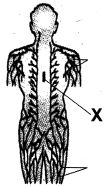
Identify $X$ from the given figure.
A
Bone marrow
B
Lymph node
C
Lymph vessel
D
Thymus
Solution
(D) The figure represents the human lymphatic system. The structure labeled as $X$ is located in the chest cavity,near the heart and beneath the breastbone. This organ is the $Thymus$. The thymus is a primary lymphoid organ where $T$-lymphocytes mature. Therefore,the correct option is $D$.
0 likes
View Solution348
MediumMCQ
Identify the correct statement$(s)$ regarding the human immune system.
A
The thymus is a lobed organ located near the heart and beneath the breastbone.
B
The spleen also acts as a large reservoir of erythrocytes.
C
Lymph nodes serve to trap microorganisms or other antigens.
D
$MALT$ constitutes about $50$% of the lymphoid tissue in the human body.
Solution
(A, C) $1$. The thymus is a lobed organ located near the heart and beneath the breastbone (sternum). Statement $A$ is correct.
$2$. The spleen is a large reservoir of erythrocytes (red blood cells),not leucocytes. Statement $B$ is incorrect.
$3$. Lymph nodes are small solid structures that trap microorganisms or other antigens that enter the lymph and tissue fluid. Statement $C$ is correct.
$4$. Mucosa-associated lymphoid tissue $(MALT)$ constitutes about $50\%$ of the lymphoid tissue in the human body,not $40\%$. Statement $D$ is incorrect.
Therefore,statements $A$ and $C$ are correct.
$2$. The spleen is a large reservoir of erythrocytes (red blood cells),not leucocytes. Statement $B$ is incorrect.
$3$. Lymph nodes are small solid structures that trap microorganisms or other antigens that enter the lymph and tissue fluid. Statement $C$ is correct.
$4$. Mucosa-associated lymphoid tissue $(MALT)$ constitutes about $50\%$ of the lymphoid tissue in the human body,not $40\%$. Statement $D$ is incorrect.
Therefore,statements $A$ and $C$ are correct.
0 likes
View Solution349
MediumMCQ
Identify the correct statement.
A
Secondary response is of very low intensity.
B
Primary response is of very high intensity.
C
In rheumatoid arthritis, the body attacks its own cells.
D
$MALT$ is located within the lining of the respiratory tract.
Solution
(C) $1$. The primary immune response is produced upon the first encounter with an antigen and is of low intensity.
$2$. The secondary immune response is produced upon subsequent encounters with the same antigen and is of high intensity due to memory cells.
$3$. Rheumatoid arthritis is an autoimmune disease where the body's immune system mistakenly attacks its own healthy cells (self-cells).
$4$. $MALT$ (Mucosa-Associated Lymphoid Tissue) constitutes about $50\%$ of the lymphoid tissue in the human body and is located within the lining of the major tracts such as respiratory, digestive, and urogenital tracts.
$2$. The secondary immune response is produced upon subsequent encounters with the same antigen and is of high intensity due to memory cells.
$3$. Rheumatoid arthritis is an autoimmune disease where the body's immune system mistakenly attacks its own healthy cells (self-cells).
$4$. $MALT$ (Mucosa-Associated Lymphoid Tissue) constitutes about $50\%$ of the lymphoid tissue in the human body and is located within the lining of the major tracts such as respiratory, digestive, and urogenital tracts.
0 likes
View SolutionHuman Health and Disease — Immunity · Frequently Asked Questions
1Are these Human Health and Disease questions useful for JEE and NEET?
Yes. All questions in this section are mapped to JEE Main and NEET exam patterns. Previous year questions from JEE Main, NEET, GUJCET and state-level exams are included with full solutions.
2Can I switch to Hindi or Gujarati for these questions?
Yes. Use the language tabs in the hero section or the sidebar to view the same questions and solutions in English, Hindi or Gujarati.
3How do I generate a question paper from this subtopic?
Use the Vedclass Exam Paper Generator — select the chapter and subtopic, set difficulty, and generate Sets A, B, C, D automatically. First 3 chapters of every subject are free.
Vedclass Products
For Students
Vedclass Test Series
Mock tests in real JEE/NEET style with performance analysis. 5-day free trial.
Start Free TrialFor Teachers
Exam Paper Generator
Generate Set A/B/C/D papers from this chapter in 2 minutes. 3 chapters free.
Try FreeFor Institutes
Online Exam Module
Live online exams with unlimited students, 360° analytics & white-label branding.
See DemoFor Teachers & Institutes
Generate a Human Health and Disease Exam Paper in 2 Minutes
Select subtopic & difficulty — Sets A, B, C, D auto-generated with No Repeat logic.
First 3 chapters of every subject are free — no payment required.