
A English
Immunity Questions in English
Class 12 Biology · Human Health and Disease · Immunity
636+
Questions
English
Language
100%
With Solutions
Showing 50 of 636 questions in English
401
Difficult
Explain the human immune system.
Solution
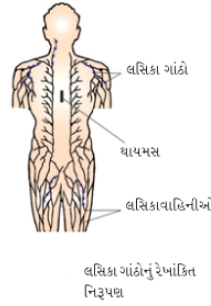
(N/A) The human immune system consists of lymphoid organs, tissues, cells, and soluble molecules like antibodies. Our immune system is unique in that it recognizes foreign antigens, responds to them, and remembers them. The immune system also plays an important role in allergic reactions, autoimmune diseases, and organ transplantation.
Lymphoid Organs: These are the organs where origin and/or maturation and proliferation of lymphocytes occur. The primary lymphoid organs are the bone marrow and the thymus, where immature lymphocytes differentiate into antigen-sensitive lymphocytes.
After maturation, the lymphocytes migrate to secondary lymphoid organs like the spleen, lymph nodes, tonsils, Peyer's patches of the small intestine, and the appendix. The secondary lymphoid organs provide the sites for interaction of lymphocytes with the antigen, which then proliferate to become effector cells.
Bone marrow is the main lymphoid organ where all blood cells including lymphocytes are produced. The thymus is a lobed organ located near the heart and beneath the breastbone. The thymus is quite large at the time of birth but keeps reducing in size with age and by the time puberty is attained, it reduces to a very small size. Both bone marrow and thymus provide micro-environments for the development and maturation of $T$-lymphocytes.
The spleen is a large, bean-shaped organ. It mainly contains lymphocytes and phagocytes. It acts as a filter of the blood by trapping blood-borne microorganisms. The spleen also has a large reservoir of erythrocytes.
Lymph nodes are small solid structures located at different points along the lymphatic system. Lymph nodes trap the microorganisms or other antigens, which happen to get into the lymph and tissue fluid. Antigens trapped in the lymph nodes are responsible for the activation of lymphocytes present there and cause the immune response.
There is lymphoid tissue also located within the lining of the major tracts (respiratory, digestive, and urogenital tracts) called Mucosa-associated lymphoid tissue $(MALT)$. It constitutes about $50$% of the lymphoid tissue in the human body.
Lymphoid Organs: These are the organs where origin and/or maturation and proliferation of lymphocytes occur. The primary lymphoid organs are the bone marrow and the thymus, where immature lymphocytes differentiate into antigen-sensitive lymphocytes.
After maturation, the lymphocytes migrate to secondary lymphoid organs like the spleen, lymph nodes, tonsils, Peyer's patches of the small intestine, and the appendix. The secondary lymphoid organs provide the sites for interaction of lymphocytes with the antigen, which then proliferate to become effector cells.
Bone marrow is the main lymphoid organ where all blood cells including lymphocytes are produced. The thymus is a lobed organ located near the heart and beneath the breastbone. The thymus is quite large at the time of birth but keeps reducing in size with age and by the time puberty is attained, it reduces to a very small size. Both bone marrow and thymus provide micro-environments for the development and maturation of $T$-lymphocytes.
The spleen is a large, bean-shaped organ. It mainly contains lymphocytes and phagocytes. It acts as a filter of the blood by trapping blood-borne microorganisms. The spleen also has a large reservoir of erythrocytes.
Lymph nodes are small solid structures located at different points along the lymphatic system. Lymph nodes trap the microorganisms or other antigens, which happen to get into the lymph and tissue fluid. Antigens trapped in the lymph nodes are responsible for the activation of lymphocytes present there and cause the immune response.
There is lymphoid tissue also located within the lining of the major tracts (respiratory, digestive, and urogenital tracts) called Mucosa-associated lymphoid tissue $(MALT)$. It constitutes about $50$% of the lymphoid tissue in the human body.
0 likes
View Solution402
Medium
Write a note on lymphoid organs.
Solution
Lymphoid organs are the organs where the origin,maturation,and proliferation of lymphocytes occur.
The primary lymphoid organs are the bone marrow and thymus,where immature lymphocytes differentiate into antigen-sensitive lymphocytes.
After maturation,the lymphocytes migrate to secondary lymphoid organs such as the spleen,lymph nodes,tonsils,Peyer's patches of the small intestine,and the appendix.
The secondary lymphoid organs provide the sites for the interaction of lymphocytes with the antigen,which then proliferate to become effector cells.
The primary lymphoid organs are the bone marrow and thymus,where immature lymphocytes differentiate into antigen-sensitive lymphocytes.
After maturation,the lymphocytes migrate to secondary lymphoid organs such as the spleen,lymph nodes,tonsils,Peyer's patches of the small intestine,and the appendix.
The secondary lymphoid organs provide the sites for the interaction of lymphocytes with the antigen,which then proliferate to become effector cells.
0 likes
View Solution403
Medium
Differentiate between $B-$lymphocytes and $T-$lymphocytes.
Solution
(N/A) $B-$lymphocytes and $T-$lymphocytes are the two main types of lymphocytes involved in the adaptive immune system.
$1$. Origin and Maturation: Both originate from stem cells in the bone marrow. $B-$lymphocytes mature in the bone marrow,whereas $T-$lymphocytes migrate to the thymus gland to mature.
$2$. Function: $B-$lymphocytes are responsible for humoral immunity by producing antibodies. $T-$lymphocytes are responsible for cell-mediated immunity by directly attacking infected cells or activating other immune cells.
$3$. Response: $B-$lymphocytes recognize antigens directly,while $T-$lymphocytes recognize antigens only when presented by antigen-presenting cells (APCs) via the major histocompatibility complex $(MHC)$.
$1$. Origin and Maturation: Both originate from stem cells in the bone marrow. $B-$lymphocytes mature in the bone marrow,whereas $T-$lymphocytes migrate to the thymus gland to mature.
$2$. Function: $B-$lymphocytes are responsible for humoral immunity by producing antibodies. $T-$lymphocytes are responsible for cell-mediated immunity by directly attacking infected cells or activating other immune cells.
$3$. Response: $B-$lymphocytes recognize antigens directly,while $T-$lymphocytes recognize antigens only when presented by antigen-presenting cells (APCs) via the major histocompatibility complex $(MHC)$.
0 likes
View Solution404
MediumMCQ
Why does immunity in old people decrease?
A
Due to the enlargement of the thymus gland.
B
Due to the degeneration of the thymus gland.
C
Due to the increased production of thymosins.
D
Due to the overactivity of the thyroid gland.
Solution
(B) The thymus gland is a primary lymphoid organ that plays a crucial role in the development of the immune system.
In old individuals,the thymus gland undergoes gradual degeneration (atrophy),which leads to a significant decrease in the production of thymosins.
Thymosins are peptide hormones essential for the differentiation of $T$-lymphocytes,which provide cell-mediated immunity.
Consequently,the reduction in thymosin levels results in a weakened immune response in elderly people.
In old individuals,the thymus gland undergoes gradual degeneration (atrophy),which leads to a significant decrease in the production of thymosins.
Thymosins are peptide hormones essential for the differentiation of $T$-lymphocytes,which provide cell-mediated immunity.
Consequently,the reduction in thymosin levels results in a weakened immune response in elderly people.
0 likes
View Solution405
Easy
Define/Explain: Pathogens and Auto-immunity.
Solution
(N/A) In higher vertebrates,the memory-based acquired immunity is based on the ability to differentiate between self and non-self (e.g.,pathogens). Although the exact mechanism is not fully understood,it is based on two corollaries:
$(i)$ Higher vertebrates can distinguish between foreign molecules and foreign organisms. Most of experimental immunology is based on this aspect.
$(ii)$ Sometimes,due to genetic or other unknown reasons,the body attacks its own cells,resulting in damage to the body. This is known as an $Auto-immune$ disease.
$(i)$ Higher vertebrates can distinguish between foreign molecules and foreign organisms. Most of experimental immunology is based on this aspect.
$(ii)$ Sometimes,due to genetic or other unknown reasons,the body attacks its own cells,resulting in damage to the body. This is known as an $Auto-immune$ disease.
0 likes
View Solution406
Easy
Define the following terms:
$(a)$ Immunity
$(b)$ Retrovirus
$(c)$ Allergy
$(a)$ Immunity
$(b)$ Retrovirus
$(c)$ Allergy
Solution
(N/A) Immunity: The overall ability of the host to fight the disease-causing organisms,conferred by the immune system,is called immunity.
$(b)$ Retrovirus: $A$ group of viruses that possess $RNA$ as their genetic material,which is enclosed within a protein coat and an envelope. They use the enzyme reverse transcriptase to convert their $RNA$ into $DNA$ inside the host cell.
$(c)$ Allergy: The exaggerated response of the immune system to certain antigens present in the environment is called allergy.
$(b)$ Retrovirus: $A$ group of viruses that possess $RNA$ as their genetic material,which is enclosed within a protein coat and an envelope. They use the enzyme reverse transcriptase to convert their $RNA$ into $DNA$ inside the host cell.
$(c)$ Allergy: The exaggerated response of the immune system to certain antigens present in the environment is called allergy.
0 likes
View Solution407
Medium
Provide the full forms of the following:
$1.$ $\text{CMI}$
$2.$ $\text{MALT}$
$3.$ $\text{AIDS}$
$1.$ $\text{CMI}$
$2.$ $\text{MALT}$
$3.$ $\text{AIDS}$
Solution
(N/A) $1.$ $\text{CMI}$: $\text{Cell-Mediated Immunity}$
$2.$ $\text{MALT}$: $\text{Mucosa-Associated Lymphoid Tissue}$
$3.$ $\text{AIDS}$: $\text{Acquired Immuno Deficiency Syndrome}$
$2.$ $\text{MALT}$: $\text{Mucosa-Associated Lymphoid Tissue}$
$3.$ $\text{AIDS}$: $\text{Acquired Immuno Deficiency Syndrome}$
0 likes
View Solution408
Easy
Where are $B$-cells and $T$-cells formed? How do they differ from each other?
Solution
(N/A) Both $B$-cells and $T$-cells are formed in the bone marrow through the process of hematopoiesis.
$B$-cells mature in the bone marrow,whereas $T$-cells migrate to the thymus to mature.
$B$-cells are responsible for humoral immunity (antibody-mediated immunity) by producing antibodies,while $T$-cells are responsible for cell-mediated immunity $(CMI)$ by activating phagocytes,antigen-specific cytotoxic $T$-lymphocytes,and releasing various cytokines.
$B$-cells mature in the bone marrow,whereas $T$-cells migrate to the thymus to mature.
$B$-cells are responsible for humoral immunity (antibody-mediated immunity) by producing antibodies,while $T$-cells are responsible for cell-mediated immunity $(CMI)$ by activating phagocytes,antigen-specific cytotoxic $T$-lymphocytes,and releasing various cytokines.
0 likes
View Solution409
Medium
Many microbial pathogens enter the gut of humans along with food. What are the preventive barriers to protect the body from such pathogens? What type of immunity do you observe in this case?
Solution
(N/A) The mucus coating of the epithelium lining of the gut helps in trapping microbes entering the body.
Saliva in the mouth contains lysozyme,which kills the pathogens. Hydrochloric acid $(HCl)$ in the gastric juice secreted by the stomach prevents microbial growth.
All these barriers are part of the innate immunity,specifically physiological barriers.
Saliva in the mouth contains lysozyme,which kills the pathogens. Hydrochloric acid $(HCl)$ in the gastric juice secreted by the stomach prevents microbial growth.
All these barriers are part of the innate immunity,specifically physiological barriers.
0 likes
View Solution410
Medium
What are interferons? How do interferons check infection of new cells?
Solution
(N/A) Interferons are natural proteins produced by the cells of the immune system in response to foreign agents such as viruses,tumor cells,and parasites.
They protect non-infected cells from further infection.
Interferons inhibit viral replication within host cells,activate natural killer cells and macrophages,and increase antigen presentation to lymphocytes.
They induce the resistance of host cells to viral infection.
When the antigen is presented to matching $T$-cells and $B$-cells,these cells multiply and remove the foreign substance.
They protect non-infected cells from further infection.
Interferons inhibit viral replication within host cells,activate natural killer cells and macrophages,and increase antigen presentation to lymphocytes.
They induce the resistance of host cells to viral infection.
When the antigen is presented to matching $T$-cells and $B$-cells,these cells multiply and remove the foreign substance.
0 likes
View Solution411
Medium
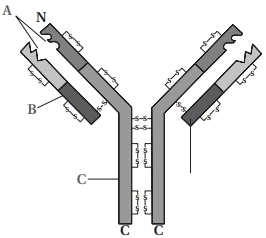
In the figure,the structure of an antibody molecule is shown. Name the parts $A$,$B$,and $C$.
Solution
(N/A) : Antigen binding site,
$B$ : Light chain,
$C$ : Heavy chain
$B$ : Light chain,
$C$ : Heavy chain
0 likes
View Solution412
Medium
Lymph nodes are secondary lymphoid organs. Explain the role of lymph nodes in our immune response.
Solution
(N/A) Lymph nodes are small,solid structures located at different points along the lymphatic system.
Lymph nodes trap microorganisms or other antigens that enter the lymph and tissue fluid.
Antigens trapped in the lymph nodes are responsible for the activation of lymphocytes present there,which leads to the production of antibodies.
This process initiates the immune response.
Additionally,they help in destroying cancer cells.
Lymph nodes trap microorganisms or other antigens that enter the lymph and tissue fluid.
Antigens trapped in the lymph nodes are responsible for the activation of lymphocytes present there,which leads to the production of antibodies.
This process initiates the immune response.
Additionally,they help in destroying cancer cells.
0 likes
View Solution413
MediumMCQ
Why is an antibody molecule represented as $H_2L_2$?
A
It consists of two heavy and two light chains.
B
It consists of two heavy and two intermediate chains.
C
It consists of two heavy and two long chains.
D
It consists of two heavy and two large chains.
Solution
(A) Each antibody molecule is composed of four polypeptide chains: two identical heavy chains $(H)$ and two identical light chains $(L)$.
These chains are held together by disulfide bonds.
Due to the presence of two heavy chains and two light chains,the structure is represented as $H_2L_2$.
These chains are held together by disulfide bonds.
Due to the presence of two heavy chains and two light chains,the structure is represented as $H_2L_2$.
0 likes
View Solution414
DifficultMCQ
What does the term 'memory' of the immune system mean?
A
The ability of the body to forget pathogens.
B
The ability of the immune system to recognize and respond to a pathogen encountered previously with higher intensity.
C
The storage of pathogens in the lymph nodes.
D
The process of producing antibodies for the first time.
Solution
(B) When the body encounters a pathogen for the first time,it produces a response called the $Primary$ $response$.
$Primary$ $response$ is of low intensity.
- During this process,memory cells are formed.
- These memory cells are stored in the spleen and lymph nodes.
When the body encounters the same pathogen subsequently,the immune system recognizes it and elicits a $Secondary$ $response$ (also known as an $Anamnestic$ $response$).
$Secondary$ $response$ is of much higher intensity due to the rapid proliferation of these memory cells.
$Primary$ $response$ is of low intensity.
- During this process,memory cells are formed.
- These memory cells are stored in the spleen and lymph nodes.
When the body encounters the same pathogen subsequently,the immune system recognizes it and elicits a $Secondary$ $response$ (also known as an $Anamnestic$ $response$).
$Secondary$ $response$ is of much higher intensity due to the rapid proliferation of these memory cells.
0 likes
View Solution415
Medium
What is the basic principle of vaccination? How do vaccines prevent microbial infections? Name the organism from which hepatitis $B$ vaccine is produced.
Solution
(N/A) The principle of vaccination is based on the property of 'memory' of the immune system.
In vaccination,a preparation of antigenic proteins of pathogens or inactivated/live but weakened pathogens is introduced into the body.
The antigens generate the primary immune response by producing antibodies. The vaccines also generate memory $B$-cells and $T$-cells.
When the vaccinated person is attacked by the same pathogens,the existing memory $B$-cells or $T$-cells recognize the antigen quickly and overwhelm the invaders with a massive production of lymphocytes and antibodies.
Hepatitis $B$ vaccine is produced from yeast.
In vaccination,a preparation of antigenic proteins of pathogens or inactivated/live but weakened pathogens is introduced into the body.
The antigens generate the primary immune response by producing antibodies. The vaccines also generate memory $B$-cells and $T$-cells.
When the vaccinated person is attacked by the same pathogens,the existing memory $B$-cells or $T$-cells recognize the antigen quickly and overwhelm the invaders with a massive production of lymphocytes and antibodies.
Hepatitis $B$ vaccine is produced from yeast.
0 likes
View Solution416
Medium
For an organ transplant,it is an advantage to have an identical twin. Why?
Solution
(N/A) Organ transplantation is often the only remedy when vital organs like the heart,liver,or kidney fail to function.
Finding a suitable donor is critical because grafts from animals or unrelated humans are usually rejected by the recipient's immune system.
The body's immune system can distinguish between 'self' and 'non-self' cells. The cell-mediated immune response is primarily responsible for graft rejection.
Tissue matching and histocompatibility are essential for successful transplants,and patients typically require life-long immunosuppressants.
Identical twins share the same genetic makeup and histocompatibility antigens. Therefore,there is no risk of graft rejection,making them the ideal donors.
Finding a suitable donor is critical because grafts from animals or unrelated humans are usually rejected by the recipient's immune system.
The body's immune system can distinguish between 'self' and 'non-self' cells. The cell-mediated immune response is primarily responsible for graft rejection.
Tissue matching and histocompatibility are essential for successful transplants,and patients typically require life-long immunosuppressants.
Identical twins share the same genetic makeup and histocompatibility antigens. Therefore,there is no risk of graft rejection,making them the ideal donors.
0 likes
View Solution417
Medium
Define Antigen and Antibody. Name any two diagnostic kits based upon them.
Solution
(N/A) An antigen is a foreign substance that elicits the formation of an antibody. An antibody is a protein that is synthesized by the immune system in response to the presence of an antigen. Antigen and antibody show a high degree of specificity in binding to each other. Two diagnostic kits based on antigen-antibody interaction are:
$(a)$ $ELISA$ (Enzyme-Linked Immunosorbent Assay) for the detection of $HIV$.
$(b)$ Pregnancy test kits (which detect $hCG$ hormone).
$(a)$ $ELISA$ (Enzyme-Linked Immunosorbent Assay) for the detection of $HIV$.
$(b)$ Pregnancy test kits (which detect $hCG$ hormone).
0 likes
View Solution418
MediumMCQ
Identify the wrong statement with reference to immunity.
A
Foetus receives some antibodies from mother, it is an example for passive immunity.
B
When exposed to antigen (living or dead) antibodies are produced in the host's body. It is called "Active Immunity".
C
When ready-made antibodies are directly given, it is called "Passive immunity".
D
Active immunity is quick and gives full response.
Solution
(D) The correct answer is $D$.
Active immunity is slow and takes time to give its full effective response because it involves the activation of the immune system and the production of antibodies by the host's body.
In contrast, passive immunity provides immediate relief as ready-made antibodies are introduced directly into the body.
Active immunity is slow and takes time to give its full effective response because it involves the activation of the immune system and the production of antibodies by the host's body.
In contrast, passive immunity provides immediate relief as ready-made antibodies are introduced directly into the body.
0 likes
View Solution419
MediumMCQ
Identify the incorrect statement regarding immunity:
A
When a host is exposed to antigens (living or dead),antibodies are produced in the host body. This is called 'active immunity'.
B
When ready-made antibodies are directly given to protect the body against foreign agents,it is called 'passive immunity'.
C
Active immunity is fast and gives full response.
D
The fetus receives some antibodies from the mother,which is an example of passive immunity.
Solution
(C) Active immunity is slow and takes time to give a full effective response. It is not fast. Passive immunity is fast because ready-made antibodies are directly introduced into the body. Therefore,statement $C$ is incorrect.
0 likes
View Solution420
EasyMCQ
Match the columns:
| Column-$I$ | Column-$II$ |
|---|---|
| $(a)$ Main lymphoid organ | $(1)$ Thymus |
| $(b)$ $MALT$ | $(2)$ Spleen |
| $(c)$ Lobe-like organ arranged near heart | $(3)$ Bone marrow |
| $(d)$ Large bean-shaped organ | $(4)$ It constitutes $50\%$ of lymphoid tissue |
A
$(a-1), (b-4), (c-3), (d-2)$
B
$(a-3), (b-4), (c-1), (d-2)$
C
$(a-3), (b-2), (c-1), (d-4)$
D
$(a-1), (b-2), (c-3), (d-4)$
Solution
(B) The correct matching is as follows:
$(a)$ Main lymphoid organ: Bone marrow $(3)$, where all blood cells including lymphocytes are produced.
$(b)$ $MALT$ (Mucosa-Associated Lymphoid Tissue): It constitutes about $50\%$ of the lymphoid tissue in the human body $(4)$.
$(c)$ Lobe-like organ arranged near the heart: Thymus $(1)$, which is the site for $T$-lymphocyte differentiation.
$(d)$ Large bean-shaped organ: Spleen $(2)$, which acts as a reservoir of erythrocytes and filters the blood.
Therefore, the correct sequence is $(a-3), (b-4), (c-1), (d-2)$.
$(a)$ Main lymphoid organ: Bone marrow $(3)$, where all blood cells including lymphocytes are produced.
$(b)$ $MALT$ (Mucosa-Associated Lymphoid Tissue): It constitutes about $50\%$ of the lymphoid tissue in the human body $(4)$.
$(c)$ Lobe-like organ arranged near the heart: Thymus $(1)$, which is the site for $T$-lymphocyte differentiation.
$(d)$ Large bean-shaped organ: Spleen $(2)$, which acts as a reservoir of erythrocytes and filters the blood.
Therefore, the correct sequence is $(a-3), (b-4), (c-1), (d-2)$.
0 likes
View Solution421
EasyMCQ
Match the columns:
| Column-$I$ | Column-$II$ |
|---|---|
| $(a)$ Physical barrier | $(1)$ Skin |
| $(b)$ Physiological barrier | $(2)$ Interferon protein |
| $(c)$ Cellular barrier | $(3)$ Leucocytes |
| $(d)$ Cytokine barrier | $(4)$ Saliva in the mouth |
A
$a-1, b-4, c-3, d-2$
B
$a-1, b-2, c-3, d-4$
C
$a-4, b-1, c-2, d-3$
D
$a-2, b-4, c-3, d-1$
Solution
(A) The correct matching is as follows:
$(a)$ Physical barrier: The skin on our body is the main barrier which prevents the entry of microorganisms. Thus,$(a-1)$.
$(b)$ Physiological barrier: Acid in the stomach,saliva in the mouth,and tears from eyes prevent microbial growth. Thus,$(b-4)$.
$(c)$ Cellular barrier: Certain types of leukocytes (WBCs) like polymorphonuclear leukocytes ($PMNL$-neutrophils) and monocytes and macrophages in blood and tissues can phagocytose and destroy microbes. Thus,$(c-3)$.
$(d)$ Cytokine barrier: Virus-infected cells secrete proteins called interferons which protect non-infected cells from further viral infection. Thus,$(d-2)$.
Therefore,the correct sequence is $(a-1, b-4, c-3, d-2)$.
$(a)$ Physical barrier: The skin on our body is the main barrier which prevents the entry of microorganisms. Thus,$(a-1)$.
$(b)$ Physiological barrier: Acid in the stomach,saliva in the mouth,and tears from eyes prevent microbial growth. Thus,$(b-4)$.
$(c)$ Cellular barrier: Certain types of leukocytes (WBCs) like polymorphonuclear leukocytes ($PMNL$-neutrophils) and monocytes and macrophages in blood and tissues can phagocytose and destroy microbes. Thus,$(c-3)$.
$(d)$ Cytokine barrier: Virus-infected cells secrete proteins called interferons which protect non-infected cells from further viral infection. Thus,$(d-2)$.
Therefore,the correct sequence is $(a-1, b-4, c-3, d-2)$.
0 likes
View Solution422
Easy
Define the following terms: Allergy and Cell-mediated immunity.
Solution
(N/A) Allergy: It is an exaggerated or hypersensitive immune response to certain antigens present in the environment,such as dust,pollen,or animal dander. This response involves the release of chemicals like histamine and serotonin from mast cells.
Cell-mediated immunity $(CMI)$: This is an immune response that does not involve antibodies. Instead,it involves the activation of phagocytes,antigen-specific cytotoxic $T$-lymphocytes,and the release of various cytokines in response to an antigen. It is primarily responsible for the rejection of transplanted organs and defense against intracellular pathogens like viruses and certain bacteria.
Cell-mediated immunity $(CMI)$: This is an immune response that does not involve antibodies. Instead,it involves the activation of phagocytes,antigen-specific cytotoxic $T$-lymphocytes,and the release of various cytokines in response to an antigen. It is primarily responsible for the rejection of transplanted organs and defense against intracellular pathogens like viruses and certain bacteria.
0 likes
View Solution423
Easy
Define and explain: Active immunity and Passive immunity.
Solution
(N/A) Active immunity: When a host is exposed to antigens,which may be in the form of living or dead microbes or other proteins,antibodies are produced in the host body. This type of immunity is called active immunity. It is slow and takes time to give its full effective response.
Passive immunity: When ready-made antibodies are directly given to protect the body against foreign agents,it is called passive immunity. This provides immediate relief,for example,the administration of tetanus antitoxin or antibodies received by a fetus from the mother through the placenta.
Passive immunity: When ready-made antibodies are directly given to protect the body against foreign agents,it is called passive immunity. This provides immediate relief,for example,the administration of tetanus antitoxin or antibodies received by a fetus from the mother through the placenta.
0 likes
View Solution424
Easy
Define the following terms: Pathogen and Immunity.
Solution
(N/A) Pathogens: Infectious disease-causing agents,such as bacteria,viruses,fungi,or parasites,are known as pathogens.
Immunity: The overall ability of the host body to fight against disease-causing organisms,conferred by the immune system,is called immunity.
Immunity: The overall ability of the host body to fight against disease-causing organisms,conferred by the immune system,is called immunity.
0 likes
View Solution425
Easy
Define and explain: Innate immunity and Acquired immunity.
Solution
(N/A) Innate immunity: It is a non-specific type of defense that is present at the time of birth. It provides protection against pathogens by various barriers such as physical,physiological,cellular,and cytokine barriers. It is always available to protect the body.
Acquired immunity: It is a pathogen-specific type of immunity. It is not present from birth but develops during an individual's lifetime after exposure to a specific pathogen or through vaccination. It is characterized by memory,meaning the body remembers the specific pathogen for a faster response upon subsequent encounters.
Acquired immunity: It is a pathogen-specific type of immunity. It is not present from birth but develops during an individual's lifetime after exposure to a specific pathogen or through vaccination. It is characterized by memory,meaning the body remembers the specific pathogen for a faster response upon subsequent encounters.
0 likes
View Solution426
EasyMCQ
Define and explain the functions of $B$-lymphocytes and $T$-lymphocytes.
A
$B$-lymphocytes produce antibodies; $T$-lymphocytes produce antigens.
B
$B$-lymphocytes produce antibodies; $T$-lymphocytes help $B$-lymphocytes produce antibodies.
C
$B$-lymphocytes kill pathogens directly; $T$-lymphocytes produce antibodies.
D
$B$-lymphocytes help $T$-lymphocytes; $T$-lymphocytes produce antibodies.
Solution
(B) -lymphocytes: These cells produce specific proteins called antibodies in response to pathogens and release them into the blood to neutralize them.
$T$-lymphocytes: These cells do not secrete antibodies themselves but help $B$-lymphocytes to produce antibodies and also mediate cell-mediated immunity.
$T$-lymphocytes: These cells do not secrete antibodies themselves but help $B$-lymphocytes to produce antibodies and also mediate cell-mediated immunity.
0 likes
View Solution427
Easy
Define the following terms: Antigen and Lymphoid organs.
Solution
(N/A) Antigen: These are substances that,when they enter the body,stimulate the production of antibodies. They are also known as immunogens.
Lymphoid organs: These are the organs where lymphocytes originate,proliferate,and mature. Examples include the bone marrow and thymus.
Lymphoid organs: These are the organs where lymphocytes originate,proliferate,and mature. Examples include the bone marrow and thymus.
0 likes
View Solution428
Easy
Provide definitions/explanations for the following terms: $1$. Retrovirus,$2$. Antibody.
Solution
(N/A) $1$. Retrovirus: These are viruses that contain $RNA$ as their genetic material. They use the enzyme reverse transcriptase to convert their $RNA$ into $DNA$ inside the host cell.
$2$. Antibody: These are a class of proteins known as immunoglobulins $(Ig)$,which are produced by $B$-lymphocytes in response to specific antigenic stimulation to neutralize pathogens.
$2$. Antibody: These are a class of proteins known as immunoglobulins $(Ig)$,which are produced by $B$-lymphocytes in response to specific antigenic stimulation to neutralize pathogens.
0 likes
View Solution429
EasyMCQ
Which antibody is present in high concentration in the initial milk (colostrum)?
A
$IgA$
B
$IgG$
C
$IgM$
D
$IgE$
Solution
(A) The initial milk secreted by the mother during the first few days of lactation is called colostrum.
Colostrum is rich in essential nutrients and contains abundant antibodies,specifically $IgA$ (Immunoglobulin $A$).
These antibodies are crucial for providing passive immunity to the newborn infant,protecting them from various infections during their early life.
Colostrum is rich in essential nutrients and contains abundant antibodies,specifically $IgA$ (Immunoglobulin $A$).
These antibodies are crucial for providing passive immunity to the newborn infant,protecting them from various infections during their early life.
0 likes
View Solution430
EasyMCQ
Which of the following acts as a physical barrier for immunity?
A
Epithelial tissue
B
Saliva
C
Blood tissue
D
Interferons
Solution
(A) The human body has several barriers to prevent the entry of pathogens.
Physical barriers are the first line of defense.
The skin and the mucous coating of the epithelium lining the respiratory,gastrointestinal,and urogenital tracts are the primary physical barriers.
Therefore,epithelial tissue acts as a physical barrier for immunity.
Physical barriers are the first line of defense.
The skin and the mucous coating of the epithelium lining the respiratory,gastrointestinal,and urogenital tracts are the primary physical barriers.
Therefore,epithelial tissue acts as a physical barrier for immunity.
0 likes
View Solution431
MediumMCQ
Which of the following cannot be included in the cellular barrier of innate immunity?
A
Antibodies secreted by lymphocytes
B
Polymorphonuclear leukocytes $(PMNL)$
C
Natural Killer $(NK)$ cells
D
Monocytes
Solution
(A) Innate immunity consists of four types of barriers: physical,physiological,cellular,and cytokine barriers.
$1$. Cellular barriers include cells like Polymorphonuclear leukocytes ($PMNL$-neutrophils),monocytes,and natural killer $(NK)$ cells that phagocytose or destroy microbes.
$2$. Antibodies are part of the acquired (adaptive) immune system,which is produced by $B$-lymphocytes in response to specific antigens.
$3$. Therefore,antibodies secreted by lymphocytes are not part of the cellular barrier of innate immunity.
$1$. Cellular barriers include cells like Polymorphonuclear leukocytes ($PMNL$-neutrophils),monocytes,and natural killer $(NK)$ cells that phagocytose or destroy microbes.
$2$. Antibodies are part of the acquired (adaptive) immune system,which is produced by $B$-lymphocytes in response to specific antigens.
$3$. Therefore,antibodies secreted by lymphocytes are not part of the cellular barrier of innate immunity.
0 likes
View Solution432
EasyMCQ
Which cells secrete interferons?
A
Lymphocytes
B
Phagocytes
C
Virus-infected cells
D
Non-infected cells
Solution
(C) Interferons are a type of cytokine barrier in innate immunity.
When a cell is infected by a virus,it secretes proteins called interferons.
These interferons protect the neighboring non-infected cells from further viral infection.
Therefore,virus-infected cells are the source of interferon secretion.
When a cell is infected by a virus,it secretes proteins called interferons.
These interferons protect the neighboring non-infected cells from further viral infection.
Therefore,virus-infected cells are the source of interferon secretion.
0 likes
View Solution433
EasyMCQ
Which response is provided by the body against a pathogen based on memory?
A
Primary response
B
Secondary response
C
Cell-mediated response
D
Humoral response
Solution
(B) When the body encounters a pathogen for the first time,it produces a $Primary \ response$ of low intensity.
When the same pathogen encounters the body for the second time,the body exhibits a highly intensified $Secondary \ response$ or $Anamnestic \ response$.
This response is based on the memory of the first encounter,which is maintained by memory $B$ and $T$ cells.
When the same pathogen encounters the body for the second time,the body exhibits a highly intensified $Secondary \ response$ or $Anamnestic \ response$.
This response is based on the memory of the first encounter,which is maintained by memory $B$ and $T$ cells.
0 likes
View Solution434
MediumMCQ
The immune response provided by the body against pathogens with the help of $B$-lymphocytes is which type of immunity?
A
Cell-mediated immunity
B
Humoral immunity
C
Antigen-mediated immunity
D
All of the above
Solution
(B) The immune system is broadly classified into two types: $1$. Cell-mediated immunity $(CMI)$ and $2$. Humoral immunity (Antibody-mediated immunity).
$B$-lymphocytes are responsible for producing antibodies in response to pathogens,which circulate in the blood and lymph (the body fluids or 'humors').
Therefore,the immune response mediated by $B$-lymphocytes is known as Humoral immunity or Antibody-mediated immunity.
Cell-mediated immunity is primarily mediated by $T$-lymphocytes.
$B$-lymphocytes are responsible for producing antibodies in response to pathogens,which circulate in the blood and lymph (the body fluids or 'humors').
Therefore,the immune response mediated by $B$-lymphocytes is known as Humoral immunity or Antibody-mediated immunity.
Cell-mediated immunity is primarily mediated by $T$-lymphocytes.
0 likes
View Solution435
MediumMCQ
Where are $H_{2}L_{2}$ molecules found in the body?
A
In blood cells
B
In blood plasma
C
In interstitial fluid
D
In the cytoplasm of cells
Solution
(B) The $H_{2}L_{2}$ molecule represents the basic structure of an antibody (immunoglobulin).
Antibodies are proteins produced by $B$-lymphocytes in response to pathogens.
These antibodies are secreted into the blood and lymph,which are the primary components of blood plasma.
Therefore,$H_{2}L_{2}$ molecules are primarily found in the blood plasma to circulate throughout the body and provide humoral immunity.
Antibodies are proteins produced by $B$-lymphocytes in response to pathogens.
These antibodies are secreted into the blood and lymph,which are the primary components of blood plasma.
Therefore,$H_{2}L_{2}$ molecules are primarily found in the blood plasma to circulate throughout the body and provide humoral immunity.
0 likes
View Solution436
MediumMCQ
Identify the component responsible for the humoral immune response.
A
Antigen
B
$T$-lymphocytes
C
Antibody
D
$PMNL$
Solution
(C) The immune system is divided into two main types: cell-mediated immunity and humoral immunity.
Humoral immunity is mediated by antibodies present in the blood and lymph.
These antibodies are produced by $B$-lymphocytes in response to pathogens.
Therefore,antibodies are the key components responsible for the humoral immune response.
Humoral immunity is mediated by antibodies present in the blood and lymph.
These antibodies are produced by $B$-lymphocytes in response to pathogens.
Therefore,antibodies are the key components responsible for the humoral immune response.
0 likes
View Solution437
MediumMCQ
What can be included in $CMI$?
A
Antibodies
B
$B$-cells
C
$T$-cells
D
Interferons
Solution
(C) $CMI$ stands for Cell-Mediated Immunity.
Cell-Mediated Immunity is primarily mediated by $T$-lymphocytes or $T$-cells.
$B$-cells are responsible for Humoral Immunity (antibody-mediated immunity).
Antibodies are the products of $B$-cells.
Interferons are cytokines that provide innate immunity against viral infections.
Therefore,$T$-cells are the key components of $CMI$.
Cell-Mediated Immunity is primarily mediated by $T$-lymphocytes or $T$-cells.
$B$-cells are responsible for Humoral Immunity (antibody-mediated immunity).
Antibodies are the products of $B$-cells.
Interferons are cytokines that provide innate immunity against viral infections.
Therefore,$T$-cells are the key components of $CMI$.
0 likes
View Solution438
MediumMCQ
Which type of immune response is primarily responsible for the chronic rejection of a transplanted organ by the recipient?
A
Humoral Immunity
B
Cell-Mediated Immunity
C
$NK$ Cell-Mediated Immunity
D
Interleukin-mediated response
Solution
(B) The rejection of a transplanted organ is primarily a result of the recipient's immune system recognizing the donor tissue as 'non-self'.
$1$. The primary mechanism involved in organ rejection is $Cell-Mediated Immunity$ $(CMI)$.
$2$. $T$-lymphocytes (specifically $T$-cytotoxic cells) recognize the foreign antigens on the surface of the transplanted organ cells.
$3$. These $T$-cells then attack and destroy the donor cells, leading to tissue damage and organ rejection.
$4$. While humoral immunity (antibodies) can also play a role, $Cell-Mediated Immunity$ is the dominant force in both acute and chronic rejection processes.
$1$. The primary mechanism involved in organ rejection is $Cell-Mediated Immunity$ $(CMI)$.
$2$. $T$-lymphocytes (specifically $T$-cytotoxic cells) recognize the foreign antigens on the surface of the transplanted organ cells.
$3$. These $T$-cells then attack and destroy the donor cells, leading to tissue damage and organ rejection.
$4$. While humoral immunity (antibodies) can also play a role, $Cell-Mediated Immunity$ is the dominant force in both acute and chronic rejection processes.
0 likes
View Solution439
MediumMCQ
What are antigens composed of?
A
Polypeptides
B
Lipids
C
Nucleic acids
D
All of the above
Solution
(D) Antigens are substances that can induce an immune response. Chemically,they are most commonly proteins or large polypeptides. However,they can also be composed of polysaccharides,lipids,or nucleic acids,especially when these molecules are conjugated with proteins. Therefore,antigens can consist of all the mentioned types of molecules. Thus,the correct option is $D$.
0 likes
View Solution440
MediumMCQ
Active immunity is associated with:
A
Response generated upon the entry of a pathogen
B
Antibodies introduced into the body against snake venom
C
Antibodies produced in the body upon exposure to antigens
D
Both $A$ and $C$
Solution
(D) Active immunity is the immunity developed by an individual's own immune system when it is exposed to antigens (such as living or dead microbes or other proteins).
When a pathogen enters the body,the immune system recognizes the foreign antigens and produces specific antibodies to neutralize them.
Option $A$ describes the primary immune response to a pathogen,and Option $C$ describes the production of antibodies against antigens,both of which are fundamental characteristics of active immunity.
Therefore,both $A$ and $C$ are correct descriptions of active immunity.
When a pathogen enters the body,the immune system recognizes the foreign antigens and produces specific antibodies to neutralize them.
Option $A$ describes the primary immune response to a pathogen,and Option $C$ describes the production of antibodies against antigens,both of which are fundamental characteristics of active immunity.
Therefore,both $A$ and $C$ are correct descriptions of active immunity.
0 likes
View Solution441
MediumMCQ
Breastfeeding can be categorized under which type of immunity?
A
Active immunity
B
Acquired immunity
C
Passive immunity
D
Active acquired immunity
Solution
(C) Breastfeeding provides the infant with pre-formed antibodies,specifically $IgA$,which are transferred from the mother to the child. Since the infant's own immune system does not produce these antibodies in response to an antigen,this is a classic example of passive immunity. Passive immunity is defined as the transfer of active humoral immunity in the form of ready-made antibodies from one individual to another.
0 likes
View Solution442
EasyMCQ
Which antibody is present in abundant amounts in colostrum?
A
$IgE$
B
$IgA$
C
$IgD$
D
$IgG$
Solution
(B) Colostrum is the yellowish fluid secreted by the mother during the initial days of lactation. It contains abundant amounts of $IgA$ antibodies. These antibodies are crucial for providing passive immunity to the newborn infant,protecting them from various infections.
0 likes
View Solution443
MediumMCQ
Which type of antibody is transferred from the mother to the fetus through the placenta?
A
$IgG$
B
$IgA$
C
$IgE$
D
Both $A$ and $B$
Solution
(A) The placenta acts as a barrier between the mother and the fetus,but it allows the passage of certain substances.
$IgG$ is the only class of antibodies that can cross the human placenta from the mother to the fetus.
This provides the fetus with passive immunity against various pathogens during the early stages of life.
$IgA$ is primarily found in colostrum (mother's milk) and provides immunity to the newborn after birth,not through the placenta.
$IgG$ is the only class of antibodies that can cross the human placenta from the mother to the fetus.
This provides the fetus with passive immunity against various pathogens during the early stages of life.
$IgA$ is primarily found in colostrum (mother's milk) and provides immunity to the newborn after birth,not through the placenta.
0 likes
View Solution444
MediumMCQ
Which of the following is $NOT$ included in passive acquired immunity?
A
Transfer of antibodies through the placenta
B
Production of antibodies by the body against $HIV$ virus
C
Transfer of $IgA$ antibodies through breastfeeding
D
Injection of antibodies as part of a vaccine against toxins
Solution
(B) Passive immunity is a type of immunity where pre-formed antibodies are received by the body rather than being produced by the body's own immune system.
$A$. Transfer of antibodies through the placenta is a natural passive immunity.
$B$. Production of antibodies by the body against $HIV$ virus is an example of active immunity,as the body's immune system actively responds to the antigen.
$C$. Transfer of $IgA$ antibodies through colostrum/breastfeeding is a natural passive immunity.
$D$. Injection of antibodies (e.g.,anti-tetanus serum) is an example of artificial passive immunity.
Therefore,option $B$ is not included in passive acquired immunity.
$A$. Transfer of antibodies through the placenta is a natural passive immunity.
$B$. Production of antibodies by the body against $HIV$ virus is an example of active immunity,as the body's immune system actively responds to the antigen.
$C$. Transfer of $IgA$ antibodies through colostrum/breastfeeding is a natural passive immunity.
$D$. Injection of antibodies (e.g.,anti-tetanus serum) is an example of artificial passive immunity.
Therefore,option $B$ is not included in passive acquired immunity.
0 likes
View Solution445
MediumMCQ
In vaccination,which of the following is introduced into the body?
A
Antibodies against diseases
B
Antitoxin substances
C
Inactivated pathogens
D
All of the above
Solution
(C) Vaccination is a process where a preparation of antigenic proteins of pathogen or inactivated/weakened pathogen (vaccine) is introduced into the body.
These antigens generate a primary immune response by producing antibodies in the body.
These antibodies neutralize the pathogenic agents during subsequent actual infection.
The vaccines also generate memory $B$-cells and $T$-cells that recognize the pathogen quickly on subsequent exposure.
Therefore,inactivated pathogens are the primary component introduced during vaccination.
These antigens generate a primary immune response by producing antibodies in the body.
These antibodies neutralize the pathogenic agents during subsequent actual infection.
The vaccines also generate memory $B$-cells and $T$-cells that recognize the pathogen quickly on subsequent exposure.
Therefore,inactivated pathogens are the primary component introduced during vaccination.
0 likes
View Solution446
MediumMCQ
What type of immunity is provided by the treatment given against snake bites?
A
Active immunity
B
Acquired immunity
C
Passive immunity
D
Active acquired immunity
Solution
(C) The treatment given against snake bites involves the injection of pre-formed antibodies (antivenom) into the patient's body.
Since the body does not produce these antibodies itself in response to an antigen,this is a form of passive immunity.
Passive immunity provides immediate relief by neutralizing the toxins present in the snake venom.
Since the body does not produce these antibodies itself in response to an antigen,this is a form of passive immunity.
Passive immunity provides immediate relief by neutralizing the toxins present in the snake venom.
0 likes
View Solution447
MediumMCQ
Which of the following is $NOT$ included in primary lymphoid organs?
A
Bone marrow
B
Thymus
C
Spleen,tonsils,Peyer's patches
D
All of the above
Solution
(C) Primary lymphoid organs are the sites where lymphocytes originate and/or mature and become antigen-specific. The primary lymphoid organs are the bone marrow and the thymus.
In these organs,immature lymphocytes differentiate into antigen-sensitive lymphocytes.
After maturation,the lymphocytes migrate to secondary lymphoid organs like the spleen,lymph nodes,tonsils,and Peyer's patches,where they interact with the antigen and then proliferate to become effector cells.
Therefore,the spleen,tonsils,and Peyer's patches are secondary lymphoid organs,not primary.
In these organs,immature lymphocytes differentiate into antigen-sensitive lymphocytes.
After maturation,the lymphocytes migrate to secondary lymphoid organs like the spleen,lymph nodes,tonsils,and Peyer's patches,where they interact with the antigen and then proliferate to become effector cells.
Therefore,the spleen,tonsils,and Peyer's patches are secondary lymphoid organs,not primary.
0 likes
View Solution448
MediumMCQ
Lymphocytes interact with antigens at the .....
A
Thymus
B
Bone marrow
C
Spleen
D
All of the above
Solution
(C) Lymphocytes are the primary cells of the immune system.
They originate in the bone marrow.
Secondary lymphoid organs like the spleen,lymph nodes,tonsils,Peyer's patches of the small intestine,and appendix provide the sites for interaction of lymphocytes with the antigen,which then proliferate to become effector cells.
Therefore,the spleen is a secondary lymphoid organ where this interaction occurs.
While bone marrow and thymus are primary lymphoid organs where maturation occurs,the interaction with antigens typically happens in secondary lymphoid organs.
They originate in the bone marrow.
Secondary lymphoid organs like the spleen,lymph nodes,tonsils,Peyer's patches of the small intestine,and appendix provide the sites for interaction of lymphocytes with the antigen,which then proliferate to become effector cells.
Therefore,the spleen is a secondary lymphoid organ where this interaction occurs.
While bone marrow and thymus are primary lymphoid organs where maturation occurs,the interaction with antigens typically happens in secondary lymphoid organs.
0 likes
View Solution449
EasyMCQ
Which lymphoid organ shows a reduction in size with increasing age?
A
Spleen
B
Lymph node
C
Thymus
D
Tonsils
Solution
(C) The $Thymus$ is a primary lymphoid organ located near the heart and beneath the breastbone.
It plays a crucial role in the development and maturation of $T$-lymphocytes.
At the time of birth,the $Thymus$ is quite large in size.
However,as an individual grows older,the $Thymus$ gradually undergoes atrophy (involution),meaning it reduces in size and is replaced by adipose tissue.
Therefore,the correct answer is $Thymus$.
It plays a crucial role in the development and maturation of $T$-lymphocytes.
At the time of birth,the $Thymus$ is quite large in size.
However,as an individual grows older,the $Thymus$ gradually undergoes atrophy (involution),meaning it reduces in size and is replaced by adipose tissue.
Therefore,the correct answer is $Thymus$.
0 likes
View Solution450
MediumMCQ
What is the full form of $MALT$?
A
Mucosal Associated Leucocytic Tissue
B
Mucosal Associated Lymphoid Tissue
C
Myloid Associated Lymphatic Tissue
D
Mucosal Assisted Leucocytic Tissue
Solution
(B) $MALT$ stands for Mucosa-Associated Lymphoid Tissue.
It constitutes about $50\%$ of the lymphoid tissue in the human body.
It is located within the lining of the major tracts such as the respiratory,digestive,and urogenital tracts.
It constitutes about $50\%$ of the lymphoid tissue in the human body.
It is located within the lining of the major tracts such as the respiratory,digestive,and urogenital tracts.
0 likes
View SolutionHuman Health and Disease — Immunity · Frequently Asked Questions
1Are these Human Health and Disease questions useful for JEE and NEET?
Yes. All questions in this section are mapped to JEE Main and NEET exam patterns. Previous year questions from JEE Main, NEET, GUJCET and state-level exams are included with full solutions.
2Can I switch to Hindi or Gujarati for these questions?
Yes. Use the language tabs in the hero section or the sidebar to view the same questions and solutions in English, Hindi or Gujarati.
3How do I generate a question paper from this subtopic?
Use the Vedclass Exam Paper Generator — select the chapter and subtopic, set difficulty, and generate Sets A, B, C, D automatically. First 3 chapters of every subject are free.
Vedclass Products
For Students
Vedclass Test Series
Mock tests in real JEE/NEET style with performance analysis. 5-day free trial.
Start Free TrialFor Teachers
Exam Paper Generator
Generate Set A/B/C/D papers from this chapter in 2 minutes. 3 chapters free.
Try FreeFor Institutes
Online Exam Module
Live online exams with unlimited students, 360° analytics & white-label branding.
See DemoFor Teachers & Institutes
Generate a Human Health and Disease Exam Paper in 2 Minutes
Select subtopic & difficulty — Sets A, B, C, D auto-generated with No Repeat logic.
First 3 chapters of every subject are free — no payment required.