
A English
Diseases caused by protozoa Questions in English
Class 12 Biology · Human Health and Disease · Diseases caused by protozoa
396+
Questions
English
Language
100%
With Solutions
Showing 50 of 396 questions in English
251
MediumMCQ
Which of the following is not associated with the pre-erythrocytic cycle of the malaria parasite?
A
Sporozoite
B
Cryptozoite
C
Schizogony
D
Metacryptozoite
Solution
(D) The life cycle of the malaria parasite $(Plasmodium)$ in humans involves two main phases: the exo-erythrocytic cycle (which includes the pre-erythrocytic cycle) and the erythrocytic cycle.
$1$. The pre-erythrocytic cycle occurs in the liver cells.
$2$. The sporozoites enter the liver cells and transform into cryptozoites.
$3$. These cryptozoites undergo multiple fission,known as schizogony,to produce crypto-merozoites.
$4$. Metacryptozoites are formed during the exo-erythrocytic cycle in the liver,but they are specifically associated with the secondary cycle (exo-erythrocytic) that occurs after the initial pre-erythrocytic phase,or are sometimes considered part of the broader liver stage. However,in standard terminology,the term 'metacryptozoite' is often distinguished from the initial 'cryptozoite' phase of the pre-erythrocytic cycle.
$5$. Among the given options,'Metacryptozoite' is the stage that follows the initial pre-erythrocytic development and is associated with the secondary liver cycle,making it the least directly associated with the primary pre-erythrocytic cycle.
$1$. The pre-erythrocytic cycle occurs in the liver cells.
$2$. The sporozoites enter the liver cells and transform into cryptozoites.
$3$. These cryptozoites undergo multiple fission,known as schizogony,to produce crypto-merozoites.
$4$. Metacryptozoites are formed during the exo-erythrocytic cycle in the liver,but they are specifically associated with the secondary cycle (exo-erythrocytic) that occurs after the initial pre-erythrocytic phase,or are sometimes considered part of the broader liver stage. However,in standard terminology,the term 'metacryptozoite' is often distinguished from the initial 'cryptozoite' phase of the pre-erythrocytic cycle.
$5$. Among the given options,'Metacryptozoite' is the stage that follows the initial pre-erythrocytic development and is associated with the secondary liver cycle,making it the least directly associated with the primary pre-erythrocytic cycle.
0 likes
View Solution252
MediumMCQ
Which cycle of $Plasmodium$ occurs in the red blood cells $(RBCs)$ of humans?
A
Pre-erythrocytic cycle
B
Exo-erythrocytic cycle
C
Endo-erythrocytic cycle
D
Post-erythrocytic cycle
Solution
(C) The life cycle of $Plasmodium$ in humans involves two main phases: the exo-erythrocytic cycle and the erythrocytic cycle.
$1$. The exo-erythrocytic cycle occurs in the liver cells $(hepatocytes)$.
$2$. The erythrocytic cycle (also known as the endo-erythrocytic cycle) occurs within the red blood cells $(RBCs)$.
During this phase,the parasite multiplies within the $RBCs$,leading to their rupture and the release of toxins like $haemozoin$,which causes the characteristic chills and high fever associated with malaria.
Therefore,the cycle occurring in $RBCs$ is the endo-erythrocytic cycle.
$1$. The exo-erythrocytic cycle occurs in the liver cells $(hepatocytes)$.
$2$. The erythrocytic cycle (also known as the endo-erythrocytic cycle) occurs within the red blood cells $(RBCs)$.
During this phase,the parasite multiplies within the $RBCs$,leading to their rupture and the release of toxins like $haemozoin$,which causes the characteristic chills and high fever associated with malaria.
Therefore,the cycle occurring in $RBCs$ is the endo-erythrocytic cycle.
0 likes
View Solution253
MediumMCQ
Where is the $endo-erythrocytic$ cycle observed?
A
Saliva
B
Hepatocytes
C
White blood cells
D
Red blood cells
Solution
(D) The life cycle of the malaria parasite $(Plasmodium)$ involves two hosts: humans and mosquitoes.
In the human body,the parasite undergoes two main cycles: the $exo-erythrocytic$ cycle (occurring in the liver cells or $hepatocytes$) and the $erythrocytic$ cycle (occurring in the red blood cells).
The term $endo-erythrocytic$ cycle is often used synonymously with the $erythrocytic$ cycle,which takes place inside the red blood cells $(RBCs)$.
Therefore,the correct answer is red blood cells.
In the human body,the parasite undergoes two main cycles: the $exo-erythrocytic$ cycle (occurring in the liver cells or $hepatocytes$) and the $erythrocytic$ cycle (occurring in the red blood cells).
The term $endo-erythrocytic$ cycle is often used synonymously with the $erythrocytic$ cycle,which takes place inside the red blood cells $(RBCs)$.
Therefore,the correct answer is red blood cells.
0 likes
View Solution254
MediumMCQ
In which stage of the life cycle of $Anopheles$ does the $metacryptomerozoite$ enter the red blood cell and become spherical?
A
Endo-erythrocytic cycle
B
Exo-erythrocytic cycle
C
Pre-erythrocytic cycle
D
Post-erythrocytic cycle
Solution
(A) The life cycle of $Plasmodium$ involves different stages in the human host.
After the initial infection,the parasite undergoes the $pre-erythrocytic$ cycle in the liver.
Following this,the $metacryptomerozoites$ are released from the liver cells.
These $metacryptomerozoites$ then enter the red blood cells $(RBCs)$ to initiate the $endo-erythrocytic$ cycle (also known as the erythrocytic schizogony).
Upon entering the $RBC$,the parasite becomes spherical and is known as the $trophozoite$ stage.
After the initial infection,the parasite undergoes the $pre-erythrocytic$ cycle in the liver.
Following this,the $metacryptomerozoites$ are released from the liver cells.
These $metacryptomerozoites$ then enter the red blood cells $(RBCs)$ to initiate the $endo-erythrocytic$ cycle (also known as the erythrocytic schizogony).
Upon entering the $RBC$,the parasite becomes spherical and is known as the $trophozoite$ stage.
0 likes
View Solution255
EasyMCQ
What is the name of the metacryptomerozoite that enters the red blood cell and becomes spherical?
A
Metacryptoschizont
B
Trophozoite
C
Schizont
D
Cryptoschizont
Solution
(B) In the life cycle of the malaria parasite $(Plasmodium)$,the merozoites released from the liver cells (specifically from the exo-erythrocytic cycle) enter the red blood cells $(RBCs)$.
Once inside the $RBC$,the parasite loses its elongated shape and becomes spherical,which is known as the $Trophozoite$ stage.
This stage is the feeding stage of the parasite within the host's blood cell.
Once inside the $RBC$,the parasite loses its elongated shape and becomes spherical,which is known as the $Trophozoite$ stage.
This stage is the feeding stage of the parasite within the host's blood cell.
0 likes
View Solution256
MediumMCQ
In which stage of the life cycle of $Plasmodium$ does the trophozoite develop pseudopodia?
A
Amoeboid
B
Cryptomerozoite
C
Sporozoite
D
Trophozoite
Solution
(A) The life cycle of $Plasmodium$ involves several stages. After the sporozoites enter the human body,they infect liver cells and then red blood cells $(RBCs)$. Inside the $RBCs$,the parasite transforms into the trophozoite stage. This stage is characterized by the development of pseudopodia,which allow the parasite to ingest the host cell cytoplasm (specifically hemoglobin). This specific form is often referred to as the 'amoeboid stage' of the trophozoite.
0 likes
View Solution257
EasyMCQ
What does the trophozoite break down the hemoglobin present in red blood cells into?
A
Heme and sodium
B
Globin and fibrinogen
C
Heme and globin
D
Heme and myosin
Solution
(C) The trophozoite stage of the malaria parasite $(Plasmodium)$ feeds on the hemoglobin present in the host's red blood cells $(RBCs)$.
During this process,it breaks down hemoglobin into two main components: heme and globin.
The globin part is used by the parasite for its own protein synthesis,while the heme part is toxic and is converted into a non-toxic pigment called hemozoin.
During this process,it breaks down hemoglobin into two main components: heme and globin.
The globin part is used by the parasite for its own protein synthesis,while the heme part is toxic and is converted into a non-toxic pigment called hemozoin.
0 likes
View Solution258
MediumMCQ
Which parasite stage breaks down hemoglobin with the help of enzymes?
A
Metacryptomerozoite
B
Sporozoite
C
Trophozoite
D
Cryptoschizont
Solution
(C) The $Plasmodium$ parasite,which causes malaria,infects human red blood cells $(RBCs)$.
Inside the $RBC$,the parasite enters the $Trophozoite$ stage.
During this stage,the parasite feeds on the host's hemoglobin.
It uses specific enzymes to break down hemoglobin into globin and hematin (a toxic byproduct),which is then converted into non-toxic hemozoin crystals.
Inside the $RBC$,the parasite enters the $Trophozoite$ stage.
During this stage,the parasite feeds on the host's hemoglobin.
It uses specific enzymes to break down hemoglobin into globin and hematin (a toxic byproduct),which is then converted into non-toxic hemozoin crystals.
0 likes
View Solution259
MediumMCQ
Which of the following proteins serves as food for the trophozoite of $Plasmodium$?
A
Myosin
B
Tubulin
C
Soybean
D
Globin
Solution
(D) The $Plasmodium$ parasite,which causes malaria,infects human red blood cells $(RBCs)$.
Inside the $RBC$,the parasite exists in the trophozoite stage.
It feeds on the hemoglobin present in the host's $RBCs$.
$Hemoglobin$ is a protein composed of heme and globin chains.
The parasite breaks down hemoglobin to obtain amino acids for its growth and development,leaving behind a toxic byproduct called hemozoin.
Therefore,the globin part of hemoglobin serves as a primary food source for the trophozoite.
Inside the $RBC$,the parasite exists in the trophozoite stage.
It feeds on the hemoglobin present in the host's $RBCs$.
$Hemoglobin$ is a protein composed of heme and globin chains.
The parasite breaks down hemoglobin to obtain amino acids for its growth and development,leaving behind a toxic byproduct called hemozoin.
Therefore,the globin part of hemoglobin serves as a primary food source for the trophozoite.
0 likes
View Solution260
MediumMCQ
In which toxic substance is heme converted during the life cycle of the malaria parasite?
A
Hemosite
B
Hemozoin
C
Globozoin
D
Hemocyanin
Solution
(B) The malaria parasite,$Plasmodium$,infects human red blood cells $(RBCs)$.
Inside the $RBCs$,the parasite feeds on hemoglobin.
The digestion of hemoglobin releases heme,which is toxic to the parasite.
To protect itself,the parasite converts this toxic heme into a non-toxic,crystalline pigment called $Hemozoin$.
The accumulation of $Hemozoin$ is responsible for the characteristic chill and high fever associated with malaria.
Inside the $RBCs$,the parasite feeds on hemoglobin.
The digestion of hemoglobin releases heme,which is toxic to the parasite.
To protect itself,the parasite converts this toxic heme into a non-toxic,crystalline pigment called $Hemozoin$.
The accumulation of $Hemozoin$ is responsible for the characteristic chill and high fever associated with malaria.
0 likes
View Solution261
EasyMCQ
The trophozoite of $Plasmodium$ feeds and becomes spherical,which is known as:
A
Schizont
B
Hemozoin
C
Merozoite
D
Sporozoite
Solution
(A) In the life cycle of $Plasmodium$ (the malarial parasite),the trophozoite stage inside the human red blood cell feeds on hemoglobin and grows in size. As it matures,it becomes spherical and is referred to as a schizont. The schizont then undergoes multiple fission to produce merozoites,which are released into the blood upon the rupture of the red blood cell. Therefore,the correct term for the spherical feeding stage is schizont.
0 likes
View Solution262
MediumMCQ
What is $Hemozoin$?
A
Mineral
B
Protein
C
Toxic substance
D
Enzyme
Solution
(C) $Hemozoin$ is a toxic substance released into the blood during $Malaria$ infection.
It is produced by the parasite $Plasmodium$ as a byproduct of the digestion of hemoglobin from the host's red blood cells.
The release of $Hemozoin$ is responsible for the characteristic chills and high fever associated with $Malaria$.
It is produced by the parasite $Plasmodium$ as a byproduct of the digestion of hemoglobin from the host's red blood cells.
The release of $Hemozoin$ is responsible for the characteristic chills and high fever associated with $Malaria$.
0 likes
View Solution263
MediumMCQ
What do merozoites transform into?
A
Cryptoschizont
B
Schizont
C
Merozoite
D
Gametocyte
Solution
(D) In the life cycle of the malaria parasite $(Plasmodium)$,the merozoites released from the liver cells (or red blood cells) infect new red blood cells. Inside the red blood cells,they undergo asexual reproduction to form a stage called the $Schizont$. Eventually,the $Schizont$ ruptures to release more merozoites,or some merozoites differentiate into sexual stages known as $Gametocytes$ (male and female gametocytes) which are then taken up by the mosquito.
0 likes
View Solution264
EasyMCQ
Which gametocyte is male in Plasmodium?
A
Small size and small nucleus
B
Small size and large nucleus
C
Large size and small nucleus
D
Large size and large nucleus
Solution
(B) In the life cycle of $Plasmodium$,the gametocytes are formed in the human blood.
These are of two types: microgametocytes (male) and macrogametocytes (female).
The microgametocyte (male) is characterized by a smaller size and a large,centrally located nucleus.
The macrogametocyte (female) is larger in size and has a small,peripherally located nucleus.
Therefore,the male gametocyte is small in size with a large nucleus.
These are of two types: microgametocytes (male) and macrogametocytes (female).
The microgametocyte (male) is characterized by a smaller size and a large,centrally located nucleus.
The macrogametocyte (female) is larger in size and has a small,peripherally located nucleus.
Therefore,the male gametocyte is small in size with a large nucleus.
0 likes
View Solution265
MediumMCQ
Which gametocytes are female?
A
Large in size with a small nucleus
B
Small in size with a large nucleus
C
Large in size with a large nucleus
D
Small in size with a small nucleus
Solution
(A) In the life cycle of $Plasmodium$ (the malarial parasite),the gametocytes formed in the human blood are of two types: microgametocytes (male) and macrogametocytes (female).
$1$. Macrogametocytes (female) are larger in size and possess a small,compact nucleus.
$2$. Microgametocytes (male) are smaller in size and possess a large,diffuse nucleus.
Therefore,the female gametocytes are characterized by being large in size with a small nucleus.
$1$. Macrogametocytes (female) are larger in size and possess a small,compact nucleus.
$2$. Microgametocytes (male) are smaller in size and possess a large,diffuse nucleus.
Therefore,the female gametocytes are characterized by being large in size with a small nucleus.
0 likes
View Solution266
EasyMCQ
Where do the gametocytes obtained from human blood enter in the female Anopheles mosquito?
A
Respiratory tract
B
Digestive tract
C
Reproductive tract
D
Urinary tract
Solution
(B) When a female $Anopheles$ mosquito bites an infected person,it ingests the blood containing the gametocytes of the malarial parasite $(Plasmodium)$.
These gametocytes enter the digestive tract (midgut) of the mosquito.
In the midgut,fertilization and further development of the parasite occur.
Therefore,the correct site of entry is the digestive tract.
These gametocytes enter the digestive tract (midgut) of the mosquito.
In the midgut,fertilization and further development of the parasite occur.
Therefore,the correct site of entry is the digestive tract.
0 likes
View Solution267
MediumMCQ
What is the male gametocyte that enters the digestive tract of a mosquito called?
A
Gametocyst
B
Microgamete
C
Megagamete
D
Ookineet
Solution
(B) In the life cycle of $Plasmodium$,the male gametocyte (microgametocyte) enters the digestive tract of the female $Anopheles$ mosquito.
Inside the mosquito's gut,the microgametocyte undergoes a process called exflagellation to produce several active,flagellated structures known as microgametes.
These microgametes then fertilize the female gamete (megagamete) to form a zygote,which later develops into an ookinete.
Inside the mosquito's gut,the microgametocyte undergoes a process called exflagellation to produce several active,flagellated structures known as microgametes.
These microgametes then fertilize the female gamete (megagamete) to form a zygote,which later develops into an ookinete.
0 likes
View Solution268
EasyMCQ
What is the female gametocyte called?
A
Megagamete
B
Microgamete
C
Ookine
D
Sporozoite
Solution
(A) In the life cycle of the malarial parasite $Plasmodium$,the gametocytes are formed in the human blood. The male gametocyte is known as the microgametocyte,while the female gametocyte is known as the megagametocyte (or macrogametocyte). Therefore,the female gametocyte is called a megagamete.
0 likes
View Solution269
EasyMCQ
What is the shape of an ookinete?
A
Spherical
B
Oval
C
Cylindrical
D
Vermiform (elongated/spindle-shaped)
Solution
(D) In the life cycle of the malaria parasite $(Plasmodium)$,the zygote formed in the gut of the female $Anopheles$ mosquito undergoes transformation. The zygote becomes elongated,motile,and spindle-shaped,which is known as an ookinete. Therefore,the shape of an ookinete is vermiform or spindle-shaped.
0 likes
View Solution270
EasyMCQ
Into what does the ookinete transform next?
A
Sporozoite
B
Oocyst
C
Merozoite
D
Cryptomerozoite
Solution
(B) In the life cycle of the malarial parasite $(Plasmodium)$,fertilization occurs in the gut of the female $Anopheles$ mosquito,resulting in the formation of a zygote.
This zygote transforms into a motile,elongated stage called the ookinete.
The ookinete then penetrates the gut wall of the mosquito and transforms into an oocyst.
Inside the oocyst,the parasite undergoes multiple fission (sporogony) to produce numerous sporozoites.
This zygote transforms into a motile,elongated stage called the ookinete.
The ookinete then penetrates the gut wall of the mosquito and transforms into an oocyst.
Inside the oocyst,the parasite undergoes multiple fission (sporogony) to produce numerous sporozoites.
0 likes
View Solution271
MediumMCQ
Where do sporozoites enter for further development in the human body?
A
Human saliva
B
Human liver
C
Anopheles blood
D
Anopheles liver
Solution
(B) When an infected female $Anopheles$ mosquito bites a human,it transmits the infectious stage of the malaria parasite,known as sporozoites,into the human bloodstream. From the blood,these sporozoites quickly travel to the liver,where they enter the liver cells (hepatocytes) to undergo further development and asexual reproduction (schizogony). Therefore,the liver is the site for the initial development of the parasite in the human body.
0 likes
View Solution272
MediumMCQ
Which of the following stages of the $Plasmodium$ life cycle is $NOT$ found in the mosquito?
A
Ookinete
B
Oocyst
C
Trophozoite
D
Sporozoite
Solution
(C) The life cycle of $Plasmodium$ involves two hosts: humans and female $Anopheles$ mosquitoes.
$1$. In the human host,the parasite undergoes asexual reproduction,where the $Trophozoite$ stage (feeding stage) is found in the red blood cells.
$2$. In the mosquito,the sexual cycle occurs. Gametocytes ingested from human blood fuse to form a zygote,which develops into an $Ookinete$,then an $Oocyst$,and finally produces $Sporozoites$.
$3$. The $Trophozoite$ stage is specific to the human host (erythrocytic cycle) and is not found in the mosquito.
$1$. In the human host,the parasite undergoes asexual reproduction,where the $Trophozoite$ stage (feeding stage) is found in the red blood cells.
$2$. In the mosquito,the sexual cycle occurs. Gametocytes ingested from human blood fuse to form a zygote,which develops into an $Ookinete$,then an $Oocyst$,and finally produces $Sporozoites$.
$3$. The $Trophozoite$ stage is specific to the human host (erythrocytic cycle) and is not found in the mosquito.
0 likes
View Solution273
MediumMCQ
Which stage of the $Plasmodium$ life cycle is found in both the mosquito and the human?
A
Gametocyte
B
Sporozoite
C
Trophozoite
D
Both $(A)$ and $(B)$
Solution
(D) The life cycle of $Plasmodium$ involves two hosts: humans and female $Anopheles$ mosquitoes.
$1$. The $Sporozoite$ is the infectious stage for humans,injected by the mosquito during a blood meal. It then travels to the liver.
$2$. Inside the human body,the parasite undergoes asexual reproduction and eventually forms $Gametocytes$ in the red blood cells.
$3$. These $Gametocytes$ are then ingested by the mosquito during a blood meal,where they undergo sexual reproduction.
$4$. Therefore,both $Sporozoites$ (in the mosquito's salivary glands and human blood) and $Gametocytes$ (in human blood and the mosquito's gut) are stages found in both hosts.
$1$. The $Sporozoite$ is the infectious stage for humans,injected by the mosquito during a blood meal. It then travels to the liver.
$2$. Inside the human body,the parasite undergoes asexual reproduction and eventually forms $Gametocytes$ in the red blood cells.
$3$. These $Gametocytes$ are then ingested by the mosquito during a blood meal,where they undergo sexual reproduction.
$4$. Therefore,both $Sporozoites$ (in the mosquito's salivary glands and human blood) and $Gametocytes$ (in human blood and the mosquito's gut) are stages found in both hosts.
0 likes
View Solution274
MediumMCQ
Statement $- X$: The male gametocyte is known as the microgamete.
Statement $- Y$: The ookinete transforms into an oocyst.
Statement $- Y$: The ookinete transforms into an oocyst.
A
Both statements $X$ and $Y$ are correct.
B
Both statements $X$ and $Y$ are incorrect.
C
Statement $X$ is incorrect and statement $Y$ is correct.
D
Statement $X$ is correct,but statement $Y$ is incorrect.
Solution
(C) Statement $- X$ is incorrect because the male gametocyte is called a microgametocyte,which produces microgametes. The microgamete itself is the male gamete,not the gametocyte.
Statement $- Y$ is correct. In the life cycle of $Plasmodium$,the zygote formed in the mosquito's gut transforms into a motile ookinete,which then penetrates the gut wall to develop into an oocyst.
Statement $- Y$ is correct. In the life cycle of $Plasmodium$,the zygote formed in the mosquito's gut transforms into a motile ookinete,which then penetrates the gut wall to develop into an oocyst.
0 likes
View Solution275
MediumMCQ
$S$ - Statement: The $Anopheles$ mosquito is responsible for malaria.
$R$ - Reason: $Plasmodium$ uses both humans and the female $Anopheles$ mosquito as hosts.
$R$ - Reason: $Plasmodium$ uses both humans and the female $Anopheles$ mosquito as hosts.
A
$S$ and $R$ are both true,and $R$ is the correct explanation of $S$.
B
$S$ and $R$ are both true,but $R$ is not the correct explanation of $S$.
C
$S$ is true and $R$ is false.
D
$S$ is false and $R$ is true.
Solution
(A) The $Anopheles$ mosquito acts as a vector for the malaria parasite,$Plasmodium$.
$Plasmodium$ is a digenetic parasite,meaning it requires two hosts to complete its life cycle: humans (intermediate host) and the female $Anopheles$ mosquito (definitive host).
Since the mosquito transmits the parasite and is essential for the completion of its life cycle,the statement that it is responsible for malaria is correct,and the reason provided explains the biological basis for this relationship.
$Plasmodium$ is a digenetic parasite,meaning it requires two hosts to complete its life cycle: humans (intermediate host) and the female $Anopheles$ mosquito (definitive host).
Since the mosquito transmits the parasite and is essential for the completion of its life cycle,the statement that it is responsible for malaria is correct,and the reason provided explains the biological basis for this relationship.
0 likes
View Solution276
MediumMCQ
What is the correct sequence of $Plasmodium$ development in a mosquito?
A
Gametocyte – Oocyst – Sporozoite – Ookinete
B
Oocyst – Ookinete – Gametocyte – Sporozoite
C
Oocyst – Ookinete – Sporozoite – Gametocyte
D
Gametocyte – Ookinete – Oocyst – Sporozoite
Solution
(D) The life cycle of $Plasmodium$ in a mosquito begins when the female $Anopheles$ mosquito ingests blood containing gametocytes from an infected human.
$1$. $Gametocytes$ are taken up by the mosquito.
$2$. Fertilization and development take place in the mosquito's gut to form an $Ookinete$.
$3$. The $Ookinete$ penetrates the gut wall to form an $Oocyst$.
$4$. Inside the $Oocyst$,sporozoites are produced through asexual reproduction.
$5$. These $Sporozoites$ migrate to the salivary glands of the mosquito,ready to infect a new human host.
Therefore,the correct sequence is $Gametocyte$ – $Ookinete$ – $Oocyst$ – $Sporozoite$.
$1$. $Gametocytes$ are taken up by the mosquito.
$2$. Fertilization and development take place in the mosquito's gut to form an $Ookinete$.
$3$. The $Ookinete$ penetrates the gut wall to form an $Oocyst$.
$4$. Inside the $Oocyst$,sporozoites are produced through asexual reproduction.
$5$. These $Sporozoites$ migrate to the salivary glands of the mosquito,ready to infect a new human host.
Therefore,the correct sequence is $Gametocyte$ – $Ookinete$ – $Oocyst$ – $Sporozoite$.
0 likes
View Solution277
MediumMCQ
Where are the gametocytes of $Plasmodium$ formed and found?
A
Human liver
B
Stomach of female mosquito
C
Human blood
D
Human red blood cells
Solution
(D) The life cycle of $Plasmodium$ involves two hosts: humans and female $Anopheles$ mosquitoes.
In the human host,the parasite undergoes asexual reproduction in the liver cells and red blood cells $(RBCs)$.
During the erythrocytic cycle,some of the parasites differentiate into gametocytes (sexual stages).
These gametocytes are formed and found within the human red blood cells $(RBCs)$ before being ingested by the mosquito during a blood meal.
In the human host,the parasite undergoes asexual reproduction in the liver cells and red blood cells $(RBCs)$.
During the erythrocytic cycle,some of the parasites differentiate into gametocytes (sexual stages).
These gametocytes are formed and found within the human red blood cells $(RBCs)$ before being ingested by the mosquito during a blood meal.
0 likes
View Solution278
EasyMCQ
Which mosquito actually transmits malaria and acts as the intermediate host for Plasmodium?
A
Male Anopheles
B
Female Anopheles
C
Male Culex
D
Female Culex
Solution
(B) The malaria parasite,$Plasmodium$,requires two hosts to complete its life cycle: humans (primary host) and mosquitoes (intermediate host).
In the mosquito,the sexual stage of the life cycle occurs.
Only the female $Anopheles$ mosquito acts as the vector for malaria because it requires a blood meal for egg production,during which it ingests the gametocytes from an infected human and transmits the sporozoites to a healthy human.
Male mosquitoes feed on plant juices and do not bite humans.
In the mosquito,the sexual stage of the life cycle occurs.
Only the female $Anopheles$ mosquito acts as the vector for malaria because it requires a blood meal for egg production,during which it ingests the gametocytes from an infected human and transmits the sporozoites to a healthy human.
Male mosquitoes feed on plant juices and do not bite humans.
0 likes
View Solution279
EasyMCQ
Which is the infectious stage of $Plasmodium$?
A
Trophozoite
B
Sporozoite
C
Merozoite
D
Schizont
Solution
(B) The infectious stage of $Plasmodium$ for humans is the $Sporozoite$.
When an infected female $Anopheles$ mosquito bites a human,it releases $Sporozoites$ into the human bloodstream through its saliva.
These $Sporozoites$ then travel to the liver to initiate the infection cycle.
When an infected female $Anopheles$ mosquito bites a human,it releases $Sporozoites$ into the human bloodstream through its saliva.
These $Sporozoites$ then travel to the liver to initiate the infection cycle.
0 likes
View Solution280
MediumMCQ
Which shape does the sporozoite acquire after obtaining nutrition from the liver cells?
A
Spindle-shaped
B
Spherical
C
Oval
D
Cylindrical
Solution
(B) In the life cycle of $Plasmodium$,the sporozoites enter the human liver cells via the bloodstream. Inside the liver cells,they feed on the cytoplasm and grow in size. After obtaining nutrition,they lose their spindle shape and transform into a spherical form known as a $schizont$ or $cryptozoite$.
0 likes
View Solution281
MediumMCQ
Which of the following stages is part of the exo-erythrocytic cycle of $Plasmodium$ in $Anopheles$?
A
Metacryptomerozoite
B
Trophozoite
C
Sporozoite
D
Merozoite
Solution
(A) The life cycle of $Plasmodium$ involves two hosts: humans and the female $Anopheles$ mosquito.
In the human host,the cycle begins with the entry of $Sporozoites$ through the bite of an infected mosquito.
These $Sporozoites$ first enter the liver cells,where they undergo asexual reproduction to form $Cryptozoites$ and subsequently $Metacryptomerozoites$. This phase is known as the exo-erythrocytic cycle.
After this,the parasites enter the red blood cells (erythrocytes) to initiate the erythrocytic cycle.
Therefore,$Metacryptomerozoite$ is the stage associated with the exo-erythrocytic cycle.
In the human host,the cycle begins with the entry of $Sporozoites$ through the bite of an infected mosquito.
These $Sporozoites$ first enter the liver cells,where they undergo asexual reproduction to form $Cryptozoites$ and subsequently $Metacryptomerozoites$. This phase is known as the exo-erythrocytic cycle.
After this,the parasites enter the red blood cells (erythrocytes) to initiate the erythrocytic cycle.
Therefore,$Metacryptomerozoite$ is the stage associated with the exo-erythrocytic cycle.
0 likes
View Solution282
EasyMCQ
Which type of disease is caused by the protozoan $Plasmodium$ $falciparum$?
A
Pneumonia
B
Jaundice
C
Diarrhea
D
Malaria
Solution
(D) $Plasmodium$ $falciparum$ is a protozoan parasite that causes the most severe and life-threatening form of malaria,known as malignant malaria.
$Plasmodium$ species are transmitted to humans through the bite of an infected female $Anopheles$ mosquito.
Other species like $P. vivax$,$P. malariae$,and $P. ovale$ also cause malaria,but $P. falciparum$ is particularly dangerous.
Therefore,the correct option is $D$.
$Plasmodium$ species are transmitted to humans through the bite of an infected female $Anopheles$ mosquito.
Other species like $P. vivax$,$P. malariae$,and $P. ovale$ also cause malaria,but $P. falciparum$ is particularly dangerous.
Therefore,the correct option is $D$.
0 likes
View Solution283
MediumMCQ
In humans,the sporozoite stage of $Plasmodium$ is found in which phase of its life cycle?
A
Pre-erythrocytic
B
Exo-erythrocytic
C
Endo-erythrocytic
D
Erythrocytic
Solution
(A) The life cycle of $Plasmodium$ begins when an infected female $Anopheles$ mosquito bites a human,injecting sporozoites into the bloodstream.
These sporozoites quickly travel to the liver cells.
The stage of the life cycle that occurs within the liver cells before the parasite enters the red blood cells is known as the pre-erythrocytic stage.
Therefore,the sporozoites are primarily associated with the pre-erythrocytic phase in the human host.
These sporozoites quickly travel to the liver cells.
The stage of the life cycle that occurs within the liver cells before the parasite enters the red blood cells is known as the pre-erythrocytic stage.
Therefore,the sporozoites are primarily associated with the pre-erythrocytic phase in the human host.
0 likes
View Solution284
MediumMCQ
What is the structure formed at the end of asexual reproduction in the cryptoschizont stage of Plasmodium?
A
Oocyst
B
Oogony
C
Schizogony
D
Schizont
Solution
(D) In the life cycle of $Plasmodium$,the sporozoites enter the liver cells and develop into a stage called the $cryptoschizont$.
Inside the $cryptoschizont$,the parasite undergoes multiple fission,a process known as $schizogony$.
At the end of this asexual reproduction process,the $cryptoschizont$ ruptures to release numerous $merozoites$ (also known as $cryptozoites$).
Therefore,the structure formed at the end of the asexual cycle within the liver cell is the $schizont$ which contains the $merozoites$.
Inside the $cryptoschizont$,the parasite undergoes multiple fission,a process known as $schizogony$.
At the end of this asexual reproduction process,the $cryptoschizont$ ruptures to release numerous $merozoites$ (also known as $cryptozoites$).
Therefore,the structure formed at the end of the asexual cycle within the liver cell is the $schizont$ which contains the $merozoites$.
0 likes
View Solution285
MediumMCQ
What is the stage called when a cryptomerozoite enters a new liver cell,grows,and becomes spherical?
A
Megacryptoschizont
B
Macrocryptoschizont
C
Metatrophozoite
D
Metacryptoschizont
Solution
(D) In the life cycle of $Plasmodium$ (the malarial parasite),after the initial exo-erythrocytic schizogony in the liver,the released merozoites (cryptomerozoites) infect fresh liver cells. Inside these new liver cells,they grow and become spherical,a stage known as the $Metacryptoschizont$.
0 likes
View Solution286
MediumMCQ
Into what does the meta-cryptoschizont transform through asexual reproduction?
A
Meta-cryptomerozoite
B
Mega-cryptomerozoite
C
Schizogony
D
Oocyst
Solution
(A) In the life cycle of the malaria parasite $(Plasmodium)$,the sporozoites enter the liver cells of the human host.
Inside the liver,they undergo a process called pre-erythrocytic schizogony to form cryptoschizonts,which release cryptomerozoites.
These cryptomerozoites infect other liver cells to form meta-cryptoschizonts.
Through asexual reproduction (schizogony),these meta-cryptoschizonts transform into meta-cryptomerozoites,which are then released into the blood to infect red blood cells.
Inside the liver,they undergo a process called pre-erythrocytic schizogony to form cryptoschizonts,which release cryptomerozoites.
These cryptomerozoites infect other liver cells to form meta-cryptoschizonts.
Through asexual reproduction (schizogony),these meta-cryptoschizonts transform into meta-cryptomerozoites,which are then released into the blood to infect red blood cells.
0 likes
View Solution287
EasyMCQ
Which stage of the $Plasmodium$ life cycle is observed in human red blood cells?
A
Exo-erythrocytic stage
B
Erythrocytic stage
C
Endo-erythrocytic stage
D
Pre-erythrocytic stage
Solution
(B) The life cycle of $Plasmodium$ involves two hosts: humans and mosquitoes.
In humans,the parasite undergoes an initial phase in the liver cells known as the pre-erythrocytic or exo-erythrocytic stage.
Following this,the parasites enter the bloodstream and invade the red blood cells $(RBCs)$.
This phase,where the parasite multiplies within the $RBCs$,is known as the erythrocytic stage.
Therefore,the stage observed in human red blood cells is the erythrocytic stage.
In humans,the parasite undergoes an initial phase in the liver cells known as the pre-erythrocytic or exo-erythrocytic stage.
Following this,the parasites enter the bloodstream and invade the red blood cells $(RBCs)$.
This phase,where the parasite multiplies within the $RBCs$,is known as the erythrocytic stage.
Therefore,the stage observed in human red blood cells is the erythrocytic stage.
0 likes
View Solution288
MediumMCQ
Which of the following stages in the human-$Plasmodium$ life cycle is known as the amoeboid stage?
A
Trophozoite
B
Sporozoite
C
Merozoite
D
Macrozoite
Solution
(A) In the life cycle of $Plasmodium$ (the malarial parasite),the sporozoites enter the human body through the bite of an infected female $Anopheles$ mosquito.
Once inside the human liver cells,they multiply and eventually release merozoites into the blood.
These merozoites invade the red blood cells $(RBCs)$.
Inside the $RBCs$,the parasite transforms into a feeding stage known as the $Trophozoite$.
This $Trophozoite$ stage is characterized by its irregular shape and pseudopodia-like extensions,which allow it to ingest host cell cytoplasm,hence it is referred to as the amoeboid stage.
Once inside the human liver cells,they multiply and eventually release merozoites into the blood.
These merozoites invade the red blood cells $(RBCs)$.
Inside the $RBCs$,the parasite transforms into a feeding stage known as the $Trophozoite$.
This $Trophozoite$ stage is characterized by its irregular shape and pseudopodia-like extensions,which allow it to ingest host cell cytoplasm,hence it is referred to as the amoeboid stage.
0 likes
View Solution289
MediumMCQ
Into what does the schizont transform through asexual reproduction?
A
Sporozoite
B
Merozoite
C
Trophozoite
D
Microzoite
Solution
(B) In the life cycle of the malaria parasite $(Plasmodium)$,the schizont is a stage that undergoes asexual reproduction (schizogony) within the liver cells or red blood cells of the host.
During this process,the schizont divides multiple times to produce numerous daughter cells known as merozoites.
These merozoites are then released into the bloodstream to infect new red blood cells.
During this process,the schizont divides multiple times to produce numerous daughter cells known as merozoites.
These merozoites are then released into the bloodstream to infect new red blood cells.
0 likes
View Solution290
EasyMCQ
What are the characteristics of the male gametocyte in terms of size and nucleus?
A
Large size and small nucleus
B
Small size and small nucleus
C
Large size and large nucleus
D
Small size and large nucleus
Solution
(D) In the life cycle of $Plasmodium$ (the malarial parasite),the gametocytes are formed in the human blood. The male gametocyte (microgametocyte) is characterized by a smaller size and a large,diffuse nucleus,which facilitates the process of exflagellation. In contrast,the female gametocyte (macrogametocyte) is larger in size and has a small,compact nucleus.
0 likes
View Solution291
MediumMCQ
What is the name of the zygote formed by the fertilization of microgametes and megagametes in the life cycle of Plasmodium?
A
Oocyst
B
Ookinete
C
Schizogony
D
Oogony
Solution
(B) In the life cycle of $Plasmodium$,fertilization occurs in the gut of the female $Anopheles$ mosquito. The fusion of the microgamete (male gamete) and the megagamete (female gamete) results in the formation of a diploid zygote. This zygote is motile and is known as an $Ookinete$. The $Ookinete$ then penetrates the gut wall of the mosquito to form an $Oocyst$.
0 likes
View Solution292
MediumMCQ
In the life cycle of Plasmodium,into what does the oocyst transform after sexual reproduction?
A
Sporozoite
B
Trophozoite
C
Merozoite
D
Gametocyte
Solution
(A) In the life cycle of $Plasmodium$,sexual reproduction occurs within the gut of the female $Anopheles$ mosquito.
After fertilization,the zygote develops into an oocyst.
The oocyst undergoes multiple divisions (sporogony) to produce numerous infective stages known as sporozoites.
These sporozoites then migrate to the salivary glands of the mosquito.
After fertilization,the zygote develops into an oocyst.
The oocyst undergoes multiple divisions (sporogony) to produce numerous infective stages known as sporozoites.
These sporozoites then migrate to the salivary glands of the mosquito.
0 likes
View Solution293
MediumMCQ
What is the correct sequence of the $Sporozoite$ in humans?
A
$Anopheles$ blood - Liver cells - Human saliva
B
Liver cells - $Anopheles$ blood - Human saliva
C
$Anopheles$ saliva - Human blood - Human liver cells
D
Human blood - Human liver cells - $Anopheles$ saliva
Solution
(C) The life cycle of $Plasmodium$ begins when an infected female $Anopheles$ mosquito bites a human.
During the bite,the mosquito injects $Sporozoites$ (the infectious stage) present in its saliva into the human bloodstream.
These $Sporozoites$ travel through the blood and reach the liver cells $(Hepatocytes)$,where they multiply and cause infection.
Therefore,the correct sequence is: $Anopheles$ saliva $\rightarrow$ Human blood $\rightarrow$ Human liver cells.
During the bite,the mosquito injects $Sporozoites$ (the infectious stage) present in its saliva into the human bloodstream.
These $Sporozoites$ travel through the blood and reach the liver cells $(Hepatocytes)$,where they multiply and cause infection.
Therefore,the correct sequence is: $Anopheles$ saliva $\rightarrow$ Human blood $\rightarrow$ Human liver cells.
0 likes
View Solution294
MediumMCQ
What is the correct sequence of the life cycle of $Plasmodium$ in the mosquito?
A
Gametocytes - Ookinete - Oocyst - Sporozoites
B
Gametocytes - Oocyst - Gametocytes - Sporozoites
C
Ookinete - Oocyst - Gametocytes - Sporozoites
D
Oocyst - Ookinete - Sporozoites - Gametocytes
Solution
(A) The life cycle of $Plasmodium$ in the mosquito begins when the mosquito ingests blood containing gametocytes from an infected human.
$1$. In the mosquito's gut,gametocytes fuse to form a zygote.
$2$. The zygote transforms into a motile stage called the ookinete.
$3$. The ookinete penetrates the gut wall and develops into an oocyst.
$4$. Inside the oocyst,sporozoites are formed through asexual reproduction.
$5$. These sporozoites migrate to the salivary glands of the mosquito,ready to infect a new host.
Therefore,the correct sequence is: Gametocytes $\rightarrow$ Zygote $\rightarrow$ Ookinete $\rightarrow$ Oocyst $\rightarrow$ Sporozoites.
$1$. In the mosquito's gut,gametocytes fuse to form a zygote.
$2$. The zygote transforms into a motile stage called the ookinete.
$3$. The ookinete penetrates the gut wall and develops into an oocyst.
$4$. Inside the oocyst,sporozoites are formed through asexual reproduction.
$5$. These sporozoites migrate to the salivary glands of the mosquito,ready to infect a new host.
Therefore,the correct sequence is: Gametocytes $\rightarrow$ Zygote $\rightarrow$ Ookinete $\rightarrow$ Oocyst $\rightarrow$ Sporozoites.
0 likes
View Solution295
MediumMCQ
Which of the following options represents the correct matching for the given table?
| List-$I$ | List-$II$ |
| $(i)$ Pre-erythrocytic cycle | $(A)$ Metacrypto merozoites enter RBCs and become spherical |
| $(ii)$ Exo-erythrocytic cycle | $(B)$ Sporozoites present in saliva enter human blood |
| $(iii)$ Erythrocytic cycle | $(C)$ Break liver cells and enter the blood |
A
$(i-B), (ii-C), (iii-A)$
B
$(i-C), (ii-B), (iii-A)$
C
$(i-A), (ii-C), (iii-B)$
D
$(i-B), (ii-A), (iii-C)$
Solution
$(A)$ The life cycle of Plasmodium in humans involves several stages:
$1$. Pre-erythrocytic cycle $(i)$: Sporozoites injected by the mosquito saliva enter the human blood and reach the liver cells, matching with $(B)$.
$2$. Exo-erythrocytic cycle $(ii)$: The parasites multiply in the liver cells, break them, and release merozoites into the blood, matching with $(C)$.
$3$. Erythrocytic cycle $(iii)$: The merozoites (specifically metacrypto merozoites) enter the Red Blood Cells (RBCs) and become spherical (trophozoite stage), matching with $(A)$.
Therefore, the correct sequence is $(i-B), (ii-C), (iii-A)$.
$1$. Pre-erythrocytic cycle $(i)$: Sporozoites injected by the mosquito saliva enter the human blood and reach the liver cells, matching with $(B)$.
$2$. Exo-erythrocytic cycle $(ii)$: The parasites multiply in the liver cells, break them, and release merozoites into the blood, matching with $(C)$.
$3$. Erythrocytic cycle $(iii)$: The merozoites (specifically metacrypto merozoites) enter the Red Blood Cells (RBCs) and become spherical (trophozoite stage), matching with $(A)$.
Therefore, the correct sequence is $(i-B), (ii-C), (iii-A)$.
0 likes
View Solution296
MediumMCQ
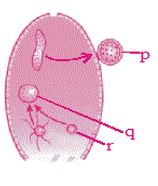
Identify '$p$','$q$',and '$r$' in the given figure.
A
$(p)$ Zygote,$(q)$ Gametes,$(r)$ Oocyst
B
$(p)$ Oocyst,$(q)$ Zygote,$(r)$ Gametes
C
$(p)$ Gametes,$(q)$ Oocyst,$(r)$ Zygote
D
$(p)$ Zygote,$(q)$ Oocyst,$(r)$ Gametes
Solution
(B) The provided figure illustrates the fertilization process of the malarial parasite $(Plasmodium)$ within the gut of a female $Anopheles$ mosquito.
$1$. The gametes fuse to form a diploid zygote $(q)$.
$2$. The zygote develops into a motile ookinete,which then encysts to form an oocyst $(p)$.
$3$. The label $(r)$ represents the gametes (male and female) that are undergoing fusion.
Therefore,$(p)$ is Oocyst,$(q)$ is Zygote,and $(r)$ is Gametes.
$1$. The gametes fuse to form a diploid zygote $(q)$.
$2$. The zygote develops into a motile ookinete,which then encysts to form an oocyst $(p)$.
$3$. The label $(r)$ represents the gametes (male and female) that are undergoing fusion.
Therefore,$(p)$ is Oocyst,$(q)$ is Zygote,and $(r)$ is Gametes.
0 likes
View Solution297
MediumMCQ
Where can you find the sporozoites of the malaria parasite?
A
In the saliva of a female Anopheles mosquito
B
In the red blood cells of a human suffering from malaria
C
In the spleen of an infected person
D
In the salivary glands of a freshly emerged female Anopheles mosquito
Solution
(D) The life cycle of the malaria parasite $(Plasmodium)$ involves two hosts: humans and female $Anopheles$ mosquitoes.
When a female $Anopheles$ mosquito bites an infected human,it ingests the gametocytes.
These gametocytes undergo fertilization and development within the mosquito's gut to form sporozoites.
These sporozoites then migrate to the salivary glands of the mosquito.
Therefore,the sporozoites are found in the salivary glands of the female $Anopheles$ mosquito,which are then injected into a healthy human during the next blood meal.
When a female $Anopheles$ mosquito bites an infected human,it ingests the gametocytes.
These gametocytes undergo fertilization and development within the mosquito's gut to form sporozoites.
These sporozoites then migrate to the salivary glands of the mosquito.
Therefore,the sporozoites are found in the salivary glands of the female $Anopheles$ mosquito,which are then injected into a healthy human during the next blood meal.
0 likes
View Solution298
EasyMCQ
Which of the following diseases is caused by a protozoan?
A
Babesiosis
B
Blastomycosis
C
Syphilis
D
Influenza
Solution
(A) : Babesiosis is a malaria-like parasitic disease caused by infection with $Babesia$,a parasitic protozoan.
Babesiosis has long been recognized as a disease of cattle and other domestic animals,until human forms of babesiosis were discovered.
$Babesia$ parasites reproduce in the red blood cells of mammals and cause haemolytic anaemia,which is quite similar to malaria.
The parasite is transmitted by ticks.
Babesiosis has long been recognized as a disease of cattle and other domestic animals,until human forms of babesiosis were discovered.
$Babesia$ parasites reproduce in the red blood cells of mammals and cause haemolytic anaemia,which is quite similar to malaria.
The parasite is transmitted by ticks.
0 likes
View Solution299
MediumMCQ
The active form of $Entamoeba \ histolytica$ feeds upon
A
food in intestine
B
blood only
C
erythrocytes,mucosa and submucosa of colon
D
mucosa and submucosa of colon only
Solution
(C) $Entamoeba \ histolytica$ (Gr.,$entos$: within + $amoeba$: change + $histos$: tissue + $lysis$: dissolve) is the causative organism of amoebic dysentery or amoebiasis in humans.
It is a microscopic endoparasite of humans.
It is commonly found in the upper part of the large intestine (colon) and can often lodge in the liver,lungs,brain,and testes.
In its life cycle,it occurs in three distinct forms: $(i)$ trophozoite or magna form,$(ii)$ precystic or minuta form,and $(iii)$ cystic form.
The trophozoite is the most active,motile,and feeding form,which is pathogenic to humans.
It lives in the mucous and submucous layers of the colon and feeds on these layers and erythrocytes.
It is a microscopic endoparasite of humans.
It is commonly found in the upper part of the large intestine (colon) and can often lodge in the liver,lungs,brain,and testes.
In its life cycle,it occurs in three distinct forms: $(i)$ trophozoite or magna form,$(ii)$ precystic or minuta form,and $(iii)$ cystic form.
The trophozoite is the most active,motile,and feeding form,which is pathogenic to humans.
It lives in the mucous and submucous layers of the colon and feeds on these layers and erythrocytes.
0 likes
View Solution300
MediumMCQ
Motile zygote of $Plasmodium$ occurs in
A
gut of female $Anopheles$
B
salivary glands of $Anopheles$
C
human $RBCs$
D
human liver
Solution
(A) $Plasmodium$,a tiny protozoan parasite,causes malaria in humans and is transmitted through the bite of an infected female $Anopheles$ mosquito.
When a female $Anopheles$ mosquito sucks the blood of an infected human,it ingests gametocytes (sexual stages of the parasite) with the blood meal.
The gametocytes are released from the $RBCs$ into the lumen (cavity) of the mosquito's stomach.
In the stomach,the male gametocyte divides to form $6$ to $8$ long,motile,whip-like microgametes (male gametes).
The female gametocyte matures into a macrogamete (female gamete).
Fertilization (syngamy) occurs when a microgamete penetrates a macrogamete,resulting in the formation of a zygote.
The zygote elongates and transforms into a worm-like,motile organism called an ookinete.
Therefore,the motile zygote (ookinete) of $Plasmodium$ is found in the gut of the female $Anopheles$ mosquito.
When a female $Anopheles$ mosquito sucks the blood of an infected human,it ingests gametocytes (sexual stages of the parasite) with the blood meal.
The gametocytes are released from the $RBCs$ into the lumen (cavity) of the mosquito's stomach.
In the stomach,the male gametocyte divides to form $6$ to $8$ long,motile,whip-like microgametes (male gametes).
The female gametocyte matures into a macrogamete (female gamete).
Fertilization (syngamy) occurs when a microgamete penetrates a macrogamete,resulting in the formation of a zygote.
The zygote elongates and transforms into a worm-like,motile organism called an ookinete.
Therefore,the motile zygote (ookinete) of $Plasmodium$ is found in the gut of the female $Anopheles$ mosquito.
0 likes
View SolutionHuman Health and Disease — Diseases caused by protozoa · Frequently Asked Questions
1Are these Human Health and Disease questions useful for JEE and NEET?
Yes. All questions in this section are mapped to JEE Main and NEET exam patterns. Previous year questions from JEE Main, NEET, GUJCET and state-level exams are included with full solutions.
2Can I switch to Hindi or Gujarati for these questions?
Yes. Use the language tabs in the hero section or the sidebar to view the same questions and solutions in English, Hindi or Gujarati.
3How do I generate a question paper from this subtopic?
Use the Vedclass Exam Paper Generator — select the chapter and subtopic, set difficulty, and generate Sets A, B, C, D automatically. First 3 chapters of every subject are free.
Vedclass Products
For Students
Vedclass Test Series
Mock tests in real JEE/NEET style with performance analysis. 5-day free trial.
Start Free TrialFor Teachers
Exam Paper Generator
Generate Set A/B/C/D papers from this chapter in 2 minutes. 3 chapters free.
Try FreeFor Institutes
Online Exam Module
Live online exams with unlimited students, 360° analytics & white-label branding.
See DemoFor Teachers & Institutes
Generate a Human Health and Disease Exam Paper in 2 Minutes
Select subtopic & difficulty — Sets A, B, C, D auto-generated with No Repeat logic.
First 3 chapters of every subject are free — no payment required.