
A English
Diseases caused by protozoa Questions in English
Class 12 Biology · Human Health and Disease · Diseases caused by protozoa
396+
Questions
English
Language
100%
With Solutions
Showing 50 of 396 questions in English
301
MediumMCQ
Where will you look for the sporozoites of the malarial parasite?
A
Saliva of infected female Anopheles mosquito
B
Red blood corpuscles of human suffering from malaria
C
Spleen of infected humans
D
Salivary glands of freshly moulted female Anopheles mosquito
Solution
(A) The correct answer is $A$.
Sporozoites are the infectious stage of the malarial parasite $(Plasmodium)$.
When an infected female $Anopheles$ mosquito bites a healthy human,it injects saliva into the host's bloodstream to prevent blood clotting.
These sporozoites are stored in the salivary glands of the infected mosquito and are released into the human host along with the saliva during the bite.
Therefore,the sporozoites are found in the saliva of the infected female $Anopheles$ mosquito.
Sporozoites are the infectious stage of the malarial parasite $(Plasmodium)$.
When an infected female $Anopheles$ mosquito bites a healthy human,it injects saliva into the host's bloodstream to prevent blood clotting.
These sporozoites are stored in the salivary glands of the infected mosquito and are released into the human host along with the saliva during the bite.
Therefore,the sporozoites are found in the saliva of the infected female $Anopheles$ mosquito.
0 likes
View Solution302
MediumMCQ
$A$ person suffering from a disease caused by $Plasmodium$ experiences recurring chill and fever at the time when:
A
the sporozoites released from $RBCs$ are being rapidly killed and broken down inside the spleen.
B
the trophozoites reach maximum growth and give out certain toxins.
C
the parasite after its rapid multiplication inside $RBCs$ ruptures them,releasing the stage to enter fresh $RBCs$.
D
the microgametocytes and megagametocytes are being destroyed by the $WBCs$.
Solution
(C) $Plasmodium$ is a protozoan parasite responsible for malaria in humans.
During the life cycle of $Plasmodium$,the parasite multiplies rapidly inside the $RBCs$ (erythrocytes).
When these $RBCs$ rupture,they release the parasite along with a toxic substance called $haemozoin$.
This release of $haemozoin$ into the bloodstream is responsible for the recurring chills and high fever associated with malaria.
During the life cycle of $Plasmodium$,the parasite multiplies rapidly inside the $RBCs$ (erythrocytes).
When these $RBCs$ rupture,they release the parasite along with a toxic substance called $haemozoin$.
This release of $haemozoin$ into the bloodstream is responsible for the recurring chills and high fever associated with malaria.
0 likes
View Solution303
MediumMCQ
Fertilization and development of Plasmodium occurs in
A
Salivary glands of mosquito
B
$WBC$
C
Gut of mosquito
D
Human brain
Solution
(C) The life cycle of $Plasmodium$ involves two hosts: humans and female $Anopheles$ mosquitoes.
In the human host,the parasite undergoes asexual reproduction (schizogony and gametogony).
When a female $Anopheles$ mosquito bites an infected human,it ingests the gametocytes.
Fertilization (fusion of male and female gametes) and further development (formation of zygote and sporozoites) occur within the gut of the mosquito.
After development,the sporozoites migrate to the salivary glands of the mosquito to be transmitted to the next human host.
In the human host,the parasite undergoes asexual reproduction (schizogony and gametogony).
When a female $Anopheles$ mosquito bites an infected human,it ingests the gametocytes.
Fertilization (fusion of male and female gametes) and further development (formation of zygote and sporozoites) occur within the gut of the mosquito.
After development,the sporozoites migrate to the salivary glands of the mosquito to be transmitted to the next human host.
0 likes
View Solution304
MediumMCQ
Which is not a symptom of amoebiasis?
A
Constipation
B
Abdominal pain and cramps
C
Stools with excess mucous and blood clots
D
Internal bleeding
Solution
(D) Amoebiasis, also known as amoebic dysentery, is caused by the protozoan parasite $Entamoeba \text{ histolytica}$.
Common symptoms of this disease include constipation, abdominal pain and cramps, and stools with excess mucous and blood clots.
Internal bleeding (hemorrhage) is not a primary or characteristic symptom of amoebiasis, although severe ulceration of the intestinal wall can occur.
Therefore, $D$ is the correct answer.
Common symptoms of this disease include constipation, abdominal pain and cramps, and stools with excess mucous and blood clots.
Internal bleeding (hemorrhage) is not a primary or characteristic symptom of amoebiasis, although severe ulceration of the intestinal wall can occur.
Therefore, $D$ is the correct answer.
0 likes
View Solution305
MediumMCQ
Plasmodium gametocytes are formed in
A
Salivary gland of mosquito
B
$RBC$ of human
C
$WBC$ of blood
D
Liver cells
Solution
(B) The life cycle of $Plasmodium$ involves two hosts: humans and female $Anopheles$ mosquitoes.
In the human host,the parasite undergoes asexual reproduction in the liver cells (exo-erythrocytic cycle) and then in the red blood cells (erythrocytic cycle).
During the erythrocytic cycle,some of the merozoites differentiate into male and female gametocytes within the red blood cells $(RBCs)$.
These gametocytes are then ingested by the female $Anopheles$ mosquito during a blood meal,where they undergo sexual reproduction.
Therefore,the correct site for the formation of gametocytes is the $RBC$ of humans.
In the human host,the parasite undergoes asexual reproduction in the liver cells (exo-erythrocytic cycle) and then in the red blood cells (erythrocytic cycle).
During the erythrocytic cycle,some of the merozoites differentiate into male and female gametocytes within the red blood cells $(RBCs)$.
These gametocytes are then ingested by the female $Anopheles$ mosquito during a blood meal,where they undergo sexual reproduction.
Therefore,the correct site for the formation of gametocytes is the $RBC$ of humans.
0 likes
View Solution306
EasyMCQ
Which toxic substance is responsible for the chills and high fever recurring every three to four days in malaria?
A
Haemozoin
B
Haemoglobin
C
Haemoerythrin
D
Haemolymph
Solution
(A) In malaria,the parasite $Plasmodium$ infects human red blood cells $(RBCs)$.
As the parasite grows and multiplies,it breaks down the haemoglobin present in the $RBCs$.
This process releases a toxic substance known as $Haemozoin$.
When the infected $RBCs$ rupture,$Haemozoin$ is released into the bloodstream,which triggers the characteristic symptoms of malaria,such as chills and high fever that recur every $3$ to $4$ days.
As the parasite grows and multiplies,it breaks down the haemoglobin present in the $RBCs$.
This process releases a toxic substance known as $Haemozoin$.
When the infected $RBCs$ rupture,$Haemozoin$ is released into the bloodstream,which triggers the characteristic symptoms of malaria,such as chills and high fever that recur every $3$ to $4$ days.
0 likes
View Solution307
EasyMCQ
Mosquitoes are vectors for which of the following pairs of diseases?
A
Elephantiasis and Pneumonia
B
Malaria and cold
C
Ringworm and dengue
D
Dengue and Malaria
Solution
(D) Mosquitoes act as biological vectors for several diseases.
$1$. $Anopheles$ mosquito is the vector for Malaria.
$2$. $Aedes$ mosquito is the vector for Dengue and Chikungunya.
$3$. $Culex$ mosquito is the vector for Filariasis (Elephantiasis).
Therefore,the pair of diseases transmitted by mosquitoes among the given options is Dengue and Malaria.
$1$. $Anopheles$ mosquito is the vector for Malaria.
$2$. $Aedes$ mosquito is the vector for Dengue and Chikungunya.
$3$. $Culex$ mosquito is the vector for Filariasis (Elephantiasis).
Therefore,the pair of diseases transmitted by mosquitoes among the given options is Dengue and Malaria.
0 likes
View Solution308
MediumMCQ
What are the symptoms of amoebiasis?
A
Abdominal pain, cramps, stools with excess mucous and blood clots, and constipation
B
Internal bleeding, muscular pain, fever, anemia
C
Inflammation of legs, mutation in genital organs
D
Fever, chills, headache, cough
Solution
(A) Amoebiasis, also known as amoebic dysentery, is caused by the protozoan parasite $Entamoeba \text{ histolytica}$.
The symptoms of this disease include constipation, abdominal pain, and cramps.
Another characteristic symptom is the passage of stools with excess mucous and blood clots.
Therefore, option $A$ correctly describes the symptoms of amoebiasis.
The symptoms of this disease include constipation, abdominal pain, and cramps.
Another characteristic symptom is the passage of stools with excess mucous and blood clots.
Therefore, option $A$ correctly describes the symptoms of amoebiasis.
0 likes
View Solution309
MediumMCQ
Haemozoin is a
A
precursor of hemoglobin
B
toxin released from Streptococcus infected cells
C
toxin released from Plasmodium infected cells
D
toxin released from Haemophilus infected cells
Solution
(C) Haemozoin is a toxic substance released into the blood during the rupture of red blood cells infected with the malarial parasite,$Plasmodium$.
This toxin is responsible for the characteristic chill and high fever that recurs every $3$ to $4$ days in malaria patients.
It is formed by the breakdown of hemoglobin by the parasite within the host's red blood cells.
This toxin is responsible for the characteristic chill and high fever that recurs every $3$ to $4$ days in malaria patients.
It is formed by the breakdown of hemoglobin by the parasite within the host's red blood cells.
0 likes
View Solution310
MediumMCQ
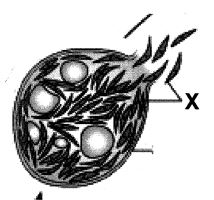
Identify $X$ from the figure.
A
Sporozoites
B
Salivary gland
C
Mosquito host
D
Human host
Solution
(A) The figure illustrates the life cycle of the malaria parasite,$Plasmodium$.
Specifically,it shows the rupture of an oocyst in the mosquito's gut wall,releasing numerous infectious stages known as sporozoites.
These sporozoites then migrate to the salivary glands of the mosquito,from where they are injected into the human host during a blood meal.
Therefore,$X$ represents the sporozoites.
Specifically,it shows the rupture of an oocyst in the mosquito's gut wall,releasing numerous infectious stages known as sporozoites.
These sporozoites then migrate to the salivary glands of the mosquito,from where they are injected into the human host during a blood meal.
Therefore,$X$ represents the sporozoites.
0 likes
View Solution311
MediumMCQ
In $Plasmodium$,we find:
A
Cell differentiation
B
Meiosis
C
Spore formation
D
Buds
Solution
(C) The life cycle of $Plasmodium$ involves both sexual and asexual reproduction.
During the asexual phase in the human host,$Plasmodium$ undergoes multiple fission (schizogony) to produce merozoites.
However,in the context of its life cycle,the formation of infective stages known as sporozoites occurs in the salivary glands of the female $Anopheles$ mosquito.
This process of producing large numbers of sporozoites is a form of spore formation (sporogony).
Therefore,spore formation is a characteristic feature of the $Plasmodium$ life cycle.
During the asexual phase in the human host,$Plasmodium$ undergoes multiple fission (schizogony) to produce merozoites.
However,in the context of its life cycle,the formation of infective stages known as sporozoites occurs in the salivary glands of the female $Anopheles$ mosquito.
This process of producing large numbers of sporozoites is a form of spore formation (sporogony).
Therefore,spore formation is a characteristic feature of the $Plasmodium$ life cycle.
0 likes
View Solution312
EasyMCQ
Which disease is caused by $Plasmodium$?
A
Pneumonia
B
Common cold
C
Malaria
D
Elephantiasis
Solution
(C) $Plasmodium$ is a genus of unicellular eukaryotes that are obligate parasites of vertebrates and insects.
$Plasmodium$ species are responsible for causing malaria in humans.
Specifically,species like $Plasmodium$ $vivax$,$Plasmodium$ $malariae$,and $Plasmodium$ $falciparum$ are known to cause different types of malaria.
Therefore,the correct option is $C$.
$Plasmodium$ species are responsible for causing malaria in humans.
Specifically,species like $Plasmodium$ $vivax$,$Plasmodium$ $malariae$,and $Plasmodium$ $falciparum$ are known to cause different types of malaria.
Therefore,the correct option is $C$.
0 likes
View Solution313
MediumMCQ
Which of the following diseases is caused by protozoans?
A
Potato spindle disease
B
Ringworm
C
Malaria
D
Typhoid
Solution
(C) The disease $Malaria$ is caused by protozoans belonging to the genus $Plasmodium$ (e.g., $Plasmodium$ $vivax$, $Plasmodium$ $falciparum$).
$Potato$ $spindle$ $tuber$ $disease$ is caused by viroids.
$Ringworm$ is a fungal infection caused by fungi such as $Microsporum$, $Trichophyton$, and $Epidermophyton$.
$Typhoid$ is a bacterial disease caused by the bacterium $Salmonella$ $typhi$.
$Potato$ $spindle$ $tuber$ $disease$ is caused by viroids.
$Ringworm$ is a fungal infection caused by fungi such as $Microsporum$, $Trichophyton$, and $Epidermophyton$.
$Typhoid$ is a bacterial disease caused by the bacterium $Salmonella$ $typhi$.
0 likes
View Solution314
MediumMCQ
Malaria fever is associated with the release of $..........$.
A
Cryptomerozoites
B
Metacryptomerozoites
C
Merozoites
D
Trophozoites
Solution
(C) Malaria fever is caused by the release of a toxic substance called $hemozoin$ into the blood. This substance is released when the $Plasmodium$ parasite completes its erythrocytic cycle (cycle in red blood cells) and ruptures the host's red blood cells to release the next generation of $merozoites$. Therefore,the periodic fever and chills associated with malaria are directly linked to the release of $merozoites$ and $hemozoin$ from the ruptured red blood cells.
0 likes
View Solution315
EasyMCQ
Which is the infectious stage of the malarial parasite $Plasmodium$ that enters the human body?
A
Merozoites
B
Sporozoites
C
Trophozoites
D
Minuta form
Solution
(B) The life cycle of $Plasmodium$ involves two hosts: humans and female $Anopheles$ mosquitoes.
When an infected female $Anopheles$ mosquito bites a human,it injects the $Plasmodium$ parasites in the form of $Sporozoites$ into the human bloodstream.
These $Sporozoites$ are the infectious stage of the parasite for humans.
They travel through the blood to the liver,where they infect liver cells and begin their asexual reproduction cycle.
When an infected female $Anopheles$ mosquito bites a human,it injects the $Plasmodium$ parasites in the form of $Sporozoites$ into the human bloodstream.
These $Sporozoites$ are the infectious stage of the parasite for humans.
They travel through the blood to the liver,where they infect liver cells and begin their asexual reproduction cycle.
0 likes
View Solution316
EasyMCQ
The vector for "Sleeping Sickness" is . . . . . . .
A
Housefly
B
Tsetse fly
C
Sand fly
D
Fruit fly
Solution
(B) Sleeping sickness, also known as African trypanosomiasis, is a parasitic disease caused by the protozoan $Trypanosoma \text{ } brucei$.
This parasite is transmitted to humans through the bite of an infected tsetse fly (genus $Glossina$).
Therefore, the tsetse fly acts as the biological vector for this disease.
This parasite is transmitted to humans through the bite of an infected tsetse fly (genus $Glossina$).
Therefore, the tsetse fly acts as the biological vector for this disease.
0 likes
View Solution317
MediumMCQ
Amoebiasis can be prevented by .............
A
Eating a balanced diet
B
Eating plenty of fruits
C
Drinking boiled water
D
Using mosquito nets
Solution
(C) Amoebiasis (Amoebic dysentery) is caused by the protozoan parasite $Entamoeba \text{ } histolytica$.
This parasite is transmitted through the fecal-oral route, primarily by consuming contaminated food and water.
Therefore, the most effective way to prevent the spread of this disease is to maintain personal and public hygiene, such as drinking boiled water and ensuring food is properly covered and washed.
Using mosquito nets helps prevent diseases like malaria or dengue, not amoebiasis.
This parasite is transmitted through the fecal-oral route, primarily by consuming contaminated food and water.
Therefore, the most effective way to prevent the spread of this disease is to maintain personal and public hygiene, such as drinking boiled water and ensuring food is properly covered and washed.
Using mosquito nets helps prevent diseases like malaria or dengue, not amoebiasis.
0 likes
View Solution318
EasyMCQ
Malignant tertian malaria is caused by $.....$.
A
$Plasmodium$ $falciparum$
B
$Plasmodium$ $vivax$
C
$Plasmodium$ $ovale$
D
$Plasmodium$ $malariae$
Solution
(A) Malignant tertian malaria is a severe form of malaria caused by the protozoan parasite $Plasmodium$ $falciparum$.
It is characterized by high fever and can lead to serious complications like cerebral malaria,which is why it is termed 'malignant'.
It is characterized by high fever and can lead to serious complications like cerebral malaria,which is why it is termed 'malignant'.
0 likes
View Solution319
EasyMCQ
Who discovered Plasmodium in human red blood cells?
A
Ronald Ross
B
Mendel
C
Laveran
D
Stephen
Solution
(C) In $1880$,the French army surgeon Charles Louis Alphonse Laveran discovered the presence of the parasite $Plasmodium$ in the red blood cells of patients suffering from malaria. This discovery was a landmark in the study of protozoan diseases and established that malaria is caused by a parasite.
0 likes
View Solution320
MediumMCQ
The stage of the life cycle of the malaria parasite $Plasmodium$ $vivax$ that passes through the female $Anopheles$ mosquito is ..........
A
Sexual cycle
B
Pre-erythrocytic schizogony
C
Exo-erythrocytic schizogony
D
Post-erythrocytic schizogony
Solution
(A) The life cycle of the malaria parasite $Plasmodium$ involves two hosts: humans and the female $Anopheles$ mosquito.
In the human host,the parasite undergoes asexual reproduction (schizogony).
In the female $Anopheles$ mosquito,the parasite undergoes sexual reproduction (gametogony and sporogony).
Therefore,the stage that occurs within the mosquito is the sexual cycle.
In the human host,the parasite undergoes asexual reproduction (schizogony).
In the female $Anopheles$ mosquito,the parasite undergoes sexual reproduction (gametogony and sporogony).
Therefore,the stage that occurs within the mosquito is the sexual cycle.
0 likes
View Solution321
MediumMCQ
Which organism is most likely to be eliminated if all ponds and puddles are destroyed?
A
Leishmania
B
Trypanosoma
C
Ascaris
D
Plasmodium
Solution
(D) The organism most likely to be eliminated is $Plasmodium$.
$Plasmodium$ is a protozoan parasite that requires a vector for its transmission,specifically the female $Anopheles$ mosquito.
The life cycle of the $Anopheles$ mosquito involves an aquatic stage where eggs are laid in stagnant water bodies like ponds and puddles.
If all ponds and puddles are destroyed,the mosquito population will decline significantly,thereby breaking the transmission cycle of $Plasmodium$ and leading to its elimination from that environment.
$Leishmania$ is transmitted by sandflies,$Trypanosoma$ by tsetse flies or kissing bugs,and $Ascaris$ is a soil-transmitted helminth,none of which depend primarily on ponds or puddles for their life cycle completion.
$Plasmodium$ is a protozoan parasite that requires a vector for its transmission,specifically the female $Anopheles$ mosquito.
The life cycle of the $Anopheles$ mosquito involves an aquatic stage where eggs are laid in stagnant water bodies like ponds and puddles.
If all ponds and puddles are destroyed,the mosquito population will decline significantly,thereby breaking the transmission cycle of $Plasmodium$ and leading to its elimination from that environment.
$Leishmania$ is transmitted by sandflies,$Trypanosoma$ by tsetse flies or kissing bugs,and $Ascaris$ is a soil-transmitted helminth,none of which depend primarily on ponds or puddles for their life cycle completion.
0 likes
View Solution322
EasyMCQ
$Entamoeba coli$ causes which of the following?
A
Pyorrhea
B
Diarrhea
C
Dysentery
D
None of the above
Solution
(D) $Entamoeba coli$ is a non-pathogenic commensal organism found in the human intestine.
It does not cause any disease in humans.
$Entamoeba histolytica$ is the species responsible for causing amoebic dysentery.
Therefore, the correct answer is $None of the above$.
It does not cause any disease in humans.
$Entamoeba histolytica$ is the species responsible for causing amoebic dysentery.
Therefore, the correct answer is $None of the above$.
0 likes
View Solution323
EasyMCQ
Kala-azar and Oriental sore are transmitted by ............ .
A
Housefly
B
Bedbug
C
Sandfly
D
Fruit fly
Solution
(C) Kala-azar (visceral leishmaniasis) and Oriental sore (cutaneous leishmaniasis) are caused by protozoan parasites of the genus $Leishmania$.
These diseases are transmitted to humans through the bite of an infected female phlebotomine sandfly,belonging to the genus $Phlebotomus$.
These diseases are transmitted to humans through the bite of an infected female phlebotomine sandfly,belonging to the genus $Phlebotomus$.
0 likes
View Solution324
MediumMCQ
In hot summers and cold winters,malaria cases and $Anopheles$ mosquitoes are seen less frequently. They reappear in hot-humid conditions due to:
A
Survival of malaria parasites in human carriers
B
Presence of sporozoites in surviving mosquitoes
C
Monkeys
D
Mosquito larvae in stagnant water
Solution
(A) Malaria is caused by the protozoan parasite $Plasmodium$. During unfavorable conditions like extreme heat or cold,the adult mosquitoes may die or become inactive. However,the $Plasmodium$ parasite survives within the human host (the reservoir) during these periods. When hot-humid conditions return,the mosquito population increases,and they pick up the parasite from infected humans,leading to a resurgence of malaria cases. Thus,the survival of the parasite in human carriers is the primary reason for the reappearance of the disease.
0 likes
View Solution325
MediumMCQ
Which of the following is an incorrectly matched pair?
A
$Glossina \text{ } palpalis$ - Sleeping sickness
B
$Culex \text{ } pipiens$ - Filariasis
C
$Aedes \text{ } aegypti$ - Yellow fever
D
$Anopheles \text{ } stephensi$ - Leishmaniasis
Solution
(D) The correct answer is $D$.
$Glossina \text{ } palpalis$ (Tsetse fly) is the vector for African sleeping sickness (Trypanosomiasis).
$Culex \text{ } pipiens$ is a common vector for $Wuchereria \text{ } bancrofti$, which causes Filariasis.
$Aedes \text{ } aegypti$ is the primary vector for Yellow fever and Dengue.
$Anopheles \text{ } stephensi$ is a vector for Malaria, not Leishmaniasis. Leishmaniasis (Kala-azar) is transmitted by the sandfly, $Phlebotomus$.
$Glossina \text{ } palpalis$ (Tsetse fly) is the vector for African sleeping sickness (Trypanosomiasis).
$Culex \text{ } pipiens$ is a common vector for $Wuchereria \text{ } bancrofti$, which causes Filariasis.
$Aedes \text{ } aegypti$ is the primary vector for Yellow fever and Dengue.
$Anopheles \text{ } stephensi$ is a vector for Malaria, not Leishmaniasis. Leishmaniasis (Kala-azar) is transmitted by the sandfly, $Phlebotomus$.
0 likes
View Solution326
MediumMCQ
Assertion: There is no chance of malaria to a man on the bite of male $Anopheles$ mosquito.
Reason: It carries a non-virulent strain of $Plasmodium$.
Reason: It carries a non-virulent strain of $Plasmodium$.
A
If both Assertion and Reason are correct and the Reason is a correct explanation of the Assertion.
B
If both Assertion and Reason are correct but Reason is not a correct explanation of the Assertion.
C
If the Assertion is correct but Reason is incorrect.
D
If both the Assertion and Reason are incorrect.
Solution
(C) The Assertion is correct because male $Anopheles$ mosquitoes feed on plant juices and nectar,not blood.
They lack the piercing and sucking mouthparts required to bite humans and transmit pathogens.
The Reason is incorrect because male $Anopheles$ mosquitoes do not carry $Plasmodium$ at all,regardless of the strain's virulence. $Plasmodium$ requires a female $Anopheles$ mosquito to complete its life cycle and be transmitted to humans.
They lack the piercing and sucking mouthparts required to bite humans and transmit pathogens.
The Reason is incorrect because male $Anopheles$ mosquitoes do not carry $Plasmodium$ at all,regardless of the strain's virulence. $Plasmodium$ requires a female $Anopheles$ mosquito to complete its life cycle and be transmitted to humans.
0 likes
View Solution327
MediumMCQ
Assertion : $Plasmodium$ $vivax$ is responsible for malaria.
Reason : Malaria is caused by polluted water.
Reason : Malaria is caused by polluted water.
A
If both Assertion and Reason are correct and the Reason is a correct explanation of the Assertion.
B
If both Assertion and Reason are correct but Reason is not a correct explanation of the Assertion.
C
If the Assertion is correct but Reason is incorrect.
D
If both the Assertion and Reason are incorrect.
Solution
(C) The Assertion is correct because $Plasmodium$ $vivax$ is a protozoan parasite that causes malaria in humans.
The Reason is incorrect because malaria is not caused by polluted water; it is a vector-borne disease transmitted by the bite of an infected female $Anopheles$ mosquito.
Therefore,the correct option is $C$.
The Reason is incorrect because malaria is not caused by polluted water; it is a vector-borne disease transmitted by the bite of an infected female $Anopheles$ mosquito.
Therefore,the correct option is $C$.
0 likes
View Solution328
Difficult
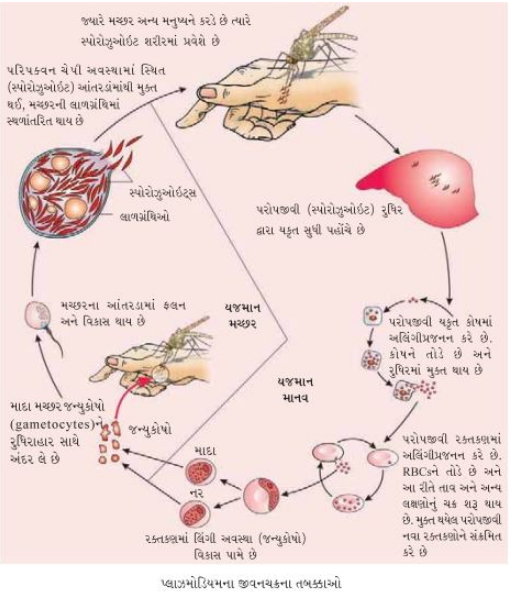
What causes Malaria?
Solution
(N/A) Malaria is caused by a tiny protozoan known as $Plasmodium$.
Different species of $Plasmodium$,such as $Plasmodium$ $vivax$,$Plasmodium$ $malariae$,and $Plasmodium$ $falciparum$,are responsible for different types of malaria.
Malignant malaria,caused by $Plasmodium$ $falciparum$,is the most serious form and can even be fatal.
Different species of $Plasmodium$,such as $Plasmodium$ $vivax$,$Plasmodium$ $malariae$,and $Plasmodium$ $falciparum$,are responsible for different types of malaria.
Malignant malaria,caused by $Plasmodium$ $falciparum$,is the most serious form and can even be fatal.
0 likes
View Solution329
Medium
Explain the disease Amoebiasis or Amoebic Dysentery.
Solution
(N/A) Amoebiasis or Amoebic Dysentery is caused by the protozoan parasite $Entamoeba \ histolytica$ found in the large intestine of humans.
Symptoms of this disease include constipation,abdominal pain and cramps,stools with excess mucus,and blood clots.
Houseflies act as mechanical carriers,which transmit the parasite from infected feces to food and food products,thereby contaminating them.
Drinking water and food contaminated by fecal matter are the main sources of infection and spread of this disease.
Symptoms of this disease include constipation,abdominal pain and cramps,stools with excess mucus,and blood clots.
Houseflies act as mechanical carriers,which transmit the parasite from infected feces to food and food products,thereby contaminating them.
Drinking water and food contaminated by fecal matter are the main sources of infection and spread of this disease.
0 likes
View Solution330
Medium
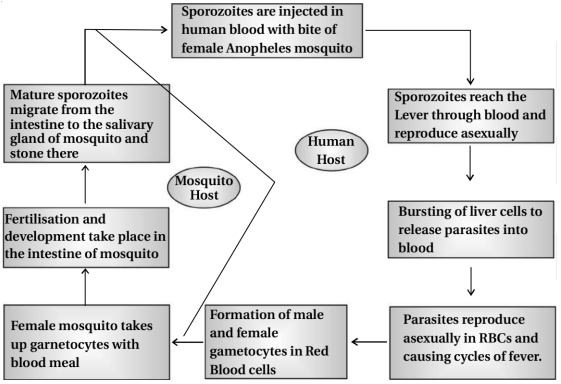
Represent schematically the life cycle of a malarial parasite.
Solution
(N/A) The life cycle of the malarial parasite $(Plasmodium)$ involves two hosts: the human and the female $Anopheles$ mosquito.
$1$. Infection starts when an infected female $Anopheles$ mosquito bites a human,injecting sporozoites into the blood.
$2$. The sporozoites travel to the liver,where they reproduce asexually,leading to the bursting of liver cells and the release of parasites into the blood.
$3$. These parasites then infect Red Blood Cells $(RBCs)$,where they continue to reproduce asexually,causing the characteristic cycles of fever and chills.
$4$. Some parasites differentiate into male and female gametocytes within the $RBCs$.
$5$. When a female $Anopheles$ mosquito bites an infected person,it ingests these gametocytes along with the blood meal.
$6$. Fertilization and further development of the parasite occur in the mosquito's intestine.
$7$. The mature sporozoites then migrate to the mosquito's salivary glands,ready to infect the next human host.
$1$. Infection starts when an infected female $Anopheles$ mosquito bites a human,injecting sporozoites into the blood.
$2$. The sporozoites travel to the liver,where they reproduce asexually,leading to the bursting of liver cells and the release of parasites into the blood.
$3$. These parasites then infect Red Blood Cells $(RBCs)$,where they continue to reproduce asexually,causing the characteristic cycles of fever and chills.
$4$. Some parasites differentiate into male and female gametocytes within the $RBCs$.
$5$. When a female $Anopheles$ mosquito bites an infected person,it ingests these gametocytes along with the blood meal.
$6$. Fertilization and further development of the parasite occur in the mosquito's intestine.
$7$. The mature sporozoites then migrate to the mosquito's salivary glands,ready to infect the next human host.
0 likes
View Solution331
EasyMCQ
The infectious stage of $Plasmodium$ that enters the human body is:
A
Male gametocytes
B
Trophozoites
C
Sporozoites
D
Female gametocytes
Solution
(C) The life cycle of $Plasmodium$ begins when an infected female $Anopheles$ mosquito bites a human.
During this bite,the parasite in the form of $Sporozoites$ is injected into the human bloodstream through the mosquito's saliva.
$Sporozoites$ are the infectious stage of $Plasmodium$ for humans,which then travel to the liver to initiate the infection.
During this bite,the parasite in the form of $Sporozoites$ is injected into the human bloodstream through the mosquito's saliva.
$Sporozoites$ are the infectious stage of $Plasmodium$ for humans,which then travel to the liver to initiate the infection.
0 likes
View Solution332
EasyMCQ
The infectious stage of $Plasmodium$ that enters the human body is ............
A
Trophozoites
B
Sporozoites
C
Female gametocytes
D
Male gametocytes
Solution
(B) The life cycle of $Plasmodium$ involves two hosts: humans and female $Anopheles$ mosquitoes.
When an infected female $Anopheles$ mosquito bites a human,it injects the $Plasmodium$ parasites in the form of $Sporozoites$ into the human blood circulation.
These $Sporozoites$ are the infectious stage of the parasite for humans.
They travel to the liver,where they multiply and eventually infect red blood cells,causing the symptoms of malaria.
When an infected female $Anopheles$ mosquito bites a human,it injects the $Plasmodium$ parasites in the form of $Sporozoites$ into the human blood circulation.
These $Sporozoites$ are the infectious stage of the parasite for humans.
They travel to the liver,where they multiply and eventually infect red blood cells,causing the symptoms of malaria.
0 likes
View Solution333
Medium
Match the columns:
| Column-$I$ | Column-$II$ |
| $(a)$ Pre-erythrocytic cycle | $(1)$ Meta-cryptomerozoites enter $RBC$ and become spherical in shape. |
| $(b)$ Exo-erythrocytic cycle | $(2)$ Sporozoites in saliva are introduced into human blood. |
| $(c)$ Endo-erythrocytic cycle | $(3)$ Breaks the liver cells and comes out into the blood. |
Solution
(A) The correct matching is as follows:
$(a)$ Pre-erythrocytic cycle: In this stage, sporozoites from the mosquito's saliva enter the human blood and reach the liver cells.
$(b)$ Exo-erythrocytic cycle: In this stage, the parasite multiplies within the liver cells, eventually breaking them and releasing merozoites into the blood.
$(c)$ Endo-erythrocytic cycle (Erythrocytic cycle): In this stage, the merozoites (or meta-cryptomerozoites) enter the $RBC$s, where they become spherical and undergo further development.
Therefore, the correct sequence is $(a-2), (b-3), (c-1)$.
$(a)$ Pre-erythrocytic cycle: In this stage, sporozoites from the mosquito's saliva enter the human blood and reach the liver cells.
$(b)$ Exo-erythrocytic cycle: In this stage, the parasite multiplies within the liver cells, eventually breaking them and releasing merozoites into the blood.
$(c)$ Endo-erythrocytic cycle (Erythrocytic cycle): In this stage, the merozoites (or meta-cryptomerozoites) enter the $RBC$s, where they become spherical and undergo further development.
Therefore, the correct sequence is $(a-2), (b-3), (c-1)$.
0 likes
View Solution334
Easy
Define/Explain: Haemozoin.
Solution
(N/A) Haemozoin is a toxic substance released into the blood upon the rupture of $RBCs$ (red blood cells) infected with the malarial parasite $Plasmodium$.
It is responsible for the characteristic symptoms of malaria,specifically the chill and high fever that recur periodically.
It is responsible for the characteristic symptoms of malaria,specifically the chill and high fever that recur periodically.
0 likes
View Solution335
MediumMCQ
Which of the following diseases is not caused by bacteria?
A
Dysentery
B
Amoebiasis
C
Plague
D
All of the above
Solution
(B) $1$. Dysentery can be caused by bacteria (e.g.,Shigella) or protozoa (e.g.,Entamoeba histolytica).
$2$. Amoebiasis is a protozoan disease caused by the parasite Entamoeba histolytica,not by bacteria.
$3$. Plague is a bacterial disease caused by Yersinia pestis.
$4$. Since Amoebiasis is strictly a protozoan infection,it is the correct answer.
$2$. Amoebiasis is a protozoan disease caused by the parasite Entamoeba histolytica,not by bacteria.
$3$. Plague is a bacterial disease caused by Yersinia pestis.
$4$. Since Amoebiasis is strictly a protozoan infection,it is the correct answer.
0 likes
View Solution336
MediumMCQ
Amoebic dysentery is caused by the infection of ......... .
A
Shigella dysenteriae
B
Entamoeba histolytica
C
Tapeworm
D
Ascaris
Solution
(B) Amoebic dysentery,also known as amoebiasis,is a protozoan disease.
It is caused by the parasite $Entamoeba \ histolytica$,which infects the large intestine of humans.
Symptoms include constipation,abdominal pain,cramps,stools with excess mucus,and blood clots.
$Shigella \ dysenteriae$ causes bacillary dysentery,while $Tapeworm$ and $Ascaris$ are helminthic parasites.
It is caused by the parasite $Entamoeba \ histolytica$,which infects the large intestine of humans.
Symptoms include constipation,abdominal pain,cramps,stools with excess mucus,and blood clots.
$Shigella \ dysenteriae$ causes bacillary dysentery,while $Tapeworm$ and $Ascaris$ are helminthic parasites.
0 likes
View Solution337
MediumMCQ
If the presence of mucus and blood clots is observed in the stool,it is an indication of which of the following?
A
Shigellosis
B
Entamoeba histolytica
C
Ascaris
D
All of the above
Solution
(D) The presence of mucus and blood clots in the stool is a characteristic symptom of amoebic dysentery (amoebiasis),which is caused by the protozoan parasite $Entamoeba \ histolytica$. Shigellosis (caused by $Shigella$ bacteria) also presents with bloody,mucus-filled stools. Since both $A$ and $B$ are associated with these symptoms,the most appropriate answer is $D$.
0 likes
View Solution338
MediumMCQ
Which of the following is $NOT$ a protozoan disease?
A
Malaria
B
Amoebiasis
C
Polio
D
All of the above
Solution
(C) $1$. Malaria is caused by the protozoan parasite $Plasmodium$.
$2$. Amoebiasis is caused by the protozoan parasite $Entamoeba \text{ } histolytica$.
$3$. Polio is a viral disease caused by the $Poliovirus$.
$4$. Therefore, Polio is not a protozoan disease.
$2$. Amoebiasis is caused by the protozoan parasite $Entamoeba \text{ } histolytica$.
$3$. Polio is a viral disease caused by the $Poliovirus$.
$4$. Therefore, Polio is not a protozoan disease.
0 likes
View Solution339
EasyMCQ
The protozoan responsible for causing malignant malaria is ...
A
Plasmodium malariae
B
Plasmodium ovale
C
Plasmodium falciparum
D
Plasmodium vivax
Solution
(C) Malignant malaria is the most severe and potentially fatal form of malaria.
It is caused by the protozoan parasite $Plasmodium$ $falciparum$.
While other species like $P. vivax$, $P. malariae$, and $P. ovale$ cause milder forms of the disease, $P. falciparum$ can lead to severe complications such as cerebral malaria, organ failure, and death if not treated promptly.
It is caused by the protozoan parasite $Plasmodium$ $falciparum$.
While other species like $P. vivax$, $P. malariae$, and $P. ovale$ cause milder forms of the disease, $P. falciparum$ can lead to severe complications such as cerebral malaria, organ failure, and death if not treated promptly.
0 likes
View Solution340
EasyMCQ
Which toxic substance is responsible for the symptoms of malaria?
A
Sporozoite
B
Destruction of RBCs
C
Hemozoin
D
Crypto merozoite
Solution
(C) Malaria is caused by the protozoan parasite $Plasmodium$.
When the $Plasmodium$ parasite infects human red blood cells $(RBCs)$,it undergoes asexual reproduction.
During this process,the parasite releases a toxic substance called $Hemozoin$ into the bloodstream.
This release of $Hemozoin$ is responsible for the characteristic chills and high fever that recur every three to four days in malaria patients.
When the $Plasmodium$ parasite infects human red blood cells $(RBCs)$,it undergoes asexual reproduction.
During this process,the parasite releases a toxic substance called $Hemozoin$ into the bloodstream.
This release of $Hemozoin$ is responsible for the characteristic chills and high fever that recur every three to four days in malaria patients.
0 likes
View Solution341
EasyMCQ
Which of the following acts as the vector for $Plasmodium$?
A
Human
B
Female $Anopheles$ mosquito
C
$Aedes$ $aegypti$ mosquito
D
$Culex$ $fatigans$ mosquito
Solution
(B) $Plasmodium$ is the causative agent of malaria. The life cycle of $Plasmodium$ requires two hosts: humans (intermediate host) and the female $Anopheles$ mosquito (definitive host/vector). The female $Anopheles$ mosquito acts as a vector because it transmits the infective stage (sporozoites) of the parasite from an infected person to a healthy person through its bite.
0 likes
View Solution342
MediumMCQ
If the liver is removed from a human and that human is bitten by a female $Anopheles$ mosquito,can malaria occur?
A
Cannot be determined
B
Malaria will occur
C
Malaria will not occur
D
Development of sporozoites will be inhibited
Solution
(C) The life cycle of the malaria parasite $(Plasmodium)$ involves two hosts: humans and female $Anopheles$ mosquitoes.
When an infected female $Anopheles$ mosquito bites a human,it injects sporozoites into the bloodstream.
These sporozoites first travel to the liver,where they undergo asexual reproduction (exo-erythrocytic cycle) to form merozoites.
If the liver is removed,the parasite cannot complete this essential pre-erythrocytic stage of its life cycle.
Since the parasite cannot multiply or transform into the stage that infects red blood cells,the clinical symptoms of malaria will not develop.
Therefore,malaria will not occur.
When an infected female $Anopheles$ mosquito bites a human,it injects sporozoites into the bloodstream.
These sporozoites first travel to the liver,where they undergo asexual reproduction (exo-erythrocytic cycle) to form merozoites.
If the liver is removed,the parasite cannot complete this essential pre-erythrocytic stage of its life cycle.
Since the parasite cannot multiply or transform into the stage that infects red blood cells,the clinical symptoms of malaria will not develop.
Therefore,malaria will not occur.
0 likes
View Solution343
EasyMCQ
The protozoan $Plasmodium$ undergoes sexual reproduction in which of the following?
A
Human liver
B
Human $RBC$
C
Female $Anopheles$ mosquito
D
Salivary glands of the mosquito
Solution
(C) The life cycle of $Plasmodium$ involves two hosts: humans and the female $Anopheles$ mosquito.
In humans,$Plasmodium$ undergoes asexual reproduction (schizogony) in the liver cells and red blood cells $(RBCs)$.
Sexual reproduction (gametogony and syngamy) occurs within the gut of the female $Anopheles$ mosquito.
After fertilization,the zygote develops into sporozoites,which migrate to the salivary glands of the mosquito to be transmitted to a new human host.
In humans,$Plasmodium$ undergoes asexual reproduction (schizogony) in the liver cells and red blood cells $(RBCs)$.
Sexual reproduction (gametogony and syngamy) occurs within the gut of the female $Anopheles$ mosquito.
After fertilization,the zygote develops into sporozoites,which migrate to the salivary glands of the mosquito to be transmitted to a new human host.
0 likes
View Solution344
MediumMCQ
In malaria,where are the gametes formed that lead to the development of the zygote after fertilization?
A
In the digestive tract of the female Anopheles mosquito
B
In the human liver cell
C
In the human red blood cell
D
In the salivary gland of the mosquito
Solution
(A) The life cycle of the malaria parasite $(Plasmodium)$ involves two hosts: humans and female $Anopheles$ mosquitoes.
$1$. In humans,the parasite undergoes asexual reproduction (schizogony) in the liver and red blood cells.
$2$. Gametocytes (male and female gametes) are formed in the human red blood cells but do not fertilize there.
$3$. When a female $Anopheles$ mosquito bites an infected human,it ingests these gametocytes.
$4$. Fertilization and the development of the zygote occur within the digestive tract (midgut) of the female $Anopheles$ mosquito.
$1$. In humans,the parasite undergoes asexual reproduction (schizogony) in the liver and red blood cells.
$2$. Gametocytes (male and female gametes) are formed in the human red blood cells but do not fertilize there.
$3$. When a female $Anopheles$ mosquito bites an infected human,it ingests these gametocytes.
$4$. Fertilization and the development of the zygote occur within the digestive tract (midgut) of the female $Anopheles$ mosquito.
0 likes
View Solution345
MediumMCQ
$Black\, water\, fever$ is caused by the effect of which of the following?
A
$Plasmodium\, falciparum$
B
$Ascaris$
C
$Rhino\, virus$
D
$Polio\, virus$
Solution
(A) $Black\, water\, fever$ is a severe complication of malaria caused by the protozoan parasite $Plasmodium\, falciparum$.
It is characterized by the destruction of red blood cells $(hemolysis)$,which releases hemoglobin into the bloodstream.
This excess hemoglobin is excreted in the urine,giving it a dark,blackish color,hence the name $Black\, water\, fever$.
It is characterized by the destruction of red blood cells $(hemolysis)$,which releases hemoglobin into the bloodstream.
This excess hemoglobin is excreted in the urine,giving it a dark,blackish color,hence the name $Black\, water\, fever$.
0 likes
View Solution346
MediumMCQ
Which of the following organisms lives as a parasite in human red blood cells?
A
Tapeworm
B
Lac insect
C
Ascaris
D
Plasmodium
Solution
(D) The organism that lives as a parasite in human red blood cells is $Plasmodium$.
$Plasmodium$ is a protozoan parasite that causes malaria in humans.
During its life cycle,it infects human liver cells and subsequently invades the red blood cells $(RBCs)$,where it multiplies,leading to the rupture of $RBCs$ and the release of toxins that cause malarial symptoms.
Tapeworms and $Ascaris$ are intestinal parasites,while the lac insect is not a human parasite.
$Plasmodium$ is a protozoan parasite that causes malaria in humans.
During its life cycle,it infects human liver cells and subsequently invades the red blood cells $(RBCs)$,where it multiplies,leading to the rupture of $RBCs$ and the release of toxins that cause malarial symptoms.
Tapeworms and $Ascaris$ are intestinal parasites,while the lac insect is not a human parasite.
0 likes
View Solution347
MediumMCQ
Identify the odd organism out.
A
Copepods
B
Lice
C
Ticks
D
Plasmodium
Solution
(D) The correct answer is $D$.
Copepods,lice,and ticks are examples of ectoparasites that live on the surface of the host organism.
Plasmodium is an endoparasite that lives inside the host's body (specifically within red blood cells or liver cells).
Therefore,Plasmodium is the odd one out as it is an endoparasite,while the others are ectoparasites.
Copepods,lice,and ticks are examples of ectoparasites that live on the surface of the host organism.
Plasmodium is an endoparasite that lives inside the host's body (specifically within red blood cells or liver cells).
Therefore,Plasmodium is the odd one out as it is an endoparasite,while the others are ectoparasites.
0 likes
View Solution348
MediumMCQ
Choose the correct statement.
A
Filariasis occurs by $Trichoderma$.
B
Housefly is the vector of amoebiasis.
C
$Culex$ acts as vector for malaria.
D
Ascariasis occurs by droplet infection.
Solution
(B) Amoebiasis, also known as amoebic dysentery, is characterized by abdominal pain and diarrhea. It is caused by the protozoan $Entamoeba$ $\text{histolytica}$. Houseflies act as mechanical vectors, transferring the parasite from feces of infected persons to food and food products, thereby contaminating them.
0 likes
View Solution349
EasyMCQ
Which of the following diseases is caused by the protozoan $Eimeria$ in fowls,resulting in bloody diarrhoea?
A
Fowl cholera
B
Coccidiosis
C
Thrush
D
Ranikhet
Solution
(B) The disease caused by the protozoan $Eimeria$ in fowls (poultry) is $Coccidiosis$.
This infection affects the intestinal tract of birds,leading to symptoms such as bloody diarrhoea,weight loss,and dehydration.
$Fowl$ $cholera$ is caused by the bacterium $Pasteurella$ $multocida$.
$Thrush$ is a fungal infection caused by $Candida$ $albicans$.
$Ranikhet$ (also known as Newcastle disease) is a viral infection caused by the $Newcastle$ $disease$ $virus$ $(NDV)$.
This infection affects the intestinal tract of birds,leading to symptoms such as bloody diarrhoea,weight loss,and dehydration.
$Fowl$ $cholera$ is caused by the bacterium $Pasteurella$ $multocida$.
$Thrush$ is a fungal infection caused by $Candida$ $albicans$.
$Ranikhet$ (also known as Newcastle disease) is a viral infection caused by the $Newcastle$ $disease$ $virus$ $(NDV)$.
0 likes
View Solution350
EasyMCQ
Chagas disease is caused by
A
Trypanosoma gambiense
B
Plasmodium sp.
C
Trypanosoma cruzi
D
Treponema pallidum
Solution
(C) Chagas disease, also known as American Trypanosomiasis, is a tropical parasitic disease caused by the protozoan $Trypanosoma cruzi$.
It is primarily transmitted to humans and other mammals by an insect vector known as the triatomine bug, commonly referred to as the 'kissing bug' (genera $Triatoma$, $Rhodnius$, and $Panstrongylus$).
It is primarily transmitted to humans and other mammals by an insect vector known as the triatomine bug, commonly referred to as the 'kissing bug' (genera $Triatoma$, $Rhodnius$, and $Panstrongylus$).
0 likes
View SolutionHuman Health and Disease — Diseases caused by protozoa · Frequently Asked Questions
1Are these Human Health and Disease questions useful for JEE and NEET?
Yes. All questions in this section are mapped to JEE Main and NEET exam patterns. Previous year questions from JEE Main, NEET, GUJCET and state-level exams are included with full solutions.
2Can I switch to Hindi or Gujarati for these questions?
Yes. Use the language tabs in the hero section or the sidebar to view the same questions and solutions in English, Hindi or Gujarati.
3How do I generate a question paper from this subtopic?
Use the Vedclass Exam Paper Generator — select the chapter and subtopic, set difficulty, and generate Sets A, B, C, D automatically. First 3 chapters of every subject are free.
Vedclass Products
For Students
Vedclass Test Series
Mock tests in real JEE/NEET style with performance analysis. 5-day free trial.
Start Free TrialFor Teachers
Exam Paper Generator
Generate Set A/B/C/D papers from this chapter in 2 minutes. 3 chapters free.
Try FreeFor Institutes
Online Exam Module
Live online exams with unlimited students, 360° analytics & white-label branding.
See DemoFor Teachers & Institutes
Generate a Human Health and Disease Exam Paper in 2 Minutes
Select subtopic & difficulty — Sets A, B, C, D auto-generated with No Repeat logic.
First 3 chapters of every subject are free — no payment required.