
A English
Diseases caused by protozoa Questions in English
Class 12 Biology · Human Health and Disease · Diseases caused by protozoa
396+
Questions
English
Language
100%
With Solutions
Showing 46 of 396 questions in English
351
EasyMCQ
Amoebiasis is caused by
A
Plasmodium
B
Entamoeba histolytica
C
House flies
D
Contaminated food and water
Solution
(B) The correct answer is $Entamoeba \ histolytica$.
Amoebiasis,also known as amoebic dysentery,is an infection of the large intestine.
It is caused by the protozoan parasite $Entamoeba \ histolytica$.
This parasite is transmitted through the ingestion of contaminated food and water,which act as vehicles for the cysts of the parasite.
Amoebiasis,also known as amoebic dysentery,is an infection of the large intestine.
It is caused by the protozoan parasite $Entamoeba \ histolytica$.
This parasite is transmitted through the ingestion of contaminated food and water,which act as vehicles for the cysts of the parasite.
0 likes
View Solution352
EasyMCQ
Kala-azar is caused by
A
Trypanosoma cruzi
B
Leishmania donovani
C
Trypanosoma brucei
D
Trypanosoma gambiense
Solution
(B) $Leishmania$ $donovani$ is an intracellular parasite found in leucocytes or cells of the liver, spleen, bone marrow, and lymphatic glands. It causes a serious disease known as 'Kala-azar', which is characterized by symptoms such as swelling, fever, enlargement of the liver and spleen, and the skin turning black.
0 likes
View Solution353
MediumMCQ
Entamoeba histolytica feeds on
A
Liver
B
Small intestine
C
Large intestine
D
WBCs
Solution
(C) The correct answer is Large intestine.
$Entamoeba \; histolytica$ is a protozoan parasite that inhabits the large intestine of humans.
It causes amoebiasis (amoebic dysentery) by feeding on the mucosal and submucosal tissues of the large intestine,leading to ulceration and abdominal pain.
$Entamoeba \; histolytica$ is a protozoan parasite that inhabits the large intestine of humans.
It causes amoebiasis (amoebic dysentery) by feeding on the mucosal and submucosal tissues of the large intestine,leading to ulceration and abdominal pain.
0 likes
View Solution354
EasyMCQ
Malignant malaria is caused by
A
Plasmodium falciparum
B
Plasmodium ovale
C
Plasmodium vivax
D
Plasmodium malariae
Solution
(A) Malignant malaria,also known as cerebral malaria,is caused by $Plasmodium \ falciparum$. It is the most dangerous and potentially fatal form of malaria,characterized by severe complications such as organ failure and neurological symptoms.
0 likes
View Solution355
EasyMCQ
Malaria is caused by
A
Plasmodium vivax
B
Plasmodium malariae
C
Plasmodium falciparum
D
All of these
Solution
(D) Malaria is a disease caused by protozoan parasites of the genus $Plasmodium$.
Different species of $Plasmodium$ such as $P. vivax$,$P. malariae$,$P. falciparum$,and $P. ovale$ are responsible for different types of malaria in humans.
Therefore,all the given options are correct.
Different species of $Plasmodium$ such as $P. vivax$,$P. malariae$,$P. falciparum$,and $P. ovale$ are responsible for different types of malaria in humans.
Therefore,all the given options are correct.
0 likes
View Solution356
EasyMCQ
The life cycle of $Plasmodium$ is:
A
Digenetic
B
Monogenetic
C
Both $(a)$ and $(b)$
D
None of these
Solution
(A) The life cycle of $Plasmodium$ is digenetic.
$Plasmodium$ completes its life cycle in two hosts,which is why it is called digenetic.
The two hosts involved are humans (intermediate host) and the female $Anopheles$ mosquito (definitive host).
$Plasmodium$ completes its life cycle in two hosts,which is why it is called digenetic.
The two hosts involved are humans (intermediate host) and the female $Anopheles$ mosquito (definitive host).
0 likes
View Solution357
EasyMCQ
Which of the following toxic substances is responsible for the high malarial fever?
A
Haemoglobin
B
Haemocyanin
C
Haemozoin
D
Haemoriden
Solution
(C) The rupture of red blood cells by the malarial parasite $Plasmodium$ releases a toxic substance called haemozoin.
This substance is responsible for the characteristic chill and high malarial fever observed in patients.
This substance is responsible for the characteristic chill and high malarial fever observed in patients.
0 likes
View Solution358
MediumMCQ
Which one of the following is not correctly matched?
A
$Glossina \text{ } palpalis$ - Sleeping sickness
B
$Culex$ - Filariasis
C
$Aedes \text{ } aegypti$ - Yellow fever
D
$Anopheles \text{ } culifacies$ - Leishmaniasis
Solution
(D) $Leishmaniasis$ or $Kala-azar$ is caused by the protozoan $Leishmania \text{ } donovani$.
It is transmitted by the bite of an infected female sand fly $(Phlebotomus)$.
$Anopheles \text{ } culifacies$ is a vector for malaria, not $Leishmaniasis$.
Therefore, option $D$ is incorrectly matched.
It is transmitted by the bite of an infected female sand fly $(Phlebotomus)$.
$Anopheles \text{ } culifacies$ is a vector for malaria, not $Leishmaniasis$.
Therefore, option $D$ is incorrectly matched.
0 likes
View Solution359
MediumMCQ
The main source of amoebic dysentery is:
A
Contaminated food and water
B
Water and food contaminated by faecal matter
C
Water and food contaminated by urine
D
Water and food contaminated by polluted air
Solution
(B) Amoebic dysentery (amoebiasis) is caused by an intestinal endoparasite,$Entamoeba \ histolytica$,which is found in the large intestine of humans.
Transmission occurs primarily through the faecal-oral route.
The cysts of the parasite are passed out with the faeces of an infected person.
These cysts contaminate food and water sources,which,when ingested by a healthy individual,lead to the infection.
Transmission occurs primarily through the faecal-oral route.
The cysts of the parasite are passed out with the faeces of an infected person.
These cysts contaminate food and water sources,which,when ingested by a healthy individual,lead to the infection.
0 likes
View Solution360
EasyMCQ
Sand fly spreads a particular type of disease by its
A
proboscis
B
Mandible
C
Salivary gland
D
None of these
Solution
(A) Many diseases such as $Kala-azar$,visceral leishmaniasis,and oriental sore are transmitted by the sand fly $(Phlebotomus)$ through its proboscis.
The proboscis is a tubular mouthpart used for piercing the skin of the host and sucking blood,which facilitates the transmission of the pathogen.
The proboscis is a tubular mouthpart used for piercing the skin of the host and sucking blood,which facilitates the transmission of the pathogen.
0 likes
View Solution361
MediumMCQ
Where will you look for the sporozoites of the malarial parasite?
A
$RBCs$ of humans suffering from malaria
B
Spleen of infected person
C
Salivary glands of freshly moulted female Anopheles mosquito
D
Saliva of infected female Anopheles mosquito
Solution
(C) The life cycle of the malarial parasite,$Plasmodium$,involves two hosts: humans and the female $Anopheles$ mosquito.
In the mosquito,the parasite undergoes sexual reproduction and forms sporozoites.
These sporozoites migrate to and are stored in the salivary glands of the female $Anopheles$ mosquito.
When this infected mosquito bites a healthy human,the sporozoites are injected into the human bloodstream along with the mosquito's saliva.
In the mosquito,the parasite undergoes sexual reproduction and forms sporozoites.
These sporozoites migrate to and are stored in the salivary glands of the female $Anopheles$ mosquito.
When this infected mosquito bites a healthy human,the sporozoites are injected into the human bloodstream along with the mosquito's saliva.
0 likes
View Solution362
EasyMCQ
Which of the following toxic substances is responsible for the chill and high fever recurring every three to four days in malaria?
A
Haemotoxin
B
Haemoglobin
C
Haemozoin
D
Sporozoites
Solution
(C) Haemozoin: The malarial parasite digests haemoglobin and releases high quantities of free heme. This free heme is toxic to cells,and the parasite converts it into an insoluble crystalline form called haemozoin. The release of haemozoin into the blood is responsible for the chill and high fever that recurs every $3$ to $4$ days.
Haemotoxin: These are toxic substances found in animal venom,such as snake venom.
Haemoglobin: This is an iron-containing metalloprotein found in red blood cells.
Sporozoites: This is the infectious form of the malarial parasite.
Haemotoxin: These are toxic substances found in animal venom,such as snake venom.
Haemoglobin: This is an iron-containing metalloprotein found in red blood cells.
Sporozoites: This is the infectious form of the malarial parasite.
0 likes
View Solution363
MediumMCQ
Mark the incorrect statement w.r.t. infection of $Entamoeba \ histolytica$.
A
It is a protozoan parasite of human.
B
It is characterised by constipation and abdominal pain.
C
It is a parasite in small intestine of man.
D
Houseflies act as mechanical carriers and serve to transmit the parasite from faeces of infected person to food and food products.
Solution
(C) $Entamoeba \ histolytica$ is a protozoan parasite that infects the large intestine of humans,not the small intestine. Therefore,the statement in option $C$ is incorrect. The symptoms of amoebiasis include constipation,abdominal pain,and cramps,and houseflies act as mechanical carriers to transmit the parasite from contaminated faeces to food.
0 likes
View Solution364
MediumMCQ
Which of the following statements is not correct regarding malarial infection?
A
Plasmodium enters the human body as sporozoites through the bite of a freshly moulted female Anopheles mosquito.
B
High fever recurring every three to four days.
C
Sporozoites initially multiply within the liver cells and then attack the $RBCs$ resulting in their rupture.
D
When a female Anopheles mosquito bites an infected person,these parasites enter the mosquito's body and undergo further development.
Solution
(A) The correct statement is that $Plasmodium$ enters the human body as sporozoites through the bite of an infected female $Anopheles$ mosquito. Option $A$ is incorrect because the mosquito must be infected with the parasite to transmit it; a 'freshly moulted' mosquito is not necessarily infected. The other statements correctly describe the life cycle and symptoms of malaria.
0 likes
View Solution365
MediumMCQ
In the life cycle of $Plasmodium$,sexual stages (gametocytes) begin to develop in
A
Stomach of mosquito
B
Intestine of man
C
Liver of man
D
Red blood cells of man
Solution
(D) In the life cycle of $Plasmodium$,the parasite undergoes asexual reproduction in the human host. The sexual stages,known as gametocytes,begin to develop within the $RBC$ (Red Blood Cells) of man. After these gametocytes are ingested by a female $Anopheles$ mosquito during a blood meal,they undergo further development into gametes in the mosquito's stomach,where fertilization occurs.
0 likes
View Solution366
Difficult
Name various diseases caused by protozoans.
Solution
(N/A) Various species of protozoans cause diseases in humans. Some examples are:
$1$. $Trypanosoma$ causes sleeping sickness.
$2$. $Leishmania$ causes kala-azar (dum dum fever).
$3$. $Giardia$ causes giardiasis.
$4$. $Trichomonas$ causes trichomoniasis (often associated with leucorrhoea).
$5$. $Plasmodium$ causes malaria.
$6$. $Entamoeba$ $histolytica$ causes amoebic dysentery.
$1$. $Trypanosoma$ causes sleeping sickness.
$2$. $Leishmania$ causes kala-azar (dum dum fever).
$3$. $Giardia$ causes giardiasis.
$4$. $Trichomonas$ causes trichomoniasis (often associated with leucorrhoea).
$5$. $Plasmodium$ causes malaria.
$6$. $Entamoeba$ $histolytica$ causes amoebic dysentery.
0 likes
View Solution367
Easy
Describe the life cycle of $Plasmodium$.
Solution
(N/A) $Plasmodium$ enters the human body as $sporozoites$ (the infectious form) through the bite of an infected female $Anopheles$ mosquito.
The parasites initially multiply within the liver cells and then attack the red blood cells $(RBCs)$.
The $haem$ part of $haemoglobin$ is converted into $haemozoin$,and the $globin$ part becomes food for the parasite.
The $RBCs$ rupture due to the release of the toxic substance $haemozoin$,which is responsible for the chills and high fever recurring every $3-4$ days.
When a female $Anopheles$ mosquito bites an infected person,these parasites enter the mosquito's body and undergo further development.
They multiply within the mosquito's body to form $sporozoites$ that are stored in the salivary glands.
When these mosquitoes bite a human,the $sporozoites$ are introduced into his/her body,thereby initiating the cycle again.
The malarial parasite requires two hosts—humans and mosquitoes—to complete its life cycle.
The parasites initially multiply within the liver cells and then attack the red blood cells $(RBCs)$.
The $haem$ part of $haemoglobin$ is converted into $haemozoin$,and the $globin$ part becomes food for the parasite.
The $RBCs$ rupture due to the release of the toxic substance $haemozoin$,which is responsible for the chills and high fever recurring every $3-4$ days.
When a female $Anopheles$ mosquito bites an infected person,these parasites enter the mosquito's body and undergo further development.
They multiply within the mosquito's body to form $sporozoites$ that are stored in the salivary glands.
When these mosquitoes bite a human,the $sporozoites$ are introduced into his/her body,thereby initiating the cycle again.
The malarial parasite requires two hosts—humans and mosquitoes—to complete its life cycle.
0 likes
View Solution368
Medium
What is Amoebic dysentery and what are its symptoms?
Solution
(N/A) $Entamoeba \ histolytica$ is a protozoan parasite in the large intestine of humans that causes Amoebiasis (Amoebic dysentery).
Symptoms of this disease include constipation,abdominal pain and cramps,and stools with excess mucus and blood clots.
Houseflies act as mechanical carriers and serve to transmit the parasite from the feces of an infected person to food and food products,thereby contaminating them.
Drinking water and food contaminated by fecal matter are the main sources of infection.
Symptoms of this disease include constipation,abdominal pain and cramps,and stools with excess mucus and blood clots.
Houseflies act as mechanical carriers and serve to transmit the parasite from the feces of an infected person to food and food products,thereby contaminating them.
Drinking water and food contaminated by fecal matter are the main sources of infection.
0 likes
View Solution369
EasyMCQ
Which of the following is the vector for the disease malaria?
A
Female Anopheles
B
Female Aedes
C
Plasmodium
D
Entamoeba
Solution
(A) Malaria is a protozoan disease caused by the parasite $Plasmodium$.
The parasite $Plasmodium$ requires two hosts to complete its life cycle: humans and the female $Anopheles$ mosquito.
The female $Anopheles$ mosquito acts as the vector (carrier) that transmits the parasite from an infected person to a healthy person.
Therefore,the correct vector for malaria is the female $Anopheles$ mosquito.
The parasite $Plasmodium$ requires two hosts to complete its life cycle: humans and the female $Anopheles$ mosquito.
The female $Anopheles$ mosquito acts as the vector (carrier) that transmits the parasite from an infected person to a healthy person.
Therefore,the correct vector for malaria is the female $Anopheles$ mosquito.
0 likes
View Solution370
MediumMCQ
The sexual cycle of $Plasmodium$ is completed in:
A
Liver cells
B
Human red blood cells
C
Alimentary canal of mosquito
D
Salivary glands of mosquito
Solution
(C) $Plasmodium$ is a digenetic parasite that requires two hosts to complete its life cycle: humans and female $Anopheles$ mosquitoes.
$1$. The asexual cycle (schizogony) occurs in the human host (liver cells and red blood cells).
$2$. The sexual cycle (gametogony,fertilization,and sporogony) occurs in the female $Anopheles$ mosquito.
$3$. Gametocytes ingested by the mosquito from human blood undergo fertilization in the mosquito's gut (alimentary canal) to form a zygote,which eventually develops into sporozoites that migrate to the salivary glands.
Therefore,the sexual cycle is completed in the alimentary canal of the mosquito.
$1$. The asexual cycle (schizogony) occurs in the human host (liver cells and red blood cells).
$2$. The sexual cycle (gametogony,fertilization,and sporogony) occurs in the female $Anopheles$ mosquito.
$3$. Gametocytes ingested by the mosquito from human blood undergo fertilization in the mosquito's gut (alimentary canal) to form a zygote,which eventually develops into sporozoites that migrate to the salivary glands.
Therefore,the sexual cycle is completed in the alimentary canal of the mosquito.
0 likes
View Solution371
MediumMCQ
Malaria is a ........ disease.
A
Viral disease
B
Bacterial disease
C
Protozoan disease
D
Fungal disease
Solution
(C) Malaria is caused by the protozoan parasite belonging to the genus $Plasmodium$ (e.g.,$P. vivax$,$P. malariae$,and $P. falciparum$).
Since the causative agent is a protozoan,malaria is classified as a protozoan disease.
Therefore,the correct option is $C$.
Since the causative agent is a protozoan,malaria is classified as a protozoan disease.
Therefore,the correct option is $C$.
0 likes
View Solution372
MediumMCQ
Which stage of $Plasmodium$ in humans obtains nutrition from the blood?
A
Sporozoite
B
Trophozoite
C
Gametocyte
D
Merozoite
Solution
(B) The $Plasmodium$ parasite enters the human body as a sporozoite.
After infecting liver cells,it undergoes asexual reproduction to form merozoites.
These merozoites then infect red blood cells $(RBCs)$.
Inside the $RBCs$,the parasite develops into the trophozoite stage.
The trophozoite stage is the active feeding stage that consumes the host's hemoglobin for nutrition.
After infecting liver cells,it undergoes asexual reproduction to form merozoites.
These merozoites then infect red blood cells $(RBCs)$.
Inside the $RBCs$,the parasite develops into the trophozoite stage.
The trophozoite stage is the active feeding stage that consumes the host's hemoglobin for nutrition.
0 likes
View Solution373
EasyMCQ
Malaria caused by $Plasmodium$ $falciparum$ is the most serious and can even be fatal.
A
$Plasmodium$ $vivax$
B
$Plasmodium$ $malariae$
C
$Plasmodium$ $falciparum$
D
$Plasmodium$ $ovale$
Solution
(C) Malaria is caused by different species of $Plasmodium$.
$Plasmodium$ $vivax$,$Plasmodium$ $malariae$,and $Plasmodium$ $ovale$ cause benign tertian or quartan malaria,which are generally less severe.
However,$Plasmodium$ $falciparum$ causes malignant malaria,which is the most serious form of the disease and can be fatal if not treated promptly.
$Plasmodium$ $vivax$,$Plasmodium$ $malariae$,and $Plasmodium$ $ovale$ cause benign tertian or quartan malaria,which are generally less severe.
However,$Plasmodium$ $falciparum$ causes malignant malaria,which is the most serious form of the disease and can be fatal if not treated promptly.
0 likes
View Solution374
EasyMCQ
Which form of $Plasmodium$ enters the human body?
A
Schizont
B
Sporozoite
C
Merozoite
D
Trophozoite
Solution
(B) The life cycle of $Plasmodium$ involves two hosts: humans and female $Anopheles$ mosquitoes.
When an infected female $Anopheles$ mosquito bites a human,it injects the $Plasmodium$ parasites in the form of $Sporozoites$ into the human bloodstream.
These $Sporozoites$ then travel to the liver,where they multiply and eventually transform into other stages like $Merozoites$ and $Schizonts$.
Therefore,the infective stage that enters the human body is the $Sporozoite$.
When an infected female $Anopheles$ mosquito bites a human,it injects the $Plasmodium$ parasites in the form of $Sporozoites$ into the human bloodstream.
These $Sporozoites$ then travel to the liver,where they multiply and eventually transform into other stages like $Merozoites$ and $Schizonts$.
Therefore,the infective stage that enters the human body is the $Sporozoite$.
0 likes
View Solution375
MediumMCQ
Hemozoin is released due to the rupture of:
A
Hepatocytes
B
Multiplication of sporozoites
C
Erythrocytes
D
All of the above
Solution
(C) The malaria parasite,$Plasmodium$,completes its asexual cycle in the human body within the red blood cells (erythrocytes).
As the parasite multiplies,it consumes hemoglobin and produces a toxic substance known as hemozoin.
When the red blood cells rupture to release the merozoites into the bloodstream,the toxic substance hemozoin is also released.
This release of hemozoin is responsible for the characteristic chill and high fever associated with malaria.
As the parasite multiplies,it consumes hemoglobin and produces a toxic substance known as hemozoin.
When the red blood cells rupture to release the merozoites into the bloodstream,the toxic substance hemozoin is also released.
This release of hemozoin is responsible for the characteristic chill and high fever associated with malaria.
0 likes
View Solution376
EasyMCQ
In what form does the malaria parasite enter the liver from the blood?
A
Schizont
B
Sporozoite
C
Merozoite
D
Trophozoite
Solution
(B) The malaria parasite,$Plasmodium$,enters the human body through the bite of an infected female $Anopheles$ mosquito in the form of $Sporozoites$. These $Sporozoites$ travel through the blood and reach the liver,where they infect liver cells and undergo asexual reproduction.
0 likes
View Solution377
MediumMCQ
Select the correct option based on the given diagram.
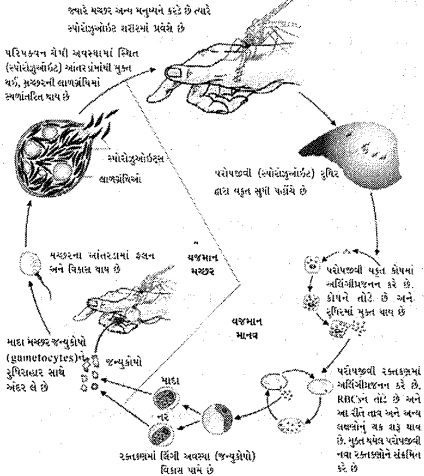
A
Sporozoan protozoans - Pneumonia
B
Ciliated protozoans - Pneumonia
C
Sporozoan protozoans - Malaria
D
Ciliated protozoans - Malaria
Solution
(C) The provided diagram illustrates the life cycle of the malarial parasite,Plasmodium.
Plasmodium is a sporozoan protozoan.
The life cycle involves two hosts: humans and female Anopheles mosquitoes.
Therefore,the correct classification is Sporozoan protozoans,and the disease caused is Malaria.
Plasmodium is a sporozoan protozoan.
The life cycle involves two hosts: humans and female Anopheles mosquitoes.
Therefore,the correct classification is Sporozoan protozoans,and the disease caused is Malaria.
0 likes
View Solution378
DifficultMCQ
Amoebiasis (amoebic dysentery) caused by $Entamoeba$ $histolytica$ is which type of disease?
A
Bacterial disease
B
Viral disease
C
Fungal disease
D
Protozoan disease
Solution
(D) $Entamoeba$ $histolytica$ is a protozoan parasite that infects the large intestine in humans.
It causes a disease known as amoebiasis or amoebic dysentery.
Since the causative agent is a protozoan, amoebiasis is classified as a protozoan disease.
Therefore, the correct option is $D$.
It causes a disease known as amoebiasis or amoebic dysentery.
Since the causative agent is a protozoan, amoebiasis is classified as a protozoan disease.
Therefore, the correct option is $D$.
0 likes
View Solution379
MediumMCQ
Which of the following is $NOT$ a symptom of amoebiasis (amoebic dysentery)?
A
Constipation
B
Abdominal pain and cramps
C
Stools with excess mucus and blood clots
D
Muscular pain and anaemia
Solution
$(D)$ Amoebiasis, or amoebic dysentery, is caused by the protozoan parasite $Entamoeba \text{ histolytica}$.
The symptoms of this disease include constipation, abdominal pain and cramps, and stools with excess mucus and blood clots.
Muscular pain and anaemia are not characteristic symptoms of amoebiasis; these are more commonly associated with other conditions or parasitic infections like malaria or hookworm infestation.
Therefore, the correct option is $D$.
The symptoms of this disease include constipation, abdominal pain and cramps, and stools with excess mucus and blood clots.
Muscular pain and anaemia are not characteristic symptoms of amoebiasis; these are more commonly associated with other conditions or parasitic infections like malaria or hookworm infestation.
Therefore, the correct option is $D$.
0 likes
View Solution380
DifficultMCQ
Toxin which is responsible for chills and high fever during malaria $:-$
A
Haematin
B
Haemoglobin
C
Haemozoin
D
Haem
Solution
(C) During the life cycle of the malarial parasite $Plasmodium$,it infects human red blood cells $(RBCs)$.
Inside the $RBCs$,the parasite consumes haemoglobin and releases a toxic substance known as $Haemozoin$.
$Haemozoin$ is a crystalline byproduct of haemoglobin digestion.
When the infected $RBCs$ rupture,this toxin is released into the bloodstream,which triggers the characteristic symptoms of malaria,including chills and high recurring fever.
Inside the $RBCs$,the parasite consumes haemoglobin and releases a toxic substance known as $Haemozoin$.
$Haemozoin$ is a crystalline byproduct of haemoglobin digestion.
When the infected $RBCs$ rupture,this toxin is released into the bloodstream,which triggers the characteristic symptoms of malaria,including chills and high recurring fever.
0 likes
View Solution381
MediumMCQ
Infectious form of $Plasmodium$ is $:-$
A
Sporozoite
B
Trophozoite
C
Haemozoin
D
Schizont
Solution
(A) The life cycle of $Plasmodium$ involves two hosts: humans and female $Anopheles$ mosquitoes.
When a female $Anopheles$ mosquito bites a healthy human,it injects the $Plasmodium$ parasites in the form of $Sporozoites$ into the human bloodstream.
These $Sporozoites$ are the infectious form of the parasite that initiates the infection in humans.
$Trophozoite$ and $Schizont$ are stages that occur within the human body after infection,while $Haemozoin$ is a toxic substance released during the rupture of red blood cells.
When a female $Anopheles$ mosquito bites a healthy human,it injects the $Plasmodium$ parasites in the form of $Sporozoites$ into the human bloodstream.
These $Sporozoites$ are the infectious form of the parasite that initiates the infection in humans.
$Trophozoite$ and $Schizont$ are stages that occur within the human body after infection,while $Haemozoin$ is a toxic substance released during the rupture of red blood cells.
0 likes
View Solution382
EasyMCQ
In the life cycle of $Plasmodium \ vivax$,if $a$ (Trophozoite),$b$ (gametocyte),$c$ (oocyst),$d$ (zygote),$e$ (sporozoite) are different stages. Select the correct sequence starting from the stage it enters the human body.
A
$e \rightarrow a \rightarrow b \rightarrow c \rightarrow d$
B
$e \rightarrow a \rightarrow b \rightarrow d \rightarrow c$
C
$c \rightarrow a \rightarrow d \rightarrow b \rightarrow e$
D
$c \rightarrow b \rightarrow e \rightarrow a \rightarrow d$
Solution
(B) The life cycle of $Plasmodium \ vivax$ begins in humans when the infectious stage,the $e$ (sporozoite),enters the human body through the bite of an infected female $Anopheles$ mosquito.
Inside the human body,the sporozoites infect liver cells and then red blood cells,where they transform into the $a$ (Trophozoite) stage.
After asexual reproduction,some parasites differentiate into sexual stages known as $b$ (gametocytes).
When a mosquito bites an infected person,these gametocytes are ingested. In the mosquito's gut,they fuse to form a $d$ (zygote).
The zygote then develops into an $c$ (oocyst) within the mosquito's gut wall,which eventually releases sporozoites.
Therefore,the sequence starting from the stage entering the human body is $e \rightarrow a \rightarrow b \rightarrow d \rightarrow c$.
Inside the human body,the sporozoites infect liver cells and then red blood cells,where they transform into the $a$ (Trophozoite) stage.
After asexual reproduction,some parasites differentiate into sexual stages known as $b$ (gametocytes).
When a mosquito bites an infected person,these gametocytes are ingested. In the mosquito's gut,they fuse to form a $d$ (zygote).
The zygote then develops into an $c$ (oocyst) within the mosquito's gut wall,which eventually releases sporozoites.
Therefore,the sequence starting from the stage entering the human body is $e \rightarrow a \rightarrow b \rightarrow d \rightarrow c$.
0 likes
View Solution383
EasyMCQ
Fertilization of gametocytes of $Plasmodium$ $vivax$ takes place in . . . . . . .
A
gut of female $Anopheles$ mosquito
B
RBCs of human being
C
salivary glands of female $Anopheles$ mosquito
D
liver of human being
Solution
(A) The life cycle of $Plasmodium$ involves two hosts: humans and female $Anopheles$ mosquitoes.
In the human host,the parasite undergoes asexual reproduction (schizogony) in the liver and $RBCs$.
When the female $Anopheles$ mosquito bites an infected person,it ingests the gametocytes along with the blood.
These gametocytes mature and undergo fertilization (syngamy) within the gut (lumen of the midgut) of the mosquito to form a zygote,which later develops into an ookinete.
In the human host,the parasite undergoes asexual reproduction (schizogony) in the liver and $RBCs$.
When the female $Anopheles$ mosquito bites an infected person,it ingests the gametocytes along with the blood.
These gametocytes mature and undergo fertilization (syngamy) within the gut (lumen of the midgut) of the mosquito to form a zygote,which later develops into an ookinete.
0 likes
View Solution384
EasyMCQ
The parasite $Plasmodium$ $vivax$ causes . . . . . . .
A
pneumonia
B
dengue
C
typhoid
D
malaria
Solution
(D) $Plasmodium$ $vivax$ is a protozoan parasite that is responsible for causing malaria in humans.
It is one of the most common species of $Plasmodium$ that causes benign tertian malaria.
Other options like pneumonia is caused by $Streptococcus$ $pneumoniae$,dengue is caused by a virus,and typhoid is caused by $Salmonella$ $typhi$.
It is one of the most common species of $Plasmodium$ that causes benign tertian malaria.
Other options like pneumonia is caused by $Streptococcus$ $pneumoniae$,dengue is caused by a virus,and typhoid is caused by $Salmonella$ $typhi$.
0 likes
View Solution385
EasyMCQ
Which of the following pair of diseases is caused by protists?
A
Pneumonia and Amoebiasis
B
Malaria and Pneumonia
C
Malaria and Amoebiasis
D
Filariasis and Typhoid
Solution
(C) The causative agents of the diseases are as follows:
$1$. Malaria is caused by the protozoan parasite $Plasmodium$.
$2$. Amoebiasis is caused by the protozoan parasite $Entamoeba histolytica$.
$3$. Pneumonia is caused by bacteria such as $Streptococcus pneumoniae$ and $Haemophilus influenzae$.
$4$. Filariasis is caused by filarial worms ($Wuchereria bancrofti$ and $Wuchereria malayi$).
$5$. Typhoid is caused by the bacterium $Salmonella typhi$.
Therefore, both Malaria and Amoebiasis are caused by protists (protozoans).
$1$. Malaria is caused by the protozoan parasite $Plasmodium$.
$2$. Amoebiasis is caused by the protozoan parasite $Entamoeba histolytica$.
$3$. Pneumonia is caused by bacteria such as $Streptococcus pneumoniae$ and $Haemophilus influenzae$.
$4$. Filariasis is caused by filarial worms ($Wuchereria bancrofti$ and $Wuchereria malayi$).
$5$. Typhoid is caused by the bacterium $Salmonella typhi$.
Therefore, both Malaria and Amoebiasis are caused by protists (protozoans).
0 likes
View Solution386
EasyMCQ
Symptoms of malaria do $NOT$ include . . . . . . .
A
sweating and shivering
B
arthralgia
C
conjunctivitis
D
fever with chills
Solution
(C) Malaria is a protozoan disease caused by species of $Plasmodium$ $(P. vivax, P. malariae, P. falciparum)$.
The characteristic symptoms of malaria include high fever with chills,shivering,sweating,headache,nausea,and muscle/joint pain (arthralgia).
Conjunctivitis (inflammation of the conjunctiva of the eye) is not a symptom of malaria.
Therefore,the correct answer is $C$.
The characteristic symptoms of malaria include high fever with chills,shivering,sweating,headache,nausea,and muscle/joint pain (arthralgia).
Conjunctivitis (inflammation of the conjunctiva of the eye) is not a symptom of malaria.
Therefore,the correct answer is $C$.
0 likes
View Solution387
EasyMCQ
In the life cycle of $Plasmodium$,the sporozoite reproduces asexually in which human cells?
A
Intestinal cells and $R.B.C.$
B
Liver cells and $R.B.C.$
C
Liver cells and $W.B.C.$
D
Salivary glands and $W.B.C.$
Solution
(B) The life cycle of $Plasmodium$ involves two hosts: humans and female $Anopheles$ mosquitoes.
$1$. When an infected female $Anopheles$ mosquito bites a human,it injects the infectious stage called sporozoites into the blood.
$2$. These sporozoites initially travel to the liver,where they undergo asexual reproduction (schizogony) to form merozoites.
$3$. The merozoites then enter the bloodstream and infect the $R.B.C.s$ (Red Blood Cells),where they continue to reproduce asexually,leading to the rupture of $R.B.C.s$ and the release of toxins like haemozoin,which causes the characteristic fever and chills of malaria.
$4$. Therefore,the asexual reproduction occurs in liver cells and $R.B.C.s$.
$1$. When an infected female $Anopheles$ mosquito bites a human,it injects the infectious stage called sporozoites into the blood.
$2$. These sporozoites initially travel to the liver,where they undergo asexual reproduction (schizogony) to form merozoites.
$3$. The merozoites then enter the bloodstream and infect the $R.B.C.s$ (Red Blood Cells),where they continue to reproduce asexually,leading to the rupture of $R.B.C.s$ and the release of toxins like haemozoin,which causes the characteristic fever and chills of malaria.
$4$. Therefore,the asexual reproduction occurs in liver cells and $R.B.C.s$.
0 likes
View Solution388
EasyMCQ
In which part of the $Anopheles$ female mosquito does the reproduction and development of $Plasmodium$ germ cells take place?
A
$RBC$
B
Salivary gland
C
Rectum
D
Gut
Solution
(D) The life cycle of $Plasmodium$ involves two hosts: humans and the female $Anopheles$ mosquito.
In the human host,$Plasmodium$ undergoes asexual reproduction in the liver and $RBCs$.
When a female $Anopheles$ mosquito bites an infected person,the gametocytes enter the mosquito's body.
Fertilization and development of $Plasmodium$ germ cells (gametes) occur in the gut (midgut) of the mosquito.
After fertilization,the zygote develops into an ookinete,which penetrates the gut wall to form oocysts,eventually releasing sporozoites that migrate to the salivary glands.
In the human host,$Plasmodium$ undergoes asexual reproduction in the liver and $RBCs$.
When a female $Anopheles$ mosquito bites an infected person,the gametocytes enter the mosquito's body.
Fertilization and development of $Plasmodium$ germ cells (gametes) occur in the gut (midgut) of the mosquito.
After fertilization,the zygote develops into an ookinete,which penetrates the gut wall to form oocysts,eventually releasing sporozoites that migrate to the salivary glands.
0 likes
View Solution389
EasyMCQ
In which body part of the female $Anopheles$ mosquito do the gametes of the parasite $Plasmodium$ fertilize and develop?
A
Salivary gland
B
Rectum
C
$RBC$
D
In the gut
Solution
(D) The life cycle of $Plasmodium$ involves two hosts: humans and the female $Anopheles$ mosquito.
$1$. When the female $Anopheles$ mosquito bites an infected person,the gametocytes of $Plasmodium$ enter the mosquito's body along with the blood meal.
$2$. These gametocytes undergo fertilization and further development within the gut (midgut) of the mosquito.
$3$. After fertilization,the zygote is formed,which then develops into an ookinete,and subsequently into oocysts,which eventually release sporozoites that migrate to the salivary glands.
$4$. Therefore,the fertilization and development of gametes occur in the gut of the mosquito.
$1$. When the female $Anopheles$ mosquito bites an infected person,the gametocytes of $Plasmodium$ enter the mosquito's body along with the blood meal.
$2$. These gametocytes undergo fertilization and further development within the gut (midgut) of the mosquito.
$3$. After fertilization,the zygote is formed,which then develops into an ookinete,and subsequently into oocysts,which eventually release sporozoites that migrate to the salivary glands.
$4$. Therefore,the fertilization and development of gametes occur in the gut of the mosquito.
0 likes
View Solution390
EasyMCQ
Which of the following protozoan parasites causes sleeping sickness?
A
Plasmodium
B
Entamoeba
C
Leishmania
D
Trypanosoma
Solution
(D) Trypanosoma.
Sleeping sickness, also known as human African trypanosomiasis, is a parasitic disease caused by the protozoan $Trypanosoma \text{ } brucei$.
It is transmitted to humans through the bite of an infected tsetse fly.
Sleeping sickness, also known as human African trypanosomiasis, is a parasitic disease caused by the protozoan $Trypanosoma \text{ } brucei$.
It is transmitted to humans through the bite of an infected tsetse fly.
0 likes
View Solution391
EasyMCQ
Identify the most infectious and fatal type of malarial parasite.
A
Plasmodium falciparum
B
Plasmodium vivax
C
Plasmodium ovale
D
Plasmodium malariae
Solution
(A) $Plasmodium \ falciparum$ is the most dangerous and infectious species of the malarial parasite.
It causes malignant malaria,which is characterized by high fever and severe complications,and it can be fatal if not treated promptly.
It causes malignant malaria,which is characterized by high fever and severe complications,and it can be fatal if not treated promptly.
0 likes
View Solution392
EasyMCQ
In the life cycle of $Plasmodium$,fertilization takes place in:
A
liver cells
B
salivary glands of mosquito
C
RBCs of humans
D
stomach of mosquito
Solution
(D) The correct answer is $D$.
In the life cycle of $Plasmodium$,the sexual stage involves the formation of gametocytes in the human host.
These gametocytes are ingested by the female $Anopheles$ mosquito during a blood meal.
Fertilization and the development of the zygote occur within the stomach (midgut) of the mosquito,leading to the formation of an ookinete,which then develops into oocysts.
In the life cycle of $Plasmodium$,the sexual stage involves the formation of gametocytes in the human host.
These gametocytes are ingested by the female $Anopheles$ mosquito during a blood meal.
Fertilization and the development of the zygote occur within the stomach (midgut) of the mosquito,leading to the formation of an ookinete,which then develops into oocysts.
0 likes
View Solution393
EasyMCQ
Some of the events that occur during the life cycle of $Plasmodium$ are given below. Identify the correct statement.
A
The sporozoites reproduce sexually in liver cells.
B
The gametocytes develop in $RBC$.
C
Female mosquito bites a man,Gametocytes are injected.
D
When mosquito bites a man,gametocytes are injected.
Solution
(B) The correct statement is: The gametocytes develop in $RBC$.
$1$. The infective stage of $Plasmodium$ is the sporozoite,which is present in the salivary glands of the female $Anopheles$ mosquito.
$2$. When the mosquito bites a human,sporozoites enter the human blood along with the mosquito's saliva.
$3$. Inside the human body,the parasite undergoes asexual reproduction in liver cells and then in red blood cells $(RBCs)$.
$4$. In the $RBCs$,the parasite eventually develops into gametocytes (male and female gametocytes),which are then taken up by the mosquito during a blood meal.
$1$. The infective stage of $Plasmodium$ is the sporozoite,which is present in the salivary glands of the female $Anopheles$ mosquito.
$2$. When the mosquito bites a human,sporozoites enter the human blood along with the mosquito's saliva.
$3$. Inside the human body,the parasite undergoes asexual reproduction in liver cells and then in red blood cells $(RBCs)$.
$4$. In the $RBCs$,the parasite eventually develops into gametocytes (male and female gametocytes),which are then taken up by the mosquito during a blood meal.
0 likes
View Solution394
EasyMCQ
Which of the following is not correct with respect to malaria?
A
$RBCs$ rupture and release haemozoin which causes chills.
B
Sporozoites multiply in blood.
C
Female $Anopheles$ mosquito is the vector.
D
Malignant malaria is caused by $Plasmodium$ $falciparum$.
Solution
(B) The correct answer is $B$. Sporozoites do not multiply in the blood.
After entering the human body through the bite of an infected female $Anopheles$ mosquito,the sporozoites initially reach the liver and multiply within the liver cells.
Subsequently,they attack the red blood cells $(RBCs)$,causing them to rupture.
The rupture of $RBCs$ releases a toxic substance called haemozoin,which is responsible for the chill and high fever recurring every $3$ to $4$ days.
Therefore,the statement that sporozoites multiply in the blood is incorrect.
After entering the human body through the bite of an infected female $Anopheles$ mosquito,the sporozoites initially reach the liver and multiply within the liver cells.
Subsequently,they attack the red blood cells $(RBCs)$,causing them to rupture.
The rupture of $RBCs$ releases a toxic substance called haemozoin,which is responsible for the chill and high fever recurring every $3$ to $4$ days.
Therefore,the statement that sporozoites multiply in the blood is incorrect.
0 likes
View Solution395
EasyMCQ
The mature infective stages of the malarial parasite which are transferred from mosquito to man are:
A
trophozoites
B
sporozoites
C
gametocytes
D
merozoites
Solution
(B) The correct answer is $B$.
Malaria is caused by a protozoan parasite belonging to the genus $Plasmodium$.
The infective stage of the $Plasmodium$ parasite for human beings is the $sporozoite$.
These $sporozoites$ are stored in the salivary glands of the female $Anopheles$ mosquito and are injected into the human bloodstream during the mosquito's blood meal.
Malaria is caused by a protozoan parasite belonging to the genus $Plasmodium$.
The infective stage of the $Plasmodium$ parasite for human beings is the $sporozoite$.
These $sporozoites$ are stored in the salivary glands of the female $Anopheles$ mosquito and are injected into the human bloodstream during the mosquito's blood meal.
0 likes
View Solution396
MediumMCQ
The following are the stages of the life cycle of $Plasmodium$. Arrange the stages in the proper order.
$A$. The parasites reproduce asexually in $RBCs$,bursting the cells.
$B$. The parasites reproduce asexually in liver cells,bursting the cells and releasing into blood.
$C$. Gametocytes develop in $RBCs$.
$D$. Sporozoites reach the liver through the blood.
$E$. Female mosquito injects sporozoites into humans during a bite.
Choose the correct answer from the options given below:
$A$. The parasites reproduce asexually in $RBCs$,bursting the cells.
$B$. The parasites reproduce asexually in liver cells,bursting the cells and releasing into blood.
$C$. Gametocytes develop in $RBCs$.
$D$. Sporozoites reach the liver through the blood.
$E$. Female mosquito injects sporozoites into humans during a bite.
Choose the correct answer from the options given below:
A
$E, C, D, B, A$
B
$E, D, B, A, C$
C
$C, A, B, D, E$
D
$A, B, C, D, E$
Solution
(B) The life cycle of $Plasmodium$ follows these steps:
$1$. The female $Anopheles$ mosquito injects sporozoites into the human body through a bite $(E)$.
$2$. These sporozoites travel through the blood and reach the liver $(D)$.
$3$. In the liver,the parasites reproduce asexually,causing the liver cells to burst and releasing the parasites into the blood $(B)$.
$4$. The parasites then enter $RBCs$ and reproduce asexually,causing the $RBCs$ to burst $(A)$.
$5$. Finally,some parasites differentiate into gametocytes within the $RBCs$ $(C)$.
Thus,the correct sequence is $E, D, B, A, C$.
$1$. The female $Anopheles$ mosquito injects sporozoites into the human body through a bite $(E)$.
$2$. These sporozoites travel through the blood and reach the liver $(D)$.
$3$. In the liver,the parasites reproduce asexually,causing the liver cells to burst and releasing the parasites into the blood $(B)$.
$4$. The parasites then enter $RBCs$ and reproduce asexually,causing the $RBCs$ to burst $(A)$.
$5$. Finally,some parasites differentiate into gametocytes within the $RBCs$ $(C)$.
Thus,the correct sequence is $E, D, B, A, C$.
0 likes
View SolutionHuman Health and Disease — Diseases caused by protozoa · Frequently Asked Questions
1Are these Human Health and Disease questions useful for JEE and NEET?
Yes. All questions in this section are mapped to JEE Main and NEET exam patterns. Previous year questions from JEE Main, NEET, GUJCET and state-level exams are included with full solutions.
2Can I switch to Hindi or Gujarati for these questions?
Yes. Use the language tabs in the hero section or the sidebar to view the same questions and solutions in English, Hindi or Gujarati.
3How do I generate a question paper from this subtopic?
Use the Vedclass Exam Paper Generator — select the chapter and subtopic, set difficulty, and generate Sets A, B, C, D automatically. First 3 chapters of every subject are free.
Vedclass Products
For Students
Vedclass Test Series
Mock tests in real JEE/NEET style with performance analysis. 5-day free trial.
Start Free TrialFor Teachers
Exam Paper Generator
Generate Set A/B/C/D papers from this chapter in 2 minutes. 3 chapters free.
Try FreeFor Institutes
Online Exam Module
Live online exams with unlimited students, 360° analytics & white-label branding.
See DemoFor Teachers & Institutes
Generate a Human Health and Disease Exam Paper in 2 Minutes
Select subtopic & difficulty — Sets A, B, C, D auto-generated with No Repeat logic.
First 3 chapters of every subject are free — no payment required.