
A English
Diseases caused by protozoa Questions in English
Class 12 Biology · Human Health and Disease · Diseases caused by protozoa
396+
Questions
English
Language
100%
With Solutions
Showing 50 of 396 questions in English
151
MediumMCQ
What happens during sporogony in Plasmodium?
A
Formation of gametocytes in humans
B
Formation of numerous sporozoites from the zygote in the mosquito
C
Formation of merozoites from the zygote in the mosquito
D
Formation of gametes in the mosquito
Solution
(B) In the life cycle of $Plasmodium$,the sexual stage occurs in the mosquito.
After fertilization,the zygote is formed in the gut of the mosquito.
The zygote undergoes multiple divisions (sporogony) to produce numerous sporozoites.
These sporozoites then migrate to the salivary glands of the mosquito,ready to infect a new human host.
After fertilization,the zygote is formed in the gut of the mosquito.
The zygote undergoes multiple divisions (sporogony) to produce numerous sporozoites.
These sporozoites then migrate to the salivary glands of the mosquito,ready to infect a new human host.
0 likes
View Solution152
MediumMCQ
In the life cycle of Plasmodium,the cryptozoite is formed in the.........
A
Salivary gland of mosquito
B
Oocyst
C
Human $RBC$
D
Human liver
Solution
(D) In the life cycle of $Plasmodium$,the sporozoites enter the human body through the bite of an infected female $Anopheles$ mosquito.
These sporozoites travel through the blood and reach the liver cells (hepatocytes).
Inside the liver cells,they undergo asexual reproduction (schizogony) to form cryptozoites.
Therefore,the cryptozoites are formed in the human liver.
These sporozoites travel through the blood and reach the liver cells (hepatocytes).
Inside the liver cells,they undergo asexual reproduction (schizogony) to form cryptozoites.
Therefore,the cryptozoites are formed in the human liver.
0 likes
View Solution153
EasyMCQ
The asexual life cycle of $Plasmodium$ is completed in:
A
Human body
B
Female $Culex$ mosquito
C
Male $Anopheles$ mosquito
D
Female $Anopheles$ mosquito
Solution
(A) The life cycle of $Plasmodium$ is digenetic,meaning it requires two hosts to complete its life cycle.
$1$. The asexual phase (schizogony) occurs in the human body (intermediate host).
$2$. The sexual phase (gametogony and syngamy) occurs in the gut of the female $Anopheles$ mosquito (definitive host).
Therefore,the asexual life cycle is completed in the human body.
$1$. The asexual phase (schizogony) occurs in the human body (intermediate host).
$2$. The sexual phase (gametogony and syngamy) occurs in the gut of the female $Anopheles$ mosquito (definitive host).
Therefore,the asexual life cycle is completed in the human body.
0 likes
View Solution154
EasyMCQ
$Plasmodium$ species that causes malignant malaria is:
A
$Plasmodium vivax$
B
$Plasmodium berghei$
C
$Plasmodium falciparum$
D
$Plasmodium yoelii$
Solution
(C) $Plasmodium falciparum$ is the species of $Plasmodium$ responsible for causing malignant malaria,which is the most severe and potentially fatal form of the disease.
$Plasmodium vivax$ causes benign tertian malaria.
$Plasmodium berghei$ and $Plasmodium yoelii$ are species typically used in rodent models for research and do not infect humans.
$Plasmodium vivax$ causes benign tertian malaria.
$Plasmodium berghei$ and $Plasmodium yoelii$ are species typically used in rodent models for research and do not infect humans.
0 likes
View Solution155
EasyMCQ
Which toxin is responsible for the chill and high fever during malaria?
A
Haematin
B
Haemoglobin
C
Haemozoin
D
Haem
Solution
(C) During the life cycle of the malaria parasite $(Plasmodium)$ in the human body,it infects red blood cells $(RBCs)$.
Inside the $RBCs$,the parasite digests the host's haemoglobin.
The byproduct of this digestion is a toxic substance known as $Haemozoin$.
When the $RBCs$ rupture to release the merozoites,this $Haemozoin$ is released into the bloodstream.
The release of $Haemozoin$ is responsible for the characteristic chill and high fever that recurs every three to four days in malaria patients.
Inside the $RBCs$,the parasite digests the host's haemoglobin.
The byproduct of this digestion is a toxic substance known as $Haemozoin$.
When the $RBCs$ rupture to release the merozoites,this $Haemozoin$ is released into the bloodstream.
The release of $Haemozoin$ is responsible for the characteristic chill and high fever that recurs every three to four days in malaria patients.
0 likes
View Solution156
EasyMCQ
The relationship between mosquitoes and malaria was proven by whom?
A
Rosenhof
B
Pasteur
C
Ronald Ross
D
Lancisi
Solution
(C) Sir Ronald Ross,a British medical doctor,discovered the transmission of malaria by mosquitoes in $1897$. He demonstrated that the malaria parasite $(Plasmodium)$ is transmitted to humans through the bite of an infected female $Anopheles$ mosquito. For this groundbreaking discovery,he was awarded the Nobel Prize in Physiology or Medicine in $1902$.
0 likes
View Solution157
MediumMCQ
At which stage does $Plasmodium$ infect the human liver?
A
Sporozoite
B
Erythrocytic cycle
C
Pre-erythrocytic cycle
D
Gamogony
Solution
(A) When an infected female $Anopheles$ mosquito bites a human,it injects the $Sporozoite$ stage of $Plasmodium$ into the blood.
These $Sporozoites$ travel through the bloodstream to the liver.
In the liver,they undergo asexual reproduction (schizogony) within the liver cells (hepatocytes).
This initial phase of infection in the liver is known as the $Pre-erythrocytic$ cycle or $Exo-erythrocytic$ cycle.
Therefore,the $Sporozoite$ is the infective stage that initiates the infection in the liver.
These $Sporozoites$ travel through the bloodstream to the liver.
In the liver,they undergo asexual reproduction (schizogony) within the liver cells (hepatocytes).
This initial phase of infection in the liver is known as the $Pre-erythrocytic$ cycle or $Exo-erythrocytic$ cycle.
Therefore,the $Sporozoite$ is the infective stage that initiates the infection in the liver.
0 likes
View Solution158
MediumMCQ
In the life cycle of $Plasmodium$,where does the exo-erythrocytic cycle occur?
A
Human $RBC$
B
Human liver
C
Midgut of $Anopheles$ mosquito
D
Salivary glands of $Anopheles$ mosquito
Solution
(B) The life cycle of $Plasmodium$ involves two hosts: humans and female $Anopheles$ mosquitoes.
In humans,the parasite first enters the liver cells (hepatocytes) via the sporozoites injected by the mosquito.
This initial phase of development within the liver cells is known as the exo-erythrocytic cycle.
After this,the parasites are released into the blood to infect red blood cells $(RBCs)$,which is known as the erythrocytic cycle.
Therefore,the exo-erythrocytic cycle occurs in the human liver.
In humans,the parasite first enters the liver cells (hepatocytes) via the sporozoites injected by the mosquito.
This initial phase of development within the liver cells is known as the exo-erythrocytic cycle.
After this,the parasites are released into the blood to infect red blood cells $(RBCs)$,which is known as the erythrocytic cycle.
Therefore,the exo-erythrocytic cycle occurs in the human liver.
0 likes
View Solution159
MediumMCQ
Which of the following is the mature stage of $Plasmodium$?
A
Trophozoite
B
Cryptozoite
C
Phanerozoite
D
Schizont
Solution
(D) The life cycle of $Plasmodium$ involves several stages.
$1$. The $Sporozoite$ is the infective stage for humans.
$2$. Inside the human liver and red blood cells,the parasite undergoes asexual reproduction.
$3$. The $Trophozoite$ is the active,feeding,and growing stage of the parasite within the host cell.
$4$. The $Schizont$ is the mature stage where the parasite undergoes multiple fission to produce $Merozoites$.
Therefore,the $Schizont$ represents the mature stage of the parasite before it releases $Merozoites$.
$1$. The $Sporozoite$ is the infective stage for humans.
$2$. Inside the human liver and red blood cells,the parasite undergoes asexual reproduction.
$3$. The $Trophozoite$ is the active,feeding,and growing stage of the parasite within the host cell.
$4$. The $Schizont$ is the mature stage where the parasite undergoes multiple fission to produce $Merozoites$.
Therefore,the $Schizont$ represents the mature stage of the parasite before it releases $Merozoites$.
0 likes
View Solution160
MediumMCQ
Which of the following acts as a stimulus for the formation of gametes in $Plasmodium$?
A
Low temperature
B
High temperature
C
Digestive enzymes
D
Both $(B)$ and $(C)$
Solution
(D) In the life cycle of $Plasmodium$,the gametocytes are formed in the human blood. When these gametocytes are ingested by the female $Anopheles$ mosquito,they enter the mosquito's midgut. The environment inside the mosquito's gut,specifically the presence of digestive enzymes and the change in temperature (often lower than human body temperature,but the stimulus for gametogenesis is primarily the chemical environment),triggers the development of gametes. Specifically,the digestive enzymes and the specific physiological conditions within the mosquito's gut act as the stimulus for gametogenesis.
0 likes
View Solution161
EasyMCQ
Malaria is caused by ...............
A
Mosquito
B
Polluted air
C
Ascaris
D
Plasmodium
Solution
(D) Malaria is a protozoan disease caused by the genus $Plasmodium$ (e.g.,$P. vivax$,$P. malariae$,$P. falciparum$).
While the female $Anopheles$ mosquito acts as a vector that transmits the parasite to humans,the actual causative agent of the disease is the protozoan $Plasmodium$.
While the female $Anopheles$ mosquito acts as a vector that transmits the parasite to humans,the actual causative agent of the disease is the protozoan $Plasmodium$.
0 likes
View Solution162
EasyMCQ
What is hemozoin?
A
The undigested part of blood in the trophozoite of Plasmodium.
B
Blood pigment of Anopheles.
C
Degraded blood in merozoites.
D
Granules in the blood of an infected person.
Solution
(A) Hemozoin is a toxic substance released during the life cycle of the malarial parasite,$Plasmodium$.
When the parasite infects human red blood cells $(RBCs)$,it feeds on hemoglobin.
The digestion of hemoglobin by the parasite releases a toxic byproduct known as hemozoin.
This substance is responsible for the characteristic chill and high fever that recurs every $3$ to $4$ days in malaria patients.
When the parasite infects human red blood cells $(RBCs)$,it feeds on hemoglobin.
The digestion of hemoglobin by the parasite releases a toxic byproduct known as hemozoin.
This substance is responsible for the characteristic chill and high fever that recurs every $3$ to $4$ days in malaria patients.
0 likes
View Solution163
MediumMCQ
Which two species are responsible for the recurrence of malaria?
A
Plasmodium ovale and Plasmodium falciparum
B
Plasmodium falciparum and Plasmodium malariae
C
Plasmodium ovale and Plasmodium vivax
D
Plasmodium vivax and Plasmodium malariae
Solution
(C) Malaria is caused by different species of $Plasmodium$.
Recurrence of malaria,also known as relapsing malaria,is primarily associated with $Plasmodium$ $vivax$ and $Plasmodium$ $ovale$.
These species form dormant stages in the liver known as hypnozoites,which can reactivate after a period of time,leading to a relapse of the disease.
Therefore,the correct answer is $Plasmodium$ $vivax$ and $Plasmodium$ $ovale$ (Note: Since the provided options were slightly ambiguous,the correct biological pairing is $vivax$ and $ovale$).
Recurrence of malaria,also known as relapsing malaria,is primarily associated with $Plasmodium$ $vivax$ and $Plasmodium$ $ovale$.
These species form dormant stages in the liver known as hypnozoites,which can reactivate after a period of time,leading to a relapse of the disease.
Therefore,the correct answer is $Plasmodium$ $vivax$ and $Plasmodium$ $ovale$ (Note: Since the provided options were slightly ambiguous,the correct biological pairing is $vivax$ and $ovale$).
0 likes
View Solution164
MediumMCQ
In $Plasmodium$,gametocytes are formed from trophozoites in human $RBCs$,but they do not develop further within the $RBCs$ because of:
A
Presence of blood antibodies.
B
Presence of blood antigens.
C
High blood temperature.
D
Low blood temperature.
Solution
(C) In the life cycle of $Plasmodium$,the parasite undergoes asexual reproduction in human $RBCs$ to form trophozoites. Some of these trophozoites differentiate into gametocytes. These gametocytes do not develop further within the human body because the human body temperature is too high for their maturation. They require the lower temperature of the mosquito's gut to complete their development into gametes.
0 likes
View Solution165
EasyMCQ
Identify the correct matching pair from the following.
A
Anopheles - Malaria
B
Housefly - Yellow fever
C
Weight loss - Thyroid
D
Sandfly - Plague
Solution
(A) The correct pair is $Anopheles - Malaria$.
$Anopheles$ mosquito acts as a vector for the transmission of the malarial parasite $(Plasmodium)$.
Houseflies are mechanical carriers for diseases like typhoid and cholera,not yellow fever.
Yellow fever is transmitted by the $Aedes$ mosquito.
Weight loss can be associated with hyperthyroidism,but it is a symptom,not a vector-disease pair.
Plague is transmitted by the rat flea $(Xenopsylla)$,not the sandfly.
Sandfly is the vector for Leishmaniasis (Kala-azar).
$Anopheles$ mosquito acts as a vector for the transmission of the malarial parasite $(Plasmodium)$.
Houseflies are mechanical carriers for diseases like typhoid and cholera,not yellow fever.
Yellow fever is transmitted by the $Aedes$ mosquito.
Weight loss can be associated with hyperthyroidism,but it is a symptom,not a vector-disease pair.
Plague is transmitted by the rat flea $(Xenopsylla)$,not the sandfly.
Sandfly is the vector for Leishmaniasis (Kala-azar).
0 likes
View Solution166
MediumMCQ
In $Plasmodium$ $vivax$,fertilization occurs in:
A
Salivary glands of human
B
Human $RBCs$
C
Stomach of female $Anopheles$ mosquito
D
Wall of the stomach of female $Anopheles$ mosquito
Solution
(C) The life cycle of $Plasmodium$ involves two hosts: humans and female $Anopheles$ mosquitoes.
In the human host,$Plasmodium$ undergoes asexual reproduction (schizogony and gametogony).
When a female $Anopheles$ mosquito bites an infected person,it ingests the gametocytes.
Fertilization (fusion of male and female gametes) takes place in the lumen of the stomach (midgut) of the female $Anopheles$ mosquito to form a zygote.
The zygote then transforms into an ookinete,which penetrates the stomach wall to form an oocyst.
In the human host,$Plasmodium$ undergoes asexual reproduction (schizogony and gametogony).
When a female $Anopheles$ mosquito bites an infected person,it ingests the gametocytes.
Fertilization (fusion of male and female gametes) takes place in the lumen of the stomach (midgut) of the female $Anopheles$ mosquito to form a zygote.
The zygote then transforms into an ookinete,which penetrates the stomach wall to form an oocyst.
0 likes
View Solution167
EasyMCQ
What is the number of chromosomes in $Plasmodium$ $falciparum$?
A
$18$
B
$10$
C
$14$
D
$9$
Solution
(C) $Plasmodium$ $falciparum$ is a protozoan parasite that causes malaria in humans. It has a haploid genome consisting of $14$ chromosomes. Therefore,the number of chromosomes in $Plasmodium$ $falciparum$ is $14$.
0 likes
View Solution168
MediumMCQ
In the life cycle of the malaria parasite,the cells resulting from schizogony are called ........
A
Merozoites
B
Zygotes
C
Sporozoites
D
Schizonts
Solution
(A) In the life cycle of the malaria parasite $(Plasmodium)$,schizogony is an asexual reproductive process that occurs within the liver cells (exo-erythrocytic cycle) and red blood cells (erythrocytic cycle) of the human host.
During this process,the parasite undergoes multiple fission,where the nucleus divides repeatedly followed by cytoplasmic division.
The resulting daughter cells released from the ruptured host cells are known as $Merozoites$.
Therefore,the correct option is $A$.
During this process,the parasite undergoes multiple fission,where the nucleus divides repeatedly followed by cytoplasmic division.
The resulting daughter cells released from the ruptured host cells are known as $Merozoites$.
Therefore,the correct option is $A$.
0 likes
View Solution169
MediumMCQ
The symptom of splenomegaly (enlargement of the spleen) in a malaria patient is caused by which of the following?
A
Accumulation of metabolites
B
Hemorrhage of arteries
C
Massive increase in the number of phagocytic cells
D
Accumulation of hemozoin
Solution
(C) In malaria,the $Plasmodium$ parasite infects red blood cells $(RBCs)$.
As the $RBCs$ rupture,they release a toxic substance called hemozoin,which is responsible for the chill and high fever recurring every three to four days.
The spleen acts as a filter for the blood and is responsible for removing damaged or infected $RBCs$.
Due to the massive destruction of $RBCs$ and the need to clear the resulting debris and hemozoin,the spleen undergoes hypertrophy (enlargement),a condition known as splenomegaly.
As the $RBCs$ rupture,they release a toxic substance called hemozoin,which is responsible for the chill and high fever recurring every three to four days.
The spleen acts as a filter for the blood and is responsible for removing damaged or infected $RBCs$.
Due to the massive destruction of $RBCs$ and the need to clear the resulting debris and hemozoin,the spleen undergoes hypertrophy (enlargement),a condition known as splenomegaly.
0 likes
View Solution170
MediumMCQ
In which part of the human body is the $Plasmodium$ schizont stage found?
A
Liver
B
Blood
C
Spleen
D
Liver and Blood
Solution
(D) The life cycle of $Plasmodium$ in humans involves two main phases: the exo-erythrocytic cycle and the erythrocytic cycle.
$1$. In the exo-erythrocytic cycle,the sporozoites enter the liver cells and multiply to form schizonts.
$2$. In the erythrocytic cycle,the parasites (merozoites) infect red blood cells (RBCs) and undergo further schizogony to form schizonts within the blood cells.
Therefore,the schizont stage of $Plasmodium$ is found in both the liver cells and the red blood cells (blood).
$1$. In the exo-erythrocytic cycle,the sporozoites enter the liver cells and multiply to form schizonts.
$2$. In the erythrocytic cycle,the parasites (merozoites) infect red blood cells (RBCs) and undergo further schizogony to form schizonts within the blood cells.
Therefore,the schizont stage of $Plasmodium$ is found in both the liver cells and the red blood cells (blood).
0 likes
View Solution171
MediumMCQ
Match the vector with the disease it transmits:
| List-$I$ (Vector) | List-$II$ (Disease) |
| $(p)$ $Culex$ | $(i)$ $Dengue$ |
| $(q)$ $Anopheles$ | $(ii)$ $Filariasis$ |
| $(r)$ $Aedes$ | $(iii)$ $Malaria$ |
A
$p-i, q-ii, r-iii$
B
$p-ii, q-iii, r-i$
C
$p-ii, q-i, r-iii$
D
$p-i, q-iii, r-ii$
Solution
(B) The correct matches are as follows:
$1$. $Culex$ mosquito acts as a vector for $Filariasis$ (also known as $Elephantiasis$), which is caused by $Wuchereria$ $bancrofti$ or $Wuchereria$ $malayi$. Thus, $p-ii$.
$2$. $Anopheles$ mosquito is the primary vector for $Malaria$, which is caused by $Plasmodium$ species. Thus, $q-iii$.
$3$. $Aedes$ mosquito is the vector for $Dengue$ and $Chikungunya$ viruses. Thus, $r-i$.
Therefore, the correct sequence is $p-ii, q-iii, r-i$.
$1$. $Culex$ mosquito acts as a vector for $Filariasis$ (also known as $Elephantiasis$), which is caused by $Wuchereria$ $bancrofti$ or $Wuchereria$ $malayi$. Thus, $p-ii$.
$2$. $Anopheles$ mosquito is the primary vector for $Malaria$, which is caused by $Plasmodium$ species. Thus, $q-iii$.
$3$. $Aedes$ mosquito is the vector for $Dengue$ and $Chikungunya$ viruses. Thus, $r-i$.
Therefore, the correct sequence is $p-ii, q-iii, r-i$.
0 likes
View Solution172
MediumMCQ
In humans,the life cycle of $Plasmodium$ begins in the liver for which of the following?
A
Protection
B
Nutrition
C
Multiplication
D
All of the above
Solution
(C) The life cycle of $Plasmodium$ in humans begins when the infectious stage,the sporozoites,are injected into the human bloodstream through the bite of an infected female $Anopheles$ mosquito.
These sporozoites reach the liver through the blood.
In the liver,they undergo asexual reproduction (schizogony) to multiply in number.
Therefore,the primary purpose of the liver stage in the $Plasmodium$ life cycle is the multiplication of the parasite.
These sporozoites reach the liver through the blood.
In the liver,they undergo asexual reproduction (schizogony) to multiply in number.
Therefore,the primary purpose of the liver stage in the $Plasmodium$ life cycle is the multiplication of the parasite.
0 likes
View Solution173
EasyMCQ
The infectious stage of $Plasmodium$ in humans is...........
A
Trophozoite
B
Sporozoite
C
Merozoite
D
Gametocyte
Solution
(B) The life cycle of $Plasmodium$ involves two hosts: humans and female $Anopheles$ mosquitoes.
When an infected female $Anopheles$ mosquito bites a human,it injects the $Sporozoite$ stage of the parasite into the human bloodstream along with its saliva.
Therefore,the $Sporozoite$ is the infectious stage of $Plasmodium$ for humans.
Once inside the human body,these parasites reach the liver and multiply,eventually infecting red blood cells.
When an infected female $Anopheles$ mosquito bites a human,it injects the $Sporozoite$ stage of the parasite into the human bloodstream along with its saliva.
Therefore,the $Sporozoite$ is the infectious stage of $Plasmodium$ for humans.
Once inside the human body,these parasites reach the liver and multiply,eventually infecting red blood cells.
0 likes
View Solution174
MediumMCQ
The housefly is a mechanical carrier for which of the following?
A
Amoebiasis
B
Malaria
C
Common cold
D
Plague
Solution
(A) The housefly ($Musca$ $domestica$) acts as a mechanical carrier for several pathogens. It picks up pathogens from contaminated surfaces like feces and transfers them to food and food products. Amoebiasis (Amoebic dysentery) is caused by the protozoan parasite $Entamoeba$ $histolytica$. The housefly serves as a mechanical carrier by transmitting the cysts of $Entamoeba$ $histolytica$ from contaminated feces to food and water,which then leads to infection in humans upon ingestion.
0 likes
View Solution175
MediumMCQ
$A$ vaccine for malaria is not available because:
A
Plasmodium hides in the liver.
B
Plasmodium does not induce antibody production.
C
The host body does not produce antibodies against Plasmodium.
D
Plasmodium destroys lymphocytes.
Solution
(C) The development of a malaria vaccine is challenging because $Plasmodium$ is a protozoan parasite that undergoes complex life cycles in both humans and mosquitoes.
Specifically,$Plasmodium$ exhibits antigenic variation,meaning it frequently changes its surface proteins to evade the host's immune system.
Furthermore,the parasite spends a significant portion of its life cycle inside host cells (like hepatocytes and erythrocytes),where it is shielded from circulating antibodies.
Therefore,the host body fails to mount an effective,long-lasting immune response (antibody production) that can completely eliminate the parasite,making vaccine development difficult.
Specifically,$Plasmodium$ exhibits antigenic variation,meaning it frequently changes its surface proteins to evade the host's immune system.
Furthermore,the parasite spends a significant portion of its life cycle inside host cells (like hepatocytes and erythrocytes),where it is shielded from circulating antibodies.
Therefore,the host body fails to mount an effective,long-lasting immune response (antibody production) that can completely eliminate the parasite,making vaccine development difficult.
0 likes
View Solution176
MediumMCQ
The characteristic shivering in malaria is caused by which of the following?
A
Schizonts affecting the end cells.
B
Schizonts entering the $RBC$s.
C
Formation of signet ring.
D
Release of merozoites from $RBC$s along with a toxin.
Solution
(D) The characteristic shivering and high fever in malaria are caused by the release of a toxic substance called $hemozoin$ into the blood.
This $hemozoin$ is released when the $Plasmodium$ parasite completes its asexual cycle within the red blood cells ($RBC$s).
As the $RBC$s rupture,they release the mature merozoites along with the toxic $hemozoin$,which triggers the immune response leading to chills and shivering.
This $hemozoin$ is released when the $Plasmodium$ parasite completes its asexual cycle within the red blood cells ($RBC$s).
As the $RBC$s rupture,they release the mature merozoites along with the toxic $hemozoin$,which triggers the immune response leading to chills and shivering.
0 likes
View Solution177
EasyMCQ
On which day do we observe World Malaria Day?
A
$25$ April
B
$5$ June
C
$1$ December
D
$20$ October
Solution
(A) World Malaria Day is observed globally on $25$ April every year.
This day is dedicated to raising awareness about malaria,a life-threatening disease caused by parasites that are transmitted to people through the bites of infected female Anopheles mosquitoes.
It serves as a platform to highlight the need for continued investment and sustained political commitment for malaria prevention and control.
This day is dedicated to raising awareness about malaria,a life-threatening disease caused by parasites that are transmitted to people through the bites of infected female Anopheles mosquitoes.
It serves as a platform to highlight the need for continued investment and sustained political commitment for malaria prevention and control.
0 likes
View Solution178
MediumMCQ
Which of the following options is $NOT$ associated with the pre-erythrocytic cycle of the malaria parasite?
A
Sporozoite
B
Crypto-schizont
C
Schizogony
D
Meta-crypto-schizont
Solution
(D) The life cycle of the malaria parasite $(Plasmodium)$ involves two hosts: humans and mosquitoes.
In the human host,the parasite first undergoes an asexual cycle in the liver cells,known as the pre-erythrocytic cycle.
$1$. The infective stage,the $Sporozoite$,enters the liver cells.
$2$. Inside the liver cells,they transform into $Crypto-schizonts$ and undergo $Schizogony$ (asexual reproduction) to produce $Crypto-merozoites$.
$3$. Some $Crypto-merozoites$ infect other liver cells to form $Meta-crypto-schizonts$ (ex-erythrocytic cycle).
$4$. The $Meta-crypto-schizont$ is associated with the ex-erythrocytic cycle,not the pre-erythrocytic cycle,as it occurs after the initial liver phase.
In the human host,the parasite first undergoes an asexual cycle in the liver cells,known as the pre-erythrocytic cycle.
$1$. The infective stage,the $Sporozoite$,enters the liver cells.
$2$. Inside the liver cells,they transform into $Crypto-schizonts$ and undergo $Schizogony$ (asexual reproduction) to produce $Crypto-merozoites$.
$3$. Some $Crypto-merozoites$ infect other liver cells to form $Meta-crypto-schizonts$ (ex-erythrocytic cycle).
$4$. The $Meta-crypto-schizont$ is associated with the ex-erythrocytic cycle,not the pre-erythrocytic cycle,as it occurs after the initial liver phase.
0 likes
View Solution179
MediumMCQ
The trophozoite of Plasmodium feeds on:
A
Heme
B
Hemozoin
C
Globulin
D
Globin
Solution
(D) The $Plasmodium$ parasite infects human red blood cells (RBCs). Inside the $RBC$,the parasite exists in the trophozoite stage. It digests the hemoglobin present in the $RBC$ to obtain amino acids for its growth and development. During this process,the protein part of hemoglobin,known as $Globin$,is broken down and consumed by the parasite,while the toxic heme group is released as a byproduct,which is later converted into the pigment $Hemozoin$.
0 likes
View Solution180
EasyMCQ
When the $Cryptomerozoite$ enters a liver cell,it grows and becomes spherical. This stage is called.........
A
$Cryptoschizont$
B
$Metacryptoschizont$
C
$Trophozoite$
D
$Schizont$
Solution
(A) In the life cycle of $Plasmodium$,the sporozoites enter the human liver cells. Inside the liver cell,the parasite grows in size and becomes spherical. This stage is known as the $Cryptoschizont$. Further development leads to the formation of merozoites through schizogony.
0 likes
View Solution181
MediumMCQ
Assertion $A$: In the human body,$Plasmodium$ exhibits sexual reproduction.
Reason $R$: Sporozoites enter the salivary glands of the female $Anopheles$ mosquito.
Reason $R$: Sporozoites enter the salivary glands of the female $Anopheles$ mosquito.
A
$A$ and $R$ are both true and $R$ is the correct explanation of $A$.
B
$A$ and $R$ are both true but $R$ is not the correct explanation of $A$.
C
$A$ is true and $R$ is false.
D
$A$ is false and $R$ is true.
Solution
(D) Assertion $A$ is false because $Plasmodium$ undergoes asexual reproduction (schizogony) in the human body,while sexual reproduction (gametogony and syngamy) occurs in the gut of the female $Anopheles$ mosquito.
Reason $R$ is true because the sporozoites,which are the infectious stage of $Plasmodium$,migrate to and reside in the salivary glands of the female $Anopheles$ mosquito after completing their development in the mosquito's body.
Therefore,$A$ is false and $R$ is true.
Reason $R$ is true because the sporozoites,which are the infectious stage of $Plasmodium$,migrate to and reside in the salivary glands of the female $Anopheles$ mosquito after completing their development in the mosquito's body.
Therefore,$A$ is false and $R$ is true.
0 likes
View Solution182
MediumMCQ
The female gametocyte of Plasmodium has:
A
Large size and small nucleus.
B
Small size and large nucleus.
C
Small size and small nucleus.
D
Large size and large nucleus.
Solution
(A) In the life cycle of $Plasmodium$,the gametocytes are formed in the human blood. The female gametocyte (macrogametocyte) is characterized by a larger size and a smaller,more compact nucleus compared to the male gametocyte (microgametocyte). The male gametocyte is smaller in size but possesses a larger,more diffuse nucleus. Therefore,the female gametocyte has a large size and a small nucleus.
0 likes
View Solution183
MediumMCQ
In the life cycle of Plasmodium,the oocyst undergoes sexual reproduction to form:
A
Merozoites
B
Ookinetes
C
Schizogony
D
Sporozoites
Solution
(D) In the life cycle of $Plasmodium$,fertilization occurs in the gut of the female $Anopheles$ mosquito,resulting in the formation of a diploid zygote. This zygote transforms into a motile $ookinete$. The $ookinete$ penetrates the gut wall and develops into an $oocyst$. Inside the $oocyst$,the parasite undergoes asexual multiplication (sporogony) to produce numerous $sporozoites$. Therefore,the $oocyst$ eventually releases $sporozoites$ which migrate to the salivary glands of the mosquito.
0 likes
View Solution184
MediumMCQ
Assertion $A$: $A$ patient suffering from malaria experiences chills and high fever.
Reason $R$: The rupture of red blood cells by the $Plasmodium$ parasite releases a toxic substance called haemozoin into the blood.
Reason $R$: The rupture of red blood cells by the $Plasmodium$ parasite releases a toxic substance called haemozoin into the blood.
A
$A$ and $R$ are both true,and $R$ is the correct explanation of $A$.
B
$A$ and $R$ are both true,but $R$ is not the correct explanation of $A$.
C
$A$ is true,but $R$ is false.
D
$A$ is false,but $R$ is true.
Solution
(A) The life cycle of $Plasmodium$ involves the infection of human red blood cells (RBCs).
When the $Plasmodium$ parasite completes its asexual cycle within the RBCs,the cells rupture to release the merozoites into the bloodstream.
Along with the merozoites,a toxic substance known as haemozoin is released.
Haemozoin is responsible for the characteristic chills and high fever that recur every three to four days in malaria patients.
Therefore,both the assertion and the reason are true,and the reason correctly explains the assertion.
When the $Plasmodium$ parasite completes its asexual cycle within the RBCs,the cells rupture to release the merozoites into the bloodstream.
Along with the merozoites,a toxic substance known as haemozoin is released.
Haemozoin is responsible for the characteristic chills and high fever that recur every three to four days in malaria patients.
Therefore,both the assertion and the reason are true,and the reason correctly explains the assertion.
0 likes
View Solution185
EasyMCQ
What is heme converted into by the trophozoite?
A
Hemozoin
B
Hemocyanin
C
Heparin
D
Hemoglobulin
Solution
(A) During the life cycle of the malaria parasite $(Plasmodium)$,the parasite infects human red blood cells. Inside the red blood cells,the parasite feeds on hemoglobin. The digestion of hemoglobin releases heme,which is toxic to the parasite. To protect itself,the parasite converts this toxic heme into a non-toxic crystalline form known as $Hemozoin$. The release of $Hemozoin$ into the blood is responsible for the characteristic chills and high fever associated with malaria.
0 likes
View Solution186
MediumMCQ
Which statement is correct regarding schizogony?
A
It is a specific asexual reproduction observed in cryptozoites in human blood.
B
It is a specific asexual reproduction observed in cryptozoites in human liver cells.
C
It is a specific asexual reproduction observed in schizonts in human red blood cells.
D
It is a specific asexual reproduction observed in sporozoites in the digestive tract of mosquitoes.
Solution
(B) Schizogony is a form of asexual reproduction (multiple fission) that occurs in the life cycle of the malaria parasite,$Plasmodium$.
In the human host,it occurs in two phases:
$1$. Pre-erythrocytic schizogony: Occurs in the liver cells where sporozoites transform into cryptozoites and undergo multiple fission.
$2$. Erythrocytic schizogony: Occurs in the red blood cells where the parasite transforms into a schizont and undergoes multiple fission to produce merozoites.
Option $B$ specifically identifies the process occurring in the liver cells (cryptozoites),which is a primary site for the initial phase of schizogony.
In the human host,it occurs in two phases:
$1$. Pre-erythrocytic schizogony: Occurs in the liver cells where sporozoites transform into cryptozoites and undergo multiple fission.
$2$. Erythrocytic schizogony: Occurs in the red blood cells where the parasite transforms into a schizont and undergoes multiple fission to produce merozoites.
Option $B$ specifically identifies the process occurring in the liver cells (cryptozoites),which is a primary site for the initial phase of schizogony.
0 likes
View Solution187
MediumMCQ
In humans,the life cycle of $Plasmodium$ is observed in how many stages?
A
Two
B
Four
C
Three
D
Five
Solution
(C) The life cycle of $Plasmodium$ in humans involves three main stages:
$1$. The Pre-erythrocytic stage (Exo-erythrocytic cycle) occurring in the liver cells.
$2$. The Erythrocytic stage occurring in the red blood cells (RBCs).
$3$. The Gametocyte formation stage,where the parasite prepares for transmission to the mosquito vector.
Therefore,the life cycle of $Plasmodium$ in humans is typically described as occurring in three distinct phases.
$1$. The Pre-erythrocytic stage (Exo-erythrocytic cycle) occurring in the liver cells.
$2$. The Erythrocytic stage occurring in the red blood cells (RBCs).
$3$. The Gametocyte formation stage,where the parasite prepares for transmission to the mosquito vector.
Therefore,the life cycle of $Plasmodium$ in humans is typically described as occurring in three distinct phases.
0 likes
View Solution188
MediumMCQ
What happens during the $metacryptoschizont$ stage of $Plasmodium$?
A
Cryptomerozoites entering the liver cells grow and become spherical.
B
Cryptomerozoites entering the liver cells transform into metacryptozoites through asexual reproduction.
C
Metacryptozoites rupture the liver cells and enter the blood.
D
Cryptoschizont grows and transforms into metacryptomerozoites.
Solution
(B) In the life cycle of $Plasmodium$,after the initial $exo-erythrocytic$ schizogony in the liver,the $cryptomerozoites$ are released. Some of these $cryptomerozoites$ infect fresh liver cells to undergo a second cycle of schizogony,known as the $metacryptoschizont$ stage. During this stage,the $cryptomerozoites$ grow and undergo asexual reproduction to produce $metacryptomerozoites$ (also called $metacryptozoites$). These then rupture the liver cells to enter the bloodstream.
0 likes
View Solution189
MediumMCQ
For its further development,the gametocyte of the malarial parasite enters the mosquito's:
A
Nervous system
B
Alimentary canal
C
Bloodstream
D
Red blood cells
Solution
(B) The life cycle of the malarial parasite $(Plasmodium)$ involves two hosts: humans and female $Anopheles$ mosquitoes.
In the human host,the parasite undergoes asexual reproduction in the liver and red blood cells,eventually forming gametocytes.
When a female $Anopheles$ mosquito bites an infected person,these gametocytes are ingested along with the blood.
Once inside the mosquito,the gametocytes enter the alimentary canal (midgut),where fertilization and further development occur to form sporozoites.
In the human host,the parasite undergoes asexual reproduction in the liver and red blood cells,eventually forming gametocytes.
When a female $Anopheles$ mosquito bites an infected person,these gametocytes are ingested along with the blood.
Once inside the mosquito,the gametocytes enter the alimentary canal (midgut),where fertilization and further development occur to form sporozoites.
0 likes
View Solution190
MediumMCQ
Where does the fertilization of male and female gametocytes of $Plasmodium$ occur?
A
In the human red blood cell
B
In the human liver cell
C
In the mosquito's salivary gland
D
In the mosquito's digestive tract
Solution
(D) The life cycle of $Plasmodium$ involves two hosts: humans and female $Anopheles$ mosquitoes.
$1$. In the human host,$Plasmodium$ undergoes asexual reproduction (schizogony) in liver cells and red blood cells.
$2$. Gametocytes are formed in the human blood,but fertilization does not occur here.
$3$. When a female $Anopheles$ mosquito bites an infected person,it ingests the gametocytes.
$4$. Inside the mosquito's digestive tract (midgut),the male and female gametocytes fuse to form a zygote,which then develops into an ookinete and eventually sporozoites.
$5$. Therefore,fertilization occurs in the digestive tract of the mosquito.
$1$. In the human host,$Plasmodium$ undergoes asexual reproduction (schizogony) in liver cells and red blood cells.
$2$. Gametocytes are formed in the human blood,but fertilization does not occur here.
$3$. When a female $Anopheles$ mosquito bites an infected person,it ingests the gametocytes.
$4$. Inside the mosquito's digestive tract (midgut),the male and female gametocytes fuse to form a zygote,which then develops into an ookinete and eventually sporozoites.
$5$. Therefore,fertilization occurs in the digestive tract of the mosquito.
0 likes
View Solution191
MediumMCQ
Which form of the Plasmodium life cycle undergoes asexual reproduction in the human body?
A
Cryptoschizont
B
Cryptomerozoite
C
Schizont
D
All of the above
Solution
(D) In the life cycle of $Plasmodium$,the parasite undergoes asexual reproduction (schizogony) in the human body.
$1$. The sporozoites enter the liver cells and transform into cryptoschizonts,which undergo asexual reproduction to produce cryptomerozoites.
$2$. These cryptomerozoites can infect other liver cells to form phanerozoites or enter the blood to infect RBCs.
$3$. Inside the RBCs,the parasite forms a schizont,which again undergoes asexual reproduction to release merozoites.
Since all the mentioned forms (cryptoschizont,cryptomerozoite,and schizont) are stages involved in or resulting from the asexual multiplication process within the human host,the correct answer is $D$.
$1$. The sporozoites enter the liver cells and transform into cryptoschizonts,which undergo asexual reproduction to produce cryptomerozoites.
$2$. These cryptomerozoites can infect other liver cells to form phanerozoites or enter the blood to infect RBCs.
$3$. Inside the RBCs,the parasite forms a schizont,which again undergoes asexual reproduction to release merozoites.
Since all the mentioned forms (cryptoschizont,cryptomerozoite,and schizont) are stages involved in or resulting from the asexual multiplication process within the human host,the correct answer is $D$.
0 likes
View Solution192
MediumMCQ
For further development, the sporozoite must enter into the:
A
Human blood
B
Salivary glands of the mosquito
C
Blood of the mosquito
D
Digestive system of the mosquito
Solution
(B) The life cycle of $Plasmodium$ involves two hosts: humans and female $Anopheles$ mosquitoes.
$1$. When a female $Anopheles$ mosquito bites a human, the infectious stage called $sporozoites$ is injected into the human bloodstream.
$2$. These $sporozoites$ reach the liver cells, multiply, and eventually enter red blood cells.
$3$. When another mosquito bites an infected person, the parasites enter the mosquito's body.
$4$. In the mosquito, the parasites undergo fertilization and development in the gut, eventually migrating to the $salivary glands$ as $sporozoites$ to complete the cycle.
$1$. When a female $Anopheles$ mosquito bites a human, the infectious stage called $sporozoites$ is injected into the human bloodstream.
$2$. These $sporozoites$ reach the liver cells, multiply, and eventually enter red blood cells.
$3$. When another mosquito bites an infected person, the parasites enter the mosquito's body.
$4$. In the mosquito, the parasites undergo fertilization and development in the gut, eventually migrating to the $salivary glands$ as $sporozoites$ to complete the cycle.
0 likes
View Solution193
MediumMCQ
Which form of the $Plasmodium$ life cycle is not spherical?
A
Sporozoite
B
Cryptoschizont
C
Metacryptoschizont
D
Schizont
Solution
(A) The $Plasmodium$ life cycle involves various stages.
$1$. The $Sporozoite$ is the infective stage found in the salivary glands of the female $Anopheles$ mosquito. It is characteristically sickle-shaped or spindle-shaped,not spherical.
$2$. $Cryptoschizonts$,$Metacryptoschizonts$,and $Schizonts$ are stages found within the liver cells or red blood cells of the human host. These stages are typically spherical or rounded in shape as they grow and undergo schizogony.
$1$. The $Sporozoite$ is the infective stage found in the salivary glands of the female $Anopheles$ mosquito. It is characteristically sickle-shaped or spindle-shaped,not spherical.
$2$. $Cryptoschizonts$,$Metacryptoschizonts$,and $Schizonts$ are stages found within the liver cells or red blood cells of the human host. These stages are typically spherical or rounded in shape as they grow and undergo schizogony.
0 likes
View Solution194
MediumMCQ
Which of the following forms of $Plasmodium$ are spindle-shaped in its life cycle?
A
Microgamete,Metagamete
B
Trophozoite,Sporozoite
C
Ookinete,Sporozoite
D
Schizont,Oocyst
Solution
(C) In the life cycle of $Plasmodium$,the $Ookinete$ is a motile,spindle-shaped stage that develops from the zygote in the mosquito's gut. The $Sporozoite$ is the infective stage for humans,which is also spindle-shaped and elongated. Both of these forms exhibit a characteristic spindle-like morphology.
0 likes
View Solution195
MediumMCQ
What is hemozoin?
A
$A$ nutrient produced by the breakdown of hemoglobin.
B
$A$ substance used in the synthesis of hemoglobin.
C
$A$ respiratory pigment used as an alternative to hemoglobin.
D
$A$ toxic substance produced by the conversion of heme released from the breakdown of hemoglobin.
Solution
(D) Hemozoin is a toxic byproduct formed during the life cycle of the malaria parasite $(Plasmodium)$.
When the parasite infects human red blood cells $(RBCs)$,it feeds on hemoglobin.
The digestion of hemoglobin releases heme,which is toxic to the parasite.
To neutralize this toxicity,the parasite converts the heme into an insoluble,non-toxic crystalline form known as hemozoin.
The release of hemozoin into the bloodstream upon the rupture of $RBCs$ is responsible for the characteristic chills and high fever associated with malaria.
When the parasite infects human red blood cells $(RBCs)$,it feeds on hemoglobin.
The digestion of hemoglobin releases heme,which is toxic to the parasite.
To neutralize this toxicity,the parasite converts the heme into an insoluble,non-toxic crystalline form known as hemozoin.
The release of hemozoin into the bloodstream upon the rupture of $RBCs$ is responsible for the characteristic chills and high fever associated with malaria.
0 likes
View Solution196
MediumMCQ
What is the correct sequence of the life cycle of Plasmodium in red blood cells (RBCs)?
A
Metacryptomerozoites $\rightarrow$ Trophozoites $\rightarrow$ Gametocytes $\rightarrow$ Hemoglobin degradation
B
Trophozoites $\rightarrow$ Hemoglobin degradation $\rightarrow$ Schizonts $\rightarrow$ Merozoites $\rightarrow$ Gametocytes
C
Sporozoites $\rightarrow$ Cryptoschizonts $\rightarrow$ Schizonts $\rightarrow$ Hemoglobin degradation $\rightarrow$ Gametocytes
D
Cryptomerozoites $\rightarrow$ Cryptoschizonts $\rightarrow$ Gametocytes $\rightarrow$ Merozoites
Solution
(B) In the erythrocytic cycle of Plasmodium,the merozoites released from the liver enter the RBCs.
$1$. The merozoite transforms into a trophozoite (feeding stage).
$2$. The trophozoite feeds on hemoglobin,leading to its degradation and the formation of hemozoin.
$3$. The trophozoite grows and undergoes schizogony to form a schizont.
$4$. The schizont ruptures to release new merozoites,which infect other RBCs.
$5$. Eventually,some merozoites differentiate into gametocytes (male and female) to continue the cycle in the mosquito.
$1$. The merozoite transforms into a trophozoite (feeding stage).
$2$. The trophozoite feeds on hemoglobin,leading to its degradation and the formation of hemozoin.
$3$. The trophozoite grows and undergoes schizogony to form a schizont.
$4$. The schizont ruptures to release new merozoites,which infect other RBCs.
$5$. Eventually,some merozoites differentiate into gametocytes (male and female) to continue the cycle in the mosquito.
0 likes
View Solution197
MediumMCQ
In the red blood cells,the breakdown of hemoglobin by the enzymes of Plasmodium results in the formation of:
A
Heme is converted into toxic hemozoin and globin is used as food by the parasite.
B
Heme is converted into toxic hemocyanin and globin is converted into globulin.
C
Heme becomes food for the parasite and globin is converted into globulin.
D
Heme becomes food for the parasite and globin is converted into a globular toxic substance.
Solution
(A) When $Plasmodium$ infects human red blood cells $(RBCs)$,it feeds on the hemoglobin present in them. The parasite breaks down hemoglobin into two components: heme and globin. The globin part is utilized by the parasite as a source of amino acids for its growth. The heme part is toxic to the parasite,so it is converted into a non-toxic,insoluble crystalline pigment called $hemozoin$. This $hemozoin$ is released into the blood when the $RBCs$ rupture,which is responsible for the characteristic chill and high fever associated with malaria.
0 likes
View Solution198
EasyMCQ
The shape of the sporozoite of $Plasmodium$ is:
A
Amoeboid
B
Spherical
C
Spindle-shaped
D
Irregular
Solution
(C) The sporozoite is the infectious stage of the malarial parasite $Plasmodium$.
It is characterized by a slender,elongated,and spindle-shaped body,which allows it to penetrate the host's liver cells efficiently after being injected by the female $Anopheles$ mosquito.
It is characterized by a slender,elongated,and spindle-shaped body,which allows it to penetrate the host's liver cells efficiently after being injected by the female $Anopheles$ mosquito.
0 likes
View Solution199
MediumMCQ
What is the zygote formed by the fertilization of microgamete and megagamete called?
A
Gametocyte
B
Oocyst
C
Ookinete
D
Sporozoite
Solution
(C) In the life cycle of $Plasmodium$ (the malarial parasite),fertilization occurs in the gut of the female $Anopheles$ mosquito.
The fusion of the microgamete (male gamete) and the megagamete (female gamete) results in the formation of a diploid zygote.
This zygote is motile and is known as an $Ookinete$.
The $Ookinete$ then penetrates the gut wall of the mosquito to form an $Oocyst$.
The fusion of the microgamete (male gamete) and the megagamete (female gamete) results in the formation of a diploid zygote.
This zygote is motile and is known as an $Ookinete$.
The $Ookinete$ then penetrates the gut wall of the mosquito to form an $Oocyst$.
0 likes
View Solution200
MediumMCQ
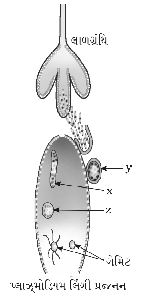
Identify $x, y, z$ in the given figure representing the life cycle of Plasmodium.
A
$x-$ Ookinete,$y-$ Oocyst,$z-$ Zygote
B
$x-$ Zygote,$y-$ Oocyst,$z-$ Ookinete
C
$x-$ Oocyst,$y-$ Zygote,$z-$ Ookinete
D
$x-$ Oocyst,$y-$ Ookinete,$z-$ Zygote
Solution
(A) In the life cycle of Plasmodium,fertilization occurs in the gut of the female Anopheles mosquito,resulting in the formation of a diploid zygote $(z)$.
This zygote transforms into an elongated,motile form called an ookinete $(x)$.
The ookinete then penetrates the gut wall and develops into an oocyst $(y)$ on the outer surface of the mosquito's gut wall.
Therefore,the correct identification is $x-$ Ookinete,$y-$ Oocyst,$z-$ Zygote.
This zygote transforms into an elongated,motile form called an ookinete $(x)$.
The ookinete then penetrates the gut wall and develops into an oocyst $(y)$ on the outer surface of the mosquito's gut wall.
Therefore,the correct identification is $x-$ Ookinete,$y-$ Oocyst,$z-$ Zygote.
0 likes
View SolutionHuman Health and Disease — Diseases caused by protozoa · Frequently Asked Questions
1Are these Human Health and Disease questions useful for JEE and NEET?
Yes. All questions in this section are mapped to JEE Main and NEET exam patterns. Previous year questions from JEE Main, NEET, GUJCET and state-level exams are included with full solutions.
2Can I switch to Hindi or Gujarati for these questions?
Yes. Use the language tabs in the hero section or the sidebar to view the same questions and solutions in English, Hindi or Gujarati.
3How do I generate a question paper from this subtopic?
Use the Vedclass Exam Paper Generator — select the chapter and subtopic, set difficulty, and generate Sets A, B, C, D automatically. First 3 chapters of every subject are free.
Vedclass Products
For Students
Vedclass Test Series
Mock tests in real JEE/NEET style with performance analysis. 5-day free trial.
Start Free TrialFor Teachers
Exam Paper Generator
Generate Set A/B/C/D papers from this chapter in 2 minutes. 3 chapters free.
Try FreeFor Institutes
Online Exam Module
Live online exams with unlimited students, 360° analytics & white-label branding.
See DemoFor Teachers & Institutes
Generate a Human Health and Disease Exam Paper in 2 Minutes
Select subtopic & difficulty — Sets A, B, C, D auto-generated with No Repeat logic.
First 3 chapters of every subject are free — no payment required.