
A English
Introduction and Biodiversity Questions in English
Class 12 Biology · Biodiversity and Conservation · Introduction and Biodiversity
288+
Questions
English
Language
100%
With Solutions
Showing 38 of 288 questions in English
251
MediumMCQ
The Western Ghats have a greater diversity of which species compared to the Eastern Ghats?
A
Birds
B
Amphibians
C
Mammals
D
Reptiles
Solution
(B) The Western Ghats are recognized as a global biodiversity hotspot. Due to their high rainfall,humid climate,and complex topography,they support a significantly higher diversity of amphibians compared to the Eastern Ghats. Many species of amphibians found in the Western Ghats are endemic to the region.
0 likes
View Solution252
MediumMCQ
Which of the following statements is correct?
A
Biodiversity exists only at the species level.
B
Biodiversity conservation is not a global concern.
C
Genetic diversity refers to variations within a species.
D
Norway has greater ecological diversity than India.
Solution
(C) Biodiversity is defined as the variety and variability of life on Earth. It is typically measured at three levels: genetic diversity,species diversity,and ecological diversity.
Genetic diversity refers to the variation of genes within a species,which allows populations to adapt to changing environments.
Option $A$ is incorrect because biodiversity exists at genetic,species,and ecological levels.
Option $B$ is incorrect because biodiversity conservation is a major global concern due to the rapid loss of species.
Option $C$ is correct as it accurately defines genetic diversity.
Option $D$ is incorrect because India,being a tropical country with diverse ecosystems like deserts,rain forests,and mangroves,has much higher ecological diversity than a Scandinavian country like Norway.
Genetic diversity refers to the variation of genes within a species,which allows populations to adapt to changing environments.
Option $A$ is incorrect because biodiversity exists at genetic,species,and ecological levels.
Option $B$ is incorrect because biodiversity conservation is a major global concern due to the rapid loss of species.
Option $C$ is correct as it accurately defines genetic diversity.
Option $D$ is incorrect because India,being a tropical country with diverse ecosystems like deserts,rain forests,and mangroves,has much higher ecological diversity than a Scandinavian country like Norway.
0 likes
View Solution253
MediumMCQ
What distinguishes India from Scandinavian countries in terms of biodiversity?
A
India has a lower species diversity.
B
India has more genetic uniformity.
C
India has greater ecological diversity.
D
Scandinavian countries has more ecosystem variations.
Solution
(C) India is a tropical country,while Scandinavian countries are located in temperate regions.
Tropical regions generally harbor more species than temperate regions.
India possesses a wide range of ecosystems such as deserts,rain forests,mangroves,coral reefs,wetlands,estuaries,and alpine meadows.
This high variety of ecosystems results in greater ecological diversity in India compared to the relatively uniform ecosystems found in Scandinavian countries.
Tropical regions generally harbor more species than temperate regions.
India possesses a wide range of ecosystems such as deserts,rain forests,mangroves,coral reefs,wetlands,estuaries,and alpine meadows.
This high variety of ecosystems results in greater ecological diversity in India compared to the relatively uniform ecosystems found in Scandinavian countries.
0 likes
View Solution254
MediumMCQ
Match the following taxonomic groups with their approximate species proportion:
| Column-$A$ (Taxonomic Group) | Column-$B$ (Proportion of total species) |
|---|---|
| $A$. Animals | $1$. More than $70\%$ |
| $B$. Plants | $2$. Around $22\%$ |
| $C$. Insects | $3$. More than $70\%$ of total animals |
| $D$. Fungi | $4$. More than combined fish,amphibians,reptiles $\&$ mammals |
A
$A-2, B-3, C-4, D-1$
B
$A-3, B-1, C-4, D-2$
C
$A-4, B-2, C-3, D-1$
D
$A-1, B-2, C-3, D-4$
Solution
(D) According to the global biodiversity data provided in the $NCERT$ textbook:
$1$. Animals constitute more than $70\%$ of all the species recorded on Earth $(A-1)$.
$2$. Plants (including algae,fungi,bryophytes,gymnosperms,and angiosperms) constitute around $22\%$ of the total species $(B-2)$.
$3$. Among animals,insects are the most species-rich taxonomic group,making up more than $70\%$ of the total animal species $(C-3)$.
$4$. The number of fungi species in the world is more than the combined total of the species of fish,amphibians,reptiles,and mammals $(D-4)$.
Therefore,the correct matching is $A-1, B-2, C-3, D-4$.
$1$. Animals constitute more than $70\%$ of all the species recorded on Earth $(A-1)$.
$2$. Plants (including algae,fungi,bryophytes,gymnosperms,and angiosperms) constitute around $22\%$ of the total species $(B-2)$.
$3$. Among animals,insects are the most species-rich taxonomic group,making up more than $70\%$ of the total animal species $(C-3)$.
$4$. The number of fungi species in the world is more than the combined total of the species of fish,amphibians,reptiles,and mammals $(D-4)$.
Therefore,the correct matching is $A-1, B-2, C-3, D-4$.
0 likes
View Solution255
DifficultMCQ
Identify the correct statements :
$1.$ According to $\text{IUCN} (2004)$,the total number of described species is slightly more than $1.5$ million.
$2.$ Robert May estimated the total species diversity on Earth to be around $7$ billion.
$3.$ Insects make up more than $70 \%$ of all recorded animal species.
$4.$ India,with $2.4 \%$ of the world's land area,contributes $8.1 \%$ to global species diversity.
$1.$ According to $\text{IUCN} (2004)$,the total number of described species is slightly more than $1.5$ million.
$2.$ Robert May estimated the total species diversity on Earth to be around $7$ billion.
$3.$ Insects make up more than $70 \%$ of all recorded animal species.
$4.$ India,with $2.4 \%$ of the world's land area,contributes $8.1 \%$ to global species diversity.
A
Only $1$ and $3$ are correct
B
Only $2$ and $4$ are correct
C
Only $1, 3$ and $4$ are correct
D
All statements are correct
Solution
(C) $1.$ According to $\text{IUCN} (2004)$,the total number of plant and animal species described is slightly more than $1.5$ million. This statement is correct.
$2.$ Robert May estimated the global species diversity to be about $7$ million,not $7$ billion. This statement is incorrect.
$3.$ Among animals,insects are the most species-rich taxonomic group,making up more than $70 \%$ of the total. This statement is correct.
$4.$ India has only $2.4 \%$ of the world's land area,but its global species diversity contribution is $8.1 \%$. This statement is correct.
Therefore,statements $1, 3,$ and $4$ are correct.
$2.$ Robert May estimated the global species diversity to be about $7$ million,not $7$ billion. This statement is incorrect.
$3.$ Among animals,insects are the most species-rich taxonomic group,making up more than $70 \%$ of the total. This statement is correct.
$4.$ India has only $2.4 \%$ of the world's land area,but its global species diversity contribution is $8.1 \%$. This statement is correct.
Therefore,statements $1, 3,$ and $4$ are correct.
0 likes
View Solution256
MediumMCQ
Which type of biodiversity refers to the variety of ecosystems in a region?
A
Genetic diversity
B
Species diversity
C
Ecological diversity
D
Habitat diversity
Solution
(C) Biodiversity is categorized into three main levels: Genetic diversity,Species diversity,and Ecological diversity.
$1$. Genetic diversity refers to the variation of genes within a species.
$2$. Species diversity refers to the variety of species within a region.
$3$. Ecological diversity refers to the variety of ecosystems,such as deserts,rain forests,mangroves,coral reefs,wetlands,estuaries,and alpine meadows,present in a specific region.
Therefore,the variety of ecosystems in a region is known as Ecological diversity.
$1$. Genetic diversity refers to the variation of genes within a species.
$2$. Species diversity refers to the variety of species within a region.
$3$. Ecological diversity refers to the variety of ecosystems,such as deserts,rain forests,mangroves,coral reefs,wetlands,estuaries,and alpine meadows,present in a specific region.
Therefore,the variety of ecosystems in a region is known as Ecological diversity.
0 likes
View Solution257
MediumMCQ
Rauwolfia vomitoria shows genetic variation in:
A
Seed size
B
Active chemical concentration
C
Leaf shape
D
Growth rate
Solution
(B) $Rauwolfia$ $vomitoria$ is a medicinal plant found in the Himalayan ranges. It exhibits genetic diversity in terms of the concentration and potency of the active chemical, $reserpine$, which it produces. This variation is observed across different populations of the plant growing in different geographical regions.
0 likes
View Solution258
MediumMCQ
$(1)$ More than $\underline A\%$ of the drugs currently sold in the market worldwide are derived from plants.
$(2)$ Although all the biodiversity hotspots put together cover less than $\underline B\%$ of Earth's land area,the number of species they collectively harbour is extremely high,and strict protection of these hotspots could reduce the ongoing mass extinction by almost $\underline C\%$.
$(2)$ Although all the biodiversity hotspots put together cover less than $\underline B\%$ of Earth's land area,the number of species they collectively harbour is extremely high,and strict protection of these hotspots could reduce the ongoing mass extinction by almost $\underline C\%$.
A
$A-25\%, B-2\%, C-30\%$
B
$A-50\%, B-4\%, C-30\%$
C
$A-50\%, B-4\%, C-60\%$
D
$A-25\%, B-2\%, C-60\%$
Solution
(A) According to the $NCERT$ textbook for Class $12$ Biology,Chapter $15$ (Biodiversity and Conservation):
$1$. More than $25\%$ of the drugs currently sold in the market worldwide are derived from plants.
$2$. Although all the biodiversity hotspots put together cover less than $2\%$ of Earth's land area,the number of species they collectively harbour is extremely high,and strict protection of these hotspots could reduce the ongoing mass extinction by almost $30\%$.
Therefore,the correct values are $A = 25\%$,$B = 2\%$,and $C = 30\%$. Thus,option $A$ is correct.
$1$. More than $25\%$ of the drugs currently sold in the market worldwide are derived from plants.
$2$. Although all the biodiversity hotspots put together cover less than $2\%$ of Earth's land area,the number of species they collectively harbour is extremely high,and strict protection of these hotspots could reduce the ongoing mass extinction by almost $30\%$.
Therefore,the correct values are $A = 25\%$,$B = 2\%$,and $C = 30\%$. Thus,option $A$ is correct.
0 likes
View Solution259
EasyMCQ
Species richness is maximum:
A
in tropical rain forest
B
at poles
C
at high altitudes
D
in temperate regions
Solution
(A) Species richness follows a latitudinal gradient,where it is generally highest in the tropics and decreases towards the poles.
Tropical rain forests,such as the Amazon,exhibit the highest biodiversity on Earth due to favorable climatic conditions,constant temperature,and high rainfall throughout the year.
These conditions allow for a longer growing season and greater niche specialization,supporting a vast number of species compared to temperate or polar regions.
Tropical rain forests,such as the Amazon,exhibit the highest biodiversity on Earth due to favorable climatic conditions,constant temperature,and high rainfall throughout the year.
These conditions allow for a longer growing season and greater niche specialization,supporting a vast number of species compared to temperate or polar regions.
0 likes
View Solution260
EasyMCQ
Match the following with respect to different categories of the red list. Choose the correct option.
| Column-$I$ | Column-$II$ |
| $i$. Extinct | $a$. Species whose members survive only in captivity. |
| $ii$. Extinct in wild | $b$. Rapid population decline of $50\%$ to more than $70\%$ over the previous $10$ years. |
| $iii$. Endangered | $c$. Species in which the last individual has died. |
| $iv$. Vulnerable | $d$. Rapid population decline of $30\%$ to more than $50\%$ over the previous $10$ years. |
A
$i-d, ii-b, iii-c, iv-a$
B
$i-c, ii-a, iii-b, iv-d$
C
$i-c, ii-d, iii-b, iv-a$
D
$i-b, ii-c, iii-a, iv-d$
Solution
(B) The correct matching based on $IUCN$ Red List categories is as follows:
$i$. Extinct: Species in which the last individual has died $(c)$.
$ii$. Extinct in wild: Species whose members survive only in captivity $(a)$.
$iii$. Endangered: Rapid population decline of $50\%$ to more than $70\%$ over the previous $10$ years $(b)$.
$iv$. Vulnerable: Rapid population decline of $30\%$ to more than $50\%$ over the previous $10$ years $(d)$.
Therefore, the correct sequence is $i-c, ii-a, iii-b, iv-d$.
$i$. Extinct: Species in which the last individual has died $(c)$.
$ii$. Extinct in wild: Species whose members survive only in captivity $(a)$.
$iii$. Endangered: Rapid population decline of $50\%$ to more than $70\%$ over the previous $10$ years $(b)$.
$iv$. Vulnerable: Rapid population decline of $30\%$ to more than $50\%$ over the previous $10$ years $(d)$.
Therefore, the correct sequence is $i-c, ii-a, iii-b, iv-d$.
0 likes
View Solution261
EasyMCQ
Paul Ehrlich,by the Rivet Popper hypothesis,has explained:
A
the rich biodiversity leads to lesser variation in biomass production.
B
the effect of human activities on biodiversity.
C
the loss of key species affects the balance of the ecosystem.
D
the importance of species richness and high productivity.
Solution
(C) The Rivet Popper hypothesis was proposed by Paul Ehrlich to explain the importance of biodiversity in an ecosystem.
In this analogy,an airplane is considered an ecosystem,and the rivets holding the wings are considered species.
If a passenger pops a rivet (removes a species),the flight safety is not immediately compromised.
However,if many rivets are removed,the airplane becomes dangerously weak over time.
Similarly,the loss of species (rivets) initially may not show a drastic effect,but the loss of key species or a large number of species eventually leads to the collapse of the ecosystem's stability and function.
In this analogy,an airplane is considered an ecosystem,and the rivets holding the wings are considered species.
If a passenger pops a rivet (removes a species),the flight safety is not immediately compromised.
However,if many rivets are removed,the airplane becomes dangerously weak over time.
Similarly,the loss of species (rivets) initially may not show a drastic effect,but the loss of key species or a large number of species eventually leads to the collapse of the ecosystem's stability and function.
0 likes
View Solution262
EasyMCQ
Which among the following shows highest amphibian species diversity?
A
Eastern Ghats
B
Himalayas
C
Rann of Kutch
D
Western Ghats
Solution
(D) The $Western\ Ghats$ are recognized as one of the world's $8$ hottest biodiversity hotspots.
They exhibit an exceptionally high level of endemism, particularly among amphibians.
$A$ significant majority of the amphibian species found in the $Western\ Ghats$ are endemic to the region, meaning they are not found anywhere else in the world.
Therefore, the $Western\ Ghats$ show the highest amphibian species diversity among the given options.
They exhibit an exceptionally high level of endemism, particularly among amphibians.
$A$ significant majority of the amphibian species found in the $Western\ Ghats$ are endemic to the region, meaning they are not found anywhere else in the world.
Therefore, the $Western\ Ghats$ show the highest amphibian species diversity among the given options.
0 likes
View Solution263
EasyMCQ
Paul Ehrlich suggested the Rivet Popper Hypothesis,in which he compared an ecosystem and species to . . . . . . and . . . . . . respectively.
A
Arthropod,insects
B
Sun,planets
C
Aeroplane,rivets
D
Venus,satellites
Solution
(C) Paul Ehrlich proposed the Rivet Popper Hypothesis to explain the importance of biodiversity. In this hypothesis,he compared an ecosystem to an $Aeroplane$ and the species inhabiting it to the $rivets$ that hold the various parts of the $Aeroplane$ together. Just as the loss of a few rivets might not cause the $Aeroplane$ to crash immediately,but the loss of many rivets would make it weak and eventually lead to a crash,similarly,the loss of a few species might not affect the ecosystem immediately,but the loss of many species would lead to the collapse of the ecosystem.
0 likes
View Solution264
EasyMCQ
Given below are two statements.
Statement-$I$: Genetic diversity is the diversity in the number and type of genes as well as chromosomes present in the same species and variations in the genes and their alleles.
Statement-$II$: Species diversity deals with the variety of species as well as the number of individuals of different species observed in an area.
In light of the above statements,select the correct answer from the options given below.
Statement-$I$: Genetic diversity is the diversity in the number and type of genes as well as chromosomes present in the same species and variations in the genes and their alleles.
Statement-$II$: Species diversity deals with the variety of species as well as the number of individuals of different species observed in an area.
In light of the above statements,select the correct answer from the options given below.
A
Both Statement-$I$ and Statement-$II$ are correct.
B
Both Statement-$I$ and Statement-$II$ are incorrect.
C
Statement-$I$ is correct and Statement-$II$ is incorrect.
D
Statement-$I$ is incorrect and Statement-$II$ is correct.
Solution
(A) Statement-$I$ is correct: Genetic diversity refers to the diversity in the number and types of genes and chromosomes present in the same species,including variations in their genes and alleles.
Statement-$II$ is correct: Species diversity refers to the variety of species and the relative abundance of individuals of different species within a specific geographical area.
Therefore,both statements are correct.
Statement-$II$ is correct: Species diversity refers to the variety of species and the relative abundance of individuals of different species within a specific geographical area.
Therefore,both statements are correct.
0 likes
View Solution265
EasyMCQ
Given below are two statements.
Statement-$I$: The number of species present in an area is always proportional to the area.
Statement-$II$: For larger areas like the entire continent,the number of species found increases faster than the area explored.
Statement-$I$: The number of species present in an area is always proportional to the area.
Statement-$II$: For larger areas like the entire continent,the number of species found increases faster than the area explored.
A
Both Statement-$I$ and Statement-$II$ are correct.
B
Statement-$I$ is correct and Statement-$II$ is incorrect.
C
Both Statement-$I$ and Statement-$II$ are incorrect.
D
Statement-$I$ is incorrect and Statement-$II$ is correct.
Solution
(C) According to the species-area relationship proposed by Alexander von Humboldt,within a region,the species richness increases with increasing explored area,but only up to a limit. This is represented by the equation $S = CA^z$.
Statement-$I$ is incorrect because the relationship is not always directly proportional; it follows a rectangular hyperbola curve where the rate of increase slows down as the area increases.
Statement-$II$ is incorrect because for very large areas like an entire continent,the slope of the line ($z$-value) is steeper ($0.6$ to $1.2$),but the number of species does not increase 'faster' than the area explored in a linear sense; rather,the species-area relationship remains consistent with the power function where the regression coefficient $z$ is higher for larger taxonomic groups or larger areas.
Statement-$I$ is incorrect because the relationship is not always directly proportional; it follows a rectangular hyperbola curve where the rate of increase slows down as the area increases.
Statement-$II$ is incorrect because for very large areas like an entire continent,the slope of the line ($z$-value) is steeper ($0.6$ to $1.2$),but the number of species does not increase 'faster' than the area explored in a linear sense; rather,the species-area relationship remains consistent with the power function where the regression coefficient $z$ is higher for larger taxonomic groups or larger areas.
0 likes
View Solution266
EasyMCQ
India shares about . . . . . . % of total biodiversity wealth on earth.
A
$2.4$
B
$12$
C
$8.1$
D
$15$
Solution
(C) India has a rich biodiversity and is one of the $12$ mega-diversity countries in the world.
Although India's land area accounts for only $2.4\%$ of the world's total land area,its global species diversity share is approximately $8.1\%$.
Therefore,the correct answer is $8.1\%$.
Although India's land area accounts for only $2.4\%$ of the world's total land area,its global species diversity share is approximately $8.1\%$.
Therefore,the correct answer is $8.1\%$.
0 likes
View Solution267
EasyMCQ
Based on the statements,choose the correct option given below.
Statement-$I$: Western Ghats show greater ecosystem diversity than the Rann of Kutch.
Statement-$II$: Ladakh also shows high levels of ecosystem diversity.
Statement-$I$: Western Ghats show greater ecosystem diversity than the Rann of Kutch.
Statement-$II$: Ladakh also shows high levels of ecosystem diversity.
A
Statement-$I$ is incorrect but Statement-$II$ is correct.
B
Statement-$I$ is correct but Statement-$II$ is incorrect.
C
Both Statement-$I$ and Statement-$II$ are correct.
D
Both Statement-$I$ and Statement-$II$ are incorrect.
Solution
(B) India has a greater ecosystem diversity than a Scandinavian country like Norway. Within India,the Western Ghats exhibit high ecosystem diversity due to varied climatic conditions and habitats.
In contrast,regions like the Rann of Kutch and the cold desert of Ladakh have very low ecosystem diversity due to extreme environmental conditions (arid and cold desert,respectively).
Therefore,Statement-$I$ is correct,and Statement-$II$ is incorrect.
In contrast,regions like the Rann of Kutch and the cold desert of Ladakh have very low ecosystem diversity due to extreme environmental conditions (arid and cold desert,respectively).
Therefore,Statement-$I$ is correct,and Statement-$II$ is incorrect.
0 likes
View Solution268
EasyMCQ
Study the following statements and select the correct option given below:
Statement-$I$: Biodiversity is the variety of features of life observed in the living organisms at different levels within a defined area.
Statement-$II$: Living organisms' attempt to accommodate with different environmental conditions forms the basis of diversity.
Statement-$I$: Biodiversity is the variety of features of life observed in the living organisms at different levels within a defined area.
Statement-$II$: Living organisms' attempt to accommodate with different environmental conditions forms the basis of diversity.
A
Statement-$I$ is incorrect but Statement-$II$ is correct.
B
Statement-$I$ is correct but Statement-$II$ is incorrect.
C
Both Statement-$I$ and Statement-$II$ are correct.
D
Both Statement-$I$ and Statement-$II$ are incorrect.
Solution
(C) Biodiversity refers to the variety and variability of life forms on Earth,including diversity within species,between species,and of ecosystems.
Statement-$I$ is correct as it defines biodiversity as the variety of life forms at different levels within a specific area.
Statement-$II$ is also correct because the evolutionary process of adaptation to diverse environmental conditions leads to the development of different traits,which is the fundamental basis of biological diversity.
Statement-$I$ is correct as it defines biodiversity as the variety of life forms at different levels within a specific area.
Statement-$II$ is also correct because the evolutionary process of adaptation to diverse environmental conditions leads to the development of different traits,which is the fundamental basis of biological diversity.
0 likes
View Solution269
EasyMCQ
Within a region,species richness increases with an increasing explored area,but only up to a limit. Which naturalist proposed this statement?
A
Paul Ehrlich
B
David Tilman
C
Alexander von Humboldt
D
Robert May
Solution
(C) The German naturalist and geographer Alexander von Humboldt observed that within a region,species richness increases with an increasing explored area,but only up to a limit. This relationship is described by the equation $S = CA^z$,where $S$ is species richness,$A$ is area,$Z$ is the slope of the line (regression coefficient),and $C$ is the $Y$-intercept.
0 likes
View Solution270
EasyMCQ
The largely tropical Amazonian rain forest in South America has . . . . . . numbers of bird species.
A
$3000$
B
$427$
C
$1300$
D
$378$
Solution
(C) The Amazonian rain forest,located in South America,is the largest tropical rain forest on Earth and is known for its immense biodiversity. According to the data provided in the $NCERT$ biology textbook,this region is home to more than $1300$ species of birds. Therefore,the correct option is $C$.
0 likes
View Solution271
EasyMCQ
How many more hotspots have been added in the list of biodiversity?
A
$9$
B
$5$
C
$3$
D
$7$
Solution
(A) Initially,$9$ biodiversity hotspots were identified in the world. Later,$25$ more hotspots were added to the list,bringing the total number of biodiversity hotspots to $34$. Therefore,$25$ more hotspots were added. However,based on the provided options,the question likely refers to the addition of $9$ hotspots in a specific context or a revision. Given the standard $NCERT$ context,the total is $34$. If the question implies the most recent additions to the original list of $25$,the answer is $9$.
0 likes
View Solution272
EasyMCQ
Who among the following established naturalistic species-area relationships?
A
Paul Ehrlich
B
Robert May
C
Alexander Von Humboldt
D
David Tilman
Solution
(C) Alexander Von Humboldt observed that within a region,species richness increased with increasing explored area,but only up to a limit. This relationship is described by the equation $S = CA^z$,where $S$ is species richness,$A$ is area,$Z$ is the slope of the line (regression coefficient),and $C$ is the $Y$-intercept. This fundamental concept in ecology was established by the German naturalist and geographer Alexander Von Humboldt.
0 likes
View Solution273
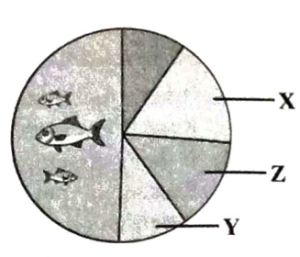
EasyMCQ
According to the representation of global biodiversity proportions for the number of species of major taxa of vertebrates,select the appropriate option for the labels $X$,$Y$,and $Z$ in the given figure.
A
$X$ - Mammals,$Y$ - Birds,$Z$ - Amphibians
B
$X$ - Birds,$Y$ - Amphibians,$Z$ - Reptiles
C
$X$ - Reptiles,$Y$ - Amphibians,$Z$ - Birds
D
$X$ - Amphibians,$Y$ - Birds,$Z$ - Mammals
Solution
(B) According to the $NCERT$ textbook figure representing the global biodiversity of vertebrates,the largest portion is occupied by fishes. Among the remaining groups,the proportions are as follows:
$1$. $X$ represents Birds.
$2$. $Z$ represents Reptiles.
$3$. $Y$ represents Amphibians.
Therefore,the correct sequence for the labels $X$,$Y$,and $Z$ is $X$ - Birds,$Y$ - Amphibians,and $Z$ - Reptiles. This corresponds to option $B$.
$1$. $X$ represents Birds.
$2$. $Z$ represents Reptiles.
$3$. $Y$ represents Amphibians.
Therefore,the correct sequence for the labels $X$,$Y$,and $Z$ is $X$ - Birds,$Y$ - Amphibians,and $Z$ - Reptiles. This corresponds to option $B$.
0 likes
View Solution274
EasyMCQ
How many biodiversity hotspots are there in the world?
A
$25$
B
$34$
C
$43$
D
$48$
Solution
(B) Currently,there are $36$ recognized biodiversity hotspots in the world. However,in the context of standard $NCERT$ textbooks,the number $34$ is often cited as the recognized count. $A$ biodiversity hotspot is a biogeographic region with a significant reservoir of biodiversity that is under threat from humans. To qualify as a biodiversity hotspot,a region must meet two strict criteria: it must contain at least $1,500$ species of vascular plants as endemics,and it must have lost at least $70$ percent of its primary native vegetation.
0 likes
View Solution275
EasyMCQ
Among the classes of invertebrates that represent global biodiversity, which are the most abundant?
A
Mollusca
B
Crustaceans
C
Annelida
D
Insects
Solution
(D) The correct answer is $D$.
Insects are the most species-rich taxonomic group on the planet, representing more than $70\%$ of all recorded animal species.
According to global biodiversity estimates, for every $10$ animals on this planet, $7$ are insects.
Therefore, among invertebrates, insects are the most abundant class.
Insects are the most species-rich taxonomic group on the planet, representing more than $70\%$ of all recorded animal species.
According to global biodiversity estimates, for every $10$ animals on this planet, $7$ are insects.
Therefore, among invertebrates, insects are the most abundant class.
0 likes
View Solution276
EasyMCQ
The medicinal plant $Rauwolfia$ $vomitoria$ produces which chemical?
A
Dopamine
B
Ethylene
C
Serotonin
D
Reserpine
Solution
(D) The medicinal plant $Rauwolfia$ $vomitoria$ is well-known for producing a potent chemical substance called $Reserpine$.
$Reserpine$ is an alkaloid that has been used medicinally to treat high blood pressure and certain mental disorders.
This plant is a classic example of chemical diversity in nature, which is a significant aspect of biodiversity.
$Reserpine$ is an alkaloid that has been used medicinally to treat high blood pressure and certain mental disorders.
This plant is a classic example of chemical diversity in nature, which is a significant aspect of biodiversity.
0 likes
View Solution277
EasyMCQ
Amazon forest is estimated to produce . . . . . . % of total oxygen in earth's atmosphere through photosynthesis.
A
$20$
B
$40$
C
$25$
D
$10$
Solution
(A) The Amazon rainforest is often referred to as the 'lungs of the planet'. It is estimated that the Amazon forest contributes approximately $20\%$ of the total oxygen in the earth's atmosphere through the process of photosynthesis. Therefore,the correct option is $A$.
0 likes
View Solution278
EasyMCQ
Statement $A$: As moving from equator to polar region,species diversity decreases.
Statement $R$: Amazon rain forest of South America has less biodiversity.
Statement $R$: Amazon rain forest of South America has less biodiversity.
A
Statement $A$ and reason $R$ both are correct but $R$ is not correct explanation of $A$.
B
Statement $A$ and reason $R$ both are correct but $R$ is correct explanation of $A$.
C
Statement $A$ is correct and reason $R$ is wrong.
D
Statement $A$ is wrong and reason $R$ is correct.
Solution
(C) Statement $A$ is correct because species diversity generally decreases as we move from the equator towards the poles due to variations in climate and solar energy.
Statement $R$ is incorrect because the Amazon rain forest in South America is known for having the greatest biodiversity on Earth,not less.
Statement $R$ is incorrect because the Amazon rain forest in South America is known for having the greatest biodiversity on Earth,not less.
0 likes
View Solution279
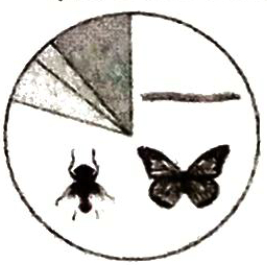
EasyMCQ
Based on the provided pie chart representing the diversity of invertebrates,which taxa represent the maximum and minimum proportions,respectively?
A
Molluscs,Insects
B
Insects,Other animal groups
C
Crustaceans,Molluscs
D
Insects,Crustaceans
Solution
(B) According to the $NCERT$ textbook diagram representing the global biodiversity of invertebrates,insects constitute the largest group,occupying the largest sector of the pie chart. The 'Other animal groups' (which includes minor phyla) occupy the smallest sector of the pie chart. Therefore,the correct sequence for maximum and minimum taxa is Insects and Other animal groups,respectively. Thus,option $B$ is correct.
0 likes
View Solution280
EasyMCQ
So far,$1.5$ million species have been identified. Among these,the number of identified fungi species is more than the combined total of which of the following groups?
A
algae,lichens,mosses,and ferns
B
fishes,amphibians,reptiles,and mammals
C
molluscs and crustaceans
D
molluscs,fishes,and amphibians
Solution
(B) The correct answer is $B$. According to the global biodiversity data provided in the $NCERT$ textbook,the number of identified fungi species is more than the combined total of the species of fishes,amphibians,reptiles,and mammals. This highlights the immense diversity of the kingdom Fungi compared to the vertebrate groups mentioned.
0 likes
View Solution281
EasyMCQ
The variety of indigenous cows is an example of
A
genetic diversity
B
species diversity
C
ecological diversity
D
microbial diversity
Solution
(A) - genetic diversity.
Genetic diversity refers to the total number of genetic characteristics within a specific species,subspecies,or group of species.
It represents the variation of genes within a species.
In the case of indigenous cows (e.g.,$Bos$ $indicus$),different breeds exist due to variations in their genetic makeup,which allows them to adapt to different environmental conditions.
Therefore,the existence of various breeds of the same species is a classic example of genetic diversity.
Genetic diversity refers to the total number of genetic characteristics within a specific species,subspecies,or group of species.
It represents the variation of genes within a species.
In the case of indigenous cows (e.g.,$Bos$ $indicus$),different breeds exist due to variations in their genetic makeup,which allows them to adapt to different environmental conditions.
Therefore,the existence of various breeds of the same species is a classic example of genetic diversity.
0 likes
View Solution282
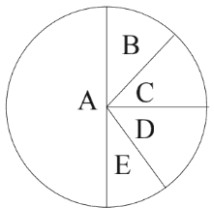
EasyMCQ
Given below is the representation of the extent of global diversity of vertebrates. What groups do the portions represent?
A
| $A$. Birds | $B$. Reptiles | $C$. Fishes | $D$. Mammals | $E$. Amphibians |
B
| $A$. Mammals | $B$. Birds | $C$. Fishes | $D$. Amphibians | $E$. Reptiles |
C
| $A$. Fishes | $B$. Amphibians | $C$. Mammals | $D$. Birds | $E$. Reptiles |
D
| $A$. Fishes | $B$. Mammals | $C$. Birds | $D$. Reptiles | $E$. Amphibians |
Solution
(D) The correct answer is $D$.
According to the $NCERT$ textbook diagram representing the global biodiversity of vertebrates:
$A$ represents Fishes (the largest portion).
$B$ represents Mammals.
$C$ represents Birds.
$D$ represents Reptiles.
$E$ represents Amphibians.
This distribution reflects the relative species diversity among these vertebrate groups.
According to the $NCERT$ textbook diagram representing the global biodiversity of vertebrates:
$A$ represents Fishes (the largest portion).
$B$ represents Mammals.
$C$ represents Birds.
$D$ represents Reptiles.
$E$ represents Amphibians.
This distribution reflects the relative species diversity among these vertebrate groups.
0 likes
View Solution283
EasyMCQ
One of the following statements is incorrect with reference to biodiversity. Identify it.
A
The richest reservoirs of animal and plant life (high species richness) with few or no threatened species are called "biodiversity hotspots".
B
Biodiversity increases from higher altitudes to lower altitudes.
C
Biodiversity decreases from the equator to polar regions.
D
Depletion in genetic diversity of crop plants is mainly due to the introduction of better varieties with high yield, disease resistance, etc.
Solution
(A) The correct answer is $A$. The statement that the richest reservoirs of animal and plant life with few or no threatened species are called "biodiversity hotspots" is incorrect.
Biodiversity hotspots are regions that are characterized by high levels of species richness and high degree of endemism, but they are also the most threatened regions due to habitat loss and fragmentation.
They are identified based on three main criteria:
$(i)$ Degree of endemism (presence of species found nowhere else).
$(ii)$ Degree of threat to the habitat due to degradation and fragmentation.
$(iii)$ High number of species or species diversity.
Biodiversity hotspots are regions that are characterized by high levels of species richness and high degree of endemism, but they are also the most threatened regions due to habitat loss and fragmentation.
They are identified based on three main criteria:
$(i)$ Degree of endemism (presence of species found nowhere else).
$(ii)$ Degree of threat to the habitat due to degradation and fragmentation.
$(iii)$ High number of species or species diversity.
0 likes
View Solution284
EasyMCQ
$A$ strict protection of biodiversity hotspots could reduce the ongoing mass extinction by almost (in $\%$)
A
$20$
B
$25$
C
$30$
D
$35$
Solution
(C) The correct answer is $C$.
Biodiversity hotspots are regions with very high levels of species richness and high degree of endemism.
These regions are also under constant threat.
Ecologists have estimated that strict protection of these biodiversity hotspots could reduce the ongoing mass extinction by almost $30\%$.
Biodiversity hotspots are regions with very high levels of species richness and high degree of endemism.
These regions are also under constant threat.
Ecologists have estimated that strict protection of these biodiversity hotspots could reduce the ongoing mass extinction by almost $30\%$.
0 likes
View Solution285
EasyMCQ
Match Column-$I$ with Column-$II$.
| Column-$I$ | Column-$II$ |
|---|---|
| $(A)$ Narrowly utilitarian argument | $(i)$ Conserving biodiversity for major ecosystem services |
| $(B)$ Broadly utilitarian argument | $(ii)$ Every species has an intrinsic value and moral duty to pass our biological legacy in good order to future generations |
| $(C)$ Ethical argument | $(iii)$ Receiving benefits like food,medicine and industrial products |
A
$(A)-(i); (B)-(ii); (C)-(iii)$
B
$(A)-(iii); (B)-(ii); (C)-(i)$
C
$(A)-(iii); (B)-(i); (C)-(ii)$
D
$(A)-(ii); (B)-(i); (C)-(iii)$
Solution
(C) The arguments for biodiversity conservation are categorized into three types:
$1$. Narrowly utilitarian: Humans derive countless direct economic benefits from nature such as food (cereals,pulses,fruits),firewood,fiber,construction material,industrial products (tannins,lubricants,dyes,resins,perfumes) and products of medicinal importance. Thus,$(A)$ matches with $(iii)$.
$2$. Broadly utilitarian: Biodiversity plays a major role in many ecosystem services that nature provides. The fast-dwindling Amazon forest is estimated to produce,through photosynthesis,$20$ percent of the total oxygen in the earth's atmosphere. Other services include pollination and aesthetic pleasures. Thus,$(B)$ matches with $(i)$.
$3$. Ethical: This argument relates to what we owe to millions of plant,animal and microbe species with whom we share this planet. Every species has an intrinsic value,even if it may not be of current or any economic value to us. We have a moral duty to care for their well-being and pass on our biological legacy in good order to future generations. Thus,$(C)$ matches with $(ii)$.
Therefore,the correct matching is $(A)-(iii), (B)-(i), (C)-(ii)$.
$1$. Narrowly utilitarian: Humans derive countless direct economic benefits from nature such as food (cereals,pulses,fruits),firewood,fiber,construction material,industrial products (tannins,lubricants,dyes,resins,perfumes) and products of medicinal importance. Thus,$(A)$ matches with $(iii)$.
$2$. Broadly utilitarian: Biodiversity plays a major role in many ecosystem services that nature provides. The fast-dwindling Amazon forest is estimated to produce,through photosynthesis,$20$ percent of the total oxygen in the earth's atmosphere. Other services include pollination and aesthetic pleasures. Thus,$(B)$ matches with $(i)$.
$3$. Ethical: This argument relates to what we owe to millions of plant,animal and microbe species with whom we share this planet. Every species has an intrinsic value,even if it may not be of current or any economic value to us. We have a moral duty to care for their well-being and pass on our biological legacy in good order to future generations. Thus,$(C)$ matches with $(ii)$.
Therefore,the correct matching is $(A)-(iii), (B)-(i), (C)-(ii)$.
0 likes
View Solution286
EasyMCQ
The species,though insignificant in number,determine the existence of many other species in a given ecosystem. Such species is known as
A
endemic species
B
sacred species
C
extinct species
D
keystone species
Solution
(D) keystone species.
In an ecosystem,certain species have a disproportionately large effect on their environment relative to their abundance. Even if they are insignificant in number,they play a critical role in maintaining the structure and diversity of the community. Such species are known as $keystone$ $species$.
In an ecosystem,certain species have a disproportionately large effect on their environment relative to their abundance. Even if they are insignificant in number,they play a critical role in maintaining the structure and diversity of the community. Such species are known as $keystone$ $species$.
0 likes
View Solution287
EasyMCQ
The term Biodiversity is popularized by . . . . . . .
A
Von Humboldt
B
David Tilman
C
Edward Wilson
D
Paul Ehrlich
Solution
(C) The term 'Biodiversity' was coined by Walter $G$. Rosen in $1985$,but it was popularized by the sociobiologist Edward $O$. Wilson to describe the combined diversity at all levels of biological organization.
0 likes
View Solution288
EasyMCQ
Exploring molecular,genetic and species-level diversity for products of economic importance is called:
A
$(1)$ Bioprospecting
B
$(2)$ Biofortification
C
$(3)$ Biomagnification
D
$(4)$ Bioremediation
Solution
(A) Bioprospecting is the systematic search for genes,compounds,and other products of economic value in biological resources.
It involves the exploration of biodiversity at molecular,genetic,and species levels to discover new resources that can be used for commercial,pharmaceutical,or industrial purposes.
It involves the exploration of biodiversity at molecular,genetic,and species levels to discover new resources that can be used for commercial,pharmaceutical,or industrial purposes.
0 likes
View SolutionBiodiversity and Conservation — Introduction and Biodiversity · Frequently Asked Questions
1Are these Biodiversity and Conservation questions useful for JEE and NEET?
Yes. All questions in this section are mapped to JEE Main and NEET exam patterns. Previous year questions from JEE Main, NEET, GUJCET and state-level exams are included with full solutions.
2Can I switch to Hindi or Gujarati for these questions?
Yes. Use the language tabs in the hero section or the sidebar to view the same questions and solutions in English, Hindi or Gujarati.
3How do I generate a question paper from this subtopic?
Use the Vedclass Exam Paper Generator — select the chapter and subtopic, set difficulty, and generate Sets A, B, C, D automatically. First 3 chapters of every subject are free.
Vedclass Products
For Students
Vedclass Test Series
Mock tests in real JEE/NEET style with performance analysis. 5-day free trial.
Start Free TrialFor Teachers
Exam Paper Generator
Generate Set A/B/C/D papers from this chapter in 2 minutes. 3 chapters free.
Try FreeFor Institutes
Online Exam Module
Live online exams with unlimited students, 360° analytics & white-label branding.
See DemoFor Teachers & Institutes
Generate a Biodiversity and Conservation Exam Paper in 2 Minutes
Select subtopic & difficulty — Sets A, B, C, D auto-generated with No Repeat logic.
First 3 chapters of every subject are free — no payment required.