
A English
Introduction and Biodiversity Questions in English
Class 12 Biology · Biodiversity and Conservation · Introduction and Biodiversity
288+
Questions
English
Language
100%
With Solutions
Showing 50 of 288 questions in English
151
MediumMCQ
In India,a biodiversity hotspot area is found in
A
Eastern Himalayas
B
Tropical Andes
C
Madagascar
D
Meso-America
Solution
(A) Out of the global biodiversity hotspots,two are found in India: the Western Ghats and the Eastern Himalayas. These regions extend into neighboring countries as well. These areas are characterized by a high degree of endemism and are inhabited by a wide variety of flowering plants,swallow-tailed butterflies,amphibians,reptiles,and mammals.
0 likes
View Solution152
EasyMCQ
The total number of biodiversity hotspots in the world is
A
$24$
B
$12$
C
$34$
D
$52$
Solution
(C) biodiversity hotspot is a biogeographic region with a significant reservoir of biodiversity that is threatened with destruction.
Initially,$25$ biodiversity hotspots were identified.
Subsequently,nine more were added to the list,bringing the total number of biodiversity hotspots in the world to $34$.
Initially,$25$ biodiversity hotspots were identified.
Subsequently,nine more were added to the list,bringing the total number of biodiversity hotspots in the world to $34$.
0 likes
View Solution153
MediumMCQ
The term 'Alpha diversity' refers to
A
Genetic diversity
B
Community diversity
C
Species diversity
D
Diversity among the plants
Solution
(C) Alpha diversity refers to the diversity of organisms within a particular community or habitat.
It represents the number of species (richness) and their relative abundance (evenness) within that specific ecosystem.
Therefore,it is essentially a measure of species diversity within a single community.
It represents the number of species (richness) and their relative abundance (evenness) within that specific ecosystem.
Therefore,it is essentially a measure of species diversity within a single community.
0 likes
View Solution154
MediumMCQ
The measure of the variety of species and their relative abundance present within a region is referred to as
A
Biodiversity
B
Genetic diversity
C
Species diversity
D
Ecological diversity
Solution
(C) Species diversity is defined as the measure of the variety of species and their relative abundance within a specific region.
It accounts for both the number of different species (species richness) and the evenness of their distribution (relative abundance).
For example,the Western Ghats exhibit a higher amphibian species diversity compared to the Eastern Ghats.
It accounts for both the number of different species (species richness) and the evenness of their distribution (relative abundance).
For example,the Western Ghats exhibit a higher amphibian species diversity compared to the Eastern Ghats.
0 likes
View Solution155
MediumMCQ
Amongst animals,insects comprise
A
Less than $70 \;\%$
B
Equal to $70 \;\%$
C
More than $70 \;\%$
D
None of these
Solution
(C) On Earth,$70 \;\%$ of all the species recorded are animals,while plants comprise no more than $22 \;\%$ of the total.
Among animals,insects are the most species-rich taxonomic group,making up more than $70 \;\%$ of the total. This means that out of every $10$ animals on this planet,at least $7$ are insects.
Among animals,insects are the most species-rich taxonomic group,making up more than $70 \;\%$ of the total. This means that out of every $10$ animals on this planet,at least $7$ are insects.
0 likes
View Solution156
MediumMCQ
The term 'biodiversity' was popularized by which of the following scientists?
A
Alexander von Humboldt
B
Edward Wilson
C
David Tilman
D
Paul Ehrlich
Solution
(B) The term 'biodiversity' was popularized by the sociobiologist Edward Wilson.
Immense diversity (heterogeneity) exists in our biosphere,not only at the species level but at all levels of biological organization ranging from macromolecules within cells to biomes.
Edward Wilson described the combined diversity at all levels of biological organization,which includes genetic diversity,species diversity,and ecological diversity.
Immense diversity (heterogeneity) exists in our biosphere,not only at the species level but at all levels of biological organization ranging from macromolecules within cells to biomes.
Edward Wilson described the combined diversity at all levels of biological organization,which includes genetic diversity,species diversity,and ecological diversity.
0 likes
View Solution157
EasyMCQ
Identify the names of two hot spots of biodiversity in India.
A
Himalayan and Deccan Plateau
B
Western Ghats and North Eastern Himalayas
C
Deccan and Western Ghats
D
Western Ghats and Gangetic plains
Solution
(B) Biodiversity hot spots are regions characterized by high levels of species richness and high degree of endemism. There are $3$ such hot spots located in India:
$1$. Western Ghats and Sri Lanka
$2$. Indo-Burma (which includes North-Eastern Himalayas)
$3$. The Himalayas.
Therefore,among the given options,the Western Ghats and North Eastern Himalayas are recognized as biodiversity hot spots.
$1$. Western Ghats and Sri Lanka
$2$. Indo-Burma (which includes North-Eastern Himalayas)
$3$. The Himalayas.
Therefore,among the given options,the Western Ghats and North Eastern Himalayas are recognized as biodiversity hot spots.
0 likes
View Solution158
EasyMCQ
How many bio-geographical regions are present in India?
A
$3$
B
$4$
C
$7$
D
$10$
Solution
(D) India occupies a dominant position in South Asia. The country is quite rich in biodiversity with a sizable percentage of endemic flora and fauna.
India is divided into $10$ distinct biogeographical regions.
These regions are: Trans-Himalayan,Himalayan,Indian Desert,Semi-Arid,Western Ghats,Deccan Peninsula,Gangetic Plain,North-East India,Islands,and Coasts.
The Deccan Peninsula is the largest biogeographical region of India,occupying approximately $45 \; \%$ of the total land mass.
India is divided into $10$ distinct biogeographical regions.
These regions are: Trans-Himalayan,Himalayan,Indian Desert,Semi-Arid,Western Ghats,Deccan Peninsula,Gangetic Plain,North-East India,Islands,and Coasts.
The Deccan Peninsula is the largest biogeographical region of India,occupying approximately $45 \; \%$ of the total land mass.
0 likes
View Solution159
MediumMCQ
Which of the following species is restricted to a specific area?
A
Sibling species
B
Allopatric species
C
Sympatric species
D
Endemic species
Solution
(D) Endemic species are those that are naturally restricted to a specific geographical area and are not found anywhere else.
Sibling species are species that are morphologically similar but reproductively isolated.
Sympatric species are species that inhabit the same geographical area.
Allopatric species are species that inhabit different geographical areas.
Sibling species are species that are morphologically similar but reproductively isolated.
Sympatric species are species that inhabit the same geographical area.
Allopatric species are species that inhabit different geographical areas.
0 likes
View Solution160
MediumMCQ
India has more than ........ genetically different strains of rice. Complete the given statement with reference to $NCERT$ textbook.
A
$1000$
B
$50000$
C
$20000$
D
$25000$
Solution
(B) India has more than $50,000$ genetically different strains of rice.
The diversity of rice in India is the highest in the world. It is estimated that there are more than $50,000$ genetically different strains of rice in India alone. Additionally,there are $27$ documented varieties of Basmati rice grown in India.
The diversity of rice in India is the highest in the world. It is estimated that there are more than $50,000$ genetically different strains of rice in India alone. Additionally,there are $27$ documented varieties of Basmati rice grown in India.
0 likes
View Solution161
MediumMCQ
The country whose tropical rain forests possess the greatest biodiversity on earth is
A
New York
B
South America
C
India
D
England
Solution
(B) The Amazon tropical rain forests,located primarily in South America,possess the greatest biodiversity on Earth.
They are home to more than $40,000$ species of plants,$3,000$ species of fishes,$1,300$ species of birds,$427$ species of mammals,$427$ species of amphibians,$378$ species of reptiles,and more than $125,000$ species of invertebrates.
They are home to more than $40,000$ species of plants,$3,000$ species of fishes,$1,300$ species of birds,$427$ species of mammals,$427$ species of amphibians,$378$ species of reptiles,and more than $125,000$ species of invertebrates.
0 likes
View Solution162
MediumMCQ
How many countries pledged their commitment to achieve a reduced rate of biodiversity loss by $2010$ in the World Summit on Sustainable Development held in $2002$ in Johannesburg,South Africa?
A
$180$
B
$200$
C
$190$
D
$210$
Solution
(C) The World Summit on Sustainable Development was held in $2002$ in Johannesburg,South Africa.
During this summit,$190$ countries pledged their commitment to achieve a significant reduction in the current rate of biodiversity loss at global,regional,and local levels by the year $2010$.
During this summit,$190$ countries pledged their commitment to achieve a significant reduction in the current rate of biodiversity loss at global,regional,and local levels by the year $2010$.
0 likes
View Solution163
MediumMCQ
Genetic diversity is the measure of
A
Varieties of the species and their relative abundance present within a region
B
Variety in the genetic information contained in the organisms
C
Diversity of the genes at community and ecosystem levels
D
All of the above
Solution
(B) Genetic diversity refers to the variation in the genetic information contained within the organisms of a species.
It encompasses the diversity in the number and types of genes,as well as the chromosomes present in different species,and the variation in genes and their alleles within the same species.
This diversity is fundamental to the process of speciation and the evolution of new species,allowing populations to adapt to changing environments.
It encompasses the diversity in the number and types of genes,as well as the chromosomes present in different species,and the variation in genes and their alleles within the same species.
This diversity is fundamental to the process of speciation and the evolution of new species,allowing populations to adapt to changing environments.
0 likes
View Solution164
MediumMCQ
Which of the following rain forest is home to more than $40,000$ species of plants,$3,000$ of fishes,$1,300$ of birds,$427$ of mammals,$427$ of amphibians,$378$ of reptiles and more than $125,000$ invertebrates?
A
Amazonian
B
Tropical
C
Arctic tundra
D
Temperate
Solution
(A) The Amazon rain forest is a moist broadleaf forest that covers most of the Amazon basin of South America.
This region includes territory belonging to nine nations.
The majority of the forest is contained within Brazil,with $60\%$ of the rain forest,followed by Peru with $13\%$ and with minor amounts in Colombia,Venezuela,Ecuador,Bolivia,Guyana,Suriname,and French Guiana.
The Amazon represents over half of the planet's remaining rain forests and comprises the largest and most species-rich tract of tropical rain forest in the world.
According to the $NCERT$ textbook,the Amazon rain forest harbors the greatest biodiversity on Earth,with the specific species counts mentioned in the question.
This region includes territory belonging to nine nations.
The majority of the forest is contained within Brazil,with $60\%$ of the rain forest,followed by Peru with $13\%$ and with minor amounts in Colombia,Venezuela,Ecuador,Bolivia,Guyana,Suriname,and French Guiana.
The Amazon represents over half of the planet's remaining rain forests and comprises the largest and most species-rich tract of tropical rain forest in the world.
According to the $NCERT$ textbook,the Amazon rain forest harbors the greatest biodiversity on Earth,with the specific species counts mentioned in the question.
0 likes
View Solution165
MediumMCQ
The reasons behind conserving biodiversity can be grouped into categories,which includes?
$I$. Broadly utilitarian
$II$. Narrowly utilitarian
$III$. No utilitarian
$IV$. Ethical utilitarian
Choose the correct option.
$I$. Broadly utilitarian
$II$. Narrowly utilitarian
$III$. No utilitarian
$IV$. Ethical utilitarian
Choose the correct option.
A
$I, II, III$ and $IV$
B
$II, III$ and $IV$
C
$I, II$ and $IV$
D
$I, III$ and $IV$
Solution
(C) The reasons for conserving biodiversity are grouped into three main categories:
$1$. Narrowly utilitarian: Humans derive countless direct economic benefits from nature,such as food,firewood,fiber,industrial products,and medicinal substances.
$2$. Broadly utilitarian: Biodiversity plays a major role in many ecosystem services that nature provides,such as the production of oxygen,pollination of flowers,and aesthetic pleasure.
$3$. Ethical utilitarian: This argument relates to what we owe to millions of plant,animal,and microbe species with whom we share this planet. Every species has an intrinsic value,even if it may not be of current economic value to us.
Therefore,the correct categories are $I$,$II$,and $IV$.
$1$. Narrowly utilitarian: Humans derive countless direct economic benefits from nature,such as food,firewood,fiber,industrial products,and medicinal substances.
$2$. Broadly utilitarian: Biodiversity plays a major role in many ecosystem services that nature provides,such as the production of oxygen,pollination of flowers,and aesthetic pleasure.
$3$. Ethical utilitarian: This argument relates to what we owe to millions of plant,animal,and microbe species with whom we share this planet. Every species has an intrinsic value,even if it may not be of current economic value to us.
Therefore,the correct categories are $I$,$II$,and $IV$.
0 likes
View Solution166
MediumMCQ
India has nearly ..... varieties of plants. (in $,000$)
A
$25$
B
$54$
C
$45$
D
$35$
Solution
(C) According to the $NCERT$ textbook,India has nearly $45,000$ species of plants and twice as many species of animals.
0 likes
View Solution167
EasyMCQ
Which one of the following shows maximum genetic diversity in India?
A
Rice
B
Maize
C
Mango
D
Groundnut
Solution
(A) India has a rich heritage of agricultural biodiversity. Among the given options,rice shows the maximum genetic diversity in India.
There are an estimated $2,00,000$ varieties of rice in India alone.
The diversity of rice in India is considered one of the richest in the world.
Additionally,there are $1,000$ varieties of mango in India.
There are an estimated $2,00,000$ varieties of rice in India alone.
The diversity of rice in India is considered one of the richest in the world.
Additionally,there are $1,000$ varieties of mango in India.
0 likes
View Solution168
EasyMCQ
The largest endangered bird in India is
A
Vulture
B
Flamingo
C
Great Indian bustard
D
Great Indian hornbill
Solution
(C) The $Great \ Indian \ bustard$ $(Ardeotis \ nigriceps)$ is a long-necked,long-legged,ground-dwelling bird.
It is recognized as the largest endangered bird species found in India.
It is recognized as the largest endangered bird species found in India.
0 likes
View Solution169
EasyMCQ
The World Biodiversity Day is celebrated annually on
A
$5^{th}$ June
B
$1^{st}$ December
C
$22^{nd}$ May
D
$16^{th}$ September
Solution
(C) $5^{th}$ June is celebrated as World Environment Day.
$1^{st}$ December is celebrated as World $AIDS$ Day.
$22^{nd}$ May is celebrated as International Day for Biological Diversity (World Biodiversity Day).
$16^{th}$ September is celebrated as World Ozone Day for the preservation of the ozone layer.
$1^{st}$ December is celebrated as World $AIDS$ Day.
$22^{nd}$ May is celebrated as International Day for Biological Diversity (World Biodiversity Day).
$16^{th}$ September is celebrated as World Ozone Day for the preservation of the ozone layer.
0 likes
View Solution170
MediumMCQ
Which of the following hypotheses suggests that ecosystems are like aeroplane wings, where the flight (ecosystem functioning) may or may not be compromised depending upon which species are being lost?
A
Gaia hypothesis
B
Gause's exclusion hypothesis
C
Odum's hypothesis
D
Rivet popper hypothesis
Solution
(D) The $Rivet$ $popper$ $hypothesis$ suggests that ecosystems are like aeroplane wings, where the flight (ecosystem functioning) may or may not be compromised depending upon which species are being lost.
This hypothesis, proposed by $Paul$ $Ehrlich$, compares the ecosystem to an aeroplane and the species to the rivets joining all parts together.
If every passenger pops a rivet to take home (representing species extinction), it may not affect the flight safety initially (proper ecosystem functioning).
However, as more rivets are removed over time, the plane will become dangerously weak, eventually leading to a catastrophic failure of the ecosystem.
This hypothesis, proposed by $Paul$ $Ehrlich$, compares the ecosystem to an aeroplane and the species to the rivets joining all parts together.
If every passenger pops a rivet to take home (representing species extinction), it may not affect the flight safety initially (proper ecosystem functioning).
However, as more rivets are removed over time, the plane will become dangerously weak, eventually leading to a catastrophic failure of the ecosystem.
0 likes
View Solution171
MediumMCQ
The state of Gujarat has river,desert,forest,and lake ecosystems,thus exhibiting a diversity of life. Which measure do you use to denote total diversity in such a case?
A
$\alpha$ (Alpha)
B
$\beta$ (Beta)
C
$\gamma$ (Gamma)
D
$\delta$ (Delta)
Solution
(C) Gamma $(\gamma)$ diversity represents the total species richness across all the different habitats found within a specific region,geographical area,or landscape. Since the question refers to the total diversity across multiple ecosystems (river,desert,forest,and lake) within the state of Gujarat,it refers to Gamma diversity.
0 likes
View Solution172
MediumMCQ
The number of species facing the threat of extinction worldwide is
A
$14,500$
B
$14,000$
C
$15,000$
D
$15,500$
Solution
(D) According to the $IUCN$ Red List of Threatened Species,the number of species facing the threat of extinction worldwide is $15,500$. This data highlights the critical need for biodiversity conservation efforts globally.
0 likes
View Solution173
MediumMCQ
What is the true approximate percentage of the earth's land area covered by biodiversity hot spots?
A
$2.5 \;\%$
B
$3.5 \;\%$
C
$1.5 \;\%$ (less than $2 \;\%$)
D
$4.5 \;\%$
Solution
(C) Biodiversity hot spots are regions with high levels of species richness and high degree of endemism.
According to ecological studies,these hot spots collectively cover less than $2 \;\%$ of the Earth's land area.
Specifically,the approximate value is often cited as $1.5 \;\%$.
Therefore,the correct option is $C$.
According to ecological studies,these hot spots collectively cover less than $2 \;\%$ of the Earth's land area.
Specifically,the approximate value is often cited as $1.5 \;\%$.
Therefore,the correct option is $C$.
0 likes
View Solution174
EasyMCQ
The dolphin found in Chilka lake is
A
Delphinus
B
Irrawady
C
Sotalia
D
Tursiops
Solution
(B) The Irrawady dolphin $(Orcaella \text{ } brevirostris)$ is the flagship species of Chilka lake.
Chilka is home to the only known population of Irrawady dolphins in India and is one of only two lagoons in the world that are home to this species.
Chilka is home to the only known population of Irrawady dolphins in India and is one of only two lagoons in the world that are home to this species.
0 likes
View Solution175
MediumMCQ
In the tropics,the rate of extinction is
A
High
B
Moderate
C
Low
D
Negligible
Solution
(C) There are various hypotheses for higher biodiversity in tropical areas. One of the primary reasons is that the rate of extinction is low in the tropics compared to temperate regions,which have historically been subjected to frequent glaciations.
0 likes
View Solution176
MediumMCQ
The Rivet Popper hypothesis assumes the $A$ to be an aeroplane and the $B$ to be the rivets,joining all parts together. Here,$A$ and $B$ refer to:
A
$A-$species; $B-$ecosystem
B
$A-$ecosystem; $B-$species
C
$A-$species; $B-$community
D
$A-$community; $B-$species
Solution
(B) The Rivet Popper hypothesis was proposed by Paul Ehrlich.
It assumes the ecosystem to be an aeroplane and the individual species to be the rivets that hold the aeroplane together.
If every passenger popping a rivet to take home as a souvenir (causing a species to go extinct),it may not affect flight safety initially,but as more rivets are removed,the plane becomes dangerously weak over a period of time.
Thus,$A$ refers to the ecosystem and $B$ refers to the species.
It assumes the ecosystem to be an aeroplane and the individual species to be the rivets that hold the aeroplane together.
If every passenger popping a rivet to take home as a souvenir (causing a species to go extinct),it may not affect flight safety initially,but as more rivets are removed,the plane becomes dangerously weak over a period of time.
Thus,$A$ refers to the ecosystem and $B$ refers to the species.
0 likes
View Solution177
EasyMCQ
Diversity index commonly used in ecological studies is
A
$y$-index diversity
B
Shannon index
C
$\alpha$-index diversity
D
$\beta$-index diversity
Solution
(B) Species diversity is a product of both species richness and evenness or equitability,i.e.,species richness weighted by species evenness.
Odum et al. $(1960)$ calculated species diversity $(d)$ as the number of species in relation to the square root of the total number of individuals.
In ecological studies,the diversity index most commonly used is the Shannon index (also known as the Shannon-Wiener index).
Odum et al. $(1960)$ calculated species diversity $(d)$ as the number of species in relation to the square root of the total number of individuals.
In ecological studies,the diversity index most commonly used is the Shannon index (also known as the Shannon-Wiener index).
0 likes
View Solution178
MediumMCQ
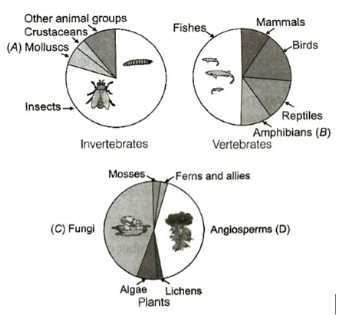
Given below are pie diagrams $I$,$II$ and $III$ related to the proportionate number of species of major taxa of invertebrates,vertebrates and plants respectively. Critically study and fill in the blanks $A, B, C$ and $D$.
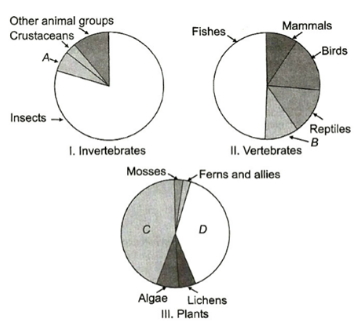
A
$A-$Molluscs,$B-$Amphibians,$C-$Angiosperms,$D-$Gymnosperms
B
$A-$Molluscs,$B-$Amphibians,$C-$Fungi,$D-$Angiosperms
C
$A-$Turtles,$B-$Amphibians,$C-$Fungi,$D-$Angiosperms
D
$A-$Hexapoda,$B-$Amphibians,$C-$Fungi,$D-$Angiosperms
Solution
(B) Based on the standard $NCERT$ biodiversity pie charts:
$1$. In the pie diagram of invertebrates $(I)$,the section labeled $A$ represents Molluscs.
$2$. In the pie diagram of vertebrates $(II)$,the section labeled $B$ represents Amphibians.
$3$. In the pie diagram of plants $(III)$,the section labeled $C$ represents Fungi (which are often grouped with plants in these ecological charts) and $D$ represents Angiosperms.
Therefore,the correct labels are $A-$Molluscs,$B-$Amphibians,$C-$Fungi,and $D-$Angiosperms.
$1$. In the pie diagram of invertebrates $(I)$,the section labeled $A$ represents Molluscs.
$2$. In the pie diagram of vertebrates $(II)$,the section labeled $B$ represents Amphibians.
$3$. In the pie diagram of plants $(III)$,the section labeled $C$ represents Fungi (which are often grouped with plants in these ecological charts) and $D$ represents Angiosperms.
Therefore,the correct labels are $A-$Molluscs,$B-$Amphibians,$C-$Fungi,and $D-$Angiosperms.
0 likes
View Solution179
MediumMCQ
Which of the following statements describes a stable community?
A
Productivity of the community should not vary too much from year to year.
B
The community should be resistant to occasional natural and man-made disturbances.
C
The community should be resistant to invasions by alien species.
D
All of the above.
Solution
(D) According to ecological studies,a stable community exhibits the following characteristics:
$(i)$ Its productivity should not vary too much from year to year.
$(ii)$ It should be resistant to occasional natural and man-made disturbances.
$(iii)$ It should be resistant to invasions by alien species.
Therefore,all the given statements are correct.
$(i)$ Its productivity should not vary too much from year to year.
$(ii)$ It should be resistant to occasional natural and man-made disturbances.
$(iii)$ It should be resistant to invasions by alien species.
Therefore,all the given statements are correct.
0 likes
View Solution180
EasyMCQ
Spot out the zone of our country considered as the hot spot of biodiversity and regarded as the "Cradle of Speciation".
A
Western Ghats
B
North East
C
Himalayan base
D
Deccan plateau
Solution
(B) The Eastern Himalayas hotspot of our country extends to North Eastern India and Bhutan. The Indo-Burma region, which covers the Eastern Himalayas, is also known as the "Cradle of Speciation" because it serves as a significant center for the evolution and diversification of various species.
0 likes
View Solution181
MediumMCQ
Initially $A$ biodiversity hot spots were identified but subsequently nine more have been added to the list,bringing the total number of biodiversity hot spots in the world to $B$. These hot spots are the regions of accelerated habitat loss. Three of these hot spots—Western Ghats and Sri Lanka,Indo-Burma,and Himalaya—cover our country's exceptionally high biodiversity regions. Although all the biodiversity hot spots put together cover less than $C$ $\%$ of the earth's land area,the number of species they collectively harbour is extremely high,and the strict protection of these hot spots could reduce the ongoing mass extinctions by almost $D$ $\%$. $A, B, C$ and $D$ in the paragraph refer to:
A
$A-25, B-26, C-2, D-30$
B
$A-25, B-34, C-2, D-30$
C
$A-15, B-20, C-2, D-30$
D
None of these
Solution
(B) Initially,$25$ biodiversity hot spots were identified globally. Subsequently,$9$ more were added,bringing the total number of biodiversity hot spots to $34$ $(A=25, B=34)$.
These regions are characterized by accelerated habitat loss.
Collectively,these hot spots cover less than $2 \%$ of the Earth's land area $(C=2)$.
Despite their small size,they harbour an extremely high number of species. Strict protection of these areas could reduce the ongoing mass extinctions by almost $30 \%$ $(D=30)$.
These regions are characterized by accelerated habitat loss.
Collectively,these hot spots cover less than $2 \%$ of the Earth's land area $(C=2)$.
Despite their small size,they harbour an extremely high number of species. Strict protection of these areas could reduce the ongoing mass extinctions by almost $30 \%$ $(D=30)$.
0 likes
View Solution182
MediumMCQ
Which of the following is correctly matched?
$I$. Alpha diversity - Number of species in a given habitat
$II$. Genetic diversity - Variation of the genes within species
$III$. Beta diversity - Diversity of the habitat in the whole region
$IV$. Species diversity - Product of the species richness and evenness
$I$. Alpha diversity - Number of species in a given habitat
$II$. Genetic diversity - Variation of the genes within species
$III$. Beta diversity - Diversity of the habitat in the whole region
$IV$. Species diversity - Product of the species richness and evenness
A
$I$,$II$ and $III$
B
$I$ and $II$
C
$I$,$II$,$III$ and $IV$
D
$I$,$II$ and $IV$
Solution
(D) $(i)$ Alpha diversity refers to the diversity within a particular area or ecosystem,often expressed by the number of species in a given habitat.
$(ii)$ Genetic diversity refers to the total genetic information contained in the genes of individuals of a species,including variations of genes within a species.
$(iii)$ Beta diversity refers to the diversity between communities,which appears due to the replacement of species along a gradient of habitats. It is not the diversity of the habitat in the whole region (which is Gamma diversity).
$(iv)$ Species diversity is a function of both species richness (number of species) and species evenness (relative abundance of species). Thus,it is considered a product of these two factors.
Therefore,statements $I$,$II$,and $IV$ are correctly matched.
$(ii)$ Genetic diversity refers to the total genetic information contained in the genes of individuals of a species,including variations of genes within a species.
$(iii)$ Beta diversity refers to the diversity between communities,which appears due to the replacement of species along a gradient of habitats. It is not the diversity of the habitat in the whole region (which is Gamma diversity).
$(iv)$ Species diversity is a function of both species richness (number of species) and species evenness (relative abundance of species). Thus,it is considered a product of these two factors.
Therefore,statements $I$,$II$,and $IV$ are correctly matched.
0 likes
View Solution183
EasyMCQ
Which of the following taxon shows maximum species diversity?
A
Fishes
B
Beetles
C
Ants
D
Orchids
Solution
(B) Among the given options,insects exhibit the highest species diversity on Earth. Specifically,within the insects,beetles $(Coleoptera)$ represent the largest group,showing the maximum species diversity.
0 likes
View Solution184
MediumMCQ
The variation shown by the medicinal plant $Rauwolfia \text{ } vomitoria$ growing in different Himalayan ranges represents:
A
Genetic diversity
B
Species diversity
C
Ecological diversity
D
Community diversity
Solution
(A) The medicinal plant $Rauwolfia \text{ } vomitoria$ grows in different Himalayan ranges.
This plant shows variation in the potency and concentration of the active chemical $Reserpine$ it produces.
Since this variation occurs within the same species due to different environmental conditions across its range, it is an example of genetic diversity.
This plant shows variation in the potency and concentration of the active chemical $Reserpine$ it produces.
Since this variation occurs within the same species due to different environmental conditions across its range, it is an example of genetic diversity.
0 likes
View Solution185
MediumMCQ
Insects are the most numerous,with an estimate of:
A
$7$ out of $10$ invertebrates
B
$4$ out of $10$ invertebrates
C
$7$ out of $10$ animals
D
$4$ out of $10$ animals
Solution
(C) Insects are the most species-rich taxonomic group on Earth.
According to estimates,out of every $10$ animals on this planet,$7$ are insects.
Therefore,insects represent the most numerous group of animals.
According to estimates,out of every $10$ animals on this planet,$7$ are insects.
Therefore,insects represent the most numerous group of animals.
0 likes
View Solution186
MediumMCQ
In global biodiversity of plants,which of the following statements is correct?
A
Angiosperms represent the maximum number.
B
Algae represent the minimum number.
C
Fungi represent the maximum number.
D
Mosses represent the maximum number.
Solution
(A) According to the global biodiversity data of plants,$Fungi$ represent the highest number of species,followed by $Angiosperms$. Therefore,among the given options,the statement that $Angiosperms$ represent the maximum number is often considered in the context of plant groups excluding $Fungi$ in some older textbooks,but strictly speaking,$Fungi$ have the highest diversity. However,based on standard multiple-choice question patterns where $Fungi$ is not the primary focus,$Angiosperms$ are often cited as the most diverse group of plants.
0 likes
View Solution187
EasyMCQ
For species-area relationships among very large areas like entire continents,the $Z$ values are in the range of:
A
$0.1$ to $0.2$
B
$1.15$
C
$0.3$ to $0.6$
D
$0.6$ to $1.2$
Solution
(D) The species-area relationship is described by the equation $S = CA^Z$.
For smaller areas,the value of the slope $Z$ generally lies in the range of $0.1$ to $0.2$.
However,for very large areas like entire continents,the slope of the line ($Z$ value) is much steeper,typically ranging from $0.6$ to $1.2$.
For smaller areas,the value of the slope $Z$ generally lies in the range of $0.1$ to $0.2$.
However,for very large areas like entire continents,the slope of the line ($Z$ value) is much steeper,typically ranging from $0.6$ to $1.2$.
0 likes
View Solution188
EasyMCQ
Which of the following ecologists proposed the 'rivet popper' hypothesis?
A
David Tilman
B
Alexander von Humboldt
C
Robert May
D
Paul Ehrlich
Solution
(D) The 'rivet popper' hypothesis was proposed by the ecologist Paul Ehrlich. This hypothesis compares an ecosystem to an airplane,where each species acts as a 'rivet' holding the plane together. As species go extinct,the ecosystem becomes weaker,similar to removing rivets from an airplane,eventually leading to a catastrophic failure.
0 likes
View Solution189
MediumMCQ
More than . . . . . . $\;\%$ of the drugs currently sold in the market worldwide are derived from plants.
A
$70$
B
$25$
C
$90$
D
$55$
Solution
(B) According to the $NCERT$ textbook,more than $25\;\%$ of the drugs currently sold in the market worldwide are derived from plants. This highlights the immense medicinal value of plant biodiversity.
0 likes
View Solution190
MediumMCQ
Bio-prospecting is exploring molecular,genetic and species level diversity for products of:
A
Ecosystem services
B
Economic benefits
C
Aesthetic pleasures
D
Both $(a)$ and $(c)$
Solution
(B) Bio-prospecting is the systematic search for new sources of chemical compounds,genes,microorganisms,macro-organisms,and other valuable products from nature. It involves exploring molecular,genetic,and species-level diversity specifically to identify products that provide economic benefits,such as pharmaceuticals,industrial chemicals,and agricultural resources.
0 likes
View Solution191
EasyMCQ
How many biodiversity hot spots have been identified in the world?
A
$30$
B
$3$
C
$34$
D
$20$
Solution
(C) Biodiversity hot spots are regions with high levels of species richness and high degree of endemism.
Currently,there are $34$ biodiversity hot spots identified globally.
Currently,there are $34$ biodiversity hot spots identified globally.
0 likes
View Solution192
MediumMCQ
How many countries pledged their commitment to achieve by $2010$,a significant reduction in the current rate of biodiversity loss at global,regional,and local levels in the World Summit held in $2002$?
A
$119$
B
$121$
C
$190$
D
$195$
Solution
(C) In the World Summit on Sustainable Development held in $2002$ in Johannesburg,South Africa,$190$ countries pledged their commitment to achieve by $2010$,a significant reduction in the current rate of biodiversity loss at global,regional,and local levels.
0 likes
View Solution193
MediumMCQ
Which is not true regarding genetic diversity?
A
It enables a population to adapt to its environment
B
It is also the basis of speciation
C
Ecotype formation depends upon it
D
Higher diversity increases uniformity
Solution
(D) Genetic diversity refers to the variety of genes within a species. Higher genetic diversity leads to greater variation among individuals in a population,which enhances the ability of the population to adapt to changing environments and serves as the raw material for evolution and speciation. Therefore,the statement that 'Higher diversity increases uniformity' is incorrect,as higher diversity actually increases variation and reduces uniformity.
0 likes
View Solution194
EasyMCQ
Regional diversity is also called
A
Alpha diversity
B
Beta diversity
C
Gamma diversity
D
Ecosystem diversity
Solution
(C) Regional diversity is also known as $\gamma$ (Gamma) diversity.
$\alpha$ (Alpha) diversity refers to the diversity within a particular area or ecosystem (local diversity).
$\beta$ (Beta) diversity refers to the diversity between communities or along a gradient (community diversity).
$\gamma$ (Gamma) diversity represents the total species diversity in a landscape or region.
$\alpha$ (Alpha) diversity refers to the diversity within a particular area or ecosystem (local diversity).
$\beta$ (Beta) diversity refers to the diversity between communities or along a gradient (community diversity).
$\gamma$ (Gamma) diversity represents the total species diversity in a landscape or region.
0 likes
View Solution195
MediumMCQ
What is $\beta$ (beta) diversity?
A
It is also called regional diversity.
B
It is within-community diversity.
C
It is generally calculated by dividing gamma diversity by alpha diversity.
D
It is local diversity.
Solution
(C) Diversity is categorized into three levels: $\alpha$ (alpha),$\beta$ (beta),and $\gamma$ (gamma) diversity.
$\alpha$ diversity refers to the diversity within a particular community or habitat (local diversity).
$\beta$ diversity refers to the diversity between communities or habitats along an environmental gradient.
$\gamma$ diversity refers to the total diversity of a landscape or region (regional diversity).
$\beta$ diversity is mathematically expressed as the ratio of $\gamma$ diversity to $\alpha$ diversity,i.e.,$\beta = \gamma / \alpha$.
$\alpha$ diversity refers to the diversity within a particular community or habitat (local diversity).
$\beta$ diversity refers to the diversity between communities or habitats along an environmental gradient.
$\gamma$ diversity refers to the total diversity of a landscape or region (regional diversity).
$\beta$ diversity is mathematically expressed as the ratio of $\gamma$ diversity to $\alpha$ diversity,i.e.,$\beta = \gamma / \alpha$.
0 likes
View Solution196
EasyMCQ
India covers the world land area of . . . . . . and contributes the global diversity of . . . . . . .
A
$4\;\%, 8\;\%$
B
$8.1\;\%, 2.4\;\%$
C
$2.4\;\%, 8.1\;\%$
D
$8\;\%, 4\;\%$
Solution
(C) India covers $2.4\;\%$ of the world's total land area.
It contributes $8.1\;\%$ to the global species diversity,making it one of the $12$ mega-biodiversity countries in the world.
It contributes $8.1\;\%$ to the global species diversity,making it one of the $12$ mega-biodiversity countries in the world.
0 likes
View Solution197
MediumMCQ
Read the following statements:
$(A)$ India has a greater ecosystem diversity than Norway.
$(B)$ According to the $IUCN$ $(2004)$,the total number of plant and animal species described so far is slightly more than $1.5$ million.
$(A)$ India has a greater ecosystem diversity than Norway.
$(B)$ According to the $IUCN$ $(2004)$,the total number of plant and animal species described so far is slightly more than $1.5$ million.
A
Both $(A)$ and $(B)$ are correct
B
Only $(B)$ is correct
C
Both $(A)$ and $(B)$ are incorrect
D
Only $(A)$ is correct
Solution
(D) Statement $(A)$ is correct: India,being a tropical country,possesses a much greater variety of ecosystems (such as deserts,rain forests,mangroves,coral reefs,wetlands,estuaries,and alpine meadows) compared to a Scandinavian country like Norway.
Statement $(B)$ is incorrect: According to the $IUCN$ $(2004)$ data,the total number of plant and animal species described so far is slightly more than $1.5$ million,not $15$ million as stated in the question.
Statement $(B)$ is incorrect: According to the $IUCN$ $(2004)$ data,the total number of plant and animal species described so far is slightly more than $1.5$ million,not $15$ million as stated in the question.
0 likes
View Solution198
MediumMCQ
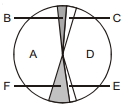
Study the following pie chart regarding the global diversity of plants and select the correct option.
A
$A$: Angiosperms,$B$: Lichens,$C$: Algae,$D$: Fungi,$E$: Mosses,$F$: Ferns and allies
B
$A$: Fungi,$B$: Lichens,$C$: Algae,$D$: Angiosperms,$E$: Mosses,$F$: Ferns and allies
C
$A$: Fungi,$B$: Mosses,$C$: Ferns and allies,$D$: Angiosperms,$E$: Lichens,$F$: Algae
D
$A$: Angiosperms,$B$: Ferns and allies,$C$: Lichens,$D$: Fungi,$E$: Algae,$F$: Mosses
Solution
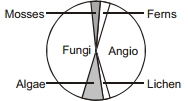
(C) Based on the standard $NCERT$ pie chart representing the global diversity of plants:
$1$. The largest sections are occupied by Fungi $(A)$ and Angiosperms $(D)$.
$2$. The smaller sections represent Algae $(F)$,Mosses $(B)$,Ferns and allies $(C)$,and Lichens $(E)$.
$3$. Comparing this with the provided pie chart labels:
- $A$ corresponds to Fungi.
- $B$ corresponds to Mosses.
- $C$ corresponds to Ferns and allies.
- $D$ corresponds to Angiosperms.
- $E$ corresponds to Lichens.
- $F$ corresponds to Algae.
Therefore,the correct option is $C$.
$1$. The largest sections are occupied by Fungi $(A)$ and Angiosperms $(D)$.
$2$. The smaller sections represent Algae $(F)$,Mosses $(B)$,Ferns and allies $(C)$,and Lichens $(E)$.
$3$. Comparing this with the provided pie chart labels:
- $A$ corresponds to Fungi.
- $B$ corresponds to Mosses.
- $C$ corresponds to Ferns and allies.
- $D$ corresponds to Angiosperms.
- $E$ corresponds to Lichens.
- $F$ corresponds to Algae.
Therefore,the correct option is $C$.
0 likes
View Solution199
MediumMCQ
Read the following statements:
$(A)$ Tropics harbour more species than temperate or polar areas.
$(B)$ Colombia located near the equator has nearly $1400$ species of birds.
$(C)$ India has less than $105$ species of birds.
$(A)$ Tropics harbour more species than temperate or polar areas.
$(B)$ Colombia located near the equator has nearly $1400$ species of birds.
$(C)$ India has less than $105$ species of birds.
A
$(A)$ and $(B)$ are incorrect
B
$(B)$ and $(C)$ are incorrect
C
$(A)$ and $(C)$ are incorrect
D
Only $(C)$ is incorrect
Solution
(D) Statement $(A)$ is correct because species diversity is generally higher in the tropics compared to temperate or polar regions.
Statement $(B)$ is correct as Colombia,located near the equator,hosts nearly $1400$ species of birds.
Statement $(C)$ is incorrect because India,with much of its land area in the tropical latitudes,possesses more than $1200$ species of birds,not less than $105$.
Statement $(B)$ is correct as Colombia,located near the equator,hosts nearly $1400$ species of birds.
Statement $(C)$ is incorrect because India,with much of its land area in the tropical latitudes,possesses more than $1200$ species of birds,not less than $105$.
0 likes
View Solution200
MediumMCQ
The Amazonian rain forest in South America is home to more than $A$ species of plants and $B$ species of fishes.
A
$A - 3,000, B - 40,000$
B
$A - 1,500, B - 2,500$
C
$A - 40,000, B - 3,000$
D
$A - 427, B - 378$
Solution
(C) According to the $NCERT$ textbook,the Amazonian rain forest is the largest tropical rain forest on Earth. It is home to more than $40,000$ species of plants and $3,000$ species of fishes.
0 likes
View SolutionBiodiversity and Conservation — Introduction and Biodiversity · Frequently Asked Questions
1Are these Biodiversity and Conservation questions useful for JEE and NEET?
Yes. All questions in this section are mapped to JEE Main and NEET exam patterns. Previous year questions from JEE Main, NEET, GUJCET and state-level exams are included with full solutions.
2Can I switch to Hindi or Gujarati for these questions?
Yes. Use the language tabs in the hero section or the sidebar to view the same questions and solutions in English, Hindi or Gujarati.
3How do I generate a question paper from this subtopic?
Use the Vedclass Exam Paper Generator — select the chapter and subtopic, set difficulty, and generate Sets A, B, C, D automatically. First 3 chapters of every subject are free.
Vedclass Products
For Students
Vedclass Test Series
Mock tests in real JEE/NEET style with performance analysis. 5-day free trial.
Start Free TrialFor Teachers
Exam Paper Generator
Generate Set A/B/C/D papers from this chapter in 2 minutes. 3 chapters free.
Try FreeFor Institutes
Online Exam Module
Live online exams with unlimited students, 360° analytics & white-label branding.
See DemoFor Teachers & Institutes
Generate a Biodiversity and Conservation Exam Paper in 2 Minutes
Select subtopic & difficulty — Sets A, B, C, D auto-generated with No Repeat logic.
First 3 chapters of every subject are free — no payment required.