
A English
Introduction and Biodiversity Questions in English
Class 12 Biology · Biodiversity and Conservation · Introduction and Biodiversity
288+
Questions
English
Language
100%
With Solutions
Showing 50 of 288 questions in English
201
MediumMCQ
Which sample area shows maximum diversity?
A
| $A$. Birds - $4$,Insects - $4$,Elephant - $4$ |
B
| $B$. Crow - $8$,Pigeon - $8$,Cuckoo - $8$,Myana - $8$ |
C
| $C$. Pigeon - $10$,Crow - $3$,Insect - $7$ |
D
| $D$. Butterfly - $20$,Banana fly - $20$,Lizards - $20$ |
Solution
(A) Maximum diversity is observed when species from taxonomically distinct groups are present in nearly equal abundance.
In option $A$:
Birds $(4)$,Insects $(4)$,and Elephant $(4)$ represent three distinct classes ($Aves$,$Insecta$,and $Mammalia$).
Since the number of individuals in each group is equal and they belong to different taxonomic groups,this sample area exhibits the highest level of biodiversity compared to the other options where either the taxonomic variety is lower or the distribution is skewed.
In option $A$:
Birds $(4)$,Insects $(4)$,and Elephant $(4)$ represent three distinct classes ($Aves$,$Insecta$,and $Mammalia$).
Since the number of individuals in each group is equal and they belong to different taxonomic groups,this sample area exhibits the highest level of biodiversity compared to the other options where either the taxonomic variety is lower or the distribution is skewed.
0 likes
View Solution202
EasyMCQ
Number of red list categories prepared by $WCU$ $(IUCN)$ is
A
$6$
B
$7$
C
$8$
D
$9$
Solution
(C) The $IUCN$ (formerly known as $WCU$ - World Conservation Union) Red List of Threatened Species classifies organisms into $8$ distinct categories.
These categories are:
$(i)$ Extinct $(EX)$,
$(ii)$ Extinct in the Wild $(EW)$,
$(iii)$ Critically Endangered $(CR)$,
$(iv)$ Endangered $(EN)$,
$(v)$ Vulnerable $(VU)$,
$(vi)$ Lower Risk $(LR)$ (which includes Near Threatened,Least Concern,and Conservation Dependent),
$(vii)$ Data Deficient $(DD)$,
$(viii)$ Not Evaluated $(NE)$.
These categories are:
$(i)$ Extinct $(EX)$,
$(ii)$ Extinct in the Wild $(EW)$,
$(iii)$ Critically Endangered $(CR)$,
$(iv)$ Endangered $(EN)$,
$(v)$ Vulnerable $(VU)$,
$(vi)$ Lower Risk $(LR)$ (which includes Near Threatened,Least Concern,and Conservation Dependent),
$(vii)$ Data Deficient $(DD)$,
$(viii)$ Not Evaluated $(NE)$.
0 likes
View Solution203
MediumMCQ
$A$: Taxonomic diversity represents the maximum level of species diversity.
$R$: It represents species of taxonomically different groups occurring in equal balance.
$R$: It represents species of taxonomically different groups occurring in equal balance.
A
Assertion and Reason both are correct and Reason is the correct explanation of Assertion.
B
Assertion and Reason both are correct but Reason is not the correct explanation of Assertion.
C
Assertion is correct,but Reason is incorrect.
D
Both Assertion and Reason are incorrect.
Solution
(C) Taxonomic diversity refers to the diversity of different taxonomic groups (e.g.,families,genera,species) within a given area.
It is considered the highest level of diversity because it accounts for the phylogenetic relationships and the variety of distinct groups present in an ecosystem.
The Assertion is correct.
The Reason states that it represents species of taxonomically different groups occurring in equal balance; however,taxonomic diversity does not require an 'equal balance' of species across groups to be defined as such.
Therefore,the Reason is incorrect.
It is considered the highest level of diversity because it accounts for the phylogenetic relationships and the variety of distinct groups present in an ecosystem.
The Assertion is correct.
The Reason states that it represents species of taxonomically different groups occurring in equal balance; however,taxonomic diversity does not require an 'equal balance' of species across groups to be defined as such.
Therefore,the Reason is incorrect.
0 likes
View Solution204
MediumMCQ
$A$: Tropics have more biodiversity.
$R$: Climate of tropical region is more seasonal.
$R$: Climate of tropical region is more seasonal.
A
Assertion and Reason both are correct and Reason is the correct explanation of Assertion.
B
Assertion and Reason both are correct but Reason is not the correct explanation of Assertion.
C
Assertion is correct,but Reason is incorrect.
D
Both Assertion and Reason are incorrect.
Solution
(C) The Assertion is correct because tropical regions harbor significantly higher species diversity compared to temperate regions.
The Reason is incorrect because tropical regions are characterized by relatively constant,predictable,and less seasonal climates,which promotes niche specialization and higher biodiversity.
In contrast,temperate regions are more seasonal,which is less conducive to high species richness.
The Reason is incorrect because tropical regions are characterized by relatively constant,predictable,and less seasonal climates,which promotes niche specialization and higher biodiversity.
In contrast,temperate regions are more seasonal,which is less conducive to high species richness.
0 likes
View Solution205
Medium
Give scientific reasons: Species diversity of plants is much less than that of animals.
Solution
(N/A) The species diversity of plants is much less than that of animals because most animals possess a nervous system that controls and coordinates various activities. They also possess receptors to receive environmental stimuli. These responses are often adaptive and ensure the survival of the organism in changing environmental conditions,allowing for greater diversification compared to plants.
0 likes
View Solution206
Medium
Give scientific reasons: It is difficult to estimate global diversity for prokaryotes.
Solution
(N/A) It is difficult to estimate the global diversity of prokaryotes because conventional taxonomic methods are not suitable for identifying microbial species. Many of these species cannot be cultured under laboratory conditions. Biochemical and molecular biology techniques suggest that their diversity could be in the millions.
0 likes
View Solution207
Medium
Define the following terms:
$1$. Biodiversity
$2$. Species diversity
$1$. Biodiversity
$2$. Species diversity
Solution
(N/A) $1$. Biodiversity: It refers to the variety and variability of all living organisms (microbes,plants,and animals) within a specific area or the entire Earth. It represents the degree of biological variety in nature.
$2$. Species diversity: It refers to the variety of species within a region. It is determined by the number of different species present in a particular area and their relative abundance.
$2$. Species diversity: It refers to the variety of species within a region. It is determined by the number of different species present in a particular area and their relative abundance.
0 likes
View Solution208
Medium
Define/Explain: Endemic species.
Solution
(N/A) Endemic species are those species of plants and animals that are found exclusively in a particular geographical region and are not naturally found anywhere else in the world. These species are restricted to a small or specific area due to factors like physical barriers,climate,or evolutionary history.
0 likes
View Solution209
Medium
Define/Explain: Endemism.
Solution
(N/A) Endemism is the ecological state of a species being unique to a defined geographic location,such as an island,nation,country,or other defined zone,or habitat type. Organisms that are indigenous to a single location are said to be endemic to that place.
0 likes
View Solution210
Medium
Define/Explain: Genetic diversity.
Solution
(N/A) Genetic diversity refers to the variation in the genetic constitution of individuals within a species. It represents the total number of genetic characteristics in the genetic makeup of a species,which allows populations to adapt to changing environments.
0 likes
View Solution211
MediumMCQ
Definition / Explanation: $\beta$-diversity.
A
Diversity within a single habitat.
B
Diversity between two habitats.
C
Diversity of the entire landscape.
D
Genetic diversity within a species.
Solution
(B) $\beta$-diversity refers to the variation in species composition between two different habitats or communities along an environmental gradient. It measures the rate of species replacement or turnover as one moves from one habitat to another.
0 likes
View Solution212
Medium
Define/Explain: $\gamma$-diversity.
Solution
(N/A) $\gamma$-diversity refers to the total species richness across a range of different habitats within a large geographical region or landscape. It represents the overall diversity of an entire ecosystem or region,encompassing the diversity of all the communities present within it.
0 likes
View Solution213
EasyMCQ
What is the full form of $UNESCO$?
A
United Nations Educational,Scientific and Cultural Organization
B
United Nations Environmental,Scientific and Cultural Organization
C
United Nations Educational,Social and Cultural Organization
D
United Nations Economic,Scientific and Cultural Organization
Solution
(A) The full form of $UNESCO$ is United Nations Educational,Scientific and Cultural Organization.
It is a specialized agency of the United Nations aimed at promoting world peace and security through international cooperation in education,arts,sciences,and culture.
It is a specialized agency of the United Nations aimed at promoting world peace and security through international cooperation in education,arts,sciences,and culture.
0 likes
View Solution214
EasyMCQ
The number and types of organisms present on Earth refer to:
A
Biodiversity
B
Bio-difference
C
Bio-variety
D
Bio-isolation
Solution
(A) The term $Biodiversity$ refers to the variety and variability of life on Earth. It encompasses the number of different species,their genetic diversity,and the variety of ecosystems they inhabit. In the context of biology,the total number and types of organisms present on Earth are collectively referred to as biodiversity.
0 likes
View Solution215
EasyMCQ
Who attempted to put a price tag on nature's life-support services?
A
Robert Costanza
B
Edward Wilson
C
Paul Ehrlich
D
$A.G. Tansley$
Solution
(A) Robert Costanza and his colleagues have made a very bold attempt to put price tags on nature's life-support services. They estimated that the average price tag for these ecosystem services is $US 33 trillion$ a year, which is largely taken for granted because they are free. This value is significantly higher than the global Gross National Product $(GNP)$ of $US 18 trillion$ at that time.
0 likes
View Solution216
EasyMCQ
The value of the global Gross National Product $(GNP)$ is $..........$.
A
$18$ billion $US$ dollars
B
$18$ trillion $US$ dollars
C
$33$ billion $US$ dollars
D
$33$ trillion $US$ dollars
Solution
(B) According to Robert Costanza and his colleagues,the total value of ecosystem services is estimated to be around $33$ trillion $US$ dollars per year. This value is significantly higher than the global Gross National Product $(GNP)$,which is approximately $18$ trillion $US$ dollars. Therefore,the correct value for the global $GNP$ is $18$ trillion $US$ dollars.
0 likes
View Solution217
MediumMCQ
Biodiversity refers to $........$
A
Diversity within a single organism
B
Diversity within a single species
C
The number and types of organisms present on Earth
D
All of the above
Solution
(C) Biodiversity is the term used to describe the variety of life found on Earth and all of the natural processes. This includes ecosystem diversity,species diversity,and genetic diversity. Therefore,it encompasses the number and types of organisms present on Earth,as well as the variations within species and ecosystems. Thus,the most comprehensive definition among the given options is the number and types of organisms present on Earth.
0 likes
View Solution218
EasyMCQ
There are $..........$ species of orchids on Earth.
A
$28,000$
B
$3,00,000$
C
$20,000$
D
$25,000$
Solution
(C) According to the $NCERT$ textbook for Class $12$ Biology,Chapter $15$ (Biodiversity and Conservation),there are more than $20,000$ species of orchids on Earth. This is a factual data point provided under the section discussing global biodiversity.
0 likes
View Solution219
EasyMCQ
The term $Biodiversity$ was popularized by $........$.
A
Robert Constanza
B
Edward Wilson
C
Paul Ehrlich
D
$A. G. Tansley$
Solution
(B) The term $Biodiversity$ was coined by $Walter \text{ } G. \text{ } Rosen$ in $1985$, but it was popularized by the sociobiologist $Edward \text{ } Wilson$ to describe the combined diversity at all the levels of biological organization. Therefore, the correct option is $B$.
0 likes
View Solution220
MediumMCQ
Match the following columns:
| Column-$I$ | Column-$II$ |
| $(P)$ Genetic diversity | $(I)$ Diversity at the genetic level |
| $(Q)$ Species diversity | $(II)$ Diversity at the species level |
| $(R)$ Ecological diversity | $(III)$ Diversity at the ecosystem level |
A
$(P-III), (Q-I), (R-II)$
B
$(P-II), (Q-I), (R-III)$
C
$(P-III), (Q-II), (R-I)$
D
$(P-I), (Q-II), (R-III)$
Solution
(D) The correct matches are as follows:
$(P)$ Genetic diversity refers to the diversity at the genetic level within a species.
$(Q)$ Species diversity refers to the diversity at the species level.
$(R)$ Ecological diversity refers to the diversity at the ecosystem level (e.g., deserts, rain forests, mangroves, etc.).
Therefore, the correct matching is $(P-I), (Q-II), (R-III)$.
$(P)$ Genetic diversity refers to the diversity at the genetic level within a species.
$(Q)$ Species diversity refers to the diversity at the species level.
$(R)$ Ecological diversity refers to the diversity at the ecosystem level (e.g., deserts, rain forests, mangroves, etc.).
Therefore, the correct matching is $(P-I), (Q-II), (R-III)$.
0 likes
View Solution221
MediumMCQ
Select the correct option regarding species diversity.
A
It is the diversity at the species level.
B
The diversity of amphibian species in the Western Ghats is greater than that in the Eastern Ghats.
C
Species diversity increases as the number of species in a given area increases.
D
All of the above.
0 likes
View Solution222
MediumMCQ
India has more than ........ genetically diverse strains of rice and more than ........ varieties of mango.
A
$50,000, 1,000$
B
$1,000, 50,000$
C
$5,000, 1,000$
D
$1,000, 5,000$
Solution
(A) According to the $NCERT$ textbook on Biodiversity and Conservation,India is home to a vast amount of genetic diversity.
Specifically,there are more than $50,000$ genetically diverse strains of rice.
Additionally,there are more than $1,000$ varieties of mango in India.
Therefore,the correct option is $A$.
Specifically,there are more than $50,000$ genetically diverse strains of rice.
Additionally,there are more than $1,000$ varieties of mango in India.
Therefore,the correct option is $A$.
0 likes
View Solution223
MediumMCQ
Select the incorrect statement regarding the plant $Rauwolfia$ $vomitoria$.
A
It produces an active chemical called reserpine.
B
The scientific name of the plant is $Rauwolfia$ $vomitoria$.
C
It is an edible plant growing in various regions of the Himalayas.
D
Reserpine is used in the treatment of high blood pressure.
Solution
(C) The plant $Rauwolfia$ $vomitoria$ is a medicinal plant found in the Himalayan ranges. It produces an active chemical known as reserpine,which is highly effective in the treatment of high blood pressure (hypertension). However,it is not an edible plant; it is primarily used for its pharmacological properties. Therefore,the statement that it is an edible plant is incorrect.
0 likes
View Solution224
EasyMCQ
Which of the following countries is not included in the Scandinavian countries?
A
Norway
B
Finland
C
Sweden
D
Russia
Solution
(D) The Scandinavian countries traditionally include $Norway$,$Sweden$,and $Denmark$. $Finland$ is often grouped with the Nordic countries but is not geographically or culturally considered part of Scandinavia in the strict sense. However,$Russia$ is definitely not a Scandinavian country,as it is a transcontinental country spanning Eastern Europe and Northern Asia. Among the given options,$Russia$ is the most distinct from the Scandinavian region.
0 likes
View Solution225
EasyMCQ
Identify the full form of $IUCN$.
A
International Union for Conservation of Nature and Natural Resources
B
Indian Union for Conservation of Nature and Natural Resources
C
International Union for Chemical Nomenclature
D
Indian Union for Chemical Nomenclature
Solution
(A) $IUCN$ stands for International Union for Conservation of Nature and Natural Resources.
It is an international organization working in the field of nature conservation and sustainable use of natural resources.
It is an international organization working in the field of nature conservation and sustainable use of natural resources.
0 likes
View Solution226
MediumMCQ
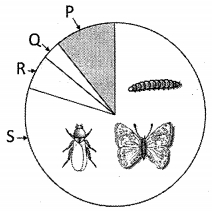
The following pie chart represents the global biodiversity of invertebrates. Identify the group of Molluscs from the given labels.
A
$P$
B
$Q$
C
$R$
D
$S$
Solution
(B) According to the $NCERT$ textbook representation of global biodiversity of invertebrates,the pie chart is divided as follows:
$1$. $S$ represents Insects,which constitute the largest group of invertebrates.
$2$. $R$ represents Crustaceans.
$3$. $Q$ represents Molluscs.
$4$. $P$ represents other animal groups.
Therefore,the label $Q$ corresponds to the group of Molluscs.
$1$. $S$ represents Insects,which constitute the largest group of invertebrates.
$2$. $R$ represents Crustaceans.
$3$. $Q$ represents Molluscs.
$4$. $P$ represents other animal groups.
Therefore,the label $Q$ corresponds to the group of Molluscs.
0 likes
View Solution227
MediumMCQ
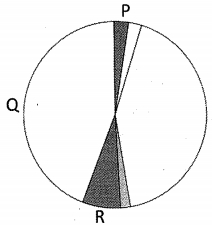
The given pie chart represents the global biodiversity of plant species. Identify $P, Q$ and $R$.
A
Algae,Fungi,Mosses
B
Mosses,Fungi,Algae
C
Angiosperms,Lichens,Fungi
D
Fungi,Lichens,Angiosperms
Solution
(C) According to the $NCERT$ textbook (Chapter: Biodiversity and Conservation), the global biodiversity of plant species is represented by a pie chart where:
$Q$ represents Angiosperms, which constitute the largest portion of plant diversity.
$R$ represents Fungi, which occupy a significant portion.
$P$ represents Lichens, which occupy a smaller portion compared to Fungi and Angiosperms.
Therefore, the correct identification is $P = \text{Lichens}, Q = \text{Angiosperms}, R = \text{Fungi}$.
However, looking at the provided options, option $C$ is the most accurate representation based on the standard pie chart provided in the textbook.
$Q$ represents Angiosperms, which constitute the largest portion of plant diversity.
$R$ represents Fungi, which occupy a significant portion.
$P$ represents Lichens, which occupy a smaller portion compared to Fungi and Angiosperms.
Therefore, the correct identification is $P = \text{Lichens}, Q = \text{Angiosperms}, R = \text{Fungi}$.
However, looking at the provided options, option $C$ is the most accurate representation based on the standard pie chart provided in the textbook.
0 likes
View Solution228
EasyMCQ
How many megadiverse countries are there in the world?
A
$9$
B
$10$
C
$11$
D
$12$
Solution
(D) The concept of 'megadiverse countries' was identified by Conservation International. There are $12$ countries that have been identified as megadiverse,which harbor the majority of the Earth's species and high numbers of endemic species. These countries are Australia,Brazil,China,Colombia,Ecuador,India,Indonesia,Madagascar,Mexico,Peru,Philippines,and Democratic Republic of Congo.
0 likes
View Solution229
MediumMCQ
In the Amazonian rainforest,at least $.........$ insect species are yet to be discovered and named.
A
$2$ million
B
$2$ billion
C
$20$ million
D
$20$ billion
Solution
(A) According to the $NCERT$ textbook,the Amazonian rainforest is home to millions of species,many of which are still unknown to science. It is estimated that at least $2$ million insect species are yet to be discovered and named in these regions. Therefore,the correct option is $A$.
0 likes
View Solution230
MediumMCQ
Match the following based on the biodiversity of the Amazon rainforest:
| Column-$I$ | Column-$II$ |
| $(P)$ Plants | $(I)$ $40,000$ |
| $(Q)$ Fishes | $(II)$ $3,000$ |
| $(R)$ Birds | $(III)$ $1,300$ |
| $(S)$ Mammals or Amphibians | $(IV)$ $427$ |
| $(T)$ Reptiles | $(V)$ $378$ |
A
$(P-I), (Q-II), (R-III), (S-IV), (T-V)$
B
$(P-II), (Q-I), (R-III), (S-IV), (T-V)$
C
$(P-III), (Q-I), (R-II), (S-V), (T-IV)$
D
$(P-I), (Q-III), (R-II), (S-IV), (T-V)$
Solution
(A) According to the data provided in the $NCERT$ textbook regarding the biodiversity of the Amazon rainforest:
- $(P)$ Plants: $40,000$ species $(I)$
- $(Q)$ Fishes: $3,000$ species $(II)$
- $(R)$ Birds: $1,300$ species $(III)$
- $(S)$ Mammals or Amphibians: $427$ species $(IV)$
- $(T)$ Reptiles: $378$ species $(V)$
Therefore,the correct matching is $(P-I), (Q-II), (R-III), (S-IV), (T-V)$.
- $(P)$ Plants: $40,000$ species $(I)$
- $(Q)$ Fishes: $3,000$ species $(II)$
- $(R)$ Birds: $1,300$ species $(III)$
- $(S)$ Mammals or Amphibians: $427$ species $(IV)$
- $(T)$ Reptiles: $378$ species $(V)$
Therefore,the correct matching is $(P-I), (Q-II), (R-III), (S-IV), (T-V)$.
0 likes
View Solution231
MediumMCQ
The Amazon rainforest is home to more than $...........$ species of invertebrates.
A
$1,25,000$
B
$20,00,000$
C
$40,000$
D
$80,000$
Solution
(A) According to the $NCERT$ textbook,the Amazon rainforest is the most biodiverse region on Earth.
It is estimated to be home to at least $40,000$ species of plants,$3,000$ species of fishes,$1,300$ species of birds,$427$ species of mammals,$427$ species of amphibians,$378$ species of reptiles,and more than $1,25,000$ species of invertebrates.
It is estimated to be home to at least $40,000$ species of plants,$3,000$ species of fishes,$1,300$ species of birds,$427$ species of mammals,$427$ species of amphibians,$378$ species of reptiles,and more than $1,25,000$ species of invertebrates.
0 likes
View Solution232
MediumMCQ
Why is species diversity higher in tropical regions?
A
Tropical latitudes have remained relatively undisturbed for millions of years,providing a long evolutionary time for species diversification.
B
Tropical environments are less seasonal,relatively more constant and predictable,which promotes niche specialization and leads to greater species diversity.
C
There is more solar energy available in the tropics,which contributes to higher productivity. Higher productivity can lead to greater species diversity.
D
All of the above.
Solution
(D) Species diversity is higher in tropical regions due to several factors:
$1$. Tropical latitudes have remained relatively undisturbed for millions of years,unlike temperate regions which were subjected to frequent glaciations in the past. This provided a long evolutionary time for species diversification.
$2$. Tropical environments are less seasonal,relatively more constant,and predictable. Such constant environments promote niche specialization and lead to a greater species diversity.
$3$. There is more solar energy available in the tropics,which contributes to higher productivity. Increased productivity is often associated with higher species richness.
$1$. Tropical latitudes have remained relatively undisturbed for millions of years,unlike temperate regions which were subjected to frequent glaciations in the past. This provided a long evolutionary time for species diversification.
$2$. Tropical environments are less seasonal,relatively more constant,and predictable. Such constant environments promote niche specialization and lead to a greater species diversity.
$3$. There is more solar energy available in the tropics,which contributes to higher productivity. Increased productivity is often associated with higher species richness.
0 likes
View Solution233
MediumMCQ
In the equation $S = CA^z$,where $S =$ species richness,$A =$ area,$Z =$ slope of the line,and $C =$ $Y$-intercept. If area is on the $X$-axis and species richness is on the $Y$-axis,what will the graph of $S = CA^z$ look like?
A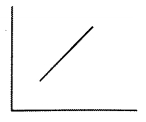
B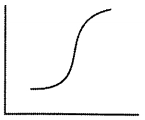
C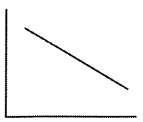
D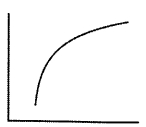
Solution
(D) The relationship between species richness and area for a wide variety of taxa (angiosperm plants,birds,bats,freshwater fishes) turns out to be a rectangular hyperbola.
On a logarithmic scale,this relationship becomes a straight line described by the equation $\log S = \log C + Z \log A$.
However,when plotted on a normal scale with area $(A)$ on the $X$-axis and species richness $(S)$ on the $Y$-axis,the equation $S = CA^z$ represents a rectangular hyperbola,which appears as a curve that rises steeply at first and then levels off as the area increases.
Among the given options,the graph shown in option $D$ represents this characteristic rectangular hyperbola curve.
On a logarithmic scale,this relationship becomes a straight line described by the equation $\log S = \log C + Z \log A$.
However,when plotted on a normal scale with area $(A)$ on the $X$-axis and species richness $(S)$ on the $Y$-axis,the equation $S = CA^z$ represents a rectangular hyperbola,which appears as a curve that rises steeply at first and then levels off as the area increases.
Among the given options,the graph shown in option $D$ represents this characteristic rectangular hyperbola curve.
0 likes
View Solution234
MediumMCQ
The 'Rivet Popper' hypothesis was proposed by $................$.
A
Alexander von Humboldt
B
Paul Ehrlich
C
Edward Wilson
D
David Tilman
Solution
(B) The 'Rivet Popper' hypothesis was proposed by the ecologist $Paul \ Ehrlich$.
This hypothesis uses the analogy of an airplane to explain the importance of biodiversity.
In this analogy,the ecosystem is compared to an airplane,and the species are compared to the rivets holding the parts together.
If passengers start popping rivets (removing species) one by one,the flight safety is initially unaffected,but as more rivets are removed,the plane becomes dangerously weak and eventually crashes,representing the collapse of the ecosystem.
This hypothesis uses the analogy of an airplane to explain the importance of biodiversity.
In this analogy,the ecosystem is compared to an airplane,and the species are compared to the rivets holding the parts together.
If passengers start popping rivets (removing species) one by one,the flight safety is initially unaffected,but as more rivets are removed,the plane becomes dangerously weak and eventually crashes,representing the collapse of the ecosystem.
0 likes
View Solution235
MediumMCQ
Which of the following is $NOT$ a characteristic of a stable biological community?
A
It does not show too much variation in productivity from year to year.
B
It should be sensitive to human-made or natural disturbances.
C
It should be resistant to invasions by alien species.
D
None of the above.
Solution
(B) According to David Tilman's long-term ecosystem experiments,a stable biological community should possess the following characteristics:
$1$. It should not show too much variation in productivity from year to year.
$2$. It should be resistant to occasional disturbances (either natural or human-made).
$3$. It should be resistant to invasions by alien species.
Therefore,the statement that a stable community should be 'sensitive' to disturbances is incorrect,as stability implies resistance or resilience to such disturbances.
$1$. It should not show too much variation in productivity from year to year.
$2$. It should be resistant to occasional disturbances (either natural or human-made).
$3$. It should be resistant to invasions by alien species.
Therefore,the statement that a stable community should be 'sensitive' to disturbances is incorrect,as stability implies resistance or resilience to such disturbances.
0 likes
View Solution236
MediumMCQ
According to the Rivet Popper Hypothesis,the airplane represents:
A
Species
B
Ecosystem
C
Biological community
D
Population
Solution
(B) The Rivet Popper Hypothesis was proposed by Paul Ehrlich to explain the importance of species diversity in an ecosystem.
In this analogy,the airplane represents the $Ecosystem$.
The rivets on the wings represent the $Species$ that make up the ecosystem.
If a passenger removes a rivet (extinction of a species),it may not affect the flight safety initially,but if too many rivets are removed,the airplane becomes weak and eventually crashes,leading to the collapse of the ecosystem.
In this analogy,the airplane represents the $Ecosystem$.
The rivets on the wings represent the $Species$ that make up the ecosystem.
If a passenger removes a rivet (extinction of a species),it may not affect the flight safety initially,but if too many rivets are removed,the airplane becomes weak and eventually crashes,leading to the collapse of the ecosystem.
0 likes
View Solution237
MediumMCQ
At one time,tropical rainforests covered more than $..........$ of the earth's land surface,but now they do not cover more than $..........$.
A
$14 \%, 6 \%$
B
$21 \%, 14 \%$
C
$14 \%, 3 \%$
D
$21 \%, 3 \%$
Solution
(A) Tropical rainforests are known as the 'lungs of the planet' because they play a crucial role in maintaining the earth's climate and oxygen levels.
Historically,these rainforests covered more than $14 \%$ of the earth's land surface.
Due to rapid deforestation and human activities,their coverage has drastically reduced.
Currently,these rainforests cover no more than $6 \%$ of the earth's land surface.
Therefore,the correct values are $14 \%$ and $6 \%$.
Historically,these rainforests covered more than $14 \%$ of the earth's land surface.
Due to rapid deforestation and human activities,their coverage has drastically reduced.
Currently,these rainforests cover no more than $6 \%$ of the earth's land surface.
Therefore,the correct values are $14 \%$ and $6 \%$.
0 likes
View Solution238
EasyMCQ
Which of the following is known as the 'Lungs of the Planet'?
A
Temperate forests of the Himalayas
B
Amazon rainforests
C
Coniferous forests
D
Grasslands
Solution
(B) The Amazon rainforest is often referred to as the 'Lungs of the Planet' because its vast vegetation absorbs massive amounts of carbon dioxide and releases oxygen through photosynthesis,playing a crucial role in regulating the Earth's climate.
0 likes
View Solution239
MediumMCQ
Pollination is an ecosystem service that ecosystems provide to us through pollinators like bees,bumblebees,birds,and bats. Which category does this service fall under?
A
Narrowly utilitarian argument
B
Broadly utilitarian argument
C
Ethical argument
D
All of the above
Solution
(B) The arguments for conserving biodiversity are classified into three categories:
$1$. Narrowly utilitarian: Derived from direct economic benefits like food,firewood,fiber,construction material,industrial products,and medicinal products.
$2$. Broadly utilitarian: Derived from ecosystem services that nature provides,such as pollination (by bees,birds,bats),oxygen production,flood control,and aesthetic pleasure.
$3$. Ethical: Based on the belief that every species has an intrinsic value and we have a moral duty to pass on the biological legacy to future generations.
Since pollination is an ecosystem service provided by nature,it falls under the broadly utilitarian argument.
$1$. Narrowly utilitarian: Derived from direct economic benefits like food,firewood,fiber,construction material,industrial products,and medicinal products.
$2$. Broadly utilitarian: Derived from ecosystem services that nature provides,such as pollination (by bees,birds,bats),oxygen production,flood control,and aesthetic pleasure.
$3$. Ethical: Based on the belief that every species has an intrinsic value and we have a moral duty to pass on the biological legacy to future generations.
Since pollination is an ecosystem service provided by nature,it falls under the broadly utilitarian argument.
0 likes
View Solution240
EasyMCQ
More than $......$ of the drugs currently sold in the market worldwide are derived from plants. (in $\%$)
A
$25$
B
$40$
C
$50$
D
$60$
Solution
(A) According to the $NCERT$ textbook under the chapter 'Biodiversity and Conservation',it is stated that $25 \%$ of all drugs currently sold in the market worldwide are derived from plants.
Furthermore,$25,000$ species of plants contribute to the traditional medicines used by native peoples around the world.
Furthermore,$25,000$ species of plants contribute to the traditional medicines used by native peoples around the world.
0 likes
View Solution241
MediumMCQ
Approximately $.........$ plant species are used by indigenous people around the world in traditional medicines. (in $,000$)
A
$10$
B
$25$
C
$30$
D
$50$
Solution
(B) According to the $NCERT$ textbook under the section 'Biodiversity and Conservation',it is estimated that approximately $25,000$ plant species are used by indigenous people around the world in traditional medicines. This highlights the importance of biodiversity in human health and traditional knowledge systems.
0 likes
View Solution242
MediumMCQ
The exploration of molecular,genetic,and species-level diversity for products of economic importance is known as $..............$
A
Genetics
B
Biotechnology
C
Bioprospecting
D
Variation
Solution
(C) Bioprospecting is the systematic search for new sources of chemical compounds,genes,microorganisms,macro-organisms,and other valuable products from nature.
It involves exploring molecular,genetic,and species-level diversity to identify products that have economic importance,such as pharmaceuticals,industrial chemicals,and agricultural products.
Therefore,the correct answer is $Bioprospecting$.
It involves exploring molecular,genetic,and species-level diversity to identify products that have economic importance,such as pharmaceuticals,industrial chemicals,and agricultural products.
Therefore,the correct answer is $Bioprospecting$.
0 likes
View Solution243
EasyMCQ
The total number of biodiversity hotspots currently identified worldwide is $.........$.
A
$25$
B
$9$
C
$32$
D
$36$
Solution
(D) Biodiversity hotspots are biogeographic regions with a significant reservoir of biodiversity that is under threat from destruction.
Initially,$25$ hotspots were identified by Norman Myers.
Over time,the number has been revised based on further research and criteria.
Currently,there are $36$ recognized biodiversity hotspots globally.
Initially,$25$ hotspots were identified by Norman Myers.
Over time,the number has been revised based on further research and criteria.
Currently,there are $36$ recognized biodiversity hotspots globally.
0 likes
View Solution244
MediumMCQ
Even if all the biodiversity hotspots are put together,they cover less than $2 \%$ of the Earth's land area.
A
$2 \%$
B
Less than $2 \%$
C
$30 \%$
D
More than $30 \%$
Solution
(B) Biodiversity hotspots are regions with very high levels of species richness and high degree of endemism.
Although these hotspots cover less than $2 \%$ of the Earth's land area,the number of species they collectively harbour is extremely high.
Strict protection of these hotspots could reduce the ongoing mass extinctions by almost $30 \%$.
Although these hotspots cover less than $2 \%$ of the Earth's land area,the number of species they collectively harbour is extremely high.
Strict protection of these hotspots could reduce the ongoing mass extinctions by almost $30 \%$.
0 likes
View Solution245
MediumMCQ
Which of the following regions is $NOT$ a biodiversity hotspot?
A
Western Ghats and Sri Lanka
B
Aravalli Hills
C
Indo-Burma
D
Himalaya
Solution
(B) Biodiversity hotspots are regions that are characterized by high levels of species richness and a high degree of endemism,while also facing significant threats to their habitat.
According to the global classification,there are $36$ biodiversity hotspots in the world.
In India,the recognized biodiversity hotspots are the Western Ghats and Sri Lanka,the Himalayas,the Indo-Burma region,and the Sundaland.
The Aravalli Hills are not classified as a global biodiversity hotspot.
Therefore,the correct option is $B$.
According to the global classification,there are $36$ biodiversity hotspots in the world.
In India,the recognized biodiversity hotspots are the Western Ghats and Sri Lanka,the Himalayas,the Indo-Burma region,and the Sundaland.
The Aravalli Hills are not classified as a global biodiversity hotspot.
Therefore,the correct option is $B$.
0 likes
View Solution246
MediumMCQ
Frugivorous birds are found in large numbers in tropical forests mainly because of:
A
lack of niche specialisation
B
higher annual rainfall
C
availability of fruits throughout the year
D
temperature conducive for their breeding
Solution
(C) Tropical forests are characterized by high biodiversity and a stable climate that supports plant growth throughout the year.
Because of the favorable climatic conditions,many plant species in tropical regions produce fruits at different times of the year.
This continuous availability of food resources (fruits) supports a large population of frugivorous (fruit-eating) birds,as they do not face food scarcity during any season.
Therefore,the primary reason for the abundance of frugivorous birds in tropical forests is the availability of fruits throughout the year.
Because of the favorable climatic conditions,many plant species in tropical regions produce fruits at different times of the year.
This continuous availability of food resources (fruits) supports a large population of frugivorous (fruit-eating) birds,as they do not face food scarcity during any season.
Therefore,the primary reason for the abundance of frugivorous birds in tropical forests is the availability of fruits throughout the year.
0 likes
View Solution247
MediumMCQ
Western Ghats have a large number of plant and animal species that are not found anywhere else. Which of the following terms is used to denote such species?
A
Threatened species
B
Keystone species
C
Endemic species
D
Vulnerable species
Solution
(C) Species that are restricted to a specific geographic area and are not found naturally anywhere else in the world are known as $Endemic$ species.
Western Ghats are a biodiversity hotspot known for a high degree of endemism,meaning many of its flora and fauna are unique to that region.
$Threatened$ species are those likely to become extinct in the near future.
$Keystone$ species are those that have a disproportionately large effect on their environment relative to their abundance.
$Vulnerable$ species are those that are likely to become endangered unless the circumstances threatening their survival and reproduction improve.
Western Ghats are a biodiversity hotspot known for a high degree of endemism,meaning many of its flora and fauna are unique to that region.
$Threatened$ species are those likely to become extinct in the near future.
$Keystone$ species are those that have a disproportionately large effect on their environment relative to their abundance.
$Vulnerable$ species are those that are likely to become endangered unless the circumstances threatening their survival and reproduction improve.
0 likes
View Solution248
MediumMCQ
The historic Convention on Biological Diversity,'The Earth Summit' was held in Rio de Janeiro in the year
A
$2002$
B
$1985$
C
$1992$
D
$1986$
Solution
(C) The historic Convention on Biological Diversity,known as 'The Earth Summit',was held in Rio de Janeiro in the year $1992$.
This summit called upon all nations to take appropriate measures for the conservation of biodiversity and the sustainable utilisation of its benefits.
This summit called upon all nations to take appropriate measures for the conservation of biodiversity and the sustainable utilisation of its benefits.
0 likes
View Solution249
MediumMCQ
Tropical regions show the greatest level of species richness because:
$A$. Tropical latitudes have remained relatively undisturbed for millions of years,hence more time was available for species diversification.
$B$. Tropical environments are more seasonal.
$C$. More solar energy is available in the tropics.
$D$. Constant environments promote niche specialization.
$E$. Tropical environments are constant and predictable.
Choose the correct answer from the options given below.
$A$. Tropical latitudes have remained relatively undisturbed for millions of years,hence more time was available for species diversification.
$B$. Tropical environments are more seasonal.
$C$. More solar energy is available in the tropics.
$D$. Constant environments promote niche specialization.
$E$. Tropical environments are constant and predictable.
Choose the correct answer from the options given below.
A
$A$ and $B$ only
B
$A, B$ and $E$ only
C
$A, B$ and $D$ only
D
$A, C, D$ and $E$ only
Solution
(D) Statement $A$ is correct because tropical latitudes have remained relatively undisturbed for millions of years,allowing more time for evolutionary diversification.
Statement $B$ is incorrect because tropical environments are less seasonal compared to temperate regions.
Statement $C$ is correct as higher solar energy input in the tropics promotes higher primary productivity.
Statement $D$ is correct because constant environments allow species to evolve specialized niches.
Statement $E$ is correct because tropical environments are relatively constant and predictable,which supports higher biodiversity.
Therefore,statements $A, C, D,$ and $E$ are correct.
Statement $B$ is incorrect because tropical environments are less seasonal compared to temperate regions.
Statement $C$ is correct as higher solar energy input in the tropics promotes higher primary productivity.
Statement $D$ is correct because constant environments allow species to evolve specialized niches.
Statement $E$ is correct because tropical environments are relatively constant and predictable,which supports higher biodiversity.
Therefore,statements $A, C, D,$ and $E$ are correct.
0 likes
View Solution250
MediumMCQ
Read the following statements carefully and mark the correct option given below.
Statement-$I$: India is one of the $12$ mega diversity countries of the world.
Statement-$II$: India has only $2.4 \%$ of the world's land area.
Statement-$I$: India is one of the $12$ mega diversity countries of the world.
Statement-$II$: India has only $2.4 \%$ of the world's land area.
A
Statement-$I$ and Statement-$II$ both are correct.
B
Statement-$I$ is correct and Statement-$II$ is incorrect.
C
Statement-$I$ is incorrect and Statement-$II$ is correct.
D
Both Statement-$I$ and Statement-$II$ are incorrect.
Solution
(A) Statement-$I$ is correct: India is recognized as one of the $12$ mega biodiversity countries in the world due to its rich variety of flora and fauna.
Statement-$II$ is correct: India occupies only $2.4 \%$ of the world's total land area,yet it contributes significantly to global biodiversity (about $8.1 \%$ of the global species diversity).
Therefore,both statements are correct.
Statement-$II$ is correct: India occupies only $2.4 \%$ of the world's total land area,yet it contributes significantly to global biodiversity (about $8.1 \%$ of the global species diversity).
Therefore,both statements are correct.
0 likes
View SolutionBiodiversity and Conservation — Introduction and Biodiversity · Frequently Asked Questions
1Are these Biodiversity and Conservation questions useful for JEE and NEET?
Yes. All questions in this section are mapped to JEE Main and NEET exam patterns. Previous year questions from JEE Main, NEET, GUJCET and state-level exams are included with full solutions.
2Can I switch to Hindi or Gujarati for these questions?
Yes. Use the language tabs in the hero section or the sidebar to view the same questions and solutions in English, Hindi or Gujarati.
3How do I generate a question paper from this subtopic?
Use the Vedclass Exam Paper Generator — select the chapter and subtopic, set difficulty, and generate Sets A, B, C, D automatically. First 3 chapters of every subject are free.
Vedclass Products
For Students
Vedclass Test Series
Mock tests in real JEE/NEET style with performance analysis. 5-day free trial.
Start Free TrialFor Teachers
Exam Paper Generator
Generate Set A/B/C/D papers from this chapter in 2 minutes. 3 chapters free.
Try FreeFor Institutes
Online Exam Module
Live online exams with unlimited students, 360° analytics & white-label branding.
See DemoFor Teachers & Institutes
Generate a Biodiversity and Conservation Exam Paper in 2 Minutes
Select subtopic & difficulty — Sets A, B, C, D auto-generated with No Repeat logic.
First 3 chapters of every subject are free — no payment required.