
A English
Mix Example-Biodiversity and Conservation Questions in English
Class 12 Biology · Biodiversity and Conservation · Mix Example-Biodiversity and Conservation
44+
Questions
English
Language
100%
With Solutions
Showing 44 of 44 questions in English
1
EasyMCQ
Mangrove vegetation is found in
A
Dehradun valley
B
Kullu valley
C
Western Ghats
D
Sundarbans
Solution
(D) Mangroves are salt-tolerant vegetation (halophytes) that grow in intertidal regions of tropical and subtropical coastlines.
$Sundarbans$ in West Bengal,India,is the largest mangrove forest in the world.
It is characterized by the presence of $Rhizophora$,$Avicennia$,and other salt-tolerant species.
Therefore,the correct option is $D$.
$Sundarbans$ in West Bengal,India,is the largest mangrove forest in the world.
It is characterized by the presence of $Rhizophora$,$Avicennia$,and other salt-tolerant species.
Therefore,the correct option is $D$.
0 likes
View Solution2
MediumMCQ
In India, tropical wet evergreen rain forests are not found in:
A
Tamil Nadu
B
Andaman
C
West Bengal
D
Madhya Pradesh
Solution
(D) Tropical wet evergreen forests in India are primarily found in regions with high rainfall, such as the Western Ghats, the Andaman and Nicobar Islands, and parts of the North-Eastern states (including West Bengal).
$Madhya Pradesh$ is located in central India and is characterized by tropical dry deciduous forests rather than wet evergreen rain forests due to lower annual rainfall compared to the coastal and northeastern regions.
$Madhya Pradesh$ is located in central India and is characterized by tropical dry deciduous forests rather than wet evergreen rain forests due to lower annual rainfall compared to the coastal and northeastern regions.
0 likes
View Solution3
MediumMCQ
If the Bengal tiger becomes extinct,then . . . . . . .
A
Hyenas and wolves will decrease.
B
The forest area will become safe for humans and domestic animals.
C
It will lose its gene pool forever.
D
The population of wild animals like deer will become stable.
Solution
(C) The Bengal tiger is a top-level predator in the ecosystem. If it becomes extinct,its entire genetic information,known as the gene pool,will be lost forever,as there is no way to recreate the specific genetic makeup of a species once it is extinct. While the extinction of a predator can lead to an increase in prey populations (like deer),the most significant and irreversible biological consequence is the permanent loss of its unique genetic diversity.
0 likes
View Solution4
MediumMCQ
The main objective of plant conservation is ..........
A
For the conservation of essential ecological processes and life-support systems.
B
For the preservation of species diversity and the sustainable utilization of species and ecosystem.
C
Both of the above.
D
None of the above.
Solution
(C) The primary objectives of biodiversity and plant conservation are defined by the World Conservation Strategy. These include:
$1$. Maintenance of essential ecological processes and life-support systems (such as nutrient cycling,soil regeneration,and water purification).
$2$. Preservation of species diversity (genetic diversity).
$3$. Sustainable utilization of species and ecosystems for the benefit of present and future generations.
Since both options $A$ and $B$ represent these core objectives,the correct answer is $C$.
$1$. Maintenance of essential ecological processes and life-support systems (such as nutrient cycling,soil regeneration,and water purification).
$2$. Preservation of species diversity (genetic diversity).
$3$. Sustainable utilization of species and ecosystems for the benefit of present and future generations.
Since both options $A$ and $B$ represent these core objectives,the correct answer is $C$.
0 likes
View Solution5
MediumMCQ
$A$ species facing an extremely high risk of extinction in the immediate future is called:
A
vulnerable
B
endemic
C
critically endangered
D
extinct
Solution
(C) The correct answer is $C$.
According to the $IUCN$ Red List criteria,a species is classified as 'critically endangered' when it is facing an extremely high risk of extinction in the wild in the immediate future.
'Vulnerable' species are those facing a high risk of extinction in the medium-term future.
'Endemic' species are those restricted to a specific geographic area.
'Extinct' species are those that no longer have any living individuals.
According to the $IUCN$ Red List criteria,a species is classified as 'critically endangered' when it is facing an extremely high risk of extinction in the wild in the immediate future.
'Vulnerable' species are those facing a high risk of extinction in the medium-term future.
'Endemic' species are those restricted to a specific geographic area.
'Extinct' species are those that no longer have any living individuals.
0 likes
View Solution6
MediumMCQ
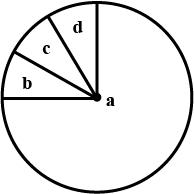
Given below is the representation of the extent of global diversity of invertebrates. What groups do the four portions $(a, b, c, d)$ represent respectively?
A
$a$-Insects,$b$-Crustaceans,$c$-Other animal groups,$d$-Molluscs
B
$a$-Crustaceans,$b$-Insects,$c$-Molluscs,$d$-Other animal groups
C
$a$-Molluscs,$b$-Other animal groups,$c$-Crustaceans,$d$-Insects
D
$a$-Insects,$b$-Molluscs,$c$-Crustaceans,$d$-Other animal groups
Solution
(D) According to the pie chart representing the global diversity of invertebrates,the largest portion $(a)$ represents insects,which are the most diverse group of animals on Earth. The next portion $(b)$ represents molluscs,followed by crustaceans $(c)$,and the remaining portion $(d)$ represents other animal groups. Therefore,the correct sequence is $a$-Insects,$b$-Molluscs,$c$-Crustaceans,$d$-Other animal groups.
0 likes
View Solution7
EasyMCQ
Which of the following pairs of an animal and a plant represents endangered organisms in India?
A
Banyan and black duck
B
Bentinckia nicobarica and red panda
C
Tamarind and rhesus monkey
D
Cinchona and leopard
Solution
(B) The correct answer is $B$.
An endangered species is a living organism that is at risk of extinction if its population continues to decline and its habitat is not protected.
$Bentinckia nicobarica$ is a critically endangered species of palm tree native to the Nicobar Islands.
The red panda $(Ailurus fulgens)$ is an endangered mammal species facing threats due to habitat loss and human encroachment.
Therefore,the pair consisting of $Bentinckia nicobarica$ (plant) and red panda (animal) represents endangered organisms in India.
An endangered species is a living organism that is at risk of extinction if its population continues to decline and its habitat is not protected.
$Bentinckia nicobarica$ is a critically endangered species of palm tree native to the Nicobar Islands.
The red panda $(Ailurus fulgens)$ is an endangered mammal species facing threats due to habitat loss and human encroachment.
Therefore,the pair consisting of $Bentinckia nicobarica$ (plant) and red panda (animal) represents endangered organisms in India.
0 likes
View Solution8
MediumMCQ
$A$ - Loss of biodiversity in a region may lead to an increase in plant production.
$R$ - Loss of biodiversity in a region may lead to lowered resistance to environmental perturbations such as drought.
$R$ - Loss of biodiversity in a region may lead to lowered resistance to environmental perturbations such as drought.
A
$A$ and $R$ both are correct.
B
$A$ and $R$ both are incorrect.
C
$A$ is correct and $R$ is incorrect.
D
$A$ is incorrect and $R$ is correct.
Solution
(D) According to David Tilman's long-term ecosystem experiments,communities with more species generally show less year-to-year variation in total biomass.
Increased diversity contributes to higher productivity.
Therefore,the loss of biodiversity leads to a decrease in plant production,not an increase.
Thus,statement $A$ is incorrect.
Ecological studies have shown that stable communities are resistant to occasional disturbances (natural or man-made) and invasions by alien species.
Loss of biodiversity makes an ecosystem less stable and more vulnerable to environmental perturbations such as drought.
Thus,statement $R$ is correct.
Increased diversity contributes to higher productivity.
Therefore,the loss of biodiversity leads to a decrease in plant production,not an increase.
Thus,statement $A$ is incorrect.
Ecological studies have shown that stable communities are resistant to occasional disturbances (natural or man-made) and invasions by alien species.
Loss of biodiversity makes an ecosystem less stable and more vulnerable to environmental perturbations such as drought.
Thus,statement $R$ is correct.
0 likes
View Solution9
MediumMCQ
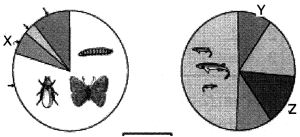
Identify $X, Y$ and $Z$ from the given pie charts representing global biodiversity of invertebrates and vertebrates:
A
Crustaceans - Fishes - Birds
B
Molluscs - Mammals - Reptiles
C
Insects - Birds - Amphibians
D
Molluscs - Amphibians - Mosses
Solution
(B) The provided pie charts are taken from the $NCERT$ textbook representing global biodiversity.
$1$. The first pie chart represents the diversity of invertebrates. In this chart,the largest portion is occupied by Insects. The label $X$ points to the section representing Molluscs.
$2$. The second pie chart represents the diversity of vertebrates. In this chart,the largest portion is occupied by Fishes. The label $Y$ points to the section representing Mammals,and the label $Z$ points to the section representing Reptiles.
$3$. Therefore,$X$ is Molluscs,$Y$ is Mammals,and $Z$ is Reptiles.
Thus,the correct option is $B$.
$1$. The first pie chart represents the diversity of invertebrates. In this chart,the largest portion is occupied by Insects. The label $X$ points to the section representing Molluscs.
$2$. The second pie chart represents the diversity of vertebrates. In this chart,the largest portion is occupied by Fishes. The label $Y$ points to the section representing Mammals,and the label $Z$ points to the section representing Reptiles.
$3$. Therefore,$X$ is Molluscs,$Y$ is Mammals,and $Z$ is Reptiles.
Thus,the correct option is $B$.
0 likes
View Solution10
DifficultMCQ
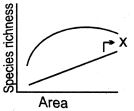
What is true for $X$ in the figure representing the species-area relationship?
A
$S = CA^Z$
B
$Log\ S = log\ C + Z log\ A$
C
$Log\ S = log\ C + log\ A$
D
$Log\ S = Z log\ A - log\ C$
Solution
(B) The species-area relationship is described by the equation $S = CA^Z$,where $S$ represents species richness,$A$ represents area,$C$ is the $Y$-intercept,and $Z$ is the slope of the line (regression coefficient).
When this equation is plotted on a logarithmic scale,it becomes a linear equation: $log\ S = log\ C + Z log\ A$.
In the provided figure,the straight line represents the logarithmic form of the species-area relationship,which is $log\ S = log\ C + Z log\ A$. Thus,$X$ corresponds to this linear equation.
When this equation is plotted on a logarithmic scale,it becomes a linear equation: $log\ S = log\ C + Z log\ A$.
In the provided figure,the straight line represents the logarithmic form of the species-area relationship,which is $log\ S = log\ C + Z log\ A$. Thus,$X$ corresponds to this linear equation.
0 likes
View Solution11
MediumMCQ
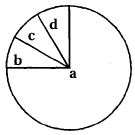
The given pie chart represents the biodiversity of invertebrates. Identify $a, b, c,$ and $d$.
A
$a$ = Insects,$b$ = Crustaceans,$c$ = Other animal groups,$d$ = Molluscs
B
$a$ = Crustaceans,$b$ = Insects,$c$ = Molluscs,$d$ = Other animal groups
C
$a$ = Molluscs,$b$ = Other animal groups,$c$ = Crustaceans,$d$ = Insects
D
$a$ = Insects,$b$ = Molluscs,$c$ = Crustaceans,$d$ = Other animal groups
Solution
(D) According to the $NCERT$ textbook,the pie chart representing the global biodiversity of invertebrates shows that insects constitute the largest proportion of species.
In the provided pie chart,$a$ represents the largest segment,which corresponds to insects.
$b$ represents the next largest segment,which corresponds to molluscs.
$c$ represents crustaceans,and $d$ represents other animal groups.
Therefore,the correct sequence is $a$ = Insects,$b$ = Molluscs,$c$ = Crustaceans,$d$ = Other animal groups.
In the provided pie chart,$a$ represents the largest segment,which corresponds to insects.
$b$ represents the next largest segment,which corresponds to molluscs.
$c$ represents crustaceans,and $d$ represents other animal groups.
Therefore,the correct sequence is $a$ = Insects,$b$ = Molluscs,$c$ = Crustaceans,$d$ = Other animal groups.
0 likes
View Solution12
DifficultMCQ
Using the provided graph,determine the percentage of bird species that will be lost if the island's inhabitable land area is reduced from $100,000\, km^2$ to $1\, km^2$.
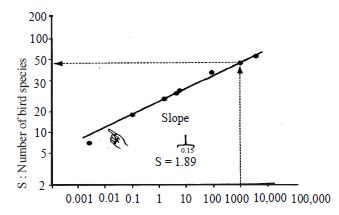
A
$17$ percent of the bird species will be lost.
B
$20$ percent of the bird species will be lost.
C
All of the bird species will be lost.
D
$93$ percent of the bird species will be lost.
Solution
(D) The species-area relationship is given by the equation $\log S = \log C + Z \log A$.
From the graph,the slope $(Z)$ is $1.15$ (as indicated by the value $S=1.15$ in the provided image).
For an area of $100,000\, km^2$,the number of species $(S_1)$ is approximately $70$.
For an area of $1\, km^2$,the number of species $(S_2)$ is approximately $5$.
The number of species lost is $S_1 - S_2 = 70 - 5 = 65$.
The percentage of species lost is $(65 / 70) \times 100 \approx 92.8\%$,which is approximately $93\%$.
Therefore,$93\%$ of the bird species will be lost.
From the graph,the slope $(Z)$ is $1.15$ (as indicated by the value $S=1.15$ in the provided image).
For an area of $100,000\, km^2$,the number of species $(S_1)$ is approximately $70$.
For an area of $1\, km^2$,the number of species $(S_2)$ is approximately $5$.
The number of species lost is $S_1 - S_2 = 70 - 5 = 65$.
The percentage of species lost is $(65 / 70) \times 100 \approx 92.8\%$,which is approximately $93\%$.
Therefore,$93\%$ of the bird species will be lost.
0 likes
View Solution13
Medium
Why are coral reefs not found in the regions from West Bengal to Andhra Pradesh,but are found in Tamil Nadu and on the east coast of India?
Solution
(N/A) Coral reefs require specific environmental conditions to thrive,including clear,warm,tropical waters,high salinity,and low levels of sedimentation or siltation.
In the regions from West Bengal to Andhra Pradesh,the presence of major river systems (like the Ganges,Mahanadi,Godavari,and Krishna) leads to a high influx of freshwater and significant siltation,which increases turbidity and reduces light penetration,making it unsuitable for coral growth.
Conversely,the coastal regions of Tamil Nadu and parts of the Gulf of Mannar provide the necessary stable,high-salinity,and clear-water environments that support the development of coral reefs.
In the regions from West Bengal to Andhra Pradesh,the presence of major river systems (like the Ganges,Mahanadi,Godavari,and Krishna) leads to a high influx of freshwater and significant siltation,which increases turbidity and reduces light penetration,making it unsuitable for coral growth.
Conversely,the coastal regions of Tamil Nadu and parts of the Gulf of Mannar provide the necessary stable,high-salinity,and clear-water environments that support the development of coral reefs.
0 likes
View Solution14
MediumMCQ
Match the following columns:
| Column-$I$ | Column-$II$ |
|---|---|
| $(a)$ Edward Wilson | $(i)$ Ecosystem experiments on plots |
| $(b)$ Alexander von Humboldt | $(ii)$ Rivet Popper Hypothesis |
| $(c)$ David Tilman | $(iii)$ Coined the term Biodiversity |
| $(d)$ Paul Ehrlich | $(iv)$ Species-Area relationships |
A
$a-iii, b-iv, c-i, d-ii$
B
$a-iv, b-iii, c-i, d-ii$
C
$a-iv, b-ii, c-i, d-iii$
D
$a-iii, b-ii, c-iv, d-i$
Solution
(A) The correct matches are as follows:
$(a)$ Edward Wilson: Coined the term 'Biodiversity' (popularized it).
$(b)$ Alexander von Humboldt: Observed species-area relationships in South American jungles.
$(c)$ David Tilman: Conducted long-term ecosystem experiments using outdoor plots.
$(d)$ Paul Ehrlich: Proposed the 'Rivet Popper Hypothesis' to explain the importance of biodiversity in ecosystem stability.
Therefore,the correct matching is $a-iii, b-iv, c-i, d-ii$.
$(a)$ Edward Wilson: Coined the term 'Biodiversity' (popularized it).
$(b)$ Alexander von Humboldt: Observed species-area relationships in South American jungles.
$(c)$ David Tilman: Conducted long-term ecosystem experiments using outdoor plots.
$(d)$ Paul Ehrlich: Proposed the 'Rivet Popper Hypothesis' to explain the importance of biodiversity in ecosystem stability.
Therefore,the correct matching is $a-iii, b-iv, c-i, d-ii$.
0 likes
View Solution15
MediumMCQ
Match the following columns:
| Column-$I$ | Column-$II$ |
| $(a)$ Clarias gariepinus | $(1)$ Zebra |
| $(b)$ Lantana | $(2)$ Tiger |
| $(c)$ Bali | $(3)$ Weed |
| $(d)$ Quagga | $(4)$ African Catfish |
A
$a-3, b-4, c-2, d-1$
B
$a-4, b-2, c-1, d-3$
C
$a-3, b-1, c-2, d-4$
D
$a-4, b-3, c-2, d-1$
Solution
(D) The correct matches are as follows:
$(a)$ $Clarias$ $gariepinus$ is an invasive alien species, commonly known as the African Catfish $(a-4)$.
$(b)$ $Lantana$ $camara$ is an invasive weed that causes environmental damage $(b-3)$.
$(c)$ The Bali tiger is a subspecies of tiger that has gone extinct $(c-2)$.
$(d)$ The Quagga is an extinct subspecies of the plains zebra $(d-1)$.
Therefore, the correct sequence is $a-4, b-3, c-2, d-1$.
$(a)$ $Clarias$ $gariepinus$ is an invasive alien species, commonly known as the African Catfish $(a-4)$.
$(b)$ $Lantana$ $camara$ is an invasive weed that causes environmental damage $(b-3)$.
$(c)$ The Bali tiger is a subspecies of tiger that has gone extinct $(c-2)$.
$(d)$ The Quagga is an extinct subspecies of the plains zebra $(d-1)$.
Therefore, the correct sequence is $a-4, b-3, c-2, d-1$.
0 likes
View Solution16
MediumMCQ
Which of the following statement$(s)$ is/are correct?
$(i)$ Rich biodiversity is not essential for ecosystem health.
$(ii)$ The current rate of species extinction is $100$ to $1000$ times faster than the pre-human extinction rate.
$(iii)$ Steller's sea cow became extinct due to overexploitation by humans.
$(iv)$ Even if we combine all biodiversity hotspots,they cover less than $2 \%$ of the Earth's land area.
$(v)$ The rate of mass extinction can be completely reduced by strict protection of hotspots.
$(i)$ Rich biodiversity is not essential for ecosystem health.
$(ii)$ The current rate of species extinction is $100$ to $1000$ times faster than the pre-human extinction rate.
$(iii)$ Steller's sea cow became extinct due to overexploitation by humans.
$(iv)$ Even if we combine all biodiversity hotspots,they cover less than $2 \%$ of the Earth's land area.
$(v)$ The rate of mass extinction can be completely reduced by strict protection of hotspots.
A
$i, ii, iii$ and $v$ are correct.
B
$ii, iii$ and $iv$ are correct.
C
$ii, iii, iv$ and $v$ are correct.
D
$i, ii$ and $v$ are correct.
Solution
(B) Statement $(i)$ is incorrect because rich biodiversity is essential for ecosystem health.
Statement $(ii)$ is correct; the current extinction rate is estimated to be $100$ to $1000$ times faster than the natural background rate.
Statement $(iii)$ is correct; Steller's sea cow was driven to extinction due to overexploitation by humans.
Statement $(iv)$ is correct; biodiversity hotspots cover less than $2 \%$ of the Earth's land area.
Statement $(v)$ is incorrect because while protection helps,it cannot completely eliminate the risk of mass extinction,which is a complex global phenomenon.
Therefore,statements $(ii), (iii),$ and $(iv)$ are correct.
Statement $(ii)$ is correct; the current extinction rate is estimated to be $100$ to $1000$ times faster than the natural background rate.
Statement $(iii)$ is correct; Steller's sea cow was driven to extinction due to overexploitation by humans.
Statement $(iv)$ is correct; biodiversity hotspots cover less than $2 \%$ of the Earth's land area.
Statement $(v)$ is incorrect because while protection helps,it cannot completely eliminate the risk of mass extinction,which is a complex global phenomenon.
Therefore,statements $(ii), (iii),$ and $(iv)$ are correct.
0 likes
View Solution17
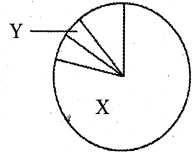
MediumMCQ
In the given pie chart representing global invertebrate diversity,what do '$x$' and '$y$' represent respectively?
A
Molluscs,Crustaceans
B
Other animal groups,Molluscs
C
Insects,Molluscs
D
Insects,Crustaceans
Solution
(C) The provided pie chart represents the global diversity of invertebrates.
In this chart,the largest segment '$x$' represents 'Insects',which constitute the most diverse group of animals on Earth.
The segment '$y$' represents 'Molluscs',which are the second most diverse group among invertebrates.
Therefore,'$x$' represents Insects and '$y$' represents Molluscs.
In this chart,the largest segment '$x$' represents 'Insects',which constitute the most diverse group of animals on Earth.
The segment '$y$' represents 'Molluscs',which are the second most diverse group among invertebrates.
Therefore,'$x$' represents Insects and '$y$' represents Molluscs.
0 likes
View Solution18
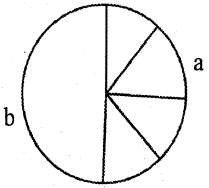
MediumMCQ
In the given pie chart,what do '$a$' and '$b$' represent respectively?
A
Birds,Fishes
B
Mammals,Fishes
C
Amphibians,Mammals
D
Reptiles,Fishes
Solution
(B) The provided pie chart represents the global biodiversity of vertebrates.
According to the $NCERT$ textbook (Chapter: Biodiversity and Conservation),in the pie chart showing the relative diversity of vertebrates:
- '$a$' represents Mammals (which occupy a smaller portion).
- '$b$' represents Fishes (which occupy the largest portion of the vertebrate diversity).
Therefore,'$a$' and '$b$' represent Mammals and Fishes respectively.
According to the $NCERT$ textbook (Chapter: Biodiversity and Conservation),in the pie chart showing the relative diversity of vertebrates:
- '$a$' represents Mammals (which occupy a smaller portion).
- '$b$' represents Fishes (which occupy the largest portion of the vertebrate diversity).
Therefore,'$a$' and '$b$' represent Mammals and Fishes respectively.
0 likes
View Solution19
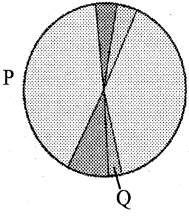
MediumMCQ
In the given pie chart representing the global biodiversity of plants,what do '$P$' and '$Q$' represent respectively?
A
Algae,Fungi
B
Angiosperms,Mosses
C
Fungi,Lichens
D
Algae,Mosses
Solution
(B) The given pie chart represents the global biodiversity of plants as per $NCERT$ textbook data.
In this chart,the largest portion '$P$' represents Angiosperms,which constitute the majority of plant species.
The smaller portion '$Q$' represents Mosses.
Therefore,'$P$' stands for Angiosperms and '$Q$' stands for Mosses.
In this chart,the largest portion '$P$' represents Angiosperms,which constitute the majority of plant species.
The smaller portion '$Q$' represents Mosses.
Therefore,'$P$' stands for Angiosperms and '$Q$' stands for Mosses.
0 likes
View Solution20
MediumMCQ
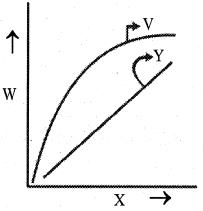
What does '$W$' represent in the given figure?
A
Species richness
B
Area
C
Slope of the line
D
$S = CA^{Z}$
Solution
(A) The given graph represents the species-area relationship,which is a fundamental concept in ecology.
In this graph,the $Y$-axis (labeled as '$W$') represents the species richness $(S)$,while the $X$-axis represents the area $(A)$.
The relationship is described by the equation $S = CA^{Z}$.
Therefore,'$W$' represents species richness.
In this graph,the $Y$-axis (labeled as '$W$') represents the species richness $(S)$,while the $X$-axis represents the area $(A)$.
The relationship is described by the equation $S = CA^{Z}$.
Therefore,'$W$' represents species richness.
0 likes
View Solution21
MediumMCQ
What does '$V$' represent in the given figure?
A
Species-Area relationship
B
$S = CA^z$
C
Area
D
Species richness
Solution
(A) The given figure represents the Species-Area relationship,which is a fundamental concept in ecology.
In this graph,the $X$-axis represents the Area $(A)$ and the $Y$-axis represents Species richness $(S)$.
The curve labeled '$V$' represents the rectangular hyperbola described by the equation $S = CA^z$,where $S$ is species richness,$A$ is area,$Z$ is the slope of the line (regression coefficient),and $C$ is the $Y$-intercept.
Therefore,'$V$' represents the Species-Area relationship curve.
In this graph,the $X$-axis represents the Area $(A)$ and the $Y$-axis represents Species richness $(S)$.
The curve labeled '$V$' represents the rectangular hyperbola described by the equation $S = CA^z$,where $S$ is species richness,$A$ is area,$Z$ is the slope of the line (regression coefficient),and $C$ is the $Y$-intercept.
Therefore,'$V$' represents the Species-Area relationship curve.
0 likes
View Solution22
MediumMCQ
What does '$X$' represent in the given graph?
A
$log \, S = log \, C + Z \, log \, A$
B
Species richness
C
$S = CA^z$
D
Area
0 likes
View Solution23
MediumMCQ
In the given graph,what does '$Y$' represent?
A
Area
B
$log \,S = log \,C + Z \,log \,A$
C
$S = CA^Z$
D
Species richness
Solution
(B) The graph represents the species-area relationship.
In this relationship,the equation is $S = CA^Z$,where $S$ is species richness,$A$ is area,$Z$ is the slope of the line (regression coefficient),and $C$ is the $Y$-intercept.
When plotted on a logarithmic scale,the equation becomes $log \,S = log \,C + Z \,log \,A$,which represents a straight line.
In the provided graph,the curve '$V$' represents the rectangular hyperbola $S = CA^Z$,while the straight line '$Y$' represents the logarithmic equation $log \,S = log \,C + Z \,log \,A$.
In this relationship,the equation is $S = CA^Z$,where $S$ is species richness,$A$ is area,$Z$ is the slope of the line (regression coefficient),and $C$ is the $Y$-intercept.
When plotted on a logarithmic scale,the equation becomes $log \,S = log \,C + Z \,log \,A$,which represents a straight line.
In the provided graph,the curve '$V$' represents the rectangular hyperbola $S = CA^Z$,while the straight line '$Y$' represents the logarithmic equation $log \,S = log \,C + Z \,log \,A$.
0 likes
View Solution24
MediumMCQ
Read the following statements:
$I.$ Species diversity increases as we move away from the equator towards the poles.
$II.$ Stellar's sea cow and passenger pigeon got extinct due to overexploitation by man.
$III.$ Lantana and Eichhornia are invasive weed in India.
$IV.$ The historic convention on biological diversity was held in $1992.$
Choose the option containing correct statements.
$I.$ Species diversity increases as we move away from the equator towards the poles.
$II.$ Stellar's sea cow and passenger pigeon got extinct due to overexploitation by man.
$III.$ Lantana and Eichhornia are invasive weed in India.
$IV.$ The historic convention on biological diversity was held in $1992.$
Choose the option containing correct statements.
A
$I$ and $II$
B
$I, II$ and $IV$
C
$I, III$ and $IV$
D
$II, III$ and $IV$
Solution
(D) Statement $I$ is incorrect because species diversity decreases,not increases,as we move from the equator towards the poles.
Statement $II$ is correct; Stellar's sea cow and passenger pigeon are classic examples of extinction due to overexploitation by humans.
Statement $III$ is correct; Lantana camara and Eichhornia crassipes (water hyacinth) are well-known invasive alien species in India.
Statement $IV$ is correct; the historic Convention on Biological Diversity (The Earth Summit) was held in Rio de Janeiro in $1992.$
Statement $II$ is correct; Stellar's sea cow and passenger pigeon are classic examples of extinction due to overexploitation by humans.
Statement $III$ is correct; Lantana camara and Eichhornia crassipes (water hyacinth) are well-known invasive alien species in India.
Statement $IV$ is correct; the historic Convention on Biological Diversity (The Earth Summit) was held in Rio de Janeiro in $1992.$
0 likes
View Solution25
MediumMCQ
Which of the following statements are correct about the Amazon rainforest?
$I$. They are called the lungs of the planet.
$II$. They harbour probably millions of species.
$III$. They are the largest tropical rainforest in South America and have the highest biodiversity on Earth.
$IV$. They are being cut and cleared for cultivating soybeans or for conversion to grasslands for raising beef cattle.
Choose the correct option.
$I$. They are called the lungs of the planet.
$II$. They harbour probably millions of species.
$III$. They are the largest tropical rainforest in South America and have the highest biodiversity on Earth.
$IV$. They are being cut and cleared for cultivating soybeans or for conversion to grasslands for raising beef cattle.
Choose the correct option.
A
$II, III$ and $IV$
B
$I, II$ and $III$
C
$I$ and $II$
D
$I, II, III$ and $IV$
Solution
(D) All the given statements are correct regarding the Amazon rainforest.
$I$. The Amazon rainforest is so vast that it produces a significant amount of oxygen,earning it the title 'lungs of the planet'.
$II$. It is home to an immense variety of life,harbouring probably millions of species.
$III$. It is the largest tropical rainforest in South America and possesses the highest biodiversity on Earth.
$IV$. It is currently being cut and cleared for agricultural purposes,specifically for cultivating soybeans or for conversion into grasslands for raising beef cattle.
$I$. The Amazon rainforest is so vast that it produces a significant amount of oxygen,earning it the title 'lungs of the planet'.
$II$. It is home to an immense variety of life,harbouring probably millions of species.
$III$. It is the largest tropical rainforest in South America and possesses the highest biodiversity on Earth.
$IV$. It is currently being cut and cleared for agricultural purposes,specifically for cultivating soybeans or for conversion into grasslands for raising beef cattle.
0 likes
View Solution26
MediumMCQ
On behalf of endangered species and habitats,why are conservationists calling for immediate and often expensive action?
A
Man has brought on climate change
B
Extinction is an unnatural process
C
It would be more costly financially if we did not act
D
Biodiversity is beneficial to humans
Solution
(C) Conservationists argue that the loss of biodiversity is a critical issue because biodiversity provides essential economic,ecological,and aesthetic benefits to humanity.
While immediate conservation actions may seem expensive,the long-term cost of inaction—including the loss of ecosystem services like pollination,water purification,and climate regulation—would be far greater.
Therefore,it is economically and ecologically more prudent to invest in conservation now to prevent further degradation and destruction of habitats,ensuring that biodiversity is preserved for future generations.
While immediate conservation actions may seem expensive,the long-term cost of inaction—including the loss of ecosystem services like pollination,water purification,and climate regulation—would be far greater.
Therefore,it is economically and ecologically more prudent to invest in conservation now to prevent further degradation and destruction of habitats,ensuring that biodiversity is preserved for future generations.
0 likes
View Solution27
MediumMCQ
Which of the following statements is wrong?
A
$A$ stable community should show much variation in productivity from year to year.
B
According to Tillman's long-term ecosystem experiments,increased diversity contributed to higher productivity.
C
$A$ stable community must be resistant to occasional disturbances.
D
Rich biodiversity is essential for ecosystem health but imperative for the very survival of the human race on this planet.
Solution
(A) stable community is characterized by its ability to maintain consistent productivity over time. Therefore,it should not show much variation in productivity from year to year. Statement $A$ is incorrect because it suggests that a stable community shows much variation,which contradicts the definition of stability in an ecosystem.
0 likes
View Solution28
MediumMCQ
$A$: Western Ghats are included among the hot spots of biodiversity.
$R$: Western Ghats have greater amphibian diversity than Eastern Ghats.
$R$: Western Ghats have greater amphibian diversity than Eastern Ghats.
A
Assertion and Reason both are correct and Reason is the correct explanation of Assertion.
B
Assertion and Reason both are correct but Reason is not the correct explanation of Assertion.
C
Assertion is correct,but Reason is incorrect.
D
Both Assertion and Reason are incorrect.
Solution
(A) The Western Ghats are recognized as one of the global biodiversity hotspots due to their high levels of species richness and endemism.
One of the key criteria for identifying a region as a biodiversity hotspot is the presence of high species diversity,including a significant number of endemic species.
The Western Ghats exhibit a much higher degree of amphibian diversity compared to the Eastern Ghats,which contributes to their status as a biodiversity hotspot.
Therefore,both the Assertion and the Reason are correct,and the Reason provides a valid explanation for why the Western Ghats are considered a biodiversity hotspot.
One of the key criteria for identifying a region as a biodiversity hotspot is the presence of high species diversity,including a significant number of endemic species.
The Western Ghats exhibit a much higher degree of amphibian diversity compared to the Eastern Ghats,which contributes to their status as a biodiversity hotspot.
Therefore,both the Assertion and the Reason are correct,and the Reason provides a valid explanation for why the Western Ghats are considered a biodiversity hotspot.
0 likes
View Solution29
EasyMCQ
Match the columns:
| Column-$I$ | Column-$II$ |
|---|---|
| $(i)$ Nile perch in Lake Victoria | $(i)$ Obvious reasons for habitat destruction |
| $(ii)$ Narrowly utilitarian | $(ii)$ Habitat destruction |
| $(iii)$ Main cause for biodiversity loss | $(iii)$ High endemism |
| $(iv)$ Hotspot | $(iv)$ Alien species |
A
$i-iv, ii-i, iii-ii, iv-iii$
B
$i-iv, ii-ii, iii-i, iv-iii$
C
$i-i, ii-ii, iii-iii, iv-iv$
D
$i-iv, ii-i, iii-iii, iv-ii$
Solution
(A) The correct matches are as follows:
$1$. $(i)$ Nile perch in Lake Victoria is an example of the introduction of an alien species,which caused the extinction of cichlid fish. Thus,$(i) - (iv)$.
$2$. $(ii)$ Narrowly utilitarian arguments for biodiversity conservation include direct economic benefits like food,firewood,fiber,construction material,industrial products,and medicinal products. These are often considered obvious reasons for human exploitation leading to habitat destruction. Thus,$(ii) - (i)$.
$3$. $(iii)$ The main cause for biodiversity loss is habitat loss and fragmentation (habitat destruction). Thus,$(iii) - (ii)$.
$4$. $(iv)$ Hotspots are regions with very high levels of species richness and high degree of endemism. Thus,$(iv) - (iii)$.
Therefore,the correct matching is $(i-iv, ii-i, iii-ii, iv-iii)$.
$1$. $(i)$ Nile perch in Lake Victoria is an example of the introduction of an alien species,which caused the extinction of cichlid fish. Thus,$(i) - (iv)$.
$2$. $(ii)$ Narrowly utilitarian arguments for biodiversity conservation include direct economic benefits like food,firewood,fiber,construction material,industrial products,and medicinal products. These are often considered obvious reasons for human exploitation leading to habitat destruction. Thus,$(ii) - (i)$.
$3$. $(iii)$ The main cause for biodiversity loss is habitat loss and fragmentation (habitat destruction). Thus,$(iii) - (ii)$.
$4$. $(iv)$ Hotspots are regions with very high levels of species richness and high degree of endemism. Thus,$(iv) - (iii)$.
Therefore,the correct matching is $(i-iv, ii-i, iii-ii, iv-iii)$.
0 likes
View Solution30
Easy
Match the columns:
| Column-$I$ | Column-$II$ |
|---|---|
| $(A)$ Endemism | $(i)$ Khasi and Jaintia hills,Meghalaya |
| $(B)$ Hotspot of India | $(ii)$ Advanced ex-situ conservation |
| $(C)$ Sacred groves | $(iii)$ Species found in a particular area only |
| $(D)$ Cryopreservation | $(iv)$ Zoological park and botanical garden |
| $(E)$ Ex-situ conservation | $(v)$ Western Ghats |
Solution
(A-III, B-V, C-I, D-II, E-IV) $(A-iii), (B-v), (C-i), (D-ii), (E-iv)$
Explanation:
- $(A)$ Endemism refers to species that are restricted to a specific geographic region,hence $(A-iii)$.
- $(B)$ Western Ghats are one of the recognized biodiversity hotspots in India,hence $(B-v)$.
- $(C)$ Sacred groves,such as the Khasi and Jaintia hills in Meghalaya,are traditional methods of in-situ conservation,hence $(C-i)$.
- $(D)$ Cryopreservation involves storing gametes or embryos at extremely low temperatures ($-196^{\circ}C$ in liquid nitrogen),which is an advanced form of ex-situ conservation,hence $(D-ii)$.
- $(E)$ Ex-situ conservation involves protecting species outside their natural habitats,such as in zoological parks and botanical gardens,hence $(E-iv)$.
Explanation:
- $(A)$ Endemism refers to species that are restricted to a specific geographic region,hence $(A-iii)$.
- $(B)$ Western Ghats are one of the recognized biodiversity hotspots in India,hence $(B-v)$.
- $(C)$ Sacred groves,such as the Khasi and Jaintia hills in Meghalaya,are traditional methods of in-situ conservation,hence $(C-i)$.
- $(D)$ Cryopreservation involves storing gametes or embryos at extremely low temperatures ($-196^{\circ}C$ in liquid nitrogen),which is an advanced form of ex-situ conservation,hence $(D-ii)$.
- $(E)$ Ex-situ conservation involves protecting species outside their natural habitats,such as in zoological parks and botanical gardens,hence $(E-iv)$.
0 likes
View Solution31
MediumMCQ
Select the correct option from the following.
A
It takes millions of years of evolution to accumulate this rich diversity in nature.
B
If the present rates of species losses continue,we could lose all this wealth of biodiversity in less than two centuries.
C
The sixth extinction is currently in progress.
D
All of the above.
Solution
(D) According to the $NCERT$ textbook chapter 'Biodiversity and Conservation',all the given statements are correct.
$1$. Evolution is a slow process,and the current rich biodiversity on Earth is the result of millions of years of evolutionary accumulation.
$2$. Due to human activities,the rate of species extinction is currently much higher than the natural background rate. If this trend continues,we risk losing a significant portion of biodiversity within two centuries.
$3$. Scientists have identified five mass extinction events in Earth's history,and the current rapid loss of species is widely considered to be the 'sixth extinction' caused by human impact.
$1$. Evolution is a slow process,and the current rich biodiversity on Earth is the result of millions of years of evolutionary accumulation.
$2$. Due to human activities,the rate of species extinction is currently much higher than the natural background rate. If this trend continues,we risk losing a significant portion of biodiversity within two centuries.
$3$. Scientists have identified five mass extinction events in Earth's history,and the current rapid loss of species is widely considered to be the 'sixth extinction' caused by human impact.
0 likes
View Solution32
MediumMCQ
Identify the incorrect statement from the following.
A
Extinction of species is a random process.
B
Amphibians appear to be more vulnerable to extinction.
C
More than $15,500$ species world-wide are facing the threat of extinction.
D
The current extinction is the sixth episode of mass extinction.
Solution
(A) According to the $IUCN$ Red List $(2004)$,more than $15,500$ species world-wide are facing the threat of extinction.
Amphibians are particularly vulnerable to extinction.
The current extinction rate is $100$ to $1,000$ times faster than in pre-human times,and this is considered the sixth episode of mass extinction.
Extinction is not a random process; it is often driven by human activities such as habitat loss,over-exploitation,and pollution,which target specific vulnerable species and ecosystems. Therefore,the statement that extinction is a random process is incorrect.
Amphibians are particularly vulnerable to extinction.
The current extinction rate is $100$ to $1,000$ times faster than in pre-human times,and this is considered the sixth episode of mass extinction.
Extinction is not a random process; it is often driven by human activities such as habitat loss,over-exploitation,and pollution,which target specific vulnerable species and ecosystems. Therefore,the statement that extinction is a random process is incorrect.
0 likes
View Solution33
MediumMCQ
Categorize the following ecosystem services into the appropriate groups: Broadly Utilitarian vs. Narrowly Utilitarian.
$I-$ Industrial products
$II-$ Dyes
$III-$ Construction materials
$IV-$ Pollination
$V-$ Watching spring flowers in full bloom
$VI-$ Watching a bulbul bird in the morning
$VII-$ Lubricants
$VIII-$ Food
Select the correct sequence for (Narrowly Utilitarian,Broadly Utilitarian).
$I-$ Industrial products
$II-$ Dyes
$III-$ Construction materials
$IV-$ Pollination
$V-$ Watching spring flowers in full bloom
$VI-$ Watching a bulbul bird in the morning
$VII-$ Lubricants
$VIII-$ Food
Select the correct sequence for (Narrowly Utilitarian,Broadly Utilitarian).
A
$I, II, III, VII, VIII$ and $IV, V, VI$
B
$IV, V, VI$ and $I, II, III, VII, VIII$
C
$I, II, IV, V, VII, VIII$ and $III, VI$
D
$III, VI$ and $I, II, IV, V, VII, VIII$
Solution
(A) Ecosystem services are classified into two main categories based on their utility:
$1$. Narrowly Utilitarian: These provide direct economic benefits to humans,such as food,firewood,fiber,construction materials,industrial products (dyes,lubricants,perfumes),and medicinal products.
Based on this,$I, II, III, VII,$ and $VIII$ fall under Narrowly Utilitarian.
$2$. Broadly Utilitarian: These provide ecosystem services that are essential for the environment and human well-being,such as pollination,climate regulation,and aesthetic/spiritual pleasure (e.g.,watching flowers,listening to birds).
Based on this,$IV, V,$ and $VI$ fall under Broadly Utilitarian.
Therefore,the correct sequence is $(I, II, III, VII, VIII)$ for Narrowly Utilitarian and $(IV, V, VI)$ for Broadly Utilitarian.
$1$. Narrowly Utilitarian: These provide direct economic benefits to humans,such as food,firewood,fiber,construction materials,industrial products (dyes,lubricants,perfumes),and medicinal products.
Based on this,$I, II, III, VII,$ and $VIII$ fall under Narrowly Utilitarian.
$2$. Broadly Utilitarian: These provide ecosystem services that are essential for the environment and human well-being,such as pollination,climate regulation,and aesthetic/spiritual pleasure (e.g.,watching flowers,listening to birds).
Based on this,$IV, V,$ and $VI$ fall under Broadly Utilitarian.
Therefore,the correct sequence is $(I, II, III, VII, VIII)$ for Narrowly Utilitarian and $(IV, V, VI)$ for Broadly Utilitarian.
0 likes
View Solution34
MediumMCQ
The World Summit on Sustainable Development held in $2002$ in Johannesburg,South Africa,pledged for:
A
$A$ significant reduction in the current rate of biodiversity loss.
B
Declaration of more biodiversity hotspots.
C
Increase in agricultural production.
D
Collection and preservation of seeds of different genetic strains of commercially important plants.
Solution
(A) The World Summit on Sustainable Development was held in $2002$ in Johannesburg,South Africa.
During this summit,$190$ countries pledged their commitment to achieve a significant reduction in the current rate of biodiversity loss at global,regional,and local levels by the year $2010$.
During this summit,$190$ countries pledged their commitment to achieve a significant reduction in the current rate of biodiversity loss at global,regional,and local levels by the year $2010$.
0 likes
View Solution35
EasyMCQ
Match List-$I$ with List-$II$ :
Choose the correct answer from the options given below :
| List-$I$ | List-$II$ |
| $a$. Sacred groves | $i$. Alien species |
| $b$. Zoological park | $ii$. Release of large quantity of oxygen |
| $c$. Nile perch | $iii$. Ex-situ conservation |
| $d$. Amazon forest | $iv$. Khasi Hills in Meghalaya |
Choose the correct answer from the options given below :
A
$(a) - (iv), (b) - (iii), (c) - (i), (d) - (ii)$
B
$(a) - (ii), (b) - (iv), (c) - (i), (d) - (iii)$
C
$(a) - (iv), (b) - (i), (c) - (ii), (d) - (iii)$
D
$(a) - (iv), (b) - (iii), (c) - (ii), (d) - (i)$
Solution
$(A)$. Sacred groves are tracts of forest which are held in high esteem and protected by local communities, such as the Khasi and Jaintia Hills in Meghalaya $(a-iv)$.
$b$. Zoological parks are facilities where animals are kept within enclosures, displayed to the public, and in which they may also be bred. This is a method of $Ex-situ$ conservation $(b-iii)$.
$c$. Nile perch is an example of an alien species introduced into Lake Victoria, which caused the extinction of more than $200$ species of cichlid fish $(c-i)$.
$d$. The Amazon rainforest is often referred to as the 'lungs of the planet' because it is estimated to contribute about $20\%$ of the total oxygen in the earth's atmosphere through photosynthesis $(d-ii)$.
Therefore, the correct matching is $(a-iv, b-iii, c-i, d-ii)$.
$b$. Zoological parks are facilities where animals are kept within enclosures, displayed to the public, and in which they may also be bred. This is a method of $Ex-situ$ conservation $(b-iii)$.
$c$. Nile perch is an example of an alien species introduced into Lake Victoria, which caused the extinction of more than $200$ species of cichlid fish $(c-i)$.
$d$. The Amazon rainforest is often referred to as the 'lungs of the planet' because it is estimated to contribute about $20\%$ of the total oxygen in the earth's atmosphere through photosynthesis $(d-ii)$.
Therefore, the correct matching is $(a-iv, b-iii, c-i, d-ii)$.
0 likes
View Solution36
MediumMCQ
Match List $I$ with List $II$:
Choose the correct answer from the options given below:
| List $I$ | List $II$ |
|---|---|
| $A$. Robert May | $I$. Species-Area relationship |
| $B$. Alexander von Humboldt | $II$. Long term ecosystem experiment using outdoor plots |
| $C$. Paul Ehrlich | $III$. Global species diversity at about $7$ million |
| $D$. David Tilman | $IV$. Rivet popper hypothesis |
Choose the correct answer from the options given below:
A
$A-III, B-I, C-IV, D-II$
B
$A-I, B-III, C-II, D-IV$
C
$A-III, B-IV, C-II, D-I$
D
$A-II, B-III, C-I, D-IV$
Solution
(A) Robert May estimated the global species diversity to be about $7$ million.
Alexander von Humboldt proposed the species-area relationship.
Paul Ehrlich used the 'Rivet popper hypothesis' analogy to explain the importance of species diversity in an ecosystem.
David Tilman conducted long-term ecosystem experiments using outdoor plots to demonstrate the relationship between species richness and ecosystem stability.
Alexander von Humboldt proposed the species-area relationship.
Paul Ehrlich used the 'Rivet popper hypothesis' analogy to explain the importance of species diversity in an ecosystem.
David Tilman conducted long-term ecosystem experiments using outdoor plots to demonstrate the relationship between species richness and ecosystem stability.
0 likes
View Solution37
DifficultMCQ
Match List-$I$ with List-$II$:
Choose the option with all correct matches:
| List-$I$ | List-$II$ |
| $A$. The Evil Quartet | $I$. Cryopreservation |
| $B$. Ex situ conservation | $II$. Alien species invasion |
| $C$. Lantana camara | $III$. Causes of biodiversity losses |
| $D$. Dodo | $IV$. Extinction |
Choose the option with all correct matches:
A
$A-III, B-I, C-II, D-IV$
B
$A-III, B-I, C-II, D-IV$
C
$A-III, B-IV, C-II, D-I$
D
$A-III, B-II, C-IV, D-I$
Solution
(B) The correct matches are as follows:
$A$. The Evil Quartet refers to the four major causes of biodiversity loss: $III$.
$B$. Ex situ conservation involves methods like cryopreservation to protect species outside their natural habitat: $I$.
$C$. Lantana camara is a classic example of an invasive alien species that causes biodiversity loss: $II$.
$D$. Dodo is a well-known example of a species that has gone through extinction: $IV$.
Therefore,the correct sequence is $A-III, B-I, C-II, D-IV$.
$A$. The Evil Quartet refers to the four major causes of biodiversity loss: $III$.
$B$. Ex situ conservation involves methods like cryopreservation to protect species outside their natural habitat: $I$.
$C$. Lantana camara is a classic example of an invasive alien species that causes biodiversity loss: $II$.
$D$. Dodo is a well-known example of a species that has gone through extinction: $IV$.
Therefore,the correct sequence is $A-III, B-I, C-II, D-IV$.
0 likes
View Solution38
MediumMCQ
Match the List-$I$ with List-$II$:
| List-$I$ | List-$II$ |
|---|---|
| $A$. Narrowly utilitarian | $i$. Hot-spot |
| $B$. Broadly utilitarian | $ii$. Seed bank |
| $C$. In situ conservation | $iii$. Photosynthesis |
| $D$. Ex-situ conservation | $iv$. Food and Fibre |
A
$A-iv, B-iii, C-i, D-ii$
B
$A-i, B-ii, C-iii, D-iv$
C
$A-iv, B-iii, C-i, D-ii$
D
$A-ii, B-iii, C-iv, D-i$
Solution
$(C)$. Narrowly utilitarian: Humans derive countless direct economic benefits from nature, such as food, fibre, firewood, construction material, industrial products, and medicinal products. Thus, it matches with $iv$.
$B$. Broadly utilitarian: Nature provides many ecosystem services that are non-marketable but essential, such as oxygen production through photosynthesis, pollination, and aesthetic pleasure. Thus, it matches with $iii$.
$C$. In situ conservation: This involves protecting species in their natural habitats, such as biodiversity hotspots, national parks, and sanctuaries. Thus, it matches with $i$.
$D$. Ex-situ conservation: This involves protecting species outside their natural habitats, such as seed banks, botanical gardens, and zoological parks. Thus, it matches with $ii$.
Therefore, the correct matching is $A-iv, B-iii, C-i, D-ii$.
$B$. Broadly utilitarian: Nature provides many ecosystem services that are non-marketable but essential, such as oxygen production through photosynthesis, pollination, and aesthetic pleasure. Thus, it matches with $iii$.
$C$. In situ conservation: This involves protecting species in their natural habitats, such as biodiversity hotspots, national parks, and sanctuaries. Thus, it matches with $i$.
$D$. Ex-situ conservation: This involves protecting species outside their natural habitats, such as seed banks, botanical gardens, and zoological parks. Thus, it matches with $ii$.
Therefore, the correct matching is $A-iv, B-iii, C-i, D-ii$.
0 likes
View Solution39
EasyMCQ
Given below are two statements.
Statement $I$: $Rauwolfia$ $vomitoria$ found in Himalayan ranges shows variation in potency and concentration of active component reserpine.
Statement $II$: Ecosystem diversity is observed in regions of Rann of Kutch.
In the light of the above statements,choose the correct option.
Statement $I$: $Rauwolfia$ $vomitoria$ found in Himalayan ranges shows variation in potency and concentration of active component reserpine.
Statement $II$: Ecosystem diversity is observed in regions of Rann of Kutch.
In the light of the above statements,choose the correct option.
A
Both statement $I$ and statement $II$ are correct.
B
Both statement $I$ and statement $II$ are incorrect.
C
Statement $I$ is correct but statement $II$ is incorrect.
D
Statement $I$ is incorrect but statement $II$ is correct.
Solution
(C) Statement $I$ is incorrect because the plant species mentioned is $Rauwolfia$ $serpentina$,not $Rauwolfia$ $vomitoria$,which shows genetic variation in the potency and concentration of the active chemical reserpine across different Himalayan ranges.
Statement $II$ is incorrect because the Rann of Kutch is known for its low ecosystem diversity compared to regions like the Western Ghats,which are biodiversity hotspots.
Statement $II$ is incorrect because the Rann of Kutch is known for its low ecosystem diversity compared to regions like the Western Ghats,which are biodiversity hotspots.
0 likes
View Solution40
EasyMCQ
Match the category in Column-$I$ with their description in Column-$II$.
| Column-$I$ | Column-$II$ |
| $i$. Extinct | $a$. Decline in species population from $50\%$ to $70\%$ over last $10$ years. |
| $ii$. Endangered | $b$. Species that are abundant. |
| $iii$. Vulnerable | $c$. Species of which its last individual has died. |
| $iv$. Least concern | $d$. Decline in species population from $30\%$ to $50\%$ over last $10$ years. |
A
$i-b, ii-c, iii-d, iv-a$
B
$i-c, ii-a, iii-d, iv-b$
C
$i-a, ii-b, iii-c, iv-d$
D
$i-c, ii-b, iii-a, iv-d$
Solution
(B) The correct matching is as follows:
$i$. Extinct: Species of which its last individual has died $(i-c)$.
$ii$. Endangered: Species facing a very high risk of extinction in the wild, often defined by a significant decline in population (e.g., $50-70\%$ decline over $10$ years) $(ii-a)$.
$iii$. Vulnerable: Species facing a high risk of extinction in the wild, often defined by a decline in population (e.g., $30-50\%$ decline over $10$ years) $(iii-d)$.
$iv$. Least concern: Species that are widespread and abundant $(iv-b)$.
Therefore, the correct sequence is $i-c, ii-a, iii-d, iv-b$.
$i$. Extinct: Species of which its last individual has died $(i-c)$.
$ii$. Endangered: Species facing a very high risk of extinction in the wild, often defined by a significant decline in population (e.g., $50-70\%$ decline over $10$ years) $(ii-a)$.
$iii$. Vulnerable: Species facing a high risk of extinction in the wild, often defined by a decline in population (e.g., $30-50\%$ decline over $10$ years) $(iii-d)$.
$iv$. Least concern: Species that are widespread and abundant $(iv-b)$.
Therefore, the correct sequence is $i-c, ii-a, iii-d, iv-b$.
0 likes
View Solution41
EasyMCQ
Read the following statements and select the correct option given below.
Statement-$I$: Announcing Kanha forest as a tiger reserve is called Ex situ conservation.
Statement-$II$: Wildlife safari parks and botanical gardens are examples of In situ conservation.
Statement-$I$: Announcing Kanha forest as a tiger reserve is called Ex situ conservation.
Statement-$II$: Wildlife safari parks and botanical gardens are examples of In situ conservation.
A
Statement-$I$ is correct and Statement-$II$ is incorrect.
B
Statement-$I$ and Statement-$II$ are correct.
C
Statement-$I$ and Statement-$II$ are incorrect.
D
Statement-$I$ is incorrect and Statement-$II$ is correct.
Solution
(C) In situ conservation involves protecting organisms within their natural habitat. Examples include national parks,wildlife sanctuaries,and biosphere reserves. Therefore,declaring Kanha forest as a tiger reserve is an example of In situ conservation,making Statement-$I$ incorrect.
Ex situ conservation involves protecting organisms outside their natural habitat in artificial settings. Examples include botanical gardens,zoological parks,and wildlife safari parks. Therefore,Statement-$II$ is also incorrect because it lists these as examples of In situ conservation.
Ex situ conservation involves protecting organisms outside their natural habitat in artificial settings. Examples include botanical gardens,zoological parks,and wildlife safari parks. Therefore,Statement-$II$ is also incorrect because it lists these as examples of In situ conservation.
0 likes
View Solution42
EasyMCQ
Identify the incorrect statement.
$I$. Speciation is generally a function of time.
$II$. Tropical environment is less seasonal,relatively more constant and predictable.
$III$. Solar energy contributes to high productivity.
$IV$. Temperate regions have remained relatively undisturbed for millions of years.
$I$. Speciation is generally a function of time.
$II$. Tropical environment is less seasonal,relatively more constant and predictable.
$III$. Solar energy contributes to high productivity.
$IV$. Temperate regions have remained relatively undisturbed for millions of years.
A
$I, II, III, IV$
B
$II, III$
C
Only $IV$
D
$III, IV$
Solution
(C) The correct answer is $C$ (Only $IV$).
Statement $I$ is correct because evolutionary processes like speciation require significant time to occur.
Statement $II$ is correct as tropical latitudes remain relatively undisturbed by seasonal variations,making them more constant and predictable.
Statement $III$ is correct because higher solar energy availability in the tropics leads to higher primary productivity.
Statement $IV$ is incorrect. Unlike tropical regions,temperate regions have been subjected to frequent glaciations in the past,which disrupted the environment and hindered species diversification.
Statement $I$ is correct because evolutionary processes like speciation require significant time to occur.
Statement $II$ is correct as tropical latitudes remain relatively undisturbed by seasonal variations,making them more constant and predictable.
Statement $III$ is correct because higher solar energy availability in the tropics leads to higher primary productivity.
Statement $IV$ is incorrect. Unlike tropical regions,temperate regions have been subjected to frequent glaciations in the past,which disrupted the environment and hindered species diversification.
0 likes
View Solution43
EasyMCQ
Find the wrongly matched pair.
A
| Lungs of the planet - | Amazon rainforest |
B
| Endemism - | Species confined to one region and also found in other regions |
C
| Hotspots - | Regions with species richness |
D
| Alien species - | Clarias gariepinus |
Solution
$(B)$ . The pair "Endemism - Species confined to one region and also found in other regions" is incorrectly matched.
Endemic species are those that are restricted to a particular geographical area or region and are not found naturally anywhere else. They are not found in other regions. Therefore, the statement provided in option $B$ is incorrect.
Endemic species are those that are restricted to a particular geographical area or region and are not found naturally anywhere else. They are not found in other regions. Therefore, the statement provided in option $B$ is incorrect.
0 likes
View Solution44
MediumMCQ
Which of the following statements are correct?
A
$A$. The Amazon rainforest being cut and cleared for cultivation of soyabeans is an example of habitat loss.
B
$B$. Steller's sea cow and passenger pigeon became extinct due to over-exploitation by humans.
C
$C$. The Nile perch introduced into Lake Victoria in East Africa helped in population growth of cichlid fish in the lake.
D
$D$. Water hyacinth is an invasive species.
Solution
(A, B, D) Statement $A$ is correct: Habitat loss and fragmentation are the most important causes driving animals and plants to extinction. The Amazon rainforest is being cut and cleared for cultivating soya beans or for conversion to grasslands for raising beef cattle.
Statement $B$ is correct: Over-exploitation by humans has led to the extinction of species like Steller's sea cow and passenger pigeon.
Statement $C$ is incorrect: The introduction of the Nile perch into Lake Victoria in East Africa led to the extinction of an ecologically unique assemblage of more than $200$ species of cichlid fish in the lake.
Statement $D$ is correct: Water hyacinth $(Eichhornia \text{ } crassipes)$ is an alien species that became invasive and caused environmental damage.
Statement $E$ is incorrect: When a species becomes extinct,the plant and animal species associated with it in an obligatory way also become extinct,a phenomenon known as co-extinction.
Therefore,statements $A, B,$ and $D$ are correct.
Statement $B$ is correct: Over-exploitation by humans has led to the extinction of species like Steller's sea cow and passenger pigeon.
Statement $C$ is incorrect: The introduction of the Nile perch into Lake Victoria in East Africa led to the extinction of an ecologically unique assemblage of more than $200$ species of cichlid fish in the lake.
Statement $D$ is correct: Water hyacinth $(Eichhornia \text{ } crassipes)$ is an alien species that became invasive and caused environmental damage.
Statement $E$ is incorrect: When a species becomes extinct,the plant and animal species associated with it in an obligatory way also become extinct,a phenomenon known as co-extinction.
Therefore,statements $A, B,$ and $D$ are correct.
0 likes
View SolutionBiodiversity and Conservation — Mix Example-Biodiversity and Conservation · Frequently Asked Questions
1Are these Biodiversity and Conservation questions useful for JEE and NEET?
Yes. All questions in this section are mapped to JEE Main and NEET exam patterns. Previous year questions from JEE Main, NEET, GUJCET and state-level exams are included with full solutions.
2Can I switch to Hindi or Gujarati for these questions?
Yes. Use the language tabs in the hero section or the sidebar to view the same questions and solutions in English, Hindi or Gujarati.
3How do I generate a question paper from this subtopic?
Use the Vedclass Exam Paper Generator — select the chapter and subtopic, set difficulty, and generate Sets A, B, C, D automatically. First 3 chapters of every subject are free.
Vedclass Products
For Students
Vedclass Test Series
Mock tests in real JEE/NEET style with performance analysis. 5-day free trial.
Start Free TrialFor Teachers
Exam Paper Generator
Generate Set A/B/C/D papers from this chapter in 2 minutes. 3 chapters free.
Try FreeFor Institutes
Online Exam Module
Live online exams with unlimited students, 360° analytics & white-label branding.
See DemoFor Teachers & Institutes
Generate a Biodiversity and Conservation Exam Paper in 2 Minutes
Select subtopic & difficulty — Sets A, B, C, D auto-generated with No Repeat logic.
First 3 chapters of every subject are free — no payment required.