
A English
How many species are there on Earth and in India ? Questions in English
Class 12 Biology · Biodiversity and Conservation · How many species are there on Earth and in India ?
86+
Questions
English
Language
100%
With Solutions
Showing 50 of 86 questions in English
1
MediumMCQ
The number of plant species reported in India is approximately:
A
$45000$
B
$40000$
C
$90000$
D
$50000$
Solution
(A) According to the data provided in the $NCERT$ textbook under the chapter 'Biodiversity and Conservation',India has a rich biodiversity.
It is reported that there are about $45000$ species of plants and twice as many animals in India.
It is reported that there are about $45000$ species of plants and twice as many animals in India.
0 likes
View Solution2
EasyMCQ
The number of endangered species of angiosperms in India is:
A
$487$
B
$3000$
C
$5000$
D
$15000$
Solution
(A) According to the data provided in the $NCERT$ Biology textbook (Chapter: Biodiversity and Conservation),there are approximately $487$ species of angiosperms in India that are classified as endangered. This data highlights the critical need for conservation efforts to protect the unique floral diversity of the country.
0 likes
View Solution3
EasyMCQ
What percentage of the world population lives in India (in $\%$)?
A
$14.8$
B
$16.2$
C
$21.2$
D
$21.4$
Solution
(B) According to the $2001$ census,India's population was $1027$ million,making it the second most populous country in the world.
India occupies only $2.42\%$ of the world's total land area.
However,it supports approximately $16.2\%$ to $17.5\%$ of the world's population (based on various census data points around that period).
Given the options provided,$16.2\%$ is the most accurate representation of the demographic data relevant to the context of standard textbook statistics.
India occupies only $2.42\%$ of the world's total land area.
However,it supports approximately $16.2\%$ to $17.5\%$ of the world's population (based on various census data points around that period).
Given the options provided,$16.2\%$ is the most accurate representation of the demographic data relevant to the context of standard textbook statistics.
0 likes
View Solution4
EasyMCQ
According to the world population, India is placed at which position?
A
Second
B
First
C
Third
D
Fourth
Solution
(B) As of recent data, India has surpassed China to become the most populous country in the world. Therefore, India is now placed at the $First$ position in terms of world population.
0 likes
View Solution5
MediumMCQ
Which of the following groups has the highest number of species on Earth?
A
Fungi
B
Insects
C
Birds
D
Angiosperms
Solution
(B) According to the global biodiversity estimates, animals represent more than $70\%$ of all the species recorded. Among animals, insects are the most species-rich taxonomic group, making up more than $70\%$ of the total animal species. This means that out of every $10$ animals on this planet, $7$ are insects. Therefore, insects have the highest number of species compared to fungi, birds, and angiosperms.
0 likes
View Solution6
EasyMCQ
The percentage of endemic flowering plants in India is approximately ......... (in $\%$)
A
$23$
B
$33$
C
$53$
D
$63$
Solution
(B) India is home to a rich diversity of flora. According to botanical studies and biodiversity assessments,approximately $33\%$ of the flowering plants found in India are endemic,meaning they are native to India and not found naturally anywhere else in the world. Therefore,the correct option is $B$.
0 likes
View Solution7
EasyMCQ
India is the home of which wild animal?
A
Wild dogs
B
Wild tigers
C
Wild fowl
D
Wild ducks
Solution
(C) India is considered the home of wild fowl $(Gallus \, gallus)$. Domesticated chickens are believed to have originated from these wild ancestors found in the Indian subcontinent.
0 likes
View Solution8
EasyMCQ
What is the estimated number of species of organisms on Earth?
A
$5$ to $10$ million
B
$5$ to $50$ million
C
$10$ to $12$ million
D
$11$ to $18$ million
Solution
(B) According to the global estimates made by Robert May,the total number of species on Earth is about $7$ million. However,various scientific estimates range widely from $3$ to $100$ million. Among the given options,the most widely accepted scientific range for the estimated number of species is $5$ to $50$ million.
0 likes
View Solution9
EasyMCQ
At the present stage,how many species are known in the world?
A
$1.7$ to $1.8$ million
B
$5$ million to $50$ million
C
$0.5$ to $5$ million
D
$50$ to $100$ million
Solution
(A) According to the $NCERT$ textbook,the number of species that are known and described ranges between $1.7$ million to $1.8$ million. This is referred to as biodiversity.
0 likes
View Solution10
EasyMCQ
What is the estimated total number of species on Earth?
A
$5$ million
B
$5$ million to $50$ million
C
$1.7$ million
D
$1.7$ million to $1.8$ million
Solution
(B) According to the $IUCN$ $(2004)$ and other scientific estimates,the total number of described species is about $1.7$ to $1.8$ million. However,the total number of species on Earth is estimated to be between $5$ million and $50$ million,with many species yet to be discovered and described.
0 likes
View Solution11
MediumMCQ
Which one of the following has the highest number of species in nature?
A
Fungi
B
Insects
C
Birds
D
Angiosperms
Solution
(B) : Insects have the highest number of species found in nature.
$Insecta$ is the largest class of animals.
It has over $7,00,000$ species.
Insects are the most successful land invertebrates and the only major competitors with humans for dominance in the world.
$Insecta$ is the largest class of animals.
It has over $7,00,000$ species.
Insects are the most successful land invertebrates and the only major competitors with humans for dominance in the world.
0 likes
View Solution12
MediumMCQ
Nearly ............. species of plants and ........... as many of animals have been recorded from India.
A
$45,000$; twice
B
$55,400$; four times more
C
$40,000$; twice
D
$65,500$; twice
Solution
(A) According to the $NCERT$ textbook,India has a rich biodiversity. It has been recorded that there are nearly $45,000$ species of plants and twice as many species of animals in India.
Therefore,the correct option is $A$.
Therefore,the correct option is $A$.
0 likes
View Solution13
MediumMCQ
How many species have been identified till $2004$ in the world?
A
More than $1.6$ million
B
More than $1.4$ million
C
More than $1.5$ million
D
More than $1.7$ million
Solution
(C) According to the $IUCN$ $(2004)$ Red List,the total number of plant and animal species described so far is slightly more than $1.5$ million.
This figure represents the global biodiversity documented by scientists up to that year.
This figure represents the global biodiversity documented by scientists up to that year.
0 likes
View Solution14
MediumMCQ
How many species of reptiles are present in the Amazonian rainforest?
A
$427$
B
$1300$
C
$378$
D
$3000$
Solution
(C) According to the data provided in the $NCERT$ textbook regarding the biodiversity of the Amazonian rainforest,the species richness is as follows:
$1$. Plants: $40,000$
$2$. Fishes: $3,000$
$3$. Birds: $1,300$
$4$. Reptiles: $378$
$5$. Amphibians: $427$
$6$. Mammals: $427$
Therefore,the number of reptile species is $378$.
$1$. Plants: $40,000$
$2$. Fishes: $3,000$
$3$. Birds: $1,300$
$4$. Reptiles: $378$
$5$. Amphibians: $427$
$6$. Mammals: $427$
Therefore,the number of reptile species is $378$.
0 likes
View Solution15
MediumMCQ
How many species of birds are present in Greenland at $71^o\, N$?
A
$105$
B
$56$
C
$55$
D
$104$
Solution
(B) According to the latitudinal gradients of biodiversity,species diversity decreases as we move from the equator towards the poles.
Greenland,located at $71^o\, N$,is near the Arctic region.
Based on the data provided in the $NCERT$ textbook regarding the latitudinal gradient of bird species,Greenland at $71^o\, N$ has $56$ species of birds.
Therefore,the correct option is $B$.
Greenland,located at $71^o\, N$,is near the Arctic region.
Based on the data provided in the $NCERT$ textbook regarding the latitudinal gradient of bird species,Greenland at $71^o\, N$ has $56$ species of birds.
Therefore,the correct option is $B$.
0 likes
View Solution16
MediumMCQ
How many genetically different varieties of mango occur in India (in $,000$)?
A
$1$
B
$28$
C
$50$
D
$20$
Solution
(A) India is home to a vast diversity of plant species. According to the $NCERT$ textbook on Biodiversity and Conservation,there are more than $1,000$ genetically different varieties of mango in India. This high level of genetic diversity is a significant aspect of India's biological heritage.
0 likes
View Solution17
MediumMCQ
Choose the incorrect sentence.
A
More than $70\%$ of all the species recorded are animals,while plants comprise no more than $22\%$ of the total.
B
Among animals,insects are the most species-rich taxonomic group,making up less than $70\%$ of the total.
C
The number of fungi species in the world is more than the combined total of the species of fishes,amphibians,reptiles,and mammals.
D
India has only $2.4\%$ of the world's land area.
Solution
(B) According to the global biodiversity data provided in the $NCERT$ textbook:
$1$. More than $70\%$ of all recorded species are animals,while plants (including algae,fungi,bryophytes,gymnosperms,and angiosperms) comprise no more than $22\%$ of the total.
$2$. Among animals,insects are the most species-rich taxonomic group,making up more than $70\%$ of the total. This means that out of every $10$ animals on this planet,$7$ are insects.
$3$. The number of fungi species in the world is more than the combined total of the species of fishes,amphibians,reptiles,and mammals.
$4$. India has only $2.4\%$ of the world's land area,but its global species diversity is an impressive $8.1\%$.
Option $B$ is incorrect because insects make up more than $70\%$ of the total animal species,not less than $70\%$.
$1$. More than $70\%$ of all recorded species are animals,while plants (including algae,fungi,bryophytes,gymnosperms,and angiosperms) comprise no more than $22\%$ of the total.
$2$. Among animals,insects are the most species-rich taxonomic group,making up more than $70\%$ of the total. This means that out of every $10$ animals on this planet,$7$ are insects.
$3$. The number of fungi species in the world is more than the combined total of the species of fishes,amphibians,reptiles,and mammals.
$4$. India has only $2.4\%$ of the world's land area,but its global species diversity is an impressive $8.1\%$.
Option $B$ is incorrect because insects make up more than $70\%$ of the total animal species,not less than $70\%$.
0 likes
View Solution18
MediumMCQ
Among the following,which group has the highest number of species?
A
Mammals
B
Fungi
C
Reptiles
D
Molluscs
Solution
(B) According to the global biodiversity estimates provided in the $NCERT$ textbook,the number of species in different groups varies significantly.
Among the given options,the number of species is as follows:
$1$. $Fungi$: More than $70,000$ species.
$2$. $Molluscs$: Approximately $70,000$ species.
$3$. $Reptiles$: Approximately $7,150$ species.
$4$. $Mammals$: Approximately $4,650$ species.
Therefore,$Fungi$ have the highest number of species among the listed groups.
Among the given options,the number of species is as follows:
$1$. $Fungi$: More than $70,000$ species.
$2$. $Molluscs$: Approximately $70,000$ species.
$3$. $Reptiles$: Approximately $7,150$ species.
$4$. $Mammals$: Approximately $4,650$ species.
Therefore,$Fungi$ have the highest number of species among the listed groups.
0 likes
View Solution19
MediumMCQ
Match the columns regarding the global species diversity estimates:
| Column-$I$ | Column-$II$ |
|---|---|
| $1$. Fishes | $a. 3,00,000$ |
| $2$. Orchids | $b. 28,000$ |
| $3$. Beetles | $c. 20,000$ |
A
$(1-a), (2-b), (3-c)$
B
$(1-b), (2-a), (3-c)$
C
$(1-b), (2-c), (3-a)$
D
$(1-c), (2-b), (3-a)$
Solution
(C) According to the global species diversity estimates provided in the $NCERT$ textbook:
$1$. Fishes: There are approximately $28,000$ species of fishes.
$2$. Orchids: There are approximately $20,000$ species of orchids.
$3$. Beetles: There are approximately $3,00,000$ species of beetles.
Therefore,the correct matching is $(1-b), (2-c), (3-a)$.
$1$. Fishes: There are approximately $28,000$ species of fishes.
$2$. Orchids: There are approximately $20,000$ species of orchids.
$3$. Beetles: There are approximately $3,00,000$ species of beetles.
Therefore,the correct matching is $(1-b), (2-c), (3-a)$.
0 likes
View Solution20
MediumMCQ
Match the following:
| Column-$I$ | Column-$II$ |
| $(P)$ Biodiversity in India | $(1) \; 45,000$ |
| $(Q)$ Plant species in India | $(2)$ Insects |
| $(R)$ Most species rich group | $(3)$ Fungi |
| $(4) \; 8.1\%$ |
A
$(P-3), (Q-2), (R-1)$
B
$(P-4), (Q-1), (R-2)$
C
$(P-2), (Q-3), (R-4)$
D
$(P-1), (Q-2), (R-3)$
Solution
(B) According to the $NCERT$ textbook on Biodiversity and Conservation:
$1$. India has only $2.4\%$ of the world's land area,but its global species diversity is an impressive $8.1\%$. Thus,$(P-4)$.
$2$. There are about $45,000$ species of plants and twice as many animals recorded in India. Thus,$(Q-1)$.
$3$. Among animals,insects are the most species-rich taxonomic group,making up more than $70\%$ of the total. Thus,$(R-2)$.
Therefore,the correct matching is $(P-4), (Q-1), (R-2)$.
$1$. India has only $2.4\%$ of the world's land area,but its global species diversity is an impressive $8.1\%$. Thus,$(P-4)$.
$2$. There are about $45,000$ species of plants and twice as many animals recorded in India. Thus,$(Q-1)$.
$3$. Among animals,insects are the most species-rich taxonomic group,making up more than $70\%$ of the total. Thus,$(R-2)$.
Therefore,the correct matching is $(P-4), (Q-1), (R-2)$.
0 likes
View Solution21
MediumMCQ
How many percent of biodiversity is present in India out of the total global species diversity (in $\%$)?
A
$24$
B
$8.1$
C
$22$
D
$10$
Solution
(B) India has only $2.4\%$ of the world's land area,but it accounts for $8.1\%$ of the global species diversity. This makes India one of the $12$ mega-biodiversity countries of the world.
0 likes
View Solution22
MediumMCQ
India has only ....... percent of the world's land area,its share of the global species diversity is .......... percent.
A
$8.1\%, 2.4\%$
B
$7.6\%, 2.9\%$
C
$2.4\%, 8.1\%$
D
$5.9\%, 2.2\%$
Solution
(C) According to the $NCERT$ textbook,India occupies only $2.4\%$ of the world's land area.
Despite this small land area,India's share of the global species diversity is an impressive $8.1\%$.
This makes India one of the $12$ mega-diversity countries of the world.
Therefore,the correct option is $C$.
Despite this small land area,India's share of the global species diversity is an impressive $8.1\%$.
This makes India one of the $12$ mega-diversity countries of the world.
Therefore,the correct option is $C$.
0 likes
View Solution23
EasyMCQ
How many species are known on the earth?
A
$2$ million
B
$7$ to $8$ million
C
$1.7$ to $1.8$ million
D
$25$ to $50$ million
Solution
(C) According to the $NCERT$ textbook,the number of species that are known and described on the earth ranges between $1.7$ to $1.8$ million. This is often referred to as the range of biodiversity currently identified by taxonomists.
0 likes
View Solution24
MediumMCQ
Which one of the following has the highest number of species in nature?
A
Fungi
B
Insects
C
Birds
D
Mammals
Solution
(B) According to the global biodiversity estimates,animals are more diverse than plants.
Among animals,insects are the most species-rich group,making up more than $70\%$ of the total identified animal species.
This means that out of every $10$ animals on this planet,$7$ are insects.
Therefore,insects have the highest number of species in nature compared to fungi,birds,and mammals.
Among animals,insects are the most species-rich group,making up more than $70\%$ of the total identified animal species.
This means that out of every $10$ animals on this planet,$7$ are insects.
Therefore,insects have the highest number of species in nature compared to fungi,birds,and mammals.
0 likes
View Solution25
EasyMCQ
Which of the following represents the highest number of species in the world?
A
Fungi
B
Algae
C
Bacteria
D
Lichens
Solution
(A) According to the global biodiversity estimates,among the groups listed,$Fungi$ represent a very high number of species. In the context of biological classification and biodiversity,$Fungi$ have a greater number of described species compared to $Algae$,$Bacteria$,or $Lichens$.
0 likes
View Solution26
MediumMCQ
Which of the following has the highest number of species?
A
Insects
B
Birds
C
Angiosperms
D
Fungi
Solution
(A) According to the global biodiversity estimates,animals are the most diverse group,and among animals,insects are the most species-rich taxonomic group.
Insects account for more than $70\%$ of all the recorded animal species on Earth.
Therefore,out of the given options,insects have the highest number of species.
Insects account for more than $70\%$ of all the recorded animal species on Earth.
Therefore,out of the given options,insects have the highest number of species.
0 likes
View Solution27
MediumMCQ
Which of the following has the highest number of species in nature?
A
Insects
B
Birds
C
Angiosperms
D
Fungi
Solution
(A) According to the global biodiversity estimates, animals constitute about $70\%$ of all recorded species, while plants (including algae, fungi, bryophytes, gymnosperms, and angiosperms) comprise about $22\%$. Among animals, insects are the most species-rich group, making up more than $70\%$ of the total animal population. Therefore, out of the given options, insects have the highest number of species in nature.
0 likes
View Solution28
EasyMCQ
Which of the following groups has the highest number of species in the world?
A
Fungi
B
Mosses
C
Algae
D
Lichens
Solution
(A) According to the global species diversity estimates,among the groups listed,$Fungi$ have the highest number of species. The number of species of $Fungi$ is more than the combined total of the species of $Fishes$,$Amphibians$,$Reptiles$,and $Mammals$.
0 likes
View Solution29
EasyMCQ
Which of the following groups has the highest number of species in global biodiversity?
A
Mosses and ferns
B
Algae
C
Lichens
D
Fungi
Solution
(D) According to the global biodiversity data provided in the $NCERT$ textbook,the number of species of fungi is more than the combined total of the species of fishes,amphibians,reptiles,and mammals. Among the given options,fungi represent the group with the highest number of recorded species.
0 likes
View Solution30
DifficultMCQ
Given below are pie diagrams $A, B$ and $C$ related to the proportionate number of species of major taxa of invertebrates,vertebrates,and plants,respectively. Critically study and fill in the blanks $I, II, III$ and $IV$.
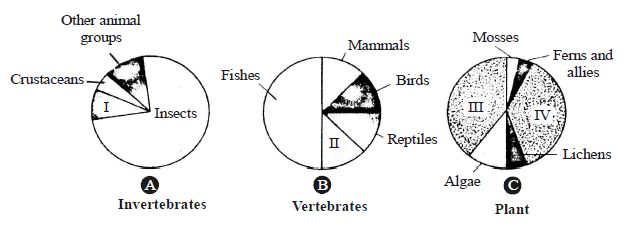
A
$I-$ Molluscs,$II-$ Amphibians,$III-$ Fungi,$IV-$ Angiosperms
B
$I-$ Molluscs,$II-$ Amphibians,$III-$ Angiosperms,$IV-$ Fungi
C
$I-$ Hexapoda,$II-$ Amphibians,$III-$ Fungi,$IV-$ Angiosperms
D
$I-$ Turtles,$II-$ Amphibians,$III-$ Fungi,$IV-$ Angiosperms
Solution
(A) Based on the standard $NCERT$ diagram for global biodiversity:
$1$. In pie diagram $A$ (Invertebrates),the largest slice is Insects,followed by Molluscs $(I)$,Crustaceans,and other animal groups.
$2$. In pie diagram $B$ (Vertebrates),the largest slice is Fishes,followed by Birds,Mammals,Reptiles,and Amphibians $(II)$.
$3$. In pie diagram $C$ (Plants),the largest slices are Angiosperms $(IV)$ and Fungi $(III)$,followed by Algae,Mosses,Ferns and allies,and Lichens.
Therefore,$I$ is Molluscs,$II$ is Amphibians,$III$ is Fungi,and $IV$ is Angiosperms. The correct option is $A$.
$1$. In pie diagram $A$ (Invertebrates),the largest slice is Insects,followed by Molluscs $(I)$,Crustaceans,and other animal groups.
$2$. In pie diagram $B$ (Vertebrates),the largest slice is Fishes,followed by Birds,Mammals,Reptiles,and Amphibians $(II)$.
$3$. In pie diagram $C$ (Plants),the largest slices are Angiosperms $(IV)$ and Fungi $(III)$,followed by Algae,Mosses,Ferns and allies,and Lichens.
Therefore,$I$ is Molluscs,$II$ is Amphibians,$III$ is Fungi,and $IV$ is Angiosperms. The correct option is $A$.
0 likes
View Solution31
MediumMCQ
How do ecologists estimate the total number of species present in the world?
A
By counting every individual organism in the world.
B
By using statistical comparisons of species richness between well-studied groups in temperate and tropical regions.
C
By assuming that the number of species is constant across all geographical regions.
D
By relying solely on fossil records from the past.
Solution
(B) The diversity of living organisms present on the Earth is vast. According to an estimate by researchers,it is about $7$ million.
Ecologists calculate the total number of species present in the world by using statistical comparisons between the species richness of well-studied groups of insects in temperate and tropical regions.
These ratios are then extrapolated to other groups of plants and animals to estimate the total species richness present on the Earth.
Ecologists calculate the total number of species present in the world by using statistical comparisons between the species richness of well-studied groups of insects in temperate and tropical regions.
These ratios are then extrapolated to other groups of plants and animals to estimate the total species richness present on the Earth.
0 likes
View Solution32
MediumMCQ
Describe the diversity of species found on the Earth.
A
Total number of species is about $7$ million.
B
Total number of species is about $1.5$ million.
C
Total number of species is more than $7$ million.
D
Total number of species is less than $1$ million.
Solution
(C) According to the $IUCN$ $(2004)$ report,the total number of plant and animal species described so far is slightly more than $1.5$ million. However,we have no clear idea of how many species are yet to be discovered and described. Many taxonomic studies suggest that the actual global species diversity is likely to be about $7$ million.
0 likes
View Solution33
Medium
How did ecologists estimate the total number of species on Earth?
Solution
(N/A) The estimate of the total number of species on Earth was provided by the $IUCN$ $(2004)$ report. According to this,the total number of plant and animal species described so far is slightly more than $1.5$ million.
Many species are yet to be discovered and described. Most of these are based on estimates.
Temperate regions are more thoroughly studied for taxonomic groups and species discovery compared to tropical countries.
$A$ significantly large number of species remains to be discovered in the tropics.
Biologists have extensively studied the species richness of insect groups in tropical and temperate regions. By making statistical comparisons between these groups and extrapolating them to other groups of animals and plants,they have estimated the total number of species on Earth.
While some estimates range from $20$ to $50$ million,the most scientifically sound estimate made by $Robert$ $May$ places the global species diversity at about $7$ million.
Many species are yet to be discovered and described. Most of these are based on estimates.
Temperate regions are more thoroughly studied for taxonomic groups and species discovery compared to tropical countries.
$A$ significantly large number of species remains to be discovered in the tropics.
Biologists have extensively studied the species richness of insect groups in tropical and temperate regions. By making statistical comparisons between these groups and extrapolating them to other groups of animals and plants,they have estimated the total number of species on Earth.
While some estimates range from $20$ to $50$ million,the most scientifically sound estimate made by $Robert$ $May$ places the global species diversity at about $7$ million.
0 likes
View Solution34
EasyMCQ
What is the estimated number of species of invertebrates,vertebrates,and plants in global biodiversity?
A
Invertebrates: $70$%,Vertebrates: $22$%,Plants: $8$%
B
Invertebrates: $70$%,Vertebrates: $20$%,Plants: $10$%
C
Invertebrates: $70$%,Vertebrates: $22$%,Plants: $8$% (approximate distribution)
D
Invertebrates: $70$%,Vertebrates: $10$%,Plants: $20$%
Solution
(A) Based on current species inventories,we observe interesting aspects of global biodiversity:
$(i)$ More than $70$ percent of all recorded species are animals. Among animals,insects are the most species-rich taxonomic group,making up more than $70$ percent of the total animal population (meaning out of every $10$ animals on this planet,$7$ are insects).
$(ii)$ Plants (including algae,fungi,bryophytes,gymnosperms,and angiosperms) comprise about $22$ percent of the total species.
$(iii)$ The number of fungal species in the world is more than the combined total of the species of fishes,amphibians,reptiles,and mammals.
$(i)$ More than $70$ percent of all recorded species are animals. Among animals,insects are the most species-rich taxonomic group,making up more than $70$ percent of the total animal population (meaning out of every $10$ animals on this planet,$7$ are insects).
$(ii)$ Plants (including algae,fungi,bryophytes,gymnosperms,and angiosperms) comprise about $22$ percent of the total species.
$(iii)$ The number of fungal species in the world is more than the combined total of the species of fishes,amphibians,reptiles,and mammals.
0 likes
View Solution35
MediumMCQ
Which criterion can be used to measure the number of prokaryotes?
A
Morphological characters
B
Biochemical and molecular criteria
C
Reproductive isolation
D
Ecological niche
Solution
(B) The estimated biodiversity does not provide any specific number for prokaryotic organisms.
Conventional taxonomic methods are not suitable for identifying microbial species.
Many of these species cannot be cultured under laboratory conditions.
When biochemical or molecular criteria are adopted for describing the species of these groups,their diversity is estimated to be in the millions.
Conventional taxonomic methods are not suitable for identifying microbial species.
Many of these species cannot be cultured under laboratory conditions.
When biochemical or molecular criteria are adopted for describing the species of these groups,their diversity is estimated to be in the millions.
0 likes
View Solution36
Medium
Describe the biodiversity found in India.
Solution
(N/A) Although India has $2.4 \%$ of the world's land area,its share of the global species diversity is an impressive $8.1 \%$.
India is one of the $12$ mega-diversity countries of the world.
There are about $45,000$ species of plants and twice as many species of animals that have been recorded in India.
If we apply Robert May's global estimate,then only $22 \%$ of the total species have been recorded so far. India probably has more than $1,00,000$ species of plants and $3,00,000$ species of animals yet to be discovered and described.
India is one of the $12$ mega-diversity countries of the world.
There are about $45,000$ species of plants and twice as many species of animals that have been recorded in India.
If we apply Robert May's global estimate,then only $22 \%$ of the total species have been recorded so far. India probably has more than $1,00,000$ species of plants and $3,00,000$ species of animals yet to be discovered and described.
0 likes
View Solution37
MediumMCQ
How do scientists extrapolate the total number of species on Earth?
A
By counting every individual organism on Earth.
B
By using statistical comparisons of species richness in well-studied groups and extrapolating to others.
C
By analyzing satellite imagery of global habitats.
D
By relying solely on historical fossil records.
Solution
(B) Scientists make a statistical comparison of the temperate-tropical species richness of an exhaustively studied group of insects.
They then extrapolate this ratio to other groups of animals and plants to arrive at a gross estimate of the total number of species on Earth.
They then extrapolate this ratio to other groups of animals and plants to arrive at a gross estimate of the total number of species on Earth.
0 likes
View Solution38
MediumMCQ
What are the approximate percentage proportions of plant and animal species on Earth?
A
Plants: $70\%$, Animals: $22\%$
B
Plants: $22\%$, Animals: $70\%$
C
Plants: $50\%$, Animals: $50\%$
D
Plants: $10\%$, Animals: $90\%$
Solution
(B) $(i)$ More than $70\%$ of all the species recorded are animals. While plants (including algae, fungi, bryophytes, gymnosperms, and angiosperms) comprise no more than $22\%$ of the total.
(ii) Among animals, insects are the most species-rich taxonomic group, making up more than $70\%$ of the total animal species. This implies that out of every $10$ animals on this planet, $7$ are insects.
(ii) Among animals, insects are the most species-rich taxonomic group, making up more than $70\%$ of the total animal species. This implies that out of every $10$ animals on this planet, $7$ are insects.
0 likes
View Solution39
Medium
Describe the number of species found on the earth.
Solution
(N/A) According to the International Union for Conservation of Nature $(IUCN)$ $2004$ data,the total number of plant and animal species described so far is slightly more than $1.5$ million.
For many taxonomic groups,species inventories are more complete in temperate regions than in tropical countries.
Assuming that a large number of species remain undiscovered in the tropics,biologists make a statistical comparison of the temperate-tropical species richness of exhaustively studied groups (like insects) and extrapolate this ratio to other groups of animals and plants.
- This leads to a gross estimate that the total number of species on Earth ranges from $20$ to $50$ million.
- $A$ more conservative and scientifically sound estimate by Robert May places the global species diversity at about $7$ million.
More than $70\%$ of all recorded species are animals,while plants comprise no more than $22\%$ of the total.
Insects are the most species-rich taxonomic group in the animal kingdom,making up more than $70\%$ of the total animals. This means that out of every $10$ animals on Earth,$7$ are insects.
The number of fungi species in the world is more than the combined total number of species of fishes,amphibians,reptiles,and mammals.
However,biologists are still not certain about the exact diversity of prokaryotic species due to difficulties in culturing them in laboratory conditions.
For many taxonomic groups,species inventories are more complete in temperate regions than in tropical countries.
Assuming that a large number of species remain undiscovered in the tropics,biologists make a statistical comparison of the temperate-tropical species richness of exhaustively studied groups (like insects) and extrapolate this ratio to other groups of animals and plants.
- This leads to a gross estimate that the total number of species on Earth ranges from $20$ to $50$ million.
- $A$ more conservative and scientifically sound estimate by Robert May places the global species diversity at about $7$ million.
More than $70\%$ of all recorded species are animals,while plants comprise no more than $22\%$ of the total.
Insects are the most species-rich taxonomic group in the animal kingdom,making up more than $70\%$ of the total animals. This means that out of every $10$ animals on Earth,$7$ are insects.
The number of fungi species in the world is more than the combined total number of species of fishes,amphibians,reptiles,and mammals.
However,biologists are still not certain about the exact diversity of prokaryotic species due to difficulties in culturing them in laboratory conditions.
0 likes
View Solution40
EasyMCQ
According to Robert May,the global species diversity is about:
A
$7$ million
B
$1.5$ million
C
$20$ million
D
$50$ million
Solution
(A) According to the estimates made by Robert May,the global species diversity is about $7$ million. While more than $1.5$ million species have been described so far,many more remain to be discovered and described.
0 likes
View Solution41
MediumMCQ
Approximately how many varieties of rice are found in India?
A
Two lakhs
B
Two thousand
C
Twenty thousand
D
One lakh
Solution
(A) India is known for its immense agricultural diversity. It is estimated that there are approximately $200,000$ (two lakhs) varieties of rice in India alone. This diversity is a significant part of India's biological heritage.
0 likes
View Solution42
MediumMCQ
How many species of beetles are there on Earth?
A
$20,000$
B
$3,00,000$
C
$28,000$
D
$10,000$
Solution
(B) According to the global biodiversity estimates provided by Robert May and documented in the $NCERT$ Biology textbook,there are about $7$ million species on Earth. Among the animal kingdom,insects are the most species-rich taxonomic group. Specifically,beetles (Coleoptera) are the most diverse group of animals,with approximately $3,00,000$ species identified and described globally. Therefore,the correct option is $B$.
0 likes
View Solution43
MediumMCQ
How many genetically diverse varieties of rice are there in India?
A
More than $50,000$
B
Less than $50,000$
C
Less than $5,00,000$
D
Less than $40,000$
Solution
(A) India is home to a vast amount of biodiversity. Specifically,regarding rice,there are more than $50,000$ genetically diverse varieties of rice in India. This high level of genetic diversity is a significant aspect of India's agricultural heritage and contributes to food security.
0 likes
View Solution44
MediumMCQ
How many varieties of mango are found in India?
A
Less than $100$
B
More than $1000$
C
More than $10,000$
D
Less than $500$
Solution
(B) India is home to a vast diversity of mangoes. According to the $NCERT$ textbook for Class $12$ Biology (Chapter: Biodiversity and Conservation),there are more than $1000$ varieties of mangoes in India.
0 likes
View Solution45
EasyMCQ
According to $IUCN$ $(2004)$,what is the total number of plant and animal species described so far?
A
$1.5$ million
B
$1.0$ million
C
$2.5$ million
D
$1.0$ billion
Solution
(A) According to the $IUCN$ $(2004)$ Red List of Threatened Species,the total number of plant and animal species described so far is slightly more than $1.5$ million.
This data is a standard reference point in the study of biodiversity and conservation.
This data is a standard reference point in the study of biodiversity and conservation.
0 likes
View Solution46
MediumMCQ
Who made a more scientifically sound and globally accepted estimate of global species diversity?
A
Edward Wilson
B
Robert May
C
Edward Jenner
D
Paul Ehrlich
Solution
(B) Robert May placed the global species diversity at about $7$ million. This estimate is considered the most scientifically sound and globally accepted estimate of species diversity on Earth. Edward Wilson is known for popularizing the term 'biodiversity',while Paul Ehrlich is known for the 'Rivet Popper Hypothesis'.
0 likes
View Solution47
MediumMCQ
Based on currently available species inventories,more than $X\%$ of all recorded species are animals,while plants comprise no more than $Y\%$ of the total.
A
$X = 60, Y = 25\%$
B
$X = 70, Y = 30\%$
C
$X = 60, Y = 40\%$
D
$X = 70, Y = 22\%$
Solution
(D) According to the $NCERT$ textbook,among the global species diversity,animals are estimated to be more than $70\%$ of the total species,while plants (including algae,fungi,bryophytes,gymnosperms,and angiosperms) comprise no more than $22\%$ of the total. Therefore,$X = 70$ and $Y = 22$.
0 likes
View Solution48
MediumMCQ
According to Robert May's global estimates,what is the total number of species on Earth?
A
$7$ million
B
$7$ lakh
C
$7$ billion
D
$7$ crore
Solution
(A) Robert May's global estimate for the total number of species on Earth is about $7$ million.
This estimate is widely accepted in the scientific community as a reasonable approximation of global biodiversity,despite the fact that only about $1.5$ million species have been scientifically described and named so far.
This estimate is widely accepted in the scientific community as a reasonable approximation of global biodiversity,despite the fact that only about $1.5$ million species have been scientifically described and named so far.
0 likes
View Solution49
EasyMCQ
Which group of animals exhibits the highest species richness?
A
Amphibians
B
Birds
C
Insects
D
Reptiles
Solution
(C) According to the global biodiversity data,insects are the most species-rich group of animals on Earth.
They account for more than $70\%$ of all the recorded animal species.
This means that out of every $10$ animals on this planet,$7$ are insects.
They account for more than $70\%$ of all the recorded animal species.
This means that out of every $10$ animals on this planet,$7$ are insects.
0 likes
View Solution50
MediumMCQ
Biologists are unable to make an accurate estimate of the number of species for which of the following organisms?
A
Mammals
B
Fungi
C
Insects
D
Prokaryotes
Solution
(D) Biologists face significant challenges in estimating the total number of species for prokaryotes. This is primarily because:
$1$. Traditional taxonomic methods based on morphological characteristics are not applicable to prokaryotes.
$2$. Many prokaryotic species cannot be cultured in laboratory conditions.
$3$. Biochemical and molecular biology-based criteria (such as $16S$ $rRNA$ sequencing) are required for their identification,which are complex and time-consuming.
Therefore,the diversity of prokaryotes remains largely unknown and underestimated.
$1$. Traditional taxonomic methods based on morphological characteristics are not applicable to prokaryotes.
$2$. Many prokaryotic species cannot be cultured in laboratory conditions.
$3$. Biochemical and molecular biology-based criteria (such as $16S$ $rRNA$ sequencing) are required for their identification,which are complex and time-consuming.
Therefore,the diversity of prokaryotes remains largely unknown and underestimated.
0 likes
View SolutionBiodiversity and Conservation — How many species are there on Earth and in India ? · Frequently Asked Questions
1Are these Biodiversity and Conservation questions useful for JEE and NEET?
Yes. All questions in this section are mapped to JEE Main and NEET exam patterns. Previous year questions from JEE Main, NEET, GUJCET and state-level exams are included with full solutions.
2Can I switch to Hindi or Gujarati for these questions?
Yes. Use the language tabs in the hero section or the sidebar to view the same questions and solutions in English, Hindi or Gujarati.
3How do I generate a question paper from this subtopic?
Use the Vedclass Exam Paper Generator — select the chapter and subtopic, set difficulty, and generate Sets A, B, C, D automatically. First 3 chapters of every subject are free.
Vedclass Products
For Students
Vedclass Test Series
Mock tests in real JEE/NEET style with performance analysis. 5-day free trial.
Start Free TrialFor Teachers
Exam Paper Generator
Generate Set A/B/C/D papers from this chapter in 2 minutes. 3 chapters free.
Try FreeFor Institutes
Online Exam Module
Live online exams with unlimited students, 360° analytics & white-label branding.
See DemoFor Teachers & Institutes
Generate a Biodiversity and Conservation Exam Paper in 2 Minutes
Select subtopic & difficulty — Sets A, B, C, D auto-generated with No Repeat logic.
First 3 chapters of every subject are free — no payment required.