
A English
Vertical Circular Motion Questions in English
Class 11 Physics · Work, Energy, Power and Collision · Vertical Circular Motion
162+
Questions
English
Language
100%
With Solutions
Showing 11 of 162 questions in English
151
DifficultMCQ
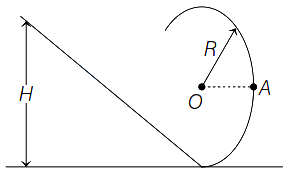
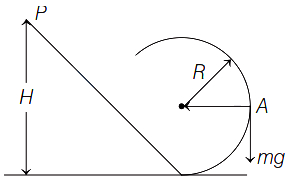
$A$ small body slides down a smooth uneven surface from a height $H$,which eventually emerges into a circular loop of radius $R (< H)$. What should be the value of $H$,so that the force on the body at $A$ is $\sqrt{2}$ times its weight?
A
$H=\frac{3 R}{2}$
B
$H=5 R$
C
$H=\frac{5 R}{2}$
D
$H=3 R$
Solution
(A) Let the mass of the body be $m$. At point $A$,the normal force $N$ provides the centripetal force required for circular motion. Since the weight $mg$ acts vertically downwards and the normal force acts horizontally towards the center $O$,the net force on the body at $A$ is the vector sum of $N$ and $mg$.
The magnitude of the net force is $F_A = \sqrt{N^2 + (mg)^2}$.
Given $F_A = \sqrt{2} mg$,we have $\sqrt{N^2 + (mg)^2} = \sqrt{2} mg$.
Squaring both sides,$N^2 + m^2g^2 = 2m^2g^2$,which gives $N^2 = m^2g^2$,so $N = mg$.
The centripetal force equation at $A$ is $N = \frac{mv_A^2}{R}$,so $mg = \frac{mv_A^2}{R}$,which implies $v_A^2 = Rg$.
By the law of conservation of energy,the total energy at the starting point $P$ (height $H$) equals the total energy at point $A$ (height $R$):
$mgH = \frac{1}{2}mv_A^2 + mgR$.
Substituting $v_A^2 = Rg$:
$mgH = \frac{1}{2}m(Rg) + mgR = \frac{3}{2}mgR$.
Therefore,$H = \frac{3}{2}R$.
The magnitude of the net force is $F_A = \sqrt{N^2 + (mg)^2}$.
Given $F_A = \sqrt{2} mg$,we have $\sqrt{N^2 + (mg)^2} = \sqrt{2} mg$.
Squaring both sides,$N^2 + m^2g^2 = 2m^2g^2$,which gives $N^2 = m^2g^2$,so $N = mg$.
The centripetal force equation at $A$ is $N = \frac{mv_A^2}{R}$,so $mg = \frac{mv_A^2}{R}$,which implies $v_A^2 = Rg$.
By the law of conservation of energy,the total energy at the starting point $P$ (height $H$) equals the total energy at point $A$ (height $R$):
$mgH = \frac{1}{2}mv_A^2 + mgR$.
Substituting $v_A^2 = Rg$:
$mgH = \frac{1}{2}m(Rg) + mgR = \frac{3}{2}mgR$.
Therefore,$H = \frac{3}{2}R$.
0 likes
View Solution152
DifficultMCQ
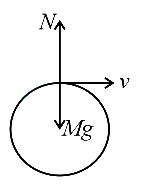
What will be the minimum speed of the roller-coaster so that the passenger at the top,when becomes upside down,does not fall out (in $m \ s^{-1}$)? Consider the acceleration due to gravity as $10 \ m \ s^{-2}$,and the radius of curvature of the roller coaster is $10 \ m$.
A
$20$
B
$10$
C
$15$
D
$25$
Solution
(B) At the highest point of the vertical circular path,the forces acting on the passenger are the gravitational force $mg$ (acting downwards) and the normal reaction $N$ (acting downwards).
The net centripetal force required for circular motion is provided by the sum of these forces:
$N + mg = \frac{mv^2}{R}$
For the passenger not to fall out,the minimum condition is that the normal reaction $N$ becomes zero at the top point.
Setting $N = 0$,we get:
$mg = \frac{mv^2}{R}$
$v^2 = gR$
$v = \sqrt{gR}$
Given $g = 10 \ m \ s^{-2}$ and $R = 10 \ m$,we substitute these values:
$v = \sqrt{10 \times 10} = \sqrt{100} = 10 \ m \ s^{-1}$.
Thus,the minimum speed required is $10 \ m \ s^{-1}$.
The net centripetal force required for circular motion is provided by the sum of these forces:
$N + mg = \frac{mv^2}{R}$
For the passenger not to fall out,the minimum condition is that the normal reaction $N$ becomes zero at the top point.
Setting $N = 0$,we get:
$mg = \frac{mv^2}{R}$
$v^2 = gR$
$v = \sqrt{gR}$
Given $g = 10 \ m \ s^{-2}$ and $R = 10 \ m$,we substitute these values:
$v = \sqrt{10 \times 10} = \sqrt{100} = 10 \ m \ s^{-1}$.
Thus,the minimum speed required is $10 \ m \ s^{-1}$.
0 likes
View Solution153
EasyMCQ
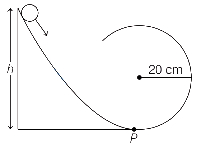
$A$ ball of mass $2 \,g$ released from the top of an inclined plane describes a circular motion of radius $20 \,cm$ in the vertical plane upon reaching the bottom. The minimum height of the inclined plane is (in $\,cm$)
A
$20$
B
$10$
C
$50$
D
$60$
Solution
(C) At the bottom of the incline (point $P$), the potential energy of the ball is converted into kinetic energy:
$\frac{1}{2} m v^2 = m g h$
$\Rightarrow v = \sqrt{2 g h} \quad \dots (i)$
To complete the vertical circular motion, the velocity of the ball at the bottom must be at least $\sqrt{5 g R}$.
$\Rightarrow v \geq \sqrt{5 g R}$
Substituting the value of $v$ from equation $(i)$:
$\sqrt{2 g h} \geq \sqrt{5 g R}$
Squaring both sides:
$2 g h \geq 5 g R$
$h \geq \frac{5}{2} R$
Given $R = 20 \,cm$, the minimum height $h_{\min}$ is:
$h_{\min} = \frac{5}{2} \times 20 \,cm = 50 \,cm$
$\frac{1}{2} m v^2 = m g h$
$\Rightarrow v = \sqrt{2 g h} \quad \dots (i)$
To complete the vertical circular motion, the velocity of the ball at the bottom must be at least $\sqrt{5 g R}$.
$\Rightarrow v \geq \sqrt{5 g R}$
Substituting the value of $v$ from equation $(i)$:
$\sqrt{2 g h} \geq \sqrt{5 g R}$
Squaring both sides:
$2 g h \geq 5 g R$
$h \geq \frac{5}{2} R$
Given $R = 20 \,cm$, the minimum height $h_{\min}$ is:
$h_{\min} = \frac{5}{2} \times 20 \,cm = 50 \,cm$
0 likes
View Solution154
EasyMCQ
Consider a particle moving with a minimum speed $v$ at the highest point of a vertical circle of radius $R$. If the radius of the circle is doubled,the corresponding minimum speed will be:
A
$v$
B
$\frac{v}{\sqrt{2}}$
C
$\sqrt{3} v$
D
$\sqrt{2} v$
Solution
(D) When a particle moves along a vertical circle,the minimum speed required at the highest point to complete the loop is given by the formula:
$v_{\min} = \sqrt{gR}$
From this expression,we can see that the minimum speed is directly proportional to the square root of the radius:
$v_{\min} \propto \sqrt{R}$
Let the initial radius be $R_1 = R$ and the initial minimum speed be $(v_{\min})_1 = v$.
Let the new radius be $R_2 = 2R$ and the new minimum speed be $(v_{\min})_2$.
Using the proportionality relation:
$\frac{(v_{\min})_1}{(v_{\min})_2} = \sqrt{\frac{R_1}{R_2}}$
Substituting the known values:
$\frac{v}{(v_{\min})_2} = \sqrt{\frac{R}{2R}} = \frac{1}{\sqrt{2}}$
Solving for the new minimum speed:
$(v_{\min})_2 = \sqrt{2}v$
$v_{\min} = \sqrt{gR}$
From this expression,we can see that the minimum speed is directly proportional to the square root of the radius:
$v_{\min} \propto \sqrt{R}$
Let the initial radius be $R_1 = R$ and the initial minimum speed be $(v_{\min})_1 = v$.
Let the new radius be $R_2 = 2R$ and the new minimum speed be $(v_{\min})_2$.
Using the proportionality relation:
$\frac{(v_{\min})_1}{(v_{\min})_2} = \sqrt{\frac{R_1}{R_2}}$
Substituting the known values:
$\frac{v}{(v_{\min})_2} = \sqrt{\frac{R}{2R}} = \frac{1}{\sqrt{2}}$
Solving for the new minimum speed:
$(v_{\min})_2 = \sqrt{2}v$
0 likes
View Solution155
MediumMCQ
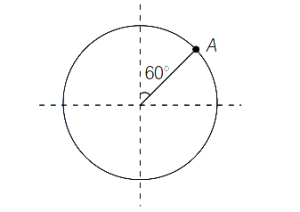
$A$ light rigid wire of length $1 \,m$ is attached to a ball of mass $500 \,g$ at one end. The other end of the wire is fixed, so that the wire can rotate freely in the vertical plane about its fixed end. At the lowest point of the circular motion, the ball is given a horizontal velocity of $6 \,m/s$. Determine the radial component of the acceleration of the ball when this rigid wire makes an angle of $60^{\circ}$ with the upward vertical. (Take $g = 10 \,m/s^2$) (in $\,m/s^2$)
A
$10$
B
$6$
C
$18$
D
$25$
Solution
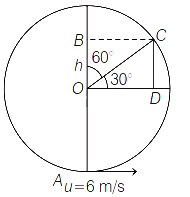
(B) Given: Length of the rigid wire $l = 1 \,m$, mass of the ball $m = 500 \,g = 0.5 \,kg$, initial velocity at the lowest point $u = 6 \,m/s$. Let $v$ be the velocity of the ball when the wire makes an angle $\theta = 60^{\circ}$ with the upward vertical.
Using the law of conservation of energy between the lowest point (let it be $P$) and the point $C$ where the wire makes $60^{\circ}$ with the upward vertical:
Total energy at $P$ = Total energy at $C$
$\frac{1}{2}mu^2 + 0 = \frac{1}{2}mv^2 + mgh$
where $h$ is the height of point $C$ above the lowest point. From the geometry, $h = l + l \cos 60^{\circ} = l(1 + \cos 60^{\circ}) = 1(1 + 0.5) = 1.5 \,m$.
Substituting the values:
$\frac{1}{2} \times (6)^2 = \frac{1}{2}v^2 + g \times 1.5$
$18 = \frac{1}{2}v^2 + 10 \times 1.5$
$18 = \frac{1}{2}v^2 + 15$
$\frac{1}{2}v^2 = 3 \implies v^2 = 6 \,m^2/s^2$.
The radial component of acceleration (centripetal acceleration) is given by $a_r = \frac{v^2}{l}$.
$a_r = \frac{6}{1} = 6 \,m/s^2$.
Using the law of conservation of energy between the lowest point (let it be $P$) and the point $C$ where the wire makes $60^{\circ}$ with the upward vertical:
Total energy at $P$ = Total energy at $C$
$\frac{1}{2}mu^2 + 0 = \frac{1}{2}mv^2 + mgh$
where $h$ is the height of point $C$ above the lowest point. From the geometry, $h = l + l \cos 60^{\circ} = l(1 + \cos 60^{\circ}) = 1(1 + 0.5) = 1.5 \,m$.
Substituting the values:
$\frac{1}{2} \times (6)^2 = \frac{1}{2}v^2 + g \times 1.5$
$18 = \frac{1}{2}v^2 + 10 \times 1.5$
$18 = \frac{1}{2}v^2 + 15$
$\frac{1}{2}v^2 = 3 \implies v^2 = 6 \,m^2/s^2$.
The radial component of acceleration (centripetal acceleration) is given by $a_r = \frac{v^2}{l}$.
$a_r = \frac{6}{1} = 6 \,m/s^2$.
0 likes
View Solution156
DifficultMCQ
$A$ bucket filled with water is tied to a rope of length $0.5 \,m$ and is rotated in a circular path in a vertical plane. The minimum velocity it should have at the lowest point of the circle so that the water does not spill is, $(g=10 \,m/s^2)$
A
$\sqrt{5} \,m/s$
B
$\sqrt{10} \,m/s$
C
$5 \,m/s$
D
$2\sqrt{5} \,m/s$
Solution
(C) For water not to spill out of the bucket, the bucket must complete the vertical circular motion.
At the highest point, the minimum velocity required is $v_{top} = \sqrt{gR}$.
Using the principle of conservation of energy between the lowest point (bottom) and the highest point (top):
$\frac{1}{2}mv_{bottom}^2 = \frac{1}{2}mv_{top}^2 + mg(2R)$
$v_{bottom}^2 = v_{top}^2 + 4gR$
$v_{bottom}^2 = gR + 4gR = 5gR$
$v_{bottom} = \sqrt{5gR}$
Given $g = 10 \,m/s^2$ and $R = 0.5 \,m$:
$v_{bottom} = \sqrt{5 \times 10 \times 0.5} = \sqrt{25} = 5 \,m/s$.
At the highest point, the minimum velocity required is $v_{top} = \sqrt{gR}$.
Using the principle of conservation of energy between the lowest point (bottom) and the highest point (top):
$\frac{1}{2}mv_{bottom}^2 = \frac{1}{2}mv_{top}^2 + mg(2R)$
$v_{bottom}^2 = v_{top}^2 + 4gR$
$v_{bottom}^2 = gR + 4gR = 5gR$
$v_{bottom} = \sqrt{5gR}$
Given $g = 10 \,m/s^2$ and $R = 0.5 \,m$:
$v_{bottom} = \sqrt{5 \times 10 \times 0.5} = \sqrt{25} = 5 \,m/s$.
0 likes
View Solution157
MediumMCQ
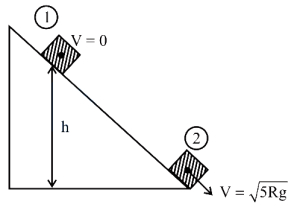
$A$ body of mass $m$ slides down along a frictionless inclined plane from height $h$ and just completes motion in a vertical circle of radius $R = 2 \ m$ after reaching the bottom. What is the value of $h$? [Use $g = 10 \ m/s^2$]
A
$2 \ m$
B
$\frac{5}{2} \ m$
C
$5 \ m$
D
$10 \ m$
Solution
(C) To complete a vertical circle,the minimum velocity at the bottom must be $v = \sqrt{5Rg}$,where $R$ is the radius of the circle.
Applying the law of conservation of mechanical energy between the top of the incline and the bottom:
$P_1 + K_1 = P_2 + K_2$
$mgh + 0 = 0 + \frac{1}{2} m v^2$
$mgh = \frac{1}{2} m (\sqrt{5Rg})^2$
$mgh = \frac{1}{2} m (5Rg)$
$h = \frac{5R}{2}$
Given $R = 2 \ m$,we have:
$h = \frac{5 \times 2}{2} = 5 \ m$
Applying the law of conservation of mechanical energy between the top of the incline and the bottom:
$P_1 + K_1 = P_2 + K_2$
$mgh + 0 = 0 + \frac{1}{2} m v^2$
$mgh = \frac{1}{2} m (\sqrt{5Rg})^2$
$mgh = \frac{1}{2} m (5Rg)$
$h = \frac{5R}{2}$
Given $R = 2 \ m$,we have:
$h = \frac{5 \times 2}{2} = 5 \ m$
0 likes
View Solution158
DifficultMCQ
$A$ simple pendulum of length $L$ carries a bob of mass $m$. When the bob is at its lowest position,it is given the minimum horizontal speed necessary for it to move in a vertical circle about the point of suspension. When the string is horizontal,the net force on the bob is
A
$\sqrt{10} mg$
B
$\sqrt{5} mg$
C
$4 mg$
D
$1 mg$
Solution
(A) For a bob to complete a vertical circle,the minimum velocity at the lowest point is $v_0 = \sqrt{5gL}$.
Applying the law of conservation of energy between the lowest point and the point where the string is horizontal (at height $L$):
$\frac{1}{2}mv_0^2 = \frac{1}{2}mv^2 + mgL$
$\frac{1}{2}m(5gL) = \frac{1}{2}mv^2 + mgL$
$\frac{5}{2}gL = \frac{1}{2}v^2 + gL \implies \frac{3}{2}gL = \frac{1}{2}v^2 \implies v^2 = 3gL$.
At the horizontal position,the forces acting on the bob are:
$1$. Centripetal force (horizontal): $F_x = \frac{mv^2}{L} = \frac{m(3gL)}{L} = 3mg$.
$2$. Gravitational force (vertical): $F_y = mg$.
The net force is $F_{\text{net}} = \sqrt{F_x^2 + F_y^2} = \sqrt{(3mg)^2 + (mg)^2} = \sqrt{9m^2g^2 + m^2g^2} = \sqrt{10}mg$.
Applying the law of conservation of energy between the lowest point and the point where the string is horizontal (at height $L$):
$\frac{1}{2}mv_0^2 = \frac{1}{2}mv^2 + mgL$
$\frac{1}{2}m(5gL) = \frac{1}{2}mv^2 + mgL$
$\frac{5}{2}gL = \frac{1}{2}v^2 + gL \implies \frac{3}{2}gL = \frac{1}{2}v^2 \implies v^2 = 3gL$.
At the horizontal position,the forces acting on the bob are:
$1$. Centripetal force (horizontal): $F_x = \frac{mv^2}{L} = \frac{m(3gL)}{L} = 3mg$.
$2$. Gravitational force (vertical): $F_y = mg$.
The net force is $F_{\text{net}} = \sqrt{F_x^2 + F_y^2} = \sqrt{(3mg)^2 + (mg)^2} = \sqrt{9m^2g^2 + m^2g^2} = \sqrt{10}mg$.
0 likes
View Solution159
DifficultMCQ
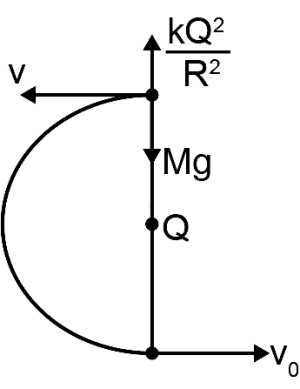
$A$ particle with charge $Q$ coulomb,tied at the end of an inextensible string of length $R$ metre,revolves in a vertical plane. At the centre of the circular trajectory,there is a fixed charge of magnitude $Q$ coulomb. The mass of the moving charge $M$ is such that $Mg = \frac{Q^2}{4 \pi \epsilon_0 R^2}$. If at the highest position of the particle,the tension of the string just vanishes,the horizontal velocity at the lowest point has to be
A
$0$
B
$2 \sqrt{g R}$
C
$\sqrt{2 g R}$
D
$\sqrt{5 g R}$
Solution
(B) Let $v$ be the velocity at the highest point. The forces acting on the particle at the highest point are the gravitational force $Mg$ (downwards),the electrostatic repulsive force $F_e = \frac{1}{4 \pi \epsilon_0} \frac{Q^2}{R^2}$ (upwards),and the tension $T$ (downwards).
Given $Mg = \frac{Q^2}{4 \pi \epsilon_0 R^2}$,the net force towards the center is $F_{net} = Mg - F_e + T = \frac{M v^2}{R}$.
At the highest point,$T = 0$,so $Mg - \frac{Q^2}{4 \pi \epsilon_0 R^2} = \frac{M v^2}{R}$.
Since $Mg = \frac{Q^2}{4 \pi \epsilon_0 R^2}$,we have $0 = \frac{M v^2}{R}$,which implies $v = 0$.
Now,applying the law of conservation of energy between the lowest point (velocity $v_0$) and the highest point (velocity $v = 0$):
Total energy at lowest point = Total energy at highest point.
$\frac{1}{2} M v_0^2 + U_{lowest} = \frac{1}{2} M v^2 + U_{highest}$.
The potential energy includes both gravitational and electrostatic components.
$U_{grav} = Mgh$,$U_{elec} = \frac{1}{4 \pi \epsilon_0} \frac{Q^2}{r}$.
Change in energy: $\frac{1}{2} M v_0^2 = Mg(2R) + \Delta U_{elec}$.
Since the distance $R$ from the center is constant,the electrostatic potential energy remains constant throughout the circular path.
Thus,$\frac{1}{2} M v_0^2 = Mg(2R)$.
$v_0^2 = 4gR$.
$v_0 = 2 \sqrt{gR}$.
Given $Mg = \frac{Q^2}{4 \pi \epsilon_0 R^2}$,the net force towards the center is $F_{net} = Mg - F_e + T = \frac{M v^2}{R}$.
At the highest point,$T = 0$,so $Mg - \frac{Q^2}{4 \pi \epsilon_0 R^2} = \frac{M v^2}{R}$.
Since $Mg = \frac{Q^2}{4 \pi \epsilon_0 R^2}$,we have $0 = \frac{M v^2}{R}$,which implies $v = 0$.
Now,applying the law of conservation of energy between the lowest point (velocity $v_0$) and the highest point (velocity $v = 0$):
Total energy at lowest point = Total energy at highest point.
$\frac{1}{2} M v_0^2 + U_{lowest} = \frac{1}{2} M v^2 + U_{highest}$.
The potential energy includes both gravitational and electrostatic components.
$U_{grav} = Mgh$,$U_{elec} = \frac{1}{4 \pi \epsilon_0} \frac{Q^2}{r}$.
Change in energy: $\frac{1}{2} M v_0^2 = Mg(2R) + \Delta U_{elec}$.
Since the distance $R$ from the center is constant,the electrostatic potential energy remains constant throughout the circular path.
Thus,$\frac{1}{2} M v_0^2 = Mg(2R)$.
$v_0^2 = 4gR$.
$v_0 = 2 \sqrt{gR}$.
0 likes
View Solution160
DifficultMCQ
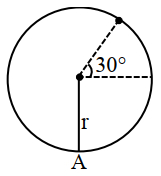
In the case of vertical circular motion of a particle attached to a thread of length $r$, if the tension in the thread is zero at an angle of $30^{\circ}$ with the horizontal as shown in the figure, the velocity at the bottom point $(A)$ of the circular path is ($g =$ gravitational acceleration).
A
$\sqrt{5gr}$
B
$\sqrt{\frac{7}{2}gr}$
C
$\sqrt{4gr}$
D
$\sqrt{\frac{5}{2}gr}$
Solution
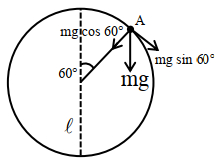
(B) Let the particle be at a point $P$ where the thread makes an angle of $30^{\circ}$ with the horizontal. The angle with the vertical is $\theta = 90^{\circ} - 30^{\circ} = 60^{\circ}$.
At this point, the forces acting along the radial direction are the tension $T$ and the component of gravity $mg \cos 60^{\circ}$.
The equation of motion is $T + mg \cos 60^{\circ} = \frac{mv^2}{r}$.
Given that the tension $T = 0$ at this point, we have $mg \cos 60^{\circ} = \frac{mv^2}{r}$.
Since $\cos 60^{\circ} = \frac{1}{2}$, we get $mg(\frac{1}{2}) = \frac{mv^2}{r}$, which simplifies to $v^2 = \frac{gr}{2}$.
Now, apply the law of conservation of mechanical energy between the bottom point $A$ and point $P$.
The height of point $P$ above point $A$ is $h = r + r \sin 30^{\circ} = r + r(\frac{1}{2}) = \frac{3r}{2}$.
Let $u$ be the velocity at point $A$. Then, $\frac{1}{2}mu^2 = \frac{1}{2}mv^2 + mgh$.
Substituting the values: $\frac{1}{2}mu^2 = \frac{1}{2}m(\frac{gr}{2}) + mg(\frac{3r}{2})$.
$u^2 = \frac{gr}{2} + 3gr = \frac{7gr}{2}$.
Therefore, the velocity at the bottom point is $u = \sqrt{\frac{7}{2}gr}$.
At this point, the forces acting along the radial direction are the tension $T$ and the component of gravity $mg \cos 60^{\circ}$.
The equation of motion is $T + mg \cos 60^{\circ} = \frac{mv^2}{r}$.
Given that the tension $T = 0$ at this point, we have $mg \cos 60^{\circ} = \frac{mv^2}{r}$.
Since $\cos 60^{\circ} = \frac{1}{2}$, we get $mg(\frac{1}{2}) = \frac{mv^2}{r}$, which simplifies to $v^2 = \frac{gr}{2}$.
Now, apply the law of conservation of mechanical energy between the bottom point $A$ and point $P$.
The height of point $P$ above point $A$ is $h = r + r \sin 30^{\circ} = r + r(\frac{1}{2}) = \frac{3r}{2}$.
Let $u$ be the velocity at point $A$. Then, $\frac{1}{2}mu^2 = \frac{1}{2}mv^2 + mgh$.
Substituting the values: $\frac{1}{2}mu^2 = \frac{1}{2}m(\frac{gr}{2}) + mg(\frac{3r}{2})$.
$u^2 = \frac{gr}{2} + 3gr = \frac{7gr}{2}$.
Therefore, the velocity at the bottom point is $u = \sqrt{\frac{7}{2}gr}$.
0 likes
View Solution161
DifficultMCQ
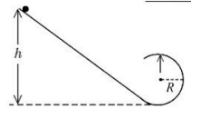
$A$ smooth inclined plane ends in a vertical circular loop,as shown in the figure. $A$ small body is released from height $h$ as shown. If the body exerts a force of three times its weight on the plane at the highest point of the circle,then the height $h = \alpha R$. The value of $\alpha$ is . . . . . . .
A
$2$
B
$4$
C
$3$
D
$6$
Solution
(B) At the highest point of the vertical circular loop,the forces acting on the body are the normal force $N$ (directed downwards) and the gravitational force $mg$ (directed downwards).
These forces provide the necessary centripetal force: $N + mg = \frac{mv^2}{R}$.
Given that the body exerts a force of three times its weight on the plane,the normal force $N = 3mg$.
Substituting this into the centripetal force equation: $3mg + mg = \frac{mv^2}{R} \Rightarrow 4mg = \frac{mv^2}{R} \Rightarrow v^2 = 4gR$.
Now,we apply the law of conservation of mechanical energy between the starting point at height $h$ and the highest point of the loop at height $2R$.
The total energy at the start is $mgh$ (potential energy).
The total energy at the highest point is $mg(2R) + \frac{1}{2}mv^2$ (potential energy + kinetic energy).
Equating the energies: $mgh = 2mgR + \frac{1}{2}m(4gR) = 2mgR + 2mgR = 4mgR$.
Thus,$h = 4R$.
Comparing this with $h = \alpha R$,we get $\alpha = 4$.
These forces provide the necessary centripetal force: $N + mg = \frac{mv^2}{R}$.
Given that the body exerts a force of three times its weight on the plane,the normal force $N = 3mg$.
Substituting this into the centripetal force equation: $3mg + mg = \frac{mv^2}{R} \Rightarrow 4mg = \frac{mv^2}{R} \Rightarrow v^2 = 4gR$.
Now,we apply the law of conservation of mechanical energy between the starting point at height $h$ and the highest point of the loop at height $2R$.
The total energy at the start is $mgh$ (potential energy).
The total energy at the highest point is $mg(2R) + \frac{1}{2}mv^2$ (potential energy + kinetic energy).
Equating the energies: $mgh = 2mgR + \frac{1}{2}m(4gR) = 2mgR + 2mgR = 4mgR$.
Thus,$h = 4R$.
Comparing this with $h = \alpha R$,we get $\alpha = 4$.
0 likes
View SolutionWork, Energy, Power and Collision — Vertical Circular Motion · Frequently Asked Questions
1Are these Work, Energy, Power and Collision questions useful for JEE and NEET?
Yes. All questions in this section are mapped to JEE Main and NEET exam patterns. Previous year questions from JEE Main, NEET, GUJCET and state-level exams are included with full solutions.
2Can I switch to Hindi or Gujarati for these questions?
Yes. Use the language tabs in the hero section or the sidebar to view the same questions and solutions in English, Hindi or Gujarati.
3How do I generate a question paper from this subtopic?
Use the Vedclass Exam Paper Generator — select the chapter and subtopic, set difficulty, and generate Sets A, B, C, D automatically. First 3 chapters of every subject are free.
Vedclass Products
For Students
Vedclass Test Series
Mock tests in real JEE/NEET style with performance analysis. 5-day free trial.
Start Free TrialFor Teachers
Exam Paper Generator
Generate Set A/B/C/D papers from this chapter in 2 minutes. 3 chapters free.
Try FreeFor Institutes
Online Exam Module
Live online exams with unlimited students, 360° analytics & white-label branding.
See DemoFor Teachers & Institutes
Generate a Work, Energy, Power and Collision Exam Paper in 2 Minutes
Select subtopic & difficulty — Sets A, B, C, D auto-generated with No Repeat logic.
First 3 chapters of every subject are free — no payment required.