
A English
Power Questions in English
Class 11 Physics · Work, Energy, Power and Collision · Power
180+
Questions
English
Language
100%
With Solutions
Showing 50 of 180 questions in English
101
Easy
Show that the rate of change of kinetic energy is a power.
Solution
(N/A) The kinetic energy $K$ of an object of mass $m$ moving with velocity $v$ is given by $K = \frac{1}{2}mv^2$.
The rate of change of kinetic energy with respect to time $t$ is given by $\frac{dK}{dt} = \frac{d}{dt}(\frac{1}{2}mv^2)$.
Assuming mass $m$ is constant,we apply the chain rule: $\frac{dK}{dt} = \frac{1}{2}m \cdot 2v \cdot \frac{dv}{dt} = mv \cdot \frac{dv}{dt}$.
Since acceleration $a = \frac{dv}{dt}$,we have $\frac{dK}{dt} = mva$.
By Newton's second law,$F = ma$,so $\frac{dK}{dt} = Fv$.
Power $P$ is defined as the rate of doing work,$P = \frac{dW}{dt} = F \cdot v$.
Thus,the rate of change of kinetic energy is equal to the power delivered by the force,i.e.,$\frac{dK}{dt} = P$.
The rate of change of kinetic energy with respect to time $t$ is given by $\frac{dK}{dt} = \frac{d}{dt}(\frac{1}{2}mv^2)$.
Assuming mass $m$ is constant,we apply the chain rule: $\frac{dK}{dt} = \frac{1}{2}m \cdot 2v \cdot \frac{dv}{dt} = mv \cdot \frac{dv}{dt}$.
Since acceleration $a = \frac{dv}{dt}$,we have $\frac{dK}{dt} = mva$.
By Newton's second law,$F = ma$,so $\frac{dK}{dt} = Fv$.
Power $P$ is defined as the rate of doing work,$P = \frac{dW}{dt} = F \cdot v$.
Thus,the rate of change of kinetic energy is equal to the power delivered by the force,i.e.,$\frac{dK}{dt} = P$.
0 likes
View Solution102
Medium
Write a note on Power.
Solution
(N/A) The time rate of doing work is known as power.
Power is defined as the work done per unit time or the time rate at which work is done or energy is transformed.
If $\Delta W$ is the work done in time interval $\Delta t$,the average power in time interval $\Delta t$ is $\langle P \rangle = \frac{\Delta W}{\Delta t}$.
Therefore,the instantaneous power at time $t$ is:
$P = \lim_{\Delta t \rightarrow 0} \frac{\Delta W}{\Delta t} = \frac{dW}{dt} \quad (1)$
If $dW$ is the work done by a force $\vec{F}$ during the displacement $d\vec{r}$,then $dW = \vec{F} \cdot d\vec{r}$.
Substituting the value of $dW$ in equation $(1)$:
$P = \frac{d}{dt}(\vec{F} \cdot d\vec{r}) = \vec{F} \cdot \frac{d\vec{r}}{dt} \quad [\because \vec{F} \text{ is constant}]$
$P = \vec{F} \cdot \vec{v} \quad [\because \frac{d\vec{r}}{dt} = \vec{v}]$
Power is a scalar quantity. Its dimensional formula is $M^{1} L^{2} T^{-3}$. The $SI$ unit of power is $J s^{-1}$. This unit is named as $watt$ in honor of the inventor of the steam engine,James Watt.
$1 W = 1 J s^{-1}$.
Larger units of power include:
$1 kW = 10^{3} W, 1 MW = 10^{6} W$.
To measure the power of vehicles and water pumps in practice,horsepower $(hp)$ is used,which is a unit of the British system.
$1 hp = 746 W$.
Power is defined as the work done per unit time or the time rate at which work is done or energy is transformed.
If $\Delta W$ is the work done in time interval $\Delta t$,the average power in time interval $\Delta t$ is $\langle P \rangle = \frac{\Delta W}{\Delta t}$.
Therefore,the instantaneous power at time $t$ is:
$P = \lim_{\Delta t \rightarrow 0} \frac{\Delta W}{\Delta t} = \frac{dW}{dt} \quad (1)$
If $dW$ is the work done by a force $\vec{F}$ during the displacement $d\vec{r}$,then $dW = \vec{F} \cdot d\vec{r}$.
Substituting the value of $dW$ in equation $(1)$:
$P = \frac{d}{dt}(\vec{F} \cdot d\vec{r}) = \vec{F} \cdot \frac{d\vec{r}}{dt} \quad [\because \vec{F} \text{ is constant}]$
$P = \vec{F} \cdot \vec{v} \quad [\because \frac{d\vec{r}}{dt} = \vec{v}]$
Power is a scalar quantity. Its dimensional formula is $M^{1} L^{2} T^{-3}$. The $SI$ unit of power is $J s^{-1}$. This unit is named as $watt$ in honor of the inventor of the steam engine,James Watt.
$1 W = 1 J s^{-1}$.
Larger units of power include:
$1 kW = 10^{3} W, 1 MW = 10^{6} W$.
To measure the power of vehicles and water pumps in practice,horsepower $(hp)$ is used,which is a unit of the British system.
$1 hp = 746 W$.
0 likes
View Solution103
Medium
$1\,kWh$ is a unit of power. This statement is true or false? If it is wrong,then correct it.
Solution
(FALSE) The statement is false.
$1\,kWh$ (kilowatt-hour) is a unit of energy,not power.
Power is defined as the rate of doing work,measured in watts $(W)$ or kilowatts $(kW)$.
Energy is defined as the product of power and time,which is why $1\,kWh = 1\,kW \times 1\,h = 1000\,W \times 3600\,s = 3.6 \times 10^6\,J$.
$1\,kWh$ (kilowatt-hour) is a unit of energy,not power.
Power is defined as the rate of doing work,measured in watts $(W)$ or kilowatts $(kW)$.
Energy is defined as the product of power and time,which is why $1\,kWh = 1\,kW \times 1\,h = 1000\,W \times 3600\,s = 3.6 \times 10^6\,J$.
0 likes
View Solution104
Easy
Why is electrical power required at all when the elevator is descending? Why should there be a limit on the number of passengers in this case?
Solution
(N/A) When the elevator is descending,electrical power is required to control the speed of the lift and prevent it from entering a state of free fall under gravity.
Additionally,as the total weight inside the elevator increases,the gravitational force acting on it increases,which would cause the speed of descent to increase uncontrollably. Therefore,there must be a limit on the number of passengers to ensure the braking system can safely manage the load.
Additionally,as the total weight inside the elevator increases,the gravitational force acting on it increases,which would cause the speed of descent to increase uncontrollably. Therefore,there must be a limit on the number of passengers to ensure the braking system can safely manage the load.
0 likes
View Solution105
EasyMCQ
Calculate the power of a crane in watts,which lifts a mass of $100 \, kg$ to a height of $10 \, m$ in $20 \, s$. (in $, W$)
A
$490$
B
$500$
C
$980$
D
$245$
Solution
(A) Given:
Mass,$m = 100 \, kg$
Height,$h = 10 \, m$
Time,$t = 20 \, s$
Acceleration due to gravity,$g = 9.8 \, m/s^2$
The work done $(W)$ by the crane is equal to the potential energy gained by the mass: $W = mgh$.
Power $(P)$ is defined as the rate of doing work: $P = \frac{W}{t} = \frac{mgh}{t}$.
Substituting the values:
$P = \frac{100 \times 9.8 \times 10}{20}$
$P = \frac{9800}{20}$
$P = 490 \, W$.
Mass,$m = 100 \, kg$
Height,$h = 10 \, m$
Time,$t = 20 \, s$
Acceleration due to gravity,$g = 9.8 \, m/s^2$
The work done $(W)$ by the crane is equal to the potential energy gained by the mass: $W = mgh$.
Power $(P)$ is defined as the rate of doing work: $P = \frac{W}{t} = \frac{mgh}{t}$.
Substituting the values:
$P = \frac{100 \times 9.8 \times 10}{20}$
$P = \frac{9800}{20}$
$P = 490 \, W$.
0 likes
View Solution106
Easy
The average work done by a human heart while it beats once is $0.5 \, J$. Calculate the power used by the heart if it beats $72$ times in a minute.
Solution
(0.6 W) The work done per beat $= 0.5 \, J$.
Total work done for $72$ beats is given by:
$W = 72 \times 0.5 \, J = 36 \, J$.
The time taken for $72$ beats is $1 \, \text{minute} = 60 \, s$.
Power is defined as the rate of doing work:
$P = \frac{W}{t} = \frac{36 \, J}{60 \, s} = 0.6 \, W$.
Thus,the power used by the heart is $0.6 \, W$.
Total work done for $72$ beats is given by:
$W = 72 \times 0.5 \, J = 36 \, J$.
The time taken for $72$ beats is $1 \, \text{minute} = 60 \, s$.
Power is defined as the rate of doing work:
$P = \frac{W}{t} = \frac{36 \, J}{60 \, s} = 0.6 \, W$.
Thus,the power used by the heart is $0.6 \, W$.
0 likes
View Solution107
MediumMCQ
$A$ particle is moving unidirectionally on a horizontal plane under the action of a constant power supplying energy source. The displacement $(s)$ - time $(t)$ graph that describes the motion of the particle is (graphs are drawn schematically and are not to scale)
A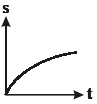
B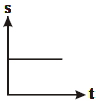
C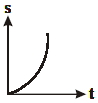
D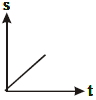
Solution
(C) The power $P$ supplied to the particle is constant. Since power is the rate of change of kinetic energy,we have $\frac{dK}{dt} = P$. Integrating this with respect to time,we get $K = Pt$ (assuming initial kinetic energy is zero).
Since $K = \frac{1}{2}mv^2$,we have $\frac{1}{2}mv^2 = Pt$,which implies $v = \sqrt{\frac{2P}{m}} t^{1/2}$.
Since velocity $v = \frac{ds}{dt}$,we have $\frac{ds}{dt} = \sqrt{\frac{2P}{m}} t^{1/2}$.
Integrating with respect to time,$s = \int \sqrt{\frac{2P}{m}} t^{1/2} dt = \sqrt{\frac{2P}{m}} \cdot \frac{2}{3} t^{3/2}$.
Thus,$s \propto t^{3/2}$.
The graph of $s$ versus $t$ for $s \propto t^{3/2}$ is a curve that is concave upwards (increasing slope),which corresponds to Graph $C$.
Since $K = \frac{1}{2}mv^2$,we have $\frac{1}{2}mv^2 = Pt$,which implies $v = \sqrt{\frac{2P}{m}} t^{1/2}$.
Since velocity $v = \frac{ds}{dt}$,we have $\frac{ds}{dt} = \sqrt{\frac{2P}{m}} t^{1/2}$.
Integrating with respect to time,$s = \int \sqrt{\frac{2P}{m}} t^{1/2} dt = \sqrt{\frac{2P}{m}} \cdot \frac{2}{3} t^{3/2}$.
Thus,$s \propto t^{3/2}$.
The graph of $s$ versus $t$ for $s \propto t^{3/2}$ is a curve that is concave upwards (increasing slope),which corresponds to Graph $C$.
0 likes
View Solution108
DifficultMCQ
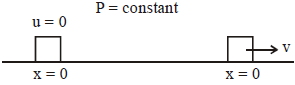
$A$ body of mass $2\, kg$ is driven by an engine delivering a constant power $1\, J/s$. The body starts from rest and moves in a straight line. After $9$ seconds,the body has moved a distance (in $m$):
A
$28$
B
$25$
C
$20$
D
$18$
Solution
(D) Given: Mass $m = 2\, kg$,Power $P = 1\, J/s$,Time $t = 9\, s$,Initial velocity $u = 0$.
Power is defined as $P = F \cdot v = (m \cdot a) \cdot v = m \cdot \frac{dv}{dt} \cdot v$.
Rearranging the terms: $m \cdot v \cdot dv = P \cdot dt$.
Integrating both sides from rest ($v=0$ at $t=0$): $\int_{0}^{v} m \cdot v \cdot dv = \int_{0}^{t} P \cdot dt$.
$m \cdot \frac{v^2}{2} = P \cdot t \Rightarrow v^2 = \frac{2Pt}{m} \Rightarrow v = \sqrt{\frac{2Pt}{m}}$.
Since $v = \frac{dx}{dt}$,we have $\frac{dx}{dt} = \sqrt{\frac{2P}{m}} \cdot t^{1/2}$.
Integrating to find distance $x$: $\int_{0}^{x} dx = \sqrt{\frac{2P}{m}} \int_{0}^{t} t^{1/2} dt$.
$x = \sqrt{\frac{2P}{m}} \cdot \frac{t^{3/2}}{3/2} = \sqrt{\frac{2P}{m}} \cdot \frac{2}{3} \cdot t^{3/2}$.
Substituting the values $m = 2$,$P = 1$,$t = 9$: $x = \sqrt{\frac{2 \cdot 1}{2}} \cdot \frac{2}{3} \cdot 9^{3/2} = 1 \cdot \frac{2}{3} \cdot (3^2)^{3/2} = \frac{2}{3} \cdot 27 = 18\, m$.
Power is defined as $P = F \cdot v = (m \cdot a) \cdot v = m \cdot \frac{dv}{dt} \cdot v$.
Rearranging the terms: $m \cdot v \cdot dv = P \cdot dt$.
Integrating both sides from rest ($v=0$ at $t=0$): $\int_{0}^{v} m \cdot v \cdot dv = \int_{0}^{t} P \cdot dt$.
$m \cdot \frac{v^2}{2} = P \cdot t \Rightarrow v^2 = \frac{2Pt}{m} \Rightarrow v = \sqrt{\frac{2Pt}{m}}$.
Since $v = \frac{dx}{dt}$,we have $\frac{dx}{dt} = \sqrt{\frac{2P}{m}} \cdot t^{1/2}$.
Integrating to find distance $x$: $\int_{0}^{x} dx = \sqrt{\frac{2P}{m}} \int_{0}^{t} t^{1/2} dt$.
$x = \sqrt{\frac{2P}{m}} \cdot \frac{t^{3/2}}{3/2} = \sqrt{\frac{2P}{m}} \cdot \frac{2}{3} \cdot t^{3/2}$.
Substituting the values $m = 2$,$P = 1$,$t = 9$: $x = \sqrt{\frac{2 \cdot 1}{2}} \cdot \frac{2}{3} \cdot 9^{3/2} = 1 \cdot \frac{2}{3} \cdot (3^2)^{3/2} = \frac{2}{3} \cdot 27 = 18\, m$.
0 likes
View Solution109
DifficultMCQ
$A$ constant power delivering machine has towed a box, which was initially at rest, along a horizontal straight line. The distance moved by the box in time $t$ is proportional to
A
$t^{2/3}$
B
$t^{3/2}$
C
$t$
D
$t^{1/2}$
Solution
(B) Power $P$ is constant, so $P = F \cdot V = \text{constant}$.
Since $F = m \cdot a = m \frac{dV}{dt}$, we have $m \frac{dV}{dt} \cdot V = \text{constant}$.
This implies $V \frac{dV}{dt} \propto 1$, which integrates to $\frac{V^2}{2} \propto t$, or $V^2 \propto t$.
Therefore, $V \propto t^{1/2}$.
Since $V = \frac{dx}{dt}$, we have $\frac{dx}{dt} \propto t^{1/2}$.
Integrating both sides with respect to time $t$, we get $x \propto \int t^{1/2} dt$.
Thus, $x \propto t^{3/2}$.
Since $F = m \cdot a = m \frac{dV}{dt}$, we have $m \frac{dV}{dt} \cdot V = \text{constant}$.
This implies $V \frac{dV}{dt} \propto 1$, which integrates to $\frac{V^2}{2} \propto t$, or $V^2 \propto t$.
Therefore, $V \propto t^{1/2}$.
Since $V = \frac{dx}{dt}$, we have $\frac{dx}{dt} \propto t^{1/2}$.
Integrating both sides with respect to time $t$, we get $x \propto \int t^{1/2} dt$.
Thus, $x \propto t^{3/2}$.
0 likes
View Solution110
DifficultMCQ
$A$ body at rest is moved along a horizontal straight line by a machine delivering a constant power. The distance moved by the body in time $t$ is proportional to :
A
$t^{1/4}$
B
$t^{3/4}$
C
$t^{3/2}$
D
$t^{1/2}$
Solution
(C) Given that the power $P$ delivered by the machine is constant.
The work done by the machine in time $t$ is $W = P \cdot t$.
According to the work-energy theorem,the work done is equal to the change in kinetic energy: $W = \Delta K = \frac{1}{2} m v^2 - 0 = \frac{1}{2} m v^2$.
Equating the two,we get $\frac{1}{2} m v^2 = P \cdot t$.
This implies $v^2 \propto t$,or $v \propto t^{1/2}$.
Since velocity $v = \frac{dx}{dt}$,we have $\frac{dx}{dt} = k \cdot t^{1/2}$ (where $k$ is a constant).
Integrating with respect to time $t$ to find the distance $x$:
$x = \int k \cdot t^{1/2} dt = k \cdot \frac{t^{1/2 + 1}}{1/2 + 1} = k \cdot \frac{t^{3/2}}{3/2}$.
Therefore,$x \propto t^{3/2}$.
The work done by the machine in time $t$ is $W = P \cdot t$.
According to the work-energy theorem,the work done is equal to the change in kinetic energy: $W = \Delta K = \frac{1}{2} m v^2 - 0 = \frac{1}{2} m v^2$.
Equating the two,we get $\frac{1}{2} m v^2 = P \cdot t$.
This implies $v^2 \propto t$,or $v \propto t^{1/2}$.
Since velocity $v = \frac{dx}{dt}$,we have $\frac{dx}{dt} = k \cdot t^{1/2}$ (where $k$ is a constant).
Integrating with respect to time $t$ to find the distance $x$:
$x = \int k \cdot t^{1/2} dt = k \cdot \frac{t^{1/2 + 1}}{1/2 + 1} = k \cdot \frac{t^{3/2}}{3/2}$.
Therefore,$x \propto t^{3/2}$.
0 likes
View Solution111
DifficultMCQ
An automobile of mass $m$ accelerates starting from the origin and is initially at rest,while the engine supplies constant power $P$. The position $x$ as a function of time $t$ is given by:
A
$\left(\frac{8P}{9m}\right)^{1/2} t^{3/2}$
B
$\left(\frac{8P}{9m}\right)^{1/2} t^{2/3}$
C
$\left(\frac{9m}{8P}\right)^{1/2} t^{3/2}$
D
$\left(\frac{9P}{8m}\right)^{1/2} t^{3/2}$
Solution
(A) Power $P$ is given by $P = Fv = (ma)v = m \left(\frac{dv}{dt}\right)v$.
Since $P$ is constant,$P = mv \frac{dv}{dt}$.
Integrating with respect to time: $\int_{0}^{v} mv \, dv = \int_{0}^{t} P \, dt$.
$\frac{1}{2}mv^2 = Pt \implies v = \sqrt{\frac{2Pt}{m}} = \left(\frac{2P}{m}\right)^{1/2} t^{1/2}$.
Since $v = \frac{dx}{dt}$,we have $\frac{dx}{dt} = \left(\frac{2P}{m}\right)^{1/2} t^{1/2}$.
Integrating with respect to position and time: $\int_{0}^{x} dx = \int_{0}^{t} \left(\frac{2P}{m}\right)^{1/2} t^{1/2} dt$.
$x = \left(\frac{2P}{m}\right)^{1/2} \left[ \frac{t^{3/2}}{3/2} \right] = \left(\frac{2P}{m}\right)^{1/2} \cdot \frac{2}{3} t^{3/2}$.
$x = \left( \frac{4}{9} \cdot \frac{2P}{m} \right)^{1/2} t^{3/2} = \left( \frac{8P}{9m} \right)^{1/2} t^{3/2}$.
Since $P$ is constant,$P = mv \frac{dv}{dt}$.
Integrating with respect to time: $\int_{0}^{v} mv \, dv = \int_{0}^{t} P \, dt$.
$\frac{1}{2}mv^2 = Pt \implies v = \sqrt{\frac{2Pt}{m}} = \left(\frac{2P}{m}\right)^{1/2} t^{1/2}$.
Since $v = \frac{dx}{dt}$,we have $\frac{dx}{dt} = \left(\frac{2P}{m}\right)^{1/2} t^{1/2}$.
Integrating with respect to position and time: $\int_{0}^{x} dx = \int_{0}^{t} \left(\frac{2P}{m}\right)^{1/2} t^{1/2} dt$.
$x = \left(\frac{2P}{m}\right)^{1/2} \left[ \frac{t^{3/2}}{3/2} \right] = \left(\frac{2P}{m}\right)^{1/2} \cdot \frac{2}{3} t^{3/2}$.
$x = \left( \frac{4}{9} \cdot \frac{2P}{m} \right)^{1/2} t^{3/2} = \left( \frac{8P}{9m} \right)^{1/2} t^{3/2}$.
1 likes
View Solution112
MediumMCQ
Water falls down a $500.0 \,m$ shaft to reach a turbine which generates electricity. How many $m^3$ of water must fall per second in order to generate $1.00 \times 10^9 \,W$ of power? (Assume $50 \%$ efficiency of conversion and $g=10 \,ms^{-2}$)
A
$250$
B
$400$
C
$500$
D
$200$
Solution
(B) The power output $P$ is given by $50 \%$ of the potential energy per second of the falling water.
Power $P = 0.50 \times \left( \frac{mgh}{t} \right)$.
Since mass $m = \rho V$,where $\rho$ is the density of water $(1000 \,kg/m^3)$ and $V$ is the volume,we have:
$P = 0.50 \times \left( \frac{V}{t} \right) \rho g h$.
Given $P = 1.00 \times 10^9 \,W$,$g = 10 \,ms^{-2}$,$\rho = 1000 \,kg/m^3$,and $h = 500 \,m$.
Rearranging for the flow rate $\frac{V}{t}$:
$\frac{V}{t} = \frac{P}{0.50 \times \rho \times g \times h}$.
$\frac{V}{t} = \frac{1.00 \times 10^9}{0.50 \times 1000 \times 10 \times 500}$.
$\frac{V}{t} = \frac{1.00 \times 10^9}{2.5 \times 10^6} = 400 \,m^3/s$.
Power $P = 0.50 \times \left( \frac{mgh}{t} \right)$.
Since mass $m = \rho V$,where $\rho$ is the density of water $(1000 \,kg/m^3)$ and $V$ is the volume,we have:
$P = 0.50 \times \left( \frac{V}{t} \right) \rho g h$.
Given $P = 1.00 \times 10^9 \,W$,$g = 10 \,ms^{-2}$,$\rho = 1000 \,kg/m^3$,and $h = 500 \,m$.
Rearranging for the flow rate $\frac{V}{t}$:
$\frac{V}{t} = \frac{P}{0.50 \times \rho \times g \times h}$.
$\frac{V}{t} = \frac{1.00 \times 10^9}{0.50 \times 1000 \times 10 \times 500}$.
$\frac{V}{t} = \frac{1.00 \times 10^9}{2.5 \times 10^6} = 400 \,m^3/s$.
0 likes
View Solution113
MediumMCQ
$A$ $750 \,W$ motor drives a pump which lifts $300 \,L$ of water per minute to a height of $6 \,m$. The efficiency of the motor is nearly (Take,acceleration due to gravity to be $10 \,m/s^2$) (in $\%$)
A
$30$
B
$40$
C
$50$
D
$20$
Solution
(B) Given:
Input power $(P_{\text{in}})$ = $750 \,W$
Volume of water $(V)$ = $300 \,L$,so mass $(m)$ = $300 \,kg$ (since density of water is $1 \,kg/L$)
Height $(h)$ = $6 \,m$
Time $(t)$ = $1 \,minute = 60 \,s$
Acceleration due to gravity $(g)$ = $10 \,m/s^2$
The useful power output $(P_{\text{out}})$ is the rate of doing work against gravity:
$P_{\text{out}} = \frac{mgh}{t} = \frac{300 \times 10 \times 6}{60} = \frac{18000}{60} = 300 \,W$
The efficiency $(\eta)$ is defined as the ratio of useful power output to input power:
$\eta = \frac{P_{\text{out}}}{P_{\text{in}}} = \frac{300}{750} = 0.4$
Converting to percentage:
$\eta = 0.4 \times 100 = 40 \%$
Input power $(P_{\text{in}})$ = $750 \,W$
Volume of water $(V)$ = $300 \,L$,so mass $(m)$ = $300 \,kg$ (since density of water is $1 \,kg/L$)
Height $(h)$ = $6 \,m$
Time $(t)$ = $1 \,minute = 60 \,s$
Acceleration due to gravity $(g)$ = $10 \,m/s^2$
The useful power output $(P_{\text{out}})$ is the rate of doing work against gravity:
$P_{\text{out}} = \frac{mgh}{t} = \frac{300 \times 10 \times 6}{60} = \frac{18000}{60} = 300 \,W$
The efficiency $(\eta)$ is defined as the ratio of useful power output to input power:
$\eta = \frac{P_{\text{out}}}{P_{\text{in}}} = \frac{300}{750} = 0.4$
Converting to percentage:
$\eta = 0.4 \times 100 = 40 \%$
0 likes
View Solution114
MediumMCQ
The power of a water pump is $4 \,kW$. If $g = 10 \,m/s^2$,the amount of water it can raise in $1 \,minute$ to a height of $20 \,m$ is ........... $litres$.
A
$100$
B
$1000$
C
$1200$
D
$2000$
Solution
(C) Given: Power $P = 4 \,kW = 4000 \,W$,acceleration due to gravity $g = 10 \,m/s^2$,height $h = 20 \,m$,and time $t = 1 \,minute = 60 \,s$.
The formula for power is $P = \frac{W}{t} = \frac{mgh}{t}$.
Substituting the values: $4000 = \frac{m \times 10 \times 20}{60}$.
Simplifying the equation: $4000 = \frac{200m}{60} = \frac{10m}{3}$.
Solving for $m$: $m = \frac{4000 \times 3}{10} = 1200 \,kg$.
Since the density of water is $1 \,kg/litre$,the volume of water is $1200 \,litres$.
The formula for power is $P = \frac{W}{t} = \frac{mgh}{t}$.
Substituting the values: $4000 = \frac{m \times 10 \times 20}{60}$.
Simplifying the equation: $4000 = \frac{200m}{60} = \frac{10m}{3}$.
Solving for $m$: $m = \frac{4000 \times 3}{10} = 1200 \,kg$.
Since the density of water is $1 \,kg/litre$,the volume of water is $1200 \,litres$.
0 likes
View Solution115
EasyMCQ
The power of a pump,which can pump $500 \,kg$ of water to a height of $100 \,m$ in $10 \,s$,is .......... $kW$. (Take $g = 10 \,m/s^2$)
A
$75$
B
$25$
C
$50$
D
$500$
Solution
(C) The power $P$ is defined as the rate of doing work,given by $P = \frac{W}{t}$.
Here,the work done $W$ is equal to the potential energy gained by the water,$W = mgh$.
Given:
Mass $m = 500 \,kg$
Height $h = 100 \,m$
Time $t = 10 \,s$
Acceleration due to gravity $g = 10 \,m/s^2$
Substituting the values:
$W = 500 \times 10 \times 100 = 500,000 \,J$
$P = \frac{500,000 \,J}{10 \,s} = 50,000 \,W$
Since $1 \,kW = 1,000 \,W$,we have:
$P = \frac{50,000}{1,000} \,kW = 50 \,kW$.
Therefore,the correct option is $C$.
Here,the work done $W$ is equal to the potential energy gained by the water,$W = mgh$.
Given:
Mass $m = 500 \,kg$
Height $h = 100 \,m$
Time $t = 10 \,s$
Acceleration due to gravity $g = 10 \,m/s^2$
Substituting the values:
$W = 500 \times 10 \times 100 = 500,000 \,J$
$P = \frac{500,000 \,J}{10 \,s} = 50,000 \,W$
Since $1 \,kW = 1,000 \,W$,we have:
$P = \frac{50,000}{1,000} \,kW = 50 \,kW$.
Therefore,the correct option is $C$.
0 likes
View Solution116
MediumMCQ
$A$ car of mass $m$ has an engine which can deliver power $P$. The minimum time in which the car can be accelerated from rest to a speed $v$ is .............
A
$\frac{m v^2}{2 P}$
B
$P m v^2$
C
$2 P m v^2$
D
$\frac{m v^2}{2} P$
Solution
(A) The power delivered by the engine is defined as the rate of change of kinetic energy.
$P = \frac{dK}{dt}$
Integrating this expression over time $t$ to reach a final kinetic energy $K$ from rest $(K_i = 0)$:
$P \cdot t = K_f - K_i$
Since the final kinetic energy is $K_f = \frac{1}{2} m v^2$ and the initial kinetic energy is $0$:
$P \cdot t = \frac{1}{2} m v^2$
Solving for time $t$:
$t = \frac{m v^2}{2 P}$
$P = \frac{dK}{dt}$
Integrating this expression over time $t$ to reach a final kinetic energy $K$ from rest $(K_i = 0)$:
$P \cdot t = K_f - K_i$
Since the final kinetic energy is $K_f = \frac{1}{2} m v^2$ and the initial kinetic energy is $0$:
$P \cdot t = \frac{1}{2} m v^2$
Solving for time $t$:
$t = \frac{m v^2}{2 P}$
0 likes
View Solution117
EasyMCQ
From a waterfall,water is pouring down at the rate of $100 \,kg/s$ on the blades of a turbine. If the height of the fall is $100 \,m$,the power delivered to the turbine is approximately equal to .......... $kW$.
A
$100$
B
$10$
C
$1$
D
$1000$
Solution
(A) The power $P$ delivered to the turbine is given by the rate of change of potential energy of the falling water.
$P = \frac{W}{t} = \frac{mgh}{t}$
Given that the rate of mass flow $\frac{m}{t} = 100 \,kg/s$,the height $h = 100 \,m$,and taking acceleration due to gravity $g \approx 10 \,m/s^2$:
$P = \left(\frac{m}{t}\right) \times g \times h$
$P = 100 \,kg/s \times 10 \,m/s^2 \times 100 \,m$
$P = 100,000 \,W$
Since $1 \,kW = 1000 \,W$,we have:
$P = \frac{100,000}{1000} \,kW = 100 \,kW$.
Therefore,the correct option is $A$.
$P = \frac{W}{t} = \frac{mgh}{t}$
Given that the rate of mass flow $\frac{m}{t} = 100 \,kg/s$,the height $h = 100 \,m$,and taking acceleration due to gravity $g \approx 10 \,m/s^2$:
$P = \left(\frac{m}{t}\right) \times g \times h$
$P = 100 \,kg/s \times 10 \,m/s^2 \times 100 \,m$
$P = 100,000 \,W$
Since $1 \,kW = 1000 \,W$,we have:
$P = \frac{100,000}{1000} \,kW = 100 \,kW$.
Therefore,the correct option is $A$.
0 likes
View Solution118
MediumMCQ
The force required to row a boat at constant velocity is proportional to the square of its speed. If a speed of $v \, km/h$ requires $4 \, kW$ of power,how much power does a speed of $2v \, km/h$ require?
A
$8$
B
$16$
C
$24$
D
$32$
Solution
(D) Given that the force $F$ required to row a boat at constant velocity $v$ is proportional to the square of its speed:
$F \propto v^2$
We know that power $P$ is defined as the product of force and velocity:
$P = F \cdot v$
Substituting the proportionality of force into the power equation:
$P \propto v^2 \cdot v = v^3$
Let $P_1$ be the power required for speed $v$,and $P_2$ be the power required for speed $2v$:
$\frac{P_2}{P_1} = \left( \frac{2v}{v} \right)^3 = 2^3 = 8$
Given $P_1 = 4 \, kW$:
$P_2 = 8 \times P_1 = 8 \times 4 \, kW = 32 \, kW$
Therefore,the power required for a speed of $2v \, km/h$ is $32 \, kW$.
$F \propto v^2$
We know that power $P$ is defined as the product of force and velocity:
$P = F \cdot v$
Substituting the proportionality of force into the power equation:
$P \propto v^2 \cdot v = v^3$
Let $P_1$ be the power required for speed $v$,and $P_2$ be the power required for speed $2v$:
$\frac{P_2}{P_1} = \left( \frac{2v}{v} \right)^3 = 2^3 = 8$
Given $P_1 = 4 \, kW$:
$P_2 = 8 \times P_1 = 8 \times 4 \, kW = 32 \, kW$
Therefore,the power required for a speed of $2v \, km/h$ is $32 \, kW$.
0 likes
View Solution119
EasyMCQ
Which of the following must be known in order to determine the power output of an automobile?
A
Final velocity and height
B
Mass and amount of work performed
C
Force exerted and distance of motion
D
Work performed and elapsed time of work
Solution
(D) The correct option is $D$.
Power is defined as the rate at which work is done or energy is transferred. Mathematically,power $P$ is given by the formula:
$P = \frac{W}{t}$
where $W$ is the work performed and $t$ is the time interval over which the work is done.
Therefore,to determine the power output of an automobile,one must know the total work performed and the time elapsed during that work.
Power is defined as the rate at which work is done or energy is transferred. Mathematically,power $P$ is given by the formula:
$P = \frac{W}{t}$
where $W$ is the work performed and $t$ is the time interval over which the work is done.
Therefore,to determine the power output of an automobile,one must know the total work performed and the time elapsed during that work.
0 likes
View Solution120
MediumMCQ
$A$ body of mass $1 \ kg$ begins to move under the action of a time-dependent force $\vec{F} = (t \hat{i} + 3t^2 \hat{j}) \ N$,where $\hat{i}$ and $\hat{j}$ are the unit vectors along the $x$ and $y$ axes. The power developed by the above force at time $t = 2 \ s$ will be $.............. \ W$.
A
$1$
B
$10$
C
$100$
D
$0.1$
Solution
(C) Given force: $\vec{F} = t \hat{i} + 3t^2 \hat{j} \ N$ and mass $m = 1 \ kg$.
Using Newton's second law,$\vec{F} = m \vec{a} = m \frac{d\vec{v}}{dt}$.
Since $m = 1 \ kg$,$\frac{d\vec{v}}{dt} = t \hat{i} + 3t^2 \hat{j}$.
Integrating with respect to time $t$ (assuming initial velocity is zero at $t=0$): $\vec{v} = \int (t \hat{i} + 3t^2 \hat{j}) dt = \frac{t^2}{2} \hat{i} + t^3 \hat{j} \ m/s$.
Power $P$ is given by the dot product of force and velocity: $P = \vec{F} \cdot \vec{v}$.
$P = (t \hat{i} + 3t^2 \hat{j}) \cdot (\frac{t^2}{2} \hat{i} + t^3 \hat{j}) = \frac{t^3}{2} + 3t^5$.
At $t = 2 \ s$,$P = \frac{2^3}{2} + 3(2^5) = \frac{8}{2} + 3(32) = 4 + 96 = 100 \ W$.
Using Newton's second law,$\vec{F} = m \vec{a} = m \frac{d\vec{v}}{dt}$.
Since $m = 1 \ kg$,$\frac{d\vec{v}}{dt} = t \hat{i} + 3t^2 \hat{j}$.
Integrating with respect to time $t$ (assuming initial velocity is zero at $t=0$): $\vec{v} = \int (t \hat{i} + 3t^2 \hat{j}) dt = \frac{t^2}{2} \hat{i} + t^3 \hat{j} \ m/s$.
Power $P$ is given by the dot product of force and velocity: $P = \vec{F} \cdot \vec{v}$.
$P = (t \hat{i} + 3t^2 \hat{j}) \cdot (\frac{t^2}{2} \hat{i} + t^3 \hat{j}) = \frac{t^3}{2} + 3t^5$.
At $t = 2 \ s$,$P = \frac{2^3}{2} + 3(2^5) = \frac{8}{2} + 3(32) = 4 + 96 = 100 \ W$.
0 likes
View Solution121
MediumMCQ
$A$ body of mass $2 \ kg$ is initially at rest. It starts moving unidirectionally under the influence of a source of constant power $P$. Its displacement in $4 \ s$ is $\frac{1}{3} \alpha^2 \sqrt{P} \ m$. The value of $\alpha$ will be $.............$
A
$1$
B
$2$
C
$4$
D
$3$
Solution
(C) Given,mass $m = 2 \ kg$ and power $P$ is constant.
Work done by the source in time $t$ is $W = P \times t$.
According to the work-energy theorem,$W = \Delta K = \frac{1}{2} m v^2 - 0$.
So,$\frac{1}{2} m v^2 = P t \implies v = \sqrt{\frac{2 P t}{m}}$.
Since $v = \frac{dx}{dt}$,we have $\frac{dx}{dt} = \sqrt{\frac{2 P}{m}} \cdot t^{1/2}$.
Integrating with respect to $t$ from $0$ to $4 \ s$:
$x = \int_0^4 \sqrt{\frac{2 P}{m}} \cdot t^{1/2} dt = \sqrt{\frac{2 P}{m}} \left[ \frac{t^{3/2}}{3/2} \right]_0^4$.
Substituting $m = 2 \ kg$:
$x = \sqrt{\frac{2 P}{2}} \cdot \frac{2}{3} \cdot (4)^{3/2} = \sqrt{P} \cdot \frac{2}{3} \cdot 8 = \frac{16}{3} \sqrt{P}$.
Given displacement is $\frac{1}{3} \alpha^2 \sqrt{P}$.
Comparing $\frac{16}{3} \sqrt{P} = \frac{1}{3} \alpha^2 \sqrt{P}$,we get $\alpha^2 = 16$,so $\alpha = 4$.
Work done by the source in time $t$ is $W = P \times t$.
According to the work-energy theorem,$W = \Delta K = \frac{1}{2} m v^2 - 0$.
So,$\frac{1}{2} m v^2 = P t \implies v = \sqrt{\frac{2 P t}{m}}$.
Since $v = \frac{dx}{dt}$,we have $\frac{dx}{dt} = \sqrt{\frac{2 P}{m}} \cdot t^{1/2}$.
Integrating with respect to $t$ from $0$ to $4 \ s$:
$x = \int_0^4 \sqrt{\frac{2 P}{m}} \cdot t^{1/2} dt = \sqrt{\frac{2 P}{m}} \left[ \frac{t^{3/2}}{3/2} \right]_0^4$.
Substituting $m = 2 \ kg$:
$x = \sqrt{\frac{2 P}{2}} \cdot \frac{2}{3} \cdot (4)^{3/2} = \sqrt{P} \cdot \frac{2}{3} \cdot 8 = \frac{16}{3} \sqrt{P}$.
Given displacement is $\frac{1}{3} \alpha^2 \sqrt{P}$.
Comparing $\frac{16}{3} \sqrt{P} = \frac{1}{3} \alpha^2 \sqrt{P}$,we get $\alpha^2 = 16$,so $\alpha = 4$.
0 likes
View Solution122
MediumMCQ
If the maximum load carried by an elevator is $1400\,kg$ ($600\,kg$ passenger $+ 800\,kg$ elevator),which is moving up with a uniform speed of $3\,m/s$ and the frictional force acting on it is $2000\,N$,then the maximum power used by the motor is $...........\,kW$ (take $g = 10\,m/s^2$).
A
$46$
B
$44$
C
$48$
D
$42$
Solution
(C) The total mass of the elevator system is $M = 1400\,kg$.
The elevator is moving upward at a uniform speed $v = 3\,m/s$. Since the speed is uniform,the acceleration is zero.
The motor must provide a force $F$ to overcome both the gravitational force and the frictional force.
The gravitational force is $F_g = M \times g = 1400\,kg \times 10\,m/s^2 = 14000\,N$.
The frictional force is $f = 2000\,N$.
Therefore,the total force required by the motor is $F = F_g + f = 14000\,N + 2000\,N = 16000\,N$.
The power $P$ used by the motor is given by $P = F \times v$.
$P = 16000\,N \times 3\,m/s = 48000\,W$.
Converting to kilowatts,$P = 48\,kW$.
The elevator is moving upward at a uniform speed $v = 3\,m/s$. Since the speed is uniform,the acceleration is zero.
The motor must provide a force $F$ to overcome both the gravitational force and the frictional force.
The gravitational force is $F_g = M \times g = 1400\,kg \times 10\,m/s^2 = 14000\,N$.
The frictional force is $f = 2000\,N$.
Therefore,the total force required by the motor is $F = F_g + f = 14000\,N + 2000\,N = 16000\,N$.
The power $P$ used by the motor is given by $P = F \times v$.
$P = 16000\,N \times 3\,m/s = 48000\,W$.
Converting to kilowatts,$P = 48\,kW$.
1 likes
View Solution123
MediumMCQ
The ratio of powers of two motors is $\frac{3 \sqrt{x}}{\sqrt{x}+1}$,which are capable of raising $300 \ kg$ of water in $5 \ minutes$ and $50 \ kg$ of water in $2 \ minutes$ respectively from a well of $100 \ m$ depth. The value of $x$ is:
A
$2$
B
$4$
C
$2.4$
D
$16$
Solution
(D) Average Power is defined as the total work done divided by the total time taken.
$P = \frac{W}{t} = \frac{mgh}{t}$
Given the ratio of powers of two motors is $\frac{P_1}{P_2} = \frac{3 \sqrt{x}}{\sqrt{x}+1}$.
For the first motor: $m_1 = 300 \ kg$,$t_1 = 5 \ minutes = 300 \ s$,$h = 100 \ m$.
For the second motor: $m_2 = 50 \ kg$,$t_2 = 2 \ minutes = 120 \ s$,$h = 100 \ m$.
Calculating the ratio of powers:
$\frac{P_1}{P_2} = \frac{m_1 g h / t_1}{m_2 g h / t_2} = \frac{m_1}{t_1} \times \frac{t_2}{m_2}$
$\frac{P_1}{P_2} = \frac{300}{5} \times \frac{2}{50} = 60 \times 0.04 = 2.4$
Equating the two expressions:
$\frac{3 \sqrt{x}}{\sqrt{x}+1} = 2.4$
$3 \sqrt{x} = 2.4 \sqrt{x} + 2.4$
$0.6 \sqrt{x} = 2.4$
$\sqrt{x} = 4$
$x = 16$
$P = \frac{W}{t} = \frac{mgh}{t}$
Given the ratio of powers of two motors is $\frac{P_1}{P_2} = \frac{3 \sqrt{x}}{\sqrt{x}+1}$.
For the first motor: $m_1 = 300 \ kg$,$t_1 = 5 \ minutes = 300 \ s$,$h = 100 \ m$.
For the second motor: $m_2 = 50 \ kg$,$t_2 = 2 \ minutes = 120 \ s$,$h = 100 \ m$.
Calculating the ratio of powers:
$\frac{P_1}{P_2} = \frac{m_1 g h / t_1}{m_2 g h / t_2} = \frac{m_1}{t_1} \times \frac{t_2}{m_2}$
$\frac{P_1}{P_2} = \frac{300}{5} \times \frac{2}{50} = 60 \times 0.04 = 2.4$
Equating the two expressions:
$\frac{3 \sqrt{x}}{\sqrt{x}+1} = 2.4$
$3 \sqrt{x} = 2.4 \sqrt{x} + 2.4$
$0.6 \sqrt{x} = 2.4$
$\sqrt{x} = 4$
$x = 16$
0 likes
View Solution124
DifficultMCQ
$A$ body of mass $2 \ kg$ begins to move under the action of a time-dependent force given by $\overrightarrow{F} = (6t \hat{i} + 6t^2 \hat{j}) \ N$. The power developed by the force at time $t$ is given by:
A
$(6t^4 + 9t^5) \ W$
B
$(3t^3 + 6t^5) \ W$
C
$(9t^5 + 6t^3) \ W$
D
$(9t^3 + 6t^5) \ W$
Solution
(D) Given force $\overrightarrow{F} = (6t \hat{i} + 6t^2 \hat{j}) \ N$ and mass $m = 2 \ kg$.
Using Newton's second law,$\overrightarrow{a} = \frac{\overrightarrow{F}}{m} = \frac{6t \hat{i} + 6t^2 \hat{j}}{2} = (3t \hat{i} + 3t^2 \hat{j}) \ m/s^2$.
To find velocity $\overrightarrow{v}$,we integrate acceleration with respect to time: $\overrightarrow{v} = \int \overrightarrow{a} \ dt = \int (3t \hat{i} + 3t^2 \hat{j}) \ dt = (\frac{3t^2}{2} \hat{i} + t^3 \hat{j}) \ m/s$.
Power $P$ is the dot product of force and velocity: $P = \overrightarrow{F} \cdot \overrightarrow{v} = (6t \hat{i} + 6t^2 \hat{j}) \cdot (\frac{3t^2}{2} \hat{i} + t^3 \hat{j})$.
$P = (6t \cdot \frac{3t^2}{2}) + (6t^2 \cdot t^3) = 9t^3 + 6t^5 \ W$.
Using Newton's second law,$\overrightarrow{a} = \frac{\overrightarrow{F}}{m} = \frac{6t \hat{i} + 6t^2 \hat{j}}{2} = (3t \hat{i} + 3t^2 \hat{j}) \ m/s^2$.
To find velocity $\overrightarrow{v}$,we integrate acceleration with respect to time: $\overrightarrow{v} = \int \overrightarrow{a} \ dt = \int (3t \hat{i} + 3t^2 \hat{j}) \ dt = (\frac{3t^2}{2} \hat{i} + t^3 \hat{j}) \ m/s$.
Power $P$ is the dot product of force and velocity: $P = \overrightarrow{F} \cdot \overrightarrow{v} = (6t \hat{i} + 6t^2 \hat{j}) \cdot (\frac{3t^2}{2} \hat{i} + t^3 \hat{j})$.
$P = (6t \cdot \frac{3t^2}{2}) + (6t^2 \cdot t^3) = 9t^3 + 6t^5 \ W$.
0 likes
View Solution125
DifficultMCQ
$A$ body is moving unidirectionally under the influence of a constant power source. Its displacement in time $t$ is proportional to :
A
$t^2$
B
$t^{2/3}$
C
$t^{3/2}$
D
$t$
Solution
(C) Given that power $P$ is constant.
Since $P = F \cdot v = m \cdot a \cdot v = m \cdot \frac{dv}{dt} \cdot v$,we have $m \cdot v \cdot \frac{dv}{dt} = P$.
Integrating both sides with respect to time: $\int m \cdot v \cdot dv = \int P \cdot dt$.
This gives $\frac{1}{2} m v^2 = P \cdot t$,which implies $v^2 \propto t$,or $v \propto t^{1/2}$.
Since velocity $v = \frac{ds}{dt}$,we have $\frac{ds}{dt} \propto t^{1/2}$.
Integrating with respect to time: $s = \int t^{1/2} dt = \frac{t^{3/2}}{3/2} = \frac{2}{3} t^{3/2}$.
Therefore,displacement $s \propto t^{3/2}$.
Since $P = F \cdot v = m \cdot a \cdot v = m \cdot \frac{dv}{dt} \cdot v$,we have $m \cdot v \cdot \frac{dv}{dt} = P$.
Integrating both sides with respect to time: $\int m \cdot v \cdot dv = \int P \cdot dt$.
This gives $\frac{1}{2} m v^2 = P \cdot t$,which implies $v^2 \propto t$,or $v \propto t^{1/2}$.
Since velocity $v = \frac{ds}{dt}$,we have $\frac{ds}{dt} \propto t^{1/2}$.
Integrating with respect to time: $s = \int t^{1/2} dt = \frac{t^{3/2}}{3/2} = \frac{2}{3} t^{3/2}$.
Therefore,displacement $s \propto t^{3/2}$.
0 likes
View Solution126
MediumMCQ
At any instant of time $t$, the displacement of a particle is given by $x = 2t - 1$ ($SI$ units) under the influence of a force of $5 \,N$. The value of instantaneous power is (in $SI$ units):
A
$5$
B
$7$
C
$6$
D
$10$
Solution
(D) Given:
Displacement $x = 2t - 1 \,m$
Force $F = 5 \,N$
Step $1$: Find the velocity of the particle.
Velocity $v = \frac{dx}{dt} = \frac{d}{dt}(2t - 1) = 2 \,m/s$
Step $2$: Calculate the instantaneous power.
Power $P = F \cdot v$
$P = 5 \,N \times 2 \,m/s = 10 \,W$
Thus, the instantaneous power is $10 \,W$.
Displacement $x = 2t - 1 \,m$
Force $F = 5 \,N$
Step $1$: Find the velocity of the particle.
Velocity $v = \frac{dx}{dt} = \frac{d}{dt}(2t - 1) = 2 \,m/s$
Step $2$: Calculate the instantaneous power.
Power $P = F \cdot v$
$P = 5 \,N \times 2 \,m/s = 10 \,W$
Thus, the instantaneous power is $10 \,W$.
0 likes
View Solution127
MediumMCQ
$A$ particle of mass $0.2 \ kg$ is moving in one dimension under a force that delivers a constant power $0.5 \ W$ to the particle. If the initial speed of the particle is zero,the speed (in $m/s$) after $5 \ s$ is:
A
$1$
B
$3$
C
$5$
D
$7$
Solution
(C) The power delivered to the particle is constant,$P = 0.5 \ W$.
Since the initial speed is zero,the initial kinetic energy is $0 \ J$.
The work done by the force in time $t = 5 \ s$ is equal to the change in kinetic energy.
Work done $W = P \times t = 0.5 \ W \times 5 \ s = 2.5 \ J$.
Using the work-energy theorem,$W = \Delta K = \frac{1}{2}mv^2 - 0$.
$2.5 \ J = \frac{1}{2} \times 0.2 \ kg \times v^2$.
$2.5 = 0.1 \times v^2$.
$v^2 = 25$.
$v = 5 \ m/s$.
Since the initial speed is zero,the initial kinetic energy is $0 \ J$.
The work done by the force in time $t = 5 \ s$ is equal to the change in kinetic energy.
Work done $W = P \times t = 0.5 \ W \times 5 \ s = 2.5 \ J$.
Using the work-energy theorem,$W = \Delta K = \frac{1}{2}mv^2 - 0$.
$2.5 \ J = \frac{1}{2} \times 0.2 \ kg \times v^2$.
$2.5 = 0.1 \times v^2$.
$v^2 = 25$.
$v = 5 \ m/s$.
0 likes
View Solution128
MediumMCQ
$A$ body of mass $4 \ kg$ is placed on a plane at a point $P$ having coordinates $(3, 4) \ m$. Under the action of force $\overrightarrow{F} = (2 \hat{i} + 3 \hat{j}) \ N$,it moves to a new point $Q$ having coordinates $(6, 10) \ m$ in $4 \ s$. The average power and instantaneous power at the end of $4 \ s$ are in the ratio of:
A
$13: 6$
B
$6: 13$
C
$1: 2$
D
$4: 3$
Solution
(B) Given: Mass $m = 4 \ kg$,Force $\overrightarrow{F} = (2 \hat{i} + 3 \hat{j}) \ N$,Displacement $\overrightarrow{d} = \overrightarrow{OQ} - \overrightarrow{OP} = (6-3) \hat{i} + (10-4) \hat{j} = (3 \hat{i} + 6 \hat{j}) \ m$,Time $t = 4 \ s$.
Work done $W = \overrightarrow{F} \cdot \overrightarrow{d} = (2 \hat{i} + 3 \hat{j}) \cdot (3 \hat{i} + 6 \hat{j}) = (2 \times 3) + (3 \times 6) = 6 + 18 = 24 \ J$.
Average power $\langle P \rangle = \frac{W}{t} = \frac{24}{4} = 6 \ W$.
Acceleration $\overrightarrow{a} = \frac{\overrightarrow{F}}{m} = \frac{2 \hat{i} + 3 \hat{j}}{4} = (0.5 \hat{i} + 0.75 \hat{j}) \ m/s^2$.
Velocity at $t = 4 \ s$ is $\overrightarrow{v} = \overrightarrow{u} + \overrightarrow{a}t = 0 + (0.5 \hat{i} + 0.75 \hat{j}) \times 4 = (2 \hat{i} + 3 \hat{j}) \ m/s$.
Instantaneous power $P_{ins} = \overrightarrow{F} \cdot \overrightarrow{v} = (2 \hat{i} + 3 \hat{j}) \cdot (2 \hat{i} + 3 \hat{j}) = 4 + 9 = 13 \ W$.
The ratio of average power to instantaneous power is $\frac{\langle P \rangle}{P_{ins}} = \frac{6}{13}$.
Work done $W = \overrightarrow{F} \cdot \overrightarrow{d} = (2 \hat{i} + 3 \hat{j}) \cdot (3 \hat{i} + 6 \hat{j}) = (2 \times 3) + (3 \times 6) = 6 + 18 = 24 \ J$.
Average power $\langle P \rangle = \frac{W}{t} = \frac{24}{4} = 6 \ W$.
Acceleration $\overrightarrow{a} = \frac{\overrightarrow{F}}{m} = \frac{2 \hat{i} + 3 \hat{j}}{4} = (0.5 \hat{i} + 0.75 \hat{j}) \ m/s^2$.
Velocity at $t = 4 \ s$ is $\overrightarrow{v} = \overrightarrow{u} + \overrightarrow{a}t = 0 + (0.5 \hat{i} + 0.75 \hat{j}) \times 4 = (2 \hat{i} + 3 \hat{j}) \ m/s$.
Instantaneous power $P_{ins} = \overrightarrow{F} \cdot \overrightarrow{v} = (2 \hat{i} + 3 \hat{j}) \cdot (2 \hat{i} + 3 \hat{j}) = 4 + 9 = 13 \ W$.
The ratio of average power to instantaneous power is $\frac{\langle P \rangle}{P_{ins}} = \frac{6}{13}$.
0 likes
View Solution129
DifficultMCQ
An object of mass $1000 \ g$ experiences a time-dependent force $\vec{F} = (2t \hat{i} + 3t^2 \hat{j}) \ N$. The power generated by the force at time $t$ is
A
$(2t^2 + 3t^3) \ W$
B
$(2t^2 + 18t^3) \ W$
C
$(3t^3 + 5t^5) \ W$
D
$(2t^3 + 3t^5) \ W$
Solution
(D) Given force $\vec{F} = (2t \hat{i} + 3t^2 \hat{j}) \ N$ and mass $m = 1000 \ g = 1 \ kg$.
Using Newton's second law,$\vec{F} = m\vec{a}$,we have $\vec{a} = \frac{\vec{F}}{m} = (2t \hat{i} + 3t^2 \hat{j}) \ m/s^2$.
Since $\vec{a} = \frac{d\vec{v}}{dt}$,we integrate with respect to time (assuming initial velocity $\vec{v} = 0$ at $t = 0$):
$\vec{v} = \int \vec{a} \ dt = \int (2t \hat{i} + 3t^2 \hat{j}) \ dt = t^2 \hat{i} + t^3 \hat{j} \ m/s$.
Power $P$ is defined as the dot product of force and velocity: $P = \vec{F} \cdot \vec{v}$.
$P = (2t \hat{i} + 3t^2 \hat{j}) \cdot (t^2 \hat{i} + t^3 \hat{j})$.
$P = (2t)(t^2) + (3t^2)(t^3) = 2t^3 + 3t^5 \ W$.
Using Newton's second law,$\vec{F} = m\vec{a}$,we have $\vec{a} = \frac{\vec{F}}{m} = (2t \hat{i} + 3t^2 \hat{j}) \ m/s^2$.
Since $\vec{a} = \frac{d\vec{v}}{dt}$,we integrate with respect to time (assuming initial velocity $\vec{v} = 0$ at $t = 0$):
$\vec{v} = \int \vec{a} \ dt = \int (2t \hat{i} + 3t^2 \hat{j}) \ dt = t^2 \hat{i} + t^3 \hat{j} \ m/s$.
Power $P$ is defined as the dot product of force and velocity: $P = \vec{F} \cdot \vec{v}$.
$P = (2t \hat{i} + 3t^2 \hat{j}) \cdot (t^2 \hat{i} + t^3 \hat{j})$.
$P = (2t)(t^2) + (3t^2)(t^3) = 2t^3 + 3t^5 \ W$.
0 likes
View Solution130
EasyMCQ
$A$ force $\vec{F} = (4 \hat{i} + \hat{j} - 2 \hat{k}) \text{ N}$ acting on a body maintains its velocity at $\vec{v} = (2 \hat{i} + 2 \hat{j} + 3 \hat{k}) \text{ m s}^{-1}$. The power exerted is $..... \text{ W}$.
A
$4$
B
$5$
C
$3$
D
$8$
Solution
(A) The power $P$ exerted by a force $\vec{F}$ on a body moving with velocity $\vec{v}$ is given by the dot product: $P = \vec{F} \cdot \vec{v}$.
Given,$\vec{F} = (4 \hat{i} + \hat{j} - 2 \hat{k}) \text{ N}$ and $\vec{v} = (2 \hat{i} + 2 \hat{j} + 3 \hat{k}) \text{ m s}^{-1}$.
Substituting these values into the formula:
$P = (4 \hat{i} + \hat{j} - 2 \hat{k}) \cdot (2 \hat{i} + 2 \hat{j} + 3 \hat{k})$
$P = (4 \times 2) + (1 \times 2) + (-2 \times 3)$
$P = 8 + 2 - 6$
$P = 4 \text{ W}$.
Given,$\vec{F} = (4 \hat{i} + \hat{j} - 2 \hat{k}) \text{ N}$ and $\vec{v} = (2 \hat{i} + 2 \hat{j} + 3 \hat{k}) \text{ m s}^{-1}$.
Substituting these values into the formula:
$P = (4 \hat{i} + \hat{j} - 2 \hat{k}) \cdot (2 \hat{i} + 2 \hat{j} + 3 \hat{k})$
$P = (4 \times 2) + (1 \times 2) + (-2 \times 3)$
$P = 8 + 2 - 6$
$P = 4 \text{ W}$.
0 likes
View Solution131
MediumMCQ
$A$ body of mass $1 \ kg$ begins to move under the action of a time-dependent force $\vec{F} = (t \hat{i} + 2t^2 \hat{j}) \ N$,where $\hat{i}$ and $\hat{j}$ are unit vectors along $x$ and $y$ axes. The power developed by the above force at time $t = 3 \ s$ will be: (in $W$)
A
$337.5$
B
$228.5$
C
$422.5$
D
$126.5$
Solution
(A) Given: Mass $m = 1 \ kg$,Force $\vec{F} = t \hat{i} + 2t^2 \hat{j}$.
Using Newton's second law,$\vec{F} = m \vec{a}$,so $\vec{a} = \frac{\vec{F}}{m} = t \hat{i} + 2t^2 \hat{j}$.
Velocity $\vec{v} = \int \vec{a} \ dt = \int (t \hat{i} + 2t^2 \hat{j}) \ dt = \frac{t^2}{2} \hat{i} + \frac{2t^3}{3} \hat{j}$ (assuming initial velocity is zero).
Power $P = \vec{F} \cdot \vec{v} = (t \hat{i} + 2t^2 \hat{j}) \cdot (\frac{t^2}{2} \hat{i} + \frac{2t^3}{3} \hat{j})$.
$P = \frac{t^3}{2} + \frac{4t^5}{3}$.
At $t = 3 \ s$:
$P = \frac{3^3}{2} + \frac{4(3^5)}{3} = \frac{27}{2} + 4(3^4) = 13.5 + 4(81) = 13.5 + 324 = 337.5 \ W$.
Using Newton's second law,$\vec{F} = m \vec{a}$,so $\vec{a} = \frac{\vec{F}}{m} = t \hat{i} + 2t^2 \hat{j}$.
Velocity $\vec{v} = \int \vec{a} \ dt = \int (t \hat{i} + 2t^2 \hat{j}) \ dt = \frac{t^2}{2} \hat{i} + \frac{2t^3}{3} \hat{j}$ (assuming initial velocity is zero).
Power $P = \vec{F} \cdot \vec{v} = (t \hat{i} + 2t^2 \hat{j}) \cdot (\frac{t^2}{2} \hat{i} + \frac{2t^3}{3} \hat{j})$.
$P = \frac{t^3}{2} + \frac{4t^5}{3}$.
At $t = 3 \ s$:
$P = \frac{3^3}{2} + \frac{4(3^5)}{3} = \frac{27}{2} + 4(3^4) = 13.5 + 4(81) = 13.5 + 324 = 337.5 \ W$.
0 likes
View Solution132
MediumMCQ
$A$ body of mass $1 \ kg$ starts from rest and moves with uniform acceleration. In $2 \ s$,its velocity is $10 \ m/s$. The power exerted on the body in $1 \ s$ is (in $W$)
A
$20$
B
$25$
C
$50$
D
$100$
Solution
(B) Given: Mass $m = 1 \ kg$,initial velocity $u = 0$,time $t = 2 \ s$,final velocity $v = 10 \ m/s$.
First,find the acceleration $a$ using $v = u + at$:
$10 = 0 + a(2) \implies a = 5 \ m/s^2$.
Now,find the velocity $v_1$ at $t = 1 \ s$:
$v_1 = u + a(1) = 0 + 5(1) = 5 \ m/s$.
The power $P$ at any instant $t$ is given by $P = F \cdot v = (ma) \cdot v$.
At $t = 1 \ s$:
$P = (1 \ kg) \times (5 \ m/s^2) \times (5 \ m/s) = 25 \ W$.
First,find the acceleration $a$ using $v = u + at$:
$10 = 0 + a(2) \implies a = 5 \ m/s^2$.
Now,find the velocity $v_1$ at $t = 1 \ s$:
$v_1 = u + a(1) = 0 + 5(1) = 5 \ m/s$.
The power $P$ at any instant $t$ is given by $P = F \cdot v = (ma) \cdot v$.
At $t = 1 \ s$:
$P = (1 \ kg) \times (5 \ m/s^2) \times (5 \ m/s) = 25 \ W$.
0 likes
View Solution133
EasyMCQ
$A$ car of mass $m$ moving with velocity $u$ on a straight road in a straight line, doubles its velocity in time $t$. The power delivered by the engine of the car for doubling the velocity is
A
$\frac{3 mu^2}{2 t}$
B
$\frac{mu^2}{2 t}$
C
$\frac{2 mu^2}{t}$
D
$\frac{3 mu^2}{t}$
Solution
(A) Initial kinetic energy $K_1 = \frac{1}{2} mu^2$.
Final kinetic energy $K_2 = \frac{1}{2} m(2u)^2 = \frac{1}{2} m(4u^2) = 2mu^2$.
Work done $W = \Delta K = K_2 - K_1 = 2mu^2 - \frac{1}{2} mu^2 = \frac{3}{2} mu^2$.
Power $P = \frac{W}{t} = \frac{3mu^2}{2t}$.
Final kinetic energy $K_2 = \frac{1}{2} m(2u)^2 = \frac{1}{2} m(4u^2) = 2mu^2$.
Work done $W = \Delta K = K_2 - K_1 = 2mu^2 - \frac{1}{2} mu^2 = \frac{3}{2} mu^2$.
Power $P = \frac{W}{t} = \frac{3mu^2}{2t}$.
0 likes
View Solution134
MediumMCQ
$A$ motor pump lifts $6$ tonnes of water from a well of depth $25 \ m$ to the first floor of height $35 \ m$ from the ground floor in $20$ minutes. The power of the pump (in $kW$) is: $[g=10 \ ms^{-2}]$
A
$3$
B
$6$
C
$1.5$
D
$12$
Solution
(A) Mass of water $m = 6 \text{ tonnes} = 6000 \ kg$.
Total height $h$ through which water is lifted = depth of well + height of first floor = $25 \ m + 35 \ m = 60 \ m$.
Time taken $t = 20 \text{ minutes} = 20 \times 60 \ s = 1200 \ s$.
Work done $W = mgh = 6000 \ kg \times 10 \ ms^{-2} \times 60 \ m = 3,600,000 \ J$.
Power $P = \frac{W}{t} = \frac{3,600,000 \ J}{1200 \ s} = 3000 \ W$.
Since $1 \ kW = 1000 \ W$,the power of the pump is $3 \ kW$.
Total height $h$ through which water is lifted = depth of well + height of first floor = $25 \ m + 35 \ m = 60 \ m$.
Time taken $t = 20 \text{ minutes} = 20 \times 60 \ s = 1200 \ s$.
Work done $W = mgh = 6000 \ kg \times 10 \ ms^{-2} \times 60 \ m = 3,600,000 \ J$.
Power $P = \frac{W}{t} = \frac{3,600,000 \ J}{1200 \ s} = 3000 \ W$.
Since $1 \ kW = 1000 \ W$,the power of the pump is $3 \ kW$.
0 likes
View Solution135
EasyMCQ
$A$ body is initially at rest. It undergoes one-dimensional motion with constant acceleration. The power delivered to it at time $t$ is proportional to
A
$t^{1/2}$
B
$t$
C
$t^{3/2}$
D
$t^2$
Solution
(B) Let the body start from rest $(u = 0)$ and move with a constant acceleration $a$.
At any time $t$,the velocity $v$ of the body is given by the first equation of motion: $v = u + at = 0 + at = at$.
The force $F$ acting on the body is given by Newton's second law: $F = ma$.
Power $P$ delivered to the body is defined as the product of force and velocity: $P = F \cdot v$.
Substituting the expressions for $F$ and $v$: $P = (ma) \cdot (at) = ma^2t$.
Since mass $m$ and acceleration $a$ are constants,the term $ma^2$ is constant.
Therefore,$P \propto t$.
At any time $t$,the velocity $v$ of the body is given by the first equation of motion: $v = u + at = 0 + at = at$.
The force $F$ acting on the body is given by Newton's second law: $F = ma$.
Power $P$ delivered to the body is defined as the product of force and velocity: $P = F \cdot v$.
Substituting the expressions for $F$ and $v$: $P = (ma) \cdot (at) = ma^2t$.
Since mass $m$ and acceleration $a$ are constants,the term $ma^2$ is constant.
Therefore,$P \propto t$.
0 likes
View Solution136
MediumMCQ
An object of mass $m$ is projected with an initial velocity $u$ at an angle $\theta$ with the horizontal. What is the average power delivered by gravity in reaching the highest point?
A
$\frac{mgu \sin^2 \theta}{2}$
B
$\frac{mu^2 \sin^2 \theta}{2g}$
C
$\frac{mg \sin \theta}{2u}$
D
$\frac{mgu \sin \theta}{2}$
Solution
(D) The average power delivered by a force is defined as the work done by the force divided by the time taken.
$P_{av} = \frac{W_g}{t}$
At the highest point, the vertical displacement is the maximum height $H_{\max} = \frac{u^2 \sin^2 \theta}{2g}$.
The work done by gravity $W_g$ as the object moves from the ground to the highest point is $-mgH_{\max}$.
The time taken to reach the highest point is $t = \frac{u \sin \theta}{g}$.
Thus, the magnitude of average power is:
$P_{av} = \frac{mg H_{\max}}{t} = \frac{mg \left( \frac{u^2 \sin^2 \theta}{2g} \right)}{\left( \frac{u \sin \theta}{g} \right)}$
$P_{av} = \frac{mg u \sin \theta}{2}$
$P_{av} = \frac{W_g}{t}$
At the highest point, the vertical displacement is the maximum height $H_{\max} = \frac{u^2 \sin^2 \theta}{2g}$.
The work done by gravity $W_g$ as the object moves from the ground to the highest point is $-mgH_{\max}$.
The time taken to reach the highest point is $t = \frac{u \sin \theta}{g}$.
Thus, the magnitude of average power is:
$P_{av} = \frac{mg H_{\max}}{t} = \frac{mg \left( \frac{u^2 \sin^2 \theta}{2g} \right)}{\left( \frac{u \sin \theta}{g} \right)}$
$P_{av} = \frac{mg u \sin \theta}{2}$
0 likes
View Solution137
EasyMCQ
$A$ motor boat is moving in a river with velocity $\vec{v} = 7 \hat{i} + 2 \hat{j} - 5 \hat{k} \text{ m/s}$. If the flow of water offers a resistive force $\vec{F} = 9 \hat{i} + 3 \hat{j} - 3 \hat{k} \text{ N}$, then the power of the boat is: (in $\text{ W}$)
A
$13$
B
$69$
C
$12$
D
$84$
Solution
(D) The power $P$ delivered by a force $\vec{F}$ to an object moving with velocity $\vec{v}$ is given by the dot product of the force and velocity vectors: $P = \vec{F} \cdot \vec{v}$.
Given:
$\vec{v} = 7 \hat{i} + 2 \hat{j} - 5 \hat{k} \text{ m/s}$
$\vec{F} = 9 \hat{i} + 3 \hat{j} - 3 \hat{k} \text{ N}$
Calculating the dot product:
$P = (9 \hat{i} + 3 \hat{j} - 3 \hat{k}) \cdot (7 \hat{i} + 2 \hat{j} - 5 \hat{k})$
$P = (9 \times 7) + (3 \times 2) + (-3 \times -5)$
$P = 63 + 6 + 15$
$P = 84 \text{ W}$
Given:
$\vec{v} = 7 \hat{i} + 2 \hat{j} - 5 \hat{k} \text{ m/s}$
$\vec{F} = 9 \hat{i} + 3 \hat{j} - 3 \hat{k} \text{ N}$
Calculating the dot product:
$P = (9 \hat{i} + 3 \hat{j} - 3 \hat{k}) \cdot (7 \hat{i} + 2 \hat{j} - 5 \hat{k})$
$P = (9 \times 7) + (3 \times 2) + (-3 \times -5)$
$P = 63 + 6 + 15$
$P = 84 \text{ W}$
0 likes
View Solution138
MediumMCQ
$A$ car of mass $2000 \ kg$ is accelerating from rest. If its engine is supplying a constant power of $10 \ kW$,then the velocity of the car at a time of $10 \ s$ is: (in $m \ s^{-1}$)
A
$15$
B
$20$
C
$5$
D
$10$
Solution
(D) Given: Mass $m = 2000 \ kg$,Power $P = 10 \ kW = 10000 \ W$,Time $t = 10 \ s$.
We know that Power $P = F \cdot v = (m \cdot a) \cdot v = m \cdot \frac{dv}{dt} \cdot v$.
So,$P \cdot dt = m \cdot v \cdot dv$.
Integrating both sides from $t = 0$ to $t = 10 \ s$ and $v = 0$ to $v = v$:
$\int_{0}^{10} P \, dt = \int_{0}^{v} m \cdot v \, dv$.
$P \cdot t = \frac{1}{2} \cdot m \cdot v^2$.
$10000 \times 10 = \frac{1}{2} \times 2000 \times v^2$.
$100000 = 1000 \times v^2$.
$v^2 = 100$.
$v = 10 \ m \ s^{-1}$.
We know that Power $P = F \cdot v = (m \cdot a) \cdot v = m \cdot \frac{dv}{dt} \cdot v$.
So,$P \cdot dt = m \cdot v \cdot dv$.
Integrating both sides from $t = 0$ to $t = 10 \ s$ and $v = 0$ to $v = v$:
$\int_{0}^{10} P \, dt = \int_{0}^{v} m \cdot v \, dv$.
$P \cdot t = \frac{1}{2} \cdot m \cdot v^2$.
$10000 \times 10 = \frac{1}{2} \times 2000 \times v^2$.
$100000 = 1000 \times v^2$.
$v^2 = 100$.
$v = 10 \ m \ s^{-1}$.
0 likes
View Solution139
MediumMCQ
$A$ train of mass $10^6 \ kg$ is moving at a constant speed of $108 \ km/h$. If the frictional force acting on it is $0.5 \ N$ per $100 \ kg$,then the power of the train is (in $kW$)
A
$300$
B
$150$
C
$75$
D
$225$
Solution
(B) Given: Mass of the train $m = 10^6 \ kg$,Speed $v = 108 \ km/h$.
First,convert the speed into $SI$ units: $v = 108 \times \frac{5}{18} \ m/s = 30 \ m/s$.
The frictional force per $100 \ kg$ is $0.5 \ N$.
Total frictional force $F = \frac{10^6 \ kg}{100 \ kg} \times 0.5 \ N = 10^4 \times 0.5 \ N = 5000 \ N$.
Since the train is moving at a constant speed,the driving force must be equal to the frictional force: $F_{drive} = F = 5000 \ N$.
Power $P = F_{drive} \times v = 5000 \ N \times 30 \ m/s = 150,000 \ W = 150 \ kW$.
First,convert the speed into $SI$ units: $v = 108 \times \frac{5}{18} \ m/s = 30 \ m/s$.
The frictional force per $100 \ kg$ is $0.5 \ N$.
Total frictional force $F = \frac{10^6 \ kg}{100 \ kg} \times 0.5 \ N = 10^4 \times 0.5 \ N = 5000 \ N$.
Since the train is moving at a constant speed,the driving force must be equal to the frictional force: $F_{drive} = F = 5000 \ N$.
Power $P = F_{drive} \times v = 5000 \ N \times 30 \ m/s = 150,000 \ W = 150 \ kW$.
0 likes
View Solution140
MediumMCQ
$A$ body is moving along a straight line under the influence of a constant power source. If the relation between the displacement $(s)$ of the body and time $(t)$ is $s \propto t^x$, then $x=$
A
$1$
B
$2$
C
$\frac{2}{3}$
D
$\frac{3}{2}$
Solution
(D) Power $(P)$ is defined as the rate of doing work, $P = Fv$. Since $P$ is constant, $Fv = \text{constant}$.
Using Newton's second law, $F = ma = m \frac{dv}{dt}$.
Thus, $m \frac{dv}{dt} v = P$, which implies $v dv = \frac{P}{m} dt$.
Integrating both sides, $\int v dv = \int \frac{P}{m} dt$, we get $\frac{1}{2} v^2 = \frac{P}{m} t + C$.
Assuming the body starts from rest at $t=0$, $C=0$, so $v^2 = \frac{2P}{m} t$, or $v = \sqrt{\frac{2P}{m}} t^{1/2}$.
Since $v = \frac{ds}{dt}$, we have $\frac{ds}{dt} = k t^{1/2}$ where $k = \sqrt{\frac{2P}{m}}$.
Integrating with respect to time, $s = \int k t^{1/2} dt = k \frac{t^{3/2}}{3/2} = \frac{2k}{3} t^{3/2}$.
Therefore, $s \propto t^{3/2}$, which means $x = \frac{3}{2}$.
Using Newton's second law, $F = ma = m \frac{dv}{dt}$.
Thus, $m \frac{dv}{dt} v = P$, which implies $v dv = \frac{P}{m} dt$.
Integrating both sides, $\int v dv = \int \frac{P}{m} dt$, we get $\frac{1}{2} v^2 = \frac{P}{m} t + C$.
Assuming the body starts from rest at $t=0$, $C=0$, so $v^2 = \frac{2P}{m} t$, or $v = \sqrt{\frac{2P}{m}} t^{1/2}$.
Since $v = \frac{ds}{dt}$, we have $\frac{ds}{dt} = k t^{1/2}$ where $k = \sqrt{\frac{2P}{m}}$.
Integrating with respect to time, $s = \int k t^{1/2} dt = k \frac{t^{3/2}}{3/2} = \frac{2k}{3} t^{3/2}$.
Therefore, $s \propto t^{3/2}$, which means $x = \frac{3}{2}$.
0 likes
View Solution141
MediumMCQ
$A$ crane of efficiency $80 \%$ is used to lift $8000 \ kg$ of coal from a mine of depth $108 \ m$. If the time taken by the crane to lift the coal is one hour, then the power of the crane (in $kW$) is (Acceleration due to gravity $= 10 \ m \ s^{-2}$)
A
$5$
B
$4$
C
$6$
D
$3$
Solution
(D) The work done $(W)$ to lift the coal is given by $W = mgh$, where $m = 8000 \ kg$, $g = 10 \ m \ s^{-2}$, and $h = 108 \ m$.
$W = 8000 \times 10 \times 108 = 8.64 \times 10^6 \ J$.
The time taken $(t)$ is $1 \ hour = 3600 \ s$.
The useful power output $(P_{out})$ is $P_{out} = W / t = (8.64 \times 10^6) / 3600 = 2400 \ W = 2.4 \ kW$.
Given the efficiency $(\eta)$ is $80 \% = 0.8$, the input power $(P_{in})$ is $P_{in} = P_{out} / \eta$.
$P_{in} = 2.4 / 0.8 = 3 \ kW$.
Thus, the power of the crane is $3 \ kW$.
$W = 8000 \times 10 \times 108 = 8.64 \times 10^6 \ J$.
The time taken $(t)$ is $1 \ hour = 3600 \ s$.
The useful power output $(P_{out})$ is $P_{out} = W / t = (8.64 \times 10^6) / 3600 = 2400 \ W = 2.4 \ kW$.
Given the efficiency $(\eta)$ is $80 \% = 0.8$, the input power $(P_{in})$ is $P_{in} = P_{out} / \eta$.
$P_{in} = 2.4 / 0.8 = 3 \ kW$.
Thus, the power of the crane is $3 \ kW$.
0 likes
View Solution142
EasyMCQ
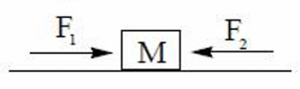
$A$ body of mass '$M$' is moving with a uniform speed of '$v$' on a frictionless horizontal surface under the influence of two forces $F_1$ and $F_2$ as shown in the figure. The net power of the system is
A
$(F_1-F_2) v$
B
$0.5(F_1+F_2) v$
C
$(F_1+F_2) v$
D
Zero
Solution
(D) Power is defined as the dot product of force and velocity,given by $P = \vec{F} \cdot \vec{v}$.
Since the body is moving with a uniform speed '$v$',the net force acting on the body must be zero according to Newton's first law of motion.
From the figure,the forces $F_1$ and $F_2$ act in opposite directions. Therefore,the net force $F_{net} = F_1 - F_2 = 0$.
The net power $P_{net}$ is the power delivered by the net force:
$P_{net} = F_{net} \cdot v = (F_1 - F_2) \cdot v$.
Since $F_1 = F_2$ for uniform motion,$P_{net} = 0 \cdot v = 0$.
Since the body is moving with a uniform speed '$v$',the net force acting on the body must be zero according to Newton's first law of motion.
From the figure,the forces $F_1$ and $F_2$ act in opposite directions. Therefore,the net force $F_{net} = F_1 - F_2 = 0$.
The net power $P_{net}$ is the power delivered by the net force:
$P_{net} = F_{net} \cdot v = (F_1 - F_2) \cdot v$.
Since $F_1 = F_2$ for uniform motion,$P_{net} = 0 \cdot v = 0$.
0 likes
View Solution143
MediumMCQ
$A$ motor can pump $7560 \text{ kg}$ of water per hour from a well of depth $100 \text{ m}$. If the efficiency of the pump is $70 \%$, then the power of the pump is (Acceleration due to gravity $= 10 \text{ m s}^{-2}$) (in $\text{ kW}$)
A
$4$
B
$6$
C
$3$
D
$7$
Solution
(C) The mass of water pumped per hour is $m = 7560 \text{ kg}$.
The time taken is $t = 1 \text{ hour} = 3600 \text{ s}$.
The depth of the well is $h = 100 \text{ m}$.
The acceleration due to gravity is $g = 10 \text{ m s}^{-2}$.
The useful work done (output energy) per second is the power output $P_{\text{out}} = \frac{mgh}{t}$.
$P_{\text{out}} = \frac{7560 \times 10 \times 100}{3600} = \frac{7560000}{3600} = 2100 \text{ W} = 2.1 \text{ kW}$.
Given the efficiency $\eta = 70 \% = 0.7$, the power input $P_{\text{in}}$ is given by $\eta = \frac{P_{\text{out}}}{P_{\text{in}}}$.
$P_{\text{in}} = \frac{P_{\text{out}}}{\eta} = \frac{2.1 \text{ kW}}{0.7} = 3 \text{ kW}$.
Therefore, the power of the pump is $3 \text{ kW}$.
The time taken is $t = 1 \text{ hour} = 3600 \text{ s}$.
The depth of the well is $h = 100 \text{ m}$.
The acceleration due to gravity is $g = 10 \text{ m s}^{-2}$.
The useful work done (output energy) per second is the power output $P_{\text{out}} = \frac{mgh}{t}$.
$P_{\text{out}} = \frac{7560 \times 10 \times 100}{3600} = \frac{7560000}{3600} = 2100 \text{ W} = 2.1 \text{ kW}$.
Given the efficiency $\eta = 70 \% = 0.7$, the power input $P_{\text{in}}$ is given by $\eta = \frac{P_{\text{out}}}{P_{\text{in}}}$.
$P_{\text{in}} = \frac{P_{\text{out}}}{\eta} = \frac{2.1 \text{ kW}}{0.7} = 3 \text{ kW}$.
Therefore, the power of the pump is $3 \text{ kW}$.
0 likes
View Solution144
EasyMCQ
The average power generated by a $90 \ kg$ mountain climber who climbs a summit of height $600 \ m$ in $90 \ minutes$ is (Acceleration due to gravity $= 10 \ ms^{-2}$). (in $W$)
A
$100$
B
$25$
C
$200$
D
$50$
Solution
(A) The formula for average power is $P_{av} = \frac{W}{t} = \frac{mgh}{t}$.
Given:
Mass $m = 90 \ kg$
Height $h = 600 \ m$
Time $t = 90 \ minutes = 90 \times 60 \ s = 5400 \ s$
Acceleration due to gravity $g = 10 \ ms^{-2}$.
Substituting the values:
$P_{av} = \frac{90 \times 10 \times 600}{90 \times 60} = \frac{540000}{5400} = 100 \ W$.
Given:
Mass $m = 90 \ kg$
Height $h = 600 \ m$
Time $t = 90 \ minutes = 90 \times 60 \ s = 5400 \ s$
Acceleration due to gravity $g = 10 \ ms^{-2}$.
Substituting the values:
$P_{av} = \frac{90 \times 10 \times 600}{90 \times 60} = \frac{540000}{5400} = 100 \ W$.
0 likes
View Solution145
MediumMCQ
$A$ machine gun fires $300$ bullets per minute, each with a velocity of $500 \,ms^{-1}$. If the mass of each bullet is $4 \,g$, the power of the machine gun is: (in $\,kW$)
A
$3.6$
B
$3$
C
$5.4$
D
$2.5$
Solution
(D) The power $P$ of the machine gun is defined as the total kinetic energy delivered per unit time.
$P = \frac{\text{Total Kinetic Energy}}{\text{Time}}$
$P = \frac{n \times (\frac{1}{2}mv^2)}{t} = \frac{n}{t} \times \frac{1}{2}mv^2$
Given:
Number of bullets $n = 300$
Time $t = 60 \,s$
Mass of each bullet $m = 4 \,g = 4 \times 10^{-3} \,kg$
Velocity $v = 500 \,ms^{-1}$
Substituting the values:
$P = \frac{300}{60} \times \frac{1}{2} \times (4 \times 10^{-3}) \times (500)^2$
$P = 5 \times \frac{1}{2} \times 0.004 \times 250000$
$P = 5 \times 0.002 \times 250000$
$P = 5 \times 500 = 2500 \,W$
$P = 2.5 \,kW$
$P = \frac{\text{Total Kinetic Energy}}{\text{Time}}$
$P = \frac{n \times (\frac{1}{2}mv^2)}{t} = \frac{n}{t} \times \frac{1}{2}mv^2$
Given:
Number of bullets $n = 300$
Time $t = 60 \,s$
Mass of each bullet $m = 4 \,g = 4 \times 10^{-3} \,kg$
Velocity $v = 500 \,ms^{-1}$
Substituting the values:
$P = \frac{300}{60} \times \frac{1}{2} \times (4 \times 10^{-3}) \times (500)^2$
$P = 5 \times \frac{1}{2} \times 0.004 \times 250000$
$P = 5 \times 0.002 \times 250000$
$P = 5 \times 500 = 2500 \,W$
$P = 2.5 \,kW$
0 likes
View Solution146
EasyMCQ
$A$ bead of mass $400 \ g$ is moving along a straight line under a force that delivers a constant power $1.2 \ W$ to the bead. If the bead is initially at rest,the speed it attains after $6 \ s$ in $m \ s^{-1}$ is:
A
$5$
B
$4$
C
$6$
D
$3$
Solution
(C) Given: Mass $m = 400 \ g = 0.4 \ kg$,Power $P = 1.2 \ W$,Time $t = 6 \ s$,Initial velocity $u = 0 \ m \ s^{-1}$.
Work done by the force is given by $W = P \times t$.
$W = 1.2 \times 6 = 7.2 \ J$.
According to the work-energy theorem,the work done by the force is equal to the change in kinetic energy of the bead.
$W = \Delta K.E. = \frac{1}{2} m v^2 - \frac{1}{2} m u^2$.
Since $u = 0$,$W = \frac{1}{2} m v^2$.
$7.2 = \frac{1}{2} \times 0.4 \times v^2$.
$7.2 = 0.2 \times v^2$.
$v^2 = \frac{7.2}{0.2} = 36$.
$v = \sqrt{36} = 6 \ m \ s^{-1}$.
Work done by the force is given by $W = P \times t$.
$W = 1.2 \times 6 = 7.2 \ J$.
According to the work-energy theorem,the work done by the force is equal to the change in kinetic energy of the bead.
$W = \Delta K.E. = \frac{1}{2} m v^2 - \frac{1}{2} m u^2$.
Since $u = 0$,$W = \frac{1}{2} m v^2$.
$7.2 = \frac{1}{2} \times 0.4 \times v^2$.
$7.2 = 0.2 \times v^2$.
$v^2 = \frac{7.2}{0.2} = 36$.
$v = \sqrt{36} = 6 \ m \ s^{-1}$.
0 likes
View Solution147
MediumMCQ
$A$ block of mass $50 \,kg$ is pulled with a constant speed of $4 \,ms^{-1}$ across a horizontal floor by an applied force of $500 \,N$ directed $30^{\circ}$ above the horizontal. The rate at which the force does work on the block in watt is
A
$2000/\sqrt{3}$
B
$500 \sqrt{3}$
C
$1732$
D
$1864$
Solution
(C) The rate at which the force does work is defined as power $(P)$.
Given:
Mass $m = 50 \,kg$
Speed $v = 4 \,ms^{-1}$
Applied force $F = 500 \,N$
Angle $\theta = 30^{\circ}$ above the horizontal.
The power delivered by a force is given by the dot product of force and velocity: $P = \vec{F} \cdot \vec{v} = Fv \cos \theta$.
Substituting the values:
$P = 500 \times 4 \times \cos 30^{\circ}$
$P = 2000 \times \frac{\sqrt{3}}{2}$
$P = 1000 \sqrt{3} \,W$
Using $\sqrt{3} \approx 1.732$:
$P = 1000 \times 1.732 = 1732 \,W$.
Given:
Mass $m = 50 \,kg$
Speed $v = 4 \,ms^{-1}$
Applied force $F = 500 \,N$
Angle $\theta = 30^{\circ}$ above the horizontal.
The power delivered by a force is given by the dot product of force and velocity: $P = \vec{F} \cdot \vec{v} = Fv \cos \theta$.
Substituting the values:
$P = 500 \times 4 \times \cos 30^{\circ}$
$P = 2000 \times \frac{\sqrt{3}}{2}$
$P = 1000 \sqrt{3} \,W$
Using $\sqrt{3} \approx 1.732$:
$P = 1000 \times 1.732 = 1732 \,W$.
0 likes
View Solution148
EasyMCQ
$A$ force of $5 \,N$ acts on a body initially at rest. If the instantaneous power due to the force at the end of the third second $(t=3 \,s)$ is $5 \,W$, then the mass of the body is (in $\,kg$)
A
$25$
B
$12.5$
C
$15$
D
$7.5$
Solution
(C) Given: Force $F = 5 \,N$, initial velocity $u = 0$, time $t = 3 \,s$, and instantaneous power $P = 5 \,W$.
Using Newton's second law, the acceleration $a$ is given by $a = \frac{F}{m} = \frac{5}{m}$.
The velocity $v$ at time $t = 3 \,s$ is $v = u + at = 0 + (\frac{5}{m}) \times 3 = \frac{15}{m} \,m/s$.
The instantaneous power is defined as $P = F \cdot v$.
Substituting the known values: $5 = 5 \times (\frac{15}{m})$.
Solving for $m$: $1 = \frac{15}{m}$, which gives $m = 15 \,kg$.
Using Newton's second law, the acceleration $a$ is given by $a = \frac{F}{m} = \frac{5}{m}$.
The velocity $v$ at time $t = 3 \,s$ is $v = u + at = 0 + (\frac{5}{m}) \times 3 = \frac{15}{m} \,m/s$.
The instantaneous power is defined as $P = F \cdot v$.
Substituting the known values: $5 = 5 \times (\frac{15}{m})$.
Solving for $m$: $1 = \frac{15}{m}$, which gives $m = 15 \,kg$.
0 likes
View Solution149
EasyMCQ
$A$ lift raises $50$ passengers, each having an average weight of $600 \,N$, to a height of $100 \,m$ at a constant speed in time $t$. If the average power of $15 \,kW$ is required by the lift, then the value of $t$ in seconds is:
A
$150$
B
$100$
C
$300$
D
$200$
Solution
(D) We know that, $\text{Power} = \frac{\text{Work done}}{\text{Time}}$.
$\Rightarrow P = \frac{W}{t} = \frac{F \times s}{t}$.
$\Rightarrow P = \frac{mgh}{t}$ ... $(i)$.
Here, the total weight of passengers is $mg = 50 \times 600 \,N = 30,000 \,N$.
The height is $h = 100 \,m$.
The power is $P = 15 \,kW = 15,000 \,W$.
Substituting these values into equation $(i)$, we get:
$t = \frac{mgh}{P}$.
$t = \frac{30,000 \times 100}{15,000}$.
$t = \frac{3,000,000}{15,000} = 200 \,s$.
$\Rightarrow P = \frac{W}{t} = \frac{F \times s}{t}$.
$\Rightarrow P = \frac{mgh}{t}$ ... $(i)$.
Here, the total weight of passengers is $mg = 50 \times 600 \,N = 30,000 \,N$.
The height is $h = 100 \,m$.
The power is $P = 15 \,kW = 15,000 \,W$.
Substituting these values into equation $(i)$, we get:
$t = \frac{mgh}{P}$.
$t = \frac{30,000 \times 100}{15,000}$.
$t = \frac{3,000,000}{15,000} = 200 \,s$.
0 likes
View Solution150
MediumMCQ
$A$ quarter horsepower motor runs at a speed of $600 \ rpm$. Assuming $60 \%$ efficiency,the work done by the motor in one rotation is (in $J$)
A
$7.46$
B
$74.6$
C
$111.9$
D
$11.19$
Solution
(D) Given,power $P = \frac{1}{4} \ hp = \frac{746}{4} = 186.5 \ W$.
Effective power $P^{\prime} = 186.5 \times \frac{60}{100} = 111.9 \ W$.
Angular velocity $\omega = \frac{2 \pi \times 600}{60} = 20 \pi \ rad/s$.
Time taken for one rotation $t = \frac{2 \pi}{\omega} = \frac{2 \pi}{20 \pi} = 0.1 \ s$.
Work done in one rotation $W = P^{\prime} \times t = 111.9 \times 0.1 = 11.19 \ J$.
Effective power $P^{\prime} = 186.5 \times \frac{60}{100} = 111.9 \ W$.
Angular velocity $\omega = \frac{2 \pi \times 600}{60} = 20 \pi \ rad/s$.
Time taken for one rotation $t = \frac{2 \pi}{\omega} = \frac{2 \pi}{20 \pi} = 0.1 \ s$.
Work done in one rotation $W = P^{\prime} \times t = 111.9 \times 0.1 = 11.19 \ J$.
0 likes
View SolutionWork, Energy, Power and Collision — Power · Frequently Asked Questions
1Are these Work, Energy, Power and Collision questions useful for JEE and NEET?
Yes. All questions in this section are mapped to JEE Main and NEET exam patterns. Previous year questions from JEE Main, NEET, GUJCET and state-level exams are included with full solutions.
2Can I switch to Hindi or Gujarati for these questions?
Yes. Use the language tabs in the hero section or the sidebar to view the same questions and solutions in English, Hindi or Gujarati.
3How do I generate a question paper from this subtopic?
Use the Vedclass Exam Paper Generator — select the chapter and subtopic, set difficulty, and generate Sets A, B, C, D automatically. First 3 chapters of every subject are free.
Vedclass Products
For Students
Vedclass Test Series
Mock tests in real JEE/NEET style with performance analysis. 5-day free trial.
Start Free TrialFor Teachers
Exam Paper Generator
Generate Set A/B/C/D papers from this chapter in 2 minutes. 3 chapters free.
Try FreeFor Institutes
Online Exam Module
Live online exams with unlimited students, 360° analytics & white-label branding.
See DemoFor Teachers & Institutes
Generate a Work, Energy, Power and Collision Exam Paper in 2 Minutes
Select subtopic & difficulty — Sets A, B, C, D auto-generated with No Repeat logic.
First 3 chapters of every subject are free — no payment required.