
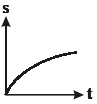
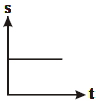
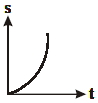
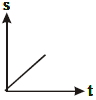
$A$ particle is moving unidirectionally on a horizontal plane under the action of a constant power supplying energy source. The displacement $(s)$ - time $(t)$ graph that describes the motion of the particle is (graphs are drawn schematically and are not to scale)
- A
- B
- C
- D
Explore More
Similar Questions
Assume the aerodynamic drag force on a car is proportional to its speed. If the power output from the engine is doubled,then the maximum speed of the car:
Medium
View Solution$A$ force of $(60 \hat{i} + 15 \hat{j} - 3 \hat{k}) \text{ N}$ produces a velocity of $(2 \hat{i} - 4 \hat{j} + 5 \hat{k}) \text{ m/s}$ in a particle. The value of power at that time will be: (in $\text{ W}$)
$A$ man does a given amount of work in $10 \ s$. Another man does the same amount of work in $20 \ s$. The ratio of the output power of the first man to the second man is:
Easy
View Solution$A$ body at rest is moved along a horizontal straight line by a machine delivering a constant power. The distance moved by the body in time $t$ is proportional to :
Difficult
View Solution$A$ body is moving unidirectionally under the influence of a source of constant power. Its displacement in time $t$ is proportional to
Difficult
View SolutionVedclass Products
For Students
Vedclass Test Series
Mock tests in real JEE/NEET style with performance analysis. 5-day free trial.
Start Free TrialFor Teachers
Exam Paper Generator
Generate Set A/B/C/D exam papers from 7.5L+ questions in 2 minutes. 3 chapters free.
Try FreeFor Institutes
Online Exam Module
Live online exams with unlimited students, 360° analytics & white-label branding.
See Demo