
A English
Units Questions in English
Class 11 Physics · Units, Dimensions and Measurement · Units
123+
Questions
English
Language
100%
With Solutions
Showing 50 of 123 questions in English
51
EasyMCQ
$1 \mathring{A} = \dots \dots \text{ fm}$
A
$10^5$
B
$10^{-5}$
C
$10^{-15}$
D
$10^{-10}$
Solution
(A) We know that $1 \mathring{A} = 10^{-10} \text{ m}$.
We also know that $1 \text{ fm} = 10^{-15} \text{ m}$.
To express $1 \mathring{A}$ in terms of $\text{fm}$, we perform the following calculation:
$1 \mathring{A} = \frac{10^{-10} \text{ m}}{10^{-15} \text{ m}} \text{ fm} = 10^{-10 - (-15)} \text{ fm} = 10^5 \text{ fm}$.
Thus, $1 \mathring{A} = 10^5 \text{ fm}$.
We also know that $1 \text{ fm} = 10^{-15} \text{ m}$.
To express $1 \mathring{A}$ in terms of $\text{fm}$, we perform the following calculation:
$1 \mathring{A} = \frac{10^{-10} \text{ m}}{10^{-15} \text{ m}} \text{ fm} = 10^{-10 - (-15)} \text{ fm} = 10^5 \text{ fm}$.
Thus, $1 \mathring{A} = 10^5 \text{ fm}$.
0 likes
View Solution52
EasyMCQ
$1 \text{ kilowatt hour} = \dots \text{ joules}$
A
$3.6 \times 10^6 \text{ J}$
B
$3.6 \times 10^4 \text{ J}$
C
$3.6 \times 10^3 \text{ J}$
D
$6 \times 10^{-4} \text{ J}$
Solution
(A) The unit kilowatt-hour $(kWh)$ is a unit of energy.
$1 \text{ kWh} = 1 \text{ kilowatt} \times 1 \text{ hour}$.
Since $1 \text{ kilowatt} = 1000 \text{ watts} = 1000 \text{ J/s}$ and $1 \text{ hour} = 3600 \text{ seconds}$.
Therefore,$1 \text{ kWh} = 1000 \text{ J/s} \times 3600 \text{ s}$.
$1 \text{ kWh} = 3,600,000 \text{ J} = 3.6 \times 10^6 \text{ J}$.
$1 \text{ kWh} = 1 \text{ kilowatt} \times 1 \text{ hour}$.
Since $1 \text{ kilowatt} = 1000 \text{ watts} = 1000 \text{ J/s}$ and $1 \text{ hour} = 3600 \text{ seconds}$.
Therefore,$1 \text{ kWh} = 1000 \text{ J/s} \times 3600 \text{ s}$.
$1 \text{ kWh} = 3,600,000 \text{ J} = 3.6 \times 10^6 \text{ J}$.
0 likes
View Solution53
EasyMCQ
Select the incorrect option.
A
$1 \ Calorie = 4.18 \ Joules$
B
$1 \ \mathring{A} = 10^{-10} \ m$
C
$1 \ MeV = 1.6 \times 10^{-13} \ Joules$
D
$1 \ Newton = 10^{-5} \ Dynes$
Solution
(D) The unit of force in the $CGS$ system is $Dyne$ and in the $SI$ system is $Newton$. The relationship is $1 \ Newton = 10^5 \ Dyne$. Therefore,the statement $1 \ Newton = 10^{-5} \ Dynes$ is incorrect.
0 likes
View Solution54
EasyMCQ
If $1 \ gm \ cm \ s^{-1} = x \ Ns$,then $x = $
A
$1 \times 10^{-1}$
B
$3 \times 10^{-2}$
C
$6 \times 10^{-4}$
D
$1 \times 10^{-5}$
Solution
(D) We are given the unit $1 \ gm \ cm \ s^{-1}$.
To convert this to $Ns$ (Newton-seconds),we express the units in terms of $kg$,$m$,and $s$.
We know that $1 \ gm = 10^{-3} \ kg$ and $1 \ cm = 10^{-2} \ m$.
Substituting these values into the expression:
$1 \ gm \ cm \ s^{-1} = (10^{-3} \ kg) \times (10^{-2} \ m) \times s^{-1}$
$= 10^{-5} \ kg \ m \ s^{-1}$.
Since $1 \ N = 1 \ kg \ m \ s^{-2}$,it follows that $1 \ Ns = 1 \ kg \ m \ s^{-1}$.
Therefore,$1 \ gm \ cm \ s^{-1} = 10^{-5} \ Ns$.
Comparing this with $x \ Ns$,we get $x = 10^{-5}$.
To convert this to $Ns$ (Newton-seconds),we express the units in terms of $kg$,$m$,and $s$.
We know that $1 \ gm = 10^{-3} \ kg$ and $1 \ cm = 10^{-2} \ m$.
Substituting these values into the expression:
$1 \ gm \ cm \ s^{-1} = (10^{-3} \ kg) \times (10^{-2} \ m) \times s^{-1}$
$= 10^{-5} \ kg \ m \ s^{-1}$.
Since $1 \ N = 1 \ kg \ m \ s^{-2}$,it follows that $1 \ Ns = 1 \ kg \ m \ s^{-1}$.
Therefore,$1 \ gm \ cm \ s^{-1} = 10^{-5} \ Ns$.
Comparing this with $x \ Ns$,we get $x = 10^{-5}$.
0 likes
View Solution55
MediumMCQ
It is estimated that per minute each $cm^2$ of the Earth receives about $2 \ cal$ $(1 \ cal = 4.18 \ J)$ of heat energy from the Sun. This is called the Solar constant. In $SI$ units,the value is: (in $W/m^2$)
A
$1060$
B
$178.4$
C
$17.84$
D
$1393.33$
Solution
(D) The Solar constant is given as $2 \ cal / (cm^2 \cdot min)$.
To convert this to $SI$ units ($W/m^2$ or $J / (m^2 \cdot s)$):
$1 \ cal = 4.18 \ J$
$1 \ min = 60 \ s$
$1 \ m^2 = 10^4 \ cm^2$
Solar constant $= 2 \times \frac{4.18 \ J}{10^{-4} \ m^2 \times 60 \ s}$
Solar constant $= 2 \times 4.18 \times \frac{10^4}{60} \ J/(m^2 \cdot s)$
Solar constant $= \frac{8.36 \times 10000}{60} \ W/m^2 = \frac{83600}{60} \ W/m^2 = 1393.33 \ W/m^2$.
To convert this to $SI$ units ($W/m^2$ or $J / (m^2 \cdot s)$):
$1 \ cal = 4.18 \ J$
$1 \ min = 60 \ s$
$1 \ m^2 = 10^4 \ cm^2$
Solar constant $= 2 \times \frac{4.18 \ J}{10^{-4} \ m^2 \times 60 \ s}$
Solar constant $= 2 \times 4.18 \times \frac{10^4}{60} \ J/(m^2 \cdot s)$
Solar constant $= \frac{8.36 \times 10000}{60} \ W/m^2 = \frac{83600}{60} \ W/m^2 = 1393.33 \ W/m^2$.
0 likes
View Solution56
EasyMCQ
Which of the following is not a physical quantity?
A
Volume
B
Time
C
Length
D
Mole
Solution
(D) physical quantity is a property of a material or system that can be quantified by measurement. Volume,time,and length are all physical quantities that can be measured. The mole is a unit used to measure the amount of substance,not a physical quantity itself. Therefore,the correct answer is $D$.
0 likes
View Solution57
Medium
Explain this statement clearly: "To call a dimensional quantity 'large' or 'small' is meaningless without specifying a standard for comparison". In view of this,reframe the following statements wherever necessary:
$(a)$ atoms are very small objects
$(b)$ a jet plane moves with great speed
$(c)$ the mass of Jupiter is very large
$(d)$ the air inside this room contains a large number of molecules
$(e)$ a proton is much more massive than an electron
$(f)$ the speed of sound is much smaller than the speed of light.
$(a)$ atoms are very small objects
$(b)$ a jet plane moves with great speed
$(c)$ the mass of Jupiter is very large
$(d)$ the air inside this room contains a large number of molecules
$(e)$ a proton is much more massive than an electron
$(f)$ the speed of sound is much smaller than the speed of light.
Solution
(N/A) The statement is true because the terms 'large' and 'small' are relative. $A$ physical quantity can only be described as large or small when compared to a standard reference value.
$(a)$ Atoms are very small objects compared to a grain of sand.
$(b)$ $A$ jet plane moves with a speed much greater than that of a car.
$(c)$ The mass of Jupiter is very large compared to the mass of the Earth.
$(d)$ The air inside this room contains a large number of molecules compared to the number of molecules in a small test tube.
$(e)$ $A$ proton is much more massive than an electron (this statement is already meaningful as it compares two specific physical entities).
$(f)$ The speed of sound is much smaller than the speed of light (this statement is already meaningful as it compares two specific physical entities).
$(a)$ Atoms are very small objects compared to a grain of sand.
$(b)$ $A$ jet plane moves with a speed much greater than that of a car.
$(c)$ The mass of Jupiter is very large compared to the mass of the Earth.
$(d)$ The air inside this room contains a large number of molecules compared to the number of molecules in a small test tube.
$(e)$ $A$ proton is much more massive than an electron (this statement is already meaningful as it compares two specific physical entities).
$(f)$ The speed of sound is much smaller than the speed of light (this statement is already meaningful as it compares two specific physical entities).
0 likes
View Solution58
EasyMCQ
$A$ new unit of length is chosen such that the speed of light in vacuum is unity. What is the distance between the Sun and the Earth in terms of the new unit if light takes $8 \; min$ and $20 \; s$ to cover this distance?
A
$480$
B
$500$
C
$720$
D
$250$
Solution
(B) The distance between the Sun and the Earth is given by the product of the speed of light and the time taken by light to travel this distance.
Given that in the new unit system,the speed of light $c = 1 \; \text{unit/s}$.
The time taken by light to travel from the Sun to the Earth is $t = 8 \; \text{min} \; 20 \; \text{s}$.
Converting the time into seconds: $t = (8 \times 60) \; \text{s} + 20 \; \text{s} = 480 \; \text{s} + 20 \; \text{s} = 500 \; \text{s}$.
Therefore,the distance $d = c \times t = 1 \times 500 = 500 \; \text{units}$.
Given that in the new unit system,the speed of light $c = 1 \; \text{unit/s}$.
The time taken by light to travel from the Sun to the Earth is $t = 8 \; \text{min} \; 20 \; \text{s}$.
Converting the time into seconds: $t = (8 \times 60) \; \text{s} + 20 \; \text{s} = 480 \; \text{s} + 20 \; \text{s} = 500 \; \text{s}$.
Therefore,the distance $d = c \times t = 1 \times 500 = 500 \; \text{units}$.
0 likes
View Solution59
MediumMCQ
Give the $CGS$ unit of universal gravitational constant $(G)$.
A
$dyn \cdot cm^2 \cdot g^{-2}$
B
$dyn \cdot cm \cdot g^{-2}$
C
$erg \cdot cm \cdot g^{-1}$
D
$dyn \cdot cm^2 \cdot g^{-1}$
Solution
(A) According to Newton's law of universal gravitation,the force $F$ between two masses $m_1$ and $m_2$ separated by a distance $r$ is given by $F = G \frac{m_1 m_2}{r^2}$.
Rearranging for $G$,we get $G = \frac{F \cdot r^2}{m_1 \cdot m_2}$.
In the $CGS$ system,the unit of force $F$ is $dyne$ $(dyn)$,the unit of distance $r$ is $centimeter$ $(cm)$,and the unit of mass $m$ is $gram$ $(g)$.
Substituting these units into the formula for $G$,we get the unit of $G = \frac{dyn \cdot cm^2}{g \cdot g} = dyn \cdot cm^2 \cdot g^{-2}$.
Rearranging for $G$,we get $G = \frac{F \cdot r^2}{m_1 \cdot m_2}$.
In the $CGS$ system,the unit of force $F$ is $dyne$ $(dyn)$,the unit of distance $r$ is $centimeter$ $(cm)$,and the unit of mass $m$ is $gram$ $(g)$.
Substituting these units into the formula for $G$,we get the unit of $G = \frac{dyn \cdot cm^2}{g \cdot g} = dyn \cdot cm^2 \cdot g^{-2}$.
0 likes
View Solution60
Difficult
What is heat? Write $SI$ and $CGS$ unit of heat and give their relation.
Solution
(N/A) Heat is a form of energy that flows from a body at a higher temperature to a body at a lower temperature due to the temperature difference between them.
The $SI$ unit of heat is the Joule $(J)$.
The $CGS$ unit of heat is the calorie $(cal)$.
The relation between the $SI$ and $CGS$ units is: $1 \ cal = 4.184 \ J$ (often approximated as $4.2 \ J$).
The $SI$ unit of heat is the Joule $(J)$.
The $CGS$ unit of heat is the calorie $(cal)$.
The relation between the $SI$ and $CGS$ units is: $1 \ cal = 4.184 \ J$ (often approximated as $4.2 \ J$).
0 likes
View Solution61
Medium
Write the unit of mass used for atoms and its definition.
Solution
(N/A) The mass of an atom is very small compared to a kilogram $(kg)$,so the kilogram is not a convenient unit to measure such small quantities.
In nuclear physics,the unit used for atoms is the atomic mass unit $(amu)$,which is also denoted by the unified mass unit $(u)$.
Definition: The twelfth part of the mass of an unexcited carbon $(C^{12})$ atom is called $1$ $amu$,which is $1$ $u$.
The mass of an unexcited carbon atom is $1.992647 \times 10^{-26} \ kg$.
$1$ $u = \frac{\text{Mass of unexcited carbon atom}}{12} = \frac{1.992647 \times 10^{-26}}{12} \ kg = 0.166 \times 10^{-26} \ kg = 1.66 \times 10^{-27} \ kg$.
The atomic masses of various elements expressed in atomic mass unit $(u)$ are close to being integral multiples of the mass of a hydrogen atom. However,there are many striking exceptions to this rule.
Accurate measurement of atomic masses is carried out with mass spectrometers.
In nuclear physics,the unit used for atoms is the atomic mass unit $(amu)$,which is also denoted by the unified mass unit $(u)$.
Definition: The twelfth part of the mass of an unexcited carbon $(C^{12})$ atom is called $1$ $amu$,which is $1$ $u$.
The mass of an unexcited carbon atom is $1.992647 \times 10^{-26} \ kg$.
$1$ $u = \frac{\text{Mass of unexcited carbon atom}}{12} = \frac{1.992647 \times 10^{-26}}{12} \ kg = 0.166 \times 10^{-26} \ kg = 1.66 \times 10^{-27} \ kg$.
The atomic masses of various elements expressed in atomic mass unit $(u)$ are close to being integral multiples of the mass of a hydrogen atom. However,there are many striking exceptions to this rule.
Accurate measurement of atomic masses is carried out with mass spectrometers.
0 likes
View Solution62
Easy
What is a physical quantity? Write its types.
Solution
(N/A) physical quantity is a property of a material or system that can be quantified by measurement. It is expressed as the product of a numerical value and a unit.
There are two main types of physical quantities:
$(1)$ Fundamental quantities: These are the basic physical quantities that are independent of each other and cannot be defined in terms of other physical quantities. Examples include length,mass,time,electric current,temperature,amount of substance,and luminous intensity.
$(2)$ Derived quantities: These are physical quantities that are expressed in terms of fundamental quantities. They are obtained by multiplying or dividing fundamental quantities. Examples include velocity,acceleration,force,work,and power.
There are two main types of physical quantities:
$(1)$ Fundamental quantities: These are the basic physical quantities that are independent of each other and cannot be defined in terms of other physical quantities. Examples include length,mass,time,electric current,temperature,amount of substance,and luminous intensity.
$(2)$ Derived quantities: These are physical quantities that are expressed in terms of fundamental quantities. They are obtained by multiplying or dividing fundamental quantities. Examples include velocity,acceleration,force,work,and power.
0 likes
View Solution63
Medium
What is a unit? What are fundamental units and derived units?
Solution
(N/A) unit is defined as the comparison of a physical quantity with a certain basic,internationally accepted reference standard.
- The measurement of any physical quantity is expressed by a numerical value accompanied by a unit.
- Although the number of physical quantities is very large,we only need a limited number of units to express all of them,as they are interrelated.
- The units used for fundamental or base quantities are called fundamental or base units (e.g.,$meter$,$kilogram$,$second$).
- Physical quantities that are expressed as a combination of fundamental quantities are called derived quantities,and their units are called derived units (e.g.,$speed = distance/time$,so the unit is $m/s$).
- The measurement of any physical quantity is expressed by a numerical value accompanied by a unit.
- Although the number of physical quantities is very large,we only need a limited number of units to express all of them,as they are interrelated.
- The units used for fundamental or base quantities are called fundamental or base units (e.g.,$meter$,$kilogram$,$second$).
- Physical quantities that are expressed as a combination of fundamental quantities are called derived quantities,and their units are called derived units (e.g.,$speed = distance/time$,so the unit is $m/s$).
0 likes
View Solution64
Medium
What is a fundamental quantity? What is a derived quantity?
Solution
(N/A) $(1)$ Fundamental quantities are physical quantities that do not depend on any other physical quantities for their measurement. Examples include length,mass,and time.
$(2)$ Derived quantities are physical quantities that are expressed as combinations of fundamental quantities. Examples include velocity,force,and work.
$(2)$ Derived quantities are physical quantities that are expressed as combinations of fundamental quantities. Examples include velocity,force,and work.
0 likes
View Solution65
Medium
What is a system of units? Write the different types of systems of units.
Solution
(N/A) system of units is a complete set of units,both fundamental and derived,for all kinds of physical quantities.
There are mainly four types of systems of units:
$(1)$ $CGS$ system: In this system,length is measured in centimeters $(cm)$,mass in grams $(g)$,and time in seconds $(s)$.
$(2)$ $FPS$ system: In this system,length is measured in feet $(ft)$,mass in pounds $(lb)$,and time in seconds $(s)$.
$(3)$ $MKS$ system: In this system,length is measured in meters $(m)$,mass in kilograms $(kg)$,and time in seconds $(s)$.
$(4)$ $SI$ system: This is the International System of Units,which is an extended version of the $MKS$ system. It is the globally accepted standard system of units.
There are mainly four types of systems of units:
$(1)$ $CGS$ system: In this system,length is measured in centimeters $(cm)$,mass in grams $(g)$,and time in seconds $(s)$.
$(2)$ $FPS$ system: In this system,length is measured in feet $(ft)$,mass in pounds $(lb)$,and time in seconds $(s)$.
$(3)$ $MKS$ system: In this system,length is measured in meters $(m)$,mass in kilograms $(kg)$,and time in seconds $(s)$.
$(4)$ $SI$ system: This is the International System of Units,which is an extended version of the $MKS$ system. It is the globally accepted standard system of units.
0 likes
View Solution66
Medium
Write a note on $SI$ (Systeme Internationale) units.
Solution
(N/A) The $SI$ (Systeme Internationale d'Unites) is the internationally accepted system of units.
- It is the modern form of the metric system and is abbreviated as $SI$.
- The $SI$ system consists of $7$ fundamental physical quantities: length,mass,time,electric current,thermodynamic temperature,amount of substance,and luminous intensity.
- These fundamental quantities,along with their units and symbols,were established and recommended by the General Conference on Weights and Measures $(CGPM)$ in $1971$ for international use in scientific,technical,and commercial fields.
- The $SI$ system is based on the decimal system,which makes conversions between units simple and convenient.
- It is the modern form of the metric system and is abbreviated as $SI$.
- The $SI$ system consists of $7$ fundamental physical quantities: length,mass,time,electric current,thermodynamic temperature,amount of substance,and luminous intensity.
- These fundamental quantities,along with their units and symbols,were established and recommended by the General Conference on Weights and Measures $(CGPM)$ in $1971$ for international use in scientific,technical,and commercial fields.
- The $SI$ system is based on the decimal system,which makes conversions between units simple and convenient.
0 likes
View Solution67
Difficult
Explain supplementary quantities and their units in the $SI$ system.
Solution
(N/A) There are two supplementary quantities in the $SI$ system:
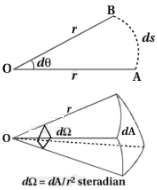
$(1)$ Plane angle $d \theta$
$(2)$ Solid angle $d \Omega$
$(1)$ Plane angle $d \theta$: The ratio of the arc length of a circle to its radius is called the plane angle $(d \theta)$.
From the figure,the plane angle $d \theta = \frac{\text{arc}}{\text{radius}} = \frac{ds}{r}$.
The plane angle subtended at the center by an arc of a circle having a length equal to the radius is called $1$ radian. It is represented as $rad$. The maximum value of the plane angle is $2 \pi \ rad$.
If $ds = r$,then $\theta = 1 \ rad$.
$[1^{\circ} = \frac{\pi}{180} \ rad]$ and $[1 \ rad = \frac{180}{\pi} \ \text{degree}]$.
$(2)$ Solid angle $d \Omega$: The angle subtended by an area $(\Delta A)$ on a spherical surface at the center of the sphere is called the solid angle $d \Omega$.
$d \Omega = \frac{dA}{r^2} \ \text{steradian}$.
From the figure,the solid angle $d \Omega = \frac{\text{area}}{(\text{radius})^2} = \frac{\Delta A}{r^2}$.
The maximum value of the solid angle is $4 \pi \ sr$.
The angle subtended by an area of $1 \ m^2$ on a sphere of $1 \ m$ radius at its center is called $1$ steradian. Its symbol is $sr$.
If $\Delta A = 1 \ m^2$ and $r = 1 \ m$,then $\Omega = 1 \ sr$.
$(1)$ Plane angle $d \theta$
$(2)$ Solid angle $d \Omega$
$(1)$ Plane angle $d \theta$: The ratio of the arc length of a circle to its radius is called the plane angle $(d \theta)$.
From the figure,the plane angle $d \theta = \frac{\text{arc}}{\text{radius}} = \frac{ds}{r}$.
The plane angle subtended at the center by an arc of a circle having a length equal to the radius is called $1$ radian. It is represented as $rad$. The maximum value of the plane angle is $2 \pi \ rad$.
If $ds = r$,then $\theta = 1 \ rad$.
$[1^{\circ} = \frac{\pi}{180} \ rad]$ and $[1 \ rad = \frac{180}{\pi} \ \text{degree}]$.
$(2)$ Solid angle $d \Omega$: The angle subtended by an area $(\Delta A)$ on a spherical surface at the center of the sphere is called the solid angle $d \Omega$.
$d \Omega = \frac{dA}{r^2} \ \text{steradian}$.
From the figure,the solid angle $d \Omega = \frac{\text{area}}{(\text{radius})^2} = \frac{\Delta A}{r^2}$.
The maximum value of the solid angle is $4 \pi \ sr$.
The angle subtended by an area of $1 \ m^2$ on a sphere of $1 \ m$ radius at its center is called $1$ steradian. Its symbol is $sr$.
If $\Delta A = 1 \ m^2$ and $r = 1 \ m$,then $\Omega = 1 \ sr$.
1 likes
View Solution68
Medium
Provide a table for the multiples and submultiples of various $SI$ units.
Solution
Multiples are used to express very large values,while submultiples are used for very small values. Below are the standard $SI$ prefixes:
Multiples:
Submultiples:
Multiples:
| Value | Prefix / Symbol |
|---|---|
| $10^{18}$ | Exa $(E)$ |
| $10^{15}$ | Peta $(P)$ |
| $10^{12}$ | Tera $(T)$ |
| $10^{9}$ | Giga $(G)$ |
| $10^{6}$ | Mega $(M)$ |
| $10^{3}$ | Kilo $(k)$ |
| $10^{2}$ | Hecto $(h)$ |
| $10^{1}$ | Deca $(da)$ |
Submultiples:
| Factor | Prefix / Symbol |
|---|---|
| $10^{-1}$ | deci $(d)$ |
| $10^{-2}$ | centi $(c)$ |
| $10^{-3}$ | milli $(m)$ |
| $10^{-6}$ | micro $(\mu)$ |
| $10^{-9}$ | nano $(n)$ |
| $10^{-12}$ | pico $(p)$ |
| $10^{-15}$ | femto $(f)$ |
| $10^{-18}$ | atto $(a)$ |
0 likes
View Solution69
Medium
What is the international system of units? What are the supplementary quantities?
Solution
(N/A) The international system of units is known as the $SI$ (Système International d'Unités).
The supplementary quantities are:
$(1)$ Plane angle $(d \theta)$,measured in radians $(rad)$.
$(2)$ Solid angle $(d \Omega)$,measured in steradians $(sr)$.
The supplementary quantities are:
$(1)$ Plane angle $(d \theta)$,measured in radians $(rad)$.
$(2)$ Solid angle $(d \Omega)$,measured in steradians $(sr)$.
0 likes
View Solution70
Difficult
What is $1$ radian? What is $1$ steradian?
Solution
(N/A) $1$ radian: The plane angle subtended at the center of a circle by an arc equal in length to the radius of the circle is defined as $1$ radian.
$1$ steradian: The solid angle subtended at the center of a sphere by a surface area equal to the square of the radius of the sphere is defined as $1$ steradian.
$1$ steradian: The solid angle subtended at the center of a sphere by a surface area equal to the square of the radius of the sphere is defined as $1$ steradian.
0 likes
View Solution71
DifficultMCQ
What is the maximum value of a plane angle and a solid angle?
A
$2 \pi \; rad$ and $4 \pi \; sr$
B
$\pi \; rad$ and $2 \pi \; sr$
C
$4 \pi \; rad$ and $2 \pi \; sr$
D
$2 \pi \; rad$ and $2 \pi \; sr$
Solution
(A) The plane angle is defined as the ratio of the arc length to the radius of a circle. For a full circle,the arc length is $2 \pi r$,so the maximum plane angle is $\frac{2 \pi r}{r} = 2 \pi \; rad$.
The solid angle is defined as the ratio of the area of a spherical cap to the square of the radius of the sphere. For a full sphere,the surface area is $4 \pi r^2$,so the maximum solid angle is $\frac{4 \pi r^2}{r^2} = 4 \pi \; sr$.
The solid angle is defined as the ratio of the area of a spherical cap to the square of the radius of the sphere. For a full sphere,the surface area is $4 \pi r^2$,so the maximum solid angle is $\frac{4 \pi r^2}{r^2} = 4 \pi \; sr$.
0 likes
View Solution72
Easy
Describe the range of lengths and the relationships between various units of length.
Solution
The sizes of objects in the universe vary over a very wide range. The dimension of an atomic nucleus is approximately $10^{-14} \, m$, while the length of the observable universe is about $10^{26} \, m$.
We use special units for short and large lengths:
$1 \, fm$ (fermi) $= 10^{-15} \, m$
Size of nucleus $\approx 10^{-14} \, m$
$1 \, \mathring{A}$ ($\mathring{A}$) $= 10^{-10} \, m$
$1 \, nm$ (nanometer) $= 10^{-9} \, m$
$1 \, \mu m$ (micrometer) $= 10^{-6} \, m$
$1 \, mm$ (millimeter) $= 10^{-3} \, m$
$1 \, km$ (kilometer) $= 10^{3} \, m$
$1 \, Mm$ (megameter) $= 10^{6} \, m$
$1 \, AU$ (astronomical unit) $= 1.496 \times 10^{11} \, m$
$1 \, ly$ (light year) $= 9.46 \times 10^{15} \, m$
$1 \, pc$ (parsec) $= 3.08 \times 10^{16} \, m$
Size of galaxy $\approx 10^{21} \, m$
We use special units for short and large lengths:
$1 \, fm$ (fermi) $= 10^{-15} \, m$
Size of nucleus $\approx 10^{-14} \, m$
$1 \, \mathring{A}$ ($\mathring{A}$) $= 10^{-10} \, m$
$1 \, nm$ (nanometer) $= 10^{-9} \, m$
$1 \, \mu m$ (micrometer) $= 10^{-6} \, m$
$1 \, mm$ (millimeter) $= 10^{-3} \, m$
$1 \, km$ (kilometer) $= 10^{3} \, m$
$1 \, Mm$ (megameter) $= 10^{6} \, m$
$1 \, AU$ (astronomical unit) $= 1.496 \times 10^{11} \, m$
$1 \, ly$ (light year) $= 9.46 \times 10^{15} \, m$
$1 \, pc$ (parsec) $= 3.08 \times 10^{16} \, m$
Size of galaxy $\approx 10^{21} \, m$
0 likes
View Solution73
Easy
What is $1\,AU$? It represents which physical quantity?
Solution
(N/A) An Astronomical Unit $(AU)$ is defined as the average distance between the Sun and the Earth.
It represents the physical quantity of length or distance.
The value of $1\,AU$ is approximately $1.496 \times 10^{11} \, m$.
It represents the physical quantity of length or distance.
The value of $1\,AU$ is approximately $1.496 \times 10^{11} \, m$.
0 likes
View Solution74
Medium
Define light year. Is it a unit of time?
Solution
(N/A) Light year is defined as the distance travelled by light in a vacuum in $1$ year.
Speed of light in vacuum,$c = 2.99 \times 10^{8} \text{ m/s}$.
Distance travelled in $1$ year $= c \times t$
$= 2.99 \times 10^{8} \text{ m/s} \times (365 \times 24 \times 3600 \text{ s})$
$= 9.46 \times 10^{15} \text{ m}$.
No,a light year is not a unit of time; it is a unit of distance used to measure the vast distances between celestial objects.
Speed of light in vacuum,$c = 2.99 \times 10^{8} \text{ m/s}$.
Distance travelled in $1$ year $= c \times t$
$= 2.99 \times 10^{8} \text{ m/s} \times (365 \times 24 \times 3600 \text{ s})$
$= 9.46 \times 10^{15} \text{ m}$.
No,a light year is not a unit of time; it is a unit of distance used to measure the vast distances between celestial objects.
0 likes
View Solution75
EasyMCQ
Define parsec. $1 \ \text{fm} = \dots \ \mathring{A}$.
A
$10^{-5}$
B
$10^{-6}$
C
$10^{-4}$
D
$10^{-7}$
Solution
(A) parsec (parallax second) is a unit of distance used in astronomy,defined as the distance at which an arc of $1 \ \text{AU}$ (astronomical unit) subtends an angle of $1 \ \text{arcsecond}$ $(1'')$. It is approximately equal to $3.08 \times 10^{16} \ \text{m}$.
To convert $1 \ \text{fm}$ (femtometer) to $\mathring{A}$ $(\mathring{A}):$
$1 \ \text{fm} = 10^{-15} \ \text{m}$
$1 \ \mathring{A} = 10^{-10} \ \text{m}$
Therefore,$1 \ \text{fm} = \frac{10^{-15} \ \text{m}}{10^{-10} \ \text{m}} \ \mathring{A} = 10^{-5} \ \mathring{A}$.
To convert $1 \ \text{fm}$ (femtometer) to $\mathring{A}$ $(\mathring{A}):$
$1 \ \text{fm} = 10^{-15} \ \text{m}$
$1 \ \mathring{A} = 10^{-10} \ \text{m}$
Therefore,$1 \ \text{fm} = \frac{10^{-15} \ \text{m}}{10^{-10} \ \text{m}} \ \mathring{A} = 10^{-5} \ \mathring{A}$.
0 likes
View Solution76
MediumMCQ
In a cesium clock,the time interval depends on which factors?
A
Vibrations of cesium-$133$ atoms
B
Temperature of the surroundings
C
Pressure of the environment
D
Magnetic field intensity
Solution
(A) cesium clock is based on the vibrations of cesium-$133$ atoms.
Specifically,the second is defined as the duration of $9,192,631,770$ periods of the radiation corresponding to the transition between the two hyperfine levels of the ground state of the cesium-$133$ atom.
Therefore,the time interval in a cesium clock depends on the atomic vibrations of cesium-$133$.
Specifically,the second is defined as the duration of $9,192,631,770$ periods of the radiation corresponding to the transition between the two hyperfine levels of the ground state of the cesium-$133$ atom.
Therefore,the time interval in a cesium clock depends on the atomic vibrations of cesium-$133$.
0 likes
View Solution77
DifficultMCQ
How many astronomical units $(AU)$ make $1$ parsec?
A
$2.06 \times 10^5 AU$
B
$3.08 \times 10^{16} AU$
C
$1.49 \times 10^{11} AU$
D
$9.46 \times 10^{15} AU$
Solution
(A) We know that $1$ parsec is defined as the distance at which an arc of length $1 AU$ subtends an angle of $1$ arcsecond $(1'')$ at the center.
Using the formula for angle: $\theta = \frac{\text{arc}}{\text{radius}}$
Here,$\theta = 1'' = \frac{1}{3600} \text{ degrees} = \frac{1}{3600} \times \frac{\pi}{180} \text{ radians} \approx 4.848 \times 10^{-6} \text{ radians}$.
Arc length $= 1 AU$.
Radius $= 1 \text{ parsec}$.
Therefore,$1 \text{ parsec} = \frac{1 AU}{\theta} = \frac{1 AU}{4.848 \times 10^{-6}} \approx 2.06 \times 10^5 AU$.
Using the formula for angle: $\theta = \frac{\text{arc}}{\text{radius}}$
Here,$\theta = 1'' = \frac{1}{3600} \text{ degrees} = \frac{1}{3600} \times \frac{\pi}{180} \text{ radians} \approx 4.848 \times 10^{-6} \text{ radians}$.
Arc length $= 1 AU$.
Radius $= 1 \text{ parsec}$.
Therefore,$1 \text{ parsec} = \frac{1 AU}{\theta} = \frac{1 AU}{4.848 \times 10^{-6}} \approx 2.06 \times 10^5 AU$.
0 likes
View Solution78
MediumMCQ
Explain the difference between $nm$, $mN$, and $Nm$.
A
$nm$ is nanometer, $mN$ is millinewton, $Nm$ is newton-meter.
B
$nm$ is newton-meter, $mN$ is nanometer, $Nm$ is millinewton.
C
$nm$ is millinewton, $mN$ is newton-meter, $Nm$ is nanometer.
D
$nm$ is newton-meter, $mN$ is millinewton, $Nm$ is nanometer.
Solution
(A) $nm$ stands for nanometer, which is a unit of length. $1 \, nm = 10^{-9} \, m$.
$mN$ stands for millinewton, which is a unit of force. $1 \, mN = 10^{-3} \, N$.
$Nm$ stands for newton-meter, which is a unit of torque or work/energy. $1 \, Nm = 1 \, N \cdot m$.
$mN$ stands for millinewton, which is a unit of force. $1 \, mN = 10^{-3} \, N$.
$Nm$ stands for newton-meter, which is a unit of torque or work/energy. $1 \, Nm = 1 \, N \cdot m$.
0 likes
View Solution79
MediumMCQ
Which of the following is the largest: Astronomical Unit,Light Year,or Parsec?
A
Astronomical Unit
B
Light Year
C
Parsec
D
All are equal
Solution
(C) The largest unit among the given options is the Parsec.
$1$ Parsec $= 3.08 \times 10^{16} \ m$
$1$ Light Year $= 9.46 \times 10^{15} \ m$
$1$ Astronomical Unit $= 1.50 \times 10^{11} \ m$
Comparing these values,we find that $3.08 \times 10^{16} \ m > 9.46 \times 10^{15} \ m > 1.50 \times 10^{11} \ m$. Therefore,the Parsec is the largest unit.
$1$ Parsec $= 3.08 \times 10^{16} \ m$
$1$ Light Year $= 9.46 \times 10^{15} \ m$
$1$ Astronomical Unit $= 1.50 \times 10^{11} \ m$
Comparing these values,we find that $3.08 \times 10^{16} \ m > 9.46 \times 10^{15} \ m > 1.50 \times 10^{11} \ m$. Therefore,the Parsec is the largest unit.
0 likes
View Solution80
MediumMCQ
How many light-years are in $1$ parsec? And how many astronomical units are in $1$ light-year?
A
$3.26$ light-years and $6.3 \times 10^{4} \text{ AU}$
B
$3.08$ light-years and $9.46 \times 10^{4} \text{ AU}$
C
$1.26$ light-years and $6.3 \times 10^{3} \text{ AU}$
D
$3.26$ light-years and $1.5 \times 10^{4} \text{ AU}$
Solution
(A) Step $1$: Convert $1$ parsec to light-years.
$1 \text{ parsec} = 3.08 \times 10^{16} \text{ m}$
$1 \text{ light-year} = 9.46 \times 10^{15} \text{ m}$
$\frac{1 \text{ parsec}}{1 \text{ light-year}} = \frac{3.08 \times 10^{16}}{9.46 \times 10^{15}} \approx 3.26$
Therefore,$1 \text{ parsec} = 3.26 \text{ light-years}$.
Step $2$: Convert $1$ light-year to astronomical units $(AU)$.
$1 \text{ AU} = 1.496 \times 10^{11} \text{ m} \approx 1.5 \times 10^{11} \text{ m}$
$\frac{1 \text{ light-year}}{1 \text{ AU}} = \frac{9.46 \times 10^{15}}{1.5 \times 10^{11}} \approx 6.3 \times 10^{4}$
Therefore,$1 \text{ light-year} = 6.3 \times 10^{4} \text{ AU}$.
$1 \text{ parsec} = 3.08 \times 10^{16} \text{ m}$
$1 \text{ light-year} = 9.46 \times 10^{15} \text{ m}$
$\frac{1 \text{ parsec}}{1 \text{ light-year}} = \frac{3.08 \times 10^{16}}{9.46 \times 10^{15}} \approx 3.26$
Therefore,$1 \text{ parsec} = 3.26 \text{ light-years}$.
Step $2$: Convert $1$ light-year to astronomical units $(AU)$.
$1 \text{ AU} = 1.496 \times 10^{11} \text{ m} \approx 1.5 \times 10^{11} \text{ m}$
$\frac{1 \text{ light-year}}{1 \text{ AU}} = \frac{9.46 \times 10^{15}}{1.5 \times 10^{11}} \approx 6.3 \times 10^{4}$
Therefore,$1 \text{ light-year} = 6.3 \times 10^{4} \text{ AU}$.
0 likes
View Solution81
EasyMCQ
Are $AU$ and $\mathring{A}$ the same units of length?
A
Yes
B
No
C
They are units of time
D
They are units of mass
Solution
(B) No, they are not the same units of length.
$1 \text{ AU (Astronomical Unit)} = 1.496 \times 10^{11} \text{ m}$.
$1 \mathring{A} = 10^{-10} \text{ m}$.
Since their values differ by many orders of magnitude, they represent different scales of length measurement.
$1 \text{ AU (Astronomical Unit)} = 1.496 \times 10^{11} \text{ m}$.
$1 \mathring{A} = 10^{-10} \text{ m}$.
Since their values differ by many orders of magnitude, they represent different scales of length measurement.
0 likes
View Solution82
EasyMCQ
$1\,g\,cm^{-3} = ....\,kg\,m^{-3}$
A
$10^1$
B
$10^2$
C
$10^3$
D
$10^4$
Solution
(C) To convert $1\,g\,cm^{-3}$ to $kg\,m^{-3}$,we use the conversion factors $1\,g = 10^{-3}\,kg$ and $1\,cm = 10^{-2}\,m$.
$\frac{1\,g}{1\,cm^3} = \frac{1 \times 10^{-3}\,kg}{(10^{-2}\,m)^3}$
$= \frac{10^{-3}\,kg}{10^{-6}\,m^3}$
$= 10^{-3 - (-6)}\,kg\,m^{-3}$
$= 10^3\,kg\,m^{-3}$
$\frac{1\,g}{1\,cm^3} = \frac{1 \times 10^{-3}\,kg}{(10^{-2}\,m)^3}$
$= \frac{10^{-3}\,kg}{10^{-6}\,m^3}$
$= 10^{-3 - (-6)}\,kg\,m^{-3}$
$= 10^3\,kg\,m^{-3}$
0 likes
View Solution83
Medium
Define the $SI$ unit of force,the newton $(N)$. Define the $CGS$ unit of force,the dyne.
Solution
(N/A) $1$. The $SI$ unit of force is the newton $(N)$. One newton is defined as the force that,when applied to a body of mass $1 \ kg$,produces an acceleration of $1 \ m/s^2$ in the direction of the force. Mathematically,$1 \ N = 1 \ kg \cdot m/s^2$.
$2$. The $CGS$ unit of force is the dyne. One dyne is defined as the force that,when applied to a body of mass $1 \ g$,produces an acceleration of $1 \ cm/s^2$ in the direction of the force. Mathematically,$1 \ dyne = 1 \ g \cdot cm/s^2$.
$2$. The $CGS$ unit of force is the dyne. One dyne is defined as the force that,when applied to a body of mass $1 \ g$,produces an acceleration of $1 \ cm/s^2$ in the direction of the force. Mathematically,$1 \ dyne = 1 \ g \cdot cm/s^2$.
0 likes
View Solution84
MediumMCQ
Mention the unit of power in the British unit system.
A
Horsepower $(hp)$
B
Watt $(W)$
C
Joule per second $(J/s)$
D
Foot-pound per second $(ft-lb/s)$
Solution
(A) In the British unit system (also known as the Imperial system or $FPS$ system),the unit of power is the horsepower $(hp)$.
By definition,$1 \ hp = 550 \ ft-lb/s$,which is equivalent to approximately $746 \ W$ in the $SI$ system.
By definition,$1 \ hp = 550 \ ft-lb/s$,which is equivalent to approximately $746 \ W$ in the $SI$ system.
0 likes
View Solution85
Easy
Define density and give the $MKS$ and $CGS$ units of density.
Solution
(N/A) Density is defined as the mass per unit volume of a substance. It is a measure of how much matter is packed into a given space.
Mathematically,$\text{Density} (\rho) = \frac{\text{Mass} (M)}{\text{Volume} (V)}$.
The $MKS$ $(SI)$ unit of density is $\text{kg/m}^3$.
The $CGS$ unit of density is $\text{g/cm}^3$.
Mathematically,$\text{Density} (\rho) = \frac{\text{Mass} (M)}{\text{Volume} (V)}$.
The $MKS$ $(SI)$ unit of density is $\text{kg/m}^3$.
The $CGS$ unit of density is $\text{g/cm}^3$.
0 likes
View Solution86
Easy
Give information for the units of pressure $torr$ and $bar$.
Solution
(N/A) The unit $torr$ is named after Evangelista Torricelli. It is defined as $1 \ torr = 1/760$ of a standard atmosphere. Thus,$1 \ atm = 760 \ torr$. Since $1 \ atm = 1.01325 \times 10^5 \ Pa$,we have $1 \ torr \approx 133.322 \ Pa$.
The unit $bar$ is a metric unit of pressure,but not part of the $SI$ system. It is defined as $1 \ bar = 10^5 \ Pa$. This unit is commonly used in meteorology and industrial applications because it is very close to the standard atmospheric pressure $(1 \ atm = 1.01325 \ bar)$.
The unit $bar$ is a metric unit of pressure,but not part of the $SI$ system. It is defined as $1 \ bar = 10^5 \ Pa$. This unit is commonly used in meteorology and industrial applications because it is very close to the standard atmospheric pressure $(1 \ atm = 1.01325 \ bar)$.
0 likes
View Solution87
Easy
$1\,J =$ ............ $\text{calorie}$. (Fill in the blank)
Solution
(0.239) The relationship between Joule $(J)$ and calorie $(\text{cal})$ is defined by the mechanical equivalent of heat.
$1 \text{ calorie} = 4.184 \text{ J}$.
Therefore, $1 \text{ J} = \frac{1}{4.184} \text{ calorie}$.
$1 \text{ J} \approx 0.239 \text{ calorie}$.
$1 \text{ calorie} = 4.184 \text{ J}$.
Therefore, $1 \text{ J} = \frac{1}{4.184} \text{ calorie}$.
$1 \text{ J} \approx 0.239 \text{ calorie}$.
0 likes
View Solution88
Medium
Write the unit and dimension of the Boltzmann constant.
Solution
(N/A) The Boltzmann constant $(k_B)$ relates the average kinetic energy of particles in a gas to the thermodynamic temperature of the gas.
It is defined by the equation: $PV = N k_B T$,where $P$ is pressure,$V$ is volume,$N$ is the number of particles,and $T$ is temperature.
Rearranging for $k_B$: $k_B = \frac{PV}{NT}$.
The unit of pressure $(P)$ is $Pascal$ ($Pa$ or $J/m^3$),volume $(V)$ is $m^3$,and temperature $(T)$ is $Kelvin$ $(K)$.
Thus,the $SI$ unit of $k_B$ is $\frac{J}{K}$ (Joule per Kelvin).
To find the dimension,we use the formula for energy: $Energy = Force \times Displacement = [M L T^{-2}] \times [L] = [M L^2 T^{-2}]$.
Since $k_B = \frac{Energy}{Temperature}$,the dimension is $\frac{[M L^2 T^{-2}]}{[K]} = [M L^2 T^{-2} K^{-1}]$.
It is defined by the equation: $PV = N k_B T$,where $P$ is pressure,$V$ is volume,$N$ is the number of particles,and $T$ is temperature.
Rearranging for $k_B$: $k_B = \frac{PV}{NT}$.
The unit of pressure $(P)$ is $Pascal$ ($Pa$ or $J/m^3$),volume $(V)$ is $m^3$,and temperature $(T)$ is $Kelvin$ $(K)$.
Thus,the $SI$ unit of $k_B$ is $\frac{J}{K}$ (Joule per Kelvin).
To find the dimension,we use the formula for energy: $Energy = Force \times Displacement = [M L T^{-2}] \times [L] = [M L^2 T^{-2}]$.
Since $k_B = \frac{Energy}{Temperature}$,the dimension is $\frac{[M L^2 T^{-2}]}{[K]} = [M L^2 T^{-2} K^{-1}]$.
0 likes
View Solution89
EasyMCQ
$1 \, fm = ...... \, m$.
A
$10^{-15} \, m$
B
$10^{-12} \, m$
C
$10^{-10} \, m$
D
$10^{-9} \, m$
Solution
(A) The unit $fm$ stands for femtometer,which is also known as a fermi.
By definition,$1 \, fm = 10^{-15} \, m$.
This unit is commonly used in nuclear physics to express the size of atomic nuclei.
By definition,$1 \, fm = 10^{-15} \, m$.
This unit is commonly used in nuclear physics to express the size of atomic nuclei.
0 likes
View Solution90
EasyMCQ
What are supplementary physical quantities?
A
Quantities that are derived from base units.
B
Quantities that are independent of base units.
C
Quantities defined in addition to the seven base physical quantities in the $SI$ system.
D
Quantities that have no dimensions.
Solution
(C) In the $SI$ system,besides the seven base physical quantities,there are two additional quantities defined to describe geometric measurements,which are known as supplementary physical quantities.
These two quantities are plane angle (measured in $radians$) and solid angle (measured in $steradians$).
These two quantities are plane angle (measured in $radians$) and solid angle (measured in $steradians$).
0 likes
View Solution91
MediumMCQ
Are you in agreement with the statement: "The fundamental unit of length is the kilometer and the fundamental unit of mass is the gram"?
A
Yes
B
No
C
Only for length
D
Only for mass
Solution
(B) The statement is incorrect. According to the $SI$ system of units,the fundamental unit of length is the meter $(m)$ and the fundamental unit of mass is the kilogram $(kg)$. Therefore,the given statement is false.
0 likes
View Solution92
EasyMCQ
$A$ light year is a unit of which physical quantity? Time or distance?
A
Time
B
Distance
C
Speed
D
Intensity
Solution
(B) light year is defined as the distance that light travels in a vacuum in one Julian year ($365.25$ days).
Since it measures the length of the path covered by light,it is a unit of distance.
Therefore,the correct answer is distance.
Since it measures the length of the path covered by light,it is a unit of distance.
Therefore,the correct answer is distance.
0 likes
View Solution93
MediumMCQ
State the supplementary units of the $SI$ system.
A
Radian and Steradian
B
Meter and Second
C
Kilogram and Kelvin
D
Ampere and Candela
Solution
(A) The $SI$ system defines two supplementary units:
$(1)$ Radian $(rad)$: Used for measuring plane angles.
$(2)$ Steradian $(sr)$: Used for measuring solid angles.
$(1)$ Radian $(rad)$: Used for measuring plane angles.
$(2)$ Steradian $(sr)$: Used for measuring solid angles.
0 likes
View Solution94
MediumMCQ
Why can $10^6 \, km$ not be represented as $M \, km$?
A
Because $M$ is not a standard $SI$ prefix.
B
Because $M$ represents Mega $(10^6)$,but it is not used as a prefix for units of length like $km$.
C
Because $M$ is already used for mass.
D
Because it is standard practice not to use two prefixes for a single unit.
Solution
(D) In the $SI$ system,prefixes are used to indicate powers of $10$. The prefix $M$ (Mega) stands for $10^6$.
If we write $M \, km$,it implies $10^6 \, km$.
However,the standard convention in physics is to avoid using two prefixes for a single unit. Since $k$ (kilo) is already a prefix for $10^3$,writing $M \, km$ would mean $10^6 \times 10^3 \, m = 10^9 \, m$.
Therefore,$10^6 \, km$ is equivalent to $10^9 \, m$,which is written as $1 \, Gm$ (Giga-meter),not $M \, km$.
If we write $M \, km$,it implies $10^6 \, km$.
However,the standard convention in physics is to avoid using two prefixes for a single unit. Since $k$ (kilo) is already a prefix for $10^3$,writing $M \, km$ would mean $10^6 \times 10^3 \, m = 10^9 \, m$.
Therefore,$10^6 \, km$ is equivalent to $10^9 \, m$,which is written as $1 \, Gm$ (Giga-meter),not $M \, km$.
0 likes
View Solution95
Medium
Why do we have different units for the same physical quantity?
Solution
(N/A) The value of any given physical quantity may vary over a wide range,so different units for the same physical quantity are required to express these values conveniently.
For example: The speed of a bicycle can be measured in $m/s$,the speed of a car can be measured in $km/h$,and the speed of a satellite can be measured in $km/s$.
For example: The speed of a bicycle can be measured in $m/s$,the speed of a car can be measured in $km/h$,and the speed of a satellite can be measured in $km/s$.
0 likes
View Solution96
Medium
Why are length,mass,and time chosen as base quantities in mechanics?
Solution
(N/A) The reasons for choosing length,mass,and time as base quantities in mechanics are:
$(i)$ Length,mass,and time are independent physical quantities and cannot be derived from any other physical quantities.
$(ii)$ All other physical quantities in mechanics,such as velocity,acceleration,force,work,and energy,can be expressed in terms of these three base quantities.
$(i)$ Length,mass,and time are independent physical quantities and cannot be derived from any other physical quantities.
$(ii)$ All other physical quantities in mechanics,such as velocity,acceleration,force,work,and energy,can be expressed in terms of these three base quantities.
0 likes
View Solution97
Medium
Fill in the blanks:
$(a)$ $1 \, rad = \dots \text{ degrees}$
$(b)$ Light year is a unit of $\dots$
$(c)$ The solid angle subtended by a hemisphere at its center is $\dots$
$(a)$ $1 \, rad = \dots \text{ degrees}$
$(b)$ Light year is a unit of $\dots$
$(c)$ The solid angle subtended by a hemisphere at its center is $\dots$
Solution
(N/A) Since $\pi \, rad = 180^{\circ}$,therefore $1 \, rad = \frac{180}{\pi} \approx 57.3^{\circ}$.
$(b)$ $A$ light year is the distance that light travels in a vacuum in one year,so it is a unit of distance.
$(c)$ The solid angle subtended by a sphere at its center is $4\pi \, sr$. Since a hemisphere is half of a sphere,the solid angle subtended by a hemisphere at its center is $\frac{4\pi}{2} = 2\pi \, sr$.
$(b)$ $A$ light year is the distance that light travels in a vacuum in one year,so it is a unit of distance.
$(c)$ The solid angle subtended by a sphere at its center is $4\pi \, sr$. Since a hemisphere is half of a sphere,the solid angle subtended by a hemisphere at its center is $\frac{4\pi}{2} = 2\pi \, sr$.
0 likes
View Solution98
Easy
Match the items in Column-$I$ with the appropriate units in Column-$II$.
| Column-$I$ | Column-$II$ |
| $(1)$ Distance between Earth and stars | $(a)$ Kilometer |
| $(2)$ Wavelength of infrared radiation | $(b)$ Light-year |
| $(c)$ $\mathring{A}$ |
Solution
(B) $(1)$ The distance between Earth and stars is extremely large, so it is measured in light-years $(ly)$. Thus, $(1-b)$.
$(2)$ The wavelength of infrared radiation is very small, typically in the range of micrometers to nanometers, which is conveniently expressed in $\mathring{A}$s. Thus, $(2-c)$.
$(2)$ The wavelength of infrared radiation is very small, typically in the range of micrometers to nanometers, which is conveniently expressed in $\mathring{A}$s. Thus, $(2-c)$.
0 likes
View Solution99
MediumMCQ
Match the items in Column-$I$ with their corresponding values in Column-$II$.
| Column-$I$ | Column-$II$ |
| $(1)$ Light year | $(a)$ $3.08 \times 10^{16} \ m$ |
| $(2)$ Parsec | $(b)$ $9.46 \times 10^{15} \ m$ |
| $(3)$ $1 \ AU$ | $(c)$ $1.496 \times 10^{11} \ m$ |
A
$1-a, 2-b, 3-c$
B
$1-b, 2-a, 3-c$
C
$1-c, 2-a, 3-b$
D
$1-b, 2-c, 3-a$
Solution
(B) The values for the astronomical units are as follows:
$(1)$ Light year is the distance light travels in one year,which is approximately $9.46 \times 10^{15} \ m$. Thus,$(1-b)$.
$(2)$ Parsec is a unit of distance used in astronomy,equal to approximately $3.08 \times 10^{16} \ m$. Thus,$(2-a)$.
$(3)$ $1 \ AU$ (Astronomical Unit) is the average distance between the Earth and the Sun,which is approximately $1.496 \times 10^{11} \ m$. Thus,$(3-c)$.
Therefore,the correct matching is $(1-b, 2-a, 3-c)$.
$(1)$ Light year is the distance light travels in one year,which is approximately $9.46 \times 10^{15} \ m$. Thus,$(1-b)$.
$(2)$ Parsec is a unit of distance used in astronomy,equal to approximately $3.08 \times 10^{16} \ m$. Thus,$(2-a)$.
$(3)$ $1 \ AU$ (Astronomical Unit) is the average distance between the Earth and the Sun,which is approximately $1.496 \times 10^{11} \ m$. Thus,$(3-c)$.
Therefore,the correct matching is $(1-b, 2-a, 3-c)$.
0 likes
View Solution100
EasyMCQ
Which of the following is not a unit of distance?
A
Light year
B
Parsec
C
$\mathring{A}$
D
Millisecond
Solution
(D) $1$. A light year is the distance light travels in one year, which is approximately $9.46 \times 10^{15} \, m$.
$2$. A parsec is a unit of distance used in astronomy, equal to about $3.26$ light years.
$3$. An $\mathring{A}$ is a unit of length equal to $10^{-10} \, m$.
$4$. A millisecond is a unit of time, equal to $10^{-3} \, s$.
Therefore, a millisecond is not a unit of distance.
$2$. A parsec is a unit of distance used in astronomy, equal to about $3.26$ light years.
$3$. An $\mathring{A}$ is a unit of length equal to $10^{-10} \, m$.
$4$. A millisecond is a unit of time, equal to $10^{-3} \, s$.
Therefore, a millisecond is not a unit of distance.
0 likes
View SolutionUnits, Dimensions and Measurement — Units · Frequently Asked Questions
1Are these Units, Dimensions and Measurement questions useful for JEE and NEET?
Yes. All questions in this section are mapped to JEE Main and NEET exam patterns. Previous year questions from JEE Main, NEET, GUJCET and state-level exams are included with full solutions.
2Can I switch to Hindi or Gujarati for these questions?
Yes. Use the language tabs in the hero section or the sidebar to view the same questions and solutions in English, Hindi or Gujarati.
3How do I generate a question paper from this subtopic?
Use the Vedclass Exam Paper Generator — select the chapter and subtopic, set difficulty, and generate Sets A, B, C, D automatically. First 3 chapters of every subject are free.
Vedclass Products
For Students
Vedclass Test Series
Mock tests in real JEE/NEET style with performance analysis. 5-day free trial.
Start Free TrialFor Teachers
Exam Paper Generator
Generate Set A/B/C/D papers from this chapter in 2 minutes. 3 chapters free.
Try FreeFor Institutes
Online Exam Module
Live online exams with unlimited students, 360° analytics & white-label branding.
See DemoFor Teachers & Institutes
Generate a Units, Dimensions and Measurement Exam Paper in 2 Minutes
Select subtopic & difficulty — Sets A, B, C, D auto-generated with No Repeat logic.
First 3 chapters of every subject are free — no payment required.