
A English
Units Questions in English
Class 11 Physics · Units, Dimensions and Measurement · Units
123+
Questions
English
Language
100%
With Solutions
Showing 23 of 123 questions in English
101
EasyMCQ
Give the unit of the torsional constant.
A
$N \cdot m/rad$
B
$N \cdot m$
C
$N/m$
D
$J/m$
Solution
(A) The torsional constant $(k)$ is defined by the restoring torque $(\tau)$ per unit angular twist $(\theta)$, given by the equation $\tau = k\theta$.
Rearranging for $k$, we get $k = \tau / \theta$.
The unit of torque $(\tau)$ is Newton-meter $(N \cdot m)$ and the unit of angular twist $(\theta)$ is radian $(rad)$.
Therefore, the unit of the torsional constant is $N \cdot m/rad$.
Rearranging for $k$, we get $k = \tau / \theta$.
The unit of torque $(\tau)$ is Newton-meter $(N \cdot m)$ and the unit of angular twist $(\theta)$ is radian $(rad)$.
Therefore, the unit of the torsional constant is $N \cdot m/rad$.
0 likes
View Solution102
Difficult
The unit of the spring constant is $J\,m^{-2}$. Is this statement true or false? If false,correct it.
Solution
(A) The statement is true.
The potential energy $U$ of a spring is given by $U = \frac{1}{2} k x^2$,where $k$ is the spring constant and $x$ is the displacement.
Rearranging for $k$,we get $k = \frac{2U}{x^2}$.
The unit of energy $U$ is Joule $(J)$ and the unit of displacement $x$ is meter $(m)$.
Therefore,the unit of $k$ is $\frac{J}{m^2} = J\,m^{-2}$.
The potential energy $U$ of a spring is given by $U = \frac{1}{2} k x^2$,where $k$ is the spring constant and $x$ is the displacement.
Rearranging for $k$,we get $k = \frac{2U}{x^2}$.
The unit of energy $U$ is Joule $(J)$ and the unit of displacement $x$ is meter $(m)$.
Therefore,the unit of $k$ is $\frac{J}{m^2} = J\,m^{-2}$.
0 likes
View Solution103
EasyMCQ
$1 \text{ MW} = \dots \text{ erg/s}$.
A
$10^{13}$
B
$10^{14}$
C
$10^{15}$
D
$10^{16}$
Solution
(A) We know that $1 \text{ MW} = 10^6 \text{ W}$.
Since $1 \text{ W} = 1 \text{ J/s}$ and $1 \text{ J} = 10^7 \text{ erg}$,
$1 \text{ W} = 10^7 \text{ erg/s}$.
Therefore,$1 \text{ MW} = 10^6 \times 10^7 \text{ erg/s} = 10^{13} \text{ erg/s}$.
Since $1 \text{ W} = 1 \text{ J/s}$ and $1 \text{ J} = 10^7 \text{ erg}$,
$1 \text{ W} = 10^7 \text{ erg/s}$.
Therefore,$1 \text{ MW} = 10^6 \times 10^7 \text{ erg/s} = 10^{13} \text{ erg/s}$.
0 likes
View Solution104
Easy
Write the relation between torr and millibar.
Solution
The pressure $1 \text{ torr}$ is defined as the pressure exerted by a column of mercury $1 \text{ mm}$ high,which is approximately $133.322 \text{ Pa}$ $(N/m^2)$.
Since $1 \text{ bar} = 10^5 \text{ Pa}$,we have $1 \text{ Pa} = 10^{-5} \text{ bar}$.
Therefore,$1 \text{ torr} = 133.322 \times 10^{-5} \text{ bar} = 1.33322 \times 10^{-3} \text{ bar}$.
Since $1 \text{ bar} = 1000 \text{ millibar}$,we have $1 \text{ torr} = 1.33322 \times 10^{-3} \times 10^3 \text{ millibar} = 1.33322 \text{ millibar}$.
Since $1 \text{ bar} = 10^5 \text{ Pa}$,we have $1 \text{ Pa} = 10^{-5} \text{ bar}$.
Therefore,$1 \text{ torr} = 133.322 \times 10^{-5} \text{ bar} = 1.33322 \times 10^{-3} \text{ bar}$.
Since $1 \text{ bar} = 1000 \text{ millibar}$,we have $1 \text{ torr} = 1.33322 \times 10^{-3} \times 10^3 \text{ millibar} = 1.33322 \text{ millibar}$.
0 likes
View Solution105
Easy
Express $1$ atm pressure into $N/m^{2}$ and bar.
Solution
(N/A) The standard atmospheric pressure is defined as the pressure exerted by a mercury column of $760 \,mm$ height at $0 \,^{\circ}C$ under standard gravity.
$1 \,atm = 1.01325 \times 10^{5} \,N/m^{2}$ (or $Pa$).
Since $1 \,bar = 10^{5} \,Pa$, we can write:
$1 \,atm = 1.01325 \,bar$.
$1 \,atm = 1.01325 \times 10^{5} \,N/m^{2}$ (or $Pa$).
Since $1 \,bar = 10^{5} \,Pa$, we can write:
$1 \,atm = 1.01325 \,bar$.
0 likes
View Solution106
EasyMCQ
The energy required to break one bond in $DNA$ is $10^{-20} \ J$. This value in $eV$ is nearly:
A
$0.006$
B
$6$
C
$0.6$
D
$0.0625$
Solution
(D) To convert energy from Joules $(J)$ to electron-volts $(eV)$,we divide the energy value by the charge of an electron,which is $1.6 \times 10^{-19} \ C$.
Given energy $E = 10^{-20} \ J$.
$E \text{ (in } eV) = \frac{10^{-20} \ J}{1.6 \times 10^{-19} \ J/eV}$
$E = \frac{1}{1.6} \times 10^{-1} \ eV$
$E = 0.625 \times 0.1 \ eV$
$E = 0.0625 \ eV$.
Given energy $E = 10^{-20} \ J$.
$E \text{ (in } eV) = \frac{10^{-20} \ J}{1.6 \times 10^{-19} \ J/eV}$
$E = \frac{1}{1.6} \times 10^{-1} \ eV$
$E = 0.625 \times 0.1 \ eV$
$E = 0.0625 \ eV$.
2 likes
View Solution107
MediumMCQ
Select the correct option for one light-year.
A
$9.161 \times 10^{12} \text{ m}$
B
$6.641 \times 10^{12} \text{ km}$
C
$3.0 \times 10^{12} \text{ m}$
D
$9.461 \times 10^{12} \text{ km}$
Solution
(D) light-year is the distance that light travels in a vacuum in one Julian year ($365.25$ days).
Speed of light $(c)$ $\approx 3 \times 10^8 \text{ m/s}$.
Time in one year $(t)$ $= 365.25 \times 24 \times 60 \times 60 \text{ seconds} \approx 3.15576 \times 10^7 \text{ s}$.
Distance $(d)$ $= c \times t = (3 \times 10^8 \text{ m/s}) \times (3.15576 \times 10^7 \text{ s}) \approx 9.461 \times 10^{15} \text{ m}$.
Converting to kilometers: $9.461 \times 10^{15} \text{ m} = 9.461 \times 10^{12} \text{ km}$.
Therefore,the correct option is $D$.
Speed of light $(c)$ $\approx 3 \times 10^8 \text{ m/s}$.
Time in one year $(t)$ $= 365.25 \times 24 \times 60 \times 60 \text{ seconds} \approx 3.15576 \times 10^7 \text{ s}$.
Distance $(d)$ $= c \times t = (3 \times 10^8 \text{ m/s}) \times (3.15576 \times 10^7 \text{ s}) \approx 9.461 \times 10^{15} \text{ m}$.
Converting to kilometers: $9.461 \times 10^{15} \text{ m} = 9.461 \times 10^{12} \text{ km}$.
Therefore,the correct option is $D$.
1 likes
View Solution108
EasyMCQ
Plane angle and solid angle have :
A
Dimensions but no units
B
No units and no dimensions
C
Both units and dimensions
D
Units but no dimensions
Solution
(D) Plane angle is defined as the ratio of arc length to radius $(d\theta = ds/r)$. Since both arc length and radius have the dimension of length $(L)$,the dimension of plane angle is $[L^1/L^1] = [M^0 L^0 T^0]$,which is dimensionless. However,it has a unit,which is radian $(rad)$.
Similarly,solid angle is defined as the ratio of the area of the spherical surface to the square of the radius $(d\Omega = dA/r^2)$. Since both area and the square of the radius have the dimension of length squared $(L^2)$,the dimension of solid angle is $[L^2/L^2] = [M^0 L^0 T^0]$,which is also dimensionless. However,it has a unit,which is steradian $(sr)$.
Therefore,plane angle and solid angle have units but no dimensions.
Similarly,solid angle is defined as the ratio of the area of the spherical surface to the square of the radius $(d\Omega = dA/r^2)$. Since both area and the square of the radius have the dimension of length squared $(L^2)$,the dimension of solid angle is $[L^2/L^2] = [M^0 L^0 T^0]$,which is also dimensionless. However,it has a unit,which is steradian $(sr)$.
Therefore,plane angle and solid angle have units but no dimensions.
1 likes
View Solution109
AdvancedMCQ
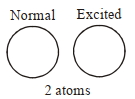
The new $SI$ unit of mass $1 \, kg$ is defined in terms of the difference in the masses of two ${}^{133}Cs_{55}$ atoms. One of these atoms is in its ground state and the other is in an excited state that has a frequency of excitation close to $9.2 \times 10^9 \, Hz$. The number of atoms required to get $1 \, kg$ of mass this way is of the order of (Planck's constant = $6.63 \times 10^{-34} \, J \cdot s$; mass of proton = $1.67 \times 10^{-27} \, kg$; Avogadro number = $6.02 \times 10^{23} \, \text{particles}$; speed of light = $3 \times 10^8 \, m/s$).
A
$10^{24}$
B
$10^{21}$
C
$10^{40}$
D
$10^{15}$
Solution
(C) According to Einstein's mass-energy equivalence, the energy difference $\Delta E$ between the excited state and the ground state corresponds to a mass difference $\Delta m$ given by $\Delta E = \Delta m c^2$.
Given the excitation frequency $\nu = 9.2 \times 10^9 \, Hz$, the energy difference is $\Delta E = h\nu$.
Therefore, the mass difference for one pair of atoms is $\Delta m = \frac{h\nu}{c^2}$.
Substituting the given values:
$\Delta m = \frac{6.63 \times 10^{-34} \times 9.2 \times 10^9}{(3 \times 10^8)^2} \, kg$
$\Delta m = \frac{6.63 \times 9.2 \times 10^{-25}}{9 \times 10^{16}} \, kg$
$\Delta m \approx 6.78 \times 10^{-41} \, kg$.
Since this mass difference is obtained using $2$ atoms, the number of atoms $N$ required to obtain a total mass of $1 \, kg$ is:
$N = \frac{2 \times 1 \, kg}{\Delta m} = \frac{2}{6.78 \times 10^{-41}} \approx 0.295 \times 10^{41} \approx 3 \times 10^{40}$.
Thus, the order of magnitude is $10^{40}$.
Given the excitation frequency $\nu = 9.2 \times 10^9 \, Hz$, the energy difference is $\Delta E = h\nu$.
Therefore, the mass difference for one pair of atoms is $\Delta m = \frac{h\nu}{c^2}$.
Substituting the given values:
$\Delta m = \frac{6.63 \times 10^{-34} \times 9.2 \times 10^9}{(3 \times 10^8)^2} \, kg$
$\Delta m = \frac{6.63 \times 9.2 \times 10^{-25}}{9 \times 10^{16}} \, kg$
$\Delta m \approx 6.78 \times 10^{-41} \, kg$.
Since this mass difference is obtained using $2$ atoms, the number of atoms $N$ required to obtain a total mass of $1 \, kg$ is:
$N = \frac{2 \times 1 \, kg}{\Delta m} = \frac{2}{6.78 \times 10^{-41}} \approx 0.295 \times 10^{41} \approx 3 \times 10^{40}$.
Thus, the order of magnitude is $10^{40}$.
0 likes
View Solution110
EasyMCQ
One astronomical unit is a distance equal to ...... $m$
A
$9.46 \times 10^{15}$
B
$1.496 \times 10^{11}$
C
$3 \times 10^8$
D
$3.08 \times 10^{16}$
Solution
(B) The correct option is $B$.
One astronomical unit $(AU)$ is defined as the average distance between the Earth and the Sun.
By definition,$1 \text{ AU} = 1.496 \times 10^{11} \, m$.
One astronomical unit $(AU)$ is defined as the average distance between the Earth and the Sun.
By definition,$1 \text{ AU} = 1.496 \times 10^{11} \, m$.
0 likes
View Solution111
EasyMCQ
Which of the following is a unit of force?
A
$Nm$
B
$mN$
C
$nm$
D
$Ns$
Solution
(B) The correct option is $B$.
$1$. $Nm$ (Newton-meter) is the unit of torque or work.
$2$. $mN$ (Milli-newton) is a unit of force,where $1 \, mN = 10^{-3} \, N$.
$3$. $nm$ (Nanometer) is a unit of length.
$4$. $Ns$ (Newton-second) is the unit of impulse or change in momentum.
Therefore,$mN$ is the only unit of force listed.
$1$. $Nm$ (Newton-meter) is the unit of torque or work.
$2$. $mN$ (Milli-newton) is a unit of force,where $1 \, mN = 10^{-3} \, N$.
$3$. $nm$ (Nanometer) is a unit of length.
$4$. $Ns$ (Newton-second) is the unit of impulse or change in momentum.
Therefore,$mN$ is the only unit of force listed.
0 likes
View Solution112
EasyMCQ
The total plane angle subtended by a circle at its centre is ......... $rad$.
A
$\pi$
B
$2 \pi$
C
$\frac{2 \pi}{3}$
D
$\frac{\pi}{2}$
Solution
(B) The plane angle $\theta$ subtended by an arc of length $s$ at the centre of a circle of radius $r$ is given by $\theta = \frac{s}{r}$.
For a complete circle,the arc length $s$ is equal to the circumference $2 \pi r$.
Therefore,the total plane angle subtended at the centre is $\theta = \frac{2 \pi r}{r} = 2 \pi \, rad$.
Thus,the correct option is $B$.
For a complete circle,the arc length $s$ is equal to the circumference $2 \pi r$.
Therefore,the total plane angle subtended at the centre is $\theta = \frac{2 \pi r}{r} = 2 \pi \, rad$.
Thus,the correct option is $B$.
0 likes
View Solution113
EasyMCQ
Which of the following practical units of length is not correct?
A
$1$ fermi $= 10^{-15} \, m$
B
$1$ astronomical unit $= 1.496 \times 10^{11} \, m$
C
$1$ parsec $= 3.26$ light year
D
$1$ light year $= 9.46 \times 10^{12} \, m$
Solution
(D) The correct value for $1$ light year is the distance light travels in one year,which is approximately $9.46 \times 10^{15} \, m$.
Option $A$ is correct: $1$ fermi $= 10^{-15} \, m$.
Option $B$ is correct: $1$ astronomical unit $(AU)$ $= 1.496 \times 10^{11} \, m$.
Option $C$ is correct: $1$ parsec $\approx 3.26$ light years.
Option $D$ is incorrect because $1$ light year $= 9.46 \times 10^{15} \, m$,not $9.46 \times 10^{12} \, m$.
Option $A$ is correct: $1$ fermi $= 10^{-15} \, m$.
Option $B$ is correct: $1$ astronomical unit $(AU)$ $= 1.496 \times 10^{11} \, m$.
Option $C$ is correct: $1$ parsec $\approx 3.26$ light years.
Option $D$ is incorrect because $1$ light year $= 9.46 \times 10^{15} \, m$,not $9.46 \times 10^{12} \, m$.
0 likes
View Solution114
MediumMCQ
Given below are two statements:
Statement $I$: Astronomical unit $(AU)$,Parsec $(pc)$,and Light year $(ly)$ are units for measuring astronomical distances.
Statement $II$: $AU < pc < ly$
In the light of the above statements,choose the most appropriate answer from the options given below:
Statement $I$: Astronomical unit $(AU)$,Parsec $(pc)$,and Light year $(ly)$ are units for measuring astronomical distances.
Statement $II$: $AU < pc < ly$
In the light of the above statements,choose the most appropriate answer from the options given below:
A
Both Statement $I$ and Statement $II$ are correct.
B
Statement $I$ is correct but Statement $II$ is incorrect.
C
Both Statement $I$ and Statement $II$ are incorrect.
D
Statement $I$ is incorrect but Statement $II$ is correct.
Solution
(B) The values of the given units in meters are:
$1 \text{ AU} = 1.496 \times 10^{11} \text{ m}$
$1 \text{ ly} = 9.46 \times 10^{15} \text{ m}$
$1 \text{ pc} = 3.08 \times 10^{16} \text{ m}$
Comparing these values,we get $1 \text{ AU} < 1 \text{ ly} < 1 \text{ pc}$.
Statement $I$ is correct as these are units of distance.
Statement $II$ is incorrect because the correct order is $AU < ly < pc$.
$1 \text{ AU} = 1.496 \times 10^{11} \text{ m}$
$1 \text{ ly} = 9.46 \times 10^{15} \text{ m}$
$1 \text{ pc} = 3.08 \times 10^{16} \text{ m}$
Comparing these values,we get $1 \text{ AU} < 1 \text{ ly} < 1 \text{ pc}$.
Statement $I$ is correct as these are units of distance.
Statement $II$ is incorrect because the correct order is $AU < ly < pc$.
0 likes
View Solution115
EasyMCQ
In an expression $a \times 10^{b}$:
A
$b$ is the order of magnitude for $a \leq 5$.
B
$a$ is the order of magnitude for $b \leq 5$.
C
$b$ is the order of magnitude for $5 < a \leq 10$.
D
$b$ is the order of magnitude for $a \geq 5$.
Solution
(A) The order of magnitude of a number expressed as $a \times 10^b$ is determined by the value of $a$.
If $1 \leq a \leq 5$,the order of magnitude is $b$.
If $5 < a < 10$,the order of magnitude is $b + 1$.
Therefore,$b$ is the order of magnitude when $a \leq 5$.
If $1 \leq a \leq 5$,the order of magnitude is $b$.
If $5 < a < 10$,the order of magnitude is $b + 1$.
Therefore,$b$ is the order of magnitude when $a \leq 5$.
0 likes
View Solution116
EasyMCQ
The biggest unit of length among the following is:
A
Parallactic second (parsec)
B
Light year
C
Astronomical unit
D
Fermi
Solution
(A) To determine the largest unit of length,we compare their values in meters:
$1$. $1 \text{ parsec} \approx 3.08 \times 10^{16} \text{ m}$
$2$. $1 \text{ light year} \approx 9.46 \times 10^{15} \text{ m}$
$3$. $1 \text{ astronomical unit (AU)} \approx 1.496 \times 10^{11} \text{ m}$
$4$. $1 \text{ fermi} = 10^{-15} \text{ m}$
Comparing these values,$3.08 \times 10^{16} \text{ m} > 9.46 \times 10^{15} \text{ m} > 1.496 \times 10^{11} \text{ m} > 10^{-15} \text{ m}$.
Therefore,the parsec is the largest unit of length among the given options.
$1$. $1 \text{ parsec} \approx 3.08 \times 10^{16} \text{ m}$
$2$. $1 \text{ light year} \approx 9.46 \times 10^{15} \text{ m}$
$3$. $1 \text{ astronomical unit (AU)} \approx 1.496 \times 10^{11} \text{ m}$
$4$. $1 \text{ fermi} = 10^{-15} \text{ m}$
Comparing these values,$3.08 \times 10^{16} \text{ m} > 9.46 \times 10^{15} \text{ m} > 1.496 \times 10^{11} \text{ m} > 10^{-15} \text{ m}$.
Therefore,the parsec is the largest unit of length among the given options.
0 likes
View Solution117
EasyMCQ
What is the $SI$ unit of density?
A
$kg \cdot dm^3$
B
$kg \cdot m^{-3}$
C
$kg \cdot m^3$
D
$kg \cdot dm^{-3}$
Solution
(B) $\text{Density} = \frac{\text{Mass}}{\text{Volume}}$
$\text{The SI unit of mass is kilogram } (kg)$.
$\text{The SI unit of volume is cubic meter } (m^3)$.
$\text{Therefore, the SI unit of density is } \frac{kg}{m^3} \text{ or } kg \cdot m^{-3}$.
$\text{The SI unit of mass is kilogram } (kg)$.
$\text{The SI unit of volume is cubic meter } (m^3)$.
$\text{Therefore, the SI unit of density is } \frac{kg}{m^3} \text{ or } kg \cdot m^{-3}$.
0 likes
View Solution118
EasyMCQ
$J s$ is the unit of . . . . . . physical quantity.
A
Work function
B
Rydberg constant
C
Moment of inertia
D
Angular momentum
Solution
(D) The correct option is $D$.
Angular momentum is defined as $L = r \times p$.
The $SI$ unit of angular momentum is $kg \cdot m^2/s$,which is equivalent to $J \cdot s$.
According to Bohr's quantization condition,$L = \frac{n h}{2 \pi}$.
Since $n$ and $2 \pi$ are dimensionless,the unit of angular momentum $L$ is the same as the unit of Planck's constant $h$,which is $J \cdot s$.
Angular momentum is defined as $L = r \times p$.
The $SI$ unit of angular momentum is $kg \cdot m^2/s$,which is equivalent to $J \cdot s$.
According to Bohr's quantization condition,$L = \frac{n h}{2 \pi}$.
Since $n$ and $2 \pi$ are dimensionless,the unit of angular momentum $L$ is the same as the unit of Planck's constant $h$,which is $J \cdot s$.
0 likes
View Solution119
EasyMCQ
Among the following, the least unit for length is:
A
parsec
B
nanometer
C
fermi
D
$ \mathring{A} $
Solution
(C) The values of the given units in meters are as follows:
$1 \text{ parsec} = 3.08 \times 10^{16} \text{ m}$
$1 \text{ nanometer} = 1 \times 10^{-9} \text{ m}$
$1 \text{ fermi} = 1 \times 10^{-15} \text{ m}$
$1 \text{ } \mathring{A} = 1 \times 10^{-10} \text{ m}$
Comparing these values, $1 \times 10^{-15} \text{ m}$ is the smallest magnitude.
Therefore, the least unit for length among the given options is fermi.
$1 \text{ parsec} = 3.08 \times 10^{16} \text{ m}$
$1 \text{ nanometer} = 1 \times 10^{-9} \text{ m}$
$1 \text{ fermi} = 1 \times 10^{-15} \text{ m}$
$1 \text{ } \mathring{A} = 1 \times 10^{-10} \text{ m}$
Comparing these values, $1 \times 10^{-15} \text{ m}$ is the smallest magnitude.
Therefore, the least unit for length among the given options is fermi.
0 likes
View Solution120
EasyMCQ
One $\mathring{A}$ is equal to:
A
$10^{-6} \text{ mm}$
B
$10^{-7} \text{ mm}$
C
$10^{-8} \text{ mm}$
D
$10^{-9} \text{ mm}$
Solution
(B) By definition, $1 \text{ } \mathring{A} = 10^{-10} \text{ m}$. To convert this into millimeters $(\text{mm})$, we know that $1 \text{ m} = 10^3 \text{ mm}$. Therefore, $1 \text{ } \mathring{A} = 10^{-10} \times 10^3 \text{ mm}$. $1 \text{ } \mathring{A} = 10^{-7} \text{ mm}$. Thus, the correct option is $B$.
0 likes
View Solution121
EasyMCQ
The $SI$ unit of length is 'metre'. Suppose we adopt a new unit of length which equals $x$ metre. Then,the area of $1 \ m^2$ expressed in terms of the new unit has a magnitude of:
A
$x$
B
$x^2$
C
$\frac{1}{x}$
D
$\frac{1}{x^2}$
Solution
(D) The $SI$ unit of length is $1 \ m$.
Given that the new unit of length is $x \ m$.
Therefore,$1 \ m = \frac{1}{x}$ new units.
We need to express the area of $1 \ m^2$ in terms of the new unit.
Area $= 1 \ m^2 = 1 \ m \times 1 \ m$.
Substituting the value of $1 \ m$ in terms of the new unit:
Area $= (\frac{1}{x} \text{ new units}) \times (\frac{1}{x} \text{ new units}) = \frac{1}{x^2} \text{ (new units)}^2$.
Thus,the magnitude is $\frac{1}{x^2}$.
Given that the new unit of length is $x \ m$.
Therefore,$1 \ m = \frac{1}{x}$ new units.
We need to express the area of $1 \ m^2$ in terms of the new unit.
Area $= 1 \ m^2 = 1 \ m \times 1 \ m$.
Substituting the value of $1 \ m$ in terms of the new unit:
Area $= (\frac{1}{x} \text{ new units}) \times (\frac{1}{x} \text{ new units}) = \frac{1}{x^2} \text{ (new units)}^2$.
Thus,the magnitude is $\frac{1}{x^2}$.
0 likes
View Solution122
EasyMCQ
Which of the following is not a unit of time?
A
Lunar month
B
Light year
C
Leap year
D
Microsecond
Solution
(B) light-year is a unit of astronomical distance,not time. It is defined as the distance that light travels in a vacuum in one Julian year,which is approximately $9.4607 \times 10^{12} \ km$.
Lunar month,leap year,and microsecond are all units used to measure time intervals.
Therefore,the correct option is $B$.
Lunar month,leap year,and microsecond are all units used to measure time intervals.
Therefore,the correct option is $B$.
0 likes
View Solution123
EasyMCQ
An energy of $13.6 eV$ is equal to
A
$0.518 \times 10^{-25} kcal$
B
$6.04 \times 10^{-25} kWh$
C
$2.17 \times 10^{-10} J$
D
$2.17 \times 10^{-15} kN-m$
Solution
(B) Given energy $E = 13.6 eV$.
We know that $1 eV = 1.6 \times 10^{-19} J$.
Therefore,$E = 13.6 \times 1.6 \times 10^{-19} J = 21.76 \times 10^{-19} J$.
To convert Joules $(J)$ to kilowatt-hours $(kWh)$,we divide by $(1000 \times 3600)$ because $1 kWh = 1000 W \times 3600 s = 3.6 \times 10^6 J$.
$E = \frac{21.76 \times 10^{-19}}{3.6 \times 10^6} kWh$.
$E \approx 6.04 \times 10^{-25} kWh$.
We know that $1 eV = 1.6 \times 10^{-19} J$.
Therefore,$E = 13.6 \times 1.6 \times 10^{-19} J = 21.76 \times 10^{-19} J$.
To convert Joules $(J)$ to kilowatt-hours $(kWh)$,we divide by $(1000 \times 3600)$ because $1 kWh = 1000 W \times 3600 s = 3.6 \times 10^6 J$.
$E = \frac{21.76 \times 10^{-19}}{3.6 \times 10^6} kWh$.
$E \approx 6.04 \times 10^{-25} kWh$.
0 likes
View SolutionUnits, Dimensions and Measurement — Units · Frequently Asked Questions
1Are these Units, Dimensions and Measurement questions useful for JEE and NEET?
Yes. All questions in this section are mapped to JEE Main and NEET exam patterns. Previous year questions from JEE Main, NEET, GUJCET and state-level exams are included with full solutions.
2Can I switch to Hindi or Gujarati for these questions?
Yes. Use the language tabs in the hero section or the sidebar to view the same questions and solutions in English, Hindi or Gujarati.
3How do I generate a question paper from this subtopic?
Use the Vedclass Exam Paper Generator — select the chapter and subtopic, set difficulty, and generate Sets A, B, C, D automatically. First 3 chapters of every subject are free.
Vedclass Products
For Students
Vedclass Test Series
Mock tests in real JEE/NEET style with performance analysis. 5-day free trial.
Start Free TrialFor Teachers
Exam Paper Generator
Generate Set A/B/C/D papers from this chapter in 2 minutes. 3 chapters free.
Try FreeFor Institutes
Online Exam Module
Live online exams with unlimited students, 360° analytics & white-label branding.
See DemoFor Teachers & Institutes
Generate a Units, Dimensions and Measurement Exam Paper in 2 Minutes
Select subtopic & difficulty — Sets A, B, C, D auto-generated with No Repeat logic.
First 3 chapters of every subject are free — no payment required.