
A English
Superposition of S.H.M. Questions in English
Class 11 Physics · Oscillations · Superposition of S.H.M.
57+
Questions
English
Language
100%
With Solutions
Showing 7 of 57 questions in English
51
EasyMCQ
Two particles execute simple harmonic motion along the same straight line with the same amplitude and same frequency. The two particles pass one another when moving in opposite directions each time at a distance of $\frac{1}{\sqrt{2}}$ times the amplitude from their common mean position. The phase difference between the two particles is (in $^{\circ}$)
A
$30$
B
$45$
C
$60$
D
$90$
Solution
(D) Let the displacement of the two particles be $x_1 = A \sin(\omega t + \phi_1)$ and $x_2 = A \sin(\omega t + \phi_2)$.
At the point where they pass each other,$x_1 = x_2 = \frac{A}{\sqrt{2}}$.
For particle $1$,moving away from the mean position,$\sin(\omega t + \phi_1) = \frac{1}{\sqrt{2}}$,which gives the phase $\theta_1 = \frac{\pi}{4}$.
For particle $2$,moving towards the mean position at the same displacement,$\sin(\omega t + \phi_2) = \frac{1}{\sqrt{2}}$. Since it is moving in the opposite direction,its phase must be in the second quadrant,so $\theta_2 = \pi - \frac{\pi}{4} = \frac{3\pi}{4}$.
The phase difference is $\Delta \phi = |\theta_2 - \theta_1| = |\frac{3\pi}{4} - \frac{\pi}{4}| = \frac{2\pi}{4} = \frac{\pi}{2}$.
Converting to degrees,$\frac{\pi}{2} = 90^{\circ}$.
At the point where they pass each other,$x_1 = x_2 = \frac{A}{\sqrt{2}}$.
For particle $1$,moving away from the mean position,$\sin(\omega t + \phi_1) = \frac{1}{\sqrt{2}}$,which gives the phase $\theta_1 = \frac{\pi}{4}$.
For particle $2$,moving towards the mean position at the same displacement,$\sin(\omega t + \phi_2) = \frac{1}{\sqrt{2}}$. Since it is moving in the opposite direction,its phase must be in the second quadrant,so $\theta_2 = \pi - \frac{\pi}{4} = \frac{3\pi}{4}$.
The phase difference is $\Delta \phi = |\theta_2 - \theta_1| = |\frac{3\pi}{4} - \frac{\pi}{4}| = \frac{2\pi}{4} = \frac{\pi}{2}$.
Converting to degrees,$\frac{\pi}{2} = 90^{\circ}$.
0 likes
View Solution52
MediumMCQ
Two particles $P$ and $Q$ describe $SHM$ of same amplitude $a$ and same frequency $f$ along the same straight line. The maximum distance between the two particles is $a \sqrt{2}$. The phase difference between the particles is
A
zero
B
$\frac{\pi}{2}$
C
$\frac{\pi}{6}$
D
$\frac{\pi}{3}$
Solution
(B) Let the equations of motion for particles $P$ and $Q$ be $x_1 = a \sin(\omega t)$ and $x_2 = a \sin(\omega t + \phi)$,where $\phi$ is the phase difference.
The distance between the particles is given by $d = |x_2 - x_1| = |a \sin(\omega t + \phi) - a \sin(\omega t)|$.
Using the trigonometric identity $\sin A - \sin B = 2 \sin(\frac{A-B}{2}) \cos(\frac{A+B}{2})$,we get:
$d = |2a \sin(\frac{\phi}{2}) \cos(\omega t + \frac{\phi}{2})|$.
The maximum value of this distance occurs when the magnitude of the cosine term is $1$.
Thus,$d_{max} = 2a \sin(\frac{\phi}{2})$.
Given $d_{max} = a \sqrt{2}$,we have $2a \sin(\frac{\phi}{2}) = a \sqrt{2}$.
$\sin(\frac{\phi}{2}) = \frac{\sqrt{2}}{2} = \frac{1}{\sqrt{2}}$.
$\frac{\phi}{2} = \frac{\pi}{4}$,which implies $\phi = \frac{\pi}{2}$.
The distance between the particles is given by $d = |x_2 - x_1| = |a \sin(\omega t + \phi) - a \sin(\omega t)|$.
Using the trigonometric identity $\sin A - \sin B = 2 \sin(\frac{A-B}{2}) \cos(\frac{A+B}{2})$,we get:
$d = |2a \sin(\frac{\phi}{2}) \cos(\omega t + \frac{\phi}{2})|$.
The maximum value of this distance occurs when the magnitude of the cosine term is $1$.
Thus,$d_{max} = 2a \sin(\frac{\phi}{2})$.
Given $d_{max} = a \sqrt{2}$,we have $2a \sin(\frac{\phi}{2}) = a \sqrt{2}$.
$\sin(\frac{\phi}{2}) = \frac{\sqrt{2}}{2} = \frac{1}{\sqrt{2}}$.
$\frac{\phi}{2} = \frac{\pi}{4}$,which implies $\phi = \frac{\pi}{2}$.
0 likes
View Solution53
DifficultMCQ
Two particles execute simple harmonic motion $(SHM)$ along close parallel lines. Both particles have the same frequency and same amplitude. When they pass each other moving in opposite directions,their displacement is half their amplitude. Their phase difference is:
A
$0$
B
$2 \pi / 3$
C
$\pi / 3$
D
$\pi / 2$
Solution
(B) Let the displacements of the two particles be $x_1 = a \sin \omega t$ and $x_2 = a \sin (\omega t + \phi)$,where $a$ is the amplitude,$\omega$ is the angular frequency,and $\phi$ is the phase difference.
When they cross each other,their displacements are equal: $x_1 = x_2 = a/2$.
For the first particle: $a \sin \omega t = a/2 \Rightarrow \sin \omega t = 1/2$. Thus,$\omega t = \pi/6$ (assuming the particle is moving in the positive direction).
For the second particle: $a \sin (\omega t + \phi) = a/2 \Rightarrow \sin (\omega t + \phi) = 1/2$.
This implies $\omega t + \phi = \pi/6$ or $\omega t + \phi = 5\pi/6$.
If $\omega t + \phi = \pi/6$,then $\phi = 0$,which means they are moving in the same direction,not opposite.
If $\omega t + \phi = 5\pi/6$,then $\phi = 5\pi/6 - \pi/6 = 4\pi/6 = 2\pi/3$.
At this phase,the velocity $v_2 = a \omega \cos (\omega t + \phi) = a \omega \cos (5\pi/6) = -a \omega \sqrt{3}/2$,which is negative,confirming they are moving in opposite directions.
Therefore,the phase difference is $2\pi/3$.
When they cross each other,their displacements are equal: $x_1 = x_2 = a/2$.
For the first particle: $a \sin \omega t = a/2 \Rightarrow \sin \omega t = 1/2$. Thus,$\omega t = \pi/6$ (assuming the particle is moving in the positive direction).
For the second particle: $a \sin (\omega t + \phi) = a/2 \Rightarrow \sin (\omega t + \phi) = 1/2$.
This implies $\omega t + \phi = \pi/6$ or $\omega t + \phi = 5\pi/6$.
If $\omega t + \phi = \pi/6$,then $\phi = 0$,which means they are moving in the same direction,not opposite.
If $\omega t + \phi = 5\pi/6$,then $\phi = 5\pi/6 - \pi/6 = 4\pi/6 = 2\pi/3$.
At this phase,the velocity $v_2 = a \omega \cos (\omega t + \phi) = a \omega \cos (5\pi/6) = -a \omega \sqrt{3}/2$,which is negative,confirming they are moving in opposite directions.
Therefore,the phase difference is $2\pi/3$.
0 likes
View Solution54
EasyMCQ
Two particles executing simple harmonic motion as described by $y_1=30 \sin \left(2 \pi t+\frac{\pi}{3}\right)$ and $y_2=10(\sin 2 \pi t+\sqrt{3} \cos 2 \pi t)$ have amplitudes $A_1$ and $A_2$ respectively. The ratio $A_1: A_2$ is
A
$2: 1$
B
$1: 1$
C
$3: 2$
D
$1: \sqrt{3}$
Solution
(C) Given,the displacement equation of the first particle is $y_1=30 \sin \left(2 \pi t+\frac{\pi}{3}\right)$.
Comparing this with the standard $SHM$ equation $y=A \sin(\omega t + \phi)$,the amplitude is $A_1=30$.
For the second particle,the displacement equation is $y_2=10(\sin 2 \pi t+\sqrt{3} \cos 2 \pi t)$.
To find the amplitude,we multiply and divide by $2$ inside the bracket: $y_2 = 10 \times 2 \left[ \frac{1}{2} \sin 2 \pi t + \frac{\sqrt{3}}{2} \cos 2 \pi t \right]$.
Using the trigonometric identity $\sin(A+B) = \sin A \cos B + \cos A \sin B$,where $\cos \frac{\pi}{3} = \frac{1}{2}$ and $\sin \frac{\pi}{3} = \frac{\sqrt{3}}{2}$,we get $y_2 = 20 \sin \left(2 \pi t + \frac{\pi}{3} \right)$.
Thus,the amplitude of the second particle is $A_2=20$.
The ratio of the amplitudes is $\frac{A_1}{A_2} = \frac{30}{20} = \frac{3}{2}$.
Therefore,the ratio $A_1: A_2$ is $3: 2$.
Comparing this with the standard $SHM$ equation $y=A \sin(\omega t + \phi)$,the amplitude is $A_1=30$.
For the second particle,the displacement equation is $y_2=10(\sin 2 \pi t+\sqrt{3} \cos 2 \pi t)$.
To find the amplitude,we multiply and divide by $2$ inside the bracket: $y_2 = 10 \times 2 \left[ \frac{1}{2} \sin 2 \pi t + \frac{\sqrt{3}}{2} \cos 2 \pi t \right]$.
Using the trigonometric identity $\sin(A+B) = \sin A \cos B + \cos A \sin B$,where $\cos \frac{\pi}{3} = \frac{1}{2}$ and $\sin \frac{\pi}{3} = \frac{\sqrt{3}}{2}$,we get $y_2 = 20 \sin \left(2 \pi t + \frac{\pi}{3} \right)$.
Thus,the amplitude of the second particle is $A_2=20$.
The ratio of the amplitudes is $\frac{A_1}{A_2} = \frac{30}{20} = \frac{3}{2}$.
Therefore,the ratio $A_1: A_2$ is $3: 2$.
0 likes
View Solution55
DifficultMCQ
$A$ particle is subjected to two simple harmonic motions in the same direction having equal amplitudes and equal frequency. If the resultant amplitude is equal to the amplitude of the individual motion,the phase difference $(\delta)$ between the two motions is
A
$\delta=\frac{\pi}{3}$
B
$\delta=\frac{2 \pi}{3}$
C
$\delta=\pi$
D
$\delta=\frac{\pi}{2}$
Solution
(B) The resultant amplitude $A_{\text{res}}$ of two simple harmonic motions with amplitudes $A_1$ and $A_2$ and phase difference $\delta$ is given by the formula: $A_{\text{res}}^2 = A_1^2 + A_2^2 + 2A_1A_2 \cos \delta$.
Given that $A_1 = A_2 = A$ and the resultant amplitude $A_{\text{res}} = A$,we substitute these values into the equation:
$A^2 = A^2 + A^2 + 2A^2 \cos \delta$.
$A^2 = 2A^2 + 2A^2 \cos \delta$.
$A^2 - 2A^2 = 2A^2 \cos \delta$.
$-A^2 = 2A^2 \cos \delta$.
$\cos \delta = -\frac{1}{2}$.
Since $\cos \delta = -\frac{1}{2}$,the phase difference $\delta = 120^{\circ}$ or $\delta = \frac{2\pi}{3}$ radians.
Given that $A_1 = A_2 = A$ and the resultant amplitude $A_{\text{res}} = A$,we substitute these values into the equation:
$A^2 = A^2 + A^2 + 2A^2 \cos \delta$.
$A^2 = 2A^2 + 2A^2 \cos \delta$.
$A^2 - 2A^2 = 2A^2 \cos \delta$.
$-A^2 = 2A^2 \cos \delta$.
$\cos \delta = -\frac{1}{2}$.
Since $\cos \delta = -\frac{1}{2}$,the phase difference $\delta = 120^{\circ}$ or $\delta = \frac{2\pi}{3}$ radians.
0 likes
View Solution56
EasyMCQ
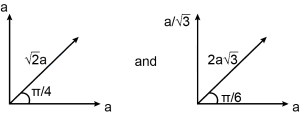
Two simple harmonic motions are given by $x_{1} = a \sin \omega t + a \cos \omega t$ and $x_{2} = a \sin \omega t + \frac{a}{\sqrt{3}} \cos \omega t$. The ratio of the amplitudes of the first and second motion and the phase difference between them are respectively:
A
$\sqrt{\frac{3}{2}}$ and $\frac{\pi}{12}$
B
$\frac{\sqrt{3}}{2}$ and $\frac{\pi}{12}$
C
$\frac{2}{\sqrt{3}}$ and $\frac{\pi}{12}$
D
$\sqrt{\frac{3}{2}}$ and $\frac{\pi}{6}$
Solution
(A) For the first $SHM$: $x_{1} = a \sin \omega t + a \cos \omega t = \sqrt{2} a \sin(\omega t + \frac{\pi}{4})$.
Amplitude $A_{1} = \sqrt{2} a$ and phase $\phi_{1} = \frac{\pi}{4}$.
For the second $SHM$: $x_{2} = a \sin \omega t + \frac{a}{\sqrt{3}} \cos \omega t$.
Amplitude $A_{2} = \sqrt{a^{2} + (\frac{a}{\sqrt{3}})^{2}} = \sqrt{a^{2} + \frac{a^{2}}{3}} = \sqrt{\frac{4a^{2}}{3}} = \frac{2a}{\sqrt{3}}$.
Phase $\phi_{2} = \tan^{-1}(\frac{a/\sqrt{3}}{a}) = \tan^{-1}(\frac{1}{\sqrt{3}}) = \frac{\pi}{6}$.
Ratio of amplitudes $\frac{A_{1}}{A_{2}} = \frac{\sqrt{2} a}{2a/\sqrt{3}} = \frac{\sqrt{2} \cdot \sqrt{3}}{2} = \frac{\sqrt{6}}{2} = \sqrt{\frac{6}{4}} = \sqrt{\frac{3}{2}}$.
Phase difference $\Delta \phi = \phi_{1} - \phi_{2} = \frac{\pi}{4} - \frac{\pi}{6} = \frac{3\pi - 2\pi}{12} = \frac{\pi}{12}$.
Amplitude $A_{1} = \sqrt{2} a$ and phase $\phi_{1} = \frac{\pi}{4}$.
For the second $SHM$: $x_{2} = a \sin \omega t + \frac{a}{\sqrt{3}} \cos \omega t$.
Amplitude $A_{2} = \sqrt{a^{2} + (\frac{a}{\sqrt{3}})^{2}} = \sqrt{a^{2} + \frac{a^{2}}{3}} = \sqrt{\frac{4a^{2}}{3}} = \frac{2a}{\sqrt{3}}$.
Phase $\phi_{2} = \tan^{-1}(\frac{a/\sqrt{3}}{a}) = \tan^{-1}(\frac{1}{\sqrt{3}}) = \frac{\pi}{6}$.
Ratio of amplitudes $\frac{A_{1}}{A_{2}} = \frac{\sqrt{2} a}{2a/\sqrt{3}} = \frac{\sqrt{2} \cdot \sqrt{3}}{2} = \frac{\sqrt{6}}{2} = \sqrt{\frac{6}{4}} = \sqrt{\frac{3}{2}}$.
Phase difference $\Delta \phi = \phi_{1} - \phi_{2} = \frac{\pi}{4} - \frac{\pi}{6} = \frac{3\pi - 2\pi}{12} = \frac{\pi}{12}$.
0 likes
View Solution57
MediumMCQ
The displacement of a particle in a periodic motion is given by $y = 4 \cos^{2}\left(\frac{t}{2}\right) \sin(1000 t)$. This displacement may be considered as the result of the superposition of $n$ independent harmonic oscillations. Here $n$ is
A
$1$
B
$2$
C
$3$
D
$4$
Solution
(C) Given,$y = 4 \cos^{2}\left(\frac{t}{2}\right) \sin(1000 t)$.
Using the trigonometric identity $2 \cos^{2} \theta = 1 + \cos(2 \theta)$,we have $2 \cos^{2}\left(\frac{t}{2}\right) = 1 + \cos t$.
Substituting this into the equation:
$y = 2 \times [2 \cos^{2}\left(\frac{t}{2}\right)] \sin(1000 t)$
$y = 2(1 + \cos t) \sin(1000 t)$
$y = 2 \sin(1000 t) + 2 \sin(1000 t) \cos t$.
Using the product-to-sum formula $2 \sin A \cos B = \sin(A + B) + \sin(A - B)$:
$y = 2 \sin(1000 t) + [\sin(1000 t + t) + \sin(1000 t - t)]$
$y = 2 \sin(1000 t) + \sin(1001 t) + \sin(999 t)$.
This expression represents the superposition of $3$ independent harmonic oscillations with frequencies $1000, 1001,$ and $999$ rad/s.
Thus,$n = 3$.
Using the trigonometric identity $2 \cos^{2} \theta = 1 + \cos(2 \theta)$,we have $2 \cos^{2}\left(\frac{t}{2}\right) = 1 + \cos t$.
Substituting this into the equation:
$y = 2 \times [2 \cos^{2}\left(\frac{t}{2}\right)] \sin(1000 t)$
$y = 2(1 + \cos t) \sin(1000 t)$
$y = 2 \sin(1000 t) + 2 \sin(1000 t) \cos t$.
Using the product-to-sum formula $2 \sin A \cos B = \sin(A + B) + \sin(A - B)$:
$y = 2 \sin(1000 t) + [\sin(1000 t + t) + \sin(1000 t - t)]$
$y = 2 \sin(1000 t) + \sin(1001 t) + \sin(999 t)$.
This expression represents the superposition of $3$ independent harmonic oscillations with frequencies $1000, 1001,$ and $999$ rad/s.
Thus,$n = 3$.
0 likes
View SolutionOscillations — Superposition of S.H.M. · Frequently Asked Questions
1Are these Oscillations questions useful for JEE and NEET?
Yes. All questions in this section are mapped to JEE Main and NEET exam patterns. Previous year questions from JEE Main, NEET, GUJCET and state-level exams are included with full solutions.
2Can I switch to Hindi or Gujarati for these questions?
Yes. Use the language tabs in the hero section or the sidebar to view the same questions and solutions in English, Hindi or Gujarati.
3How do I generate a question paper from this subtopic?
Use the Vedclass Exam Paper Generator — select the chapter and subtopic, set difficulty, and generate Sets A, B, C, D automatically. First 3 chapters of every subject are free.
Vedclass Products
For Students
Vedclass Test Series
Mock tests in real JEE/NEET style with performance analysis. 5-day free trial.
Start Free TrialFor Teachers
Exam Paper Generator
Generate Set A/B/C/D papers from this chapter in 2 minutes. 3 chapters free.
Try FreeFor Institutes
Online Exam Module
Live online exams with unlimited students, 360° analytics & white-label branding.
See DemoFor Teachers & Institutes
Generate a Oscillations Exam Paper in 2 Minutes
Select subtopic & difficulty — Sets A, B, C, D auto-generated with No Repeat logic.
First 3 chapters of every subject are free — no payment required.