
A English
Motion Under Gravity Questions in English
Class 11 Physics · Motion in Straight Line · Motion Under Gravity
334+
Questions
English
Language
100%
With Solutions
Showing 31 of 334 questions in English
301
MediumMCQ
$A$ body is falling freely from the top of a tower of height $125 \ m$. The distance covered by the body during the last second of its motion is $x \%$ of the height of the tower. Then $x$ is (Acceleration due to gravity $= 10 \ m/s^2$)
A
$9$
B
$36$
C
$25$
D
$49$
Solution
(B) Given: Height of tower $h = 125 \ m$,initial velocity $u = 0$,acceleration $g = 10 \ m/s^2$.
First,calculate the total time $t$ taken to reach the ground using $h = ut + \frac{1}{2}gt^2$:
$125 = 0 + \frac{1}{2} \times 10 \times t^2$
$125 = 5t^2 \Rightarrow t^2 = 25 \Rightarrow t = 5 \ s$.
The distance covered in the last second is the distance covered in the total time minus the distance covered in $(t-1)$ seconds.
Distance covered in $(5-1) = 4 \ s$ is $h' = \frac{1}{2} \times 10 \times (4)^2 = 5 \times 16 = 80 \ m$.
Distance covered in the last second $= 125 - 80 = 45 \ m$.
According to the problem,this distance is $x \%$ of the total height:
$45 = \frac{x}{100} \times 125$
$x = \frac{45 \times 100}{125} = \frac{4500}{125} = 36$.
First,calculate the total time $t$ taken to reach the ground using $h = ut + \frac{1}{2}gt^2$:
$125 = 0 + \frac{1}{2} \times 10 \times t^2$
$125 = 5t^2 \Rightarrow t^2 = 25 \Rightarrow t = 5 \ s$.
The distance covered in the last second is the distance covered in the total time minus the distance covered in $(t-1)$ seconds.
Distance covered in $(5-1) = 4 \ s$ is $h' = \frac{1}{2} \times 10 \times (4)^2 = 5 \times 16 = 80 \ m$.
Distance covered in the last second $= 125 - 80 = 45 \ m$.
According to the problem,this distance is $x \%$ of the total height:
$45 = \frac{x}{100} \times 125$
$x = \frac{45 \times 100}{125} = \frac{4500}{125} = 36$.
0 likes
View Solution302
EasyMCQ
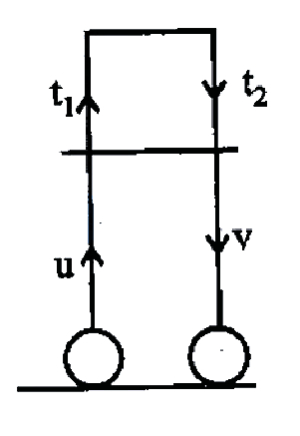
$A$ body is thrown vertically upwards with a velocity of $35 \ m/s$ from the ground. The ratio of the speeds of the body at times $3 \ s$ and $4 \ s$ of its motion is (Acceleration due to gravity $= 10 \ m/s^2$)
A
$3: 4$
B
$1: 1$
C
$2: 1$
D
$3: 2$
Solution
(B) Given: Initial velocity $u = 35 \ m/s$,acceleration $a = -g = -10 \ m/s^2$.
Using the first equation of motion $v = u + at$:
At $t_1 = 3 \ s$,the velocity is $v_1 = 35 - 10(3) = 35 - 30 = 5 \ m/s$.
The speed is $|v_1| = 5 \ m/s$.
At $t_2 = 4 \ s$,the velocity is $v_2 = 35 - 10(4) = 35 - 40 = -5 \ m/s$.
The speed is $|v_2| = |-5| = 5 \ m/s$.
Therefore,the ratio of the speeds at $3 \ s$ and $4 \ s$ is $\frac{|v_1|}{|v_2|} = \frac{5}{5} = 1: 1$.
Using the first equation of motion $v = u + at$:
At $t_1 = 3 \ s$,the velocity is $v_1 = 35 - 10(3) = 35 - 30 = 5 \ m/s$.
The speed is $|v_1| = 5 \ m/s$.
At $t_2 = 4 \ s$,the velocity is $v_2 = 35 - 10(4) = 35 - 40 = -5 \ m/s$.
The speed is $|v_2| = |-5| = 5 \ m/s$.
Therefore,the ratio of the speeds at $3 \ s$ and $4 \ s$ is $\frac{|v_1|}{|v_2|} = \frac{5}{5} = 1: 1$.
0 likes
View Solution303
MediumMCQ
The ratio of the displacements of a freely falling body during the first,second,and third seconds of its motion is
A
$1: 1: 1$
B
$1: 3: 5$
C
$1: 2: 3$
D
$1: 4: 9$
Solution
(B) The distance travelled in the $n^{\text{th}}$ second is given by the formula:
$S_n = u + \frac{a}{2}(2n - 1)$
For a freely falling body,the initial velocity $u = 0$ and acceleration $a = g$.
Therefore,the distance travelled in the $n^{\text{th}}$ second is $S_n = \frac{g}{2}(2n - 1)$.
For the first second $(n = 1)$:
$S_1 = \frac{g}{2}(2(1) - 1) = \frac{g}{2}$
For the second second $(n = 2)$:
$S_2 = \frac{g}{2}(2(2) - 1) = \frac{3g}{2}$
For the third second $(n = 3)$:
$S_3 = \frac{g}{2}(2(3) - 1) = \frac{5g}{2}$
The ratio of displacements is $S_1 : S_2 : S_3 = \frac{g}{2} : \frac{3g}{2} : \frac{5g}{2} = 1 : 3 : 5$.
$S_n = u + \frac{a}{2}(2n - 1)$
For a freely falling body,the initial velocity $u = 0$ and acceleration $a = g$.
Therefore,the distance travelled in the $n^{\text{th}}$ second is $S_n = \frac{g}{2}(2n - 1)$.
For the first second $(n = 1)$:
$S_1 = \frac{g}{2}(2(1) - 1) = \frac{g}{2}$
For the second second $(n = 2)$:
$S_2 = \frac{g}{2}(2(2) - 1) = \frac{3g}{2}$
For the third second $(n = 3)$:
$S_3 = \frac{g}{2}(2(3) - 1) = \frac{5g}{2}$
The ratio of displacements is $S_1 : S_2 : S_3 = \frac{g}{2} : \frac{3g}{2} : \frac{5g}{2} = 1 : 3 : 5$.
0 likes
View Solution304
EasyMCQ
The acceleration of a vertically projected body at its highest reaching position is
A
$0$
B
Equal to acceleration due to gravity at the place
C
Infinity
D
$-1 \,m/s^2$
Solution
(B) When a body is projected vertically upwards, it experiences a constant downward acceleration due to gravity, denoted by $g$, throughout its entire flight.
At the highest point of its trajectory, the velocity of the body becomes $0 \,m/s$ momentarily.
However, the acceleration remains constant and acts downwards towards the center of the Earth.
Therefore, the acceleration at the highest point is equal to the acceleration due to gravity, which is approximately $9.8 \,m/s^2$ downwards.
At the highest point of its trajectory, the velocity of the body becomes $0 \,m/s$ momentarily.
However, the acceleration remains constant and acts downwards towards the center of the Earth.
Therefore, the acceleration at the highest point is equal to the acceleration due to gravity, which is approximately $9.8 \,m/s^2$ downwards.
0 likes
View Solution305
EasyMCQ
$A$ ball projected up passes the same height $H$ at $2 \,s$ and $10 \,s$. The value of $H$ is [Use $g=9.8 \,m/s^2$]. (in $m$)
A
$102$
B
$100$
C
$98$
D
$9.8$
Solution
(C) The equation of motion for height $H$ at time $t$ is given by $H = ut - \frac{1}{2}gt^2$.
Since the ball passes the same height $H$ at $t_1 = 2 \,s$ and $t_2 = 10 \,s$,we have:
$H = u(2) - \frac{1}{2}g(2)^2 = 2u - 2g$
$H = u(10) - \frac{1}{2}g(10)^2 = 10u - 50g$
Equating the two expressions for $H$:
$2u - 2g = 10u - 50g$
$8u = 48g$
$u = 6g = 6 \times 9.8 = 58.8 \,m/s$
Now,substitute $u$ back into the expression for $H$:
$H = 2(58.8) - 2(9.8) = 117.6 - 19.6 = 98 \,m$.
Since the ball passes the same height $H$ at $t_1 = 2 \,s$ and $t_2 = 10 \,s$,we have:
$H = u(2) - \frac{1}{2}g(2)^2 = 2u - 2g$
$H = u(10) - \frac{1}{2}g(10)^2 = 10u - 50g$
Equating the two expressions for $H$:
$2u - 2g = 10u - 50g$
$8u = 48g$
$u = 6g = 6 \times 9.8 = 58.8 \,m/s$
Now,substitute $u$ back into the expression for $H$:
$H = 2(58.8) - 2(9.8) = 117.6 - 19.6 = 98 \,m$.
0 likes
View Solution306
MediumMCQ
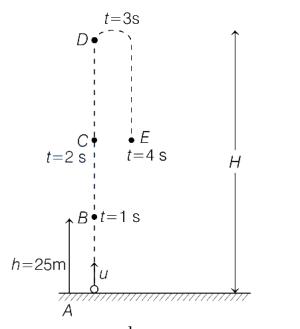
$A$ ball thrown vertically upwards reaches a height of $25 \,m$ in $1 \,s$. The ratio of the total distance covered by the ball in time $t=2 \,s$ and $t=4 \,s$ is (Use $g=10 \,m/s^2$)
A
$1$
B
$\frac{4}{5}$
C
$\frac{2}{3}$
D
$\frac{3}{4}$
Solution
(B) Given that the height achieved in $1 \,s$ is $h=25 \,m$. Let $u$ be the initial velocity in the upward direction. Using the equation of motion,$h=ut-\frac{1}{2}gt^2$.
$25=u(1)-\frac{1}{2}(10)(1)^2$
$25=u-5 \Rightarrow u=30 \,m/s$.
The final velocity of the ball at maximum height becomes zero. The time taken to reach the maximum height is $v=u-gt \Rightarrow 0=30-10t \Rightarrow t=3 \,s$.
Now,the distance travelled in $2 \,s$ is the displacement in $2 \,s$ since the ball is still moving upwards:
$d_1=u(2)-\frac{1}{2}g(2)^2 = 30(2)-5(4) = 60-20 = 40 \,m$.
The maximum height achieved by the ball in $3 \,s$ is:
$H=u(3)-\frac{1}{2}g(3)^2 = 30(3)-5(9) = 90-45 = 45 \,m$.
The displacement after $4 \,s$ is:
$S_2=u(4)-\frac{1}{2}g(4)^2 = 30(4)-5(16) = 120-80 = 40 \,m$.
Since the ball has passed the maximum height at $t=3 \,s$,the total distance travelled in $4 \,s$ is $d_2=H+(H-S_2) = 45+(45-40) = 50 \,m$.
The ratio is $\frac{d_1}{d_2} = \frac{40}{50} = \frac{4}{5}$.
$25=u(1)-\frac{1}{2}(10)(1)^2$
$25=u-5 \Rightarrow u=30 \,m/s$.
The final velocity of the ball at maximum height becomes zero. The time taken to reach the maximum height is $v=u-gt \Rightarrow 0=30-10t \Rightarrow t=3 \,s$.
Now,the distance travelled in $2 \,s$ is the displacement in $2 \,s$ since the ball is still moving upwards:
$d_1=u(2)-\frac{1}{2}g(2)^2 = 30(2)-5(4) = 60-20 = 40 \,m$.
The maximum height achieved by the ball in $3 \,s$ is:
$H=u(3)-\frac{1}{2}g(3)^2 = 30(3)-5(9) = 90-45 = 45 \,m$.
The displacement after $4 \,s$ is:
$S_2=u(4)-\frac{1}{2}g(4)^2 = 30(4)-5(16) = 120-80 = 40 \,m$.
Since the ball has passed the maximum height at $t=3 \,s$,the total distance travelled in $4 \,s$ is $d_2=H+(H-S_2) = 45+(45-40) = 50 \,m$.
The ratio is $\frac{d_1}{d_2} = \frac{40}{50} = \frac{4}{5}$.
0 likes
View Solution307
MediumMCQ
$A$ ball is thrown vertically upwards with an initial velocity $u$ and reaches its maximum height in $5 \,s$. The ratio of the distance travelled by the ball in the $2^{nd}$ and $7^{th}$ second is (assume $g=10 \,m/s^2$):
A
$8:19$
B
$16:29$
C
$16:49$
D
None of these
Solution
(D) At maximum height, the final velocity $v = 0$. Using the first equation of motion $v = u - gt$, we have $0 = u - 10 \times 5$, which gives $u = 50 \,m/s$.
Distance travelled in the $n^{th}$ second is given by $s_n = u + \frac{a}{2}(2n - 1)$.
For the $2^{nd}$ second $(n=2)$: $s_2 = 50 - \frac{10}{2}(2 \times 2 - 1) = 50 - 5(3) = 35 \,m$.
For the $7^{th}$ second $(n=7)$: $s_7 = 50 - \frac{10}{2}(2 \times 7 - 1) = 50 - 5(13) = 50 - 65 = -15 \,m$. The magnitude of distance is $15 \,m$.
The ratio of distance in the $2^{nd}$ second to the $7^{th}$ second is $\frac{35}{15} = \frac{7}{3}$.
Distance travelled in the $n^{th}$ second is given by $s_n = u + \frac{a}{2}(2n - 1)$.
For the $2^{nd}$ second $(n=2)$: $s_2 = 50 - \frac{10}{2}(2 \times 2 - 1) = 50 - 5(3) = 35 \,m$.
For the $7^{th}$ second $(n=7)$: $s_7 = 50 - \frac{10}{2}(2 \times 7 - 1) = 50 - 5(13) = 50 - 65 = -15 \,m$. The magnitude of distance is $15 \,m$.
The ratio of distance in the $2^{nd}$ second to the $7^{th}$ second is $\frac{35}{15} = \frac{7}{3}$.
0 likes
View Solution308
EasyMCQ
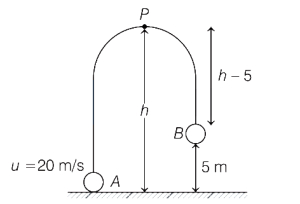
$A$ ball is thrown straight upward from the ground with a speed of $20 \,m/s$. The ball is caught on its way down at a point $5 \,m$ above the ground. The time taken by the ball during the entire trip is (assume $g = 10 \,m/s^2$):
A
$2+\sqrt{3} \,s$
B
$3-\sqrt{3} \,s$
C
$2+\sqrt{2} \,s$
D
$3.5 \,s$
Solution
(A) Let the initial position be $A$ and the point where the ball is caught be $B$. The highest point is $P$.
Initial speed $u = 20 \,m/s$.
Using the equation of motion $s = ut + \frac{1}{2}at^2$ for the displacement $s = 5 \,m$:
$5 = 20t - \frac{1}{2}(10)t^2$
$5 = 20t - 5t^2$
Dividing by $5$:
$1 = 4t - t^2$
$t^2 - 4t + 1 = 0$
Using the quadratic formula $t = \frac{-b \pm \sqrt{b^2 - 4ac}}{2a}$:
$t = \frac{4 \pm \sqrt{16 - 4}}{2} = \frac{4 \pm \sqrt{12}}{2} = \frac{4 \pm 2\sqrt{3}}{2} = 2 \pm \sqrt{3} \,s$.
Since the ball is caught on its way down, we take the larger time value:
$t = 2 + \sqrt{3} \,s$.
Initial speed $u = 20 \,m/s$.
Using the equation of motion $s = ut + \frac{1}{2}at^2$ for the displacement $s = 5 \,m$:
$5 = 20t - \frac{1}{2}(10)t^2$
$5 = 20t - 5t^2$
Dividing by $5$:
$1 = 4t - t^2$
$t^2 - 4t + 1 = 0$
Using the quadratic formula $t = \frac{-b \pm \sqrt{b^2 - 4ac}}{2a}$:
$t = \frac{4 \pm \sqrt{16 - 4}}{2} = \frac{4 \pm \sqrt{12}}{2} = \frac{4 \pm 2\sqrt{3}}{2} = 2 \pm \sqrt{3} \,s$.
Since the ball is caught on its way down, we take the larger time value:
$t = 2 + \sqrt{3} \,s$.
0 likes
View Solution309
EasyMCQ
The nature of a graph drawn for a freely falling body with time on the $x$-axis and speed on the $y$-axis is (Assuming initial speed to be zero.)
A
a straight line with positive $y$-axis intercept.
B
a straight line passing through the origin.
C
a parabola.
D
a straight line parallel to $y$-axis with positive $x$-axis intercept.
Solution
(B) For a freely falling body,the equation of motion for velocity is given by $v = u + gt$.
Since the initial speed $u = 0$,the equation becomes $v = gt$.
Here,$g$ is the acceleration due to gravity,which is a constant ($g \approx 9.8 \ m/s^2$ or $10 \ m/s^2$).
This equation $v = gt$ is of the form $y = mx$,where $y$ represents speed,$x$ represents time,and $m = g$ is the slope.
Since there is no constant term (intercept),the graph is a straight line passing through the origin $(0, 0)$.
Therefore,the correct option is $B$.
Since the initial speed $u = 0$,the equation becomes $v = gt$.
Here,$g$ is the acceleration due to gravity,which is a constant ($g \approx 9.8 \ m/s^2$ or $10 \ m/s^2$).
This equation $v = gt$ is of the form $y = mx$,where $y$ represents speed,$x$ represents time,and $m = g$ is the slope.
Since there is no constant term (intercept),the graph is a straight line passing through the origin $(0, 0)$.
Therefore,the correct option is $B$.
0 likes
View Solution310
EasyMCQ
$A$ ball is thrown vertically upward from the ground at time, $t=0 \,s$. It passes the top of a tower at $t=3 \,s$ and $2 \,s$ later it reaches its maximum height. The height of the tower is (Acceleration due to gravity, $g=10 \,m/s^2$) (in $\,m$)
A
$105$
B
$125$
C
$85$
D
$65$
Solution
(A) According to the question, the ball reaches the top of a tower at time $t_1 = 3 \,s$ and further reaches its maximum height $2 \,s$ later.
Therefore, the total time taken by the ball to reach the maximum height is $t = t_1 + t_2 = 3 + 2 = 5 \,s$.
If $u$ is the initial velocity of the ball at $t = 0$, then from the first equation of motion $(v = u - gt)$:
$0 = u - 10 \times 5 \implies u = 50 \,m/s$.
If $h$ is the height of the tower, then from the second equation of motion $(h = ut - \frac{1}{2}gt^2)$:
$h = 50 \times 3 - \frac{1}{2} \times 10 \times 3^2 = 150 - 45 = 105 \,m$.
Hence, the height of the tower is $105 \,m$.
Therefore, the total time taken by the ball to reach the maximum height is $t = t_1 + t_2 = 3 + 2 = 5 \,s$.
If $u$ is the initial velocity of the ball at $t = 0$, then from the first equation of motion $(v = u - gt)$:
$0 = u - 10 \times 5 \implies u = 50 \,m/s$.
If $h$ is the height of the tower, then from the second equation of motion $(h = ut - \frac{1}{2}gt^2)$:
$h = 50 \times 3 - \frac{1}{2} \times 10 \times 3^2 = 150 - 45 = 105 \,m$.
Hence, the height of the tower is $105 \,m$.
0 likes
View Solution311
EasyMCQ
An object is thrown vertically upward with a speed of $30 \,m/s$. The velocity of the object half-a-second before it reaches the maximum height is (in $\,m/s$)
A
$4.9$
B
$9.8$
C
$19.6$
D
$25.1$
Solution
(A) At the maximum height, the final velocity of the object is $v = 0 \,m/s$.
Let the time taken to reach the maximum height be $t_{max}$.
We know that the velocity of an object at time $t$ before reaching the maximum height is equal to the velocity it gains in time $t$ while falling from the maximum height (due to symmetry).
Here, $t = 0.5 \,s$ and the acceleration due to gravity is $g = 9.8 \,m/s^2$.
Using the first equation of motion for the downward journey starting from rest at the maximum height:
$v = u + gt$
$v = 0 + (9.8 \,m/s^2) \times (0.5 \,s)$
$v = 4.9 \,m/s$.
Let the time taken to reach the maximum height be $t_{max}$.
We know that the velocity of an object at time $t$ before reaching the maximum height is equal to the velocity it gains in time $t$ while falling from the maximum height (due to symmetry).
Here, $t = 0.5 \,s$ and the acceleration due to gravity is $g = 9.8 \,m/s^2$.
Using the first equation of motion for the downward journey starting from rest at the maximum height:
$v = u + gt$
$v = 0 + (9.8 \,m/s^2) \times (0.5 \,s)$
$v = 4.9 \,m/s$.
0 likes
View Solution312
MediumMCQ
$A, B, C$ are points in a vertical line such that $AB = BC$. If a body falls freely from rest at $A$,and $t_1$ and $t_2$ are the times taken to travel distances $AB$ and $BC$ respectively,then the ratio $(t_2 / t_1)$ is:
A
$\sqrt{2} + 1$
B
$\sqrt{2} - 1$
C
$2 \sqrt{2}$
D
$\frac{1}{\sqrt{2} + 1}$
Solution
(B) Let the distance $AB = BC = h$. The total distance $AC = 2h$.
Since the body falls freely from rest at $A$,the initial velocity $u = 0$.
Using the equation of motion $s = \frac{1}{2}gt^2$,the time $t_1$ taken to travel distance $AB = h$ is:
$t_1 = \sqrt{\frac{2h}{g}}$
The total time $T$ taken to travel distance $AC = 2h$ is:
$T = \sqrt{\frac{2(2h)}{g}} = \sqrt{\frac{4h}{g}} = 2\sqrt{\frac{h}{g}}$
The time $t_2$ taken to travel distance $BC$ is the difference between the total time $T$ and the time $t_1$:
$t_2 = T - t_1 = 2\sqrt{\frac{h}{g}} - \sqrt{\frac{2h}{g}} = \sqrt{\frac{h}{g}}(2 - \sqrt{2})$
Now,the ratio $(t_2 / t_1)$ is:
$\frac{t_2}{t_1} = \frac{\sqrt{\frac{h}{g}}(2 - \sqrt{2})}{\sqrt{\frac{2h}{g}}} = \frac{2 - \sqrt{2}}{\sqrt{2}} = \frac{2}{\sqrt{2}} - \frac{\sqrt{2}}{\sqrt{2}} = \sqrt{2} - 1$
Since the body falls freely from rest at $A$,the initial velocity $u = 0$.
Using the equation of motion $s = \frac{1}{2}gt^2$,the time $t_1$ taken to travel distance $AB = h$ is:
$t_1 = \sqrt{\frac{2h}{g}}$
The total time $T$ taken to travel distance $AC = 2h$ is:
$T = \sqrt{\frac{2(2h)}{g}} = \sqrt{\frac{4h}{g}} = 2\sqrt{\frac{h}{g}}$
The time $t_2$ taken to travel distance $BC$ is the difference between the total time $T$ and the time $t_1$:
$t_2 = T - t_1 = 2\sqrt{\frac{h}{g}} - \sqrt{\frac{2h}{g}} = \sqrt{\frac{h}{g}}(2 - \sqrt{2})$
Now,the ratio $(t_2 / t_1)$ is:
$\frac{t_2}{t_1} = \frac{\sqrt{\frac{h}{g}}(2 - \sqrt{2})}{\sqrt{\frac{2h}{g}}} = \frac{2 - \sqrt{2}}{\sqrt{2}} = \frac{2}{\sqrt{2}} - \frac{\sqrt{2}}{\sqrt{2}} = \sqrt{2} - 1$
0 likes
View Solution313
DifficultMCQ
$A$ body is thrown vertically upwards and reaches its maximum height in $t$ seconds. The total time from the time of projection to reach a point at half of its maximum height while returning (in seconds) is:
A
$\sqrt{2} t$
B
$\left(1+\frac{1}{\sqrt{2}}\right) t$
C
$\frac{3 t}{2}$
D
$\frac{t}{\sqrt{2}}$
Solution
(B) Let the initial velocity be $u$. At maximum height $h$,the final velocity is $0$. Using $v = u - gt$,we get $0 = u - gt$,so $u = gt$.
The maximum height is $h = \frac{u^2}{2g} = \frac{(gt)^2}{2g} = \frac{gt^2}{2}$.
The body reaches the maximum height in time $t$.
While returning,the body falls from height $h$ to $h/2$. The distance covered is $h/2$.
Using $s = ut + \frac{1}{2}at^2$ for the downward motion starting from rest at the maximum height:
$\frac{h}{2} = 0 + \frac{1}{2}g(t')^2$,where $t'$ is the time taken to fall from the maximum height to half the maximum height.
Substituting $h = \frac{gt^2}{2}$,we get $\frac{gt^2}{4} = \frac{1}{2}g(t')^2$.
Solving for $t'$,we get $(t')^2 = \frac{t^2}{2}$,so $t' = \frac{t}{\sqrt{2}}$.
The total time from projection is $T = t + t' = t + \frac{t}{\sqrt{2}} = \left(1 + \frac{1}{\sqrt{2}}\right)t$.
The maximum height is $h = \frac{u^2}{2g} = \frac{(gt)^2}{2g} = \frac{gt^2}{2}$.
The body reaches the maximum height in time $t$.
While returning,the body falls from height $h$ to $h/2$. The distance covered is $h/2$.
Using $s = ut + \frac{1}{2}at^2$ for the downward motion starting from rest at the maximum height:
$\frac{h}{2} = 0 + \frac{1}{2}g(t')^2$,where $t'$ is the time taken to fall from the maximum height to half the maximum height.
Substituting $h = \frac{gt^2}{2}$,we get $\frac{gt^2}{4} = \frac{1}{2}g(t')^2$.
Solving for $t'$,we get $(t')^2 = \frac{t^2}{2}$,so $t' = \frac{t}{\sqrt{2}}$.
The total time from projection is $T = t + t' = t + \frac{t}{\sqrt{2}} = \left(1 + \frac{1}{\sqrt{2}}\right)t$.
0 likes
View Solution314
MediumMCQ
Assertion: The zero velocity of a particle at any instant always implies zero acceleration at that instant.
Reason: $A$ body is momentarily at rest when it reverses its direction of motion.
The correct option among the following is:
Reason: $A$ body is momentarily at rest when it reverses its direction of motion.
The correct option among the following is:
A
Assertion is true,Reason is true and Reason is the correct explanation for Assertion
B
Assertion is true,Reason is true but Reason is not the correct explanation for Assertion
C
Assertion is true but Reason is false
D
Assertion is false but Reason is true
Solution
(D) When a body reverses its direction,it comes to rest for a moment,for example,a body thrown upward at the topmost point. Hence,the reason statement is correct.
In the same example,at the topmost point,the velocity of the particle is $0$,but the acceleration of the particle is equal to the acceleration due to gravity $(g = 9.8 \ m/s^2)$,which is non-zero.
Therefore,the assertion statement is false.
In the same example,at the topmost point,the velocity of the particle is $0$,but the acceleration of the particle is equal to the acceleration due to gravity $(g = 9.8 \ m/s^2)$,which is non-zero.
Therefore,the assertion statement is false.
0 likes
View Solution315
EasyMCQ
$A$ stone falls freely under gravity. It covers distances $d_1$ and $d_2$ in the first $4$ seconds and the next $8$ seconds,respectively. The ratio $\frac{d_2}{d_1}$ is
A
$8$
B
$2$
C
$16$
D
$12$
Solution
(A) For a body falling freely under gravity,the initial velocity $u = 0$. The distance covered in time $t$ is given by $h = \frac{1}{2}gt^2$.
In the first $4$ seconds,the distance covered is $d_1 = \frac{1}{2}g(4)^2 = 8g$.
The total distance covered in $12$ seconds ($4$ seconds + $8$ seconds) is $h_{12} = \frac{1}{2}g(12)^2 = 72g$.
The distance covered in the next $8$ seconds is $d_2 = h_{12} - d_1 = 72g - 8g = 64g$.
Therefore,the ratio $\frac{d_2}{d_1} = \frac{64g}{8g} = 8$.
In the first $4$ seconds,the distance covered is $d_1 = \frac{1}{2}g(4)^2 = 8g$.
The total distance covered in $12$ seconds ($4$ seconds + $8$ seconds) is $h_{12} = \frac{1}{2}g(12)^2 = 72g$.
The distance covered in the next $8$ seconds is $d_2 = h_{12} - d_1 = 72g - 8g = 64g$.
Therefore,the ratio $\frac{d_2}{d_1} = \frac{64g}{8g} = 8$.
0 likes
View Solution316
EasyMCQ
$A$ ball is dropped from rest at time $t=0$ from a certain height. $A$ second ball is dropped from the same height at time $t=1 \,s$. At what time $t$, does the distance between the two balls become $10 \,m$ (in $s$)?
A
$1.25$
B
$1.5$
C
$1.75$
D
$2$
Solution
(B) Let the first ball be dropped from rest from height $h$ at $t=0$ and the second ball be dropped from the same height $h$ at $t=1 \,s$.
The distance covered by the first ball at time $t$ is $H_1 = \frac{1}{2} g t^2$.
The second ball is dropped at $t=1 \,s$. Let the time elapsed after the second ball is dropped be $t_1$. Then $t = 1 + t_1$.
The distance covered by the first ball at time $t$ is $s_1 = \frac{1}{2} g t^2 = \frac{1}{2} g (1 + t_1)^2$.
The distance covered by the second ball at time $t_1$ is $s_2 = \frac{1}{2} g t_1^2$.
The distance between the two balls is given by $s_1 - s_2 = 10 \,m$.
Substituting the expressions: $\frac{1}{2} g (1 + t_1)^2 - \frac{1}{2} g t_1^2 = 10$.
Using $g = 10 \,m/s^2$: $5(1 + 2t_1 + t_1^2) - 5t_1^2 = 10$.
$5 + 10t_1 + 5t_1^2 - 5t_1^2 = 10$.
$10t_1 = 5$.
$t_1 = 0.5 \,s$.
The total time $t = 1 + t_1 = 1 + 0.5 = 1.5 \,s$.
The distance covered by the first ball at time $t$ is $H_1 = \frac{1}{2} g t^2$.
The second ball is dropped at $t=1 \,s$. Let the time elapsed after the second ball is dropped be $t_1$. Then $t = 1 + t_1$.
The distance covered by the first ball at time $t$ is $s_1 = \frac{1}{2} g t^2 = \frac{1}{2} g (1 + t_1)^2$.
The distance covered by the second ball at time $t_1$ is $s_2 = \frac{1}{2} g t_1^2$.
The distance between the two balls is given by $s_1 - s_2 = 10 \,m$.
Substituting the expressions: $\frac{1}{2} g (1 + t_1)^2 - \frac{1}{2} g t_1^2 = 10$.
Using $g = 10 \,m/s^2$: $5(1 + 2t_1 + t_1^2) - 5t_1^2 = 10$.
$5 + 10t_1 + 5t_1^2 - 5t_1^2 = 10$.
$10t_1 = 5$.
$t_1 = 0.5 \,s$.
The total time $t = 1 + t_1 = 1 + 0.5 = 1.5 \,s$.
0 likes
View Solution317
MediumMCQ
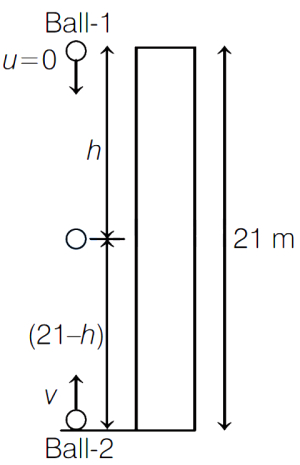
Ball-$1$ is dropped from the top of a building from rest. At the same moment,ball-$2$ is thrown upward towards ball-$1$ with a speed $14 \,m/s$ from a point $21 \,m$ below the top of the building. How far will ball-$1$ have dropped when it passes ball-$2$? (Assume acceleration due to gravity,$g=10 \,m/s^2$.)
A
$\frac{45}{4} \,m$
B
$\frac{52}{6} \,m$
C
$\frac{37}{2} \,m$
D
$\frac{25}{2} \,m$
Solution
(A) Let the balls meet at a distance $h$ from the top after time $t$.
For ball-$1$ (downward motion):
$h = u_1 t + \frac{1}{2} g t^2 = 0 \cdot t + \frac{1}{2} (10) t^2 = 5 t^2$ ... $(i)$
For ball-$2$ (upward motion):
The distance covered by ball-$2$ is $(21 - h)$.
$(21 - h) = u_2 t - \frac{1}{2} g t^2 = 14 t - 5 t^2$ ... (ii)
Adding equations $(i)$ and (ii):
$h + (21 - h) = 5 t^2 + 14 t - 5 t^2$
$21 = 14 t$
$t = \frac{21}{14} = 1.5 \,s$
Substituting $t = 1.5 \,s$ into equation $(i)$:
$h = 5 \times (1.5)^2 = 5 \times 2.25 = 11.25 \,m = \frac{45}{4} \,m$
Thus,ball-$1$ will have dropped $\frac{45}{4} \,m$ when it passes ball-$2$.
For ball-$1$ (downward motion):
$h = u_1 t + \frac{1}{2} g t^2 = 0 \cdot t + \frac{1}{2} (10) t^2 = 5 t^2$ ... $(i)$
For ball-$2$ (upward motion):
The distance covered by ball-$2$ is $(21 - h)$.
$(21 - h) = u_2 t - \frac{1}{2} g t^2 = 14 t - 5 t^2$ ... (ii)
Adding equations $(i)$ and (ii):
$h + (21 - h) = 5 t^2 + 14 t - 5 t^2$
$21 = 14 t$
$t = \frac{21}{14} = 1.5 \,s$
Substituting $t = 1.5 \,s$ into equation $(i)$:
$h = 5 \times (1.5)^2 = 5 \times 2.25 = 11.25 \,m = \frac{45}{4} \,m$
Thus,ball-$1$ will have dropped $\frac{45}{4} \,m$ when it passes ball-$2$.
0 likes
View Solution318
EasyMCQ
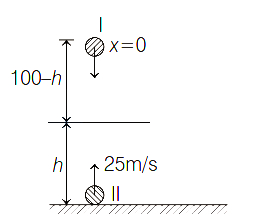
$A$ stone is dropped from a height of $100 \ m$,while another one is projected vertically upwards from the ground with a velocity of $25 \ m/s$ at the same time. The time in seconds after which they will have the same height is (acceleration due to gravity,$g = 10 \ m/s^2$):
A
$4$
B
$5$
C
$6$
D
$7$
Solution
(A) Let the two stones meet at a height $h$ from the ground after time $t$.
For the first stone dropped from $100 \ m$:
The height of the first stone at time $t$ is given by $y_1 = 100 - \frac{1}{2}gt^2$.
For the second stone projected upwards from the ground:
The height of the second stone at time $t$ is given by $y_2 = 25t - \frac{1}{2}gt^2$.
Since they meet at the same height,$y_1 = y_2$:
$100 - \frac{1}{2}gt^2 = 25t - \frac{1}{2}gt^2$
$100 = 25t$
$t = \frac{100}{25} = 4 \ s$.
Thus,the stones will be at the same height after $4 \ s$.
For the first stone dropped from $100 \ m$:
The height of the first stone at time $t$ is given by $y_1 = 100 - \frac{1}{2}gt^2$.
For the second stone projected upwards from the ground:
The height of the second stone at time $t$ is given by $y_2 = 25t - \frac{1}{2}gt^2$.
Since they meet at the same height,$y_1 = y_2$:
$100 - \frac{1}{2}gt^2 = 25t - \frac{1}{2}gt^2$
$100 = 25t$
$t = \frac{100}{25} = 4 \ s$.
Thus,the stones will be at the same height after $4 \ s$.
0 likes
View Solution319
MediumMCQ
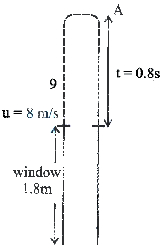
$A$ stone is thrown vertically up from the top end of a window of height $1.8 \,m$ with a velocity of $8 \,m/s$. The time taken by the stone to cross the window during its downward journey is (Acceleration due to gravity $= 10 \,m/s^2$) (in $\,s$)
A
$0.8$
B
$1.6$
C
$1.0$
D
$0.2$
Solution
(D) Let the top of the window be the origin $(y=0)$. The stone is thrown upwards with $u = 8 \,m/s$.
At the maximum height $A$,the final velocity $v = 0$.
Using $v = u + at$:
$0 = 8 - 10t \implies t = 0.8 \,s$.
The height of point $A$ above the top of the window is $h = ut + \frac{1}{2}at^2 = 8(0.8) - \frac{1}{2}(10)(0.8)^2 = 6.4 - 3.2 = 3.2 \,m$.
Now,the stone falls from point $A$ to the bottom of the window. The total distance from $A$ to the bottom of the window is $H = 3.2 \,m + 1.8 \,m = 5.0 \,m$.
Time taken to fall from $A$ to the bottom of the window $(t_{total})$:
$H = \frac{1}{2}gt_{total}^2 \implies 5.0 = \frac{1}{2}(10)t_{total}^2 \implies t_{total}^2 = 1 \implies t_{total} = 1 \,s$.
The time taken to cross the window during the downward journey is the difference between the time to reach the bottom and the time to reach the top of the window from $A$:
$\Delta t = t_{total} - t = 1 \,s - 0.8 \,s = 0.2 \,s$.
At the maximum height $A$,the final velocity $v = 0$.
Using $v = u + at$:
$0 = 8 - 10t \implies t = 0.8 \,s$.
The height of point $A$ above the top of the window is $h = ut + \frac{1}{2}at^2 = 8(0.8) - \frac{1}{2}(10)(0.8)^2 = 6.4 - 3.2 = 3.2 \,m$.
Now,the stone falls from point $A$ to the bottom of the window. The total distance from $A$ to the bottom of the window is $H = 3.2 \,m + 1.8 \,m = 5.0 \,m$.
Time taken to fall from $A$ to the bottom of the window $(t_{total})$:
$H = \frac{1}{2}gt_{total}^2 \implies 5.0 = \frac{1}{2}(10)t_{total}^2 \implies t_{total}^2 = 1 \implies t_{total} = 1 \,s$.
The time taken to cross the window during the downward journey is the difference between the time to reach the bottom and the time to reach the top of the window from $A$:
$\Delta t = t_{total} - t = 1 \,s - 0.8 \,s = 0.2 \,s$.
0 likes
View Solution320
DifficultMCQ
Two balls are released from the same position at a height of $500 \ m$ above the ground,one after the other,with an interval of $1 \ s$. What is the distance between the two balls when the first ball hits the ground (in $m$)? (Acceleration due to gravity $g = 10 \ m/s^2$)
A
$95$
B
$65$
C
$130$
D
$175$
Solution
(A) The time taken by the first ball to reach the ground is given by $t_1 = \sqrt{\frac{2h}{g}}$.
Substituting the values,$t_1 = \sqrt{\frac{2 \times 500}{10}} = \sqrt{100} = 10 \ s$.
The first ball hits the ground at $t = 10 \ s$.
The second ball is released $1 \ s$ later,so it has been in motion for $t_2 = 10 - 1 = 9 \ s$.
The distance traveled by the first ball is $s_1 = 500 \ m$ (as it hits the ground).
The distance traveled by the second ball in $9 \ s$ is $s_2 = \frac{1}{2} \times g \times t_2^2$.
$s_2 = \frac{1}{2} \times 10 \times 9^2 = 5 \times 81 = 405 \ m$.
The distance between the two balls is $s_1 - s_2 = 500 - 405 = 95 \ m$.
Substituting the values,$t_1 = \sqrt{\frac{2 \times 500}{10}} = \sqrt{100} = 10 \ s$.
The first ball hits the ground at $t = 10 \ s$.
The second ball is released $1 \ s$ later,so it has been in motion for $t_2 = 10 - 1 = 9 \ s$.
The distance traveled by the first ball is $s_1 = 500 \ m$ (as it hits the ground).
The distance traveled by the second ball in $9 \ s$ is $s_2 = \frac{1}{2} \times g \times t_2^2$.
$s_2 = \frac{1}{2} \times 10 \times 9^2 = 5 \times 81 = 405 \ m$.
The distance between the two balls is $s_1 - s_2 = 500 - 405 = 95 \ m$.
0 likes
View Solution321
MediumMCQ
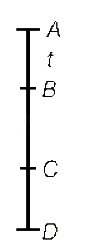
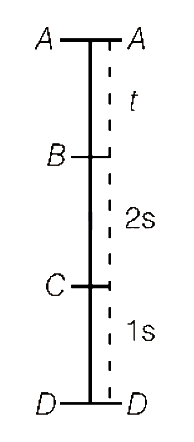
$A$ body is falling freely from a point $A$ at a certain height from the ground and passes through points $B, C$,and $D$ (vertically as shown below) such that $BC = CD$. The time taken by the particle to move from $B$ to $C$ is $2 \ s$ and from $C$ to $D$ is $1 \ s$. The time taken to move from $A$ to $B$ in seconds is
A
$0.6$
B
$0.5$
C
$0.2$
D
$0.4$
Solution
(B) Let the velocity of the particle at point $B$ be $v$.
Since the body is falling freely,the acceleration is $g$.
For the interval $BC$,the time taken is $t_1 = 2 \ s$. Using the equation of motion $s = ut + \frac{1}{2}at^2$:
$BC = v(2) + \frac{1}{2}g(2)^2 = 2v + 2g$ --- $(i)$
For the interval $BD$,the total time is $t_2 = 2 + 1 = 3 \ s$.
$BD = BC + CD = 2BC$ (since $BC = CD$).
$BD = v(3) + \frac{1}{2}g(3)^2 = 3v + 4.5g$
Since $BD = 2BC$,we have:
$2(2v + 2g) = 3v + 4.5g$
$4v + 4g = 3v + 4.5g$
$v = 0.5g$
Now,for the interval $AB$,let the time taken be $t$. Since the body falls freely from $A$,its initial velocity $u = 0$.
$v = u + at \Rightarrow 0.5g = 0 + gt$
$t = 0.5 \ s$.
Since the body is falling freely,the acceleration is $g$.
For the interval $BC$,the time taken is $t_1 = 2 \ s$. Using the equation of motion $s = ut + \frac{1}{2}at^2$:
$BC = v(2) + \frac{1}{2}g(2)^2 = 2v + 2g$ --- $(i)$
For the interval $BD$,the total time is $t_2 = 2 + 1 = 3 \ s$.
$BD = BC + CD = 2BC$ (since $BC = CD$).
$BD = v(3) + \frac{1}{2}g(3)^2 = 3v + 4.5g$
Since $BD = 2BC$,we have:
$2(2v + 2g) = 3v + 4.5g$
$4v + 4g = 3v + 4.5g$
$v = 0.5g$
Now,for the interval $AB$,let the time taken be $t$. Since the body falls freely from $A$,its initial velocity $u = 0$.
$v = u + at \Rightarrow 0.5g = 0 + gt$
$t = 0.5 \ s$.
0 likes
View Solution322
EasyMCQ
$A$ body is projected vertically upwards. It reaches a point at a height $h$ above the point of projection after some time with a speed of $8 \,m/s$. The maximum height reached by the body is (Acceleration due to gravity $g = 10 \,m/s^2$). (in $m$)
A
$5$
B
$3.2$
C
$4.1$
D
$4.5$
Solution
(B) Let the initial velocity of the body be $u$. At the maximum height $H$, the final velocity $v = 0$. The formula for maximum height is $H = \frac{u^2}{2g}$.
At a height $h$, the velocity is $v_h = 8 \,m/s$. Using the equation of motion $v^2 = u^2 - 2gh$, we have $8^2 = u^2 - 2gh$, which implies $u^2 = 64 + 2gh$.
However, the problem implies the body reaches a height $h$ where the speed is $8 \,m/s$. Assuming the body is projected from the ground, the maximum height $H$ is reached when the velocity becomes $0$. If we consider the motion from the point of height $h$ to the maximum height $H$, the initial velocity is $8 \,m/s$ and final velocity is $0$. The distance covered is $(H - h)$.
Using $v^2 = u^2 - 2as$, we get $0^2 = 8^2 - 2g(H - h)$, so $64 = 20(H - h)$, which gives $(H - h) = 3.2 \,m$.
If the question implies the body is at height $h$ and the speed is $8 \,m/s$, the additional height gained is $3.2 \,m$. Assuming the body was projected such that $h$ is the point where speed is $8 \,m/s$, the maximum height relative to that point is $3.2 \,m$.
At a height $h$, the velocity is $v_h = 8 \,m/s$. Using the equation of motion $v^2 = u^2 - 2gh$, we have $8^2 = u^2 - 2gh$, which implies $u^2 = 64 + 2gh$.
However, the problem implies the body reaches a height $h$ where the speed is $8 \,m/s$. Assuming the body is projected from the ground, the maximum height $H$ is reached when the velocity becomes $0$. If we consider the motion from the point of height $h$ to the maximum height $H$, the initial velocity is $8 \,m/s$ and final velocity is $0$. The distance covered is $(H - h)$.
Using $v^2 = u^2 - 2as$, we get $0^2 = 8^2 - 2g(H - h)$, so $64 = 20(H - h)$, which gives $(H - h) = 3.2 \,m$.
If the question implies the body is at height $h$ and the speed is $8 \,m/s$, the additional height gained is $3.2 \,m$. Assuming the body was projected such that $h$ is the point where speed is $8 \,m/s$, the maximum height relative to that point is $3.2 \,m$.
0 likes
View Solution323
DifficultMCQ
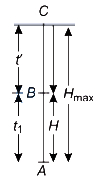
$A$ body is projected vertically upwards at time $t=0$ and it is seen at a height $H$ at times $t_1$ and $t_2$ seconds during its flight. The maximum height attained is ($g$ is acceleration due to gravity).
A
$\frac{g(t_2-t_1)^2}{8}$
B
$\frac{g(t_1+t_2)^2}{4}$
C
$\frac{g(t_1+t_2)^2}{8}$
D
$\frac{g(t_2-t_1)^2}{4}$
Solution
(C) Let the time taken by the body to fall from the maximum height point $C$ to point $B$ be $t^{\prime}$.
Due to symmetry of motion,the time taken to go from $B$ to $C$ is equal to the time taken to fall from $C$ to $B$,which is $t^{\prime}$.
Given that the body is at height $H$ at times $t_1$ and $t_2$,we have $t_2 = t_1 + 2t^{\prime}$.
Thus,$t^{\prime} = \frac{t_2-t_1}{2}$.
The total time $T$ taken to reach the maximum height $C$ is $T = t_1 + t^{\prime} = t_1 + \frac{t_2-t_1}{2} = \frac{t_1+t_2}{2}$.
The maximum height $H_{\max}$ attained is given by the formula $H_{\max} = \frac{1}{2}gT^2$.
Substituting the value of $T$,we get $H_{\max} = \frac{1}{2}g\left(\frac{t_1+t_2}{2}\right)^2 = \frac{1}{2}g \cdot \frac{(t_1+t_2)^2}{4} = \frac{g(t_1+t_2)^2}{8}$.
Due to symmetry of motion,the time taken to go from $B$ to $C$ is equal to the time taken to fall from $C$ to $B$,which is $t^{\prime}$.
Given that the body is at height $H$ at times $t_1$ and $t_2$,we have $t_2 = t_1 + 2t^{\prime}$.
Thus,$t^{\prime} = \frac{t_2-t_1}{2}$.
The total time $T$ taken to reach the maximum height $C$ is $T = t_1 + t^{\prime} = t_1 + \frac{t_2-t_1}{2} = \frac{t_1+t_2}{2}$.
The maximum height $H_{\max}$ attained is given by the formula $H_{\max} = \frac{1}{2}gT^2$.
Substituting the value of $T$,we get $H_{\max} = \frac{1}{2}g\left(\frac{t_1+t_2}{2}\right)^2 = \frac{1}{2}g \cdot \frac{(t_1+t_2)^2}{4} = \frac{g(t_1+t_2)^2}{8}$.
0 likes
View Solution324
DifficultMCQ
$A$ body projected vertically upwards crosses a point twice in its journey at a height $h$ after $t_1$ and $t_2$ seconds. The maximum height reached by the body is
A
$\frac{g}{4}(t_1+t_2)^2$
B
$g\left(\frac{t_1+t_2}{4}\right)^2$
C
$2g\left(\frac{t_1+t_2}{4}\right)^2$
D
$\frac{g}{4}(t_1 t_2)$
Solution
(C) Let the body be projected with initial velocity $u$. The equation of motion for height $h$ is $h = ut - \frac{1}{2}gt^2$,which is a quadratic equation in $t$: $\frac{1}{2}gt^2 - ut + h = 0$.
Since $t_1$ and $t_2$ are the roots of this equation,the sum of roots is $t_1 + t_2 = \frac{u}{g/2} = \frac{2u}{g}$.
Thus,$u = \frac{g(t_1+t_2)}{2}$.
The maximum height $H$ reached by the body is given by $H = \frac{u^2}{2g}$.
Substituting the value of $u$: $H = \frac{1}{2g} \left[ \frac{g(t_1+t_2)}{2} \right]^2 = \frac{1}{2g} \cdot \frac{g^2(t_1+t_2)^2}{4} = \frac{g(t_1+t_2)^2}{8}$.
Alternatively,$H = 2g \left( \frac{t_1+t_2}{4} \right)^2 = 2g \cdot \frac{(t_1+t_2)^2}{16} = \frac{g(t_1+t_2)^2}{8}$.
Therefore,the correct option is $C$.
Since $t_1$ and $t_2$ are the roots of this equation,the sum of roots is $t_1 + t_2 = \frac{u}{g/2} = \frac{2u}{g}$.
Thus,$u = \frac{g(t_1+t_2)}{2}$.
The maximum height $H$ reached by the body is given by $H = \frac{u^2}{2g}$.
Substituting the value of $u$: $H = \frac{1}{2g} \left[ \frac{g(t_1+t_2)}{2} \right]^2 = \frac{1}{2g} \cdot \frac{g^2(t_1+t_2)^2}{4} = \frac{g(t_1+t_2)^2}{8}$.
Alternatively,$H = 2g \left( \frac{t_1+t_2}{4} \right)^2 = 2g \cdot \frac{(t_1+t_2)^2}{16} = \frac{g(t_1+t_2)^2}{8}$.
Therefore,the correct option is $C$.
0 likes
View Solution325
MediumMCQ
$A$ ball is dropped from a bridge that is $45 \ m$ above the water. It falls directly into a boat which is moving with constant velocity. The boat is $12 \ m$ away from the point of impact when the ball is dropped. The speed of the boat is (Take $g=10 \ m \ s^{-2}$) (in $m \ s^{-1}$)
A
$2$
B
$3$
C
$4$
D
$5$
Solution
(C) Given: Height of the bridge $h = 45 \ m$. Initial velocity of the ball $u = 0 \ m \ s^{-1}$. Acceleration due to gravity $g = 10 \ m \ s^{-2}$.
Using the kinematic equation for vertical motion: $h = ut + \frac{1}{2}gt^2$.
Since $u = 0$,we have $45 = 0 + \frac{1}{2} \times 10 \times t^2$.
$45 = 5t^2 \implies t^2 = 9 \implies t = 3 \ s$.
The ball takes $3 \ s$ to reach the water surface.
During this time,the boat must travel the distance of $12 \ m$ to be at the point of impact.
Speed of the boat $v = \frac{\text{distance}}{\text{time}} = \frac{12 \ m}{3 \ s} = 4 \ m \ s^{-1}$.
Using the kinematic equation for vertical motion: $h = ut + \frac{1}{2}gt^2$.
Since $u = 0$,we have $45 = 0 + \frac{1}{2} \times 10 \times t^2$.
$45 = 5t^2 \implies t^2 = 9 \implies t = 3 \ s$.
The ball takes $3 \ s$ to reach the water surface.
During this time,the boat must travel the distance of $12 \ m$ to be at the point of impact.
Speed of the boat $v = \frac{\text{distance}}{\text{time}} = \frac{12 \ m}{3 \ s} = 4 \ m \ s^{-1}$.
0 likes
View Solution326
DifficultMCQ
$A$ ball is projected vertically up from the ground. Boy $A$,standing at the window of the first floor of a nearby building,observes that the time interval between the ball crossing him while going up and the ball crossing him while going down is $2 \ s$. Another boy $B$,standing on the second floor,notices the time interval between the ball passing him twice,during up and down motion,is $1 \ s$. Calculate the difference between the vertical positions of boy $B$ and boy $A$. (Assume $g = 10 \ m \ s^{-2}$) (in $m$)
A
$8.45$
B
$3.75$
C
$4.25$
D
$2.50$
Solution
(B) Let $t_A = 2 \ s$ be the time interval for boy $A$ and $t_B = 1 \ s$ be the time interval for boy $B$.
For a ball projected vertically,the time taken to reach the maximum height from a point at height $h$ is $t/2$.
Using $v = u + at$,at the highest point $v = 0$,so $u = g(t/2)$.
The height $h$ of the point from the ground is given by $h = u(t/2) - 1/2 g(t/2)^2 = g(t/2)^2 - 1/2 g(t/2)^2 = 1/2 g(t/2)^2 = 1/8 g t^2$.
For boy $A$: $h_A = 1/8 \times 10 \times (2)^2 = 5 \ m$.
For boy $B$: $h_B = 1/8 \times 10 \times (1)^2 = 1.25 \ m$.
The difference in vertical positions is $h_A - h_B = 5 \ m - 1.25 \ m = 3.75 \ m$.
For a ball projected vertically,the time taken to reach the maximum height from a point at height $h$ is $t/2$.
Using $v = u + at$,at the highest point $v = 0$,so $u = g(t/2)$.
The height $h$ of the point from the ground is given by $h = u(t/2) - 1/2 g(t/2)^2 = g(t/2)^2 - 1/2 g(t/2)^2 = 1/2 g(t/2)^2 = 1/8 g t^2$.
For boy $A$: $h_A = 1/8 \times 10 \times (2)^2 = 5 \ m$.
For boy $B$: $h_B = 1/8 \times 10 \times (1)^2 = 1.25 \ m$.
The difference in vertical positions is $h_A - h_B = 5 \ m - 1.25 \ m = 3.75 \ m$.
0 likes
View Solution327
EasyMCQ
$A$ ball (initially at rest) is released from the top of a tower. The ratio of work done by the force of gravity,in the first,second,and third seconds is
A
$1: 3: 5$
B
$1: 4: 16$
C
$1: 9: 25$
D
$1: 2: 3$
Solution
(A) The work done by the force of gravity is given by $W = F \cdot S_n = mg \cdot S_n$,where $S_n$ is the distance traveled in the $n$th second.
Since $m$,$g$,and $F$ are constant,$W \propto S_n$.
The distance traveled in the $n$th second for an object starting from rest is given by $S_n = u + \frac{a}{2}(2n - 1)$.
Here,$u = 0$ and $a = g$,so $S_n = \frac{g}{2}(2n - 1)$.
For $n = 1, 2, 3$:
$S_1 = \frac{g}{2}(2(1) - 1) = \frac{g}{2}(1)$
$S_2 = \frac{g}{2}(2(2) - 1) = \frac{g}{2}(3)$
$S_3 = \frac{g}{2}(2(3) - 1) = \frac{g}{2}(5)$
The ratio of distances is $S_1 : S_2 : S_3 = 1 : 3 : 5$.
Therefore,the ratio of work done is $1 : 3 : 5$.
Since $m$,$g$,and $F$ are constant,$W \propto S_n$.
The distance traveled in the $n$th second for an object starting from rest is given by $S_n = u + \frac{a}{2}(2n - 1)$.
Here,$u = 0$ and $a = g$,so $S_n = \frac{g}{2}(2n - 1)$.
For $n = 1, 2, 3$:
$S_1 = \frac{g}{2}(2(1) - 1) = \frac{g}{2}(1)$
$S_2 = \frac{g}{2}(2(2) - 1) = \frac{g}{2}(3)$
$S_3 = \frac{g}{2}(2(3) - 1) = \frac{g}{2}(5)$
The ratio of distances is $S_1 : S_2 : S_3 = 1 : 3 : 5$.
Therefore,the ratio of work done is $1 : 3 : 5$.
0 likes
View Solution328
DifficultMCQ
Water drops fall from a tap onto the floor,$5 \ m$ below,at regular intervals of time. The first drop strikes the floor when the sixth drop begins to fall. The height at which the fourth drop will be from the ground at the instant when the first drop strikes the ground is . . . . . . $m$. $(g = 10 \ m/s^2)$
A
$2.5$
B
$4$
C
$4.2$
D
$3.8$
Solution
(C) Let the time interval between two consecutive drops be $t$.
Since the first drop strikes the floor when the sixth drop begins to fall,the total time taken by the first drop to reach the ground is $5t$.
Given the height $h = 5 \ m$ and $g = 10 \ m/s^2$,the time taken is $t_{total} = \sqrt{\frac{2h}{g}} = \sqrt{\frac{2 \times 5}{10}} = 1 \ s$.
Thus,$5t = 1 \ s$,which implies $t = 0.2 \ s$.
At the instant the first drop strikes the ground,the fourth drop has been falling for a time $t_4 = (5 - 4)t = 1 \times 0.2 = 0.2 \ s$ is incorrect; let's re-evaluate:
The first drop is at $t=0$ (start),$t=1$ (ground).
The second drop is at $t=0.2$,the third at $t=0.4$,the fourth at $t=0.6$,the fifth at $t=0.8$,and the sixth at $t=1.0$.
At $t=1.0 \ s$,the fourth drop has been falling for $(1.0 - 0.6) = 0.4 \ s$.
Distance fallen by the fourth drop $h_4 = \frac{1}{2}gt_4^2 = \frac{1}{2} \times 10 \times (0.4)^2 = 5 \times 0.16 = 0.8 \ m$.
Height from the ground $= 5 - 0.8 = 4.2 \ m$.
Since the first drop strikes the floor when the sixth drop begins to fall,the total time taken by the first drop to reach the ground is $5t$.
Given the height $h = 5 \ m$ and $g = 10 \ m/s^2$,the time taken is $t_{total} = \sqrt{\frac{2h}{g}} = \sqrt{\frac{2 \times 5}{10}} = 1 \ s$.
Thus,$5t = 1 \ s$,which implies $t = 0.2 \ s$.
At the instant the first drop strikes the ground,the fourth drop has been falling for a time $t_4 = (5 - 4)t = 1 \times 0.2 = 0.2 \ s$ is incorrect; let's re-evaluate:
The first drop is at $t=0$ (start),$t=1$ (ground).
The second drop is at $t=0.2$,the third at $t=0.4$,the fourth at $t=0.6$,the fifth at $t=0.8$,and the sixth at $t=1.0$.
At $t=1.0 \ s$,the fourth drop has been falling for $(1.0 - 0.6) = 0.4 \ s$.
Distance fallen by the fourth drop $h_4 = \frac{1}{2}gt_4^2 = \frac{1}{2} \times 10 \times (0.4)^2 = 5 \times 0.16 = 0.8 \ m$.
Height from the ground $= 5 - 0.8 = 4.2 \ m$.
0 likes
View Solution329
DifficultMCQ
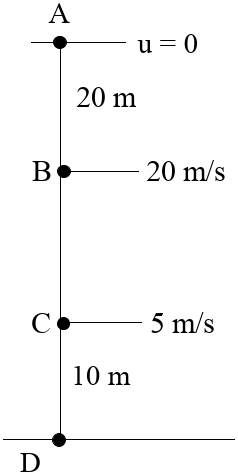
$A$ paratrooper jumps from an aeroplane and opens a parachute after $2 \ s$ of free fall and starts decelerating with $3 \ m/s^2$. At $10 \ m$ height from the ground,while descending with the help of the parachute,the speed of the paratrooper is $5 \ m/s$. The initial height of the aeroplane is . . . . . . $m$. $(g = 10 \ m/s^2)$
A
$62.5$
B
$92.5$
C
$20$
D
$82.5$
Solution
(B) Let the points of motion be $A$ (jump),$B$ (parachute opens),$C$ (at $10 \ m$ height),and $D$ (ground).
$1.$ Motion from $A$ to $B$ (Free fall):
Initial velocity $u_A = 0$,time $t = 2 \ s$,acceleration $a = g = 10 \ m/s^2$.
Distance covered $x_1 = \frac{1}{2} g t^2 = \frac{1}{2} \times 10 \times (2)^2 = 20 \ m$.
Velocity at $B$,$v_B = u_A + gt = 0 + 10 \times 2 = 20 \ m/s$.
$2.$ Motion from $B$ to $C$ (Deceleration):
Initial velocity $u_B = 20 \ m/s$,final velocity $v_C = 5 \ m/s$,acceleration $a = -3 \ m/s^2$.
Using $v^2 - u^2 = 2as$:
$(5)^2 - (20)^2 = 2(-3) x_2$
$25 - 400 = -6 x_2$
$-375 = -6 x_2$
$x_2 = \frac{375}{6} = 62.5 \ m$.
$3.$ Motion from $C$ to $D$:
Distance $x_3 = 10 \ m$.
Total height $H = x_1 + x_2 + x_3 = 20 + 62.5 + 10 = 92.5 \ m$.
$1.$ Motion from $A$ to $B$ (Free fall):
Initial velocity $u_A = 0$,time $t = 2 \ s$,acceleration $a = g = 10 \ m/s^2$.
Distance covered $x_1 = \frac{1}{2} g t^2 = \frac{1}{2} \times 10 \times (2)^2 = 20 \ m$.
Velocity at $B$,$v_B = u_A + gt = 0 + 10 \times 2 = 20 \ m/s$.
$2.$ Motion from $B$ to $C$ (Deceleration):
Initial velocity $u_B = 20 \ m/s$,final velocity $v_C = 5 \ m/s$,acceleration $a = -3 \ m/s^2$.
Using $v^2 - u^2 = 2as$:
$(5)^2 - (20)^2 = 2(-3) x_2$
$25 - 400 = -6 x_2$
$-375 = -6 x_2$
$x_2 = \frac{375}{6} = 62.5 \ m$.
$3.$ Motion from $C$ to $D$:
Distance $x_3 = 10 \ m$.
Total height $H = x_1 + x_2 + x_3 = 20 + 62.5 + 10 = 92.5 \ m$.
0 likes
View Solution330
DifficultMCQ
From $18 \text{ m}$ height above the ground,a ball is dropped from rest. The height above the ground at which the magnitude of velocity equals the magnitude of acceleration (in the same set of units) due to gravity is . . . . . . $\text{m}$. (Take $g = 10 \text{ m/s}^2$ and neglect the air resistance)
A
$13$
B
$14$
C
$15$
D
$16$
Solution
(A) Let the ball fall a distance $h'$ from the top.
The velocity $v$ of the ball after falling a distance $h'$ is given by $v = \sqrt{2gh'}$.
The magnitude of acceleration due to gravity is $a = g = 10 \text{ m/s}^2$.
According to the problem,the magnitude of velocity equals the magnitude of acceleration: $|v| = |a|$.
Substituting the values,we get $\sqrt{2gh'} = g$.
Squaring both sides,we get $2gh' = g^2$.
Dividing by $g$,we get $2h' = g$.
Given $g = 10 \text{ m/s}^2$,we have $2h' = 10$,which gives $h' = 5 \text{ m}$.
The height above the ground $H$ is the total height minus the distance fallen: $H = 18 \text{ m} - 5 \text{ m} = 13 \text{ m}$.
The velocity $v$ of the ball after falling a distance $h'$ is given by $v = \sqrt{2gh'}$.
The magnitude of acceleration due to gravity is $a = g = 10 \text{ m/s}^2$.
According to the problem,the magnitude of velocity equals the magnitude of acceleration: $|v| = |a|$.
Substituting the values,we get $\sqrt{2gh'} = g$.
Squaring both sides,we get $2gh' = g^2$.
Dividing by $g$,we get $2h' = g$.
Given $g = 10 \text{ m/s}^2$,we have $2h' = 10$,which gives $h' = 5 \text{ m}$.
The height above the ground $H$ is the total height minus the distance fallen: $H = 18 \text{ m} - 5 \text{ m} = 13 \text{ m}$.
0 likes
View Solution331
MediumMCQ
When a ruler falls vertically,$5$ different persons catch it with different reaction times. $(g = 9.8 \text{ ms}^{-2})$
$A$. Person $A$ has reaction time of $0.20 \text{ s}$
$B$. Person $B$ has reaction time of $0.22 \text{ s}$
$C$. Person $C$ has reaction time of $0.18 \text{ s}$
$D$. Person $D$ has reaction time of $0.19 \text{ s}$
$E$. Person $E$ has reaction time of $0.21 \text{ s}$
What is the correct order of the distance travelled by the ruler for each person?
$A$. Person $A$ has reaction time of $0.20 \text{ s}$
$B$. Person $B$ has reaction time of $0.22 \text{ s}$
$C$. Person $C$ has reaction time of $0.18 \text{ s}$
$D$. Person $D$ has reaction time of $0.19 \text{ s}$
$E$. Person $E$ has reaction time of $0.21 \text{ s}$
What is the correct order of the distance travelled by the ruler for each person?
A
$B > E > A > C > D$
B
$C > D > A > E > B$
C
$C > D > A > B > E$
D
$B > E > A > D > C$
Solution
(D) The distance travelled by a freely falling object is given by the equation $s = \frac{1}{2}gt^2$.
Since $g$ is constant,the distance $s$ is directly proportional to the square of the reaction time $t$ $(s \propto t^2)$.
Comparing the reaction times: $t_B (0.22 \text{ s}) > t_E (0.21 \text{ s}) > t_A (0.20 \text{ s}) > t_D (0.19 \text{ s}) > t_C (0.18 \text{ s})$.
Since $s \propto t^2$,the order of distances will be the same as the order of the squares of the reaction times.
Therefore,the distance travelled will follow the order: $B > E > A > D > C$.
Thus,option $D$ is correct.
Since $g$ is constant,the distance $s$ is directly proportional to the square of the reaction time $t$ $(s \propto t^2)$.
Comparing the reaction times: $t_B (0.22 \text{ s}) > t_E (0.21 \text{ s}) > t_A (0.20 \text{ s}) > t_D (0.19 \text{ s}) > t_C (0.18 \text{ s})$.
Since $s \propto t^2$,the order of distances will be the same as the order of the squares of the reaction times.
Therefore,the distance travelled will follow the order: $B > E > A > D > C$.
Thus,option $D$ is correct.
0 likes
View SolutionMotion in Straight Line — Motion Under Gravity · Frequently Asked Questions
1Are these Motion in Straight Line questions useful for JEE and NEET?
Yes. All questions in this section are mapped to JEE Main and NEET exam patterns. Previous year questions from JEE Main, NEET, GUJCET and state-level exams are included with full solutions.
2Can I switch to Hindi or Gujarati for these questions?
Yes. Use the language tabs in the hero section or the sidebar to view the same questions and solutions in English, Hindi or Gujarati.
3How do I generate a question paper from this subtopic?
Use the Vedclass Exam Paper Generator — select the chapter and subtopic, set difficulty, and generate Sets A, B, C, D automatically. First 3 chapters of every subject are free.
Vedclass Products
For Students
Vedclass Test Series
Mock tests in real JEE/NEET style with performance analysis. 5-day free trial.
Start Free TrialFor Teachers
Exam Paper Generator
Generate Set A/B/C/D papers from this chapter in 2 minutes. 3 chapters free.
Try FreeFor Institutes
Online Exam Module
Live online exams with unlimited students, 360° analytics & white-label branding.
See DemoFor Teachers & Institutes
Generate a Motion in Straight Line Exam Paper in 2 Minutes
Select subtopic & difficulty — Sets A, B, C, D auto-generated with No Repeat logic.
First 3 chapters of every subject are free — no payment required.