
A English
Speed (velocity) of Gas (rms, mean and Most probable speed) Questions in English
Class 11 Physics · Kinetic Theory of Gases · Speed (velocity) of Gas (rms, mean and Most probable speed)
291+
Questions
English
Language
100%
With Solutions
Showing 49 of 291 questions in English
201
MediumMCQ
Three vessels of equal volume contain gases at the same temperature and pressure. The first vessel contains neon (monoatomic),the second contains chlorine (diatomic) and the third contains uranium hexafluoride (polyatomic). Arrange these on the basis of their root mean square speed $(v_{rms})$ and choose the correct answer from the options given below:
A
$v_{rms}(\text{mono}) = v_{rms}(\text{dia}) = v_{rms}(\text{poly})$
B
$v_{rms}(\text{mono}) > v_{rms}(\text{dia}) > v_{rms}(\text{poly})$
C
$v_{rms}(\text{dia}) < v_{rms}(\text{poly}) < v_{rms}(\text{mono})$
D
$v_{rms}(\text{mono}) < v_{rms}(\text{dia}) < v_{rms}(\text{poly})$
Solution
(B) The root mean square speed of a gas is given by the formula $v_{rms} = \sqrt{\frac{3RT}{M}}$,where $R$ is the universal gas constant,$T$ is the absolute temperature,and $M$ is the molar mass of the gas.
Since $T$ is the same for all three vessels,$v_{rms} \propto \frac{1}{\sqrt{M}}$.
The molar masses are:
Neon (monoatomic): $M_1 \approx 20 \text{ g/mol}$.
Chlorine (diatomic): $M_2 \approx 71 \text{ g/mol}$.
Uranium hexafluoride (polyatomic): $M_3 \approx 352 \text{ g/mol}$.
Since $M_1 < M_2 < M_3$,it follows that $\frac{1}{\sqrt{M_1}} > \frac{1}{\sqrt{M_2}} > \frac{1}{\sqrt{M_3}}$.
Therefore,$v_{rms}(\text{mono}) > v_{rms}(\text{dia}) > v_{rms}(\text{poly})$.
Since $T$ is the same for all three vessels,$v_{rms} \propto \frac{1}{\sqrt{M}}$.
The molar masses are:
Neon (monoatomic): $M_1 \approx 20 \text{ g/mol}$.
Chlorine (diatomic): $M_2 \approx 71 \text{ g/mol}$.
Uranium hexafluoride (polyatomic): $M_3 \approx 352 \text{ g/mol}$.
Since $M_1 < M_2 < M_3$,it follows that $\frac{1}{\sqrt{M_1}} > \frac{1}{\sqrt{M_2}} > \frac{1}{\sqrt{M_3}}$.
Therefore,$v_{rms}(\text{mono}) > v_{rms}(\text{dia}) > v_{rms}(\text{poly})$.
0 likes
View Solution202
EasyMCQ
The root mean square speed of molecules of nitrogen gas at $27^{\circ} C$ is approximately $.......m/s$. (Given: mass of a nitrogen molecule $= 4.6 \times 10^{-26} \, kg$ and Boltzmann constant $k_{B} = 1.4 \times 10^{-23} \, J K^{-1}$)
A
$523$
B
$1260$
C
$91$
D
$27.4$
Solution
(A) The root mean square speed $(V_{rms})$ of gas molecules is given by the formula: $V_{rms} = \sqrt{\frac{3 k_{B} T}{m}}$.
Given:
Temperature $T = 27^{\circ} C = 27 + 273 = 300 \, K$.
Mass of a nitrogen molecule $m = 4.6 \times 10^{-26} \, kg$.
Boltzmann constant $k_{B} = 1.4 \times 10^{-23} \, J K^{-1}$.
Substituting the values into the formula:
$V_{rms} = \sqrt{\frac{3 \times 1.4 \times 10^{-23} \times 300}{4.6 \times 10^{-26}}}$
$V_{rms} = \sqrt{\frac{1260 \times 10^{-23}}{4.6 \times 10^{-26}}}$
$V_{rms} = \sqrt{273.91 \times 10^{3}} \approx \sqrt{273910} \approx 523.36 \, m/s$.
Thus,the approximate speed is $523 \, m/s$.
Given:
Temperature $T = 27^{\circ} C = 27 + 273 = 300 \, K$.
Mass of a nitrogen molecule $m = 4.6 \times 10^{-26} \, kg$.
Boltzmann constant $k_{B} = 1.4 \times 10^{-23} \, J K^{-1}$.
Substituting the values into the formula:
$V_{rms} = \sqrt{\frac{3 \times 1.4 \times 10^{-23} \times 300}{4.6 \times 10^{-26}}}$
$V_{rms} = \sqrt{\frac{1260 \times 10^{-23}}{4.6 \times 10^{-26}}}$
$V_{rms} = \sqrt{273.91 \times 10^{3}} \approx \sqrt{273910} \approx 523.36 \, m/s$.
Thus,the approximate speed is $523 \, m/s$.
0 likes
View Solution203
EasyMCQ
If the r.m.s. speed of a chlorine molecule is $490\,m/s$ at $27^{\circ}C$,the r.m.s. speed of argon molecules at the same temperature will be $......\,m/s$ (Atomic mass of argon $= 39.9\,u$,molecular mass of chlorine $= 70.9\,u$). (in $.7$)
A
$751$
B
$451$
C
$651$
D
$551$
Solution
(C) The root mean square (r.m.s.) speed of a gas molecule is given by the formula $v_{rms} = \sqrt{\frac{3RT}{M}}$,where $R$ is the universal gas constant,$T$ is the absolute temperature,and $M$ is the molar mass.
Since the temperature $T$ is the same for both gases,we have $v_{rms} \propto \frac{1}{\sqrt{M}}$.
Therefore,the ratio of the r.m.s. speeds is $\frac{v_{Ar}}{v_{Cl}} = \sqrt{\frac{M_{Cl}}{M_{Ar}}}$.
Given $v_{Cl} = 490\,m/s$,$M_{Cl} = 70.9\,u$,and $M_{Ar} = 39.9\,u$.
Substituting the values: $v_{Ar} = 490 \times \sqrt{\frac{70.9}{39.9}}$.
$v_{Ar} = 490 \times \sqrt{1.7769} \approx 490 \times 1.333 = 653.17\,m/s$.
Rounding to the nearest provided option,we get $651.7\,m/s$.
Since the temperature $T$ is the same for both gases,we have $v_{rms} \propto \frac{1}{\sqrt{M}}$.
Therefore,the ratio of the r.m.s. speeds is $\frac{v_{Ar}}{v_{Cl}} = \sqrt{\frac{M_{Cl}}{M_{Ar}}}$.
Given $v_{Cl} = 490\,m/s$,$M_{Cl} = 70.9\,u$,and $M_{Ar} = 39.9\,u$.
Substituting the values: $v_{Ar} = 490 \times \sqrt{\frac{70.9}{39.9}}$.
$v_{Ar} = 490 \times \sqrt{1.7769} \approx 490 \times 1.333 = 653.17\,m/s$.
Rounding to the nearest provided option,we get $651.7\,m/s$.
0 likes
View Solution204
MediumMCQ
The rms speed of an oxygen molecule in a vessel at a particular temperature is $\left(1+\frac{5}{x}\right)^{\frac{1}{2}} v$,where $v$ is the average speed of the molecule. The value of $x$ will be: (Take $\pi=\frac{22}{7}$)
A
$28$
B
$27$
C
$8$
D
$4$
Solution
(A) The root mean square (rms) speed of a gas molecule is given by $v_{rms} = \sqrt{\frac{3RT}{M}}$.
The average speed of a gas molecule is given by $v_{avg} = \sqrt{\frac{8RT}{\pi M}}$.
According to the problem,$v_{rms} = \left(1+\frac{5}{x}\right)^{\frac{1}{2}} v_{avg}$.
Substituting the formulas: $\sqrt{\frac{3RT}{M}} = \left(1+\frac{5}{x}\right)^{\frac{1}{2}} \sqrt{\frac{8RT}{\pi M}}$.
Squaring both sides: $\frac{3RT}{M} = \left(1+\frac{5}{x}\right) \frac{8RT}{\pi M}$.
Canceling $\frac{RT}{M}$ from both sides: $3 = \left(1+\frac{5}{x}\right) \frac{8}{\pi}$.
Given $\pi = \frac{22}{7}$,we have $3 = \left(1+\frac{5}{x}\right) \frac{8}{22/7} = \left(1+\frac{5}{x}\right) \frac{8 \times 7}{22} = \left(1+\frac{5}{x}\right) \frac{56}{22} = \left(1+\frac{5}{x}\right) \frac{28}{11}$.
$\Rightarrow 1+\frac{5}{x} = 3 \times \frac{11}{28} = \frac{33}{28}$.
$\Rightarrow \frac{5}{x} = \frac{33}{28} - 1 = \frac{5}{28}$.
$\Rightarrow x = 28$.
The average speed of a gas molecule is given by $v_{avg} = \sqrt{\frac{8RT}{\pi M}}$.
According to the problem,$v_{rms} = \left(1+\frac{5}{x}\right)^{\frac{1}{2}} v_{avg}$.
Substituting the formulas: $\sqrt{\frac{3RT}{M}} = \left(1+\frac{5}{x}\right)^{\frac{1}{2}} \sqrt{\frac{8RT}{\pi M}}$.
Squaring both sides: $\frac{3RT}{M} = \left(1+\frac{5}{x}\right) \frac{8RT}{\pi M}$.
Canceling $\frac{RT}{M}$ from both sides: $3 = \left(1+\frac{5}{x}\right) \frac{8}{\pi}$.
Given $\pi = \frac{22}{7}$,we have $3 = \left(1+\frac{5}{x}\right) \frac{8}{22/7} = \left(1+\frac{5}{x}\right) \frac{8 \times 7}{22} = \left(1+\frac{5}{x}\right) \frac{56}{22} = \left(1+\frac{5}{x}\right) \frac{28}{11}$.
$\Rightarrow 1+\frac{5}{x} = 3 \times \frac{11}{28} = \frac{33}{28}$.
$\Rightarrow \frac{5}{x} = \frac{33}{28} - 1 = \frac{5}{28}$.
$\Rightarrow x = 28$.
1 likes
View Solution205
EasyMCQ
The temperature of a gas is $-50^{\circ}C$. To what temperature should the gas be heated so that the $rms$ speed is increased by $3$ times?
A
$223\,K$
B
$669^{\circ}C$
C
$3295^{\circ}C$
D
$3097\,K$
Solution
(C) The $rms$ speed of a gas is given by $v_{rms} = \sqrt{\frac{3RT}{M}}$,which implies $v_{rms} \propto \sqrt{T}$.
Let the initial temperature be $T_1 = -50 + 273 = 223\,K$ and the initial speed be $v_1 = v$.
The speed is increased by $3$ times,so the final speed $v_2 = v + 3v = 4v$.
Using the relation $\frac{v_1}{v_2} = \sqrt{\frac{T_1}{T_2}}$,we have $\frac{v}{4v} = \sqrt{\frac{223}{T_2}}$.
Squaring both sides,$\frac{1}{16} = \frac{223}{T_2}$.
Thus,$T_2 = 223 \times 16 = 3568\,K$.
Converting to Celsius,$T_2 = 3568 - 273 = 3295^{\circ}C$.
Let the initial temperature be $T_1 = -50 + 273 = 223\,K$ and the initial speed be $v_1 = v$.
The speed is increased by $3$ times,so the final speed $v_2 = v + 3v = 4v$.
Using the relation $\frac{v_1}{v_2} = \sqrt{\frac{T_1}{T_2}}$,we have $\frac{v}{4v} = \sqrt{\frac{223}{T_2}}$.
Squaring both sides,$\frac{1}{16} = \frac{223}{T_2}$.
Thus,$T_2 = 223 \times 16 = 3568\,K$.
Converting to Celsius,$T_2 = 3568 - 273 = 3295^{\circ}C$.
0 likes
View Solution206
DifficultMCQ
At which temperature is the r.m.s. velocity of a hydrogen molecule equal to that of an oxygen molecule at $47^{\circ} C$ (in $\,K$)?
A
$80$
B
$-73$
C
$4$
D
$20$
Solution
(D) The root mean square (r.m.s.) velocity of a gas molecule is given by the formula $v_{rms} = \sqrt{\frac{3RT}{M}}$, where $R$ is the universal gas constant, $T$ is the absolute temperature in Kelvin, and $M$ is the molar mass of the gas.
Given, the r.m.s. velocity of hydrogen $(H_2)$ at temperature $T_H$ is equal to the r.m.s. velocity of oxygen $(O_2)$ at temperature $T_O = 47^{\circ} C = 47 + 273 = 320 \,K$.
The molar mass of hydrogen $M_H = 2 \,g/mol$ and the molar mass of oxygen $M_O = 32 \,g/mol$.
Equating the velocities: $\sqrt{\frac{3RT_H}{M_H}} = \sqrt{\frac{3RT_O}{M_O}}$.
Squaring both sides: $\frac{T_H}{M_H} = \frac{T_O}{M_O}$.
Substituting the values: $\frac{T_H}{2} = \frac{320}{32}$.
$T_H = 2 \times 10 = 20 \,K$.
Given, the r.m.s. velocity of hydrogen $(H_2)$ at temperature $T_H$ is equal to the r.m.s. velocity of oxygen $(O_2)$ at temperature $T_O = 47^{\circ} C = 47 + 273 = 320 \,K$.
The molar mass of hydrogen $M_H = 2 \,g/mol$ and the molar mass of oxygen $M_O = 32 \,g/mol$.
Equating the velocities: $\sqrt{\frac{3RT_H}{M_H}} = \sqrt{\frac{3RT_O}{M_O}}$.
Squaring both sides: $\frac{T_H}{M_H} = \frac{T_O}{M_O}$.
Substituting the values: $\frac{T_H}{2} = \frac{320}{32}$.
$T_H = 2 \times 10 = 20 \,K$.
0 likes
View Solution207
DifficultMCQ
If the root mean square velocity of a hydrogen molecule at a given temperature and pressure is $2 \,km/s$, the root mean square velocity of oxygen at the same condition in $km/s$ is:
A
$2.0$
B
$0.5$
C
$1.5$
D
$1.0$
Solution
(B) The root mean square velocity $(V_{rms})$ of a gas is given by the formula: $V_{rms} = \sqrt{\frac{3RT}{M}}$.
Since the temperature $(T)$ and gas constant $(R)$ are the same for both gases, the relationship between velocity and molar mass $(M)$ is $V_{rms} \propto \frac{1}{\sqrt{M}}$.
Let $V_H$ be the velocity of hydrogen $(M_H = 2 \,g/mol)$ and $V_O$ be the velocity of oxygen $(M_O = 32 \,g/mol)$.
Then, $\frac{V_H}{V_O} = \sqrt{\frac{M_O}{M_H}}$.
Substituting the given values: $\frac{2}{V_O} = \sqrt{\frac{32}{2}} = \sqrt{16} = 4$.
Therefore, $V_O = \frac{2}{4} = 0.5 \,km/s$.
Since the temperature $(T)$ and gas constant $(R)$ are the same for both gases, the relationship between velocity and molar mass $(M)$ is $V_{rms} \propto \frac{1}{\sqrt{M}}$.
Let $V_H$ be the velocity of hydrogen $(M_H = 2 \,g/mol)$ and $V_O$ be the velocity of oxygen $(M_O = 32 \,g/mol)$.
Then, $\frac{V_H}{V_O} = \sqrt{\frac{M_O}{M_H}}$.
Substituting the given values: $\frac{2}{V_O} = \sqrt{\frac{32}{2}} = \sqrt{16} = 4$.
Therefore, $V_O = \frac{2}{4} = 0.5 \,km/s$.
0 likes
View Solution208
DifficultMCQ
$A$ sample contains a mixture of helium and oxygen gas. The ratio of the root mean square speed of helium to oxygen in the sample is:
A
$\frac{1}{32}$
B
$\frac{2 \sqrt{2}}{1}$
C
$\frac{1}{4}$
D
$\frac{1}{2 \sqrt{2}}$
Solution
(B) The root mean square speed $(V_{rms})$ of a gas is given by the formula: $V_{rms} = \sqrt{\frac{3RT}{M_w}}$.
Since the gases are in the same sample,they are at the same temperature $(T)$.
Therefore,$V_{rms} \propto \frac{1}{\sqrt{M_w}}$.
The ratio of the root mean square speed of helium $(He)$ to oxygen $(O_2)$ is:
$\frac{V_{He}}{V_{O_2}} = \sqrt{\frac{M_{w, O_2}}{M_{w, He}}}$.
Given the molar mass of helium $(M_{w, He} = 4 \ g/mol)$ and oxygen $(M_{w, O_2} = 32 \ g/mol)$:
$\frac{V_{He}}{V_{O_2}} = \sqrt{\frac{32}{4}} = \sqrt{8} = 2\sqrt{2}$.
Thus,the ratio is $\frac{2\sqrt{2}}{1}$.
Since the gases are in the same sample,they are at the same temperature $(T)$.
Therefore,$V_{rms} \propto \frac{1}{\sqrt{M_w}}$.
The ratio of the root mean square speed of helium $(He)$ to oxygen $(O_2)$ is:
$\frac{V_{He}}{V_{O_2}} = \sqrt{\frac{M_{w, O_2}}{M_{w, He}}}$.
Given the molar mass of helium $(M_{w, He} = 4 \ g/mol)$ and oxygen $(M_{w, O_2} = 32 \ g/mol)$:
$\frac{V_{He}}{V_{O_2}} = \sqrt{\frac{32}{4}} = \sqrt{8} = 2\sqrt{2}$.
Thus,the ratio is $\frac{2\sqrt{2}}{1}$.
0 likes
View Solution209
AdvancedMCQ
$A$ mixture of $2$ moles of helium gas (atomic mass $= 4 \ amu$) and $1$ mole of argon gas (atomic mass $= 40 \ amu$) is kept at $300 \ K$ in a container. The ratio of the rms speeds $\left(\frac{v_{\text{rms}} \text{ (helium)}}{v_{\text{rms}} \text{ (argon)}}\right)$ is:
A
$0.32$
B
$0.45$
C
$2.24$
D
$3.16$
Solution
(D) The root mean square (rms) speed of a gas is given by the formula $v_{\text{rms}} = \sqrt{\frac{3RT}{M}}$,where $R$ is the universal gas constant,$T$ is the absolute temperature,and $M$ is the molar mass of the gas.
Since both gases are in the same container at the same temperature $T = 300 \ K$,the ratio of their rms speeds is:
$\frac{v_{\text{rms}} \text{ (helium)}}{v_{\text{rms}} \text{ (argon)}} = \frac{\sqrt{\frac{3RT}{M_{\text{He}}}}}{\sqrt{\frac{3RT}{M_{\text{Ar}}}}} = \sqrt{\frac{M_{\text{Ar}}}{M_{\text{He}}}}$
Given $M_{\text{He}} = 4 \ amu$ and $M_{\text{Ar}} = 40 \ amu$,we have:
$\frac{v_{\text{rms}} \text{ (helium)}}{v_{\text{rms}} \text{ (argon)}} = \sqrt{\frac{40}{4}} = \sqrt{10} \approx 3.16$.
Since both gases are in the same container at the same temperature $T = 300 \ K$,the ratio of their rms speeds is:
$\frac{v_{\text{rms}} \text{ (helium)}}{v_{\text{rms}} \text{ (argon)}} = \frac{\sqrt{\frac{3RT}{M_{\text{He}}}}}{\sqrt{\frac{3RT}{M_{\text{Ar}}}}} = \sqrt{\frac{M_{\text{Ar}}}{M_{\text{He}}}}$
Given $M_{\text{He}} = 4 \ amu$ and $M_{\text{Ar}} = 40 \ amu$,we have:
$\frac{v_{\text{rms}} \text{ (helium)}}{v_{\text{rms}} \text{ (argon)}} = \sqrt{\frac{40}{4}} = \sqrt{10} \approx 3.16$.
0 likes
View Solution210
EasyMCQ
For a particular ideal gas,which of the following graphs represents the variation of the mean squared velocity of the gas molecules with temperature?
A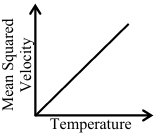
B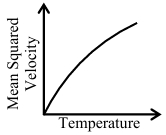
C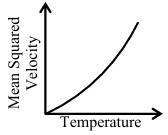
D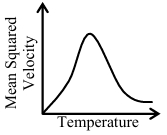
Solution
(A) The root mean square velocity $(V_{rms})$ of gas molecules is given by the formula:
$V_{rms} = \sqrt{\frac{3RT}{M}}$
Squaring both sides,we get the mean squared velocity $(V_{rms}^2)$:
$V_{rms}^2 = \frac{3RT}{M}$
Since $R$ (universal gas constant) and $M$ (molar mass of the gas) are constants for a particular ideal gas,we can write:
$V_{rms}^2 \propto T$
This equation is of the form $y = mx$,where $y = V_{rms}^2$,$x = T$,and $m = \frac{3R}{M}$ is the slope.
Therefore,the graph of mean squared velocity versus temperature is a straight line passing through the origin.
$V_{rms} = \sqrt{\frac{3RT}{M}}$
Squaring both sides,we get the mean squared velocity $(V_{rms}^2)$:
$V_{rms}^2 = \frac{3RT}{M}$
Since $R$ (universal gas constant) and $M$ (molar mass of the gas) are constants for a particular ideal gas,we can write:
$V_{rms}^2 \propto T$
This equation is of the form $y = mx$,where $y = V_{rms}^2$,$x = T$,and $m = \frac{3R}{M}$ is the slope.
Therefore,the graph of mean squared velocity versus temperature is a straight line passing through the origin.
0 likes
View Solution211
EasyMCQ
The ratio of vapour densities of two gases at the same temperature is $\frac{4}{25}$. What is the ratio of their $r.m.s.$ velocities?
A
$\frac{25}{4}$
B
$\frac{2}{5}$
C
$\frac{5}{2}$
D
$\frac{4}{25}$
Solution
(C) The $r.m.s.$ velocity of a gas is given by $v_{rms} = \sqrt{\frac{3RT}{M}}$.
Since vapour density $d$ is proportional to molar mass $M$ $(d = \frac{M}{2})$,we have $v_{rms} \propto \frac{1}{\sqrt{d}}$.
Given the ratio of vapour densities $\frac{d_1}{d_2} = \frac{4}{25}$.
The ratio of $r.m.s.$ velocities is $\frac{v_1}{v_2} = \sqrt{\frac{d_2}{d_1}}$.
Substituting the values: $\frac{v_1}{v_2} = \sqrt{\frac{25}{4}} = \frac{5}{2}$.
Since vapour density $d$ is proportional to molar mass $M$ $(d = \frac{M}{2})$,we have $v_{rms} \propto \frac{1}{\sqrt{d}}$.
Given the ratio of vapour densities $\frac{d_1}{d_2} = \frac{4}{25}$.
The ratio of $r.m.s.$ velocities is $\frac{v_1}{v_2} = \sqrt{\frac{d_2}{d_1}}$.
Substituting the values: $\frac{v_1}{v_2} = \sqrt{\frac{25}{4}} = \frac{5}{2}$.
0 likes
View Solution212
MediumMCQ
If $V_{rms}$ of $O_2$ molecule is equal to $V_{rms}$ of $H_2$ molecule at $20 K$,the temperature of $O_2$ is:
A
$320 K$
B
$47 K$
C
$300 K$
D
$47^{\circ} C$
Solution
(A) The root mean square velocity is given by $V_{rms} = \sqrt{\frac{3RT}{M}}$.
Given that $(V_{rms})_{O_2} = (V_{rms})_{H_2}$,we have $\sqrt{\frac{3RT_{O_2}}{M_{O_2}}} = \sqrt{\frac{3RT_{H_2}}{M_{H_2}}}$.
Squaring both sides and canceling common terms,we get $\frac{T_{O_2}}{M_{O_2}} = \frac{T_{H_2}}{M_{H_2}}$.
Here,$M_{O_2} = 32 \ g/mol$,$M_{H_2} = 2 \ g/mol$,and $T_{H_2} = 20 K$.
Substituting the values: $\frac{T_{O_2}}{32} = \frac{20}{2}$.
$T_{O_2} = 10 \times 32 = 320 K$.
Given that $(V_{rms})_{O_2} = (V_{rms})_{H_2}$,we have $\sqrt{\frac{3RT_{O_2}}{M_{O_2}}} = \sqrt{\frac{3RT_{H_2}}{M_{H_2}}}$.
Squaring both sides and canceling common terms,we get $\frac{T_{O_2}}{M_{O_2}} = \frac{T_{H_2}}{M_{H_2}}$.
Here,$M_{O_2} = 32 \ g/mol$,$M_{H_2} = 2 \ g/mol$,and $T_{H_2} = 20 K$.
Substituting the values: $\frac{T_{O_2}}{32} = \frac{20}{2}$.
$T_{O_2} = 10 \times 32 = 320 K$.
0 likes
View Solution213
EasyMCQ
Equal volumes of two gases are kept in different containers having densities in the ratio $1:16$. They exert equal pressures on the walls of their respective containers. Then the ratio of their r.m.s. velocities is
A
$16:1$
B
$1:8$
C
$4:1$
D
$1:12$
Solution
(C) The pressure exerted by an ideal gas is given by the formula $P = \frac{1}{3} \rho v_{rms}^2$,where $\rho$ is the density and $v_{rms}$ is the root mean square velocity.
Since the pressures $P_1$ and $P_2$ are equal,we have $P_1 = P_2$.
Thus,$\frac{1}{3} \rho_1 v_{rms,1}^2 = \frac{1}{3} \rho_2 v_{rms,2}^2$.
This simplifies to $\rho_1 v_{rms,1}^2 = \rho_2 v_{rms,2}^2$.
Rearranging for the ratio of velocities,we get $\frac{v_{rms,1}^2}{v_{rms,2}^2} = \frac{\rho_2}{\rho_1}$.
Given the ratio of densities $\rho_1 : \rho_2 = 1 : 16$,we have $\frac{\rho_2}{\rho_1} = \frac{16}{1} = 16$.
Taking the square root on both sides,$\frac{v_{rms,1}}{v_{rms,2}} = \sqrt{16} = 4$.
Therefore,the ratio of their r.m.s. velocities is $4:1$.
Since the pressures $P_1$ and $P_2$ are equal,we have $P_1 = P_2$.
Thus,$\frac{1}{3} \rho_1 v_{rms,1}^2 = \frac{1}{3} \rho_2 v_{rms,2}^2$.
This simplifies to $\rho_1 v_{rms,1}^2 = \rho_2 v_{rms,2}^2$.
Rearranging for the ratio of velocities,we get $\frac{v_{rms,1}^2}{v_{rms,2}^2} = \frac{\rho_2}{\rho_1}$.
Given the ratio of densities $\rho_1 : \rho_2 = 1 : 16$,we have $\frac{\rho_2}{\rho_1} = \frac{16}{1} = 16$.
Taking the square root on both sides,$\frac{v_{rms,1}}{v_{rms,2}} = \sqrt{16} = 4$.
Therefore,the ratio of their r.m.s. velocities is $4:1$.
0 likes
View Solution214
MediumMCQ
If the r.m.s. velocity of hydrogen molecules is $4$ times that of an oxygen molecule at $47^{\circ} C$,the temperature of the hydrogen molecules is (Molecular weight of Hydrogen and Oxygen are $2$ and $32$ respectively). (in $^{\circ} C$)
A
$23$
B
$47$
C
$80$
D
$114$
Solution
(B) The formula for r.m.s. velocity is $v_{rms} = \sqrt{\frac{3RT}{M}}$.
Given,$v_{H_2} = 4 \times v_{O_2}$.
Temperature of Oxygen $T_{O_2} = 47 + 273 = 320 \ K$.
Molar mass of Hydrogen $M_{H_2} = 2 \ g/mol$ and Oxygen $M_{O_2} = 32 \ g/mol$.
Using the relation $\sqrt{\frac{3RT_{H_2}}{M_{H_2}}} = 4 \times \sqrt{\frac{3RT_{O_2}}{M_{O_2}}}$.
Squaring both sides: $\frac{T_{H_2}}{M_{H_2}} = 16 \times \frac{T_{O_2}}{M_{O_2}}$.
Substituting the values: $\frac{T_{H_2}}{2} = 16 \times \frac{320}{32}$.
$\frac{T_{H_2}}{2} = 16 \times 10 = 160$.
$T_{H_2} = 320 \ K$.
Converting back to Celsius: $T(^{\circ}C) = 320 - 273 = 47^{\circ} C$.
Given,$v_{H_2} = 4 \times v_{O_2}$.
Temperature of Oxygen $T_{O_2} = 47 + 273 = 320 \ K$.
Molar mass of Hydrogen $M_{H_2} = 2 \ g/mol$ and Oxygen $M_{O_2} = 32 \ g/mol$.
Using the relation $\sqrt{\frac{3RT_{H_2}}{M_{H_2}}} = 4 \times \sqrt{\frac{3RT_{O_2}}{M_{O_2}}}$.
Squaring both sides: $\frac{T_{H_2}}{M_{H_2}} = 16 \times \frac{T_{O_2}}{M_{O_2}}$.
Substituting the values: $\frac{T_{H_2}}{2} = 16 \times \frac{320}{32}$.
$\frac{T_{H_2}}{2} = 16 \times 10 = 160$.
$T_{H_2} = 320 \ K$.
Converting back to Celsius: $T(^{\circ}C) = 320 - 273 = 47^{\circ} C$.
0 likes
View Solution215
EasyMCQ
If a gas is compressed isothermally,then the r.m.s. velocity of its molecules
A
increases.
B
decreases.
C
remains the same.
D
first increases and then decreases.
Solution
(C) The root mean square (r.m.s.) velocity of gas molecules is given by the formula $v_{rms} = \sqrt{\frac{3RT}{M}}$,where $R$ is the universal gas constant,$T$ is the absolute temperature,and $M$ is the molar mass of the gas.
In an isothermal process,the temperature $T$ of the gas remains constant.
Since $v_{rms}$ depends only on the temperature $T$ (assuming the gas composition $M$ remains constant),if $T$ is constant,then $v_{rms}$ must also remain constant.
Therefore,when a gas is compressed isothermally,the r.m.s. velocity of its molecules remains the same.
In an isothermal process,the temperature $T$ of the gas remains constant.
Since $v_{rms}$ depends only on the temperature $T$ (assuming the gas composition $M$ remains constant),if $T$ is constant,then $v_{rms}$ must also remain constant.
Therefore,when a gas is compressed isothermally,the r.m.s. velocity of its molecules remains the same.
0 likes
View Solution216
EasyMCQ
The temperature of an ideal gas is increased from $100 \ K$ to $400 \ K$. If '$x$' is the $R$.$M$.$S$. velocity of its molecules at $100 \ K$,what does it become at $400 \ K$?
A
$\frac{x}{4}$
B
$2x$
C
$3x$
D
$4x$
Solution
(B) The root mean square ($R$.$M$.$S$.) velocity of an ideal gas is given by the formula: $v_{rms} = \sqrt{\frac{3RT}{M}}$.
From this relation,we can see that $v_{rms} \propto \sqrt{T}$.
Let $v_1$ be the $R$.$M$.$S$. velocity at $T_1 = 100 \ K$ and $v_2$ be the $R$.$M$.$S$. velocity at $T_2 = 400 \ K$.
Given $v_1 = x$.
Using the proportionality: $\frac{v_2}{v_1} = \sqrt{\frac{T_2}{T_1}}$.
Substituting the values: $\frac{v_2}{x} = \sqrt{\frac{400}{100}} = \sqrt{4} = 2$.
Therefore,$v_2 = 2x$.
From this relation,we can see that $v_{rms} \propto \sqrt{T}$.
Let $v_1$ be the $R$.$M$.$S$. velocity at $T_1 = 100 \ K$ and $v_2$ be the $R$.$M$.$S$. velocity at $T_2 = 400 \ K$.
Given $v_1 = x$.
Using the proportionality: $\frac{v_2}{v_1} = \sqrt{\frac{T_2}{T_1}}$.
Substituting the values: $\frac{v_2}{x} = \sqrt{\frac{400}{100}} = \sqrt{4} = 2$.
Therefore,$v_2 = 2x$.
0 likes
View Solution217
EasyMCQ
The $r.m.s.$ speed of gas molecules at $800 \ K$ will be
A
same as at $200 \ K$
B
twice the value at $200 \ K$
C
four times the value at $200 \ K$
D
half the value at $200 \ K$
Solution
(B) The $r.m.s.$ speed $(v_{rms})$ of gas molecules is given by the formula: $v_{rms} = \sqrt{\frac{3RT}{M}}$.
From this formula,it is clear that $v_{rms} \propto \sqrt{T}$.
Let $v_1$ be the $r.m.s.$ speed at $T_1 = 200 \ K$ and $v_2$ be the $r.m.s.$ speed at $T_2 = 800 \ K$.
Then,$\frac{v_2}{v_1} = \sqrt{\frac{T_2}{T_1}}$.
Substituting the given values: $\frac{v_2}{v_1} = \sqrt{\frac{800}{200}} = \sqrt{4} = 2$.
Therefore,$v_2 = 2v_1$.
This means the $r.m.s.$ speed at $800 \ K$ is twice the value at $200 \ K$.
From this formula,it is clear that $v_{rms} \propto \sqrt{T}$.
Let $v_1$ be the $r.m.s.$ speed at $T_1 = 200 \ K$ and $v_2$ be the $r.m.s.$ speed at $T_2 = 800 \ K$.
Then,$\frac{v_2}{v_1} = \sqrt{\frac{T_2}{T_1}}$.
Substituting the given values: $\frac{v_2}{v_1} = \sqrt{\frac{800}{200}} = \sqrt{4} = 2$.
Therefore,$v_2 = 2v_1$.
This means the $r.m.s.$ speed at $800 \ K$ is twice the value at $200 \ K$.
0 likes
View Solution218
EasyMCQ
Six molecules of a gas in a container have speeds $2 \,m/s, 5 \,m/s, 3 \,m/s, 6 \,m/s, 3 \,m/s$ and $5 \,m/s$. The root mean square (r.m.s.) speed is: (in $\,m/s$)
A
$4$
B
$1.7$
C
$4.24$
D
$5$
Solution
(C) The root mean square (r.m.s.) speed is defined as the square root of the mean of the squares of the individual speeds.
Formula: $v_{rms} = \sqrt{\frac{v_1^2 + v_2^2 + v_3^2 + v_4^2 + v_5^2 + v_6^2}{N}}$
Given speeds: $2, 5, 3, 6, 3, 5 \,m/s$.
Number of molecules $N = 6$.
Sum of squares: $2^2 + 5^2 + 3^2 + 6^2 + 3^2 + 5^2 = 4 + 25 + 9 + 36 + 9 + 25 = 108$.
Mean of squares: $\frac{108}{6} = 18$.
$v_{rms} = \sqrt{18} \approx 4.24 \,m/s$.
Formula: $v_{rms} = \sqrt{\frac{v_1^2 + v_2^2 + v_3^2 + v_4^2 + v_5^2 + v_6^2}{N}}$
Given speeds: $2, 5, 3, 6, 3, 5 \,m/s$.
Number of molecules $N = 6$.
Sum of squares: $2^2 + 5^2 + 3^2 + 6^2 + 3^2 + 5^2 = 4 + 25 + 9 + 36 + 9 + 25 = 108$.
Mean of squares: $\frac{108}{6} = 18$.
$v_{rms} = \sqrt{18} \approx 4.24 \,m/s$.
0 likes
View Solution219
EasyMCQ
The temperature of an ideal gas is increased from $100 \ K$ to $400 \ K$. If '$x$' is the root mean square velocity of its molecules at $100 \ K$,what is the new root mean square velocity?
A
$\frac{x}{4}$
B
$2x$
C
$3x$
D
$4x$
Solution
(B) The root mean square velocity $(v_{rms})$ of an ideal gas is given by the formula: $v_{rms} = \sqrt{\frac{3RT}{M}}$.
From this relation,we can see that $v_{rms} \propto \sqrt{T}$.
Let $v_1$ be the velocity at $T_1 = 100 \ K$ and $v_2$ be the velocity at $T_2 = 400 \ K$.
Given $v_1 = x$.
Using the proportionality,$\frac{v_2}{v_1} = \sqrt{\frac{T_2}{T_1}}$.
Substituting the values: $\frac{v_2}{x} = \sqrt{\frac{400}{100}} = \sqrt{4} = 2$.
Therefore,$v_2 = 2x$.
From this relation,we can see that $v_{rms} \propto \sqrt{T}$.
Let $v_1$ be the velocity at $T_1 = 100 \ K$ and $v_2$ be the velocity at $T_2 = 400 \ K$.
Given $v_1 = x$.
Using the proportionality,$\frac{v_2}{v_1} = \sqrt{\frac{T_2}{T_1}}$.
Substituting the values: $\frac{v_2}{x} = \sqrt{\frac{400}{100}} = \sqrt{4} = 2$.
Therefore,$v_2 = 2x$.
0 likes
View Solution220
MediumMCQ
The temperature at which oxygen molecules will have the same r.m.s. speed as helium molecules at $57^{\circ} C$ is (molecular masses of oxygen and helium are $32$ and $4$ respectively.) (in $K$)
A
$1320$
B
$2240$
C
$2640$
D
$3230$
Solution
(C) The root mean square (r.m.s.) speed of gas molecules is given by the formula $v_{rms} = \sqrt{\frac{3RT}{M}}$.
Given that the r.m.s. speeds of oxygen $(O_2)$ and helium $(He)$ are equal,we have:
$\sqrt{\frac{3RT_{O_2}}{M_{O_2}}} = \sqrt{\frac{3RT_{He}}{M_{He}}}$
Squaring both sides and simplifying,we get:
$\frac{T_{O_2}}{M_{O_2}} = \frac{T_{He}}{M_{He}}$
Given $T_{He} = 57^{\circ} C = 57 + 273 = 330 \ K$,$M_{O_2} = 32$,and $M_{He} = 4$.
Substituting the values:
$\frac{T_{O_2}}{32} = \frac{330}{4}$
$T_{O_2} = \frac{330 \times 32}{4} = 330 \times 8 = 2640 \ K$.
Given that the r.m.s. speeds of oxygen $(O_2)$ and helium $(He)$ are equal,we have:
$\sqrt{\frac{3RT_{O_2}}{M_{O_2}}} = \sqrt{\frac{3RT_{He}}{M_{He}}}$
Squaring both sides and simplifying,we get:
$\frac{T_{O_2}}{M_{O_2}} = \frac{T_{He}}{M_{He}}$
Given $T_{He} = 57^{\circ} C = 57 + 273 = 330 \ K$,$M_{O_2} = 32$,and $M_{He} = 4$.
Substituting the values:
$\frac{T_{O_2}}{32} = \frac{330}{4}$
$T_{O_2} = \frac{330 \times 32}{4} = 330 \times 8 = 2640 \ K$.
0 likes
View Solution221
EasyMCQ
The temperature of an ideal gas is increased from $100 \ K$ to $400 \ K$. If '$x$' is the r.m.s. velocity of its molecules at $100 \ K$,then at $400 \ K$,the r.m.s. velocity becomes:
A
$4 x$
B
$x / 4$
C
$2 x$
D
$3 x$
Solution
(C) The root mean square (r.m.s.) velocity of an ideal gas is given by the formula: $v_{rms} = \sqrt{\frac{3RT}{M}}$.
From this relation,we can see that $v_{rms} \propto \sqrt{T}$.
Let $v_1$ be the r.m.s. velocity at $T_1 = 100 \ K$ and $v_2$ be the r.m.s. velocity at $T_2 = 400 \ K$.
Given $v_1 = x$.
Using the proportionality $v_{rms} \propto \sqrt{T}$,we have: $\frac{v_2}{v_1} = \sqrt{\frac{T_2}{T_1}}$.
Substituting the values: $\frac{v_2}{x} = \sqrt{\frac{400}{100}} = \sqrt{4} = 2$.
Therefore,$v_2 = 2x$.
From this relation,we can see that $v_{rms} \propto \sqrt{T}$.
Let $v_1$ be the r.m.s. velocity at $T_1 = 100 \ K$ and $v_2$ be the r.m.s. velocity at $T_2 = 400 \ K$.
Given $v_1 = x$.
Using the proportionality $v_{rms} \propto \sqrt{T}$,we have: $\frac{v_2}{v_1} = \sqrt{\frac{T_2}{T_1}}$.
Substituting the values: $\frac{v_2}{x} = \sqrt{\frac{400}{100}} = \sqrt{4} = 2$.
Therefore,$v_2 = 2x$.
0 likes
View Solution222
EasyMCQ
The temperature at which the $r.m.s.$ velocity of hydrogen molecules is $4.5$ times that of an oxygen molecule at $47^{\circ} C$ is (Molecular weight of hydrogen and oxygen molecules are $2$ and $32$ respectively). (in $^{\circ} C$)
A
$47$
B
$132$
C
$320$
D
$405$
Solution
(B) The $r.m.s.$ velocity of gas molecules is given by $V_{rms} = \sqrt{\frac{3RT}{M}}$.
Given,$T_{O_2} = 47^{\circ} C = 47 + 273 = 320 \ K$.
Let $V_H$ be the $r.m.s.$ velocity of hydrogen and $V_O$ be that of oxygen.
According to the problem,$V_H = 4.5 \times V_O$.
Substituting the formula: $\sqrt{\frac{3RT_H}{M_H}} = 4.5 \times \sqrt{\frac{3RT_O}{M_O}}$.
Squaring both sides: $\frac{3RT_H}{M_H} = (4.5)^2 \times \frac{3RT_O}{M_O}$.
Canceling $3R$ from both sides: $\frac{T_H}{M_H} = 20.25 \times \frac{T_O}{M_O}$.
Given $M_H = 2$ and $M_O = 32$: $\frac{T_H}{2} = 20.25 \times \frac{320}{32}$.
$\frac{T_H}{2} = 20.25 \times 10 = 202.5$.
$T_H = 202.5 \times 2 = 405 \ K$.
Converting to Celsius: $T_H = 405 - 273 = 132^{\circ} C$.
Given,$T_{O_2} = 47^{\circ} C = 47 + 273 = 320 \ K$.
Let $V_H$ be the $r.m.s.$ velocity of hydrogen and $V_O$ be that of oxygen.
According to the problem,$V_H = 4.5 \times V_O$.
Substituting the formula: $\sqrt{\frac{3RT_H}{M_H}} = 4.5 \times \sqrt{\frac{3RT_O}{M_O}}$.
Squaring both sides: $\frac{3RT_H}{M_H} = (4.5)^2 \times \frac{3RT_O}{M_O}$.
Canceling $3R$ from both sides: $\frac{T_H}{M_H} = 20.25 \times \frac{T_O}{M_O}$.
Given $M_H = 2$ and $M_O = 32$: $\frac{T_H}{2} = 20.25 \times \frac{320}{32}$.
$\frac{T_H}{2} = 20.25 \times 10 = 202.5$.
$T_H = 202.5 \times 2 = 405 \ K$.
Converting to Celsius: $T_H = 405 - 273 = 132^{\circ} C$.
0 likes
View Solution223
EasyMCQ
The r.m.s. velocity of gas molecules kept at temperature $27^{\circ} C$ in a vessel is $61 \ m/s$. The molecular weight of the gas is nearly:
$[R = 8.31 \ J \ mol^{-1} \ K^{-1}]$
$[R = 8.31 \ J \ mol^{-1} \ K^{-1}]$
A
$2$
B
$28$
C
$4$
D
$32$
Solution
(A) Given:
Temperature $T = 27^{\circ} C = 27 + 273 = 300 \ K$.
Root mean square velocity $v_{rms} = 61 \ m/s$.
Gas constant $R = 8.31 \ J \ mol^{-1} \ K^{-1}$.
The formula for $v_{rms}$ is given by $v_{rms} = \sqrt{\frac{3RT}{M}}$,where $M$ is the molar mass in $kg/mol$.
Squaring both sides,we get $v_{rms}^2 = \frac{3RT}{M}$.
Rearranging for $M$,we get $M = \frac{3RT}{v_{rms}^2}$.
Substituting the values: $M = \frac{3 \times 8.31 \times 300}{61 \times 61}$.
$M = \frac{7479}{3721} \approx 2.01 \ kg/mol$.
Since the molar mass is approximately $2 \ kg/mol$,the molecular weight is $2 \ g/mol$.
Temperature $T = 27^{\circ} C = 27 + 273 = 300 \ K$.
Root mean square velocity $v_{rms} = 61 \ m/s$.
Gas constant $R = 8.31 \ J \ mol^{-1} \ K^{-1}$.
The formula for $v_{rms}$ is given by $v_{rms} = \sqrt{\frac{3RT}{M}}$,where $M$ is the molar mass in $kg/mol$.
Squaring both sides,we get $v_{rms}^2 = \frac{3RT}{M}$.
Rearranging for $M$,we get $M = \frac{3RT}{v_{rms}^2}$.
Substituting the values: $M = \frac{3 \times 8.31 \times 300}{61 \times 61}$.
$M = \frac{7479}{3721} \approx 2.01 \ kg/mol$.
Since the molar mass is approximately $2 \ kg/mol$,the molecular weight is $2 \ g/mol$.
0 likes
View Solution224
MediumMCQ
The temperature of a gas is $-80^{\circ} C$. To what temperature should the gas be heated so that the r.m.s. speed is increased by $2$ times (in $^{\circ} C$)?
A
$499$
B
$772$
C
$1464$
D
$1737$
Solution
(C) Initial temperature $T_1 = -80^{\circ} C = -80 + 273 = 193 \ K$.
The root mean square (r.m.s.) speed of a gas is given by $v_{rms} = \sqrt{\frac{3RT}{M}}$,which implies $v_{rms} \propto \sqrt{T}$.
Let the initial speed be $v_1$ and the final speed be $v_2$. We are given that the speed is increased by $2$ times,meaning $v_2 = v_1 + 2v_1 = 3v_1$.
Using the relation $\frac{v_2}{v_1} = \sqrt{\frac{T_2}{T_1}}$,we have $\frac{3v_1}{v_1} = \sqrt{\frac{T_2}{T_1}}$.
$3 = \sqrt{\frac{T_2}{193}} \implies 9 = \frac{T_2}{193}$.
$T_2 = 9 \times 193 = 1737 \ K$.
Converting to Celsius: $T_2 = 1737 - 273 = 1464^{\circ} C$.
The root mean square (r.m.s.) speed of a gas is given by $v_{rms} = \sqrt{\frac{3RT}{M}}$,which implies $v_{rms} \propto \sqrt{T}$.
Let the initial speed be $v_1$ and the final speed be $v_2$. We are given that the speed is increased by $2$ times,meaning $v_2 = v_1 + 2v_1 = 3v_1$.
Using the relation $\frac{v_2}{v_1} = \sqrt{\frac{T_2}{T_1}}$,we have $\frac{3v_1}{v_1} = \sqrt{\frac{T_2}{T_1}}$.
$3 = \sqrt{\frac{T_2}{193}} \implies 9 = \frac{T_2}{193}$.
$T_2 = 9 \times 193 = 1737 \ K$.
Converting to Celsius: $T_2 = 1737 - 273 = 1464^{\circ} C$.
0 likes
View Solution225
DifficultMCQ
$N$ molecules of gas $A$,each having mass $m$,and $2N$ molecules of gas $B$,each of mass $2m$,are contained in the same vessel at a constant temperature $T$. The mean square velocity of $B$ is $V^2$ and the mean square of the $x$-component of $A$ is $\omega^2$. The value of $\frac{\omega^2}{V^2}$ is
A
$3: 2$
B
$2: 3$
C
$1: 2$
D
$2: 1$
Solution
(B) The mean square velocity of a gas molecule is given by $\langle v^2 \rangle = \frac{3kT}{m}$.
For gas $A$,the mean square of the $x$-component is $\omega^2 = \langle v_x^2 \rangle$. Since $\langle v^2 \rangle = \langle v_x^2 \rangle + \langle v_y^2 \rangle + \langle v_z^2 \rangle$ and $\langle v_x^2 \rangle = \langle v_y^2 \rangle = \langle v_z^2 \rangle$,we have $\langle v^2 \rangle = 3\omega^2$.
Thus,$3\omega^2 = \frac{3kT}{m} \implies \omega^2 = \frac{kT}{m}$...$(i)$
For gas $B$,the mean square velocity is $V^2 = \frac{3kT}{2m}$...(ii)
Dividing $(i)$ by (ii):
$\frac{\omega^2}{V^2} = \frac{kT/m}{3kT/2m} = \frac{kT}{m} \times \frac{2m}{3kT} = \frac{2}{3}$.
For gas $A$,the mean square of the $x$-component is $\omega^2 = \langle v_x^2 \rangle$. Since $\langle v^2 \rangle = \langle v_x^2 \rangle + \langle v_y^2 \rangle + \langle v_z^2 \rangle$ and $\langle v_x^2 \rangle = \langle v_y^2 \rangle = \langle v_z^2 \rangle$,we have $\langle v^2 \rangle = 3\omega^2$.
Thus,$3\omega^2 = \frac{3kT}{m} \implies \omega^2 = \frac{kT}{m}$...$(i)$
For gas $B$,the mean square velocity is $V^2 = \frac{3kT}{2m}$...(ii)
Dividing $(i)$ by (ii):
$\frac{\omega^2}{V^2} = \frac{kT/m}{3kT/2m} = \frac{kT}{m} \times \frac{2m}{3kT} = \frac{2}{3}$.
0 likes
View Solution226
EasyMCQ
The absolute temperature of a gas is determined by
A
the average momentum of the molecule.
B
the velocity of sound in the gas.
C
the number of molecules in the gas.
D
the mean square velocity of the molecules.
Solution
(D) According to the kinetic theory of gases,the absolute temperature $T$ of an ideal gas is related to the average kinetic energy of its molecules.
The average kinetic energy per molecule is given by $\frac{1}{2} m v_{rms}^2 = \frac{3}{2} k_B T$,where $m$ is the mass of a molecule,$v_{rms}$ is the root mean square velocity,and $k_B$ is the Boltzmann constant.
From this relation,we can see that $T \propto v_{rms}^2$.
Therefore,the absolute temperature is directly proportional to the mean square velocity of the molecules.
The average kinetic energy per molecule is given by $\frac{1}{2} m v_{rms}^2 = \frac{3}{2} k_B T$,where $m$ is the mass of a molecule,$v_{rms}$ is the root mean square velocity,and $k_B$ is the Boltzmann constant.
From this relation,we can see that $T \propto v_{rms}^2$.
Therefore,the absolute temperature is directly proportional to the mean square velocity of the molecules.
0 likes
View Solution227
MediumMCQ
The temperature of an ideal gas is increased from $27^{\circ} C$ to $927^{\circ} C$. The r.m.s. speed of its molecules becomes
A
twice.
B
half.
C
four times.
D
one-fourth.
Solution
(A) The root mean square (r.m.s.) speed of gas molecules is given by the formula $v_{rms} = \sqrt{\frac{3RT}{M}}$.
From this relation,we can see that $v_{rms} \propto \sqrt{T}$.
Given initial temperature $T_1 = 27^{\circ} C = 27 + 273 = 300 \ K$.
Given final temperature $T_2 = 927^{\circ} C = 927 + 273 = 1200 \ K$.
Taking the ratio of the speeds:
$\frac{v_{rms_2}}{v_{rms_1}} = \sqrt{\frac{T_2}{T_1}} = \sqrt{\frac{1200}{300}} = \sqrt{4} = 2$.
Therefore,$v_{rms_2} = 2 \cdot v_{rms_1}$.
The r.m.s. speed becomes twice the initial speed.
From this relation,we can see that $v_{rms} \propto \sqrt{T}$.
Given initial temperature $T_1 = 27^{\circ} C = 27 + 273 = 300 \ K$.
Given final temperature $T_2 = 927^{\circ} C = 927 + 273 = 1200 \ K$.
Taking the ratio of the speeds:
$\frac{v_{rms_2}}{v_{rms_1}} = \sqrt{\frac{T_2}{T_1}} = \sqrt{\frac{1200}{300}} = \sqrt{4} = 2$.
Therefore,$v_{rms_2} = 2 \cdot v_{rms_1}$.
The r.m.s. speed becomes twice the initial speed.
0 likes
View Solution228
DifficultMCQ
If the temperature of gas molecules is raised from $127^{\circ} C$ to $527^{\circ} C$,the ratio of the r.m.s. speed of the molecules is respectively:
A
$1: 2$
B
$2: 1$
C
$1: \sqrt{2}$
D
$2: \sqrt{2}$
Solution
(C) The root mean square (r.m.s.) speed of gas molecules is given by the formula: $V_{rms} = \sqrt{\frac{3RT}{M}}$.
Since the gas is the same,$V_{rms} \propto \sqrt{T}$.
First,convert the temperatures from Celsius to Kelvin:
$T_1 = 127^{\circ} C = 127 + 273 = 400 \ K$
$T_2 = 527^{\circ} C = 527 + 273 = 800 \ K$
The ratio of the r.m.s. speeds is:
$\frac{V_1}{V_2} = \sqrt{\frac{T_1}{T_2}} = \sqrt{\frac{400}{800}} = \sqrt{\frac{1}{2}} = \frac{1}{\sqrt{2}}$.
Thus,the ratio is $1: \sqrt{2}$.
Since the gas is the same,$V_{rms} \propto \sqrt{T}$.
First,convert the temperatures from Celsius to Kelvin:
$T_1 = 127^{\circ} C = 127 + 273 = 400 \ K$
$T_2 = 527^{\circ} C = 527 + 273 = 800 \ K$
The ratio of the r.m.s. speeds is:
$\frac{V_1}{V_2} = \sqrt{\frac{T_1}{T_2}} = \sqrt{\frac{400}{800}} = \sqrt{\frac{1}{2}} = \frac{1}{\sqrt{2}}$.
Thus,the ratio is $1: \sqrt{2}$.
0 likes
View Solution229
MediumMCQ
The temperature of a gas is $-68^{\circ} C$. To what temperature should it be heated,so that the r.m.s. velocity of the molecules be doubled (in $^{\circ} C$)?
A
$357$
B
$457$
C
$547$
D
$820$
Solution
(C) The initial temperature $T_1 = -68^{\circ} C = -68 + 273 = 205 \ K$.
The root mean square (r.m.s.) velocity of gas molecules is given by $v_{rms} = \sqrt{\frac{3RT}{M}}$,which implies $v_{rms} \propto \sqrt{T}$.
Let the initial velocity be $(v_{rms})_1$ and the final velocity be $(v_{rms})_2 = 2(v_{rms})_1$.
Using the ratio: $\frac{(v_{rms})_2}{(v_{rms})_1} = \sqrt{\frac{T_2}{T_1}}$.
Substituting the values: $2 = \sqrt{\frac{T_2}{205}}$.
Squaring both sides: $4 = \frac{T_2}{205}$.
Therefore,$T_2 = 4 \times 205 = 820 \ K$.
Converting back to Celsius: $T_2 = 820 - 273 = 547^{\circ} C$.
The root mean square (r.m.s.) velocity of gas molecules is given by $v_{rms} = \sqrt{\frac{3RT}{M}}$,which implies $v_{rms} \propto \sqrt{T}$.
Let the initial velocity be $(v_{rms})_1$ and the final velocity be $(v_{rms})_2 = 2(v_{rms})_1$.
Using the ratio: $\frac{(v_{rms})_2}{(v_{rms})_1} = \sqrt{\frac{T_2}{T_1}}$.
Substituting the values: $2 = \sqrt{\frac{T_2}{205}}$.
Squaring both sides: $4 = \frac{T_2}{205}$.
Therefore,$T_2 = 4 \times 205 = 820 \ K$.
Converting back to Celsius: $T_2 = 820 - 273 = 547^{\circ} C$.
0 likes
View Solution230
MediumMCQ
The molecular mass of a gas having $r.m.s.$ speed four times as that of another gas having molecular mass $32$ is
A
$2$
B
$4$
C
$26$
D
$32$
Solution
(A) The $r.m.s.$ speed of a gas is given by the formula $v_{rms} = \sqrt{\frac{3RT}{M}}$,which implies $v_{rms} \propto \frac{1}{\sqrt{M}}$.
Let the first gas have molecular mass $M_1 = 32$ and $r.m.s.$ speed $(v_{rms})_1$.
Let the second gas have molecular mass $M_2$ and $r.m.s.$ speed $(v_{rms})_2 = 4(v_{rms})_1$.
Using the relation $\frac{(v_{rms})_2}{(v_{rms})_1} = \sqrt{\frac{M_1}{M_2}}$,we substitute the given values:
$4 = \sqrt{\frac{32}{M_2}}$.
Squaring both sides,we get $16 = \frac{32}{M_2}$.
Therefore,$M_2 = \frac{32}{16} = 2$.
Let the first gas have molecular mass $M_1 = 32$ and $r.m.s.$ speed $(v_{rms})_1$.
Let the second gas have molecular mass $M_2$ and $r.m.s.$ speed $(v_{rms})_2 = 4(v_{rms})_1$.
Using the relation $\frac{(v_{rms})_2}{(v_{rms})_1} = \sqrt{\frac{M_1}{M_2}}$,we substitute the given values:
$4 = \sqrt{\frac{32}{M_2}}$.
Squaring both sides,we get $16 = \frac{32}{M_2}$.
Therefore,$M_2 = \frac{32}{16} = 2$.
0 likes
View Solution231
EasyMCQ
If the absolute temperature of a gas is increased $5$ times,the r.m.s. velocity of the gas molecules will be
A
$5$ times
B
$10$ times
C
$25$ times
D
$\sqrt{5}$ times
Solution
(D) The root mean square (r.m.s.) velocity $v_{rms}$ of gas molecules is given by the formula: $v_{rms} = \sqrt{\frac{3RT}{M}}$.
From this relation,it is clear that $v_{rms} \propto \sqrt{T}$.
Let the initial temperature be $T_1 = T$ and the final temperature be $T_2 = 5T$.
Let the initial r.m.s. velocity be $v_1$ and the final r.m.s. velocity be $v_2$.
Then,$\frac{v_2}{v_1} = \sqrt{\frac{T_2}{T_1}} = \sqrt{\frac{5T}{T}} = \sqrt{5}$.
Therefore,$v_2 = \sqrt{5} v_1$.
Thus,the r.m.s. velocity becomes $\sqrt{5}$ times the initial velocity.
From this relation,it is clear that $v_{rms} \propto \sqrt{T}$.
Let the initial temperature be $T_1 = T$ and the final temperature be $T_2 = 5T$.
Let the initial r.m.s. velocity be $v_1$ and the final r.m.s. velocity be $v_2$.
Then,$\frac{v_2}{v_1} = \sqrt{\frac{T_2}{T_1}} = \sqrt{\frac{5T}{T}} = \sqrt{5}$.
Therefore,$v_2 = \sqrt{5} v_1$.
Thus,the r.m.s. velocity becomes $\sqrt{5}$ times the initial velocity.
0 likes
View Solution232
EasyMCQ
The r.m.s. speed of gas at temperature $T$ is $2$ times the r.m.s speed at $320 \,K$. The value of the temperature $T$ is (in $\,K$)
A
$1280$
B
$960$
C
$640$
D
$2560$
Solution
(A) The root mean square (r.m.s.) speed of a gas molecule is given by the formula $v_{rms} = \sqrt{\frac{3RT}{M}}$.
This implies that $v_{rms} \propto \sqrt{T}$.
Given that the r.m.s. speed at temperature $T$ is $2$ times the r.m.s. speed at $320 \,K$,we can write:
$\frac{v_T}{v_{320}} = 2$
Since $v \propto \sqrt{T}$,we have:
$\frac{\sqrt{T}}{\sqrt{320}} = 2$
Squaring both sides:
$\frac{T}{320} = 2^2$
$\frac{T}{320} = 4$
$T = 4 \times 320 \,K = 1280 \,K$.
This implies that $v_{rms} \propto \sqrt{T}$.
Given that the r.m.s. speed at temperature $T$ is $2$ times the r.m.s. speed at $320 \,K$,we can write:
$\frac{v_T}{v_{320}} = 2$
Since $v \propto \sqrt{T}$,we have:
$\frac{\sqrt{T}}{\sqrt{320}} = 2$
Squaring both sides:
$\frac{T}{320} = 2^2$
$\frac{T}{320} = 4$
$T = 4 \times 320 \,K = 1280 \,K$.
0 likes
View Solution233
EasyMCQ
When the rms velocity of a gas is denoted by $V$,which of the following relations is true? ($T=$ absolute temperature of the gas)
A
$\frac{V^2}{T} = \text{constant}$
B
$V T^2 = \text{constant}$
C
$\frac{V}{T^2} = \text{constant}$
D
$V^2 T = \text{constant}$
Solution
(A) The root mean square (rms) velocity $V$ of a gas molecule is given by the formula:
$V = \sqrt{\frac{3 k_B T}{m}}$
where $k_B$ is the Boltzmann constant,$T$ is the absolute temperature,and $m$ is the mass of one molecule.
Squaring both sides,we get:
$V^2 = \frac{3 k_B T}{m}$
Since $k_B$ and $m$ are constants for a given gas,we can write:
$V^2 \propto T$
Or,$\frac{V^2}{T} = \frac{3 k_B}{m} = \text{constant}$
Therefore,the correct relation is $\frac{V^2}{T} = \text{constant}$.
$V = \sqrt{\frac{3 k_B T}{m}}$
where $k_B$ is the Boltzmann constant,$T$ is the absolute temperature,and $m$ is the mass of one molecule.
Squaring both sides,we get:
$V^2 = \frac{3 k_B T}{m}$
Since $k_B$ and $m$ are constants for a given gas,we can write:
$V^2 \propto T$
Or,$\frac{V^2}{T} = \frac{3 k_B}{m} = \text{constant}$
Therefore,the correct relation is $\frac{V^2}{T} = \text{constant}$.
0 likes
View Solution234
EasyMCQ
The temperature of an ideal gas is increased from $140 \,K$ to $560 \,K$. If the r.m.s. speed of gas molecules is $v$ at $140 \,K$, then at $560 \,K$, the r.m.s. speed becomes:
A
$4 v$
B
$\frac{v}{4}$
C
$\frac{v}{2}$
D
$2 v$
Solution
(D) The root mean square (r.m.s.) speed of gas molecules is given by the formula $v = \sqrt{\frac{3RT}{M}}$.
From this relation, it is clear that $v \propto \sqrt{T}$.
Given initial temperature $T_1 = 140 \,K$ and initial r.m.s. speed $v_1 = v$.
Final temperature $T_2 = 560 \,K$.
We can write the ratio: $\frac{v_2}{v_1} = \sqrt{\frac{T_2}{T_1}}$.
Substituting the values: $\frac{v_2}{v} = \sqrt{\frac{560}{140}} = \sqrt{4} = 2$.
Therefore, the new r.m.s. speed $v_2 = 2 v$.
From this relation, it is clear that $v \propto \sqrt{T}$.
Given initial temperature $T_1 = 140 \,K$ and initial r.m.s. speed $v_1 = v$.
Final temperature $T_2 = 560 \,K$.
We can write the ratio: $\frac{v_2}{v_1} = \sqrt{\frac{T_2}{T_1}}$.
Substituting the values: $\frac{v_2}{v} = \sqrt{\frac{560}{140}} = \sqrt{4} = 2$.
Therefore, the new r.m.s. speed $v_2 = 2 v$.
0 likes
View Solution235
EasyMCQ
$A$ perfect gas of volume $10 \ L$ is compressed isothermally to a volume of $1 \ L$. The $rms$ speed of the molecules will
A
decrease $5$ times
B
remain unchanged
C
increase $5$ times
D
increase $10$ times
Solution
(B) The process is isothermal,which means the temperature $T$ of the gas remains constant throughout the process.
The $rms$ speed of gas molecules is given by the formula $v_{rms} = \sqrt{\frac{3RT}{M}}$.
Since $R$ (universal gas constant),$M$ (molar mass),and $T$ (temperature) are constant,the $rms$ speed remains unchanged.
The $rms$ speed of gas molecules is given by the formula $v_{rms} = \sqrt{\frac{3RT}{M}}$.
Since $R$ (universal gas constant),$M$ (molar mass),and $T$ (temperature) are constant,the $rms$ speed remains unchanged.
0 likes
View Solution236
EasyMCQ
An ideal gas of molar mass $M_0$ has r.m.s. velocity $V$ at temperature $T$. Then
A
$VT^2 = \text{constant}$
B
$\frac{V^2}{T} = \text{constant}$
C
$V^2 T = \text{constant}$
D
$V$ is independent of $T$
Solution
(B) The root mean square (r.m.s.) velocity of an ideal gas is given by the formula:
$V = \sqrt{\frac{3RT}{M_0}}$
Squaring both sides, we get:
$V^2 = \frac{3RT}{M_0}$
Rearranging the terms to isolate the variables $V$ and $T$:
$\frac{V^2}{T} = \frac{3R}{M_0}$
Since $R$ (universal gas constant) and $M_0$ (molar mass) are constants for a given gas, the ratio $\frac{3R}{M_0}$ is also a constant.
Therefore, $\frac{V^2}{T} = \text{constant}$.
$V = \sqrt{\frac{3RT}{M_0}}$
Squaring both sides, we get:
$V^2 = \frac{3RT}{M_0}$
Rearranging the terms to isolate the variables $V$ and $T$:
$\frac{V^2}{T} = \frac{3R}{M_0}$
Since $R$ (universal gas constant) and $M_0$ (molar mass) are constants for a given gas, the ratio $\frac{3R}{M_0}$ is also a constant.
Therefore, $\frac{V^2}{T} = \text{constant}$.
0 likes
View Solution237
EasyMCQ
If $m'$ represents the mass of each molecule of a gas and $T'$ its absolute temperature,then the root mean square speed of the gas molecule is proportional to
A
$m^{-\frac{1}{2}} T^{\frac{1}{2}}$
B
$mT$
C
$m^{\frac{1}{2}} T^{-\frac{1}{2}}$
D
$m^{\frac{1}{2}} T^{\frac{1}{2}}$
Solution
(A) The root mean square speed $(v_{rms})$ of a gas molecule is given by the formula:
$v_{rms} = \sqrt{\frac{3RT}{M}}$
where $R$ is the universal gas constant,$T$ is the absolute temperature,and $M$ is the molar mass.
Since $M = m \times N_A$ (where $m$ is the mass of one molecule and $N_A$ is Avogadro's number),we can substitute this into the equation:
$v_{rms} = \sqrt{\frac{3RT}{mN_A}}$
Since $3$,$R$,and $N_A$ are constants,we have:
$v_{rms} \propto \sqrt{\frac{T}{m}}$
$v_{rms} \propto m^{-\frac{1}{2}} T^{\frac{1}{2}}$
$v_{rms} = \sqrt{\frac{3RT}{M}}$
where $R$ is the universal gas constant,$T$ is the absolute temperature,and $M$ is the molar mass.
Since $M = m \times N_A$ (where $m$ is the mass of one molecule and $N_A$ is Avogadro's number),we can substitute this into the equation:
$v_{rms} = \sqrt{\frac{3RT}{mN_A}}$
Since $3$,$R$,and $N_A$ are constants,we have:
$v_{rms} \propto \sqrt{\frac{T}{m}}$
$v_{rms} \propto m^{-\frac{1}{2}} T^{\frac{1}{2}}$
0 likes
View Solution238
EasyMCQ
Equal volumes of two gases,having their densities in the ratio of $1: 16$,exert equal pressures on the walls of two containers. The ratio of their rms speeds $(c_1: c_2)$ is
A
$1: 4$
B
$4: 1$
C
$8: 1$
D
$1: 8$
Solution
(B) The pressure exerted by an ideal gas is given by the formula $P = \frac{1}{3} \rho c^2$,where $\rho$ is the density and $c$ is the root mean square (rms) speed.
Since the pressures are equal,we have $P_1 = P_2$.
Therefore,$\frac{1}{3} \rho_1 c_1^2 = \frac{1}{3} \rho_2 c_2^2$.
This simplifies to $\frac{c_1^2}{c_2^2} = \frac{\rho_2}{\rho_1}$.
Given the ratio of densities $\rho_1 : \rho_2 = 1 : 16$,we have $\frac{\rho_2}{\rho_1} = \frac{16}{1} = 16$.
Substituting this into the equation,we get $\frac{c_1^2}{c_2^2} = 16$.
Taking the square root on both sides,we find $\frac{c_1}{c_2} = \sqrt{16} = 4$.
Thus,the ratio of their rms speeds $(c_1: c_2)$ is $4: 1$.
Since the pressures are equal,we have $P_1 = P_2$.
Therefore,$\frac{1}{3} \rho_1 c_1^2 = \frac{1}{3} \rho_2 c_2^2$.
This simplifies to $\frac{c_1^2}{c_2^2} = \frac{\rho_2}{\rho_1}$.
Given the ratio of densities $\rho_1 : \rho_2 = 1 : 16$,we have $\frac{\rho_2}{\rho_1} = \frac{16}{1} = 16$.
Substituting this into the equation,we get $\frac{c_1^2}{c_2^2} = 16$.
Taking the square root on both sides,we find $\frac{c_1}{c_2} = \sqrt{16} = 4$.
Thus,the ratio of their rms speeds $(c_1: c_2)$ is $4: 1$.
0 likes
View Solution239
EasyMCQ
The rms speed of a gas molecule is $V$ at pressure $P$. If the pressure is increased by two times,then the rms speed of the gas molecule at the same temperature will be
A
$V$
B
$\sqrt{2} V$
C
$V/3$
D
$V/2$
Solution
(A) The root mean square (rms) speed of a gas molecule is given by the formula $v_{rms} = \sqrt{\frac{3RT}{M}}$,where $R$ is the universal gas constant,$T$ is the absolute temperature,and $M$ is the molar mass of the gas.
Since the rms speed depends only on the temperature $T$ and the molar mass $M$ of the gas,it is independent of the pressure $P$ of the gas.
Given that the temperature remains constant,the rms speed will remain unchanged even if the pressure is increased.
Therefore,the new rms speed will be $V$.
Since the rms speed depends only on the temperature $T$ and the molar mass $M$ of the gas,it is independent of the pressure $P$ of the gas.
Given that the temperature remains constant,the rms speed will remain unchanged even if the pressure is increased.
Therefore,the new rms speed will be $V$.
0 likes
View Solution240
EasyMCQ
The molecular masses of helium and oxygen are $4$ and $32$ respectively. The ratio of r.m.s speed of helium at $327^{\circ} C$ to r.m.s speed of oxygen at $27^{\circ} C$ will be
A
$1:6$
B
$8:1$
C
$1:8$
D
$4:1$
Solution
(D) The root mean square (r.m.s) speed of a gas molecule is given by the formula: $v_{rms} = \sqrt{\frac{3RT}{M}}$.
Here,$R$ is the universal gas constant,$T$ is the absolute temperature in Kelvin,and $M$ is the molar mass.
For helium $(He)$: $M_{He} = 4$,$T_{He} = 327^{\circ} C = 327 + 273 = 600 \ K$.
For oxygen $(O_2)$: $M_{O} = 32$,$T_{O} = 27^{\circ} C = 27 + 273 = 300 \ K$.
The ratio of the r.m.s speeds is:
$\frac{v_{He}}{v_{O}} = \sqrt{\frac{T_{He}}{T_{O}} \times \frac{M_{O}}{M_{He}}} = \sqrt{\frac{600}{300} \times \frac{32}{4}} = \sqrt{2 \times 8} = \sqrt{16} = 4$.
Thus,the ratio is $4:1$.
Here,$R$ is the universal gas constant,$T$ is the absolute temperature in Kelvin,and $M$ is the molar mass.
For helium $(He)$: $M_{He} = 4$,$T_{He} = 327^{\circ} C = 327 + 273 = 600 \ K$.
For oxygen $(O_2)$: $M_{O} = 32$,$T_{O} = 27^{\circ} C = 27 + 273 = 300 \ K$.
The ratio of the r.m.s speeds is:
$\frac{v_{He}}{v_{O}} = \sqrt{\frac{T_{He}}{T_{O}} \times \frac{M_{O}}{M_{He}}} = \sqrt{\frac{600}{300} \times \frac{32}{4}} = \sqrt{2 \times 8} = \sqrt{16} = 4$.
Thus,the ratio is $4:1$.
0 likes
View Solution241
EasyMCQ
At what temperature is the $R$.$M$.$S$. velocity of a hydrogen molecule equal to that of an oxygen molecule at $47^{\circ} C$ (in $K$)? (Molecular weight of hydrogen $= 2$,molecular weight of oxygen $= 32$)
A
$80$
B
$20$
C
$40$
D
$60$
Solution
(B) The root mean square ($R$.$M$.$S$.) velocity of a gas molecule is given by the formula $v_{rms} = \sqrt{\frac{3RT}{M}}$.
Given that the $R$.$M$.$S$. velocities of hydrogen $(H_2)$ and oxygen $(O_2)$ are equal,we have $v_{H} = v_{O}$.
Substituting the formula: $\sqrt{\frac{3RT_H}{M_H}} = \sqrt{\frac{3RT_O}{M_O}}$.
Squaring both sides and simplifying: $\frac{T_H}{M_H} = \frac{T_O}{M_O}$.
Given $T_O = 47^{\circ} C = 47 + 273 = 320 \ K$,$M_H = 2$,and $M_O = 32$.
Rearranging for $T_H$: $T_H = T_O \times \frac{M_H}{M_O}$.
Substituting the values: $T_H = 320 \times \frac{2}{32} = 320 \times \frac{1}{16} = 20 \ K$.
Given that the $R$.$M$.$S$. velocities of hydrogen $(H_2)$ and oxygen $(O_2)$ are equal,we have $v_{H} = v_{O}$.
Substituting the formula: $\sqrt{\frac{3RT_H}{M_H}} = \sqrt{\frac{3RT_O}{M_O}}$.
Squaring both sides and simplifying: $\frac{T_H}{M_H} = \frac{T_O}{M_O}$.
Given $T_O = 47^{\circ} C = 47 + 273 = 320 \ K$,$M_H = 2$,and $M_O = 32$.
Rearranging for $T_H$: $T_H = T_O \times \frac{M_H}{M_O}$.
Substituting the values: $T_H = 320 \times \frac{2}{32} = 320 \times \frac{1}{16} = 20 \ K$.
0 likes
View Solution242
EasyMCQ
Let the r.m.s. velocity of a molecule of a given mass of gas be $C_{1}$ at temperature $27^{\circ} C$. When the temperature is increased to $327^{\circ} C$,the r.m.s. velocity is $C_{2}$. Then the ratio $\frac{C_{2}}{C_{1}}$ is
A
$\sqrt{2}$
B
$2$
C
$4$
D
$2 \sqrt{2}$
Solution
(A) The r.m.s. velocity of a gas molecule is given by the formula $C = \sqrt{\frac{3RT}{M}}$,which implies $C \propto \sqrt{T}$.
Given initial temperature $T_{1} = 27^{\circ} C = 27 + 273 = 300 \ K$.
Given final temperature $T_{2} = 327^{\circ} C = 327 + 273 = 600 \ K$.
The ratio of the velocities is $\frac{C_{2}}{C_{1}} = \sqrt{\frac{T_{2}}{T_{1}}}$.
Substituting the values,we get $\frac{C_{2}}{C_{1}} = \sqrt{\frac{600}{300}} = \sqrt{2}$.
Given initial temperature $T_{1} = 27^{\circ} C = 27 + 273 = 300 \ K$.
Given final temperature $T_{2} = 327^{\circ} C = 327 + 273 = 600 \ K$.
The ratio of the velocities is $\frac{C_{2}}{C_{1}} = \sqrt{\frac{T_{2}}{T_{1}}}$.
Substituting the values,we get $\frac{C_{2}}{C_{1}} = \sqrt{\frac{600}{300}} = \sqrt{2}$.
0 likes
View Solution243
EasyMCQ
The root mean square velocity of molecules of a gas is $200 \,m/s$. What will be the root mean square velocity of the molecules, if the molecular weight is doubled and the absolute temperature is halved?
A
$50 \,m/s$
B
$100 \,m/s$
C
$200 \,m/s$
D
$\frac{100}{\sqrt{2}} \,m/s$
Solution
(B) The formula for the root mean square ($R.M.S.$) velocity of gas molecules is given by $C = \sqrt{\frac{3RT}{M}}$.
From this relation, we can see that $C \propto \sqrt{\frac{T}{M}}$.
Let the initial velocity be $C = 200 \,m/s$ at temperature $T$ and molecular weight $M$.
Given the new conditions: $T' = \frac{T}{2}$ and $M' = 2M$.
The new $R.M.S.$ velocity $C'$ is given by the ratio:
$\frac{C'}{C} = \sqrt{\frac{T'}{T} \times \frac{M}{M'}} = \sqrt{\frac{T/2}{T} \times \frac{M}{2M}} = \sqrt{\frac{1}{2} \times \frac{1}{2}} = \sqrt{\frac{1}{4}} = \frac{1}{2}$.
Therefore, $C' = \frac{C}{2} = \frac{200}{2} = 100 \,m/s$.
From this relation, we can see that $C \propto \sqrt{\frac{T}{M}}$.
Let the initial velocity be $C = 200 \,m/s$ at temperature $T$ and molecular weight $M$.
Given the new conditions: $T' = \frac{T}{2}$ and $M' = 2M$.
The new $R.M.S.$ velocity $C'$ is given by the ratio:
$\frac{C'}{C} = \sqrt{\frac{T'}{T} \times \frac{M}{M'}} = \sqrt{\frac{T/2}{T} \times \frac{M}{2M}} = \sqrt{\frac{1}{2} \times \frac{1}{2}} = \sqrt{\frac{1}{4}} = \frac{1}{2}$.
Therefore, $C' = \frac{C}{2} = \frac{200}{2} = 100 \,m/s$.
0 likes
View Solution244
EasyMCQ
The speed of an oxygen molecule in a gas is $u$. If the temperature is doubled and the molecule dissociates into two atoms,the speed will be:
A
$4u$
B
$u$
C
$2u$
D
$u\sqrt{2}$
Solution
(C) The root mean square (rms) speed of an $O_2$ molecule is given by $u = \sqrt{\frac{3RT}{M}}$,where $T$ is the temperature and $M$ is the molar mass of $O_2$.
When the temperature is doubled $(T' = 2T)$ and the molecule dissociates into two atoms,the molar mass of the oxygen atom becomes $M' = \frac{M}{2}$.
The new rms speed $u'$ is given by $u' = \sqrt{\frac{3RT'}{M'}} = \sqrt{\frac{3R(2T)}{M/2}}$.
Simplifying this,we get $u' = \sqrt{4 \cdot \frac{3RT}{M}} = 2 \sqrt{\frac{3RT}{M}}$.
Since $u = \sqrt{\frac{3RT}{M}}$,we have $u' = 2u$.
When the temperature is doubled $(T' = 2T)$ and the molecule dissociates into two atoms,the molar mass of the oxygen atom becomes $M' = \frac{M}{2}$.
The new rms speed $u'$ is given by $u' = \sqrt{\frac{3RT'}{M'}} = \sqrt{\frac{3R(2T)}{M/2}}$.
Simplifying this,we get $u' = \sqrt{4 \cdot \frac{3RT}{M}} = 2 \sqrt{\frac{3RT}{M}}$.
Since $u = \sqrt{\frac{3RT}{M}}$,we have $u' = 2u$.
0 likes
View Solution245
MediumMCQ
The velocities of $4$ gas molecules are given by $1 \ km/s, 3 \ km/s, 5 \ km/s$ and $7 \ km/s$. Calculate the difference between the average velocity and the root mean square $(RMS)$ velocity. (in $km/s$)
A
$0.338$
B
$0.438$
C
$0.583$
D
$0.683$
Solution
(C) The average velocity $(v_{av})$ is calculated as the arithmetic mean of the velocities:
$v_{av} = \frac{v_{1} + v_{2} + v_{3} + v_{4}}{N} = \frac{1 + 3 + 5 + 7}{4} = \frac{16}{4} = 4 \ km/s$
The root mean square $(RMS)$ velocity $(v_{rms})$ is calculated as the square root of the mean of the squares of the velocities:
$v_{rms} = \sqrt{\frac{v_{1}^{2} + v_{2}^{2} + v_{3}^{2} + v_{4}^{2}}{N}} = \sqrt{\frac{1^{2} + 3^{2} + 5^{2} + 7^{2}}{4}} = \sqrt{\frac{1 + 9 + 25 + 49}{4}} = \sqrt{\frac{84}{4}} = \sqrt{21} \approx 4.583 \ km/s$
The difference between the $RMS$ velocity and the average velocity is:
$v_{rms} - v_{av} = 4.583 \ km/s - 4 \ km/s = 0.583 \ km/s$
$v_{av} = \frac{v_{1} + v_{2} + v_{3} + v_{4}}{N} = \frac{1 + 3 + 5 + 7}{4} = \frac{16}{4} = 4 \ km/s$
The root mean square $(RMS)$ velocity $(v_{rms})$ is calculated as the square root of the mean of the squares of the velocities:
$v_{rms} = \sqrt{\frac{v_{1}^{2} + v_{2}^{2} + v_{3}^{2} + v_{4}^{2}}{N}} = \sqrt{\frac{1^{2} + 3^{2} + 5^{2} + 7^{2}}{4}} = \sqrt{\frac{1 + 9 + 25 + 49}{4}} = \sqrt{\frac{84}{4}} = \sqrt{21} \approx 4.583 \ km/s$
The difference between the $RMS$ velocity and the average velocity is:
$v_{rms} - v_{av} = 4.583 \ km/s - 4 \ km/s = 0.583 \ km/s$
0 likes
View Solution246
EasyMCQ
To what temperature should the hydrogen at $327^{\circ} C$ be cooled at constant pressure,so that the root mean square velocity of its molecules becomes half of its previous value (in $^{\circ} C$)?
A
$-123$
B
$123$
C
$-100$
D
$0$
Solution
(A) The root mean square velocity $(v_{rms})$ of gas molecules is given by the formula $v_{rms} = \sqrt{\frac{3RT}{M}}$.
Since $R$ and $M$ are constants for a given gas,we have $v_{rms} \propto \sqrt{T}$.
This implies $T \propto v_{rms}^2$.
Given that the final velocity $v_2$ is half of the initial velocity $v_1$,i.e.,$v_2 = \frac{v_1}{2}$.
Therefore,$\frac{T_2}{T_1} = \left(\frac{v_2}{v_1}\right)^2 = \left(\frac{1}{2}\right)^2 = \frac{1}{4}$.
The initial temperature $T_1 = 327^{\circ} C = 327 + 273 = 600 \ K$.
Thus,$T_2 = \frac{T_1}{4} = \frac{600 \ K}{4} = 150 \ K$.
Converting back to Celsius: $T_2 = 150 - 273 = -123^{\circ} C$.
Since $R$ and $M$ are constants for a given gas,we have $v_{rms} \propto \sqrt{T}$.
This implies $T \propto v_{rms}^2$.
Given that the final velocity $v_2$ is half of the initial velocity $v_1$,i.e.,$v_2 = \frac{v_1}{2}$.
Therefore,$\frac{T_2}{T_1} = \left(\frac{v_2}{v_1}\right)^2 = \left(\frac{1}{2}\right)^2 = \frac{1}{4}$.
The initial temperature $T_1 = 327^{\circ} C = 327 + 273 = 600 \ K$.
Thus,$T_2 = \frac{T_1}{4} = \frac{600 \ K}{4} = 150 \ K$.
Converting back to Celsius: $T_2 = 150 - 273 = -123^{\circ} C$.
0 likes
View Solution247
EasyMCQ
At what temperature is the $rms$ speed of air molecules doubled compared to its value at $NTP$?
A
$819^{\circ} C$
B
$719^{\circ} C$
C
$909^{\circ} C$
D
None of these
Solution
(A) The $rms$ speed of gas molecules is given by $v_{rms} = \sqrt{\frac{3RT}{M}}$,which implies $v_{rms} \propto \sqrt{T}$.
Let $v_1$ be the $rms$ speed at $NTP$ $(T_1 = 273 \ K)$ and $v_2$ be the $rms$ speed at temperature $T_2$.
Given that $v_2 = 2v_1$,we have:
$\frac{v_2}{v_1} = \sqrt{\frac{T_2}{T_1}}$
$2 = \sqrt{\frac{T_2}{273}}$
Squaring both sides:
$4 = \frac{T_2}{273}$
$T_2 = 4 \times 273 = 1092 \ K$
Converting to Celsius:
$T_2(^{\circ}C) = 1092 - 273 = 819^{\circ} C$.
Let $v_1$ be the $rms$ speed at $NTP$ $(T_1 = 273 \ K)$ and $v_2$ be the $rms$ speed at temperature $T_2$.
Given that $v_2 = 2v_1$,we have:
$\frac{v_2}{v_1} = \sqrt{\frac{T_2}{T_1}}$
$2 = \sqrt{\frac{T_2}{273}}$
Squaring both sides:
$4 = \frac{T_2}{273}$
$T_2 = 4 \times 273 = 1092 \ K$
Converting to Celsius:
$T_2(^{\circ}C) = 1092 - 273 = 819^{\circ} C$.
0 likes
View Solution248
EasyMCQ
The gas having average speed four times as that of $SO_{2}$ (molecular mass $64$) is
A
$He$ (molecular mass $4$)
B
$O_{2}$ (molecular mass $32$)
C
$H_{2}$ (molecular mass $2$)
D
$CH_{4}$ (molecular mass $16$)
Solution
(A) The average speed $(v_{av})$ of gas molecules is given by the formula:
$v_{av} = \sqrt{\frac{8RT}{\pi M}}$
where $R$ is the universal gas constant,$T$ is the absolute temperature,and $M$ is the molar mass of the gas.
Assuming the temperature $T$ is constant for both gases,the average speed is inversely proportional to the square root of the molar mass:
$v_{av} \propto \frac{1}{\sqrt{M}}$
Let $v_{1}$ be the speed of $SO_{2}$ and $v_{2}$ be the speed of the unknown gas. Given $v_{2} = 4v_{1}$ and $M_{1} = 64$:
$\frac{v_{2}}{v_{1}} = \sqrt{\frac{M_{1}}{M_{2}}}$
$4 = \sqrt{\frac{64}{M_{2}}}$
Squaring both sides:
$16 = \frac{64}{M_{2}}$
$M_{2} = \frac{64}{16} = 4$
The gas with a molar mass of $4$ is Helium $(He)$.
Therefore,the correct option is $A$.
$v_{av} = \sqrt{\frac{8RT}{\pi M}}$
where $R$ is the universal gas constant,$T$ is the absolute temperature,and $M$ is the molar mass of the gas.
Assuming the temperature $T$ is constant for both gases,the average speed is inversely proportional to the square root of the molar mass:
$v_{av} \propto \frac{1}{\sqrt{M}}$
Let $v_{1}$ be the speed of $SO_{2}$ and $v_{2}$ be the speed of the unknown gas. Given $v_{2} = 4v_{1}$ and $M_{1} = 64$:
$\frac{v_{2}}{v_{1}} = \sqrt{\frac{M_{1}}{M_{2}}}$
$4 = \sqrt{\frac{64}{M_{2}}}$
Squaring both sides:
$16 = \frac{64}{M_{2}}$
$M_{2} = \frac{64}{16} = 4$
The gas with a molar mass of $4$ is Helium $(He)$.
Therefore,the correct option is $A$.
0 likes
View Solution249
MediumMCQ
To increase the rms speed of gas molecules by $25 \%$,the percentage increase in absolute temperature of the gas is to be
A
$42.75$
B
$56.25$
C
$36.75$
D
$18.25$
Solution
(B) The root mean square (rms) speed of gas molecules is given by the formula $v_{rms} = \sqrt{\frac{3RT}{M}}$.
From this relation,we can see that $v_{rms} \propto \sqrt{T}$.
Let the initial rms speed be $v_1$ and the initial temperature be $T_1$. Let the final rms speed be $v_2$ and the final temperature be $T_2$.
Given that the rms speed increases by $25 \%$,we have $v_2 = v_1 + 0.25v_1 = 1.25v_1$.
Since $v \propto \sqrt{T}$,we have $\frac{v_2}{v_1} = \sqrt{\frac{T_2}{T_1}}$.
Substituting the values,we get $1.25 = \sqrt{\frac{T_2}{T_1}}$.
Squaring both sides,we get $(1.25)^2 = \frac{T_2}{T_1}$,which gives $1.5625 = \frac{T_2}{T_1}$.
This implies $T_2 = 1.5625 T_1$.
The percentage increase in temperature is given by $\frac{T_2 - T_1}{T_1} \times 100 \%$.
Percentage increase $= (1.5625 - 1) \times 100 \% = 0.5625 \times 100 \% = 56.25 \%$.
From this relation,we can see that $v_{rms} \propto \sqrt{T}$.
Let the initial rms speed be $v_1$ and the initial temperature be $T_1$. Let the final rms speed be $v_2$ and the final temperature be $T_2$.
Given that the rms speed increases by $25 \%$,we have $v_2 = v_1 + 0.25v_1 = 1.25v_1$.
Since $v \propto \sqrt{T}$,we have $\frac{v_2}{v_1} = \sqrt{\frac{T_2}{T_1}}$.
Substituting the values,we get $1.25 = \sqrt{\frac{T_2}{T_1}}$.
Squaring both sides,we get $(1.25)^2 = \frac{T_2}{T_1}$,which gives $1.5625 = \frac{T_2}{T_1}$.
This implies $T_2 = 1.5625 T_1$.
The percentage increase in temperature is given by $\frac{T_2 - T_1}{T_1} \times 100 \%$.
Percentage increase $= (1.5625 - 1) \times 100 \% = 0.5625 \times 100 \% = 56.25 \%$.
0 likes
View SolutionKinetic Theory of Gases — Speed (velocity) of Gas (rms, mean and Most probable speed) · Frequently Asked Questions
1Are these Kinetic Theory of Gases questions useful for JEE and NEET?
Yes. All questions in this section are mapped to JEE Main and NEET exam patterns. Previous year questions from JEE Main, NEET, GUJCET and state-level exams are included with full solutions.
2Can I switch to Hindi or Gujarati for these questions?
Yes. Use the language tabs in the hero section or the sidebar to view the same questions and solutions in English, Hindi or Gujarati.
3How do I generate a question paper from this subtopic?
Use the Vedclass Exam Paper Generator — select the chapter and subtopic, set difficulty, and generate Sets A, B, C, D automatically. First 3 chapters of every subject are free.
Vedclass Products
For Students
Vedclass Test Series
Mock tests in real JEE/NEET style with performance analysis. 5-day free trial.
Start Free TrialFor Teachers
Exam Paper Generator
Generate Set A/B/C/D papers from this chapter in 2 minutes. 3 chapters free.
Try FreeFor Institutes
Online Exam Module
Live online exams with unlimited students, 360° analytics & white-label branding.
See DemoFor Teachers & Institutes
Generate a Kinetic Theory of Gases Exam Paper in 2 Minutes
Select subtopic & difficulty — Sets A, B, C, D auto-generated with No Repeat logic.
First 3 chapters of every subject are free — no payment required.