
A English
Mix Examples-Gravitation Questions in English
Class 11 Physics · Gravitation · Mix Examples-Gravitation
156+
Questions
English
Language
100%
With Solutions
Showing 6 of 156 questions in English
151
MediumMCQ
$A$ uniform sphere $A$ with radius $R$ exerts a force $F$ on a small particle $B$ situated at a distance $2R$ from the centre of the sphere. $A$ spherical portion of diameter $R$ is cut from the sphere $A$ as shown in the figure. If $F^{\prime}$ is the new gravitational force between the remaining part of the sphere $A$ and the particle $B$,then find the correct relation between $F$ and $F^{\prime}$.
A
$F^{\prime} = \frac{7}{8} F$
B
$F^{\prime} = \frac{14}{9} F$
C
$F^{\prime} = \frac{7}{9} F$
D
$F^{\prime} = \frac{9}{7} F$
Solution
(C) Let the mass of the original sphere $A$ be $M$. The force $F$ on particle $B$ of mass $m$ at distance $2R$ is $F = \frac{GMm}{(2R)^2} = \frac{GMm}{4R^2}$.
The mass of the removed spherical portion of radius $r = R/2$ is $M^{\prime} = \rho \cdot \frac{4}{3} \pi (R/2)^3 = \frac{M}{\frac{4}{3} \pi R^3} \cdot \frac{4}{3} \pi \frac{R^3}{8} = \frac{M}{8}$.
The distance of the centre of the removed portion from the particle $B$ is $d = 2R - R/2 = 3R/2$.
The force exerted by the removed portion on $B$ is $F_{removed} = \frac{G M^{\prime} m}{d^2} = \frac{G (M/8) m}{(3R/2)^2} = \frac{GMm}{8 \cdot (9R^2/4)} = \frac{GMm}{18R^2}$.
Since $F = \frac{GMm}{4R^2}$,we have $\frac{GMm}{R^2} = 4F$. Thus,$F_{removed} = \frac{4F}{18} = \frac{2}{9} F$.
The new force $F^{\prime}$ is $F - F_{removed} = F - \frac{2}{9} F = \frac{7}{9} F$.
The mass of the removed spherical portion of radius $r = R/2$ is $M^{\prime} = \rho \cdot \frac{4}{3} \pi (R/2)^3 = \frac{M}{\frac{4}{3} \pi R^3} \cdot \frac{4}{3} \pi \frac{R^3}{8} = \frac{M}{8}$.
The distance of the centre of the removed portion from the particle $B$ is $d = 2R - R/2 = 3R/2$.
The force exerted by the removed portion on $B$ is $F_{removed} = \frac{G M^{\prime} m}{d^2} = \frac{G (M/8) m}{(3R/2)^2} = \frac{GMm}{8 \cdot (9R^2/4)} = \frac{GMm}{18R^2}$.
Since $F = \frac{GMm}{4R^2}$,we have $\frac{GMm}{R^2} = 4F$. Thus,$F_{removed} = \frac{4F}{18} = \frac{2}{9} F$.
The new force $F^{\prime}$ is $F - F_{removed} = F - \frac{2}{9} F = \frac{7}{9} F$.
0 likes
View Solution152
EasyMCQ
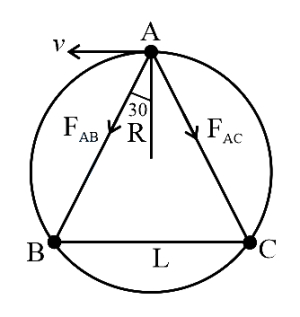
Three particles,each of mass $M$,are situated at the vertices of an equilateral triangle of side length $L$. The only forces acting on the particles are their mutual gravitational forces. It is desired that each particle moves in a circle while maintaining the original separation $L$. The initial speed that should be given to each particle is
A
$\sqrt{\frac{2 G M}{L}}$
B
$\sqrt{\frac{G M}{2 L}}$
C
$\sqrt{\frac{G M}{L}}$
D
$\sqrt{\frac{3 G M}{L}}$
Solution
(C) As the particles move under gravitational influence,the gravitational force provides the necessary centripetal force.
The gravitational force between two bodies of mass $M$ separated by distance $L$ is $F = \frac{G M^2}{L^2}$.
The net force on a particle at vertex $A$ due to particles at $B$ and $C$ is the vector sum of the forces $\vec{F}_{AB}$ and $\vec{F}_{AC}$.
Since the angle between these forces is $60^\circ$,the magnitude of the resultant force is $F_{net} = 2 F \cos(30^\circ) = 2 \left( \frac{G M^2}{L^2} \right) \frac{\sqrt{3}}{2} = \frac{\sqrt{3} G M^2}{L^2}$.
The particles move in a circle of radius $R$. For an equilateral triangle,the distance from the centroid to a vertex is $R = \frac{L}{\sqrt{3}}$.
Equating the net force to the centripetal force,$\frac{M v^2}{R} = F_{net}$.
Substituting the values,$\frac{M v^2}{L/\sqrt{3}} = \frac{\sqrt{3} G M^2}{L^2}$.
Solving for $v$,$v^2 = \frac{\sqrt{3} G M^2}{L^2} \cdot \frac{L}{\sqrt{3} M} = \frac{G M}{L}$.
Therefore,$v = \sqrt{\frac{G M}{L}}$.
The gravitational force between two bodies of mass $M$ separated by distance $L$ is $F = \frac{G M^2}{L^2}$.
The net force on a particle at vertex $A$ due to particles at $B$ and $C$ is the vector sum of the forces $\vec{F}_{AB}$ and $\vec{F}_{AC}$.
Since the angle between these forces is $60^\circ$,the magnitude of the resultant force is $F_{net} = 2 F \cos(30^\circ) = 2 \left( \frac{G M^2}{L^2} \right) \frac{\sqrt{3}}{2} = \frac{\sqrt{3} G M^2}{L^2}$.
The particles move in a circle of radius $R$. For an equilateral triangle,the distance from the centroid to a vertex is $R = \frac{L}{\sqrt{3}}$.
Equating the net force to the centripetal force,$\frac{M v^2}{R} = F_{net}$.
Substituting the values,$\frac{M v^2}{L/\sqrt{3}} = \frac{\sqrt{3} G M^2}{L^2}$.
Solving for $v$,$v^2 = \frac{\sqrt{3} G M^2}{L^2} \cdot \frac{L}{\sqrt{3} M} = \frac{G M}{L}$.
Therefore,$v = \sqrt{\frac{G M}{L}}$.
0 likes
View Solution153
EasyMCQ
$A$ planet is moving in an elliptical orbit around the sun. The work done on the planet by the gravitational force of the sun:
$(i)$ is zero in no part of the motion.
(ii) is zero in some parts of the orbit.
(iii) is zero in one complete revolution.
(iv) is zero in any small part of the orbit.
Which of the following is true?
$(i)$ is zero in no part of the motion.
(ii) is zero in some parts of the orbit.
(iii) is zero in one complete revolution.
(iv) is zero in any small part of the orbit.
Which of the following is true?
A
Only (iii) is true
B
(ii),(iii) and (iv) are true
C
(ii) and (iii) are true
D
Only $(i)$ is true
Solution
(C) The gravitational force is a conservative force. For any conservative force,the work done in a complete closed path (one complete revolution) is always zero.
Thus,statement (iii) is true.
Work done is given by the dot product $W = \int \vec{F} \cdot d\vec{r}$.
Since $\vec{F} = m\vec{a}$,we have $W = \int m\vec{a} \cdot d\vec{r}$.
If the acceleration vector $\vec{a}$ (which is directed towards the sun) is perpendicular to the displacement vector $d\vec{r}$ (which is tangent to the orbit),the work done is zero.
In an elliptical orbit,there are specific points (at perihelion and aphelion) where the velocity is perpendicular to the radius vector,meaning the force is perpendicular to the displacement at those instantaneous points.
Therefore,the work done is zero at these specific points,making statement (ii) true.
Statement $(i)$ is false because work is zero at specific points.
Statement (iv) is false because work is not zero for any arbitrary small part of the orbit.
Hence,(ii) and (iii) are true.
Thus,statement (iii) is true.
Work done is given by the dot product $W = \int \vec{F} \cdot d\vec{r}$.
Since $\vec{F} = m\vec{a}$,we have $W = \int m\vec{a} \cdot d\vec{r}$.
If the acceleration vector $\vec{a}$ (which is directed towards the sun) is perpendicular to the displacement vector $d\vec{r}$ (which is tangent to the orbit),the work done is zero.
In an elliptical orbit,there are specific points (at perihelion and aphelion) where the velocity is perpendicular to the radius vector,meaning the force is perpendicular to the displacement at those instantaneous points.
Therefore,the work done is zero at these specific points,making statement (ii) true.
Statement $(i)$ is false because work is zero at specific points.
Statement (iv) is false because work is not zero for any arbitrary small part of the orbit.
Hence,(ii) and (iii) are true.
0 likes
View Solution154
EasyMCQ
Identify the correct option.
A
The range of the gravitational force is large but not infinite.
B
The range of electromagnetic force is large but lesser than the range of gravitational force.
C
The range of weak nuclear force is smaller than the range of strong nuclear force,gravitation force and electromagnetic force.
D
The range of the weak as well as strong nuclear force is of the order of $10^{-10} \,m$.
Solution
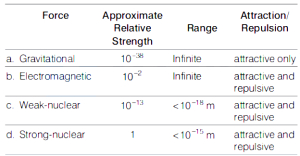
(C) The properties of the four basic forces in nature are given in the following table:
| Force | Approximate Relative Strength | Range | Attraction/Repulsion |
| :--- | :--- | :--- | :--- |
| Gravitational | $10^{-38}$ | Infinite | Attractive only |
| Electromagnetic | $10^{-2}$ | Infinite | Attractive and repulsive |
| Weak nuclear | $10^{-13}$ | $ < 10^{-16} \,m$ | Attractive and repulsive |
| Strong nuclear | $1$ | $ < 10^{-15} \,m$ | Attractive and repulsive |
From the table,we can observe the following:
$1$. Gravitational and electromagnetic forces have an infinite range.
$2$. The range of the weak nuclear force ($ < 10^{-16} \,m$) is smaller than the range of the strong nuclear force ($ < 10^{-15} \,m$),as well as the infinite range of gravitational and electromagnetic forces.
Therefore,option $(c)$ is correct.
| Force | Approximate Relative Strength | Range | Attraction/Repulsion |
| :--- | :--- | :--- | :--- |
| Gravitational | $10^{-38}$ | Infinite | Attractive only |
| Electromagnetic | $10^{-2}$ | Infinite | Attractive and repulsive |
| Weak nuclear | $10^{-13}$ | $ < 10^{-16} \,m$ | Attractive and repulsive |
| Strong nuclear | $1$ | $ < 10^{-15} \,m$ | Attractive and repulsive |
From the table,we can observe the following:
$1$. Gravitational and electromagnetic forces have an infinite range.
$2$. The range of the weak nuclear force ($ < 10^{-16} \,m$) is smaller than the range of the strong nuclear force ($ < 10^{-15} \,m$),as well as the infinite range of gravitational and electromagnetic forces.
Therefore,option $(c)$ is correct.
0 likes
View Solution155
MediumMCQ
The distance between the Sun and the Earth is $1.6 \times 10^{11} \,m$ and the radius of the Earth is $6.4 \times 10^6 \,m$. The ratio of the angular momentum of the Earth around the Sun to the angular momentum around its own axis is approximately (Assume the Earth as a solid sphere with uniform mass density and that it rotates around the Sun in a circular path.)
A
$2.0 \times 10^2$
B
$5.1 \times 10^8$
C
$4.3 \times 10^6$
D
$8.7 \times 10^{12}$
Solution
(C) Given: Distance between Sun and Earth,$r = 1.6 \times 10^{11} \,m$. Radius of Earth,$R_e = 6.4 \times 10^6 \,m$. Mass of Earth,$M_e = 6.0 \times 10^{24} \,kg$.
Angular momentum of Earth around the Sun $(L_1)$: $L_1 = M_e v r = M_e (\frac{2 \pi r}{T_1}) r = \frac{2 \pi M_e r^2}{T_1}$.
Here,$T_1 = 365 \times 24 \times 3600 \,s \approx 3.15 \times 10^7 \,s$.
$L_1 = \frac{2 \times 3.14 \times 6.0 \times 10^{24} \times (1.6 \times 10^{11})^2}{3.15 \times 10^7} \approx 3.06 \times 10^{40} \,kg \cdot m^2/s$.
Angular momentum of Earth about its own axis $(L_2)$: $L_2 = I \omega = (\frac{2}{5} M_e R_e^2) (\frac{2 \pi}{T_2})$.
Here,$T_2 = 24 \times 3600 \,s = 8.64 \times 10^4 \,s$.
$L_2 = \frac{2}{5} \times 6.0 \times 10^{24} \times (6.4 \times 10^6)^2 \times \frac{2 \times 3.14}{8.64 \times 10^4} \approx 7.15 \times 10^{33} \,kg \cdot m^2/s$.
Ratio $\frac{L_1}{L_2} = \frac{3.06 \times 10^{40}}{7.15 \times 10^{33}} \approx 4.28 \times 10^6 \approx 4.3 \times 10^6$.
Angular momentum of Earth around the Sun $(L_1)$: $L_1 = M_e v r = M_e (\frac{2 \pi r}{T_1}) r = \frac{2 \pi M_e r^2}{T_1}$.
Here,$T_1 = 365 \times 24 \times 3600 \,s \approx 3.15 \times 10^7 \,s$.
$L_1 = \frac{2 \times 3.14 \times 6.0 \times 10^{24} \times (1.6 \times 10^{11})^2}{3.15 \times 10^7} \approx 3.06 \times 10^{40} \,kg \cdot m^2/s$.
Angular momentum of Earth about its own axis $(L_2)$: $L_2 = I \omega = (\frac{2}{5} M_e R_e^2) (\frac{2 \pi}{T_2})$.
Here,$T_2 = 24 \times 3600 \,s = 8.64 \times 10^4 \,s$.
$L_2 = \frac{2}{5} \times 6.0 \times 10^{24} \times (6.4 \times 10^6)^2 \times \frac{2 \times 3.14}{8.64 \times 10^4} \approx 7.15 \times 10^{33} \,kg \cdot m^2/s$.
Ratio $\frac{L_1}{L_2} = \frac{3.06 \times 10^{40}}{7.15 \times 10^{33}} \approx 4.28 \times 10^6 \approx 4.3 \times 10^6$.
0 likes
View Solution156
DifficultMCQ
Assume the earth's orbit around the sun as circular and the distance between their centres as $D$. The mass of the earth is $M$ and its radius is $R$. If the earth has an angular velocity $\omega_0$ with respect to its centre and $\omega$ with respect to the centre of the sun,the total kinetic energy of the earth is:
A
$\frac{M R^2 \omega_0^2}{5}\left[1+\left(\frac{\omega}{\omega_0}\right)^2+\frac{5}{2}\left(\frac{D \omega}{R \omega_0}\right)^2\right]$
B
$\frac{M R^2 \omega_0^2}{5}\left[1+\frac{5}{2}\left(\frac{D \omega}{R \omega_0}\right)^2\right]$
C
$\frac{2}{5} M R^2 \omega_0^2\left[1+\frac{5}{2}\left(\frac{D \omega}{R \omega_0}\right)^2\right]$
D
$\frac{2}{5} M R^2 \omega_0^2\left[1+\left(\frac{\omega}{\omega_0}\right)^2+\frac{5}{2}\left(\frac{D \omega}{R \omega_0}\right)^2\right]$
Solution
(B) The total kinetic energy of the earth is the sum of its rotational kinetic energy about its own axis and its translational kinetic energy due to its orbital motion around the sun.
Rotational kinetic energy $K_{rot} = \frac{1}{2} I \omega_0^2$,where $I = \frac{2}{5} M R^2$ for a solid sphere.
So,$K_{rot} = \frac{1}{2} \times \frac{2}{5} M R^2 \omega_0^2 = \frac{1}{5} M R^2 \omega_0^2$.
Translational kinetic energy $K_{trans} = \frac{1}{2} M v^2$,where $v = D \omega$.
So,$K_{trans} = \frac{1}{2} M (D \omega)^2 = \frac{1}{2} M D^2 \omega^2$.
Total kinetic energy $K_{total} = K_{rot} + K_{trans} = \frac{1}{5} M R^2 \omega_0^2 + \frac{1}{2} M D^2 \omega^2$.
Factoring out $\frac{M R^2 \omega_0^2}{5}$,we get $K_{total} = \frac{M R^2 \omega_0^2}{5} \left[ 1 + \frac{5}{2} \frac{M D^2 \omega^2}{M R^2 \omega_0^2} \right] = \frac{M R^2 \omega_0^2}{5} \left[ 1 + \frac{5}{2} \left( \frac{D \omega}{R \omega_0} \right)^2 \right]$.
Rotational kinetic energy $K_{rot} = \frac{1}{2} I \omega_0^2$,where $I = \frac{2}{5} M R^2$ for a solid sphere.
So,$K_{rot} = \frac{1}{2} \times \frac{2}{5} M R^2 \omega_0^2 = \frac{1}{5} M R^2 \omega_0^2$.
Translational kinetic energy $K_{trans} = \frac{1}{2} M v^2$,where $v = D \omega$.
So,$K_{trans} = \frac{1}{2} M (D \omega)^2 = \frac{1}{2} M D^2 \omega^2$.
Total kinetic energy $K_{total} = K_{rot} + K_{trans} = \frac{1}{5} M R^2 \omega_0^2 + \frac{1}{2} M D^2 \omega^2$.
Factoring out $\frac{M R^2 \omega_0^2}{5}$,we get $K_{total} = \frac{M R^2 \omega_0^2}{5} \left[ 1 + \frac{5}{2} \frac{M D^2 \omega^2}{M R^2 \omega_0^2} \right] = \frac{M R^2 \omega_0^2}{5} \left[ 1 + \frac{5}{2} \left( \frac{D \omega}{R \omega_0} \right)^2 \right]$.
0 likes
View SolutionGravitation — Mix Examples-Gravitation · Frequently Asked Questions
1Are these Gravitation questions useful for JEE and NEET?
Yes. All questions in this section are mapped to JEE Main and NEET exam patterns. Previous year questions from JEE Main, NEET, GUJCET and state-level exams are included with full solutions.
2Can I switch to Hindi or Gujarati for these questions?
Yes. Use the language tabs in the hero section or the sidebar to view the same questions and solutions in English, Hindi or Gujarati.
3How do I generate a question paper from this subtopic?
Use the Vedclass Exam Paper Generator — select the chapter and subtopic, set difficulty, and generate Sets A, B, C, D automatically. First 3 chapters of every subject are free.
Vedclass Products
For Students
Vedclass Test Series
Mock tests in real JEE/NEET style with performance analysis. 5-day free trial.
Start Free TrialFor Teachers
Exam Paper Generator
Generate Set A/B/C/D papers from this chapter in 2 minutes. 3 chapters free.
Try FreeFor Institutes
Online Exam Module
Live online exams with unlimited students, 360° analytics & white-label branding.
See DemoFor Teachers & Institutes
Generate a Gravitation Exam Paper in 2 Minutes
Select subtopic & difficulty — Sets A, B, C, D auto-generated with No Repeat logic.
First 3 chapters of every subject are free — no payment required.