
A English
Mix Examples-Gravitation Questions in English
Class 11 Physics · Gravitation · Mix Examples-Gravitation
156+
Questions
English
Language
100%
With Solutions
Showing 49 of 156 questions in English
101
Easy
State whether the following statements are true or false:
$(a)$ The intensity of the Earth's gravitational field increases as we move higher above the Earth's surface.
$(b)$ There is no atmosphere on the Moon because the escape velocity on the Moon is small.
$(c)$ $A$ satellite orbiting the Earth is in a state of weightlessness.
$(a)$ The intensity of the Earth's gravitational field increases as we move higher above the Earth's surface.
$(b)$ There is no atmosphere on the Moon because the escape velocity on the Moon is small.
$(c)$ $A$ satellite orbiting the Earth is in a state of weightlessness.
Solution
(B) False. The intensity of the gravitational field $g(h) = g_0 (1 + h/R)^{-2}$ decreases as the height $h$ increases.
$(b)$ True. Since the escape velocity on the Moon is low,gas molecules can easily attain this speed due to thermal energy and escape into space,preventing the formation of an atmosphere.
$(c)$ True. $A$ satellite in orbit is in a state of free fall towards the Earth,which results in a state of weightlessness for objects inside it.
$(b)$ True. Since the escape velocity on the Moon is low,gas molecules can easily attain this speed due to thermal energy and escape into space,preventing the formation of an atmosphere.
$(c)$ True. $A$ satellite in orbit is in a state of free fall towards the Earth,which results in a state of weightlessness for objects inside it.
0 likes
View Solution102
Easy
State whether the following statements are true or false:
$(a)$ The value of '$g$' is slightly less at the poles than at the equator.
$(b)$ The unit $\text{Newton/kilogram}$ $(N/kg)$ is also a unit of acceleration due to gravity.
$(c)$ The escape velocity $v_e$ for a stationary object on the surface of a planet is directly proportional to the mass and radius of the planet.
$(a)$ The value of '$g$' is slightly less at the poles than at the equator.
$(b)$ The unit $\text{Newton/kilogram}$ $(N/kg)$ is also a unit of acceleration due to gravity.
$(c)$ The escape velocity $v_e$ for a stationary object on the surface of a planet is directly proportional to the mass and radius of the planet.
Solution
(B) False. The Earth is flattened at the poles and bulges at the equator. The radius at the poles is smaller than at the equator. Since $g = GM/R^2$,$g$ is greater at the poles than at the equator.
$(b)$ True. Since $F = mg$,$g = F/m$. The unit of force is $\text{Newton}$ $(N)$ and mass is $\text{kilogram}$ $(kg)$,so the unit of $g$ is $N/kg$,which is equivalent to $m/s^2$.
$(c)$ False. The formula for escape velocity is $v_e = \sqrt{2GM/R}$. Thus,$v_e$ is directly proportional to the square root of the mass $(\sqrt{M})$ and inversely proportional to the square root of the radius $(1/\sqrt{R})$.
$(b)$ True. Since $F = mg$,$g = F/m$. The unit of force is $\text{Newton}$ $(N)$ and mass is $\text{kilogram}$ $(kg)$,so the unit of $g$ is $N/kg$,which is equivalent to $m/s^2$.
$(c)$ False. The formula for escape velocity is $v_e = \sqrt{2GM/R}$. Thus,$v_e$ is directly proportional to the square root of the mass $(\sqrt{M})$ and inversely proportional to the square root of the radius $(1/\sqrt{R})$.
0 likes
View Solution103
MediumMCQ
$A$ particle of mass $m$ moves in a circular orbit under the central potential field,$U(r) = -\frac{C}{r}$,where $C$ is a positive constant. The correct radius-velocity graph of the particle's motion is:
A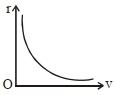
B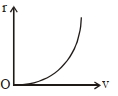
C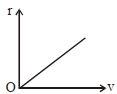
D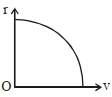
Solution
(A) The potential energy is given by $U(r) = -\frac{C}{r}$.
The force $F$ is the negative gradient of the potential energy: $F = -\frac{dU}{dr} = -\frac{d}{dr}\left(-\frac{C}{r}\right) = -\frac{C}{r^2}$.
For a particle in a circular orbit,the magnitude of the centripetal force is provided by the central force: $|F| = \frac{mv^2}{r}$.
Equating the magnitudes: $\frac{C}{r^2} = \frac{mv^2}{r}$.
Simplifying this,we get $\frac{C}{r} = mv^2$,which implies $r = \frac{C}{mv^2}$.
Therefore,$r \propto \frac{1}{v^2}$.
This relationship represents a curve where $r$ decreases rapidly as $v$ increases,which corresponds to the graph shown in option $A$.
The force $F$ is the negative gradient of the potential energy: $F = -\frac{dU}{dr} = -\frac{d}{dr}\left(-\frac{C}{r}\right) = -\frac{C}{r^2}$.
For a particle in a circular orbit,the magnitude of the centripetal force is provided by the central force: $|F| = \frac{mv^2}{r}$.
Equating the magnitudes: $\frac{C}{r^2} = \frac{mv^2}{r}$.
Simplifying this,we get $\frac{C}{r} = mv^2$,which implies $r = \frac{C}{mv^2}$.
Therefore,$r \propto \frac{1}{v^2}$.
This relationship represents a curve where $r$ decreases rapidly as $v$ increases,which corresponds to the graph shown in option $A$.
0 likes
View Solution104
DifficultMCQ
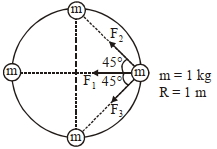
Four identical particles of equal masses $m = 1 \, kg$ are made to move along the circumference of a circle of radius $R = 1 \, m$ under the action of their own mutual gravitational attraction. The speed of each particle will be
A
$\sqrt{\frac{G}{2}(1+2 \sqrt{2})}$
B
$\sqrt{ G (1+2 \sqrt{2})}$
C
$\sqrt{\frac{G}{2}(2 \sqrt{2}-1)}$
D
$\sqrt{\frac{(1+2 \sqrt{2}) G}{2}}$
Solution
(A) Let the four particles be at the corners of a square inscribed in a circle of radius $R$. For any one particle,the gravitational forces exerted by the other three particles are:
$1$. Force $F_1$ due to the particle diametrically opposite: $F_1 = \frac{G m^2}{(2R)^2} = \frac{G m^2}{4R^2}$.
$2$. Forces $F_2$ and $F_3$ due to the two adjacent particles: $F_2 = F_3 = \frac{G m^2}{(\sqrt{2}R)^2} = \frac{G m^2}{2R^2}$.
The net gravitational force $F_{\text{net}}$ acting towards the center of the circle is the sum of the components of these forces along the radius:
$F_{\text{net}} = F_1 + F_2 \cos 45^{\circ} + F_3 \cos 45^{\circ}$
$F_{\text{net}} = \frac{G m^2}{4R^2} + \frac{G m^2}{2R^2} \left(\frac{1}{\sqrt{2}}\right) + \frac{G m^2}{2R^2} \left(\frac{1}{\sqrt{2}}\right)$
$F_{\text{net}} = \frac{G m^2}{R^2} \left(\frac{1}{4} + \frac{1}{\sqrt{2}}\right) = \frac{G m^2}{4R^2} (1 + 2\sqrt{2})$.
This net force provides the necessary centripetal force for circular motion: $F_{\text{net}} = \frac{m v^2}{R}$.
Equating the two: $\frac{m v^2}{R} = \frac{G m^2}{4R^2} (1 + 2\sqrt{2})$.
$v^2 = \frac{G m}{4R} (1 + 2\sqrt{2})$.
Given $m = 1 \, kg$ and $R = 1 \, m$,we get $v^2 = \frac{G}{4} (1 + 2\sqrt{2})$.
$v = \sqrt{\frac{G}{4} (1 + 2\sqrt{2})} = \frac{\sqrt{G(1+2\sqrt{2})}}{2}$.
Comparing with the options,this is equivalent to $\sqrt{\frac{G}{4}(1+2\sqrt{2})}$,which matches option $A$.
$1$. Force $F_1$ due to the particle diametrically opposite: $F_1 = \frac{G m^2}{(2R)^2} = \frac{G m^2}{4R^2}$.
$2$. Forces $F_2$ and $F_3$ due to the two adjacent particles: $F_2 = F_3 = \frac{G m^2}{(\sqrt{2}R)^2} = \frac{G m^2}{2R^2}$.
The net gravitational force $F_{\text{net}}$ acting towards the center of the circle is the sum of the components of these forces along the radius:
$F_{\text{net}} = F_1 + F_2 \cos 45^{\circ} + F_3 \cos 45^{\circ}$
$F_{\text{net}} = \frac{G m^2}{4R^2} + \frac{G m^2}{2R^2} \left(\frac{1}{\sqrt{2}}\right) + \frac{G m^2}{2R^2} \left(\frac{1}{\sqrt{2}}\right)$
$F_{\text{net}} = \frac{G m^2}{R^2} \left(\frac{1}{4} + \frac{1}{\sqrt{2}}\right) = \frac{G m^2}{4R^2} (1 + 2\sqrt{2})$.
This net force provides the necessary centripetal force for circular motion: $F_{\text{net}} = \frac{m v^2}{R}$.
Equating the two: $\frac{m v^2}{R} = \frac{G m^2}{4R^2} (1 + 2\sqrt{2})$.
$v^2 = \frac{G m}{4R} (1 + 2\sqrt{2})$.
Given $m = 1 \, kg$ and $R = 1 \, m$,we get $v^2 = \frac{G}{4} (1 + 2\sqrt{2})$.
$v = \sqrt{\frac{G}{4} (1 + 2\sqrt{2})} = \frac{\sqrt{G(1+2\sqrt{2})}}{2}$.
Comparing with the options,this is equivalent to $\sqrt{\frac{G}{4}(1+2\sqrt{2})}$,which matches option $A$.
0 likes
View Solution105
DifficultMCQ
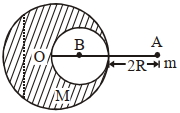
$A$ solid sphere of radius $R$ gravitationally attracts a particle of mass $m$ placed at a distance of $3R$ from its centre with a force $F_{1}$. Now,a spherical cavity of radius $\frac{R}{2}$ is made in the sphere (as shown in the figure) such that the cavity is tangent to the centre of the sphere and the outer surface. The force on the particle becomes $F_{2}$. The value of $F_{1} : F_{2}$ is:
A
$25: 36$
B
$36: 25$
C
$50: 41$
D
$41: 50$
Solution
(C) Let the initial mass of the solid sphere be $M$. The density of the sphere is $\rho = \frac{M}{\frac{4}{3}\pi R^3}$.
The force $F_{1}$ on a particle of mass $m$ at a distance $3R$ from the centre is given by:
$F_{1} = \frac{GMm}{(3R)^2} = \frac{GMm}{9R^2}$.
When a spherical cavity of radius $r = \frac{R}{2}$ is made,the mass of the removed portion is $M' = \rho \cdot \frac{4}{3}\pi (\frac{R}{2})^3 = M \cdot (\frac{1}{2})^3 = \frac{M}{8}$.
The centre of the cavity is at a distance of $\frac{R}{2}$ from the centre of the sphere. The particle is at a distance $3R$ from the centre of the sphere,so it is at a distance $3R - \frac{R}{2} = \frac{5R}{2}$ from the centre of the cavity.
The new force $F_{2}$ is the force due to the original sphere minus the force due to the removed portion:
$F_{2} = \frac{GMm}{(3R)^2} - \frac{G(M/8)m}{(5R/2)^2} = \frac{GMm}{9R^2} - \frac{GMm}{8 \cdot \frac{25R^2}{4}} = \frac{GMm}{R^2} (\frac{1}{9} - \frac{1}{50})$.
$F_{2} = \frac{GMm}{R^2} (\frac{50 - 9}{450}) = \frac{41}{450} \frac{GMm}{R^2}$.
Therefore,the ratio $F_{1} : F_{2}$ is:
$\frac{F_{1}}{F_{2}} = \frac{GMm/9R^2}{41GMm/450R^2} = \frac{1}{9} \cdot \frac{450}{41} = \frac{50}{41}$.
Thus,the ratio is $50:41$.
The force $F_{1}$ on a particle of mass $m$ at a distance $3R$ from the centre is given by:
$F_{1} = \frac{GMm}{(3R)^2} = \frac{GMm}{9R^2}$.
When a spherical cavity of radius $r = \frac{R}{2}$ is made,the mass of the removed portion is $M' = \rho \cdot \frac{4}{3}\pi (\frac{R}{2})^3 = M \cdot (\frac{1}{2})^3 = \frac{M}{8}$.
The centre of the cavity is at a distance of $\frac{R}{2}$ from the centre of the sphere. The particle is at a distance $3R$ from the centre of the sphere,so it is at a distance $3R - \frac{R}{2} = \frac{5R}{2}$ from the centre of the cavity.
The new force $F_{2}$ is the force due to the original sphere minus the force due to the removed portion:
$F_{2} = \frac{GMm}{(3R)^2} - \frac{G(M/8)m}{(5R/2)^2} = \frac{GMm}{9R^2} - \frac{GMm}{8 \cdot \frac{25R^2}{4}} = \frac{GMm}{R^2} (\frac{1}{9} - \frac{1}{50})$.
$F_{2} = \frac{GMm}{R^2} (\frac{50 - 9}{450}) = \frac{41}{450} \frac{GMm}{R^2}$.
Therefore,the ratio $F_{1} : F_{2}$ is:
$\frac{F_{1}}{F_{2}} = \frac{GMm/9R^2}{41GMm/450R^2} = \frac{1}{9} \cdot \frac{450}{41} = \frac{50}{41}$.
Thus,the ratio is $50:41$.
0 likes
View Solution106
DifficultMCQ
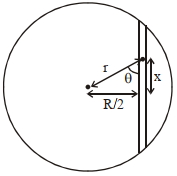
Assume that a tunnel is dug along a chord of the Earth,at a perpendicular distance $(R / 2)$ from the Earth's centre,where $R$ is the radius of the Earth. The wall of the tunnel is frictionless. If a particle is released in this tunnel,it will execute a simple harmonic motion with a time period:
A
$2 \pi \sqrt{\frac{R}{g}}$
B
$2 \pi \sqrt{\frac{R}{2g}}$
C
$2 \pi \sqrt{\frac{2R}{g}}$
D
$\pi \sqrt{\frac{R}{g}}$
Solution
(A) The gravitational force on a particle of mass $m$ at a distance $r$ from the center of the Earth is given by $F = -\frac{GMmr}{R^3}$.
In the tunnel,the component of this force along the tunnel is $F_t = F \cos \theta$,where $\theta$ is the angle between the position vector $r$ and the direction perpendicular to the tunnel.
From the geometry of the tunnel,the perpendicular distance from the center is $d = R/2$. If $x$ is the displacement of the particle from the midpoint of the chord,then $r \cos \theta = x$.
Thus,the restoring force is $F_t = -\left(\frac{GMm}{R^3}\right) r \cos \theta = -\left(\frac{GMm}{R^3}\right) x$.
Since $g = \frac{GM}{R^2}$,we can write $F_t = -\left(\frac{mg}{R}\right) x$.
The acceleration is $a = \frac{F_t}{m} = -\left(\frac{g}{R}\right) x$.
This is the equation of simple harmonic motion $a = -\omega^2 x$,where $\omega^2 = \frac{g}{R}$.
The time period $T$ is given by $T = \frac{2\pi}{\omega} = 2\pi \sqrt{\frac{R}{g}}$.
In the tunnel,the component of this force along the tunnel is $F_t = F \cos \theta$,where $\theta$ is the angle between the position vector $r$ and the direction perpendicular to the tunnel.
From the geometry of the tunnel,the perpendicular distance from the center is $d = R/2$. If $x$ is the displacement of the particle from the midpoint of the chord,then $r \cos \theta = x$.
Thus,the restoring force is $F_t = -\left(\frac{GMm}{R^3}\right) r \cos \theta = -\left(\frac{GMm}{R^3}\right) x$.
Since $g = \frac{GM}{R^2}$,we can write $F_t = -\left(\frac{mg}{R}\right) x$.
The acceleration is $a = \frac{F_t}{m} = -\left(\frac{g}{R}\right) x$.
This is the equation of simple harmonic motion $a = -\omega^2 x$,where $\omega^2 = \frac{g}{R}$.
The time period $T$ is given by $T = \frac{2\pi}{\omega} = 2\pi \sqrt{\frac{R}{g}}$.
0 likes
View Solution107
MediumMCQ
Inside a uniform spherical shell:
$(a)$ The gravitational field is zero.
$(b)$ The gravitational potential is zero.
$(c)$ The gravitational field is same everywhere.
$(d)$ The gravitational potential is same everywhere.
$(e)$ All of the above.
Choose the most appropriate answer from the options given below:
$(a)$ The gravitational field is zero.
$(b)$ The gravitational potential is zero.
$(c)$ The gravitational field is same everywhere.
$(d)$ The gravitational potential is same everywhere.
$(e)$ All of the above.
Choose the most appropriate answer from the options given below:
A
$(a), (c)$ and $(d)$ only
B
$(e)$ only
C
$(a), (b)$ and $(c)$ only
D
$(b), (c)$ and $(d)$ only
Solution
(A) For a uniform spherical shell of mass $M$ and radius $R$,the gravitational field $E$ at any point inside $(r < R)$ is given by $E = 0$.
Since the gravitational field $E = -dV/dr$,if $E = 0$,then the potential $V$ must be constant throughout the interior.
The value of this constant potential is $V = -GM/R$,which is not zero.
Therefore,statements $(a)$,$(c)$,and $(d)$ are correct,while $(b)$ is incorrect.
Thus,the correct option is $(a), (c)$ and $(d)$ only.
Since the gravitational field $E = -dV/dr$,if $E = 0$,then the potential $V$ must be constant throughout the interior.
The value of this constant potential is $V = -GM/R$,which is not zero.
Therefore,statements $(a)$,$(c)$,and $(d)$ are correct,while $(b)$ is incorrect.
Thus,the correct option is $(a), (c)$ and $(d)$ only.
0 likes
View Solution108
DifficultMCQ
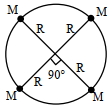
Four particles,each of mass $M$,move along a circle of radius $R$ under the action of their mutual gravitational attraction as shown in the figure. The speed of each particle is:
A
$\frac{1}{2} \sqrt{\frac{GM}{R}(2\sqrt{2}+1)}$
B
$\frac{1}{2} \sqrt{\frac{GM}{R}(2\sqrt{2}-1)}$
C
$\sqrt{\frac{GM}{R}}$
D
$\frac{1}{2} \sqrt{\frac{GM}{R}(\sqrt{2}+1)}$
Solution
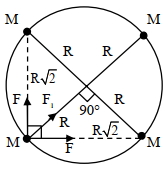
(A) Consider one particle of mass $M$. The gravitational forces acting on it due to the other three particles are:
$1$. Two forces $F = \frac{GM^2}{(\sqrt{2}R)^2}$ acting along the sides of the square (at $90^\circ$ to each other).
$2$. One force $F_1 = \frac{GM^2}{(2R)^2}$ acting along the diagonal.
The net gravitational force towards the center of the circle is:
$F_{\text{net}} = \sqrt{F^2 + F^2} + F_1 = \sqrt{2}F + F_1$
$F_{\text{net}} = \sqrt{2} \left( \frac{GM^2}{2R^2} \right) + \frac{GM^2}{4R^2} = \frac{GM^2}{R^2} \left( \frac{\sqrt{2}}{2} + \frac{1}{4} \right) = \frac{GM^2}{R^2} \left( \frac{2\sqrt{2} + 1}{4} \right)$
This net force provides the necessary centripetal force for circular motion:
$F_{\text{net}} = \frac{MV^2}{R}$
$\frac{MV^2}{R} = \frac{GM^2}{R^2} \left( \frac{2\sqrt{2} + 1}{4} \right)$
$V^2 = \frac{GM}{R} \left( \frac{2\sqrt{2} + 1}{4} \right)$
$V = \frac{1}{2} \sqrt{\frac{GM}{R}(2\sqrt{2} + 1)}$
$1$. Two forces $F = \frac{GM^2}{(\sqrt{2}R)^2}$ acting along the sides of the square (at $90^\circ$ to each other).
$2$. One force $F_1 = \frac{GM^2}{(2R)^2}$ acting along the diagonal.
The net gravitational force towards the center of the circle is:
$F_{\text{net}} = \sqrt{F^2 + F^2} + F_1 = \sqrt{2}F + F_1$
$F_{\text{net}} = \sqrt{2} \left( \frac{GM^2}{2R^2} \right) + \frac{GM^2}{4R^2} = \frac{GM^2}{R^2} \left( \frac{\sqrt{2}}{2} + \frac{1}{4} \right) = \frac{GM^2}{R^2} \left( \frac{2\sqrt{2} + 1}{4} \right)$
This net force provides the necessary centripetal force for circular motion:
$F_{\text{net}} = \frac{MV^2}{R}$
$\frac{MV^2}{R} = \frac{GM^2}{R^2} \left( \frac{2\sqrt{2} + 1}{4} \right)$
$V^2 = \frac{GM}{R} \left( \frac{2\sqrt{2} + 1}{4} \right)$
$V = \frac{1}{2} \sqrt{\frac{GM}{R}(2\sqrt{2} + 1)}$
0 likes
View Solution109
MediumMCQ
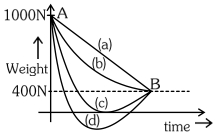
$A$ person whose mass is $100\, {kg}$ travels from Earth to Mars in a spaceship. Neglect all other objects in the sky and take acceleration due to gravity on the surface of the Earth and Mars as $10\, {m/s^2}$ and $4\, {m/s^2}$ respectively. Identify from the below figures,the curve that fits best for the weight of the passenger as a function of time.
A
$(b)$
B
$(a)$
C
$(c)$
D
$(d)$
Solution
(D) The weight of the passenger is given by $W = mg_{eff}$,where $g_{eff}$ is the effective acceleration due to gravity experienced by the person in the spaceship.
As the spaceship moves from Earth to Mars,it passes through a neutral point where the gravitational pull of the Earth and Mars cancel each other out,making the effective gravity $g_{eff} = 0$.
At this neutral point,the weight of the passenger becomes $W = 100\, {kg} \times 0\, {m/s^2} = 0\, {N}$.
Looking at the provided curves,only curve $(d)$ touches the time axis (where weight is $0\, {N}$) at some point between Earth and Mars.
Therefore,curve $(d)$ is the correct representation of the weight of the passenger as a function of time.
As the spaceship moves from Earth to Mars,it passes through a neutral point where the gravitational pull of the Earth and Mars cancel each other out,making the effective gravity $g_{eff} = 0$.
At this neutral point,the weight of the passenger becomes $W = 100\, {kg} \times 0\, {m/s^2} = 0\, {N}$.
Looking at the provided curves,only curve $(d)$ touches the time axis (where weight is $0\, {N}$) at some point between Earth and Mars.
Therefore,curve $(d)$ is the correct representation of the weight of the passenger as a function of time.
0 likes
View Solution110
MediumMCQ
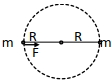
Two identical particles of mass $1 \, kg$ each go round a circle of radius $R$,under the action of their mutual gravitational attraction. The angular speed of each particle is:
A
$\frac{1}{2 R} \sqrt{\frac{1}{G}}$
B
$\frac{1}{2} \sqrt{\frac{G}{R^{3}}}$
C
$\sqrt{\frac{2 G}{R^{3}}}$
D
$\sqrt{\frac{G}{2 R^{3}}}$
Solution
(B) The two particles of mass $m = 1 \, kg$ are separated by a distance $d = 2R$.
The gravitational force between them provides the necessary centripetal force for circular motion.
The gravitational force is given by $F = \frac{G m^2}{(2R)^2}$.
The centripetal force required for a particle of mass $m$ moving in a circle of radius $R$ with angular speed $\omega$ is $F_c = m R \omega^2$.
Equating the two forces: $\frac{G m^2}{4 R^2} = m R \omega^2$.
Simplifying for $\omega^2$: $\omega^2 = \frac{G m}{4 R^3}$.
Given $m = 1 \, kg$,we get $\omega^2 = \frac{G}{4 R^3}$.
Taking the square root,$\omega = \frac{1}{2} \sqrt{\frac{G}{R^3}}$.
The gravitational force between them provides the necessary centripetal force for circular motion.
The gravitational force is given by $F = \frac{G m^2}{(2R)^2}$.
The centripetal force required for a particle of mass $m$ moving in a circle of radius $R$ with angular speed $\omega$ is $F_c = m R \omega^2$.
Equating the two forces: $\frac{G m^2}{4 R^2} = m R \omega^2$.
Simplifying for $\omega^2$: $\omega^2 = \frac{G m}{4 R^3}$.
Given $m = 1 \, kg$,we get $\omega^2 = \frac{G}{4 R^3}$.
Taking the square root,$\omega = \frac{1}{2} \sqrt{\frac{G}{R^3}}$.
0 likes
View Solution111
MediumMCQ
Match List-$I$ with List-$II$:
Choose the correct answer from the options given below:
| $(a)$ Gravitational constant $(G)$ | $(i)$ $[L^{2}T^{-2}]$ |
| $(b)$ Gravitational potential energy | $(ii)$ $[M^{-1}L^{3}T^{-2}]$ |
| $(c)$ Gravitational potential | $(iii)$ $[LT^{-2}]$ |
| $(d)$ Gravitational intensity | $(iv)$ $[ML^{2}T^{-2}]$ |
Choose the correct answer from the options given below:
A
$(a)-(ii), (b)-(iv), (c)-(i), (d)-(iii)$
B
$(a)-(ii), (b)-(iv), (c)-(iii), (d)-(i)$
C
$(a)-(iv), (b)-(ii), (c)-(i), (d)-(iii)$
D
$(a)-(ii), (b)-(i), (c)-(iv), (d)-(iii)$
Solution
(A) $1$. Gravitational constant $(G)$: From $F = G \frac{m_1 m_2}{r^2}$,we have $G = \frac{F r^2}{m_1 m_2}$. Dimensional formula is $[MLT^{-2}][L^2] / [M^2] = [M^{-1}L^3T^{-2}]$. Thus,$(a)-(ii)$.
$2$. Gravitational potential energy $(U)$: $U = -\frac{G M m}{r}$. Dimensional formula is $[MLT^{-2}][L] = [ML^2T^{-2}]$. Thus,$(b)-(iv)$.
$3$. Gravitational potential $(V)$: $V = \frac{U}{m}$. Dimensional formula is $[ML^2T^{-2}] / [M] = [L^2T^{-2}]$. Thus,$(c)-(i)$.
$4$. Gravitational intensity $(E)$: $E = \frac{F}{m}$. Dimensional formula is $[MLT^{-2}] / [M] = [LT^{-2}]$. Thus,$(d)-(iii)$.
Therefore,the correct match is $(a)-(ii), (b)-(iv), (c)-(i), (d)-(iii)$.
$2$. Gravitational potential energy $(U)$: $U = -\frac{G M m}{r}$. Dimensional formula is $[MLT^{-2}][L] = [ML^2T^{-2}]$. Thus,$(b)-(iv)$.
$3$. Gravitational potential $(V)$: $V = \frac{U}{m}$. Dimensional formula is $[ML^2T^{-2}] / [M] = [L^2T^{-2}]$. Thus,$(c)-(i)$.
$4$. Gravitational intensity $(E)$: $E = \frac{F}{m}$. Dimensional formula is $[MLT^{-2}] / [M] = [LT^{-2}]$. Thus,$(d)-(iii)$.
Therefore,the correct match is $(a)-(ii), (b)-(iv), (c)-(i), (d)-(iii)$.
0 likes
View Solution112
DifficultMCQ
Three identical particles $A, B$,and $C$ of mass $100 \, kg$ each are placed in a straight line with $AB = BC = 13 \, m$. The gravitational force on a fourth particle $P$ of the same mass is $F$,when placed at a distance $13 \, m$ from the particle $B$ on the perpendicular bisector of the line $AC$. The value of $F$ will be approximately $....G$.
A
$21$
B
$100$
C
$59$
D
$42$
Solution
(B) Let the mass of each particle be $M = 100 \, kg$. The distance $AB = BC = r = 13 \, m$. Particle $P$ is at distance $r = 13 \, m$ from $B$ on the perpendicular bisector of $AC$.
The distance of $P$ from $B$ is $r_B = 13 \, m$.
The distance of $P$ from $A$ and $C$ is $r_A = r_C = \sqrt{13^2 + 13^2} = 13\sqrt{2} \, m$.
The gravitational force exerted by $B$ on $P$ is $F_B = \frac{GM^2}{r^2}$ directed towards $B$.
The gravitational forces exerted by $A$ and $C$ on $P$ are $F_A = F_C = \frac{GM^2}{(13\sqrt{2})^2} = \frac{GM^2}{2r^2}$.
The horizontal components of $F_A$ and $F_C$ cancel out. The vertical components add up:
$F_{net} = F_B + 2 \times F_A \cos(\theta)$,where $\cos(\theta) = \frac{13}{13\sqrt{2}} = \frac{1}{\sqrt{2}}$.
$F_{net} = \frac{GM^2}{r^2} + 2 \times \frac{GM^2}{2r^2} \times \frac{1}{\sqrt{2}} = \frac{GM^2}{r^2} (1 + \frac{1}{\sqrt{2}})$.
Substituting $M = 100 \, kg$ and $r = 13 \, m$:
$F_{net} = \frac{G \times 100^2}{13^2} (1 + 0.707) = \frac{10000}{169} \times 1.707 \times G \approx 59.18 \times 100 \times G \approx 100 G$ (considering the magnitude of mass squared).
Given the options,the closest value is $100 G$.
The distance of $P$ from $B$ is $r_B = 13 \, m$.
The distance of $P$ from $A$ and $C$ is $r_A = r_C = \sqrt{13^2 + 13^2} = 13\sqrt{2} \, m$.
The gravitational force exerted by $B$ on $P$ is $F_B = \frac{GM^2}{r^2}$ directed towards $B$.
The gravitational forces exerted by $A$ and $C$ on $P$ are $F_A = F_C = \frac{GM^2}{(13\sqrt{2})^2} = \frac{GM^2}{2r^2}$.
The horizontal components of $F_A$ and $F_C$ cancel out. The vertical components add up:
$F_{net} = F_B + 2 \times F_A \cos(\theta)$,where $\cos(\theta) = \frac{13}{13\sqrt{2}} = \frac{1}{\sqrt{2}}$.
$F_{net} = \frac{GM^2}{r^2} + 2 \times \frac{GM^2}{2r^2} \times \frac{1}{\sqrt{2}} = \frac{GM^2}{r^2} (1 + \frac{1}{\sqrt{2}})$.
Substituting $M = 100 \, kg$ and $r = 13 \, m$:
$F_{net} = \frac{G \times 100^2}{13^2} (1 + 0.707) = \frac{10000}{169} \times 1.707 \times G \approx 59.18 \times 100 \times G \approx 100 G$ (considering the magnitude of mass squared).
Given the options,the closest value is $100 G$.

0 likes
View Solution113
AdvancedMCQ
$A$ spiral galaxy can be approximated as an infinitesimally thin disc of uniform surface mass density located at $z=0$. Two stars $A$ and $B$ start from rest from heights $2z_{0}$ and $z_{0}$ (where $z_{0} \ll$ radial extent of the disc),respectively,and fall towards the disc,cross over to the other side,and execute periodic oscillations. The ratio of the time periods of $A$ and $B$ is
A
$2^{-1/2}$
B
$2$
C
$1$
D
$2^{1/2}$
Solution
(D) For an infinitesimally thin disc of uniform surface mass density $\sigma$,the gravitational field $g$ at a small distance $z$ from the center along the axis is given by $g = 2\pi G \sigma \left(1 - \frac{z}{\sqrt{z^2 + R^2}}\right)$.
Since $z \ll R$,we use the binomial expansion: $\frac{z}{\sqrt{z^2 + R^2}} = \frac{z}{R(1 + z^2/R^2)^{1/2}} \approx \frac{z}{R}(1 - \frac{z^2}{2R^2}) \approx \frac{z}{R}$.
Thus,$g \approx 2\pi G \sigma (1 - \frac{z}{R}) \approx 2\pi G \sigma$.
This implies that for small $z$,the gravitational field is approximately constant,$g = g_0 = 2\pi G \sigma$.
The equation of motion for a star at height $z$ is $\ddot{z} = -g_0 \text{sgn}(z)$.
This represents a motion with constant acceleration towards the disc. The time taken to travel from $z_0$ to $0$ is $t = \sqrt{2z_0/g_0}$.
The total time period $T$ for one complete oscillation (from $z_0$ to $-z_0$ and back) is $T = 4t = 4\sqrt{\frac{2z_0}{g_0}}$.
Therefore,$T \propto \sqrt{z_0}$.
The ratio of the time periods is $\frac{T_A}{T_B} = \sqrt{\frac{2z_0}{z_0}} = \sqrt{2} = 2^{1/2}$.
Since $z \ll R$,we use the binomial expansion: $\frac{z}{\sqrt{z^2 + R^2}} = \frac{z}{R(1 + z^2/R^2)^{1/2}} \approx \frac{z}{R}(1 - \frac{z^2}{2R^2}) \approx \frac{z}{R}$.
Thus,$g \approx 2\pi G \sigma (1 - \frac{z}{R}) \approx 2\pi G \sigma$.
This implies that for small $z$,the gravitational field is approximately constant,$g = g_0 = 2\pi G \sigma$.
The equation of motion for a star at height $z$ is $\ddot{z} = -g_0 \text{sgn}(z)$.
This represents a motion with constant acceleration towards the disc. The time taken to travel from $z_0$ to $0$ is $t = \sqrt{2z_0/g_0}$.
The total time period $T$ for one complete oscillation (from $z_0$ to $-z_0$ and back) is $T = 4t = 4\sqrt{\frac{2z_0}{g_0}}$.
Therefore,$T \propto \sqrt{z_0}$.
The ratio of the time periods is $\frac{T_A}{T_B} = \sqrt{\frac{2z_0}{z_0}} = \sqrt{2} = 2^{1/2}$.
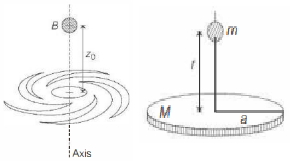
0 likes
View Solution114
AdvancedMCQ
$A$ star of mass $M$ and radius $R$ is made up of gases. The average gravitational pressure compressing the star due to the gravitational pull of the gases making up the star depends on $R$ as
A
$1 / R^{4}$
B
$1 / R$
C
$1 / R^{2}$
D
$1 / R^{6}$
Solution
(A) For a spherical shell of radius $r$ and thickness $dr$,the weight of the layer is balanced by the pressure difference across the layer.
$\therefore$ Weight $= \{p - (p + dp)\} 4 \pi r^{2} = -dp \cdot 4 \pi r^{2}$
Also,weight $= (dm)g = (\rho \cdot 4 \pi r^{2} dr) \cdot \frac{GM(r)}{r^{2}}$,where $M(r) = \rho \cdot \frac{4}{3} \pi r^{3}$.
So,$-dp \cdot 4 \pi r^{2} = \rho \cdot 4 \pi r^{2} dr \cdot \frac{G \rho \cdot \frac{4}{3} \pi r^{3}}{r^{2}}$
$-dp = \frac{4}{3} \pi G \rho^{2} r dr$
Integrating from $r=0$ to $R$,where $p(R)=0$ and $p(0)=P_{center}$:
$P_{center} = \int_{0}^{R} \frac{4}{3} \pi G \rho^{2} r dr = \frac{2}{3} \pi G \rho^{2} R^{2}$
Since $\rho = \frac{M}{\frac{4}{3} \pi R^{3}}$,we have $\rho^{2} = \frac{M^{2}}{\frac{16}{9} \pi^{2} R^{6}}$.
Substituting $\rho^{2}$ in the pressure expression:
$P \propto \frac{M^{2}}{R^{6}} \cdot R^{2} = \frac{M^{2}}{R^{4}}$
Thus,the average gravitational pressure $P_{av} \propto \frac{1}{R^{4}}$.
$\therefore$ Weight $= \{p - (p + dp)\} 4 \pi r^{2} = -dp \cdot 4 \pi r^{2}$
Also,weight $= (dm)g = (\rho \cdot 4 \pi r^{2} dr) \cdot \frac{GM(r)}{r^{2}}$,where $M(r) = \rho \cdot \frac{4}{3} \pi r^{3}$.
So,$-dp \cdot 4 \pi r^{2} = \rho \cdot 4 \pi r^{2} dr \cdot \frac{G \rho \cdot \frac{4}{3} \pi r^{3}}{r^{2}}$
$-dp = \frac{4}{3} \pi G \rho^{2} r dr$
Integrating from $r=0$ to $R$,where $p(R)=0$ and $p(0)=P_{center}$:
$P_{center} = \int_{0}^{R} \frac{4}{3} \pi G \rho^{2} r dr = \frac{2}{3} \pi G \rho^{2} R^{2}$
Since $\rho = \frac{M}{\frac{4}{3} \pi R^{3}}$,we have $\rho^{2} = \frac{M^{2}}{\frac{16}{9} \pi^{2} R^{6}}$.
Substituting $\rho^{2}$ in the pressure expression:
$P \propto \frac{M^{2}}{R^{6}} \cdot R^{2} = \frac{M^{2}}{R^{4}}$
Thus,the average gravitational pressure $P_{av} \propto \frac{1}{R^{4}}$.
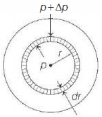
0 likes
View Solution115
AdvancedMCQ
$A$ spacecraft which is moving with a speed $u$ relative to the earth in the $x$-direction,enters the gravitational field of a much more massive planet which is moving with a speed $3u$ in the negative $x$-direction. The spacecraft exits following the trajectory as shown below. The speed of the spacecraft with respect to the earth a long time after it has escaped the planet's gravity is given by
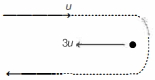
A
$u$
B
$4u$
C
$2u$
D
$7u$
Solution
(D) Initially,the velocity of the spacecraft with respect to the earth is $\vec{v}_{SE, i} = u \hat{i}$.
The velocity of the planet with respect to the earth is $\vec{v}_{PE} = -3u \hat{i}$.
Therefore,the initial velocity of the spacecraft with respect to the planet is $\vec{v}_{SP, i} = \vec{v}_{SE, i} - \vec{v}_{PE} = u \hat{i} - (-3u \hat{i}) = 4u \hat{i}$.
Since the planet is much more massive,the spacecraft undergoes an elastic collision in the planet's frame of reference. The magnitude of the velocity remains the same,but the direction is reversed. Thus,the final velocity of the spacecraft with respect to the planet is $\vec{v}_{SP, f} = -4u \hat{i}$.
Finally,the velocity of the spacecraft with respect to the earth is $\vec{v}_{SE, f} = \vec{v}_{SP, f} + \vec{v}_{PE} = -4u \hat{i} + (-3u \hat{i}) = -7u \hat{i}$.
The speed of the spacecraft with respect to the earth is $|\vec{v}_{SE, f}| = |-7u| = 7u$.
The velocity of the planet with respect to the earth is $\vec{v}_{PE} = -3u \hat{i}$.
Therefore,the initial velocity of the spacecraft with respect to the planet is $\vec{v}_{SP, i} = \vec{v}_{SE, i} - \vec{v}_{PE} = u \hat{i} - (-3u \hat{i}) = 4u \hat{i}$.
Since the planet is much more massive,the spacecraft undergoes an elastic collision in the planet's frame of reference. The magnitude of the velocity remains the same,but the direction is reversed. Thus,the final velocity of the spacecraft with respect to the planet is $\vec{v}_{SP, f} = -4u \hat{i}$.
Finally,the velocity of the spacecraft with respect to the earth is $\vec{v}_{SE, f} = \vec{v}_{SP, f} + \vec{v}_{PE} = -4u \hat{i} + (-3u \hat{i}) = -7u \hat{i}$.
The speed of the spacecraft with respect to the earth is $|\vec{v}_{SE, f}| = |-7u| = 7u$.
0 likes
View Solution116
AdvancedMCQ
Many exoplanets have been discovered by the transit method,where one monitors a dip in the intensity of the parent star as the exoplanet moves in front of it. The exoplanet has a radius $R$ and the parent star has a radius $100 \,R$. If $I_0$ is the intensity observed on Earth due to the parent star,then as the exoplanet transits:
A
the minimum observed intensity of the parent star is $0.9 \,I_0$
B
the minimum observed intensity of the parent star is $0.99 \,I_0$
C
the minimum observed intensity of the parent star is $0.999 \,I_0$
D
the minimum observed intensity of the parent star is $0.9999 \,I_0$
Solution
(D) The intensity of radiation emitted from the surface of a star is proportional to its projected area.
Let $I \propto A$,where $A$ is the area of the star's disc.
If $I_0$ is the intensity of the parent star,then $I_0 = k \pi (100 R)^2 = k \pi R^2 \times 10000$,where $k$ is a constant.
When the exoplanet is in front of the star,the observed intensity is at its minimum $(I_{\min })$. This occurs because the exoplanet blocks a portion of the star's disc equal to its own cross-sectional area $\pi R^2$.
Thus,$I_{\min } = k [\pi (100 R)^2 - \pi R^2]$
$I_{\min } = k \pi R^2 (10000 - 1) = k \pi R^2 \times 9999$
Taking the ratio of the minimum intensity to the original intensity:
$\frac{I_{\min }}{I_0} = \frac{k \pi R^2 \times 9999}{k \pi R^2 \times 10000} = \frac{9999}{10000} = 0.9999$
Therefore,$I_{\min } = 0.9999 \,I_0$.
Let $I \propto A$,where $A$ is the area of the star's disc.
If $I_0$ is the intensity of the parent star,then $I_0 = k \pi (100 R)^2 = k \pi R^2 \times 10000$,where $k$ is a constant.
When the exoplanet is in front of the star,the observed intensity is at its minimum $(I_{\min })$. This occurs because the exoplanet blocks a portion of the star's disc equal to its own cross-sectional area $\pi R^2$.
Thus,$I_{\min } = k [\pi (100 R)^2 - \pi R^2]$
$I_{\min } = k \pi R^2 (10000 - 1) = k \pi R^2 \times 9999$
Taking the ratio of the minimum intensity to the original intensity:
$\frac{I_{\min }}{I_0} = \frac{k \pi R^2 \times 9999}{k \pi R^2 \times 10000} = \frac{9999}{10000} = 0.9999$
Therefore,$I_{\min } = 0.9999 \,I_0$.
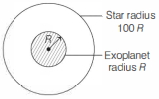
0 likes
View Solution117
MediumMCQ
$A$ planet is orbiting the sun in an elliptical orbit. Let $U$ denote the potential energy and $K$ denote the kinetic energy of the planet at an arbitrary point on the orbit. Choose the correct statement.
A
$K < |U|$ always
B
$K > |U|$ always
C
$K = |U|$ always
D
$K = |U|$ for two positions of the planet in the orbit
Solution
(A) For a planet orbiting the sun in an elliptical orbit,the total mechanical energy $E$ is given by $E = K + U$.
Since the planet is bound to the sun,the total energy $E$ is negative $(E < 0)$.
From the virial theorem for a gravitational potential $V \propto r^{-1}$,the average kinetic energy $\langle K \rangle$ and average potential energy $\langle U \rangle$ are related by $\langle K \rangle = -\frac{1}{2} \langle U \rangle$.
Specifically,at any point in the orbit,the potential energy is $U = -\frac{GMm}{r}$ and the kinetic energy is $K = \frac{GMm}{2r} + \text{constant terms depending on the orbit}$.
More simply,for a bound orbit,the total energy $E = K + U < 0$,which implies $K + U < 0$,or $K < -U$. Since $U$ is negative,$-U = |U|$.
Therefore,$K < |U|$ always holds true for a bound elliptical orbit.
Since the planet is bound to the sun,the total energy $E$ is negative $(E < 0)$.
From the virial theorem for a gravitational potential $V \propto r^{-1}$,the average kinetic energy $\langle K \rangle$ and average potential energy $\langle U \rangle$ are related by $\langle K \rangle = -\frac{1}{2} \langle U \rangle$.
Specifically,at any point in the orbit,the potential energy is $U = -\frac{GMm}{r}$ and the kinetic energy is $K = \frac{GMm}{2r} + \text{constant terms depending on the orbit}$.
More simply,for a bound orbit,the total energy $E = K + U < 0$,which implies $K + U < 0$,or $K < -U$. Since $U$ is negative,$-U = |U|$.
Therefore,$K < |U|$ always holds true for a bound elliptical orbit.
0 likes
View Solution118
MediumMCQ
Mark the correct statement:
$(i)$ Escape velocity does not depend on the mass of the body.
$(ii)$ If the total energy of a satellite becomes positive,it escapes from the Earth.
$(iii)$ The orbit of a geostationary satellite is called a parking orbit.
$(i)$ Escape velocity does not depend on the mass of the body.
$(ii)$ If the total energy of a satellite becomes positive,it escapes from the Earth.
$(iii)$ The orbit of a geostationary satellite is called a parking orbit.
A
$(i)$ only
B
$(i), (ii)$ and $(iii)$
C
$(i), (ii)$ only
D
$(i), (iii)$ only
Solution
(B) Statement $(i)$ is correct: The escape velocity is given by $v_e = \sqrt{\frac{2GM}{R}}$,which is independent of the mass of the body $m$.
Statement $(ii)$ is correct: $A$ satellite is bound to the Earth if its total energy is negative. If the total energy becomes positive (or zero),the satellite is no longer bound and escapes the gravitational field of the Earth.
Statement $(iii)$ is correct: $A$ geostationary orbit is often referred to as a parking orbit because a satellite placed in this orbit appears stationary relative to the Earth's surface,effectively 'parking' above a specific location.
Therefore,all three statements are correct. The correct option is $(b)$.
Statement $(ii)$ is correct: $A$ satellite is bound to the Earth if its total energy is negative. If the total energy becomes positive (or zero),the satellite is no longer bound and escapes the gravitational field of the Earth.
Statement $(iii)$ is correct: $A$ geostationary orbit is often referred to as a parking orbit because a satellite placed in this orbit appears stationary relative to the Earth's surface,effectively 'parking' above a specific location.
Therefore,all three statements are correct. The correct option is $(b)$.
0 likes
View Solution119
DifficultMCQ
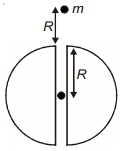
$A$ particle of mass $m$ is dropped from a height $R$ equal to the radius of the earth above the tunnel dug through the earth as shown in the figure. Hence the correct statement is
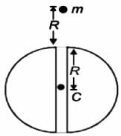
A
Particle will oscillate through the earth to a height $h=R$ on both sides
B
Motion of the particle is periodic
C
Motion of the particle is simple harmonic
D
Both $(a)$ and $(b)$
Solution
(D) The correct option is $(d)$.
$1$. When the particle is outside the earth (at a distance $r > R$ from the center),the gravitational force acting on it is $F = \frac{GMm}{r^2}$,which is proportional to $\frac{1}{r^2}$.
$2$. When the particle is inside the tunnel (at a distance $r < R$ from the center),the gravitational force acting on it is $F = \frac{GMmr}{R^3}$,which is proportional to $r$.
$3$. In both regions,the force is always directed towards the center of the earth. Since the particle is dropped from a height $R$ above the surface,it will fall into the tunnel,pass through the center,and reach a height $R$ on the other side due to the conservation of mechanical energy.
$4$. The motion is repetitive and bounded,making it periodic and oscillatory. However,because the force is not proportional to the displacement from the equilibrium position throughout the entire path (it changes from $\propto \frac{1}{r^2}$ to $\propto r$),the motion is not simple harmonic $(SHM)$.
Therefore,both statements $(a)$ and $(b)$ are correct.
$1$. When the particle is outside the earth (at a distance $r > R$ from the center),the gravitational force acting on it is $F = \frac{GMm}{r^2}$,which is proportional to $\frac{1}{r^2}$.
$2$. When the particle is inside the tunnel (at a distance $r < R$ from the center),the gravitational force acting on it is $F = \frac{GMmr}{R^3}$,which is proportional to $r$.
$3$. In both regions,the force is always directed towards the center of the earth. Since the particle is dropped from a height $R$ above the surface,it will fall into the tunnel,pass through the center,and reach a height $R$ on the other side due to the conservation of mechanical energy.
$4$. The motion is repetitive and bounded,making it periodic and oscillatory. However,because the force is not proportional to the displacement from the equilibrium position throughout the entire path (it changes from $\propto \frac{1}{r^2}$ to $\propto r$),the motion is not simple harmonic $(SHM)$.
Therefore,both statements $(a)$ and $(b)$ are correct.
0 likes
View Solution120
EasyMCQ
During the motion of a planet from perihelion to aphelion,the work done by the gravitational force of the sun on it is ...........
A
Zero
B
Negative
C
Positive
D
May be positive or negative
Solution
(B) The work done by the gravitational force on a planet is given by the Work-Energy Theorem: $W = \Delta K = K_f - K_i$.
At perihelion $(P)$,the planet is closest to the sun and its speed $(v_P)$ is maximum.
At aphelion $(A)$,the planet is farthest from the sun and its speed $(v_A)$ is minimum.
Since the planet moves from perihelion to aphelion,the final state is at aphelion and the initial state is at perihelion.
Therefore,$W = \frac{1}{2} m (v_A^2 - v_P^2)$.
Since $v_A < v_P$,it follows that $v_A^2 - v_P^2 < 0$.
Thus,the work done by the gravitational force is negative.
At perihelion $(P)$,the planet is closest to the sun and its speed $(v_P)$ is maximum.
At aphelion $(A)$,the planet is farthest from the sun and its speed $(v_A)$ is minimum.
Since the planet moves from perihelion to aphelion,the final state is at aphelion and the initial state is at perihelion.
Therefore,$W = \frac{1}{2} m (v_A^2 - v_P^2)$.
Since $v_A < v_P$,it follows that $v_A^2 - v_P^2 < 0$.
Thus,the work done by the gravitational force is negative.
0 likes
View Solution121
EasyMCQ
If the height of a satellite from the surface of the Earth is increased,then its
A
Potential energy will increase
B
Kinetic energy will decrease
C
Total energy will increase
D
All of these
Solution
(D) For a satellite of mass $m_s$ orbiting at a height $h$ from the surface of the Earth (mass $M_e$,radius $R_e$):
$1$. Potential Energy $(P.E.)$ is given by $P.E. = -\frac{G M_e m_s}{R_e + h}$. As $h$ increases,the denominator increases,making the value less negative,which means the $P.E.$ increases.
$2$. Kinetic Energy $(K.E.)$ is given by $K.E. = \frac{G M_e m_s}{2(R_e + h)}$. As $h$ increases,the denominator increases,so the $K.E.$ decreases.
$3$. Total Energy $(T.E.)$ is given by $T.E. = P.E. + K.E. = -\frac{G M_e m_s}{2(R_e + h)}$. As $h$ increases,the value becomes less negative,which means the $T.E.$ increases.
Therefore,all the given statements are correct. The correct option is $D$.
$1$. Potential Energy $(P.E.)$ is given by $P.E. = -\frac{G M_e m_s}{R_e + h}$. As $h$ increases,the denominator increases,making the value less negative,which means the $P.E.$ increases.
$2$. Kinetic Energy $(K.E.)$ is given by $K.E. = \frac{G M_e m_s}{2(R_e + h)}$. As $h$ increases,the denominator increases,so the $K.E.$ decreases.
$3$. Total Energy $(T.E.)$ is given by $T.E. = P.E. + K.E. = -\frac{G M_e m_s}{2(R_e + h)}$. As $h$ increases,the value becomes less negative,which means the $T.E.$ increases.
Therefore,all the given statements are correct. The correct option is $D$.
0 likes
View Solution122
MediumMCQ
If the radius of the Earth becomes $n$ times its present value,without any change in its mass,then the duration of the day becomes:
A
$\frac{24}{n^2}$
B
$24 n^2$
C
$24(1 - \frac{1}{n^2})$
D
$24(1 - n^2)$
Solution
(B) According to the principle of conservation of angular momentum,since no external torque acts on the Earth,the angular momentum $L = I\omega$ remains constant.
Initially,the moment of inertia is $I_1 = \frac{2}{5}MR^2$ and the angular velocity is $\omega_1 = \frac{2\pi}{T_1}$,where $T_1 = 24 \text{ hours}$.
Finally,the radius becomes $R' = nR$,so the new moment of inertia is $I_2 = \frac{2}{5}M(nR)^2 = n^2 I_1$.
Using $I_1 \omega_1 = I_2 \omega_2$:
$I_1 \times \frac{2\pi}{24} = (n^2 I_1) \times \frac{2\pi}{T_2}$
Canceling $I_1$ and $2\pi$ from both sides:
$\frac{1}{24} = \frac{n^2}{T_2}$
Solving for $T_2$:
$T_2 = 24 n^2 \text{ hours}$.
Thus,the duration of the day becomes $24 n^2$ hours.
Initially,the moment of inertia is $I_1 = \frac{2}{5}MR^2$ and the angular velocity is $\omega_1 = \frac{2\pi}{T_1}$,where $T_1 = 24 \text{ hours}$.
Finally,the radius becomes $R' = nR$,so the new moment of inertia is $I_2 = \frac{2}{5}M(nR)^2 = n^2 I_1$.
Using $I_1 \omega_1 = I_2 \omega_2$:
$I_1 \times \frac{2\pi}{24} = (n^2 I_1) \times \frac{2\pi}{T_2}$
Canceling $I_1$ and $2\pi$ from both sides:
$\frac{1}{24} = \frac{n^2}{T_2}$
Solving for $T_2$:
$T_2 = 24 n^2 \text{ hours}$.
Thus,the duration of the day becomes $24 n^2$ hours.
0 likes
View Solution123
DifficultMCQ
Imagine a narrow tunnel between two diametrically opposite points of the Earth. $A$ particle of mass $m$ is released in this tunnel. The time period of oscillation is ..........
A
$ \pi \sqrt{\frac{R}{g}} $
B
$ \frac{\pi}{2} \sqrt{\frac{R}{g}} $
C
$ 2 \pi \sqrt{\frac{R}{g}} $
D
$ \frac{2}{\pi} \sqrt{\frac{R}{g}} $
Solution
(C) The gravitational force on a particle of mass $m$ at a distance $x$ from the center of the Earth is given by $F = -\frac{G M m x}{R^3}$.
Since $F = ma$,we have $a = -\frac{G M}{R^3} x$.
This is the equation of Simple Harmonic Motion $(a = -\omega^2 x)$,where $\omega^2 = \frac{G M}{R^3}$.
We know that $g = \frac{G M}{R^2}$,so $\frac{G M}{R^3} = \frac{g}{R}$.
Thus,$\omega^2 = \frac{g}{R}$,which means $\omega = \sqrt{\frac{g}{R}}$.
The time period $T$ is given by $T = \frac{2 \pi}{\omega}$.
Substituting the value of $\omega$,we get $T = 2 \pi \sqrt{\frac{R}{g}}$.
Since $F = ma$,we have $a = -\frac{G M}{R^3} x$.
This is the equation of Simple Harmonic Motion $(a = -\omega^2 x)$,where $\omega^2 = \frac{G M}{R^3}$.
We know that $g = \frac{G M}{R^2}$,so $\frac{G M}{R^3} = \frac{g}{R}$.
Thus,$\omega^2 = \frac{g}{R}$,which means $\omega = \sqrt{\frac{g}{R}}$.
The time period $T$ is given by $T = \frac{2 \pi}{\omega}$.
Substituting the value of $\omega$,we get $T = 2 \pi \sqrt{\frac{R}{g}}$.
0 likes
View Solution124
MediumMCQ
Every planet revolves around the sun in an elliptical orbit. Which of the following statements are correct?
$A.$ The force acting on a planet is inversely proportional to the square of the distance from the sun.
$B.$ The force acting on the planet is inversely proportional to the product of the masses of the planet and the sun.
$C.$ The centripetal force acting on the planet is directed away from the sun.
$D.$ The square of the time period of revolution of a planet around the sun is directly proportional to the cube of the semi-major axis of the elliptical orbit.
Choose the correct answer from the options given below:
$A.$ The force acting on a planet is inversely proportional to the square of the distance from the sun.
$B.$ The force acting on the planet is inversely proportional to the product of the masses of the planet and the sun.
$C.$ The centripetal force acting on the planet is directed away from the sun.
$D.$ The square of the time period of revolution of a planet around the sun is directly proportional to the cube of the semi-major axis of the elliptical orbit.
Choose the correct answer from the options given below:
A
$A$ and $D$ only
B
$C$ and $D$ only
C
$B$ and $C$ only
D
$A$ and $C$ only
Solution
(A) According to Newton's law of universal gravitation,the gravitational force between the sun and a planet is given by $F = \frac{GMm}{r^2}$.
$1$. Statement $A$ is correct because $F \propto \frac{1}{r^2}$.
$2$. Statement $B$ is incorrect because the force is directly proportional to the product of the masses $(F \propto Mm)$,not inversely proportional.
$3$. Statement $C$ is incorrect because the centripetal force (gravitational force) is directed towards the sun,not away from it.
$4$. Statement $D$ is correct as it represents Kepler's third law of planetary motion,which states $T^2 \propto a^3$,where $T$ is the time period and $a$ is the semi-major axis.
Therefore,statements $A$ and $D$ are correct.
$1$. Statement $A$ is correct because $F \propto \frac{1}{r^2}$.
$2$. Statement $B$ is incorrect because the force is directly proportional to the product of the masses $(F \propto Mm)$,not inversely proportional.
$3$. Statement $C$ is incorrect because the centripetal force (gravitational force) is directed towards the sun,not away from it.
$4$. Statement $D$ is correct as it represents Kepler's third law of planetary motion,which states $T^2 \propto a^3$,where $T$ is the time period and $a$ is the semi-major axis.
Therefore,statements $A$ and $D$ are correct.
0 likes
View Solution125
DifficultMCQ
Given below are two statements: one is labelled as Assertion $(A)$ and the other is labelled as Reason $(R)$.
$Assertion$ $(A)$: The angular speed of the moon in its orbit about the earth is more than the angular speed of the earth in its orbit about the sun.
$Reason$ $(R)$: The moon takes less time to move around the earth than the time taken by the earth to move around the sun.
In the light of the above statements,choose the most appropriate answer from the options given below:
$Assertion$ $(A)$: The angular speed of the moon in its orbit about the earth is more than the angular speed of the earth in its orbit about the sun.
$Reason$ $(R)$: The moon takes less time to move around the earth than the time taken by the earth to move around the sun.
In the light of the above statements,choose the most appropriate answer from the options given below:
A
$(A)$ is correct but $(R)$ is not correct
B
Both $(A)$ and $(R)$ are correct and $(R)$ is the correct explanation of $(A)$
C
Both $(A)$ and $(R)$ are correct but $(R)$ is not the correct explanation of $(A)$
D
$(A)$ is not correct but $(R)$ is correct
Solution
(B) The angular speed $\omega$ is given by the formula $\omega = \frac{2\pi}{T}$,where $T$ is the time period of revolution.
This implies that $\omega \propto \frac{1}{T}$.
The time period of the moon revolving around the earth is $T_{\text{moon}} \approx 27.3 \text{ days}$.
The time period of the earth revolving around the sun is $T_{\text{earth}} \approx 365.25 \text{ days}$.
Since $T_{\text{moon}} < T_{\text{earth}}$,it follows that $\omega_{\text{moon}} > \omega_{\text{earth}}$.
Thus,both the Assertion $(A)$ and the Reason $(R)$ are correct,and the Reason $(R)$ correctly explains why the angular speed of the moon is higher.
This implies that $\omega \propto \frac{1}{T}$.
The time period of the moon revolving around the earth is $T_{\text{moon}} \approx 27.3 \text{ days}$.
The time period of the earth revolving around the sun is $T_{\text{earth}} \approx 365.25 \text{ days}$.
Since $T_{\text{moon}} < T_{\text{earth}}$,it follows that $\omega_{\text{moon}} > \omega_{\text{earth}}$.
Thus,both the Assertion $(A)$ and the Reason $(R)$ are correct,and the Reason $(R)$ correctly explains why the angular speed of the moon is higher.
0 likes
View Solution126
DifficultMCQ
Match List-$I$ with List-$II$:
(Where $a=$ radius of planet orbit,$r=$ radius of planet,$M=$ mass of Sun,$m=$ mass of planet)
Choose the correct answer from the options given below:
| List-$I$ | List-$II$ |
| $(A)$ Kinetic energy of planet | $(1)$ $-\frac{GMm}{a}$ |
| $(B)$ Gravitational potential energy of Sun-planet system | $(2)$ $\frac{GMm}{2a}$ |
| $(C)$ Total mechanical energy of planet | $(3)$ $\frac{GM}{r}$ |
| $(D)$ Escape energy at the surface of planet for unit mass object | $(4)$ $-\frac{GMm}{2a}$ |
(Where $a=$ radius of planet orbit,$r=$ radius of planet,$M=$ mass of Sun,$m=$ mass of planet)
Choose the correct answer from the options given below:
A
$(A) - II, (B) - I, (C) - IV, (D) - III$
B
$(A) - III, (B) - IV, (C) - I, (D) - II$
C
$(A) - I, (B) - IV, (C) - II, (D) - III$
D
$(A) - I, (B) - II, (C) - III, (D) - IV$
Solution
(A) For a planet in a circular orbit of radius $a$ around the Sun of mass $M$:
$1$. Kinetic Energy $(KE)$: The orbital velocity is $v = \sqrt{\frac{GM}{a}}$. Thus,$KE = \frac{1}{2}mv^2 = \frac{GMm}{2a}$. This matches $(2)$.
$2$. Gravitational Potential Energy $(PE)$: The potential energy of the system is $PE = -\frac{GMm}{a}$. This matches $(1)$.
$3$. Total Mechanical Energy $(TE)$: $TE = KE + PE = \frac{GMm}{2a} - \frac{GMm}{a} = -\frac{GMm}{2a}$. This matches $(4)$.
$4$. Escape energy at the surface of the planet (mass $m_p$,radius $r$): The energy required to escape is equal to the magnitude of the gravitational potential energy at the surface,which is $\frac{GM_p m}{r}$. For a unit mass object $(m=1)$,this is $\frac{GM_p}{r}$. Assuming the question refers to the planet's own gravitational field,this matches $(3)$.
Therefore,the correct matching is $(A) - II, (B) - I, (C) - IV, (D) - III$.
$1$. Kinetic Energy $(KE)$: The orbital velocity is $v = \sqrt{\frac{GM}{a}}$. Thus,$KE = \frac{1}{2}mv^2 = \frac{GMm}{2a}$. This matches $(2)$.
$2$. Gravitational Potential Energy $(PE)$: The potential energy of the system is $PE = -\frac{GMm}{a}$. This matches $(1)$.
$3$. Total Mechanical Energy $(TE)$: $TE = KE + PE = \frac{GMm}{2a} - \frac{GMm}{a} = -\frac{GMm}{2a}$. This matches $(4)$.
$4$. Escape energy at the surface of the planet (mass $m_p$,radius $r$): The energy required to escape is equal to the magnitude of the gravitational potential energy at the surface,which is $\frac{GM_p m}{r}$. For a unit mass object $(m=1)$,this is $\frac{GM_p}{r}$. Assuming the question refers to the planet's own gravitational field,this matches $(3)$.
Therefore,the correct matching is $(A) - II, (B) - I, (C) - IV, (D) - III$.
0 likes
View Solution127
DifficultMCQ
Two planets $A$ and $B$ having masses $m_1$ and $m_2$ move around the sun in circular orbits of $r_1$ and $r_2$ radii respectively. If angular momentum of $A$ is $L$ and that of $B$ is $3L$,the ratio of time period $\left(\frac{T_A}{T_B}\right)$ is:
A
$\left(\frac{r_2}{r_1}\right)^{\frac{3}{2}}$
B
$\left(\frac{r_1}{r_2}\right)^3$
C
$\frac{1}{27}\left(\frac{m_2}{m_1}\right)^3$
D
$27\left(\frac{m_1}{m_2}\right)^3$
Solution
(C) For a planet in a circular orbit,the angular momentum $L$ is given by $L = mvr = m(r\omega)r = mr^2\left(\frac{2\pi}{T}\right)$.
Thus,$\frac{L}{m} = \frac{2\pi r^2}{T}$,which implies $\frac{T}{r^2} = \frac{2\pi m}{L}$.
For planet $A$: $\frac{T_A}{r_1^2} = \frac{2\pi m_1}{L}$.
For planet $B$: $\frac{T_B}{r_2^2} = \frac{2\pi m_2}{3L}$.
Dividing the two equations: $\frac{T_A}{T_B} \cdot \left(\frac{r_2}{r_1}\right)^2 = \frac{m_1}{m_2} \cdot 3 \implies \frac{T_A}{T_B} = 3 \left(\frac{m_1}{m_2}\right) \left(\frac{r_1}{r_2}\right)^2$.
From Kepler's Third Law,$T^2 \propto r^3$,so $\left(\frac{T_A}{T_B}\right)^2 = \left(\frac{r_1}{r_2}\right)^3$,which means $\left(\frac{r_1}{r_2}\right)^2 = \left(\frac{T_A}{T_B}\right)^{4/3}$.
Substituting this into the expression: $\frac{T_A}{T_B} = 3 \left(\frac{m_1}{m_2}\right) \left(\frac{T_A}{T_B}\right)^{4/3}$.
Rearranging: $\left(\frac{T_A}{T_B}\right)^{-1/3} = 3 \frac{m_1}{m_2} \implies \frac{T_A}{T_B} = \left(3 \frac{m_1}{m_2}\right)^{-3} = \frac{1}{27} \left(\frac{m_2}{m_1}\right)^3$.
Thus,$\frac{L}{m} = \frac{2\pi r^2}{T}$,which implies $\frac{T}{r^2} = \frac{2\pi m}{L}$.
For planet $A$: $\frac{T_A}{r_1^2} = \frac{2\pi m_1}{L}$.
For planet $B$: $\frac{T_B}{r_2^2} = \frac{2\pi m_2}{3L}$.
Dividing the two equations: $\frac{T_A}{T_B} \cdot \left(\frac{r_2}{r_1}\right)^2 = \frac{m_1}{m_2} \cdot 3 \implies \frac{T_A}{T_B} = 3 \left(\frac{m_1}{m_2}\right) \left(\frac{r_1}{r_2}\right)^2$.
From Kepler's Third Law,$T^2 \propto r^3$,so $\left(\frac{T_A}{T_B}\right)^2 = \left(\frac{r_1}{r_2}\right)^3$,which means $\left(\frac{r_1}{r_2}\right)^2 = \left(\frac{T_A}{T_B}\right)^{4/3}$.
Substituting this into the expression: $\frac{T_A}{T_B} = 3 \left(\frac{m_1}{m_2}\right) \left(\frac{T_A}{T_B}\right)^{4/3}$.
Rearranging: $\left(\frac{T_A}{T_B}\right)^{-1/3} = 3 \frac{m_1}{m_2} \implies \frac{T_A}{T_B} = \left(3 \frac{m_1}{m_2}\right)^{-3} = \frac{1}{27} \left(\frac{m_2}{m_1}\right)^3$.
0 likes
View Solution128
DifficultMCQ
$A$ spherically symmetric gravitational system of particles has a mass density $\rho = \begin{cases} \rho_0 & \text{for } r \leq R \\ 0 & \text{for } r > R \end{cases}$ where $\rho_0$ is a constant. $A$ test mass can undergo circular motion under the influence of the gravitational field of particles. Its speed $V$ as a function of distance $r$ $(0 < r < \infty)$ from the centre of the system is represented by:
A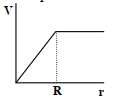
B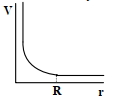
C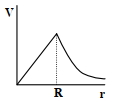
D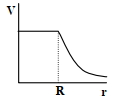
Solution
(C) For a test mass in circular motion,the gravitational force provides the necessary centripetal force: $\frac{G M(r) m}{r^2} = \frac{m v^2}{r}$,which simplifies to $v = \sqrt{\frac{G M(r)}{r}}$.
Case $1$: $r \leq R$
The mass enclosed within radius $r$ is $M(r) = \rho_0 \cdot \frac{4}{3} \pi r^3$. Substituting this into the speed formula:
$v = \sqrt{\frac{G (\rho_0 \cdot \frac{4}{3} \pi r^3)}{r}} = \sqrt{\frac{4}{3} \pi G \rho_0} \cdot r$. Thus,$v \propto r$.
Case $2$: $r > R$
The total mass of the system is $M = \rho_0 \cdot \frac{4}{3} \pi R^3$. The mass enclosed for $r > R$ is constant $M$. Substituting this into the speed formula:
$v = \sqrt{\frac{G M}{r}}$. Thus,$v \propto \frac{1}{\sqrt{r}}$.
Comparing these results,the graph shows a linear increase for $r \leq R$ and a decreasing curve proportional to $1/\sqrt{r}$ for $r > R$,which corresponds to option $C$.
Case $1$: $r \leq R$
The mass enclosed within radius $r$ is $M(r) = \rho_0 \cdot \frac{4}{3} \pi r^3$. Substituting this into the speed formula:
$v = \sqrt{\frac{G (\rho_0 \cdot \frac{4}{3} \pi r^3)}{r}} = \sqrt{\frac{4}{3} \pi G \rho_0} \cdot r$. Thus,$v \propto r$.
Case $2$: $r > R$
The total mass of the system is $M = \rho_0 \cdot \frac{4}{3} \pi R^3$. The mass enclosed for $r > R$ is constant $M$. Substituting this into the speed formula:
$v = \sqrt{\frac{G M}{r}}$. Thus,$v \propto \frac{1}{\sqrt{r}}$.
Comparing these results,the graph shows a linear increase for $r \leq R$ and a decreasing curve proportional to $1/\sqrt{r}$ for $r > R$,which corresponds to option $C$.
0 likes
View Solution129
DifficultMCQ
$A$ binary star system consists of two stars $A$ (mass $M_A = 2.2 M_S$) and $B$ (mass $M_B = 11 M_S$),where $M_S$ is the mass of the Sun. They are separated by a distance $d$ and rotate about their common centre of mass,which is stationary. What is the ratio of the angular momentum of star $A$ to the angular momentum of star $B$ about the centre of mass?
A
$1/25$
B
$1$
C
$5$
D
$25$
Solution
(C) In a binary star system rotating about their common centre of mass,both stars have the same angular velocity $\omega$ at any instant.
The distance of star $A$ from the centre of mass is $r_A$ and that of star $B$ is $r_B$.
By the definition of the centre of mass,$M_A r_A = M_B r_B$,which implies $r_A / r_B = M_B / M_A$.
The angular momentum of a particle about the centre of mass is given by $L = mvr = mr^2\omega$.
Thus,the angular momentum of star $A$ is $L_A = M_A r_A^2 \omega$ and for star $B$ is $L_B = M_B r_B^2 \omega$.
The ratio of angular momenta is $L_A / L_B = (M_A r_A^2) / (M_B r_B^2) = (M_A r_A) r_A / (M_B r_B) r_B$.
Since $M_A r_A = M_B r_B$,the ratio simplifies to $L_A / L_B = r_A / r_B = M_B / M_A$.
Given $M_A = 2.2 M_S$ and $M_B = 11 M_S$,the ratio is $L_A / L_B = 11 / 2.2 = 5$.
The distance of star $A$ from the centre of mass is $r_A$ and that of star $B$ is $r_B$.
By the definition of the centre of mass,$M_A r_A = M_B r_B$,which implies $r_A / r_B = M_B / M_A$.
The angular momentum of a particle about the centre of mass is given by $L = mvr = mr^2\omega$.
Thus,the angular momentum of star $A$ is $L_A = M_A r_A^2 \omega$ and for star $B$ is $L_B = M_B r_B^2 \omega$.
The ratio of angular momenta is $L_A / L_B = (M_A r_A^2) / (M_B r_B^2) = (M_A r_A) r_A / (M_B r_B) r_B$.
Since $M_A r_A = M_B r_B$,the ratio simplifies to $L_A / L_B = r_A / r_B = M_B / M_A$.
Given $M_A = 2.2 M_S$ and $M_B = 11 M_S$,the ratio is $L_A / L_B = 11 / 2.2 = 5$.
0 likes
View Solution130
AdvancedMCQ
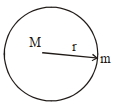
Consider a spherical gaseous cloud of mass density $\rho(r)$ in free space,where $r$ is the radial distance from its center. The gaseous cloud is made of particles of equal mass $m$ moving in circular orbits about the common center with the same kinetic energy $K$. The force acting on the particles is their mutual gravitational force. If $\rho(r)$ is constant in time,the particle number density $n(r) = \rho(r) / m$ is:
[$G$ is the universal gravitational constant]
[$G$ is the universal gravitational constant]
A
$\frac{K}{\pi r^2 m^2 G}$
B
$\frac{K}{6 \pi^2 m^2 G}$
C
$\frac{3K}{\pi^2 m^2 G}$
D
$\frac{K}{2 \pi r^2 m^2 G}$
Solution
(D) Let $M$ be the total mass enclosed within a sphere of radius $r$.
For a particle of mass $m$ moving in a circular orbit of radius $r$,the gravitational force provides the necessary centripetal force:
$\frac{GMm}{r^2} = \frac{mv^2}{r}$
Since the kinetic energy $K = \frac{1}{2}mv^2$,we have $mv^2 = 2K$. Substituting this into the force equation:
$\frac{GMm}{r^2} = \frac{2K}{r} \Rightarrow M = \frac{2Kr}{Gm}$
Differentiating both sides with respect to $r$ to find the mass $dM$ in a shell of thickness $dr$:
$dM = \frac{2K}{Gm} dr$
Also,the mass of the shell is $dM = \rho(r) \cdot 4 \pi r^2 dr$. Equating the two expressions for $dM$:
$4 \pi r^2 \rho(r) dr = \frac{2K}{Gm} dr$
Solving for density $\rho(r)$:
$\rho(r) = \frac{2K}{4 \pi r^2 Gm} = \frac{K}{2 \pi r^2 Gm}$
The particle number density $n(r)$ is given by $\rho(r) / m$:
$n(r) = \frac{K}{2 \pi r^2 m^2 G}$
For a particle of mass $m$ moving in a circular orbit of radius $r$,the gravitational force provides the necessary centripetal force:
$\frac{GMm}{r^2} = \frac{mv^2}{r}$
Since the kinetic energy $K = \frac{1}{2}mv^2$,we have $mv^2 = 2K$. Substituting this into the force equation:
$\frac{GMm}{r^2} = \frac{2K}{r} \Rightarrow M = \frac{2Kr}{Gm}$
Differentiating both sides with respect to $r$ to find the mass $dM$ in a shell of thickness $dr$:
$dM = \frac{2K}{Gm} dr$
Also,the mass of the shell is $dM = \rho(r) \cdot 4 \pi r^2 dr$. Equating the two expressions for $dM$:
$4 \pi r^2 \rho(r) dr = \frac{2K}{Gm} dr$
Solving for density $\rho(r)$:
$\rho(r) = \frac{2K}{4 \pi r^2 Gm} = \frac{K}{2 \pi r^2 Gm}$
The particle number density $n(r)$ is given by $\rho(r) / m$:
$n(r) = \frac{K}{2 \pi r^2 m^2 G}$
0 likes
View Solution131
DifficultMCQ
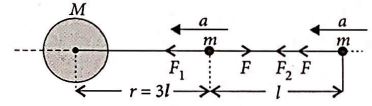
$A$ large spherical mass $M$ is fixed at one position and two identical point masses $m$ are kept on a line passing through the centre of $M$ (see figure). The point masses are connected by a rigid massless rod of length $\ell$ and this assembly is free to move along the line connecting them. All three masses interact only through their mutual gravitational interaction. When the point mass nearer to $M$ is at a distance $r = 3\ell$ from $M$,the tension in the rod is zero for $m = k\left(\frac{M}{288}\right)$. The value of $k$ is

A
$7$
B
$8$
C
$9$
D
$1$
Solution
(A) Both point masses are connected by a rigid massless rod,so they must have the same acceleration $a$ towards the large mass $M$.
Let $F_1$ be the gravitational force on the nearer mass $m$ due to $M$,and $F_2$ be the gravitational force on the farther mass $m$ due to $M$.
Let $F$ be the tension in the rod. Since the tension is zero,$F = 0$.
For the nearer mass $m$:
$F_1 = ma \implies \frac{GMm}{(3\ell)^2} = ma \implies a = \frac{GM}{9\ell^2} \quad (i)$
For the farther mass $m$:
$F_2 = ma \implies \frac{GMm}{(4\ell)^2} = ma \implies a = \frac{GM}{16\ell^2} \quad (ii)$
However,the rod also exerts a gravitational force between the two masses $m$. Let this force be $F_g = \frac{Gm^2}{\ell^2}$.
For the nearer mass: $F_1 - F_g = ma$
For the farther mass: $F_2 + F_g = ma$
Equating the two expressions for $ma$:
$F_1 - F_g = F_2 + F_g \implies F_1 - F_2 = 2F_g$
$\frac{GMm}{9\ell^2} - \frac{GMm}{16\ell^2} = 2 \left( \frac{Gm^2}{\ell^2} \right)$
$GMm \left( \frac{16 - 9}{144\ell^2} \right) = \frac{2Gm^2}{\ell^2}$
$\frac{7GMm}{144} = 2Gm^2 \implies \frac{7M}{144} = 2m \implies m = \frac{7M}{288}$
Comparing with $m = k \left( \frac{M}{288} \right)$,we get $k = 7$.
Let $F_1$ be the gravitational force on the nearer mass $m$ due to $M$,and $F_2$ be the gravitational force on the farther mass $m$ due to $M$.
Let $F$ be the tension in the rod. Since the tension is zero,$F = 0$.
For the nearer mass $m$:
$F_1 = ma \implies \frac{GMm}{(3\ell)^2} = ma \implies a = \frac{GM}{9\ell^2} \quad (i)$
For the farther mass $m$:
$F_2 = ma \implies \frac{GMm}{(4\ell)^2} = ma \implies a = \frac{GM}{16\ell^2} \quad (ii)$
However,the rod also exerts a gravitational force between the two masses $m$. Let this force be $F_g = \frac{Gm^2}{\ell^2}$.
For the nearer mass: $F_1 - F_g = ma$
For the farther mass: $F_2 + F_g = ma$
Equating the two expressions for $ma$:
$F_1 - F_g = F_2 + F_g \implies F_1 - F_2 = 2F_g$
$\frac{GMm}{9\ell^2} - \frac{GMm}{16\ell^2} = 2 \left( \frac{Gm^2}{\ell^2} \right)$
$GMm \left( \frac{16 - 9}{144\ell^2} \right) = \frac{2Gm^2}{\ell^2}$
$\frac{7GMm}{144} = 2Gm^2 \implies \frac{7M}{144} = 2m \implies m = \frac{7M}{288}$
Comparing with $m = k \left( \frac{M}{288} \right)$,we get $k = 7$.
0 likes
View Solution132
MediumMCQ
$A$ spherical body of radius $R$ consists of a fluid of constant density $\rho$ and is in equilibrium under its own gravity. If $P(r)$ is the pressure at a distance $r$ from the center $(r < R)$,then the correct option$(s)$ is(are):
$(A) P(r=0) = P_c$ (maximum pressure at center)
$(B) \frac{P(r=3R/4)}{P(r=2R/3)} = \frac{63}{80}$
$(C) \frac{P(r=3R/5)}{P(r=2R/5)} = \frac{16}{21}$
$(D) \frac{P(r=R/2)}{P(r=R/3)} = \frac{20}{27}$
$(A) P(r=0) = P_c$ (maximum pressure at center)
$(B) \frac{P(r=3R/4)}{P(r=2R/3)} = \frac{63}{80}$
$(C) \frac{P(r=3R/5)}{P(r=2R/5)} = \frac{16}{21}$
$(D) \frac{P(r=R/2)}{P(r=R/3)} = \frac{20}{27}$
A
$(B, D)$
B
$(B, C)$
C
$(A, C)$
D
$(A, D)$
Solution
(B) For a fluid sphere of constant density $\rho$ in equilibrium under its own gravity,the pressure $P(r)$ at a distance $r$ from the center is given by the hydrostatic equilibrium equation: $\frac{dP}{dr} = -\rho g(r)$.
The gravitational field at distance $r$ is $g(r) = \frac{G M(r)}{r^2} = \frac{G (\frac{4}{3}\pi r^3 \rho)}{r^2} = \frac{4}{3}\pi G \rho r$.
Substituting this into the equilibrium equation: $\frac{dP}{dr} = -\frac{4}{3}\pi G \rho^2 r$.
Integrating from $r$ to $R$ (where $P(R) = 0$): $\int_{P(r)}^{0} dP = -\int_{r}^{R} \frac{4}{3}\pi G \rho^2 r dr$.
$0 - P(r) = -\frac{4}{3}\pi G \rho^2 [\frac{r^2}{2}]_r^R = -\frac{2}{3}\pi G \rho^2 (R^2 - r^2)$.
Thus,$P(r) = \frac{2}{3}\pi G \rho^2 R^2 (1 - \frac{r^2}{R^2}) = P_c (1 - \frac{r^2}{R^2})$.
Checking the ratios:
$(B) \frac{P(3R/4)}{P(2R/3)} = \frac{1 - (3/4)^2}{1 - (2/3)^2} = \frac{1 - 9/16}{1 - 4/9} = \frac{7/16}{5/9} = \frac{63}{80}$. (Correct)
$(C) \frac{P(3R/5)}{P(2R/5)} = \frac{1 - 9/25}{1 - 4/25} = \frac{16/25}{21/25} = \frac{16}{21}$. (Correct)
$(D) \frac{P(R/2)}{P(R/3)} = \frac{1 - 1/4}{1 - 1/9} = \frac{3/4}{8/9} = \frac{27}{32} \neq \frac{20}{27}$. (Incorrect)
Therefore,the correct options are $(B)$ and $(C)$.
The gravitational field at distance $r$ is $g(r) = \frac{G M(r)}{r^2} = \frac{G (\frac{4}{3}\pi r^3 \rho)}{r^2} = \frac{4}{3}\pi G \rho r$.
Substituting this into the equilibrium equation: $\frac{dP}{dr} = -\frac{4}{3}\pi G \rho^2 r$.
Integrating from $r$ to $R$ (where $P(R) = 0$): $\int_{P(r)}^{0} dP = -\int_{r}^{R} \frac{4}{3}\pi G \rho^2 r dr$.
$0 - P(r) = -\frac{4}{3}\pi G \rho^2 [\frac{r^2}{2}]_r^R = -\frac{2}{3}\pi G \rho^2 (R^2 - r^2)$.
Thus,$P(r) = \frac{2}{3}\pi G \rho^2 R^2 (1 - \frac{r^2}{R^2}) = P_c (1 - \frac{r^2}{R^2})$.
Checking the ratios:
$(B) \frac{P(3R/4)}{P(2R/3)} = \frac{1 - (3/4)^2}{1 - (2/3)^2} = \frac{1 - 9/16}{1 - 4/9} = \frac{7/16}{5/9} = \frac{63}{80}$. (Correct)
$(C) \frac{P(3R/5)}{P(2R/5)} = \frac{1 - 9/25}{1 - 4/25} = \frac{16/25}{21/25} = \frac{16}{21}$. (Correct)
$(D) \frac{P(R/2)}{P(R/3)} = \frac{1 - 1/4}{1 - 1/9} = \frac{3/4}{8/9} = \frac{27}{32} \neq \frac{20}{27}$. (Incorrect)
Therefore,the correct options are $(B)$ and $(C)$.
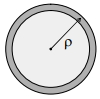
0 likes
View Solution133
DifficultMCQ
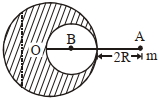
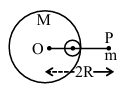
$A$ small point mass $m$ is placed at a distance $2R$ from the centre $O$ of a big uniform solid sphere of mass $M$ and radius $R$. The gravitational force on $m$ due to $M$ is $F_1$. $A$ spherical part of radius $R/3$ is removed from the big sphere as shown in the figure and the gravitational force on $m$ due to the remaining part of $M$ is found to be $F_2$. The value of the ratio $F_1: F_2$ is
A
$16: 9$
B
$11: 10$
C
$12: 11$
D
$12: 9$
Solution
(C) The gravitational force on mass $m$ due to the complete sphere is given by:
$F_1 = \frac{GMm}{(2R)^2} = \frac{GMm}{4R^2} \quad ...(1)$
When a spherical part of radius $r = R/3$ is removed,its mass $M'$ is calculated by considering the density $\rho$ of the sphere:
$M' = \rho \cdot V' = \left( \frac{M}{\frac{4}{3}\pi R^3} \right) \cdot \left( \frac{4}{3}\pi (R/3)^3 \right) = \frac{M}{27}$
The center of the removed sphere is at a distance $d = R - R/3 = 2R/3$ from the center $O$. The distance of this center from the point mass $m$ is $2R - 2R/3 = 4R/3$.
The force $F_2$ exerted by the remaining part is the original force minus the force that would have been exerted by the removed part:
$F_2 = F_1 - F_{\text{removed}} = \frac{GMm}{4R^2} - \frac{G(M/27)m}{(4R/3)^2}$
$F_2 = \frac{GMm}{4R^2} - \frac{GMm}{27 \cdot (16R^2/9)} = \frac{GMm}{4R^2} - \frac{GMm}{48R^2}$
$F_2 = \frac{GMm}{R^2} \left( \frac{1}{4} - \frac{1}{48} \right) = \frac{GMm}{R^2} \left( \frac{12-1}{48} \right) = \frac{11}{48} \frac{GMm}{R^2}$
Now,the ratio $F_1 : F_2$ is:
$\frac{F_1}{F_2} = \frac{GMm / 4R^2}{11GMm / 48R^2} = \frac{1}{4} \cdot \frac{48}{11} = \frac{12}{11}$
Thus,$F_1 : F_2 = 12 : 11$.
$F_1 = \frac{GMm}{(2R)^2} = \frac{GMm}{4R^2} \quad ...(1)$
When a spherical part of radius $r = R/3$ is removed,its mass $M'$ is calculated by considering the density $\rho$ of the sphere:
$M' = \rho \cdot V' = \left( \frac{M}{\frac{4}{3}\pi R^3} \right) \cdot \left( \frac{4}{3}\pi (R/3)^3 \right) = \frac{M}{27}$
The center of the removed sphere is at a distance $d = R - R/3 = 2R/3$ from the center $O$. The distance of this center from the point mass $m$ is $2R - 2R/3 = 4R/3$.
The force $F_2$ exerted by the remaining part is the original force minus the force that would have been exerted by the removed part:
$F_2 = F_1 - F_{\text{removed}} = \frac{GMm}{4R^2} - \frac{G(M/27)m}{(4R/3)^2}$
$F_2 = \frac{GMm}{4R^2} - \frac{GMm}{27 \cdot (16R^2/9)} = \frac{GMm}{4R^2} - \frac{GMm}{48R^2}$
$F_2 = \frac{GMm}{R^2} \left( \frac{1}{4} - \frac{1}{48} \right) = \frac{GMm}{R^2} \left( \frac{12-1}{48} \right) = \frac{11}{48} \frac{GMm}{R^2}$
Now,the ratio $F_1 : F_2$ is:
$\frac{F_1}{F_2} = \frac{GMm / 4R^2}{11GMm / 48R^2} = \frac{1}{4} \cdot \frac{48}{11} = \frac{12}{11}$
Thus,$F_1 : F_2 = 12 : 11$.
0 likes
View Solution134
MediumMCQ
Match the $\text{LIST-I}$ with $\text{LIST-II}$:
Choose the correct answer from the options given below:
| $\text{LIST-I}$ | $\text{LIST-II}$ |
|---|---|
| $A$. Gravitational constant | $I$. $[LT^{-2}]$ |
| $B$. Gravitational potential energy | $II$. $[L^2 T^{-2}]$ |
| $C$. Gravitational potential | $III$. $[ML^2 T^{-2}]$ |
| $D$. Acceleration due to gravity | $IV$. $[M^{-1} L^3 T^{-2}]$ |
Choose the correct answer from the options given below:
A
$A-IV, B-III, C-II, D-I$
B
$A-III, B-II, C-I, D-IV$
C
$A-II, B-IV, C-III, D-I$
D
$A-I, B-III, C-IV, D-II$
Solution
(A) Gravitational constant $G = \frac{Fr^2}{m^2}$. The dimensional formula is $[G] = \frac{[MLT^{-2}][L^2]}{[M^2]} = [M^{-1} L^3 T^{-2}] \ (IV)$.
$(B)$ Gravitational potential energy $U = mgh$. The dimensional formula is $[U] = [M][LT^{-2}][L] = [ML^2 T^{-2}] \ (III)$.
$(C)$ Gravitational potential $V = \frac{GM}{r}$. The dimensional formula is $[V] = \frac{[M^{-1} L^3 T^{-2}][M]}{[L]} = [L^2 T^{-2}] \ (II)$.
$(D)$ Acceleration due to gravity $g$. The dimensional formula is $[g] = [LT^{-2}] \ (I)$.
Thus,the correct matching is $A-IV, B-III, C-II, D-I$.
$(B)$ Gravitational potential energy $U = mgh$. The dimensional formula is $[U] = [M][LT^{-2}][L] = [ML^2 T^{-2}] \ (III)$.
$(C)$ Gravitational potential $V = \frac{GM}{r}$. The dimensional formula is $[V] = \frac{[M^{-1} L^3 T^{-2}][M]}{[L]} = [L^2 T^{-2}] \ (II)$.
$(D)$ Acceleration due to gravity $g$. The dimensional formula is $[g] = [LT^{-2}] \ (I)$.
Thus,the correct matching is $A-IV, B-III, C-II, D-I$.
0 likes
View Solution135
DifficultMCQ
Three identical spheres of mass $m$ are placed at the vertices of an equilateral triangle of side length $a$. When released,they interact only through gravitational force and collide after a time $T = 4 \text{ s}$. If the sides of the triangle are increased to length $2a$ and the masses of the spheres are made $2m$,then they will collide after . . . . . . seconds.
A
$8$
B
$4$
C
$3$
D
$6$
Solution
(A) The time taken for the spheres to collide is proportional to the orbital period of a body in a gravitational field,which follows Kepler's Third Law: $T^2 \propto \frac{a^3}{M}$.
Here,$a$ is the side length of the triangle and $M$ is the mass of the spheres.
Given the initial condition: $T_1 = 4 \text{ s}$,$a_1 = a$,and $M_1 = m$.
For the second condition: $a_2 = 2a$ and $M_2 = 2m$.
Using the proportionality $T \propto \sqrt{\frac{a^3}{M}}$,we have:
$\frac{T_2}{T_1} = \sqrt{\frac{a_2^3}{M_2} \cdot \frac{M_1}{a_1^3}}$
$\frac{T_2}{4} = \sqrt{\frac{(2a)^3}{2m} \cdot \frac{m}{a^3}}$
$\frac{T_2}{4} = \sqrt{\frac{8a^3}{2m} \cdot \frac{m}{a^3}}$
$\frac{T_2}{4} = \sqrt{4} = 2$
$T_2 = 4 \times 2 = 8 \text{ s}$.
Here,$a$ is the side length of the triangle and $M$ is the mass of the spheres.
Given the initial condition: $T_1 = 4 \text{ s}$,$a_1 = a$,and $M_1 = m$.
For the second condition: $a_2 = 2a$ and $M_2 = 2m$.
Using the proportionality $T \propto \sqrt{\frac{a^3}{M}}$,we have:
$\frac{T_2}{T_1} = \sqrt{\frac{a_2^3}{M_2} \cdot \frac{M_1}{a_1^3}}$
$\frac{T_2}{4} = \sqrt{\frac{(2a)^3}{2m} \cdot \frac{m}{a^3}}$
$\frac{T_2}{4} = \sqrt{\frac{8a^3}{2m} \cdot \frac{m}{a^3}}$
$\frac{T_2}{4} = \sqrt{4} = 2$
$T_2 = 4 \times 2 = 8 \text{ s}$.
0 likes
View Solution136
MediumMCQ
Assume that a tunnel is dug along a chord of the earth,at a perpendicular distance $(R / 2)$ from the earth's centre,where '$R$' is the radius of the Earth. The wall of the tunnel is frictionless. If a particle is released in this tunnel,it will execute a simple harmonic motion with a time period:
A
$\frac{2 \pi R}{g}$
B
$\frac{g}{2 \pi R}$
C
$\frac{1}{2 \pi} \sqrt{\frac{g}{R}}$
D
$2 \pi \sqrt{\frac{R}{g}}$
Solution
(D) The gravitational force on a particle of mass $m$ at a distance $r$ from the center of the Earth is given by $F = -\frac{GMmr}{R^3}$.
Along the tunnel,only the component of this force directed towards the center of the tunnel (the equilibrium position) acts as a restoring force.
Let $x$ be the displacement of the particle from the center of the tunnel. The distance from the Earth's center is $r = \sqrt{x^2 + (R/2)^2}$.
The component of the force along the tunnel is $F_{restoring} = F \cos \theta$,where $\cos \theta = \frac{x}{r}$.
Thus,$F_{restoring} = -\left(\frac{GMmr}{R^3}\right) \left(\frac{x}{r}\right) = -\frac{GMm}{R^3} x$.
Since $g = \frac{GM}{R^2}$,we have $\frac{GM}{R^3} = \frac{g}{R}$.
Therefore,$F_{restoring} = -\left(\frac{mg}{R}\right) x$.
Comparing this with the $SHM$ equation $F = -m \omega^2 x$,we get $\omega^2 = \frac{g}{R}$,which implies $\omega = \sqrt{\frac{g}{R}}$.
The time period $T$ is given by $T = \frac{2 \pi}{\omega} = 2 \pi \sqrt{\frac{R}{g}}$.
Along the tunnel,only the component of this force directed towards the center of the tunnel (the equilibrium position) acts as a restoring force.
Let $x$ be the displacement of the particle from the center of the tunnel. The distance from the Earth's center is $r = \sqrt{x^2 + (R/2)^2}$.
The component of the force along the tunnel is $F_{restoring} = F \cos \theta$,where $\cos \theta = \frac{x}{r}$.
Thus,$F_{restoring} = -\left(\frac{GMmr}{R^3}\right) \left(\frac{x}{r}\right) = -\frac{GMm}{R^3} x$.
Since $g = \frac{GM}{R^2}$,we have $\frac{GM}{R^3} = \frac{g}{R}$.
Therefore,$F_{restoring} = -\left(\frac{mg}{R}\right) x$.
Comparing this with the $SHM$ equation $F = -m \omega^2 x$,we get $\omega^2 = \frac{g}{R}$,which implies $\omega = \sqrt{\frac{g}{R}}$.
The time period $T$ is given by $T = \frac{2 \pi}{\omega} = 2 \pi \sqrt{\frac{R}{g}}$.
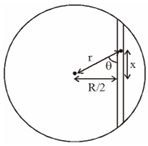
0 likes
View Solution137
DifficultMCQ
If two bodies $A$ and $B$ of equal masses $M$ are situated in air at a distance $d$ and the gravitational force between them is $F$. Now,$50 \%$ of the mass is transferred from body $A$ to $B$ and the distance between them is reduced to $\frac{d}{2}$. If the space around them is now filled with a liquid of specific density $3$,what will be the new gravitational force?
A
$F$
B
$3 F$
C
$\frac{3 F}{2}$
D
$\frac{3 F}{4}$
Solution
(B) The initial gravitational force between the two bodies is given by $F = \frac{G M^2}{d^2}$.
After transferring $50 \%$ of the mass from $A$ to $B$,the new masses are $M_A = M - 0.5 M = 0.5 M = \frac{M}{2}$ and $M_B = M + 0.5 M = 1.5 M = \frac{3 M}{2}$.
The new distance between the bodies is $d' = \frac{d}{2}$.
The gravitational force is independent of the medium between the bodies.
Therefore,the new gravitational force $F'$ is given by $F' = \frac{G M_A M_B}{(d')^2} = \frac{G (M/2) (3M/2)}{(d/2)^2}$.
$F' = \frac{3 G M^2 / 4}{d^2 / 4} = \frac{3 G M^2}{d^2}$.
Since $F = \frac{G M^2}{d^2}$,we get $F' = 3 F$.
After transferring $50 \%$ of the mass from $A$ to $B$,the new masses are $M_A = M - 0.5 M = 0.5 M = \frac{M}{2}$ and $M_B = M + 0.5 M = 1.5 M = \frac{3 M}{2}$.
The new distance between the bodies is $d' = \frac{d}{2}$.
The gravitational force is independent of the medium between the bodies.
Therefore,the new gravitational force $F'$ is given by $F' = \frac{G M_A M_B}{(d')^2} = \frac{G (M/2) (3M/2)}{(d/2)^2}$.
$F' = \frac{3 G M^2 / 4}{d^2 / 4} = \frac{3 G M^2}{d^2}$.
Since $F = \frac{G M^2}{d^2}$,we get $F' = 3 F$.
0 likes
View Solution138
MediumMCQ
Two bodies,each of mass $M$,are kept fixed with a separation $2L$. $A$ particle of mass $m$ is projected from the mid-point of the line joining their centres,perpendicular to the line. The gravitational constant is $G$. The correct statement$(s)$ is/are:
$(a)$ The minimum initial velocity of the mass $m$ to escape the gravitational field of the two bodies is $4 \sqrt{\frac{GM}{L}}$
$(b)$ The minimum initial velocity of the mass $m$ to escape the gravitational field of the two bodies is $2 \sqrt{\frac{GM}{L}}$
$(c)$ The minimum initial velocity of the mass $m$ to escape the gravitational field of the two bodies is $\sqrt{\frac{2GM}{L}}$
$(d)$ The energy of the mass $m$ remains constant
$(a)$ The minimum initial velocity of the mass $m$ to escape the gravitational field of the two bodies is $4 \sqrt{\frac{GM}{L}}$
$(b)$ The minimum initial velocity of the mass $m$ to escape the gravitational field of the two bodies is $2 \sqrt{\frac{GM}{L}}$
$(c)$ The minimum initial velocity of the mass $m$ to escape the gravitational field of the two bodies is $\sqrt{\frac{2GM}{L}}$
$(d)$ The energy of the mass $m$ remains constant
A
$a, b$
B
$b, d$
C
$a, c$
D
$a, d$
Solution
(B) Let the two masses $M$ be at positions $(-L, 0)$ and $(L, 0)$. The particle $m$ is at the origin $(0, 0)$.
The initial potential energy $U_i$ of the particle $m$ is the sum of the gravitational potential energy due to both masses:
$U_i = -\frac{GMm}{L} - \frac{GMm}{L} = -\frac{2GMm}{L}$
The initial kinetic energy is $K_i = \frac{1}{2}mv^2$.
To escape the gravitational field,the final total energy must be at least $0$ at infinity.
By the Law of Conservation of Mechanical Energy:
$K_i + U_i = K_f + U_f$
$\frac{1}{2}mv^2 - \frac{2GMm}{L} = 0 + 0$
$\frac{1}{2}mv^2 = \frac{2GMm}{L}$
$v^2 = \frac{4GM}{L}$
$v = 2\sqrt{\frac{GM}{L}}$
Thus,statement $(b)$ is correct. Since the particle is moving in a gravitational field,its potential energy changes as it moves,so its total energy remains constant,but its kinetic energy changes. Therefore,statement $(d)$ is also correct as the total mechanical energy is conserved.
The initial potential energy $U_i$ of the particle $m$ is the sum of the gravitational potential energy due to both masses:
$U_i = -\frac{GMm}{L} - \frac{GMm}{L} = -\frac{2GMm}{L}$
The initial kinetic energy is $K_i = \frac{1}{2}mv^2$.
To escape the gravitational field,the final total energy must be at least $0$ at infinity.
By the Law of Conservation of Mechanical Energy:
$K_i + U_i = K_f + U_f$
$\frac{1}{2}mv^2 - \frac{2GMm}{L} = 0 + 0$
$\frac{1}{2}mv^2 = \frac{2GMm}{L}$
$v^2 = \frac{4GM}{L}$
$v = 2\sqrt{\frac{GM}{L}}$
Thus,statement $(b)$ is correct. Since the particle is moving in a gravitational field,its potential energy changes as it moves,so its total energy remains constant,but its kinetic energy changes. Therefore,statement $(d)$ is also correct as the total mechanical energy is conserved.
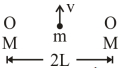
0 likes
View Solution139
MediumMCQ
The ratio of energy required to raise a satellite of mass '$m$' to a height '$h$' above the earth's surface to that required to put it into the orbit at the same height is $[R = \text{radius of the earth}]$
A
$\frac{h}{R}$
B
$\frac{4h}{R}$
C
$\frac{3h}{R}$
D
$\frac{2h}{R}$
Solution
(D) The energy required to raise the satellite to a height $h$ from the surface of the earth is the change in potential energy:
$U = -\frac{GMm}{R+h} - (-\frac{GMm}{R}) = GMm [\frac{1}{R} - \frac{1}{R+h}] = \frac{GMmh}{R(R+h)}$
The energy required to put the satellite into orbit at height $h$ is the kinetic energy required for circular motion:
$K = \frac{1}{2}mv_0^2 = \frac{1}{2}m(\frac{GM}{R+h}) = \frac{GMm}{2(R+h)}$
The ratio of the energy required to raise the satellite to the energy required to orbit is:
$\frac{U}{K} = \frac{GMmh}{R(R+h)} \times \frac{2(R+h)}{GMm} = \frac{2h}{R}$
$U = -\frac{GMm}{R+h} - (-\frac{GMm}{R}) = GMm [\frac{1}{R} - \frac{1}{R+h}] = \frac{GMmh}{R(R+h)}$
The energy required to put the satellite into orbit at height $h$ is the kinetic energy required for circular motion:
$K = \frac{1}{2}mv_0^2 = \frac{1}{2}m(\frac{GM}{R+h}) = \frac{GMm}{2(R+h)}$
The ratio of the energy required to raise the satellite to the energy required to orbit is:
$\frac{U}{K} = \frac{GMmh}{R(R+h)} \times \frac{2(R+h)}{GMm} = \frac{2h}{R}$
0 likes
View Solution140
DifficultMCQ
Three point masses,each of mass $m$,are kept at the corners of an equilateral triangle of side $L$. The system rotates about the center of the triangle without any change in the separation of masses during rotation. The period of rotation is directly proportional to
A
$L$
B
$L^{1/2}$
C
$L^{3/2}$
D
$L^{-2}$
Solution
(C) Consider a mass $m$ at corner $A$. The gravitational forces exerted on it by the other two masses at $B$ and $C$ are $F_1$ and $F_2$,where $F_1 = F_2 = G \frac{m^2}{L^2}$.
The angle between these two forces is $60^{\circ}$. The resultant force $F$ is given by:
$F = \sqrt{F_1^2 + F_2^2 + 2F_1 F_2 \cos 60^{\circ}} = \sqrt{3} F_1 = \sqrt{3} G \frac{m^2}{L^2}$.
The distance of each mass from the center of the triangle is $r = \frac{L}{\sqrt{3}}$.
For uniform circular motion,the gravitational force provides the necessary centripetal force:
$mr \omega^2 = F$
$m \left( \frac{L}{\sqrt{3}} \right) \omega^2 = \sqrt{3} G \frac{m^2}{L^2}$
$\omega^2 = 3 G \frac{m}{L^3}$
Since $\omega = \frac{2\pi}{T}$,we have:
$\left( \frac{2\pi}{T} \right)^2 = \frac{3Gm}{L^3}$
$T^2 = \frac{4\pi^2 L^3}{3Gm}$
$T \propto L^{3/2}$.
The angle between these two forces is $60^{\circ}$. The resultant force $F$ is given by:
$F = \sqrt{F_1^2 + F_2^2 + 2F_1 F_2 \cos 60^{\circ}} = \sqrt{3} F_1 = \sqrt{3} G \frac{m^2}{L^2}$.
The distance of each mass from the center of the triangle is $r = \frac{L}{\sqrt{3}}$.
For uniform circular motion,the gravitational force provides the necessary centripetal force:
$mr \omega^2 = F$
$m \left( \frac{L}{\sqrt{3}} \right) \omega^2 = \sqrt{3} G \frac{m^2}{L^2}$
$\omega^2 = 3 G \frac{m}{L^3}$
Since $\omega = \frac{2\pi}{T}$,we have:
$\left( \frac{2\pi}{T} \right)^2 = \frac{3Gm}{L^3}$
$T^2 = \frac{4\pi^2 L^3}{3Gm}$
$T \propto L^{3/2}$.
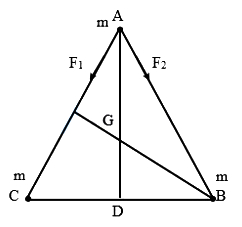
0 likes
View Solution141
DifficultMCQ
$A$ body situated on the surface of the earth becomes weightless at the equator when the rotational kinetic energy of the earth reaches a critical value '$K$'. The value of '$K$' is given by [$g$ = gravitational acceleration on earth's surface,$M$ = mass of the earth,and $R$ = radius of the earth].
A
$\frac{1}{2} MgR$
B
$\frac{1}{3} MgR$
C
$\frac{1}{4} MgR$
D
$\frac{1}{5} MgR$
Solution
(D) body becomes weightless at the equator when the centrifugal force equals the gravitational force,which is expressed as $R \omega^2 = g$,or $\omega^2 = \frac{g}{R}$.
The rotational kinetic energy of the earth is given by $K = \frac{1}{2} I \omega^2$.
For a solid sphere (assuming the earth is a solid sphere),the moment of inertia is $I = \frac{2}{5} MR^2$.
Substituting the values of $I$ and $\omega^2$ into the kinetic energy formula:
$K = \frac{1}{2} \times (\frac{2}{5} MR^2) \times (\frac{g}{R})$.
Simplifying the expression:
$K = \frac{1}{2} \times \frac{2}{5} \times M \times R \times g = \frac{1}{5} MgR$.
The rotational kinetic energy of the earth is given by $K = \frac{1}{2} I \omega^2$.
For a solid sphere (assuming the earth is a solid sphere),the moment of inertia is $I = \frac{2}{5} MR^2$.
Substituting the values of $I$ and $\omega^2$ into the kinetic energy formula:
$K = \frac{1}{2} \times (\frac{2}{5} MR^2) \times (\frac{g}{R})$.
Simplifying the expression:
$K = \frac{1}{2} \times \frac{2}{5} \times M \times R \times g = \frac{1}{5} MgR$.
0 likes
View Solution142
MediumMCQ
Three point masses,each of mass $m$,are kept at the corners of an equilateral triangle of side $L$. The system rotates about the center of the triangle. The period of rotation $T$ is directly proportional to:
A
$\sqrt{L}$
B
$L^{3/2}$
C
$L$
D
$L^2$
Solution
(B) Let the masses be at vertices $A, B,$ and $C$ of an equilateral triangle with side $L$. Let $O$ be the centroid of the triangle.
The distance from any vertex to the centroid $O$ is $R = \frac{L}{\sqrt{3}}$.
The moment of inertia of the system about the axis passing through $O$ and perpendicular to the plane of the triangle is:
$I = 3 \times (m R^2) = 3 \times m \times \left(\frac{L}{\sqrt{3}}\right)^2 = 3 \times m \times \frac{L^2}{3} = m L^2$.
For the system to rotate,the gravitational force between the masses provides the necessary centripetal force.
The gravitational force on one mass due to the other two is $F_{net} = 2 \times \left(\frac{G m^2}{L^2}\right) \cos 30^{\circ} = 2 \times \frac{G m^2}{L^2} \times \frac{\sqrt{3}}{2} = \frac{\sqrt{3} G m^2}{L^2}$.
This force acts as the centripetal force: $F_{net} = m \omega^2 R$.
$\frac{\sqrt{3} G m^2}{L^2} = m \omega^2 \left(\frac{L}{\sqrt{3}}\right)$.
$\omega^2 = \frac{\sqrt{3} G m}{L^2} \times \frac{\sqrt{3}}{L} = \frac{3 G m}{L^3}$.
Since $T = \frac{2 \pi}{\omega}$,we have $T^2 = \frac{4 \pi^2}{\omega^2} = \frac{4 \pi^2 L^3}{3 G m}$.
Thus,$T^2 \propto L^3$,which implies $T \propto L^{3/2}$.
The distance from any vertex to the centroid $O$ is $R = \frac{L}{\sqrt{3}}$.
The moment of inertia of the system about the axis passing through $O$ and perpendicular to the plane of the triangle is:
$I = 3 \times (m R^2) = 3 \times m \times \left(\frac{L}{\sqrt{3}}\right)^2 = 3 \times m \times \frac{L^2}{3} = m L^2$.
For the system to rotate,the gravitational force between the masses provides the necessary centripetal force.
The gravitational force on one mass due to the other two is $F_{net} = 2 \times \left(\frac{G m^2}{L^2}\right) \cos 30^{\circ} = 2 \times \frac{G m^2}{L^2} \times \frac{\sqrt{3}}{2} = \frac{\sqrt{3} G m^2}{L^2}$.
This force acts as the centripetal force: $F_{net} = m \omega^2 R$.
$\frac{\sqrt{3} G m^2}{L^2} = m \omega^2 \left(\frac{L}{\sqrt{3}}\right)$.
$\omega^2 = \frac{\sqrt{3} G m}{L^2} \times \frac{\sqrt{3}}{L} = \frac{3 G m}{L^3}$.
Since $T = \frac{2 \pi}{\omega}$,we have $T^2 = \frac{4 \pi^2}{\omega^2} = \frac{4 \pi^2 L^3}{3 G m}$.
Thus,$T^2 \propto L^3$,which implies $T \propto L^{3/2}$.
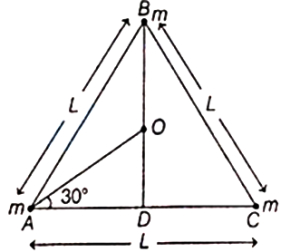
0 likes
View Solution143
MediumMCQ
As shown in the figure,two spherical cavities are made in a uniform solid sphere of radius $R$. The boundaries of the cavities touch at the centre of the sphere. The centers of the cavities and the sphere lie on the $X$-axis. The mass of the solid sphere before the cavities were created was $M$. The gravitational force on a point mass $m$ at a distance $d$ away from the centre of the solid sphere is
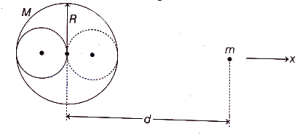
A
$\frac{G M m}{d^2}\left[1-\frac{1}{8} \frac{1}{\left(1+\frac{R}{2 d}\right)^2}-\frac{1}{8} \frac{1}{\left(1-\frac{R}{2 d}\right)^2}\right]$
B
$\frac{G M m}{d^2}\left[1-\frac{1}{8} \frac{1}{\left(1+\frac{R}{d}\right)^2}-\frac{1}{8} \frac{1}{\left(1-\frac{R}{d}\right)^2}\right]$
C
$\frac{G M m}{d^2}\left[1-\frac{1}{8} \frac{1}{\left(1+\frac{d}{R}\right)^2}-\frac{1}{8} \frac{1}{\left(1-\frac{d}{R}\right)^2}\right]$
D
$\frac{G M m}{d^2}\left[1-\frac{1}{8} \frac{1}{\left(1+\frac{d}{R}\right)^2}+\frac{1}{8} \frac{1}{\left(1-\frac{d}{R}\right)^2}\right]$
Solution
(A) The radius of the solid sphere is $R$ and its mass is $M$. The density of the sphere is $\rho = \frac{M}{\frac{4}{3} \pi R^3}$.
Each spherical cavity has a radius of $R/2$. The mass of each removed portion is $M' = \rho \times \text{Volume of cavity} = \frac{M}{\frac{4}{3} \pi R^3} \times \frac{4}{3} \pi (R/2)^3 = \frac{M}{8}$.
The center of the sphere is at the origin. Let the center of the left cavity be at $x = -R/2$ and the center of the right cavity be at $x = R/2$. The point mass $m$ is at $x = d$.
The gravitational force on $m$ is the force due to the full sphere minus the forces due to the two removed spherical masses.
$F = \frac{G M m}{d^2} - \frac{G M' m}{(d - R/2)^2} - \frac{G M' m}{(d + R/2)^2}$.
Substituting $M' = M/8$:
$F = \frac{G M m}{d^2} - \frac{G M m}{8(d - R/2)^2} - \frac{G M m}{8(d + R/2)^2}$.
Factoring out $\frac{G M m}{d^2}$:
$F = \frac{G M m}{d^2} \left[ 1 - \frac{1}{8(1 - R/2d)^2} - \frac{1}{8(1 + R/2d)^2} \right]$.
Each spherical cavity has a radius of $R/2$. The mass of each removed portion is $M' = \rho \times \text{Volume of cavity} = \frac{M}{\frac{4}{3} \pi R^3} \times \frac{4}{3} \pi (R/2)^3 = \frac{M}{8}$.
The center of the sphere is at the origin. Let the center of the left cavity be at $x = -R/2$ and the center of the right cavity be at $x = R/2$. The point mass $m$ is at $x = d$.
The gravitational force on $m$ is the force due to the full sphere minus the forces due to the two removed spherical masses.
$F = \frac{G M m}{d^2} - \frac{G M' m}{(d - R/2)^2} - \frac{G M' m}{(d + R/2)^2}$.
Substituting $M' = M/8$:
$F = \frac{G M m}{d^2} - \frac{G M m}{8(d - R/2)^2} - \frac{G M m}{8(d + R/2)^2}$.
Factoring out $\frac{G M m}{d^2}$:
$F = \frac{G M m}{d^2} \left[ 1 - \frac{1}{8(1 - R/2d)^2} - \frac{1}{8(1 + R/2d)^2} \right]$.
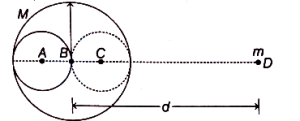
0 likes
View Solution144
DifficultMCQ
The gravitational force acting on a particle,due to a solid sphere of uniform density and radius $R$,at a distance of $3 R$ from the centre of the sphere is $F_1$. $A$ spherical hole of radius $(R / 2)$ is now made in the sphere as shown in the figure. The sphere with hole now exerts a force $F_2$ on the same particle. The ratio of $F_1$ and $F_2$ is
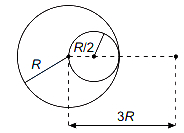
A
$\frac{50}{41}$
B
$\frac{41}{50}$
C
$\frac{41}{42}$
D
$\frac{25}{41}$
Solution
(A) Let $M$ be the mass of the solid sphere and $m$ be the mass of the particle. The gravitational force due to the solid sphere on the particle at a distance $3R$ from its center is given by:
$F_1 = \frac{G M m}{(3 R)^2} = \frac{G M m}{9 R^2}$
When a spherical hole of radius $r = R/2$ is made,its mass $M'$ is proportional to its volume. Since the density $\rho$ is uniform,$M' = \rho \cdot \frac{4}{3} \pi (R/2)^3 = \rho \cdot \frac{4}{3} \pi R^3 \cdot \frac{1}{8} = \frac{M}{8}$.
The center of the hole is at a distance $R/2$ from the center of the original sphere. The particle is at a distance $3R$ from the center of the original sphere,so it is at a distance $(3R - R/2) = 2.5R = 5R/2$ from the center of the hole.
The gravitational force $F_2$ exerted by the sphere with the hole is the force of the solid sphere minus the force that would have been exerted by the removed spherical part:
$F_2 = F_1 - F_{hole} = \frac{G M m}{9 R^2} - \frac{G (M/8) m}{(5R/2)^2}$
$F_2 = \frac{G M m}{R^2} \left[ \frac{1}{9} - \frac{1}{8} \cdot \frac{4}{25} \right] = \frac{G M m}{R^2} \left[ \frac{1}{9} - \frac{1}{50} \right]$
$F_2 = \frac{G M m}{R^2} \left[ \frac{50 - 9}{450} \right] = \frac{G M m}{R^2} \left[ \frac{41}{450} \right]$
Now,the ratio $F_1 / F_2$ is:
$\frac{F_1}{F_2} = \frac{G M m / 9 R^2}{41 G M m / 450 R^2} = \frac{1}{9} \cdot \frac{450}{41} = \frac{50}{41}$
$F_1 = \frac{G M m}{(3 R)^2} = \frac{G M m}{9 R^2}$
When a spherical hole of radius $r = R/2$ is made,its mass $M'$ is proportional to its volume. Since the density $\rho$ is uniform,$M' = \rho \cdot \frac{4}{3} \pi (R/2)^3 = \rho \cdot \frac{4}{3} \pi R^3 \cdot \frac{1}{8} = \frac{M}{8}$.
The center of the hole is at a distance $R/2$ from the center of the original sphere. The particle is at a distance $3R$ from the center of the original sphere,so it is at a distance $(3R - R/2) = 2.5R = 5R/2$ from the center of the hole.
The gravitational force $F_2$ exerted by the sphere with the hole is the force of the solid sphere minus the force that would have been exerted by the removed spherical part:
$F_2 = F_1 - F_{hole} = \frac{G M m}{9 R^2} - \frac{G (M/8) m}{(5R/2)^2}$
$F_2 = \frac{G M m}{R^2} \left[ \frac{1}{9} - \frac{1}{8} \cdot \frac{4}{25} \right] = \frac{G M m}{R^2} \left[ \frac{1}{9} - \frac{1}{50} \right]$
$F_2 = \frac{G M m}{R^2} \left[ \frac{50 - 9}{450} \right] = \frac{G M m}{R^2} \left[ \frac{41}{450} \right]$
Now,the ratio $F_1 / F_2$ is:
$\frac{F_1}{F_2} = \frac{G M m / 9 R^2}{41 G M m / 450 R^2} = \frac{1}{9} \cdot \frac{450}{41} = \frac{50}{41}$
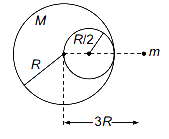
0 likes
View Solution145
MediumMCQ
Two bodies of masses $m_1$ and $m_2$ initially at rest at infinite distance apart move towards each other under gravitational force of attraction. Their relative velocity of approach when they are separated by a distance $r$ is ($G=$ universal gravitational constant.)
A
$\left[\frac{2 G\left(m_1-m_2\right)}{r}\right]^{1 / 2}$
B
$\left[\frac{2 G\left(m_1+m_2\right)}{r}\right]^{1 / 2}$
C
$\left[\frac{r}{2 G\left(m_1 m_2\right)}\right]^{1 / 2}$
D
$\left[\frac{r}{2 G} m_1 m_2\right]^{1 / 2}$
Solution
(B) Initially,the bodies are at an infinite distance,so their total energy is $0$. When they are at a distance $r$,the total energy is the sum of kinetic energies and potential energy: $E = \frac{1}{2}m_1v_1^2 + \frac{1}{2}m_2v_2^2 - \frac{Gm_1m_2}{r} = 0$. Since the system is isolated,the center of mass remains at rest,so $m_1v_1 = m_2v_2$. Substituting $v_2 = \frac{m_1v_1}{m_2}$ into the energy equation,we get $\frac{1}{2}m_1v_1^2 + \frac{1}{2}m_2(\frac{m_1v_1}{m_2})^2 = \frac{Gm_1m_2}{r}$. Simplifying,$\frac{1}{2}m_1v_1^2(1 + \frac{m_1}{m_2}) = \frac{Gm_1m_2}{r}$,which gives $v_1 = \sqrt{\frac{2Gm_2^2}{r(m_1+m_2)}}$. Similarly,$v_2 = \sqrt{\frac{2Gm_1^2}{r(m_1+m_2)}}$. The relative velocity of approach is $v_{rel} = v_1 + v_2 = \sqrt{\frac{2G}{r(m_1+m_2)}} (m_1 + m_2) = \sqrt{\frac{2G(m_1+m_2)}{r}}$.
0 likes
View Solution146
MediumMCQ
Two satellites of masses $m$ and $1.5 m$ are revolving around the earth in two circular orbits of heights $R_E$ and $2 R_E$ respectively,where $R_E$ is the radius of the earth. The ratio of the minimum and maximum gravitational forces exerted by the two satellites on the earth is
A
$2: 5$
B
$2: 3$
C
$1: 2$
D
$1: 5$
Solution
(D) The gravitational force exerted by a satellite of mass $m_s$ at a distance $r$ from the center of the earth is $F = \frac{G M_E m_s}{r^2}$.
For the first satellite: mass $m_1 = m$,height $h_1 = R_E$,so distance $r_1 = R_E + R_E = 2 R_E$. Force $F_1 = \frac{G M_E m}{(2 R_E)^2} = \frac{G M_E m}{4 R_E^2}$.
For the second satellite: mass $m_2 = 1.5 m$,height $h_2 = 2 R_E$,so distance $r_2 = R_E + 2 R_E = 3 R_E$. Force $F_2 = \frac{G M_E (1.5 m)}{(3 R_E)^2} = \frac{1.5 G M_E m}{9 R_E^2} = \frac{G M_E m}{6 R_E^2}$.
Maximum force $F_{\max} = F_1 + F_2 = \frac{G M_E m}{R_E^2} (\frac{1}{4} + \frac{1}{6}) = \frac{G M_E m}{R_E^2} (\frac{3+2}{12}) = \frac{5}{12} \frac{G M_E m}{R_E^2}$.
Minimum force $F_{\min} = F_1 - F_2 = \frac{G M_E m}{R_E^2} (\frac{1}{4} - \frac{1}{6}) = \frac{G M_E m}{R_E^2} (\frac{3-2}{12}) = \frac{1}{12} \frac{G M_E m}{R_E^2}$.
Ratio $\frac{F_{\min}}{F_{\max}} = \frac{1/12}{5/12} = \frac{1}{5} = 1: 5$.
For the first satellite: mass $m_1 = m$,height $h_1 = R_E$,so distance $r_1 = R_E + R_E = 2 R_E$. Force $F_1 = \frac{G M_E m}{(2 R_E)^2} = \frac{G M_E m}{4 R_E^2}$.
For the second satellite: mass $m_2 = 1.5 m$,height $h_2 = 2 R_E$,so distance $r_2 = R_E + 2 R_E = 3 R_E$. Force $F_2 = \frac{G M_E (1.5 m)}{(3 R_E)^2} = \frac{1.5 G M_E m}{9 R_E^2} = \frac{G M_E m}{6 R_E^2}$.
Maximum force $F_{\max} = F_1 + F_2 = \frac{G M_E m}{R_E^2} (\frac{1}{4} + \frac{1}{6}) = \frac{G M_E m}{R_E^2} (\frac{3+2}{12}) = \frac{5}{12} \frac{G M_E m}{R_E^2}$.
Minimum force $F_{\min} = F_1 - F_2 = \frac{G M_E m}{R_E^2} (\frac{1}{4} - \frac{1}{6}) = \frac{G M_E m}{R_E^2} (\frac{3-2}{12}) = \frac{1}{12} \frac{G M_E m}{R_E^2}$.
Ratio $\frac{F_{\min}}{F_{\max}} = \frac{1/12}{5/12} = \frac{1}{5} = 1: 5$.
0 likes
View Solution147
EasyMCQ
The orbital velocity of a body near the surface of a planet $A$ is equal to the escape velocity of a body from the planet $B$. If the masses of planets $A$ and $B$ are the same,the ratio of their radii is
A
$1$
B
$\frac{1}{2}$
C
$\frac{1}{3}$
D
$2$
Solution
(B) The orbital velocity of a body near the surface of planet $A$ is given by $V_{A} = \sqrt{\frac{GM_{A}}{r_{A}}}$.
The escape velocity of a body from the surface of planet $B$ is given by $V_{B} = \sqrt{\frac{2GM_{B}}{r_{B}}}$.
According to the problem,$V_{A} = V_{B}$.
Therefore,$\sqrt{\frac{GM_{A}}{r_{A}}} = \sqrt{\frac{2GM_{B}}{r_{B}}}$.
Since the masses are equal $(M_{A} = M_{B} = M)$,we have $\sqrt{\frac{GM}{r_{A}}} = \sqrt{\frac{2GM}{r_{B}}}$.
Squaring both sides,we get $\frac{GM}{r_{A}} = \frac{2GM}{r_{B}}$.
This simplifies to $\frac{1}{r_{A}} = \frac{2}{r_{B}}$,which implies $\frac{r_{A}}{r_{B}} = \frac{1}{2}$.
The escape velocity of a body from the surface of planet $B$ is given by $V_{B} = \sqrt{\frac{2GM_{B}}{r_{B}}}$.
According to the problem,$V_{A} = V_{B}$.
Therefore,$\sqrt{\frac{GM_{A}}{r_{A}}} = \sqrt{\frac{2GM_{B}}{r_{B}}}$.
Since the masses are equal $(M_{A} = M_{B} = M)$,we have $\sqrt{\frac{GM}{r_{A}}} = \sqrt{\frac{2GM}{r_{B}}}$.
Squaring both sides,we get $\frac{GM}{r_{A}} = \frac{2GM}{r_{B}}$.
This simplifies to $\frac{1}{r_{A}} = \frac{2}{r_{B}}$,which implies $\frac{r_{A}}{r_{B}} = \frac{1}{2}$.
0 likes
View Solution148
MediumMCQ
Statement $(A)$ Two artificial satellites revolving in the same circular orbit have the same period of revolution.
Statement $(B)$ The orbital velocity is inversely proportional to the square root of the radius of the orbit.
Statement $(C)$ The escape velocity of a body is independent of the altitude of the point of projection.
Statement $(B)$ The orbital velocity is inversely proportional to the square root of the radius of the orbit.
Statement $(C)$ The escape velocity of a body is independent of the altitude of the point of projection.
A
$A, B, C$ are true
B
$A, B$ are true,$C$ is false
C
$A, C$ are true,$B$ is false
D
$B, C$ are true,$A$ is false
Solution
(B) The time period $T$ of a satellite revolving around a planet is given by $T = 2\pi \sqrt{\frac{r^3}{GM}}$. Since both satellites are in the same circular orbit,their orbital radius $r$ is the same,meaning their time periods are identical. Thus,Statement $(A)$ is true.
The orbital velocity $v$ of a satellite is given by $v = \sqrt{\frac{GM}{r}}$. This shows that $v \propto \frac{1}{\sqrt{r}}$,meaning the orbital velocity is inversely proportional to the square root of the radius of the orbit. Thus,Statement $(B)$ is true.
The escape velocity $v_e$ from a point at distance $r$ from the center of a planet is given by $v_e = \sqrt{\frac{2GM}{r}}$. Since $r = R + h$ (where $R$ is the radius of the planet and $h$ is the altitude),the escape velocity depends on the altitude $h$. Thus,Statement $(C)$ is false.
The orbital velocity $v$ of a satellite is given by $v = \sqrt{\frac{GM}{r}}$. This shows that $v \propto \frac{1}{\sqrt{r}}$,meaning the orbital velocity is inversely proportional to the square root of the radius of the orbit. Thus,Statement $(B)$ is true.
The escape velocity $v_e$ from a point at distance $r$ from the center of a planet is given by $v_e = \sqrt{\frac{2GM}{r}}$. Since $r = R + h$ (where $R$ is the radius of the planet and $h$ is the altitude),the escape velocity depends on the altitude $h$. Thus,Statement $(C)$ is false.
0 likes
View Solution149
EasyMCQ
Two bodies of equal masses are at some distance apart. If $20 \%$ of the mass is transferred from the first body to the second body,then the gravitational force between them
A
increases by $4 \%$
B
increases by $14 \%$
C
decreases by $4 \%$
D
decreases by $14 \%$
Solution
(C) Let the initial masses of the two bodies be $m$ and $m$,separated by a distance $r$. The initial gravitational force is $F_1 = \frac{G m^2}{r^2}$.
After transferring $20 \%$ of the mass from the first body to the second,the new masses are $m_1 = m - 0.2m = 0.8m$ and $m_2 = m + 0.2m = 1.2m$.
The new gravitational force is $F_2 = \frac{G (0.8m)(1.2m)}{r^2} = \frac{G (0.96m^2)}{r^2} = 0.96 F_1$.
The change in force is $\Delta F = F_2 - F_1 = 0.96 F_1 - F_1 = -0.04 F_1$.
The percentage change is $\frac{\Delta F}{F_1} \times 100 \% = -0.04 \times 100 \% = -4 \%$.
Therefore,the gravitational force decreases by $4 \%$.
After transferring $20 \%$ of the mass from the first body to the second,the new masses are $m_1 = m - 0.2m = 0.8m$ and $m_2 = m + 0.2m = 1.2m$.
The new gravitational force is $F_2 = \frac{G (0.8m)(1.2m)}{r^2} = \frac{G (0.96m^2)}{r^2} = 0.96 F_1$.
The change in force is $\Delta F = F_2 - F_1 = 0.96 F_1 - F_1 = -0.04 F_1$.
The percentage change is $\frac{\Delta F}{F_1} \times 100 \% = -0.04 \times 100 \% = -4 \%$.
Therefore,the gravitational force decreases by $4 \%$.
0 likes
View SolutionGravitation — Mix Examples-Gravitation · Frequently Asked Questions
1Are these Gravitation questions useful for JEE and NEET?
Yes. All questions in this section are mapped to JEE Main and NEET exam patterns. Previous year questions from JEE Main, NEET, GUJCET and state-level exams are included with full solutions.
2Can I switch to Hindi or Gujarati for these questions?
Yes. Use the language tabs in the hero section or the sidebar to view the same questions and solutions in English, Hindi or Gujarati.
3How do I generate a question paper from this subtopic?
Use the Vedclass Exam Paper Generator — select the chapter and subtopic, set difficulty, and generate Sets A, B, C, D automatically. First 3 chapters of every subject are free.
Vedclass Products
For Students
Vedclass Test Series
Mock tests in real JEE/NEET style with performance analysis. 5-day free trial.
Start Free TrialFor Teachers
Exam Paper Generator
Generate Set A/B/C/D papers from this chapter in 2 minutes. 3 chapters free.
Try FreeFor Institutes
Online Exam Module
Live online exams with unlimited students, 360° analytics & white-label branding.
See DemoFor Teachers & Institutes
Generate a Gravitation Exam Paper in 2 Minutes
Select subtopic & difficulty — Sets A, B, C, D auto-generated with No Repeat logic.
First 3 chapters of every subject are free — no payment required.