
A English
Gravitational Potential and Potential Energy of system Questions in English
Class 11 Physics · Gravitation · Gravitational Potential and Potential Energy of system
128+
Questions
English
Language
100%
With Solutions
Showing 47 of 128 questions in English
51
DifficultMCQ
The self gravitational potential energy of a spherical shell of mass $M$ and radius $R$ is
A
$ - \frac{GM^2}{R}$
B
$ - \frac{GM^2}{2R}$
C
$ - \frac{3}{5} \frac{GM^2}{R}$
D
$ - \frac{GM^2}{4R}$
Solution
(B) The gravitational potential energy $U$ of a system is defined as the work done in assembling the system by bringing mass elements from infinity to their respective positions.
For a thin spherical shell of mass $M$ and radius $R$,we consider building the shell by adding infinitesimal mass elements $dm$ to the surface.
However,for a thin shell,the potential $V$ at the surface is constant and equal to $-\frac{GM}{R}$.
When we assemble the shell,the total work done is $W = \int V dm = \int_{0}^{M} -\frac{GM}{R} dm$.
Since the potential $V$ is constant for the entire shell of radius $R$,we integrate $dm$ from $0$ to $M$:
$U = -\frac{G}{R} \int_{0}^{M} M' dm$ is not correct here; rather,we consider the work to bring the mass $M$ to the surface of a shell of radius $R$ where the potential is constant.
The correct expression for the self-energy of a thin spherical shell is $U = -\frac{GM^2}{2R}$.
For a thin spherical shell of mass $M$ and radius $R$,we consider building the shell by adding infinitesimal mass elements $dm$ to the surface.
However,for a thin shell,the potential $V$ at the surface is constant and equal to $-\frac{GM}{R}$.
When we assemble the shell,the total work done is $W = \int V dm = \int_{0}^{M} -\frac{GM}{R} dm$.
Since the potential $V$ is constant for the entire shell of radius $R$,we integrate $dm$ from $0$ to $M$:
$U = -\frac{G}{R} \int_{0}^{M} M' dm$ is not correct here; rather,we consider the work to bring the mass $M$ to the surface of a shell of radius $R$ where the potential is constant.
The correct expression for the self-energy of a thin spherical shell is $U = -\frac{GM^2}{2R}$.
0 likes
View Solution52
MediumMCQ
$A$ particle of mass $10\, g$ is kept on the surface of a uniform sphere of mass $100\, kg$ and radius $10\, cm$. Find the work to be done against the gravitational force between them to take the particle far away from the sphere (you may take $G = 6.67 \times 10^{-11}\, Nm^2 / kg^2$).
A
$3.33 \times 10^{-10}\,J$
B
$13.34 \times 10^{-10}\,J$
C
$6.67 \times 10^{-10}\,J$
D
$6.67 \times 10^{-9}\,J$
Solution
(C) The gravitational potential energy $U$ of a particle of mass $m$ at the surface of a sphere of mass $M$ and radius $R$ is given by $U = -\frac{GMm}{R}$.
To take the particle to infinity (where potential energy is $0$),the work done $W$ against the gravitational force is equal to the change in potential energy: $W = U_{final} - U_{initial} = 0 - (- \frac{GMm}{R}) = \frac{GMm}{R}$.
Given values:
$M = 100\, kg$
$m = 10\, g = 0.01\, kg$
$R = 10\, cm = 0.1\, m$
$G = 6.67 \times 10^{-11}\, Nm^2/kg^2$
Substituting these values into the formula:
$W = \frac{6.67 \times 10^{-11} \times 100 \times 0.01}{0.1}$
$W = \frac{6.67 \times 10^{-11} \times 1}{0.1} = 6.67 \times 10^{-10}\, J$.
To take the particle to infinity (where potential energy is $0$),the work done $W$ against the gravitational force is equal to the change in potential energy: $W = U_{final} - U_{initial} = 0 - (- \frac{GMm}{R}) = \frac{GMm}{R}$.
Given values:
$M = 100\, kg$
$m = 10\, g = 0.01\, kg$
$R = 10\, cm = 0.1\, m$
$G = 6.67 \times 10^{-11}\, Nm^2/kg^2$
Substituting these values into the formula:
$W = \frac{6.67 \times 10^{-11} \times 100 \times 0.01}{0.1}$
$W = \frac{6.67 \times 10^{-11} \times 1}{0.1} = 6.67 \times 10^{-10}\, J$.
0 likes
View Solution53
DifficultMCQ
The potential energy of a satellite of mass $m$ revolving at a height $R_e$ above the surface of the Earth,where $R_e$ is the radius of the Earth,is:
A
$-m g R_e$
B
$-\frac{m g R_e}{2}$
C
$-\frac{m g R_e}{3}$
D
$-\frac{m g R_e}{4}$
Solution
(B) The gravitational potential energy $U$ of a body of mass $m$ at a distance $r$ from the center of the Earth is given by $U = -\frac{G M_e m}{r}$.
Here,the satellite is at a height $h = R_e$ above the surface of the Earth.
Therefore,the distance from the center of the Earth is $r = R_e + h = R_e + R_e = 2 R_e$.
Substituting this into the potential energy formula,we get $U = -\frac{G M_e m}{2 R_e}$.
We know that the acceleration due to gravity at the surface of the Earth is $g = \frac{G M_e}{R_e^2}$,which implies $G M_e = g R_e^2$.
Substituting $G M_e = g R_e^2$ into the expression for $U$,we get $U = -\frac{(g R_e^2) m}{2 R_e} = -\frac{m g R_e}{2}$.
Here,the satellite is at a height $h = R_e$ above the surface of the Earth.
Therefore,the distance from the center of the Earth is $r = R_e + h = R_e + R_e = 2 R_e$.
Substituting this into the potential energy formula,we get $U = -\frac{G M_e m}{2 R_e}$.
We know that the acceleration due to gravity at the surface of the Earth is $g = \frac{G M_e}{R_e^2}$,which implies $G M_e = g R_e^2$.
Substituting $G M_e = g R_e^2$ into the expression for $U$,we get $U = -\frac{(g R_e^2) m}{2 R_e} = -\frac{m g R_e}{2}$.
0 likes
View Solution54
MediumMCQ
Taking the gravitational potential at a point at an infinite distance away as zero,the gravitational potential at a point $A$ is $-5 \, unit$. If the gravitational potential at a point at an infinite distance away is taken as $+10 \, units$,the potential at point $A$ is ......... $unit$.
A
$-5$
B
$+5$
C
$+10$
D
$+15$
Solution
(B) The gravitational potential $V$ at a point is defined as the work done per unit mass in bringing a test mass from a reference point to that point.
The potential difference between a point $A$ at distance $r$ and a reference point at infinity is given by $V_A - V_{\infty} = -\int_{\infty}^{r} \vec{E} \cdot d\vec{r} = -\frac{GM}{r}$.
Case $(i)$: When the potential at infinity is $V_{\infty} = 0$,the potential at point $A$ is $V_A = -5 \, unit$.
Thus,$-5 - 0 = -\frac{GM}{r}$,which implies $-\frac{GM}{r} = -5$.
Case $(ii)$: When the potential at infinity is $V_{\infty}' = +10 \, unit$,the potential at point $A$ becomes $V_A'$.
The potential difference remains the same because it depends only on the mass and the distance: $V_A' - V_{\infty}' = -\frac{GM}{r}$.
Substituting the values: $V_A' - 10 = -5$.
Therefore,$V_A' = -5 + 10 = +5 \, unit$.
The potential difference between a point $A$ at distance $r$ and a reference point at infinity is given by $V_A - V_{\infty} = -\int_{\infty}^{r} \vec{E} \cdot d\vec{r} = -\frac{GM}{r}$.
Case $(i)$: When the potential at infinity is $V_{\infty} = 0$,the potential at point $A$ is $V_A = -5 \, unit$.
Thus,$-5 - 0 = -\frac{GM}{r}$,which implies $-\frac{GM}{r} = -5$.
Case $(ii)$: When the potential at infinity is $V_{\infty}' = +10 \, unit$,the potential at point $A$ becomes $V_A'$.
The potential difference remains the same because it depends only on the mass and the distance: $V_A' - V_{\infty}' = -\frac{GM}{r}$.
Substituting the values: $V_A' - 10 = -5$.
Therefore,$V_A' = -5 + 10 = +5 \, unit$.
0 likes
View Solution55
Medium
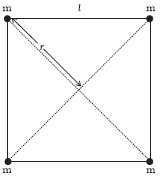
Find the potential energy of a system of four particles,each of mass $m$,placed at the vertices of a square of side $l$. Also,obtain the gravitational potential at the centre of the square.
Solution
(N/A) Consider four masses,each of mass $m$,placed at the corners of a square of side $l$. The total gravitational potential energy $U$ is the sum of the potential energies of all distinct pairs of masses.
There are $4$ pairs of masses separated by distance $l$ (the sides of the square) and $2$ pairs of masses separated by distance $\sqrt{2}l$ (the diagonals of the square).
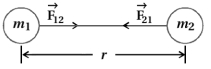
The potential energy of a pair of masses $m_1$ and $m_2$ at distance $r$ is $U = -\frac{G m_1 m_2}{r}$.
Thus,the total potential energy is:
$U = -4 \left( \frac{G m^2}{l} \right) - 2 \left( \frac{G m^2}{\sqrt{2} l} \right)$
$U = -\frac{G m^2}{l} \left( 4 + \frac{2}{\sqrt{2}} \right) = -\frac{G m^2}{l} (4 + \sqrt{2}) \approx -5.414 \frac{G m^2}{l}$.
The gravitational potential $V$ at the centre of the square is the sum of the potentials due to each of the four masses. The distance of each mass from the centre is $r = \frac{\sqrt{2}l}{2} = \frac{l}{\sqrt{2}}$.
$V = 4 \times \left( -\frac{G m}{r} \right) = 4 \times \left( -\frac{G m}{l/\sqrt{2}} \right) = -4\sqrt{2} \frac{G m}{l}$.
There are $4$ pairs of masses separated by distance $l$ (the sides of the square) and $2$ pairs of masses separated by distance $\sqrt{2}l$ (the diagonals of the square).
The potential energy of a pair of masses $m_1$ and $m_2$ at distance $r$ is $U = -\frac{G m_1 m_2}{r}$.
Thus,the total potential energy is:
$U = -4 \left( \frac{G m^2}{l} \right) - 2 \left( \frac{G m^2}{\sqrt{2} l} \right)$
$U = -\frac{G m^2}{l} \left( 4 + \frac{2}{\sqrt{2}} \right) = -\frac{G m^2}{l} (4 + \sqrt{2}) \approx -5.414 \frac{G m^2}{l}$.
The gravitational potential $V$ at the centre of the square is the sum of the potentials due to each of the four masses. The distance of each mass from the centre is $r = \frac{\sqrt{2}l}{2} = \frac{l}{\sqrt{2}}$.
$V = 4 \times \left( -\frac{G m}{r} \right) = 4 \times \left( -\frac{G m}{l/\sqrt{2}} \right) = -4\sqrt{2} \frac{G m}{l}$.
0 likes
View Solution56
Medium
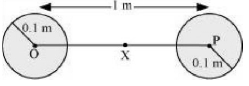
Two heavy spheres each of mass $100 \; kg$ and radius $0.10 \; m$ are placed $1.0 \; m$ apart on a horizontal table. What is the gravitational force and potential at the mid-point of the line joining the centres of the spheres? Is an object placed at that point in equilibrium? If so,is the equilibrium stable or unstable?
Solution
(N/A) Mass of each sphere,$M = 100 \; kg$.
Separation between the centres of the spheres,$r = 1.0 \; m$.
Let $X$ be the mid-point between the centres of the spheres.
$1$. Gravitational Force at $X$:
The gravitational force exerted by each sphere on an object at $X$ is equal in magnitude but opposite in direction. Therefore,the net gravitational force at $X$ is $0 \; N$.
$2$. Gravitational Potential at $X$:
The gravitational potential $V$ at a distance $d$ from a mass $M$ is given by $V = -GM/d$. At the mid-point $X$,the distance from each sphere is $d = r/2 = 0.5 \; m$.
$V_{total} = V_1 + V_2 = -\frac{GM}{r/2} - \frac{GM}{r/2} = -\frac{4GM}{r}$
$V_{total} = -\frac{4 \times 6.67 \times 10^{-11} \times 100}{1.0} = -2.668 \times 10^{-8} \; J/kg \approx -2.67 \times 10^{-8} \; J/kg$.
$3$. Equilibrium:
Since the net force is zero,an object placed at $X$ is in equilibrium. If the object is displaced slightly towards one sphere,the gravitational force from that sphere increases while the force from the other decreases. This creates a net force in the direction of displacement,pulling the object further away from $X$. Thus,the equilibrium is unstable.
Separation between the centres of the spheres,$r = 1.0 \; m$.
Let $X$ be the mid-point between the centres of the spheres.
$1$. Gravitational Force at $X$:
The gravitational force exerted by each sphere on an object at $X$ is equal in magnitude but opposite in direction. Therefore,the net gravitational force at $X$ is $0 \; N$.
$2$. Gravitational Potential at $X$:
The gravitational potential $V$ at a distance $d$ from a mass $M$ is given by $V = -GM/d$. At the mid-point $X$,the distance from each sphere is $d = r/2 = 0.5 \; m$.
$V_{total} = V_1 + V_2 = -\frac{GM}{r/2} - \frac{GM}{r/2} = -\frac{4GM}{r}$
$V_{total} = -\frac{4 \times 6.67 \times 10^{-11} \times 100}{1.0} = -2.668 \times 10^{-8} \; J/kg \approx -2.67 \times 10^{-8} \; J/kg$.
$3$. Equilibrium:
Since the net force is zero,an object placed at $X$ is in equilibrium. If the object is displaced slightly towards one sphere,the gravitational force from that sphere increases while the force from the other decreases. This creates a net force in the direction of displacement,pulling the object further away from $X$. Thus,the equilibrium is unstable.
0 likes
View Solution57
MediumMCQ
$A$ geostationary satellite orbits the Earth at a height of nearly $36,000 \; km$ from the surface of the Earth. What is the potential due to Earth's gravity at the site of this satellite? (Take the potential energy at infinity to be zero). Mass of the Earth $= 6.0 \times 10^{24} \; kg$,radius $= 6400 \; km$.
A
$-4.9 \times 10^{5} \; J/kg$
B
$-9.4 \times 10^{6} \; J/kg$
C
$-8.7 \times 10^{7} \; J/kg$
D
$-3.1 \times 10^{4} \; J/kg$
Solution
(B) Mass of the Earth,$M = 6.0 \times 10^{24} \; kg$.
Radius of the Earth,$R = 6400 \; km = 6.4 \times 10^{6} \; m$.
Height of the geostationary satellite,$h = 36000 \; km = 3.6 \times 10^{7} \; m$.
The distance of the satellite from the center of the Earth is $r = R + h = 6.4 \times 10^{6} \; m + 36.0 \times 10^{6} \; m = 42.4 \times 10^{6} \; m = 4.24 \times 10^{7} \; m$.
Gravitational potential $V$ at a distance $r$ is given by $V = -\frac{GM}{r}$.
Substituting the values: $V = -\frac{6.67 \times 10^{-11} \times 6.0 \times 10^{24}}{4.24 \times 10^{7}}$.
$V = -\frac{40.02 \times 10^{13}}{4.24 \times 10^{7}}$.
$V \approx -9.44 \times 10^{6} \; J/kg$.
Radius of the Earth,$R = 6400 \; km = 6.4 \times 10^{6} \; m$.
Height of the geostationary satellite,$h = 36000 \; km = 3.6 \times 10^{7} \; m$.
The distance of the satellite from the center of the Earth is $r = R + h = 6.4 \times 10^{6} \; m + 36.0 \times 10^{6} \; m = 42.4 \times 10^{6} \; m = 4.24 \times 10^{7} \; m$.
Gravitational potential $V$ at a distance $r$ is given by $V = -\frac{GM}{r}$.
Substituting the values: $V = -\frac{6.67 \times 10^{-11} \times 6.0 \times 10^{24}}{4.24 \times 10^{7}}$.
$V = -\frac{40.02 \times 10^{13}}{4.24 \times 10^{7}}$.
$V \approx -9.44 \times 10^{6} \; J/kg$.
0 likes
View Solution58
Medium
What is potential energy and gravitational potential energy? Write the dimensional formula of gravitational potential energy.
Solution
(N/A) Potential energy is the energy possessed by a body by virtue of its position or configuration. If the configuration of the system changes,its potential energy changes.
Gravitational potential energy is the energy stored in an object due to its position in a gravitational field. When an object of mass $m$ is lifted to a height $h$ above the Earth's surface,the work done against the gravitational force is stored as gravitational potential energy.
The work done by an external force $F$ is given by $W = F d \cos \theta$.
Here,$F = mg$,$d = h$,and $\theta = 0^{\circ}$ (since the force and displacement are in the same upward direction).
Therefore,$W = (mg)(h) \cos 0^{\circ} = mgh$.
This work is stored as gravitational potential energy,$U = mgh$.
The dimensional formula for energy is derived from $U = mgh$:
$[M] \times [LT^{-2}] \times [L] = [M^{1} L^{2} T^{-2}]$.
The $SI$ unit of gravitational potential energy is Joule $(J)$.
Gravitational potential energy is the energy stored in an object due to its position in a gravitational field. When an object of mass $m$ is lifted to a height $h$ above the Earth's surface,the work done against the gravitational force is stored as gravitational potential energy.
The work done by an external force $F$ is given by $W = F d \cos \theta$.
Here,$F = mg$,$d = h$,and $\theta = 0^{\circ}$ (since the force and displacement are in the same upward direction).
Therefore,$W = (mg)(h) \cos 0^{\circ} = mgh$.
This work is stored as gravitational potential energy,$U = mgh$.
The dimensional formula for energy is derived from $U = mgh$:
$[M] \times [LT^{-2}] \times [L] = [M^{1} L^{2} T^{-2}]$.
The $SI$ unit of gravitational potential energy is Joule $(J)$.
0 likes
View Solution59
Medium
What is gravitational potential energy? What is zero potential energy?
Solution
(N/A) Gravitational potential energy is defined as the work done by an external agent in bringing a body of mass $m$ from an infinite distance to a specific point within the gravitational field of another body.
Mathematically,the gravitational potential energy $U$ at a distance $r$ from a mass $M$ is given by $U = -\frac{GMm}{r}$.
Zero potential energy is defined as the state where the gravitational potential energy of a system is considered to be zero. By convention,the gravitational potential energy of a system of two bodies is taken to be zero when the distance between them is infinite $(r = \infty)$,because at an infinite distance,the gravitational force exerted on the body is zero.
Mathematically,the gravitational potential energy $U$ at a distance $r$ from a mass $M$ is given by $U = -\frac{GMm}{r}$.
Zero potential energy is defined as the state where the gravitational potential energy of a system is considered to be zero. By convention,the gravitational potential energy of a system of two bodies is taken to be zero when the distance between them is infinite $(r = \infty)$,because at an infinite distance,the gravitational force exerted on the body is zero.
0 likes
View Solution60
Medium
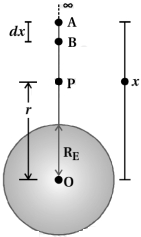
Define gravitational potential energy. Obtain the formula for the gravitational potential energy of a body of mass $m$ at a distance $r$ $(r > R_E)$ from the centre of the Earth.
Solution
(N/A) Gravitational potential energy is defined as the work done in bringing a body of mass $m$ from an infinite distance to a given point in the gravitational field of another body.
Let the mass of the Earth be $M_E$ and its radius be $R_E$. We want to determine the gravitational potential energy of a mass $m$ at a point $P$ at a distance $r$ from the centre of the Earth $(O)$.
Consider the body of mass $m$ at an arbitrary point $A$ at a distance $x$ from the centre of the Earth $(OP = x)$.
The gravitational force on the body at this point is given by:
$F = \frac{G M_E m}{x^2}$
The work done to move the body by a small displacement $dx$ towards the Earth is:
$dW = F dx = \frac{G M_E m}{x^2} dx$
The total work done to bring the body from infinity to a distance $r$ is:
$W = \int_{\infty}^{r} dW = \int_{\infty}^{r} \frac{G M_E m}{x^2} dx$
$W = G M_E m \int_{\infty}^{r} x^{-2} dx$
$W = G M_E m \left[ -\frac{1}{x} \right]_{\infty}^{r}$
$W = G M_E m \left( -\frac{1}{r} - (-\frac{1}{\infty}) \right)$
Since $\frac{1}{\infty} = 0$,we get:
$W = -\frac{G M_E m}{r}$
Thus,the gravitational potential energy $U$ at distance $r$ is:
$U = -\frac{G M_E m}{r}$
Let the mass of the Earth be $M_E$ and its radius be $R_E$. We want to determine the gravitational potential energy of a mass $m$ at a point $P$ at a distance $r$ from the centre of the Earth $(O)$.
Consider the body of mass $m$ at an arbitrary point $A$ at a distance $x$ from the centre of the Earth $(OP = x)$.
The gravitational force on the body at this point is given by:
$F = \frac{G M_E m}{x^2}$
The work done to move the body by a small displacement $dx$ towards the Earth is:
$dW = F dx = \frac{G M_E m}{x^2} dx$
The total work done to bring the body from infinity to a distance $r$ is:
$W = \int_{\infty}^{r} dW = \int_{\infty}^{r} \frac{G M_E m}{x^2} dx$
$W = G M_E m \int_{\infty}^{r} x^{-2} dx$
$W = G M_E m \left[ -\frac{1}{x} \right]_{\infty}^{r}$
$W = G M_E m \left( -\frac{1}{r} - (-\frac{1}{\infty}) \right)$
Since $\frac{1}{\infty} = 0$,we get:
$W = -\frac{G M_E m}{r}$
Thus,the gravitational potential energy $U$ at distance $r$ is:
$U = -\frac{G M_E m}{r}$
0 likes
View Solution61
Easy
Define gravitational potential. Give its unit. Is gravitational potential a vector or a scalar quantity?
Solution
(N/A) Gravitational Potential $V$: The gravitational potential at a point in a gravitational field is defined as the amount of work done by an external agent in bringing a unit mass from infinity to that point without acceleration.
Definition: The work done per unit mass in bringing a body of unit mass from an infinite distance to a given point in a gravitational field is called the gravitational potential at that point.
Formula: Gravitational potential $V = \frac{W}{m}$,where $W$ is the work done and $m$ is the mass.
Nature: It is a scalar quantity.
Units: Its $SI$ unit is $J/kg$ (joule per kilogram) and its $CGS$ unit is $erg/g$ (erg per gram).
Dimensional Formula: $M^{0} L^{2} T^{-2}$.
Definition: The work done per unit mass in bringing a body of unit mass from an infinite distance to a given point in a gravitational field is called the gravitational potential at that point.
Formula: Gravitational potential $V = \frac{W}{m}$,where $W$ is the work done and $m$ is the mass.
Nature: It is a scalar quantity.
Units: Its $SI$ unit is $J/kg$ (joule per kilogram) and its $CGS$ unit is $erg/g$ (erg per gram).
Dimensional Formula: $M^{0} L^{2} T^{-2}$.
0 likes
View Solution62
Medium
Obtain an expression for the gravitational potential at a point in the gravitational field of the Earth. Give the relation between gravitational potential and gravitational potential energy.
Solution
(N/A) The work done in bringing a body of mass $m$ from an infinite distance in the gravitational field of the Earth to a point at a distance $r$ $(r > R_{E})$ from the center of the Earth is given by the gravitational potential energy $U = -\frac{GM_{E}m}{r}$.
Gravitational potential $V$ at a point is defined as the work done per unit mass to bring a body from infinity to that point:
$V = \frac{W}{m} = \frac{U}{m}$
Substituting the expression for $U$:
$V = \frac{-GM_{E}m/r}{m} = -\frac{GM_{E}}{r}$
On the surface of the Earth,where $r = R_{E}$,the gravitational potential is:
$V_{E} = -\frac{GM_{E}}{R_{E}}$
Relation between gravitational potential and gravitational potential energy:
Since $U = -\frac{GM_{E}m}{r}$ and $V = -\frac{GM_{E}}{r}$,we can write:
$U = V \cdot m$
Therefore,Gravitational potential energy = (Gravitational potential) $\times$ (mass).
Gravitational potential $V$ at a point is defined as the work done per unit mass to bring a body from infinity to that point:
$V = \frac{W}{m} = \frac{U}{m}$
Substituting the expression for $U$:
$V = \frac{-GM_{E}m/r}{m} = -\frac{GM_{E}}{r}$
On the surface of the Earth,where $r = R_{E}$,the gravitational potential is:
$V_{E} = -\frac{GM_{E}}{R_{E}}$
Relation between gravitational potential and gravitational potential energy:
Since $U = -\frac{GM_{E}m}{r}$ and $V = -\frac{GM_{E}}{r}$,we can write:
$U = V \cdot m$
Therefore,Gravitational potential energy = (Gravitational potential) $\times$ (mass).
0 likes
View Solution63
Medium
What is gravitational potential energy? Why is gravitational potential negative,and what does it mean?
Solution
(N/A) Gravitational potential energy is the energy possessed by an object due to its position in a gravitational field. It is defined as the work done by an external agent in bringing a body from infinity to a point in the gravitational field without acceleration.
The gravitational potential $V$ at a point is given by $V = -GM/r$,where $G$ is the gravitational constant,$M$ is the mass of the source,and $r$ is the distance from the source.
The negative sign indicates that the gravitational force is attractive in nature. It means that the gravitational potential energy of a system of two masses is zero at infinity and decreases as the masses are brought closer together. Thus,work must be done by the gravitational field to bring the masses together,or conversely,an external agent must do negative work to move the body from infinity to a point $r$.
The gravitational potential $V$ at a point is given by $V = -GM/r$,where $G$ is the gravitational constant,$M$ is the mass of the source,and $r$ is the distance from the source.
The negative sign indicates that the gravitational force is attractive in nature. It means that the gravitational potential energy of a system of two masses is zero at infinity and decreases as the masses are brought closer together. Thus,work must be done by the gravitational field to bring the masses together,or conversely,an external agent must do negative work to move the body from infinity to a point $r$.
0 likes
View Solution64
MediumMCQ
What is the magnitude of potential energy at infinity distance?
A
Positive
B
Negative
C
Zero
D
Infinite
Solution
(C) The gravitational potential energy $U$ of a system of two masses $m_1$ and $m_2$ separated by a distance $r$ is given by the formula $U = -\frac{G m_1 m_2}{r}$.
As the distance $r$ approaches infinity $(r \to \infty)$,the term $\frac{1}{r}$ approaches zero.
Therefore,the potential energy at infinity distance is defined as $U = 0$.
As the distance $r$ approaches infinity $(r \to \infty)$,the term $\frac{1}{r}$ approaches zero.
Therefore,the potential energy at infinity distance is defined as $U = 0$.
0 likes
View Solution65
Medium
Write $SI$ and $CGS$ unit of gravitational potential.
Solution
(N/A) Gravitational potential $(V)$ at a point is defined as the work done per unit mass in bringing a test mass from infinity to that point.
Mathematically,$V = \frac{W}{m}$.
In $SI$ units,work is measured in Joules $(J)$ and mass in kilograms $(kg)$. Therefore,the $SI$ unit is $J/kg$ or $m^2/s^2$.
In $CGS$ units,work is measured in ergs $(erg)$ and mass in grams $(g)$. Therefore,the $CGS$ unit is $erg/g$ or $cm^2/s^2$.
Mathematically,$V = \frac{W}{m}$.
In $SI$ units,work is measured in Joules $(J)$ and mass in kilograms $(kg)$. Therefore,the $SI$ unit is $J/kg$ or $m^2/s^2$.
In $CGS$ units,work is measured in ergs $(erg)$ and mass in grams $(g)$. Therefore,the $CGS$ unit is $erg/g$ or $cm^2/s^2$.
0 likes
View Solution66
MediumMCQ
Give the formula of gravitational potential at distance $r$ $(r > R_E)$ from the centre of the Earth.
A
$V = -\frac{GM_E}{r}$
B
$V = -\frac{GM_E}{r^2}$
C
$V = \frac{GM_E}{r}$
D
$V = -\frac{GM_E}{R_E}$
Solution
(A) The gravitational potential $V$ at a distance $r$ from the centre of the Earth (where $r > R_E$) is defined as the work done per unit mass in bringing a test mass from infinity to that point.
The formula is given by:
$V = -\frac{GM_E}{r}$
Where:
$G$ is the universal gravitational constant,
$M_E$ is the mass of the Earth,
$r$ is the distance from the centre of the Earth.
The formula is given by:
$V = -\frac{GM_E}{r}$
Where:
$G$ is the universal gravitational constant,
$M_E$ is the mass of the Earth,
$r$ is the distance from the centre of the Earth.
0 likes
View Solution67
Medium
Write the expression for gravitational potential energy and gravitational potential at the surface of the Earth.
Solution
(N/A) The gravitational potential energy $U$ of a body of mass $m$ at the surface of the Earth is given by $U = -\frac{GM_{E}m}{R_{E}}$.
The gravitational potential $V$ at the surface of the Earth is defined as the gravitational potential energy per unit mass,given by $V = \frac{U}{m} = -\frac{GM_{E}}{R_{E}}$.
Here,$G$ is the universal gravitational constant,$M_{E}$ is the mass of the Earth,and $R_{E}$ is the radius of the Earth.
The gravitational potential $V$ at the surface of the Earth is defined as the gravitational potential energy per unit mass,given by $V = \frac{U}{m} = -\frac{GM_{E}}{R_{E}}$.
Here,$G$ is the universal gravitational constant,$M_{E}$ is the mass of the Earth,and $R_{E}$ is the radius of the Earth.
0 likes
View Solution68
Difficult
Give the difference between gravitational potential energy and gravitational potential.
Solution
(N/A) $1$. Definition: Gravitational potential energy $(U)$ is the energy possessed by a body due to its position in a gravitational field. Gravitational potential $(V)$ is the work done per unit mass to bring a test mass from infinity to a point in a gravitational field.
$2$. Formula: For a point mass $M$,gravitational potential energy at distance $r$ is $U = -GMm/r$. Gravitational potential at distance $r$ is $V = -GM/r$.
$3$. Units: The $SI$ unit of gravitational potential energy is Joule $(J)$. The $SI$ unit of gravitational potential is Joule per kilogram ($J/kg$ or $m^2/s^2$).
$4$. Dependence: Gravitational potential energy depends on the mass of the object $(m)$ placed at that point. Gravitational potential is independent of the mass of the object placed at that point; it depends only on the source mass $(M)$ and the position $(r)$.
$2$. Formula: For a point mass $M$,gravitational potential energy at distance $r$ is $U = -GMm/r$. Gravitational potential at distance $r$ is $V = -GM/r$.
$3$. Units: The $SI$ unit of gravitational potential energy is Joule $(J)$. The $SI$ unit of gravitational potential is Joule per kilogram ($J/kg$ or $m^2/s^2$).
$4$. Dependence: Gravitational potential energy depends on the mass of the object $(m)$ placed at that point. Gravitational potential is independent of the mass of the object placed at that point; it depends only on the source mass $(M)$ and the position $(r)$.
0 likes
View Solution69
EasyMCQ
What is the total energy of a system of two masses at an infinite distance from each other?
A
Zero
B
Positive
C
Negative
D
Infinite
Solution
(A) The gravitational potential energy $U$ of a system of two masses $m_1$ and $m_2$ separated by a distance $r$ is given by $U = -\frac{G m_1 m_2}{r}$.
As the distance $r$ between the masses approaches infinity $(r \to \infty)$,the potential energy $U$ approaches zero $(U \to 0)$.
Since the masses are at an infinite distance,their kinetic energy $K$ is also zero (assuming they are at rest relative to each other).
The total energy $E$ of the system is the sum of kinetic energy and potential energy: $E = K + U$.
Therefore,$E = 0 + 0 = 0$.
Thus,the total energy at an infinite distance is zero.
As the distance $r$ between the masses approaches infinity $(r \to \infty)$,the potential energy $U$ approaches zero $(U \to 0)$.
Since the masses are at an infinite distance,their kinetic energy $K$ is also zero (assuming they are at rest relative to each other).
The total energy $E$ of the system is the sum of kinetic energy and potential energy: $E = K + U$.
Therefore,$E = 0 + 0 = 0$.
Thus,the total energy at an infinite distance is zero.
0 likes
View Solution70
MediumMCQ
$A$ stationary body on the surface of the Earth has negative potential energy. What does this indicate?
A
The body is in motion.
B
The body is bound to the Earth.
C
The body is at an infinite distance.
D
The body has no mass.
Solution
(B) The gravitational potential energy of a body of mass $m$ at a distance $r$ from the center of the Earth is given by $U = -\frac{GMm}{r}$.
Since $G$,$M$,$m$,and $r$ are all positive,the potential energy $U$ is negative.
$A$ negative value of potential energy indicates that the body is in a bound state within the Earth's gravitational field.
To move the body to infinity (where potential energy is zero),we must provide an amount of energy equal to $|U|$ (i.e.,positive work must be done on the body).
Therefore,negative energy signifies that the body is gravitationally bound to the Earth.
Since $G$,$M$,$m$,and $r$ are all positive,the potential energy $U$ is negative.
$A$ negative value of potential energy indicates that the body is in a bound state within the Earth's gravitational field.
To move the body to infinity (where potential energy is zero),we must provide an amount of energy equal to $|U|$ (i.e.,positive work must be done on the body).
Therefore,negative energy signifies that the body is gravitationally bound to the Earth.
0 likes
View Solution71
Easy
What is the binding energy of a body of mass $m$ lying on the surface of the Earth at a distance $r$ from the center of the Earth?
Solution
(N/A) The binding energy of a body is defined as the minimum energy required to remove the body from the gravitational influence of the Earth to infinity.
The gravitational potential energy $U$ of a body of mass $m$ at a distance $r$ from the center of the Earth (of mass $M_E$) is given by $U = -\frac{G M_E m}{r}$.
To remove the body to infinity,where the potential energy is zero,we must provide an amount of energy equal to the magnitude of the potential energy.
Therefore,the binding energy $BE = -U = -\left(-\frac{G M_E m}{r}\right) = \frac{G M_E m}{r}$.
The gravitational potential energy $U$ of a body of mass $m$ at a distance $r$ from the center of the Earth (of mass $M_E$) is given by $U = -\frac{G M_E m}{r}$.
To remove the body to infinity,where the potential energy is zero,we must provide an amount of energy equal to the magnitude of the potential energy.
Therefore,the binding energy $BE = -U = -\left(-\frac{G M_E m}{r}\right) = \frac{G M_E m}{r}$.
0 likes
View Solution72
Medium
Write an equation for the potential energy of a satellite. Why is the potential energy of a satellite negative?
Solution
(N/A) The gravitational potential energy $U$ of a satellite of mass $m$ orbiting a planet of mass $M$ at a distance $r$ from the center of the planet is given by the equation:
$U = -\frac{GMm}{r}$
where $G$ is the universal gravitational constant.
The potential energy is negative because the gravitational force is attractive in nature. By convention,the potential energy of a system is defined as zero at an infinite distance $(r = \infty)$ from the source mass. Since the gravitational force acts to pull the satellite towards the planet,work must be done by an external agent to move the satellite from its position $r$ to infinity. Because the system is in a bound state,the energy required to reach the zero-potential state at infinity is positive,implying that the energy at any finite distance $r$ must be less than zero.
$U = -\frac{GMm}{r}$
where $G$ is the universal gravitational constant.
The potential energy is negative because the gravitational force is attractive in nature. By convention,the potential energy of a system is defined as zero at an infinite distance $(r = \infty)$ from the source mass. Since the gravitational force acts to pull the satellite towards the planet,work must be done by an external agent to move the satellite from its position $r$ to infinity. Because the system is in a bound state,the energy required to reach the zero-potential state at infinity is positive,implying that the energy at any finite distance $r$ must be less than zero.
0 likes
View Solution73
MediumMCQ
Match Column-$I$ with Column-$II$.
| Column-$I$ | Column-$II$ |
| $(1)$ Can never be positive. | $(a)$ Escape velocity |
| $(2)$ Reason for negative potential energy of galaxies. | $(b)$ Gravitational potential energy |
| $(c)$ The nature of force between different galaxies is attractive. |
A
$1-b, 2-c$
B
$1-a, 2-c$
C
$1-b, 2-a$
D
$1-a, 2-b$
Solution
$(A)$ The gravitational potential energy $(U)$ of a system of two masses $m_1$ and $m_2$ separated by a distance $r$ is given by $U = -G \frac{m_1 m_2}{r}$. Since $G$, $m_1$, $m_2$, and $r$ are all positive, $U$ is always negative. Thus, $(1)$ matches with $(b)$.
The potential energy of a system is negative if the force between the constituents is attractive. Since the gravitational force between galaxies is always attractive, their gravitational potential energy is negative. Thus, $(2)$ matches with $(c)$.
Therefore, the correct matching is $(1-b, 2-c)$.
The potential energy of a system is negative if the force between the constituents is attractive. Since the gravitational force between galaxies is always attractive, their gravitational potential energy is negative. Thus, $(2)$ matches with $(c)$.
Therefore, the correct matching is $(1-b, 2-c)$.
0 likes
View Solution74
MediumMCQ
Why does the potential energy of an object increase when it is raised above the surface of the Earth?
A
Because work is done against the gravitational force of the Earth.
B
Because the kinetic energy decreases.
C
Because the mass of the object increases.
D
Because the acceleration due to gravity increases.
Solution
(A) When an object is raised above the surface of the Earth,work must be done against the gravitational force exerted by the Earth.
Since the displacement is in the direction opposite to the gravitational force,the work done by the gravitational force is negative.
According to the work-energy theorem,this work done against the conservative gravitational force is stored in the system as gravitational potential energy.
Therefore,the potential energy of the object increases as its height above the Earth's surface increases.
Since the displacement is in the direction opposite to the gravitational force,the work done by the gravitational force is negative.
According to the work-energy theorem,this work done against the conservative gravitational force is stored in the system as gravitational potential energy.
Therefore,the potential energy of the object increases as its height above the Earth's surface increases.
0 likes
View Solution75
EasyMCQ
If the gravitational potential of an object of mass $m$ on the surface of the Earth is $\phi$,what is the gravitational potential of an object of mass $2m$?
A
$\phi$
B
$2\phi$
C
$\phi/2$
D
$4\phi$
Solution
(A) The gravitational potential at a point in a gravitational field is defined as the work done per unit mass in bringing a test mass from infinity to that point.
Mathematically,$\phi = -GM/R$,where $G$ is the gravitational constant,$M$ is the mass of the Earth,and $R$ is the radius of the Earth.
Since the gravitational potential $\phi$ depends only on the mass of the source $(M)$ and the distance from the center $(R)$,it is independent of the mass of the object $(m)$ placed at that point.
Therefore,for an object of mass $2m$,the gravitational potential remains $\phi$.
Mathematically,$\phi = -GM/R$,where $G$ is the gravitational constant,$M$ is the mass of the Earth,and $R$ is the radius of the Earth.
Since the gravitational potential $\phi$ depends only on the mass of the source $(M)$ and the distance from the center $(R)$,it is independent of the mass of the object $(m)$ placed at that point.
Therefore,for an object of mass $2m$,the gravitational potential remains $\phi$.
0 likes
View Solution76
MediumMCQ
The gravitational potential energy of a body of mass $m$ at a distance $r$ from the center of the Earth is $U$. Express the weight of the body at this point in terms of $U$.
A
$U/r$
B
$Ur$
C
$U/r^2$
D
$Ur^2$
Solution
(A) The gravitational potential energy $U$ of a body of mass $m$ at a distance $r$ from the center of the Earth is given by $U = \frac{G M_e m}{r}$.
Here,$G$ is the universal gravitational constant,$M_e$ is the mass of the Earth,and $m$ is the mass of the body.
The weight of the body at distance $r$ is $W = mg$,where $g$ is the acceleration due to gravity at that distance.
The acceleration due to gravity at distance $r$ is $g = \frac{G M_e}{r^2}$.
Substituting $g$ into the weight formula,we get $W = m \left( \frac{G M_e}{r^2} \right) = \frac{G M_e m}{r^2}$.
We can rewrite the expression for $U$ as $U = \left( \frac{G M_e m}{r} \right)$.
Comparing the two,we see that $W = \frac{U}{r}$.
Therefore,the weight of the body at this point is $U/r$.
Here,$G$ is the universal gravitational constant,$M_e$ is the mass of the Earth,and $m$ is the mass of the body.
The weight of the body at distance $r$ is $W = mg$,where $g$ is the acceleration due to gravity at that distance.
The acceleration due to gravity at distance $r$ is $g = \frac{G M_e}{r^2}$.
Substituting $g$ into the weight formula,we get $W = m \left( \frac{G M_e}{r^2} \right) = \frac{G M_e m}{r^2}$.
We can rewrite the expression for $U$ as $U = \left( \frac{G M_e m}{r} \right)$.
Comparing the two,we see that $W = \frac{U}{r}$.
Therefore,the weight of the body at this point is $U/r$.
0 likes
View Solution77
EasyMCQ
When an object is brought from infinity to a distance $r$ from a mass,its gravitational potential energy ....... . (Fill in the blank)
A
Increases
B
Decreases
C
Remains constant
D
Becomes zero
Solution
(B) The gravitational potential energy of an object at a distance $r$ from a mass $M$ is given by $U = -\frac{GMm}{r}$.
As the object is brought from infinity (where $U = 0$) to a distance $r$,the potential energy changes from $0$ to a negative value.
Since the value becomes negative,the gravitational potential energy decreases.
As the object is brought from infinity (where $U = 0$) to a distance $r$,the potential energy changes from $0$ to a negative value.
Since the value becomes negative,the gravitational potential energy decreases.
0 likes
View Solution78
DifficultMCQ
On the $x$-axis and at a distance $x$ from the origin,the gravitational field due to a mass distribution is given by $\frac{Ax}{(x^2+a^2)^{3/2}}$ in the $x$-direction. The magnitude of gravitational potential on the $x$-axis at a distance $x$,taking its value to be zero at infinity,is
A
$\frac{A}{(x^2+a^2)^{1/2}}$
B
$\frac{A}{(x^2+a^2)^{3/2}}$
C
$A(x^2+a^2)^{3/2}$
D
$A(x^2+a^2)^{1/2}$
Solution
(A) The relationship between gravitational field $E_G$ and gravitational potential $V$ is given by $V(x) = -\int_{\infty}^{x} E_G \cdot dx$.
Given $E_G = \frac{Ax}{(x^2+a^2)^{3/2}}$.
Substituting this into the integral:
$V(x) = -\int_{\infty}^{x} \frac{Ax}{(x^2+a^2)^{3/2}} dx$.
Let $u = x^2 + a^2$,then $du = 2x dx$,or $x dx = \frac{du}{2}$.
As $x \to \infty$,$u \to \infty$. As $x = x$,$u = x^2 + a^2$.
$V(x) = -\int_{\infty}^{x^2+a^2} \frac{A}{u^{3/2}} \cdot \frac{du}{2} = -\frac{A}{2} \int_{\infty}^{x^2+a^2} u^{-3/2} du$.
$V(x) = -\frac{A}{2} \left[ \frac{u^{-1/2}}{-1/2} \right]_{\infty}^{x^2+a^2} = A \left[ \frac{1}{\sqrt{u}} \right]_{\infty}^{x^2+a^2}$.
$V(x) = A \left( \frac{1}{\sqrt{x^2+a^2}} - 0 \right) = \frac{A}{(x^2+a^2)^{1/2}}$.
Given $E_G = \frac{Ax}{(x^2+a^2)^{3/2}}$.
Substituting this into the integral:
$V(x) = -\int_{\infty}^{x} \frac{Ax}{(x^2+a^2)^{3/2}} dx$.
Let $u = x^2 + a^2$,then $du = 2x dx$,or $x dx = \frac{du}{2}$.
As $x \to \infty$,$u \to \infty$. As $x = x$,$u = x^2 + a^2$.
$V(x) = -\int_{\infty}^{x^2+a^2} \frac{A}{u^{3/2}} \cdot \frac{du}{2} = -\frac{A}{2} \int_{\infty}^{x^2+a^2} u^{-3/2} du$.
$V(x) = -\frac{A}{2} \left[ \frac{u^{-1/2}}{-1/2} \right]_{\infty}^{x^2+a^2} = A \left[ \frac{1}{\sqrt{u}} \right]_{\infty}^{x^2+a^2}$.
$V(x) = A \left( \frac{1}{\sqrt{x^2+a^2}} - 0 \right) = \frac{A}{(x^2+a^2)^{1/2}}$.
0 likes
View Solution79
DifficultMCQ
If one wants to remove all the mass of the earth to infinity in order to break it up completely,the amount of energy that needs to be supplied will be $\frac{x}{5} \frac{GM^2}{R}$,where $x$ is .......... (Round off to the Nearest Integer). ($M$ is the mass of earth,$R$ is the radius of earth,$G$ is the gravitational constant)
A
$3$
B
$6$
C
$4$
D
$9$
Solution
(A) The gravitational self-energy of a solid sphere of mass $M$ and radius $R$ is given by $U_i = -\frac{3}{5} \frac{GM^2}{R}$.
To break the earth up completely and move all its mass to infinity,the final potential energy $U_f$ will be $0$.
The energy required to be supplied is $\Delta U = U_f - U_i$.
$\Delta U = 0 - (-\frac{3}{5} \frac{GM^2}{R}) = \frac{3}{5} \frac{GM^2}{R}$.
Comparing this with the given expression $\frac{x}{5} \frac{GM^2}{R}$,we get $x = 3$.
To break the earth up completely and move all its mass to infinity,the final potential energy $U_f$ will be $0$.
The energy required to be supplied is $\Delta U = U_f - U_i$.
$\Delta U = 0 - (-\frac{3}{5} \frac{GM^2}{R}) = \frac{3}{5} \frac{GM^2}{R}$.
Comparing this with the given expression $\frac{x}{5} \frac{GM^2}{R}$,we get $x = 3$.
0 likes
View Solution80
DifficultMCQ
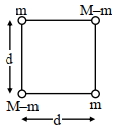
$A$ body of mass $2M$ is split into four masses $\{m, M-m, m, M-m\}$,which are placed at the corners of a square of side $d$ as shown in the figure. The ratio $\frac{M}{m}$ for which the gravitational potential energy of the system is maximum is $x:1$. The value of $x$ is ..... .
A
$2$
B
$3$
C
$1$
D
$4$
Solution
(A) The gravitational potential energy $U$ of a system of particles is given by $U = -\sum \frac{G m_i m_j}{r_{ij}}$.
For the given square configuration with side $d$,there are four sides of length $d$ and two diagonals of length $\sqrt{2}d$.
The masses at the corners are $m_1 = m$,$m_2 = M-m$,$m_3 = m$,and $m_4 = M-m$.
The potential energy is:
$U = -\frac{G}{d} [m(M-m) + (M-m)m + m(M-m) + (M-m)m] - \frac{G}{\sqrt{2}d} [m^2 + (M-m)^2]$
$U = -\frac{G}{d} [4m(M-m)] - \frac{G}{\sqrt{2}d} [m^2 + M^2 - 2Mm + m^2]$
$U = -\frac{G}{d} [4Mm - 4m^2 + \frac{1}{\sqrt{2}}(M^2 - 2Mm + 2m^2)]$
To maximize $U$ (or minimize $|U|$),we differentiate $U$ with respect to $m$ and set it to zero:
$\frac{dU}{dm} = -\frac{G}{d} [4M - 8m + \frac{1}{\sqrt{2}}(-2M + 4m)] = 0$
$4M - 8m - \sqrt{2}M + 2\sqrt{2}m = 0$
$M(4 - \sqrt{2}) = m(8 - 2\sqrt{2})$
$M(4 - \sqrt{2}) = 2m(4 - \sqrt{2})$
$\frac{M}{m} = 2$
Thus,$x = 2$.
For the given square configuration with side $d$,there are four sides of length $d$ and two diagonals of length $\sqrt{2}d$.
The masses at the corners are $m_1 = m$,$m_2 = M-m$,$m_3 = m$,and $m_4 = M-m$.
The potential energy is:
$U = -\frac{G}{d} [m(M-m) + (M-m)m + m(M-m) + (M-m)m] - \frac{G}{\sqrt{2}d} [m^2 + (M-m)^2]$
$U = -\frac{G}{d} [4m(M-m)] - \frac{G}{\sqrt{2}d} [m^2 + M^2 - 2Mm + m^2]$
$U = -\frac{G}{d} [4Mm - 4m^2 + \frac{1}{\sqrt{2}}(M^2 - 2Mm + 2m^2)]$
To maximize $U$ (or minimize $|U|$),we differentiate $U$ with respect to $m$ and set it to zero:
$\frac{dU}{dm} = -\frac{G}{d} [4M - 8m + \frac{1}{\sqrt{2}}(-2M + 4m)] = 0$
$4M - 8m - \sqrt{2}M + 2\sqrt{2}m = 0$
$M(4 - \sqrt{2}) = m(8 - 2\sqrt{2})$
$M(4 - \sqrt{2}) = 2m(4 - \sqrt{2})$
$\frac{M}{m} = 2$
Thus,$x = 2$.
0 likes
View Solution81
MediumMCQ
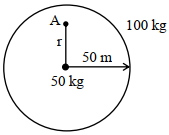
$A$ mass of $50 \, \text{kg}$ is placed at the centre of a uniform spherical shell of mass $100 \, \text{kg}$ and radius $50 \, \text{m}$. If the gravitational potential at a point $25 \, \text{m}$ from the centre is $V \, \text{J/kg}$,find the value of $V$.
A
$-60G$
B
$+2G$
C
$-20G$
D
$-4G$
Solution
(D) The gravitational potential $V$ at a point inside a spherical shell is the sum of the potential due to the point mass at the centre and the potential due to the shell.
$1$. Potential due to the point mass $M_1 = 50 \, \text{kg}$ at a distance $r = 25 \, \text{m}$ is $V_1 = -\frac{GM_1}{r} = -\frac{G \times 50}{25} = -2G$.
$2$. Potential due to the spherical shell of mass $M_2 = 100 \, \text{kg}$ and radius $R = 50 \, \text{m}$ at any point inside it is constant and equal to the potential at its surface: $V_2 = -\frac{GM_2}{R} = -\frac{G \times 100}{50} = -2G$.
$3$. The total gravitational potential $V$ is $V = V_1 + V_2 = -2G + (-2G) = -4G$.
$1$. Potential due to the point mass $M_1 = 50 \, \text{kg}$ at a distance $r = 25 \, \text{m}$ is $V_1 = -\frac{GM_1}{r} = -\frac{G \times 50}{25} = -2G$.
$2$. Potential due to the spherical shell of mass $M_2 = 100 \, \text{kg}$ and radius $R = 50 \, \text{m}$ at any point inside it is constant and equal to the potential at its surface: $V_2 = -\frac{GM_2}{R} = -\frac{G \times 100}{50} = -2G$.
$3$. The total gravitational potential $V$ is $V = V_1 + V_2 = -2G + (-2G) = -4G$.
0 likes
View Solution82
MediumMCQ
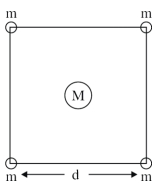
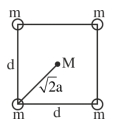
Four spheres each of mass $m$ form a square of side $d$ (as shown in the figure). $A$ fifth sphere of mass $M$ is situated at the centre of the square. The total gravitational potential energy of the system is
A
$-\frac{ Gm }{ d }[(4+\sqrt{2}) m +4 \sqrt{2} M]$
B
$-\frac{ Gm }{ d }[(4+\sqrt{2}) m +4 \sqrt{2} M ]$
C
$-\frac{ Gm }{ d }\left[4 m +4 \sqrt{2} M \right]$
D
$-\frac{ Gm }{ d }\left[6 m +4 \sqrt{2} M \right]$
Solution
(A) The total gravitational potential energy $U$ of the system is the sum of the potential energies of all pairs of spheres.
$1$. Potential energy of the four spheres of mass $m$ at the corners of the square:
There are $4$ sides of length $d$ and $2$ diagonals of length $\sqrt{2}d$.
$U_{m-m} = -\frac{G m^2}{d} \times 4 - \frac{G m^2}{\sqrt{2}d} \times 2 = -\frac{G m^2}{d} (4 + \sqrt{2})$.
$2$. Potential energy of the central sphere of mass $M$ with the four spheres of mass $m$:
The distance of each corner from the centre is $r = \frac{\sqrt{2}d}{2} = \frac{d}{\sqrt{2}}$.
$U_{M-m} = -\frac{G M m}{r} \times 4 = -\frac{G M m}{d/\sqrt{2}} \times 4 = -\frac{4\sqrt{2} G M m}{d}$.
$3$. Total potential energy $U = U_{m-m} + U_{M-m} = -\frac{G m}{d} [(4 + \sqrt{2})m + 4\sqrt{2}M]$.
$1$. Potential energy of the four spheres of mass $m$ at the corners of the square:
There are $4$ sides of length $d$ and $2$ diagonals of length $\sqrt{2}d$.
$U_{m-m} = -\frac{G m^2}{d} \times 4 - \frac{G m^2}{\sqrt{2}d} \times 2 = -\frac{G m^2}{d} (4 + \sqrt{2})$.
$2$. Potential energy of the central sphere of mass $M$ with the four spheres of mass $m$:
The distance of each corner from the centre is $r = \frac{\sqrt{2}d}{2} = \frac{d}{\sqrt{2}}$.
$U_{M-m} = -\frac{G M m}{r} \times 4 = -\frac{G M m}{d/\sqrt{2}} \times 4 = -\frac{4\sqrt{2} G M m}{d}$.
$3$. Total potential energy $U = U_{m-m} + U_{M-m} = -\frac{G m}{d} [(4 + \sqrt{2})m + 4\sqrt{2}M]$.
0 likes
View Solution83
MediumMCQ
Four particles $A, B, C$ and $D$ each of mass $m$ are kept at the corners of a square of side $L$. Now the particle $D$ is taken to infinity by an external agent,keeping the other particles fixed at their respective positions. The work done by the gravitational force acting on the particle $D$ during its movement is ..........

A
$2 \frac{G m^2}{L}$
B
$-2 \frac{G m^2}{L}$
C
$\frac{G m^2}{L} \left( \frac{2 \sqrt{2} + 1}{\sqrt{2}} \right)$
D
$-\frac{G m^2}{L} \left( \frac{2 \sqrt{2} + 1}{\sqrt{2}} \right)$
Solution
(D) The work done by the gravitational force $(W_g)$ is equal to the negative change in the gravitational potential energy of the particle $D$ due to the other particles $(A, B, C)$.
$W_g = -\Delta U = -(U_{\text{final}} - U_{\text{initial}}) = U_{\text{initial}} - U_{\text{final}}$.
When the particle $D$ is at infinity,the potential energy $U_{\text{final}} = 0$.
Therefore,$W_g = U_{\text{initial}}$.
The initial gravitational potential energy of particle $D$ due to particles $A, B,$ and $C$ is:
$U_{\text{initial}} = -\frac{G m_A m_D}{r_{AD}} - \frac{G m_B m_D}{r_{BD}} - \frac{G m_C m_D}{r_{CD}}$
Given $m_A = m_B = m_C = m_D = m$,$r_{AD} = L$,$r_{CD} = L$,and $r_{BD} = \sqrt{2} L$ (diagonal of the square).
$U_{\text{initial}} = -\frac{G m^2}{L} - \frac{G m^2}{\sqrt{2} L} - \frac{G m^2}{L} = -\frac{G m^2}{L} \left( 2 + \frac{1}{\sqrt{2}} \right)$.
$U_{\text{initial}} = -\frac{G m^2}{L} \left( \frac{2 \sqrt{2} + 1}{\sqrt{2}} \right)$.
Thus,the work done by the gravitational force is $-\frac{G m^2}{L} \left( \frac{2 \sqrt{2} + 1}{\sqrt{2}} \right)$.
$W_g = -\Delta U = -(U_{\text{final}} - U_{\text{initial}}) = U_{\text{initial}} - U_{\text{final}}$.
When the particle $D$ is at infinity,the potential energy $U_{\text{final}} = 0$.
Therefore,$W_g = U_{\text{initial}}$.
The initial gravitational potential energy of particle $D$ due to particles $A, B,$ and $C$ is:
$U_{\text{initial}} = -\frac{G m_A m_D}{r_{AD}} - \frac{G m_B m_D}{r_{BD}} - \frac{G m_C m_D}{r_{CD}}$
Given $m_A = m_B = m_C = m_D = m$,$r_{AD} = L$,$r_{CD} = L$,and $r_{BD} = \sqrt{2} L$ (diagonal of the square).
$U_{\text{initial}} = -\frac{G m^2}{L} - \frac{G m^2}{\sqrt{2} L} - \frac{G m^2}{L} = -\frac{G m^2}{L} \left( 2 + \frac{1}{\sqrt{2}} \right)$.
$U_{\text{initial}} = -\frac{G m^2}{L} \left( \frac{2 \sqrt{2} + 1}{\sqrt{2}} \right)$.
Thus,the work done by the gravitational force is $-\frac{G m^2}{L} \left( \frac{2 \sqrt{2} + 1}{\sqrt{2}} \right)$.

0 likes
View Solution84
MediumMCQ
If the gravitational potential on the surface of the earth is $V_0$,then the potential at a point at a height equal to half of the radius of the earth is ..........
A
$\frac{V_0}{2}$
B
$\frac{2}{3} V_0$
C
$\frac{V_0}{3}$
D
$\frac{3 V_0}{2}$
Solution
(B) The gravitational potential on the surface of the earth is given by $V_0 = -\frac{G M_e}{R_e}$.
The gravitational potential at a height $h$ above the surface is given by $V_h = -\frac{G M_e}{R_e + h}$.
Given that the height $h = \frac{R_e}{2}$,we substitute this into the formula:
$V_h = -\frac{G M_e}{R_e + \frac{R_e}{2}}$
Simplifying the denominator:
$V_h = -\frac{G M_e}{\frac{3 R_e}{2}}$
$V_h = -\frac{2}{3} \left( \frac{G M_e}{R_e} \right)$
Since $V_0 = -\frac{G M_e}{R_e}$,we can write:
$V_h = \frac{2}{3} V_0$.
The gravitational potential at a height $h$ above the surface is given by $V_h = -\frac{G M_e}{R_e + h}$.
Given that the height $h = \frac{R_e}{2}$,we substitute this into the formula:
$V_h = -\frac{G M_e}{R_e + \frac{R_e}{2}}$
Simplifying the denominator:
$V_h = -\frac{G M_e}{\frac{3 R_e}{2}}$
$V_h = -\frac{2}{3} \left( \frac{G M_e}{R_e} \right)$
Since $V_0 = -\frac{G M_e}{R_e}$,we can write:
$V_h = \frac{2}{3} V_0$.
0 likes
View Solution85
EasyMCQ
If the gravitational potential energy of two point masses infinitely away is taken to be zero,then the gravitational potential energy of a galaxy is ...............
A
Zero
B
Positive
C
Negative
D
Can have any value
Solution
(C) The gravitational potential energy of a system of particles is defined as the work done by an external agent in bringing the particles from infinity to their respective positions.
For a system of particles bound together by gravitational forces,such as a galaxy,the particles are in a state of attraction.
When the potential energy at infinity is taken to be zero,the potential energy of any bound system is always negative.
This is because the gravitational force is attractive,and the system is in a lower energy state compared to the state where the particles are at infinity.
Therefore,the gravitational potential energy of a galaxy is negative.
For a system of particles bound together by gravitational forces,such as a galaxy,the particles are in a state of attraction.
When the potential energy at infinity is taken to be zero,the potential energy of any bound system is always negative.
This is because the gravitational force is attractive,and the system is in a lower energy state compared to the state where the particles are at infinity.
Therefore,the gravitational potential energy of a galaxy is negative.
0 likes
View Solution86
MediumMCQ
The particles $A$ and $B$ of mass $m$ each are separated by a distance $r$. Another particle $C$ of mass $M$ is placed at the midpoint of $A$ and $B$. Find the work done in moving $C$ to a point equidistant $r$ from $A$ and $B$ without acceleration. ($G$ is the gravitational constant and only gravitational interaction between $A, B$ and $C$ is considered.)
A
$\frac{G M m}{r}$
B
$\frac{2 G M m}{r}$
C
$\frac{3 G M m}{r}$
D
$\frac{4 G M m}{r}$
Solution
(B) Since particle $C$ is moved without any acceleration,the change in kinetic energy is zero,$\Delta K.E. = 0$.
By the work-energy theorem,the work done by an external agent plus the work done by gravitational forces is zero: $W_{\text{ext}} + W_{\text{grav}} = 0$.
Therefore,$W_{\text{ext}} = -W_{\text{grav}} = \Delta U = U_f - U_i$.
The gravitational potential energy of the system involving particle $C$ is $U = -\frac{GMm}{r_A} - \frac{GMm}{r_B}$,where $r_A$ and $r_B$ are the distances of $C$ from $A$ and $B$ respectively.
Initial position: $C$ is at the midpoint,so $r_A = r/2$ and $r_B = r/2$.
$U_i = -\frac{GMm}{r/2} - \frac{GMm}{r/2} = -\frac{2GMm}{r} - \frac{2GMm}{r} = -\frac{4GMm}{r}$.
Final position: $C$ is at a point equidistant $r$ from $A$ and $B$,so $r_A = r$ and $r_B = r$.
$U_f = -\frac{GMm}{r} - \frac{GMm}{r} = -\frac{2GMm}{r}$.
Work done $W_{\text{ext}} = U_f - U_i = -\frac{2GMm}{r} - (-\frac{4GMm}{r}) = \frac{2GMm}{r}$.
By the work-energy theorem,the work done by an external agent plus the work done by gravitational forces is zero: $W_{\text{ext}} + W_{\text{grav}} = 0$.
Therefore,$W_{\text{ext}} = -W_{\text{grav}} = \Delta U = U_f - U_i$.
The gravitational potential energy of the system involving particle $C$ is $U = -\frac{GMm}{r_A} - \frac{GMm}{r_B}$,where $r_A$ and $r_B$ are the distances of $C$ from $A$ and $B$ respectively.
Initial position: $C$ is at the midpoint,so $r_A = r/2$ and $r_B = r/2$.
$U_i = -\frac{GMm}{r/2} - \frac{GMm}{r/2} = -\frac{2GMm}{r} - \frac{2GMm}{r} = -\frac{4GMm}{r}$.
Final position: $C$ is at a point equidistant $r$ from $A$ and $B$,so $r_A = r$ and $r_B = r$.
$U_f = -\frac{GMm}{r} - \frac{GMm}{r} = -\frac{2GMm}{r}$.
Work done $W_{\text{ext}} = U_f - U_i = -\frac{2GMm}{r} - (-\frac{4GMm}{r}) = \frac{2GMm}{r}$.
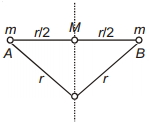
0 likes
View Solution87
MediumMCQ
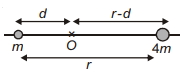
Two point masses having mass $M$ and $4 M$ are placed at a distance $r$. The gravitational potential at a point,where the gravitational field intensity is zero,is ..............
A
$\frac{-9 G M}{r}$
B
$\frac{-2 G M}{3 r}$
C
$\frac{-3 G M}{r}$
D
$\frac{-6 G M}{5 r}$
Solution
(A) Let the point $O$ be at a distance $d$ from mass $M$ and at a distance $(r-d)$ from mass $4M$.
At point $O$,the gravitational field intensity is zero,so the magnitudes of the gravitational fields due to both masses must be equal:
$\frac{G M}{d^2} = \frac{G (4 M)}{(r-d)^2}$
$\Rightarrow \frac{(r-d)^2}{d^2} = 4$
Taking the square root on both sides:
$\frac{r-d}{d} = 2$ (since $d$ must be between the masses,we take the positive root)
$r-d = 2d \Rightarrow 3d = r \Rightarrow d = \frac{r}{3}$
Thus,the distance from mass $4M$ is $r - d = r - \frac{r}{3} = \frac{2r}{3}$.
Now,calculate the gravitational potential $V$ at point $O$:
$V = V_1 + V_2 = -\frac{G M}{d} - \frac{G (4 M)}{(r-d)}$
$V = -\frac{G M}{r/3} - \frac{4 G M}{2r/3}$
$V = -\frac{3 G M}{r} - \frac{6 G M}{r} = -\frac{9 G M}{r}$
At point $O$,the gravitational field intensity is zero,so the magnitudes of the gravitational fields due to both masses must be equal:
$\frac{G M}{d^2} = \frac{G (4 M)}{(r-d)^2}$
$\Rightarrow \frac{(r-d)^2}{d^2} = 4$
Taking the square root on both sides:
$\frac{r-d}{d} = 2$ (since $d$ must be between the masses,we take the positive root)
$r-d = 2d \Rightarrow 3d = r \Rightarrow d = \frac{r}{3}$
Thus,the distance from mass $4M$ is $r - d = r - \frac{r}{3} = \frac{2r}{3}$.
Now,calculate the gravitational potential $V$ at point $O$:
$V = V_1 + V_2 = -\frac{G M}{d} - \frac{G (4 M)}{(r-d)}$
$V = -\frac{G M}{r/3} - \frac{4 G M}{2r/3}$
$V = -\frac{3 G M}{r} - \frac{6 G M}{r} = -\frac{9 G M}{r}$
0 likes
View Solution88
DifficultMCQ
If the potential at the surface of the Earth is assigned a zero value,then the potential at the center of the Earth will be (Mass $= M$,Radius $= R$).
A
$0$
B
$-\frac{GM}{2R}$
C
$-\frac{3GM}{2R}$
D
$\frac{3GM}{2R}$
Solution
(B) The gravitational potential difference between any two points in a gravitational field is independent of the choice of reference point.
When the potential at infinity is assigned a zero value:
Potential at the surface,$V_s = -\frac{GM}{R}$
Potential at the center,$V_c = -\frac{3GM}{2R}$
The potential difference between the surface and the center is:
$V_s - V_c = -\frac{GM}{R} - (-\frac{3GM}{2R}) = -\frac{GM}{R} + \frac{3GM}{2R} = \frac{GM}{2R}$
Now,if the potential at the surface is assigned a zero value $(V_s' = 0)$,let the new potential at the center be $V_c'$.
Since the potential difference remains constant:
$V_s - V_c = V_s' - V_c'$
$\frac{GM}{2R} = 0 - V_c'$
$V_c' = -\frac{GM}{2R}$
Therefore,the potential at the center is $-\frac{GM}{2R}$.
When the potential at infinity is assigned a zero value:
Potential at the surface,$V_s = -\frac{GM}{R}$
Potential at the center,$V_c = -\frac{3GM}{2R}$
The potential difference between the surface and the center is:
$V_s - V_c = -\frac{GM}{R} - (-\frac{3GM}{2R}) = -\frac{GM}{R} + \frac{3GM}{2R} = \frac{GM}{2R}$
Now,if the potential at the surface is assigned a zero value $(V_s' = 0)$,let the new potential at the center be $V_c'$.
Since the potential difference remains constant:
$V_s - V_c = V_s' - V_c'$
$\frac{GM}{2R} = 0 - V_c'$
$V_c' = -\frac{GM}{2R}$
Therefore,the potential at the center is $-\frac{GM}{2R}$.
0 likes
View Solution89
DifficultMCQ
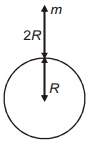
An object is taken to a height of $2R$ above the surface of the Earth. What is the increase in its gravitational potential energy? [$R$ is the radius of the Earth]
A
$\frac{mgR}{2}$
B
$\frac{mgR}{3}$
C
$\frac{2mgR}{3}$
D
$2mgR$
Solution
(C) The gravitational potential energy $U$ of an object of mass $m$ at a distance $r$ from the center of the Earth is given by $U = -\frac{GMm}{r}$.
At the surface of the Earth,the distance from the center is $r_1 = R$. Therefore,the potential energy at the surface is $U_i = -\frac{GMm}{R}$.
At a height of $2R$ above the surface,the distance from the center is $r_2 = R + 2R = 3R$. Therefore,the potential energy at this height is $U_f = -\frac{GMm}{3R}$.
The increase in potential energy is $\Delta U = U_f - U_i = -\frac{GMm}{3R} - (-\frac{GMm}{R}) = \frac{GMm}{R} - \frac{GMm}{3R}$.
Taking $\frac{GMm}{R}$ as a common factor,we get $\Delta U = \frac{GMm}{R} (1 - \frac{1}{3}) = \frac{GMm}{R} (\frac{2}{3}) = \frac{2}{3} \frac{GMm}{R}$.
Since the acceleration due to gravity at the surface is $g = \frac{GM}{R^2}$,we can write $GM = gR^2$.
Substituting this into the expression for $\Delta U$,we get $\Delta U = \frac{2}{3} \frac{(gR^2)m}{R} = \frac{2}{3} mgR$.
At the surface of the Earth,the distance from the center is $r_1 = R$. Therefore,the potential energy at the surface is $U_i = -\frac{GMm}{R}$.
At a height of $2R$ above the surface,the distance from the center is $r_2 = R + 2R = 3R$. Therefore,the potential energy at this height is $U_f = -\frac{GMm}{3R}$.
The increase in potential energy is $\Delta U = U_f - U_i = -\frac{GMm}{3R} - (-\frac{GMm}{R}) = \frac{GMm}{R} - \frac{GMm}{3R}$.
Taking $\frac{GMm}{R}$ as a common factor,we get $\Delta U = \frac{GMm}{R} (1 - \frac{1}{3}) = \frac{GMm}{R} (\frac{2}{3}) = \frac{2}{3} \frac{GMm}{R}$.
Since the acceleration due to gravity at the surface is $g = \frac{GM}{R^2}$,we can write $GM = gR^2$.
Substituting this into the expression for $\Delta U$,we get $\Delta U = \frac{2}{3} \frac{(gR^2)m}{R} = \frac{2}{3} mgR$.
0 likes
View Solution90
MediumMCQ
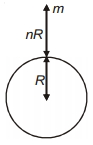
The change in potential energy when a body of mass $m$ is raised to a height $n R$ from the earth's surface is (where $R$ is the radius of the earth).
A
$m g R \left( \frac{n}{n-1} \right)$
B
$n m g R$
C
$m g R \left( \frac{n}{n+1} \right)$
D
$m g R \left( \frac{n^2}{n^2+1} \right)$
Solution
(C) The gravitational potential energy of a body of mass $m$ at a distance $r$ from the center of the earth is given by $U = -\frac{G M m}{r}$.
At the earth's surface,the distance from the center is $r_1 = R$. Therefore,the potential energy at the surface is $U_i = -\frac{G M m}{R}$.
When the body is raised to a height $h = n R$ from the surface,the distance from the center of the earth becomes $r_2 = R + n R = (n+1) R$. Therefore,the potential energy at this height is $U_f = -\frac{G M m}{(n+1) R}$.
The change in potential energy is $\Delta U = U_f - U_i = -\frac{G M m}{(n+1) R} - \left( -\frac{G M m}{R} \right)$.
$\Delta U = \frac{G M m}{R} - \frac{G M m}{(n+1) R} = \frac{G M m}{R} \left( 1 - \frac{1}{n+1} \right)$.
$\Delta U = \frac{G M m}{R} \left( \frac{n+1-1}{n+1} \right) = \frac{G M m}{R} \left( \frac{n}{n+1} \right)$.
Since the acceleration due to gravity at the surface is $g = \frac{G M}{R^2}$,we can write $G M = g R^2$.
Substituting this into the expression for $\Delta U$:
$\Delta U = \frac{(g R^2) m}{R} \left( \frac{n}{n+1} \right) = m g R \left( \frac{n}{n+1} \right)$.
At the earth's surface,the distance from the center is $r_1 = R$. Therefore,the potential energy at the surface is $U_i = -\frac{G M m}{R}$.
When the body is raised to a height $h = n R$ from the surface,the distance from the center of the earth becomes $r_2 = R + n R = (n+1) R$. Therefore,the potential energy at this height is $U_f = -\frac{G M m}{(n+1) R}$.
The change in potential energy is $\Delta U = U_f - U_i = -\frac{G M m}{(n+1) R} - \left( -\frac{G M m}{R} \right)$.
$\Delta U = \frac{G M m}{R} - \frac{G M m}{(n+1) R} = \frac{G M m}{R} \left( 1 - \frac{1}{n+1} \right)$.
$\Delta U = \frac{G M m}{R} \left( \frac{n+1-1}{n+1} \right) = \frac{G M m}{R} \left( \frac{n}{n+1} \right)$.
Since the acceleration due to gravity at the surface is $g = \frac{G M}{R^2}$,we can write $G M = g R^2$.
Substituting this into the expression for $\Delta U$:
$\Delta U = \frac{(g R^2) m}{R} \left( \frac{n}{n+1} \right) = m g R \left( \frac{n}{n+1} \right)$.
0 likes
View Solution91
DifficultMCQ
If the potential energy of a body of mass $m$ on the surface of the Earth is taken as zero,then its potential energy at height $h$ above the surface of the Earth is ($R$ is the radius of the Earth and $M$ is the mass of the Earth).
A
$\frac{-G M m}{R+h}$
B
$\frac{-G M m}{h}$
C
$\frac{G M m h}{R(R+h)}$
D
$\frac{G M m h}{h+2 R}$
Solution
(C) The gravitational potential energy difference between any two points in a gravitational field is independent of the choice of reference point.
When the potential energy at infinity is taken as zero,the potential energy of a body of mass $m$ at a distance $r$ from the center of the Earth is given by $U = -\frac{G M m}{r}$.
Potential energy at the surface of the Earth $(r = R)$: $U_s = -\frac{G M m}{R}$.
Potential energy at height $h$ above the surface $(r = R+h)$: $U_h = -\frac{G M m}{R+h}$.
The difference in potential energy between the surface and height $h$ is:
$\Delta U = U_h - U_s = -\frac{G M m}{R+h} - \left(-\frac{G M m}{R}\right) = G M m \left( \frac{1}{R} - \frac{1}{R+h} \right)$.
Simplifying the expression:
$\Delta U = G M m \left( \frac{R+h-R}{R(R+h)} \right) = \frac{G M m h}{R(R+h)}$.
If the potential energy at the surface is taken as zero $(U_s' = 0)$,then the new potential energy at height $h$ $(U_h')$ is defined by the same difference:
$U_h' - U_s' = \Delta U$
$U_h' - 0 = \frac{G M m h}{R(R+h)}$.
Therefore,the potential energy at height $h$ is $\frac{G M m h}{R(R+h)}$.
When the potential energy at infinity is taken as zero,the potential energy of a body of mass $m$ at a distance $r$ from the center of the Earth is given by $U = -\frac{G M m}{r}$.
Potential energy at the surface of the Earth $(r = R)$: $U_s = -\frac{G M m}{R}$.
Potential energy at height $h$ above the surface $(r = R+h)$: $U_h = -\frac{G M m}{R+h}$.
The difference in potential energy between the surface and height $h$ is:
$\Delta U = U_h - U_s = -\frac{G M m}{R+h} - \left(-\frac{G M m}{R}\right) = G M m \left( \frac{1}{R} - \frac{1}{R+h} \right)$.
Simplifying the expression:
$\Delta U = G M m \left( \frac{R+h-R}{R(R+h)} \right) = \frac{G M m h}{R(R+h)}$.
If the potential energy at the surface is taken as zero $(U_s' = 0)$,then the new potential energy at height $h$ $(U_h')$ is defined by the same difference:
$U_h' - U_s' = \Delta U$
$U_h' - 0 = \frac{G M m h}{R(R+h)}$.
Therefore,the potential energy at height $h$ is $\frac{G M m h}{R(R+h)}$.
0 likes
View Solution92
MediumMCQ
$A$ body of mass $m$ is taken from the Earth's surface to a height $h$ equal to twice the radius of the Earth $(R_e)$. The increase in potential energy will be: (where $g$ is the acceleration due to gravity on the surface of the Earth)
A
$3 mgR_e$
B
$\frac{1}{3} mgR_e$
C
$\frac{2}{3} mgR_e$
D
$\frac{1}{2} mgR_e$
Solution
(C) The gravitational potential energy of a body of mass $m$ at a distance $r$ from the center of the Earth is given by $U = -\frac{GM_e m}{r}$.
Initial potential energy at the surface $(r = R_e)$ is $U_i = -\frac{GM_e m}{R_e}$.
Final potential energy at height $h = 2R_e$ $(r = R_e + h = 3R_e)$ is $U_f = -\frac{GM_e m}{3R_e}$.
The increase in potential energy is $\Delta U = U_f - U_i$.
$\Delta U = -\frac{GM_e m}{3R_e} - (-\frac{GM_e m}{R_e}) = \frac{GM_e m}{R_e} (1 - \frac{1}{3}) = \frac{2}{3} \frac{GM_e m}{R_e}$.
Since $g = \frac{GM_e}{R_e^2}$,we have $GM_e = gR_e^2$.
Substituting this into the expression: $\Delta U = \frac{2}{3} \frac{(gR_e^2)m}{R_e} = \frac{2}{3} mgR_e$.
Initial potential energy at the surface $(r = R_e)$ is $U_i = -\frac{GM_e m}{R_e}$.
Final potential energy at height $h = 2R_e$ $(r = R_e + h = 3R_e)$ is $U_f = -\frac{GM_e m}{3R_e}$.
The increase in potential energy is $\Delta U = U_f - U_i$.
$\Delta U = -\frac{GM_e m}{3R_e} - (-\frac{GM_e m}{R_e}) = \frac{GM_e m}{R_e} (1 - \frac{1}{3}) = \frac{2}{3} \frac{GM_e m}{R_e}$.
Since $g = \frac{GM_e}{R_e^2}$,we have $GM_e = gR_e^2$.
Substituting this into the expression: $\Delta U = \frac{2}{3} \frac{(gR_e^2)m}{R_e} = \frac{2}{3} mgR_e$.
0 likes
View Solution93
DifficultMCQ
If the gravitational field in space is given as $E = -\frac{K}{r^2}$. Taking the reference point at $r = 2\,cm$ with gravitational potential $V = 10\,J/kg$. Find the gravitational potential at $r = 3\,cm$ in $SI$ units. (Given: $K = 6\,J\cdot cm/kg$)
A
$9$
B
$11$
C
$12$
D
$10$
Solution
(B) The relationship between gravitational field $E$ and potential $V$ is given by $E = -\frac{dV}{dr}$.
Given $E = -\frac{K}{r^2}$,we have $-\frac{dV}{dr} = -\frac{K}{r^2}$,which implies $dV = \frac{K}{r^2} dr$.
Integrating both sides from the reference point $(r_1 = 2\,cm, V_1 = 10\,J/kg)$ to the target point $(r_2 = 3\,cm, V_2 = V)$:
$\int_{10}^{V} dV = \int_{2}^{3} \frac{K}{r^2} dr$.
$V - 10 = K \left[ -\frac{1}{r} \right]_{2}^{3} = K \left( -\frac{1}{3} - (-\frac{1}{2}) \right) = K \left( \frac{1}{2} - \frac{1}{3} \right) = K \left( \frac{1}{6} \right)$.
Substituting $K = 6\,J\cdot cm/kg$:
$V - 10 = 6 \times \frac{1}{6} = 1$.
$V = 10 + 1 = 11\,J/kg$.
Given $E = -\frac{K}{r^2}$,we have $-\frac{dV}{dr} = -\frac{K}{r^2}$,which implies $dV = \frac{K}{r^2} dr$.
Integrating both sides from the reference point $(r_1 = 2\,cm, V_1 = 10\,J/kg)$ to the target point $(r_2 = 3\,cm, V_2 = V)$:
$\int_{10}^{V} dV = \int_{2}^{3} \frac{K}{r^2} dr$.
$V - 10 = K \left[ -\frac{1}{r} \right]_{2}^{3} = K \left( -\frac{1}{3} - (-\frac{1}{2}) \right) = K \left( \frac{1}{2} - \frac{1}{3} \right) = K \left( \frac{1}{6} \right)$.
Substituting $K = 6\,J\cdot cm/kg$:
$V - 10 = 6 \times \frac{1}{6} = 1$.
$V = 10 + 1 = 11\,J/kg$.
0 likes
View Solution94
DifficultMCQ
If $V$ is the gravitational potential due to a sphere of uniform density on its surface,then its value at the center of the sphere will be:
A
$\frac{3 V}{2}$
B
$V$
C
$\frac{4}{3} V$
D
$\frac{V}{2}$
Solution
(A) The gravitational potential $V$ inside a uniform solid sphere at a distance $r$ from the center is given by $V(r) = \frac{GM}{2R^3}(3R^2 - r^2)$.
At the surface,$r = R$,so $V_{surface} = \frac{GM}{2R^3}(3R^2 - R^2) = \frac{GM}{2R^3}(2R^2) = \frac{GM}{R} = V$.
At the center,$r = 0$,so $V_{center} = \frac{GM}{2R^3}(3R^2 - 0) = \frac{3GM}{2R}$.
Substituting $V = \frac{GM}{R}$,we get $V_{center} = \frac{3}{2} V$.
At the surface,$r = R$,so $V_{surface} = \frac{GM}{2R^3}(3R^2 - R^2) = \frac{GM}{2R^3}(2R^2) = \frac{GM}{R} = V$.
At the center,$r = 0$,so $V_{center} = \frac{GM}{2R^3}(3R^2 - 0) = \frac{3GM}{2R}$.
Substituting $V = \frac{GM}{R}$,we get $V_{center} = \frac{3}{2} V$.
2 likes
View Solution95
MediumMCQ
Two bodies of mass $m$ and $9 m$ are placed at a distance $R$. The gravitational potential on the line joining the bodies where the gravitational field equals zero,will be ($G=$ gravitational constant):
A
$-\frac{20 G m}{R}$
B
$-\frac{8 G m}{R}$
C
$-\frac{12 G m}{R}$
D
$-\frac{16 G m}{R}$
Solution
(D) Let the point $P$ be the neutral point where the gravitational field is zero. Let $r_1$ be the distance from mass $m$ and $r_2$ be the distance from mass $9m$.
The condition for zero gravitational field is:
$\frac{G m}{r_1^2} = \frac{G (9m)}{r_2^2}$
$\frac{1}{r_1^2} = \frac{9}{r_2^2} \implies \frac{r_2}{r_1} = 3 \implies r_2 = 3 r_1$
Since $r_1 + r_2 = R$,we have $r_1 + 3 r_1 = R \implies 4 r_1 = R \implies r_1 = \frac{R}{4}$ and $r_2 = \frac{3R}{4}$.
The gravitational potential $V$ at point $P$ is the sum of potentials due to both masses:
$V = -\frac{G m}{r_1} - \frac{G (9m)}{r_2}$
$V = -\frac{G m}{R/4} - \frac{9 G m}{3R/4}$
$V = -\frac{4 G m}{R} - \frac{36 G m}{3R} = -\frac{4 G m}{R} - \frac{12 G m}{R}$
$V = -\frac{16 G m}{R}$
The condition for zero gravitational field is:
$\frac{G m}{r_1^2} = \frac{G (9m)}{r_2^2}$
$\frac{1}{r_1^2} = \frac{9}{r_2^2} \implies \frac{r_2}{r_1} = 3 \implies r_2 = 3 r_1$
Since $r_1 + r_2 = R$,we have $r_1 + 3 r_1 = R \implies 4 r_1 = R \implies r_1 = \frac{R}{4}$ and $r_2 = \frac{3R}{4}$.
The gravitational potential $V$ at point $P$ is the sum of potentials due to both masses:
$V = -\frac{G m}{r_1} - \frac{G (9m)}{r_2}$
$V = -\frac{G m}{R/4} - \frac{9 G m}{3R/4}$
$V = -\frac{4 G m}{R} - \frac{36 G m}{3R} = -\frac{4 G m}{R} - \frac{12 G m}{R}$
$V = -\frac{16 G m}{R}$
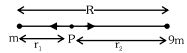
0 likes
View Solution96
AdvancedMCQ
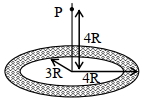
$A$ thin uniform annular disc (see figure) of mass $M$ has outer radius $4 R$ and inner radius $3 R$. The work required to take a unit mass from point $P$ on its axis to infinity is
A
$\frac{2 GM}{7 R}(4 \sqrt{2}-5)$
B
$-\frac{2 GM}{7 R}(4 \sqrt{2}-5)$
C
$\frac{GM}{4 R}$
D
$\frac{2 GM}{5 R}(\sqrt{2}-1)$
Solution
(A) The surface mass density $\sigma$ of the annular disc is $\sigma = \frac{M}{\pi(4R)^2 - \pi(3R)^2} = \frac{M}{7\pi R^2}$.
Consider a thin ring element of radius $r$ and width $dr$. The mass of this element is $dm = \sigma (2\pi r dr)$.
The gravitational potential $V_P$ at point $P$ (at distance $h=4R$ from the center) due to this ring is $dV_P = -\frac{G dm}{\sqrt{r^2 + h^2}} = -\frac{G \sigma 2\pi r dr}{\sqrt{r^2 + (4R)^2}}$.
Integrating from $r=3R$ to $r=4R$:
$V_P = -\int_{3R}^{4R} \frac{G \sigma 2\pi r dr}{\sqrt{r^2 + 16R^2}} = -2\pi G \sigma [\sqrt{r^2 + 16R^2}]_{3R}^{4R}$.
$V_P = -2\pi G \left(\frac{M}{7\pi R^2}\right) [\sqrt{16R^2 + 16R^2} - \sqrt{9R^2 + 16R^2}] = -\frac{2GM}{7R^2} [4R\sqrt{2} - 5R] = -\frac{2GM}{7R}(4\sqrt{2}-5)$.
The work required to move a unit mass from $P$ to infinity is $W = U_{\infty} - U_P = 1 \cdot V_{\infty} - 1 \cdot V_P = 0 - V_P = -V_P$.
Therefore,$W = \frac{2GM}{7R}(4\sqrt{2}-5)$.
Consider a thin ring element of radius $r$ and width $dr$. The mass of this element is $dm = \sigma (2\pi r dr)$.
The gravitational potential $V_P$ at point $P$ (at distance $h=4R$ from the center) due to this ring is $dV_P = -\frac{G dm}{\sqrt{r^2 + h^2}} = -\frac{G \sigma 2\pi r dr}{\sqrt{r^2 + (4R)^2}}$.
Integrating from $r=3R$ to $r=4R$:
$V_P = -\int_{3R}^{4R} \frac{G \sigma 2\pi r dr}{\sqrt{r^2 + 16R^2}} = -2\pi G \sigma [\sqrt{r^2 + 16R^2}]_{3R}^{4R}$.
$V_P = -2\pi G \left(\frac{M}{7\pi R^2}\right) [\sqrt{16R^2 + 16R^2} - \sqrt{9R^2 + 16R^2}] = -\frac{2GM}{7R^2} [4R\sqrt{2} - 5R] = -\frac{2GM}{7R}(4\sqrt{2}-5)$.
The work required to move a unit mass from $P$ to infinity is $W = U_{\infty} - U_P = 1 \cdot V_{\infty} - 1 \cdot V_P = 0 - V_P = -V_P$.
Therefore,$W = \frac{2GM}{7R}(4\sqrt{2}-5)$.
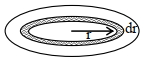
0 likes
View Solution97
MediumMCQ
Compare the gravitational potential at the center $O$ for the given arcs,each having mass $M$ and radius $R$.
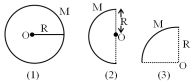
A
$(V_O)_1 > (V_O)_2 > (V_O)_3$
B
$(V_O)_3 > (V_O)_2 > (V_O)_1$
C
$(V_O)_1 = (V_O)_2 = (V_O)_3$
D
$(2 V_O)_1 > (V_O)_2 > (3 V_O)_3$
Solution
(C) The gravitational potential $V$ at a point due to a mass element $dm$ at a distance $r$ is given by $dV = -\frac{G dm}{r}$.
For an arc of mass $M$ and radius $R$,every mass element $dm$ of the arc is at the same distance $R$ from the center $O$.
Therefore,the gravitational potential at the center $O$ is the integral of the potential due to all mass elements: $V_O = \int dV = \int -\frac{G dm}{R} = -\frac{G}{R} \int dm = -\frac{GM}{R}$.
Since the potential depends only on the total mass $M$ and the distance $R$,and both are identical for all three arcs,the gravitational potential at the center is the same for all three cases.
Thus,$(V_O)_1 = (V_O)_2 = (V_O)_3$.
For an arc of mass $M$ and radius $R$,every mass element $dm$ of the arc is at the same distance $R$ from the center $O$.
Therefore,the gravitational potential at the center $O$ is the integral of the potential due to all mass elements: $V_O = \int dV = \int -\frac{G dm}{R} = -\frac{G}{R} \int dm = -\frac{GM}{R}$.
Since the potential depends only on the total mass $M$ and the distance $R$,and both are identical for all three arcs,the gravitational potential at the center is the same for all three cases.
Thus,$(V_O)_1 = (V_O)_2 = (V_O)_3$.
0 likes
View SolutionGravitation — Gravitational Potential and Potential Energy of system · Frequently Asked Questions
1Are these Gravitation questions useful for JEE and NEET?
Yes. All questions in this section are mapped to JEE Main and NEET exam patterns. Previous year questions from JEE Main, NEET, GUJCET and state-level exams are included with full solutions.
2Can I switch to Hindi or Gujarati for these questions?
Yes. Use the language tabs in the hero section or the sidebar to view the same questions and solutions in English, Hindi or Gujarati.
3How do I generate a question paper from this subtopic?
Use the Vedclass Exam Paper Generator — select the chapter and subtopic, set difficulty, and generate Sets A, B, C, D automatically. First 3 chapters of every subject are free.
Vedclass Products
For Students
Vedclass Test Series
Mock tests in real JEE/NEET style with performance analysis. 5-day free trial.
Start Free TrialFor Teachers
Exam Paper Generator
Generate Set A/B/C/D papers from this chapter in 2 minutes. 3 chapters free.
Try FreeFor Institutes
Online Exam Module
Live online exams with unlimited students, 360° analytics & white-label branding.
See DemoFor Teachers & Institutes
Generate a Gravitation Exam Paper in 2 Minutes
Select subtopic & difficulty — Sets A, B, C, D auto-generated with No Repeat logic.
First 3 chapters of every subject are free — no payment required.