
A English
Gravitational Potential and Potential Energy of system Questions in English
Class 11 Physics · Gravitation · Gravitational Potential and Potential Energy of system
128+
Questions
English
Language
100%
With Solutions
Showing 49 of 128 questions in English
1
EasyMCQ
The $S.I.$ unit of gravitational potential is
A
$J$
B
$J \cdot kg^{-1}$
C
$J \cdot kg$
D
$J \cdot kg^{-2}$
Solution
(B) Gravitational potential $V$ at a point is defined as the work done per unit mass in bringing a test mass from infinity to that point.
Mathematically,$V = \frac{W}{m}$,where $W$ is work done and $m$ is mass.
The $S.I.$ unit of work $W$ is Joule $(J)$ and the $S.I.$ unit of mass $m$ is kilogram $(kg)$.
Therefore,the $S.I.$ unit of gravitational potential is $\frac{J}{kg} = J \cdot kg^{-1}$.
Mathematically,$V = \frac{W}{m}$,where $W$ is work done and $m$ is mass.
The $S.I.$ unit of work $W$ is Joule $(J)$ and the $S.I.$ unit of mass $m$ is kilogram $(kg)$.
Therefore,the $S.I.$ unit of gravitational potential is $\frac{J}{kg} = J \cdot kg^{-1}$.
0 likes
View Solution2
EasyMCQ
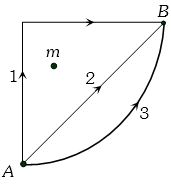
If $W_1, W_2$ and $W_3$ represent the work done in moving a particle from $A$ to $B$ along three different paths $1, 2$ and $3$ respectively (as shown) in the gravitational field of a point mass $m$,find the correct relation between $W_1, W_2$ and $W_3$.
A
$W_1 > W_2 > W_3$
B
$W_1 = W_2 = W_3$
C
$W_1 < W_2 < W_3$
D
$W_2 > W_1 > W_3$
Solution
(B) The gravitational force is a conservative force.
By definition,the work done by or against a conservative force in moving a particle between two points depends only on the initial and final positions of the particle,not on the path taken.
Since all three paths $1, 2$ and $3$ start at point $A$ and end at point $B$,the work done along each path must be equal.
Therefore,$W_1 = W_2 = W_3$.
By definition,the work done by or against a conservative force in moving a particle between two points depends only on the initial and final positions of the particle,not on the path taken.
Since all three paths $1, 2$ and $3$ start at point $A$ and end at point $B$,the work done along each path must be equal.
Therefore,$W_1 = W_2 = W_3$.
0 likes
View Solution3
MediumMCQ
$A$ body of mass $m$ rises to a height $h = R/5$ from the earth's surface,where $R$ is the earth's radius. If $g$ is the acceleration due to gravity at the earth's surface,the increase in potential energy is:
A
$mgh$
B
$\frac{4}{5}mgh$
C
$\frac{5}{6}mgh$
D
$\frac{6}{7}mgh$
Solution
(C) The gravitational potential energy at the surface of the earth is $U_i = -\frac{GMm}{R}$.
At height $h$,the potential energy is $U_f = -\frac{GMm}{R+h}$.
The increase in potential energy is $\Delta U = U_f - U_i = GMm \left( \frac{1}{R} - \frac{1}{R+h} \right) = GMm \left( \frac{h}{R(R+h)} \right)$.
Since $g = \frac{GM}{R^2}$,we have $GM = gR^2$.
Substituting $GM$,we get $\Delta U = \frac{gR^2 mh}{R(R+h)} = \frac{mgh}{1 + h/R}$.
Given $h = R/5$,so $h/R = 1/5$.
Therefore,$\Delta U = \frac{mgh}{1 + 1/5} = \frac{mgh}{6/5} = \frac{5}{6}mgh$.
At height $h$,the potential energy is $U_f = -\frac{GMm}{R+h}$.
The increase in potential energy is $\Delta U = U_f - U_i = GMm \left( \frac{1}{R} - \frac{1}{R+h} \right) = GMm \left( \frac{h}{R(R+h)} \right)$.
Since $g = \frac{GM}{R^2}$,we have $GM = gR^2$.
Substituting $GM$,we get $\Delta U = \frac{gR^2 mh}{R(R+h)} = \frac{mgh}{1 + h/R}$.
Given $h = R/5$,so $h/R = 1/5$.
Therefore,$\Delta U = \frac{mgh}{1 + 1/5} = \frac{mgh}{6/5} = \frac{5}{6}mgh$.
0 likes
View Solution4
EasyMCQ
In a gravitational field,at a point where the gravitational potential is zero,
A
The gravitational field is necessarily zero
B
The gravitational field is not necessarily zero
C
Nothing can be said definitely about the gravitational field
D
None of these
Solution
(B) The relationship between the gravitational field $I$ and the gravitational potential $V$ is given by the formula $I = -\frac{dV}{dr}$.
This implies that the gravitational field is the negative gradient of the gravitational potential.
However,it is a common misconception that $V = 0$ implies $I = 0$. For example,consider the gravitational potential at the center of a spherical shell or between two point masses; the potential can be zero at a point where the field is non-zero.
Therefore,the gravitational field is not necessarily zero just because the gravitational potential is zero.
This implies that the gravitational field is the negative gradient of the gravitational potential.
However,it is a common misconception that $V = 0$ implies $I = 0$. For example,consider the gravitational potential at the center of a spherical shell or between two point masses; the potential can be zero at a point where the field is non-zero.
Therefore,the gravitational field is not necessarily zero just because the gravitational potential is zero.
0 likes
View Solution5
MediumMCQ
The gravitational field due to a mass distribution is $E = K/x^3$ in the $X$-direction ($K$ is a constant). Taking the gravitational potential to be zero at infinity,its value at a distance $x$ is:
A
$K/x$
B
$K/2x$
C
$K/x^2$
D
$K/2x^2$
Solution
(D) The gravitational potential $V(x)$ is defined as the negative integral of the gravitational field $E$ from infinity to the point $x$:
$V(x) = -\int_{\infty}^{x} E \, dx$
Given $E = K/x^3$,we have:
$V(x) = -\int_{\infty}^{x} \frac{K}{x^3} \, dx$
$V(x) = -K \int_{\infty}^{x} x^{-3} \, dx$
$V(x) = -K \left[ \frac{x^{-2}}{-2} \right]_{\infty}^{x}$
$V(x) = \frac{K}{2} \left[ \frac{1}{x^2} \right]_{\infty}^{x}$
$V(x) = \frac{K}{2} \left( \frac{1}{x^2} - 0 \right) = \frac{K}{2x^2}$
$V(x) = -\int_{\infty}^{x} E \, dx$
Given $E = K/x^3$,we have:
$V(x) = -\int_{\infty}^{x} \frac{K}{x^3} \, dx$
$V(x) = -K \int_{\infty}^{x} x^{-3} \, dx$
$V(x) = -K \left[ \frac{x^{-2}}{-2} \right]_{\infty}^{x}$
$V(x) = \frac{K}{2} \left[ \frac{1}{x^2} \right]_{\infty}^{x}$
$V(x) = \frac{K}{2} \left( \frac{1}{x^2} - 0 \right) = \frac{K}{2x^2}$
0 likes
View Solution6
EasyMCQ
The mass of the earth is $6.00 \times 10^{24} \ kg$ and that of the moon is $7.40 \times 10^{22} \ kg$. The gravitational constant is $G = 6.67 \times 10^{-11} \ N \cdot m^2/kg^2$. The potential energy of the system is $-7.79 \times 10^{28} \ J$. The mean distance between the earth and the moon is:
A
$3.80 \times 10^8 \ m$
B
$3.37 \times 10^6 \ m$
C
$7.60 \times 10^4 \ m$
D
$1.90 \times 10^2 \ m$
Solution
(A) The gravitational potential energy $U$ of a system of two masses $M$ and $m$ separated by a distance $r$ is given by the formula: $U = -\frac{GMm}{r}$.
Given:
$M = 6.00 \times 10^{24} \ kg$
$m = 7.40 \times 10^{22} \ kg$
$G = 6.67 \times 10^{-11} \ N \cdot m^2/kg^2$
$U = -7.79 \times 10^{28} \ J$
Rearranging the formula to solve for $r$:
$r = -\frac{GMm}{U}$
Substituting the values:
$r = \frac{6.67 \times 10^{-11} \times 6.00 \times 10^{24} \times 7.40 \times 10^{22}}{7.79 \times 10^{28}}$
$r = \frac{296.196 \times 10^{35}}{7.79 \times 10^{28}}$
$r \approx 38.02 \times 10^7 \ m = 3.80 \times 10^8 \ m$.
Given:
$M = 6.00 \times 10^{24} \ kg$
$m = 7.40 \times 10^{22} \ kg$
$G = 6.67 \times 10^{-11} \ N \cdot m^2/kg^2$
$U = -7.79 \times 10^{28} \ J$
Rearranging the formula to solve for $r$:
$r = -\frac{GMm}{U}$
Substituting the values:
$r = \frac{6.67 \times 10^{-11} \times 6.00 \times 10^{24} \times 7.40 \times 10^{22}}{7.79 \times 10^{28}}$
$r = \frac{296.196 \times 10^{35}}{7.79 \times 10^{28}}$
$r \approx 38.02 \times 10^7 \ m = 3.80 \times 10^8 \ m$.
0 likes
View Solution7
EasyMCQ
If the mass of the Earth is $M$,its radius is $R$,and the gravitational constant is $G$,then the work done to take a $1 \, kg$ mass from the Earth's surface to infinity will be:
A
$\sqrt{\frac{GM}{2R}}$
B
$\frac{GM}{R}$
C
$\sqrt{\frac{2GM}{R}}$
D
$\frac{GM}{2R}$
Solution
(B) The gravitational potential energy $U$ of a mass $m$ at a distance $r$ from the center of the Earth is given by $U = -\frac{GMm}{r}$.
At the surface of the Earth,$r = R$ and $m = 1 \, kg$,so the initial potential energy is $U_i = -\frac{GM(1)}{R} = -\frac{GM}{R}$.
At infinity,the distance $r = \infty$,so the final potential energy is $U_f = -\frac{GM(1)}{\infty} = 0$.
The work done $W$ is equal to the change in potential energy: $W = U_f - U_i$.
$W = 0 - (-\frac{GM}{R}) = \frac{GM}{R}$.
At the surface of the Earth,$r = R$ and $m = 1 \, kg$,so the initial potential energy is $U_i = -\frac{GM(1)}{R} = -\frac{GM}{R}$.
At infinity,the distance $r = \infty$,so the final potential energy is $U_f = -\frac{GM(1)}{\infty} = 0$.
The work done $W$ is equal to the change in potential energy: $W = U_f - U_i$.
$W = 0 - (-\frac{GM}{R}) = \frac{GM}{R}$.
0 likes
View Solution8
MediumMCQ
The gravitational potential energy of a body of mass $m$ at the earth's surface is $-mgR_e$. Its gravitational potential energy at a height $R_e$ from the earth's surface will be (Here $R_e$ is the radius of the earth).
A
$-2mgR_e$
B
$2mgR_e$
C
$\frac{1}{2}mgR_e$
D
$-\frac{1}{2}mgR_e$
Solution
(D) The gravitational potential energy $U$ at a distance $r$ from the center of the earth is given by $U = -\frac{GMm}{r}$.
At the earth's surface,$r = R_e$,so $U_1 = -\frac{GMm}{R_e} = -mgR_e$ (since $g = \frac{GM}{R_e^2}$).
At a height $h = R_e$ from the surface,the distance from the center is $r = R_e + h = R_e + R_e = 2R_e$.
The potential energy at this height is $U_2 = -\frac{GMm}{2R_e}$.
Substituting $GM = gR_e^2$,we get $U_2 = -\frac{(gR_e^2)m}{2R_e} = -\frac{1}{2}mgR_e$.
At the earth's surface,$r = R_e$,so $U_1 = -\frac{GMm}{R_e} = -mgR_e$ (since $g = \frac{GM}{R_e^2}$).
At a height $h = R_e$ from the surface,the distance from the center is $r = R_e + h = R_e + R_e = 2R_e$.
The potential energy at this height is $U_2 = -\frac{GMm}{2R_e}$.
Substituting $GM = gR_e^2$,we get $U_2 = -\frac{(gR_e^2)m}{2R_e} = -\frac{1}{2}mgR_e$.
0 likes
View Solution9
EasyMCQ
In some region,the gravitational field is zero. The gravitational potential in this region
A
Must be variable
B
Must be constant
C
Cannot be zero
D
Must be zero
Solution
(B) The relationship between gravitational field $I$ and gravitational potential $V$ is given by the formula $I = -\frac{dV}{dr}$.
Given that the gravitational field $I = 0$ in the region.
Substituting this into the formula,we get $0 = -\frac{dV}{dr}$,which implies $\frac{dV}{dr} = 0$.
Since the derivative of the potential with respect to distance is zero,the gravitational potential $V$ must be constant throughout that region.
Given that the gravitational field $I = 0$ in the region.
Substituting this into the formula,we get $0 = -\frac{dV}{dr}$,which implies $\frac{dV}{dr} = 0$.
Since the derivative of the potential with respect to distance is zero,the gravitational potential $V$ must be constant throughout that region.
0 likes
View Solution10
MediumMCQ
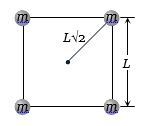
Four particles,each of mass $M$,are located at the vertices of a square with side $L$. The gravitational potential due to this system at the centre of the square is:
A
$ - \sqrt{32} \frac{GM}{L} $
B
$ - \sqrt{64} \frac{GM}{L^2} $
C
Zero
D
$ \sqrt{32} \frac{GM}{L} $
Solution
(A) The distance from each vertex of the square to its centre is $r = \frac{L}{\sqrt{2}}$.
Gravitational potential $V$ due to a single mass $M$ at a distance $r$ is given by $V = -\frac{GM}{r}$.
Substituting $r = \frac{L}{\sqrt{2}}$,the potential due to one particle is $V_1 = -\frac{GM}{L/\sqrt{2}} = -\frac{\sqrt{2}GM}{L}$.
Since there are four such particles,the total gravitational potential at the centre is $V_{total} = 4 \times V_1$.
$V_{total} = 4 \times \left( -\frac{\sqrt{2}GM}{L} \right) = -\frac{4\sqrt{2}GM}{L}$.
Since $4\sqrt{2} = \sqrt{16 \times 2} = \sqrt{32}$,the total potential is $V_{total} = -\sqrt{32} \frac{GM}{L}$.
Gravitational potential $V$ due to a single mass $M$ at a distance $r$ is given by $V = -\frac{GM}{r}$.
Substituting $r = \frac{L}{\sqrt{2}}$,the potential due to one particle is $V_1 = -\frac{GM}{L/\sqrt{2}} = -\frac{\sqrt{2}GM}{L}$.
Since there are four such particles,the total gravitational potential at the centre is $V_{total} = 4 \times V_1$.
$V_{total} = 4 \times \left( -\frac{\sqrt{2}GM}{L} \right) = -\frac{4\sqrt{2}GM}{L}$.
Since $4\sqrt{2} = \sqrt{16 \times 2} = \sqrt{32}$,the total potential is $V_{total} = -\sqrt{32} \frac{GM}{L}$.
0 likes
View Solution11
MediumMCQ
Potential energy of a satellite having mass $m$ and rotating at a height of $6.4 \times 10^6 \ m$ from the Earth's surface is
A
$ - 0.5 \, mgR_e $
B
$ - mgR_e $
C
$ - 2 \, mgR_e $
D
$ 4 \, mgR_e $
Solution
(A) The potential energy $U$ of a satellite of mass $m$ at a distance $r$ from the center of the Earth is given by $U = -\frac{GMm}{r}$.
Here,$r = R_e + h$,where $R_e$ is the radius of the Earth and $h$ is the height of the satellite.
Given $h = 6.4 \times 10^6 \ m$ and $R_e \approx 6.4 \times 10^6 \ m$,we have $r = R_e + R_e = 2R_e$.
Using the relation $g = \frac{GM}{R_e^2}$,we can write $GM = gR_e^2$.
Substituting these into the potential energy formula:
$U = -\frac{(gR_e^2)m}{2R_e} = -\frac{1}{2}mgR_e = -0.5 \, mgR_e$.
Here,$r = R_e + h$,where $R_e$ is the radius of the Earth and $h$ is the height of the satellite.
Given $h = 6.4 \times 10^6 \ m$ and $R_e \approx 6.4 \times 10^6 \ m$,we have $r = R_e + R_e = 2R_e$.
Using the relation $g = \frac{GM}{R_e^2}$,we can write $GM = gR_e^2$.
Substituting these into the potential energy formula:
$U = -\frac{(gR_e^2)m}{2R_e} = -\frac{1}{2}mgR_e = -0.5 \, mgR_e$.
0 likes
View Solution12
DifficultMCQ
The diagram showing the variation of gravitational potential of Earth with distance from the centre of Earth is
A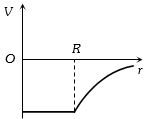
B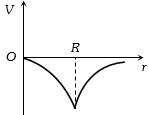
C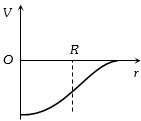
D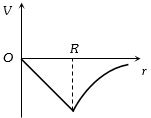
Solution
(C) The gravitational potential $V$ of a spherical body of mass $M$ and radius $R$ is given by:
$1$. Inside the Earth $(r < R)$: $V_{in} = -\frac{GM}{2R^3} (3R^2 - r^2) = -\frac{GM}{2R} [3 - (r/R)^2]$. This is a parabolic variation where the potential is maximum (least negative) at the centre $(r=0)$ and decreases to $-\frac{3GM}{2R}$ at the surface.
$2$. At the surface $(r = R)$: $V_{surface} = -\frac{GM}{R}$.
$3$. Outside the Earth $(r > R)$: $V_{out} = -\frac{GM}{r}$. This follows an inverse relationship.
Comparing these with the given graphs, the potential starts from a negative value at the center, decreases parabolically to a more negative value at the surface, and then increases towards zero as $r$ approaches infinity. Option $C$ correctly represents this behavior.
$1$. Inside the Earth $(r < R)$: $V_{in} = -\frac{GM}{2R^3} (3R^2 - r^2) = -\frac{GM}{2R} [3 - (r/R)^2]$. This is a parabolic variation where the potential is maximum (least negative) at the centre $(r=0)$ and decreases to $-\frac{3GM}{2R}$ at the surface.
$2$. At the surface $(r = R)$: $V_{surface} = -\frac{GM}{R}$.
$3$. Outside the Earth $(r > R)$: $V_{out} = -\frac{GM}{r}$. This follows an inverse relationship.
Comparing these with the given graphs, the potential starts from a negative value at the center, decreases parabolically to a more negative value at the surface, and then increases towards zero as $r$ approaches infinity. Option $C$ correctly represents this behavior.
0 likes
View Solution13
MediumMCQ
Which curve depicts the variation of gravitational potential $V$ of a hollow sphere of radius $R$ with distance $r$ from its center?
A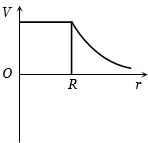
B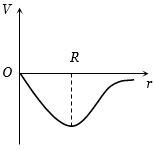
C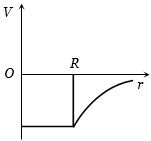
D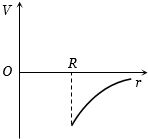
Solution
(C) For a hollow sphere of mass $M$ and radius $R$:
$1$. Inside the sphere $(r < R)$, the gravitational potential is constant and equal to the potential at the surface: $V_{in} = -\frac{GM}{R}$.
$2$. At the surface $(r = R)$, the potential is $V_{surface} = -\frac{GM}{R}$.
$3$. Outside the sphere $(r > R)$, the potential varies inversely with distance: $V_{out} = -\frac{GM}{r}$.
Since the potential is negative, it remains constant at a negative value inside the sphere and approaches zero as $r$ increases outside the sphere. Graph $C$ correctly represents this behavior, showing a constant negative value for $r \leq R$ and a curve following $V \propto -1/r$ for $r > R$.
$1$. Inside the sphere $(r < R)$, the gravitational potential is constant and equal to the potential at the surface: $V_{in} = -\frac{GM}{R}$.
$2$. At the surface $(r = R)$, the potential is $V_{surface} = -\frac{GM}{R}$.
$3$. Outside the sphere $(r > R)$, the potential varies inversely with distance: $V_{out} = -\frac{GM}{r}$.
Since the potential is negative, it remains constant at a negative value inside the sphere and approaches zero as $r$ increases outside the sphere. Graph $C$ correctly represents this behavior, showing a constant negative value for $r \leq R$ and a curve following $V \propto -1/r$ for $r > R$.
0 likes
View Solution14
EasyMCQ
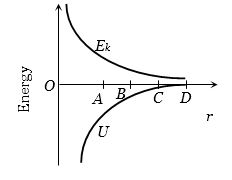
The curves for potential energy $(U)$ and kinetic energy $(E_k)$ of a two-particle system are shown in the figure. At what points will the system be bound?
A
Only at point $D$
B
Only at point $A$
C
At point $D$ and $A$
D
At points $A, B$ and $C$
Solution
(D) system is considered bound if its total mechanical energy $(E = U + E_k)$ is negative.
In the given graph,$U$ represents the potential energy (which is negative) and $E_k$ represents the kinetic energy (which is positive).
At points $A, B,$ and $C$,the magnitude of the negative potential energy $|U|$ is greater than the kinetic energy $E_k$,which implies that the total energy $E = U + E_k < 0$.
Therefore,the system is bound at points $A, B,$ and $C$.
In the given graph,$U$ represents the potential energy (which is negative) and $E_k$ represents the kinetic energy (which is positive).
At points $A, B,$ and $C$,the magnitude of the negative potential energy $|U|$ is greater than the kinetic energy $E_k$,which implies that the total energy $E = U + E_k < 0$.
Therefore,the system is bound at points $A, B,$ and $C$.
0 likes
View Solution15
MediumMCQ
$A$ shell of mass $M$ and radius $R$ has a point mass $m$ placed at a distance $r$ from its centre. The gravitational potential energy $U(r)$ vs $r$ graph will be:
A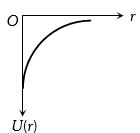
B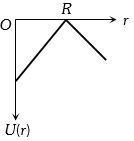
C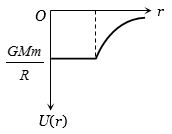
D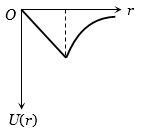
Solution
(C) The gravitational potential energy $U(r)$ of a point mass $m$ at a distance $r$ from the center of a spherical shell of mass $M$ and radius $R$ is given by $U(r) = m \cdot V(r)$,where $V(r)$ is the gravitational potential due to the shell.
For $r < R$,the gravitational potential inside a spherical shell is constant and equal to $V = -\frac{GM}{R}$. Thus,$U(r) = -\frac{GMm}{R}$,which is a constant value.
For $r \geq R$,the gravitational potential is $V = -\frac{GM}{r}$. Thus,$U(r) = -\frac{GMm}{r}$,which varies inversely with $r$.
The graph of $U(r)$ versus $r$ will be a horizontal line for $r \leq R$ and a curve following the inverse law for $r > R$. This matches the graph shown in option $C$.
For $r < R$,the gravitational potential inside a spherical shell is constant and equal to $V = -\frac{GM}{R}$. Thus,$U(r) = -\frac{GMm}{R}$,which is a constant value.
For $r \geq R$,the gravitational potential is $V = -\frac{GM}{r}$. Thus,$U(r) = -\frac{GMm}{r}$,which varies inversely with $r$.
The graph of $U(r)$ versus $r$ will be a horizontal line for $r \leq R$ and a curve following the inverse law for $r > R$. This matches the graph shown in option $C$.
0 likes
View Solution16
DifficultMCQ
If the gravitational field intensity at a point is given by $E = K/x^3$,what is the gravitational potential at that point?
A
$K/x$
B
$K/2x$
C
$K/x^2$
D
$K/2x^2$
Solution
(D) The relationship between gravitational potential $V$ and gravitational field intensity $E$ is given by the formula $V = - \int E \, dx$.
Given $E = K/x^3$.
Substituting the value of $E$ in the integral:
$V = - \int (K/x^3) \, dx$
$V = -K \int x^{-3} \, dx$
$V = -K [x^{-2} / -2]$
$V = K / (2x^2)$.
Thus,the gravitational potential is $K / (2x^2)$.
Given $E = K/x^3$.
Substituting the value of $E$ in the integral:
$V = - \int (K/x^3) \, dx$
$V = -K \int x^{-3} \, dx$
$V = -K [x^{-2} / -2]$
$V = K / (2x^2)$.
Thus,the gravitational potential is $K / (2x^2)$.
0 likes
View Solution17
EasyMCQ
If the gravitational intensity at a height of $8000 \, km$ from the center of the Earth is $6 \, N/kg$,what is the gravitational potential at that point?
A
$8 \times 10^6 \, J/kg$
B
$2.4 \times 10^3 \, J/kg$
C
$4.8 \times 10^7 \, J/kg$
D
$6.4 \times 10^{14} \, J/kg$
Solution
(C) The gravitational intensity $I$ at a distance $r$ from the center of the Earth is given by $I = \frac{GM}{r^2}$.
The gravitational potential $V$ at a distance $r$ is given by $V = -\frac{GM}{r}$.
By taking the magnitude,we can relate the two: $V = I \times r$.
Given: $I = 6 \, N/kg$ and $r = 8000 \, km = 8 \times 10^6 \, m$.
Substituting the values: $V = 6 \times (8 \times 10^6) = 48 \times 10^6 = 4.8 \times 10^7 \, J/kg$.
The gravitational potential $V$ at a distance $r$ is given by $V = -\frac{GM}{r}$.
By taking the magnitude,we can relate the two: $V = I \times r$.
Given: $I = 6 \, N/kg$ and $r = 8000 \, km = 8 \times 10^6 \, m$.
Substituting the values: $V = 6 \times (8 \times 10^6) = 48 \times 10^6 = 4.8 \times 10^7 \, J/kg$.
0 likes
View Solution18
DifficultMCQ
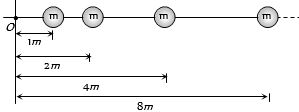
Objects of mass $m$ are placed on the $x$-axis at $x = 1, x = 2, x = 4, x = 8, \dots$ respectively. What is the gravitational potential at the origin $x = 0$?
A
$ - Gm$
B
$ - 2Gm$
C
$ - 4Gm$
D
$ - 8Gm$
Solution
(B) The gravitational potential $V$ at the origin due to a system of point masses is given by the sum of potentials due to individual masses:
$V = - \left[ \frac{Gm}{r_1} + \frac{Gm}{r_2} + \frac{Gm}{r_3} + \dots \right]$
Substituting the given positions $r_1 = 1, r_2 = 2, r_3 = 4, r_4 = 8, \dots$:
$V = - Gm \left[ \frac{1}{1} + \frac{1}{2} + \frac{1}{4} + \frac{1}{8} + \dots \right]$
The term in the bracket is an infinite geometric series with first term $a = 1$ and common ratio $r = 1/2$. The sum of an infinite geometric series is $S = \frac{a}{1 - r}$.
$S = \frac{1}{1 - 1/2} = \frac{1}{1/2} = 2$
Therefore,$V = - Gm(2) = - 2Gm$.
$V = - \left[ \frac{Gm}{r_1} + \frac{Gm}{r_2} + \frac{Gm}{r_3} + \dots \right]$
Substituting the given positions $r_1 = 1, r_2 = 2, r_3 = 4, r_4 = 8, \dots$:
$V = - Gm \left[ \frac{1}{1} + \frac{1}{2} + \frac{1}{4} + \frac{1}{8} + \dots \right]$
The term in the bracket is an infinite geometric series with first term $a = 1$ and common ratio $r = 1/2$. The sum of an infinite geometric series is $S = \frac{a}{1 - r}$.
$S = \frac{1}{1 - 1/2} = \frac{1}{1/2} = 2$
Therefore,$V = - Gm(2) = - 2Gm$.
0 likes
View Solution19
DifficultMCQ
Two bodies of masses $m$ and $M$ are placed at a distance $d$ from each other. What is the gravitational potential $V$ at the point where the gravitational field intensity is zero?
A
$V = - \frac{G}{d}(m + M)$
B
$V = - \frac{G}{d}(\sqrt{m} + \sqrt{M})^2$
C
$V = - \frac{G}{d}(\sqrt{m} - \sqrt{M})^2$
D
$V = - \frac{G}{d}(\sqrt{m} + \sqrt{M})$
Solution
(B) Let the point where the gravitational field intensity is zero be at a distance $x$ from mass $m$. The gravitational field intensity $E$ is given by $E = \frac{Gm}{x^2} - \frac{GM}{(d-x)^2} = 0$.
This implies $\frac{m}{x^2} = \frac{M}{(d-x)^2}$,so $\frac{\sqrt{m}}{x} = \frac{\sqrt{M}}{d-x}$.
Solving for $x$,we get $x = \frac{\sqrt{m}}{\sqrt{m} + \sqrt{M}} d$ and $d-x = \frac{\sqrt{M}}{\sqrt{m} + \sqrt{M}} d$.
The gravitational potential $V$ at this point is the sum of potentials due to both masses: $V = - \frac{Gm}{x} - \frac{GM}{d-x}$.
Substituting the values of $x$ and $d-x$: $V = - \frac{Gm}{\frac{\sqrt{m}}{\sqrt{m} + \sqrt{M}} d} - \frac{GM}{\frac{\sqrt{M}}{\sqrt{m} + \sqrt{M}} d}$.
$V = - \frac{G}{d} [\sqrt{m}(\sqrt{m} + \sqrt{M}) + \sqrt{M}(\sqrt{m} + \sqrt{M})]$.
$V = - \frac{G}{d} (\sqrt{m} + \sqrt{M})^2$.
This implies $\frac{m}{x^2} = \frac{M}{(d-x)^2}$,so $\frac{\sqrt{m}}{x} = \frac{\sqrt{M}}{d-x}$.
Solving for $x$,we get $x = \frac{\sqrt{m}}{\sqrt{m} + \sqrt{M}} d$ and $d-x = \frac{\sqrt{M}}{\sqrt{m} + \sqrt{M}} d$.
The gravitational potential $V$ at this point is the sum of potentials due to both masses: $V = - \frac{Gm}{x} - \frac{GM}{d-x}$.
Substituting the values of $x$ and $d-x$: $V = - \frac{Gm}{\frac{\sqrt{m}}{\sqrt{m} + \sqrt{M}} d} - \frac{GM}{\frac{\sqrt{M}}{\sqrt{m} + \sqrt{M}} d}$.
$V = - \frac{G}{d} [\sqrt{m}(\sqrt{m} + \sqrt{M}) + \sqrt{M}(\sqrt{m} + \sqrt{M})]$.
$V = - \frac{G}{d} (\sqrt{m} + \sqrt{M})^2$.
0 likes
View Solution20
DifficultMCQ
What is the potential energy of a satellite at a height of $6.4 \times 10^6 \, m$ from the surface of the Earth? ($R_e$ = radius of the Earth)
A
$-0.5 \, mgR_e$
B
$-mgR_e$
C
$-2 \, mgR_e$
D
$4 \, mgR_e$
Solution
(A) The gravitational potential energy $U$ of a satellite of mass $m$ at a distance $r$ from the center of the Earth is given by $U = -\frac{GMm}{r}$.
Given height $h = 6.4 \times 10^6 \, m$. Since the radius of the Earth $R_e \approx 6.4 \times 10^6 \, m$,we have $h = R_e$.
The distance from the center of the Earth is $r = R_e + h = R_e + R_e = 2R_e$.
Substituting this into the formula: $U = -\frac{GMm}{2R_e}$.
Using the relation $GM = gR_e^2$,where $g$ is the acceleration due to gravity at the Earth's surface:
$U = -\frac{(gR_e^2)m}{2R_e} = -\frac{1}{2} mgR_e = -0.5 \, mgR_e$.
Given height $h = 6.4 \times 10^6 \, m$. Since the radius of the Earth $R_e \approx 6.4 \times 10^6 \, m$,we have $h = R_e$.
The distance from the center of the Earth is $r = R_e + h = R_e + R_e = 2R_e$.
Substituting this into the formula: $U = -\frac{GMm}{2R_e}$.
Using the relation $GM = gR_e^2$,where $g$ is the acceleration due to gravity at the Earth's surface:
$U = -\frac{(gR_e^2)m}{2R_e} = -\frac{1}{2} mgR_e = -0.5 \, mgR_e$.
0 likes
View Solution21
DifficultMCQ
An infinite number of bodies,each of mass $2 \, kg$,are situated on the $x-$axis at distances $1 \, m, 2 \, m, 4 \, m, 8 \, m, \dots$ respectively,from the origin. The resulting gravitational potential due to this system at the origin will be:
A
$-\frac{8}{3}G$
B
$-\frac{4}{3}G$
C
$-4G$
D
$-G$
Solution
(C) The gravitational potential $V$ at a point due to a point mass $m$ at a distance $r$ is given by $V = -\frac{Gm}{r}$.
For a system of multiple masses,the total potential is the algebraic sum of the potentials due to each mass.
Here,each body has a mass $m = 2 \, kg$ and they are located at distances $r_1 = 1 \, m, r_2 = 2 \, m, r_3 = 4 \, m, r_4 = 8 \, m, \dots$ from the origin.
The total gravitational potential $V$ at the origin is:
$V = -\frac{G(2)}{1} - \frac{G(2)}{2} - \frac{G(2)}{4} - \frac{G(2)}{8} - \dots$
$V = -2G \left( 1 + \frac{1}{2} + \frac{1}{4} + \frac{1}{8} + \dots \right)$
The term in the bracket is an infinite geometric series with the first term $a = 1$ and common ratio $r = \frac{1}{2}$.
The sum of an infinite geometric series is $S = \frac{a}{1 - r}$.
$S = \frac{1}{1 - 1/2} = \frac{1}{1/2} = 2$.
Therefore,$V = -2G(2) = -4G$.
For a system of multiple masses,the total potential is the algebraic sum of the potentials due to each mass.
Here,each body has a mass $m = 2 \, kg$ and they are located at distances $r_1 = 1 \, m, r_2 = 2 \, m, r_3 = 4 \, m, r_4 = 8 \, m, \dots$ from the origin.
The total gravitational potential $V$ at the origin is:
$V = -\frac{G(2)}{1} - \frac{G(2)}{2} - \frac{G(2)}{4} - \frac{G(2)}{8} - \dots$
$V = -2G \left( 1 + \frac{1}{2} + \frac{1}{4} + \frac{1}{8} + \dots \right)$
The term in the bracket is an infinite geometric series with the first term $a = 1$ and common ratio $r = \frac{1}{2}$.
The sum of an infinite geometric series is $S = \frac{a}{1 - r}$.
$S = \frac{1}{1 - 1/2} = \frac{1}{1/2} = 2$.
Therefore,$V = -2G(2) = -4G$.

0 likes
View Solution22
EasyMCQ
An earth satellite is moved from one stable circular orbit to a further stable circular orbit. Which one of the following quantities increases?
A
Gravitational force
B
Gravitational potential energy
C
Linear orbital speed
D
Centripetal acceleration
Solution
(B) The gravitational potential energy $(U)$ of a satellite of mass $m$ at a distance $r$ from the center of the Earth is given by $U = -\frac{GMm}{r}$,where $G$ is the gravitational constant and $M$ is the mass of the Earth.
As the satellite moves to a further stable circular orbit,the orbital radius $r$ increases.
Since $U = -\frac{GMm}{r}$,as $r$ increases,the magnitude of the negative value decreases,which means the value of $U$ increases (becomes less negative).
Therefore,the gravitational potential energy increases.
As the satellite moves to a further stable circular orbit,the orbital radius $r$ increases.
Since $U = -\frac{GMm}{r}$,as $r$ increases,the magnitude of the negative value decreases,which means the value of $U$ increases (becomes less negative).
Therefore,the gravitational potential energy increases.
0 likes
View Solution23
EasyMCQ
At some point,the gravitational potential and the gravitational field due to the Earth are both zero. This point is:
A
On the Earth's surface
B
Below the Earth's surface
C
At a height $R_e$ from the Earth's surface ($R_e$ = radius of the Earth)
D
At infinity
Solution
(D) The gravitational potential $V$ at a distance $r$ from the center of the Earth is given by $V = -\frac{GM}{r}$.
The gravitational field intensity $I$ at a distance $r$ from the center of the Earth is given by $I = \frac{GM}{r^2}$.
For the gravitational potential $V$ to be zero,we require $r \to \infty$.
For the gravitational field $I$ to be zero,we require $r \to \infty$.
Therefore,both the gravitational potential and the gravitational field due to the Earth are zero only at infinity.
The gravitational field intensity $I$ at a distance $r$ from the center of the Earth is given by $I = \frac{GM}{r^2}$.
For the gravitational potential $V$ to be zero,we require $r \to \infty$.
For the gravitational field $I$ to be zero,we require $r \to \infty$.
Therefore,both the gravitational potential and the gravitational field due to the Earth are zero only at infinity.
0 likes
View Solution24
DifficultMCQ
Two masses $m_1$ and $m_2$ are initially at rest and are separated by a very large distance. If the masses approach each other subsequently due to gravitational attraction between them,their relative velocity of approach at a separation distance of $d$ is:
A
$\frac{2Gd}{(m_1 + m_2)}$
B
$\frac{(m_1 + m_2)G}{2d}$
C
$[2G(m_1 + m_2)/d]^{1/2}$
D
$(m_1 + m_2)^{1/2} 2Gd$
Solution
(C) By the law of conservation of energy,the initial potential energy at infinity is $0$ and the initial kinetic energy is $0$. At a separation distance $d$,the potential energy is $-G m_1 m_2 / d$. The total energy is conserved:
$0 = \frac{1}{2} m_1 v_1^2 + \frac{1}{2} m_2 v_2^2 - \frac{G m_1 m_2}{d}$
From the conservation of linear momentum,since the system is initially at rest,the center of mass remains at rest:
$m_1 v_1 = m_2 v_2 \implies v_2 = \frac{m_1 v_1}{m_2}$
Substituting $v_2$ into the energy equation:
$\frac{G m_1 m_2}{d} = \frac{1}{2} m_1 v_1^2 + \frac{1}{2} m_2 (\frac{m_1 v_1}{m_2})^2 = \frac{1}{2} m_1 v_1^2 (1 + \frac{m_1}{m_2}) = \frac{1}{2} m_1 v_1^2 (\frac{m_1 + m_2}{m_2})$
Solving for $v_1$: $v_1 = \sqrt{\frac{2 G m_2^2}{d(m_1 + m_2)}}$. Similarly,$v_2 = \sqrt{\frac{2 G m_1^2}{d(m_1 + m_2)}}$.
The relative velocity of approach is $v_{rel} = v_1 + v_2 = \sqrt{\frac{2 G}{d(m_1 + m_2)}} (m_2 + m_1) = \sqrt{\frac{2 G (m_1 + m_2)}{d}}$.
$0 = \frac{1}{2} m_1 v_1^2 + \frac{1}{2} m_2 v_2^2 - \frac{G m_1 m_2}{d}$
From the conservation of linear momentum,since the system is initially at rest,the center of mass remains at rest:
$m_1 v_1 = m_2 v_2 \implies v_2 = \frac{m_1 v_1}{m_2}$
Substituting $v_2$ into the energy equation:
$\frac{G m_1 m_2}{d} = \frac{1}{2} m_1 v_1^2 + \frac{1}{2} m_2 (\frac{m_1 v_1}{m_2})^2 = \frac{1}{2} m_1 v_1^2 (1 + \frac{m_1}{m_2}) = \frac{1}{2} m_1 v_1^2 (\frac{m_1 + m_2}{m_2})$
Solving for $v_1$: $v_1 = \sqrt{\frac{2 G m_2^2}{d(m_1 + m_2)}}$. Similarly,$v_2 = \sqrt{\frac{2 G m_1^2}{d(m_1 + m_2)}}$.
The relative velocity of approach is $v_{rel} = v_1 + v_2 = \sqrt{\frac{2 G}{d(m_1 + m_2)}} (m_2 + m_1) = \sqrt{\frac{2 G (m_1 + m_2)}{d}}$.
0 likes
View Solution25
MediumMCQ
$A$ hollow spherical shell is compressed to half its radius. The gravitational potential at the centre
A
increases
B
decreases
C
remains same
D
during the compression increases then returns at the previous value.
Solution
(B) The gravitational potential $V$ at the centre of a hollow spherical shell of mass $M$ and radius $r$ is given by $V = -\frac{GM}{r}$.
When the shell is compressed to half its radius,the new radius becomes $r' = \frac{r}{2}$.
The new potential at the centre becomes $V' = -\frac{GM}{r'} = -\frac{GM}{r/2} = -\frac{2GM}{r} = 2V$.
Since $V$ is negative,$2V$ is more negative than $V$ (e.g.,if $V = -10 \ J/kg$,then $V' = -20 \ J/kg$).
Therefore,the gravitational potential decreases.
When the shell is compressed to half its radius,the new radius becomes $r' = \frac{r}{2}$.
The new potential at the centre becomes $V' = -\frac{GM}{r'} = -\frac{GM}{r/2} = -\frac{2GM}{r} = 2V$.
Since $V$ is negative,$2V$ is more negative than $V$ (e.g.,if $V = -10 \ J/kg$,then $V' = -20 \ J/kg$).
Therefore,the gravitational potential decreases.
0 likes
View Solution26
AdvancedMCQ
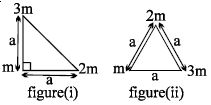
Consider two configurations of a system of three particles of masses $m, 2m$ and $3m$. The work done by an external agent in changing the configuration of the system from figure $(i)$ to figure $(ii)$ is:
A
zero
B
$ - \frac{6Gm^2}{a} \left( 1 + \frac{1}{\sqrt{2}} \right) $
C
$ - \frac{6Gm^2}{a} \left( 1 - \frac{1}{\sqrt{2}} \right) $
D
$ - \frac{6Gm^2}{a} \left( 2 - \frac{1}{\sqrt{2}} \right) $
Solution
(C) The gravitational potential energy of a system of particles is given by $U = -\sum \frac{G m_i m_j}{r_{ij}}$.
For figure $(i)$,the distances are $r_{m,2m} = a$,$r_{m,3m} = a$,and $r_{2m,3m} = \sqrt{a^2 + a^2} = a\sqrt{2}$.
$U_1 = -\left( \frac{G(m)(2m)}{a} + \frac{G(m)(3m)}{a} + \frac{G(2m)(3m)}{a\sqrt{2}} \right) = -\frac{Gm^2}{a} \left( 2 + 3 + \frac{6}{\sqrt{2}} \right) = -\frac{Gm^2}{a} (5 + 3\sqrt{2})$.
For figure $(ii)$,the distances are $r_{m,2m} = a$,$r_{m,3m} = a$,and $r_{2m,3m} = a$.
$U_2 = -\left( \frac{G(m)(2m)}{a} + \frac{G(m)(3m)}{a} + \frac{G(2m)(3m)}{a} \right) = -\frac{Gm^2}{a} (2 + 3 + 6) = -\frac{11Gm^2}{a}$.
The work done by an external agent is $W = U_2 - U_1$.
$W = -\frac{11Gm^2}{a} - \left( -\frac{Gm^2}{a} (5 + 3\sqrt{2}) \right) = \frac{Gm^2}{a} (-11 + 5 + 3\sqrt{2}) = \frac{Gm^2}{a} (-6 + 3\sqrt{2})$.
$W = -\frac{6Gm^2}{a} \left( 1 - \frac{3\sqrt{2}}{6} \right) = -\frac{6Gm^2}{a} \left( 1 - \frac{1}{\sqrt{2}} \right)$.
For figure $(i)$,the distances are $r_{m,2m} = a$,$r_{m,3m} = a$,and $r_{2m,3m} = \sqrt{a^2 + a^2} = a\sqrt{2}$.
$U_1 = -\left( \frac{G(m)(2m)}{a} + \frac{G(m)(3m)}{a} + \frac{G(2m)(3m)}{a\sqrt{2}} \right) = -\frac{Gm^2}{a} \left( 2 + 3 + \frac{6}{\sqrt{2}} \right) = -\frac{Gm^2}{a} (5 + 3\sqrt{2})$.
For figure $(ii)$,the distances are $r_{m,2m} = a$,$r_{m,3m} = a$,and $r_{2m,3m} = a$.
$U_2 = -\left( \frac{G(m)(2m)}{a} + \frac{G(m)(3m)}{a} + \frac{G(2m)(3m)}{a} \right) = -\frac{Gm^2}{a} (2 + 3 + 6) = -\frac{11Gm^2}{a}$.
The work done by an external agent is $W = U_2 - U_1$.
$W = -\frac{11Gm^2}{a} - \left( -\frac{Gm^2}{a} (5 + 3\sqrt{2}) \right) = \frac{Gm^2}{a} (-11 + 5 + 3\sqrt{2}) = \frac{Gm^2}{a} (-6 + 3\sqrt{2})$.
$W = -\frac{6Gm^2}{a} \left( 1 - \frac{3\sqrt{2}}{6} \right) = -\frac{6Gm^2}{a} \left( 1 - \frac{1}{\sqrt{2}} \right)$.
0 likes
View Solution27
AdvancedMCQ
Gravitational potential at the centre of curvature of a hemispherical bowl of radius $R$ and mass $M$ is $V.$
A
Gravitational potential at the centre of curvature of a thin uniform wire of mass $M,$ bent into a semicircle of radius $R,$ is also equal to $V.$
B
In part $(A),$ if the same wire is bent into a quarter of a circle,then also the gravitational potential at the centre of curvature will be $V.$
C
In part $(A),$ if the same wire mass is nonuniformly distributed along its length and it is bent into a semicircle of radius $R,$ gravitational potential at the centre is $V.$
D
$(A)$ and $(C)$ both
Solution
(D) The gravitational potential $V$ due to a mass element $dm$ at a distance $r$ is given by $V = -\int \frac{G dm}{r}.$
For a hemispherical bowl of radius $R$ and mass $M,$ every point on the surface is at a distance $R$ from the centre. Thus,$V = -\int \frac{G dm}{R} = -\frac{G}{R} \int dm = -\frac{GM}{R}.$
For a thin uniform wire of mass $M$ bent into a semicircle of radius $R,$ every point on the wire is at a distance $R$ from the centre of curvature. Thus,$V = -\int \frac{G dm}{R} = -\frac{GM}{R}.$
Since the distance $R$ is constant for all mass elements in both cases,the potential remains $-GM/R.$
This holds true regardless of the distribution of mass along the wire,as long as every element is at distance $R.$ Therefore,both $(A)$ and $(C)$ are correct.
For a hemispherical bowl of radius $R$ and mass $M,$ every point on the surface is at a distance $R$ from the centre. Thus,$V = -\int \frac{G dm}{R} = -\frac{G}{R} \int dm = -\frac{GM}{R}.$
For a thin uniform wire of mass $M$ bent into a semicircle of radius $R,$ every point on the wire is at a distance $R$ from the centre of curvature. Thus,$V = -\int \frac{G dm}{R} = -\frac{GM}{R}.$
Since the distance $R$ is constant for all mass elements in both cases,the potential remains $-GM/R.$
This holds true regardless of the distribution of mass along the wire,as long as every element is at distance $R.$ Therefore,both $(A)$ and $(C)$ are correct.
0 likes
View Solution28
MediumMCQ
An earth satellite is moved from one stable circular orbit to another larger and stable circular orbit. Which of the following quantities increases for the satellite as a result of this change?
A
Gravitational potential energy
B
Angular velocity
C
Linear orbital velocity
D
Centripetal acceleration
Solution
(A) The gravitational potential energy of a satellite in an orbit of radius $r$ is given by $U = -\frac{GMm}{r}$. As the radius $r$ increases,the value of $U$ becomes less negative,meaning it increases.
The orbital velocity is $v = \sqrt{\frac{GM}{r}}$. As $r$ increases,$v$ decreases.
The angular velocity is $\omega = \frac{v}{r} = \sqrt{\frac{GM}{r^3}}$. As $r$ increases,$\omega$ decreases.
The centripetal acceleration is $a_c = \frac{v^2}{r} = \frac{GM}{r^2}$. As $r$ increases,$a_c$ decreases.
Therefore,only the gravitational potential energy increases.
The orbital velocity is $v = \sqrt{\frac{GM}{r}}$. As $r$ increases,$v$ decreases.
The angular velocity is $\omega = \frac{v}{r} = \sqrt{\frac{GM}{r^3}}$. As $r$ increases,$\omega$ decreases.
The centripetal acceleration is $a_c = \frac{v^2}{r} = \frac{GM}{r^2}$. As $r$ increases,$a_c$ decreases.
Therefore,only the gravitational potential energy increases.
0 likes
View Solution29
MediumMCQ
Two bodies of masses $m$ and $4m$ are placed at a distance $r$. The gravitational potential at a point on the line joining them where the gravitational field is zero is
A
$-\frac{4Gm}{r}$
B
$-\frac{6Gm}{r}$
C
$-\frac{9Gm}{r}$
D
Zero
Solution
(C) Let the gravitational field at point $P$,at a distance $x$ from mass $m$,be zero.
Equating the gravitational field strengths due to both masses:
$\frac{Gm}{x^2} = \frac{G(4m)}{(r-x)^2}$
Taking the square root on both sides:
$\frac{1}{x} = \frac{2}{r-x}$
$r - x = 2x \implies 3x = r \implies x = \frac{r}{3}$
Now,calculate the gravitational potential $V$ at point $P$:
$V = -\frac{Gm}{x} - \frac{G(4m)}{r-x}$
Substituting $x = \frac{r}{3}$ and $r-x = \frac{2r}{3}$:
$V = -\frac{Gm}{r/3} - \frac{4Gm}{2r/3} = -\frac{3Gm}{r} - \frac{6Gm}{r} = -\frac{9Gm}{r}$
Equating the gravitational field strengths due to both masses:
$\frac{Gm}{x^2} = \frac{G(4m)}{(r-x)^2}$
Taking the square root on both sides:
$\frac{1}{x} = \frac{2}{r-x}$
$r - x = 2x \implies 3x = r \implies x = \frac{r}{3}$
Now,calculate the gravitational potential $V$ at point $P$:
$V = -\frac{Gm}{x} - \frac{G(4m)}{r-x}$
Substituting $x = \frac{r}{3}$ and $r-x = \frac{2r}{3}$:
$V = -\frac{Gm}{r/3} - \frac{4Gm}{2r/3} = -\frac{3Gm}{r} - \frac{6Gm}{r} = -\frac{9Gm}{r}$
0 likes
View Solution30
DifficultMCQ
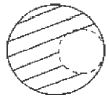
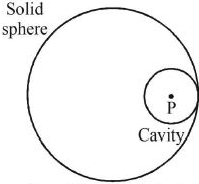
From a solid sphere of mass $M$ and radius $R$,a spherical portion of radius $R/2$ is removed,as shown in the figure. Taking gravitational potential $V = 0$ at $r = \infty$,the potential at the centre of the cavity thus formed is
($G =$ gravitational constant)
($G =$ gravitational constant)
A
$\frac{-GM}{R}$
B
$\frac{-2GM}{3R}$
C
$\frac{-2GM}{R}$
D
$\frac{-GM}{2R}$
Solution
(A) Let the center of the original sphere be $O$ and the center of the cavity be $P$. The distance $OP = R/2$.
The gravitational potential at any point inside a solid sphere of mass $M$ and radius $R$ at a distance $r$ from its center is given by $V = \frac{-GM}{2R^3}(3R^2 - r^2)$.
$1$. Potential at point $P$ due to the original solid sphere:
Here,$r = OP = R/2$.
$V_{sphere} = \frac{-GM}{2R^3} \left[ 3R^2 - (R/2)^2 \right] = \frac{-GM}{2R^3} \left( 3R^2 - \frac{R^2}{4} \right) = \frac{-GM}{2R^3} \left( \frac{11R^2}{4} \right) = \frac{-11GM}{8R}$.
$2$. Potential at point $P$ due to the removed spherical portion (cavity):
The mass of the removed portion $M'$ is proportional to the volume: $M' = M \times \frac{(4/3)\pi(R/2)^3}{(4/3)\pi R^3} = M/8$.
The potential at the center of a solid sphere of mass $M'$ and radius $R' = R/2$ is $V_{cavity} = \frac{-3GM'}{2R'} = \frac{-3G(M/8)}{2(R/2)} = \frac{-3GM}{8R}$.
$3$. Potential at the center of the cavity $(P)$:
$V_{total} = V_{sphere} - V_{cavity} = \frac{-11GM}{8R} - \left( \frac{-3GM}{8R} \right) = \frac{-11GM + 3GM}{8R} = \frac{-8GM}{8R} = \frac{-GM}{R}$.
The gravitational potential at any point inside a solid sphere of mass $M$ and radius $R$ at a distance $r$ from its center is given by $V = \frac{-GM}{2R^3}(3R^2 - r^2)$.
$1$. Potential at point $P$ due to the original solid sphere:
Here,$r = OP = R/2$.
$V_{sphere} = \frac{-GM}{2R^3} \left[ 3R^2 - (R/2)^2 \right] = \frac{-GM}{2R^3} \left( 3R^2 - \frac{R^2}{4} \right) = \frac{-GM}{2R^3} \left( \frac{11R^2}{4} \right) = \frac{-11GM}{8R}$.
$2$. Potential at point $P$ due to the removed spherical portion (cavity):
The mass of the removed portion $M'$ is proportional to the volume: $M' = M \times \frac{(4/3)\pi(R/2)^3}{(4/3)\pi R^3} = M/8$.
The potential at the center of a solid sphere of mass $M'$ and radius $R' = R/2$ is $V_{cavity} = \frac{-3GM'}{2R'} = \frac{-3G(M/8)}{2(R/2)} = \frac{-3GM}{8R}$.
$3$. Potential at the center of the cavity $(P)$:
$V_{total} = V_{sphere} - V_{cavity} = \frac{-11GM}{8R} - \left( \frac{-3GM}{8R} \right) = \frac{-11GM + 3GM}{8R} = \frac{-8GM}{8R} = \frac{-GM}{R}$.
0 likes
View Solution31
MediumMCQ
Calculate the energy needed to move a mass of $4 \, kg$ from the center of the Earth to its surface (in joules),given that the radius of the Earth is $6400 \, km$ and the acceleration due to gravity at the surface of the Earth is $g = 10 \, m/s^2$.
A
$1.28 \times 10^8 \, J$
B
$1.28 \times 10^6 \, J$
C
$2.56 \times 10^8 \, J$
D
$2.56 \times 10^{10} \, J$
Solution
(A) The gravitational potential energy at the center of the Earth is given by $U_i = -\frac{3GMm}{2R}$.
The gravitational potential energy at the surface of the Earth is given by $U_f = -\frac{GMm}{R}$.
The energy required to move the mass is the change in potential energy: $\Delta U = U_f - U_i = -\frac{GMm}{R} - (-\frac{3GMm}{2R}) = \frac{GMm}{2R}$.
Since $g = \frac{GM}{R^2}$,we have $GM = gR^2$. Substituting this into the equation:
$\Delta U = \frac{(gR^2)m}{2R} = \frac{mgR}{2}$.
Given $m = 4 \, kg$,$g = 10 \, m/s^2$,and $R = 6400 \, km = 6.4 \times 10^6 \, m$:
$\Delta U = \frac{4 \times 10 \times 6.4 \times 10^6}{2} = 2 \times 6.4 \times 10^7 = 1.28 \times 10^8 \, J$.
The gravitational potential energy at the surface of the Earth is given by $U_f = -\frac{GMm}{R}$.
The energy required to move the mass is the change in potential energy: $\Delta U = U_f - U_i = -\frac{GMm}{R} - (-\frac{3GMm}{2R}) = \frac{GMm}{2R}$.
Since $g = \frac{GM}{R^2}$,we have $GM = gR^2$. Substituting this into the equation:
$\Delta U = \frac{(gR^2)m}{2R} = \frac{mgR}{2}$.
Given $m = 4 \, kg$,$g = 10 \, m/s^2$,and $R = 6400 \, km = 6.4 \times 10^6 \, m$:
$\Delta U = \frac{4 \times 10 \times 6.4 \times 10^6}{2} = 2 \times 6.4 \times 10^7 = 1.28 \times 10^8 \, J$.
1 likes
View Solution32
AdvancedMCQ
$A$ star is modeled as a uniform spherical distribution of matter,keeping the mass of the star constant. How does the gravitational pressure on the surface depend on the volume of the star?
A
$P \propto V$
B
$P \propto V^{-1/3}$
C
$P \propto V^{-2/3}$
D
$P \propto V^{-4/3}$
Solution
(D) The gravitational potential energy $U$ of a uniform spherical star of mass $M$ and radius $R$ is given by $U = -\frac{3GM^2}{5R}$.
The volume $V$ of the star is $V = \frac{4}{3}\pi R^3$,which implies $R = (\frac{3V}{4\pi})^{1/3}$.
Substituting $R$ into the expression for $U$,we get $U = -\frac{3GM^2}{5} (\frac{4\pi}{3V})^{1/3} = -\frac{3GM^2}{5} (\frac{4\pi}{3})^{1/3} V^{-1/3}$.
The gravitational pressure $P$ is related to the change in potential energy by the relation $dW = P dV = -dU$,which gives $P = -\frac{dU}{dV}$.
Differentiating $U$ with respect to $V$: $P = -[ -\frac{3GM^2}{5} (\frac{4\pi}{3})^{1/3} \cdot (-\frac{1}{3}) V^{-4/3} ]$.
Simplifying this,we find $P = -\frac{GM^2}{5} (\frac{4\pi}{3})^{1/3} V^{-4/3}$.
Since $G, M,$ and the constants are fixed,$P \propto V^{-4/3}$.
The volume $V$ of the star is $V = \frac{4}{3}\pi R^3$,which implies $R = (\frac{3V}{4\pi})^{1/3}$.
Substituting $R$ into the expression for $U$,we get $U = -\frac{3GM^2}{5} (\frac{4\pi}{3V})^{1/3} = -\frac{3GM^2}{5} (\frac{4\pi}{3})^{1/3} V^{-1/3}$.
The gravitational pressure $P$ is related to the change in potential energy by the relation $dW = P dV = -dU$,which gives $P = -\frac{dU}{dV}$.
Differentiating $U$ with respect to $V$: $P = -[ -\frac{3GM^2}{5} (\frac{4\pi}{3})^{1/3} \cdot (-\frac{1}{3}) V^{-4/3} ]$.
Simplifying this,we find $P = -\frac{GM^2}{5} (\frac{4\pi}{3})^{1/3} V^{-4/3}$.
Since $G, M,$ and the constants are fixed,$P \propto V^{-4/3}$.
0 likes
View Solution33
DifficultMCQ
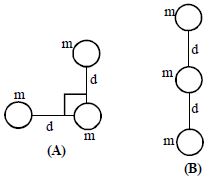
The masses $m$ in figures $(A)$ and $(B)$ are identical. The gravitational potential energy in the two cases are $U_A$ and $U_B$. Then
A
$U_A = U_B \neq 0$
B
$U_A < U_B$
C
$U_A > U_B$
D
$U_A = U_B = 0$
Solution
(B) The gravitational potential energy of a system of particles is given by $U = -\sum \frac{Gm_i m_j}{r_{ij}}$.
For case $(A)$,we have three pairs of masses with distances $d, d,$ and $\sqrt{d^2+d^2} = d\sqrt{2}$.
$U_A = -\frac{Gm^2}{d} - \frac{Gm^2}{d} - \frac{Gm^2}{d\sqrt{2}} = -\frac{2Gm^2}{d} - \frac{Gm^2}{d\sqrt{2}}$.
For case $(B)$,we have three pairs of masses with distances $d, d,$ and $2d$.
$U_B = -\frac{Gm^2}{d} - \frac{Gm^2}{d} - \frac{Gm^2}{2d} = -\frac{2Gm^2}{d} - \frac{Gm^2}{2d}$.
Comparing the two,since $\frac{1}{\sqrt{2}} \approx 0.707$ and $\frac{1}{2} = 0.5$,we have $\frac{1}{\sqrt{2}} > \frac{1}{2}$.
Therefore,$-\frac{Gm^2}{d\sqrt{2}} < -\frac{Gm^2}{2d}$.
This implies $U_A < U_B$.
For case $(A)$,we have three pairs of masses with distances $d, d,$ and $\sqrt{d^2+d^2} = d\sqrt{2}$.
$U_A = -\frac{Gm^2}{d} - \frac{Gm^2}{d} - \frac{Gm^2}{d\sqrt{2}} = -\frac{2Gm^2}{d} - \frac{Gm^2}{d\sqrt{2}}$.
For case $(B)$,we have three pairs of masses with distances $d, d,$ and $2d$.
$U_B = -\frac{Gm^2}{d} - \frac{Gm^2}{d} - \frac{Gm^2}{2d} = -\frac{2Gm^2}{d} - \frac{Gm^2}{2d}$.
Comparing the two,since $\frac{1}{\sqrt{2}} \approx 0.707$ and $\frac{1}{2} = 0.5$,we have $\frac{1}{\sqrt{2}} > \frac{1}{2}$.
Therefore,$-\frac{Gm^2}{d\sqrt{2}} < -\frac{Gm^2}{2d}$.
This implies $U_A < U_B$.
0 likes
View Solution34
MediumMCQ
$A$ particle of mass $m$ is released from infinity and it moves towards a large solid sphere of mass $M$ and radius $R$ made of a jelly-like material. Neglecting the resistance offered by the material of the sphere,find the velocity of the particle when it crosses the centre of the sphere.
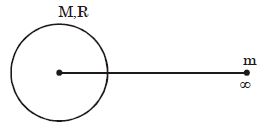
A
$\sqrt {\frac{{2GM}}{R}} $
B
$\sqrt {\frac{3}{2}\frac{{GM}}{R}} $
C
$\sqrt {\frac{{3GM}}{R}} $
D
$\sqrt {\frac{{21GM}}{R}} $
Solution
(C) The total mechanical energy of the particle is conserved.
At infinity,the potential energy is $U_{\infty} = 0$ and the kinetic energy is $K_{\infty} = 0$.
At the centre of the sphere,the potential energy $U_{c}$ is given by the formula for the potential inside a uniform solid sphere: $U_{c} = m \times V_{c} = m \times \left( -\frac{3GM}{2R} \right) = -\frac{3GMm}{2R}$.
Applying the law of conservation of energy: $K_{\infty} + U_{\infty} = K_{c} + U_{c}$.
$0 + 0 = \frac{1}{2}mV^{2} - \frac{3GMm}{2R}$.
$\frac{1}{2}mV^{2} = \frac{3GMm}{2R}$.
$V^{2} = \frac{3GM}{R}$.
$V = \sqrt{\frac{3GM}{R}}$.
At infinity,the potential energy is $U_{\infty} = 0$ and the kinetic energy is $K_{\infty} = 0$.
At the centre of the sphere,the potential energy $U_{c}$ is given by the formula for the potential inside a uniform solid sphere: $U_{c} = m \times V_{c} = m \times \left( -\frac{3GM}{2R} \right) = -\frac{3GMm}{2R}$.
Applying the law of conservation of energy: $K_{\infty} + U_{\infty} = K_{c} + U_{c}$.
$0 + 0 = \frac{1}{2}mV^{2} - \frac{3GMm}{2R}$.
$\frac{1}{2}mV^{2} = \frac{3GMm}{2R}$.
$V^{2} = \frac{3GM}{R}$.
$V = \sqrt{\frac{3GM}{R}}$.
0 likes
View Solution35
MediumMCQ
$A$ thin rod of length $L$ is bent to form a semicircle. The mass of the rod is $M$. What will be the gravitational potential at the center of the circle?
A
$-\frac{GM}{L}$
B
$-\frac{GM}{2 \pi L}$
C
$-\frac{\pi GM}{2L}$
D
$-\frac{\pi GM}{L}$
Solution
(D) The gravitational potential $V$ at a distance $r$ from a point mass $m$ is given by $V = -\frac{Gm}{r}$.
For a continuous distribution of mass,the potential at the center of a circular arc is the same for every point on the arc because every point is at the same distance $r$ from the center.
Given that the length of the rod is $L$ and it is bent into a semicircle,the radius $r$ of the semicircle is related to the length by the formula for the circumference of a semicircle: $\pi r = L$.
Therefore,the radius is $r = \frac{L}{\pi}$.
Since the total mass $M$ is distributed uniformly along the arc,the gravitational potential at the center is $V = -\frac{GM}{r}$.
Substituting the value of $r$,we get $V = -\frac{GM}{(L/\pi)}$.
Thus,the gravitational potential at the center is $V = -\frac{\pi GM}{L}$.
For a continuous distribution of mass,the potential at the center of a circular arc is the same for every point on the arc because every point is at the same distance $r$ from the center.
Given that the length of the rod is $L$ and it is bent into a semicircle,the radius $r$ of the semicircle is related to the length by the formula for the circumference of a semicircle: $\pi r = L$.
Therefore,the radius is $r = \frac{L}{\pi}$.
Since the total mass $M$ is distributed uniformly along the arc,the gravitational potential at the center is $V = -\frac{GM}{r}$.
Substituting the value of $r$,we get $V = -\frac{GM}{(L/\pi)}$.
Thus,the gravitational potential at the center is $V = -\frac{\pi GM}{L}$.
0 likes
View Solution36
DifficultMCQ
In a certain region of space,the gravitational field is given by $E = -\frac{K}{r}$,where $r$ is the distance from a fixed point and $K$ is a constant. Taking the reference point to be at $r = r_0$ with potential $V = V_0$,the potential at a distance $r$ is:
A
$V = -V_0 + K \ln \left( \frac{r}{r_0} \right)$
B
$V = V_0 + K \ln \left( \frac{r}{r_0} \right)$
C
$V = V_0 + K \ln \left( \frac{r_0}{r} \right)$
D
None of these
Solution
(B) The relationship between gravitational potential $V$ and gravitational field $E$ is given by $dV = -\vec{E} \cdot d\vec{r}$.
Given $E = -\frac{K}{r}$,we have $dV = -(-\frac{K}{r}) dr = \frac{K}{r} dr$.
Integrating both sides from the reference point $(r_0, V_0)$ to an arbitrary point $(r, V)$:
$\int_{V_0}^{V} dV = \int_{r_0}^{r} \frac{K}{r} dr$.
$V - V_0 = K [\ln(r)]_{r_0}^{r}$.
$V - V_0 = K (\ln(r) - \ln(r_0))$.
$V - V_0 = K \ln \left( \frac{r}{r_0} \right)$.
Therefore,$V = V_0 + K \ln \left( \frac{r}{r_0} \right)$.
Given $E = -\frac{K}{r}$,we have $dV = -(-\frac{K}{r}) dr = \frac{K}{r} dr$.
Integrating both sides from the reference point $(r_0, V_0)$ to an arbitrary point $(r, V)$:
$\int_{V_0}^{V} dV = \int_{r_0}^{r} \frac{K}{r} dr$.
$V - V_0 = K [\ln(r)]_{r_0}^{r}$.
$V - V_0 = K (\ln(r) - \ln(r_0))$.
$V - V_0 = K \ln \left( \frac{r}{r_0} \right)$.
Therefore,$V = V_0 + K \ln \left( \frac{r}{r_0} \right)$.
0 likes
View Solution37
DifficultMCQ
In a certain region of space,the gravitational field is given by $E = -k/r$,where $r$ is the distance and $k$ is a constant. If the gravitational potential at $r = r_0$ is $V_0$,then what is the expression for the gravitational potential $V$?
A
$k \log(r/r_0)$
B
$k \log(r_0/r)$
C
$V_0 + k \log(r/r_0)$
D
$V_0 + k \log(r_0/r)$
Solution
(C) We know that the gravitational field intensity $E$ is related to the gravitational potential $V$ by the relation $E = -dV/dr$.
Given $E = -k/r$,we have $-dV/dr = -k/r$,which simplifies to $dV/dr = k/r$.
Integrating both sides with respect to $r$ from the reference point $r_0$ to $r$:
$\int_{V_0}^{V} dV = \int_{r_0}^{r} (k/r) dr$
$V - V_0 = k [\ln(r)]_{r_0}^{r}$
$V - V_0 = k (\ln(r) - \ln(r_0))$
$V - V_0 = k \ln(r/r_0)$
Therefore,$V = V_0 + k \ln(r/r_0)$.
Given $E = -k/r$,we have $-dV/dr = -k/r$,which simplifies to $dV/dr = k/r$.
Integrating both sides with respect to $r$ from the reference point $r_0$ to $r$:
$\int_{V_0}^{V} dV = \int_{r_0}^{r} (k/r) dr$
$V - V_0 = k [\ln(r)]_{r_0}^{r}$
$V - V_0 = k (\ln(r) - \ln(r_0))$
$V - V_0 = k \ln(r/r_0)$
Therefore,$V = V_0 + k \ln(r/r_0)$.
0 likes
View Solution38
DifficultMCQ
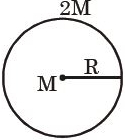
$A$ particle of mass $M$ is placed at the centre of a uniform spherical shell of mass $2M$ and radius $R$. The gravitational potential on the surface of the shell is
A
$-\frac{GM}{R}$
B
$-\frac{3GM}{R}$
C
$-\frac{2GM}{R}$
D
Zero
Solution
(B) The total gravitational potential at the surface of the shell is the sum of the potential due to the spherical shell and the potential due to the particle at the centre.
$1$. The potential due to a uniform spherical shell of mass $2M$ and radius $R$ at its surface is $V_{\text{shell}} = -\frac{G(2M)}{R}$.
$2$. The potential due to a particle of mass $M$ at a distance $R$ from it (which is the distance from the centre to the surface) is $V_M = -\frac{GM}{R}$.
$3$. The total potential $V_{\text{surface}}$ is given by:
$V_{\text{surface}} = V_{\text{shell}} + V_M$
$V_{\text{surface}} = -\frac{2GM}{R} - \frac{GM}{R}$
$V_{\text{surface}} = -\frac{3GM}{R}$
$1$. The potential due to a uniform spherical shell of mass $2M$ and radius $R$ at its surface is $V_{\text{shell}} = -\frac{G(2M)}{R}$.
$2$. The potential due to a particle of mass $M$ at a distance $R$ from it (which is the distance from the centre to the surface) is $V_M = -\frac{GM}{R}$.
$3$. The total potential $V_{\text{surface}}$ is given by:
$V_{\text{surface}} = V_{\text{shell}} + V_M$
$V_{\text{surface}} = -\frac{2GM}{R} - \frac{GM}{R}$
$V_{\text{surface}} = -\frac{3GM}{R}$
0 likes
View Solution39
DifficultMCQ
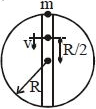
$A$ tunnel is dug across the diameter of the Earth. $A$ ball is released from the surface of the Earth into the tunnel. The velocity of the ball when it is at a distance $\frac{R}{2}$ from the center of the Earth is (where $R$ = radius of the Earth and $M$ = mass of the Earth):
A
$\sqrt{\frac{3GM}{4R}}$
B
$\sqrt{\frac{2GM}{3R}}$
C
$\sqrt{\frac{GM}{2R}}$
D
$\sqrt{\frac{2GM}{R}}$
Solution
(A) The gravitational potential $V$ inside the Earth at a distance $r$ from the center is given by $V = -\frac{GM}{2R^3}(3R^2 - r^2)$.
At the surface $(r = R)$,the potential is $V_s = -\frac{GM}{R}$.
At a distance $r = \frac{R}{2}$ from the center,the potential is $V_p = -\frac{GM}{2R^3}(3R^2 - (\frac{R}{2})^2) = -\frac{GM}{2R^3}(3R^2 - \frac{R^2}{4}) = -\frac{GM}{2R^3}(\frac{11R^2}{4}) = -\frac{11GM}{8R}$.
Using the law of conservation of energy between the surface and the point at $\frac{R}{2}$:
$K_i + U_i = K_f + U_f$
$0 + m V_s = \frac{1}{2}mv^2 + m V_p$
$m(-\frac{GM}{R}) = \frac{1}{2}mv^2 + m(-\frac{11GM}{8R})$
$-\frac{GM}{R} + \frac{11GM}{8R} = \frac{1}{2}v^2$
$\frac{3GM}{8R} = \frac{1}{2}v^2$
$v^2 = \frac{3GM}{4R}$
$v = \sqrt{\frac{3GM}{4R}}$
At the surface $(r = R)$,the potential is $V_s = -\frac{GM}{R}$.
At a distance $r = \frac{R}{2}$ from the center,the potential is $V_p = -\frac{GM}{2R^3}(3R^2 - (\frac{R}{2})^2) = -\frac{GM}{2R^3}(3R^2 - \frac{R^2}{4}) = -\frac{GM}{2R^3}(\frac{11R^2}{4}) = -\frac{11GM}{8R}$.
Using the law of conservation of energy between the surface and the point at $\frac{R}{2}$:
$K_i + U_i = K_f + U_f$
$0 + m V_s = \frac{1}{2}mv^2 + m V_p$
$m(-\frac{GM}{R}) = \frac{1}{2}mv^2 + m(-\frac{11GM}{8R})$
$-\frac{GM}{R} + \frac{11GM}{8R} = \frac{1}{2}v^2$
$\frac{3GM}{8R} = \frac{1}{2}v^2$
$v^2 = \frac{3GM}{4R}$
$v = \sqrt{\frac{3GM}{4R}}$
0 likes
View Solution40
MediumMCQ
Which of the following most closely depicts the correct variation of the gravitational potential $V(r)$ due to a large planet of radius $R$ and uniform mass density? (figures are not drawn to scale)
A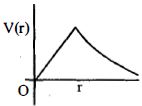
B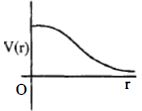
C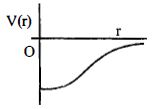
D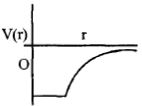
Solution
(C) For a solid sphere of radius $R$ and mass $M$ with uniform density,the gravitational potential $V(r)$ is given by:
Inside the sphere $(r \le R)$: $V(r) = -\frac{GM}{2R^3}(3R^2 - r^2)$. This is a parabolic variation where the potential is maximum (least negative) at the surface $(r=R)$ and minimum (most negative) at the center $(r=0)$.
Outside the sphere $(r > R)$: $V(r) = -\frac{GM}{r}$. This shows an inverse variation with distance.
Graph $C$ correctly shows the potential starting from a negative value at the center,increasing (becoming less negative) as $r$ increases towards $R$,and then continuing to increase towards zero as $r$ increases beyond $R$.
Inside the sphere $(r \le R)$: $V(r) = -\frac{GM}{2R^3}(3R^2 - r^2)$. This is a parabolic variation where the potential is maximum (least negative) at the surface $(r=R)$ and minimum (most negative) at the center $(r=0)$.
Outside the sphere $(r > R)$: $V(r) = -\frac{GM}{r}$. This shows an inverse variation with distance.
Graph $C$ correctly shows the potential starting from a negative value at the center,increasing (becoming less negative) as $r$ increases towards $R$,and then continuing to increase towards zero as $r$ increases beyond $R$.
0 likes
View Solution41
MediumMCQ
The gravitational field in a region is given by $\vec{g} = 5\,N/kg\hat{i} + 12\,N/kg\hat{j}$. The change in the gravitational potential energy of a particle of mass $1\,kg$ when it is taken from the origin to a point $(7\,m, -3\,m)$ is ....... $J$.
A
$71$
B
$13\sqrt{58}$
C
$-71$
D
$1$
Solution
(D) The gravitational field is given by $\vec{g} = (5\hat{i} + 12\hat{j})\,N/kg$.
Since the field is uniform,the change in gravitational potential $\Delta V$ is given by $\Delta V = -\int \vec{g} \cdot d\vec{r}$.
For a displacement from $(0, 0)$ to $(7, -3)$,the change in potential is $\Delta V = -\vec{g} \cdot \Delta\vec{r}$.
$\Delta\vec{r} = (7 - 0)\hat{i} + (-3 - 0)\hat{j} = 7\hat{i} - 3\hat{j}$.
$\Delta V = -[(5\hat{i} + 12\hat{j}) \cdot (7\hat{i} - 3\hat{j})] = -[5(7) + 12(-3)] = -[35 - 36] = -(-1) = 1\,J/kg$.
The change in gravitational potential energy $\Delta U = m \Delta V$.
Given $m = 1\,kg$,$\Delta U = 1\,kg \times 1\,J/kg = 1\,J$.
Since the field is uniform,the change in gravitational potential $\Delta V$ is given by $\Delta V = -\int \vec{g} \cdot d\vec{r}$.
For a displacement from $(0, 0)$ to $(7, -3)$,the change in potential is $\Delta V = -\vec{g} \cdot \Delta\vec{r}$.
$\Delta\vec{r} = (7 - 0)\hat{i} + (-3 - 0)\hat{j} = 7\hat{i} - 3\hat{j}$.
$\Delta V = -[(5\hat{i} + 12\hat{j}) \cdot (7\hat{i} - 3\hat{j})] = -[5(7) + 12(-3)] = -[35 - 36] = -(-1) = 1\,J/kg$.
The change in gravitational potential energy $\Delta U = m \Delta V$.
Given $m = 1\,kg$,$\Delta U = 1\,kg \times 1\,J/kg = 1\,J$.
0 likes
View Solution42
DifficultMCQ
$A$ point particle is held on the axis of a ring of mass $m$ and radius $r$ at a distance $r$ from its centre $C$. When released,it reaches $C$ under the gravitational attraction of the ring. Its speed at $C$ will be
A
$\sqrt {\frac{{2Gm}}{r}\left( {\sqrt 2 - 1} \right)} $
B
$\sqrt {\frac{{Gm}}{r}} $
C
$\sqrt {\frac{{2Gm}}{r}\left( {1 - \frac{1}{{\sqrt 2 }}} \right)} $
D
$\sqrt {\frac{{2Gm}}{r}} $
Solution
(C) Let $M$ be the mass of the particle.
Using the principle of conservation of energy,the total energy at the initial position (at distance $r$ from the center) equals the total energy at the center $C$.
The gravitational potential $V_p$ at a distance $x$ on the axis of a ring of mass $m$ and radius $r$ is given by $V_p = -\frac{Gm}{\sqrt{r^2 + x^2}}$.
Initial potential energy $U_i = M \times V_p(r) = -\frac{GMm}{\sqrt{r^2 + r^2}} = -\frac{GMm}{r\sqrt{2}}$.
Final potential energy at center $U_f = M \times V_p(0) = -\frac{GMm}{r}$.
By conservation of energy: $U_i + K_i = U_f + K_f$.
$-\frac{GMm}{r\sqrt{2}} + 0 = -\frac{GMm}{r} + \frac{1}{2}MV^2$.
$\frac{1}{2}MV^2 = \frac{GMm}{r} - \frac{GMm}{r\sqrt{2}} = \frac{GMm}{r} (1 - \frac{1}{\sqrt{2}})$.
$V^2 = \frac{2Gm}{r} (1 - \frac{1}{\sqrt{2}})$.
$V = \sqrt{\frac{2Gm}{r} (1 - \frac{1}{\sqrt{2}})}$.
Using the principle of conservation of energy,the total energy at the initial position (at distance $r$ from the center) equals the total energy at the center $C$.
The gravitational potential $V_p$ at a distance $x$ on the axis of a ring of mass $m$ and radius $r$ is given by $V_p = -\frac{Gm}{\sqrt{r^2 + x^2}}$.
Initial potential energy $U_i = M \times V_p(r) = -\frac{GMm}{\sqrt{r^2 + r^2}} = -\frac{GMm}{r\sqrt{2}}$.
Final potential energy at center $U_f = M \times V_p(0) = -\frac{GMm}{r}$.
By conservation of energy: $U_i + K_i = U_f + K_f$.
$-\frac{GMm}{r\sqrt{2}} + 0 = -\frac{GMm}{r} + \frac{1}{2}MV^2$.
$\frac{1}{2}MV^2 = \frac{GMm}{r} - \frac{GMm}{r\sqrt{2}} = \frac{GMm}{r} (1 - \frac{1}{\sqrt{2}})$.
$V^2 = \frac{2Gm}{r} (1 - \frac{1}{\sqrt{2}})$.
$V = \sqrt{\frac{2Gm}{r} (1 - \frac{1}{\sqrt{2}})}$.
0 likes
View Solution43
MediumMCQ
$A$ particle of mass $m$ is placed at the centre of a uniform spherical shell of mass $3m$ and radius $R$. The gravitational potential on the surface of the shell is
A
$-\frac{Gm}{R}$
B
$-\frac{3Gm}{R}$
C
$-\frac{4Gm}{R}$
D
$-\frac{2Gm}{R}$
Solution
(C) The gravitational potential at any point on the surface of the spherical shell is the sum of the potential due to the particle at the centre and the potential due to the shell itself.
$1$. The potential due to the particle of mass $m$ at a distance $R$ (on the surface) is $V_1 = -\frac{Gm}{R}$.
$2$. The potential due to a uniform spherical shell of mass $3m$ and radius $R$ at any point on its surface is $V_2 = -\frac{G(3m)}{R}$.
$3$. The total gravitational potential $V$ on the surface is $V = V_1 + V_2$.
$V = -\frac{Gm}{R} + \left(-\frac{3Gm}{R}\right) = -\frac{4Gm}{R}$.
$1$. The potential due to the particle of mass $m$ at a distance $R$ (on the surface) is $V_1 = -\frac{Gm}{R}$.
$2$. The potential due to a uniform spherical shell of mass $3m$ and radius $R$ at any point on its surface is $V_2 = -\frac{G(3m)}{R}$.
$3$. The total gravitational potential $V$ on the surface is $V = V_1 + V_2$.
$V = -\frac{Gm}{R} + \left(-\frac{3Gm}{R}\right) = -\frac{4Gm}{R}$.
0 likes
View Solution44
DifficultMCQ
Four particles each of mass $m$ are placed at the vertices of a square of side $l.$ The potential energy of the system is
A
$ - \frac{{\sqrt 2 G{m^2}}}{l}\left( {2 - \frac{1}{{\sqrt 2 }}} \right)$
B
$ - \frac{{2G{m^2}}}{l}\left( {2 + \frac{1}{{\sqrt 2 }}} \right)$
C
$ - \frac{{4G{m^2}}}{l} - \frac{{2G{m^2}}}{{\sqrt 2 l}} = - \frac{{2G{m^2}}}{l} (2 + \frac{1}{\sqrt{2}})$
D
$ - \frac{{2G{m^2}}}{l}\left( {\sqrt 2 - \frac{1}{{\sqrt 2 }}} \right)$
Solution
(B) The gravitational potential energy of a system of particles is the sum of the potential energies of all possible pairs.
For a square of side $l$,there are $4$ sides of length $l$ and $2$ diagonals of length $\sqrt{2}l$.
Total potential energy $U = 4 \times (-\frac{Gm^2}{l}) + 2 \times (-\frac{Gm^2}{\sqrt{2}l})$.
$U = -\frac{4Gm^2}{l} - \frac{2Gm^2}{\sqrt{2}l}$.
Factoring out $-\frac{2Gm^2}{l}$,we get $U = -\frac{2Gm^2}{l} (2 + \frac{1}{\sqrt{2}})$.
Thus,the correct option is $B$.
For a square of side $l$,there are $4$ sides of length $l$ and $2$ diagonals of length $\sqrt{2}l$.
Total potential energy $U = 4 \times (-\frac{Gm^2}{l}) + 2 \times (-\frac{Gm^2}{\sqrt{2}l})$.
$U = -\frac{4Gm^2}{l} - \frac{2Gm^2}{\sqrt{2}l}$.
Factoring out $-\frac{2Gm^2}{l}$,we get $U = -\frac{2Gm^2}{l} (2 + \frac{1}{\sqrt{2}})$.
Thus,the correct option is $B$.
0 likes
View Solution45
MediumMCQ
Gravitational potential difference between the surface of a planet and a point situated at a height of $20\,m$ above its surface is $2\,J/kg$. If the gravitational field is uniform,then the work done in taking a $5\,kg$ body to a height of $4\,m$ above the surface will be ........ $J$.
A
$2$
B
$20$
C
$40$
D
$10$
Solution
(A) The gravitational potential difference $\Delta V$ for a height $h_1 = 20\,m$ is given as $2\,J/kg$.
Since the gravitational field $g$ is uniform,the potential difference is given by $\Delta V = g \cdot h$.
Therefore,$g = \frac{\Delta V}{h_1} = \frac{2\,J/kg}{20\,m} = 0.1\,N/kg$ (or $m/s^2$).
The work done $W$ in moving a body of mass $m = 5\,kg$ to a height $h_2 = 4\,m$ is given by $W = m \cdot g \cdot h_2$.
Substituting the values: $W = 5\,kg \times 0.1\,N/kg \times 4\,m = 2\,J$.
Since the gravitational field $g$ is uniform,the potential difference is given by $\Delta V = g \cdot h$.
Therefore,$g = \frac{\Delta V}{h_1} = \frac{2\,J/kg}{20\,m} = 0.1\,N/kg$ (or $m/s^2$).
The work done $W$ in moving a body of mass $m = 5\,kg$ to a height $h_2 = 4\,m$ is given by $W = m \cdot g \cdot h_2$.
Substituting the values: $W = 5\,kg \times 0.1\,N/kg \times 4\,m = 2\,J$.
0 likes
View Solution46
MediumMCQ
$A$ uniform solid sphere of mass $M$ and radius $R$ is surrounded symmetrically by a uniform thin spherical shell of equal mass and radius $2R$. The value of gravitational potential at a distance $\frac{3}{2}R$ from the center is:
A
$ - \frac{2}{3} \frac{GM}{R} $
B
$ - \frac{5}{6} \frac{GM}{R} $
C
$ - \frac{4}{3} \frac{GM}{R} $
D
$ - \frac{7}{6} \frac{GM}{R} $
Solution
(D) The total gravitational potential $V$ at a distance $r = \frac{3}{2}R$ is the sum of the potential due to the solid sphere $(V_1)$ and the potential due to the spherical shell $(V_2)$.
$1$. For the solid sphere of mass $M$ and radius $R$,the point $r = \frac{3}{2}R$ is outside the sphere. The potential is given by $V_1 = -\frac{GM}{r} = -\frac{GM}{(3/2)R} = -\frac{2GM}{3R}$.
$2$. For the spherical shell of mass $M$ and radius $2R$,the point $r = \frac{3}{2}R$ is inside the shell. The potential inside a shell is constant and equal to the potential at its surface,given by $V_2 = -\frac{GM}{R_{shell}} = -\frac{GM}{2R}$.
$3$. The net gravitational potential is $V = V_1 + V_2 = -\frac{2GM}{3R} - \frac{GM}{2R} = -\frac{4GM + 3GM}{6R} = -\frac{7GM}{6R}$.
$1$. For the solid sphere of mass $M$ and radius $R$,the point $r = \frac{3}{2}R$ is outside the sphere. The potential is given by $V_1 = -\frac{GM}{r} = -\frac{GM}{(3/2)R} = -\frac{2GM}{3R}$.
$2$. For the spherical shell of mass $M$ and radius $2R$,the point $r = \frac{3}{2}R$ is inside the shell. The potential inside a shell is constant and equal to the potential at its surface,given by $V_2 = -\frac{GM}{R_{shell}} = -\frac{GM}{2R}$.
$3$. The net gravitational potential is $V = V_1 + V_2 = -\frac{2GM}{3R} - \frac{GM}{2R} = -\frac{4GM + 3GM}{6R} = -\frac{7GM}{6R}$.
0 likes
View Solution47
DifficultMCQ
$A$ body of mass $m$ is kept at a small height $h$ above the ground. If the radius of the earth is $R$ and its mass is $M$,the potential energy of the body and earth system (with $h = \infty$ being the reference position) is
A
$-\frac{GMm}{R+h}$
B
$-\frac{GMm}{R} + mgh$
C
$-\frac{GMm}{R+h}$
D
$\frac{GMm}{R+h}$
Solution
(B) The gravitational potential energy $U$ of a body of mass $m$ at a distance $r$ from the center of the Earth (mass $M$) is given by $U = -\frac{GMm}{r}$.
Here,the body is at a height $h$ above the surface of the Earth,so its distance from the center is $r = R + h$.
Therefore,the potential energy is $U = -\frac{GMm}{R+h}$.
Note: If $h$ is very small compared to $R$,we can approximate this using the Taylor expansion: $U = -\frac{GMm}{R(1 + h/R)} \approx -\frac{GMm}{R}(1 - h/R) = -\frac{GMm}{R} + \frac{GMmh}{R^2}$.
Since $g = \frac{GM}{R^2}$,this becomes $U \approx -\frac{GMm}{R} + mgh$.
Here,the body is at a height $h$ above the surface of the Earth,so its distance from the center is $r = R + h$.
Therefore,the potential energy is $U = -\frac{GMm}{R+h}$.
Note: If $h$ is very small compared to $R$,we can approximate this using the Taylor expansion: $U = -\frac{GMm}{R(1 + h/R)} \approx -\frac{GMm}{R}(1 - h/R) = -\frac{GMm}{R} + \frac{GMmh}{R^2}$.
Since $g = \frac{GM}{R^2}$,this becomes $U \approx -\frac{GMm}{R} + mgh$.
0 likes
View Solution48
DifficultMCQ
If three particles each of mass $M$ are placed at the corners of an equilateral triangle of side $a$,the potential energy of the system and the work done if the side of the triangle is changed from $a$ to $2a$,are
A
$\frac{3GM}{a}, \frac{3GM}{2a}$
B
$-\frac{3GM^2}{a}, \frac{3GM^2}{2a}$
C
$-\frac{3GM^2}{a}, \frac{3GM^2}{4a}$
D
$-\frac{3GM^2}{a}, \frac{3GM}{2a}$
Solution
(B) The gravitational potential energy of a system of three particles of mass $M$ at the corners of an equilateral triangle of side $a$ is given by the sum of potential energies of all pairs: $U_1 = -\frac{GM^2}{a} - \frac{GM^2}{a} - \frac{GM^2}{a} = -\frac{3GM^2}{a}$.
When the side length is changed to $2a$,the new potential energy is $U_2 = -\frac{3GM^2}{2a}$.
The work done by an external agent is equal to the change in potential energy: $W = U_2 - U_1$.
$W = -\frac{3GM^2}{2a} - (-\frac{3GM^2}{a}) = -\frac{3GM^2}{2a} + \frac{3GM^2}{a} = \frac{3GM^2}{2a}$.
When the side length is changed to $2a$,the new potential energy is $U_2 = -\frac{3GM^2}{2a}$.
The work done by an external agent is equal to the change in potential energy: $W = U_2 - U_1$.
$W = -\frac{3GM^2}{2a} - (-\frac{3GM^2}{a}) = -\frac{3GM^2}{2a} + \frac{3GM^2}{a} = \frac{3GM^2}{2a}$.
0 likes
View Solution49
MediumMCQ
Two concentric shells have masses $M$ and $m$ and their radii are $R$ and $r$ respectively,where $R > r$. If $x$ is the distance from the common centre,what is the gravitational potential at a point for which $r < x < R$?
A
$ - G\left[ \frac{M}{x} + \frac{m}{r} \right] $
B
$ - G\left[ \frac{M}{x} - \frac{m}{r} \right] $
C
$ - G\left[ \frac{M}{R} + \frac{m}{x} \right] $
D
$ - G\left[ \frac{M}{R} - \frac{m}{x} \right] $
Solution
(C) For a point at distance $x$ from the centre,where $r < x < R$:
$1$. The point lies outside the inner shell (radius $r$,mass $m$). The potential due to the inner shell is $V_1 = -\frac{Gm}{x}$.
$2$. The point lies inside the outer shell (radius $R$,mass $M$). The potential inside a spherical shell is constant and equal to the potential at its surface,so $V_2 = -\frac{GM}{R}$.
$3$. The total gravitational potential $V$ is the sum of the potentials due to both shells: $V = V_1 + V_2 = -\frac{Gm}{x} - \frac{GM}{R} = -G \left[ \frac{M}{R} + \frac{m}{x} \right]$.
$1$. The point lies outside the inner shell (radius $r$,mass $m$). The potential due to the inner shell is $V_1 = -\frac{Gm}{x}$.
$2$. The point lies inside the outer shell (radius $R$,mass $M$). The potential inside a spherical shell is constant and equal to the potential at its surface,so $V_2 = -\frac{GM}{R}$.
$3$. The total gravitational potential $V$ is the sum of the potentials due to both shells: $V = V_1 + V_2 = -\frac{Gm}{x} - \frac{GM}{R} = -G \left[ \frac{M}{R} + \frac{m}{x} \right]$.
0 likes
View SolutionGravitation — Gravitational Potential and Potential Energy of system · Frequently Asked Questions
1Are these Gravitation questions useful for JEE and NEET?
Yes. All questions in this section are mapped to JEE Main and NEET exam patterns. Previous year questions from JEE Main, NEET, GUJCET and state-level exams are included with full solutions.
2Can I switch to Hindi or Gujarati for these questions?
Yes. Use the language tabs in the hero section or the sidebar to view the same questions and solutions in English, Hindi or Gujarati.
3How do I generate a question paper from this subtopic?
Use the Vedclass Exam Paper Generator — select the chapter and subtopic, set difficulty, and generate Sets A, B, C, D automatically. First 3 chapters of every subject are free.
Vedclass Products
For Students
Vedclass Test Series
Mock tests in real JEE/NEET style with performance analysis. 5-day free trial.
Start Free TrialFor Teachers
Exam Paper Generator
Generate Set A/B/C/D papers from this chapter in 2 minutes. 3 chapters free.
Try FreeFor Institutes
Online Exam Module
Live online exams with unlimited students, 360° analytics & white-label branding.
See DemoFor Teachers & Institutes
Generate a Gravitation Exam Paper in 2 Minutes
Select subtopic & difficulty — Sets A, B, C, D auto-generated with No Repeat logic.
First 3 chapters of every subject are free — no payment required.