
A English
Gravitational Potential and Potential Energy of system Questions in English
Class 11 Physics · Gravitation · Gravitational Potential and Potential Energy of system
128+
Questions
English
Language
100%
With Solutions
Showing 25 of 128 questions in English
101
MediumMCQ
$A$ person brings a mass of $1 \ kg$ from infinity to a point $A.$ Initially,the mass was at rest but it moves at a speed of $3 \ m/s$ as it reaches $A.$ The work done by the person on the mass is $-5.5 \ J.$ The gravitational potential at $A$ is $:$ (in $J/kg$)
A
$-1$
B
$-4.5$
C
$-5.5$
D
$-10$
Solution
(D) According to the work-energy theorem,the work done by all forces is equal to the change in kinetic energy: $W_{ext} + W_{grav} = \Delta K.$
Here,$W_{ext} = -5.5 \ J$ is the work done by the person.
The work done by the gravitational force is $W_{grav} = -\Delta U = -(U_A - U_{\infty}) = -(m V_A - 0) = -m V_A.$
The change in kinetic energy is $\Delta K = K_f - K_i = \frac{1}{2} m v^2 - 0 = \frac{1}{2} \times 1 \times (3)^2 = 4.5 \ J.$
Substituting these into the work-energy theorem: $-5.5 + (-1 \times V_A) = 4.5.$
$-V_A = 4.5 + 5.5 = 10 \ J/kg.$
Therefore,$V_A = -10 \ J/kg.$
Here,$W_{ext} = -5.5 \ J$ is the work done by the person.
The work done by the gravitational force is $W_{grav} = -\Delta U = -(U_A - U_{\infty}) = -(m V_A - 0) = -m V_A.$
The change in kinetic energy is $\Delta K = K_f - K_i = \frac{1}{2} m v^2 - 0 = \frac{1}{2} \times 1 \times (3)^2 = 4.5 \ J.$
Substituting these into the work-energy theorem: $-5.5 + (-1 \times V_A) = 4.5.$
$-V_A = 4.5 + 5.5 = 10 \ J/kg.$
Therefore,$V_A = -10 \ J/kg.$
0 likes
View Solution102
MediumMCQ
The magnitude of gravitational potential energy of a body of mass ' $m$' at a distance ' $R$' from the centre of the earth is ' $E$ '. Its weight at a distance ' $1.5 R$' from the centre of the earth is:
A
$\frac{2 E}{9 R}$
B
$\frac{4 E}{5 R}$
C
$\frac{4 E}{9 R}$
D
$\frac{2 E}{7 R}$
Solution
(C) The gravitational potential energy $U$ of a body of mass $m$ at a distance $r$ from the centre of the earth is given by $U = -\frac{GMm}{r}$.
The magnitude of this energy at $r = R$ is $E = \frac{GMm}{R}$,which implies $GMm = ER$.
Weight $W$ of the body at a distance $r$ is the gravitational force $F = \frac{GMm}{r^2}$.
At $r = 1.5 R = \frac{3}{2} R$,the weight is $W = \frac{GMm}{(1.5 R)^2} = \frac{GMm}{2.25 R^2} = \frac{GMm}{\frac{9}{4} R^2} = \frac{4 GMm}{9 R^2}$.
Substituting $GMm = ER$ into the expression for $W$:
$W = \frac{4 (ER)}{9 R^2} = \frac{4 E}{9 R}$.
The magnitude of this energy at $r = R$ is $E = \frac{GMm}{R}$,which implies $GMm = ER$.
Weight $W$ of the body at a distance $r$ is the gravitational force $F = \frac{GMm}{r^2}$.
At $r = 1.5 R = \frac{3}{2} R$,the weight is $W = \frac{GMm}{(1.5 R)^2} = \frac{GMm}{2.25 R^2} = \frac{GMm}{\frac{9}{4} R^2} = \frac{4 GMm}{9 R^2}$.
Substituting $GMm = ER$ into the expression for $W$:
$W = \frac{4 (ER)}{9 R^2} = \frac{4 E}{9 R}$.
0 likes
View Solution103
MediumMCQ
$A$ body of mass $m$ is raised through a height $h$ above the Earth's surface such that the increase in potential energy is $\frac{mgR}{5}$. The height to which the body is raised is ($R=$ radius of Earth,$g=$ acceleration due to gravity).
A
$R$
B
$\frac{R}{2}$
C
$\frac{R}{4}$
D
$\frac{R}{8}$
Solution
(C) The gravitational potential energy of a body of mass $m$ at the surface of the Earth is $U_i = -\frac{GMm}{R}$.
At a height $h$ above the surface,the potential energy is $U_f = -\frac{GMm}{R+h}$.
The increase in potential energy is $\Delta U = U_f - U_i = GMm \left( \frac{1}{R} - \frac{1}{R+h} \right) = GMm \left( \frac{h}{R(R+h)} \right)$.
Since $g = \frac{GM}{R^2}$,we have $GM = gR^2$.
Substituting this,$\Delta U = mgR^2 \left( \frac{h}{R(R+h)} \right) = mgR \left( \frac{h}{R+h} \right)$.
Given $\Delta U = \frac{mgR}{5}$,we equate: $\frac{mgR}{5} = mgR \left( \frac{h}{R+h} \right)$.
$\frac{1}{5} = \frac{h}{R+h} \implies R+h = 5h \implies 4h = R \implies h = \frac{R}{4}$.
At a height $h$ above the surface,the potential energy is $U_f = -\frac{GMm}{R+h}$.
The increase in potential energy is $\Delta U = U_f - U_i = GMm \left( \frac{1}{R} - \frac{1}{R+h} \right) = GMm \left( \frac{h}{R(R+h)} \right)$.
Since $g = \frac{GM}{R^2}$,we have $GM = gR^2$.
Substituting this,$\Delta U = mgR^2 \left( \frac{h}{R(R+h)} \right) = mgR \left( \frac{h}{R+h} \right)$.
Given $\Delta U = \frac{mgR}{5}$,we equate: $\frac{mgR}{5} = mgR \left( \frac{h}{R+h} \right)$.
$\frac{1}{5} = \frac{h}{R+h} \implies R+h = 5h \implies 4h = R \implies h = \frac{R}{4}$.
0 likes
View Solution104
DifficultMCQ
Earth has mass $M_{1}$ and radius $R_{1}$. Moon has mass $M_{2}$ and radius $R_{2}$. The distance between their centres is $r$. $A$ body of mass $M$ is placed on the line joining them at a distance $r/3$ from the centre of the Earth. To project the mass $M$ to escape to infinity,the minimum speed required is:
A
$\left[\frac{6 G}{r}\left(M_{1}-\frac{M_{2}}{2}\right)\right]^{\frac{1}{2}}$
B
$\left[\frac{6 G}{r}\left(M_{1}+\frac{M_{2}}{2}\right)\right]^{\frac{1}{2}}$
C
$\left[\frac{3 G}{r}\left(M_{1}+\frac{M_{2}}{2}\right)\right]^{\frac{1}{2}}$
D
$\left[\frac{3 G}{r}\left(M_{1}-\frac{M_{2}}{2}\right)\right]^{\frac{1}{2}}$
Solution
(B) The gravitational potential energy $U$ of the body of mass $M$ at a distance $r/3$ from the Earth's centre is given by the sum of potentials due to Earth and Moon:
$U = -\frac{G M_{1} M}{r/3} - \frac{G M_{2} M}{2r/3} = -\frac{3 G M_{1} M}{r} - \frac{3 G M_{2} M}{2r} = -\frac{3 G M}{r} \left( M_{1} + \frac{M_{2}}{2} \right)$.
To escape to infinity,the total energy must be at least zero. Thus,the kinetic energy $K$ required is equal to the magnitude of the potential energy:
$K = \frac{1}{2} M V^{2} = |U| = \frac{3 G M}{r} \left( M_{1} + \frac{M_{2}}{2} \right)$.
Solving for $V$:
$V^{2} = \frac{6 G}{r} \left( M_{1} + \frac{M_{2}}{2} \right)$,
$V = \left[ \frac{6 G}{r} \left( M_{1} + \frac{M_{2}}{2} \right) \right]^{\frac{1}{2}}$.
Therefore,the correct option is $B$.
$U = -\frac{G M_{1} M}{r/3} - \frac{G M_{2} M}{2r/3} = -\frac{3 G M_{1} M}{r} - \frac{3 G M_{2} M}{2r} = -\frac{3 G M}{r} \left( M_{1} + \frac{M_{2}}{2} \right)$.
To escape to infinity,the total energy must be at least zero. Thus,the kinetic energy $K$ required is equal to the magnitude of the potential energy:
$K = \frac{1}{2} M V^{2} = |U| = \frac{3 G M}{r} \left( M_{1} + \frac{M_{2}}{2} \right)$.
Solving for $V$:
$V^{2} = \frac{6 G}{r} \left( M_{1} + \frac{M_{2}}{2} \right)$,
$V = \left[ \frac{6 G}{r} \left( M_{1} + \frac{M_{2}}{2} \right) \right]^{\frac{1}{2}}$.
Therefore,the correct option is $B$.
0 likes
View Solution105
EasyMCQ
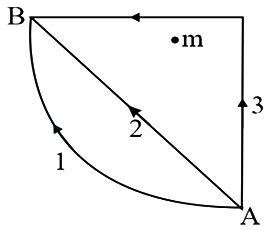
If $W_1, W_2$ and $W_3$ represent the work done in moving a particle from $A$ to $B$ along three different paths $1, 2$ and $3$ (as shown in the figure) in the gravitational field of the point mass '$m$',find the correct relation between '$W_1$','$W_2$' and '$W_3$'.
A
$W_1 < W_3 < W_2$
B
$W_1 < W_2 < W_3$
C
$W_1 = W_2 = W_3$
D
$W_1 > W_3 > W_2$
Solution
(C) The gravitational field is a conservative force field.
In a conservative force field,the work done in moving a particle from one point to another is independent of the path taken.
It only depends on the initial and final positions of the particle.
Since all three paths $(1, 2, 3)$ start at point $A$ and end at point $B$,the work done along each path must be equal.
Therefore,$W_1 = W_2 = W_3$.
In a conservative force field,the work done in moving a particle from one point to another is independent of the path taken.
It only depends on the initial and final positions of the particle.
Since all three paths $(1, 2, 3)$ start at point $A$ and end at point $B$,the work done along each path must be equal.
Therefore,$W_1 = W_2 = W_3$.
0 likes
View Solution106
MediumMCQ
Two particles of mass $m$ and $9m$ are separated by a distance $r$. At a point on the line joining them,the gravitational field is zero. What is the gravitational potential at that point? ($G$ is the universal gravitational constant)
A
$-\frac{4 G m}{r}$
B
$-\frac{8 G m}{r}$
C
$-\frac{16 G m}{r}$
D
$-\frac{32 G m}{r}$
Solution
(C) For the gravitational field to be zero,the intensities produced by both particles must be equal in magnitude and opposite in direction.
$\frac{G m}{r_1^2} = \frac{G(9 m)}{r_2^2}$
where $r_1$ is the distance from mass $m$ and $r_2$ is the distance from mass $9m$.
Since $r_1 + r_2 = r$,we have $\frac{r_2}{r_1} = \sqrt{9} = 3 \Rightarrow r_2 = 3 r_1$.
Therefore,$r_1 + 3 r_1 = r \Rightarrow 4 r_1 = r \Rightarrow r_1 = \frac{r}{4}$ and $r_2 = \frac{3r}{4}$.
The gravitational potential $V$ is given by $V = -\frac{G m}{r_1} - \frac{G(9 m)}{r_2}$.
Substituting the values: $V = -\frac{G m}{r/4} - \frac{9 G m}{3r/4} = -\frac{4 G m}{r} - \frac{36 G m}{3r} = -\frac{4 G m}{r} - \frac{12 G m}{r} = -\frac{16 G m}{r}$.
$\frac{G m}{r_1^2} = \frac{G(9 m)}{r_2^2}$
where $r_1$ is the distance from mass $m$ and $r_2$ is the distance from mass $9m$.
Since $r_1 + r_2 = r$,we have $\frac{r_2}{r_1} = \sqrt{9} = 3 \Rightarrow r_2 = 3 r_1$.
Therefore,$r_1 + 3 r_1 = r \Rightarrow 4 r_1 = r \Rightarrow r_1 = \frac{r}{4}$ and $r_2 = \frac{3r}{4}$.
The gravitational potential $V$ is given by $V = -\frac{G m}{r_1} - \frac{G(9 m)}{r_2}$.
Substituting the values: $V = -\frac{G m}{r/4} - \frac{9 G m}{3r/4} = -\frac{4 G m}{r} - \frac{36 G m}{3r} = -\frac{4 G m}{r} - \frac{12 G m}{r} = -\frac{16 G m}{r}$.
0 likes
View Solution107
MediumMCQ
If $g$ is the acceleration due to gravity on the earth's surface,the gain in the potential energy of an object of mass $m$ raised from the surface of the earth to a height equal to the radius $R$ of the earth is
A
$2 mgR$
B
$mgR$
C
$\frac{1}{2} mgR$
D
$\frac{1}{4} mgR$
Solution
(C) The gravitational potential energy of an object of mass $m$ at the surface of the earth is given by $U_{1} = -\frac{GMm}{R}$.
At a height $h = R$ from the surface,the distance from the center of the earth is $r = R + h = R + R = 2R$.
The potential energy at this height is $U_{2} = -\frac{GMm}{2R}$.
The gain in potential energy is $\Delta U = U_{2} - U_{1} = -\frac{GMm}{2R} - (-\frac{GMm}{R}) = \frac{GMm}{R} - \frac{GMm}{2R} = \frac{GMm}{2R}$.
Since the acceleration due to gravity at the surface is $g = \frac{GM}{R^{2}}$,we have $GM = gR^{2}$.
Substituting this into the expression for $\Delta U$:
$\Delta U = \frac{1}{2} \frac{(gR^{2})m}{R} = \frac{1}{2} mgR$.
At a height $h = R$ from the surface,the distance from the center of the earth is $r = R + h = R + R = 2R$.
The potential energy at this height is $U_{2} = -\frac{GMm}{2R}$.
The gain in potential energy is $\Delta U = U_{2} - U_{1} = -\frac{GMm}{2R} - (-\frac{GMm}{R}) = \frac{GMm}{R} - \frac{GMm}{2R} = \frac{GMm}{2R}$.
Since the acceleration due to gravity at the surface is $g = \frac{GM}{R^{2}}$,we have $GM = gR^{2}$.
Substituting this into the expression for $\Delta U$:
$\Delta U = \frac{1}{2} \frac{(gR^{2})m}{R} = \frac{1}{2} mgR$.
0 likes
View Solution108
MediumMCQ
An infinite number of objects,each of mass $1 \ kg$,are placed on the $x$-axis on both sides of $x=0$ at positions $x = \pm 1 \ m, \pm 2 \ m, \pm 4 \ m, \pm 8 \ m, \ldots$ and so on. The magnitude of the resultant gravitational potential (in $SI$ units) at $x=0$ is ($G$ is the universal gravitational constant).
A
$G$
B
$2G$
C
$3G$
D
$4G$
Solution
(D) The gravitational potential $V$ at a point due to a mass $m$ at distance $r$ is given by $V = -\frac{Gm}{r}$.
Here,$m = 1 \ kg$. The objects are placed at $x = \pm 1, \pm 2, \pm 4, \pm 8, \ldots \ m$.
Since there are two objects at each distance $r$ (one at $+r$ and one at $-r$),the total potential $V_{total}$ at $x=0$ is:
$V_{total} = \sum -\frac{Gm}{r_i} = -G(1) \left[ \frac{1}{1} + \frac{1}{1} + \frac{1}{2} + \frac{1}{2} + \frac{1}{4} + \frac{1}{4} + \ldots \right]$
$V_{total} = -G \left[ 2 \left( 1 + \frac{1}{2} + \frac{1}{4} + \frac{1}{8} + \ldots \right) \right]$
The term in the bracket is a geometric progression with first term $a=1$ and common ratio $r=1/2$. The sum is $S = \frac{a}{1-r} = \frac{1}{1 - 1/2} = 2$.
Therefore,$V_{total} = -G \times 2 \times 2 = -4G$.
The magnitude of the potential is $|V_{total}| = 4G$.
Here,$m = 1 \ kg$. The objects are placed at $x = \pm 1, \pm 2, \pm 4, \pm 8, \ldots \ m$.
Since there are two objects at each distance $r$ (one at $+r$ and one at $-r$),the total potential $V_{total}$ at $x=0$ is:
$V_{total} = \sum -\frac{Gm}{r_i} = -G(1) \left[ \frac{1}{1} + \frac{1}{1} + \frac{1}{2} + \frac{1}{2} + \frac{1}{4} + \frac{1}{4} + \ldots \right]$
$V_{total} = -G \left[ 2 \left( 1 + \frac{1}{2} + \frac{1}{4} + \frac{1}{8} + \ldots \right) \right]$
The term in the bracket is a geometric progression with first term $a=1$ and common ratio $r=1/2$. The sum is $S = \frac{a}{1-r} = \frac{1}{1 - 1/2} = 2$.
Therefore,$V_{total} = -G \times 2 \times 2 = -4G$.
The magnitude of the potential is $|V_{total}| = 4G$.
0 likes
View Solution109
MediumMCQ
The potential energy of a satellite of mass '$m$' revolving around the earth at a height of $R_e$ from the surface of the earth is ($R_e$ - radius of earth; $g$ - acceleration due to gravity).
A
$-0.5 mgR_{e}$
B
$-m g R_e$
C
$-2 m g R_e$
D
$-4 m g R_e$
Solution
(A) The gravitational potential energy $U$ of a satellite of mass $m$ at a distance $r$ from the center of the earth is given by $U = -\frac{GMm}{r}$.
Here,the satellite is at a height $h = R_e$ from the surface of the earth.
Therefore,the distance from the center of the earth is $r = R_e + h = R_e + R_e = 2R_e$.
Substituting $r = 2R_e$ into the formula,we get $U = -\frac{GMm}{2R_e}$.
We know that the acceleration due to gravity at the surface of the earth is $g = \frac{GM}{R_e^2}$,which implies $GM = gR_e^2$.
Substituting $GM = gR_e^2$ into the expression for $U$,we get $U = -\frac{(gR_e^2)m}{2R_e} = -0.5 mgR_e$.
Thus,the correct option is $A$.
Here,the satellite is at a height $h = R_e$ from the surface of the earth.
Therefore,the distance from the center of the earth is $r = R_e + h = R_e + R_e = 2R_e$.
Substituting $r = 2R_e$ into the formula,we get $U = -\frac{GMm}{2R_e}$.
We know that the acceleration due to gravity at the surface of the earth is $g = \frac{GM}{R_e^2}$,which implies $GM = gR_e^2$.
Substituting $GM = gR_e^2$ into the expression for $U$,we get $U = -\frac{(gR_e^2)m}{2R_e} = -0.5 mgR_e$.
Thus,the correct option is $A$.
0 likes
View Solution110
EasyMCQ
The gravitational potential energy of a body on the surface of the earth is $E$. If the body is taken from the surface of the earth to a height equal to $150 \%$ of the radius of the earth,its gravitational potential energy is (in $E$)
A
$0.4$
B
$0.2$
C
$0.6$
D
$0.3$
Solution
(A) The gravitational potential energy of a body of mass $m$ at the surface of the earth (radius $R$) is given by $E = -\frac{GMm}{R}$.
When the body is taken to a height $h = 150\% \text{ of } R$,we have $h = 1.5R$.
The distance of the body from the center of the earth at this height is $R' = R + h = R + 1.5R = 2.5R$.
The new gravitational potential energy $E'$ is given by $E' = -\frac{GMm}{R'} = -\frac{GMm}{2.5R}$.
Substituting $E = -\frac{GMm}{R}$ into the expression for $E'$,we get $E' = \frac{E}{2.5} = 0.4E$.
When the body is taken to a height $h = 150\% \text{ of } R$,we have $h = 1.5R$.
The distance of the body from the center of the earth at this height is $R' = R + h = R + 1.5R = 2.5R$.
The new gravitational potential energy $E'$ is given by $E' = -\frac{GMm}{R'} = -\frac{GMm}{2.5R}$.
Substituting $E = -\frac{GMm}{R}$ into the expression for $E'$,we get $E' = \frac{E}{2.5} = 0.4E$.
0 likes
View Solution111
EasyMCQ
$A$ uniform solid sphere of mass $M$ and radius $a$ is surrounded by a concentric uniform thin spherical shell of mass $0.5 M$ and radius $1.5 a$. The gravitational potential energy of a unit mass kept at a distance of $2.5 a$ from the center is
A
$\frac{-3 GM}{5 a}$
B
$\frac{3 GM}{5 a}$
C
$\frac{2 GM}{5 a}$
D
$\frac{-2 GM}{5 a}$
Solution
(A) The gravitational potential at a point outside a spherical body is given by $V = -\frac{GM}{r}$.
Since the point at distance $r = 2.5 a$ is outside both the solid sphere and the spherical shell,both act as point masses at the center.
The total mass of the system is $M_{total} = M + 0.5 M = 1.5 M$.
The gravitational potential energy $U$ of a unit mass $(m = 1)$ at distance $r = 2.5 a$ is given by $U = V = -\frac{G M_{total}}{r}$.
Substituting the values: $U = -\frac{G(1.5 M)}{2.5 a} = -\frac{1.5}{2.5} \frac{GM}{a} = -\frac{3}{5} \frac{GM}{a} = -\frac{3 GM}{5 a}$.
Since the point at distance $r = 2.5 a$ is outside both the solid sphere and the spherical shell,both act as point masses at the center.
The total mass of the system is $M_{total} = M + 0.5 M = 1.5 M$.
The gravitational potential energy $U$ of a unit mass $(m = 1)$ at distance $r = 2.5 a$ is given by $U = V = -\frac{G M_{total}}{r}$.
Substituting the values: $U = -\frac{G(1.5 M)}{2.5 a} = -\frac{1.5}{2.5} \frac{GM}{a} = -\frac{3}{5} \frac{GM}{a} = -\frac{3 GM}{5 a}$.
0 likes
View Solution112
EasyMCQ
The gravitational potential energy of a system of three masses $m$,$2m$,and $3m$ placed at the three vertices of an equilateral triangle of side '$a$' is:
A
$-11 \frac{Gm}{a}$
B
$-11 \frac{Gm^2}{a^2}$
C
$-11 \frac{Gm^2}{a}$
D
$-11 \frac{Gm}{a^2}$
Solution
(C) The gravitational potential energy $U$ of a system of point masses is the sum of the potential energies of all pairs of masses.
For three masses $m_1, m_2, m_3$ at distances $r_{12}, r_{23}, r_{31}$,the total potential energy is $U = -G \left( \frac{m_1 m_2}{r_{12}} + \frac{m_2 m_3}{r_{23}} + \frac{m_3 m_1}{r_{31}} \right)$.
Here,$m_1 = m$,$m_2 = 2m$,$m_3 = 3m$,and $r_{12} = r_{23} = r_{31} = a$.
Substituting these values:
$U = -\frac{G}{a} [ (m)(2m) + (2m)(3m) + (3m)(m) ]$
$U = -\frac{G}{a} [ 2m^2 + 6m^2 + 3m^2 ]$
$U = -\frac{G}{a} [ 11m^2 ]$
$U = -11 \frac{Gm^2}{a}$.
For three masses $m_1, m_2, m_3$ at distances $r_{12}, r_{23}, r_{31}$,the total potential energy is $U = -G \left( \frac{m_1 m_2}{r_{12}} + \frac{m_2 m_3}{r_{23}} + \frac{m_3 m_1}{r_{31}} \right)$.
Here,$m_1 = m$,$m_2 = 2m$,$m_3 = 3m$,and $r_{12} = r_{23} = r_{31} = a$.
Substituting these values:
$U = -\frac{G}{a} [ (m)(2m) + (2m)(3m) + (3m)(m) ]$
$U = -\frac{G}{a} [ 2m^2 + 6m^2 + 3m^2 ]$
$U = -\frac{G}{a} [ 11m^2 ]$
$U = -11 \frac{Gm^2}{a}$.
0 likes
View Solution113
MediumMCQ
$A$ particle is kept on the surface of a uniform sphere of mass $1000 \ kg$ and radius $1 \ m$. The work done per unit mass against the gravitational force between them is $\left[G=6.67 \times 10^{-11} \ N \ m^2 \ kg^{-2}\right]$
A
$3.35 \times 10^{-10} \ J \ kg^{-1}$
B
$-3.35 \times 10^{-10} \ J \ kg^{-1}$
C
$6.67 \times 10^{-8} \ J \ kg^{-1}$
D
$-3.35 \times 10^{-8} \ J \ kg^{-1}$
Solution
(C) The work done by an external agent against a conservative force is equal to the change in potential energy,$W = U_f - U_i$.
The gravitational potential $V$ at a distance $r$ from a sphere of mass $M$ is given by $V = -\frac{GM}{r}$.
The initial potential at the surface $(r = 1 \ m)$ is $V_i = -\frac{G \times 1000}{1} = -6.67 \times 10^{-11} \times 1000 = -6.67 \times 10^{-8} \ J \ kg^{-1}$.
To take the particle to infinity,the final potential is $V_f = -\frac{GM}{\infty} = 0$.
The work done per unit mass is $W = V_f - V_i = 0 - (-6.67 \times 10^{-8} \ J \ kg^{-1}) = 6.67 \times 10^{-8} \ J \ kg^{-1}$.
The gravitational potential $V$ at a distance $r$ from a sphere of mass $M$ is given by $V = -\frac{GM}{r}$.
The initial potential at the surface $(r = 1 \ m)$ is $V_i = -\frac{G \times 1000}{1} = -6.67 \times 10^{-11} \times 1000 = -6.67 \times 10^{-8} \ J \ kg^{-1}$.
To take the particle to infinity,the final potential is $V_f = -\frac{GM}{\infty} = 0$.
The work done per unit mass is $W = V_f - V_i = 0 - (-6.67 \times 10^{-8} \ J \ kg^{-1}) = 6.67 \times 10^{-8} \ J \ kg^{-1}$.
0 likes
View Solution114
EasyMCQ
The gravitational potential energy is maximum at
A
Infinity
B
the earth's surface
C
the centre of the earth
D
twice the radius of the earth
Solution
(A) The gravitational potential energy is the energy possessed by a mass due to its position in a gravitational field.
The expression for gravitational potential energy $U$ of a mass $m$ at a distance $r$ from a mass $M$ is given by $U = -\frac{G M m}{r}$.
Since $U$ is inversely proportional to the distance $r$ with a negative sign,as $r$ increases,the value of $U$ increases.
At $r = \infty$,$U = -\frac{G M m}{\infty} = 0$.
Since the potential energy is negative everywhere else,$0$ is the maximum possible value for gravitational potential energy.
The expression for gravitational potential energy $U$ of a mass $m$ at a distance $r$ from a mass $M$ is given by $U = -\frac{G M m}{r}$.
Since $U$ is inversely proportional to the distance $r$ with a negative sign,as $r$ increases,the value of $U$ increases.
At $r = \infty$,$U = -\frac{G M m}{\infty} = 0$.
Since the potential energy is negative everywhere else,$0$ is the maximum possible value for gravitational potential energy.
0 likes
View Solution115
MediumMCQ
The gravitational field in a region is given by $E = (5 \hat{i} + 12 \hat{j}) \text{ N kg}^{-1}$. If a particle of mass $2 \text{ kg}$ is moved from the origin to the point $(12 \text{ m}, 15 \text{ m})$ in this region,the change in gravitational potential energy is (in $\text{ J}$)
A
$-450$
B
$-480$
C
$-240$
D
$-500$
Solution
(B) Given,gravitational field $E = (5 \hat{i} + 12 \hat{j}) \text{ N kg}^{-1}$,mass $m = 2 \text{ kg}$,and displacement vector $r = (12 \hat{i} + 15 \hat{j}) \text{ m}$.
The work done by the gravitational field is $W = \int F \cdot dr = \int (mE) \cdot dr$.
The change in gravitational potential energy $\Delta U$ is given by $\Delta U = -W = -m \int E \cdot dr$.
Substituting the values:
$\Delta U = -2 \int_{(0,0)}^{(12,15)} (5 \hat{i} + 12 \hat{j}) \cdot (dx \hat{i} + dy \hat{j})$
$\Delta U = -2 \left[ \int_0^{12} 5 dx + \int_0^{15} 12 dy \right]$
$\Delta U = -2 [5(12 - 0) + 12(15 - 0)]$
$\Delta U = -2 [60 + 180]$
$\Delta U = -2 [240] = -480 \text{ J}$.
Thus,the change in gravitational potential energy is $-480 \text{ J}$.
Therefore,the correct option is $B$.
The work done by the gravitational field is $W = \int F \cdot dr = \int (mE) \cdot dr$.
The change in gravitational potential energy $\Delta U$ is given by $\Delta U = -W = -m \int E \cdot dr$.
Substituting the values:
$\Delta U = -2 \int_{(0,0)}^{(12,15)} (5 \hat{i} + 12 \hat{j}) \cdot (dx \hat{i} + dy \hat{j})$
$\Delta U = -2 \left[ \int_0^{12} 5 dx + \int_0^{15} 12 dy \right]$
$\Delta U = -2 [5(12 - 0) + 12(15 - 0)]$
$\Delta U = -2 [60 + 180]$
$\Delta U = -2 [240] = -480 \text{ J}$.
Thus,the change in gravitational potential energy is $-480 \text{ J}$.
Therefore,the correct option is $B$.
0 likes
View Solution116
DifficultMCQ
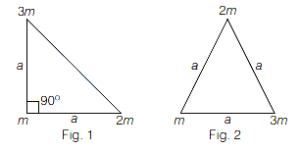
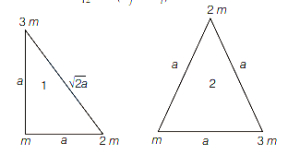
Three masses $m, 2m$ and $3m$ are arranged in two triangular configurations as shown in figure $1$ and figure $2$. The work done by an external agent in changing the configuration from figure $1$ to figure $2$ is:
A
$\frac{6 G m^2}{a}\left[2-\frac{6}{\sqrt{2}}\right]$
B
$0$
C
$\frac{G m^2}{a}\left[6+\frac{6}{\sqrt{2}}\right]$
D
$-\frac{G m^2}{a}\left[6-\frac{6}{\sqrt{2}}\right]$
Solution
(D) The work done by an external agent is equal to the change in the gravitational potential energy of the system: $W = U_f - U_i$.
For configuration $1$ (right-angled triangle with sides $a, a, \sqrt{2}a$):
$U_i = -\frac{G(m)(2m)}{a} - \frac{G(m)(3m)}{a} - \frac{G(2m)(3m)}{\sqrt{2}a} = -\frac{G m^2}{a} \left( 2 + 3 + \frac{6}{\sqrt{2}} \right) = -\frac{G m^2}{a} \left( 5 + \frac{6}{\sqrt{2}} \right)$.
For configuration $2$ (equilateral triangle with all sides $a$):
$U_f = -\frac{G(m)(3m)}{a} - \frac{G(m)(2m)}{a} - \frac{G(2m)(3m)}{a} = -\frac{G m^2}{a} (3 + 2 + 6) = -\frac{11 G m^2}{a}$.
Work done $W = U_f - U_i = -\frac{11 G m^2}{a} - \left( -\frac{G m^2}{a} \left( 5 + \frac{6}{\sqrt{2}} \right) \right) = \frac{G m^2}{a} \left( -11 + 5 + \frac{6}{\sqrt{2}} \right) = \frac{G m^2}{a} \left( \frac{6}{\sqrt{2}} - 6 \right) = -\frac{G m^2}{a} \left( 6 - \frac{6}{\sqrt{2}} \right)$.
For configuration $1$ (right-angled triangle with sides $a, a, \sqrt{2}a$):
$U_i = -\frac{G(m)(2m)}{a} - \frac{G(m)(3m)}{a} - \frac{G(2m)(3m)}{\sqrt{2}a} = -\frac{G m^2}{a} \left( 2 + 3 + \frac{6}{\sqrt{2}} \right) = -\frac{G m^2}{a} \left( 5 + \frac{6}{\sqrt{2}} \right)$.
For configuration $2$ (equilateral triangle with all sides $a$):
$U_f = -\frac{G(m)(3m)}{a} - \frac{G(m)(2m)}{a} - \frac{G(2m)(3m)}{a} = -\frac{G m^2}{a} (3 + 2 + 6) = -\frac{11 G m^2}{a}$.
Work done $W = U_f - U_i = -\frac{11 G m^2}{a} - \left( -\frac{G m^2}{a} \left( 5 + \frac{6}{\sqrt{2}} \right) \right) = \frac{G m^2}{a} \left( -11 + 5 + \frac{6}{\sqrt{2}} \right) = \frac{G m^2}{a} \left( \frac{6}{\sqrt{2}} - 6 \right) = -\frac{G m^2}{a} \left( 6 - \frac{6}{\sqrt{2}} \right)$.
0 likes
View Solution117
EasyMCQ
Two bodies of masses $m$ and $9m$ are placed at a distance $r$. The gravitational potential at a point on the line joining them,where the gravitational field is zero,is ($G$ is the universal gravitational constant).
A
$\frac{-14Gm}{r}$
B
$\frac{-16Gm}{r}$
C
$\frac{-12Gm}{r}$
D
$\frac{-8Gm}{r}$
Solution
(B) Let the point where the gravitational field is zero be at a distance $x$ from the mass $m$. The gravitational field due to both masses must be equal in magnitude and opposite in direction.
$E_1 = E_2 \Rightarrow \frac{Gm}{x^2} = \frac{G(9m)}{(r-x)^2}$
Taking the square root on both sides: $\frac{1}{x} = \frac{3}{r-x}$
$r-x = 3x \Rightarrow 4x = r \Rightarrow x = \frac{r}{4}$.
The distance from mass $9m$ is $r-x = r - \frac{r}{4} = \frac{3r}{4}$.
The gravitational potential $V$ at this point is the sum of the potentials due to both masses:
$V = V_1 + V_2 = -\frac{Gm}{x} - \frac{G(9m)}{r-x}$
$V = -\frac{Gm}{r/4} - \frac{9Gm}{3r/4} = -\frac{4Gm}{r} - \frac{12Gm}{r}$
$V = -\frac{16Gm}{r}$.
$E_1 = E_2 \Rightarrow \frac{Gm}{x^2} = \frac{G(9m)}{(r-x)^2}$
Taking the square root on both sides: $\frac{1}{x} = \frac{3}{r-x}$
$r-x = 3x \Rightarrow 4x = r \Rightarrow x = \frac{r}{4}$.
The distance from mass $9m$ is $r-x = r - \frac{r}{4} = \frac{3r}{4}$.
The gravitational potential $V$ at this point is the sum of the potentials due to both masses:
$V = V_1 + V_2 = -\frac{Gm}{x} - \frac{G(9m)}{r-x}$
$V = -\frac{Gm}{r/4} - \frac{9Gm}{3r/4} = -\frac{4Gm}{r} - \frac{12Gm}{r}$
$V = -\frac{16Gm}{r}$.
0 likes
View Solution118
DifficultMCQ
The gravitational field in a region is given by the equation $E = (5\hat{i} + 12\hat{j}) \text{ N/kg}$. If a particle of mass $2 \text{ kg}$ is moved from the origin $(0, 0)$ to the point $(12 \text{ m}, 5 \text{ m})$ in this region, the change in gravitational potential energy is: (in $\text{ J}$)
A
$-225$
B
$-240$
C
$-245$
D
$-250$
Solution
(B) The change in gravitational potential energy $\Delta U$ is given by the work done against the gravitational field, or $\Delta U = -W = -\int \vec{F} \cdot d\vec{r} = -m \int \vec{E} \cdot d\vec{r}$.
Given $\vec{E} = (5\hat{i} + 12\hat{j}) \text{ N/kg}$ and displacement $\vec{r} = (12\hat{i} + 5\hat{j}) \text{ m}$.
Since the field is uniform, the work done $W = m(\vec{E} \cdot \vec{r})$.
$W = 2 \text{ kg} \times [(5\hat{i} + 12\hat{j}) \cdot (12\hat{i} + 5\hat{j})] \text{ J}$.
$W = 2 \times (5 \times 12 + 12 \times 5) = 2 \times (60 + 60) = 2 \times 120 = 240 \text{ J}$.
The change in gravitational potential energy $\Delta U = -W = -240 \text{ J}$.
Given $\vec{E} = (5\hat{i} + 12\hat{j}) \text{ N/kg}$ and displacement $\vec{r} = (12\hat{i} + 5\hat{j}) \text{ m}$.
Since the field is uniform, the work done $W = m(\vec{E} \cdot \vec{r})$.
$W = 2 \text{ kg} \times [(5\hat{i} + 12\hat{j}) \cdot (12\hat{i} + 5\hat{j})] \text{ J}$.
$W = 2 \times (5 \times 12 + 12 \times 5) = 2 \times (60 + 60) = 2 \times 120 = 240 \text{ J}$.
The change in gravitational potential energy $\Delta U = -W = -240 \text{ J}$.
0 likes
View Solution119
DifficultMCQ
Two bodies of masses $4 \,m$ and $9 \,m$ are separated by a distance $r$. The gravitational potential at a point on the line joining them where the gravitational field becomes zero is:
A
$\frac{-25 G m}{r}$
B
$\frac{-4 G m}{r}$
C
$\frac{-9 G m}{r}$
D
$\frac{-13 G m}{r}$
Solution
(A) Let the point where the gravitational field is zero be at a distance $x$ from the mass $4 \,m$. The distance from the mass $9 \,m$ will be $(r - x)$.
At this point,the magnitudes of the gravitational fields due to both masses are equal:
$\frac{G(4 \,m)}{x^2} = \frac{G(9 \,m)}{(r - x)^2}$
$\frac{4}{9} = \left(\frac{x}{r - x}\right)^2$
Taking the square root on both sides:
$\frac{2}{3} = \frac{x}{r - x}$
$2(r - x) = 3x \Rightarrow 2r - 2x = 3x \Rightarrow 5x = 2r \Rightarrow x = \frac{2r}{5}$
So,the distance from $4 \,m$ is $\frac{2r}{5}$ and from $9 \,m$ is $r - \frac{2r}{5} = \frac{3r}{5}$.
The gravitational potential $V$ at this point is the sum of the potentials due to both masses:
$V = -\frac{G(4 \,m)}{x} - \frac{G(9 \,m)}{r - x}$
$V = -\frac{G(4 \,m)}{\frac{2r}{5}} - \frac{G(9 \,m)}{\frac{3r}{5}}$
$V = -\frac{20Gm}{2r} - \frac{45Gm}{3r} = -\frac{10Gm}{r} - \frac{15Gm}{r} = -\frac{25Gm}{r}$
At this point,the magnitudes of the gravitational fields due to both masses are equal:
$\frac{G(4 \,m)}{x^2} = \frac{G(9 \,m)}{(r - x)^2}$
$\frac{4}{9} = \left(\frac{x}{r - x}\right)^2$
Taking the square root on both sides:
$\frac{2}{3} = \frac{x}{r - x}$
$2(r - x) = 3x \Rightarrow 2r - 2x = 3x \Rightarrow 5x = 2r \Rightarrow x = \frac{2r}{5}$
So,the distance from $4 \,m$ is $\frac{2r}{5}$ and from $9 \,m$ is $r - \frac{2r}{5} = \frac{3r}{5}$.
The gravitational potential $V$ at this point is the sum of the potentials due to both masses:
$V = -\frac{G(4 \,m)}{x} - \frac{G(9 \,m)}{r - x}$
$V = -\frac{G(4 \,m)}{\frac{2r}{5}} - \frac{G(9 \,m)}{\frac{3r}{5}}$
$V = -\frac{20Gm}{2r} - \frac{45Gm}{3r} = -\frac{10Gm}{r} - \frac{15Gm}{r} = -\frac{25Gm}{r}$
0 likes
View Solution120
EasyMCQ
$A$ body of mass $m$ rises to a height $h = R/5$ from the earth's surface,where $R$ is the earth's radius. If $g$ is the acceleration due to gravity at the earth's surface,the increase in potential energy is:
A
$mg/h$
B
$\frac{5}{6} mgh$
C
$\frac{3}{5} mgh$
D
$\frac{6}{7} mgh$
Solution
(B) The gravitational potential energy at the surface of the earth is $PE_1 = -\frac{GMm}{R}$.
At a height $h = R/5$,the potential energy is $PE_2 = -\frac{GMm}{R+h} = -\frac{GMm}{R + R/5} = -\frac{GMm}{6R/5} = -\frac{5GMm}{6R}$.
The increase in potential energy is $\Delta PE = PE_2 - PE_1 = -\frac{5GMm}{6R} - (-\frac{GMm}{R}) = \frac{GMm}{R} (1 - 5/6) = \frac{GMm}{6R}$.
Since $g = \frac{GM}{R^2}$,we have $GM = gR^2$.
Substituting this into the expression,$\Delta PE = \frac{(gR^2)m}{6R} = \frac{mgR}{6}$.
Given $h = R/5$,then $R = 5h$.
Substituting $R = 5h$ into the expression,$\Delta PE = \frac{mg(5h)}{6} = \frac{5}{6} mgh$.
At a height $h = R/5$,the potential energy is $PE_2 = -\frac{GMm}{R+h} = -\frac{GMm}{R + R/5} = -\frac{GMm}{6R/5} = -\frac{5GMm}{6R}$.
The increase in potential energy is $\Delta PE = PE_2 - PE_1 = -\frac{5GMm}{6R} - (-\frac{GMm}{R}) = \frac{GMm}{R} (1 - 5/6) = \frac{GMm}{6R}$.
Since $g = \frac{GM}{R^2}$,we have $GM = gR^2$.
Substituting this into the expression,$\Delta PE = \frac{(gR^2)m}{6R} = \frac{mgR}{6}$.
Given $h = R/5$,then $R = 5h$.
Substituting $R = 5h$ into the expression,$\Delta PE = \frac{mg(5h)}{6} = \frac{5}{6} mgh$.
0 likes
View Solution121
EasyMCQ
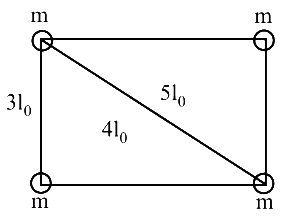
Four particles each of mass $m$ are placed at four vertices of a rectangle having side lengths $3 l_o$ and $4 l_o$. The magnitude of the gravitational potential energy of the system in units of $\frac{Gm^2}{l_o}$ is:
A
$7$/$6$
B
$47$/$30$
C
$47$/$60$
D
$7$/$12$
Solution
(B) The gravitational potential energy $U$ of a system of particles is given by the sum of the potential energies of all possible pairs: $U = -\sum \frac{Gm_i m_j}{r_{ij}}$.
For a rectangle with sides $a = 3 l_o$ and $b = 4 l_o$,the diagonal $d = \sqrt{(3 l_o)^2 + (4 l_o)^2} = 5 l_o$.
There are $4$ pairs with side length $3 l_o$ (two sides),$4 l_o$ (two sides),and $5 l_o$ (two diagonals).
$U = -\left[ \frac{Gm^2}{3 l_o} \times 2 + \frac{Gm^2}{4 l_o} \times 2 + \frac{Gm^2}{5 l_o} \times 2 \right]$
$U = -\frac{Gm^2}{l_o} \left[ \frac{2}{3} + \frac{2}{4} + \frac{2}{5} \right]$
$U = -\frac{Gm^2}{l_o} \left[ \frac{40 + 30 + 24}{60} \right] = -\frac{94}{60} \frac{Gm^2}{l_o} = -\frac{47}{30} \frac{Gm^2}{l_o}$.
The magnitude is $|U| = \frac{47}{30} \frac{Gm^2}{l_o}$.
For a rectangle with sides $a = 3 l_o$ and $b = 4 l_o$,the diagonal $d = \sqrt{(3 l_o)^2 + (4 l_o)^2} = 5 l_o$.
There are $4$ pairs with side length $3 l_o$ (two sides),$4 l_o$ (two sides),and $5 l_o$ (two diagonals).
$U = -\left[ \frac{Gm^2}{3 l_o} \times 2 + \frac{Gm^2}{4 l_o} \times 2 + \frac{Gm^2}{5 l_o} \times 2 \right]$
$U = -\frac{Gm^2}{l_o} \left[ \frac{2}{3} + \frac{2}{4} + \frac{2}{5} \right]$
$U = -\frac{Gm^2}{l_o} \left[ \frac{40 + 30 + 24}{60} \right] = -\frac{94}{60} \frac{Gm^2}{l_o} = -\frac{47}{30} \frac{Gm^2}{l_o}$.
The magnitude is $|U| = \frac{47}{30} \frac{Gm^2}{l_o}$.
0 likes
View Solution122
EasyMCQ
The bodies of masses $100 \,kg$ and $8100 \,kg$ are held at a distance of $1 \,m$. The gravitational field at a point on the line joining them is zero. The gravitational potential at that point in $J/kg$ is $\left(G = 6.67 \times 10^{-11} \,Nm^2/kg^2\right)$
A
$-6.67 \times 10^{-7}$
B
$-6.67 \times 10^{-10}$
C
$-13.34 \times 10^{-7}$
D
$-6.67 \times 10^{-9}$
Solution
(A) Let $m_1 = 100 \,kg$ and $m_2 = 8100 \,kg$ be the masses separated by distance $d = 1 \,m$.
Let $x$ be the distance of the null point (where gravitational field is zero) from $m_1$.
The condition for zero gravitational field is $\frac{G m_1}{x^2} = \frac{G m_2}{(d-x)^2}$.
Taking the square root on both sides: $\frac{\sqrt{m_1}}{x} = \frac{\sqrt{m_2}}{d-x}$.
Substituting values: $\frac{10}{x} = \frac{90}{1-x} \implies 10 - 10x = 90x \implies 100x = 10 \implies x = 0.1 \,m$.
The distance from $m_2$ is $d-x = 0.9 \,m$.
The gravitational potential $V$ at this point is $V = -\frac{G m_1}{x} - \frac{G m_2}{d-x}$.
$V = -G \left( \frac{100}{0.1} + \frac{8100}{0.9} \right) = -G (1000 + 9000) = -10000 G$.
$V = -10000 \times 6.67 \times 10^{-11} = -6.67 \times 10^{-7} \,J/kg$.
Let $x$ be the distance of the null point (where gravitational field is zero) from $m_1$.
The condition for zero gravitational field is $\frac{G m_1}{x^2} = \frac{G m_2}{(d-x)^2}$.
Taking the square root on both sides: $\frac{\sqrt{m_1}}{x} = \frac{\sqrt{m_2}}{d-x}$.
Substituting values: $\frac{10}{x} = \frac{90}{1-x} \implies 10 - 10x = 90x \implies 100x = 10 \implies x = 0.1 \,m$.
The distance from $m_2$ is $d-x = 0.9 \,m$.
The gravitational potential $V$ at this point is $V = -\frac{G m_1}{x} - \frac{G m_2}{d-x}$.
$V = -G \left( \frac{100}{0.1} + \frac{8100}{0.9} \right) = -G (1000 + 9000) = -10000 G$.
$V = -10000 \times 6.67 \times 10^{-11} = -6.67 \times 10^{-7} \,J/kg$.
0 likes
View Solution123
DifficultMCQ
The gravitational field in a region is given by the equation $E = (5\hat{i} + 12\hat{j}) \,N/kg$. If a particle of mass $2 \,kg$ is moved from the origin to the point $(12 \,m, 5 \,m)$ in this region, what is the change in gravitational potential energy (in $\,J$)?
A
$-225$
B
$-240$
C
$-245$
D
$-250$
Solution
(B) The gravitational field is given by $E = (5\hat{i} + 12\hat{j}) \,N/kg$.
The displacement vector $dr$ from the origin $(0, 0)$ to the point $(12 \,m, 5 \,m)$ is $dr = (12\hat{i} + 5\hat{j}) \,m$.
The change in gravitational potential $dV$ is given by $dV = -E \cdot dr$.
$dV = -(5\hat{i} + 12\hat{j}) \cdot (12\hat{i} + 5\hat{j}) = -(5 \times 12 + 12 \times 5) = -(60 + 60) = -120 \,J/kg$.
The change in gravitational potential energy $\Delta U$ is given by $\Delta U = m \cdot dV$.
Given mass $m = 2 \,kg$, we have $\Delta U = 2 \,kg \times (-120 \,J/kg) = -240 \,J$.
The displacement vector $dr$ from the origin $(0, 0)$ to the point $(12 \,m, 5 \,m)$ is $dr = (12\hat{i} + 5\hat{j}) \,m$.
The change in gravitational potential $dV$ is given by $dV = -E \cdot dr$.
$dV = -(5\hat{i} + 12\hat{j}) \cdot (12\hat{i} + 5\hat{j}) = -(5 \times 12 + 12 \times 5) = -(60 + 60) = -120 \,J/kg$.
The change in gravitational potential energy $\Delta U$ is given by $\Delta U = m \cdot dV$.
Given mass $m = 2 \,kg$, we have $\Delta U = 2 \,kg \times (-120 \,J/kg) = -240 \,J$.
0 likes
View Solution124
DifficultMCQ
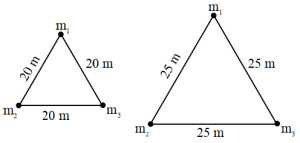
Three masses $200 \ kg$,$300 \ kg$,and $400 \ kg$ are placed at the vertices of an equilateral triangle with sides $20 \ m$. They are rearranged on the vertices of a bigger triangle of side $25 \ m$ with the same center. The work done in this process is . . . . . . $J$.
A
$9.86 \times 10^{-6}$
B
$2.85 \times 10^{-7}$
C
$1.74 \times 10^{-7}$
D
$4.77 \times 10^{-7}$
Solution
(C) The work done by an external agent is equal to the change in the gravitational potential energy of the system: $W_{ext} = \Delta U = U_f - U_i$.
The gravitational potential energy of a system of three masses is given by $U = -G \left( \frac{m_1 m_2}{r} + \frac{m_2 m_3}{r} + \frac{m_1 m_3}{r} \right) = -\frac{G}{r} (m_1 m_2 + m_2 m_3 + m_1 m_3)$.
Given masses: $m_1 = 200 \ kg$,$m_2 = 300 \ kg$,$m_3 = 400 \ kg$.
Sum of products: $(200 \times 300) + (300 \times 400) + (200 \times 400) = 60000 + 120000 + 80000 = 260000 = 2.6 \times 10^5 \ kg^2$.
Initial potential energy $(r_i = 20 \ m)$:
$U_i = -\frac{6.67 \times 10^{-11}}{20} \times 2.6 \times 10^5 = -6.67 \times 10^{-11} \times 0.13 \times 10^5 = -8.671 \times 10^{-7} \ J$.
Final potential energy $(r_f = 25 \ m)$:
$U_f = -\frac{6.67 \times 10^{-11}}{25} \times 2.6 \times 10^5 = -6.67 \times 10^{-11} \times 0.104 \times 10^5 = -6.9368 \times 10^{-7} \ J$.
Work done:
$W = U_f - U_i = (-6.9368 \times 10^{-7}) - (-8.671 \times 10^{-7}) = 1.7342 \times 10^{-7} \ J \approx 1.74 \times 10^{-7} \ J$.
The gravitational potential energy of a system of three masses is given by $U = -G \left( \frac{m_1 m_2}{r} + \frac{m_2 m_3}{r} + \frac{m_1 m_3}{r} \right) = -\frac{G}{r} (m_1 m_2 + m_2 m_3 + m_1 m_3)$.
Given masses: $m_1 = 200 \ kg$,$m_2 = 300 \ kg$,$m_3 = 400 \ kg$.
Sum of products: $(200 \times 300) + (300 \times 400) + (200 \times 400) = 60000 + 120000 + 80000 = 260000 = 2.6 \times 10^5 \ kg^2$.
Initial potential energy $(r_i = 20 \ m)$:
$U_i = -\frac{6.67 \times 10^{-11}}{20} \times 2.6 \times 10^5 = -6.67 \times 10^{-11} \times 0.13 \times 10^5 = -8.671 \times 10^{-7} \ J$.
Final potential energy $(r_f = 25 \ m)$:
$U_f = -\frac{6.67 \times 10^{-11}}{25} \times 2.6 \times 10^5 = -6.67 \times 10^{-11} \times 0.104 \times 10^5 = -6.9368 \times 10^{-7} \ J$.
Work done:
$W = U_f - U_i = (-6.9368 \times 10^{-7}) - (-8.671 \times 10^{-7}) = 1.7342 \times 10^{-7} \ J \approx 1.74 \times 10^{-7} \ J$.
0 likes
View Solution125
DifficultMCQ
$A$ body of mass $m$ is taken from the surface of earth to a height equal to twice the radius of earth $(R_e)$. The increase in potential energy will be . . . . . . . ($g$ is acceleration due to gravity at the surface of earth)
A
$\frac{1}{2}mgR_e$
B
$\frac{3}{4}mgR_e$
C
$\frac{1}{4}mgR_e$
D
$\frac{2}{3}mgR_e$
Solution
(D) The gravitational potential energy of a body of mass $m$ at a distance $r$ from the center of the Earth is given by $U = -\frac{GMm}{r}$.
At the surface of the Earth,the distance from the center is $r_i = R_e$. Thus,the initial potential energy is $U_i = -\frac{GMm}{R_e}$.
At a height $h = 2R_e$ from the surface,the distance from the center is $r_f = R_e + 2R_e = 3R_e$. Thus,the final potential energy is $U_f = -\frac{GMm}{3R_e}$.
The increase in potential energy is $\Delta U = U_f - U_i = -\frac{GMm}{3R_e} - (-\frac{GMm}{R_e}) = GMm(\frac{1}{R_e} - \frac{1}{3R_e}) = GMm(\frac{2}{3R_e})$.
Since the acceleration due to gravity at the surface is $g = \frac{GM}{R_e^2}$,we have $GM = gR_e^2$.
Substituting this into the expression for $\Delta U$,we get $\Delta U = (gR_e^2)m(\frac{2}{3R_e}) = \frac{2}{3}mgR_e$.
At the surface of the Earth,the distance from the center is $r_i = R_e$. Thus,the initial potential energy is $U_i = -\frac{GMm}{R_e}$.
At a height $h = 2R_e$ from the surface,the distance from the center is $r_f = R_e + 2R_e = 3R_e$. Thus,the final potential energy is $U_f = -\frac{GMm}{3R_e}$.
The increase in potential energy is $\Delta U = U_f - U_i = -\frac{GMm}{3R_e} - (-\frac{GMm}{R_e}) = GMm(\frac{1}{R_e} - \frac{1}{3R_e}) = GMm(\frac{2}{3R_e})$.
Since the acceleration due to gravity at the surface is $g = \frac{GM}{R_e^2}$,we have $GM = gR_e^2$.
Substituting this into the expression for $\Delta U$,we get $\Delta U = (gR_e^2)m(\frac{2}{3R_e}) = \frac{2}{3}mgR_e$.
0 likes
View SolutionGravitation — Gravitational Potential and Potential Energy of system · Frequently Asked Questions
1Are these Gravitation questions useful for JEE and NEET?
Yes. All questions in this section are mapped to JEE Main and NEET exam patterns. Previous year questions from JEE Main, NEET, GUJCET and state-level exams are included with full solutions.
2Can I switch to Hindi or Gujarati for these questions?
Yes. Use the language tabs in the hero section or the sidebar to view the same questions and solutions in English, Hindi or Gujarati.
3How do I generate a question paper from this subtopic?
Use the Vedclass Exam Paper Generator — select the chapter and subtopic, set difficulty, and generate Sets A, B, C, D automatically. First 3 chapters of every subject are free.
Vedclass Products
For Students
Vedclass Test Series
Mock tests in real JEE/NEET style with performance analysis. 5-day free trial.
Start Free TrialFor Teachers
Exam Paper Generator
Generate Set A/B/C/D papers from this chapter in 2 minutes. 3 chapters free.
Try FreeFor Institutes
Online Exam Module
Live online exams with unlimited students, 360° analytics & white-label branding.
See DemoFor Teachers & Institutes
Generate a Gravitation Exam Paper in 2 Minutes
Select subtopic & difficulty — Sets A, B, C, D auto-generated with No Repeat logic.
First 3 chapters of every subject are free — no payment required.