
A English
Projectile Motion from Hight Questions in English
Class 11 Physics · 3-2.Motion in Plane · Projectile Motion from Hight
69+
Questions
English
Language
100%
With Solutions
Showing 19 of 69 questions in English
51
MediumMCQ
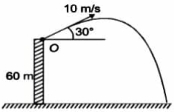
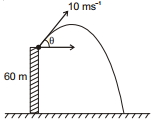
$A$ ball is projected from a point $O$ as shown in the figure. It will strike the ground after ........ $s$ $\left(g=10 \, m/s^2\right)$.
A
$4$
B
$3$
C
$2$
D
$5$
Solution
(A) Given: Initial velocity $u = 10 \, m/s$,angle of projection $\theta = 30^{\circ}$,and vertical displacement $h = -60 \, m$ (downward).
Using the equation of motion in the vertical direction: $s_y = u_y T + \frac{1}{2} a_y T^2$
Here,$u_y = u \sin \theta = 10 \sin 30^{\circ} = 10 \times 0.5 = 5 \, m/s$,$a_y = -g = -10 \, m/s^2$,and $s_y = -60 \, m$.
Substituting the values: $-60 = 5T - \frac{1}{2} \times 10 \times T^2$
$-60 = 5T - 5T^2$
Dividing by $-5$: $T^2 - T - 12 = 0$
Factoring the quadratic equation: $(T - 4)(T + 3) = 0$
Since time $T$ cannot be negative,$T = 4 \, s$.
Using the equation of motion in the vertical direction: $s_y = u_y T + \frac{1}{2} a_y T^2$
Here,$u_y = u \sin \theta = 10 \sin 30^{\circ} = 10 \times 0.5 = 5 \, m/s$,$a_y = -g = -10 \, m/s^2$,and $s_y = -60 \, m$.
Substituting the values: $-60 = 5T - \frac{1}{2} \times 10 \times T^2$
$-60 = 5T - 5T^2$
Dividing by $-5$: $T^2 - T - 12 = 0$
Factoring the quadratic equation: $(T - 4)(T + 3) = 0$
Since time $T$ cannot be negative,$T = 4 \, s$.
0 likes
View Solution52
MediumMCQ
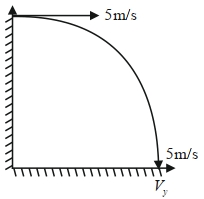
$A$ child stands on the edge of a cliff $10 \ m$ above the ground and throws a stone horizontally with an initial speed of $5 \ m/s$. Neglecting air resistance,the speed with which the stone hits the ground will be $.......... \ m/s$ (given,$g = 10 \ m/s^2$).
A
$20$
B
$15$
C
$30$
D
$25$
Solution
(B) The initial horizontal velocity is $u_x = 5 \ m/s$ and the initial vertical velocity is $u_y = 0 \ m/s$.
The vertical velocity $v_y$ when the stone hits the ground is given by the equation $v_y^2 = u_y^2 + 2gh$.
Substituting the values,$v_y^2 = 0^2 + 2 \times 10 \times 10 = 200$,so $v_y = \sqrt{200} \ m/s$.
The horizontal velocity remains constant at $v_x = 5 \ m/s$.
The net speed $v$ when hitting the ground is $v = \sqrt{v_x^2 + v_y^2}$.
$v = \sqrt{5^2 + 200} = \sqrt{25 + 200} = \sqrt{225} = 15 \ m/s$.
The vertical velocity $v_y$ when the stone hits the ground is given by the equation $v_y^2 = u_y^2 + 2gh$.
Substituting the values,$v_y^2 = 0^2 + 2 \times 10 \times 10 = 200$,so $v_y = \sqrt{200} \ m/s$.
The horizontal velocity remains constant at $v_x = 5 \ m/s$.
The net speed $v$ when hitting the ground is $v = \sqrt{v_x^2 + v_y^2}$.
$v = \sqrt{5^2 + 200} = \sqrt{25 + 200} = \sqrt{225} = 15 \ m/s$.
3 likes
View Solution53
DifficultMCQ
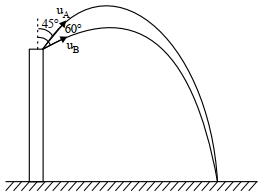
Projectiles $A$ and $B$ are thrown at angles of $45^{\circ}$ and $60^{\circ}$ with the vertical,respectively,from the top of a $400 \ m$ high tower. If their ranges and times of flight are the same,the ratio of their speeds of projection $v_A : v_B$ is:
A
$1 : \sqrt{3}$
B
$\sqrt{2} : 1$
C
$1 : 2$
D
$1 : \sqrt{2}$
Solution
(D) Let the angles with the horizontal be $\theta_A$ and $\theta_B$. Given angles with vertical are $45^{\circ}$ and $60^{\circ}$,so $\theta_A = 90^{\circ} - 45^{\circ} = 45^{\circ}$ and $\theta_B = 90^{\circ} - 60^{\circ} = 30^{\circ}$.
For a projectile thrown from height $h$,the time of flight $T$ is given by $h = -u \sin \theta T + \frac{1}{2} g T^2$. Since $T$ is the same for both,the vertical components of initial velocity must be equal: $v_A \sin \theta_A = v_B \sin \theta_B$.
$v_A \sin 45^{\circ} = v_B \sin 30^{\circ} \implies v_A (\frac{1}{\sqrt{2}}) = v_B (\frac{1}{2}) \implies \frac{v_A}{v_B} = \frac{\sqrt{2}}{2} = \frac{1}{\sqrt{2}}$.
Also,the range $R = (v \cos \theta) T$. Since $R$ and $T$ are same,$v_A \cos \theta_A = v_B \cos \theta_B$.
$v_A \cos 45^{\circ} = v_B \cos 30^{\circ} \implies v_A (\frac{1}{\sqrt{2}}) = v_B (\frac{\sqrt{3}}{2}) \implies \frac{v_A}{v_B} = \frac{\sqrt{6}}{2} = \sqrt{\frac{3}{2}}$.
Since the two conditions lead to different ratios,the problem statement is physically inconsistent. However,if we assume the vertical components are equal to satisfy the time of flight condition,the ratio is $1 : \sqrt{2}$.
For a projectile thrown from height $h$,the time of flight $T$ is given by $h = -u \sin \theta T + \frac{1}{2} g T^2$. Since $T$ is the same for both,the vertical components of initial velocity must be equal: $v_A \sin \theta_A = v_B \sin \theta_B$.
$v_A \sin 45^{\circ} = v_B \sin 30^{\circ} \implies v_A (\frac{1}{\sqrt{2}}) = v_B (\frac{1}{2}) \implies \frac{v_A}{v_B} = \frac{\sqrt{2}}{2} = \frac{1}{\sqrt{2}}$.
Also,the range $R = (v \cos \theta) T$. Since $R$ and $T$ are same,$v_A \cos \theta_A = v_B \cos \theta_B$.
$v_A \cos 45^{\circ} = v_B \cos 30^{\circ} \implies v_A (\frac{1}{\sqrt{2}}) = v_B (\frac{\sqrt{3}}{2}) \implies \frac{v_A}{v_B} = \frac{\sqrt{6}}{2} = \sqrt{\frac{3}{2}}$.
Since the two conditions lead to different ratios,the problem statement is physically inconsistent. However,if we assume the vertical components are equal to satisfy the time of flight condition,the ratio is $1 : \sqrt{2}$.
0 likes
View Solution54
DifficultMCQ
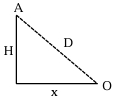
$A$ helicopter flying horizontally with a speed of $360 \ km/h$ at an altitude of $2 \ km$,drops an object at an instant. The object hits the ground at a point $O$,$20 \ s$ after it is dropped. The displacement of $O$ from the position of the helicopter where the object was released is: (use acceleration due to gravity $g = 10 \ m/s^2$ and neglect air resistance)
A
$2\sqrt{5} \ km$
B
$4 \ km$
C
$7.2 \ km$
D
$2\sqrt{2} \ km$
Solution
(D) Given:
Horizontal speed of helicopter,$u = 360 \ km/h = 360 \times \frac{5}{18} = 100 \ m/s$.
Altitude,$H = 2 \ km = 2000 \ m$.
Time taken to hit the ground,$t = 20 \ s$.
Step $1$: Calculate the horizontal displacement $(x)$ of the object.
$x = u \times t = 100 \ m/s \times 20 \ s = 2000 \ m = 2 \ km$.
Step $2$: The vertical displacement is the altitude $H = 2 \ km$.
Step $3$: Calculate the total displacement $(D)$ from the release point to point $O$.
$D = \sqrt{x^2 + H^2} = \sqrt{(2 \ km)^2 + (2 \ km)^2} = \sqrt{4 + 4} \ km = \sqrt{8} \ km = 2\sqrt{2} \ km$.
Thus,the correct option is $D$.
Horizontal speed of helicopter,$u = 360 \ km/h = 360 \times \frac{5}{18} = 100 \ m/s$.
Altitude,$H = 2 \ km = 2000 \ m$.
Time taken to hit the ground,$t = 20 \ s$.
Step $1$: Calculate the horizontal displacement $(x)$ of the object.
$x = u \times t = 100 \ m/s \times 20 \ s = 2000 \ m = 2 \ km$.
Step $2$: The vertical displacement is the altitude $H = 2 \ km$.
Step $3$: Calculate the total displacement $(D)$ from the release point to point $O$.
$D = \sqrt{x^2 + H^2} = \sqrt{(2 \ km)^2 + (2 \ km)^2} = \sqrt{4 + 4} \ km = \sqrt{8} \ km = 2\sqrt{2} \ km$.
Thus,the correct option is $D$.
0 likes
View Solution55
MediumMCQ
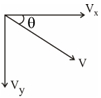
$A$ bomber plane moves horizontally with a speed of $500 \ m/s$ and a bomb released from it strikes the ground in $10 \ s$. The angle with the horizontal at which it strikes the ground will be $(g = 10 \ m/s^2)$.
A
$\tan^{-1}\left(\frac{1}{5}\right)$
B
$\tan^{-1}\left(\frac{1}{2}\right)$
C
$\tan^{-1}(1)$
D
$\tan^{-1}(5)$
Solution
(A) The horizontal component of the velocity of the bomb remains constant throughout the motion because there is no acceleration in the horizontal direction.
$V_x = u = 500 \ m/s$
The vertical component of the velocity at time $t = 10 \ s$ can be calculated using the first equation of motion:
$V_y = u_y + g t$
Since the bomb is released horizontally,the initial vertical velocity $u_y = 0$.
$V_y = 0 + (10 \ m/s^2) \times (10 \ s) = 100 \ m/s$
The angle $\theta$ that the velocity vector makes with the horizontal is given by:
$\tan \theta = \frac{V_y}{V_x}$
$\tan \theta = \frac{100}{500} = \frac{1}{5}$
$\theta = \tan^{-1}\left(\frac{1}{5}\right)$
$V_x = u = 500 \ m/s$
The vertical component of the velocity at time $t = 10 \ s$ can be calculated using the first equation of motion:
$V_y = u_y + g t$
Since the bomb is released horizontally,the initial vertical velocity $u_y = 0$.
$V_y = 0 + (10 \ m/s^2) \times (10 \ s) = 100 \ m/s$
The angle $\theta$ that the velocity vector makes with the horizontal is given by:
$\tan \theta = \frac{V_y}{V_x}$
$\tan \theta = \frac{100}{500} = \frac{1}{5}$
$\theta = \tan^{-1}\left(\frac{1}{5}\right)$
0 likes
View Solution56
EasyMCQ
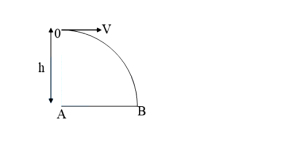
An aeroplane is flying in a horizontal direction with a velocity of $540 \ km/h$ at a height of $1960 \ m$. When it is vertically above the point $A$ on the ground,a body is dropped from it. The body strikes the ground at point $B$. The distance $AB$ is equal to $(g = 9.8 \ m/s^2)$ (in $m$)
A
$2000$
B
$3000$
C
$3600$
D
$4000$
Solution
(B) The initial vertical velocity of the body is $u_y = 0 \ m/s$. The height is $h = 1960 \ m$. Using the equation of motion $h = \frac{1}{2} gt^2$,we can find the time $t$ taken to reach the ground:
$1960 = \frac{1}{2} \times 9.8 \times t^2$
$t^2 = \frac{1960 \times 2}{9.8} = 400$
$t = 20 \ s$
Now,convert the horizontal velocity $v$ from $km/h$ to $m/s$:
$v = 540 \times \frac{5}{18} = 150 \ m/s$
The horizontal distance $AB$ covered by the body is given by $AB = v \times t$:
$AB = 150 \times 20 = 3000 \ m$
$1960 = \frac{1}{2} \times 9.8 \times t^2$
$t^2 = \frac{1960 \times 2}{9.8} = 400$
$t = 20 \ s$
Now,convert the horizontal velocity $v$ from $km/h$ to $m/s$:
$v = 540 \times \frac{5}{18} = 150 \ m/s$
The horizontal distance $AB$ covered by the body is given by $AB = v \times t$:
$AB = 150 \times 20 = 3000 \ m$
0 likes
View Solution57
MediumMCQ
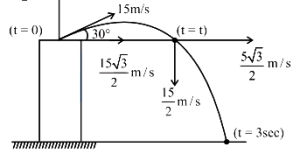
$A$ ball is thrown upward from the top of a building at an angle of $30^{\circ}$ to the horizontal with an initial speed of $15 \,ms^{-1}$. If the ball hits the ground after $3 \,s$, then the height of the building is (acceleration due to gravity $= 10 \,ms^{-2}$): (in $\,m$)
A
$30$
B
$12.5$
C
$25.5$
D
$22.5$
Solution
(D) The initial vertical component of velocity is $u_y = u \sin \theta = 15 \sin 30^{\circ} = 15 \times 0.5 = 7.5 \,ms^{-1}$.
Using the equation of motion for vertical displacement $y = u_y t + \frac{1}{2} a_y t^2$, where $y = -h$ (downward displacement), $u_y = 7.5 \,ms^{-1}$, $a_y = -g = -10 \,ms^{-2}$, and $t = 3 \,s$:
$-h = (7.5)(3) + \frac{1}{2}(-10)(3)^2$
$-h = 22.5 - 5(9)$
$-h = 22.5 - 45$
$-h = -22.5$
$h = 22.5 \,m$.
Therefore, the height of the building is $22.5 \,m$.
Using the equation of motion for vertical displacement $y = u_y t + \frac{1}{2} a_y t^2$, where $y = -h$ (downward displacement), $u_y = 7.5 \,ms^{-1}$, $a_y = -g = -10 \,ms^{-2}$, and $t = 3 \,s$:
$-h = (7.5)(3) + \frac{1}{2}(-10)(3)^2$
$-h = 22.5 - 5(9)$
$-h = 22.5 - 45$
$-h = -22.5$
$h = 22.5 \,m$.
Therefore, the height of the building is $22.5 \,m$.
0 likes
View Solution58
EasyMCQ
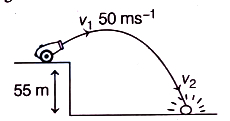
$A$ cannon ball is fired from the top of a $55 \ m$ high cliff with an initial speed of $50 \ m \ s^{-1}$. The speed of the cannon ball while hitting the ground in $m \ s^{-1}$ is (acceleration due to gravity $= 10 \ m \ s^{-2}$):
A
$50$
B
$60$
C
$33.2$
D
$83.2$
Solution
(B) According to the law of conservation of mechanical energy,the total mechanical energy at the top of the cliff is equal to the total mechanical energy at the ground level.
Initial kinetic energy + Initial potential energy = Final kinetic energy at ground
$\frac{1}{2} m v_1^2 + m g h = \frac{1}{2} m v_2^2$
Dividing both sides by $\frac{1}{2} m$,we get:
$v_1^2 + 2 g h = v_2^2$
$v_2 = \sqrt{v_1^2 + 2 g h}$
Given:
Initial speed $v_1 = 50 \ m \ s^{-1}$
Height $h = 55 \ m$
Acceleration due to gravity $g = 10 \ m \ s^{-2}$
Substituting the values:
$v_2 = \sqrt{(50)^2 + 2 \times 10 \times 55}$
$v_2 = \sqrt{2500 + 1100}$
$v_2 = \sqrt{3600}$
$v_2 = 60 \ m \ s^{-1}$
Initial kinetic energy + Initial potential energy = Final kinetic energy at ground
$\frac{1}{2} m v_1^2 + m g h = \frac{1}{2} m v_2^2$
Dividing both sides by $\frac{1}{2} m$,we get:
$v_1^2 + 2 g h = v_2^2$
$v_2 = \sqrt{v_1^2 + 2 g h}$
Given:
Initial speed $v_1 = 50 \ m \ s^{-1}$
Height $h = 55 \ m$
Acceleration due to gravity $g = 10 \ m \ s^{-2}$
Substituting the values:
$v_2 = \sqrt{(50)^2 + 2 \times 10 \times 55}$
$v_2 = \sqrt{2500 + 1100}$
$v_2 = \sqrt{3600}$
$v_2 = 60 \ m \ s^{-1}$
0 likes
View Solution59
DifficultMCQ
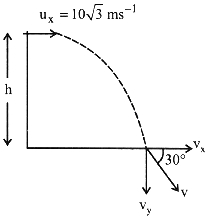
$A$ bowling machine placed at a height $h$ above the earth's surface releases different balls with different angles but with the same velocity $10 \sqrt{3} \text{ m s}^{-1}$. All these balls' landing velocities make angles of $30^{\circ}$ or more with the horizontal. Find the height $h$ (in meters) (acceleration due to gravity $g = 10 \text{ m s}^{-2}$).
A
$15$
B
$12$
C
$10$
D
$5$
Solution
(D) For a projectile launched horizontally from a height $h$ with initial velocity $u = 10 \sqrt{3} \text{ m s}^{-1}$:
$1$. The horizontal component of velocity remains constant: $v_x = u = 10 \sqrt{3} \text{ m s}^{-1}$.
$2$. The vertical component of velocity at the time of landing is $v_y = \sqrt{2gh}$.
$3$. The angle $\theta$ that the velocity vector makes with the horizontal is given by $\tan \theta = \frac{v_y}{v_x}$.
$4$. Given that the landing angle is $30^{\circ}$ or more,we have $\tan \theta \geq \tan 30^{\circ}$.
$5$. Substituting the values: $\frac{\sqrt{2gh}}{10 \sqrt{3}} \geq \frac{1}{\sqrt{3}}$.
$6$. Simplifying: $\sqrt{2gh} \geq 10$.
$7$. Squaring both sides: $2gh \geq 100$.
$8$. With $g = 10 \text{ m s}^{-2}$,we get $20h \geq 100$,which implies $h \geq 5 \text{ m}$.
$9$. The minimum height is $5 \text{ m}$.
$1$. The horizontal component of velocity remains constant: $v_x = u = 10 \sqrt{3} \text{ m s}^{-1}$.
$2$. The vertical component of velocity at the time of landing is $v_y = \sqrt{2gh}$.
$3$. The angle $\theta$ that the velocity vector makes with the horizontal is given by $\tan \theta = \frac{v_y}{v_x}$.
$4$. Given that the landing angle is $30^{\circ}$ or more,we have $\tan \theta \geq \tan 30^{\circ}$.
$5$. Substituting the values: $\frac{\sqrt{2gh}}{10 \sqrt{3}} \geq \frac{1}{\sqrt{3}}$.
$6$. Simplifying: $\sqrt{2gh} \geq 10$.
$7$. Squaring both sides: $2gh \geq 100$.
$8$. With $g = 10 \text{ m s}^{-2}$,we get $20h \geq 100$,which implies $h \geq 5 \text{ m}$.
$9$. The minimum height is $5 \text{ m}$.
0 likes
View Solution60
EasyMCQ
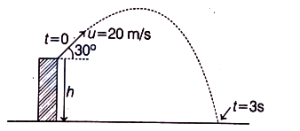
$A$ ball is thrown upward from the top of a building at an angle of $30^{\circ}$ to the horizontal and with an initial speed of $20 \,m/s$. If the ball strikes the ground after $3 \,s$, then the height of the building is (acceleration due to gravity $g = 10 \,m/s^2$) (in $\,m$)
A
$10$
B
$15$
C
$20$
D
$25$
Solution
(B) We consider the vertical motion of the ball.
Initial vertical velocity: $u_y = u \sin \theta = 20 \times \sin 30^{\circ} = 20 \times \frac{1}{2} = 10 \,m/s$.
Vertical acceleration: $a_y = -g = -10 \,m/s^2$.
Time taken to reach the ground: $t = 3 \,s$.
Using the equation of motion for vertical displacement: $s_y = u_y t + \frac{1}{2} a_y t^2$.
Here, the displacement $s_y = -h$ (where $h$ is the height of the building).
$-h = (10)(3) + \frac{1}{2}(-10)(3)^2$.
$-h = 30 - 5(9) = 30 - 45 = -15 \,m$.
Therefore, $h = 15 \,m$.
Initial vertical velocity: $u_y = u \sin \theta = 20 \times \sin 30^{\circ} = 20 \times \frac{1}{2} = 10 \,m/s$.
Vertical acceleration: $a_y = -g = -10 \,m/s^2$.
Time taken to reach the ground: $t = 3 \,s$.
Using the equation of motion for vertical displacement: $s_y = u_y t + \frac{1}{2} a_y t^2$.
Here, the displacement $s_y = -h$ (where $h$ is the height of the building).
$-h = (10)(3) + \frac{1}{2}(-10)(3)^2$.
$-h = 30 - 5(9) = 30 - 45 = -15 \,m$.
Therefore, $h = 15 \,m$.
0 likes
View Solution61
MediumMCQ
$A$ hiker stands on the edge of a cliff $490 \ m$ above the ground and throws a stone horizontally with an initial speed of $15 \ m \ s^{-1}$. The speed with which it hits the ground is (in $m \ s^{-1}$)
A
$99$
B
$101$
C
$103$
D
$105$
Solution
(A) The horizontal component of velocity remains constant because there is no acceleration in the horizontal direction: $v_x = u_x = 15 \ m \ s^{-1}$.
In the vertical direction,the stone undergoes free fall with initial vertical velocity $u_y = 0$. Using the equation $v_y^2 = u_y^2 + 2gh$:
$v_y^2 = 0 + 2 \times 9.8 \times 490 = 9604$.
$v_y = \sqrt{9604} = 98 \ m \ s^{-1}$.
The final speed $v$ is the magnitude of the resultant velocity vector: $v = \sqrt{v_x^2 + v_y^2}$.
$v = \sqrt{15^2 + 98^2} = \sqrt{225 + 9604} = \sqrt{9829} \approx 99.14 \ m \ s^{-1}$.
Rounding to the nearest integer,the speed is $99 \ m \ s^{-1}$.
In the vertical direction,the stone undergoes free fall with initial vertical velocity $u_y = 0$. Using the equation $v_y^2 = u_y^2 + 2gh$:
$v_y^2 = 0 + 2 \times 9.8 \times 490 = 9604$.
$v_y = \sqrt{9604} = 98 \ m \ s^{-1}$.
The final speed $v$ is the magnitude of the resultant velocity vector: $v = \sqrt{v_x^2 + v_y^2}$.
$v = \sqrt{15^2 + 98^2} = \sqrt{225 + 9604} = \sqrt{9829} \approx 99.14 \ m \ s^{-1}$.
Rounding to the nearest integer,the speed is $99 \ m \ s^{-1}$.
0 likes
View Solution62
MediumMCQ
$A$ body is projected horizontally from the top of a tower of height $180 \ m$ with a velocity of $20 \ ms^{-1}$. If acceleration due to gravity is $10 \ ms^{-2}$,then match the following:
The correct answer is
| List-$I$ (Kinematic Variable) | List-$II$ (Value) |
| $A$. Velocity of the body after $1 \ s$ (in $ms^{-1}$) | $I$. $5$ |
| $B$. Horizontal displacement of the body after $1 \ s$ (in $m$) | $II$. $20$ |
| $C$. Vertical displacement of the body after $1 \ s$ (in $m$) | $III$. $10$ |
| $D$. Vertical velocity of the body after $1 \ s$ (in $ms^{-1}$) | $IV$. $22.4$ |
The correct answer is
A
| $A-IV, B-II, C-III, D-I$ |
B
| $A-I, B-II, C-III, D-IV$ |
C
| $A-IV, B-II, C-I, D-III$ |
D
| $A-II, B-IV, C-I, D-III$ |
Solution
(C) Given: Initial horizontal velocity $u_x = 20 \ ms^{-1}$,initial vertical velocity $u_y = 0 \ ms^{-1}$,acceleration $g = 10 \ ms^{-2}$,time $t = 1 \ s$.
$A$. Velocity of the body after $1 \ s$:
$v_x = u_x = 20 \ ms^{-1}$
$v_y = u_y + gt = 0 + 10(1) = 10 \ ms^{-1}$
Resultant velocity $v = \sqrt{v_x^2 + v_y^2} = \sqrt{20^2 + 10^2} = \sqrt{500} \approx 22.4 \ ms^{-1}$. Thus,$A-IV$.
$B$. Horizontal displacement after $1 \ s$:
$x = u_x t = 20 \times 1 = 20 \ m$. Thus,$B-II$.
$C$. Vertical displacement after $1 \ s$:
$y = u_y t + \frac{1}{2}gt^2 = 0 + \frac{1}{2}(10)(1)^2 = 5 \ m$. Thus,$C-I$.
$D$. Vertical velocity after $1 \ s$:
$v_y = u_y + gt = 0 + 10(1) = 10 \ ms^{-1}$. Thus,$D-III$.
Therefore,the correct matching is $A-IV, B-II, C-I, D-III$.
$A$. Velocity of the body after $1 \ s$:
$v_x = u_x = 20 \ ms^{-1}$
$v_y = u_y + gt = 0 + 10(1) = 10 \ ms^{-1}$
Resultant velocity $v = \sqrt{v_x^2 + v_y^2} = \sqrt{20^2 + 10^2} = \sqrt{500} \approx 22.4 \ ms^{-1}$. Thus,$A-IV$.
$B$. Horizontal displacement after $1 \ s$:
$x = u_x t = 20 \times 1 = 20 \ m$. Thus,$B-II$.
$C$. Vertical displacement after $1 \ s$:
$y = u_y t + \frac{1}{2}gt^2 = 0 + \frac{1}{2}(10)(1)^2 = 5 \ m$. Thus,$C-I$.
$D$. Vertical velocity after $1 \ s$:
$v_y = u_y + gt = 0 + 10(1) = 10 \ ms^{-1}$. Thus,$D-III$.
Therefore,the correct matching is $A-IV, B-II, C-I, D-III$.
0 likes
View Solution63
MediumMCQ
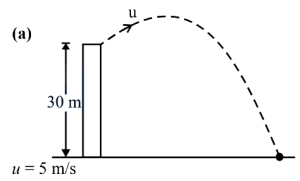
$A$ body is projected from the top of a tower with a velocity $\overrightarrow{u} = 3 \hat{i} + 4 \hat{j} + 5 \hat{k} \text{ m/s}$, where $\hat{i}, \hat{j},$ and $\hat{k}$ are unit vectors along east, north, and vertically upwards, respectively. If the height of the tower is $30 \text{ m}$, find the horizontal range of the body on the ground. (Take $g = 10 \text{ m/s}^2$) (in $\text{ m}$)
A
$15$
B
$25$
C
$9$
D
$12$
Solution
(A) Given, initial velocity $\overrightarrow{u} = 3 \hat{i} + 4 \hat{j} + 5 \hat{k} \text{ m/s}$.
Height of the tower $h = 30 \text{ m}$. Since $\hat{k}$ is vertically upward, the vertical displacement $S_z = -30 \text{ m}$ and acceleration $a_z = -g = -10 \text{ m/s}^2$.
The initial vertical velocity component is $u_z = 5 \text{ m/s}$.
Using the equation of motion $S_z = u_z t + \frac{1}{2} a_z t^2$:
$-30 = 5t - \frac{1}{2} \times 10 \times t^2$
$-30 = 5t - 5t^2$
$t^2 - t - 6 = 0$
$(t - 3)(t + 2) = 0$
Since time cannot be negative, $t = 3 \text{ s}$.
In the horizontal plane, the velocity components are $v_x = 3 \text{ m/s}$ (East) and $v_y = 4 \text{ m/s}$ (North).
The horizontal displacements in $3 \text{ s}$ are:
$x = v_x \times t = 3 \times 3 = 9 \text{ m}$
$y = v_y \times t = 4 \times 3 = 12 \text{ m}$
The horizontal range $R$ is the distance from the base of the tower:
$R = \sqrt{x^2 + y^2} = \sqrt{9^2 + 12^2} = \sqrt{81 + 144} = \sqrt{225} = 15 \text{ m}$.
Height of the tower $h = 30 \text{ m}$. Since $\hat{k}$ is vertically upward, the vertical displacement $S_z = -30 \text{ m}$ and acceleration $a_z = -g = -10 \text{ m/s}^2$.
The initial vertical velocity component is $u_z = 5 \text{ m/s}$.
Using the equation of motion $S_z = u_z t + \frac{1}{2} a_z t^2$:
$-30 = 5t - \frac{1}{2} \times 10 \times t^2$
$-30 = 5t - 5t^2$
$t^2 - t - 6 = 0$
$(t - 3)(t + 2) = 0$
Since time cannot be negative, $t = 3 \text{ s}$.
In the horizontal plane, the velocity components are $v_x = 3 \text{ m/s}$ (East) and $v_y = 4 \text{ m/s}$ (North).
The horizontal displacements in $3 \text{ s}$ are:
$x = v_x \times t = 3 \times 3 = 9 \text{ m}$
$y = v_y \times t = 4 \times 3 = 12 \text{ m}$
The horizontal range $R$ is the distance from the base of the tower:
$R = \sqrt{x^2 + y^2} = \sqrt{9^2 + 12^2} = \sqrt{81 + 144} = \sqrt{225} = 15 \text{ m}$.
0 likes
View Solution64
MediumMCQ
$A$ cannon placed on a cliff at a height of $375 \ m$ fires a cannonball with a velocity of $100 \ ms^{-1}$ at an angle of $30^{\circ}$ above the horizontal. The horizontal distance between the cannon and the target is (Acceleration due to gravity $= 10 \ ms^{-2}$)
A
$750 \sqrt{3} \ m$
B
$500 \sqrt{3} \ m$
C
$250 \sqrt{3} \ m$
D
$750 \ m$
Solution
(A) The initial velocity $u = 100 \ ms^{-1}$ at an angle $\theta = 30^{\circ}$ above the horizontal.
The vertical component of velocity is $u_y = u \sin 30^{\circ} = 100 \times 0.5 = 50 \ ms^{-1}$.
The horizontal component of velocity is $u_x = u \cos 30^{\circ} = 100 \times \frac{\sqrt{3}}{2} = 50\sqrt{3} \ ms^{-1}$.
Taking the downward direction as positive,the vertical displacement $h = 375 \ m$ and acceleration $g = 10 \ ms^{-2}$.
Using the equation of motion $h = u_y t + \frac{1}{2} g t^2$:
$375 = -50t + \frac{1}{2} \times 10 \times t^2$
$375 = -50t + 5t^2$
$5t^2 - 50t - 375 = 0$
Dividing by $5$: $t^2 - 10t - 75 = 0$
$(t - 15)(t + 5) = 0$
Since time cannot be negative,$t = 15 \ s$.
The horizontal distance $x = u_x \times t = 50\sqrt{3} \times 15 = 750\sqrt{3} \ m$.
The vertical component of velocity is $u_y = u \sin 30^{\circ} = 100 \times 0.5 = 50 \ ms^{-1}$.
The horizontal component of velocity is $u_x = u \cos 30^{\circ} = 100 \times \frac{\sqrt{3}}{2} = 50\sqrt{3} \ ms^{-1}$.
Taking the downward direction as positive,the vertical displacement $h = 375 \ m$ and acceleration $g = 10 \ ms^{-2}$.
Using the equation of motion $h = u_y t + \frac{1}{2} g t^2$:
$375 = -50t + \frac{1}{2} \times 10 \times t^2$
$375 = -50t + 5t^2$
$5t^2 - 50t - 375 = 0$
Dividing by $5$: $t^2 - 10t - 75 = 0$
$(t - 15)(t + 5) = 0$
Since time cannot be negative,$t = 15 \ s$.
The horizontal distance $x = u_x \times t = 50\sqrt{3} \times 15 = 750\sqrt{3} \ m$.
0 likes
View Solution65
EasyMCQ
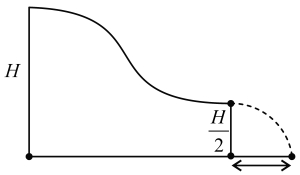
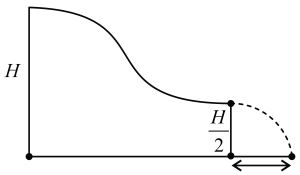
$A$ small object slides down with initial velocity equal to zero from the top of a smooth hill of height $H$. The other end of the hill is horizontal and is at height $\frac{H}{2}$ as shown in the figure. The horizontal distance covered by the object from the end of the hill to the ground is
A
$2 H$
B
$H$
C
$\frac{H}{2}$
D
$\frac{3 H}{2}$
Solution
(B) Since the hill is smooth,the potential energy at the top is converted into kinetic energy at the point where the height is $\frac{H}{2}$.
Let $v$ be the velocity at height $\frac{H}{2}$. By the law of conservation of energy:
$mgH = mg(\frac{H}{2}) + \frac{1}{2}mv^2$
$mg(\frac{H}{2}) = \frac{1}{2}mv^2$
$v = \sqrt{gH}$
Now,the object acts as a horizontal projectile from a height $h' = \frac{H}{2}$.
The time taken to reach the ground is given by:
$t = \sqrt{\frac{2h'}{g}} = \sqrt{\frac{2(H/2)}{g}} = \sqrt{\frac{H}{g}}$
The horizontal distance (range) covered is:
$x = v \times t = \sqrt{gH} \times \sqrt{\frac{H}{g}} = H$
Let $v$ be the velocity at height $\frac{H}{2}$. By the law of conservation of energy:
$mgH = mg(\frac{H}{2}) + \frac{1}{2}mv^2$
$mg(\frac{H}{2}) = \frac{1}{2}mv^2$
$v = \sqrt{gH}$
Now,the object acts as a horizontal projectile from a height $h' = \frac{H}{2}$.
The time taken to reach the ground is given by:
$t = \sqrt{\frac{2h'}{g}} = \sqrt{\frac{2(H/2)}{g}} = \sqrt{\frac{H}{g}}$
The horizontal distance (range) covered is:
$x = v \times t = \sqrt{gH} \times \sqrt{\frac{H}{g}} = H$
0 likes
View Solution66
EasyMCQ
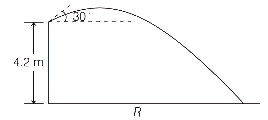
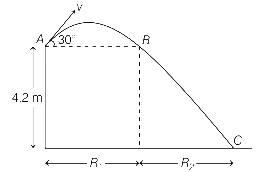
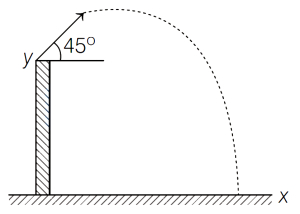
An archer shoots an arrow from a height of $4.2 \text{ m}$ above the ground with a speed of $40 \text{ m/s}$ at an angle of $30^{\circ}$ with the horizontal,as shown in the figure. Determine the total horizontal distance $R$ covered by the arrow when it hits the ground. (Take $g = 10 \text{ m/s}^2$)
A
$\frac{185}{\sqrt{3}} \text{ m}$
B
$84 \sqrt{3} \text{ m}$
C
$68 \sqrt{3} \text{ m}$
D
$\frac{95}{\sqrt{3}} \text{ m}$
Solution
(B) Let the initial position be at height $h = 4.2 \text{ m}$. The initial velocity components are $u_x = v \cos 30^{\circ} = 40 \times \frac{\sqrt{3}}{2} = 20\sqrt{3} \text{ m/s}$ and $u_y = v \sin 30^{\circ} = 40 \times \frac{1}{2} = 20 \text{ m/s}$.
Using the equation of motion for the vertical direction,taking the downward direction as positive:
$y = u_y t + \frac{1}{2} g t^2$
$4.2 = -20t + \frac{1}{2} (10) t^2$
$5t^2 - 20t - 4.2 = 0$
Multiplying by $10$ to simplify: $50t^2 - 200t - 42 = 0$. This is incorrect; let's use the standard convention where upward is positive:
$-4.2 = 20t - \frac{1}{2} (10) t^2$
$5t^2 - 20t - 4.2 = 0$
$t = \frac{20 \pm \sqrt{(-20)^2 - 4(5)(-4.2)}}{2(5)} = \frac{20 \pm \sqrt{400 + 84}}{10} = \frac{20 \pm \sqrt{484}}{10} = \frac{20 \pm 22}{10}$.
Since $t > 0$,$t = \frac{42}{10} = 4.2 \text{ s}$.
The horizontal distance $R$ is given by $R = u_x t = (20\sqrt{3}) \times 4.2 = 84\sqrt{3} \text{ m}$.
Using the equation of motion for the vertical direction,taking the downward direction as positive:
$y = u_y t + \frac{1}{2} g t^2$
$4.2 = -20t + \frac{1}{2} (10) t^2$
$5t^2 - 20t - 4.2 = 0$
Multiplying by $10$ to simplify: $50t^2 - 200t - 42 = 0$. This is incorrect; let's use the standard convention where upward is positive:
$-4.2 = 20t - \frac{1}{2} (10) t^2$
$5t^2 - 20t - 4.2 = 0$
$t = \frac{20 \pm \sqrt{(-20)^2 - 4(5)(-4.2)}}{2(5)} = \frac{20 \pm \sqrt{400 + 84}}{10} = \frac{20 \pm \sqrt{484}}{10} = \frac{20 \pm 22}{10}$.
Since $t > 0$,$t = \frac{42}{10} = 4.2 \text{ s}$.
The horizontal distance $R$ is given by $R = u_x t = (20\sqrt{3}) \times 4.2 = 84\sqrt{3} \text{ m}$.
0 likes
View Solution67
MediumMCQ
Two objects are located at a height of $10 \ m$ above the ground. At some point in time,the objects are thrown with an initial velocity of $2 \sqrt{2} \ m \ s^{-1}$ at an angle of $45^{\circ}$ and $135^{\circ}$ with the positive $X$-axis,respectively. Assuming $g = 10 \ m \ s^{-2}$,the velocity vectors will be perpendicular to each other at a time equal to: (in $s$)
A
$0.2$
B
$0.4$
C
$0.6$
D
$0.8$
Solution
(B) Given: Initial velocity $U_1 = U_2 = 2 \sqrt{2} \ m \ s^{-1}$,acceleration due to gravity $g = 10 \ m \ s^{-2}$.
At time $t$,the velocity vectors are given by:
$\vec{v}_1 = (U_1 \cos 45^{\circ}) \hat{i} + (U_1 \sin 45^{\circ} - gt) \hat{j} = (2 \sqrt{2} \cdot \frac{1}{\sqrt{2}}) \hat{i} + (2 \sqrt{2} \cdot \frac{1}{\sqrt{2}} - 10t) \hat{j} = 2 \hat{i} + (2 - 10t) \hat{j} \dots(1)$
$\vec{v}_2 = (U_2 \cos 135^{\circ}) \hat{i} + (U_2 \sin 135^{\circ} - gt) \hat{j} = (2 \sqrt{2} \cdot -\frac{1}{\sqrt{2}}) \hat{i} + (2 \sqrt{2} \cdot \frac{1}{\sqrt{2}} - 10t) \hat{j} = -2 \hat{i} + (2 - 10t) \hat{j} \dots(2)$
Since the velocity vectors are perpendicular,their dot product must be zero:
$\vec{v}_1 \cdot \vec{v}_2 = 0$
$(2 \hat{i} + (2 - 10t) \hat{j}) \cdot (-2 \hat{i} + (2 - 10t) \hat{j}) = 0$
$-4 + (2 - 10t)^2 = 0$
$(2 - 10t)^2 = 4$
Taking the square root on both sides:
$2 - 10t = \pm 2$
Case $1$: $2 - 10t = 2 \Rightarrow 10t = 0 \Rightarrow t = 0 \ s$
Case $2$: $2 - 10t = -2 \Rightarrow 10t = 4 \Rightarrow t = 0.4 \ s$
Thus,the velocity vectors are perpendicular at $t = 0.4 \ s$.
At time $t$,the velocity vectors are given by:
$\vec{v}_1 = (U_1 \cos 45^{\circ}) \hat{i} + (U_1 \sin 45^{\circ} - gt) \hat{j} = (2 \sqrt{2} \cdot \frac{1}{\sqrt{2}}) \hat{i} + (2 \sqrt{2} \cdot \frac{1}{\sqrt{2}} - 10t) \hat{j} = 2 \hat{i} + (2 - 10t) \hat{j} \dots(1)$
$\vec{v}_2 = (U_2 \cos 135^{\circ}) \hat{i} + (U_2 \sin 135^{\circ} - gt) \hat{j} = (2 \sqrt{2} \cdot -\frac{1}{\sqrt{2}}) \hat{i} + (2 \sqrt{2} \cdot \frac{1}{\sqrt{2}} - 10t) \hat{j} = -2 \hat{i} + (2 - 10t) \hat{j} \dots(2)$
Since the velocity vectors are perpendicular,their dot product must be zero:
$\vec{v}_1 \cdot \vec{v}_2 = 0$
$(2 \hat{i} + (2 - 10t) \hat{j}) \cdot (-2 \hat{i} + (2 - 10t) \hat{j}) = 0$
$-4 + (2 - 10t)^2 = 0$
$(2 - 10t)^2 = 4$
Taking the square root on both sides:
$2 - 10t = \pm 2$
Case $1$: $2 - 10t = 2 \Rightarrow 10t = 0 \Rightarrow t = 0 \ s$
Case $2$: $2 - 10t = -2 \Rightarrow 10t = 4 \Rightarrow t = 0.4 \ s$
Thus,the velocity vectors are perpendicular at $t = 0.4 \ s$.
0 likes
View Solution68
EasyMCQ
$A$ ball of mass $0.2 \ kg$ is thrown from a height of $1 \ m$ with an initial velocity of $\sqrt{10} \ m/s$ at an angle of $45^{\circ}$ with the horizontal. Assuming acceleration due to gravity $g = 10 \ m/s^2$,the modulus of the momentum increment during the total time of motion in $kg \cdot m/s$ is:
A
$\frac{2+\sqrt{10}}{\sqrt{10}}$
B
$\frac{1+\sqrt{10}}{\sqrt{5}}$
C
$\frac{1+\sqrt{5}}{\sqrt{5}}$
D
$\frac{\sqrt{5}-1}{\sqrt{5}}$
Solution
(C) The force acting on the ball is gravity,which acts only in the vertical $(y)$ direction. Therefore,there is no change in momentum in the horizontal $(x)$ direction.
Initial vertical velocity: $u_y = u \sin 45^{\circ} = \sqrt{10} \cdot \frac{1}{\sqrt{2}} = \sqrt{5} \ m/s$.
Initial vertical momentum: $p_{yi} = m u_y = 0.2 \cdot \sqrt{5} = \frac{\sqrt{5}}{5} = \frac{1}{\sqrt{5}} \ kg \cdot m/s$ (upwards).
Using the equation of motion $v_y^2 = u_y^2 + 2gh$ (taking downward as positive for final velocity calculation,or using energy conservation):
$v_y^2 = (\sqrt{5})^2 + 2(10)(1) = 5 + 20 = 25$.
So,final vertical velocity $v_y = 5 \ m/s$ (downwards).
Final vertical momentum: $p_{yf} = m v_y = 0.2 \cdot 5 = 1 \ kg \cdot m/s$ (downwards).
Taking upward direction as positive,$p_{yi} = \frac{1}{\sqrt{5}}$ and $p_{yf} = -1$.
The change in momentum is $\Delta p = p_{yf} - p_{yi} = -1 - \frac{1}{\sqrt{5}} = -(1 + \frac{1}{\sqrt{5}})$.
The modulus of the momentum increment is $|\Delta p| = 1 + \frac{1}{\sqrt{5}} = \frac{\sqrt{5}+1}{\sqrt{5}}$.
Initial vertical velocity: $u_y = u \sin 45^{\circ} = \sqrt{10} \cdot \frac{1}{\sqrt{2}} = \sqrt{5} \ m/s$.
Initial vertical momentum: $p_{yi} = m u_y = 0.2 \cdot \sqrt{5} = \frac{\sqrt{5}}{5} = \frac{1}{\sqrt{5}} \ kg \cdot m/s$ (upwards).
Using the equation of motion $v_y^2 = u_y^2 + 2gh$ (taking downward as positive for final velocity calculation,or using energy conservation):
$v_y^2 = (\sqrt{5})^2 + 2(10)(1) = 5 + 20 = 25$.
So,final vertical velocity $v_y = 5 \ m/s$ (downwards).
Final vertical momentum: $p_{yf} = m v_y = 0.2 \cdot 5 = 1 \ kg \cdot m/s$ (downwards).
Taking upward direction as positive,$p_{yi} = \frac{1}{\sqrt{5}}$ and $p_{yf} = -1$.
The change in momentum is $\Delta p = p_{yf} - p_{yi} = -1 - \frac{1}{\sqrt{5}} = -(1 + \frac{1}{\sqrt{5}})$.
The modulus of the momentum increment is $|\Delta p| = 1 + \frac{1}{\sqrt{5}} = \frac{\sqrt{5}+1}{\sqrt{5}}$.
0 likes
View Solution69
EasyMCQ
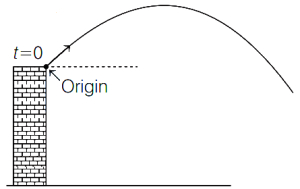
$A$ ball of mass $m=1 \, kg$ is thrown from the top of a building with initial velocity $v=(20 \, m/s) \hat{i} + (24 \, m/s) \hat{j}$ at time $t=0$. The change in the potential energy of the ball between $t=0$ and $t=6 \, s$, if the ball does not hit the ground, is (assume $g=10 \, m/s^2$): (in $ \, J$)
A
$-320$
B
$-360$
C
$-380$
D
$320$
Solution
(B) The change in potential energy $(\Delta PE)$ is given by $\Delta PE = mgh$, where $h$ is the vertical displacement.
To find the vertical displacement, we consider the vertical component of the motion:
Initial vertical velocity, $u_y = 24 \, m/s$
Acceleration, $a_y = -g = -10 \, m/s^2$
Time, $t = 6 \, s$
Using the equation of motion $h = u_y t + \frac{1}{2} a_y t^2$:
$h = (24)(6) + \frac{1}{2}(-10)(6)^2$
$h = 144 - 5(36)$
$h = 144 - 180 = -36 \, m$
Now, calculate the change in potential energy:
$\Delta PE = mgh = (1 \, kg)(10 \, m/s^2)(-36 \, m)$
$\Delta PE = -360 \, J$
To find the vertical displacement, we consider the vertical component of the motion:
Initial vertical velocity, $u_y = 24 \, m/s$
Acceleration, $a_y = -g = -10 \, m/s^2$
Time, $t = 6 \, s$
Using the equation of motion $h = u_y t + \frac{1}{2} a_y t^2$:
$h = (24)(6) + \frac{1}{2}(-10)(6)^2$
$h = 144 - 5(36)$
$h = 144 - 180 = -36 \, m$
Now, calculate the change in potential energy:
$\Delta PE = mgh = (1 \, kg)(10 \, m/s^2)(-36 \, m)$
$\Delta PE = -360 \, J$
0 likes
View Solution3-2.Motion in Plane — Projectile Motion from Hight · Frequently Asked Questions
1Are these 3-2.Motion in Plane questions useful for JEE and NEET?
Yes. All questions in this section are mapped to JEE Main and NEET exam patterns. Previous year questions from JEE Main, NEET, GUJCET and state-level exams are included with full solutions.
2Can I switch to Hindi or Gujarati for these questions?
Yes. Use the language tabs in the hero section or the sidebar to view the same questions and solutions in English, Hindi or Gujarati.
3How do I generate a question paper from this subtopic?
Use the Vedclass Exam Paper Generator — select the chapter and subtopic, set difficulty, and generate Sets A, B, C, D automatically. First 3 chapters of every subject are free.
Vedclass Products
For Students
Vedclass Test Series
Mock tests in real JEE/NEET style with performance analysis. 5-day free trial.
Start Free TrialFor Teachers
Exam Paper Generator
Generate Set A/B/C/D papers from this chapter in 2 minutes. 3 chapters free.
Try FreeFor Institutes
Online Exam Module
Live online exams with unlimited students, 360° analytics & white-label branding.
See DemoFor Teachers & Institutes
Generate a 3-2.Motion in Plane Exam Paper in 2 Minutes
Select subtopic & difficulty — Sets A, B, C, D auto-generated with No Repeat logic.
First 3 chapters of every subject are free — no payment required.