
A English
Relation between sides and angles, Solutions of triangles Questions in English
Class 11 Mathematics · Trigonometrical Equations · Relation between sides and angles, Solutions of triangles
611+
Questions
English
Language
100%
With Solutions
Showing 48 of 611 questions in English
401
MediumMCQ
In $\triangle ABC$,if $a, b, c$ are its sides and $\angle C = 60^{\circ}$,find the value of $\frac{a}{b+c} + \frac{b}{c+a}$.
A
$1$
B
$0$
C
$\frac{\sqrt{3}}{2}$
D
$\frac{1}{2}$
Solution
(A) In $\triangle ABC$,by the Law of Cosines,$\cos C = \frac{a^2+b^2-c^2}{2ab}$.
Given $\angle C = 60^{\circ}$,so $\cos 60^{\circ} = \frac{1}{2} = \frac{a^2+b^2-c^2}{2ab}$.
This implies $ab = a^2+b^2-c^2$,or $c^2 = a^2+b^2-ab$.
Now,consider the expression $E = \frac{a}{b+c} + \frac{b}{c+a} = \frac{a(c+a) + b(b+c)}{(b+c)(c+a)} = \frac{ac+a^2+b^2+bc}{bc+ab+c^2+ac}$.
Substituting $a^2+b^2 = c^2+ab$ into the numerator:
$E = \frac{ac + (c^2+ab) + bc}{bc+ab+c^2+ac} = \frac{ac+c^2+ab+bc}{ac+ab+c^2+bc} = 1$.
Given $\angle C = 60^{\circ}$,so $\cos 60^{\circ} = \frac{1}{2} = \frac{a^2+b^2-c^2}{2ab}$.
This implies $ab = a^2+b^2-c^2$,or $c^2 = a^2+b^2-ab$.
Now,consider the expression $E = \frac{a}{b+c} + \frac{b}{c+a} = \frac{a(c+a) + b(b+c)}{(b+c)(c+a)} = \frac{ac+a^2+b^2+bc}{bc+ab+c^2+ac}$.
Substituting $a^2+b^2 = c^2+ab$ into the numerator:
$E = \frac{ac + (c^2+ab) + bc}{bc+ab+c^2+ac} = \frac{ac+c^2+ab+bc}{ac+ab+c^2+bc} = 1$.
0 likes
View Solution402
EasyMCQ
In triangle $ABC$,if $\frac{b+c}{9}=\frac{c+a}{10}=\frac{a+b}{11}$,then $\frac{\cos A+\cos B}{\cos C}=$
A
$\frac{9}{10}$
B
$\frac{10}{11}$
C
$\frac{11}{12}$
D
$\frac{12}{13}$
Solution
(C) Let $\frac{b+c}{9}=\frac{c+a}{10}=\frac{a+b}{11}=k$.
Then $b+c=9k$,$c+a=10k$,and $a+b=11k$.
Adding these gives $2(a+b+c)=30k$,so $a+b+c=15k$.
Thus,$a=(a+b+c)-(b+c)=15k-9k=6k$,$b=(a+b+c)-(c+a)=15k-10k=5k$,and $c=(a+b+c)-(a+b)=15k-11k=4k$.
Using the cosine rule,$\cos A = \frac{b^2+c^2-a^2}{2bc} = \frac{25k^2+16k^2-36k^2}{2(5k)(4k)} = \frac{5k^2}{40k^2} = \frac{1}{8}$.
$\cos B = \frac{a^2+c^2-b^2}{2ac} = \frac{36k^2+16k^2-25k^2}{2(6k)(4k)} = \frac{27k^2}{48k^2} = \frac{9}{16}$.
$\cos C = \frac{a^2+b^2-c^2}{2ab} = \frac{36k^2+25k^2-16k^2}{2(6k)(5k)} = \frac{45k^2}{60k^2} = \frac{3}{4}$.
Therefore,$\frac{\cos A+\cos B}{\cos C} = \frac{\frac{1}{8}+\frac{9}{16}}{\frac{3}{4}} = \frac{\frac{2+9}{16}}{\frac{3}{4}} = \frac{11}{16} \times \frac{4}{3} = \frac{11}{12}$.
Hence,option $C$ is correct.
Then $b+c=9k$,$c+a=10k$,and $a+b=11k$.
Adding these gives $2(a+b+c)=30k$,so $a+b+c=15k$.
Thus,$a=(a+b+c)-(b+c)=15k-9k=6k$,$b=(a+b+c)-(c+a)=15k-10k=5k$,and $c=(a+b+c)-(a+b)=15k-11k=4k$.
Using the cosine rule,$\cos A = \frac{b^2+c^2-a^2}{2bc} = \frac{25k^2+16k^2-36k^2}{2(5k)(4k)} = \frac{5k^2}{40k^2} = \frac{1}{8}$.
$\cos B = \frac{a^2+c^2-b^2}{2ac} = \frac{36k^2+16k^2-25k^2}{2(6k)(4k)} = \frac{27k^2}{48k^2} = \frac{9}{16}$.
$\cos C = \frac{a^2+b^2-c^2}{2ab} = \frac{36k^2+25k^2-16k^2}{2(6k)(5k)} = \frac{45k^2}{60k^2} = \frac{3}{4}$.
Therefore,$\frac{\cos A+\cos B}{\cos C} = \frac{\frac{1}{8}+\frac{9}{16}}{\frac{3}{4}} = \frac{\frac{2+9}{16}}{\frac{3}{4}} = \frac{11}{16} \times \frac{4}{3} = \frac{11}{12}$.
Hence,option $C$ is correct.
0 likes
View Solution403
MediumMCQ
In $\triangle ABC$,if the median $AD$ drawn through $A$ is perpendicular to the side $AC$,then $3ca \cos A \cos C + 2a^2 =$
A
$c^2$
B
$2c^2$
C
$3c^2$
D
$4c^2$
Solution
(B) In $\triangle ABC$,$AD$ is the median to $BC$,so $BD = DC = a/2$. Given $AD \perp AC$,in right-angled $\triangle ADC$,by Pythagoras theorem,$AD^2 + b^2 = (a/2)^2$,so $AD^2 = a^2/4 - b^2$.
By Apollonius theorem on $\triangle ABC$,$c^2 + b^2 = 2(AD^2 + (a/2)^2)$.
Substituting $AD^2$,we get $c^2 + b^2 = 2(a^2/4 - b^2 + a^2/4) = a^2 - 2b^2$,which implies $a^2 = 3b^2 + c^2$ (Eq. $iii$).
Now,consider the expression $3ca \cos A \cos C + 2a^2$.
Using cosine rule,$\cos A = (b^2 + c^2 - a^2)/(2bc)$ and $\cos C = (a^2 + b^2 - c^2)/(2ab)$.
Substituting these,the expression becomes $3ca \cdot [(b^2 + c^2 - a^2)/(2bc)] \cdot [(a^2 + b^2 - c^2)/(2ab)] + 2a^2$.
$= (3/4b^2) \cdot (b^2 + c^2 - a^2)(a^2 + b^2 - c^2) + 2a^2$.
Since $a^2 - c^2 = 3b^2$,we have $b^2 + c^2 - a^2 = -2b^2$ and $a^2 + b^2 - c^2 = 4b^2$.
$= (3/4b^2) \cdot (-2b^2)(4b^2) + 2a^2 = -6b^2 + 2a^2 = 2(a^2 - 3b^2)$.
From Eq. $iii$,$a^2 - 3b^2 = c^2$.
Thus,the expression equals $2c^2$.
By Apollonius theorem on $\triangle ABC$,$c^2 + b^2 = 2(AD^2 + (a/2)^2)$.
Substituting $AD^2$,we get $c^2 + b^2 = 2(a^2/4 - b^2 + a^2/4) = a^2 - 2b^2$,which implies $a^2 = 3b^2 + c^2$ (Eq. $iii$).
Now,consider the expression $3ca \cos A \cos C + 2a^2$.
Using cosine rule,$\cos A = (b^2 + c^2 - a^2)/(2bc)$ and $\cos C = (a^2 + b^2 - c^2)/(2ab)$.
Substituting these,the expression becomes $3ca \cdot [(b^2 + c^2 - a^2)/(2bc)] \cdot [(a^2 + b^2 - c^2)/(2ab)] + 2a^2$.
$= (3/4b^2) \cdot (b^2 + c^2 - a^2)(a^2 + b^2 - c^2) + 2a^2$.
Since $a^2 - c^2 = 3b^2$,we have $b^2 + c^2 - a^2 = -2b^2$ and $a^2 + b^2 - c^2 = 4b^2$.
$= (3/4b^2) \cdot (-2b^2)(4b^2) + 2a^2 = -6b^2 + 2a^2 = 2(a^2 - 3b^2)$.
From Eq. $iii$,$a^2 - 3b^2 = c^2$.
Thus,the expression equals $2c^2$.
0 likes
View Solution404
EasyMCQ
In $\triangle ABC$,if $a: b: c = 3: 5: 7$,then $\cos A + \cos B =$
A
$\frac{13}{7}$
B
$\frac{11}{7}$
C
$\frac{12}{7}$
D
$\frac{10}{7}$
Solution
(C) Given the ratio of sides as $a: b: c = 3: 5: 7$,let $a = 3x, b = 5x, c = 7x$.
Using the cosine rule,$\cos A = \frac{b^2 + c^2 - a^2}{2bc}$ and $\cos B = \frac{a^2 + c^2 - b^2}{2ac}$.
Substituting the values:
$\cos A = \frac{(5x)^2 + (7x)^2 - (3x)^2}{2(5x)(7x)} = \frac{25x^2 + 49x^2 - 9x^2}{70x^2} = \frac{65x^2}{70x^2} = \frac{13}{14}$.
$\cos B = \frac{(3x)^2 + (7x)^2 - (5x)^2}{2(3x)(7x)} = \frac{9x^2 + 49x^2 - 25x^2}{42x^2} = \frac{33x^2}{42x^2} = \frac{11}{14}$.
Therefore,$\cos A + \cos B = \frac{13}{14} + \frac{11}{14} = \frac{24}{14} = \frac{12}{7}$.
Using the cosine rule,$\cos A = \frac{b^2 + c^2 - a^2}{2bc}$ and $\cos B = \frac{a^2 + c^2 - b^2}{2ac}$.
Substituting the values:
$\cos A = \frac{(5x)^2 + (7x)^2 - (3x)^2}{2(5x)(7x)} = \frac{25x^2 + 49x^2 - 9x^2}{70x^2} = \frac{65x^2}{70x^2} = \frac{13}{14}$.
$\cos B = \frac{(3x)^2 + (7x)^2 - (5x)^2}{2(3x)(7x)} = \frac{9x^2 + 49x^2 - 25x^2}{42x^2} = \frac{33x^2}{42x^2} = \frac{11}{14}$.
Therefore,$\cos A + \cos B = \frac{13}{14} + \frac{11}{14} = \frac{24}{14} = \frac{12}{7}$.
0 likes
View Solution405
MediumMCQ
The base of a triangle is $80$ and one of the base angles is $60^{\circ}$. If the sum of the lengths of the other two sides is $90$,then the shortest side is of length
A
$15$
B
$21$
C
$19$
D
$17$
Solution
(D) Let the sides of the triangle be $a, b, c$ where $a = 80$ and the angle $B = 60^{\circ}$.
Given $b + c = 90$.
Using the Law of Cosines: $b^2 = a^2 + c^2 - 2ac \cos(B)$.
Substituting the values: $b^2 = 80^2 + c^2 - 2(80)(c) \cos(60^{\circ})$.
Since $\cos(60^{\circ}) = 0.5$,we have $b^2 = 6400 + c^2 - 80c$.
Substitute $b = 90 - c$ into the equation: $(90 - c)^2 = 6400 + c^2 - 80c$.
$8100 - 180c + c^2 = 6400 + c^2 - 80c$.
$1700 = 100c$.
$c = 17$.
Then $b = 90 - 17 = 73$.
The sides are $80, 73, 17$. The shortest side is $17$.
Given $b + c = 90$.
Using the Law of Cosines: $b^2 = a^2 + c^2 - 2ac \cos(B)$.
Substituting the values: $b^2 = 80^2 + c^2 - 2(80)(c) \cos(60^{\circ})$.
Since $\cos(60^{\circ}) = 0.5$,we have $b^2 = 6400 + c^2 - 80c$.
Substitute $b = 90 - c$ into the equation: $(90 - c)^2 = 6400 + c^2 - 80c$.
$8100 - 180c + c^2 = 6400 + c^2 - 80c$.
$1700 = 100c$.
$c = 17$.
Then $b = 90 - 17 = 73$.
The sides are $80, 73, 17$. The shortest side is $17$.
0 likes
View Solution406
MediumMCQ
In $\triangle ABC$,if $b \cos \theta = c - a$,(where $\theta$ is an acute angle),then $(c - a) \tan \theta =$
A
$2 \sqrt{ca} \cos \frac{B}{2}$
B
$2 \sqrt{ca} \sin \frac{B}{2}$
C
$2ca \cos \frac{B}{2}$
D
$2ca \sin \frac{B}{2}$
Solution
(B) Given $b \cos \theta = c - a$,we have $\cos \theta = \frac{c - a}{b}$.
Since $\theta$ is an acute angle,$\sin \theta = \sqrt{1 - \cos^2 \theta} = \frac{\sqrt{b^2 - (c - a)^2}}{b}$.
Thus,$\tan \theta = \frac{\sin \theta}{\cos \theta} = \frac{\sqrt{b^2 - (c - a)^2}}{c - a}$.
Therefore,$(c - a) \tan \theta = \sqrt{b^2 - (c - a)^2} = \sqrt{b^2 - c^2 - a^2 + 2ac}$.
Using the cosine rule $b^2 = a^2 + c^2 - 2ac \cos B$,we substitute $b^2 - c^2 - a^2 = -2ac \cos B$.
So,$(c - a) \tan \theta = \sqrt{2ac - 2ac \cos B} = \sqrt{2ac(1 - \cos B)}$.
Using the identity $1 - \cos B = 2 \sin^2 \frac{B}{2}$,we get:
$(c - a) \tan \theta = \sqrt{2ac \cdot 2 \sin^2 \frac{B}{2}} = \sqrt{4ac \sin^2 \frac{B}{2}} = 2 \sqrt{ca} \sin \frac{B}{2}$.
Since $\theta$ is an acute angle,$\sin \theta = \sqrt{1 - \cos^2 \theta} = \frac{\sqrt{b^2 - (c - a)^2}}{b}$.
Thus,$\tan \theta = \frac{\sin \theta}{\cos \theta} = \frac{\sqrt{b^2 - (c - a)^2}}{c - a}$.
Therefore,$(c - a) \tan \theta = \sqrt{b^2 - (c - a)^2} = \sqrt{b^2 - c^2 - a^2 + 2ac}$.
Using the cosine rule $b^2 = a^2 + c^2 - 2ac \cos B$,we substitute $b^2 - c^2 - a^2 = -2ac \cos B$.
So,$(c - a) \tan \theta = \sqrt{2ac - 2ac \cos B} = \sqrt{2ac(1 - \cos B)}$.
Using the identity $1 - \cos B = 2 \sin^2 \frac{B}{2}$,we get:
$(c - a) \tan \theta = \sqrt{2ac \cdot 2 \sin^2 \frac{B}{2}} = \sqrt{4ac \sin^2 \frac{B}{2}} = 2 \sqrt{ca} \sin \frac{B}{2}$.
0 likes
View Solution407
EasyMCQ
In $\triangle ABC$,if $a: b: c = 4: 5: 6$,then $\cos A: \cos B: \cos C =$
A
$12: 9: 2$
B
$6: 5: 4$
C
$7: 8: 9$
D
$14: 11: 6$
Solution
(A) Given the sides $a: b: c = 4: 5: 6$,let $a = 4k$,$b = 5k$,and $c = 6k$ for some constant $k > 0$.
Using the Law of Cosines:
$\cos A = \frac{b^2 + c^2 - a^2}{2bc} = \frac{(5k)^2 + (6k)^2 - (4k)^2}{2(5k)(6k)} = \frac{25 + 36 - 16}{60} = \frac{45}{60} = \frac{3}{4}$.
$\cos B = \frac{a^2 + c^2 - b^2}{2ac} = \frac{(4k)^2 + (6k)^2 - (5k)^2}{2(4k)(6k)} = \frac{16 + 36 - 25}{48} = \frac{27}{48} = \frac{9}{16}$.
$\cos C = \frac{a^2 + b^2 - c^2}{2ab} = \frac{(4k)^2 + (5k)^2 - (6k)^2}{2(4k)(5k)} = \frac{16 + 25 - 36}{40} = \frac{5}{40} = \frac{1}{8}$.
Now,find the ratio $\cos A : \cos B : \cos C = \frac{3}{4} : \frac{9}{16} : \frac{1}{8}$.
Multiply by the least common multiple of the denominators,which is $16$:
$\cos A : \cos B : \cos C = (\frac{3}{4} \times 16) : (\frac{9}{16} \times 16) : (\frac{1}{8} \times 16) = 12 : 9 : 2$.
Using the Law of Cosines:
$\cos A = \frac{b^2 + c^2 - a^2}{2bc} = \frac{(5k)^2 + (6k)^2 - (4k)^2}{2(5k)(6k)} = \frac{25 + 36 - 16}{60} = \frac{45}{60} = \frac{3}{4}$.
$\cos B = \frac{a^2 + c^2 - b^2}{2ac} = \frac{(4k)^2 + (6k)^2 - (5k)^2}{2(4k)(6k)} = \frac{16 + 36 - 25}{48} = \frac{27}{48} = \frac{9}{16}$.
$\cos C = \frac{a^2 + b^2 - c^2}{2ab} = \frac{(4k)^2 + (5k)^2 - (6k)^2}{2(4k)(5k)} = \frac{16 + 25 - 36}{40} = \frac{5}{40} = \frac{1}{8}$.
Now,find the ratio $\cos A : \cos B : \cos C = \frac{3}{4} : \frac{9}{16} : \frac{1}{8}$.
Multiply by the least common multiple of the denominators,which is $16$:
$\cos A : \cos B : \cos C = (\frac{3}{4} \times 16) : (\frac{9}{16} \times 16) : (\frac{1}{8} \times 16) = 12 : 9 : 2$.
0 likes
View Solution408
MediumMCQ
In a $\triangle ABC$,$(a-b)^2 \cos^2 \frac{C}{2} + (a+b)^2 \sin^2 \frac{C}{2}$ is equal to
A
$a^2$
B
$c^2$
C
$b^2$
D
$a^2+b^2$
Solution
(B) We have,\\ $(a-b)^2 \cos^2 \frac{C}{2} + (a+b)^2 \sin^2 \frac{C}{2}$ \\ $= (a^2 + b^2 - 2ab) \cos^2 \frac{C}{2} + (a^2 + b^2 + 2ab) \sin^2 \frac{C}{2}$ \\ $= (a^2 + b^2)(\cos^2 \frac{C}{2} + \sin^2 \frac{C}{2}) - 2ab(\cos^2 \frac{C}{2} - \sin^2 \frac{C}{2})$ \\ $= (a^2 + b^2)(1) - 2ab \cos C$ \\ $= a^2 + b^2 - 2ab \cos C$ \\ Since by the Law of Cosines,$c^2 = a^2 + b^2 - 2ab \cos C$,\\ Therefore,the expression is equal to $c^2$.
0 likes
View Solution409
MediumMCQ
If the area of a triangle $ABC$ is $4\sqrt{5} \text{ sq. units}$, the length of the side $CA$ is $6 \text{ units}$, and $\tan \frac{B}{2} = \frac{\sqrt{5}}{4}$, then the length of its smallest side is: (in $\text{ units}$)
A
$5$
B
$4$
C
$3$
D
$6$
Solution
(C) Given: Area $\Delta = 4\sqrt{5}$, $b = 6$, and $\tan \frac{B}{2} = \frac{\sqrt{5}}{4}$.
Using the formula $\tan \frac{B}{2} = \sqrt{\frac{(s-a)(s-c)}{s(s-b)}}$, where $s = \frac{a+b+c}{2}$.
We know $\Delta = \sqrt{s(s-a)(s-b)(s-c)}$, so $(s-a)(s-c) = \frac{\Delta^2}{s(s-b)}$.
Substituting this into the tangent formula: $\tan^2 \frac{B}{2} = \frac{\Delta^2}{s^2(s-b)^2}$.
Given $\tan \frac{B}{2} = \frac{\sqrt{5}}{4}$, so $\tan^2 \frac{B}{2} = \frac{5}{16}$.
$\frac{5}{16} = \frac{(4\sqrt{5})^2}{s^2(s-6)^2} = \frac{80}{s^2(s-6)^2}$.
$s^2(s-6)^2 = \frac{80 \times 16}{5} = 256$.
$s(s-6) = 16$ or $s(s-6) = -16$ (impossible).
$s^2 - 6s - 16 = 0 \implies (s-8)(s+2) = 0$. Since $s > 0$, $s = 8$.
$s = \frac{a+b+c}{2} = 8 \implies a+c+6 = 16 \implies a+c = 10$.
Also, $\Delta = \frac{1}{2}ac \sin B = 4\sqrt{5}$.
Using $\tan \frac{B}{2} = \frac{\sqrt{5}}{4}$, $\cos B = \frac{1 - \tan^2(B/2)}{1 + \tan^2(B/2)} = \frac{1 - 5/16}{1 + 5/16} = \frac{11/16}{21/16} = \frac{11}{21}$.
$\sin B = \sqrt{1 - (11/21)^2} = \frac{\sqrt{441-121}}{21} = \frac{\sqrt{320}}{21} = \frac{8\sqrt{5}}{21}$.
$\frac{1}{2}ac \left(\frac{8\sqrt{5}}{21}\right) = 4\sqrt{5} \implies ac = 21$.
We have $a+c = 10$ and $ac = 21$. The roots of $x^2 - 10x + 21 = 0$ are $x = 3, 7$.
The sides are $3, 6, 7$. The smallest side is $3$.
Using the formula $\tan \frac{B}{2} = \sqrt{\frac{(s-a)(s-c)}{s(s-b)}}$, where $s = \frac{a+b+c}{2}$.
We know $\Delta = \sqrt{s(s-a)(s-b)(s-c)}$, so $(s-a)(s-c) = \frac{\Delta^2}{s(s-b)}$.
Substituting this into the tangent formula: $\tan^2 \frac{B}{2} = \frac{\Delta^2}{s^2(s-b)^2}$.
Given $\tan \frac{B}{2} = \frac{\sqrt{5}}{4}$, so $\tan^2 \frac{B}{2} = \frac{5}{16}$.
$\frac{5}{16} = \frac{(4\sqrt{5})^2}{s^2(s-6)^2} = \frac{80}{s^2(s-6)^2}$.
$s^2(s-6)^2 = \frac{80 \times 16}{5} = 256$.
$s(s-6) = 16$ or $s(s-6) = -16$ (impossible).
$s^2 - 6s - 16 = 0 \implies (s-8)(s+2) = 0$. Since $s > 0$, $s = 8$.
$s = \frac{a+b+c}{2} = 8 \implies a+c+6 = 16 \implies a+c = 10$.
Also, $\Delta = \frac{1}{2}ac \sin B = 4\sqrt{5}$.
Using $\tan \frac{B}{2} = \frac{\sqrt{5}}{4}$, $\cos B = \frac{1 - \tan^2(B/2)}{1 + \tan^2(B/2)} = \frac{1 - 5/16}{1 + 5/16} = \frac{11/16}{21/16} = \frac{11}{21}$.
$\sin B = \sqrt{1 - (11/21)^2} = \frac{\sqrt{441-121}}{21} = \frac{\sqrt{320}}{21} = \frac{8\sqrt{5}}{21}$.
$\frac{1}{2}ac \left(\frac{8\sqrt{5}}{21}\right) = 4\sqrt{5} \implies ac = 21$.
We have $a+c = 10$ and $ac = 21$. The roots of $x^2 - 10x + 21 = 0$ are $x = 3, 7$.
The sides are $3, 6, 7$. The smallest side is $3$.
0 likes
View Solution410
MediumMCQ
In $\triangle ABC$,find the value of $\sqrt{\frac{r r_2}{r_3 r_1}}$.
A
$\tan(A/2)$
B
$\tan(B/2)$
C
$\tan(C/2)$
D
$\cot(B/2)$
Solution
(B) We know the formulas for the exradii of a triangle: $r = \frac{\Delta}{s-a}$,$r_1 = \frac{\Delta}{s-a}$,$r_2 = \frac{\Delta}{s-b}$,and $r_3 = \frac{\Delta}{s-c}$.
Substituting these into the expression $\sqrt{\frac{r r_2}{r_3 r_1}}$:
$\sqrt{\frac{\left(\frac{\Delta}{s}\right) \left(\frac{\Delta}{s-b}\right)}{\left(\frac{\Delta}{s-c}\right) \left(\frac{\Delta}{s-a}\right)}} = \sqrt{\frac{(s-a)(s-c)}{s(s-b)}}$.
Using the half-angle formula $\tan^2(B/2) = \frac{(s-a)(s-c)}{s(s-b)}$,we get $\sqrt{\frac{(s-a)(s-c)}{s(s-b)}} = \tan(B/2)$.
Substituting these into the expression $\sqrt{\frac{r r_2}{r_3 r_1}}$:
$\sqrt{\frac{\left(\frac{\Delta}{s}\right) \left(\frac{\Delta}{s-b}\right)}{\left(\frac{\Delta}{s-c}\right) \left(\frac{\Delta}{s-a}\right)}} = \sqrt{\frac{(s-a)(s-c)}{s(s-b)}}$.
Using the half-angle formula $\tan^2(B/2) = \frac{(s-a)(s-c)}{s(s-b)}$,we get $\sqrt{\frac{(s-a)(s-c)}{s(s-b)}} = \tan(B/2)$.
0 likes
View Solution411
MediumMCQ
In a $\triangle ABC$,$\frac{2(r_1+r_3)}{ac(1+\cos B)} = $
A
$\frac{\Delta}{b}$
B
$\frac{b}{\Delta}$
C
$\frac{2\Delta}{a+b+c}$
D
$\frac{a+b+c}{2\Delta}$
Solution
(B) We know that $r_1 = \frac{\Delta}{s-a}$ and $r_3 = \frac{\Delta}{s-c}$.
So,$r_1 + r_3 = \Delta \left( \frac{1}{s-a} + \frac{1}{s-c} \right) = \Delta \left( \frac{s-c+s-a}{(s-a)(s-c)} \right) = \Delta \left( \frac{2s-a-c}{(s-a)(s-c)} \right)$.
Since $2s = a+b+c$,we have $2s-a-c = b$.
Thus,$r_1 + r_3 = \frac{\Delta b}{(s-a)(s-c)}$.
Also,$1 + \cos B = 1 + \frac{a^2+c^2-b^2}{2ac} = \frac{2ac+a^2+c^2-b^2}{2ac} = \frac{(a+c)^2-b^2}{2ac} = \frac{(a+c-b)(a+c+b)}{2ac} = \frac{(2s-2b)(2s)}{2ac} = \frac{2(s-b)s}{ac}$.
Substituting these into the expression:
$\frac{2(r_1+r_3)}{ac(1+\cos B)} = \frac{2 \cdot \frac{\Delta b}{(s-a)(s-c)}}{ac \cdot \frac{2s(s-b)}{ac}} = \frac{2 \Delta b}{2s(s-a)(s-b)(s-c)} = \frac{\Delta b}{s(s-a)(s-b)(s-c)}$.
Since $\Delta^2 = s(s-a)(s-b)(s-c)$,the expression becomes $\frac{\Delta b}{\Delta^2} = \frac{b}{\Delta}$.
So,$r_1 + r_3 = \Delta \left( \frac{1}{s-a} + \frac{1}{s-c} \right) = \Delta \left( \frac{s-c+s-a}{(s-a)(s-c)} \right) = \Delta \left( \frac{2s-a-c}{(s-a)(s-c)} \right)$.
Since $2s = a+b+c$,we have $2s-a-c = b$.
Thus,$r_1 + r_3 = \frac{\Delta b}{(s-a)(s-c)}$.
Also,$1 + \cos B = 1 + \frac{a^2+c^2-b^2}{2ac} = \frac{2ac+a^2+c^2-b^2}{2ac} = \frac{(a+c)^2-b^2}{2ac} = \frac{(a+c-b)(a+c+b)}{2ac} = \frac{(2s-2b)(2s)}{2ac} = \frac{2(s-b)s}{ac}$.
Substituting these into the expression:
$\frac{2(r_1+r_3)}{ac(1+\cos B)} = \frac{2 \cdot \frac{\Delta b}{(s-a)(s-c)}}{ac \cdot \frac{2s(s-b)}{ac}} = \frac{2 \Delta b}{2s(s-a)(s-b)(s-c)} = \frac{\Delta b}{s(s-a)(s-b)(s-c)}$.
Since $\Delta^2 = s(s-a)(s-b)(s-c)$,the expression becomes $\frac{\Delta b}{\Delta^2} = \frac{b}{\Delta}$.
0 likes
View Solution412
MediumMCQ
In $\triangle ABC$,if $r_1=4, r_2=8, r_3=24$,then $a=$
A
$0$
B
$\frac{16}{\sqrt{5}}$
C
$16 \sqrt{5}$
D
$\sqrt{5}$
Solution
(B) Given $r_1=4, r_2=8, r_3=24$.
We know that $\frac{1}{r} = \frac{1}{r_1} + \frac{1}{r_2} + \frac{1}{r_3} = \frac{1}{4} + \frac{1}{8} + \frac{1}{24} = \frac{6+3+1}{24} = \frac{10}{24} = \frac{5}{12}$.
Thus,$r = \frac{12}{5}$.
We know that $\Delta^2 = r r_1 r_2 r_3 = \frac{12}{5} \times 4 \times 8 \times 24 = \frac{9216}{5}$.
So,$\Delta = \sqrt{\frac{9216}{5}} = \frac{96}{\sqrt{5}}$.
Using $r = \frac{\Delta}{s}$,we get $s = \frac{\Delta}{r} = \frac{96}{\sqrt{5}} \times \frac{5}{12} = 8\sqrt{5}$.
Since $r_1 = \frac{\Delta}{s-a}$,we have $4 = \frac{96/\sqrt{5}}{8\sqrt{5}-a}$.
$4(8\sqrt{5}-a) = \frac{96}{\sqrt{5}} \Rightarrow 32\sqrt{5} - 4a = \frac{96}{\sqrt{5}}$.
$4a = 32\sqrt{5} - \frac{96}{\sqrt{5}} = \frac{160-96}{\sqrt{5}} = \frac{64}{\sqrt{5}}$.
$a = \frac{16}{\sqrt{5}}$.
We know that $\frac{1}{r} = \frac{1}{r_1} + \frac{1}{r_2} + \frac{1}{r_3} = \frac{1}{4} + \frac{1}{8} + \frac{1}{24} = \frac{6+3+1}{24} = \frac{10}{24} = \frac{5}{12}$.
Thus,$r = \frac{12}{5}$.
We know that $\Delta^2 = r r_1 r_2 r_3 = \frac{12}{5} \times 4 \times 8 \times 24 = \frac{9216}{5}$.
So,$\Delta = \sqrt{\frac{9216}{5}} = \frac{96}{\sqrt{5}}$.
Using $r = \frac{\Delta}{s}$,we get $s = \frac{\Delta}{r} = \frac{96}{\sqrt{5}} \times \frac{5}{12} = 8\sqrt{5}$.
Since $r_1 = \frac{\Delta}{s-a}$,we have $4 = \frac{96/\sqrt{5}}{8\sqrt{5}-a}$.
$4(8\sqrt{5}-a) = \frac{96}{\sqrt{5}} \Rightarrow 32\sqrt{5} - 4a = \frac{96}{\sqrt{5}}$.
$4a = 32\sqrt{5} - \frac{96}{\sqrt{5}} = \frac{160-96}{\sqrt{5}} = \frac{64}{\sqrt{5}}$.
$a = \frac{16}{\sqrt{5}}$.
0 likes
View Solution413
MediumMCQ
In $\triangle ABC$,$bc - r_2 r_3 =$
A
$rr_1$
B
$r_2$
C
$r_1$
D
$ar_1$
Solution
(A) We know that $r = \frac{\Delta}{s}$,$r_1 = \frac{\Delta}{s-a}$,$r_2 = \frac{\Delta}{s-b}$,and $r_3 = \frac{\Delta}{s-c}$.
Consider the expression $rr_1 + r_2 r_3 = \frac{\Delta^2}{s(s-a)} + \frac{\Delta^2}{(s-b)(s-c)}$.
Since $\Delta^2 = s(s-a)(s-b)(s-c)$,we have $\frac{\Delta^2}{s(s-a)} = (s-b)(s-c)$ and $\frac{\Delta^2}{(s-b)(s-c)} = s(s-a)$.
Thus,$rr_1 + r_2 r_3 = (s-b)(s-c) + s(s-a)$.
Expanding this,we get $s^2 - s(b+c) + bc + s^2 - sa = 2s^2 - s(a+b+c) + bc$.
Since $2s = a+b+c$,we have $2s^2 - s(2s) + bc = 2s^2 - 2s^2 + bc = bc$.
Therefore,$rr_1 + r_2 r_3 = bc$,which implies $bc - r_2 r_3 = rr_1$.
Consider the expression $rr_1 + r_2 r_3 = \frac{\Delta^2}{s(s-a)} + \frac{\Delta^2}{(s-b)(s-c)}$.
Since $\Delta^2 = s(s-a)(s-b)(s-c)$,we have $\frac{\Delta^2}{s(s-a)} = (s-b)(s-c)$ and $\frac{\Delta^2}{(s-b)(s-c)} = s(s-a)$.
Thus,$rr_1 + r_2 r_3 = (s-b)(s-c) + s(s-a)$.
Expanding this,we get $s^2 - s(b+c) + bc + s^2 - sa = 2s^2 - s(a+b+c) + bc$.
Since $2s = a+b+c$,we have $2s^2 - s(2s) + bc = 2s^2 - 2s^2 + bc = bc$.
Therefore,$rr_1 + r_2 r_3 = bc$,which implies $bc - r_2 r_3 = rr_1$.
0 likes
View Solution414
MediumMCQ
In $\triangle ABC$,$\frac{r_2(r_1+r_3)}{\sqrt{r_1 r_2+r_2 r_3+r_3 r_1}} =$
A
$a$
B
$b$
C
$c$
D
$s$
Solution
(B) We know that $r_1 = \frac{\Delta}{s-a}$,$r_2 = \frac{\Delta}{s-b}$,$r_3 = \frac{\Delta}{s-c}$ and $\Delta^2 = s(s-a)(s-b)(s-c)$.
Substituting these into the expression:
$\frac{r_2(r_1+r_3)}{\sqrt{r_1 r_2+r_2 r_3+r_3 r_1}} = \frac{\frac{\Delta}{s-b}(\frac{\Delta}{s-a} + \frac{\Delta}{s-c})}{\sqrt{\frac{\Delta^2}{(s-a)(s-b)} + \frac{\Delta^2}{(s-b)(s-c)} + \frac{\Delta^2}{(s-c)(s-a)}}}$
$= \frac{\frac{\Delta^2}{s-b} \cdot \frac{s-c+s-a}{(s-a)(s-c)}}{\Delta \sqrt{\frac{s-c+s-a+s-b}{(s-a)(s-b)(s-c)}}}$
$= \frac{\Delta \cdot b}{(s-a)(s-b)(s-c)} \cdot \sqrt{\frac{(s-a)(s-b)(s-c)}{3s-(a+b+c)}}$
Since $a+b+c = 2s$,the denominator inside the square root is $3s-2s = s$.
$= \frac{\Delta \cdot b}{(s-a)(s-b)(s-c)} \cdot \frac{\sqrt{(s-a)(s-b)(s-c)}}{\sqrt{s}}$
$= \frac{\Delta \cdot b}{\sqrt{s(s-a)(s-b)(s-c)}} = \frac{\Delta \cdot b}{\Delta} = b$.
Substituting these into the expression:
$\frac{r_2(r_1+r_3)}{\sqrt{r_1 r_2+r_2 r_3+r_3 r_1}} = \frac{\frac{\Delta}{s-b}(\frac{\Delta}{s-a} + \frac{\Delta}{s-c})}{\sqrt{\frac{\Delta^2}{(s-a)(s-b)} + \frac{\Delta^2}{(s-b)(s-c)} + \frac{\Delta^2}{(s-c)(s-a)}}}$
$= \frac{\frac{\Delta^2}{s-b} \cdot \frac{s-c+s-a}{(s-a)(s-c)}}{\Delta \sqrt{\frac{s-c+s-a+s-b}{(s-a)(s-b)(s-c)}}}$
$= \frac{\Delta \cdot b}{(s-a)(s-b)(s-c)} \cdot \sqrt{\frac{(s-a)(s-b)(s-c)}{3s-(a+b+c)}}$
Since $a+b+c = 2s$,the denominator inside the square root is $3s-2s = s$.
$= \frac{\Delta \cdot b}{(s-a)(s-b)(s-c)} \cdot \frac{\sqrt{(s-a)(s-b)(s-c)}}{\sqrt{s}}$
$= \frac{\Delta \cdot b}{\sqrt{s(s-a)(s-b)(s-c)}} = \frac{\Delta \cdot b}{\Delta} = b$.
0 likes
View Solution415
MediumMCQ
In $\triangle ABC, (r_2+r_3) \operatorname{cosec}^2 \frac{A}{2} =$
A
$4 R$
B
$4 R \cot^2 \frac{A}{2}$
C
$4 R \tan^2 \frac{A}{2}$
D
$R \tan^2 \frac{A}{2}$
Solution
(B) We know that $r_2 = \frac{\Delta}{s-b}$ and $r_3 = \frac{\Delta}{s-c}$.
Also,$\sin^2 \frac{A}{2} = \frac{(s-b)(s-c)}{bc}$.
Thus,$(r_2+r_3) \operatorname{cosec}^2 \frac{A}{2} = \left(\frac{\Delta}{s-b} + \frac{\Delta}{s-c}\right) \times \frac{bc}{(s-b)(s-c)}$.
$= \Delta \left(\frac{s-c+s-b}{(s-b)(s-c)}\right) \times \frac{bc}{(s-b)(s-c)} = \Delta \left(\frac{a}{(s-b)(s-c)}\right) \times \frac{bc}{(s-b)(s-c)}$.
$= \frac{\Delta abc}{(s-b)^2(s-c)^2} = \frac{4R \Delta^2}{(s-b)^2(s-c)^2}$.
$= 4R \left(\frac{\Delta}{(s-b)(s-c)}\right)^2 = 4R \left(\cot \frac{A}{2}\right)^2 = 4R \cot^2 \frac{A}{2}$.
Also,$\sin^2 \frac{A}{2} = \frac{(s-b)(s-c)}{bc}$.
Thus,$(r_2+r_3) \operatorname{cosec}^2 \frac{A}{2} = \left(\frac{\Delta}{s-b} + \frac{\Delta}{s-c}\right) \times \frac{bc}{(s-b)(s-c)}$.
$= \Delta \left(\frac{s-c+s-b}{(s-b)(s-c)}\right) \times \frac{bc}{(s-b)(s-c)} = \Delta \left(\frac{a}{(s-b)(s-c)}\right) \times \frac{bc}{(s-b)(s-c)}$.
$= \frac{\Delta abc}{(s-b)^2(s-c)^2} = \frac{4R \Delta^2}{(s-b)^2(s-c)^2}$.
$= 4R \left(\frac{\Delta}{(s-b)(s-c)}\right)^2 = 4R \left(\cot \frac{A}{2}\right)^2 = 4R \cot^2 \frac{A}{2}$.
0 likes
View Solution416
MediumMCQ
In $\triangle ABC$,if $\cot \frac{A}{2} : \cot \frac{B}{2} : \cot \frac{C}{2} = 3 : 7 : 9$,then $a : b : c =$
A
$8 : 6 : 5$
B
$5 : 6 : 8$
C
$10 : 8 : 5$
D
$5 : 8 : 10$
Solution
(A) Given $\cot \frac{A}{2} : \cot \frac{B}{2} : \cot \frac{C}{2} = 3 : 7 : 9$.
Using the formula $\cot \frac{A}{2} = \frac{s(s-a)}{\Delta}$,we have:
$\frac{s(s-a)}{\Delta} : \frac{s(s-b)}{\Delta} : \frac{s(s-c)}{\Delta} = 3 : 7 : 9$.
Multiplying by $\frac{\Delta}{s}$,we get $(s-a) : (s-b) : (s-c) = 3 : 7 : 9$.
Let $s-a = 3k$,$s-b = 7k$,and $s-c = 9k$.
Adding these,we get $3s - (a+b+c) = 19k$. Since $a+b+c = 2s$,we have $3s - 2s = s = 19k$.
Now,$a = s - 3k = 19k - 3k = 16k$.
$b = s - 7k = 19k - 7k = 12k$.
$c = s - 9k = 19k - 9k = 10k$.
Thus,$a : b : c = 16k : 12k : 10k = 16 : 12 : 10 = 8 : 6 : 5$.
Using the formula $\cot \frac{A}{2} = \frac{s(s-a)}{\Delta}$,we have:
$\frac{s(s-a)}{\Delta} : \frac{s(s-b)}{\Delta} : \frac{s(s-c)}{\Delta} = 3 : 7 : 9$.
Multiplying by $\frac{\Delta}{s}$,we get $(s-a) : (s-b) : (s-c) = 3 : 7 : 9$.
Let $s-a = 3k$,$s-b = 7k$,and $s-c = 9k$.
Adding these,we get $3s - (a+b+c) = 19k$. Since $a+b+c = 2s$,we have $3s - 2s = s = 19k$.
Now,$a = s - 3k = 19k - 3k = 16k$.
$b = s - 7k = 19k - 7k = 12k$.
$c = s - 9k = 19k - 9k = 10k$.
Thus,$a : b : c = 16k : 12k : 10k = 16 : 12 : 10 = 8 : 6 : 5$.
0 likes
View Solution417
MediumMCQ
In $\triangle ABC$,if $r_1 = 2r_2 = 3r_3$,then
A
$b+c=2a$
B
$a+b=2c$
C
$a+c=2b$
D
$\Delta=abc$
Solution
(C) Given,in $\triangle ABC$,$r_1 = 2r_2 = 3r_3$.
Using the formula $r_1 = \frac{\Delta}{s-a}$,$r_2 = \frac{\Delta}{s-b}$,and $r_3 = \frac{\Delta}{s-c}$,we have:
$\frac{\Delta}{s-a} = 2 \frac{\Delta}{s-b} = 3 \frac{\Delta}{s-c} = k$ (let).
Then,$s-a = \frac{1}{k}$,$s-b = \frac{2}{k}$,and $s-c = \frac{3}{k}$.
Adding these equations:
$(s-a) + (s-c) = \frac{1}{k} + \frac{3}{k} = \frac{4}{k}$.
Since $s-b = \frac{2}{k}$,we have $\frac{4}{k} = 2(s-b)$.
Thus,$2s - a - c = 2s - 2b$,which simplifies to $a+c = 2b$.
Using the formula $r_1 = \frac{\Delta}{s-a}$,$r_2 = \frac{\Delta}{s-b}$,and $r_3 = \frac{\Delta}{s-c}$,we have:
$\frac{\Delta}{s-a} = 2 \frac{\Delta}{s-b} = 3 \frac{\Delta}{s-c} = k$ (let).
Then,$s-a = \frac{1}{k}$,$s-b = \frac{2}{k}$,and $s-c = \frac{3}{k}$.
Adding these equations:
$(s-a) + (s-c) = \frac{1}{k} + \frac{3}{k} = \frac{4}{k}$.
Since $s-b = \frac{2}{k}$,we have $\frac{4}{k} = 2(s-b)$.
Thus,$2s - a - c = 2s - 2b$,which simplifies to $a+c = 2b$.
0 likes
View Solution418
EasyMCQ
In $\triangle ABC$,$\left(\tan \frac{A}{2}+\tan \frac{B}{2}\right) \tan \frac{C}{2} =$
A
$\frac{2c}{a+b+c}$
B
$\frac{2c}{a+b-c}$
C
$\frac{2c^2}{a^2+b^2+c^2}$
D
$\frac{c}{a+b+c}$
Solution
(A) We know that in $\triangle ABC$,$\tan \frac{A}{2} = \sqrt{\frac{(s-b)(s-c)}{s(s-a)}}$,$\tan \frac{B}{2} = \sqrt{\frac{(s-a)(s-c)}{s(s-b)}}$,and $\tan \frac{C}{2} = \sqrt{\frac{(s-a)(s-b)}{s(s-c)}}$.
Substituting these values into the expression:
$\left(\tan \frac{A}{2} + \tan \frac{B}{2}\right) \tan \frac{C}{2} = \tan \frac{A}{2} \tan \frac{C}{2} + \tan \frac{B}{2} \tan \frac{C}{2}$
$= \sqrt{\frac{(s-b)(s-c)}{s(s-a)}} \cdot \sqrt{\frac{(s-a)(s-b)}{s(s-c)}} + \sqrt{\frac{(s-a)(s-c)}{s(s-b)}} \cdot \sqrt{\frac{(s-a)(s-b)}{s(s-c)}}$
$= \frac{s-b}{s} + \frac{s-a}{s}$
$= \frac{2s - a - b}{s}$
Since $2s = a + b + c$,we have $2s - a - b = c$ and $s = \frac{a+b+c}{2}$.
$= \frac{c}{\left(\frac{a+b+c}{2}\right)} = \frac{2c}{a+b+c}$.
Substituting these values into the expression:
$\left(\tan \frac{A}{2} + \tan \frac{B}{2}\right) \tan \frac{C}{2} = \tan \frac{A}{2} \tan \frac{C}{2} + \tan \frac{B}{2} \tan \frac{C}{2}$
$= \sqrt{\frac{(s-b)(s-c)}{s(s-a)}} \cdot \sqrt{\frac{(s-a)(s-b)}{s(s-c)}} + \sqrt{\frac{(s-a)(s-c)}{s(s-b)}} \cdot \sqrt{\frac{(s-a)(s-b)}{s(s-c)}}$
$= \frac{s-b}{s} + \frac{s-a}{s}$
$= \frac{2s - a - b}{s}$
Since $2s = a + b + c$,we have $2s - a - b = c$ and $s = \frac{a+b+c}{2}$.
$= \frac{c}{\left(\frac{a+b+c}{2}\right)} = \frac{2c}{a+b+c}$.
0 likes
View Solution419
MediumMCQ
In $\triangle ABC$,if $(a-b)(s-c)=(b-c)(s-a)$,then $r_1, r_2, r_3$ are in
A
Arithmetic progression
B
Geometric progression
C
Harmonic progression
D
Arithmetico-geometric progression
Solution
(A) Given: $(a-b)(s-c)=(b-c)(s-a)$
Since $a = (s-b) + (s-c)$,$b = (s-a) + (s-c)$,and $c = (s-a) + (s-b)$,we have $(a-b) = (s-b) - (s-a)$ and $(b-c) = (s-c) - (s-b)$.
Substituting these into the equation:
$((s-b)-(s-a))(s-c) = ((s-c)-(s-b))(s-a)$
$(s-b)(s-c) - (s-a)(s-c) = (s-c)(s-a) - (s-b)(s-a)$
Rearranging terms:
$2(s-a)(s-c) = (s-b)(s-c) + (s-b)(s-a)$
Dividing both sides by $(s-a)(s-b)(s-c)$:
$\frac{2}{s-b} = \frac{1}{s-a} + \frac{1}{s-c}$
Multiplying by $\Delta$ (area of the triangle):
$\frac{2\Delta}{s-b} = \frac{\Delta}{s-a} + \frac{\Delta}{s-c}$
Since $r_1 = \frac{\Delta}{s-a}$,$r_2 = \frac{\Delta}{s-b}$,and $r_3 = \frac{\Delta}{s-c}$,we get:
$2r_2 = r_1 + r_3$
Thus,$r_1, r_2, r_3$ are in Arithmetic Progression.
Since $a = (s-b) + (s-c)$,$b = (s-a) + (s-c)$,and $c = (s-a) + (s-b)$,we have $(a-b) = (s-b) - (s-a)$ and $(b-c) = (s-c) - (s-b)$.
Substituting these into the equation:
$((s-b)-(s-a))(s-c) = ((s-c)-(s-b))(s-a)$
$(s-b)(s-c) - (s-a)(s-c) = (s-c)(s-a) - (s-b)(s-a)$
Rearranging terms:
$2(s-a)(s-c) = (s-b)(s-c) + (s-b)(s-a)$
Dividing both sides by $(s-a)(s-b)(s-c)$:
$\frac{2}{s-b} = \frac{1}{s-a} + \frac{1}{s-c}$
Multiplying by $\Delta$ (area of the triangle):
$\frac{2\Delta}{s-b} = \frac{\Delta}{s-a} + \frac{\Delta}{s-c}$
Since $r_1 = \frac{\Delta}{s-a}$,$r_2 = \frac{\Delta}{s-b}$,and $r_3 = \frac{\Delta}{s-c}$,we get:
$2r_2 = r_1 + r_3$
Thus,$r_1, r_2, r_3$ are in Arithmetic Progression.
0 likes
View Solution420
MediumMCQ
In a triangle,if $b=5, c=6$,and $\tan \frac{A}{2}=\frac{1}{\sqrt{2}}$,then $a=$
A
$\sqrt{41}$
B
$\sqrt{21}$
C
$\sqrt{14}$
D
$8 \sqrt{6}$
Solution
(A) Given $\tan \frac{A}{2} = \frac{1}{\sqrt{2}}$.
Using the formula $\cos A = \frac{1-\tan^2 \frac{A}{2}}{1+\tan^2 \frac{A}{2}}$:
$\cos A = \frac{1 - (\frac{1}{\sqrt{2}})^2}{1 + (\frac{1}{\sqrt{2}})^2} = \frac{1 - 1/2}{1 + 1/2} = \frac{1/2}{3/2} = \frac{1}{3}$.
Using the Law of Cosines: $\cos A = \frac{b^2+c^2-a^2}{2bc}$.
$\frac{1}{3} = \frac{5^2 + 6^2 - a^2}{2(5)(6)}$.
$\frac{1}{3} = \frac{25 + 36 - a^2}{60}$.
$20 = 61 - a^2$.
$a^2 = 41$.
$a = \sqrt{41}$.
Using the formula $\cos A = \frac{1-\tan^2 \frac{A}{2}}{1+\tan^2 \frac{A}{2}}$:
$\cos A = \frac{1 - (\frac{1}{\sqrt{2}})^2}{1 + (\frac{1}{\sqrt{2}})^2} = \frac{1 - 1/2}{1 + 1/2} = \frac{1/2}{3/2} = \frac{1}{3}$.
Using the Law of Cosines: $\cos A = \frac{b^2+c^2-a^2}{2bc}$.
$\frac{1}{3} = \frac{5^2 + 6^2 - a^2}{2(5)(6)}$.
$\frac{1}{3} = \frac{25 + 36 - a^2}{60}$.
$20 = 61 - a^2$.
$a^2 = 41$.
$a = \sqrt{41}$.
0 likes
View Solution421
EasyMCQ
Let $ABC$ be an acute-angled triangle with area $R$. Then,$\sqrt{a^2 b^2-4 R^2}+\sqrt{b^2 c^2-4 R^2}+\sqrt{c^2 a^2-4 R^2} = $
A
$a+b+c$
B
$a^2+b^2+c^2$
C
$\frac{a^2+b^2+c^2}{2}$
D
$2(a^2+b^2+c^2)$
Solution
(C) We know that the area $R = \frac{1}{2}ab \sin C$,so $2R = ab \sin C$,which implies $4R^2 = a^2b^2 \sin^2 C$.
Substituting this into the first term: $\sqrt{a^2b^2 - 4R^2} = \sqrt{a^2b^2 - a^2b^2 \sin^2 C} = \sqrt{a^2b^2(1 - \sin^2 C)} = \sqrt{a^2b^2 \cos^2 C} = ab \cos C$.
Similarly,$\sqrt{b^2c^2 - 4R^2} = bc \cos A$ and $\sqrt{c^2a^2 - 4R^2} = ca \cos B$.
Using the Law of Cosines,$\cos C = \frac{a^2+b^2-c^2}{2ab}$,so $ab \cos C = \frac{a^2+b^2-c^2}{2}$.
Thus,the expression becomes: $\frac{a^2+b^2-c^2}{2} + \frac{b^2+c^2-a^2}{2} + \frac{c^2+a^2-b^2}{2} = \frac{a^2+b^2+c^2}{2}$.
Substituting this into the first term: $\sqrt{a^2b^2 - 4R^2} = \sqrt{a^2b^2 - a^2b^2 \sin^2 C} = \sqrt{a^2b^2(1 - \sin^2 C)} = \sqrt{a^2b^2 \cos^2 C} = ab \cos C$.
Similarly,$\sqrt{b^2c^2 - 4R^2} = bc \cos A$ and $\sqrt{c^2a^2 - 4R^2} = ca \cos B$.
Using the Law of Cosines,$\cos C = \frac{a^2+b^2-c^2}{2ab}$,so $ab \cos C = \frac{a^2+b^2-c^2}{2}$.
Thus,the expression becomes: $\frac{a^2+b^2-c^2}{2} + \frac{b^2+c^2-a^2}{2} + \frac{c^2+a^2-b^2}{2} = \frac{a^2+b^2+c^2}{2}$.
0 likes
View Solution422
MediumMCQ
In a $\triangle ABC$,if $2 \Delta^2 = \frac{a^2 b^2 c^2}{a^2+b^2+c^2}$,then the triangle is
A
Equilateral
B
Isosceles
C
Right angled
D
Acute angled triangle
Solution
(C) Given $2 \Delta^2 = \frac{a^2 b^2 c^2}{a^2+b^2+c^2}$.
Using the relation $\Delta = \frac{abc}{4R}$,we have $a^2 b^2 c^2 = (4R \Delta)^2 = 16 R^2 \Delta^2$.
Substituting this into the given equation: $2 \Delta^2 = \frac{16 R^2 \Delta^2}{a^2+b^2+c^2}$.
Dividing by $2 \Delta^2$,we get $a^2+b^2+c^2 = 8 R^2$.
Using $a = 2R \sin A$,$b = 2R \sin B$,and $c = 2R \sin C$,we get $4R^2(\sin^2 A + \sin^2 B + \sin^2 C) = 8R^2$.
Thus,$\sin^2 A + \sin^2 B + \sin^2 C = 2$.
Using the identity $\sin^2 A + \sin^2 B + \sin^2 C = 2 + 2 \cos A \cos B \cos C$,we have $2 + 2 \cos A \cos B \cos C = 2$.
This implies $2 \cos A \cos B \cos C = 0$,so $\cos A = 0$ or $\cos B = 0$ or $\cos C = 0$.
Therefore,one of the angles must be $90^{\circ}$,which means the triangle is right-angled.
Using the relation $\Delta = \frac{abc}{4R}$,we have $a^2 b^2 c^2 = (4R \Delta)^2 = 16 R^2 \Delta^2$.
Substituting this into the given equation: $2 \Delta^2 = \frac{16 R^2 \Delta^2}{a^2+b^2+c^2}$.
Dividing by $2 \Delta^2$,we get $a^2+b^2+c^2 = 8 R^2$.
Using $a = 2R \sin A$,$b = 2R \sin B$,and $c = 2R \sin C$,we get $4R^2(\sin^2 A + \sin^2 B + \sin^2 C) = 8R^2$.
Thus,$\sin^2 A + \sin^2 B + \sin^2 C = 2$.
Using the identity $\sin^2 A + \sin^2 B + \sin^2 C = 2 + 2 \cos A \cos B \cos C$,we have $2 + 2 \cos A \cos B \cos C = 2$.
This implies $2 \cos A \cos B \cos C = 0$,so $\cos A = 0$ or $\cos B = 0$ or $\cos C = 0$.
Therefore,one of the angles must be $90^{\circ}$,which means the triangle is right-angled.
0 likes
View Solution423
MediumMCQ
What is the value of $(a-b)^2 \cos^2 \frac{C}{2} + (a+b)^2 \sin^2 \frac{C}{2}$?
A
$c^2$
B
$a^2+b^2$
C
$a^2+b^2+c^2$
D
$a^2-b^2+c^2$
Solution
(A) Given expression: $(a-b)^2 \cos^2 \frac{C}{2} + (a+b)^2 \sin^2 \frac{C}{2}$
$= (a^2 - 2ab + b^2) \cos^2 \frac{C}{2} + (a^2 + 2ab + b^2) \sin^2 \frac{C}{2}$
$= (a^2 + b^2)(\cos^2 \frac{C}{2} + \sin^2 \frac{C}{2}) + 2ab(\sin^2 \frac{C}{2} - \cos^2 \frac{C}{2})$
Since $\cos^2 \frac{C}{2} + \sin^2 \frac{C}{2} = 1$ and $\cos C = \cos^2 \frac{C}{2} - \sin^2 \frac{C}{2}$,we have:
$= (a^2 + b^2)(1) - 2ab(\cos C)$
Using the Law of Cosines,$\cos C = \frac{a^2 + b^2 - c^2}{2ab}$:
$= a^2 + b^2 - 2ab \left( \frac{a^2 + b^2 - c^2}{2ab} \right)$
$= a^2 + b^2 - (a^2 + b^2 - c^2)$
$= c^2$
$= (a^2 - 2ab + b^2) \cos^2 \frac{C}{2} + (a^2 + 2ab + b^2) \sin^2 \frac{C}{2}$
$= (a^2 + b^2)(\cos^2 \frac{C}{2} + \sin^2 \frac{C}{2}) + 2ab(\sin^2 \frac{C}{2} - \cos^2 \frac{C}{2})$
Since $\cos^2 \frac{C}{2} + \sin^2 \frac{C}{2} = 1$ and $\cos C = \cos^2 \frac{C}{2} - \sin^2 \frac{C}{2}$,we have:
$= (a^2 + b^2)(1) - 2ab(\cos C)$
Using the Law of Cosines,$\cos C = \frac{a^2 + b^2 - c^2}{2ab}$:
$= a^2 + b^2 - 2ab \left( \frac{a^2 + b^2 - c^2}{2ab} \right)$
$= a^2 + b^2 - (a^2 + b^2 - c^2)$
$= c^2$
0 likes
View Solution424
EasyMCQ
If the angles of a triangle are in the ratio $1: 2: 3$,the corresponding sides are in the ratio
A
$2: \sqrt{3}: 1$
B
$1: \sqrt{3}: 2$
C
$1: 2: 3$
D
$\sqrt{3}: 2: 1$
Solution
(B) Let $\triangle ABC$ be a triangle such that $\angle A: \angle B: \angle C = 1: 2: 3$.
Let the ratio constant be $x$,then $\angle A = x, \angle B = 2x, \angle C = 3x$.
Using the angle sum property of a triangle:
$\angle A + \angle B + \angle C = 180^{\circ}$
$x + 2x + 3x = 180^{\circ}$ $\Rightarrow 6x = 180^{\circ}$ $\Rightarrow x = 30^{\circ}$.
Thus,$\angle A = 30^{\circ}, \angle B = 60^{\circ}, \angle C = 90^{\circ}$.
Using the sine rule,$\frac{a}{\sin A} = \frac{b}{\sin B} = \frac{c}{\sin C}$:
$\frac{a}{\sin 30^{\circ}} = \frac{b}{\sin 60^{\circ}} = \frac{c}{\sin 90^{\circ}}$
$\frac{a}{1/2} = \frac{b}{\sqrt{3}/2} = \frac{c}{1}$
Multiplying by $1/2$,we get $a: b: c = 1: \sqrt{3}: 2$.
Let the ratio constant be $x$,then $\angle A = x, \angle B = 2x, \angle C = 3x$.
Using the angle sum property of a triangle:
$\angle A + \angle B + \angle C = 180^{\circ}$
$x + 2x + 3x = 180^{\circ}$ $\Rightarrow 6x = 180^{\circ}$ $\Rightarrow x = 30^{\circ}$.
Thus,$\angle A = 30^{\circ}, \angle B = 60^{\circ}, \angle C = 90^{\circ}$.
Using the sine rule,$\frac{a}{\sin A} = \frac{b}{\sin B} = \frac{c}{\sin C}$:
$\frac{a}{\sin 30^{\circ}} = \frac{b}{\sin 60^{\circ}} = \frac{c}{\sin 90^{\circ}}$
$\frac{a}{1/2} = \frac{b}{\sqrt{3}/2} = \frac{c}{1}$
Multiplying by $1/2$,we get $a: b: c = 1: \sqrt{3}: 2$.
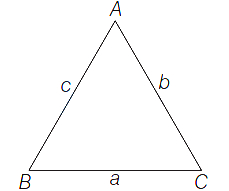
0 likes
View Solution425
EasyMCQ
If in a $\triangle ABC$,$s(s-a) = (s-b)(s-c)$,then
A
$\angle A = \frac{\pi}{4}$
B
$\angle B = \frac{\pi}{3}$
C
$\angle A = \frac{\pi}{2}$
D
$\angle B = \frac{\pi}{2}$
Solution
(C) Given,$s(s-a) = (s-b)(s-c)$.
We know that $\sin \frac{A}{2} = \sqrt{\frac{(s-b)(s-c)}{bc}}$ and $\cos \frac{A}{2} = \sqrt{\frac{s(s-a)}{bc}}$.
Squaring both,we get $\sin^2 \frac{A}{2} = \frac{(s-b)(s-c)}{bc}$ and $\cos^2 \frac{A}{2} = \frac{s(s-a)}{bc}$.
Since $s(s-a) = (s-b)(s-c)$,it follows that $\sin^2 \frac{A}{2} = \cos^2 \frac{A}{2}$.
Dividing by $\cos^2 \frac{A}{2}$,we get $\tan^2 \frac{A}{2} = 1$.
Since $\frac{A}{2}$ is an angle of a triangle,$\frac{A}{2} = \frac{\pi}{4}$,which implies $A = \frac{\pi}{2}$.
We know that $\sin \frac{A}{2} = \sqrt{\frac{(s-b)(s-c)}{bc}}$ and $\cos \frac{A}{2} = \sqrt{\frac{s(s-a)}{bc}}$.
Squaring both,we get $\sin^2 \frac{A}{2} = \frac{(s-b)(s-c)}{bc}$ and $\cos^2 \frac{A}{2} = \frac{s(s-a)}{bc}$.
Since $s(s-a) = (s-b)(s-c)$,it follows that $\sin^2 \frac{A}{2} = \cos^2 \frac{A}{2}$.
Dividing by $\cos^2 \frac{A}{2}$,we get $\tan^2 \frac{A}{2} = 1$.
Since $\frac{A}{2}$ is an angle of a triangle,$\frac{A}{2} = \frac{\pi}{4}$,which implies $A = \frac{\pi}{2}$.
0 likes
View Solution426
MediumMCQ
In a $\triangle ABC$,if $\tan(A/2)$,$\tan(B/2)$,and $\tan(C/2)$ are in Arithmetic Progression,then which of the following options is always correct?
A
$\cos A$,$\cos B$,and $\cos C$ are in Arithmetic Progression.
B
$\cos A$,$\cos B$,and $\cos C$ are in Geometric Progression.
C
$\cos A$,$\cos B$,and $\cos C$ are in Harmonic Progression.
D
No conclusion can be made with the given data.
Solution
(A) Given that in a $\triangle ABC$,$\tan(A/2)$,$\tan(B/2)$,and $\tan(C/2)$ are in Arithmetic Progression $(AP)$.
Therefore,$2 \tan(B/2) = \tan(A/2) + \tan(C/2)$.
Using the identity $\tan(A/2) = \sqrt{\frac{(s-b)(s-c)}{s(s-a)}}$,this can be solved,but a more direct trigonometric approach is:
$\tan(B/2) - \tan(A/2) = \tan(C/2) - \tan(B/2)$
$\frac{\sin(B/2)}{\cos(B/2)} - \frac{\sin(A/2)}{\cos(A/2)} = \frac{\sin(C/2)}{\cos(C/2)} - \frac{\sin(B/2)}{\cos(B/2)}$
$\frac{\sin(B/2-A/2)}{\cos(B/2)\cos(A/2)} = \frac{\sin(C/2-B/2)}{\cos(C/2)\cos(B/2)}$
$\frac{\sin((B-A)/2)}{\cos(A/2)} = \frac{\sin((C-B)/2)}{\cos(C/2)}$
Using $A/2 = 90^{\circ} - (B+C)/2$ and $C/2 = 90^{\circ} - (A+B)/2$,we get:
$\frac{\sin((B-A)/2)}{\sin((B+C)/2)} = \frac{\sin((C-B)/2)}{\sin((A+B)/2)}$
$\sin((A+B)/2)\sin((B-A)/2) = \sin((B+C)/2)\sin((C-B)/2)$
Using $2\sin x \sin y = \cos(x-y) - \cos(x+y)$:
$\cos A - \cos B = \cos B - \cos C$
$\cos A + \cos C = 2\cos B$
Thus,$\cos A$,$\cos B$,and $\cos C$ are in Arithmetic Progression.
Therefore,$2 \tan(B/2) = \tan(A/2) + \tan(C/2)$.
Using the identity $\tan(A/2) = \sqrt{\frac{(s-b)(s-c)}{s(s-a)}}$,this can be solved,but a more direct trigonometric approach is:
$\tan(B/2) - \tan(A/2) = \tan(C/2) - \tan(B/2)$
$\frac{\sin(B/2)}{\cos(B/2)} - \frac{\sin(A/2)}{\cos(A/2)} = \frac{\sin(C/2)}{\cos(C/2)} - \frac{\sin(B/2)}{\cos(B/2)}$
$\frac{\sin(B/2-A/2)}{\cos(B/2)\cos(A/2)} = \frac{\sin(C/2-B/2)}{\cos(C/2)\cos(B/2)}$
$\frac{\sin((B-A)/2)}{\cos(A/2)} = \frac{\sin((C-B)/2)}{\cos(C/2)}$
Using $A/2 = 90^{\circ} - (B+C)/2$ and $C/2 = 90^{\circ} - (A+B)/2$,we get:
$\frac{\sin((B-A)/2)}{\sin((B+C)/2)} = \frac{\sin((C-B)/2)}{\sin((A+B)/2)}$
$\sin((A+B)/2)\sin((B-A)/2) = \sin((B+C)/2)\sin((C-B)/2)$
Using $2\sin x \sin y = \cos(x-y) - \cos(x+y)$:
$\cos A - \cos B = \cos B - \cos C$
$\cos A + \cos C = 2\cos B$
Thus,$\cos A$,$\cos B$,and $\cos C$ are in Arithmetic Progression.
0 likes
View Solution427
EasyMCQ
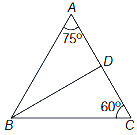
In a $\triangle ABC$,$\angle C = 60^{\circ}$ and $\angle A = 75^{\circ}$. If $D$ is a point on $AC$ such that the area of $\triangle BAD$ is $\sqrt{3}$ times the area of $\triangle BCD$,then the measure of $\angle ABD$ is (in $^{\circ}$)
A
$30$
B
$45$
C
$60$
D
$90$
Solution
(A) In $\triangle ABC$,the sum of angles is $180^{\circ}$. Thus,$\angle B = 180^{\circ} - (75^{\circ} + 60^{\circ}) = 45^{\circ}$.
Since $\triangle BAD$ and $\triangle BCD$ share the same altitude from vertex $B$ to the base $AC$,the ratio of their areas is equal to the ratio of their bases: $\frac{\text{Area}(\triangle BAD)}{\text{Area}(\triangle BCD)} = \frac{AD}{CD} = \sqrt{3}$.
Let $\angle ABD = \alpha$,then $\angle DBC = 45^{\circ} - \alpha$.
Using the sine rule in $\triangle BAD$ and $\triangle BCD$:
$\frac{AD}{\sin \alpha} = \frac{BD}{\sin 75^{\circ}}$ and $\frac{CD}{\sin(45^{\circ} - \alpha)} = \frac{BD}{\sin 60^{\circ}}$.
Dividing these equations gives $\frac{AD}{CD} = \frac{\sin \alpha}{\sin(45^{\circ} - \alpha)} \cdot \frac{\sin 60^{\circ}}{\sin 75^{\circ}} = \sqrt{3}$.
$\frac{\sin \alpha}{\sin(45^{\circ} - \alpha)} = \sqrt{3} \cdot \frac{\sin 75^{\circ}}{\sin 60^{\circ}} = \sqrt{3} \cdot \frac{(\sqrt{6} + \sqrt{2})/4}{\sqrt{3}/2} = \frac{\sqrt{6} + \sqrt{2}}{2} = \frac{\sqrt{2}(\sqrt{3} + 1)}{2} = \frac{\sqrt{3} + 1}{\sqrt{2}}$.
Solving $\frac{\sin \alpha}{\sin 45^{\circ} \cos \alpha - \cos 45^{\circ} \sin \alpha} = \frac{\sqrt{3} + 1}{\sqrt{2}}$ leads to $\cot \alpha = \sqrt{3}$,hence $\alpha = 30^{\circ}$.
Since $\triangle BAD$ and $\triangle BCD$ share the same altitude from vertex $B$ to the base $AC$,the ratio of their areas is equal to the ratio of their bases: $\frac{\text{Area}(\triangle BAD)}{\text{Area}(\triangle BCD)} = \frac{AD}{CD} = \sqrt{3}$.
Let $\angle ABD = \alpha$,then $\angle DBC = 45^{\circ} - \alpha$.
Using the sine rule in $\triangle BAD$ and $\triangle BCD$:
$\frac{AD}{\sin \alpha} = \frac{BD}{\sin 75^{\circ}}$ and $\frac{CD}{\sin(45^{\circ} - \alpha)} = \frac{BD}{\sin 60^{\circ}}$.
Dividing these equations gives $\frac{AD}{CD} = \frac{\sin \alpha}{\sin(45^{\circ} - \alpha)} \cdot \frac{\sin 60^{\circ}}{\sin 75^{\circ}} = \sqrt{3}$.
$\frac{\sin \alpha}{\sin(45^{\circ} - \alpha)} = \sqrt{3} \cdot \frac{\sin 75^{\circ}}{\sin 60^{\circ}} = \sqrt{3} \cdot \frac{(\sqrt{6} + \sqrt{2})/4}{\sqrt{3}/2} = \frac{\sqrt{6} + \sqrt{2}}{2} = \frac{\sqrt{2}(\sqrt{3} + 1)}{2} = \frac{\sqrt{3} + 1}{\sqrt{2}}$.
Solving $\frac{\sin \alpha}{\sin 45^{\circ} \cos \alpha - \cos 45^{\circ} \sin \alpha} = \frac{\sqrt{3} + 1}{\sqrt{2}}$ leads to $\cot \alpha = \sqrt{3}$,hence $\alpha = 30^{\circ}$.
0 likes
View Solution428
DifficultMCQ
Let $\Delta$ denote the area of a $\triangle ABC$. If $\alpha, \beta, \gamma$ are the lengths of the altitudes of the $\triangle ABC$,then $\alpha^{-2}+\beta^{-2}+\gamma^{-2}=$
A
$\frac{4}{\Delta}(\tan A+\tan B+\tan C)$
B
$\frac{1}{\Delta}(\cot A+\cot B+\cot C)$
C
$\frac{\Delta^2}{2}(\tan A+\tan B+\tan C)$
D
$\frac{\Delta^2}{4}(\cot A+\cot B+\cot C)$
Solution
(B) The area of $\triangle ABC$ is given by $\Delta = \frac{1}{2} a \alpha = \frac{1}{2} b \beta = \frac{1}{2} c \gamma$.
Thus,$\alpha = \frac{2\Delta}{a}$,$\beta = \frac{2\Delta}{b}$,and $\gamma = \frac{2\Delta}{c}$.
Substituting these into the expression:
$\alpha^{-2} + \beta^{-2} + \gamma^{-2} = \frac{a^2}{4\Delta^2} + \frac{b^2}{4\Delta^2} + \frac{c^2}{4\Delta^2} = \frac{a^2+b^2+c^2}{4\Delta^2}$.
Using the identity $\cot A = \frac{b^2+c^2-a^2}{4\Delta}$,we have $b^2+c^2-a^2 = 4\Delta \cot A$.
Summing these for $A, B, C$:
$(b^2+c^2-a^2) + (c^2+a^2-b^2) + (a^2+b^2-c^2) = a^2+b^2+c^2 = 4\Delta(\cot A + \cot B + \cot C)$.
Therefore,$\frac{a^2+b^2+c^2}{4\Delta^2} = \frac{4\Delta(\cot A + \cot B + \cot C)}{4\Delta^2} = \frac{1}{\Delta}(\cot A + \cot B + \cot C)$.
Thus,$\alpha = \frac{2\Delta}{a}$,$\beta = \frac{2\Delta}{b}$,and $\gamma = \frac{2\Delta}{c}$.
Substituting these into the expression:
$\alpha^{-2} + \beta^{-2} + \gamma^{-2} = \frac{a^2}{4\Delta^2} + \frac{b^2}{4\Delta^2} + \frac{c^2}{4\Delta^2} = \frac{a^2+b^2+c^2}{4\Delta^2}$.
Using the identity $\cot A = \frac{b^2+c^2-a^2}{4\Delta}$,we have $b^2+c^2-a^2 = 4\Delta \cot A$.
Summing these for $A, B, C$:
$(b^2+c^2-a^2) + (c^2+a^2-b^2) + (a^2+b^2-c^2) = a^2+b^2+c^2 = 4\Delta(\cot A + \cot B + \cot C)$.
Therefore,$\frac{a^2+b^2+c^2}{4\Delta^2} = \frac{4\Delta(\cot A + \cot B + \cot C)}{4\Delta^2} = \frac{1}{\Delta}(\cot A + \cot B + \cot C)$.
0 likes
View Solution429
MediumMCQ
In $\triangle ABC, (r_2 + r_3) \cot \left(\frac{B+C}{2}\right) = $
A
$a+b+c$
B
$a$
C
$b$
D
$c$
Solution
(B) We know that $r_2 = \frac{\Delta}{s-b}$ and $r_3 = \frac{\Delta}{s-c}$.
Also,$\cot \left(\frac{B+C}{2}\right) = \tan \left(\frac{A}{2}\right) = \sqrt{\frac{(s-b)(s-c)}{s(s-a)}}$.
Substituting these values:
$(r_2 + r_3) \cot \left(\frac{B+C}{2}\right) = \left( \frac{\Delta}{s-b} + \frac{\Delta}{s-c} \right) \tan \left(\frac{A}{2}\right)$
$= \Delta \left( \frac{s-c+s-b}{(s-b)(s-c)} \right) \sqrt{\frac{(s-b)(s-c)}{s(s-a)}}$
$= \Delta \left( \frac{a}{(s-b)(s-c)} \right) \frac{\sqrt{(s-b)(s-c)}}{\sqrt{s(s-a)}}$
$= \frac{\Delta \cdot a}{\sqrt{s(s-a)(s-b)(s-c)}}$
Since $\Delta = \sqrt{s(s-a)(s-b)(s-c)}$,the expression simplifies to:
$= \frac{\Delta \cdot a}{\Delta} = a$.
Thus,option $B$ is correct.
Also,$\cot \left(\frac{B+C}{2}\right) = \tan \left(\frac{A}{2}\right) = \sqrt{\frac{(s-b)(s-c)}{s(s-a)}}$.
Substituting these values:
$(r_2 + r_3) \cot \left(\frac{B+C}{2}\right) = \left( \frac{\Delta}{s-b} + \frac{\Delta}{s-c} \right) \tan \left(\frac{A}{2}\right)$
$= \Delta \left( \frac{s-c+s-b}{(s-b)(s-c)} \right) \sqrt{\frac{(s-b)(s-c)}{s(s-a)}}$
$= \Delta \left( \frac{a}{(s-b)(s-c)} \right) \frac{\sqrt{(s-b)(s-c)}}{\sqrt{s(s-a)}}$
$= \frac{\Delta \cdot a}{\sqrt{s(s-a)(s-b)(s-c)}}$
Since $\Delta = \sqrt{s(s-a)(s-b)(s-c)}$,the expression simplifies to:
$= \frac{\Delta \cdot a}{\Delta} = a$.
Thus,option $B$ is correct.
0 likes
View Solution430
EasyMCQ
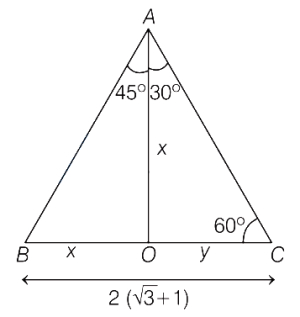
The area (in square units) of $\triangle ABC$ if $\angle A=75^{\circ}, \angle B=45^{\circ}$ and $a=2(\sqrt{3}+1)$ is
A
$6$
B
$2\sqrt{3}$
C
$6-2\sqrt{3}$
D
$6+2\sqrt{3}$
Solution
(D) Given,$\angle A=75^{\circ}, \angle B=45^{\circ}$ and $a=2(\sqrt{3}+1)$.
In $\triangle AOC$,$\tan 60^{\circ} = \frac{x}{y}$ $\Rightarrow \sqrt{3} = \frac{x}{y}$ $\Rightarrow x = \sqrt{3}y$.
Now,$x+y = 2(\sqrt{3}+1)$.
Substituting $x = \sqrt{3}y$,we get $\sqrt{3}y + y = 2(\sqrt{3}+1)$ $\Rightarrow y(\sqrt{3}+1) = 2(\sqrt{3}+1)$ $\Rightarrow y = 2$.
Then,$x = 2\sqrt{3}$.
Now,the area of $\triangle ABC = \text{Area of } \triangle AOB + \text{Area of } \triangle AOC$.
Area $= \frac{1}{2} \times x \times x + \frac{1}{2} \times x \times y = \frac{1}{2}x(x+y)$.
Area $= \frac{1}{2} \times (2\sqrt{3}) \times (2\sqrt{3} + 2) = \sqrt{3} \times 2(\sqrt{3}+1) = 2(3 + \sqrt{3}) = 6 + 2\sqrt{3} \text{ sq units}$.
In $\triangle AOC$,$\tan 60^{\circ} = \frac{x}{y}$ $\Rightarrow \sqrt{3} = \frac{x}{y}$ $\Rightarrow x = \sqrt{3}y$.
Now,$x+y = 2(\sqrt{3}+1)$.
Substituting $x = \sqrt{3}y$,we get $\sqrt{3}y + y = 2(\sqrt{3}+1)$ $\Rightarrow y(\sqrt{3}+1) = 2(\sqrt{3}+1)$ $\Rightarrow y = 2$.
Then,$x = 2\sqrt{3}$.
Now,the area of $\triangle ABC = \text{Area of } \triangle AOB + \text{Area of } \triangle AOC$.
Area $= \frac{1}{2} \times x \times x + \frac{1}{2} \times x \times y = \frac{1}{2}x(x+y)$.
Area $= \frac{1}{2} \times (2\sqrt{3}) \times (2\sqrt{3} + 2) = \sqrt{3} \times 2(\sqrt{3}+1) = 2(3 + \sqrt{3}) = 6 + 2\sqrt{3} \text{ sq units}$.
0 likes
View Solution431
MediumMCQ
In a $\triangle ABC$,if $3a = b + c$,then $\cot \frac{B}{2} \cot \frac{C}{2} =$
A
$1$
B
$2$
C
$\frac{1}{3}$
D
$\frac{1}{2}$
Solution
(B) Given,$3a = b + c$ ... $(i)$
Let $s$ be the semi-perimeter of $\triangle ABC$,so $s = \frac{a + b + c}{2}$.
Substituting the value from $(i)$,we get $s = \frac{a + 3a}{2} = \frac{4a}{2} = 2a$.
We know that $\cot \frac{B}{2} = \sqrt{\frac{s(s-b)}{(s-a)(s-c)}}$ and $\cot \frac{C}{2} = \sqrt{\frac{s(s-c)}{(s-a)(s-b)}}$.
Therefore,$\cot \frac{B}{2} \cot \frac{C}{2} = \sqrt{\frac{s(s-b)}{(s-a)(s-c)} \cdot \frac{s(s-c)}{(s-a)(s-b)}} = \sqrt{\frac{s^2}{(s-a)^2}} = \frac{s}{s-a}$.
Substituting $s = 2a$,we get $\frac{2a}{2a - a} = \frac{2a}{a} = 2$.
Let $s$ be the semi-perimeter of $\triangle ABC$,so $s = \frac{a + b + c}{2}$.
Substituting the value from $(i)$,we get $s = \frac{a + 3a}{2} = \frac{4a}{2} = 2a$.
We know that $\cot \frac{B}{2} = \sqrt{\frac{s(s-b)}{(s-a)(s-c)}}$ and $\cot \frac{C}{2} = \sqrt{\frac{s(s-c)}{(s-a)(s-b)}}$.
Therefore,$\cot \frac{B}{2} \cot \frac{C}{2} = \sqrt{\frac{s(s-b)}{(s-a)(s-c)} \cdot \frac{s(s-c)}{(s-a)(s-b)}} = \sqrt{\frac{s^2}{(s-a)^2}} = \frac{s}{s-a}$.
Substituting $s = 2a$,we get $\frac{2a}{2a - a} = \frac{2a}{a} = 2$.
0 likes
View Solution432
EasyMCQ
If the area of triangle $ABC$ is $b^2-(c-a)^2$,then $\tan B=$
A
$1$
B
$\frac{13}{15}$
C
$\frac{1}{4}$
D
$\frac{8}{15}$
Solution
(D) Given,the area of triangle $\Delta = b^2-(c-a)^2$.
Using the identity $x^2-y^2 = (x-y)(x+y)$,we have $\Delta = (b-c+a)(b+c-a)$.
Since $2s = a+b+c$,we have $b-c+a = 2s-2c$ and $b+c-a = 2s-2a$.
Thus,$\Delta = (2s-2c)(2s-2a) = 4(s-a)(s-c)$.
By Heron's formula,$\Delta = \sqrt{s(s-a)(s-b)(s-c)}$.
Equating the two expressions: $\sqrt{s(s-a)(s-b)(s-c)} = 4(s-a)(s-c)$.
Dividing both sides by $\sqrt{(s-a)(s-c)}$,we get $\sqrt{s(s-b)} = 4\sqrt{(s-a)(s-c)}$.
Therefore,$\tan(\frac{B}{2}) = \sqrt{\frac{(s-a)(s-c)}{s(s-b)}} = \frac{1}{4}$.
Using the double angle formula $\tan B = \frac{2\tan(B/2)}{1-\tan^2(B/2)}$,we get $\tan B = \frac{2(1/4)}{1-(1/4)^2} = \frac{1/2}{1-1/16} = \frac{1/2}{15/16} = \frac{8}{15}$.
Using the identity $x^2-y^2 = (x-y)(x+y)$,we have $\Delta = (b-c+a)(b+c-a)$.
Since $2s = a+b+c$,we have $b-c+a = 2s-2c$ and $b+c-a = 2s-2a$.
Thus,$\Delta = (2s-2c)(2s-2a) = 4(s-a)(s-c)$.
By Heron's formula,$\Delta = \sqrt{s(s-a)(s-b)(s-c)}$.
Equating the two expressions: $\sqrt{s(s-a)(s-b)(s-c)} = 4(s-a)(s-c)$.
Dividing both sides by $\sqrt{(s-a)(s-c)}$,we get $\sqrt{s(s-b)} = 4\sqrt{(s-a)(s-c)}$.
Therefore,$\tan(\frac{B}{2}) = \sqrt{\frac{(s-a)(s-c)}{s(s-b)}} = \frac{1}{4}$.
Using the double angle formula $\tan B = \frac{2\tan(B/2)}{1-\tan^2(B/2)}$,we get $\tan B = \frac{2(1/4)}{1-(1/4)^2} = \frac{1/2}{1-1/16} = \frac{1/2}{15/16} = \frac{8}{15}$.
0 likes
View Solution433
MediumMCQ
In triangle $ABC$,if $r_1=36, r_2=18$ and $r_3=12$,then $a+b=$
A
$36$
B
$24$
C
$30$
D
$54$
Solution
(D) Given in a $\triangle ABC$:
$r_1 = \frac{\Delta}{s-a} = 36, r_2 = \frac{\Delta}{s-b} = 18, r_3 = \frac{\Delta}{s-c} = 12$
$\frac{1}{r_1} + \frac{1}{r_2} + \frac{1}{r_3} = \frac{1}{36} + \frac{1}{18} + \frac{1}{12} = \frac{1+2+3}{36} = \frac{6}{36} = \frac{1}{6}$
Since $\frac{1}{r_1} + \frac{1}{r_2} + \frac{1}{r_3} = \frac{s}{\Delta}$,we have $\frac{s}{\Delta} = \frac{1}{6} \Rightarrow \Delta = 6s$
$r_1 = \frac{6s}{s-a} = 36$ $\Rightarrow 6s = 36s - 36a$ $\Rightarrow 36a = 30s$ $\Rightarrow a = \frac{5s}{6}$
$r_2 = \frac{6s}{s-b} = 18$ $\Rightarrow 6s = 18s - 18b$ $\Rightarrow 18b = 12s$ $\Rightarrow b = \frac{2s}{3}$
$r_3 = \frac{6s}{s-c} = 12$ $\Rightarrow 6s = 12s - 12c$ $\Rightarrow 12c = 6s$ $\Rightarrow c = \frac{s}{2}$
Using Heron's formula $\Delta^2 = s(s-a)(s-b)(s-c) = (6s)^2 = 36s^2$
$s(s - \frac{5s}{6})(s - \frac{2s}{3})(s - \frac{s}{2}) = 36s^2$
$s(\frac{s}{6})(\frac{s}{3})(\frac{s}{2}) = 36s^2$
$\frac{s^4}{36} = 36s^2$ $\Rightarrow s^2 = 36^2$ $\Rightarrow s = 36$
$a = \frac{5 \times 36}{6} = 30$
$b = \frac{2 \times 36}{3} = 24$
$a+b = 30+24 = 54$
$r_1 = \frac{\Delta}{s-a} = 36, r_2 = \frac{\Delta}{s-b} = 18, r_3 = \frac{\Delta}{s-c} = 12$
$\frac{1}{r_1} + \frac{1}{r_2} + \frac{1}{r_3} = \frac{1}{36} + \frac{1}{18} + \frac{1}{12} = \frac{1+2+3}{36} = \frac{6}{36} = \frac{1}{6}$
Since $\frac{1}{r_1} + \frac{1}{r_2} + \frac{1}{r_3} = \frac{s}{\Delta}$,we have $\frac{s}{\Delta} = \frac{1}{6} \Rightarrow \Delta = 6s$
$r_1 = \frac{6s}{s-a} = 36$ $\Rightarrow 6s = 36s - 36a$ $\Rightarrow 36a = 30s$ $\Rightarrow a = \frac{5s}{6}$
$r_2 = \frac{6s}{s-b} = 18$ $\Rightarrow 6s = 18s - 18b$ $\Rightarrow 18b = 12s$ $\Rightarrow b = \frac{2s}{3}$
$r_3 = \frac{6s}{s-c} = 12$ $\Rightarrow 6s = 12s - 12c$ $\Rightarrow 12c = 6s$ $\Rightarrow c = \frac{s}{2}$
Using Heron's formula $\Delta^2 = s(s-a)(s-b)(s-c) = (6s)^2 = 36s^2$
$s(s - \frac{5s}{6})(s - \frac{2s}{3})(s - \frac{s}{2}) = 36s^2$
$s(\frac{s}{6})(\frac{s}{3})(\frac{s}{2}) = 36s^2$
$\frac{s^4}{36} = 36s^2$ $\Rightarrow s^2 = 36^2$ $\Rightarrow s = 36$
$a = \frac{5 \times 36}{6} = 30$
$b = \frac{2 \times 36}{3} = 24$
$a+b = 30+24 = 54$
0 likes
View Solution434
DifficultMCQ
In $\triangle ABC$,if $a=3, b=4, c=6$,then $\frac{\cot \frac{A}{2}+\cot \frac{B}{2}+\cot \frac{C}{2}}{\cot A+\cot B+\cot C}=$
A
$\frac{13}{61}$
B
$\frac{169}{61}$
C
$\frac{61}{169}$
D
$\frac{61}{13}$
Solution
(B) We know that $\cot \frac{A}{2} = \frac{s(s-a)}{\Delta}$,where $s = \frac{a+b+c}{2}$ and $\Delta$ is the area of the triangle.
Thus,$\cot \frac{A}{2} + \cot \frac{B}{2} + \cot \frac{C}{2} = \frac{s(s-a) + s(s-b) + s(s-c)}{\Delta} = \frac{s(3s - (a+b+c))}{\Delta} = \frac{s(3s - 2s)}{\Delta} = \frac{s^2}{\Delta} = \frac{(a+b+c)^2}{4\Delta}$.
Also,$\cot A + \cot B + \cot C = \frac{a^2+b^2+c^2}{4\Delta}$.
Therefore,the ratio is $\frac{(a+b+c)^2}{a^2+b^2+c^2}$.
Substituting $a=3, b=4, c=6$:
Ratio $= \frac{(3+4+6)^2}{3^2+4^2+6^2} = \frac{13^2}{9+16+36} = \frac{169}{61}$.
Thus,$\cot \frac{A}{2} + \cot \frac{B}{2} + \cot \frac{C}{2} = \frac{s(s-a) + s(s-b) + s(s-c)}{\Delta} = \frac{s(3s - (a+b+c))}{\Delta} = \frac{s(3s - 2s)}{\Delta} = \frac{s^2}{\Delta} = \frac{(a+b+c)^2}{4\Delta}$.
Also,$\cot A + \cot B + \cot C = \frac{a^2+b^2+c^2}{4\Delta}$.
Therefore,the ratio is $\frac{(a+b+c)^2}{a^2+b^2+c^2}$.
Substituting $a=3, b=4, c=6$:
Ratio $= \frac{(3+4+6)^2}{3^2+4^2+6^2} = \frac{13^2}{9+16+36} = \frac{169}{61}$.
0 likes
View Solution435
MediumMCQ
In $\triangle ABC$,if $a \cos^2 \frac{C}{2} + c \cos^2 \frac{A}{2} = \frac{3b}{2}$,then
A
$2b = a + c$
B
$b^2 = ac$
C
$\frac{1}{b} = \frac{1}{a} + \frac{1}{c}$
D
$a = c$
Solution
(A) Given the equation: $a \cos^2 \frac{C}{2} + c \cos^2 \frac{A}{2} = \frac{3b}{2}$
Using the half-angle formulas $\cos^2 \frac{C}{2} = \frac{s(s-c)}{ab}$ and $\cos^2 \frac{A}{2} = \frac{s(s-a)}{bc}$:
$a \left( \frac{s(s-c)}{ab} \right) + c \left( \frac{s(s-a)}{bc} \right) = \frac{3b}{2}$
$\frac{s(s-c)}{b} + \frac{s(s-a)}{b} = \frac{3b}{2}$
$\frac{s}{b} (s - c + s - a) = \frac{3b}{2}$
Since $2s = a + b + c$,we have $2s - a - c = b$:
$\frac{s}{b} (b) = \frac{3b}{2} \Rightarrow s = \frac{3b}{2}$
$\frac{a + b + c}{2} = \frac{3b}{2} \Rightarrow a + b + c = 3b$
$a + c = 2b$
Using the half-angle formulas $\cos^2 \frac{C}{2} = \frac{s(s-c)}{ab}$ and $\cos^2 \frac{A}{2} = \frac{s(s-a)}{bc}$:
$a \left( \frac{s(s-c)}{ab} \right) + c \left( \frac{s(s-a)}{bc} \right) = \frac{3b}{2}$
$\frac{s(s-c)}{b} + \frac{s(s-a)}{b} = \frac{3b}{2}$
$\frac{s}{b} (s - c + s - a) = \frac{3b}{2}$
Since $2s = a + b + c$,we have $2s - a - c = b$:
$\frac{s}{b} (b) = \frac{3b}{2} \Rightarrow s = \frac{3b}{2}$
$\frac{a + b + c}{2} = \frac{3b}{2} \Rightarrow a + b + c = 3b$
$a + c = 2b$
0 likes
View Solution436
MediumMCQ
If $s$ is the semi-perimeter of $\triangle ABC$ and if $\frac{s-a}{4}=\frac{s-b}{5}=\frac{s-c}{6}$,then $\sum \sin^2\left(\frac{A}{2}\right) = $
A
$\frac{74}{25}$
B
$\frac{25}{74}$
C
$\frac{74}{33}$
D
$\frac{25}{33}$
Solution
(D) Let $\frac{s-a}{4} = \frac{s-b}{5} = \frac{s-c}{6} = k$.
Then $s-a = 4k$,$s-b = 5k$,and $s-c = 6k$.
Adding these gives $3s - (a+b+c) = 15k$. Since $a+b+c = 2s$,we have $3s - 2s = 15k$,so $s = 15k$.
Then $a = s - 4k = 11k$,$b = s - 5k = 10k$,and $c = s - 6k = 9k$.
We know $\sin^2\left(\frac{A}{2}\right) = \frac{(s-b)(s-c)}{bc}$.
Thus,$\sum \sin^2\left(\frac{A}{2}\right) = \frac{(s-b)(s-c)}{bc} + \frac{(s-c)(s-a)}{ca} + \frac{(s-a)(s-b)}{ab}$.
Substituting the values:
$= \frac{(5k)(6k)}{(10k)(9k)} + \frac{(6k)(4k)}{(9k)(11k)} + \frac{(4k)(5k)}{(11k)(10k)} = \frac{30}{90} + \frac{24}{99} + \frac{20}{110} = \frac{1}{3} + \frac{8}{33} + \frac{2}{11}$.
$= \frac{11 + 8 + 6}{33} = \frac{25}{33}$.
Then $s-a = 4k$,$s-b = 5k$,and $s-c = 6k$.
Adding these gives $3s - (a+b+c) = 15k$. Since $a+b+c = 2s$,we have $3s - 2s = 15k$,so $s = 15k$.
Then $a = s - 4k = 11k$,$b = s - 5k = 10k$,and $c = s - 6k = 9k$.
We know $\sin^2\left(\frac{A}{2}\right) = \frac{(s-b)(s-c)}{bc}$.
Thus,$\sum \sin^2\left(\frac{A}{2}\right) = \frac{(s-b)(s-c)}{bc} + \frac{(s-c)(s-a)}{ca} + \frac{(s-a)(s-b)}{ab}$.
Substituting the values:
$= \frac{(5k)(6k)}{(10k)(9k)} + \frac{(6k)(4k)}{(9k)(11k)} + \frac{(4k)(5k)}{(11k)(10k)} = \frac{30}{90} + \frac{24}{99} + \frac{20}{110} = \frac{1}{3} + \frac{8}{33} + \frac{2}{11}$.
$= \frac{11 + 8 + 6}{33} = \frac{25}{33}$.
0 likes
View Solution437
EasyMCQ
In $\triangle ABC$,if $\frac{s-a}{11}=\frac{s-b}{12}=\frac{s-c}{13}$,then $\tan^2\left(\frac{A}{2}\right)+\tan^2\left(\frac{C}{2}\right) = $
A
$\frac{290}{429}$
B
$\frac{290}{143}$
C
$\frac{143}{33}$
D
$\frac{113}{33}$
Solution
(A) Given that,$\frac{s-a}{11}=\frac{s-b}{12}=\frac{s-c}{13}=k$.
$s-a=11k$,$s-b=12k$,$s-c=13k$.
Adding these,we get $3s-(a+b+c) = 36k$.
Since $a+b+c=2s$,we have $3s-2s=36k$,so $s=36k$.
Using the formula $\tan^2\left(\frac{A}{2}\right) = \frac{(s-b)(s-c)}{s(s-a)}$ and $\tan^2\left(\frac{C}{2}\right) = \frac{(s-a)(s-b)}{s(s-c)}$,
$\tan^2\left(\frac{A}{2}\right)+\tan^2\left(\frac{C}{2}\right) = \frac{(12k)(13k)}{(36k)(11k)} + \frac{(11k)(12k)}{(36k)(13k)}$.
$= \frac{12 \times 13}{36 \times 11} + \frac{11 \times 12}{36 \times 13} = \frac{1}{3} \left( \frac{13}{11} + \frac{11}{13} \right)$.
$= \frac{1}{3} \left( \frac{169+121}{143} \right) = \frac{1}{3} \times \frac{290}{143} = \frac{290}{429}$.
$s-a=11k$,$s-b=12k$,$s-c=13k$.
Adding these,we get $3s-(a+b+c) = 36k$.
Since $a+b+c=2s$,we have $3s-2s=36k$,so $s=36k$.
Using the formula $\tan^2\left(\frac{A}{2}\right) = \frac{(s-b)(s-c)}{s(s-a)}$ and $\tan^2\left(\frac{C}{2}\right) = \frac{(s-a)(s-b)}{s(s-c)}$,
$\tan^2\left(\frac{A}{2}\right)+\tan^2\left(\frac{C}{2}\right) = \frac{(12k)(13k)}{(36k)(11k)} + \frac{(11k)(12k)}{(36k)(13k)}$.
$= \frac{12 \times 13}{36 \times 11} + \frac{11 \times 12}{36 \times 13} = \frac{1}{3} \left( \frac{13}{11} + \frac{11}{13} \right)$.
$= \frac{1}{3} \left( \frac{169+121}{143} \right) = \frac{1}{3} \times \frac{290}{143} = \frac{290}{429}$.
0 likes
View Solution438
EasyMCQ
In a triangle,if the ex-radii $r_1, r_2, r_3$ are in the ratio $1: 2: 3$,then its sides are in the ratio
A
$5: 8: 9$
B
$5: 4: 3$
C
$7: 9: 11$
D
$1: 2: 3$
Solution
(A) We know that $r_1 = \frac{\Delta}{s-a}$,$r_2 = \frac{\Delta}{s-b}$,and $r_3 = \frac{\Delta}{s-c}$,where $\Delta$ is the area of the triangle and $s$ is the semi-perimeter.
Given $r_1: r_2: r_3 = 1: 2: 3$,let $r_1 = x, r_2 = 2x, r_3 = 3x$.
Then $s-a = \frac{\Delta}{x}$,$s-b = \frac{\Delta}{2x}$,and $s-c = \frac{\Delta}{3x}$.
Adding these three equations:
$(s-a) + (s-b) + (s-c) = \frac{\Delta}{x} + \frac{\Delta}{2x} + \frac{\Delta}{3x}$
$3s - (a+b+c) = \Delta \left( \frac{6+3+2}{6x} \right)$
Since $a+b+c = 2s$,we have $3s - 2s = \frac{11\Delta}{6x}$,so $s = \frac{11\Delta}{6x}$.
Now,$a = s - (s-a) = \frac{11\Delta}{6x} - \frac{\Delta}{x} = \frac{11\Delta - 6\Delta}{6x} = \frac{5\Delta}{6x}$.
$b = s - (s-b) = \frac{11\Delta}{6x} - \frac{\Delta}{2x} = \frac{11\Delta - 3\Delta}{6x} = \frac{8\Delta}{6x}$.
$c = s - (s-c) = \frac{11\Delta}{6x} - \frac{\Delta}{3x} = \frac{11\Delta - 2\Delta}{6x} = \frac{9\Delta}{6x}$.
Thus,$a: b: c = \frac{5\Delta}{6x} : \frac{8\Delta}{6x} : \frac{9\Delta}{6x} = 5: 8: 9$.
Given $r_1: r_2: r_3 = 1: 2: 3$,let $r_1 = x, r_2 = 2x, r_3 = 3x$.
Then $s-a = \frac{\Delta}{x}$,$s-b = \frac{\Delta}{2x}$,and $s-c = \frac{\Delta}{3x}$.
Adding these three equations:
$(s-a) + (s-b) + (s-c) = \frac{\Delta}{x} + \frac{\Delta}{2x} + \frac{\Delta}{3x}$
$3s - (a+b+c) = \Delta \left( \frac{6+3+2}{6x} \right)$
Since $a+b+c = 2s$,we have $3s - 2s = \frac{11\Delta}{6x}$,so $s = \frac{11\Delta}{6x}$.
Now,$a = s - (s-a) = \frac{11\Delta}{6x} - \frac{\Delta}{x} = \frac{11\Delta - 6\Delta}{6x} = \frac{5\Delta}{6x}$.
$b = s - (s-b) = \frac{11\Delta}{6x} - \frac{\Delta}{2x} = \frac{11\Delta - 3\Delta}{6x} = \frac{8\Delta}{6x}$.
$c = s - (s-c) = \frac{11\Delta}{6x} - \frac{\Delta}{3x} = \frac{11\Delta - 2\Delta}{6x} = \frac{9\Delta}{6x}$.
Thus,$a: b: c = \frac{5\Delta}{6x} : \frac{8\Delta}{6x} : \frac{9\Delta}{6x} = 5: 8: 9$.
0 likes
View Solution439
DifficultMCQ
In $\triangle ABC$,if $a = 2b$ and $|A - B| = \frac{\pi}{3}$,then $\angle C = $
A
$\frac{\pi}{6}$
B
$\frac{\pi}{3}$
C
$\frac{\pi}{2}$
D
$\frac{\pi}{4}$
Solution
(B) Using the Law of Tangents: $\frac{a-b}{a+b} = \frac{\tan(\frac{A-B}{2})}{\tan(\frac{A+B}{2})}$.
Given $a = 2b$,we have $\frac{2b-b}{2b+b} = \frac{b}{3b} = \frac{1}{3}$.
Also,$|A-B| = \frac{\pi}{3}$,so $\frac{A-B}{2} = \frac{\pi}{6}$.
Thus,$\frac{1}{3} = \frac{\tan(\pi/6)}{\tan((A+B)/2)} = \frac{1/\sqrt{3}}{\tan((A+B)/2)}$.
This implies $\tan(\frac{A+B}{2}) = \sqrt{3}$.
Therefore,$\frac{A+B}{2} = \frac{\pi}{3}$,which means $A+B = \frac{2\pi}{3}$.
Since $A+B+C = \pi$,we have $C = \pi - (A+B) = \pi - \frac{2\pi}{3} = \frac{\pi}{3}$.
Given $a = 2b$,we have $\frac{2b-b}{2b+b} = \frac{b}{3b} = \frac{1}{3}$.
Also,$|A-B| = \frac{\pi}{3}$,so $\frac{A-B}{2} = \frac{\pi}{6}$.
Thus,$\frac{1}{3} = \frac{\tan(\pi/6)}{\tan((A+B)/2)} = \frac{1/\sqrt{3}}{\tan((A+B)/2)}$.
This implies $\tan(\frac{A+B}{2}) = \sqrt{3}$.
Therefore,$\frac{A+B}{2} = \frac{\pi}{3}$,which means $A+B = \frac{2\pi}{3}$.
Since $A+B+C = \pi$,we have $C = \pi - (A+B) = \pi - \frac{2\pi}{3} = \frac{\pi}{3}$.
0 likes
View Solution440
MediumMCQ
In a triangle $ABC$,if $\tan \left(\frac{A-B}{2}\right) = \frac{1}{3} \tan \left(\frac{A+B}{2}\right)$,then $a : b =$
A
$2 : 1$
B
$3 : 1$
C
$4 : 1$
D
$1 : 3$
Solution
(A) Using Napier's Analogy,we have $\tan \left(\frac{A-B}{2}\right) = \frac{a-b}{a+b} \cot \left(\frac{C}{2}\right)$.
Given $\tan \left(\frac{A-B}{2}\right) = \frac{1}{3} \tan \left(\frac{A+B}{2}\right)$.
Since $A+B+C = 180^{\circ}$,we have $\frac{A+B}{2} = 90^{\circ} - \frac{C}{2}$,so $\tan \left(\frac{A+B}{2}\right) = \cot \left(\frac{C}{2}\right)$.
Substituting this into the given equation: $\frac{a-b}{a+b} \cot \left(\frac{C}{2}\right) = \frac{1}{3} \cot \left(\frac{C}{2}\right)$.
Assuming $\cot \left(\frac{C}{2}\right) \neq 0$,we get $\frac{a-b}{a+b} = \frac{1}{3}$.
Cross-multiplying gives $3(a-b) = a+b$,which simplifies to $3a - 3b = a + b$.
Rearranging terms gives $2a = 4b$,or $\frac{a}{b} = \frac{4}{2} = 2$.
Thus,$a : b = 2 : 1$.
Given $\tan \left(\frac{A-B}{2}\right) = \frac{1}{3} \tan \left(\frac{A+B}{2}\right)$.
Since $A+B+C = 180^{\circ}$,we have $\frac{A+B}{2} = 90^{\circ} - \frac{C}{2}$,so $\tan \left(\frac{A+B}{2}\right) = \cot \left(\frac{C}{2}\right)$.
Substituting this into the given equation: $\frac{a-b}{a+b} \cot \left(\frac{C}{2}\right) = \frac{1}{3} \cot \left(\frac{C}{2}\right)$.
Assuming $\cot \left(\frac{C}{2}\right) \neq 0$,we get $\frac{a-b}{a+b} = \frac{1}{3}$.
Cross-multiplying gives $3(a-b) = a+b$,which simplifies to $3a - 3b = a + b$.
Rearranging terms gives $2a = 4b$,or $\frac{a}{b} = \frac{4}{2} = 2$.
Thus,$a : b = 2 : 1$.
0 likes
View Solution441
EasyMCQ
If in a $\triangle ABC$,$r_1 = 2r_2 = 3r_3$,then the perimeter of the triangle is equal to
A
$3a$
B
$3b$
C
$3c$
D
$3(a+b+c)$
Solution
(B) Given $r_1 = 2r_2 = 3r_3 = \lambda$ (say).
We know that $r_1 = \frac{\Delta}{s-a}$,$r_2 = \frac{\Delta}{s-b}$,and $r_3 = \frac{\Delta}{s-c}$.
So,$\frac{\Delta}{s-a} = \lambda$,$\frac{\Delta}{s-b} = \frac{\lambda}{2}$,and $\frac{\Delta}{s-c} = \frac{\lambda}{3}$.
This gives $s-a = \frac{\Delta}{\lambda}$,$s-b = \frac{2\Delta}{\lambda}$,and $s-c = \frac{3\Delta}{\lambda}$.
Adding these,$(s-a) + (s-b) + (s-c) = \frac{\Delta}{\lambda} (1 + 2 + 3) = \frac{6\Delta}{\lambda}$.
$3s - (a+b+c) = \frac{6\Delta}{\lambda}$.
Since $a+b+c = 2s$,we have $3s - 2s = s = \frac{6\Delta}{\lambda}$.
Thus,$s-a = \frac{s}{6}$,$s-b = \frac{2s}{6} = \frac{s}{3}$,and $s-c = \frac{3s}{6} = \frac{s}{2}$.
Solving for sides: $a = s - \frac{s}{6} = \frac{5s}{6}$,$b = s - \frac{s}{3} = \frac{2s}{3}$,$c = s - \frac{s}{2} = \frac{s}{2}$.
Perimeter $P = a+b+c = \frac{5s}{6} + \frac{4s}{6} + \frac{3s}{6} = \frac{12s}{6} = 2s$.
Also,$b = \frac{2s}{3} \implies 3b = 2s = P$. Therefore,the perimeter is $3b$.
We know that $r_1 = \frac{\Delta}{s-a}$,$r_2 = \frac{\Delta}{s-b}$,and $r_3 = \frac{\Delta}{s-c}$.
So,$\frac{\Delta}{s-a} = \lambda$,$\frac{\Delta}{s-b} = \frac{\lambda}{2}$,and $\frac{\Delta}{s-c} = \frac{\lambda}{3}$.
This gives $s-a = \frac{\Delta}{\lambda}$,$s-b = \frac{2\Delta}{\lambda}$,and $s-c = \frac{3\Delta}{\lambda}$.
Adding these,$(s-a) + (s-b) + (s-c) = \frac{\Delta}{\lambda} (1 + 2 + 3) = \frac{6\Delta}{\lambda}$.
$3s - (a+b+c) = \frac{6\Delta}{\lambda}$.
Since $a+b+c = 2s$,we have $3s - 2s = s = \frac{6\Delta}{\lambda}$.
Thus,$s-a = \frac{s}{6}$,$s-b = \frac{2s}{6} = \frac{s}{3}$,and $s-c = \frac{3s}{6} = \frac{s}{2}$.
Solving for sides: $a = s - \frac{s}{6} = \frac{5s}{6}$,$b = s - \frac{s}{3} = \frac{2s}{3}$,$c = s - \frac{s}{2} = \frac{s}{2}$.
Perimeter $P = a+b+c = \frac{5s}{6} + \frac{4s}{6} + \frac{3s}{6} = \frac{12s}{6} = 2s$.
Also,$b = \frac{2s}{3} \implies 3b = 2s = P$. Therefore,the perimeter is $3b$.
0 likes
View Solution442
MediumMCQ
In $\triangle ABC$,the sum of the lengths of two sides is $x$ and the product of those lengths is $y$. If $c$ is the length of the third side and $x^2 - c^2 = y$,then the circumradius of the triangle is
A
$\frac{c}{\sqrt{3}}$
B
$\frac{c}{3}$
C
$\frac{y}{\sqrt{3}}$
D
$\frac{3y}{2}$
Solution
(A) Let the two sides be $a$ and $b$. We are given $a + b = x$ and $ab = y$.
Given the condition $x^2 - c^2 = y$,we substitute $x = a + b$:
$(a + b)^2 - c^2 = y$
$a^2 + b^2 + 2ab - c^2 = y$
Since $ab = y$,we have $a^2 + b^2 + 2y - c^2 = y$,which simplifies to $a^2 + b^2 - c^2 = -y$.
By the Law of Cosines,$c^2 = a^2 + b^2 - 2ab \cos C$.
Comparing $a^2 + b^2 - c^2 = 2ab \cos C$ with $a^2 + b^2 - c^2 = -y$ and $ab = y$,we get $2y \cos C = -y$,so $\cos C = -\frac{1}{2}$.
Thus,$C = 120^\circ$.
The circumradius $R$ is given by $R = \frac{c}{2 \sin C}$.
$R = \frac{c}{2 \sin 120^\circ} = \frac{c}{2 (\sqrt{3}/2)} = \frac{c}{\sqrt{3}}$.
Given the condition $x^2 - c^2 = y$,we substitute $x = a + b$:
$(a + b)^2 - c^2 = y$
$a^2 + b^2 + 2ab - c^2 = y$
Since $ab = y$,we have $a^2 + b^2 + 2y - c^2 = y$,which simplifies to $a^2 + b^2 - c^2 = -y$.
By the Law of Cosines,$c^2 = a^2 + b^2 - 2ab \cos C$.
Comparing $a^2 + b^2 - c^2 = 2ab \cos C$ with $a^2 + b^2 - c^2 = -y$ and $ab = y$,we get $2y \cos C = -y$,so $\cos C = -\frac{1}{2}$.
Thus,$C = 120^\circ$.
The circumradius $R$ is given by $R = \frac{c}{2 \sin C}$.
$R = \frac{c}{2 \sin 120^\circ} = \frac{c}{2 (\sqrt{3}/2)} = \frac{c}{\sqrt{3}}$.
0 likes
View Solution443
DifficultMCQ
In a $\triangle ABC$,if $r_1 = 2r_2 = 3r_3$,then the ratio $a : b$ is:
A
$3 : 2$
B
$2 : 3$
C
$5 : 4$
D
$4 : 5$
Solution
(C) We are given $r_1 = 2r_2 = 3r_3 = k$ (let).
Then $r_1 = k$,$r_2 = k/2$,and $r_3 = k/3$.
The exradii are given by $r_1 = \frac{\Delta}{s-a}$,$r_2 = \frac{\Delta}{s-b}$,and $r_3 = \frac{\Delta}{s-c}$.
Thus,$s-a = \frac{\Delta}{k}$,$s-b = \frac{2\Delta}{k}$,and $s-c = \frac{3\Delta}{k}$.
Adding these,$(s-a) + (s-b) + (s-c) = 3s - (a+b+c) = 3s - 2s = s$.
So,$s = \frac{\Delta}{k} (1 + 2 + 3) = \frac{6\Delta}{k}$.
Now,$a = s - (s-a) = \frac{6\Delta}{k} - \frac{\Delta}{k} = \frac{5\Delta}{k}$.
And $b = s - (s-b) = \frac{6\Delta}{k} - \frac{2\Delta}{k} = \frac{4\Delta}{k}$.
Therefore,$a : b = \frac{5\Delta}{k} : \frac{4\Delta}{k} = 5 : 4$.
Then $r_1 = k$,$r_2 = k/2$,and $r_3 = k/3$.
The exradii are given by $r_1 = \frac{\Delta}{s-a}$,$r_2 = \frac{\Delta}{s-b}$,and $r_3 = \frac{\Delta}{s-c}$.
Thus,$s-a = \frac{\Delta}{k}$,$s-b = \frac{2\Delta}{k}$,and $s-c = \frac{3\Delta}{k}$.
Adding these,$(s-a) + (s-b) + (s-c) = 3s - (a+b+c) = 3s - 2s = s$.
So,$s = \frac{\Delta}{k} (1 + 2 + 3) = \frac{6\Delta}{k}$.
Now,$a = s - (s-a) = \frac{6\Delta}{k} - \frac{\Delta}{k} = \frac{5\Delta}{k}$.
And $b = s - (s-b) = \frac{6\Delta}{k} - \frac{2\Delta}{k} = \frac{4\Delta}{k}$.
Therefore,$a : b = \frac{5\Delta}{k} : \frac{4\Delta}{k} = 5 : 4$.
0 likes
View Solution444
MediumMCQ
In $\triangle ABC$,if $r=3$ and $R=5$,then $\frac{1}{ab} + \frac{1}{bc} + \frac{1}{ca} = $
A
$\frac{1}{30}$
B
$\frac{12}{15}$
C
$\frac{1}{15}$
D
$\frac{5}{36}$
Solution
(A) We know that in a triangle,the area $\Delta = rs = \frac{abc}{4R}$.
Also,the expression $\frac{1}{ab} + \frac{1}{bc} + \frac{1}{ca}$ can be written as $\frac{a+b+c}{abc} = \frac{2s}{abc}$.
From the area formula,$abc = 4R\Delta = 4R(rs) = 4Rrs$.
Substituting this into the expression,we get $\frac{2s}{4Rrs} = \frac{1}{2Rr}$.
Given $r=3$ and $R=5$,the value is $\frac{1}{2 \times 5 \times 3} = \frac{1}{30}$.
Also,the expression $\frac{1}{ab} + \frac{1}{bc} + \frac{1}{ca}$ can be written as $\frac{a+b+c}{abc} = \frac{2s}{abc}$.
From the area formula,$abc = 4R\Delta = 4R(rs) = 4Rrs$.
Substituting this into the expression,we get $\frac{2s}{4Rrs} = \frac{1}{2Rr}$.
Given $r=3$ and $R=5$,the value is $\frac{1}{2 \times 5 \times 3} = \frac{1}{30}$.
0 likes
View Solution445
MediumMCQ
In $\triangle ABC$,if the line joining the circumcentre $(O)$ and the incentre $(I)$ is parallel to $BC$,then $\cos B + \cos C = $
A
$\frac{1}{2}$
B
$\frac{3}{4}$
C
$1$
D
$\frac{3}{2}$
Solution
(C) Let the circumcentre be $O$ and the incentre be $I$. The coordinates of $O$ and $I$ relative to the side $BC$ can be analyzed. The distance of $O$ from $BC$ is $R \cos A$ and the distance of $I$ from $BC$ is $r$. Since $OI$ is parallel to $BC$,their distances from $BC$ must be equal,so $R \cos A = r$.
Using the identity $r = 4R \sin(A/2) \sin(B/2) \sin(C/2)$,we have $\cos A = 4 \sin(A/2) \sin(B/2) \sin(C/2)$.
Using $\cos A = 1 - 2 \sin^2(A/2)$,we get $1 - 2 \sin^2(A/2) = 4 \sin(A/2) \sin(B/2) \sin(C/2)$.
Also,using the property $\cos B + \cos C = 2 \cos((B+C)/2) \cos((B-C)/2) = 2 \sin(A/2) \cos((B-C)/2)$.
Given $OI \parallel BC$,it is a known property that $\cos B + \cos C = 1$.
Using the identity $r = 4R \sin(A/2) \sin(B/2) \sin(C/2)$,we have $\cos A = 4 \sin(A/2) \sin(B/2) \sin(C/2)$.
Using $\cos A = 1 - 2 \sin^2(A/2)$,we get $1 - 2 \sin^2(A/2) = 4 \sin(A/2) \sin(B/2) \sin(C/2)$.
Also,using the property $\cos B + \cos C = 2 \cos((B+C)/2) \cos((B-C)/2) = 2 \sin(A/2) \cos((B-C)/2)$.
Given $OI \parallel BC$,it is a known property that $\cos B + \cos C = 1$.
0 likes
View Solution446
MediumMCQ
In a triangle $ABC$,if $r_1 : r_2 = 3 : 4$ and $r_2 : r_3 = 2 : 3$,then $a : b : c =$
A
$2 : 3 : 4$
B
$3 : 4 : 5$
C
$4 : 5 : 6$
D
$5 : 6 : 7$
Solution
(D) We know that the exradii of a triangle are given by $r_1 = \frac{\Delta}{s-a}$,$r_2 = \frac{\Delta}{s-b}$,and $r_3 = \frac{\Delta}{s-c}$.
Given $r_1 : r_2 = 3 : 4$,we have $\frac{s-b}{s-a} = \frac{3}{4}$,which implies $4s - 4b = 3s - 3a$,or $s = 4b - 3a$.
Given $r_2 : r_3 = 2 : 3$,we have $\frac{s-c}{s-b} = \frac{2}{3}$,which implies $3s - 3c = 2s - 2b$,or $s = 3c - 2b$.
Equating the two expressions for $s$: $4b - 3a = 3c - 2b \implies 6b = 3a + 3c \implies 2b = a + c$.
This shows that $a, b, c$ are in arithmetic progression.
Using the property $r_1 : r_2 : r_3 = \frac{1}{s-a} : \frac{1}{s-b} : \frac{1}{s-c}$,we have $r_1 : r_2 : r_3 = 3 : 4 : 6$ (since $r_1:r_2=3:4$ and $r_2:r_3=2:3=4:6$).
Thus,$s-a = \frac{k}{3}$,$s-b = \frac{k}{4}$,$s-c = \frac{k}{6}$ for some constant $k$.
Summing these: $3s - (a+b+c) = k(\frac{1}{3} + \frac{1}{4} + \frac{1}{6}) = k(\frac{4+3+2}{12}) = \frac{9k}{12} = \frac{3k}{4}$.
Since $a+b+c = 2s$,we have $3s - 2s = s = \frac{3k}{4}$.
Then $a = s - \frac{k}{3} = \frac{3k}{4} - \frac{k}{3} = \frac{5k}{12}$,$b = s - \frac{k}{4} = \frac{3k}{4} - \frac{k}{4} = \frac{2k}{4} = \frac{6k}{12}$,$c = s - \frac{k}{6} = \frac{3k}{4} - \frac{k}{6} = \frac{7k}{12}$.
Therefore,$a : b : c = 5 : 6 : 7$.
Given $r_1 : r_2 = 3 : 4$,we have $\frac{s-b}{s-a} = \frac{3}{4}$,which implies $4s - 4b = 3s - 3a$,or $s = 4b - 3a$.
Given $r_2 : r_3 = 2 : 3$,we have $\frac{s-c}{s-b} = \frac{2}{3}$,which implies $3s - 3c = 2s - 2b$,or $s = 3c - 2b$.
Equating the two expressions for $s$: $4b - 3a = 3c - 2b \implies 6b = 3a + 3c \implies 2b = a + c$.
This shows that $a, b, c$ are in arithmetic progression.
Using the property $r_1 : r_2 : r_3 = \frac{1}{s-a} : \frac{1}{s-b} : \frac{1}{s-c}$,we have $r_1 : r_2 : r_3 = 3 : 4 : 6$ (since $r_1:r_2=3:4$ and $r_2:r_3=2:3=4:6$).
Thus,$s-a = \frac{k}{3}$,$s-b = \frac{k}{4}$,$s-c = \frac{k}{6}$ for some constant $k$.
Summing these: $3s - (a+b+c) = k(\frac{1}{3} + \frac{1}{4} + \frac{1}{6}) = k(\frac{4+3+2}{12}) = \frac{9k}{12} = \frac{3k}{4}$.
Since $a+b+c = 2s$,we have $3s - 2s = s = \frac{3k}{4}$.
Then $a = s - \frac{k}{3} = \frac{3k}{4} - \frac{k}{3} = \frac{5k}{12}$,$b = s - \frac{k}{4} = \frac{3k}{4} - \frac{k}{4} = \frac{2k}{4} = \frac{6k}{12}$,$c = s - \frac{k}{6} = \frac{3k}{4} - \frac{k}{6} = \frac{7k}{12}$.
Therefore,$a : b : c = 5 : 6 : 7$.
0 likes
View Solution447
MediumMCQ
In $\triangle ABC$,if $(r_2-r_1)(r_3-r_1)=2 r_2 r_3$,then $2(r+R)=$
A
$a+b$
B
$c+a$
C
$2 \sqrt{2} R \cos \left(\frac{C-A}{2}\right)$
D
$2 \sqrt{2} R \cos \left(\frac{B-C}{2}\right)$
Solution
(D) Given that $(r_2-r_1)(r_3-r_1)=2 r_2 r_3$.
Dividing by $r_2 r_3$,we get $(1-\frac{r_1}{r_2})(1-\frac{r_1}{r_3})=2$.
Using $r_1 = \frac{\Delta}{s-a}, r_2 = \frac{\Delta}{s-b}, r_3 = \frac{\Delta}{s-c}$,we have $(1-\frac{s-b}{s-a})(1-\frac{s-c}{s-a})=2$.
This simplifies to $(\frac{s-a-s+b}{s-a})(\frac{s-a-s+c}{s-a})=2$,which is $(b-a)(c-a)=2(s-a)^2$.
Since $2(s-a) = b+c-a$,we have $(b-a)(c-a) = \frac{1}{2}(b+c-a)^2$.
Expanding this leads to $b^2+c^2-a^2=0$,so $a^2=b^2+c^2$,meaning $\angle A=90^{\circ}$.
We know $2(r+R) = 2r+2R = (b+c-a) + a = b+c$.
Since $b=2R \sin B$ and $c=2R \sin C$,$b+c = 2R(\sin B + \sin C) = 2R(2 \sin \frac{B+C}{2} \cos \frac{B-C}{2})$.
Since $A=90^{\circ}$,$B+C=90^{\circ}$,so $\sin \frac{B+C}{2} = \sin 45^{\circ} = \frac{1}{\sqrt{2}}$.
Thus,$2(r+R) = 4R(\frac{1}{\sqrt{2}}) \cos \frac{B-C}{2} = 2 \sqrt{2} R \cos \frac{B-C}{2}$.
Dividing by $r_2 r_3$,we get $(1-\frac{r_1}{r_2})(1-\frac{r_1}{r_3})=2$.
Using $r_1 = \frac{\Delta}{s-a}, r_2 = \frac{\Delta}{s-b}, r_3 = \frac{\Delta}{s-c}$,we have $(1-\frac{s-b}{s-a})(1-\frac{s-c}{s-a})=2$.
This simplifies to $(\frac{s-a-s+b}{s-a})(\frac{s-a-s+c}{s-a})=2$,which is $(b-a)(c-a)=2(s-a)^2$.
Since $2(s-a) = b+c-a$,we have $(b-a)(c-a) = \frac{1}{2}(b+c-a)^2$.
Expanding this leads to $b^2+c^2-a^2=0$,so $a^2=b^2+c^2$,meaning $\angle A=90^{\circ}$.
We know $2(r+R) = 2r+2R = (b+c-a) + a = b+c$.
Since $b=2R \sin B$ and $c=2R \sin C$,$b+c = 2R(\sin B + \sin C) = 2R(2 \sin \frac{B+C}{2} \cos \frac{B-C}{2})$.
Since $A=90^{\circ}$,$B+C=90^{\circ}$,so $\sin \frac{B+C}{2} = \sin 45^{\circ} = \frac{1}{\sqrt{2}}$.
Thus,$2(r+R) = 4R(\frac{1}{\sqrt{2}}) \cos \frac{B-C}{2} = 2 \sqrt{2} R \cos \frac{B-C}{2}$.
0 likes
View Solution448
EasyMCQ
In $\triangle ABC$,$(r_1+r_2) \operatorname{cosec}^2 \frac{C}{2} =$
A
$2 R \cot ^2 \frac{C}{2}$
B
$4 R \tan ^2 \frac{C}{2}$
C
$4 R \cot ^2 \frac{C}{2}$
D
$2 R \tan ^2 \frac{C}{2}$
Solution
(C) In $\triangle ABC$,$A+B+C=\pi$.
We know that $r_1 = 4R \sin \frac{A}{2} \cos \frac{B}{2} \cos \frac{C}{2}$ and $r_2 = 4R \cos \frac{A}{2} \sin \frac{B}{2} \cos \frac{C}{2}$.
Adding these,$r_1+r_2 = 4R \cos \frac{C}{2} [\sin \frac{A}{2} \cos \frac{B}{2} + \cos \frac{A}{2} \sin \frac{B}{2}]$.
Using the identity $\sin(x+y) = \sin x \cos y + \cos x \sin y$,we get $r_1+r_2 = 4R \cos \frac{C}{2} \sin(\frac{A+B}{2})$.
Since $A+B = \pi - C$,$\sin(\frac{A+B}{2}) = \sin(\frac{\pi}{2} - \frac{C}{2}) = \cos \frac{C}{2}$.
Thus,$r_1+r_2 = 4R \cos^2 \frac{C}{2}$.
Now,$(r_1+r_2) \operatorname{cosec}^2 \frac{C}{2} = \frac{4R \cos^2 \frac{C}{2}}{\sin^2 \frac{C}{2}} = 4R \cot^2 \frac{C}{2}$.
We know that $r_1 = 4R \sin \frac{A}{2} \cos \frac{B}{2} \cos \frac{C}{2}$ and $r_2 = 4R \cos \frac{A}{2} \sin \frac{B}{2} \cos \frac{C}{2}$.
Adding these,$r_1+r_2 = 4R \cos \frac{C}{2} [\sin \frac{A}{2} \cos \frac{B}{2} + \cos \frac{A}{2} \sin \frac{B}{2}]$.
Using the identity $\sin(x+y) = \sin x \cos y + \cos x \sin y$,we get $r_1+r_2 = 4R \cos \frac{C}{2} \sin(\frac{A+B}{2})$.
Since $A+B = \pi - C$,$\sin(\frac{A+B}{2}) = \sin(\frac{\pi}{2} - \frac{C}{2}) = \cos \frac{C}{2}$.
Thus,$r_1+r_2 = 4R \cos^2 \frac{C}{2}$.
Now,$(r_1+r_2) \operatorname{cosec}^2 \frac{C}{2} = \frac{4R \cos^2 \frac{C}{2}}{\sin^2 \frac{C}{2}} = 4R \cot^2 \frac{C}{2}$.
0 likes
View SolutionTrigonometrical Equations — Relation between sides and angles, Solutions of triangles · Frequently Asked Questions
1Are these Trigonometrical Equations questions useful for JEE and NEET?
Yes. All questions in this section are mapped to JEE Main and NEET exam patterns. Previous year questions from JEE Main, NEET, GUJCET and state-level exams are included with full solutions.
2Can I switch to Hindi or Gujarati for these questions?
Yes. Use the language tabs in the hero section or the sidebar to view the same questions and solutions in English, Hindi or Gujarati.
3How do I generate a question paper from this subtopic?
Use the Vedclass Exam Paper Generator — select the chapter and subtopic, set difficulty, and generate Sets A, B, C, D automatically. First 3 chapters of every subject are free.
Vedclass Products
For Students
Vedclass Test Series
Mock tests in real JEE/NEET style with performance analysis. 5-day free trial.
Start Free TrialFor Teachers
Exam Paper Generator
Generate Set A/B/C/D papers from this chapter in 2 minutes. 3 chapters free.
Try FreeFor Institutes
Online Exam Module
Live online exams with unlimited students, 360° analytics & white-label branding.
See DemoFor Teachers & Institutes
Generate a Trigonometrical Equations Exam Paper in 2 Minutes
Select subtopic & difficulty — Sets A, B, C, D auto-generated with No Repeat logic.
First 3 chapters of every subject are free — no payment required.