
A English
Relation between sides and angles, Solutions of triangles Questions in English
Class 11 Mathematics · Trigonometrical Equations · Relation between sides and angles, Solutions of triangles
611+
Questions
English
Language
100%
With Solutions
Showing 50 of 611 questions in English
351
EasyMCQ
In a $\triangle ABC$,if $a=4, b=5$ and $c=7$,then $\sin \left(\frac{A}{2}\right) = $
A
$\sqrt{\frac{3}{35}}$
B
$\sqrt{\frac{35}{3}}$
C
$\sqrt{\frac{2}{35}}$
D
$\sqrt{\frac{1}{35}}$
Solution
(A) Given sides are $a=4, b=5, c=7$.
First,calculate the semi-perimeter $s$:
$s = \frac{a+b+c}{2} = \frac{4+5+7}{2} = \frac{16}{2} = 8$.
The formula for $\sin \left(\frac{A}{2}\right)$ is:
$\sin \left(\frac{A}{2}\right) = \sqrt{\frac{(s-b)(s-c)}{bc}}$.
Substituting the values:
$\sin \left(\frac{A}{2}\right) = \sqrt{\frac{(8-5)(8-7)}{5 \times 7}} = \sqrt{\frac{3 \times 1}{35}} = \sqrt{\frac{3}{35}}$.
First,calculate the semi-perimeter $s$:
$s = \frac{a+b+c}{2} = \frac{4+5+7}{2} = \frac{16}{2} = 8$.
The formula for $\sin \left(\frac{A}{2}\right)$ is:
$\sin \left(\frac{A}{2}\right) = \sqrt{\frac{(s-b)(s-c)}{bc}}$.
Substituting the values:
$\sin \left(\frac{A}{2}\right) = \sqrt{\frac{(8-5)(8-7)}{5 \times 7}} = \sqrt{\frac{3 \times 1}{35}} = \sqrt{\frac{3}{35}}$.
0 likes
View Solution352
MediumMCQ
In any triangle $ABC$,$\sin \frac{A}{2} \leq$
A
$\frac{2 a}{\sqrt{b c}}$
B
$\frac{a}{2 \sqrt{b c}}$
C
$\frac{3 a}{\sqrt{b c}}$
D
$\frac{\sqrt{b c}}{2 a}$
Solution
(B) By the Sine Rule,$\frac{a}{\sin A} = \frac{b}{\sin B} = \frac{c}{\sin C} = 2R$.
Using the identity $\sin A = 2 \sin \frac{A}{2} \cos \frac{A}{2}$,we have $\sin \frac{A}{2} = \frac{a}{2R \cdot 2 \cos \frac{A}{2}} = \frac{a}{4R \cos \frac{A}{2}}$.
Alternatively,using the formula $\sin \frac{A}{2} = \sqrt{\frac{(s-b)(s-c)}{bc}}$,where $s$ is the semi-perimeter.
By the $AM$-$GM$ inequality,$\sqrt{(s-b)(s-c)} \leq \frac{(s-b)+(s-c)}{2} = \frac{2s-b-c}{2} = \frac{a}{2}$.
Therefore,$\sin \frac{A}{2} = \frac{\sqrt{(s-b)(s-c)}}{\sqrt{bc}} \leq \frac{a}{2 \sqrt{bc}}$.
Thus,$\sin \frac{A}{2} \leq \frac{a}{2 \sqrt{bc}}$.
Using the identity $\sin A = 2 \sin \frac{A}{2} \cos \frac{A}{2}$,we have $\sin \frac{A}{2} = \frac{a}{2R \cdot 2 \cos \frac{A}{2}} = \frac{a}{4R \cos \frac{A}{2}}$.
Alternatively,using the formula $\sin \frac{A}{2} = \sqrt{\frac{(s-b)(s-c)}{bc}}$,where $s$ is the semi-perimeter.
By the $AM$-$GM$ inequality,$\sqrt{(s-b)(s-c)} \leq \frac{(s-b)+(s-c)}{2} = \frac{2s-b-c}{2} = \frac{a}{2}$.
Therefore,$\sin \frac{A}{2} = \frac{\sqrt{(s-b)(s-c)}}{\sqrt{bc}} \leq \frac{a}{2 \sqrt{bc}}$.
Thus,$\sin \frac{A}{2} \leq \frac{a}{2 \sqrt{bc}}$.
0 likes
View Solution353
EasyMCQ
In a $\triangle ABC$,if $a=13, b=14$ and $c=15$,then $\sin(\frac{A}{2})$ is:
A
$\frac{1}{\sqrt{5}}$
B
$\frac{1}{\sqrt{7}}$
C
$\frac{3}{4}$
D
$\frac{4}{5}$
Solution
(A) Given sides are $a=13, b=14, c=15$.
Semi-perimeter $s = \frac{a+b+c}{2} = \frac{13+14+15}{2} = \frac{42}{2} = 21$.
Using the formula $\sin(\frac{A}{2}) = \sqrt{\frac{(s-b)(s-c)}{bc}}$:
$s-b = 21-14 = 7$
$s-c = 21-15 = 6$
$\sin(\frac{A}{2}) = \sqrt{\frac{7 \times 6}{14 \times 15}} = \sqrt{\frac{42}{210}} = \sqrt{\frac{1}{5}} = \frac{1}{\sqrt{5}}$.
Semi-perimeter $s = \frac{a+b+c}{2} = \frac{13+14+15}{2} = \frac{42}{2} = 21$.
Using the formula $\sin(\frac{A}{2}) = \sqrt{\frac{(s-b)(s-c)}{bc}}$:
$s-b = 21-14 = 7$
$s-c = 21-15 = 6$
$\sin(\frac{A}{2}) = \sqrt{\frac{7 \times 6}{14 \times 15}} = \sqrt{\frac{42}{210}} = \sqrt{\frac{1}{5}} = \frac{1}{\sqrt{5}}$.
0 likes
View Solution354
MediumMCQ
In a $\triangle ABC$,$\operatorname{cosec} A(\sin B \cos C + \cos B \sin C)$ is equal to
A
$\frac{c}{a}$
B
$\frac{a}{c}$
C
$1$
D
$\frac{a}{b}$
Solution
(C) Given expression: $\operatorname{cosec} A(\sin B \cos C + \cos B \sin C)$
Using the trigonometric identity $\sin(B + C) = \sin B \cos C + \cos B \sin C$,the expression becomes:
$\operatorname{cosec} A \cdot \sin(B + C)$
In a $\triangle ABC$,$A + B + C = \pi$,so $B + C = \pi - A$.
Therefore,$\sin(B + C) = \sin(\pi - A) = \sin A$.
Substituting this into the expression:
$\operatorname{cosec} A \cdot \sin A = \frac{1}{\sin A} \cdot \sin A = 1$.
Using the trigonometric identity $\sin(B + C) = \sin B \cos C + \cos B \sin C$,the expression becomes:
$\operatorname{cosec} A \cdot \sin(B + C)$
In a $\triangle ABC$,$A + B + C = \pi$,so $B + C = \pi - A$.
Therefore,$\sin(B + C) = \sin(\pi - A) = \sin A$.
Substituting this into the expression:
$\operatorname{cosec} A \cdot \sin A = \frac{1}{\sin A} \cdot \sin A = 1$.
0 likes
View Solution355
EasyMCQ
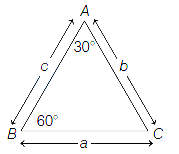
Let $a, b$ and $c$ denote the lengths of sides $BC, CA$ and $AB$ of $\triangle ABC$. In $\triangle ABC$,$\angle BAC = 30^{\circ}$ and $\angle ABC = 60^{\circ}$. Then $a: b: c$ is
A
$2: \sqrt{3}: 1$
B
$1: \sqrt{3}: 2$
C
$1: 2: \sqrt{3}$
D
$2: 1: \sqrt{3}$
Solution
(B) Given $BC = a, CA = b$ and $AB = c$.
To find $a: b: c$.
Since the sum of angles in a triangle is $180^{\circ}$,we have:
$\angle ACB = 180^{\circ} - (\angle BAC + \angle ABC)$
$\angle ACB = 180^{\circ} - (30^{\circ} + 60^{\circ}) = 180^{\circ} - 90^{\circ} = 90^{\circ}$.
By using the sine rule,we have:
$\frac{a}{\sin A} = \frac{b}{\sin B} = \frac{c}{\sin C}$
$\frac{a}{\sin 30^{\circ}} = \frac{b}{\sin 60^{\circ}} = \frac{c}{\sin 90^{\circ}}$
Substituting the values of the sine functions:
$\frac{a}{1/2} = \frac{b}{\sqrt{3}/2} = \frac{c}{1}$
Multiplying by $1/2$,we get:
$a : b : c = \frac{1}{2} : \frac{\sqrt{3}}{2} : 1$
Multiplying the ratio by $2$,we get:
$a : b : c = 1 : \sqrt{3} : 2$.
To find $a: b: c$.
Since the sum of angles in a triangle is $180^{\circ}$,we have:
$\angle ACB = 180^{\circ} - (\angle BAC + \angle ABC)$
$\angle ACB = 180^{\circ} - (30^{\circ} + 60^{\circ}) = 180^{\circ} - 90^{\circ} = 90^{\circ}$.
By using the sine rule,we have:
$\frac{a}{\sin A} = \frac{b}{\sin B} = \frac{c}{\sin C}$
$\frac{a}{\sin 30^{\circ}} = \frac{b}{\sin 60^{\circ}} = \frac{c}{\sin 90^{\circ}}$
Substituting the values of the sine functions:
$\frac{a}{1/2} = \frac{b}{\sqrt{3}/2} = \frac{c}{1}$
Multiplying by $1/2$,we get:
$a : b : c = \frac{1}{2} : \frac{\sqrt{3}}{2} : 1$
Multiplying the ratio by $2$,we get:
$a : b : c = 1 : \sqrt{3} : 2$.
0 likes
View Solution356
EasyMCQ
In a $\triangle ABC$,$b:c = \sqrt{3}:\sqrt{2}$ and the angles $A, B, C$ are in $AP$,then $\angle A = $ (in $^{\circ}$)
A
$45$
B
$65$
C
$55$
D
$75$
Solution
(D) Given that in a $\triangle ABC$,angles $A, B, C$ are in $AP$,so $2B = A + C$.
Since $A + B + C = 180^{\circ}$,we have $3B = 180^{\circ}$,which implies $B = 60^{\circ}$.
Using the sine rule,$\frac{b}{\sin B} = \frac{c}{\sin C}$,we get $\frac{b}{c} = \frac{\sin B}{\sin C}$.
Substituting the given values,$\frac{\sqrt{3}}{\sqrt{2}} = \frac{\sin 60^{\circ}}{\sin C} = \frac{\sqrt{3}/2}{\sin C}$.
This simplifies to $\sin C = \frac{\sqrt{2}}{2} = \frac{1}{\sqrt{2}}$,so $C = 45^{\circ}$.
Finally,$\angle A = 180^{\circ} - (B + C) = 180^{\circ} - (60^{\circ} + 45^{\circ}) = 75^{\circ}$.
Since $A + B + C = 180^{\circ}$,we have $3B = 180^{\circ}$,which implies $B = 60^{\circ}$.
Using the sine rule,$\frac{b}{\sin B} = \frac{c}{\sin C}$,we get $\frac{b}{c} = \frac{\sin B}{\sin C}$.
Substituting the given values,$\frac{\sqrt{3}}{\sqrt{2}} = \frac{\sin 60^{\circ}}{\sin C} = \frac{\sqrt{3}/2}{\sin C}$.
This simplifies to $\sin C = \frac{\sqrt{2}}{2} = \frac{1}{\sqrt{2}}$,so $C = 45^{\circ}$.
Finally,$\angle A = 180^{\circ} - (B + C) = 180^{\circ} - (60^{\circ} + 45^{\circ}) = 75^{\circ}$.
0 likes
View Solution357
EasyMCQ
In a $\triangle ABC$,$a=1$,$b=\sqrt{3}$ and $\angle C=\pi/6$. Then the measure of the third side $c=$
A
$4$
B
$3$
C
$1$
D
$2$
Solution
(C) In a $\triangle ABC$,it is given that $a=1$,$b=\sqrt{3}$ and $\angle C=\frac{\pi}{6}$.
Using the Law of Cosines:
$\cos C = \frac{a^2 + b^2 - c^2}{2ab}$
$\cos \frac{\pi}{6} = \frac{1^2 + (\sqrt{3})^2 - c^2}{2(1)(\sqrt{3})}$
$\frac{\sqrt{3}}{2} = \frac{1 + 3 - c^2}{2\sqrt{3}}$
$\frac{\sqrt{3}}{2} = \frac{4 - c^2}{2\sqrt{3}}$
Multiply both sides by $2\sqrt{3}$:
$3 = 4 - c^2$
$c^2 = 4 - 3 = 1$
Since $c$ represents the length of a side,$c = 1$.
Therefore,option $C$ is correct.
Using the Law of Cosines:
$\cos C = \frac{a^2 + b^2 - c^2}{2ab}$
$\cos \frac{\pi}{6} = \frac{1^2 + (\sqrt{3})^2 - c^2}{2(1)(\sqrt{3})}$
$\frac{\sqrt{3}}{2} = \frac{1 + 3 - c^2}{2\sqrt{3}}$
$\frac{\sqrt{3}}{2} = \frac{4 - c^2}{2\sqrt{3}}$
Multiply both sides by $2\sqrt{3}$:
$3 = 4 - c^2$
$c^2 = 4 - 3 = 1$
Since $c$ represents the length of a side,$c = 1$.
Therefore,option $C$ is correct.
0 likes
View Solution358
EasyMCQ
$A$ triangle can be uniquely determined by its
A
Three angles
B
Three sides
C
One of the angles and one of the sides
D
Only one side
Solution
(B) triangle is uniquely determined by its three sides according to the $SSS$ (Side-Side-Side) congruence criterion.
If three sides are given,the triangle's shape and size are fixed.
Therefore,option $(B)$ is correct.
If three sides are given,the triangle's shape and size are fixed.
Therefore,option $(B)$ is correct.
0 likes
View Solution359
MediumMCQ
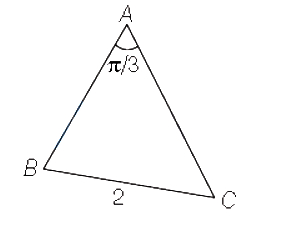
If $2$ is the length of a side of a triangle with its opposite angle $\frac{\pi}{3}$,then the circumradius of the triangle is ......
A
$\frac{2}{\sqrt{3}}$
B
$\frac{4}{\sqrt{3}}$
C
$2$
D
$4$
Solution
(A) Given that the side length $a = 2$ and its opposite angle $A = \frac{\pi}{3}$.
By the sine law,we have $\frac{a}{\sin A} = 2R$,where $R$ is the circumradius.
Substituting the given values:
$\frac{2}{\sin(\frac{\pi}{3})} = 2R$
$\frac{2}{\frac{\sqrt{3}}{2}} = 2R$
$\frac{4}{\sqrt{3}} = 2R$
$R = \frac{2}{\sqrt{3}}$
Thus,the circumradius of the triangle is $\frac{2}{\sqrt{3}}$.
By the sine law,we have $\frac{a}{\sin A} = 2R$,where $R$ is the circumradius.
Substituting the given values:
$\frac{2}{\sin(\frac{\pi}{3})} = 2R$
$\frac{2}{\frac{\sqrt{3}}{2}} = 2R$
$\frac{4}{\sqrt{3}} = 2R$
$R = \frac{2}{\sqrt{3}}$
Thus,the circumradius of the triangle is $\frac{2}{\sqrt{3}}$.
0 likes
View Solution360
EasyMCQ
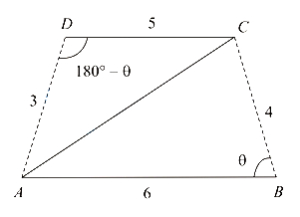
If $ABCD$ is a cyclic quadrilateral with $AB=6, BC=4, CD=5, DA=3$ and $\angle ABC=\theta$,then $\cos \theta=$
A
$\frac{3}{13}$
B
$\frac{18}{76}$
C
$\frac{16}{78}$
D
$\frac{78}{86}$
Solution
(A) In $\triangle ABC$,by the law of cosines:
$AC^2 = AB^2 + BC^2 - 2(AB)(BC) \cos \theta$
$AC^2 = 6^2 + 4^2 - 2(6)(4) \cos \theta = 36 + 16 - 48 \cos \theta = 52 - 48 \cos \theta \quad (i)$
In a cyclic quadrilateral,opposite angles are supplementary. Thus,$\angle ADC = 180^{\circ} - \theta$.
In $\triangle ADC$,by the law of cosines:
$AC^2 = AD^2 + CD^2 - 2(AD)(CD) \cos(180^{\circ} - \theta)$
Since $\cos(180^{\circ} - \theta) = -\cos \theta$,we have:
$AC^2 = 3^2 + 5^2 - 2(3)(5)(-\cos \theta) = 9 + 25 + 30 \cos \theta = 34 + 30 \cos \theta \quad (ii)$
Equating $(i)$ and $(ii)$:
$52 - 48 \cos \theta = 34 + 30 \cos \theta$
$52 - 34 = 30 \cos \theta + 48 \cos \theta$
$18 = 78 \cos \theta$
$\cos \theta = \frac{18}{78} = \frac{3}{13}$
$AC^2 = AB^2 + BC^2 - 2(AB)(BC) \cos \theta$
$AC^2 = 6^2 + 4^2 - 2(6)(4) \cos \theta = 36 + 16 - 48 \cos \theta = 52 - 48 \cos \theta \quad (i)$
In a cyclic quadrilateral,opposite angles are supplementary. Thus,$\angle ADC = 180^{\circ} - \theta$.
In $\triangle ADC$,by the law of cosines:
$AC^2 = AD^2 + CD^2 - 2(AD)(CD) \cos(180^{\circ} - \theta)$
Since $\cos(180^{\circ} - \theta) = -\cos \theta$,we have:
$AC^2 = 3^2 + 5^2 - 2(3)(5)(-\cos \theta) = 9 + 25 + 30 \cos \theta = 34 + 30 \cos \theta \quad (ii)$
Equating $(i)$ and $(ii)$:
$52 - 48 \cos \theta = 34 + 30 \cos \theta$
$52 - 34 = 30 \cos \theta + 48 \cos \theta$
$18 = 78 \cos \theta$
$\cos \theta = \frac{18}{78} = \frac{3}{13}$
0 likes
View Solution361
EasyMCQ
If $ABC$ is a right-angled triangle with $90^{\circ}$ at $C$ and $a > b$,then $\frac{a^2+b^2}{a^2-b^2} \sin (A-B) = $
A
$\frac{3}{2}$
B
$1$
C
$\frac{1}{2}$
D
$0$
Solution
(B) Using the sine rule,we have $a = 2R \sin A$ and $b = 2R \sin B$. Substituting these into the expression:
$\frac{a^2+b^2}{a^2-b^2} \sin (A-B) = \frac{(2R \sin A)^2 + (2R \sin B)^2}{(2R \sin A)^2 - (2R \sin B)^2} \sin (A-B)$
$= \frac{\sin^2 A + \sin^2 B}{\sin^2 A - \sin^2 B} \sin (A-B)$
Using the identity $\sin^2 A - \sin^2 B = \sin(A+B) \sin(A-B)$:
$= \frac{\sin^2 A + \sin^2 B}{\sin(A+B) \sin(A-B)} \sin(A-B)$
$= \frac{\sin^2 A + \sin^2 B}{\sin(A+B)}$
Since $A+B+C = 180^{\circ}$ and $C = 90^{\circ}$,we have $A+B = 90^{\circ}$,so $\sin(A+B) = \sin 90^{\circ} = 1$ and $B = 90^{\circ} - A$,which implies $\sin B = \cos A$.
$= \frac{\sin^2 A + \cos^2 A}{1} = 1$
Thus,the correct option is $B$.
$\frac{a^2+b^2}{a^2-b^2} \sin (A-B) = \frac{(2R \sin A)^2 + (2R \sin B)^2}{(2R \sin A)^2 - (2R \sin B)^2} \sin (A-B)$
$= \frac{\sin^2 A + \sin^2 B}{\sin^2 A - \sin^2 B} \sin (A-B)$
Using the identity $\sin^2 A - \sin^2 B = \sin(A+B) \sin(A-B)$:
$= \frac{\sin^2 A + \sin^2 B}{\sin(A+B) \sin(A-B)} \sin(A-B)$
$= \frac{\sin^2 A + \sin^2 B}{\sin(A+B)}$
Since $A+B+C = 180^{\circ}$ and $C = 90^{\circ}$,we have $A+B = 90^{\circ}$,so $\sin(A+B) = \sin 90^{\circ} = 1$ and $B = 90^{\circ} - A$,which implies $\sin B = \cos A$.
$= \frac{\sin^2 A + \cos^2 A}{1} = 1$
Thus,the correct option is $B$.
0 likes
View Solution362
EasyMCQ
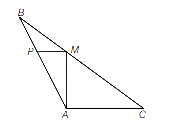
If the median of a $\triangle ABC$ through $A$ is perpendicular to $AC$,then $\frac{\tan A}{\tan C}=$
A
$1+\sqrt{2}$
B
$-\frac{1}{\sqrt{3}}+1$
C
$-2$
D
$1+\frac{2}{\sqrt{3}}$
Solution
(C) Let $AM$ be the median of $\triangle ABC$ through vertex $A$. Given that $AM \perp AC$,we have $\angle MAC = 90^{\circ}$.
Since $AM$ is the median,$M$ is the midpoint of $BC$,so $BM = MC$.
In $\triangle AMC$,$\angle MAC = 90^{\circ}$,so $\tan C = \frac{AM}{AC}$,which implies $AM = AC \tan C$.
Let $\angle MAC = 90^{\circ}$. In $\triangle ABC$,using the sine rule,$\frac{BM}{\sin(\angle BAM)} = \frac{AB}{\sin(\angle AMB)}$ and $\frac{MC}{\sin(\angle MAC)} = \frac{AC}{\sin(\angle B)}$.
Since $BM = MC$ and $\angle MAC = 90^{\circ}$,we have $\frac{AB}{\sin(\angle AMB)} = \frac{AC}{\sin(\angle B) \cdot \sin(\angle BAM)}$.
Using the property of the median and perpendicularity,it can be shown that $\tan A = -2 \tan C$.
Therefore,$\frac{\tan A}{\tan C} = -2$.
Since $AM$ is the median,$M$ is the midpoint of $BC$,so $BM = MC$.
In $\triangle AMC$,$\angle MAC = 90^{\circ}$,so $\tan C = \frac{AM}{AC}$,which implies $AM = AC \tan C$.
Let $\angle MAC = 90^{\circ}$. In $\triangle ABC$,using the sine rule,$\frac{BM}{\sin(\angle BAM)} = \frac{AB}{\sin(\angle AMB)}$ and $\frac{MC}{\sin(\angle MAC)} = \frac{AC}{\sin(\angle B)}$.
Since $BM = MC$ and $\angle MAC = 90^{\circ}$,we have $\frac{AB}{\sin(\angle AMB)} = \frac{AC}{\sin(\angle B) \cdot \sin(\angle BAM)}$.
Using the property of the median and perpendicularity,it can be shown that $\tan A = -2 \tan C$.
Therefore,$\frac{\tan A}{\tan C} = -2$.
0 likes
View Solution363
EasyMCQ
In $\triangle ABC$,$\tan \frac{A}{2} + \tan \frac{B}{2} =$
A
$\frac{\cot \frac{C}{2}}{4s}$
B
$\frac{2c \cot \frac{C}{2}}{a+b+c}$
C
$\frac{2c \tan \frac{C}{2}}{s}$
D
$\frac{c \tan \frac{C}{2}}{a+b+c}$
Solution
(B) We know that $\tan \frac{A}{2} = \sqrt{\frac{(s-b)(s-c)}{s(s-a)}} = \frac{\Delta}{s(s-a)}$ and $\tan \frac{B}{2} = \frac{\Delta}{s(s-b)}$.
Adding these,we get $\tan \frac{A}{2} + \tan \frac{B}{2} = \frac{\Delta}{s} \left( \frac{1}{s-a} + \frac{1}{s-b} \right)$.
$= \frac{\Delta}{s} \left( \frac{s-b+s-a}{(s-a)(s-b)} \right) = \frac{\Delta}{s} \left( \frac{2s-a-b}{(s-a)(s-b)} \right)$.
Since $2s = a+b+c$,we have $2s-a-b = c$.
So,$\tan \frac{A}{2} + \tan \frac{B}{2} = \frac{c \Delta}{s(s-a)(s-b)}$.
Using $\Delta = \sqrt{s(s-a)(s-b)(s-c)}$,we have $\frac{\Delta}{(s-a)(s-b)} = \sqrt{\frac{s(s-c)}{(s-a)(s-b)}} = \cot \frac{C}{2}$.
Thus,$\tan \frac{A}{2} + \tan \frac{B}{2} = \frac{c}{s} \cot \frac{C}{2} = \frac{2c}{2s} \cot \frac{C}{2} = \frac{2c \cot \frac{C}{2}}{a+b+c}$.
Adding these,we get $\tan \frac{A}{2} + \tan \frac{B}{2} = \frac{\Delta}{s} \left( \frac{1}{s-a} + \frac{1}{s-b} \right)$.
$= \frac{\Delta}{s} \left( \frac{s-b+s-a}{(s-a)(s-b)} \right) = \frac{\Delta}{s} \left( \frac{2s-a-b}{(s-a)(s-b)} \right)$.
Since $2s = a+b+c$,we have $2s-a-b = c$.
So,$\tan \frac{A}{2} + \tan \frac{B}{2} = \frac{c \Delta}{s(s-a)(s-b)}$.
Using $\Delta = \sqrt{s(s-a)(s-b)(s-c)}$,we have $\frac{\Delta}{(s-a)(s-b)} = \sqrt{\frac{s(s-c)}{(s-a)(s-b)}} = \cot \frac{C}{2}$.
Thus,$\tan \frac{A}{2} + \tan \frac{B}{2} = \frac{c}{s} \cot \frac{C}{2} = \frac{2c}{2s} \cot \frac{C}{2} = \frac{2c \cot \frac{C}{2}}{a+b+c}$.
0 likes
View Solution364
MediumMCQ
With the usual notations,in a $\triangle ABC$,if $a=2, b=\sqrt{6}$ and $c=\sqrt{3}+1$,then $\sin^2 C - \sin^2 A =$
A
$\frac{1+\sqrt{3}}{4}$
B
$\frac{\sqrt{3}}{2}$
C
$\frac{\sqrt{3}}{4}$
D
$\frac{3}{4}$
Solution
(C) Given $a=2, b=\sqrt{6}, c=\sqrt{3}+1$.
Using the cosine rule for $\cos C$:
$\cos C = \frac{a^2+b^2-c^2}{2ab} = \frac{2^2 + (\sqrt{6})^2 - (\sqrt{3}+1)^2}{2(2)(\sqrt{6})} = \frac{4+6-(3+1+2\sqrt{3})}{4\sqrt{6}} = \frac{6-2\sqrt{3}}{4\sqrt{6}} = \frac{2(3-\sqrt{3})}{4\sqrt{6}} = \frac{\sqrt{3}(\sqrt{3}-1)}{2\sqrt{2}\sqrt{3}} = \frac{\sqrt{3}-1}{2\sqrt{2}}$.
Using the cosine rule for $\cos A$:
$\cos A = \frac{b^2+c^2-a^2}{2bc} = \frac{6 + (\sqrt{3}+1)^2 - 2^2}{2(\sqrt{6})(\sqrt{3}+1)} = \frac{6+4+2\sqrt{3}-4}{2\sqrt{6}(\sqrt{3}+1)} = \frac{6+2\sqrt{3}}{2\sqrt{6}(\sqrt{3}+1)} = \frac{2\sqrt{3}(\sqrt{3}+1)}{2\sqrt{6}(\sqrt{3}+1)} = \frac{\sqrt{3}}{\sqrt{6}} = \frac{1}{\sqrt{2}}$.
Now,$\sin^2 C - \sin^2 A = (1-\cos^2 C) - (1-\cos^2 A) = \cos^2 A - \cos^2 C$.
$= (\frac{1}{\sqrt{2}})^2 - (\frac{\sqrt{3}-1}{2\sqrt{2}})^2 = \frac{1}{2} - \frac{3+1-2\sqrt{3}}{8} = \frac{1}{2} - \frac{4-2\sqrt{3}}{8} = \frac{4 - (4-2\sqrt{3})}{8} = \frac{2\sqrt{3}}{8} = \frac{\sqrt{3}}{4}$.
Using the cosine rule for $\cos C$:
$\cos C = \frac{a^2+b^2-c^2}{2ab} = \frac{2^2 + (\sqrt{6})^2 - (\sqrt{3}+1)^2}{2(2)(\sqrt{6})} = \frac{4+6-(3+1+2\sqrt{3})}{4\sqrt{6}} = \frac{6-2\sqrt{3}}{4\sqrt{6}} = \frac{2(3-\sqrt{3})}{4\sqrt{6}} = \frac{\sqrt{3}(\sqrt{3}-1)}{2\sqrt{2}\sqrt{3}} = \frac{\sqrt{3}-1}{2\sqrt{2}}$.
Using the cosine rule for $\cos A$:
$\cos A = \frac{b^2+c^2-a^2}{2bc} = \frac{6 + (\sqrt{3}+1)^2 - 2^2}{2(\sqrt{6})(\sqrt{3}+1)} = \frac{6+4+2\sqrt{3}-4}{2\sqrt{6}(\sqrt{3}+1)} = \frac{6+2\sqrt{3}}{2\sqrt{6}(\sqrt{3}+1)} = \frac{2\sqrt{3}(\sqrt{3}+1)}{2\sqrt{6}(\sqrt{3}+1)} = \frac{\sqrt{3}}{\sqrt{6}} = \frac{1}{\sqrt{2}}$.
Now,$\sin^2 C - \sin^2 A = (1-\cos^2 C) - (1-\cos^2 A) = \cos^2 A - \cos^2 C$.
$= (\frac{1}{\sqrt{2}})^2 - (\frac{\sqrt{3}-1}{2\sqrt{2}})^2 = \frac{1}{2} - \frac{3+1-2\sqrt{3}}{8} = \frac{1}{2} - \frac{4-2\sqrt{3}}{8} = \frac{4 - (4-2\sqrt{3})}{8} = \frac{2\sqrt{3}}{8} = \frac{\sqrt{3}}{4}$.
0 likes
View Solution365
MediumMCQ
In $\triangle ABC$,if $A: B: C = 5: 1: 6$,then $a: b: c =$
A
$\sqrt{3}+1: \sqrt{3}-1: 2\sqrt{2}$
B
$\sqrt{3}-1: \sqrt{3}+1: 2\sqrt{2}$
C
$\sqrt{3}+1: \sqrt{3}-1: 1$
D
$\sqrt{2}+1: \sqrt{2}-1: 2\sqrt{2}$
Solution
(A) Given the ratio of angles $A: B: C = 5: 1: 6$. Let the angles be $5k, k, 6k$. Since the sum of angles in a triangle is $180^{\circ}$,we have $5k + k + 6k = 180^{\circ}$,which gives $12k = 180^{\circ}$,so $k = 15^{\circ}$.
Thus,$A = 75^{\circ}$,$B = 15^{\circ}$,and $C = 90^{\circ}$.
Using the Sine Rule,$\frac{a}{\sin A} = \frac{b}{\sin B} = \frac{c}{\sin C} = 2R$.
Therefore,$a: b: c = \sin 75^{\circ}: \sin 15^{\circ}: \sin 90^{\circ}$.
We know $\sin 75^{\circ} = \sin(45^{\circ} + 30^{\circ}) = \frac{\sqrt{6} + \sqrt{2}}{4}$ and $\sin 15^{\circ} = \sin(45^{\circ} - 30^{\circ}) = \frac{\sqrt{6} - \sqrt{2}}{4}$.
Also,$\sin 90^{\circ} = 1$.
So,$a: b: c = \frac{\sqrt{6} + \sqrt{2}}{4}: \frac{\sqrt{6} - \sqrt{2}}{4}: 1$.
Multiplying by $4$,we get $a: b: c = (\sqrt{6} + \sqrt{2}): (\sqrt{6} - \sqrt{2}): 4$.
Dividing by $\sqrt{2}$,we get $a: b: c = (\sqrt{3} + 1): (\sqrt{3} - 1): 2\sqrt{2}$.
Thus,$A = 75^{\circ}$,$B = 15^{\circ}$,and $C = 90^{\circ}$.
Using the Sine Rule,$\frac{a}{\sin A} = \frac{b}{\sin B} = \frac{c}{\sin C} = 2R$.
Therefore,$a: b: c = \sin 75^{\circ}: \sin 15^{\circ}: \sin 90^{\circ}$.
We know $\sin 75^{\circ} = \sin(45^{\circ} + 30^{\circ}) = \frac{\sqrt{6} + \sqrt{2}}{4}$ and $\sin 15^{\circ} = \sin(45^{\circ} - 30^{\circ}) = \frac{\sqrt{6} - \sqrt{2}}{4}$.
Also,$\sin 90^{\circ} = 1$.
So,$a: b: c = \frac{\sqrt{6} + \sqrt{2}}{4}: \frac{\sqrt{6} - \sqrt{2}}{4}: 1$.
Multiplying by $4$,we get $a: b: c = (\sqrt{6} + \sqrt{2}): (\sqrt{6} - \sqrt{2}): 4$.
Dividing by $\sqrt{2}$,we get $a: b: c = (\sqrt{3} + 1): (\sqrt{3} - 1): 2\sqrt{2}$.
0 likes
View Solution366
MediumMCQ
In $\triangle ABC$,if $\theta$ is any angle,then $b \cos (C+\theta) + c \cos (B-\theta) =$
A
$a \cot \theta$
B
$a \cos \theta$
C
$a \tan \theta$
D
$a \sin \theta$
Solution
(B) We are given the expression $b \cos (C+\theta) + c \cos (B-\theta)$.
Expanding the cosine terms using the identity $\cos(x \pm y) = \cos x \cos y \mp \sin x \sin y$:
$= b(\cos C \cos \theta - \sin C \sin \theta) + c(\cos B \cos \theta + \sin B \sin \theta)$
$= (b \cos C + c \cos B) \cos \theta - (b \sin C - c \sin B) \sin \theta$
Using the projection formula,$b \cos C + c \cos B = a$.
Using the sine rule,$\frac{b}{\sin B} = \frac{c}{\sin C} = 2R$,which implies $b \sin C = c \sin B$,so $b \sin C - c \sin B = 0$.
Substituting these into the expression:
$= a \cos \theta - 0 \cdot \sin \theta = a \cos \theta$.
Expanding the cosine terms using the identity $\cos(x \pm y) = \cos x \cos y \mp \sin x \sin y$:
$= b(\cos C \cos \theta - \sin C \sin \theta) + c(\cos B \cos \theta + \sin B \sin \theta)$
$= (b \cos C + c \cos B) \cos \theta - (b \sin C - c \sin B) \sin \theta$
Using the projection formula,$b \cos C + c \cos B = a$.
Using the sine rule,$\frac{b}{\sin B} = \frac{c}{\sin C} = 2R$,which implies $b \sin C = c \sin B$,so $b \sin C - c \sin B = 0$.
Substituting these into the expression:
$= a \cos \theta - 0 \cdot \sin \theta = a \cos \theta$.
0 likes
View Solution367
MediumMCQ
In a $\triangle ABC$,if $(a+b+c)(b+c-a) = \lambda bc$,then which of the following is true?
A
$\lambda < -6$
B
$\lambda > 6$
C
$0 < \lambda < 4$
D
$\lambda > 4$
Solution
(C) Given the expression $(a+b+c)(b+c-a) = \lambda bc$.
This can be rewritten as $((b+c)+a)((b+c)-a) = \lambda bc$.
Using the identity $(x+y)(x-y) = x^2 - y^2$,we get $(b+c)^2 - a^2 = \lambda bc$.
Expanding this,$b^2 + c^2 + 2bc - a^2 = \lambda bc$.
Rearranging the terms,$b^2 + c^2 - a^2 = (\lambda - 2)bc$.
Dividing both sides by $2bc$,we get $\frac{b^2 + c^2 - a^2}{2bc} = \frac{\lambda - 2}{2}$.
By the Law of Cosines,$\cos A = \frac{b^2 + c^2 - a^2}{2bc}$,so $\cos A = \frac{\lambda - 2}{2}$.
Since $-1 < \cos A < 1$ for a triangle,we have $-1 < \frac{\lambda - 2}{2} < 1$.
Multiplying by $2$,$-2 < \lambda - 2 < 2$.
Adding $2$ to all parts,$0 < \lambda < 4$.
This can be rewritten as $((b+c)+a)((b+c)-a) = \lambda bc$.
Using the identity $(x+y)(x-y) = x^2 - y^2$,we get $(b+c)^2 - a^2 = \lambda bc$.
Expanding this,$b^2 + c^2 + 2bc - a^2 = \lambda bc$.
Rearranging the terms,$b^2 + c^2 - a^2 = (\lambda - 2)bc$.
Dividing both sides by $2bc$,we get $\frac{b^2 + c^2 - a^2}{2bc} = \frac{\lambda - 2}{2}$.
By the Law of Cosines,$\cos A = \frac{b^2 + c^2 - a^2}{2bc}$,so $\cos A = \frac{\lambda - 2}{2}$.
Since $-1 < \cos A < 1$ for a triangle,we have $-1 < \frac{\lambda - 2}{2} < 1$.
Multiplying by $2$,$-2 < \lambda - 2 < 2$.
Adding $2$ to all parts,$0 < \lambda < 4$.
0 likes
View Solution368
MediumMCQ
In $\triangle ABC$,if $a: b: c = 4: 5: 6$,then $\frac{\cos A + 3 \cos C}{\cos B} = $
A
$1$
B
$4$
C
$2$
D
$3$
Solution
(C) Given $a: b: c = 4: 5: 6$. Let $a = 4k, b = 5k, c = 6k$ for some constant $k > 0$.
Using the Law of Cosines:
$\cos A = \frac{b^2 + c^2 - a^2}{2bc} = \frac{(5k)^2 + (6k)^2 - (4k)^2}{2(5k)(6k)} = \frac{25k^2 + 36k^2 - 16k^2}{60k^2} = \frac{45}{60} = \frac{3}{4}$.
$\cos B = \frac{a^2 + c^2 - b^2}{2ac} = \frac{(4k)^2 + (6k)^2 - (5k)^2}{2(4k)(6k)} = \frac{16k^2 + 36k^2 - 25k^2}{48k^2} = \frac{27}{48} = \frac{9}{16}$.
$\cos C = \frac{a^2 + b^2 - c^2}{2ab} = \frac{(4k)^2 + (5k)^2 - (6k)^2}{2(4k)(5k)} = \frac{16k^2 + 25k^2 - 36k^2}{40k^2} = \frac{5}{40} = \frac{1}{8}$.
Now,calculate the expression:
$\frac{\cos A + 3 \cos C}{\cos B} = \frac{\frac{3}{4} + 3(\frac{1}{8})}{\frac{9}{16}} = \frac{\frac{3}{4} + \frac{3}{8}}{\frac{9}{16}} = \frac{\frac{6+3}{8}}{\frac{9}{16}} = \frac{\frac{9}{8}}{\frac{9}{16}} = \frac{9}{8} \times \frac{16}{9} = 2$.
Using the Law of Cosines:
$\cos A = \frac{b^2 + c^2 - a^2}{2bc} = \frac{(5k)^2 + (6k)^2 - (4k)^2}{2(5k)(6k)} = \frac{25k^2 + 36k^2 - 16k^2}{60k^2} = \frac{45}{60} = \frac{3}{4}$.
$\cos B = \frac{a^2 + c^2 - b^2}{2ac} = \frac{(4k)^2 + (6k)^2 - (5k)^2}{2(4k)(6k)} = \frac{16k^2 + 36k^2 - 25k^2}{48k^2} = \frac{27}{48} = \frac{9}{16}$.
$\cos C = \frac{a^2 + b^2 - c^2}{2ab} = \frac{(4k)^2 + (5k)^2 - (6k)^2}{2(4k)(5k)} = \frac{16k^2 + 25k^2 - 36k^2}{40k^2} = \frac{5}{40} = \frac{1}{8}$.
Now,calculate the expression:
$\frac{\cos A + 3 \cos C}{\cos B} = \frac{\frac{3}{4} + 3(\frac{1}{8})}{\frac{9}{16}} = \frac{\frac{3}{4} + \frac{3}{8}}{\frac{9}{16}} = \frac{\frac{6+3}{8}}{\frac{9}{16}} = \frac{\frac{9}{8}}{\frac{9}{16}} = \frac{9}{8} \times \frac{16}{9} = 2$.
0 likes
View Solution369
MediumMCQ
In triangle $ABC$,if $a=13, b=8, c=7$,then $\cos(B+C) = $
A
$\frac{11}{13}$
B
$\frac{23}{26}$
C
$\frac{3}{4}$
D
$\frac{1}{2}$
Solution
(D) In any triangle $ABC$,the sum of angles is $A+B+C = 180^{\circ}$.
Therefore,$B+C = 180^{\circ} - A$.
Thus,$\cos(B+C) = \cos(180^{\circ} - A) = -\cos A$.
Using the Law of Cosines,$\cos A = \frac{b^2 + c^2 - a^2}{2bc}$.
Substituting the given values $a=13, b=8, c=7$:
$\cos A = \frac{8^2 + 7^2 - 13^2}{2 \times 8 \times 7} = \frac{64 + 49 - 169}{112} = \frac{113 - 169}{112} = \frac{-56}{112} = -\frac{1}{2}$.
Finally,$\cos(B+C) = -\cos A = -(-\frac{1}{2}) = \frac{1}{2}$.
Therefore,$B+C = 180^{\circ} - A$.
Thus,$\cos(B+C) = \cos(180^{\circ} - A) = -\cos A$.
Using the Law of Cosines,$\cos A = \frac{b^2 + c^2 - a^2}{2bc}$.
Substituting the given values $a=13, b=8, c=7$:
$\cos A = \frac{8^2 + 7^2 - 13^2}{2 \times 8 \times 7} = \frac{64 + 49 - 169}{112} = \frac{113 - 169}{112} = \frac{-56}{112} = -\frac{1}{2}$.
Finally,$\cos(B+C) = -\cos A = -(-\frac{1}{2}) = \frac{1}{2}$.
0 likes
View Solution370
MediumMCQ
In triangle $ABC$,if $C=120^{\circ}$,$c=\sqrt{19}$,and $b=3$,then $a=$
A
$4$
B
$5$
C
$2$
D
$\sqrt{5}$
Solution
(C) Using the Law of Cosines: $c^2 = a^2 + b^2 - 2ab \cos(C)$.
Substituting the given values: $(\sqrt{19})^2 = a^2 + 3^2 - 2(a)(3) \cos(120^{\circ})$.
$19 = a^2 + 9 - 6a(-1/2)$.
$19 = a^2 + 9 + 3a$.
$a^2 + 3a - 10 = 0$.
Factoring the quadratic equation: $(a+5)(a-2) = 0$.
Since $a$ must be positive,$a = 2$.
Substituting the given values: $(\sqrt{19})^2 = a^2 + 3^2 - 2(a)(3) \cos(120^{\circ})$.
$19 = a^2 + 9 - 6a(-1/2)$.
$19 = a^2 + 9 + 3a$.
$a^2 + 3a - 10 = 0$.
Factoring the quadratic equation: $(a+5)(a-2) = 0$.
Since $a$ must be positive,$a = 2$.
0 likes
View Solution371
MediumMCQ
In $\triangle ABC$,if $a=5, b=4$ and $\cos(A-B)=\frac{31}{32}$,then $c=$
A
$8$
B
$6$
C
$2$
D
$4$
Solution
(B) Using the Napier's Analogy (Tangent Rule): $\tan\left(\frac{A-B}{2}\right) = \frac{a-b}{a+b} \cot\left(\frac{C}{2}\right)$.
Given $a=5, b=4$,we have $\frac{a-b}{a+b} = \frac{5-4}{5+4} = \frac{1}{9}$.
From $\cos(A-B) = \frac{31}{32}$,we use the identity $\tan^2\left(\frac{A-B}{2}\right) = \frac{1-\cos(A-B)}{1+\cos(A-B)} = \frac{1-\frac{31}{32}}{1+\frac{31}{32}} = \frac{\frac{1}{32}}{\frac{63}{32}} = \frac{1}{63}$.
Thus,$\tan\left(\frac{A-B}{2}\right) = \frac{1}{\sqrt{63}} = \frac{1}{3\sqrt{7}}$.
Substituting into the tangent rule: $\frac{1}{3\sqrt{7}} = \frac{1}{9} \cot\left(\frac{C}{2}\right) \implies \cot\left(\frac{C}{2}\right) = \frac{9}{3\sqrt{7}} = \frac{3}{\sqrt{7}}$.
Then $\tan^2\left(\frac{C}{2}\right) = \frac{7}{9}$.
Using $\cos C = \frac{1-\tan^2(C/2)}{1+\tan^2(C/2)} = \frac{1-7/9}{1+7/9} = \frac{2/9}{16/9} = \frac{1}{8}$.
By the Law of Cosines: $c^2 = a^2 + b^2 - 2ab \cos C = 5^2 + 4^2 - 2(5)(4)(\frac{1}{8}) = 25 + 16 - 5 = 36$.
Therefore,$c = 6$.
Given $a=5, b=4$,we have $\frac{a-b}{a+b} = \frac{5-4}{5+4} = \frac{1}{9}$.
From $\cos(A-B) = \frac{31}{32}$,we use the identity $\tan^2\left(\frac{A-B}{2}\right) = \frac{1-\cos(A-B)}{1+\cos(A-B)} = \frac{1-\frac{31}{32}}{1+\frac{31}{32}} = \frac{\frac{1}{32}}{\frac{63}{32}} = \frac{1}{63}$.
Thus,$\tan\left(\frac{A-B}{2}\right) = \frac{1}{\sqrt{63}} = \frac{1}{3\sqrt{7}}$.
Substituting into the tangent rule: $\frac{1}{3\sqrt{7}} = \frac{1}{9} \cot\left(\frac{C}{2}\right) \implies \cot\left(\frac{C}{2}\right) = \frac{9}{3\sqrt{7}} = \frac{3}{\sqrt{7}}$.
Then $\tan^2\left(\frac{C}{2}\right) = \frac{7}{9}$.
Using $\cos C = \frac{1-\tan^2(C/2)}{1+\tan^2(C/2)} = \frac{1-7/9}{1+7/9} = \frac{2/9}{16/9} = \frac{1}{8}$.
By the Law of Cosines: $c^2 = a^2 + b^2 - 2ab \cos C = 5^2 + 4^2 - 2(5)(4)(\frac{1}{8}) = 25 + 16 - 5 = 36$.
Therefore,$c = 6$.
0 likes
View Solution372
MediumMCQ
In $\triangle ABC$,if $A, B, C$ are in arithmetic progression,then $\sqrt{a^2-ac+c^2} \cdot \cos \left(\frac{A-C}{2}\right) =$
A
$a+c$
B
$\frac{a+c}{2}$
C
$\frac{a+c-b}{2}$
D
$a-c$
Solution
(B) Given that $A, B, C$ are in arithmetic progression,we have $2B = A + C$. Since $A + B + C = 180^{\circ}$,we get $3B = 180^{\circ}$,so $B = 60^{\circ}$.
Using the Law of Cosines,$b^2 = a^2 + c^2 - 2ac \cos B$. Since $B = 60^{\circ}$,$\cos 60^{\circ} = 1/2$,so $b^2 = a^2 + c^2 - ac$.
Thus,$\sqrt{a^2 - ac + c^2} = b$.
Using the Projection Formula,$b = a \cos C + c \cos A$.
Alternatively,using the Mollweide's formula or the ratio of sides,we know $a = 2R \sin A$ and $c = 2R \sin C$.
Then $\sqrt{a^2 - ac + c^2} = 2R \sqrt{\sin^2 A - \sin A \sin C + \sin^2 C}$.
Using the identity $\cos((A-C)/2) = \sin((A+C)/2) = \sin(180^{\circ} - B/2) = \sin(180^{\circ} - 60^{\circ}/2) = \sin 120^{\circ}$ is not correct here.
Actually,$\cos((A-C)/2) = \frac{a+c}{b} \sin(B/2) = \frac{a+c}{b} \sin 30^{\circ} = \frac{a+c}{2b}$.
Therefore,$\sqrt{a^2 - ac + c^2} \cdot \cos \left(\frac{A-C}{2}\right) = b \cdot \frac{a+c}{2b} = \frac{a+c}{2}$.
Using the Law of Cosines,$b^2 = a^2 + c^2 - 2ac \cos B$. Since $B = 60^{\circ}$,$\cos 60^{\circ} = 1/2$,so $b^2 = a^2 + c^2 - ac$.
Thus,$\sqrt{a^2 - ac + c^2} = b$.
Using the Projection Formula,$b = a \cos C + c \cos A$.
Alternatively,using the Mollweide's formula or the ratio of sides,we know $a = 2R \sin A$ and $c = 2R \sin C$.
Then $\sqrt{a^2 - ac + c^2} = 2R \sqrt{\sin^2 A - \sin A \sin C + \sin^2 C}$.
Using the identity $\cos((A-C)/2) = \sin((A+C)/2) = \sin(180^{\circ} - B/2) = \sin(180^{\circ} - 60^{\circ}/2) = \sin 120^{\circ}$ is not correct here.
Actually,$\cos((A-C)/2) = \frac{a+c}{b} \sin(B/2) = \frac{a+c}{b} \sin 30^{\circ} = \frac{a+c}{2b}$.
Therefore,$\sqrt{a^2 - ac + c^2} \cdot \cos \left(\frac{A-C}{2}\right) = b \cdot \frac{a+c}{2b} = \frac{a+c}{2}$.
0 likes
View Solution373
DifficultMCQ
In $\triangle ABC$,what is the value of $\cos A + \cos B + \cos C$?
A
$1 + \frac{r}{2R}$
B
$1 - \frac{r}{R}$
C
$1 + \frac{R}{r}$
D
$1 + \frac{r}{R}$
Solution
(D) We know that in any $\triangle ABC$,$\cos A + \cos B + \cos C = 1 + 4 \sin \left(\frac{A}{2}\right) \sin \left(\frac{B}{2}\right) \sin \left(\frac{C}{2}\right)$.
Using the identity for the inradius $r = 4R \sin \left(\frac{A}{2}\right) \sin \left(\frac{B}{2}\right) \sin \left(\frac{C}{2}\right)$,we can substitute the product of sines.
Thus,$4 \sin \left(\frac{A}{2}\right) \sin \left(\frac{B}{2}\right) \sin \left(\frac{C}{2}\right) = \frac{r}{R}$.
Therefore,$\cos A + \cos B + \cos C = 1 + \frac{r}{R}$.
Using the identity for the inradius $r = 4R \sin \left(\frac{A}{2}\right) \sin \left(\frac{B}{2}\right) \sin \left(\frac{C}{2}\right)$,we can substitute the product of sines.
Thus,$4 \sin \left(\frac{A}{2}\right) \sin \left(\frac{B}{2}\right) \sin \left(\frac{C}{2}\right) = \frac{r}{R}$.
Therefore,$\cos A + \cos B + \cos C = 1 + \frac{r}{R}$.
0 likes
View Solution374
MediumMCQ
In a $\triangle ABC$,if $a=26, b=30$,and $\cos C=\frac{63}{65}$,then $c=$
A
$2$
B
$4$
C
$6$
D
$8$
Solution
(D) Given in $\triangle ABC$:
$a=26, b=30, \cos C=\frac{63}{65}$.
Using the Law of Cosines:
$\cos C = \frac{a^2+b^2-c^2}{2ab}$
$\frac{63}{65} = \frac{26^2+30^2-c^2}{2 \times 26 \times 30}$
$\frac{63}{65} = \frac{676+900-c^2}{1560}$
$c^2 = 1576 - \frac{63 \times 1560}{65}$
$c^2 = 1576 - (63 \times 24)$
$c^2 = 1576 - 1512 = 64$
$c = \sqrt{64} = 8$.
$a=26, b=30, \cos C=\frac{63}{65}$.
Using the Law of Cosines:
$\cos C = \frac{a^2+b^2-c^2}{2ab}$
$\frac{63}{65} = \frac{26^2+30^2-c^2}{2 \times 26 \times 30}$
$\frac{63}{65} = \frac{676+900-c^2}{1560}$
$c^2 = 1576 - \frac{63 \times 1560}{65}$
$c^2 = 1576 - (63 \times 24)$
$c^2 = 1576 - 1512 = 64$
$c = \sqrt{64} = 8$.
0 likes
View Solution375
EasyMCQ
If $7$ and $8$ are the lengths of two sides of a triangle and '$a$' is the length of its smallest side. The angles of the triangle are in $AP$ and '$a$' has two values $a_1$ and $a_2$ satisfying this condition. If $a_1 < a_2$ then $2 a_1 + 3 a_2 =$
A
$15$
B
$21$
C
$24$
D
$28$
Solution
(B) Let the angles of the triangle be $A - d, A, A + d$. Since the sum of angles is $180^{\circ}$,we have $3A = 180^{\circ}$,so $A = 60^{\circ}$.
Thus,the angles are $60^{\circ} - d, 60^{\circ}, 60^{\circ} + d$.
The sides opposite to these angles are $a, b, c$. Given two sides are $7$ and $8$. Let the sides be $a, 7, 8$ where $a$ is the smallest side.
Using the Law of Cosines for the angle $60^{\circ}$:
Case $1$: If the angle $60^{\circ}$ is between sides $7$ and $8$,then $a^2 = 7^2 + 8^2 - 2(7)(8) \cos 60^{\circ} = 49 + 64 - 56 = 57$. This gives $a = \sqrt{57} \approx 7.55$,which is not smaller than $7$.
Case $2$: If the angle $60^{\circ}$ is opposite to side $7$,then $8^2 = a^2 + 7^2 - 2(a)(7) \cos 60^{\circ}$ $\Rightarrow 64 = a^2 + 49 - 7a$ $\Rightarrow a^2 - 7a - 15 = 0$. This yields $a = \frac{7 \pm \sqrt{49 + 60}}{2} = \frac{7 \pm \sqrt{109}}{2}$. Only the positive value is valid,$a \approx 8.72 > 7$.
Case $3$: If the angle $60^{\circ}$ is opposite to side $8$,then $7^2 = a^2 + 8^2 - 2(a)(8) \cos 60^{\circ}$ $\Rightarrow 49 = a^2 + 64 - 8a$ $\Rightarrow a^2 - 8a + 15 = 0$.
Solving $a^2 - 8a + 15 = 0$ gives $(a - 3)(a - 5) = 0$,so $a = 3$ or $a = 5$.
Since $a$ is the smallest side,both $3 < 7$ and $5 < 7$ are valid.
Thus,$a_1 = 3$ and $a_2 = 5$.
Finally,$2 a_1 + 3 a_2 = 2(3) + 3(5) = 6 + 15 = 21$.
Thus,the angles are $60^{\circ} - d, 60^{\circ}, 60^{\circ} + d$.
The sides opposite to these angles are $a, b, c$. Given two sides are $7$ and $8$. Let the sides be $a, 7, 8$ where $a$ is the smallest side.
Using the Law of Cosines for the angle $60^{\circ}$:
Case $1$: If the angle $60^{\circ}$ is between sides $7$ and $8$,then $a^2 = 7^2 + 8^2 - 2(7)(8) \cos 60^{\circ} = 49 + 64 - 56 = 57$. This gives $a = \sqrt{57} \approx 7.55$,which is not smaller than $7$.
Case $2$: If the angle $60^{\circ}$ is opposite to side $7$,then $8^2 = a^2 + 7^2 - 2(a)(7) \cos 60^{\circ}$ $\Rightarrow 64 = a^2 + 49 - 7a$ $\Rightarrow a^2 - 7a - 15 = 0$. This yields $a = \frac{7 \pm \sqrt{49 + 60}}{2} = \frac{7 \pm \sqrt{109}}{2}$. Only the positive value is valid,$a \approx 8.72 > 7$.
Case $3$: If the angle $60^{\circ}$ is opposite to side $8$,then $7^2 = a^2 + 8^2 - 2(a)(8) \cos 60^{\circ}$ $\Rightarrow 49 = a^2 + 64 - 8a$ $\Rightarrow a^2 - 8a + 15 = 0$.
Solving $a^2 - 8a + 15 = 0$ gives $(a - 3)(a - 5) = 0$,so $a = 3$ or $a = 5$.
Since $a$ is the smallest side,both $3 < 7$ and $5 < 7$ are valid.
Thus,$a_1 = 3$ and $a_2 = 5$.
Finally,$2 a_1 + 3 a_2 = 2(3) + 3(5) = 6 + 15 = 21$.
0 likes
View Solution376
EasyMCQ
In $\triangle ABC$,if $a=13, b=14$ and $\cos \frac{C}{2}=\frac{3}{\sqrt{13}}$,then $2r_1=$
A
$2s$
B
$\Delta$
C
$s$
D
$2\Delta$
Solution
(C) Given $a=13, b=14$ and $\cos \frac{C}{2}=\frac{3}{\sqrt{13}}$.
Using the formula $\cos \frac{C}{2} = \sqrt{\frac{s(s-c)}{ab}}$,we have $\frac{s(s-c)}{ab} = \frac{9}{13}$.
Substituting $a=13, b=14$,we get $\frac{s(s-c)}{182} = \frac{9}{13}$,so $s(s-c) = 126$.
Since $s = \frac{a+b+c}{2} = \frac{27+c}{2}$,then $s-c = \frac{27-c}{2}$.
Thus,$\left(\frac{27+c}{2}\right)\left(\frac{27-c}{2}\right) = 126$ $\Rightarrow 729-c^2 = 504$ $\Rightarrow c^2 = 225$ $\Rightarrow c=15$.
Then $s = \frac{13+14+15}{2} = 21$.
The exradius $r_1$ is given by $r_1 = \frac{\Delta}{s-a}$.
Area $\Delta = \sqrt{s(s-a)(s-b)(s-c)} = \sqrt{21(21-13)(21-14)(21-15)} = \sqrt{21 \times 8 \times 7 \times 6} = \sqrt{7056} = 84$.
So,$r_1 = \frac{84}{21-13} = \frac{84}{8} = 10.5$.
Therefore,$2r_1 = 2 \times 10.5 = 21 = s$.
Using the formula $\cos \frac{C}{2} = \sqrt{\frac{s(s-c)}{ab}}$,we have $\frac{s(s-c)}{ab} = \frac{9}{13}$.
Substituting $a=13, b=14$,we get $\frac{s(s-c)}{182} = \frac{9}{13}$,so $s(s-c) = 126$.
Since $s = \frac{a+b+c}{2} = \frac{27+c}{2}$,then $s-c = \frac{27-c}{2}$.
Thus,$\left(\frac{27+c}{2}\right)\left(\frac{27-c}{2}\right) = 126$ $\Rightarrow 729-c^2 = 504$ $\Rightarrow c^2 = 225$ $\Rightarrow c=15$.
Then $s = \frac{13+14+15}{2} = 21$.
The exradius $r_1$ is given by $r_1 = \frac{\Delta}{s-a}$.
Area $\Delta = \sqrt{s(s-a)(s-b)(s-c)} = \sqrt{21(21-13)(21-14)(21-15)} = \sqrt{21 \times 8 \times 7 \times 6} = \sqrt{7056} = 84$.
So,$r_1 = \frac{84}{21-13} = \frac{84}{8} = 10.5$.
Therefore,$2r_1 = 2 \times 10.5 = 21 = s$.
0 likes
View Solution377
MediumMCQ
In $\triangle ABC$,if $b+c : c+a : a+b = 7 : 8 : 9$,then the smallest angle (in radians) of that triangle is
A
$\cos^{-1}\left(\frac{4}{5}\right)$
B
$\frac{\pi}{3}$
C
$\cos^{-1}\left(\frac{3}{5}\right)$
D
$\frac{\pi}{4}$
Solution
(A) Given $b+c = 7k$,$c+a = 8k$,and $a+b = 9k$.
Adding these equations,we get $2(a+b+c) = 24k$,which implies $a+b+c = 12k$.
Subtracting the given equations from $a+b+c = 12k$:
$a = (a+b+c) - (b+c) = 12k - 7k = 5k$.
$b = (a+b+c) - (c+a) = 12k - 8k = 4k$.
$c = (a+b+c) - (a+b) = 12k - 9k = 3k$.
Since $c < b < a$,the smallest angle is $C$ (opposite to side $c$).
Using the Law of Cosines: $\cos C = \frac{a^2+b^2-c^2}{2ab}$.
$\cos C = \frac{(5k)^2 + (4k)^2 - (3k)^2}{2(5k)(4k)} = \frac{25k^2 + 16k^2 - 9k^2}{40k^2} = \frac{32k^2}{40k^2} = \frac{4}{5}$.
Therefore,the smallest angle is $C = \cos^{-1}\left(\frac{4}{5}\right)$.
Adding these equations,we get $2(a+b+c) = 24k$,which implies $a+b+c = 12k$.
Subtracting the given equations from $a+b+c = 12k$:
$a = (a+b+c) - (b+c) = 12k - 7k = 5k$.
$b = (a+b+c) - (c+a) = 12k - 8k = 4k$.
$c = (a+b+c) - (a+b) = 12k - 9k = 3k$.
Since $c < b < a$,the smallest angle is $C$ (opposite to side $c$).
Using the Law of Cosines: $\cos C = \frac{a^2+b^2-c^2}{2ab}$.
$\cos C = \frac{(5k)^2 + (4k)^2 - (3k)^2}{2(5k)(4k)} = \frac{25k^2 + 16k^2 - 9k^2}{40k^2} = \frac{32k^2}{40k^2} = \frac{4}{5}$.
Therefore,the smallest angle is $C = \cos^{-1}\left(\frac{4}{5}\right)$.
0 likes
View Solution378
DifficultMCQ
In $\triangle ABC$,if $a \cos^2 \frac{C}{2} + c \cos^2 \frac{A}{2} = \frac{3b}{2}$,then $a+c : b =$
A
$1: 1$
B
$3: 2$
C
$2: 1$
D
$4: 3$
Solution
(C) Given $a \cos^2 \frac{C}{2} + c \cos^2 \frac{A}{2} = \frac{3b}{2}$.
Using the identity $\cos^2 \theta = \frac{1 + \cos 2\theta}{2}$,we get:
$\frac{a(1 + \cos C) + c(1 + \cos A)}{2} = \frac{3b}{2}$.
$a + a \cos C + c + c \cos A = 3b$.
By the projection rule in $\triangle ABC$,$a \cos C + c \cos A = b$.
Substituting this into the equation:
$a + c + b = 3b$.
$a + c = 2b$.
Therefore,$\frac{a+c}{b} = \frac{2}{1}$,which means $a+c : b = 2 : 1$.
Using the identity $\cos^2 \theta = \frac{1 + \cos 2\theta}{2}$,we get:
$\frac{a(1 + \cos C) + c(1 + \cos A)}{2} = \frac{3b}{2}$.
$a + a \cos C + c + c \cos A = 3b$.
By the projection rule in $\triangle ABC$,$a \cos C + c \cos A = b$.
Substituting this into the equation:
$a + c + b = 3b$.
$a + c = 2b$.
Therefore,$\frac{a+c}{b} = \frac{2}{1}$,which means $a+c : b = 2 : 1$.
0 likes
View Solution379
DifficultMCQ
In a triangle $ABC$,if $a \neq b$,then the value of $\frac{a \cos A - b \cos B}{a \cos B - b \cos A} + \cos C$ is:
A
$0$
B
$1$
C
$2$
D
$-1$
Solution
(A) Given,in triangle $ABC$,we need to evaluate $\frac{a \cos A - b \cos B}{a \cos B - b \cos A} + \cos C$.
Using the sine rule,$a = 2R \sin A$ and $b = 2R \sin B$.
Substituting these values:
$= \frac{2R \sin A \cos A - 2R \sin B \cos B}{2R \sin A \cos B - 2R \sin B \cos A} + \cos C$
$= \frac{\sin 2A - \sin 2B}{2(\sin A \cos B - \sin B \cos A)} + \cos C$
Using the formula $\sin 2A - \sin 2B = 2 \sin(A - B) \cos(A + B)$ and $\sin(A - B) = \sin A \cos B - \sin B \cos A$:
$= \frac{2 \sin(A - B) \cos(A + B)}{2 \sin(A - B)} + \cos C$
$= \cos(A + B) + \cos C$
Since $A + B = \pi - C$,we have $\cos(A + B) = \cos(\pi - C) = -\cos C$.
$= -\cos C + \cos C = 0$.
Using the sine rule,$a = 2R \sin A$ and $b = 2R \sin B$.
Substituting these values:
$= \frac{2R \sin A \cos A - 2R \sin B \cos B}{2R \sin A \cos B - 2R \sin B \cos A} + \cos C$
$= \frac{\sin 2A - \sin 2B}{2(\sin A \cos B - \sin B \cos A)} + \cos C$
Using the formula $\sin 2A - \sin 2B = 2 \sin(A - B) \cos(A + B)$ and $\sin(A - B) = \sin A \cos B - \sin B \cos A$:
$= \frac{2 \sin(A - B) \cos(A + B)}{2 \sin(A - B)} + \cos C$
$= \cos(A + B) + \cos C$
Since $A + B = \pi - C$,we have $\cos(A + B) = \cos(\pi - C) = -\cos C$.
$= -\cos C + \cos C = 0$.
0 likes
View Solution380
MediumMCQ
If in a triangle $ABC$,$a=2$,$b=3$ and $c=4$,then $\tan \left(\frac{A}{2}\right) = $
A
$\sqrt{\frac{3}{15}}$
B
$\sqrt{\frac{4}{15}}$
C
$\sqrt{\frac{2}{15}}$
D
$\sqrt{\frac{1}{15}}$
Solution
(D) Given,in a triangle $ABC$,$a=2$,$b=3$,and $c=4$.
We know that the semi-perimeter $s = \frac{a+b+c}{2} = \frac{2+3+4}{2} = 4.5$.
The formula for $\tan \left(\frac{A}{2}\right)$ is $\sqrt{\frac{(s-b)(s-c)}{s(s-a)}}$.
Substituting the values:
$\tan \left(\frac{A}{2}\right) = \sqrt{\frac{(4.5-3)(4.5-4)}{4.5(4.5-2)}}$
$= \sqrt{\frac{1.5 \times 0.5}{4.5 \times 2.5}}$
$= \sqrt{\frac{0.75}{11.25}}$
$= \sqrt{\frac{75}{1125}} = \sqrt{\frac{1}{15}}$.
We know that the semi-perimeter $s = \frac{a+b+c}{2} = \frac{2+3+4}{2} = 4.5$.
The formula for $\tan \left(\frac{A}{2}\right)$ is $\sqrt{\frac{(s-b)(s-c)}{s(s-a)}}$.
Substituting the values:
$\tan \left(\frac{A}{2}\right) = \sqrt{\frac{(4.5-3)(4.5-4)}{4.5(4.5-2)}}$
$= \sqrt{\frac{1.5 \times 0.5}{4.5 \times 2.5}}$
$= \sqrt{\frac{0.75}{11.25}}$
$= \sqrt{\frac{75}{1125}} = \sqrt{\frac{1}{15}}$.
0 likes
View Solution381
MediumMCQ
If the angles of a triangle $ABC$ are in the ratio $1: 2: 3$,then the corresponding sides are in the ratio
A
$1: 2: 3$
B
$3: 2: 1$
C
$1: \sqrt{3}: 2$
D
$1: \sqrt{3}: \sqrt{2}$
Solution
(C) Given that the angles of a triangle are in the ratio $1: 2: 3$.
From the angle sum property,the sum of all angles of a triangle is $180^{\circ}$.
Let the angles be $x, 2x, 3x$.
Then $x + 2x + 3x = 180^{\circ}$ $\Rightarrow 6x = 180^{\circ}$ $\Rightarrow x = 30^{\circ}$.
So,the angles are $A = 30^{\circ}, B = 60^{\circ}, C = 90^{\circ}$.
According to the sine rule,$\frac{a}{\sin A} = \frac{b}{\sin B} = \frac{c}{\sin C}$.
Substituting the values: $\frac{a}{\sin 30^{\circ}} = \frac{b}{\sin 60^{\circ}} = \frac{c}{\sin 90^{\circ}}$.
$\Rightarrow \frac{a}{1/2} = \frac{b}{\sqrt{3}/2} = \frac{c}{1}$.
Multiplying by $1/2$,we get $a : b : c = 1 : \sqrt{3} : 2$.
From the angle sum property,the sum of all angles of a triangle is $180^{\circ}$.
Let the angles be $x, 2x, 3x$.
Then $x + 2x + 3x = 180^{\circ}$ $\Rightarrow 6x = 180^{\circ}$ $\Rightarrow x = 30^{\circ}$.
So,the angles are $A = 30^{\circ}, B = 60^{\circ}, C = 90^{\circ}$.
According to the sine rule,$\frac{a}{\sin A} = \frac{b}{\sin B} = \frac{c}{\sin C}$.
Substituting the values: $\frac{a}{\sin 30^{\circ}} = \frac{b}{\sin 60^{\circ}} = \frac{c}{\sin 90^{\circ}}$.
$\Rightarrow \frac{a}{1/2} = \frac{b}{\sqrt{3}/2} = \frac{c}{1}$.
Multiplying by $1/2$,we get $a : b : c = 1 : \sqrt{3} : 2$.
0 likes
View Solution382
MediumMCQ
In a $\triangle ABC$,$2(bc \cos A + ca \cos B + ab \cos C) = ?$
A
$(a^2 + b^2 - c^2)$
B
$(a^2 + c^2 - b^2)$
C
$(b^2 + c^2 - a^2)$
D
$(a^2 + b^2 + c^2)$
Solution
(D) Given the expression $2(bc \cos A + ca \cos B + ab \cos C) = 2bc \cos A + 2ca \cos B + 2ab \cos C$.
Using the Law of Cosines,we know that $\cos A = \frac{b^2 + c^2 - a^2}{2bc}$,$\cos B = \frac{c^2 + a^2 - b^2}{2ca}$,and $\cos C = \frac{a^2 + b^2 - c^2}{2ab}$.
Substituting these values into the expression:
$= 2bc \left(\frac{b^2 + c^2 - a^2}{2bc}\right) + 2ca \left(\frac{c^2 + a^2 - b^2}{2ca}\right) + 2ab \left(\frac{a^2 + b^2 - c^2}{2ab}\right)$
$= (b^2 + c^2 - a^2) + (c^2 + a^2 - b^2) + (a^2 + b^2 - c^2)$
$= a^2 + b^2 + c^2$.
Thus,the value is $a^2 + b^2 + c^2$.
Using the Law of Cosines,we know that $\cos A = \frac{b^2 + c^2 - a^2}{2bc}$,$\cos B = \frac{c^2 + a^2 - b^2}{2ca}$,and $\cos C = \frac{a^2 + b^2 - c^2}{2ab}$.
Substituting these values into the expression:
$= 2bc \left(\frac{b^2 + c^2 - a^2}{2bc}\right) + 2ca \left(\frac{c^2 + a^2 - b^2}{2ca}\right) + 2ab \left(\frac{a^2 + b^2 - c^2}{2ab}\right)$
$= (b^2 + c^2 - a^2) + (c^2 + a^2 - b^2) + (a^2 + b^2 - c^2)$
$= a^2 + b^2 + c^2$.
Thus,the value is $a^2 + b^2 + c^2$.
0 likes
View Solution383
MediumMCQ
In a triangle $ABC$,$\frac{a}{b}=2+\sqrt{3}$ and $\angle C=60^{\circ}$. Then the measure of $\angle A$ is (in $^{\circ}$)
A
$95$
B
$65$
C
$105$
D
$115$
Solution
(C) Given: $\frac{a}{b}=2+\sqrt{3}$ and $\angle C=60^{\circ}$.
Since $A+B+C=180^{\circ}$,we have $A+B=120^{\circ}$ $(1)$.
By the sine rule,$\frac{\sin A}{\sin B} = \frac{a}{b} = 2+\sqrt{3}$.
Applying componendo and dividendo:
$\frac{\sin A + \sin B}{\sin A - \sin B} = \frac{2+\sqrt{3}+1}{2+\sqrt{3}-1} = \frac{3+\sqrt{3}}{\sqrt{3}+1} = \frac{\sqrt{3}(\sqrt{3}+1)}{\sqrt{3}+1} = \sqrt{3}$.
Using the sum-to-product formulas:
$\frac{2 \sin(\frac{A+B}{2}) \cos(\frac{A-B}{2})}{2 \cos(\frac{A+B}{2}) \sin(\frac{A-B}{2})} = \sqrt{3}$.
$\tan(\frac{A+B}{2}) \cot(\frac{A-B}{2}) = \sqrt{3}$.
Since $\frac{A+B}{2} = 60^{\circ}$,$\tan(60^{\circ}) \cot(\frac{A-B}{2}) = \sqrt{3}$.
$\sqrt{3} \cot(\frac{A-B}{2}) = \sqrt{3} \Rightarrow \cot(\frac{A-B}{2}) = 1$.
Thus,$\frac{A-B}{2} = 45^{\circ} \Rightarrow A-B = 90^{\circ}$ $(2)$.
Adding $(1)$ and $(2)$: $2A = 210^{\circ} \Rightarrow A = 105^{\circ}$.
Since $A+B+C=180^{\circ}$,we have $A+B=120^{\circ}$ $(1)$.
By the sine rule,$\frac{\sin A}{\sin B} = \frac{a}{b} = 2+\sqrt{3}$.
Applying componendo and dividendo:
$\frac{\sin A + \sin B}{\sin A - \sin B} = \frac{2+\sqrt{3}+1}{2+\sqrt{3}-1} = \frac{3+\sqrt{3}}{\sqrt{3}+1} = \frac{\sqrt{3}(\sqrt{3}+1)}{\sqrt{3}+1} = \sqrt{3}$.
Using the sum-to-product formulas:
$\frac{2 \sin(\frac{A+B}{2}) \cos(\frac{A-B}{2})}{2 \cos(\frac{A+B}{2}) \sin(\frac{A-B}{2})} = \sqrt{3}$.
$\tan(\frac{A+B}{2}) \cot(\frac{A-B}{2}) = \sqrt{3}$.
Since $\frac{A+B}{2} = 60^{\circ}$,$\tan(60^{\circ}) \cot(\frac{A-B}{2}) = \sqrt{3}$.
$\sqrt{3} \cot(\frac{A-B}{2}) = \sqrt{3} \Rightarrow \cot(\frac{A-B}{2}) = 1$.
Thus,$\frac{A-B}{2} = 45^{\circ} \Rightarrow A-B = 90^{\circ}$ $(2)$.
Adding $(1)$ and $(2)$: $2A = 210^{\circ} \Rightarrow A = 105^{\circ}$.
0 likes
View Solution384
EasyMCQ
If $a=2, b=3, c=4$ in a triangle $ABC$,then $\cos C=$
A
$\frac{1}{4}$
B
$\frac{-1}{4}$
C
$\frac{1}{2}$
D
$\frac{-1}{2}$
Solution
(B) Given: $a=2, b=3, c=4$.
Using the Law of Cosines: $\cos C = \frac{a^2 + b^2 - c^2}{2ab}$.
Substituting the values: $\cos C = \frac{2^2 + 3^2 - 4^2}{2 \times 2 \times 3}$.
$\cos C = \frac{4 + 9 - 16}{12}$.
$\cos C = \frac{13 - 16}{12} = \frac{-3}{12}$.
Therefore,$\cos C = -\frac{1}{4}$.
Using the Law of Cosines: $\cos C = \frac{a^2 + b^2 - c^2}{2ab}$.
Substituting the values: $\cos C = \frac{2^2 + 3^2 - 4^2}{2 \times 2 \times 3}$.
$\cos C = \frac{4 + 9 - 16}{12}$.
$\cos C = \frac{13 - 16}{12} = \frac{-3}{12}$.
Therefore,$\cos C = -\frac{1}{4}$.
0 likes
View Solution385
MediumMCQ
In any triangle $ABC$,$(b+c) \cos A + (c+a) \cos B + (a+b) \cos C$ equals
A
$0$
B
$a+b+c$
C
$a+b-c$
D
$a-b-c$
Solution
(B) Given expression: $(b+c) \cos A + (c+a) \cos B + (a+b) \cos C$
Expand the terms: $(b \cos A + c \cos A) + (c \cos B + a \cos B) + (a \cos C + b \cos C)$
Rearrange the terms: $(b \cos A + a \cos B) + (c \cos A + a \cos C) + (c \cos B + b \cos C)$
Using the projection formula for a triangle:
$c = a \cos B + b \cos A$
$b = a \cos C + c \cos A$
$a = b \cos C + c \cos B$
Substituting these into the rearranged expression:
$= c + b + a = a + b + c$
Expand the terms: $(b \cos A + c \cos A) + (c \cos B + a \cos B) + (a \cos C + b \cos C)$
Rearrange the terms: $(b \cos A + a \cos B) + (c \cos A + a \cos C) + (c \cos B + b \cos C)$
Using the projection formula for a triangle:
$c = a \cos B + b \cos A$
$b = a \cos C + c \cos A$
$a = b \cos C + c \cos B$
Substituting these into the rearranged expression:
$= c + b + a = a + b + c$
0 likes
View Solution386
MediumMCQ
In any $\triangle ABC$,$\frac{\cos A}{a} + \frac{\cos B}{b} + \frac{\cos C}{c} =$
A
$a^2+b^2+c^2$
B
$\frac{a^2+b^2+c^2}{2abc}$
C
$\frac{2abc}{a^2+b^2+c^2}$
D
$a+b+c$
Solution
(B) In any $\triangle ABC$,by the Law of Cosines,we have:
$\cos A = \frac{b^2+c^2-a^2}{2bc}$,$\cos B = \frac{a^2+c^2-b^2}{2ac}$,and $\cos C = \frac{a^2+b^2-c^2}{2ab}$.
Substituting these into the expression:
$\frac{\cos A}{a} + \frac{\cos B}{b} + \frac{\cos C}{c} = \frac{b^2+c^2-a^2}{2abc} + \frac{a^2+c^2-b^2}{2abc} + \frac{a^2+b^2-c^2}{2abc}$
$= \frac{(b^2+c^2-a^2) + (a^2+c^2-b^2) + (a^2+b^2-c^2)}{2abc}$
$= \frac{a^2+b^2+c^2}{2abc}$.
$\cos A = \frac{b^2+c^2-a^2}{2bc}$,$\cos B = \frac{a^2+c^2-b^2}{2ac}$,and $\cos C = \frac{a^2+b^2-c^2}{2ab}$.
Substituting these into the expression:
$\frac{\cos A}{a} + \frac{\cos B}{b} + \frac{\cos C}{c} = \frac{b^2+c^2-a^2}{2abc} + \frac{a^2+c^2-b^2}{2abc} + \frac{a^2+b^2-c^2}{2abc}$
$= \frac{(b^2+c^2-a^2) + (a^2+c^2-b^2) + (a^2+b^2-c^2)}{2abc}$
$= \frac{a^2+b^2+c^2}{2abc}$.
0 likes
View Solution387
EasyMCQ
In a $\triangle ABC$,if $a=6$,$b=5$,and $c=4$,then find the value of $\cos 2A$.
A
$-\frac{31}{32}$
B
$-\frac{15}{16}$
C
$\frac{31}{32}$
D
$\frac{15}{16}$
Solution
(A) Given in $\triangle ABC$: $a=6$,$b=5$,$c=4$.
Using the Law of Cosines: $\cos A = \frac{b^2 + c^2 - a^2}{2bc}$.
Substituting the values: $\cos A = \frac{5^2 + 4^2 - 6^2}{2 \times 5 \times 4} = \frac{25 + 16 - 36}{40} = \frac{5}{40} = \frac{1}{8}$.
Now,using the formula $\cos 2A = 2\cos^2 A - 1$:
$\cos 2A = 2 \left(\frac{1}{8}\right)^2 - 1 = 2 \left(\frac{1}{64}\right) - 1 = \frac{1}{32} - 1 = \frac{1 - 32}{32} = -\frac{31}{32}$.
Using the Law of Cosines: $\cos A = \frac{b^2 + c^2 - a^2}{2bc}$.
Substituting the values: $\cos A = \frac{5^2 + 4^2 - 6^2}{2 \times 5 \times 4} = \frac{25 + 16 - 36}{40} = \frac{5}{40} = \frac{1}{8}$.
Now,using the formula $\cos 2A = 2\cos^2 A - 1$:
$\cos 2A = 2 \left(\frac{1}{8}\right)^2 - 1 = 2 \left(\frac{1}{64}\right) - 1 = \frac{1}{32} - 1 = \frac{1 - 32}{32} = -\frac{31}{32}$.
0 likes
View Solution388
DifficultMCQ
In any triangle $ABC$,what is the value of $a(b \cos C - c \cos B)$?
A
$b-c$
B
$b+c$
C
$b^2-c^2$
D
$b^2+c^2$
Solution
(C) Given expression: $a(b \cos C - c \cos B)$.
Using the projection formula or cosine rule:
$\cos C = \frac{a^2+b^2-c^2}{2ab}$ and $\cos B = \frac{a^2+c^2-b^2}{2ac}$.
Substituting these values into the expression:
$a \left( b \left( \frac{a^2+b^2-c^2}{2ab} \right) - c \left( \frac{a^2+c^2-b^2}{2ac} \right) \right)$
$= a \left( \frac{a^2+b^2-c^2}{2a} - \frac{a^2+c^2-b^2}{2a} \right)$
$= \frac{1}{2} (a^2+b^2-c^2 - a^2 - c^2 + b^2)$
$= \frac{1}{2} (2b^2 - 2c^2)$
$= b^2 - c^2$.
Using the projection formula or cosine rule:
$\cos C = \frac{a^2+b^2-c^2}{2ab}$ and $\cos B = \frac{a^2+c^2-b^2}{2ac}$.
Substituting these values into the expression:
$a \left( b \left( \frac{a^2+b^2-c^2}{2ab} \right) - c \left( \frac{a^2+c^2-b^2}{2ac} \right) \right)$
$= a \left( \frac{a^2+b^2-c^2}{2a} - \frac{a^2+c^2-b^2}{2a} \right)$
$= \frac{1}{2} (a^2+b^2-c^2 - a^2 - c^2 + b^2)$
$= \frac{1}{2} (2b^2 - 2c^2)$
$= b^2 - c^2$.
0 likes
View Solution389
MediumMCQ
In a $\triangle ABC$,if $\angle A = 60^{\circ}$,then $\frac{b}{c+a} + \frac{c}{a+b} = $
A
$a+b+c$
B
$0$
C
$1$
D
$abc$
Solution
(C) Apply the cosine rule: $\cos A = \frac{b^2+c^2-a^2}{2bc}$.
Given $\angle A = 60^{\circ}$,we have $\cos 60^{\circ} = \frac{1}{2}$.
$\frac{1}{2} = \frac{b^2+c^2-a^2}{2bc}$ $\Rightarrow bc = b^2+c^2-a^2$ $\Rightarrow b^2+c^2 = bc+a^2 \dots (i)$.
Now,consider the expression $\frac{b}{c+a} + \frac{c}{a+b} = \frac{b(a+b) + c(c+a)}{(c+a)(a+b)}$.
$= \frac{ab+b^2+c^2+ac}{ac+a^2+bc+ab}$.
Substitute $b^2+c^2 = bc+a^2$ from $(i)$:
$= \frac{ab+(bc+a^2)+ac}{ac+a^2+bc+ab} = \frac{ab+bc+a^2+ac}{ab+bc+a^2+ac} = 1$.
Given $\angle A = 60^{\circ}$,we have $\cos 60^{\circ} = \frac{1}{2}$.
$\frac{1}{2} = \frac{b^2+c^2-a^2}{2bc}$ $\Rightarrow bc = b^2+c^2-a^2$ $\Rightarrow b^2+c^2 = bc+a^2 \dots (i)$.
Now,consider the expression $\frac{b}{c+a} + \frac{c}{a+b} = \frac{b(a+b) + c(c+a)}{(c+a)(a+b)}$.
$= \frac{ab+b^2+c^2+ac}{ac+a^2+bc+ab}$.
Substitute $b^2+c^2 = bc+a^2$ from $(i)$:
$= \frac{ab+(bc+a^2)+ac}{ac+a^2+bc+ab} = \frac{ab+bc+a^2+ac}{ab+bc+a^2+ac} = 1$.
0 likes
View Solution390
MediumMCQ
In a $\triangle ABC$,if $a \cos A = b \cos B$,where $a \neq b$,then $\triangle ABC$ is
A
Obtuse angled triangle
B
Equilateral triangle
C
Acute angled triangle
D
Right angled triangle
Solution
(D) Given $a \cos A = b \cos B$.
Using the cosine rule $\cos A = \frac{b^2 + c^2 - a^2}{2bc}$ and $\cos B = \frac{a^2 + c^2 - b^2}{2ac}$:
$a \left(\frac{b^2 + c^2 - a^2}{2bc}\right) = b \left(\frac{a^2 + c^2 - b^2}{2ac}\right)$
$\Rightarrow \frac{a}{b} (b^2 + c^2 - a^2) = \frac{b}{a} (a^2 + c^2 - b^2)$
$\Rightarrow a^2 (b^2 + c^2 - a^2) = b^2 (a^2 + c^2 - b^2)$
$\Rightarrow a^2b^2 + a^2c^2 - a^4 = a^2b^2 + b^2c^2 - b^4$
$\Rightarrow a^4 - b^4 + b^2c^2 - a^2c^2 = 0$
$\Rightarrow (a^2 - b^2)(a^2 + b^2) - c^2(a^2 - b^2) = 0$
$\Rightarrow (a^2 - b^2)(a^2 + b^2 - c^2) = 0$
Since $a \neq b$,we have $a^2 - b^2 \neq 0$.
Therefore,$a^2 + b^2 - c^2 = 0$,which implies $a^2 + b^2 = c^2$.
Thus,$\triangle ABC$ is a right-angled triangle.
Using the cosine rule $\cos A = \frac{b^2 + c^2 - a^2}{2bc}$ and $\cos B = \frac{a^2 + c^2 - b^2}{2ac}$:
$a \left(\frac{b^2 + c^2 - a^2}{2bc}\right) = b \left(\frac{a^2 + c^2 - b^2}{2ac}\right)$
$\Rightarrow \frac{a}{b} (b^2 + c^2 - a^2) = \frac{b}{a} (a^2 + c^2 - b^2)$
$\Rightarrow a^2 (b^2 + c^2 - a^2) = b^2 (a^2 + c^2 - b^2)$
$\Rightarrow a^2b^2 + a^2c^2 - a^4 = a^2b^2 + b^2c^2 - b^4$
$\Rightarrow a^4 - b^4 + b^2c^2 - a^2c^2 = 0$
$\Rightarrow (a^2 - b^2)(a^2 + b^2) - c^2(a^2 - b^2) = 0$
$\Rightarrow (a^2 - b^2)(a^2 + b^2 - c^2) = 0$
Since $a \neq b$,we have $a^2 - b^2 \neq 0$.
Therefore,$a^2 + b^2 - c^2 = 0$,which implies $a^2 + b^2 = c^2$.
Thus,$\triangle ABC$ is a right-angled triangle.
0 likes
View Solution391
EasyMCQ
The sides of a $\triangle ABC$ are given by $a=3, b=5$ and $c=3$. Then,$\cos A=$
A
$2/6$
B
$1/6$
C
$2/3$
D
$5/6$
Solution
(D) Given sides are $a=3, b=5, c=3$.
Using the Law of Cosines: $\cos A = \frac{b^2 + c^2 - a^2}{2bc}$.
Substituting the values: $\cos A = \frac{5^2 + 3^2 - 3^2}{2 \times 5 \times 3}$.
$\cos A = \frac{25 + 9 - 9}{30} = \frac{25}{30}$.
$\cos A = \frac{5}{6}$.
Using the Law of Cosines: $\cos A = \frac{b^2 + c^2 - a^2}{2bc}$.
Substituting the values: $\cos A = \frac{5^2 + 3^2 - 3^2}{2 \times 5 \times 3}$.
$\cos A = \frac{25 + 9 - 9}{30} = \frac{25}{30}$.
$\cos A = \frac{5}{6}$.
0 likes
View Solution392
EasyMCQ
In any $\triangle ABC$,$\frac{\cos 2A}{a^2} - \frac{\cos 2B}{b^2} =$
A
$a^2 - b^2$
B
$\frac{1}{a^2} - \frac{1}{b^2}$
C
$a^2 + b^2$
D
$\frac{1}{a^2} + \frac{1}{b^2}$
Solution
(B) We know that $\cos 2A = 1 - 2\sin^2 A$ and $\cos 2B = 1 - 2\sin^2 B$.
Substituting these into the expression:
$\frac{1 - 2\sin^2 A}{a^2} - \frac{1 - 2\sin^2 B}{b^2} = \frac{1}{a^2} - \frac{2\sin^2 A}{a^2} - \left(\frac{1}{b^2} - \frac{2\sin^2 B}{b^2}\right)$
$= \frac{1}{a^2} - \frac{1}{b^2} - 2 \left( \frac{\sin^2 A}{a^2} - \frac{\sin^2 B}{b^2} \right)$
By the Sine Rule,$\frac{\sin A}{a} = \frac{\sin B}{b} = k$,so $\frac{\sin^2 A}{a^2} = \frac{\sin^2 B}{b^2} = k^2$.
Thus,$\frac{\sin^2 A}{a^2} - \frac{\sin^2 B}{b^2} = 0$.
Therefore,the expression simplifies to $\frac{1}{a^2} - \frac{1}{b^2}$.
Substituting these into the expression:
$\frac{1 - 2\sin^2 A}{a^2} - \frac{1 - 2\sin^2 B}{b^2} = \frac{1}{a^2} - \frac{2\sin^2 A}{a^2} - \left(\frac{1}{b^2} - \frac{2\sin^2 B}{b^2}\right)$
$= \frac{1}{a^2} - \frac{1}{b^2} - 2 \left( \frac{\sin^2 A}{a^2} - \frac{\sin^2 B}{b^2} \right)$
By the Sine Rule,$\frac{\sin A}{a} = \frac{\sin B}{b} = k$,so $\frac{\sin^2 A}{a^2} = \frac{\sin^2 B}{b^2} = k^2$.
Thus,$\frac{\sin^2 A}{a^2} - \frac{\sin^2 B}{b^2} = 0$.
Therefore,the expression simplifies to $\frac{1}{a^2} - \frac{1}{b^2}$.
0 likes
View Solution393
MediumMCQ
In a $\triangle ABC$,if $\angle A = 60^{\circ}$,then $(a+b+c)(b+c-a) =$
A
$3bc$
B
$2abc$
C
$abc$
D
$a+b+c$
Solution
(A) Given $\angle A = 60^{\circ}$. By the Cosine Rule,$a^2 = b^2 + c^2 - 2bc \cos A$.
Since $\cos 60^{\circ} = \frac{1}{2}$,we have $a^2 = b^2 + c^2 - 2bc \left(\frac{1}{2}\right) = b^2 + c^2 - bc$.
Now,consider the expression $(a+b+c)(b+c-a)$.
This can be rewritten as $((b+c)+a)((b+c)-a) = (b+c)^2 - a^2$.
Expanding this,we get $b^2 + c^2 + 2bc - a^2$.
Substituting $a^2 = b^2 + c^2 - bc$,we get:
$b^2 + c^2 + 2bc - (b^2 + c^2 - bc) = b^2 + c^2 + 2bc - b^2 - c^2 + bc = 3bc$.
Since $\cos 60^{\circ} = \frac{1}{2}$,we have $a^2 = b^2 + c^2 - 2bc \left(\frac{1}{2}\right) = b^2 + c^2 - bc$.
Now,consider the expression $(a+b+c)(b+c-a)$.
This can be rewritten as $((b+c)+a)((b+c)-a) = (b+c)^2 - a^2$.
Expanding this,we get $b^2 + c^2 + 2bc - a^2$.
Substituting $a^2 = b^2 + c^2 - bc$,we get:
$b^2 + c^2 + 2bc - (b^2 + c^2 - bc) = b^2 + c^2 + 2bc - b^2 - c^2 + bc = 3bc$.
0 likes
View Solution394
EasyMCQ
In a triangle $ABC$, if $a=3, b=4$ and $\sin A=\frac{3}{4}$, then $\angle CBA = (\text{in } ^{\circ})?$
A
$60$
B
$75$
C
$90$
D
$45$
Solution
(C) Given in $\triangle ABC$: $a=3, b=4$ and $\sin A = \frac{3}{4}$.
Using the Sine Rule: $\frac{\sin A}{a} = \frac{\sin B}{b}$.
Substituting the values: $\frac{\frac{3}{4}}{3} = \frac{\sin B}{4}$.
$\Rightarrow \frac{3}{4 \times 3} = \frac{\sin B}{4}$.
$\Rightarrow \frac{1}{4} = \frac{\sin B}{4}$.
$\Rightarrow \sin B = 1$.
Since $\sin B = 1$, we have $B = 90^{\circ}$.
Therefore, $\angle CBA = 90^{\circ}$.
Using the Sine Rule: $\frac{\sin A}{a} = \frac{\sin B}{b}$.
Substituting the values: $\frac{\frac{3}{4}}{3} = \frac{\sin B}{4}$.
$\Rightarrow \frac{3}{4 \times 3} = \frac{\sin B}{4}$.
$\Rightarrow \frac{1}{4} = \frac{\sin B}{4}$.
$\Rightarrow \sin B = 1$.
Since $\sin B = 1$, we have $B = 90^{\circ}$.
Therefore, $\angle CBA = 90^{\circ}$.
0 likes
View Solution395
EasyMCQ
In $\triangle ABC$,if $A=75^{\circ}$ and $B=45^{\circ}$,then the value of $b+c\sqrt{2}$ is:
A
$a$
B
$3a$
C
$2a$
D
$4a$
Solution
(C) Given in $\triangle ABC$,$A=75^{\circ}$ and $B=45^{\circ}$.
Using the angle sum property of a triangle,$C = 180^{\circ} - (75^{\circ} + 45^{\circ}) = 60^{\circ}$.
Using the Sine Rule,$\frac{a}{\sin A} = \frac{b}{\sin B} = \frac{c}{\sin C} = k$.
Thus,$b = k \sin 45^{\circ} = k \frac{1}{\sqrt{2}}$ and $c = k \sin 60^{\circ} = k \frac{\sqrt{3}}{2}$.
Also,$a = k \sin 75^{\circ} = k \sin(45^{\circ}+30^{\circ}) = k \left( \frac{1}{\sqrt{2}} \cdot \frac{\sqrt{3}}{2} + \frac{1}{\sqrt{2}} \cdot \frac{1}{2} \right) = k \frac{\sqrt{3}+1}{2\sqrt{2}}$.
We need to find $b + c\sqrt{2}$.
$b + c\sqrt{2} = k \frac{1}{\sqrt{2}} + k \frac{\sqrt{3}}{2} \cdot \sqrt{2} = k \left( \frac{1}{\sqrt{2}} + \frac{\sqrt{3}}{\sqrt{2}} \right) = k \frac{\sqrt{3}+1}{\sqrt{2}}$.
Since $a = k \frac{\sqrt{3}+1}{2\sqrt{2}}$,we have $k = \frac{2\sqrt{2}a}{\sqrt{3}+1}$.
Substituting $k$ back,$b + c\sqrt{2} = \left( \frac{2\sqrt{2}a}{\sqrt{3}+1} \right) \left( \frac{\sqrt{3}+1}{\sqrt{2}} \right) = 2a$.
Using the angle sum property of a triangle,$C = 180^{\circ} - (75^{\circ} + 45^{\circ}) = 60^{\circ}$.
Using the Sine Rule,$\frac{a}{\sin A} = \frac{b}{\sin B} = \frac{c}{\sin C} = k$.
Thus,$b = k \sin 45^{\circ} = k \frac{1}{\sqrt{2}}$ and $c = k \sin 60^{\circ} = k \frac{\sqrt{3}}{2}$.
Also,$a = k \sin 75^{\circ} = k \sin(45^{\circ}+30^{\circ}) = k \left( \frac{1}{\sqrt{2}} \cdot \frac{\sqrt{3}}{2} + \frac{1}{\sqrt{2}} \cdot \frac{1}{2} \right) = k \frac{\sqrt{3}+1}{2\sqrt{2}}$.
We need to find $b + c\sqrt{2}$.
$b + c\sqrt{2} = k \frac{1}{\sqrt{2}} + k \frac{\sqrt{3}}{2} \cdot \sqrt{2} = k \left( \frac{1}{\sqrt{2}} + \frac{\sqrt{3}}{\sqrt{2}} \right) = k \frac{\sqrt{3}+1}{\sqrt{2}}$.
Since $a = k \frac{\sqrt{3}+1}{2\sqrt{2}}$,we have $k = \frac{2\sqrt{2}a}{\sqrt{3}+1}$.
Substituting $k$ back,$b + c\sqrt{2} = \left( \frac{2\sqrt{2}a}{\sqrt{3}+1} \right) \left( \frac{\sqrt{3}+1}{\sqrt{2}} \right) = 2a$.
0 likes
View Solution396
MediumMCQ
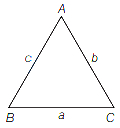
In $\triangle ABC$,$a=6 \text{ cm}$,$b=10 \text{ cm}$ and $c=14 \text{ cm}$. Then,the sum of the acute angles of the triangle is (in $^{\circ}$)
A
$180$
B
$120$
C
$90$
D
$60$
Solution
(D) Given: $a=6 \text{ cm}$,$b=10 \text{ cm}$,$c=14 \text{ cm}$.
Using the Law of Cosines:
$\cos C = \frac{a^2 + b^2 - c^2}{2ab} = \frac{6^2 + 10^2 - 14^2}{2 \times 6 \times 10} = \frac{36 + 100 - 196}{120} = \frac{-60}{120} = -\frac{1}{2}$.
Since $\cos C = -\frac{1}{2}$,$C = 120^{\circ}$,which is an obtuse angle.
The sum of all angles in a triangle is $180^{\circ}$.
Therefore,the sum of the remaining two angles (which must be acute) is $A + B = 180^{\circ} - 120^{\circ} = 60^{\circ}$.
Using the Law of Cosines:
$\cos C = \frac{a^2 + b^2 - c^2}{2ab} = \frac{6^2 + 10^2 - 14^2}{2 \times 6 \times 10} = \frac{36 + 100 - 196}{120} = \frac{-60}{120} = -\frac{1}{2}$.
Since $\cos C = -\frac{1}{2}$,$C = 120^{\circ}$,which is an obtuse angle.
The sum of all angles in a triangle is $180^{\circ}$.
Therefore,the sum of the remaining two angles (which must be acute) is $A + B = 180^{\circ} - 120^{\circ} = 60^{\circ}$.
0 likes
View Solution397
DifficultMCQ
What is the greatest angle of the triangle whose sides are $x^2+x+1, 2x+1, x^2-1$ (in $^{\circ}$)?
A
$120$
B
$90$
C
$135$
D
$60$
Solution
(A) Let the sides of the triangle be $a = x^2+x+1$,$b = 2x+1$,and $c = x^2-1$.
Since $x^2+x+1$ is the greatest side,the greatest angle $A$ is opposite to side $a$.
Using the Law of Cosines: $\cos A = \frac{b^2+c^2-a^2}{2bc}$.
Substituting the values: $\cos A = \frac{(2x+1)^2 + (x^2-1)^2 - (x^2+x+1)^2}{2(2x+1)(x^2-1)}$.
Expanding the terms: $(2x+1)^2 = 4x^2+4x+1$,$(x^2-1)^2 = x^4-2x^2+1$,and $(x^2+x+1)^2 = x^4+x^2+1+2x^3+2x^2+2x = x^4+2x^3+3x^2+2x+1$.
Numerator: $(4x^2+4x+1) + (x^4-2x^2+1) - (x^4+2x^3+3x^2+2x+1) = -2x^3-x^2+2x+1$.
Factoring the numerator: $-(2x^3+x^2-2x-1) = -[x^2(2x+1) - 1(2x+1)] = -(x^2-1)(2x+1)$.
Thus,$\cos A = \frac{-(x^2-1)(2x+1)}{2(2x+1)(x^2-1)} = -\frac{1}{2}$.
Therefore,$A = 120^{\circ}$.
Since $x^2+x+1$ is the greatest side,the greatest angle $A$ is opposite to side $a$.
Using the Law of Cosines: $\cos A = \frac{b^2+c^2-a^2}{2bc}$.
Substituting the values: $\cos A = \frac{(2x+1)^2 + (x^2-1)^2 - (x^2+x+1)^2}{2(2x+1)(x^2-1)}$.
Expanding the terms: $(2x+1)^2 = 4x^2+4x+1$,$(x^2-1)^2 = x^4-2x^2+1$,and $(x^2+x+1)^2 = x^4+x^2+1+2x^3+2x^2+2x = x^4+2x^3+3x^2+2x+1$.
Numerator: $(4x^2+4x+1) + (x^4-2x^2+1) - (x^4+2x^3+3x^2+2x+1) = -2x^3-x^2+2x+1$.
Factoring the numerator: $-(2x^3+x^2-2x-1) = -[x^2(2x+1) - 1(2x+1)] = -(x^2-1)(2x+1)$.
Thus,$\cos A = \frac{-(x^2-1)(2x+1)}{2(2x+1)(x^2-1)} = -\frac{1}{2}$.
Therefore,$A = 120^{\circ}$.
0 likes
View Solution398
EasyMCQ
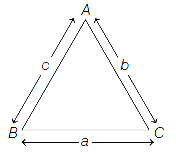
In a $\triangle ABC$,if $b=2, c=3$ and $\angle B=\frac{\pi}{6}$,then $a$ satisfies the equation
A
$a^2+3 \sqrt{3} a+5=0$
B
$a^2+3 \sqrt{3} a-5=0$
C
$a^2-3 \sqrt{3} a+5=0$
D
$\sqrt{3} a^2+3 a+5=0$
Solution
(C) Given,$b = 2$,$c = 3$,and $\angle B = \frac{\pi}{6}$.
Using the cosine rule in $\triangle ABC$:
$\cos B = \frac{a^2 + c^2 - b^2}{2ac}$
Substituting the given values:
$\cos \frac{\pi}{6} = \frac{a^2 + 3^2 - 2^2}{2 \cdot a \cdot 3}$
$\frac{\sqrt{3}}{2} = \frac{a^2 + 9 - 4}{6a}$
$\frac{\sqrt{3}}{2} = \frac{a^2 + 5}{6a}$
Multiplying both sides by $6a$:
$3\sqrt{3} a = a^2 + 5$
Rearranging the terms,we get:
$a^2 - 3\sqrt{3} a + 5 = 0$
Using the cosine rule in $\triangle ABC$:
$\cos B = \frac{a^2 + c^2 - b^2}{2ac}$
Substituting the given values:
$\cos \frac{\pi}{6} = \frac{a^2 + 3^2 - 2^2}{2 \cdot a \cdot 3}$
$\frac{\sqrt{3}}{2} = \frac{a^2 + 9 - 4}{6a}$
$\frac{\sqrt{3}}{2} = \frac{a^2 + 5}{6a}$
Multiplying both sides by $6a$:
$3\sqrt{3} a = a^2 + 5$
Rearranging the terms,we get:
$a^2 - 3\sqrt{3} a + 5 = 0$
0 likes
View Solution399
EasyMCQ
Let $a, b$ and $c$ be the lengths of the sides of a triangle with its opposite angles $A, B$ and $C$ respectively. If $\angle C=60^{\circ}$,then the value of $\frac{c(a+b)+(a^2+b^2)}{(b+c)(c+a)}$ is
A
$\frac{1}{2}$
B
$\frac{\sqrt{3}}{2}$
C
$1$
D
$\sqrt{3}$
Solution
(C) Using the Law of Cosines,$\cos C = \frac{a^2+b^2-c^2}{2ab}$.
Given $\angle C = 60^{\circ}$,we have $\cos 60^{\circ} = \frac{1}{2} = \frac{a^2+b^2-c^2}{2ab}$.
This implies $ab = a^2+b^2-c^2$,or $a^2+b^2 = ab+c^2$.
Now,substitute $a^2+b^2$ in the given expression:
$\frac{c(a+b)+(a^2+b^2)}{(b+c)(c+a)} = \frac{ca+cb+ab+c^2}{bc+ab+c^2+ac}$.
Since the numerator and denominator are identical,the value is $1$.
Given $\angle C = 60^{\circ}$,we have $\cos 60^{\circ} = \frac{1}{2} = \frac{a^2+b^2-c^2}{2ab}$.
This implies $ab = a^2+b^2-c^2$,or $a^2+b^2 = ab+c^2$.
Now,substitute $a^2+b^2$ in the given expression:
$\frac{c(a+b)+(a^2+b^2)}{(b+c)(c+a)} = \frac{ca+cb+ab+c^2}{bc+ab+c^2+ac}$.
Since the numerator and denominator are identical,the value is $1$.
0 likes
View Solution400
MediumMCQ
In $\triangle PQR$,find $\Sigma(q+r) \cos P$,if $p, q, r$ denote its sides and $s = \frac{p+q+r}{2}$.
A
$s$
B
$s / 2$
C
$2s$
D
$4s$
Solution
(C) We are given $\Sigma(q+r) \cos P = (q+r) \cos P + (r+p) \cos Q + (p+q) \cos R$.
Expanding this,we get:
$(q \cos P + r \cos P) + (r \cos Q + p \cos Q) + (p \cos R + q \cos R)$
Rearranging the terms:
$(q \cos P + p \cos Q) + (r \cos P + p \cos R) + (r \cos Q + q \cos R)$
Using the projection law,we know that $r = q \cos P + p \cos Q$,$q = r \cos P + p \cos R$,and $p = r \cos Q + q \cos R$.
Substituting these into the expression:
$r + q + p = p + q + r$
Since the semi-perimeter $s = \frac{p+q+r}{2}$,we have $p+q+r = 2s$.
Therefore,$\Sigma(q+r) \cos P = 2s$.
Expanding this,we get:
$(q \cos P + r \cos P) + (r \cos Q + p \cos Q) + (p \cos R + q \cos R)$
Rearranging the terms:
$(q \cos P + p \cos Q) + (r \cos P + p \cos R) + (r \cos Q + q \cos R)$
Using the projection law,we know that $r = q \cos P + p \cos Q$,$q = r \cos P + p \cos R$,and $p = r \cos Q + q \cos R$.
Substituting these into the expression:
$r + q + p = p + q + r$
Since the semi-perimeter $s = \frac{p+q+r}{2}$,we have $p+q+r = 2s$.
Therefore,$\Sigma(q+r) \cos P = 2s$.
0 likes
View SolutionTrigonometrical Equations — Relation between sides and angles, Solutions of triangles · Frequently Asked Questions
1Are these Trigonometrical Equations questions useful for JEE and NEET?
Yes. All questions in this section are mapped to JEE Main and NEET exam patterns. Previous year questions from JEE Main, NEET, GUJCET and state-level exams are included with full solutions.
2Can I switch to Hindi or Gujarati for these questions?
Yes. Use the language tabs in the hero section or the sidebar to view the same questions and solutions in English, Hindi or Gujarati.
3How do I generate a question paper from this subtopic?
Use the Vedclass Exam Paper Generator — select the chapter and subtopic, set difficulty, and generate Sets A, B, C, D automatically. First 3 chapters of every subject are free.
Vedclass Products
For Students
Vedclass Test Series
Mock tests in real JEE/NEET style with performance analysis. 5-day free trial.
Start Free TrialFor Teachers
Exam Paper Generator
Generate Set A/B/C/D papers from this chapter in 2 minutes. 3 chapters free.
Try FreeFor Institutes
Online Exam Module
Live online exams with unlimited students, 360° analytics & white-label branding.
See DemoFor Teachers & Institutes
Generate a Trigonometrical Equations Exam Paper in 2 Minutes
Select subtopic & difficulty — Sets A, B, C, D auto-generated with No Repeat logic.
First 3 chapters of every subject are free — no payment required.