
A English
Questions related to geometrical conditions Questions in English
Class 11 Mathematics · Rectangular Cartesian Co-ordinates · Questions related to geometrical conditions
14+
Questions
English
Language
100%
With Solutions
Showing 14 of 14 questions in English
1
EasyMCQ
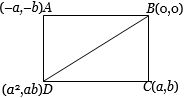
The points $(-a, -b)$,$(0, 0)$,$(a, b)$,and $(a^2, ab)$ are
A
Collinear
B
Vertices of a rectangle
C
Vertices of a parallelogram
D
None of these
Solution
(A) Let the points be $A(-a, -b)$,$B(0, 0)$,$C(a, b)$,and $D(a^2, ab)$.
To check if the points are collinear,we can check the slopes between consecutive points.
Slope of $AB = \frac{0 - (-b)}{0 - (-a)} = \frac{b}{a}$.
Slope of $BC = \frac{b - 0}{a - 0} = \frac{b}{a}$.
Since the slope of $AB$ is equal to the slope of $BC$,the points $A, B,$ and $C$ are collinear.
Now,check the slope of $CD = \frac{ab - b}{a^2 - a} = \frac{b(a - 1)}{a(a - 1)} = \frac{b}{a}$ (assuming $a \neq 1, 0$).
Since the slopes of $AB, BC,$ and $CD$ are all equal to $\frac{b}{a}$,all four points lie on the same line.
Therefore,the points are collinear.
To check if the points are collinear,we can check the slopes between consecutive points.
Slope of $AB = \frac{0 - (-b)}{0 - (-a)} = \frac{b}{a}$.
Slope of $BC = \frac{b - 0}{a - 0} = \frac{b}{a}$.
Since the slope of $AB$ is equal to the slope of $BC$,the points $A, B,$ and $C$ are collinear.
Now,check the slope of $CD = \frac{ab - b}{a^2 - a} = \frac{b(a - 1)}{a(a - 1)} = \frac{b}{a}$ (assuming $a \neq 1, 0$).
Since the slopes of $AB, BC,$ and $CD$ are all equal to $\frac{b}{a}$,all four points lie on the same line.
Therefore,the points are collinear.
0 likes
View Solution2
EasyMCQ
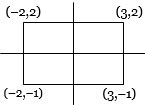
The vertices of a figure are $(-2, 2), (-2, -1), (3, -1),$ and $(3, 2)$. This figure is a:
A
Square
B
Rhombus
C
Rectangle
D
Parallelogram
Solution
(C) Let the vertices be $A(-2, 2), B(-2, -1), C(3, -1),$ and $D(3, 2)$.
Calculate the lengths of the sides using the distance formula $d = \sqrt{(x_2-x_1)^2 + (y_2-y_1)^2}$:
$AB = \sqrt{(-2 - (-2))^2 + (-1 - 2)^2} = \sqrt{0^2 + (-3)^2} = 3$
$BC = \sqrt{(3 - (-2))^2 + (-1 - (-1))^2} = \sqrt{5^2 + 0^2} = 5$
$CD = \sqrt{(3 - 3)^2 + (2 - (-1))^2} = \sqrt{0^2 + 3^2} = 3$
$DA = \sqrt{(-2 - 3)^2 + (2 - 2)^2} = \sqrt{(-5)^2 + 0^2} = 5$
Since opposite sides are equal ($AB = CD = 3$ and $BC = DA = 5$) and adjacent sides are perpendicular (as sides are parallel to the coordinate axes),the figure is a rectangle.
Calculate the lengths of the sides using the distance formula $d = \sqrt{(x_2-x_1)^2 + (y_2-y_1)^2}$:
$AB = \sqrt{(-2 - (-2))^2 + (-1 - 2)^2} = \sqrt{0^2 + (-3)^2} = 3$
$BC = \sqrt{(3 - (-2))^2 + (-1 - (-1))^2} = \sqrt{5^2 + 0^2} = 5$
$CD = \sqrt{(3 - 3)^2 + (2 - (-1))^2} = \sqrt{0^2 + 3^2} = 3$
$DA = \sqrt{(-2 - 3)^2 + (2 - 2)^2} = \sqrt{(-5)^2 + 0^2} = 5$
Since opposite sides are equal ($AB = CD = 3$ and $BC = DA = 5$) and adjacent sides are perpendicular (as sides are parallel to the coordinate axes),the figure is a rectangle.
0 likes
View Solution3
DifficultMCQ
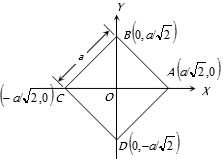
The point of intersection of the diagonals of a square is at the origin,and the coordinate axes are drawn along the diagonals. If the side length of the square is $a$,then which of the following is $NOT$ a vertex of the square?
A
$(a\sqrt{2}, 0)$
B
$\left(0, \frac{a}{\sqrt{2}}\right)$
C
$\left(\frac{a}{\sqrt{2}}, 0\right)$
D
$\left(-\frac{a}{\sqrt{2}}, 0\right)$
Solution
(A) The diagonals of a square bisect each other at $90^{\circ}$ at the origin. Let the vertices be on the axes. The distance from the origin to each vertex is half the length of the diagonal.
Since the side length is $a$,the diagonal length $d$ is given by $d = a\sqrt{2}$.
The distance from the origin to each vertex is $\frac{d}{2} = \frac{a\sqrt{2}}{2} = \frac{a}{\sqrt{2}}$.
Thus,the vertices of the square are $\left(\frac{a}{\sqrt{2}}, 0\right)$,$\left(-\frac{a}{\sqrt{2}}, 0\right)$,$\left(0, \frac{a}{\sqrt{2}}\right)$,and $\left(0, -\frac{a}{\sqrt{2}}\right)$.
Comparing these with the given options,the point $(a\sqrt{2}, 0)$ is not a vertex of the square.
Since the side length is $a$,the diagonal length $d$ is given by $d = a\sqrt{2}$.
The distance from the origin to each vertex is $\frac{d}{2} = \frac{a\sqrt{2}}{2} = \frac{a}{\sqrt{2}}$.
Thus,the vertices of the square are $\left(\frac{a}{\sqrt{2}}, 0\right)$,$\left(-\frac{a}{\sqrt{2}}, 0\right)$,$\left(0, \frac{a}{\sqrt{2}}\right)$,and $\left(0, -\frac{a}{\sqrt{2}}\right)$.
Comparing these with the given options,the point $(a\sqrt{2}, 0)$ is not a vertex of the square.
0 likes
View Solution4
MediumMCQ
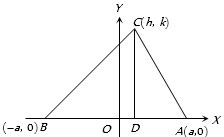
Two fixed points are $A(a, 0)$ and $B(-a, 0)$. If $\angle A - \angle B = \theta$,then the locus of point $C$ of triangle $ABC$ will be
A
${x^2} + {y^2} + 2xy\tan \theta = {a^2}$
B
${x^2} - {y^2} + 2xy\tan \theta = {a^2}$
C
${x^2} + {y^2} + 2xy\cot \theta = {a^2}$
D
${x^2} - {y^2} + 2xy\cot \theta = {a^2}$
Solution
(D) Let the coordinates of point $C$ be $(h, k)$.
Given $\angle A - \angle B = \theta$,so $\tan(A - B) = \tan \theta$ .....$(i)$
In the right-angled triangle $CDA$,where $D$ is the projection of $C$ on the $x$-axis,$\tan A = \frac{k}{a - h}$.
In the right-angled triangle $CDB$,$\tan B = \frac{k}{h - (-a)} = \frac{k}{h + a}$.
From $(i)$,we have $\frac{\tan A - \tan B}{1 + \tan A \tan B} = \tan \theta$.
Substituting the values of $\tan A$ and $\tan B$:
$\frac{\frac{k}{a - h} - \frac{k}{a + h}}{1 + \frac{k^2}{a^2 - h^2}} = \tan \theta$
$\frac{k(a + h) - k(a - h)}{a^2 - h^2 + k^2} = \tan \theta$
$\frac{2kh}{a^2 - h^2 + k^2} = \tan \theta$
$2kh = (a^2 - h^2 + k^2) \tan \theta$
$2kh \cot \theta = a^2 - h^2 + k^2$
$h^2 - k^2 + 2hk \cot \theta = a^2$.
Replacing $(h, k)$ with $(x, y)$,the locus is ${x^2} - {y^2} + 2xy \cot \theta = {a^2}$.
Given $\angle A - \angle B = \theta$,so $\tan(A - B) = \tan \theta$ .....$(i)$
In the right-angled triangle $CDA$,where $D$ is the projection of $C$ on the $x$-axis,$\tan A = \frac{k}{a - h}$.
In the right-angled triangle $CDB$,$\tan B = \frac{k}{h - (-a)} = \frac{k}{h + a}$.
From $(i)$,we have $\frac{\tan A - \tan B}{1 + \tan A \tan B} = \tan \theta$.
Substituting the values of $\tan A$ and $\tan B$:
$\frac{\frac{k}{a - h} - \frac{k}{a + h}}{1 + \frac{k^2}{a^2 - h^2}} = \tan \theta$
$\frac{k(a + h) - k(a - h)}{a^2 - h^2 + k^2} = \tan \theta$
$\frac{2kh}{a^2 - h^2 + k^2} = \tan \theta$
$2kh = (a^2 - h^2 + k^2) \tan \theta$
$2kh \cot \theta = a^2 - h^2 + k^2$
$h^2 - k^2 + 2hk \cot \theta = a^2$.
Replacing $(h, k)$ with $(x, y)$,the locus is ${x^2} - {y^2} + 2xy \cot \theta = {a^2}$.
0 likes
View Solution5
EasyMCQ
If the polar coordinates of a point are $\left( \sqrt{2}, -\frac{3\pi}{4} \right)$,what are its Cartesian coordinates?
A
$(1, -1)$
B
$(-1, -1)$
C
$(-1, 1)$
D
$(1, 1)$
Solution
(B) The Cartesian coordinates $(x, y)$ of a point with polar coordinates $(r, \theta)$ are given by $x = r \cos \theta$ and $y = r \sin \theta$.
Given $r = \sqrt{2}$ and $\theta = -\frac{3\pi}{4}$.
$x = \sqrt{2} \cos\left( -\frac{3\pi}{4} \right) = \sqrt{2} \cos\left( \frac{3\pi}{4} \right) = \sqrt{2} \left( -\frac{1}{\sqrt{2}} \right) = -1$.
$y = \sqrt{2} \sin\left( -\frac{3\pi}{4} \right) = -\sqrt{2} \sin\left( \frac{3\pi}{4} \right) = -\sqrt{2} \left( \frac{1}{\sqrt{2}} \right) = -1$.
Thus,the Cartesian coordinates are $(-1, -1)$.
Given $r = \sqrt{2}$ and $\theta = -\frac{3\pi}{4}$.
$x = \sqrt{2} \cos\left( -\frac{3\pi}{4} \right) = \sqrt{2} \cos\left( \frac{3\pi}{4} \right) = \sqrt{2} \left( -\frac{1}{\sqrt{2}} \right) = -1$.
$y = \sqrt{2} \sin\left( -\frac{3\pi}{4} \right) = -\sqrt{2} \sin\left( \frac{3\pi}{4} \right) = -\sqrt{2} \left( \frac{1}{\sqrt{2}} \right) = -1$.
Thus,the Cartesian coordinates are $(-1, -1)$.
0 likes
View Solution6
AdvancedMCQ
An insect is resting on the graph paper at a point $A(3, 2)$. Now it starts moving towards the west direction and covers a distance of $4 \ units$,then it turns towards the south and covers a distance of $3 \ units$ to reach point $B$. The polar coordinates of point $B$ will be:
A
$\left( 6\sqrt{2}, \frac{\pi}{4} \right)$
B
$\left( \sqrt{2}, \frac{3\pi}{4} \right)$
C
$\left( \sqrt{2}, \frac{-3\pi}{4} \right)$
D
None of these
Solution
(C) The initial position of the insect is $A(3, 2)$.
Moving $4 \ units$ towards the west (negative $x$-direction) changes the $x$-coordinate: $3 - 4 = -1$. The position becomes $(-1, 2)$.
Moving $3 \ units$ towards the south (negative $y$-direction) changes the $y$-coordinate: $2 - 3 = -1$. The final position $B$ is $(-1, -1)$.
To find the polar coordinates $(r, \theta)$ for $B(-1, -1)$:
$r = \sqrt{(-1)^2 + (-1)^2} = \sqrt{1 + 1} = \sqrt{2}$.
Since the point $(-1, -1)$ lies in the third quadrant,the angle $\theta$ is given by $\theta = -\pi + \tan^{-1}\left(\frac{-1}{-1}\right) = -\pi + \frac{\pi}{4} = -\frac{3\pi}{4}$.
Thus,the polar coordinates are $\left( \sqrt{2}, -\frac{3\pi}{4} \right)$.
Moving $4 \ units$ towards the west (negative $x$-direction) changes the $x$-coordinate: $3 - 4 = -1$. The position becomes $(-1, 2)$.
Moving $3 \ units$ towards the south (negative $y$-direction) changes the $y$-coordinate: $2 - 3 = -1$. The final position $B$ is $(-1, -1)$.
To find the polar coordinates $(r, \theta)$ for $B(-1, -1)$:
$r = \sqrt{(-1)^2 + (-1)^2} = \sqrt{1 + 1} = \sqrt{2}$.
Since the point $(-1, -1)$ lies in the third quadrant,the angle $\theta$ is given by $\theta = -\pi + \tan^{-1}\left(\frac{-1}{-1}\right) = -\pi + \frac{\pi}{4} = -\frac{3\pi}{4}$.
Thus,the polar coordinates are $\left( \sqrt{2}, -\frac{3\pi}{4} \right)$.
0 likes
View Solution7
DifficultMCQ
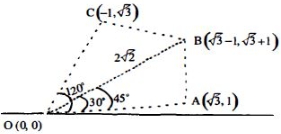
$A$ square,of each side $2$,lies above the $x-$axis and has one vertex at the origin. If one of the sides passing through the origin makes an angle $30^o$ with the positive direction of the $x-$axis,then the sum of the $x-$coordinates of the vertices of the square is
A
$2\sqrt{3} - 1$
B
$2\sqrt{3} - 2$
C
$\sqrt{3} - 2$
D
$\sqrt{3} - 1$
Solution
(B) Let the vertices of the square be $O(0, 0)$,$A$,$B$,and $C$. The side $OA$ makes an angle of $30^o$ with the positive $x-$axis. Since the side length is $2$,the coordinates of $A$ are $(2 \cos 30^o, 2 \sin 30^o) = (2 \cdot \frac{\sqrt{3}}{2}, 2 \cdot \frac{1}{2}) = (\sqrt{3}, 1)$.
The side $OC$ is perpendicular to $OA$ and lies at an angle of $30^o + 90^o = 120^o$ with the positive $x-$axis. The coordinates of $C$ are $(2 \cos 120^o, 2 \sin 120^o) = (2 \cdot -\frac{1}{2}, 2 \cdot \frac{\sqrt{3}}{2}) = (-1, \sqrt{3})$.
The vertex $B$ is the sum of vectors $\vec{OA}$ and $\vec{OC}$,so $B = (\sqrt{3} - 1, 1 + \sqrt{3})$.
The $x-$coordinates of the vertices are $0$,$\sqrt{3}$,$-1$,and $\sqrt{3} - 1$.
The sum of the $x-$coordinates is $0 + \sqrt{3} - 1 + \sqrt{3} - 1 = 2\sqrt{3} - 2$.
The side $OC$ is perpendicular to $OA$ and lies at an angle of $30^o + 90^o = 120^o$ with the positive $x-$axis. The coordinates of $C$ are $(2 \cos 120^o, 2 \sin 120^o) = (2 \cdot -\frac{1}{2}, 2 \cdot \frac{\sqrt{3}}{2}) = (-1, \sqrt{3})$.
The vertex $B$ is the sum of vectors $\vec{OA}$ and $\vec{OC}$,so $B = (\sqrt{3} - 1, 1 + \sqrt{3})$.
The $x-$coordinates of the vertices are $0$,$\sqrt{3}$,$-1$,and $\sqrt{3} - 1$.
The sum of the $x-$coordinates is $0 + \sqrt{3} - 1 + \sqrt{3} - 1 = 2\sqrt{3} - 2$.
0 likes
View Solution8
AdvancedMCQ
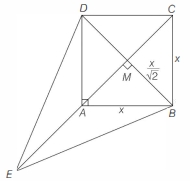
Let $ABCD$ be a square and $E$ be a point outside $ABCD$ such that $E, A, C$ are collinear in that order. Suppose $EB = ED = \sqrt{130}$ and the areas of $\triangle EAB$ and square $ABCD$ are equal. Then,the area of square $ABCD$ is
A
$8$
B
$10$
C
$\sqrt{120}$
D
$\sqrt{125}$
Solution
(B) Let the side length of the square $ABCD$ be $x$. The area of the square is $x^2$.
Let $M$ be the intersection of the diagonals $AC$ and $BD$. Since $ABCD$ is a square,the diagonals bisect each other at right angles,so $AM = MC = BM = MD = \frac{x}{\sqrt{2}}$.
Since $E, A, C$ are collinear,$EA$ lies on the diagonal $AC$. In $\triangle EBD$,$EB = ED = \sqrt{130}$ and $BD$ is the base. The altitude from $E$ to $BD$ is $EM$. Since $\triangle EBD$ is isosceles,$EM \perp BD$.
In $\triangle EBM$,by the Pythagorean theorem,$EM^2 + BM^2 = EB^2$.
$EM^2 + (\frac{x}{\sqrt{2}})^2 = 130$ $\Rightarrow EM^2 = 130 - \frac{x^2}{2}$ $\Rightarrow EM = \sqrt{130 - \frac{x^2}{2}}$.
The area of $\triangle EAB = \frac{1}{2} \times \text{base} \times \text{height} = \frac{1}{2} \times AB \times EA \times \sin(\angle EAB)$. Since $E, A, C$ are collinear,$\angle EAB = 135^\circ$. Thus,$\text{Area} = \frac{1}{2} x \cdot EA \cdot \sin(135^\circ) = \frac{1}{2} x \cdot EA \cdot \frac{1}{\sqrt{2}}$.
Alternatively,using the coordinates with $A$ at $(0,0)$,$B$ at $(x,0)$,$D$ at $(0,x)$,and $C$ at $(x,x)$,the line $AC$ is $y=x$. Point $E$ lies on $y=x$ with $x_E < 0$,so $E = (-a, -a)$.
$EB^2 = (x+a)^2 + a^2 = 130$ and $ED^2 = a^2 + (x+a)^2 = 130$. Area of $\triangle EAB = \frac{1}{2} |x_A(y_B-y_E) + x_B(y_E-y_A) + x_E(y_A-y_B)| = \frac{1}{2} |0 + x(-a-0) + (-a)(0-0)| = \frac{ax}{2}$.
Given $\frac{ax}{2} = x^2 \Rightarrow a = 2x$.
Substitute $a=2x$ into $EB^2 = (x+2x)^2 + (2x)^2 = 130$ $\Rightarrow 9x^2 + 4x^2 = 130$ $\Rightarrow 13x^2 = 130$ $\Rightarrow x^2 = 10$.
The area of the square is $x^2 = 10$.
Let $M$ be the intersection of the diagonals $AC$ and $BD$. Since $ABCD$ is a square,the diagonals bisect each other at right angles,so $AM = MC = BM = MD = \frac{x}{\sqrt{2}}$.
Since $E, A, C$ are collinear,$EA$ lies on the diagonal $AC$. In $\triangle EBD$,$EB = ED = \sqrt{130}$ and $BD$ is the base. The altitude from $E$ to $BD$ is $EM$. Since $\triangle EBD$ is isosceles,$EM \perp BD$.
In $\triangle EBM$,by the Pythagorean theorem,$EM^2 + BM^2 = EB^2$.
$EM^2 + (\frac{x}{\sqrt{2}})^2 = 130$ $\Rightarrow EM^2 = 130 - \frac{x^2}{2}$ $\Rightarrow EM = \sqrt{130 - \frac{x^2}{2}}$.
The area of $\triangle EAB = \frac{1}{2} \times \text{base} \times \text{height} = \frac{1}{2} \times AB \times EA \times \sin(\angle EAB)$. Since $E, A, C$ are collinear,$\angle EAB = 135^\circ$. Thus,$\text{Area} = \frac{1}{2} x \cdot EA \cdot \sin(135^\circ) = \frac{1}{2} x \cdot EA \cdot \frac{1}{\sqrt{2}}$.
Alternatively,using the coordinates with $A$ at $(0,0)$,$B$ at $(x,0)$,$D$ at $(0,x)$,and $C$ at $(x,x)$,the line $AC$ is $y=x$. Point $E$ lies on $y=x$ with $x_E < 0$,so $E = (-a, -a)$.
$EB^2 = (x+a)^2 + a^2 = 130$ and $ED^2 = a^2 + (x+a)^2 = 130$. Area of $\triangle EAB = \frac{1}{2} |x_A(y_B-y_E) + x_B(y_E-y_A) + x_E(y_A-y_B)| = \frac{1}{2} |0 + x(-a-0) + (-a)(0-0)| = \frac{ax}{2}$.
Given $\frac{ax}{2} = x^2 \Rightarrow a = 2x$.
Substitute $a=2x$ into $EB^2 = (x+2x)^2 + (2x)^2 = 130$ $\Rightarrow 9x^2 + 4x^2 = 130$ $\Rightarrow 13x^2 = 130$ $\Rightarrow x^2 = 10$.
The area of the square is $x^2 = 10$.
0 likes
View Solution9
EasyMCQ
If the Cartesian coordinates of a point are $\left(\frac{-5 \sqrt{3}}{2}, \frac{5}{2}\right)$,then its polar coordinates are
A
$\left(5, \frac{2 \pi}{3}\right)$
B
$\left(5, \frac{13 \pi}{18}\right)$
C
$\left(5, \frac{5 \pi}{6}\right)$
D
$\left(5, \frac{11 \pi}{18}\right)$
Solution
(C) Given Cartesian coordinates $(x, y) = \left(-\frac{5 \sqrt{3}}{2}, \frac{5}{2}\right)$.
$r = \sqrt{x^2 + y^2} = \sqrt{\left(-\frac{5 \sqrt{3}}{2}\right)^2 + \left(\frac{5}{2}\right)^2} = \sqrt{\frac{75}{4} + \frac{25}{4}} = \sqrt{\frac{100}{4}} = \sqrt{25} = 5$.
Since the point lies in the second quadrant $(x < 0, y > 0)$,the polar angle $\theta$ is given by $\theta = \pi - \tan^{-1}\left|\frac{y}{x}\right|$.
$\theta = \pi - \tan^{-1}\left|\frac{5/2}{-5\sqrt{3}/2}\right| = \pi - \tan^{-1}\left(\frac{1}{\sqrt{3}}\right) = \pi - \frac{\pi}{6} = \frac{5 \pi}{6}$.
Thus,the polar coordinates are $(r, \theta) = \left(5, \frac{5 \pi}{6}\right)$.
$r = \sqrt{x^2 + y^2} = \sqrt{\left(-\frac{5 \sqrt{3}}{2}\right)^2 + \left(\frac{5}{2}\right)^2} = \sqrt{\frac{75}{4} + \frac{25}{4}} = \sqrt{\frac{100}{4}} = \sqrt{25} = 5$.
Since the point lies in the second quadrant $(x < 0, y > 0)$,the polar angle $\theta$ is given by $\theta = \pi - \tan^{-1}\left|\frac{y}{x}\right|$.
$\theta = \pi - \tan^{-1}\left|\frac{5/2}{-5\sqrt{3}/2}\right| = \pi - \tan^{-1}\left(\frac{1}{\sqrt{3}}\right) = \pi - \frac{\pi}{6} = \frac{5 \pi}{6}$.
Thus,the polar coordinates are $(r, \theta) = \left(5, \frac{5 \pi}{6}\right)$.
0 likes
View Solution10
EasyMCQ
The Cartesian coordinates of the point whose polar coordinates are $\left(\frac{1}{2}, 120^{\circ}\right)$ are:
A
$\left(\frac{1}{4}, \frac{-\sqrt{3}}{4}\right)$
B
$\left(\frac{1}{4}, \frac{\sqrt{3}}{4}\right)$
C
$\left(\frac{-1}{4}, \frac{-\sqrt{3}}{4}\right)$
D
$\left(\frac{-1}{4}, \frac{\sqrt{3}}{4}\right)$
Solution
(D) Given polar coordinates are $P(r, \theta) = \left(\frac{1}{2}, 120^{\circ}\right)$,where $r = \frac{1}{2}$ and $\theta = 120^{\circ}$.
We use the conversion formulas $x = r \cos \theta$ and $y = r \sin \theta$.
For $x$: $x = \frac{1}{2} \cos 120^{\circ} = \frac{1}{2} \left(-\frac{1}{2}\right) = -\frac{1}{4}$.
For $y$: $y = \frac{1}{2} \sin 120^{\circ} = \frac{1}{2} \left(\frac{\sqrt{3}}{2}\right) = \frac{\sqrt{3}}{4}$.
Therefore,the Cartesian coordinates are $\left(-\frac{1}{4}, \frac{\sqrt{3}}{4}\right)$.
We use the conversion formulas $x = r \cos \theta$ and $y = r \sin \theta$.
For $x$: $x = \frac{1}{2} \cos 120^{\circ} = \frac{1}{2} \left(-\frac{1}{2}\right) = -\frac{1}{4}$.
For $y$: $y = \frac{1}{2} \sin 120^{\circ} = \frac{1}{2} \left(\frac{\sqrt{3}}{2}\right) = \frac{\sqrt{3}}{4}$.
Therefore,the Cartesian coordinates are $\left(-\frac{1}{4}, \frac{\sqrt{3}}{4}\right)$.
0 likes
View Solution11
EasyMCQ
If $(-\sqrt{2}, \sqrt{2})$ are the Cartesian coordinates of a point,then its polar coordinates are $.....$
A
$\left(2, \frac{\pi}{4}\right)$
B
$\left(2, \frac{3 \pi}{4}\right)$
C
$\left(2, \frac{5 \pi}{4}\right)$
D
$\left(2, \frac{7 \pi}{4}\right)$
Solution
(B) Given Cartesian coordinates $(x, y) = (-\sqrt{2}, \sqrt{2})$.
To find polar coordinates $(r, \theta)$:
$r = \sqrt{x^2 + y^2} = \sqrt{(-\sqrt{2})^2 + (\sqrt{2})^2} = \sqrt{2 + 2} = \sqrt{4} = 2$.
Since $x = r \cos \theta$ and $y = r \sin \theta$,we have:
$\cos \theta = \frac{-\sqrt{2}}{2} = -\frac{1}{\sqrt{2}}$ and $\sin \theta = \frac{\sqrt{2}}{2} = \frac{1}{\sqrt{2}}$.
Since $\cos \theta < 0$ and $\sin \theta > 0$,the point lies in the second quadrant.
$\theta = \pi - \frac{\pi}{4} = \frac{3 \pi}{4}$.
Thus,the polar coordinates are $\left(2, \frac{3 \pi}{4}\right)$.
To find polar coordinates $(r, \theta)$:
$r = \sqrt{x^2 + y^2} = \sqrt{(-\sqrt{2})^2 + (\sqrt{2})^2} = \sqrt{2 + 2} = \sqrt{4} = 2$.
Since $x = r \cos \theta$ and $y = r \sin \theta$,we have:
$\cos \theta = \frac{-\sqrt{2}}{2} = -\frac{1}{\sqrt{2}}$ and $\sin \theta = \frac{\sqrt{2}}{2} = \frac{1}{\sqrt{2}}$.
Since $\cos \theta < 0$ and $\sin \theta > 0$,the point lies in the second quadrant.
$\theta = \pi - \frac{\pi}{4} = \frac{3 \pi}{4}$.
Thus,the polar coordinates are $\left(2, \frac{3 \pi}{4}\right)$.
0 likes
View Solution12
EasyMCQ
To which point should the origin be shifted in order to eliminate the first-degree terms ($x$ and $y$ terms) from the equation $4x^2 + 9y^2 - 8x + 36y + 4 = 0$?
A
$(1, 2)$
B
$(-1, 2)$
C
$(1, -2)$
D
$(-1, -2)$
Solution
(C) The given equation is $4x^2 + 9y^2 - 8x + 36y + 4 = 0$.
To eliminate the first-degree terms,we complete the square for $x$ and $y$ terms:
$4(x^2 - 2x) + 9(y^2 + 4y) + 4 = 0$
$4(x^2 - 2x + 1 - 1) + 9(y^2 + 4y + 4 - 4) + 4 = 0$
$4(x - 1)^2 - 4 + 9(y + 2)^2 - 36 + 4 = 0$
$4(x - 1)^2 + 9(y + 2)^2 = 36$
Let the new coordinates be $X = x - 1$ and $Y = y + 2$.
This implies $x = X + 1$ and $y = Y - 2$.
Thus,the origin must be shifted to the point $(1, -2)$ to eliminate the $x$ and $y$ terms.
To eliminate the first-degree terms,we complete the square for $x$ and $y$ terms:
$4(x^2 - 2x) + 9(y^2 + 4y) + 4 = 0$
$4(x^2 - 2x + 1 - 1) + 9(y^2 + 4y + 4 - 4) + 4 = 0$
$4(x - 1)^2 - 4 + 9(y + 2)^2 - 36 + 4 = 0$
$4(x - 1)^2 + 9(y + 2)^2 = 36$
Let the new coordinates be $X = x - 1$ and $Y = y + 2$.
This implies $x = X + 1$ and $y = Y - 2$.
Thus,the origin must be shifted to the point $(1, -2)$ to eliminate the $x$ and $y$ terms.
0 likes
View Solution13
MediumMCQ
The point to which the origin is to be shifted to eliminate $x$ and $y$ terms of the equation $4x^2+9y^2-8x+36y+4=0$ is
A
$(1, -2)$
B
$(-1, 2)$
C
$(1, 2)$
D
$(-1, -2)$
Solution
(A) Given equation is $4x^2 + 9y^2 - 8x + 36y + 4 = 0$.
To eliminate the $x$ and $y$ terms,we shift the origin to $(h, k)$.
Let $x = X + h$ and $y = Y + k$.
Substituting these into the equation: $4(X+h)^2 + 9(Y+k)^2 - 8(X+h) + 36(Y+k) + 4 = 0$.
Expanding the terms: $4(X^2 + 2hX + h^2) + 9(Y^2 + 2kY + k^2) - 8X - 8h + 36Y + 36k + 4 = 0$.
Grouping the linear terms: $(8h - 8)X + (18k + 36)Y + (4h^2 + 9k^2 - 8h + 36k + 4) = 0$.
For the $X$ and $Y$ terms to be eliminated,their coefficients must be zero:
$8h - 8 = 0 \implies h = 1$.
$18k + 36 = 0 \implies k = -2$.
Thus,the origin is shifted to $(1, -2)$.
To eliminate the $x$ and $y$ terms,we shift the origin to $(h, k)$.
Let $x = X + h$ and $y = Y + k$.
Substituting these into the equation: $4(X+h)^2 + 9(Y+k)^2 - 8(X+h) + 36(Y+k) + 4 = 0$.
Expanding the terms: $4(X^2 + 2hX + h^2) + 9(Y^2 + 2kY + k^2) - 8X - 8h + 36Y + 36k + 4 = 0$.
Grouping the linear terms: $(8h - 8)X + (18k + 36)Y + (4h^2 + 9k^2 - 8h + 36k + 4) = 0$.
For the $X$ and $Y$ terms to be eliminated,their coefficients must be zero:
$8h - 8 = 0 \implies h = 1$.
$18k + 36 = 0 \implies k = -2$.
Thus,the origin is shifted to $(1, -2)$.
0 likes
View Solution14
MediumMCQ
If a square $ABCD$,where $A(0,0), B(2,0), C(2,2)$ and $D(0,2)$ undergoes the following transformations successively,then the final figure would be a:
$(i)$ $f_1(x, y) \longrightarrow (y, x)$
(ii) $f_2(x, y) \longrightarrow (x+3y, y)$
(iii) $f_3(x, y) \longrightarrow \left(\frac{x-y}{2}, \frac{x+y}{2}\right)$
$(i)$ $f_1(x, y) \longrightarrow (y, x)$
(ii) $f_2(x, y) \longrightarrow (x+3y, y)$
(iii) $f_3(x, y) \longrightarrow \left(\frac{x-y}{2}, \frac{x+y}{2}\right)$
A
square
B
rhombus
C
rectangle
D
parallelogram
Solution
(D) Given,square $ABCD$ with vertices $A(0,0), B(2,0), C(2,2), D(0,2)$.
Applying $f_1(x, y) \longrightarrow (y, x)$:
$A(0,0)$ $\longrightarrow A'(0,0), B(2,0)$ $\longrightarrow B'(0,2), C(2,2)$ $\longrightarrow C'(2,2), D(0,2)$ $\longrightarrow D'(2,0)$.
Applying $f_2(x, y) \longrightarrow (x+3y, y)$:
$A'(0,0)$ $\longrightarrow A''(0,0), B'(0,2)$ $\longrightarrow B''(6,2), C'(2,2)$ $\longrightarrow C''(8,2), D'(2,0)$ $\longrightarrow D''(2,0)$.
Applying $f_3(x, y) \longrightarrow \left(\frac{x-y}{2}, \frac{x+y}{2}\right)$:
$A''(0,0)$ $\longrightarrow A'''(0,0), B''(6,2)$ $\longrightarrow B'''(2,4), C''(8,2)$ $\longrightarrow C'''(3,5), D''(2,0)$ $\longrightarrow D'''(1,1)$.
Final vertices: $A(0,0), B(2,4), C(3,5), D(1,1)$.
Calculating side lengths:
$AB = \sqrt{(2-0)^2 + (4-0)^2} = \sqrt{4+16} = \sqrt{20} = 2\sqrt{5}$.
$BC = \sqrt{(3-2)^2 + (5-4)^2} = \sqrt{1+1} = \sqrt{2}$.
$CD = \sqrt{(1-3)^2 + (1-5)^2} = \sqrt{4+16} = \sqrt{20} = 2\sqrt{5}$.
$DA = \sqrt{(0-1)^2 + (0-1)^2} = \sqrt{1+1} = \sqrt{2}$.
Since opposite sides are equal ($AB=CD$ and $BC=DA$) and adjacent sides are not equal,the figure is a parallelogram.
Applying $f_1(x, y) \longrightarrow (y, x)$:
$A(0,0)$ $\longrightarrow A'(0,0), B(2,0)$ $\longrightarrow B'(0,2), C(2,2)$ $\longrightarrow C'(2,2), D(0,2)$ $\longrightarrow D'(2,0)$.
Applying $f_2(x, y) \longrightarrow (x+3y, y)$:
$A'(0,0)$ $\longrightarrow A''(0,0), B'(0,2)$ $\longrightarrow B''(6,2), C'(2,2)$ $\longrightarrow C''(8,2), D'(2,0)$ $\longrightarrow D''(2,0)$.
Applying $f_3(x, y) \longrightarrow \left(\frac{x-y}{2}, \frac{x+y}{2}\right)$:
$A''(0,0)$ $\longrightarrow A'''(0,0), B''(6,2)$ $\longrightarrow B'''(2,4), C''(8,2)$ $\longrightarrow C'''(3,5), D''(2,0)$ $\longrightarrow D'''(1,1)$.
Final vertices: $A(0,0), B(2,4), C(3,5), D(1,1)$.
Calculating side lengths:
$AB = \sqrt{(2-0)^2 + (4-0)^2} = \sqrt{4+16} = \sqrt{20} = 2\sqrt{5}$.
$BC = \sqrt{(3-2)^2 + (5-4)^2} = \sqrt{1+1} = \sqrt{2}$.
$CD = \sqrt{(1-3)^2 + (1-5)^2} = \sqrt{4+16} = \sqrt{20} = 2\sqrt{5}$.
$DA = \sqrt{(0-1)^2 + (0-1)^2} = \sqrt{1+1} = \sqrt{2}$.
Since opposite sides are equal ($AB=CD$ and $BC=DA$) and adjacent sides are not equal,the figure is a parallelogram.
0 likes
View SolutionRectangular Cartesian Co-ordinates — Questions related to geometrical conditions · Frequently Asked Questions
1Are these Rectangular Cartesian Co-ordinates questions useful for JEE and NEET?
Yes. All questions in this section are mapped to JEE Main and NEET exam patterns. Previous year questions from JEE Main, NEET, GUJCET and state-level exams are included with full solutions.
2Can I switch to Hindi or Gujarati for these questions?
Yes. Use the language tabs in the hero section or the sidebar to view the same questions and solutions in English, Hindi or Gujarati.
3How do I generate a question paper from this subtopic?
Use the Vedclass Exam Paper Generator — select the chapter and subtopic, set difficulty, and generate Sets A, B, C, D automatically. First 3 chapters of every subject are free.
Vedclass Products
For Students
Vedclass Test Series
Mock tests in real JEE/NEET style with performance analysis. 5-day free trial.
Start Free TrialFor Teachers
Exam Paper Generator
Generate Set A/B/C/D papers from this chapter in 2 minutes. 3 chapters free.
Try FreeFor Institutes
Online Exam Module
Live online exams with unlimited students, 360° analytics & white-label branding.
See DemoFor Teachers & Institutes
Generate a Rectangular Cartesian Co-ordinates Exam Paper in 2 Minutes
Select subtopic & difficulty — Sets A, B, C, D auto-generated with No Repeat logic.
First 3 chapters of every subject are free — no payment required.