
A English
Area of some geometrical figures Questions in English
Class 11 Mathematics · Rectangular Cartesian Co-ordinates · Area of some geometrical figures
21+
Questions
English
Language
100%
With Solutions
Showing 20 of 21 questions in English
1
EasyMCQ
The sides of a triangle are $4 \, cm, 5 \, cm$ and $6 \, cm$. The area of the triangle is equal to
A
$\frac{15}{4} \, cm^2$
B
$\frac{15}{4} \sqrt{7} \, cm^2$
C
$\frac{4}{15} \sqrt{7} \, cm^2$
D
None of these
Solution
(B) Given sides of the triangle are $a = 4 \, cm, b = 5 \, cm, c = 6 \, cm$.
Semi-perimeter $s = \frac{a + b + c}{2} = \frac{4 + 5 + 6}{2} = \frac{15}{2} \, cm$.
Using Heron's formula,Area $= \sqrt{s(s - a)(s - b)(s - c)}$.
Area $= \sqrt{\frac{15}{2} \left( \frac{15}{2} - 4 \right) \left( \frac{15}{2} - 5 \right) \left( \frac{15}{2} - 6 \right)}$.
Area $= \sqrt{\frac{15}{2} \times \frac{7}{2} \times \frac{5}{2} \times \frac{3}{2}}$.
Area $= \sqrt{\frac{15 \times 7 \times 15}{16}} = \frac{15}{4} \sqrt{7} \, cm^2$.
Semi-perimeter $s = \frac{a + b + c}{2} = \frac{4 + 5 + 6}{2} = \frac{15}{2} \, cm$.
Using Heron's formula,Area $= \sqrt{s(s - a)(s - b)(s - c)}$.
Area $= \sqrt{\frac{15}{2} \left( \frac{15}{2} - 4 \right) \left( \frac{15}{2} - 5 \right) \left( \frac{15}{2} - 6 \right)}$.
Area $= \sqrt{\frac{15}{2} \times \frac{7}{2} \times \frac{5}{2} \times \frac{3}{2}}$.
Area $= \sqrt{\frac{15 \times 7 \times 15}{16}} = \frac{15}{4} \sqrt{7} \, cm^2$.
0 likes
View Solution2
EasyMCQ
The area of a triangle whose vertices are $(a \cos \theta, b \sin \theta)$,$(-a \sin \theta, b \cos \theta)$,and $(-a \cos \theta, -b \sin \theta)$ is:
A
$a \cos \theta \sin \theta$
B
$ab \sin \theta \cos \theta$
C
$\frac{1}{2} ab$
D
$ab$
Solution
(D) The area of a triangle with vertices $(x_1, y_1), (x_2, y_2), (x_3, y_3)$ is given by $\frac{1}{2} |x_1(y_2 - y_3) + x_2(y_3 - y_1) + x_3(y_1 - y_2)|$.
Substituting the given vertices:
$x_1 = a \cos \theta, y_1 = b \sin \theta$
$x_2 = -a \sin \theta, y_2 = b \cos \theta$
$x_3 = -a \cos \theta, y_3 = -b \sin \theta$
Area $= \frac{1}{2} |a \cos \theta (b \cos \theta - (-b \sin \theta)) + (-a \sin \theta)(-b \sin \theta - b \sin \theta) + (-a \cos \theta)(b \sin \theta - b \cos \theta)|$
$= \frac{1}{2} |a \cos \theta (b \cos \theta + b \sin \theta) - a \sin \theta (-2b \sin \theta) - a \cos \theta (b \sin \theta - b \cos \theta)|$
$= \frac{ab}{2} |\cos^2 \theta + \cos \theta \sin \theta + 2 \sin^2 \theta - \sin \theta \cos \theta + \cos^2 \theta|$
$= \frac{ab}{2} |2 \cos^2 \theta + 2 \sin^2 \theta|$
$= \frac{ab}{2} \times 2(\cos^2 \theta + \sin^2 \theta) = ab(1) = ab$.
Substituting the given vertices:
$x_1 = a \cos \theta, y_1 = b \sin \theta$
$x_2 = -a \sin \theta, y_2 = b \cos \theta$
$x_3 = -a \cos \theta, y_3 = -b \sin \theta$
Area $= \frac{1}{2} |a \cos \theta (b \cos \theta - (-b \sin \theta)) + (-a \sin \theta)(-b \sin \theta - b \sin \theta) + (-a \cos \theta)(b \sin \theta - b \cos \theta)|$
$= \frac{1}{2} |a \cos \theta (b \cos \theta + b \sin \theta) - a \sin \theta (-2b \sin \theta) - a \cos \theta (b \sin \theta - b \cos \theta)|$
$= \frac{ab}{2} |\cos^2 \theta + \cos \theta \sin \theta + 2 \sin^2 \theta - \sin \theta \cos \theta + \cos^2 \theta|$
$= \frac{ab}{2} |2 \cos^2 \theta + 2 \sin^2 \theta|$
$= \frac{ab}{2} \times 2(\cos^2 \theta + \sin^2 \theta) = ab(1) = ab$.
0 likes
View Solution3
EasyMCQ
The area of the triangle with vertices at $(-4, 1), (1, 2), (4, -3)$ is
A
$14$
B
$16$
C
$15$
D
None of these
Solution
(A) The area of a triangle with vertices $(x_1, y_1), (x_2, y_2), (x_3, y_3)$ is given by the formula:
Area $= \frac{1}{2} |x_1(y_2 - y_3) + x_2(y_3 - y_1) + x_3(y_1 - y_2)|$
Substituting the given vertices $(-4, 1), (1, 2), (4, -3)$:
Area $= \frac{1}{2} |-4(2 - (-3)) + 1(-3 - 1) + 4(1 - 2)|$
Area $= \frac{1}{2} |-4(5) + 1(-4) + 4(-1)|$
Area $= \frac{1}{2} |-20 - 4 - 4|$
Area $= \frac{1}{2} |-28| = 14$ square units.
Area $= \frac{1}{2} |x_1(y_2 - y_3) + x_2(y_3 - y_1) + x_3(y_1 - y_2)|$
Substituting the given vertices $(-4, 1), (1, 2), (4, -3)$:
Area $= \frac{1}{2} |-4(2 - (-3)) + 1(-3 - 1) + 4(1 - 2)|$
Area $= \frac{1}{2} |-4(5) + 1(-4) + 4(-1)|$
Area $= \frac{1}{2} |-20 - 4 - 4|$
Area $= \frac{1}{2} |-28| = 14$ square units.
0 likes
View Solution4
MediumMCQ
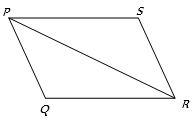
$P(2, 1), Q(4, -1), R(3, 2)$ are the vertices of a triangle. If lines parallel to the opposite sides are drawn through $P$ and $R$ to intersect at $S$,then the area of $PQRS$ is:
A
$6$
B
$4$
C
$8$
D
$12$
Solution
(B) The quadrilateral $PQRS$ formed by drawing lines through the vertices parallel to the opposite sides is a parallelogram.
The area of this parallelogram $PQRS$ is twice the area of the triangle $\Delta PQR$.
The area of $\Delta PQR$ with vertices $(x_1, y_1), (x_2, y_2), (x_3, y_3)$ is given by:
$\text{Area} = \frac{1}{2} |x_1(y_2 - y_3) + x_2(y_3 - y_1) + x_3(y_1 - y_2)|$
Substituting the coordinates $P(2, 1), Q(4, -1), R(3, 2)$:
$\text{Area}(\Delta PQR) = \frac{1}{2} |2(-1 - 2) + 4(2 - 1) + 3(1 - (-1))|$
$= \frac{1}{2} |2(-3) + 4(1) + 3(2)|$
$= \frac{1}{2} |-6 + 4 + 6| = \frac{1}{2} |4| = 2$
Therefore,the area of the parallelogram $PQRS = 2 \times \text{Area}(\Delta PQR) = 2 \times 2 = 4$.
The area of this parallelogram $PQRS$ is twice the area of the triangle $\Delta PQR$.
The area of $\Delta PQR$ with vertices $(x_1, y_1), (x_2, y_2), (x_3, y_3)$ is given by:
$\text{Area} = \frac{1}{2} |x_1(y_2 - y_3) + x_2(y_3 - y_1) + x_3(y_1 - y_2)|$
Substituting the coordinates $P(2, 1), Q(4, -1), R(3, 2)$:
$\text{Area}(\Delta PQR) = \frac{1}{2} |2(-1 - 2) + 4(2 - 1) + 3(1 - (-1))|$
$= \frac{1}{2} |2(-3) + 4(1) + 3(2)|$
$= \frac{1}{2} |-6 + 4 + 6| = \frac{1}{2} |4| = 2$
Therefore,the area of the parallelogram $PQRS = 2 \times \text{Area}(\Delta PQR) = 2 \times 2 = 4$.
0 likes
View Solution5
EasyMCQ
The vertices of the triangle $ABC$ are $(2, 1)$,$(4, 3)$,and $(2, 5)$. If $D$,$E$,and $F$ are the mid-points of the sides,then the area of the triangle $DEF$ is:
A
$1$
B
$1.5$
C
$3$
D
$4$
Solution
(A) The vertices of triangle $ABC$ are $A(2, 1)$,$B(4, 3)$,and $C(2, 5)$.
The mid-points $D$,$E$,and $F$ are calculated as follows:
$D = \left( \frac{2+4}{2}, \frac{1+3}{2} \right) = (3, 2)$
$E = \left( \frac{4+2}{2}, \frac{3+5}{2} \right) = (3, 4)$
$F = \left( \frac{2+2}{2}, \frac{1+5}{2} \right) = (2, 3)$
The area of triangle $DEF$ is given by the determinant formula:
Area $= \frac{1}{2} |x_1(y_2 - y_3) + x_2(y_3 - y_1) + x_3(y_1 - y_2)|$
Area $= \frac{1}{2} |3(4 - 3) + 3(3 - 2) + 2(2 - 4)|$
Area $= \frac{1}{2} |3(1) + 3(1) + 2(-2)|$
Area $= \frac{1}{2} |3 + 3 - 4| = \frac{1}{2} |2| = 1$ sq. units.
Alternatively,the area of the triangle formed by joining the mid-points is $\frac{1}{4}$ of the area of the original triangle $ABC$.
The mid-points $D$,$E$,and $F$ are calculated as follows:
$D = \left( \frac{2+4}{2}, \frac{1+3}{2} \right) = (3, 2)$
$E = \left( \frac{4+2}{2}, \frac{3+5}{2} \right) = (3, 4)$
$F = \left( \frac{2+2}{2}, \frac{1+5}{2} \right) = (2, 3)$
The area of triangle $DEF$ is given by the determinant formula:
Area $= \frac{1}{2} |x_1(y_2 - y_3) + x_2(y_3 - y_1) + x_3(y_1 - y_2)|$
Area $= \frac{1}{2} |3(4 - 3) + 3(3 - 2) + 2(2 - 4)|$
Area $= \frac{1}{2} |3(1) + 3(1) + 2(-2)|$
Area $= \frac{1}{2} |3 + 3 - 4| = \frac{1}{2} |2| = 1$ sq. units.
Alternatively,the area of the triangle formed by joining the mid-points is $\frac{1}{4}$ of the area of the original triangle $ABC$.
0 likes
View Solution6
MediumMCQ
The area enclosed within the curve $|x| + |y| = 1$ is
A
$1/2$
B
$1$
C
$2$
D
$4$
Solution
(C) The equation $|x| + |y| = 1$ represents a square with vertices at $(1, 0)$,$(0, 1)$,$(-1, 0)$,and $(0, -1)$.
The distance between consecutive vertices (e.g.,$(1, 0)$ and $(0, 1)$) is the side length $s = \sqrt{(1-0)^2 + (0-1)^2} = \sqrt{1^2 + (-1)^2} = \sqrt{2}$.
The area of a square is given by $s^2$.
Therefore,the area $= (\sqrt{2})^2 = 2$ square units.
Alternatively,the area of the square formed by $|x| + |y| = a$ is $2a^2$. Here $a = 1$,so the area is $2(1)^2 = 2$.
The distance between consecutive vertices (e.g.,$(1, 0)$ and $(0, 1)$) is the side length $s = \sqrt{(1-0)^2 + (0-1)^2} = \sqrt{1^2 + (-1)^2} = \sqrt{2}$.
The area of a square is given by $s^2$.
Therefore,the area $= (\sqrt{2})^2 = 2$ square units.
Alternatively,the area of the square formed by $|x| + |y| = a$ is $2a^2$. Here $a = 1$,so the area is $2(1)^2 = 2$.
0 likes
View Solution7
MediumMCQ
If $(0, 0), (1, 2),$ and $(-3, 4)$ are the midpoints of the sides of a triangle $ABC$,find the area of triangle $ABC$.
A
$40$
B
$20$
C
$10$
D
$60$
Solution
(B) Let the midpoints be $D(0, 0), E(1, 2),$ and $F(-3, 4)$.
The area of triangle $DEF$ is given by the formula:
Area $= \frac{1}{2} |x_1(y_2 - y_3) + x_2(y_3 - y_1) + x_3(y_1 - y_2)|$
Area of $\Delta DEF = \frac{1}{2} |0(2 - 4) + 1(4 - 0) + (-3)(0 - 2)|$
$= \frac{1}{2} |0 + 4 + 6| = \frac{1}{2} \times 10 = 5$.
The area of triangle $ABC$ is $4$ times the area of the triangle formed by joining the midpoints.
Area of $\Delta ABC = 4 \times \text{Area of } \Delta DEF = 4 \times 5 = 20$.
The area of triangle $DEF$ is given by the formula:
Area $= \frac{1}{2} |x_1(y_2 - y_3) + x_2(y_3 - y_1) + x_3(y_1 - y_2)|$
Area of $\Delta DEF = \frac{1}{2} |0(2 - 4) + 1(4 - 0) + (-3)(0 - 2)|$
$= \frac{1}{2} |0 + 4 + 6| = \frac{1}{2} \times 10 = 5$.
The area of triangle $ABC$ is $4$ times the area of the triangle formed by joining the midpoints.
Area of $\Delta ABC = 4 \times \text{Area of } \Delta DEF = 4 \times 5 = 20$.
0 likes
View Solution8
MediumMCQ
If $(1, 1)$,$(3, 4)$,$(5, -2)$,and $(4, -7)$ are the vertices of a quadrilateral,find its area.
A
$9.75$
B
$20.5$
C
$35/3$
D
$40/3$
Solution
(B) The area of a quadrilateral with vertices $(x_1, y_1)$,$(x_2, y_2)$,$(x_3, y_3)$,and $(x_4, y_4)$ is given by the formula: $\text{Area} = \frac{1}{2} |(x_1y_2 + x_2y_3 + x_3y_4 + x_4y_1) - (y_1x_2 + y_2x_3 + y_3x_4 + y_4x_1)|$.
Substituting the given coordinates $(1, 1)$,$(3, 4)$,$(5, -2)$,and $(4, -7)$:
$\text{Area} = \frac{1}{2} |(1 \times 4 + 3 \times -2 + 5 \times -7 + 4 \times 1) - (1 \times 3 + 4 \times 5 + -2 \times 4 + -7 \times 1)|$.
$\text{Area} = \frac{1}{2} |(4 - 6 - 35 + 4) - (3 + 20 - 8 - 7)|$.
$\text{Area} = \frac{1}{2} |(-33) - (8)|$.
$\text{Area} = \frac{1}{2} |-41| = 20.5 \text{ square units}$.
Substituting the given coordinates $(1, 1)$,$(3, 4)$,$(5, -2)$,and $(4, -7)$:
$\text{Area} = \frac{1}{2} |(1 \times 4 + 3 \times -2 + 5 \times -7 + 4 \times 1) - (1 \times 3 + 4 \times 5 + -2 \times 4 + -7 \times 1)|$.
$\text{Area} = \frac{1}{2} |(4 - 6 - 35 + 4) - (3 + 20 - 8 - 7)|$.
$\text{Area} = \frac{1}{2} |(-33) - (8)|$.
$\text{Area} = \frac{1}{2} |-41| = 20.5 \text{ square units}$.
0 likes
View Solution9
DifficultMCQ
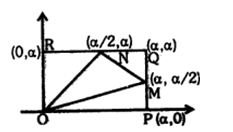
$OPQR$ is a square and point $Q$ is $(\alpha, \alpha)$. If $M$ and $N$ are the midpoints of sides $PQ$ and $QR$ respectively,then what is the ratio of the area of the square to the area of triangle $OMN$?
A
$4 : 1$
B
$2 : 1$
C
$8 : 3$
D
$4 : 3$
Solution
(C) The vertices of the square $OPQR$ are $O(0, 0)$,$P(\alpha, 0)$,$Q(\alpha, \alpha)$,and $R(0, \alpha)$.
Area of square $OPQR = \alpha^2$.
$M$ is the midpoint of $PQ$,so $M = (\frac{\alpha + \alpha}{2}, \frac{0 + \alpha}{2}) = (\alpha, \frac{\alpha}{2})$.
$N$ is the midpoint of $QR$,so $N = (\frac{0 + \alpha}{2}, \frac{\alpha + \alpha}{2}) = (\frac{\alpha}{2}, \alpha)$.
The coordinates of the vertices of $\triangle OMN$ are $O(0, 0)$,$M(\alpha, \frac{\alpha}{2})$,and $N(\frac{\alpha}{2}, \alpha)$.
Area of $\triangle OMN = \frac{1}{2} |x_1(y_2 - y_3) + x_2(y_3 - y_1) + x_3(y_1 - y_2)|$
$= \frac{1}{2} |0(\frac{\alpha}{2} - \alpha) + \alpha(\alpha - 0) + \frac{\alpha}{2}(0 - \frac{\alpha}{2})|$
$= \frac{1}{2} |\alpha^2 - \frac{\alpha^2}{4}| = \frac{1}{2} |\frac{3\alpha^2}{4}| = \frac{3\alpha^2}{8}$.
Ratio = $\frac{\text{Area of square}}{\text{Area of } \triangle OMN} = \frac{\alpha^2}{\frac{3\alpha^2}{8}} = \frac{8}{3} = 8 : 3$.
Area of square $OPQR = \alpha^2$.
$M$ is the midpoint of $PQ$,so $M = (\frac{\alpha + \alpha}{2}, \frac{0 + \alpha}{2}) = (\alpha, \frac{\alpha}{2})$.
$N$ is the midpoint of $QR$,so $N = (\frac{0 + \alpha}{2}, \frac{\alpha + \alpha}{2}) = (\frac{\alpha}{2}, \alpha)$.
The coordinates of the vertices of $\triangle OMN$ are $O(0, 0)$,$M(\alpha, \frac{\alpha}{2})$,and $N(\frac{\alpha}{2}, \alpha)$.
Area of $\triangle OMN = \frac{1}{2} |x_1(y_2 - y_3) + x_2(y_3 - y_1) + x_3(y_1 - y_2)|$
$= \frac{1}{2} |0(\frac{\alpha}{2} - \alpha) + \alpha(\alpha - 0) + \frac{\alpha}{2}(0 - \frac{\alpha}{2})|$
$= \frac{1}{2} |\alpha^2 - \frac{\alpha^2}{4}| = \frac{1}{2} |\frac{3\alpha^2}{4}| = \frac{3\alpha^2}{8}$.
Ratio = $\frac{\text{Area of square}}{\text{Area of } \triangle OMN} = \frac{\alpha^2}{\frac{3\alpha^2}{8}} = \frac{8}{3} = 8 : 3$.
0 likes
View Solution10
MediumMCQ
Find the area of the pentagon with vertices $A(1, 1)$,$B(7, 21)$,$C(7, -3)$,$D(12, 2)$,and $E(0, -3)$.
A
$115/2$
B
$125/3$
C
$137/2$
D
$139/3$
Solution
(C) The area of a polygon with vertices $(x_1, y_1), (x_2, y_2), \dots, (x_n, y_n)$ is given by the formula: $\text{Area} = \frac{1}{2} |(x_1y_2 - y_1x_2) + (x_2y_3 - y_2x_3) + (x_3y_4 - y_3x_4) + (x_4y_5 - y_4x_5) + (x_5y_1 - y_5x_1)|$. \\ Substituting the given points $A(1, 1), B(7, 21), C(7, -3), D(12, 2), E(0, -3)$: \\ $\text{Area} = \frac{1}{2} |(1 \times 21 - 1 \times 7) + (7 \times -3 - 21 \times 7) + (7 \times 2 - (-3) \times 12) + (12 \times -3 - 2 \times 0) + (0 \times 1 - (-3) \times 1)|$ \\ $\text{Area} = \frac{1}{2} |(21 - 7) + (-21 - 147) + (14 + 36) + (-36 - 0) + (0 + 3)|$ \\ $\text{Area} = \frac{1}{2} |14 - 168 + 50 - 36 + 3| = \frac{1}{2} |-137| = \frac{137}{2} \text{ square units}$.
0 likes
View Solution11
MediumMCQ
If $D, E,$ and $F$ are the midpoints of the sides $AB, BC,$ and $CA$ of the triangle formed by the points $A\ (5, -1), B\ (-7, 6),$ and $C\ (1, 3)$ respectively,find the area of $\Delta DEF$.
A
$0.4$
B
$2.5$
C
$5$
D
$10$
Solution
(B) The area of the triangle formed by joining the midpoints of the sides of a triangle is one-fourth of the area of the original triangle.
First,calculate the area of $\Delta ABC$ using the coordinates $A(5, -1), B(-7, 6),$ and $C(1, 3)$.
Area of $\Delta ABC = \frac{1}{2} |x_1(y_2 - y_3) + x_2(y_3 - y_1) + x_3(y_1 - y_2)|$
$= \frac{1}{2} |5(6 - 3) + (-7)(3 - (-1)) + 1(-1 - 6)|$
$= \frac{1}{2} |5(3) - 7(4) + 1(-7)|$
$= \frac{1}{2} |15 - 28 - 7|$
$= \frac{1}{2} |-20| = 10 \text{ sq. units}$.
Since the area of $\Delta DEF = \frac{1}{4} \times \text{Area of } \Delta ABC$,
Area of $\Delta DEF = \frac{1}{4} \times 10 = 2.5 \text{ sq. units}$.
First,calculate the area of $\Delta ABC$ using the coordinates $A(5, -1), B(-7, 6),$ and $C(1, 3)$.
Area of $\Delta ABC = \frac{1}{2} |x_1(y_2 - y_3) + x_2(y_3 - y_1) + x_3(y_1 - y_2)|$
$= \frac{1}{2} |5(6 - 3) + (-7)(3 - (-1)) + 1(-1 - 6)|$
$= \frac{1}{2} |5(3) - 7(4) + 1(-7)|$
$= \frac{1}{2} |15 - 28 - 7|$
$= \frac{1}{2} |-20| = 10 \text{ sq. units}$.
Since the area of $\Delta DEF = \frac{1}{4} \times \text{Area of } \Delta ABC$,
Area of $\Delta DEF = \frac{1}{4} \times 10 = 2.5 \text{ sq. units}$.
0 likes
View Solution12
MediumMCQ
The midpoints of the three sides of a triangle are $(1, 2)$,$(-1, 1)$,and $(0, 3)$. The area of this triangle is (in sq. units):
A
$2$
B
$3$
C
$4$
D
$6$
Solution
(D) Let the midpoints be $M_1(1, 2)$,$M_2(-1, 1)$,and $M_3(0, 3)$.
The area of the triangle formed by the midpoints of the sides of a triangle is one-fourth the area of the original triangle.
Area of the triangle formed by midpoints $= \frac{1}{2} |x_1(y_2 - y_3) + x_2(y_3 - y_1) + x_3(y_1 - y_2)|$
Area $= \frac{1}{2} |1(1 - 3) + (-1)(3 - 2) + 0(2 - 1)|$
Area $= \frac{1}{2} |1(-2) - 1(1) + 0| = \frac{1}{2} |-2 - 1| = \frac{1}{2} |-3| = 1.5 \text{ sq. units}$.
The area of the original triangle $= 4 \times (\text{Area of the triangle formed by midpoints}) = 4 \times 1.5 = 6 \text{ sq. units}$.
The area of the triangle formed by the midpoints of the sides of a triangle is one-fourth the area of the original triangle.
Area of the triangle formed by midpoints $= \frac{1}{2} |x_1(y_2 - y_3) + x_2(y_3 - y_1) + x_3(y_1 - y_2)|$
Area $= \frac{1}{2} |1(1 - 3) + (-1)(3 - 2) + 0(2 - 1)|$
Area $= \frac{1}{2} |1(-2) - 1(1) + 0| = \frac{1}{2} |-2 - 1| = \frac{1}{2} |-3| = 1.5 \text{ sq. units}$.
The area of the original triangle $= 4 \times (\text{Area of the triangle formed by midpoints}) = 4 \times 1.5 = 6 \text{ sq. units}$.
0 likes
View Solution13
AdvancedMCQ
The area enclosed by the curve $|x + y| + |x - y| = 11$ is
A
$121$
B
$144$
C
$60.5$
D
$169$
Solution
(A) The given equation is $|x + y| + |x - y| = 11$.
Let $u = x + y$ and $v = x - y$. The equation becomes $|u| + |v| = 11$.
This represents a square in the $uv$-plane with vertices at $(11, 0), (0, 11), (-11, 0), (0, -11)$.
The area of this square in the $uv$-plane is $2 \times (11)^2 = 242$.
The transformation from $(x, y)$ to $(u, v)$ is given by $u = x + y$ and $v = x - y$.
The Jacobian of this transformation is $J = \begin{vmatrix} \frac{\partial u}{\partial x} & \frac{\partial u}{\partial y} \\ \frac{\partial v}{\partial x} & \frac{\partial v}{\partial y} \end{vmatrix} = \begin{vmatrix} 1 & 1 \\ 1 & -1 \end{vmatrix} = -1 - 1 = -2$.
The area in the $xy$-plane is given by $\text{Area}_{xy} = \frac{\text{Area}_{uv}}{|J|} = \frac{242}{|-2|} = \frac{242}{2} = 121$.
Alternatively,the equation $|x + y| + |x - y| = a$ represents a square with vertices at $(\pm a/2, \pm a/2)$. Here $a = 11$,so vertices are $(\pm 5.5, \pm 5.5)$.
The side length of this square is the distance between $(5.5, 5.5)$ and $(-5.5, 5.5)$,which is $11$.
Thus,the area is $11^2 = 121$.
Let $u = x + y$ and $v = x - y$. The equation becomes $|u| + |v| = 11$.
This represents a square in the $uv$-plane with vertices at $(11, 0), (0, 11), (-11, 0), (0, -11)$.
The area of this square in the $uv$-plane is $2 \times (11)^2 = 242$.
The transformation from $(x, y)$ to $(u, v)$ is given by $u = x + y$ and $v = x - y$.
The Jacobian of this transformation is $J = \begin{vmatrix} \frac{\partial u}{\partial x} & \frac{\partial u}{\partial y} \\ \frac{\partial v}{\partial x} & \frac{\partial v}{\partial y} \end{vmatrix} = \begin{vmatrix} 1 & 1 \\ 1 & -1 \end{vmatrix} = -1 - 1 = -2$.
The area in the $xy$-plane is given by $\text{Area}_{xy} = \frac{\text{Area}_{uv}}{|J|} = \frac{242}{|-2|} = \frac{242}{2} = 121$.
Alternatively,the equation $|x + y| + |x - y| = a$ represents a square with vertices at $(\pm a/2, \pm a/2)$. Here $a = 11$,so vertices are $(\pm 5.5, \pm 5.5)$.
The side length of this square is the distance between $(5.5, 5.5)$ and $(-5.5, 5.5)$,which is $11$.
Thus,the area is $11^2 = 121$.

0 likes
View Solution14
AdvancedMCQ
$OPQR$ is a square and $M$ and $N$ are the midpoints of sides $PQ$ and $QR$ respectively. Then,the ratio of the area of the square to the area of the triangle $OMN$ is:
A
$4 : 1$
B
$2 : 1$
C
$8 : 3$
D
$4 : 3$
Solution
(C) Let the side length of the square be $a$. Let the coordinates of vertices $O, P, Q, R$ be $(0,0), (a, 0), (a, a), (0, a)$ respectively.
The area of the square $OPQR$ is $a^2$.
$M$ is the midpoint of $PQ$,so its coordinates are $\left(a, \frac{a}{2}\right)$.
$N$ is the midpoint of $QR$,so its coordinates are $\left(\frac{a}{2}, a\right)$.
The area of $\Delta OMN$ with vertices $(0,0), (a, \frac{a}{2}), (\frac{a}{2}, a)$ is given by:
Area $= \frac{1}{2} |x_1(y_2 - y_3) + x_2(y_3 - y_1) + x_3(y_1 - y_2)|$
Area $= \frac{1}{2} |0(\frac{a}{2} - a) + a(a - 0) + \frac{a}{2}(0 - \frac{a}{2})|$
Area $= \frac{1}{2} |a^2 - \frac{a^2}{4}| = \frac{1}{2} |\frac{3a^2}{4}| = \frac{3a^2}{8}$.
The ratio of the area of the square to the area of $\Delta OMN$ is $a^2 : \frac{3a^2}{8} = 1 : \frac{3}{8} = 8 : 3$.
The area of the square $OPQR$ is $a^2$.
$M$ is the midpoint of $PQ$,so its coordinates are $\left(a, \frac{a}{2}\right)$.
$N$ is the midpoint of $QR$,so its coordinates are $\left(\frac{a}{2}, a\right)$.
The area of $\Delta OMN$ with vertices $(0,0), (a, \frac{a}{2}), (\frac{a}{2}, a)$ is given by:
Area $= \frac{1}{2} |x_1(y_2 - y_3) + x_2(y_3 - y_1) + x_3(y_1 - y_2)|$
Area $= \frac{1}{2} |0(\frac{a}{2} - a) + a(a - 0) + \frac{a}{2}(0 - \frac{a}{2})|$
Area $= \frac{1}{2} |a^2 - \frac{a^2}{4}| = \frac{1}{2} |\frac{3a^2}{4}| = \frac{3a^2}{8}$.
The ratio of the area of the square to the area of $\Delta OMN$ is $a^2 : \frac{3a^2}{8} = 1 : \frac{3}{8} = 8 : 3$.
0 likes
View Solution15
MediumMCQ
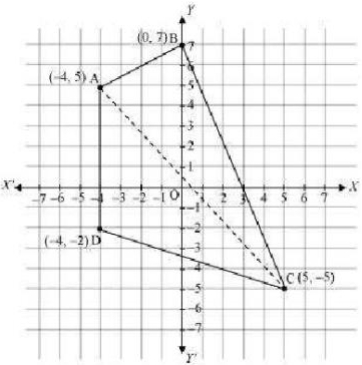
Draw a quadrilateral in the Cartesian plane,whose vertices are $(-4, 5), (0, 7), (5, -5),$ and $(-4, -2).$ Also,find its area.
A
$121/2 \text{ unit}^2$
B
$60 \text{ unit}^2$
C
$61 \text{ unit}^2$
D
$63 \text{ unit}^2$
Solution
(A) Let $ABCD$ be the given quadrilateral with vertices $A(-4, 5), B(0, 7), C(5, -5),$ and $D(-4, -2).$
To find the area of quadrilateral $ABCD$,we divide it into two triangles by drawing the diagonal $AC$.
Area $(ABCD) = \text{Area}(\Delta ABC) + \text{Area}(\Delta ACD).$
The area of a triangle with vertices $(x_1, y_1), (x_2, y_2),$ and $(x_3, y_3)$ is given by $\frac{1}{2} |x_1(y_2 - y_3) + x_2(y_3 - y_1) + x_3(y_1 - y_2)|.$
For $\Delta ABC$ with vertices $A(-4, 5), B(0, 7), C(5, -5):$
Area $(\Delta ABC) = \frac{1}{2} |-4(7 - (-5)) + 0(-5 - 5) + 5(5 - 7)|$
$= \frac{1}{2} |-4(12) + 0(-10) + 5(-2)|$
$= \frac{1}{2} |-48 - 10| = \frac{1}{2} |-58| = 29 \text{ unit}^2.$
For $\Delta ACD$ with vertices $A(-4, 5), C(5, -5), D(-4, -2):$
Area $(\Delta ACD) = \frac{1}{2} |-4(-5 - (-2)) + 5(-2 - 5) + (-4)(5 - (-5))|$
$= \frac{1}{2} |-4(-3) + 5(-7) - 4(10)|$
$= \frac{1}{2} |12 - 35 - 40| = \frac{1}{2} |-63| = 31.5 \text{ unit}^2.$
Total Area $(ABCD) = 29 + 31.5 = 60.5 = \frac{121}{2} \text{ unit}^2.$
To find the area of quadrilateral $ABCD$,we divide it into two triangles by drawing the diagonal $AC$.
Area $(ABCD) = \text{Area}(\Delta ABC) + \text{Area}(\Delta ACD).$
The area of a triangle with vertices $(x_1, y_1), (x_2, y_2),$ and $(x_3, y_3)$ is given by $\frac{1}{2} |x_1(y_2 - y_3) + x_2(y_3 - y_1) + x_3(y_1 - y_2)|.$
For $\Delta ABC$ with vertices $A(-4, 5), B(0, 7), C(5, -5):$
Area $(\Delta ABC) = \frac{1}{2} |-4(7 - (-5)) + 0(-5 - 5) + 5(5 - 7)|$
$= \frac{1}{2} |-4(12) + 0(-10) + 5(-2)|$
$= \frac{1}{2} |-48 - 10| = \frac{1}{2} |-58| = 29 \text{ unit}^2.$
For $\Delta ACD$ with vertices $A(-4, 5), C(5, -5), D(-4, -2):$
Area $(\Delta ACD) = \frac{1}{2} |-4(-5 - (-2)) + 5(-2 - 5) + (-4)(5 - (-5))|$
$= \frac{1}{2} |-4(-3) + 5(-7) - 4(10)|$
$= \frac{1}{2} |12 - 35 - 40| = \frac{1}{2} |-63| = 31.5 \text{ unit}^2.$
Total Area $(ABCD) = 29 + 31.5 = 60.5 = \frac{121}{2} \text{ unit}^2.$
0 likes
View Solution16
AdvancedMCQ
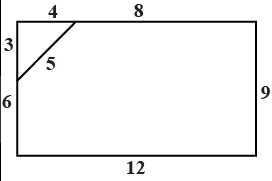
$A$ triangular corner is cut from a rectangular piece of paper and the resulting pentagon has sides $5, 6, 8, 9, 12$ in some order. The ratio of the area of the pentagon to the area of the rectangle is
A
$\frac{11}{18}$
B
$\frac{13}{18}$
C
$\frac{15}{18}$
D
$\frac{17}{18}$
Solution
(D) From the figure,the rectangle has dimensions $12 \times 9$. The area of the rectangle is $12 \times 9 = 108 \text{ sq units}$.
The triangular corner cut from the rectangle has legs of length $3$ and $4$,and a hypotenuse of length $5$.
The area of this right-angled triangle is $\frac{1}{2} \times \text{base} \times \text{height} = \frac{1}{2} \times 4 \times 3 = 6 \text{ sq units}$.
The area of the resulting pentagon is the area of the rectangle minus the area of the triangle: $108 - 6 = 102 \text{ sq units}$.
The ratio of the area of the pentagon to the area of the rectangle is $\frac{102}{108}$.
Dividing both numerator and denominator by $6$,we get $\frac{17}{18}$.
The triangular corner cut from the rectangle has legs of length $3$ and $4$,and a hypotenuse of length $5$.
The area of this right-angled triangle is $\frac{1}{2} \times \text{base} \times \text{height} = \frac{1}{2} \times 4 \times 3 = 6 \text{ sq units}$.
The area of the resulting pentagon is the area of the rectangle minus the area of the triangle: $108 - 6 = 102 \text{ sq units}$.
The ratio of the area of the pentagon to the area of the rectangle is $\frac{102}{108}$.
Dividing both numerator and denominator by $6$,we get $\frac{17}{18}$.
0 likes
View Solution17
AdvancedMCQ
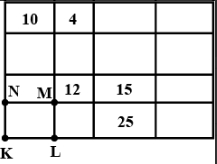
$A$ rectangle is divided into $16$ sub-rectangles as shown in the figure. The number in each sub-rectangle represents its area. What is the area of the rectangle $KLMN$?
A
$20$
B
$30$
C
$40$
D
$50$
Solution
(D) Let the widths of the columns be $x_1, x_2, x_3, x_4$ and the heights of the rows be $y_1, y_2, y_3, y_4$.
From the given areas,we have:
$x_1 y_1 = 10$,$x_2 y_1 = 4$,$x_3 y_2 = 12$,$x_4 y_2 = 15$,$x_4 y_3 = 25$.
We want to find the area of rectangle $KLMN$,which is $x_1 y_3$.
From the relations:
$x_1 = \frac{10}{y_1}$,$x_2 = \frac{4}{y_1}$,$x_3 = \frac{12}{y_2}$,$x_4 = \frac{15}{y_2}$,$y_3 = \frac{25}{x_4} = \frac{25}{15/y_2} = \frac{25 y_2}{15} = \frac{5}{3} y_2$.
Thus,the area $KLMN = x_1 y_3 = \left(\frac{10}{y_1}\right) \left(\frac{5}{3} y_2\right) = \frac{50}{3} \frac{y_2}{y_1}$.
Looking at the grid,the area $KLMN$ is the product of the width of the first column and the height of the third row.
Using the property that for any four rectangles in a $2 \times 2$ grid,the product of the areas of diagonally opposite rectangles is equal:
Let $A_{i,j}$ be the area of the rectangle in row $i$ and column $j$.
$A_{1,1} \cdot A_{2,2} = A_{1,2} \cdot A_{2,1}$.
Using the given values: $10 \cdot A_{2,2} = 4 \cdot A_{2,1} \Rightarrow A_{2,1} = 2.5 A_{2,2}$.
Also,$A_{2,2} \cdot A_{3,3} = A_{2,3} \cdot A_{3,2} \Rightarrow A_{2,2} \cdot A_{3,3} = 12 \cdot 15 = 180$.
$A_{3,3} \cdot A_{4,4} = A_{3,4} \cdot A_{4,3} \Rightarrow A_{3,3} \cdot A_{4,4} = 25 \cdot A_{4,3}$.
By observing the grid,the area of $KLMN$ is $A_{4,1} = \frac{A_{4,3} \cdot A_{2,1}}{A_{2,3}} = \frac{A_{4,3} \cdot 2.5 A_{2,2}}{12}$.
Following the grid proportions,the area is $50$.
From the given areas,we have:
$x_1 y_1 = 10$,$x_2 y_1 = 4$,$x_3 y_2 = 12$,$x_4 y_2 = 15$,$x_4 y_3 = 25$.
We want to find the area of rectangle $KLMN$,which is $x_1 y_3$.
From the relations:
$x_1 = \frac{10}{y_1}$,$x_2 = \frac{4}{y_1}$,$x_3 = \frac{12}{y_2}$,$x_4 = \frac{15}{y_2}$,$y_3 = \frac{25}{x_4} = \frac{25}{15/y_2} = \frac{25 y_2}{15} = \frac{5}{3} y_2$.
Thus,the area $KLMN = x_1 y_3 = \left(\frac{10}{y_1}\right) \left(\frac{5}{3} y_2\right) = \frac{50}{3} \frac{y_2}{y_1}$.
Looking at the grid,the area $KLMN$ is the product of the width of the first column and the height of the third row.
Using the property that for any four rectangles in a $2 \times 2$ grid,the product of the areas of diagonally opposite rectangles is equal:
Let $A_{i,j}$ be the area of the rectangle in row $i$ and column $j$.
$A_{1,1} \cdot A_{2,2} = A_{1,2} \cdot A_{2,1}$.
Using the given values: $10 \cdot A_{2,2} = 4 \cdot A_{2,1} \Rightarrow A_{2,1} = 2.5 A_{2,2}$.
Also,$A_{2,2} \cdot A_{3,3} = A_{2,3} \cdot A_{3,2} \Rightarrow A_{2,2} \cdot A_{3,3} = 12 \cdot 15 = 180$.
$A_{3,3} \cdot A_{4,4} = A_{3,4} \cdot A_{4,3} \Rightarrow A_{3,3} \cdot A_{4,4} = 25 \cdot A_{4,3}$.
By observing the grid,the area of $KLMN$ is $A_{4,1} = \frac{A_{4,3} \cdot A_{2,1}}{A_{2,3}} = \frac{A_{4,3} \cdot 2.5 A_{2,2}}{12}$.
Following the grid proportions,the area is $50$.
0 likes
View Solution18
EasyMCQ
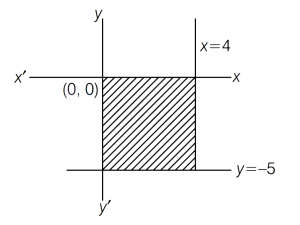
The area enclosed by the pair of lines $xy=0$,the line $x-4=0$ and $y+5=0$ is
A
$20 \text{ sq units}$
B
$10 \text{ sq units}$
C
$\frac{5}{4} \text{ sq units}$
D
$0 \text{ sq unit}$
Solution
(A) The given pair of lines $xy=0$ represents the coordinate axes,i.e.,$x=0$ and $y=0$.
The other lines are $x-4=0$ (which is $x=4$) and $y+5=0$ (which is $y=-5$).
These four lines $x=0, x=4, y=0$,and $y=-5$ enclose a rectangular region in the Cartesian plane.
The vertices of this rectangle are $(0, 0), (4, 0), (4, -5)$,and $(0, -5)$.
The length of the rectangle is the distance between $x=0$ and $x=4$,which is $|4-0| = 4 \text{ units}$.
The breadth of the rectangle is the distance between $y=0$ and $y=-5$,which is $|0-(-5)| = 5 \text{ units}$.
Therefore,the area of the rectangle is $\text{length} \times \text{breadth} = 4 \times 5 = 20 \text{ sq units}$.
The other lines are $x-4=0$ (which is $x=4$) and $y+5=0$ (which is $y=-5$).
These four lines $x=0, x=4, y=0$,and $y=-5$ enclose a rectangular region in the Cartesian plane.
The vertices of this rectangle are $(0, 0), (4, 0), (4, -5)$,and $(0, -5)$.
The length of the rectangle is the distance between $x=0$ and $x=4$,which is $|4-0| = 4 \text{ units}$.
The breadth of the rectangle is the distance between $y=0$ and $y=-5$,which is $|0-(-5)| = 5 \text{ units}$.
Therefore,the area of the rectangle is $\text{length} \times \text{breadth} = 4 \times 5 = 20 \text{ sq units}$.
0 likes
View Solution19
DifficultMCQ
The area (in square units) of the triangle formed by the points with polar coordinates $(1, 0)$,$(2, \frac{\pi}{3})$,and $(3, \frac{2\pi}{3})$ is:
A
$\frac{11\sqrt{3}}{4}$
B
$\frac{5\sqrt{3}}{4}$
C
$\frac{5}{4}$
D
$\frac{11}{4}$
Solution
(B) The area of a triangle with vertices in polar coordinates $(r_1, \theta_1)$,$(r_2, \theta_2)$,and $(r_3, \theta_3)$ is given by the formula:
$\text{Area} = \frac{1}{2} |r_1 r_2 \sin(\theta_2 - \theta_1) + r_2 r_3 \sin(\theta_3 - \theta_2) + r_3 r_1 \sin(\theta_1 - \theta_3)|$
Substituting the given values $(1, 0)$,$(2, \frac{\pi}{3})$,and $(3, \frac{2\pi}{3})$:
$\text{Area} = \frac{1}{2} |1 \cdot 2 \sin(\frac{\pi}{3} - 0) + 2 \cdot 3 \sin(\frac{2\pi}{3} - \frac{\pi}{3}) + 3 \cdot 1 \sin(0 - \frac{2\pi}{3})|$
$\text{Area} = \frac{1}{2} |2 \sin(\frac{\pi}{3}) + 6 \sin(\frac{\pi}{3}) + 3 \sin(-\frac{2\pi}{3})|$
$\text{Area} = \frac{1}{2} |2(\frac{\sqrt{3}}{2}) + 6(\frac{\sqrt{3}}{2}) + 3(-\frac{\sqrt{3}}{2})|$
$\text{Area} = \frac{1}{2} |\sqrt{3} + 3\sqrt{3} - \frac{3\sqrt{3}}{2}|$
$\text{Area} = \frac{1}{2} |4\sqrt{3} - 1.5\sqrt{3}| = \frac{1}{2} |2.5\sqrt{3}| = \frac{5\sqrt{3}}{4} \text{ square units}$
$\text{Area} = \frac{1}{2} |r_1 r_2 \sin(\theta_2 - \theta_1) + r_2 r_3 \sin(\theta_3 - \theta_2) + r_3 r_1 \sin(\theta_1 - \theta_3)|$
Substituting the given values $(1, 0)$,$(2, \frac{\pi}{3})$,and $(3, \frac{2\pi}{3})$:
$\text{Area} = \frac{1}{2} |1 \cdot 2 \sin(\frac{\pi}{3} - 0) + 2 \cdot 3 \sin(\frac{2\pi}{3} - \frac{\pi}{3}) + 3 \cdot 1 \sin(0 - \frac{2\pi}{3})|$
$\text{Area} = \frac{1}{2} |2 \sin(\frac{\pi}{3}) + 6 \sin(\frac{\pi}{3}) + 3 \sin(-\frac{2\pi}{3})|$
$\text{Area} = \frac{1}{2} |2(\frac{\sqrt{3}}{2}) + 6(\frac{\sqrt{3}}{2}) + 3(-\frac{\sqrt{3}}{2})|$
$\text{Area} = \frac{1}{2} |\sqrt{3} + 3\sqrt{3} - \frac{3\sqrt{3}}{2}|$
$\text{Area} = \frac{1}{2} |4\sqrt{3} - 1.5\sqrt{3}| = \frac{1}{2} |2.5\sqrt{3}| = \frac{5\sqrt{3}}{4} \text{ square units}$
0 likes
View Solution20
DifficultMCQ
Find the area of a triangle given that midpoints of its sides are $(2, 7)$,$(1, 1)$,and $(10, 8)$.
A
$47/4$
B
$47$
C
$94$
D
$47/2$
Solution
(C) Let the vertices of the triangle be $A(x_1, y_1)$,$B(x_2, y_2)$,and $C(x_3, y_3)$.
The midpoints of the sides are given as $M_1(2, 7)$,$M_2(1, 1)$,and $M_3(10, 8)$.
The area of the triangle formed by the midpoints of the sides of a triangle is $\frac{1}{4}$ of the area of the original triangle.
First,calculate the area of the triangle formed by the midpoints using the formula: $\text{Area} = \frac{1}{2} |x_1(y_2 - y_3) + x_2(y_3 - y_1) + x_3(y_1 - y_2)|$.
$\text{Area}_{\text{mid}} = \frac{1}{2} |2(1 - 8) + 1(8 - 7) + 10(7 - 1)|$.
$\text{Area}_{\text{mid}} = \frac{1}{2} |2(-7) + 1(1) + 10(6)|$.
$\text{Area}_{\text{mid}} = \frac{1}{2} |-14 + 1 + 60| = \frac{1}{2} |47| = 23.5$.
Since $\text{Area}_{\text{original}} = 4 \times \text{Area}_{\text{mid}}$,we have $\text{Area}_{\text{original}} = 4 \times 23.5 = 94$.
The midpoints of the sides are given as $M_1(2, 7)$,$M_2(1, 1)$,and $M_3(10, 8)$.
The area of the triangle formed by the midpoints of the sides of a triangle is $\frac{1}{4}$ of the area of the original triangle.
First,calculate the area of the triangle formed by the midpoints using the formula: $\text{Area} = \frac{1}{2} |x_1(y_2 - y_3) + x_2(y_3 - y_1) + x_3(y_1 - y_2)|$.
$\text{Area}_{\text{mid}} = \frac{1}{2} |2(1 - 8) + 1(8 - 7) + 10(7 - 1)|$.
$\text{Area}_{\text{mid}} = \frac{1}{2} |2(-7) + 1(1) + 10(6)|$.
$\text{Area}_{\text{mid}} = \frac{1}{2} |-14 + 1 + 60| = \frac{1}{2} |47| = 23.5$.
Since $\text{Area}_{\text{original}} = 4 \times \text{Area}_{\text{mid}}$,we have $\text{Area}_{\text{original}} = 4 \times 23.5 = 94$.
0 likes
View SolutionRectangular Cartesian Co-ordinates — Area of some geometrical figures · Frequently Asked Questions
1Are these Rectangular Cartesian Co-ordinates questions useful for JEE and NEET?
Yes. All questions in this section are mapped to JEE Main and NEET exam patterns. Previous year questions from JEE Main, NEET, GUJCET and state-level exams are included with full solutions.
2Can I switch to Hindi or Gujarati for these questions?
Yes. Use the language tabs in the hero section or the sidebar to view the same questions and solutions in English, Hindi or Gujarati.
3How do I generate a question paper from this subtopic?
Use the Vedclass Exam Paper Generator — select the chapter and subtopic, set difficulty, and generate Sets A, B, C, D automatically. First 3 chapters of every subject are free.
Vedclass Products
For Students
Vedclass Test Series
Mock tests in real JEE/NEET style with performance analysis. 5-day free trial.
Start Free TrialFor Teachers
Exam Paper Generator
Generate Set A/B/C/D papers from this chapter in 2 minutes. 3 chapters free.
Try FreeFor Institutes
Online Exam Module
Live online exams with unlimited students, 360° analytics & white-label branding.
See DemoFor Teachers & Institutes
Generate a Rectangular Cartesian Co-ordinates Exam Paper in 2 Minutes
Select subtopic & difficulty — Sets A, B, C, D auto-generated with No Repeat logic.
First 3 chapters of every subject are free — no payment required.