
A English
Definition of combinations, Condition combinations Questions in English
Class 11 Mathematics · Permutation and Combination · Definition of combinations, Condition combinations
363+
Questions
English
Language
100%
With Solutions
Showing 48 of 363 questions in English
301
MediumMCQ
$A$ student is to answer $10$ out of $13$ questions in an examination such that he must choose at least $4$ from the first $5$ questions. The number of choices available to him is
A
$196$
B
$140$
C
$168$
D
$176$
Solution
(A) Total number of questions $= 13$.
Number of questions to be selected $= 10$.
Restriction: At least $4$ from the first $5$ questions must be selected.
Case $I$: Exactly $4$ out of the first $5$ questions are selected.
Number of ways to select $4$ questions from $5 = {}^{5}C_{4} = 5$.
Remaining $10 - 4 = 6$ questions are selected from the last $13 - 5 = 8$ questions in ${}^{8}C_{6}$ ways.
Number of ways $= 5 \times {}^{8}C_{6} = 5 \times 28 = 140$.
Case $II$: Exactly $5$ out of the first $5$ questions are selected.
Number of ways to select $5$ out of $5$ questions $= {}^{5}C_{5} = 1$.
Remaining $10 - 5 = 5$ questions are selected from the last $13 - 5 = 8$ questions in ${}^{8}C_{5}$ ways.
Number of ways $= 1 \times {}^{8}C_{5} = 1 \times 56 = 56$.
Total number of ways $= 140 + 56 = 196$.
Number of questions to be selected $= 10$.
Restriction: At least $4$ from the first $5$ questions must be selected.
Case $I$: Exactly $4$ out of the first $5$ questions are selected.
Number of ways to select $4$ questions from $5 = {}^{5}C_{4} = 5$.
Remaining $10 - 4 = 6$ questions are selected from the last $13 - 5 = 8$ questions in ${}^{8}C_{6}$ ways.
Number of ways $= 5 \times {}^{8}C_{6} = 5 \times 28 = 140$.
Case $II$: Exactly $5$ out of the first $5$ questions are selected.
Number of ways to select $5$ out of $5$ questions $= {}^{5}C_{5} = 1$.
Remaining $10 - 5 = 5$ questions are selected from the last $13 - 5 = 8$ questions in ${}^{8}C_{5}$ ways.
Number of ways $= 1 \times {}^{8}C_{5} = 1 \times 56 = 56$.
Total number of ways $= 140 + 56 = 196$.
0 likes
View Solution302
EasyMCQ
Statement $I$: The number of ways of distributing $10$ identical balls in $4$ distinct boxes such that no box is empty is ${}^9C_3$.
Statement $II$: The number of ways of choosing $3$ places from $9$ different places is ${}^9C_3$.
Statement $II$: The number of ways of choosing $3$ places from $9$ different places is ${}^9C_3$.
A
Statement $I$ is true,statement $II$ is true,statement $II$ is not a correct explanation for statement $I$
B
Statement $I$ is true,statement $II$ is false
C
Statement $I$ is false,statement $II$ is true
D
Statement $I$ is true,statement $II$ is true,statement $II$ is a correct explanation for statement $I$
Solution
(A) Statement $I$: The number of ways of distributing $n$ identical items into $r$ distinct boxes such that no box is empty is given by the formula ${}^{n-1}C_{r-1}$.
Here,$n = 10$ and $r = 4$.
So,the number of ways is ${}^{10-1}C_{4-1} = {}^9C_3$.
Thus,Statement $I$ is true.
Statement $II$: The number of ways of choosing $r$ items from $n$ distinct items is ${}^nC_r$.
For choosing $3$ places from $9$ different places,the number of ways is ${}^9C_3$.
Thus,Statement $II$ is true.
Since Statement $II$ is a standard combinatorial formula and not the logical derivation for the specific distribution problem in Statement $I$,Statement $II$ is not the correct explanation for Statement $I$.
Here,$n = 10$ and $r = 4$.
So,the number of ways is ${}^{10-1}C_{4-1} = {}^9C_3$.
Thus,Statement $I$ is true.
Statement $II$: The number of ways of choosing $r$ items from $n$ distinct items is ${}^nC_r$.
For choosing $3$ places from $9$ different places,the number of ways is ${}^9C_3$.
Thus,Statement $II$ is true.
Since Statement $II$ is a standard combinatorial formula and not the logical derivation for the specific distribution problem in Statement $I$,Statement $II$ is not the correct explanation for Statement $I$.
0 likes
View Solution303
MediumMCQ
From a group of $10$ men and $8$ women,the number of ways of forming a committee of $8$ members with not more than $5$ men and not less than $5$ women is
A
$8061$
B
$8060$
C
$20997$
D
$20952$
Solution
(A) Given,a group of $10$ men and $8$ women. We need to form a committee of $8$ members such that there are not more than $5$ men and not less than $5$ women.
This implies the possible combinations of (Women,Men) are:
$(5W, 3M), (6W, 2M), (7W, 1M), (8W, 0M)$.
The number of ways is calculated as:
$= \binom{8}{5} \times \binom{10}{3} + \binom{8}{6} \times \binom{10}{2} + \binom{8}{7} \times \binom{10}{1} + \binom{8}{8} \times \binom{10}{0}$
$= (56 \times 120) + (28 \times 45) + (8 \times 10) + (1 \times 1)$
$= 6720 + 1260 + 80 + 1 = 8061$ ways.
This implies the possible combinations of (Women,Men) are:
$(5W, 3M), (6W, 2M), (7W, 1M), (8W, 0M)$.
The number of ways is calculated as:
$= \binom{8}{5} \times \binom{10}{3} + \binom{8}{6} \times \binom{10}{2} + \binom{8}{7} \times \binom{10}{1} + \binom{8}{8} \times \binom{10}{0}$
$= (56 \times 120) + (28 \times 45) + (8 \times 10) + (1 \times 1)$
$= 6720 + 1260 + 80 + 1 = 8061$ ways.
0 likes
View Solution304
EasyMCQ
If $5$ dice are rolled simultaneously,then the number of ways of getting a total of $7$ on their faces is:
A
$12$
B
$15$
C
$20$
D
$25$
Solution
(B) To get a sum of $7$ with $5$ dice,each die must show at least $1$. Let the outcomes be $x_1, x_2, x_3, x_4, x_5$ where $x_i \ge 1$. The sum is $x_1 + x_2 + x_3 + x_4 + x_5 = 7$.
Since each $x_i \ge 1$,we can write $x_i = 1 + y_i$ where $y_i \ge 0$.
Substituting this,we get $(1+y_1) + (1+y_2) + (1+y_3) + (1+y_4) + (1+y_5) = 7$,which simplifies to $y_1 + y_2 + y_3 + y_4 + y_5 = 2$.
The number of non-negative integer solutions is given by the formula $\binom{n+r-1}{r-1}$ where $n=2$ and $r=5$.
This is $\binom{2+5-1}{5-1} = \binom{6}{4} = \binom{6}{2} = \frac{6 \times 5}{2} = 15$.
Alternatively,the cases are:
$(i)$ Four $1$s and one $3$: $\frac{5!}{4!1!} = 5$ ways.
(ii) Three $1$s and two $2$s: $\frac{5!}{3!2!} = 10$ ways.
Total ways = $5 + 10 = 15$.
Since each $x_i \ge 1$,we can write $x_i = 1 + y_i$ where $y_i \ge 0$.
Substituting this,we get $(1+y_1) + (1+y_2) + (1+y_3) + (1+y_4) + (1+y_5) = 7$,which simplifies to $y_1 + y_2 + y_3 + y_4 + y_5 = 2$.
The number of non-negative integer solutions is given by the formula $\binom{n+r-1}{r-1}$ where $n=2$ and $r=5$.
This is $\binom{2+5-1}{5-1} = \binom{6}{4} = \binom{6}{2} = \frac{6 \times 5}{2} = 15$.
Alternatively,the cases are:
$(i)$ Four $1$s and one $3$: $\frac{5!}{4!1!} = 5$ ways.
(ii) Three $1$s and two $2$s: $\frac{5!}{3!2!} = 10$ ways.
Total ways = $5 + 10 = 15$.
0 likes
View Solution305
EasyMCQ
The number of ways of distributing $500$ dissimilar boxes equally among $50$ persons is:
A
$500! / (10!)^{50}$
B
$500! / (50!)^{10} \cdot 10!$
C
$500! / (50!)^{10}$
D
$500! / (10!)^{50} \cdot 50!$
Solution
(A) The number of ways to distribute $N = m \times n$ distinct items equally among $n$ persons is given by the multinomial coefficient formula: $\frac{(mn)!}{(m!)^n}$.
Here,$N = 500$,$n = 50$,and $m = 10$ (since $500 = 50 \times 10$).
Therefore,the number of ways is $\frac{500!}{(10!)^{50}}$.
Here,$N = 500$,$n = 50$,and $m = 10$ (since $500 = 50 \times 10$).
Therefore,the number of ways is $\frac{500!}{(10!)^{50}}$.
0 likes
View Solution306
MediumMCQ
The number of $5$ card combinations out of a deck of $52$ cards such that there is exactly one ace in each combination is:
A
$823764$
B
$363428$
C
$778320$
D
$542380$
Solution
(C) To form a combination of $5$ cards with exactly one ace from a deck of $52$ cards:
$1$. Select $1$ ace from the $4$ available aces: $^4C_1 = 4$.
$2$. Select the remaining $4$ cards from the $48$ non-ace cards: $^{48}C_4$.
$3$. The total number of combinations is $^4C_1 \times ^{48}C_4$.
$\begin{aligned} & = 4 \times \frac{48 \times 47 \times 46 \times 45}{4 \times 3 \times 2 \times 1} \\ & = 4 \times 194580 \\ & = 778320 \end{aligned}$
$1$. Select $1$ ace from the $4$ available aces: $^4C_1 = 4$.
$2$. Select the remaining $4$ cards from the $48$ non-ace cards: $^{48}C_4$.
$3$. The total number of combinations is $^4C_1 \times ^{48}C_4$.
$\begin{aligned} & = 4 \times \frac{48 \times 47 \times 46 \times 45}{4 \times 3 \times 2 \times 1} \\ & = 4 \times 194580 \\ & = 778320 \end{aligned}$
0 likes
View Solution307
EasyMCQ
If the number of subsets with $8$ elements from the set $A=\{a_1, a_2, a_3, \ldots, a_n\}$,$n \geq 8$,is five times the number of such subsets containing $a_4$,then $n=$
A
$35$
B
$40$
C
$45$
D
$50$
Solution
(B) The total number of subsets with $8$ elements from a set of $n$ elements is given by $\binom{n}{8}$.
The number of subsets with $8$ elements that contain $a_4$ is equivalent to choosing $7$ more elements from the remaining $(n-1)$ elements,which is $\binom{n-1}{7}$.
According to the problem,$\binom{n}{8} = 5 \times \binom{n-1}{7}$.
Using the identity $\binom{n}{r} = \frac{n}{r} \binom{n-1}{r-1}$,we have $\binom{n}{8} = \frac{n}{8} \binom{n-1}{7}$.
Substituting this into the equation: $\frac{n}{8} \binom{n-1}{7} = 5 \times \binom{n-1}{7}$.
Since $\binom{n-1}{7} \neq 0$,we can divide both sides by $\binom{n-1}{7}$ to get $\frac{n}{8} = 5$.
Therefore,$n = 5 \times 8 = 40$.
The number of subsets with $8$ elements that contain $a_4$ is equivalent to choosing $7$ more elements from the remaining $(n-1)$ elements,which is $\binom{n-1}{7}$.
According to the problem,$\binom{n}{8} = 5 \times \binom{n-1}{7}$.
Using the identity $\binom{n}{r} = \frac{n}{r} \binom{n-1}{r-1}$,we have $\binom{n}{8} = \frac{n}{8} \binom{n-1}{7}$.
Substituting this into the equation: $\frac{n}{8} \binom{n-1}{7} = 5 \times \binom{n-1}{7}$.
Since $\binom{n-1}{7} \neq 0$,we can divide both sides by $\binom{n-1}{7}$ to get $\frac{n}{8} = 5$.
Therefore,$n = 5 \times 8 = 40$.
0 likes
View Solution308
MediumMCQ
The number of elements in the set $\{x \in N : ^{20-2x}C_{x-3} \in N\}$ is
A
$3$
B
$4$
C
$5$
D
$6$
Solution
(C) For the binomial coefficient $^{n}C_{r}$ to be a natural number,we must have $n \geq r \geq 0$ and $n, r \in \mathbb{N}_0$.
Given $^{20-2x}C_{x-3} \in N$,the following conditions must be satisfied:
$1) \; x-3 \geq 0 \Rightarrow x \geq 3$
$2) \; 20-2x \geq x-3$ $\Rightarrow 23 \geq 3x$ $\Rightarrow x \leq \frac{23}{3} \approx 7.66$
$3) \; 20-2x \geq 0 \Rightarrow x \leq 10$
Combining these inequalities,we get $3 \leq x \leq 7.66$.
Since $x \in N$,the possible values for $x$ are $3, 4, 5, 6, 7$.
Thus,there are $5$ elements in the set.
Given $^{20-2x}C_{x-3} \in N$,the following conditions must be satisfied:
$1) \; x-3 \geq 0 \Rightarrow x \geq 3$
$2) \; 20-2x \geq x-3$ $\Rightarrow 23 \geq 3x$ $\Rightarrow x \leq \frac{23}{3} \approx 7.66$
$3) \; 20-2x \geq 0 \Rightarrow x \leq 10$
Combining these inequalities,we get $3 \leq x \leq 7.66$.
Since $x \in N$,the possible values for $x$ are $3, 4, 5, 6, 7$.
Thus,there are $5$ elements in the set.
0 likes
View Solution309
EasyMCQ
The least value of $n$ such that ${}^{(n-1)}C_6 + {}^{(n-1)}C_7 < {}^{n}C_8$ is
A
$14$
B
$15$
C
$16$
D
$17$
Solution
(C) Using the identity ${}^{n}C_{r} + {}^{n}C_{r-1} = {}^{n+1}C_{r}$,we have:
${}^{(n-1)}C_6 + {}^{(n-1)}C_7 = {}^{n}C_7$
Given inequality: ${}^{n}C_7 < {}^{n}C_8$
Using the property $\frac{{}^{n}C_{r}}{{}^{n}C_{r-1}} = \frac{n-r+1}{r}$,we get:
$\frac{{}^{n}C_8}{{}^{n}C_7} > 1$
$\frac{n-8+1}{8} > 1$
$\frac{n-7}{8} > 1$
$n-7 > 8$
$n > 15$
Therefore,the least integer value of $n$ is $16$.
${}^{(n-1)}C_6 + {}^{(n-1)}C_7 = {}^{n}C_7$
Given inequality: ${}^{n}C_7 < {}^{n}C_8$
Using the property $\frac{{}^{n}C_{r}}{{}^{n}C_{r-1}} = \frac{n-r+1}{r}$,we get:
$\frac{{}^{n}C_8}{{}^{n}C_7} > 1$
$\frac{n-8+1}{8} > 1$
$\frac{n-7}{8} > 1$
$n-7 > 8$
$n > 15$
Therefore,the least integer value of $n$ is $16$.
0 likes
View Solution310
MediumMCQ
The least value of $n$ such that ${ }^{(n-1)} C_3 + { }^{(n-1)} C_4 > { }^n C_3$ is:
A
$11$
B
$9$
C
$8$
D
$7$
Solution
(C) Given the inequality: ${ }^{(n-1)} C_3 + { }^{(n-1)} C_4 > { }^n C_3$
Using the Pascal's identity ${ }^n C_{r-1} + { }^n C_r = { }^{n+1} C_r$,we have:
${ }^{(n-1)} C_3 + { }^{(n-1)} C_4 = { }^n C_4$
Substituting this into the inequality:
${ }^n C_4 > { }^n C_3$
Expanding the combinations:
$\frac{n!}{4!(n-4)!} > \frac{n!}{3!(n-3)!}$
Since $n! > 0$,we can divide both sides by $n!$:
$\frac{1}{4!(n-4)!} > \frac{1}{3!(n-3)!}$
$\frac{1}{4 \times 3! \times (n-4)!} > \frac{1}{3! \times (n-3) \times (n-4)!}$
$\frac{1}{4} > \frac{1}{n-3}$
Since $n-3 > 0$ (as $n \ge 4$),we can cross-multiply:
$n - 3 > 4$
$n > 7$
Therefore,the least integer value of $n$ is $8$.
Using the Pascal's identity ${ }^n C_{r-1} + { }^n C_r = { }^{n+1} C_r$,we have:
${ }^{(n-1)} C_3 + { }^{(n-1)} C_4 = { }^n C_4$
Substituting this into the inequality:
${ }^n C_4 > { }^n C_3$
Expanding the combinations:
$\frac{n!}{4!(n-4)!} > \frac{n!}{3!(n-3)!}$
Since $n! > 0$,we can divide both sides by $n!$:
$\frac{1}{4!(n-4)!} > \frac{1}{3!(n-3)!}$
$\frac{1}{4 \times 3! \times (n-4)!} > \frac{1}{3! \times (n-3) \times (n-4)!}$
$\frac{1}{4} > \frac{1}{n-3}$
Since $n-3 > 0$ (as $n \ge 4$),we can cross-multiply:
$n - 3 > 4$
$n > 7$
Therefore,the least integer value of $n$ is $8$.
0 likes
View Solution311
EasyMCQ
If $10 \cdot ^nC_2 = 3 \cdot ^{n+1}C_3$,then the value of $n$ is
A
$3$
B
$10$
C
$7$
D
$9$
Solution
(D) Given the equation: $10 \cdot ^nC_2 = 3 \cdot ^{n+1}C_3$
Using the formula $^nC_r = \frac{n!}{r!(n-r)!}$:
$10 \cdot \frac{n!}{2!(n-2)!} = 3 \cdot \frac{(n+1)!}{3!(n+1-3)!}$
$10 \cdot \frac{n(n-1)}{2} = 3 \cdot \frac{(n+1)n(n-1)}{6}$
$5n(n-1) = \frac{(n+1)n(n-1)}{2}$
Since $n > 2$,we can divide both sides by $n(n-1)$:
$5 = \frac{n+1}{2}$
$10 = n + 1$
$n = 9$
Using the formula $^nC_r = \frac{n!}{r!(n-r)!}$:
$10 \cdot \frac{n!}{2!(n-2)!} = 3 \cdot \frac{(n+1)!}{3!(n+1-3)!}$
$10 \cdot \frac{n(n-1)}{2} = 3 \cdot \frac{(n+1)n(n-1)}{6}$
$5n(n-1) = \frac{(n+1)n(n-1)}{2}$
Since $n > 2$,we can divide both sides by $n(n-1)$:
$5 = \frac{n+1}{2}$
$10 = n + 1$
$n = 9$
0 likes
View Solution312
EasyMCQ
If ${ }^{2n}C_3 : { }^{n}C_3 = 12 : 1$,then $n =$
A
$5$
B
$8$
C
$10$
D
$3$
Solution
(A) Given $\frac{{ }^{2n}C_3}{{ }^{n}C_3} = \frac{12}{1}$.
Using the formula ${ }^{n}C_r = \frac{n!}{r!(n-r)!}$,we have:
$\frac{\frac{(2n)!}{3!(2n-3)!}}{\frac{n!}{3!(n-3)!}} = 12$
$\Rightarrow \frac{2n(2n-1)(2n-2)(2n-3)!}{3!(2n-3)!} \times \frac{3!(n-3)!}{n(n-1)(n-2)(n-3)!} = 12$
$\Rightarrow \frac{2n(2n-1) \cdot 2(n-1)}{n(n-1)(n-2)} = 12$
$\Rightarrow \frac{4n(2n-1)}{n(n-2)} = 12$
$\Rightarrow \frac{4(2n-1)}{n-2} = 12$
$\Rightarrow 2n-1 = 3(n-2)$
$\Rightarrow 2n-1 = 3n-6$
$\Rightarrow n = 5$.
Using the formula ${ }^{n}C_r = \frac{n!}{r!(n-r)!}$,we have:
$\frac{\frac{(2n)!}{3!(2n-3)!}}{\frac{n!}{3!(n-3)!}} = 12$
$\Rightarrow \frac{2n(2n-1)(2n-2)(2n-3)!}{3!(2n-3)!} \times \frac{3!(n-3)!}{n(n-1)(n-2)(n-3)!} = 12$
$\Rightarrow \frac{2n(2n-1) \cdot 2(n-1)}{n(n-1)(n-2)} = 12$
$\Rightarrow \frac{4n(2n-1)}{n(n-2)} = 12$
$\Rightarrow \frac{4(2n-1)}{n-2} = 12$
$\Rightarrow 2n-1 = 3(n-2)$
$\Rightarrow 2n-1 = 3n-6$
$\Rightarrow n = 5$.
0 likes
View Solution313
EasyMCQ
If ${ }^9 C_3+{ }^9 C_5={ }^{10} C_r$ for some $r \in N$,then $r=$
A
$3$
B
$4$
C
$5$
D
$7$
Solution
(B) We use the property ${ }^n C_r={ }^n C_{n-r}$.
${ }^9 C_5={ }^9 C_{9-5}={ }^9 C_4$.
Now,the expression becomes ${ }^9 C_3+{ }^9 C_4$.
Using the Pascal's identity ${ }^n C_r+{ }^n C_{r-1}={ }^{n+1} C_r$,we get:
${ }^9 C_4+{ }^9 C_3={ }^{10} C_4$.
Comparing this with ${ }^{10} C_r$,we find $r=4$.
${ }^9 C_5={ }^9 C_{9-5}={ }^9 C_4$.
Now,the expression becomes ${ }^9 C_3+{ }^9 C_4$.
Using the Pascal's identity ${ }^n C_r+{ }^n C_{r-1}={ }^{n+1} C_r$,we get:
${ }^9 C_4+{ }^9 C_3={ }^{10} C_4$.
Comparing this with ${ }^{10} C_r$,we find $r=4$.
0 likes
View Solution314
MediumMCQ
The value of ${ }^{34}C_5 + \sum_{i=0}^4 {}^{38-i}C_4$ is
A
${ }^{39}C_4$
B
${ }^{39}C_5$
C
${ }^{38}C_5$
D
${ }^{38}C_4$
Solution
(B) We use the Pascal's identity: ${}^nC_r + {}^nC_{r-1} = {}^{n+1}C_r$.
The given expression is ${}^{34}C_5 + \sum_{i=0}^4 {}^{38-i}C_4 = {}^{34}C_5 + {}^{38}C_4 + {}^{37}C_4 + {}^{36}C_4 + {}^{35}C_4 + {}^{34}C_4$.
Rearranging the terms,we get $({}^{34}C_5 + {}^{34}C_4) + {}^{35}C_4 + {}^{36}C_4 + {}^{37}C_4 + {}^{38}C_4$.
Applying the identity ${}^{34}C_5 + {}^{34}C_4 = {}^{35}C_5$,the expression becomes ${}^{35}C_5 + {}^{35}C_4 + {}^{36}C_4 + {}^{37}C_4 + {}^{38}C_4$.
Continuing this process: ${}^{35}C_5 + {}^{35}C_4 = {}^{36}C_5$,then ${}^{36}C_5 + {}^{36}C_4 = {}^{37}C_5$,then ${}^{37}C_5 + {}^{37}C_4 = {}^{38}C_5$,and finally ${}^{38}C_5 + {}^{38}C_4 = {}^{39}C_5$.
The given expression is ${}^{34}C_5 + \sum_{i=0}^4 {}^{38-i}C_4 = {}^{34}C_5 + {}^{38}C_4 + {}^{37}C_4 + {}^{36}C_4 + {}^{35}C_4 + {}^{34}C_4$.
Rearranging the terms,we get $({}^{34}C_5 + {}^{34}C_4) + {}^{35}C_4 + {}^{36}C_4 + {}^{37}C_4 + {}^{38}C_4$.
Applying the identity ${}^{34}C_5 + {}^{34}C_4 = {}^{35}C_5$,the expression becomes ${}^{35}C_5 + {}^{35}C_4 + {}^{36}C_4 + {}^{37}C_4 + {}^{38}C_4$.
Continuing this process: ${}^{35}C_5 + {}^{35}C_4 = {}^{36}C_5$,then ${}^{36}C_5 + {}^{36}C_4 = {}^{37}C_5$,then ${}^{37}C_5 + {}^{37}C_4 = {}^{38}C_5$,and finally ${}^{38}C_5 + {}^{38}C_4 = {}^{39}C_5$.
0 likes
View Solution315
DifficultMCQ
If ${ }^{n-3} C_r + B \cdot { }^{n-3} C_{r-1} + B^{\prime} \cdot { }^{n-3} C_{r-2} + { }^{n-3} C_{r-3} = { }^n C_r$ holds for all $n \geq r \geq 3$,then $(B, B^{\prime}) = $.
A
$(1, 5)$
B
$(5, 1)$
C
$(3, 3)$
D
$(4, 2)$
Solution
(C) We use the identity ${ }^n C_r + { }^n C_{r-1} = { }^{n+1} C_r$.
Given: ${ }^{n-3} C_r + B \cdot { }^{n-3} C_{r-1} + B^{\prime} \cdot { }^{n-3} C_{r-2} + { }^{n-3} C_{r-3} = { }^n C_r$.
We know that ${ }^n C_r = { }^{n-1} C_r + { }^{n-1} C_{r-1} = ({ }^{n-2} C_r + { }^{n-2} C_{r-1}) + ({ }^{n-2} C_{r-1} + { }^{n-2} C_{r-2}) = { }^{n-2} C_r + 2 \cdot { }^{n-2} C_{r-1} + { }^{n-2} C_{r-2}$.
Expanding further: ${ }^{n-2} C_r + 2({ }^{n-3} C_{r-1} + { }^{n-3} C_{r-2}) + ({ }^{n-3} C_{r-2} + { }^{n-3} C_{r-3}) = { }^{n-3} C_r + { }^{n-3} C_{r-1} + 2 \cdot { }^{n-3} C_{r-1} + 2 \cdot { }^{n-3} C_{r-2} + { }^{n-3} C_{r-2} + { }^{n-3} C_{r-3} = { }^{n-3} C_r + 3 \cdot { }^{n-3} C_{r-1} + 3 \cdot { }^{n-3} C_{r-2} + { }^{n-3} C_{r-3}$.
Comparing this with the given equation ${ }^{n-3} C_r + B \cdot { }^{n-3} C_{r-1} + B^{\prime} \cdot { }^{n-3} C_{r-2} + { }^{n-3} C_{r-3} = { }^n C_r$,we get $B = 3$ and $B^{\prime} = 3$.
Thus,$(B, B^{\prime}) = (3, 3)$.
Given: ${ }^{n-3} C_r + B \cdot { }^{n-3} C_{r-1} + B^{\prime} \cdot { }^{n-3} C_{r-2} + { }^{n-3} C_{r-3} = { }^n C_r$.
We know that ${ }^n C_r = { }^{n-1} C_r + { }^{n-1} C_{r-1} = ({ }^{n-2} C_r + { }^{n-2} C_{r-1}) + ({ }^{n-2} C_{r-1} + { }^{n-2} C_{r-2}) = { }^{n-2} C_r + 2 \cdot { }^{n-2} C_{r-1} + { }^{n-2} C_{r-2}$.
Expanding further: ${ }^{n-2} C_r + 2({ }^{n-3} C_{r-1} + { }^{n-3} C_{r-2}) + ({ }^{n-3} C_{r-2} + { }^{n-3} C_{r-3}) = { }^{n-3} C_r + { }^{n-3} C_{r-1} + 2 \cdot { }^{n-3} C_{r-1} + 2 \cdot { }^{n-3} C_{r-2} + { }^{n-3} C_{r-2} + { }^{n-3} C_{r-3} = { }^{n-3} C_r + 3 \cdot { }^{n-3} C_{r-1} + 3 \cdot { }^{n-3} C_{r-2} + { }^{n-3} C_{r-3}$.
Comparing this with the given equation ${ }^{n-3} C_r + B \cdot { }^{n-3} C_{r-1} + B^{\prime} \cdot { }^{n-3} C_{r-2} + { }^{n-3} C_{r-3} = { }^n C_r$,we get $B = 3$ and $B^{\prime} = 3$.
Thus,$(B, B^{\prime}) = (3, 3)$.
0 likes
View Solution316
MediumMCQ
The value of $\sum_{r=0}^4 {}^{(19-r)} C_3 + {}^{15} C_4$ is equal to
A
${}^{21} C_4$
B
${}^{19} C_4$
C
${}^{20} C_4$
D
${}^{16} C_4$
Solution
(C) We use the identity ${}^{n} C_r + {}^{n} C_{r-1} = {}^{n+1} C_r$.
Given expression: $\sum_{r=0}^4 {}^{19-r} C_3 + {}^{15} C_4$
$= {}^{19} C_3 + {}^{18} C_3 + {}^{17} C_3 + {}^{16} C_3 + {}^{15} C_3 + {}^{15} C_4$
$= {}^{19} C_3 + {}^{18} C_3 + {}^{17} C_3 + {}^{16} C_3 + ({}^{15} C_3 + {}^{15} C_4)$
$= {}^{19} C_3 + {}^{18} C_3 + {}^{17} C_3 + ({}^{16} C_3 + {}^{16} C_4)$
$= {}^{19} C_3 + {}^{18} C_3 + ({}^{17} C_3 + {}^{17} C_4)$
$= {}^{19} C_3 + ({}^{18} C_3 + {}^{18} C_4)$
$= {}^{19} C_3 + {}^{19} C_4$
$= {}^{20} C_4$
Given expression: $\sum_{r=0}^4 {}^{19-r} C_3 + {}^{15} C_4$
$= {}^{19} C_3 + {}^{18} C_3 + {}^{17} C_3 + {}^{16} C_3 + {}^{15} C_3 + {}^{15} C_4$
$= {}^{19} C_3 + {}^{18} C_3 + {}^{17} C_3 + {}^{16} C_3 + ({}^{15} C_3 + {}^{15} C_4)$
$= {}^{19} C_3 + {}^{18} C_3 + {}^{17} C_3 + ({}^{16} C_3 + {}^{16} C_4)$
$= {}^{19} C_3 + {}^{18} C_3 + ({}^{17} C_3 + {}^{17} C_4)$
$= {}^{19} C_3 + ({}^{18} C_3 + {}^{18} C_4)$
$= {}^{19} C_3 + {}^{19} C_4$
$= {}^{20} C_4$
0 likes
View Solution317
EasyMCQ
If ${}^n C_7 = {}^n C_6$,then ${}^n C_2 = $
A
$858$
B
$13$
C
$1$
D
$78$
Solution
(D) Given,${}^n C_7 = {}^n C_6$.
Using the property: If ${}^n C_x = {}^n C_y$,then either $x = y$ or $x + y = n$.
Since $7 \neq 6$,we must have $n = 7 + 6 = 13$.
Therefore,${}^n C_2 = {}^{13} C_2 = \frac{13 \times 12}{2 \times 1} = 13 \times 6 = 78$.
Hence,option $D$ is correct.
Using the property: If ${}^n C_x = {}^n C_y$,then either $x = y$ or $x + y = n$.
Since $7 \neq 6$,we must have $n = 7 + 6 = 13$.
Therefore,${}^n C_2 = {}^{13} C_2 = \frac{13 \times 12}{2 \times 1} = 13 \times 6 = 78$.
Hence,option $D$ is correct.
0 likes
View Solution318
EasyMCQ
If ${ }^{12} C_{2 k-1}={ }^{12} C_{k+1}$,then find $k$.
A
$3$
B
$6$
C
$9$
D
$4$
Solution
(D) Given that,${ }^{12} C_{2 k-1}={ }^{12} C_{k+1}$.
We know that if ${ }^n C_x={ }^n C_y$,then either $x=y$ or $x+y=n$.
Case $1$: $2k-1 = k+1$
$k = 2$.
Case $2$: $(2k-1) + (k+1) = 12$
$3k = 12$
$k = 4$.
Since $k=4$ is one of the given options,the correct value is $4$.
We know that if ${ }^n C_x={ }^n C_y$,then either $x=y$ or $x+y=n$.
Case $1$: $2k-1 = k+1$
$k = 2$.
Case $2$: $(2k-1) + (k+1) = 12$
$3k = 12$
$k = 4$.
Since $k=4$ is one of the given options,the correct value is $4$.
0 likes
View Solution319
EasyMCQ
If $^{n-1}C_r = (k^2 - 3) \cdot ^nC_{r+1}$,then an interval containing the values of $k$ is
A
$(-\infty, -2]$
B
$[-\sqrt{3}, \sqrt{3}]$
C
$[\sqrt{3}, 2]$
D
$(-\infty, -2] \cup [2, \infty)$
Solution
(C) We are given the equation: $^{n-1}C_r = (k^2 - 3) \cdot ^nC_{r+1}$.
Using the identity $^nC_r = \frac{n}{r} \cdot ^{n-1}C_{r-1}$,we can write $^nC_{r+1} = \frac{n}{r+1} \cdot ^{n-1}C_r$.
Substituting this into the given equation:
$^{n-1}C_r = (k^2 - 3) \cdot \frac{n}{r+1} \cdot ^{n-1}C_r$.
Assuming $^{n-1}C_r \neq 0$,we divide both sides by $^{n-1}C_r$:
$1 = (k^2 - 3) \cdot \frac{n}{r+1}$.
Rearranging for $k^2 - 3$:
$k^2 - 3 = \frac{r+1}{n}$.
Since $0 \le r \le n-1$,the ratio $\frac{r+1}{n}$ lies in the interval $(0, 1]$.
Thus,$0 < k^2 - 3 \le 1$.
Adding $3$ to all parts:
$3 < k^2 \le 4$.
Taking the square root,we get $k \in [-2, -\sqrt{3}) \cup (\sqrt{3}, 2]$.
Comparing this with the given options,the interval $[\sqrt{3}, 2]$ is a subset of the possible values for $k$.
Using the identity $^nC_r = \frac{n}{r} \cdot ^{n-1}C_{r-1}$,we can write $^nC_{r+1} = \frac{n}{r+1} \cdot ^{n-1}C_r$.
Substituting this into the given equation:
$^{n-1}C_r = (k^2 - 3) \cdot \frac{n}{r+1} \cdot ^{n-1}C_r$.
Assuming $^{n-1}C_r \neq 0$,we divide both sides by $^{n-1}C_r$:
$1 = (k^2 - 3) \cdot \frac{n}{r+1}$.
Rearranging for $k^2 - 3$:
$k^2 - 3 = \frac{r+1}{n}$.
Since $0 \le r \le n-1$,the ratio $\frac{r+1}{n}$ lies in the interval $(0, 1]$.
Thus,$0 < k^2 - 3 \le 1$.
Adding $3$ to all parts:
$3 < k^2 \le 4$.
Taking the square root,we get $k \in [-2, -\sqrt{3}) \cup (\sqrt{3}, 2]$.
Comparing this with the given options,the interval $[\sqrt{3}, 2]$ is a subset of the possible values for $k$.
0 likes
View Solution320
MediumMCQ
If $N(n) = n \prod_{r=1}^{2023} (n^2 - r^2)$ for $n > 2023$,then find the value of ${}^{N}C_{N-1}$ when $n = 2024$.
A
$(4047)!$
B
$(4048)!$
C
$(6023)!$
D
$(6069)!$
Solution
(A) Given $N(n) = n \prod_{r=1}^{2023} (n^2 - r^2) = n \cdot \left[ \prod_{r=1}^{2023} (n-r) \right] \left[ \prod_{r=1}^{2023} (n+r) \right]$.
For $n = 2024$,we have:
$N(2024) = 2024 \cdot [(2023)(2022) \dots (1)] \cdot [(2025)(2026) \dots (4047)]$.
Rearranging the terms,we get:
$N(2024) = (4047)(4046) \dots (2025)(2024)(2023) \dots (1) = (4047)!$.
We need to find ${}^{N}C_{N-1}$ where $N = N(2024) = (4047)!$.
Using the property ${}^{n}C_{r} = {}^{n}C_{n-r}$,we have ${}^{N}C_{N-1} = {}^{N}C_{1} = N$.
Therefore,${}^{N}C_{N-1} = (4047)!$.
For $n = 2024$,we have:
$N(2024) = 2024 \cdot [(2023)(2022) \dots (1)] \cdot [(2025)(2026) \dots (4047)]$.
Rearranging the terms,we get:
$N(2024) = (4047)(4046) \dots (2025)(2024)(2023) \dots (1) = (4047)!$.
We need to find ${}^{N}C_{N-1}$ where $N = N(2024) = (4047)!$.
Using the property ${}^{n}C_{r} = {}^{n}C_{n-r}$,we have ${}^{N}C_{N-1} = {}^{N}C_{1} = N$.
Therefore,${}^{N}C_{N-1} = (4047)!$.
0 likes
View Solution321
EasyMCQ
The number of non-negative integral solutions of $x_1+x_2+x_3+x_4=10$ is
A
$120$
B
$144$
C
$256$
D
$286$
Solution
(D) The given equation is $x_1+x_2+x_3+x_4=10$.
For non-negative integral solutions of the equation $x_1+x_2+...+x_r=n$,the formula is given by $^{n+r-1}C_{r-1}$.
Here,$n=10$ and $r=4$.
Substituting the values,we get:
$^{10+4-1}C_{4-1} = ^{13}C_3$.
Calculating the value:
$^{13}C_3 = \frac{13 \times 12 \times 11}{3 \times 2 \times 1} = 13 \times 2 \times 11 = 286$.
For non-negative integral solutions of the equation $x_1+x_2+...+x_r=n$,the formula is given by $^{n+r-1}C_{r-1}$.
Here,$n=10$ and $r=4$.
Substituting the values,we get:
$^{10+4-1}C_{4-1} = ^{13}C_3$.
Calculating the value:
$^{13}C_3 = \frac{13 \times 12 \times 11}{3 \times 2 \times 1} = 13 \times 2 \times 11 = 286$.
0 likes
View Solution322
EasyMCQ
If set $A$ contains $8$ elements,then the number of subsets of $A$ which contain at least $6$ elements is
A
$28$
B
$73$
C
$37$
D
$82$
Solution
(C) Given $n(A) = 8$.
The number of subsets of $A$ containing at least $6$ elements is given by the sum of combinations:
$^8C_6 + ^8C_7 + ^8C_8$
Using the formula $^nC_r = \frac{n!}{r!(n-r)!}$:
$^8C_6 = \frac{8 \times 7}{2 \times 1} = 28$
$^8C_7 = \frac{8}{1} = 8$
$^8C_8 = 1$
Total subsets $= 28 + 8 + 1 = 37$.
The number of subsets of $A$ containing at least $6$ elements is given by the sum of combinations:
$^8C_6 + ^8C_7 + ^8C_8$
Using the formula $^nC_r = \frac{n!}{r!(n-r)!}$:
$^8C_6 = \frac{8 \times 7}{2 \times 1} = 28$
$^8C_7 = \frac{8}{1} = 8$
$^8C_8 = 1$
Total subsets $= 28 + 8 + 1 = 37$.
0 likes
View Solution323
MediumMCQ
$A$ team of $5$ students is to be selected from $12$ students. If two particular students are to be included in that team,then the number of ways that such team can be selected is
A
$792$
B
$180$
C
$120$
D
$90$
Solution
(C) Since $2$ particular students are always to be included in the team,we have already selected $2$ members.
Remaining members to be selected $= 5 - 2 = 3$.
Remaining students available to choose from $= 12 - 2 = 10$.
Therefore,the number of ways to select the remaining $3$ students from $10$ available students is given by the combination formula ${}^{n}C_{r} = \frac{n!}{r!(n-r)!}$.
Number of ways $= {}^{10}C_{3} = \frac{10 \times 9 \times 8}{3 \times 2 \times 1} = 10 \times 3 \times 4 = 120$.
Remaining members to be selected $= 5 - 2 = 3$.
Remaining students available to choose from $= 12 - 2 = 10$.
Therefore,the number of ways to select the remaining $3$ students from $10$ available students is given by the combination formula ${}^{n}C_{r} = \frac{n!}{r!(n-r)!}$.
Number of ways $= {}^{10}C_{3} = \frac{10 \times 9 \times 8}{3 \times 2 \times 1} = 10 \times 3 \times 4 = 120$.
0 likes
View Solution324
EasyMCQ
Let $N$ be the set of positive integers. The number of distinct triplets $(x, y, z)$ satisfying $x, y, z \in N, x < y < z$ and $x+y+z=12$ is
A
$5$
B
$7$
C
$6$
D
$8$
Solution
(B) We are looking for the number of triplets $(x, y, z)$ such that $x, y, z \in N$,$x < y < z$,and $x+y+z=12$.
Since $x < y < z$,we have $x+y+z > x+x+x = 3x$,so $3x < 12$,which implies $x < 4$. Thus,$x$ can be $1, 2,$ or $3$.
Case $1$: If $x=1$,then $y+z=11$ with $1 < y < z$. Possible pairs $(y, z)$ are $(2, 9), (3, 8), (4, 7), (5, 6)$. (Total $4$)
Case $2$: If $x=2$,then $y+z=10$ with $2 < y < z$. Possible pairs $(y, z)$ are $(3, 7), (4, 6)$. (Total $2$)
Case $3$: If $x=3$,then $y+z=9$ with $3 < y < z$. The only possible pair $(y, z)$ is $(4, 5)$. (Total $1$)
Total number of triplets $= 4 + 2 + 1 = 7$.
Since $x < y < z$,we have $x+y+z > x+x+x = 3x$,so $3x < 12$,which implies $x < 4$. Thus,$x$ can be $1, 2,$ or $3$.
Case $1$: If $x=1$,then $y+z=11$ with $1 < y < z$. Possible pairs $(y, z)$ are $(2, 9), (3, 8), (4, 7), (5, 6)$. (Total $4$)
Case $2$: If $x=2$,then $y+z=10$ with $2 < y < z$. Possible pairs $(y, z)$ are $(3, 7), (4, 6)$. (Total $2$)
Case $3$: If $x=3$,then $y+z=9$ with $3 < y < z$. The only possible pair $(y, z)$ is $(4, 5)$. (Total $1$)
Total number of triplets $= 4 + 2 + 1 = 7$.
0 likes
View Solution325
MediumMCQ
$A$ student has to answer $10$ out of $13$ questions in an examination,choosing at least $5$ questions from the first $6$ questions. The number of choices available to the student is:
A
$63$
B
$91$
C
$161$
D
$196$
Solution
(C) The student must select $10$ questions out of $13$ such that at least $5$ are from the first $6$ questions. This implies two possible cases:
Case $I$: Selecting $5$ questions from the first $6$ and $5$ questions from the remaining $7$.
Number of ways $= {}^{6}C_{5} \times {}^{7}C_{5} = 6 \times 21 = 126$.
Case $II$: Selecting $6$ questions from the first $6$ and $4$ questions from the remaining $7$.
Number of ways $= {}^{6}C_{6} \times {}^{7}C_{4} = 1 \times 35 = 35$.
Total number of ways $= 126 + 35 = 161$.
Case $I$: Selecting $5$ questions from the first $6$ and $5$ questions from the remaining $7$.
Number of ways $= {}^{6}C_{5} \times {}^{7}C_{5} = 6 \times 21 = 126$.
Case $II$: Selecting $6$ questions from the first $6$ and $4$ questions from the remaining $7$.
Number of ways $= {}^{6}C_{6} \times {}^{7}C_{4} = 1 \times 35 = 35$.
Total number of ways $= 126 + 35 = 161$.
0 likes
View Solution326
MediumMCQ
$A$ committee of $12$ members is to be formed from $9$ women and $8$ men. The number of committees in which the women are in majority is
A
$2720$
B
$2702$
C
$2270$
D
$2278$
Solution
(B) committee of $12$ members is to be formed such that women are in majority. Since there are $9$ women and $8$ men,the possible cases for women to be in majority are:
Case $I$: $9$ women and $3$ men
Number of ways $= {^9C_9} \times {^8C_3} = 1 \times \frac{8 \times 7 \times 6}{3 \times 2 \times 1} = 56$
Case $II$: $8$ women and $4$ men
Number of ways $= {^9C_8} \times {^8C_4} = 9 \times \frac{8 \times 7 \times 6 \times 5}{4 \times 3 \times 2 \times 1} = 9 \times 70 = 630$
Case $III$: $7$ women and $5$ men
Number of ways $= {^9C_7} \times {^8C_5} = \frac{9 \times 8}{2 \times 1} \times \frac{8 \times 7 \times 6}{3 \times 2 \times 1} = 36 \times 56 = 2016$
Total number of ways $= 56 + 630 + 2016 = 2702$
Case $I$: $9$ women and $3$ men
Number of ways $= {^9C_9} \times {^8C_3} = 1 \times \frac{8 \times 7 \times 6}{3 \times 2 \times 1} = 56$
Case $II$: $8$ women and $4$ men
Number of ways $= {^9C_8} \times {^8C_4} = 9 \times \frac{8 \times 7 \times 6 \times 5}{4 \times 3 \times 2 \times 1} = 9 \times 70 = 630$
Case $III$: $7$ women and $5$ men
Number of ways $= {^9C_7} \times {^8C_5} = \frac{9 \times 8}{2 \times 1} \times \frac{8 \times 7 \times 6}{3 \times 2 \times 1} = 36 \times 56 = 2016$
Total number of ways $= 56 + 630 + 2016 = 2702$
0 likes
View Solution327
MediumMCQ
$A$ student has to answer a multiple-choice question having $5$ alternatives in which two or more than two alternatives are correct. Then the number of ways in which the student can answer that question is
A
$31$
B
$30$
C
$27$
D
$26$
Solution
(D) The total number of ways to select any number of alternatives from $5$ available alternatives is given by the sum of combinations: $\binom{5}{0} + \binom{5}{1} + \binom{5}{2} + \binom{5}{3} + \binom{5}{4} + \binom{5}{5} = 2^5 = 32$.
Since the student must choose two or more than two alternatives,we must exclude the cases where $0$ or $1$ alternative is chosen.
The number of ways to choose $0$ alternatives is $\binom{5}{0} = 1$.
The number of ways to choose $1$ alternative is $\binom{5}{1} = 5$.
Therefore,the number of ways to choose two or more alternatives is $32 - (1 + 5) = 32 - 6 = 26$.
Since the student must choose two or more than two alternatives,we must exclude the cases where $0$ or $1$ alternative is chosen.
The number of ways to choose $0$ alternatives is $\binom{5}{0} = 1$.
The number of ways to choose $1$ alternative is $\binom{5}{1} = 5$.
Therefore,the number of ways to choose two or more alternatives is $32 - (1 + 5) = 32 - 6 = 26$.
0 likes
View Solution328
DifficultMCQ
The total number of all those $3$-digit numbers in which the sum of all the digits in each of them is $10$,is
A
$54$
B
$55$
C
$56$
D
$58$
Solution
(A) Let the $3$-digit number be represented as $abc$,where $a$ is the hundreds digit,$b$ is the tens digit,and $c$ is the units digit.
Given the condition $a + b + c = 10$,where $1 \leq a \leq 9$ and $0 \leq b, c \leq 9$.
Let $a' = a - 1$,so $a = a' + 1$. Substituting this into the equation:
$(a' + 1) + b + c = 10 \Rightarrow a' + b + c = 9$,where $a', b, c \geq 0$.
The number of non-negative integral solutions is given by the formula $^{n+r-1}C_{r-1}$,where $n=9$ and $r=3$:
$^{9+3-1}C_{3-1} = ^{11}C_2 = \frac{11 \times 10}{2} = 55$.
However,we must exclude cases where any digit exceeds $9$.
Since $a = a' + 1$,if $a' = 9$,then $a = 10$,which is not possible for a digit.
This corresponds to the solution $(a', b, c) = (9, 0, 0)$,which gives $a = 10, b = 0, c = 0$.
Thus,we subtract this $1$ invalid case: $55 - 1 = 54$.
Therefore,the total number of such $3$-digit numbers is $54$.
Given the condition $a + b + c = 10$,where $1 \leq a \leq 9$ and $0 \leq b, c \leq 9$.
Let $a' = a - 1$,so $a = a' + 1$. Substituting this into the equation:
$(a' + 1) + b + c = 10 \Rightarrow a' + b + c = 9$,where $a', b, c \geq 0$.
The number of non-negative integral solutions is given by the formula $^{n+r-1}C_{r-1}$,where $n=9$ and $r=3$:
$^{9+3-1}C_{3-1} = ^{11}C_2 = \frac{11 \times 10}{2} = 55$.
However,we must exclude cases where any digit exceeds $9$.
Since $a = a' + 1$,if $a' = 9$,then $a = 10$,which is not possible for a digit.
This corresponds to the solution $(a', b, c) = (9, 0, 0)$,which gives $a = 10, b = 0, c = 0$.
Thus,we subtract this $1$ invalid case: $55 - 1 = 54$.
Therefore,the total number of such $3$-digit numbers is $54$.
0 likes
View Solution329
EasyMCQ
$A$ student is asked to answer $10$ out of $13$ questions in an examination such that he must answer at least four questions from the first five questions. Then the total number of possible choices available to him is
A
$186$
B
$176$
C
$286$
D
$196$
Solution
(D) The student needs to select $10$ questions out of $13$. The first $5$ questions are in one group and the remaining $8$ questions are in another group.
He must answer at least $4$ questions from the first $5$ questions.
Case $1$: He selects $4$ questions from the first $5$ and $6$ questions from the remaining $8$.
Number of ways = ${}^5C_4 \times {}^8C_6 = 5 \times 28 = 140$.
Case $2$: He selects $5$ questions from the first $5$ and $5$ questions from the remaining $8$.
Number of ways = ${}^5C_5 \times {}^8C_5 = 1 \times 56 = 56$.
Total number of ways = $140 + 56 = 196$.
He must answer at least $4$ questions from the first $5$ questions.
Case $1$: He selects $4$ questions from the first $5$ and $6$ questions from the remaining $8$.
Number of ways = ${}^5C_4 \times {}^8C_6 = 5 \times 28 = 140$.
Case $2$: He selects $5$ questions from the first $5$ and $5$ questions from the remaining $8$.
Number of ways = ${}^5C_5 \times {}^8C_5 = 1 \times 56 = 56$.
Total number of ways = $140 + 56 = 196$.
0 likes
View Solution330
EasyMCQ
The number of ways of selecting a committee of $30$ persons from $20$ boys,$20$ girls,and $20$ teachers such that the participation of the number of boys,girls,and teachers in that committee is equal,is
A
$(20!)(20!)(20!)$
B
$^{60}C_{30}$
C
$\frac{(20!)^3}{(10!)^6}$
D
$\frac{(20!)^3}{(10!)^3}$
Solution
(C) To select a committee of $30$ persons such that the number of boys,girls,and teachers is equal,we must select $10$ boys,$10$ girls,and $10$ teachers.
The number of ways to select $10$ boys from $20$ is $^{20}C_{10} = \frac{20!}{10!10!}$.
The number of ways to select $10$ girls from $20$ is $^{20}C_{10} = \frac{20!}{10!10!}$.
The number of ways to select $10$ teachers from $20$ is $^{20}C_{10} = \frac{20!}{10!10!}$.
Since these selections are independent,the total number of ways is the product of these individual combinations:
Total ways $= \frac{20!}{10!10!} \times \frac{20!}{10!10!} \times \frac{20!}{10!10!} = \frac{(20!)^3}{(10!)^6}$.
The number of ways to select $10$ boys from $20$ is $^{20}C_{10} = \frac{20!}{10!10!}$.
The number of ways to select $10$ girls from $20$ is $^{20}C_{10} = \frac{20!}{10!10!}$.
The number of ways to select $10$ teachers from $20$ is $^{20}C_{10} = \frac{20!}{10!10!}$.
Since these selections are independent,the total number of ways is the product of these individual combinations:
Total ways $= \frac{20!}{10!10!} \times \frac{20!}{10!10!} \times \frac{20!}{10!10!} = \frac{(20!)^3}{(10!)^6}$.
0 likes
View Solution331
EasyMCQ
At an election,a voter may vote for any number of candidates not exceeding the number to be elected. If $4$ candidates are to be elected out of the $12$ contested in the election and a voter votes for at least one candidate,then the number of ways in which a voter can vote is:
A
$793$
B
$298$
C
$781$
D
$1585$
Solution
(A) The voter can vote for $1, 2, 3,$ or $4$ candidates out of $12$ available candidates.
The number of ways to choose $k$ candidates out of $12$ is given by the combination formula ${}^{12}C_k$.
Since the voter must vote for at least one candidate,the total number of ways is the sum of selecting $1, 2, 3,$ or $4$ candidates:
$\text{Total ways} = {}^{12}C_1 + {}^{12}C_2 + {}^{12}C_3 + {}^{12}C_4$
$= 12 + \frac{12 \times 11}{2 \times 1} + \frac{12 \times 11 \times 10}{3 \times 2 \times 1} + \frac{12 \times 11 \times 10 \times 9}{4 \times 3 \times 2 \times 1}$
$= 12 + 66 + 220 + 495 = 793$
The number of ways to choose $k$ candidates out of $12$ is given by the combination formula ${}^{12}C_k$.
Since the voter must vote for at least one candidate,the total number of ways is the sum of selecting $1, 2, 3,$ or $4$ candidates:
$\text{Total ways} = {}^{12}C_1 + {}^{12}C_2 + {}^{12}C_3 + {}^{12}C_4$
$= 12 + \frac{12 \times 11}{2 \times 1} + \frac{12 \times 11 \times 10}{3 \times 2 \times 1} + \frac{12 \times 11 \times 10 \times 9}{4 \times 3 \times 2 \times 1}$
$= 12 + 66 + 220 + 495 = 793$
0 likes
View Solution332
EasyMCQ
The number of integers $x, y, z, w$ satisfying $x+y+z+w=25$ and $x, y, z \geq -1, w \geq 1$ is
A
${}^{28}C_3$
B
${}^{30}C_3$
C
${}^{29}C_3$
D
${}^{31}C_3$
Solution
(B) Given the equation $x+y+z+w=25$ with constraints $x, y, z \geq -1$ and $w \geq 1$.
Let $a = x+1 \geq 0$,$b = y+1 \geq 0$,$c = z+1 \geq 0$,and $d = w-1 \geq 0$.
Substituting these into the equation: $(a-1) + (b-1) + (c-1) + (d+1) = 25$.
This simplifies to $a+b+c+d-2 = 25$,or $a+b+c+d = 27$.
The number of non-negative integral solutions for $a+b+c+d = n$ is given by the formula ${}^{n+k-1}C_{k-1}$,where $k$ is the number of variables.
Here $n=27$ and $k=4$,so the number of solutions is ${}^{27+4-1}C_{4-1} = {}^{30}C_3$.
Let $a = x+1 \geq 0$,$b = y+1 \geq 0$,$c = z+1 \geq 0$,and $d = w-1 \geq 0$.
Substituting these into the equation: $(a-1) + (b-1) + (c-1) + (d+1) = 25$.
This simplifies to $a+b+c+d-2 = 25$,or $a+b+c+d = 27$.
The number of non-negative integral solutions for $a+b+c+d = n$ is given by the formula ${}^{n+k-1}C_{k-1}$,where $k$ is the number of variables.
Here $n=27$ and $k=4$,so the number of solutions is ${}^{27+4-1}C_{4-1} = {}^{30}C_3$.
0 likes
View Solution333
EasyMCQ
The number of values of $n \in N$ for which ${ }^{n+2} C_2 : { }^{n+3} C_1 = 4 : 2$ is
A
$0$
B
$1$
C
$2$
D
$3$
Solution
(A) Given the ratio: $\frac{{ }^{n+2} C_2}{{ }^{n+3} C_1} = \frac{4}{2} = 2$.
Using the formula ${ }^n C_r = \frac{n!}{r!(n-r)!}$,we have:
$\frac{(n+2)!}{2! n!} \div (n+3) = 2$.
$\frac{(n+2)(n+1)}{2} \times \frac{1}{n+3} = 2$.
$(n+2)(n+1) = 4(n+3)$.
$n^2 + 3n + 2 = 4n + 12$.
$n^2 - n - 10 = 0$.
Solving for $n$ using the quadratic formula $n = \frac{-b \pm \sqrt{b^2 - 4ac}}{2a}$:
$n = \frac{1 \pm \sqrt{1 - 4(1)(-10)}}{2} = \frac{1 \pm \sqrt{41}}{2}$.
Since $\sqrt{41}$ is not an integer,$n$ cannot be a natural number $(n \notin N)$.
Therefore,the number of values of $n$ is $0$.
Using the formula ${ }^n C_r = \frac{n!}{r!(n-r)!}$,we have:
$\frac{(n+2)!}{2! n!} \div (n+3) = 2$.
$\frac{(n+2)(n+1)}{2} \times \frac{1}{n+3} = 2$.
$(n+2)(n+1) = 4(n+3)$.
$n^2 + 3n + 2 = 4n + 12$.
$n^2 - n - 10 = 0$.
Solving for $n$ using the quadratic formula $n = \frac{-b \pm \sqrt{b^2 - 4ac}}{2a}$:
$n = \frac{1 \pm \sqrt{1 - 4(1)(-10)}}{2} = \frac{1 \pm \sqrt{41}}{2}$.
Since $\sqrt{41}$ is not an integer,$n$ cannot be a natural number $(n \notin N)$.
Therefore,the number of values of $n$ is $0$.
0 likes
View Solution334
MediumMCQ
The total number of ways of forming a committee of $5$ members out of $7$ Indians,$6$ Americans,$5$ Russians,and $4$ Australians such that every committee contains at least one member from each country is:
A
$3360$
B
$6720$
C
$7200$
D
$7560$
Solution
(D) We need to form a committee of $5$ members from $7$ Indians $(I)$,$6$ Americans $(A)$,$5$ Russians $(R)$,and $4$ Australians $(AU)$ such that each country is represented at least once.
Since the total number of members is $5$ and there are $4$ countries,one country must have $2$ representatives,and the other three countries must have $1$ representative each.
The possible distributions are:
$1$. $2I, 1A, 1R, 1AU: {^7C_2} \times {^6C_1} \times {^5C_1} \times {^4C_1} = 21 \times 6 \times 5 \times 4 = 2520$
$2$. $1I, 2A, 1R, 1AU: {^7C_1} \times {^6C_2} \times {^5C_1} \times {^4C_1} = 7 \times 15 \times 5 \times 4 = 2100$
$3$. $1I, 1A, 2R, 1AU: {^7C_1} \times {^6C_1} \times {^5C_2} \times {^4C_1} = 7 \times 6 \times 10 \times 4 = 1680$
$4$. $1I, 1A, 1R, 2AU: {^7C_1} \times {^6C_1} \times {^5C_1} \times {^4C_2} = 7 \times 6 \times 5 \times 6 = 1260$
Total ways $= 2520 + 2100 + 1680 + 1260 = 7560$.
Since the total number of members is $5$ and there are $4$ countries,one country must have $2$ representatives,and the other three countries must have $1$ representative each.
The possible distributions are:
$1$. $2I, 1A, 1R, 1AU: {^7C_2} \times {^6C_1} \times {^5C_1} \times {^4C_1} = 21 \times 6 \times 5 \times 4 = 2520$
$2$. $1I, 2A, 1R, 1AU: {^7C_1} \times {^6C_2} \times {^5C_1} \times {^4C_1} = 7 \times 15 \times 5 \times 4 = 2100$
$3$. $1I, 1A, 2R, 1AU: {^7C_1} \times {^6C_1} \times {^5C_2} \times {^4C_1} = 7 \times 6 \times 10 \times 4 = 1680$
$4$. $1I, 1A, 1R, 2AU: {^7C_1} \times {^6C_1} \times {^5C_1} \times {^4C_2} = 7 \times 6 \times 5 \times 6 = 1260$
Total ways $= 2520 + 2100 + 1680 + 1260 = 7560$.
0 likes
View Solution335
MediumMCQ
The total number of ways of selecting $4$ letters from all the letters of the word $TSEAMCET$ is
A
$12$
B
$13$
C
$26$
D
$36$
Solution
(D) The word $TSEAMCET$ contains $8$ letters: $T, T, E, E, S, A, M, C$.
There are $6$ distinct letters: $\{T, E, S, A, M, C\}$.
We need to select $4$ letters.
Case $1$: All $4$ letters are different.
Number of ways $= {}^{6}C_{4} = \frac{6 \times 5 \times 4 \times 3}{4 \times 3 \times 2 \times 1} = 15$.
Case $2$: One pair of identical letters and $2$ different letters.
Number of ways $= {}^{2}C_{1} \times {}^{5}C_{2} = 2 \times \frac{5 \times 4}{2 \times 1} = 20$.
Case $3$: Two pairs of identical letters.
Number of ways $= {}^{2}C_{2} = 1$.
Total number of ways $= 15 + 20 + 1 = 36$.
There are $6$ distinct letters: $\{T, E, S, A, M, C\}$.
We need to select $4$ letters.
Case $1$: All $4$ letters are different.
Number of ways $= {}^{6}C_{4} = \frac{6 \times 5 \times 4 \times 3}{4 \times 3 \times 2 \times 1} = 15$.
Case $2$: One pair of identical letters and $2$ different letters.
Number of ways $= {}^{2}C_{1} \times {}^{5}C_{2} = 2 \times \frac{5 \times 4}{2 \times 1} = 20$.
Case $3$: Two pairs of identical letters.
Number of ways $= {}^{2}C_{2} = 1$.
Total number of ways $= 15 + 20 + 1 = 36$.
0 likes
View Solution336
EasyMCQ
$A$ student is allowed to select at least $(n+1)$ books but not all books from a collection of $(2n+1)$ books. If the total number of ways in which he can select these books is $255$,then the number of books in that collection is
A
$4$
B
$9$
C
$10$
D
$7$
Solution
(B) The total number of ways to select at least $(n+1)$ books from $(2n+1)$ books is given by the sum of combinations:
$^{2n+1}C_{n+1} + ^{2n+1}C_{n+2} + \dots + ^{2n+1}C_{2n} = 255$.
Note that the student cannot select all books,so the term $^{2n+1}C_{2n+1}$ is excluded.
We know that the sum of all combinations from $^{2n+1}C_0$ to $^{2n+1}C_{2n+1}$ is $2^{2n+1}$.
Since $^{2n+1}C_k = ^{2n+1}C_{2n+1-k}$,the sum of the first half of the terms is equal to the sum of the second half.
Specifically,$\sum_{k=n+1}^{2n} {^{2n+1}C_k} = \frac{2^{2n+1}}{2} - 1 = 2^{2n} - 1$.
Given $2^{2n} - 1 = 255$,we have $2^{2n} = 256$.
Since $256 = 2^8$,we get $2n = 8$,which implies $n = 4$.
The total number of books is $2n + 1 = 2(4) + 1 = 9$.
$^{2n+1}C_{n+1} + ^{2n+1}C_{n+2} + \dots + ^{2n+1}C_{2n} = 255$.
Note that the student cannot select all books,so the term $^{2n+1}C_{2n+1}$ is excluded.
We know that the sum of all combinations from $^{2n+1}C_0$ to $^{2n+1}C_{2n+1}$ is $2^{2n+1}$.
Since $^{2n+1}C_k = ^{2n+1}C_{2n+1-k}$,the sum of the first half of the terms is equal to the sum of the second half.
Specifically,$\sum_{k=n+1}^{2n} {^{2n+1}C_k} = \frac{2^{2n+1}}{2} - 1 = 2^{2n} - 1$.
Given $2^{2n} - 1 = 255$,we have $2^{2n} = 256$.
Since $256 = 2^8$,we get $2n = 8$,which implies $n = 4$.
The total number of books is $2n + 1 = 2(4) + 1 = 9$.
0 likes
View Solution337
EasyMCQ
$A$ student is asked to answer $10$ out of $13$ questions in an examination such that he must answer at least four questions from the first five questions. The number of choices available to him is
A
$140$
B
$176$
C
$196$
D
$280$
Solution
(C) The student needs to select $10$ questions out of $13$ total questions,with the constraint of selecting at least $4$ from the first $5$ questions.
Case $I$: Selecting $4$ questions from the first $5$ and $6$ questions from the remaining $8$.
Number of ways $= {}^{5}C_{4} \times {}^{8}C_{6} = 5 \times 28 = 140$.
Case $II$: Selecting $5$ questions from the first $5$ and $5$ questions from the remaining $8$.
Number of ways $= {}^{5}C_{5} \times {}^{8}C_{5} = 1 \times 56 = 56$.
Total number of choices $= 140 + 56 = 196$.
Case $I$: Selecting $4$ questions from the first $5$ and $6$ questions from the remaining $8$.
Number of ways $= {}^{5}C_{4} \times {}^{8}C_{6} = 5 \times 28 = 140$.
Case $II$: Selecting $5$ questions from the first $5$ and $5$ questions from the remaining $8$.
Number of ways $= {}^{5}C_{5} \times {}^{8}C_{5} = 1 \times 56 = 56$.
Total number of choices $= 140 + 56 = 196$.
0 likes
View Solution338
EasyMCQ
$A$ village has $10$ players. $A$ team of $6$ players is to be formed. $5$ members are chosen out of these $10$ players and then the captain is chosen from the remaining $5$ players. The total number of ways of choosing such a team is:
A
$1260$
B
$210$
C
$({ }^{10} C_6) \times 5!$
D
$({ }^{10} C_5) \times 6$
Solution
(A) The total number of ways to choose the team is calculated by first selecting $5$ players from $10$ and then selecting $1$ captain from the remaining $5$ players.
This is given by the expression:
$({ }^{10} C_5) \times ({ }^5 C_1)$
$= \frac{10 \times 9 \times 8 \times 7 \times 6}{5 \times 4 \times 3 \times 2 \times 1} \times 5$
$= 252 \times 5 = 1260$.
This is given by the expression:
$({ }^{10} C_5) \times ({ }^5 C_1)$
$= \frac{10 \times 9 \times 8 \times 7 \times 6}{5 \times 4 \times 3 \times 2 \times 1} \times 5$
$= 252 \times 5 = 1260$.
0 likes
View Solution339
MediumMCQ
The number of ways in which $6$ distinct things can be distributed into $2$ boxes so that no box is empty is
A
$36$
B
$64$
C
$62$
D
$34$
Solution
(C) Each of the $6$ distinct objects can be placed in either of the $2$ boxes in $2$ ways.
Since there are $6$ objects,the total number of ways to distribute them is $2^6 = 64$.
However,this includes the $2$ cases where one of the boxes remains empty (i.e.,all $6$ objects are in the first box,or all $6$ objects are in the second box).
Since the condition is that no box is empty,we subtract these $2$ cases.
Required number of ways $= 2^6 - 2 = 64 - 2 = 62$.
Since there are $6$ objects,the total number of ways to distribute them is $2^6 = 64$.
However,this includes the $2$ cases where one of the boxes remains empty (i.e.,all $6$ objects are in the first box,or all $6$ objects are in the second box).
Since the condition is that no box is empty,we subtract these $2$ cases.
Required number of ways $= 2^6 - 2 = 64 - 2 = 62$.
0 likes
View Solution340
EasyMCQ
The number of ways in which $3$ identical balls can be distributed into $7$ distinct bins is
A
$49$
B
$84$
C
$35$
D
$42$
Solution
(B) The problem is equivalent to finding the number of non-negative integer solutions to the equation $x_1 + x_2 + x_3 + x_4 + x_5 + x_6 + x_7 = 3$,where $x_i \ge 0$.
Using the stars and bars formula,the number of ways is given by $\binom{n+r-1}{r-1}$,where $n = 3$ (identical balls) and $r = 7$ (distinct bins).
Number of ways = $\binom{7+3-1}{7-1} = \binom{9}{6}$.
Since $\binom{9}{6} = \binom{9}{3} = \frac{9 \times 8 \times 7}{3 \times 2 \times 1} = 3 \times 4 \times 7 = 84$.
Using the stars and bars formula,the number of ways is given by $\binom{n+r-1}{r-1}$,where $n = 3$ (identical balls) and $r = 7$ (distinct bins).
Number of ways = $\binom{7+3-1}{7-1} = \binom{9}{6}$.
Since $\binom{9}{6} = \binom{9}{3} = \frac{9 \times 8 \times 7}{3 \times 2 \times 1} = 3 \times 4 \times 7 = 84$.
0 likes
View Solution341
MediumMCQ
The number of non-negative integral solutions of the equation $x+y+z+t=10$ when $x \geq 2$ and $z \geq 5$ is:
A
$80$
B
$20$
C
$50$
D
$10$
Solution
(B) Given the equation $x+y+z+t=10$ with constraints $x \geq 2$ and $z \geq 5$.
Let $x = x' + 2$ where $x' \geq 0$.
Let $z = z' + 5$ where $z' \geq 0$.
Substituting these into the equation: $(x' + 2) + y + (z' + 5) + t = 10$.
$x' + y + z' + t + 7 = 10$.
$x' + y + z' + t = 3$.
The number of non-negative integral solutions is given by the formula $\binom{n+r-1}{r-1}$,where $n=3$ and $r=4$.
Number of solutions = $\binom{3+4-1}{4-1} = \binom{6}{3}$.
$\binom{6}{3} = \frac{6 \times 5 \times 4}{3 \times 2 \times 1} = 20$.
Let $x = x' + 2$ where $x' \geq 0$.
Let $z = z' + 5$ where $z' \geq 0$.
Substituting these into the equation: $(x' + 2) + y + (z' + 5) + t = 10$.
$x' + y + z' + t + 7 = 10$.
$x' + y + z' + t = 3$.
The number of non-negative integral solutions is given by the formula $\binom{n+r-1}{r-1}$,where $n=3$ and $r=4$.
Number of solutions = $\binom{3+4-1}{4-1} = \binom{6}{3}$.
$\binom{6}{3} = \frac{6 \times 5 \times 4}{3 \times 2 \times 1} = 20$.
0 likes
View Solution342
MediumMCQ
The number of ways in which $15$ identical gold coins can be distributed among $3$ persons such that each one gets at least $3$ gold coins is
A
$27$
B
$28$
C
$22$
D
$25$
Solution
(B) Let $x_1, x_2, x_3$ be the number of coins received by the $3$ persons.
We have the condition $x_1 + x_2 + x_3 = 15$ where $x_i \geq 3$ for $i = 1, 2, 3$.
Let $y_i = x_i - 3$,then $y_i \geq 0$.
Substituting $x_i = y_i + 3$ into the equation:
$(y_1 + 3) + (y_2 + 3) + (y_3 + 3) = 15$
$y_1 + y_2 + y_3 + 9 = 15$
$y_1 + y_2 + y_3 = 6$
The number of non-negative integer solutions is given by the formula $\binom{n+r-1}{r-1}$,where $n = 6$ and $r = 3$.
Number of ways $= \binom{6+3-1}{3-1} = \binom{8}{2} = \frac{8 \times 7}{2 \times 1} = 28$.
We have the condition $x_1 + x_2 + x_3 = 15$ where $x_i \geq 3$ for $i = 1, 2, 3$.
Let $y_i = x_i - 3$,then $y_i \geq 0$.
Substituting $x_i = y_i + 3$ into the equation:
$(y_1 + 3) + (y_2 + 3) + (y_3 + 3) = 15$
$y_1 + y_2 + y_3 + 9 = 15$
$y_1 + y_2 + y_3 = 6$
The number of non-negative integer solutions is given by the formula $\binom{n+r-1}{r-1}$,where $n = 6$ and $r = 3$.
Number of ways $= \binom{6+3-1}{3-1} = \binom{8}{2} = \frac{8 \times 7}{2 \times 1} = 28$.
0 likes
View Solution343
EasyMCQ
Let $S_r = \{(x, y, z) : x + y + z = 11, x \geq r, y \geq r, z \geq r, x, y, z, r \in \mathbb{Z}\}$ and $n(S_r)$ represents the number of elements in $S_r$. Then $n(S_2) + n(S_3) + n(S_4) = $
A
$78$
B
$27$
C
$165$
D
$234$
Solution
(B) Given,$S_r = \{(x, y, z) : x + y + z = 11, x \geq r, y \geq r, z \geq r\}$.
For $S_2$: $x+y+z=11, x \geq 2, y \geq 2, z \geq 2$.
Let $x-2=a, y-2=b, z-2=c$,where $a, b, c \geq 0$.
Then $(a+2)+(b+2)+(c+2)=11 \Rightarrow a+b+c=5$.
The number of non-negative integer solutions is given by $\binom{n+k-1}{k-1} = \binom{5+3-1}{3-1} = \binom{7}{2} = 21$.
So,$n(S_2) = 21$.
For $S_3$: $x+y+z=11, x \geq 3, y \geq 3, z \geq 3$.
Let $x-3=a, y-3=b, z-3=c$,where $a, b, c \geq 0$.
Then $(a+3)+(b+3)+(c+3)=11 \Rightarrow a+b+c=2$.
The number of solutions is $\binom{2+3-1}{3-1} = \binom{4}{2} = 6$.
So,$n(S_3) = 6$.
For $S_4$: $x+y+z=11, x \geq 4, y \geq 4, z \geq 4$.
Let $x-4=a, y-4=b, z-4=4$,where $a, b, c \geq 0$.
Then $(a+4)+(b+4)+(c+4)=11 \Rightarrow a+b+c=-1$.
Since $a, b, c \geq 0$,this is not possible,so $n(S_4) = 0$.
Therefore,$n(S_2) + n(S_3) + n(S_4) = 21 + 6 + 0 = 27$.
For $S_2$: $x+y+z=11, x \geq 2, y \geq 2, z \geq 2$.
Let $x-2=a, y-2=b, z-2=c$,where $a, b, c \geq 0$.
Then $(a+2)+(b+2)+(c+2)=11 \Rightarrow a+b+c=5$.
The number of non-negative integer solutions is given by $\binom{n+k-1}{k-1} = \binom{5+3-1}{3-1} = \binom{7}{2} = 21$.
So,$n(S_2) = 21$.
For $S_3$: $x+y+z=11, x \geq 3, y \geq 3, z \geq 3$.
Let $x-3=a, y-3=b, z-3=c$,where $a, b, c \geq 0$.
Then $(a+3)+(b+3)+(c+3)=11 \Rightarrow a+b+c=2$.
The number of solutions is $\binom{2+3-1}{3-1} = \binom{4}{2} = 6$.
So,$n(S_3) = 6$.
For $S_4$: $x+y+z=11, x \geq 4, y \geq 4, z \geq 4$.
Let $x-4=a, y-4=b, z-4=4$,where $a, b, c \geq 0$.
Then $(a+4)+(b+4)+(c+4)=11 \Rightarrow a+b+c=-1$.
Since $a, b, c \geq 0$,this is not possible,so $n(S_4) = 0$.
Therefore,$n(S_2) + n(S_3) + n(S_4) = 21 + 6 + 0 = 27$.
0 likes
View Solution344
MediumMCQ
The number of all possible ways of distributing $8$ identical apples among $3$ persons is
A
$45$
B
$42$
C
$39$
D
$36$
Solution
(A) To distribute $n$ identical items among $r$ persons,we use the stars and bars formula: $\binom{n+r-1}{r-1}$.
Here,$n = 8$ (identical apples) and $r = 3$ (persons).
The number of ways is $\binom{8+3-1}{3-1} = \binom{10}{2}$.
Calculating the combination: $\binom{10}{2} = \frac{10 \times 9}{2 \times 1} = 45$.
Here,$n = 8$ (identical apples) and $r = 3$ (persons).
The number of ways is $\binom{8+3-1}{3-1} = \binom{10}{2}$.
Calculating the combination: $\binom{10}{2} = \frac{10 \times 9}{2 \times 1} = 45$.
0 likes
View Solution345
MediumMCQ
$A$ student is allowed to select at most $n$ books from a collection of $(2n+1)$ books. If the total number of ways in which one can select at least one book is $255$,then the value of $n$ is
A
$4$
B
$5$
C
$6$
D
$7$
Solution
(A) The number of ways to select at most $n$ books from $(2n+1)$ books is given by the sum of combinations:
${}^{2n+1}C_1 + {}^{2n+1}C_2 + \dots + {}^{2n+1}C_n = 255$ $(i)$
Using the property ${}^mC_r = {}^mC_{m-r}$,we have:
${}^{2n+1}C_{2n} + {}^{2n+1}C_{2n-1} + \dots + {}^{2n+1}C_{n+1} = 255$ $(ii)$
Adding $(i)$ and $(ii)$:
$({}^{2n+1}C_1 + {}^{2n+1}C_2 + \dots + {}^{2n+1}C_{2n}) = 510$
Adding ${}^{2n+1}C_0$ and ${}^{2n+1}C_{2n+1}$ (both equal to $1$) to both sides:
${}^{2n+1}C_0 + {}^{2n+1}C_1 + \dots + {}^{2n+1}C_{2n+1} = 510 + 1 + 1 = 512$
Since the sum of binomial coefficients $\sum_{k=0}^{m} {}^mC_k = 2^m$,we have:
$2^{2n+1} = 512 = 2^9$
Equating the exponents:
$2n + 1 = 9$
$2n = 8$
$n = 4$
${}^{2n+1}C_1 + {}^{2n+1}C_2 + \dots + {}^{2n+1}C_n = 255$ $(i)$
Using the property ${}^mC_r = {}^mC_{m-r}$,we have:
${}^{2n+1}C_{2n} + {}^{2n+1}C_{2n-1} + \dots + {}^{2n+1}C_{n+1} = 255$ $(ii)$
Adding $(i)$ and $(ii)$:
$({}^{2n+1}C_1 + {}^{2n+1}C_2 + \dots + {}^{2n+1}C_{2n}) = 510$
Adding ${}^{2n+1}C_0$ and ${}^{2n+1}C_{2n+1}$ (both equal to $1$) to both sides:
${}^{2n+1}C_0 + {}^{2n+1}C_1 + \dots + {}^{2n+1}C_{2n+1} = 510 + 1 + 1 = 512$
Since the sum of binomial coefficients $\sum_{k=0}^{m} {}^mC_k = 2^m$,we have:
$2^{2n+1} = 512 = 2^9$
Equating the exponents:
$2n + 1 = 9$
$2n = 8$
$n = 4$
0 likes
View Solution346
EasyMCQ
The greatest integer which divides $(p+1)(p+2)(p+3) \ldots (p+q)$ for all $p \in N$ and fixed $q \in N$ is
A
$p!$
B
$q!$
C
$p$
D
$q$
Solution
(B) The expression $(p+1)(p+2)(p+3) \ldots (p+q)$ represents the product of $q$ consecutive natural numbers starting from $(p+1)$.
We know that the product of $q$ consecutive natural numbers is always divisible by $q!$.
This is because the expression can be written as $\frac{(p+q)!}{p!} = q! \times \binom{p+q}{q}$.
Since $\binom{p+q}{q}$ is an integer for all $p, q \in N$,the expression is always divisible by $q!$.
Thus,the greatest integer that divides this product for all $p \in N$ is $q!$.
We know that the product of $q$ consecutive natural numbers is always divisible by $q!$.
This is because the expression can be written as $\frac{(p+q)!}{p!} = q! \times \binom{p+q}{q}$.
Since $\binom{p+q}{q}$ is an integer for all $p, q \in N$,the expression is always divisible by $q!$.
Thus,the greatest integer that divides this product for all $p \in N$ is $q!$.
0 likes
View Solution347
MediumMCQ
The product of any $r$ consecutive natural numbers is always divisible by
A
$r!$
B
$(r+4)!$
C
$(r+1)!$
D
$(r+2)!$
Solution
(A) Let the $r$ consecutive natural numbers be $(n+1), (n+2), \dots, (n+r)$.
Their product is $P = (n+1)(n+2) \dots (n+r)$.
We can write this as:
$P = \frac{(n+r)!}{n!}$.
Multiplying and dividing by $r!$,we get:
$P = \frac{(n+r)!}{n! r!} \times r! = \binom{n+r}{r} \times r!$.
Since $\binom{n+r}{r}$ is the number of ways to choose $r$ objects from $n+r$ objects,it is always an integer.
Therefore,the product $P$ is always divisible by $r!$.
Their product is $P = (n+1)(n+2) \dots (n+r)$.
We can write this as:
$P = \frac{(n+r)!}{n!}$.
Multiplying and dividing by $r!$,we get:
$P = \frac{(n+r)!}{n! r!} \times r! = \binom{n+r}{r} \times r!$.
Since $\binom{n+r}{r}$ is the number of ways to choose $r$ objects from $n+r$ objects,it is always an integer.
Therefore,the product $P$ is always divisible by $r!$.
0 likes
View Solution348
MediumMCQ
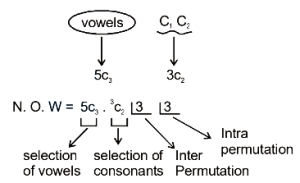
Five-letter words,having distinct letters,are to be constructed using the letters of the word '$EQUATION$' so that each word contains exactly three vowels and two consonants. How many of them have all the vowels together?
A
$3600$
B
$1800$
C
$1080$
D
$900$
Solution
(C) The word '$EQUATION$' has $8$ distinct letters: $5$ vowels $(E, U, A, I, O)$ and $3$ consonants $(Q, T, N)$.
We need to select $3$ vowels out of $5$ and $2$ consonants out of $3$.
Number of ways to select the letters = $^5C_3 \times ^3C_2 = 10 \times 3 = 30$.
Since all $3$ vowels must be together,we treat the $3$ vowels as a single block. Now we have $1$ block of vowels and $2$ consonants,totaling $3$ units to arrange.
Number of ways to arrange these $3$ units = $3! = 6$.
Within the vowel block,the $3$ vowels can be arranged in $3! = 6$ ways.
Total number of words = $30 \times 6 \times 6 = 1080$.
We need to select $3$ vowels out of $5$ and $2$ consonants out of $3$.
Number of ways to select the letters = $^5C_3 \times ^3C_2 = 10 \times 3 = 30$.
Since all $3$ vowels must be together,we treat the $3$ vowels as a single block. Now we have $1$ block of vowels and $2$ consonants,totaling $3$ units to arrange.
Number of ways to arrange these $3$ units = $3! = 6$.
Within the vowel block,the $3$ vowels can be arranged in $3! = 6$ ways.
Total number of words = $30 \times 6 \times 6 = 1080$.
0 likes
View SolutionPermutation and Combination — Definition of combinations, Condition combinations · Frequently Asked Questions
1Are these Permutation and Combination questions useful for JEE and NEET?
Yes. All questions in this section are mapped to JEE Main and NEET exam patterns. Previous year questions from JEE Main, NEET, GUJCET and state-level exams are included with full solutions.
2Can I switch to Hindi or Gujarati for these questions?
Yes. Use the language tabs in the hero section or the sidebar to view the same questions and solutions in English, Hindi or Gujarati.
3How do I generate a question paper from this subtopic?
Use the Vedclass Exam Paper Generator — select the chapter and subtopic, set difficulty, and generate Sets A, B, C, D automatically. First 3 chapters of every subject are free.
Vedclass Products
For Students
Vedclass Test Series
Mock tests in real JEE/NEET style with performance analysis. 5-day free trial.
Start Free TrialFor Teachers
Exam Paper Generator
Generate Set A/B/C/D papers from this chapter in 2 minutes. 3 chapters free.
Try FreeFor Institutes
Online Exam Module
Live online exams with unlimited students, 360° analytics & white-label branding.
See DemoFor Teachers & Institutes
Generate a Permutation and Combination Exam Paper in 2 Minutes
Select subtopic & difficulty — Sets A, B, C, D auto-generated with No Repeat logic.
First 3 chapters of every subject are free — no payment required.