
A English
Section Formula Questions in English
Class 11 Mathematics · Introduction to Three Dimensional Geometry · Section Formula
84+
Questions
English
Language
100%
With Solutions
Showing 26 of 84 questions in English
51
EasyMCQ
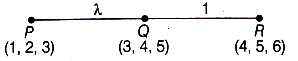
If the point $(3,4,5)$ divides the line segment joining the points $(1,2,3)$ and $(4,5,6)$ in the ratio $\lambda: 1$,then the point which divides the line segment joining the points $(3,4,5)$ and $(1,2,3)$ in the ratio $-1: \lambda$ is
A
$(6,7,8)$
B
$(5,6,7)$
C
$(-4,-5,-6)$
D
$(-5,-6,-7)$
Solution
(B) Let the points be $P(1,2,3)$ and $R(4,5,6)$. The point $Q(3,4,5)$ divides $PR$ in the ratio $\lambda: 1$.
Using the section formula,the coordinates of $Q$ are given by:
$Q = \left( \frac{\lambda(4) + 1(1)}{\lambda + 1}, \frac{\lambda(5) + 1(2)}{\lambda + 1}, \frac{\lambda(6) + 1(3)}{\lambda + 1} \right) = (3,4,5)$
Comparing the $x$-coordinates:
$\frac{4\lambda + 1}{\lambda + 1} = 3$
$4\lambda + 1 = 3\lambda + 3$
$\lambda = 2$
Now,we need to find the point that divides the line segment joining $Q(3,4,5)$ and $P(1,2,3)$ in the ratio $-1: \lambda$ (which is $-1: 2$).
Let the required point be $S(x, y, z)$. Using the section formula for internal division with ratio $m:n = -1: 2$:
$x = \frac{-1(1) + 2(3)}{-1 + 2} = \frac{-1 + 6}{1} = 5$
$y = \frac{-1(2) + 2(4)}{-1 + 2} = \frac{-2 + 8}{1} = 6$
$z = \frac{-1(3) + 2(5)}{-1 + 2} = \frac{-3 + 10}{1} = 7$
Thus,the required point is $(5,6,7)$.
Using the section formula,the coordinates of $Q$ are given by:
$Q = \left( \frac{\lambda(4) + 1(1)}{\lambda + 1}, \frac{\lambda(5) + 1(2)}{\lambda + 1}, \frac{\lambda(6) + 1(3)}{\lambda + 1} \right) = (3,4,5)$
Comparing the $x$-coordinates:
$\frac{4\lambda + 1}{\lambda + 1} = 3$
$4\lambda + 1 = 3\lambda + 3$
$\lambda = 2$
Now,we need to find the point that divides the line segment joining $Q(3,4,5)$ and $P(1,2,3)$ in the ratio $-1: \lambda$ (which is $-1: 2$).
Let the required point be $S(x, y, z)$. Using the section formula for internal division with ratio $m:n = -1: 2$:
$x = \frac{-1(1) + 2(3)}{-1 + 2} = \frac{-1 + 6}{1} = 5$
$y = \frac{-1(2) + 2(4)}{-1 + 2} = \frac{-2 + 8}{1} = 6$
$z = \frac{-1(3) + 2(5)}{-1 + 2} = \frac{-3 + 10}{1} = 7$
Thus,the required point is $(5,6,7)$.
0 likes
View Solution52
DifficultMCQ
The harmonic conjugate of $(2,3,4)$ with respect to the points $(3,-2,2)$ and $(6,-17,-4)$ is
A
$(11,-16,2)$
B
$\left(\frac{1}{2}, \frac{1}{3}, \frac{1}{4}\right)$
C
$(0,0,0)$
D
$\left(\frac{18}{5}, -5, \frac{4}{5}\right)$
Solution
(D) Let $A = (3, -2, 2)$ and $B = (6, -17, -4)$. Let $P = (2, 3, 4)$ divide the line segment $AB$ in the ratio $m:n$.
Using the section formula,we have:
$P = \left(\frac{6m + 3n}{m+n}, \frac{-17m - 2n}{m+n}, \frac{-4m + 2n}{m+n}\right) = (2, 3, 4)$.
Equating the $x$-coordinates: $\frac{6m + 3n}{m+n} = 2 \implies 6m + 3n = 2m + 2n \implies 4m = -n \implies \frac{m}{n} = -\frac{1}{4}$.
Thus,$P$ divides $AB$ externally in the ratio $1:4$.
The harmonic conjugate of $P$ with respect to $A$ and $B$ divides the segment $AB$ internally in the ratio $m:n = 1:4$.
Using the section formula for internal division:
$Q = \left(\frac{1(6) + 4(3)}{1+4}, \frac{1(-17) + 4(-2)}{1+4}, \frac{1(-4) + 4(2)}{1+4}\right) = \left(\frac{6+12}{5}, \frac{-17-8}{5}, \frac{-4+8}{5}\right) = \left(\frac{18}{5}, -5, \frac{4}{5}\right)$.
Therefore,the correct option is $D$.
Using the section formula,we have:
$P = \left(\frac{6m + 3n}{m+n}, \frac{-17m - 2n}{m+n}, \frac{-4m + 2n}{m+n}\right) = (2, 3, 4)$.
Equating the $x$-coordinates: $\frac{6m + 3n}{m+n} = 2 \implies 6m + 3n = 2m + 2n \implies 4m = -n \implies \frac{m}{n} = -\frac{1}{4}$.
Thus,$P$ divides $AB$ externally in the ratio $1:4$.
The harmonic conjugate of $P$ with respect to $A$ and $B$ divides the segment $AB$ internally in the ratio $m:n = 1:4$.
Using the section formula for internal division:
$Q = \left(\frac{1(6) + 4(3)}{1+4}, \frac{1(-17) + 4(-2)}{1+4}, \frac{1(-4) + 4(2)}{1+4}\right) = \left(\frac{6+12}{5}, \frac{-17-8}{5}, \frac{-4+8}{5}\right) = \left(\frac{18}{5}, -5, \frac{4}{5}\right)$.
Therefore,the correct option is $D$.
0 likes
View Solution53
EasyMCQ
If $P(-3, -2, 4)$,$Q(-9, -8, 10)$,and $R(-5, -4, 6)$ are collinear,then the ratio in which $R$ divides $PQ$ is
A
$1 : 2$
B
$2 : 1$
C
$3 : 1$
D
$1 : 3$
Solution
(A) Let the point $R$ divide the line segment $PQ$ in the ratio $\lambda : 1$.
Using the section formula for the $x$-coordinate:
$x = \frac{m x_2 + n x_1}{m + n}$
$-5 = \frac{\lambda(-9) + 1(-3)}{\lambda + 1}$
$-5(\lambda + 1) = -9\lambda - 3$
$-5\lambda - 5 = -9\lambda - 3$
$-5\lambda + 9\lambda = 5 - 3$
$4\lambda = 2$
$\lambda = \frac{2}{4} = \frac{1}{2}$
Thus,the ratio $\lambda : 1$ is $\frac{1}{2} : 1$,which simplifies to $1 : 2$.
Using the section formula for the $x$-coordinate:
$x = \frac{m x_2 + n x_1}{m + n}$
$-5 = \frac{\lambda(-9) + 1(-3)}{\lambda + 1}$
$-5(\lambda + 1) = -9\lambda - 3$
$-5\lambda - 5 = -9\lambda - 3$
$-5\lambda + 9\lambda = 5 - 3$
$4\lambda = 2$
$\lambda = \frac{2}{4} = \frac{1}{2}$
Thus,the ratio $\lambda : 1$ is $\frac{1}{2} : 1$,which simplifies to $1 : 2$.
0 likes
View Solution54
EasyMCQ
The harmonic conjugate of $P(-9, 12, -15)$ with respect to the line segment $AB$,where $A=(1, -2, 3)$ and $B=(-4, 5, -6)$ is
A
$\left(-\frac{2}{3}, \frac{1}{3}, 0\right)$
B
$(6, -9, 12)$
C
$\left(-\frac{7}{3}, \frac{8}{3}, -3\right)$
D
$\left(\frac{7}{3}, -\frac{8}{3}, 3\right)$
Solution
(C) Let the point $P(-9, 12, -15)$ divide the line segment joining $A(1, -2, 3)$ and $B(-4, 5, -6)$ in the ratio $\lambda : 1$.
Using the section formula,we have:
$-9 = \frac{-4\lambda + 1}{\lambda + 1} \implies -9\lambda - 9 = -4\lambda + 1 \implies -5\lambda = 10 \implies \lambda = -2$.
The point $P$ divides $AB$ externally in the ratio $2 : 1$.
The harmonic conjugate of $P$ with respect to $AB$ is the point $Q$ that divides $AB$ internally in the same ratio $2 : 1$.
Using the internal section formula:
$Q = \left(\frac{2(-4) + 1(1)}{2+1}, \frac{2(5) + 1(-2)}{2+1}, \frac{2(-6) + 1(3)}{2+1}\right)$
$Q = \left(\frac{-8 + 1}{3}, \frac{10 - 2}{3}, \frac{-12 + 3}{3}\right)$
$Q = \left(-\frac{7}{3}, \frac{8}{3}, -3\right)$.
Using the section formula,we have:
$-9 = \frac{-4\lambda + 1}{\lambda + 1} \implies -9\lambda - 9 = -4\lambda + 1 \implies -5\lambda = 10 \implies \lambda = -2$.
The point $P$ divides $AB$ externally in the ratio $2 : 1$.
The harmonic conjugate of $P$ with respect to $AB$ is the point $Q$ that divides $AB$ internally in the same ratio $2 : 1$.
Using the internal section formula:
$Q = \left(\frac{2(-4) + 1(1)}{2+1}, \frac{2(5) + 1(-2)}{2+1}, \frac{2(-6) + 1(3)}{2+1}\right)$
$Q = \left(\frac{-8 + 1}{3}, \frac{10 - 2}{3}, \frac{-12 + 3}{3}\right)$
$Q = \left(-\frac{7}{3}, \frac{8}{3}, -3\right)$.
0 likes
View Solution55
MediumMCQ
If $A=(5,4,2), B=(6,2,-1), C=(8,-2,-7)$,then the harmonic conjugate of $A$ with respect to $B$ and $C$ is
A
$(7,0,-3)$
B
$(\frac{13}{2},-1, \frac{-5}{2})$
C
$(\frac{13}{2}, 1, \frac{-5}{2})$
D
$(\frac{11}{2}, 3, \frac{1}{2})$
Solution
(C) The harmonic conjugate of a point $A$ with respect to points $B$ and $C$ is a point $P$ that divides the line segment $BC$ externally in the ratio of the distances $AB$ and $AC$.
First,we calculate the distances $AB$ and $AC$:
$AB = \sqrt{(6-5)^2 + (2-4)^2 + (-1-2)^2} = \sqrt{1^2 + (-2)^2 + (-3)^2} = \sqrt{1+4+9} = \sqrt{14}$.
$AC = \sqrt{(8-5)^2 + (-2-4)^2 + (-7-2)^2} = \sqrt{3^2 + (-6)^2 + (-9)^2} = \sqrt{9+36+81} = \sqrt{126} = 3\sqrt{14}$.
The ratio $m:n = AB:AC = \sqrt{14} : 3\sqrt{14} = 1:3$.
Since $P$ divides $BC$ externally in the ratio $1:3$,the coordinates of $P$ are given by the section formula for external division:
$P = \left(\frac{m x_2 - n x_1}{m-n}, \frac{m y_2 - n y_1}{m-n}, \frac{m z_2 - n z_1}{m-n}\right)$
Substituting $m=1, n=3, B=(6,2,-1), C=(8,-2,-7)$:
$x = \frac{1(8) - 3(6)}{1-3} = \frac{8-18}{-2} = \frac{-10}{-2} = 5$.
Wait,let us re-evaluate the definition. The harmonic conjugate $P$ of $A$ with respect to $B$ and $C$ means $A$ divides $BC$ internally in ratio $k$ and $P$ divides $BC$ externally in ratio $k$.
$A$ divides $BC$ in ratio $k:1$.
$5 = \frac{k(8) + 1(6)}{k+1} \implies 5k+5 = 8k+6 \implies 3k = -1 \implies k = -1/3$.
Since $k$ is negative,$A$ divides $BC$ externally.
Using the property that $P$ is the harmonic conjugate,$P$ divides $BC$ internally in the same ratio $1:3$.
$P = \left(\frac{1(8) + 3(6)}{1+3}, \frac{1(-2) + 3(2)}{1+3}, \frac{1(-7) + 3(-1)}{1+3}\right) = \left(\frac{26}{4}, \frac{4}{4}, \frac{-10}{4}\right) = (6.5, 1, -2.5) = (\frac{13}{2}, 1, \frac{-5}{2})$.
Thus,the correct option is $C$.
First,we calculate the distances $AB$ and $AC$:
$AB = \sqrt{(6-5)^2 + (2-4)^2 + (-1-2)^2} = \sqrt{1^2 + (-2)^2 + (-3)^2} = \sqrt{1+4+9} = \sqrt{14}$.
$AC = \sqrt{(8-5)^2 + (-2-4)^2 + (-7-2)^2} = \sqrt{3^2 + (-6)^2 + (-9)^2} = \sqrt{9+36+81} = \sqrt{126} = 3\sqrt{14}$.
The ratio $m:n = AB:AC = \sqrt{14} : 3\sqrt{14} = 1:3$.
Since $P$ divides $BC$ externally in the ratio $1:3$,the coordinates of $P$ are given by the section formula for external division:
$P = \left(\frac{m x_2 - n x_1}{m-n}, \frac{m y_2 - n y_1}{m-n}, \frac{m z_2 - n z_1}{m-n}\right)$
Substituting $m=1, n=3, B=(6,2,-1), C=(8,-2,-7)$:
$x = \frac{1(8) - 3(6)}{1-3} = \frac{8-18}{-2} = \frac{-10}{-2} = 5$.
Wait,let us re-evaluate the definition. The harmonic conjugate $P$ of $A$ with respect to $B$ and $C$ means $A$ divides $BC$ internally in ratio $k$ and $P$ divides $BC$ externally in ratio $k$.
$A$ divides $BC$ in ratio $k:1$.
$5 = \frac{k(8) + 1(6)}{k+1} \implies 5k+5 = 8k+6 \implies 3k = -1 \implies k = -1/3$.
Since $k$ is negative,$A$ divides $BC$ externally.
Using the property that $P$ is the harmonic conjugate,$P$ divides $BC$ internally in the same ratio $1:3$.
$P = \left(\frac{1(8) + 3(6)}{1+3}, \frac{1(-2) + 3(2)}{1+3}, \frac{1(-7) + 3(-1)}{1+3}\right) = \left(\frac{26}{4}, \frac{4}{4}, \frac{-10}{4}\right) = (6.5, 1, -2.5) = (\frac{13}{2}, 1, \frac{-5}{2})$.
Thus,the correct option is $C$.
0 likes
View Solution56
DifficultMCQ
If the line joining $A(1,3,4)$ and $B$ is divided by the point $P(-2,3,5)$ in the ratio $1:3$,then the coordinates of $B$ are:
A
$(-11,3,8)$
B
$(-11,3,-8)$
C
$(-8,12,20)$
D
$(13,6,-13)$
Solution
(A) Let the coordinates of point $B$ be $(x, y, z)$.
Given that point $P(-2, 3, 5)$ divides the line segment joining $A(1, 3, 4)$ and $B(x, y, z)$ in the ratio $m:n = 1:3$.
Using the section formula for internal division:
$P = \left( \frac{mx_2 + nx_1}{m+n}, \frac{my_2 + ny_1}{m+n}, \frac{mz_2 + nz_1}{m+n} \right)$
Substituting the values:
$(-2, 3, 5) = \left( \frac{1(x) + 3(1)}{1+3}, \frac{1(y) + 3(3)}{1+3}, \frac{1(z) + 3(4)}{1+3} \right)$
$(-2, 3, 5) = \left( \frac{x+3}{4}, \frac{y+9}{4}, \frac{z+12}{4} \right)$
Equating the coordinates:
$1) \frac{x+3}{4} = -2 \Rightarrow x+3 = -8 \Rightarrow x = -11$
$2) \frac{y+9}{4} = 3 \Rightarrow y+9 = 12 \Rightarrow y = 3$
$3) \frac{z+12}{4} = 5 \Rightarrow z+12 = 20 \Rightarrow z = 8$
Thus,the coordinates of $B$ are $(-11, 3, 8)$.
Given that point $P(-2, 3, 5)$ divides the line segment joining $A(1, 3, 4)$ and $B(x, y, z)$ in the ratio $m:n = 1:3$.
Using the section formula for internal division:
$P = \left( \frac{mx_2 + nx_1}{m+n}, \frac{my_2 + ny_1}{m+n}, \frac{mz_2 + nz_1}{m+n} \right)$
Substituting the values:
$(-2, 3, 5) = \left( \frac{1(x) + 3(1)}{1+3}, \frac{1(y) + 3(3)}{1+3}, \frac{1(z) + 3(4)}{1+3} \right)$
$(-2, 3, 5) = \left( \frac{x+3}{4}, \frac{y+9}{4}, \frac{z+12}{4} \right)$
Equating the coordinates:
$1) \frac{x+3}{4} = -2 \Rightarrow x+3 = -8 \Rightarrow x = -11$
$2) \frac{y+9}{4} = 3 \Rightarrow y+9 = 12 \Rightarrow y = 3$
$3) \frac{z+12}{4} = 5 \Rightarrow z+12 = 20 \Rightarrow z = 8$
Thus,the coordinates of $B$ are $(-11, 3, 8)$.
0 likes
View Solution57
DifficultMCQ
The ratio in which the $yz$-plane divides the line segment joining the points $(-3, 4, -2)$ and $(2, 1, 3)$ is:
A
$3: 2$
B
$2: 3$
C
$4: 1$
D
$1: 4$
Solution
(A) Let the ratio in which the $yz$-plane divides the line segment joining the points $A(-3, 4, -2)$ and $B(2, 1, 3)$ be $k: 1$.
The coordinates of the point dividing the segment in ratio $k: 1$ are given by the section formula:
$P = \left( \frac{k(2) + 1(-3)}{k+1}, \frac{k(1) + 1(4)}{k+1}, \frac{k(3) + 1(-2)}{k+1} \right)$.
Since the point $P$ lies on the $yz$-plane,its $x$-coordinate must be $0$.
Therefore,$\frac{2k - 3}{k+1} = 0$.
$2k - 3 = 0 \implies 2k = 3 \implies k = \frac{3}{2}$.
Thus,the ratio is $k: 1 = \frac{3}{2}: 1 = 3: 2$.
The coordinates of the point dividing the segment in ratio $k: 1$ are given by the section formula:
$P = \left( \frac{k(2) + 1(-3)}{k+1}, \frac{k(1) + 1(4)}{k+1}, \frac{k(3) + 1(-2)}{k+1} \right)$.
Since the point $P$ lies on the $yz$-plane,its $x$-coordinate must be $0$.
Therefore,$\frac{2k - 3}{k+1} = 0$.
$2k - 3 = 0 \implies 2k = 3 \implies k = \frac{3}{2}$.
Thus,the ratio is $k: 1 = \frac{3}{2}: 1 = 3: 2$.
0 likes
View Solution58
MediumMCQ
If $A(2,-1,1)$,$B(2,5,1)$,and $C(0,-2,3)$ are the vertices of a triangle,and $D$ is the point of intersection of the side $BC$ and the internal angular bisector of angle $A$,then $AD=$
A
$\frac{5}{\sqrt{7}}$
B
$\frac{3}{\sqrt{2}}$
C
$\frac{\sqrt{3}}{2}$
D
$\frac{4}{\sqrt{3}}$
Solution
(D) The length of the sides of $\triangle ABC$ are calculated using the distance formula $d = \sqrt{(x_2-x_1)^2 + (y_2-y_1)^2 + (z_2-z_1)^2}$.
$c = AB = \sqrt{(2-2)^2 + (5-(-1))^2 + (1-1)^2} = \sqrt{0^2 + 6^2 + 0^2} = 6$.
$b = AC = \sqrt{(0-2)^2 + (-2-(-1))^2 + (3-1)^2} = \sqrt{(-2)^2 + (-1)^2 + 2^2} = \sqrt{4+1+4} = 3$.
$a = BC = \sqrt{(0-2)^2 + (-2-5)^2 + (3-1)^2} = \sqrt{(-2)^2 + (-7)^2 + 2^2} = \sqrt{4+49+4} = \sqrt{57}$.
By the Angle Bisector Theorem,point $D$ divides $BC$ in the ratio $c:b$,which is $6:3 = 2:1$.
Using the section formula,the coordinates of $D$ are $\left(\frac{2(0)+1(2)}{2+1}, \frac{2(-2)+1(5)}{2+1}, \frac{2(3)+1(1)}{2+1}\right) = \left(\frac{2}{3}, \frac{1}{3}, \frac{7}{3}\right)$.
Now,$AD = \sqrt{(\frac{2}{3}-2)^2 + (\frac{1}{3}-(-1))^2 + (\frac{7}{3}-1)^2} = \sqrt{(-\frac{4}{3})^2 + (\frac{4}{3})^2 + (\frac{4}{3})^2} = \sqrt{\frac{16}{9} + \frac{16}{9} + \frac{16}{9}} = \sqrt{\frac{48}{9}} = \frac{4\sqrt{3}}{3} = \frac{4}{\sqrt{3}}$.
$c = AB = \sqrt{(2-2)^2 + (5-(-1))^2 + (1-1)^2} = \sqrt{0^2 + 6^2 + 0^2} = 6$.
$b = AC = \sqrt{(0-2)^2 + (-2-(-1))^2 + (3-1)^2} = \sqrt{(-2)^2 + (-1)^2 + 2^2} = \sqrt{4+1+4} = 3$.
$a = BC = \sqrt{(0-2)^2 + (-2-5)^2 + (3-1)^2} = \sqrt{(-2)^2 + (-7)^2 + 2^2} = \sqrt{4+49+4} = \sqrt{57}$.
By the Angle Bisector Theorem,point $D$ divides $BC$ in the ratio $c:b$,which is $6:3 = 2:1$.
Using the section formula,the coordinates of $D$ are $\left(\frac{2(0)+1(2)}{2+1}, \frac{2(-2)+1(5)}{2+1}, \frac{2(3)+1(1)}{2+1}\right) = \left(\frac{2}{3}, \frac{1}{3}, \frac{7}{3}\right)$.
Now,$AD = \sqrt{(\frac{2}{3}-2)^2 + (\frac{1}{3}-(-1))^2 + (\frac{7}{3}-1)^2} = \sqrt{(-\frac{4}{3})^2 + (\frac{4}{3})^2 + (\frac{4}{3})^2} = \sqrt{\frac{16}{9} + \frac{16}{9} + \frac{16}{9}} = \sqrt{\frac{48}{9}} = \frac{4\sqrt{3}}{3} = \frac{4}{\sqrt{3}}$.
0 likes
View Solution59
EasyMCQ
In the triangle with vertices $A(3,2,0)$,$B(5,3,2)$,and $C(-9,6,-3)$,the bisector of $\angle BAC$ meets $BC$ at $D$. The coordinates of $D$ are
A
$\left(\frac{57}{16}, \frac{38}{16}, \frac{17}{16}\right)$
B
$\left(\frac{38}{16}, \frac{57}{16}, \frac{17}{16}\right)$
C
$\left(\frac{38}{16}, \frac{17}{16}, \frac{57}{16}\right)$
D
$\left(\frac{17}{16}, \frac{38}{16}, \frac{57}{16}\right)$
Solution
(B) The angle bisector theorem states that the bisector of $\angle BAC$ divides the opposite side $BC$ in the ratio of the sides adjacent to the angle,i.e.,$BD/DC = AB/AC$.
First,calculate the lengths of sides $AB$ and $AC$:
$AB = \sqrt{(5-3)^2 + (3-2)^2 + (2-0)^2} = \sqrt{2^2 + 1^2 + 2^2} = \sqrt{4+1+4} = \sqrt{9} = 3$.
$AC = \sqrt{(-9-3)^2 + (6-2)^2 + (-3-0)^2} = \sqrt{(-12)^2 + 4^2 + (-3)^2} = \sqrt{144 + 16 + 9} = \sqrt{169} = 13$.
Thus,the ratio $BD:DC = AB:AC = 3:13$.
Using the section formula,the coordinates of $D$ are given by:
$D = \left(\frac{m x_2 + n x_1}{m+n}, \frac{m y_2 + n y_1}{m+n}, \frac{m z_2 + n z_1}{m+n}\right)$ where $m=3, n=13$,$B(5,3,2)$,and $C(-9,6,-3)$.
$x = \frac{3(-9) + 13(5)}{3+13} = \frac{-27 + 65}{16} = \frac{38}{16}$.
$y = \frac{3(6) + 13(3)}{3+13} = \frac{18 + 39}{16} = \frac{57}{16}$.
$z = \frac{3(-3) + 13(2)}{3+13} = \frac{-9 + 26}{16} = \frac{17}{16}$.
Therefore,the coordinates of $D$ are $\left(\frac{38}{16}, \frac{57}{16}, \frac{17}{16}\right)$.
First,calculate the lengths of sides $AB$ and $AC$:
$AB = \sqrt{(5-3)^2 + (3-2)^2 + (2-0)^2} = \sqrt{2^2 + 1^2 + 2^2} = \sqrt{4+1+4} = \sqrt{9} = 3$.
$AC = \sqrt{(-9-3)^2 + (6-2)^2 + (-3-0)^2} = \sqrt{(-12)^2 + 4^2 + (-3)^2} = \sqrt{144 + 16 + 9} = \sqrt{169} = 13$.
Thus,the ratio $BD:DC = AB:AC = 3:13$.
Using the section formula,the coordinates of $D$ are given by:
$D = \left(\frac{m x_2 + n x_1}{m+n}, \frac{m y_2 + n y_1}{m+n}, \frac{m z_2 + n z_1}{m+n}\right)$ where $m=3, n=13$,$B(5,3,2)$,and $C(-9,6,-3)$.
$x = \frac{3(-9) + 13(5)}{3+13} = \frac{-27 + 65}{16} = \frac{38}{16}$.
$y = \frac{3(6) + 13(3)}{3+13} = \frac{18 + 39}{16} = \frac{57}{16}$.
$z = \frac{3(-3) + 13(2)}{3+13} = \frac{-9 + 26}{16} = \frac{17}{16}$.
Therefore,the coordinates of $D$ are $\left(\frac{38}{16}, \frac{57}{16}, \frac{17}{16}\right)$.
0 likes
View Solution60
EasyMCQ
The point dividing the line segment joining $(3, -2, 1)$ and $(-2, 3, 11)$ in the ratio $2:3$ is
A
$(1, 1, 4)$
B
$(1, 0, 5)$
C
$(2, 3, 5)$
D
$(0, 6, -1)$
Solution
(B) Let the required point be $P(x, y, z)$. By the section formula,the coordinates of point $P$ dividing the line segment joining $(x_1, y_1, z_1)$ and $(x_2, y_2, z_2)$ in the ratio $m:n$ are given by:
$P = \left(\frac{mx_2 + nx_1}{m+n}, \frac{my_2 + ny_1}{m+n}, \frac{mz_2 + nz_1}{m+n}\right)$
Here,$(x_1, y_1, z_1) = (3, -2, 1)$,$(x_2, y_2, z_2) = (-2, 3, 11)$,$m = 2$,and $n = 3$.
Substituting these values into the formula:
$P = \left(\frac{2(-2) + 3(3)}{2+3}, \frac{2(3) + 3(-2)}{2+3}, \frac{2(11) + 3(1)}{2+3}\right)$
$P = \left(\frac{-4 + 9}{5}, \frac{6 - 6}{5}, \frac{22 + 3}{5}\right)$
$P = \left(\frac{5}{5}, \frac{0}{5}, \frac{25}{5}\right)$
$P = (1, 0, 5)$
$P = \left(\frac{mx_2 + nx_1}{m+n}, \frac{my_2 + ny_1}{m+n}, \frac{mz_2 + nz_1}{m+n}\right)$
Here,$(x_1, y_1, z_1) = (3, -2, 1)$,$(x_2, y_2, z_2) = (-2, 3, 11)$,$m = 2$,and $n = 3$.
Substituting these values into the formula:
$P = \left(\frac{2(-2) + 3(3)}{2+3}, \frac{2(3) + 3(-2)}{2+3}, \frac{2(11) + 3(1)}{2+3}\right)$
$P = \left(\frac{-4 + 9}{5}, \frac{6 - 6}{5}, \frac{22 + 3}{5}\right)$
$P = \left(\frac{5}{5}, \frac{0}{5}, \frac{25}{5}\right)$
$P = (1, 0, 5)$

0 likes
View Solution61
MediumMCQ
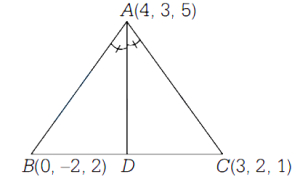
If $A(4,3,5)$,$B(0,-2,2)$,and $C(3,2,1)$ are three points,then the coordinates of the point $D$ where the bisector of $\angle BAC$ meets the side $BC$ are:
A
$\left(\frac{15}{8}, \frac{4}{8}, \frac{11}{8}\right)$
B
$\left(\frac{12}{7}, \frac{2}{7}, \frac{10}{7}\right)$
C
$\left(\frac{9}{5}, \frac{2}{5}, \frac{7}{5}\right)$
D
$\left(\frac{3}{2}, 0, \frac{3}{2}\right)$
Solution
(A) The angle bisector theorem states that the bisector of $\angle BAC$ divides the opposite side $BC$ in the ratio of the sides adjacent to the angle,i.e.,$BD:CD = AB:AC$.
First,calculate the lengths of sides $AB$ and $AC$:
$AB = \sqrt{(0-4)^2 + (-2-3)^2 + (2-5)^2} = \sqrt{(-4)^2 + (-5)^2 + (-3)^2} = \sqrt{16 + 25 + 9} = \sqrt{50} = 5\sqrt{2}$.
$AC = \sqrt{(3-4)^2 + (2-3)^2 + (1-5)^2} = \sqrt{(-1)^2 + (-1)^2 + (-4)^2} = \sqrt{1 + 1 + 16} = \sqrt{18} = 3\sqrt{2}$.
Thus,the ratio $BD:CD = AB:AC = 5\sqrt{2} : 3\sqrt{2} = 5:3$.
Point $D$ divides $BC$ internally in the ratio $5:3$. Using the section formula,the coordinates of $D$ are:
$D = \left(\frac{5(3) + 3(0)}{5+3}, \frac{5(2) + 3(-2)}{5+3}, \frac{5(1) + 3(2)}{5+3}\right)$
$D = \left(\frac{15+0}{8}, \frac{10-6}{8}, \frac{5+6}{8}\right) = \left(\frac{15}{8}, \frac{4}{8}, \frac{11}{8}\right)$.
First,calculate the lengths of sides $AB$ and $AC$:
$AB = \sqrt{(0-4)^2 + (-2-3)^2 + (2-5)^2} = \sqrt{(-4)^2 + (-5)^2 + (-3)^2} = \sqrt{16 + 25 + 9} = \sqrt{50} = 5\sqrt{2}$.
$AC = \sqrt{(3-4)^2 + (2-3)^2 + (1-5)^2} = \sqrt{(-1)^2 + (-1)^2 + (-4)^2} = \sqrt{1 + 1 + 16} = \sqrt{18} = 3\sqrt{2}$.
Thus,the ratio $BD:CD = AB:AC = 5\sqrt{2} : 3\sqrt{2} = 5:3$.
Point $D$ divides $BC$ internally in the ratio $5:3$. Using the section formula,the coordinates of $D$ are:
$D = \left(\frac{5(3) + 3(0)}{5+3}, \frac{5(2) + 3(-2)}{5+3}, \frac{5(1) + 3(2)}{5+3}\right)$
$D = \left(\frac{15+0}{8}, \frac{10-6}{8}, \frac{5+6}{8}\right) = \left(\frac{15}{8}, \frac{4}{8}, \frac{11}{8}\right)$.
0 likes
View Solution62
MediumMCQ
$A(3, 2, -1), B(4, 1, 0), C(2, 1, 4)$ are the vertices of a triangle $ABC$. If the bisector of $\angle BAC$ intersects the side $BC$ at $D(p, q, r)$,then $\sqrt{2p + q + r} =$
A
$1$
B
$2$
C
$3$
D
$4$
Solution
(C) The lengths of the sides $AB$ and $AC$ are calculated as follows:
$AB = \sqrt{(4-3)^2 + (1-2)^2 + (0-(-1))^2} = \sqrt{1^2 + (-1)^2 + 1^2} = \sqrt{3}$
$AC = \sqrt{(2-3)^2 + (1-2)^2 + (4-(-1))^2} = \sqrt{(-1)^2 + (-1)^2 + 5^2} = \sqrt{1 + 1 + 25} = \sqrt{27} = 3\sqrt{3}$
By the Angle Bisector Theorem,the bisector of $\angle BAC$ divides the opposite side $BC$ in the ratio of the adjacent sides:
$\frac{BD}{DC} = \frac{AB}{AC} = \frac{\sqrt{3}}{3\sqrt{3}} = \frac{1}{3}$
Using the section formula,the coordinates of $D(p, q, r)$ are:
$D = \left( \frac{1(2) + 3(4)}{1+3}, \frac{1(1) + 3(1)}{1+3}, \frac{1(4) + 3(0)}{1+3} \right) = \left( \frac{14}{4}, \frac{4}{4}, \frac{4}{4} \right) = \left( \frac{7}{2}, 1, 1 \right)$
Thus,$p = \frac{7}{2}, q = 1, r = 1$.
Finally,$\sqrt{2p + q + r} = \sqrt{2(\frac{7}{2}) + 1 + 1} = \sqrt{7 + 1 + 1} = \sqrt{9} = 3$.
$AB = \sqrt{(4-3)^2 + (1-2)^2 + (0-(-1))^2} = \sqrt{1^2 + (-1)^2 + 1^2} = \sqrt{3}$
$AC = \sqrt{(2-3)^2 + (1-2)^2 + (4-(-1))^2} = \sqrt{(-1)^2 + (-1)^2 + 5^2} = \sqrt{1 + 1 + 25} = \sqrt{27} = 3\sqrt{3}$
By the Angle Bisector Theorem,the bisector of $\angle BAC$ divides the opposite side $BC$ in the ratio of the adjacent sides:
$\frac{BD}{DC} = \frac{AB}{AC} = \frac{\sqrt{3}}{3\sqrt{3}} = \frac{1}{3}$
Using the section formula,the coordinates of $D(p, q, r)$ are:
$D = \left( \frac{1(2) + 3(4)}{1+3}, \frac{1(1) + 3(1)}{1+3}, \frac{1(4) + 3(0)}{1+3} \right) = \left( \frac{14}{4}, \frac{4}{4}, \frac{4}{4} \right) = \left( \frac{7}{2}, 1, 1 \right)$
Thus,$p = \frac{7}{2}, q = 1, r = 1$.
Finally,$\sqrt{2p + q + r} = \sqrt{2(\frac{7}{2}) + 1 + 1} = \sqrt{7 + 1 + 1} = \sqrt{9} = 3$.
0 likes
View Solution63
MediumMCQ
If $A(4,7,8)$,$B(2,3,4)$,and $C(2,5,7)$ are the vertices of $\triangle ABC$,then the length of the internal bisector of the angle $A$ is
A
$\frac{1}{2} \sqrt{34}$
B
$\frac{1}{3} \sqrt{34}$
C
$\frac{2}{3} \sqrt{34}$
D
$\frac{3}{8} \sqrt{17}$
Solution
(C) Given vertices $A(4,7,8)$,$B(2,3,4)$,and $C(2,5,7)$.
First,calculate the lengths of sides $AB$ and $AC$:
$AB = \sqrt{(4-2)^2 + (7-3)^2 + (8-4)^2} = \sqrt{2^2 + 4^2 + 4^2} = \sqrt{4+16+16} = \sqrt{36} = 6$.
$AC = \sqrt{(4-2)^2 + (7-5)^2 + (8-7)^2} = \sqrt{2^2 + 2^2 + 1^2} = \sqrt{4+4+1} = \sqrt{9} = 3$.
By the Angle Bisector Theorem,the internal bisector of angle $A$ divides the opposite side $BC$ in the ratio $AB:AC = 6:3 = 2:1$.
Let $D$ be the point on $BC$ dividing it in the ratio $2:1$. Using the section formula:
$D = \left( \frac{2(2) + 1(2)}{2+1}, \frac{2(5) + 1(3)}{2+1}, \frac{2(7) + 1(4)}{2+1} \right) = \left( \frac{6}{3}, \frac{13}{3}, \frac{18}{3} \right) = \left( 2, \frac{13}{3}, 6 \right)$.
The length of the internal bisector is the distance $AD$:
$AD = \sqrt{(4-2)^2 + (7 - \frac{13}{3})^2 + (8-6)^2} = \sqrt{2^2 + (\frac{8}{3})^2 + 2^2} = \sqrt{4 + \frac{64}{9} + 4} = \sqrt{8 + \frac{64}{9}} = \sqrt{\frac{72+64}{9}} = \sqrt{\frac{136}{9}} = \frac{\sqrt{4 \times 34}}{3} = \frac{2}{3} \sqrt{34}$.
First,calculate the lengths of sides $AB$ and $AC$:
$AB = \sqrt{(4-2)^2 + (7-3)^2 + (8-4)^2} = \sqrt{2^2 + 4^2 + 4^2} = \sqrt{4+16+16} = \sqrt{36} = 6$.
$AC = \sqrt{(4-2)^2 + (7-5)^2 + (8-7)^2} = \sqrt{2^2 + 2^2 + 1^2} = \sqrt{4+4+1} = \sqrt{9} = 3$.
By the Angle Bisector Theorem,the internal bisector of angle $A$ divides the opposite side $BC$ in the ratio $AB:AC = 6:3 = 2:1$.
Let $D$ be the point on $BC$ dividing it in the ratio $2:1$. Using the section formula:
$D = \left( \frac{2(2) + 1(2)}{2+1}, \frac{2(5) + 1(3)}{2+1}, \frac{2(7) + 1(4)}{2+1} \right) = \left( \frac{6}{3}, \frac{13}{3}, \frac{18}{3} \right) = \left( 2, \frac{13}{3}, 6 \right)$.
The length of the internal bisector is the distance $AD$:
$AD = \sqrt{(4-2)^2 + (7 - \frac{13}{3})^2 + (8-6)^2} = \sqrt{2^2 + (\frac{8}{3})^2 + 2^2} = \sqrt{4 + \frac{64}{9} + 4} = \sqrt{8 + \frac{64}{9}} = \sqrt{\frac{72+64}{9}} = \sqrt{\frac{136}{9}} = \frac{\sqrt{4 \times 34}}{3} = \frac{2}{3} \sqrt{34}$.
0 likes
View Solution64
MediumMCQ
$O(0,0,0), A(3,1,4), B(1,3,2)$ and $C(0,4,-2)$ are the vertices of a tetrahedron. If $G$ is the centroid of the tetrahedron and $G_1$ is the centroid of its face $ABC$,then the point which divides $GG_1$ in the ratio $1:2$ is
A
$\left(\frac{10}{3}, \frac{20}{3}, \frac{10}{3}\right)$
B
$\left(\frac{20}{9}, \frac{10}{9}, \frac{10}{9}\right)$
C
$\left(\frac{10}{9}, \frac{20}{9}, \frac{10}{9}\right)$
D
$\left(\frac{20}{3}, \frac{10}{3}, \frac{10}{3}\right)$
Solution
(C) The vertices of the tetrahedron are $O(0,0,0), A(3,1,4), B(1,3,2)$,and $C(0,4,-2)$.
The centroid $G$ of the tetrahedron is given by the average of its vertices: $G = \left(\frac{0+3+1+0}{4}, \frac{0+1+3+4}{4}, \frac{0+4+2-2}{4}\right) = \left(1, 2, 1\right)$.
The centroid $G_1$ of the face $ABC$ is given by the average of vertices $A, B$,and $C$: $G_1 = \left(\frac{3+1+0}{3}, \frac{1+3+4}{3}, \frac{4+2-2}{3}\right) = \left(\frac{4}{3}, \frac{8}{3}, \frac{4}{3}\right)$.
We need to find the point $P$ that divides the line segment $GG_1$ in the ratio $1:2$. Using the section formula,$P = \left(\frac{m x_2 + n x_1}{m+n}, \frac{m y_2 + n y_1}{m+n}, \frac{m z_2 + n z_1}{m+n}\right)$ with $m=1, n=2$,$G(1,2,1)$ and $G_1(\frac{4}{3}, \frac{8}{3}, \frac{4}{3})$:
$x = \frac{1(\frac{4}{3}) + 2(1)}{1+2} = \frac{\frac{4}{3} + 2}{3} = \frac{10}{9}$.
$y = \frac{1(\frac{8}{3}) + 2(2)}{1+2} = \frac{\frac{8}{3} + 4}{3} = \frac{20}{9}$.
$z = \frac{1(\frac{4}{3}) + 2(1)}{1+2} = \frac{\frac{4}{3} + 2}{3} = \frac{10}{9}$.
Thus,the point is $\left(\frac{10}{9}, \frac{20}{9}, \frac{10}{9}\right)$.
The centroid $G$ of the tetrahedron is given by the average of its vertices: $G = \left(\frac{0+3+1+0}{4}, \frac{0+1+3+4}{4}, \frac{0+4+2-2}{4}\right) = \left(1, 2, 1\right)$.
The centroid $G_1$ of the face $ABC$ is given by the average of vertices $A, B$,and $C$: $G_1 = \left(\frac{3+1+0}{3}, \frac{1+3+4}{3}, \frac{4+2-2}{3}\right) = \left(\frac{4}{3}, \frac{8}{3}, \frac{4}{3}\right)$.
We need to find the point $P$ that divides the line segment $GG_1$ in the ratio $1:2$. Using the section formula,$P = \left(\frac{m x_2 + n x_1}{m+n}, \frac{m y_2 + n y_1}{m+n}, \frac{m z_2 + n z_1}{m+n}\right)$ with $m=1, n=2$,$G(1,2,1)$ and $G_1(\frac{4}{3}, \frac{8}{3}, \frac{4}{3})$:
$x = \frac{1(\frac{4}{3}) + 2(1)}{1+2} = \frac{\frac{4}{3} + 2}{3} = \frac{10}{9}$.
$y = \frac{1(\frac{8}{3}) + 2(2)}{1+2} = \frac{\frac{8}{3} + 4}{3} = \frac{20}{9}$.
$z = \frac{1(\frac{4}{3}) + 2(1)}{1+2} = \frac{\frac{4}{3} + 2}{3} = \frac{10}{9}$.
Thus,the point is $\left(\frac{10}{9}, \frac{20}{9}, \frac{10}{9}\right)$.
0 likes
View Solution65
MediumMCQ
If $m:n$ is the ratio in which the point $\left(\frac{8}{5}, -\frac{1}{5}, \frac{8}{5}\right)$ divides the line segment joining the points $(2, p, 2)$ and $(p, -2, p)$,where $p$ is an integer,then $\frac{3m+n}{3n} =$
A
$p$
B
$2p$
C
$3p$
D
$4p$
Solution
(A) Let the points be $A(2, p, 2)$ and $B(p, -2, p)$. The point $P\left(\frac{8}{5}, -\frac{1}{5}, \frac{8}{5}\right)$ divides $AB$ in the ratio $m:n$.
Using the section formula,the $y$-coordinate of $P$ is given by:
$\frac{m(-2) + n(p)}{m+n} = -\frac{1}{5}$
$-10m + 5np = -m - n$
$9m = n(5p + 1) \implies \frac{m}{n} = \frac{5p+1}{9}$
Using the $x$-coordinate of $P$:
$\frac{m(p) + n(2)}{m+n} = \frac{8}{5}$
$5mp + 10n = 8m + 8n$
$m(5p - 8) = -2n \implies \frac{m}{n} = \frac{-2}{5p-8} = \frac{2}{8-5p}$
Equating the two ratios:
$\frac{5p+1}{9} = \frac{2}{8-5p}$
$(5p+1)(8-5p) = 18$
$40p - 25p^2 + 8 - 5p = 18$
$25p^2 - 35p + 10 = 0$
$5p^2 - 7p + 2 = 0$
$(5p-2)(p-1) = 0$
Since $p$ is an integer,$p = 1$.
Then $\frac{m}{n} = \frac{5(1)+1}{9} = \frac{6}{9} = \frac{2}{3}$.
We need to find $\frac{3m+n}{3n} = \frac{3(m/n) + 1}{3} = \frac{3(2/3) + 1}{3} = \frac{2+1}{3} = 1$.
Since $p=1$,the result is $p$.
Using the section formula,the $y$-coordinate of $P$ is given by:
$\frac{m(-2) + n(p)}{m+n} = -\frac{1}{5}$
$-10m + 5np = -m - n$
$9m = n(5p + 1) \implies \frac{m}{n} = \frac{5p+1}{9}$
Using the $x$-coordinate of $P$:
$\frac{m(p) + n(2)}{m+n} = \frac{8}{5}$
$5mp + 10n = 8m + 8n$
$m(5p - 8) = -2n \implies \frac{m}{n} = \frac{-2}{5p-8} = \frac{2}{8-5p}$
Equating the two ratios:
$\frac{5p+1}{9} = \frac{2}{8-5p}$
$(5p+1)(8-5p) = 18$
$40p - 25p^2 + 8 - 5p = 18$
$25p^2 - 35p + 10 = 0$
$5p^2 - 7p + 2 = 0$
$(5p-2)(p-1) = 0$
Since $p$ is an integer,$p = 1$.
Then $\frac{m}{n} = \frac{5(1)+1}{9} = \frac{6}{9} = \frac{2}{3}$.
We need to find $\frac{3m+n}{3n} = \frac{3(m/n) + 1}{3} = \frac{3(2/3) + 1}{3} = \frac{2+1}{3} = 1$.
Since $p=1$,the result is $p$.
0 likes
View Solution66
MediumMCQ
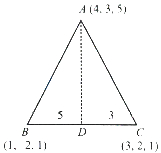
Let $A(4,3,5), B(1,-2,1), C(3,2,1)$ be the vertices of a triangle $ABC$. If the internal bisector of $\angle BAC$ meets the side $BC$ at $D$,then $CD=$
A
$\frac{\sqrt{5}}{4}$
B
$\frac{3 \sqrt{5}}{4}$
C
$2 \sqrt{5}$
D
$\frac{5 \sqrt{5}}{2}$
Solution
(B) First,calculate the lengths of sides $AB$ and $AC$ using the distance formula:
$AB = \sqrt{(4-1)^2 + (3-(-2))^2 + (5-1)^2} = \sqrt{3^2 + 5^2 + 4^2} = \sqrt{9 + 25 + 16} = \sqrt{50} = 5\sqrt{2}$
$AC = \sqrt{(4-3)^2 + (3-2)^2 + (5-1)^2} = \sqrt{1^2 + 1^2 + 4^2} = \sqrt{1 + 1 + 16} = \sqrt{18} = 3\sqrt{2}$
According to the Angle Bisector Theorem,the internal bisector of $\angle BAC$ divides the opposite side $BC$ in the ratio of the sides containing the angle:
$\frac{BD}{DC} = \frac{AB}{AC} = \frac{5\sqrt{2}}{3\sqrt{2}} = \frac{5}{3}$
Thus,point $D$ divides $BC$ internally in the ratio $5:3$. Using the section formula,the coordinates of $D$ are:
$D = \left( \frac{5(3) + 3(1)}{5+3}, \frac{5(2) + 3(-2)}{5+3}, \frac{5(1) + 3(1)}{5+3} \right) = \left( \frac{18}{8}, \frac{4}{8}, \frac{8}{8} \right) = \left( \frac{9}{4}, \frac{1}{2}, 1 \right)$
Now,calculate the length $CD$ using the distance formula between $C(3,2,1)$ and $D(\frac{9}{4}, \frac{1}{2}, 1)$:
$CD = \sqrt{(\frac{9}{4} - 3)^2 + (\frac{1}{2} - 2)^2 + (1 - 1)^2}$
$CD = \sqrt{(-\frac{3}{4})^2 + (-\frac{3}{2})^2 + 0^2} = \sqrt{\frac{9}{16} + \frac{9}{4}} = \sqrt{\frac{9 + 36}{16}} = \sqrt{\frac{45}{16}} = \frac{3\sqrt{5}}{4}$
$AB = \sqrt{(4-1)^2 + (3-(-2))^2 + (5-1)^2} = \sqrt{3^2 + 5^2 + 4^2} = \sqrt{9 + 25 + 16} = \sqrt{50} = 5\sqrt{2}$
$AC = \sqrt{(4-3)^2 + (3-2)^2 + (5-1)^2} = \sqrt{1^2 + 1^2 + 4^2} = \sqrt{1 + 1 + 16} = \sqrt{18} = 3\sqrt{2}$
According to the Angle Bisector Theorem,the internal bisector of $\angle BAC$ divides the opposite side $BC$ in the ratio of the sides containing the angle:
$\frac{BD}{DC} = \frac{AB}{AC} = \frac{5\sqrt{2}}{3\sqrt{2}} = \frac{5}{3}$
Thus,point $D$ divides $BC$ internally in the ratio $5:3$. Using the section formula,the coordinates of $D$ are:
$D = \left( \frac{5(3) + 3(1)}{5+3}, \frac{5(2) + 3(-2)}{5+3}, \frac{5(1) + 3(1)}{5+3} \right) = \left( \frac{18}{8}, \frac{4}{8}, \frac{8}{8} \right) = \left( \frac{9}{4}, \frac{1}{2}, 1 \right)$
Now,calculate the length $CD$ using the distance formula between $C(3,2,1)$ and $D(\frac{9}{4}, \frac{1}{2}, 1)$:
$CD = \sqrt{(\frac{9}{4} - 3)^2 + (\frac{1}{2} - 2)^2 + (1 - 1)^2}$
$CD = \sqrt{(-\frac{3}{4})^2 + (-\frac{3}{2})^2 + 0^2} = \sqrt{\frac{9}{16} + \frac{9}{4}} = \sqrt{\frac{9 + 36}{16}} = \sqrt{\frac{45}{16}} = \frac{3\sqrt{5}}{4}$
0 likes
View Solution67
EasyMCQ
$A(1, 2, 3)$,$B(2, 3, 1)$,and $C(3, 1, 2)$ are three points. If the point $P$ divides $AB$ in the ratio $1:2$ and the point $Q$ divides $BC$ in the ratio $-2:3$,then the distance between $P$ and $Q$ is
A
$\sqrt{312}$
B
$13$
C
$\frac{2}{3} \sqrt{78}$
D
$25$
Solution
(C) The coordinates of point $P$ dividing $AB$ in the ratio $m:n = 1:2$ are given by the section formula:
$P = \left( \frac{mx_2 + nx_1}{m+n}, \frac{my_2 + ny_1}{m+n}, \frac{mz_2 + nz_1}{m+n} \right)$
$P = \left( \frac{1(2) + 2(1)}{1+2}, \frac{1(3) + 2(2)}{1+2}, \frac{1(1) + 2(3)}{1+2} \right) = \left( \frac{4}{3}, \frac{7}{3}, \frac{7}{3} \right)$
The coordinates of point $Q$ dividing $BC$ in the ratio $m:n = -2:3$ are:
$Q = \left( \frac{-2(3) + 3(2)}{-2+3}, \frac{-2(1) + 3(3)}{-2+3}, \frac{-2(2) + 3(1)}{-2+3} \right) = \left( \frac{0}{1}, \frac{7}{1}, \frac{-1}{1} \right) = (0, 7, -1)$
The distance $PQ$ is given by $\sqrt{(x_2-x_1)^2 + (y_2-y_1)^2 + (z_2-z_1)^2}$:
$PQ = \sqrt{\left(0 - \frac{4}{3}\right)^2 + \left(7 - \frac{7}{3}\right)^2 + \left(-1 - \frac{7}{3}\right)^2}$
$PQ = \sqrt{\left(-\frac{4}{3}\right)^2 + \left(\frac{14}{3}\right)^2 + \left(-\frac{10}{3}\right)^2}$
$PQ = \sqrt{\frac{16}{9} + \frac{196}{9} + \frac{100}{9}} = \sqrt{\frac{312}{9}} = \frac{\sqrt{312}}{3} = \frac{2\sqrt{78}}{3}$
$P = \left( \frac{mx_2 + nx_1}{m+n}, \frac{my_2 + ny_1}{m+n}, \frac{mz_2 + nz_1}{m+n} \right)$
$P = \left( \frac{1(2) + 2(1)}{1+2}, \frac{1(3) + 2(2)}{1+2}, \frac{1(1) + 2(3)}{1+2} \right) = \left( \frac{4}{3}, \frac{7}{3}, \frac{7}{3} \right)$
The coordinates of point $Q$ dividing $BC$ in the ratio $m:n = -2:3$ are:
$Q = \left( \frac{-2(3) + 3(2)}{-2+3}, \frac{-2(1) + 3(3)}{-2+3}, \frac{-2(2) + 3(1)}{-2+3} \right) = \left( \frac{0}{1}, \frac{7}{1}, \frac{-1}{1} \right) = (0, 7, -1)$
The distance $PQ$ is given by $\sqrt{(x_2-x_1)^2 + (y_2-y_1)^2 + (z_2-z_1)^2}$:
$PQ = \sqrt{\left(0 - \frac{4}{3}\right)^2 + \left(7 - \frac{7}{3}\right)^2 + \left(-1 - \frac{7}{3}\right)^2}$
$PQ = \sqrt{\left(-\frac{4}{3}\right)^2 + \left(\frac{14}{3}\right)^2 + \left(-\frac{10}{3}\right)^2}$
$PQ = \sqrt{\frac{16}{9} + \frac{196}{9} + \frac{100}{9}} = \sqrt{\frac{312}{9}} = \frac{\sqrt{312}}{3} = \frac{2\sqrt{78}}{3}$
0 likes
View Solution68
EasyMCQ
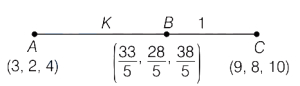
The ratio in which $B\left(\frac{33}{5}, \frac{28}{5}, \frac{38}{5}\right)$ divides the line segment joining $A(3, 2, 4)$ and $C(9, 8, 10)$ is
A
$2: 1$
B
$1: 3$
C
$3: 2$
D
$5: 3$
Solution
(C) Let the point $B$ divide the line segment $AC$ in the ratio $k: 1$. Using the section formula,the coordinates of $B$ are given by:
$B = \left( \frac{k(9) + 1(3)}{k+1}, \frac{k(8) + 1(2)}{k+1}, \frac{k(10) + 1(4)}{k+1} \right)$
Given that $B = \left( \frac{33}{5}, \frac{28}{5}, \frac{38}{5} \right)$,we equate the $x$-coordinates:
$\frac{9k + 3}{k + 1} = \frac{33}{5}$
$5(9k + 3) = 33(k + 1)$
$45k + 15 = 33k + 33$
$45k - 33k = 33 - 15$
$12k = 18$
$k = \frac{18}{12} = \frac{3}{2}$
Thus,the ratio $k: 1$ is $3: 2$.
$B = \left( \frac{k(9) + 1(3)}{k+1}, \frac{k(8) + 1(2)}{k+1}, \frac{k(10) + 1(4)}{k+1} \right)$
Given that $B = \left( \frac{33}{5}, \frac{28}{5}, \frac{38}{5} \right)$,we equate the $x$-coordinates:
$\frac{9k + 3}{k + 1} = \frac{33}{5}$
$5(9k + 3) = 33(k + 1)$
$45k + 15 = 33k + 33$
$45k - 33k = 33 - 15$
$12k = 18$
$k = \frac{18}{12} = \frac{3}{2}$
Thus,the ratio $k: 1$ is $3: 2$.
0 likes
View Solution69
EasyMCQ
If the points $A(-1,0,7), B(3,2, t), C(5, k,-2)$ are collinear,then the ratio in which the point $P(t, k-2t, t+k)$ divides the line segment $BC$ is
A
$-2: 3$
B
$-1: 2$
C
$4: 3$
D
$1: 1$
Solution
(B) Given that the points $A(-1,0,7), B(3,2, t)$ and $C(5, k,-2)$ are collinear,the direction ratios of $AB$ and $BC$ must be proportional.
$\frac{3-(-1)}{5-3} = \frac{2-0}{k-2} = \frac{t-7}{-2-t}$
$\frac{4}{2} = \frac{2}{k-2} = \frac{t-7}{-2-t}$
$2 = \frac{2}{k-2} \Rightarrow k-2 = 1 \Rightarrow k = 3$
$2 = \frac{t-7}{-2-t} \Rightarrow -4-2t = t-7 \Rightarrow 3t = 3 \Rightarrow t = 1$
Thus,the points are $B(3,2,1)$ and $C(5,3,-2)$.
The point $P$ is given by $P(t, k-2t, t+k) = P(1, 3-2(1), 1+3) = P(1, 1, 4)$.
Let $P$ divide the line segment $BC$ in the ratio $\lambda : 1$.
Using the section formula for the $x$-coordinate:
$1 = \frac{\lambda(5) + 1(3)}{\lambda + 1}$
$\lambda + 1 = 5\lambda + 3$
$-2 = 4\lambda$
$\lambda = -\frac{1}{2}$
Therefore,the required ratio is $-1: 2$.
$\frac{3-(-1)}{5-3} = \frac{2-0}{k-2} = \frac{t-7}{-2-t}$
$\frac{4}{2} = \frac{2}{k-2} = \frac{t-7}{-2-t}$
$2 = \frac{2}{k-2} \Rightarrow k-2 = 1 \Rightarrow k = 3$
$2 = \frac{t-7}{-2-t} \Rightarrow -4-2t = t-7 \Rightarrow 3t = 3 \Rightarrow t = 1$
Thus,the points are $B(3,2,1)$ and $C(5,3,-2)$.
The point $P$ is given by $P(t, k-2t, t+k) = P(1, 3-2(1), 1+3) = P(1, 1, 4)$.
Let $P$ divide the line segment $BC$ in the ratio $\lambda : 1$.
Using the section formula for the $x$-coordinate:
$1 = \frac{\lambda(5) + 1(3)}{\lambda + 1}$
$\lambda + 1 = 5\lambda + 3$
$-2 = 4\lambda$
$\lambda = -\frac{1}{2}$
Therefore,the required ratio is $-1: 2$.

0 likes
View Solution70
EasyMCQ
If $A(4,3,2), B(5,4,6), C(-1,-1,5)$ are the vertices of a triangle,then the coordinates of the point in which the bisector of the angle $A$ meets the side $BC$ is
A
$\left(\frac{22}{8}, \frac{17}{8}, \frac{45}{8}\right)$
B
$\left(\frac{17}{8}, \frac{22}{8}, \frac{45}{8}\right)$
C
$\left(\frac{-22}{8}, \frac{-17}{8}, \frac{45}{8}\right)$
D
$\left(\frac{-17}{8}, \frac{22}{8}, \frac{45}{8}\right)$
Solution
(A) The vertices of the triangle are $A(4,3,2), B(5,4,6)$,and $C(-1,-1,5)$.
First,we calculate the lengths of sides $AB$ and $AC$ using the distance formula:
$AB = \sqrt{(5-4)^2 + (4-3)^2 + (6-2)^2} = \sqrt{1^2 + 1^2 + 4^2} = \sqrt{1 + 1 + 16} = \sqrt{18} = 3\sqrt{2}$.
$AC = \sqrt{(-1-4)^2 + (-1-3)^2 + (5-2)^2} = \sqrt{(-5)^2 + (-4)^2 + 3^2} = \sqrt{25 + 16 + 9} = \sqrt{50} = 5\sqrt{2}$.
According to the Angle Bisector Theorem,the bisector of angle $A$ divides the opposite side $BC$ in the ratio of the sides containing the angle,which is $AB : AC = 3\sqrt{2} : 5\sqrt{2} = 3 : 5$.
Let $D$ be the point on $BC$ where the bisector meets it. $D$ divides $BC$ internally in the ratio $m:n = 3:5$.
Using the section formula $D = \left(\frac{mx_C + nx_B}{m+n}, \frac{my_C + ny_B}{m+n}, \frac{mz_C + nz_B}{m+n}\right)$:
$x_D = \frac{3(-1) + 5(5)}{3+5} = \frac{-3 + 25}{8} = \frac{22}{8}$.
$y_D = \frac{3(-1) + 5(4)}{3+5} = \frac{-3 + 20}{8} = \frac{17}{8}$.
$z_D = \frac{3(5) + 5(6)}{3+5} = \frac{15 + 30}{8} = \frac{45}{8}$.
Thus,the coordinates of point $D$ are $\left(\frac{22}{8}, \frac{17}{8}, \frac{45}{8}\right)$.
First,we calculate the lengths of sides $AB$ and $AC$ using the distance formula:
$AB = \sqrt{(5-4)^2 + (4-3)^2 + (6-2)^2} = \sqrt{1^2 + 1^2 + 4^2} = \sqrt{1 + 1 + 16} = \sqrt{18} = 3\sqrt{2}$.
$AC = \sqrt{(-1-4)^2 + (-1-3)^2 + (5-2)^2} = \sqrt{(-5)^2 + (-4)^2 + 3^2} = \sqrt{25 + 16 + 9} = \sqrt{50} = 5\sqrt{2}$.
According to the Angle Bisector Theorem,the bisector of angle $A$ divides the opposite side $BC$ in the ratio of the sides containing the angle,which is $AB : AC = 3\sqrt{2} : 5\sqrt{2} = 3 : 5$.
Let $D$ be the point on $BC$ where the bisector meets it. $D$ divides $BC$ internally in the ratio $m:n = 3:5$.
Using the section formula $D = \left(\frac{mx_C + nx_B}{m+n}, \frac{my_C + ny_B}{m+n}, \frac{mz_C + nz_B}{m+n}\right)$:
$x_D = \frac{3(-1) + 5(5)}{3+5} = \frac{-3 + 25}{8} = \frac{22}{8}$.
$y_D = \frac{3(-1) + 5(4)}{3+5} = \frac{-3 + 20}{8} = \frac{17}{8}$.
$z_D = \frac{3(5) + 5(6)}{3+5} = \frac{15 + 30}{8} = \frac{45}{8}$.
Thus,the coordinates of point $D$ are $\left(\frac{22}{8}, \frac{17}{8}, \frac{45}{8}\right)$.
0 likes
View Solution71
EasyMCQ
Let $A(3, 2, -4)$ and $B(9, 8, -10)$ be two points. Let $P_1$ divide $AB$ in the ratio $1:2$ and $P_2$ divide $AB$ in the ratio $2:1$. If the point $P(\alpha, \beta, \gamma)$ divides $P_1 P_2$ in the ratio $1:1$,then $\alpha + 2\beta + 2\gamma =$
A
$1$
B
$2$
C
$3$
D
$4$
Solution
(B) The coordinates of $P_1$ dividing $AB$ in the ratio $1:2$ are given by the section formula:
$P_1 = \left( \frac{1(9) + 2(3)}{1+2}, \frac{1(8) + 2(2)}{1+2}, \frac{1(-10) + 2(-4)}{1+2} \right) = \left( \frac{15}{3}, \frac{12}{3}, \frac{-18}{3} \right) = (5, 4, -6)$.
The coordinates of $P_2$ dividing $AB$ in the ratio $2:1$ are:
$P_2 = \left( \frac{2(9) + 1(3)}{2+1}, \frac{2(8) + 1(2)}{2+1}, \frac{2(-10) + 1(-4)}{2+1} \right) = \left( \frac{21}{3}, \frac{18}{3}, \frac{-24}{3} \right) = (7, 6, -8)$.
Since $P(\alpha, \beta, \gamma)$ is the midpoint of $P_1 P_2$ (ratio $1:1$):
$P = \left( \frac{5+7}{2}, \frac{4+6}{2}, \frac{-6-8}{2} \right) = (6, 5, -7)$.
Thus,$\alpha = 6$,$\beta = 5$,and $\gamma = -7$.
Calculating the expression:
$\alpha + 2\beta + 2\gamma = 6 + 2(5) + 2(-7) = 6 + 10 - 14 = 2$.
$P_1 = \left( \frac{1(9) + 2(3)}{1+2}, \frac{1(8) + 2(2)}{1+2}, \frac{1(-10) + 2(-4)}{1+2} \right) = \left( \frac{15}{3}, \frac{12}{3}, \frac{-18}{3} \right) = (5, 4, -6)$.
The coordinates of $P_2$ dividing $AB$ in the ratio $2:1$ are:
$P_2 = \left( \frac{2(9) + 1(3)}{2+1}, \frac{2(8) + 1(2)}{2+1}, \frac{2(-10) + 1(-4)}{2+1} \right) = \left( \frac{21}{3}, \frac{18}{3}, \frac{-24}{3} \right) = (7, 6, -8)$.
Since $P(\alpha, \beta, \gamma)$ is the midpoint of $P_1 P_2$ (ratio $1:1$):
$P = \left( \frac{5+7}{2}, \frac{4+6}{2}, \frac{-6-8}{2} \right) = (6, 5, -7)$.
Thus,$\alpha = 6$,$\beta = 5$,and $\gamma = -7$.
Calculating the expression:
$\alpha + 2\beta + 2\gamma = 6 + 2(5) + 2(-7) = 6 + 10 - 14 = 2$.
0 likes
View Solution72
DifficultMCQ
Points $A(3, 2, 4)$,$B\left(\frac{33}{5}, \frac{28}{5}, \frac{38}{5}\right)$ and $C(9, 8, 10)$ are given. The ratio in which $B$ divides $\overline{AC}$ is
A
$5: 3$
B
$2: 1$
C
$1: 3$
D
$3: 2$
Solution
(D) Let $B$ divide the line segment $\overline{AC}$ in the ratio $k: 1$. Using the section formula,the coordinates of $B$ are given by:
$B = \left( \frac{k(9) + 1(3)}{k+1}, \frac{k(8) + 1(2)}{k+1}, \frac{k(10) + 1(4)}{k+1} \right)$
Equating the $x$-coordinate:
$\frac{9k + 3}{k+1} = \frac{33}{5}$
$5(9k + 3) = 33(k + 1)$
$45k + 15 = 33k + 33$
$12k = 18$
$k = \frac{18}{12} = \frac{3}{2}$
Thus,the ratio $k: 1$ is $\frac{3}{2}: 1$,which is $3: 2$.
$B = \left( \frac{k(9) + 1(3)}{k+1}, \frac{k(8) + 1(2)}{k+1}, \frac{k(10) + 1(4)}{k+1} \right)$
Equating the $x$-coordinate:
$\frac{9k + 3}{k+1} = \frac{33}{5}$
$5(9k + 3) = 33(k + 1)$
$45k + 15 = 33k + 33$
$12k = 18$
$k = \frac{18}{12} = \frac{3}{2}$
Thus,the ratio $k: 1$ is $\frac{3}{2}: 1$,which is $3: 2$.
0 likes
View Solution73
EasyMCQ
If the $x$-coordinate of a point $P$ on the line joining the points $Q(2,2,1)$ and $R(5,1,-2)$ is $4$,then the $z$-coordinate of $P$ is
A
$-2$
B
$-1$
C
$1$
D
$2$
Solution
(B) Let $P$ divide the line segment joining $Q(2,2,1)$ and $R(5,1,-2)$ in the ratio $m:1$.
Using the section formula,the coordinates of $P$ are given by:
$P = \left( \frac{5m+2}{m+1}, \frac{m+2}{m+1}, \frac{-2m+1}{m+1} \right)$.
Given that the $x$-coordinate of $P$ is $4$,we have:
$\frac{5m+2}{m+1} = 4$.
Multiplying both sides by $(m+1)$,we get:
$5m + 2 = 4(m + 1) \Rightarrow 5m + 2 = 4m + 4$.
Solving for $m$,we get $m = 2$.
Now,substitute $m = 2$ into the expression for the $z$-coordinate:
$z = \frac{-2(2) + 1}{2 + 1} = \frac{-4 + 1}{3} = \frac{-3}{3} = -1$.
Therefore,the $z$-coordinate of $P$ is $-1$.
Using the section formula,the coordinates of $P$ are given by:
$P = \left( \frac{5m+2}{m+1}, \frac{m+2}{m+1}, \frac{-2m+1}{m+1} \right)$.
Given that the $x$-coordinate of $P$ is $4$,we have:
$\frac{5m+2}{m+1} = 4$.
Multiplying both sides by $(m+1)$,we get:
$5m + 2 = 4(m + 1) \Rightarrow 5m + 2 = 4m + 4$.
Solving for $m$,we get $m = 2$.
Now,substitute $m = 2$ into the expression for the $z$-coordinate:
$z = \frac{-2(2) + 1}{2 + 1} = \frac{-4 + 1}{3} = \frac{-3}{3} = -1$.
Therefore,the $z$-coordinate of $P$ is $-1$.
0 likes
View Solution74
EasyMCQ
The ratio in which the $yz$-plane divides the line segment joining $(-3, 4, -2)$ and $(2, 1, 3)$ is
A
$3: 2$
B
$2: 3$
C
$-3: 2$
D
$-2: 3$
Solution
(A) The equation of the $yz$-plane is $x = 0$.
Let the ratio in which the $yz$-plane divides the line segment joining $A(-3, 4, -2)$ and $B(2, 1, 3)$ be $k: 1$.
Using the section formula,the coordinates of the point dividing the segment are:
$P = \left( \frac{k(2) + 1(-3)}{k+1}, \frac{k(1) + 1(4)}{k+1}, \frac{k(3) + 1(-2)}{k+1} \right)$.
Since the point $P$ lies on the $yz$-plane,its $x$-coordinate must be $0$:
$\frac{2k - 3}{k+1} = 0$.
$2k - 3 = 0
\implies 2k = 3
\implies k = \frac{3}{2}$.
Thus,the ratio is $k: 1 = \frac{3}{2}: 1 = 3: 2$.
Let the ratio in which the $yz$-plane divides the line segment joining $A(-3, 4, -2)$ and $B(2, 1, 3)$ be $k: 1$.
Using the section formula,the coordinates of the point dividing the segment are:
$P = \left( \frac{k(2) + 1(-3)}{k+1}, \frac{k(1) + 1(4)}{k+1}, \frac{k(3) + 1(-2)}{k+1} \right)$.
Since the point $P$ lies on the $yz$-plane,its $x$-coordinate must be $0$:
$\frac{2k - 3}{k+1} = 0$.
$2k - 3 = 0
\implies 2k = 3
\implies k = \frac{3}{2}$.
Thus,the ratio is $k: 1 = \frac{3}{2}: 1 = 3: 2$.
0 likes
View Solution75
MediumMCQ
If $A(1,2,3), B(2,-3,1), C(3,2,-1)$ are three vertices of a tetrahedron $ABCD$ and $G\left(\frac{5}{2}, \frac{3}{2}, \frac{9}{4}\right)$ is its centroid,then the point which divides $GD$ in the ratio $1:2$ is
A
$(6,1,3)$
B
$\left(3, \frac{8}{3}, 3\right)$
C
$\left(\frac{1}{3}, \frac{2}{3}, 1\right)$
D
$\left(3, \frac{8}{3}, \frac{7}{2}\right)$
Solution
(D) Let the vertices of the tetrahedron be $A(1,2,3), B(2,-3,1), C(3,2,-1)$ and $D(a, b, c)$.
Since $G\left(\frac{5}{2}, \frac{3}{2}, \frac{9}{4}\right)$ is the centroid of the tetrahedron $ABCD$,we have:
$G = \frac{A+B+C+D}{4}$
$\left(\frac{5}{2}, \frac{3}{2}, \frac{9}{4}\right) = \frac{(1+2+3+a, 2-3+2+b, 3+1-1+c)}{4}$
$\left(\frac{5}{2}, \frac{3}{2}, \frac{9}{4}\right) = \frac{(6+a, 1+b, 3+c)}{4}$
Multiplying by $4$,we get:
$(10, 6, 9) = (6+a, 1+b, 3+c)$
Comparing the coordinates:
$6+a = 10 \Rightarrow a = 4$
$1+b = 6 \Rightarrow b = 5$
$3+c = 9 \Rightarrow c = 6$
Thus,$D = (4, 5, 6)$.
Now,we find the point $P$ that divides $GD$ in the ratio $1:2$ using the section formula:
$P = \left(\frac{m x_2 + n x_1}{m+n}, \frac{m y_2 + n y_1}{m+n}, \frac{m z_2 + n z_1}{m+n}\right)$
Here $m=1, n=2$,$G = \left(\frac{5}{2}, \frac{3}{2}, \frac{9}{4}\right)$ and $D = (4, 5, 6)$.
$x = \frac{1(4) + 2(5/2)}{1+2} = \frac{4+5}{3} = \frac{9}{3} = 3$
$y = \frac{1(5) + 2(3/2)}{1+2} = \frac{5+3}{3} = \frac{8}{3}$
$z = \frac{1(6) + 2(9/4)}{1+2} = \frac{6+9/2}{3} = \frac{21/2}{3} = \frac{7}{2}$
Therefore,the required point is $\left(3, \frac{8}{3}, \frac{7}{2}\right)$.
Since $G\left(\frac{5}{2}, \frac{3}{2}, \frac{9}{4}\right)$ is the centroid of the tetrahedron $ABCD$,we have:
$G = \frac{A+B+C+D}{4}$
$\left(\frac{5}{2}, \frac{3}{2}, \frac{9}{4}\right) = \frac{(1+2+3+a, 2-3+2+b, 3+1-1+c)}{4}$
$\left(\frac{5}{2}, \frac{3}{2}, \frac{9}{4}\right) = \frac{(6+a, 1+b, 3+c)}{4}$
Multiplying by $4$,we get:
$(10, 6, 9) = (6+a, 1+b, 3+c)$
Comparing the coordinates:
$6+a = 10 \Rightarrow a = 4$
$1+b = 6 \Rightarrow b = 5$
$3+c = 9 \Rightarrow c = 6$
Thus,$D = (4, 5, 6)$.
Now,we find the point $P$ that divides $GD$ in the ratio $1:2$ using the section formula:
$P = \left(\frac{m x_2 + n x_1}{m+n}, \frac{m y_2 + n y_1}{m+n}, \frac{m z_2 + n z_1}{m+n}\right)$
Here $m=1, n=2$,$G = \left(\frac{5}{2}, \frac{3}{2}, \frac{9}{4}\right)$ and $D = (4, 5, 6)$.
$x = \frac{1(4) + 2(5/2)}{1+2} = \frac{4+5}{3} = \frac{9}{3} = 3$
$y = \frac{1(5) + 2(3/2)}{1+2} = \frac{5+3}{3} = \frac{8}{3}$
$z = \frac{1(6) + 2(9/4)}{1+2} = \frac{6+9/2}{3} = \frac{21/2}{3} = \frac{7}{2}$
Therefore,the required point is $\left(3, \frac{8}{3}, \frac{7}{2}\right)$.
0 likes
View Solution76
EasyMCQ
$XOZ$-plane divides the line segment joining the points $(2, 3, 1)$ and $(6, 7, 1)$ in the ratio: (in $: 7$)
A
$3$
B
$2$
C
$-3$
D
$-2$
Solution
(C) Let the $XOZ$-plane divide the line segment joining the points $A(2, 3, 1)$ and $B(6, 7, 1)$ in the ratio $m: n$.
Using the section formula,the coordinates of the point of division are given by:
$\left(\frac{m(6)+n(2)}{m+n}, \frac{m(7)+n(3)}{m+n}, \frac{m(1)+n(1)}{m+n}\right)$
Since the point lies on the $XOZ$-plane,its $y$-coordinate must be zero.
Therefore,$\frac{7m + 3n}{m+n} = 0$.
$7m + 3n = 0$
$7m = -3n$
$\frac{m}{n} = -\frac{3}{7}$
Thus,the ratio is $-3: 7$.
Using the section formula,the coordinates of the point of division are given by:
$\left(\frac{m(6)+n(2)}{m+n}, \frac{m(7)+n(3)}{m+n}, \frac{m(1)+n(1)}{m+n}\right)$
Since the point lies on the $XOZ$-plane,its $y$-coordinate must be zero.
Therefore,$\frac{7m + 3n}{m+n} = 0$.
$7m + 3n = 0$
$7m = -3n$
$\frac{m}{n} = -\frac{3}{7}$
Thus,the ratio is $-3: 7$.
0 likes
View SolutionIntroduction to Three Dimensional Geometry — Section Formula · Frequently Asked Questions
1Are these Introduction to Three Dimensional Geometry questions useful for JEE and NEET?
Yes. All questions in this section are mapped to JEE Main and NEET exam patterns. Previous year questions from JEE Main, NEET, GUJCET and state-level exams are included with full solutions.
2Can I switch to Hindi or Gujarati for these questions?
Yes. Use the language tabs in the hero section or the sidebar to view the same questions and solutions in English, Hindi or Gujarati.
3How do I generate a question paper from this subtopic?
Use the Vedclass Exam Paper Generator — select the chapter and subtopic, set difficulty, and generate Sets A, B, C, D automatically. First 3 chapters of every subject are free.
Vedclass Products
For Students
Vedclass Test Series
Mock tests in real JEE/NEET style with performance analysis. 5-day free trial.
Start Free TrialFor Teachers
Exam Paper Generator
Generate Set A/B/C/D papers from this chapter in 2 minutes. 3 chapters free.
Try FreeFor Institutes
Online Exam Module
Live online exams with unlimited students, 360° analytics & white-label branding.
See DemoFor Teachers & Institutes
Generate a Introduction to Three Dimensional Geometry Exam Paper in 2 Minutes
Select subtopic & difficulty — Sets A, B, C, D auto-generated with No Repeat logic.
First 3 chapters of every subject are free — no payment required.