
A English
Triangle and Parallelogram Questions in English
Class 11 Mathematics · Introduction to Three Dimensional Geometry · Triangle and Parallelogram
112+
Questions
English
Language
100%
With Solutions
Showing 50 of 112 questions in English
1
EasyMCQ
If the points $(x, -1)$,$(3, y)$,$(-2, 3)$,and $(-3, -2)$ are the vertices of a parallelogram,then:
A
$x = 2, y = 4$
B
$x = 1, y = 2$
C
$x = 4, y = 2$
D
None of these
Solution
(A) Let the vertices of the parallelogram be $A(x, -1)$,$B(3, y)$,$C(-2, 3)$,and $D(-3, -2)$.
In a parallelogram,the diagonals bisect each other,meaning the mid-points of the diagonals coincide.
The mid-point of diagonal $AC$ is $\left( \frac{x - 2}{2}, \frac{-1 + 3}{2} \right) = \left( \frac{x - 2}{2}, 1 \right)$.
The mid-point of diagonal $BD$ is $\left( \frac{3 - 3}{2}, \frac{y - 2}{2} \right) = \left( 0, \frac{y - 2}{2} \right)$.
Equating the mid-points: $\frac{x - 2}{2} = 0 \Rightarrow x = 2$.
And $1 = \frac{y - 2}{2}$ $\Rightarrow y - 2 = 2$ $\Rightarrow y = 4$.
Thus,$x = 2$ and $y = 4$.
In a parallelogram,the diagonals bisect each other,meaning the mid-points of the diagonals coincide.
The mid-point of diagonal $AC$ is $\left( \frac{x - 2}{2}, \frac{-1 + 3}{2} \right) = \left( \frac{x - 2}{2}, 1 \right)$.
The mid-point of diagonal $BD$ is $\left( \frac{3 - 3}{2}, \frac{y - 2}{2} \right) = \left( 0, \frac{y - 2}{2} \right)$.
Equating the mid-points: $\frac{x - 2}{2} = 0 \Rightarrow x = 2$.
And $1 = \frac{y - 2}{2}$ $\Rightarrow y - 2 = 2$ $\Rightarrow y = 4$.
Thus,$x = 2$ and $y = 4$.
0 likes
View Solution2
EasyMCQ
The extremities of a diagonal of a parallelogram are the points $(3, -4)$ and $(-6, 5)$. If the third vertex is $(-2, 1)$,then the fourth vertex is:
A
$(1, 0)$
B
$(-1, 0)$
C
$(1, 1)$
D
None of these
Solution
(B) Let $A = (3, -4)$ and $C = (-6, 5)$ be the endpoints of one diagonal of the parallelogram $ABCD$. Let $B = (-2, 1)$ be the third vertex and $D = (x, y)$ be the fourth vertex.
The diagonals of a parallelogram bisect each other,meaning the midpoint of diagonal $AC$ is the same as the midpoint of diagonal $BD$.
Midpoint of $AC = \left( \frac{3 + (-6)}{2}, \frac{-4 + 5}{2} \right) = \left( -\frac{3}{2}, \frac{1}{2} \right)$.
Midpoint of $BD = \left( \frac{-2 + x}{2}, \frac{1 + y}{2} \right)$.
Equating the midpoints:
$\frac{-2 + x}{2} = -\frac{3}{2} \implies -2 + x = -3 \implies x = -1$.
$\frac{1 + y}{2} = \frac{1}{2} \implies 1 + y = 1 \implies y = 0$.
Therefore,the fourth vertex $D$ is $(-1, 0)$.
The diagonals of a parallelogram bisect each other,meaning the midpoint of diagonal $AC$ is the same as the midpoint of diagonal $BD$.
Midpoint of $AC = \left( \frac{3 + (-6)}{2}, \frac{-4 + 5}{2} \right) = \left( -\frac{3}{2}, \frac{1}{2} \right)$.
Midpoint of $BD = \left( \frac{-2 + x}{2}, \frac{1 + y}{2} \right)$.
Equating the midpoints:
$\frac{-2 + x}{2} = -\frac{3}{2} \implies -2 + x = -3 \implies x = -1$.
$\frac{1 + y}{2} = \frac{1}{2} \implies 1 + y = 1 \implies y = 0$.
Therefore,the fourth vertex $D$ is $(-1, 0)$.
0 likes
View Solution3
EasyMCQ
If $A(3, 5), B(-5, -4), C(7, 10)$ are the vertices of a parallelogram,taken in order,then the coordinates of the fourth vertex are:
A
$(10, 19)$
B
$(15, 10)$
C
$(19, 10)$
D
$(15, 19)$
Solution
(D) In a parallelogram $ABCD$,the diagonals $AC$ and $BD$ bisect each other at the same midpoint $M$.
The midpoint $M$ of diagonal $AC$ is given by:
$M = \left( \frac{3+7}{2}, \frac{5+10}{2} \right) = \left( 5, \frac{15}{2} \right)$
Let the fourth vertex be $D(x, y)$. Since $M$ is also the midpoint of diagonal $BD$:
$\frac{-5+x}{2} = 5 \implies -5+x = 10 \implies x = 15$
$\frac{-4+y}{2} = \frac{15}{2} \implies -4+y = 15 \implies y = 19$
Thus,the coordinates of the fourth vertex $D$ are $(15, 19)$.
The midpoint $M$ of diagonal $AC$ is given by:
$M = \left( \frac{3+7}{2}, \frac{5+10}{2} \right) = \left( 5, \frac{15}{2} \right)$
Let the fourth vertex be $D(x, y)$. Since $M$ is also the midpoint of diagonal $BD$:
$\frac{-5+x}{2} = 5 \implies -5+x = 10 \implies x = 15$
$\frac{-4+y}{2} = \frac{15}{2} \implies -4+y = 15 \implies y = 19$
Thus,the coordinates of the fourth vertex $D$ are $(15, 19)$.
0 likes
View Solution4
EasyMCQ
If the points $A(0, 1, 2)$,$B(2, -1, 3)$,and $C(1, -3, 1)$ are the vertices of a triangle,then the triangle is
A
Right angled
B
Isosceles right angled
C
Equilateral
D
None of these
Solution
(B) Let the vertices be $A(0, 1, 2)$,$B(2, -1, 3)$,and $C(1, -3, 1)$.
Calculate the lengths of the sides using the distance formula $d = \sqrt{(x_2-x_1)^2 + (y_2-y_1)^2 + (z_2-z_1)^2}$.
$AB = \sqrt{(2-0)^2 + (-1-1)^2 + (3-2)^2} = \sqrt{4 + 4 + 1} = \sqrt{9} = 3$.
$BC = \sqrt{(1-2)^2 + (-3 - (-1))^2 + (1-3)^2} = \sqrt{(-1)^2 + (-2)^2 + (-2)^2} = \sqrt{1 + 4 + 4} = \sqrt{9} = 3$.
$AC = \sqrt{(1-0)^2 + (-3-1)^2 + (1-2)^2} = \sqrt{1^2 + (-4)^2 + (-1)^2} = \sqrt{1 + 16 + 1} = \sqrt{18} = 3\sqrt{2}$.
Since $AB = BC = 3$,the triangle is isosceles.
Check for the right-angled condition: $AB^2 + BC^2 = 3^2 + 3^2 = 9 + 9 = 18$,and $AC^2 = (3\sqrt{2})^2 = 18$.
Since $AB^2 + BC^2 = AC^2$,the triangle is a right-angled triangle.
Therefore,the triangle is an isosceles right-angled triangle.
Calculate the lengths of the sides using the distance formula $d = \sqrt{(x_2-x_1)^2 + (y_2-y_1)^2 + (z_2-z_1)^2}$.
$AB = \sqrt{(2-0)^2 + (-1-1)^2 + (3-2)^2} = \sqrt{4 + 4 + 1} = \sqrt{9} = 3$.
$BC = \sqrt{(1-2)^2 + (-3 - (-1))^2 + (1-3)^2} = \sqrt{(-1)^2 + (-2)^2 + (-2)^2} = \sqrt{1 + 4 + 4} = \sqrt{9} = 3$.
$AC = \sqrt{(1-0)^2 + (-3-1)^2 + (1-2)^2} = \sqrt{1^2 + (-4)^2 + (-1)^2} = \sqrt{1 + 16 + 1} = \sqrt{18} = 3\sqrt{2}$.
Since $AB = BC = 3$,the triangle is isosceles.
Check for the right-angled condition: $AB^2 + BC^2 = 3^2 + 3^2 = 9 + 9 = 18$,and $AC^2 = (3\sqrt{2})^2 = 18$.
Since $AB^2 + BC^2 = AC^2$,the triangle is a right-angled triangle.
Therefore,the triangle is an isosceles right-angled triangle.
0 likes
View Solution5
EasyMCQ
If the points $(-1, 3, 2)$,$(-4, 2, -2)$,and $(5, 5, \lambda)$ are collinear,then $\lambda = $
A
$-10$
B
$5$
C
$-5$
D
$10$
Solution
(D) Let the points be $A(-1, 3, 2)$,$B(-4, 2, -2)$,and $C(5, 5, \lambda)$.
Since the points are collinear,the direction ratios of line segment $AB$ must be proportional to the direction ratios of line segment $BC$.
The direction ratios of $AB$ are $(-4 - (-1), 2 - 3, -2 - 2) = (-3, -1, -4)$.
The direction ratios of $BC$ are $(5 - (-4), 5 - 2, \lambda - (-2)) = (9, 3, \lambda + 2)$.
For collinearity,the ratio of corresponding direction ratios must be equal:
$\frac{-3}{9} = \frac{-1}{3} = \frac{-4}{\lambda + 2}$.
From $\frac{-1}{3} = \frac{-4}{\lambda + 2}$,we get:
$-1(\lambda + 2) = -4 \times 3$
$-\lambda - 2 = -12$
$-\lambda = -10$
$\lambda = 10$.
Since the points are collinear,the direction ratios of line segment $AB$ must be proportional to the direction ratios of line segment $BC$.
The direction ratios of $AB$ are $(-4 - (-1), 2 - 3, -2 - 2) = (-3, -1, -4)$.
The direction ratios of $BC$ are $(5 - (-4), 5 - 2, \lambda - (-2)) = (9, 3, \lambda + 2)$.
For collinearity,the ratio of corresponding direction ratios must be equal:
$\frac{-3}{9} = \frac{-1}{3} = \frac{-4}{\lambda + 2}$.
From $\frac{-1}{3} = \frac{-4}{\lambda + 2}$,we get:
$-1(\lambda + 2) = -4 \times 3$
$-\lambda - 2 = -12$
$-\lambda = -10$
$\lambda = 10$.
0 likes
View Solution6
EasyMCQ
If the centroid of the triangle whose vertices are $(a, 1, 3)$,$(-2, b, -5)$,and $(4, 7, c)$ is the origin,then the values of $a, b, c$ are:
A
$-2, -8, -2$
B
$2, 8, -2$
C
$-2, -8, 2$
D
$7, -1, 0$
Solution
(C) The centroid $(G)$ of a triangle with vertices $(x_1, y_1, z_1)$,$(x_2, y_2, z_2)$,and $(x_3, y_3, z_3)$ is given by the formula $G = (\frac{x_1+x_2+x_3}{3}, \frac{y_1+y_2+y_3}{3}, \frac{z_1+z_2+z_3}{3})$.
Given that the centroid is the origin $(0, 0, 0)$,we have:
$\frac{a - 2 + 4}{3} = 0 \Rightarrow a + 2 = 0 \Rightarrow a = -2$.
$\frac{1 + b + 7}{3} = 0 \Rightarrow b + 8 = 0 \Rightarrow b = -8$.
$\frac{3 - 5 + c}{3} = 0 \Rightarrow c - 2 = 0 \Rightarrow c = 2$.
Thus,the values are $a = -2, b = -8, c = 2$.
Given that the centroid is the origin $(0, 0, 0)$,we have:
$\frac{a - 2 + 4}{3} = 0 \Rightarrow a + 2 = 0 \Rightarrow a = -2$.
$\frac{1 + b + 7}{3} = 0 \Rightarrow b + 8 = 0 \Rightarrow b = -8$.
$\frac{3 - 5 + c}{3} = 0 \Rightarrow c - 2 = 0 \Rightarrow c = 2$.
Thus,the values are $a = -2, b = -8, c = 2$.
0 likes
View Solution7
EasyMCQ
Which of the following sets of points are non-collinear?
A
$(1, -1, 1), (-1, 1, 1), (0, 0, 1)$
B
$(1, 2, 3), (3, 2, 1), (2, 2, 2)$
C
$(-2, 4, -3), (4, -3, -2), (-3, -2, 4)$
D
$(2, 0, -1), (3, 2, -2), (5, 6, -4)$
Solution
(C) Points $A(x_1, y_1, z_1)$,$B(x_2, y_2, z_2)$,and $C(x_3, y_3, z_3)$ are collinear if the direction ratios of $AB$ are proportional to the direction ratios of $BC$.
For option $(A)$: Points $(1, -1, 1), (-1, 1, 1), (0, 0, 1)$. Direction ratios of $AB$ are $(-2, 2, 0)$ and $BC$ are $(1, -1, 0)$. Since $(-2)/1 = 2/(-1) = 0/0$ (undefined),these are collinear.
For option $(B)$: Points $(1, 2, 3), (3, 2, 1), (2, 2, 2)$. Direction ratios of $AB$ are $(2, 0, -2)$ and $BC$ are $(-1, 0, 1)$. Since $2/(-1) = 0/0 = -2/1$,these are collinear.
For option $(C)$: Points $A(-2, 4, -3), B(4, -3, -2), C(-3, -2, 4)$. Direction ratios of $AB$ are $(6, -7, 1)$ and $BC$ are $(-7, 1, 6)$. Since $6/(-7) \neq -7/1 \neq 1/6$,these points are non-collinear.
For option $(D)$: Points $(2, 0, -1), (3, 2, -2), (5, 6, -4)$. Direction ratios of $AB$ are $(1, 2, -1)$ and $BC$ are $(2, 4, -2)$. Since $1/2 = 2/4 = -1/(-2)$,these are collinear.
For option $(A)$: Points $(1, -1, 1), (-1, 1, 1), (0, 0, 1)$. Direction ratios of $AB$ are $(-2, 2, 0)$ and $BC$ are $(1, -1, 0)$. Since $(-2)/1 = 2/(-1) = 0/0$ (undefined),these are collinear.
For option $(B)$: Points $(1, 2, 3), (3, 2, 1), (2, 2, 2)$. Direction ratios of $AB$ are $(2, 0, -2)$ and $BC$ are $(-1, 0, 1)$. Since $2/(-1) = 0/0 = -2/1$,these are collinear.
For option $(C)$: Points $A(-2, 4, -3), B(4, -3, -2), C(-3, -2, 4)$. Direction ratios of $AB$ are $(6, -7, 1)$ and $BC$ are $(-7, 1, 6)$. Since $6/(-7) \neq -7/1 \neq 1/6$,these points are non-collinear.
For option $(D)$: Points $(2, 0, -1), (3, 2, -2), (5, 6, -4)$. Direction ratios of $AB$ are $(1, 2, -1)$ and $BC$ are $(2, 4, -2)$. Since $1/2 = 2/4 = -1/(-2)$,these are collinear.
0 likes
View Solution8
EasyMCQ
The points $(-2, 4, 7)$,$(3, -6, -8)$,and $(1, -2, -2)$ are:
A
Collinear
B
Vertices of an equilateral triangle
C
Vertices of an isosceles triangle
D
None of these
Solution
(A) Let the points be $A(-2, 4, 7)$,$B(3, -6, -8)$,and $C(1, -2, -2)$.
To check if the points are collinear,we calculate the direction ratios of lines $AB$ and $BC$.
The direction ratios of line $AB$ are $(3 - (-2), -6 - 4, -8 - 7) = (5, -10, -15)$.
The direction ratios of line $BC$ are $(1 - 3, -2 - (-6), -2 - (-8)) = (-2, 4, 6)$.
We observe that the ratio of the direction ratios is $\frac{5}{-2} = \frac{-10}{4} = \frac{-15}{6} = -2.5$.
Since the direction ratios are proportional,the lines $AB$ and $BC$ are parallel.
Because they share a common point $B$,the points $A, B$,and $C$ must be collinear.
To check if the points are collinear,we calculate the direction ratios of lines $AB$ and $BC$.
The direction ratios of line $AB$ are $(3 - (-2), -6 - 4, -8 - 7) = (5, -10, -15)$.
The direction ratios of line $BC$ are $(1 - 3, -2 - (-6), -2 - (-8)) = (-2, 4, 6)$.
We observe that the ratio of the direction ratios is $\frac{5}{-2} = \frac{-10}{4} = \frac{-15}{6} = -2.5$.
Since the direction ratios are proportional,the lines $AB$ and $BC$ are parallel.
Because they share a common point $B$,the points $A, B$,and $C$ must be collinear.
0 likes
View Solution9
EasyMCQ
Points $(1, 1, 1), (-2, 4, 1), (-1, 5, 5)$ and $(2, 2, 5)$ are the vertices of a
A
Rectangle
B
Square
C
Parallelogram
D
Trapezium
Solution
(B) Let the vertices be $A(1, 1, 1)$,$B(-2, 4, 1)$,$C(-1, 5, 5)$,and $D(2, 2, 5)$.
Calculate the lengths of the sides using the distance formula $d = \sqrt{(x_2-x_1)^2 + (y_2-y_1)^2 + (z_2-z_1)^2}$:
$AB = \sqrt{(-2-1)^2 + (4-1)^2 + (1-1)^2} = \sqrt{(-3)^2 + 3^2 + 0^2} = \sqrt{9+9} = \sqrt{18} = 3\sqrt{2}$.
$BC = \sqrt{(-1-(-2))^2 + (5-4)^2 + (5-1)^2} = \sqrt{1^2 + 1^2 + 4^2} = \sqrt{1+1+16} = \sqrt{18} = 3\sqrt{2}$.
$CD = \sqrt{(2-(-1))^2 + (2-5)^2 + (5-5)^2} = \sqrt{3^2 + (-3)^2 + 0^2} = \sqrt{9+9} = \sqrt{18} = 3\sqrt{2}$.
$DA = \sqrt{(1-2)^2 + (1-2)^2 + (1-5)^2} = \sqrt{(-1)^2 + (-1)^2 + (-4)^2} = \sqrt{1+1+16} = \sqrt{18} = 3\sqrt{2}$.
Since all sides are equal,we check the diagonals $AC$ and $BD$:
$AC = \sqrt{(-1-1)^2 + (5-1)^2 + (5-1)^2} = \sqrt{(-2)^2 + 4^2 + 4^2} = \sqrt{4+16+16} = \sqrt{36} = 6$.
$BD = \sqrt{(2-(-2))^2 + (2-4)^2 + (5-1)^2} = \sqrt{4^2 + (-2)^2 + 4^2} = \sqrt{16+4+16} = \sqrt{36} = 6$.
Since all sides are equal $(3\sqrt{2})$ and both diagonals are equal $(6)$,the figure is a square.
Calculate the lengths of the sides using the distance formula $d = \sqrt{(x_2-x_1)^2 + (y_2-y_1)^2 + (z_2-z_1)^2}$:
$AB = \sqrt{(-2-1)^2 + (4-1)^2 + (1-1)^2} = \sqrt{(-3)^2 + 3^2 + 0^2} = \sqrt{9+9} = \sqrt{18} = 3\sqrt{2}$.
$BC = \sqrt{(-1-(-2))^2 + (5-4)^2 + (5-1)^2} = \sqrt{1^2 + 1^2 + 4^2} = \sqrt{1+1+16} = \sqrt{18} = 3\sqrt{2}$.
$CD = \sqrt{(2-(-1))^2 + (2-5)^2 + (5-5)^2} = \sqrt{3^2 + (-3)^2 + 0^2} = \sqrt{9+9} = \sqrt{18} = 3\sqrt{2}$.
$DA = \sqrt{(1-2)^2 + (1-2)^2 + (1-5)^2} = \sqrt{(-1)^2 + (-1)^2 + (-4)^2} = \sqrt{1+1+16} = \sqrt{18} = 3\sqrt{2}$.
Since all sides are equal,we check the diagonals $AC$ and $BD$:
$AC = \sqrt{(-1-1)^2 + (5-1)^2 + (5-1)^2} = \sqrt{(-2)^2 + 4^2 + 4^2} = \sqrt{4+16+16} = \sqrt{36} = 6$.
$BD = \sqrt{(2-(-2))^2 + (2-4)^2 + (5-1)^2} = \sqrt{4^2 + (-2)^2 + 4^2} = \sqrt{16+4+16} = \sqrt{36} = 6$.
Since all sides are equal $(3\sqrt{2})$ and both diagonals are equal $(6)$,the figure is a square.
0 likes
View Solution10
EasyMCQ
The triangle formed by the points $(0, 7, 10), (-1, 6, 6), (-4, 9, 6)$ is
A
Equilateral
B
Isosceles
C
Right angled
D
Right angled Isosceles
Solution
(D) Let the vertices of the triangle be $A(0, 7, 10)$,$B(-1, 6, 6)$,and $C(-4, 9, 6)$.
Using the distance formula $d = \sqrt{(x_2-x_1)^2 + (y_2-y_1)^2 + (z_2-z_1)^2}$:
$AB = \sqrt{(-1-0)^2 + (6-7)^2 + (6-10)^2} = \sqrt{1 + 1 + 16} = \sqrt{18} = 3\sqrt{2}$
$BC = \sqrt{(-4 - (-1))^2 + (9-6)^2 + (6-6)^2} = \sqrt{(-3)^2 + 3^2 + 0^2} = \sqrt{9 + 9 + 0} = \sqrt{18} = 3\sqrt{2}$
$AC = \sqrt{(-4-0)^2 + (9-7)^2 + (6-10)^2} = \sqrt{(-4)^2 + 2^2 + (-4)^2} = \sqrt{16 + 4 + 16} = \sqrt{36} = 6$
Now,check for the right-angled triangle condition using Pythagoras theorem:
$AB^2 + BC^2 = (3\sqrt{2})^2 + (3\sqrt{2})^2 = 18 + 18 = 36$
$AC^2 = 6^2 = 36$
Since $AB^2 + BC^2 = AC^2$,the triangle is right-angled.
Also,since $AB = BC = 3\sqrt{2}$,the triangle is isosceles.
Therefore,the triangle is a right-angled isosceles triangle.
Using the distance formula $d = \sqrt{(x_2-x_1)^2 + (y_2-y_1)^2 + (z_2-z_1)^2}$:
$AB = \sqrt{(-1-0)^2 + (6-7)^2 + (6-10)^2} = \sqrt{1 + 1 + 16} = \sqrt{18} = 3\sqrt{2}$
$BC = \sqrt{(-4 - (-1))^2 + (9-6)^2 + (6-6)^2} = \sqrt{(-3)^2 + 3^2 + 0^2} = \sqrt{9 + 9 + 0} = \sqrt{18} = 3\sqrt{2}$
$AC = \sqrt{(-4-0)^2 + (9-7)^2 + (6-10)^2} = \sqrt{(-4)^2 + 2^2 + (-4)^2} = \sqrt{16 + 4 + 16} = \sqrt{36} = 6$
Now,check for the right-angled triangle condition using Pythagoras theorem:
$AB^2 + BC^2 = (3\sqrt{2})^2 + (3\sqrt{2})^2 = 18 + 18 = 36$
$AC^2 = 6^2 = 36$
Since $AB^2 + BC^2 = AC^2$,the triangle is right-angled.
Also,since $AB = BC = 3\sqrt{2}$,the triangle is isosceles.
Therefore,the triangle is a right-angled isosceles triangle.
0 likes
View Solution11
EasyMCQ
The points $(5, -4, 2), (4, -3, 1), (7, -6, 4)$ and $(8, -7, 5)$ are the vertices of
A
$A$ rectangle
B
$A$ square
C
$A$ parallelogram
D
None of these
Solution
(D) Let the given points be $A(5, -4, 2)$,$B(4, -3, 1)$,$C(7, -6, 4)$,and $D(8, -7, 5)$.
Calculate the vectors:
$\vec{AB} = (4-5, -3-(-4), 1-2) = (-1, 1, -1)$
$\vec{BC} = (7-4, -6-(-3), 4-1) = (3, -3, 3)$
$\vec{CD} = (8-7, -7-(-6), 5-4) = (1, -1, 1)$
$\vec{DA} = (5-8, -4-(-7), 2-5) = (-3, 3, -3)$
Note that $\vec{BC} = -3\vec{AB}$ and $\vec{DA} = 3\vec{AB}$.
Since the vectors are collinear,the points $A, B, C, D$ lie on a single straight line.
Therefore,they do not form a polygon (rectangle,square,or parallelogram).
Hence,option $(d)$ is correct.
Calculate the vectors:
$\vec{AB} = (4-5, -3-(-4), 1-2) = (-1, 1, -1)$
$\vec{BC} = (7-4, -6-(-3), 4-1) = (3, -3, 3)$
$\vec{CD} = (8-7, -7-(-6), 5-4) = (1, -1, 1)$
$\vec{DA} = (5-8, -4-(-7), 2-5) = (-3, 3, -3)$
Note that $\vec{BC} = -3\vec{AB}$ and $\vec{DA} = 3\vec{AB}$.
Since the vectors are collinear,the points $A, B, C, D$ lie on a single straight line.
Therefore,they do not form a polygon (rectangle,square,or parallelogram).
Hence,option $(d)$ is correct.
0 likes
View Solution12
MediumMCQ
If the coordinates of the points $A, B, C$ are $(-1, 3, 2)$,$(2, 3, 5)$,and $(3, 5, -2)$ respectively,then $\angle A = \dots^o$.
A
$0$
B
$45$
C
$60$
D
$90$
Solution
(D) The direction ratios of line $AB$ are $(2 - (-1), 3 - 3, 5 - 2) = (3, 0, 3)$.
The direction ratios of line $AC$ are $(3 - (-1), 5 - 3, -2 - 2) = (4, 2, -4)$.
Let $\theta$ be the angle between $AB$ and $AC$. The formula for the cosine of the angle between two lines with direction ratios $(a_1, b_1, c_1)$ and $(a_2, b_2, c_2)$ is $\cos \theta = \frac{|a_1 a_2 + b_1 b_2 + c_1 c_2|}{\sqrt{a_1^2 + b_1^2 + c_1^2} \sqrt{a_2^2 + b_2^2 + c_2^2}}$.
Substituting the values: $\cos A = \frac{|(3)(4) + (0)(2) + (3)(-4)|}{\sqrt{3^2 + 0^2 + 3^2} \sqrt{4^2 + 2^2 + (-4)^2}}$.
$\cos A = \frac{|12 + 0 - 12|}{\sqrt{18} \sqrt{16 + 4 + 16}} = \frac{0}{\sqrt{18} \sqrt{36}} = 0$.
Since $\cos A = 0$,we have $A = 90^o$.
The direction ratios of line $AC$ are $(3 - (-1), 5 - 3, -2 - 2) = (4, 2, -4)$.
Let $\theta$ be the angle between $AB$ and $AC$. The formula for the cosine of the angle between two lines with direction ratios $(a_1, b_1, c_1)$ and $(a_2, b_2, c_2)$ is $\cos \theta = \frac{|a_1 a_2 + b_1 b_2 + c_1 c_2|}{\sqrt{a_1^2 + b_1^2 + c_1^2} \sqrt{a_2^2 + b_2^2 + c_2^2}}$.
Substituting the values: $\cos A = \frac{|(3)(4) + (0)(2) + (3)(-4)|}{\sqrt{3^2 + 0^2 + 3^2} \sqrt{4^2 + 2^2 + (-4)^2}}$.
$\cos A = \frac{|12 + 0 - 12|}{\sqrt{18} \sqrt{16 + 4 + 16}} = \frac{0}{\sqrt{18} \sqrt{36}} = 0$.
Since $\cos A = 0$,we have $A = 90^o$.
0 likes
View Solution13
MediumMCQ
$A$ point moves in such a way that the sum of its distances from the $xy$-plane and $yz$-plane remains equal to its distance from the $zx$-plane. The locus of the point is:
A
$x - y + z = 2$
B
$x + y - z = 0$
C
$x - y + z = 0$
D
$x - y - z = 2$
Solution
(C) Let the coordinates of the point be $P(x, y, z)$.
The distance of point $P(x, y, z)$ from the $xy$-plane is $|z|$.
The distance of point $P(x, y, z)$ from the $yz$-plane is $|x|$.
The distance of point $P(x, y, z)$ from the $zx$-plane is $|y|$.
According to the problem,the sum of its distances from the $xy$-plane and $yz$-plane is equal to its distance from the $zx$-plane:
$|z| + |x| = |y|$.
Assuming the point lies in the first octant where $x, y, z > 0$,we have $z + x = y$.
Rearranging the terms,we get $x - y + z = 0$.
The distance of point $P(x, y, z)$ from the $xy$-plane is $|z|$.
The distance of point $P(x, y, z)$ from the $yz$-plane is $|x|$.
The distance of point $P(x, y, z)$ from the $zx$-plane is $|y|$.
According to the problem,the sum of its distances from the $xy$-plane and $yz$-plane is equal to its distance from the $zx$-plane:
$|z| + |x| = |y|$.
Assuming the point lies in the first octant where $x, y, z > 0$,we have $z + x = y$.
Rearranging the terms,we get $x - y + z = 0$.
0 likes
View Solution14
MediumMCQ
If the three vertices of a parallelogram are $(-1, 0), (3, 1),$ and $(2, 2)$ respectively,find the coordinates of the fourth vertex.
A
$(2, 1)$
B
$(-2, 1)$
C
$(1, 2)$
D
$(1, -2)$
Solution
(B) Let the vertices of the parallelogram $ABCD$ be $A(-1, 0), B(3, 1), C(2, 2),$ and $D(x, y).$
Since the diagonals of a parallelogram bisect each other,the midpoint of $AC$ is the same as the midpoint of $BD.$
Midpoint of $AC = (\frac{-1+2}{2}, \frac{0+2}{2}) = (\frac{1}{2}, 1).$
Midpoint of $BD = (\frac{3+x}{2}, \frac{1+y}{2}).$
Equating the midpoints: $(\frac{3+x}{2}, \frac{1+y}{2}) = (\frac{1}{2}, 1).$
For the $x$-coordinate: $\frac{3+x}{2} = \frac{1}{2}$ $\Rightarrow 3+x = 1$ $\Rightarrow x = -2.$
For the $y$-coordinate: $\frac{1+y}{2} = 1$ $\Rightarrow 1+y = 2$ $\Rightarrow y = 1.$
Thus,the fourth vertex is $(-2, 1).$
Since the diagonals of a parallelogram bisect each other,the midpoint of $AC$ is the same as the midpoint of $BD.$
Midpoint of $AC = (\frac{-1+2}{2}, \frac{0+2}{2}) = (\frac{1}{2}, 1).$
Midpoint of $BD = (\frac{3+x}{2}, \frac{1+y}{2}).$
Equating the midpoints: $(\frac{3+x}{2}, \frac{1+y}{2}) = (\frac{1}{2}, 1).$
For the $x$-coordinate: $\frac{3+x}{2} = \frac{1}{2}$ $\Rightarrow 3+x = 1$ $\Rightarrow x = -2.$
For the $y$-coordinate: $\frac{1+y}{2} = 1$ $\Rightarrow 1+y = 2$ $\Rightarrow y = 1.$
Thus,the fourth vertex is $(-2, 1).$
0 likes
View Solution15
MediumMCQ
Which of the following statements are true?
A
$A(-2, -1), B(1, 0), C(4, 3)$ and $D(1, 2)$ are the vertices of a parallelogram.
B
$A(-4, -1), B(-2, -4), C(4, 0)$ and $D(2, 3)$ are the vertices of a square.
C
$A(0, -1), B(2, 1), C(0, 3)$ and $D(-2, 1)$ are the vertices of a rhombus.
D
None of these
Solution
(A) For option $A$: The midpoint of diagonal $AC$ is $(\frac{-2+4}{2}, \frac{-1+3}{2}) = (1, 1)$. The midpoint of diagonal $BD$ is $(\frac{1+1}{2}, \frac{0+2}{2}) = (1, 1)$. Since the midpoints of the diagonals coincide,the diagonals bisect each other,so $ABCD$ is a parallelogram.
For option $B$: Calculating side lengths,$AB = \sqrt{(-2 - (-4))^2 + (-4 - (-1))^2} = \sqrt{2^2 + (-3)^2} = \sqrt{13}$. $BC = \sqrt{(4 - (-2))^2 + (0 - (-4))^2} = \sqrt{6^2 + 4^2} = \sqrt{52}$. Since $AB \neq BC$,it is not a square.
For option $C$: Calculating side lengths,$AB = \sqrt{(2-0)^2 + (1 - (-1))^2} = \sqrt{2^2 + 2^2} = \sqrt{8}$. $BC = \sqrt{(0-2)^2 + (3-1)^2} = \sqrt{(-2)^2 + 2^2} = \sqrt{8}$. $CD = \sqrt{(-2-0)^2 + (1-3)^2} = \sqrt{(-2)^2 + (-2)^2} = \sqrt{8}$. $DA = \sqrt{(0 - (-2))^2 + (-1-1)^2} = \sqrt{2^2 + (-2)^2} = \sqrt{8}$. All sides are equal. The diagonal $AC = \sqrt{(0-0)^2 + (3 - (-1))^2} = 4$ and $BD = \sqrt{(-2-2)^2 + (1-1)^2} = 4$. Since diagonals are equal and sides are equal,it is a square,not a rhombus.
Thus,only statement $A$ is true.
For option $B$: Calculating side lengths,$AB = \sqrt{(-2 - (-4))^2 + (-4 - (-1))^2} = \sqrt{2^2 + (-3)^2} = \sqrt{13}$. $BC = \sqrt{(4 - (-2))^2 + (0 - (-4))^2} = \sqrt{6^2 + 4^2} = \sqrt{52}$. Since $AB \neq BC$,it is not a square.
For option $C$: Calculating side lengths,$AB = \sqrt{(2-0)^2 + (1 - (-1))^2} = \sqrt{2^2 + 2^2} = \sqrt{8}$. $BC = \sqrt{(0-2)^2 + (3-1)^2} = \sqrt{(-2)^2 + 2^2} = \sqrt{8}$. $CD = \sqrt{(-2-0)^2 + (1-3)^2} = \sqrt{(-2)^2 + (-2)^2} = \sqrt{8}$. $DA = \sqrt{(0 - (-2))^2 + (-1-1)^2} = \sqrt{2^2 + (-2)^2} = \sqrt{8}$. All sides are equal. The diagonal $AC = \sqrt{(0-0)^2 + (3 - (-1))^2} = 4$ and $BD = \sqrt{(-2-2)^2 + (1-1)^2} = 4$. Since diagonals are equal and sides are equal,it is a square,not a rhombus.
Thus,only statement $A$ is true.
0 likes
View Solution16
EasyMCQ
Three vertices of a parallelogram are $(1, 3)$,$(2, 0)$,and $(5, 1)$. Find its fourth vertex.
A
$(3, 3)$
B
$(4, 4)$
C
$(4, 0)$
D
$(0, -4)$
Solution
(B) Let the vertices of the parallelogram be $A(1, 3)$,$B(2, 0)$,$C(5, 1)$,and $D(x, y)$.
Since the diagonals of a parallelogram bisect each other,the midpoint of diagonal $AC$ is the same as the midpoint of diagonal $BD$.
Midpoint of $AC = (\frac{1+5}{2}, \frac{3+1}{2}) = (3, 2)$.
Midpoint of $BD = (\frac{2+x}{2}, \frac{0+y}{2})$.
Equating the midpoints:
$\frac{2+x}{2} = 3$ $\Rightarrow 2+x = 6$ $\Rightarrow x = 4$.
$\frac{0+y}{2} = 2 \Rightarrow y = 4$.
Thus,the fourth vertex is $(4, 4)$.
Since the diagonals of a parallelogram bisect each other,the midpoint of diagonal $AC$ is the same as the midpoint of diagonal $BD$.
Midpoint of $AC = (\frac{1+5}{2}, \frac{3+1}{2}) = (3, 2)$.
Midpoint of $BD = (\frac{2+x}{2}, \frac{0+y}{2})$.
Equating the midpoints:
$\frac{2+x}{2} = 3$ $\Rightarrow 2+x = 6$ $\Rightarrow x = 4$.
$\frac{0+y}{2} = 2 \Rightarrow y = 4$.
Thus,the fourth vertex is $(4, 4)$.
0 likes
View Solution17
DifficultMCQ
Let $A (2, 3, 5)$,$B (-1, 3, 2)$ and $C (\lambda, 5, \mu)$ be the vertices of a $\Delta ABC$. If the median through $A$ is equally inclined to the coordinate axes,then
A
$5\lambda - 8\mu = 0$
B
$8\lambda - 5\mu = 0$
C
$10\lambda - 7\mu = 0$
D
$7\lambda - 10\mu = 0$
Solution
(C) Let $D$ be the mid-point of $BC$. The coordinates of $D$ are given by:
$D = \left( \frac{\lambda - 1}{2}, \frac{5 + 3}{2}, \frac{\mu + 2}{2} \right) = \left( \frac{\lambda - 1}{2}, 4, \frac{\mu + 2}{2} \right)$
The direction ratios of the median $AD$ are:
$AD = \left( \frac{\lambda - 1}{2} - 2, 4 - 3, \frac{\mu + 2}{2} - 5 \right) = \left( \frac{\lambda - 5}{2}, 1, \frac{\mu - 8}{2} \right)$
Since the median $AD$ is equally inclined to the coordinate axes,its direction ratios must be equal in magnitude:
$\left| \frac{\lambda - 5}{2} \right| = |1| = \left| \frac{\mu - 8}{2} \right|$
This implies:
$\frac{\lambda - 5}{2} = \pm 1 \Rightarrow \lambda - 5 = \pm 2 \Rightarrow \lambda = 7 \text{ or } 3$
$\frac{\mu - 8}{2} = \pm 1 \Rightarrow \mu - 8 = \pm 2 \Rightarrow \mu = 10 \text{ or } 6$
For the median to be equally inclined,the direction ratios must be equal,i.e.,$\frac{\lambda - 5}{2} = 1 = \frac{\mu - 8}{2}$.
Thus,$\lambda = 7$ and $\mu = 10$.
Checking the options,for $\lambda = 7$ and $\mu = 10$:
$10\lambda - 7\mu = 10(7) - 7(10) = 70 - 70 = 0$.
Therefore,the correct relation is $10\lambda - 7\mu = 0$.
$D = \left( \frac{\lambda - 1}{2}, \frac{5 + 3}{2}, \frac{\mu + 2}{2} \right) = \left( \frac{\lambda - 1}{2}, 4, \frac{\mu + 2}{2} \right)$
The direction ratios of the median $AD$ are:
$AD = \left( \frac{\lambda - 1}{2} - 2, 4 - 3, \frac{\mu + 2}{2} - 5 \right) = \left( \frac{\lambda - 5}{2}, 1, \frac{\mu - 8}{2} \right)$
Since the median $AD$ is equally inclined to the coordinate axes,its direction ratios must be equal in magnitude:
$\left| \frac{\lambda - 5}{2} \right| = |1| = \left| \frac{\mu - 8}{2} \right|$
This implies:
$\frac{\lambda - 5}{2} = \pm 1 \Rightarrow \lambda - 5 = \pm 2 \Rightarrow \lambda = 7 \text{ or } 3$
$\frac{\mu - 8}{2} = \pm 1 \Rightarrow \mu - 8 = \pm 2 \Rightarrow \mu = 10 \text{ or } 6$
For the median to be equally inclined,the direction ratios must be equal,i.e.,$\frac{\lambda - 5}{2} = 1 = \frac{\mu - 8}{2}$.
Thus,$\lambda = 7$ and $\mu = 10$.
Checking the options,for $\lambda = 7$ and $\mu = 10$:
$10\lambda - 7\mu = 10(7) - 7(10) = 70 - 70 = 0$.
Therefore,the correct relation is $10\lambda - 7\mu = 0$.
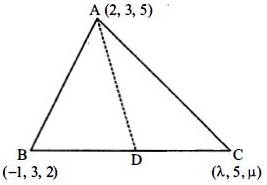
0 likes
View Solution18
MediumMCQ
Are the points $A(3, 6, 9)$,$B(10, 20, 30)$,and $C(25, -41, 5)$ the vertices of a right-angled triangle?
A
Yes
B
No
C
Cannot be determined
D
None of these
Solution
(B) Using the distance formula $d^2 = (x_2 - x_1)^2 + (y_2 - y_1)^2 + (z_2 - z_1)^2$,we calculate the squares of the sides:
$AB^2 = (10 - 3)^2 + (20 - 6)^2 + (30 - 9)^2 = 7^2 + 14^2 + 21^2 = 49 + 196 + 441 = 686$
$BC^2 = (25 - 10)^2 + (-41 - 20)^2 + (5 - 30)^2 = 15^2 + (-61)^2 + (-25)^2 = 225 + 3721 + 625 = 4571$
$CA^2 = (3 - 25)^2 + (6 - (-41))^2 + (9 - 5)^2 = (-22)^2 + 47^2 + 4^2 = 484 + 2209 + 16 = 2709$
For a right-angled triangle,the sum of the squares of two sides must equal the square of the third side (Pythagoras theorem).
Checking the sums:
$AB^2 + CA^2 = 686 + 2709 = 3395 \neq 4571 (BC^2)$
$AB^2 + BC^2 = 686 + 4571 = 5257 \neq 2709 (CA^2)$
$BC^2 + CA^2 = 4571 + 2709 = 7280 \neq 686 (AB^2)$
Since none of the combinations satisfy the condition $a^2 + b^2 = c^2$,the points $A, B, C$ do not form a right-angled triangle.
$AB^2 = (10 - 3)^2 + (20 - 6)^2 + (30 - 9)^2 = 7^2 + 14^2 + 21^2 = 49 + 196 + 441 = 686$
$BC^2 = (25 - 10)^2 + (-41 - 20)^2 + (5 - 30)^2 = 15^2 + (-61)^2 + (-25)^2 = 225 + 3721 + 625 = 4571$
$CA^2 = (3 - 25)^2 + (6 - (-41))^2 + (9 - 5)^2 = (-22)^2 + 47^2 + 4^2 = 484 + 2209 + 16 = 2709$
For a right-angled triangle,the sum of the squares of two sides must equal the square of the third side (Pythagoras theorem).
Checking the sums:
$AB^2 + CA^2 = 686 + 2709 = 3395 \neq 4571 (BC^2)$
$AB^2 + BC^2 = 686 + 4571 = 5257 \neq 2709 (CA^2)$
$BC^2 + CA^2 = 4571 + 2709 = 7280 \neq 686 (AB^2)$
Since none of the combinations satisfy the condition $a^2 + b^2 = c^2$,the points $A, B, C$ do not form a right-angled triangle.
0 likes
View Solution19
Medium
Verify that the points $(0, 7, -10)$,$(1, 6, -6)$,and $(4, 9, -6)$ are the vertices of an isosceles triangle.
Solution
Let the points be $A(0, 7, -10)$,$B(1, 6, -6)$,and $C(4, 9, -6)$.
Using the distance formula $d = \sqrt{(x_2 - x_1)^2 + (y_2 - y_1)^2 + (z_2 - z_1)^2}$:
$AB = \sqrt{(1 - 0)^2 + (6 - 7)^2 + (-6 - (-10))^2} = \sqrt{1^2 + (-1)^2 + 4^2} = \sqrt{1 + 1 + 16} = \sqrt{18} = 3\sqrt{2}$.
$BC = \sqrt{(4 - 1)^2 + (9 - 6)^2 + (-6 - (-6))^2} = \sqrt{3^2 + 3^2 + 0^2} = \sqrt{9 + 9} = \sqrt{18} = 3\sqrt{2}$.
$CA = \sqrt{(0 - 4)^2 + (7 - 9)^2 + (-10 - (-6))^2} = \sqrt{(-4)^2 + (-2)^2 + (-4)^2} = \sqrt{16 + 4 + 16} = \sqrt{36} = 6$.
Since $AB = BC = 3\sqrt{2}$ and $AB \neq CA$,two sides of the triangle are equal.
Therefore,the given points are the vertices of an isosceles triangle.
Using the distance formula $d = \sqrt{(x_2 - x_1)^2 + (y_2 - y_1)^2 + (z_2 - z_1)^2}$:
$AB = \sqrt{(1 - 0)^2 + (6 - 7)^2 + (-6 - (-10))^2} = \sqrt{1^2 + (-1)^2 + 4^2} = \sqrt{1 + 1 + 16} = \sqrt{18} = 3\sqrt{2}$.
$BC = \sqrt{(4 - 1)^2 + (9 - 6)^2 + (-6 - (-6))^2} = \sqrt{3^2 + 3^2 + 0^2} = \sqrt{9 + 9} = \sqrt{18} = 3\sqrt{2}$.
$CA = \sqrt{(0 - 4)^2 + (7 - 9)^2 + (-10 - (-6))^2} = \sqrt{(-4)^2 + (-2)^2 + (-4)^2} = \sqrt{16 + 4 + 16} = \sqrt{36} = 6$.
Since $AB = BC = 3\sqrt{2}$ and $AB \neq CA$,two sides of the triangle are equal.
Therefore,the given points are the vertices of an isosceles triangle.
0 likes
View Solution20
Medium
Verify that the points $(0, 7, 10)$,$(-1, 6, 6)$,and $(-4, 9, 6)$ are the vertices of a right-angled triangle.
Solution
(N/A) Let the points be $A(0, 7, 10)$,$B(-1, 6, 6)$,and $C(-4, 9, 6)$.
Using the distance formula $d = \sqrt{(x_2-x_1)^2 + (y_2-y_1)^2 + (z_2-z_1)^2}$:
$AB = \sqrt{(-1-0)^2 + (6-7)^2 + (6-10)^2} = \sqrt{(-1)^2 + (-1)^2 + (-4)^2} = \sqrt{1 + 1 + 16} = \sqrt{18} = 3\sqrt{2}$
$BC = \sqrt{(-4 - (-1))^2 + (9-6)^2 + (6-6)^2} = \sqrt{(-3)^2 + (3)^2 + (0)^2} = \sqrt{9 + 9 + 0} = \sqrt{18} = 3\sqrt{2}$
$CA = \sqrt{(0 - (-4))^2 + (7-9)^2 + (10-6)^2} = \sqrt{(4)^2 + (-2)^2 + (4)^2} = \sqrt{16 + 4 + 16} = \sqrt{36} = 6$
Now,check for the Pythagoras theorem condition $AB^2 + BC^2 = AC^2$:
$AB^2 + BC^2 = (3\sqrt{2})^2 + (3\sqrt{2})^2 = 18 + 18 = 36$
$AC^2 = (6)^2 = 36$
Since $AB^2 + BC^2 = AC^2$,the points $A, B,$ and $C$ form a right-angled triangle.
Using the distance formula $d = \sqrt{(x_2-x_1)^2 + (y_2-y_1)^2 + (z_2-z_1)^2}$:
$AB = \sqrt{(-1-0)^2 + (6-7)^2 + (6-10)^2} = \sqrt{(-1)^2 + (-1)^2 + (-4)^2} = \sqrt{1 + 1 + 16} = \sqrt{18} = 3\sqrt{2}$
$BC = \sqrt{(-4 - (-1))^2 + (9-6)^2 + (6-6)^2} = \sqrt{(-3)^2 + (3)^2 + (0)^2} = \sqrt{9 + 9 + 0} = \sqrt{18} = 3\sqrt{2}$
$CA = \sqrt{(0 - (-4))^2 + (7-9)^2 + (10-6)^2} = \sqrt{(4)^2 + (-2)^2 + (4)^2} = \sqrt{16 + 4 + 16} = \sqrt{36} = 6$
Now,check for the Pythagoras theorem condition $AB^2 + BC^2 = AC^2$:
$AB^2 + BC^2 = (3\sqrt{2})^2 + (3\sqrt{2})^2 = 18 + 18 = 36$
$AC^2 = (6)^2 = 36$
Since $AB^2 + BC^2 = AC^2$,the points $A, B,$ and $C$ form a right-angled triangle.
0 likes
View Solution21
Medium
Verify that the points $A(-1, 2, 1)$,$B(1, -2, 5)$,$C(4, -7, 8)$,and $D(2, -3, 4)$ are the vertices of a parallelogram.
Solution
(N/A) Let the given points be $A(-1, 2, 1)$,$B(1, -2, 5)$,$C(4, -7, 8)$,and $D(2, -3, 4)$.
First,we calculate the lengths of the sides using the distance formula $d = \sqrt{(x_2-x_1)^2 + (y_2-y_1)^2 + (z_2-z_1)^2}$:
$AB = \sqrt{(1 - (-1))^2 + (-2 - 2)^2 + (5 - 1)^2} = \sqrt{2^2 + (-4)^2 + 4^2} = \sqrt{4 + 16 + 16} = \sqrt{36} = 6$
$BC = \sqrt{(4 - 1)^2 + (-7 - (-2))^2 + (8 - 5)^2} = \sqrt{3^2 + (-5)^2 + 3^2} = \sqrt{9 + 25 + 9} = \sqrt{43}$
$CD = \sqrt{(2 - 4)^2 + (-3 - (-7))^2 + (4 - 8)^2} = \sqrt{(-2)^2 + 4^2 + (-4)^2} = \sqrt{4 + 16 + 16} = \sqrt{36} = 6$
$DA = \sqrt{(-1 - 2)^2 + (2 - (-3))^2 + (1 - 4)^2} = \sqrt{(-3)^2 + 5^2 + (-3)^2} = \sqrt{9 + 25 + 9} = \sqrt{43}$
Since $AB = CD = 6$ and $BC = DA = \sqrt{43}$,the opposite sides are equal.
Additionally,we check the diagonals $AC$ and $BD$:
$AC = \sqrt{(4 - (-1))^2 + (-7 - 2)^2 + (8 - 1)^2} = \sqrt{5^2 + (-9)^2 + 7^2} = \sqrt{25 + 81 + 49} = \sqrt{155}$
$BD = \sqrt{(2 - 1)^2 + (-3 - (-2))^2 + (4 - 5)^2} = \sqrt{1^2 + (-1)^2 + (-1)^2} = \sqrt{1 + 1 + 1} = \sqrt{3}$
Since the opposite sides are equal and the diagonals are not equal,the quadrilateral $ABCD$ is a parallelogram.
First,we calculate the lengths of the sides using the distance formula $d = \sqrt{(x_2-x_1)^2 + (y_2-y_1)^2 + (z_2-z_1)^2}$:
$AB = \sqrt{(1 - (-1))^2 + (-2 - 2)^2 + (5 - 1)^2} = \sqrt{2^2 + (-4)^2 + 4^2} = \sqrt{4 + 16 + 16} = \sqrt{36} = 6$
$BC = \sqrt{(4 - 1)^2 + (-7 - (-2))^2 + (8 - 5)^2} = \sqrt{3^2 + (-5)^2 + 3^2} = \sqrt{9 + 25 + 9} = \sqrt{43}$
$CD = \sqrt{(2 - 4)^2 + (-3 - (-7))^2 + (4 - 8)^2} = \sqrt{(-2)^2 + 4^2 + (-4)^2} = \sqrt{4 + 16 + 16} = \sqrt{36} = 6$
$DA = \sqrt{(-1 - 2)^2 + (2 - (-3))^2 + (1 - 4)^2} = \sqrt{(-3)^2 + 5^2 + (-3)^2} = \sqrt{9 + 25 + 9} = \sqrt{43}$
Since $AB = CD = 6$ and $BC = DA = \sqrt{43}$,the opposite sides are equal.
Additionally,we check the diagonals $AC$ and $BD$:
$AC = \sqrt{(4 - (-1))^2 + (-7 - 2)^2 + (8 - 1)^2} = \sqrt{5^2 + (-9)^2 + 7^2} = \sqrt{25 + 81 + 49} = \sqrt{155}$
$BD = \sqrt{(2 - 1)^2 + (-3 - (-2))^2 + (4 - 5)^2} = \sqrt{1^2 + (-1)^2 + (-1)^2} = \sqrt{1 + 1 + 1} = \sqrt{3}$
Since the opposite sides are equal and the diagonals are not equal,the quadrilateral $ABCD$ is a parallelogram.
0 likes
View Solution22
Medium
Show that the points $A(1, 2, 3)$,$B(-1, -2, -1)$,$C(2, 3, 2)$,and $D(4, 7, 6)$ are the vertices of a parallelogram $ABCD$,but it is not a rectangle.
Solution
To show that $ABCD$ is a parallelogram,we need to show that opposite sides are equal.
$AB = \sqrt{(-1-1)^{2} + (-2-2)^{2} + (-1-3)^{2}} = \sqrt{(-2)^{2} + (-4)^{2} + (-4)^{2}} = \sqrt{4 + 16 + 16} = \sqrt{36} = 6$
$BC = \sqrt{(2 - (-1))^{2} + (3 - (-2))^{2} + (2 - (-1))^{2}} = \sqrt{3^{2} + 5^{2} + 3^{2}} = \sqrt{9 + 25 + 9} = \sqrt{43}$
$CD = \sqrt{(4-2)^{2} + (7-3)^{2} + (6-2)^{2}} = \sqrt{2^{2} + 4^{2} + 4^{2}} = \sqrt{4 + 16 + 16} = \sqrt{36} = 6$
$DA = \sqrt{(1-4)^{2} + (2-7)^{2} + (3-6)^{2}} = \sqrt{(-3)^{2} + (-5)^{2} + (-3)^{2}} = \sqrt{9 + 25 + 9} = \sqrt{43}$
Since $AB = CD$ and $BC = DA$,$ABCD$ is a parallelogram.
Now,to prove that $ABCD$ is not a rectangle,we show that the diagonals $AC$ and $BD$ are unequal.
$AC = \sqrt{(2-1)^{2} + (3-2)^{2} + (2-3)^{2}} = \sqrt{1^{2} + 1^{2} + (-1)^{2}} = \sqrt{1 + 1 + 1} = \sqrt{3}$
$BD = \sqrt{(4 - (-1))^{2} + (7 - (-2))^{2} + (6 - (-1))^{2}} = \sqrt{5^{2} + 9^{2} + 7^{2}} = \sqrt{25 + 81 + 49} = \sqrt{155}$
Since $AC \neq BD$,$ABCD$ is not a rectangle.
$AB = \sqrt{(-1-1)^{2} + (-2-2)^{2} + (-1-3)^{2}} = \sqrt{(-2)^{2} + (-4)^{2} + (-4)^{2}} = \sqrt{4 + 16 + 16} = \sqrt{36} = 6$
$BC = \sqrt{(2 - (-1))^{2} + (3 - (-2))^{2} + (2 - (-1))^{2}} = \sqrt{3^{2} + 5^{2} + 3^{2}} = \sqrt{9 + 25 + 9} = \sqrt{43}$
$CD = \sqrt{(4-2)^{2} + (7-3)^{2} + (6-2)^{2}} = \sqrt{2^{2} + 4^{2} + 4^{2}} = \sqrt{4 + 16 + 16} = \sqrt{36} = 6$
$DA = \sqrt{(1-4)^{2} + (2-7)^{2} + (3-6)^{2}} = \sqrt{(-3)^{2} + (-5)^{2} + (-3)^{2}} = \sqrt{9 + 25 + 9} = \sqrt{43}$
Since $AB = CD$ and $BC = DA$,$ABCD$ is a parallelogram.
Now,to prove that $ABCD$ is not a rectangle,we show that the diagonals $AC$ and $BD$ are unequal.
$AC = \sqrt{(2-1)^{2} + (3-2)^{2} + (2-3)^{2}} = \sqrt{1^{2} + 1^{2} + (-1)^{2}} = \sqrt{1 + 1 + 1} = \sqrt{3}$
$BD = \sqrt{(4 - (-1))^{2} + (7 - (-2))^{2} + (6 - (-1))^{2}} = \sqrt{5^{2} + 9^{2} + 7^{2}} = \sqrt{25 + 81 + 49} = \sqrt{155}$
Since $AC \neq BD$,$ABCD$ is not a rectangle.
0 likes
View Solution23
EasyMCQ
The centroid of a triangle $ABC$ is at the point $(1,1,1)$. If the coordinates of $A$ and $B$ are $(3,-5,7)$ and $(-1,7,-6)$ respectively,find the coordinates of the point $C$.
A
$(1,1,2)$
B
$(1,1,3)$
C
$(1,1,4)$
D
$(1,1,5)$
Solution
(A) Let the coordinates of $C$ be $(x, y, z)$.
Given that the centroid $G$ is $(1,1,1)$,and the vertices are $A(3,-5,7)$ and $B(-1,7,-6)$.
The formula for the centroid of a triangle is $G = (\frac{x_1+x_2+x_3}{3}, \frac{y_1+y_2+y_3}{3}, \frac{z_1+z_2+z_3}{3})$.
Substituting the values,we get:
$\frac{x+3-1}{3} = 1 \implies x+2 = 3 \implies x = 1$.
$\frac{y-5+7}{3} = 1 \implies y+2 = 3 \implies y = 1$.
$\frac{z+7-6}{3} = 1 \implies z+1 = 3 \implies z = 2$.
Thus,the coordinates of point $C$ are $(1,1,2)$.
Given that the centroid $G$ is $(1,1,1)$,and the vertices are $A(3,-5,7)$ and $B(-1,7,-6)$.
The formula for the centroid of a triangle is $G = (\frac{x_1+x_2+x_3}{3}, \frac{y_1+y_2+y_3}{3}, \frac{z_1+z_2+z_3}{3})$.
Substituting the values,we get:
$\frac{x+3-1}{3} = 1 \implies x+2 = 3 \implies x = 1$.
$\frac{y-5+7}{3} = 1 \implies y+2 = 3 \implies y = 1$.
$\frac{z+7-6}{3} = 1 \implies z+1 = 3 \implies z = 2$.
Thus,the coordinates of point $C$ are $(1,1,2)$.
0 likes
View Solution24
MediumMCQ
Three vertices of a parallelogram $ABCD$ are $A(3, -1, 2)$,$B(1, 2, -4)$,and $C(-1, 1, 2)$. Find the coordinates of the fourth vertex $D$.
A
$(1, -2, 8)$
B
$(1, 2, 8)$
C
$(1, -2, -8)$
D
$(1, 2, -8)$
Solution
(A) Let the coordinates of the fourth vertex $D$ be $(x, y, z)$.
In a parallelogram $ABCD$,the diagonals $AC$ and $BD$ bisect each other at the same midpoint.
Midpoint of $AC = \left(\frac{3 + (-1)}{2}, \frac{-1 + 1}{2}, \frac{2 + 2}{2}\right) = \left(\frac{2}{2}, \frac{0}{2}, \frac{4}{2}\right) = (1, 0, 2)$.
Midpoint of $BD = \left(\frac{x + 1}{2}, \frac{y + 2}{2}, \frac{z - 4}{2}\right)$.
Equating the midpoints:
$\frac{x + 1}{2} = 1$ $\Rightarrow x + 1 = 2$ $\Rightarrow x = 1$.
$\frac{y + 2}{2} = 0$ $\Rightarrow y + 2 = 0$ $\Rightarrow y = -2$.
$\frac{z - 4}{2} = 2$ $\Rightarrow z - 4 = 4$ $\Rightarrow z = 8$.
Thus,the coordinates of the fourth vertex $D$ are $(1, -2, 8)$.
In a parallelogram $ABCD$,the diagonals $AC$ and $BD$ bisect each other at the same midpoint.
Midpoint of $AC = \left(\frac{3 + (-1)}{2}, \frac{-1 + 1}{2}, \frac{2 + 2}{2}\right) = \left(\frac{2}{2}, \frac{0}{2}, \frac{4}{2}\right) = (1, 0, 2)$.
Midpoint of $BD = \left(\frac{x + 1}{2}, \frac{y + 2}{2}, \frac{z - 4}{2}\right)$.
Equating the midpoints:
$\frac{x + 1}{2} = 1$ $\Rightarrow x + 1 = 2$ $\Rightarrow x = 1$.
$\frac{y + 2}{2} = 0$ $\Rightarrow y + 2 = 0$ $\Rightarrow y = -2$.
$\frac{z - 4}{2} = 2$ $\Rightarrow z - 4 = 4$ $\Rightarrow z = 8$.
Thus,the coordinates of the fourth vertex $D$ are $(1, -2, 8)$.
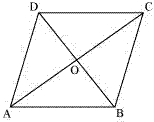
0 likes
View Solution25
MediumMCQ
Find the lengths of the medians of the triangle with vertices $A(0,0,6)$,$B(0,4,0)$,and $C(6,0,0)$.
A
$7, \sqrt{34}, 7$
B
$7, 7, \sqrt{34}$
C
$\sqrt{34}, 7, 7$
D
$7, 7, 7$
Solution
(A) Let $AD, BE,$ and $CF$ be the medians of the given triangle $ABC$ with vertices $A(0,0,6)$,$B(0,4,0)$,and $C(6,0,0)$.
Since $AD$ is the median,$D$ is the mid-point of $BC$.
Coordinates of point $D = \left(\frac{0+6}{2}, \frac{4+0}{2}, \frac{0+0}{2}\right) = (3,2,0)$.
$AD = \sqrt{(0-3)^{2} + (0-2)^{2} + (6-0)^{2}} = \sqrt{9+4+36} = \sqrt{49} = 7$.
Since $BE$ is the median,$E$ is the mid-point of $AC$.
Coordinates of point $E = \left(\frac{0+6}{2}, \frac{0+0}{2}, \frac{6+0}{2}\right) = (3,0,3)$.
$BE = \sqrt{(3-0)^{2} + (0-4)^{2} + (3-0)^{2}} = \sqrt{9+16+9} = \sqrt{34}$.
Since $CF$ is the median,$F$ is the mid-point of $AB$.
Coordinates of point $F = \left(\frac{0+0}{2}, \frac{0+4}{2}, \frac{6+0}{2}\right) = (0,2,3)$.
$CF = \sqrt{(6-0)^{2} + (0-2)^{2} + (0-3)^{2}} = \sqrt{36+4+9} = \sqrt{49} = 7$.
Thus,the lengths of the medians of $\Delta ABC$ are $7, \sqrt{34},$ and $7$.
Since $AD$ is the median,$D$ is the mid-point of $BC$.
Coordinates of point $D = \left(\frac{0+6}{2}, \frac{4+0}{2}, \frac{0+0}{2}\right) = (3,2,0)$.
$AD = \sqrt{(0-3)^{2} + (0-2)^{2} + (6-0)^{2}} = \sqrt{9+4+36} = \sqrt{49} = 7$.
Since $BE$ is the median,$E$ is the mid-point of $AC$.
Coordinates of point $E = \left(\frac{0+6}{2}, \frac{0+0}{2}, \frac{6+0}{2}\right) = (3,0,3)$.
$BE = \sqrt{(3-0)^{2} + (0-4)^{2} + (3-0)^{2}} = \sqrt{9+16+9} = \sqrt{34}$.
Since $CF$ is the median,$F$ is the mid-point of $AB$.
Coordinates of point $F = \left(\frac{0+0}{2}, \frac{0+4}{2}, \frac{6+0}{2}\right) = (0,2,3)$.
$CF = \sqrt{(6-0)^{2} + (0-2)^{2} + (0-3)^{2}} = \sqrt{36+4+9} = \sqrt{49} = 7$.
Thus,the lengths of the medians of $\Delta ABC$ are $7, \sqrt{34},$ and $7$.
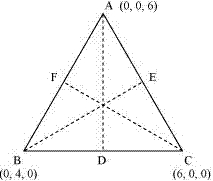
0 likes
View Solution26
MediumMCQ
If the origin is the centroid of the triangle $PQR$ with vertices $P(2a, 2, 6)$,$Q(-4, 3b, -10)$,and $R(8, 14, 2c)$,then find the values of $a, b$,and $c$.
A
$a = -2, b = -\frac{16}{3}, c = 2$
B
$a = 2, b = \frac{16}{3}, c = -2$
C
$a = -2, b = \frac{16}{3}, c = 2$
D
$a = 2, b = -\frac{16}{3}, c = -2$
Solution
(A) The coordinates of the centroid of a triangle with vertices $(x_1, y_1, z_1)$,$(x_2, y_2, z_2)$,and $(x_3, y_3, z_3)$ are given by $\left(\frac{x_1+x_2+x_3}{3}, \frac{y_1+y_2+y_3}{3}, \frac{z_1+z_2+z_3}{3}\right)$.
Given the vertices $P(2a, 2, 6)$,$Q(-4, 3b, -10)$,and $R(8, 14, 2c)$,the centroid is:
$\left(\frac{2a - 4 + 8}{3}, \frac{2 + 3b + 14}{3}, \frac{6 - 10 + 2c}{3}\right) = \left(\frac{2a + 4}{3}, \frac{3b + 16}{3}, \frac{2c - 4}{3}\right)$.
Since the origin $(0, 0, 0)$ is the centroid,we equate the coordinates:
$\frac{2a + 4}{3} = 0$ $\Rightarrow 2a = -4$ $\Rightarrow a = -2$.
$\frac{3b + 16}{3} = 0$ $\Rightarrow 3b = -16$ $\Rightarrow b = -\frac{16}{3}$.
$\frac{2c - 4}{3} = 0$ $\Rightarrow 2c = 4$ $\Rightarrow c = 2$.
Thus,the values are $a = -2, b = -\frac{16}{3}, c = 2$.
Given the vertices $P(2a, 2, 6)$,$Q(-4, 3b, -10)$,and $R(8, 14, 2c)$,the centroid is:
$\left(\frac{2a - 4 + 8}{3}, \frac{2 + 3b + 14}{3}, \frac{6 - 10 + 2c}{3}\right) = \left(\frac{2a + 4}{3}, \frac{3b + 16}{3}, \frac{2c - 4}{3}\right)$.
Since the origin $(0, 0, 0)$ is the centroid,we equate the coordinates:
$\frac{2a + 4}{3} = 0$ $\Rightarrow 2a = -4$ $\Rightarrow a = -2$.
$\frac{3b + 16}{3} = 0$ $\Rightarrow 3b = -16$ $\Rightarrow b = -\frac{16}{3}$.
$\frac{2c - 4}{3} = 0$ $\Rightarrow 2c = 4$ $\Rightarrow c = 2$.
Thus,the values are $a = -2, b = -\frac{16}{3}, c = 2$.
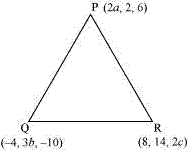
0 likes
View Solution27
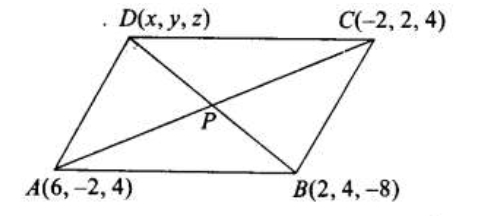
Medium
Three consecutive vertices of a parallelogram $ABCD$ are $A(6, -2, 4)$,$B(2, 4, -8)$,and $C(-2, 2, 4)$. Find the coordinates of the fourth vertex $D$.
Solution
(N/A) Let the coordinates of the fourth vertex $D$ be $(x, y, z)$.
In a parallelogram,the diagonals bisect each other,meaning they share the same midpoint $P$.
Midpoint of diagonal $AC$ is $P\left(\frac{6-2}{2}, \frac{-2+2}{2}, \frac{4+4}{2}\right) = P(2, 0, 4)$.
Midpoint of diagonal $BD$ is $P\left(\frac{x+2}{2}, \frac{y+4}{2}, \frac{z-8}{2}\right)$.
Equating the midpoints:
$\frac{x+2}{2} = 2$ $\Rightarrow x+2 = 4$ $\Rightarrow x = 2$
$\frac{y+4}{2} = 0$ $\Rightarrow y+4 = 0$ $\Rightarrow y = -4$
$\frac{z-8}{2} = 4$ $\Rightarrow z-8 = 8$ $\Rightarrow z = 16$
Thus,the coordinates of the fourth vertex $D$ are $(2, -4, 16)$.
In a parallelogram,the diagonals bisect each other,meaning they share the same midpoint $P$.
Midpoint of diagonal $AC$ is $P\left(\frac{6-2}{2}, \frac{-2+2}{2}, \frac{4+4}{2}\right) = P(2, 0, 4)$.
Midpoint of diagonal $BD$ is $P\left(\frac{x+2}{2}, \frac{y+4}{2}, \frac{z-8}{2}\right)$.
Equating the midpoints:
$\frac{x+2}{2} = 2$ $\Rightarrow x+2 = 4$ $\Rightarrow x = 2$
$\frac{y+4}{2} = 0$ $\Rightarrow y+4 = 0$ $\Rightarrow y = -4$
$\frac{z-8}{2} = 4$ $\Rightarrow z-8 = 8$ $\Rightarrow z = 16$
Thus,the coordinates of the fourth vertex $D$ are $(2, -4, 16)$.
0 likes
View Solution28
MediumMCQ
Find the third vertex of a triangle whose centroid is the origin and two vertices are $(2, 4, 6)$ and $(0, -2, -5)$.
A
$(-2, -2, -1)$
B
$(2, 2, 1)$
C
$(1, 1, 2)$
D
$(-1, -1, -2)$
Solution
(A) Let the third vertex of the triangle be $A(x, y, z)$.
The given vertices are $B(2, 4, 6)$ and $C(0, -2, -5)$.
The centroid $G$ of a triangle with vertices $(x_1, y_1, z_1)$,$(x_2, y_2, z_2)$,and $(x_3, y_3, z_3)$ is given by $G = \left(\frac{x_1+x_2+x_3}{3}, \frac{y_1+y_2+y_3}{3}, \frac{z_1+z_2+z_3}{3}\right)$.
Given that the centroid is the origin $(0, 0, 0)$,we have:
$(0, 0, 0) = \left(\frac{2+0+x}{3}, \frac{4-2+y}{3}, \frac{6-5+z}{3}\right)$.
Equating the coordinates:
$\frac{2+x}{3} = 0 \implies x = -2$.
$\frac{2+y}{3} = 0 \implies y = -2$.
$\frac{1+z}{3} = 0 \implies z = -1$.
Thus,the third vertex is $(-2, -2, -1)$.
The given vertices are $B(2, 4, 6)$ and $C(0, -2, -5)$.
The centroid $G$ of a triangle with vertices $(x_1, y_1, z_1)$,$(x_2, y_2, z_2)$,and $(x_3, y_3, z_3)$ is given by $G = \left(\frac{x_1+x_2+x_3}{3}, \frac{y_1+y_2+y_3}{3}, \frac{z_1+z_2+z_3}{3}\right)$.
Given that the centroid is the origin $(0, 0, 0)$,we have:
$(0, 0, 0) = \left(\frac{2+0+x}{3}, \frac{4-2+y}{3}, \frac{6-5+z}{3}\right)$.
Equating the coordinates:
$\frac{2+x}{3} = 0 \implies x = -2$.
$\frac{2+y}{3} = 0 \implies y = -2$.
$\frac{1+z}{3} = 0 \implies z = -1$.
Thus,the third vertex is $(-2, -2, -1)$.
0 likes
View Solution29
EasyMCQ
Find the centroid of a triangle,the mid-points of whose sides are $D(1, 2, -3)$,$E(3, 0, 1)$,and $F(-1, 1, -4)$.
A
$G(1, 1, -2)$
B
$G(1, 2, -1)$
C
$G(2, 1, -3)$
D
$G(3, 1, -2)$
Solution
(A) Let the vertices of the triangle be $A(x_1, y_1, z_1)$,$B(x_2, y_2, z_2)$,and $C(x_3, y_3, z_3)$.
The mid-points of the sides are given as $D(1, 2, -3)$,$E(3, 0, 1)$,and $F(-1, 1, -4)$.
We know that the centroid of the triangle formed by the mid-points of the sides of a triangle is the same as the centroid of the original triangle.
The centroid $G(x, y, z)$ of $\Delta DEF$ is calculated as:
$x = \frac{1 + 3 + (-1)}{3} = \frac{3}{3} = 1$
$y = \frac{2 + 0 + 1}{3} = \frac{3}{3} = 1$
$z = \frac{-3 + 1 + (-4)}{3} = \frac{-6}{3} = -2$
Therefore,the centroid of the triangle is $G(1, 1, -2)$.
The mid-points of the sides are given as $D(1, 2, -3)$,$E(3, 0, 1)$,and $F(-1, 1, -4)$.
We know that the centroid of the triangle formed by the mid-points of the sides of a triangle is the same as the centroid of the original triangle.
The centroid $G(x, y, z)$ of $\Delta DEF$ is calculated as:
$x = \frac{1 + 3 + (-1)}{3} = \frac{3}{3} = 1$
$y = \frac{2 + 0 + 1}{3} = \frac{3}{3} = 1$
$z = \frac{-3 + 1 + (-4)}{3} = \frac{-6}{3} = -2$
Therefore,the centroid of the triangle is $G(1, 1, -2)$.
0 likes
View Solution30
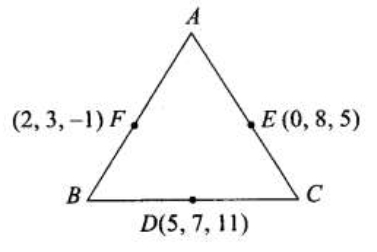
Medium
The mid-points of the sides of a triangle are $(5,7,11)$,$(0,8,5)$,and $(2,3,-1)$. Find its vertices.
Solution
(N/A) Let the vertices of the triangle be $A(x_1, y_1, z_1)$,$B(x_2, y_2, z_2)$,and $C(x_3, y_3, z_3)$.
Given mid-points are $D(5,7,11)$ on $BC$,$E(0,8,5)$ on $AC$,and $F(2,3,-1)$ on $AB$.
Using the mid-point formula:
$1) \frac{x_2+x_3}{2} = 5, \frac{y_2+y_3}{2} = 7, \frac{z_2+z_3}{2} = 11 \Rightarrow x_2+x_3=10, y_2+y_3=14, z_2+z_3=22$
$2) \frac{x_1+x_3}{2} = 0, \frac{y_1+y_3}{2} = 8, \frac{z_1+z_3}{2} = 5 \Rightarrow x_1+x_3=0, y_1+y_3=16, z_1+z_3=10$
$3) \frac{x_1+x_2}{2} = 2, \frac{y_1+y_2}{2} = 3, \frac{z_1+z_2}{2} = -1 \Rightarrow x_1+x_2=4, y_1+y_2=6, z_1+z_2=-2$
Adding all equations for $x$:
$(x_2+x_3) + (x_1+x_3) + (x_1+x_2) = 10+0+4 = 14$ $\Rightarrow 2(x_1+x_2+x_3) = 14$ $\Rightarrow x_1+x_2+x_3 = 7$
$x_1 = (x_1+x_2+x_3) - (x_2+x_3) = 7-10 = -3$
$x_2 = (x_1+x_2+x_3) - (x_1+x_3) = 7-0 = 7$
$x_3 = (x_1+x_2+x_3) - (x_1+x_2) = 7-4 = 3$
Similarly for $y$:
$y_1+y_2+y_3 = (14+16+6)/2 = 18$
$y_1 = 18-14 = 4, y_2 = 18-16 = 2, y_3 = 18-6 = 12$
Similarly for $z$:
$z_1+z_2+z_3 = (22+10-2)/2 = 15$
$z_1 = 15-22 = -7, z_2 = 15-10 = 5, z_3 = 15-(-2) = 17$
Thus,the vertices are $A(-3, 4, -7)$,$B(7, 2, 5)$,and $C(3, 12, 17)$.
Given mid-points are $D(5,7,11)$ on $BC$,$E(0,8,5)$ on $AC$,and $F(2,3,-1)$ on $AB$.
Using the mid-point formula:
$1) \frac{x_2+x_3}{2} = 5, \frac{y_2+y_3}{2} = 7, \frac{z_2+z_3}{2} = 11 \Rightarrow x_2+x_3=10, y_2+y_3=14, z_2+z_3=22$
$2) \frac{x_1+x_3}{2} = 0, \frac{y_1+y_3}{2} = 8, \frac{z_1+z_3}{2} = 5 \Rightarrow x_1+x_3=0, y_1+y_3=16, z_1+z_3=10$
$3) \frac{x_1+x_2}{2} = 2, \frac{y_1+y_2}{2} = 3, \frac{z_1+z_2}{2} = -1 \Rightarrow x_1+x_2=4, y_1+y_2=6, z_1+z_2=-2$
Adding all equations for $x$:
$(x_2+x_3) + (x_1+x_3) + (x_1+x_2) = 10+0+4 = 14$ $\Rightarrow 2(x_1+x_2+x_3) = 14$ $\Rightarrow x_1+x_2+x_3 = 7$
$x_1 = (x_1+x_2+x_3) - (x_2+x_3) = 7-10 = -3$
$x_2 = (x_1+x_2+x_3) - (x_1+x_3) = 7-0 = 7$
$x_3 = (x_1+x_2+x_3) - (x_1+x_2) = 7-4 = 3$
Similarly for $y$:
$y_1+y_2+y_3 = (14+16+6)/2 = 18$
$y_1 = 18-14 = 4, y_2 = 18-16 = 2, y_3 = 18-6 = 12$
Similarly for $z$:
$z_1+z_2+z_3 = (22+10-2)/2 = 15$
$z_1 = 15-22 = -7, z_2 = 15-10 = 5, z_3 = 15-(-2) = 17$
Thus,the vertices are $A(-3, 4, -7)$,$B(7, 2, 5)$,and $C(3, 12, 17)$.
0 likes
View Solution31
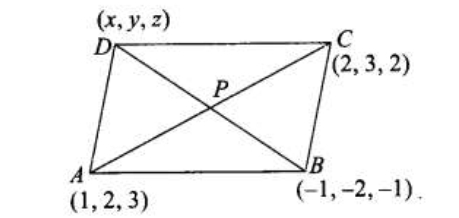
Easy
Three vertices of a parallelogram $ABCD$ are $A(1, 2, 3)$,$B(-1, -2, -1)$ and $C(2, 3, 2)$. Find the fourth vertex $D(x, y, z)$.
Solution
(N/A) In a parallelogram,the diagonals bisect each other. Therefore,the mid-point of diagonal $AC$ is the same as the mid-point of diagonal $BD$.
Mid-point of $AC = \left(\frac{1+2}{2}, \frac{2+3}{2}, \frac{3+2}{2}\right) = \left(\frac{3}{2}, \frac{5}{2}, \frac{5}{2}\right)$
Mid-point of $BD = \left(\frac{x-1}{2}, \frac{y-2}{2}, \frac{z-1}{2}\right)$
Equating the mid-points:
$\frac{x-1}{2} = \frac{3}{2}$ $\Rightarrow x-1 = 3$ $\Rightarrow x = 4$
$\frac{y-2}{2} = \frac{5}{2}$ $\Rightarrow y-2 = 5$ $\Rightarrow y = 7$
$\frac{z-1}{2} = \frac{5}{2}$ $\Rightarrow z-1 = 5$ $\Rightarrow z = 6$
Thus,the coordinates of the fourth vertex $D$ are $(4, 7, 6)$.
Mid-point of $AC = \left(\frac{1+2}{2}, \frac{2+3}{2}, \frac{3+2}{2}\right) = \left(\frac{3}{2}, \frac{5}{2}, \frac{5}{2}\right)$
Mid-point of $BD = \left(\frac{x-1}{2}, \frac{y-2}{2}, \frac{z-1}{2}\right)$
Equating the mid-points:
$\frac{x-1}{2} = \frac{3}{2}$ $\Rightarrow x-1 = 3$ $\Rightarrow x = 4$
$\frac{y-2}{2} = \frac{5}{2}$ $\Rightarrow y-2 = 5$ $\Rightarrow y = 7$
$\frac{z-1}{2} = \frac{5}{2}$ $\Rightarrow z-1 = 5$ $\Rightarrow z = 6$
Thus,the coordinates of the fourth vertex $D$ are $(4, 7, 6)$.
0 likes
View Solution32
Easy
If the origin is the centroid of a triangle $ABC$ having vertices $A(a, 1, 3)$,$B(-2, b, -5)$,and $C(4, 7, c)$,find the values of $a, b, c$.
Solution
(A) The vertices of triangle $ABC$ are $A(a, 1, 3)$,$B(-2, b, -5)$,and $C(4, 7, c)$.
The centroid $G$ of a triangle with vertices $(x_1, y_1, z_1)$,$(x_2, y_2, z_2)$,and $(x_3, y_3, z_3)$ is given by $\left(\frac{x_1+x_2+x_3}{3}, \frac{y_1+y_2+y_3}{3}, \frac{z_1+z_2+z_3}{3}\right)$.
Given that the centroid is the origin $G(0, 0, 0)$,we have:
$G(0, 0, 0) = \left(\frac{a-2+4}{3}, \frac{1+b+7}{3}, \frac{3-5+c}{3}\right)$.
Equating the coordinates:
$0 = \frac{a+2}{3} \implies a+2 = 0 \implies a = -2$.
$0 = \frac{b+8}{3} \implies b+8 = 0 \implies b = -8$.
$0 = \frac{c-2}{3} \implies c-2 = 0 \implies c = 2$.
Thus,the values are $a = -2, b = -8, c = 2$.
The centroid $G$ of a triangle with vertices $(x_1, y_1, z_1)$,$(x_2, y_2, z_2)$,and $(x_3, y_3, z_3)$ is given by $\left(\frac{x_1+x_2+x_3}{3}, \frac{y_1+y_2+y_3}{3}, \frac{z_1+z_2+z_3}{3}\right)$.
Given that the centroid is the origin $G(0, 0, 0)$,we have:
$G(0, 0, 0) = \left(\frac{a-2+4}{3}, \frac{1+b+7}{3}, \frac{3-5+c}{3}\right)$.
Equating the coordinates:
$0 = \frac{a+2}{3} \implies a+2 = 0 \implies a = -2$.
$0 = \frac{b+8}{3} \implies b+8 = 0 \implies b = -8$.
$0 = \frac{c-2}{3} \implies c-2 = 0 \implies c = 2$.
Thus,the values are $a = -2, b = -8, c = 2$.
0 likes
View Solution33
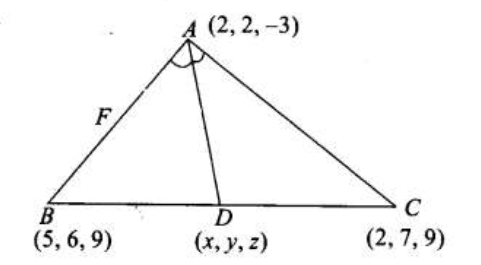
Medium
Let $A(2, 2, -3)$,$B(5, 6, 9)$,and $C(2, 7, 9)$ be the vertices of a triangle. The angle bisector of $\angle A$ meets $BC$ at the point $D$. Find the coordinates of $D$.
Solution
(N/A) Let the coordinates of $D$ be $(x, y, z)$.
First,calculate the lengths of sides $AB$ and $AC$:
$AB = \sqrt{(5-2)^2 + (6-2)^2 + (9 - (-3))^2} = \sqrt{3^2 + 4^2 + 12^2} = \sqrt{9 + 16 + 144} = \sqrt{169} = 13$
$AC = \sqrt{(2-2)^2 + (7-2)^2 + (9 - (-3))^2} = \sqrt{0^2 + 5^2 + 12^2} = \sqrt{0 + 25 + 144} = \sqrt{169} = 13$
Since $AB = AC = 13$,$\triangle ABC$ is an isosceles triangle.
In an isosceles triangle,the angle bisector of the vertex angle is also the median to the base.
Therefore,$AD$ is the median to $BC$,which means $D$ is the midpoint of $BC$.
The coordinates of $D$ are given by the midpoint formula:
$D = \left(\frac{5+2}{2}, \frac{6+7}{2}, \frac{9+9}{2}\right) = \left(\frac{7}{2}, \frac{13}{2}, 9\right)$
First,calculate the lengths of sides $AB$ and $AC$:
$AB = \sqrt{(5-2)^2 + (6-2)^2 + (9 - (-3))^2} = \sqrt{3^2 + 4^2 + 12^2} = \sqrt{9 + 16 + 144} = \sqrt{169} = 13$
$AC = \sqrt{(2-2)^2 + (7-2)^2 + (9 - (-3))^2} = \sqrt{0^2 + 5^2 + 12^2} = \sqrt{0 + 25 + 144} = \sqrt{169} = 13$
Since $AB = AC = 13$,$\triangle ABC$ is an isosceles triangle.
In an isosceles triangle,the angle bisector of the vertex angle is also the median to the base.
Therefore,$AD$ is the median to $BC$,which means $D$ is the midpoint of $BC$.
The coordinates of $D$ are given by the midpoint formula:
$D = \left(\frac{5+2}{2}, \frac{6+7}{2}, \frac{9+9}{2}\right) = \left(\frac{7}{2}, \frac{13}{2}, 9\right)$
0 likes
View Solution34
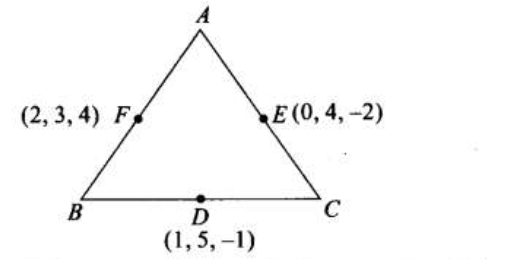
Medium
The mid-points of the sides of a triangle are $(1, 5, -1), (0, 4, -2)$ and $(2, 3, 4)$. Find its vertices. Also,find the centroid of the triangle.
Solution
(N/A) Let the vertices of the triangle be $A(x_1, y_1, z_1), B(x_2, y_2, z_2)$ and $C(x_3, y_3, z_3)$.
Let the mid-points be $D(1, 5, -1)$ on $BC$,$E(0, 4, -2)$ on $AC$,and $F(2, 3, 4)$ on $AB$.
Using the mid-point formula:
$\frac{x_1+x_2}{2} = 2, \frac{y_1+y_2}{2} = 3, \frac{z_1+z_2}{2} = 4 \implies x_1+x_2 = 4, y_1+y_2 = 6, z_1+z_2 = 8$ $(i)$
$\frac{x_1+x_3}{2} = 0, \frac{y_1+y_3}{2} = 4, \frac{z_1+z_3}{2} = -2 \implies x_1+x_3 = 0, y_1+y_3 = 8, z_1+z_3 = -4$ (ii)
$\frac{x_2+x_3}{2} = 1, \frac{y_2+y_3}{2} = 5, \frac{z_2+z_3}{2} = -1 \implies x_2+x_3 = 2, y_2+y_3 = 10, z_2+z_3 = -2$ (iii)
Adding $(i)$,(ii),and (iii): $2(x_1+x_2+x_3) = 6 \implies x_1+x_2+x_3 = 3$. Similarly,$y_1+y_2+y_3 = 12$ and $z_1+z_2+z_3 = 1$.
Subtracting (iii) from the sum: $x_1 = 3-2 = 1, y_1 = 12-10 = 2, z_1 = 1-(-2) = 3$. So,$A = (1, 2, 3)$.
Subtracting (ii) from the sum: $x_2 = 3-0 = 3, y_2 = 12-8 = 4, z_2 = 1-(-4) = 5$. So,$B = (3, 4, 5)$.
Subtracting $(i)$ from the sum: $x_3 = 3-4 = -1, y_3 = 12-6 = 6, z_3 = 1-8 = -7$. So,$C = (-1, 6, -7)$.
Centroid $G = \left(\frac{x_1+x_2+x_3}{3}, \frac{y_1+y_2+y_3}{3}, \frac{z_1+z_2+z_3}{3}\right) = \left(\frac{3}{3}, \frac{12}{3}, \frac{1}{3}\right) = (1, 4, 1/3)$.
Let the mid-points be $D(1, 5, -1)$ on $BC$,$E(0, 4, -2)$ on $AC$,and $F(2, 3, 4)$ on $AB$.
Using the mid-point formula:
$\frac{x_1+x_2}{2} = 2, \frac{y_1+y_2}{2} = 3, \frac{z_1+z_2}{2} = 4 \implies x_1+x_2 = 4, y_1+y_2 = 6, z_1+z_2 = 8$ $(i)$
$\frac{x_1+x_3}{2} = 0, \frac{y_1+y_3}{2} = 4, \frac{z_1+z_3}{2} = -2 \implies x_1+x_3 = 0, y_1+y_3 = 8, z_1+z_3 = -4$ (ii)
$\frac{x_2+x_3}{2} = 1, \frac{y_2+y_3}{2} = 5, \frac{z_2+z_3}{2} = -1 \implies x_2+x_3 = 2, y_2+y_3 = 10, z_2+z_3 = -2$ (iii)
Adding $(i)$,(ii),and (iii): $2(x_1+x_2+x_3) = 6 \implies x_1+x_2+x_3 = 3$. Similarly,$y_1+y_2+y_3 = 12$ and $z_1+z_2+z_3 = 1$.
Subtracting (iii) from the sum: $x_1 = 3-2 = 1, y_1 = 12-10 = 2, z_1 = 1-(-2) = 3$. So,$A = (1, 2, 3)$.
Subtracting (ii) from the sum: $x_2 = 3-0 = 3, y_2 = 12-8 = 4, z_2 = 1-(-4) = 5$. So,$B = (3, 4, 5)$.
Subtracting $(i)$ from the sum: $x_3 = 3-4 = -1, y_3 = 12-6 = 6, z_3 = 1-8 = -7$. So,$C = (-1, 6, -7)$.
Centroid $G = \left(\frac{x_1+x_2+x_3}{3}, \frac{y_1+y_2+y_3}{3}, \frac{z_1+z_2+z_3}{3}\right) = \left(\frac{3}{3}, \frac{12}{3}, \frac{1}{3}\right) = (1, 4, 1/3)$.
0 likes
View Solution35
MediumMCQ
If the points $(-1, -1, 2), (2, m, 5)$ and $(3, 11, 6)$ are collinear,find the value of $m$.
A
$m = 8$
B
$m = 7$
C
$m = 9$
D
$m = 6$
Solution
(A) Let the given points be $A(-1, -1, 2), B(2, m, 5)$ and $C(3, 11, 6)$.
Since the points are collinear,the vectors $\overrightarrow{AB}$ and $\overrightarrow{BC}$ must be parallel.
$\overrightarrow{AB} = (2 - (-1))\hat{i} + (m - (-1))\hat{j} + (5 - 2)\hat{k} = 3\hat{i} + (m + 1)\hat{j} + 3\hat{k}$.
$\overrightarrow{BC} = (3 - 2)\hat{i} + (11 - m)\hat{j} + (6 - 5)\hat{k} = 1\hat{i} + (11 - m)\hat{j} + 1\hat{k}$.
Since $\overrightarrow{AB} = k\overrightarrow{BC}$,we have:
$3 = k(1) \Rightarrow k = 3$.
Equating the $\hat{j}$ components: $m + 1 = k(11 - m)$.
Substituting $k = 3$: $m + 1 = 3(11 - m)$.
$m + 1 = 33 - 3m$.
$4m = 32$.
$m = 8$.
Since the points are collinear,the vectors $\overrightarrow{AB}$ and $\overrightarrow{BC}$ must be parallel.
$\overrightarrow{AB} = (2 - (-1))\hat{i} + (m - (-1))\hat{j} + (5 - 2)\hat{k} = 3\hat{i} + (m + 1)\hat{j} + 3\hat{k}$.
$\overrightarrow{BC} = (3 - 2)\hat{i} + (11 - m)\hat{j} + (6 - 5)\hat{k} = 1\hat{i} + (11 - m)\hat{j} + 1\hat{k}$.
Since $\overrightarrow{AB} = k\overrightarrow{BC}$,we have:
$3 = k(1) \Rightarrow k = 3$.
Equating the $\hat{j}$ components: $m + 1 = k(11 - m)$.
Substituting $k = 3$: $m + 1 = 3(11 - m)$.
$m + 1 = 33 - 3m$.
$4m = 32$.
$m = 8$.
0 likes
View Solution36
AdvancedMCQ
Consider a cuboid where all edges are integers and the base is a square. Suppose the sum of all its edges is numerically equal to the sum of the areas of all its six faces. Then,the sum of all its edges is
A
$12$
B
$18$
C
$24$
D
$36$
Solution
(C) Let the side length of the square base be $x$ and the height of the cuboid be $y$,where $x, y \in \mathbb{Z}^+$.
The sum of all edges of the cuboid is $4x + 4x + 4y = 8x + 4y$.
The sum of the areas of all six faces is $2x^2 + 4xy$.
According to the problem,the sum of edges equals the sum of areas:
$8x + 4y = 2x^2 + 4xy$
Dividing by $2$:
$4x + 2y = x^2 + 2xy$
Rearranging to solve for $y$:
$2y - 2xy = x^2 - 4x$
$2y(1 - x) = x(x - 4)$
$y = \frac{x(x - 4)}{2(1 - x)} = \frac{x(4 - x)}{2(x - 1)}$
Since $y > 0$,we must have $1 < x < 4$. Thus,$x$ can be $2$ or $3$.
If $x = 2$,$y = \frac{2(4 - 2)}{2(2 - 1)} = \frac{4}{2} = 2$.
Sum of edges $= 8(2) + 4(2) = 16 + 8 = 24$.
If $x = 3$,$y = \frac{3(4 - 3)}{2(3 - 1)} = \frac{3}{4}$,which is not an integer.
Thus,the only integer solution is $x = 2, y = 2$,and the sum of edges is $24$.
The sum of all edges of the cuboid is $4x + 4x + 4y = 8x + 4y$.
The sum of the areas of all six faces is $2x^2 + 4xy$.
According to the problem,the sum of edges equals the sum of areas:
$8x + 4y = 2x^2 + 4xy$
Dividing by $2$:
$4x + 2y = x^2 + 2xy$
Rearranging to solve for $y$:
$2y - 2xy = x^2 - 4x$
$2y(1 - x) = x(x - 4)$
$y = \frac{x(x - 4)}{2(1 - x)} = \frac{x(4 - x)}{2(x - 1)}$
Since $y > 0$,we must have $1 < x < 4$. Thus,$x$ can be $2$ or $3$.
If $x = 2$,$y = \frac{2(4 - 2)}{2(2 - 1)} = \frac{4}{2} = 2$.
Sum of edges $= 8(2) + 4(2) = 16 + 8 = 24$.
If $x = 3$,$y = \frac{3(4 - 3)}{2(3 - 1)} = \frac{3}{4}$,which is not an integer.
Thus,the only integer solution is $x = 2, y = 2$,and the sum of edges is $24$.
0 likes
View Solution37
DifficultMCQ
Let $A(x, y, z)$ be a point in the $xy$-plane,which is equidistant from three points $P(0, 3, 2)$,$Q(2, 0, 3)$,and $R(0, 0, 1)$. Let $B = (1, 4, -1)$ and $C = (2, 0, -2)$. Then among the statements $(S1) :$ $\triangle ABC$ is an isosceles right-angled triangle and $(S2) :$ the area of $\triangle ABC$ is $\frac{9 \sqrt{2}}{2}$.
A
both are true
B
only $(S1)$ is true
C
only $(S2)$ is true
D
both are false
Solution
(B) Since $A(x, y, z)$ lies in the $xy$-plane,$z = 0$. Thus,$A = (x, y, 0)$.
Given $AP^2 = AQ^2 = AR^2$.
$AR^2 = x^2 + y^2 + (0 - 1)^2 = x^2 + y^2 + 1$.
$AP^2 = x^2 + (y - 3)^2 + (0 - 2)^2 = x^2 + y^2 - 6y + 9 + 4 = x^2 + y^2 - 6y + 13$.
$AQ^2 = (x - 2)^2 + y^2 + (0 - 3)^2 = x^2 - 4x + 4 + y^2 + 9 = x^2 + y^2 - 4x + 13$.
Equating $AP^2 = AR^2 \implies x^2 + y^2 - 6y + 13 = x^2 + y^2 + 1 \implies 6y = 12 \implies y = 2$.
Equating $AQ^2 = AR^2 \implies x^2 + y^2 - 4x + 13 = x^2 + y^2 + 1 \implies 4x = 12 \implies x = 3$.
So,$A = (3, 2, 0)$.
Now,calculate the side lengths of $\triangle ABC$ with $A(3, 2, 0)$,$B(1, 4, -1)$,and $C(2, 0, -2)$:
$AB^2 = (3 - 1)^2 + (2 - 4)^2 + (0 - (-1))^2 = 2^2 + (-2)^2 + 1^2 = 4 + 4 + 1 = 9 \implies AB = 3$.
$AC^2 = (3 - 2)^2 + (2 - 0)^2 + (0 - (-2))^2 = 1^2 + 2^2 + 2^2 = 1 + 4 + 4 = 9 \implies AC = 3$.
$BC^2 = (1 - 2)^2 + (4 - 0)^2 + (-1 - (-2))^2 = (-1)^2 + 4^2 + 1^2 = 1 + 16 + 1 = 18 \implies BC = \sqrt{18} = 3\sqrt{2}$.
Since $AB = AC = 3$ and $AB^2 + AC^2 = 9 + 9 = 18 = BC^2$,$\triangle ABC$ is an isosceles right-angled triangle. Thus,$(S1)$ is true.
Area of $\triangle ABC = \frac{1}{2} \times AB \times AC = \frac{1}{2} \times 3 \times 3 = \frac{9}{2}$.
Since $\frac{9}{2} \neq \frac{9\sqrt{2}}{2}$,$(S2)$ is false.
Therefore,only $(S1)$ is true.
Given $AP^2 = AQ^2 = AR^2$.
$AR^2 = x^2 + y^2 + (0 - 1)^2 = x^2 + y^2 + 1$.
$AP^2 = x^2 + (y - 3)^2 + (0 - 2)^2 = x^2 + y^2 - 6y + 9 + 4 = x^2 + y^2 - 6y + 13$.
$AQ^2 = (x - 2)^2 + y^2 + (0 - 3)^2 = x^2 - 4x + 4 + y^2 + 9 = x^2 + y^2 - 4x + 13$.
Equating $AP^2 = AR^2 \implies x^2 + y^2 - 6y + 13 = x^2 + y^2 + 1 \implies 6y = 12 \implies y = 2$.
Equating $AQ^2 = AR^2 \implies x^2 + y^2 - 4x + 13 = x^2 + y^2 + 1 \implies 4x = 12 \implies x = 3$.
So,$A = (3, 2, 0)$.
Now,calculate the side lengths of $\triangle ABC$ with $A(3, 2, 0)$,$B(1, 4, -1)$,and $C(2, 0, -2)$:
$AB^2 = (3 - 1)^2 + (2 - 4)^2 + (0 - (-1))^2 = 2^2 + (-2)^2 + 1^2 = 4 + 4 + 1 = 9 \implies AB = 3$.
$AC^2 = (3 - 2)^2 + (2 - 0)^2 + (0 - (-2))^2 = 1^2 + 2^2 + 2^2 = 1 + 4 + 4 = 9 \implies AC = 3$.
$BC^2 = (1 - 2)^2 + (4 - 0)^2 + (-1 - (-2))^2 = (-1)^2 + 4^2 + 1^2 = 1 + 16 + 1 = 18 \implies BC = \sqrt{18} = 3\sqrt{2}$.
Since $AB = AC = 3$ and $AB^2 + AC^2 = 9 + 9 = 18 = BC^2$,$\triangle ABC$ is an isosceles right-angled triangle. Thus,$(S1)$ is true.
Area of $\triangle ABC = \frac{1}{2} \times AB \times AC = \frac{1}{2} \times 3 \times 3 = \frac{9}{2}$.
Since $\frac{9}{2} \neq \frac{9\sqrt{2}}{2}$,$(S2)$ is false.
Therefore,only $(S1)$ is true.
0 likes
View Solution38
MediumMCQ
Let $A(4, -2)$,$B(1, 1)$,and $C(9, -3)$ be the vertices of a triangle $ABC$. Then the maximum area of the parallelogram $AFDE$,formed with vertices $D, E$,and $F$ on the sides $BC, CA$,and $AB$ of the triangle $ABC$ respectively,is $\qquad$ .
A
$11$
B
$1$
C
$2$
D
$3$
Solution
(D) The area of $\triangle ABC$ is given by the determinant formula: $\text{Area} = \frac{1}{2} |x_A(y_B - y_C) + x_B(y_C - y_A) + x_C(y_A - y_B)|$.
$\text{Area} = \frac{1}{2} |4(1 - (-3)) + 1(-3 - (-2)) + 9(-2 - 1)|$.
$\text{Area} = \frac{1}{2} |4(4) + 1(-1) + 9(-3)| = \frac{1}{2} |16 - 1 - 27| = \frac{1}{2} |-12| = 6$ square units.
For a parallelogram $AFDE$ inscribed in a triangle $ABC$ such that $D$ lies on $BC$,$E$ on $AC$,and $F$ on $AB$,the maximum area of the parallelogram is exactly half the area of the triangle $ABC$.
$\text{Maximum Area} = \frac{1}{2} \times \text{Area}(\triangle ABC) = \frac{1}{2} \times 6 = 3$ square units.
$\text{Area} = \frac{1}{2} |4(1 - (-3)) + 1(-3 - (-2)) + 9(-2 - 1)|$.
$\text{Area} = \frac{1}{2} |4(4) + 1(-1) + 9(-3)| = \frac{1}{2} |16 - 1 - 27| = \frac{1}{2} |-12| = 6$ square units.
For a parallelogram $AFDE$ inscribed in a triangle $ABC$ such that $D$ lies on $BC$,$E$ on $AC$,and $F$ on $AB$,the maximum area of the parallelogram is exactly half the area of the triangle $ABC$.
$\text{Maximum Area} = \frac{1}{2} \times \text{Area}(\triangle ABC) = \frac{1}{2} \times 6 = 3$ square units.
0 likes
View Solution39
MediumMCQ
The centroid of the triangle whose vertices are $P(1, -2, 1)$,$Q(2, 3, -1)$,and $R(1, -1, -1)$ is:
A
$(1, 2, 1)$
B
$(\frac{4}{3}, 0, -\frac{1}{3})$
C
$(\frac{3}{2}, \frac{1}{2}, 0)$
D
$(-\frac{4}{3}, -\frac{4}{3}, -\frac{1}{3})$
Solution
(B) The centroid $(G)$ of a triangle with vertices $(x_1, y_1, z_1)$,$(x_2, y_2, z_2)$,and $(x_3, y_3, z_3)$ is given by the formula:
$G = (\frac{x_1 + x_2 + x_3}{3}, \frac{y_1 + y_2 + y_3}{3}, \frac{z_1 + z_2 + z_3}{3})$
Given vertices are $P(1, -2, 1)$,$Q(2, 3, -1)$,and $R(1, -1, -1)$.
Substituting the values:
$x$-coordinate $= \frac{1 + 2 + 1}{3} = \frac{4}{3}$
$y$-coordinate $= \frac{-2 + 3 - 1}{3} = \frac{0}{3} = 0$
$z$-coordinate $= \frac{1 - 1 - 1}{3} = -\frac{1}{3}$
Thus,the centroid is $(\frac{4}{3}, 0, -\frac{1}{3})$.
$G = (\frac{x_1 + x_2 + x_3}{3}, \frac{y_1 + y_2 + y_3}{3}, \frac{z_1 + z_2 + z_3}{3})$
Given vertices are $P(1, -2, 1)$,$Q(2, 3, -1)$,and $R(1, -1, -1)$.
Substituting the values:
$x$-coordinate $= \frac{1 + 2 + 1}{3} = \frac{4}{3}$
$y$-coordinate $= \frac{-2 + 3 - 1}{3} = \frac{0}{3} = 0$
$z$-coordinate $= \frac{1 - 1 - 1}{3} = -\frac{1}{3}$
Thus,the centroid is $(\frac{4}{3}, 0, -\frac{1}{3})$.
0 likes
View Solution40
MediumMCQ
If the centroid of $\Delta ABC$ is $(0,0,0)$,where $A(1,1,1), B(2,1,2), C(x, y, z)$,then $(x, y, z) = \ldots \ldots$
A
$(3,2,3)$
B
$(0,0,0)$
C
$(-3,-2,-3)$
D
$(1,-1,1)$
Solution
(C) The centroid $G$ of a triangle with vertices $A(x_1, y_1, z_1)$,$B(x_2, y_2, z_2)$,and $C(x_3, y_3, z_3)$ is given by the formula:
$G = \left( \frac{x_1 + x_2 + x_3}{3}, \frac{y_1 + y_2 + y_3}{3}, \frac{z_1 + z_2 + z_3}{3} \right)$.
Given $G = (0,0,0)$,$A = (1,1,1)$,and $B = (2,1,2)$,we have:
$\frac{1 + 2 + x}{3} = 0 \implies 3 + x = 0 \implies x = -3$.
$\frac{1 + 1 + y}{3} = 0 \implies 2 + y = 0 \implies y = -2$.
$\frac{1 + 2 + z}{3} = 0 \implies 3 + z = 0 \implies z = -3$.
Therefore,$(x, y, z) = (-3, -2, -3)$.
$G = \left( \frac{x_1 + x_2 + x_3}{3}, \frac{y_1 + y_2 + y_3}{3}, \frac{z_1 + z_2 + z_3}{3} \right)$.
Given $G = (0,0,0)$,$A = (1,1,1)$,and $B = (2,1,2)$,we have:
$\frac{1 + 2 + x}{3} = 0 \implies 3 + x = 0 \implies x = -3$.
$\frac{1 + 1 + y}{3} = 0 \implies 2 + y = 0 \implies y = -2$.
$\frac{1 + 2 + z}{3} = 0 \implies 3 + z = 0 \implies z = -3$.
Therefore,$(x, y, z) = (-3, -2, -3)$.
0 likes
View Solution41
MediumMCQ
If $A(1, 1, 2), B(2, 1, 2), C(2, 2, 1)$,then $A, B, C$ are $........$
A
vertices of a triangle
B
collinear
C
on axes
D
non-coplanar
Solution
(A) To determine if the points $A(1, 1, 2), B(2, 1, 2)$,and $C(2, 2, 1)$ are collinear,we calculate the vectors $\vec{AB}$ and $\vec{BC}$.
$\vec{AB} = (2-1)\hat{i} + (1-1)\hat{j} + (2-2)\hat{k} = 1\hat{i} + 0\hat{j} + 0\hat{k} = \hat{i}$.
$\vec{BC} = (2-2)\hat{i} + (2-1)\hat{j} + (1-2)\hat{k} = 0\hat{i} + 1\hat{j} - 1\hat{k} = \hat{j} - \hat{k}$.
Since $\vec{AB}$ and $\vec{BC}$ are not parallel (they are not scalar multiples of each other),the points are not collinear.
Three non-collinear points in space always form the vertices of a triangle.
Therefore,$A, B, C$ are vertices of a triangle.
$\vec{AB} = (2-1)\hat{i} + (1-1)\hat{j} + (2-2)\hat{k} = 1\hat{i} + 0\hat{j} + 0\hat{k} = \hat{i}$.
$\vec{BC} = (2-2)\hat{i} + (2-1)\hat{j} + (1-2)\hat{k} = 0\hat{i} + 1\hat{j} - 1\hat{k} = \hat{j} - \hat{k}$.
Since $\vec{AB}$ and $\vec{BC}$ are not parallel (they are not scalar multiples of each other),the points are not collinear.
Three non-collinear points in space always form the vertices of a triangle.
Therefore,$A, B, C$ are vertices of a triangle.
0 likes
View Solution42
EasyMCQ
If $A(-4, 5, p)$,$B(3, 1, 4)$,and $C(-2, 0, q)$ are the vertices of a triangle $ABC$ and $G(r, q, 1)$ is its centroid,then the value of $2p + q - r$ is equal to
A
-$3$
B
-$6$
C
$9$
D
$4$
Solution
(A) Given vertices are $A(-4, 5, p)$,$B(3, 1, 4)$,and $C(-2, 0, q)$.
The centroid $G(r, q, 1)$ of a triangle with vertices $(x_1, y_1, z_1)$,$(x_2, y_2, z_2)$,and $(x_3, y_3, z_3)$ is given by $\left(\frac{x_1+x_2+x_3}{3}, \frac{y_1+y_2+y_3}{3}, \frac{z_1+z_2+z_3}{3}\right)$.
Equating the coordinates,we have:
$r = \frac{-4+3-2}{3} = \frac{-3}{3} = -1$
$q = \frac{5+1+0}{3} = \frac{6}{3} = 2$
$1 = \frac{p+4+q}{3} \Rightarrow p+4+q = 3$
Substituting $q=2$ into the equation: $p+4+2 = 3$ $\Rightarrow p+6 = 3$ $\Rightarrow p = -3$.
Now,calculating $2p + q - r$:
$2(-3) + 2 - (-1) = -6 + 2 + 1 = -3$.
The centroid $G(r, q, 1)$ of a triangle with vertices $(x_1, y_1, z_1)$,$(x_2, y_2, z_2)$,and $(x_3, y_3, z_3)$ is given by $\left(\frac{x_1+x_2+x_3}{3}, \frac{y_1+y_2+y_3}{3}, \frac{z_1+z_2+z_3}{3}\right)$.
Equating the coordinates,we have:
$r = \frac{-4+3-2}{3} = \frac{-3}{3} = -1$
$q = \frac{5+1+0}{3} = \frac{6}{3} = 2$
$1 = \frac{p+4+q}{3} \Rightarrow p+4+q = 3$
Substituting $q=2$ into the equation: $p+4+2 = 3$ $\Rightarrow p+6 = 3$ $\Rightarrow p = -3$.
Now,calculating $2p + q - r$:
$2(-3) + 2 - (-1) = -6 + 2 + 1 = -3$.
0 likes
View Solution43
EasyMCQ
If $A \equiv (x, 4, -1)$,$B \equiv (3, x, -5)$,and $C \equiv (2, -2, 3)$ are the vertices and $G \equiv (2, 1, -1)$ is the centroid of the triangle $ABC$,then the value of $x$ is
A
$3$
B
$1$
C
$-2$
D
$2$
Solution
(B) The centroid $G$ of a triangle with vertices $A(x_1, y_1, z_1)$,$B(x_2, y_2, z_2)$,and $C(x_3, y_3, z_3)$ is given by $G = \left(\frac{x_1+x_2+x_3}{3}, \frac{y_1+y_2+y_3}{3}, \frac{z_1+z_2+z_3}{3}\right)$.
Given $A(x, 4, -1)$,$B(3, x, -5)$,$C(2, -2, 3)$,and $G(2, 1, -1)$.
Equating the $x$-coordinates: $\frac{x+3+2}{3} = 2$.
$x + 5 = 6$.
$x = 1$.
Checking with $y$-coordinates: $\frac{4+x-2}{3} = 1$ $\Rightarrow 2+x = 3$ $\Rightarrow x = 1$.
Thus,the value of $x$ is $1$.
Given $A(x, 4, -1)$,$B(3, x, -5)$,$C(2, -2, 3)$,and $G(2, 1, -1)$.
Equating the $x$-coordinates: $\frac{x+3+2}{3} = 2$.
$x + 5 = 6$.
$x = 1$.
Checking with $y$-coordinates: $\frac{4+x-2}{3} = 1$ $\Rightarrow 2+x = 3$ $\Rightarrow x = 1$.
Thus,the value of $x$ is $1$.
0 likes
View Solution44
EasyMCQ
If $A \equiv (5, 1, p)$,$B \equiv (1, q, p)$,and $C \equiv (1, -2, 3)$ are the vertices of a triangle and $G \equiv (r, -\frac{4}{3}, \frac{1}{3})$ is its centroid,then the values of $p, q, r$ are respectively:
A
$-1, 3, \frac{7}{3}$
B
$1, 3, \frac{7}{3}$
C
$1, -3, \frac{7}{3}$
D
$-1, -3, \frac{7}{3}$
Solution
(D) The centroid $G$ of a triangle with vertices $(x_1, y_1, z_1)$,$(x_2, y_2, z_2)$,and $(x_3, y_3, z_3)$ is given by $\left(\frac{x_1+x_2+x_3}{3}, \frac{y_1+y_2+y_3}{3}, \frac{z_1+z_2+z_3}{3}\right)$.
Given $G = (r, -\frac{4}{3}, \frac{1}{3})$,we equate the coordinates:
$r = \frac{5+1+1}{3} = \frac{7}{3}$
$-\frac{4}{3} = \frac{1+q-2}{3}$ $\Rightarrow -4 = q-1$ $\Rightarrow q = -3$
$\frac{1}{3} = \frac{p+p+3}{3}$ $\Rightarrow 1 = 2p+3$ $\Rightarrow 2p = -2$ $\Rightarrow p = -1$
Thus,the values are $p = -1, q = -3, r = \frac{7}{3}$.
Given $G = (r, -\frac{4}{3}, \frac{1}{3})$,we equate the coordinates:
$r = \frac{5+1+1}{3} = \frac{7}{3}$
$-\frac{4}{3} = \frac{1+q-2}{3}$ $\Rightarrow -4 = q-1$ $\Rightarrow q = -3$
$\frac{1}{3} = \frac{p+p+3}{3}$ $\Rightarrow 1 = 2p+3$ $\Rightarrow 2p = -2$ $\Rightarrow p = -1$
Thus,the values are $p = -1, q = -3, r = \frac{7}{3}$.
0 likes
View Solution45
EasyMCQ
If $G(4, 3, 3)$ is the centroid of the triangle $ABC$ whose vertices are $A(a, 3, 1)$,$B(4, 5, b)$,and $C(6, c, 5)$,then the values of $a, b, c$ are:
A
$a=1, b=2, c=3$
B
$a=3, b=2, c=1$
C
$a=2, b=1, c=3$
D
$a=2, b=3, c=1$
Solution
(D) The centroid $G(x, y, z)$ of a triangle with vertices $A(x_1, y_1, z_1)$,$B(x_2, y_2, z_2)$,and $C(x_3, y_3, z_3)$ is given by $(\frac{x_1+x_2+x_3}{3}, \frac{y_1+y_2+y_3}{3}, \frac{z_1+z_2+z_3}{3})$.
Given $G(4, 3, 3)$,$A(a, 3, 1)$,$B(4, 5, b)$,and $C(6, c, 5)$,we have:
$\frac{a+4+6}{3} = 4$ $\Rightarrow a+10 = 12$ $\Rightarrow a = 2$.
$\frac{3+5+c}{3} = 3$ $\Rightarrow 8+c = 9$ $\Rightarrow c = 1$.
$\frac{1+b+5}{3} = 3$ $\Rightarrow 6+b = 9$ $\Rightarrow b = 3$.
Thus,$a=2, b=3, c=1$.
Given $G(4, 3, 3)$,$A(a, 3, 1)$,$B(4, 5, b)$,and $C(6, c, 5)$,we have:
$\frac{a+4+6}{3} = 4$ $\Rightarrow a+10 = 12$ $\Rightarrow a = 2$.
$\frac{3+5+c}{3} = 3$ $\Rightarrow 8+c = 9$ $\Rightarrow c = 1$.
$\frac{1+b+5}{3} = 3$ $\Rightarrow 6+b = 9$ $\Rightarrow b = 3$.
Thus,$a=2, b=3, c=1$.
0 likes
View Solution46
EasyMCQ
If $G(3, -5, r)$ is the centroid of $\triangle ABC$,where $A \equiv (7, -8, 1)$,$B \equiv (p, q, 5)$,and $C \equiv (q+1, 5p, 0)$ are vertices of the triangle $ABC$,then the values of $p, q, r$ are respectively:
A
-$2$,$3$,$2$
B
-$4$,$5$,$4$
C
$6$,$5$,$4$
D
$2$,-$2$,$3$
Solution
(A) The centroid $G$ of a triangle with vertices $(x_1, y_1, z_1)$,$(x_2, y_2, z_2)$,and $(x_3, y_3, z_3)$ is given by $(\frac{x_1+x_2+x_3}{3}, \frac{y_1+y_2+y_3}{3}, \frac{z_1+z_2+z_3}{3})$.
Given $A(7, -8, 1)$,$B(p, q, 5)$,$C(q+1, 5p, 0)$,and $G(3, -5, r)$.
Equating the coordinates:
$3 = \frac{7 + p + q + 1}{3} \implies 9 = 8 + p + q \implies p + q = 1 \quad (1)$
$-5 = \frac{-8 + q + 5p}{3} \implies -15 = -8 + q + 5p \implies 5p + q = -7 \quad (2)$
$r = \frac{1 + 5 + 0}{3} = \frac{6}{3} = 2$
Subtracting $(1)$ from $(2)$:
$(5p + q) - (p + q) = -7 - 1$
$4p = -8 \implies p = -2$
Substituting $p = -2$ in $(1)$:
$-2 + q = 1 \implies q = 3$
Thus,$p = -2, q = 3, r = 2$.
Given $A(7, -8, 1)$,$B(p, q, 5)$,$C(q+1, 5p, 0)$,and $G(3, -5, r)$.
Equating the coordinates:
$3 = \frac{7 + p + q + 1}{3} \implies 9 = 8 + p + q \implies p + q = 1 \quad (1)$
$-5 = \frac{-8 + q + 5p}{3} \implies -15 = -8 + q + 5p \implies 5p + q = -7 \quad (2)$
$r = \frac{1 + 5 + 0}{3} = \frac{6}{3} = 2$
Subtracting $(1)$ from $(2)$:
$(5p + q) - (p + q) = -7 - 1$
$4p = -8 \implies p = -2$
Substituting $p = -2$ in $(1)$:
$-2 + q = 1 \implies q = 3$
Thus,$p = -2, q = 3, r = 2$.
0 likes
View Solution47
MediumMCQ
If $A(0,4,0)$,$B(0,0,3)$,and $C(0,4,3)$ are the vertices of $\Delta ABC$,then its incentre is
A
$(2,0,3)$
B
$(3,0,2)$
C
$(0,3,2)$
D
$(0,2,3)$
Solution
(C) The vertices are $A(0,4,0)$,$B(0,0,3)$,and $C(0,4,3)$.
Calculate the side lengths:
$a = BC = \sqrt{(0-0)^2 + (4-0)^2 + (3-3)^2} = \sqrt{0+16+0} = 4$.
$b = AC = \sqrt{(0-0)^2 + (4-4)^2 + (3-0)^2} = \sqrt{0+0+9} = 3$.
$c = AB = \sqrt{(0-0)^2 + (0-4)^2 + (3-0)^2} = \sqrt{0+16+9} = 5$.
The incentre $I(x, y, z)$ is given by the formula:
$I = \left( \frac{ax_A + bx_B + cx_C}{a+b+c}, \frac{ay_A + by_B + cy_C}{a+b+c}, \frac{az_A + bz_B + cz_C}{a+b+c} \right)$.
Substituting the values:
$x = \frac{4(0) + 3(0) + 5(0)}{4+3+5} = 0$.
$y = \frac{4(4) + 3(0) + 5(4)}{4+3+5} = \frac{16+0+20}{12} = \frac{36}{12} = 3$.
$z = \frac{4(0) + 3(3) + 5(3)}{4+3+5} = \frac{0+9+15}{12} = \frac{24}{12} = 2$.
Thus,the incentre is $(0,3,2)$.
Calculate the side lengths:
$a = BC = \sqrt{(0-0)^2 + (4-0)^2 + (3-3)^2} = \sqrt{0+16+0} = 4$.
$b = AC = \sqrt{(0-0)^2 + (4-4)^2 + (3-0)^2} = \sqrt{0+0+9} = 3$.
$c = AB = \sqrt{(0-0)^2 + (0-4)^2 + (3-0)^2} = \sqrt{0+16+9} = 5$.
The incentre $I(x, y, z)$ is given by the formula:
$I = \left( \frac{ax_A + bx_B + cx_C}{a+b+c}, \frac{ay_A + by_B + cy_C}{a+b+c}, \frac{az_A + bz_B + cz_C}{a+b+c} \right)$.
Substituting the values:
$x = \frac{4(0) + 3(0) + 5(0)}{4+3+5} = 0$.
$y = \frac{4(4) + 3(0) + 5(4)}{4+3+5} = \frac{16+0+20}{12} = \frac{36}{12} = 3$.
$z = \frac{4(0) + 3(3) + 5(3)}{4+3+5} = \frac{0+9+15}{12} = \frac{24}{12} = 2$.
Thus,the incentre is $(0,3,2)$.
0 likes
View Solution48
EasyMCQ
If the origin is the centroid of the triangle whose vertices are $A(2, p, -3)$,$B(q, -2, 5)$,and $C(-5, 1, r)$,then
A
$p=-1, q=3, r=-2$
B
$p=1, q=-3, r=-2$
C
$p=1, q=3, r=2$
D
$p=1, q=3, r=-2$
Solution
(D) The centroid of a triangle with vertices $(x_1, y_1, z_1)$,$(x_2, y_2, z_2)$,and $(x_3, y_3, z_3)$ is given by $(\frac{x_1+x_2+x_3}{3}, \frac{y_1+y_2+y_3}{3}, \frac{z_1+z_2+z_3}{3})$.
Given that the origin $(0, 0, 0)$ is the centroid:
For the $x$-coordinate: $\frac{2+q-5}{3} = 0$ $\Rightarrow q-3 = 0$ $\Rightarrow q = 3$.
For the $y$-coordinate: $\frac{p-2+1}{3} = 0$ $\Rightarrow p-1 = 0$ $\Rightarrow p = 1$.
For the $z$-coordinate: $\frac{-3+5+r}{3} = 0$ $\Rightarrow r+2 = 0$ $\Rightarrow r = -2$.
Thus,$p=1, q=3, r=-2$.
Given that the origin $(0, 0, 0)$ is the centroid:
For the $x$-coordinate: $\frac{2+q-5}{3} = 0$ $\Rightarrow q-3 = 0$ $\Rightarrow q = 3$.
For the $y$-coordinate: $\frac{p-2+1}{3} = 0$ $\Rightarrow p-1 = 0$ $\Rightarrow p = 1$.
For the $z$-coordinate: $\frac{-3+5+r}{3} = 0$ $\Rightarrow r+2 = 0$ $\Rightarrow r = -2$.
Thus,$p=1, q=3, r=-2$.
0 likes
View Solution49
EasyMCQ
The centroid of a tetrahedron with vertices $A(3, -5, x)$,$B(5, 4, 2)$,$C(7, -7, y)$,and $D(1, 0, z)$ is $G(4, -2, 2)$. Then,the value of $x + y + z$ is:
A
$2$
B
$6$
C
$-6$
D
$-2$
Solution
(B) The centroid $G$ of a tetrahedron with vertices $(x_1, y_1, z_1)$,$(x_2, y_2, z_2)$,$(x_3, y_3, z_3)$,and $(x_4, y_4, z_4)$ is given by the formula:
$G = \left( \frac{x_1+x_2+x_3+x_4}{4}, \frac{y_1+y_2+y_3+y_4}{4}, \frac{z_1+z_2+z_3+z_4}{4} \right)$
Given the vertices $A(3, -5, x)$,$B(5, 4, 2)$,$C(7, -7, y)$,$D(1, 0, z)$ and centroid $G(4, -2, 2)$,we equate the coordinates:
For the $z$-coordinate:
$\frac{x + 2 + y + z}{4} = 2$
$x + y + z + 2 = 8$
$x + y + z = 8 - 2$
$x + y + z = 6$
$G = \left( \frac{x_1+x_2+x_3+x_4}{4}, \frac{y_1+y_2+y_3+y_4}{4}, \frac{z_1+z_2+z_3+z_4}{4} \right)$
Given the vertices $A(3, -5, x)$,$B(5, 4, 2)$,$C(7, -7, y)$,$D(1, 0, z)$ and centroid $G(4, -2, 2)$,we equate the coordinates:
For the $z$-coordinate:
$\frac{x + 2 + y + z}{4} = 2$
$x + y + z + 2 = 8$
$x + y + z = 8 - 2$
$x + y + z = 6$
0 likes
View Solution50
MediumMCQ
If two vertices of a triangle are $A(3,1,4)$ and $B(-4,5,-3)$ and the centroid of the triangle is $G(-1,2,1)$,then the third vertex $C$ of the triangle is
A
$(2,0,2)$
B
$(-2,0,2)$
C
$(0,-2,2)$
D
$(2,-2,0)$
Solution
(B) Let the coordinates of the third vertex $C$ be $(x, y, z)$.
Since $G$ is the centroid of $\triangle ABC$,the coordinates of $G$ are given by the formula:
$G = \left( \frac{x_A + x_B + x_C}{3}, \frac{y_A + y_B + y_C}{3}, \frac{z_A + z_B + z_C}{3} \right)$
Given $A(3, 1, 4)$,$B(-4, 5, -3)$,and $G(-1, 2, 1)$:
$-1 = \frac{3 - 4 + x}{3} \implies -3 = -1 + x \implies x = -2$
$2 = \frac{1 + 5 + y}{3} \implies 6 = 6 + y \implies y = 0$
$1 = \frac{4 - 3 + z}{3} \implies 3 = 1 + z \implies z = 2$
Therefore,the third vertex $C$ is $(-2, 0, 2)$.
Since $G$ is the centroid of $\triangle ABC$,the coordinates of $G$ are given by the formula:
$G = \left( \frac{x_A + x_B + x_C}{3}, \frac{y_A + y_B + y_C}{3}, \frac{z_A + z_B + z_C}{3} \right)$
Given $A(3, 1, 4)$,$B(-4, 5, -3)$,and $G(-1, 2, 1)$:
$-1 = \frac{3 - 4 + x}{3} \implies -3 = -1 + x \implies x = -2$
$2 = \frac{1 + 5 + y}{3} \implies 6 = 6 + y \implies y = 0$
$1 = \frac{4 - 3 + z}{3} \implies 3 = 1 + z \implies z = 2$
Therefore,the third vertex $C$ is $(-2, 0, 2)$.
0 likes
View SolutionIntroduction to Three Dimensional Geometry — Triangle and Parallelogram · Frequently Asked Questions
1Are these Introduction to Three Dimensional Geometry questions useful for JEE and NEET?
Yes. All questions in this section are mapped to JEE Main and NEET exam patterns. Previous year questions from JEE Main, NEET, GUJCET and state-level exams are included with full solutions.
2Can I switch to Hindi or Gujarati for these questions?
Yes. Use the language tabs in the hero section or the sidebar to view the same questions and solutions in English, Hindi or Gujarati.
3How do I generate a question paper from this subtopic?
Use the Vedclass Exam Paper Generator — select the chapter and subtopic, set difficulty, and generate Sets A, B, C, D automatically. First 3 chapters of every subject are free.
Vedclass Products
For Students
Vedclass Test Series
Mock tests in real JEE/NEET style with performance analysis. 5-day free trial.
Start Free TrialFor Teachers
Exam Paper Generator
Generate Set A/B/C/D papers from this chapter in 2 minutes. 3 chapters free.
Try FreeFor Institutes
Online Exam Module
Live online exams with unlimited students, 360° analytics & white-label branding.
See DemoFor Teachers & Institutes
Generate a Introduction to Three Dimensional Geometry Exam Paper in 2 Minutes
Select subtopic & difficulty — Sets A, B, C, D auto-generated with No Repeat logic.
First 3 chapters of every subject are free — no payment required.