
A English
Solution of quadratic equations and Nature of roots Questions in English
Class 11 Mathematics · 4-2.Quadratic Equations and Inequations · Solution of quadratic equations and Nature of roots
652+
Questions
English
Language
100%
With Solutions
Showing 50 of 652 questions in English
251
AdvancedMCQ
Suppose that $x$ and $y$ are positive numbers with $xy = \frac{1}{9}$,$x(y + 1) = \frac{7}{9}$,and $y(x + 1) = \frac{5}{18}$. The value of $(x + 1)(y + 1)$ is equal to:
A
$\frac{8}{9}$
B
$\frac{16}{9}$
C
$\frac{10}{9}$
D
$\frac{35}{18}$
Solution
(D) We are given the equations:
$xy = \frac{1}{9}$
$x(y + 1) = \frac{7}{9}$
$y(x + 1) = \frac{5}{18}$
Expanding the expressions:
$xy + x = \frac{7}{9} \implies \frac{1}{9} + x = \frac{7}{9} \implies x = \frac{6}{9} = \frac{2}{3}$
$xy + y = \frac{5}{18} \implies \frac{1}{9} + y = \frac{5}{18} \implies y = \frac{5}{18} - \frac{2}{18} = \frac{3}{18} = \frac{1}{6}$
Now,calculate $(x + 1)(y + 1)$:
$(x + 1)(y + 1) = (\frac{2}{3} + 1)(\frac{1}{6} + 1)$
$= (\frac{5}{3})(\frac{7}{6})$
$= \frac{35}{18}$
$xy = \frac{1}{9}$
$x(y + 1) = \frac{7}{9}$
$y(x + 1) = \frac{5}{18}$
Expanding the expressions:
$xy + x = \frac{7}{9} \implies \frac{1}{9} + x = \frac{7}{9} \implies x = \frac{6}{9} = \frac{2}{3}$
$xy + y = \frac{5}{18} \implies \frac{1}{9} + y = \frac{5}{18} \implies y = \frac{5}{18} - \frac{2}{18} = \frac{3}{18} = \frac{1}{6}$
Now,calculate $(x + 1)(y + 1)$:
$(x + 1)(y + 1) = (\frac{2}{3} + 1)(\frac{1}{6} + 1)$
$= (\frac{5}{3})(\frac{7}{6})$
$= \frac{35}{18}$
0 likes
View Solution252
AdvancedMCQ
If the graph of $y = ax^3 + bx^2 + cx + d$ is symmetric about the line $x = k$,then:
A
$k = c$
B
$k = -\frac{c}{b}$
C
$a + \frac{c}{2b} + k = 0$
D
None of these
Solution
(C) For a cubic polynomial $y = ax^3 + bx^2 + cx + d$ to be symmetric about a vertical line $x = k$,the coefficient of the cubic term must be zero,i.e.,$a = 0$.
Then the equation becomes $y = bx^2 + cx + d$,which is a parabola.
$A$ parabola $y = bx^2 + cx + d$ is symmetric about its axis of symmetry,given by $x = -\frac{c}{2b}$.
Given that the graph is symmetric about $x = k$,we have $k = -\frac{c}{2b}$.
This implies $2bk = -c$,or $2bk + c = 0$.
Since $a = 0$,we can write $a + \frac{c}{2b} + k = 0 + \frac{c}{2b} + (-\frac{c}{2b}) = 0$.
Thus,the condition is $a + \frac{c}{2b} + k = 0$.
Then the equation becomes $y = bx^2 + cx + d$,which is a parabola.
$A$ parabola $y = bx^2 + cx + d$ is symmetric about its axis of symmetry,given by $x = -\frac{c}{2b}$.
Given that the graph is symmetric about $x = k$,we have $k = -\frac{c}{2b}$.
This implies $2bk = -c$,or $2bk + c = 0$.
Since $a = 0$,we can write $a + \frac{c}{2b} + k = 0 + \frac{c}{2b} + (-\frac{c}{2b}) = 0$.
Thus,the condition is $a + \frac{c}{2b} + k = 0$.
0 likes
View Solution253
AdvancedMCQ
The solution set of the equation $\sqrt{x + 3 - 4\sqrt{x - 1}} + \sqrt{x + 8 - 6\sqrt{x - 1}} = 1$ is
A
$x \in [4, 9]$
B
$x \in [3, 8]$
C
$x \in [5, 10]$
D
$x \in [4, 7]$
Solution
(C) Let $u = x - 1$. Then $x = u + 1$. The equation becomes:
$\sqrt{u + 1 + 3 - 4\sqrt{u}} + \sqrt{u + 1 + 8 - 6\sqrt{u}} = 1$
$\sqrt{u + 4 - 4\sqrt{u}} + \sqrt{u + 9 - 6\sqrt{u}} = 1$
$\sqrt{(\sqrt{u} - 2)^2} + \sqrt{(\sqrt{u} - 3)^2} = 1$
$|\sqrt{u} - 2| + |\sqrt{u} - 3| = 1$
Let $y = \sqrt{u}$. Since $u \geq 0$,$y \geq 0$. The equation is $|y - 2| + |y - 3| = 1$.
This is of the form $|y - a| + |y - b| = |a - b|$,which holds for $y$ between $a$ and $b$ inclusive.
Here $a = 2$ and $b = 3$,so $2 \leq y \leq 3$.
Substituting $y = \sqrt{u}$,we get $2 \leq \sqrt{u} \leq 3$.
Squaring gives $4 \leq u \leq 9$.
Since $u = x - 1$,we have $4 \leq x - 1 \leq 9$,which implies $5 \leq x \leq 10$.
Thus,$x \in [5, 10]$.
$\sqrt{u + 1 + 3 - 4\sqrt{u}} + \sqrt{u + 1 + 8 - 6\sqrt{u}} = 1$
$\sqrt{u + 4 - 4\sqrt{u}} + \sqrt{u + 9 - 6\sqrt{u}} = 1$
$\sqrt{(\sqrt{u} - 2)^2} + \sqrt{(\sqrt{u} - 3)^2} = 1$
$|\sqrt{u} - 2| + |\sqrt{u} - 3| = 1$
Let $y = \sqrt{u}$. Since $u \geq 0$,$y \geq 0$. The equation is $|y - 2| + |y - 3| = 1$.
This is of the form $|y - a| + |y - b| = |a - b|$,which holds for $y$ between $a$ and $b$ inclusive.
Here $a = 2$ and $b = 3$,so $2 \leq y \leq 3$.
Substituting $y = \sqrt{u}$,we get $2 \leq \sqrt{u} \leq 3$.
Squaring gives $4 \leq u \leq 9$.
Since $u = x - 1$,we have $4 \leq x - 1 \leq 9$,which implies $5 \leq x \leq 10$.
Thus,$x \in [5, 10]$.
0 likes
View Solution254
AdvancedMCQ
The sum of all distinct integral values of $\alpha$ such that the equation $x^2 - \alpha x + \alpha + 1 = 0$ has integral roots is equal to:
A
$2$
B
$4$
C
$3$
D
None of these
Solution
(B) Given the quadratic equation $x^2 - \alpha x + \alpha + 1 = 0$.
For the roots to be integral,the discriminant $D$ must be a perfect square,say $\beta^2$,where $\beta \ge 0$.
$D = (-\alpha)^2 - 4(1)(\alpha + 1) = \alpha^2 - 4\alpha - 4 = \beta^2$.
Completing the square: $(\alpha - 2)^2 - 8 = \beta^2$.
Rearranging gives: $(\alpha - 2)^2 - \beta^2 = 8$,which factors as $(\alpha - 2 - \beta)(\alpha - 2 + \beta) = 8$.
Since $\alpha$ and $\beta$ are integers,we look for factor pairs of $8$ (where the product is $8$ and both factors have the same parity):
Case $1$: $(\alpha - 2 - \beta) = 2$ and $(\alpha - 2 + \beta) = 4$. Adding these gives $2(\alpha - 2) = 6$ $\Rightarrow \alpha - 2 = 3$ $\Rightarrow \alpha = 5$.
Case $2$: $(\alpha - 2 - \beta) = -4$ and $(\alpha - 2 + \beta) = -2$. Adding these gives $2(\alpha - 2) = -6$ $\Rightarrow \alpha - 2 = -3$ $\Rightarrow \alpha = -1$.
Case $3$: $(\alpha - 2 - \beta) = -2$ and $(\alpha - 2 + \beta) = -4$. Adding these gives $2(\alpha - 2) = -6 \Rightarrow \alpha = -1$.
Case $4$: $(\alpha - 2 - \beta) = 4$ and $(\alpha - 2 + \beta) = 2$. Adding these gives $2(\alpha - 2) = 6 \Rightarrow \alpha = 5$.
The distinct integral values for $\alpha$ are $-1$ and $5$.
The sum of these values is $-1 + 5 = 4$.
For the roots to be integral,the discriminant $D$ must be a perfect square,say $\beta^2$,where $\beta \ge 0$.
$D = (-\alpha)^2 - 4(1)(\alpha + 1) = \alpha^2 - 4\alpha - 4 = \beta^2$.
Completing the square: $(\alpha - 2)^2 - 8 = \beta^2$.
Rearranging gives: $(\alpha - 2)^2 - \beta^2 = 8$,which factors as $(\alpha - 2 - \beta)(\alpha - 2 + \beta) = 8$.
Since $\alpha$ and $\beta$ are integers,we look for factor pairs of $8$ (where the product is $8$ and both factors have the same parity):
Case $1$: $(\alpha - 2 - \beta) = 2$ and $(\alpha - 2 + \beta) = 4$. Adding these gives $2(\alpha - 2) = 6$ $\Rightarrow \alpha - 2 = 3$ $\Rightarrow \alpha = 5$.
Case $2$: $(\alpha - 2 - \beta) = -4$ and $(\alpha - 2 + \beta) = -2$. Adding these gives $2(\alpha - 2) = -6$ $\Rightarrow \alpha - 2 = -3$ $\Rightarrow \alpha = -1$.
Case $3$: $(\alpha - 2 - \beta) = -2$ and $(\alpha - 2 + \beta) = -4$. Adding these gives $2(\alpha - 2) = -6 \Rightarrow \alpha = -1$.
Case $4$: $(\alpha - 2 - \beta) = 4$ and $(\alpha - 2 + \beta) = 2$. Adding these gives $2(\alpha - 2) = 6 \Rightarrow \alpha = 5$.
The distinct integral values for $\alpha$ are $-1$ and $5$.
The sum of these values is $-1 + 5 = 4$.
0 likes
View Solution255
AdvancedMCQ
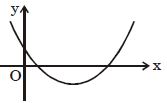
The graph of $y = ax^2 + bx + c$ is shown. Which of the following does $NOT$ hold good?
A
$ab^2c^3 > 0$
B
$ab^3c^2 < 0$
C
$ab^3c^5 > 0$
D
$b^2 > 4ac$
Solution
(C) From the graph,the parabola opens upwards,so $a > 0$.
The $y$-intercept is above the $x$-axis,so $c > 0$.
The vertex has a positive $x$-coordinate,$-b/(2a) > 0$. Since $a > 0$,we must have $-b > 0$,which implies $b < 0$.
Now,let us evaluate the options:
$A) ab^2c^3 = (+)(+)(+) = (+) > 0$ (Holds good)
$B) ab^3c^2 = (+)(-)(+) = (-) < 0$ (Holds good)
$C) ab^3c^5 = (+)(-)(+) = (-) < 0$. Thus,$ab^3c^5 > 0$ does $NOT$ hold good.
$D)$ Since the graph intersects the $x$-axis at two distinct points, the discriminant $D = b^2 - 4ac > 0$, so $b^2 > 4ac$ (Holds good).
The $y$-intercept is above the $x$-axis,so $c > 0$.
The vertex has a positive $x$-coordinate,$-b/(2a) > 0$. Since $a > 0$,we must have $-b > 0$,which implies $b < 0$.
Now,let us evaluate the options:
$A) ab^2c^3 = (+)(+)(+) = (+) > 0$ (Holds good)
$B) ab^3c^2 = (+)(-)(+) = (-) < 0$ (Holds good)
$C) ab^3c^5 = (+)(-)(+) = (-) < 0$. Thus,$ab^3c^5 > 0$ does $NOT$ hold good.
$D)$ Since the graph intersects the $x$-axis at two distinct points, the discriminant $D = b^2 - 4ac > 0$, so $b^2 > 4ac$ (Holds good).
0 likes
View Solution256
AdvancedMCQ
The integral values of $a$ for which the quadratic equation $(x - a)(x - 10) + 1 = 0$ has integral roots are
A
$8, 12$
B
$1, 6$
C
$4, 6$
D
$3, 15$
Solution
(A) The given quadratic equation is $(x - a)(x - 10) + 1 = 0$.
Expanding this,we get $x^{2} - (10 + a)x + 10a + 1 = 0$.
For the roots to be integers,the discriminant $D$ must be a perfect square.
$D = (10 + a)^{2} - 4(10a + 1) = 100 + 20a + a^{2} - 40a - 4 = a^{2} - 20a + 96$.
We can rewrite this as $D = (a - 10)^{2} - 4$.
Let $D = k^{2}$ for some non-negative integer $k$.
Then $(a - 10)^{2} - k^{2} = 4$,which implies $(a - 10 - k)(a - 10 + k) = 4$.
Since $a$ and $k$ are integers,the factors must be pairs of integers whose product is $4$.
The possible cases are:
$1) (a - 10 - k) = 2$ and $(a - 10 + k) = 2 \Rightarrow a - 10 = 2 \Rightarrow a = 12$.
$2) (a - 10 - k) = -2$ and $(a - 10 + k) = -2 \Rightarrow a - 10 = -2 \Rightarrow a = 8$.
$3) (a - 10 - k) = 1$ and $(a - 10 + k) = 4$ (No integer solution for $a$).
Thus,the integral values of $a$ are $8$ and $12$.
Expanding this,we get $x^{2} - (10 + a)x + 10a + 1 = 0$.
For the roots to be integers,the discriminant $D$ must be a perfect square.
$D = (10 + a)^{2} - 4(10a + 1) = 100 + 20a + a^{2} - 40a - 4 = a^{2} - 20a + 96$.
We can rewrite this as $D = (a - 10)^{2} - 4$.
Let $D = k^{2}$ for some non-negative integer $k$.
Then $(a - 10)^{2} - k^{2} = 4$,which implies $(a - 10 - k)(a - 10 + k) = 4$.
Since $a$ and $k$ are integers,the factors must be pairs of integers whose product is $4$.
The possible cases are:
$1) (a - 10 - k) = 2$ and $(a - 10 + k) = 2 \Rightarrow a - 10 = 2 \Rightarrow a = 12$.
$2) (a - 10 - k) = -2$ and $(a - 10 + k) = -2 \Rightarrow a - 10 = -2 \Rightarrow a = 8$.
$3) (a - 10 - k) = 1$ and $(a - 10 + k) = 4$ (No integer solution for $a$).
Thus,the integral values of $a$ are $8$ and $12$.
0 likes
View Solution257
AdvancedMCQ
If $ax^2 + bx + c = 0$ has real and distinct roots,$\alpha$ and $\beta$ where $\beta > \alpha$. Further,if $a > 0, b < 0$,and $c < 0$,then:
A
$0 < \beta < |\alpha|$
B
$0 < |\alpha| < \beta$
C
$\alpha + \beta < 0$
D
$|\alpha| + |\beta| = |\frac{b}{a}|$
Solution
(B) Given the quadratic equation $ax^2 + bx + c = 0$ with $a > 0, b < 0, c < 0$.
Sum of roots $(\alpha + \beta) = -\frac{b}{a}$. Since $b < 0$ and $a > 0$,$-\frac{b}{a} > 0$. Thus,$\alpha + \beta > 0$.
Product of roots $(\alpha \beta) = \frac{c}{a}$. Since $c < 0$ and $a > 0$,$\frac{c}{a} < 0$. Thus,$\alpha \beta < 0$.
Since the product of the roots is negative,one root must be positive and the other must be negative.
Let $\alpha < 0$ and $\beta > 0$. Since $\alpha + \beta > 0$,the positive root must have a larger absolute value than the negative root.
Therefore,$|\beta| > |\alpha|$,which implies $0 < |\alpha| < \beta$.
Sum of roots $(\alpha + \beta) = -\frac{b}{a}$. Since $b < 0$ and $a > 0$,$-\frac{b}{a} > 0$. Thus,$\alpha + \beta > 0$.
Product of roots $(\alpha \beta) = \frac{c}{a}$. Since $c < 0$ and $a > 0$,$\frac{c}{a} < 0$. Thus,$\alpha \beta < 0$.
Since the product of the roots is negative,one root must be positive and the other must be negative.
Let $\alpha < 0$ and $\beta > 0$. Since $\alpha + \beta > 0$,the positive root must have a larger absolute value than the negative root.
Therefore,$|\beta| > |\alpha|$,which implies $0 < |\alpha| < \beta$.
0 likes
View Solution258
AdvancedMCQ
The roots of the equation $x^2 - \sqrt{13}x + 1 = 0$ are:
A
Real and distinct
B
Real and equal
C
Imaginary
D
Rational and different
Solution
(A) For the quadratic equation $ax^2 + bx + c = 0$,the discriminant $D$ is given by $D = b^2 - 4ac$.
Here,$a = 1$,$b = -\sqrt{13}$,and $c = 1$.
$D = (-\sqrt{13})^2 - 4(1)(1) = 13 - 4 = 9$.
Since $D > 0$ and $D$ is a perfect square,the roots are real,distinct,and rational.
However,since the coefficient $b = -\sqrt{13}$ is irrational,the roots are real and distinct.
Here,$a = 1$,$b = -\sqrt{13}$,and $c = 1$.
$D = (-\sqrt{13})^2 - 4(1)(1) = 13 - 4 = 9$.
Since $D > 0$ and $D$ is a perfect square,the roots are real,distinct,and rational.
However,since the coefficient $b = -\sqrt{13}$ is irrational,the roots are real and distinct.
0 likes
View Solution259
AdvancedMCQ
Consider the equation $x^2+x-n = 0$,where $n \in N$ and $n \in [5, 100]$. The total number of different values of $n$ such that the given equation has integral roots is:
A
$8$
B
$6$
C
$4$
D
$10$
Solution
(A) The given equation is $x^2+x-n=0$.
For the roots to be integers,the discriminant $D = b^2-4ac = 1^2 - 4(1)(-n) = 1+4n$ must be a perfect square of an odd integer.
Let $1+4n = (2k+1)^2$ for some integer $k$.
$1+4n = 4k^2 + 4k + 1
$ $\Rightarrow 4n = 4k(k+1)
$ $\Rightarrow n = k(k+1)$.
Given $n \in [5, 100]$,we have $5 \le k(k+1) \le 100$.
For $k=2, n=2(3)=6$.
For $k=3, n=3(4)=12$.
For $k=4, n=4(5)=20$.
For $k=5, n=5(6)=30$.
For $k=6, n=6(7)=42$.
For $k=7, n=7(8)=56$.
For $k=8, n=8(9)=72$.
For $k=9, n=9(10)=90$.
For $k=10, n=10(11)=110 > 100$.
Thus,the possible values of $n$ are $6, 12, 20, 30, 42, 56, 72, 90$.
The total number of such values is $8$.
For the roots to be integers,the discriminant $D = b^2-4ac = 1^2 - 4(1)(-n) = 1+4n$ must be a perfect square of an odd integer.
Let $1+4n = (2k+1)^2$ for some integer $k$.
$1+4n = 4k^2 + 4k + 1
$ $\Rightarrow 4n = 4k(k+1)
$ $\Rightarrow n = k(k+1)$.
Given $n \in [5, 100]$,we have $5 \le k(k+1) \le 100$.
For $k=2, n=2(3)=6$.
For $k=3, n=3(4)=12$.
For $k=4, n=4(5)=20$.
For $k=5, n=5(6)=30$.
For $k=6, n=6(7)=42$.
For $k=7, n=7(8)=56$.
For $k=8, n=8(9)=72$.
For $k=9, n=9(10)=90$.
For $k=10, n=10(11)=110 > 100$.
Thus,the possible values of $n$ are $6, 12, 20, 30, 42, 56, 72, 90$.
The total number of such values is $8$.
0 likes
View Solution260
AdvancedMCQ
The number of real solutions of the equation $(\frac{3}{2})^x = -x^2 + 5x - 10$ is:
A
$1$
B
$2$
C
$4$
D
No solution
Solution
(D) Let $f(x) = -x^2 + 5x - 10$ and $g(x) = (\frac{3}{2})^x$.
For the quadratic function $f(x) = -x^2 + 5x - 10$,the discriminant $D = b^2 - 4ac = 5^2 - 4(-1)(-10) = 25 - 40 = -15$.
The maximum value of $f(x)$ is given by $\frac{-D}{4a} = \frac{-(-15)}{4(-1)} = -\frac{15}{4} = -3.75$.
Since $g(x) = (\frac{3}{2})^x$ is an exponential function,$g(x) > 0$ for all real $x$.
Because the maximum value of $f(x)$ is $-3.75$ (which is negative) and the minimum value of $g(x)$ is always positive,there is no real value of $x$ for which $f(x) = g(x)$.
Therefore,the equation has no real solutions.
For the quadratic function $f(x) = -x^2 + 5x - 10$,the discriminant $D = b^2 - 4ac = 5^2 - 4(-1)(-10) = 25 - 40 = -15$.
The maximum value of $f(x)$ is given by $\frac{-D}{4a} = \frac{-(-15)}{4(-1)} = -\frac{15}{4} = -3.75$.
Since $g(x) = (\frac{3}{2})^x$ is an exponential function,$g(x) > 0$ for all real $x$.
Because the maximum value of $f(x)$ is $-3.75$ (which is negative) and the minimum value of $g(x)$ is always positive,there is no real value of $x$ for which $f(x) = g(x)$.
Therefore,the equation has no real solutions.
0 likes
View Solution261
DifficultMCQ
If $f(x)$ is a quadratic expression such that $f(1) + f(2) = 0$,and $-1$ is a root of $f(x) = 0$,then the other root of $f(x) = 0$ is
A
$-\frac{5}{8}$
B
$-\frac{8}{5}$
C
$\frac{5}{8}$
D
$\frac{8}{5}$
Solution
(D) Let the quadratic expression be $f(x) = k(x - r_1)(x - r_2)$.
Given that $-1$ is a root,let $r_1 = -1$. Let the other root be $a$.
So,$f(x) = k(x + 1)(x - a) = k(x^2 + (1 - a)x - a)$.
We are given $f(1) + f(2) = 0$.
$f(1) = k(1 + 1)(1 - a) = 2k(1 - a) = 2k - 2ka$.
$f(2) = k(2 + 1)(2 - a) = 3k(2 - a) = 6k - 3ka$.
Summing these: $f(1) + f(2) = (2k - 2ka) + (6k - 3ka) = 8k - 5ka$.
Setting the sum to zero: $8k - 5ka = 0$.
Since $f(x)$ is a quadratic expression,$k \neq 0$,so we can divide by $k$.
$8 - 5a = 0 \Rightarrow 5a = 8 \Rightarrow a = \frac{8}{5}$.
Thus,the other root is $\frac{8}{5}$.
Given that $-1$ is a root,let $r_1 = -1$. Let the other root be $a$.
So,$f(x) = k(x + 1)(x - a) = k(x^2 + (1 - a)x - a)$.
We are given $f(1) + f(2) = 0$.
$f(1) = k(1 + 1)(1 - a) = 2k(1 - a) = 2k - 2ka$.
$f(2) = k(2 + 1)(2 - a) = 3k(2 - a) = 6k - 3ka$.
Summing these: $f(1) + f(2) = (2k - 2ka) + (6k - 3ka) = 8k - 5ka$.
Setting the sum to zero: $8k - 5ka = 0$.
Since $f(x)$ is a quadratic expression,$k \neq 0$,so we can divide by $k$.
$8 - 5a = 0 \Rightarrow 5a = 8 \Rightarrow a = \frac{8}{5}$.
Thus,the other root is $\frac{8}{5}$.
0 likes
View Solution262
DifficultMCQ
Let $p, q$ and $r$ be real numbers $(p \ne q, r \ne 0)$ such that the roots of the equation $\frac{1}{x + p} + \frac{1}{x + q} = \frac{1}{r}$ are equal in magnitude but opposite in sign. Then the sum of squares of these roots is equal to:
A
$p^2 + q^2 + r^2$
B
$p^2 + q^2$
C
$2(p^2 + q^2)$
D
$\frac{p^2 + q^2}{2}$
Solution
(B) Given the equation: $\frac{1}{x + p} + \frac{1}{x + q} = \frac{1}{r}$
Simplify the left side: $\frac{x + q + x + p}{(x + p)(x + q)} = \frac{1}{r}$
Cross-multiply: $r(2x + p + q) = x^2 + (p + q)x + pq$
Rearrange into standard quadratic form: $x^2 + (p + q - 2r)x + (pq - pr - qr) = 0$
Let the roots be $\alpha$ and $\beta$. Since the roots are equal in magnitude but opposite in sign,$\alpha = -\beta$,which implies $\alpha + \beta = 0$.
From the sum of roots formula for a quadratic equation $ax^2 + bx + c = 0$,the sum of roots is $-b/a$. Thus,$-(p + q - 2r) = 0$,which means $p + q = 2r$.
The sum of squares of the roots is $\alpha^2 + \beta^2 = (\alpha + \beta)^2 - 2\alpha\beta$.
Since $\alpha + \beta = 0$,this simplifies to $\alpha^2 + \beta^2 = -2\alpha\beta$.
From the product of roots formula,$\alpha\beta = pq - pr - qr$.
Substituting $\alpha\beta$: $\alpha^2 + \beta^2 = -2(pq - pr - qr) = -2pq + 2pr + 2qr$.
Since $2r = p + q$,substitute $2pr + 2qr = 2r(p + q) = (p + q)(p + q) = p^2 + 2pq + q^2$.
Therefore,$\alpha^2 + \beta^2 = -2pq + (p^2 + 2pq + q^2) = p^2 + q^2$.
Simplify the left side: $\frac{x + q + x + p}{(x + p)(x + q)} = \frac{1}{r}$
Cross-multiply: $r(2x + p + q) = x^2 + (p + q)x + pq$
Rearrange into standard quadratic form: $x^2 + (p + q - 2r)x + (pq - pr - qr) = 0$
Let the roots be $\alpha$ and $\beta$. Since the roots are equal in magnitude but opposite in sign,$\alpha = -\beta$,which implies $\alpha + \beta = 0$.
From the sum of roots formula for a quadratic equation $ax^2 + bx + c = 0$,the sum of roots is $-b/a$. Thus,$-(p + q - 2r) = 0$,which means $p + q = 2r$.
The sum of squares of the roots is $\alpha^2 + \beta^2 = (\alpha + \beta)^2 - 2\alpha\beta$.
Since $\alpha + \beta = 0$,this simplifies to $\alpha^2 + \beta^2 = -2\alpha\beta$.
From the product of roots formula,$\alpha\beta = pq - pr - qr$.
Substituting $\alpha\beta$: $\alpha^2 + \beta^2 = -2(pq - pr - qr) = -2pq + 2pr + 2qr$.
Since $2r = p + q$,substitute $2pr + 2qr = 2r(p + q) = (p + q)(p + q) = p^2 + 2pq + q^2$.
Therefore,$\alpha^2 + \beta^2 = -2pq + (p^2 + 2pq + q^2) = p^2 + q^2$.
0 likes
View Solution263
DifficultMCQ
Let $p(x)$ be a quadratic polynomial such that $p(0) = 1$. If $p(x)$ leaves a remainder of $4$ when divided by $x - 1$ and a remainder of $6$ when divided by $x + 1$,then:
A
$p(2) = 11$
B
$p(2) = 19$
C
$p(-2) = 19$
D
$p(-2) = 11$
Solution
(C) Let the quadratic polynomial be $p(x) = ax^2 + bx + c$.
Given $p(0) = 1$,we have $c = 1$.
By the Remainder Theorem,$p(1) = 4$ and $p(-1) = 6$.
Substituting these into $p(x) = ax^2 + bx + 1$:
$p(1) = a(1)^2 + b(1) + 1 = 4 \Rightarrow a + b = 3$.
$p(-1) = a(-1)^2 + b(-1) + 1 = 6 \Rightarrow a - b = 5$.
Adding the two equations: $2a = 8 \Rightarrow a = 4$.
Subtracting the two equations: $2b = -2 \Rightarrow b = -1$.
Thus,$p(x) = 4x^2 - x + 1$.
Now,evaluating $p(-2)$:
$p(-2) = 4(-2)^2 - (-2) + 1 = 4(4) + 2 + 1 = 16 + 3 = 19$.
Therefore,$p(-2) = 19$ is the correct statement.
Given $p(0) = 1$,we have $c = 1$.
By the Remainder Theorem,$p(1) = 4$ and $p(-1) = 6$.
Substituting these into $p(x) = ax^2 + bx + 1$:
$p(1) = a(1)^2 + b(1) + 1 = 4 \Rightarrow a + b = 3$.
$p(-1) = a(-1)^2 + b(-1) + 1 = 6 \Rightarrow a - b = 5$.
Adding the two equations: $2a = 8 \Rightarrow a = 4$.
Subtracting the two equations: $2b = -2 \Rightarrow b = -1$.
Thus,$p(x) = 4x^2 - x + 1$.
Now,evaluating $p(-2)$:
$p(-2) = 4(-2)^2 - (-2) + 1 = 4(4) + 2 + 1 = 16 + 3 = 19$.
Therefore,$p(-2) = 19$ is the correct statement.
0 likes
View Solution264
DifficultMCQ
The sum of all the real values of $x$ satisfying the equation $2^{(x - 1)(x^2 + 5x - 50)} = 1$ is
A
$16$
B
$14$
C
$-4$
D
$-5$
Solution
(C) Given the equation $2^{(x - 1)(x^2 + 5x - 50)} = 1$.
Since $2^0 = 1$,we equate the exponent to $0$:
$(x - 1)(x^2 + 5x - 50) = 0$.
Factoring the quadratic expression $x^2 + 5x - 50$:
$(x^2 + 10x - 5x - 50) = x(x + 10) - 5(x + 10) = (x - 5)(x + 10)$.
So,the equation becomes $(x - 1)(x - 5)(x + 10) = 0$.
The real values of $x$ are $x = 1, 5, -10$.
The sum of these values is $1 + 5 + (-10) = 6 - 10 = -4$.
Since $2^0 = 1$,we equate the exponent to $0$:
$(x - 1)(x^2 + 5x - 50) = 0$.
Factoring the quadratic expression $x^2 + 5x - 50$:
$(x^2 + 10x - 5x - 50) = x(x + 10) - 5(x + 10) = (x - 5)(x + 10)$.
So,the equation becomes $(x - 1)(x - 5)(x + 10) = 0$.
The real values of $x$ are $x = 1, 5, -10$.
The sum of these values is $1 + 5 + (-10) = 6 - 10 = -4$.
0 likes
View Solution265
DifficultMCQ
If $x$ is a solution of the equation $\sqrt{2x + 1} - \sqrt{2x - 1} = 1$ for $x \ge \frac{1}{2}$,then $\sqrt{4x^2 - 1}$ is equal to:
A
$\frac{3}{4}$
B
$\frac{1}{2}$
C
$2\sqrt{2}$
D
$2$
Solution
(A) Given equation: $\sqrt{2x + 1} - \sqrt{2x - 1} = 1$
Squaring both sides: $(\sqrt{2x + 1} - \sqrt{2x - 1})^2 = 1^2$
$(2x + 1) + (2x - 1) - 2\sqrt{(2x + 1)(2x - 1)} = 1$
$4x - 2\sqrt{4x^2 - 1} = 1$
$4x - 1 = 2\sqrt{4x^2 - 1}$
Squaring again: $(4x - 1)^2 = 4(4x^2 - 1)$
$16x^2 - 8x + 1 = 16x^2 - 4$
$-8x = -5 \implies x = \frac{5}{8}$
Now,substitute $x = \frac{5}{8}$ into $\sqrt{4x^2 - 1}$:
$\sqrt{4(\frac{5}{8})^2 - 1} = \sqrt{4(\frac{25}{64}) - 1} = \sqrt{\frac{25}{16} - 1} = \sqrt{\frac{9}{16}} = \frac{3}{4}$
Squaring both sides: $(\sqrt{2x + 1} - \sqrt{2x - 1})^2 = 1^2$
$(2x + 1) + (2x - 1) - 2\sqrt{(2x + 1)(2x - 1)} = 1$
$4x - 2\sqrt{4x^2 - 1} = 1$
$4x - 1 = 2\sqrt{4x^2 - 1}$
Squaring again: $(4x - 1)^2 = 4(4x^2 - 1)$
$16x^2 - 8x + 1 = 16x^2 - 4$
$-8x = -5 \implies x = \frac{5}{8}$
Now,substitute $x = \frac{5}{8}$ into $\sqrt{4x^2 - 1}$:
$\sqrt{4(\frac{5}{8})^2 - 1} = \sqrt{4(\frac{25}{64}) - 1} = \sqrt{\frac{25}{16} - 1} = \sqrt{\frac{9}{16}} = \frac{3}{4}$
0 likes
View Solution266
DifficultMCQ
If the two roots of the equation $(a - 1)(x^4 + x^2 + 1) + (a + 1)(x^2 + x + 1)^2 = 0$ are real and distinct,then the set of all values of $a$ is
A
$(0, 1/2)$
B
$(-1/2, 0) \cup (0, 1/2)$
C
$(-1/2, 0)$
D
$(-\infty, -2) \cup (2, \infty)$
Solution
(B) Given equation: $(a-1)(x^4+x^2+1) + (a+1)(x^2+x+1)^2 = 0$
We know that $x^4+x^2+1 = (x^2+x+1)(x^2-x+1)$.
Substituting this,we get: $(a-1)(x^2+x+1)(x^2-x+1) + (a+1)(x^2+x+1)^2 = 0$
Factoring out $(x^2+x+1)$: $(x^2+x+1)[(a-1)(x^2-x+1) + (a+1)(x^2+x+1)] = 0$
Simplifying the expression inside the bracket: $(x^2+x+1)[ax^2-ax+a-x^2+x-1 + ax^2+ax+a+x^2+x+1] = 0$
$(x^2+x+1)(2ax^2+2x+2a) = 0$
$2(x^2+x+1)(ax^2+x+a) = 0$
The quadratic $x^2+x+1$ has a discriminant $D = 1^2 - 4(1)(1) = -3 < 0$,so it has no real roots.
For the equation to have real and distinct roots,the quadratic $ax^2+x+a = 0$ must have two distinct real roots.
This requires $a \neq 0$ and the discriminant $D > 0$.
$D = 1^2 - 4(a)(a) = 1 - 4a^2 > 0$
$4a^2 < 1$ $\Rightarrow a^2 < 1/4$ $\Rightarrow |a| < 1/2$.
Since $a \neq 0$,the set of values is $a \in (-1/2, 0) \cup (0, 1/2)$.
We know that $x^4+x^2+1 = (x^2+x+1)(x^2-x+1)$.
Substituting this,we get: $(a-1)(x^2+x+1)(x^2-x+1) + (a+1)(x^2+x+1)^2 = 0$
Factoring out $(x^2+x+1)$: $(x^2+x+1)[(a-1)(x^2-x+1) + (a+1)(x^2+x+1)] = 0$
Simplifying the expression inside the bracket: $(x^2+x+1)[ax^2-ax+a-x^2+x-1 + ax^2+ax+a+x^2+x+1] = 0$
$(x^2+x+1)(2ax^2+2x+2a) = 0$
$2(x^2+x+1)(ax^2+x+a) = 0$
The quadratic $x^2+x+1$ has a discriminant $D = 1^2 - 4(1)(1) = -3 < 0$,so it has no real roots.
For the equation to have real and distinct roots,the quadratic $ax^2+x+a = 0$ must have two distinct real roots.
This requires $a \neq 0$ and the discriminant $D > 0$.
$D = 1^2 - 4(a)(a) = 1 - 4a^2 > 0$
$4a^2 < 1$ $\Rightarrow a^2 < 1/4$ $\Rightarrow |a| < 1/2$.
Since $a \neq 0$,the set of values is $a \in (-1/2, 0) \cup (0, 1/2)$.
0 likes
View Solution267
DifficultMCQ
The sum of the roots of the equation $x^2 + |2x - 3| - 4 = 0$ is:
A
$2$
B
$-2$
C
$\sqrt{2}$
D
$-\sqrt{2}$
Solution
(C) Given the equation: $x^2 + |2x - 3| - 4 = 0$.
Case $1$: If $x \ge \frac{3}{2}$,then $|2x - 3| = 2x - 3$.
$x^2 + 2x - 3 - 4 = 0 \implies x^2 + 2x - 7 = 0$.
Using the quadratic formula: $x = \frac{-2 \pm \sqrt{4 - 4(1)(-7)}}{2} = \frac{-2 \pm \sqrt{32}}{2} = -1 \pm 2\sqrt{2}$.
Since $x \ge \frac{3}{2}$,we check the values: $-1 + 2\sqrt{2} \approx -1 + 2(1.414) = 1.828 > 1.5$ (Valid).
$-1 - 2\sqrt{2} < 0 < 1.5$ (Invalid).
So,$x_1 = 2\sqrt{2} - 1$.
Case $2$: If $x < \frac{3}{2}$,then $|2x - 3| = -(2x - 3) = -2x + 3$.
$x^2 - 2x + 3 - 4 = 0 \implies x^2 - 2x - 1 = 0$.
Using the quadratic formula: $x = \frac{2 \pm \sqrt{4 - 4(1)(-1)}}{2} = \frac{2 \pm \sqrt{8}}{2} = 1 \pm \sqrt{2}$.
Since $x < \frac{3}{2}$,we check the values: $1 + \sqrt{2} \approx 2.414 > 1.5$ (Invalid).
$1 - \sqrt{2} \approx -0.414 < 1.5$ (Valid).
So,$x_2 = 1 - \sqrt{2}$.
Sum of the roots: $x_1 + x_2 = (2\sqrt{2} - 1) + (1 - \sqrt{2}) = \sqrt{2}$.
Case $1$: If $x \ge \frac{3}{2}$,then $|2x - 3| = 2x - 3$.
$x^2 + 2x - 3 - 4 = 0 \implies x^2 + 2x - 7 = 0$.
Using the quadratic formula: $x = \frac{-2 \pm \sqrt{4 - 4(1)(-7)}}{2} = \frac{-2 \pm \sqrt{32}}{2} = -1 \pm 2\sqrt{2}$.
Since $x \ge \frac{3}{2}$,we check the values: $-1 + 2\sqrt{2} \approx -1 + 2(1.414) = 1.828 > 1.5$ (Valid).
$-1 - 2\sqrt{2} < 0 < 1.5$ (Invalid).
So,$x_1 = 2\sqrt{2} - 1$.
Case $2$: If $x < \frac{3}{2}$,then $|2x - 3| = -(2x - 3) = -2x + 3$.
$x^2 - 2x + 3 - 4 = 0 \implies x^2 - 2x - 1 = 0$.
Using the quadratic formula: $x = \frac{2 \pm \sqrt{4 - 4(1)(-1)}}{2} = \frac{2 \pm \sqrt{8}}{2} = 1 \pm \sqrt{2}$.
Since $x < \frac{3}{2}$,we check the values: $1 + \sqrt{2} \approx 2.414 > 1.5$ (Invalid).
$1 - \sqrt{2} \approx -0.414 < 1.5$ (Valid).
So,$x_2 = 1 - \sqrt{2}$.
Sum of the roots: $x_1 + x_2 = (2\sqrt{2} - 1) + (1 - \sqrt{2}) = \sqrt{2}$.
0 likes
View Solution268
DifficultMCQ
The equation $\sqrt{3x^2 + x + 5} = x - 3$,where $x$ is real,has
A
no solution
B
exactly one solution
C
exactly two solutions
D
exactly four solutions
Solution
(A) Given the equation $\sqrt{3x^2 + x + 5} = x - 3$.
For the square root to be defined and equal to a real value,we must have $x - 3 \geq 0$,which implies $x \geq 3$.
Squaring both sides:
$3x^2 + x + 5 = (x - 3)^2$
$3x^2 + x + 5 = x^2 - 6x + 9$
$2x^2 + 7x - 4 = 0$
Solving the quadratic equation $2x^2 + 7x - 4 = 0$ using the quadratic formula or factorization:
$2x^2 + 8x - x - 4 = 0$
$2x(x + 4) - 1(x + 4) = 0$
$(2x - 1)(x + 4) = 0$
So,$x = \frac{1}{2}$ or $x = -4$.
Checking these values against the condition $x \geq 3$:
For $x = \frac{1}{2}$,$\frac{1}{2} < 3$ (Invalid).
For $x = -4$,$-4 < 3$ (Invalid).
Since neither value satisfies the condition $x \geq 3$,the equation has no real solution.
For the square root to be defined and equal to a real value,we must have $x - 3 \geq 0$,which implies $x \geq 3$.
Squaring both sides:
$3x^2 + x + 5 = (x - 3)^2$
$3x^2 + x + 5 = x^2 - 6x + 9$
$2x^2 + 7x - 4 = 0$
Solving the quadratic equation $2x^2 + 7x - 4 = 0$ using the quadratic formula or factorization:
$2x^2 + 8x - x - 4 = 0$
$2x(x + 4) - 1(x + 4) = 0$
$(2x - 1)(x + 4) = 0$
So,$x = \frac{1}{2}$ or $x = -4$.
Checking these values against the condition $x \geq 3$:
For $x = \frac{1}{2}$,$\frac{1}{2} < 3$ (Invalid).
For $x = -4$,$-4 < 3$ (Invalid).
Since neither value satisfies the condition $x \geq 3$,the equation has no real solution.
0 likes
View Solution269
DifficultMCQ
The value of $k$ for which the equation $(k - 2)x^2 + 8x + k + 4 = 0$ has both roots real,distinct,and negative is
A
$6$
B
$3$
C
$4$
D
$1$
Solution
(B) For the quadratic equation $(k-2)x^2 + 8x + k+4 = 0$ to have real and distinct roots,the discriminant $D > 0$:
$D = 8^2 - 4(k-2)(k+4) > 0$
$64 - 4(k^2 + 2k - 8) > 0$
$16 - (k^2 + 2k - 8) > 0$
$-k^2 - 2k + 24 > 0 \Rightarrow k^2 + 2k - 24 < 0$
$(k+6)(k-4) < 0 \Rightarrow -6 < k < 4$
For the roots to be negative,the sum of roots $\alpha + \beta = -\frac{8}{k-2} < 0$ and the product of roots $\alpha \beta = \frac{k+4}{k-2} > 0$.
From $\alpha + \beta < 0$: $\frac{8}{k-2} > 0 \Rightarrow k > 2$.
From $\alpha \beta > 0$: $\frac{k+4}{k-2} > 0 \Rightarrow k < -4$ or $k > 2$.
Combining all conditions: $(-6 < k < 4)$ $AND$ $(k > 2)$ $AND$ $(k < -4 \text{ or } k > 2)$.
The intersection is $2 < k < 4$.
Among the given options,only $k = 3$ satisfies $2 < k < 4$.
$D = 8^2 - 4(k-2)(k+4) > 0$
$64 - 4(k^2 + 2k - 8) > 0$
$16 - (k^2 + 2k - 8) > 0$
$-k^2 - 2k + 24 > 0 \Rightarrow k^2 + 2k - 24 < 0$
$(k+6)(k-4) < 0 \Rightarrow -6 < k < 4$
For the roots to be negative,the sum of roots $\alpha + \beta = -\frac{8}{k-2} < 0$ and the product of roots $\alpha \beta = \frac{k+4}{k-2} > 0$.
From $\alpha + \beta < 0$: $\frac{8}{k-2} > 0 \Rightarrow k > 2$.
From $\alpha \beta > 0$: $\frac{k+4}{k-2} > 0 \Rightarrow k < -4$ or $k > 2$.
Combining all conditions: $(-6 < k < 4)$ $AND$ $(k > 2)$ $AND$ $(k < -4 \text{ or } k > 2)$.
The intersection is $2 < k < 4$.
Among the given options,only $k = 3$ satisfies $2 < k < 4$.
0 likes
View Solution270
DifficultMCQ
Let $p, q, r \in \mathbb{R}$ and $r > p > 0.$ If the quadratic equation $px^2 + qx + r = 0$ has two complex roots $\alpha$ and $\beta,$ then $|\alpha| + |\beta|$ is:
A
equal to $1$
B
less than $2$ but not equal to $1$
C
greater than $2$
D
equal to $2$
Solution
(C) The given quadratic equation is $px^2 + qx + r = 0$ with $p, q, r \in \mathbb{R}$ and $r > p > 0.$
Since the roots $\alpha$ and $\beta$ are complex,the discriminant $D = q^2 - 4pr < 0.$
This implies $q^2 < 4pr.$
Since the coefficients are real,the complex roots must be conjugates,i.e.,$\beta = \bar{\alpha}.$
Thus,$|\alpha| = |\beta| = \sqrt{\alpha \bar{\alpha}} = \sqrt{\alpha \beta}.$
From the properties of quadratic equations,the product of the roots is $\alpha \beta = \frac{r}{p}.$
Therefore,$|\alpha| = |\beta| = \sqrt{\frac{r}{p}}.$
Given $r > p > 0,$ we have $\frac{r}{p} > 1,$ which implies $\sqrt{\frac{r}{p}} > 1.$
Then,$|\alpha| + |\beta| = 2|\alpha| = 2\sqrt{\frac{r}{p}}.$
Since $\sqrt{\frac{r}{p}} > 1,$ it follows that $2\sqrt{\frac{r}{p}} > 2.$
Hence,$|\alpha| + |\beta| > 2.$
Since the roots $\alpha$ and $\beta$ are complex,the discriminant $D = q^2 - 4pr < 0.$
This implies $q^2 < 4pr.$
Since the coefficients are real,the complex roots must be conjugates,i.e.,$\beta = \bar{\alpha}.$
Thus,$|\alpha| = |\beta| = \sqrt{\alpha \bar{\alpha}} = \sqrt{\alpha \beta}.$
From the properties of quadratic equations,the product of the roots is $\alpha \beta = \frac{r}{p}.$
Therefore,$|\alpha| = |\beta| = \sqrt{\frac{r}{p}}.$
Given $r > p > 0,$ we have $\frac{r}{p} > 1,$ which implies $\sqrt{\frac{r}{p}} > 1.$
Then,$|\alpha| + |\beta| = 2|\alpha| = 2\sqrt{\frac{r}{p}}.$
Since $\sqrt{\frac{r}{p}} > 1,$ it follows that $2\sqrt{\frac{r}{p}} > 2.$
Hence,$|\alpha| + |\beta| > 2.$
0 likes
View Solution271
DifficultMCQ
The number of all possible positive integral values of $\alpha$ for which the roots of the quadratic equation $6x^2 - 11x + \alpha = 0$ are rational numbers is:
A
$2$
B
$5$
C
$3$
D
$4$
Solution
(C) For the roots of the quadratic equation $ax^2 + bx + c = 0$ to be rational,the discriminant $D = b^2 - 4ac$ must be a perfect square.
Here,$a = 6$,$b = -11$,and $c = \alpha$.
$D = (-11)^2 - 4(6)(\alpha) = 121 - 24\alpha$.
Since $\alpha$ is a positive integer,$121 - 24\alpha \ge 0$,which implies $24\alpha \le 121$,so $\alpha \le 5.04$. Thus,$\alpha \in \{1, 2, 3, 4, 5\}$.
We check each value:
If $\alpha = 1$,$D = 121 - 24(1) = 97$ (not a perfect square).
If $\alpha = 2$,$D = 121 - 24(2) = 121 - 48 = 73$ (not a perfect square).
If $\alpha = 3$,$D = 121 - 24(3) = 121 - 72 = 49 = 7^2$ (perfect square).
If $\alpha = 4$,$D = 121 - 24(4) = 121 - 96 = 25 = 5^2$ (perfect square).
If $\alpha = 5$,$D = 121 - 24(5) = 121 - 120 = 1 = 1^2$ (perfect square).
The possible values for $\alpha$ are $3, 4, 5$. Therefore,there are $3$ such values.
Here,$a = 6$,$b = -11$,and $c = \alpha$.
$D = (-11)^2 - 4(6)(\alpha) = 121 - 24\alpha$.
Since $\alpha$ is a positive integer,$121 - 24\alpha \ge 0$,which implies $24\alpha \le 121$,so $\alpha \le 5.04$. Thus,$\alpha \in \{1, 2, 3, 4, 5\}$.
We check each value:
If $\alpha = 1$,$D = 121 - 24(1) = 97$ (not a perfect square).
If $\alpha = 2$,$D = 121 - 24(2) = 121 - 48 = 73$ (not a perfect square).
If $\alpha = 3$,$D = 121 - 24(3) = 121 - 72 = 49 = 7^2$ (perfect square).
If $\alpha = 4$,$D = 121 - 24(4) = 121 - 96 = 25 = 5^2$ (perfect square).
If $\alpha = 5$,$D = 121 - 24(5) = 121 - 120 = 1 = 1^2$ (perfect square).
The possible values for $\alpha$ are $3, 4, 5$. Therefore,there are $3$ such values.
0 likes
View Solution272
DifficultMCQ
The value of $\lambda$ such that the sum of the squares of the roots of the quadratic equation $x^2 + (3 - \lambda)x + 2 = \lambda$ has the least value is
A
$\frac{15}{8}$
B
$1$
C
$\frac{4}{9}$
D
$2$
Solution
(D) The given quadratic equation is $x^2 + (3 - \lambda)x + (2 - \lambda) = 0$.
Let the roots be $\alpha$ and $\beta$. Then $\alpha + \beta = - (3 - \lambda) = \lambda - 3$ and $\alpha \beta = 2 - \lambda$.
The sum of the squares of the roots is $S = \alpha^2 + \beta^2 = (\alpha + \beta)^2 - 2 \alpha \beta$.
Substituting the values,we get $S = (\lambda - 3)^2 - 2(2 - \lambda)$.
$S = \lambda^2 - 6 \lambda + 9 - 4 + 2 \lambda$.
$S = \lambda^2 - 4 \lambda + 5$.
To find the least value,we complete the square: $S = (\lambda - 2)^2 + 1$.
The expression $S$ has the least value when $\lambda - 2 = 0$,which gives $\lambda = 2$.
Let the roots be $\alpha$ and $\beta$. Then $\alpha + \beta = - (3 - \lambda) = \lambda - 3$ and $\alpha \beta = 2 - \lambda$.
The sum of the squares of the roots is $S = \alpha^2 + \beta^2 = (\alpha + \beta)^2 - 2 \alpha \beta$.
Substituting the values,we get $S = (\lambda - 3)^2 - 2(2 - \lambda)$.
$S = \lambda^2 - 6 \lambda + 9 - 4 + 2 \lambda$.
$S = \lambda^2 - 4 \lambda + 5$.
To find the least value,we complete the square: $S = (\lambda - 2)^2 + 1$.
The expression $S$ has the least value when $\lambda - 2 = 0$,which gives $\lambda = 2$.
0 likes
View Solution273
DifficultMCQ
Let $\alpha$ and $\beta$ be the roots of the quadratic equation $x^2 \sin \theta - x(\sin \theta \cos \theta + 1) + \cos \theta = 0$ where $0 < \theta < 45^\circ$,and $\alpha < \beta$. Then $\sum_{n=0}^\infty (\alpha^n + \frac{(-1)^n}{\beta^n})$ is equal to
A
$\frac{1}{1 - \cos \theta} - \frac{1}{1 + \sin \theta}$
B
$\frac{1}{1 + \cos \theta} + \frac{1}{1 - \sin \theta}$
C
$\frac{1}{1 - \cos \theta} + \frac{1}{1 + \sin \theta}$
D
$\frac{1}{1 + \cos \theta} - \frac{1}{1 - \sin \theta}$
Solution
(C) The given quadratic equation is $x^2 \sin \theta - x(\sin \theta \cos \theta + 1) + \cos \theta = 0$.
Using the quadratic formula,$x = \frac{(\sin \theta \cos \theta + 1) \pm \sqrt{(\sin \theta \cos \theta + 1)^2 - 4 \sin \theta \cos \theta}}{2 \sin \theta}$.
Simplifying the discriminant: $(\sin \theta \cos \theta + 1)^2 - 4 \sin \theta \cos \theta = (\sin \theta \cos \theta - 1)^2$.
Thus,$x = \frac{\sin \theta \cos \theta + 1 \pm (\sin \theta \cos \theta - 1)}{2 \sin \theta}$.
This gives $x_1 = \frac{2 \sin \theta \cos \theta}{2 \sin \theta} = \cos \theta$ and $x_2 = \frac{2}{2 \sin \theta} = \csc \theta$.
Since $0 < \theta < 45^\circ$,$\cos \theta > \sin \theta$,so $\cos \theta < \csc \theta$. Thus $\alpha = \cos \theta$ and $\beta = \csc \theta$.
The sum is $S = \sum_{n=0}^\infty \alpha^n + \sum_{n=0}^\infty (-\frac{1}{\beta})^n = \frac{1}{1 - \alpha} + \frac{1}{1 + 1/\beta} = \frac{1}{1 - \cos \theta} + \frac{1}{1 + \sin \theta}$.
Using the quadratic formula,$x = \frac{(\sin \theta \cos \theta + 1) \pm \sqrt{(\sin \theta \cos \theta + 1)^2 - 4 \sin \theta \cos \theta}}{2 \sin \theta}$.
Simplifying the discriminant: $(\sin \theta \cos \theta + 1)^2 - 4 \sin \theta \cos \theta = (\sin \theta \cos \theta - 1)^2$.
Thus,$x = \frac{\sin \theta \cos \theta + 1 \pm (\sin \theta \cos \theta - 1)}{2 \sin \theta}$.
This gives $x_1 = \frac{2 \sin \theta \cos \theta}{2 \sin \theta} = \cos \theta$ and $x_2 = \frac{2}{2 \sin \theta} = \csc \theta$.
Since $0 < \theta < 45^\circ$,$\cos \theta > \sin \theta$,so $\cos \theta < \csc \theta$. Thus $\alpha = \cos \theta$ and $\beta = \csc \theta$.
The sum is $S = \sum_{n=0}^\infty \alpha^n + \sum_{n=0}^\infty (-\frac{1}{\beta})^n = \frac{1}{1 - \alpha} + \frac{1}{1 + 1/\beta} = \frac{1}{1 - \cos \theta} + \frac{1}{1 + \sin \theta}$.
0 likes
View Solution274
DifficultMCQ
The sum of the solutions of the equation $|\sqrt{x} - 2| + \sqrt{x}(\sqrt{x} - 4) + 2 = 0$ for $x > 0$ is equal to
A
$9$
B
$4$
C
$10$
D
$12$
Solution
(C) Let $t = \sqrt{x}$,where $t > 0$.
The equation becomes $|t - 2| + t(t - 4) + 2 = 0$.
$|t - 2| + t^2 - 4t + 2 = 0$.
We can rewrite $t^2 - 4t + 2$ as $(t^2 - 4t + 4) - 2 = (t - 2)^2 - 2$.
So,$|t - 2| + (t - 2)^2 - 2 = 0$.
Let $u = |t - 2|$,then $u^2 + u - 2 = 0$.
$(u + 2)(u - 1) = 0$.
Since $u = |t - 2| \ge 0$,we must have $u = 1$.
$|t - 2| = 1 \implies t - 2 = 1$ or $t - 2 = -1$.
$t = 3$ or $t = 1$.
Since $t = \sqrt{x}$,we have $\sqrt{x} = 3 \implies x = 9$ and $\sqrt{x} = 1 \implies x = 1$.
The sum of the solutions is $9 + 1 = 10$.
The equation becomes $|t - 2| + t(t - 4) + 2 = 0$.
$|t - 2| + t^2 - 4t + 2 = 0$.
We can rewrite $t^2 - 4t + 2$ as $(t^2 - 4t + 4) - 2 = (t - 2)^2 - 2$.
So,$|t - 2| + (t - 2)^2 - 2 = 0$.
Let $u = |t - 2|$,then $u^2 + u - 2 = 0$.
$(u + 2)(u - 1) = 0$.
Since $u = |t - 2| \ge 0$,we must have $u = 1$.
$|t - 2| = 1 \implies t - 2 = 1$ or $t - 2 = -1$.
$t = 3$ or $t = 1$.
Since $t = \sqrt{x}$,we have $\sqrt{x} = 3 \implies x = 9$ and $\sqrt{x} = 1 \implies x = 1$.
The sum of the solutions is $9 + 1 = 10$.
0 likes
View Solution275
DifficultMCQ
The number of integral values of $m$ for which the equation $(1 + m^2) x^2 - 2(1 + 3m) x + (1 + 8m) = 0$ has no real root is
A
infinitely many
B
$2$
C
$3$
D
$1$
Solution
(A) For the quadratic equation $ax^2 + bx + c = 0$ to have no real roots,the discriminant $D$ must be less than $0$.
Here,$a = (1 + m^2)$,$b = -2(1 + 3m)$,and $c = (1 + 8m)$.
$D = b^2 - 4ac = [-2(1 + 3m)]^2 - 4(1 + m^2)(1 + 8m) < 0$.
$D = 4(1 + 9m^2 + 6m) - 4(1 + 8m + m^2 + 8m^3) < 0$.
$D = 4(1 + 9m^2 + 6m - 1 - 8m - m^2 - 8m^3) < 0$.
$D = 4(-8m^3 + 8m^2 - 2m) < 0$.
$D = -8m(4m^2 - 4m + 1) < 0$.
$D = -8m(2m - 1)^2 < 0$.
Since $(2m - 1)^2 \ge 0$,for $D < 0$,we must have $-8m < 0$ and $2m - 1 \neq 0$.
This implies $m > 0$ and $m \neq \frac{1}{2}$.
Since there are infinitely many integers $m > 0$ (excluding $m = 0.5$,which is not an integer),there are infinitely many integral values of $m$.
Here,$a = (1 + m^2)$,$b = -2(1 + 3m)$,and $c = (1 + 8m)$.
$D = b^2 - 4ac = [-2(1 + 3m)]^2 - 4(1 + m^2)(1 + 8m) < 0$.
$D = 4(1 + 9m^2 + 6m) - 4(1 + 8m + m^2 + 8m^3) < 0$.
$D = 4(1 + 9m^2 + 6m - 1 - 8m - m^2 - 8m^3) < 0$.
$D = 4(-8m^3 + 8m^2 - 2m) < 0$.
$D = -8m(4m^2 - 4m + 1) < 0$.
$D = -8m(2m - 1)^2 < 0$.
Since $(2m - 1)^2 \ge 0$,for $D < 0$,we must have $-8m < 0$ and $2m - 1 \neq 0$.
This implies $m > 0$ and $m \neq \frac{1}{2}$.
Since there are infinitely many integers $m > 0$ (excluding $m = 0.5$,which is not an integer),there are infinitely many integral values of $m$.
0 likes
View Solution276
DifficultMCQ
Let $p, q \in \mathbb{Q}$. If $2 - \sqrt{3}$ is a root of the quadratic equation $x^2 + px + q = 0$,then:
A
$q^2 + 4p + 14 = 0$
B
$p^2 - 4q - 12 = 0$
C
$p^2 - 4q + 12 = 0$
D
$q^2 - 4p - 16 = 0$
Solution
(B) Given that $p, q \in \mathbb{Q}$ and $2 - \sqrt{3}$ is a root of the quadratic equation $x^2 + px + q = 0$.
Since the coefficients are rational,the irrational roots must occur in conjugate pairs.
Therefore,the other root is $2 + \sqrt{3}$.
Sum of roots $= (2 - \sqrt{3}) + (2 + \sqrt{3}) = 4$.
From the equation $x^2 + px + q = 0$,the sum of roots $= -p$.
So,$-p = 4 \implies p = -4$.
Product of roots $= (2 - \sqrt{3})(2 + \sqrt{3}) = 2^2 - (\sqrt{3})^2 = 4 - 3 = 1$.
From the equation,the product of roots $= q$.
So,$q = 1$.
Now,check the options:
For option $(B)$,$p^2 - 4q - 12 = (-4)^2 - 4(1) - 12 = 16 - 4 - 12 = 0$.
Thus,option $(B)$ is correct.
Since the coefficients are rational,the irrational roots must occur in conjugate pairs.
Therefore,the other root is $2 + \sqrt{3}$.
Sum of roots $= (2 - \sqrt{3}) + (2 + \sqrt{3}) = 4$.
From the equation $x^2 + px + q = 0$,the sum of roots $= -p$.
So,$-p = 4 \implies p = -4$.
Product of roots $= (2 - \sqrt{3})(2 + \sqrt{3}) = 2^2 - (\sqrt{3})^2 = 4 - 3 = 1$.
From the equation,the product of roots $= q$.
So,$q = 1$.
Now,check the options:
For option $(B)$,$p^2 - 4q - 12 = (-4)^2 - 4(1) - 12 = 16 - 4 - 12 = 0$.
Thus,option $(B)$ is correct.
0 likes
View Solution277
DifficultMCQ
The number of real roots of the equation $5 + |2^x - 1| = 2^x(2^x - 2)$ is
A
$4$
B
$3$
C
$2$
D
$1$
Solution
(D) Let $2^x = t$. Since $2^x > 0$,we must have $t > 0$.
The equation becomes $5 + |t - 1| = t(t - 2) = t^2 - 2t$.
Rearranging,we get $|t - 1| = t^2 - 2t - 5$.
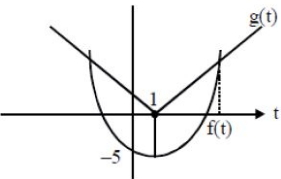
Let $g(t) = |t - 1|$ and $f(t) = t^2 - 2t - 5$.
We look for solutions where $t > 0$.
Case $1$: $t \ge 1$.
$t - 1 = t^2 - 2t - 5$ $\Rightarrow t^2 - 3t - 4 = 0$ $\Rightarrow (t - 4)(t + 1) = 0$.
Since $t \ge 1$,we have $t = 4$. Thus $2^x = 4 \Rightarrow x = 2$.
Case $2$: $0 < t < 1$.
$-(t - 1) = t^2 - 2t - 5$ $\Rightarrow -t + 1 = t^2 - 2t - 5$ $\Rightarrow t^2 - t - 6 = 0$ $\Rightarrow (t - 3)(t + 2) = 0$.
Neither $t = 3$ nor $t = -2$ satisfy $0 < t < 1$.
Thus,there is only $1$ real root.
The equation becomes $5 + |t - 1| = t(t - 2) = t^2 - 2t$.
Rearranging,we get $|t - 1| = t^2 - 2t - 5$.
Let $g(t) = |t - 1|$ and $f(t) = t^2 - 2t - 5$.
We look for solutions where $t > 0$.
Case $1$: $t \ge 1$.
$t - 1 = t^2 - 2t - 5$ $\Rightarrow t^2 - 3t - 4 = 0$ $\Rightarrow (t - 4)(t + 1) = 0$.
Since $t \ge 1$,we have $t = 4$. Thus $2^x = 4 \Rightarrow x = 2$.
Case $2$: $0 < t < 1$.
$-(t - 1) = t^2 - 2t - 5$ $\Rightarrow -t + 1 = t^2 - 2t - 5$ $\Rightarrow t^2 - t - 6 = 0$ $\Rightarrow (t - 3)(t + 2) = 0$.
Neither $t = 3$ nor $t = -2$ satisfy $0 < t < 1$.
Thus,there is only $1$ real root.
0 likes
View Solution278
DifficultMCQ
Let $S$ be the set of all real roots of the equation $3^{x}(3^{x}-1)+2=|3^{x}-1|+|3^{x}-2|$. Then $S$
A
is an empty set.
B
contains at least four elements.
C
contains exactly two elements.
D
is a singleton.
Solution
(D) Let $3^{x} = t$,where $t > 0$.
The equation becomes $t(t-1) + 2 = |t-1| + |t-2|$.
$t^{2} - t + 2 = |t-1| + |t-2|$.
Case-$I$: $0 < t < 1$.
$t^{2} - t + 2 = (1 - t) + (2 - t) = 3 - 2t$.
$t^{2} + t - 1 = 0$.
$t = \frac{-1 \pm \sqrt{1 - 4(1)(-1)}}{2} = \frac{-1 \pm \sqrt{5}}{2}$.
Since $t > 0$,$t = \frac{\sqrt{5}-1}{2} \approx 0.618$,which satisfies $0 < t < 1$.
Case-$II$: $1 \leq t < 2$.
$t^{2} - t + 2 = (t - 1) + (2 - t) = 1$.
$t^{2} - t + 1 = 0$.
The discriminant $D = (-1)^{2} - 4(1)(1) = -3 < 0$,so no real solution.
Case-$III$: $t \geq 2$.
$t^{2} - t + 2 = (t - 1) + (t - 2) = 2t - 3$.
$t^{2} - 3t + 5 = 0$.
The discriminant $D = (-3)^{2} - 4(1)(5) = 9 - 20 = -11 < 0$,so no real solution.
Thus,the only valid value is $t = \frac{\sqrt{5}-1}{2}$.
Since $3^{x} = \frac{\sqrt{5}-1}{2}$,there is exactly one real value for $x$,which is $x = \log_{3}\left(\frac{\sqrt{5}-1}{2}\right)$.
Therefore,$S$ is a singleton set.
The equation becomes $t(t-1) + 2 = |t-1| + |t-2|$.
$t^{2} - t + 2 = |t-1| + |t-2|$.
Case-$I$: $0 < t < 1$.
$t^{2} - t + 2 = (1 - t) + (2 - t) = 3 - 2t$.
$t^{2} + t - 1 = 0$.
$t = \frac{-1 \pm \sqrt{1 - 4(1)(-1)}}{2} = \frac{-1 \pm \sqrt{5}}{2}$.
Since $t > 0$,$t = \frac{\sqrt{5}-1}{2} \approx 0.618$,which satisfies $0 < t < 1$.
Case-$II$: $1 \leq t < 2$.
$t^{2} - t + 2 = (t - 1) + (2 - t) = 1$.
$t^{2} - t + 1 = 0$.
The discriminant $D = (-1)^{2} - 4(1)(1) = -3 < 0$,so no real solution.
Case-$III$: $t \geq 2$.
$t^{2} - t + 2 = (t - 1) + (t - 2) = 2t - 3$.
$t^{2} - 3t + 5 = 0$.
The discriminant $D = (-3)^{2} - 4(1)(5) = 9 - 20 = -11 < 0$,so no real solution.
Thus,the only valid value is $t = \frac{\sqrt{5}-1}{2}$.
Since $3^{x} = \frac{\sqrt{5}-1}{2}$,there is exactly one real value for $x$,which is $x = \log_{3}\left(\frac{\sqrt{5}-1}{2}\right)$.
Therefore,$S$ is a singleton set.
0 likes
View Solution279
DifficultMCQ
The least positive value of $a$ for which the equation $2x^{2} + (a-10)x + \frac{33}{2} = 2a$ has real roots is
A
$4$
B
$5$
C
$8$
D
$9$
Solution
(C) The given equation is $2x^{2} + (a-10)x + (\frac{33}{2} - 2a) = 0$.
For real roots,the discriminant $D$ must be greater than or equal to $0$.
$D = (a-10)^{2} - 4(2)(\frac{33}{2} - 2a) \geq 0$.
$D = a^{2} - 20a + 100 - 8(\frac{33-4a}{2}) \geq 0$.
$D = a^{2} - 20a + 100 - 4(33-4a) \geq 0$.
$D = a^{2} - 20a + 100 - 132 + 16a \geq 0$.
$D = a^{2} - 4a - 32 \geq 0$.
$(a-8)(a+4) \geq 0$.
This inequality holds for $a \in (-\infty, -4] \cup [8, \infty)$.
Since we are looking for the least positive value of $a$,we consider the interval $[8, \infty)$.
The least positive value is $8$.
For real roots,the discriminant $D$ must be greater than or equal to $0$.
$D = (a-10)^{2} - 4(2)(\frac{33}{2} - 2a) \geq 0$.
$D = a^{2} - 20a + 100 - 8(\frac{33-4a}{2}) \geq 0$.
$D = a^{2} - 20a + 100 - 4(33-4a) \geq 0$.
$D = a^{2} - 20a + 100 - 132 + 16a \geq 0$.
$D = a^{2} - 4a - 32 \geq 0$.
$(a-8)(a+4) \geq 0$.
This inequality holds for $a \in (-\infty, -4] \cup [8, \infty)$.
Since we are looking for the least positive value of $a$,we consider the interval $[8, \infty)$.
The least positive value is $8$.
0 likes
View Solution280
DifficultMCQ
Let $a, b \in \mathbb{R}, a \neq 0$ be such that the equation $a x^{2}-2 b x+5=0$ has a repeated root $\alpha,$ which is also a root of the equation $x^{2}-2 b x-10=0$. If $\beta$ is the other root of this equation,then $\alpha^{2}+\beta^{2}$ is equal to:
A
$26$
B
$25$
C
$28$
D
$24$
Solution
(B) For the equation $a x^{2}-2 b x+5=0$,the roots are $\alpha, \alpha$.
Thus,the sum of roots $2\alpha = \frac{2b}{a} \Rightarrow \alpha = \frac{b}{a}$ and the product of roots $\alpha^{2} = \frac{5}{a}$.
From these,$b = a\alpha$ and $a = \frac{5}{\alpha^{2}}$. Substituting $a$,we get $b = \frac{5}{\alpha}$.
Since $\alpha$ is also a root of $x^{2}-2 b x-10=0$,we have $\alpha^{2}-2 b \alpha-10=0$.
Substituting $b = \frac{5}{\alpha}$ into this equation: $\alpha^{2}-2(\frac{5}{\alpha})\alpha-10=0$ $\Rightarrow \alpha^{2}-10-10=0$ $\Rightarrow \alpha^{2}=20$.
Now,for the equation $x^{2}-2 b x-10=0$,the product of roots $\alpha \beta = -10$.
Since $\alpha^{2} = 20$,we have $\alpha = \pm \sqrt{20}$.
Then $\beta = \frac{-10}{\alpha}$.
Thus,$\beta^{2} = \frac{100}{\alpha^{2}} = \frac{100}{20} = 5$.
Therefore,$\alpha^{2}+\beta^{2} = 20 + 5 = 25$.
Thus,the sum of roots $2\alpha = \frac{2b}{a} \Rightarrow \alpha = \frac{b}{a}$ and the product of roots $\alpha^{2} = \frac{5}{a}$.
From these,$b = a\alpha$ and $a = \frac{5}{\alpha^{2}}$. Substituting $a$,we get $b = \frac{5}{\alpha}$.
Since $\alpha$ is also a root of $x^{2}-2 b x-10=0$,we have $\alpha^{2}-2 b \alpha-10=0$.
Substituting $b = \frac{5}{\alpha}$ into this equation: $\alpha^{2}-2(\frac{5}{\alpha})\alpha-10=0$ $\Rightarrow \alpha^{2}-10-10=0$ $\Rightarrow \alpha^{2}=20$.
Now,for the equation $x^{2}-2 b x-10=0$,the product of roots $\alpha \beta = -10$.
Since $\alpha^{2} = 20$,we have $\alpha = \pm \sqrt{20}$.
Then $\beta = \frac{-10}{\alpha}$.
Thus,$\beta^{2} = \frac{100}{\alpha^{2}} = \frac{100}{20} = 5$.
Therefore,$\alpha^{2}+\beta^{2} = 20 + 5 = 25$.
0 likes
View Solution281
DifficultMCQ
The number of real roots of the equation $e^{4x} + e^{3x} - 4e^{2x} + e^x + 1 = 0$ is:
A
$4$
B
$2$
C
$3$
D
$1$
Solution
(D) Given equation: $e^{4x} + e^{3x} - 4e^{2x} + e^x + 1 = 0$.
Divide the entire equation by $e^{2x}$ (since $e^{2x} \neq 0$):
$e^{2x} + e^x - 4 + \frac{1}{e^x} + \frac{1}{e^{2x}} = 0$.
Rearrange the terms:
$(e^{2x} + \frac{1}{e^{2x}}) + (e^x + \frac{1}{e^x}) - 4 = 0$.
Using the identity $a^2 + \frac{1}{a^2} = (a + \frac{1}{a})^2 - 2$,we get:
$(e^x + \frac{1}{e^x})^2 - 2 + (e^x + \frac{1}{e^x}) - 4 = 0$.
Let $t = e^x + \frac{1}{e^x}$. Since $e^x > 0$,by $AM$-$GM$ inequality,$t = e^x + \frac{1}{e^x} \geq 2$.
The equation becomes $t^2 + t - 6 = 0$.
Factoring the quadratic: $(t + 3)(t - 2) = 0$.
This gives $t = -3$ or $t = 2$.
Since $t \geq 2$,we must have $t = 2$.
$e^x + \frac{1}{e^x} = 2$ $\Rightarrow e^{2x} - 2e^x + 1 = 0$ $\Rightarrow (e^x - 1)^2 = 0$.
$e^x = 1 \Rightarrow x = 0$.
Thus,there is only $1$ real root.
Divide the entire equation by $e^{2x}$ (since $e^{2x} \neq 0$):
$e^{2x} + e^x - 4 + \frac{1}{e^x} + \frac{1}{e^{2x}} = 0$.
Rearrange the terms:
$(e^{2x} + \frac{1}{e^{2x}}) + (e^x + \frac{1}{e^x}) - 4 = 0$.
Using the identity $a^2 + \frac{1}{a^2} = (a + \frac{1}{a})^2 - 2$,we get:
$(e^x + \frac{1}{e^x})^2 - 2 + (e^x + \frac{1}{e^x}) - 4 = 0$.
Let $t = e^x + \frac{1}{e^x}$. Since $e^x > 0$,by $AM$-$GM$ inequality,$t = e^x + \frac{1}{e^x} \geq 2$.
The equation becomes $t^2 + t - 6 = 0$.
Factoring the quadratic: $(t + 3)(t - 2) = 0$.
This gives $t = -3$ or $t = 2$.
Since $t \geq 2$,we must have $t = 2$.
$e^x + \frac{1}{e^x} = 2$ $\Rightarrow e^{2x} - 2e^x + 1 = 0$ $\Rightarrow (e^x - 1)^2 = 0$.
$e^x = 1 \Rightarrow x = 0$.
Thus,there is only $1$ real root.
0 likes
View Solution282
Medium
Find the maximum and minimum values of the function $f(x) = 9x^{2} + 12x + 2$.
Solution
(D) The given function is $f(x) = 9x^{2} + 12x + 2$.
We can rewrite this by completing the square:
$f(x) = (3x)^{2} + 2(3x)(2) + 2^{2} - 2^{2} + 2$
$f(x) = (3x + 2)^{2} - 4 + 2$
$f(x) = (3x + 2)^{2} - 2$.
Since $(3x + 2)^{2} \geq 0$ for all $x \in \mathbb{R}$,the minimum value of $(3x + 2)^{2}$ is $0$.
Therefore,the minimum value of $f(x)$ is $0 - 2 = -2$,which occurs when $3x + 2 = 0$,i.e.,$x = -\frac{2}{3}$.
As $x \to \infty$,$f(x) \to \infty$,so the function does not have a maximum value.
We can rewrite this by completing the square:
$f(x) = (3x)^{2} + 2(3x)(2) + 2^{2} - 2^{2} + 2$
$f(x) = (3x + 2)^{2} - 4 + 2$
$f(x) = (3x + 2)^{2} - 2$.
Since $(3x + 2)^{2} \geq 0$ for all $x \in \mathbb{R}$,the minimum value of $(3x + 2)^{2}$ is $0$.
Therefore,the minimum value of $f(x)$ is $0 - 2 = -2$,which occurs when $3x + 2 = 0$,i.e.,$x = -\frac{2}{3}$.
As $x \to \infty$,$f(x) \to \infty$,so the function does not have a maximum value.
0 likes
View Solution283
EasyMCQ
Solve $x^{2}+x+1=0$
A
$\frac{-1 + \sqrt{3} i}{2}$
B
$\frac{-1 \pm \sqrt{3} i}{2}$
C
$\frac{1 \pm \sqrt{3} i}{2}$
D
$\frac{-1 \pm \sqrt{2} i}{2}$
Solution
(B) The given quadratic equation is $x^{2}+x+1=0$.
Comparing this with $ax^{2}+bx+c=0$,we get $a=1, b=1, c=1$.
The discriminant is $D = b^{2}-4ac = 1^{2}-4(1)(1) = 1-4 = -3$.
Using the quadratic formula $x = \frac{-b \pm \sqrt{D}}{2a}$,we get:
$x = \frac{-1 \pm \sqrt{-3}}{2(1)} = \frac{-1 \pm \sqrt{3}i}{2}$.
Comparing this with $ax^{2}+bx+c=0$,we get $a=1, b=1, c=1$.
The discriminant is $D = b^{2}-4ac = 1^{2}-4(1)(1) = 1-4 = -3$.
Using the quadratic formula $x = \frac{-b \pm \sqrt{D}}{2a}$,we get:
$x = \frac{-1 \pm \sqrt{-3}}{2(1)} = \frac{-1 \pm \sqrt{3}i}{2}$.
0 likes
View Solution284
EasyMCQ
Solve $\sqrt{5} x^{2} + x + \sqrt{5} = 0$.
A
$\frac{-1 \pm \sqrt{19} i}{2 \sqrt{5}}$
B
$\frac{-1 \pm \sqrt{19} i}{2 \sqrt{5}}$
C
$\frac{-1 \pm \sqrt{19} i}{2 \sqrt{5}}$
D
$\frac{-1 \pm \sqrt{19} i}{2 \sqrt{5}}$
Solution
(A) Given the quadratic equation $\sqrt{5} x^{2} + x + \sqrt{5} = 0$.
Comparing this with $ax^{2} + bx + c = 0$,we have $a = \sqrt{5}$,$b = 1$,and $c = \sqrt{5}$.
The discriminant $D = b^{2} - 4ac$ is calculated as:
$D = (1)^{2} - 4(\sqrt{5})(\sqrt{5}) = 1 - 4(5) = 1 - 20 = -19$.
The roots are given by the quadratic formula $x = \frac{-b \pm \sqrt{D}}{2a}$.
Substituting the values,we get $x = \frac{-1 \pm \sqrt{-19}}{2\sqrt{5}}$.
Since $\sqrt{-1} = i$,the solutions are $x = \frac{-1 \pm \sqrt{19} i}{2\sqrt{5}}$.
Comparing this with $ax^{2} + bx + c = 0$,we have $a = \sqrt{5}$,$b = 1$,and $c = \sqrt{5}$.
The discriminant $D = b^{2} - 4ac$ is calculated as:
$D = (1)^{2} - 4(\sqrt{5})(\sqrt{5}) = 1 - 4(5) = 1 - 20 = -19$.
The roots are given by the quadratic formula $x = \frac{-b \pm \sqrt{D}}{2a}$.
Substituting the values,we get $x = \frac{-1 \pm \sqrt{-19}}{2\sqrt{5}}$.
Since $\sqrt{-1} = i$,the solutions are $x = \frac{-1 \pm \sqrt{19} i}{2\sqrt{5}}$.
0 likes
View Solution285
MediumMCQ
Solve the equation $2x^{2}+x+1=0$.
A
$\frac{-1 \pm \sqrt{7}i}{4}$
B
$\frac{-1 \pm \sqrt{5}i}{4}$
C
$\frac{-1 \pm \sqrt{3}i}{4}$
D
$\frac{-1 \pm \sqrt{2}i}{4}$
Solution
(A) The given quadratic equation is $2x^{2}+x+1=0$.
Comparing this with the standard form $ax^{2}+bx+c=0$,we get $a=2, b=1, c=1$.
The discriminant $D$ is given by $D = b^{2}-4ac$.
$D = 1^{2}-4(2)(1) = 1-8 = -7$.
The roots are given by the quadratic formula $x = \frac{-b \pm \sqrt{D}}{2a}$.
Substituting the values,we get $x = \frac{-1 \pm \sqrt{-7}}{2(2)} = \frac{-1 \pm \sqrt{7}i}{4}$ (since $\sqrt{-1} = i$).
Comparing this with the standard form $ax^{2}+bx+c=0$,we get $a=2, b=1, c=1$.
The discriminant $D$ is given by $D = b^{2}-4ac$.
$D = 1^{2}-4(2)(1) = 1-8 = -7$.
The roots are given by the quadratic formula $x = \frac{-b \pm \sqrt{D}}{2a}$.
Substituting the values,we get $x = \frac{-1 \pm \sqrt{-7}}{2(2)} = \frac{-1 \pm \sqrt{7}i}{4}$ (since $\sqrt{-1} = i$).
0 likes
View Solution286
MediumMCQ
Solve the equation $x^{2}+3x+9=0$.
A
$\frac{-3 \pm 3 \sqrt{3} i}{2}$
B
$\frac{-3 \pm \sqrt{3} i}{2}$
C
$\frac{3 \pm 3 \sqrt{3} i}{2}$
D
$\frac{-3 \pm \sqrt{3}}{2}$
Solution
(A) The given quadratic equation is $x^{2}+3x+9=0$.
On comparing the given equation with $ax^{2}+bx+c=0$,we obtain $a=1, b=3,$ and $c=9$.
The discriminant $D$ is given by $D = b^{2}-4ac$.
$D = 3^{2}-4(1)(9) = 9-36 = -27$.
The roots are given by the quadratic formula $x = \frac{-b \pm \sqrt{D}}{2a}$.
$x = \frac{-3 \pm \sqrt{-27}}{2(1)} = \frac{-3 \pm \sqrt{27}i}{2} = \frac{-3 \pm 3\sqrt{3}i}{2}$.
On comparing the given equation with $ax^{2}+bx+c=0$,we obtain $a=1, b=3,$ and $c=9$.
The discriminant $D$ is given by $D = b^{2}-4ac$.
$D = 3^{2}-4(1)(9) = 9-36 = -27$.
The roots are given by the quadratic formula $x = \frac{-b \pm \sqrt{D}}{2a}$.
$x = \frac{-3 \pm \sqrt{-27}}{2(1)} = \frac{-3 \pm \sqrt{27}i}{2} = \frac{-3 \pm 3\sqrt{3}i}{2}$.
0 likes
View Solution287
MediumMCQ
Solve the equation $-x^{2}+x-2=0$.
A
$\frac{1 \pm \sqrt{7} i}{2}$
B
$\frac{-1 \pm \sqrt{7} i}{2}$
C
$\frac{1 \pm \sqrt{7} i}{-2}$
D
$\frac{-1 \pm \sqrt{7} i}{-2}$
Solution
(D) The given quadratic equation is $-x^{2}+x-2=0$.
Comparing this with the standard form $ax^{2}+bx+c=0$,we get $a=-1, b=1, c=-2$.
The discriminant $D$ is given by $D = b^{2}-4ac = (1)^{2}-4(-1)(-2) = 1-8 = -7$.
The roots are given by the quadratic formula $x = \frac{-b \pm \sqrt{D}}{2a}$.
Substituting the values,$x = \frac{-1 \pm \sqrt{-7}}{2(-1)} = \frac{-1 \pm \sqrt{7}i}{-2}$.
This can be simplified as $x = \frac{1 \pm \sqrt{7}i}{2}$.
Comparing this with the standard form $ax^{2}+bx+c=0$,we get $a=-1, b=1, c=-2$.
The discriminant $D$ is given by $D = b^{2}-4ac = (1)^{2}-4(-1)(-2) = 1-8 = -7$.
The roots are given by the quadratic formula $x = \frac{-b \pm \sqrt{D}}{2a}$.
Substituting the values,$x = \frac{-1 \pm \sqrt{-7}}{2(-1)} = \frac{-1 \pm \sqrt{7}i}{-2}$.
This can be simplified as $x = \frac{1 \pm \sqrt{7}i}{2}$.
0 likes
View Solution288
MediumMCQ
Solve the equation $x^{2}+3x+5=0$.
A
$\frac{-3 \pm \sqrt{11}i}{2}$
B
$\frac{-3 \pm \sqrt{13}i}{2}$
C
$\frac{-3 \pm \sqrt{15}i}{2}$
D
$\frac{-3 \pm \sqrt{17}i}{2}$
Solution
(A) The given quadratic equation is $x^{2}+3x+5=0$.
Comparing this with the standard form $ax^{2}+bx+c=0$,we get $a=1, b=3, c=5$.
The discriminant $D$ is given by $D = b^{2}-4ac$.
$D = 3^{2}-4(1)(5) = 9-20 = -11$.
The roots are given by the quadratic formula $x = \frac{-b \pm \sqrt{D}}{2a}$.
$x = \frac{-3 \pm \sqrt{-11}}{2(1)} = \frac{-3 \pm \sqrt{11}i}{2}$ (since $\sqrt{-1} = i$).
Comparing this with the standard form $ax^{2}+bx+c=0$,we get $a=1, b=3, c=5$.
The discriminant $D$ is given by $D = b^{2}-4ac$.
$D = 3^{2}-4(1)(5) = 9-20 = -11$.
The roots are given by the quadratic formula $x = \frac{-b \pm \sqrt{D}}{2a}$.
$x = \frac{-3 \pm \sqrt{-11}}{2(1)} = \frac{-3 \pm \sqrt{11}i}{2}$ (since $\sqrt{-1} = i$).
0 likes
View Solution289
MediumMCQ
Solve the equation $x^{2}-x+2=0$.
A
$\frac{1 \pm \sqrt{7} i}{2}$
B
$\frac{1 \pm \sqrt{5} i}{2}$
C
$\frac{-1 \pm \sqrt{7} i}{2}$
D
$\frac{-1 \pm \sqrt{5} i}{2}$
Solution
(A) The given quadratic equation is $x^{2}-x+2=0$.
On comparing the given equation with $ax^{2}+bx+c=0$,we obtain $a=1, b=-1,$ and $c=2$.
The discriminant $D$ is given by $D = b^{2}-4ac$.
$D = (-1)^{2}-4(1)(2) = 1-8 = -7$.
Using the quadratic formula $x = \frac{-b \pm \sqrt{D}}{2a}$,we get:
$x = \frac{-(-1) \pm \sqrt{-7}}{2(1)} = \frac{1 \pm \sqrt{7}i}{2}$.
On comparing the given equation with $ax^{2}+bx+c=0$,we obtain $a=1, b=-1,$ and $c=2$.
The discriminant $D$ is given by $D = b^{2}-4ac$.
$D = (-1)^{2}-4(1)(2) = 1-8 = -7$.
Using the quadratic formula $x = \frac{-b \pm \sqrt{D}}{2a}$,we get:
$x = \frac{-(-1) \pm \sqrt{-7}}{2(1)} = \frac{1 \pm \sqrt{7}i}{2}$.
0 likes
View Solution290
MediumMCQ
Solve the equation $\sqrt{2} x^{2} + x + \sqrt{2} = 0$.
A
$\frac{-1 \pm \sqrt{7} i}{2 \sqrt{2}}$
B
$\frac{-1 \pm \sqrt{5} i}{2 \sqrt{2}}$
C
$\frac{-1 \pm \sqrt{3} i}{2 \sqrt{2}}$
D
$\frac{-1 \pm \sqrt{9} i}{2 \sqrt{2}}$
Solution
(A) The given quadratic equation is $\sqrt{2} x^{2} + x + \sqrt{2} = 0$.
On comparing the given equation with $ax^{2} + bx + c = 0$,we obtain $a = \sqrt{2}$,$b = 1$,and $c = \sqrt{2}$.
The discriminant $D$ is given by $D = b^{2} - 4ac$.
$D = (1)^{2} - 4(\sqrt{2})(\sqrt{2}) = 1 - 8 = -7$.
The roots are given by the quadratic formula $x = \frac{-b \pm \sqrt{D}}{2a}$.
$x = \frac{-1 \pm \sqrt{-7}}{2(\sqrt{2})} = \frac{-1 \pm \sqrt{7}i}{2\sqrt{2}}$.
On comparing the given equation with $ax^{2} + bx + c = 0$,we obtain $a = \sqrt{2}$,$b = 1$,and $c = \sqrt{2}$.
The discriminant $D$ is given by $D = b^{2} - 4ac$.
$D = (1)^{2} - 4(\sqrt{2})(\sqrt{2}) = 1 - 8 = -7$.
The roots are given by the quadratic formula $x = \frac{-b \pm \sqrt{D}}{2a}$.
$x = \frac{-1 \pm \sqrt{-7}}{2(\sqrt{2})} = \frac{-1 \pm \sqrt{7}i}{2\sqrt{2}}$.
0 likes
View Solution291
MediumMCQ
Solve the equation $\sqrt{3} x^{2}-\sqrt{2} x+3 \sqrt{3}=0$.
A
$\frac{\sqrt{2} \pm \sqrt{34} i}{2 \sqrt{3}}$
B
$\frac{\sqrt{2} \pm \sqrt{34} i}{2 \sqrt{6}}$
C
$\frac{\sqrt{2} \pm \sqrt{34}}{2 \sqrt{3}}$
D
$\frac{\sqrt{2} \pm \sqrt{34} i}{3 \sqrt{2}}$
Solution
(A) The given quadratic equation is $\sqrt{3} x^{2}-\sqrt{2} x+3 \sqrt{3}=0$.
Comparing this with $a x^{2}+b x+c=0$,we get $a=\sqrt{3}, b=-\sqrt{2}, c=3 \sqrt{3}$.
The discriminant $D$ is given by $D = b^{2}-4ac$.
$D = (-\sqrt{2})^{2} - 4(\sqrt{3})(3 \sqrt{3}) = 2 - 4(3)(3) = 2 - 36 = -34$.
The roots are given by $x = \frac{-b \pm \sqrt{D}}{2a}$.
$x = \frac{-(-\sqrt{2}) \pm \sqrt{-34}}{2 \sqrt{3}} = \frac{\sqrt{2} \pm \sqrt{34} i}{2 \sqrt{3}}$ (since $\sqrt{-1} = i$).
Comparing this with $a x^{2}+b x+c=0$,we get $a=\sqrt{3}, b=-\sqrt{2}, c=3 \sqrt{3}$.
The discriminant $D$ is given by $D = b^{2}-4ac$.
$D = (-\sqrt{2})^{2} - 4(\sqrt{3})(3 \sqrt{3}) = 2 - 4(3)(3) = 2 - 36 = -34$.
The roots are given by $x = \frac{-b \pm \sqrt{D}}{2a}$.
$x = \frac{-(-\sqrt{2}) \pm \sqrt{-34}}{2 \sqrt{3}} = \frac{\sqrt{2} \pm \sqrt{34} i}{2 \sqrt{3}}$ (since $\sqrt{-1} = i$).
0 likes
View Solution292
MediumMCQ
Solve the equation $x^{2}+x+\frac{1}{\sqrt{2}}=0$.
A
$\frac{-1 \pm i\sqrt{2\sqrt{2}-1}}{2}$
B
$\frac{-1 \pm i\sqrt{2\sqrt{2}+1}}{2}$
C
$\frac{1 \pm i\sqrt{2\sqrt{2}-1}}{2}$
D
$\frac{-1 \pm i\sqrt{\sqrt{2}-1}}{2}$
Solution
(A) The given quadratic equation is $x^{2}+x+\frac{1}{\sqrt{2}}=0$.
Multiplying by $\sqrt{2}$,we get $\sqrt{2}x^{2}+\sqrt{2}x+1=0$.
Comparing with $ax^{2}+bx+c=0$,we have $a=\sqrt{2}$,$b=\sqrt{2}$,and $c=1$.
The discriminant $D = b^{2}-4ac = (\sqrt{2})^{2}-4(\sqrt{2})(1) = 2-4\sqrt{2}$.
Since $D < 0$,the roots are given by $x = \frac{-b \pm \sqrt{D}}{2a} = \frac{-\sqrt{2} \pm \sqrt{2-4\sqrt{2}}}{2\sqrt{2}}$.
$x = \frac{-\sqrt{2} \pm i\sqrt{4\sqrt{2}-2}}{2\sqrt{2}} = \frac{-\sqrt{2} \pm i\sqrt{2(2\sqrt{2}-1)}}{2\sqrt{2}}$.
$x = \frac{-\sqrt{2} \pm i\sqrt{2}\sqrt{2\sqrt{2}-1}}{2\sqrt{2}} = \frac{-1 \pm i\sqrt{2\sqrt{2}-1}}{2}$.
Multiplying by $\sqrt{2}$,we get $\sqrt{2}x^{2}+\sqrt{2}x+1=0$.
Comparing with $ax^{2}+bx+c=0$,we have $a=\sqrt{2}$,$b=\sqrt{2}$,and $c=1$.
The discriminant $D = b^{2}-4ac = (\sqrt{2})^{2}-4(\sqrt{2})(1) = 2-4\sqrt{2}$.
Since $D < 0$,the roots are given by $x = \frac{-b \pm \sqrt{D}}{2a} = \frac{-\sqrt{2} \pm \sqrt{2-4\sqrt{2}}}{2\sqrt{2}}$.
$x = \frac{-\sqrt{2} \pm i\sqrt{4\sqrt{2}-2}}{2\sqrt{2}} = \frac{-\sqrt{2} \pm i\sqrt{2(2\sqrt{2}-1)}}{2\sqrt{2}}$.
$x = \frac{-\sqrt{2} \pm i\sqrt{2}\sqrt{2\sqrt{2}-1}}{2\sqrt{2}} = \frac{-1 \pm i\sqrt{2\sqrt{2}-1}}{2}$.
0 likes
View Solution293
MediumMCQ
Solve the equation $x^{2}+\frac{x}{\sqrt{2}}+1=0$.
A
$\frac{-1 \pm \sqrt{7} i}{2 \sqrt{2}}$
B
$\frac{-1 \pm \sqrt{7} i}{2}$
C
$\frac{-1 \pm \sqrt{7}}{2 \sqrt{2}}$
D
$\frac{1 \pm \sqrt{7} i}{2 \sqrt{2}}$
Solution
(A) The given quadratic equation is $x^{2}+\frac{x}{\sqrt{2}}+1=0$.
Multiply the entire equation by $\sqrt{2}$ to simplify: $\sqrt{2}x^{2}+x+\sqrt{2}=0$.
Comparing this with the standard quadratic form $ax^{2}+bx+c=0$,we get $a=\sqrt{2}$,$b=1$,and $c=\sqrt{2}$.
The discriminant $D$ is given by $D = b^{2}-4ac = (1)^{2}-4(\sqrt{2})(\sqrt{2}) = 1-8 = -7$.
The roots are given by the quadratic formula $x = \frac{-b \pm \sqrt{D}}{2a}$.
Substituting the values,we get $x = \frac{-1 \pm \sqrt{-7}}{2\sqrt{2}} = \frac{-1 \pm \sqrt{7}i}{2\sqrt{2}}$ (since $\sqrt{-1}=i$).
Multiply the entire equation by $\sqrt{2}$ to simplify: $\sqrt{2}x^{2}+x+\sqrt{2}=0$.
Comparing this with the standard quadratic form $ax^{2}+bx+c=0$,we get $a=\sqrt{2}$,$b=1$,and $c=\sqrt{2}$.
The discriminant $D$ is given by $D = b^{2}-4ac = (1)^{2}-4(\sqrt{2})(\sqrt{2}) = 1-8 = -7$.
The roots are given by the quadratic formula $x = \frac{-b \pm \sqrt{D}}{2a}$.
Substituting the values,we get $x = \frac{-1 \pm \sqrt{-7}}{2\sqrt{2}} = \frac{-1 \pm \sqrt{7}i}{2\sqrt{2}}$ (since $\sqrt{-1}=i$).
0 likes
View Solution294
MediumMCQ
Solve the equation $3x^{2} - 4x + \frac{20}{3} = 0$.
A
$\frac{2}{3} \pm \frac{4}{3}i$
B
$\frac{1}{3} \pm \frac{2}{3}i$
C
$\frac{2}{3} \pm \frac{2}{3}i$
D
$\frac{4}{3} \pm \frac{2}{3}i$
Solution
(A) The given quadratic equation is $3x^{2} - 4x + \frac{20}{3} = 0$.
Multiplying the entire equation by $3$,we get $9x^{2} - 12x + 20 = 0$.
Comparing this with the standard form $ax^{2} + bx + c = 0$,we have $a = 9$,$b = -12$,and $c = 20$.
The discriminant $D$ is given by $D = b^{2} - 4ac = (-12)^{2} - 4(9)(20) = 144 - 720 = -576$.
Using the quadratic formula $x = \frac{-b \pm \sqrt{D}}{2a}$,we get:
$x = \frac{-(-12) \pm \sqrt{-576}}{2(9)} = \frac{12 \pm \sqrt{576}i}{18} = \frac{12 \pm 24i}{18}$.
Simplifying the expression,we get $x = \frac{12}{18} \pm \frac{24}{18}i = \frac{2}{3} \pm \frac{4}{3}i$.
Multiplying the entire equation by $3$,we get $9x^{2} - 12x + 20 = 0$.
Comparing this with the standard form $ax^{2} + bx + c = 0$,we have $a = 9$,$b = -12$,and $c = 20$.
The discriminant $D$ is given by $D = b^{2} - 4ac = (-12)^{2} - 4(9)(20) = 144 - 720 = -576$.
Using the quadratic formula $x = \frac{-b \pm \sqrt{D}}{2a}$,we get:
$x = \frac{-(-12) \pm \sqrt{-576}}{2(9)} = \frac{12 \pm \sqrt{576}i}{18} = \frac{12 \pm 24i}{18}$.
Simplifying the expression,we get $x = \frac{12}{18} \pm \frac{24}{18}i = \frac{2}{3} \pm \frac{4}{3}i$.
0 likes
View Solution295
MediumMCQ
Solve the equation $x^{2}-2x+\frac{3}{2}=0$.
A
$1 \pm \frac{\sqrt{2}}{2}i$
B
$1 \pm \sqrt{2}i$
C
$2 \pm \frac{\sqrt{2}}{2}i$
D
$1 \pm \sqrt{2}i$
Solution
(A) The given quadratic equation is $x^{2}-2x+\frac{3}{2}=0$.
Multiplying by $2$,we get $2x^{2}-4x+3=0$.
Comparing this with $ax^{2}+bx+c=0$,we have $a=2, b=-4, c=3$.
The discriminant $D = b^{2}-4ac = (-4)^{2}-4(2)(3) = 16-24 = -8$.
The roots are given by $x = \frac{-b \pm \sqrt{D}}{2a} = \frac{-(-4) \pm \sqrt{-8}}{2(2)}$.
$x = \frac{4 \pm 2\sqrt{2}i}{4} = \frac{4}{4} \pm \frac{2\sqrt{2}i}{4} = 1 \pm \frac{\sqrt{2}}{2}i$.
Multiplying by $2$,we get $2x^{2}-4x+3=0$.
Comparing this with $ax^{2}+bx+c=0$,we have $a=2, b=-4, c=3$.
The discriminant $D = b^{2}-4ac = (-4)^{2}-4(2)(3) = 16-24 = -8$.
The roots are given by $x = \frac{-b \pm \sqrt{D}}{2a} = \frac{-(-4) \pm \sqrt{-8}}{2(2)}$.
$x = \frac{4 \pm 2\sqrt{2}i}{4} = \frac{4}{4} \pm \frac{2\sqrt{2}i}{4} = 1 \pm \frac{\sqrt{2}}{2}i$.
0 likes
View Solution296
MediumMCQ
Solve the equation $27 x^{2}-10 x+1=0$.
A
$\frac{5 \pm \sqrt{2} i}{27}$
B
$\frac{5 \pm \sqrt{3} i}{27}$
C
$\frac{1 \pm \sqrt{2} i}{27}$
D
$\frac{5 \pm \sqrt{2}}{27}$
Solution
(A) The given quadratic equation is $27 x^{2}-10 x+1=0$.
On comparing this equation with $a x^{2}+b x+c=0$,we obtain $a=27, b=-10$,and $c=1$.
Therefore,the discriminant $D$ is given by $D=b^{2}-4 a c = (-10)^{2}-4(27)(1) = 100-108 = -8$.
Using the quadratic formula $x = \frac{-b \pm \sqrt{D}}{2 a}$,we get:
$x = \frac{-(-10) \pm \sqrt{-8}}{2(27)} = \frac{10 \pm 2 \sqrt{2} i}{54}$.
Dividing the numerator and denominator by $2$,we obtain $x = \frac{5 \pm \sqrt{2} i}{27}$.
On comparing this equation with $a x^{2}+b x+c=0$,we obtain $a=27, b=-10$,and $c=1$.
Therefore,the discriminant $D$ is given by $D=b^{2}-4 a c = (-10)^{2}-4(27)(1) = 100-108 = -8$.
Using the quadratic formula $x = \frac{-b \pm \sqrt{D}}{2 a}$,we get:
$x = \frac{-(-10) \pm \sqrt{-8}}{2(27)} = \frac{10 \pm 2 \sqrt{2} i}{54}$.
Dividing the numerator and denominator by $2$,we obtain $x = \frac{5 \pm \sqrt{2} i}{27}$.
0 likes
View Solution297
MediumMCQ
Solve the equation $21x^{2} - 28x + 10 = 0$.
A
$\frac{2}{3} \pm \frac{\sqrt{14}}{21}i$
B
$\frac{2}{3} \pm \frac{\sqrt{14}}{21}$
C
$\frac{2}{3} \pm \frac{\sqrt{7}}{21}i$
D
$\frac{2}{3} \pm \frac{\sqrt{7}}{21}$
Solution
(A) The given quadratic equation is $21x^{2} - 28x + 10 = 0$.
Comparing this with $ax^{2} + bx + c = 0$,we get $a = 21$,$b = -28$,and $c = 10$.
The discriminant $D$ is given by $D = b^{2} - 4ac$.
$D = (-28)^{2} - 4(21)(10) = 784 - 840 = -56$.
The roots are given by $x = \frac{-b \pm \sqrt{D}}{2a}$.
$x = \frac{-(-28) \pm \sqrt{-56}}{2(21)} = \frac{28 \pm \sqrt{56}i}{42}$.
Since $\sqrt{56} = \sqrt{4 \times 14} = 2\sqrt{14}$,we have:
$x = \frac{28 \pm 2\sqrt{14}i}{42} = \frac{28}{42} \pm \frac{2\sqrt{14}}{42}i = \frac{2}{3} \pm \frac{\sqrt{14}}{21}i$.
Comparing this with $ax^{2} + bx + c = 0$,we get $a = 21$,$b = -28$,and $c = 10$.
The discriminant $D$ is given by $D = b^{2} - 4ac$.
$D = (-28)^{2} - 4(21)(10) = 784 - 840 = -56$.
The roots are given by $x = \frac{-b \pm \sqrt{D}}{2a}$.
$x = \frac{-(-28) \pm \sqrt{-56}}{2(21)} = \frac{28 \pm \sqrt{56}i}{42}$.
Since $\sqrt{56} = \sqrt{4 \times 14} = 2\sqrt{14}$,we have:
$x = \frac{28 \pm 2\sqrt{14}i}{42} = \frac{28}{42} \pm \frac{2\sqrt{14}}{42}i = \frac{2}{3} \pm \frac{\sqrt{14}}{21}i$.
0 likes
View Solution298
MediumMCQ
Let $f(x)$ be a quadratic polynomial such that $f(-1)+f(2)=0$. If one of the roots of $f(x)=0$ is $3$,then its other root lies in
A
$(-3, -1)$
B
$(1, 3)$
C
$(-1, 0)$
D
$(0, 1)$
Solution
(C) Let the quadratic polynomial be $f(x) = a(x - 3)(x - \alpha)$,where $\alpha$ is the other root.
Given $f(2) = a(2 - 3)(2 - \alpha) = a(-1)(2 - \alpha) = a(\alpha - 2)$.
Given $f(-1) = a(-1 - 3)(-1 - \alpha) = a(-4)(-1 - \alpha) = 4a(1 + \alpha)$.
Since $f(-1) + f(2) = 0$,we have $4a(1 + \alpha) + a(\alpha - 2) = 0$.
Since $a \neq 0$,we can divide by $a$: $4 + 4\alpha + \alpha - 2 = 0$.
$5\alpha + 2 = 0$ $\Rightarrow 5\alpha = -2$ $\Rightarrow \alpha = -\frac{2}{5} = -0.4$.
Thus,the other root $\alpha = -0.4$ lies in the interval $(-1, 0)$.
Given $f(2) = a(2 - 3)(2 - \alpha) = a(-1)(2 - \alpha) = a(\alpha - 2)$.
Given $f(-1) = a(-1 - 3)(-1 - \alpha) = a(-4)(-1 - \alpha) = 4a(1 + \alpha)$.
Since $f(-1) + f(2) = 0$,we have $4a(1 + \alpha) + a(\alpha - 2) = 0$.
Since $a \neq 0$,we can divide by $a$: $4 + 4\alpha + \alpha - 2 = 0$.
$5\alpha + 2 = 0$ $\Rightarrow 5\alpha = -2$ $\Rightarrow \alpha = -\frac{2}{5} = -0.4$.
Thus,the other root $\alpha = -0.4$ lies in the interval $(-1, 0)$.
0 likes
View Solution299
MediumMCQ
The product of the roots of the equation $9x^{2}-18|x|+5=0$ is
A
$\frac{25}{9}$
B
$\frac{25}{81}$
C
$\frac{5}{27}$
D
$\frac{5}{9}$
Solution
(B) Given equation: $9x^{2}-18|x|+5=0$
Since $x^{2} = |x|^{2}$,the equation becomes $9|x|^{2}-18|x|+5=0$.
Let $t = |x|$,then $9t^{2}-18t+5=0$.
Factoring the quadratic: $9t^{2}-15t-3t+5=0$.
$3t(3t-5)-1(3t-5)=0$.
$(3t-1)(3t-5)=0$.
So,$|x| = \frac{1}{3}$ or $|x| = \frac{5}{3}$.
The roots are $x = \frac{1}{3}, -\frac{1}{3}, \frac{5}{3}, -\frac{5}{3}$.
The product of the roots is $(\frac{1}{3}) \times (-\frac{1}{3}) \times (\frac{5}{3}) \times (-\frac{5}{3}) = \frac{25}{81}$.
Since $x^{2} = |x|^{2}$,the equation becomes $9|x|^{2}-18|x|+5=0$.
Let $t = |x|$,then $9t^{2}-18t+5=0$.
Factoring the quadratic: $9t^{2}-15t-3t+5=0$.
$3t(3t-5)-1(3t-5)=0$.
$(3t-1)(3t-5)=0$.
So,$|x| = \frac{1}{3}$ or $|x| = \frac{5}{3}$.
The roots are $x = \frac{1}{3}, -\frac{1}{3}, \frac{5}{3}, -\frac{5}{3}$.
The product of the roots is $(\frac{1}{3}) \times (-\frac{1}{3}) \times (\frac{5}{3}) \times (-\frac{5}{3}) = \frac{25}{81}$.
0 likes
View Solution300
MediumMCQ
The given image shows the graph of a quadratic equation $y = ax^2 + bx + c$. Based on the graph,which of the following is true?
A
$a > 0, D > 0$
B
$a < 0, D > 0$
C
$a > 0, D < 0$
D
$a < 0, D < 0$
Solution
(B) $1$. The graph is a parabola opening downwards. This indicates that the coefficient of $x^2$ is negative,so $a < 0$.
$2$. The graph intersects the $x$-axis at two distinct points. This indicates that the quadratic equation has two distinct real roots,which means the discriminant $D = b^2 - 4ac > 0$.
$3$. Combining these two observations,we get $a < 0$ and $D > 0$.
$2$. The graph intersects the $x$-axis at two distinct points. This indicates that the quadratic equation has two distinct real roots,which means the discriminant $D = b^2 - 4ac > 0$.
$3$. Combining these two observations,we get $a < 0$ and $D > 0$.
0 likes
View Solution4-2.Quadratic Equations and Inequations — Solution of quadratic equations and Nature of roots · Frequently Asked Questions
1Are these 4-2.Quadratic Equations and Inequations questions useful for JEE and NEET?
Yes. All questions in this section are mapped to JEE Main and NEET exam patterns. Previous year questions from JEE Main, NEET, GUJCET and state-level exams are included with full solutions.
2Can I switch to Hindi or Gujarati for these questions?
Yes. Use the language tabs in the hero section or the sidebar to view the same questions and solutions in English, Hindi or Gujarati.
3How do I generate a question paper from this subtopic?
Use the Vedclass Exam Paper Generator — select the chapter and subtopic, set difficulty, and generate Sets A, B, C, D automatically. First 3 chapters of every subject are free.
Vedclass Products
For Students
Vedclass Test Series
Mock tests in real JEE/NEET style with performance analysis. 5-day free trial.
Start Free TrialFor Teachers
Exam Paper Generator
Generate Set A/B/C/D papers from this chapter in 2 minutes. 3 chapters free.
Try FreeFor Institutes
Online Exam Module
Live online exams with unlimited students, 360° analytics & white-label branding.
See DemoFor Teachers & Institutes
Generate a 4-2.Quadratic Equations and Inequations Exam Paper in 2 Minutes
Select subtopic & difficulty — Sets A, B, C, D auto-generated with No Repeat logic.
First 3 chapters of every subject are free — no payment required.