
A English
Quadratic expressions and Position of roots Questions in English
Class 11 Mathematics · 4-2.Quadratic Equations and Inequations · Quadratic expressions and Position of roots
73+
Questions
English
Language
100%
With Solutions
Showing 50 of 73 questions in English
1
EasyMCQ
If $x$ is real,then the maximum value of $5 + 4x - 4x^2$ is equal to:
A
$5$
B
$6$
C
$1$
D
$2$
Solution
(B) Let $f(x) = 5 + 4x - 4x^2 = y$.
Rearranging the terms,we get $4x^2 - 4x + (y - 5) = 0$.
Since $x$ is real,the discriminant $D$ must be greater than or equal to $0$ $(D \ge 0)$.
$D = b^2 - 4ac = (-4)^2 - 4(4)(y - 5) \ge 0$.
$16 - 16(y - 5) \ge 0$.
Dividing by $16$,we get $1 - (y - 5) \ge 0$.
$1 - y + 5 \ge 0$.
$6 - y \ge 0$,which implies $y \le 6$.
Alternatively,$f(x) = 5 - (4x^2 - 4x) = 5 - (4x^2 - 4x + 1 - 1) = 5 - ((2x - 1)^2 - 1) = 6 - (2x - 1)^2$.
Since $(2x - 1)^2 \ge 0$,the maximum value of $f(x)$ is $6$ when $2x - 1 = 0$,i.e.,$x = 1/2$.
Rearranging the terms,we get $4x^2 - 4x + (y - 5) = 0$.
Since $x$ is real,the discriminant $D$ must be greater than or equal to $0$ $(D \ge 0)$.
$D = b^2 - 4ac = (-4)^2 - 4(4)(y - 5) \ge 0$.
$16 - 16(y - 5) \ge 0$.
Dividing by $16$,we get $1 - (y - 5) \ge 0$.
$1 - y + 5 \ge 0$.
$6 - y \ge 0$,which implies $y \le 6$.
Alternatively,$f(x) = 5 - (4x^2 - 4x) = 5 - (4x^2 - 4x + 1 - 1) = 5 - ((2x - 1)^2 - 1) = 6 - (2x - 1)^2$.
Since $(2x - 1)^2 \ge 0$,the maximum value of $f(x)$ is $6$ when $2x - 1 = 0$,i.e.,$x = 1/2$.
0 likes
View Solution2
EasyMCQ
If the roots of ${x^2} + x + a = 0$ exceed $a$,then
A
$2 < a < 3$
B
$a > 3$
C
$-3 < a < 3$
D
$a < -2$
Solution
(D) For the roots of the quadratic equation $f(x) = x^2 + x + a = 0$ to exceed a number $k = a$,the following conditions must be satisfied:
$1$. $D = b^2 - 4ac \ge 0$
$2$. $f(k) > 0$
$3$. $-\frac{b}{2a} > k$
Applying these conditions for $k = a$:
$1$. $1^2 - 4(1)(a) \ge 0 \implies 1 - 4a \ge 0 \implies a \le \frac{1}{4}$
$2$. $f(a) = a^2 + a + a > 0 \implies a^2 + 2a > 0 \implies a(a + 2) > 0 \implies a < -2$ or $a > 0$
$3$. $-\frac{1}{2(1)} > a \implies a < -\frac{1}{2}$
Taking the intersection of all three conditions:
$a \le \frac{1}{4}$,$(a < -2 \text{ or } a > 0)$,and $a < -\frac{1}{2}$.
The intersection is $a < -2$.
$1$. $D = b^2 - 4ac \ge 0$
$2$. $f(k) > 0$
$3$. $-\frac{b}{2a} > k$
Applying these conditions for $k = a$:
$1$. $1^2 - 4(1)(a) \ge 0 \implies 1 - 4a \ge 0 \implies a \le \frac{1}{4}$
$2$. $f(a) = a^2 + a + a > 0 \implies a^2 + 2a > 0 \implies a(a + 2) > 0 \implies a < -2$ or $a > 0$
$3$. $-\frac{1}{2(1)} > a \implies a < -\frac{1}{2}$
Taking the intersection of all three conditions:
$a \le \frac{1}{4}$,$(a < -2 \text{ or } a > 0)$,and $a < -\frac{1}{2}$.
The intersection is $a < -2$.
0 likes
View Solution3
DifficultMCQ
If the roots of the equation $x^2 - 2ax + a^2 + a - 3 = 0$ are real and less than $3$,then
A
$a < 2$
B
$2 \le a \le 3$
C
$3 < a \le 4$
D
$a > 4$
Solution
(A) Given equation is $x^2 - 2ax + a^2 + a - 3 = 0$.
For real roots,the discriminant $D \ge 0$:
$D = (-2a)^2 - 4(1)(a^2 + a - 3) \ge 0$
$4a^2 - 4a^2 - 4a + 12 \ge 0$
$-4a + 12 \ge 0 \Rightarrow a \le 3$.
Let $f(x) = x^2 - 2ax + a^2 + a - 3$. Since the roots are less than $3$,the vertex of the parabola $x = -b/(2a) = a$ must be less than $3$,and $f(3) > 0$:
$1$) $a < 3$
$2$) $f(3) = 3^2 - 2a(3) + a^2 + a - 3 > 0$
$9 - 6a + a^2 + a - 3 > 0$
$a^2 - 5a + 6 > 0$
$(a - 2)(a - 3) > 0$
This implies $a < 2$ or $a > 3$.
Combining $a \le 3$,$a < 3$,and ($a < 2$ or $a > 3$),we get $a < 2$.
For real roots,the discriminant $D \ge 0$:
$D = (-2a)^2 - 4(1)(a^2 + a - 3) \ge 0$
$4a^2 - 4a^2 - 4a + 12 \ge 0$
$-4a + 12 \ge 0 \Rightarrow a \le 3$.
Let $f(x) = x^2 - 2ax + a^2 + a - 3$. Since the roots are less than $3$,the vertex of the parabola $x = -b/(2a) = a$ must be less than $3$,and $f(3) > 0$:
$1$) $a < 3$
$2$) $f(3) = 3^2 - 2a(3) + a^2 + a - 3 > 0$
$9 - 6a + a^2 + a - 3 > 0$
$a^2 - 5a + 6 > 0$
$(a - 2)(a - 3) > 0$
This implies $a < 2$ or $a > 3$.
Combining $a \le 3$,$a < 3$,and ($a < 2$ or $a > 3$),we get $a < 2$.
0 likes
View Solution4
EasyMCQ
If $x$ is real,the least value of $x^2 - 6x + 10$ is
A
$1$
B
$2$
C
$3$
D
$10$
Solution
(A) Given the quadratic expression $f(x) = x^2 - 6x + 10$.
We can rewrite this by completing the square:
$f(x) = (x^2 - 6x + 9) + 1$
$f(x) = (x - 3)^2 + 1$.
Since $(x - 3)^2 \ge 0$ for all real $x$,the minimum value of $(x - 3)^2$ is $0$ when $x = 3$.
Therefore,the least value of $f(x)$ is $0 + 1 = 1$.
We can rewrite this by completing the square:
$f(x) = (x^2 - 6x + 9) + 1$
$f(x) = (x - 3)^2 + 1$.
Since $(x - 3)^2 \ge 0$ for all real $x$,the minimum value of $(x - 3)^2$ is $0$ when $x = 3$.
Therefore,the least value of $f(x)$ is $0 + 1 = 1$.
0 likes
View Solution5
EasyMCQ
If $\alpha$ and $\beta$ are the roots of the quadratic equation $ax^2 + bx + c = 0$ and $k$ is a real number,then the condition for $\alpha < k < \beta$ is given by:
A
$ac > 0$
B
$ak^2 + bk + c = 0$
C
$ac < 0$
D
$a(ak^2 + bk + c) < 0$
Solution
(D) Let $f(x) = ax^2 + bx + c = a(x - \alpha)(x - \beta)$.
Given that $\alpha < k < \beta$,the factors $(k - \alpha)$ and $(k - \beta)$ have opposite signs.
Specifically,$(k - \alpha) > 0$ and $(k - \beta) < 0$,so $(k - \alpha)(k - \beta) < 0$.
For the expression $f(k) = a(k - \alpha)(k - \beta)$ to be negative,we must have $a(k - \alpha)(k - \beta) < 0$.
Multiplying by $a$,we get $a^2(k - \alpha)(k - \beta) < 0$,which is equivalent to $a(ak^2 + bk + c) < 0$ or $a^2k^2 + abk + ac < 0$.
Given that $\alpha < k < \beta$,the factors $(k - \alpha)$ and $(k - \beta)$ have opposite signs.
Specifically,$(k - \alpha) > 0$ and $(k - \beta) < 0$,so $(k - \alpha)(k - \beta) < 0$.
For the expression $f(k) = a(k - \alpha)(k - \beta)$ to be negative,we must have $a(k - \alpha)(k - \beta) < 0$.
Multiplying by $a$,we get $a^2(k - \alpha)(k - \beta) < 0$,which is equivalent to $a(ak^2 + bk + c) < 0$ or $a^2k^2 + abk + ac < 0$.
0 likes
View Solution6
DifficultMCQ
The value of $p$ for which both the roots of the equation $4x^2 - 20px + (25p^2 + 15p - 66) = 0$ are less than $2$ lies in:
A
$(4/5, 2)$
B
$(2, \infty)$
C
$(-1, -4/5)$
D
$(-\infty, -1)$
Solution
(D) Let $f(x) = 4x^2 - 20px + (25p^2 + 15p - 66) = 0$ .....$(i)$
The roots of $(i)$ are real if $D \ge 0$:
$D = (-20p)^2 - 4(4)(25p^2 + 15p - 66) = 400p^2 - 16(25p^2 + 15p - 66) = 16(66 - 15p) \ge 0$
$\Rightarrow 66 - 15p \ge 0$ $\Rightarrow p \le \frac{22}{5}$ .....$(ii)$
For both roots to be less than $2$:
$1)$ $D \ge 0 \Rightarrow p \le \frac{22}{5}$
$2)$ $f(2) > 0 \Rightarrow 4(2)^2 - 20p(2) + 25p^2 + 15p - 66 > 0$
$16 - 40p + 25p^2 + 15p - 66 > 0$ $\Rightarrow 25p^2 - 25p - 50 > 0$ $\Rightarrow p^2 - p - 2 > 0$
$(p - 2)(p + 1) > 0 \Rightarrow p < -1$ or $p > 2$ .....$(iii)$
$3)$ Vertex $x_v < 2$ $\Rightarrow \frac{-b}{2a} < 2$ $\Rightarrow \frac{20p}{8} < 2$ $\Rightarrow \frac{5p}{2} < 2$ $\Rightarrow p < \frac{4}{5}$ .....$(iv)$
Taking the intersection of $(ii), (iii),$ and $(iv)$:
$p < -1$.
The roots of $(i)$ are real if $D \ge 0$:
$D = (-20p)^2 - 4(4)(25p^2 + 15p - 66) = 400p^2 - 16(25p^2 + 15p - 66) = 16(66 - 15p) \ge 0$
$\Rightarrow 66 - 15p \ge 0$ $\Rightarrow p \le \frac{22}{5}$ .....$(ii)$
For both roots to be less than $2$:
$1)$ $D \ge 0 \Rightarrow p \le \frac{22}{5}$
$2)$ $f(2) > 0 \Rightarrow 4(2)^2 - 20p(2) + 25p^2 + 15p - 66 > 0$
$16 - 40p + 25p^2 + 15p - 66 > 0$ $\Rightarrow 25p^2 - 25p - 50 > 0$ $\Rightarrow p^2 - p - 2 > 0$
$(p - 2)(p + 1) > 0 \Rightarrow p < -1$ or $p > 2$ .....$(iii)$
$3)$ Vertex $x_v < 2$ $\Rightarrow \frac{-b}{2a} < 2$ $\Rightarrow \frac{20p}{8} < 2$ $\Rightarrow \frac{5p}{2} < 2$ $\Rightarrow p < \frac{4}{5}$ .....$(iv)$
Taking the intersection of $(ii), (iii),$ and $(iv)$:
$p < -1$.
0 likes
View Solution7
MediumMCQ
If $b > a$,then the equation $(x - a)(x - b) = 1$ has
A
Both roots in $[a, b]$
B
Both roots in $(-\infty, a)$
C
Both roots in $(b, +\infty)$
D
One root in $(-\infty, a)$ and the other in $(b, +\infty)$
Solution
(D) Let $f(x) = (x - a)(x - b) - 1 = 0$.
$f(a) = (a - a)(a - b) - 1 = -1 < 0$.
$f(b) = (b - a)(b - b) - 1 = -1 < 0$.
Since $f(x)$ is a parabola opening upwards,and $f(a) < 0$ and $f(b) < 0$,the vertex of the parabola lies between $a$ and $b$.
Because the parabola opens upwards and $f(a) < 0$ and $f(b) < 0$,the graph must cross the $x$-axis at one point less than $a$ and one point greater than $b$.
Thus,one root lies in $(-\infty, a)$ and the other root lies in $(b, +\infty)$.
$f(a) = (a - a)(a - b) - 1 = -1 < 0$.
$f(b) = (b - a)(b - b) - 1 = -1 < 0$.
Since $f(x)$ is a parabola opening upwards,and $f(a) < 0$ and $f(b) < 0$,the vertex of the parabola lies between $a$ and $b$.
Because the parabola opens upwards and $f(a) < 0$ and $f(b) < 0$,the graph must cross the $x$-axis at one point less than $a$ and one point greater than $b$.
Thus,one root lies in $(-\infty, a)$ and the other root lies in $(b, +\infty)$.
0 likes
View Solution8
MediumMCQ
If both the roots of the quadratic equation $x^2 - 2kx + k^2 + k - 5 = 0$ are less than $5$,then $k$ lies in the interval:
A
$(-\infty, 4)$
B
$[4, 5]$
C
$(5, 6]$
D
$(6, \infty)$
Solution
(A) Given the quadratic equation $f(x) = x^2 - 2kx + k^2 + k - 5 = 0$.
For both roots to be less than $5$,the following conditions must be satisfied:
$1$. Discriminant $D \ge 0$:
$D = (-2k)^2 - 4(1)(k^2 + k - 5) = 4k^2 - 4k^2 - 4k + 20 = 20 - 4k \ge 0 \Rightarrow k \le 5$.
$2$. $f(5) > 0$:
$f(5) = 5^2 - 2k(5) + k^2 + k - 5 = 25 - 10k + k^2 + k - 5 = k^2 - 9k + 20 > 0$.
$(k - 4)(k - 5) > 0 \Rightarrow k \in (-\infty, 4) \cup (5, \infty)$.
$3$. Vertex position: $-\frac{b}{2a} < 5$:
$-\frac{-2k}{2(1)} < 5 \Rightarrow k < 5$.
Taking the intersection of all three conditions: $k \le 5$,$k \in (-\infty, 4) \cup (5, \infty)$,and $k < 5$,we get $k \in (-\infty, 4)$.
For both roots to be less than $5$,the following conditions must be satisfied:
$1$. Discriminant $D \ge 0$:
$D = (-2k)^2 - 4(1)(k^2 + k - 5) = 4k^2 - 4k^2 - 4k + 20 = 20 - 4k \ge 0 \Rightarrow k \le 5$.
$2$. $f(5) > 0$:
$f(5) = 5^2 - 2k(5) + k^2 + k - 5 = 25 - 10k + k^2 + k - 5 = k^2 - 9k + 20 > 0$.
$(k - 4)(k - 5) > 0 \Rightarrow k \in (-\infty, 4) \cup (5, \infty)$.
$3$. Vertex position: $-\frac{b}{2a} < 5$:
$-\frac{-2k}{2(1)} < 5 \Rightarrow k < 5$.
Taking the intersection of all three conditions: $k \le 5$,$k \in (-\infty, 4) \cup (5, \infty)$,and $k < 5$,we get $k \in (-\infty, 4)$.
0 likes
View Solution9
MediumMCQ
The values of $a$ for which the equation $2x^2 - 2(2a + 1)x + a(a + 1) = 0$ has one root less than $a$ and the other root greater than $a$ are given by:
A
$1 > a > 0$
B
$-1 < a < 0$
C
$a \ge 0$
D
$a > 0 \text{ or } a < -1$
Solution
(D) Let $f(x) = 2x^2 - 2(2a + 1)x + a(a + 1)$.
For $a$ to lie between the roots of the quadratic equation $f(x) = 0$,the condition is $f(a) < 0$.
Substituting $x = a$ into $f(x)$:
$f(a) = 2(a)^2 - 2(2a + 1)(a) + a(a + 1) < 0$
$f(a) = 2a^2 - 4a^2 - 2a + a^2 + a < 0$
$-a^2 - a < 0$
Multiplying by $-1$ (reversing the inequality sign):
$a^2 + a > 0$
$a(a + 1) > 0$
This inequality holds when $a > 0$ or $a < -1$.
Since the discriminant $D = [2(2a+1)]^2 - 4(2)(a(a+1)) = 4(4a^2 + 4a + 1) - 8(a^2 + a) = 16a^2 + 16a + 4 - 8a^2 - 8a = 8a^2 + 8a + 4 = 8(a^2 + a + 1/2) = 8((a + 1/2)^2 + 1/4) > 0$ for all real $a$,the roots are always real and distinct. Thus,the condition $f(a) < 0$ is sufficient.
For $a$ to lie between the roots of the quadratic equation $f(x) = 0$,the condition is $f(a) < 0$.
Substituting $x = a$ into $f(x)$:
$f(a) = 2(a)^2 - 2(2a + 1)(a) + a(a + 1) < 0$
$f(a) = 2a^2 - 4a^2 - 2a + a^2 + a < 0$
$-a^2 - a < 0$
Multiplying by $-1$ (reversing the inequality sign):
$a^2 + a > 0$
$a(a + 1) > 0$
This inequality holds when $a > 0$ or $a < -1$.
Since the discriminant $D = [2(2a+1)]^2 - 4(2)(a(a+1)) = 4(4a^2 + 4a + 1) - 8(a^2 + a) = 16a^2 + 16a + 4 - 8a^2 - 8a = 8a^2 + 8a + 4 = 8(a^2 + a + 1/2) = 8((a + 1/2)^2 + 1/4) > 0$ for all real $a$,the roots are always real and distinct. Thus,the condition $f(a) < 0$ is sufficient.
0 likes
View Solution10
MediumMCQ
If $f(x) = \frac{1}{4x^2 + 2x + 1}$,then its maximum value is
A
$4/3$
B
$2/3$
C
$1$
D
$3/4$
Solution
(A) To find the maximum value of $f(x) = \frac{1}{4x^2 + 2x + 1}$,we first find the minimum value of the denominator $g(x) = 4x^2 + 2x + 1$.
Since $g(x)$ is a quadratic expression of the form $ax^2 + bx + c$ with $a = 4 > 0$,its minimum value occurs at $x = -\frac{b}{2a} = -\frac{2}{2(4)} = -\frac{1}{4}$.
The minimum value of the denominator is $g(-\frac{1}{4}) = 4(-\frac{1}{4})^2 + 2(-\frac{1}{4}) + 1 = 4(\frac{1}{16}) - \frac{1}{2} + 1 = \frac{1}{4} - \frac{1}{2} + 1 = \frac{1-2+4}{4} = \frac{3}{4}$.
Since $f(x) = \frac{1}{g(x)}$,the maximum value of $f(x)$ is the reciprocal of the minimum value of $g(x)$.
Therefore,the maximum value is $\frac{1}{3/4} = \frac{4}{3}$.
Since $g(x)$ is a quadratic expression of the form $ax^2 + bx + c$ with $a = 4 > 0$,its minimum value occurs at $x = -\frac{b}{2a} = -\frac{2}{2(4)} = -\frac{1}{4}$.
The minimum value of the denominator is $g(-\frac{1}{4}) = 4(-\frac{1}{4})^2 + 2(-\frac{1}{4}) + 1 = 4(\frac{1}{16}) - \frac{1}{2} + 1 = \frac{1}{4} - \frac{1}{2} + 1 = \frac{1-2+4}{4} = \frac{3}{4}$.
Since $f(x) = \frac{1}{g(x)}$,the maximum value of $f(x)$ is the reciprocal of the minimum value of $g(x)$.
Therefore,the maximum value is $\frac{1}{3/4} = \frac{4}{3}$.
0 likes
View Solution11
DifficultMCQ
If $f(x) = x^2 + 2bx + 2c^2$ and $g(x) = -x^2 - 2cx + b^2$ such that $\min f(x) > \max g(x)$,then the relation between $b$ and $c$ is
A
No real value of $b$ and $c$
B
$0 < c < b\sqrt{2}$
C
$|c| < |b|\sqrt{2}$
D
$|c| > |b|\sqrt{2}$
Solution
(D) Given $f(x) = x^2 + 2bx + 2c^2$. Completing the square,we get $f(x) = (x + b)^2 + 2c^2 - b^2$. The minimum value of $f(x)$ is $2c^2 - b^2$.
Given $g(x) = -x^2 - 2cx + b^2$. Completing the square,we get $g(x) = b^2 + c^2 - (x + c)^2$. The maximum value of $g(x)$ is $b^2 + c^2$.
According to the condition $\min f(x) > \max g(x)$,we have $2c^2 - b^2 > b^2 + c^2$.
Simplifying the inequality,we get $c^2 > 2b^2$.
Taking the square root on both sides,we get $|c| > |b|\sqrt{2}$.
Given $g(x) = -x^2 - 2cx + b^2$. Completing the square,we get $g(x) = b^2 + c^2 - (x + c)^2$. The maximum value of $g(x)$ is $b^2 + c^2$.
According to the condition $\min f(x) > \max g(x)$,we have $2c^2 - b^2 > b^2 + c^2$.
Simplifying the inequality,we get $c^2 > 2b^2$.
Taking the square root on both sides,we get $|c| > |b|\sqrt{2}$.
0 likes
View Solution12
MediumMCQ
If $a, b, c$ are real numbers and $a > 0$,what is the minimum value of the quadratic expression $ax^2 + bx + c$ for real $x$?
A
$\frac{b^2 - 4ac}{4a}$
B
$\frac{4ac - b^2}{4a}$
C
$\frac{b^2 - 4ac}{2a}$
D
$\frac{4ac - b^2}{2a}$
Solution
(B) The given quadratic expression is $f(x) = ax^2 + bx + c$ with $a > 0$.
To find the minimum value,we complete the square:
$f(x) = a(x^2 + \frac{b}{a}x) + c$
$f(x) = a(x^2 + \frac{b}{a}x + (\frac{b}{2a})^2 - (\frac{b}{2a})^2) + c$
$f(x) = a(x + \frac{b}{2a})^2 - \frac{b^2}{4a} + c$
$f(x) = a(x + \frac{b}{2a})^2 + \frac{4ac - b^2}{4a}$
Since $a > 0$,the term $a(x + \frac{b}{2a})^2 \ge 0$ for all real $x$.
The minimum value occurs when $x = -\frac{b}{2a}$,and the minimum value is $\frac{4ac - b^2}{4a}$.
To find the minimum value,we complete the square:
$f(x) = a(x^2 + \frac{b}{a}x) + c$
$f(x) = a(x^2 + \frac{b}{a}x + (\frac{b}{2a})^2 - (\frac{b}{2a})^2) + c$
$f(x) = a(x + \frac{b}{2a})^2 - \frac{b^2}{4a} + c$
$f(x) = a(x + \frac{b}{2a})^2 + \frac{4ac - b^2}{4a}$
Since $a > 0$,the term $a(x + \frac{b}{2a})^2 \ge 0$ for all real $x$.
The minimum value occurs when $x = -\frac{b}{2a}$,and the minimum value is $\frac{4ac - b^2}{4a}$.
0 likes
View Solution13
DifficultMCQ
For the quadratic equation $x^2 - (K + 1)x + (K^2 + K - 8) = 0$,if one root is greater than $2$ and the other root is less than $2$,then $K$ lies in which interval?
A
$-2$ and $3$
B
$2$ and $-2$
C
$2$ and $-3$
D
None of these
Solution
(D) Let $f(x) = x^2 - (K + 1)x + (K^2 + K - 8)$.
For one root to be greater than $2$ and the other to be less than $2$,the value of the function at $x = 2$ must be negative,i.e.,$f(2) < 0$.
Substituting $x = 2$ into the equation:
$f(2) = (2)^2 - (K + 1)(2) + (K^2 + K - 8) < 0$
$4 - 2K - 2 + K^2 + K - 8 < 0$
$K^2 - K - 6 < 0$
Factoring the quadratic expression:
$(K - 3)(K + 2) < 0$
This inequality holds when $K$ lies between the roots of the equation $(K - 3)(K + 2) = 0$.
Thus,$-2 < K < 3$.
Comparing this with the given options,none of the options match the interval $(-2, 3)$ exactly.
For one root to be greater than $2$ and the other to be less than $2$,the value of the function at $x = 2$ must be negative,i.e.,$f(2) < 0$.
Substituting $x = 2$ into the equation:
$f(2) = (2)^2 - (K + 1)(2) + (K^2 + K - 8) < 0$
$4 - 2K - 2 + K^2 + K - 8 < 0$
$K^2 - K - 6 < 0$
Factoring the quadratic expression:
$(K - 3)(K + 2) < 0$
This inequality holds when $K$ lies between the roots of the equation $(K - 3)(K + 2) = 0$.
Thus,$-2 < K < 3$.
Comparing this with the given options,none of the options match the interval $(-2, 3)$ exactly.
0 likes
View Solution14
MediumMCQ
Statement-$I$: If the roots $\alpha, \beta$ of the equation $x^2 + 2(a - 3)x + 9 = 0$,$a \in R$ satisfy $\alpha < 6 < \beta$,then $a < -3/4$.
Statement-$II$: If $f(x) = x^2 + 2(a - 3)x + 9$,then $f(6) < 0 \implies a < -3/4$.
Statement-$II$: If $f(x) = x^2 + 2(a - 3)x + 9$,then $f(6) < 0 \implies a < -3/4$.
A
Statement-$I$ is true,Statement-$II$ is true,Statement-$II$ is a correct explanation for Statement-$I$.
B
Statement-$I$ is true,Statement-$II$ is true,Statement-$II$ is not a correct explanation for Statement-$I$.
C
Statement-$I$ is true,Statement-$II$ is false.
D
Statement-$I$ is false,Statement-$II$ is true.
Solution
(A) Let $f(x) = x^2 + 2(a - 3)x + 9$.
For a quadratic $f(x) = x^2 + bx + c$ to have roots $\alpha, \beta$ such that $\alpha < k < \beta$,the condition is $f(k) < 0$.
Here,$k = 6$,so we require $f(6) < 0$.
$f(6) = (6)^2 + 2(a - 3)(6) + 9 < 0$
$36 + 12(a - 3) + 9 < 0$
$45 + 12a - 36 < 0$
$12a + 9 < 0$
$12a < -9$
$a < -9/12 = -3/4$.
Thus,Statement-$II$ is the condition for Statement-$I$ to hold,and both are true.
For a quadratic $f(x) = x^2 + bx + c$ to have roots $\alpha, \beta$ such that $\alpha < k < \beta$,the condition is $f(k) < 0$.
Here,$k = 6$,so we require $f(6) < 0$.
$f(6) = (6)^2 + 2(a - 3)(6) + 9 < 0$
$36 + 12(a - 3) + 9 < 0$
$45 + 12a - 36 < 0$
$12a + 9 < 0$
$12a < -9$
$a < -9/12 = -3/4$.
Thus,Statement-$II$ is the condition for Statement-$I$ to hold,and both are true.
0 likes
View Solution15
DifficultMCQ
For what set of values of $K$ do both roots of the equation $4x^2 - 20Kx + (25K^2 + 15K - 66) = 0$ lie below $2$?
A
$(2, \infty)$
B
$(4/5, 2)$
C
$(-\infty, -1)$
D
None of these
Solution
(C) Let $f(x) = 4x^2 - 20Kx + (25K^2 + 15K - 66)$.
For both roots to be less than $2$,three conditions must be satisfied:
$1$. Discriminant $D \ge 0$:
$D = (-20K)^2 - 4(4)(25K^2 + 15K - 66) = 400K^2 - 16(25K^2 + 15K - 66) = 400K^2 - 400K^2 - 240K + 1056 = -240K + 1056$.
$-240K + 1056 \ge 0 \implies 240K \le 1056 \implies K \le 4.4$.
$2$. Vertex $x_v < 2$:
$x_v = -b/(2a) = 20K / 8 = 2.5K$.
$2.5K < 2 \implies K < 0.8$.
$3$. $f(2) > 0$:
$f(2) = 4(2)^2 - 20K(2) + 25K^2 + 15K - 66 = 16 - 40K + 25K^2 + 15K - 66 = 25K^2 - 25K - 50 > 0$.
$K^2 - K - 2 > 0 \implies (K-2)(K+1) > 0$.
This implies $K > 2$ or $K < -1$.
Combining all conditions: $(K \le 4.4) \cap (K < 0.8) \cap (K > 2 \cup K < -1)$.
The intersection is $K < -1$,which is $(-\infty, -1)$.
For both roots to be less than $2$,three conditions must be satisfied:
$1$. Discriminant $D \ge 0$:
$D = (-20K)^2 - 4(4)(25K^2 + 15K - 66) = 400K^2 - 16(25K^2 + 15K - 66) = 400K^2 - 400K^2 - 240K + 1056 = -240K + 1056$.
$-240K + 1056 \ge 0 \implies 240K \le 1056 \implies K \le 4.4$.
$2$. Vertex $x_v < 2$:
$x_v = -b/(2a) = 20K / 8 = 2.5K$.
$2.5K < 2 \implies K < 0.8$.
$3$. $f(2) > 0$:
$f(2) = 4(2)^2 - 20K(2) + 25K^2 + 15K - 66 = 16 - 40K + 25K^2 + 15K - 66 = 25K^2 - 25K - 50 > 0$.
$K^2 - K - 2 > 0 \implies (K-2)(K+1) > 0$.
This implies $K > 2$ or $K < -1$.
Combining all conditions: $(K \le 4.4) \cap (K < 0.8) \cap (K > 2 \cup K < -1)$.
The intersection is $K < -1$,which is $(-\infty, -1)$.
0 likes
View Solution16
MediumMCQ
If $b > a$,then in which interval do the roots of the equation $(x - a)(x - b) - 1 = 0$ lie?
A
Both roots in $[a, b]$
B
Both roots in $(-\infty, a)$
C
Both roots in $(b, +\infty)$
D
One root in $(-\infty, a)$ and the other in $(b, +\infty)$
Solution
(D) Let $f(x) = (x - a)(x - b) - 1$.
Since $f(x)$ is a downward-opening parabola if we consider the sign,but here the coefficient of $x^2$ is $1$,so it is an upward-opening parabola.
Calculate the values at $x = a$ and $x = b$:
$f(a) = (a - a)(a - b) - 1 = -1$
$f(b) = (b - a)(b - b) - 1 = -1$
Since $f(a) < 0$ and $f(b) < 0$,and the parabola opens upwards,the function must cross the $x$-axis at some point less than $a$ and at some point greater than $b$.
Therefore,one root lies in $(-\infty, a)$ and the other root lies in $(b, +\infty)$.
Since $f(x)$ is a downward-opening parabola if we consider the sign,but here the coefficient of $x^2$ is $1$,so it is an upward-opening parabola.
Calculate the values at $x = a$ and $x = b$:
$f(a) = (a - a)(a - b) - 1 = -1$
$f(b) = (b - a)(b - b) - 1 = -1$
Since $f(a) < 0$ and $f(b) < 0$,and the parabola opens upwards,the function must cross the $x$-axis at some point less than $a$ and at some point greater than $b$.
Therefore,one root lies in $(-\infty, a)$ and the other root lies in $(b, +\infty)$.
0 likes
View Solution17
DifficultMCQ
For what possible values of $a$ does $6$ lie between the roots of the equation $x^2 + 2(a - 3)x + 9 = 0$?
A
$(-\infty, -2) \cup (2, \infty)$
B
$(-\infty, -3/4)$
C
$(2, \infty)$
D
None of these
Solution
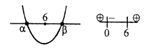
(B) Let $f(x) = x^2 + 2(a - 3)x + 9$. For $6$ to lie between the roots of $f(x) = 0$,the condition is $f(6) < 0$.
$f(6) = 6^2 + 2(a - 3)(6) + 9 < 0$
$36 + 12(a - 3) + 9 < 0$
$36 + 12a - 36 + 9 < 0$
$12a + 9 < 0$
$12a < -9$
$a < -\frac{9}{12}$
$a < -\frac{3}{4}$
Thus,$a \in (-\infty, -3/4)$.
$f(6) = 6^2 + 2(a - 3)(6) + 9 < 0$
$36 + 12(a - 3) + 9 < 0$
$36 + 12a - 36 + 9 < 0$
$12a + 9 < 0$
$12a < -9$
$a < -\frac{9}{12}$
$a < -\frac{3}{4}$
Thus,$a \in (-\infty, -3/4)$.
0 likes
View Solution18
DifficultMCQ
Match the following: Consider the equation $x^2 + 2(a - 1)x + a + 5 = 0$. Match the real values of $a$ with the conditions on the roots of the given equation.
| Column-$I$ | Column-$II$ |
|---|---|
| $A$. Imaginary roots | $P$. $a \in (-1, 4)$ |
| $B$. One root less than $3$ and other greater than $3$ | $Q$. $a \in (-\infty, -1)$ |
| $C$. One root less than $1$ and other greater than $3$ | $R$. $a \in (-\infty, -4/3)$ |
A
$A \to Q, B \to P, C \to R$
B
$A \to P, B \to Q, C \to R$
C
$A \to R, B \to P, C \to Q$
D
$A \to Q, B \to R, C \to P$
Solution
(B) Given equation: $f(x) = x^2 + 2(a - 1)x + a + 5 = 0$.
$A$. For imaginary roots,discriminant $D < 0$:
$D = [2(a - 1)]^2 - 4(1)(a + 5) < 0$
$4(a^2 - 2a + 1) - 4a - 20 < 0$
$a^2 - 2a + 1 - a - 5 < 0$
$a^2 - 3a - 4 < 0 \implies (a - 4)(a + 1) < 0 \implies a \in (-1, 4)$. Thus,$A \to P$.
$B$. One root less than $3$ and other greater than $3$:
This implies $f(3) < 0$:
$f(3) = 3^2 + 2(a - 1)(3) + a + 5 < 0$
$9 + 6a - 6 + a + 5 < 0$
$7a + 8 < 0 \implies a < -8/7$. This matches $Q$ $(a < -1)$ approximately or $R$ $(a < -4/3)$. Let's re-evaluate.
Actually,for $B$,$f(3) < 0 \implies 7a + 8 < 0 \implies a < -8/7 \approx -1.14$. Since $Q$ is $a < -1$,$B \to Q$ is the best fit.
$C$. One root less than $1$ and other greater than $3$:
This requires $f(1) < 0$ and $f(3) < 0$:
$f(1) = 1 + 2a - 2 + a + 5 = 3a + 4 < 0 \implies a < -4/3$.
$f(3) = 7a + 8 < 0 \implies a < -8/7$.
Intersection: $a < -4/3$. Thus,$C \to R$.
Correct matching: $A \to P, B \to Q, C \to R$.
$A$. For imaginary roots,discriminant $D < 0$:
$D = [2(a - 1)]^2 - 4(1)(a + 5) < 0$
$4(a^2 - 2a + 1) - 4a - 20 < 0$
$a^2 - 2a + 1 - a - 5 < 0$
$a^2 - 3a - 4 < 0 \implies (a - 4)(a + 1) < 0 \implies a \in (-1, 4)$. Thus,$A \to P$.
$B$. One root less than $3$ and other greater than $3$:
This implies $f(3) < 0$:
$f(3) = 3^2 + 2(a - 1)(3) + a + 5 < 0$
$9 + 6a - 6 + a + 5 < 0$
$7a + 8 < 0 \implies a < -8/7$. This matches $Q$ $(a < -1)$ approximately or $R$ $(a < -4/3)$. Let's re-evaluate.
Actually,for $B$,$f(3) < 0 \implies 7a + 8 < 0 \implies a < -8/7 \approx -1.14$. Since $Q$ is $a < -1$,$B \to Q$ is the best fit.
$C$. One root less than $1$ and other greater than $3$:
This requires $f(1) < 0$ and $f(3) < 0$:
$f(1) = 1 + 2a - 2 + a + 5 = 3a + 4 < 0 \implies a < -4/3$.
$f(3) = 7a + 8 < 0 \implies a < -8/7$.
Intersection: $a < -4/3$. Thus,$C \to R$.
Correct matching: $A \to P, B \to Q, C \to R$.
0 likes
View Solution19
EasyMCQ
For what condition is the value of the quadratic expression $x^2 + 2bx + c$ always positive?
A
$b^2 - 4c > 0$
B
$b^2 - 4c < 0$
C
$c^2 < b$
D
$b^2 < c$
Solution
(D) The given quadratic expression is $f(x) = x^2 + 2bx + c$.
Completing the square,we get $f(x) = (x + b)^2 + (c - b^2)$.
For $f(x)$ to be always positive for all real $x$,the minimum value of the expression must be greater than $0$.
The minimum value occurs at $x = -b$,which is $f(-b) = c - b^2$.
Thus,we require $c - b^2 > 0$,which implies $b^2 < c$.
Completing the square,we get $f(x) = (x + b)^2 + (c - b^2)$.
For $f(x)$ to be always positive for all real $x$,the minimum value of the expression must be greater than $0$.
The minimum value occurs at $x = -b$,which is $f(-b) = c - b^2$.
Thus,we require $c - b^2 > 0$,which implies $b^2 < c$.
0 likes
View Solution20
DifficultMCQ
If the roots of the quadratic equation $x^2 - 2kx + k^2 + k - 5 = 0$ are less than $5$,then in which interval does $k$ lie?
A
$[4, 5]$
B
$(-\infty, 4)$
C
$(6, \infty)$
D
$(5, 6)$
Solution
(B) For the roots of the quadratic equation $f(x) = x^2 - 2kx + k^2 + k - 5 = 0$ to be less than $5$,three conditions must be satisfied:
$1$. Discriminant $D \ge 0$:
$D = (-2k)^2 - 4(1)(k^2 + k - 5) = 4k^2 - 4k^2 - 4k + 20 = 20 - 4k \ge 0 \implies k \le 5$.
$2$. Vertex position: The $x$-coordinate of the vertex $-b/(2a) < 5$:
$-(-2k)/(2 \times 1) = k < 5$.
$3$. Function value at $x = 5$: $f(5) > 0$:
$f(5) = 5^2 - 2k(5) + k^2 + k - 5 = 25 - 10k + k^2 + k - 5 = k^2 - 9k + 20 > 0$.
$(k - 4)(k - 5) > 0 \implies k < 4$ or $k > 5$.
Combining all conditions: $k \le 5$ $AND$ $k < 5$ $AND$ ($k < 4$ or $k > 5$).
The intersection is $k < 4$,which is $(-\infty, 4)$.
$1$. Discriminant $D \ge 0$:
$D = (-2k)^2 - 4(1)(k^2 + k - 5) = 4k^2 - 4k^2 - 4k + 20 = 20 - 4k \ge 0 \implies k \le 5$.
$2$. Vertex position: The $x$-coordinate of the vertex $-b/(2a) < 5$:
$-(-2k)/(2 \times 1) = k < 5$.
$3$. Function value at $x = 5$: $f(5) > 0$:
$f(5) = 5^2 - 2k(5) + k^2 + k - 5 = 25 - 10k + k^2 + k - 5 = k^2 - 9k + 20 > 0$.
$(k - 4)(k - 5) > 0 \implies k < 4$ or $k > 5$.
Combining all conditions: $k \le 5$ $AND$ $k < 5$ $AND$ ($k < 4$ or $k > 5$).
The intersection is $k < 4$,which is $(-\infty, 4)$.
0 likes
View Solution21
MediumMCQ
For what interval of $m$ do all roots of the quadratic equation $x^2 - 2mx + m^2 - 1 = 0$ lie between $-2$ and $4$?
A
$-1 < m < 3$
B
$1 < m < 4$
C
$-2 < m < 0$
D
$m > 3$
Solution
(A) The given quadratic equation is $x^2 - 2mx + m^2 - 1 = 0$.
This can be rewritten as $(x - m)^2 = 1$.
Taking the square root on both sides,we get $x - m = \pm 1$,which implies $x = m + 1$ or $x = m - 1$.
For the roots to lie between $-2$ and $4$,both roots must satisfy the inequality $-2 < x < 4$.
For $x = m + 1$: $-2 < m + 1 < 4 \implies -3 < m < 3$.
For $x = m - 1$: $-2 < m - 1 < 4 \implies -1 < m < 5$.
To satisfy both conditions simultaneously,we take the intersection of the intervals $(-3, 3)$ and $(-1, 5)$,which is $(-1, 3)$.
This can be rewritten as $(x - m)^2 = 1$.
Taking the square root on both sides,we get $x - m = \pm 1$,which implies $x = m + 1$ or $x = m - 1$.
For the roots to lie between $-2$ and $4$,both roots must satisfy the inequality $-2 < x < 4$.
For $x = m + 1$: $-2 < m + 1 < 4 \implies -3 < m < 3$.
For $x = m - 1$: $-2 < m - 1 < 4 \implies -1 < m < 5$.
To satisfy both conditions simultaneously,we take the intersection of the intervals $(-3, 3)$ and $(-1, 5)$,which is $(-1, 3)$.
0 likes
View Solution22
DifficultMCQ
For what minimum value of $k$ do both roots of the equation $x^2 - 8kx + 16(k^2 - k + 1) = 0$ exist,are real,distinct,and at least $4$?
A
$1$
B
$2$
C
$3$
D
$4$
Solution
(B) Let the quadratic equation be $f(x) = x^2 - 8kx + 16(k^2 - k + 1) = 0$.
For the roots to be real and distinct,the discriminant $D > 0$:
$D = (-8k)^2 - 4(1)(16(k^2 - k + 1)) > 0$
$64k^2 - 64(k^2 - k + 1) > 0$
$64k^2 - 64k^2 + 64k - 64 > 0$
$64k - 64 > 0 \implies k > 1$.
Let the roots be $\alpha$ and $\beta$. We are given $\alpha, \beta \ge 4$.
This implies:
$1)$ The vertex of the parabola $x = -b/(2a) = 8k/2 = 4k$ must be $\ge 4$,so $4k \ge 4 \implies k \ge 1$.
$2)$ $f(4) \ge 0$:
$4^2 - 8k(4) + 16(k^2 - k + 1) \ge 0$
$16 - 32k + 16k^2 - 16k + 16 \ge 0$
$16k^2 - 48k + 32 \ge 0$
$k^2 - 3k + 2 \ge 0$
$(k - 1)(k - 2) \ge 0$.
This holds for $k \le 1$ or $k \ge 2$.
Combining $k > 1$ (from $D > 0$) and $k \ge 2$ (from $f(4) \ge 0$),we get $k \ge 2$.
The minimum value of $k$ is $2$.
For the roots to be real and distinct,the discriminant $D > 0$:
$D = (-8k)^2 - 4(1)(16(k^2 - k + 1)) > 0$
$64k^2 - 64(k^2 - k + 1) > 0$
$64k^2 - 64k^2 + 64k - 64 > 0$
$64k - 64 > 0 \implies k > 1$.
Let the roots be $\alpha$ and $\beta$. We are given $\alpha, \beta \ge 4$.
This implies:
$1)$ The vertex of the parabola $x = -b/(2a) = 8k/2 = 4k$ must be $\ge 4$,so $4k \ge 4 \implies k \ge 1$.
$2)$ $f(4) \ge 0$:
$4^2 - 8k(4) + 16(k^2 - k + 1) \ge 0$
$16 - 32k + 16k^2 - 16k + 16 \ge 0$
$16k^2 - 48k + 32 \ge 0$
$k^2 - 3k + 2 \ge 0$
$(k - 1)(k - 2) \ge 0$.
This holds for $k \le 1$ or $k \ge 2$.
Combining $k > 1$ (from $D > 0$) and $k \ge 2$ (from $f(4) \ge 0$),we get $k \ge 2$.
The minimum value of $k$ is $2$.
0 likes
View Solution23
DifficultMCQ
The maximum and minimum values of $\frac{x^2 + x + 1}{x^2 - x + 1}$ are respectively ...........
A
$2, 1$
B
$3, 1/3$
C
$1, 0$
D
$3, 1$
Solution
(B) Let $y = \frac{x^2 + x + 1}{x^2 - x + 1}$.
Then $y(x^2 - x + 1) = x^2 + x + 1$.
$yx^2 - yx + y = x^2 + x + 1$.
$x^2(y - 1) - x(y + 1) + (y - 1) = 0$.
Since $x \in \mathbb{R}$,the discriminant $D \geq 0$.
$D = [-(y + 1)]^2 - 4(y - 1)(y - 1) \geq 0$.
$(y + 1)^2 - 4(y - 1)^2 \geq 0$.
$(y + 1 - 2(y - 1))(y + 1 + 2(y - 1)) \geq 0$.
$(y + 1 - 2y + 2)(y + 1 + 2y - 2) \geq 0$.
$(3 - y)(3y - 1) \geq 0$.
Multiplying by $-1$,we get $(y - 3)(3y - 1) \leq 0$.
This implies $\frac{1}{3} \leq y \leq 3$.
Therefore,the maximum value is $3$ and the minimum value is $\frac{1}{3}$.
Then $y(x^2 - x + 1) = x^2 + x + 1$.
$yx^2 - yx + y = x^2 + x + 1$.
$x^2(y - 1) - x(y + 1) + (y - 1) = 0$.
Since $x \in \mathbb{R}$,the discriminant $D \geq 0$.
$D = [-(y + 1)]^2 - 4(y - 1)(y - 1) \geq 0$.
$(y + 1)^2 - 4(y - 1)^2 \geq 0$.
$(y + 1 - 2(y - 1))(y + 1 + 2(y - 1)) \geq 0$.
$(y + 1 - 2y + 2)(y + 1 + 2y - 2) \geq 0$.
$(3 - y)(3y - 1) \geq 0$.
Multiplying by $-1$,we get $(y - 3)(3y - 1) \leq 0$.
This implies $\frac{1}{3} \leq y \leq 3$.
Therefore,the maximum value is $3$ and the minimum value is $\frac{1}{3}$.
0 likes
View Solution24
DifficultMCQ
Let $f(x) = (1 + b^2)x^2 + 2bx + 1$ and $m(b)$ be the minimum value of $f(x)$. If $b$ can take any real value,what is the range of $m(b)$?
A
$[0, 1]$
B
$(0, 1/2]$
C
$[1/2, 1]$
D
$(0, 1]$
Solution
(D) The given function is a quadratic expression $f(x) = (1 + b^2)x^2 + 2bx + 1$.
Since the coefficient of $x^2$ is $(1 + b^2) > 0$ for all real $b$,the function has a minimum value.
The minimum value of a quadratic $ax^2 + bx + c$ is given by $-\frac{D}{4a}$,where $D = b^2 - 4ac$.
Here,$a = (1 + b^2)$,$B = 2b$,and $C = 1$.
$D = (2b)^2 - 4(1 + b^2)(1) = 4b^2 - 4 - 4b^2 = -4$.
Thus,$m(b) = -\frac{-4}{4(1 + b^2)} = \frac{4}{4(1 + b^2)} = \frac{1}{1 + b^2}$.
Since $b^2 \ge 0$,we have $1 + b^2 \ge 1$.
Therefore,$0 < \frac{1}{1 + b^2} \le 1$.
The range of $m(b)$ is $(0, 1]$.
Since the coefficient of $x^2$ is $(1 + b^2) > 0$ for all real $b$,the function has a minimum value.
The minimum value of a quadratic $ax^2 + bx + c$ is given by $-\frac{D}{4a}$,where $D = b^2 - 4ac$.
Here,$a = (1 + b^2)$,$B = 2b$,and $C = 1$.
$D = (2b)^2 - 4(1 + b^2)(1) = 4b^2 - 4 - 4b^2 = -4$.
Thus,$m(b) = -\frac{-4}{4(1 + b^2)} = \frac{4}{4(1 + b^2)} = \frac{1}{1 + b^2}$.
Since $b^2 \ge 0$,we have $1 + b^2 \ge 1$.
Therefore,$0 < \frac{1}{1 + b^2} \le 1$.
The range of $m(b)$ is $(0, 1]$.
0 likes
View Solution25
DifficultMCQ
The real number $k$ for which the equation $2x^2 + 3x + k = 0$ has two distinct real roots in the interval $[0, 1]$.
A
lies between $1$ and $2$
B
lies between $2$ and $3$
C
lies between $-1$ and $0$
D
does not exist
Solution
(D) Let $f(x) = 2x^2 + 3x + k$.
For the quadratic equation $f(x) = 0$ to have two distinct real roots,the discriminant $D$ must be greater than $0$.
$D = b^2 - 4ac = 3^2 - 4(2)(k) = 9 - 8k > 0 \implies k < \frac{9}{8}$.
For the roots to lie in the interval $[0, 1]$,the vertex of the parabola $x = -\frac{b}{2a} = -\frac{3}{4}$ must lie within $[0, 1]$.
Since $-\frac{3}{4}$ is not in $[0, 1]$,it is impossible for both roots to lie in the interval $[0, 1]$.
Thus,no such real number $k$ exists.
For the quadratic equation $f(x) = 0$ to have two distinct real roots,the discriminant $D$ must be greater than $0$.
$D = b^2 - 4ac = 3^2 - 4(2)(k) = 9 - 8k > 0 \implies k < \frac{9}{8}$.
For the roots to lie in the interval $[0, 1]$,the vertex of the parabola $x = -\frac{b}{2a} = -\frac{3}{4}$ must lie within $[0, 1]$.
Since $-\frac{3}{4}$ is not in $[0, 1]$,it is impossible for both roots to lie in the interval $[0, 1]$.
Thus,no such real number $k$ exists.
0 likes
View Solution26
MediumMCQ
The number of values of $k$ for which the equation $x^2 - 3x + k = 0$ has two real and distinct roots lying in the interval $(0, 1)$ is
A
$0$
B
$2$
C
$3$
D
Infinitely many
Solution
(A) Let $f(x) = x^2 - 3x + k$. For the roots $\alpha$ and $\beta$ to lie in the interval $(0, 1)$ with $\alpha \neq \beta$,the following conditions must be satisfied:
$1$. Discriminant $\Delta > 0$: $\Delta = (-3)^2 - 4(1)(k) = 9 - 4k > 0 \implies k < \frac{9}{4}$.
$2$. $f(0) > 0$: $0^2 - 3(0) + k > 0 \implies k > 0$.
$3$. $f(1) > 0$: $1^2 - 3(1) + k > 0 \implies 1 - 3 + k > 0 \implies k > 2$.
$4$. The vertex of the parabola $x = -\frac{b}{2a}$ must lie in $(0, 1)$: $x = -\frac{-3}{2(1)} = \frac{3}{2} = 1.5$.
Since the vertex $1.5$ does not lie in the interval $(0, 1)$,it is impossible for both roots to lie in $(0, 1)$.
Thus,there are no such values of $k$.
$1$. Discriminant $\Delta > 0$: $\Delta = (-3)^2 - 4(1)(k) = 9 - 4k > 0 \implies k < \frac{9}{4}$.
$2$. $f(0) > 0$: $0^2 - 3(0) + k > 0 \implies k > 0$.
$3$. $f(1) > 0$: $1^2 - 3(1) + k > 0 \implies 1 - 3 + k > 0 \implies k > 2$.
$4$. The vertex of the parabola $x = -\frac{b}{2a}$ must lie in $(0, 1)$: $x = -\frac{-3}{2(1)} = \frac{3}{2} = 1.5$.
Since the vertex $1.5$ does not lie in the interval $(0, 1)$,it is impossible for both roots to lie in $(0, 1)$.
Thus,there are no such values of $k$.
0 likes
View Solution27
AdvancedMCQ
If $\alpha$ and $\beta$ are the roots of the quadratic equation $x^2 - 3x + a = 0$,where $a \in R$ and $\alpha < 1 < \beta$,then which of the following is true?
A
$a \in (-\infty, 9/4)$
B
$a \in (2, 9/4)$
C
$a \in (-\infty, 2)$
D
None of these
Solution
(C) Let $f(x) = x^2 - 3x + a$.
Since $\alpha < 1 < \beta$,the value of the quadratic expression $f(x)$ at $x = 1$ must be negative,i.e.,$f(1) < 0$.
Substituting $x = 1$ into the equation:
$f(1) = (1)^2 - 3(1) + a < 0$
$1 - 3 + a < 0$
$-2 + a < 0$
$a < 2$.
Since the roots are real and distinct (as $1$ lies between them),the discriminant $D$ must be greater than $0$:
$D = b^2 - 4ac = (-3)^2 - 4(1)(a) = 9 - 4a > 0$
$9 > 4a \Rightarrow a < 9/4$.
Combining the conditions $a < 2$ and $a < 9/4$,we get $a < 2$.
Thus,$a \in (-\infty, 2)$.
Since $\alpha < 1 < \beta$,the value of the quadratic expression $f(x)$ at $x = 1$ must be negative,i.e.,$f(1) < 0$.
Substituting $x = 1$ into the equation:
$f(1) = (1)^2 - 3(1) + a < 0$
$1 - 3 + a < 0$
$-2 + a < 0$
$a < 2$.
Since the roots are real and distinct (as $1$ lies between them),the discriminant $D$ must be greater than $0$:
$D = b^2 - 4ac = (-3)^2 - 4(1)(a) = 9 - 4a > 0$
$9 > 4a \Rightarrow a < 9/4$.
Combining the conditions $a < 2$ and $a < 9/4$,we get $a < 2$.
Thus,$a \in (-\infty, 2)$.
0 likes
View Solution28
AdvancedMCQ
If exactly one root of the equation $x^2 + (a - 1)x + 2a = 0$ lies in the interval $(0, 3)$,then the set of values of $a$ is given by:
A
$(-\infty, 0) \cup (6, \infty)$
B
$(-\infty, 0] \cup (6, \infty)$
C
$(-\infty, 0] \cup [6, \infty)$
D
$(0, 6)$
Solution
(B) Let $f(x) = x^2 + (a - 1)x + 2a$. For exactly one root to lie in $(0, 3)$,we check two cases:
Case $1$: $f(0) \cdot f(3) < 0$
$f(0) = 2a$
$f(3) = 9 + 3(a - 1) + 2a = 9 + 3a - 3 + 2a = 5a + 6$
$2a(5a + 6) < 0$ $\Rightarrow a(5a + 6) < 0$ $\Rightarrow a \in (-1.2, 0)$
Case $2$: One root is at the boundary.
If $x = 0$ is a root,$f(0) = 0$ $\Rightarrow 2a = 0$ $\Rightarrow a = 0$. The equation becomes $x^2 - x = 0$,roots are $0, 1$. Since $1 \in (0, 3)$,$a = 0$ is included.
If $x = 3$ is a root,$f(3) = 0$ $\Rightarrow 5a + 6 = 0$ $\Rightarrow a = -1.2$. The equation becomes $x^2 - 2.2x - 2.4 = 0$,roots are $3, -0.8$. Since $3$ is not in $(0, 3)$,$a = -1.2$ is excluded.
Combining these,the set of values is $a \in (-1.2, 0]$.
Note: The provided options appear to have a typo in the equation coefficients. Based on the standard interpretation of such problems,the correct range is $(-1.2, 0]$. Given the options provided,if we assume the equation was $x^2 - (a+1)x + 2a = 0$,the range would be $(-\infty, 0] \cup (6, \infty)$.
Case $1$: $f(0) \cdot f(3) < 0$
$f(0) = 2a$
$f(3) = 9 + 3(a - 1) + 2a = 9 + 3a - 3 + 2a = 5a + 6$
$2a(5a + 6) < 0$ $\Rightarrow a(5a + 6) < 0$ $\Rightarrow a \in (-1.2, 0)$
Case $2$: One root is at the boundary.
If $x = 0$ is a root,$f(0) = 0$ $\Rightarrow 2a = 0$ $\Rightarrow a = 0$. The equation becomes $x^2 - x = 0$,roots are $0, 1$. Since $1 \in (0, 3)$,$a = 0$ is included.
If $x = 3$ is a root,$f(3) = 0$ $\Rightarrow 5a + 6 = 0$ $\Rightarrow a = -1.2$. The equation becomes $x^2 - 2.2x - 2.4 = 0$,roots are $3, -0.8$. Since $3$ is not in $(0, 3)$,$a = -1.2$ is excluded.
Combining these,the set of values is $a \in (-1.2, 0]$.
Note: The provided options appear to have a typo in the equation coefficients. Based on the standard interpretation of such problems,the correct range is $(-1.2, 0]$. Given the options provided,if we assume the equation was $x^2 - (a+1)x + 2a = 0$,the range would be $(-\infty, 0] \cup (6, \infty)$.
0 likes
View Solution29
AdvancedMCQ
If $c > 0$ and the equation $3ax^2 + 4bx + c = 0$ has no real root,then :-
A
$2a + c > b$
B
$a + 2c > b$
C
$3a + c > 4b$
D
$a + 3c < b$
Solution
(C) Let $f(x) = 3ax^2 + 4bx + c$.
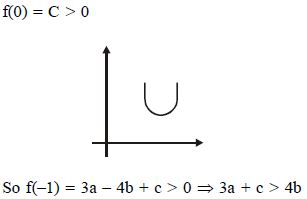
Since the equation $f(x) = 0$ has no real roots,the graph of $f(x)$ does not intersect the $x$-axis.
Given $c > 0$,we have $f(0) = c > 0$. Since $f(0) > 0$ and there are no real roots,the parabola must open upwards,meaning $3a > 0$,so $a > 0$.
Thus,$f(x) > 0$ for all real $x$.
Specifically,$f(-1) > 0$.
Substituting $x = -1$ into the expression,we get $f(-1) = 3a(-1)^2 + 4b(-1) + c = 3a - 4b + c$.
Since $f(-1) > 0$,we have $3a - 4b + c > 0$,which implies $3a + c > 4b$.
Since the equation $f(x) = 0$ has no real roots,the graph of $f(x)$ does not intersect the $x$-axis.
Given $c > 0$,we have $f(0) = c > 0$. Since $f(0) > 0$ and there are no real roots,the parabola must open upwards,meaning $3a > 0$,so $a > 0$.
Thus,$f(x) > 0$ for all real $x$.
Specifically,$f(-1) > 0$.
Substituting $x = -1$ into the expression,we get $f(-1) = 3a(-1)^2 + 4b(-1) + c = 3a - 4b + c$.
Since $f(-1) > 0$,we have $3a - 4b + c > 0$,which implies $3a + c > 4b$.
0 likes
View Solution30
MediumMCQ
If $\alpha, \beta$ are the roots of $x^2 - 3x + a = 0, a \in R$ and $\alpha < 1 < \beta$,then :-
A
$a \in (-\infty, \frac{9}{4})$
B
$a \in (2, \frac{9}{4})$
C
$a \in (-\infty, 2)$
D
None of these
Solution
(C) Let $f(x) = x^2 - 3x + a$.
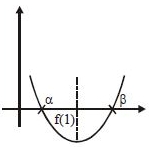
Since $\alpha < 1 < \beta$,the value of the quadratic function at $x = 1$ must be negative because the parabola opens upwards (coefficient of $x^2$ is $1 > 0$).
Thus,$f(1) < 0$.
$f(1) = (1)^2 - 3(1) + a < 0$
$1 - 3 + a < 0$
$-2 + a < 0$
$a < 2$
Therefore,$a \in (-\infty, 2)$.
Since $\alpha < 1 < \beta$,the value of the quadratic function at $x = 1$ must be negative because the parabola opens upwards (coefficient of $x^2$ is $1 > 0$).
Thus,$f(1) < 0$.
$f(1) = (1)^2 - 3(1) + a < 0$
$1 - 3 + a < 0$
$-2 + a < 0$
$a < 2$
Therefore,$a \in (-\infty, 2)$.
0 likes
View Solution31
AdvancedMCQ
Let $y = f(x) = ax^2 + 2bx + c$,where $a, b, c \in R$ and $a \neq 0$. If $f(x) = 0$ has imaginary roots and $4a + 4b + c < 0$,then which of the following is true?
A
$c > 0$
B
$c < 0$
C
$c = 0$
D
Data insufficient
Solution
(B) Given $f(x) = ax^2 + 2bx + c$.
Since $f(x) = 0$ has imaginary roots,the discriminant $D = (2b)^2 - 4ac < 0$,which implies $4b^2 - 4ac < 0$,or $b^2 < ac$.
Since $a \neq 0$,if $a > 0$,then $ac > b^2 \geq 0$,so $c > 0$. However,the graph of $f(x)$ would be an upward parabola,and since $D < 0$,$f(x)$ would always be positive,contradicting $f(2) = 4a + 4b + c < 0$.
Therefore,we must have $a < 0$.
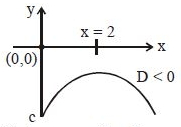
Since $a < 0$ and $D < 0$,the parabola opens downwards and lies entirely below the $x$-axis.
Thus,$f(x) < 0$ for all $x \in R$.
Specifically,at $x = 0$,$f(0) = c$. Since the entire graph is below the $x$-axis,$f(0) < 0$,which means $c < 0$.
Since $f(x) = 0$ has imaginary roots,the discriminant $D = (2b)^2 - 4ac < 0$,which implies $4b^2 - 4ac < 0$,or $b^2 < ac$.
Since $a \neq 0$,if $a > 0$,then $ac > b^2 \geq 0$,so $c > 0$. However,the graph of $f(x)$ would be an upward parabola,and since $D < 0$,$f(x)$ would always be positive,contradicting $f(2) = 4a + 4b + c < 0$.
Therefore,we must have $a < 0$.
Since $a < 0$ and $D < 0$,the parabola opens downwards and lies entirely below the $x$-axis.
Thus,$f(x) < 0$ for all $x \in R$.
Specifically,at $x = 0$,$f(0) = c$. Since the entire graph is below the $x$-axis,$f(0) < 0$,which means $c < 0$.
0 likes
View Solution32
AdvancedMCQ
Number of integral values of $a$ for which both roots of the quadratic equation $x^2 - (2a + 3)x + a^2 + 3a = 0$ lie in the interval $(0, 4)$ is:
A
$0$
B
$1$
C
$2$
D
Infinite many
Solution
(A) Let $f(x) = x^2 - (2a + 3)x + a^2 + 3a$. The roots are $x = a$ and $x = a + 3$.
For both roots to lie in $(0, 4)$,we must have:
$0 < a < 4$ and $0 < a + 3 < 4$.
From $0 < a < 4$,we have $a \in (0, 4)$.
From $0 < a + 3 < 4$,we have $-3 < a < 1$.
Taking the intersection of these two intervals,we get $0 < a < 1$.
There are no integers $a$ in the interval $(0, 1)$.
Thus,the number of integral values of $a$ is $0$.
For both roots to lie in $(0, 4)$,we must have:
$0 < a < 4$ and $0 < a + 3 < 4$.
From $0 < a < 4$,we have $a \in (0, 4)$.
From $0 < a + 3 < 4$,we have $-3 < a < 1$.
Taking the intersection of these two intervals,we get $0 < a < 1$.
There are no integers $a$ in the interval $(0, 1)$.
Thus,the number of integral values of $a$ is $0$.
0 likes
View Solution33
AdvancedMCQ
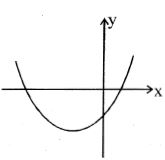
If the graph of $y = ax^2 + bx + c$ $(a, b, c \in R)$ is as shown in the figure,where $D = b^2 - 4ac$,which of the following is incorrect?
A
$abc < 0$
B
$ac^2bD < 0$
C
$\frac{a^2c}{b^2D} < 0$
D
$bD > 0$
Solution
(B) From the graph,the parabola opens upwards,so $a > 0$.
Since the vertex is on the left side of the $y$-axis,the $x$-coordinate of the vertex $-\frac{b}{2a} < 0$. Since $a > 0$,we must have $b > 0$.
The graph intersects the $y$-axis below the $x$-axis,so $c < 0$.
The graph intersects the $x$-axis at two distinct points,so $D = b^2 - 4ac > 0$.
Now,let's check the options:
$A$: $abc = (+)(+)(-) = - < 0$. This is correct.
$B$: $ac^2bD = (+)(+)(+)(+) = + > 0$. Thus,$ac^2bD < 0$ is incorrect.
$C$: $\frac{a^2c}{b^2D} = \frac{(+)(+)(-)}{(+)(+)} = - < 0$. This is correct.
$D$: $bD = (+)(+) = + > 0$. This is correct.
Therefore,the incorrect statement is $B$.
Since the vertex is on the left side of the $y$-axis,the $x$-coordinate of the vertex $-\frac{b}{2a} < 0$. Since $a > 0$,we must have $b > 0$.
The graph intersects the $y$-axis below the $x$-axis,so $c < 0$.
The graph intersects the $x$-axis at two distinct points,so $D = b^2 - 4ac > 0$.
Now,let's check the options:
$A$: $abc = (+)(+)(-) = - < 0$. This is correct.
$B$: $ac^2bD = (+)(+)(+)(+) = + > 0$. Thus,$ac^2bD < 0$ is incorrect.
$C$: $\frac{a^2c}{b^2D} = \frac{(+)(+)(-)}{(+)(+)} = - < 0$. This is correct.
$D$: $bD = (+)(+) = + > 0$. This is correct.
Therefore,the incorrect statement is $B$.
0 likes
View Solution34
AdvancedMCQ
The set of values of $a$ such that $x^2 - 2ax + a^2 - 6a \leqslant 0$ for all $x \in [1, 2]$ is
A
$[4 - \sqrt{15}, 4 + \sqrt{15}]$
B
$[5 - \sqrt{21}, 4 + \sqrt{15}]$
C
$[5 - \sqrt{21}, 4 + \sqrt{21}]$
D
$[4 - \sqrt{15}, 5 + \sqrt{21}]$
Solution
(B) Let $f(x) = x^2 - 2ax + a^2 - 6a$. For $f(x) \leqslant 0$ to hold for all $x \in [1, 2]$,we must have $f(1) \leqslant 0$ and $f(2) \leqslant 0$.
Step $1$: Solve $f(1) \leqslant 0$.
$f(1) = 1 - 2a + a^2 - 6a = a^2 - 8a + 1 \leqslant 0$.
The roots of $a^2 - 8a + 1 = 0$ are $a = \frac{8 \pm \sqrt{64 - 4}}{2} = 4 \pm \sqrt{15}$.
So,$a \in [4 - \sqrt{15}, 4 + \sqrt{15}]$ $(i)$.
Step $2$: Solve $f(2) \leqslant 0$.
$f(2) = 4 - 4a + a^2 - 6a = a^2 - 10a + 4 \leqslant 0$.
The roots of $a^2 - 10a + 4 = 0$ are $a = \frac{10 \pm \sqrt{100 - 16}}{2} = 5 \pm \sqrt{21}$.
So,$a \in [5 - \sqrt{21}, 5 + \sqrt{21}]$ $(ii)$.
Step $3$: Find the intersection of $(i)$ and $(ii)$.
$a \in [4 - \sqrt{15}, 4 + \sqrt{15}] \cap [5 - \sqrt{21}, 5 + \sqrt{21}] = [5 - \sqrt{21}, 4 + \sqrt{15}]$.
Step $1$: Solve $f(1) \leqslant 0$.
$f(1) = 1 - 2a + a^2 - 6a = a^2 - 8a + 1 \leqslant 0$.
The roots of $a^2 - 8a + 1 = 0$ are $a = \frac{8 \pm \sqrt{64 - 4}}{2} = 4 \pm \sqrt{15}$.
So,$a \in [4 - \sqrt{15}, 4 + \sqrt{15}]$ $(i)$.
Step $2$: Solve $f(2) \leqslant 0$.
$f(2) = 4 - 4a + a^2 - 6a = a^2 - 10a + 4 \leqslant 0$.
The roots of $a^2 - 10a + 4 = 0$ are $a = \frac{10 \pm \sqrt{100 - 16}}{2} = 5 \pm \sqrt{21}$.
So,$a \in [5 - \sqrt{21}, 5 + \sqrt{21}]$ $(ii)$.
Step $3$: Find the intersection of $(i)$ and $(ii)$.
$a \in [4 - \sqrt{15}, 4 + \sqrt{15}] \cap [5 - \sqrt{21}, 5 + \sqrt{21}] = [5 - \sqrt{21}, 4 + \sqrt{15}]$.
0 likes
View Solution35
AdvancedMCQ
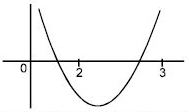
The value of $p$ such that both the roots of the equation $(p - 5)x^2 - 2px + (p - 4) = 0$ are positive,one is less than $2$ and the other lies between $2$ and $3$,lies in the interval:
A
$\left( \frac{49}{4}, 24 \right)$
B
$\left( 5, \infty \right)$
C
$\left( -\infty, 4 \right) \cup \left( \frac{49}{4}, \infty \right)$
D
None of these
Solution
(A) Let $f(x) = (p - 5)x^2 - 2px + (p - 4)$.
For the roots to be real and satisfy the given conditions,we analyze the sign of $f(x)$ at specific points.
Case $1$: If $p - 5 > 0$ (i.e.,$p > 5$),the parabola opens upward.
For one root to be in $(0, 2)$ and the other in $(2, 3)$,we must have $f(0) > 0$,$f(2) < 0$,and $f(3) > 0$.
$f(0) = p - 4 > 0 \implies p > 4$.
$f(2) = (p - 5)(4) - 2p(2) + (p - 4) = 4p - 20 - 4p + p - 4 = p - 24 < 0 \implies p < 24$.
$f(3) = (p - 5)(9) - 2p(3) + (p - 4) = 9p - 45 - 6p + p - 4 = 4p - 49 > 0 \implies p > \frac{49}{4}$.
Combining $p > 5$,$p < 24$,and $p > \frac{49}{4}$,we get $p \in \left( \frac{49}{4}, 24 \right)$.
Case $2$: If $p - 5 < 0$ (i.e.,$p < 5$),the parabola opens downward.
For one root to be in $(0, 2)$ and the other in $(2, 3)$,we must have $f(0) < 0$,$f(2) > 0$,and $f(3) < 0$.
$f(0) = p - 4 < 0 \implies p < 4$.
$f(2) = p - 24 > 0 \implies p > 24$. This is impossible since $p < 5$.
Thus,the interval is $\left( \frac{49}{4}, 24 \right)$.
For the roots to be real and satisfy the given conditions,we analyze the sign of $f(x)$ at specific points.
Case $1$: If $p - 5 > 0$ (i.e.,$p > 5$),the parabola opens upward.
For one root to be in $(0, 2)$ and the other in $(2, 3)$,we must have $f(0) > 0$,$f(2) < 0$,and $f(3) > 0$.
$f(0) = p - 4 > 0 \implies p > 4$.
$f(2) = (p - 5)(4) - 2p(2) + (p - 4) = 4p - 20 - 4p + p - 4 = p - 24 < 0 \implies p < 24$.
$f(3) = (p - 5)(9) - 2p(3) + (p - 4) = 9p - 45 - 6p + p - 4 = 4p - 49 > 0 \implies p > \frac{49}{4}$.
Combining $p > 5$,$p < 24$,and $p > \frac{49}{4}$,we get $p \in \left( \frac{49}{4}, 24 \right)$.
Case $2$: If $p - 5 < 0$ (i.e.,$p < 5$),the parabola opens downward.
For one root to be in $(0, 2)$ and the other in $(2, 3)$,we must have $f(0) < 0$,$f(2) > 0$,and $f(3) < 0$.
$f(0) = p - 4 < 0 \implies p < 4$.
$f(2) = p - 24 > 0 \implies p > 24$. This is impossible since $p < 5$.
Thus,the interval is $\left( \frac{49}{4}, 24 \right)$.
0 likes
View Solution36
AdvancedMCQ
Number of integral values of $a$ for which the smaller root of the quadratic equation $x^2 - 2ax + a^2 - 4 = 0$ is smaller than $1$ and the bigger root is greater than $6$ is:
A
$0$
B
$1$
C
$2$
D
infinite values
Solution
(A) The given quadratic equation is $x^2 - 2ax + (a^2 - 4) = 0$.
We can factorize this as $(x - (a - 2))(x - (a + 2)) = 0$.
Thus,the roots are $x_1 = a - 2$ and $x_2 = a + 2$.
Since $a - 2 < a + 2$,the smaller root is $a - 2$ and the bigger root is $a + 2$.
We are given the conditions:
$1$) $a - 2 < 1 \implies a < 3$
$2$) $a + 2 > 6 \implies a > 4$
Combining these,we need $a < 3$ $AND$ $a > 4$,which is impossible.
Therefore,there are no integral values of $a$ that satisfy these conditions.
We can factorize this as $(x - (a - 2))(x - (a + 2)) = 0$.
Thus,the roots are $x_1 = a - 2$ and $x_2 = a + 2$.
Since $a - 2 < a + 2$,the smaller root is $a - 2$ and the bigger root is $a + 2$.
We are given the conditions:
$1$) $a - 2 < 1 \implies a < 3$
$2$) $a + 2 > 6 \implies a > 4$
Combining these,we need $a < 3$ $AND$ $a > 4$,which is impossible.
Therefore,there are no integral values of $a$ that satisfy these conditions.
0 likes
View Solution37
AdvancedMCQ
If non-zero real numbers $p$ and $q$ exist such that $\min f(x) > \max g(x)$,where $f(x) = x^2 + 2px + 2q^2$ and $g(x) = -x^2 - 2qx + p^2$ for $x \in \mathbb{R}$,find the set of values containing $|\frac{2p}{q}|$.
A
$[0, \sqrt{2})$
B
$(\sqrt{2}, 2\sqrt{2})$
C
$[0, 2\sqrt{2})$
D
$(2\sqrt{2}, \infty)$
Solution
(A) For $f(x) = x^2 + 2px + 2q^2$,the minimum value is at $x = -p$,which is $f(-p) = (-p)^2 + 2p(-p) + 2q^2 = p^2 - 2p^2 + 2q^2 = 2q^2 - p^2$.
For $g(x) = -x^2 - 2qx + p^2$,the maximum value is at $x = -q$,which is $g(-q) = -(-q)^2 - 2q(-q) + p^2 = -q^2 + 2q^2 + p^2 = q^2 + p^2$.
The condition $\min f(x) > \max g(x)$ implies $2q^2 - p^2 > q^2 + p^2$.
Rearranging the terms,we get $q^2 > 2p^2$,which implies $\frac{q^2}{p^2} > 2$.
Taking the reciprocal,$\frac{p^2}{q^2} < \frac{1}{2}$,so $|\frac{p}{q}| < \frac{1}{\sqrt{2}}$.
Multiplying by $2$,we get $|\frac{2p}{q}| < \frac{2}{\sqrt{2}} = \sqrt{2}$.
Since $p, q$ are non-zero,$|\frac{2p}{q}| > 0$.
Thus,the set of values is $[0, \sqrt{2})$.
For $g(x) = -x^2 - 2qx + p^2$,the maximum value is at $x = -q$,which is $g(-q) = -(-q)^2 - 2q(-q) + p^2 = -q^2 + 2q^2 + p^2 = q^2 + p^2$.
The condition $\min f(x) > \max g(x)$ implies $2q^2 - p^2 > q^2 + p^2$.
Rearranging the terms,we get $q^2 > 2p^2$,which implies $\frac{q^2}{p^2} > 2$.
Taking the reciprocal,$\frac{p^2}{q^2} < \frac{1}{2}$,so $|\frac{p}{q}| < \frac{1}{\sqrt{2}}$.
Multiplying by $2$,we get $|\frac{2p}{q}| < \frac{2}{\sqrt{2}} = \sqrt{2}$.
Since $p, q$ are non-zero,$|\frac{2p}{q}| > 0$.
Thus,the set of values is $[0, \sqrt{2})$.
0 likes
View Solution38
AdvancedMCQ
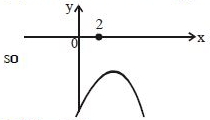
If $y = f(x) = ax^2 + 2bx + c = 0$ has imaginary roots and $4a + 4b + c < 0$,then :-
A
$c > 0$
B
$c < 0$
C
$c = 0$
D
data insufficient
Solution
(B) Let $f(x) = ax^2 + 2bx + c$. Given that $f(x) = 0$ has imaginary roots,the discriminant $D = (2b)^2 - 4ac < 0$,which implies $4b^2 - 4ac < 0$,or $b^2 < ac$.
Since $f(x)$ has imaginary roots,the parabola $y = f(x)$ does not intersect the $x$-axis. Thus,$f(x)$ is either always positive $(a > 0)$ or always negative $(a < 0)$.
We are given $4a + 4b + c < 0$. Note that $f(2) = a(2)^2 + 2b(2) + c = 4a + 4b + c$.
Since $f(2) < 0$,the function $f(x)$ must be always negative for all $x \in \mathbb{R}$. This implies $a < 0$.
Since $f(x) < 0$ for all $x$,it must be that $f(0) < 0$.
$f(0) = a(0)^2 + 2b(0) + c = c$.
Therefore,$c < 0$.
Since $f(x)$ has imaginary roots,the parabola $y = f(x)$ does not intersect the $x$-axis. Thus,$f(x)$ is either always positive $(a > 0)$ or always negative $(a < 0)$.
We are given $4a + 4b + c < 0$. Note that $f(2) = a(2)^2 + 2b(2) + c = 4a + 4b + c$.
Since $f(2) < 0$,the function $f(x)$ must be always negative for all $x \in \mathbb{R}$. This implies $a < 0$.
Since $f(x) < 0$ for all $x$,it must be that $f(0) < 0$.
$f(0) = a(0)^2 + 2b(0) + c = c$.
Therefore,$c < 0$.
0 likes
View Solution39
AdvancedMCQ
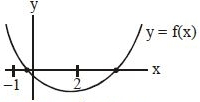
The interval of $k$ for which the equation $x^2+kx-4=0$ has its smaller root in the interval $(-1, 2)$ is:
A
$(-\infty, -3)$
B
$(0, 3)$
C
$(0, \infty)$
D
$(-\infty, -3) \cup (0, \infty)$
Solution
(A) Let $f(x) = x^2 + kx - 4$. The parabola opens upwards. For the smaller root to lie in $(-1, 2)$,the value of the function at the endpoints must satisfy $f(-1) > 0$ and $f(2) < 0$.
$f(-1) = (-1)^2 + k(-1) - 4 = 1 - k - 4 = -k - 3$. Since $f(-1) > 0$,we have $-k - 3 > 0$,which implies $k < -3$.
$f(2) = (2)^2 + k(2) - 4 = 4 + 2k - 4 = 2k$. Since $f(2) < 0$,we have $2k < 0$,which implies $k < 0$.
Combining $k < -3$ and $k < 0$,we get $k \in (-\infty, -3)$.
$f(-1) = (-1)^2 + k(-1) - 4 = 1 - k - 4 = -k - 3$. Since $f(-1) > 0$,we have $-k - 3 > 0$,which implies $k < -3$.
$f(2) = (2)^2 + k(2) - 4 = 4 + 2k - 4 = 2k$. Since $f(2) < 0$,we have $2k < 0$,which implies $k < 0$.
Combining $k < -3$ and $k < 0$,we get $k \in (-\infty, -3)$.
0 likes
View Solution40
AdvancedMCQ
The range of $a$ for which the roots of $x^2 - 2x - a^2 + 1 = 0$ lie between the roots (exclusive) of the equation $x^2 - 2(a + 1)x + a(a - 1) = 0$ is:
A
$\left( -\frac{1}{3}, 1 \right)$
B
$\left( -\frac{1}{3}, -\frac{1}{4} \right)$
C
$\left( -\frac{1}{4}, 1 \right)$
D
$\left( -\frac{1}{3}, \infty \right)$
Solution
(C) The roots of $x^2 - 2x - a^2 + 1 = 0$ are found by $(x-1)^2 - a^2 = 0$,which gives $x = 1 \pm a$.
Let $f(x) = x^2 - 2(a+1)x + a(a-1)$.
For the roots $1+a$ and $1-a$ to lie between the roots of $f(x)$,we must have $f(1+a) < 0$ and $f(1-a) < 0$.
First,$f(1+a) = (1+a)^2 - 2(a+1)(1+a) + a(a-1) = (1+a)^2 - 2(1+a)^2 + a^2 - a = -(1+a)^2 + a^2 - a = -1 - 2a - a^2 + a^2 - a = -3a - 1 < 0$.
This implies $3a > -1$,or $a > -\frac{1}{3}$.
Second,$f(1-a) = (1-a)^2 - 2(a+1)(1-a) + a(a-1) = (a-1)^2 + 2(a+1)(a-1) + a(a-1) = (a-1)[(a-1) + 2(a+1) + a] = (a-1)[a-1 + 2a + 2 + a] = (a-1)(4a+1) < 0$.
This inequality holds for $a \in \left( -\frac{1}{4}, 1 \right)$.
Taking the intersection of $a > -\frac{1}{3}$ and $a \in \left( -\frac{1}{4}, 1 \right)$,we get $a \in \left( -\frac{1}{4}, 1 \right)$.
Let $f(x) = x^2 - 2(a+1)x + a(a-1)$.
For the roots $1+a$ and $1-a$ to lie between the roots of $f(x)$,we must have $f(1+a) < 0$ and $f(1-a) < 0$.
First,$f(1+a) = (1+a)^2 - 2(a+1)(1+a) + a(a-1) = (1+a)^2 - 2(1+a)^2 + a^2 - a = -(1+a)^2 + a^2 - a = -1 - 2a - a^2 + a^2 - a = -3a - 1 < 0$.
This implies $3a > -1$,or $a > -\frac{1}{3}$.
Second,$f(1-a) = (1-a)^2 - 2(a+1)(1-a) + a(a-1) = (a-1)^2 + 2(a+1)(a-1) + a(a-1) = (a-1)[(a-1) + 2(a+1) + a] = (a-1)[a-1 + 2a + 2 + a] = (a-1)(4a+1) < 0$.
This inequality holds for $a \in \left( -\frac{1}{4}, 1 \right)$.
Taking the intersection of $a > -\frac{1}{3}$ and $a \in \left( -\frac{1}{4}, 1 \right)$,we get $a \in \left( -\frac{1}{4}, 1 \right)$.
0 likes
View Solution41
AdvancedMCQ
The set of values of $a$ for which the inequality $x^2 - (a + 2)x - (a + 3) < 0$ is satisfied by at least one positive real $x$ is:
A
$[-3, \infty)$
B
$(-3, \infty)$
C
$(-\infty, -3)$
D
$(-\infty, 3]$
Solution
(B) Let $f(x) = x^2 - (a + 2)x - (a + 3)$.
For $f(x) < 0$ to have at least one positive root $x$, we consider the following cases:
Case-$I$: $f(0) < 0$
$-(a + 3) < 0 \Rightarrow a + 3 > 0 \Rightarrow a > -3$.
Case-$II$: $f(0) \geq 0$ and the vertex is at $x > 0$ and $D > 0$.
$1$) $D = (a + 2)^2 + 4(a + 3) = a^2 + 4a + 4 + 4a + 12 = a^2 + 8a + 16 = (a + 4)^2 > 0$, which is true for all $a \neq -4$.
$2$) $f(0) = -(a + 3) \geq 0 \Rightarrow a \leq -3$.
$3$) Vertex $x_v = -\frac{b}{2a} = \frac{a + 2}{2} > 0 \Rightarrow a > -2$.
Intersection of $a \leq -3$ and $a > -2$ is empty $(\phi)$.
Combining Case-$I$ and Case-$II$, we get $a > -3$.
Thus, the set of values is $(-3, \infty)$.
For $f(x) < 0$ to have at least one positive root $x$, we consider the following cases:
Case-$I$: $f(0) < 0$
$-(a + 3) < 0 \Rightarrow a + 3 > 0 \Rightarrow a > -3$.
Case-$II$: $f(0) \geq 0$ and the vertex is at $x > 0$ and $D > 0$.
$1$) $D = (a + 2)^2 + 4(a + 3) = a^2 + 4a + 4 + 4a + 12 = a^2 + 8a + 16 = (a + 4)^2 > 0$, which is true for all $a \neq -4$.
$2$) $f(0) = -(a + 3) \geq 0 \Rightarrow a \leq -3$.
$3$) Vertex $x_v = -\frac{b}{2a} = \frac{a + 2}{2} > 0 \Rightarrow a > -2$.
Intersection of $a \leq -3$ and $a > -2$ is empty $(\phi)$.
Combining Case-$I$ and Case-$II$, we get $a > -3$.
Thus, the set of values is $(-3, \infty)$.
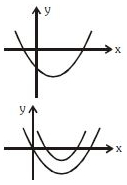
0 likes
View Solution42
AdvancedMCQ
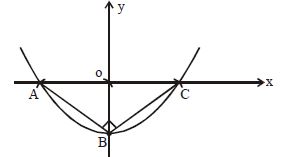
If the graph of $y = ax^2 + bx + c$ is as follows,where $\Delta ABC$ is a right-angled isosceles triangle with hypotenuse $AC = 4\sqrt{2} \text{ units}$,then the minimum value of $ax^2 + bx + c$ is:
A
$-2$
B
$-2\sqrt{2}$
C
$-4\sqrt{2}$
D
None
Solution
(B) Let the coordinates of $A$ be $(-k, 0)$ and $C$ be $(k, 0)$. Since $AC = 4\sqrt{2}$,we have $2k = 4\sqrt{2}$,so $k = 2\sqrt{2}$.
Thus,$A = (-2\sqrt{2}, 0)$ and $C = (2\sqrt{2}, 0)$.
Since $\Delta ABC$ is a right-angled isosceles triangle with the right angle at $B$,$B$ must lie on the $y$-axis at $(0, -h)$ where $h > 0$.
The midpoint of $AC$ is the origin $(0, 0)$. In a right-angled isosceles triangle,the median to the hypotenuse is half the length of the hypotenuse.
Therefore,the length of the median $OB = \frac{1}{2} AC = \frac{1}{2} (4\sqrt{2}) = 2\sqrt{2}$.
Since $B$ is below the $x$-axis,its coordinates are $(0, -2\sqrt{2})$.
The minimum value of the quadratic $y = ax^2 + bx + c$ is the $y$-coordinate of its vertex $B$.
Thus,the minimum value is $-2\sqrt{2}$.
Thus,$A = (-2\sqrt{2}, 0)$ and $C = (2\sqrt{2}, 0)$.
Since $\Delta ABC$ is a right-angled isosceles triangle with the right angle at $B$,$B$ must lie on the $y$-axis at $(0, -h)$ where $h > 0$.
The midpoint of $AC$ is the origin $(0, 0)$. In a right-angled isosceles triangle,the median to the hypotenuse is half the length of the hypotenuse.
Therefore,the length of the median $OB = \frac{1}{2} AC = \frac{1}{2} (4\sqrt{2}) = 2\sqrt{2}$.
Since $B$ is below the $x$-axis,its coordinates are $(0, -2\sqrt{2})$.
The minimum value of the quadratic $y = ax^2 + bx + c$ is the $y$-coordinate of its vertex $B$.
Thus,the minimum value is $-2\sqrt{2}$.
0 likes
View Solution43
DifficultMCQ
If non-zero real numbers $b$ and $c$ are such that $\min \,f(x) > \max \,g(x)$,where $f(x) = x^2 + 2bx + 2c^2$ and $g(x) = -x^2 - 2cx + b^2$ for $x \in R$; then $\left| \frac{c}{b} \right|$ lies in the interval
A
$(0, 1/2)$
B
$[1/2, 1/\sqrt{2})$
C
$[1/\sqrt{2}, \sqrt{2}]$
D
$(\sqrt{2}, \infty)$
Solution
(D) We have $f(x) = x^2 + 2bx + 2c^2$ and $g(x) = -x^2 - 2cx + b^2$ for $x \in R$.
Completing the square for $f(x)$:
$f(x) = (x + b)^2 + 2c^2 - b^2$.
Thus,the minimum value of $f(x)$ is $f_{\min} = 2c^2 - b^2$.
Completing the square for $g(x)$:
$g(x) = -(x^2 + 2cx) + b^2 = -(x + c)^2 + c^2 + b^2$.
Thus,the maximum value of $g(x)$ is $g_{\max} = c^2 + b^2$.
Given the condition $\min f(x) > \max g(x)$:
$2c^2 - b^2 > c^2 + b^2$.
Subtracting $c^2$ and adding $b^2$ to both sides:
$c^2 > 2b^2$.
Since $b$ and $c$ are non-zero,we divide by $b^2$:
$\frac{c^2}{b^2} > 2$.
Taking the square root on both sides:
$\left| \frac{c}{b} \right| > \sqrt{2}$.
Therefore,$\left| \frac{c}{b} \right| \in (\sqrt{2}, \infty)$.
Completing the square for $f(x)$:
$f(x) = (x + b)^2 + 2c^2 - b^2$.
Thus,the minimum value of $f(x)$ is $f_{\min} = 2c^2 - b^2$.
Completing the square for $g(x)$:
$g(x) = -(x^2 + 2cx) + b^2 = -(x + c)^2 + c^2 + b^2$.
Thus,the maximum value of $g(x)$ is $g_{\max} = c^2 + b^2$.
Given the condition $\min f(x) > \max g(x)$:
$2c^2 - b^2 > c^2 + b^2$.
Subtracting $c^2$ and adding $b^2$ to both sides:
$c^2 > 2b^2$.
Since $b$ and $c$ are non-zero,we divide by $b^2$:
$\frac{c^2}{b^2} > 2$.
Taking the square root on both sides:
$\left| \frac{c}{b} \right| > \sqrt{2}$.
Therefore,$\left| \frac{c}{b} \right| \in (\sqrt{2}, \infty)$.
0 likes
View Solution44
DifficultMCQ
The values of $a$ for which one root of the equation $x^2 - (a + 1)x + a^2 + a - 8 = 0$ exceeds $2$ and the other is lesser than $2$,are given by
A
$3 < a < 10$
B
$a \ge 10$
C
$-2 < a < 3$
D
$a \le -2$
Solution
(C) Let $f(x) = x^2 - (a + 1)x + a^2 + a - 8$.
Since one root is less than $2$ and the other is greater than $2$,the value of the function at $x = 2$ must be negative,i.e.,$f(2) < 0$.
$f(2) = (2)^2 - (a + 1)(2) + a^2 + a - 8 < 0$
$4 - 2a - 2 + a^2 + a - 8 < 0$
$a^2 - a - 6 < 0$
$(a - 3)(a + 2) < 0$
Solving this inequality,we get $-2 < a < 3$.
Since one root is less than $2$ and the other is greater than $2$,the value of the function at $x = 2$ must be negative,i.e.,$f(2) < 0$.
$f(2) = (2)^2 - (a + 1)(2) + a^2 + a - 8 < 0$
$4 - 2a - 2 + a^2 + a - 8 < 0$
$a^2 - a - 6 < 0$
$(a - 3)(a + 2) < 0$
Solving this inequality,we get $-2 < a < 3$.
0 likes
View Solution45
DifficultMCQ
If both the roots of the quadratic equation $x^2 - mx + 4 = 0$ are real and distinct and they lie in the interval $[1, 5]$,then $m$ lies in the interval.
A
$(4, 5)$
B
$(3, 4)$
C
$(5, 6)$
D
None of these
Solution
(A) Let $f(x) = x^2 - mx + 4$. For the roots $\alpha, \beta$ to be real,distinct,and lie in $[1, 5]$,the following conditions must be satisfied:
$(1)$ Discriminant $D > 0$:
$D = (-m)^2 - 4(1)(4) = m^2 - 16 > 0$
$m^2 > 16 \Rightarrow m \in (-\infty, -4) \cup (4, \infty)$
$(2)$ $f(1) > 0$ (since roots are distinct and lie in $[1, 5]$,$f(1)$ cannot be $0$ as $1$ is not a root):
$f(1) = 1 - m + 4 = 5 - m > 0 \Rightarrow m < 5$
$(3)$ $f(5) > 0$:
$f(5) = 25 - 5m + 4 = 29 - 5m > 0 \Rightarrow m < \frac{29}{5} = 5.8$
$(4)$ Vertex location $1 < \frac{-b}{2a} < 5$:
$1 < \frac{m}{2} < 5 \Rightarrow 2 < m < 10$
Taking the intersection of all conditions:
$m \in (4, \infty) \cap (-\infty, 5) \cap (-\infty, 5.8) \cap (2, 10) = (4, 5)$
Thus,$m \in (4, 5)$. Option $A$ is correct.
$(1)$ Discriminant $D > 0$:
$D = (-m)^2 - 4(1)(4) = m^2 - 16 > 0$
$m^2 > 16 \Rightarrow m \in (-\infty, -4) \cup (4, \infty)$
$(2)$ $f(1) > 0$ (since roots are distinct and lie in $[1, 5]$,$f(1)$ cannot be $0$ as $1$ is not a root):
$f(1) = 1 - m + 4 = 5 - m > 0 \Rightarrow m < 5$
$(3)$ $f(5) > 0$:
$f(5) = 25 - 5m + 4 = 29 - 5m > 0 \Rightarrow m < \frac{29}{5} = 5.8$
$(4)$ Vertex location $1 < \frac{-b}{2a} < 5$:
$1 < \frac{m}{2} < 5 \Rightarrow 2 < m < 10$
Taking the intersection of all conditions:
$m \in (4, \infty) \cap (-\infty, 5) \cap (-\infty, 5.8) \cap (2, 10) = (4, 5)$
Thus,$m \in (4, 5)$. Option $A$ is correct.
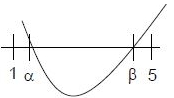
0 likes
View Solution46
DifficultMCQ
Consider the quadratic equation $(c - 5)x^2 - 2cx + (c - 4) = 0$,where $c \ne 5$. Let $S$ be the set of all integral values of $c$ for which one root of the equation lies in the interval $(0, 2)$ and the other root lies in the interval $(2, 3)$. Then the number of elements in $S$ is
A
$18$
B
$12$
C
$10$
D
$11$
Solution
(D) Let $f(x) = (c - 5)x^2 - 2cx + (c - 4)$.
For one root to lie in $(0, 2)$ and the other in $(2, 3)$,the value of $f(x)$ must change sign at $x=2$.
Case $I$: If $c - 5 > 0$ (i.e.,$c > 5$),then $f(2) < 0$.
$f(2) = (c - 5)(2)^2 - 2c(2) + (c - 4) = 4c - 20 - 4c + c - 4 = c - 24$.
So,$c - 24 < 0 \Rightarrow c < 24$.
Also,$f(0) > 0$ $\Rightarrow c - 4 > 0$ $\Rightarrow c > 4$.
And $f(3) > 0$ $\Rightarrow (c - 5)(9) - 2c(3) + (c - 4) > 0$ $\Rightarrow 9c - 45 - 6c + c - 4 > 0$ $\Rightarrow 4c - 49 > 0$ $\Rightarrow c > 12.25$.
Combining these,$12.25 < c < 24$. The integers are ${13, 14, 15, 16, 17, 18, 19, 20, 21, 22, 23}$,which are $11$ values.
Case $II$: If $c - 5 < 0$ (i.e.,$c < 5$),then $f(2) > 0$.
$c - 24 > 0 \Rightarrow c > 24$,which contradicts $c < 5$.
Thus,there are $11$ such integral values.
For one root to lie in $(0, 2)$ and the other in $(2, 3)$,the value of $f(x)$ must change sign at $x=2$.
Case $I$: If $c - 5 > 0$ (i.e.,$c > 5$),then $f(2) < 0$.
$f(2) = (c - 5)(2)^2 - 2c(2) + (c - 4) = 4c - 20 - 4c + c - 4 = c - 24$.
So,$c - 24 < 0 \Rightarrow c < 24$.
Also,$f(0) > 0$ $\Rightarrow c - 4 > 0$ $\Rightarrow c > 4$.
And $f(3) > 0$ $\Rightarrow (c - 5)(9) - 2c(3) + (c - 4) > 0$ $\Rightarrow 9c - 45 - 6c + c - 4 > 0$ $\Rightarrow 4c - 49 > 0$ $\Rightarrow c > 12.25$.
Combining these,$12.25 < c < 24$. The integers are ${13, 14, 15, 16, 17, 18, 19, 20, 21, 22, 23}$,which are $11$ values.
Case $II$: If $c - 5 < 0$ (i.e.,$c < 5$),then $f(2) > 0$.
$c - 24 > 0 \Rightarrow c > 24$,which contradicts $c < 5$.
Thus,there are $11$ such integral values.
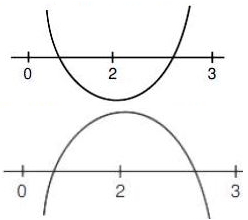
0 likes
View Solution47
DifficultMCQ
The number of integral values of $m$ for which the quadratic expression $(1 + 2m)x^2 - 2(1 + 3m)x + 4(1 + m)$ is always positive for all $x \in R$ is:
A
$3$
B
$8$
C
$7$
D
$6$
Solution
(C) For the quadratic expression $f(x) = ax^2 + bx + c$ to be always positive for all $x \in R$,we must have $a > 0$ and the discriminant $D < 0$.
Step $1$: Condition $a > 0$
$1 + 2m > 0 \Rightarrow 2m > -1 \Rightarrow m > -\frac{1}{2}$.
Step $2$: Condition $D < 0$
$D = [-2(1 + 3m)]^2 - 4(1 + 2m)(4(1 + m)) < 0$
$4(1 + 6m + 9m^2) - 16(1 + 3m + 2m^2) < 0$
Divide by $4$: $(1 + 6m + 9m^2) - 4(1 + 3m + 2m^2) < 0$
$1 + 6m + 9m^2 - 4 - 12m - 8m^2 < 0$
$m^2 - 6m - 3 < 0$.
Step $3$: Solve the inequality $m^2 - 6m - 3 < 0$
The roots of $m^2 - 6m - 3 = 0$ are $m = \frac{6 \pm \sqrt{36 - 4(1)(-3)}}{2} = \frac{6 \pm \sqrt{48}}{2} = 3 \pm 2\sqrt{3}$.
Since $\sqrt{3} \approx 1.732$,$2\sqrt{3} \approx 3.464$.
So,$3 - 3.464 < m < 3 + 3.464$,which is $-0.464 < m < 6.464$.
Step $4$: Intersection with $m > -0.5$
The interval is $(-0.464, 6.464)$.
The integral values of $m$ are ${0, 1, 2, 3, 4, 5, 6}$.
There are $7$ such values.
Step $1$: Condition $a > 0$
$1 + 2m > 0 \Rightarrow 2m > -1 \Rightarrow m > -\frac{1}{2}$.
Step $2$: Condition $D < 0$
$D = [-2(1 + 3m)]^2 - 4(1 + 2m)(4(1 + m)) < 0$
$4(1 + 6m + 9m^2) - 16(1 + 3m + 2m^2) < 0$
Divide by $4$: $(1 + 6m + 9m^2) - 4(1 + 3m + 2m^2) < 0$
$1 + 6m + 9m^2 - 4 - 12m - 8m^2 < 0$
$m^2 - 6m - 3 < 0$.
Step $3$: Solve the inequality $m^2 - 6m - 3 < 0$
The roots of $m^2 - 6m - 3 = 0$ are $m = \frac{6 \pm \sqrt{36 - 4(1)(-3)}}{2} = \frac{6 \pm \sqrt{48}}{2} = 3 \pm 2\sqrt{3}$.
Since $\sqrt{3} \approx 1.732$,$2\sqrt{3} \approx 3.464$.
So,$3 - 3.464 < m < 3 + 3.464$,which is $-0.464 < m < 6.464$.
Step $4$: Intersection with $m > -0.5$
The interval is $(-0.464, 6.464)$.
The integral values of $m$ are ${0, 1, 2, 3, 4, 5, 6}$.
There are $7$ such values.
0 likes
View Solution48
DifficultMCQ
The set of all real values of $\lambda$ for which the quadratic equation $(\lambda^{2}+1)x^{2}-4\lambda x+2=0$ has exactly one root in the interval $(0,1)$ is
A
$(-3,-1)$
B
$(1,3]$
C
$(0,2)$
D
$(2,4]$
Solution
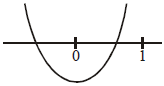
(B) Let $f(x) = (\lambda^{2}+1)x^{2}-4\lambda x+2$.
For exactly one root to lie in $(0,1)$,we consider the condition $f(0) \cdot f(1) < 0$.
$f(0) = 2$
$f(1) = \lambda^{2}+1-4\lambda+2 = \lambda^{2}-4\lambda+3 = (\lambda-1)(\lambda-3)$
So,$f(0) \cdot f(1) = 2(\lambda-1)(\lambda-3) < 0$.
This implies $1 < \lambda < 3$.
Now,we check the endpoints:
Case $1$: If $\lambda = 1$,the equation becomes $2x^{2}-4x+2 = 0$,which is $2(x-1)^{2} = 0$. The roots are $x=1, 1$. Neither root lies in $(0,1)$. So $\lambda \neq 1$.
Case $2$: If $\lambda = 3$,the equation becomes $10x^{2}-12x+2 = 0$,which is $2(5x^{2}-6x+1) = 0$,or $2(5x-1)(x-1) = 0$. The roots are $x = 1/5$ and $x = 1$. Since $1/5 \in (0,1)$,$\lambda = 3$ is a valid solution.
Combining these,the set of values is $\lambda \in (1,3]$.
For exactly one root to lie in $(0,1)$,we consider the condition $f(0) \cdot f(1) < 0$.
$f(0) = 2$
$f(1) = \lambda^{2}+1-4\lambda+2 = \lambda^{2}-4\lambda+3 = (\lambda-1)(\lambda-3)$
So,$f(0) \cdot f(1) = 2(\lambda-1)(\lambda-3) < 0$.
This implies $1 < \lambda < 3$.
Now,we check the endpoints:
Case $1$: If $\lambda = 1$,the equation becomes $2x^{2}-4x+2 = 0$,which is $2(x-1)^{2} = 0$. The roots are $x=1, 1$. Neither root lies in $(0,1)$. So $\lambda \neq 1$.
Case $2$: If $\lambda = 3$,the equation becomes $10x^{2}-12x+2 = 0$,which is $2(5x^{2}-6x+1) = 0$,or $2(5x-1)(x-1) = 0$. The roots are $x = 1/5$ and $x = 1$. Since $1/5 \in (0,1)$,$\lambda = 3$ is a valid solution.
Combining these,the set of values is $\lambda \in (1,3]$.
0 likes
View Solution49
DifficultMCQ
The number of integral values of $k$,for which one root of the equation $2x^2-8x+k=0$ lies in the interval $(1,2)$ and its other root lies in the interval $(2,3)$,is:
A
$2$
B
$0$
C
$1$
D
$3$
Solution
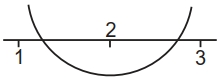
(C) Let $f(x) = 2x^2 - 8x + k$.
For one root to lie in $(1,2)$ and the other in $(2,3)$,the value of the quadratic at $x=2$ must be negative,and the values at $x=1$ and $x=3$ must be positive.
$f(1) = 2(1)^2 - 8(1) + k = k - 6 > 0 \implies k > 6$.
$f(3) = 2(3)^2 - 8(3) + k = 18 - 24 + k = k - 6 > 0 \implies k > 6$.
$f(2) = 2(2)^2 - 8(2) + k = 8 - 16 + k = k - 8 < 0 \implies k < 8$.
Combining these,we get $6 < k < 8$.
The only integral value of $k$ in this interval is $k = 7$.
For one root to lie in $(1,2)$ and the other in $(2,3)$,the value of the quadratic at $x=2$ must be negative,and the values at $x=1$ and $x=3$ must be positive.
$f(1) = 2(1)^2 - 8(1) + k = k - 6 > 0 \implies k > 6$.
$f(3) = 2(3)^2 - 8(3) + k = 18 - 24 + k = k - 6 > 0 \implies k > 6$.
$f(2) = 2(2)^2 - 8(2) + k = 8 - 16 + k = k - 8 < 0 \implies k < 8$.
Combining these,we get $6 < k < 8$.
The only integral value of $k$ in this interval is $k = 7$.
0 likes
View Solution50
DifficultMCQ
The smallest value of $k$,for which both the roots of the equation $x^2-8kx+16(k^2-k+1)=0$ are real,distinct and have values at least $4$,is
A
$1$
B
$2$
C
$3$
D
$4$
Solution
(B) Given the quadratic equation $x^2-8kx+16(k^2-k+1)=0$.
For the roots to be real and distinct,the discriminant $D > 0$:
$D = (-8k)^2 - 4(1)(16(k^2-k+1)) > 0$
$64k^2 - 64(k^2-k+1) > 0$
$64k^2 - 64k^2 + 64k - 64 > 0$
$64k - 64 > 0 \Rightarrow k > 1 \cdots (1)$
For both roots to be at least $4$,the vertex of the parabola $-\frac{b}{2a} \geq 4$:
$-\frac{-8k}{2(1)} \geq 4$ $\Rightarrow 4k \geq 4$ $\Rightarrow k \geq 1 \cdots (2)$
Additionally,$f(4) \geq 0$:
$f(4) = (4)^2 - 8k(4) + 16(k^2-k+1) \geq 0$
$16 - 32k + 16k^2 - 16k + 16 \geq 0$
$16k^2 - 48k + 32 \geq 0$
Dividing by $16$:
$k^2 - 3k + 2 \geq 0$
$(k-1)(k-2) \geq 0 \Rightarrow k \leq 1 \text{ or } k \geq 2 \cdots (3)$
Combining $(1)$,$(2)$,and $(3)$:
$k > 1$ $AND$ $k \geq 1$ $AND$ $(k \leq 1 \text{ or } k \geq 2)$
This results in $k \geq 2$.
Therefore,the smallest value of $k$ is $2$.
For the roots to be real and distinct,the discriminant $D > 0$:
$D = (-8k)^2 - 4(1)(16(k^2-k+1)) > 0$
$64k^2 - 64(k^2-k+1) > 0$
$64k^2 - 64k^2 + 64k - 64 > 0$
$64k - 64 > 0 \Rightarrow k > 1 \cdots (1)$
For both roots to be at least $4$,the vertex of the parabola $-\frac{b}{2a} \geq 4$:
$-\frac{-8k}{2(1)} \geq 4$ $\Rightarrow 4k \geq 4$ $\Rightarrow k \geq 1 \cdots (2)$
Additionally,$f(4) \geq 0$:
$f(4) = (4)^2 - 8k(4) + 16(k^2-k+1) \geq 0$
$16 - 32k + 16k^2 - 16k + 16 \geq 0$
$16k^2 - 48k + 32 \geq 0$
Dividing by $16$:
$k^2 - 3k + 2 \geq 0$
$(k-1)(k-2) \geq 0 \Rightarrow k \leq 1 \text{ or } k \geq 2 \cdots (3)$
Combining $(1)$,$(2)$,and $(3)$:
$k > 1$ $AND$ $k \geq 1$ $AND$ $(k \leq 1 \text{ or } k \geq 2)$
This results in $k \geq 2$.
Therefore,the smallest value of $k$ is $2$.
0 likes
View Solution4-2.Quadratic Equations and Inequations — Quadratic expressions and Position of roots · Frequently Asked Questions
1Are these 4-2.Quadratic Equations and Inequations questions useful for JEE and NEET?
Yes. All questions in this section are mapped to JEE Main and NEET exam patterns. Previous year questions from JEE Main, NEET, GUJCET and state-level exams are included with full solutions.
2Can I switch to Hindi or Gujarati for these questions?
Yes. Use the language tabs in the hero section or the sidebar to view the same questions and solutions in English, Hindi or Gujarati.
3How do I generate a question paper from this subtopic?
Use the Vedclass Exam Paper Generator — select the chapter and subtopic, set difficulty, and generate Sets A, B, C, D automatically. First 3 chapters of every subject are free.
Vedclass Products
For Students
Vedclass Test Series
Mock tests in real JEE/NEET style with performance analysis. 5-day free trial.
Start Free TrialFor Teachers
Exam Paper Generator
Generate Set A/B/C/D papers from this chapter in 2 minutes. 3 chapters free.
Try FreeFor Institutes
Online Exam Module
Live online exams with unlimited students, 360° analytics & white-label branding.
See DemoFor Teachers & Institutes
Generate a 4-2.Quadratic Equations and Inequations Exam Paper in 2 Minutes
Select subtopic & difficulty — Sets A, B, C, D auto-generated with No Repeat logic.
First 3 chapters of every subject are free — no payment required.