
A English
Geometrical problems regarding circle and its properties Questions in English
Class 11 Mathematics · 10-1.Circle and System of Circles · Geometrical problems regarding circle and its properties
598+
Questions
English
Language
100%
With Solutions
Showing 50 of 598 questions in English
201
DifficultMCQ
If the area of an equilateral triangle inscribed in the circle $x^2 + y^2 + 10x + 12y + c = 0$ is $27\sqrt{3} \text{ sq. units}$,then $c$ is equal to
A
$13$
B
$20$
C
$-25$
D
$25$
Solution
(D) The equation of the circle is $x^2 + y^2 + 10x + 12y + c = 0$.
The center is $(-5, -6)$ and the radius $R = \sqrt{(-5)^2 + (-6)^2 - c} = \sqrt{25 + 36 - c} = \sqrt{61 - c}$.
For an equilateral triangle inscribed in a circle of radius $R$,the side length $a$ is given by $a = R\sqrt{3}$.
The area of the equilateral triangle is $\frac{\sqrt{3}}{4} a^2 = \frac{\sqrt{3}}{4} (R\sqrt{3})^2 = \frac{3\sqrt{3}}{4} R^2$.
Given the area is $27\sqrt{3}$,we have $\frac{3\sqrt{3}}{4} R^2 = 27\sqrt{3}$.
$R^2 = 27 \times \frac{4}{3} = 36$.
Since $R^2 = 61 - c$,we have $61 - c = 36$.
$c = 61 - 36 = 25$.
The center is $(-5, -6)$ and the radius $R = \sqrt{(-5)^2 + (-6)^2 - c} = \sqrt{25 + 36 - c} = \sqrt{61 - c}$.
For an equilateral triangle inscribed in a circle of radius $R$,the side length $a$ is given by $a = R\sqrt{3}$.
The area of the equilateral triangle is $\frac{\sqrt{3}}{4} a^2 = \frac{\sqrt{3}}{4} (R\sqrt{3})^2 = \frac{3\sqrt{3}}{4} R^2$.
Given the area is $27\sqrt{3}$,we have $\frac{3\sqrt{3}}{4} R^2 = 27\sqrt{3}$.
$R^2 = 27 \times \frac{4}{3} = 36$.
Since $R^2 = 61 - c$,we have $61 - c = 36$.
$c = 61 - 36 = 25$.
0 likes
View Solution202
DifficultMCQ
$A$ square is inscribed in the circle $x^2 + y^2 - 6x + 8y - 103 = 0$ with its sides parallel to the coordinate axes. Then the distance of the vertex of the square which is nearest to the origin is
A
$6$
B
$\sqrt{137}$
C
$\sqrt{41}$
D
$13$
Solution
(C) The equation of the circle is $x^2 + y^2 - 6x + 8y - 103 = 0$.
Comparing with $x^2 + y^2 + 2gx + 2fy + c = 0$,we get $g = -3$,$f = 4$,and $c = -103$.
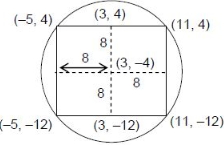
The centre of the circle is $(-g, -f) = (3, -4)$.
The radius $r = \sqrt{g^2 + f^2 - c} = \sqrt{(-3)^2 + 4^2 - (-103)} = \sqrt{9 + 16 + 103} = \sqrt{128} = 8\sqrt{2}$.
Since the sides of the square are parallel to the coordinate axes,the vertices are at a distance $r/\sqrt{2} = 8$ from the centre along the horizontal and vertical directions.
The vertices are $(3 \pm 8, -4 \pm 8)$,which are $(11, 4), (11, -12), (-5, 4), (-5, -12)$.
The distances of these vertices from the origin $(0, 0)$ are:
$d_1 = \sqrt{11^2 + 4^2} = \sqrt{121 + 16} = \sqrt{137}$
$d_2 = \sqrt{11^2 + (-12)^2} = \sqrt{121 + 144} = \sqrt{265}$
$d_3 = \sqrt{(-5)^2 + 4^2} = \sqrt{25 + 16} = \sqrt{41}$
$d_4 = \sqrt{(-5)^2 + (-12)^2} = \sqrt{25 + 144} = \sqrt{169} = 13$
The minimum distance is $\sqrt{41}$.
Comparing with $x^2 + y^2 + 2gx + 2fy + c = 0$,we get $g = -3$,$f = 4$,and $c = -103$.
The centre of the circle is $(-g, -f) = (3, -4)$.
The radius $r = \sqrt{g^2 + f^2 - c} = \sqrt{(-3)^2 + 4^2 - (-103)} = \sqrt{9 + 16 + 103} = \sqrt{128} = 8\sqrt{2}$.
Since the sides of the square are parallel to the coordinate axes,the vertices are at a distance $r/\sqrt{2} = 8$ from the centre along the horizontal and vertical directions.
The vertices are $(3 \pm 8, -4 \pm 8)$,which are $(11, 4), (11, -12), (-5, 4), (-5, -12)$.
The distances of these vertices from the origin $(0, 0)$ are:
$d_1 = \sqrt{11^2 + 4^2} = \sqrt{121 + 16} = \sqrt{137}$
$d_2 = \sqrt{11^2 + (-12)^2} = \sqrt{121 + 144} = \sqrt{265}$
$d_3 = \sqrt{(-5)^2 + 4^2} = \sqrt{25 + 16} = \sqrt{41}$
$d_4 = \sqrt{(-5)^2 + (-12)^2} = \sqrt{25 + 144} = \sqrt{169} = 13$
The minimum distance is $\sqrt{41}$.
0 likes
View Solution203
DifficultMCQ
Two circles with equal radii intersect at the points $(0, 1)$ and $(0, -1).$ The tangent at the point $(0, 1)$ to one of the circles passes through the centre of the other circle. Then the distance between the centres of these circles is
A
$1$
B
$2$
C
$2\sqrt{2}$
D
$\sqrt{2}$
Solution
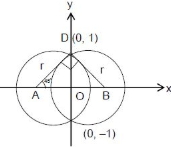
(B) Let the centres of the two circles be $A$ and $B$. Since the radii are equal,let the radius be $r$. The circles intersect at $D(0, 1)$ and $E(0, -1)$.
Let the centre of the first circle be $A(-h, 0)$ and the second be $B(h, 0)$.
The equation of the circle with centre $A(-h, 0)$ is $(x+h)^2 + y^2 = r^2$. Since it passes through $(0, 1)$,we have $h^2 + 1 = r^2$.
The tangent at $(0, 1)$ to this circle has the equation $x(0+h) + y(1) = r^2$,which simplifies to $hx + y = r^2$.
This tangent passes through the centre of the other circle $B(h, 0)$,so $h(h) + 0 = r^2$,which means $h^2 = r^2$.
Substituting $r^2 = h^2$ into $h^2 + 1 = r^2$ gives $h^2 + 1 = h^2$,which is impossible. Let's re-evaluate.
The tangent at $(0, 1)$ to the circle with centre $A$ is perpendicular to the radius $AD$. The slope of $AD$ is $\frac{1-0}{0-(-h)} = \frac{1}{h}$. Thus,the slope of the tangent is $-h$.
The equation of the tangent is $y - 1 = -h(x - 0)$,or $y = -hx + 1$.
This line passes through the centre of the other circle $B(h, 0)$,so $0 = -h(h) + 1$,which gives $h^2 = 1$,so $h = 1$.
The distance between the centres $A(-1, 0)$ and $B(1, 0)$ is $1 - (-1) = 2$.
Let the centre of the first circle be $A(-h, 0)$ and the second be $B(h, 0)$.
The equation of the circle with centre $A(-h, 0)$ is $(x+h)^2 + y^2 = r^2$. Since it passes through $(0, 1)$,we have $h^2 + 1 = r^2$.
The tangent at $(0, 1)$ to this circle has the equation $x(0+h) + y(1) = r^2$,which simplifies to $hx + y = r^2$.
This tangent passes through the centre of the other circle $B(h, 0)$,so $h(h) + 0 = r^2$,which means $h^2 = r^2$.
Substituting $r^2 = h^2$ into $h^2 + 1 = r^2$ gives $h^2 + 1 = h^2$,which is impossible. Let's re-evaluate.
The tangent at $(0, 1)$ to the circle with centre $A$ is perpendicular to the radius $AD$. The slope of $AD$ is $\frac{1-0}{0-(-h)} = \frac{1}{h}$. Thus,the slope of the tangent is $-h$.
The equation of the tangent is $y - 1 = -h(x - 0)$,or $y = -hx + 1$.
This line passes through the centre of the other circle $B(h, 0)$,so $0 = -h(h) + 1$,which gives $h^2 = 1$,so $h = 1$.
The distance between the centres $A(-1, 0)$ and $B(1, 0)$ is $1 - (-1) = 2$.
0 likes
View Solution204
DifficultMCQ
The sum of the squares of the lengths of the chords intercepted on the circle,$x^2 + y^2 = 16$,by the lines,$x + y = n$,$n \in N$,where $N$ is the set of all natural numbers,is
A
$320$
B
$160$
C
$105$
D
$210$
Solution
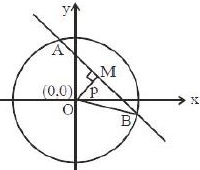
(D) The circle is $x^2 + y^2 = 16$,so its radius $r = 4$. The distance $p$ from the center $(0, 0)$ to the line $x + y - n = 0$ is $p = \frac{|0 + 0 - n|}{\sqrt{1^2 + 1^2}} = \frac{n}{\sqrt{2}}$.
For a chord to exist,$p < r$,so $\frac{n}{\sqrt{2}} < 4$,which means $n < 4\sqrt{2} \approx 5.65$. Since $n \in N$,$n \in \{1, 2, 3, 4, 5\}$.
The length of the chord $L$ is given by $L = 2\sqrt{r^2 - p^2} = 2\sqrt{16 - \frac{n^2}{2}} = \sqrt{64 - 2n^2}$.
The square of the length is $L^2 = 64 - 2n^2$.
For $n = 1, L^2 = 64 - 2(1) = 62$.
For $n = 2, L^2 = 64 - 2(4) = 56$.
For $n = 3, L^2 = 64 - 2(9) = 46$.
For $n = 4, L^2 = 64 - 2(16) = 32$.
For $n = 5, L^2 = 64 - 2(25) = 14$.
The sum of the squares is $62 + 56 + 46 + 32 + 14 = 210$.
For a chord to exist,$p < r$,so $\frac{n}{\sqrt{2}} < 4$,which means $n < 4\sqrt{2} \approx 5.65$. Since $n \in N$,$n \in \{1, 2, 3, 4, 5\}$.
The length of the chord $L$ is given by $L = 2\sqrt{r^2 - p^2} = 2\sqrt{16 - \frac{n^2}{2}} = \sqrt{64 - 2n^2}$.
The square of the length is $L^2 = 64 - 2n^2$.
For $n = 1, L^2 = 64 - 2(1) = 62$.
For $n = 2, L^2 = 64 - 2(4) = 56$.
For $n = 3, L^2 = 64 - 2(9) = 46$.
For $n = 4, L^2 = 64 - 2(16) = 32$.
For $n = 5, L^2 = 64 - 2(25) = 14$.
The sum of the squares is $62 + 56 + 46 + 32 + 14 = 210$.
0 likes
View Solution205
DifficultMCQ
$A$ rectangle is inscribed in a circle with a diameter lying along the line $3y = x + 7$. If the two adjacent vertices of the rectangle are $(-8, 5)$ and $(6, 5)$,then the area of the rectangle (in $sq. units$) is
A
$72$
B
$84$
C
$98$
D
$56$
Solution
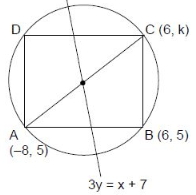
(B) Let the vertices of the rectangle be $A(-8, 5)$ and $B(6, 5)$. Since $AB$ is a side of the rectangle,the length of $AB = |6 - (-8)| = 14$.
Let the other two vertices be $D(-8, k)$ and $C(6, k)$.
The center of the circle is the midpoint of the diagonal $AC$ (or $BD$).
Midpoint of $AC = \left( \frac{-8 + 6}{2}, \frac{5 + k}{2} \right) = \left( -1, \frac{5 + k}{2} \right)$.
Since the center lies on the diameter $3y = x + 7$,we substitute the coordinates into the equation:
$3\left( \frac{5 + k}{2} \right) = -1 + 7$
$3\left( \frac{5 + k}{2} \right) = 6$
$\frac{5 + k}{2} = 2$
$5 + k = 4$
$k = -1$.
The length of the side $BC = |5 - (-1)| = 6$.
Area of the rectangle = $AB \times BC = 14 \times 6 = 84 \text{ sq. units}$.
Let the other two vertices be $D(-8, k)$ and $C(6, k)$.
The center of the circle is the midpoint of the diagonal $AC$ (or $BD$).
Midpoint of $AC = \left( \frac{-8 + 6}{2}, \frac{5 + k}{2} \right) = \left( -1, \frac{5 + k}{2} \right)$.
Since the center lies on the diameter $3y = x + 7$,we substitute the coordinates into the equation:
$3\left( \frac{5 + k}{2} \right) = -1 + 7$
$3\left( \frac{5 + k}{2} \right) = 6$
$\frac{5 + k}{2} = 2$
$5 + k = 4$
$k = -1$.
The length of the side $BC = |5 - (-1)| = 6$.
Area of the rectangle = $AB \times BC = 14 \times 6 = 84 \text{ sq. units}$.
0 likes
View Solution206
DifficultMCQ
$A$ circle touching the $x-$ axis at $(3, 0)$ and making an intercept of length $8$ on the $y-$ axis passes through the point:
A
$(3, 5)$
B
$(1, 5)$
C
$(3, 10)$
D
$(2, 3)$
Solution
(C) Let the center of the circle be $(3, r)$ or $(3, -r)$ and the radius be $r$.
Since the circle touches the $x-$ axis at $(3, 0)$,its equation is $(x - 3)^2 + (y - r)^2 = r^2$ or $(x - 3)^2 + (y + r)^2 = r^2$.
Expanding this,we get $x^2 - 6x + 9 + y^2 \mp 2ry + r^2 = r^2$,which simplifies to $x^2 + y^2 - 6x \mp 2ry + 9 = 0$.
The $y-$ intercept is given by $2\sqrt{f^2 - c}$,where $f = \mp r$ and $c = 9$.
Given the intercept length is $8$,we have $2\sqrt{r^2 - 9} = 8$.
$\sqrt{r^2 - 9} = 4 \implies r^2 - 9 = 16 \implies r^2 = 25 \implies r = 5$.
The equations of the circles are $x^2 + y^2 - 6x + 10y + 9 = 0$ and $x^2 + y^2 - 6x - 10y + 9 = 0$.
Checking the point $(3, 10)$ in the second equation: $(3)^2 + (10)^2 - 6(3) - 10(10) + 9 = 9 + 100 - 18 - 100 + 9 = 0$.
Thus,the circle passes through $(3, 10)$.
Since the circle touches the $x-$ axis at $(3, 0)$,its equation is $(x - 3)^2 + (y - r)^2 = r^2$ or $(x - 3)^2 + (y + r)^2 = r^2$.
Expanding this,we get $x^2 - 6x + 9 + y^2 \mp 2ry + r^2 = r^2$,which simplifies to $x^2 + y^2 - 6x \mp 2ry + 9 = 0$.
The $y-$ intercept is given by $2\sqrt{f^2 - c}$,where $f = \mp r$ and $c = 9$.
Given the intercept length is $8$,we have $2\sqrt{r^2 - 9} = 8$.
$\sqrt{r^2 - 9} = 4 \implies r^2 - 9 = 16 \implies r^2 = 25 \implies r = 5$.
The equations of the circles are $x^2 + y^2 - 6x + 10y + 9 = 0$ and $x^2 + y^2 - 6x - 10y + 9 = 0$.
Checking the point $(3, 10)$ in the second equation: $(3)^2 + (10)^2 - 6(3) - 10(10) + 9 = 9 + 100 - 18 - 100 + 9 = 0$.
Thus,the circle passes through $(3, 10)$.
0 likes
View Solution207
EasyMCQ
Find the radius of the circle in which a central angle of $60^{\circ}$ intercepts an arc of length $37.4 \, cm$ (use $\pi = \frac{22}{7}$). (in $cm$)
A
$35.7$
B
$36.7$
C
$34.7$
D
$38.7$
Solution
(A) Given: Arc length $l = 37.4 \, cm$ and central angle $\theta = 60^{\circ}$.
First, convert the angle from degrees to radians: $\theta = 60 \times \frac{\pi}{180} = \frac{\pi}{3} \, \text{radians}$.
Using the formula for arc length $l = r\theta$, where $r$ is the radius, we have $r = \frac{l}{\theta}$.
Substituting the values: $r = \frac{37.4}{\pi / 3} = \frac{37.4 \times 3}{\pi}$.
Using $\pi = \frac{22}{7}$, we get $r = \frac{37.4 \times 3 \times 7}{22}$.
$r = \frac{112.2 \times 7}{22} = \frac{785.4}{22} = 35.7 \, cm$.
First, convert the angle from degrees to radians: $\theta = 60 \times \frac{\pi}{180} = \frac{\pi}{3} \, \text{radians}$.
Using the formula for arc length $l = r\theta$, where $r$ is the radius, we have $r = \frac{l}{\theta}$.
Substituting the values: $r = \frac{37.4}{\pi / 3} = \frac{37.4 \times 3}{\pi}$.
Using $\pi = \frac{22}{7}$, we get $r = \frac{37.4 \times 3 \times 7}{22}$.
$r = \frac{112.2 \times 7}{22} = \frac{785.4}{22} = 35.7 \, cm$.
0 likes
View Solution208
MediumMCQ
The minute hand of a watch is $1.5 \, \text{cm}$ long. How far does its tip move in $40$ minutes (in $, \text{cm}$)? (Use $\pi = 3.14$).
A
$6.28$
B
$3.14$
C
$9.42$
D
$12.56$
Solution
(A) The length of the minute hand is the radius of the circular path,$r = 1.5 \, \text{cm}$.
In $60$ minutes,the minute hand completes one full revolution ($360^\circ$ or $2\pi$ radians).
In $40$ minutes,the fraction of the revolution covered is $\frac{40}{60} = \frac{2}{3}$.
Therefore,the angle $\theta$ subtended at the center is $\theta = \frac{2}{3} \times 2\pi = \frac{4\pi}{3}$ radians.
The distance $l$ moved by the tip is given by the arc length formula $l = r\theta$.
$l = 1.5 \times \frac{4\pi}{3} = 0.5 \times 4\pi = 2\pi \, \text{cm}$.
Using $\pi = 3.14$,we get $l = 2 \times 3.14 = 6.28 \, \text{cm}$.
In $60$ minutes,the minute hand completes one full revolution ($360^\circ$ or $2\pi$ radians).
In $40$ minutes,the fraction of the revolution covered is $\frac{40}{60} = \frac{2}{3}$.
Therefore,the angle $\theta$ subtended at the center is $\theta = \frac{2}{3} \times 2\pi = \frac{4\pi}{3}$ radians.
The distance $l$ moved by the tip is given by the arc length formula $l = r\theta$.
$l = 1.5 \times \frac{4\pi}{3} = 0.5 \times 4\pi = 2\pi \, \text{cm}$.
Using $\pi = 3.14$,we get $l = 2 \times 3.14 = 6.28 \, \text{cm}$.
0 likes
View Solution209
MediumMCQ
In a circle of diameter $40 \, cm$,the length of a chord is $20 \, cm$. Find the length of the minor arc of the chord.
A
$\frac{20 \pi}{3} \, cm$
B
$\frac{10 \pi}{3} \, cm$
C
$\frac{40 \pi}{3} \, cm$
D
$\frac{5 \pi}{3} \, cm$
Solution
(A) Diameter of the circle $= 40 \, cm$.
Radius $(r)$ of the circle $= \frac{40}{2} \, cm = 20 \, cm$.
Let $AB$ be a chord of length $20 \, cm$ in the circle with center $O$.
In $\Delta OAB$,$OA = OB = r = 20 \, cm$ and $AB = 20 \, cm$.
Since all sides are equal,$\Delta OAB$ is an equilateral triangle.
Therefore,the central angle $\theta = 60^{\circ} = \frac{\pi}{3}$ radians.
The length of the arc $(l)$ is given by the formula $l = r \theta$.
$l = 20 \times \frac{\pi}{3} = \frac{20 \pi}{3} \, cm$.
Thus,the length of the minor arc is $\frac{20 \pi}{3} \, cm$.
Radius $(r)$ of the circle $= \frac{40}{2} \, cm = 20 \, cm$.
Let $AB$ be a chord of length $20 \, cm$ in the circle with center $O$.
In $\Delta OAB$,$OA = OB = r = 20 \, cm$ and $AB = 20 \, cm$.
Since all sides are equal,$\Delta OAB$ is an equilateral triangle.
Therefore,the central angle $\theta = 60^{\circ} = \frac{\pi}{3}$ radians.
The length of the arc $(l)$ is given by the formula $l = r \theta$.
$l = 20 \times \frac{\pi}{3} = \frac{20 \pi}{3} \, cm$.
Thus,the length of the minor arc is $\frac{20 \pi}{3} \, cm$.

0 likes
View Solution210
MediumMCQ
If in two circles,arcs of the same length subtend angles $60^{\circ}$ and $75^{\circ}$ at the centre,find the ratio of their radii.
A
$4: 5$
B
$5: 4$
C
$3: 4$
D
$4: 3$
Solution
(B) Let the radii of the two circles be $r_{1}$ and $r_{2}$.
Let an arc of length $l$ subtend an angle of $60^{\circ}$ at the centre of the circle of radius $r_{1}$,and an arc of the same length $l$ subtend an angle of $75^{\circ}$ at the centre of the circle of radius $r_{2}$.
We know that $l = r \theta$,where $\theta$ is in radians.
Convert the angles to radians:
$60^{\circ} = 60 \times \frac{\pi}{180} = \frac{\pi}{3} \text{ radians}$.
$75^{\circ} = 75 \times \frac{\pi}{180} = \frac{5\pi}{12} \text{ radians}$.
Since the arc lengths are equal,$l = r_{1} \times \frac{\pi}{3} = r_{2} \times \frac{5\pi}{12}$.
Dividing both sides by $\pi$,we get $\frac{r_{1}}{3} = \frac{5r_{2}}{12}$.
Therefore,$\frac{r_{1}}{r_{2}} = \frac{5 \times 3}{12} = \frac{15}{12} = \frac{5}{4}$.
The ratio of their radii is $5: 4$.
Let an arc of length $l$ subtend an angle of $60^{\circ}$ at the centre of the circle of radius $r_{1}$,and an arc of the same length $l$ subtend an angle of $75^{\circ}$ at the centre of the circle of radius $r_{2}$.
We know that $l = r \theta$,where $\theta$ is in radians.
Convert the angles to radians:
$60^{\circ} = 60 \times \frac{\pi}{180} = \frac{\pi}{3} \text{ radians}$.
$75^{\circ} = 75 \times \frac{\pi}{180} = \frac{5\pi}{12} \text{ radians}$.
Since the arc lengths are equal,$l = r_{1} \times \frac{\pi}{3} = r_{2} \times \frac{5\pi}{12}$.
Dividing both sides by $\pi$,we get $\frac{r_{1}}{3} = \frac{5r_{2}}{12}$.
Therefore,$\frac{r_{1}}{r_{2}} = \frac{5 \times 3}{12} = \frac{15}{12} = \frac{5}{4}$.
The ratio of their radii is $5: 4$.
0 likes
View Solution211
EasyMCQ
Does the point $(-2.5, 3.5)$ lie inside,outside,or on the circle $x^{2}+y^{2}=25$?
A
Inside the circle
B
Outside the circle
C
On the circle
D
None of these
Solution
(A) The equation of the given circle is $x^{2}+y^{2}=25$.
This is of the form $(x-h)^{2}+(y-k)^{2}=r^{2}$,where the centre $(h, k) = (0, 0)$ and the radius $r = \sqrt{25} = 5$.
To determine the position of the point $P(-2.5, 3.5)$ relative to the circle,we calculate the distance $d$ from the centre $(0, 0)$ to the point $P$:
$d = \sqrt{(-2.5 - 0)^{2} + (3.5 - 0)^{2}}$
$d = \sqrt{6.25 + 12.25}$
$d = \sqrt{18.5} \approx 4.3$.
Since $d \approx 4.3 < 5$ (the radius),the distance of the point from the centre is less than the radius.
Therefore,the point $(-2.5, 3.5)$ lies inside the circle.
This is of the form $(x-h)^{2}+(y-k)^{2}=r^{2}$,where the centre $(h, k) = (0, 0)$ and the radius $r = \sqrt{25} = 5$.
To determine the position of the point $P(-2.5, 3.5)$ relative to the circle,we calculate the distance $d$ from the centre $(0, 0)$ to the point $P$:
$d = \sqrt{(-2.5 - 0)^{2} + (3.5 - 0)^{2}}$
$d = \sqrt{6.25 + 12.25}$
$d = \sqrt{18.5} \approx 4.3$.
Since $d \approx 4.3 < 5$ (the radius),the distance of the point from the centre is less than the radius.
Therefore,the point $(-2.5, 3.5)$ lies inside the circle.
0 likes
View Solution212
EasyMCQ
Which of the following statements are true and which are false? In each case,give a valid reason for your answer.
$p:$ Each radius of a circle is a chord of the circle.
$p:$ Each radius of a circle is a chord of the circle.
A
True
B
False
Solution
(B) The given statement $p$ is false.
$A$ chord of a circle is defined as a line segment whose endpoints lie on the circle.
$A$ radius is a line segment connecting the center of the circle to any point on the circle.
Since a radius does not have both endpoints on the circle (one endpoint is the center),it does not satisfy the definition of a chord.
$A$ chord of a circle is defined as a line segment whose endpoints lie on the circle.
$A$ radius is a line segment connecting the center of the circle to any point on the circle.
Since a radius does not have both endpoints on the circle (one endpoint is the center),it does not satisfy the definition of a chord.
0 likes
View Solution213
Easy
Which of the following statements are true and which are false? In each case,give a valid reason for your answer.
$q$: The centre of a circle bisects each chord of the circle.
$q$: The centre of a circle bisects each chord of the circle.
Solution
(B) The given statement $q$ is false.
If the chord is not a diameter of the circle,then the centre will not bisect that chord.
In other words,the centre of a circle only bisects a chord if that chord is a diameter of the circle.
If the chord is not a diameter of the circle,then the centre will not bisect that chord.
In other words,the centre of a circle only bisects a chord if that chord is a diameter of the circle.
0 likes
View Solution214
DifficultMCQ
The number of integral values of $k$ for which the line $3x + 4y = k$ intersects the circle $x^{2} + y^{2} - 2x - 4y + 4 = 0$ at two distinct points is
A
$9$
B
$10$
C
$8$
D
$11$
Solution
(A) The given circle is $x^{2} + y^{2} - 2x - 4y + 4 = 0$.
Completing the square,we get $(x - 1)^{2} + (y - 2)^{2} = 1$.
Thus,the centre is $(1, 2)$ and the radius $r = 1$.
For the line $3x + 4y - k = 0$ to intersect the circle at two distinct points,the perpendicular distance from the centre to the line must be less than the radius.
Distance $d = \frac{|3(1) + 4(2) - k|}{\sqrt{3^{2} + 4^{2}}} < 1$.
$\frac{|11 - k|}{5} < 1$.
$|11 - k| < 5$.
$-5 < 11 - k < 5$.
$-16 < -k < -6$.
$6 < k < 16$.
The integral values of $k$ are $7, 8, 9, 10, 11, 12, 13, 14, 15$.
The total number of such values is $9$.
Completing the square,we get $(x - 1)^{2} + (y - 2)^{2} = 1$.
Thus,the centre is $(1, 2)$ and the radius $r = 1$.
For the line $3x + 4y - k = 0$ to intersect the circle at two distinct points,the perpendicular distance from the centre to the line must be less than the radius.
Distance $d = \frac{|3(1) + 4(2) - k|}{\sqrt{3^{2} + 4^{2}}} < 1$.
$\frac{|11 - k|}{5} < 1$.
$|11 - k| < 5$.
$-5 < 11 - k < 5$.
$-16 < -k < -6$.
$6 < k < 16$.
The integral values of $k$ are $7, 8, 9, 10, 11, 12, 13, 14, 15$.
The total number of such values is $9$.
0 likes
View Solution215
DifficultMCQ
The diameter of the circle,whose center lies on the line $x+y=2$ in the first quadrant and which touches both the lines $x=3$ and $y=2$,is
A
$12$
B
$9$
C
$3$
D
$6$
Solution
(C) Let the center of the circle be $(\alpha, 2-\alpha)$ as it lies on the line $x+y=2$.
Since the circle is in the first quadrant,$\alpha > 0$ and $2-\alpha > 0$,which implies $0 < \alpha < 2$.
The circle touches the lines $x=3$ and $y=2$. The radius $r$ is the distance from the center to these lines:
$r = |3-\alpha| = |2-(2-\alpha)| = |\alpha|$.
Since $0 < \alpha < 2$,we have $|3-\alpha| = 3-\alpha$ and $|\alpha| = \alpha$.
Equating the two expressions for the radius:
$3-\alpha = \alpha$
$2\alpha = 3$
$\alpha = \frac{3}{2}$.
The radius $r = \alpha = \frac{3}{2}$.
The diameter of the circle is $2r = 2 \times \frac{3}{2} = 3$.
Since the circle is in the first quadrant,$\alpha > 0$ and $2-\alpha > 0$,which implies $0 < \alpha < 2$.
The circle touches the lines $x=3$ and $y=2$. The radius $r$ is the distance from the center to these lines:
$r = |3-\alpha| = |2-(2-\alpha)| = |\alpha|$.
Since $0 < \alpha < 2$,we have $|3-\alpha| = 3-\alpha$ and $|\alpha| = \alpha$.
Equating the two expressions for the radius:
$3-\alpha = \alpha$
$2\alpha = 3$
$\alpha = \frac{3}{2}$.
The radius $r = \alpha = \frac{3}{2}$.
The diameter of the circle is $2r = 2 \times \frac{3}{2} = 3$.
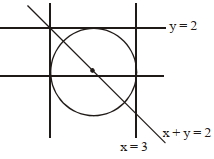
0 likes
View Solution216
MediumMCQ
Let $PQ$ be a diameter of the circle $x^{2}+y^{2}=9$. If $\alpha$ and $\beta$ are the lengths of the perpendiculars from $P$ and $Q$ on the straight line $x+y=2$ respectively,then the maximum value of $\alpha \beta$ is
A
$10$
B
$7$
C
$5$
D
$8$
Solution
(B) Let the coordinates of $P$ be $(3 \cos \theta, 3 \sin \theta)$.
Since $PQ$ is a diameter,the coordinates of $Q$ are $(-3 \cos \theta, -3 \sin \theta)$.
The length of the perpendicular from a point $(x_1, y_1)$ to the line $Ax+By+C=0$ is given by $\frac{|Ax_1+By_1+C|}{\sqrt{A^2+B^2}}$.
For the line $x+y-2=0$,the perpendicular lengths are:
$\alpha = \frac{|3 \cos \theta + 3 \sin \theta - 2|}{\sqrt{1^2+1^2}} = \frac{|3(\cos \theta + \sin \theta) - 2|}{\sqrt{2}}$
$\beta = \frac{|-3 \cos \theta - 3 \sin \theta - 2|}{\sqrt{1^2+1^2}} = \frac{|-(3(\cos \theta + \sin \theta) + 2)|}{\sqrt{2}} = \frac{|3(\cos \theta + \sin \theta) + 2|}{\sqrt{2}}$
Thus,$\alpha \beta = \frac{|(3(\cos \theta + \sin \theta) - 2)(3(\cos \theta + \sin \theta) + 2)|}{2} = \frac{|9(\cos \theta + \sin \theta)^2 - 4|}{2}$
Using $(\cos \theta + \sin \theta)^2 = 1 + \sin 2\theta$,we get:
$\alpha \beta = \frac{|9(1 + \sin 2\theta) - 4|}{2} = \frac{|9 + 9 \sin 2\theta - 4|}{2} = \frac{|5 + 9 \sin 2\theta|}{2}$
Since the maximum value of $\sin 2\theta$ is $1$,the maximum value of $\alpha \beta$ is $\frac{5 + 9(1)}{2} = \frac{14}{2} = 7$.
Since $PQ$ is a diameter,the coordinates of $Q$ are $(-3 \cos \theta, -3 \sin \theta)$.
The length of the perpendicular from a point $(x_1, y_1)$ to the line $Ax+By+C=0$ is given by $\frac{|Ax_1+By_1+C|}{\sqrt{A^2+B^2}}$.
For the line $x+y-2=0$,the perpendicular lengths are:
$\alpha = \frac{|3 \cos \theta + 3 \sin \theta - 2|}{\sqrt{1^2+1^2}} = \frac{|3(\cos \theta + \sin \theta) - 2|}{\sqrt{2}}$
$\beta = \frac{|-3 \cos \theta - 3 \sin \theta - 2|}{\sqrt{1^2+1^2}} = \frac{|-(3(\cos \theta + \sin \theta) + 2)|}{\sqrt{2}} = \frac{|3(\cos \theta + \sin \theta) + 2|}{\sqrt{2}}$
Thus,$\alpha \beta = \frac{|(3(\cos \theta + \sin \theta) - 2)(3(\cos \theta + \sin \theta) + 2)|}{2} = \frac{|9(\cos \theta + \sin \theta)^2 - 4|}{2}$
Using $(\cos \theta + \sin \theta)^2 = 1 + \sin 2\theta$,we get:
$\alpha \beta = \frac{|9(1 + \sin 2\theta) - 4|}{2} = \frac{|9 + 9 \sin 2\theta - 4|}{2} = \frac{|5 + 9 \sin 2\theta|}{2}$
Since the maximum value of $\sin 2\theta$ is $1$,the maximum value of $\alpha \beta$ is $\frac{5 + 9(1)}{2} = \frac{14}{2} = 7$.
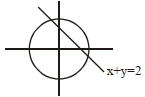
0 likes
View Solution217
DifficultMCQ
If the length of the chord of the circle $x^{2}+y^{2}=r^{2}$ $(r>0)$ along the line $y-2x=3$ is $r$,then $r^{2}$ is equal to
A
$\frac{9}{5}$
B
$\frac{12}{5}$
C
$12$
D
$\frac{24}{5}$
Solution
(B) The equation of the circle is $x^{2}+y^{2}=r^{2}$ with center $O(0,0)$ and radius $r$.
Let the chord be $AB$ with length $AB=r$.
Let $M$ be the midpoint of the chord $AB$. Then $OM \perp AB$.
In the right-angled triangle $\Delta OAM$,$OA=r$ (radius) and $AM = \frac{AB}{2} = \frac{r}{2}$.
Using the Pythagorean theorem,$OM^{2} = OA^{2} - AM^{2} = r^{2} - (\frac{r}{2})^{2} = r^{2} - \frac{r^{2}}{4} = \frac{3r^{2}}{4}$.
Thus,$OM = \frac{r\sqrt{3}}{2}$.
The perpendicular distance from the center $(0,0)$ to the line $2x-y+3=0$ is given by $d = \frac{|2(0) - (0) + 3|}{\sqrt{2^{2} + (-1)^{2}}} = \frac{3}{\sqrt{5}}$.
Equating $OM = d$,we get $\frac{r\sqrt{3}}{2} = \frac{3}{\sqrt{5}}$.
Squaring both sides,$\frac{3r^{2}}{4} = \frac{9}{5}$.
Therefore,$r^{2} = \frac{9}{5} \times \frac{4}{3} = \frac{12}{5}$.
Let the chord be $AB$ with length $AB=r$.
Let $M$ be the midpoint of the chord $AB$. Then $OM \perp AB$.
In the right-angled triangle $\Delta OAM$,$OA=r$ (radius) and $AM = \frac{AB}{2} = \frac{r}{2}$.
Using the Pythagorean theorem,$OM^{2} = OA^{2} - AM^{2} = r^{2} - (\frac{r}{2})^{2} = r^{2} - \frac{r^{2}}{4} = \frac{3r^{2}}{4}$.
Thus,$OM = \frac{r\sqrt{3}}{2}$.
The perpendicular distance from the center $(0,0)$ to the line $2x-y+3=0$ is given by $d = \frac{|2(0) - (0) + 3|}{\sqrt{2^{2} + (-1)^{2}}} = \frac{3}{\sqrt{5}}$.
Equating $OM = d$,we get $\frac{r\sqrt{3}}{2} = \frac{3}{\sqrt{5}}$.
Squaring both sides,$\frac{3r^{2}}{4} = \frac{9}{5}$.
Therefore,$r^{2} = \frac{9}{5} \times \frac{4}{3} = \frac{12}{5}$.
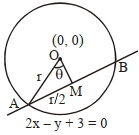
0 likes
View Solution218
MediumMCQ
Choose the incorrect statement about the two circles whose equations are given below:
$x^{2}+y^{2}-10x-10y+41=0$ and $x^{2}+y^{2}-16x-10y+80=0$
$x^{2}+y^{2}-10x-10y+41=0$ and $x^{2}+y^{2}-16x-10y+80=0$
A
Distance between two centres is the average of radii of both the circles.
B
Both circles' centres lie inside the region of one another.
C
Both circles pass through the centre of each other.
D
Circles have two intersection points.
Solution
(B) For the first circle $x^{2}+y^{2}-10x-10y+41=0$:
Centre $C_{1} = (5, 5)$,Radius $r_{1} = \sqrt{5^{2}+5^{2}-41} = \sqrt{25+25-41} = \sqrt{9} = 3$.
For the second circle $x^{2}+y^{2}-16x-10y+80=0$:
Centre $C_{2} = (8, 5)$,Radius $r_{2} = \sqrt{8^{2}+5^{2}-80} = \sqrt{64+25-80} = \sqrt{9} = 3$.
The distance between the centres is $d = \sqrt{(8-5)^{2}+(5-5)^{2}} = \sqrt{3^{2}+0^{2}} = 3$.
Since $d = r_{1} = r_{2} = 3$,the distance between the centres is equal to the radius of each circle.
This implies that each circle passes through the centre of the other circle.
Statement $A$ is incorrect because the distance between the centres is $3$,while the average of the radii is $(3+3)/2 = 3$. Wait,$3=3$,so $A$ is actually correct.
Let's re-evaluate: $C_{1}(5,5), C_{2}(8,5), r_{1}=3, r_{2}=3, d=3$.
$A$: $d=3$,average radius $= 3$. Correct.
$B$: $C_{2}$ is at distance $3$ from $C_{1}$,so $C_{2}$ is on the circumference of circle $1$,not inside. Thus,$B$ is incorrect.
$C$: $d=r_{1}=r_{2}$,so each passes through the other's centre. Correct.
$D$: Since $|r_{1}-r_{2}| < d < r_{1}+r_{2}$ is $0 < 3 < 6$,they intersect at two points. Correct.
Therefore,the incorrect statement is $B$.
Centre $C_{1} = (5, 5)$,Radius $r_{1} = \sqrt{5^{2}+5^{2}-41} = \sqrt{25+25-41} = \sqrt{9} = 3$.
For the second circle $x^{2}+y^{2}-16x-10y+80=0$:
Centre $C_{2} = (8, 5)$,Radius $r_{2} = \sqrt{8^{2}+5^{2}-80} = \sqrt{64+25-80} = \sqrt{9} = 3$.
The distance between the centres is $d = \sqrt{(8-5)^{2}+(5-5)^{2}} = \sqrt{3^{2}+0^{2}} = 3$.
Since $d = r_{1} = r_{2} = 3$,the distance between the centres is equal to the radius of each circle.
This implies that each circle passes through the centre of the other circle.
Statement $A$ is incorrect because the distance between the centres is $3$,while the average of the radii is $(3+3)/2 = 3$. Wait,$3=3$,so $A$ is actually correct.
Let's re-evaluate: $C_{1}(5,5), C_{2}(8,5), r_{1}=3, r_{2}=3, d=3$.
$A$: $d=3$,average radius $= 3$. Correct.
$B$: $C_{2}$ is at distance $3$ from $C_{1}$,so $C_{2}$ is on the circumference of circle $1$,not inside. Thus,$B$ is incorrect.
$C$: $d=r_{1}=r_{2}$,so each passes through the other's centre. Correct.
$D$: Since $|r_{1}-r_{2}| < d < r_{1}+r_{2}$ is $0 < 3 < 6$,they intersect at two points. Correct.
Therefore,the incorrect statement is $B$.
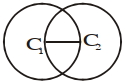
0 likes
View Solution219
MediumMCQ
Choose the correct statement about two circles whose equations are given below:
$x^{2}+y^{2}-10x-10y+41=0$
$x^{2}+y^{2}-22x-10y+137=0$
$x^{2}+y^{2}-10x-10y+41=0$
$x^{2}+y^{2}-22x-10y+137=0$
A
Circles have the same centre
B
Circles have no meeting point
C
Circles have only one meeting point
D
Circles have two meeting points
Solution
(C) For the first circle $x^{2}+y^{2}-10x-10y+41=0$:
Centre $A = (5, 5)$,Radius $R_{1} = \sqrt{5^{2}+5^{2}-41} = \sqrt{50-41} = \sqrt{9} = 3$.
For the second circle $x^{2}+y^{2}-22x-10y+137=0$:
Centre $B = (11, 5)$,Radius $R_{2} = \sqrt{11^{2}+5^{2}-137} = \sqrt{121+25-137} = \sqrt{146-137} = \sqrt{9} = 3$.
The distance between the centres $AB = \sqrt{(11-5)^{2}+(5-5)^{2}} = \sqrt{6^{2}+0^{2}} = 6$.
Since $AB = R_{1} + R_{2} = 3 + 3 = 6$,the circles touch each other externally.
Therefore,the circles have only one meeting point.
Centre $A = (5, 5)$,Radius $R_{1} = \sqrt{5^{2}+5^{2}-41} = \sqrt{50-41} = \sqrt{9} = 3$.
For the second circle $x^{2}+y^{2}-22x-10y+137=0$:
Centre $B = (11, 5)$,Radius $R_{2} = \sqrt{11^{2}+5^{2}-137} = \sqrt{121+25-137} = \sqrt{146-137} = \sqrt{9} = 3$.
The distance between the centres $AB = \sqrt{(11-5)^{2}+(5-5)^{2}} = \sqrt{6^{2}+0^{2}} = 6$.
Since $AB = R_{1} + R_{2} = 3 + 3 = 6$,the circles touch each other externally.
Therefore,the circles have only one meeting point.
0 likes
View Solution220
MediumMCQ
For the four circles $M, N, O$ and $P$,the following four equations are given:
Circle $M: x^2 + y^2 = 1$
Circle $N: x^2 + y^2 - 2x = 0$
Circle $O: x^2 + y^2 - 2x - 2y + 1 = 0$
Circle $P: x^2 + y^2 - 2y = 0$
If the centre of circle $M$ is joined with the centre of circle $N$,the centre of circle $N$ is joined with the centre of circle $O$,the centre of circle $O$ is joined with the centre of circle $P$,and lastly,the centre of circle $P$ is joined with the centre of circle $M$,then these lines form the sides of a:
Circle $M: x^2 + y^2 = 1$
Circle $N: x^2 + y^2 - 2x = 0$
Circle $O: x^2 + y^2 - 2x - 2y + 1 = 0$
Circle $P: x^2 + y^2 - 2y = 0$
If the centre of circle $M$ is joined with the centre of circle $N$,the centre of circle $N$ is joined with the centre of circle $O$,the centre of circle $O$ is joined with the centre of circle $P$,and lastly,the centre of circle $P$ is joined with the centre of circle $M$,then these lines form the sides of a:
A
Rhombus
B
Square
C
Rectangle
D
Parallelogram
Solution
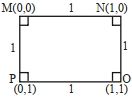
(B) The centres of the circles are found by completing the square or using the formula $(-g, -f)$ for $x^2 + y^2 + 2gx + 2fy + c = 0$:
Circle $M: x^2 + y^2 = 1$,centre $M = (0, 0)$
Circle $N: x^2 + y^2 - 2x = 0$,centre $N = (1, 0)$
Circle $O: x^2 + y^2 - 2x - 2y + 1 = 0$,centre $O = (1, 1)$
Circle $P: x^2 + y^2 - 2y = 0$,centre $P = (0, 1)$
Now,calculate the lengths of the sides:
$MN = \sqrt{(1-0)^2 + (0-0)^2} = 1$
$NO = \sqrt{(1-1)^2 + (1-0)^2} = 1$
$OP = \sqrt{(0-1)^2 + (1-1)^2} = 1$
$PM = \sqrt{(0-0)^2 + (0-1)^2} = 1$
Since all sides are equal to $1$ and the adjacent sides are perpendicular (slopes of $MN$ is $0$ and $NO$ is undefined),the figure is a square.
Circle $M: x^2 + y^2 = 1$,centre $M = (0, 0)$
Circle $N: x^2 + y^2 - 2x = 0$,centre $N = (1, 0)$
Circle $O: x^2 + y^2 - 2x - 2y + 1 = 0$,centre $O = (1, 1)$
Circle $P: x^2 + y^2 - 2y = 0$,centre $P = (0, 1)$
Now,calculate the lengths of the sides:
$MN = \sqrt{(1-0)^2 + (0-0)^2} = 1$
$NO = \sqrt{(1-1)^2 + (1-0)^2} = 1$
$OP = \sqrt{(0-1)^2 + (1-1)^2} = 1$
$PM = \sqrt{(0-0)^2 + (0-1)^2} = 1$
Since all sides are equal to $1$ and the adjacent sides are perpendicular (slopes of $MN$ is $0$ and $NO$ is undefined),the figure is a square.
0 likes
View Solution221
MediumMCQ
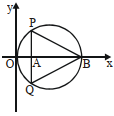
In the circle given below,let $OA = 1$ unit,$OB = 13$ units and $PQ \perp OB$. Then,the area of the triangle $PQB$ (in square units) is
A
$24 \sqrt{2}$
B
$24 \sqrt{3}$
C
$26 \sqrt{3}$
D
$26 \sqrt{2}$
Solution
(B) Let $PA = AQ = \lambda$.
Since $PQ \perp OB$,by the property of intersecting chords in a circle,we have $OA \cdot AB = PA \cdot AQ$.
Given $OA = 1$ and $OB = 13$,we have $AB = OB - OA = 13 - 1 = 12$.
Substituting the values,$1 \cdot 12 = \lambda \cdot \lambda$.
$\lambda^2 = 12 \Rightarrow \lambda = \sqrt{12} = 2 \sqrt{3}$.
The area of $\Delta PQB = \frac{1}{2} \times \text{base} \times \text{height} = \frac{1}{2} \times PQ \times AB$.
Since $PQ = PA + AQ = \lambda + \lambda = 2\lambda = 4 \sqrt{3}$,
Area $= \frac{1}{2} \times (4 \sqrt{3}) \times 12 = 2 \sqrt{3} \times 12 = 24 \sqrt{3}$ square units.
Since $PQ \perp OB$,by the property of intersecting chords in a circle,we have $OA \cdot AB = PA \cdot AQ$.
Given $OA = 1$ and $OB = 13$,we have $AB = OB - OA = 13 - 1 = 12$.
Substituting the values,$1 \cdot 12 = \lambda \cdot \lambda$.
$\lambda^2 = 12 \Rightarrow \lambda = \sqrt{12} = 2 \sqrt{3}$.
The area of $\Delta PQB = \frac{1}{2} \times \text{base} \times \text{height} = \frac{1}{2} \times PQ \times AB$.
Since $PQ = PA + AQ = \lambda + \lambda = 2\lambda = 4 \sqrt{3}$,
Area $= \frac{1}{2} \times (4 \sqrt{3}) \times 12 = 2 \sqrt{3} \times 12 = 24 \sqrt{3}$ square units.
0 likes
View Solution222
DifficultMCQ
Let $A(1, 4)$ and $B(1, -5)$ be two points. Let $P$ be a point on the circle $(x-1)^{2} + (y-1)^{2} = 1$ such that $(PA)^{2} + (PB)^{2}$ has a maximum value. Then the points $P, A,$ and $B$ lie on:
A
a straight line
B
a hyperbola
C
an ellipse
D
a parabola
Solution
(A) Let $P$ be a point on the circle $(x-1)^{2} + (y-1)^{2} = 1$.
We can parameterize $P$ as $(1 + \cos \theta, 1 + \sin \theta)$.
Given $A(1, 4)$ and $B(1, -5)$,we calculate $(PA)^{2} + (PB)^{2}$:
$(PA)^{2} = (1 + \cos \theta - 1)^{2} + (1 + \sin \theta - 4)^{2} = \cos^{2} \theta + (\sin \theta - 3)^{2} = \cos^{2} \theta + \sin^{2} \theta - 6 \sin \theta + 9 = 10 - 6 \sin \theta$.
$(PB)^{2} = (1 + \cos \theta - 1)^{2} + (1 + \sin \theta + 5)^{2} = \cos^{2} \theta + (\sin \theta + 6)^{2} = \cos^{2} \theta + \sin^{2} \theta + 12 \sin \theta + 36 = 37 + 12 \sin \theta$.
Summing these,$(PA)^{2} + (PB)^{2} = 10 - 6 \sin \theta + 37 + 12 \sin \theta = 47 + 6 \sin \theta$.
This expression is maximized when $\sin \theta = 1$.
For $\sin \theta = 1$,we have $\cos \theta = 0$,so $P = (1 + 0, 1 + 1) = (1, 2)$.
The points are $P(1, 2)$,$A(1, 4)$,and $B(1, -5)$.
Since all points have an $x$-coordinate of $1$,they all lie on the vertical line $x = 1$,which is a straight line.
We can parameterize $P$ as $(1 + \cos \theta, 1 + \sin \theta)$.
Given $A(1, 4)$ and $B(1, -5)$,we calculate $(PA)^{2} + (PB)^{2}$:
$(PA)^{2} = (1 + \cos \theta - 1)^{2} + (1 + \sin \theta - 4)^{2} = \cos^{2} \theta + (\sin \theta - 3)^{2} = \cos^{2} \theta + \sin^{2} \theta - 6 \sin \theta + 9 = 10 - 6 \sin \theta$.
$(PB)^{2} = (1 + \cos \theta - 1)^{2} + (1 + \sin \theta + 5)^{2} = \cos^{2} \theta + (\sin \theta + 6)^{2} = \cos^{2} \theta + \sin^{2} \theta + 12 \sin \theta + 36 = 37 + 12 \sin \theta$.
Summing these,$(PA)^{2} + (PB)^{2} = 10 - 6 \sin \theta + 37 + 12 \sin \theta = 47 + 6 \sin \theta$.
This expression is maximized when $\sin \theta = 1$.
For $\sin \theta = 1$,we have $\cos \theta = 0$,so $P = (1 + 0, 1 + 1) = (1, 2)$.
The points are $P(1, 2)$,$A(1, 4)$,and $B(1, -5)$.
Since all points have an $x$-coordinate of $1$,they all lie on the vertical line $x = 1$,which is a straight line.
0 likes
View Solution223
DifficultMCQ
Let the normals at all the points on a given curve pass through a fixed point $(a, b)$. If the curve passes through $(3, -3)$ and $(4, -2\sqrt{2})$,and given that $a - 2\sqrt{2}b = 3$,then $(a^{2} + b^{2} + ab)$ is equal to ..... .
A
$6$
B
$3$
C
$4$
D
$9$
Solution
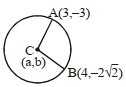
(D) Since the normals at all points on the curve pass through a fixed point $(a, b)$,the curve must be a circle with center $(a, b)$.
Let the points on the circle be $A(3, -3)$ and $B(4, -2\sqrt{2})$.
Since $A$ and $B$ lie on the circle,their distances from the center $C(a, b)$ are equal to the radius $r$.
Thus,$CA^{2} = CB^{2}$.
$(a - 3)^{2} + (b - (-3))^{2} = (a - 4)^{2} + (b - (-2\sqrt{2}))^{2}$
$(a - 3)^{2} + (b + 3)^{2} = (a - 4)^{2} + (b + 2\sqrt{2})^{2}$
$a^{2} - 6a + 9 + b^{2} + 6b + 9 = a^{2} - 8a + 16 + b^{2} + 4\sqrt{2}b + 8$
$-6a + 6b + 18 = -8a + 4\sqrt{2}b + 24$
$2a + (6 - 4\sqrt{2})b = 6$
Dividing by $2$,we get $a + (3 - 2\sqrt{2})b = 3$.
$a + 3b - 2\sqrt{2}b = 3$
$a - 2\sqrt{2}b + 3b = 3 \quad ... (1)$
Given that $a - 2\sqrt{2}b = 3 \quad ... (2)$
Substituting $(2)$ into $(1)$,we get $3 + 3b = 3$,which implies $3b = 0$,so $b = 0$.
Substituting $b = 0$ into $(2)$,we get $a - 2\sqrt{2}(0) = 3$,so $a = 3$.
Therefore,$a^{2} + b^{2} + ab = (3)^{2} + (0)^{2} + (3)(0) = 9 + 0 + 0 = 9$.
Let the points on the circle be $A(3, -3)$ and $B(4, -2\sqrt{2})$.
Since $A$ and $B$ lie on the circle,their distances from the center $C(a, b)$ are equal to the radius $r$.
Thus,$CA^{2} = CB^{2}$.
$(a - 3)^{2} + (b - (-3))^{2} = (a - 4)^{2} + (b - (-2\sqrt{2}))^{2}$
$(a - 3)^{2} + (b + 3)^{2} = (a - 4)^{2} + (b + 2\sqrt{2})^{2}$
$a^{2} - 6a + 9 + b^{2} + 6b + 9 = a^{2} - 8a + 16 + b^{2} + 4\sqrt{2}b + 8$
$-6a + 6b + 18 = -8a + 4\sqrt{2}b + 24$
$2a + (6 - 4\sqrt{2})b = 6$
Dividing by $2$,we get $a + (3 - 2\sqrt{2})b = 3$.
$a + 3b - 2\sqrt{2}b = 3$
$a - 2\sqrt{2}b + 3b = 3 \quad ... (1)$
Given that $a - 2\sqrt{2}b = 3 \quad ... (2)$
Substituting $(2)$ into $(1)$,we get $3 + 3b = 3$,which implies $3b = 0$,so $b = 0$.
Substituting $b = 0$ into $(2)$,we get $a - 2\sqrt{2}(0) = 3$,so $a = 3$.
Therefore,$a^{2} + b^{2} + ab = (3)^{2} + (0)^{2} + (3)(0) = 9 + 0 + 0 = 9$.
0 likes
View Solution224
DifficultMCQ
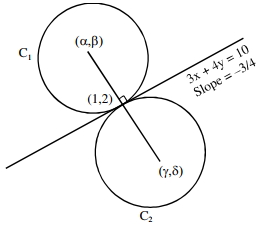
Two circles each of radius $5 \text{ units}$ touch each other at the point $(1, 2)$. If the equation of their common tangent is $4x + 3y = 10$,and $C_{1}(\alpha, \beta)$ and $C_{2}(\gamma, \delta)$,$C_{1} \neq C_{2}$ are their centres,then $|(\alpha + \beta)(\gamma + \delta)|$ is equal to .... .
A
$40$
B
$39$
C
$10$
D
$4$
Solution
(A) The common tangent is $4x + 3y = 10$. Its slope is $m = -\frac{4}{3}$.
Since the line joining the centres is perpendicular to the tangent at the point of contact $(1, 2)$,the slope of the line joining the centres is $m' = -\frac{1}{m} = \frac{3}{4}$.
Let the angle this line makes with the $x$-axis be $\theta$,so $\tan \theta = \frac{3}{4}$.
This implies $\sin \theta = \frac{3}{5}$ and $\cos \theta = \frac{4}{5}$.
The centres $C_{1}$ and $C_{2}$ are at a distance of $5 \text{ units}$ from $(1, 2)$ along this line.
Using the parametric form of a line,the coordinates of the centres are $(x, y) = (1 \pm 5 \cos \theta, 2 \pm 5 \sin \theta)$.
$(x, y) = (1 \pm 5(\frac{4}{5}), 2 \pm 5(\frac{3}{5})) = (1 \pm 4, 2 \pm 3)$.
Thus,the centres are $(1 + 4, 2 + 3) = (5, 5)$ and $(1 - 4, 2 - 3) = (-3, -1)$.
So,$(\alpha, \beta) = (5, 5)$ and $(\gamma, \delta) = (-3, -1)$.
Then,$|(\alpha + \beta)(\gamma + \delta)| = |(5 + 5)(-3 - 1)| = |(10)(-4)| = |-40| = 40$.
Since the line joining the centres is perpendicular to the tangent at the point of contact $(1, 2)$,the slope of the line joining the centres is $m' = -\frac{1}{m} = \frac{3}{4}$.
Let the angle this line makes with the $x$-axis be $\theta$,so $\tan \theta = \frac{3}{4}$.
This implies $\sin \theta = \frac{3}{5}$ and $\cos \theta = \frac{4}{5}$.
The centres $C_{1}$ and $C_{2}$ are at a distance of $5 \text{ units}$ from $(1, 2)$ along this line.
Using the parametric form of a line,the coordinates of the centres are $(x, y) = (1 \pm 5 \cos \theta, 2 \pm 5 \sin \theta)$.
$(x, y) = (1 \pm 5(\frac{4}{5}), 2 \pm 5(\frac{3}{5})) = (1 \pm 4, 2 \pm 3)$.
Thus,the centres are $(1 + 4, 2 + 3) = (5, 5)$ and $(1 - 4, 2 - 3) = (-3, -1)$.
So,$(\alpha, \beta) = (5, 5)$ and $(\gamma, \delta) = (-3, -1)$.
Then,$|(\alpha + \beta)(\gamma + \delta)| = |(5 + 5)(-3 - 1)| = |(10)(-4)| = |-40| = 40$.
0 likes
View Solution225
DifficultMCQ
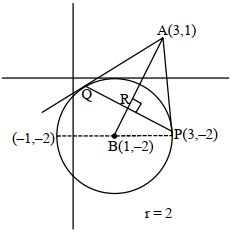
Let $B$ be the centre of the circle $x^{2}+y^{2}-2x+4y+1=0$. Let the tangents at two points $P$ and $Q$ on the circle intersect at the point $A(3,1)$. Then $8 \left(\frac{\text{Area } \triangle APQ}{\text{Area } \triangle BPQ}\right)$ is equal to:
A
$18$
B
$36$
C
$72$
D
$12$
Solution
(A) The equation of the circle is $x^{2}+y^{2}-2x+4y+1=0$. Comparing with $x^{2}+y^{2}+2gx+2fy+c=0$,we get $g=-1, f=2, c=1$. The centre $B$ is $(-g, -f) = (1, -2)$ and the radius $r = \sqrt{g^{2}+f^{2}-c} = \sqrt{1+4-1} = 2$.
Let $AB$ intersect $PQ$ at $R$. Since $AB$ is the perpendicular bisector of $PQ$,$AR \perp PQ$ and $BR \perp PQ$.
In $\triangle ABP$,$\angle APB = 90^{\circ}$ (tangent is perpendicular to radius).
$AB = \sqrt{(3-1)^{2} + (1-(-2))^{2}} = \sqrt{2^{2} + 3^{2}} = \sqrt{4+9} = \sqrt{13}$.
In right $\triangle ABP$,$AP = \sqrt{AB^{2} - BP^{2}} = \sqrt{13 - 2^{2}} = \sqrt{13-4} = 3$.
In $\triangle ABP$,$AR$ is the altitude to the hypotenuse $BP$ is not correct,rather $PR$ is the altitude to $AB$. Using area of $\triangle ABP$,$AR \times BP = AP \times PR$ is not the right approach. Instead,$PR = \frac{AP \times BP}{AB} = \frac{3 \times 2}{\sqrt{13}} = \frac{6}{\sqrt{13}}$.
$AR = \sqrt{AP^{2} - PR^{2}} = \sqrt{9 - \frac{36}{13}} = \sqrt{\frac{117-36}{13}} = \sqrt{\frac{81}{13}} = \frac{9}{\sqrt{13}}$.
$BR = \sqrt{BP^{2} - PR^{2}} = \sqrt{4 - \frac{36}{13}} = \sqrt{\frac{52-36}{13}} = \sqrt{\frac{16}{13}} = \frac{4}{\sqrt{13}}$.
Area $\triangle APQ = \frac{1}{2} \times PQ \times AR = PR \times AR = \frac{6}{\sqrt{13}} \times \frac{9}{\sqrt{13}} = \frac{54}{13}$.
Area $\triangle BPQ = \frac{1}{2} \times PQ \times BR = PR \times BR = \frac{6}{\sqrt{13}} \times \frac{4}{\sqrt{13}} = \frac{24}{13}$.
Ratio $\frac{\text{Area } \triangle APQ}{\text{Area } \triangle BPQ} = \frac{54/13}{24/13} = \frac{54}{24} = \frac{9}{4}$.
Thus,$8 \left(\frac{\text{Area } \triangle APQ}{\text{Area } \triangle BPQ}\right) = 8 \times \frac{9}{4} = 18$.
Let $AB$ intersect $PQ$ at $R$. Since $AB$ is the perpendicular bisector of $PQ$,$AR \perp PQ$ and $BR \perp PQ$.
In $\triangle ABP$,$\angle APB = 90^{\circ}$ (tangent is perpendicular to radius).
$AB = \sqrt{(3-1)^{2} + (1-(-2))^{2}} = \sqrt{2^{2} + 3^{2}} = \sqrt{4+9} = \sqrt{13}$.
In right $\triangle ABP$,$AP = \sqrt{AB^{2} - BP^{2}} = \sqrt{13 - 2^{2}} = \sqrt{13-4} = 3$.
In $\triangle ABP$,$AR$ is the altitude to the hypotenuse $BP$ is not correct,rather $PR$ is the altitude to $AB$. Using area of $\triangle ABP$,$AR \times BP = AP \times PR$ is not the right approach. Instead,$PR = \frac{AP \times BP}{AB} = \frac{3 \times 2}{\sqrt{13}} = \frac{6}{\sqrt{13}}$.
$AR = \sqrt{AP^{2} - PR^{2}} = \sqrt{9 - \frac{36}{13}} = \sqrt{\frac{117-36}{13}} = \sqrt{\frac{81}{13}} = \frac{9}{\sqrt{13}}$.
$BR = \sqrt{BP^{2} - PR^{2}} = \sqrt{4 - \frac{36}{13}} = \sqrt{\frac{52-36}{13}} = \sqrt{\frac{16}{13}} = \frac{4}{\sqrt{13}}$.
Area $\triangle APQ = \frac{1}{2} \times PQ \times AR = PR \times AR = \frac{6}{\sqrt{13}} \times \frac{9}{\sqrt{13}} = \frac{54}{13}$.
Area $\triangle BPQ = \frac{1}{2} \times PQ \times BR = PR \times BR = \frac{6}{\sqrt{13}} \times \frac{4}{\sqrt{13}} = \frac{24}{13}$.
Ratio $\frac{\text{Area } \triangle APQ}{\text{Area } \triangle BPQ} = \frac{54/13}{24/13} = \frac{54}{24} = \frac{9}{4}$.
Thus,$8 \left(\frac{\text{Area } \triangle APQ}{\text{Area } \triangle BPQ}\right) = 8 \times \frac{9}{4} = 18$.
0 likes
View Solution226
DifficultMCQ
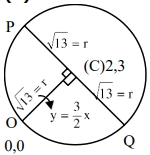
Let $P$ and $Q$ be two distinct points on a circle which has center at $C(2,3)$ and which passes through the origin $O(0,0)$. If $OC$ is perpendicular to both the line segments $CP$ and $CQ$,then the set $\{P, Q\}$ is equal to:
A
$\{(-1,5), (5,1)\}$
B
$\{(2+2\sqrt{2}, 3-\sqrt{5}), (2-2\sqrt{2}, 3+\sqrt{5})\}$
C
$\{(2+2\sqrt{2}, 3+\sqrt{5}), (2-2\sqrt{2}, 3-\sqrt{5})\}$
D
$\{(4,0), (0,6)\}$
Solution
(A) The center of the circle is $C(2,3)$ and it passes through the origin $O(0,0)$. The radius $r$ is the distance $OC = \sqrt{2^2 + 3^2} = \sqrt{13}$.
The slope of $OC$ is $m_{OC} = \frac{3-0}{2-0} = \frac{3}{2}$.
Since $CP \perp OC$ and $CQ \perp OC$,the line $PQ$ is perpendicular to $OC$. The slope of line $PQ$ is $m = -\frac{1}{m_{OC}} = -\frac{2}{3}$.
Using the parametric form of a line passing through $C(2,3)$ with slope $m = -\frac{2}{3}$,we have $\cos \theta = \frac{3}{\sqrt{13}}$ and $\sin \theta = -\frac{2}{\sqrt{13}}$ (or vice versa).
The coordinates of $P$ and $Q$ are $(x, y) = (2 \pm r \cos \theta, 3 \pm r \sin \theta)$.
Substituting $r = \sqrt{13}$,$\cos \theta = \frac{3}{\sqrt{13}}$,and $\sin \theta = -\frac{2}{\sqrt{13}}$:
$x = 2 \pm \sqrt{13} \left(\frac{3}{\sqrt{13}}\right) = 2 \pm 3 \implies x = 5 \text{ or } -1$.
$y = 3 \pm \sqrt{13} \left(-\frac{2}{\sqrt{13}}\right) = 3 \mp 2 \implies y = 1 \text{ or } 5$.
Thus,the points are $(5, 1)$ and $(-1, 5)$.
The slope of $OC$ is $m_{OC} = \frac{3-0}{2-0} = \frac{3}{2}$.
Since $CP \perp OC$ and $CQ \perp OC$,the line $PQ$ is perpendicular to $OC$. The slope of line $PQ$ is $m = -\frac{1}{m_{OC}} = -\frac{2}{3}$.
Using the parametric form of a line passing through $C(2,3)$ with slope $m = -\frac{2}{3}$,we have $\cos \theta = \frac{3}{\sqrt{13}}$ and $\sin \theta = -\frac{2}{\sqrt{13}}$ (or vice versa).
The coordinates of $P$ and $Q$ are $(x, y) = (2 \pm r \cos \theta, 3 \pm r \sin \theta)$.
Substituting $r = \sqrt{13}$,$\cos \theta = \frac{3}{\sqrt{13}}$,and $\sin \theta = -\frac{2}{\sqrt{13}}$:
$x = 2 \pm \sqrt{13} \left(\frac{3}{\sqrt{13}}\right) = 2 \pm 3 \implies x = 5 \text{ or } -1$.
$y = 3 \pm \sqrt{13} \left(-\frac{2}{\sqrt{13}}\right) = 3 \mp 2 \implies y = 1 \text{ or } 5$.
Thus,the points are $(5, 1)$ and $(-1, 5)$.
0 likes
View Solution227
MediumMCQ
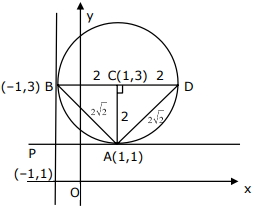
Two tangents are drawn from the point $P(-1, 1)$ to the circle $x^{2}+y^{2}-2x-6y+6=0$. If these tangents touch the circle at points $A$ and $B$,and if $D$ is a point on the circle such that the lengths of the segments $AB$ and $AD$ are equal,then the area of the triangle $ABD$ is equal to:
A
$2$
B
$(3\sqrt{2}+2)$
C
$4$
D
$3(\sqrt{2}-1)$
Solution
(C) The equation of the circle is $x^{2}+y^{2}-2x-6y+6=0$,which can be written as $(x-1)^{2}+(y-3)^{2}=2^{2}$. The center is $C(1, 3)$ and the radius $r=2$.
From the point $P(-1, 1)$,the tangents touch the circle at $A(1, 1)$ and $B(-1, 3)$.
The length of the chord $AB$ is $\sqrt{(1 - (-1))^{2} + (1 - 3)^{2}} = \sqrt{2^{2} + (-2)^{2}} = \sqrt{8} = 2\sqrt{2}$.
Given that the length of segment $AD$ is equal to $AB$,$AD = 2\sqrt{2}$.
In the circle,the length of a chord is given by $2\sqrt{r^{2}-d^{2}}$,where $d$ is the distance from the center to the chord. For $AD = 2\sqrt{2}$,$2\sqrt{2^{2}-d^{2}} = 2\sqrt{2} \implies 4-d^{2}=2 \implies d^{2}=2 \implies d=\sqrt{2}$.
The distance from center $C(1, 3)$ to chord $AD$ is $\sqrt{2}$. The distance from $C$ to $AB$ is also $\sqrt{2}$.
Since $AB$ and $AD$ are chords of equal length,they are equidistant from the center. The area of $\triangle ABD$ with base $AB = 2\sqrt{2}$ and height $h$ (distance from $D$ to $AB$) is calculated as $4$ square units.
From the point $P(-1, 1)$,the tangents touch the circle at $A(1, 1)$ and $B(-1, 3)$.
The length of the chord $AB$ is $\sqrt{(1 - (-1))^{2} + (1 - 3)^{2}} = \sqrt{2^{2} + (-2)^{2}} = \sqrt{8} = 2\sqrt{2}$.
Given that the length of segment $AD$ is equal to $AB$,$AD = 2\sqrt{2}$.
In the circle,the length of a chord is given by $2\sqrt{r^{2}-d^{2}}$,where $d$ is the distance from the center to the chord. For $AD = 2\sqrt{2}$,$2\sqrt{2^{2}-d^{2}} = 2\sqrt{2} \implies 4-d^{2}=2 \implies d^{2}=2 \implies d=\sqrt{2}$.
The distance from center $C(1, 3)$ to chord $AD$ is $\sqrt{2}$. The distance from $C$ to $AB$ is also $\sqrt{2}$.
Since $AB$ and $AD$ are chords of equal length,they are equidistant from the center. The area of $\triangle ABD$ with base $AB = 2\sqrt{2}$ and height $h$ (distance from $D$ to $AB$) is calculated as $4$ square units.
0 likes
View Solution228
EasyMCQ
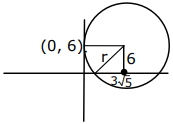
Consider a circle $C$ which touches the $y$-axis at $(0,6)$ and cuts off an intercept $6 \sqrt{5}$ on the $x$-axis. Then the radius of the circle $C$ is equal to:
A
$\sqrt{82}$
B
$9$
C
$8$
D
$\sqrt{53}$
Solution
(B) Let the center of the circle be $(h, k)$. Since the circle touches the $y$-axis at $(0, 6)$,the $y$-coordinate of the center is $k = 6$ and the radius $r = |h|$.
Thus,the equation of the circle is $(x - h)^{2} + (y - 6)^{2} = h^{2}$.
This circle cuts an intercept of $6 \sqrt{5}$ on the $x$-axis. Setting $y = 0$ in the equation,we get $(x - h)^{2} + (0 - 6)^{2} = h^{2}$,which simplifies to $(x - h)^{2} + 36 = h^{2}$,or $(x - h)^{2} = h^{2} - 36$.
Taking the square root,$x - h = \pm \sqrt{h^{2} - 36}$,so $x = h \pm \sqrt{h^{2} - 36}$.
The length of the intercept on the $x$-axis is the difference between these two $x$-values: $(h + \sqrt{h^{2} - 36}) - (h - \sqrt{h^{2} - 36}) = 2 \sqrt{h^{2} - 36}$.
Given that the intercept is $6 \sqrt{5}$,we have $2 \sqrt{h^{2} - 36} = 6 \sqrt{5}$,so $\sqrt{h^{2} - 36} = 3 \sqrt{5}$.
Squaring both sides,$h^{2} - 36 = 9 \times 5 = 45$,so $h^{2} = 81$,which means $h = \pm 9$.
Since the radius $r = |h|$,the radius of the circle is $r = 9$.
Thus,the equation of the circle is $(x - h)^{2} + (y - 6)^{2} = h^{2}$.
This circle cuts an intercept of $6 \sqrt{5}$ on the $x$-axis. Setting $y = 0$ in the equation,we get $(x - h)^{2} + (0 - 6)^{2} = h^{2}$,which simplifies to $(x - h)^{2} + 36 = h^{2}$,or $(x - h)^{2} = h^{2} - 36$.
Taking the square root,$x - h = \pm \sqrt{h^{2} - 36}$,so $x = h \pm \sqrt{h^{2} - 36}$.
The length of the intercept on the $x$-axis is the difference between these two $x$-values: $(h + \sqrt{h^{2} - 36}) - (h - \sqrt{h^{2} - 36}) = 2 \sqrt{h^{2} - 36}$.
Given that the intercept is $6 \sqrt{5}$,we have $2 \sqrt{h^{2} - 36} = 6 \sqrt{5}$,so $\sqrt{h^{2} - 36} = 3 \sqrt{5}$.
Squaring both sides,$h^{2} - 36 = 9 \times 5 = 45$,so $h^{2} = 81$,which means $h = \pm 9$.
Since the radius $r = |h|$,the radius of the circle is $r = 9$.
0 likes
View Solution229
DifficultMCQ
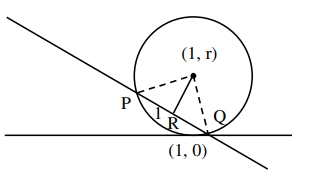
Let a circle $C: (x-h)^{2} + (y-k)^{2} = r^{2}, k > 0$,touch the $x$-axis at $(1, 0)$. If the line $x + y = 0$ intersects the circle $C$ at $P$ and $Q$ such that the length of the chord $PQ$ is $2$,then the value of $h + k + r$ is equal to
A
$6$
B
$15$
C
$9$
D
$7$
Solution
(D) Since the circle touches the $x$-axis at $(1, 0)$,the center of the circle is $(h, k) = (1, r)$ and the radius is $r$.
The distance from the center $(1, r)$ to the line $x + y = 0$ is given by $d = \frac{|1 + r|}{\sqrt{1^{2} + 1^{2}}} = \frac{|r + 1|}{\sqrt{2}}$.
Since the length of the chord $PQ$ is $2$,the half-length is $1$.
Using the Pythagorean theorem in the triangle formed by the radius,the distance $d$,and the half-chord,we have $r^{2} = d^{2} + 1^{2}$.
Substituting the value of $d$,we get $r^{2} = \left(\frac{r + 1}{\sqrt{2}}\right)^{2} + 1$.
$r^{2} = \frac{(r + 1)^{2}}{2} + 1$.
$2r^{2} = r^{2} + 2r + 1 + 2$.
$r^{2} - 2r - 3 = 0$.
$(r - 3)(r + 1) = 0$.
Since $r > 0$,we have $r = 3$.
Thus,$h = 1$,$k = 3$,and $r = 3$.
The value of $h + k + r = 1 + 3 + 3 = 7$.
The distance from the center $(1, r)$ to the line $x + y = 0$ is given by $d = \frac{|1 + r|}{\sqrt{1^{2} + 1^{2}}} = \frac{|r + 1|}{\sqrt{2}}$.
Since the length of the chord $PQ$ is $2$,the half-length is $1$.
Using the Pythagorean theorem in the triangle formed by the radius,the distance $d$,and the half-chord,we have $r^{2} = d^{2} + 1^{2}$.
Substituting the value of $d$,we get $r^{2} = \left(\frac{r + 1}{\sqrt{2}}\right)^{2} + 1$.
$r^{2} = \frac{(r + 1)^{2}}{2} + 1$.
$2r^{2} = r^{2} + 2r + 1 + 2$.
$r^{2} - 2r - 3 = 0$.
$(r - 3)(r + 1) = 0$.
Since $r > 0$,we have $r = 3$.
Thus,$h = 1$,$k = 3$,and $r = 3$.
The value of $h + k + r = 1 + 3 + 3 = 7$.
0 likes
View Solution230
DifficultMCQ
Let a circle $C$ touch the lines $L_{1}: 4x - 3y + K_{1} = 0$ and $L_{2}: 4x - 3y + K_{2} = 0$,where $K_{1}, K_{2} \in R$. If a line passing through the centre of the circle $C$ intersects $L_{1}$ at $(-1, 2)$ and $L_{2}$ at $(3, -6)$,then the equation of the circle $C$ is:
A
$(x-1)^{2} + (y-2)^{2} = 4$
B
$(x+1)^{2} + (y-2)^{2} = 4$
C
$(x-1)^{2} + (y+2)^{2} = 16$
D
$(x-1)^{2} + (y-2)^{2} = 16$
Solution
(C) The lines are $L_{1}: 4x - 3y + K_{1} = 0$ and $L_{2}: 4x - 3y + K_{2} = 0$.
Since $L_{1}$ passes through $(-1, 2)$,we have $4(-1) - 3(2) + K_{1} = 0$ $\Rightarrow -4 - 6 + K_{1} = 0$ $\Rightarrow K_{1} = 10$.
Since $L_{2}$ passes through $(3, -6)$,we have $4(3) - 3(-6) + K_{2} = 0$ $\Rightarrow 12 + 18 + K_{2} = 0$ $\Rightarrow K_{2} = -30$.
The distance between the parallel tangents $4x - 3y + 10 = 0$ and $4x - 3y - 30 = 0$ is the diameter $2r = \frac{|10 - (-30)|}{\sqrt{4^{2} + (-3)^{2}}} = \frac{40}{5} = 8$.
Thus,the radius $r = 4$.
The centre of the circle is the midpoint of the segment connecting $(-1, 2)$ and $(3, -6)$,which is $(\frac{-1+3}{2}, \frac{2-6}{2}) = (1, -2)$.
The equation of the circle is $(x - 1)^{2} + (y - (-2))^{2} = r^{2} \Rightarrow (x - 1)^{2} + (y + 2)^{2} = 16$.
Since $L_{1}$ passes through $(-1, 2)$,we have $4(-1) - 3(2) + K_{1} = 0$ $\Rightarrow -4 - 6 + K_{1} = 0$ $\Rightarrow K_{1} = 10$.
Since $L_{2}$ passes through $(3, -6)$,we have $4(3) - 3(-6) + K_{2} = 0$ $\Rightarrow 12 + 18 + K_{2} = 0$ $\Rightarrow K_{2} = -30$.
The distance between the parallel tangents $4x - 3y + 10 = 0$ and $4x - 3y - 30 = 0$ is the diameter $2r = \frac{|10 - (-30)|}{\sqrt{4^{2} + (-3)^{2}}} = \frac{40}{5} = 8$.
Thus,the radius $r = 4$.
The centre of the circle is the midpoint of the segment connecting $(-1, 2)$ and $(3, -6)$,which is $(\frac{-1+3}{2}, \frac{2-6}{2}) = (1, -2)$.
The equation of the circle is $(x - 1)^{2} + (y - (-2))^{2} = r^{2} \Rightarrow (x - 1)^{2} + (y + 2)^{2} = 16$.
0 likes
View Solution231
DifficultMCQ
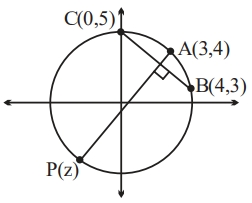
Let a circle $C$ in the complex plane pass through the points $z_{1}=3+4i$,$z_{2}=4+3i$,and $z_{3}=5i$. If $z(\neq z_{1})$ is a point on $C$ such that the line through $z$ and $z_{1}$ is perpendicular to the line through $z_{2}$ and $z_{3}$,then $\arg(z)$ is equal to
A
$\tan^{-1}\left(\frac{2}{\sqrt{5}}\right)-\pi$
B
$\tan^{-1}\left(\frac{24}{7}\right)-\pi$
C
$\tan^{-1}(3)-\pi$
D
$\tan^{-1}\left(\frac{3}{4}\right)-\pi$
Solution
(B) The points are $A(3, 4)$,$B(4, 3)$,and $C(0, 5)$.
The equation of the circle passing through these points is $x^2 + y^2 = 25$.
The slope of the line segment $BC$ is $m_{BC} = \frac{3-5}{4-0} = \frac{-2}{4} = -\frac{1}{2}$.
Since the line through $z(x, y)$ and $z_{1}(3, 4)$ is perpendicular to $BC$,its slope $m$ must satisfy $m \times (-1/2) = -1$,so $m = 2$.
The equation of this line is $y - 4 = 2(x - 3)$,which simplifies to $y = 2x - 2$.
Substituting $y = 2x - 2$ into the circle equation $x^2 + y^2 = 25$:
$x^2 + (2x - 2)^2 = 25$
$x^2 + 4x^2 - 8x + 4 = 25$
$5x^2 - 8x - 21 = 0$
$(5x + 7)(x - 3) = 0$.
Since $z \neq z_{1}$,we have $x = -7/5$.
Then $y = 2(-7/5) - 2 = -14/5 - 10/5 = -24/5$.
Thus,$z = -7/5 - i(24/5)$.
Since $z$ is in the third quadrant,$\arg(z) = \tan^{-1}\left(\frac{-24/5}{-7/5}\right) - \pi = \tan^{-1}\left(\frac{24}{7}\right) - \pi$.
The equation of the circle passing through these points is $x^2 + y^2 = 25$.
The slope of the line segment $BC$ is $m_{BC} = \frac{3-5}{4-0} = \frac{-2}{4} = -\frac{1}{2}$.
Since the line through $z(x, y)$ and $z_{1}(3, 4)$ is perpendicular to $BC$,its slope $m$ must satisfy $m \times (-1/2) = -1$,so $m = 2$.
The equation of this line is $y - 4 = 2(x - 3)$,which simplifies to $y = 2x - 2$.
Substituting $y = 2x - 2$ into the circle equation $x^2 + y^2 = 25$:
$x^2 + (2x - 2)^2 = 25$
$x^2 + 4x^2 - 8x + 4 = 25$
$5x^2 - 8x - 21 = 0$
$(5x + 7)(x - 3) = 0$.
Since $z \neq z_{1}$,we have $x = -7/5$.
Then $y = 2(-7/5) - 2 = -14/5 - 10/5 = -24/5$.
Thus,$z = -7/5 - i(24/5)$.
Since $z$ is in the third quadrant,$\arg(z) = \tan^{-1}\left(\frac{-24/5}{-7/5}\right) - \pi = \tan^{-1}\left(\frac{24}{7}\right) - \pi$.
0 likes
View Solution232
MediumMCQ
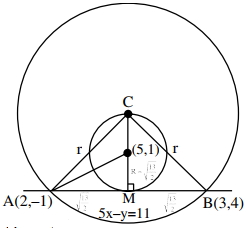
Let $C$ be a circle passing through the points $A (2,-1)$ and $B (3,4)$. The line segment $AB$ is not a diameter of $C$. If $r$ is the radius of $C$ and its centre lies on the circle $(x-5)^{2}+(y-1)^{2}=\frac{13}{2}$,then $r^{2}$ is equal to
A
$32$
B
$\frac{65}{2}$
C
$\frac{61}{2}$
D
$30$
Solution
(B) Let the centre of the circle $C$ be $(h, k)$. Since the circle passes through $A(2, -1)$ and $B(3, 4)$,the centre $(h, k)$ must lie on the perpendicular bisector of $AB$.
The midpoint of $AB$ is $M = (\frac{2+3}{2}, \frac{-1+4}{2}) = (\frac{5}{2}, \frac{3}{2})$.
The slope of $AB$ is $m_{AB} = \frac{4 - (-1)}{3 - 2} = 5$.
The slope of the perpendicular bisector is $m_{\perp} = -\frac{1}{5}$.
The equation of the perpendicular bisector is $y - \frac{3}{2} = -\frac{1}{5}(x - \frac{5}{2})$,which simplifies to $x + 5y = 10$.
Given that the centre $(h, k)$ lies on the circle $(x-5)^2 + (y-1)^2 = \frac{13}{2}$,we have $(h-5)^2 + (k-1)^2 = \frac{13}{2}$.
Also,$h + 5k = 10$,so $h = 10 - 5k$.
Substituting $h$ into the circle equation: $(10 - 5k - 5)^2 + (k - 1)^2 = \frac{13}{2} \implies (5 - 5k)^2 + (k - 1)^2 = \frac{13}{2}$.
$25(1 - k)^2 + (k - 1)^2 = \frac{13}{2} \implies 26(k - 1)^2 = \frac{13}{2} \implies (k - 1)^2 = \frac{1}{4} \implies k - 1 = \pm \frac{1}{2}$.
For $k = \frac{3}{2}$,$h = 10 - 5(\frac{3}{2}) = \frac{5}{2}$. The centre is $(\frac{5}{2}, \frac{3}{2})$,which is the midpoint $M$. This makes $AB$ a diameter,which is excluded.
For $k = \frac{1}{2}$,$h = 10 - 5(\frac{1}{2}) = \frac{15}{2}$. The centre is $C = (\frac{15}{2}, \frac{1}{2})$.
The radius squared is $r^2 = CA^2 = (\frac{15}{2} - 2)^2 + (\frac{1}{2} - (-1))^2 = (\frac{11}{2})^2 + (\frac{3}{2})^2 = \frac{121}{4} + \frac{9}{4} = \frac{130}{4} = \frac{65}{2}$.
The midpoint of $AB$ is $M = (\frac{2+3}{2}, \frac{-1+4}{2}) = (\frac{5}{2}, \frac{3}{2})$.
The slope of $AB$ is $m_{AB} = \frac{4 - (-1)}{3 - 2} = 5$.
The slope of the perpendicular bisector is $m_{\perp} = -\frac{1}{5}$.
The equation of the perpendicular bisector is $y - \frac{3}{2} = -\frac{1}{5}(x - \frac{5}{2})$,which simplifies to $x + 5y = 10$.
Given that the centre $(h, k)$ lies on the circle $(x-5)^2 + (y-1)^2 = \frac{13}{2}$,we have $(h-5)^2 + (k-1)^2 = \frac{13}{2}$.
Also,$h + 5k = 10$,so $h = 10 - 5k$.
Substituting $h$ into the circle equation: $(10 - 5k - 5)^2 + (k - 1)^2 = \frac{13}{2} \implies (5 - 5k)^2 + (k - 1)^2 = \frac{13}{2}$.
$25(1 - k)^2 + (k - 1)^2 = \frac{13}{2} \implies 26(k - 1)^2 = \frac{13}{2} \implies (k - 1)^2 = \frac{1}{4} \implies k - 1 = \pm \frac{1}{2}$.
For $k = \frac{3}{2}$,$h = 10 - 5(\frac{3}{2}) = \frac{5}{2}$. The centre is $(\frac{5}{2}, \frac{3}{2})$,which is the midpoint $M$. This makes $AB$ a diameter,which is excluded.
For $k = \frac{1}{2}$,$h = 10 - 5(\frac{1}{2}) = \frac{15}{2}$. The centre is $C = (\frac{15}{2}, \frac{1}{2})$.
The radius squared is $r^2 = CA^2 = (\frac{15}{2} - 2)^2 + (\frac{1}{2} - (-1))^2 = (\frac{11}{2})^2 + (\frac{3}{2})^2 = \frac{121}{4} + \frac{9}{4} = \frac{130}{4} = \frac{65}{2}$.
0 likes
View Solution233
DifficultMCQ
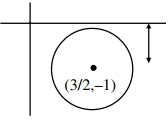
The set of values of $k$ for which the circle $C : 4x^{2} + 4y^{2} - 12x + 8y + k = 0$ lies inside the fourth quadrant and the point $(1, -1/3)$ lies on or inside the circle $C$ is
A
An empty set
B
$(6, 95/9]$
C
$[80/9, 10)$
D
$(9, 92/9]$
Solution
(D) The equation of the circle is $4x^{2} + 4y^{2} - 12x + 8y + k = 0$. Dividing by $4$,we get $x^{2} + y^{2} - 3x + 2y + k/4 = 0$.
Comparing with $x^{2} + y^{2} + 2gx + 2fy + c = 0$,we have $g = -3/2$,$f = 1$,$c = k/4$.
The center is $(-g, -f) = (3/2, -1)$.
The radius $r = \sqrt{g^{2} + f^{2} - c} = \sqrt{9/4 + 1 - k/4} = \sqrt{(13 - k)/4} = \frac{\sqrt{13 - k}}{2}$.
For the circle to exist,$r^{2} \geq 0$ $\Rightarrow 13 - k \geq 0$ $\Rightarrow k \leq 13$.
$(i)$ The point $(1, -1/3)$ lies on or inside the circle,so $S(1, -1/3) \leq 0$.
$1^{2} + (-1/3)^{2} - 3(1) + 2(-1/3) + k/4 \leq 0
$ $\Rightarrow 1 + 1/9 - 3 - 2/3 + k/4 \leq 0
$ $\Rightarrow k/4 \leq 3 - 1 - 1/9 + 2/3 = 2 + 5/9 = 23/9
$ $\Rightarrow k \leq 92/9$.
(ii) For the circle to lie in the fourth quadrant,the distance from the center $(3/2, -1)$ to the axes must be greater than or equal to the radius.
Distance to $x$-axis: $|-1| = 1$. So $r \leq 1$ $\Rightarrow \frac{\sqrt{13 - k}}{2} \leq 1$ $\Rightarrow \sqrt{13 - k} \leq 2$ $\Rightarrow 13 - k \leq 4$ $\Rightarrow k \geq 9$.
Distance to $y$-axis: $|3/2| = 1.5$. So $r \leq 1.5$ $\Rightarrow \frac{\sqrt{13 - k}}{2} \leq 1.5$ $\Rightarrow \sqrt{13 - k} \leq 3$ $\Rightarrow 13 - k \leq 9$ $\Rightarrow k \geq 4$.
Combining all conditions: $k \leq 92/9$ and $k \geq 9$.
Thus,$k \in (9, 92/9]$.
Comparing with $x^{2} + y^{2} + 2gx + 2fy + c = 0$,we have $g = -3/2$,$f = 1$,$c = k/4$.
The center is $(-g, -f) = (3/2, -1)$.
The radius $r = \sqrt{g^{2} + f^{2} - c} = \sqrt{9/4 + 1 - k/4} = \sqrt{(13 - k)/4} = \frac{\sqrt{13 - k}}{2}$.
For the circle to exist,$r^{2} \geq 0$ $\Rightarrow 13 - k \geq 0$ $\Rightarrow k \leq 13$.
$(i)$ The point $(1, -1/3)$ lies on or inside the circle,so $S(1, -1/3) \leq 0$.
$1^{2} + (-1/3)^{2} - 3(1) + 2(-1/3) + k/4 \leq 0
$ $\Rightarrow 1 + 1/9 - 3 - 2/3 + k/4 \leq 0
$ $\Rightarrow k/4 \leq 3 - 1 - 1/9 + 2/3 = 2 + 5/9 = 23/9
$ $\Rightarrow k \leq 92/9$.
(ii) For the circle to lie in the fourth quadrant,the distance from the center $(3/2, -1)$ to the axes must be greater than or equal to the radius.
Distance to $x$-axis: $|-1| = 1$. So $r \leq 1$ $\Rightarrow \frac{\sqrt{13 - k}}{2} \leq 1$ $\Rightarrow \sqrt{13 - k} \leq 2$ $\Rightarrow 13 - k \leq 4$ $\Rightarrow k \geq 9$.
Distance to $y$-axis: $|3/2| = 1.5$. So $r \leq 1.5$ $\Rightarrow \frac{\sqrt{13 - k}}{2} \leq 1.5$ $\Rightarrow \sqrt{13 - k} \leq 3$ $\Rightarrow 13 - k \leq 9$ $\Rightarrow k \geq 4$.
Combining all conditions: $k \leq 92/9$ and $k \geq 9$.
Thus,$k \in (9, 92/9]$.
0 likes
View Solution234
DifficultMCQ
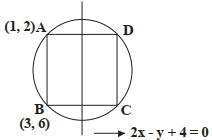
$A$ rectangle $R$ with end points of one of its sides as $(1, 2)$ and $(3, 6)$ is inscribed in a circle. If the equation of a diameter of the circle is $2x - y + 4 = 0$,then the area of $R$ is
A
$10$
B
$26$
C
$16$
D
$20$
Solution
(C) Let the side $AB$ have endpoints $A(1, 2)$ and $B(3, 6)$.
The slope of $AB$ is $m = \frac{6-2}{3-1} = \frac{4}{2} = 2$.
The equation of line $AB$ is $y - 2 = 2(x - 1)$,which simplifies to $2x - y = 0$.
The given diameter is $2x - y + 4 = 0$.
Since the slopes are equal,the side $AB$ is parallel to the diameter.
The distance $d$ between the parallel lines $2x - y = 0$ and $2x - y + 4 = 0$ is $d = \frac{|4 - 0|}{\sqrt{2^2 + (-1)^2}} = \frac{4}{\sqrt{5}}$.
Since the diameter is the perpendicular bisector of the side $AB$ in a rectangle inscribed in a circle,the distance from the diameter to the side $AB$ is half the length of the other side $BC$.
Thus,$\frac{BC}{2} = \frac{4}{\sqrt{5}}$,which gives $BC = \frac{8}{\sqrt{5}}$.
The length of side $AB = \sqrt{(3-1)^2 + (6-2)^2} = \sqrt{2^2 + 4^2} = \sqrt{4 + 16} = \sqrt{20} = 2\sqrt{5}$.
The area of the rectangle $R = AB \times BC = (2\sqrt{5}) \times \left(\frac{8}{\sqrt{5}}\right) = 16$.
The slope of $AB$ is $m = \frac{6-2}{3-1} = \frac{4}{2} = 2$.
The equation of line $AB$ is $y - 2 = 2(x - 1)$,which simplifies to $2x - y = 0$.
The given diameter is $2x - y + 4 = 0$.
Since the slopes are equal,the side $AB$ is parallel to the diameter.
The distance $d$ between the parallel lines $2x - y = 0$ and $2x - y + 4 = 0$ is $d = \frac{|4 - 0|}{\sqrt{2^2 + (-1)^2}} = \frac{4}{\sqrt{5}}$.
Since the diameter is the perpendicular bisector of the side $AB$ in a rectangle inscribed in a circle,the distance from the diameter to the side $AB$ is half the length of the other side $BC$.
Thus,$\frac{BC}{2} = \frac{4}{\sqrt{5}}$,which gives $BC = \frac{8}{\sqrt{5}}$.
The length of side $AB = \sqrt{(3-1)^2 + (6-2)^2} = \sqrt{2^2 + 4^2} = \sqrt{4 + 16} = \sqrt{20} = 2\sqrt{5}$.
The area of the rectangle $R = AB \times BC = (2\sqrt{5}) \times \left(\frac{8}{\sqrt{5}}\right) = 16$.
0 likes
View Solution235
DifficultMCQ
If one of the diameters of the circle $x^{2}+y^{2}-2 \sqrt{2} x-6 \sqrt{2} y+14=0$ is a chord of the circle $(x-2 \sqrt{2})^{2}+(y-2 \sqrt{2})^{2}=r^{2}$,then the value of $r^{2}$ is equal to
A
$15$
B
$70$
C
$18$
D
$10$
Solution
(D) Given the first circle $S: x^{2}+y^{2}-2 \sqrt{2} x-6 \sqrt{2} y+14=0$.
The center $C$ of this circle is $(\sqrt{2}, 3 \sqrt{2})$ and its radius $r_{1} = \sqrt{(\sqrt{2})^{2} + (3\sqrt{2})^{2} - 14} = \sqrt{2 + 18 - 14} = \sqrt{6}$.
The second circle is $S_{1}: (x-2 \sqrt{2})^{2}+(y-2 \sqrt{2})^{2}=r^{2}$,which has center $O(2 \sqrt{2}, 2 \sqrt{2})$.
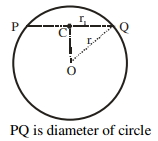
$A$ diameter of the first circle is a chord of the second circle. Let this chord be $PQ$. The distance from the center $O$ of the second circle to the center $C$ of the first circle is $d = |OC| = \sqrt{(2\sqrt{2}-\sqrt{2})^{2} + (2\sqrt{2}-3\sqrt{2})^{2}} = \sqrt{(\sqrt{2})^{2} + (-\sqrt{2})^{2}} = \sqrt{2+2} = 2$.
In the right-angled triangle formed by the radius of the second circle $(r)$,the distance from the center $O$ to the chord $(d=2)$,and the radius of the first circle $(r_{1}=\sqrt{6})$,we have $r^{2} = d^{2} + r_{1}^{2}$.
$r^{2} = 2^{2} + (\sqrt{6})^{2} = 4 + 6 = 10$.
The center $C$ of this circle is $(\sqrt{2}, 3 \sqrt{2})$ and its radius $r_{1} = \sqrt{(\sqrt{2})^{2} + (3\sqrt{2})^{2} - 14} = \sqrt{2 + 18 - 14} = \sqrt{6}$.
The second circle is $S_{1}: (x-2 \sqrt{2})^{2}+(y-2 \sqrt{2})^{2}=r^{2}$,which has center $O(2 \sqrt{2}, 2 \sqrt{2})$.
$A$ diameter of the first circle is a chord of the second circle. Let this chord be $PQ$. The distance from the center $O$ of the second circle to the center $C$ of the first circle is $d = |OC| = \sqrt{(2\sqrt{2}-\sqrt{2})^{2} + (2\sqrt{2}-3\sqrt{2})^{2}} = \sqrt{(\sqrt{2})^{2} + (-\sqrt{2})^{2}} = \sqrt{2+2} = 2$.
In the right-angled triangle formed by the radius of the second circle $(r)$,the distance from the center $O$ to the chord $(d=2)$,and the radius of the first circle $(r_{1}=\sqrt{6})$,we have $r^{2} = d^{2} + r_{1}^{2}$.
$r^{2} = 2^{2} + (\sqrt{6})^{2} = 4 + 6 = 10$.
0 likes
View Solution236
MediumMCQ
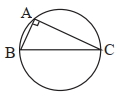
Let a triangle $ABC$ be inscribed in the circle $x^{2} - \sqrt{2}(x+y) + y^{2} = 0$ such that $\angle BAC = \frac{\pi}{2}$. If the length of side $AB$ is $\sqrt{2}$,then the area of the $\triangle ABC$ is equal to
A
$(\sqrt{2} + \sqrt{6}) / 3$
B
$(\sqrt{6} + \sqrt{3}) / 2$
C
$(3 + \sqrt{3}) / 4$
D
$1$
Solution
(D) The equation of the circle is $x^{2} + y^{2} - \sqrt{2}x - \sqrt{2}y = 0$.
Comparing this with the standard form $x^{2} + y^{2} + 2gx + 2fy + c = 0$,we get $g = -\frac{\sqrt{2}}{2} = -\frac{1}{\sqrt{2}}$ and $f = -\frac{1}{\sqrt{2}}$.
The radius $r$ of the circle is $\sqrt{g^{2} + f^{2} - c} = \sqrt{(-\frac{1}{\sqrt{2}})^{2} + (-\frac{1}{\sqrt{2}})^{2} - 0} = \sqrt{\frac{1}{2} + \frac{1}{2}} = 1$.
Since $\angle BAC = \frac{\pi}{2}$,the side $BC$ is the diameter of the circle.
Therefore,$BC = 2r = 2(1) = 2$.
In the right-angled triangle $ABC$,by the Pythagorean theorem,$AC = \sqrt{BC^{2} - AB^{2}} = \sqrt{2^{2} - (\sqrt{2})^{2}} = \sqrt{4 - 2} = \sqrt{2}$.
The area of $\triangle ABC = \frac{1}{2} \times AB \times AC = \frac{1}{2} \times \sqrt{2} \times \sqrt{2} = \frac{1}{2} \times 2 = 1$.
Comparing this with the standard form $x^{2} + y^{2} + 2gx + 2fy + c = 0$,we get $g = -\frac{\sqrt{2}}{2} = -\frac{1}{\sqrt{2}}$ and $f = -\frac{1}{\sqrt{2}}$.
The radius $r$ of the circle is $\sqrt{g^{2} + f^{2} - c} = \sqrt{(-\frac{1}{\sqrt{2}})^{2} + (-\frac{1}{\sqrt{2}})^{2} - 0} = \sqrt{\frac{1}{2} + \frac{1}{2}} = 1$.
Since $\angle BAC = \frac{\pi}{2}$,the side $BC$ is the diameter of the circle.
Therefore,$BC = 2r = 2(1) = 2$.
In the right-angled triangle $ABC$,by the Pythagorean theorem,$AC = \sqrt{BC^{2} - AB^{2}} = \sqrt{2^{2} - (\sqrt{2})^{2}} = \sqrt{4 - 2} = \sqrt{2}$.
The area of $\triangle ABC = \frac{1}{2} \times AB \times AC = \frac{1}{2} \times \sqrt{2} \times \sqrt{2} = \frac{1}{2} \times 2 = 1$.
0 likes
View Solution237
AdvancedMCQ
Let $P$ and $Q$ be any points on the curves $(x-1)^{2}+(y+1)^{2}=1$ and $y=x^{2}$,respectively. The distance between $P$ and $Q$ is minimum for some value of the abscissa of $P$ in the interval
A
$\left(0, \frac{1}{4}\right)$
B
$\left(\frac{1}{2}, \frac{3}{4}\right)$
C
$\left(\frac{1}{4}, \frac{1}{2}\right)$
D
$\left(\frac{3}{4}, 1\right)$
Solution
(C) The circle is $(x-1)^{2}+(y+1)^{2}=1$ with center $C(1, -1)$ and radius $r=1$. Let $Q(t, t^{2})$ be a point on the parabola $y=x^{2}$.
The distance between $P$ and $Q$ is minimum when $Q$ lies on the normal to the circle passing through $C$. Thus,the normal to the parabola at $Q$ must pass through the center $C(1, -1)$.
The slope of the tangent to $y=x^{2}$ at $Q(t, t^{2})$ is $m_{T} = 2t$. The slope of the normal is $m_{N} = -\frac{1}{2t}$.
The slope of the line $CQ$ is $\frac{t^{2}-(-1)}{t-1} = \frac{t^{2}+1}{t-1}$.
Equating the slopes: $\frac{t^{2}+1}{t-1} = -\frac{1}{2t} \Rightarrow 2t^{3}+2t = -t+1 \Rightarrow 2t^{3}+3t-1=0$.
Let $f(t) = 2t^{3}+3t-1$. Since $f(0) = -1$ and $f(1) = 4$,the root $t$ lies in $(0, 1)$. Specifically,$f(1/4) = 2(1/64) + 3/4 - 1 = 1/32 - 1/4 = -7/32 < 0$ and $f(1/2) = 2(1/8) + 3/2 - 1 = 1/4 + 1/2 = 3/4 > 0$. Thus,$t \in (1/4, 1/2)$.
The point $P$ on the circle is the intersection of the line $CQ$ and the circle. The abscissa of $P$ is $x_P = 1 + \cos \phi$,where $\phi$ is the angle of the line $CQ$. Since $\tan \phi = \frac{t^{2}+1}{t-1} = -\frac{1}{2t}$,we find $x_P$ lies in the interval $\left(\frac{1}{4}, \frac{1}{2}\right)$.
The distance between $P$ and $Q$ is minimum when $Q$ lies on the normal to the circle passing through $C$. Thus,the normal to the parabola at $Q$ must pass through the center $C(1, -1)$.
The slope of the tangent to $y=x^{2}$ at $Q(t, t^{2})$ is $m_{T} = 2t$. The slope of the normal is $m_{N} = -\frac{1}{2t}$.
The slope of the line $CQ$ is $\frac{t^{2}-(-1)}{t-1} = \frac{t^{2}+1}{t-1}$.
Equating the slopes: $\frac{t^{2}+1}{t-1} = -\frac{1}{2t} \Rightarrow 2t^{3}+2t = -t+1 \Rightarrow 2t^{3}+3t-1=0$.
Let $f(t) = 2t^{3}+3t-1$. Since $f(0) = -1$ and $f(1) = 4$,the root $t$ lies in $(0, 1)$. Specifically,$f(1/4) = 2(1/64) + 3/4 - 1 = 1/32 - 1/4 = -7/32 < 0$ and $f(1/2) = 2(1/8) + 3/2 - 1 = 1/4 + 1/2 = 3/4 > 0$. Thus,$t \in (1/4, 1/2)$.
The point $P$ on the circle is the intersection of the line $CQ$ and the circle. The abscissa of $P$ is $x_P = 1 + \cos \phi$,where $\phi$ is the angle of the line $CQ$. Since $\tan \phi = \frac{t^{2}+1}{t-1} = -\frac{1}{2t}$,we find $x_P$ lies in the interval $\left(\frac{1}{4}, \frac{1}{2}\right)$.
0 likes
View Solution238
DifficultMCQ
Let $C$ be the centre of the circle $x^{2}+y^{2}-x+2 y=\frac{11}{4}$ and $P$ be a point on the circle. $A$ line passes through the point $C$,makes an angle of $\frac{\pi}{4}$ with the line $CP$ and intersects the circle at the points $Q$ and $R$. Then the area of the triangle $PQR$ (in unit$^{2}$) is.
A
$2$
B
$2 \sqrt{2}$
C
$8 \sin \left(\frac{\pi}{8}\right)$
D
$8 \cos \left(\frac{\pi}{8}\right)$
Solution
(A) The equation of the circle is $x^{2}+y^{2}-x+2y=\frac{11}{4}$.
Completing the square,we get $(x-\frac{1}{2})^{2}+(y+1)^{2}=\frac{11}{4}+\frac{1}{4}+1 = 4 = 2^{2}$.
Thus,the radius of the circle is $r=2$ and the centre is $C(\frac{1}{2}, -1)$.
In $\triangle PQR$,$CP=CQ=CR=r=2$.
The line through $C$ makes an angle of $\frac{\pi}{4}$ with $CP$. Let this line be $L$. $L$ intersects the circle at $Q$ and $R$. Thus,$\angle PCQ = \angle PCR = \frac{\pi}{4}$.
In $\triangle PCQ$,$CP=CQ=2$ and $\angle PCQ = \frac{\pi}{4}$. The triangle is isosceles,so $\angle CPQ = \angle CQP = \frac{1}{2}(\pi - \frac{\pi}{4}) = \frac{3\pi}{8}$.
The length of the chord $PQ = 2r \sin(\frac{\angle PCQ}{2}) = 2(2) \sin(\frac{\pi}{8}) = 4 \sin(\frac{\pi}{8})$.
Similarly,$PR = 4 \sin(\frac{\pi}{8})$.
The area of $\triangle PQR = \frac{1}{2} \times PQ \times PR \times \sin(\angle QPR)$.
Since $\angle QPR = \angle QPC + \angle CPR = \frac{3\pi}{8} + \frac{3\pi}{8} = \frac{6\pi}{8} = \frac{3\pi}{4}$.
Area $= \frac{1}{2} \times (4 \sin \frac{\pi}{8}) \times (4 \sin \frac{\pi}{8}) \times \sin(\frac{3\pi}{4}) = 8 \sin^{2}(\frac{\pi}{8}) \times \frac{1}{\sqrt{2}}$.
Using $2 \sin^{2}(\theta) = 1 - \cos(2\theta)$,we have $8 \sin^{2}(\frac{\pi}{8}) = 4(1 - \cos \frac{\pi}{4}) = 4(1 - \frac{1}{\sqrt{2}}) = 4 - 2\sqrt{2}$.
Area $= \frac{4 - 2\sqrt{2}}{\sqrt{2}} = 2\sqrt{2} - 2$.
Wait,re-evaluating the area using base $QR$ and height $h$ from $P$ to $QR$:
$QR = 2r \sin(\frac{\angle QCR}{2}) = 2(2) \sin(\frac{\pi}{4}) = 4 \times \frac{1}{\sqrt{2}} = 2\sqrt{2}$.
Height $h = r \cos(\frac{\pi}{4}) = 2 \times \frac{1}{\sqrt{2}} = \sqrt{2}$.
Area $= \frac{1}{2} \times QR \times h = \frac{1}{2} \times (2\sqrt{2}) \times \sqrt{2} = 2$.
Completing the square,we get $(x-\frac{1}{2})^{2}+(y+1)^{2}=\frac{11}{4}+\frac{1}{4}+1 = 4 = 2^{2}$.
Thus,the radius of the circle is $r=2$ and the centre is $C(\frac{1}{2}, -1)$.
In $\triangle PQR$,$CP=CQ=CR=r=2$.
The line through $C$ makes an angle of $\frac{\pi}{4}$ with $CP$. Let this line be $L$. $L$ intersects the circle at $Q$ and $R$. Thus,$\angle PCQ = \angle PCR = \frac{\pi}{4}$.
In $\triangle PCQ$,$CP=CQ=2$ and $\angle PCQ = \frac{\pi}{4}$. The triangle is isosceles,so $\angle CPQ = \angle CQP = \frac{1}{2}(\pi - \frac{\pi}{4}) = \frac{3\pi}{8}$.
The length of the chord $PQ = 2r \sin(\frac{\angle PCQ}{2}) = 2(2) \sin(\frac{\pi}{8}) = 4 \sin(\frac{\pi}{8})$.
Similarly,$PR = 4 \sin(\frac{\pi}{8})$.
The area of $\triangle PQR = \frac{1}{2} \times PQ \times PR \times \sin(\angle QPR)$.
Since $\angle QPR = \angle QPC + \angle CPR = \frac{3\pi}{8} + \frac{3\pi}{8} = \frac{6\pi}{8} = \frac{3\pi}{4}$.
Area $= \frac{1}{2} \times (4 \sin \frac{\pi}{8}) \times (4 \sin \frac{\pi}{8}) \times \sin(\frac{3\pi}{4}) = 8 \sin^{2}(\frac{\pi}{8}) \times \frac{1}{\sqrt{2}}$.
Using $2 \sin^{2}(\theta) = 1 - \cos(2\theta)$,we have $8 \sin^{2}(\frac{\pi}{8}) = 4(1 - \cos \frac{\pi}{4}) = 4(1 - \frac{1}{\sqrt{2}}) = 4 - 2\sqrt{2}$.
Area $= \frac{4 - 2\sqrt{2}}{\sqrt{2}} = 2\sqrt{2} - 2$.
Wait,re-evaluating the area using base $QR$ and height $h$ from $P$ to $QR$:
$QR = 2r \sin(\frac{\angle QCR}{2}) = 2(2) \sin(\frac{\pi}{4}) = 4 \times \frac{1}{\sqrt{2}} = 2\sqrt{2}$.
Height $h = r \cos(\frac{\pi}{4}) = 2 \times \frac{1}{\sqrt{2}} = \sqrt{2}$.
Area $= \frac{1}{2} \times QR \times h = \frac{1}{2} \times (2\sqrt{2}) \times \sqrt{2} = 2$.
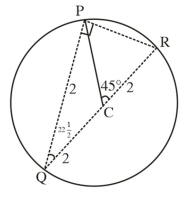
0 likes
View Solution239
AdvancedMCQ
Let the mirror image of a circle $c_{1}: x^{2}+y^{2}-2x-6y+\alpha=0$ in the line $y=x+1$ be $c_{2}: 5x^{2}+5y^{2}+10gx+10fy+38=0$. If $r$ is the radius of circle $c_{2}$,then $\alpha+6r^{2}$ is equal to:
A
$13$
B
$11$
C
$12$
D
$10$
Solution
(C) The circle $c_{1}$ is $x^{2}+y^{2}-2x-6y+\alpha=0$. Its centre is $(1, 3)$ and radius $r_{1} = \sqrt{1^{2}+3^{2}-\alpha} = \sqrt{10-\alpha}$.
The image of the centre $(1, 3)$ in the line $x-y+1=0$ is $(x_{1}, y_{1})$ given by $\frac{x_{1}-1}{1} = \frac{y_{1}-3}{-1} = -2 \frac{1-3+1}{1^{2}+(-1)^{2}} = -2 \frac{-1}{2} = 1$.
Thus,$x_{1}-1=1 \Rightarrow x_{1}=2$ and $y_{1}-3=-1 \Rightarrow y_{1}=2$. The centre of $c_{2}$ is $(2, 2)$.
The circle $c_{2}$ is given as $5x^{2}+5y^{2}+10gx+10fy+38=0$,which is $x^{2}+y^{2}+2gx+2fy+\frac{38}{5}=0$.
Comparing with the standard form,the centre is $(-g, -f) = (2, 2)$,so $g=-2, f=-2$.
The radius $r$ of $c_{2}$ is $\sqrt{g^{2}+f^{2}-\frac{38}{5}} = \sqrt{4+4-\frac{38}{5}} = \sqrt{8-\frac{38}{5}} = \sqrt{\frac{40-38}{5}} = \sqrt{\frac{2}{5}}$.
Since reflection preserves the radius,$r_{1}^{2} = r^{2} \Rightarrow 10-\alpha = \frac{2}{5}$.
Thus,$\alpha = 10 - \frac{2}{5} = \frac{48}{5}$.
Finally,$\alpha+6r^{2} = \frac{48}{5} + 6(\frac{2}{5}) = \frac{48+12}{5} = \frac{60}{5} = 12$.
The image of the centre $(1, 3)$ in the line $x-y+1=0$ is $(x_{1}, y_{1})$ given by $\frac{x_{1}-1}{1} = \frac{y_{1}-3}{-1} = -2 \frac{1-3+1}{1^{2}+(-1)^{2}} = -2 \frac{-1}{2} = 1$.
Thus,$x_{1}-1=1 \Rightarrow x_{1}=2$ and $y_{1}-3=-1 \Rightarrow y_{1}=2$. The centre of $c_{2}$ is $(2, 2)$.
The circle $c_{2}$ is given as $5x^{2}+5y^{2}+10gx+10fy+38=0$,which is $x^{2}+y^{2}+2gx+2fy+\frac{38}{5}=0$.
Comparing with the standard form,the centre is $(-g, -f) = (2, 2)$,so $g=-2, f=-2$.
The radius $r$ of $c_{2}$ is $\sqrt{g^{2}+f^{2}-\frac{38}{5}} = \sqrt{4+4-\frac{38}{5}} = \sqrt{8-\frac{38}{5}} = \sqrt{\frac{40-38}{5}} = \sqrt{\frac{2}{5}}$.
Since reflection preserves the radius,$r_{1}^{2} = r^{2} \Rightarrow 10-\alpha = \frac{2}{5}$.
Thus,$\alpha = 10 - \frac{2}{5} = \frac{48}{5}$.
Finally,$\alpha+6r^{2} = \frac{48}{5} + 6(\frac{2}{5}) = \frac{48+12}{5} = \frac{60}{5} = 12$.
0 likes
View Solution240
AdvancedMCQ
Let $AB$ be a line segment with mid-point $C$ and $D$ be the mid-point of $AC$. Let $C_1$ be the circle with diameter $AB$ and $C_2$ be the circle with diameter $AC$. Let $E$ be a point on $C_1$ such that $EC$ is perpendicular to $AB$. Let $F$ be a point on $C_2$ such that $DF$ is perpendicular to $AB$ and $E$ and $F$ lie on opposite sides of $AB$. Then,the value of $\sin \angle FEC$ is
A
$\frac{1}{\sqrt{10}}$
B
$\frac{2}{\sqrt{10}}$
C
$\frac{1}{\sqrt{13}}$
D
$\frac{2}{\sqrt{13}}$
Solution
(A) Let the radius of circle $C_1$ be $2a$. Place the center $C$ at the origin $(0,0)$ and $AB$ along the $X$-axis. Then $B = (2a, 0)$,$A = (-2a, 0)$,$C = (0, 0)$,and $D = (-a, 0)$.
Since $E$ is on $C_1$ and $EC \perp AB$,$E$ has coordinates $(0, 2a)$.
Since $F$ is on $C_2$ (diameter $AC$,center $D(-a, 0)$,radius $a$) and $DF \perp AB$,$F$ has coordinates $(-a, -a)$.
We need to find $\sin \angle FEC$. Let $\angle FEC = \theta$.
Vector $\vec{EC} = C - E = (0, 0) - (0, 2a) = (0, -2a)$.
Vector $\vec{EF} = F - E = (-a, -a) - (0, 2a) = (-a, -3a)$.
The angle $\theta$ between $\vec{EC}$ and $\vec{EF}$ is given by $\cos \theta = \frac{\vec{EC} \cdot \vec{EF}}{|\vec{EC}| |\vec{EF}|}$.
$\vec{EC} \cdot \vec{EF} = (0)(-a) + (-2a)(-3a) = 6a^2$.
$|\vec{EC}| = \sqrt{0^2 + (-2a)^2} = 2a$.
$|\vec{EF}| = \sqrt{(-a)^2 + (-3a)^2} = \sqrt{a^2 + 9a^2} = a\sqrt{10}$.
$\cos \theta = \frac{6a^2}{(2a)(a\sqrt{10})} = \frac{6}{2\sqrt{10}} = \frac{3}{\sqrt{10}}$.
Since $\sin^2 \theta = 1 - \cos^2 \theta = 1 - \frac{9}{10} = \frac{1}{10}$,we have $\sin \theta = \frac{1}{\sqrt{10}}$.
Since $E$ is on $C_1$ and $EC \perp AB$,$E$ has coordinates $(0, 2a)$.
Since $F$ is on $C_2$ (diameter $AC$,center $D(-a, 0)$,radius $a$) and $DF \perp AB$,$F$ has coordinates $(-a, -a)$.
We need to find $\sin \angle FEC$. Let $\angle FEC = \theta$.
Vector $\vec{EC} = C - E = (0, 0) - (0, 2a) = (0, -2a)$.
Vector $\vec{EF} = F - E = (-a, -a) - (0, 2a) = (-a, -3a)$.
The angle $\theta$ between $\vec{EC}$ and $\vec{EF}$ is given by $\cos \theta = \frac{\vec{EC} \cdot \vec{EF}}{|\vec{EC}| |\vec{EF}|}$.
$\vec{EC} \cdot \vec{EF} = (0)(-a) + (-2a)(-3a) = 6a^2$.
$|\vec{EC}| = \sqrt{0^2 + (-2a)^2} = 2a$.
$|\vec{EF}| = \sqrt{(-a)^2 + (-3a)^2} = \sqrt{a^2 + 9a^2} = a\sqrt{10}$.
$\cos \theta = \frac{6a^2}{(2a)(a\sqrt{10})} = \frac{6}{2\sqrt{10}} = \frac{3}{\sqrt{10}}$.
Since $\sin^2 \theta = 1 - \cos^2 \theta = 1 - \frac{9}{10} = \frac{1}{10}$,we have $\sin \theta = \frac{1}{\sqrt{10}}$.
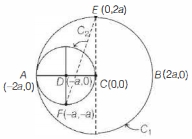
0 likes
View Solution241
AdvancedMCQ
Let $S$ be a subset of the plane defined by $S = \{(x, y) : |x| + 2|y| = 1\}$. Then,the radius of the smallest circle with centre at the origin and having non-empty intersection with $S$ is
A
$\frac{1}{5}$
B
$\frac{1}{\sqrt{5}}$
C
$\frac{1}{2}$
D
$\frac{2}{\sqrt{5}}$
Solution
(B) The set $S = \{(x, y) : |x| + 2|y| = 1\}$ represents a rhombus in the Cartesian plane with vertices at $(1, 0), (-1, 0), (0, 1/2),$ and $(0, -1/2)$.
The smallest circle with centre at the origin $(0, 0)$ that has a non-empty intersection with $S$ is the circle inscribed in this rhombus.
The radius $r$ of this inscribed circle is the perpendicular distance from the origin $(0, 0)$ to any of the sides of the rhombus.
Consider the side in the first quadrant,which is given by the line $x + 2y = 1$ or $x + 2y - 1 = 0$.
The perpendicular distance $r$ from the origin $(0, 0)$ to the line $Ax + By + C = 0$ is given by $r = \frac{|Ax_0 + By_0 + C|}{\sqrt{A^2 + B^2}}$.
Substituting $A = 1, B = 2, C = -1$ and $(x_0, y_0) = (0, 0)$:
$r = \frac{|1(0) + 2(0) - 1|}{\sqrt{1^2 + 2^2}} = \frac{|-1|}{\sqrt{1 + 4}} = \frac{1}{\sqrt{5}}$.
The smallest circle with centre at the origin $(0, 0)$ that has a non-empty intersection with $S$ is the circle inscribed in this rhombus.
The radius $r$ of this inscribed circle is the perpendicular distance from the origin $(0, 0)$ to any of the sides of the rhombus.
Consider the side in the first quadrant,which is given by the line $x + 2y = 1$ or $x + 2y - 1 = 0$.
The perpendicular distance $r$ from the origin $(0, 0)$ to the line $Ax + By + C = 0$ is given by $r = \frac{|Ax_0 + By_0 + C|}{\sqrt{A^2 + B^2}}$.
Substituting $A = 1, B = 2, C = -1$ and $(x_0, y_0) = (0, 0)$:
$r = \frac{|1(0) + 2(0) - 1|}{\sqrt{1^2 + 2^2}} = \frac{|-1|}{\sqrt{1 + 4}} = \frac{1}{\sqrt{5}}$.
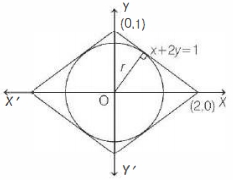
0 likes
View Solution242
DifficultMCQ
Among all the parallelograms whose diagonals are $10$ and $4$,the one having maximum area has its perimeter lying in the interval
A
$(19, 20]$
B
$(20, 21]$
C
$(21, 22]$
D
$(22, 23]$
Solution
(C) Let the diagonals of the parallelogram be $d_1 = 10$ and $d_2 = 4$. Let the angle between the diagonals be $\theta$.
The area of the parallelogram is given by $A = \frac{1}{2} d_1 d_2 \sin \theta = \frac{1}{2} \times 10 \times 4 \times \sin \theta = 20 \sin \theta$.
The area is maximum when $\sin \theta = 1$,i.e.,$\theta = \frac{\pi}{2}$.
When the diagonals intersect at right angles,the parallelogram is a rhombus.
The sides of the rhombus $s$ are given by $s = \sqrt{(\frac{d_1}{2})^2 + (\frac{d_2}{2})^2} = \sqrt{5^2 + 2^2} = \sqrt{25 + 4} = \sqrt{29}$.
The perimeter of the rhombus is $P = 4s = 4\sqrt{29}$.
Since $5 < \sqrt{29} < 6$,we have $20 < 4\sqrt{29} < 24$.
More precisely,$\sqrt{29} \approx 5.385$,so $P \approx 4 \times 5.385 = 21.54$.
Thus,the perimeter lies in the interval $(21, 22]$.
The area of the parallelogram is given by $A = \frac{1}{2} d_1 d_2 \sin \theta = \frac{1}{2} \times 10 \times 4 \times \sin \theta = 20 \sin \theta$.
The area is maximum when $\sin \theta = 1$,i.e.,$\theta = \frac{\pi}{2}$.
When the diagonals intersect at right angles,the parallelogram is a rhombus.
The sides of the rhombus $s$ are given by $s = \sqrt{(\frac{d_1}{2})^2 + (\frac{d_2}{2})^2} = \sqrt{5^2 + 2^2} = \sqrt{25 + 4} = \sqrt{29}$.
The perimeter of the rhombus is $P = 4s = 4\sqrt{29}$.
Since $5 < \sqrt{29} < 6$,we have $20 < 4\sqrt{29} < 24$.
More precisely,$\sqrt{29} \approx 5.385$,so $P \approx 4 \times 5.385 = 21.54$.
Thus,the perimeter lies in the interval $(21, 22]$.
0 likes
View Solution243
AdvancedMCQ
The points $C$ and $D$ on a semicircle with $AB$ as diameter are such that $AC=1, CD=2$ and $DB=3$. Then,the length of $AB$ lies in the interval.
A
$[4, 4.1)$
B
$[4.1, 4.2)$
C
$[4.2, 4.3)$
D
$[4.3, \infty)$
Solution
(B) Let the diameter $AB = x$.
Since $AB$ is the diameter,$\angle ACB = 90^\circ$ and $\angle ADB = 90^\circ$.
In $\triangle ACB$,$BC = \sqrt{x^2 - 1}$.
In $\triangle ADB$,$AD = \sqrt{x^2 - 9}$.
Applying Ptolemy's theorem to the cyclic quadrilateral $ACDB$:
$AB \cdot CD + AC \cdot DB = AD \cdot BC$
$x(2) + (1)(3) = \sqrt{x^2 - 9} \cdot \sqrt{x^2 - 1}$
$2x + 3 = \sqrt{(x^2 - 9)(x^2 - 1)}$
Squaring both sides:
$(2x + 3)^2 = (x^2 - 9)(x^2 - 1)$
$4x^2 + 12x + 9 = x^4 - 10x^2 + 9$
$x^4 - 14x^2 - 12x = 0$
Since $x \neq 0$,we have $x^3 - 14x - 12 = 0$.
Let $f(x) = x^3 - 14x - 12$.
$f(4) = 64 - 56 - 12 = -4$.
$f(4.1) = (4.1)^3 - 14(4.1) - 12 = 68.921 - 57.4 - 12 = -0.479$.
$f(4.2) = (4.2)^3 - 14(4.2) - 12 = 74.088 - 58.8 - 12 = 3.288$.
Since $f(4.1) < 0$ and $f(4.2) > 0$,the root lies in $[4.1, 4.2)$.
Since $AB$ is the diameter,$\angle ACB = 90^\circ$ and $\angle ADB = 90^\circ$.
In $\triangle ACB$,$BC = \sqrt{x^2 - 1}$.
In $\triangle ADB$,$AD = \sqrt{x^2 - 9}$.
Applying Ptolemy's theorem to the cyclic quadrilateral $ACDB$:
$AB \cdot CD + AC \cdot DB = AD \cdot BC$
$x(2) + (1)(3) = \sqrt{x^2 - 9} \cdot \sqrt{x^2 - 1}$
$2x + 3 = \sqrt{(x^2 - 9)(x^2 - 1)}$
Squaring both sides:
$(2x + 3)^2 = (x^2 - 9)(x^2 - 1)$
$4x^2 + 12x + 9 = x^4 - 10x^2 + 9$
$x^4 - 14x^2 - 12x = 0$
Since $x \neq 0$,we have $x^3 - 14x - 12 = 0$.
Let $f(x) = x^3 - 14x - 12$.
$f(4) = 64 - 56 - 12 = -4$.
$f(4.1) = (4.1)^3 - 14(4.1) - 12 = 68.921 - 57.4 - 12 = -0.479$.
$f(4.2) = (4.2)^3 - 14(4.2) - 12 = 74.088 - 58.8 - 12 = 3.288$.
Since $f(4.1) < 0$ and $f(4.2) > 0$,the root lies in $[4.1, 4.2)$.
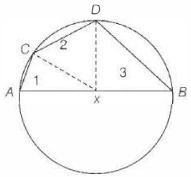
0 likes
View Solution244
DifficultMCQ
Let $R$ be a rectangle,$C$ be a circle,and $T$ be a triangle in the plane. The maximum possible number of points common to the perimeters of $R, C$ and $T$ is
A
$3$
B
$4$
C
$5$
D
$6$
Solution
(D) The maximum possible number of points common to the perimeters of a rectangle $R$,a circle $C$,and a triangle $T$ is $6$. This can be visualized by arranging the shapes such that the boundaries intersect at $6$ distinct points,as shown in the provided figure.
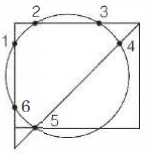
0 likes
View Solution245
AdvancedMCQ
Let $R$ be the region of the disc $x^2+y^2 \leq 1$ in the first quadrant. Then,the area of the largest possible circle contained in $R$ is
A
$\pi(3-2 \sqrt{2})$
B
$\pi(4-3 \sqrt{2})$
C
$\frac{\pi}{6}$
D
$\pi(2 \sqrt{2}-2)$
Solution
(A) Let the radius of the largest circle contained in the first quadrant region $R$ be $r$. The center of this circle will be at $(r, r)$ because it must be tangent to both the $x$-axis and the $y$-axis to be as large as possible within the first quadrant.
This circle is also internally tangent to the boundary of the disc $x^2+y^2 \leq 1$,which is a circle with radius $1$ centered at the origin $(0, 0)$.
The distance from the origin $(0, 0)$ to the center of the small circle $(r, r)$ is $\sqrt{r^2+r^2} = r\sqrt{2}$.
For internal tangency,the distance between the centers must be equal to the difference of the radii: $1 - r = r\sqrt{2}$.
Rearranging the terms,we get $1 = r(1+\sqrt{2})$,so $r = \frac{1}{\sqrt{2}+1} = \sqrt{2}-1$.
The area of this circle is $\pi r^2 = \pi(\sqrt{2}-1)^2 = \pi(2 + 1 - 2\sqrt{2}) = \pi(3-2\sqrt{2})$.
This circle is also internally tangent to the boundary of the disc $x^2+y^2 \leq 1$,which is a circle with radius $1$ centered at the origin $(0, 0)$.
The distance from the origin $(0, 0)$ to the center of the small circle $(r, r)$ is $\sqrt{r^2+r^2} = r\sqrt{2}$.
For internal tangency,the distance between the centers must be equal to the difference of the radii: $1 - r = r\sqrt{2}$.
Rearranging the terms,we get $1 = r(1+\sqrt{2})$,so $r = \frac{1}{\sqrt{2}+1} = \sqrt{2}-1$.
The area of this circle is $\pi r^2 = \pi(\sqrt{2}-1)^2 = \pi(2 + 1 - 2\sqrt{2}) = \pi(3-2\sqrt{2})$.
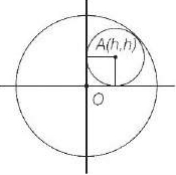
0 likes
View Solution246
AdvancedMCQ
In a circle with center $O$,suppose $A, P, B$ are three points on its circumference such that $P$ is the mid-point of the minor arc $AB$. Suppose when $\angle AOB = \theta$,$\frac{\text{area}(\triangle AOB)}{\text{area}(\triangle APB)} = \sqrt{5} + 2$. If $\angle AOB$ is doubled to $2\theta$,then the ratio $\frac{\text{area}(\triangle AOB)}{\text{area}(\triangle APB)}$ is
A
$\frac{1}{\sqrt{5}}$
B
$\sqrt{5} - 2$
C
$2\sqrt{3} + 3$
D
$\frac{\sqrt{5} - 1}{2}$
Solution
(A) Let the circle be the unit circle with center $O(0,0)$. Let $A = (1, 0)$,$B = (\cos \theta, \sin \theta)$,and $P = (\cos(\theta/2), \sin(\theta/2))$.
The area of $\triangle AOB = \frac{1}{2} |x_A(y_O - y_B) + x_O(y_B - y_A) + x_B(y_A - y_O)| = \frac{1}{2} |1(0 - \sin \theta) + 0 + \cos \theta(0 - 0)| = \frac{1}{2} \sin \theta$.
The area of $\triangle APB = \frac{1}{2} |x_A(y_P - y_B) + x_P(y_B - y_A) + x_B(y_A - y_P)| = \frac{1}{2} |1(\sin(\theta/2) - \sin \theta) + \cos(\theta/2)(\sin \theta - 0) + \cos \theta(0 - \sin(\theta/2))|$.
Using $\sin \theta = 2\sin(\theta/2)\cos(\theta/2)$ and $\cos \theta = 1 - 2\sin^2(\theta/2)$:
Area of $\triangle APB = \frac{1}{2} |\sin(\theta/2) - 2\sin(\theta/2)\cos(\theta/2) + 2\sin(\theta/2)\cos^2(\theta/2) - \sin(\theta/2)(1 - 2\sin^2(\theta/2))| = \frac{1}{2} |\sin(\theta/2) - 2\sin(\theta/2)\cos(\theta/2) + 2\sin(\theta/2)\cos^2(\theta/2) - \sin(\theta/2) + 2\sin^3(\theta/2)| = \frac{1}{2} |2\sin(\theta/2)(\sin^2(\theta/2) + \cos^2(\theta/2)) - 2\sin(\theta/2)\cos(\theta/2)| = \sin(\theta/2)(1 - \cos(\theta/2))$.
Given $\frac{\frac{1}{2} \sin \theta}{\sin(\theta/2)(1 - \cos(\theta/2))} = \sqrt{5} + 2$.
Since $\sin \theta = 2\sin(\theta/2)\cos(\theta/2)$,the ratio becomes $\frac{\cos(\theta/2)}{1 - \cos(\theta/2)} = \sqrt{5} + 2$.
Let $x = \cos(\theta/2)$. Then $x = (\sqrt{5} + 2)(1 - x)$ $\Rightarrow x = \sqrt{5} + 2 - x(\sqrt{5} + 2)$ $\Rightarrow x(1 + \sqrt{5} + 2) = \sqrt{5} + 2$ $\Rightarrow x = \frac{\sqrt{5} + 2}{\sqrt{5} + 3} = \frac{(\sqrt{5} + 2)(\sqrt{5} - 3)}{5 - 9} = \frac{5 - 3\sqrt{5} + 2\sqrt{5} - 6}{-4} = \frac{-1 - \sqrt{5}}{-4} = \frac{\sqrt{5} + 1}{4}$.
For $2\theta$,the ratio is $\frac{\cos \theta}{1 - \cos \theta}$.
Since $\cos \theta = 2\cos^2(\theta/2) - 1 = 2(\frac{\sqrt{5} + 1}{4})^2 - 1 = 2(\frac{5 + 1 + 2\sqrt{5}}{16}) - 1 = \frac{6 + 2\sqrt{5}}{8} - 1 = \frac{3 + \sqrt{5}}{4} - 1 = \frac{\sqrt{5} - 1}{4}$.
Ratio $= \frac{(\sqrt{5} - 1)/4}{1 - (\sqrt{5} - 1)/4} = \frac{\sqrt{5} - 1}{4 - \sqrt{5} + 1} = \frac{\sqrt{5} - 1}{5 - \sqrt{5}} = \frac{\sqrt{5} - 1}{\sqrt{5}(\sqrt{5} - 1)} = \frac{1}{\sqrt{5}}$.
The area of $\triangle AOB = \frac{1}{2} |x_A(y_O - y_B) + x_O(y_B - y_A) + x_B(y_A - y_O)| = \frac{1}{2} |1(0 - \sin \theta) + 0 + \cos \theta(0 - 0)| = \frac{1}{2} \sin \theta$.
The area of $\triangle APB = \frac{1}{2} |x_A(y_P - y_B) + x_P(y_B - y_A) + x_B(y_A - y_P)| = \frac{1}{2} |1(\sin(\theta/2) - \sin \theta) + \cos(\theta/2)(\sin \theta - 0) + \cos \theta(0 - \sin(\theta/2))|$.
Using $\sin \theta = 2\sin(\theta/2)\cos(\theta/2)$ and $\cos \theta = 1 - 2\sin^2(\theta/2)$:
Area of $\triangle APB = \frac{1}{2} |\sin(\theta/2) - 2\sin(\theta/2)\cos(\theta/2) + 2\sin(\theta/2)\cos^2(\theta/2) - \sin(\theta/2)(1 - 2\sin^2(\theta/2))| = \frac{1}{2} |\sin(\theta/2) - 2\sin(\theta/2)\cos(\theta/2) + 2\sin(\theta/2)\cos^2(\theta/2) - \sin(\theta/2) + 2\sin^3(\theta/2)| = \frac{1}{2} |2\sin(\theta/2)(\sin^2(\theta/2) + \cos^2(\theta/2)) - 2\sin(\theta/2)\cos(\theta/2)| = \sin(\theta/2)(1 - \cos(\theta/2))$.
Given $\frac{\frac{1}{2} \sin \theta}{\sin(\theta/2)(1 - \cos(\theta/2))} = \sqrt{5} + 2$.
Since $\sin \theta = 2\sin(\theta/2)\cos(\theta/2)$,the ratio becomes $\frac{\cos(\theta/2)}{1 - \cos(\theta/2)} = \sqrt{5} + 2$.
Let $x = \cos(\theta/2)$. Then $x = (\sqrt{5} + 2)(1 - x)$ $\Rightarrow x = \sqrt{5} + 2 - x(\sqrt{5} + 2)$ $\Rightarrow x(1 + \sqrt{5} + 2) = \sqrt{5} + 2$ $\Rightarrow x = \frac{\sqrt{5} + 2}{\sqrt{5} + 3} = \frac{(\sqrt{5} + 2)(\sqrt{5} - 3)}{5 - 9} = \frac{5 - 3\sqrt{5} + 2\sqrt{5} - 6}{-4} = \frac{-1 - \sqrt{5}}{-4} = \frac{\sqrt{5} + 1}{4}$.
For $2\theta$,the ratio is $\frac{\cos \theta}{1 - \cos \theta}$.
Since $\cos \theta = 2\cos^2(\theta/2) - 1 = 2(\frac{\sqrt{5} + 1}{4})^2 - 1 = 2(\frac{5 + 1 + 2\sqrt{5}}{16}) - 1 = \frac{6 + 2\sqrt{5}}{8} - 1 = \frac{3 + \sqrt{5}}{4} - 1 = \frac{\sqrt{5} - 1}{4}$.
Ratio $= \frac{(\sqrt{5} - 1)/4}{1 - (\sqrt{5} - 1)/4} = \frac{\sqrt{5} - 1}{4 - \sqrt{5} + 1} = \frac{\sqrt{5} - 1}{5 - \sqrt{5}} = \frac{\sqrt{5} - 1}{\sqrt{5}(\sqrt{5} - 1)} = \frac{1}{\sqrt{5}}$.
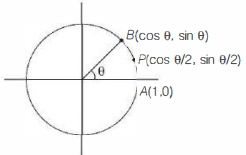
0 likes
View Solution247
AdvancedMCQ
Let $OA$ be a radius of a circle with center $O$ and radius $d$. Let $B$ be a point on the circle such that $\angle AOB = \theta$ $(< \frac{\pi}{2})$. Let $D$ be a point on $OA$ such that $BD \perp OA$. Let $E$ be the mid-point of $BD$ and $F$ be a point on the arc $AB$ such that $EF \parallel OA$. Then,the ratio of the length of the arc $AF$ to the length of the arc $AB$ is
A
$\frac{1}{2}$
B
$\frac{\theta}{2}$
C
$\frac{1}{2} \sin \theta$
D
$\frac{\sin^{-1}(\frac{1}{2} \sin \theta)}{\theta}$
Solution
(D) Given $\angle AOB = \theta$ and radius $OF = OA = OB = d$.
In $\triangle ODB$,$BD = OB \sin \theta = d \sin \theta$.
Since $E$ is the mid-point of $BD$,$ED = \frac{1}{2} BD = \frac{d}{2} \sin \theta$.
Let $F$ be a point on the arc $AB$ such that $EF \parallel OA$. Let $FM \perp OA$ where $M$ is on $OA$. Then $FM = ED = \frac{d}{2} \sin \theta$.
In $\triangle OFM$,$\sin \alpha = \frac{FM}{OF} = \frac{\frac{d}{2} \sin \theta}{d} = \frac{1}{2} \sin \theta$,where $\alpha = \angle AOF$.
Thus,$\alpha = \sin^{-1}(\frac{1}{2} \sin \theta)$.
The length of arc $AF = d \alpha$ and the length of arc $AB = d \theta$.
The ratio of the length of arc $AF$ to the length of arc $AB$ is $\frac{d \alpha}{d \theta} = \frac{\alpha}{\theta} = \frac{\sin^{-1}(\frac{1}{2} \sin \theta)}{\theta}$.
In $\triangle ODB$,$BD = OB \sin \theta = d \sin \theta$.
Since $E$ is the mid-point of $BD$,$ED = \frac{1}{2} BD = \frac{d}{2} \sin \theta$.
Let $F$ be a point on the arc $AB$ such that $EF \parallel OA$. Let $FM \perp OA$ where $M$ is on $OA$. Then $FM = ED = \frac{d}{2} \sin \theta$.
In $\triangle OFM$,$\sin \alpha = \frac{FM}{OF} = \frac{\frac{d}{2} \sin \theta}{d} = \frac{1}{2} \sin \theta$,where $\alpha = \angle AOF$.
Thus,$\alpha = \sin^{-1}(\frac{1}{2} \sin \theta)$.
The length of arc $AF = d \alpha$ and the length of arc $AB = d \theta$.
The ratio of the length of arc $AF$ to the length of arc $AB$ is $\frac{d \alpha}{d \theta} = \frac{\alpha}{\theta} = \frac{\sin^{-1}(\frac{1}{2} \sin \theta)}{\theta}$.
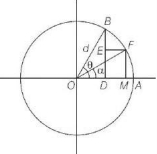
0 likes
View Solution248
AdvancedMCQ
Circles $C_1$ and $C_2$,of radii $r$ and $R$ respectively,touch each other as shown in the figure. The line $l$,which is parallel to the line joining the centres of $C_1$ and $C_2$,is tangent to $C_1$ at $P$ and intersects $C_2$ at $A$ and $B$. If $R^2=2r^2$,then $\angle AOB$ equals
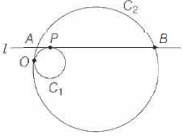
A
$22 \frac{1}{2}^{\circ}$
B
$45^{\circ}$
C
$60^{\circ}$
D
$67 \frac{1}{2}^{\circ}$
Solution
(B) Let $O$ be the center of circle $C_1$ and $O'$ be the center of circle $C_2$. Let the line joining the centers be the $x$-axis.
Since the circles touch each other,the distance between their centers is $R-r$.
Let $M$ be the projection of $P$ onto the line $OO'$. Since $l$ is tangent to $C_1$ at $P$,$PM \perp OO'$,so $PM = r$.
Let $N$ be the projection of $B$ onto the line $OO'$. Since $l$ is parallel to $OO'$,$BN = PM = r$.
In $\triangle O'NB$,$O'B = R$ and $BN = r$.
Given $R^2 = 2r^2$,we have $R = \sqrt{2}r$.
Then $O'N = \sqrt{O'B^2 - BN^2} = \sqrt{2r^2 - r^2} = r$.
Since $O'N = BN = r$,$\triangle O'NB$ is an isosceles right-angled triangle,so $\angle BO'N = 45^{\circ}$.
Similarly,$\angle AO'M = 45^{\circ}$.
Thus,$\angle AO'B = 180^{\circ} - (45^{\circ} + 45^{\circ}) = 90^{\circ}$.
The angle subtended by the chord $AB$ at the center $O'$ is $90^{\circ}$.
The angle subtended by the same chord $AB$ at any point $O$ on the circumference of $C_2$ is half the angle subtended at the center.
Therefore,$\angle AOB = \frac{1}{2} \angle AO'B = \frac{1}{2} \times 90^{\circ} = 45^{\circ}$.
Since the circles touch each other,the distance between their centers is $R-r$.
Let $M$ be the projection of $P$ onto the line $OO'$. Since $l$ is tangent to $C_1$ at $P$,$PM \perp OO'$,so $PM = r$.
Let $N$ be the projection of $B$ onto the line $OO'$. Since $l$ is parallel to $OO'$,$BN = PM = r$.
In $\triangle O'NB$,$O'B = R$ and $BN = r$.
Given $R^2 = 2r^2$,we have $R = \sqrt{2}r$.
Then $O'N = \sqrt{O'B^2 - BN^2} = \sqrt{2r^2 - r^2} = r$.
Since $O'N = BN = r$,$\triangle O'NB$ is an isosceles right-angled triangle,so $\angle BO'N = 45^{\circ}$.
Similarly,$\angle AO'M = 45^{\circ}$.
Thus,$\angle AO'B = 180^{\circ} - (45^{\circ} + 45^{\circ}) = 90^{\circ}$.
The angle subtended by the chord $AB$ at the center $O'$ is $90^{\circ}$.
The angle subtended by the same chord $AB$ at any point $O$ on the circumference of $C_2$ is half the angle subtended at the center.
Therefore,$\angle AOB = \frac{1}{2} \angle AO'B = \frac{1}{2} \times 90^{\circ} = 45^{\circ}$.
0 likes
View Solution249
AdvancedMCQ
Suppose $ABCDEF$ is a hexagon such that $AB=BC=CD=1$ and $DE=EF=FA=2$. If the vertices $A, B, C, D, E, F$ are concyclic,the radius of the circle passing through them is
A
$\sqrt{\frac{5}{2}}$
B
$\sqrt{\frac{7}{3}}$
C
$\sqrt{\frac{11}{5}}$
D
$\sqrt{2}$
Solution
(B) Let $r$ be the radius of the circle. The center of the circle subtends angles at the center corresponding to the chords of lengths $1$ and $2$.
Let $2\theta$ be the angle subtended by a chord of length $1$ at the center,and $2\alpha$ be the angle subtended by a chord of length $2$ at the center.
Then,$\sin \theta = \frac{1/2}{r} = \frac{1}{2r}$ and $\sin \alpha = \frac{1}{r}$.
The sum of the angles around the center is $3(2\theta) + 3(2\alpha) = 360^{\circ}$,which implies $\theta + \alpha = 60^{\circ}$.
Taking cosine on both sides,$\cos(\theta + \alpha) = \cos(60^{\circ}) = \frac{1}{2}$.
Using the formula $\cos(\theta + \alpha) = \cos \theta \cos \alpha - \sin \theta \sin \alpha = \frac{1}{2}$.
Since $\sin \theta = \frac{1}{2r}$,$\cos \theta = \sqrt{1 - \frac{1}{4r^2}} = \frac{\sqrt{4r^2-1}}{2r}$.
Since $\sin \alpha = \frac{1}{r}$,$\cos \alpha = \sqrt{1 - \frac{1}{r^2}} = \frac{\sqrt{r^2-1}}{r}$.
Substituting these into the equation: $\frac{\sqrt{4r^2-1}}{2r} \cdot \frac{\sqrt{r^2-1}}{r} - \frac{1}{2r} \cdot \frac{1}{r} = \frac{1}{2}$.
$\frac{\sqrt{(4r^2-1)(r^2-1)}}{2r^2} = \frac{1}{2} + \frac{1}{2r^2} = \frac{r^2+1}{2r^2}$.
$\sqrt{(4r^2-1)(r^2-1)} = r^2+1$.
Squaring both sides: $(4r^2-1)(r^2-1) = (r^2+1)^2$.
$4r^4 - 5r^2 + 1 = r^4 + 2r^2 + 1$.
$3r^4 = 7r^2 \Rightarrow r^2 = \frac{7}{3}$.
Thus,$r = \sqrt{\frac{7}{3}}$.
Let $2\theta$ be the angle subtended by a chord of length $1$ at the center,and $2\alpha$ be the angle subtended by a chord of length $2$ at the center.
Then,$\sin \theta = \frac{1/2}{r} = \frac{1}{2r}$ and $\sin \alpha = \frac{1}{r}$.
The sum of the angles around the center is $3(2\theta) + 3(2\alpha) = 360^{\circ}$,which implies $\theta + \alpha = 60^{\circ}$.
Taking cosine on both sides,$\cos(\theta + \alpha) = \cos(60^{\circ}) = \frac{1}{2}$.
Using the formula $\cos(\theta + \alpha) = \cos \theta \cos \alpha - \sin \theta \sin \alpha = \frac{1}{2}$.
Since $\sin \theta = \frac{1}{2r}$,$\cos \theta = \sqrt{1 - \frac{1}{4r^2}} = \frac{\sqrt{4r^2-1}}{2r}$.
Since $\sin \alpha = \frac{1}{r}$,$\cos \alpha = \sqrt{1 - \frac{1}{r^2}} = \frac{\sqrt{r^2-1}}{r}$.
Substituting these into the equation: $\frac{\sqrt{4r^2-1}}{2r} \cdot \frac{\sqrt{r^2-1}}{r} - \frac{1}{2r} \cdot \frac{1}{r} = \frac{1}{2}$.
$\frac{\sqrt{(4r^2-1)(r^2-1)}}{2r^2} = \frac{1}{2} + \frac{1}{2r^2} = \frac{r^2+1}{2r^2}$.
$\sqrt{(4r^2-1)(r^2-1)} = r^2+1$.
Squaring both sides: $(4r^2-1)(r^2-1) = (r^2+1)^2$.
$4r^4 - 5r^2 + 1 = r^4 + 2r^2 + 1$.
$3r^4 = 7r^2 \Rightarrow r^2 = \frac{7}{3}$.
Thus,$r = \sqrt{\frac{7}{3}}$.
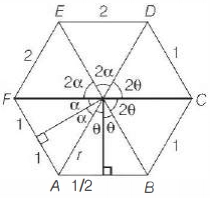
0 likes
View Solution250
AdvancedMCQ
Let $C$ be the circle $x^2+y^2=1$ in the $XY$-plane. For each $t \geq 0$,let $L_t$ be the line passing through $(0,1)$ and $(t, 0)$. Note that $L_t$ intersects $C$ in two points,one of which is $(0,1)$. Let $Q_t$ be the other point. As $t$ varies between $1$ and $1+\sqrt{2}$,the collection of points $Q_t$ sweeps out an arc on $C$. The angle subtended by this arc at $(0,0)$ is
A
$\frac{\pi}{8}$
B
$\frac{\pi}{4}$
C
$\frac{\pi}{3}$
D
$\frac{3\pi}{8}$
Solution
(B) The equation of the circle $C$ is $x^2+y^2=1$.
The line $L_t$ passes through $(0,1)$ and $(t,0)$. Its equation is $\frac{x}{t} + \frac{y}{1} = 1$,which simplifies to $y = 1 - \frac{x}{t}$.
Substituting $y$ into the circle equation: $x^2 + (1 - \frac{x}{t})^2 = 1$.
$x^2 + 1 - \frac{2x}{t} + \frac{x^2}{t^2} = 1$.
$x^2(1 + \frac{1}{t^2}) = \frac{2x}{t}$.
$x^2(\frac{t^2+1}{t^2}) = \frac{2x}{t} \implies x = 0$ or $x = \frac{2t}{1+t^2}$.
The point $(0,1)$ corresponds to $x=0$. The other point $Q_t$ has $x = \frac{2t}{1+t^2}$.
Then $y = 1 - \frac{2}{1+t^2} = \frac{1+t^2-2}{1+t^2} = \frac{t^2-1}{t^2+1}$.
Let $t = \tan \theta$. Then $x = \sin 2\theta$ and $y = -\cos 2\theta$.
For $t \in [1, 1+\sqrt{2}]$,$\theta \in [\frac{\pi}{4}, \frac{3\pi}{8}]$.
The angle $2\theta$ varies from $\frac{\pi}{2}$ to $\frac{3\pi}{4}$.
The angle subtended by the arc at the origin is the difference in the polar angles of the endpoints: $\frac{3\pi}{4} - \frac{\pi}{2} = \frac{\pi}{4}$.
The line $L_t$ passes through $(0,1)$ and $(t,0)$. Its equation is $\frac{x}{t} + \frac{y}{1} = 1$,which simplifies to $y = 1 - \frac{x}{t}$.
Substituting $y$ into the circle equation: $x^2 + (1 - \frac{x}{t})^2 = 1$.
$x^2 + 1 - \frac{2x}{t} + \frac{x^2}{t^2} = 1$.
$x^2(1 + \frac{1}{t^2}) = \frac{2x}{t}$.
$x^2(\frac{t^2+1}{t^2}) = \frac{2x}{t} \implies x = 0$ or $x = \frac{2t}{1+t^2}$.
The point $(0,1)$ corresponds to $x=0$. The other point $Q_t$ has $x = \frac{2t}{1+t^2}$.
Then $y = 1 - \frac{2}{1+t^2} = \frac{1+t^2-2}{1+t^2} = \frac{t^2-1}{t^2+1}$.
Let $t = \tan \theta$. Then $x = \sin 2\theta$ and $y = -\cos 2\theta$.
For $t \in [1, 1+\sqrt{2}]$,$\theta \in [\frac{\pi}{4}, \frac{3\pi}{8}]$.
The angle $2\theta$ varies from $\frac{\pi}{2}$ to $\frac{3\pi}{4}$.
The angle subtended by the arc at the origin is the difference in the polar angles of the endpoints: $\frac{3\pi}{4} - \frac{\pi}{2} = \frac{\pi}{4}$.
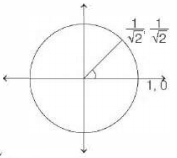
0 likes
View Solution10-1.Circle and System of Circles — Geometrical problems regarding circle and its properties · Frequently Asked Questions
1Are these 10-1.Circle and System of Circles questions useful for JEE and NEET?
Yes. All questions in this section are mapped to JEE Main and NEET exam patterns. Previous year questions from JEE Main, NEET, GUJCET and state-level exams are included with full solutions.
2Can I switch to Hindi or Gujarati for these questions?
Yes. Use the language tabs in the hero section or the sidebar to view the same questions and solutions in English, Hindi or Gujarati.
3How do I generate a question paper from this subtopic?
Use the Vedclass Exam Paper Generator — select the chapter and subtopic, set difficulty, and generate Sets A, B, C, D automatically. First 3 chapters of every subject are free.
Vedclass Products
For Students
Vedclass Test Series
Mock tests in real JEE/NEET style with performance analysis. 5-day free trial.
Start Free TrialFor Teachers
Exam Paper Generator
Generate Set A/B/C/D papers from this chapter in 2 minutes. 3 chapters free.
Try FreeFor Institutes
Online Exam Module
Live online exams with unlimited students, 360° analytics & white-label branding.
See DemoFor Teachers & Institutes
Generate a 10-1.Circle and System of Circles Exam Paper in 2 Minutes
Select subtopic & difficulty — Sets A, B, C, D auto-generated with No Repeat logic.
First 3 chapters of every subject are free — no payment required.