
A English
Free energy and Work Questions in English
Class 11 Chemistry · Thermodynamics · Free energy and Work
193+
Questions
English
Language
100%
With Solutions
Showing 49 of 193 questions in English
101
MediumMCQ
In which of the following conditions will a reaction always be spontaneous at all temperatures?
A
$\Delta H = +ve, \Delta S = +ve$
B
$\Delta H = +ve, \Delta S = -ve$
C
$\Delta H = -ve, \Delta S = -ve$
D
$\Delta H = -ve, \Delta S = +ve$
Solution
(D) For a reaction to be spontaneous,the Gibbs free energy change $\Delta G$ must be negative. The relationship is given by $\Delta G = \Delta H - T \cdot \Delta S$.
If $\Delta H$ is negative (exothermic) and $\Delta S$ is positive (increase in entropy),then $\Delta G$ will be negative at all temperatures $T$ because both terms $\Delta H$ and $-T \cdot \Delta S$ will be negative.
If $\Delta H$ is negative (exothermic) and $\Delta S$ is positive (increase in entropy),then $\Delta G$ will be negative at all temperatures $T$ because both terms $\Delta H$ and $-T \cdot \Delta S$ will be negative.
0 likes
View Solution102
MediumMCQ
Which of the following is correct?
A
$[dG/dP]_T = V$
B
$[dG/dT]_P = -S$
C
$[dG/dP]_T = 1/V$
D
$[dG/dT]_P = C_V$
Solution
(B) The Gibbs free energy is defined as $G = H - TS$.
For a system at constant pressure,the change in Gibbs free energy with respect to temperature is given by the fundamental thermodynamic relation:
$[dG/dT]_P = -S$.
Thus,the correct relation is $[dG/dT]_P = -S$.
For a system at constant pressure,the change in Gibbs free energy with respect to temperature is given by the fundamental thermodynamic relation:
$[dG/dT]_P = -S$.
Thus,the correct relation is $[dG/dT]_P = -S$.
0 likes
View Solution103
MediumMCQ
The value of ${\left[ {\frac{dG}{dT}} \right]_P}$ is ....
A
$-S$
B
$S$
C
$V$
D
$1/V$
Solution
(A) From the fundamental thermodynamic relation for Gibbs free energy,$dG = VdP - SdT$.
At constant pressure,$dP = 0$,so $dG = -SdT$.
Therefore,${\left[ {\frac{dG}{dT}} \right]_P} = -S$.
At constant pressure,$dP = 0$,so $dG = -SdT$.
Therefore,${\left[ {\frac{dG}{dT}} \right]_P} = -S$.
0 likes
View Solution104
MediumMCQ
For a chemical reaction,if $\Delta H = \Delta S > 0$,then $\Delta H = $ ................
A
$\Delta G$
B
$\Delta G/T$
C
$\Delta G/(1 - T)$
D
$(1 - T)/\Delta G$
Solution
(C) The Gibbs free energy equation is given by: $\Delta G = \Delta H - T \cdot \Delta S$.
Given that $\Delta H = \Delta S$,we substitute $\Delta S$ with $\Delta H$ in the equation:
$\Delta G = \Delta H - T \cdot \Delta H$.
Factoring out $\Delta H$:
$\Delta G = \Delta H(1 - T)$.
Rearranging to solve for $\Delta H$:
$\Delta H = \frac{\Delta G}{1 - T}$.
Given that $\Delta H = \Delta S$,we substitute $\Delta S$ with $\Delta H$ in the equation:
$\Delta G = \Delta H - T \cdot \Delta H$.
Factoring out $\Delta H$:
$\Delta G = \Delta H(1 - T)$.
Rearranging to solve for $\Delta H$:
$\Delta H = \frac{\Delta G}{1 - T}$.
0 likes
View Solution105
MediumMCQ
For a chemical reaction,if $\Delta H > 0$ and $\Delta S > 0$,under what condition will the reaction not be spontaneous?
A
$\Delta H > T \cdot \Delta S$
B
$\Delta H = T \cdot \Delta S$
C
$\Delta G = 0$
D
$T \cdot \Delta S - \Delta H > 0$
Solution
(A) The Gibbs free energy equation is given by $\Delta G = \Delta H - T \cdot \Delta S$.
For a reaction to be non-spontaneous,the change in Gibbs free energy must be positive,i.e.,$\Delta G > 0$.
Substituting the expression,we get $\Delta H - T \cdot \Delta S > 0$,which implies $\Delta H > T \cdot \Delta S$.
For a reaction to be non-spontaneous,the change in Gibbs free energy must be positive,i.e.,$\Delta G > 0$.
Substituting the expression,we get $\Delta H - T \cdot \Delta S > 0$,which implies $\Delta H > T \cdot \Delta S$.
0 likes
View Solution106
DifficultMCQ
For a reaction,$\Delta H = +3 \, kJ$ and $\Delta S = +10 \, J/K$. At what minimum temperature (in $K$) will the reaction become spontaneous?
A
$300$
B
$200$
C
$273$
D
$373$
Solution
(A) For a reaction to be spontaneous,the Gibbs free energy change $\Delta G$ must be negative $(\Delta G < 0)$.
Given the equation $\Delta G = \Delta H - T\Delta S$,for $\Delta G < 0$,we have $\Delta H - T\Delta S < 0$.
This implies $\Delta H < T\Delta S$,or $T > \frac{\Delta H}{\Delta S}$.
Given $\Delta H = 3 \, kJ = 3000 \, J$ and $\Delta S = 10 \, J/K$.
Substituting these values: $T > \frac{3000 \, J}{10 \, J/K} = 300 \, K$.
Thus,the reaction becomes spontaneous at temperatures above $300 \, K$.
Given the equation $\Delta G = \Delta H - T\Delta S$,for $\Delta G < 0$,we have $\Delta H - T\Delta S < 0$.
This implies $\Delta H < T\Delta S$,or $T > \frac{\Delta H}{\Delta S}$.
Given $\Delta H = 3 \, kJ = 3000 \, J$ and $\Delta S = 10 \, J/K$.
Substituting these values: $T > \frac{3000 \, J}{10 \, J/K} = 300 \, K$.
Thus,the reaction becomes spontaneous at temperatures above $300 \, K$.
0 likes
View Solution107
MediumMCQ
For a reaction with $\Delta H = +ve$ and $\Delta S = +ve$,which of the following statements is correct?
A
The reaction is spontaneous at high temperatures.
B
The reaction is spontaneous at low temperatures.
C
The reaction is non-spontaneous at high temperatures.
D
The reaction is non-spontaneous at all temperatures.
Solution
(A) The Gibbs free energy equation is given by $\Delta G = \Delta H - T \cdot \Delta S$.
For a reaction to be spontaneous,$\Delta G$ must be less than $0$.
Therefore,$\Delta H - T \cdot \Delta S < 0$,which implies $\Delta H < T \cdot \Delta S$.
Since both $\Delta H$ and $\Delta S$ are positive,the condition $\Delta H < T \cdot \Delta S$ is satisfied only when the temperature $T$ is high.
Thus,the reaction is spontaneous at high temperatures.
For a reaction to be spontaneous,$\Delta G$ must be less than $0$.
Therefore,$\Delta H - T \cdot \Delta S < 0$,which implies $\Delta H < T \cdot \Delta S$.
Since both $\Delta H$ and $\Delta S$ are positive,the condition $\Delta H < T \cdot \Delta S$ is satisfied only when the temperature $T$ is high.
Thus,the reaction is spontaneous at high temperatures.
0 likes
View Solution108
MediumMCQ
For the reaction $A \to B$,$\Delta H = 4 \, kcal \, mol^{-1}$ and $\Delta S = 10 \, cal \, K^{-1} \, mol^{-1}$. At what temperature $(K)$ will the reaction become spontaneous?
A
$400$
B
$300$
C
$500$
D
None of these
Solution
(C) For a spontaneous reaction,the Gibbs free energy change $\Delta G$ must be negative,i.e.,$\Delta G < 0$.
Given $\Delta G = \Delta H - T\Delta S < 0$,which implies $\Delta H < T\Delta S$ or $T > \frac{\Delta H}{\Delta S}$.
Convert $\Delta H$ to calories: $\Delta H = 4 \, kcal \, mol^{-1} = 4000 \, cal \, mol^{-1}$.
Calculate the equilibrium temperature: $T = \frac{\Delta H}{\Delta S} = \frac{4000 \, cal \, mol^{-1}}{10 \, cal \, K^{-1} \, mol^{-1}} = 400 \, K$.
Since $T > 400 \, K$,the reaction is spontaneous at temperatures greater than $400 \, K$. Among the given options,$500 \, K$ is the correct temperature where the reaction is spontaneous.
Given $\Delta G = \Delta H - T\Delta S < 0$,which implies $\Delta H < T\Delta S$ or $T > \frac{\Delta H}{\Delta S}$.
Convert $\Delta H$ to calories: $\Delta H = 4 \, kcal \, mol^{-1} = 4000 \, cal \, mol^{-1}$.
Calculate the equilibrium temperature: $T = \frac{\Delta H}{\Delta S} = \frac{4000 \, cal \, mol^{-1}}{10 \, cal \, K^{-1} \, mol^{-1}} = 400 \, K$.
Since $T > 400 \, K$,the reaction is spontaneous at temperatures greater than $400 \, K$. Among the given options,$500 \, K$ is the correct temperature where the reaction is spontaneous.
0 likes
View Solution109
EasyMCQ
For a reaction to be spontaneous at all temperatures,which of the following conditions must be satisfied?
A
$\Delta G < 0, \Delta H > 0, \Delta S > 0$
B
$\Delta G > 0, \Delta H < 0, \Delta S > 0$
C
$\Delta G < 0, \Delta H < 0, \Delta S < 0$
D
$\Delta G < 0, \Delta H < 0, \Delta S > 0$
Solution
(D) The spontaneity of a reaction is determined by the Gibbs free energy equation: $\Delta G = \Delta H - T\Delta S$.
For a reaction to be spontaneous at all temperatures,$\Delta G$ must be negative.
This occurs when the enthalpy change $\Delta H$ is negative (exothermic) and the entropy change $\Delta S$ is positive (increase in disorder).
In this case,$\Delta G = (\text{negative}) - T(\text{positive})$,which will always be negative regardless of the temperature $T$.
For a reaction to be spontaneous at all temperatures,$\Delta G$ must be negative.
This occurs when the enthalpy change $\Delta H$ is negative (exothermic) and the entropy change $\Delta S$ is positive (increase in disorder).
In this case,$\Delta G = (\text{negative}) - T(\text{positive})$,which will always be negative regardless of the temperature $T$.
0 likes
View Solution110
MediumMCQ
Assertion: Many endothermic reactions that are not spontaneous at room temperature become spontaneous at high temperature.
Reason: Entropy of the system increases with increase in temperature.
Reason: Entropy of the system increases with increase in temperature.
A
If both Assertion and Reason are correct and the Reason is a correct explanation of the Assertion.
B
If both Assertion and Reason are correct but Reason is not a correct explanation of the Assertion.
C
If the Assertion is correct but Reason is incorrect.
D
If both the Assertion and Reason are incorrect.
Solution
(C) For a reaction to be spontaneous,the Gibbs free energy change $\Delta G$ must be negative,where $\Delta G = \Delta H - T\Delta S$.
For endothermic reactions,$\Delta H > 0$. If the reaction involves an increase in entropy $(\Delta S > 0)$,then at high temperatures,the term $T\Delta S$ becomes larger than $\Delta H$.
Consequently,$\Delta G = \Delta H - T\Delta S$ becomes negative,making the reaction spontaneous at high temperatures.
The reason provided is incorrect because the entropy of a system is generally considered a state function that does not necessarily increase with temperature in the context of the spontaneity condition; rather,the term $T\Delta S$ increases with temperature.
For endothermic reactions,$\Delta H > 0$. If the reaction involves an increase in entropy $(\Delta S > 0)$,then at high temperatures,the term $T\Delta S$ becomes larger than $\Delta H$.
Consequently,$\Delta G = \Delta H - T\Delta S$ becomes negative,making the reaction spontaneous at high temperatures.
The reason provided is incorrect because the entropy of a system is generally considered a state function that does not necessarily increase with temperature in the context of the spontaneity condition; rather,the term $T\Delta S$ increases with temperature.
0 likes
View Solution111
EasyMCQ
$A$ reaction,$A + B \rightarrow C + D + q$,is found to have a positive entropy change. The reaction will be:
A
possible at high temperature
B
possible only at low temperature
C
not possible at any temperature
D
possible at any temperature
Solution
(D) For a reaction to be spontaneous,the Gibbs free energy change $\Delta G$ must be negative.
The relationship is given by $\Delta G = \Delta H - T\Delta S$.
According to the reaction $A + B \rightarrow C + D + q$,the term $q$ indicates that heat is evolved,so the enthalpy change $\Delta H$ is negative.
Given that the entropy change $\Delta S$ is positive,the term $-T\Delta S$ will always be negative for any temperature $T > 0$.
Since both $\Delta H$ and $-T\Delta S$ are negative,$\Delta G$ will be negative at all temperatures.
Therefore,the reaction is spontaneous at any temperature.
The relationship is given by $\Delta G = \Delta H - T\Delta S$.
According to the reaction $A + B \rightarrow C + D + q$,the term $q$ indicates that heat is evolved,so the enthalpy change $\Delta H$ is negative.
Given that the entropy change $\Delta S$ is positive,the term $-T\Delta S$ will always be negative for any temperature $T > 0$.
Since both $\Delta H$ and $-T\Delta S$ are negative,$\Delta G$ will be negative at all temperatures.
Therefore,the reaction is spontaneous at any temperature.
0 likes
View Solution112
Easy
For the reaction at $298 \, K$,$2 A + B \rightarrow C$. Given $\Delta H = 400 \, kJ \, mol^{-1}$ and $\Delta S = 0.2 \, kJ \, K^{-1} \, mol^{-1}$. At what temperature will the reaction become spontaneous,considering $\Delta H$ and $\Delta S$ to be constant over the temperature range?
Solution
(D) For a reaction to be spontaneous,the Gibbs free energy change $\Delta G$ must be negative.
The relationship is given by $\Delta G = \Delta H - T \Delta S$.
At equilibrium,$\Delta G = 0$,so $T = \frac{\Delta H}{\Delta S}$.
Substituting the given values: $T = \frac{400 \, kJ \, mol^{-1}}{0.2 \, kJ \, K^{-1} \, mol^{-1}} = 2000 \, K$.
Since $\Delta H$ is positive (endothermic) and $\Delta S$ is positive,the reaction becomes spontaneous when $T \Delta S > \Delta H$.
Therefore,the reaction will be spontaneous at $T > 2000 \, K$.
The relationship is given by $\Delta G = \Delta H - T \Delta S$.
At equilibrium,$\Delta G = 0$,so $T = \frac{\Delta H}{\Delta S}$.
Substituting the given values: $T = \frac{400 \, kJ \, mol^{-1}}{0.2 \, kJ \, K^{-1} \, mol^{-1}} = 2000 \, K$.
Since $\Delta H$ is positive (endothermic) and $\Delta S$ is positive,the reaction becomes spontaneous when $T \Delta S > \Delta H$.
Therefore,the reaction will be spontaneous at $T > 2000 \, K$.
0 likes
View Solution113
Medium
Describe Gibbs energy and spontaneity.
Solution
(N/A) Gibbs energy $(G)$ is an extensive property defined as $G = H - TS$.
The change in Gibbs energy for a system at constant temperature $(\Delta T = 0)$ is given by the Gibbs equation:
$\Delta G = \Delta H - T \Delta S$
Here,$\Delta H$ and $T \Delta S$ are energy terms,so $\Delta G$ has units of energy.
For a system in thermal equilibrium with its surroundings,the temperature of the system equals the temperature of the surroundings. The heat lost by the system is gained by the surroundings,so $\Delta H_{\text{surr}} = -\Delta H_{\text{sys}}$.
The total entropy change is $\Delta S_{\text{total}} = \Delta S_{\text{sys}} + \Delta S_{\text{surr}} = \Delta S_{\text{sys}} - \frac{\Delta H_{\text{sys}}}{T}$.
Multiplying by $-T$,we get $-T \Delta S_{\text{total}} = \Delta H_{\text{sys}} - T \Delta S_{\text{sys}} = \Delta G_{\text{sys}}$.
Criteria for spontaneity:
$1$. If $\Delta G < 0$,the process is spontaneous.
$2$. If $\Delta G > 0$,the process is non-spontaneous.
$3$. If $\Delta G = 0$,the system is at equilibrium.
The change in Gibbs energy for a system at constant temperature $(\Delta T = 0)$ is given by the Gibbs equation:
$\Delta G = \Delta H - T \Delta S$
Here,$\Delta H$ and $T \Delta S$ are energy terms,so $\Delta G$ has units of energy.
For a system in thermal equilibrium with its surroundings,the temperature of the system equals the temperature of the surroundings. The heat lost by the system is gained by the surroundings,so $\Delta H_{\text{surr}} = -\Delta H_{\text{sys}}$.
The total entropy change is $\Delta S_{\text{total}} = \Delta S_{\text{sys}} + \Delta S_{\text{surr}} = \Delta S_{\text{sys}} - \frac{\Delta H_{\text{sys}}}{T}$.
Multiplying by $-T$,we get $-T \Delta S_{\text{total}} = \Delta H_{\text{sys}} - T \Delta S_{\text{sys}} = \Delta G_{\text{sys}}$.
Criteria for spontaneity:
$1$. If $\Delta G < 0$,the process is spontaneous.
$2$. If $\Delta G > 0$,the process is non-spontaneous.
$3$. If $\Delta G = 0$,the system is at equilibrium.
0 likes
View Solution114
Medium
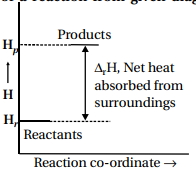
An enthalpy diagram for a particular reaction is given in the figure. Is it possible to decide the spontaneity of a reaction from the given diagram? Explain.
Solution
(N/A) No,it is not possible to decide the spontaneity of a reaction solely from the enthalpy diagram.
Enthalpy change $(\Delta_rH)$ is only one of the contributing factors in determining the spontaneity of a reaction.
Another essential factor,the entropy factor $(\Delta S)$,must also be taken into consideration.
The overall spontaneity is determined by the Gibbs free energy change,given by the equation $\Delta G = \Delta H - T\Delta S$,where a reaction is spontaneous only if $\Delta G < 0$.
Enthalpy change $(\Delta_rH)$ is only one of the contributing factors in determining the spontaneity of a reaction.
Another essential factor,the entropy factor $(\Delta S)$,must also be taken into consideration.
The overall spontaneity is determined by the Gibbs free energy change,given by the equation $\Delta G = \Delta H - T\Delta S$,where a reaction is spontaneous only if $\Delta G < 0$.
0 likes
View Solution115
Difficult
$\Delta G$ is net energy available to do useful work and is thus a measure of "free energy". Show mathematically that $\Delta G$ is a measure of free energy. Find the unit of $\Delta G$. If a reaction has positive enthalpy change and positive entropy change,under what condition will the reaction be spontaneous?
Solution
(N/A) Gibbs free energy is the thermodynamic quantity of a system,the decrease in whose value during a process is equal to the maximum possible useful work that can be obtained from the system.
Mathematically,this result may be derived as follows:
The relationship between heat absorbed by a system $q$,the change in its internal energy $\Delta U$,and the work done by the system is given by the first law of thermodynamics:
$q = \Delta U + W_{\text{expansion}} + W_{\text{non-expansion}}$ $(i)$
Under constant pressure,the expansion work is $p \Delta V$. Since $\Delta H = \Delta U + p \Delta V$,we have:
$q = \Delta H + W_{\text{non-expansion}}$ $(ii)$
For a reversible process at constant temperature $T$,$\Delta S = \frac{q_{\text{rev}}}{T}$,so $q_{\text{rev}} = T \Delta S$ $(iii)$
Substituting $(iii)$ into $(ii)$:
$T \Delta S = \Delta H + W_{\text{non-expansion}}$
$\Delta H - T \Delta S = -W_{\text{non-expansion}}$ $(iv)$
Since $\Delta G = \Delta H - T \Delta S$,equation $(iv)$ becomes:
$\Delta G = -W_{\text{non-expansion}}$ $(v)$
Thus,$-\Delta G$ represents the maximum useful work (non-expansion work) obtainable from the system.
The unit of $\Delta G$ is the same as energy,which is joule $(J)$ or kilojoule $(kJ)$.
For a reaction with positive $\Delta H$ and positive $\Delta S$,the condition for spontaneity $(\Delta G < 0)$ is:
$\Delta H - T \Delta S < 0$
$T \Delta S > \Delta H$
$T > \frac{\Delta H}{\Delta S}$
Thus,the reaction is spontaneous at high temperatures.
Mathematically,this result may be derived as follows:
The relationship between heat absorbed by a system $q$,the change in its internal energy $\Delta U$,and the work done by the system is given by the first law of thermodynamics:
$q = \Delta U + W_{\text{expansion}} + W_{\text{non-expansion}}$ $(i)$
Under constant pressure,the expansion work is $p \Delta V$. Since $\Delta H = \Delta U + p \Delta V$,we have:
$q = \Delta H + W_{\text{non-expansion}}$ $(ii)$
For a reversible process at constant temperature $T$,$\Delta S = \frac{q_{\text{rev}}}{T}$,so $q_{\text{rev}} = T \Delta S$ $(iii)$
Substituting $(iii)$ into $(ii)$:
$T \Delta S = \Delta H + W_{\text{non-expansion}}$
$\Delta H - T \Delta S = -W_{\text{non-expansion}}$ $(iv)$
Since $\Delta G = \Delta H - T \Delta S$,equation $(iv)$ becomes:
$\Delta G = -W_{\text{non-expansion}}$ $(v)$
Thus,$-\Delta G$ represents the maximum useful work (non-expansion work) obtainable from the system.
The unit of $\Delta G$ is the same as energy,which is joule $(J)$ or kilojoule $(kJ)$.
For a reaction with positive $\Delta H$ and positive $\Delta S$,the condition for spontaneity $(\Delta G < 0)$ is:
$\Delta H - T \Delta S < 0$
$T \Delta S > \Delta H$
$T > \frac{\Delta H}{\Delta S}$
Thus,the reaction is spontaneous at high temperatures.
0 likes
View Solution116
EasyMCQ
At a temperature of $298 \ K$,if $\Delta H < T \Delta S$,what is the value of the equilibrium constant $K$?
A
$K > 1$
B
$K < 1$
C
$K = 1$
D
$K = 0$
Solution
(A) The relationship between Gibbs free energy change $\Delta G$ and the equilibrium constant $K$ is given by $\Delta G = -RT \ln K$.
Given the condition $\Delta H < T \Delta S$,we know that $\Delta G = \Delta H - T \Delta S < 0$.
Since $\Delta G < 0$,the reaction is spontaneous in the forward direction.
Substituting $\Delta G < 0$ into the equation $-RT \ln K < 0$,we get $\ln K > 0$,which implies $K > 1$.
Given the condition $\Delta H < T \Delta S$,we know that $\Delta G = \Delta H - T \Delta S < 0$.
Since $\Delta G < 0$,the reaction is spontaneous in the forward direction.
Substituting $\Delta G < 0$ into the equation $-RT \ln K < 0$,we get $\ln K > 0$,which implies $K > 1$.
0 likes
View Solution117
EasyMCQ
State the criteria for a spontaneous process in terms of $\Delta G$ at constant pressure and temperature.
A
$\Delta G < 0$
B
$\Delta G > 0$
C
$\Delta G = 0$
D
$\Delta G = 1$
Solution
(A) For a process to be spontaneous at constant pressure and temperature,the change in Gibbs free energy must be negative.
$1$. If $\Delta G < 0$,the process is spontaneous.
$2$. If $\Delta G > 0$,the process is non-spontaneous.
$3$. If $\Delta G = 0$,the process is at equilibrium.
$1$. If $\Delta G < 0$,the process is spontaneous.
$2$. If $\Delta G > 0$,the process is non-spontaneous.
$3$. If $\Delta G = 0$,the process is at equilibrium.
0 likes
View Solution118
EasyMCQ
What is the relationship between Gibbs free energy change,enthalpy change,and entropy change?
A
$\Delta G = \Delta H + T \Delta S$
B
$\Delta G = \Delta H - T \Delta S$
C
$\Delta G = \Delta S - T \Delta H$
D
$\Delta G = \Delta H + \Delta S$
Solution
(B) The relationship between Gibbs free energy change $(\Delta G)$,enthalpy change $(\Delta H)$,and entropy change $(\Delta S)$ at a constant temperature $(T)$ is given by the Gibbs-Helmholtz equation:
$\Delta G = \Delta H - T \Delta S$
$\Delta G = \Delta H - T \Delta S$
0 likes
View Solution119
Easy
What is the value of $\Delta G$ for a water system in an environment with a temperature of $100 \ K$?
Solution
(D) The freezing point of water is $273 \ K$ $(0^{\circ}C)$.
At $100 \ K$,water exists as ice (solid state).
The process of water remaining as ice at $100 \ K$ is spontaneous.
For a spontaneous process,the change in Gibbs free energy,$\Delta G$,is negative $(\Delta G < 0)$.
At $100 \ K$,water exists as ice (solid state).
The process of water remaining as ice at $100 \ K$ is spontaneous.
For a spontaneous process,the change in Gibbs free energy,$\Delta G$,is negative $(\Delta G < 0)$.
0 likes
View Solution120
EasyMCQ
State the criteria for a spontaneous process in terms of $\Delta G$ at constant pressure and temperature.
A
$\Delta G < 0$
B
$\Delta G > 0$
C
$\Delta G = 0$
D
$\Delta G \geq 0$
Solution
(A) For a process to be spontaneous at constant pressure and temperature,the change in Gibbs free energy must be negative.
$1$. If $\Delta G < 0$,the process is spontaneous.
$2$. If $\Delta G > 0$,the process is non-spontaneous.
$3$. If $\Delta G = 0$,the process is at equilibrium.
$1$. If $\Delta G < 0$,the process is spontaneous.
$2$. If $\Delta G > 0$,the process is non-spontaneous.
$3$. If $\Delta G = 0$,the process is at equilibrium.
0 likes
View Solution121
Easy
What is the relationship between Gibbs free energy change,enthalpy change,and entropy change?
Solution
(N/A) The relationship between Gibbs free energy change $(\Delta G)$,enthalpy change $(\Delta H)$,and entropy change $(\Delta S)$ at a constant temperature $(T)$ is given by the Gibbs-Helmholtz equation: $\Delta G = \Delta H - T \Delta S$.
0 likes
View Solution122
Easy
What is the value of $\Delta G$ for a water system in an environment at a temperature of $100 \ K$?
Solution
(C) The freezing point of water is $273 \ K$ at $1 \ \text{atm}$ pressure.
At $100 \ K$,the system is below the freezing point of water.
Since the temperature is below the phase transition temperature $(273 \ K)$,the process of freezing (liquid to solid) is spontaneous.
For a spontaneous process,the change in Gibbs free energy is negative,i.e.,$\Delta G < 0$.
At $100 \ K$,the system is below the freezing point of water.
Since the temperature is below the phase transition temperature $(273 \ K)$,the process of freezing (liquid to solid) is spontaneous.
For a spontaneous process,the change in Gibbs free energy is negative,i.e.,$\Delta G < 0$.
0 likes
View Solution123
Medium
Compare the following criteria for spontaneity of a reaction based on the values of $\Delta_{\text{r}}H^0$,$\Delta_{\text{r}}S^0$,and $\Delta_{\text{r}}G^0$:
| $\Delta_{\text{r}}H^0$ | $\Delta_{\text{r}}S^0$ | $\Delta_{\text{r}}G^0$ | Description |
|---|---|---|---|
| $(a) (+)$ | $(-)$ | $(+)$ | $(i) \text{ Non-spontaneous at all temperatures}$ |
| $(b) (-)$ | $(-)$ | $(-)$ | $(ii) \text{ Spontaneous at low temperatures}$ |
| $(c) (-)$ | $(+)$ | $(-)$ | $(iii) \text{ Spontaneous at all temperatures}$ |
Solution
(A) The spontaneity of a reaction is determined by the Gibbs free energy equation: $\Delta G = \Delta H - T\Delta S$.
$1$. If $\Delta H > 0$ (endothermic) and $\Delta S < 0$ (entropy decreases),then $\Delta G$ will always be positive at all temperatures. Thus,the reaction is non-spontaneous at all temperatures. $(a-i)$.
$2$. If $\Delta H < 0$ (exothermic) and $\Delta S < 0$ (entropy decreases),then $\Delta G$ will be negative only at low temperatures (where $|\Delta H| > |T\Delta S|$). Thus,the reaction is spontaneous at low temperatures. $(b-ii)$.
$3$. If $\Delta H < 0$ (exothermic) and $\Delta S > 0$ (entropy increases),then $\Delta G$ will always be negative at all temperatures. Thus,the reaction is spontaneous at all temperatures. $(c-iii)$.
Therefore,the correct matching is $(a-i, b-ii, c-iii)$.
$1$. If $\Delta H > 0$ (endothermic) and $\Delta S < 0$ (entropy decreases),then $\Delta G$ will always be positive at all temperatures. Thus,the reaction is non-spontaneous at all temperatures. $(a-i)$.
$2$. If $\Delta H < 0$ (exothermic) and $\Delta S < 0$ (entropy decreases),then $\Delta G$ will be negative only at low temperatures (where $|\Delta H| > |T\Delta S|$). Thus,the reaction is spontaneous at low temperatures. $(b-ii)$.
$3$. If $\Delta H < 0$ (exothermic) and $\Delta S > 0$ (entropy increases),then $\Delta G$ will always be negative at all temperatures. Thus,the reaction is spontaneous at all temperatures. $(c-iii)$.
Therefore,the correct matching is $(a-i, b-ii, c-iii)$.
0 likes
View Solution124
MediumMCQ
For the reaction occurring in the gaseous phase: $PCl_{5(g)} \rightleftharpoons PCl_{3(g)} + Cl_{2(g)}$,which of the following conditions is correct for the reaction to be spontaneous at high temperatures?
A
$\Delta H > 0$ and $\Delta S > 0$
B
$\Delta H < 0$ and $\Delta S > 0$
C
$\Delta H > 0$ and $\Delta S < 0$
D
$\Delta H < 0$ and $\Delta S < 0$
Solution
(A) The reaction $PCl_{5(g)} \rightleftharpoons PCl_{3(g)} + Cl_{2(g)}$ involves the dissociation of one mole of gas into two moles of gas,which leads to an increase in entropy,so $\Delta S > 0$.
Since bond breaking is an endothermic process,the enthalpy change is positive,so $\Delta H > 0$.
For a reaction to be spontaneous,the Gibbs free energy change $\Delta G = \Delta H - T\Delta S$ must be negative.
At high temperatures,the term $T\Delta S$ becomes large and positive,making $\Delta G$ negative when $\Delta H > 0$ and $\Delta S > 0$.
Since bond breaking is an endothermic process,the enthalpy change is positive,so $\Delta H > 0$.
For a reaction to be spontaneous,the Gibbs free energy change $\Delta G = \Delta H - T\Delta S$ must be negative.
At high temperatures,the term $T\Delta S$ becomes large and positive,making $\Delta G$ negative when $\Delta H > 0$ and $\Delta S > 0$.
0 likes
View Solution125
MediumMCQ
For a reaction,$4 M (s) + n O_2 (g) \rightarrow 2 M_2 O_n (s)$,the free energy change is plotted as a function of temperature. The temperature below which the oxide is stable could be inferred from the plot as the point at which :
A
the slope changes from positive to zero
B
the free energy change shows a change from negative to positive value
C
the slope changes from negative to positive
D
the slope changes from positive to negative
Solution
(B) The stability of an oxide is determined by the Gibbs free energy change $(\Delta G)$ of the formation reaction.
For the reaction $4 M (s) + n O_2 (g) \rightarrow 2 M_2 O_n (s)$,the oxide is stable when $\Delta G < 0$.
As the temperature increases,the value of $\Delta G$ increases.
The temperature at which $\Delta G = 0$ is the equilibrium temperature.
Below this temperature,$\Delta G$ is negative,meaning the oxide is stable.
Above this temperature,$\Delta G$ becomes positive,meaning the oxide is unstable and tends to decompose.
Therefore,the point where the free energy change crosses from negative to positive indicates the temperature limit for stability.
For the reaction $4 M (s) + n O_2 (g) \rightarrow 2 M_2 O_n (s)$,the oxide is stable when $\Delta G < 0$.
As the temperature increases,the value of $\Delta G$ increases.
The temperature at which $\Delta G = 0$ is the equilibrium temperature.
Below this temperature,$\Delta G$ is negative,meaning the oxide is stable.
Above this temperature,$\Delta G$ becomes positive,meaning the oxide is unstable and tends to decompose.
Therefore,the point where the free energy change crosses from negative to positive indicates the temperature limit for stability.
0 likes
View Solution126
MediumMCQ
If for a certain reaction $\Delta_{r} H$ is $30 \; kJ \; mol^{-1}$ at $450 \; K$,the value of $\Delta_{r} S$ (in $J \; K^{-1} \; mol^{-1}$) for which the same reaction will be spontaneous at the same temperature is
A
$< 66.67$
B
$> 66.67$
C
$< 33.33$
D
$> 33.33$
Solution
(B) For a reaction to be spontaneous,the change in Gibbs free energy,$\Delta_{r} G$,must be negative $(\Delta_{r} G < 0)$.
The relationship is given by the equation: $\Delta_{r} G = \Delta_{r} H - T \Delta_{r} S$.
Substituting the condition for spontaneity: $\Delta_{r} H - T \Delta_{r} S < 0$.
Rearranging the inequality: $\Delta_{r} H < T \Delta_{r} S$ or $\Delta_{r} S > \frac{\Delta_{r} H}{T}$.
Given $\Delta_{r} H = 30 \; kJ \; mol^{-1} = 30,000 \; J \; mol^{-1}$ and $T = 450 \; K$.
$\Delta_{r} S > \frac{30,000 \; J \; mol^{-1}}{450 \; K} = 66.67 \; J \; K^{-1} \; mol^{-1}$.
Therefore,the reaction will be spontaneous if $\Delta_{r} S > 66.67 \; J \; K^{-1} \; mol^{-1}$.
The relationship is given by the equation: $\Delta_{r} G = \Delta_{r} H - T \Delta_{r} S$.
Substituting the condition for spontaneity: $\Delta_{r} H - T \Delta_{r} S < 0$.
Rearranging the inequality: $\Delta_{r} H < T \Delta_{r} S$ or $\Delta_{r} S > \frac{\Delta_{r} H}{T}$.
Given $\Delta_{r} H = 30 \; kJ \; mol^{-1} = 30,000 \; J \; mol^{-1}$ and $T = 450 \; K$.
$\Delta_{r} S > \frac{30,000 \; J \; mol^{-1}}{450 \; K} = 66.67 \; J \; K^{-1} \; mol^{-1}$.
Therefore,the reaction will be spontaneous if $\Delta_{r} S > 66.67 \; J \; K^{-1} \; mol^{-1}$.
0 likes
View Solution127
MediumMCQ
In the conversion of limestone to lime,$CaCO_{3(s)} \rightarrow CaO_{(s)} + CO_{2(g)}$,the values of $\Delta H^{\circ}$ and $\Delta S^{\circ}$ are $+179.1 \ kJ \ mol^{-1}$ and $160.2 \ J \ K^{-1} \ mol^{-1}$ respectively at $298 \ K$ and $1 \ bar$. Assuming that $\Delta H^{\circ}$ and $\Delta S^{\circ}$ do not change with temperature,the temperature above which the conversion of limestone to lime will be spontaneous is ........... $K$.
A
$1118$
B
$1008$
C
$1200$
D
$845$
Solution
(A) For a reaction to be spontaneous,the Gibbs free energy change $\Delta G^{\circ}$ must be less than $0$.
Given the equation: $\Delta G^{\circ} = \Delta H^{\circ} - T \Delta S^{\circ}$.
At equilibrium,$\Delta G^{\circ} = 0$,so $T = \frac{\Delta H^{\circ}}{\Delta S^{\circ}}$.
Given values: $\Delta H^{\circ} = 179.1 \ kJ \ mol^{-1} = 179100 \ J \ mol^{-1}$ and $\Delta S^{\circ} = 160.2 \ J \ K^{-1} \ mol^{-1}$.
Substituting these values into the equation:
$T = \frac{179100 \ J \ mol^{-1}}{160.2 \ J \ K^{-1} \ mol^{-1}} \approx 1117.97 \ K$.
Since the reaction is endothermic and entropy increases,the reaction becomes spontaneous at temperatures above $1118 \ K$.
Given the equation: $\Delta G^{\circ} = \Delta H^{\circ} - T \Delta S^{\circ}$.
At equilibrium,$\Delta G^{\circ} = 0$,so $T = \frac{\Delta H^{\circ}}{\Delta S^{\circ}}$.
Given values: $\Delta H^{\circ} = 179.1 \ kJ \ mol^{-1} = 179100 \ J \ mol^{-1}$ and $\Delta S^{\circ} = 160.2 \ J \ K^{-1} \ mol^{-1}$.
Substituting these values into the equation:
$T = \frac{179100 \ J \ mol^{-1}}{160.2 \ J \ K^{-1} \ mol^{-1}} \approx 1117.97 \ K$.
Since the reaction is endothermic and entropy increases,the reaction becomes spontaneous at temperatures above $1118 \ K$.
0 likes
View Solution128
EasyMCQ
For a chemical reaction $A^{+} + B \rightleftharpoons C^{+} + D$ $(\Delta_{r} H^{0} = 80 \, kJ \, mol^{-1})$,the entropy change $\Delta_{r} S^{0}$ depends on the temperature $T$ (in $K$) as $\Delta_{r} S^{0} = 2T \, J \, K^{-1} \, mol^{-1}$.
Minimum temperature at which it will become spontaneous is ..... $K$. (Integer)
Minimum temperature at which it will become spontaneous is ..... $K$. (Integer)
A
$50$
B
$250$
C
$200$
D
$150$
Solution
(C) For a reaction to be spontaneous,the Gibbs free energy change $\Delta G^{0}$ must be less than $0$.
$\Delta G^{0} = \Delta_{r} H^{0} - T \Delta_{r} S^{0} < 0$
Given $\Delta_{r} H^{0} = 80 \, kJ \, mol^{-1} = 80000 \, J \, mol^{-1}$ and $\Delta_{r} S^{0} = 2T \, J \, K^{-1} \, mol^{-1}$.
Substituting the values:
$80000 - T(2T) < 0$
$80000 - 2T^{2} < 0$
$2T^{2} > 80000$
$T^{2} > 40000$
$T > \sqrt{40000}$
$T > 200 \, K$
Therefore,the minimum temperature at which the reaction becomes spontaneous is $200 \, K$.
$\Delta G^{0} = \Delta_{r} H^{0} - T \Delta_{r} S^{0} < 0$
Given $\Delta_{r} H^{0} = 80 \, kJ \, mol^{-1} = 80000 \, J \, mol^{-1}$ and $\Delta_{r} S^{0} = 2T \, J \, K^{-1} \, mol^{-1}$.
Substituting the values:
$80000 - T(2T) < 0$
$80000 - 2T^{2} < 0$
$2T^{2} > 80000$
$T^{2} > 40000$
$T > \sqrt{40000}$
$T > 200 \, K$
Therefore,the minimum temperature at which the reaction becomes spontaneous is $200 \, K$.
0 likes
View Solution129
EasyMCQ
Data given for the following reaction is as follows:
$FeO_{(s)} + C_{(\text{graphite})} \longrightarrow Fe_{(s)} + CO_{(g)}$
The minimum temperature in $K$ at which the reaction becomes spontaneous is ....... .
(Integer answer)
$FeO_{(s)} + C_{(\text{graphite})} \longrightarrow Fe_{(s)} + CO_{(g)}$
| Substance | $\Delta H^{\circ} \text{ (kJ mol}^{-1})$ | $\Delta S^{\circ} \text{ (J mol}^{-1} \text{ K}^{-1})$ |
| $FeO_{(s)}$ | $-266.3$ | $57.49$ |
| $C_{(\text{graphite})}$ | $0$ | $5.74$ |
| $Fe_{(s)}$ | $0$ | $27.28$ |
| $CO_{(g)}$ | $-110.5$ | $197.6$ |
The minimum temperature in $K$ at which the reaction becomes spontaneous is ....... .
(Integer answer)
A
$964$
B
$864$
C
$96.4$
D
$9.64$
Solution
(A) For a reaction to be spontaneous,$\Delta G < 0$. Since $\Delta G = \Delta H - T\Delta S$,the reaction becomes spontaneous when $\Delta H - T\Delta S < 0$,or $T > \frac{\Delta H}{\Delta S}$.
First,calculate $\Delta H^{\circ}_{rxn}$:
$\Delta H^{\circ}_{rxn} = [\Delta H^{\circ}_{f}(Fe) + \Delta H^{\circ}_{f}(CO)] - [\Delta H^{\circ}_{f}(FeO) + \Delta H^{\circ}_{f}(C_{(\text{graphite})})]$
$= [0 + (-110.5)] - [-266.3 + 0] = 155.8 \ \text{kJ mol}^{-1} = 155800 \ \text{J mol}^{-1}$.
Next,calculate $\Delta S^{\circ}_{rxn}$:
$\Delta S^{\circ}_{rxn} = [S^{\circ}(Fe) + S^{\circ}(CO)] - [S^{\circ}(FeO) + S^{\circ}(C_{(\text{graphite})})]$
$= [27.28 + 197.6] - [57.49 + 5.74] = 224.88 - 63.23 = 161.65 \ \text{J mol}^{-1} \text{K}^{-1}$.
The minimum temperature $T$ is given by:
$T = \frac{\Delta H^{\circ}_{rxn}}{\Delta S^{\circ}_{rxn}} = \frac{155800 \ \text{J mol}^{-1}}{161.65 \ \text{J mol}^{-1} \text{K}^{-1}} \approx 963.81 \ \text{K}$.
Rounding to the nearest integer,we get $964 \ \text{K}$.
First,calculate $\Delta H^{\circ}_{rxn}$:
$\Delta H^{\circ}_{rxn} = [\Delta H^{\circ}_{f}(Fe) + \Delta H^{\circ}_{f}(CO)] - [\Delta H^{\circ}_{f}(FeO) + \Delta H^{\circ}_{f}(C_{(\text{graphite})})]$
$= [0 + (-110.5)] - [-266.3 + 0] = 155.8 \ \text{kJ mol}^{-1} = 155800 \ \text{J mol}^{-1}$.
Next,calculate $\Delta S^{\circ}_{rxn}$:
$\Delta S^{\circ}_{rxn} = [S^{\circ}(Fe) + S^{\circ}(CO)] - [S^{\circ}(FeO) + S^{\circ}(C_{(\text{graphite})})]$
$= [27.28 + 197.6] - [57.49 + 5.74] = 224.88 - 63.23 = 161.65 \ \text{J mol}^{-1} \text{K}^{-1}$.
The minimum temperature $T$ is given by:
$T = \frac{\Delta H^{\circ}_{rxn}}{\Delta S^{\circ}_{rxn}} = \frac{155800 \ \text{J mol}^{-1}}{161.65 \ \text{J mol}^{-1} \text{K}^{-1}} \approx 963.81 \ \text{K}$.
Rounding to the nearest integer,we get $964 \ \text{K}$.
0 likes
View Solution130
MediumMCQ
For the reaction $2 \ NO_{2(g)} \rightleftharpoons N_2O_{4(g)}$,when $\Delta S = -176.0 \ J \ K^{-1} \ mol^{-1}$ and $\Delta H = -57.8 \ kJ \ mol^{-1}$,the magnitude of $\Delta G$ at $298 \ K$ for the reaction is $...... \ kJ \ mol^{-1}$. (Nearest integer)
A
$15$
B
$10$
C
$5$
D
$8$
Solution
(C) The Gibbs free energy change is given by the equation: $\Delta G = \Delta H - T \Delta S$.
Given: $\Delta H = -57.8 \ kJ \ mol^{-1}$,$\Delta S = -176.0 \ J \ K^{-1} \ mol^{-1} = -0.176 \ kJ \ K^{-1} \ mol^{-1}$,and $T = 298 \ K$.
Substituting the values: $\Delta G = -57.8 - (298 \times -0.176)$.
$\Delta G = -57.8 + 52.448 = -5.352 \ kJ \ mol^{-1}$.
The magnitude of $\Delta G$ is $|-5.352| = 5.352 \ kJ \ mol^{-1}$.
The nearest integer value is $5$.
Given: $\Delta H = -57.8 \ kJ \ mol^{-1}$,$\Delta S = -176.0 \ J \ K^{-1} \ mol^{-1} = -0.176 \ kJ \ K^{-1} \ mol^{-1}$,and $T = 298 \ K$.
Substituting the values: $\Delta G = -57.8 - (298 \times -0.176)$.
$\Delta G = -57.8 + 52.448 = -5.352 \ kJ \ mol^{-1}$.
The magnitude of $\Delta G$ is $|-5.352| = 5.352 \ kJ \ mol^{-1}$.
The nearest integer value is $5$.
0 likes
View Solution131
DifficultMCQ
For a given chemical reaction $A \rightarrow B$ at $300 \ K$,the free energy change is $-49.4 \ kJ \ mol^{-1}$ and the enthalpy of reaction is $51.4 \ kJ \ mol^{-1}$. The entropy change of the reaction is $..... \ J \ K^{-1} \ mol^{-1}$.
A
$336$
B
$390$
C
$460$
D
$551$
Solution
(A) Given: $\Delta G = -49.4 \ kJ \ mol^{-1} = -49400 \ J \ mol^{-1}$,$\Delta H = 51.4 \ kJ \ mol^{-1} = 51400 \ J \ mol^{-1}$,$T = 300 \ K$.
Using the Gibbs-Helmholtz equation: $\Delta G = \Delta H - T \Delta S$.
Rearranging for $\Delta S$: $\Delta S = \frac{\Delta H - \Delta G}{T}$.
Substituting the values: $\Delta S = \frac{51400 - (-49400)}{300} \ J \ K^{-1} \ mol^{-1}$.
$\Delta S = \frac{100800}{300} \ J \ K^{-1} \ mol^{-1} = 336 \ J \ K^{-1} \ mol^{-1}$.
Using the Gibbs-Helmholtz equation: $\Delta G = \Delta H - T \Delta S$.
Rearranging for $\Delta S$: $\Delta S = \frac{\Delta H - \Delta G}{T}$.
Substituting the values: $\Delta S = \frac{51400 - (-49400)}{300} \ J \ K^{-1} \ mol^{-1}$.
$\Delta S = \frac{100800}{300} \ J \ K^{-1} \ mol^{-1} = 336 \ J \ K^{-1} \ mol^{-1}$.
0 likes
View Solution132
EasyMCQ
Under isothermal and reversible conditions,the term "free energy" in thermodynamics signifies
A
Non-expansion work done by the system
B
Expansion work done by the system
C
Non-expansion work done on the system
D
Expansion work done on the system
Solution
(A) In thermodynamics,the change in Gibbs free energy $( \Delta G )$ under isothermal and reversible conditions is equal to the maximum non-expansion work (or useful work) done by the system. Mathematically,$ \Delta G = W_{\text{non-expansion}} $.
0 likes
View Solution133
MediumMCQ
The standard entropy change for the reaction $4 Fe ( s ) + 3 O_{2} ( g ) \rightarrow 2 Fe_{2} O_{3} ( s )$ is $-550 \ J K^{-1}$ at $298 \ K$. Given: The standard enthalpy change for the reaction is $-165 \ kJ \ mol^{-1}$. The temperature in $K$ at which the reaction attains equilibrium is ... . (Nearest Integer)
A
$30$
B
$300$
C
$210$
D
$670$
Solution
(B) At equilibrium,the Gibbs free energy change $\Delta G$ is equal to $0$.
Using the relation $\Delta G = \Delta H - T \Delta S = 0$,we get $T = \frac{\Delta H}{\Delta S}$.
Given $\Delta H = -165 \ kJ \ mol^{-1} = -165000 \ J \ mol^{-1}$ and $\Delta S = -550 \ J K^{-1} mol^{-1}$.
Substituting the values: $T = \frac{-165000 \ J \ mol^{-1}}{-550 \ J K^{-1} mol^{-1}} = 300 \ K$.
Therefore,the temperature at which the reaction attains equilibrium is $300 \ K$.
Using the relation $\Delta G = \Delta H - T \Delta S = 0$,we get $T = \frac{\Delta H}{\Delta S}$.
Given $\Delta H = -165 \ kJ \ mol^{-1} = -165000 \ J \ mol^{-1}$ and $\Delta S = -550 \ J K^{-1} mol^{-1}$.
Substituting the values: $T = \frac{-165000 \ J \ mol^{-1}}{-550 \ J K^{-1} mol^{-1}} = 300 \ K$.
Therefore,the temperature at which the reaction attains equilibrium is $300 \ K$.
0 likes
View Solution134
MediumMCQ
The maximum work (in $kJ \, mol^{-1}$) that can be derived from the complete combustion of $1 \, mole$ of $CO$ at $298 \, K$ and $1 \, atm$ is:
[Standard enthalpy of combustion of $CO = -283.0 \, kJ \, mol^{-1}$; standard molar entropies: $S_{O_2} = 205.1 \, J \, K^{-1} \, mol^{-1}$,$S_{CO} = 197.7 \, J \, K^{-1} \, mol^{-1}$,$S_{CO_2} = 213.7 \, J \, K^{-1} \, mol^{-1}$]
[Standard enthalpy of combustion of $CO = -283.0 \, kJ \, mol^{-1}$; standard molar entropies: $S_{O_2} = 205.1 \, J \, K^{-1} \, mol^{-1}$,$S_{CO} = 197.7 \, J \, K^{-1} \, mol^{-1}$,$S_{CO_2} = 213.7 \, J \, K^{-1} \, mol^{-1}$]
A
$257$
B
$227$
C
$57$
D
$127$
Solution
(A) The combustion reaction is: $CO_{(g)} + \frac{1}{2} O_{2(g)} \longrightarrow CO_{2(g)}$
Step $1$: Calculate the change in entropy $(\Delta S)$:
$\Delta S = S_{CO_2} - (S_{CO} + \frac{1}{2} S_{O_2})$
$\Delta S = 213.7 - (197.7 + \frac{1}{2} \times 205.1) \, J \, K^{-1} \, mol^{-1}$
$\Delta S = 213.7 - (197.7 + 102.55) = -86.55 \, J \, K^{-1} \, mol^{-1} = -0.08655 \, kJ \, K^{-1} \, mol^{-1}$
Step $2$: Calculate the change in Gibbs free energy $(\Delta G)$:
$\Delta G = \Delta H - T \Delta S$
$\Delta G = -283.0 - (298 \times -0.08655)$
$\Delta G = -283.0 + 25.79 = -257.21 \, kJ \, mol^{-1}$
Step $3$: Maximum work $(w_{max})$ is equal to $-\Delta G$:
$w_{max} = -(-257.21) \approx 257 \, kJ \, mol^{-1}$
Step $1$: Calculate the change in entropy $(\Delta S)$:
$\Delta S = S_{CO_2} - (S_{CO} + \frac{1}{2} S_{O_2})$
$\Delta S = 213.7 - (197.7 + \frac{1}{2} \times 205.1) \, J \, K^{-1} \, mol^{-1}$
$\Delta S = 213.7 - (197.7 + 102.55) = -86.55 \, J \, K^{-1} \, mol^{-1} = -0.08655 \, kJ \, K^{-1} \, mol^{-1}$
Step $2$: Calculate the change in Gibbs free energy $(\Delta G)$:
$\Delta G = \Delta H - T \Delta S$
$\Delta G = -283.0 - (298 \times -0.08655)$
$\Delta G = -283.0 + 25.79 = -257.21 \, kJ \, mol^{-1}$
Step $3$: Maximum work $(w_{max})$ is equal to $-\Delta G$:
$w_{max} = -(-257.21) \approx 257 \, kJ \, mol^{-1}$
0 likes
View Solution135
MediumMCQ
For the reaction $A \longrightarrow B$,$\Delta H^{\circ} = 7.5 \, kJ \, mol^{-1}$ and $\Delta S^{\circ} = 25 \, J \, K^{-1} \, mol^{-1}$. The value of $\Delta G^{\circ}$ and the temperature at which the reaction reaches equilibrium are,respectively:
A
$0 \, kJ \, mol^{-1}$ and $300 \, K$
B
$-2.5 \, kJ \, mol^{-1}$ and $400 \, K$
C
$2.5 \, kJ \, mol^{-1}$ and $200 \, K$
D
$0 \, kJ \, mol^{-1}$ and $300 \, K$
Solution
(A) At equilibrium,the change in Gibbs free energy is $\Delta G^{\circ} = 0 \, kJ \, mol^{-1}$.
Using the relation $\Delta G^{\circ} = \Delta H^{\circ} - T \Delta S^{\circ}$,at equilibrium,we have $0 = \Delta H^{\circ} - T \Delta S^{\circ}$.
Therefore,$T = \frac{\Delta H^{\circ}}{\Delta S^{\circ}}$.
Given $\Delta H^{\circ} = 7.5 \, kJ \, mol^{-1} = 7500 \, J \, mol^{-1}$ and $\Delta S^{\circ} = 25 \, J \, K^{-1} \, mol^{-1}$.
$T = \frac{7500 \, J \, mol^{-1}}{25 \, J \, K^{-1} \, mol^{-1}} = 300 \, K$.
Thus,the values are $0 \, kJ \, mol^{-1}$ and $300 \, K$.
Using the relation $\Delta G^{\circ} = \Delta H^{\circ} - T \Delta S^{\circ}$,at equilibrium,we have $0 = \Delta H^{\circ} - T \Delta S^{\circ}$.
Therefore,$T = \frac{\Delta H^{\circ}}{\Delta S^{\circ}}$.
Given $\Delta H^{\circ} = 7.5 \, kJ \, mol^{-1} = 7500 \, J \, mol^{-1}$ and $\Delta S^{\circ} = 25 \, J \, K^{-1} \, mol^{-1}$.
$T = \frac{7500 \, J \, mol^{-1}}{25 \, J \, K^{-1} \, mol^{-1}} = 300 \, K$.
Thus,the values are $0 \, kJ \, mol^{-1}$ and $300 \, K$.
0 likes
View Solution136
MediumMCQ
For independent processes at $300 \ K$,determine the number of non-spontaneous processes from the following table:
| Process | $\Delta H \ (kJ \ mol^{-1})$ | $\Delta S \ (J \ K^{-1} \ mol^{-1})$ |
|---|---|---|
| $A$ | $-25$ | $-80$ |
| $B$ | $-22$ | $40$ |
| $C$ | $25$ | $-50$ |
| $D$ | $22$ | $20$ |
A
$1$
B
$2$
C
$3$
D
$4$
Solution
(B) process is spontaneous if $\Delta G < 0$ and non-spontaneous if $\Delta G > 0$. The Gibbs free energy change is given by $\Delta G = \Delta H - T \Delta S$.
For process $A$: $\Delta G = -25000 - (300 \times -80) = -25000 + 24000 = -1000 \ J \ mol^{-1}$ (Spontaneous).
For process $B$: $\Delta G = -22000 - (300 \times 40) = -22000 - 12000 = -34000 \ J \ mol^{-1}$ (Spontaneous).
For process $C$: $\Delta G = 25000 - (300 \times -50) = 25000 + 15000 = +40000 \ J \ mol^{-1}$ (Non-spontaneous).
For process $D$: $\Delta G = 22000 - (300 \times 20) = 22000 - 6000 = +16000 \ J \ mol^{-1}$ (Non-spontaneous).
Thus,processes $C$ and $D$ are non-spontaneous. The total number of non-spontaneous processes is $2$.
For process $A$: $\Delta G = -25000 - (300 \times -80) = -25000 + 24000 = -1000 \ J \ mol^{-1}$ (Spontaneous).
For process $B$: $\Delta G = -22000 - (300 \times 40) = -22000 - 12000 = -34000 \ J \ mol^{-1}$ (Spontaneous).
For process $C$: $\Delta G = 25000 - (300 \times -50) = 25000 + 15000 = +40000 \ J \ mol^{-1}$ (Non-spontaneous).
For process $D$: $\Delta G = 22000 - (300 \times 20) = 22000 - 6000 = +16000 \ J \ mol^{-1}$ (Non-spontaneous).
Thus,processes $C$ and $D$ are non-spontaneous. The total number of non-spontaneous processes is $2$.
0 likes
View Solution137
MediumMCQ
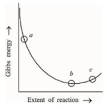
Consider the graph of $Gibbs$ free energy $G$ vs. Extent of reaction. The number of statement$(s)$ from the following which are true with respect to points $(a)$,$(b)$,and $(c)$ is $.................$
$A$. Reaction is spontaneous at $(a)$ and $(b)$
$B$. Reaction is at equilibrium at point $(b)$ and non-spontaneous at point $(c)$
$C$. Reaction is spontaneous at $(a)$ and non-spontaneous at $(c)$
$D$. Reaction is non-spontaneous at $(a)$ and $(b)$
$A$. Reaction is spontaneous at $(a)$ and $(b)$
$B$. Reaction is at equilibrium at point $(b)$ and non-spontaneous at point $(c)$
$C$. Reaction is spontaneous at $(a)$ and non-spontaneous at $(c)$
$D$. Reaction is non-spontaneous at $(a)$ and $(b)$
A
$6$
B
$4$
C
$8$
D
$2$
Solution
(D) For a spontaneous process,the slope of the $G$ vs. extent of reaction graph is negative,i.e.,$dG/d\xi < 0$.
For a process at equilibrium,the slope is zero,i.e.,$dG/d\xi = 0$.
For a non-spontaneous process,the slope is positive,i.e.,$dG/d\xi > 0$.
At point $(a)$,the slope is negative,so the reaction is spontaneous.
At point $(b)$,the slope is zero,so the reaction is at equilibrium.
At point $(c)$,the slope is positive,so the reaction is non-spontaneous.
Evaluating the statements:
$A$. Reaction is spontaneous at $(a)$ and $(b)$: False (at $(b)$ it is at equilibrium).
$B$. Reaction is at equilibrium at point $(b)$ and non-spontaneous at point $(c)$: True.
$C$. Reaction is spontaneous at $(a)$ and non-spontaneous at $(c)$: True.
$D$. Reaction is non-spontaneous at $(a)$ and $(b)$: False.
Therefore,there are $2$ true statements ($B$ and $C$).
For a process at equilibrium,the slope is zero,i.e.,$dG/d\xi = 0$.
For a non-spontaneous process,the slope is positive,i.e.,$dG/d\xi > 0$.
At point $(a)$,the slope is negative,so the reaction is spontaneous.
At point $(b)$,the slope is zero,so the reaction is at equilibrium.
At point $(c)$,the slope is positive,so the reaction is non-spontaneous.
Evaluating the statements:
$A$. Reaction is spontaneous at $(a)$ and $(b)$: False (at $(b)$ it is at equilibrium).
$B$. Reaction is at equilibrium at point $(b)$ and non-spontaneous at point $(c)$: True.
$C$. Reaction is spontaneous at $(a)$ and non-spontaneous at $(c)$: True.
$D$. Reaction is non-spontaneous at $(a)$ and $(b)$: False.
Therefore,there are $2$ true statements ($B$ and $C$).
0 likes
View Solution138
DifficultMCQ
Which of the following is not correct?
A
$\Delta G$ is negative for a spontaneous reaction
B
$\Delta G$ is positive for a spontaneous reaction
C
$\Delta G$ is zero for a reversible reaction
D
$\Delta G$ is positive for a non-spontaneous reaction
Solution
(B) For a spontaneous reaction,$\Delta G < 0$ (negative).
For a non-spontaneous reaction,$\Delta G > 0$ (positive).
For a reversible reaction at equilibrium,$\Delta G = 0$.
Therefore,the statement '$\Delta G$ is positive for a spontaneous reaction' is incorrect.
For a non-spontaneous reaction,$\Delta G > 0$ (positive).
For a reversible reaction at equilibrium,$\Delta G = 0$.
Therefore,the statement '$\Delta G$ is positive for a spontaneous reaction' is incorrect.
0 likes
View Solution139
MediumMCQ
For the reaction at $298 \ K$,$2 \ A^{+}B \rightarrow C$. $\Delta H = 400 \ kJ \ mol^{-1}$ and $\Delta S = 0.2 \ kJ \ mol^{-1} \ K^{-1}$. The reaction will become spontaneous above $...... \ K$.
A
$1000$
B
$2000$
C
$100$
D
$200$
Solution
(B) For a reaction to be spontaneous,the Gibbs free energy change $\Delta G$ must be negative. $\Delta G = \Delta H - T\Delta S < 0$.
At equilibrium,$\Delta G = 0$,so $T = \frac{\Delta H}{\Delta S}$.
Given $\Delta H = 400 \ kJ \ mol^{-1}$ and $\Delta S = 0.2 \ kJ \ mol^{-1} \ K^{-1}$.
$T = \frac{400}{0.2} = 2000 \ K$.
Since $\Delta H$ and $\Delta S$ are both positive,the reaction becomes spontaneous at temperatures higher than the equilibrium temperature.
Therefore,the reaction will become spontaneous above $2000 \ K$.
At equilibrium,$\Delta G = 0$,so $T = \frac{\Delta H}{\Delta S}$.
Given $\Delta H = 400 \ kJ \ mol^{-1}$ and $\Delta S = 0.2 \ kJ \ mol^{-1} \ K^{-1}$.
$T = \frac{400}{0.2} = 2000 \ K$.
Since $\Delta H$ and $\Delta S$ are both positive,the reaction becomes spontaneous at temperatures higher than the equilibrium temperature.
Therefore,the reaction will become spontaneous above $2000 \ K$.
0 likes
View Solution140
MediumMCQ
When $\Delta H_{vap} = 30 \ kJ \ mol^{-1}$ and $\Delta S_{vap} = 75 \ J \ mol^{-1} \ K^{-1}$,then the temperature of vapour,at one atmosphere is . . . . $K$.
A
$500$
B
$400$
C
$120$
D
$654$
Solution
(B) At equilibrium,the change in Gibbs free energy is $\Delta G = 0$.
Using the relation $\Delta G = \Delta H - T \Delta S$,at equilibrium we have $\Delta H_{vap} = T \Delta S_{vap}$.
Given $\Delta H_{vap} = 30 \ kJ \ mol^{-1} = 30000 \ J \ mol^{-1}$ and $\Delta S_{vap} = 75 \ J \ mol^{-1} \ K^{-1}$.
Substituting the values: $30000 \ J \ mol^{-1} = T \times 75 \ J \ mol^{-1} \ K^{-1}$.
$T = \frac{30000}{75} \ K = 400 \ K$.
Using the relation $\Delta G = \Delta H - T \Delta S$,at equilibrium we have $\Delta H_{vap} = T \Delta S_{vap}$.
Given $\Delta H_{vap} = 30 \ kJ \ mol^{-1} = 30000 \ J \ mol^{-1}$ and $\Delta S_{vap} = 75 \ J \ mol^{-1} \ K^{-1}$.
Substituting the values: $30000 \ J \ mol^{-1} = T \times 75 \ J \ mol^{-1} \ K^{-1}$.
$T = \frac{30000}{75} \ K = 400 \ K$.
0 likes
View Solution141
AdvancedMCQ
The standard state Gibbs free energies of formation of $C$ (graphite) and $C$ (diamond) at $T = 298 \ K$ are:
$\Delta_f G^0[C(\text{graphite})] = 0 \ kJ \ mol^{-1}$
$\Delta_f G^0[C(\text{diamond})] = 2.9 \ kJ \ mol^{-1}$
The standard state means that the pressure should be $1 \ bar$,and the substance should be pure at a given temperature. The conversion of graphite [$C$ (graphite)] to diamond [$C$ (diamond)] reduces its volume by $2 \times 10^{-6} \ m^3 \ mol^{-1}$. If $C$ (graphite) is converted to $C$ (diamond) isothermally at $T = 298 \ K$,the pressure at which $C$ (graphite) is in equilibrium with $C$ (diamond) is:
[Useful information: $1 \ J = 1 \ kg \ m^2 \ s^{-2} ; 1 \ Pa = 1 \ kg \ m^{-1} \ s^{-2} ; 1 \ bar = 10^5 \ Pa$ ] (in $bar$)
$\Delta_f G^0[C(\text{graphite})] = 0 \ kJ \ mol^{-1}$
$\Delta_f G^0[C(\text{diamond})] = 2.9 \ kJ \ mol^{-1}$
The standard state means that the pressure should be $1 \ bar$,and the substance should be pure at a given temperature. The conversion of graphite [$C$ (graphite)] to diamond [$C$ (diamond)] reduces its volume by $2 \times 10^{-6} \ m^3 \ mol^{-1}$. If $C$ (graphite) is converted to $C$ (diamond) isothermally at $T = 298 \ K$,the pressure at which $C$ (graphite) is in equilibrium with $C$ (diamond) is:
[Useful information: $1 \ J = 1 \ kg \ m^2 \ s^{-2} ; 1 \ Pa = 1 \ kg \ m^{-1} \ s^{-2} ; 1 \ bar = 10^5 \ Pa$ ] (in $bar$)
A
$14501$
B
$58001$
C
$14500$
D
$29001$
Solution
(C) At equilibrium,the change in Gibbs free energy is given by $\Delta G = \Delta G^0 + P \Delta V = 0$.
Therefore,$P \Delta V = -\Delta G^0$.
Here,$\Delta G^0 = \Delta_f G^0[C(\text{diamond})] - \Delta_f G^0[C(\text{graphite})] = 2.9 \ kJ \ mol^{-1} - 0 = 2.9 \times 10^3 \ J \ mol^{-1}$.
The change in volume is $\Delta V = V_{\text{diamond}} - V_{\text{graphite}} = -2 \times 10^{-6} \ m^3 \ mol^{-1}$.
Substituting these values into $P \Delta V = -\Delta G^0$:
$P \times (-2 \times 10^{-6} \ m^3 \ mol^{-1}) = -2.9 \times 10^3 \ J \ mol^{-1}$.
$P = \frac{2.9 \times 10^3}{2 \times 10^{-6}} \ Pa = 1.45 \times 10^9 \ Pa$.
Since $1 \ bar = 10^5 \ Pa$,$P = \frac{1.45 \times 10^9}{10^5} \ bar = 1.45 \times 10^4 \ bar = 14500 \ bar$.
Therefore,$P \Delta V = -\Delta G^0$.
Here,$\Delta G^0 = \Delta_f G^0[C(\text{diamond})] - \Delta_f G^0[C(\text{graphite})] = 2.9 \ kJ \ mol^{-1} - 0 = 2.9 \times 10^3 \ J \ mol^{-1}$.
The change in volume is $\Delta V = V_{\text{diamond}} - V_{\text{graphite}} = -2 \times 10^{-6} \ m^3 \ mol^{-1}$.
Substituting these values into $P \Delta V = -\Delta G^0$:
$P \times (-2 \times 10^{-6} \ m^3 \ mol^{-1}) = -2.9 \times 10^3 \ J \ mol^{-1}$.
$P = \frac{2.9 \times 10^3}{2 \times 10^{-6}} \ Pa = 1.45 \times 10^9 \ Pa$.
Since $1 \ bar = 10^5 \ Pa$,$P = \frac{1.45 \times 10^9}{10^5} \ bar = 1.45 \times 10^4 \ bar = 14500 \ bar$.
0 likes
View Solution142
MediumMCQ
The standard enthalpy and standard entropy of decomposition of $N_2O_4$ to $NO_2$ are $55.0 \ kJ \ mol^{-1}$ and $175.0 \ J \ K^{-1} \ mol^{-1}$ respectively. The standard free energy change for this reaction at $25 ^{\circ}C$ in $J \ mol^{-1}$ is $............$ $(Nearest \ integer)$.
A
$2850$
B
$2950$
C
$3065$
D
$4025$
Solution
(A) The reaction is $N_2O_4(g) \rightarrow 2NO_2(g)$.
Given: $\Delta H^{\circ} = 55.0 \ kJ \ mol^{-1} = 55000 \ J \ mol^{-1}$.
Given: $\Delta S^{\circ} = 175.0 \ J \ K^{-1} \ mol^{-1}$.
Temperature $T = 25 + 273 = 298 \ K$.
The Gibbs free energy change is given by the formula: $\Delta G^{\circ} = \Delta H^{\circ} - T\Delta S^{\circ}$.
Substituting the values: $\Delta G^{\circ} = 55000 \ J \ mol^{-1} - (298 \ K \times 175.0 \ J \ K^{-1} \ mol^{-1})$.
$\Delta G^{\circ} = 55000 - 52150 = 2850 \ J \ mol^{-1}$.
Given: $\Delta H^{\circ} = 55.0 \ kJ \ mol^{-1} = 55000 \ J \ mol^{-1}$.
Given: $\Delta S^{\circ} = 175.0 \ J \ K^{-1} \ mol^{-1}$.
Temperature $T = 25 + 273 = 298 \ K$.
The Gibbs free energy change is given by the formula: $\Delta G^{\circ} = \Delta H^{\circ} - T\Delta S^{\circ}$.
Substituting the values: $\Delta G^{\circ} = 55000 \ J \ mol^{-1} - (298 \ K \times 175.0 \ J \ K^{-1} \ mol^{-1})$.
$\Delta G^{\circ} = 55000 - 52150 = 2850 \ J \ mol^{-1}$.
0 likes
View Solution143
MediumMCQ
The effect of temperature on the spontaneity of reactions is represented as follows:
Which of the above conditions are correctly matched?
| Condition | Details |
|---|---|
| $A$. $\Delta H: +, \Delta S: -$ | $T$: any $T$,Spontaneity: Non-spontaneous |
| $B$. $\Delta H: +, \Delta S: +$ | $T$: low $T$,Spontaneity: Non-spontaneous |
| $C$. $\Delta H: -, \Delta S: -$ | $T$: low $T$,Spontaneity: Spontaneous |
| $D$. $\Delta H: -, \Delta S: +$ | $T$: any $T$,Spontaneity: Spontaneous |
Which of the above conditions are correctly matched?
A
$B$ and $D$ only
B
$A$ and $D$ only
C
$B$ and $C$ only
D
$A$ and $C$ only
Solution
(D) The spontaneity of a reaction is determined by the Gibbs free energy equation: $\Delta G = \Delta H - T \Delta S$.
For a reaction to be spontaneous,$\Delta G < 0$.
$1$. If $\Delta H > 0$ and $\Delta S < 0$,then $\Delta G$ is always positive,so the reaction is non-spontaneous at all temperatures ($A$ is correct).
$2$. If $\Delta H > 0$ and $\Delta S > 0$,then $\Delta G < 0$ only at high temperatures ($B$ is incorrect).
$3$. If $\Delta H < 0$ and $\Delta S < 0$,then $\Delta G < 0$ only at low temperatures ($C$ is correct).
$4$. If $\Delta H < 0$ and $\Delta S > 0$,then $\Delta G$ is always negative,so the reaction is spontaneous at all temperatures ($D$ is correct).
Thus,conditions $A, C,$ and $D$ are correct. However,based on the provided options,the combination $A$ and $C$ is the most appropriate match.
For a reaction to be spontaneous,$\Delta G < 0$.
$1$. If $\Delta H > 0$ and $\Delta S < 0$,then $\Delta G$ is always positive,so the reaction is non-spontaneous at all temperatures ($A$ is correct).
$2$. If $\Delta H > 0$ and $\Delta S > 0$,then $\Delta G < 0$ only at high temperatures ($B$ is incorrect).
$3$. If $\Delta H < 0$ and $\Delta S < 0$,then $\Delta G < 0$ only at low temperatures ($C$ is correct).
$4$. If $\Delta H < 0$ and $\Delta S > 0$,then $\Delta G$ is always negative,so the reaction is spontaneous at all temperatures ($D$ is correct).
Thus,conditions $A, C,$ and $D$ are correct. However,based on the provided options,the combination $A$ and $C$ is the most appropriate match.
0 likes
View Solution144
MediumMCQ
Let us consider an endothermic reaction which is non-spontaneous at the freezing point of water. However,the reaction is spontaneous at the boiling point of water. Choose the correct option.
A
Both $\Delta H$ and $\Delta S$ are $(+ve)$
B
$\Delta H$ is $(-ve)$ but $\Delta S$ is $(+ve)$
C
$\Delta H$ is $(+ve)$ but $\Delta S$ is $(-ve)$
D
Both $\Delta H$ and $\Delta S$ are $(-ve)$
Solution
(A) For a reaction to be spontaneous,the Gibbs free energy change $\Delta G$ must be negative,where $\Delta G = \Delta H - T \Delta S$.
Given that the reaction is endothermic,$\Delta H > 0$ (positive).
At low temperature (freezing point of water,$273 \ K$),the reaction is non-spontaneous,meaning $\Delta G > 0$. This implies $\Delta H > T \Delta S$.
At high temperature (boiling point of water,$373 \ K$),the reaction is spontaneous,meaning $\Delta G < 0$. This implies $\Delta H < T \Delta S$.
For $\Delta G$ to become negative as temperature $T$ increases,$\Delta S$ must be positive. Thus,both $\Delta H$ and $\Delta S$ are positive.
Given that the reaction is endothermic,$\Delta H > 0$ (positive).
At low temperature (freezing point of water,$273 \ K$),the reaction is non-spontaneous,meaning $\Delta G > 0$. This implies $\Delta H > T \Delta S$.
At high temperature (boiling point of water,$373 \ K$),the reaction is spontaneous,meaning $\Delta G < 0$. This implies $\Delta H < T \Delta S$.
For $\Delta G$ to become negative as temperature $T$ increases,$\Delta S$ must be positive. Thus,both $\Delta H$ and $\Delta S$ are positive.
0 likes
View Solution145
MediumMCQ
The spontaneous nature of a reaction is impossible if
A
$\Delta H$ is $+ve$; $\Delta S$ is also positive
B
$\Delta H$ is $-ve$; $\Delta S$ is also negative
C
$\Delta H$ is $-ve$; $\Delta S$ is positive
D
$\Delta H$ is $+ve$; $\Delta S$ is negative
Solution
(D) The spontaneity of a reaction is determined by the Gibbs free energy equation: $\Delta G = \Delta H - T \Delta S$.
$A$ reaction is spontaneous if $\Delta G < 0$.
If $\Delta H$ is $+ve$ (endothermic) and $\Delta S$ is $-ve$ (decrease in entropy),then $\Delta G = (+ve) - T(-ve) = (+ve) + T(+ve)$,which results in a positive $\Delta G$ at all temperatures.
Therefore,the reaction is non-spontaneous (impossible) under these conditions.
$A$ reaction is spontaneous if $\Delta G < 0$.
If $\Delta H$ is $+ve$ (endothermic) and $\Delta S$ is $-ve$ (decrease in entropy),then $\Delta G = (+ve) - T(-ve) = (+ve) + T(+ve)$,which results in a positive $\Delta G$ at all temperatures.
Therefore,the reaction is non-spontaneous (impossible) under these conditions.
0 likes
View Solution146
DifficultMCQ
For a reaction $A + B \rightarrow$ products,$\Delta H = -84.2 \ kJ$ and $\Delta S = -200 \ J \ K^{-1}$. Calculate the highest value of temperature (in $K$) so that the reaction will proceed in the forward direction.
A
$421$
B
$237$
C
$168$
D
$273$
Solution
(A) For a reaction to be spontaneous,the Gibbs free energy change $\Delta G$ must be negative,i.e.,$\Delta G < 0$.
Given the equation $\Delta G = \Delta H - T\Delta S < 0$.
Convert $\Delta H$ to Joules: $\Delta H = -84.2 \ kJ = -84200 \ J$.
Substituting the values: $-84200 \ J - T(-200 \ J \ K^{-1}) < 0$.
$-84200 + 200T < 0$.
$200T < 84200$.
$T < \frac{84200}{200} \ K$.
$T < 421 \ K$.
Thus,the highest temperature at which the reaction proceeds in the forward direction is $421 \ K$.
Given the equation $\Delta G = \Delta H - T\Delta S < 0$.
Convert $\Delta H$ to Joules: $\Delta H = -84.2 \ kJ = -84200 \ J$.
Substituting the values: $-84200 \ J - T(-200 \ J \ K^{-1}) < 0$.
$-84200 + 200T < 0$.
$200T < 84200$.
$T < \frac{84200}{200} \ K$.
$T < 421 \ K$.
Thus,the highest temperature at which the reaction proceeds in the forward direction is $421 \ K$.
0 likes
View Solution147
MediumMCQ
Calculate the work done if $1 \ mole$ of an ideal gas is compressed isothermally and reversibly from $12 \ dm^3$ to $6 \ dm^3$ at $300 \ K$. $\left[R = 8.314 \ J \ K^{-1} \ mol^{-1}\right]$ (in $kJ$)
A
$1.729$
B
$3.458$
C
$5.187$
D
$6.916$
Solution
(A) For an isothermal reversible compression of an ideal gas,the work done $(w)$ is given by the formula: $w = -2.303 \ nRT \log\left(\frac{V_f}{V_i}\right)$.
Given: $n = 1 \ mol$,$R = 8.314 \ J \ K^{-1} \ mol^{-1}$,$T = 300 \ K$,$V_i = 12 \ dm^3$,$V_f = 6 \ dm^3$.
Substituting the values: $w = -2.303 \times 1 \times 8.314 \times 300 \times \log\left(\frac{6}{12}\right)$.
$w = -2.303 \times 8.314 \times 300 \times \log(0.5)$.
Since $\log(0.5) = -0.3010$,we have: $w = -2.303 \times 8.314 \times 300 \times (-0.3010)$.
$w \approx 1728.8 \ J = 1.729 \ kJ$.
Given: $n = 1 \ mol$,$R = 8.314 \ J \ K^{-1} \ mol^{-1}$,$T = 300 \ K$,$V_i = 12 \ dm^3$,$V_f = 6 \ dm^3$.
Substituting the values: $w = -2.303 \times 1 \times 8.314 \times 300 \times \log\left(\frac{6}{12}\right)$.
$w = -2.303 \times 8.314 \times 300 \times \log(0.5)$.
Since $\log(0.5) = -0.3010$,we have: $w = -2.303 \times 8.314 \times 300 \times (-0.3010)$.
$w \approx 1728.8 \ J = 1.729 \ kJ$.
0 likes
View Solution148
MediumMCQ
Calculate the work done in the following reaction at $27^{\circ} C$.
$4 SO_{2(g)} + 2 O_{2(g)} \rightarrow 4 SO_{3(g)}$
$(R = 8.314 \ J \ K^{-1} \ mol^{-1})$ (in $J$)
$4 SO_{2(g)} + 2 O_{2(g)} \rightarrow 4 SO_{3(g)}$
$(R = 8.314 \ J \ K^{-1} \ mol^{-1})$ (in $J$)
A
$4988.4$
B
$2494.2$
C
$1247.1$
D
$3741.3$
Solution
(A) The work done in a chemical reaction is given by the formula $W = -\Delta n_g RT$.
First,calculate the change in the number of moles of gaseous species,$\Delta n_g = n_{p(g)} - n_{r(g)}$.
For the reaction $4 SO_{2(g)} + 2 O_{2(g)} \rightarrow 4 SO_{3(g)}$,the number of moles of gaseous products is $4$ and the number of moles of gaseous reactants is $4 + 2 = 6$.
So,$\Delta n_g = 4 - 6 = -2 \ mol$.
The temperature $T = 27^{\circ} C = 27 + 273 = 300 \ K$.
The gas constant $R = 8.314 \ J \ K^{-1} \ mol^{-1}$.
Now,substitute the values into the formula: $W = -(-2 \ mol) \times (8.314 \ J \ K^{-1} \ mol^{-1}) \times (300 \ K)$.
$W = 2 \times 8.314 \times 300 = 4988.4 \ J$.
First,calculate the change in the number of moles of gaseous species,$\Delta n_g = n_{p(g)} - n_{r(g)}$.
For the reaction $4 SO_{2(g)} + 2 O_{2(g)} \rightarrow 4 SO_{3(g)}$,the number of moles of gaseous products is $4$ and the number of moles of gaseous reactants is $4 + 2 = 6$.
So,$\Delta n_g = 4 - 6 = -2 \ mol$.
The temperature $T = 27^{\circ} C = 27 + 273 = 300 \ K$.
The gas constant $R = 8.314 \ J \ K^{-1} \ mol^{-1}$.
Now,substitute the values into the formula: $W = -(-2 \ mol) \times (8.314 \ J \ K^{-1} \ mol^{-1}) \times (300 \ K)$.
$W = 2 \times 8.314 \times 300 = 4988.4 \ J$.
0 likes
View Solution149
MediumMCQ
Calculate the work done if $1 \ mole$ of a certain gas is compressed isothermally and reversibly at $300 \ K$ from an initial pressure $x \ bar$ to a final pressure $2x \ bar$ $[R = 8.314 \ J \ K^{-1} \ mol^{-1}]$. (in $kJ$)
A
$1.729$
B
$0.865$
C
$2.593$
D
$3.458$
Solution
(A) For an isothermal reversible compression,the work done $w$ is given by the formula: $w = -nRT \ln\left(\frac{P_2}{P_1}\right)$.
Given values: $n = 1 \ mol$,$T = 300 \ K$,$P_1 = x \ bar$,$P_2 = 2x \ bar$,$R = 8.314 \ J \ K^{-1} \ mol^{-1}$.
Substituting these values into the formula:
$w = -(1 \ mol) \times (8.314 \ J \ K^{-1} \ mol^{-1}) \times (300 \ K) \times \ln\left(\frac{2x}{x}\right)$.
$w = -8.314 \times 300 \times \ln(2)$.
Using $\ln(2) \approx 0.693$:
$w = -2494.2 \times 0.693 \approx -1728.5 \ J$.
Converting to $kJ$: $w \approx -1.729 \ kJ$.
The magnitude of work done on the system is $1.729 \ kJ$.
Given values: $n = 1 \ mol$,$T = 300 \ K$,$P_1 = x \ bar$,$P_2 = 2x \ bar$,$R = 8.314 \ J \ K^{-1} \ mol^{-1}$.
Substituting these values into the formula:
$w = -(1 \ mol) \times (8.314 \ J \ K^{-1} \ mol^{-1}) \times (300 \ K) \times \ln\left(\frac{2x}{x}\right)$.
$w = -8.314 \times 300 \times \ln(2)$.
Using $\ln(2) \approx 0.693$:
$w = -2494.2 \times 0.693 \approx -1728.5 \ J$.
Converting to $kJ$: $w \approx -1.729 \ kJ$.
The magnitude of work done on the system is $1.729 \ kJ$.
0 likes
View SolutionThermodynamics — Free energy and Work · Frequently Asked Questions
1Are these Thermodynamics questions useful for JEE and NEET?
Yes. All questions in this section are mapped to JEE Main and NEET exam patterns. Previous year questions from JEE Main, NEET, GUJCET and state-level exams are included with full solutions.
2Can I switch to Hindi or Gujarati for these questions?
Yes. Use the language tabs in the hero section or the sidebar to view the same questions and solutions in English, Hindi or Gujarati.
3How do I generate a question paper from this subtopic?
Use the Vedclass Exam Paper Generator — select the chapter and subtopic, set difficulty, and generate Sets A, B, C, D automatically. First 3 chapters of every subject are free.
Vedclass Products
For Students
Vedclass Test Series
Mock tests in real JEE/NEET style with performance analysis. 5-day free trial.
Start Free TrialFor Teachers
Exam Paper Generator
Generate Set A/B/C/D papers from this chapter in 2 minutes. 3 chapters free.
Try FreeFor Institutes
Online Exam Module
Live online exams with unlimited students, 360° analytics & white-label branding.
See DemoFor Teachers & Institutes
Generate a Thermodynamics Exam Paper in 2 Minutes
Select subtopic & difficulty — Sets A, B, C, D auto-generated with No Repeat logic.
First 3 chapters of every subject are free — no payment required.