
A English
Uncertainty principle and Schrodinger wave equation Questions in English
Class 11 Chemistry · Structure of Atom · Uncertainty principle and Schrodinger wave equation
152+
Questions
English
Language
100%
With Solutions
Showing 49 of 152 questions in English
51
EasyMCQ
The Bohr model of the atom is contradicted by
A
Pauli's exclusion principle
B
Planck's quantum theory
C
Heisenberg's uncertainty principle
D
All of the above
Solution
(C) The Bohr model of an atom is contradicted by Heisenberg's uncertainty principle.
According to the Bohr model,an electron in an atom is located at a definite distance from the nucleus and revolves with a definite velocity in a circular orbit.
However,according to Heisenberg's uncertainty principle,it is impossible to determine simultaneously the exact position and momentum (or velocity) of a microscopic particle like an electron.
According to the Bohr model,an electron in an atom is located at a definite distance from the nucleus and revolves with a definite velocity in a circular orbit.
However,according to Heisenberg's uncertainty principle,it is impossible to determine simultaneously the exact position and momentum (or velocity) of a microscopic particle like an electron.
0 likes
View Solution52
EasyMCQ
Heisenberg's uncertainty principle is not valid for:
A
Moving electrons
B
Motor car
C
Stationary particles
D
Both $(b)$ and $(c)$
Solution
(D) Heisenberg's uncertainty principle states that it is impossible to determine simultaneously the exact position and exact momentum of a microscopic particle.
This principle is significant only for microscopic particles like electrons,protons,etc.
It is not applicable to macroscopic objects like a $ \text{motor car} $ because their mass is large,making the uncertainty in position and velocity negligible.
It is also not valid for $ \text{stationary particles} $ because their velocity is zero,and their position can be determined precisely.
Therefore,the principle is not valid for both $ (b) $ and $ (c) $.
This principle is significant only for microscopic particles like electrons,protons,etc.
It is not applicable to macroscopic objects like a $ \text{motor car} $ because their mass is large,making the uncertainty in position and velocity negligible.
It is also not valid for $ \text{stationary particles} $ because their velocity is zero,and their position can be determined precisely.
Therefore,the principle is not valid for both $ (b) $ and $ (c) $.
0 likes
View Solution53
MediumMCQ
Which of the following quantum numbers is not obtained by the solution of the Schrodinger wave equation?
A
Magnetic quantum number
B
Principal quantum number
C
Spin quantum number
D
Azimuthal quantum number
Solution
(C) The Schrodinger wave equation is given by: $\frac{d^2 \Psi}{dx^2} + \frac{d^2 \Psi}{dy^2} + \frac{d^2 \Psi}{dz^2} + \frac{8 \pi^2 m}{h^2} (E - V) \Psi = 0$.
The solution of this equation provides three quantum numbers: the principal quantum number $(n)$,the azimuthal quantum number $(l)$,and the magnetic quantum number $(m_l)$.
These describe the energy,shape,and orientation of the orbitals.
The spin quantum number $(s)$ is not derived from the Schrodinger wave equation; it was introduced later to explain the magnetic properties and the fine structure of atomic spectra arising from the electron's intrinsic spin.
The solution of this equation provides three quantum numbers: the principal quantum number $(n)$,the azimuthal quantum number $(l)$,and the magnetic quantum number $(m_l)$.
These describe the energy,shape,and orientation of the orbitals.
The spin quantum number $(s)$ is not derived from the Schrodinger wave equation; it was introduced later to explain the magnetic properties and the fine structure of atomic spectra arising from the electron's intrinsic spin.
0 likes
View Solution54
EasyMCQ
The wave mechanical model of atom is based upon
A
de Broglie concept of dual character of matter
B
Heisenberg’s uncertainty principle
C
Schrodinger wave equation
D
all the above three
Solution
(D) The wave mechanical model of the atom,also known as the quantum mechanical model,was developed by incorporating several key principles of modern physics.
$1$. It incorporates the $de \ Broglie$ concept of the dual nature of matter,which states that particles like electrons exhibit wave-like properties.
$2$. It accounts for $Heisenberg’s$ uncertainty principle,which asserts that it is impossible to simultaneously determine the exact position and momentum of a subatomic particle.
$3$. It is mathematically formulated using the $Schrodinger$ wave equation,which describes the behavior of electrons in atoms as wave functions.
Therefore,the model is based on all three of these fundamental concepts.
$1$. It incorporates the $de \ Broglie$ concept of the dual nature of matter,which states that particles like electrons exhibit wave-like properties.
$2$. It accounts for $Heisenberg’s$ uncertainty principle,which asserts that it is impossible to simultaneously determine the exact position and momentum of a subatomic particle.
$3$. It is mathematically formulated using the $Schrodinger$ wave equation,which describes the behavior of electrons in atoms as wave functions.
Therefore,the model is based on all three of these fundamental concepts.
0 likes
View Solution55
EasyMCQ
Which of the following statements is incorrect?
A
Probabilities are found by solving $Schrodinger$ wave equation
B
Energy of the electron at infinite distance is zero and yet it is maximum
C
Some spectral lines of an element may have the same wave number
D
The position and momentum of a rolling ball can be measured accurately
Solution
(C) The $Heisenberg$ uncertainty principle states that it is impossible to determine simultaneously the exact position and exact momentum of a microscopic particle.
For macroscopic objects like a rolling ball,the uncertainty is negligible,so they can be measured accurately.
However,the statement $D$ is often considered a general principle for microscopic particles.
Wait,let us re-evaluate:
$A$: Correct,the $Schrodinger$ wave equation gives the probability density.
$B$: Correct,energy at infinity is $0$,which is the maximum value for a bound electron (as all other states are negative).
$C$: Incorrect,spectral lines are unique to transitions between specific energy levels.
$D$: Correct,for macroscopic objects,the uncertainty is negligible.
For macroscopic objects like a rolling ball,the uncertainty is negligible,so they can be measured accurately.
However,the statement $D$ is often considered a general principle for microscopic particles.
Wait,let us re-evaluate:
$A$: Correct,the $Schrodinger$ wave equation gives the probability density.
$B$: Correct,energy at infinity is $0$,which is the maximum value for a bound electron (as all other states are negative).
$C$: Incorrect,spectral lines are unique to transitions between specific energy levels.
$D$: Correct,for macroscopic objects,the uncertainty is negligible.
0 likes
View Solution56
EasyMCQ
Choose the correct statement.
A
Electronic energy is positive.
B
$\psi^2$ represents the probability of finding an electron per unit volume.
C
$\psi$ represents the probability of finding an electron.
D
None of the above is correct.
Solution
(B) In quantum mechanics,$\psi$ is the wave function,which does not have a direct physical meaning.
$\psi^2$ (or more accurately,$|\psi|^2$) represents the probability density,which is the probability of finding an electron per unit volume at a given point in space.
Electronic energy in an atom is typically negative because the electron is bound to the nucleus by electrostatic attraction.
$\psi^2$ (or more accurately,$|\psi|^2$) represents the probability density,which is the probability of finding an electron per unit volume at a given point in space.
Electronic energy in an atom is typically negative because the electron is bound to the nucleus by electrostatic attraction.
0 likes
View Solution57
MediumMCQ
Which of the following statements is $correct$?
A
An electron cannot exist inside the nucleus because the uncertainty in speed becomes greater than the speed of light.
B
The wavelength associated with a $1 \ g$ particle moving with a velocity of $100 \ m/s$ has physical significance.
C
It is possible to determine the position as well as momentum precisely for a very fast-moving particle.
D
An electron having a total kinetic energy of $E_1$ has a wavelength associated with it equal to $\frac{hc}{E_1}$ [$h =$ Planck's constant].
Solution
(A) According to Heisenberg's Uncertainty Principle,$\Delta x \cdot \Delta p \ge \frac{h}{4\pi}$.
If an electron were inside the nucleus (radius $\approx 10^{-15} \ m$),the uncertainty in position $\Delta x$ would be $\approx 10^{-15} \ m$.
Calculating $\Delta v = \frac{h}{4\pi m \Delta x}$,we find $\Delta v \approx 5.8 \times 10^{10} \ m/s$,which is greater than the speed of light $(c = 3 \times 10^8 \ m/s)$.
This implies that an electron cannot be confined within the nucleus.
Option $A$ is correct.
If an electron were inside the nucleus (radius $\approx 10^{-15} \ m$),the uncertainty in position $\Delta x$ would be $\approx 10^{-15} \ m$.
Calculating $\Delta v = \frac{h}{4\pi m \Delta x}$,we find $\Delta v \approx 5.8 \times 10^{10} \ m/s$,which is greater than the speed of light $(c = 3 \times 10^8 \ m/s)$.
This implies that an electron cannot be confined within the nucleus.
Option $A$ is correct.
0 likes
View Solution58
MediumMCQ
The uncertainty in the position of an electron and a helium atom is the same. If the uncertainty in the momentum of the electron is $32 \times 10^5$,then the uncertainty in the momentum of the helium atom is:
A
$32 \times 10^5$
B
$16 \times 10^5$
C
$8 \times 10^5$
D
$4 \times 10^5$
Solution
(A) According to Heisenberg's Uncertainty Principle,the product of uncertainty in position $(\Delta x)$ and uncertainty in momentum $(\Delta p)$ is given by:
$\Delta x \cdot \Delta p \geq \frac{h}{4\pi}$
Since the uncertainty in position $(\Delta x)$ is the same for both the electron and the helium atom,and the value of $h/4\pi$ is a constant,the uncertainty in momentum $(\Delta p)$ must also be the same for both particles.
Given that the uncertainty in the momentum of the electron is $\Delta p_e = 32 \times 10^5$,the uncertainty in the momentum of the helium atom must also be $\Delta p_{He} = 32 \times 10^5$.
Therefore,option $A$ is correct.
$\Delta x \cdot \Delta p \geq \frac{h}{4\pi}$
Since the uncertainty in position $(\Delta x)$ is the same for both the electron and the helium atom,and the value of $h/4\pi$ is a constant,the uncertainty in momentum $(\Delta p)$ must also be the same for both particles.
Given that the uncertainty in the momentum of the electron is $\Delta p_e = 32 \times 10^5$,the uncertainty in the momentum of the helium atom must also be $\Delta p_{He} = 32 \times 10^5$.
Therefore,option $A$ is correct.
0 likes
View Solution59
MediumMCQ
Uncertainty in the position of an electron (mass $= 9.1 \times 10^{-31} \, kg$) moving with a velocity $300 \, ms^{-1}$,with uncertainty $0.001\%$ will be :- $(h = 6.63 \times 10^{-34} \, Js)$
A
$1.92 \times 10^{-3} \, m$
B
$5.76 \times 10^{-4} \, m$
C
$1.93 \times 10^{-2} \, m$
D
$3.84 \times 10^{-4} \, m$
Solution
(C) According to Heisenberg's uncertainty principle: $\Delta x \cdot \Delta p \geq \frac{h}{4 \pi}$ or $\Delta x \cdot m \cdot \Delta v = \frac{h}{4 \pi}$.
Given: $m = 9.1 \times 10^{-31} \, kg$,$v = 300 \, ms^{-1}$,uncertainty in velocity $\Delta v = 0.001\% \text{ of } 300 = \frac{0.001}{100} \times 300 = 3 \times 10^{-3} \, ms^{-1}$.
Substituting the values: $\Delta x = \frac{h}{4 \pi m \Delta v} = \frac{6.63 \times 10^{-34}}{4 \times 3.14 \times 9.1 \times 10^{-31} \times 3 \times 10^{-3}}$.
$\Delta x = \frac{6.63 \times 10^{-34}}{342.588 \times 10^{-34}} \approx 0.0193 \, m = 1.93 \times 10^{-2} \, m$.
Given: $m = 9.1 \times 10^{-31} \, kg$,$v = 300 \, ms^{-1}$,uncertainty in velocity $\Delta v = 0.001\% \text{ of } 300 = \frac{0.001}{100} \times 300 = 3 \times 10^{-3} \, ms^{-1}$.
Substituting the values: $\Delta x = \frac{h}{4 \pi m \Delta v} = \frac{6.63 \times 10^{-34}}{4 \times 3.14 \times 9.1 \times 10^{-31} \times 3 \times 10^{-3}}$.
$\Delta x = \frac{6.63 \times 10^{-34}}{342.588 \times 10^{-34}} \approx 0.0193 \, m = 1.93 \times 10^{-2} \, m$.
0 likes
View Solution60
MediumMCQ
Given: The mass of an electron is $9.1 \times 10^{-31} \ kg$,Planck's constant is $6.62 \times 10^{-34} \ J \cdot s$. The uncertainty involved in the measurement of velocity within a distance of $0.1 \ \mathring{A}$ is:
A
$5.79 \times 10^6 \ m \cdot s^{-1}$
B
$5.79 \times 10^7 \ m \cdot s^{-1}$
C
$5.79 \times 10^8 \ m \cdot s^{-1}$
D
$5.79 \times 10^5 \ m \cdot s^{-1}$
Solution
(A) According to Heisenberg's uncertainty principle: $\Delta x \cdot m \Delta v \geq \frac{h}{4 \pi}$.
Given: $\Delta x = 0.1 \ \mathring{A} = 0.1 \times 10^{-10} \ m$,$m = 9.1 \times 10^{-31} \ kg$,$h = 6.62 \times 10^{-34} \ J \cdot s$.
Substituting the values:
$\Delta v = \frac{h}{4 \pi m \Delta x} = \frac{6.62 \times 10^{-34}}{4 \times 3.1416 \times 9.1 \times 10^{-31} \times 0.1 \times 10^{-10}}$.
$\Delta v = \frac{6.62 \times 10^{-34}}{114.354 \times 10^{-41}} \approx 5.79 \times 10^6 \ m \cdot s^{-1}$.
Given: $\Delta x = 0.1 \ \mathring{A} = 0.1 \times 10^{-10} \ m$,$m = 9.1 \times 10^{-31} \ kg$,$h = 6.62 \times 10^{-34} \ J \cdot s$.
Substituting the values:
$\Delta v = \frac{h}{4 \pi m \Delta x} = \frac{6.62 \times 10^{-34}}{4 \times 3.1416 \times 9.1 \times 10^{-31} \times 0.1 \times 10^{-10}}$.
$\Delta v = \frac{6.62 \times 10^{-34}}{114.354 \times 10^{-41}} \approx 5.79 \times 10^6 \ m \cdot s^{-1}$.
0 likes
View Solution61
MediumMCQ
What will be the mass of a particle if uncertainty in its position is $10^{-8} \ m$ and uncertainty in velocity is $5.26 \times 10^{-25} \ m \ s^{-1}$? ............... $kg$
A
$0.01$
B
$100$
C
$1$
D
$10$
Solution
(A) According to Heisenberg's uncertainty principle: $\Delta x \cdot m \Delta v \geq \frac{h}{4 \pi}$.
Rearranging for mass $(m)$: $m = \frac{h}{4 \pi \Delta x \Delta v}$.
Given: $h = 6.626 \times 10^{-34} \ J \ s$,$\Delta x = 10^{-8} \ m$,$\Delta v = 5.26 \times 10^{-25} \ m \ s^{-1}$.
Substituting the values: $m = \frac{6.626 \times 10^{-34}}{4 \times 3.14159 \times 10^{-8} \times 5.26 \times 10^{-25}}$.
$m = \frac{6.626 \times 10^{-34}}{6.608 \times 10^{-32}} \approx 0.01 \ kg$.
Rearranging for mass $(m)$: $m = \frac{h}{4 \pi \Delta x \Delta v}$.
Given: $h = 6.626 \times 10^{-34} \ J \ s$,$\Delta x = 10^{-8} \ m$,$\Delta v = 5.26 \times 10^{-25} \ m \ s^{-1}$.
Substituting the values: $m = \frac{6.626 \times 10^{-34}}{4 \times 3.14159 \times 10^{-8} \times 5.26 \times 10^{-25}}$.
$m = \frac{6.626 \times 10^{-34}}{6.608 \times 10^{-32}} \approx 0.01 \ kg$.
0 likes
View Solution62
MediumMCQ
The electrons are more likely to be found
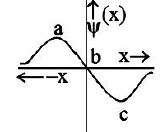
A
in the region $a$ and $b$
B
in the region $a$ and $c$
C
only in the region $a$
D
only in the region $c$
Solution
(B) The probability of finding an electron in an atom is given by the square of the wave function,$\psi^2$.
In the given graph,the regions $a$ and $c$ represent the peaks of the $\psi^2$ curve,where the probability density is maximum.
Therefore,electrons are most likely to be found in regions $a$ and $c$.
In the given graph,the regions $a$ and $c$ represent the peaks of the $\psi^2$ curve,where the probability density is maximum.
Therefore,electrons are most likely to be found in regions $a$ and $c$.
0 likes
View Solution63
EasyMCQ
The Heisenberg uncertainty principle is not valid for
A
Moving electron
B
Motor car
C
Stationary particles
D
$B$ and $C$ both
Solution
(D) The Heisenberg uncertainty principle states that it is impossible to determine simultaneously the exact position and exact momentum of a microscopic particle.
Mathematically,$\Delta x \cdot \Delta p \ge \frac{h}{4\pi}$.
This principle is significant only for microscopic particles like electrons,protons,etc.
For macroscopic objects like a motor car,the uncertainty is negligible due to their large mass.
For stationary particles,the velocity is zero,meaning the momentum is exactly known $(\Delta p = 0)$,which leads to an infinite uncertainty in position $(\Delta x = \infty)$,making the principle inapplicable in the standard sense.
Therefore,the principle is not valid for macroscopic objects and stationary particles.
Mathematically,$\Delta x \cdot \Delta p \ge \frac{h}{4\pi}$.
This principle is significant only for microscopic particles like electrons,protons,etc.
For macroscopic objects like a motor car,the uncertainty is negligible due to their large mass.
For stationary particles,the velocity is zero,meaning the momentum is exactly known $(\Delta p = 0)$,which leads to an infinite uncertainty in position $(\Delta x = \infty)$,making the principle inapplicable in the standard sense.
Therefore,the principle is not valid for macroscopic objects and stationary particles.
0 likes
View Solution64
DifficultMCQ
The uncertainty in the location of a circulating electron is equal to its de Broglie wavelength. The minimum percent error in its measurement of velocity under these circumstances will be approximately:
A
$4$
B
$8$
C
$18$
D
$22$
Solution
(B) Given that the uncertainty in position $\Delta x$ is equal to the de Broglie wavelength $\lambda$:
$\Delta x = \lambda = \frac{h}{mv}$
According to Heisenberg's uncertainty principle:
$\Delta x \cdot m \Delta v \geq \frac{h}{4\pi}$
Substituting $\Delta x = \frac{h}{mv}$ into the uncertainty equation:
$(\frac{h}{mv}) \cdot m \Delta v \geq \frac{h}{4\pi}$
Simplifying the expression:
$\frac{\Delta v}{v} \geq \frac{1}{4\pi}$
The percentage error in velocity is given by:
$\frac{\Delta v}{v} \times 100 \geq \frac{100}{4\pi} \approx \frac{100}{12.56} \approx 7.96 \% \approx 8 \%$
$\Delta x = \lambda = \frac{h}{mv}$
According to Heisenberg's uncertainty principle:
$\Delta x \cdot m \Delta v \geq \frac{h}{4\pi}$
Substituting $\Delta x = \frac{h}{mv}$ into the uncertainty equation:
$(\frac{h}{mv}) \cdot m \Delta v \geq \frac{h}{4\pi}$
Simplifying the expression:
$\frac{\Delta v}{v} \geq \frac{1}{4\pi}$
The percentage error in velocity is given by:
$\frac{\Delta v}{v} \times 100 \geq \frac{100}{4\pi} \approx \frac{100}{12.56} \approx 7.96 \% \approx 8 \%$
0 likes
View Solution65
DifficultMCQ
Which quantum number cannot be obtained from the solution of the Schrodinger wave equation?
A
$n$
B
$l$
C
$m_s$
D
$m$
Solution
(C) The Schrodinger wave equation provides the three quantum numbers: principal quantum number $(n)$,azimuthal quantum number $(l)$,and magnetic quantum number $(m)$.
These are derived directly from the mathematical solution of the wave function $\psi$ for the hydrogen atom.
The spin quantum number $(m_s)$ was introduced later to account for the magnetic properties of the electron and is not a direct result of the Schrodinger wave equation.
These are derived directly from the mathematical solution of the wave function $\psi$ for the hydrogen atom.
The spin quantum number $(m_s)$ was introduced later to account for the magnetic properties of the electron and is not a direct result of the Schrodinger wave equation.
0 likes
View Solution66
DifficultMCQ
If the uncertainty in the position of an electron is associated with an uncertainty in momentum of $2 \times 10^{-17} \ g \ cm \ s^{-1}$,what will be the uncertainty in the velocity of the electron?
A
$4 \times 10^{28} \ cm \ s^{-1}$
B
$1 \times 10^6 \ cm \ s^{-1}$
C
$2.1 \times 10^{10} \ cm \ s^{-1}$
D
$1.1 \times 10^{10} \ cm \ s^{-1}$
Solution
(C) The uncertainty in momentum is given by $\Delta p = m \times \Delta v$.
Given: $\Delta p = 2 \times 10^{-17} \ g \ cm \ s^{-1}$ and mass of electron $m = 9.1 \times 10^{-28} \ g$.
We know that $\Delta v = \frac{\Delta p}{m}$.
Substituting the values: $\Delta v = \frac{2 \times 10^{-17} \ g \ cm \ s^{-1}}{9.1 \times 10^{-28} \ g} \approx 0.2197 \times 10^{11} \ cm \ s^{-1}$.
This simplifies to $\Delta v \approx 2.197 \times 10^{10} \ cm \ s^{-1}$,which is approximately $2.1 \times 10^{10} \ cm \ s^{-1}$.
Given: $\Delta p = 2 \times 10^{-17} \ g \ cm \ s^{-1}$ and mass of electron $m = 9.1 \times 10^{-28} \ g$.
We know that $\Delta v = \frac{\Delta p}{m}$.
Substituting the values: $\Delta v = \frac{2 \times 10^{-17} \ g \ cm \ s^{-1}}{9.1 \times 10^{-28} \ g} \approx 0.2197 \times 10^{11} \ cm \ s^{-1}$.
This simplifies to $\Delta v \approx 2.197 \times 10^{10} \ cm \ s^{-1}$,which is approximately $2.1 \times 10^{10} \ cm \ s^{-1}$.
0 likes
View Solution67
DifficultMCQ
If the uncertainty in momentum of a particle is twice the uncertainty in its position,what will be the uncertainty in the position of the particle?
A
$\sqrt{\frac{h}{2\pi}}$
B
$\frac{h}{2\pi}$
C
$\frac{1}{2}\sqrt{\frac{h}{\pi}}$
D
$\frac{1}{2}\sqrt{\frac{h}{2\pi}}$
Solution
(D) According to Heisenberg's uncertainty principle,$\Delta x \cdot \Delta p \geq \frac{h}{4\pi}$.
Given that the uncertainty in momentum $(\Delta p)$ is twice the uncertainty in position $(\Delta x)$,we have $\Delta p = 2\Delta x$.
Substituting this into the equation: $\Delta x \cdot (2\Delta x) = \frac{h}{4\pi}$.
$2(\Delta x)^2 = \frac{h}{4\pi}$.
$(\Delta x)^2 = \frac{h}{8\pi}$.
$\Delta x = \sqrt{\frac{h}{8\pi}} = \sqrt{\frac{h}{4 \times 2\pi}} = \frac{1}{2}\sqrt{\frac{h}{2\pi}}$.
Thus,the correct option is $D$.
Given that the uncertainty in momentum $(\Delta p)$ is twice the uncertainty in position $(\Delta x)$,we have $\Delta p = 2\Delta x$.
Substituting this into the equation: $\Delta x \cdot (2\Delta x) = \frac{h}{4\pi}$.
$2(\Delta x)^2 = \frac{h}{4\pi}$.
$(\Delta x)^2 = \frac{h}{8\pi}$.
$\Delta x = \sqrt{\frac{h}{8\pi}} = \sqrt{\frac{h}{4 \times 2\pi}} = \frac{1}{2}\sqrt{\frac{h}{2\pi}}$.
Thus,the correct option is $D$.
0 likes
View Solution68
DifficultMCQ
If the uncertainty in position and momentum of a particle are equal,then what will be the uncertainty in the momentum of the particle?
A
$\frac{1}{2}\sqrt{\frac{h}{\pi}}$
B
$\frac{h}{4\pi}$
C
$\sqrt{\frac{h}{\pi}}$
D
$\sqrt{\frac{h}{4\pi}}$
Solution
(A) According to Heisenberg's uncertainty principle,$\Delta x \cdot \Delta p \geq \frac{h}{4\pi}$.
Given that the uncertainty in position $(\Delta x)$ is equal to the uncertainty in momentum $(\Delta p)$,i.e.,$\Delta x = \Delta p$.
Substituting $\Delta x$ with $\Delta p$ in the equation: $(\Delta p)^2 = \frac{h}{4\pi}$.
Taking the square root on both sides: $\Delta p = \sqrt{\frac{h}{4\pi}} = \frac{1}{2}\sqrt{\frac{h}{\pi}}$.
Given that the uncertainty in position $(\Delta x)$ is equal to the uncertainty in momentum $(\Delta p)$,i.e.,$\Delta x = \Delta p$.
Substituting $\Delta x$ with $\Delta p$ in the equation: $(\Delta p)^2 = \frac{h}{4\pi}$.
Taking the square root on both sides: $\Delta p = \sqrt{\frac{h}{4\pi}} = \frac{1}{2}\sqrt{\frac{h}{\pi}}$.
0 likes
View Solution69
DifficultMCQ
If you are driving a car of mass $1050 \, kg$ at a speed of $90 \, km/h$ and the uncertainty in the velocity of the car is $1 \, \%$,what will be the uncertainty in its position?
A
$2 \times 10^{-37} \, m$
B
$1.24 \times 10^{-34} \, m$
C
$\geq 2 \times 10^{-37} \, m$
D
$\geq 1.24 \times 10^{-34} \, m$
Solution
(C) According to Heisenberg's uncertainty principle,$\Delta x \cdot \Delta p \geq \frac{h}{4\pi}$.
Since $\Delta p = m \cdot \Delta v$,the equation becomes $\Delta x \cdot m \cdot \Delta v \geq \frac{h}{4\pi}$.
Given: $m = 1050 \, kg$,$v = 90 \, km/h = 90 \times \frac{5}{18} = 25 \, m/s$.
Uncertainty in velocity $\Delta v = 1 \, \% \text{ of } 25 \, m/s = 0.25 \, m/s$.
Using $h = 6.626 \times 10^{-34} \, J \cdot s$:
$\Delta x \geq \frac{6.626 \times 10^{-34}}{4 \times 3.1416 \times 1050 \times 0.25}$.
$\Delta x \geq \frac{6.626 \times 10^{-34}}{3298.68} \approx 2.008 \times 10^{-37} \, m$.
Thus,$\Delta x \geq 2 \times 10^{-37} \, m$.
Since $\Delta p = m \cdot \Delta v$,the equation becomes $\Delta x \cdot m \cdot \Delta v \geq \frac{h}{4\pi}$.
Given: $m = 1050 \, kg$,$v = 90 \, km/h = 90 \times \frac{5}{18} = 25 \, m/s$.
Uncertainty in velocity $\Delta v = 1 \, \% \text{ of } 25 \, m/s = 0.25 \, m/s$.
Using $h = 6.626 \times 10^{-34} \, J \cdot s$:
$\Delta x \geq \frac{6.626 \times 10^{-34}}{4 \times 3.1416 \times 1050 \times 0.25}$.
$\Delta x \geq \frac{6.626 \times 10^{-34}}{3298.68} \approx 2.008 \times 10^{-37} \, m$.
Thus,$\Delta x \geq 2 \times 10^{-37} \, m$.
0 likes
View Solution70
DifficultMCQ
Which of the following statements regarding $\Psi$ is incorrect?
A
Its value must be continuous.
B
Its value must be finite.
C
Its value must be single-valued.
D
It is a time-dependent function.
0 likes
View Solution71
DifficultMCQ
The total probability of finding an electron in the entire space from $+\infty$ to $-\infty$ is .....
A
$0$
B
$> 1$
C
$< 1$
D
$1$
Solution
(D) According to the normalization condition of the wave function $\psi$ in quantum mechanics,the probability of finding an electron in the entire space is given by the integral $\int_{-\infty}^{+\infty} |\psi|^2 d\tau = 1$.
This represents the certainty that the electron exists somewhere in the universe.
This represents the certainty that the electron exists somewhere in the universe.
0 likes
View Solution72
DifficultMCQ
Which of the following statements is correct?
A
The value of $\Psi$ can be positive or negative.
B
The value of $\Psi^2$ is always positive.
C
The value of $\Psi^2$ can be positive or negative.
D
Both $a$ and $b$.
Solution
(D) The wave function $\Psi$ represents the amplitude of the electron wave and can have positive or negative values depending on the phase of the wave.
$\Psi^2$ represents the probability density of finding an electron at a particular point in space.
Since probability cannot be negative,$\Psi^2$ is always positive.
$\Psi^2$ represents the probability density of finding an electron at a particular point in space.
Since probability cannot be negative,$\Psi^2$ is always positive.
0 likes
View Solution73
DifficultMCQ
In the polar coordinates of the Schrodinger equation,the angle between the radius vector and the $Z$-axis is known as ..........
A
Azimuthal angle
B
Radius vector
C
Cartesian vector
D
Zenith angle
Solution
(D) In the spherical polar coordinate system used for the Schrodinger equation,the position of an electron is defined by $(r, \theta, \phi)$.
Here,$r$ is the radial distance (radius vector).
$\theta$ is the angle between the radius vector and the $Z$-axis,known as the zenith angle or colatitude.
$\phi$ is the azimuthal angle in the $XY$-plane.
Therefore,the correct term for the angle between the radius vector and the $Z$-axis is the zenith angle.
Here,$r$ is the radial distance (radius vector).
$\theta$ is the angle between the radius vector and the $Z$-axis,known as the zenith angle or colatitude.
$\phi$ is the azimuthal angle in the $XY$-plane.
Therefore,the correct term for the angle between the radius vector and the $Z$-axis is the zenith angle.
0 likes
View Solution74
MediumMCQ
In an atom,an electron is moving with a speed of $600 \ m/sec$ with an uncertainty of $0.005\%$. The uncertainty with which the position of the electron can be located is:
A
$5.10 \times 10^{-3} \ m$
B
$1.92 \times 10^{-3} \ m$
C
$3.84 \times 10^{-3} \ m$
D
$1.52 \times 10^{-4} \ m$
Solution
(B) According to Heisenberg's uncertainty principle,$\Delta x \times \Delta p \geq \frac{h}{4 \pi}$.
Since $\Delta p = m \times \Delta v$,the formula becomes $\Delta x = \frac{h}{4 \pi \times m \times \Delta v}$.
Given: $v = 600 \ m/sec$,uncertainty in velocity $\Delta v = 600 \times \frac{0.005}{100} = 0.03 \ m/sec$.
Mass of electron $m = 9.10 \times 10^{-31} \ kg$,Planck's constant $h = 6.626 \times 10^{-34} \ J \cdot s$.
Substituting the values:
$\Delta x = \frac{6.626 \times 10^{-34}}{4 \times 3.1416 \times 9.10 \times 10^{-31} \times 0.03}$.
$\Delta x = \frac{6.626 \times 10^{-34}}{3.424 \times 10^{-31}} \approx 1.93 \times 10^{-3} \ m$.
Rounding to the nearest provided option,the correct answer is $1.92 \times 10^{-3} \ m$.
Since $\Delta p = m \times \Delta v$,the formula becomes $\Delta x = \frac{h}{4 \pi \times m \times \Delta v}$.
Given: $v = 600 \ m/sec$,uncertainty in velocity $\Delta v = 600 \times \frac{0.005}{100} = 0.03 \ m/sec$.
Mass of electron $m = 9.10 \times 10^{-31} \ kg$,Planck's constant $h = 6.626 \times 10^{-34} \ J \cdot s$.
Substituting the values:
$\Delta x = \frac{6.626 \times 10^{-34}}{4 \times 3.1416 \times 9.10 \times 10^{-31} \times 0.03}$.
$\Delta x = \frac{6.626 \times 10^{-34}}{3.424 \times 10^{-31}} \approx 1.93 \times 10^{-3} \ m$.
Rounding to the nearest provided option,the correct answer is $1.92 \times 10^{-3} \ m$.
0 likes
View Solution75
EasyMCQ
Each quantum mechanical wave function does not have a readily interpretable physical meaning,but the square of the wave function gives the . . . . . . of finding the electron at a certain point.
A
Bohr orbital
B
probability density
C
energy
D
velocity
Solution
(B) In quantum mechanics,the wave function $\psi$ itself does not have a direct physical interpretation. However,the square of the wave function,$|\psi|^2$,represents the probability density of finding an electron at a specific point in space. This is a fundamental concept derived from the $Schrodinger$ wave equation.
0 likes
View Solution76
DifficultMCQ
The uncertainties in the velocities of two particles,$A$ and $B$ are $0.05 \ ms^{-1}$ and $0.02 \ ms^{-1}$ respectively. The mass of $B$ is five times that of the mass of $A$. What is the ratio of uncertainties $\frac{\Delta x_A}{\Delta x_B}$ in their positions?
A
$2$
B
$0.25$
C
$4$
D
$1$
Solution
(A) According to Heisenberg's uncertainty principle,the relation is $\Delta x \cdot \Delta v \cdot m = \frac{h}{4 \pi}$.
Thus,$\Delta x = \frac{h}{4 \pi m \cdot \Delta v}$.
For particle $A$: $\Delta x_A = \frac{h}{4 \pi m_A \cdot \Delta v_A} = \frac{h}{4 \pi m_A \cdot 0.05}$.
For particle $B$: $\Delta x_B = \frac{h}{4 \pi m_B \cdot \Delta v_B} = \frac{h}{4 \pi (5m_A) \cdot 0.02}$.
Taking the ratio $\frac{\Delta x_A}{\Delta x_B} = \frac{h}{4 \pi m_A \cdot 0.05} \times \frac{4 \pi (5m_A) \cdot 0.02}{h}$.
$\frac{\Delta x_A}{\Delta x_B} = \frac{5 \times 0.02}{0.05} = \frac{0.10}{0.05} = 2$.
Thus,$\Delta x = \frac{h}{4 \pi m \cdot \Delta v}$.
For particle $A$: $\Delta x_A = \frac{h}{4 \pi m_A \cdot \Delta v_A} = \frac{h}{4 \pi m_A \cdot 0.05}$.
For particle $B$: $\Delta x_B = \frac{h}{4 \pi m_B \cdot \Delta v_B} = \frac{h}{4 \pi (5m_A) \cdot 0.02}$.
Taking the ratio $\frac{\Delta x_A}{\Delta x_B} = \frac{h}{4 \pi m_A \cdot 0.05} \times \frac{4 \pi (5m_A) \cdot 0.02}{h}$.
$\frac{\Delta x_A}{\Delta x_B} = \frac{5 \times 0.02}{0.05} = \frac{0.10}{0.05} = 2$.
0 likes
View Solution77
MediumMCQ
Assertion : It is impossible to determine the exact position and exact momentum of an electron simultaneously.
Reason : The path of an electron in an atom is clearly defined.
Reason : The path of an electron in an atom is clearly defined.
A
If both Assertion and Reason are correct and the Reason is a correct explanation of the Assertion.
B
If both Assertion and Reason are correct but Reason is not a correct explanation of the Assertion.
C
If the Assertion is correct but Reason is incorrect.
D
If both the Assertion and Reason are incorrect.
Solution
(C) The Assertion is based on Heisenberg's Uncertainty Principle,which states that it is impossible to determine simultaneously the exact position and exact momentum of a microscopic particle like an electron. This is a fundamental law of quantum mechanics.
The Reason states that the path of an electron in an atom is clearly defined. This is incorrect because,according to quantum mechanics,electrons do not move in well-defined circular orbits (as proposed in the Bohr model). Instead,they exist in orbitals,which are regions of space where the probability of finding an electron is high. Therefore,the path of an electron cannot be defined.
The Reason states that the path of an electron in an atom is clearly defined. This is incorrect because,according to quantum mechanics,electrons do not move in well-defined circular orbits (as proposed in the Bohr model). Instead,they exist in orbitals,which are regions of space where the probability of finding an electron is high. Therefore,the path of an electron cannot be defined.
0 likes
View Solution78
Medium
$A$ microscope using suitable photons is employed to locate an electron in an atom within a distance of $0.1 \, \mathring{A}$. What is the uncertainty involved in the measurement of its velocity?
Solution
(N/A) According to Heisenberg's uncertainty principle: $\Delta x \Delta p = \frac{h}{4 \pi}$ or $\Delta x \, m \Delta v = \frac{h}{4 \pi}$.
Rearranging for velocity uncertainty: $\Delta v = \frac{h}{4 \pi \Delta x m}$.
Given values: $h = 6.626 \times 10^{-34} \, J \, s$,$\Delta x = 0.1 \, \mathring{A} = 0.1 \times 10^{-10} \, m$,$m = 9.11 \times 10^{-31} \, kg$.
Substituting the values: $\Delta v = \frac{6.626 \times 10^{-34}}{4 \times 3.1416 \times 0.1 \times 10^{-10} \times 9.11 \times 10^{-31}}$.
Calculation: $\Delta v = 0.579 \times 10^{7} \, m \, s^{-1} = 5.79 \times 10^{6} \, m \, s^{-1}$.
Rearranging for velocity uncertainty: $\Delta v = \frac{h}{4 \pi \Delta x m}$.
Given values: $h = 6.626 \times 10^{-34} \, J \, s$,$\Delta x = 0.1 \, \mathring{A} = 0.1 \times 10^{-10} \, m$,$m = 9.11 \times 10^{-31} \, kg$.
Substituting the values: $\Delta v = \frac{6.626 \times 10^{-34}}{4 \times 3.1416 \times 0.1 \times 10^{-10} \times 9.11 \times 10^{-31}}$.
Calculation: $\Delta v = 0.579 \times 10^{7} \, m \, s^{-1} = 5.79 \times 10^{6} \, m \, s^{-1}$.
0 likes
View Solution79
Medium
$A$ golf ball has a mass of $40 \, g$ and a speed of $45 \, m/s$. If the speed can be measured within an accuracy of $2 \%$,calculate the uncertainty in the position.
Solution
The uncertainty in the speed $(\Delta v)$ is $2 \%$ of $45 \, m/s$:
$\Delta v = 45 \times \frac{2}{100} = 0.9 \, m/s$
Using Heisenberg's uncertainty principle formula:
$\Delta x \times \Delta v = \frac{h}{4 \pi m}$
$\Delta x = \frac{h}{4 \pi m \Delta v}$
Substituting the values ($h = 6.626 \times 10^{-34} \, J \cdot s$,$m = 40 \times 10^{-3} \, kg$,$\Delta v = 0.9 \, m/s$):
$\Delta x = \frac{6.626 \times 10^{-34}}{4 \times 3.14159 \times (40 \times 10^{-3}) \times 0.9}$
$\Delta x = \frac{6.626 \times 10^{-34}}{0.45239} \approx 1.46 \times 10^{-33} \, m$
This value is extremely small,indicating that the uncertainty principle is insignificant for macroscopic objects like a golf ball.
$\Delta v = 45 \times \frac{2}{100} = 0.9 \, m/s$
Using Heisenberg's uncertainty principle formula:
$\Delta x \times \Delta v = \frac{h}{4 \pi m}$
$\Delta x = \frac{h}{4 \pi m \Delta v}$
Substituting the values ($h = 6.626 \times 10^{-34} \, J \cdot s$,$m = 40 \times 10^{-3} \, kg$,$\Delta v = 0.9 \, m/s$):
$\Delta x = \frac{6.626 \times 10^{-34}}{4 \times 3.14159 \times (40 \times 10^{-3}) \times 0.9}$
$\Delta x = \frac{6.626 \times 10^{-34}}{0.45239} \approx 1.46 \times 10^{-33} \, m$
This value is extremely small,indicating that the uncertainty principle is insignificant for macroscopic objects like a golf ball.
0 likes
View Solution80
Difficult
If the position of the electron is measured within an accuracy of $\pm 0.002 \,nm$,calculate the uncertainty in the momentum of the electron. Suppose the momentum of the electron is $\frac{h}{4 \pi \times 0.05 \,nm}$,is there any problem in defining this value?
Solution
From Heisenberg's uncertainty principle,$\Delta x \times \Delta p \geq \frac{h}{4 \pi}$.
Given,$\Delta x = 0.002 \,nm = 2 \times 10^{-12} \,m$.
$\Delta p = \frac{h}{4 \pi \Delta x} = \frac{6.626 \times 10^{-34} \,Js}{4 \times 3.1416 \times 2 \times 10^{-12} \,m} = 2.637 \times 10^{-23} \,kg \,ms^{-1}$.
The given momentum is $p = \frac{h}{4 \pi \times 0.05 \,nm} = \frac{6.626 \times 10^{-34} \,Js}{4 \times 3.1416 \times 5 \times 10^{-11} \,m} = 1.055 \times 10^{-24} \,kg \,ms^{-1}$.
Since the actual momentum $(1.055 \times 10^{-24} \,kg \,ms^{-1})$ is less than the uncertainty in momentum $(2.637 \times 10^{-23} \,kg \,ms^{-1})$,the value cannot be defined as it violates the uncertainty principle.
Given,$\Delta x = 0.002 \,nm = 2 \times 10^{-12} \,m$.
$\Delta p = \frac{h}{4 \pi \Delta x} = \frac{6.626 \times 10^{-34} \,Js}{4 \times 3.1416 \times 2 \times 10^{-12} \,m} = 2.637 \times 10^{-23} \,kg \,ms^{-1}$.
The given momentum is $p = \frac{h}{4 \pi \times 0.05 \,nm} = \frac{6.626 \times 10^{-34} \,Js}{4 \times 3.1416 \times 5 \times 10^{-11} \,m} = 1.055 \times 10^{-24} \,kg \,ms^{-1}$.
Since the actual momentum $(1.055 \times 10^{-24} \,kg \,ms^{-1})$ is less than the uncertainty in momentum $(2.637 \times 10^{-23} \,kg \,ms^{-1})$,the value cannot be defined as it violates the uncertainty principle.
0 likes
View Solution81
EasyMCQ
Which two developments remove the drawbacks of Bohr's model?
A
Dual behaviour of matter and Heisenberg's uncertainty principle
B
Photoelectric effect and Black body radiation
C
Planck's quantum theory and Photoelectric effect
D
Black body radiation and Dual behaviour of matter
Solution
(A) The two major developments that led to the failure of Bohr's model and provided a more accurate description of atomic structure are:
$(i)$ The dual behaviour of matter,proposed by de-Broglie,which states that all matter exhibits both wave-like and particle-like properties.
$(ii)$ Heisenberg's uncertainty principle,which states that it is impossible to determine simultaneously both the exact position and the exact momentum of an electron.
$(i)$ The dual behaviour of matter,proposed by de-Broglie,which states that all matter exhibits both wave-like and particle-like properties.
$(ii)$ Heisenberg's uncertainty principle,which states that it is impossible to determine simultaneously both the exact position and the exact momentum of an electron.
0 likes
View Solution82
Difficult
Write down Heisenberg's uncertainty principle.
Solution
(N/A) Werner Heisenberg,a German physicist in $1927$,stated the uncertainty principle.
Principle: It states that it is impossible to determine simultaneously the exact position and exact momentum (or velocity) of an electron.
Mathematically,it is given by the equation:
$(\Delta x) \times (\Delta p) \geq \frac{h}{4 \pi}$ (Eq. $2.31$) or $(\Delta x) \times \Delta(m v_x) \geq \frac{h}{4 \pi}$
$(\Delta x) \times (m \Delta v_x) \geq \frac{h}{4 \pi}$ (Eq. $2.32$)
Where,
$\Delta x = \text{uncertainty in position of particle}$
$\Delta p = \text{uncertainty in momentum of particle}$
$\Delta v_x = \text{uncertainty in velocity of particle}$
Explanation: If the position of the electron is known ($\Delta x$ is small),then the velocity of the electron will be uncertain (large). If the velocity of the electron is known precisely,then the position of the electron will be uncertain. Thus,any physical measurement of the electron's position or velocity will always result in a fuzzy or blurred picture.
Significance: One of the important implications of the Heisenberg Uncertainty Principle is that it rules out the existence of definite paths or trajectories of electrons and other similar sub-atomic particles. Since it is not possible to simultaneously determine the position and velocity at any given instant to an arbitrary degree of precision,it is not possible to define the trajectory of an electron.
Principle: It states that it is impossible to determine simultaneously the exact position and exact momentum (or velocity) of an electron.
Mathematically,it is given by the equation:
$(\Delta x) \times (\Delta p) \geq \frac{h}{4 \pi}$ (Eq. $2.31$) or $(\Delta x) \times \Delta(m v_x) \geq \frac{h}{4 \pi}$
$(\Delta x) \times (m \Delta v_x) \geq \frac{h}{4 \pi}$ (Eq. $2.32$)
Where,
$\Delta x = \text{uncertainty in position of particle}$
$\Delta p = \text{uncertainty in momentum of particle}$
$\Delta v_x = \text{uncertainty in velocity of particle}$
Explanation: If the position of the electron is known ($\Delta x$ is small),then the velocity of the electron will be uncertain (large). If the velocity of the electron is known precisely,then the position of the electron will be uncertain. Thus,any physical measurement of the electron's position or velocity will always result in a fuzzy or blurred picture.
Significance: One of the important implications of the Heisenberg Uncertainty Principle is that it rules out the existence of definite paths or trajectories of electrons and other similar sub-atomic particles. Since it is not possible to simultaneously determine the position and velocity at any given instant to an arbitrary degree of precision,it is not possible to define the trajectory of an electron.
0 likes
View Solution83
Medium
The moving bullet of a gun has $10 \ g$ mass and $10^{-5} \ m$ uncertainty in position. Find the uncertainty in velocity.
Solution
(N/A) The uncertainty in the position is given by Heisenberg's Uncertainty Principle: $\Delta x \cdot \Delta v \ge \frac{h}{4 \pi \, m}$.
Rearranging for uncertainty in velocity: $\Delta v = \frac{h}{4 \pi \, m \, \Delta x}$.
Given: $h = 6.626 \times 10^{-34} \, J \, s$,$m = 10 \, g = 10^{-2} \, kg$,and $\Delta x = 10^{-5} \, m$.
Substituting the values: $\Delta v = \frac{6.626 \times 10^{-34}}{4 \times 3.1416 \times 10^{-2} \times 10^{-5}}$.
$\Delta v = \frac{6.626 \times 10^{-34}}{1.2566 \times 10^{-6}} = 5.27 \times 10^{-28} \, m \, s^{-1}$.
Rearranging for uncertainty in velocity: $\Delta v = \frac{h}{4 \pi \, m \, \Delta x}$.
Given: $h = 6.626 \times 10^{-34} \, J \, s$,$m = 10 \, g = 10^{-2} \, kg$,and $\Delta x = 10^{-5} \, m$.
Substituting the values: $\Delta v = \frac{6.626 \times 10^{-34}}{4 \times 3.1416 \times 10^{-2} \times 10^{-5}}$.
$\Delta v = \frac{6.626 \times 10^{-34}}{1.2566 \times 10^{-6}} = 5.27 \times 10^{-28} \, m \, s^{-1}$.
0 likes
View Solution84
Medium
The uncertainty in position is $10^{-10} \ m$ and in velocity is $5.27 \times 10^{-24} \ m \ s^{-1}$. Calculate the mass of the particle.
Solution
(0.1 KG) According to Heisenberg's uncertainty principle,$\Delta x \cdot m \Delta v \geq \frac{h}{4 \pi}$.
Rearranging for mass $(m)$:
$m = \frac{h}{4 \pi \Delta x \cdot \Delta v}$
Given:
$h = 6.626 \times 10^{-34} \ J \ s$
$\Delta x = 10^{-10} \ m$
$\Delta v = 5.27 \times 10^{-24} \ m \ s^{-1}$
Substituting the values:
$m = \frac{6.626 \times 10^{-34}}{4 \times 3.14159 \times 10^{-10} \times 5.27 \times 10^{-24}}$
$m = \frac{6.626 \times 10^{-34}}{6.626 \times 10^{-33}}$
$m = 0.1 \ kg$
Rearranging for mass $(m)$:
$m = \frac{h}{4 \pi \Delta x \cdot \Delta v}$
Given:
$h = 6.626 \times 10^{-34} \ J \ s$
$\Delta x = 10^{-10} \ m$
$\Delta v = 5.27 \times 10^{-24} \ m \ s^{-1}$
Substituting the values:
$m = \frac{6.626 \times 10^{-34}}{4 \times 3.14159 \times 10^{-10} \times 5.27 \times 10^{-24}}$
$m = \frac{6.626 \times 10^{-34}}{6.626 \times 10^{-33}}$
$m = 0.1 \ kg$
0 likes
View Solution85
MediumMCQ
The uncertainty of velocity of an electron is $5.7 \times 10^5 \ m \ s^{-1}$. Find its uncertainty in position.
A
$1.0 \times 10^{-10} \ m$
B
$2.0 \times 10^{-10} \ m$
C
$1.0 \times 10^{-9} \ m$
D
$2.0 \times 10^{-9} \ m$
Solution
(A) According to Heisenberg's uncertainty principle,$\Delta x \cdot \Delta v \geq \frac{h}{4 \pi m}$.
Given: $\Delta v = 5.7 \times 10^5 \ m \ s^{-1}$,$h = 6.626 \times 10^{-34} \ kg \ m^2 \ s^{-1}$,$m = 9.11 \times 10^{-31} \ kg$.
Substituting the values:
$\Delta x = \frac{h}{4 \pi m \Delta v} = \frac{6.626 \times 10^{-34}}{4 \times 3.14 \times 9.11 \times 10^{-31} \times 5.7 \times 10^5}$.
$\Delta x \approx 1.01 \times 10^{-10} \ m$.
Given: $\Delta v = 5.7 \times 10^5 \ m \ s^{-1}$,$h = 6.626 \times 10^{-34} \ kg \ m^2 \ s^{-1}$,$m = 9.11 \times 10^{-31} \ kg$.
Substituting the values:
$\Delta x = \frac{h}{4 \pi m \Delta v} = \frac{6.626 \times 10^{-34}}{4 \times 3.14 \times 9.11 \times 10^{-31} \times 5.7 \times 10^5}$.
$\Delta x \approx 1.01 \times 10^{-10} \ m$.
0 likes
View Solution86
Medium
The uncertainty in the position of an electron is $1 \, \mathring{A}$. Find the uncertainty in its velocity.
Solution
(N/A) According to Heisenberg's uncertainty principle:
$\Delta x \cdot \Delta p \geqslant \frac{h}{4 \pi}$
Since $\Delta p = m \cdot \Delta v$,we have:
$\Delta x \cdot m \cdot \Delta v \geqslant \frac{h}{4 \pi}$
Rearranging for $\Delta v$:
$\Delta v = \frac{h}{4 \pi \cdot m \cdot \Delta x}$
Given:
$\Delta x = 1 \, \mathring{A} = 10^{-10} \, m$
$m = 9.1 \times 10^{-31} \, kg$
$h = 6.626 \times 10^{-34} \, J \cdot s$
Substituting the values:
$\Delta v = \frac{6.626 \times 10^{-34}}{4 \times 3.1416 \times 9.1 \times 10^{-31} \times 10^{-10}}$
$\Delta v = \frac{6.626 \times 10^{-34}}{114.35 \times 10^{-41}}$
$\Delta v \approx 5.797 \times 10^5 \, m/s$
$\Delta x \cdot \Delta p \geqslant \frac{h}{4 \pi}$
Since $\Delta p = m \cdot \Delta v$,we have:
$\Delta x \cdot m \cdot \Delta v \geqslant \frac{h}{4 \pi}$
Rearranging for $\Delta v$:
$\Delta v = \frac{h}{4 \pi \cdot m \cdot \Delta x}$
Given:
$\Delta x = 1 \, \mathring{A} = 10^{-10} \, m$
$m = 9.1 \times 10^{-31} \, kg$
$h = 6.626 \times 10^{-34} \, J \cdot s$
Substituting the values:
$\Delta v = \frac{6.626 \times 10^{-34}}{4 \times 3.1416 \times 9.1 \times 10^{-31} \times 10^{-10}}$
$\Delta v = \frac{6.626 \times 10^{-34}}{114.35 \times 10^{-41}}$
$\Delta v \approx 5.797 \times 10^5 \, m/s$
0 likes
View Solution87
DifficultMCQ
The mass of particle $A$ is $5$ times that of particle $B$. The uncertainty in their velocities are $0.05 \ ms^{-1}$ and $0.02 \ ms^{-1}$ respectively. What is the ratio of the uncertainties in their positions,i.e.,$\Delta x_A : \Delta x_B$?
A
$1: 2$
B
$2: 1$
C
$1: 1$
D
$4: 1$
Solution
(B) According to Heisenberg's uncertainty principle,$\Delta x \cdot \Delta p \ge \frac{h}{4\pi}$.
Since $\Delta p = m \cdot \Delta v$,the expression becomes $\Delta x \cdot m \cdot \Delta v \ge \frac{h}{4\pi}$.
Thus,$\Delta x = \frac{h}{4\pi \cdot m \cdot \Delta v}$.
Given: $m_A = 5m_B$ and $\Delta v_A = 0.05 \ ms^{-1}$,$\Delta v_B = 0.02 \ ms^{-1}$.
The ratio of uncertainties in positions is $\frac{\Delta x_A}{\Delta x_B} = \frac{m_B \cdot \Delta v_B}{m_A \cdot \Delta v_A}$.
Substituting the values: $\frac{\Delta x_A}{\Delta x_B} = \frac{m_B \cdot 0.02}{5m_B \cdot 0.05} = \frac{0.02}{0.25} = \frac{2}{25} = 0.08$.
Wait,re-evaluating the provided question text: If $m_A = 5m_B$,then $\frac{\Delta x_A}{\Delta x_B} = \frac{m_B \cdot 0.02}{5m_B \cdot 0.05} = \frac{0.02}{0.25} = 0.08$. However,if the question implies $m_B = 5m_A$,then $\frac{\Delta x_A}{\Delta x_B} = \frac{m_B \cdot 0.02}{m_A \cdot 0.05} = \frac{5m_A \cdot 0.02}{m_A \cdot 0.05} = \frac{0.1}{0.05} = 2:1$.
Since $\Delta p = m \cdot \Delta v$,the expression becomes $\Delta x \cdot m \cdot \Delta v \ge \frac{h}{4\pi}$.
Thus,$\Delta x = \frac{h}{4\pi \cdot m \cdot \Delta v}$.
Given: $m_A = 5m_B$ and $\Delta v_A = 0.05 \ ms^{-1}$,$\Delta v_B = 0.02 \ ms^{-1}$.
The ratio of uncertainties in positions is $\frac{\Delta x_A}{\Delta x_B} = \frac{m_B \cdot \Delta v_B}{m_A \cdot \Delta v_A}$.
Substituting the values: $\frac{\Delta x_A}{\Delta x_B} = \frac{m_B \cdot 0.02}{5m_B \cdot 0.05} = \frac{0.02}{0.25} = \frac{2}{25} = 0.08$.
Wait,re-evaluating the provided question text: If $m_A = 5m_B$,then $\frac{\Delta x_A}{\Delta x_B} = \frac{m_B \cdot 0.02}{5m_B \cdot 0.05} = \frac{0.02}{0.25} = 0.08$. However,if the question implies $m_B = 5m_A$,then $\frac{\Delta x_A}{\Delta x_B} = \frac{m_B \cdot 0.02}{m_A \cdot 0.05} = \frac{5m_A \cdot 0.02}{m_A \cdot 0.05} = \frac{0.1}{0.05} = 2:1$.
0 likes
View Solution88
DifficultMCQ
The uncertainty in the position of an electron is $10 \ \mathring{A}$. Find the uncertainty in its velocity.
A
$5.79 \times 10^{4} \ \text{m s}^{-1}$
B
$5.79 \times 10^{6} \ \text{m s}^{-1}$
C
$5.79 \times 10^{2} \ \text{m s}^{-1}$
D
$5.79 \times 10^{8} \ \text{m s}^{-1}$
Solution
(A) According to Heisenberg's uncertainty principle: $\Delta x \cdot \Delta v \geq \frac{h}{4 \pi m}$.
Given: $\Delta x = 10 \ \mathring{A} = 10 \times 10^{-10} \ \text{m} = 10^{-9} \ \text{m}$.
Mass of electron $m = 9.11 \times 10^{-31} \ \text{kg}$.
Planck's constant $h = 6.626 \times 10^{-34} \ \text{J s}$.
Substituting the values:
$\Delta v = \frac{h}{4 \pi m \Delta x} = \frac{6.626 \times 10^{-34}}{4 \times 3.1416 \times 9.11 \times 10^{-31} \times 10^{-9}}$.
$\Delta v = \frac{6.626 \times 10^{-34}}{114.53 \times 10^{-40}} \approx 0.5785 \times 10^{6} \ \text{m s}^{-1} = 5.79 \times 10^{4} \ \text{m s}^{-1}$.
Given: $\Delta x = 10 \ \mathring{A} = 10 \times 10^{-10} \ \text{m} = 10^{-9} \ \text{m}$.
Mass of electron $m = 9.11 \times 10^{-31} \ \text{kg}$.
Planck's constant $h = 6.626 \times 10^{-34} \ \text{J s}$.
Substituting the values:
$\Delta v = \frac{h}{4 \pi m \Delta x} = \frac{6.626 \times 10^{-34}}{4 \times 3.1416 \times 9.11 \times 10^{-31} \times 10^{-9}}$.
$\Delta v = \frac{6.626 \times 10^{-34}}{114.53 \times 10^{-40}} \approx 0.5785 \times 10^{6} \ \text{m s}^{-1} = 5.79 \times 10^{4} \ \text{m s}^{-1}$.
0 likes
View Solution89
Medium
An electron moves with a speed of $300 \ ms^{-1}$ with an uncertainty of $0.01\%$. Find the uncertainty in its position.
Solution
The uncertainty in position $(\Delta x)$ is calculated using Heisenberg's uncertainty principle: $\Delta x \cdot m \Delta v \geq \frac{h}{4 \pi}$.
Given:
Speed $(v) = 300 \ ms^{-1}$
Uncertainty in speed $(\Delta v) = 0.01\% \text{ of } 300 \ ms^{-1} = \frac{0.01}{100} \times 300 = 3 \times 10^{-2} \ ms^{-1}$.
Mass of electron $(m) = 9.1 \times 10^{-31} \ kg$.
Planck's constant $(h) = 6.626 \times 10^{-34} \ J \ s$.
Substituting the values:
$\Delta x = \frac{h}{4 \pi m \Delta v}$
$\Delta x = \frac{6.626 \times 10^{-34}}{4 \times 3.1416 \times 9.1 \times 10^{-31} \times 3 \times 10^{-2}}$
$\Delta x \approx 1.93 \times 10^{-3} \ m$.
Given:
Speed $(v) = 300 \ ms^{-1}$
Uncertainty in speed $(\Delta v) = 0.01\% \text{ of } 300 \ ms^{-1} = \frac{0.01}{100} \times 300 = 3 \times 10^{-2} \ ms^{-1}$.
Mass of electron $(m) = 9.1 \times 10^{-31} \ kg$.
Planck's constant $(h) = 6.626 \times 10^{-34} \ J \ s$.
Substituting the values:
$\Delta x = \frac{h}{4 \pi m \Delta v}$
$\Delta x = \frac{6.626 \times 10^{-34}}{4 \times 3.1416 \times 9.1 \times 10^{-31} \times 3 \times 10^{-2}}$
$\Delta x \approx 1.93 \times 10^{-3} \ m$.
0 likes
View Solution90
Medium
What is quantum mechanics? Give its primary information.
Solution
(N/A) Quantum mechanics is a theoretical framework in physics that describes the dual behavior of matter (wave-particle duality) and is based on the principles of wave motion.
It was developed independently in $1926$ by Werner Heisenberg and Erwin Schrodinger. The fundamental equation of quantum mechanics,known as the Schrodinger equation,was developed by Schrodinger,for which he was awarded the Nobel Prize in Physics in $1933$.
This equation is mathematically complex and requires advanced knowledge of calculus and differential equations to solve.
Quantum mechanics postulates that the energy of an electron in an atom is quantized. Consequently,it is impossible to determine the exact path or trajectory of an electron in an atom simultaneously with its momentum (Heisenberg's Uncertainty Principle).
For a time-independent system (such as an atom or molecule),the Schrodinger equation is expressed as:
$\hat{H}\Psi = E\Psi$
Where:
$\hat{H}$ = Hamiltonian operator (a mathematical operator representing the total energy of the system).
$E$ = Total energy of the system.
$\Psi$ = Wave function (a mathematical function that describes the quantum state of the system).
The solution of this equation provides values for $E$ and $\Psi$.
Total energy $(E)$: This accounts for the kinetic energies of all sub-atomic particles (electrons and nuclei) and the potential energy arising from the electrostatic attractions between them.
Wave function $(\Psi)$: It represents the state of the atom. While $\Psi$ itself does not have a direct physical meaning,the square of its magnitude,$|\Psi|^2$,represents the probability density of finding an electron in a specific region of space.
It was developed independently in $1926$ by Werner Heisenberg and Erwin Schrodinger. The fundamental equation of quantum mechanics,known as the Schrodinger equation,was developed by Schrodinger,for which he was awarded the Nobel Prize in Physics in $1933$.
This equation is mathematically complex and requires advanced knowledge of calculus and differential equations to solve.
Quantum mechanics postulates that the energy of an electron in an atom is quantized. Consequently,it is impossible to determine the exact path or trajectory of an electron in an atom simultaneously with its momentum (Heisenberg's Uncertainty Principle).
For a time-independent system (such as an atom or molecule),the Schrodinger equation is expressed as:
$\hat{H}\Psi = E\Psi$
Where:
$\hat{H}$ = Hamiltonian operator (a mathematical operator representing the total energy of the system).
$E$ = Total energy of the system.
$\Psi$ = Wave function (a mathematical function that describes the quantum state of the system).
The solution of this equation provides values for $E$ and $\Psi$.
Total energy $(E)$: This accounts for the kinetic energies of all sub-atomic particles (electrons and nuclei) and the potential energy arising from the electrostatic attractions between them.
Wave function $(\Psi)$: It represents the state of the atom. While $\Psi$ itself does not have a direct physical meaning,the square of its magnitude,$|\Psi|^2$,represents the probability density of finding an electron in a specific region of space.
0 likes
View Solution91
Difficult
Write down the Schrodinger wave equation for the hydrogen atom.
Solution
(N/A) The Schrodinger wave equation for a system like the hydrogen atom is given by the operator equation: $\hat{H}\Psi = E\Psi$,where $\hat{H}$ is the Hamiltonian operator,$\Psi$ is the wave function,and $E$ is the total energy of the system.
When this equation is solved for the hydrogen atom:
$(i)$ The solution provides the possible energy levels the electron can occupy and the corresponding wave function$(s)$ $(\Psi)$ associated with each energy level.
$(ii)$ These quantized energy states and wave functions are characterized by a set of three quantum numbers: principal quantum number $(n)$,azimuthal quantum number $(l)$,and magnetic quantum number $(m_{l})$.
$(iii)$ The wave function $(\Psi)$ contains all the information about the electron in a given energy state.
Definition of $\Psi$: The wave function is a mathematical function whose value depends on the coordinates of the electron in the atom. It does not have direct physical meaning,but its square,$|\Psi|^{2}$,represents the probability density of finding an electron at a point.
One-electron system: The wave functions for hydrogen or hydrogen-like species $(He^{+}, Li^{2+}, \dots)$ are called atomic orbitals.
The quantum mechanical model successfully predicts all aspects of the hydrogen atom spectrum,including phenomena that could not be explained by the Bohr model.
When this equation is solved for the hydrogen atom:
$(i)$ The solution provides the possible energy levels the electron can occupy and the corresponding wave function$(s)$ $(\Psi)$ associated with each energy level.
$(ii)$ These quantized energy states and wave functions are characterized by a set of three quantum numbers: principal quantum number $(n)$,azimuthal quantum number $(l)$,and magnetic quantum number $(m_{l})$.
$(iii)$ The wave function $(\Psi)$ contains all the information about the electron in a given energy state.
Definition of $\Psi$: The wave function is a mathematical function whose value depends on the coordinates of the electron in the atom. It does not have direct physical meaning,but its square,$|\Psi|^{2}$,represents the probability density of finding an electron at a point.
One-electron system: The wave functions for hydrogen or hydrogen-like species $(He^{+}, Li^{2+}, \dots)$ are called atomic orbitals.
The quantum mechanical model successfully predicts all aspects of the hydrogen atom spectrum,including phenomena that could not be explained by the Bohr model.
0 likes
View Solution92
Difficult
Explain the Schrödinger wave equation and also explain $\psi$ and $|\psi|^{2}$ for a one-electron system.
Solution
(N/A) The Schrödinger wave equation describes the behavior of electrons in atoms as waves. When solved for a hydrogen atom:
$(i)$ The solution provides the possible energy levels the electron can occupy and the corresponding wave function$(s)$ $(\psi)$ associated with each energy level.
$(ii)$ These quantized energy states and wave functions are characterized by three quantum numbers: principal $(n)$,azimuthal $(l)$,and magnetic $(m_{l})$.
$(iii)$ The wave function contains all the information about the electron in a given energy state.
Definition of $\psi$: The wave function is a mathematical function whose value depends on the coordinates $(x, y, z)$ of the electron in the atom. It does not have direct physical significance.
One-electron system: Wave functions for hydrogen or hydrogen-like species (e.g.,$He^{+}$,$Li^{2+}$) containing only one electron are known as atomic orbitals.
Meaning of $|\psi|^{2}$: The value $|\psi|^{2}$ represents the probability density of finding an electron at a specific point within an atom. It is always a positive quantity.
For one-electron species,the energy of the orbitals depends solely on the principal quantum number '$n$'.
$(i)$ The solution provides the possible energy levels the electron can occupy and the corresponding wave function$(s)$ $(\psi)$ associated with each energy level.
$(ii)$ These quantized energy states and wave functions are characterized by three quantum numbers: principal $(n)$,azimuthal $(l)$,and magnetic $(m_{l})$.
$(iii)$ The wave function contains all the information about the electron in a given energy state.
Definition of $\psi$: The wave function is a mathematical function whose value depends on the coordinates $(x, y, z)$ of the electron in the atom. It does not have direct physical significance.
One-electron system: Wave functions for hydrogen or hydrogen-like species (e.g.,$He^{+}$,$Li^{2+}$) containing only one electron are known as atomic orbitals.
Meaning of $|\psi|^{2}$: The value $|\psi|^{2}$ represents the probability density of finding an electron at a specific point within an atom. It is always a positive quantity.
For one-electron species,the energy of the orbitals depends solely on the principal quantum number '$n$'.
0 likes
View Solution93
Medium
Give the difference between $\psi$ and $|\psi|^2$.
Solution
(N/A)
| $\psi$ | $|\psi|^2$ |
| It is a wave function. | It represents the probability density of finding an electron at a point within an atom. |
| It does not have any direct physical meaning. | It has a direct physical meaning. |
| It is a mathematical function of the coordinates of the electron. | $|\psi|^2$ is proportional to the probability of finding an electron,representing electron density. |
| It can have positive or negative values. | It is always positive. |
| It is used to determine the energy levels of an electron,which are quantized. | It is used to determine the distribution and position of electrons,and the shape of orbitals. |
0 likes
View Solution94
Medium
What is the quantum mechanical model of the atom? Give its important features.
Solution
(N/A) Quantum Mechanical Model of Atom: This model of the atom is the picture of the structure of the atom,which emerges from the application of the Schrodinger equation to atoms.
Important features of the quantum mechanical model of the atom:
$(i)$. The energy of electrons in atoms is quantized (i.e.,can only have certain specific values),for example,when electrons are bound to the nucleus in atoms.
$(ii)$. The existence of quantized electronic energy levels is a direct result of the wave-like properties of electrons and are allowed solutions of the Schrodinger wave equation.
$(iii)$. Both the exact position and exact velocity of an electron in an atom cannot be determined simultaneously (Heisenberg uncertainty principle). The path of an electron in an atom,therefore,can never be determined or known accurately.
$(iv)$. An atomic orbital is the wave function $\psi$ for an electron in an atom.
- Whenever an electron is described by a wave function,we say that the electron occupies that orbital. Since many such wave functions are possible for an electron,there are many atomic orbitals in an atom.
- These "one-electron orbital wave functions" or orbitals form the basis of the electronic structure of atoms.
- In each orbital,the electron has a definite energy. An orbital cannot contain more than two electrons.
- In a multi-electron atom,the electrons are filled in various orbitals in the order of increasing energy.
- All the information about the electron in an atom is stored in its orbital wave function $\Psi$,and quantum mechanics makes it possible to extract this information out of $\Psi$.
$(v)$. Finding of electron probability $|\Psi|^{2}$:
- The probability of finding an electron at a point within an atom is proportional to the square of the orbital wave function,i.e.,$|\Psi|^{2}$ at that point. $|\Psi|^{2}$ is known as probability density and is always positive.
- From the value of $|\Psi|^{2}$ at different points within an atom,it is possible to predict the region around the nucleus where the electron will most probably be found.
Important features of the quantum mechanical model of the atom:
$(i)$. The energy of electrons in atoms is quantized (i.e.,can only have certain specific values),for example,when electrons are bound to the nucleus in atoms.
$(ii)$. The existence of quantized electronic energy levels is a direct result of the wave-like properties of electrons and are allowed solutions of the Schrodinger wave equation.
$(iii)$. Both the exact position and exact velocity of an electron in an atom cannot be determined simultaneously (Heisenberg uncertainty principle). The path of an electron in an atom,therefore,can never be determined or known accurately.
$(iv)$. An atomic orbital is the wave function $\psi$ for an electron in an atom.
- Whenever an electron is described by a wave function,we say that the electron occupies that orbital. Since many such wave functions are possible for an electron,there are many atomic orbitals in an atom.
- These "one-electron orbital wave functions" or orbitals form the basis of the electronic structure of atoms.
- In each orbital,the electron has a definite energy. An orbital cannot contain more than two electrons.
- In a multi-electron atom,the electrons are filled in various orbitals in the order of increasing energy.
- All the information about the electron in an atom is stored in its orbital wave function $\Psi$,and quantum mechanics makes it possible to extract this information out of $\Psi$.
$(v)$. Finding of electron probability $|\Psi|^{2}$:
- The probability of finding an electron at a point within an atom is proportional to the square of the orbital wave function,i.e.,$|\Psi|^{2}$ at that point. $|\Psi|^{2}$ is known as probability density and is always positive.
- From the value of $|\Psi|^{2}$ at different points within an atom,it is possible to predict the region around the nucleus where the electron will most probably be found.
0 likes
View Solution95
Medium
Explain the graph of $\psi(r)$ and $\psi^2(r)$ with distance $r$ from the nucleus.
Solution
(N/A) $\psi(r)$ vs $r$ graph:
- This graph represents the variation of the wave function with distance from the nucleus. The curve is specific to each orbital.
- The points where the curve crosses the $r$-axis (where $\psi(r) = 0$) represent the radial nodes.
- For the $1s$ orbital,$\psi(r)$ is maximum at $r = 0$ and decreases exponentially. For $2s$,it passes through zero at a certain distance,indicating a node.
$\psi^2(r)$ vs $r$ graph:
- This graph represents the probability density of finding an electron at a distance $r$ from the nucleus.
- Since $\psi^2(r)$ is always positive,the curve remains above the $r$-axis.
- The value of $\psi^2(r)$ decreases as $r$ increases. The points where $\psi^2(r) = 0$ correspond to radial nodes,where the probability of finding an electron is zero.
- This graph represents the variation of the wave function with distance from the nucleus. The curve is specific to each orbital.
- The points where the curve crosses the $r$-axis (where $\psi(r) = 0$) represent the radial nodes.
- For the $1s$ orbital,$\psi(r)$ is maximum at $r = 0$ and decreases exponentially. For $2s$,it passes through zero at a certain distance,indicating a node.
$\psi^2(r)$ vs $r$ graph:
- This graph represents the probability density of finding an electron at a distance $r$ from the nucleus.
- Since $\psi^2(r)$ is always positive,the curve remains above the $r$-axis.
- The value of $\psi^2(r)$ decreases as $r$ increases. The points where $\psi^2(r) = 0$ correspond to radial nodes,where the probability of finding an electron is zero.
0 likes
View Solution96
DifficultMCQ
$A$ table-tennis ball has a mass of $10 \ g$ and a speed of $90 \ m/s$. If the speed can be measured within an accuracy of $4\%$,what will be the uncertainty in speed and position?
A
$3.6 \ m/s, 1.46 \times 10^{-33} \ m$
B
$3.6 \ m/s, 1.46 \times 10^{-30} \ m$
C
$0.36 \ m/s, 1.46 \times 10^{-33} \ m$
D
$3.6 \ m/s, 1.46 \times 10^{-35} \ m$
Solution
(A) Given: Mass $m = 10 \ g = 0.01 \ kg$,Speed $v = 90 \ m/s$.
Accuracy in speed is $4\%$,so uncertainty in speed $\Delta v = \frac{4}{100} \times 90 = 3.6 \ m/s$.
According to Heisenberg's uncertainty principle,$\Delta x \cdot \Delta p \ge \frac{h}{4 \pi}$.
Since $\Delta p = m \cdot \Delta v$,we have $\Delta x \ge \frac{h}{4 \pi m \Delta v}$.
Substituting the values: $\Delta x \ge \frac{6.626 \times 10^{-34} \ J \cdot s}{4 \times 3.14 \times 0.01 \ kg \times 3.6 \ m/s}$.
$\Delta x \ge \frac{6.626 \times 10^{-34}}{0.45216} \approx 1.46 \times 10^{-33} \ m$.
Accuracy in speed is $4\%$,so uncertainty in speed $\Delta v = \frac{4}{100} \times 90 = 3.6 \ m/s$.
According to Heisenberg's uncertainty principle,$\Delta x \cdot \Delta p \ge \frac{h}{4 \pi}$.
Since $\Delta p = m \cdot \Delta v$,we have $\Delta x \ge \frac{h}{4 \pi m \Delta v}$.
Substituting the values: $\Delta x \ge \frac{6.626 \times 10^{-34} \ J \cdot s}{4 \times 3.14 \times 0.01 \ kg \times 3.6 \ m/s}$.
$\Delta x \ge \frac{6.626 \times 10^{-34}}{0.45216} \approx 1.46 \times 10^{-33} \ m$.
0 likes
View Solution97
Medium
The effect of the uncertainty principle is significant only for the motion of microscopic particles and is negligible for macroscopic particles. Justify the statement with the help of a suitable example.
Solution
(N/A) The Heisenberg uncertainty principle is given by $\Delta x \cdot \Delta v \geq \frac{h}{4 \pi m}$.
For a microscopic particle like an electron $(m = 9.11 \times 10^{-31} \ kg)$,the uncertainty is significant.
For a macroscopic object of mass $1 \ mg$ $(10^{-6} \ kg)$:
$\Delta x \cdot \Delta v = \frac{h}{4 \pi m} = \frac{6.626 \times 10^{-34} \ J \ s}{4 \times 3.1416 \times 10^{-6} \ kg} \approx 0.527 \times 10^{-28} \ m^2 \ s^{-1}$.
This value is extremely small and physically insignificant,which is why the uncertainty principle is negligible for macroscopic objects.
For a microscopic particle like an electron $(m = 9.11 \times 10^{-31} \ kg)$,the uncertainty is significant.
For a macroscopic object of mass $1 \ mg$ $(10^{-6} \ kg)$:
$\Delta x \cdot \Delta v = \frac{h}{4 \pi m} = \frac{6.626 \times 10^{-34} \ J \ s}{4 \times 3.1416 \times 10^{-6} \ kg} \approx 0.527 \times 10^{-28} \ m^2 \ s^{-1}$.
This value is extremely small and physically insignificant,which is why the uncertainty principle is negligible for macroscopic objects.
0 likes
View Solution98
Medium
Why was a change in the Bohr Model of atom required? Due to which important development$(s)$,was the concept of movement of an electron in an orbit replaced by the concept of probability of finding an electron in an orbital? What is the name given to the changed model of atom?
Solution
(N/A) The Bohr model failed because it treated the electron as a particle moving in well-defined circular orbits,which requires knowing both the exact position and velocity of the electron simultaneously.
This violates the $Heisenberg$ uncertainty principle,which states that it is impossible to determine both the position and momentum of a subatomic particle simultaneously.
Additionally,the Bohr model did not account for the wave-particle duality of matter.
The concept of an orbit was replaced by the concept of an orbital (a region of probability) due to two major developments:
$1$. The de-Broglie concept of the dual nature of matter.
$2$. The $Heisenberg$ uncertainty principle.
The new model is known as the $Quantum$ $Mechanical$ model of the atom.
This violates the $Heisenberg$ uncertainty principle,which states that it is impossible to determine both the position and momentum of a subatomic particle simultaneously.
Additionally,the Bohr model did not account for the wave-particle duality of matter.
The concept of an orbit was replaced by the concept of an orbital (a region of probability) due to two major developments:
$1$. The de-Broglie concept of the dual nature of matter.
$2$. The $Heisenberg$ uncertainty principle.
The new model is known as the $Quantum$ $Mechanical$ model of the atom.
0 likes
View Solution99
EasyMCQ
State the Heisenberg uncertainty principle.
A
It is impossible to determine simultaneously the exact position and exact momentum of an electron.
B
The energy of an electron is quantized.
C
Electrons behave as both particles and waves.
D
No two electrons in an atom can have the same set of four quantum numbers.
Solution
(A) The Heisenberg uncertainty principle states that it is impossible to determine simultaneously the exact position and exact momentum (or velocity) of a microscopic particle like an electron.
Mathematically,it is expressed as: $\Delta x \times \Delta p \geq \frac{h}{4\pi}$,where $\Delta x$ is the uncertainty in position and $\Delta p$ is the uncertainty in momentum.
Mathematically,it is expressed as: $\Delta x \times \Delta p \geq \frac{h}{4\pi}$,where $\Delta x$ is the uncertainty in position and $\Delta p$ is the uncertainty in momentum.
0 likes
View SolutionStructure of Atom — Uncertainty principle and Schrodinger wave equation · Frequently Asked Questions
1Are these Structure of Atom questions useful for JEE and NEET?
Yes. All questions in this section are mapped to JEE Main and NEET exam patterns. Previous year questions from JEE Main, NEET, GUJCET and state-level exams are included with full solutions.
2Can I switch to Hindi or Gujarati for these questions?
Yes. Use the language tabs in the hero section or the sidebar to view the same questions and solutions in English, Hindi or Gujarati.
3How do I generate a question paper from this subtopic?
Use the Vedclass Exam Paper Generator — select the chapter and subtopic, set difficulty, and generate Sets A, B, C, D automatically. First 3 chapters of every subject are free.
Vedclass Products
For Students
Vedclass Test Series
Mock tests in real JEE/NEET style with performance analysis. 5-day free trial.
Start Free TrialFor Teachers
Exam Paper Generator
Generate Set A/B/C/D papers from this chapter in 2 minutes. 3 chapters free.
Try FreeFor Institutes
Online Exam Module
Live online exams with unlimited students, 360° analytics & white-label branding.
See DemoFor Teachers & Institutes
Generate a Structure of Atom Exam Paper in 2 Minutes
Select subtopic & difficulty — Sets A, B, C, D auto-generated with No Repeat logic.
First 3 chapters of every subject are free — no payment required.