
A English
De Broglie's principle Questions in English
Class 11 Chemistry · Structure of Atom · De Broglie's principle
209+
Questions
English
Language
100%
With Solutions
Showing 50 of 209 questions in English
101
AdvancedMCQ
The de Broglie wavelength of an electron in the $4^{th}$ Bohr orbit is (in $\pi a_{0}$)
A
$8$
B
$2$
C
$4$
D
$6$
Solution
(A) According to the Bohr quantization condition, the circumference of the orbit is an integral multiple of the de Broglie wavelength: $2 \pi r = n \lambda$.
For the $n^{th}$ Bohr orbit, the radius is given by $r = n^{2} a_{0}$, where $a_{0}$ is the Bohr radius.
For the $4^{th}$ orbit $(n = 4)$, the radius is $r = 4^{2} a_{0} = 16 a_{0}$.
Substituting these values into the quantization equation: $2 \pi (16 a_{0}) = 4 \lambda$.
Solving for $\lambda$: $\lambda = \frac{32 \pi a_{0}}{4} = 8 \pi a_{0}$.
For the $n^{th}$ Bohr orbit, the radius is given by $r = n^{2} a_{0}$, where $a_{0}$ is the Bohr radius.
For the $4^{th}$ orbit $(n = 4)$, the radius is $r = 4^{2} a_{0} = 16 a_{0}$.
Substituting these values into the quantization equation: $2 \pi (16 a_{0}) = 4 \lambda$.
Solving for $\lambda$: $\lambda = \frac{32 \pi a_{0}}{4} = 8 \pi a_{0}$.
0 likes
View Solution102
MediumMCQ
What will be the wavelength of a ball of mass $0.1 \,kg$ moving with a velocity of $10 \,m \,s^{-1}?$
A
$6.626 \times 10^{-34} \,m$
B
$6.626 \times 10^{-33} \,m$
C
$6.626 \times 10^{-35} \,m$
D
$6.626 \times 10^{-32} \,m$
Solution
(A) According to the de Broglie equation: $\lambda = \frac{h}{mv}$
Given: $h = 6.626 \times 10^{-34} \,J \,s$,$m = 0.1 \,kg$,$v = 10 \,m \,s^{-1}$
Substituting the values: $\lambda = \frac{6.626 \times 10^{-34} \,J \,s}{(0.1 \,kg)(10 \,m \,s^{-1})}$
$\lambda = \frac{6.626 \times 10^{-34}}{1} \,m = 6.626 \times 10^{-34} \,m$
Given: $h = 6.626 \times 10^{-34} \,J \,s$,$m = 0.1 \,kg$,$v = 10 \,m \,s^{-1}$
Substituting the values: $\lambda = \frac{6.626 \times 10^{-34} \,J \,s}{(0.1 \,kg)(10 \,m \,s^{-1})}$
$\lambda = \frac{6.626 \times 10^{-34}}{1} \,m = 6.626 \times 10^{-34} \,m$
0 likes
View Solution103
Medium
The mass of an electron is $9.1 \times 10^{-31} \ kg$. If its $K.E.$ is $3.0 \times 10^{-25} \ J$,calculate its wavelength.
Solution
The kinetic energy $(K.E.)$ is given by the formula: $K.E. = \frac{1}{2}mv^2$.
First,calculate the velocity $(v)$:
$v = \sqrt{\frac{2 \times K.E.}{m}} = \sqrt{\frac{2 \times 3.0 \times 10^{-25} \ J}{9.1 \times 10^{-31} \ kg}} \approx 812 \ m \ s^{-1}$.
Now,use the de Broglie wavelength formula: $\lambda = \frac{h}{mv}$.
Substituting the values: $\lambda = \frac{6.626 \times 10^{-34} \ J \ s}{(9.1 \times 10^{-31} \ kg) \times (812 \ m \ s^{-1})}$.
$\lambda \approx 8.967 \times 10^{-7} \ m = 896.7 \ nm$.
First,calculate the velocity $(v)$:
$v = \sqrt{\frac{2 \times K.E.}{m}} = \sqrt{\frac{2 \times 3.0 \times 10^{-25} \ J}{9.1 \times 10^{-31} \ kg}} \approx 812 \ m \ s^{-1}$.
Now,use the de Broglie wavelength formula: $\lambda = \frac{h}{mv}$.
Substituting the values: $\lambda = \frac{6.626 \times 10^{-34} \ J \ s}{(9.1 \times 10^{-31} \ kg) \times (812 \ m \ s^{-1})}$.
$\lambda \approx 8.967 \times 10^{-7} \ m = 896.7 \ nm$.
0 likes
View Solution104
Difficult
Calculate the mass of a photon with wavelength $3.6 \, \mathring{A}$.
Solution
Given wavelength $\lambda = 3.6 \, \mathring{A} = 3.6 \times 10^{-10} \, \text{m}$.
Velocity of photon $v$ is equal to the speed of light $c = 3 \times 10^8 \, \text{m s}^{-1}$.
Using the de Broglie relation $m = \frac{h}{\lambda v}$,where $h = 6.626 \times 10^{-34} \, \text{J s}$:
$m = \frac{6.626 \times 10^{-34} \, \text{J s}}{(3.6 \times 10^{-10} \, \text{m})(3 \times 10^8 \, \text{m s}^{-1})}$
$m = \frac{6.626 \times 10^{-34}}{10.8 \times 10^{-2}} \, \text{kg}$
$m = 6.135 \times 10^{-33} \, \text{kg}$.
Velocity of photon $v$ is equal to the speed of light $c = 3 \times 10^8 \, \text{m s}^{-1}$.
Using the de Broglie relation $m = \frac{h}{\lambda v}$,where $h = 6.626 \times 10^{-34} \, \text{J s}$:
$m = \frac{6.626 \times 10^{-34} \, \text{J s}}{(3.6 \times 10^{-10} \, \text{m})(3 \times 10^8 \, \text{m s}^{-1})}$
$m = \frac{6.626 \times 10^{-34}}{10.8 \times 10^{-2}} \, \text{kg}$
$m = 6.135 \times 10^{-33} \, \text{kg}$.
0 likes
View Solution105
MediumMCQ
Calculate the wavelength of an electron moving with a velocity of $2.05 \times 10^{7} \,m s^{-1}$.
A
$3.548 \times 10^{-11} \,m$
B
$2.548 \times 10^{-11} \,m$
C
$3.548 \times 10^{-10} \,m$
D
$4.548 \times 10^{-11} \,m$
Solution
(A) According to de Broglie's equation,$\lambda = \frac{h}{mv}$.
Given:
$h = 6.626 \times 10^{-34} \,J s$
$m = 9.109 \times 10^{-31} \,kg$
$v = 2.05 \times 10^{7} \,m s^{-1}$
Substituting the values:
$\lambda = \frac{6.626 \times 10^{-34}}{(9.109 \times 10^{-31})(2.05 \times 10^{7})}$
$\lambda = \frac{6.626 \times 10^{-34}}{18.673 \times 10^{-24}}$
$\lambda = 0.3548 \times 10^{-10} \,m = 3.548 \times 10^{-11} \,m$.
Given:
$h = 6.626 \times 10^{-34} \,J s$
$m = 9.109 \times 10^{-31} \,kg$
$v = 2.05 \times 10^{7} \,m s^{-1}$
Substituting the values:
$\lambda = \frac{6.626 \times 10^{-34}}{(9.109 \times 10^{-31})(2.05 \times 10^{7})}$
$\lambda = \frac{6.626 \times 10^{-34}}{18.673 \times 10^{-24}}$
$\lambda = 0.3548 \times 10^{-10} \,m = 3.548 \times 10^{-11} \,m$.
0 likes
View Solution106
Medium
The mass of an electron is $9.1 \times 10^{-31} \ kg$. If its $K.E.$ is $3.0 \times 10^{-25} \ J$,calculate its wavelength.
Solution
(N/A) From de Broglie's equation,$\lambda = \frac{h}{mv}$.
Given,Kinetic energy $(K.E.)$ of the electron $= 3.0 \times 10^{-25} \ J$.
Since $K.E. = \frac{1}{2} mv^{2}$,therefore velocity $(v) = \sqrt{\frac{2 K.E.}{m}}$.
$v = \sqrt{\frac{2(3.0 \times 10^{-25} \ J)}{9.1 \times 10^{-31} \ kg}} = \sqrt{6.5934 \times 10^{5}} \approx 812 \ ms^{-1}$.
Substituting the value in the expression of $\lambda$:
$\lambda = \frac{6.626 \times 10^{-34} \ Js}{(9.1 \times 10^{-31} \ kg)(812 \ ms^{-1})} \approx 8.96 \times 10^{-7} \ m$.
Hence,the wavelength of the electron is $8.96 \times 10^{-7} \ m$.
Given,Kinetic energy $(K.E.)$ of the electron $= 3.0 \times 10^{-25} \ J$.
Since $K.E. = \frac{1}{2} mv^{2}$,therefore velocity $(v) = \sqrt{\frac{2 K.E.}{m}}$.
$v = \sqrt{\frac{2(3.0 \times 10^{-25} \ J)}{9.1 \times 10^{-31} \ kg}} = \sqrt{6.5934 \times 10^{5}} \approx 812 \ ms^{-1}$.
Substituting the value in the expression of $\lambda$:
$\lambda = \frac{6.626 \times 10^{-34} \ Js}{(9.1 \times 10^{-31} \ kg)(812 \ ms^{-1})} \approx 8.96 \times 10^{-7} \ m$.
Hence,the wavelength of the electron is $8.96 \times 10^{-7} \ m$.
1 likes
View Solution107
Medium
The mass of an electron is $9.1 \times 10^{-31} \ kg$. If its $K.E.$ is $3.0 \times 10^{-25} \ J$,calculate its wavelength.
Solution
From de Broglie's equation,$\lambda = \frac{h}{mv}$.
Given,Kinetic energy $(K.E)$ of the electron $= 3.0 \times 10^{-25} \ J$.
Since $K.E = \frac{1}{2} mv^2$,therefore velocity $(v) = \sqrt{\frac{2 K.E}{m}}$.
$v = \sqrt{\frac{2(3.0 \times 10^{-25} \ J)}{9.1 \times 10^{-31} \ kg}} = \sqrt{6.5934 \times 10^5} \approx 812 \ ms^{-1}$.
Substituting the value in the expression of $\lambda$:
$\lambda = \frac{6.626 \times 10^{-34} \ Js}{(9.1 \times 10^{-31} \ kg)(812 \ ms^{-1})} \approx 8.96 \times 10^{-7} \ m$.
Hence,the wavelength of the electron is $8.96 \times 10^{-7} \ m$.
Given,Kinetic energy $(K.E)$ of the electron $= 3.0 \times 10^{-25} \ J$.
Since $K.E = \frac{1}{2} mv^2$,therefore velocity $(v) = \sqrt{\frac{2 K.E}{m}}$.
$v = \sqrt{\frac{2(3.0 \times 10^{-25} \ J)}{9.1 \times 10^{-31} \ kg}} = \sqrt{6.5934 \times 10^5} \approx 812 \ ms^{-1}$.
Substituting the value in the expression of $\lambda$:
$\lambda = \frac{6.626 \times 10^{-34} \ Js}{(9.1 \times 10^{-31} \ kg)(812 \ ms^{-1})} \approx 8.96 \times 10^{-7} \ m$.
Hence,the wavelength of the electron is $8.96 \times 10^{-7} \ m$.
0 likes
View Solution108
Medium
Show that the circumference of the Bohr orbit for the hydrogen atom is an integral multiple of the de Broglie wavelength associated with the electron revolving around the orbit.
Solution
(N/A) According to Bohr's postulate,the angular momentum of an electron in a hydrogen atom is given by:
$mvr = n \frac{h}{2\pi}$ ........$(1)$
where $n = 1, 2, 3, \dots$
According to de Broglie's equation,the wavelength $\lambda$ is given by:
$\lambda = \frac{h}{mv}$
Rearranging this gives:
$mv = \frac{h}{\lambda}$ ........$(2)$
Substituting the value of $mv$ from equation $(2)$ into equation $(1)$:
$r \left( \frac{h}{\lambda} \right) = n \frac{h}{2\pi}$
Canceling $h$ from both sides and rearranging:
$2\pi r = n\lambda$ ........$(3)$
Since $2\pi r$ represents the circumference of the Bohr orbit,equation $(3)$ proves that the circumference of the Bohr orbit is an integral multiple of the de Broglie wavelength associated with the electron.
$mvr = n \frac{h}{2\pi}$ ........$(1)$
where $n = 1, 2, 3, \dots$
According to de Broglie's equation,the wavelength $\lambda$ is given by:
$\lambda = \frac{h}{mv}$
Rearranging this gives:
$mv = \frac{h}{\lambda}$ ........$(2)$
Substituting the value of $mv$ from equation $(2)$ into equation $(1)$:
$r \left( \frac{h}{\lambda} \right) = n \frac{h}{2\pi}$
Canceling $h$ from both sides and rearranging:
$2\pi r = n\lambda$ ........$(3)$
Since $2\pi r$ represents the circumference of the Bohr orbit,equation $(3)$ proves that the circumference of the Bohr orbit is an integral multiple of the de Broglie wavelength associated with the electron.
0 likes
View Solution109
Medium
Dual behavior of matter proposed by de Broglie led to the discovery of electron microscope, often used for the highly magnified images of biological molecules and other types of material. If the velocity of the electron in this microscope is $1.6 \times 10^{6} \,ms^{-1}$, calculate the de Broglie wavelength associated with this electron.
Solution
According to de Broglie's equation, $\lambda = \frac{h}{mv}$.
Given:
$h = 6.626 \times 10^{-34} \,Js$
$m = 9.109 \times 10^{-31} \,kg$
$v = 1.6 \times 10^{6} \,ms^{-1}$
Substituting the values:
$\lambda = \frac{6.626 \times 10^{-34} \,Js}{(9.109 \times 10^{-31} \,kg)(1.6 \times 10^{6} \,ms^{-1})}$
$\lambda = \frac{6.626 \times 10^{-34}}{1.4574 \times 10^{-24}} \,m$
$\lambda = 4.546 \times 10^{-10} \,m \approx 4.55 \times 10^{-10} \,m$
Converting to picometers:
$\lambda = 455 \,pm$.
Given:
$h = 6.626 \times 10^{-34} \,Js$
$m = 9.109 \times 10^{-31} \,kg$
$v = 1.6 \times 10^{6} \,ms^{-1}$
Substituting the values:
$\lambda = \frac{6.626 \times 10^{-34} \,Js}{(9.109 \times 10^{-31} \,kg)(1.6 \times 10^{6} \,ms^{-1})}$
$\lambda = \frac{6.626 \times 10^{-34}}{1.4574 \times 10^{-24}} \,m$
$\lambda = 4.546 \times 10^{-10} \,m \approx 4.55 \times 10^{-10} \,m$
Converting to picometers:
$\lambda = 455 \,pm$.
0 likes
View Solution110
Difficult
Similar to electron diffraction, neutron diffraction is also used for the determination of the structure of molecules. If the wavelength used is $800 \, pm$, calculate the characteristic velocity associated with the neutron.
Solution
According to de Broglie's equation, $\lambda = \frac{h}{mv}$.
Rearranging for velocity, we get $v = \frac{h}{m\lambda}$.
Given:
$h = 6.626 \times 10^{-34} \, J \cdot s$
$m = 1.67493 \times 10^{-27} \, kg$ (mass of a neutron)
$\lambda = 800 \, pm = 800 \times 10^{-12} \, m$
Substituting the values:
$v = \frac{6.626 \times 10^{-34}}{(1.67493 \times 10^{-27}) \times (800 \times 10^{-12})}$
$v = \frac{6.626 \times 10^{-34}}{1.339944 \times 10^{-36}}$
$v \approx 494.5 \, m \cdot s^{-1}$.
Thus, the characteristic velocity associated with the neutron is approximately $494.5 \, m \cdot s^{-1}$.
Rearranging for velocity, we get $v = \frac{h}{m\lambda}$.
Given:
$h = 6.626 \times 10^{-34} \, J \cdot s$
$m = 1.67493 \times 10^{-27} \, kg$ (mass of a neutron)
$\lambda = 800 \, pm = 800 \times 10^{-12} \, m$
Substituting the values:
$v = \frac{6.626 \times 10^{-34}}{(1.67493 \times 10^{-27}) \times (800 \times 10^{-12})}$
$v = \frac{6.626 \times 10^{-34}}{1.339944 \times 10^{-36}}$
$v \approx 494.5 \, m \cdot s^{-1}$.
Thus, the characteristic velocity associated with the neutron is approximately $494.5 \, m \cdot s^{-1}$.
0 likes
View Solution111
Medium
If the velocity of the electron in Bohr's first orbit is $2.19 \times 10^{6} \, m s^{-1}$, calculate the de Broglie wavelength associated with it.
Solution
According to de Broglie's equation, $\lambda = \frac{h}{mv}$.
Where:
$\lambda = \text{wavelength associated with the electron}$
$h = 6.626 \times 10^{-34} \, J s \text{ (Planck's constant)}$
$m = 9.109 \times 10^{-31} \, kg \text{ (mass of electron)}$
$v = 2.19 \times 10^{6} \, m s^{-1} \text{ (velocity of electron)}$
Substituting the values in the expression of $\lambda$:
$\lambda = \frac{6.626 \times 10^{-34} \, J s}{(9.109 \times 10^{-31} \, kg)(2.19 \times 10^{6} \, m s^{-1})}$
$\lambda = \frac{6.626 \times 10^{-34}}{1.9948 \times 10^{-24}} \, m$
$\lambda \approx 3.32 \times 10^{-10} \, m$
Since $1 \, pm = 10^{-12} \, m$, we have:
$\lambda = 332 \times 10^{-12} \, m = 332 \, pm$.
Therefore, the de Broglie wavelength associated with the electron is $332 \, pm$.
Where:
$\lambda = \text{wavelength associated with the electron}$
$h = 6.626 \times 10^{-34} \, J s \text{ (Planck's constant)}$
$m = 9.109 \times 10^{-31} \, kg \text{ (mass of electron)}$
$v = 2.19 \times 10^{6} \, m s^{-1} \text{ (velocity of electron)}$
Substituting the values in the expression of $\lambda$:
$\lambda = \frac{6.626 \times 10^{-34} \, J s}{(9.109 \times 10^{-31} \, kg)(2.19 \times 10^{6} \, m s^{-1})}$
$\lambda = \frac{6.626 \times 10^{-34}}{1.9948 \times 10^{-24}} \, m$
$\lambda \approx 3.32 \times 10^{-10} \, m$
Since $1 \, pm = 10^{-12} \, m$, we have:
$\lambda = 332 \times 10^{-12} \, m = 332 \, pm$.
Therefore, the de Broglie wavelength associated with the electron is $332 \, pm$.
0 likes
View Solution112
Medium
The velocity associated with a proton moving in a potential difference of $1000 \, V$ is $4.37 \times 10^{5} \, ms^{-1}$. If a hockey ball of mass $0.1 \, kg$ is moving with this velocity,calculate the wavelength associated with this velocity.
Solution
According to de Broglie's expression,$\lambda = \frac{h}{mv}$.
Substituting the given values:
$h = 6.626 \times 10^{-34} \, J \cdot s$
$m = 0.1 \, kg$
$v = 4.37 \times 10^{5} \, ms^{-1}$
$\lambda = \frac{6.626 \times 10^{-34} \, J \cdot s}{(0.1 \, kg)(4.37 \times 10^{5} \, ms^{-1})}$
$\lambda = \frac{6.626 \times 10^{-34}}{4.37 \times 10^{4}} \, m$
$\lambda = 1.516 \times 10^{-38} \, m$
Substituting the given values:
$h = 6.626 \times 10^{-34} \, J \cdot s$
$m = 0.1 \, kg$
$v = 4.37 \times 10^{5} \, ms^{-1}$
$\lambda = \frac{6.626 \times 10^{-34} \, J \cdot s}{(0.1 \, kg)(4.37 \times 10^{5} \, ms^{-1})}$
$\lambda = \frac{6.626 \times 10^{-34}}{4.37 \times 10^{4}} \, m$
$\lambda = 1.516 \times 10^{-38} \, m$
0 likes
View Solution113
Medium
Write about the dual behaviour of matter.
Solution
(N/A) de-Broglie principle: The French physicist,de-Broglie,in $1924$ proposed that matter,like radiation,should also exhibit dual behaviour,i.e.,both particle and wavelike properties.
This means that just as the photon has momentum as well as wavelength,electrons should also have momentum as well as wavelength.
Analogy of de-Broglie principle: The following relation exists between wavelength $(\lambda)$ and momentum $(p)$ of a material particle:
$\lambda = \frac{h}{mv} = \frac{h}{p} \quad (Eq. -2.30)$
Proof of de-Broglie's dual behaviour: de-Broglie's prediction was confirmed experimentally when it was found that an electron beam undergoes diffraction,a phenomenon characteristic of waves.
Limitation: According to de-Broglie,every object in motion has a wave character. The wavelengths associated with ordinary objects are so short (because of their large masses) that their wave properties cannot be detected.
The wavelengths associated with electrons and other subatomic particles (with very small mass) can,however,be detected experimentally.
This means that just as the photon has momentum as well as wavelength,electrons should also have momentum as well as wavelength.
Analogy of de-Broglie principle: The following relation exists between wavelength $(\lambda)$ and momentum $(p)$ of a material particle:
$\lambda = \frac{h}{mv} = \frac{h}{p} \quad (Eq. -2.30)$
Proof of de-Broglie's dual behaviour: de-Broglie's prediction was confirmed experimentally when it was found that an electron beam undergoes diffraction,a phenomenon characteristic of waves.
Limitation: According to de-Broglie,every object in motion has a wave character. The wavelengths associated with ordinary objects are so short (because of their large masses) that their wave properties cannot be detected.
The wavelengths associated with electrons and other subatomic particles (with very small mass) can,however,be detected experimentally.
0 likes
View Solution114
Medium
State the de-Broglie principle and explain it.
Solution
(N/A) de-Broglie principle: The French physicist,de-Broglie,in $1924$ proposed that matter,like radiation,should also exhibit dual behaviour,i.e.,both particle and wavelike properties. This means that just as the photon has momentum as well as wavelength,electrons should also have momentum as well as wavelength.
Mathematical relation: The following relation exists between wavelength $(\lambda)$ and momentum $(p)$ of a material particle:
$\lambda = \frac{h}{m v} = \frac{h}{p} \quad$ (Eq. $- 2.30$)
Proof of de-Broglie's dual behaviour: de-Broglie's prediction was confirmed experimentally when it was found that an electron beam undergoes diffraction,a phenomenon characteristic of waves.
Limitation: According to de Broglie,every object in motion has a wave character. The wavelengths associated with ordinary objects are so short (because of their large masses) that their wave properties cannot be detected.
The wavelengths associated with electrons and other subatomic particles (with very small mass) can,however,be detected experimentally.
Mathematical relation: The following relation exists between wavelength $(\lambda)$ and momentum $(p)$ of a material particle:
$\lambda = \frac{h}{m v} = \frac{h}{p} \quad$ (Eq. $- 2.30$)
Proof of de-Broglie's dual behaviour: de-Broglie's prediction was confirmed experimentally when it was found that an electron beam undergoes diffraction,a phenomenon characteristic of waves.
Limitation: According to de Broglie,every object in motion has a wave character. The wavelengths associated with ordinary objects are so short (because of their large masses) that their wave properties cannot be detected.
The wavelengths associated with electrons and other subatomic particles (with very small mass) can,however,be detected experimentally.
0 likes
View Solution115
MediumMCQ
The wavelength of a photon is $5200 \ \mathring{A}$. At what velocity will an electron have the same wavelength as this photon (in $m/s$)?
A
$1400$
B
$1200$
C
$1600$
D
$1000$
Solution
(A) According to the de Broglie relation,the wavelength $\lambda$ is given by $\lambda = \frac{h}{mv}$.
For an electron,the velocity $v$ is given by $v = \frac{h}{m \lambda}$.
Given: $h = 6.626 \times 10^{-34} \ J \cdot s$,$m = 9.11 \times 10^{-31} \ kg$,and $\lambda = 5200 \ \mathring{A} = 5.2 \times 10^{-7} \ m$.
Substituting the values:
$v = \frac{6.626 \times 10^{-34}}{(9.11 \times 10^{-31}) \times (5.2 \times 10^{-7})}$
$v = \frac{6.626 \times 10^{-34}}{47.372 \times 10^{-38}}$
$v = 0.1398 \times 10^4 \ m/s \approx 1400 \ m/s$.
For an electron,the velocity $v$ is given by $v = \frac{h}{m \lambda}$.
Given: $h = 6.626 \times 10^{-34} \ J \cdot s$,$m = 9.11 \times 10^{-31} \ kg$,and $\lambda = 5200 \ \mathring{A} = 5.2 \times 10^{-7} \ m$.
Substituting the values:
$v = \frac{6.626 \times 10^{-34}}{(9.11 \times 10^{-31}) \times (5.2 \times 10^{-7})}$
$v = \frac{6.626 \times 10^{-34}}{47.372 \times 10^{-38}}$
$v = 0.1398 \times 10^4 \ m/s \approx 1400 \ m/s$.
0 likes
View Solution116
MediumMCQ
The kinetic energy of a proton wave is $500 \ eV$. Calculate its de Broglie wavelength. (Mass of proton $= 1.67 \times 10^{-27} \ kg$)
A
$4.953 \times 10^{-12} \ m$
B
$2.025 \times 10^{-12} \ m$
C
$1.542 \times 10^{-12} \ m$
D
$3.125 \times 10^{-12} \ m$
Solution
(A) The de Broglie wavelength $\lambda$ is given by the formula $\lambda = \frac{h}{\sqrt{2mK}}$,where $h$ is Planck's constant $(6.626 \times 10^{-34} \ J \cdot s)$,$m$ is the mass of the proton $(1.67 \times 10^{-27} \ kg)$,and $K$ is the kinetic energy in Joules.
First,convert kinetic energy from $eV$ to Joules: $K = 500 \ eV \times 1.602 \times 10^{-19} \ J/eV = 8.01 \times 10^{-17} \ J$.
Now,substitute the values into the formula: $\lambda = \frac{6.626 \times 10^{-34}}{\sqrt{2 \times 1.67 \times 10^{-27} \times 8.01 \times 10^{-17}}}$.
$\lambda = \frac{6.626 \times 10^{-34}}{\sqrt{2.675 \times 10^{-43}}} = \frac{6.626 \times 10^{-34}}{1.635 \times 10^{-22}} \approx 4.05 \times 10^{-12} \ m$.
First,convert kinetic energy from $eV$ to Joules: $K = 500 \ eV \times 1.602 \times 10^{-19} \ J/eV = 8.01 \times 10^{-17} \ J$.
Now,substitute the values into the formula: $\lambda = \frac{6.626 \times 10^{-34}}{\sqrt{2 \times 1.67 \times 10^{-27} \times 8.01 \times 10^{-17}}}$.
$\lambda = \frac{6.626 \times 10^{-34}}{\sqrt{2.675 \times 10^{-43}}} = \frac{6.626 \times 10^{-34}}{1.635 \times 10^{-22}} \approx 4.05 \times 10^{-12} \ m$.
0 likes
View Solution117
Medium
The velocity of an electron is $1\%$ of the velocity of light. Calculate the de-Broglie wavelength of the electron.
Solution
The velocity of the electron is $v = (\frac{1}{100}) \times (3.00 \times 10^8 \ m \ s^{-1}) = 3.00 \times 10^6 \ m \ s^{-1}$.
The momentum of the electron is given by $p = m \times v$.
Substituting the mass of the electron $(m = 9.11 \times 10^{-31} \ kg)$:
$p = (9.11 \times 10^{-31} \ kg) \times (3.00 \times 10^6 \ m \ s^{-1}) = 2.733 \times 10^{-24} \ kg \ m \ s^{-1}$.
The de-Broglie wavelength is calculated using the formula $\lambda = \frac{h}{p}$,where $h = 6.626 \times 10^{-34} \ J \ s$.
$\lambda = \frac{6.626 \times 10^{-34} \ J \ s}{2.733 \times 10^{-24} \ kg \ m \ s^{-1}} = 2.424 \times 10^{-10} \ m$.
The momentum of the electron is given by $p = m \times v$.
Substituting the mass of the electron $(m = 9.11 \times 10^{-31} \ kg)$:
$p = (9.11 \times 10^{-31} \ kg) \times (3.00 \times 10^6 \ m \ s^{-1}) = 2.733 \times 10^{-24} \ kg \ m \ s^{-1}$.
The de-Broglie wavelength is calculated using the formula $\lambda = \frac{h}{p}$,where $h = 6.626 \times 10^{-34} \ J \ s$.
$\lambda = \frac{6.626 \times 10^{-34} \ J \ s}{2.733 \times 10^{-24} \ kg \ m \ s^{-1}} = 2.424 \times 10^{-10} \ m$.
0 likes
View Solution118
Difficult
The kinetic energy of an electron is $4.55 \times 10^{-25} \ J$ and its mass is $9.1 \times 10^{-31} \ kg$. Calculate the velocity,momentum,and wavelength of the electron.
Solution
Given: $KE = 4.55 \times 10^{-25} \ J$,$m = 9.1 \times 10^{-31} \ kg$.
$1$. Velocity $(v)$:
$KE = \frac{1}{2} mv^2$
$4.55 \times 10^{-25} = \frac{1}{2} \times 9.1 \times 10^{-31} \times v^2$
$v^2 = \frac{2 \times 4.55 \times 10^{-25}}{9.1 \times 10^{-31}} = 10^6$
$v = 10^3 \ m \ s^{-1}$.
$2$. Momentum $(p)$:
$p = mv = 9.1 \times 10^{-31} \ kg \times 10^3 \ m \ s^{-1} = 9.1 \times 10^{-28} \ kg \ m \ s^{-1}$.
$3$. Wavelength $(\lambda)$:
Using de Broglie equation,$\lambda = \frac{h}{p}$
$\lambda = \frac{6.626 \times 10^{-34} \ J \ s}{9.1 \times 10^{-28} \ kg \ m \ s^{-1}} \approx 7.28 \times 10^{-7} \ m$.
$1$. Velocity $(v)$:
$KE = \frac{1}{2} mv^2$
$4.55 \times 10^{-25} = \frac{1}{2} \times 9.1 \times 10^{-31} \times v^2$
$v^2 = \frac{2 \times 4.55 \times 10^{-25}}{9.1 \times 10^{-31}} = 10^6$
$v = 10^3 \ m \ s^{-1}$.
$2$. Momentum $(p)$:
$p = mv = 9.1 \times 10^{-31} \ kg \times 10^3 \ m \ s^{-1} = 9.1 \times 10^{-28} \ kg \ m \ s^{-1}$.
$3$. Wavelength $(\lambda)$:
Using de Broglie equation,$\lambda = \frac{h}{p}$
$\lambda = \frac{6.626 \times 10^{-34} \ J \ s}{9.1 \times 10^{-28} \ kg \ m \ s^{-1}} \approx 7.28 \times 10^{-7} \ m$.
0 likes
View Solution119
DifficultMCQ
If an electron is accelerated by a potential difference of $1.0 \times 10^4 \ V$,calculate its kinetic energy,frequency,and wavelength.
A
$KE = 1.602 \times 10^{-15} \ J, \nu = 2.418 \times 10^{18} \ Hz, \lambda = 1.227 \times 10^{-11} \ m$
B
$KE = 1.602 \times 10^{-16} \ J, \nu = 5.933 \times 10^{17} \ Hz, \lambda = 1.227 \times 10^{-10} \ m$
C
$KE = 1.602 \times 10^{-15} \ J, \nu = 5.933 \times 10^{17} \ Hz, \lambda = 1.227 \times 10^{-11} \ m$
D
$KE = 1.602 \times 10^{-14} \ J, \nu = 2.418 \times 10^{17} \ Hz, \lambda = 1.227 \times 10^{-12} \ m$
Solution
(A) $1$. Kinetic Energy $(KE)$: $KE = e \times V = (1.602 \times 10^{-19} \ C) \times (1.0 \times 10^4 \ V) = 1.602 \times 10^{-15} \ J$.
$2$. Frequency $(
u)$: Using $KE = h\nu$,$\nu = \frac{KE}{h} = \frac{1.602 \times 10^{-15} \ J}{6.626 \times 10^{-34} \ J \cdot s} = 2.418 \times 10^{18} \ Hz$.
$3$. Wavelength $(\lambda)$: Using de Broglie equation $\lambda = \frac{h}{\sqrt{2m(KE)}}$,$\lambda = \frac{6.626 \times 10^{-34}}{\sqrt{2 \times 9.11 \times 10^{-31} \times 1.602 \times 10^{-15}}} = 1.227 \times 10^{-11} \ m$.
$2$. Frequency $(
u)$: Using $KE = h\nu$,$\nu = \frac{KE}{h} = \frac{1.602 \times 10^{-15} \ J}{6.626 \times 10^{-34} \ J \cdot s} = 2.418 \times 10^{18} \ Hz$.
$3$. Wavelength $(\lambda)$: Using de Broglie equation $\lambda = \frac{h}{\sqrt{2m(KE)}}$,$\lambda = \frac{6.626 \times 10^{-34}}{\sqrt{2 \times 9.11 \times 10^{-31} \times 1.602 \times 10^{-15}}} = 1.227 \times 10^{-11} \ m$.
0 likes
View Solution120
EasyMCQ
Calculate the momentum of a particle which has a wavelength of $1 \ \mathring{A}$.
A
$6.625 \times 10^{-24} \ kg \ m/s$
B
$6.625 \times 10^{-22} \ kg \ m/s$
C
$6.625 \times 10^{-26} \ kg \ m/s$
D
$6.625 \times 10^{-20} \ kg \ m/s$
Solution
(A) According to the de Broglie relation,the wavelength $\lambda$ is given by $\lambda = \frac{h}{p}$,where $h$ is Planck's constant and $p$ is the momentum.
Rearranging for momentum: $p = \frac{h}{\lambda}$.
Given: $\lambda = 1 \ \mathring{A} = 10^{-10} \ m$ and $h = 6.625 \times 10^{-34} \ J \ s$.
Substituting the values: $p = \frac{6.625 \times 10^{-34} \ J \ s}{10^{-10} \ m} = 6.625 \times 10^{-24} \ kg \ m/s$.
Rearranging for momentum: $p = \frac{h}{\lambda}$.
Given: $\lambda = 1 \ \mathring{A} = 10^{-10} \ m$ and $h = 6.625 \times 10^{-34} \ J \ s$.
Substituting the values: $p = \frac{6.625 \times 10^{-34} \ J \ s}{10^{-10} \ m} = 6.625 \times 10^{-24} \ kg \ m/s$.
0 likes
View Solution121
MediumMCQ
If the wavelength and the distance traveled by an electron in $1 \ s$ are the same,calculate its velocity.
A
$2.7 \times 10^{-2} \ m \ s^{-1}$
B
$3.5 \times 10^{-3} \ m \ s^{-1}$
C
$1.2 \times 10^{-2} \ m \ s^{-1}$
D
$5.4 \times 10^{-2} \ m \ s^{-1}$
Solution
(A) According to the de Broglie relation,the wavelength $\lambda$ is given by $\lambda = \frac{h}{mv}$.
Given that the distance traveled in $1 \ s$ is equal to the wavelength,we have $d = v \times t = v \times 1 = v$.
Thus,$\lambda = v$.
Substituting this into the de Broglie equation: $v = \frac{h}{mv}$,which implies $v^2 = \frac{h}{m}$.
Here,$h = 6.626 \times 10^{-34} \ J \ s$ and $m = 9.11 \times 10^{-31} \ kg$.
$v^2 = \frac{6.626 \times 10^{-34}}{9.11 \times 10^{-31}} \approx 7.27 \times 10^{-4} \ m^2 \ s^{-2}$.
Taking the square root,$v = \sqrt{7.27 \times 10^{-4}} \approx 2.7 \times 10^{-2} \ m \ s^{-1}$.
Given that the distance traveled in $1 \ s$ is equal to the wavelength,we have $d = v \times t = v \times 1 = v$.
Thus,$\lambda = v$.
Substituting this into the de Broglie equation: $v = \frac{h}{mv}$,which implies $v^2 = \frac{h}{m}$.
Here,$h = 6.626 \times 10^{-34} \ J \ s$ and $m = 9.11 \times 10^{-31} \ kg$.
$v^2 = \frac{6.626 \times 10^{-34}}{9.11 \times 10^{-31}} \approx 7.27 \times 10^{-4} \ m^2 \ s^{-2}$.
Taking the square root,$v = \sqrt{7.27 \times 10^{-4}} \approx 2.7 \times 10^{-2} \ m \ s^{-1}$.
0 likes
View Solution122
MediumMCQ
The kinetic energy of an electron is $4.55 \times 10^{-25} \ J$. Find its wavelength.
A
$7.25 \times 10^{-7} \ m$
B
$7.25 \times 10^{-6} \ m$
C
$7.25 \times 10^{-8} \ m$
D
$7.25 \times 10^{-9} \ m$
Solution
(A) Given: Kinetic Energy $(KE) = 4.55 \times 10^{-25} \ J$,mass of electron $(m) = 9.1 \times 10^{-31} \ kg$,Planck's constant $(h) = 6.626 \times 10^{-34} \ J \ s$.
Using the formula for kinetic energy: $KE = \frac{1}{2} mv^2$.
$4.55 \times 10^{-25} = \frac{1}{2} \times 9.1 \times 10^{-31} \times v^2$.
$v^2 = \frac{2 \times 4.55 \times 10^{-25}}{9.1 \times 10^{-31}} = \frac{9.1 \times 10^{-25}}{9.1 \times 10^{-31}} = 10^6$.
$v = 10^3 \ m \ s^{-1}$.
Applying the de Broglie equation: $\lambda = \frac{h}{mv}$.
$\lambda = \frac{6.626 \times 10^{-34}}{9.1 \times 10^{-31} \times 10^3} = \frac{6.626}{9.1} \times 10^{-6} \ m \approx 0.728 \times 10^{-6} \ m = 7.28 \times 10^{-7} \ m$.
Using the formula for kinetic energy: $KE = \frac{1}{2} mv^2$.
$4.55 \times 10^{-25} = \frac{1}{2} \times 9.1 \times 10^{-31} \times v^2$.
$v^2 = \frac{2 \times 4.55 \times 10^{-25}}{9.1 \times 10^{-31}} = \frac{9.1 \times 10^{-25}}{9.1 \times 10^{-31}} = 10^6$.
$v = 10^3 \ m \ s^{-1}$.
Applying the de Broglie equation: $\lambda = \frac{h}{mv}$.
$\lambda = \frac{6.626 \times 10^{-34}}{9.1 \times 10^{-31} \times 10^3} = \frac{6.626}{9.1} \times 10^{-6} \ m \approx 0.728 \times 10^{-6} \ m = 7.28 \times 10^{-7} \ m$.
0 likes
View Solution123
Medium
According to de Broglie,matter should exhibit dual behaviour,that is both particle and wave-like properties. However,a cricket ball of mass $100 \ g$ does not move like a wave when it is thrown by a bowler at a speed of $100 \ km/h$. Calculate the wavelength of the ball and explain why it does not show wave nature.
Solution
Given: Mass $m = 100 \ g = 0.1 \ kg$.
Velocity $v = 100 \ km/h = \frac{100 \times 1000 \ m}{3600 \ s} = 27.78 \ m/s$.
Planck's constant $h = 6.626 \times 10^{-34} \ J \cdot s$.
According to the de Broglie equation,$\lambda = \frac{h}{mv}$.
Substituting the values: $\lambda = \frac{6.626 \times 10^{-34} \ J \cdot s}{0.1 \ kg \times 27.78 \ m/s} = 2.385 \times 10^{-34} \ m$.
The calculated wavelength is extremely small $(2.385 \times 10^{-34} \ m)$,which is far beyond the range of any detectable measurement. Therefore,the wave nature of macroscopic objects like a cricket ball is not observable.
Velocity $v = 100 \ km/h = \frac{100 \times 1000 \ m}{3600 \ s} = 27.78 \ m/s$.
Planck's constant $h = 6.626 \times 10^{-34} \ J \cdot s$.
According to the de Broglie equation,$\lambda = \frac{h}{mv}$.
Substituting the values: $\lambda = \frac{6.626 \times 10^{-34} \ J \cdot s}{0.1 \ kg \times 27.78 \ m/s} = 2.385 \times 10^{-34} \ m$.
The calculated wavelength is extremely small $(2.385 \times 10^{-34} \ m)$,which is far beyond the range of any detectable measurement. Therefore,the wave nature of macroscopic objects like a cricket ball is not observable.
0 likes
View Solution124
Easy
Out of an electron and a proton,which one will have a higher velocity to produce matter waves of the same wavelength? Explain.
Solution
(A) According to the de Broglie relation,the wavelength $\lambda$ is given by $\lambda = \frac{h}{mv}$,where $h$ is Planck's constant,$m$ is the mass of the particle,and $v$ is its velocity.
Since the wavelength $\lambda$ is the same for both particles,the product $mv$ must be constant $(mv = \frac{h}{\lambda} = \text{constant})$.
This implies that $v \propto \frac{1}{m}$.
Since the mass of an electron $(m_e \approx 9.11 \times 10^{-31} \ kg)$ is much smaller than the mass of a proton $(m_p \approx 1.67 \times 10^{-27} \ kg)$,the electron must have a higher velocity to maintain the same wavelength.
Since the wavelength $\lambda$ is the same for both particles,the product $mv$ must be constant $(mv = \frac{h}{\lambda} = \text{constant})$.
This implies that $v \propto \frac{1}{m}$.
Since the mass of an electron $(m_e \approx 9.11 \times 10^{-31} \ kg)$ is much smaller than the mass of a proton $(m_p \approx 1.67 \times 10^{-27} \ kg)$,the electron must have a higher velocity to maintain the same wavelength.
0 likes
View Solution125
EasyMCQ
State the de Broglie principle.
A
Matter exhibits dual behavior: particle-like and wave-like.
B
Energy is emitted in discrete packets called quanta.
C
It is impossible to determine the exact position and momentum of an electron simultaneously.
D
Electrons occupy orbitals in increasing order of energy.
Solution
(A) The de Broglie principle states that all matter,especially microscopic particles like electrons,exhibits dual behavior,i.e.,both particle-like and wave-like properties.
The relationship is given by the equation: $\lambda = \frac{h}{mv}$,where $\lambda$ is the wavelength,$h$ is Planck's constant,$m$ is the mass of the particle,and $v$ is its velocity.
The relationship is given by the equation: $\lambda = \frac{h}{mv}$,where $\lambda$ is the wavelength,$h$ is Planck's constant,$m$ is the mass of the particle,and $v$ is its velocity.
0 likes
View Solution126
EasyMCQ
The diffraction of an electron beam indicates that:
A
Electrons are particles.
B
Electrons are waves.
C
Electrons have mass.
D
Electrons have charge.
Solution
(B) The phenomenon of diffraction is a characteristic property of waves. Since an electron beam undergoes diffraction,it indicates that electrons possess wave-like properties,as proposed by the $De \ Broglie$ hypothesis.
0 likes
View Solution127
Easy
What is the characteristic of an electron microscope? On which principle is it based?
Solution
(N/A) An electron microscope can achieve a magnification of up to $15$ million times.
Principle: It is based on the wave nature of electrons,as proposed by the de Broglie hypothesis,where moving electrons behave as waves with a very short wavelength.
Principle: It is based on the wave nature of electrons,as proposed by the de Broglie hypothesis,where moving electrons behave as waves with a very short wavelength.
0 likes
View Solution128
EasyMCQ
Can the wave nature of ordinary objects be detected? Why?
A
Yes,because their mass is large.
B
No,because their mass is large,resulting in an extremely short wavelength.
C
Yes,because they move at high speeds.
D
No,because they do not have any mass.
Solution
(B) The wave nature of ordinary objects cannot be detected.
According to the de Broglie equation,$\lambda = \frac{h}{mv}$.
Since the mass $(m)$ of ordinary objects is very large,the wavelength $(\lambda)$ associated with them is extremely small.
This wavelength is too small to be measured or detected by any experimental means.
According to the de Broglie equation,$\lambda = \frac{h}{mv}$.
Since the mass $(m)$ of ordinary objects is very large,the wavelength $(\lambda)$ associated with them is extremely small.
This wavelength is too small to be measured or detected by any experimental means.
0 likes
View Solution129
MediumMCQ
What is the de Broglie wavelength of an object with a mass of $0.1 \ kg$ moving with a velocity of $10 \ m/s$? What does this value indicate?
A
$6.626 \times 10^{-34} \ m$
B
$6.626 \times 10^{-33} \ m$
C
$6.626 \times 10^{-35} \ m$
D
$6.626 \times 10^{-32} \ m$
Solution
(A) Using the de Broglie equation: $\lambda = \frac{h}{mv}$.
Given: $h = 6.626 \times 10^{-34} \ J \cdot s$,$m = 0.1 \ kg$,$v = 10 \ m/s$.
$\lambda = \frac{6.626 \times 10^{-34}}{0.1 \times 10} = \frac{6.626 \times 10^{-34}}{1} = 6.626 \times 10^{-34} \ m$.
This value is extremely small,which indicates that the wave nature of macroscopic objects is negligible and cannot be detected.
Given: $h = 6.626 \times 10^{-34} \ J \cdot s$,$m = 0.1 \ kg$,$v = 10 \ m/s$.
$\lambda = \frac{6.626 \times 10^{-34}}{0.1 \times 10} = \frac{6.626 \times 10^{-34}}{1} = 6.626 \times 10^{-34} \ m$.
This value is extremely small,which indicates that the wave nature of macroscopic objects is negligible and cannot be detected.
0 likes
View Solution130
Easy
What is the wavelength of an electron? What does it indicate?
Solution
(N/A) The wavelength of an electron is calculated using the de Broglie relation $\lambda = \frac{h}{mv}$.
This wavelength is relatively long compared to the wavelength of matter and indicates that the electron possesses wave-particle duality,specifically exhibiting wave nature.
This wavelength is relatively long compared to the wavelength of matter and indicates that the electron possesses wave-particle duality,specifically exhibiting wave nature.
0 likes
View Solution131
DifficultMCQ
When light of wavelength $248 \, nm$ falls on a metal of threshold energy $3.0 \, eV$,the de-Broglie wavelength of emitted electrons is ............. $\mathring{A}$ (Round off to the Nearest Integer). [Use : $\sqrt{3}=1.73, h =6.63 \times 10^{-34} \, Js, m_e =9.1 \times 10^{-31} \, kg, c =3.0 \times 10^{8} \, ms^{-1}, 1 \, eV =1.6 \times 10^{-19} \, J$]
A
$7$
B
$9$
C
$12$
D
$18$
Solution
(B) Energy incident $E = \frac{hc}{\lambda} = \frac{6.63 \times 10^{-34} \times 3.0 \times 10^{8}}{248 \times 10^{-9}} \, J$
Converting to $eV$: $E = \frac{6.63 \times 10^{-34} \times 3.0 \times 10^{8}}{248 \times 10^{-9} \times 1.6 \times 10^{-19}} \approx 5.0 \, eV$
Using Einstein's photoelectric equation: $E = \phi + K.E.$
$5.0 \, eV = 3.0 \, eV + K.E. \implies K.E. = 2.0 \, eV$
$K.E. = 2.0 \times 1.6 \times 10^{-19} \, J = 3.2 \times 10^{-19} \, J$
De-Broglie wavelength $\lambda = \frac{h}{\sqrt{2mK.E.}}$
$\lambda = \frac{6.63 \times 10^{-34}}{\sqrt{2 \times 9.1 \times 10^{-31} \times 3.2 \times 10^{-19}}}$
$\lambda = \frac{6.63 \times 10^{-34}}{\sqrt{58.24 \times 10^{-50}}} = \frac{6.63 \times 10^{-34}}{7.63 \times 10^{-25}} \approx 0.868 \times 10^{-9} \, m$
$\lambda \approx 8.68 \times 10^{-10} \, m = 8.68 \, \mathring{A}$
Rounding to the nearest integer,we get $9 \, \mathring{A}$.
Converting to $eV$: $E = \frac{6.63 \times 10^{-34} \times 3.0 \times 10^{8}}{248 \times 10^{-9} \times 1.6 \times 10^{-19}} \approx 5.0 \, eV$
Using Einstein's photoelectric equation: $E = \phi + K.E.$
$5.0 \, eV = 3.0 \, eV + K.E. \implies K.E. = 2.0 \, eV$
$K.E. = 2.0 \times 1.6 \times 10^{-19} \, J = 3.2 \times 10^{-19} \, J$
De-Broglie wavelength $\lambda = \frac{h}{\sqrt{2mK.E.}}$
$\lambda = \frac{6.63 \times 10^{-34}}{\sqrt{2 \times 9.1 \times 10^{-31} \times 3.2 \times 10^{-19}}}$
$\lambda = \frac{6.63 \times 10^{-34}}{\sqrt{58.24 \times 10^{-50}}} = \frac{6.63 \times 10^{-34}}{7.63 \times 10^{-25}} \approx 0.868 \times 10^{-9} \, m$
$\lambda \approx 8.68 \times 10^{-10} \, m = 8.68 \, \mathring{A}$
Rounding to the nearest integer,we get $9 \, \mathring{A}$.
0 likes
View Solution132
MediumMCQ
$A$ proton and a $Li^{3+}$ nucleus are accelerated by the same potential. If $\lambda_{Li}$ and $\lambda_{P}$ denote the de Broglie wavelengths of $Li^{3+}$ and proton respectively,then the value of $\frac{\lambda_{Li}}{\lambda_{P}}$ is $x \times 10^{-1}$. The value of $x$ is ............
(Rounded off to the nearest integer)
(Mass of $Li^{3+} = 8.3 \times \text{mass of proton}$)
(Rounded off to the nearest integer)
(Mass of $Li^{3+} = 8.3 \times \text{mass of proton}$)
A
$1$
B
$2$
C
$3$
D
$4$
Solution
(B) The de Broglie wavelength is given by $\lambda = \frac{h}{\sqrt{2mqV}}$.
For a proton $(P)$ and $Li^{3+}$ nucleus accelerated by the same potential $V$:
$\frac{\lambda_{Li}}{\lambda_{P}} = \sqrt{\frac{m_{P} \times q_{P}}{m_{Li} \times q_{Li}}} = \sqrt{\frac{m_{P} \times e}{8.3 m_{P} \times 3e}} = \sqrt{\frac{1}{8.3 \times 3}} = \sqrt{\frac{1}{24.9}} \approx \sqrt{0.04016} \approx 0.2004$.
Given $\frac{\lambda_{Li}}{\lambda_{P}} = x \times 10^{-1}$,we have $0.2004 = x \times 10^{-1}$,so $x \approx 2.004$.
Rounding to the nearest integer,$x = 2$.
For a proton $(P)$ and $Li^{3+}$ nucleus accelerated by the same potential $V$:
$\frac{\lambda_{Li}}{\lambda_{P}} = \sqrt{\frac{m_{P} \times q_{P}}{m_{Li} \times q_{Li}}} = \sqrt{\frac{m_{P} \times e}{8.3 m_{P} \times 3e}} = \sqrt{\frac{1}{8.3 \times 3}} = \sqrt{\frac{1}{24.9}} \approx \sqrt{0.04016} \approx 0.2004$.
Given $\frac{\lambda_{Li}}{\lambda_{P}} = x \times 10^{-1}$,we have $0.2004 = x \times 10^{-1}$,so $x \approx 2.004$.
Rounding to the nearest integer,$x = 2$.
0 likes
View Solution133
DifficultMCQ
The wavelength of electrons accelerated from rest through a potential difference of $40 \, kV$ is $X \times 10^{-12} \, m$. The value of $X$ is $......$. (Nearest integer)
Given:
Mass of electron $= 9.1 \times 10^{-31} \, kg$
Charge on an electron $= 1.6 \times 10^{-19} \, C$
Planck's constant $= 6.63 \times 10^{-34} \, J \cdot s$
Given:
Mass of electron $= 9.1 \times 10^{-31} \, kg$
Charge on an electron $= 1.6 \times 10^{-19} \, C$
Planck's constant $= 6.63 \times 10^{-34} \, J \cdot s$
A
$9$
B
$4$
C
$5$
D
$6$
Solution
(D) The de Broglie wavelength of an electron is given by $\lambda = \frac{h}{\sqrt{2m(KE)}}$.
Since the electron is accelerated from rest,$KE = qV$.
Thus,$\lambda = \frac{h}{\sqrt{2mqV}}$.
Substituting the given values:
$\lambda = \frac{6.63 \times 10^{-34}}{\sqrt{2 \times 9.1 \times 10^{-31} \times 1.6 \times 10^{-19} \times 40 \times 10^{3}}}$.
$\lambda = \frac{6.63 \times 10^{-34}}{\sqrt{116.48 \times 10^{-47}}} = \frac{6.63 \times 10^{-34}}{\sqrt{11.648 \times 10^{-46}}}$.
$\lambda = \frac{6.63 \times 10^{-34}}{3.413 \times 10^{-23}} \approx 1.94 \times 10^{-11} \, m$ (Wait,re-calculating).
Using the shortcut formula: $\lambda = \frac{12.27}{\sqrt{V}} \, \mathring{A} = \frac{12.27}{\sqrt{40000}} \, \mathring{A} = \frac{12.27}{200} \, \mathring{A} = 0.06135 \, \mathring{A}$.
Converting to meters: $0.06135 \times 10^{-10} \, m = 6.135 \times 10^{-12} \, m$.
Rounding to the nearest integer,$X = 6$.
Since the electron is accelerated from rest,$KE = qV$.
Thus,$\lambda = \frac{h}{\sqrt{2mqV}}$.
Substituting the given values:
$\lambda = \frac{6.63 \times 10^{-34}}{\sqrt{2 \times 9.1 \times 10^{-31} \times 1.6 \times 10^{-19} \times 40 \times 10^{3}}}$.
$\lambda = \frac{6.63 \times 10^{-34}}{\sqrt{116.48 \times 10^{-47}}} = \frac{6.63 \times 10^{-34}}{\sqrt{11.648 \times 10^{-46}}}$.
$\lambda = \frac{6.63 \times 10^{-34}}{3.413 \times 10^{-23}} \approx 1.94 \times 10^{-11} \, m$ (Wait,re-calculating).
Using the shortcut formula: $\lambda = \frac{12.27}{\sqrt{V}} \, \mathring{A} = \frac{12.27}{\sqrt{40000}} \, \mathring{A} = \frac{12.27}{200} \, \mathring{A} = 0.06135 \, \mathring{A}$.
Converting to meters: $0.06135 \times 10^{-10} \, m = 6.135 \times 10^{-12} \, m$.
Rounding to the nearest integer,$X = 6$.
0 likes
View Solution134
MediumMCQ
The wavelength of an electron and a neutron will become equal when the velocity of the electron is $x$ times the velocity of the neutron. The value of $x$ is (Nearest Integer). (Mass of electron is $9.1 \times 10^{-31} \ kg$ and mass of neutron is $1.6 \times 10^{-27} \ kg$)
A
$1757$
B
$1758$
C
$1756$
D
$1755$
Solution
(B) Given that the de Broglie wavelengths are equal: $\lambda_{e} = \lambda_{N}$.
Using the de Broglie relation $\lambda = \frac{h}{mv}$,we have $\frac{h}{m_{e} v_{e}} = \frac{h}{m_{N} v_{N}}$.
This simplifies to $m_{e} v_{e} = m_{N} v_{N}$,or $v_{e} = \frac{m_{N}}{m_{e}} v_{N}$.
Given $v_{e} = x \ v_{N}$,we have $x = \frac{m_{N}}{m_{e}}$.
Substituting the values: $x = \frac{1.6 \times 10^{-27} \ kg}{9.1 \times 10^{-31} \ kg}$.
$x = \frac{1.6}{9.1} \times 10^{4} = 0.175824 \times 10^{4} = 1758.24$.
The nearest integer value of $x$ is $1758$.
Using the de Broglie relation $\lambda = \frac{h}{mv}$,we have $\frac{h}{m_{e} v_{e}} = \frac{h}{m_{N} v_{N}}$.
This simplifies to $m_{e} v_{e} = m_{N} v_{N}$,or $v_{e} = \frac{m_{N}}{m_{e}} v_{N}$.
Given $v_{e} = x \ v_{N}$,we have $x = \frac{m_{N}}{m_{e}}$.
Substituting the values: $x = \frac{1.6 \times 10^{-27} \ kg}{9.1 \times 10^{-31} \ kg}$.
$x = \frac{1.6}{9.1} \times 10^{4} = 0.175824 \times 10^{4} = 1758.24$.
The nearest integer value of $x$ is $1758$.
1 likes
View Solution135
MediumMCQ
$A$ metal is irradiated with light of wavelength $660 \, nm$. Given that the work function of the metal is $1.0 \, eV$,the de Broglie wavelength of the ejected electron is close to
A
$6.6 \times 10^{-7} \, m$
B
$8.9 \times 10^{-11} \, m$
C
$1.3 \times 10^{-9} \, m$
D
$6.6 \times 10^{13} \, m$
Solution
(C) The energy of the incident photon is given by $E = \frac{hc}{\lambda}$.
Substituting the values: $E = \frac{6.63 \times 10^{-34} \times 3 \times 10^8}{660 \times 10^{-9}} = 3.01 \times 10^{-19} \, J$.
The work function $\Phi = 1.0 \, eV = 1.6 \times 10^{-19} \, J$.
The kinetic energy of the ejected electron is $KE = E - \Phi = 3.01 \times 10^{-19} - 1.6 \times 10^{-19} = 1.41 \times 10^{-19} \, J$.
The de Broglie wavelength is $\lambda = \frac{h}{\sqrt{2m KE}}$.
Substituting $m = 9.1 \times 10^{-31} \, kg$ and $h = 6.63 \times 10^{-34} \, J \cdot s$:
$\lambda = \frac{6.63 \times 10^{-34}}{\sqrt{2 \times 9.1 \times 10^{-31} \times 1.41 \times 10^{-19}}} \approx 1.32 \times 10^{-9} \, m$.
Substituting the values: $E = \frac{6.63 \times 10^{-34} \times 3 \times 10^8}{660 \times 10^{-9}} = 3.01 \times 10^{-19} \, J$.
The work function $\Phi = 1.0 \, eV = 1.6 \times 10^{-19} \, J$.
The kinetic energy of the ejected electron is $KE = E - \Phi = 3.01 \times 10^{-19} - 1.6 \times 10^{-19} = 1.41 \times 10^{-19} \, J$.
The de Broglie wavelength is $\lambda = \frac{h}{\sqrt{2m KE}}$.
Substituting $m = 9.1 \times 10^{-31} \, kg$ and $h = 6.63 \times 10^{-34} \, J \cdot s$:
$\lambda = \frac{6.63 \times 10^{-34}}{\sqrt{2 \times 9.1 \times 10^{-31} \times 1.41 \times 10^{-19}}} \approx 1.32 \times 10^{-9} \, m$.
0 likes
View Solution136
MediumMCQ
$C_{60}$ emerging from a source at a speed $(v)$ has a de Broglie wavelength of $11.0 \ \mathring{A}$. The value of $v$ (in $m \ s^{-1}$) is closest to
[Planck's constant $h = 6.626 \times 10^{-34} \ J \ s$]
[Planck's constant $h = 6.626 \times 10^{-34} \ J \ s$]
A
$0.5$
B
$2.5$
C
$5.0$
D
None of the above
Solution
(A) The de Broglie wavelength is given by the formula $\lambda = \frac{h}{mv}$.
First,calculate the mass of one $C_{60}$ molecule in $kg$:
Mass of $C_{60} = 60 \times 12 \ \text{amu} = 720 \ \text{amu}$.
Since $1 \ \text{amu} = 1.66 \times 10^{-27} \ kg$,the mass $m = 720 \times 1.66 \times 10^{-27} \ kg \approx 1.195 \times 10^{-24} \ kg$.
Given $\lambda = 11.0 \ \mathring{A} = 11.0 \times 10^{-10} \ m$ and $h = 6.626 \times 10^{-34} \ J \ s$.
Rearranging for $v$: $v = \frac{h}{m \lambda} = \frac{6.626 \times 10^{-34}}{1.195 \times 10^{-24} \times 11.0 \times 10^{-10}}$.
$v \approx \frac{6.626 \times 10^{-34}}{1.3145 \times 10^{-33}} \approx 0.504 \ m \ s^{-1}$.
Comparing this with the given options,the value is closest to $0.5 \ m \ s^{-1}$,which corresponds to option $(A)$.
First,calculate the mass of one $C_{60}$ molecule in $kg$:
Mass of $C_{60} = 60 \times 12 \ \text{amu} = 720 \ \text{amu}$.
Since $1 \ \text{amu} = 1.66 \times 10^{-27} \ kg$,the mass $m = 720 \times 1.66 \times 10^{-27} \ kg \approx 1.195 \times 10^{-24} \ kg$.
Given $\lambda = 11.0 \ \mathring{A} = 11.0 \times 10^{-10} \ m$ and $h = 6.626 \times 10^{-34} \ J \ s$.
Rearranging for $v$: $v = \frac{h}{m \lambda} = \frac{6.626 \times 10^{-34}}{1.195 \times 10^{-24} \times 11.0 \times 10^{-10}}$.
$v \approx \frac{6.626 \times 10^{-34}}{1.3145 \times 10^{-33}} \approx 0.504 \ m \ s^{-1}$.
Comparing this with the given options,the value is closest to $0.5 \ m \ s^{-1}$,which corresponds to option $(A)$.
0 likes
View Solution137
DifficultMCQ
$A$ $20 \, g$ object is moving with a velocity of $100 \, ms^{-1}$. The de Broglie wavelength (in $m$) of the object is [Planck's constant $h = 6.626 \times 10^{-34} \, Js$]
A
$3.313 \times 10^{-34}$
B
$6.626 \times 10^{-34}$
C
$3.313 \times 10^{-31}$
D
$6.626 \times 10^{-31}$
Solution
(A) The de Broglie wavelength $\lambda$ is given by the formula $\lambda = \frac{h}{mv}$.
Given: Mass $m = 20 \, g = 20 \times 10^{-3} \, kg = 0.02 \, kg$.
Velocity $v = 100 \, ms^{-1}$.
Planck's constant $h = 6.626 \times 10^{-34} \, Js$.
Substituting the values into the formula:
$\lambda = \frac{6.626 \times 10^{-34} \, Js}{0.02 \, kg \times 100 \, ms^{-1}}$
$\lambda = \frac{6.626 \times 10^{-34}}{2} \, m$
$\lambda = 3.313 \times 10^{-34} \, m$.
Therefore,the correct option is $A$.
Given: Mass $m = 20 \, g = 20 \times 10^{-3} \, kg = 0.02 \, kg$.
Velocity $v = 100 \, ms^{-1}$.
Planck's constant $h = 6.626 \times 10^{-34} \, Js$.
Substituting the values into the formula:
$\lambda = \frac{6.626 \times 10^{-34} \, Js}{0.02 \, kg \times 100 \, ms^{-1}}$
$\lambda = \frac{6.626 \times 10^{-34}}{2} \, m$
$\lambda = 3.313 \times 10^{-34} \, m$.
Therefore,the correct option is $A$.
0 likes
View Solution138
MediumMCQ
The wavelength of an electron of kinetic energy $4.50 \times 10^{-29} \ J$ is $... \times 10^{-5} \ m$. (Nearest integer) Given: mass of electron is $9 \times 10^{-31} \ kg$,$h = 6.6 \times 10^{-34} \ J \ s$.
A
$6$
B
$5$
C
$4$
D
$7$
Solution
(D) The de Broglie wavelength is given by the formula $\lambda = \frac{h}{p} = \frac{h}{\sqrt{2mKE}}$.
Substituting the given values:
$\lambda = \frac{6.6 \times 10^{-34}}{\sqrt{2 \times (9 \times 10^{-31} \ kg) \times (4.50 \times 10^{-29} \ J)}}$
$\lambda = \frac{6.6 \times 10^{-34}}{\sqrt{81 \times 10^{-60}}}$
$\lambda = \frac{6.6 \times 10^{-34}}{9 \times 10^{-30}}$
$\lambda = 0.733 \times 10^{-4} \ m = 7.33 \times 10^{-5} \ m$.
The nearest integer is $7$.
Substituting the given values:
$\lambda = \frac{6.6 \times 10^{-34}}{\sqrt{2 \times (9 \times 10^{-31} \ kg) \times (4.50 \times 10^{-29} \ J)}}$
$\lambda = \frac{6.6 \times 10^{-34}}{\sqrt{81 \times 10^{-60}}}$
$\lambda = \frac{6.6 \times 10^{-34}}{9 \times 10^{-30}}$
$\lambda = 0.733 \times 10^{-4} \ m = 7.33 \times 10^{-5} \ m$.
The nearest integer is $7$.
0 likes
View Solution139
MediumMCQ
If the radius of the first orbit of hydrogen atom is $a_0$, then de Broglie's wavelength of electron in $3^{rd}$ orbit is (in $\pi a_0$)
A
$2$
B
$6$
C
$9$
D
$3$
Solution
(B) The radius of the $n^{th}$ orbit of a hydrogen atom is given by $r_n = a_0 n^2$.
For the $3^{rd}$ orbit $(n = 3)$, the radius is $r_3 = a_0 \times 3^2 = 9 a_0$.
According to Bohr's postulate, the circumference of the orbit is an integral multiple of the de Broglie wavelength: $2 \pi r_n = n \lambda$.
Substituting the values for the $3^{rd}$ orbit: $2 \pi (9 a_0) = 3 \lambda$.
Solving for $\lambda$: $\lambda = \frac{18 \pi a_0}{3} = 6 \pi a_0$.
For the $3^{rd}$ orbit $(n = 3)$, the radius is $r_3 = a_0 \times 3^2 = 9 a_0$.
According to Bohr's postulate, the circumference of the orbit is an integral multiple of the de Broglie wavelength: $2 \pi r_n = n \lambda$.
Substituting the values for the $3^{rd}$ orbit: $2 \pi (9 a_0) = 3 \lambda$.
Solving for $\lambda$: $\lambda = \frac{18 \pi a_0}{3} = 6 \pi a_0$.
0 likes
View Solution140
DifficultMCQ
According to the wave-particle duality of matter by de-Broglie,which of the following graph plots presents the most appropriate relationship between the wavelength of an electron $(\lambda)$ and the momentum of an electron $(p)$?
A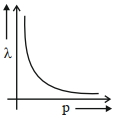
B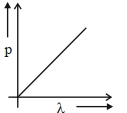
C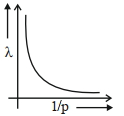
D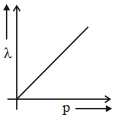
Solution
(A) According to de-Broglie's relation,the wavelength $(\lambda)$ is inversely proportional to the momentum $(p)$:
$\lambda = \frac{h}{p}$
where $h$ is Planck's constant.
This equation can be rewritten as $\lambda p = h$.
Since $h$ is a constant,the product of $\lambda$ and $p$ is constant.
This represents the equation of a rectangular hyperbola.
Therefore,the graph of $\lambda$ versus $p$ is a rectangular hyperbola.
$\lambda = \frac{h}{p}$
where $h$ is Planck's constant.
This equation can be rewritten as $\lambda p = h$.
Since $h$ is a constant,the product of $\lambda$ and $p$ is constant.
This represents the equation of a rectangular hyperbola.
Therefore,the graph of $\lambda$ versus $p$ is a rectangular hyperbola.
0 likes
View Solution141
MediumMCQ
The de-Broglie's wavelength of an electron in the $4^{th}$ orbit is . . . . . . . . $\pi a_0$. ($a_0 =$ Bohr's radius)
A
$5$
B
$4$
C
$7$
D
$8$
Solution
(D) According to Bohr's quantization rule:
$2 \pi r_n = n \lambda$
Radius of $n^{th}$ orbit,$r_n = a_0 \frac{n^2}{Z}$
For hydrogen atom,$Z = 1$ and given $n = 4$.
$2 \pi \left(a_0 \frac{4^2}{1}\right) = 4 \lambda$
$2 \pi a_0 (16) = 4 \lambda$
$32 \pi a_0 = 4 \lambda$
$\lambda = 8 \pi a_0$
Therefore,the value is $8$.
$2 \pi r_n = n \lambda$
Radius of $n^{th}$ orbit,$r_n = a_0 \frac{n^2}{Z}$
For hydrogen atom,$Z = 1$ and given $n = 4$.
$2 \pi \left(a_0 \frac{4^2}{1}\right) = 4 \lambda$
$2 \pi a_0 (16) = 4 \lambda$
$32 \pi a_0 = 4 \lambda$
$\lambda = 8 \pi a_0$
Therefore,the value is $8$.
0 likes
View Solution142
MediumMCQ
The frequency of the de-Broglie wave of an electron in Bohr's first orbit of a hydrogen atom is . . . . . . . . . . $\times 10^{13} \ Hz$ (nearest integer).
[Given: $R_H$ (Rydberg constant) $= 2.18 \times 10^{-18} \ J$,$h$ (Planck's constant) $= 6.6 \times 10^{-34} \ J \cdot s$]
[Given: $R_H$ (Rydberg constant) $= 2.18 \times 10^{-18} \ J$,$h$ (Planck's constant) $= 6.6 \times 10^{-34} \ J \cdot s$]
A
$600$
B
$657$
C
$661$
D
$668$
Solution
(C) The de-Broglie wavelength is given by $\lambda = \frac{h}{mv}$.
The frequency $\nu$ is given by $\nu = \frac{v}{\lambda}$.
Substituting $\lambda = \frac{h}{mv}$,we get $\nu = \frac{v \cdot mv}{h} = \frac{mv^2}{h}$.
From Bohr's model,the kinetic energy $K.E. = \frac{1}{2}mv^2 = 2.18 \times 10^{-18} \ J$.
Therefore,$mv^2 = 2 \times 2.18 \times 10^{-18} = 4.36 \times 10^{-18} \ J$.
Now,calculate the frequency: $\nu = \frac{4.36 \times 10^{-18}}{6.6 \times 10^{-34}} \ Hz$.
$\nu = 0.6606 \times 10^{16} \ Hz = 660.6 \times 10^{13} \ Hz$.
Rounding to the nearest integer,we get $661 \times 10^{13} \ Hz$.
The frequency $\nu$ is given by $\nu = \frac{v}{\lambda}$.
Substituting $\lambda = \frac{h}{mv}$,we get $\nu = \frac{v \cdot mv}{h} = \frac{mv^2}{h}$.
From Bohr's model,the kinetic energy $K.E. = \frac{1}{2}mv^2 = 2.18 \times 10^{-18} \ J$.
Therefore,$mv^2 = 2 \times 2.18 \times 10^{-18} = 4.36 \times 10^{-18} \ J$.
Now,calculate the frequency: $\nu = \frac{4.36 \times 10^{-18}}{6.6 \times 10^{-34}} \ Hz$.
$\nu = 0.6606 \times 10^{16} \ Hz = 660.6 \times 10^{13} \ Hz$.
Rounding to the nearest integer,we get $661 \times 10^{13} \ Hz$.
0 likes
View Solution143
MediumMCQ
The atomic masses of $He$ and $Ne$ are $4$ and $20 \ amu$,respectively. The value of the de Broglie wavelength of $He$ gas at $-73^{\circ} C$ is $M$ times that of the de Broglie wavelength of $Ne$ at $727^{\circ} C$. $M$ is
A
$3$
B
$4$
C
$5$
D
$6$
Solution
(C) The de Broglie wavelength is given by $\lambda = \frac{h}{\sqrt{2m(KE)}}$.
Since $KE = \frac{3}{2}kT$,we have $\lambda \propto \frac{1}{\sqrt{mT}}$.
For $He$ at $-73^{\circ} C$ $(200 \ K)$: $m_{He} = 4$,$T_{He} = 200 \ K$.
For $Ne$ at $727^{\circ} C$ $(1000 \ K)$: $m_{Ne} = 20$,$T_{Ne} = 1000 \ K$.
$\frac{\lambda_{He}}{\lambda_{Ne}} = \sqrt{\frac{m_{Ne} T_{Ne}}{m_{He} T_{He}}} = \sqrt{\frac{20 \times 1000}{4 \times 200}} = \sqrt{\frac{20000}{800}} = \sqrt{25} = 5$.
Thus,$M = 5$.
Since $KE = \frac{3}{2}kT$,we have $\lambda \propto \frac{1}{\sqrt{mT}}$.
For $He$ at $-73^{\circ} C$ $(200 \ K)$: $m_{He} = 4$,$T_{He} = 200 \ K$.
For $Ne$ at $727^{\circ} C$ $(1000 \ K)$: $m_{Ne} = 20$,$T_{Ne} = 1000 \ K$.
$\frac{\lambda_{He}}{\lambda_{Ne}} = \sqrt{\frac{m_{Ne} T_{Ne}}{m_{He} T_{He}}} = \sqrt{\frac{20 \times 1000}{4 \times 200}} = \sqrt{\frac{20000}{800}} = \sqrt{25} = 5$.
Thus,$M = 5$.
0 likes
View Solution144
MediumMCQ
If $a_0$ is denoted as the Bohr radius of the hydrogen atom,then what is the de-Broglie wavelength $(\lambda)$ of the electron present in the $n^{th}$ orbit of the hydrogen atom?
A
$\frac{2 a_0}{n \pi}$
B
$\frac{8 \pi a_0}{n}$
C
$\frac{4 \pi a_0}{n}$
D
$\frac{4 n}{\pi a_0}$
Solution
(C) According to the Bohr quantization condition,the circumference of the orbit is an integral multiple of the de-Broglie wavelength:
$2 \pi r_n = n \lambda$
The radius of the $n^{th}$ orbit is given by $r_n = n^2 a_0$.
Substituting $r_n$ into the equation:
$2 \pi (n^2 a_0) = n \lambda$
Solving for $\lambda$:
$\lambda = \frac{2 \pi n^2 a_0}{n} = 2 \pi n a_0$
Note: The original question asked for the second orbit $(n=2)$,which would yield $\lambda = 4 \pi a_0$. Given the options provided,the expression for the $n^{th}$ orbit is derived as $2 \pi n a_0$.
$2 \pi r_n = n \lambda$
The radius of the $n^{th}$ orbit is given by $r_n = n^2 a_0$.
Substituting $r_n$ into the equation:
$2 \pi (n^2 a_0) = n \lambda$
Solving for $\lambda$:
$\lambda = \frac{2 \pi n^2 a_0}{n} = 2 \pi n a_0$
Note: The original question asked for the second orbit $(n=2)$,which would yield $\lambda = 4 \pi a_0$. Given the options provided,the expression for the $n^{th}$ orbit is derived as $2 \pi n a_0$.
0 likes
View Solution145
MediumMCQ
If the kinetic energy of an electron is $1.25 \times 10^{-28} \ J$,then what will be the de-Broglie wavelength of the electron? (Mass of electron $= 9 \times 10^{-31} \ kg$,$h = 6.6 \times 10^{-34} \ Js$)
A
$1.1 \times 10^{-5} \ m$
B
$4.4 \times 10^{-5} \ m$
C
$2 \times 10^{-8} \ m$
D
$5.3 \times 10^{-10} \ m$
Solution
(B) The de-Broglie wavelength $\lambda$ is given by the formula: $\lambda = \frac{h}{\sqrt{2mK.E.}}$
Given:
$h = 6.6 \times 10^{-34} \ Js$
$m = 9 \times 10^{-31} \ kg$
$K.E. = 1.25 \times 10^{-28} \ J$
Substituting the values:
$\lambda = \frac{6.6 \times 10^{-34}}{\sqrt{2 \times 9 \times 10^{-31} \times 1.25 \times 10^{-28}}}$
$\lambda = \frac{6.6 \times 10^{-34}}{\sqrt{22.5 \times 10^{-59}}} = \frac{6.6 \times 10^{-34}}{\sqrt{225 \times 10^{-60}}}$
$\lambda = \frac{6.6 \times 10^{-34}}{15 \times 10^{-30}} = 0.44 \times 10^{-4} \ m = 4.4 \times 10^{-5} \ m$
Given:
$h = 6.6 \times 10^{-34} \ Js$
$m = 9 \times 10^{-31} \ kg$
$K.E. = 1.25 \times 10^{-28} \ J$
Substituting the values:
$\lambda = \frac{6.6 \times 10^{-34}}{\sqrt{2 \times 9 \times 10^{-31} \times 1.25 \times 10^{-28}}}$
$\lambda = \frac{6.6 \times 10^{-34}}{\sqrt{22.5 \times 10^{-59}}} = \frac{6.6 \times 10^{-34}}{\sqrt{225 \times 10^{-60}}}$
$\lambda = \frac{6.6 \times 10^{-34}}{15 \times 10^{-30}} = 0.44 \times 10^{-4} \ m = 4.4 \times 10^{-5} \ m$
0 likes
View Solution146
MediumMCQ
The de-Broglie wavelength associated with a particle of mass $10^{-6} \ kg$ with a velocity of $10 \ ms^{-1}$ is $:-$
A
$6.63 \times 10^{-22} \ m$
B
$6.63 \times 10^{-29} \ m$
C
$6.63 \times 10^{-31} \ m$
D
$6.63 \times 10^{-34} \ m$
Solution
(B) The de-Broglie wavelength $(\lambda)$ is given by the formula: $\lambda = \frac{h}{mv}$
Where:
$h$ (Planck's constant) = $6.63 \times 10^{-34} \ J \cdot s$
$m$ (mass) = $10^{-6} \ kg$
$v$ (velocity) = $10 \ ms^{-1}$
Substituting the values:
$\lambda = \frac{6.63 \times 10^{-34}}{10^{-6} \times 10} = \frac{6.63 \times 10^{-34}}{10^{-5}} = 6.63 \times 10^{-29} \ m$
Therefore,the correct option is $B$.
Where:
$h$ (Planck's constant) = $6.63 \times 10^{-34} \ J \cdot s$
$m$ (mass) = $10^{-6} \ kg$
$v$ (velocity) = $10 \ ms^{-1}$
Substituting the values:
$\lambda = \frac{6.63 \times 10^{-34}}{10^{-6} \times 10} = \frac{6.63 \times 10^{-34}}{10^{-5}} = 6.63 \times 10^{-29} \ m$
Therefore,the correct option is $B$.
0 likes
View Solution147
MediumMCQ
$A$ proton accelerated through a potential $V$ has de-Broglie wavelength $\lambda$. Then the de-Broglie wavelength of an $\alpha$-particle,when accelerated through the same potential $V$ is :
A
$\frac{\lambda}{2}$
B
$\frac{\lambda}{\sqrt{2}}$
C
$\frac{\lambda}{2 \sqrt{2}}$
D
$\frac{\lambda}{8}$
Solution
(C) The de-Broglie wavelength is given by $\lambda = \frac{h}{\sqrt{2mqV}}$.
For a proton,$\lambda_p = \frac{h}{\sqrt{2 m_p q_p V}}$.
For an $\alpha$-particle,the mass $m_{\alpha} = 4 m_p$ and the charge $q_{\alpha} = 2 q_p$.
Substituting these values,$\lambda_{\alpha} = \frac{h}{\sqrt{2 (4 m_p) (2 q_p) V}} = \frac{h}{\sqrt{16 m_p q_p V}} = \frac{1}{4} \frac{h}{\sqrt{m_p q_p V}}$.
Comparing this with $\lambda_p$,we get $\lambda_{\alpha} = \frac{\lambda}{2 \sqrt{2}}$.
For a proton,$\lambda_p = \frac{h}{\sqrt{2 m_p q_p V}}$.
For an $\alpha$-particle,the mass $m_{\alpha} = 4 m_p$ and the charge $q_{\alpha} = 2 q_p$.
Substituting these values,$\lambda_{\alpha} = \frac{h}{\sqrt{2 (4 m_p) (2 q_p) V}} = \frac{h}{\sqrt{16 m_p q_p V}} = \frac{1}{4} \frac{h}{\sqrt{m_p q_p V}}$.
Comparing this with $\lambda_p$,we get $\lambda_{\alpha} = \frac{\lambda}{2 \sqrt{2}}$.
0 likes
View Solution148
MediumMCQ
The energy of separation of an electron in a $H$ atom in an excited state is $3.4 \ eV$. The de-Broglie wavelength (in $\mathring{A}$) associated with the above electron is,if the radius of the first orbit of the $H$ atom is $0.53 \ \mathring{A}$.
A
$3.33$
B
$6.66$
C
$13.31$
D
$4.2$
Solution
(B) The energy of separation is given by $E_{\text{sep}} = \frac{13.6 \ Z^2}{n^2} \ eV$. For a Hydrogen atom,$Z = 1$. Given $E_{\text{sep}} = 3.4 \ eV$,we have $3.4 = \frac{13.6}{n^2}$,which gives $n^2 = 4$,so $n = 2$.
According to Bohr's postulate,the circumference of the orbit is an integral multiple of the de-Broglie wavelength: $2 \pi r_n = n \lambda$.
The radius of the $n^{th}$ orbit is $r_n = r_1 \times n^2$,where $r_1 = 0.53 \ \mathring{A}$.
Substituting the values: $2 \pi \times (0.53 \times n^2) = n \lambda$.
Simplifying for $\lambda$: $\lambda = 2 \pi \times 0.53 \times n$.
Since $n = 2$,$\lambda = 2 \times 3.14159 \times 0.53 \times 2 \approx 6.66 \ \mathring{A}$.
According to Bohr's postulate,the circumference of the orbit is an integral multiple of the de-Broglie wavelength: $2 \pi r_n = n \lambda$.
The radius of the $n^{th}$ orbit is $r_n = r_1 \times n^2$,where $r_1 = 0.53 \ \mathring{A}$.
Substituting the values: $2 \pi \times (0.53 \times n^2) = n \lambda$.
Simplifying for $\lambda$: $\lambda = 2 \pi \times 0.53 \times n$.
Since $n = 2$,$\lambda = 2 \times 3.14159 \times 0.53 \times 2 \approx 6.66 \ \mathring{A}$.
0 likes
View Solution149
MediumMCQ
If $a_0$ is the radius of the first Bohr's orbit of the $H$-atom, the de-Broglie wavelength of an electron revolving in the second Bohr's orbit will be: (in $\pi a_0$)
A
$6$
B
$4$
C
$2$
D
$3$
Solution
(B) The radius of the $n^{th}$ Bohr orbit is given by $r_n = a_0 n^2$, where $a_0$ is the radius of the first orbit.
For the second orbit $(n = 2)$, the radius $r_2 = a_0 \times (2)^2 = 4 a_0$.
According to the Bohr quantization condition, the circumference of the orbit is an integral multiple of the de-Broglie wavelength: $n \lambda = 2 \pi r_n$.
For $n = 2$, we have $2 \lambda = 2 \pi r_2$.
Substituting $r_2 = 4 a_0$, we get $2 \lambda = 2 \pi (4 a_0)$.
Therefore, $\lambda = 4 \pi a_0$.
For the second orbit $(n = 2)$, the radius $r_2 = a_0 \times (2)^2 = 4 a_0$.
According to the Bohr quantization condition, the circumference of the orbit is an integral multiple of the de-Broglie wavelength: $n \lambda = 2 \pi r_n$.
For $n = 2$, we have $2 \lambda = 2 \pi r_2$.
Substituting $r_2 = 4 a_0$, we get $2 \lambda = 2 \pi (4 a_0)$.
Therefore, $\lambda = 4 \pi a_0$.
0 likes
View Solution150
EasyMCQ
What should be the momentum (in $g \ cm / s$) of a particle if its de Broglie wavelength is $1 \ \mathring{A}$ and the value of $h$ is $6.6252 \times 10^{-27} \ erg \ s$?
A
$6.6252 \times 10^{-19} \ g \ cm / s$
B
$6.6252 \times 10^{-21} \ g \ cm / s$
C
$6.6252 \times 10^{-24} \ g \ cm / s$
D
$6.6252 \times 10^{-27} \ g \ cm / s$
Solution
(A) According to the de Broglie relation,the momentum $P$ is given by $P = \frac{h}{\lambda}$.
Given,$\lambda = 1 \ \mathring{A} = 10^{-8} \ cm$ and $h = 6.6252 \times 10^{-27} \ erg \ s$.
Substituting the values,we get $P = \frac{6.6252 \times 10^{-27} \ erg \ s}{10^{-8} \ cm}$.
$P = 6.6252 \times 10^{-19} \ g \ cm / s$ (since $1 \ erg = 1 \ g \ cm^2 / s^2$,so $1 \ erg \ s / cm = 1 \ g \ cm / s$).
Given,$\lambda = 1 \ \mathring{A} = 10^{-8} \ cm$ and $h = 6.6252 \times 10^{-27} \ erg \ s$.
Substituting the values,we get $P = \frac{6.6252 \times 10^{-27} \ erg \ s}{10^{-8} \ cm}$.
$P = 6.6252 \times 10^{-19} \ g \ cm / s$ (since $1 \ erg = 1 \ g \ cm^2 / s^2$,so $1 \ erg \ s / cm = 1 \ g \ cm / s$).
0 likes
View SolutionStructure of Atom — De Broglie's principle · Frequently Asked Questions
1Are these Structure of Atom questions useful for JEE and NEET?
Yes. All questions in this section are mapped to JEE Main and NEET exam patterns. Previous year questions from JEE Main, NEET, GUJCET and state-level exams are included with full solutions.
2Can I switch to Hindi or Gujarati for these questions?
Yes. Use the language tabs in the hero section or the sidebar to view the same questions and solutions in English, Hindi or Gujarati.
3How do I generate a question paper from this subtopic?
Use the Vedclass Exam Paper Generator — select the chapter and subtopic, set difficulty, and generate Sets A, B, C, D automatically. First 3 chapters of every subject are free.
Vedclass Products
For Students
Vedclass Test Series
Mock tests in real JEE/NEET style with performance analysis. 5-day free trial.
Start Free TrialFor Teachers
Exam Paper Generator
Generate Set A/B/C/D papers from this chapter in 2 minutes. 3 chapters free.
Try FreeFor Institutes
Online Exam Module
Live online exams with unlimited students, 360° analytics & white-label branding.
See DemoFor Teachers & Institutes
Generate a Structure of Atom Exam Paper in 2 Minutes
Select subtopic & difficulty — Sets A, B, C, D auto-generated with No Repeat logic.
First 3 chapters of every subject are free — no payment required.