
A English
Laws of chemical combination Questions in English
Class 11 Chemistry · Some Basic Concepts of Chemistry · Laws of chemical combination
98+
Questions
English
Language
100%
With Solutions
Showing 48 of 98 questions in English
51
EasyMCQ
Under the same conditions of temperature and pressure,equal volumes of different gases contain an equal number of......
A
Atoms
B
Molecules
C
Radicals
D
Compounds
Solution
(B) According to Avogadro's Law,under the same conditions of temperature and pressure,equal volumes of all gases contain an equal number of molecules.
0 likes
View Solution52
EasyMCQ
Gay-Lussac's law of gaseous volumes is derived from $.......$.
A
Law of reciprocal proportions
B
Law of multiple proportions
C
Experimental observations
D
None of the above
Solution
(C) Gay-Lussac's law of gaseous volumes states that when gases react together,they do so in volumes which bear a simple ratio to one another and to the volumes of the products if gaseous,provided that all gases are at the same temperature and pressure. This law was based on $Experimental \ observations$ made by Joseph Louis Gay-Lussac.
0 likes
View Solution53
MediumMCQ
The law of multiple proportions was proposed by
A
Lavoisier
B
Dalton
C
Proust
D
Gay-Lussac
Solution
(B) The law of multiple proportions was proposed by John Dalton in $1803$ and was later verified by Jons Jacob Berzelius.
0 likes
View Solution54
DifficultMCQ
$1 \, L$ of $N_2$ combines with $3 \, L$ of $H_2$ to form $2 \, L$ of $NH_3$ under the same conditions. This illustrates the:
A
Law of constant composition
B
Law of multiple proportions
C
Law of reciprocal proportions
D
Gay-Lussac’s law of gaseous volumes
Solution
(D) Gay-Lussac's law of gaseous volumes states that when gases react together,they do so in volumes which bear a simple ratio to one another and to the volumes of the products,if gaseous,provided that the temperature and pressure remain constant.
In the reaction $N_2(g) + 3H_2(g) \rightarrow 2NH_3(g)$,the ratio of volumes of $N_2 : H_2 : NH_3$ is $1 : 3 : 2$,which is a simple whole-number ratio.
In the reaction $N_2(g) + 3H_2(g) \rightarrow 2NH_3(g)$,the ratio of volumes of $N_2 : H_2 : NH_3$ is $1 : 3 : 2$,which is a simple whole-number ratio.
0 likes
View Solution55
DifficultMCQ
One part of an element $A$ combines with two parts of another element $B$. Six parts of the element $C$ combine with four parts of the element $B$. If $A$ and $C$ combine together,the ratio of their weights will be governed by
A
Law of definite proportion
B
Law of multiple proportion
C
Law of reciprocal proportion
D
Law of conservation of mass
Solution
(C) The Law of Reciprocal Proportion states that when two different elements combine separately with a fixed mass of a third element,the ratio of the masses in which they do so is either the same or a simple multiple of the ratio in which they combine with each other.
Given:
$1 \text{ part of } A$ combines with $2 \text{ parts of } B$.
$6 \text{ parts of } C$ combine with $4 \text{ parts of } B$.
To compare $A$ and $C$ with a fixed mass of $B$ (let's fix $B$ at $4 \text{ parts}$):
$A$ combines with $B$ in ratio $1:2$,so $2 \text{ parts of } A$ combine with $4 \text{ parts of } B$.
$C$ combines with $B$ in ratio $6:4$,so $6 \text{ parts of } C$ combine with $4 \text{ parts of } B$.
The ratio of masses of $A$ and $C$ that combine with a fixed mass of $B$ is $2:6$ or $1:3$.
Since the ratio of weights of $A$ and $C$ is governed by their reaction with a third element $B$,this follows the Law of Reciprocal Proportion.
Given:
$1 \text{ part of } A$ combines with $2 \text{ parts of } B$.
$6 \text{ parts of } C$ combine with $4 \text{ parts of } B$.
To compare $A$ and $C$ with a fixed mass of $B$ (let's fix $B$ at $4 \text{ parts}$):
$A$ combines with $B$ in ratio $1:2$,so $2 \text{ parts of } A$ combine with $4 \text{ parts of } B$.
$C$ combines with $B$ in ratio $6:4$,so $6 \text{ parts of } C$ combine with $4 \text{ parts of } B$.
The ratio of masses of $A$ and $C$ that combine with a fixed mass of $B$ is $2:6$ or $1:3$.
Since the ratio of weights of $A$ and $C$ is governed by their reaction with a third element $B$,this follows the Law of Reciprocal Proportion.
0 likes
View Solution56
EasyMCQ
According to Dalton’s atomic theory,an atom
A
can not be subdivided
B
can be further subdivided
C
contains neutrons,protons and electrons
D
none of these
Solution
(A) Dalton's atomic theory,proposed in $1808$,stated that atoms are the ultimate,indivisible particles of matter. According to this theory,an atom cannot be subdivided into smaller particles.
0 likes
View Solution57
EasyMCQ
According to Dalton's atomic theory,atoms of an element are
A
similar in all respects except their masses
B
similar in all respects except their sizes
C
identical
D
different
Solution
(C) According to Dalton's atomic theory,atoms of the same element are identical in all respects,including their mass,shape,and chemical properties.
Therefore,the statement that atoms of an element are identical is the correct representation of his postulate.
Note: The existence of isotopes (atoms of the same element with different masses) is a limitation of Dalton's theory,as he originally proposed that all atoms of a given element are identical in every way.
Therefore,the statement that atoms of an element are identical is the correct representation of his postulate.
Note: The existence of isotopes (atoms of the same element with different masses) is a limitation of Dalton's theory,as he originally proposed that all atoms of a given element are identical in every way.
0 likes
View Solution58
MediumMCQ
Which of the following statements is correct about the given reaction?
$4Fe_{(s)} + 3O_{2_{(g)}} \to 2Fe_{2}O_{3_{(s)}}$
$4Fe_{(s)} + 3O_{2_{(g)}} \to 2Fe_{2}O_{3_{(s)}}$
A
Total mass of iron and oxygen used in reaction $=$ total mass of ferric oxide in product; therefore,it follows law of conservation of mass.
B
Total mass of reactants used in the reaction $=$ total mass of product; therefore,law of multiple proportions is followed.
C
Amount of $Fe_{2}O_{3}$ can be increased by taking any one of the reactants (iron or oxygen) in excess.
D
Amount of $Fe_{2}O_{3}$ produced will decrease if the amount of any one of the reactants (iron or oxygen) is taken in excess.
Solution
(A) According to the law of conservation of mass,the total mass of the reactants must equal the total mass of the products in a balanced chemical equation.
In the reaction $4Fe_{(s)} + 3O_{2_{(g)}} \to 2Fe_{2}O_{3_{(s)}}$,the mass of $4$ moles of $Fe$ and $3$ moles of $O_{2}$ equals the mass of $2$ moles of $Fe_{2}O_{3}$.
Therefore,statement $A$ is correct as it correctly identifies that the reaction follows the law of conservation of mass.
Statement $B$ is incorrect because the law of multiple proportions applies to two elements forming more than one compound,not to a single balanced reaction.
Statements $C$ and $D$ are incorrect because the amount of product is determined by the limiting reagent,not by simply adding excess of one reactant.
In the reaction $4Fe_{(s)} + 3O_{2_{(g)}} \to 2Fe_{2}O_{3_{(s)}}$,the mass of $4$ moles of $Fe$ and $3$ moles of $O_{2}$ equals the mass of $2$ moles of $Fe_{2}O_{3}$.
Therefore,statement $A$ is correct as it correctly identifies that the reaction follows the law of conservation of mass.
Statement $B$ is incorrect because the law of multiple proportions applies to two elements forming more than one compound,not to a single balanced reaction.
Statements $C$ and $D$ are incorrect because the amount of product is determined by the limiting reagent,not by simply adding excess of one reactant.
0 likes
View Solution59
MediumMCQ
Which one of the following pairs of compounds illustrates the law of multiple proportions?
A
$H_2O, Na_2O$
B
$MgO, Na_2O$
C
$Na_2O, BaO$
D
$SnCl_2, SnCl_4$
Solution
(D) The law of multiple proportions states that when two elements combine to form more than one compound,the masses of one element that combine with a fixed mass of the other are in the ratio of small whole numbers.
In the pair $SnCl_2$ and $SnCl_4$,the same element tin $(Sn)$ combines with chlorine $(Cl)$ in different proportions.
For $SnCl_2$: $118.7 \ g$ of $Sn$ combines with $71 \ g$ of $Cl$.
For $SnCl_4$: $118.7 \ g$ of $Sn$ combines with $142 \ g$ of $Cl$.
The ratio of the masses of chlorine that combine with a fixed mass of tin is $142 : 71$,which simplifies to $2 : 1$.
Since this is a simple whole-number ratio,this pair illustrates the law of multiple proportions.
In the pair $SnCl_2$ and $SnCl_4$,the same element tin $(Sn)$ combines with chlorine $(Cl)$ in different proportions.
For $SnCl_2$: $118.7 \ g$ of $Sn$ combines with $71 \ g$ of $Cl$.
For $SnCl_4$: $118.7 \ g$ of $Sn$ combines with $142 \ g$ of $Cl$.
The ratio of the masses of chlorine that combine with a fixed mass of tin is $142 : 71$,which simplifies to $2 : 1$.
Since this is a simple whole-number ratio,this pair illustrates the law of multiple proportions.
0 likes
View Solution60
MediumMCQ
The following data are obtained when dinitrogen and dioxygen react together to form different compounds:
Which law of chemical combination is obeyed by the above experimental data?
| Mass of dinitrogen | Mass of dioxygen |
|---|---|
| $14 \ g$ | $16 \ g$ |
| $14 \ g$ | $32 \ g$ |
| $28 \ g$ | $32 \ g$ |
| $28 \ g$ | $80 \ g$ |
Which law of chemical combination is obeyed by the above experimental data?
A
Law of conservation of mass
B
Law of definite proportions
C
Law of multiple proportions
D
Avogadro's Law
Solution
(C) To verify the law,we fix the mass of dinitrogen $(N_2)$ to a constant value,say $14 \ g$.
$1$. For $14 \ g$ of $N_2$,the mass of dioxygen $(O_2)$ is $16 \ g$ and $32 \ g$. The ratio is $16:32 = 1:2$.
$2$. For $28 \ g$ of $N_2$,the mass of $O_2$ is $32 \ g$ and $80 \ g$. Normalizing to $14 \ g$ of $N_2$ (dividing by $2$),the masses of $O_2$ are $16 \ g$ and $40 \ g$. The ratio is $16:40 = 2:5$.
Since the masses of one element $(O_2)$ that combine with a fixed mass of another element $(N_2)$ are in the ratio of small whole numbers $(1:2:5)$,the data obeys the Law of Multiple Proportions.
Thus,option $C$ is correct.
$1$. For $14 \ g$ of $N_2$,the mass of dioxygen $(O_2)$ is $16 \ g$ and $32 \ g$. The ratio is $16:32 = 1:2$.
$2$. For $28 \ g$ of $N_2$,the mass of $O_2$ is $32 \ g$ and $80 \ g$. Normalizing to $14 \ g$ of $N_2$ (dividing by $2$),the masses of $O_2$ are $16 \ g$ and $40 \ g$. The ratio is $16:40 = 2:5$.
Since the masses of one element $(O_2)$ that combine with a fixed mass of another element $(N_2)$ are in the ratio of small whole numbers $(1:2:5)$,the data obeys the Law of Multiple Proportions.
Thus,option $C$ is correct.
0 likes
View Solution61
EasyMCQ
Which of the following examples illustrates the Law of Multiple Proportions?
A
$NH_3, HCl$
B
$H_2S, SO_2$
C
$CuO, Cu_2O$
D
$FeCl_3, FeSO_4$
Solution
(C) The Law of Multiple Proportions states that when two elements combine to form more than one compound,the masses of one element that combine with a fixed mass of the other are in the ratio of small whole numbers.
In $CuO$ and $Cu_2O$:
For $CuO$: $63.5 \ g$ of $Cu$ combines with $16 \ g$ of $O$.
For $Cu_2O$: $127 \ g$ of $Cu$ combines with $16 \ g$ of $O$,which means $63.5 \ g$ of $Cu$ combines with $8 \ g$ of $O$.
The ratio of the masses of oxygen combining with a fixed mass $(63.5 \ g)$ of copper is $16:8$,which simplifies to $2:1$,a simple whole number ratio.
Therefore,$CuO$ and $Cu_2O$ illustrate the Law of Multiple Proportions.
In $CuO$ and $Cu_2O$:
For $CuO$: $63.5 \ g$ of $Cu$ combines with $16 \ g$ of $O$.
For $Cu_2O$: $127 \ g$ of $Cu$ combines with $16 \ g$ of $O$,which means $63.5 \ g$ of $Cu$ combines with $8 \ g$ of $O$.
The ratio of the masses of oxygen combining with a fixed mass $(63.5 \ g)$ of copper is $16:8$,which simplifies to $2:1$,a simple whole number ratio.
Therefore,$CuO$ and $Cu_2O$ illustrate the Law of Multiple Proportions.
0 likes
View Solution62
EasyMCQ
Which of the following examples illustrates the Law of Multiple Proportions?
A
$N_2O_3, N_2O_4, N_2O_5$
B
$KCl, KBr, KI$
C
$H_2O, H_2S, SO_2$
D
$PH_3, P_2O_3, P_2O_5$
Solution
(A) The Law of Multiple Proportions states that when two elements combine to form more than one compound,the masses of one element that combine with a fixed mass of the other element are in the ratio of small whole numbers.
In $N_2O_3, N_2O_4$,and $N_2O_5$,the element nitrogen $(N)$ combines with oxygen $(O)$ to form different compounds.
For a fixed mass of nitrogen $(28 \ g)$,the masses of oxygen are $48 \ g, 64 \ g$,and $80 \ g$ respectively.
The ratio of these masses is $48:64:80$,which simplifies to $3:4:5$,a ratio of small whole numbers.
Thus,$N_2O_3, N_2O_4, N_2O_5$ illustrates the Law of Multiple Proportions.
In $N_2O_3, N_2O_4$,and $N_2O_5$,the element nitrogen $(N)$ combines with oxygen $(O)$ to form different compounds.
For a fixed mass of nitrogen $(28 \ g)$,the masses of oxygen are $48 \ g, 64 \ g$,and $80 \ g$ respectively.
The ratio of these masses is $48:64:80$,which simplifies to $3:4:5$,a ratio of small whole numbers.
Thus,$N_2O_3, N_2O_4, N_2O_5$ illustrates the Law of Multiple Proportions.
0 likes
View Solution63
EasyMCQ
Two compounds are formed by carbon and oxygen. In one compound,the percentage of carbon is $42.9\%$ and in the other,the percentage of carbon is $27.3\%$. Which law of chemical combination is illustrated by this data?
A
Law of Definite Proportions
B
Law of Multiple Proportions
C
Law of Reciprocal Proportions
D
Law of Conservation of Mass
Solution
(B) In the first compound,carbon = $42.9\%$ and oxygen = $(100 - 42.9)\% = 57.1\%$. The ratio of oxygen to carbon is $57.1 / 42.9 \approx 1.33$.
In the second compound,carbon = $27.3\%$ and oxygen = $(100 - 27.3)\% = 72.7\%$. The ratio of oxygen to carbon is $72.7 / 27.3 \approx 2.66$.
The ratio of the two ratios is $2.66 / 1.33 = 2:1$.
Since the ratio is a simple whole number,this illustrates the $Law$ $of$ $Multiple$ $Proportions$.
In the second compound,carbon = $27.3\%$ and oxygen = $(100 - 27.3)\% = 72.7\%$. The ratio of oxygen to carbon is $72.7 / 27.3 \approx 2.66$.
The ratio of the two ratios is $2.66 / 1.33 = 2:1$.
Since the ratio is a simple whole number,this illustrates the $Law$ $of$ $Multiple$ $Proportions$.
0 likes
View Solution64
MediumMCQ
In $SO_2$ and $SO_3$,the masses of oxygen that combine with $48 \, g$ of sulfur are respectively ......... .
A
$48, 72$
B
$48, 48$
C
$32, 48$
D
$16, 48$
Solution
(A) For $SO_2$: The molar mass of $S$ is $32 \, g$ and $O_2$ is $32 \, g$.
Since $32 \, g$ of $S$ combines with $32 \, g$ of $O_2$,then $48 \, g$ of $S$ will combine with $(32 / 32) \times 48 = 48 \, g$ of $O_2$.
For $SO_3$: The molar mass of $S$ is $32 \, g$ and $O_3$ is $48 \, g$.
Since $32 \, g$ of $S$ combines with $48 \, g$ of $O_3$,then $48 \, g$ of $S$ will combine with $(48 / 32) \times 48 = 72 \, g$ of $O_3$.
Thus,the masses are $48 \, g$ and $72 \, g$.
Since $32 \, g$ of $S$ combines with $32 \, g$ of $O_2$,then $48 \, g$ of $S$ will combine with $(32 / 32) \times 48 = 48 \, g$ of $O_2$.
For $SO_3$: The molar mass of $S$ is $32 \, g$ and $O_3$ is $48 \, g$.
Since $32 \, g$ of $S$ combines with $48 \, g$ of $O_3$,then $48 \, g$ of $S$ will combine with $(48 / 32) \times 48 = 72 \, g$ of $O_3$.
Thus,the masses are $48 \, g$ and $72 \, g$.
0 likes
View Solution65
MediumMCQ
Assertion : Atoms can neither be created nor destroyed.
Reason : Under similar conditions of temperature and pressure,equal volumes of gases do not contain equal numbers of atoms.
Reason : Under similar conditions of temperature and pressure,equal volumes of gases do not contain equal numbers of atoms.
A
If both Assertion and Reason are correct and the Reason is a correct explanation of the Assertion.
B
If both Assertion and Reason are correct but Reason is not a correct explanation of the Assertion.
C
If the Assertion is correct but Reason is incorrect.
D
If both the Assertion and Reason are incorrect.
Solution
(D) The Assertion is incorrect because,according to nuclear reactions,atoms can be created or destroyed (e.g.,in nuclear fission or fusion).
The Reason is also incorrect because,according to Avogadro's Law,equal volumes of all gases under the same conditions of temperature and pressure contain an equal number of molecules,and consequently,an equal number of atoms if the gases are monatomic.
The Reason is also incorrect because,according to Avogadro's Law,equal volumes of all gases under the same conditions of temperature and pressure contain an equal number of molecules,and consequently,an equal number of atoms if the gases are monatomic.
0 likes
View Solution66
MediumMCQ
Amongst the following statements,which one was not proposed by $Dalton$?
A
All the atoms of a given element have identical properties including identical mass. Atoms of different elements differ in mass.
B
Chemical reactions involve reorganization of atoms. These are neither created nor destroyed in a chemical reaction.
C
When gases combine or are produced in a chemical reaction,they do so in a simple ratio by volume,provided all gases are at the same $T$ and $P$.
D
Matter consists of indivisible atoms.
Solution
(C) According to $Dalton's$ atomic theory,matter consists of indivisible atoms,chemical reactions involve the reorganization of atoms,and atoms are neither created nor destroyed.
The statement regarding the simple ratio of volumes of gases is known as $Gay-Lussac's$ Law of Gaseous Volumes,which was not part of $Dalton's$ atomic theory.
The statement regarding the simple ratio of volumes of gases is known as $Gay-Lussac's$ Law of Gaseous Volumes,which was not part of $Dalton's$ atomic theory.
0 likes
View Solution67
Difficult
The following data are obtained when dinitrogen and dioxygen react together to form different compounds:
$(a)$ Which law of chemical combination is obeyed by the above experimental data? Give its statement.
$(b)$ Fill in the blanks in the following conversions:
$(i) \ 1 \ km = \dots \ mm = \dots \ pm$
$(ii) \ 1 \ mg = \dots \ kg = \dots \ ng$
$(iii) \ 1 \ mL = \dots \ L = \dots \ dm^{3}$
| Mass of dinitrogen | Mass of dioxygen |
|---|---|
| $(i) \ 14 \ g$ | $16 \ g$ |
| $(ii) \ 14 \ g$ | $32 \ g$ |
| $(iii) \ 28 \ g$ | $32 \ g$ |
| $(iv) \ 28 \ g$ | $80 \ g$ |
$(a)$ Which law of chemical combination is obeyed by the above experimental data? Give its statement.
$(b)$ Fill in the blanks in the following conversions:
$(i) \ 1 \ km = \dots \ mm = \dots \ pm$
$(ii) \ 1 \ mg = \dots \ kg = \dots \ ng$
$(iii) \ 1 \ mL = \dots \ L = \dots \ dm^{3}$
Solution
(N/A) If we fix the mass of dinitrogen at $28 \ g$, the masses of dioxygen that combine with the fixed mass of dinitrogen are $32 \ g, 64 \ g, 32 \ g,$ and $80 \ g$.
The ratio of these masses of dioxygen is $32:64:32:80$, which simplifies to $2:4:2:5$ (a whole number ratio).
Thus, the data obeys the Law of Multiple Proportions.
Statement: When two elements combine to form more than one compound, the masses of one element that combine with a fixed mass of the other are in the ratio of small whole numbers.
$(b) (i) \ 1 \ km = 10^{6} \ mm = 10^{15} \ pm$
$(ii) \ 1 \ mg = 10^{-6} \ kg = 10^{6} \ ng$
$(iii) \ 1 \ mL = 10^{-3} \ L = 10^{-3} \ dm^{3}$
The ratio of these masses of dioxygen is $32:64:32:80$, which simplifies to $2:4:2:5$ (a whole number ratio).
Thus, the data obeys the Law of Multiple Proportions.
Statement: When two elements combine to form more than one compound, the masses of one element that combine with a fixed mass of the other are in the ratio of small whole numbers.
$(b) (i) \ 1 \ km = 10^{6} \ mm = 10^{15} \ pm$
$(ii) \ 1 \ mg = 10^{-6} \ kg = 10^{6} \ ng$
$(iii) \ 1 \ mL = 10^{-3} \ L = 10^{-3} \ dm^{3}$
0 likes
View Solution68
Medium
Explain Dalton's atomic theory.
Solution
(N/A) The atomic theory of matter was first proposed by John Dalton in $1808$.
$1$. Matter consists of indivisible atoms.
$2$. All the atoms of a given element have identical properties,including identical mass. Atoms of different elements differ in mass.
$3$. Compounds are formed when atoms of different elements combine in a fixed ratio.
$4$. Chemical reactions involve only the reorganization of atoms. Atoms are neither created nor destroyed in a chemical reaction.
This theory successfully explained the law of conservation of mass,the law of constant composition,and the law of multiple proportions. However,it failed to explain the existence of subatomic particles (like electrons,protons,and neutrons) and the phenomenon of static electricity generated by rubbing materials.
$1$. Matter consists of indivisible atoms.
$2$. All the atoms of a given element have identical properties,including identical mass. Atoms of different elements differ in mass.
$3$. Compounds are formed when atoms of different elements combine in a fixed ratio.
$4$. Chemical reactions involve only the reorganization of atoms. Atoms are neither created nor destroyed in a chemical reaction.
This theory successfully explained the law of conservation of mass,the law of constant composition,and the law of multiple proportions. However,it failed to explain the existence of subatomic particles (like electrons,protons,and neutrons) and the phenomenon of static electricity generated by rubbing materials.
0 likes
View Solution69
Easy
Define the Law of Conservation of Mass.
Solution
(N/A) The Law of Conservation of Mass states that matter can neither be created nor destroyed in a chemical reaction.
This law was put forth by Antoine Lavoisier in $1789$.
He performed careful experimental studies for combustion reactions to reach this conclusion.
This law formed the basis for several later developments in chemistry.
It is the result of exact measurements of the masses of reactants and products in carefully planned experiments.
This law was put forth by Antoine Lavoisier in $1789$.
He performed careful experimental studies for combustion reactions to reach this conclusion.
This law formed the basis for several later developments in chemistry.
It is the result of exact measurements of the masses of reactants and products in carefully planned experiments.
0 likes
View Solution70
Medium
Explain the Law of Definite Proportions with examples.
Solution
(N/A) The Law of Definite Proportions was proposed by the French chemist $Joseph \ Proust$. He stated that a given chemical compound always contains exactly the same proportion of elements by weight,regardless of its source or method of preparation.
$Proust$ worked with two samples of cupric carbonate $(CuCO_3)$—one of natural origin and the other synthetic. He found that the composition of elements present in both samples was identical,as shown in the table below:
Thus,irrespective of the source,a given compound always contains the same elements in the same proportion by mass. This law is also known as the Law of Definite Composition.
$Proust$ worked with two samples of cupric carbonate $(CuCO_3)$—one of natural origin and the other synthetic. He found that the composition of elements present in both samples was identical,as shown in the table below:
| Sample Type | $\% \text{ of Copper}$ | $\% \text{ of Carbon}$ | $\% \text{ of Oxygen}$ |
| Natural sample | $51.35$ | $9.74$ | $38.91$ |
| Synthetic sample | $51.35$ | $9.74$ | $38.91$ |
Thus,irrespective of the source,a given compound always contains the same elements in the same proportion by mass. This law is also known as the Law of Definite Composition.
0 likes
View Solution71
Medium
Explain the Law of Multiple Proportions.
Solution
This law was proposed by Dalton in $1803$.
According to this law,if two elements can combine to form more than one compound,the masses of one element that combine with a fixed mass of the other element are in the ratio of small whole numbers.
For example,hydrogen combines with oxygen to form two compounds,namely,water $(H_2O)$ and hydrogen peroxide $(H_2O_2)$.
$1.$ Hydrogen $+$ Oxygen $\rightarrow$ Water $(H_2O)$
$2 \ g$ of Hydrogen combines with $16 \ g$ of Oxygen.
$2.$ Hydrogen $+$ Oxygen $\rightarrow$ Hydrogen Peroxide $(H_2O_2)$
$2 \ g$ of Hydrogen combines with $32 \ g$ of Oxygen.
Here,the masses of oxygen ($16 \ g$ and $32 \ g$) which combine with a fixed mass of hydrogen $(2 \ g)$ bear a simple ratio,i.e.,$16:32$ or $1:2$.
According to this law,if two elements can combine to form more than one compound,the masses of one element that combine with a fixed mass of the other element are in the ratio of small whole numbers.
For example,hydrogen combines with oxygen to form two compounds,namely,water $(H_2O)$ and hydrogen peroxide $(H_2O_2)$.
$1.$ Hydrogen $+$ Oxygen $\rightarrow$ Water $(H_2O)$
$2 \ g$ of Hydrogen combines with $16 \ g$ of Oxygen.
$2.$ Hydrogen $+$ Oxygen $\rightarrow$ Hydrogen Peroxide $(H_2O_2)$
$2 \ g$ of Hydrogen combines with $32 \ g$ of Oxygen.
Here,the masses of oxygen ($16 \ g$ and $32 \ g$) which combine with a fixed mass of hydrogen $(2 \ g)$ bear a simple ratio,i.e.,$16:32$ or $1:2$.
0 likes
View Solution72
Medium
State and explain Gay-Lussac's Law of Gaseous Volumes.
Solution
This law was proposed by Gay-Lussac in $1808$.
He observed that when gases combine or are produced in a chemical reaction,they do so in a simple ratio by volume,provided all gases are at the same temperature and pressure.
For example,$100 \ mL$ of hydrogen combines with $50 \ mL$ of oxygen to give $100 \ mL$ of water vapour.
$\text{Hydrogen} + \text{Oxygen} \rightarrow \text{Water vapour}$
$100 \ mL$ $50 \ mL$ $100 \ mL$
Thus,the volumes of hydrogen and oxygen which combine together (i.e.,$100 \ mL$ and $50 \ mL$) bear a simple ratio of $2:1$.
Gay-Lussac's discovery of an integer ratio in volume relationships is essentially the law of definite proportions by volume,whereas the earlier law was with respect to mass.
He observed that when gases combine or are produced in a chemical reaction,they do so in a simple ratio by volume,provided all gases are at the same temperature and pressure.
For example,$100 \ mL$ of hydrogen combines with $50 \ mL$ of oxygen to give $100 \ mL$ of water vapour.
$\text{Hydrogen} + \text{Oxygen} \rightarrow \text{Water vapour}$
$100 \ mL$ $50 \ mL$ $100 \ mL$
Thus,the volumes of hydrogen and oxygen which combine together (i.e.,$100 \ mL$ and $50 \ mL$) bear a simple ratio of $2:1$.
Gay-Lussac's discovery of an integer ratio in volume relationships is essentially the law of definite proportions by volume,whereas the earlier law was with respect to mass.
0 likes
View Solution73
Medium
Explain Avogadro's Law with the help of a figure.
Solution
(N/A) In $1811$,Avogadro proposed that equal volumes of gases at the same temperature and pressure should contain an equal number of molecules.
Avogadro made a distinction between atoms and molecules,which is well-understood in modern times.
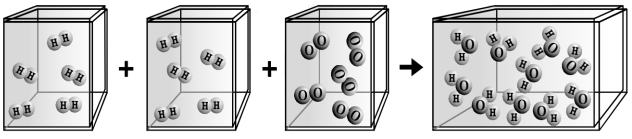
If we consider the reaction of hydrogen and oxygen to produce water,we observe that two volumes of hydrogen combine with one volume of oxygen to yield two volumes of water vapor without leaving any unreacted oxygen.
In the figure,each box contains an equal number of molecules. Avogadro explained this result by considering the molecules to be polyatomic. Specifically,he proposed that hydrogen and oxygen exist as diatomic molecules.
At that time,Dalton and others believed that atoms of the same kind could not combine,and thus molecules of oxygen or hydrogen containing two atoms did not exist. However,Avogadro's hypothesis successfully explained the experimental observations.
Avogadro made a distinction between atoms and molecules,which is well-understood in modern times.
If we consider the reaction of hydrogen and oxygen to produce water,we observe that two volumes of hydrogen combine with one volume of oxygen to yield two volumes of water vapor without leaving any unreacted oxygen.
In the figure,each box contains an equal number of molecules. Avogadro explained this result by considering the molecules to be polyatomic. Specifically,he proposed that hydrogen and oxygen exist as diatomic molecules.
At that time,Dalton and others believed that atoms of the same kind could not combine,and thus molecules of oxygen or hydrogen containing two atoms did not exist. However,Avogadro's hypothesis successfully explained the experimental observations.
0 likes
View Solution74
Medium
Write about Dalton's Atomic Theory.
Solution
(N/A) The first atomic theory was proposed by John Dalton in $1808$.
According to this theory:
$(i)$ Matter consists of indivisible atoms.
$(ii)$ All atoms of a given element have identical properties,including identical mass. Atoms of different elements differ in mass.
$(iii)$ Compounds are formed when atoms of different elements combine in a fixed ratio.
$(iv)$ Chemical reactions involve the reorganization of atoms. Atoms are neither created nor destroyed in a chemical reaction.
According to this theory:
$(i)$ Matter consists of indivisible atoms.
$(ii)$ All atoms of a given element have identical properties,including identical mass. Atoms of different elements differ in mass.
$(iii)$ Compounds are formed when atoms of different elements combine in a fixed ratio.
$(iv)$ Chemical reactions involve the reorganization of atoms. Atoms are neither created nor destroyed in a chemical reaction.
0 likes
View Solution75
Medium
$45.4 \ L$ of dinitrogen reacts with $22.7 \ L$ of dioxygen to form $45.4 \ L$ of nitrous oxide. For the reaction $2N_{2(g)} + O_{2(g)} \to 2N_2O_{(g)}$,identify the law followed and state the law.
Solution
(A) The given reaction is: $2N_{2(g)} + O_{2(g)} \to 2N_2O_{(g)}$
Stoichiometric volumes: $2 \ V \quad 1 \ V \quad 2 \ V$
Given volumes: $45.4 \ L \quad 22.7 \ L \quad 45.4 \ L$
Dividing by $22.7 \ L$: $2 : 1 : 2$
Since the volumes of reactants and products bear a simple whole-number ratio $(2:1:2)$,this reaction follows Gay-Lussac's Law of Gaseous Volumes.
Gay-Lussac's Law states: "When gases react together,they do so in volumes which bear a simple ratio to one another and to the volume of the products,if gaseous,provided that all gases are at the same temperature and pressure."
Stoichiometric volumes: $2 \ V \quad 1 \ V \quad 2 \ V$
Given volumes: $45.4 \ L \quad 22.7 \ L \quad 45.4 \ L$
Dividing by $22.7 \ L$: $2 : 1 : 2$
Since the volumes of reactants and products bear a simple whole-number ratio $(2:1:2)$,this reaction follows Gay-Lussac's Law of Gaseous Volumes.
Gay-Lussac's Law states: "When gases react together,they do so in volumes which bear a simple ratio to one another and to the volume of the products,if gaseous,provided that all gases are at the same temperature and pressure."
0 likes
View Solution76
Medium
When two elements combine to form more than one compound,the masses of one element that combine with a fixed mass of the other element are in a simple whole number ratio.
$(a)$ Is the statement given above correct?
$(b)$ If 'yes',which law does it follow?
$(c)$ Give an example corresponding to this law.
$(a)$ Is the statement given above correct?
$(b)$ If 'yes',which law does it follow?
$(c)$ Give an example corresponding to this law.
Solution
(N/A) Yes,the statement is correct.
$(b)$ It follows the Law of Multiple Proportions.
$(c)$ Example: Hydrogen and oxygen combine to form water $(H_2O)$ and hydrogen peroxide $(H_2O_2)$.
For $H_2O$: $2 \ g$ of $H$ combines with $16 \ g$ of $O$.
For $H_2O_2$: $2 \ g$ of $H$ combines with $32 \ g$ of $O$.
The masses of oxygen ($16 \ g$ and $32 \ g$) that combine with a fixed mass of hydrogen $(2 \ g)$ bear a simple ratio of $16:32$,which is $1:2$.
$(b)$ It follows the Law of Multiple Proportions.
$(c)$ Example: Hydrogen and oxygen combine to form water $(H_2O)$ and hydrogen peroxide $(H_2O_2)$.
For $H_2O$: $2 \ g$ of $H$ combines with $16 \ g$ of $O$.
For $H_2O_2$: $2 \ g$ of $H$ combines with $32 \ g$ of $O$.
The masses of oxygen ($16 \ g$ and $32 \ g$) that combine with a fixed mass of hydrogen $(2 \ g)$ bear a simple ratio of $16:32$,which is $1:2$.
0 likes
View Solution77
Medium
Define the law of multiple proportions. Explain it with two examples. How does this law point to the existence of atoms?
Solution
The 'Law of Multiple Proportions' was proposed by Dalton in $1803$. It states that when two elements combine to form more than one compound,the masses of one element that combine with a fixed mass of the other are in the ratio of small whole numbers.
Example $1$: Hydrogen and oxygen form water $(H_2O)$ and hydrogen peroxide $(H_2O_2)$.
In $H_2O$,$2 \ g$ of hydrogen combines with $16 \ g$ of oxygen.
In $H_2O_2$,$2 \ g$ of hydrogen combines with $32 \ g$ of oxygen.
The ratio of the masses of oxygen $(16:32)$ is $1:2$,which is a simple whole number ratio.
Example $2$: Carbon and oxygen form carbon monoxide $(CO)$ and carbon dioxide $(CO_2)$.
In $CO$,$12 \ g$ of carbon combines with $16 \ g$ of oxygen.
In $CO_2$,$12 \ g$ of carbon combines with $32 \ g$ of oxygen.
The ratio of the masses of oxygen $(16:32)$ is $1:2$.
This law supports the existence of atoms because it implies that elements combine in discrete,fixed units (atoms) rather than in arbitrary amounts,leading to fixed ratios of mass.
Example $1$: Hydrogen and oxygen form water $(H_2O)$ and hydrogen peroxide $(H_2O_2)$.
In $H_2O$,$2 \ g$ of hydrogen combines with $16 \ g$ of oxygen.
In $H_2O_2$,$2 \ g$ of hydrogen combines with $32 \ g$ of oxygen.
The ratio of the masses of oxygen $(16:32)$ is $1:2$,which is a simple whole number ratio.
Example $2$: Carbon and oxygen form carbon monoxide $(CO)$ and carbon dioxide $(CO_2)$.
In $CO$,$12 \ g$ of carbon combines with $16 \ g$ of oxygen.
In $CO_2$,$12 \ g$ of carbon combines with $32 \ g$ of oxygen.
The ratio of the masses of oxygen $(16:32)$ is $1:2$.
This law supports the existence of atoms because it implies that elements combine in discrete,fixed units (atoms) rather than in arbitrary amounts,leading to fixed ratios of mass.
0 likes
View Solution78
Difficult
$A$ box contains some identical red-coloured balls,labelled as $A$,each weighing $2 \ g$. Another box contains identical blue-coloured balls,labelled as $B$,each weighing $5 \ g$. Consider the combinations $AB, AB_2, A_2B$ and $A_2B_3$ and show that the law of multiple proportions is applicable.
Solution
(N/A) To verify the law of multiple proportions,we calculate the mass of $B$ that combines with a fixed mass of $A$ $(4 \ g)$:
The masses of $B$ that combine with a fixed mass of $4 \ g$ of $A$ are $10 \ g, 20 \ g, 5 \ g$ and $15 \ g$.
The ratio of these masses is $10:20:5:15$,which simplifies to $2:4:1:3$.
Since this is a simple whole-number ratio,the law of multiple proportions is applicable.
| Combination | Mass of $B$ combined with $4 \ g$ of $A$ |
| $AB$ | $10 \ g$ |
| $AB_2$ | $20 \ g$ |
| $A_2B$ | $5 \ g$ |
| $A_2B_3$ | $15 \ g$ |
The masses of $B$ that combine with a fixed mass of $4 \ g$ of $A$ are $10 \ g, 20 \ g, 5 \ g$ and $15 \ g$.
The ratio of these masses is $10:20:5:15$,which simplifies to $2:4:1:3$.
Since this is a simple whole-number ratio,the law of multiple proportions is applicable.
0 likes
View Solution79
MediumMCQ
According to Dalton's atomic theory,which other laws are explained by the atomic theory?
A
Law of Conservation of Mass
B
Law of Definite Proportions
C
Law of Multiple Proportions
D
All of the above
Solution
(D) Dalton's atomic theory provides a theoretical basis for the laws of chemical combination. These include:
$1$. The Law of Conservation of Mass.
$2$. The Law of Definite Proportions.
$3$. The Law of Multiple Proportions.
$4$. Gay-Lussac's Law of Gaseous Volumes and Avogadro's Law are also consistent with the atomic theory.
$1$. The Law of Conservation of Mass.
$2$. The Law of Definite Proportions.
$3$. The Law of Multiple Proportions.
$4$. Gay-Lussac's Law of Gaseous Volumes and Avogadro's Law are also consistent with the atomic theory.
0 likes
View Solution80
Easy
Define the Law of Multiple Proportions.
Solution
The Law of Multiple Proportions states that if two elements can combine to form more than one compound,the masses of one element that combine with a fixed mass of the other element are in the ratio of small whole numbers.
For example,carbon and oxygen can combine to form $CO$ and $CO_2$.
In $CO$,$12 \ g$ of carbon combines with $16 \ g$ of oxygen.
In $CO_2$,$12 \ g$ of carbon combines with $32 \ g$ of oxygen.
The ratio of the masses of oxygen that combine with a fixed mass $(12 \ g)$ of carbon is $16:32$,which simplifies to $1:2$,a simple whole number ratio.
For example,carbon and oxygen can combine to form $CO$ and $CO_2$.
In $CO$,$12 \ g$ of carbon combines with $16 \ g$ of oxygen.
In $CO_2$,$12 \ g$ of carbon combines with $32 \ g$ of oxygen.
The ratio of the masses of oxygen that combine with a fixed mass $(12 \ g)$ of carbon is $16:32$,which simplifies to $1:2$,a simple whole number ratio.
0 likes
View Solution81
EasyMCQ
Match the laws given in List-$A$ with the scientists who discovered them in List-$B$.
| List-$A$ | List-$B$ |
| $(1)$ Law of Multiple Proportions | $(A)$ Dalton |
| $(2)$ Law of Conservation of Mass | $(B)$ Joseph Proust |
| $(3)$ Law of Definite Proportions | $(C)$ Lavoisier |
| $(D)$ Hofmann |
A
$1-A, 2-C, 3-B$
B
$1-A, 2-B, 3-C$
C
$1-C, 2-A, 3-B$
D
$1-B, 2-C, 3-A$
Solution
(A) The correct matches are:
$(1)$ Law of Multiple Proportions was proposed by John Dalton.
$(2)$ Law of Conservation of Mass was proposed by Antoine Lavoisier.
$(3)$ Law of Definite Proportions was proposed by Joseph Proust.
Therefore,the correct sequence is $(1-A, 2-C, 3-B)$.
$(1)$ Law of Multiple Proportions was proposed by John Dalton.
$(2)$ Law of Conservation of Mass was proposed by Antoine Lavoisier.
$(3)$ Law of Definite Proportions was proposed by Joseph Proust.
Therefore,the correct sequence is $(1-A, 2-C, 3-B)$.
0 likes
View Solution82
MediumMCQ
Choose the incorrect statement about Dalton's Atomic Theory.
A
Compounds are formed when atoms of different elements combine in any ratio.
B
All the atoms of a given element have identical properties including identical mass.
C
Matter consists of indivisible atoms.
D
Chemical reactions involve reorganization of atoms.
Solution
(A) According to Dalton's Atomic Theory,atoms of different elements combine in a fixed ratio by mass to form compounds. Therefore,the statement that they combine in 'any' ratio is incorrect.
0 likes
View Solution83
AdvancedMCQ
To check the principle of multiple proportions,a series of pure binary compounds $(P_m Q_n)$ were analyzed and their composition is tabulated below. The correct option$(s)$ is(are)
$(A)$ If empirical formula of compound $3$ is $P_3 Q_4$,then the empirical formula of compound $2$ is $P_3 Q_5$.
$(B)$ If empirical formula of compound $3$ is $P_3 Q_2$ and atomic weight of element $P$ is $20$,then the atomic weight of $Q$ is $45$.
$(C)$ If empirical formula of compound $2$ is $PQ$,then the empirical formula of the compound $1$ is $P_5 Q_4$.
$(D)$ If atomic weight of $P$ and $Q$ are $70$ and $35$,respectively,then the empirical formula of compound $1$ is $P_2 Q$.
| Compound | Weight $\%$ of $P$ | Weight $\%$ of $Q$ |
| $1$ | $50$ | $50$ |
| $2$ | $44.4$ | $55.6$ |
| $3$ | $40$ | $60$ |
$(A)$ If empirical formula of compound $3$ is $P_3 Q_4$,then the empirical formula of compound $2$ is $P_3 Q_5$.
$(B)$ If empirical formula of compound $3$ is $P_3 Q_2$ and atomic weight of element $P$ is $20$,then the atomic weight of $Q$ is $45$.
$(C)$ If empirical formula of compound $2$ is $PQ$,then the empirical formula of the compound $1$ is $P_5 Q_4$.
$(D)$ If atomic weight of $P$ and $Q$ are $70$ and $35$,respectively,then the empirical formula of compound $1$ is $P_2 Q$.
A
$A, B$
B
$A, C$
C
$A, D$
D
$B, C$
Solution
(D) For option $(A)$:
Let atomic mass of $P$ be $M_P$ and atomic mass of $Q$ be $M_Q$. Molar ratio of atoms $P:Q$ in compound $3$ is $\frac{40}{M_P} : \frac{60}{M_Q} = 3:4$.
$\frac{40 M_Q}{60 M_P} = \frac{3}{4}$ $\Rightarrow \frac{2 M_Q}{3 M_P} = \frac{3}{4}$ $\Rightarrow 9 M_P = 8 M_Q$.
For compound $2$,molar ratio is $\frac{44.4}{M_P} : \frac{55.6}{M_Q} = 44.4 M_Q : 55.6 M_P = 44.4 M_Q : 55.6 \times (\frac{8 M_Q}{9}) = 44.4 : 49.42 \approx 9:10$. Empirical formula is $P_9 Q_{10}$. Option $(A)$ is incorrect.
For option $(B)$:
Molar ratio of atoms $P:Q$ in compound $3$ is $\frac{40}{M_P} : \frac{60}{M_Q} = 3:2$.
$\frac{40 M_Q}{60 M_P} = \frac{3}{2}$ $\Rightarrow \frac{2 M_Q}{3 M_P} = \frac{3}{2}$ $\Rightarrow 9 M_P = 4 M_Q$.
If $M_P = 20$,then $M_Q = \frac{9 \times 20}{4} = 45$. Option $(B)$ is correct.
For option $(C)$:
Molar ratio of atoms $P:Q$ in compound $2$ is $\frac{44.4}{M_P} : \frac{55.6}{M_Q} = 1:1 \Rightarrow \frac{M_P}{M_Q} = \frac{44.4}{55.6}$.
Molar ratio of atoms $P:Q$ in compound $1$ is $\frac{50}{M_P} : \frac{50}{M_Q} = M_Q : M_P = 55.6 : 44.4 \approx 5:4$. Empirical formula is $P_5 Q_4$. Option $(C)$ is correct.
For option $(D)$:
Molar ratio of atoms $P:Q$ in compound $1$ is $\frac{50}{M_P} : \frac{50}{M_Q} = M_Q : M_P = 35 : 70 = 1:2$. Empirical formula is $PQ_2$. Option $(D)$ is incorrect.
Let atomic mass of $P$ be $M_P$ and atomic mass of $Q$ be $M_Q$. Molar ratio of atoms $P:Q$ in compound $3$ is $\frac{40}{M_P} : \frac{60}{M_Q} = 3:4$.
$\frac{40 M_Q}{60 M_P} = \frac{3}{4}$ $\Rightarrow \frac{2 M_Q}{3 M_P} = \frac{3}{4}$ $\Rightarrow 9 M_P = 8 M_Q$.
For compound $2$,molar ratio is $\frac{44.4}{M_P} : \frac{55.6}{M_Q} = 44.4 M_Q : 55.6 M_P = 44.4 M_Q : 55.6 \times (\frac{8 M_Q}{9}) = 44.4 : 49.42 \approx 9:10$. Empirical formula is $P_9 Q_{10}$. Option $(A)$ is incorrect.
For option $(B)$:
Molar ratio of atoms $P:Q$ in compound $3$ is $\frac{40}{M_P} : \frac{60}{M_Q} = 3:2$.
$\frac{40 M_Q}{60 M_P} = \frac{3}{2}$ $\Rightarrow \frac{2 M_Q}{3 M_P} = \frac{3}{2}$ $\Rightarrow 9 M_P = 4 M_Q$.
If $M_P = 20$,then $M_Q = \frac{9 \times 20}{4} = 45$. Option $(B)$ is correct.
For option $(C)$:
Molar ratio of atoms $P:Q$ in compound $2$ is $\frac{44.4}{M_P} : \frac{55.6}{M_Q} = 1:1 \Rightarrow \frac{M_P}{M_Q} = \frac{44.4}{55.6}$.
Molar ratio of atoms $P:Q$ in compound $1$ is $\frac{50}{M_P} : \frac{50}{M_Q} = M_Q : M_P = 55.6 : 44.4 \approx 5:4$. Empirical formula is $P_5 Q_4$. Option $(C)$ is correct.
For option $(D)$:
Molar ratio of atoms $P:Q$ in compound $1$ is $\frac{50}{M_P} : \frac{50}{M_Q} = M_Q : M_P = 35 : 70 = 1:2$. Empirical formula is $PQ_2$. Option $(D)$ is incorrect.
0 likes
View Solution84
EasyMCQ
Dalton's atomic theory could not explain which of the following?
A
Law of conservation of mass
B
Law of constant proportion
C
Law of multiple proportion
D
Law of gaseous volume
Solution
(D) Dalton's atomic theory was based on the concept of atoms as indivisible particles and could explain the laws of chemical combination like the law of conservation of mass,law of constant proportions,and law of multiple proportions.
However,it failed to explain the law of gaseous volume,which was later explained by Avogadro's hypothesis.
However,it failed to explain the law of gaseous volume,which was later explained by Avogadro's hypothesis.
0 likes
View Solution85
MediumMCQ
Which of the following pairs of compounds illustrates the law of multiple proportions?
A
$H_2O, N_2O$
B
$Na_2O, MgO$
C
$CO_2, MgO$
D
$D_2O, D_2O_2$
Solution
(D) The law of multiple proportions states that when two elements combine to form more than one compound,the masses of one element that combine with a fixed mass of the other are in the ratio of small whole numbers.
In the pair $D_2O$ and $D_2O_2$,the element $D$ (deuterium) has a fixed mass,while the mass of $O$ (oxygen) in $D_2O$ is $16 \ g$ and in $D_2O_2$ is $32 \ g$.
The ratio of the masses of oxygen is $16:32$,which simplifies to $1:2$,a simple whole number ratio.
Therefore,$D_2O$ and $D_2O_2$ illustrate the law of multiple proportions.
In the pair $D_2O$ and $D_2O_2$,the element $D$ (deuterium) has a fixed mass,while the mass of $O$ (oxygen) in $D_2O$ is $16 \ g$ and in $D_2O_2$ is $32 \ g$.
The ratio of the masses of oxygen is $16:32$,which simplifies to $1:2$,a simple whole number ratio.
Therefore,$D_2O$ and $D_2O_2$ illustrate the law of multiple proportions.
0 likes
View Solution86
EasyMCQ
Which of the following pairs of compounds does not demonstrate the law of multiple proportions?
A
$CuO, Cu_2O$
B
$NaNO_3, CaCO_3$
C
$CO, CO_2$
D
$N_2O_4, N_2O_5$
Solution
(B) The law of multiple proportions states that when two elements combine to form more than one compound,the masses of one element that combine with a fixed mass of the other are in the ratio of small whole numbers.
$CuO$ and $Cu_2O$ consist of $Cu$ and $O$.
$CO$ and $CO_2$ consist of $C$ and $O$.
$N_2O_4$ and $N_2O_5$ consist of $N$ and $O$.
$NaNO_3$ and $CaCO_3$ are different compounds containing different sets of elements ($Na, N, O$ vs $Ca, C, O$).
Therefore,they do not satisfy the criteria for the law of multiple proportions.
$CuO$ and $Cu_2O$ consist of $Cu$ and $O$.
$CO$ and $CO_2$ consist of $C$ and $O$.
$N_2O_4$ and $N_2O_5$ consist of $N$ and $O$.
$NaNO_3$ and $CaCO_3$ are different compounds containing different sets of elements ($Na, N, O$ vs $Ca, C, O$).
Therefore,they do not satisfy the criteria for the law of multiple proportions.
0 likes
View Solution87
EasyMCQ
"$A$ given compound always contains the same proportion of elements" is a statement of $-$
A
Law of combining volumes of gases
B
Law of conservation of mass
C
Law of multiple proportions
D
Law of definite proportions
Solution
(D) The statement "$A$ given compound always contains the same proportion of elements by mass" refers to the $Law \ of \ definite \ proportions$.
This law states that a chemical compound always consists of the same elements combined together in the same fixed proportion by mass,regardless of its source or method of preparation.
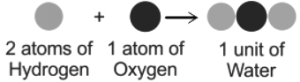
For example,water $(H_2O)$ always contains hydrogen and oxygen in a mass ratio of $1:8$.
This law states that a chemical compound always consists of the same elements combined together in the same fixed proportion by mass,regardless of its source or method of preparation.
For example,water $(H_2O)$ always contains hydrogen and oxygen in a mass ratio of $1:8$.
0 likes
View Solution88
EasyMCQ
Which law is illustrated by compounds $H_2O$ and $H_2O_2$ formed from two different elements,$H$ and $O$?
A
Law of Constant proportion.
B
Law of Conservation of mass.
C
Law of Multiple proportion.
D
Avogadro's law.
Solution
(C) The correct answer is $C$ (Law of Multiple Proportions).
Explanation:
The Law of Multiple Proportions states that when two elements combine to form more than one compound,the different masses of one element that combine with a fixed mass of the other element are in simple whole number ratios.
- In $H_2O$,$2 \ g$ of hydrogen combines with $16 \ g$ of oxygen.
- In $H_2O_2$,$2 \ g$ of hydrogen combines with $32 \ g$ of oxygen.
- The masses of oxygen ($16 \ g$ and $32 \ g$) that combine with a fixed mass of hydrogen $(2 \ g)$ are in the ratio $16:32$,which simplifies to $1:2$,a simple whole number ratio.
- Therefore,these compounds illustrate the Law of Multiple Proportions.
Explanation:
The Law of Multiple Proportions states that when two elements combine to form more than one compound,the different masses of one element that combine with a fixed mass of the other element are in simple whole number ratios.
- In $H_2O$,$2 \ g$ of hydrogen combines with $16 \ g$ of oxygen.
- In $H_2O_2$,$2 \ g$ of hydrogen combines with $32 \ g$ of oxygen.
- The masses of oxygen ($16 \ g$ and $32 \ g$) that combine with a fixed mass of hydrogen $(2 \ g)$ are in the ratio $16:32$,which simplifies to $1:2$,a simple whole number ratio.
- Therefore,these compounds illustrate the Law of Multiple Proportions.
0 likes
View Solution89
EasyMCQ
Which of the following pairs of compounds cannot demonstrate the law of multiple proportions?
A
$NO, NO_2$
B
$CO, CO_2$
C
$H_2O, H_2O_2$
D
$Na_2S, NaF$
Solution
(D) The law of multiple proportions states that when two elements combine to form two or more compounds,the masses of one element that combine with a fixed mass of the other are in the ratio of small whole numbers.
This law is applicable only when the same two elements form different compounds.
In the pair $Na_2S$ and $NaF$,the elements involved are different ($S$ and $F$),so they cannot demonstrate the law of multiple proportions.
This law is applicable only when the same two elements form different compounds.
In the pair $Na_2S$ and $NaF$,the elements involved are different ($S$ and $F$),so they cannot demonstrate the law of multiple proportions.
0 likes
View Solution90
EasyMCQ
Which one of the following sets of compounds correctly illustrates the law of reciprocal proportions?
A
$P_2O_3, PH_3$ and $H_2O$
B
$P_2O_5, PH_3$ and $H_2O$
C
$N_2O_5, NH_3$ and $H_2O$
D
$NO_2, NH_3$ and $H_2O$
Solution
(A) The law of reciprocal proportions states that if two different elements combine separately with a fixed mass of a third element,the ratio of the masses in which they do so is either the same or a simple multiple of the ratio of the masses in which they combine with each other.
In the set $P_2O_3, PH_3$ and $H_2O$:
$1$. $P$ combines with $H$ to form $PH_3$ ($31 \ g$ of $P$ with $3 \ g$ of $H$).
$2$. $P$ combines with $O$ to form $P_2O_3$ ($62 \ g$ of $P$ with $48 \ g$ of $O$).
$3$. For a fixed mass of $P$ $(62 \ g)$,the mass of $H$ is $6 \ g$ and the mass of $O$ is $48 \ g$. The ratio is $6:48 = 1:8$.
$4$. In $H_2O$,$H$ and $O$ combine in the ratio $2:16 = 1:8$.
Since the ratios are the same,this set illustrates the law.
In the set $P_2O_3, PH_3$ and $H_2O$:
$1$. $P$ combines with $H$ to form $PH_3$ ($31 \ g$ of $P$ with $3 \ g$ of $H$).
$2$. $P$ combines with $O$ to form $P_2O_3$ ($62 \ g$ of $P$ with $48 \ g$ of $O$).
$3$. For a fixed mass of $P$ $(62 \ g)$,the mass of $H$ is $6 \ g$ and the mass of $O$ is $48 \ g$. The ratio is $6:48 = 1:8$.
$4$. In $H_2O$,$H$ and $O$ combine in the ratio $2:16 = 1:8$.
Since the ratios are the same,this set illustrates the law.
0 likes
View Solution91
EasyMCQ
Which of the following pairs of compounds demonstrates the law of multiple proportions?
A
$CH_4, CCl_4$
B
$BF_3, NH_3$
C
$CO, CO_2$
D
$NO_2, CO_2$
Solution
(C) The law of multiple proportions states that when two elements combine to form more than one compound,the masses of one element that combine with a fixed mass of the other are in the ratio of small whole numbers.
In the pair $CO$ and $CO_2$,carbon $(C)$ and oxygen $(O)$ combine to form two different compounds.
In $CO$,$12 \ g$ of carbon combines with $16 \ g$ of oxygen.
In $CO_2$,$12 \ g$ of carbon combines with $32 \ g$ of oxygen.
The ratio of the masses of oxygen that combine with a fixed mass of carbon $(12 \ g)$ is $16:32$,which simplifies to $1:2$,a simple whole number ratio.
Therefore,$CO$ and $CO_2$ demonstrate the law of multiple proportions.
In the pair $CO$ and $CO_2$,carbon $(C)$ and oxygen $(O)$ combine to form two different compounds.
In $CO$,$12 \ g$ of carbon combines with $16 \ g$ of oxygen.
In $CO_2$,$12 \ g$ of carbon combines with $32 \ g$ of oxygen.
The ratio of the masses of oxygen that combine with a fixed mass of carbon $(12 \ g)$ is $16:32$,which simplifies to $1:2$,a simple whole number ratio.
Therefore,$CO$ and $CO_2$ demonstrate the law of multiple proportions.
0 likes
View Solution92
EasyMCQ
"Mass can neither be created nor destroyed" is the statement of
A
Gay Lussac Law of gaseous volume
B
Law of definite proportion
C
Law of conservation of mass
D
Law of multiple proportions
Solution
(C) The statement "Mass can neither be created nor destroyed" is the fundamental definition of the $Law \ of \ conservation \ of \ mass$.
This law was proposed by $Antoine \ Lavoisier$ in $1789$.
It states that in any chemical reaction, the total mass of the reactants is equal to the total mass of the products.
This law was proposed by $Antoine \ Lavoisier$ in $1789$.
It states that in any chemical reaction, the total mass of the reactants is equal to the total mass of the products.
0 likes
View Solution93
EasyMCQ
Identify the symbol used for water according to $\text{Dalton's}$ atomic theory?
A
B
C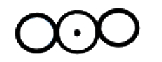
D
Solution
(B) The correct answer is $(B)$.
According to $\text{Dalton's}$ atomic theory,the symbols for elements and compounds were represented by specific pictorial symbols.
The symbol for water was represented by two circles,one containing a dot (representing hydrogen) and the other empty (representing oxygen),placed side by side.
According to $\text{Dalton's}$ atomic theory,the symbols for elements and compounds were represented by specific pictorial symbols.
The symbol for water was represented by two circles,one containing a dot (representing hydrogen) and the other empty (representing oxygen),placed side by side.

0 likes
View Solution94
MediumMCQ
$A$ sample of calcium carbonate has the following percentage composition: $Ca = 40 \%$,$C = 12 \%$,and $O = 48 \%$. According to the law of definite proportion,the weight of calcium in $4 \ g$ of a sample of calcium carbonate from another source will be (atomic weights: $Ca = 40, C = 12, O = 16$).
A
$1.6 \times 10^{-2} \ g$
B
$1.6 \ g$
C
$0.1 \ g$
D
$0.2 \ g$
Solution
(B) According to the law of definite proportion,the percentage composition of a compound remains constant regardless of its source.
Given that $Ca$ constitutes $40 \%$ of the sample by mass.
Therefore,in a $4 \ g$ sample of calcium carbonate,the mass of calcium is calculated as:
$\text{Mass of } Ca = \frac{40}{100} \times 4 \ g = 1.6 \ g$.
Given that $Ca$ constitutes $40 \%$ of the sample by mass.
Therefore,in a $4 \ g$ sample of calcium carbonate,the mass of calcium is calculated as:
$\text{Mass of } Ca = \frac{40}{100} \times 4 \ g = 1.6 \ g$.
0 likes
View Solution95
MediumMCQ
Pure samples of copper carbonate synthesized in the laboratory and found naturally both contain $51.35 \%$ copper,$38.91 \%$ carbon,and $9.74 \%$ oxygen by weight. This is in accordance with:
A
Law of combining volumes
B
Law of conservation of mass
C
Law of multiple proportion
D
Law of definite proportion
Solution
(D) The Law of Definite Proportions (also known as the Law of Constant Composition) states that a given chemical compound always contains its component elements in a fixed ratio by mass,regardless of its source or method of preparation.
Since the samples of copper carbonate from both the laboratory and natural sources contain the same percentage composition by weight ($51.35 \%$ copper,$38.91 \%$ carbon,and $9.74 \%$ oxygen),it confirms the Law of Definite Proportions.
Since the samples of copper carbonate from both the laboratory and natural sources contain the same percentage composition by weight ($51.35 \%$ copper,$38.91 \%$ carbon,and $9.74 \%$ oxygen),it confirms the Law of Definite Proportions.
0 likes
View Solution96
EasyMCQ
The combining ratios of hydrogen and oxygen in water and hydrogen peroxide are $1: 8$ and $1: 16$. Which law is illustrated in this example?
A
Law of definite proportions
B
Law of conservation of mass
C
Gay-Lussac's law of combining volumes of gases
D
Law of multiple proportions
Solution
(D) The combining ratios of hydrogen and oxygen in water $(H_2O)$ and hydrogen peroxide $(H_2O_2)$ are $1: 8$ and $1: 16$ respectively.
This is an example of the law of multiple proportions.
According to this law,if two elements combine to form more than one compound,the masses of one element that combine with a fixed mass of the other are in the ratio of small whole numbers.
Here,for a fixed mass of hydrogen $(1 \ g)$,the masses of oxygen are $8 \ g$ and $16 \ g$,which are in the ratio $8:16$ or $1:2$.
This is an example of the law of multiple proportions.
According to this law,if two elements combine to form more than one compound,the masses of one element that combine with a fixed mass of the other are in the ratio of small whole numbers.
Here,for a fixed mass of hydrogen $(1 \ g)$,the masses of oxygen are $8 \ g$ and $16 \ g$,which are in the ratio $8:16$ or $1:2$.
0 likes
View Solution97
EasyMCQ
The statement related to the law of definite proportions is:
A
The ratio of oxygen in $H_2O$ and $H_2O_2$ with respect to a fixed mass of Hydrogen atom is a whole number.
B
The $\%$ of oxygen in $H_2O$ is constant irrespective of the source.
C
Equal volumes of all gases at the same temperature and pressure contain an equal number of molecules.
D
Matter can neither be created nor destroyed.
Solution
(B) The law of definite proportions states that every chemical compound contains fixed and constant proportions (by mass) of its constituent elements.
The statement that the $\%$ of oxygen in $H_2O$ is constant irrespective of the source is in accordance with the law of definite proportions.
The ratio of oxygen in $H_2O$ and $H_2O_2$ with respect to a fixed mass of Hydrogen is related to the law of multiple proportions.
The statement regarding equal volumes of gases containing equal molecules is Avogadro's law.
The statement that matter can neither be created nor destroyed is the law of conservation of mass.
The statement that the $\%$ of oxygen in $H_2O$ is constant irrespective of the source is in accordance with the law of definite proportions.
The ratio of oxygen in $H_2O$ and $H_2O_2$ with respect to a fixed mass of Hydrogen is related to the law of multiple proportions.
The statement regarding equal volumes of gases containing equal molecules is Avogadro's law.
The statement that matter can neither be created nor destroyed is the law of conservation of mass.
0 likes
View Solution98
EasyMCQ
Identify the law for which the following statement is true.
"Equal volume of all gases at same temperature and pressure should contain equal number of molecules".
"Equal volume of all gases at same temperature and pressure should contain equal number of molecules".
A
Gay Lussac's law
B
Avogadro's law
C
Law of multiple proportion
D
Law of conservation of mass
Solution
(B) The given statement is $Avogadro's \ law$,because according to $Avogadro's \ law$.
$Equal \ volume \ of \ all \ gases \ under \ similar \ conditions \ of \ temperature \ and \ pressure \ contain \ equal \ number \ of \ molecules$,i.e.,volume of gas $V \propto N$ (number of molecules).
Or $V \propto n$ (number of moles) [at constant temperature and pressure].
$Equal \ volume \ of \ all \ gases \ under \ similar \ conditions \ of \ temperature \ and \ pressure \ contain \ equal \ number \ of \ molecules$,i.e.,volume of gas $V \propto N$ (number of molecules).
Or $V \propto n$ (number of moles) [at constant temperature and pressure].
0 likes
View SolutionSome Basic Concepts of Chemistry — Laws of chemical combination · Frequently Asked Questions
1Are these Some Basic Concepts of Chemistry questions useful for JEE and NEET?
Yes. All questions in this section are mapped to JEE Main and NEET exam patterns. Previous year questions from JEE Main, NEET, GUJCET and state-level exams are included with full solutions.
2Can I switch to Hindi or Gujarati for these questions?
Yes. Use the language tabs in the hero section or the sidebar to view the same questions and solutions in English, Hindi or Gujarati.
3How do I generate a question paper from this subtopic?
Use the Vedclass Exam Paper Generator — select the chapter and subtopic, set difficulty, and generate Sets A, B, C, D automatically. First 3 chapters of every subject are free.
Vedclass Products
For Students
Vedclass Test Series
Mock tests in real JEE/NEET style with performance analysis. 5-day free trial.
Start Free TrialFor Teachers
Exam Paper Generator
Generate Set A/B/C/D papers from this chapter in 2 minutes. 3 chapters free.
Try FreeFor Institutes
Online Exam Module
Live online exams with unlimited students, 360° analytics & white-label branding.
See DemoFor Teachers & Institutes
Generate a Some Basic Concepts of Chemistry Exam Paper in 2 Minutes
Select subtopic & difficulty — Sets A, B, C, D auto-generated with No Repeat logic.
First 3 chapters of every subject are free — no payment required.