
A English
Atomic, Molecular and Equivalent masses Questions in English
Class 11 Chemistry · Some Basic Concepts of Chemistry · Atomic, Molecular and Equivalent masses
281+
Questions
English
Language
100%
With Solutions
Showing 50 of 281 questions in English
201
DifficultMCQ
Assertion : The normality of $0.3 \ M$ aqueous solution of $H_3PO_3$ is equal to $0.6 \ N$.
Reason : Equivalent weight of $H_3PO_3 = \frac{\text{Molecular weight of } H_3PO_3}{3}$
Reason : Equivalent weight of $H_3PO_3 = \frac{\text{Molecular weight of } H_3PO_3}{3}$
A
If both Assertion and Reason are correct and the Reason is a correct explanation of the Assertion.
B
If both Assertion and Reason are correct but Reason is not a correct explanation of the Assertion.
C
If the Assertion is correct but Reason is incorrect.
D
If both the Assertion and Reason are incorrect.
Solution
(C) The normality of a solution is given by the formula: $\text{Normality} = \text{Molarity} \times \text{n-factor}$.
For $H_3PO_3$ (phosphorous acid),the structure contains two $P-OH$ bonds,making it a dibasic acid. Thus,its n-factor is $2$.
Normality $= 0.3 \ M \times 2 = 0.6 \ N$. Therefore,the Assertion is correct.
The equivalent weight of an acid is defined as $\frac{\text{Molecular weight}}{\text{Basicity}}$.
Since the basicity of $H_3PO_3$ is $2$,its equivalent weight is $\frac{\text{Molecular weight}}{2}$.
The Reason states the denominator is $3$,which is incorrect. Therefore,the Reason is incorrect.
For $H_3PO_3$ (phosphorous acid),the structure contains two $P-OH$ bonds,making it a dibasic acid. Thus,its n-factor is $2$.
Normality $= 0.3 \ M \times 2 = 0.6 \ N$. Therefore,the Assertion is correct.
The equivalent weight of an acid is defined as $\frac{\text{Molecular weight}}{\text{Basicity}}$.
Since the basicity of $H_3PO_3$ is $2$,its equivalent weight is $\frac{\text{Molecular weight}}{2}$.
The Reason states the denominator is $3$,which is incorrect. Therefore,the Reason is incorrect.
0 likes
View Solution202
DifficultMCQ
Calculate the molecular mass of glucose $[C_{6}H_{12}O_{6}]$ molecule. (in $u$)
A
$180.162$
B
$170.162$
C
$190.162$
D
$160.162$
Solution
(A) The molecular mass of glucose $(C_{6}H_{12}O_{6})$ is calculated by summing the atomic masses of all atoms present in the molecule.
Atomic masses: $C = 12.011 \, u$,$H = 1.008 \, u$,$O = 16.00 \, u$.
Molecular mass $= 6 \times (12.011 \, u) + 12 \times (1.008 \, u) + 6 \times (16.00 \, u)$.
$= 72.066 \, u + 12.096 \, u + 96.00 \, u$.
$= 180.162 \, u$.
Atomic masses: $C = 12.011 \, u$,$H = 1.008 \, u$,$O = 16.00 \, u$.
Molecular mass $= 6 \times (12.011 \, u) + 12 \times (1.008 \, u) + 6 \times (16.00 \, u)$.
$= 72.066 \, u + 12.096 \, u + 96.00 \, u$.
$= 180.162 \, u$.
0 likes
View Solution203
Difficult
Calculate the molecular mass of the following:
$(i)$ $H_{2}O$
$(ii)$ $CO_{2}$
$(iii)$ $CH_{4}$
$(i)$ $H_{2}O$
$(ii)$ $CO_{2}$
$(iii)$ $CH_{4}$
Solution
$(i)$ $H_{2}O$
The molecular mass of water,$H_{2}O$ is calculated as:
$= (2 \times \text{Atomic mass of H}) + (1 \times \text{Atomic mass of O})$
$= [2(1.008 \, u) + 1(16.00 \, u)]$
$= 2.016 \, u + 16.00 \, u = 18.016 \, u \approx 18.02 \, u$
$(ii)$ $CO_{2}$
The molecular mass of carbon dioxide,$CO_{2}$ is calculated as:
$= (1 \times \text{Atomic mass of C}) + (2 \times \text{Atomic mass of O})$
$= [1(12.011 \, u) + 2(16.00 \, u)]$
$= 12.011 \, u + 32.00 \, u = 44.011 \, u \approx 44.01 \, u$
$(iii)$ $CH_{4}$
The molecular mass of methane,$CH_{4}$ is calculated as:
$= (1 \times \text{Atomic mass of C}) + (4 \times \text{Atomic mass of H})$
$= [1(12.011 \, u) + 4(1.008 \, u)]$
$= 12.011 \, u + 4.032 \, u = 16.043 \, u$
The molecular mass of water,$H_{2}O$ is calculated as:
$= (2 \times \text{Atomic mass of H}) + (1 \times \text{Atomic mass of O})$
$= [2(1.008 \, u) + 1(16.00 \, u)]$
$= 2.016 \, u + 16.00 \, u = 18.016 \, u \approx 18.02 \, u$
$(ii)$ $CO_{2}$
The molecular mass of carbon dioxide,$CO_{2}$ is calculated as:
$= (1 \times \text{Atomic mass of C}) + (2 \times \text{Atomic mass of O})$
$= [1(12.011 \, u) + 2(16.00 \, u)]$
$= 12.011 \, u + 32.00 \, u = 44.011 \, u \approx 44.01 \, u$
$(iii)$ $CH_{4}$
The molecular mass of methane,$CH_{4}$ is calculated as:
$= (1 \times \text{Atomic mass of C}) + (4 \times \text{Atomic mass of H})$
$= [1(12.011 \, u) + 4(1.008 \, u)]$
$= 12.011 \, u + 4.032 \, u = 16.043 \, u$
0 likes
View Solution204
DifficultMCQ
Calculate the atomic mass (average) of chlorine using the following data:
(in $u$)
| Isotope | $\%$ Natural Abundance | Molar Mass $(g/mol)$ |
| $^{35}Cl$ | $75.77$ | $34.9689$ |
| $^{37}Cl$ | $24.23$ | $36.9659$ |
A
$32.45$
B
$33.45$
C
$34.45$
D
$35.45$
Solution
(D) The average atomic mass is calculated by the weighted average of the isotopes:
$\text{Average atomic mass} = \frac{(\text{Abundance of } ^{35}Cl \times \text{Mass of } ^{35}Cl) + (\text{Abundance of } ^{37}Cl \times \text{Mass of } ^{37}Cl)}{100}$
$\text{Average atomic mass} = \frac{(75.77 \times 34.9689) + (24.23 \times 36.9659)}{100}$
$\text{Average atomic mass} = \frac{2649.59 + 895.68}{100} = \frac{3545.27}{100} = 35.4527 \ u$
Rounding to two decimal places,we get $35.45 \ u$.
$\text{Average atomic mass} = \frac{(\text{Abundance of } ^{35}Cl \times \text{Mass of } ^{35}Cl) + (\text{Abundance of } ^{37}Cl \times \text{Mass of } ^{37}Cl)}{100}$
$\text{Average atomic mass} = \frac{(75.77 \times 34.9689) + (24.23 \times 36.9659)}{100}$
$\text{Average atomic mass} = \frac{2649.59 + 895.68}{100} = \frac{3545.27}{100} = 35.4527 \ u$
Rounding to two decimal places,we get $35.45 \ u$.
0 likes
View Solution205
Difficult
What will be the mass of one $^{12}C$ atom in $g$?
Solution
(N/A) $1$ mole of $^{12}C$ atoms $= 6.022 \times 10^{23}$ atoms.
The molar mass of $^{12}C$ is $12 \, g/mol$.
Mass of one $^{12}C$ atom $= \frac{\text{Molar mass}}{\text{Avogadro's number}}$
$= \frac{12 \, g}{6.022 \times 10^{23}}$
$= 1.993 \times 10^{-23} \, g$.
The molar mass of $^{12}C$ is $12 \, g/mol$.
Mass of one $^{12}C$ atom $= \frac{\text{Molar mass}}{\text{Avogadro's number}}$
$= \frac{12 \, g}{6.022 \times 10^{23}}$
$= 1.993 \times 10^{-23} \, g$.
0 likes
View Solution206
Medium
Use the data given in the following table to calculate the molar mass of naturally occurring argon isotopes:
| Isotope | Isotopic molar mass $(g \, mol^{-1})$ | Abundance (%) |
| $^{36}Ar$ | $35.96755$ | $0.337$ |
| $^{38}Ar$ | $37.96272$ | $0.063$ |
| $^{40}Ar$ | $39.9624$ | $99.600$ |
Solution
(N/A) The molar mass of an element with multiple isotopes is calculated by the weighted average of the isotopic masses:
$\text{Molar mass} = \sum (\text{Isotopic mass} \times \text{Fractional abundance})$
$\text{Molar mass} = \left[ \left( 35.96755 \times \frac{0.337}{100} \right) + \left( 37.96272 \times \frac{0.063}{100} \right) + \left( 39.9624 \times \frac{99.600}{100} \right) \right] \, g \, mol^{-1}$
$= [0.12121 + 0.02392 + 39.80255] \, g \, mol^{-1}$
$= 39.94768 \, g \, mol^{-1}$
Rounding to appropriate significant figures,the molar mass is $39.948 \, g \, mol^{-1}$.
$\text{Molar mass} = \sum (\text{Isotopic mass} \times \text{Fractional abundance})$
$\text{Molar mass} = \left[ \left( 35.96755 \times \frac{0.337}{100} \right) + \left( 37.96272 \times \frac{0.063}{100} \right) + \left( 39.9624 \times \frac{99.600}{100} \right) \right] \, g \, mol^{-1}$
$= [0.12121 + 0.02392 + 39.80255] \, g \, mol^{-1}$
$= 39.94768 \, g \, mol^{-1}$
Rounding to appropriate significant figures,the molar mass is $39.948 \, g \, mol^{-1}$.
0 likes
View Solution207
Medium
Write the formulae for the following compounds:
$(a)$ Mercury $(II)$ chloride
$(b)$ Nickel $(II)$ sulphate
$(c)$ Tin $(IV)$ oxide
$(d)$ Thallium $(I)$ sulphate
$(e)$ Iron $(III)$ sulphate
$(f)$ Chromium $(III)$ oxide
$(a)$ Mercury $(II)$ chloride
$(b)$ Nickel $(II)$ sulphate
$(c)$ Tin $(IV)$ oxide
$(d)$ Thallium $(I)$ sulphate
$(e)$ Iron $(III)$ sulphate
$(f)$ Chromium $(III)$ oxide
Solution
(N/A) Mercury $(II)$ chloride: $Hg^{2+}$ and $Cl^-$ ions combine to form $HgCl_2$.
$(b)$ Nickel $(II)$ sulphate: $Ni^{2+}$ and $SO_4^{2-}$ ions combine to form $NiSO_4$.
$(c)$ Tin $(IV)$ oxide: $Sn^{4+}$ and $O^{2-}$ ions combine to form $SnO_2$.
$(d)$ Thallium $(I)$ sulphate: $Tl^+$ and $SO_4^{2-}$ ions combine to form $Tl_2SO_4$.
$(e)$ Iron $(III)$ sulphate: $Fe^{3+}$ and $SO_4^{2-}$ ions combine to form $Fe_2(SO_4)_3$.
$(f)$ Chromium $(III)$ oxide: $Cr^{3+}$ and $O^{2-}$ ions combine to form $Cr_2O_3$.
$(b)$ Nickel $(II)$ sulphate: $Ni^{2+}$ and $SO_4^{2-}$ ions combine to form $NiSO_4$.
$(c)$ Tin $(IV)$ oxide: $Sn^{4+}$ and $O^{2-}$ ions combine to form $SnO_2$.
$(d)$ Thallium $(I)$ sulphate: $Tl^+$ and $SO_4^{2-}$ ions combine to form $Tl_2SO_4$.
$(e)$ Iron $(III)$ sulphate: $Fe^{3+}$ and $SO_4^{2-}$ ions combine to form $Fe_2(SO_4)_3$.
$(f)$ Chromium $(III)$ oxide: $Cr^{3+}$ and $O^{2-}$ ions combine to form $Cr_2O_3$.
0 likes
View Solution208
Medium
Write about atomic mass.
Solution
(N/A) The atomic mass of an atom is extremely small because atoms are very tiny.
Today,sophisticated techniques like mass spectrometry are used to determine atomic masses accurately.
Initially,hydrogen was assigned a mass of $1$ (without units) as it is the lightest atom,and other elements were assigned masses relative to it.
However,the current system of atomic masses is based on carbon-$12$ as the standard,which was agreed upon in $1961$.
Carbon-$12$ is an isotope of carbon represented as ${}^{12}C$.
In this system,${}^{12}C$ is assigned a mass of exactly $12$ atomic mass units $(amu)$,and the masses of all other atoms are determined relative to this standard.
One atomic mass unit $(amu)$ is defined as a mass exactly equal to $\frac{1}{12}$ of the mass of one carbon-$12$ atom.
$1 \ amu = 1.66056 \times 10^{-24} \ g$
The mass of a hydrogen atom is $1.6736 \times 10^{-24} \ g$.
Thus,in terms of $amu$,the mass of a hydrogen atom is $\frac{1.6736 \times 10^{-24}}{1.66056 \times 10^{-24}} \approx 1.0080 \ amu$.
Similarly,the mass of an oxygen-$16$ $({}^{16}O)$ atom is $15.995 \ amu$.
Currently,'$amu$' has been replaced by '$u$',which is known as unified mass.
Today,sophisticated techniques like mass spectrometry are used to determine atomic masses accurately.
Initially,hydrogen was assigned a mass of $1$ (without units) as it is the lightest atom,and other elements were assigned masses relative to it.
However,the current system of atomic masses is based on carbon-$12$ as the standard,which was agreed upon in $1961$.
Carbon-$12$ is an isotope of carbon represented as ${}^{12}C$.
In this system,${}^{12}C$ is assigned a mass of exactly $12$ atomic mass units $(amu)$,and the masses of all other atoms are determined relative to this standard.
One atomic mass unit $(amu)$ is defined as a mass exactly equal to $\frac{1}{12}$ of the mass of one carbon-$12$ atom.
$1 \ amu = 1.66056 \times 10^{-24} \ g$
The mass of a hydrogen atom is $1.6736 \times 10^{-24} \ g$.
Thus,in terms of $amu$,the mass of a hydrogen atom is $\frac{1.6736 \times 10^{-24}}{1.66056 \times 10^{-24}} \approx 1.0080 \ amu$.
Similarly,the mass of an oxygen-$16$ $({}^{16}O)$ atom is $15.995 \ amu$.
Currently,'$amu$' has been replaced by '$u$',which is known as unified mass.
0 likes
View Solution209
Medium
Explain the concept of Average Atomic Mass.
Solution
Many naturally occurring elements exist as more than one isotope. When we take into account the existence of these isotopes and their relative abundance,the average atomic mass of that element can be computed.
For example,carbon has the following three isotopes with relative abundances and masses as shown against each of them:
From the above data,the average atomic mass of carbon is calculated as:
$(0.98892)(12 \ u) + (0.01108)(13.00335 \ u) + (2 \times 10^{-12})(14.00317 \ u) = 12.011 \ u$.
Similarly,average atomic masses for other elements can be calculated.
For example,carbon has the following three isotopes with relative abundances and masses as shown against each of them:
| Isotope | Relative Abundance $(\%)$ | Atomic mass $(\text{amu})$ |
|---|---|---|
| ${}^{12}C$ | $98.892$ | $12$ |
| ${}^{13}C$ | $1.108$ | $13.00335$ |
| ${}^{14}C$ | $2 \times 10^{-10}$ | $14.00317$ |
From the above data,the average atomic mass of carbon is calculated as:
$(0.98892)(12 \ u) + (0.01108)(13.00335 \ u) + (2 \times 10^{-12})(14.00317 \ u) = 12.011 \ u$.
Similarly,average atomic masses for other elements can be calculated.
0 likes
View Solution210
Medium
Define and explain the concept of Molecular Mass.
Solution
(N/A) Molecular mass is defined as the sum of the atomic masses of all the elements present in a molecule.
It is calculated by multiplying the atomic mass of each constituent element by the number of its atoms in the molecule and then adding these values together.
For example,the molecular mass of methane $(CH_{4})$,which contains one carbon atom and four hydrogen atoms,is calculated as follows:
Molecular mass of $(CH_{4}) = (12.011 \ u) + 4 \times (1.008 \ u) = 16.043 \ u$.
Similarly,the molecular mass of water $(H_{2}O)$ is calculated as:
Molecular mass of $(H_{2}O) = (2 \times \text{atomic mass of hydrogen}) + (1 \times \text{atomic mass of oxygen}) = (2 \times 1.008 \ u) + 16.00 \ u = 18.02 \ u$.
It is calculated by multiplying the atomic mass of each constituent element by the number of its atoms in the molecule and then adding these values together.
For example,the molecular mass of methane $(CH_{4})$,which contains one carbon atom and four hydrogen atoms,is calculated as follows:
Molecular mass of $(CH_{4}) = (12.011 \ u) + 4 \times (1.008 \ u) = 16.043 \ u$.
Similarly,the molecular mass of water $(H_{2}O)$ is calculated as:
Molecular mass of $(H_{2}O) = (2 \times \text{atomic mass of hydrogen}) + (1 \times \text{atomic mass of oxygen}) = (2 \times 1.008 \ u) + 16.00 \ u = 18.02 \ u$.
0 likes
View Solution211
Medium
Calculate the molecular mass of a glucose $C_{6}H_{12}O_{6}$ molecule.
Solution
The molecular mass of glucose $(C_{6}H_{12}O_{6})$ is calculated by summing the atomic masses of all atoms present in the molecule.
$= 6 \times (12.011 \ u) + 12 \times (1.008 \ u) + 6 \times (16.00 \ u)$
$= 72.066 \ u + 12.096 \ u + 96.00 \ u$
$= 180.162 \ u$
$= 6 \times (12.011 \ u) + 12 \times (1.008 \ u) + 6 \times (16.00 \ u)$
$= 72.066 \ u + 12.096 \ u + 96.00 \ u$
$= 180.162 \ u$
0 likes
View Solution212
Medium
Write about Formula Mass.
Solution
(N/A) Some substances such as sodium chloride $(NaCl)$ do not contain discrete molecules as their constituent units.
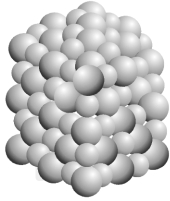
In such compounds,positive (sodium) and negative (chloride) ions are arranged in a three-dimensional structure.
It may be noted that in sodium chloride,one $Na^+$ ion is surrounded by $six$ $Cl^-$ ions and vice-versa.
The formula such as $NaCl$ is used to calculate the formula mass instead of molecular mass,as in the solid state,sodium chloride does not exist as a single discrete entity.
Thus,
Formula mass of sodium chloride = Atomic mass of sodium + Atomic mass of chlorine
$= 23.0 \ u + 35.5 \ u = 58.5 \ u$
In such compounds,positive (sodium) and negative (chloride) ions are arranged in a three-dimensional structure.
It may be noted that in sodium chloride,one $Na^+$ ion is surrounded by $six$ $Cl^-$ ions and vice-versa.
The formula such as $NaCl$ is used to calculate the formula mass instead of molecular mass,as in the solid state,sodium chloride does not exist as a single discrete entity.
Thus,
Formula mass of sodium chloride = Atomic mass of sodium + Atomic mass of chlorine
$= 23.0 \ u + 35.5 \ u = 58.5 \ u$
0 likes
View Solution213
MediumMCQ
Calculate the average atomic mass of chlorine using the following data:
(in $u$)
| Isotope | Natural abundance (%) | Molar mass $(u)$ |
|---|---|---|
| $^{35}Cl$ | $75.77$ | $34.9689$ |
| $^{37}Cl$ | $24.23$ | $36.9659$ |
A
$35.4527$
B
$36.4527$
C
$34.4527$
D
$35.9659$
Solution
(A) The average atomic mass is calculated using the weighted average of the isotopes:
$\text{Average atomic mass} = \sum (\text{abundance}_i \times \text{mass}_i)$
$\text{Average atomic mass} = (0.7577 \times 34.9689) + (0.2423 \times 36.9659)$
$\text{Average atomic mass} = 26.4972 + 8.9567 = 35.4539 \ u$
Rounding to appropriate significant figures,the average atomic mass of chlorine is approximately $35.45 \ u$.
$\text{Average atomic mass} = \sum (\text{abundance}_i \times \text{mass}_i)$
$\text{Average atomic mass} = (0.7577 \times 34.9689) + (0.2423 \times 36.9659)$
$\text{Average atomic mass} = 26.4972 + 8.9567 = 35.4539 \ u$
Rounding to appropriate significant figures,the average atomic mass of chlorine is approximately $35.45 \ u$.
0 likes
View Solution214
Easy
Calculate the molar mass of naturally occurring argon from the data given in the following table:
| Isotope | Molar Mass $(g \ mol^{-1})$ | Abundance |
| $^{36}Ar$ | $35.96755$ | $0.337 \%$ |
| $^{38}Ar$ | $37.96272$ | $0.063 \%$ |
| $^{40}Ar$ | $39.9624$ | $99.600 \%$ |
Solution
The average molar mass is calculated using the formula: $\overline{A} = \sum (f_i \times A_i)$
$\overline{A} = (0.00337 \times 35.96755) + (0.00063 \times 37.96272) + (0.99600 \times 39.9624)$
$\overline{A} = 0.12121 + 0.02392 + 39.80255$
$\overline{A} = 39.94768 \approx 39.948 \ g \ mol^{-1}$
$\overline{A} = (0.00337 \times 35.96755) + (0.00063 \times 37.96272) + (0.99600 \times 39.9624)$
$\overline{A} = 0.12121 + 0.02392 + 39.80255$
$\overline{A} = 39.94768 \approx 39.948 \ g \ mol^{-1}$
0 likes
View Solution215
Medium
Write about 'Molar Mass'.
Solution
(N/A) The mass of one mole of a substance in grams is defined as its molar mass.
The molar mass in grams is numerically equal to the atomic,molecular,or formula mass expressed in atomic mass units $(u)$.
For example:
Molar mass of water $(H_2O)$ $= 18.02 \ g \ mol^{-1}$.
Molar mass of sodium chloride $(NaCl)$ $= 58.5 \ g \ mol^{-1}$.
The molar mass in grams is numerically equal to the atomic,molecular,or formula mass expressed in atomic mass units $(u)$.
For example:
Molar mass of water $(H_2O)$ $= 18.02 \ g \ mol^{-1}$.
Molar mass of sodium chloride $(NaCl)$ $= 58.5 \ g \ mol^{-1}$.
0 likes
View Solution216
Easy
Calculate the molar mass of the following:
$(i)$ $H_2O$
$(ii)$ $CO_2$
$(iii)$ $CH_4$
$(i)$ $H_2O$
$(ii)$ $CO_2$
$(iii)$ $CH_4$
Solution
$(i)$ Molar mass of water $(H_2O)$:
Atomic mass of $H = 1 \ u$,Atomic mass of $O = 16 \ u$
Molar mass of $H_2O = (2 \times 1) + (1 \times 16) = 18 \ g/mol$
$(ii)$ Molar mass of carbon dioxide $(CO_2)$:
Atomic mass of $C = 12 \ u$,Atomic mass of $O = 16 \ u$
Molar mass of $CO_2 = (1 \times 12) + (2 \times 16) = 44 \ g/mol$
$(iii)$ Molar mass of methane $(CH_4)$:
Atomic mass of $C = 12 \ u$,Atomic mass of $H = 1 \ u$
Molar mass of $CH_4 = (1 \times 12) + (4 \times 1) = 16 \ g/mol$
Atomic mass of $H = 1 \ u$,Atomic mass of $O = 16 \ u$
Molar mass of $H_2O = (2 \times 1) + (1 \times 16) = 18 \ g/mol$
$(ii)$ Molar mass of carbon dioxide $(CO_2)$:
Atomic mass of $C = 12 \ u$,Atomic mass of $O = 16 \ u$
Molar mass of $CO_2 = (1 \times 12) + (2 \times 16) = 44 \ g/mol$
$(iii)$ Molar mass of methane $(CH_4)$:
Atomic mass of $C = 12 \ u$,Atomic mass of $H = 1 \ u$
Molar mass of $CH_4 = (1 \times 12) + (4 \times 1) = 16 \ g/mol$
0 likes
View Solution217
EasyMCQ
What will be the mass of one atom of $^{12}C$ in grams?
A
$1.99 \times 10^{-23} \ g$
B
$1.66 \times 10^{-24} \ g$
C
$1.99 \times 10^{-24} \ g$
D
$1.66 \times 10^{-23} \ g$
Solution
(A) The molar mass of $^{12}C$ is $12 \ g/mol$.
One mole of $^{12}C$ contains $6.022 \times 10^{23}$ atoms (Avogadro's number,$N_A$).
The mass of one atom is calculated as:
$\text{Mass of one atom} = \frac{\text{Molar mass}}{N_A} = \frac{12 \ g/mol}{6.022 \times 10^{23} \ atoms/mol}$.
$\text{Mass of one atom} \approx 1.9926 \times 10^{-23} \ g$.
One mole of $^{12}C$ contains $6.022 \times 10^{23}$ atoms (Avogadro's number,$N_A$).
The mass of one atom is calculated as:
$\text{Mass of one atom} = \frac{\text{Molar mass}}{N_A} = \frac{12 \ g/mol}{6.022 \times 10^{23} \ atoms/mol}$.
$\text{Mass of one atom} \approx 1.9926 \times 10^{-23} \ g$.
0 likes
View Solution218
Medium
Calculate the average atomic mass of hydrogen using the following data:
| Isotope | $\%$ Natural abundance | Molar mass |
| $^1H$ | $99.985$ | $1$ |
| $^2H$ | $0.015$ | $2$ |
Solution
(A) The average atomic mass is calculated by the formula:
$\text{Average Atomic Mass} = \frac{(\text{Abundance of } ^1H \times \text{Mass of } ^1H) + (\text{Abundance of } ^2H \times \text{Mass of } ^2H)}{100}$
Substituting the given values:
$= \frac{(99.985 \times 1) + (0.015 \times 2)}{100}$
$= \frac{99.985 + 0.030}{100}$
$= \frac{100.015}{100} = 1.00015 \ u$
$\text{Average Atomic Mass} = \frac{(\text{Abundance of } ^1H \times \text{Mass of } ^1H) + (\text{Abundance of } ^2H \times \text{Mass of } ^2H)}{100}$
Substituting the given values:
$= \frac{(99.985 \times 1) + (0.015 \times 2)}{100}$
$= \frac{99.985 + 0.030}{100}$
$= \frac{100.015}{100} = 1.00015 \ u$
0 likes
View Solution219
Easy
What do you mean by molar weight?
Solution
(N/A) Molar weight,commonly referred to as molar mass,is defined as the mass of $1 \ mol$ of a substance in grams.
It is expressed in units of $g \ mol^{-1}$.
For an element,it is numerically equal to the atomic mass in $u$,and for a molecule,it is equal to the molecular mass in $u$.
It is expressed in units of $g \ mol^{-1}$.
For an element,it is numerically equal to the atomic mass in $u$,and for a molecule,it is equal to the molecular mass in $u$.
0 likes
View Solution220
EasyMCQ
What is meant by $1 \ amu$ or $1 \ u$?
A
$1/12$ of the mass of a $C-12$ atom
B
$1/14$ of the mass of a $N-14$ atom
C
$1/16$ of the mass of an $O-16$ atom
D
Mass of one proton
Solution
(A) One $amu$ (atomic mass unit) or $1 \ u$ (unified mass) is defined as exactly $\frac{1}{12}$ of the mass of one carbon-$12$ $(^{12}C)$ atom.
0 likes
View Solution221
Medium
Write formulas for the following compounds:
$(1)$ Iron $(III)$ sulphate
$(2)$ Chromium $(III)$ oxide
$(1)$ Iron $(III)$ sulphate
$(2)$ Chromium $(III)$ oxide
Solution
(N/A) For Iron $(III)$ sulphate:
Iron has an oxidation state of $+3$ and the sulphate ion is $SO_{4}^{2-}$. By criss-crossing the valencies,we get $Fe_{2}(SO_{4})_{3}$.
For Chromium $(III)$ oxide:
Chromium has an oxidation state of $+3$ and the oxide ion is $O^{2-}$. By criss-crossing the valencies,we get $Cr_{2}O_{3}$.
Iron has an oxidation state of $+3$ and the sulphate ion is $SO_{4}^{2-}$. By criss-crossing the valencies,we get $Fe_{2}(SO_{4})_{3}$.
For Chromium $(III)$ oxide:
Chromium has an oxidation state of $+3$ and the oxide ion is $O^{2-}$. By criss-crossing the valencies,we get $Cr_{2}O_{3}$.
0 likes
View Solution222
MediumMCQ
Find out the equivalent mass of $KIO_{3}$ in the given reaction.
$2Cr(OH)_{3} + 4OH^{-} + KIO_{3} \to 2CrO_{4}^{2-} + 5H_{2}O + KI$
(Molecular Mass $= M$)
$2Cr(OH)_{3} + 4OH^{-} + KIO_{3} \to 2CrO_{4}^{2-} + 5H_{2}O + KI$
(Molecular Mass $= M$)
A
$M/2$
B
$M/4$
C
$M/6$
D
$M/8$
Solution
(C) In the given reaction,$KIO_{3}$ is converted into $KI$.
The oxidation state of $I$ in $KIO_{3}$ is $+5$.
The oxidation state of $I$ in $KI$ is $-1$.
The change in oxidation number per molecule of $KIO_{3}$ is $|(+5) - (-1)| = 6$.
Therefore,the $n$-factor for $KIO_{3}$ is $6$.
Equivalent mass $= \frac{\text{Molecular mass}}{n\text{-factor}} = \frac{M}{6}$.
The oxidation state of $I$ in $KIO_{3}$ is $+5$.
The oxidation state of $I$ in $KI$ is $-1$.
The change in oxidation number per molecule of $KIO_{3}$ is $|(+5) - (-1)| = 6$.
Therefore,the $n$-factor for $KIO_{3}$ is $6$.
Equivalent mass $= \frac{\text{Molecular mass}}{n\text{-factor}} = \frac{M}{6}$.
0 likes
View Solution223
EasyMCQ
Calculate the mass of a single atom of hydrogen.
A
$1.6736 \times 10^{-24} \ g$
B
$1.008 \ g$
C
$6.022 \times 10^{23} \ g$
D
$1.66 \times 10^{-27} \ g$
Solution
(A) The molar mass of hydrogen is $1.008 \ g/mol$.
The number of atoms in one mole is $6.022 \times 10^{23} \ atoms/mol$.
The mass of a single atom is calculated by dividing the molar mass by the Avogadro constant:
$\text{Mass} = \frac{1.008 \ g/mol}{6.022 \times 10^{23} \ atoms/mol} \approx 1.6736 \times 10^{-24} \ g$.
The number of atoms in one mole is $6.022 \times 10^{23} \ atoms/mol$.
The mass of a single atom is calculated by dividing the molar mass by the Avogadro constant:
$\text{Mass} = \frac{1.008 \ g/mol}{6.022 \times 10^{23} \ atoms/mol} \approx 1.6736 \times 10^{-24} \ g$.
0 likes
View Solution224
EasyMCQ
Which instrument is used to measure the atomic mass of an atom accurately?
A
Mass spectrometer
B
Analytical balance
C
Calorimeter
D
Spectrophotometer
Solution
(A) The atomic mass of an atom can be measured accurately using a $Mass \ spectrometer$.
0 likes
View Solution225
MediumMCQ
The equivalent mass of an element $X$ is $9$. If the vapor density of its chloride salt is $66.75$,determine the valency of element $X$.
A
$1$
B
$2$
C
$3$
D
$4$
Solution
(C) Molecular mass $= 2 \times \text{Vapor density} = 2 \times 66.75 = 133.50$.
The formula of the chloride salt is $XCl_n$,where $n$ is the valency.
Molecular mass $= \text{Atomic mass of } X + n \times \text{Atomic mass of } Cl$.
Atomic mass of $X = \text{Equivalent mass} \times \text{Valency} = 9 \times n$.
Substituting the values: $133.50 = 9n + n \times 35.5$.
$133.50 = 44.5n$.
$n = \frac{133.50}{44.5} = 3$.
Therefore,the valency of element $X$ is $3$.
The formula of the chloride salt is $XCl_n$,where $n$ is the valency.
Molecular mass $= \text{Atomic mass of } X + n \times \text{Atomic mass of } Cl$.
Atomic mass of $X = \text{Equivalent mass} \times \text{Valency} = 9 \times n$.
Substituting the values: $133.50 = 9n + n \times 35.5$.
$133.50 = 44.5n$.
$n = \frac{133.50}{44.5} = 3$.
Therefore,the valency of element $X$ is $3$.
0 likes
View Solution226
MediumMCQ
If the molar mass of phosphoric acid $\left[ H_3PO_4 \right]$ is $98 \ g/mol$,calculate the atomic mass of $P$. (in $g/mol$)
A
$31$
B
$15$
C
$48$
D
$64$
Solution
(A) The molar mass of $H_3PO_4$ is given as $98 \ g/mol$.
The formula for molar mass is: $3 \times \text{Atomic mass of } H + 1 \times \text{Atomic mass of } P + 4 \times \text{Atomic mass of } O = 98 \ g/mol$.
Given atomic masses: $H = 1 \ g/mol$,$O = 16 \ g/mol$.
Substituting the values: $3(1) + P + 4(16) = 98$.
$3 + P + 64 = 98$.
$67 + P = 98$.
$P = 98 - 67 = 31 \ g/mol$.
The formula for molar mass is: $3 \times \text{Atomic mass of } H + 1 \times \text{Atomic mass of } P + 4 \times \text{Atomic mass of } O = 98 \ g/mol$.
Given atomic masses: $H = 1 \ g/mol$,$O = 16 \ g/mol$.
Substituting the values: $3(1) + P + 4(16) = 98$.
$3 + P + 64 = 98$.
$67 + P = 98$.
$P = 98 - 67 = 31 \ g/mol$.
0 likes
View Solution227
EasyMCQ
Which method is used to determine atomic mass accurately?
A
Mass Spectrometry
B
$X$-ray Diffraction
C
Gas Chromatography
D
Titration
Solution
(A) The atomic mass can be determined accurately using the $Mass \ Spectrometry$ method.
0 likes
View Solution228
MediumMCQ
In chlorine,the isotopes $^{35}Cl$ and $^{37}Cl$ are present in the ratio $3:1$. Calculate the atomic mass of chlorine. (in $amu$)
A
$35.0$
B
$35.5$
C
$36.0$
D
$37.0$
Solution
(B) The ratio of isotopes $^{35}Cl$ and $^{37}Cl$ is $3:1$.
This means that out of every $4$ atoms of chlorine,$3$ atoms have a mass of $35 \ amu$ and $1$ atom has a mass of $37 \ amu$.
Average atomic mass $= \frac{(3 \times 35) + (1 \times 37)}{3 + 1} \ amu$.
Average atomic mass $= \frac{105 + 37}{4} \ amu$.
Average atomic mass $= \frac{142}{4} \ amu = 35.5 \ amu$.
This means that out of every $4$ atoms of chlorine,$3$ atoms have a mass of $35 \ amu$ and $1$ atom has a mass of $37 \ amu$.
Average atomic mass $= \frac{(3 \times 35) + (1 \times 37)}{3 + 1} \ amu$.
Average atomic mass $= \frac{105 + 37}{4} \ amu$.
Average atomic mass $= \frac{142}{4} \ amu = 35.5 \ amu$.
0 likes
View Solution229
Medium
Match column $-I$ and column $-II$ with the correct molar mass values:
| Column $-I$ | Column $-II$ |
| $(i)$ Barium sulphate | $(a)$ $1877 \ g/mol$ |
| $(ii)$ Magnesium pyrophosphate | $(b)$ $235 \ g/mol$ |
| $(iii)$ Ammonium phosphomolybdate | $(c)$ $188 \ g/mol$ |
| $(iv)$ Silver chloride | $(d)$ $222 \ g/mol$ |
| $(v)$ Silver bromide | $(e)$ $143.5 \ g/mol$ |
| $(vi)$ Silver iodide | $(f)$ $233 \ g/mol$ |
Solution
(A) The molar masses are calculated as follows:
$(i)$ Barium sulphate $(BaSO_4)$: $137 + 32 + (4 \times 16) = 233 \ g/mol$ $(f)$
$(ii)$ Magnesium pyrophosphate $(Mg_2P_2O_7)$: $(2 \times 24) + (2 \times 31) + (7 \times 16) = 48 + 62 + 112 = 222 \ g/mol$ $(d)$
$(iii)$ Ammonium phosphomolybdate $((NH_4)_3PO_4 \cdot 12MoO_3)$: $\approx 1877 \ g/mol$ $(a)$
$(iv)$ Silver chloride $(AgCl)$: $108 + 35.5 = 143.5 \ g/mol$ $(e)$
$(v)$ Silver bromide $(AgBr)$: $108 + 80 = 188 \ g/mol$ $(c)$
$(vi)$ Silver iodide $(AgI)$: $108 + 127 = 235 \ g/mol$ $(b)$
Therefore,the correct matching is: $(i-f, ii-d, iii-a, iv-e, v-c, vi-b)$.
$(i)$ Barium sulphate $(BaSO_4)$: $137 + 32 + (4 \times 16) = 233 \ g/mol$ $(f)$
$(ii)$ Magnesium pyrophosphate $(Mg_2P_2O_7)$: $(2 \times 24) + (2 \times 31) + (7 \times 16) = 48 + 62 + 112 = 222 \ g/mol$ $(d)$
$(iii)$ Ammonium phosphomolybdate $((NH_4)_3PO_4 \cdot 12MoO_3)$: $\approx 1877 \ g/mol$ $(a)$
$(iv)$ Silver chloride $(AgCl)$: $108 + 35.5 = 143.5 \ g/mol$ $(e)$
$(v)$ Silver bromide $(AgBr)$: $108 + 80 = 188 \ g/mol$ $(c)$
$(vi)$ Silver iodide $(AgI)$: $108 + 127 = 235 \ g/mol$ $(b)$
Therefore,the correct matching is: $(i-f, ii-d, iii-a, iv-e, v-c, vi-b)$.
0 likes
View Solution230
DifficultMCQ
The average molar mass of chlorine is $35.5 \ g \ mol^{-1}$. The ratio of $^{35}Cl$ to $^{37}Cl$ in naturally occurring chlorine is close to : (in $:1$)
A
$4$
B
$1$
C
$2$
D
$3$
Solution
(D) Let the mole ratio of $^{35}Cl$ to $^{37}Cl$ be $x:1$.
The average molar mass is given by the formula: $\text{Average molar mass} = \frac{n_{1} M_{1} + n_{2} M_{2}}{n_{1} + n_{2}}$
Substituting the given values: $35.5 = \frac{x \times 35 + 1 \times 37}{x + 1}$
$35.5(x + 1) = 35x + 37$
$35.5x + 35.5 = 35x + 37$
$35.5x - 35x = 37 - 35.5$
$0.5x = 1.5$
$x = \frac{1.5}{0.5} = 3$
Therefore,the ratio of $^{35}Cl$ to $^{37}Cl$ is $3:1$.
The average molar mass is given by the formula: $\text{Average molar mass} = \frac{n_{1} M_{1} + n_{2} M_{2}}{n_{1} + n_{2}}$
Substituting the given values: $35.5 = \frac{x \times 35 + 1 \times 37}{x + 1}$
$35.5(x + 1) = 35x + 37$
$35.5x + 35.5 = 35x + 37$
$35.5x - 35x = 37 - 35.5$
$0.5x = 1.5$
$x = \frac{1.5}{0.5} = 3$
Therefore,the ratio of $^{35}Cl$ to $^{37}Cl$ is $3:1$.
0 likes
View Solution231
MediumMCQ
Chlorine has two naturally occurring isotopes,${}^{35}Cl$ and ${}^{37}Cl$. If the atomic mass of $Cl$ is $35.45$,the ratio of natural abundance of ${}^{35}Cl$ and ${}^{37}Cl$ is closest to (in $: 1$)
A
$3.5$
B
$3$
C
$2.5$
D
$4$
Solution
(B) Let the natural abundance of ${}^{35}Cl$ be $x$ and that of ${}^{37}Cl$ be $y$.
The average atomic mass is given by the formula: $M_{av} = \frac{M_{1}x + M_{2}y}{x + y}$.
Substituting the given values: $35.45 = \frac{35x + 37y}{x + y}$.
$35.45(x + y) = 35x + 37y$.
$35.45x + 35.45y = 35x + 37y$.
$0.45x = 1.55y$.
$\frac{x}{y} = \frac{1.55}{0.45} = \frac{155}{45} \approx 3.44$.
The ratio is closest to $3: 1$.
The average atomic mass is given by the formula: $M_{av} = \frac{M_{1}x + M_{2}y}{x + y}$.
Substituting the given values: $35.45 = \frac{35x + 37y}{x + y}$.
$35.45(x + y) = 35x + 37y$.
$35.45x + 35.45y = 35x + 37y$.
$0.45x = 1.55y$.
$\frac{x}{y} = \frac{1.55}{0.45} = \frac{155}{45} \approx 3.44$.
The ratio is closest to $3: 1$.
0 likes
View Solution232
MediumMCQ
Complete reaction of $2.0 \, g$ of calcium (at. wt. $= 40$) with excess $HCl$ produces $1.125 \, L$ of $H_2$ gas. Complete reaction of the same quantity of another metal $M$ with excess $HCl$ produces $1.85 \, L$ of $H_2$ gas under identical conditions. The equivalent weight of $M$ is closest to
A
$23$
B
$9$
C
$7$
D
$12$
Solution
(D) .
Let the equivalent weight of metal $M = x$.
According to the law of equivalence,the number of equivalents of metal reacted is equal to the number of equivalents of $H_2$ gas produced.
$(eq)_{Ca} = (eq)_{H_2} \text{ (from Ca)} = \frac{2.0}{20} = 0.1$
$(eq)_{M} = (eq)_{H_2} \text{ (from M)} = \frac{2.0}{x}$
Since the volume of gas produced is directly proportional to the number of equivalents under identical conditions:
$\frac{(eq)_{Ca}}{(eq)_{M}} = \frac{V_{H_2} \text{ (from Ca)}}{V_{H_2} \text{ (from M)}}$
$\frac{0.1}{2.0/x} = \frac{1.125}{1.85}$
$\frac{0.1x}{2.0} = \frac{1.125}{1.85}$
$x = \frac{1.125 \times 2.0}{1.85 \times 0.1} = \frac{2.25}{0.185} \approx 12.16$
Thus,the equivalent weight of $M$ is approximately $12$.
Let the equivalent weight of metal $M = x$.
According to the law of equivalence,the number of equivalents of metal reacted is equal to the number of equivalents of $H_2$ gas produced.
$(eq)_{Ca} = (eq)_{H_2} \text{ (from Ca)} = \frac{2.0}{20} = 0.1$
$(eq)_{M} = (eq)_{H_2} \text{ (from M)} = \frac{2.0}{x}$
Since the volume of gas produced is directly proportional to the number of equivalents under identical conditions:
$\frac{(eq)_{Ca}}{(eq)_{M}} = \frac{V_{H_2} \text{ (from Ca)}}{V_{H_2} \text{ (from M)}}$
$\frac{0.1}{2.0/x} = \frac{1.125}{1.85}$
$\frac{0.1x}{2.0} = \frac{1.125}{1.85}$
$x = \frac{1.125 \times 2.0}{1.85 \times 0.1} = \frac{2.25}{0.185} \approx 12.16$
Thus,the equivalent weight of $M$ is approximately $12$.
0 likes
View Solution233
MediumMCQ
Upon fully dissolving $2.0 \ g$ of a metal in sulphuric acid,$6.8 \ g$ of the metal sulphate is formed. The equivalent weight of the metal is $...... \ g$.
A
$13.6$
B
$20.0$
C
$4.0$
D
$10.0$
Solution
(B) The principle of equivalence states that the number of equivalents of the metal equals the number of equivalents of the metal sulphate formed.
Let the equivalent weight of the metal be $x$.
The equivalent weight of the sulphate ion $(SO_4^{2-})$ is $\frac{96}{2} = 48$.
Thus,the equivalent weight of the metal sulphate is $(x + 48)$.
Using the formula: $\frac{\text{Mass of metal}}{\text{Eq. wt. of metal}} = \frac{\text{Mass of metal sulphate}}{\text{Eq. wt. of metal sulphate}}$
$\frac{2.0}{x} = \frac{6.8}{x + 48}$
$2.0(x + 48) = 6.8x$
$2x + 96 = 6.8x$
$4.8x = 96$
$x = \frac{96}{4.8} = 20.0 \ g$.
Let the equivalent weight of the metal be $x$.
The equivalent weight of the sulphate ion $(SO_4^{2-})$ is $\frac{96}{2} = 48$.
Thus,the equivalent weight of the metal sulphate is $(x + 48)$.
Using the formula: $\frac{\text{Mass of metal}}{\text{Eq. wt. of metal}} = \frac{\text{Mass of metal sulphate}}{\text{Eq. wt. of metal sulphate}}$
$\frac{2.0}{x} = \frac{6.8}{x + 48}$
$2.0(x + 48) = 6.8x$
$2x + 96 = 6.8x$
$4.8x = 96$
$x = \frac{96}{4.8} = 20.0 \ g$.
0 likes
View Solution234
DifficultMCQ
Given that the abundances of isotopes $^{54}Fe$,$^{56}Fe$ and $^{57}Fe$ are $5 \%$,$90 \%$ and $5 \%$,respectively,the atomic mass of $Fe$ is
A
$55.85$
B
$55.95$
C
$55.75$
D
$56.05$
Solution
(B) The average atomic mass of an element is calculated by the weighted average of the masses of its isotopes.
Average atomic mass of $Fe = \frac{(5 \times 54) + (90 \times 56) + (5 \times 57)}{100}$
$= \frac{270 + 5040 + 285}{100}$
$= \frac{5595}{100} = 55.95 \ u$
Average atomic mass of $Fe = \frac{(5 \times 54) + (90 \times 56) + (5 \times 57)}{100}$
$= \frac{270 + 5040 + 285}{100}$
$= \frac{5595}{100} = 55.95 \ u$
0 likes
View Solution235
DifficultMCQ
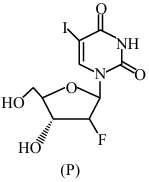
$0.1$ mol of the following given antiviral compound $(P)$ will weigh $......... \times 10^{-1} \ g$
$Given :$ molar mass in $g \ mol^{-1} H: 1, C: 12, N: 14, O: 16, F: 19, I: 127$
$Given :$ molar mass in $g \ mol^{-1} H: 1, C: 12, N: 14, O: 16, F: 19, I: 127$
A
$145$
B
$721$
C
$372$
D
$472$
Solution
(C) The molecular formula of the compound $(P)$ is $C_9H_{11}FIN_2O_5$.
Calculating the molar mass:
$M = (9 \times 12) + (11 \times 1) + 127 + 19 + (2 \times 14) + (5 \times 16)$
$M = 108 + 11 + 127 + 19 + 28 + 80 = 373 \ g \ mol^{-1}$.
Weight of $0.1$ mol $= 0.1 \times 373 = 37.3 \ g = 373 \times 10^{-1} \ g$.
Thus,the value is $373$.
Calculating the molar mass:
$M = (9 \times 12) + (11 \times 1) + 127 + 19 + (2 \times 14) + (5 \times 16)$
$M = 108 + 11 + 127 + 19 + 28 + 80 = 373 \ g \ mol^{-1}$.
Weight of $0.1$ mol $= 0.1 \times 373 = 37.3 \ g = 373 \times 10^{-1} \ g$.
Thus,the value is $373$.
0 likes
View Solution236
MediumMCQ
Among $10^{-9} \ g$ (each) of the following elements,which one will have the highest number of atoms?
Element: $Pb, Po, Pr$ and $Pt$
Element: $Pb, Po, Pr$ and $Pt$
A
$Po$
B
$Pr$
C
$Pb$
D
$Pt$
Solution
(B) The number of atoms is calculated using the formula: $\text{Number of atoms} = \frac{\text{Mass}}{\text{Molar Mass}} \times N_A$.
Since the mass is constant $(10^{-9} \ g)$ for all elements,the number of atoms is inversely proportional to the molar mass.
Therefore,the element with the lowest molar mass will have the highest number of atoms.
The molar masses are:
$\bullet M_{Po} = 209 \ g/mol$
$\bullet M_{Pr} = 141 \ g/mol$
$\bullet M_{Pb} = 207 \ g/mol$
$\bullet M_{Pt} = 195 \ g/mol$
Comparing these values,$Pr$ has the lowest molar mass $(141 \ g/mol)$.
Thus,$Pr$ will have the highest number of atoms.
Since the mass is constant $(10^{-9} \ g)$ for all elements,the number of atoms is inversely proportional to the molar mass.
Therefore,the element with the lowest molar mass will have the highest number of atoms.
The molar masses are:
$\bullet M_{Po} = 209 \ g/mol$
$\bullet M_{Pr} = 141 \ g/mol$
$\bullet M_{Pb} = 207 \ g/mol$
$\bullet M_{Pt} = 195 \ g/mol$
Comparing these values,$Pr$ has the lowest molar mass $(141 \ g/mol)$.
Thus,$Pr$ will have the highest number of atoms.
0 likes
View Solution237
MediumMCQ
Atomic weight of $Ne$ is $20.2$. If $Ne$ is a mixture of $Ne^{20}$ and $Ne^{22}$,what is the percentage abundance of the lighter isotope?
A
$90$
B
$20$
C
$40$
D
$10$
Solution
(A) Let the percentage abundance of $Ne^{20}$ be $x$ and that of $Ne^{22}$ be $(100 - x)$.
Using the formula for average atomic mass:
$Average \ Atomic \ Mass = \frac{(Mass_1 \times Abundance_1) + (Mass_2 \times Abundance_2)}{100}$
$20.2 = \frac{(20 \times x) + (22 \times (100 - x))}{100}$
$2020 = 20x + 2200 - 22x$
$2020 = 2200 - 2x$
$2x = 2200 - 2020$
$2x = 180$
$x = 90$
Thus,the percentage abundance of the lighter isotope $Ne^{20}$ is $90\%$.
Using the formula for average atomic mass:
$Average \ Atomic \ Mass = \frac{(Mass_1 \times Abundance_1) + (Mass_2 \times Abundance_2)}{100}$
$20.2 = \frac{(20 \times x) + (22 \times (100 - x))}{100}$
$2020 = 20x + 2200 - 22x$
$2020 = 2200 - 2x$
$2x = 2200 - 2020$
$2x = 180$
$x = 90$
Thus,the percentage abundance of the lighter isotope $Ne^{20}$ is $90\%$.
0 likes
View Solution238
MediumMCQ
If $V \ mL$ of the vapours of a substance at $NTP$ weigh $W \ g$,find the molecular weight of the substance.
A
$\frac{W}{V} \times 22400$
B
$\frac{V}{W} \times 22400$
C
$(W - V) \times 22400$
D
$\frac{W}{V \times 224}$
Solution
(A) At $NTP$,$1 \ mole$ of any gas occupies $22400 \ mL$ volume and its mass is equal to its molecular weight $(M)$.
Given that $V \ mL$ of the vapours weigh $W \ g$.
Therefore,$1 \ mL$ of the vapours weighs $\frac{W}{V} \ g$.
Thus,$22400 \ mL$ of the vapours will weigh $\frac{W}{V} \times 22400 \ g$.
Hence,the molecular weight $M = \frac{W}{V} \times 22400$.
Given that $V \ mL$ of the vapours weigh $W \ g$.
Therefore,$1 \ mL$ of the vapours weighs $\frac{W}{V} \ g$.
Thus,$22400 \ mL$ of the vapours will weigh $\frac{W}{V} \times 22400 \ g$.
Hence,the molecular weight $M = \frac{W}{V} \times 22400$.
0 likes
View Solution239
MediumMCQ
Elements $A$ and $B$ form two compounds $B_2A_3$ and $B_2A$. $0.05$ moles of $B_2A_3$ weigh $9.0 \ g$ and $0.10$ mole of $B_2A$ weigh $10 \ g$. The atomic weights of $A$ and $B$ are:
A
$20$ and $30$
B
$30$ and $40$
C
$40$ and $30$
D
$30$ and $20$
Solution
(C) Let the atomic weights of $A$ and $B$ be $a$ and $b$ respectively.
For $B_2A_3$: $0.05 \text{ moles} = 9.0 \ g$,so $1 \text{ mole} = \frac{9.0}{0.05} = 180 \ g/mol$.
Thus,$2b + 3a = 180 \dots (i)$
For $B_2A$: $0.10 \text{ mole} = 10 \ g$,so $1 \text{ mole} = \frac{10}{0.10} = 100 \ g/mol$.
Thus,$2b + a = 100 \dots (ii)$
Subtracting equation $(ii)$ from $(i)$:
$(2b + 3a) - (2b + a) = 180 - 100$
$2a = 80 \implies a = 40$.
Substituting $a = 40$ in equation $(ii)$:
$2b + 40 = 100$
$2b = 60 \implies b = 30$.
Therefore,the atomic weights of $A$ and $B$ are $40$ and $30$ respectively.
For $B_2A_3$: $0.05 \text{ moles} = 9.0 \ g$,so $1 \text{ mole} = \frac{9.0}{0.05} = 180 \ g/mol$.
Thus,$2b + 3a = 180 \dots (i)$
For $B_2A$: $0.10 \text{ mole} = 10 \ g$,so $1 \text{ mole} = \frac{10}{0.10} = 100 \ g/mol$.
Thus,$2b + a = 100 \dots (ii)$
Subtracting equation $(ii)$ from $(i)$:
$(2b + 3a) - (2b + a) = 180 - 100$
$2a = 80 \implies a = 40$.
Substituting $a = 40$ in equation $(ii)$:
$2b + 40 = 100$
$2b = 60 \implies b = 30$.
Therefore,the atomic weights of $A$ and $B$ are $40$ and $30$ respectively.
0 likes
View Solution240
MediumMCQ
An element has three isotopes and their isotopic weights are $11, 12, 13$ units,and their percentage of occurrence in nature is $80 \%, 15 \%, 5 \%$ respectively. Then the average atomic weight of the element will be $:-$
A
$11.20$
B
$11.2$
C
$11.25$
D
$112.5$
Solution
(C) The average atomic mass is calculated using the formula:
$Avg. \text{ atomic mass} = \frac{m_1 x_1 + m_2 x_2 + m_3 x_3}{x_1 + x_2 + x_3}$
Substituting the given values:
$Avg. \text{ atomic mass} = \frac{11 \times 80 + 12 \times 15 + 13 \times 5}{80 + 15 + 5}$
$= \frac{880 + 180 + 65}{100} = \frac{1125}{100} = 11.25$
$Avg. \text{ atomic mass} = \frac{m_1 x_1 + m_2 x_2 + m_3 x_3}{x_1 + x_2 + x_3}$
Substituting the given values:
$Avg. \text{ atomic mass} = \frac{11 \times 80 + 12 \times 15 + 13 \times 5}{80 + 15 + 5}$
$= \frac{880 + 180 + 65}{100} = \frac{1125}{100} = 11.25$
0 likes
View Solution241
EasyMCQ
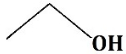
What is the molar mass of the compound represented by the following structural formula?
A
$36 \ g \ mol^{-1}$
B
$46 \ g \ mol^{-1}$
C
$22 \ g \ mol^{-1}$
D
$32 \ g \ mol^{-1}$
Solution
(B) The given structural formula represents ethanol $(CH_3CH_2OH)$.
The molecular formula of ethanol is $C_2H_6O$.
The molar mass is calculated as follows:
$M = (2 \times 12.01) + (6 \times 1.008) + (1 \times 16.00) \approx 24 + 6 + 16 = 46 \ g \ mol^{-1}$.
Therefore,the correct option is $B$.
The molecular formula of ethanol is $C_2H_6O$.
The molar mass is calculated as follows:
$M = (2 \times 12.01) + (6 \times 1.008) + (1 \times 16.00) \approx 24 + 6 + 16 = 46 \ g \ mol^{-1}$.
Therefore,the correct option is $B$.
0 likes
View Solution242
EasyMCQ
What is the atomicity of aluminium phosphate?
A
$8$
B
$6$
C
$5$
D
$13$
Solution
(B) The chemical formula for aluminium phosphate is $AlPO_4$.
Atomicity of a molecule is the total number of atoms present in one molecule.
In $AlPO_4$,there is $1$ atom of $Al$,$1$ atom of $P$,and $4$ atoms of $O$.
$\therefore$ Atomicity $= 1 + 1 + 4 = 6$.
Atomicity of a molecule is the total number of atoms present in one molecule.
In $AlPO_4$,there is $1$ atom of $Al$,$1$ atom of $P$,and $4$ atoms of $O$.
$\therefore$ Atomicity $= 1 + 1 + 4 = 6$.
0 likes
View Solution243
MediumMCQ
Chlorine has two isotopes $^{35}Cl$ and $^{37}Cl$ with an average atomic mass of $35.5$. What is the ratio of their relative abundance respectively?
A
$1:1$
B
$2:1$
C
$1:3$
D
$3:1$
Solution
(D) Let the relative abundance of $^{35}Cl$ be $x\%$ and $^{37}Cl$ be $(100-x)\%$.
Average atomic mass = $\frac{(35 \times x) + (37 \times (100-x))}{100} = 35.5$
$35x + 3700 - 37x = 3550$
$-2x = -150$
$x = 75$
Abundance of $^{35}Cl = 75\%$ and $^{37}Cl = 25\%$.
Ratio = $75:25 = 3:1$.
Average atomic mass = $\frac{(35 \times x) + (37 \times (100-x))}{100} = 35.5$
$35x + 3700 - 37x = 3550$
$-2x = -150$
$x = 75$
Abundance of $^{35}Cl = 75\%$ and $^{37}Cl = 25\%$.
Ratio = $75:25 = 3:1$.
0 likes
View Solution244
MediumMCQ
Chlorine exists in two isotopic forms $^{35}Cl$ and $^{37}Cl$. If the average atomic mass of chlorine is $35.5$,what is the percentage abundance of these isotopes respectively?
A
$25 \%, 75 \%$
B
$75 \%, 25 \%$
C
$50 \%, 50 \%$
D
$35 \%, 65 \%$
Solution
(B) Let the percentage abundance of $^{35}Cl$ be $x$ and that of $^{37}Cl$ be $(100 - x)$.
Average atomic mass is given by the formula:
$\text{Average atomic mass} = \frac{(\text{mass of } ^{35}Cl \times x) + (\text{mass of } ^{37}Cl \times (100 - x))}{100}$
Substituting the values:
$35.5 = \frac{35x + 37(100 - x)}{100}$
$3550 = 35x + 3700 - 37x$
$3550 = 3700 - 2x$
$2x = 3700 - 3550$
$2x = 150$
$x = 75$
Therefore,the abundance of $^{35}Cl$ is $75 \%$ and the abundance of $^{37}Cl$ is $100 - 75 = 25 \%$.
Average atomic mass is given by the formula:
$\text{Average atomic mass} = \frac{(\text{mass of } ^{35}Cl \times x) + (\text{mass of } ^{37}Cl \times (100 - x))}{100}$
Substituting the values:
$35.5 = \frac{35x + 37(100 - x)}{100}$
$3550 = 35x + 3700 - 37x$
$3550 = 3700 - 2x$
$2x = 3700 - 3550$
$2x = 150$
$x = 75$
Therefore,the abundance of $^{35}Cl$ is $75 \%$ and the abundance of $^{37}Cl$ is $100 - 75 = 25 \%$.
0 likes
View Solution245
MediumMCQ
What is the mass in gram of $1$ atom of an element if its atomic mass is $10 \ u$?
A
$2.06056 \times 10^{-22} \ g$
B
$1.66056 \times 10^{-23} \ g$
C
$1.06056 \times 10^{-24} \ g$
D
$3.66056 \times 10^{-25} \ g$
Solution
(B) Atomic mass is the mass of one atom of the element in atomic mass units $(u)$.
Given,mass of $1$ atom $= 10 \ u$.
We know that $1 \ u = 1.66056 \times 10^{-24} \ g$.
Therefore,mass of $1$ atom in grams $= 10 \times 1.66056 \times 10^{-24} \ g = 1.66056 \times 10^{-23} \ g$.
Given,mass of $1$ atom $= 10 \ u$.
We know that $1 \ u = 1.66056 \times 10^{-24} \ g$.
Therefore,mass of $1$ atom in grams $= 10 \times 1.66056 \times 10^{-24} \ g = 1.66056 \times 10^{-23} \ g$.
0 likes
View Solution246
MediumMCQ
Mass of one molecule of oxygen in $amu$ and in $gram$ respectively is
A
$32 \ u, 53.13 \times 10^{-24} \ g$
B
$16 \ u, 6.0 \times 10^{-24} \ g$
C
$42 \ u, 5.313 \times 10^{-24} \ g$
D
$53.13 \times 10^{-24} \ u, 32 \ g$
Solution
(A) The molar mass of an oxygen molecule $(O_2)$ is $32 \ g/mol$.
The mass of one molecule in $amu$ is equal to its molecular mass,which is $32 \ u$.
To convert this to grams,we use the conversion factor $1 \ u = 1.66056 \times 10^{-24} \ g$.
Mass in grams $= 32 \times 1.66056 \times 10^{-24} \ g \approx 53.14 \times 10^{-24} \ g$.
The mass of one molecule in $amu$ is equal to its molecular mass,which is $32 \ u$.
To convert this to grams,we use the conversion factor $1 \ u = 1.66056 \times 10^{-24} \ g$.
Mass in grams $= 32 \times 1.66056 \times 10^{-24} \ g \approx 53.14 \times 10^{-24} \ g$.
0 likes
View Solution247
EasyMCQ
The unit of atomic mass,$amu$ is replaced by $u$,here $u$ stands for
A
unified mass
B
united mass
C
unique mass
D
universal mass
Solution
(A) The unit of atomic mass,$amu$ (atomic mass unit),has been replaced by $u$ in the modern $IUPAC$ system.
Here,$u$ stands for $unified \ mass$.
Here,$u$ stands for $unified \ mass$.
0 likes
View Solution248
EasyMCQ
Which symbol replaced the unit of atomic mass,$amu$?
A
$u$
B
$A$
C
$M$
D
$n$
Solution
(A) The symbol $u$ (unified mass) has replaced the older unit of atomic mass,$amu$ (atomic mass unit).
0 likes
View Solution249
EasyMCQ
One atomic mass unit $(amu)$ is equal to:
A
$1.66 \times 10^{-27} \ g$
B
$1.66 \times 10^{-24} \ g$
C
$1.66 \times 10^{-23} \ g$
D
$1.66 \times 10^{-25} \ kg$
Solution
(B) The atomic mass unit $(amu)$,also known as the unified atomic mass unit $(u)$,is defined as $1/12$ of the mass of a carbon-$12$ atom.
$1 \ amu = 1.66057 \times 10^{-27} \ kg$.
Since $1 \ kg = 10^3 \ g$,we convert the value to grams:
$1 \ amu = 1.66057 \times 10^{-27} \ kg \times 10^3 \ g/kg = 1.66057 \times 10^{-24} \ g$.
Therefore,the correct value is $1.66 \times 10^{-24} \ g$.
$1 \ amu = 1.66057 \times 10^{-27} \ kg$.
Since $1 \ kg = 10^3 \ g$,we convert the value to grams:
$1 \ amu = 1.66057 \times 10^{-27} \ kg \times 10^3 \ g/kg = 1.66057 \times 10^{-24} \ g$.
Therefore,the correct value is $1.66 \times 10^{-24} \ g$.
0 likes
View Solution250
EasyMCQ
$1 \ u \ (amu)$ is equal to
A
$1.492 \times 10^{-10} \ J$
B
$1.492 \times 10^{-7} \ J$
C
$1.492 \times 10^{-13} \ J$
D
$6.023 \times 10^{23} \ J$
Solution
(A) $1 \ u = 1.66056 \times 10^{-27} \ kg$.
Using Einstein's mass-energy equivalence relation,$E = mc^2$.
$E = (1.66056 \times 10^{-27} \ kg) \times (2.9979 \times 10^8 \ m/s)^2$.
$E \approx 1.4924 \times 10^{-10} \ J$.
Using Einstein's mass-energy equivalence relation,$E = mc^2$.
$E = (1.66056 \times 10^{-27} \ kg) \times (2.9979 \times 10^8 \ m/s)^2$.
$E \approx 1.4924 \times 10^{-10} \ J$.
0 likes
View SolutionSome Basic Concepts of Chemistry — Atomic, Molecular and Equivalent masses · Frequently Asked Questions
1Are these Some Basic Concepts of Chemistry questions useful for JEE and NEET?
Yes. All questions in this section are mapped to JEE Main and NEET exam patterns. Previous year questions from JEE Main, NEET, GUJCET and state-level exams are included with full solutions.
2Can I switch to Hindi or Gujarati for these questions?
Yes. Use the language tabs in the hero section or the sidebar to view the same questions and solutions in English, Hindi or Gujarati.
3How do I generate a question paper from this subtopic?
Use the Vedclass Exam Paper Generator — select the chapter and subtopic, set difficulty, and generate Sets A, B, C, D automatically. First 3 chapters of every subject are free.
Vedclass Products
For Students
Vedclass Test Series
Mock tests in real JEE/NEET style with performance analysis. 5-day free trial.
Start Free TrialFor Teachers
Exam Paper Generator
Generate Set A/B/C/D papers from this chapter in 2 minutes. 3 chapters free.
Try FreeFor Institutes
Online Exam Module
Live online exams with unlimited students, 360° analytics & white-label branding.
See DemoFor Teachers & Institutes
Generate a Some Basic Concepts of Chemistry Exam Paper in 2 Minutes
Select subtopic & difficulty — Sets A, B, C, D auto-generated with No Repeat logic.
First 3 chapters of every subject are free — no payment required.