
A English
Boron family Questions in English
Class 11 Chemistry · p-Block Elements (Class 11) · Boron family
528+
Questions
English
Language
100%
With Solutions
Showing 49 of 528 questions in English
51
MediumMCQ
In the borax bead test,which of the following compounds is formed?
A
Meta borate
B
Tetra borate
C
Double oxide
D
Ortho borate
Solution
(A) $Na_2B_4O_7 \cdot 10H_2O \xrightarrow[-10H_2O]{\Delta} Na_2B_4O_7$
$Na_2B_4O_7 \xrightarrow{\Delta} 2NaBO_2 + B_2O_3$
$CuO + B_2O_3 \to \underset{(\text{Copper meta borate, blue})}{Cu(BO_2)_2}$
In the borax bead test,the metal oxide reacts with $B_2O_3$ to form a metal meta borate,which gives a characteristic color to the bead.
$Na_2B_4O_7 \xrightarrow{\Delta} 2NaBO_2 + B_2O_3$
$CuO + B_2O_3 \to \underset{(\text{Copper meta borate, blue})}{Cu(BO_2)_2}$
In the borax bead test,the metal oxide reacts with $B_2O_3$ to form a metal meta borate,which gives a characteristic color to the bead.
0 likes
View Solution52
MediumMCQ
Sodium borate on reaction with $H_2SO_4$ (conc.) and $C_2H_5OH$ gives a compound '$A$' which burns with a green flame. The compound '$A$' is
A
$H_2B_4O_7$
B
$(C_2H_5)_2B_4O_7$
C
$H_3BO_3$
D
$(C_2H_5)_3BO_3$
Solution
(D) When borate is heated with ethanol and conc. $H_2SO_4$,triethyl borate is produced,and these vapours burn with a green-edged flame on ignition.
$Na_2B_4O_7 + H_2SO_4 + 5 H_2O \rightarrow Na_2SO_4 + 4 H_3BO_3$
$H_3BO_3 + 3 C_2H_5OH \rightarrow B(OC_2H_5)_3 + 3 H_2O$
Thus,the green-edged flame is due to the formation of Triethyl Borate,which is $(C_2H_5)_3BO_3$.
$Na_2B_4O_7 + H_2SO_4 + 5 H_2O \rightarrow Na_2SO_4 + 4 H_3BO_3$
$H_3BO_3 + 3 C_2H_5OH \rightarrow B(OC_2H_5)_3 + 3 H_2O$
Thus,the green-edged flame is due to the formation of Triethyl Borate,which is $(C_2H_5)_3BO_3$.
0 likes
View Solution53
MediumMCQ
Two gases when mixed give white dense fumes,the gases are
A
$NH_3$ and $SO_2$
B
$SO_2$ and steam
C
$NH_3$ and $HCl$
D
$NH_3$ and $N_2O$
Solution
(C) The reaction between ammonia $(NH_3)$ and hydrogen chloride $(HCl)$ gas produces ammonium chloride $(NH_4Cl)$,which appears as dense white fumes.
$NH_3(g) + HCl(g) \to NH_4Cl(s)$ (dense white fumes)
$NH_3(g) + HCl(g) \to NH_4Cl(s)$ (dense white fumes)
0 likes
View Solution54
MediumMCQ
Which of the following imparts a green colour to the burner flame?
A
$B(OMe)_3$
B
$Na(OMe)$
C
$Al(OPr)_3$
D
$Sn(OH)_2$
Solution
(A) The vapours of trialkyl borates,such as $B(OMe)_3$,burn with a green-edged flame. This reaction is a characteristic qualitative test for the presence of borates.
The chemical reactions involved are:
$2BO_3^{3-} + 3H_2SO_4 \rightarrow 2H_3BO_3 + 3SO_4^{2-}$
$H_3BO_3 + 3CH_3OH \rightarrow B(OCH_3)_3 + 3H_2O$
Since $B(OMe)_3$ is a trialkyl borate,it imparts a green colour to the flame.
The chemical reactions involved are:
$2BO_3^{3-} + 3H_2SO_4 \rightarrow 2H_3BO_3 + 3SO_4^{2-}$
$H_3BO_3 + 3CH_3OH \rightarrow B(OCH_3)_3 + 3H_2O$
Since $B(OMe)_3$ is a trialkyl borate,it imparts a green colour to the flame.
0 likes
View Solution55
MediumMCQ
Which of the following shows dimerisation?
A
$HgCl_2$
B
$B_2H_6$
C
$TiCl_4$
D
$SO_2$
Solution
(A) $HgCl_2$ exists as a dimer in the solid state. The mercury atoms are linked by chlorine bridges. While $B_2H_6$ is a dimer of $BH_3$,in the context of typical inorganic chemistry questions regarding metal halides,$HgCl_2$ is frequently cited for its dimeric nature in solid form.
0 likes
View Solution56
EasyMCQ
The chemical name of borax is
A
Sodium orthoborate
B
Sodium metaborate
C
Sodium tetraborate
D
Sodium tetraborate decahydrate
Solution
(D) The chemical formula of borax is $Na_2B_4O_7 \cdot 10H_2O$.
Its chemical name is $Sodium \ tetraborate \ decahydrate$.
Its chemical name is $Sodium \ tetraborate \ decahydrate$.
0 likes
View Solution57
EasyMCQ
In moist air,$AlCl_3$ fumes because:
A
It is highly volatile.
B
It is covalent.
C
It forms $HCl$ gas in moist air.
D
It is highly hygroscopic.
Solution
(C) $AlCl_3$ is a covalent compound that undergoes hydrolysis in the presence of moisture (water vapor) in the air.
The reaction is: $AlCl_3 + 3H_2O \rightarrow Al(OH)_3 + 3HCl$.
The $HCl$ gas produced forms white fumes in the air,which is why $AlCl_3$ appears to fume in moist air.
The reaction is: $AlCl_3 + 3H_2O \rightarrow Al(OH)_3 + 3HCl$.
The $HCl$ gas produced forms white fumes in the air,which is why $AlCl_3$ appears to fume in moist air.
0 likes
View Solution58
EasyMCQ
Boron compounds act as Lewis acids due to their .....
A
acidic nature
B
covalent nature
C
electron deficiency
D
ionization property
Solution
(C) Boron compounds like $BF_3$ have only $6$ electrons in the valence shell of the central boron atom. Due to this incomplete octet,they are electron-deficient and can accept a pair of electrons,which is the definition of a Lewis acid.
0 likes
View Solution59
MediumMCQ
What is the correct formula for Borazole?
A
$B_2H_6$
B
$B_6N_6H_6$
C
$B_3N_3H_6$
D
$B_3N_3H_3$
Solution
(C) Borazole,also known as inorganic benzene,has the chemical formula $B_3N_3H_6$.
It is isoelectronic with benzene $(C_6H_6)$ and possesses a cyclic structure consisting of alternating boron and nitrogen atoms.
It is isoelectronic with benzene $(C_6H_6)$ and possesses a cyclic structure consisting of alternating boron and nitrogen atoms.
0 likes
View Solution60
EasyMCQ
Which of the following is $NOT$ true regarding the structure of diborane $(B_2H_6)$?
A
It contains four terminal hydrogen atoms and two bridged hydrogen atoms.
B
The terminal hydrogen atoms and boron atoms lie in the same plane.
C
It contains four two-center-two-electron bonds and two three-center-two-electron bonds.
D
The hybrid orbitals of the boron atom each contain one electron.
Solution
(C) In diborane $(B_2H_6)$,the boron atom undergoes $sp^3$ hybridization.
Each boron atom has four $sp^3$ hybrid orbitals.
Three of these orbitals contain one electron each,while one orbital is empty.
The four terminal hydrogen atoms form four $2c-2e$ (two-center-two-electron) bonds with the boron atoms.
The two bridged hydrogen atoms form two $3c-2e$ (three-center-two-electron) bonds,also known as banana bonds.
Therefore,the statement that it contains four one-center bonds is incorrect.
Each boron atom has four $sp^3$ hybrid orbitals.
Three of these orbitals contain one electron each,while one orbital is empty.
The four terminal hydrogen atoms form four $2c-2e$ (two-center-two-electron) bonds with the boron atoms.
The two bridged hydrogen atoms form two $3c-2e$ (three-center-two-electron) bonds,also known as banana bonds.
Therefore,the statement that it contains four one-center bonds is incorrect.
0 likes
View Solution61
MediumMCQ
Which of the following is true for an element in group $13$ of the periodic table?
A
It is a gas at room temperature.
B
Its oxidation state is $+4$.
C
It shows $R_2O_3$ type oxide.
D
It forms $RX_2$ type halides.
0 likes
View Solution62
MediumMCQ
Aluminium $(III)$ chloride forms a dimer because ........
A
$Al$ can show high coordination numbers.
B
$Al$ has high ionization energy.
C
$Al$ is a group $13$ element.
D
It cannot show trimerization.
Solution
(A) Aluminium chloride $(AlCl_3)$ exists as a dimer $(Al_2Cl_6)$ in the vapour state or in non-polar solvents.
This occurs because the $Al$ atom in $AlCl_3$ is electron-deficient,having only $6$ electrons in its valence shell.
To complete its octet,$Al$ accepts a lone pair of electrons from the chlorine atom of another $AlCl_3$ molecule,forming a coordinate bond.
This results in the formation of a dimer where $Al$ achieves a coordination number of $4$.
This occurs because the $Al$ atom in $AlCl_3$ is electron-deficient,having only $6$ electrons in its valence shell.
To complete its octet,$Al$ accepts a lone pair of electrons from the chlorine atom of another $AlCl_3$ molecule,forming a coordinate bond.
This results in the formation of a dimer where $Al$ achieves a coordination number of $4$.
0 likes
View Solution63
EasyMCQ
Substance $X$ reacts with an aqueous solution of $NaOH$ to form $Y$ and releases $H_2$ gas. When an aqueous solution of $Y$ is heated at $323 \; K - 333 \; K$ and $CO_2$ gas is passed through it,it yields $Al_2O_3 \cdot xH_2O$ (often represented as $Al(OH)_3$) and $Z$. Heating $Z$ at $1200^{\circ}C$ produces $Al_2O_3$. Identify $X, Y,$ and $Z$.
A
$Al, AlCl_3, NaAlO_2$
B
$Zn, Na_2ZnO_2, Al(OH)_3$
C
$Al, Al(OH)_3, AlCl_3$
D
$Al, NaAlO_2, Al(OH)_3$
Solution
(D) $1$. Aluminum $(Al)$ reacts with $NaOH$ to form sodium aluminate $(NaAlO_2)$ and releases $H_2$ gas: $2Al + 2NaOH + 2H_2O \rightarrow 2NaAlO_2 + 3H_2$. Here,$X = Al$ and $Y = NaAlO_2$.
$2$. When $CO_2$ is passed through the aqueous solution of $NaAlO_2$,aluminum hydroxide $(Al(OH)_3)$ is precipitated: $2NaAlO_2 + 3H_2O + CO_2 \rightarrow 2Al(OH)_3 + Na_2CO_3$. Here,$Z = Al(OH)_3$.
$3$. Heating $Al(OH)_3$ at $1200^{\circ}C$ yields alumina $(Al_2O_3)$: $2Al(OH)_3 \xrightarrow{\Delta} Al_2O_3 + 3H_2O$. Thus,the correct sequence is $X = Al, Y = NaAlO_2, Z = Al(OH)_3$.
$2$. When $CO_2$ is passed through the aqueous solution of $NaAlO_2$,aluminum hydroxide $(Al(OH)_3)$ is precipitated: $2NaAlO_2 + 3H_2O + CO_2 \rightarrow 2Al(OH)_3 + Na_2CO_3$. Here,$Z = Al(OH)_3$.
$3$. Heating $Al(OH)_3$ at $1200^{\circ}C$ yields alumina $(Al_2O_3)$: $2Al(OH)_3 \xrightarrow{\Delta} Al_2O_3 + 3H_2O$. Thus,the correct sequence is $X = Al, Y = NaAlO_2, Z = Al(OH)_3$.
0 likes
View Solution64
EasyMCQ
What are the approximate $H-B-H$ bond angles in diborane $(B_2H_6)$?
A
$60^{\circ}, 120^{\circ}$
B
$95^{\circ}, 120^{\circ}$
C
$95^{\circ}, 150^{\circ}$
D
$120^{\circ}, 180^{\circ}$
Solution
(B) In diborane $(B_2H_6)$,there are two types of hydrogen atoms: terminal and bridging.
The terminal $B-H$ bonds are normal covalent bonds,and the angle between them is approximately $120^{\circ}$.
The bridging $B-H-B$ bonds involve $3c-2e$ (three-center two-electron) bonds,and the $H-B-H$ angle in the bridge is approximately $95^{\circ}$.
Therefore,the bond angles are $95^{\circ}$ and $120^{\circ}$.
The terminal $B-H$ bonds are normal covalent bonds,and the angle between them is approximately $120^{\circ}$.
The bridging $B-H-B$ bonds involve $3c-2e$ (three-center two-electron) bonds,and the $H-B-H$ angle in the bridge is approximately $95^{\circ}$.
Therefore,the bond angles are $95^{\circ}$ and $120^{\circ}$.
0 likes
View Solution65
EasyMCQ
What is the product formed by the action of caustic soda on aluminium hydroxide?
A
$Al_{2}(OH)_{4}$
B
$Na_{2}Al(OH)_{4}$
C
$NaAlO_{2}$
D
$Na_{3}AlO_{3}$
Solution
(C) Aluminium hydroxide $(Al(OH)_{3})$ is amphoteric in nature. When it reacts with caustic soda $(NaOH)$,it forms sodium aluminate $(NaAlO_{2})$ and water. The balanced chemical equation is:
$Al(OH)_{3} + NaOH \rightarrow NaAlO_{2} + 2H_{2}O$.
$Al(OH)_{3} + NaOH \rightarrow NaAlO_{2} + 2H_{2}O$.
0 likes
View Solution66
EasyMCQ
When $BCl_3$ reacts with water,which of the following substances is formed?
A
$H_3BO_3 + HCl$
B
$B_2H_6 + HCl$
C
$B_2O_3 + HCl$
D
None of these
Solution
(A) The hydrolysis of boron trichloride $(BCl_3)$ with water proceeds as follows:
$BCl_3 + 3H_2O \rightarrow H_3BO_3 + 3HCl$.
Here,$BCl_3$ reacts with water to form boric acid $(H_3BO_3)$ and hydrogen chloride $(HCl)$.
$BCl_3 + 3H_2O \rightarrow H_3BO_3 + 3HCl$.
Here,$BCl_3$ reacts with water to form boric acid $(H_3BO_3)$ and hydrogen chloride $(HCl)$.
0 likes
View Solution67
EasyMCQ
What is the formula for meta-boric acid?
A
$HBO_2$
B
$H_2B_4O_7$
C
$H_3BO_3$
D
None of these
Solution
(A) Orthoboric acid $(H_3BO_3)$ on heating at $370 \ K$ loses a water molecule to form meta-boric acid $(HBO_2)$.
The reaction is: $H_3BO_3 \xrightarrow{\Delta} HBO_2 + H_2O$.
The reaction is: $H_3BO_3 \xrightarrow{\Delta} HBO_2 + H_2O$.
0 likes
View Solution68
EasyMCQ
Which of the following is produced by the hydrolysis of diborane $(B_2H_6)$?
A
$H_3BO_3 + H_2$
B
$B_2O_3 + H_2$
C
$B_2O_3 + O_2$
D
$H_3BO_3 + H_2O_2$
Solution
(A) The hydrolysis of diborane $(B_2H_6)$ is a vigorous reaction that produces boric acid $(H_3BO_3)$ and hydrogen gas $(H_2)$.
The balanced chemical equation is:
$B_2H_6 + 6H_2O \rightarrow 2H_3BO_3 + 6H_2$.
The balanced chemical equation is:
$B_2H_6 + 6H_2O \rightarrow 2H_3BO_3 + 6H_2$.
0 likes
View Solution69
EasyMCQ
Which of the following processes is used to prepare borazine?
A
$B_2H_6 + NH_3$ (excess),low temperature
B
$B_2H_6 + NH_3$ (excess),high temperature
C
$B_2H_6 + 2NH_3$ ($2NH_3 : 1B_2H_6$ ratio),high temperature
D
None of the above
Solution
(C) Borazine,also known as inorganic benzene,is prepared by the reaction of diborane $(B_2H_6)$ with ammonia $(NH_3)$ in a $1:2$ molar ratio at high temperatures.
The chemical reaction is: $3B_2H_6 + 6NH_3 \rightarrow 2B_3N_3H_6 + 12H_2$.
Therefore,the correct condition is a $2NH_3 : 1B_2H_6$ ratio at high temperature.
The chemical reaction is: $3B_2H_6 + 6NH_3 \rightarrow 2B_3N_3H_6 + 12H_2$.
Therefore,the correct condition is a $2NH_3 : 1B_2H_6$ ratio at high temperature.
0 likes
View Solution70
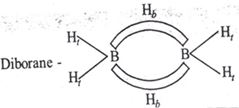
MediumMCQ
Which of the following structures does not represent the structure of the substance given in the brackets?
A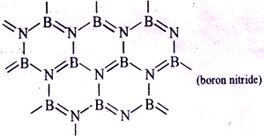
Boron nitride
B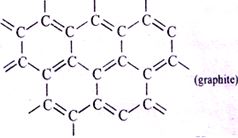
Graphite
C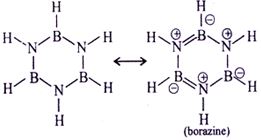
Borazine
D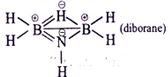
Diborane
Solution
(D) The structure shown in option $D$ is incorrect for diborane $(B_2H_6)$.
In diborane,there are two bridging hydrogen atoms $(H_b)$ and four terminal hydrogen atoms $(H_t)$. The boron atoms are $sp^3$ hybridized and the structure involves $3c-2e^-$ bonds (banana bonds) for the bridging hydrogens,not the structure shown in option $D$ which incorrectly depicts a nitrogen atom and incorrect bonding.
In diborane,there are two bridging hydrogen atoms $(H_b)$ and four terminal hydrogen atoms $(H_t)$. The boron atoms are $sp^3$ hybridized and the structure involves $3c-2e^-$ bonds (banana bonds) for the bridging hydrogens,not the structure shown in option $D$ which incorrectly depicts a nitrogen atom and incorrect bonding.
0 likes
View Solution71
EasyMCQ
Which of the following processes will not yield anhydrous $AlCl_3$?
A
Heating $AlCl_3 \cdot 6H_2O$
B
Passing dry $HCl$ over hot aluminum powder
C
Passing dry $Cl_2$ over hot aluminum powder
D
Heating a mixture of aluminum and coke in a stream of dry $Cl_2$
Solution
(A) Heating hydrated aluminum chloride $(AlCl_3 \cdot 6H_2O)$ results in hydrolysis rather than dehydration. The reaction is: $2(AlCl_3 \cdot 6H_2O) \xrightarrow{\Delta} Al_2O_3 + 6HCl + 9H_2O$. Thus,it produces aluminum oxide $(Al_2O_3)$ instead of anhydrous $AlCl_3$. The other methods (passing dry $HCl$ or $Cl_2$ over hot $Al$) are standard industrial methods to produce anhydrous $AlCl_3$.
0 likes
View Solution72
EasyMCQ
Which of the following is added to borax to obtain boric acid?
A
Hydrochloric acid
B
Sodium hydroxide
C
Carbon dioxide
D
Sodium carbonate
Solution
(A) Borax $(Na_2B_4O_7 \cdot 10H_2O)$ reacts with mineral acids like hydrochloric acid $(HCl)$ to produce boric acid $(H_3BO_3)$.
The chemical reaction is:
$Na_2B_4O_7 + 2HCl + 5H_2O \rightarrow 2NaCl + 4H_3BO_3$
Thus,hydrochloric acid is added to borax to obtain boric acid.
The chemical reaction is:
$Na_2B_4O_7 + 2HCl + 5H_2O \rightarrow 2NaCl + 4H_3BO_3$
Thus,hydrochloric acid is added to borax to obtain boric acid.
0 likes
View Solution73
EasyMCQ
Which of the following elements does not release $H_2$ gas upon reaction with an acid?
A
$Al$
B
$In$
C
$Ti$
D
$B$
Solution
(D) Boron $(B)$ is a non-metal and does not react with non-oxidizing acids like $HCl$ or $H_2SO_4$ to release $H_2$ gas.
Metals like $Al$,$In$,and $Ti$ are electropositive and react with acids to liberate $H_2$ gas.
Therefore,the correct answer is $B$.
Metals like $Al$,$In$,and $Ti$ are electropositive and react with acids to liberate $H_2$ gas.
Therefore,the correct answer is $B$.
0 likes
View Solution74
EasyMCQ
The element that has the least metallic character is ..........
A
Indium
B
Boron
C
Aluminium
D
Gallium
Solution
(B) In the $p$-block elements of group $13$ (Boron family),the metallic character increases as we move down the group from $B$ to $Tl$.
$B$ (Boron) is a non-metal,while $Al$,$Ga$,$In$,and $Tl$ exhibit metallic properties.
Therefore,$B$ (Boron) has the least metallic character among the given options.
$B$ (Boron) is a non-metal,while $Al$,$Ga$,$In$,and $Tl$ exhibit metallic properties.
Therefore,$B$ (Boron) has the least metallic character among the given options.
0 likes
View Solution75
EasyMCQ
What is the correct order of melting points for the elements of Group $13$?
A
$B > Al > Ga > In > Tl$
B
$B > Al > Ga > Tl > In$
C
$B > Al > Tl > In > Ga$
D
$B > Tl > Al > In > Ga$
Solution
(C) The melting points of Group $13$ elements do not show a regular trend due to the differences in their crystal structures and atomic sizes.
$B$ (Boron) has a very high melting point due to its strong covalent network structure.
$Al$ (Aluminum) has a lower melting point than $B$.
$Ga$ (Gallium) has an unusually low melting point $(303 \ K)$ because it exists as $Ga_2$ molecules in the solid state.
$In$ (Indium) and $Tl$ (Thallium) follow,with $Tl$ having a higher melting point than $In$ due to the inert pair effect and relativistic effects.
The correct order is $B > Al > Tl > In > Ga$.
$B$ (Boron) has a very high melting point due to its strong covalent network structure.
$Al$ (Aluminum) has a lower melting point than $B$.
$Ga$ (Gallium) has an unusually low melting point $(303 \ K)$ because it exists as $Ga_2$ molecules in the solid state.
$In$ (Indium) and $Tl$ (Thallium) follow,with $Tl$ having a higher melting point than $In$ due to the inert pair effect and relativistic effects.
The correct order is $B > Al > Tl > In > Ga$.
0 likes
View Solution76
EasyMCQ
Which of the following statements is incorrect regarding $BCl_3$?
A
$BCl_3$ is a covalent compound.
B
$BCl_3$ acts as a Lewis acid.
C
$BCl_3$ does not show dimerization.
D
All $B-Cl$ bonds in $BCl_3$ are longer than a single bond.
Solution
(D) $BCl_3$ is a covalent molecule with a planar triangular geometry.
It is electron-deficient,having only $6$ electrons in the valence shell of Boron,hence it acts as a strong Lewis acid.
Due to the back-bonding ($p\pi-p\pi$ back-donation) from $Cl$ to $B$,the $B-Cl$ bond acquires some double-bond character.
This makes the $B-Cl$ bond length shorter than a pure single bond.
Therefore,the statement that all $B-Cl$ bonds are longer than a single bond is incorrect.
It is electron-deficient,having only $6$ electrons in the valence shell of Boron,hence it acts as a strong Lewis acid.
Due to the back-bonding ($p\pi-p\pi$ back-donation) from $Cl$ to $B$,the $B-Cl$ bond acquires some double-bond character.
This makes the $B-Cl$ bond length shorter than a pure single bond.
Therefore,the statement that all $B-Cl$ bonds are longer than a single bond is incorrect.
0 likes
View Solution77
MediumMCQ
Which of the following is the correct decreasing order of Lewis acid strength of boron halides?
A
$BBr_3 > BCl_3 > BF_3$
B
$BF_3 > BCl_3 > BBr_3$
C
$BCl_3 > BF_3 > BBr_3$
D
$BCl_3 > BBr_3 > BF_3$
Solution
(A) The Lewis acid strength of boron halides is determined by the extent of $p\pi-p\pi$ back-bonding between the halogen atom and the boron atom.
In $BF_3$,the small size of the fluorine atom allows for effective $2p-2p$ back-bonding with boron,which significantly reduces the electron deficiency of the boron atom.
As the size of the halogen increases from $F$ to $Cl$ to $Br$,the effectiveness of back-bonding decreases ($2p-3p$ for $BCl_3$ and $2p-4p$ for $BBr_3$).
Therefore,the electron deficiency on boron increases as we move from $BF_3$ to $BBr_3$,making $BBr_3$ the strongest Lewis acid and $BF_3$ the weakest.
The correct decreasing order is $BBr_3 > BCl_3 > BF_3$.
In $BF_3$,the small size of the fluorine atom allows for effective $2p-2p$ back-bonding with boron,which significantly reduces the electron deficiency of the boron atom.
As the size of the halogen increases from $F$ to $Cl$ to $Br$,the effectiveness of back-bonding decreases ($2p-3p$ for $BCl_3$ and $2p-4p$ for $BBr_3$).
Therefore,the electron deficiency on boron increases as we move from $BF_3$ to $BBr_3$,making $BBr_3$ the strongest Lewis acid and $BF_3$ the weakest.
The correct decreasing order is $BBr_3 > BCl_3 > BF_3$.
0 likes
View Solution78
MediumMCQ
Consider the following halides: $(1) \; BCl_3$,$(2) \; AlCl_3$,$(3) \; GaCl_3$,$(4) \; InCl_3$. What is the decreasing order of their Lewis acid strength?
A
$1 > 2 > 3 > 4$
B
$4 > 3 > 2 > 1$
C
$3 > 4 > 2 > 1$
D
$2 > 3 > 4 > 1$
Solution
(A) The Lewis acid strength of group $13$ trihalides depends on the ability of the central metal atom to accept an electron pair.
In $BCl_3$,the boron atom is small and undergoes $p\pi-p\pi$ back-bonding with chlorine,which reduces its electron deficiency.
As we move down the group from $B$ to $In$,the size of the central atom increases,and the extent of back-bonding decreases significantly.
Therefore,the electron deficiency increases as we move from $BCl_3$ to $InCl_3$.
However,the Lewis acidity is also influenced by the electronegativity and the size of the central atom. For group $13$ trihalides,the order of Lewis acid strength is $BCl_3 > AlCl_3 > GaCl_3 > InCl_3$ due to the effective back-bonding in $BCl_3$ and the increasing metallic character down the group.
Thus,the correct decreasing order is $(1) > (2) > (3) > (4)$.
In $BCl_3$,the boron atom is small and undergoes $p\pi-p\pi$ back-bonding with chlorine,which reduces its electron deficiency.
As we move down the group from $B$ to $In$,the size of the central atom increases,and the extent of back-bonding decreases significantly.
Therefore,the electron deficiency increases as we move from $BCl_3$ to $InCl_3$.
However,the Lewis acidity is also influenced by the electronegativity and the size of the central atom. For group $13$ trihalides,the order of Lewis acid strength is $BCl_3 > AlCl_3 > GaCl_3 > InCl_3$ due to the effective back-bonding in $BCl_3$ and the increasing metallic character down the group.
Thus,the correct decreasing order is $(1) > (2) > (3) > (4)$.
0 likes
View Solution79
EasyMCQ
Two elements $X$ and $Y$ combine separately with a highly electropositive metal to form binary compounds,which upon hydrolysis yield borane and silane,respectively. What are $X$ and $Y$?
A
$B, Si$
B
$Si, B$
C
$Al, B$
D
$B, Al$
Solution
(A) Highly electropositive metals (like $Mg$) form binary compounds (borides and silicides) with $B$ and $Si$.
Hydrolysis of magnesium boride $(Mg_3B_2)$ yields borane $(B_2H_6)$:
$Mg_3B_2 + 6H_2O \rightarrow 3Mg(OH)_2 + B_2H_6$
Hydrolysis of magnesium silicide $(Mg_2Si)$ yields silane $(SiH_4)$:
$Mg_2Si + 4H_2O \rightarrow 2Mg(OH)_2 + SiH_4$
Since the question specifies that $X$ yields borane and $Y$ yields silane,$X$ must be $B$ and $Y$ must be $Si$.
Hydrolysis of magnesium boride $(Mg_3B_2)$ yields borane $(B_2H_6)$:
$Mg_3B_2 + 6H_2O \rightarrow 3Mg(OH)_2 + B_2H_6$
Hydrolysis of magnesium silicide $(Mg_2Si)$ yields silane $(SiH_4)$:
$Mg_2Si + 4H_2O \rightarrow 2Mg(OH)_2 + SiH_4$
Since the question specifies that $X$ yields borane and $Y$ yields silane,$X$ must be $B$ and $Y$ must be $Si$.
0 likes
View Solution80
EasyMCQ
The reason for boric acid being polymeric is .....
A
Its acidic property
B
Presence of hydrogen bonds
C
Its monobasic property
D
Its geometry
Solution
(B) Boric acid $(H_3BO_3)$ exists as a layered structure in the solid state.
In this structure,the planar $BO_3^{3-}$ units are linked together by hydrogen bonds.
This extensive hydrogen bonding leads to the formation of a two-dimensional polymeric sheet-like structure.
In this structure,the planar $BO_3^{3-}$ units are linked together by hydrogen bonds.
This extensive hydrogen bonding leads to the formation of a two-dimensional polymeric sheet-like structure.
0 likes
View Solution81
EasyMCQ
Which of the following types of hybridization occurs in diborane $(B_2H_6)$?
A
$sp$
B
$sp^3$
C
$sp^2$
D
$sp^3d^2$
Solution
(B) In diborane $(B_2H_6)$,each boron atom is bonded to four hydrogen atoms.
Each boron atom undergoes $sp^3$ hybridization to form four $sp^3$ hybrid orbitals.
Three of these orbitals contain one electron each,while the fourth one is empty.
These orbitals participate in the formation of two $3c-2e$ (three-center two-electron) bonds and four terminal $B-H$ covalent bonds.
Each boron atom undergoes $sp^3$ hybridization to form four $sp^3$ hybrid orbitals.
Three of these orbitals contain one electron each,while the fourth one is empty.
These orbitals participate in the formation of two $3c-2e$ (three-center two-electron) bonds and four terminal $B-H$ covalent bonds.
0 likes
View Solution82
EasyMCQ
Which of the following boron compounds is the hardest?
A
Boron oxide
B
Boron nitride
C
Boron carbide
D
Boron hydride
Solution
(C) Boron carbide $(B_4C)$ is known as one of the hardest materials known,ranking just below diamond and cubic boron nitride in hardness. It is widely used in industrial applications such as tank armor and bulletproof vests due to its extreme hardness and low density.
0 likes
View Solution83
EasyMCQ
Which of the following statements is correct?
A
Aluminum hydroxide is more acidic than boron hydroxide.
B
Boron hydroxide is basic while aluminum hydroxide is amphoteric.
C
Boron hydroxide is acidic while aluminum hydroxide is amphoteric.
D
Hydroxides of $B$ and $Al$ are amphoteric.
Solution
(C) The nature of hydroxides depends on the ionization energy and electronegativity of the central atom.
$B(OH)_3$ (or $H_3BO_3$) is a weak monobasic Lewis acid because it accepts $OH^-$ ions from water,releasing $H^+$ ions.
$Al(OH)_3$ is amphoteric in nature as it reacts with both acids and bases.
Therefore,boron hydroxide is acidic and aluminum hydroxide is amphoteric.
$B(OH)_3$ (or $H_3BO_3$) is a weak monobasic Lewis acid because it accepts $OH^-$ ions from water,releasing $H^+$ ions.
$Al(OH)_3$ is amphoteric in nature as it reacts with both acids and bases.
Therefore,boron hydroxide is acidic and aluminum hydroxide is amphoteric.
0 likes
View Solution84
EasyMCQ
What is obtained when an aqueous solution of aluminum chloride is heated to dryness?
A
$AlCl_3$
B
$Al_2Cl_6$
C
$Al_2O_3$
D
$Al(OH)Cl_2$
Solution
(C) When an aqueous solution of aluminum chloride $(AlCl_3)$ is heated to dryness,it undergoes hydrolysis due to the high charge density of the $Al^{3+}$ ion. The reaction is: $AlCl_3 + 3H_2O \rightarrow Al(OH)_3 + 3HCl$. Upon further heating,the aluminum hydroxide loses water to form aluminum oxide: $2Al(OH)_3 \rightarrow Al_2O_3 + 3H_2O$. Therefore,the final residue obtained is aluminum oxide $(Al_2O_3)$.
0 likes
View Solution85
MediumMCQ
Graphite is isostructural with which of the following?
A
$B$
B
$B_4C$
C
$B_2H_6$
D
$BN$
Solution
(D) Graphite and $BN$ (Boron Nitride) both possess a similar layered structure. Due to this similarity in structure,$BN$ is often referred to as 'inorganic graphite'.
0 likes
View Solution86
MediumMCQ
Which of the following will not give a borax bead test?
A
$Cr$
B
$Ni$
C
$Na$
D
$Mn$
Solution
(C) The borax bead test is used to identify transition metal ions in a sample.
When borax $(Na_2B_4O_7 \cdot 10H_2O)$ is heated,it forms a transparent glassy bead consisting of sodium metaborate $(NaBO_2)$ and boric anhydride $(B_2O_3)$.
Transition metals react with this bead to form colored metaborates.
Since $Na$ is an alkali metal and not a transition metal,it does not form colored metaborates and thus does not give a positive borax bead test.
$Cr$,$Ni$,and $Mn$ are transition metals and will give characteristic colors in the borax bead test.
When borax $(Na_2B_4O_7 \cdot 10H_2O)$ is heated,it forms a transparent glassy bead consisting of sodium metaborate $(NaBO_2)$ and boric anhydride $(B_2O_3)$.
Transition metals react with this bead to form colored metaborates.
Since $Na$ is an alkali metal and not a transition metal,it does not form colored metaborates and thus does not give a positive borax bead test.
$Cr$,$Ni$,and $Mn$ are transition metals and will give characteristic colors in the borax bead test.
0 likes
View Solution87
MediumMCQ
Boron halides are Lewis acids because.....
A
They are ionic.
B
They are acidic.
C
They are covalent.
D
They are electron-deficient.
Solution
(D) Boron halides (e.g.,$BF_3$,$BCl_3$) have a central boron atom with only $6$ electrons in its valence shell.
According to the octet rule,boron requires $8$ electrons to complete its octet.
Since it has an incomplete octet,it acts as an electron pair acceptor,which is the definition of a Lewis acid.
According to the octet rule,boron requires $8$ electrons to complete its octet.
Since it has an incomplete octet,it acts as an electron pair acceptor,which is the definition of a Lewis acid.
0 likes
View Solution88
MediumMCQ
Statement-$1$: Orthoboric acid acts as a weak monobasic acid in water.
Statement-$2$: Orthoboric acid acts as a proton donor in water.
Statement-$2$: Orthoboric acid acts as a proton donor in water.
A
Statement-$1$ is true,Statement-$2$ is true. Statement-$2$ is the correct explanation for Statement-$1$.
B
Statement-$1$ is true,Statement-$2$ is true. Statement-$2$ is not the correct explanation for Statement-$1$.
C
Statement-$1$ is true,Statement-$2$ is false.
D
Statement-$1$ is false,Statement-$2$ is true.
Solution
(C) Orthoboric acid,$H_3BO_3$ (or $B(OH)_3$),acts as a weak monobasic Lewis acid in water.
It does not donate a proton $(H^+)$ directly; instead,it accepts a hydroxyl ion $(OH^-)$ from water to release a proton.
The reaction is: $B(OH)_3 + 2H_2O \rightleftharpoons [B(OH)_4]^- + H_3O^+$.
Since it acts as a Lewis acid (electron pair acceptor) rather than a Brønsted-Lowry acid (proton donor),Statement-$1$ is true and Statement-$2$ is false.
It does not donate a proton $(H^+)$ directly; instead,it accepts a hydroxyl ion $(OH^-)$ from water to release a proton.
The reaction is: $B(OH)_3 + 2H_2O \rightleftharpoons [B(OH)_4]^- + H_3O^+$.
Since it acts as a Lewis acid (electron pair acceptor) rather than a Brønsted-Lowry acid (proton donor),Statement-$1$ is true and Statement-$2$ is false.
0 likes
View Solution89
EasyMCQ
Which of the following is the strongest Lewis acid?
A
$BI_3$
B
$BBr_3$
C
$BCl_3$
D
$BF_3$
Solution
(A) The Lewis acidity of boron trihalides $(BX_3)$ depends on the extent of back-bonding between the lone pair of the halogen and the empty $p$-orbital of boron.
In $BF_3$,the fluorine atom has a small size and its $2p$-orbitals overlap effectively with the $2p$-orbital of boron ($2p\pi-2p\pi$ back-bonding),making it the weakest Lewis acid.
As the size of the halogen increases from $F$ to $I$,the effectiveness of back-bonding decreases ($2p\pi-3p\pi$ for $BCl_3$,$2p\pi-4p\pi$ for $BBr_3$,and $2p\pi-5p\pi$ for $BI_3$).
Therefore,$BI_3$ has the least back-bonding and the most available empty $p$-orbital,making it the strongest Lewis acid.
The order of Lewis acidity is $BF_3 < BCl_3 < BBr_3 < BI_3$.
In $BF_3$,the fluorine atom has a small size and its $2p$-orbitals overlap effectively with the $2p$-orbital of boron ($2p\pi-2p\pi$ back-bonding),making it the weakest Lewis acid.
As the size of the halogen increases from $F$ to $I$,the effectiveness of back-bonding decreases ($2p\pi-3p\pi$ for $BCl_3$,$2p\pi-4p\pi$ for $BBr_3$,and $2p\pi-5p\pi$ for $BI_3$).
Therefore,$BI_3$ has the least back-bonding and the most available empty $p$-orbital,making it the strongest Lewis acid.
The order of Lewis acidity is $BF_3 < BCl_3 < BBr_3 < BI_3$.
0 likes
View Solution90
MediumMCQ
Which of the following statements is true?
A
The coordination number of Beryllium is $6$.
B
Both Beryllium and Aluminum chlorides form bridged structures in the solid state.
C
$B_2H_6 \cdot 2NH_3$ is known as inorganic benzene.
D
Boric acid is a protonic acid.
Solution
(B) In the solid state,$BeCl_2$ and $AlCl_3$ exist as polymeric structures with chlorine bridges. The structure shown in the image represents the bridged dimer/polymer structure where $M = Be$ or $Al$.
$BeCl_2$ forms a chain structure with $Cl$ bridges,and $AlCl_3$ forms a layer structure with $Cl$ bridges.
Option $A$ is incorrect as the coordination number of $Be$ in $BeCl_2$ is $4$.
Option $C$ is incorrect as inorganic benzene is $B_3N_3H_6$ (borazine).
Option $D$ is incorrect as boric acid $(H_3BO_3)$ is a Lewis acid,not a protonic acid,as it accepts $OH^-$ ions from water.
$BeCl_2$ forms a chain structure with $Cl$ bridges,and $AlCl_3$ forms a layer structure with $Cl$ bridges.
Option $A$ is incorrect as the coordination number of $Be$ in $BeCl_2$ is $4$.
Option $C$ is incorrect as inorganic benzene is $B_3N_3H_6$ (borazine).
Option $D$ is incorrect as boric acid $(H_3BO_3)$ is a Lewis acid,not a protonic acid,as it accepts $OH^-$ ions from water.

0 likes
View Solution91
EasyMCQ
For a $p$-block element,its $3d, 3s, 3p$ and $4s$ orbitals are completely filled and the differentiating electron goes to the $4p$ orbital. The element should have its atomic number in the range:
A
$13 - 18$
B
$21 - 26$
C
$31 - 36$
D
$49 - 54$
Solution
(C) The electronic configuration of the element is given by filling the orbitals in the order: $1s^2, 2s^2, 2p^6, 3s^2, 3p^6, 4s^2, 3d^{10}, 4p^{1-6}$.
Summing the electrons: $2+2+6+2+6+2+10 = 30$ electrons are filled before the $4p$ orbital.
For a $p$-block element,the differentiating electron enters the $4p$ orbital.
If the $4p$ orbital has $1$ electron,the atomic number is $30 + 1 = 31$ (Gallium,$Ga$).
If the $4p$ orbital has $6$ electrons,the atomic number is $30 + 6 = 36$ (Krypton,$Kr$).
Thus,the range of atomic numbers for this configuration is $31 - 36$.
Summing the electrons: $2+2+6+2+6+2+10 = 30$ electrons are filled before the $4p$ orbital.
For a $p$-block element,the differentiating electron enters the $4p$ orbital.
If the $4p$ orbital has $1$ electron,the atomic number is $30 + 1 = 31$ (Gallium,$Ga$).
If the $4p$ orbital has $6$ electrons,the atomic number is $30 + 6 = 36$ (Krypton,$Kr$).
Thus,the range of atomic numbers for this configuration is $31 - 36$.
0 likes
View Solution92
EasyMCQ
Inorganic benzene is
A
$B_3H_3N_3$
B
$BH_3NH_3$
C
$B_3H_6N_3$
D
$H_3B_3N_6$
Solution
(C) The chemical formula for inorganic benzene,also known as borazine,is $B_3H_6N_3$.
It is isostructural with benzene $(C_6H_6)$ because it has the same number of electrons and a similar ring structure.
It is isostructural with benzene $(C_6H_6)$ because it has the same number of electrons and a similar ring structure.
0 likes
View Solution93
MediumMCQ
Which of the following is electron-deficient?
A
$(BH_3)_2$
B
$PH_3$
C
$(CH_3)_2$
D
$(SiH_3)_2$
Solution
(A) Boron is an element of group $13$ and contains $3$ electrons in its valence shell.
When its compound $BH_3$ dimerises to form $(BH_3)_2$ (diborane),each boron atom is surrounded by only $6$ electrons,meaning its octet is incomplete.
Therefore,$(BH_3)_2$ is an electron-deficient compound.
In all other given molecules,the octet of the central atoms is complete.
When its compound $BH_3$ dimerises to form $(BH_3)_2$ (diborane),each boron atom is surrounded by only $6$ electrons,meaning its octet is incomplete.
Therefore,$(BH_3)_2$ is an electron-deficient compound.
In all other given molecules,the octet of the central atoms is complete.
0 likes
View Solution94
MediumMCQ
Boric acid is an acid because its molecule
A
contains replaceable $H^{+}$ ion
B
gives up a proton
C
accepts $OH^{-}$ from water releasing proton.
D
combines with proton from water molecule.
Solution
(C) Boric acid is a weak monobasic Lewis acid. It acts as an acid not by donating a proton directly,but by accepting an $OH^{-}$ ion from water,which releases a proton $(H^{+})$ into the solution.
$B(OH)_3 + H_2O \longrightarrow [B(OH)_4]^{-}_{(aq)} + H^{+}_{(aq)}$
$B(OH)_3 + H_2O \longrightarrow [B(OH)_4]^{-}_{(aq)} + H^{+}_{(aq)}$
0 likes
View Solution95
MediumMCQ
The stability of $+1$ oxidation state among $Al$,$Ga$,$In$ and $Tl$ increases in the sequence:
A
$Al < Ga < In < Tl$
B
$Tl < In < Ga < Al$
C
$In < Tl < Ga < Al$
D
$Ga < In < Al < Tl$
Solution
(A) The stability of the $+1$ oxidation state increases down the group $13$ elements as $Al < Ga < In < Tl$.
This is due to the inert pair effect,where the $ns^2$ electrons become increasingly reluctant to participate in bond formation due to poor shielding by $d$ and $f$ orbitals.
As we move down the group,the stability of the $+1$ oxidation state increases,making $Tl^+$ the most stable among the given ions.
This is due to the inert pair effect,where the $ns^2$ electrons become increasingly reluctant to participate in bond formation due to poor shielding by $d$ and $f$ orbitals.
As we move down the group,the stability of the $+1$ oxidation state increases,making $Tl^+$ the most stable among the given ions.
0 likes
View Solution96
EasyMCQ
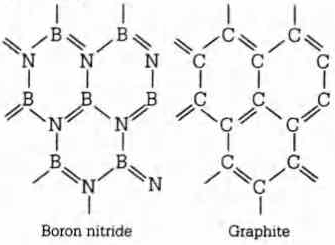
Which of the following structures is similar to graphite?
A
$B_4C$
B
$B_2H_6$
C
$BN$
D
$B$
Solution
(C) Boron nitride $(BN)_x$ is known as inorganic graphite because its structure is similar to that of graphite.
In graphite,carbon atoms are arranged in hexagonal layers.
In boron nitride,boron and nitrogen atoms are arranged in a similar hexagonal layered structure,where each boron atom is surrounded by three nitrogen atoms and vice versa.
In graphite,carbon atoms are arranged in hexagonal layers.
In boron nitride,boron and nitrogen atoms are arranged in a similar hexagonal layered structure,where each boron atom is surrounded by three nitrogen atoms and vice versa.
0 likes
View Solution97
MediumMCQ
Which one of the following molecular hydrides acts as a Lewis acid?
A
$NH_3$
B
$H_2O$
C
$B_2H_6$
D
$CH_4$
Solution
(C) Electron-deficient molecules act as Lewis acids.
Among the given molecules,only diborane $(B_2H_6)$ is electron-deficient,meaning it does not have a complete octet.
Thus,it acts as a Lewis acid.
$NH_3$ and $H_2O$ are electron-rich molecules and behave as Lewis bases.
Among the given molecules,only diborane $(B_2H_6)$ is electron-deficient,meaning it does not have a complete octet.
Thus,it acts as a Lewis acid.
$NH_3$ and $H_2O$ are electron-rich molecules and behave as Lewis bases.
0 likes
View Solution98
MediumMCQ
The tendency of $BF_3$,$BCl_3$ and $BBr_3$ to behave as Lewis acid decreases in the sequence
A
$BCl_3 > BF_3 > BBr_3$
B
$BBr_3 > BCl_3 > BF_3$
C
$BBr_3 > BF_3 > BCl_3$
D
$BF_3 > BCl_3 > BBr_3$
Solution
(B) The Lewis acid strength of boron trihalides depends on the extent of $p\pi - p\pi$ back bonding from the halogen atom to the boron atom.
In $BF_3$,the $2p - 2p$ back bonding is most effective due to the small size of the $F$ atom,which significantly reduces the electron deficiency of boron.
As the size of the halogen increases from $F$ to $Cl$ to $Br$,the effectiveness of $p\pi - p\pi$ back bonding decreases $(F > Cl > Br)$.
Consequently,the electron deficiency on the boron atom increases in the order $BF_3 < BCl_3 < BBr_3$.
Therefore,the Lewis acid strength follows the sequence $BBr_3 > BCl_3 > BF_3$.
In $BF_3$,the $2p - 2p$ back bonding is most effective due to the small size of the $F$ atom,which significantly reduces the electron deficiency of boron.
As the size of the halogen increases from $F$ to $Cl$ to $Br$,the effectiveness of $p\pi - p\pi$ back bonding decreases $(F > Cl > Br)$.
Consequently,the electron deficiency on the boron atom increases in the order $BF_3 < BCl_3 < BBr_3$.
Therefore,the Lewis acid strength follows the sequence $BBr_3 > BCl_3 > BF_3$.
0 likes
View Solution99
MediumMCQ
Which one of the following is the correct statement?
A
Boric acid is a protonic acid
B
Beryllium exhibits coordination number of six
C
Chlorides of both beryllium and aluminium have bridged chloride structures in solid phase
D
$B_2H_6 \cdot 2NH_3$ is known as 'inorganic benzene'
Solution
(C) Boric acid is a Lewis acid,not a protonic acid.
Beryllium typically exhibits a coordination number of $4$.
$B_2H_6 \cdot 2NH_3$ is known as 'inorganic benzene' is incorrect; borazine $(B_3N_3H_6)$ is known as inorganic benzene.
Both $BeCl_2$ and $AlCl_3$ exist as polymeric structures with bridged chloride atoms in the solid state.
Beryllium typically exhibits a coordination number of $4$.
$B_2H_6 \cdot 2NH_3$ is known as 'inorganic benzene' is incorrect; borazine $(B_3N_3H_6)$ is known as inorganic benzene.
Both $BeCl_2$ and $AlCl_3$ exist as polymeric structures with bridged chloride atoms in the solid state.
0 likes
View Solutionp-Block Elements (Class 11) — Boron family · Frequently Asked Questions
1Are these p-Block Elements (Class 11) questions useful for JEE and NEET?
Yes. All questions in this section are mapped to JEE Main and NEET exam patterns. Previous year questions from JEE Main, NEET, GUJCET and state-level exams are included with full solutions.
2Can I switch to Hindi or Gujarati for these questions?
Yes. Use the language tabs in the hero section or the sidebar to view the same questions and solutions in English, Hindi or Gujarati.
3How do I generate a question paper from this subtopic?
Use the Vedclass Exam Paper Generator — select the chapter and subtopic, set difficulty, and generate Sets A, B, C, D automatically. First 3 chapters of every subject are free.
Vedclass Products
For Students
Vedclass Test Series
Mock tests in real JEE/NEET style with performance analysis. 5-day free trial.
Start Free TrialFor Teachers
Exam Paper Generator
Generate Set A/B/C/D papers from this chapter in 2 minutes. 3 chapters free.
Try FreeFor Institutes
Online Exam Module
Live online exams with unlimited students, 360° analytics & white-label branding.
See DemoFor Teachers & Institutes
Generate a p-Block Elements (Class 11) Exam Paper in 2 Minutes
Select subtopic & difficulty — Sets A, B, C, D auto-generated with No Repeat logic.
First 3 chapters of every subject are free — no payment required.