
A English
Boron family Questions in English
Class 11 Chemistry · p-Block Elements (Class 11) · Boron family
528+
Questions
English
Language
100%
With Solutions
Showing 50 of 528 questions in English
1
MediumMCQ
In diborane,the $H-B-H$ bond angle is $120^o$. The hybridization of boron is likely to be
A
$sp$
B
$sp^2$
C
$sp^3$
D
$dsp^2$
Solution
(C) In diborane $(B_2H_6)$,each boron atom is bonded to four hydrogen atoms (two terminal and two bridging).
This results in a tetrahedral geometry around each boron atom.
Therefore,the hybridization of each boron atom is $sp^3$.
This results in a tetrahedral geometry around each boron atom.
Therefore,the hybridization of each boron atom is $sp^3$.
0 likes
View Solution2
MediumMCQ
Which of the following compounds of boron does not exist in the free form?
A
$BCl_3$
B
$BF_3$
C
$BBr_3$
D
$BH_3$
Solution
(D) The compound $BH_3$ (borane) is electron-deficient and does not exist in the free monomeric form under standard conditions.
It exists as a stable dimer known as diborane,$B_2H_6$,where boron achieves an octet through three-center two-electron $(3c-2e)$ bonds.
It exists as a stable dimer known as diborane,$B_2H_6$,where boron achieves an octet through three-center two-electron $(3c-2e)$ bonds.
0 likes
View Solution3
EasyMCQ
Which of the following is the weakest acid?
A
$HF$
B
$HCl$
C
$HBr$
D
$HI$
Solution
(A) The acidic strength of hydrohalic acids $(HX)$ increases as the bond dissociation energy decreases down the group $(F < Cl < Br < I)$.
Since the $H-F$ bond is the strongest due to the small size of the fluorine atom,it has the highest bond dissociation energy.
Therefore,$HF$ does not release $H^+$ ions as easily as the other hydrohalic acids,making it the weakest acid among the given options.
Since the $H-F$ bond is the strongest due to the small size of the fluorine atom,it has the highest bond dissociation energy.
Therefore,$HF$ does not release $H^+$ ions as easily as the other hydrohalic acids,making it the weakest acid among the given options.
0 likes
View Solution4
MediumMCQ
Orthoboric acid in aqueous medium is
A
Monobasic
B
Dibasic
C
Tribasic
D
All are correct
Solution
(A) Orthoboric acid $(H_3BO_3)$ acts as a weak Lewis acid in aqueous medium.
It accepts a lone pair of electrons from $OH^-$ ions of water to form the $[B(OH)_4]^-$ complex and releases a proton $(H^+)$.
The reaction is: $H_3BO_3 + H_2O \rightleftharpoons [B(OH)_4]^- + H^+$.
Since it releases only one $H^+$ ion per molecule,it is a monobasic acid.
It accepts a lone pair of electrons from $OH^-$ ions of water to form the $[B(OH)_4]^-$ complex and releases a proton $(H^+)$.
The reaction is: $H_3BO_3 + H_2O \rightleftharpoons [B(OH)_4]^- + H^+$.
Since it releases only one $H^+$ ion per molecule,it is a monobasic acid.
0 likes
View Solution5
MediumMCQ
Boron halides behave as Lewis acids because of their
A
Ionic nature
B
Acidic nature
C
Covalent nature
D
Electron deficient nature
Solution
(D) $Boron$ halides $(BX_3)$ have only $6$ electrons in the valence shell of the central $Boron$ atom.
Due to this electron deficiency,they have a strong tendency to accept a lone pair of electrons from a donor to complete their octet,which is the definition of a $Lewis$ acid.
For example,in $BF_3$,the $Boron$ atom is electron-deficient.
Due to this electron deficiency,they have a strong tendency to accept a lone pair of electrons from a donor to complete their octet,which is the definition of a $Lewis$ acid.
For example,in $BF_3$,the $Boron$ atom is electron-deficient.
0 likes
View Solution6
MediumMCQ
In the reaction $B_2H_6 + 2KOH + 2X \to 2Y + 6H_2$,$X$ and $Y$ are respectively
A
$H_2$,$H_3BO_3$
B
$HCl$,$KBO_3$
C
$H_2O$,$KBO_3$
D
$H_2O$,$KBO_2$
Solution
(D) The reaction of diborane $(B_2H_6)$ with potassium hydroxide $(KOH)$ in the presence of water $(H_2O)$ is a redox reaction.
The balanced chemical equation is:
$B_2H_6 + 2KOH + 2H_2O \to 2KBO_2 + 6H_2$.
Comparing this with the given equation $B_2H_6 + 2KOH + 2X \to 2Y + 6H_2$,we find that $X = H_2O$ and $Y = KBO_2$.
The balanced chemical equation is:
$B_2H_6 + 2KOH + 2H_2O \to 2KBO_2 + 6H_2$.
Comparing this with the given equation $B_2H_6 + 2KOH + 2X \to 2Y + 6H_2$,we find that $X = H_2O$ and $Y = KBO_2$.
0 likes
View Solution7
EasyMCQ
Which of the following show diagonal relationship?
A
$B$ and $Si$
B
$B$ and $Al$
C
$B$ and $Ga$
D
$B$ and $C$
Solution
(A) Boron $(B)$ shows a diagonal relationship with silicon $(Si)$.
Boron exhibits anomalous behavior in its group due to its small atomic size and the non-availability of $d$-orbitals.
Due to similarities in charge-to-size ratio,it resembles silicon and shows a diagonal relationship with it.
Boron exhibits anomalous behavior in its group due to its small atomic size and the non-availability of $d$-orbitals.
Due to similarities in charge-to-size ratio,it resembles silicon and shows a diagonal relationship with it.
0 likes
View Solution8
MediumMCQ
An element $X$ which occurs in the first short period has an outer electronic structure $s^2p^1$. What are the formula and acid-base character of its oxides?
A
$XO_3$,basic
B
$X_2O_3$,basic
C
$X_2O_3$,amphoteric
D
$XO_2$,acidic
Solution
(C) The element $X$ has an outer electronic configuration of $ns^2np^1$. Since it is in the first short period (Period $2$ or $3$),and considering the valence shell configuration,the element is Boron $(B)$ or Aluminum $(Al)$.
For Boron $(B)$,the oxide is $B_2O_3$,and for Aluminum $(Al)$,the oxide is $Al_2O_3$.
Both $B_2O_3$ and $Al_2O_3$ are known to be amphoteric in nature,meaning they can react with both acids and bases.
For Boron $(B)$,the oxide is $B_2O_3$,and for Aluminum $(Al)$,the oxide is $Al_2O_3$.
Both $B_2O_3$ and $Al_2O_3$ are known to be amphoteric in nature,meaning they can react with both acids and bases.
0 likes
View Solution9
EasyMCQ
Tincal is
A
$Na_2CO_3 \cdot 10H_2O$
B
$NaNO_3$
C
$NaCl$
D
$Na_2B_4O_7 \cdot 10H_2O$
Solution
(D) Tincal is a naturally occurring mineral form of borax.
Its chemical formula is $Na_2B_4O_7 \cdot 10H_2O$.
Its chemical formula is $Na_2B_4O_7 \cdot 10H_2O$.
0 likes
View Solution10
EasyMCQ
The composition of borax is:
A
$Na_2B_4O_7 \cdot 4H_2O$
B
$Na_2B_4O_7 \cdot 10H_2O$
C
$NaBO_2$
D
$H_3BO_3$
Solution
(B) Borax is a well-known compound of boron with the chemical formula $Na_2B_4O_7 \cdot 10H_2O$.
It is more accurately represented as $Na_2[B_4O_5(OH)_4] \cdot 8H_2O$ because it contains the tetranuclear unit $[B_4O_5(OH)_4]^{2-}$.
Therefore,the correct composition is $Na_2B_4O_7 \cdot 10H_2O$.
It is more accurately represented as $Na_2[B_4O_5(OH)_4] \cdot 8H_2O$ because it contains the tetranuclear unit $[B_4O_5(OH)_4]^{2-}$.
Therefore,the correct composition is $Na_2B_4O_7 \cdot 10H_2O$.
0 likes
View Solution11
EasyMCQ
Which of the following is a use of alum?
A
Making explosives
B
Bleaching clothes
C
Water softening
D
All of the above
Solution
(C) Alum,specifically potassium alum $(KAl(SO_4)_2 \cdot 12H_2O)$,is widely used in water purification and treatment processes. It acts as a coagulant to remove suspended impurities and is also used in the process of water softening. Therefore,the correct option is $(C)$.
0 likes
View Solution12
MediumMCQ
Aluminium reacts with caustic soda to form
A
Aluminium hydroxide
B
Aluminium oxide
C
Sodium meta-aluminate
D
Sodium tetra aluminate
Solution
(C) Aluminium reacts with caustic soda $(NaOH)$ to form sodium meta-aluminate $(NaAlO_2)$ and hydrogen gas.
The balanced chemical equation is:
$2Al + 2NaOH + 2H_2O \to 2NaAlO_2 + 3H_2 \uparrow$
The balanced chemical equation is:
$2Al + 2NaOH + 2H_2O \to 2NaAlO_2 + 3H_2 \uparrow$
0 likes
View Solution13
EasyMCQ
The alum used for purifying water is
A
Ferric alum
B
Chrome alum
C
Potash alum
D
Ammonium alum
Solution
(C) Potash alum,with the chemical formula $K_2SO_4 \cdot Al_2(SO_4)_3 \cdot 24H_2O$,is commonly used in the process of water purification.
It acts as a coagulant,which helps in settling down the suspended impurities in water.
It acts as a coagulant,which helps in settling down the suspended impurities in water.
0 likes
View Solution14
MediumMCQ
Colemanite is
A
$Ca[B_3O_4(OH)_2] \cdot 2H_2O$
B
$Ca_2B_6O_{11} \cdot 5H_2O$
C
$Ca(OH)_2$
D
$Na_2B_4O_7 \cdot 2H_2O$
Solution
(B) Colemanite is a naturally occurring mineral of boron.
Its chemical formula is $Ca_2B_6O_{11} \cdot 5H_2O$.
Its chemical formula is $Ca_2B_6O_{11} \cdot 5H_2O$.
0 likes
View Solution15
MediumMCQ
Which of the following statements about $H_3BO_3$ is not correct?
A
It is a strong tribasic acid
B
It is prepared by acidifying an aqueous solution of borax
C
It has a layer structure in which planar $BO_3$ units are joined by hydrogen bonds
D
It does not act as proton donor but acts as a Lewis acid by accepting hydroxyl ion
Solution
(A) $H_3BO_3$ (orthoboric acid) is a very weak monoprotic Lewis acid,not a strong tribasic acid.
It acts as a Lewis acid by accepting an $OH^-$ ion from water molecules,releasing $H^+$ ions in the process: $B(OH)_3 + 2H_2O \rightleftharpoons [B(OH)_4]^- + H_3O^+$.
Therefore,the statement that it is a strong tribasic acid is incorrect.
It acts as a Lewis acid by accepting an $OH^-$ ion from water molecules,releasing $H^+$ ions in the process: $B(OH)_3 + 2H_2O \rightleftharpoons [B(OH)_4]^- + H_3O^+$.
Therefore,the statement that it is a strong tribasic acid is incorrect.
0 likes
View Solution16
MediumMCQ
The type of hybridisation of boron in diborane is
A
$sp$ hybridisation
B
$sp^2$ hybridisation
C
$sp^3$ hybridisation
D
$sp^3d^2$ hybridisation
Solution
(C) In diborane $(B_2H_6)$,each boron atom is bonded to four hydrogen atoms (two terminal and two bridging).
According to the valence bond theory,each boron atom undergoes $sp^3$ hybridisation to form four $sp^3$ hybrid orbitals.
Three of these orbitals contain one electron each,while the fourth one is vacant.
This results in a tetrahedral geometry around each boron atom,confirming $sp^3$ hybridisation.
According to the valence bond theory,each boron atom undergoes $sp^3$ hybridisation to form four $sp^3$ hybrid orbitals.
Three of these orbitals contain one electron each,while the fourth one is vacant.
This results in a tetrahedral geometry around each boron atom,confirming $sp^3$ hybridisation.
0 likes
View Solution17
EasyMCQ
In the reaction $B_2O_3 + C + Cl_2 \to A + CO$,the $A$ is:
A
$BCl_3$
B
$BCl_2$
C
$B_2Cl_2$
D
$CCl_2$
Solution
(A) The balanced chemical equation for the reaction is: $B_2O_3 + 3C + 3Cl_2 \to 2BCl_3 + 3CO$.
Boron trichloride $(BCl_3)$ is obtained by passing chlorine gas over a heated mixture of boron trioxide $(B_2O_3)$ and powdered charcoal $(C)$.
Boron trichloride $(BCl_3)$ is obtained by passing chlorine gas over a heated mixture of boron trioxide $(B_2O_3)$ and powdered charcoal $(C)$.
0 likes
View Solution18
EasyMCQ
The most acidic of the following compounds is
A
$P_2O_3$
B
$Sb_2O_3$
C
$B_2O_3$
D
$As_2O_3$
Solution
(A) The acidity of oxides generally increases with an increase in the non-metallic character of the central element and its oxidation state.
Among the given oxides,$P_2O_3$ is the oxide of phosphorus,which is a non-metal,while $B_2O_3$,$As_2O_3$,and $Sb_2O_3$ are oxides of elements with more metallic or metalloid character compared to phosphorus.
$P_2O_3$ is the most acidic oxide among the choices provided because phosphorus is the most non-metallic element in this group.
Among the given oxides,$P_2O_3$ is the oxide of phosphorus,which is a non-metal,while $B_2O_3$,$As_2O_3$,and $Sb_2O_3$ are oxides of elements with more metallic or metalloid character compared to phosphorus.
$P_2O_3$ is the most acidic oxide among the choices provided because phosphorus is the most non-metallic element in this group.
0 likes
View Solution19
MediumMCQ
Identify the statement that is not correct as far as the structure of diborane is concerned.
A
There are two bridging hydrogen atoms in diborane.
B
Each boron atom forms four bonds in diborane.
C
The hydrogen atoms are not in the same plane in diborane.
D
All $B-H$ bonds in diborane are similar.
Solution
(D) The structure of diborane $(B_2H_6)$ consists of two terminal $BH_2$ groups and two bridging hydrogen atoms.
In this structure, there are two types of $B-H$ bonds:
$1$. Terminal $B-H$ bonds: These are normal $2c-2e$ (two-center, two-electron) covalent bonds.
$2$. Bridging $B-H-B$ bonds: These are $3c-2e$ (three-center, two-electron) bonds, also known as banana bonds.
Since the terminal and bridging bonds have different bond lengths ($119 \ pm$ and $134 \ pm$ respectively) and different bonding characteristics, the statement that all $B-H$ bonds are similar is incorrect.
Therefore, the correct option is $D$.
In this structure, there are two types of $B-H$ bonds:
$1$. Terminal $B-H$ bonds: These are normal $2c-2e$ (two-center, two-electron) covalent bonds.
$2$. Bridging $B-H-B$ bonds: These are $3c-2e$ (three-center, two-electron) bonds, also known as banana bonds.
Since the terminal and bridging bonds have different bond lengths ($119 \ pm$ and $134 \ pm$ respectively) and different bonding characteristics, the statement that all $B-H$ bonds are similar is incorrect.
Therefore, the correct option is $D$.
0 likes
View Solution20
MediumMCQ
Which metal burns in air at high temperature with the evolution of much heat?
A
$Cu$
B
$Hg$
C
$Pb$
D
$Al$
Solution
(D) Aluminium $(Al)$ has a high affinity for oxygen.
At high temperatures,it reacts vigorously with oxygen in the air to form aluminium oxide $(Al_2O_3)$.
This reaction is highly exothermic,meaning it releases a significant amount of heat and light.
At high temperatures,it reacts vigorously with oxygen in the air to form aluminium oxide $(Al_2O_3)$.
This reaction is highly exothermic,meaning it releases a significant amount of heat and light.
0 likes
View Solution21
MediumMCQ
Aluminium hydroxide is soluble in excess of sodium hydroxide forming the ion
A
$Al(O)_2^{+3}$
B
$AlO_2^{-3}$
C
$AlO_2^{-}$
D
$AlO_3^{-}$
Solution
(C) Aluminium hydroxide is amphoteric in nature and reacts with excess sodium hydroxide to form a soluble complex.
The chemical reaction is:
$Al(OH)_3 + NaOH \rightarrow NaAlO_2 + 2H_2O$
In aqueous solution,$NaAlO_2$ dissociates to form the aluminate ion,$AlO_2^{-}$.
The chemical reaction is:
$Al(OH)_3 + NaOH \rightarrow NaAlO_2 + 2H_2O$
In aqueous solution,$NaAlO_2$ dissociates to form the aluminate ion,$AlO_2^{-}$.
0 likes
View Solution22
MediumMCQ
Boron forms covalent compounds due to:
A
Higher ionization energy
B
Lower ionization energy
C
Small size
D
Both $(a)$ and $(c)$
Solution
(D) Boron forms covalent bonds primarily due to its small size.
Additionally,the sum of its first three ionization enthalpies is very high.
This high energy requirement prevents the formation of $B^{3+}$ ions and forces boron to form covalent compounds.
Additionally,the sum of its first three ionization enthalpies is very high.
This high energy requirement prevents the formation of $B^{3+}$ ions and forces boron to form covalent compounds.
0 likes
View Solution23
MediumMCQ
In diborane $(B_2H_6)$,the two $H-B-H$ bond angles are nearly
A
$60^{\circ}, 120^{\circ}$
B
$97^{\circ}, 122^{\circ}$
C
$95^{\circ}, 150^{\circ}$
D
$120^{\circ}, 180^{\circ}$
Solution
(B) In diborane $(B_2H_6)$,there are two types of hydrogen atoms: terminal and bridging.
The terminal $H-B-H$ bond angle is approximately $122^{\circ}$.
The bridging $H-B-H$ bond angle is approximately $97^{\circ}$.
Therefore,the two angles are nearly $97^{\circ}$ and $122^{\circ}$.
The terminal $H-B-H$ bond angle is approximately $122^{\circ}$.
The bridging $H-B-H$ bond angle is approximately $97^{\circ}$.
Therefore,the two angles are nearly $97^{\circ}$ and $122^{\circ}$.
0 likes
View Solution24
EasyMCQ
Which of the following is a non-metal?
A
Gallium
B
Indium
C
Boron
D
Aluminium
Solution
(C) In the $p$-block elements of Group $13$,$Gallium$ $(Ga)$,$Indium$ $(In)$,and $Aluminium$ $(Al)$ are metals. $Boron$ $(B)$ is a metalloid,but it is the only element in this group that exhibits non-metallic properties.
0 likes
View Solution25
EasyMCQ
When orthoboric acid $(H_3BO_3)$ is heated,the residue left is:
A
Metaboric acid
B
Boron
C
Boric anhydride
D
Borax
Solution
(C) When orthoboric acid $(H_3BO_3)$ is heated at high temperatures,it loses water to form boric anhydride $(B_2O_3)$.
The reaction is as follows:
$2H_3BO_3 \xrightarrow{\Delta} B_2O_3 + 3H_2O$
Thus,the residue left is boric anhydride.
The reaction is as follows:
$2H_3BO_3 \xrightarrow{\Delta} B_2O_3 + 3H_2O$
Thus,the residue left is boric anhydride.
0 likes
View Solution26
EasyMCQ
Which of the following elements form dimeric halides?
A
$Al$
B
$Ga$
C
$In$
D
All of the above
Solution
(D) The elements of Group $13$ (Boron family) such as $Al$,$Ga$,and $In$ form dimeric halides in the vapor state or in non-polar solvents to complete their octet.
These dimeric structures are represented as $Al_2Cl_6$,$Ga_2Cl_6$,and $In_2Cl_6$.
These dimeric structures are represented as $Al_2Cl_6$,$Ga_2Cl_6$,and $In_2Cl_6$.
0 likes
View Solution27
MediumMCQ
Aluminium chloride exists as a dimer,$Al_2Cl_6$,in the solid state as well as in solutions of non-polar solvents such as benzene. When dissolved in water,it gives:
A
$[Al(H_2O)_6]^{3+} + 3Cl^{-}$
B
$[Al(H_2O)_6]^{3+} + 3Cl^{-}$
C
$Al^{3+} + 3Cl^{-}$
D
$Al_2O_3 + 6HCl$
Solution
(A) Aluminium chloride $(Al_2Cl_6)$ is a covalent dimer in non-polar solvents.
When it dissolves in water,it undergoes hydration to form the stable octahedral complex ion,$[Al(H_2O)_6]^{3+}$,and releases chloride ions.
The reaction is: $Al_2Cl_6 + 12H_2O \rightarrow 2[Al(H_2O)_6]^{3+} + 6Cl^-$.
Therefore,the correct species formed are $[Al(H_2O)_6]^{3+}$ and $Cl^-$ ions.
When it dissolves in water,it undergoes hydration to form the stable octahedral complex ion,$[Al(H_2O)_6]^{3+}$,and releases chloride ions.
The reaction is: $Al_2Cl_6 + 12H_2O \rightarrow 2[Al(H_2O)_6]^{3+} + 6Cl^-$.
Therefore,the correct species formed are $[Al(H_2O)_6]^{3+}$ and $Cl^-$ ions.
0 likes
View Solution28
EasyMCQ
The hardest substance amongst the following is
A
$Be_2C$
B
Graphite
C
Titanium
D
$B_4C$
Solution
(D) The correct answer is $(D)$.
$B_4C$ (Boron carbide) is known as one of the hardest materials,ranking just after diamond in hardness.
$B_4C$ (Boron carbide) is known as one of the hardest materials,ranking just after diamond in hardness.
0 likes
View Solution29
MediumMCQ
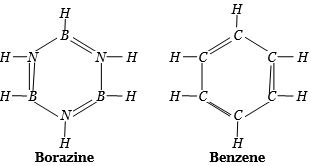
Which of the following is known as inorganic benzene?
A
Borazine
B
Boron nitride
C
$p-dichlorobenzene$
D
Phosphonitrilic acid
Solution
(A) Borazine,$B_3N_3H_6$,is isoelectronic to benzene and hence,is called inorganic benzene.
Some physical properties of benzene and borazine are also similar.
Some physical properties of benzene and borazine are also similar.
0 likes
View Solution30
EasyMCQ
Which of the following is only acidic in nature?
A
$Be(OH)_2$
B
$Mg(OH)_2$
C
$B(OH)_3$
D
$Al(OH)_3$
Solution
(C) $B(OH)_3$ is the hydroxide of a non-metal and exhibits acidic nature in aqueous solution by accepting $OH^-$ ions from water.
In contrast,$Be(OH)_2$,$Mg(OH)_2$,and $Al(OH)_3$ are metallic hydroxides that exhibit basic or amphoteric character.
In contrast,$Be(OH)_2$,$Mg(OH)_2$,and $Al(OH)_3$ are metallic hydroxides that exhibit basic or amphoteric character.
0 likes
View Solution31
EasyMCQ
Moissan boron is
A
Amorphous boron of ultra purity
B
Crystalline boron of ultra purity
C
Amorphous boron of low purity
D
Crystalline boron of low purity
Solution
(C) Moissan boron is amorphous boron,obtained by the reduction of $B_2O_3$ with $Na$ or $Mg$.
It contains $95-98\%$ boron and is black in colour.
It contains $95-98\%$ boron and is black in colour.
0 likes
View Solution32
MediumMCQ
Which of the following does not exist in free form?
A
$BF_3$
B
$BCl_3$
C
$BBr_3$
D
$BH_3$
Solution
(D) Boron forms various hydrides with the general formulas $B_n H_{n+4}$ and $B_n H_{n+6}$,such as $B_2H_6$ (diborane).
However,the monomeric species $BH_3$ is unstable and does not exist in free form under standard conditions; it dimerizes to form $B_2H_6$ to complete its octet.
However,the monomeric species $BH_3$ is unstable and does not exist in free form under standard conditions; it dimerizes to form $B_2H_6$ to complete its octet.
0 likes
View Solution33
EasyMCQ
Alumina $(Al_2O_3)$ is:
A
Acidic
B
Basic
C
Amphoteric
D
None of these
Solution
(C) Alumina $(Al_2O_3)$ is an amphoteric oxide.
It reacts with both acids and bases to form salts and water.
For example:
$Al_2O_3 + 6HCl \rightarrow 2AlCl_3 + 3H_2O$ (reacts with acid)
$Al_2O_3 + 2NaOH \rightarrow 2NaAlO_2 + H_2O$ (reacts with base).
It reacts with both acids and bases to form salts and water.
For example:
$Al_2O_3 + 6HCl \rightarrow 2AlCl_3 + 3H_2O$ (reacts with acid)
$Al_2O_3 + 2NaOH \rightarrow 2NaAlO_2 + H_2O$ (reacts with base).
0 likes
View Solution34
EasyMCQ
Aluminium is a self-protecting metal,because
A
It is not tarnished by air
B
$A$ thin film of basic carbonate on its surface
C
$A$ non-porous layer of oxide is formed on its surface
D
It is not affected by salt water
Solution
(C) Aluminium is called a self-protecting metal because when it comes in contact with the atmosphere,it is covered entirely with a thin,non-porous layer of aluminium oxide $(Al_2O_3)$.
This layer acts as a protective barrier that prevents further oxidation or corrosion of the underlying metal.
This layer acts as a protective barrier that prevents further oxidation or corrosion of the underlying metal.
0 likes
View Solution35
MediumMCQ
Anhydrous $AlCl_3$ cannot be obtained from which of the following reactions?
A
Heating $AlCl_3 \cdot 6H_2O$
B
By passing dry $HCl$ over hot aluminium powder
C
By passing dry $Cl_2$ over hot aluminium powder
D
By passing dry $Cl_2$ over a hot mixture of alumina and coke
Solution
(A) Heating hydrated aluminium chloride $(AlCl_3 \cdot 6H_2O)$ results in hydrolysis rather than dehydration.
The reaction is: $AlCl_3 \cdot 6H_2O \xrightarrow{\Delta} Al(OH)_3 + 3HCl + 3H_2O$.
Further heating of $Al(OH)_3$ yields $Al_2O_3$. Therefore,anhydrous $AlCl_3$ cannot be obtained by heating its hexahydrate.
The reaction is: $AlCl_3 \cdot 6H_2O \xrightarrow{\Delta} Al(OH)_3 + 3HCl + 3H_2O$.
Further heating of $Al(OH)_3$ yields $Al_2O_3$. Therefore,anhydrous $AlCl_3$ cannot be obtained by heating its hexahydrate.
0 likes
View Solution36
MediumMCQ
Anhydrous $AlCl_3$ is obtained from
A
$HCl$ and aluminium metal
B
Aluminium and chlorine gas
C
Hydrogen chloride gas and aluminium metal
D
None of the above
Solution
(C) Anhydrous $AlCl_3$ is prepared by passing dry $HCl$ gas over heated aluminium metal.
The chemical reaction is:
$2Al(s) + 6HCl(g) \to 2AlCl_3(s) + 3H_2(g)$
The chemical reaction is:
$2Al(s) + 6HCl(g) \to 2AlCl_3(s) + 3H_2(g)$
0 likes
View Solution37
EasyMCQ
When $Al$ is added to $KOH$ solution,what happens?
A
No action takes place
B
Oxygen is evolved
C
Water is produced
D
Hydrogen is evolved
Solution
(D) When aluminum $(Al)$ reacts with a hot concentrated solution of potassium hydroxide $(KOH)$,it forms potassium aluminate $(KAlO_2)$ and releases hydrogen gas $(H_2)$.
The balanced chemical equation is:
$2KOH + 2Al + 2H_2O \to 2KAlO_2 + 3H_2$
Therefore,hydrogen gas is evolved.
The balanced chemical equation is:
$2KOH + 2Al + 2H_2O \to 2KAlO_2 + 3H_2$
Therefore,hydrogen gas is evolved.
0 likes
View Solution38
MediumMCQ
Which of the statements about anhydrous aluminium chloride is correct?
A
It exists as $AlCl_3$ molecule
B
It is not easily hydrolysed
C
It sublimes at $100\,^oC$ under vacuum
D
It is a strong Lewis base
Solution
(C) Anhydrous aluminium chloride exists as a dimer $(Al_2Cl_6)$ in the vapour state and in non-polar solvents.
It is a strong Lewis acid due to the incomplete octet of the $Al$ atom.
Because of its Lewis acidic nature,it undergoes hydrolysis easily in the presence of moisture.
It sublimes at $178\,^oC$ under atmospheric pressure,but it can sublime at lower temperatures under vacuum.
It is a strong Lewis acid due to the incomplete octet of the $Al$ atom.
Because of its Lewis acidic nature,it undergoes hydrolysis easily in the presence of moisture.
It sublimes at $178\,^oC$ under atmospheric pressure,but it can sublime at lower temperatures under vacuum.
0 likes
View Solution39
EasyMCQ
Common alum is
A
$K_2SO_4 \cdot Al_2(SO_4)_3 \cdot 24H_2O$
B
$K_2SO_4 \cdot Cr_2(SO_4)_3 \cdot 24H_2O$
C
$K_2SO_4 \cdot Fe_2(SO_4)_3 \cdot 24H_2O$
D
$(NH_4)_2SO_4 \cdot FeSO_4 \cdot 6H_2O$
Solution
(A) Potassium alum is the common alum of commerce,and its chemical formula is $K_2SO_4 \cdot Al_2(SO_4)_3 \cdot 24H_2O$.
Ammonium alum is $(NH_4)_2SO_4 \cdot Al_2(SO_4)_3 \cdot 24H_2O$.
Chrome alum is $K_2SO_4 \cdot Cr_2(SO_4)_3 \cdot 24H_2O$.
Ammonium alum is $(NH_4)_2SO_4 \cdot Al_2(SO_4)_3 \cdot 24H_2O$.
Chrome alum is $K_2SO_4 \cdot Cr_2(SO_4)_3 \cdot 24H_2O$.
0 likes
View Solution40
EasyMCQ
Which one of the following is the correct statement?
A
The hydroxide of aluminium is more acidic than that of boron.
B
The hydroxide of boron is basic,while that of aluminium is amphoteric.
C
The hydroxide of boron is acidic,while that of aluminium is amphoteric.
D
The hydroxides of boron and aluminium are amphoteric.
Solution
(C) The hydroxide of boron,$B(OH)_3$ or $H_3BO_3$,acts as a weak monobasic Lewis acid in water because it accepts an $OH^-$ ion from water.
Aluminium hydroxide,$Al(OH)_3$,is amphoteric in nature as it reacts with both acids and bases.
Therefore,the correct statement is that the hydroxide of boron is acidic,while that of aluminium is amphoteric.
Aluminium hydroxide,$Al(OH)_3$,is amphoteric in nature as it reacts with both acids and bases.
Therefore,the correct statement is that the hydroxide of boron is acidic,while that of aluminium is amphoteric.
0 likes
View Solution41
EasyMCQ
Aluminium $(III)$ chloride forms a dimer because
A
Higher coordination number can be achieved by aluminium
B
Aluminium has high ionization energy
C
Aluminium belongs to $III$ group
D
It cannot form a trimer
Solution
(A) $AlCl_3$ forms a dimer and exists as $Al_2Cl_6$ to achieve a higher coordination number of $6$ for the aluminium atom.
In $AlCl_3$,the aluminium atom is electron-deficient with an incomplete octet.
By forming a dimer,each aluminium atom accepts a lone pair of electrons from a chlorine atom of another $AlCl_3$ molecule,thereby completing its octet and increasing its coordination number.
In $AlCl_3$,the aluminium atom is electron-deficient with an incomplete octet.
By forming a dimer,each aluminium atom accepts a lone pair of electrons from a chlorine atom of another $AlCl_3$ molecule,thereby completing its octet and increasing its coordination number.
0 likes
View Solution42
EasyMCQ
Which of the following is an amphoteric oxide?
A
$MgO$
B
$Al_2O_3$
C
$Cl_2O_7$
D
$TiO_2$
Solution
(B) An amphoteric oxide is a substance that can react as both an acid and a base.
$Al_2O_3$ (Aluminum oxide) reacts with both acids and bases to form salts and water,making it amphoteric.
$MgO$ is basic,$Cl_2O_7$ is acidic,and $TiO_2$ is generally considered acidic or weakly amphoteric,but $Al_2O_3$ is the classic example of an amphoteric oxide in this context.
$Al_2O_3$ (Aluminum oxide) reacts with both acids and bases to form salts and water,making it amphoteric.
$MgO$ is basic,$Cl_2O_7$ is acidic,and $TiO_2$ is generally considered acidic or weakly amphoteric,but $Al_2O_3$ is the classic example of an amphoteric oxide in this context.
0 likes
View Solution43
EasyMCQ
Aluminium is not used:
A
In silvery paints
B
For making utensils
C
As a reducing agent
D
As an oxidizer in metallurgy
Solution
(D) Aluminium is a strong reducing agent and is widely used in the thermite process for the reduction of metal oxides. It is not used as an oxidizer in metallurgy.
0 likes
View Solution44
MediumMCQ
The structure of diborane $(B_2H_6)$ contains
A
Four $2c-2e$ bonds and two $3c-2e$ bonds
B
Two $2c-2e$ bonds and four $3c-2e$ bonds
C
Two $2c-2e$ bonds and two $3c-3e$ bonds
D
Four $2c-2e$ bonds and four $3c-2e$ bonds
Solution
(A) In diborane $(B_2H_6)$,there are four terminal $B-H$ bonds which are regular two-center two-electron $(2c-2e)$ bonds.
There are also two bridging $B-H-B$ bonds,known as banana bonds,which are three-center two-electron $(3c-2e)$ bonds.
There are also two bridging $B-H-B$ bonds,known as banana bonds,which are three-center two-electron $(3c-2e)$ bonds.
0 likes
View Solution45
MediumMCQ
The acidic strength of boron trihalides follows the order:
A
$BF_3 < BCl_3 < BBr_3 < BI_3$
B
$BI_3 < BBr_3 < BCl_3 < BF_3$
C
$BBr_3 < BCl_3 < BF_3 < BI_3$
D
$BF_3 < BI_3 < BCl_3 < BBr_3$
Solution
(A) The acidic strength of boron trihalides depends on the extent of back-bonding between the halogen $p$-orbitals and the empty $p$-orbital of boron.
In $BF_3$,the $2p-2p$ back-bonding is most effective due to the small size of the fluorine atom,which reduces the electron deficiency of boron.
As the size of the halogen increases from $F$ to $I$,the effectiveness of back-bonding decreases $(2p-2p > 2p-3p > 2p-4p > 2p-5p)$.
Therefore,the electron deficiency of boron increases from $BF_3$ to $BI_3$,making $BI_3$ the strongest Lewis acid.
The correct order of acidic strength is: $BF_3 < BCl_3 < BBr_3 < BI_3$.
In $BF_3$,the $2p-2p$ back-bonding is most effective due to the small size of the fluorine atom,which reduces the electron deficiency of boron.
As the size of the halogen increases from $F$ to $I$,the effectiveness of back-bonding decreases $(2p-2p > 2p-3p > 2p-4p > 2p-5p)$.
Therefore,the electron deficiency of boron increases from $BF_3$ to $BI_3$,making $BI_3$ the strongest Lewis acid.
The correct order of acidic strength is: $BF_3 < BCl_3 < BBr_3 < BI_3$.
0 likes
View Solution46
MediumMCQ
Inorganic graphite is
A
$B_3N_3H_6$
B
$BN$
C
$SiC$
D
$Fe(CO)_5$
Solution
(B) Boron nitride $(BN)$ is known as inorganic graphite.
It is isoelectronic to carbon and possesses a layered structure similar to graphite.
In this structure,boron and nitrogen atoms are arranged in hexagonal rings,making it structurally analogous to the carbon atoms in graphite.
It is isoelectronic to carbon and possesses a layered structure similar to graphite.
In this structure,boron and nitrogen atoms are arranged in hexagonal rings,making it structurally analogous to the carbon atoms in graphite.
0 likes
View Solution47
MediumMCQ
Conc. $HNO_3$ can be stored in a container of
A
$Al$
B
$Sn$
C
$Cu$
D
$Zn$
Solution
(A) Aluminium forms a protective layer of aluminium oxide $(Al_2O_3)$ on its surface when exposed to concentrated nitric acid.
This passive layer prevents further reaction between the metal and the acid,making it suitable for storage.
The chemical reaction is:
$2 Al + 6 HNO_3 (\text{conc.}) \rightarrow Al_2O_3 + 6 NO_2 + 3 H_2O$
This passive layer prevents further reaction between the metal and the acid,making it suitable for storage.
The chemical reaction is:
$2 Al + 6 HNO_3 (\text{conc.}) \rightarrow Al_2O_3 + 6 NO_2 + 3 H_2O$
0 likes
View Solution48
MediumMCQ
The formula of an oxyacid of phosphorus is $H_3PO_4$. It is a
A
Dibasic acid
B
Monobasic acid
C
Tribasic acid
D
Tetrabasic acid
Solution
(C) The structure of phosphoric acid $(H_3PO_4)$ contains three $P-OH$ groups.
The basicity of an oxyacid is determined by the number of $P-OH$ groups present in its structure.
Since $H_3PO_4$ has three $P-OH$ groups,it can release three $H^+$ ions in an aqueous solution.
Therefore,$H_3PO_4$ is a tribasic acid.
The basicity of an oxyacid is determined by the number of $P-OH$ groups present in its structure.
Since $H_3PO_4$ has three $P-OH$ groups,it can release three $H^+$ ions in an aqueous solution.
Therefore,$H_3PO_4$ is a tribasic acid.
0 likes
View Solution49
MediumMCQ
The acid which forms two series of salts is
A
$H_3PO_4$
B
$H_3PO_3$
C
$H_3BO_3$
D
$H_3PO_2$
Solution
(B) $H_3PO_3$ is a dibasic acid because it contains two $P-OH$ bonds.
It can replace two hydrogen atoms to form two series of salts: acid salts (e.g.,$NaH_2PO_3$) and normal salts (e.g.,$Na_2HPO_3$).
It can replace two hydrogen atoms to form two series of salts: acid salts (e.g.,$NaH_2PO_3$) and normal salts (e.g.,$Na_2HPO_3$).
0 likes
View Solution50
EasyMCQ
Which of the following is the least basic?
A
$BI_3$
B
$BBr_3$
C
$BCl_3$
D
$BF_3$
Solution
(D) The basicity of boron trihalides $(BX_3)$ depends on the extent of $p\pi-p\pi$ back-bonding between the halogen atom and the boron atom.
In $BF_3$,the fluorine atom has a small size and its $2p$ orbitals overlap effectively with the empty $2p$ orbital of boron,leading to the strongest back-bonding.
This reduces the electron-deficient nature of boron,making $BF_3$ the least basic among the given trihalides.
Therefore,the order of basicity is $BF_3 < BCl_3 < BBr_3 < BI_3$.
In $BF_3$,the fluorine atom has a small size and its $2p$ orbitals overlap effectively with the empty $2p$ orbital of boron,leading to the strongest back-bonding.
This reduces the electron-deficient nature of boron,making $BF_3$ the least basic among the given trihalides.
Therefore,the order of basicity is $BF_3 < BCl_3 < BBr_3 < BI_3$.
0 likes
View Solutionp-Block Elements (Class 11) — Boron family · Frequently Asked Questions
1Are these p-Block Elements (Class 11) questions useful for JEE and NEET?
Yes. All questions in this section are mapped to JEE Main and NEET exam patterns. Previous year questions from JEE Main, NEET, GUJCET and state-level exams are included with full solutions.
2Can I switch to Hindi or Gujarati for these questions?
Yes. Use the language tabs in the hero section or the sidebar to view the same questions and solutions in English, Hindi or Gujarati.
3How do I generate a question paper from this subtopic?
Use the Vedclass Exam Paper Generator — select the chapter and subtopic, set difficulty, and generate Sets A, B, C, D automatically. First 3 chapters of every subject are free.
Vedclass Products
For Students
Vedclass Test Series
Mock tests in real JEE/NEET style with performance analysis. 5-day free trial.
Start Free TrialFor Teachers
Exam Paper Generator
Generate Set A/B/C/D papers from this chapter in 2 minutes. 3 chapters free.
Try FreeFor Institutes
Online Exam Module
Live online exams with unlimited students, 360° analytics & white-label branding.
See DemoFor Teachers & Institutes
Generate a p-Block Elements (Class 11) Exam Paper in 2 Minutes
Select subtopic & difficulty — Sets A, B, C, D auto-generated with No Repeat logic.
First 3 chapters of every subject are free — no payment required.