
A English
Hydrogen peroxide Questions in English
Class 11 Chemistry · Hydrogen · Hydrogen peroxide
342+
Questions
English
Language
100%
With Solutions
Showing 50 of 342 questions in English
201
MediumMCQ
Which of the following is commercially known as oxone?
A
$Na_2O_2 + HCl$
B
$Na_2O + HCl$
C
$Na_2O_2 + Na_2$
D
None of these
Solution
(A) The mixture of $Na_2O_2$ and $HCl$ is commercially known as oxone.
It is primarily used for the bleaching of delicate fibres.
It is primarily used for the bleaching of delicate fibres.
0 likes
View Solution202
DifficultMCQ
Assertion : Anhydrous $BaO_2$ is used for preparing $H_2O_2$.
Reason : Hydrated $BaO_2$ is not available.
Reason : Hydrated $BaO_2$ is not available.
A
If both Assertion and Reason are correct and the Reason is a correct explanation of the Assertion.
B
If both Assertion and Reason are correct but Reason is not a correct explanation of the Assertion.
C
If the Assertion is correct but Reason is incorrect.
D
If both the Assertion and Reason are incorrect.
Solution
(D) $H_2O_2$ is prepared by the action of $H_2SO_4$ on hydrated $BaO_2$ $(BaO_2 \cdot 8H_2O)$.
Anhydrous $BaO_2$ is not used because it forms a protective layer of $BaSO_4$ on its surface,which prevents further reaction.
Therefore,the Assertion is incorrect because anhydrous $BaO_2$ is not used.
The Reason is also incorrect because hydrated $BaO_2$ is readily available and is the preferred reagent.
The reaction is: $BaO_2 \cdot 8H_2O + H_2SO_4 \to BaSO_4 + H_2O_2 + 8H_2O$.
Anhydrous $BaO_2$ is not used because it forms a protective layer of $BaSO_4$ on its surface,which prevents further reaction.
Therefore,the Assertion is incorrect because anhydrous $BaO_2$ is not used.
The Reason is also incorrect because hydrated $BaO_2$ is readily available and is the preferred reagent.
The reaction is: $BaO_2 \cdot 8H_2O + H_2SO_4 \to BaSO_4 + H_2O_2 + 8H_2O$.
0 likes
View Solution203
AdvancedMCQ
Among the statements $(a) - (d)$,the correct ones are:
$(a)$ Decomposition of hydrogen peroxide gives dioxygen.
$(b)$ Like hydrogen peroxide,compounds such as $KClO_{3}$,$Pb(NO_{3})_{2}$,and $NaNO_{3}$ liberate dioxygen when heated.
$(c)$ $2$-Ethylanthraquinone is useful for the industrial preparation of hydrogen peroxide.
$(d)$ Hydrogen peroxide is used for the manufacture of sodium perborate.
$(a)$ Decomposition of hydrogen peroxide gives dioxygen.
$(b)$ Like hydrogen peroxide,compounds such as $KClO_{3}$,$Pb(NO_{3})_{2}$,and $NaNO_{3}$ liberate dioxygen when heated.
$(c)$ $2$-Ethylanthraquinone is useful for the industrial preparation of hydrogen peroxide.
$(d)$ Hydrogen peroxide is used for the manufacture of sodium perborate.
A
$(a)$,$(b)$ and $(c)$ only
B
$(a)$ and $(c)$ only
C
$(a)$,$(b)$,$(c)$ and $(d)$
D
$(a)$,$(c)$ and $(d)$ only
Solution
(C) The decomposition of $H_{2}O_{2}$ is: $2H_{2}O_{2} \rightarrow 2H_{2}O + O_{2}$. This is correct.
$(b)$ Thermal decomposition of these salts also yields dioxygen:
$2KClO_{3} \xrightarrow{\Delta} 2KCl + 3O_{2}$
$2Pb(NO_{3})_{2} \xrightarrow{\Delta} 2PbO + 4NO_{2} + O_{2}$
$2NaNO_{3} \xrightarrow{\Delta} 2NaNO_{2} + O_{2}$. This is correct.
$(c)$ In the industrial process,$2$-ethylanthraquinol is oxidized by air to produce $H_{2}O_{2}$ and $2$-ethylanthraquinone,which is then recycled. This is correct.
$(d)$ $H_{2}O_{2}$ is used in the synthesis of sodium perborate from borax and sodium hydroxide. This is correct.
Therefore,all statements $(a)$,$(b)$,$(c)$,and $(d)$ are correct.
$(b)$ Thermal decomposition of these salts also yields dioxygen:
$2KClO_{3} \xrightarrow{\Delta} 2KCl + 3O_{2}$
$2Pb(NO_{3})_{2} \xrightarrow{\Delta} 2PbO + 4NO_{2} + O_{2}$
$2NaNO_{3} \xrightarrow{\Delta} 2NaNO_{2} + O_{2}$. This is correct.
$(c)$ In the industrial process,$2$-ethylanthraquinol is oxidized by air to produce $H_{2}O_{2}$ and $2$-ethylanthraquinone,which is then recycled. This is correct.
$(d)$ $H_{2}O_{2}$ is used in the synthesis of sodium perborate from borax and sodium hydroxide. This is correct.
Therefore,all statements $(a)$,$(b)$,$(c)$,and $(d)$ are correct.
0 likes
View Solution204
EasyMCQ
Calculate the strength of $10$ volume solution of hydrogen peroxide. (in $, g/L$)
A
$30.3$
B
$3.03$
C
$303$
D
$0.303$
Solution
(A) $10$ volume solution of $H_{2}O_{2}$ means that $1 \, L$ of this $H_{2}O_{2}$ solution will give $10 \, L$ of oxygen at $STP$.
$\mathop{2H_{2}O_{2(l)}}\limits_{68 \, g}$ $\rightarrow \mathop{O_{2(g)} + 2H_{2}O_{(l)}}\limits_{22.7 \, L \, \text{at} \, STP}$
On the basis of the above equation,$22.7 \, L$ of $O_{2}$ is produced from $68 \, g \, H_{2}O_{2}$ at $STP$.
Therefore,$10 \, L$ of $O_{2}$ at $STP$ is produced from:
$\frac{68 \times 10}{22.7} \, g \approx 29.95 \, g \approx 30.3 \, g \, H_{2}O_{2}$.
Thus,the strength of $H_{2}O_{2}$ in $10$ volume $H_{2}O_{2}$ solution is approximately $30.3 \, g/L$.
$\mathop{2H_{2}O_{2(l)}}\limits_{68 \, g}$ $\rightarrow \mathop{O_{2(g)} + 2H_{2}O_{(l)}}\limits_{22.7 \, L \, \text{at} \, STP}$
On the basis of the above equation,$22.7 \, L$ of $O_{2}$ is produced from $68 \, g \, H_{2}O_{2}$ at $STP$.
Therefore,$10 \, L$ of $O_{2}$ at $STP$ is produced from:
$\frac{68 \times 10}{22.7} \, g \approx 29.95 \, g \approx 30.3 \, g \, H_{2}O_{2}$.
Thus,the strength of $H_{2}O_{2}$ in $10$ volume $H_{2}O_{2}$ solution is approximately $30.3 \, g/L$.
0 likes
View Solution205
Easy
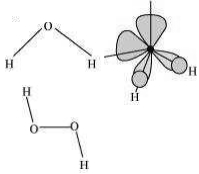
Compare the structures of $H_2O$ and $H_2O_2$.
Solution
(N/A) In the gaseous phase, the water molecule $(H_2O)$ has a bent structure with a bond angle of $104.5^{\circ}$. The $O-H$ bond length is $95.7 \, pm$.
Hydrogen peroxide $(H_2O_2)$ has a non-planar structure in both the gas and solid phases. The dihedral angle in the gas phase is $111.5^{\circ}$, while in the solid phase, it is $90.2^{\circ}$.
Hydrogen peroxide $(H_2O_2)$ has a non-planar structure in both the gas and solid phases. The dihedral angle in the gas phase is $111.5^{\circ}$, while in the solid phase, it is $90.2^{\circ}$.
0 likes
View Solution206
Medium
Complete the following chemical reactions.
$i$. $PbS_{(s)} + H_2O_{2_{(aq)}} \rightarrow$
$ii$. $MnO_{4_{(aq)}}^{-} + H_2O_{2_{(aq)}} \rightarrow$
$iii$. $CaO_{(s)} + H_2O_{(g)} \rightarrow$
$iv$. $AlCl_{3_{(s)}} + H_2O_{(l)} \rightarrow$
$v$. $Ca_3N_{2_{(s)}} + H_2O_{(l)} \rightarrow$
Classify the above into $a$. hydrolysis,$b$. redox,and $c$. hydration reactions.
$i$. $PbS_{(s)} + H_2O_{2_{(aq)}} \rightarrow$
$ii$. $MnO_{4_{(aq)}}^{-} + H_2O_{2_{(aq)}} \rightarrow$
$iii$. $CaO_{(s)} + H_2O_{(g)} \rightarrow$
$iv$. $AlCl_{3_{(s)}} + H_2O_{(l)} \rightarrow$
$v$. $Ca_3N_{2_{(s)}} + H_2O_{(l)} \rightarrow$
Classify the above into $a$. hydrolysis,$b$. redox,and $c$. hydration reactions.
Solution
(N/A) $i$. $PbS_{(s)} + 4H_2O_{2_{(aq)}} \rightarrow PbSO_{4_{(s)}} + 4H_2O_{(l)}$
$H_2O_2$ acts as an oxidizing agent. This is a redox reaction.
$ii$. $2MnO_{4_{(aq)}}^{-} + 5H_2O_{2_{(aq)}} + 6H_{(aq)}^{+} \rightarrow 2Mn_{(aq)}^{2+} + 8H_2O_{(l)} + 5O_{2_{(g)}}$
$H_2O_2$ acts as a reducing agent. This is a redox reaction.
$iii$. $CaO_{(s)} + H_2O_{(g)} \rightarrow Ca(OH)_{2_{(s)}}$
This is a hydration reaction.
$iv$. $AlCl_{3_{(s)}} + 3H_2O_{(l)} \rightarrow Al(OH)_{3_{(s)}} + 3HCl_{(aq)}$
This is a hydrolysis reaction.
$v$. $Ca_3N_{2_{(s)}} + 6H_2O_{(l)} \rightarrow 3Ca(OH)_{2_{(aq)}} + 2NH_{3_{(g)}}$
This is a hydrolysis reaction.
$H_2O_2$ acts as an oxidizing agent. This is a redox reaction.
$ii$. $2MnO_{4_{(aq)}}^{-} + 5H_2O_{2_{(aq)}} + 6H_{(aq)}^{+} \rightarrow 2Mn_{(aq)}^{2+} + 8H_2O_{(l)} + 5O_{2_{(g)}}$
$H_2O_2$ acts as a reducing agent. This is a redox reaction.
$iii$. $CaO_{(s)} + H_2O_{(g)} \rightarrow Ca(OH)_{2_{(s)}}$
This is a hydration reaction.
$iv$. $AlCl_{3_{(s)}} + 3H_2O_{(l)} \rightarrow Al(OH)_{3_{(s)}} + 3HCl_{(aq)}$
This is a hydrolysis reaction.
$v$. $Ca_3N_{2_{(s)}} + 6H_2O_{(l)} \rightarrow 3Ca(OH)_{2_{(aq)}} + 2NH_{3_{(g)}}$
This is a hydrolysis reaction.
0 likes
View Solution207
Medium
Write chemical reactions to justify that hydrogen peroxide can function as an oxidizing as well as a reducing agent.
Solution
Hydrogen peroxide,$H_{2}O_{2}$,acts as an oxidizing as well as a reducing agent in both acidic and alkaline media.
Reactions involving oxidizing actions (where $H_{2}O_{2}$ is reduced to $H_{2}O$ or $OH^{-}$):
$1) \ 2Fe^{2+} + 2H^{+} + H_{2}O_{2} \longrightarrow 2Fe^{3+} + 2H_{2}O$
$2) \ PbS + 4H_{2}O_{2} \longrightarrow PbSO_{4} + 4H_{2}O$
Reactions involving reducing actions (where $H_{2}O_{2}$ is oxidized to $O_{2}$):
$1) \ 2MnO_{4}^{-} + 6H^{+} + 5H_{2}O_{2} \longrightarrow 2Mn^{2+} + 8H_{2}O + 5O_{2}$
$2) \ I_{2} + H_{2}O_{2} + 2OH^{-} \longrightarrow 2I^{-} + 2H_{2}O + O_{2}$
Reactions involving oxidizing actions (where $H_{2}O_{2}$ is reduced to $H_{2}O$ or $OH^{-}$):
$1) \ 2Fe^{2+} + 2H^{+} + H_{2}O_{2} \longrightarrow 2Fe^{3+} + 2H_{2}O$
$2) \ PbS + 4H_{2}O_{2} \longrightarrow PbSO_{4} + 4H_{2}O$
Reactions involving reducing actions (where $H_{2}O_{2}$ is oxidized to $O_{2}$):
$1) \ 2MnO_{4}^{-} + 6H^{+} + 5H_{2}O_{2} \longrightarrow 2Mn^{2+} + 8H_{2}O + 5O_{2}$
$2) \ I_{2} + H_{2}O_{2} + 2OH^{-} \longrightarrow 2I^{-} + 2H_{2}O + O_{2}$
0 likes
View Solution208
Easy
How does $H_{2}O_{2}$ behave as a bleaching agent?
Solution
(N/A) $H_{2}O_{2}$ (hydrogen peroxide) acts as a strong oxidizing agent in both acidic and basic media.
It releases nascent oxygen $([O])$ which oxidizes the colored matter (chromophores) present in the substance.
This oxidation breaks the chemical bonds of the chromophores,rendering them colorless.
Consequently,the material appears white.
It releases nascent oxygen $([O])$ which oxidizes the colored matter (chromophores) present in the substance.
This oxidation breaks the chemical bonds of the chromophores,rendering them colorless.
Consequently,the material appears white.
0 likes
View Solution209
Difficult
Compare the structures of $H_2O$ and $H_2O_2$.
Solution
(N/A) $H_2O$ (Water): In the gas phase, $H_2O$ is a bent molecule with a bond angle of $104.5^{\circ}$ and an $O-H$ bond length of $95.7 \text{ pm}$. It is a highly polar molecule with $sp^3$ hybridization of the oxygen atom.
$H_2O_2$ (Hydrogen Peroxide): $H_2O_2$ has a non-planar 'open book' structure. In the gas phase, the dihedral angle is $111.5^{\circ}$, while in the solid phase, it is $90.2^{\circ}$. The $O-O$ bond length is $147.5 \text{ pm}$ and the $O-H$ bond length is $95.0 \text{ pm}$.
$H_2O_2$ (Hydrogen Peroxide): $H_2O_2$ has a non-planar 'open book' structure. In the gas phase, the dihedral angle is $111.5^{\circ}$, while in the solid phase, it is $90.2^{\circ}$. The $O-O$ bond length is $147.5 \text{ pm}$ and the $O-H$ bond length is $95.0 \text{ pm}$.
0 likes
View Solution210
Difficult
Describe the preparation of Hydrogen peroxide and write its physical properties.
Solution
(N/A) $(i)$ Acidifying barium peroxide and removing excess water by evaporation under reduced pressure gives hydrogen peroxide.
$BaO_{2} \cdot 8H_{2}O_{(s)} + H_{2}SO_{4_{(aq)}} \longrightarrow BaSO_{4_{(s)}} + H_{2}O_{2_{(aq)}} + 8H_{2}O_{(l)}$
$(ii)$ Peroxodisulphate,obtained by electrolytic oxidation of acidified sulphate solutions at high current density,on hydrolysis yields hydrogen peroxide.
$2HSO_{4_{(aq)}}^{-}$ $\xrightarrow{\text{Electrolysis}} HO_{3}SOOSO_{3}H_{(aq)}$ $\xrightarrow{\text{Hydrolysis}} 2HSO_{4_{(aq)}}^{-} + 2H_{(aq)}^{+} + H_{2}O_{2_{(aq)}}$
This method is now used for the laboratory preparation of $D_{2}O_{2}$.
$K_{2}S_{2}O_{8_{(s)}} + 2D_{2}O_{(l)} \longrightarrow 2KDSO_{4_{(aq)}} + D_{2}O_{2_{(l)}}$
$(iii)$ Industrially,it is prepared by the auto-oxidation of $2$-alkylanthraquinols.
(2-ethyl anthraquinol) $\underset{\text { Oxidation }}{\stackrel{\text { Reduction }}{\rightleftharpoons}} H _2 O _2+$ (Oxidised product)
In this case,$1\%$ $H_{2}O_{2}$ is formed. It is extracted with water and concentrated to $\sim 30\%$ (by mass) by distillation under reduced pressure.
It can be further concentrated to $\sim 85\%$ by careful distillation under low pressure. The remaining water can be frozen out to obtain pure $H_{2}O_{2}$.
In the pure state,$H_{2}O_{2}$ is an almost colourless (very pale blue) liquid.
$H_{2}O_{2}$ is miscible with water in all proportions and forms a hydrate $H_{2}O_{2} \cdot H_{2}O$ ($mp$ $221 \ K$).
Physical Properties of Hydrogen Peroxide:
$BaO_{2} \cdot 8H_{2}O_{(s)} + H_{2}SO_{4_{(aq)}} \longrightarrow BaSO_{4_{(s)}} + H_{2}O_{2_{(aq)}} + 8H_{2}O_{(l)}$
$(ii)$ Peroxodisulphate,obtained by electrolytic oxidation of acidified sulphate solutions at high current density,on hydrolysis yields hydrogen peroxide.
$2HSO_{4_{(aq)}}^{-}$ $\xrightarrow{\text{Electrolysis}} HO_{3}SOOSO_{3}H_{(aq)}$ $\xrightarrow{\text{Hydrolysis}} 2HSO_{4_{(aq)}}^{-} + 2H_{(aq)}^{+} + H_{2}O_{2_{(aq)}}$
This method is now used for the laboratory preparation of $D_{2}O_{2}$.
$K_{2}S_{2}O_{8_{(s)}} + 2D_{2}O_{(l)} \longrightarrow 2KDSO_{4_{(aq)}} + D_{2}O_{2_{(l)}}$
$(iii)$ Industrially,it is prepared by the auto-oxidation of $2$-alkylanthraquinols.
(2-ethyl anthraquinol) $\underset{\text { Oxidation }}{\stackrel{\text { Reduction }}{\rightleftharpoons}} H _2 O _2+$ (Oxidised product)
In this case,$1\%$ $H_{2}O_{2}$ is formed. It is extracted with water and concentrated to $\sim 30\%$ (by mass) by distillation under reduced pressure.
It can be further concentrated to $\sim 85\%$ by careful distillation under low pressure. The remaining water can be frozen out to obtain pure $H_{2}O_{2}$.
In the pure state,$H_{2}O_{2}$ is an almost colourless (very pale blue) liquid.
$H_{2}O_{2}$ is miscible with water in all proportions and forms a hydrate $H_{2}O_{2} \cdot H_{2}O$ ($mp$ $221 \ K$).
Physical Properties of Hydrogen Peroxide:
| Property | Value |
| Melting point/$K$ | $272.4$ |
| Density (liquid at $298 \ K$)/$g \ cm^{-3}$ | $1.44$ |
| Boiling point (extrapolated)/$K$ | $423$ |
| Viscosity $(290 \ K)$/centipoise | $1.25$ |
| Vapour pressure $(298 \ K)$/$mmHg$ | $1.9$ |
| Dielectric constant $(298 \ K)$ | $70.7$ |
| Density (solid at $268.5 \ K$)/$g \ cm^{-3}$ | $1.64$ |
| Electrical conductivity $(298 \ K)$/$\Omega^{-1} cm^{-1}$ | $5.1 \times 10^{-8}$ |
0 likes
View Solution211
Medium
Describe the structure of hydrogen peroxide $(H_2O_2)$.
Solution
Hydrogen peroxide has a non-planar structure.
$a$. In the gas phase, the $H_2O_2$ molecule has a dihedral angle of $111.5^{\circ}$. The $O-O$ bond length is $147.5 \text{ pm}$ and the $O-H$ bond length is $95.0 \text{ pm}$.
$b$. In the solid phase at $110 \text{ K}$, the $H_2O_2$ molecule has a dihedral angle of $90.2^{\circ}$. The $O-O$ bond length is $145.8 \text{ pm}$ and the $O-H$ bond length is $98.8 \text{ pm}$.
$a$. In the gas phase, the $H_2O_2$ molecule has a dihedral angle of $111.5^{\circ}$. The $O-O$ bond length is $147.5 \text{ pm}$ and the $O-H$ bond length is $95.0 \text{ pm}$.
$b$. In the solid phase at $110 \text{ K}$, the $H_2O_2$ molecule has a dihedral angle of $90.2^{\circ}$. The $O-O$ bond length is $145.8 \text{ pm}$ and the $O-H$ bond length is $98.8 \text{ pm}$.
0 likes
View Solution212
Difficult
Write chemical reactions to justify that hydrogen peroxide $(H_{2}O_{2})$ can function as an oxidising as well as a reducing agent.
Solution
(N/A) Hydrogen peroxide acts as an oxidising as well as a reducing agent in both acidic and alkaline media. The reactions are as follows:
$(i)$ Oxidising effect in acidic medium:
$2 Fe^{2+}_{(aq)} + 2 H^{+}_{(aq)} + H_{2}O_{2(aq)} \longrightarrow 2 Fe^{3+}_{(aq)} + 2 H_{2}O_{(l)}$
$PbS_{(s)} + 4 H_{2}O_{2(aq)} \longrightarrow PbSO_{4(s)} + 4 H_{2}O_{(l)}$
$(ii)$ Reducing effect in acidic medium:
$2 MnO_{4}^{-} + 6 H^{+} + 5 H_{2}O_{2} \longrightarrow 2 Mn^{2+}_{(aq)} + 8 H_{2}O + 5 O_{2}$
$HOCl + H_{2}O_{2} \longrightarrow H_{3}O^{+} + Cl^{-} + O_{2}$
$(iii)$ Oxidising effect in basic medium:
$2 Fe^{2+} + H_{2}O_{2} \longrightarrow 2 Fe^{3+} + 2 OH^{-}$
$Mn^{2+} + H_{2}O_{2} \longrightarrow Mn^{4+} + 2 OH^{-}$
$(iv)$ Reducing effect in basic medium:
$I_{2} + H_{2}O_{2} + 2 OH^{-} \longrightarrow 2 I^{-} + 2 H_{2}O + O_{2}$
$2 MnO_{4}^{-} + 3 H_{2}O_{2} \longrightarrow 2 MnO_{2} + 3 O_{2} + 2 H_{2}O + 2 OH^{-}$
$(i)$ Oxidising effect in acidic medium:
$2 Fe^{2+}_{(aq)} + 2 H^{+}_{(aq)} + H_{2}O_{2(aq)} \longrightarrow 2 Fe^{3+}_{(aq)} + 2 H_{2}O_{(l)}$
$PbS_{(s)} + 4 H_{2}O_{2(aq)} \longrightarrow PbSO_{4(s)} + 4 H_{2}O_{(l)}$
$(ii)$ Reducing effect in acidic medium:
$2 MnO_{4}^{-} + 6 H^{+} + 5 H_{2}O_{2} \longrightarrow 2 Mn^{2+}_{(aq)} + 8 H_{2}O + 5 O_{2}$
$HOCl + H_{2}O_{2} \longrightarrow H_{3}O^{+} + Cl^{-} + O_{2}$
$(iii)$ Oxidising effect in basic medium:
$2 Fe^{2+} + H_{2}O_{2} \longrightarrow 2 Fe^{3+} + 2 OH^{-}$
$Mn^{2+} + H_{2}O_{2} \longrightarrow Mn^{4+} + 2 OH^{-}$
$(iv)$ Reducing effect in basic medium:
$I_{2} + H_{2}O_{2} + 2 OH^{-} \longrightarrow 2 I^{-} + 2 H_{2}O + O_{2}$
$2 MnO_{4}^{-} + 3 H_{2}O_{2} \longrightarrow 2 MnO_{2} + 3 O_{2} + 2 H_{2}O + 2 OH^{-}$
0 likes
View Solution213
Difficult
Write the chemical properties of hydrogen peroxide.
Solution
Hydrogen peroxide $(H_{2}O_{2})$ acts as both an oxidizing and a reducing agent in both acidic and alkaline media. Key reactions are described below:
$(i)$ Oxidizing effect in acidic medium:
$2 Fe_{(aq)}^{2+} + 2 H_{(aq)}^{+} + H_{2}O_{2_{(aq)}} \longrightarrow 2 Fe_{(aq)}^{3+} + 2 H_{2}O_{(l)}$
$PbS_{(s)} + 4 H_{2}O_{2_{(aq)}} \longrightarrow PbSO_{4_{(s)}} + 4 H_{2}O_{(l)}$
$(ii)$ Reducing effect in acidic medium:
$2 MnO_{4}^{-} + 6 H^{+} + 5 H_{2}O_{2} \longrightarrow 2 Mn_{(aq)}^{2+} + 8 H_{2}O + 5 O_{2}$
$HOCl + H_{2}O_{2} \longrightarrow H_{3}O^{+} + Cl^{-} + O_{2}$
$(iii)$ Oxidizing effect in basic medium:
$2 Fe^{2+} + H_{2}O_{2} \longrightarrow 2 Fe^{3+} + 2 OH^{-}$
$Mn^{2+} + H_{2}O_{2} \longrightarrow Mn^{4+} + 2 OH^{-}$
$(iv)$ Reducing effect in basic medium:
$I_{2} + H_{2}O_{2} + 2 OH^{-} \longrightarrow 2 I^{-} + 2 H_{2}O + O_{2}$
$2 MnO_{4}^{-} + 3 H_{2}O_{2} \longrightarrow 2 MnO_{2} + 3 O_{2} + 2 H_{2}O + 2 OH^{-}$
$(i)$ Oxidizing effect in acidic medium:
$2 Fe_{(aq)}^{2+} + 2 H_{(aq)}^{+} + H_{2}O_{2_{(aq)}} \longrightarrow 2 Fe_{(aq)}^{3+} + 2 H_{2}O_{(l)}$
$PbS_{(s)} + 4 H_{2}O_{2_{(aq)}} \longrightarrow PbSO_{4_{(s)}} + 4 H_{2}O_{(l)}$
$(ii)$ Reducing effect in acidic medium:
$2 MnO_{4}^{-} + 6 H^{+} + 5 H_{2}O_{2} \longrightarrow 2 Mn_{(aq)}^{2+} + 8 H_{2}O + 5 O_{2}$
$HOCl + H_{2}O_{2} \longrightarrow H_{3}O^{+} + Cl^{-} + O_{2}$
$(iii)$ Oxidizing effect in basic medium:
$2 Fe^{2+} + H_{2}O_{2} \longrightarrow 2 Fe^{3+} + 2 OH^{-}$
$Mn^{2+} + H_{2}O_{2} \longrightarrow Mn^{4+} + 2 OH^{-}$
$(iv)$ Reducing effect in basic medium:
$I_{2} + H_{2}O_{2} + 2 OH^{-} \longrightarrow 2 I^{-} + 2 H_{2}O + O_{2}$
$2 MnO_{4}^{-} + 3 H_{2}O_{2} \longrightarrow 2 MnO_{2} + 3 O_{2} + 2 H_{2}O + 2 OH^{-}$
0 likes
View Solution214
MediumMCQ
How should $H_2O_2$ be stored?
A
In open glass containers
B
In wax-lined glass or plastic vessels in the dark
C
In metal containers exposed to sunlight
D
In contact with dust
Solution
(B) $H_2O_2$ decomposes slowly on exposure to light.
$2 H_2O_2(l) \longrightarrow 2 H_2O(l) + O_2(g)$
In the presence of metal surfaces or traces of alkali (present in glass containers),the above reaction is catalysed.
It is,therefore,stored in wax-lined glass or plastic vessels in the dark.
Urea can be added as a stabiliser. It is kept away from dust because dust can induce explosive decomposition of the compound.
$2 H_2O_2(l) \longrightarrow 2 H_2O(l) + O_2(g)$
In the presence of metal surfaces or traces of alkali (present in glass containers),the above reaction is catalysed.
It is,therefore,stored in wax-lined glass or plastic vessels in the dark.
Urea can be added as a stabiliser. It is kept away from dust because dust can induce explosive decomposition of the compound.
0 likes
View Solution215
Easy
How does $H_2O_2$ behave as a bleaching agent?
Solution
(N/A) $H_2O_2$ acts as a bleaching agent due to the release of nascent oxygen $([O])$ upon its decomposition.
$2H_2O_2 \rightarrow 2H_2O + 2[O]$
This nascent oxygen oxidizes the colored matter present in substances like textiles,paper pulp,leather,oils,and fats into colorless products,thereby acting as a bleaching agent.
$2H_2O_2 \rightarrow 2H_2O + 2[O]$
This nascent oxygen oxidizes the colored matter present in substances like textiles,paper pulp,leather,oils,and fats into colorless products,thereby acting as a bleaching agent.
0 likes
View Solution216
Medium
Give uses of Hydrogen peroxide $(H_2O_2)$.
Solution
(N/A) $(i)$ In daily life,it is used as a hair bleach and as a mild disinfectant. As an antiseptic,it is sold in the market as perhydrol.
$(ii)$ It is used to manufacture chemicals like sodium perborate and per-carbonate,which are used in high-quality detergents.
$(iii)$ It is used in the synthesis of hydroquinone,tartaric acid,and certain food products and pharmaceuticals (e.g.,cephalosporin).
$(iv)$ It is employed in industries as a bleaching agent for textiles,paper pulp,leather,oils,fats,etc.
$(v)$ Nowadays,it is also used in Environmental (Green) Chemistry. For example,in pollution control treatment of domestic and industrial effluents,oxidation of cyanides,and restoration of aerobic conditions to sewage wastes.
$(ii)$ It is used to manufacture chemicals like sodium perborate and per-carbonate,which are used in high-quality detergents.
$(iii)$ It is used in the synthesis of hydroquinone,tartaric acid,and certain food products and pharmaceuticals (e.g.,cephalosporin).
$(iv)$ It is employed in industries as a bleaching agent for textiles,paper pulp,leather,oils,fats,etc.
$(v)$ Nowadays,it is also used in Environmental (Green) Chemistry. For example,in pollution control treatment of domestic and industrial effluents,oxidation of cyanides,and restoration of aerobic conditions to sewage wastes.
0 likes
View Solution217
MediumMCQ
Calculate the molarity and $\% \ W/V$ of $40$ volume of $H_2O_2$ solution.
A
$1.78 \ M, 6.07\%$
B
$3.57 \ M, 12.14\%$
C
$7.14 \ M, 24.28\%$
D
$1.78 \ M, 12.14\%$
Solution
(B) The relationship between volume strength and molarity $(M)$ is given by: $Volume \ strength = 11.2 \times M$.
Given volume strength = $40$.
Therefore,$M = \frac{40}{11.2} \approx 3.57 \ M$.
Now,$\% \ W/V = \text{Molarity} \times \frac{\text{Molar mass of } H_2O_2}{10}$.
Molar mass of $H_2O_2 = (2 \times 1) + (2 \times 16) = 34 \ g/mol$.
$\% \ W/V = 3.57 \times \frac{34}{10} = 3.57 \times 3.4 = 12.138 \approx 12.14\%$.
Thus,the molarity is $3.57 \ M$ and the $\% \ W/V$ is $12.14\%$.
Given volume strength = $40$.
Therefore,$M = \frac{40}{11.2} \approx 3.57 \ M$.
Now,$\% \ W/V = \text{Molarity} \times \frac{\text{Molar mass of } H_2O_2}{10}$.
Molar mass of $H_2O_2 = (2 \times 1) + (2 \times 16) = 34 \ g/mol$.
$\% \ W/V = 3.57 \times \frac{34}{10} = 3.57 \times 3.4 = 12.138 \approx 12.14\%$.
Thus,the molarity is $3.57 \ M$ and the $\% \ W/V$ is $12.14\%$.
0 likes
View Solution218
MediumMCQ
The concentration of commercial $H_2O_2$ is $3.125 \ M$,then its grade is $..........$ volume.
A
$10$ volume
B
$20$ volume
C
$35$ volume
D
$40$ volume
Solution
(C) The relationship between molarity $(M)$ and volume strength $(V)$ of $H_2O_2$ is given by the formula: $M = \frac{V}{11.2}$.
Given $M = 3.125 \ M$.
Substituting the value: $3.125 = \frac{V}{11.2}$.
$V = 3.125 \times 11.2 = 35$.
Therefore,the grade is $35$ volume.
Given $M = 3.125 \ M$.
Substituting the value: $3.125 = \frac{V}{11.2}$.
$V = 3.125 \times 11.2 = 35$.
Therefore,the grade is $35$ volume.
0 likes
View Solution219
Medium
$12 \ V \ H_2O_2$ solution contains $680 \ g \ H_2O_2$. Then $\% \ W/V$ and volume of the solution is respectively ........ and ...........
Solution
(A) The strength of $H_2O_2$ in terms of $\% \ W/V$ is given by the formula: $\text{Strength} \ (\% \ W/V) = \frac{\text{Volume strength}}{5.6} = \frac{12}{5.6} \approx 2.14 \% \ W/V$.
Given mass of $H_2O_2 = 680 \ g$.
Since $\% \ W/V = \frac{\text{mass of solute in } g}{\text{volume of solution in } mL} \times 100$,we have $2.14 = \frac{680}{V} \times 100$.
$V = \frac{68000}{2.14} \approx 31775.7 \ mL \approx 31.78 \ L$.
Given mass of $H_2O_2 = 680 \ g$.
Since $\% \ W/V = \frac{\text{mass of solute in } g}{\text{volume of solution in } mL} \times 100$,we have $2.14 = \frac{680}{V} \times 100$.
$V = \frac{68000}{2.14} \approx 31775.7 \ mL \approx 31.78 \ L$.
0 likes
View Solution220
MediumMCQ
The strength of $H_2O_2$ sample available from market is $8.32\% \ W/V$. The volume and molar concentration of this sample are ......... and ........ respectively.
A
$27.4, 2.447$
B
$24.7, 2.447$
C
$27.4, 4.247$
D
$24.7, 4.247$
Solution
(A) The strength of $H_2O_2$ is given as $8.32\% \ W/V$,which means $8.32 \ g$ of $H_2O_2$ is present in $100 \ mL$ of solution.
$1$. Calculation of Volume Strength:
Volume strength of $H_2O_2 = \text{Strength in } g/L \times \frac{11.2}{34}$.
Strength in $g/L = 8.32 \times 10 = 83.2 \ g/L$.
Volume strength $= 83.2 \times \frac{11.2}{34} \approx 27.4 \ V$.
$2$. Calculation of Molar Concentration:
Molarity $(M) = \frac{\text{Strength in } g/L}{\text{Molar mass of } H_2O_2}$.
Molar mass of $H_2O_2 = (2 \times 1) + (2 \times 16) = 34 \ g/mol$.
$M = \frac{83.2}{34} \approx 2.447 \ M$.
Thus,the volume strength is $27.4 \ V$ and molarity is $2.447 \ M$.
$1$. Calculation of Volume Strength:
Volume strength of $H_2O_2 = \text{Strength in } g/L \times \frac{11.2}{34}$.
Strength in $g/L = 8.32 \times 10 = 83.2 \ g/L$.
Volume strength $= 83.2 \times \frac{11.2}{34} \approx 27.4 \ V$.
$2$. Calculation of Molar Concentration:
Molarity $(M) = \frac{\text{Strength in } g/L}{\text{Molar mass of } H_2O_2}$.
Molar mass of $H_2O_2 = (2 \times 1) + (2 \times 16) = 34 \ g/mol$.
$M = \frac{83.2}{34} \approx 2.447 \ M$.
Thus,the volume strength is $27.4 \ V$ and molarity is $2.447 \ M$.
0 likes
View Solution221
Easy
Give the reaction of $I_2$ with $H_2O_2$ in the presence of a basic medium.
Solution
(N/A) In a basic medium,$H_2O_2$ acts as a reducing agent towards $I_2$. The balanced chemical equation is:
$I_{2(s)} + H_2O_{2(aq)} + 2OH^{-}_{(aq)} \rightarrow 2I^{-}_{(aq)} + 2H_2O_{(l)} + O_{2(g)}$
$I_{2(s)} + H_2O_{2(aq)} + 2OH^{-}_{(aq)} \rightarrow 2I^{-}_{(aq)} + 2H_2O_{(l)} + O_{2(g)}$
0 likes
View Solution222
EasyMCQ
Reaction $H_2S_2O_{8(aq)} \xrightarrow{H_2O} 2H_2SO_4 + x.$ What is product $x$?
A
$H_2O_2$
B
$SO_2$
C
$H_2S$
D
$SO_3$
Solution
(A) The hydrolysis of peroxodisulphuric acid $(H_2S_2O_8)$ is a standard method for the preparation of hydrogen peroxide $(H_2O_2)$.
The reaction is given by: $H_2S_2O_8(aq) + 2H_2O(l) \rightarrow 2H_2SO_4(aq) + H_2O_2(aq)$.
Therefore,the product $x$ is $H_2O_2$.
The reaction is given by: $H_2S_2O_8(aq) + 2H_2O(l) \rightarrow 2H_2SO_4(aq) + H_2O_2(aq)$.
Therefore,the product $x$ is $H_2O_2$.
0 likes
View Solution223
EasyMCQ
What is the $O-O-H$ bond angle in the solid form of $H_2O_2$ (in $^{\circ}$)?
A
$90.2$
B
$101.9$
C
$111.5$
D
$94.8$
Solution
(B) In the solid state,$H_2O_2$ adopts a non-planar structure due to the repulsion between the lone pairs of electrons on the oxygen atoms.
The dihedral angle is $90.2^{\circ}$ and the $O-O-H$ bond angle is $101.9^{\circ}$.
The dihedral angle is $90.2^{\circ}$ and the $O-O-H$ bond angle is $101.9^{\circ}$.
0 likes
View Solution224
Medium
Fill in the blanks:
$(1)$ $H_2O_2$ acts as an antiseptic, then it is known as ......... in the market.
$(2)$ Cation exchange resin is a ......... group containing organic molecule.
$(3)$ The ionic radius of $H^+$ ions and that of other ions is ......... $pm$ and ......... $pm$ respectively.
$(4)$ ......... group elements give salt-like hydrides.
$(1)$ $H_2O_2$ acts as an antiseptic, then it is known as ......... in the market.
$(2)$ Cation exchange resin is a ......... group containing organic molecule.
$(3)$ The ionic radius of $H^+$ ions and that of other ions is ......... $pm$ and ......... $pm$ respectively.
$(4)$ ......... group elements give salt-like hydrides.
Solution
(N/A) $(i)$ Perhydrol
$(ii)$ $-SO_3H$ (Sulphonic acid)
$(iii)$ $1.5 \times 10^{-3} \ pm, 50-200 \ pm$
$(iv)$ Alkali metals (Group $1$) and Alkaline earth metals (Group $2$)
$(ii)$ $-SO_3H$ (Sulphonic acid)
$(iii)$ $1.5 \times 10^{-3} \ pm, 50-200 \ pm$
$(iv)$ Alkali metals (Group $1$) and Alkaline earth metals (Group $2$)
0 likes
View Solution225
Easy
Complete the following equations :
$(i) PbS_{(s)} + 4H_2O_{2_{(aq)}} \to$
$(ii) CO_{(g)} + 2H_{2_{(g)}} \xrightarrow{\text{cobalt catalyst}}$
$(i) PbS_{(s)} + 4H_2O_{2_{(aq)}} \to$
$(ii) CO_{(g)} + 2H_{2_{(g)}} \xrightarrow{\text{cobalt catalyst}}$
Solution
(N/A) $(i)$ When $PbS$ reacts with hydrogen peroxide,it forms $PbSO_4$ and water.
$PbS_{(s)} + 4H_2O_{2_{(aq)}} \to PbSO_{4_{(s)}} + 4H_2O_{(l)}$
$(ii)$ Methanol is formed by the reaction of carbon monoxide with $H_2$ gas in the presence of a cobalt catalyst.
$CO_{(g)} + 2H_{2_{(g)}} \xrightarrow{\text{cobalt catalyst}} CH_3OH_{(l)}$
$PbS_{(s)} + 4H_2O_{2_{(aq)}} \to PbSO_{4_{(s)}} + 4H_2O_{(l)}$
$(ii)$ Methanol is formed by the reaction of carbon monoxide with $H_2$ gas in the presence of a cobalt catalyst.
$CO_{(g)} + 2H_{2_{(g)}} \xrightarrow{\text{cobalt catalyst}} CH_3OH_{(l)}$
0 likes
View Solution226
Easy
Write one chemical reaction for the preparation of $D_2O_2$.
Solution
(N/A) The preparation of $D_2O_2$ can be carried out by the action of $D_2SO_4$ on barium peroxide $(BaO_2)$.
$BaO_2 + D_2SO_4 \rightarrow BaSO_4 + D_2O_2$
$BaO_2 + D_2SO_4 \rightarrow BaSO_4 + D_2O_2$
0 likes
View Solution227
Medium
Calculate the strength of $5$ volumes $H_2O_2$ solution.
Solution
(D) By definition,$5$ volumes $H_2O_2$ solution means that $1 \ L$ of this solution produces $5 \ L$ of $O_2$ gas at $STP$ upon decomposition.
The decomposition reaction is: $2H_2O_2(aq) \rightarrow 2H_2O(l) + O_2(g)$.
According to the stoichiometry,$2 \times 34 \ g$ $(68 \ g)$ of $H_2O_2$ produces $22.7 \ L$ of $O_2$ at $STP$.
Therefore,$22.7 \ L$ of $O_2$ at $STP$ is produced by $68 \ g$ of $H_2O_2$.
So,$5 \ L$ of $O_2$ at $STP$ will be produced by: $\frac{68 \times 5}{22.7} \ g \approx 14.98 \ g$.
The strength of the solution is approximately $15 \ g/L$.
The decomposition reaction is: $2H_2O_2(aq) \rightarrow 2H_2O(l) + O_2(g)$.
According to the stoichiometry,$2 \times 34 \ g$ $(68 \ g)$ of $H_2O_2$ produces $22.7 \ L$ of $O_2$ at $STP$.
Therefore,$22.7 \ L$ of $O_2$ at $STP$ is produced by $68 \ g$ of $H_2O_2$.
So,$5 \ L$ of $O_2$ at $STP$ will be produced by: $\frac{68 \times 5}{22.7} \ g \approx 14.98 \ g$.
The strength of the solution is approximately $15 \ g/L$.
0 likes
View Solution228
Medium
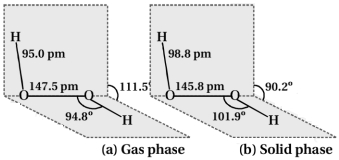
$(i)$ Draw the gas phase and solid phase structure of $H_2O_2$.
$(ii)$ $H_2O_2$ is a better oxidizing agent than water. Explain.
$(ii)$ $H_2O_2$ is a better oxidizing agent than water. Explain.
Solution
(N/A) $(i)$ $H_2O_2$ has a non-planar structure. The gas phase structure has a dihedral angle of $111.5^{\circ}$ and the solid phase structure has a dihedral angle of $90.2^{\circ}$.
$(ii)$ $H_2O_2$ is a better oxidizing agent than water because the $O-O$ bond in $H_2O_2$ is weak and can easily break to release oxygen atoms or accept electrons to form water.
Examples:
$1.$ $H_2O_2$ oxidizes an acidified solution of $KI$ to $I_2$,which gives a blue color with starch solution:
$2KI + H_2SO_4 + H_2O_2 \longrightarrow K_2SO_4 + 2H_2O + I_2$
$2.$ $H_2O_2$ oxidizes black $PbS$ to white $PbSO_4$:
$PbS + 4H_2O_2 \longrightarrow PbSO_4 + 4H_2O$
$(ii)$ $H_2O_2$ is a better oxidizing agent than water because the $O-O$ bond in $H_2O_2$ is weak and can easily break to release oxygen atoms or accept electrons to form water.
Examples:
$1.$ $H_2O_2$ oxidizes an acidified solution of $KI$ to $I_2$,which gives a blue color with starch solution:
$2KI + H_2SO_4 + H_2O_2 \longrightarrow K_2SO_4 + 2H_2O + I_2$
$2.$ $H_2O_2$ oxidizes black $PbS$ to white $PbSO_4$:
$PbS + 4H_2O_2 \longrightarrow PbSO_4 + 4H_2O$
0 likes
View Solution229
Medium
Complete the following reactions:
$(i) \ O_2^{2-} + H_2O \to $
$(ii) \ O_2^- + H_2O \to $
$(i) \ O_2^{2-} + H_2O \to $
$(ii) \ O_2^- + H_2O \to $
Solution
$O_2^{2-}$ is the peroxide ion.
$O_2^-$ is the superoxide ion.
$(i)$ Peroxide ion reacts with water to form hydrogen peroxide $(H_2O_2)$ and hydroxide ions $(OH^-)$:
$O_2^{2-} + 2H_2O \to 2OH^- + H_2O_2$
$(ii)$ Superoxide ion reacts with water to produce hydrogen peroxide $(H_2O_2)$,oxygen $(O_2)$,and hydroxide ions $(OH^-)$:
$2O_2^- + 2H_2O \to 2OH^- + H_2O_2 + O_2$
$O_2^-$ is the superoxide ion.
$(i)$ Peroxide ion reacts with water to form hydrogen peroxide $(H_2O_2)$ and hydroxide ions $(OH^-)$:
$O_2^{2-} + 2H_2O \to 2OH^- + H_2O_2$
$(ii)$ Superoxide ion reacts with water to produce hydrogen peroxide $(H_2O_2)$,oxygen $(O_2)$,and hydroxide ions $(OH^-)$:
$2O_2^- + 2H_2O \to 2OH^- + H_2O_2 + O_2$
0 likes
View Solution230
Medium
Rohan heard that instructions were given to the laboratory attendant to store a particular chemical,i.e.,keep it in the dark room,add some urea in it,and keep it away from dust. This chemical acts as an oxidising as well as a reducing agent in both acidic and alkaline media. This chemical is important for use in the pollution control treatment of domestic and industrial effluents.
$(i)$ Write the name of this compound.
$(ii)$ Explain why such precautions are taken for storing this chemical.
$(i)$ Write the name of this compound.
$(ii)$ Explain why such precautions are taken for storing this chemical.
Solution
(N/A) $(i)$ The name of the compound is hydrogen peroxide,$H_2O_2$. It acts as an oxidising agent as well as a reducing agent in both acidic and basic media.
$(ii)$ $H_2O_2$ is unstable and decomposes in the presence of light and dust particles. Urea is added as a stabilizer (negative catalyst) to inhibit its decomposition.
The decomposition reaction is: $2H_2O_{2(aq)} \xrightarrow{h\nu} 2H_2O_{(l)} + O_{2(g)}$
Due to its strong oxidising properties,$H_2O_2$ is used in pollution control to oxidise harmful cyanides and foul-smelling sulphides present in domestic and industrial effluents. It also aids in sewage treatment by supplying oxygen for the oxidation of organic matter.
$(ii)$ $H_2O_2$ is unstable and decomposes in the presence of light and dust particles. Urea is added as a stabilizer (negative catalyst) to inhibit its decomposition.
The decomposition reaction is: $2H_2O_{2(aq)} \xrightarrow{h\nu} 2H_2O_{(l)} + O_{2(g)}$
Due to its strong oxidising properties,$H_2O_2$ is used in pollution control to oxidise harmful cyanides and foul-smelling sulphides present in domestic and industrial effluents. It also aids in sewage treatment by supplying oxygen for the oxidation of organic matter.
0 likes
View Solution231
Easy
Write the Lewis structure of hydrogen peroxide.
Solution
The Lewis structure of $H_2O_2$ is represented as $H-\ddot{O}-\ddot{O}-H$. In this structure,each oxygen atom is bonded to one hydrogen atom and the other oxygen atom,with two lone pairs of electrons on each oxygen atom.
0 likes
View Solution232
Easy
An acidic solution of hydrogen peroxide behaves as an oxidising as well as reducing agent. Illustrate it with the help of a chemical equation.
Solution
(N/A) The following chemical equations indicate the oxidising and reducing nature of $H_{2}O_{2}$.
$(i)$ $H_{2}O_{2}$ acts as an oxidising agent by oxidising acidified $KI$ to $I_{2}$:
$2KI + H_{2}O_{2} + H_{2}SO_{4} \longrightarrow I_{2} + K_{2}SO_{4} + 2H_{2}O$
$(ii)$ $H_{2}O_{2}$ acts as a reducing agent by reducing acidified $KMnO_{4}$ to $Mn^{2+}$ ions:
$2KMnO_{4} + 3H_{2}SO_{4} + 5H_{2}O_{2} \longrightarrow K_{2}SO_{4} + 2MnSO_{4} + 8H_{2}O + 5O_{2}$
$(i)$ $H_{2}O_{2}$ acts as an oxidising agent by oxidising acidified $KI$ to $I_{2}$:
$2KI + H_{2}O_{2} + H_{2}SO_{4} \longrightarrow I_{2} + K_{2}SO_{4} + 2H_{2}O$
$(ii)$ $H_{2}O_{2}$ acts as a reducing agent by reducing acidified $KMnO_{4}$ to $Mn^{2+}$ ions:
$2KMnO_{4} + 3H_{2}SO_{4} + 5H_{2}O_{2} \longrightarrow K_{2}SO_{4} + 2MnSO_{4} + 8H_{2}O + 5O_{2}$
0 likes
View Solution233
Medium
With the help of suitable examples,explain the property of $H_{2}O_{2}$ that is responsible for its bleaching action?
Solution
(N/A) The bleaching action of $H_{2}O_{2}$ is due to the release of nascent oxygen upon its decomposition.
$H_{2}O_{2} \longrightarrow H_{2}O + [O]$
The nascent oxygen $[O]$ is a strong oxidizing agent. It reacts with the colouring matter present in substances and oxidizes it to a colourless product.
$\text{Colouring matter} + [O] \longrightarrow \text{Colourless matter}$
Due to this oxidation property,$H_{2}O_{2}$ is used for bleaching delicate materials such as silk,wool,feathers,and ivory.
$H_{2}O_{2} \longrightarrow H_{2}O + [O]$
The nascent oxygen $[O]$ is a strong oxidizing agent. It reacts with the colouring matter present in substances and oxidizes it to a colourless product.
$\text{Colouring matter} + [O] \longrightarrow \text{Colourless matter}$
Due to this oxidation property,$H_{2}O_{2}$ is used for bleaching delicate materials such as silk,wool,feathers,and ivory.
0 likes
View Solution234
Medium
Why can dilute solutions of hydrogen peroxide not be concentrated by heating? How can a concentrated solution of hydrogen peroxide be obtained?
Solution
(N/A) $H_{2}O_{2}$ cannot be concentrated by heating because it decomposes much below its boiling point to give $H_{2}O$ and $O_{2}$.
$2H_{2}O_{2} \longrightarrow 2H_{2}O + O_{2}$
Therefore,concentration of $H_{2}O_{2}$ is carried out in a number of stages:
$(i)$ The $H_{2}O_{2}$ formed (about $1\%$) is extracted with water.
$(ii)$ The aqueous solution is concentrated by distillation under reduced pressure to give $30\% H_{2}O_{2}$ solution.
$2H_{2}O_{2} \longrightarrow 2H_{2}O + O_{2}$
Therefore,concentration of $H_{2}O_{2}$ is carried out in a number of stages:
$(i)$ The $H_{2}O_{2}$ formed (about $1\%$) is extracted with water.
$(ii)$ The aqueous solution is concentrated by distillation under reduced pressure to give $30\% H_{2}O_{2}$ solution.
0 likes
View Solution235
Medium
Why is hydrogen peroxide stored in wax-lined bottles?
Solution
(N/A) Hydrogen peroxide $(H_{2}O_{2})$ is decomposed by the rough surfaces of glass,alkali oxides present in glass,and light to form water $(H_{2}O)$ and oxygen $(O_{2})$.
The decomposition reaction is: $2 H_{2}O_{2} \rightarrow 2 H_{2}O + O_{2}$.
To prevent this catalytic decomposition,$H_{2}O_{2}$ is usually stored in coloured paraffin wax-coated plastic or teflon bottles.
The decomposition reaction is: $2 H_{2}O_{2} \rightarrow 2 H_{2}O + O_{2}$.
To prevent this catalytic decomposition,$H_{2}O_{2}$ is usually stored in coloured paraffin wax-coated plastic or teflon bottles.
0 likes
View Solution236
Medium
Phosphoric acid is preferred over sulphuric acid in preparing hydrogen peroxide from peroxides. Why?
Solution
(N/A) $H_{2}SO_{4}$ acts as a catalyst for the decomposition of $H_{2}O_{2}$. Therefore,weaker acids such as $H_{3}PO_{4}$ are preferred over $H_{2}SO_{4}$ for preparing $H_{2}O_{2}$ from peroxides.
$3BaO_{2} + 2H_{3}PO_{4} \rightarrow Ba_{3}(PO_{4})_{2} + 3H_{2}O_{2}$
$3BaO_{2} + 2H_{3}PO_{4} \rightarrow Ba_{3}(PO_{4})_{2} + 3H_{2}O_{2}$
0 likes
View Solution237
Difficult
How will you concentrate $H_2O_2$? Show differences between structures of $H_2O$ and $H_2O_2$ by drawing their spatial structures. Also, mention three important uses of $H_2O_2$.
Solution
(N/A) Concentration of $H_2O_2$: The $H_2O_2$ solution obtained industrially is about $30\%$ by mass. It can be concentrated to $\sim 85\%$ by careful distillation under reduced pressure. The remaining water can be frozen out to obtain pure $H_2O_2$.
Structural Differences:
- $H_2O$ has a bent (angular) structure with a bond angle of $104.5^\circ$ and $O-H$ bond length of $95.7 \text{ pm}$.
- $H_2O_2$ has a non-planar 'open book' structure. In the gas phase, the dihedral angle is $111.5^\circ$, and in the solid phase, it is $90.2^\circ$.
Uses of $H_2O_2$:
$1$. It is used as an antiseptic and mouthwash (sold as perhydrol).
$2$. It is used in the manufacture of chemicals like sodium perborate and sodium carbonate.
$3$. It is used as a bleaching agent for textiles, paper pulp, and oils.
Structural Differences:
- $H_2O$ has a bent (angular) structure with a bond angle of $104.5^\circ$ and $O-H$ bond length of $95.7 \text{ pm}$.
- $H_2O_2$ has a non-planar 'open book' structure. In the gas phase, the dihedral angle is $111.5^\circ$, and in the solid phase, it is $90.2^\circ$.
Uses of $H_2O_2$:
$1$. It is used as an antiseptic and mouthwash (sold as perhydrol).
$2$. It is used in the manufacture of chemicals like sodium perborate and sodium carbonate.
$3$. It is used as a bleaching agent for textiles, paper pulp, and oils.
0 likes
View Solution238
Difficult
$(i)$ Give a method for the manufacture of hydrogen peroxide and explain the reactions involved therein.
$(ii)$ Illustrate oxidising,reducing and acidic properties of hydrogen peroxide with equations.
$(ii)$ Illustrate oxidising,reducing and acidic properties of hydrogen peroxide with equations.
Solution
Industrially,$H_2O_2$ is prepared by the auto-oxidation of $2-alkylanthraquinols$.
$2-ethylanthraquinol \underset{H_2/Pd}{\overset{O_2 \text{ (air)}}{\rightleftarrows}} H_2O_2 + \text{oxidised product}$
In this process,$1\% H_2O_2$ is formed. It is extracted with water and concentrated to $\sim 30\%$ (by mass) by distillation under reduced pressure.
It can be further concentrated to $\sim 85\%$ by careful distillation under low pressure. The remaining water can be frozen out to obtain pure $H_2O_2$.
$(i)$ Oxidising effect in acidic medium:
$2Fe^{2+}_{(aq)} + 2H^+_{(aq)} + H_2O_{2(aq)} \longrightarrow 2Fe^{3+}_{(aq)} + 2H_2O_{(l)}$
$PbS_{(s)} + 4H_2O_{2(aq)} \longrightarrow PbSO_{4(s)} + 4H_2O_{(l)}$
$(ii)$ Reducing effect in acidic medium:
$2MnO_4^- + 6H^+ + 5H_2O_2 \longrightarrow 2Mn^{2+}_{(aq)} + 8H_2O + 5O_2$
$HOCl + H_2O_2 \longrightarrow H_3O^+ + Cl^- + O_2$
$(iii)$ Oxidising effect in basic medium:
$2Fe^{2+} + H_2O_2 \longrightarrow 2Fe^{3+} + 2OH^-$
$Mn^{2+} + H_2O_2 \longrightarrow Mn^{4+} + 2OH^-$
$(iv)$ Reducing effect in basic medium:
$I_2 + H_2O_2 + 2OH^- \longrightarrow 2I^- + 2H_2O + O_2$
$2MnO_4^- + 3H_2O_2 \longrightarrow 2MnO_2 + 3O_2 + 2H_2O + 2OH^-$
$2-ethylanthraquinol \underset{H_2/Pd}{\overset{O_2 \text{ (air)}}{\rightleftarrows}} H_2O_2 + \text{oxidised product}$
In this process,$1\% H_2O_2$ is formed. It is extracted with water and concentrated to $\sim 30\%$ (by mass) by distillation under reduced pressure.
It can be further concentrated to $\sim 85\%$ by careful distillation under low pressure. The remaining water can be frozen out to obtain pure $H_2O_2$.
$(i)$ Oxidising effect in acidic medium:
$2Fe^{2+}_{(aq)} + 2H^+_{(aq)} + H_2O_{2(aq)} \longrightarrow 2Fe^{3+}_{(aq)} + 2H_2O_{(l)}$
$PbS_{(s)} + 4H_2O_{2(aq)} \longrightarrow PbSO_{4(s)} + 4H_2O_{(l)}$
$(ii)$ Reducing effect in acidic medium:
$2MnO_4^- + 6H^+ + 5H_2O_2 \longrightarrow 2Mn^{2+}_{(aq)} + 8H_2O + 5O_2$
$HOCl + H_2O_2 \longrightarrow H_3O^+ + Cl^- + O_2$
$(iii)$ Oxidising effect in basic medium:
$2Fe^{2+} + H_2O_2 \longrightarrow 2Fe^{3+} + 2OH^-$
$Mn^{2+} + H_2O_2 \longrightarrow Mn^{4+} + 2OH^-$
$(iv)$ Reducing effect in basic medium:
$I_2 + H_2O_2 + 2OH^- \longrightarrow 2I^- + 2H_2O + O_2$
$2MnO_4^- + 3H_2O_2 \longrightarrow 2MnO_2 + 3O_2 + 2H_2O + 2OH^-$
0 likes
View Solution239
Medium
$(i)$ What mass of hydrogen peroxide will be present in $2 \, L$ of a $5 \, M$ solution?
$(ii)$ Calculate the mass of oxygen which will be liberated by the decomposition of $200 \, mL$ of this solution.
$(ii)$ Calculate the mass of oxygen which will be liberated by the decomposition of $200 \, mL$ of this solution.
Solution
(N/A) $(i)$ Molar mass of $H_2O_2 = 34 \, g \, mol^{-1}$.
$1 \, L$ of $5 \, M$ solution of $H_2O_2$ contains $34 \times 5 = 170 \, g$ of $H_2O_2$.
Therefore,$2 \, L$ of $5 \, M$ solution of $H_2O_2$ contains $170 \times 2 = 340 \, g$ of $H_2O_2$.
$(ii)$ $200 \, mL$ $(0.2 \, L)$ of $5 \, M$ solution contains $H_2O_2 = 5 \, mol \, L^{-1} \times 0.2 \, L = 1 \, mol$.
Mass of $1 \, mol$ of $H_2O_2 = 34 \, g$.
The decomposition reaction is: $2H_2O_2 \rightarrow 2H_2O + O_2$.
From the stoichiometry,$2 \, mol$ of $H_2O_2$ $(68 \, g)$ produces $1 \, mol$ of $O_2$ $(32 \, g)$.
Thus,$1 \, mol$ of $H_2O_2$ $(34 \, g)$ will produce $\frac{32}{2} = 16 \, g$ of $O_2$.
$1 \, L$ of $5 \, M$ solution of $H_2O_2$ contains $34 \times 5 = 170 \, g$ of $H_2O_2$.
Therefore,$2 \, L$ of $5 \, M$ solution of $H_2O_2$ contains $170 \times 2 = 340 \, g$ of $H_2O_2$.
$(ii)$ $200 \, mL$ $(0.2 \, L)$ of $5 \, M$ solution contains $H_2O_2 = 5 \, mol \, L^{-1} \times 0.2 \, L = 1 \, mol$.
Mass of $1 \, mol$ of $H_2O_2 = 34 \, g$.
The decomposition reaction is: $2H_2O_2 \rightarrow 2H_2O + O_2$.
From the stoichiometry,$2 \, mol$ of $H_2O_2$ $(68 \, g)$ produces $1 \, mol$ of $O_2$ $(32 \, g)$.
Thus,$1 \, mol$ of $H_2O_2$ $(34 \, g)$ will produce $\frac{32}{2} = 16 \, g$ of $O_2$.
0 likes
View Solution240
Medium
$A$ colourless liquid $A$ contains $H$ and $O$ elements only. It decomposes slowly on exposure to light. It is stabilised by mixing urea to store in the presence of light.
$(i)$ Suggest the possible structure of $A$.
$(ii)$ Write the chemical equation for its decomposition reaction in light.
$(i)$ Suggest the possible structure of $A$.
$(ii)$ Write the chemical equation for its decomposition reaction in light.
Solution
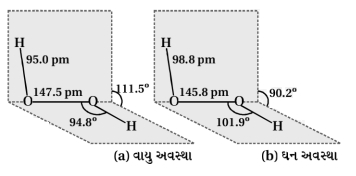
(N/A) $(i)$ Since the colourless liquid $A$ contains only hydrogen and oxygen and decomposes slowly on exposure to light but is stabilised by the addition of urea,liquid $A$ is hydrogen peroxide $(H_2O_2)$. The structure of $H_2O_2$ is an open book structure.
$(ii)$ The decomposition reaction is:
$2 H_2O_2 \xrightarrow{h\nu} 2 H_2O + O_2$
$(ii)$ The decomposition reaction is:
$2 H_2O_2 \xrightarrow{h\nu} 2 H_2O + O_2$
0 likes
View Solution241
DifficultMCQ
The strengths of $5.6$ volume hydrogen peroxide (of density $1 \ g/mL$) in terms of mass percentage and molarity $(M)$,respectively,are:
(Take molar mass of hydrogen peroxide as $34 \ g/mol$)
(Take molar mass of hydrogen peroxide as $34 \ g/mol$)
A
$1.7$ and $0.25$
B
$1.7$ and $0.5$
C
$0.85$ and $0.5$
D
$0.85$ and $0.25$
Solution
(B) The relationship between volume strength and molarity is given by: $\text{Volume strength} = 11.2 \times \text{Molarity}$.
$\text{Molarity} = \frac{5.6}{11.2} = 0.5 \ M$.
Assuming $1 \ L$ $(1000 \ mL)$ of solution:
$\text{Mass of solution} = 1000 \ mL \times 1 \ g/mL = 1000 \ g$.
$\text{Moles of } H_2O_2 = \text{Molarity} \times \text{Volume in Liters} = 0.5 \ mol/L \times 1 \ L = 0.5 \ mol$.
$\text{Mass of solute } (H_2O_2) = 0.5 \ mol \times 34 \ g/mol = 17 \ g$.
$\text{Mass percentage} = \frac{\text{Mass of solute}}{\text{Mass of solution}} \times 100 = \frac{17}{1000} \times 100 = 1.7 \%$.
$\text{Molarity} = \frac{5.6}{11.2} = 0.5 \ M$.
Assuming $1 \ L$ $(1000 \ mL)$ of solution:
$\text{Mass of solution} = 1000 \ mL \times 1 \ g/mL = 1000 \ g$.
$\text{Moles of } H_2O_2 = \text{Molarity} \times \text{Volume in Liters} = 0.5 \ mol/L \times 1 \ L = 0.5 \ mol$.
$\text{Mass of solute } (H_2O_2) = 0.5 \ mol \times 34 \ g/mol = 17 \ g$.
$\text{Mass percentage} = \frac{\text{Mass of solute}}{\text{Mass of solution}} \times 100 = \frac{17}{1000} \times 100 = 1.7 \%$.
0 likes
View Solution242
MediumMCQ
The volume strength of $8.9 \, M \, H_{2}O_{2}$ solution calculated at $273 \, K$ and $1 \, atm$ is.........
$(R = 0.0821 \, L \, atm \, K^{-1} \, mol^{-1})$ (rounded off to the nearest integer)
$(R = 0.0821 \, L \, atm \, K^{-1} \, mol^{-1})$ (rounded off to the nearest integer)
A
$100$
B
$125$
C
$130$
D
$128$
Solution
(A) The decomposition of $H_{2}O_{2}$ is given by: $2H_{2}O_{2}(aq) \rightarrow 2H_{2}O(l) + O_{2}(g)$.
At $STP$ ($273 \, K$ and $1 \, atm$),$1 \, mole$ of $O_{2}$ gas occupies $22.4 \, L$.
From the stoichiometry,$2 \, moles$ of $H_{2}O_{2}$ produce $1 \, mole$ of $O_{2}$.
Therefore,$1 \, mole$ of $H_{2}O_{2}$ produces $11.2 \, L$ of $O_{2}$ at $STP$.
Volume strength $= Molarity \times 11.2 = 8.9 \times 11.2 = 99.68$.
Rounding off to the nearest integer,we get $100$.
At $STP$ ($273 \, K$ and $1 \, atm$),$1 \, mole$ of $O_{2}$ gas occupies $22.4 \, L$.
From the stoichiometry,$2 \, moles$ of $H_{2}O_{2}$ produce $1 \, mole$ of $O_{2}$.
Therefore,$1 \, mole$ of $H_{2}O_{2}$ produces $11.2 \, L$ of $O_{2}$ at $STP$.
Volume strength $= Molarity \times 11.2 = 8.9 \times 11.2 = 99.68$.
Rounding off to the nearest integer,we get $100$.
0 likes
View Solution243
EasyMCQ
$H_2O_2$ (hydrogen peroxide),in the pure state,is:
A
non-planar and almost colorless
B
linear and almost colorless
C
planar and blue in color
D
linear and blue in color
Solution
(A) $H_2O_2$ has a non-planar (open book) structure due to the repulsion between the lone pairs of electrons on the oxygen atoms.
In its pure state,it is a nearly colorless (very pale blue) liquid.
In its pure state,it is a nearly colorless (very pale blue) liquid.
0 likes
View Solution244
MediumMCQ
$H_2O_2$ is obtained by which of the following?
A
$BaO_2$
B
$MnO_2$
C
$SeO_2$
D
$TeO_2$
Solution
(A) $H_2O_2$ is prepared by the action of dilute sulfuric acid on hydrated barium peroxide $(BaO_2 \cdot 8H_2O)$.
The chemical reaction is:
$BaO_2 \cdot 8H_2O_{(s)} + H_2SO_{4(aq)} \rightarrow BaSO_{4(s)} + H_2O_{2(aq)} + 8H_2O_{(l)}$.
The chemical reaction is:
$BaO_2 \cdot 8H_2O_{(s)} + H_2SO_{4(aq)} \rightarrow BaSO_{4(s)} + H_2O_{2(aq)} + 8H_2O_{(l)}$.
0 likes
View Solution245
MediumMCQ
Given below are two statements:
Statement $I$: $H_{2}O_{2}$ can act as both an oxidising and a reducing agent in a basic medium.
Statement $II$: In the hydrogen economy,the energy is transmitted in the form of dihydrogen.
In the light of the above statements,choose the correct answer from the options given below:
Statement $I$: $H_{2}O_{2}$ can act as both an oxidising and a reducing agent in a basic medium.
Statement $II$: In the hydrogen economy,the energy is transmitted in the form of dihydrogen.
In the light of the above statements,choose the correct answer from the options given below:
A
Both statement $I$ and statement $II$ are false.
B
Both statement $I$ and statement $II$ are true.
C
Statement $I$ is true but statement $II$ is false.
D
Statement $I$ is false but statement $II$ is true.
Solution
(B) Statement $I$ is true: $H_{2}O_{2}$ acts as an oxidising agent in basic medium,e.g.,$2Fe^{2+} + H_{2}O_{2} \rightarrow 2Fe^{3+} + 2OH^{-}$. It also acts as a reducing agent in basic medium,e.g.,$2MnO_{4}^{-} + 3H_{2}O_{2} \rightarrow 2MnO_{2} + 3O_{2} + 2H_{2}O + 2OH^{-}$.
Statement $II$ is true: The basic principle of the hydrogen economy is the transportation and storage of energy in the form of liquid or gaseous dihydrogen. Energy is transmitted as dihydrogen rather than as electric power.
Statement $II$ is true: The basic principle of the hydrogen economy is the transportation and storage of energy in the form of liquid or gaseous dihydrogen. Energy is transmitted as dihydrogen rather than as electric power.
0 likes
View Solution246
MediumMCQ
The correct statements about $H_2O_2$ are:
$A$. Used in the treatment of effluents.
$B$. Used as both oxidising and reducing agents.
$C$. The two hydroxyl groups lie in the same plane.
$D$. Miscible with water.
Choose the correct answer from the options given below:
$A$. Used in the treatment of effluents.
$B$. Used as both oxidising and reducing agents.
$C$. The two hydroxyl groups lie in the same plane.
$D$. Miscible with water.
Choose the correct answer from the options given below:
A
$A, B, C$ and $D$
B
$A, B$ and $D$ only
C
$B, C$ and $D$ only
D
$A, C$ and $D$ only
Solution
(B) $H_2O_2$ is used in the treatment of effluents (industrial waste).
$H_2O_2$ acts as both an oxidising agent $(O.A.)$ and a reducing agent $(R.A.)$ in both acidic and basic media.
$H_2O_2$ has a non-planar,open-book structure. Therefore,the two hydroxyl groups do not lie in the same plane.
$H_2O_2$ is miscible with water in all proportions due to hydrogen bonding.
Thus,statements $A, B,$ and $D$ are correct.
$H_2O_2$ acts as both an oxidising agent $(O.A.)$ and a reducing agent $(R.A.)$ in both acidic and basic media.
$H_2O_2$ has a non-planar,open-book structure. Therefore,the two hydroxyl groups do not lie in the same plane.
$H_2O_2$ is miscible with water in all proportions due to hydrogen bonding.
Thus,statements $A, B,$ and $D$ are correct.
0 likes
View Solution247
MediumMCQ
In basic medium,$H_{2}O_{2}$ exhibits which of the following reactions?
$A$. $Mn^{2+} \rightarrow Mn^{4+}$
$B$. $I_{2} \rightarrow I^{-}$
$C$. $PbS \rightarrow PbSO_{4}$
Choose the most appropriate answer from the options given below:
$A$. $Mn^{2+} \rightarrow Mn^{4+}$
$B$. $I_{2} \rightarrow I^{-}$
$C$. $PbS \rightarrow PbSO_{4}$
Choose the most appropriate answer from the options given below:
A
$A, C$ only
B
$A$ only
C
$B$ only
D
$A, B$ only
Solution
(D) $H_{2}O_{2}$ acts as an oxidizing agent in basic medium:
$Mn^{2+} + H_{2}O_{2} \rightarrow Mn^{4+} + 2OH^{-}$
$H_{2}O_{2}$ acts as a reducing agent in basic medium:
$I_{2} + H_{2}O_{2} + 2OH^{-} \rightarrow 2I^{-} + 2H_{2}O + O_{2}$
$H_{2}O_{2}$ acts as an oxidizing agent in acidic medium:
$PbS_{(s)} + 4H_{2}O_{2(aq)} \rightarrow PbSO_{4(s)} + 4H_{2}O_{(\ell)}$
Thus,reactions $A$ and $B$ occur in basic medium.
$Mn^{2+} + H_{2}O_{2} \rightarrow Mn^{4+} + 2OH^{-}$
$H_{2}O_{2}$ acts as a reducing agent in basic medium:
$I_{2} + H_{2}O_{2} + 2OH^{-} \rightarrow 2I^{-} + 2H_{2}O + O_{2}$
$H_{2}O_{2}$ acts as an oxidizing agent in acidic medium:
$PbS_{(s)} + 4H_{2}O_{2(aq)} \rightarrow PbSO_{4(s)} + 4H_{2}O_{(\ell)}$
Thus,reactions $A$ and $B$ occur in basic medium.
0 likes
View Solution248
MediumMCQ
Which of the following equations depicts the oxidizing nature of $H_{2}O_{2}$?
A
$KIO_{4} + H_{2}O_{2} \rightarrow KIO_{3} + H_{2}O + O_{2}$
B
$2I^{-} + H_{2}O_{2} + 2H^{+} \rightarrow I_{2} + 2H_{2}O$
C
$I_{2} + H_{2}O_{2} + 2OH^{-} \rightarrow 2I^{-} + 2H_{2}O + O_{2}$
D
$Cl_{2} + H_{2}O_{2} \rightarrow 2HCl + O_{2}$
Solution
(B) In the reaction $2I^{-} + H_{2}O_{2} + 2H^{+} \rightarrow I_{2} + 2H_{2}O$,the oxidation state of iodine increases from $-1$ to $0$,which indicates that $I^{-}$ is oxidized to $I_{2}$ by $H_{2}O_{2}$.
Thus,$H_{2}O_{2}$ acts as an oxidizing agent.
In the other reactions,$H_{2}O_{2}$ acts as a reducing agent.
Hence,the correct answer is $(B)$.
Thus,$H_{2}O_{2}$ acts as an oxidizing agent.
In the other reactions,$H_{2}O_{2}$ acts as a reducing agent.
Hence,the correct answer is $(B)$.
0 likes
View Solution249
EasyMCQ
The oxide that gives $H_{2}O_{2}$ most readily on treatment with $H_{2}O$ is:
A
$PbO_{2}$
B
$Na_{2}O_{2}$
C
$SnO_{2}$
D
$BaO_{2} \cdot 8 H_{2}O$
Solution
(B) $1.$ $PbO_{2}$ does not react with water to give $H_{2}O_{2}$.
$2.$ $Na_{2}O_{2} + 2 H_{2}O \rightarrow 2 NaOH + H_{2}O_{2}$. This reaction occurs readily at room temperature.
$3.$ $SnO_{2}$ is an acidic oxide and does not yield $H_{2}O_{2}$ with water.
$4.$ $BaO_{2} \cdot 8 H_{2}O$ requires the addition of a dilute acid (like $H_{2}SO_{4}$) to produce $H_{2}O_{2}$,not just water.
$2.$ $Na_{2}O_{2} + 2 H_{2}O \rightarrow 2 NaOH + H_{2}O_{2}$. This reaction occurs readily at room temperature.
$3.$ $SnO_{2}$ is an acidic oxide and does not yield $H_{2}O_{2}$ with water.
$4.$ $BaO_{2} \cdot 8 H_{2}O$ requires the addition of a dilute acid (like $H_{2}SO_{4}$) to produce $H_{2}O_{2}$,not just water.
0 likes
View Solution250
DifficultMCQ
Hydrogen peroxide reacts with iodine in basic medium to give:
A
$IO_{4}^{-}$
B
$IO^{-}$
C
$I^{-}$
D
$IO_{3}^{-}$
Solution
(C) In a basic medium,hydrogen peroxide $(H_{2}O_{2})$ acts as a reducing agent towards iodine $(I_{2})$.
The balanced chemical equation for this redox reaction is:
$I_{2} + H_{2}O_{2} + 2 OH^{-} \longrightarrow 2 I^{-} + 2 H_{2}O + O_{2}$
Thus,the product formed is the iodide ion $(I^{-})$.
The balanced chemical equation for this redox reaction is:
$I_{2} + H_{2}O_{2} + 2 OH^{-} \longrightarrow 2 I^{-} + 2 H_{2}O + O_{2}$
Thus,the product formed is the iodide ion $(I^{-})$.
0 likes
View SolutionHydrogen — Hydrogen peroxide · Frequently Asked Questions
1Are these Hydrogen questions useful for JEE and NEET?
Yes. All questions in this section are mapped to JEE Main and NEET exam patterns. Previous year questions from JEE Main, NEET, GUJCET and state-level exams are included with full solutions.
2Can I switch to Hindi or Gujarati for these questions?
Yes. Use the language tabs in the hero section or the sidebar to view the same questions and solutions in English, Hindi or Gujarati.
3How do I generate a question paper from this subtopic?
Use the Vedclass Exam Paper Generator — select the chapter and subtopic, set difficulty, and generate Sets A, B, C, D automatically. First 3 chapters of every subject are free.
Vedclass Products
For Students
Vedclass Test Series
Mock tests in real JEE/NEET style with performance analysis. 5-day free trial.
Start Free TrialFor Teachers
Exam Paper Generator
Generate Set A/B/C/D papers from this chapter in 2 minutes. 3 chapters free.
Try FreeFor Institutes
Online Exam Module
Live online exams with unlimited students, 360° analytics & white-label branding.
See DemoFor Teachers & Institutes
Generate a Hydrogen Exam Paper in 2 Minutes
Select subtopic & difficulty — Sets A, B, C, D auto-generated with No Repeat logic.
First 3 chapters of every subject are free — no payment required.