
A English
Alkane Questions in English
Class 11 Chemistry · Hydrocarbons · Alkane
746+
Questions
English
Language
100%
With Solutions
Showing 49 of 746 questions in English
101
MediumMCQ
Isomerism in saturated hydrocarbons is due to
A
Change in the valence of carbon
B
Change in the ratio of elements in compounds
C
Formation of branches in the chain of $C$ atoms
D
Formation of double bond
Solution
(C) Saturated hydrocarbons (alkanes) exhibit chain isomerism due to the difference in the arrangement of carbon atoms in the chain.
This occurs because of the $(C)$ formation of branches in the chain of $C$ atoms.
For example,$n$-butane $(\text{CH}_3-\text{CH}_2-\text{CH}_2-\text{CH}_3)$ and isobutane $(\text{CH}_3-\text{CH}(\text{CH}_3)-\text{CH}_3)$ are isomers.
This occurs because of the $(C)$ formation of branches in the chain of $C$ atoms.
For example,$n$-butane $(\text{CH}_3-\text{CH}_2-\text{CH}_2-\text{CH}_3)$ and isobutane $(\text{CH}_3-\text{CH}(\text{CH}_3)-\text{CH}_3)$ are isomers.
0 likes
View Solution102
MediumMCQ
Photochemical chlorination of alkane is initiated by a process of
A
Pyrolysis
B
Substitution
C
Homolysis
D
Peroxidation
Solution
(C) The photochemical chlorination of an alkane proceeds via a free radical mechanism.
In the initiation step,the $Cl-Cl$ bond undergoes homolytic fission (homolysis) in the presence of light $(h
u)$ to generate chlorine free radicals $(Cl^{\bullet})$.
In the initiation step,the $Cl-Cl$ bond undergoes homolytic fission (homolysis) in the presence of light $(h
u)$ to generate chlorine free radicals $(Cl^{\bullet})$.
0 likes
View Solution103
MediumMCQ
Which of the following is not linked with methane?
A
Marsh gas
B
Natural gas
C
Producer gas
D
Coal gas
Solution
(C) . Marsh gas,natural gas,and coal gas contain $CH_4$,but producer gas is a mixture of $CO$ and $N_2$.
$\underset{\text{Coke, red hot}}{2C} + \underbrace{O_2 + 4N_2}_{\text{Air}}$ $\longrightarrow \underbrace{2CO + 4N_2}_{\text{Producer gas}}$
$\underset{\text{Coke, red hot}}{2C} + \underbrace{O_2 + 4N_2}_{\text{Air}}$ $\longrightarrow \underbrace{2CO + 4N_2}_{\text{Producer gas}}$
0 likes
View Solution104
MediumMCQ
Which of the following has the highest octane number?
A
$n$-hexane
B
$n$-heptane
C
Iso-octane
D
$n$-heptane and Iso-octane mixed in ratio $50:50$
Solution
(C) The octane number is a measure of the anti-knock properties of a fuel. $n$-heptane is assigned an octane number of $0$,while $2,2,4$-trimethylpentane (Iso-octane) is assigned an octane number of $100$. Aromatic hydrocarbons and branched alkanes generally have higher octane numbers than straight-chain alkanes. Among the given options,Iso-octane has the highest octane number $(100)$.
0 likes
View Solution105
MediumMCQ
$A$ mixture of ethyl iodide and $n-$propyl iodide is subjected to Wurtz reaction. The hydrocarbon that will not be formed is
A
$n-$butane
B
$n-$propane
C
$n-$pentane
D
$n-$hexane
Solution
(B) The Wurtz reaction involves the coupling of alkyl halides in the presence of sodium metal to form higher alkanes.
When a mixture of ethyl iodide $(C_2H_5I)$ and $n-$propyl iodide $(C_3H_7I)$ is used,the following products are formed:
$1$. Self-coupling of ethyl iodide: $C_2H_5-C_2H_5$ ($n-$butane).
$2$. Self-coupling of $n-$propyl iodide: $C_3H_7-C_3H_7$ ($n-$hexane).
$3$. Cross-coupling of ethyl iodide and $n-$propyl iodide: $C_2H_5-C_3H_7$ ($n-$pentane).
Therefore,$n-$propane is not formed in this reaction.
When a mixture of ethyl iodide $(C_2H_5I)$ and $n-$propyl iodide $(C_3H_7I)$ is used,the following products are formed:
$1$. Self-coupling of ethyl iodide: $C_2H_5-C_2H_5$ ($n-$butane).
$2$. Self-coupling of $n-$propyl iodide: $C_3H_7-C_3H_7$ ($n-$hexane).
$3$. Cross-coupling of ethyl iodide and $n-$propyl iodide: $C_2H_5-C_3H_7$ ($n-$pentane).
Therefore,$n-$propane is not formed in this reaction.
0 likes
View Solution106
MediumMCQ
In the dichlorination reaction of propane,a mixture of products is obtained. How many isomers does the mixture contain?
A
$2$
B
$3$
C
$4$
D
$5$
Solution
(C) The dichlorination of propane $(CH_3-CH_2-CH_3)$ leads to the formation of various isomers based on the position of chlorine atoms.
The possible isomers are:
$1,1$-dichloropropane
$1,2$-dichloropropane
$1,3$-dichloropropane
$2,2$-dichloropropane
Thus,the mixture contains $4$ isomers.
The possible isomers are:
$1,1$-dichloropropane
$1,2$-dichloropropane
$1,3$-dichloropropane
$2,2$-dichloropropane
Thus,the mixture contains $4$ isomers.
0 likes
View Solution107
DifficultMCQ
Which of the following cycloalkanes gives an open-chain compound when it reacts with bromine?
A
Cyclopropane
B
Cyclopentane
C
Cyclohexane
D
Cyclo-octane
Solution
(A) Cyclopropane reacts with $Br_2$ to form an open-chain compound,$1,3-dibromopropane$.
This occurs because cyclopropane experiences significant ring strain due to its small bond angles of $60^{\circ}$,which deviate greatly from the ideal tetrahedral angle of $109.5^{\circ}$.
Consequently,the ring undergoes a ring-opening reaction with bromine,whereas larger cycloalkanes like cyclopentane and cyclohexane typically undergo substitution reactions rather than ring-opening.
This occurs because cyclopropane experiences significant ring strain due to its small bond angles of $60^{\circ}$,which deviate greatly from the ideal tetrahedral angle of $109.5^{\circ}$.
Consequently,the ring undergoes a ring-opening reaction with bromine,whereas larger cycloalkanes like cyclopentane and cyclohexane typically undergo substitution reactions rather than ring-opening.
0 likes
View Solution108
MediumMCQ
Heating of alkanes with fuming sulphuric acid or oleum at high temperature,which forms sulphonic acid,is called
A
Nitration
B
Halogenation
C
Sulphonation
D
Oxidation
Solution
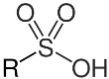
(C) Heating of alkanes with fuming sulphuric acid or oleum at high temperature,which forms sulphonic acid,is called Sulphonation.
$H_2S_2O_7$ (Oleum) $\rightarrow H_2SO_4 + SO_3$
$R-H + SO_3 \rightarrow R-SO_2OH$
$H_2S_2O_7$ (Oleum) $\rightarrow H_2SO_4 + SO_3$
$R-H + SO_3 \rightarrow R-SO_2OH$
0 likes
View Solution109
MediumMCQ
The $B.P.$ of branched-chain alkanes as compared to straight-chain alkanes is:
A
Lower
B
Equal
C
Higher
D
Independent of the chain
Solution
(A) . As the number of branches increases,the surface area of the molecule decreases.
This reduction in surface area leads to weaker $Vander \ Waals$ forces of attraction between the molecules.
Consequently,the boiling point $(B.P.)$ of branched-chain alkanes is lower than that of their corresponding straight-chain isomers.
This reduction in surface area leads to weaker $Vander \ Waals$ forces of attraction between the molecules.
Consequently,the boiling point $(B.P.)$ of branched-chain alkanes is lower than that of their corresponding straight-chain isomers.
0 likes
View Solution110
MediumMCQ
Daily use candles (paraffin wax) contain
A
Higher saturated hydrocarbon
B
Lower saturated hydrocarbon
C
Higher unsaturated hydrocarbon
D
Lower unsaturated hydrocarbon
Solution
(A) Candles consist of paraffin wax,which is a mixture of solid alkanes.
These are generally saturated hydrocarbons with a carbon chain length ranging from $C_{20}$ to $C_{40}$ (i.e.,higher saturated hydrocarbons).
These are generally saturated hydrocarbons with a carbon chain length ranging from $C_{20}$ to $C_{40}$ (i.e.,higher saturated hydrocarbons).
0 likes
View Solution111
MediumMCQ
The reaction $CH_4 + Cl_2 \xrightarrow{uv \ light} CH_3Cl + HCl$ is an example of
A
Addition reactions
B
Substitution reaction
C
Elimination reaction
D
Rearrangement reaction
Solution
(B) The reaction $CH_4 + Cl_2 \xrightarrow{uv \ light} CH_3Cl + HCl$ involves the replacement of a hydrogen atom in methane $(CH_4)$ by a chlorine atom $(Cl)$.
This type of reaction,where one atom or group of atoms in a molecule is replaced by another atom or group,is known as a substitution reaction.
Specifically,this is a free-radical substitution reaction initiated by $UV$ light.
This type of reaction,where one atom or group of atoms in a molecule is replaced by another atom or group,is known as a substitution reaction.
Specifically,this is a free-radical substitution reaction initiated by $UV$ light.
0 likes
View Solution112
MediumMCQ
Normal butane is converted into isobutane by:
A
$LiAlH_4$
B
$AlCl_3$
C
$NaBH_4$
D
$Zn / HCl$
Solution
(B) The conversion of $n$-butane to isobutane is an isomerization reaction.
This reaction is catalyzed by anhydrous $AlCl_3$ in the presence of $HCl$ gas.
$CH_3CH_2CH_2CH_3 \xrightarrow[\Delta]{Anhyd. AlCl_3 / HCl} CH_3-CH(CH_3)-CH_3$
Thus,the correct reagent is $AlCl_3$.
This reaction is catalyzed by anhydrous $AlCl_3$ in the presence of $HCl$ gas.
$CH_3CH_2CH_2CH_3 \xrightarrow[\Delta]{Anhyd. AlCl_3 / HCl} CH_3-CH(CH_3)-CH_3$
Thus,the correct reagent is $AlCl_3$.
0 likes
View Solution113
MediumMCQ
Aluminium carbide on reacting with water gives
A
Methane
B
Ethane
C
Ethene
D
Ethyne
Solution
(A) The reaction of aluminium carbide $(Al_4C_3)$ with water $(H_2O)$ is a hydrolysis reaction that produces methane $(CH_4)$ gas and aluminium hydroxide $(Al(OH)_3)$.
The balanced chemical equation is:
$Al_4C_3 + 12H_2O \to 3CH_4 + 4Al(OH)_3$
Therefore,the correct option is $A$.
The balanced chemical equation is:
$Al_4C_3 + 12H_2O \to 3CH_4 + 4Al(OH)_3$
Therefore,the correct option is $A$.
0 likes
View Solution114
MediumMCQ
Maximum carbon-carbon bond distance is found in
A
Ethyne
B
Ethene
C
Ethane
D
Benzene
Solution
(C) The carbon-carbon bond distance depends on the hybridization of the carbon atoms.
In $Ethyne$ $(C_2H_2)$,the $C-C$ bond is a triple bond with $sp$ hybridization,having a bond length of $1.20 \ \mathring{A}$.
In $Ethene$ $(C_2H_4)$,the $C-C$ bond is a double bond with $sp^2$ hybridization,having a bond length of $1.34 \ \mathring{A}$.
In $Benzene$ $(C_6H_6)$,the $C-C$ bond length is $1.39 \ \mathring{A}$ due to resonance.
In $Ethane$ $(C_2H_6)$,the $C-C$ bond is a single bond with $sp^3$ hybridization,having a bond length of $1.54 \ \mathring{A}$.
Therefore,the maximum carbon-carbon bond distance is found in $Ethane$.
In $Ethyne$ $(C_2H_2)$,the $C-C$ bond is a triple bond with $sp$ hybridization,having a bond length of $1.20 \ \mathring{A}$.
In $Ethene$ $(C_2H_4)$,the $C-C$ bond is a double bond with $sp^2$ hybridization,having a bond length of $1.34 \ \mathring{A}$.
In $Benzene$ $(C_6H_6)$,the $C-C$ bond length is $1.39 \ \mathring{A}$ due to resonance.
In $Ethane$ $(C_2H_6)$,the $C-C$ bond is a single bond with $sp^3$ hybridization,having a bond length of $1.54 \ \mathring{A}$.
Therefore,the maximum carbon-carbon bond distance is found in $Ethane$.
0 likes
View Solution115
DifficultMCQ
Which of the following reactions is expected to readily give a hydrocarbon product in good yields?
A
$2RCOOK + 2H_2O \xrightarrow{\text{Electrolysis}} R-R + 2CO_2 + 2KOH + H_2$
B
$RCOOAg + I_2 \xrightarrow{\Delta} R-COOR + CO_2 + 2AgI$
C
$CH_3-CH_3 \xrightarrow{hv, Cl_2} CH_3-CH_2Cl + HCl$
D
$(CH_3)_3CCl \xrightarrow{C_2H_5OH} \text{Alkene}$
Solution
(A) The reaction $2RCOOK + 2H_2O \xrightarrow{\text{Electrolysis}} R-R + 2CO_2 + 2KOH + H_2$ is known as the Kolbe's electrolysis method.
This method is used for the preparation of alkanes (hydrocarbons) with an even number of carbon atoms.
It proceeds via a free radical mechanism and provides good yields of the symmetric alkane product $(R-R)$.
This method is used for the preparation of alkanes (hydrocarbons) with an even number of carbon atoms.
It proceeds via a free radical mechanism and provides good yields of the symmetric alkane product $(R-R)$.
0 likes
View Solution116
EasyMCQ
Out of the following fractions of petroleum,which one has the lowest boiling point?
A
Kerosene
B
Diesel oil
C
Gasoline
D
Heavy oil
Solution
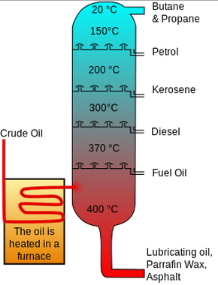
(C) Petroleum is a mixture of various hydrocarbons that can be separated by fractional distillation based on their boiling points.
According to the fractional distillation process:
$1$. Fractions with lower molecular mass and lower boiling points vaporize and are collected at the top of the column at lower temperatures.
$2$. Fractions with higher molecular mass and higher boiling points are collected at the bottom at higher temperatures.
Comparing the given options:
- Gasoline (Petrol) has a boiling point range of approximately $40-175 \ ^\circ C$.
- Kerosene has a boiling point range of approximately $175-250 \ ^\circ C$.
- Diesel oil has a boiling point range of approximately $250-350 \ ^\circ C$.
- Heavy oil (Fuel oil) has a boiling point above $350 \ ^\circ C$.
Therefore,among the given options,Gasoline has the lowest boiling point.
According to the fractional distillation process:
$1$. Fractions with lower molecular mass and lower boiling points vaporize and are collected at the top of the column at lower temperatures.
$2$. Fractions with higher molecular mass and higher boiling points are collected at the bottom at higher temperatures.
Comparing the given options:
- Gasoline (Petrol) has a boiling point range of approximately $40-175 \ ^\circ C$.
- Kerosene has a boiling point range of approximately $175-250 \ ^\circ C$.
- Diesel oil has a boiling point range of approximately $250-350 \ ^\circ C$.
- Heavy oil (Fuel oil) has a boiling point above $350 \ ^\circ C$.
Therefore,among the given options,Gasoline has the lowest boiling point.
0 likes
View Solution117
MediumMCQ
Methane can be prepared by
A
Wurtz reaction
B
Decarboxylation
C
Hydrogenation reaction
D
All of these
Solution
(B) The correct answer is $(B)$.
Decarboxylation of sodium acetate with soda lime $(NaOH + CaO)$ yields methane.
The reaction is: $CH_3COONa + NaOH \xrightarrow{CaO} CH_4 + Na_2CO_3$.
Decarboxylation of sodium acetate with soda lime $(NaOH + CaO)$ yields methane.
The reaction is: $CH_3COONa + NaOH \xrightarrow{CaO} CH_4 + Na_2CO_3$.
0 likes
View Solution118
MediumMCQ
The most strained cycloalkane is
A
Cyclopropane
B
Cyclobutane
C
Cyclopentane
D
Cyclohexane
Solution
(A) According to Baeyer's strain theory,the angle strain in cycloalkanes is related to the deviation of the bond angle from the ideal tetrahedral angle of $109.5^o$.
$Cyclopropane$ has a bond angle of $60^o$,which is the largest deviation from the ideal tetrahedral angle,making it the most strained and most reactive cycloalkane.
Therefore,the correct option is $(A)$.
$Cyclopropane$ has a bond angle of $60^o$,which is the largest deviation from the ideal tetrahedral angle,making it the most strained and most reactive cycloalkane.
Therefore,the correct option is $(A)$.
0 likes
View Solution119
MediumMCQ
Which of the following does not react with chlorine in the dark?
A
$C_2H_4$
B
$C_2H_2$
C
$CH_4$
D
$CH_3CHO$
Solution
(C) Alkenes $(C_2H_4)$ and alkynes $(C_2H_2)$ undergo electrophilic addition reactions with $Cl_2$ even in the dark.
$CH_3CHO$ reacts with $Cl_2$ via substitution or addition depending on conditions.
$CH_4$ (methane) is an alkane and requires ultraviolet light or high temperature to initiate free radical substitution with $Cl_2$.
In the dark,there is no energy source to generate chlorine radicals,so $CH_4$ does not react with $Cl_2$.
$CH_3CHO$ reacts with $Cl_2$ via substitution or addition depending on conditions.
$CH_4$ (methane) is an alkane and requires ultraviolet light or high temperature to initiate free radical substitution with $Cl_2$.
In the dark,there is no energy source to generate chlorine radicals,so $CH_4$ does not react with $Cl_2$.
0 likes
View Solution120
MediumMCQ
The main constituent of marsh gas is:
A
$C_2H_2$
B
$CH_4$
C
$H_2S$
D
$CO$
Solution
(B) Marsh gas is formed by the anaerobic decomposition of organic matter in wetlands and swamps.
It primarily consists of methane $(CH_4)$,which is the simplest alkane.
Therefore,the correct option is $(B)$.
It primarily consists of methane $(CH_4)$,which is the simplest alkane.
Therefore,the correct option is $(B)$.
0 likes
View Solution121
MediumMCQ
Which of the following methods can be used for the preparation of methane?
A
Wurtz reaction
B
Kolbe's reaction
C
Reduction of alkyl halide
D
Hydrogenation of alkene
Solution
(C) The reduction of alkyl halides (specifically methyl chloride) with zinc and hydrochloric acid produces methane.
$CH_3-Cl + 2H \xrightarrow{Zn/HCl} CH_4 + HCl$
$Wurtz$ reaction and $Kolbe's$ reaction are generally used to prepare alkanes with an even number of carbon atoms or higher alkanes,while hydrogenation of alkenes requires at least two carbon atoms to form ethane.
$CH_3-Cl + 2H \xrightarrow{Zn/HCl} CH_4 + HCl$
$Wurtz$ reaction and $Kolbe's$ reaction are generally used to prepare alkanes with an even number of carbon atoms or higher alkanes,while hydrogenation of alkenes requires at least two carbon atoms to form ethane.
0 likes
View Solution122
MediumMCQ
Which hydrocarbon will be most stable?
A
Methane
B
Ethane
C
Propane
D
Butane
Solution
(D) Stability in alkanes is generally governed by the heat of combustion per $CH_2$ group and the degree of branching.
For straight-chain alkanes,as the chain length increases,the stability per carbon atom increases slightly due to the decrease in the relative contribution of end-group effects.
Among the given options,$n$-butane $(C_4H_{10})$ has the longest chain and the highest molecular weight,making it the most stable compared to methane $(CH_4)$,ethane $(C_2H_6)$,and propane $(C_3H_8)$.
For straight-chain alkanes,as the chain length increases,the stability per carbon atom increases slightly due to the decrease in the relative contribution of end-group effects.
Among the given options,$n$-butane $(C_4H_{10})$ has the longest chain and the highest molecular weight,making it the most stable compared to methane $(CH_4)$,ethane $(C_2H_6)$,and propane $(C_3H_8)$.
0 likes
View Solution123
DifficultMCQ
Which one of the following compounds does not form an ozonide?
A
Ethene
B
Propyne
C
Propene
D
Propane
Solution
(D) Ozonolysis is a reaction characteristic of unsaturated compounds containing multiple bonds (alkenes and alkynes).
$A$) Ethene $(CH_2=CH_2)$ is an alkene and forms an ozonide.
$B$) Propyne $(CH_3-C\equiv CH)$ is an alkyne and forms an ozonide.
$C$) Propene $(CH_3-CH=CH_2)$ is an alkene and forms an ozonide.
$D$) Propane $(CH_3-CH_2-CH_3)$ is a saturated alkane and does not contain any multiple bonds,therefore it does not undergo ozonolysis to form an ozonide.
$A$) Ethene $(CH_2=CH_2)$ is an alkene and forms an ozonide.
$B$) Propyne $(CH_3-C\equiv CH)$ is an alkyne and forms an ozonide.
$C$) Propene $(CH_3-CH=CH_2)$ is an alkene and forms an ozonide.
$D$) Propane $(CH_3-CH_2-CH_3)$ is a saturated alkane and does not contain any multiple bonds,therefore it does not undergo ozonolysis to form an ozonide.
0 likes
View Solution124
MediumMCQ
When sodium reacts with ethyl iodide,which of the following hydrocarbons is produced?
A
Methane
B
Ethane
C
Butane
D
Ethene
Solution
(C) The reaction between an alkyl halide and sodium metal in the presence of dry ether is known as the $Wurtz$ reaction.
$2C_2H_5I + 2Na \xrightarrow{\text{Dry Ether}} C_4H_{10} + 2NaI$
Here,ethyl iodide $(C_2H_5I)$ reacts with sodium to form $n$-butane $(C_4H_{10})$.
$2C_2H_5I + 2Na \xrightarrow{\text{Dry Ether}} C_4H_{10} + 2NaI$
Here,ethyl iodide $(C_2H_5I)$ reacts with sodium to form $n$-butane $(C_4H_{10})$.
0 likes
View Solution125
EasyMCQ
The process in which higher hydrocarbons are broken down into lower hydrocarbons by controlled pyrolysis is called:
A
Hydrolysis
B
Cracking
C
Oxidation
D
Reduction
Solution
(B) The process of breaking down higher hydrocarbons into lower hydrocarbons by the application of heat is known as $Cracking$ or $Pyrolysis$.
This process involves the cleavage of $C-C$ and $C-H$ bonds in alkanes to produce smaller,more volatile hydrocarbons.
This process involves the cleavage of $C-C$ and $C-H$ bonds in alkanes to produce smaller,more volatile hydrocarbons.
0 likes
View Solution126
MediumMCQ
Successive alkanes differ by
A
$-CH_2-$
B
$-CH-$
C
$-CH_3$
D
$C_2H_4$
Solution
(A) Successive members of the alkane homologous series differ in their molecular formula by an extra methylene group ($-CH_2-$ unit) inserted in the carbon chain.
0 likes
View Solution127
EasyMCQ
The general formula of an alkane is:
A
$C_nH_{2n + 2}$
B
$C_nH_{2n - 1}$
C
$C_nH_{2n}$
D
$C_nH_{2n + 1}$
Solution
(A) The general formula for alkanes is $C_nH_{2n + 2}$,where $n$ represents the number of carbon atoms in the molecule.
Alkanes are saturated hydrocarbons containing only single bonds between carbon atoms.
Therefore,the correct option is $(A)$.
Alkanes are saturated hydrocarbons containing only single bonds between carbon atoms.
Therefore,the correct option is $(A)$.
0 likes
View Solution128
MediumMCQ
Methane and ethane both can be prepared in one step by which of the following compounds?
A
$C_2H_4$
B
$CH_3OH$
C
$CH_3Br$
D
$CH_3CH_2OH$
Solution
(C) The correct answer is $CH_3Br$.
$1$. Methane $(CH_4)$ can be prepared by the reduction of methyl bromide $(CH_3Br)$ using $LiAlH_4$: $CH_3Br + H_2 \xrightarrow{LiAlH_4} CH_4 + HBr$.
$2$. Ethane $(CH_3-CH_3)$ can be prepared by the Wurtz reaction of methyl bromide $(CH_3Br)$ with sodium metal in dry ether: $2CH_3Br + 2Na \xrightarrow{\text{dry ether}} CH_3-CH_3 + 2NaBr$.
$1$. Methane $(CH_4)$ can be prepared by the reduction of methyl bromide $(CH_3Br)$ using $LiAlH_4$: $CH_3Br + H_2 \xrightarrow{LiAlH_4} CH_4 + HBr$.
$2$. Ethane $(CH_3-CH_3)$ can be prepared by the Wurtz reaction of methyl bromide $(CH_3Br)$ with sodium metal in dry ether: $2CH_3Br + 2Na \xrightarrow{\text{dry ether}} CH_3-CH_3 + 2NaBr$.
0 likes
View Solution129
MediumMCQ
Photochemical chlorination of an alkane is initiated by a process of
A
Pyrolysis
B
Substitution
C
Cracking
D
Homolysis
Solution
(D) . Photochemical chlorination of an alkane takes place via a free radical mechanism,which is initiated by the homolysis of the $Cl-Cl$ bond.
$Cl_2 \xrightarrow{hv} Cl^{\bullet} + Cl^{\bullet}$
$CH_3-CH_3 + Cl^{\bullet} \to CH_3CH_2^{\bullet} + HCl$
$Cl_2 \xrightarrow{hv} Cl^{\bullet} + Cl^{\bullet}$
$CH_3-CH_3 + Cl^{\bullet} \to CH_3CH_2^{\bullet} + HCl$
0 likes
View Solution130
MediumMCQ
The highest boiling point is expected for
A
$n-$butane
B
iso-octane
C
$n-$octane
D
$2, 2, 3, 3-$tetramethyl butane
Solution
(C) Among alkanes,the boiling point increases with an increase in molecular weight.
For isomeric alkanes,straight-chain alkanes have a higher boiling point than branched alkanes because they have a larger surface area,leading to stronger van der Waals forces.
Comparing the given options:
$(A)$ $n-$butane $(C_4H_{10})$ has the lowest molecular weight.
$(B)$,$(C)$,and $(D)$ are isomers with the molecular formula $C_8H_{18}$.
Among these,$n-$octane is a straight-chain alkane,while iso-octane and $2, 2, 3, 3-$tetramethyl butane are branched.
Therefore,$n-$octane has the highest boiling point.
For isomeric alkanes,straight-chain alkanes have a higher boiling point than branched alkanes because they have a larger surface area,leading to stronger van der Waals forces.
Comparing the given options:
$(A)$ $n-$butane $(C_4H_{10})$ has the lowest molecular weight.
$(B)$,$(C)$,and $(D)$ are isomers with the molecular formula $C_8H_{18}$.
Among these,$n-$octane is a straight-chain alkane,while iso-octane and $2, 2, 3, 3-$tetramethyl butane are branched.
Therefore,$n-$octane has the highest boiling point.
0 likes
View Solution131
MediumMCQ
The complete combustion of $CH_4$ gives
A
$CO + H_2$
B
$CO + N_2$
C
$CO_2 + H_2O$
D
$CO + N_2O$
Solution
(C) The complete combustion of alkanes like $CH_4$ in the presence of excess oxygen results in the formation of carbon dioxide and water vapor.
The balanced chemical equation is:
$CH_4(g) + 2O_2(g) \to CO_2(g) + 2H_2O(l)$
The balanced chemical equation is:
$CH_4(g) + 2O_2(g) \to CO_2(g) + 2H_2O(l)$
0 likes
View Solution132
MediumMCQ
Which of the following has the highest knocking tendency in an internal combustion engine?
A
Olefins
B
Branched chain alkanes
C
Straight chain alkanes
D
Aromatic hydrocarbons
Solution
(C) The knocking tendency of fuels is inversely proportional to their octane number. Straight chain alkanes have the lowest octane number and thus the highest knocking tendency. Among the given options,straight chain alkanes exhibit the highest knocking.
0 likes
View Solution133
MediumMCQ
Which one of the following compounds gives methane on treatment with water?
A
$Al_{4}C_{3}$
B
$CaC_{2}$
C
$VC$
D
$SiC, B_{4}C$
Solution
(A) The reaction of aluminum carbide $(Al_{4}C_{3})$ with water produces methane $(CH_{4})$ gas.
The chemical equation is: $Al_{4}C_{3} + 12H_{2}O \to 3CH_{4} + 4Al(OH)_{3}$.
In contrast,calcium carbide $(CaC_{2})$ reacts with water to produce ethyne $(C_{2}H_{2})$,while $SiC$ and $B_{4}C$ are inert to water under normal conditions.
The chemical equation is: $Al_{4}C_{3} + 12H_{2}O \to 3CH_{4} + 4Al(OH)_{3}$.
In contrast,calcium carbide $(CaC_{2})$ reacts with water to produce ethyne $(C_{2}H_{2})$,while $SiC$ and $B_{4}C$ are inert to water under normal conditions.
0 likes
View Solution134
MediumMCQ
Pick out the alkane which differs from the other members of the group.
A
$2,2-$dimethyl propane
B
Pentane
C
$2-$methyl butane
D
$2,2-$dimethyl butane
Solution
(D) $2,2-$dimethyl propane,Pentane,and $2-$methyl butane are isomers with the molecular formula $C_5H_{12}$.
$2,2-$dimethyl butane has the molecular formula $C_6H_{14}$.
Therefore,$2,2-$dimethyl butane is the odd one out as it belongs to the $C_6$ series while others belong to the $C_5$ series.
$2,2-$dimethyl butane has the molecular formula $C_6H_{14}$.
Therefore,$2,2-$dimethyl butane is the odd one out as it belongs to the $C_6$ series while others belong to the $C_5$ series.
0 likes
View Solution135
MediumMCQ
$2-$Methylbutane on reacting with bromine in the presence of sunlight gives mainly:
A
$1-$bromo$-2-$methylbutane
B
$2-$bromo$-2-$methylbutane
C
$2-$bromo$-3-$methylbutane
D
$1-$bromo$-3-$methylbutane
Solution
(B) The reaction of alkanes with bromine in the presence of sunlight (or $UV$ light) proceeds via a free radical mechanism.
Bromination is highly selective compared to chlorination.
The reactivity order of hydrogen atoms towards free radical substitution is $3^\circ > 2^\circ > 1^\circ$.
In $2-$methylbutane $(CH_3-CH(CH_3)-CH_2-CH_3)$,the hydrogen atom on the $C-2$ carbon is a tertiary $(3^\circ)$ hydrogen.
Therefore,the abstraction of the $3^\circ$ hydrogen is the fastest,leading to the formation of the most stable tertiary free radical.
Consequently,the major product is $2-$bromo$-2-$methylbutane: $CH_3-C(Br)(CH_3)-CH_2-CH_3$.
Bromination is highly selective compared to chlorination.
The reactivity order of hydrogen atoms towards free radical substitution is $3^\circ > 2^\circ > 1^\circ$.
In $2-$methylbutane $(CH_3-CH(CH_3)-CH_2-CH_3)$,the hydrogen atom on the $C-2$ carbon is a tertiary $(3^\circ)$ hydrogen.
Therefore,the abstraction of the $3^\circ$ hydrogen is the fastest,leading to the formation of the most stable tertiary free radical.
Consequently,the major product is $2-$bromo$-2-$methylbutane: $CH_3-C(Br)(CH_3)-CH_2-CH_3$.
0 likes
View Solution136
MediumMCQ
Of the $5$ isomeric hexanes,the isomer which can give $2$ monochlorinated compounds is
A
$n$-hexane
B
$2,3$-dimethylbutane
C
$2,2$-dimethylbutane
D
$2$-methylpentane
Solution
(B) $2,3$-dimethylbutane has the structure $CH_3-CH(CH_3)-CH(CH_3)-CH_3$.
It contains $2$ types of equivalent hydrogen atoms: $12$ primary hydrogens (on the four $-CH_3$ groups) and $2$ tertiary hydrogens (on the two $-CH$ groups).
Therefore,it can form only $2$ monochlorinated isomers.
It contains $2$ types of equivalent hydrogen atoms: $12$ primary hydrogens (on the four $-CH_3$ groups) and $2$ tertiary hydrogens (on the two $-CH$ groups).
Therefore,it can form only $2$ monochlorinated isomers.
0 likes
View Solution137
MediumMCQ
Which of the following hydrocarbons cannot be obtained by Sabatier and Senderen's reaction?
A
$CH_4$
B
$C_2H_6$
C
$C_3H_8$
D
All
Solution
(A) Sabatier and Senderen's reaction involves the catalytic hydrogenation of unsaturated hydrocarbons (alkenes or alkynes) to form alkanes.
The general reaction is: $C_nH_{2n} + H_2 \xrightarrow{Ni} C_nH_{2n+2}$ or $C_nH_{2n-2} + 2H_2 \xrightarrow{Ni} C_nH_{2n+2}$.
Since the simplest alkene is ethene $(C_2H_4)$ and the simplest alkyne is ethyne $(C_2H_2)$,the minimum number of carbon atoms in the resulting alkane is $2$.
Therefore,methane $(CH_4)$ cannot be prepared by this method because it contains only one carbon atom.
The general reaction is: $C_nH_{2n} + H_2 \xrightarrow{Ni} C_nH_{2n+2}$ or $C_nH_{2n-2} + 2H_2 \xrightarrow{Ni} C_nH_{2n+2}$.
Since the simplest alkene is ethene $(C_2H_4)$ and the simplest alkyne is ethyne $(C_2H_2)$,the minimum number of carbon atoms in the resulting alkane is $2$.
Therefore,methane $(CH_4)$ cannot be prepared by this method because it contains only one carbon atom.
0 likes
View Solution138
MediumMCQ
Which of the following has the highest knocking property?
A
$A$. Aromatic hydrocarbons
B
$B$. Olefins
C
$C$. Branched chain paraffins
D
$D$. Straight chain paraffins
Solution
(D) The octane number is a measure of the anti-knocking property of a fuel. The order of octane number is: $\text{Straight chain alkanes} < \text{Branched chain alkanes} < \text{Olefins} < \text{Cycloalkanes} < \text{Aromatic compounds}$.
Since straight chain paraffins (alkanes) have the lowest octane number,they have the highest tendency to knock in an internal combustion engine.
Therefore,the correct option is $D$.
Since straight chain paraffins (alkanes) have the lowest octane number,they have the highest tendency to knock in an internal combustion engine.
Therefore,the correct option is $D$.
0 likes
View Solution139
MediumMCQ
Which of the following formulas represents a saturated cyclic compound?
A
$C_3H_6$
B
$C_3H_8$
C
$C_8H_{10}$
D
$C_8H_{12}$
Solution
(A) saturated cyclic compound (cycloalkane) follows the general formula $C_nH_{2n}$.
For $n = 3$,the formula is $C_3H_{2(3)} = C_3H_6$,which represents cyclopropane.
Cyclopropane is a saturated cyclic hydrocarbon because all carbon-carbon bonds are single bonds.
Therefore,the correct option is $A$.
For $n = 3$,the formula is $C_3H_{2(3)} = C_3H_6$,which represents cyclopropane.
Cyclopropane is a saturated cyclic hydrocarbon because all carbon-carbon bonds are single bonds.
Therefore,the correct option is $A$.
0 likes
View Solution140
MediumMCQ
In paraffins,with the increasing molecular weight,it is found that
A
Freezing point decreases
B
Boiling point decreases
C
Boiling point increases
D
Vapour pressure decreases
Solution
(C) Paraffins are non-polar compounds. The intermolecular forces are weak Van der Waals forces. As the molecular mass increases,the Van der Waals forces increase. Hence,the boiling point increases.
0 likes
View Solution141
MediumMCQ
The halogen which is most reactive in the free radical halogenation of alkanes under sunlight is
A
Fluorine
B
Chlorine
C
Bromine
D
Iodine
Solution
(A) The reactivity order of halogens in free radical halogenation is $F_2 > Cl_2 > Br_2 > I_2$.
Fluorine is the most reactive halogen due to its small size and high electronegativity,making the reaction highly exothermic and often explosive.
Fluorine is the most reactive halogen due to its small size and high electronegativity,making the reaction highly exothermic and often explosive.
0 likes
View Solution142
MediumMCQ
Paraffins are soluble in
A
Distilled water
B
Benzene
C
Methanol
D
Sea water
Solution
(B) Paraffins (alkanes) are non-polar hydrocarbons.
According to the principle of "like dissolves like",non-polar substances are soluble in non-polar solvents.
Benzene $(C_6H_6)$ is a non-polar organic solvent,whereas water and methanol are polar solvents.
Therefore,paraffins are soluble in benzene.
According to the principle of "like dissolves like",non-polar substances are soluble in non-polar solvents.
Benzene $(C_6H_6)$ is a non-polar organic solvent,whereas water and methanol are polar solvents.
Therefore,paraffins are soluble in benzene.
0 likes
View Solution143
MediumMCQ
The reaction $CH_2 = CH_2 + H_2 \xrightarrow[250 - 300^{\circ}C]{Ni} CH_3 - CH_3$ is called:
A
Wurtz's reaction
B
Kolbe's reaction
C
Sabatier and Senderens reaction
D
Carbylamine reaction
Solution
(C) The reaction $CH_2 = CH_2 + H_2 \xrightarrow[250 - 300^{\circ}C]{Ni} CH_3 - CH_3$ is known as the Sabatier-Senderens reaction.
This process involves the catalytic hydrogenation of unsaturated hydrocarbons (alkenes or alkynes) in the presence of a metal catalyst like $Ni$,$Pt$,or $Pd$ at elevated temperatures to form alkanes.
This process involves the catalytic hydrogenation of unsaturated hydrocarbons (alkenes or alkynes) in the presence of a metal catalyst like $Ni$,$Pt$,or $Pd$ at elevated temperatures to form alkanes.
0 likes
View Solution144
MediumMCQ
Which of the following yields both alkane and alkene?
A
Kolbe's reaction
B
Williamson's synthesis
C
Wurtz reaction
D
Sandmeyer reaction
Solution
(A) The correct answer is $A$.
$1$. Kolbe's electrolysis of concentrated aqueous solutions of sodium or potassium salts of saturated monocarboxylic acids yields higher alkanes at the anode.
$2$. In the case of salts of dicarboxylic acids (e.g.,succinic acid salts),the electrolysis yields alkenes at the anode.
$3$. Thus,depending on the starting material (monocarboxylic vs. dicarboxylic acid salts),Kolbe's reaction can yield both alkanes and alkenes.
$4$. For monocarboxylic acid: $2CH_3COONa + 2H_2O \xrightarrow{\text{electrolysis}} CH_3-CH_3 + 2CO_2 + H_2 + 2NaOH$.
$5$. For dicarboxylic acid (e.g.,sodium succinate): $NaOOC-CH_2-CH_2-COONa + 2H_2O \xrightarrow{\text{electrolysis}} CH_2=CH_2 + 2CO_2 + H_2 + 2NaOH$.
$1$. Kolbe's electrolysis of concentrated aqueous solutions of sodium or potassium salts of saturated monocarboxylic acids yields higher alkanes at the anode.
$2$. In the case of salts of dicarboxylic acids (e.g.,succinic acid salts),the electrolysis yields alkenes at the anode.
$3$. Thus,depending on the starting material (monocarboxylic vs. dicarboxylic acid salts),Kolbe's reaction can yield both alkanes and alkenes.
$4$. For monocarboxylic acid: $2CH_3COONa + 2H_2O \xrightarrow{\text{electrolysis}} CH_3-CH_3 + 2CO_2 + H_2 + 2NaOH$.
$5$. For dicarboxylic acid (e.g.,sodium succinate): $NaOOC-CH_2-CH_2-COONa + 2H_2O \xrightarrow{\text{electrolysis}} CH_2=CH_2 + 2CO_2 + H_2 + 2NaOH$.
0 likes
View Solution145
DifficultMCQ
In the case of the homologous series of alkanes,which one of the following statements is incorrect?
A
The members of the series are isomers of each other
B
The members of the series have similar chemical properties
C
The members of the series have the general formula $C_nH_{2n+2}$,where $n$ is an integer
D
The difference between any two successive members of the series corresponds to $14$ units of relative atomic mass
Solution
(A) The correct answer is $A$.
Members of a homologous series are not isomers of each other because they have different molecular formulas and different chain lengths.
Members of the same homologous series share the same general formula ($C_nH_{2n+2}$ for alkanes) and exhibit similar chemical properties.
The difference between any two successive members is a $-CH_2-$ group,which corresponds to a mass difference of $14 \text{ u}$ $(12 + 2 = 14)$.
Members of a homologous series are not isomers of each other because they have different molecular formulas and different chain lengths.
Members of the same homologous series share the same general formula ($C_nH_{2n+2}$ for alkanes) and exhibit similar chemical properties.
The difference between any two successive members is a $-CH_2-$ group,which corresponds to a mass difference of $14 \text{ u}$ $(12 + 2 = 14)$.
0 likes
View Solution146
MediumMCQ
How many primary,secondary,tertiary,and quaternary carbons are present in the following hydrocarbon?
$CH_3-CH(CH_3)-C(CH_3)_2-CH_2-CH(CH_3)-CH_2-CH_3$
Select the correct count for (Primary,Secondary,Tertiary,Quaternary) carbons respectively:
$CH_3-CH(CH_3)-C(CH_3)_2-CH_2-CH(CH_3)-CH_2-CH_3$
Select the correct count for (Primary,Secondary,Tertiary,Quaternary) carbons respectively:
A
$6, 2, 2, 1$
B
$2, 6, 3, 0$
C
$2, 4, 3, 2$
D
$2, 2, 4, 3$
Solution
(A) To determine the type of carbon atoms,we identify how many other carbon atoms are attached to each carbon:
$1^o$ (Primary): Carbon attached to $1$ other carbon.
$2^o$ (Secondary): Carbon attached to $2$ other carbons.
$3^o$ (Tertiary): Carbon attached to $3$ other carbons.
$4^o$ (Quaternary): Carbon attached to $4$ other carbons.
In the structure $CH_3-CH(CH_3)-C(CH_3)_2-CH_2-CH(CH_3)-CH_2-CH_3$:
- Primary $(1^o)$ carbons: The $6$ terminal $CH_3$ groups.
- Secondary $(2^o)$ carbons: The $2$ $CH_2$ groups.
- Tertiary $(3^o)$ carbons: The $2$ $CH$ groups.
- Quaternary $(4^o)$ carbon: The central $C$ atom attached to $4$ carbons.
Thus,the count is $6$ primary,$2$ secondary,$2$ tertiary,and $1$ quaternary carbon.
$1^o$ (Primary): Carbon attached to $1$ other carbon.
$2^o$ (Secondary): Carbon attached to $2$ other carbons.
$3^o$ (Tertiary): Carbon attached to $3$ other carbons.
$4^o$ (Quaternary): Carbon attached to $4$ other carbons.
In the structure $CH_3-CH(CH_3)-C(CH_3)_2-CH_2-CH(CH_3)-CH_2-CH_3$:
- Primary $(1^o)$ carbons: The $6$ terminal $CH_3$ groups.
- Secondary $(2^o)$ carbons: The $2$ $CH_2$ groups.
- Tertiary $(3^o)$ carbons: The $2$ $CH$ groups.
- Quaternary $(4^o)$ carbon: The central $C$ atom attached to $4$ carbons.
Thus,the count is $6$ primary,$2$ secondary,$2$ tertiary,and $1$ quaternary carbon.
0 likes
View Solution147
MediumMCQ
The condition for the maximum yield of $C_2H_5Cl$ is:
A
$C_2H_6$ (excess) $+ Cl_2 \xrightarrow{UV \text{ Light}}$
B
$C_2H_6 + Cl_2 \xrightarrow[\text{Room temp.}]{\text{Dark}}$
C
$C_2H_6 + Cl_2$ (excess) $\xrightarrow{UV \text{ Light}}$
D
$C_2H_6 + Cl_2 \xrightarrow{UV \text{ Light}}$
Solution
(A) The free radical chlorination of alkanes is a chain reaction that continues until all hydrogen atoms are replaced by chlorine atoms if $Cl_2$ is in excess.
To obtain the mono-substituted product $(C_2H_5Cl)$ as the major product,the alkane $(C_2H_6)$ must be taken in excess.
Therefore,the reaction $C_2H_6$ (excess) $+ Cl_2 \xrightarrow{UV \text{ Light}} C_2H_5Cl + HCl$ provides the maximum yield of the mono-chloro product.
To obtain the mono-substituted product $(C_2H_5Cl)$ as the major product,the alkane $(C_2H_6)$ must be taken in excess.
Therefore,the reaction $C_2H_6$ (excess) $+ Cl_2 \xrightarrow{UV \text{ Light}} C_2H_5Cl + HCl$ provides the maximum yield of the mono-chloro product.
0 likes
View Solution148
MediumMCQ
In the Fischer-Tropsch synthesis of petrol,$.....$ and $.....$ are used as the raw materials.
A
$H_2$; $CO$
B
$CH_4$; $H_2$
C
$CH_4$; $CH_3OH$
D
$CH_3OH$; $CO$
Solution
(A) The correct option is $A$.
In the Fischer-Tropsch process,a mixture of carbon monoxide $(CO)$ and hydrogen $(H_2)$,known as water gas,is used as the raw material.
The reaction is: $nCO + (2n+1)H_2 \xrightarrow{\text{Co or Ni, heat}} C_nH_{2n+2} + nH_2O$.
This process produces a mixture of hydrocarbons,including petrol.
In the Fischer-Tropsch process,a mixture of carbon monoxide $(CO)$ and hydrogen $(H_2)$,known as water gas,is used as the raw material.
The reaction is: $nCO + (2n+1)H_2 \xrightarrow{\text{Co or Ni, heat}} C_nH_{2n+2} + nH_2O$.
This process produces a mixture of hydrocarbons,including petrol.
0 likes
View Solution149
MediumMCQ
Propane cannot be prepared from which reaction?
A
$CH_3-CH=CH_2 \xrightarrow{B_2H_6, OH^-}$
B
$CH_3CH_2CH_2I \xrightarrow{HI, P}$
C
$CH_3CH_2CH_2Cl \xrightarrow{Na}$
D
None of these
Solution
(A) . Hydroboration-oxidation of propene yields propan$-1-$ol,not propane.
$CH_3-CH=CH_2 \xrightarrow{B_2H_6, H_2O_2, OH^-} CH_3-CH_2-CH_2OH$.
$B$. Reduction of $1$-iodopropane with $HI/P$ gives propane: $CH_3CH_2CH_2I + HI \xrightarrow{P} CH_3CH_2CH_3 + I_2$.
$C$. Wurtz reaction of $1$-chloropropane with $Na$ gives $n$-hexane: $2CH_3CH_2CH_2Cl + 2Na \rightarrow CH_3CH_2CH_2CH_2CH_2CH_3 + 2NaCl$.
Since both $B$ and $C$ also do not produce propane as the primary product (Wurtz gives hexane,$HI/P$ gives propane),the question implies which reaction fails to yield propane. However,$B$ yields propane. Thus,$A$ and $C$ do not yield propane. Given the options,$A$ is the most direct answer for a reaction that yields an alcohol instead of an alkane.
$CH_3-CH=CH_2 \xrightarrow{B_2H_6, H_2O_2, OH^-} CH_3-CH_2-CH_2OH$.
$B$. Reduction of $1$-iodopropane with $HI/P$ gives propane: $CH_3CH_2CH_2I + HI \xrightarrow{P} CH_3CH_2CH_3 + I_2$.
$C$. Wurtz reaction of $1$-chloropropane with $Na$ gives $n$-hexane: $2CH_3CH_2CH_2Cl + 2Na \rightarrow CH_3CH_2CH_2CH_2CH_2CH_3 + 2NaCl$.
Since both $B$ and $C$ also do not produce propane as the primary product (Wurtz gives hexane,$HI/P$ gives propane),the question implies which reaction fails to yield propane. However,$B$ yields propane. Thus,$A$ and $C$ do not yield propane. Given the options,$A$ is the most direct answer for a reaction that yields an alcohol instead of an alkane.
0 likes
View SolutionHydrocarbons — Alkane · Frequently Asked Questions
1Are these Hydrocarbons questions useful for JEE and NEET?
Yes. All questions in this section are mapped to JEE Main and NEET exam patterns. Previous year questions from JEE Main, NEET, GUJCET and state-level exams are included with full solutions.
2Can I switch to Hindi or Gujarati for these questions?
Yes. Use the language tabs in the hero section or the sidebar to view the same questions and solutions in English, Hindi or Gujarati.
3How do I generate a question paper from this subtopic?
Use the Vedclass Exam Paper Generator — select the chapter and subtopic, set difficulty, and generate Sets A, B, C, D automatically. First 3 chapters of every subject are free.
Vedclass Products
For Students
Vedclass Test Series
Mock tests in real JEE/NEET style with performance analysis. 5-day free trial.
Start Free TrialFor Teachers
Exam Paper Generator
Generate Set A/B/C/D papers from this chapter in 2 minutes. 3 chapters free.
Try FreeFor Institutes
Online Exam Module
Live online exams with unlimited students, 360° analytics & white-label branding.
See DemoFor Teachers & Institutes
Generate a Hydrocarbons Exam Paper in 2 Minutes
Select subtopic & difficulty — Sets A, B, C, D auto-generated with No Repeat logic.
First 3 chapters of every subject are free — no payment required.