
A English
Resonance Questions in English
Class 11 Chemistry · Chemical Bonding and Molecular Structure · Resonance
193+
Questions
English
Language
100%
With Solutions
Showing 43 of 193 questions in English
151
Medium
Draw the resonance structures of the following compounds.
$(a)$ $CH_2=CH-Cl:$
$(b)$ $CH_2=CH-CH=CH_2$
$(c)$ $CH_2=CH-CHO$
$(a)$ $CH_2=CH-Cl:$
$(b)$ $CH_2=CH-CH=CH_2$
$(c)$ $CH_2=CH-CHO$
Solution
(N/A) In $CH_2=CH-Cl:$,the lone pair on $Cl$ participates in resonance: $CH_2=CH-\ddot{Cl}: \leftrightarrow \overset{-}{C}H_2-CH=\overset{+}{Cl}:$
$(b)$ For $CH_2=CH-CH=CH_2$,the resonance structures are:
$CH_2=CH-CH=CH_2 \leftrightarrow \overset{+}{C}H_2-CH=CH-\overset{-}{C}H_2 \leftrightarrow \overset{-}{C}H_2-CH=CH-\overset{+}{C}H_2$
$(c)$ In $CH_2=CH-CHO$,the $\pi$-electrons of the $C=C$ bond shift towards the $C=O$ group:
$CH_2=CH-CH=O \leftrightarrow \overset{+}{C}H_2-CH=CH-O^-$
$(b)$ For $CH_2=CH-CH=CH_2$,the resonance structures are:
$CH_2=CH-CH=CH_2 \leftrightarrow \overset{+}{C}H_2-CH=CH-\overset{-}{C}H_2 \leftrightarrow \overset{-}{C}H_2-CH=CH-\overset{+}{C}H_2$
$(c)$ In $CH_2=CH-CHO$,the $\pi$-electrons of the $C=C$ bond shift towards the $C=O$ group:
$CH_2=CH-CH=O \leftrightarrow \overset{+}{C}H_2-CH=CH-O^-$
0 likes
View Solution152
Medium
Which of the following compounds will not exist as a resonance hybrid? Give a reason for your answer.
$(a)$ $CH_3OH$
$(b)$ $RCONH_2$
$(c)$ $CH_3CH=CHCH_2NH_2$
$(a)$ $CH_3OH$
$(b)$ $RCONH_2$
$(c)$ $CH_3CH=CHCH_2NH_2$
Solution
(A AND C) $CH_3OH$ does not contain $\pi$-electrons and hence it cannot be regarded as a resonance hybrid.
$(b)$ The structure of $RCONH_2$ contains a conjugated system involving the lone pair on $N$ and the $C=O$ $\pi$-bond,allowing for resonance.
$(c)$ $CH_3CH=CHCH_2NH_2$ contains a $\pi$-bond,but it is not in conjugation with the lone pair on $N$ due to the presence of the $sp^3$ hybridized $CH_2$ group,which acts as an insulator. Thus,it does not exhibit resonance.
Therefore,both $(a)$ and $(c)$ do not exist as resonance hybrids.
$(b)$ The structure of $RCONH_2$ contains a conjugated system involving the lone pair on $N$ and the $C=O$ $\pi$-bond,allowing for resonance.
$(c)$ $CH_3CH=CHCH_2NH_2$ contains a $\pi$-bond,but it is not in conjugation with the lone pair on $N$ due to the presence of the $sp^3$ hybridized $CH_2$ group,which acts as an insulator. Thus,it does not exhibit resonance.
Therefore,both $(a)$ and $(c)$ do not exist as resonance hybrids.
0 likes
View Solution153
Medium
Why does $SO_3$ act as an electrophile?
Solution
(N/A) The $SO_3$ molecule consists of a central sulphur atom bonded to three oxygen atoms.
Due to the high electronegativity of oxygen,the electron density is pulled towards the oxygen atoms,creating a significant partial positive charge on the sulphur atom.
Furthermore,resonance structures of $SO_3$ show that the sulphur atom carries a formal positive charge in its contributing structures.
Because of this electron-deficient nature at the sulphur centre,$SO_3$ acts as an electrophile,meaning it is an electron-seeking species.
Due to the high electronegativity of oxygen,the electron density is pulled towards the oxygen atoms,creating a significant partial positive charge on the sulphur atom.
Furthermore,resonance structures of $SO_3$ show that the sulphur atom carries a formal positive charge in its contributing structures.
Because of this electron-deficient nature at the sulphur centre,$SO_3$ acts as an electrophile,meaning it is an electron-seeking species.
0 likes
View Solution154
Medium
Resonance structures of propenal are given below. Which of these resonating structures is more stable? Give reason for your answer.
$CH_2=CH-CH=O$ $(I)$ $\leftrightarrow$ $\stackrel{+}{CH_2}-CH=CH-\stackrel{-}{O}$ $(II)$
$CH_2=CH-CH=O$ $(I)$ $\leftrightarrow$ $\stackrel{+}{CH_2}-CH=CH-\stackrel{-}{O}$ $(II)$
Solution
(A) Structure $(I)$ is more stable than structure $(II)$ due to the following reasons:
$1$. Structure $(I)$ is a neutral molecule with no charge separation,whereas structure $(II)$ involves charge separation,which requires energy and decreases stability.
$2$. Structure $(I)$ has more covalent bonds (total $9$ bonds: $7$ $\sigma$ and $2$ $\pi$) compared to structure $(II)$ (total $8$ bonds: $7$ $\sigma$ and $1$ $\pi$). Structures with more covalent bonds are generally more stable.
$3$. In structure $(I)$,all carbon and oxygen atoms have complete octets. In structure $(II)$,the terminal carbon atom has a positive charge and an incomplete octet (only $6$ electrons),making it less stable.
$1$. Structure $(I)$ is a neutral molecule with no charge separation,whereas structure $(II)$ involves charge separation,which requires energy and decreases stability.
$2$. Structure $(I)$ has more covalent bonds (total $9$ bonds: $7$ $\sigma$ and $2$ $\pi$) compared to structure $(II)$ (total $8$ bonds: $7$ $\sigma$ and $1$ $\pi$). Structures with more covalent bonds are generally more stable.
$3$. In structure $(I)$,all carbon and oxygen atoms have complete octets. In structure $(II)$,the terminal carbon atom has a positive charge and an incomplete octet (only $6$ electrons),making it less stable.
0 likes
View Solution155
Medium
Which of the two structures $A$ $(CH_3COOH)$ and $B$ $(CH_3COO^-)$ given below is more stabilised by resonance? Explain.
Solution
(B) $(CH_3COO^-)$ is more stabilised by resonance.
$A$: Resonance structures of $CH_3COOH$:
In structure $(II)$,there is a separation of charge,which increases the energy and decreases the stability of the molecule. Therefore,there is less stabilisation in structure $A$.
$B$: Resonance structures of $CH_3COO^-$:
Both resonance structures $(x)$ and $(y)$ of the acetate ion are equivalent (they have equal energy). Equivalent resonance structures contribute equally to the resonance hybrid,leading to significant stabilisation. Thus,structure $B$ is more stable than structure $A$.
$A$: Resonance structures of $CH_3COOH$:
In structure $(II)$,there is a separation of charge,which increases the energy and decreases the stability of the molecule. Therefore,there is less stabilisation in structure $A$.
$B$: Resonance structures of $CH_3COO^-$:
Both resonance structures $(x)$ and $(y)$ of the acetate ion are equivalent (they have equal energy). Equivalent resonance structures contribute equally to the resonance hybrid,leading to significant stabilisation. Thus,structure $B$ is more stable than structure $A$.
0 likes
View Solution156
MediumMCQ
Identify the species having one $\pi$-bond and the maximum number of canonical forms from the following:
A
$CO_{3}^{2-}$
B
$O_{2}$
C
$SO_{2}$
D
$SO_{3}$
Solution
(A) $1$. Analyze the number of $\pi$-bonds in each species:
- $CO_{3}^{2-}$: Has one $\pi$-bond (delocalized over three oxygen atoms).
- $O_{2}$: Has one $\pi$-bond (in its ground state,$O=O$).
- $SO_{2}$: Has two $\pi$-bonds (one $\pi$-bond per $S=O$ bond).
- $SO_{3}$: Has three $\pi$-bonds.
$2$. Analyze the number of canonical forms:
- $CO_{3}^{2-}$: Has $3$ equivalent canonical forms.
- $O_{2}$: Does not exhibit resonance in the standard sense of multiple canonical forms for a single Lewis structure in this context.
$3$. Conclusion:
$CO_{3}^{2-}$ is the species that contains one $\pi$-bond and exhibits $3$ canonical forms,which is the maximum among the given options.
- $CO_{3}^{2-}$: Has one $\pi$-bond (delocalized over three oxygen atoms).
- $O_{2}$: Has one $\pi$-bond (in its ground state,$O=O$).
- $SO_{2}$: Has two $\pi$-bonds (one $\pi$-bond per $S=O$ bond).
- $SO_{3}$: Has three $\pi$-bonds.
$2$. Analyze the number of canonical forms:
- $CO_{3}^{2-}$: Has $3$ equivalent canonical forms.
- $O_{2}$: Does not exhibit resonance in the standard sense of multiple canonical forms for a single Lewis structure in this context.
$3$. Conclusion:
$CO_{3}^{2-}$ is the species that contains one $\pi$-bond and exhibits $3$ canonical forms,which is the maximum among the given options.
0 likes
View Solution157
DifficultMCQ
The $C-O$ bond length in $CO$,$CO_2$ and $CO_3^{2-}$ follows the order.
A
$CO < CO_2 < CO_3^{2-}$
B
$CO_2 < CO_3^{2-} < CO$
C
$CO > CO_2 > CO_3^{2-}$
D
$CO_3^{2-} < CO_2 < CO$
Solution
(A) The bond length is inversely proportional to the bond order.
Bond order $(BO)$ for these species is as follows:
$1$. For $CO$: The bond order is $3.0$.
$2$. For $CO_2$: The resonance hybrid structure shows an average bond order of $2.0$.
$3$. For $CO_3^{2-}$: The resonance hybrid structure shows an average bond order of $1.33$.
Since the bond order follows the order $CO > CO_2 > CO_3^{2-}$,the bond length follows the inverse order: $CO < CO_2 < CO_3^{2-}$.
Bond order $(BO)$ for these species is as follows:
$1$. For $CO$: The bond order is $3.0$.
$2$. For $CO_2$: The resonance hybrid structure shows an average bond order of $2.0$.
$3$. For $CO_3^{2-}$: The resonance hybrid structure shows an average bond order of $1.33$.
Since the bond order follows the order $CO > CO_2 > CO_3^{2-}$,the bond length follows the inverse order: $CO < CO_2 < CO_3^{2-}$.
0 likes
View Solution158
MediumMCQ
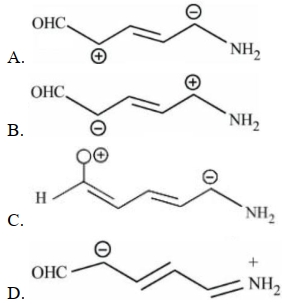
The increasing order of stability of the resonance structures is:
A
$C, D, B, A$
B
$C, A, B, D$
C
$D, C, A, B$
D
$D, C, B, A$
Solution
(D) The stability of resonance structures is determined by the following rules:
$1$. Structures with more covalent bonds are more stable.
$2$. Structures with complete octets for all atoms are more stable.
$3$. Structures with negative charge on more electronegative atoms and positive charge on less electronegative atoms are more stable.
$4$. Structures with like charges on adjacent atoms are less stable.
Analyzing the structures:
- Structure $D$ is the most stable because all atoms (including $N$ and $O$) have complete octets.
- Structure $A$ has a negative charge on $C$ and a positive charge on $C$,which is less stable than $D$.
- Structure $B$ has a positive charge on $C$ and a negative charge on $C$,but the separation of charges is less favorable than in $D$.
- Structure $C$ is the least stable because it has a positive charge on the highly electronegative oxygen atom.
Comparing the options,the increasing order of stability is $C < D < B < A$ is not explicitly listed,but based on standard resonance stability rules,the correct sequence is $C < D < B < A$. Re-evaluating the provided options,the most logical sequence following standard stability rules is $D < C < B < A$.
$1$. Structures with more covalent bonds are more stable.
$2$. Structures with complete octets for all atoms are more stable.
$3$. Structures with negative charge on more electronegative atoms and positive charge on less electronegative atoms are more stable.
$4$. Structures with like charges on adjacent atoms are less stable.
Analyzing the structures:
- Structure $D$ is the most stable because all atoms (including $N$ and $O$) have complete octets.
- Structure $A$ has a negative charge on $C$ and a positive charge on $C$,which is less stable than $D$.
- Structure $B$ has a positive charge on $C$ and a negative charge on $C$,but the separation of charges is less favorable than in $D$.
- Structure $C$ is the least stable because it has a positive charge on the highly electronegative oxygen atom.
Comparing the options,the increasing order of stability is $C < D < B < A$ is not explicitly listed,but based on standard resonance stability rules,the correct sequence is $C < D < B < A$. Re-evaluating the provided options,the most logical sequence following standard stability rules is $D < C < B < A$.
0 likes
View Solution159
MediumMCQ
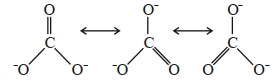
Resonance in carbonate ion $CO_3^{2-}$ is shown below. Which of the following statements is true?
A
It is possible to identify each structure individually by some physical or chemical method.
B
All these structures are in dynamic equilibrium with each other.
C
Each structure exists for an equal amount of time.
D
$CO_3^{2-}$ has a single structure,i.e.,the resonance hybrid of the above three structures.
Solution
(D) Resonating structures are hypothetical and do not exist in reality.
Resonance hybrid is the real structure which is the weighted average of all the resonating structures.
Therefore,the $CO_3^{2-}$ ion exists as a single resonance hybrid structure.
Resonance hybrid is the real structure which is the weighted average of all the resonating structures.
Therefore,the $CO_3^{2-}$ ion exists as a single resonance hybrid structure.
0 likes
View Solution160
DifficultMCQ
The difference in energy between the actual structure and the lowest energy resonance structure for the given compound is
A
electromeric energy
B
resonance energy
C
ionization energy
D
hyperconjugation energy
Solution
(B) The difference in energy between the actual structure and the lowest energy resonance structure for the given compound is known as resonance energy.
0 likes
View Solution161
MediumMCQ
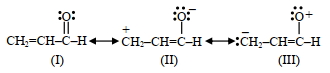
The relative stability of the contributing structures is:
A
$I > III > II$
B
$I > II > III$
C
$II > I > III$
D
$III > II > I$
Solution
(B) $(1)$ Neutral structures are more stable than charged ones. Therefore,structure $I$ is more stable than structures $II$ and $III$.
$(2)$ In charged structures,a positive charge on a less electronegative atom is more stable. In structure $II$,the positive charge is on the carbon atom $(C^{\oplus})$,whereas in structure $III$,the positive charge is on the oxygen atom $(O^{\oplus})$. Since carbon is less electronegative than oxygen,structure $II$ is more stable than structure $III$.
$\therefore$ The order of stability is $I > II > III$.
$(2)$ In charged structures,a positive charge on a less electronegative atom is more stable. In structure $II$,the positive charge is on the carbon atom $(C^{\oplus})$,whereas in structure $III$,the positive charge is on the oxygen atom $(O^{\oplus})$. Since carbon is less electronegative than oxygen,structure $II$ is more stable than structure $III$.
$\therefore$ The order of stability is $I > II > III$.
0 likes
View Solution162
MediumMCQ
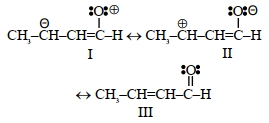
The correct stability order of the following resonance structures of $CH_3-CH=CH-CHO$ is:
A
$II > III > I$
B
$III > II > I$
C
$I > II > III$
D
$II > I > III$
Solution
(B) The stability of resonance structures is determined by the following rules:
$1$. Structures with more covalent bonds are more stable.
$2$. Structures with complete octets for all atoms are more stable.
$3$. Structures with negative charge on a more electronegative atom and positive charge on a less electronegative atom are more stable.
Analyzing the given structures:
- Structure $III$ $(CH_3-CH=CH-CHO)$ is a non-polar structure with the maximum number of covalent bonds and complete octets for all atoms,making it the most stable.
- Structure $II$ $(CH_3-CH^+-CH=CH-O^-)$ has a negative charge on the oxygen atom,which is more electronegative than carbon,making it more stable than structure $I$.
- Structure $I$ $(CH_3-CH^--CH=CH-O^+)$ has a negative charge on a carbon atom and a positive charge on an oxygen atom,which is unfavorable due to the electronegativity difference,making it the least stable.
Therefore,the correct stability order is $III > II > I$.
$1$. Structures with more covalent bonds are more stable.
$2$. Structures with complete octets for all atoms are more stable.
$3$. Structures with negative charge on a more electronegative atom and positive charge on a less electronegative atom are more stable.
Analyzing the given structures:
- Structure $III$ $(CH_3-CH=CH-CHO)$ is a non-polar structure with the maximum number of covalent bonds and complete octets for all atoms,making it the most stable.
- Structure $II$ $(CH_3-CH^+-CH=CH-O^-)$ has a negative charge on the oxygen atom,which is more electronegative than carbon,making it more stable than structure $I$.
- Structure $I$ $(CH_3-CH^--CH=CH-O^+)$ has a negative charge on a carbon atom and a positive charge on an oxygen atom,which is unfavorable due to the electronegativity difference,making it the least stable.
Therefore,the correct stability order is $III > II > I$.
0 likes
View Solution163
MediumMCQ
Identify the correct statement.
A
$BF_3$ has a non-zero dipole moment.
B
The dipole moment of $NF_3$ is greater than that of $NH_3$.
C
Three canonical forms can be drawn for the $CO_3^{2-}$ ion.
D
Three resonance structures can be drawn for ozone.
Solution
(C) $1$. $BF_3$ is a trigonal planar molecule with a symmetric structure,so its net dipole moment is $0$. Thus,option $A$ is incorrect.
$2$. In $NH_3$,the dipole moments of $N-H$ bonds and the lone pair are in the same direction,leading to a higher dipole moment. In $NF_3$,the dipole moments of $N-F$ bonds are in the opposite direction to the lone pair,resulting in a lower net dipole moment. Thus,$NH_3 > NF_3$. Option $B$ is incorrect.
$3$. The carbonate ion $(CO_3^{2-})$ has three equivalent resonance structures (canonical forms) where the double bond is delocalized among the three oxygen atoms. Thus,option $C$ is correct.
$4$. Ozone $(O_3)$ has two equivalent resonance structures. Thus,option $D$ is incorrect.
$2$. In $NH_3$,the dipole moments of $N-H$ bonds and the lone pair are in the same direction,leading to a higher dipole moment. In $NF_3$,the dipole moments of $N-F$ bonds are in the opposite direction to the lone pair,resulting in a lower net dipole moment. Thus,$NH_3 > NF_3$. Option $B$ is incorrect.
$3$. The carbonate ion $(CO_3^{2-})$ has three equivalent resonance structures (canonical forms) where the double bond is delocalized among the three oxygen atoms. Thus,option $C$ is correct.
$4$. Ozone $(O_3)$ has two equivalent resonance structures. Thus,option $D$ is incorrect.
0 likes
View Solution164
DifficultMCQ
Among the following,the least stable resonance structure is
A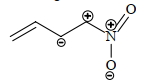
B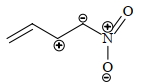
C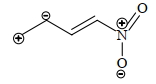
D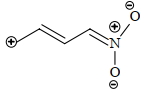
Solution
(A) The stability of resonance structures is determined by several factors,including the number of covalent bonds,the presence of complete octets,and the separation of formal charges.
According to the rules of resonance,structures with like charges on adjacent atoms are highly unstable due to strong electrostatic repulsion.
In structure $A$,a positive charge is placed on the carbon atom adjacent to the nitrogen atom,which already bears a formal positive charge. This proximity of two positive charges makes the structure highly unstable compared to others where charges are separated by greater distances or are opposite in nature.
According to the rules of resonance,structures with like charges on adjacent atoms are highly unstable due to strong electrostatic repulsion.
In structure $A$,a positive charge is placed on the carbon atom adjacent to the nitrogen atom,which already bears a formal positive charge. This proximity of two positive charges makes the structure highly unstable compared to others where charges are separated by greater distances or are opposite in nature.
0 likes
View Solution165
DifficultMCQ
The correct stability order of the following resonance structures is:

A
$I > II > IV > III$
B
$I > III > II > IV$
C
$II > I > III > IV$
D
$III > I > IV > II$
Solution
(B) To determine the stability of resonance structures,we follow these rules:
$1$. Structures with more covalent bonds are more stable (complete octets).
$2$. Structures with fewer formal charges are more stable.
$3$. Negative charges should be on more electronegative atoms,and positive charges on less electronegative atoms.
Analyzing the structures:
$(I)$ $H_2C=N^+=N^-$: Has $4$ bonds,octets are complete for all atoms. It is the most stable.
$(III)$ $H_2C^--N^+=N$: Has $4$ bonds,but the negative charge is on the carbon atom (less electronegative than nitrogen). It is the next most stable.
$(II)$ $H_2C^+-N=N^-$: Has $3$ bonds,carbon has an incomplete octet. Less stable.
$(IV)$ $H_2C^--N=N^+$: Has $3$ bonds,nitrogen has an incomplete octet. Least stable.
Thus,the correct order is $I > III > II > IV$.
$1$. Structures with more covalent bonds are more stable (complete octets).
$2$. Structures with fewer formal charges are more stable.
$3$. Negative charges should be on more electronegative atoms,and positive charges on less electronegative atoms.
Analyzing the structures:
$(I)$ $H_2C=N^+=N^-$: Has $4$ bonds,octets are complete for all atoms. It is the most stable.
$(III)$ $H_2C^--N^+=N$: Has $4$ bonds,but the negative charge is on the carbon atom (less electronegative than nitrogen). It is the next most stable.
$(II)$ $H_2C^+-N=N^-$: Has $3$ bonds,carbon has an incomplete octet. Less stable.
$(IV)$ $H_2C^--N=N^+$: Has $3$ bonds,nitrogen has an incomplete octet. Least stable.
Thus,the correct order is $I > III > II > IV$.
0 likes
View Solution166
DifficultMCQ
The correct statement$(s)$ about $O_3$ is (are)
$A$. $O-O$ bond lengths are equal.
$B$. Thermal decomposition of $O_3$ is endothermic.
$C$. $O_3$ is diamagnetic in nature.
$D$. $O_3$ has a bent structure.
$A$. $O-O$ bond lengths are equal.
$B$. Thermal decomposition of $O_3$ is endothermic.
$C$. $O_3$ is diamagnetic in nature.
$D$. $O_3$ has a bent structure.
A
$A, B, C$
B
$A, B, D$
C
$A, C, D$
D
$B, C, D$
Solution
(C) . Due to resonance,the two $O-O$ bond lengths in $O_3$ are equal $(1.28 \ \mathring{A})$. This statement is correct.
$B$. The formation of $O_3$ from $O_2$ is endothermic $(3O_2 \rightarrow 2O_3, \Delta H = +142 \ \text{kJ/mol})$. Therefore,the decomposition of $O_3$ into $O_2$ is exothermic. This statement is incorrect.
$C$. In $O_3$,all electrons are paired,making it diamagnetic. This statement is correct.
$D$. $O_3$ has a bent structure with a bond angle of approximately $117^\circ$. This statement is correct.
Thus,the correct statements are $A, C, D$.
$B$. The formation of $O_3$ from $O_2$ is endothermic $(3O_2 \rightarrow 2O_3, \Delta H = +142 \ \text{kJ/mol})$. Therefore,the decomposition of $O_3$ into $O_2$ is exothermic. This statement is incorrect.
$C$. In $O_3$,all electrons are paired,making it diamagnetic. This statement is correct.
$D$. $O_3$ has a bent structure with a bond angle of approximately $117^\circ$. This statement is correct.
Thus,the correct statements are $A, C, D$.
0 likes
View Solution167
DifficultMCQ
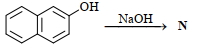
The number of resonance structures for $N$ is
A
$7$
B
$8$
C
$9$
D
$0$
Solution
(C) The reaction of $2$-naphthol with $NaOH$ produces the $2$-naphthoxide ion $(N)$.
The $2$-naphthoxide ion is a resonance-stabilized species.
By drawing all possible resonance structures for the $2$-naphthoxide ion,we find that there are $9$ distinct resonance structures.
These structures involve the delocalization of the negative charge from the oxygen atom into the naphthalene ring system,creating various keto-enolate forms.
Therefore,the total number of resonance structures for $N$ is $9$.
The $2$-naphthoxide ion is a resonance-stabilized species.
By drawing all possible resonance structures for the $2$-naphthoxide ion,we find that there are $9$ distinct resonance structures.
These structures involve the delocalization of the negative charge from the oxygen atom into the naphthalene ring system,creating various keto-enolate forms.
Therefore,the total number of resonance structures for $N$ is $9$.
0 likes
View Solution168
MediumMCQ
Given below are two statements :
Statement $I$ : Experimentally determined oxygen-oxygen bond lengths in the $O_3$ are found to be same and the bond length is greater than that of a $O=O$ (double bond) but less than that of a single $(O-O)$ bond.
Statement $II$ : The strong lone pair-lone pair repulsion between oxygen atoms is solely responsible for the fact that the bond length in ozone is smaller than that of a double bond $(O=O)$ but more than that of a single bond $(O-O)$.
In the light of the above statements,choose the correct answer from the options given below:
Statement $I$ : Experimentally determined oxygen-oxygen bond lengths in the $O_3$ are found to be same and the bond length is greater than that of a $O=O$ (double bond) but less than that of a single $(O-O)$ bond.
Statement $II$ : The strong lone pair-lone pair repulsion between oxygen atoms is solely responsible for the fact that the bond length in ozone is smaller than that of a double bond $(O=O)$ but more than that of a single bond $(O-O)$.
In the light of the above statements,choose the correct answer from the options given below:
A
Statement $I$ is true but Statement $II$ is false
B
Both Statement $I$ and Statement $II$ are true
C
Both Statement $I$ and Statement $II$ are false
D
Statement $I$ is false but Statement $II$ is true
Solution
(A) In the ozone molecule $(O_3)$,the two oxygen-oxygen bonds are equivalent due to resonance. The actual bond length is an average of the single and double bond lengths,making it intermediate between the two. Thus,Statement $I$ is true.
Statement $II$ is false because the intermediate bond length is primarily due to resonance (delocalization of electrons),not solely due to lone pair-lone pair repulsion.
Statement $II$ is false because the intermediate bond length is primarily due to resonance (delocalization of electrons),not solely due to lone pair-lone pair repulsion.
0 likes
View Solution169
MediumMCQ
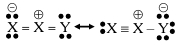
Resonance in $X_2Y$ can be represented as shown in the image. The enthalpy of formation of $X_2Y$ $(X \equiv X(g) + \frac{1}{2} Y = Y(g) \rightarrow X_2Y(g))$ is $80 \ kJ \ mol^{-1}$. The magnitude of resonance energy of $X_2Y$ is $......... \ kJ \ mol^{-1}$ (nearest integer value). Given: Bond energies of $X \equiv X, X=X, Y=Y$ and $X=Y$ are $940, 410, 500$ and $602 \ kJ \ mol^{-1}$ respectively. Valence $X: 3, Y: 2$.
A
$98$
B
$99$
C
$95$
D
$96$
Solution
(A) The resonance energy is calculated as $\Delta H_{R.E.} = \Delta H_{f(exp)} - \Delta H_{f(theo)}$.
Given $\Delta H_{f(exp)} = 80 \ kJ \ mol^{-1}$.
For the theoretical enthalpy of formation,we consider the reaction: $X \equiv X(g) + \frac{1}{2} Y = Y(g) \rightarrow X=X=Y(g)$.
$\Delta H_{f(theo)} = (BE_{X \equiv X} + \frac{1}{2} BE_{Y=Y}) - (BE_{X=X} + BE_{X=Y})$.
Substituting the given values: $\Delta H_{f(theo)} = (940 + \frac{1}{2} \times 500) - (410 + 602)$.
$\Delta H_{f(theo)} = (940 + 250) - (1012) = 1190 - 1012 = 178 \ kJ \ mol^{-1}$.
Now,$\Delta H_{R.E.} = 80 - 178 = -98 \ kJ \ mol^{-1}$.
The magnitude of resonance energy is $|-98| = 98 \ kJ \ mol^{-1}$.
Given $\Delta H_{f(exp)} = 80 \ kJ \ mol^{-1}$.
For the theoretical enthalpy of formation,we consider the reaction: $X \equiv X(g) + \frac{1}{2} Y = Y(g) \rightarrow X=X=Y(g)$.
$\Delta H_{f(theo)} = (BE_{X \equiv X} + \frac{1}{2} BE_{Y=Y}) - (BE_{X=X} + BE_{X=Y})$.
Substituting the given values: $\Delta H_{f(theo)} = (940 + \frac{1}{2} \times 500) - (410 + 602)$.
$\Delta H_{f(theo)} = (940 + 250) - (1012) = 1190 - 1012 = 178 \ kJ \ mol^{-1}$.
Now,$\Delta H_{R.E.} = 80 - 178 = -98 \ kJ \ mol^{-1}$.
The magnitude of resonance energy is $|-98| = 98 \ kJ \ mol^{-1}$.
0 likes
View Solution170
MediumMCQ
The least stable resonating structure of ethyl acetate is $:-$
A
$CH_3-C(=O)-O-CH_2-CH_3$
B
$CH_3-C(=O^+)-O^--CH_2-CH_3$
C
$CH_3-C(O^-)(^+)-O-CH_2-CH_3$
D
$CH_3-C(O^+)(^-)-O-CH_2-CH_3$
Solution
(D) The stability of resonating structures is determined by the following rules:
$1$. Structures with more covalent bonds are more stable.
$2$. Structures with complete octets for all atoms are more stable.
$3$. Structures with negative charge on more electronegative atoms and positive charge on less electronegative atoms are more stable.
$4$. Structures with like charges on adjacent atoms are highly unstable due to electrostatic repulsion.
In option $D$,the carbon atom has a negative charge while the adjacent oxygen atom has a positive charge. This creates a highly unstable structure due to the separation of charges and the presence of a negative charge on a less electronegative atom (carbon) adjacent to a positive charge on a more electronegative atom (oxygen). Therefore,option $D$ is the least stable.
$1$. Structures with more covalent bonds are more stable.
$2$. Structures with complete octets for all atoms are more stable.
$3$. Structures with negative charge on more electronegative atoms and positive charge on less electronegative atoms are more stable.
$4$. Structures with like charges on adjacent atoms are highly unstable due to electrostatic repulsion.
In option $D$,the carbon atom has a negative charge while the adjacent oxygen atom has a positive charge. This creates a highly unstable structure due to the separation of charges and the presence of a negative charge on a less electronegative atom (carbon) adjacent to a positive charge on a more electronegative atom (oxygen). Therefore,option $D$ is the least stable.
0 likes
View Solution171
MediumMCQ
The $S-O$ and $P-O$ bond order in $SO_4^{2-}$ and $PO_4^{3-}$ are respectively:
A
$1.25 \& 1.33$
B
$1.5 \& 1.25$
C
$2 \& 2$
D
$1.7 \& 1.5$
Solution
(B) The bond order can be calculated using the formula: $Bond \ Order = \frac{\text{Total number of bonds}}{\text{Total number of resonating structures or terminal atoms}}$.
For $SO_4^{2-}$,there are $6$ bonds distributed over $4$ oxygen atoms,so $Bond \ Order = \frac{6}{4} = 1.5$.
For $PO_4^{3-}$,there are $5$ bonds distributed over $4$ oxygen atoms,so $Bond \ Order = \frac{5}{4} = 1.25$.
Thus,the bond orders are $1.5$ and $1.25$ respectively.
For $SO_4^{2-}$,there are $6$ bonds distributed over $4$ oxygen atoms,so $Bond \ Order = \frac{6}{4} = 1.5$.
For $PO_4^{3-}$,there are $5$ bonds distributed over $4$ oxygen atoms,so $Bond \ Order = \frac{5}{4} = 1.25$.
Thus,the bond orders are $1.5$ and $1.25$ respectively.
0 likes
View Solution172
MediumMCQ
Select the correct statement about $HCO_3^-$:
A
Formal charge on all the $O$ atoms is the same.
B
Bond order of all $C-O$ bonds is the same.
C
Bicarbonate ion is nonpolar.
D
All $C-O$ bond lengths are not equivalent.
Solution
(D) The structure of the bicarbonate ion $(HCO_3^-)$ shows that it has one $C=O$ double bond,one $C-OH$ single bond,and one $C-O^-$ single bond.
Due to the presence of different types of $C-O$ bonds,the bond lengths are not equivalent.
Since the molecule is asymmetric and has a net dipole moment,it is a polar ion.
The formal charges on the oxygen atoms differ because they are in different chemical environments (one is part of a carbonyl group,one is hydroxyl,and one is an oxide ion).
Therefore,the statement that all $C-O$ bond lengths are not equivalent is correct.
Due to the presence of different types of $C-O$ bonds,the bond lengths are not equivalent.
Since the molecule is asymmetric and has a net dipole moment,it is a polar ion.
The formal charges on the oxygen atoms differ because they are in different chemical environments (one is part of a carbonyl group,one is hydroxyl,and one is an oxide ion).
Therefore,the statement that all $C-O$ bond lengths are not equivalent is correct.
0 likes
View Solution173
MediumMCQ
Which statement is true regarding the $PO_4^{3-}$ ion?
$A$. In $PO_4^{3-}$ ion,the $P-O$ bond order is $1.25$.
$B$. In $PO_4^{3-}$,the formal charge on each $O$ atom is $-0.75$.
$C$. $PO_4^{3-}$ shows four resonating structures.
$A$. In $PO_4^{3-}$ ion,the $P-O$ bond order is $1.25$.
$B$. In $PO_4^{3-}$,the formal charge on each $O$ atom is $-0.75$.
$C$. $PO_4^{3-}$ shows four resonating structures.
A
$A, B$
B
$A, B, C$
C
$A, C$
D
$B, C$
Solution
(B) $1$. The total number of valence electrons in $PO_4^{3-}$ is $5 + (4 \times 6) + 3 = 32$.
$2$. The structure of $PO_4^{3-}$ involves one $P=O$ double bond and three $P-O$ single bonds in its Lewis structure. The total number of bonds is $5$. The number of $P-O$ linkages is $4$. Bond order = $\frac{\text{Total number of bonds}}{\text{Number of resonating bonds}} = \frac{5}{4} = 1.25$. Thus,statement $A$ is true.
$3$. The formal charge on each oxygen atom is calculated as: $\frac{\text{Total charge}}{\text{Number of oxygen atoms}} = \frac{-3}{4} = -0.75$. Thus,statement $B$ is true.
$4$. $PO_4^{3-}$ has four equivalent resonance structures corresponding to the four different positions of the $P=O$ double bond. Thus,statement $C$ is true.
$2$. The structure of $PO_4^{3-}$ involves one $P=O$ double bond and three $P-O$ single bonds in its Lewis structure. The total number of bonds is $5$. The number of $P-O$ linkages is $4$. Bond order = $\frac{\text{Total number of bonds}}{\text{Number of resonating bonds}} = \frac{5}{4} = 1.25$. Thus,statement $A$ is true.
$3$. The formal charge on each oxygen atom is calculated as: $\frac{\text{Total charge}}{\text{Number of oxygen atoms}} = \frac{-3}{4} = -0.75$. Thus,statement $B$ is true.
$4$. $PO_4^{3-}$ has four equivalent resonance structures corresponding to the four different positions of the $P=O$ double bond. Thus,statement $C$ is true.
0 likes
View Solution174
DifficultMCQ
What is the number of Lewis structures for $NO_2^{-}$?
A
$1$
B
$2$
C
$3$
D
$4$
Solution
(B) The nitrite ion,$NO_2^{-}$,exhibits resonance.
There are two equivalent Lewis structures that can be drawn for $NO_2^{-}$,where the double bond alternates between the two nitrogen-oxygen bonds.
These two structures are shown in the provided image,representing the resonance contributors of the ion.
There are two equivalent Lewis structures that can be drawn for $NO_2^{-}$,where the double bond alternates between the two nitrogen-oxygen bonds.
These two structures are shown in the provided image,representing the resonance contributors of the ion.
0 likes
View Solution175
EasyMCQ
What is the carbon-carbon bond length in benzene (in $pm$)?
A
$154$
B
$120$
C
$144$
D
$139$
Solution
(D) In benzene $(C_6H_6)$, all carbon-carbon bonds are equivalent due to resonance.
The bond order is $1.5$, which results in a bond length of approximately $139 \ pm$ (or $1.39 \ \mathring{A}$), intermediate between a single bond $(154 \ pm)$ and a double bond $(134 \ pm)$.
The bond order is $1.5$, which results in a bond length of approximately $139 \ pm$ (or $1.39 \ \mathring{A}$), intermediate between a single bond $(154 \ pm)$ and a double bond $(134 \ pm)$.
0 likes
View Solution176
DifficultMCQ
In the resonance hybrid of an ozone $(O_3)$ molecule, the $O-O$ bond length is: (in $pm$)
A
$128$
B
$134.5$
C
$121$
D
$148$
Solution
(A) The ozone molecule $(O_3)$ exhibits resonance, where the two canonical forms contribute to the resonance hybrid.
In the resonance hybrid, the two $O-O$ bonds are equivalent due to the delocalization of $\pi$ electrons.
The experimental bond length for both $O-O$ bonds in the ozone molecule is $128 \ pm$, which is intermediate between the length of a single bond $(148 \ pm)$ and a double bond $(121 \ pm)$.
In the resonance hybrid, the two $O-O$ bonds are equivalent due to the delocalization of $\pi$ electrons.
The experimental bond length for both $O-O$ bonds in the ozone molecule is $128 \ pm$, which is intermediate between the length of a single bond $(148 \ pm)$ and a double bond $(121 \ pm)$.
0 likes
View Solution177
MediumMCQ
What is the $O-O$ bond length in the resonance hybrid of ozone (in $pm$)?
A
$131$
B
$121$
C
$128$
D
$148$
Solution
(C) In the ozone molecule $(O_3)$, the two $O-O$ bonds are equivalent due to resonance.
The resonance hybrid structure shows that both $O-O$ bonds have a bond length of $128 \ pm$ and a bond angle of $117^{\circ}$.
The resonance hybrid structure shows that both $O-O$ bonds have a bond length of $128 \ pm$ and a bond angle of $117^{\circ}$.
0 likes
View Solution178
EasyMCQ
Resonance is $\underline{\text{NOT}}$ exhibited by
A
cyclohexane
B
aniline
C
nitrobenzene
D
phenol
Solution
(A) Resonance requires a conjugated system of $\pi$ bonds,such as alternating single and double bonds or the presence of lone pairs adjacent to a $\pi$ system.
$1$. $Aniline$,$nitrobenzene$,and $phenol$ all contain a benzene ring,which is a conjugated system of $\pi$ electrons,allowing for resonance.
$2$. $Cyclohexane$ $(C_6H_{12})$ is a saturated cyclic hydrocarbon where all carbon atoms are $sp^3$ hybridized and connected by single $\sigma$ bonds.
$3$. Since $cyclohexane$ lacks any $\pi$ bonds or a conjugated system,it does not exhibit resonance.
$1$. $Aniline$,$nitrobenzene$,and $phenol$ all contain a benzene ring,which is a conjugated system of $\pi$ electrons,allowing for resonance.
$2$. $Cyclohexane$ $(C_6H_{12})$ is a saturated cyclic hydrocarbon where all carbon atoms are $sp^3$ hybridized and connected by single $\sigma$ bonds.
$3$. Since $cyclohexane$ lacks any $\pi$ bonds or a conjugated system,it does not exhibit resonance.
0 likes
View Solution179
DifficultMCQ
What is the $O-O$ bond length in the ozone $(O_3)$ molecule (in $pm$)?
A
$128$
B
$117$
C
$107$
D
$134$
Solution
(A) The ozone $(O_3)$ molecule is a resonance hybrid of two canonical structures.
Due to resonance, both $O-O$ bonds in the ozone molecule are equivalent.
The experimental bond length for both $O-O$ bonds in the resonance hybrid of ozone is $128 \ pm$.
Due to resonance, both $O-O$ bonds in the ozone molecule are equivalent.
The experimental bond length for both $O-O$ bonds in the resonance hybrid of ozone is $128 \ pm$.
0 likes
View Solution180
EasyMCQ
The correct arrangement of the species in the decreasing order of the bond length between carbon and oxygen in them is
A
$CO_{2}, HCO_{2}^{-}, CO, CO_{3}^{2-}$
B
$CO, CO_{3}^{2-}, CO_{2}, HCO_{2}^{-}$
C
$CO, CO_{2}, HCO_{2}^{-}, CO_{3}^{2-}$
D
$CO_{3}^{2-}, HCO_{2}^{-}, CO_{2}, CO$
Solution
(D) We know that $\text{Bond order} \propto \frac{1}{\text{Bond length}}$.
$CO$ molecule has a bond order of $3$ $(C\equiv O)$.
$CO_{2}$ molecule has a bond order of $2$ $(O=C=O)$.
$HCO_{2}^{-}$ (formate ion) has a resonance hybrid with a bond order of $1.5$.
$CO_{3}^{2-}$ (carbonate ion) has a resonance hybrid with a bond order of $1.33$.
Since bond order is inversely proportional to bond length,the decreasing order of bond length is: $CO_{3}^{2-} (1.33) > HCO_{2}^{-} (1.5) > CO_{2} (2) > CO (3)$.
$CO$ molecule has a bond order of $3$ $(C\equiv O)$.
$CO_{2}$ molecule has a bond order of $2$ $(O=C=O)$.
$HCO_{2}^{-}$ (formate ion) has a resonance hybrid with a bond order of $1.5$.
$CO_{3}^{2-}$ (carbonate ion) has a resonance hybrid with a bond order of $1.33$.
Since bond order is inversely proportional to bond length,the decreasing order of bond length is: $CO_{3}^{2-} (1.33) > HCO_{2}^{-} (1.5) > CO_{2} (2) > CO (3)$.
0 likes
View Solution181
MediumMCQ
Which of the following statements is correct about $CO_3^{2-}$ ?
$A$. The hybridisation of the central atom is $sp^3$.
$B$. Its resonance structure has one $C-O$ single bond and two $C=O$ double bonds.
$C$. The average formal charge on each oxygen atom is $0.67$ units.
$D$. All $C-O$ bond lengths are equal.
$A$. The hybridisation of the central atom is $sp^3$.
$B$. Its resonance structure has one $C-O$ single bond and two $C=O$ double bonds.
$C$. The average formal charge on each oxygen atom is $0.67$ units.
$D$. All $C-O$ bond lengths are equal.
A
$A$
B
$A$ and $C$
C
$B$ and $D$
D
$C$ and $D$
Solution
(D) The hybridisation of the central carbon atom is $sp^2$ (trigonal planar geometry).
Since a net charge of $-2$ is delocalized over $3$ oxygen atoms,the average formal charge on each oxygen atom is $|-2/3| = 0.67$ units.
Due to resonance,the $C-O$ bonds are not fixed as single or double,and therefore,all $C-O$ bond lengths are equal.
Thus,statements $C$ and $D$ are correct.
Since a net charge of $-2$ is delocalized over $3$ oxygen atoms,the average formal charge on each oxygen atom is $|-2/3| = 0.67$ units.
Due to resonance,the $C-O$ bonds are not fixed as single or double,and therefore,all $C-O$ bond lengths are equal.
Thus,statements $C$ and $D$ are correct.
0 likes
View Solution182
EasyMCQ
The correct order of sulphur-oxygen bond order in $SO_3$,$S_2O_3^{2-}$,and $SO_4^{2-}$ is:
A
$SO_4^{2-} < S_2O_3^{2-} < SO_3$
B
$SO_4^{2-} < SO_3 < S_2O_3^{2-}$
C
$S_2O_3^{2-} < SO_4^{2-} < SO_3$
D
$S_2O_3^{2-} < SO_3 < SO_4^{2-}$
Solution
(C) The bond order is calculated as the total number of bonds divided by the number of resonating structures or the number of terminal atoms.
$1$. For $SO_3$: The structure has $3$ resonance hybrids where $6$ bonds are distributed over $3$ $S-O$ positions. Bond order $= \frac{6}{3} = 2.0$.
$2$. For $SO_4^{2-}$: The structure has $4$ equivalent $S-O$ bonds with a total of $6$ bonds in the resonance hybrid. Bond order $= \frac{6}{4} = 1.5$.
$3$. For $S_2O_3^{2-}$: The structure involves a central sulphur atom bonded to three oxygen atoms and one sulphur atom. The resonance involves $4$ bonds distributed over $3$ $S-O$ positions. Bond order $= \frac{4}{3} \approx 1.33$.
Comparing the values: $1.33 < 1.5 < 2.0$.
Thus,the correct order is $S_2O_3^{2-} < SO_4^{2-} < SO_3$.
$1$. For $SO_3$: The structure has $3$ resonance hybrids where $6$ bonds are distributed over $3$ $S-O$ positions. Bond order $= \frac{6}{3} = 2.0$.
$2$. For $SO_4^{2-}$: The structure has $4$ equivalent $S-O$ bonds with a total of $6$ bonds in the resonance hybrid. Bond order $= \frac{6}{4} = 1.5$.
$3$. For $S_2O_3^{2-}$: The structure involves a central sulphur atom bonded to three oxygen atoms and one sulphur atom. The resonance involves $4$ bonds distributed over $3$ $S-O$ positions. Bond order $= \frac{4}{3} \approx 1.33$.
Comparing the values: $1.33 < 1.5 < 2.0$.
Thus,the correct order is $S_2O_3^{2-} < SO_4^{2-} < SO_3$.
0 likes
View Solution183
MediumMCQ
The stability order of the following resonance structures is:
$I. CH_2=CH-CH=O$
$II. CH_2^+-CH=CH-O^-$
$III. CH_2^--CH=CH-O^+$
$I. CH_2=CH-CH=O$
$II. CH_2^+-CH=CH-O^-$
$III. CH_2^--CH=CH-O^+$
A
$III < II < I$
B
$II > I > III$
C
$II < I < III$
D
$II > III > I$
Solution
(A) $(I)$ is a neutral structure with a complete octet for all atoms,making it the most stable resonance structure.
Between $(II)$ and $(III)$,structure $(II)$ places a negative charge on the more electronegative oxygen atom,whereas structure $(III)$ places a positive charge on the oxygen atom.
Since a more electronegative atom is more stable with a negative charge,$(II)$ is more stable than $(III)$.
Therefore,the stability order is $III < II < I$.
Hence,option $(A)$ is correct.
Between $(II)$ and $(III)$,structure $(II)$ places a negative charge on the more electronegative oxygen atom,whereas structure $(III)$ places a positive charge on the oxygen atom.
Since a more electronegative atom is more stable with a negative charge,$(II)$ is more stable than $(III)$.
Therefore,the stability order is $III < II < I$.
Hence,option $(A)$ is correct.
0 likes
View Solution184
MediumMCQ
The number of resonance structures that aniline and anilinium ion can have are respectively:
A
$5, 2$
B
$4, 5$
C
$3, 4$
D
$2, 5$
Solution
(A) Aniline $(C_6H_5NH_2)$ has a lone pair on the nitrogen atom which is in conjugation with the benzene ring. This allows for the delocalization of the lone pair into the ring,resulting in $5$ resonance structures (one original structure + $4$ canonical forms).
In the anilinium ion $(C_6H_5NH_3^+)$,the nitrogen atom has a positive charge and no lone pair available for conjugation with the benzene ring. Therefore,the only resonance structures possible are the $2$ Kekulé structures of the benzene ring itself.
In the anilinium ion $(C_6H_5NH_3^+)$,the nitrogen atom has a positive charge and no lone pair available for conjugation with the benzene ring. Therefore,the only resonance structures possible are the $2$ Kekulé structures of the benzene ring itself.
0 likes
View Solution185
MediumMCQ
The correct order of $C-O$ bond length is:
A
$CO_2 < CO_3^{2-} < CO$
B
$CO < CO_3^{2-} < CO_2$
C
$CO_3^{2-} < CO_2 < CO$
D
$CO < CO_2 < CO_3^{2-}$
Solution
(D) We know that bond length $\propto \frac{1}{\text{bond order}}$.
Thus,a higher bond order corresponds to a shorter bond length.
The bond order can be calculated as the average number of bonds per resonance structure.
For $CO$ (carbon monoxide),the bond order is $3$.
For $CO_2$ (carbon dioxide),the bond order is $2$.
For $CO_3^{2-}$ (carbonate ion),the bond order is $\frac{4}{3} \approx 1.33$.
Since the bond order follows the order $CO > CO_2 > CO_3^{2-}$,the bond length follows the inverse order:
$CO < CO_2 < CO_3^{2-}$.
Thus,a higher bond order corresponds to a shorter bond length.
The bond order can be calculated as the average number of bonds per resonance structure.
For $CO$ (carbon monoxide),the bond order is $3$.
For $CO_2$ (carbon dioxide),the bond order is $2$.
For $CO_3^{2-}$ (carbonate ion),the bond order is $\frac{4}{3} \approx 1.33$.
Since the bond order follows the order $CO > CO_2 > CO_3^{2-}$,the bond length follows the inverse order:
$CO < CO_2 < CO_3^{2-}$.
0 likes
View Solution186
MediumMCQ
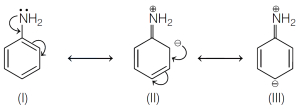
The order of stability of the resonance structures given below is:
A
$I > II > III$
B
$I > III > II$
C
$II > I > III$
D
$III > II > I$
Solution
(A) Non-charged molecular species are the most stable. Therefore,structure $(I)$ has the maximum stability.
In the charged resonating structures $(II)$ and $(III)$,the stability depends on the distance between the positive and negative charges.
Structure $(II)$ has the negative charge at the ortho position relative to the positive charge,while structure $(III)$ has the negative charge at the para position.
Since the distance between the opposite charges is smaller in $(II)$ than in $(III)$,the electrostatic attraction is stronger in $(II)$.
Thus,the stability order is $I > II > III$.
In the charged resonating structures $(II)$ and $(III)$,the stability depends on the distance between the positive and negative charges.
Structure $(II)$ has the negative charge at the ortho position relative to the positive charge,while structure $(III)$ has the negative charge at the para position.
Since the distance between the opposite charges is smaller in $(II)$ than in $(III)$,the electrostatic attraction is stronger in $(II)$.
Thus,the stability order is $I > II > III$.
0 likes
View Solution187
EasyMCQ
The two bonds $N=O$ and $N-O$ in $CH_3NO_2$ have the same bond length due to:
A
inductive effect
B
hyperconjugation
C
electromeric effect
D
resonance effect
Solution
(D) In nitromethane $(CH_3NO_2)$,the nitro group $(NO_2)$ exhibits resonance.
Due to the delocalization of $\pi$-electrons between the nitrogen and the two oxygen atoms,the two $N-O$ bonds acquire partial double bond character.
As a result,both $N-O$ bonds become equivalent in length,which is intermediate between a single bond and a double bond.
This phenomenon is known as the resonance effect.
Due to the delocalization of $\pi$-electrons between the nitrogen and the two oxygen atoms,the two $N-O$ bonds acquire partial double bond character.
As a result,both $N-O$ bonds become equivalent in length,which is intermediate between a single bond and a double bond.
This phenomenon is known as the resonance effect.
0 likes
View Solution188
MediumMCQ
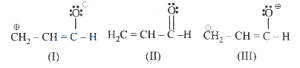
Consider the following three resonance structures:
The correct order of their stabilities is:
The correct order of their stabilities is:
A
$II > I > III$
B
$I > II > III$
C
$III > I > II$
D
$III > II > I$
Solution
(A) The stability of resonance structures is determined by the following rules:
$1$. Neutral structures are more stable than charged structures.
$2$. Structures with a complete octet for all atoms are more stable.
$3$. Negative charge on a more electronegative atom is more stable.
Structure $II$ is a neutral molecule where all atoms have complete octets,making it the most stable.
Structure $I$ has a positive charge on carbon and a negative charge on oxygen. Oxygen is more electronegative than carbon,so having a negative charge on oxygen is relatively stable.
Structure $III$ has a negative charge on carbon and a positive charge on oxygen. Having a positive charge on a highly electronegative atom like oxygen is highly unstable.
Therefore,the stability order is $II > I > III$.
$1$. Neutral structures are more stable than charged structures.
$2$. Structures with a complete octet for all atoms are more stable.
$3$. Negative charge on a more electronegative atom is more stable.
Structure $II$ is a neutral molecule where all atoms have complete octets,making it the most stable.
Structure $I$ has a positive charge on carbon and a negative charge on oxygen. Oxygen is more electronegative than carbon,so having a negative charge on oxygen is relatively stable.
Structure $III$ has a negative charge on carbon and a positive charge on oxygen. Having a positive charge on a highly electronegative atom like oxygen is highly unstable.
Therefore,the stability order is $II > I > III$.
0 likes
View Solution189
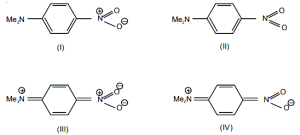
MediumMCQ
$p-$nitro$-N, N-$dimethylaniline cannot be represented by which of the following resonating structures? (Refer to the provided structures $I, II, III, IV$)
A
$I$ and $II$
B
$II$ and $IV$
C
$I$ and $III$
D
$III$ and $IV$
Solution
(D) In structures $III$ and $IV$,the nitrogen atom of the nitro group is shown to be bonded to five atoms/groups (pentavalent).
Nitrogen belongs to the second period and does not have vacant $d-$orbitals in its valence shell,so it cannot expand its covalency beyond $4$.
Therefore,structures $III$ and $IV$ are chemically impossible and cannot represent the resonating structures of $p-$nitro$-N, N-$dimethylaniline.
Nitrogen belongs to the second period and does not have vacant $d-$orbitals in its valence shell,so it cannot expand its covalency beyond $4$.
Therefore,structures $III$ and $IV$ are chemically impossible and cannot represent the resonating structures of $p-$nitro$-N, N-$dimethylaniline.
0 likes
View Solution190
EasyMCQ
Which structure has delocalised $\pi$-electrons?
A
$O_{3}$
B
$CO$
C
$HCN$
D
$O_{3}$ and $HCN$
Solution
(A) Delocalisation of $\pi$-electrons occurs in molecules that exhibit resonance.
$O_{3}$ (ozone) exists as a resonance hybrid of two canonical structures,where the $\pi$-electrons are delocalised over the three oxygen atoms.
$CO$ and $HCN$ have localised $\pi$-bonds and do not exhibit resonance-based delocalisation of $\pi$-electrons.
Therefore,the correct option is $A$.
$O_{3}$ (ozone) exists as a resonance hybrid of two canonical structures,where the $\pi$-electrons are delocalised over the three oxygen atoms.
$CO$ and $HCN$ have localised $\pi$-bonds and do not exhibit resonance-based delocalisation of $\pi$-electrons.
Therefore,the correct option is $A$.
0 likes
View Solution191
EasyMCQ
In $O_{2}$ and $H_{2}O_{2}$,the $O-O$ bond lengths are $1.21 \mathring{A}$ and $1.48 \mathring{A}$ respectively. In ozone $(O_{3})$,the average $O-O$ bond length is
A
$1.28 \mathring{A}$
B
$1.18 \mathring{A}$
C
$1.44 \mathring{A}$
D
$1.52 \mathring{A}$
Solution
(A) Ozone $(O_{3})$ exhibits resonance,where the two $O-O$ bonds are equivalent due to the delocalization of $\pi$ electrons.
The actual structure is a resonance hybrid of two canonical forms.
The experimental value for the average $O-O$ bond length in ozone is $1.28 \mathring{A}$,which is intermediate between the single bond length $(1.48 \mathring{A})$ and the double bond length $(1.21 \mathring{A})$.
The actual structure is a resonance hybrid of two canonical forms.
The experimental value for the average $O-O$ bond length in ozone is $1.28 \mathring{A}$,which is intermediate between the single bond length $(1.48 \mathring{A})$ and the double bond length $(1.21 \mathring{A})$.
0 likes
View Solution192
MediumMCQ
The correct bond order of the $B-F$ bond in the $BF_3$ molecule is:
A
$1$
B
$1 \frac{1}{2}$
C
$2$
D
$1 \frac{1}{3}$
Solution
(D) In the $BF_3$ molecule,the boron atom is electron-deficient and completes its octet through back-bonding from the fluorine atoms. This results in resonance structures where one $B-F$ bond has a double bond character while the other two remain single bonds.
There are $3$ contributing resonance structures.
In each structure,one bond is a double bond (order $2$) and two are single bonds (order $1$).
The average bond order is calculated as:
$\text{Bond Order} = \frac{\text{Total number of bonds}}{\text{Number of resonating positions}} = \frac{2 + 1 + 1}{3} = \frac{4}{3} = 1 \frac{1}{3}$.
There are $3$ contributing resonance structures.
In each structure,one bond is a double bond (order $2$) and two are single bonds (order $1$).
The average bond order is calculated as:
$\text{Bond Order} = \frac{\text{Total number of bonds}}{\text{Number of resonating positions}} = \frac{2 + 1 + 1}{3} = \frac{4}{3} = 1 \frac{1}{3}$.
0 likes
View Solution193
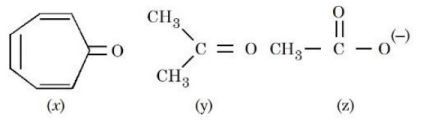
DifficultMCQ
Consider the following molecules/species: tropone $(x)$,acetone $(y)$,acetate ion $(z)$. The correct order of carbon-oxygen bond length is:
A
$x > y > z$
B
$y > z > x$
C
$z > x > y$
D
$x > z > y$
Solution
(C) The bond length is inversely proportional to the bond order.
In acetone $(y)$,the $C=O$ bond has a bond order of $2$.
In tropone $(x)$,the $C=O$ bond is conjugated within a $7$-membered aromatic ring,which gives it a partial single bond character,resulting in a bond order between $1$ and $2$ (lower than $2$,thus higher length than $y$).
In the acetate ion $(z)$,resonance leads to two equivalent $C-O$ bonds,each with a bond order of $1.5$.
Comparing the bond orders: $y$ $(2)$ > $x$ $(1 < \text{bond order} < 2)$ > $z$ $(1.5)$.
Since bond length is inversely proportional to bond order,the order of bond length is $z > x > y$.
In acetone $(y)$,the $C=O$ bond has a bond order of $2$.
In tropone $(x)$,the $C=O$ bond is conjugated within a $7$-membered aromatic ring,which gives it a partial single bond character,resulting in a bond order between $1$ and $2$ (lower than $2$,thus higher length than $y$).
In the acetate ion $(z)$,resonance leads to two equivalent $C-O$ bonds,each with a bond order of $1.5$.
Comparing the bond orders: $y$ $(2)$ > $x$ $(1 < \text{bond order} < 2)$ > $z$ $(1.5)$.
Since bond length is inversely proportional to bond order,the order of bond length is $z > x > y$.
0 likes
View SolutionChemical Bonding and Molecular Structure — Resonance · Frequently Asked Questions
1Are these Chemical Bonding and Molecular Structure questions useful for JEE and NEET?
Yes. All questions in this section are mapped to JEE Main and NEET exam patterns. Previous year questions from JEE Main, NEET, GUJCET and state-level exams are included with full solutions.
2Can I switch to Hindi or Gujarati for these questions?
Yes. Use the language tabs in the hero section or the sidebar to view the same questions and solutions in English, Hindi or Gujarati.
3How do I generate a question paper from this subtopic?
Use the Vedclass Exam Paper Generator — select the chapter and subtopic, set difficulty, and generate Sets A, B, C, D automatically. First 3 chapters of every subject are free.
Vedclass Products
For Students
Vedclass Test Series
Mock tests in real JEE/NEET style with performance analysis. 5-day free trial.
Start Free TrialFor Teachers
Exam Paper Generator
Generate Set A/B/C/D papers from this chapter in 2 minutes. 3 chapters free.
Try FreeFor Institutes
Online Exam Module
Live online exams with unlimited students, 360° analytics & white-label branding.
See DemoFor Teachers & Institutes
Generate a Chemical Bonding and Molecular Structure Exam Paper in 2 Minutes
Select subtopic & difficulty — Sets A, B, C, D auto-generated with No Repeat logic.
First 3 chapters of every subject are free — no payment required.