
A English
Resonance Questions in English
Class 11 Chemistry · Chemical Bonding and Molecular Structure · Resonance
193+
Questions
English
Language
100%
With Solutions
Showing 50 of 193 questions in English
101
Medium
Write the Lewis structure of the nitrite ion,$NO_{2}^{-}$
Solution
(N/A) Step $1$. Count the total number of valence electrons of the nitrogen atom,the oxygen atoms,and the additional one negative charge (equal to one electron).
$N (2s^{2} 2p^{3}), O (2s^{2} 2p^{4})$
$5 + (2 \times 6) + 1 = 18$ electrons.
Step $2$. The skeletal structure of $NO_{2}^{-}$ is written as: $O-N-O$.
Step $3$. Draw a single bond (one shared electron pair) between the nitrogen and each of the oxygen atoms. Completing the octets on oxygen atoms uses $16$ electrons. The remaining $2$ electrons constitute a lone pair on the nitrogen atom.
Step $4$. To complete the octet on the nitrogen atom,one of the oxygen atoms forms a double bond with the nitrogen atom.
The resulting resonance structures are:
$\left[ \ddot{O} = \ddot{N} - \ddot{O}: \right]^{-} \leftrightarrow \left[ :\ddot{O} - \ddot{N} = \ddot{O} \right]^{-}$
$N (2s^{2} 2p^{3}), O (2s^{2} 2p^{4})$
$5 + (2 \times 6) + 1 = 18$ electrons.
Step $2$. The skeletal structure of $NO_{2}^{-}$ is written as: $O-N-O$.
Step $3$. Draw a single bond (one shared electron pair) between the nitrogen and each of the oxygen atoms. Completing the octets on oxygen atoms uses $16$ electrons. The remaining $2$ electrons constitute a lone pair on the nitrogen atom.
Step $4$. To complete the octet on the nitrogen atom,one of the oxygen atoms forms a double bond with the nitrogen atom.
The resulting resonance structures are:
$\left[ \ddot{O} = \ddot{N} - \ddot{O}: \right]^{-} \leftrightarrow \left[ :\ddot{O} - \ddot{N} = \ddot{O} \right]^{-}$
0 likes
View Solution102
Medium
Explain the structure of $CO_{3}^{2-}$ ion in terms of resonance.
Solution
(N/A) The single Lewis structure based on the presence of two single bonds and one double bond between carbon and oxygen atoms is inadequate to represent the molecule accurately as it represents unequal bonds.
According to the experimental findings,all carbon to oxygen bonds in $CO_{3}^{2-}$ are equivalent.
Therefore,the carbonate ion is best described as a resonance hybrid of the canonical forms $I$,$II$,and $III$ as shown below:
$I \leftrightarrow II \leftrightarrow III$
(Where $I$,$II$,and $III$ represent the three equivalent Lewis structures with the double bond shifting between the three oxygen atoms.)
According to the experimental findings,all carbon to oxygen bonds in $CO_{3}^{2-}$ are equivalent.
Therefore,the carbonate ion is best described as a resonance hybrid of the canonical forms $I$,$II$,and $III$ as shown below:
$I \leftrightarrow II \leftrightarrow III$
(Where $I$,$II$,and $III$ represent the three equivalent Lewis structures with the double bond shifting between the three oxygen atoms.)
0 likes
View Solution103
Medium
Explain the structure of $CO_{2}$ molecule.
Solution
(N/A) The experimentally determined carbon to oxygen bond length in $CO_{2}$ is $115 \ pm$.
The lengths of a normal carbon to oxygen double bond $(C=O)$ and carbon to oxygen triple bond $(C \equiv O)$ are $121 \ pm$ and $110 \ pm$ respectively.
The carbon-oxygen bond lengths in $CO_{2}$ $(115 \ pm)$ lie between the values for $C=O$ and $C \equiv O$.
Obviously, a single Lewis structure cannot depict this position and it becomes necessary to write more than one Lewis structure and to consider that the structure of $CO_{2}$ is best described as a hybrid of the canonical or resonance forms $I$, $II$ and $III$:
$:O=C=O: \leftrightarrow :O^{-}-C \equiv O^{+}: \leftrightarrow :O^{+}\equiv C-O^{-}:$
The lengths of a normal carbon to oxygen double bond $(C=O)$ and carbon to oxygen triple bond $(C \equiv O)$ are $121 \ pm$ and $110 \ pm$ respectively.
The carbon-oxygen bond lengths in $CO_{2}$ $(115 \ pm)$ lie between the values for $C=O$ and $C \equiv O$.
Obviously, a single Lewis structure cannot depict this position and it becomes necessary to write more than one Lewis structure and to consider that the structure of $CO_{2}$ is best described as a hybrid of the canonical or resonance forms $I$, $II$ and $III$:
$:O=C=O: \leftrightarrow :O^{-}-C \equiv O^{+}: \leftrightarrow :O^{+}\equiv C-O^{-}:$

0 likes
View Solution104
Medium
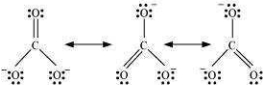
Explain the important aspects of resonance with reference to the $CO_{3}^{2-}$ ion.
Solution
(N/A) According to experimental findings,all carbon-to-oxygen bonds in $CO_{3}^{2-}$ are equivalent.
Hence,it is inadequate to represent the $CO_{3}^{2-}$ ion by a single Lewis structure having two single bonds and one double bond.
Therefore,the carbonate ion is described as a resonance hybrid of the following three canonical structures:
[Image: $914-$s15]
Key aspects of resonance:
$1$. Resonance structures do not represent real molecules; they are hypothetical.
$2$. The actual structure of the molecule is a resonance hybrid of all canonical structures.
$3$. The energy of the resonance hybrid is lower than that of any individual canonical structure,providing stability.
Hence,it is inadequate to represent the $CO_{3}^{2-}$ ion by a single Lewis structure having two single bonds and one double bond.
Therefore,the carbonate ion is described as a resonance hybrid of the following three canonical structures:
[Image: $914-$s15]
Key aspects of resonance:
$1$. Resonance structures do not represent real molecules; they are hypothetical.
$2$. The actual structure of the molecule is a resonance hybrid of all canonical structures.
$3$. The energy of the resonance hybrid is lower than that of any individual canonical structure,providing stability.
0 likes
View Solution105
Medium
Write the resonance structures for $SO_{3}$,$NO_{2}$ and $NO_{3}^{-}$.
Solution
(N/A) The resonance structures are represented by the following diagrams:
$1$. For $SO_{3}$:
$[:O=S(-O:)(-O:)] \leftrightarrow [:O-S(=O:)(-O:)] \leftrightarrow [:O-S(-O:)(=O:)]$
$2$. For $NO_{2}$:
$[:O=N-O:] \leftrightarrow [:O-N=O:]$
$3$. For $NO_{3}^{-}$:
$[:O^{-}-N(=O:)(-O:)] \leftrightarrow [:O=N(-O^{-})(-O:)] \leftrightarrow [:O=N(-O:)(-O^{-})]$
$1$. For $SO_{3}$:
$[:O=S(-O:)(-O:)] \leftrightarrow [:O-S(=O:)(-O:)] \leftrightarrow [:O-S(-O:)(=O:)]$
$2$. For $NO_{2}$:
$[:O=N-O:] \leftrightarrow [:O-N=O:]$
$3$. For $NO_{3}^{-}$:
$[:O^{-}-N(=O:)(-O:)] \leftrightarrow [:O=N(-O^{-})(-O:)] \leftrightarrow [:O=N(-O:)(-O^{-})]$
0 likes
View Solution106
Medium
Write resonance structures of $CH_{3}COO^{-}$ and show the movement of electrons by curved arrows.
Solution
(N/A) The resonance structures of the acetate ion $(CH_{3}COO^{-})$ are formed by the delocalization of the negative charge between the two oxygen atoms.
In the first structure,the negative charge is on one oxygen atom,and there is a double bond between the carbon and the other oxygen atom.
By moving a lone pair from the negatively charged oxygen to form a $C-O$ double bond,and simultaneously moving the $\pi$-electrons of the existing $C=O$ double bond onto the other oxygen atom,we obtain the second resonance structure.
The resonance hybrid shows that the negative charge is shared equally between the two oxygen atoms.
In the first structure,the negative charge is on one oxygen atom,and there is a double bond between the carbon and the other oxygen atom.
By moving a lone pair from the negatively charged oxygen to form a $C-O$ double bond,and simultaneously moving the $\pi$-electrons of the existing $C=O$ double bond onto the other oxygen atom,we obtain the second resonance structure.
The resonance hybrid shows that the negative charge is shared equally between the two oxygen atoms.
0 likes
View Solution107
Medium
Write the resonance structures of $CH_2=CH-CHO$. Indicate the relative stability of the contributing structures.
Solution
(N/A) The resonance structures for $CH_2=CH-CHO$ are:
$I$: $CH_2=CH-CH=O$
$II$: $^+CH_2-CH=CH-O^-$
$III$: $^-CH_2-CH=CH-O^+$
Relative stability: $I > II > III$
Explanation:
$I$: Most stable,as it has the maximum number of covalent bonds,all atoms have complete octets,and there is no charge separation.
$II$: More stable than $III$ because the negative charge is on the more electronegative oxygen atom and the positive charge is on the less electronegative carbon atom.
$III$: Least stable,as it involves charge separation with a positive charge on the highly electronegative oxygen atom and a negative charge on the carbon atom.
$I$: $CH_2=CH-CH=O$
$II$: $^+CH_2-CH=CH-O^-$
$III$: $^-CH_2-CH=CH-O^+$
Relative stability: $I > II > III$
Explanation:
$I$: Most stable,as it has the maximum number of covalent bonds,all atoms have complete octets,and there is no charge separation.
$II$: More stable than $III$ because the negative charge is on the more electronegative oxygen atom and the positive charge is on the less electronegative carbon atom.
$III$: Least stable,as it involves charge separation with a positive charge on the highly electronegative oxygen atom and a negative charge on the carbon atom.
0 likes
View Solution108
Easy
Explain why the following two structures,$I$ and $II$,cannot be the major contributors to the real structure of $CH_{3}COOCH_{3}$.
$I: CH_{3}-C^{+}(O^{-})-OCH_{3}$
$II: CH_{3}-C(=O^{-})-OCH_{3}^{+}$
$I: CH_{3}-C^{+}(O^{-})-OCH_{3}$
$II: CH_{3}-C(=O^{-})-OCH_{3}^{+}$
Solution
(N/A) The two structures are less important contributors because they involve charge separation,which requires energy.
In structure $I$,the central carbon atom has only $6$ electrons in its valence shell,meaning it has an incomplete octet.
In structure $II$,the oxygen atom is bonded to three groups and carries a positive charge,which is less stable due to the high electronegativity of oxygen.
In structure $I$,the central carbon atom has only $6$ electrons in its valence shell,meaning it has an incomplete octet.
In structure $II$,the oxygen atom is bonded to three groups and carries a positive charge,which is less stable due to the high electronegativity of oxygen.
0 likes
View Solution109
Medium
Draw the resonance structures for the following compounds. Show the electron shift using curved-arrow notation.
$(a)$ $C_{6}H_{5}OH$
$(b)$ $C_{6}H_{5}NO_{2}$
$(c)$ $CH_{3}CH=CH-CHO$
$(d)$ $C_{6}H_{5}CHO$
$(e)$ $C_{6}H_{5}CH_{2}^{+}$
$(f)$ $CH_{3}CH=CH-CH_{2}^{+}$
$(a)$ $C_{6}H_{5}OH$
$(b)$ $C_{6}H_{5}NO_{2}$
$(c)$ $CH_{3}CH=CH-CHO$
$(d)$ $C_{6}H_{5}CHO$
$(e)$ $C_{6}H_{5}CH_{2}^{+}$
$(f)$ $CH_{3}CH=CH-CH_{2}^{+}$
Solution
(N/A) The resonance structures are drawn by shifting electrons using curved arrows to show the delocalization of $\pi$ electrons or lone pairs.
$(a)$ Phenol $(C_{6}H_{5}OH)$: The lone pair on oxygen delocalizes into the ring,creating ortho and para negative charges.
$(b)$ Nitrobenzene $(C_{6}H_{5}NO_{2})$: The $\pi$ electrons of the ring delocalize towards the electron-withdrawing nitro group,creating ortho and para positive charges.
$(c)$ $CH_{3}CH=CH-CHO$: The $\pi$ electrons of the $C=C$ bond shift towards the carbonyl group,creating a carbocation at the $C-2$ position.
$(d)$ Benzaldehyde $(C_{6}H_{5}CHO)$: Similar to nitrobenzene,the ring $\pi$ electrons delocalize towards the carbonyl oxygen,creating positive charges at ortho and para positions.
$(e)$ Benzyl carbocation $(C_{6}H_{5}CH_{2}^{+})$: The $\pi$ electrons of the ring delocalize to stabilize the positive charge on the benzylic carbon.
$(f)$ $CH_{3}CH=CH-CH_{2}^{+}$: The $\pi$ electrons of the $C=C$ bond shift to stabilize the positive charge on the terminal carbon.
$(a)$ Phenol $(C_{6}H_{5}OH)$: The lone pair on oxygen delocalizes into the ring,creating ortho and para negative charges.
$(b)$ Nitrobenzene $(C_{6}H_{5}NO_{2})$: The $\pi$ electrons of the ring delocalize towards the electron-withdrawing nitro group,creating ortho and para positive charges.
$(c)$ $CH_{3}CH=CH-CHO$: The $\pi$ electrons of the $C=C$ bond shift towards the carbonyl group,creating a carbocation at the $C-2$ position.
$(d)$ Benzaldehyde $(C_{6}H_{5}CHO)$: Similar to nitrobenzene,the ring $\pi$ electrons delocalize towards the carbonyl oxygen,creating positive charges at ortho and para positions.
$(e)$ Benzyl carbocation $(C_{6}H_{5}CH_{2}^{+})$: The $\pi$ electrons of the ring delocalize to stabilize the positive charge on the benzylic carbon.
$(f)$ $CH_{3}CH=CH-CH_{2}^{+}$: The $\pi$ electrons of the $C=C$ bond shift to stabilize the positive charge on the terminal carbon.
0 likes
View Solution110
Medium
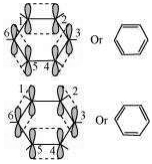
Why is benzene extraordinarily stable though it contains three double bonds?
Solution
(N/A) Benzene is a hybrid of resonating structures. All six carbon atoms in benzene are $sp^2$ hybridized.
The two $sp^2$ hybrid orbitals of each carbon atom overlap with the $sp^2$ hybrid orbitals of adjacent carbon atoms to form six sigma bonds in the hexagonal plane.
The remaining $sp^2$ hybrid orbital on each carbon atom overlaps with the $s$-orbital of hydrogen to form six sigma $C-H$ bonds.
The remaining unhybridized $p$-orbital of carbon atoms has the possibility of forming three $\pi$ bonds by the lateral overlap of $C_1-C_2, C_3-C_4, C_5-C_6$ or $C_2-C_3, C_4-C_5, C_6-C_1$.
The six $\pi$ electrons are delocalized and can move freely about the six carbon nuclei.
Even with the presence of three double bonds,these delocalized $\pi$-electrons provide extra stability to benzene due to resonance energy.
The two $sp^2$ hybrid orbitals of each carbon atom overlap with the $sp^2$ hybrid orbitals of adjacent carbon atoms to form six sigma bonds in the hexagonal plane.
The remaining $sp^2$ hybrid orbital on each carbon atom overlaps with the $s$-orbital of hydrogen to form six sigma $C-H$ bonds.
The remaining unhybridized $p$-orbital of carbon atoms has the possibility of forming three $\pi$ bonds by the lateral overlap of $C_1-C_2, C_3-C_4, C_5-C_6$ or $C_2-C_3, C_4-C_5, C_6-C_1$.
The six $\pi$ electrons are delocalized and can move freely about the six carbon nuclei.
Even with the presence of three double bonds,these delocalized $\pi$-electrons provide extra stability to benzene due to resonance energy.
0 likes
View Solution111
Medium
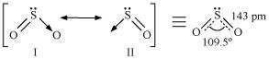
Comment on the nature of two $S-O$ bonds formed in $SO_{2}$ molecule. Are the two $S-O$ bonds in this molecule equal?
Solution
(N/A) The electronic configuration of $S$ is $1s^{2} 2s^{2} 2p^{6} 3s^{2} 3p^{4}$.
During the formation of $SO_{2}$, one electron from the $3p$ orbital is promoted to the $3d$ orbital, and $S$ undergoes $sp^{2}$ hybridization. Two of these hybrid orbitals form sigma bonds with two oxygen atoms, and the third contains a lone pair.
The remaining $p$-orbital and $d$-orbital on $S$ contain an unpaired electron each. One of these electrons forms a $p\pi-p\pi$ bond with one oxygen atom, and the other forms a $p\pi-d\pi$ bond with the other oxygen atom.
Due to resonance, $SO_{2}$ exists as a resonance hybrid of structures $I$ and $II$. As a result, both $S-O$ bonds are equivalent in length $(143 \ pm)$ and possess a partial double bond character.
During the formation of $SO_{2}$, one electron from the $3p$ orbital is promoted to the $3d$ orbital, and $S$ undergoes $sp^{2}$ hybridization. Two of these hybrid orbitals form sigma bonds with two oxygen atoms, and the third contains a lone pair.
The remaining $p$-orbital and $d$-orbital on $S$ contain an unpaired electron each. One of these electrons forms a $p\pi-p\pi$ bond with one oxygen atom, and the other forms a $p\pi-d\pi$ bond with the other oxygen atom.
Due to resonance, $SO_{2}$ exists as a resonance hybrid of structures $I$ and $II$. As a result, both $S-O$ bonds are equivalent in length $(143 \ pm)$ and possess a partial double bond character.
0 likes
View Solution112
Medium
Draw the resonating structures of $NO_2$ and $N_2O_5$.
Solution
(N/A) $1$. For $NO_2$: The nitrogen atom has one unpaired electron. The two resonance structures involve the delocalization of the odd electron and the double bond between the nitrogen and the two oxygen atoms. The structures are: $O=N-O^{\bullet} \leftrightarrow ^{\bullet}O-N=O$.
$2$. For $N_2O_5$: The structure consists of two $NO_2$ groups linked by an oxygen atom $(O_2N-O-NO_2)$. Resonance occurs within the $NO_2$ groups,where the double bond alternates between the two oxygen atoms attached to each nitrogen atom. The resonance hybrid shows partial double bond character across the $N-O$ bonds.
$2$. For $N_2O_5$: The structure consists of two $NO_2$ groups linked by an oxygen atom $(O_2N-O-NO_2)$. Resonance occurs within the $NO_2$ groups,where the double bond alternates between the two oxygen atoms attached to each nitrogen atom. The resonance hybrid shows partial double bond character across the $N-O$ bonds.
0 likes
View Solution113
Medium
Draw the Lewis structure of $NO_2^-$.
Solution
(N/A) To draw the Lewis structure of the nitrite ion,$NO_2^-$,follow these steps:
$1$. Calculate the total number of valence electrons: $N$ $(5)$ + $2 \times O$ $(6 \times 2 = 12)$ + $1$ (negative charge) = $18$ valence electrons.
$2$. Place the nitrogen atom in the center and connect the two oxygen atoms with single bonds.
$3$. Distribute the remaining electrons to complete the octets of the oxygen atoms.
$4$. Since nitrogen does not have a complete octet,form a double bond with one of the oxygen atoms.
$5$. The resulting structure exhibits resonance,where the double bond alternates between the two oxygen atoms.
The correct Lewis resonance structures are:
$[O=N-O]^- \leftrightarrow [O-N=O]^-$
$1$. Calculate the total number of valence electrons: $N$ $(5)$ + $2 \times O$ $(6 \times 2 = 12)$ + $1$ (negative charge) = $18$ valence electrons.
$2$. Place the nitrogen atom in the center and connect the two oxygen atoms with single bonds.
$3$. Distribute the remaining electrons to complete the octets of the oxygen atoms.
$4$. Since nitrogen does not have a complete octet,form a double bond with one of the oxygen atoms.
$5$. The resulting structure exhibits resonance,where the double bond alternates between the two oxygen atoms.
The correct Lewis resonance structures are:
$[O=N-O]^- \leftrightarrow [O-N=O]^-$
0 likes
View Solution114
Advanced
What is a resonance structure? Why are resonance structures required? Explain with a suitable example.
Solution
(N/A) Resonance Structures: Different Lewis structures of a single molecule or ion are known as resonance structures. According to the concept of resonance, whenever a single Lewis structure cannot describe a molecule accurately, more than one Lewis structure, known as resonance structures, are used to describe it.
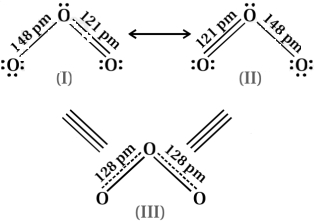
Resonance structure of ozone $(O_3)$: To draw resonance structures, the position of the nuclei of the atoms is not changed. In every resonance structure, the position of bonding and non-bonding electrons changes, but the identity of the Lewis structure is not considered different. The different resonance structures are represented by a double-headed arrow. All resonance structures have similar energy.
Two resonance structures of the $O_3$ molecule are $(I)$ and $(II)$, and $(III)$ is the resonance hybrid.
Limitation of resonance: None of the individual structures are seen as the "correct" structure. The $O-O$ single bond length is $148 \ pm$ and the $O=O$ double bond length is $121 \ pm$. Thus, individual single and double bond lengths are not experimentally present in $O_3$.
Therefore, the correct structure of $O_3$ is not $(I)$ or $(II)$.
Resonance: The correct structure is the resonance hybrid. Experimentally determined oxygen-oxygen $(O-O)$ bond lengths in the $O_3$ molecule are the same, $128 \ pm$. So, $(III)$ is the real or accurate structure of $O_3$ in which the single and double bonds are not static. Resonance structures are necessary because they facilitate the determination of the correct molecular structure that a single Lewis structure cannot represent.
Orientation: $A$ single assumed structure cannot give the correct bond length and bond energy.
Advantage: It provides an assumption of the correct structure.
Resonance structure of ozone $(O_3)$: To draw resonance structures, the position of the nuclei of the atoms is not changed. In every resonance structure, the position of bonding and non-bonding electrons changes, but the identity of the Lewis structure is not considered different. The different resonance structures are represented by a double-headed arrow. All resonance structures have similar energy.
Two resonance structures of the $O_3$ molecule are $(I)$ and $(II)$, and $(III)$ is the resonance hybrid.
Limitation of resonance: None of the individual structures are seen as the "correct" structure. The $O-O$ single bond length is $148 \ pm$ and the $O=O$ double bond length is $121 \ pm$. Thus, individual single and double bond lengths are not experimentally present in $O_3$.
Therefore, the correct structure of $O_3$ is not $(I)$ or $(II)$.
Resonance: The correct structure is the resonance hybrid. Experimentally determined oxygen-oxygen $(O-O)$ bond lengths in the $O_3$ molecule are the same, $128 \ pm$. So, $(III)$ is the real or accurate structure of $O_3$ in which the single and double bonds are not static. Resonance structures are necessary because they facilitate the determination of the correct molecular structure that a single Lewis structure cannot represent.
Orientation: $A$ single assumed structure cannot give the correct bond length and bond energy.
Advantage: It provides an assumption of the correct structure.
0 likes
View Solution115
Difficult
Draw the resonance structures of $O_3$ and explain its requirement, limitations, and advantages.
Solution
(N/A) Resonance Structures: Different Lewis structures of a single molecule or ion are known as resonance structures. According to the concept of resonance, whenever a single Lewis structure cannot describe a molecule accurately, more than one Lewis structure (resonance structures) is used to describe it.
Resonance structures of ozone $(O_3)$: To draw resonance structures, the positions of the atomic nuclei do not change. In every resonance structure, the positions of bonding and non-bonding electrons change, but the overall Lewis structure does not appear different. The different resonance structures are represented by a double-headed arrow. All resonance structures have similar energy.
Two resonance structures of the $O_3$ molecule are $(I)$ and $(II)$, and $(III)$ is the resonance hybrid.
Limitations of resonance: No single structure is the correct structure. The $O-O$ single bond length is $148 \ pm$ and the $O=O$ double bond length is $121 \ pm$. Thus, experimentally, $O_3$ does not contain distinct single and double bonds.
$\therefore$ The correct structure of $O_3$ is not just $(I)$ or $(II)$.
Resonance: The correct structure is the resonance hybrid. Experimentally determined oxygen-oxygen $(O-O)$ bond lengths in the $O_3$ molecule are identical at $128 \ pm$. So, $(III)$ is the real or accurate structure of $O_3$ in which single and double bonds are not static. Resonance structures are necessary because they provide a more accurate representation than a single Lewis structure.
Requirement: A single assumed structure cannot correctly predict bond length and bond energy.
Advantage: It provides an estimation of the correct molecular structure.
Resonance structures of ozone $(O_3)$: To draw resonance structures, the positions of the atomic nuclei do not change. In every resonance structure, the positions of bonding and non-bonding electrons change, but the overall Lewis structure does not appear different. The different resonance structures are represented by a double-headed arrow. All resonance structures have similar energy.
Two resonance structures of the $O_3$ molecule are $(I)$ and $(II)$, and $(III)$ is the resonance hybrid.
Limitations of resonance: No single structure is the correct structure. The $O-O$ single bond length is $148 \ pm$ and the $O=O$ double bond length is $121 \ pm$. Thus, experimentally, $O_3$ does not contain distinct single and double bonds.
$\therefore$ The correct structure of $O_3$ is not just $(I)$ or $(II)$.
Resonance: The correct structure is the resonance hybrid. Experimentally determined oxygen-oxygen $(O-O)$ bond lengths in the $O_3$ molecule are identical at $128 \ pm$. So, $(III)$ is the real or accurate structure of $O_3$ in which single and double bonds are not static. Resonance structures are necessary because they provide a more accurate representation than a single Lewis structure.
Requirement: A single assumed structure cannot correctly predict bond length and bond energy.
Advantage: It provides an estimation of the correct molecular structure.
0 likes
View Solution116
Medium
Explain the important aspects of resonance with reference to the $CO_{3}^{2-}$ ion.
Solution
(N/A) Resonance is a phenomenon where a single Lewis structure cannot adequately describe the properties of a molecule or ion. In such cases, multiple canonical structures are written to represent the electronic distribution.
For the carbonate ion $(CO_{3}^{2-})$, the central carbon atom is bonded to three oxygen atoms. According to the Lewis structure, there is one double bond and two single bonds.
However, experimental evidence shows that all three $C-O$ bond lengths in the $CO_{3}^{2-}$ ion are identical $(127 \ pm)$, which is intermediate between the length of a $C-O$ single bond $(143 \ pm)$ and a $C=O$ double bond $(121 \ pm)$.
This indicates that the actual structure is a resonance hybrid of three canonical forms ($I$, $II$, and $III$), where the double bond is delocalized over all three $C-O$ bonds, as shown in the resonance hybrid structure $(IV)$.
For the carbonate ion $(CO_{3}^{2-})$, the central carbon atom is bonded to three oxygen atoms. According to the Lewis structure, there is one double bond and two single bonds.
However, experimental evidence shows that all three $C-O$ bond lengths in the $CO_{3}^{2-}$ ion are identical $(127 \ pm)$, which is intermediate between the length of a $C-O$ single bond $(143 \ pm)$ and a $C=O$ double bond $(121 \ pm)$.
This indicates that the actual structure is a resonance hybrid of three canonical forms ($I$, $II$, and $III$), where the double bond is delocalized over all three $C-O$ bonds, as shown in the resonance hybrid structure $(IV)$.
0 likes
View Solution117
MediumMCQ
Explain the important aspects of resonance with reference to the $CO_3^{2-}$ ion.
A
Resonance structures represent real molecules.
B
Resonance structures have different positions of nuclei.
C
Resonance structures have the same number of unpaired electrons.
D
Resonance structures have different energies.
Solution
(C) The $CO_3^{2-}$ ion exhibits resonance, where the actual structure is a resonance hybrid of three canonical forms.
$1$. The positions of the nuclei remain the same in all resonance structures.
$2$. The number of unpaired electrons remains the same in all resonance structures.
$3$. The resonance hybrid is more stable than any individual canonical form.
$4$. The $C-O$ bond lengths in the $CO_3^{2-}$ ion are identical due to resonance, measured at $127 \text{ pm}$.
$1$. The positions of the nuclei remain the same in all resonance structures.
$2$. The number of unpaired electrons remains the same in all resonance structures.
$3$. The resonance hybrid is more stable than any individual canonical form.
$4$. The $C-O$ bond lengths in the $CO_3^{2-}$ ion are identical due to resonance, measured at $127 \text{ pm}$.
0 likes
View Solution118
Medium
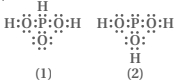
$H_3PO_3$ can be represented by structures $(1)$ and $(2)$ shown below. Can these two structures be taken as the canonical forms of the resonance hybrid representing $H_3PO_3$? If not,give reasons for the same.
Solution
(N/A) No,these two structures cannot be taken as the canonical forms of the resonance hybrid.
In resonance,the positions of the atomic nuclei must remain the same in all canonical structures.
In the given structures $(1)$ and $(2)$,the position of the hydrogen atom $(H)$ is different (attached to different oxygen atoms),which implies a change in the position of the nuclei.
Therefore,these are not resonance structures but are different isomers (tautomers) of $H_3PO_3$.
In resonance,the positions of the atomic nuclei must remain the same in all canonical structures.
In the given structures $(1)$ and $(2)$,the position of the hydrogen atom $(H)$ is different (attached to different oxygen atoms),which implies a change in the position of the nuclei.
Therefore,these are not resonance structures but are different isomers (tautomers) of $H_3PO_3$.
0 likes
View Solution119
Medium
What points should be kept in mind while writing resonance structures?
Solution
(N/A) Resonance structures are possible for molecules or ions that contain two or more atoms connected by multiple bonds (double or triple bonds) or have lone pairs of electrons on the atoms.
Each resonance structure must be a valid $Lewis$ structure. The total number of electrons in the molecule or ion remains the same for all resonance structures.
In resonance structures,the positions of the atomic nuclei remain fixed. Only the positions of double bonds,lone pairs of electrons,and formal charges ($+$ or $-$) change.
$A$ double-headed arrow $\leftrightarrow$ is placed between the resonance structures to indicate that they are contributing structures.
Each resonance structure must be a valid $Lewis$ structure. The total number of electrons in the molecule or ion remains the same for all resonance structures.
In resonance structures,the positions of the atomic nuclei remain fixed. Only the positions of double bonds,lone pairs of electrons,and formal charges ($+$ or $-$) change.
$A$ double-headed arrow $\leftrightarrow$ is placed between the resonance structures to indicate that they are contributing structures.
0 likes
View Solution120
MediumMCQ
Which of the following statements is correct regarding resonance structures?
A
The canonical forms have real existence.
B
The molecule exists in one canonical form for a certain fraction of time.
C
There is an equilibrium between the canonical forms.
D
The molecule has a single structure which is the resonance hybrid of the canonical forms.
Solution
(D) The canonical forms (or contributing structures) have no real existence.
The molecule does not exist for a certain fraction of time in one canonical form.
There is no such equilibrium between the canonical forms as we have between tautomeric forms in tautomerism.
The molecule as such has a single structure which is the resonance hybrid of the canonical forms and which cannot be depicted by a single $Lewis$ structure.
The molecule does not exist for a certain fraction of time in one canonical form.
There is no such equilibrium between the canonical forms as we have between tautomeric forms in tautomerism.
The molecule as such has a single structure which is the resonance hybrid of the canonical forms and which cannot be depicted by a single $Lewis$ structure.
0 likes
View Solution121
Medium
Write the resonance structures of $CO_3^{2-}$ and $HCO_3^{-}$.
Solution
(N/A) The resonance structures represent the delocalization of electrons within the ion.
$(a)$ For the carbonate ion $(CO_3^{2-})$,there are three equivalent resonance structures where the double bond is shared among the three oxygen atoms.
$(b)$ For the bicarbonate ion $(HCO_3^{-})$,there are two resonance structures where the double bond is shared between the carbon and the two non-protonated oxygen atoms.
$(a)$ For the carbonate ion $(CO_3^{2-})$,there are three equivalent resonance structures where the double bond is shared among the three oxygen atoms.
$(b)$ For the bicarbonate ion $(HCO_3^{-})$,there are two resonance structures where the double bond is shared between the carbon and the two non-protonated oxygen atoms.
0 likes
View Solution122
Difficult
Explain with a suitable example that the resonance structures of a molecule do not represent its real structure and are hypothetical.
Solution
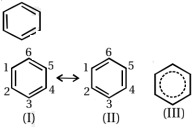
(N/A) There are many organic molecules whose behavior cannot be explained by a single Lewis structure. An example is benzene. Its cyclic structure containing alternating $C-C$ single and $C=C$ double bonds is inadequate for explaining its characteristic properties.
As per the above representation, benzene should exhibit two different bond lengths due to $C-C$ single and $C=C$ double bonds. Experimentally, by $X$-ray diffraction, it is found that in benzene all $C-C$ bond lengths are $139 \ pm$.
However, as determined experimentally, benzene has uniform $C-C$ bond distances of $139 \ pm$, a value intermediate between the $C-C$ single $(154 \ pm)$ and $C=C$ double $(134 \ pm)$ bonds. Thus, the structure of benzene cannot be represented adequately by a single Kekulé structure. Benzene can be represented equally well by the energetically identical structures $(I)$ and $(II)$.
Therefore, according to resonance theory, the actual structure of benzene cannot be adequately represented by any of these structures; rather, it is a hybrid of the two structures $(I)$ and $(II)$, called resonance structures, as shown in figure $(III)$.
The resonance structures (canonical structures or contributing structures) are hypothetical and individually do not represent any real molecule. They contribute to the actual structure in proportion to their stability.
As per the above representation, benzene should exhibit two different bond lengths due to $C-C$ single and $C=C$ double bonds. Experimentally, by $X$-ray diffraction, it is found that in benzene all $C-C$ bond lengths are $139 \ pm$.
However, as determined experimentally, benzene has uniform $C-C$ bond distances of $139 \ pm$, a value intermediate between the $C-C$ single $(154 \ pm)$ and $C=C$ double $(134 \ pm)$ bonds. Thus, the structure of benzene cannot be represented adequately by a single Kekulé structure. Benzene can be represented equally well by the energetically identical structures $(I)$ and $(II)$.
Therefore, according to resonance theory, the actual structure of benzene cannot be adequately represented by any of these structures; rather, it is a hybrid of the two structures $(I)$ and $(II)$, called resonance structures, as shown in figure $(III)$.
The resonance structures (canonical structures or contributing structures) are hypothetical and individually do not represent any real molecule. They contribute to the actual structure in proportion to their stability.
0 likes
View Solution123
Medium
Give the resonance structures of nitromethane and explain its real structure.
Solution
(N/A) Nitromethane $(CH_{3}NO_{2})$ can be represented by two Lewis structures,$(I)$ and $(II)$,which are its resonance structures as shown below:
$H_{3}C-N^{+}(=O)-O^{-} \longleftrightarrow H_{3}C-N^{+}(O^{-})=O$
In these individual Lewis structures,there appear to be two different types of $N-O$ bonds: one single bond and one double bond.
However,experimental evidence shows that both $N-O$ bonds in nitromethane have the same bond length,which is intermediate between a $N-O$ single bond and a $N=O$ double bond.
Therefore,the actual structure of nitromethane is a resonance hybrid of the two canonical forms $(I)$ and $(II)$.
$H_{3}C-N^{+}(=O)-O^{-} \longleftrightarrow H_{3}C-N^{+}(O^{-})=O$
In these individual Lewis structures,there appear to be two different types of $N-O$ bonds: one single bond and one double bond.
However,experimental evidence shows that both $N-O$ bonds in nitromethane have the same bond length,which is intermediate between a $N-O$ single bond and a $N=O$ double bond.
Therefore,the actual structure of nitromethane is a resonance hybrid of the two canonical forms $(I)$ and $(II)$.
0 likes
View Solution124
Medium
What is resonance energy? Write about its value.
Solution
(N/A) The energy of the actual structure of the molecule (the resonance hybrid) is lower than that of any of the canonical structures. The difference in energy between the actual structure and the lowest energy resonance structure is called the resonance stabilisation energy or simply the resonance energy.
Value of resonance energy: The more the number of important contributing structures,the more is the resonance energy. Resonance energy $\propto$ $\text{Number of resonance structures}$. This is particularly important when the contributing structures are equivalent in energy.
Value of resonance energy: The more the number of important contributing structures,the more is the resonance energy. Resonance energy $\propto$ $\text{Number of resonance structures}$. This is particularly important when the contributing structures are equivalent in energy.
0 likes
View Solution125
Easy
Give rules for writing resonance structures.
Solution
(N/A) $(i)$ The resonance structures must have the same positions of nuclei,i.e.,the atomic framework remains constant.
$(ii)$ The resonance structures must have the same number of unpaired electrons.
$(iii)$ Among the resonance structures,the one which has a greater number of covalent bonds,all atoms with a complete octet of electrons,less separation of opposite charges,and more dispersal of charge is more stable than others.
$(ii)$ The resonance structures must have the same number of unpaired electrons.
$(iii)$ Among the resonance structures,the one which has a greater number of covalent bonds,all atoms with a complete octet of electrons,less separation of opposite charges,and more dispersal of charge is more stable than others.
0 likes
View Solution126
Medium
Write the rules to decide the relative stability of different resonance structures.
Solution
(N/A) $(i)$ Among the resonance structures,the one which has a greater number of covalent bonds and all atoms with a complete octet of electrons (except hydrogen,which has a duplet) is more stable.
$(ii)$ Among the resonance structures,those with less separation of opposite charges are more stable.
$(iii)$ $A$ negative charge on a more electronegative atom and a positive charge on a more electropositive atom contribute to greater stability.
$(iv)$ Resonance structures with more dispersal of charge are more stable than others.
$(ii)$ Among the resonance structures,those with less separation of opposite charges are more stable.
$(iii)$ $A$ negative charge on a more electronegative atom and a positive charge on a more electropositive atom contribute to greater stability.
$(iv)$ Resonance structures with more dispersal of charge are more stable than others.
0 likes
View Solution127
Medium
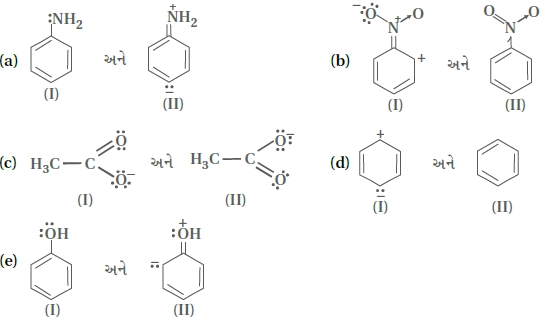
$(i)$ Identify the less stable resonance structure and $(ii)$ give its reason for the following pairs.
Solution
(N/A) The stability of resonance structures is determined by several factors,including the number of covalent bonds,charge separation,and the electronegativity of atoms bearing charges.
$(a)$ Structure $(II)$ is less stable because it involves charge separation,whereas structure $(I)$ is a neutral molecule.
$(b)$ Structure $(I)$ is less stable because it has charge separation,while structure $(II)$ is a neutral molecule.
$(c)$ Structures $(I)$ and $(II)$ are equally stable because they are equivalent resonance structures (both are carboxylate ions).
$(d)$ Structure $(I)$ is less stable because it has charge separation,while structure $(II)$ is a neutral benzene molecule.
$(e)$ Structure $(II)$ is less stable because it involves charge separation,whereas structure $(I)$ is a neutral molecule.
$(a)$ Structure $(II)$ is less stable because it involves charge separation,whereas structure $(I)$ is a neutral molecule.
$(b)$ Structure $(I)$ is less stable because it has charge separation,while structure $(II)$ is a neutral molecule.
$(c)$ Structures $(I)$ and $(II)$ are equally stable because they are equivalent resonance structures (both are carboxylate ions).
$(d)$ Structure $(I)$ is less stable because it has charge separation,while structure $(II)$ is a neutral benzene molecule.
$(e)$ Structure $(II)$ is less stable because it involves charge separation,whereas structure $(I)$ is a neutral molecule.
0 likes
View Solution128
Difficult
Provide the Lewis dot resonance structures of nitrogen oxides and give information about their shapes and bond parameters.
Solution
(N/A) The oxides of nitrogen exhibit various resonance structures and geometries. The following table summarizes their structures and bond parameters:
| No. | Molecular Formula | Resonance Structures | Bond Parameters |
|---|---|---|---|
| $(1)$ | $N_2O$ | $:N=N=\ddot{O}: \leftrightarrow :N \equiv N-\ddot{O}:$ | $N-N=113 \ pm, N-O=119 \ pm$,Linear |
| $(2)$ | $NO$ | $:N=\ddot{O}: \leftrightarrow :N=\ddot{O}:$ | $N-O=115 \ pm$,Linear |
| $(3)$ | $N_2O_3$ | $O_2N-NO_2$ resonance forms | Planar,$N-N=186 \ pm, N-O=121 \ pm$ |
| $(4)$ | $NO_2$ | $O=N-O \leftrightarrow O-N=O$ | Bent,$N-O=120 \ pm, \angle ONO=134^\circ$ |
| $(5)$ | $N_2O_4$ | $O_2N-NO_2$ resonance forms | Planar,$N-N=175 \ pm, N-O=121 \ pm$ |
| $(6)$ | $N_2O_5$ | $O_2N-O-NO_2$ resonance forms | Planar,$N-O=119 \ pm, 151 \ pm, \angle NON=112^\circ$ |
0 likes
View Solution129
EasyMCQ
What are the resonance structures and shape of $N_2O$?
A
Linear,$N \equiv N^+-O^-$ and $N^-=N^+=O$
B
Bent,$N \equiv N^+-O^-$ and $N^-=N^+=O$
C
Linear,$N=N=O$ and $N-N \equiv O$
D
Bent,$N=N=O$ and $N-N \equiv O$
Solution
(A) The molecule $N_2O$ (nitrous oxide) is a linear molecule with a bond angle of $180^{\circ}$.
Its resonance structures are represented as $[:N \equiv N^+ - O^- \leftrightarrow :N^- = N^+ = O]$.
The central nitrogen atom is $sp$ hybridized,resulting in a linear geometry.
Its resonance structures are represented as $[:N \equiv N^+ - O^- \leftrightarrow :N^- = N^+ = O]$.
The central nitrogen atom is $sp$ hybridized,resulting in a linear geometry.
0 likes
View Solution130
Easy
$(i)$ Draw the resonance structures of $N_2O_3$ and state its shape.
$(ii)$ Indicate the bond angles and bond lengths in it.
$(ii)$ Indicate the bond angles and bond lengths in it.
Solution
(N/A) $(i)$ $N_2O_3$ (dinitrogen trioxide) exists as a planar molecule in the gas phase. Its resonance structures involve the delocalization of electrons between the $N-N$ bond and the $N-O$ bonds.
The structure is planar with a $N-N$ bond length of approximately $186 \text{ pm}$. The terminal $N-O$ bond length is $114 \text{ pm}$ (double bond character) and the bridging $N-O$ bond length is $121 \text{ pm}$ (single bond character).
$(ii)$ The bond angle $\angle O-N-N$ is approximately $105^{\circ}$ and the $\angle N-N-O$ is approximately $117^{\circ}$.
The structure is planar with a $N-N$ bond length of approximately $186 \text{ pm}$. The terminal $N-O$ bond length is $114 \text{ pm}$ (double bond character) and the bridging $N-O$ bond length is $121 \text{ pm}$ (single bond character).
$(ii)$ The bond angle $\angle O-N-N$ is approximately $105^{\circ}$ and the $\angle N-N-O$ is approximately $117^{\circ}$.
0 likes
View Solution131
EasyMCQ
Draw the resonance structures of $NO$ and state its shape.
A
Linear,$1$ resonance structure
B
Linear,$2$ resonance structures
C
Bent,$2$ resonance structures
D
Linear,$3$ resonance structures
Solution
(B) The $NO$ molecule has $11$ valence electrons (odd-electron molecule).
It exists as a radical.
Due to the presence of an odd electron,it does not have perfect resonance structures like $NO_2$ or $NO_3^-$.
However,it is represented by two major resonance contributors where the odd electron resides on either the $N$ or $O$ atom.
Since it is a diatomic molecule,its shape is linear.
It exists as a radical.
Due to the presence of an odd electron,it does not have perfect resonance structures like $NO_2$ or $NO_3^-$.
However,it is represented by two major resonance contributors where the odd electron resides on either the $N$ or $O$ atom.
Since it is a diatomic molecule,its shape is linear.
0 likes
View Solution132
MediumMCQ
Draw the resonance structures of $NO_2$, state its shape, and indicate the bond angle and bond length.
A
Bent shape, $134^{\circ}$, $119 \text{ pm}$
B
Linear shape, $180^{\circ}$, $120 \text{ pm}$
C
Trigonal planar, $120^{\circ}$, $125 \text{ pm}$
D
Pyramidal, $107^{\circ}$, $115 \text{ pm}$
Solution
(A) The $NO_2$ molecule has an odd number of valence electrons ($5 + 6 + 6 = 17$ electrons).
It exists as a resonance hybrid of two structures where the unpaired electron resides on the nitrogen atom.
The shape of $NO_2$ is bent (angular) due to the presence of a lone electron on the nitrogen atom.
The $O-N-O$ bond angle is approximately $134^{\circ}$.
The $N-O$ bond length is approximately $119 \text{ pm}$.
It exists as a resonance hybrid of two structures where the unpaired electron resides on the nitrogen atom.
The shape of $NO_2$ is bent (angular) due to the presence of a lone electron on the nitrogen atom.
The $O-N-O$ bond angle is approximately $134^{\circ}$.
The $N-O$ bond length is approximately $119 \text{ pm}$.
0 likes
View Solution133
Easy
Draw the resonance structures of $N_2O_4$,state its shape,and indicate the bond angles and bond lengths.
Solution
(N/A) The $N_2O_4$ (dinitrogen tetroxide) molecule is planar with $D_{2h}$ symmetry.
Its resonance structures involve the delocalization of electrons across the $N-N$ bond and the $N-O$ bonds.
In the resonance hybrid,the $N-N$ bond length is approximately $1.75 \ \mathring{A}$,and the $N-O$ bond length is approximately $1.19 \ \mathring{A}$.
The bond angle $\angle O-N-O$ is approximately $135^{\circ}$ and $\angle N-N-O$ is approximately $112.5^{\circ}$.
The molecule is planar,meaning all atoms lie in the same plane.
Its resonance structures involve the delocalization of electrons across the $N-N$ bond and the $N-O$ bonds.
In the resonance hybrid,the $N-N$ bond length is approximately $1.75 \ \mathring{A}$,and the $N-O$ bond length is approximately $1.19 \ \mathring{A}$.
The bond angle $\angle O-N-O$ is approximately $135^{\circ}$ and $\angle N-N-O$ is approximately $112.5^{\circ}$.
The molecule is planar,meaning all atoms lie in the same plane.
0 likes
View Solution134
Easy
Draw the resonance structures of $N_2O_5$,state its shape,and indicate the bond angles and bond lengths.
Solution
(N/A) $N_2O_5$ (dinitrogen pentoxide) exists as a covalent molecule in the gas phase with the structure $O_2N-O-NO_2$.
Its shape is planar with $C_{2v}$ symmetry.
The central $N-O-N$ bond angle is approximately $112^{\circ}$.
The terminal $N=O$ bonds are shorter (approximately $1.19 \ \mathring{A}$) compared to the $N-O$ bonds connected to the bridging oxygen (approximately $1.35 \ \mathring{A}$).
Resonance structures involve the delocalization of $\pi$-electrons across the $O-N-O$ framework,resulting in partial double bond character for the $N-O$ bonds.
Its shape is planar with $C_{2v}$ symmetry.
The central $N-O-N$ bond angle is approximately $112^{\circ}$.
The terminal $N=O$ bonds are shorter (approximately $1.19 \ \mathring{A}$) compared to the $N-O$ bonds connected to the bridging oxygen (approximately $1.35 \ \mathring{A}$).
Resonance structures involve the delocalization of $\pi$-electrons across the $O-N-O$ framework,resulting in partial double bond character for the $N-O$ bonds.
0 likes
View Solution135
EasyMCQ
What is the $O-O$ bond length in an ozone $(O_3)$ molecule (in $pm$)?
A
$110$
B
$128$
C
$148$
D
$154$
Solution
(B) The ozone $(O_3)$ molecule has a bent structure with resonance between two canonical forms.
Due to resonance, the $O-O$ bond length is intermediate between a single bond $(148 \ pm)$ and a double bond $(121 \ pm)$.
The experimentally determined bond length for both $O-O$ bonds in ozone is $128 \ pm$.
Due to resonance, the $O-O$ bond length is intermediate between a single bond $(148 \ pm)$ and a double bond $(121 \ pm)$.
The experimentally determined bond length for both $O-O$ bonds in ozone is $128 \ pm$.
0 likes
View Solution136
Easy
Draw the resonance structures of $CO_2$.
Solution
The resonance structures of $CO_2$ involve the shifting of lone pairs and pi electrons between the carbon and oxygen atoms. The three contributing resonance structures are as follows:
$: \ddot{O}^{\ominus}-C \equiv O:^{+} \leftrightarrow :\ddot{O}=C=\ddot{O}: \leftrightarrow :^{+}O \equiv C-\ddot{O}^{\ominus}:$
$: \ddot{O}^{\ominus}-C \equiv O:^{+} \leftrightarrow :\ddot{O}=C=\ddot{O}: \leftrightarrow :^{+}O \equiv C-\ddot{O}^{\ominus}:$
0 likes
View Solution137
Medium
Explain why $CO_3^{2-}$ ion cannot be represented by a single Lewis structure. How can it be best represented?
Solution
(N/A) single Lewis structure of $CO_3^{2-}$ ion cannot explain all the properties of this ion.
If it were represented by only one structure,there should be two types of bonds,i.e.,one $C=O$ double bond and two $C-O$ single bonds. However,experimental evidence shows that all three $C-O$ bonds are identical in bond length and bond strength.
Therefore,it is best represented as a resonance hybrid of three canonical structures as shown below:
$(i)$ $\leftrightarrow$ (ii) $\leftrightarrow$ (iii) $\equiv$ Resonance hybrid
If it were represented by only one structure,there should be two types of bonds,i.e.,one $C=O$ double bond and two $C-O$ single bonds. However,experimental evidence shows that all three $C-O$ bonds are identical in bond length and bond strength.
Therefore,it is best represented as a resonance hybrid of three canonical structures as shown below:
$(i)$ $\leftrightarrow$ (ii) $\leftrightarrow$ (iii) $\equiv$ Resonance hybrid
0 likes
View Solution138
Medium
Draw the resonating structures of $(A)$ Ozone molecule $(O_3)$ and $(B)$ Nitrate ion $(NO_3^-)$.
Solution
(N/A) The resonating structures of the ozone molecule $(O_3)$ involve the delocalization of $\pi$ electrons. The two contributing structures are:
$O=O-O \leftrightarrow O-O=O$
$(B)$ The resonating structures of the nitrate ion $(NO_3^-)$ involve the delocalization of the double bond among the three oxygen atoms. The three contributing structures are:
$[O-N(=O)-O]^- \leftrightarrow [O=N(-O)-O]^- \leftrightarrow [O-N(-O)=O]^-$
$O=O-O \leftrightarrow O-O=O$
$(B)$ The resonating structures of the nitrate ion $(NO_3^-)$ involve the delocalization of the double bond among the three oxygen atoms. The three contributing structures are:
$[O-N(=O)-O]^- \leftrightarrow [O=N(-O)-O]^- \leftrightarrow [O-N(-O)=O]^-$
0 likes
View Solution139
Medium
All the $C-O$ bonds in carbonate ion $(CO_3^{2-})$ are equal in length. Explain.
Solution
(N/A) The carbonate ion $(CO_3^{2-})$ has a trigonal planar geometry.
According to the concept of resonance, the actual structure of the carbonate ion is a resonance hybrid of three canonical structures.
In these structures, the double bond is delocalized over all three $C-O$ bonds.
As a result, each $C-O$ bond possesses a partial double bond character, making all three $C-O$ bond lengths equal (approximately $128 \text{ pm}$).
According to the concept of resonance, the actual structure of the carbonate ion is a resonance hybrid of three canonical structures.
In these structures, the double bond is delocalized over all three $C-O$ bonds.
As a result, each $C-O$ bond possesses a partial double bond character, making all three $C-O$ bond lengths equal (approximately $128 \text{ pm}$).
0 likes
View Solution140
Medium
For which of the following can resonance structures be drawn? Why?
$CO_2, NO_2, O_3, O_2, CH_4$
$CO_2, NO_2, O_3, O_2, CH_4$
Solution
(N/A) Resonance structures can be drawn for $CO_2, NO_2,$ and $O_3$.
Resonance occurs in molecules where there is a system of conjugated double bonds or where a central atom has a lone pair of electrons and is bonded to atoms with different electronegativities or multiple bonds,allowing for the delocalization of $\pi$ electrons.
In $CO_2, NO_2,$ and $O_3$,the presence of multiple bonds and lone pairs allows for the shifting of electrons to create different resonance contributors.
$O_2$ and $CH_4$ do not exhibit resonance because $O_2$ is a homonuclear diatomic molecule with a simple double bond,and $CH_4$ has only single bonds with no lone pairs on the central carbon atom.
Resonance occurs in molecules where there is a system of conjugated double bonds or where a central atom has a lone pair of electrons and is bonded to atoms with different electronegativities or multiple bonds,allowing for the delocalization of $\pi$ electrons.
In $CO_2, NO_2,$ and $O_3$,the presence of multiple bonds and lone pairs allows for the shifting of electrons to create different resonance contributors.
$O_2$ and $CH_4$ do not exhibit resonance because $O_2$ is a homonuclear diatomic molecule with a simple double bond,and $CH_4$ has only single bonds with no lone pairs on the central carbon atom.
0 likes
View Solution141
Medium
Under what conditions can resonance structures be drawn?
Solution
(N/A) Resonance structures can be drawn under the following conditions:
$(i)$ When the molecule contains alternating multiple bonds (conjugation).
$(ii)$ When an atom involved in a double bond possesses a lone pair of electrons.
$(i)$ When the molecule contains alternating multiple bonds (conjugation).
$(ii)$ When an atom involved in a double bond possesses a lone pair of electrons.
0 likes
View Solution142
Medium
What points should be kept in mind while drawing resonance structures?
Solution
(N/A) $(i)$ The positions of atomic nuclei must remain fixed in all resonance structures.
$(ii)$ Only the positions of $p$ or $\pi$ electrons should be shifted.
$(iii)$ If possible,place electron pairs on more electronegative atoms to make them negative,and ensure that the number of unpaired electrons remains the same in all structures.
$(ii)$ Only the positions of $p$ or $\pi$ electrons should be shifted.
$(iii)$ If possible,place electron pairs on more electronegative atoms to make them negative,and ensure that the number of unpaired electrons remains the same in all structures.
0 likes
View Solution143
Medium
Draw different resonance structures of the following:
$(a)$ $CH_3COO^{-}$
$(b)$ $CH_2=CH-CHO$
$(c)$ Aniline $(C_6H_5NH_2)$
$(d)$ $C_6H_5NO_2$
$(e)$ Phenol
$(a)$ $CH_3COO^{-}$
$(b)$ $CH_2=CH-CHO$
$(c)$ Aniline $(C_6H_5NH_2)$
$(d)$ $C_6H_5NO_2$
$(e)$ Phenol
Solution
(N/A) Resonance structures represent the delocalization of $\pi$-electrons or lone pairs within a molecule.
$(a)$ $CH_3COO^-$: The negative charge is delocalized between the two oxygen atoms,resulting in two equivalent resonance structures.
$(b)$ $CH_2=CH-CHO$: The $\pi$-electrons delocalize towards the electronegative oxygen atom,creating polar resonance structures.
$(c)$ Aniline $(C_6H_5NH_2)$: The lone pair on the nitrogen atom participates in resonance with the benzene ring,increasing electron density at the ortho and para positions.
$(d)$ $C_6H_5NO_2$: The nitro group is electron-withdrawing,pulling $\pi$-electrons from the benzene ring towards the nitrogen atom,creating positive charges at ortho and para positions.
$(e)$ Phenol: The lone pair on the oxygen atom of the $-OH$ group delocalizes into the benzene ring,activating the ring towards electrophilic substitution.
$(a)$ $CH_3COO^-$: The negative charge is delocalized between the two oxygen atoms,resulting in two equivalent resonance structures.
$(b)$ $CH_2=CH-CHO$: The $\pi$-electrons delocalize towards the electronegative oxygen atom,creating polar resonance structures.
$(c)$ Aniline $(C_6H_5NH_2)$: The lone pair on the nitrogen atom participates in resonance with the benzene ring,increasing electron density at the ortho and para positions.
$(d)$ $C_6H_5NO_2$: The nitro group is electron-withdrawing,pulling $\pi$-electrons from the benzene ring towards the nitrogen atom,creating positive charges at ortho and para positions.
$(e)$ Phenol: The lone pair on the oxygen atom of the $-OH$ group delocalizes into the benzene ring,activating the ring towards electrophilic substitution.
0 likes
View Solution144
EasyMCQ
What are the characteristics of resonance structures?
A
The positions of atomic nuclei are different.
B
The number of lone pairs is different.
C
The positions of atomic nuclei are the same,and the number of unpaired electrons remains the same.
D
The total number of electrons changes.
Solution
(C) $(i)$ The positions of atomic nuclei remain the same in all resonance structures.
(ii) The total number of electrons remains the same.
(iii) Only $\pi$ electrons or lone pair electrons migrate and change their positions.
(ii) The total number of electrons remains the same.
(iii) Only $\pi$ electrons or lone pair electrons migrate and change their positions.
0 likes
View Solution145
Medium
What is resonance energy?
Solution
(N/A) Resonance energy is also known as stabilisation energy. The difference in energy between the actual structure and the lowest energy resonance structure is called the resonance energy.
0 likes
View Solution146
Easy
The value of resonance energy of nitromethane is represented by which equation?
Solution
(A) Resonance energy is defined as the difference between the potential energy of the most stable contributing resonance structure and the actual potential energy of the resonance hybrid structure.
$\text{Resonance energy} = \text{Potential energy of the most stable resonance structure} - \text{Potential energy of the resonance hybrid}$
$\text{Resonance energy} = \text{Potential energy of the most stable resonance structure} - \text{Potential energy of the resonance hybrid}$
0 likes
View Solution147
EasyMCQ
What is the difference between the resonance structures of $CH_3CH_2COO^{-}$ and $CH_3COOH$?
A
The resonance structures of $CH_3CH_2COO^{-}$ involve charge separation,while $CH_3COOH$ does not.
B
The resonance structures of $CH_3CH_2COO^{-}$ are equivalent,whereas those of $CH_3COOH$ are non-equivalent.
C
The resonance structures of $CH_3CH_2COO^{-}$ are non-equivalent,while those of $CH_3COOH$ are equivalent.
D
There is no difference in the nature of resonance structures for these two species.
Solution
(B) The resonance structures of the carboxylate ion $(CH_3CH_2COO^{-})$ are equivalent because the negative charge is delocalized over two oxygen atoms,making both resonance contributors identical in energy and stability.
In contrast,the resonance structures of the carboxylic acid $(CH_3COOH)$ are non-equivalent because one structure is neutral while the other involves charge separation (a positive charge on oxygen and a negative charge on oxygen),which makes the second structure significantly less stable.
In contrast,the resonance structures of the carboxylic acid $(CH_3COOH)$ are non-equivalent because one structure is neutral while the other involves charge separation (a positive charge on oxygen and a negative charge on oxygen),which makes the second structure significantly less stable.
0 likes
View Solution148
Medium
In benzene, why is neither of the two given resonance structures considered to be the correct representation of the actual molecule?
Solution
(N/A) Experimentally, benzene has uniform $C-C$ bond distances of $139 \ pm$, which is an intermediate value between the $C-C$ single bond $(154 \ pm)$ and the $C=C$ double bond $(134 \ pm)$. Therefore, the actual structure of benzene does not contain pure single or double bonds, but rather a resonance hybrid of the two structures.
0 likes
View Solution149
Medium
Draw the possible resonance structures for $CH_3 - \ddot{O} - CH_2^+$ and predict which of the structures is more stable. Give reason for your answer.
Solution
(B) The resonance structures for the given carbocation are as follows:
$CH_3 - \ddot{O} - CH_2^+ \leftrightarrow CH_3 - O^+ = CH_2$
$(A) \leftrightarrow (B)$
Structure $(B)$ is more stable than structure $(A)$ due to the following reasons:
In structure $(B)$,every atom has a complete octet,which makes it more stable than structure $(A)$ where the carbon atom has an incomplete octet.
$CH_3 - \ddot{O} - CH_2^+ \leftrightarrow CH_3 - O^+ = CH_2$
$(A) \leftrightarrow (B)$
Structure $(B)$ is more stable than structure $(A)$ due to the following reasons:
| $A$. Less stable | $B$. More stable |
| The positive charge is on the carbon atom. | The positive charge is on the oxygen atom. |
| The octet of the positively charged carbon atom is incomplete. | The octets of all atoms (carbon and oxygen) are complete. |
In structure $(B)$,every atom has a complete octet,which makes it more stable than structure $(A)$ where the carbon atom has an incomplete octet.
0 likes
View Solution150
Medium
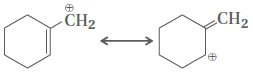
Which of the following resonance structures is more stable? Explain your answer.
Solution
(A) Between the two resonance structures,structure $A$ is more stable than structure $B$.
In structure $A$,the positive charge is on the primary carbon atom,but it is an allylic carbocation,which allows for resonance stabilization.
In structure $B$,the positive charge is on the secondary carbon atom within the ring.
However,the primary reason for the stability difference is that structure $A$ has an endocyclic double bond,which is generally more stable than the exocyclic double bond present in structure $B$ due to less ring strain.
In structure $A$,the positive charge is on the primary carbon atom,but it is an allylic carbocation,which allows for resonance stabilization.
In structure $B$,the positive charge is on the secondary carbon atom within the ring.
However,the primary reason for the stability difference is that structure $A$ has an endocyclic double bond,which is generally more stable than the exocyclic double bond present in structure $B$ due to less ring strain.
0 likes
View SolutionChemical Bonding and Molecular Structure — Resonance · Frequently Asked Questions
1Are these Chemical Bonding and Molecular Structure questions useful for JEE and NEET?
Yes. All questions in this section are mapped to JEE Main and NEET exam patterns. Previous year questions from JEE Main, NEET, GUJCET and state-level exams are included with full solutions.
2Can I switch to Hindi or Gujarati for these questions?
Yes. Use the language tabs in the hero section or the sidebar to view the same questions and solutions in English, Hindi or Gujarati.
3How do I generate a question paper from this subtopic?
Use the Vedclass Exam Paper Generator — select the chapter and subtopic, set difficulty, and generate Sets A, B, C, D automatically. First 3 chapters of every subject are free.
Vedclass Products
For Students
Vedclass Test Series
Mock tests in real JEE/NEET style with performance analysis. 5-day free trial.
Start Free TrialFor Teachers
Exam Paper Generator
Generate Set A/B/C/D papers from this chapter in 2 minutes. 3 chapters free.
Try FreeFor Institutes
Online Exam Module
Live online exams with unlimited students, 360° analytics & white-label branding.
See DemoFor Teachers & Institutes
Generate a Chemical Bonding and Molecular Structure Exam Paper in 2 Minutes
Select subtopic & difficulty — Sets A, B, C, D auto-generated with No Repeat logic.
First 3 chapters of every subject are free — no payment required.