
A English
Mix Examples-Chemical Bonding Questions in English
Class 11 Chemistry · Chemical Bonding and Molecular Structure · Mix Examples-Chemical Bonding
489+
Questions
English
Language
100%
With Solutions
Showing 50 of 489 questions in English
351
MediumMCQ
For the compound having the formula $GaAlCl_4$,the correct option from the following is:
A
$Ga$ is more electronegative than $Al$ and is present as a cationic part of the salt $GaAlCl_4$.
B
The oxidation state of $Ga$ in the salt $GaAlCl_4$ is $+3$.
C
$Cl$ forms a bond with both $Al$ and $Ga$ in $GaAlCl_4$.
D
$Ga$ is coordinated with $Cl$ in $GaAlCl_4$.
Solution
(A) The compound $GaAlCl_4$ is an ionic salt consisting of $Ga^+$ and $[AlCl_4]^-$ ions.
In this structure,$Ga$ exists as a $Ga^+$ cation,meaning its oxidation state is $+1$,not $+3$.
The $[AlCl_4]^-$ anion consists of an $Al$ atom coordinated to four $Cl$ atoms.
Since $Ga$ is the cationic part of the salt,it is not coordinated to $Cl$ in the same way $Al$ is within the anion.
Therefore,$Ga$ is present as a cationic part of the salt $GaAlCl_4$.
In this structure,$Ga$ exists as a $Ga^+$ cation,meaning its oxidation state is $+1$,not $+3$.
The $[AlCl_4]^-$ anion consists of an $Al$ atom coordinated to four $Cl$ atoms.
Since $Ga$ is the cationic part of the salt,it is not coordinated to $Cl$ in the same way $Al$ is within the anion.
Therefore,$Ga$ is present as a cationic part of the salt $GaAlCl_4$.
0 likes
View Solution352
MediumMCQ
Consider the following statements:
$A$. $NF_3$ molecule has a trigonal planar structure.
$B$. Bond length of $N_2$ is shorter than $O_2$.
$C$. Isoelectronic molecules or ions have identical bond order.
$D$. Dipole moment of $H_2S$ is higher than that of water molecule.
Choose the correct answer from the options below:
$A$. $NF_3$ molecule has a trigonal planar structure.
$B$. Bond length of $N_2$ is shorter than $O_2$.
$C$. Isoelectronic molecules or ions have identical bond order.
$D$. Dipole moment of $H_2S$ is higher than that of water molecule.
Choose the correct answer from the options below:
A
$A$ and $D$ are correct
B
$C$ and $D$ are correct
C
$A$ and $B$ are correct
D
$B$ and $C$ are correct
Solution
(D) . $NF_3$ has a trigonal pyramidal shape due to the presence of one lone pair on the $N$ atom.
$B$. The bond order of $N_2$ is $3$ and $O_2$ is $2$. Higher bond order implies shorter bond length,so $N_2$ has a shorter bond length than $O_2$. Statement $B$ is correct.
$C$. Isoelectronic species (e.g.,$N_2$ and $CO$) have identical bond orders. Statement $C$ is correct.
$D$. The dipole moment of $H_2O$ $(1.85 \ D)$ is higher than that of $H_2S$ $(0.95 \ D)$ due to the higher electronegativity of oxygen compared to sulfur. Statement $D$ is incorrect.
Therefore,statements $B$ and $C$ are correct.
$B$. The bond order of $N_2$ is $3$ and $O_2$ is $2$. Higher bond order implies shorter bond length,so $N_2$ has a shorter bond length than $O_2$. Statement $B$ is correct.
$C$. Isoelectronic species (e.g.,$N_2$ and $CO$) have identical bond orders. Statement $C$ is correct.
$D$. The dipole moment of $H_2O$ $(1.85 \ D)$ is higher than that of $H_2S$ $(0.95 \ D)$ due to the higher electronegativity of oxygen compared to sulfur. Statement $D$ is incorrect.
Therefore,statements $B$ and $C$ are correct.
0 likes
View Solution353
MediumMCQ
The number of $\sigma$ bonds,$\pi$ bonds and lone pair of electrons in pyridine,respectively are:
A
$12, 2, 1$
B
$11, 2, 0$
C
$12, 3, 0$
D
$11, 3, 1$
Solution
(D) Pyridine $(C_5H_5N)$ has a hexagonal ring structure similar to benzene where one $CH$ group is replaced by a nitrogen atom.
$1$. $\sigma$ bonds: There are $5$ $C-H$ bonds,$5$ $C-C/C-N$ single bonds,and $1$ $C-N$ double bond (which contains $1$ $\sigma$ bond). Total $\sigma$ bonds $= 5 + 5 + 1 = 11$.
$2$. $\pi$ bonds: There are $3$ double bonds in the ring,each containing $1$ $\pi$ bond. Total $\pi$ bonds $= 3$.
$3$. Lone pair of electrons: The nitrogen atom in pyridine has $1$ lone pair of electrons.
Thus,the number of $\sigma$ bonds,$\pi$ bonds,and lone pairs are $11, 3, 1$ respectively.
$1$. $\sigma$ bonds: There are $5$ $C-H$ bonds,$5$ $C-C/C-N$ single bonds,and $1$ $C-N$ double bond (which contains $1$ $\sigma$ bond). Total $\sigma$ bonds $= 5 + 5 + 1 = 11$.
$2$. $\pi$ bonds: There are $3$ double bonds in the ring,each containing $1$ $\pi$ bond. Total $\pi$ bonds $= 3$.
$3$. Lone pair of electrons: The nitrogen atom in pyridine has $1$ lone pair of electrons.
Thus,the number of $\sigma$ bonds,$\pi$ bonds,and lone pairs are $11, 3, 1$ respectively.
0 likes
View Solution354
MediumMCQ
Amongst the following,the total number of species $NOT$ having $8$ electrons around the central atom in its outermost shell is $NH_3$,$AlCl_3$,$BeCl_2$,$CCl_4$,$PCl_5$:
A
$1$
B
$3$
C
$2$
D
$4$
Solution
(B) To determine the number of species that do not follow the octet rule (i.e.,do not have $8$ electrons around the central atom),we analyze the valence electrons of each molecule:
$1$. $NH_3$: Nitrogen has $5$ valence electrons and forms $3$ bonds with Hydrogen,plus $1$ lone pair. Total electrons = $3 \times 2 + 2 = 8$ electrons.
$2$. $AlCl_3$: Aluminum has $3$ valence electrons and forms $3$ bonds with Chlorine. Total electrons = $3 \times 2 = 6$ electrons (Incomplete octet).
$3$. $BeCl_2$: Beryllium has $2$ valence electrons and forms $2$ bonds with Chlorine. Total electrons = $2 \times 2 = 4$ electrons (Incomplete octet).
$4$. $CCl_4$: Carbon has $4$ valence electrons and forms $4$ bonds with Chlorine. Total electrons = $4 \times 2 = 8$ electrons.
$5$. $PCl_5$: Phosphorus has $5$ valence electrons and forms $5$ bonds with Chlorine. Total electrons = $5 \times 2 = 10$ electrons (Expanded octet).
Species with $NOT$ $8$ electrons are $AlCl_3$,$BeCl_2$,and $PCl_5$.
Therefore,the total number of such species is $3$.
$1$. $NH_3$: Nitrogen has $5$ valence electrons and forms $3$ bonds with Hydrogen,plus $1$ lone pair. Total electrons = $3 \times 2 + 2 = 8$ electrons.
$2$. $AlCl_3$: Aluminum has $3$ valence electrons and forms $3$ bonds with Chlorine. Total electrons = $3 \times 2 = 6$ electrons (Incomplete octet).
$3$. $BeCl_2$: Beryllium has $2$ valence electrons and forms $2$ bonds with Chlorine. Total electrons = $2 \times 2 = 4$ electrons (Incomplete octet).
$4$. $CCl_4$: Carbon has $4$ valence electrons and forms $4$ bonds with Chlorine. Total electrons = $4 \times 2 = 8$ electrons.
$5$. $PCl_5$: Phosphorus has $5$ valence electrons and forms $5$ bonds with Chlorine. Total electrons = $5 \times 2 = 10$ electrons (Expanded octet).
Species with $NOT$ $8$ electrons are $AlCl_3$,$BeCl_2$,and $PCl_5$.
Therefore,the total number of such species is $3$.
1 likes
View Solution355
DifficultMCQ
Arrange the bonds in order of increasing ionic character in the molecules: $LiF$,$K_2O$,$N_2$,$SO_2$,and $ClF_3$.
A
$ClF_3 < N_2 < SO_2 < K_2O < LiF$
B
$LiF < K_2O < ClF_3 < SO_2 < N_2$
C
$N_2 < SO_2 < ClF_3 < K_2O < LiF$
D
$N_2 < ClF_3 < SO_2 < K_2O < LiF$
Solution
(C) The ionic character of a bond depends on the difference in electronegativity between the bonded atoms. Larger electronegativity difference leads to higher ionic character.
$1$. $N_2$ (non-polar covalent,$\Delta EN = 0$)
$2$. $SO_2$ (polar covalent,$\Delta EN \approx 0.9$)
$3$. $ClF_3$ (polar covalent,$\Delta EN \approx 1.0$)
$4$. $K_2O$ (ionic,$\Delta EN \approx 2.6$)
$5$. $LiF$ (ionic,$\Delta EN \approx 3.0$)
Therefore,the increasing order of ionic character is: $N_2 < SO_2 < ClF_3 < K_2O < LiF$.
$1$. $N_2$ (non-polar covalent,$\Delta EN = 0$)
$2$. $SO_2$ (polar covalent,$\Delta EN \approx 0.9$)
$3$. $ClF_3$ (polar covalent,$\Delta EN \approx 1.0$)
$4$. $K_2O$ (ionic,$\Delta EN \approx 2.6$)
$5$. $LiF$ (ionic,$\Delta EN \approx 3.0$)
Therefore,the increasing order of ionic character is: $N_2 < SO_2 < ClF_3 < K_2O < LiF$.
0 likes
View Solution356
MediumMCQ
In the Lewis dot structure for $NO_2^-$,the total number of valence electrons around the nitrogen atom is $.......$
A
$8$
B
$9$
C
$15$
D
$20$
Solution
(A) The nitrogen atom in the $NO_2^-$ ion is bonded to two oxygen atoms,one via a double bond and one via a single bond.
It also possesses one lone pair of electrons.
Total electrons around $N = (2 \times 2 \text{ from double bond}) + (1 \times 2 \text{ from single bond}) + (1 \times 2 \text{ from lone pair}) = 4 + 2 + 2 = 8$ electrons.
It also possesses one lone pair of electrons.
Total electrons around $N = (2 \times 2 \text{ from double bond}) + (1 \times 2 \text{ from single bond}) + (1 \times 2 \text{ from lone pair}) = 4 + 2 + 2 = 8$ electrons.
0 likes
View Solution357
MediumMCQ
Match List-$I$ with List-$II$ :
Choose the correct answer from the options given below :
| List-$I$ (Molecule Species) | List-$II$ (Property/Shape) |
|---|---|
| $A$. $SO_2Cl_2$ | $I$. Paramagnetic |
| $B$. $NO$ | $II$. Diamagnetic |
| $C$. $NO_2^-$ | $III$. Tetrahedral |
| $D$. $I_3^-$ | $IV$. Linear |
Choose the correct answer from the options given below :
A
$A-IV, B-I, C-III, D-II$
B
$A-III, B-I, C-II, D-IV$
C
$A-II, B-III, C-I, D-IV$
D
$A-III, B-IV, C-II, D-I$
Solution
(B) $1$. $SO_2Cl_2$: The central $S$ atom has $4$ bonding pairs (two $S=O$ and two $S-Cl$ bonds) and $0$ lone pairs. Hybridization is $sp^3$,resulting in a Tetrahedral shape $(III)$.
$2$. $NO$: Total valence electrons = $5 + 6 = 11$. It has an odd number of electrons,making it Paramagnetic $(I)$.
$3$. $NO_2^-$: The central $N$ atom has $2$ bonding pairs and $1$ lone pair. It is Diamagnetic $(II)$.
$4$. $I_3^-$: The central $I$ atom has $2$ bonding pairs and $3$ lone pairs. Hybridization is $sp^3d$,resulting in a Linear shape $(IV)$.
Matching: $A-III, B-I, C-II, D-IV$.
$2$. $NO$: Total valence electrons = $5 + 6 = 11$. It has an odd number of electrons,making it Paramagnetic $(I)$.
$3$. $NO_2^-$: The central $N$ atom has $2$ bonding pairs and $1$ lone pair. It is Diamagnetic $(II)$.
$4$. $I_3^-$: The central $I$ atom has $2$ bonding pairs and $3$ lone pairs. Hybridization is $sp^3d$,resulting in a Linear shape $(IV)$.
Matching: $A-III, B-I, C-II, D-IV$.
1 likes
View Solution358
MediumMCQ
Number of molecules from the following which are exceptions to the octet rule is. . . .
$CO_2, NO_2, H_2SO_4, BF_3, CH_4, SiF_4, ClO_2, PCl_5, BeF_2, C_2H_6, CHCl_3, CBr_4$
$CO_2, NO_2, H_2SO_4, BF_3, CH_4, SiF_4, ClO_2, PCl_5, BeF_2, C_2H_6, CHCl_3, CBr_4$
A
$5$
B
$6$
C
$8$
D
$9$
Solution
(B) The octet rule states that atoms tend to gain,lose,or share electrons to achieve a stable configuration of $8$ electrons in their valence shell.
Let us analyze each molecule:
$1$. $CO_2$: Carbon has $8$ electrons (complete octet).
$2$. $NO_2$: Nitrogen has an odd number of electrons ($7$ electrons,exception).
$3$. $H_2SO_4$: Sulfur has an expanded octet ($12$ electrons,exception).
$4$. $BF_3$: Boron has an incomplete octet ($6$ electrons,exception).
$5$. $CH_4$: Carbon has $8$ electrons (complete octet).
$6$. $SiF_4$: Silicon has $8$ electrons (complete octet).
$7$. $ClO_2$: Chlorine has an odd number of electrons ($7$ electrons,exception).
$8$. $PCl_5$: Phosphorus has an expanded octet ($10$ electrons,exception).
$9$. $BeF_2$: Beryllium has an incomplete octet ($4$ electrons,exception).
$10$. $C_2H_6$: Carbon has $8$ electrons (complete octet).
$11$. $CHCl_3$: Carbon has $8$ electrons (complete octet).
$12$. $CBr_4$: Carbon has $8$ electrons (complete octet).
The molecules that are exceptions to the octet rule are: $NO_2, H_2SO_4, BF_3, ClO_2, PCl_5, BeF_2$.
Total number of exceptions = $6$.
Let us analyze each molecule:
$1$. $CO_2$: Carbon has $8$ electrons (complete octet).
$2$. $NO_2$: Nitrogen has an odd number of electrons ($7$ electrons,exception).
$3$. $H_2SO_4$: Sulfur has an expanded octet ($12$ electrons,exception).
$4$. $BF_3$: Boron has an incomplete octet ($6$ electrons,exception).
$5$. $CH_4$: Carbon has $8$ electrons (complete octet).
$6$. $SiF_4$: Silicon has $8$ electrons (complete octet).
$7$. $ClO_2$: Chlorine has an odd number of electrons ($7$ electrons,exception).
$8$. $PCl_5$: Phosphorus has an expanded octet ($10$ electrons,exception).
$9$. $BeF_2$: Beryllium has an incomplete octet ($4$ electrons,exception).
$10$. $C_2H_6$: Carbon has $8$ electrons (complete octet).
$11$. $CHCl_3$: Carbon has $8$ electrons (complete octet).
$12$. $CBr_4$: Carbon has $8$ electrons (complete octet).
The molecules that are exceptions to the octet rule are: $NO_2, H_2SO_4, BF_3, ClO_2, PCl_5, BeF_2$.
Total number of exceptions = $6$.
0 likes
View Solution359
MediumMCQ
Among the following,the correct statement$(s)$ is(are):
$A$. $Al(CH_3)_3$ has the three-centre two-electron $(3c-2e)$ bonds in its dimeric structure.
$B$. $BH_3$ has the three-centre two-electron $(3c-2e)$ bonds in its dimeric structure $(B_2H_6)$.
$C$. $AlCl_3$ has the three-centre two-electron bonds in its dimeric structure.
$D$. The Lewis acidity of $BCl_3$ is greater than that of $AlCl_3$.
$A$. $Al(CH_3)_3$ has the three-centre two-electron $(3c-2e)$ bonds in its dimeric structure.
$B$. $BH_3$ has the three-centre two-electron $(3c-2e)$ bonds in its dimeric structure $(B_2H_6)$.
$C$. $AlCl_3$ has the three-centre two-electron bonds in its dimeric structure.
$D$. The Lewis acidity of $BCl_3$ is greater than that of $AlCl_3$.
A
$A, B, C$
B
$A, B, D$
C
$A, B$
D
$A, C$
Solution
(B) . $Al_2(CH_3)_6$ (dimer of $Al(CH_3)_3$) contains $Al-C-Al$ bridges which are $3c-2e$ bonds.
$B$. $B_2H_6$ (dimer of $BH_3$) contains $B-H-B$ bridges which are $3c-2e$ bonds.
$C$. $Al_2Cl_6$ (dimer of $AlCl_3$) contains $Al-Cl-Al$ bridges,but these are $3c-4e$ bonds (due to lone pairs on $Cl$),not $3c-2e$ bonds.
$D$. $BCl_3$ is a stronger Lewis acid than $AlCl_3$ because the back-bonding in $BCl_3$ is less effective than in $AlCl_3$ due to the size mismatch between $B$ $(2p)$ and $Cl$ $(3p)$ orbitals compared to $Al$ $(3p)$ and $Cl$ $(3p)$.
Thus,statements $A, B,$ and $D$ are correct.
$B$. $B_2H_6$ (dimer of $BH_3$) contains $B-H-B$ bridges which are $3c-2e$ bonds.
$C$. $Al_2Cl_6$ (dimer of $AlCl_3$) contains $Al-Cl-Al$ bridges,but these are $3c-4e$ bonds (due to lone pairs on $Cl$),not $3c-2e$ bonds.
$D$. $BCl_3$ is a stronger Lewis acid than $AlCl_3$ because the back-bonding in $BCl_3$ is less effective than in $AlCl_3$ due to the size mismatch between $B$ $(2p)$ and $Cl$ $(3p)$ orbitals compared to $Al$ $(3p)$ and $Cl$ $(3p)$.
Thus,statements $A, B,$ and $D$ are correct.
0 likes
View Solution360
AdvancedMCQ
$A$ tin chloride $Q$ undergoes the following reactions (not balanced):
$Q + Cl^{-} \rightarrow X$
$Q + Me_3N \rightarrow Y$
$Q + CuCl_2 \rightarrow Z + CuCl$
$X$ is a monoanion having pyramidal geometry. Both $Y$ and $Z$ are neutral compounds. Choose the correct option$(s)$.
$(1)$ The central atom in $X$ is $sp^3$ hybridized
$(2)$ The oxidation state of the central atom in $Z$ is $+4$
$(3)$ The central atom in $Z$ has no lone pair of electrons
$(4)$ There is a coordinate bond in $Y$
$Q + Cl^{-} \rightarrow X$
$Q + Me_3N \rightarrow Y$
$Q + CuCl_2 \rightarrow Z + CuCl$
$X$ is a monoanion having pyramidal geometry. Both $Y$ and $Z$ are neutral compounds. Choose the correct option$(s)$.
$(1)$ The central atom in $X$ is $sp^3$ hybridized
$(2)$ The oxidation state of the central atom in $Z$ is $+4$
$(3)$ The central atom in $Z$ has no lone pair of electrons
$(4)$ There is a coordinate bond in $Y$
A
$1, 2$
B
$1, 3$
C
$1, 4$
D
$2, 3$
Solution
(C) $Q$ is $SnCl_2$.
$1. SnCl_2 + Cl^{-} \rightarrow [SnCl_3]^{-} (X)$. The $Sn$ atom in $[SnCl_3]^{-}$ has $3$ bond pairs and $1$ lone pair,so it is $sp^3$ hybridized with pyramidal geometry. Statement $(1)$ is correct.
$2. SnCl_2 + Me_3N \rightarrow SnCl_2 \cdot NMe_3 (Y)$. This is an adduct where $N$ donates a lone pair to $Sn$,forming a coordinate bond. Statement $(4)$ is correct.
$3. SnCl_2 + 2CuCl_2 \rightarrow SnCl_4 (Z) + 2CuCl$. The oxidation state of $Sn$ in $SnCl_4$ is $+4$. Statement $(2)$ is incorrect.
$4. SnCl_4$ has $4$ bond pairs and $0$ lone pairs. Statement $(3)$ is incorrect.
Therefore,statements $(1)$ and $(4)$ are correct.
$1. SnCl_2 + Cl^{-} \rightarrow [SnCl_3]^{-} (X)$. The $Sn$ atom in $[SnCl_3]^{-}$ has $3$ bond pairs and $1$ lone pair,so it is $sp^3$ hybridized with pyramidal geometry. Statement $(1)$ is correct.
$2. SnCl_2 + Me_3N \rightarrow SnCl_2 \cdot NMe_3 (Y)$. This is an adduct where $N$ donates a lone pair to $Sn$,forming a coordinate bond. Statement $(4)$ is correct.
$3. SnCl_2 + 2CuCl_2 \rightarrow SnCl_4 (Z) + 2CuCl$. The oxidation state of $Sn$ in $SnCl_4$ is $+4$. Statement $(2)$ is incorrect.
$4. SnCl_4$ has $4$ bond pairs and $0$ lone pairs. Statement $(3)$ is incorrect.
Therefore,statements $(1)$ and $(4)$ are correct.
0 likes
View Solution361
MediumMCQ
The total number of lone pairs of electrons in melamine is
A
$6$
B
$7$
C
$8$
D
$9$
Solution
(A) Melamine is a heterocyclic organic compound with the formula $C_3H_6N_6$.
It consists of a $1,3,5$-triazine ring substituted with three amino groups at the $2, 4,$ and $6$ positions.
In the structure of melamine:
$1$. Each of the $3$ nitrogen atoms in the triazine ring has $1$ lone pair of electrons.
$2$. Each of the $3$ nitrogen atoms in the amino $(-NH_2)$ groups has $1$ lone pair of electrons.
Therefore,the total number of lone pairs of electrons in melamine is $3 + 3 = 6$.
It consists of a $1,3,5$-triazine ring substituted with three amino groups at the $2, 4,$ and $6$ positions.
In the structure of melamine:
$1$. Each of the $3$ nitrogen atoms in the triazine ring has $1$ lone pair of electrons.
$2$. Each of the $3$ nitrogen atoms in the amino $(-NH_2)$ groups has $1$ lone pair of electrons.
Therefore,the total number of lone pairs of electrons in melamine is $3 + 3 = 6$.
0 likes
View Solution362
MediumMCQ
The total number of lone pairs of electrons in $N_2O_3$ is
A
$5$
B
$6$
C
$7$
D
$8$
Solution
(D) To determine the total number of lone pairs in $N_2O_3$,we look at its Lewis structure.
In the structure of $N_2O_3$ $(O=N-O-N=O)$,the distribution of lone pairs is as follows:
$1$. Each terminal oxygen atom $(=O)$ has $2$ lone pairs.
$2$. The central oxygen atom $(-O-)$ has $2$ lone pairs.
$3$. Each nitrogen atom has $1$ lone pair.
Total lone pairs = $(2 \times 2) + 2 + (2 \times 1) = 4 + 2 + 2 = 8$.
Thus,the total number of lone pairs is $8$.
In the structure of $N_2O_3$ $(O=N-O-N=O)$,the distribution of lone pairs is as follows:
$1$. Each terminal oxygen atom $(=O)$ has $2$ lone pairs.
$2$. The central oxygen atom $(-O-)$ has $2$ lone pairs.
$3$. Each nitrogen atom has $1$ lone pair.
Total lone pairs = $(2 \times 2) + 2 + (2 \times 1) = 4 + 2 + 2 = 8$.
Thus,the total number of lone pairs is $8$.
0 likes
View Solution363
MediumMCQ
The option$(s)$ in which at least three molecules follow the Octet Rule is(are):
$(A)$ $CO_2, C_2H_4, NO$ and $HCl$
$(B)$ $NO_2, O_3, HCl$ and $H_2SO_4$
$(C)$ $BCl_3, NO, NO_2$ and $H_2SO_4$
$(D)$ $CO_2, BCl_3, O_3$ and $C_2H_4$
$(A)$ $CO_2, C_2H_4, NO$ and $HCl$
$(B)$ $NO_2, O_3, HCl$ and $H_2SO_4$
$(C)$ $BCl_3, NO, NO_2$ and $H_2SO_4$
$(D)$ $CO_2, BCl_3, O_3$ and $C_2H_4$
A
$A, B$
B
$A, C$
C
$A, D$
D
$A, B, C$
Solution
(C) To determine which molecules follow the Octet Rule,we check the valence electrons around the central atom:
$1$. $CO_2$: $C$ has $8$ electrons (follows octet).
$2$. $C_2H_4$: $C$ has $8$ electrons (follows octet).
$3$. $HCl$: $Cl$ has $8$ electrons (follows octet).
$4$. $NO$: $N$ has $7$ electrons (odd electron molecule,violates octet).
$5$. $NO_2$: $N$ has $7$ electrons (odd electron molecule,violates octet).
$6$. $O_3$: Central $O$ has $8$ electrons (follows octet).
$7$. $H_2SO_4$: $S$ has $12$ electrons (expanded octet,violates octet).
$8$. $BCl_3$: $B$ has $6$ electrons (incomplete octet,violates octet).
Evaluating options:
$(A)$ $CO_2, C_2H_4, HCl$ follow octet ($3$ molecules). $NO$ does not.
$(B)$ $O_3, HCl$ follow octet. $NO_2, H_2SO_4$ do not.
$(C)$ $NO, NO_2, BCl_3, H_2SO_4$ do not follow octet.
$(D)$ $CO_2, O_3, C_2H_4$ follow octet ($3$ molecules). $BCl_3$ does not.
Thus,options $(A)$ and $(D)$ contain at least three molecules that follow the Octet Rule.
$1$. $CO_2$: $C$ has $8$ electrons (follows octet).
$2$. $C_2H_4$: $C$ has $8$ electrons (follows octet).
$3$. $HCl$: $Cl$ has $8$ electrons (follows octet).
$4$. $NO$: $N$ has $7$ electrons (odd electron molecule,violates octet).
$5$. $NO_2$: $N$ has $7$ electrons (odd electron molecule,violates octet).
$6$. $O_3$: Central $O$ has $8$ electrons (follows octet).
$7$. $H_2SO_4$: $S$ has $12$ electrons (expanded octet,violates octet).
$8$. $BCl_3$: $B$ has $6$ electrons (incomplete octet,violates octet).
Evaluating options:
$(A)$ $CO_2, C_2H_4, HCl$ follow octet ($3$ molecules). $NO$ does not.
$(B)$ $O_3, HCl$ follow octet. $NO_2, H_2SO_4$ do not.
$(C)$ $NO, NO_2, BCl_3, H_2SO_4$ do not follow octet.
$(D)$ $CO_2, O_3, C_2H_4$ follow octet ($3$ molecules). $BCl_3$ does not.
Thus,options $(A)$ and $(D)$ contain at least three molecules that follow the Octet Rule.
0 likes
View Solution364
DifficultMCQ
Match the List-$I$ with List-$II$:
Choose the correct answer from the options given below:
| List-$I$ (Classification of molecules based on octet rule) | List-$II$ (Example) |
| $A$. Molecules obeying octet rule | $I$. $NO, NO_2$ |
| $B$. Molecules with incomplete octet | $II$. $BCl_3, AlCl_3$ |
| $C$. Molecules with odd electron | $III$. $H_2SO_4, PCl_5$ |
| $D$. Molecules with expanded octet | $IV$. $CCl_4, CO_2$ |
Choose the correct answer from the options given below:
A
$A-IV, B-II, C-I, D-III$
B
$A-III, B-II, C-I, D-IV$
C
$A-IV, B-I, C-III, D-II$
D
$A-II, B-IV, C-III, D-I$
Solution
(A) $A \rightarrow IV$: $CCl_4$ and $CO_2$ follow the octet rule as all atoms have $8$ electrons in their valence shell.
$B \rightarrow II$: $BCl_3$ and $AlCl_3$ have incomplete octets with only $6$ electrons around the central atom.
$C \rightarrow I$: $NO$ and $NO_2$ are odd-electron molecules containing an unpaired electron.
$D \rightarrow III$: $H_2SO_4$ and $PCl_5$ have expanded octets where the central atom has more than $8$ electrons.
Therefore,the correct matching is $A-IV, B-II, C-I, D-III$.
$B \rightarrow II$: $BCl_3$ and $AlCl_3$ have incomplete octets with only $6$ electrons around the central atom.
$C \rightarrow I$: $NO$ and $NO_2$ are odd-electron molecules containing an unpaired electron.
$D \rightarrow III$: $H_2SO_4$ and $PCl_5$ have expanded octets where the central atom has more than $8$ electrons.
Therefore,the correct matching is $A-IV, B-II, C-I, D-III$.
0 likes
View Solution365
DifficultMCQ
Which of the following statements is true with respect to $H_2O$,$NH_3$ and $CH_4$?
$A.$ The central atoms of all the molecules are $sp^3$ hybridized.
$B.$ The $H-O-H$,$H-N-H$ and $H-C-H$ angles in the above molecules are $104.5^{\circ}$,$107.5^{\circ}$ and $109.5^{\circ}$ respectively.
$C.$ The increasing order of dipole moment is $CH_4 < NH_3 < H_2O$.
$D.$ Both $H_2O$ and $NH_3$ are Lewis acids and $CH_4$ is a Lewis base.
$E.$ $A$ solution of $NH_3$ in $H_2O$ is basic. In this solution,$NH_3$ and $H_2O$ act as a Lowry-Bronsted base and acid respectively.
Choose the correct answer from the options given below:
$A.$ The central atoms of all the molecules are $sp^3$ hybridized.
$B.$ The $H-O-H$,$H-N-H$ and $H-C-H$ angles in the above molecules are $104.5^{\circ}$,$107.5^{\circ}$ and $109.5^{\circ}$ respectively.
$C.$ The increasing order of dipole moment is $CH_4 < NH_3 < H_2O$.
$D.$ Both $H_2O$ and $NH_3$ are Lewis acids and $CH_4$ is a Lewis base.
$E.$ $A$ solution of $NH_3$ in $H_2O$ is basic. In this solution,$NH_3$ and $H_2O$ act as a Lowry-Bronsted base and acid respectively.
Choose the correct answer from the options given below:
A
$A$,$B$ and $C$ only
B
$C$,$D$ and $E$ only
C
$A$,$D$ and $E$ only
D
$A$,$B$,$C$ and $E$ only
Solution
(D) $1$. All central atoms ($O$,$N$,$C$) in $H_2O$,$NH_3$,and $CH_4$ have $sp^3$ hybridization. Thus,statement $A$ is correct.
$2$. The bond angles are $104.5^{\circ}$ $(H_2O)$,$107.5^{\circ}$ $(NH_3)$,and $109.5^{\circ}$ $(CH_4)$. Thus,statement $B$ is correct.
$3$. Dipole moments are $CH_4$ $(0 \ D)$,$NH_3$ $(1.47 \ D)$,and $H_2O$ $(1.85 \ D)$. The increasing order is $CH_4 < NH_3 < H_2O$. Thus,statement $C$ is correct.
$4$. $H_2O$ and $NH_3$ have lone pairs,so they act as Lewis bases,not acids. $CH_4$ does not act as a Lewis base. Thus,statement $D$ is incorrect.
$5$. In $NH_3 + H_2O \rightleftharpoons NH_4^+ + OH^-$,$NH_3$ accepts a proton (base) and $H_2O$ donates a proton (acid). Thus,statement $E$ is correct.
$6$. Statements $A$,$B$,$C$,and $E$ are correct.
$2$. The bond angles are $104.5^{\circ}$ $(H_2O)$,$107.5^{\circ}$ $(NH_3)$,and $109.5^{\circ}$ $(CH_4)$. Thus,statement $B$ is correct.
$3$. Dipole moments are $CH_4$ $(0 \ D)$,$NH_3$ $(1.47 \ D)$,and $H_2O$ $(1.85 \ D)$. The increasing order is $CH_4 < NH_3 < H_2O$. Thus,statement $C$ is correct.
$4$. $H_2O$ and $NH_3$ have lone pairs,so they act as Lewis bases,not acids. $CH_4$ does not act as a Lewis base. Thus,statement $D$ is incorrect.
$5$. In $NH_3 + H_2O \rightleftharpoons NH_4^+ + OH^-$,$NH_3$ accepts a proton (base) and $H_2O$ donates a proton (acid). Thus,statement $E$ is correct.
$6$. Statements $A$,$B$,$C$,and $E$ are correct.
0 likes
View Solution366
MediumMCQ
Total number of non-bonded electrons present in $NO_2^{-}$ ion based on Lewis theory is $........$
A
$12$
B
$22$
C
$42$
D
$32$
Solution
(A) The total number of valence electrons in $NO_2^{-}$ is calculated as follows:
Valence electrons of $N = 5$
Valence electrons of $O = 6 \times 2 = 12$
Negative charge = $1$
Total valence electrons = $5 + 12 + 1 = 18$.
In the $NO_2^{-}$ structure,the nitrogen atom is bonded to two oxygen atoms with one single bond and one double bond $(O=N-O^{-})$.
Each double bond involves $4$ electrons (bonding) and each single bond involves $2$ electrons (bonding).
Total bonding electrons = $4 + 2 = 6$.
Total non-bonded (lone pair) electrons = Total valence electrons - Total bonding electrons = $18 - 6 = 18 - 6 = 12$.
Thus,the total number of non-bonded electrons is $12$.
Valence electrons of $N = 5$
Valence electrons of $O = 6 \times 2 = 12$
Negative charge = $1$
Total valence electrons = $5 + 12 + 1 = 18$.
In the $NO_2^{-}$ structure,the nitrogen atom is bonded to two oxygen atoms with one single bond and one double bond $(O=N-O^{-})$.
Each double bond involves $4$ electrons (bonding) and each single bond involves $2$ electrons (bonding).
Total bonding electrons = $4 + 2 = 6$.
Total non-bonded (lone pair) electrons = Total valence electrons - Total bonding electrons = $18 - 6 = 18 - 6 = 12$.
Thus,the total number of non-bonded electrons is $12$.
0 likes
View Solution367
MediumMCQ
Identify the correct orders against the property mentioned:
$(A)$ $H_2O > NH_3 > CHCl_3$ - dipole moment
$(B)$ $XeF_4 > XeO_3 > XeF_2$ - number of lone pairs on central atom
$(C)$ $O-H > C-H > N-O$ - bond length
$(D)$ $N_2 > O_2 > H_2$ - bond enthalpy
Choose the correct answer from the options given below:
$(A)$ $H_2O > NH_3 > CHCl_3$ - dipole moment
$(B)$ $XeF_4 > XeO_3 > XeF_2$ - number of lone pairs on central atom
$(C)$ $O-H > C-H > N-O$ - bond length
$(D)$ $N_2 > O_2 > H_2$ - bond enthalpy
Choose the correct answer from the options given below:
A
$A, D$ only
B
$B, D$ only
C
$A, C$ only
D
$B, C$ only
Solution
(A) is correct: The dipole moment order is $H_2O$ $(1.85 \ D)$ $> NH_3$ $(1.47 \ D)$ $> CHCl_3$ $(1.01 \ D)$.
$(B)$ is incorrect: The number of lone pairs on the central $Xe$ atom are: $XeF_4$ $(2)$,$XeO_3$ $(1)$,and $XeF_2$ $(3)$. Thus,the order is $XeF_2 > XeF_4 > XeO_3$.
$(C)$ is incorrect: The bond length order is $N-O > C-H > O-H$.
$(D)$ is correct: Bond enthalpy depends on bond order. The bond orders are $N_2$ $(3)$,$O_2$ $(2)$,and $H_2$ $(1)$. Thus,the order is $N_2 > O_2 > H_2$.
$(B)$ is incorrect: The number of lone pairs on the central $Xe$ atom are: $XeF_4$ $(2)$,$XeO_3$ $(1)$,and $XeF_2$ $(3)$. Thus,the order is $XeF_2 > XeF_4 > XeO_3$.
$(C)$ is incorrect: The bond length order is $N-O > C-H > O-H$.
$(D)$ is correct: Bond enthalpy depends on bond order. The bond orders are $N_2$ $(3)$,$O_2$ $(2)$,and $H_2$ $(1)$. Thus,the order is $N_2 > O_2 > H_2$.
0 likes
View Solution368
DifficultMCQ
Choose the incorrect order of bond length $-$
A
$H_2 < F_2 < Cl_2$
B
$H_2 < O_2 < Cl_2$
C
$F_2 < Cl_2 < Br_2$
D
$C-N < C-O < C-H$
Solution
(D) Bond length is inversely proportional to the bond order and directly proportional to the atomic size of the bonded atoms.
In option $D$,the bond lengths are $C-N$ $(1.47 \ \mathring{A})$,$C-O$ $(1.43 \ \mathring{A})$,and $C-H$ $(1.09 \ \mathring{A})$.
The correct order of bond length is $C-H < C-O < C-N$.
Therefore,the order $C-N < C-O < C-H$ is incorrect.
In option $D$,the bond lengths are $C-N$ $(1.47 \ \mathring{A})$,$C-O$ $(1.43 \ \mathring{A})$,and $C-H$ $(1.09 \ \mathring{A})$.
The correct order of bond length is $C-H < C-O < C-N$.
Therefore,the order $C-N < C-O < C-H$ is incorrect.
0 likes
View Solution369
MediumMCQ
In which of the following pairs of species is the bond length as well as the bond energy of the $I^{st}$ species less than the $II^{nd}$ species?
A
$I$ $\rightarrow F-F, II$ $\rightarrow Cl-Cl$
B
$I$ $\rightarrow C-C, II$ $\rightarrow Si-Si$
C
$I$ $\rightarrow P-P, II$ $\rightarrow N-N$
D
All of these
Solution
(D) $1$. In $F-F$ vs $Cl-Cl$: Due to the small size of $F$ atoms,there is significant inter-electronic repulsion between the lone pairs,making the $F-F$ bond longer and weaker than expected,but compared to $Cl-Cl$,$F-F$ has a shorter bond length. This option does not satisfy the condition.
$2$. In $C-C$ vs $Si-Si$: $C-C$ has a smaller atomic radius than $Si-Si$,so $C-C$ has a shorter bond length and higher bond energy. This does not satisfy the condition.
$3$. In $P-P$ vs $N-N$: $N-N$ has a very small bond length due to the small size of $N$ atoms,but it has a very low bond energy due to strong lone pair-lone pair repulsions. $P-P$ has a larger bond length and higher bond energy than $N-N$. Thus,the $I^{st}$ species $(P-P)$ has a larger bond length and higher bond energy than the $II^{nd}$ species $(N-N)$.
$4$. Upon re-evaluating the question criteria: The question asks for $I < II$ for both bond length and bond energy. None of the provided options satisfy this condition correctly based on standard chemical trends.
$2$. In $C-C$ vs $Si-Si$: $C-C$ has a smaller atomic radius than $Si-Si$,so $C-C$ has a shorter bond length and higher bond energy. This does not satisfy the condition.
$3$. In $P-P$ vs $N-N$: $N-N$ has a very small bond length due to the small size of $N$ atoms,but it has a very low bond energy due to strong lone pair-lone pair repulsions. $P-P$ has a larger bond length and higher bond energy than $N-N$. Thus,the $I^{st}$ species $(P-P)$ has a larger bond length and higher bond energy than the $II^{nd}$ species $(N-N)$.
$4$. Upon re-evaluating the question criteria: The question asks for $I < II$ for both bond length and bond energy. None of the provided options satisfy this condition correctly based on standard chemical trends.
0 likes
View Solution370
DifficultMCQ
Which of the following statement$(s)$ is/are correct? [$T$ for True and $F$ for False$]$
$(a)$ Hybrid orbitals form stronger bonds than pure atomic orbitals.
$(b)$ Canonical structures have a difference in the arrangement of atoms $w.r.t.$ each other.
$(c)$ Any symmetrical molecule always contains the same bond angle.
$(d)$ $VSEPR$ theory can explain the square planar geometry of $XeF_4$.
$(a)$ Hybrid orbitals form stronger bonds than pure atomic orbitals.
$(b)$ Canonical structures have a difference in the arrangement of atoms $w.r.t.$ each other.
$(c)$ Any symmetrical molecule always contains the same bond angle.
$(d)$ $VSEPR$ theory can explain the square planar geometry of $XeF_4$.
A
$T F F T$
B
$F T F T$
C
$T T T T$
D
$F F T T$
Solution
(A) True: Hybrid orbitals have more directional character and overlap more effectively,forming stronger bonds than pure atomic orbitals.
$(b)$ False: Canonical structures (resonance structures) differ only in the arrangement of electrons,not in the arrangement of atoms.
$(c)$ False: $A$ symmetrical molecule like $PCl_5$ (trigonal bipyramidal) is symmetrical but contains different bond angles $(180^{\circ}, 120^{\circ}, 90^{\circ})$.
$(d)$ True: $VSEPR$ theory accounts for the lone pairs on $Xe$ in $XeF_4$,predicting its square planar geometry.
$(b)$ False: Canonical structures (resonance structures) differ only in the arrangement of electrons,not in the arrangement of atoms.
$(c)$ False: $A$ symmetrical molecule like $PCl_5$ (trigonal bipyramidal) is symmetrical but contains different bond angles $(180^{\circ}, 120^{\circ}, 90^{\circ})$.
$(d)$ True: $VSEPR$ theory accounts for the lone pairs on $Xe$ in $XeF_4$,predicting its square planar geometry.
0 likes
View Solution371
MediumMCQ
Which of the following orders is incorrect $:-$
A
$BF_3 < PF_3$ (Dipole moment)
B
$N_2 < P_2$ (Bond strength)
C
$PH_3 > NH_3$ (Solubility in water)
D
$Ne < Ne^+$ (Ionization Potential)
Solution
(B) . $BF_3$ is non-polar $(\mu = 0)$ while $PF_3$ has a dipole moment,so $BF_3 < PF_3$ is correct.
$B$. $N_2$ has a triple bond with high bond energy,while $P_2$ is unstable and exists as $P_4$,so $N_2 > P_2$ in bond strength. Thus,$N_2 < P_2$ is incorrect.
$C$. $NH_3$ forms hydrogen bonds with water,making it highly soluble,while $PH_3$ does not,so $PH_3 < NH_3$ in solubility. Thus,$PH_3 > NH_3$ is incorrect.
$D$. $Ne $ has a higher effective nuclear charge than $Ne$,so $I.P. (Ne) < I.P. (Ne^ )$ is correct.
Note: Both $B$ and $C$ are technically incorrect statements based on standard chemical properties.
$B$. $N_2$ has a triple bond with high bond energy,while $P_2$ is unstable and exists as $P_4$,so $N_2 > P_2$ in bond strength. Thus,$N_2 < P_2$ is incorrect.
$C$. $NH_3$ forms hydrogen bonds with water,making it highly soluble,while $PH_3$ does not,so $PH_3 < NH_3$ in solubility. Thus,$PH_3 > NH_3$ is incorrect.
$D$. $Ne $ has a higher effective nuclear charge than $Ne$,so $I.P. (Ne) < I.P. (Ne^ )$ is correct.
Note: Both $B$ and $C$ are technically incorrect statements based on standard chemical properties.
0 likes
View Solution372
MediumMCQ
Considering ethene molecule,which of the following statements is/are correct?
$I$. $C-C$ bond is formed by overlapping of $sp^2-sp^2$ hybrid orbitals.
$II$. $C-H$ bond is formed by overlapping of $sp^2-s$ orbitals.
$III$. $p\pi-p\pi$ bond is present.
$IV$. $H-C-H$ bond angle is greater than $H-C-C$ bond angle.
$V$. Nodal plane of $\pi$ bond and molecular plane are same.
$I$. $C-C$ bond is formed by overlapping of $sp^2-sp^2$ hybrid orbitals.
$II$. $C-H$ bond is formed by overlapping of $sp^2-s$ orbitals.
$III$. $p\pi-p\pi$ bond is present.
$IV$. $H-C-H$ bond angle is greater than $H-C-C$ bond angle.
$V$. Nodal plane of $\pi$ bond and molecular plane are same.
A
$I, II, III$
B
$I, II, III, IV$
C
$I, II, III, IV, V$
D
$I, II, III, V$
Solution
(A) $I$. The $C-C$ sigma bond in ethene $(CH_2=CH_2)$ is formed by the head-on overlap of $sp^2$ hybrid orbitals of two carbon atoms. This is correct.
$II$. The $C-H$ sigma bond is formed by the overlap of the $sp^2$ hybrid orbital of carbon and the $1s$ orbital of hydrogen. This is correct.
$III$. The $\pi$ bond is formed by the lateral overlap of unhybridized $2p_z$ orbitals,which is a $p\pi-p\pi$ bond. This is correct.
$IV$. In ethene,the $H-C-H$ bond angle is approximately $117.6^\circ$ and the $H-C-C$ bond angle is approximately $121.2^\circ$. Thus,the $H-C-H$ bond angle is smaller than the $H-C-C$ bond angle. This statement is incorrect.
$V$. The $\pi$ bond has a nodal plane that is perpendicular to the molecular plane. This statement is incorrect.
$II$. The $C-H$ sigma bond is formed by the overlap of the $sp^2$ hybrid orbital of carbon and the $1s$ orbital of hydrogen. This is correct.
$III$. The $\pi$ bond is formed by the lateral overlap of unhybridized $2p_z$ orbitals,which is a $p\pi-p\pi$ bond. This is correct.
$IV$. In ethene,the $H-C-H$ bond angle is approximately $117.6^\circ$ and the $H-C-C$ bond angle is approximately $121.2^\circ$. Thus,the $H-C-H$ bond angle is smaller than the $H-C-C$ bond angle. This statement is incorrect.
$V$. The $\pi$ bond has a nodal plane that is perpendicular to the molecular plane. This statement is incorrect.
0 likes
View Solution373
MediumMCQ
Which of the following pairs are isoelectronic and isostructural?
$NO_3^{-}, CO_3^{2-}, ClO_3^{-}, SO_3, NO_2^{-}$
$NO_3^{-}, CO_3^{2-}, ClO_3^{-}, SO_3, NO_2^{-}$
A
$NO_3^{-}, CO_3^{2-}$
B
$SO_3, NO_2^{-}$
C
$ClO_3^{-}, CO_3^{2-}$
D
$SO_3, ClO_3^{-}$
Solution
(A) To be isoelectronic,species must have the same number of electrons.
To be isostructural,species must have the same hybridization and geometry.
$1$. $NO_3^{-}$: Electrons = $7 + (3 \times 8) + 1 = 32$. Hybridization = $sp^2$,Geometry = Trigonal planar.
$2$. $CO_3^{2-}$: Electrons = $6 + (3 \times 8) + 2 = 32$. Hybridization = $sp^2$,Geometry = Trigonal planar.
$3$. $ClO_3^{-}$: Electrons = $17 + (3 \times 8) + 1 = 42$. Hybridization = $sp^3$,Geometry = Trigonal pyramidal.
$4$. $SO_3$: Electrons = $16 + (3 \times 8) = 40$. Hybridization = $sp^2$,Geometry = Trigonal planar.
$5$. $NO_2^{-}$: Electrons = $7 + (2 \times 8) + 1 = 24$. Hybridization = $sp^2$,Geometry = Bent.
Comparing these,$NO_3^{-}$ and $CO_3^{2-}$ both have $32$ electrons and are trigonal planar.
To be isostructural,species must have the same hybridization and geometry.
$1$. $NO_3^{-}$: Electrons = $7 + (3 \times 8) + 1 = 32$. Hybridization = $sp^2$,Geometry = Trigonal planar.
$2$. $CO_3^{2-}$: Electrons = $6 + (3 \times 8) + 2 = 32$. Hybridization = $sp^2$,Geometry = Trigonal planar.
$3$. $ClO_3^{-}$: Electrons = $17 + (3 \times 8) + 1 = 42$. Hybridization = $sp^3$,Geometry = Trigonal pyramidal.
$4$. $SO_3$: Electrons = $16 + (3 \times 8) = 40$. Hybridization = $sp^2$,Geometry = Trigonal planar.
$5$. $NO_2^{-}$: Electrons = $7 + (2 \times 8) + 1 = 24$. Hybridization = $sp^2$,Geometry = Bent.
Comparing these,$NO_3^{-}$ and $CO_3^{2-}$ both have $32$ electrons and are trigonal planar.
0 likes
View Solution374
MediumMCQ
Match List-$I$ with List-$II$:
| List-$I$ | List-$II$ |
|---|---|
| $(P). \ IF_7$ | $(a). \ \text{Planar} \ \& \ \text{Polar}$ |
| $(Q). \ SO_2$ | $(b). \ \text{Non-planar} \ \& \ \text{Polar}$ |
| $(R). \ SF_4$ | $(c). \ \text{Planar} \ \& \ \text{Non-polar}$ |
| $(S). \ CS_2$ | $(d). \ \text{Non-planar} \ \& \ \text{Non-polar}$ |
A
$P$ $\rightarrow d, Q$ $\rightarrow a, R$ $\rightarrow c, S$ $\rightarrow b$
B
$P$ $\rightarrow a, Q$ $\rightarrow d, R$ $\rightarrow c, S$ $\rightarrow b$
C
$P$ $\rightarrow d, Q$ $\rightarrow a, R$ $\rightarrow b, S$ $\rightarrow c$
D
$P$ $\rightarrow a, Q$ $\rightarrow d, R$ $\rightarrow b, S$ $\rightarrow c$
Solution
(C) $1$. $IF_7$: Pentagonal bipyramidal geometry,non-planar and non-polar $(P \rightarrow d)$.
$2$. $SO_2$: Bent shape,planar and polar $(Q \rightarrow a)$.
$3$. $SF_4$: See-saw shape,non-planar and polar $(R \rightarrow b)$.
$4$. $CS_2$: Linear shape,planar and non-polar $(S \rightarrow c)$.
Therefore,the correct matching is $P$ $\rightarrow d, Q$ $\rightarrow a, R$ $\rightarrow b, S$ $\rightarrow c$.
$2$. $SO_2$: Bent shape,planar and polar $(Q \rightarrow a)$.
$3$. $SF_4$: See-saw shape,non-planar and polar $(R \rightarrow b)$.
$4$. $CS_2$: Linear shape,planar and non-polar $(S \rightarrow c)$.
Therefore,the correct matching is $P$ $\rightarrow d, Q$ $\rightarrow a, R$ $\rightarrow b, S$ $\rightarrow c$.
0 likes
View Solution375
MediumMCQ
Which of the following statements is incorrect regarding $SO_3$?
A
It has a trigonal planar shape.
B
The sulfur atom undergoes $sp^2$ hybridisation.
C
It is paramagnetic in nature.
D
Both $A$ and $B$ are correct.
Solution
(C) $1$. The sulfur trioxide molecule $(SO_3)$ has a central sulfur atom bonded to three oxygen atoms.
$2$. The sulfur atom is $sp^2$ hybridised,resulting in a trigonal planar geometry with bond angles of $120^{\circ}$.
$3$. In $SO_3$,all electrons are paired,making the molecule diamagnetic,not paramagnetic.
$4$. Therefore,the statement that $SO_3$ is paramagnetic is incorrect.
$2$. The sulfur atom is $sp^2$ hybridised,resulting in a trigonal planar geometry with bond angles of $120^{\circ}$.
$3$. In $SO_3$,all electrons are paired,making the molecule diamagnetic,not paramagnetic.
$4$. Therefore,the statement that $SO_3$ is paramagnetic is incorrect.
0 likes
View Solution376
MediumMCQ
Which of the following is an incorrect statement?
A
$ICl$ is an ionic compound.
B
$Cl-Cl$ bond is stronger than $Br-Br$ bond.
C
$ICl$ is a polar covalent molecule while $Br_2$ is non-polar.
D
Ionisation energy of Iodine is less than that of $Br$.
Solution
(A) $1$. $ICl$ is an interhalogen compound,which is covalent in nature,not ionic. Thus,the statement '$ICl$ is an ionic compound' is incorrect.
$2$. The $Cl-Cl$ bond is stronger than the $Br-Br$ bond due to smaller atomic size and less inter-electronic repulsion in $Cl_2$.
$3$. $ICl$ is polar due to the electronegativity difference between $I$ and $Cl$,whereas $Br_2$ is a homonuclear diatomic molecule and is non-polar.
$4$. Ionisation energy decreases down the group,so $I$ has lower ionisation energy than $Br$.
$2$. The $Cl-Cl$ bond is stronger than the $Br-Br$ bond due to smaller atomic size and less inter-electronic repulsion in $Cl_2$.
$3$. $ICl$ is polar due to the electronegativity difference between $I$ and $Cl$,whereas $Br_2$ is a homonuclear diatomic molecule and is non-polar.
$4$. Ionisation energy decreases down the group,so $I$ has lower ionisation energy than $Br$.
0 likes
View Solution377
MediumMCQ
Consider the following species and select the incorrect statement $:-$ $NH_3, PCl_4^{\oplus}, NH_2^{-}, SO_2, SO_3, BF_3, PCl_3, IF_7$
A
Four species are having same hybridisation
B
All species are planar
C
Two species are having $p \pi-p \pi$ as well as $p \pi-d \pi$ bonds.
D
One of the species has $72^{\circ}$ angles also
Solution
(B) Let us analyze the hybridization and geometry of each species:
$NH_3$: $sp^3$ (Pyramidal)
$PCl_4^{\oplus}$: $sp^3$ (Tetrahedral)
$NH_2^{-}$: $sp^3$ (Bent)
$PCl_3$: $sp^3$ (Pyramidal)
$SO_2$: $sp^2$ (Bent)
$SO_3$: $sp^2$ (Planar)
$BF_3$: $sp^2$ (Planar)
$IF_7$: $sp^3d^3$ (Pentagonal bipyramidal)
$1$. Hybridization: $NH_3, PCl_4^{\oplus}, NH_2^{-}, PCl_3$ are all $sp^3$ hybridized. So,option $A$ is correct.
$2$. Geometry: $NH_3, PCl_4^{\oplus}, NH_2^{-}, PCl_3, IF_7$ are non-planar. Thus,the statement that all species are planar is incorrect. So,option $B$ is incorrect.
$3$. $p \pi-p \pi$ and $p \pi-d \pi$ bonds: $SO_2$ and $SO_3$ contain both types of back bonding. So,option $C$ is correct.
$4$. Angles: $IF_7$ has $72^{\circ}$ angles in its pentagonal plane. So,option $D$ is correct.
$NH_3$: $sp^3$ (Pyramidal)
$PCl_4^{\oplus}$: $sp^3$ (Tetrahedral)
$NH_2^{-}$: $sp^3$ (Bent)
$PCl_3$: $sp^3$ (Pyramidal)
$SO_2$: $sp^2$ (Bent)
$SO_3$: $sp^2$ (Planar)
$BF_3$: $sp^2$ (Planar)
$IF_7$: $sp^3d^3$ (Pentagonal bipyramidal)
$1$. Hybridization: $NH_3, PCl_4^{\oplus}, NH_2^{-}, PCl_3$ are all $sp^3$ hybridized. So,option $A$ is correct.
$2$. Geometry: $NH_3, PCl_4^{\oplus}, NH_2^{-}, PCl_3, IF_7$ are non-planar. Thus,the statement that all species are planar is incorrect. So,option $B$ is incorrect.
$3$. $p \pi-p \pi$ and $p \pi-d \pi$ bonds: $SO_2$ and $SO_3$ contain both types of back bonding. So,option $C$ is correct.
$4$. Angles: $IF_7$ has $72^{\circ}$ angles in its pentagonal plane. So,option $D$ is correct.
0 likes
View Solution378
MediumMCQ
Assertion: $H_2O$ and $XeF_4$ both have a plane of symmetry.
Reason: $H_2O$ is a polar molecule,whereas $XeF_4$ is a non-polar molecule.
Reason: $H_2O$ is a polar molecule,whereas $XeF_4$ is a non-polar molecule.
A
Both Assertion and Reason are true,but Reason is $NOT$ the correct explanation of Assertion.
B
Assertion is true,but Reason is false.
C
Assertion is false,but Reason is true.
D
Both Assertion and Reason are true,and Reason is the correct explanation of Assertion.
Solution
(A) $H_2O$ has a bent structure ($sp^3$ hybridization) and possesses a plane of symmetry (the molecular plane). It is a polar molecule due to the net dipole moment.
$XeF_4$ has a square planar structure ($sp^3d^2$ hybridization) and possesses multiple planes of symmetry (including the molecular plane). It is non-polar because the individual bond dipoles cancel each other out.
Both statements are true,but the polarity of the molecules is not the reason for the existence of a plane of symmetry. Therefore,the Reason is not the correct explanation of the Assertion.
$XeF_4$ has a square planar structure ($sp^3d^2$ hybridization) and possesses multiple planes of symmetry (including the molecular plane). It is non-polar because the individual bond dipoles cancel each other out.
Both statements are true,but the polarity of the molecules is not the reason for the existence of a plane of symmetry. Therefore,the Reason is not the correct explanation of the Assertion.
0 likes
View Solution379
MediumMCQ
Which of the following molecules does not form in the $I^{st}$ excited state of the central atom?
A
$ICl_3$
B
$CH_4$
C
$BF_3$
D
$SF_6$
Solution
(D) In $CH_4$,the central atom is $C$ (Carbon). The ground state electronic configuration of $C$ is $[He] 2s^2 2p^2$. To form $4$ bonds,$C$ undergoes excitation to the $2s^1 2p^3$ state,which is the $I^{st}$ excited state. However,$CH_4$ is formed by $sp^3$ hybridization involving this state.
In $BF_3$,$B$ (Boron) is in the $I^{st}$ excited state $(2s^1 2p^2)$ to form $3$ bonds.
In $ICl_3$,$I$ (Iodine) is in the $I^{st}$ excited state to form $3$ bonds.
In $SF_6$,$S$ (Sulfur) is in the $II^{nd}$ excited state to form $6$ bonds.
Therefore,$SF_6$ is the molecule that does not form in the $I^{st}$ excited state,as it requires the $II^{nd}$ excited state.
In $BF_3$,$B$ (Boron) is in the $I^{st}$ excited state $(2s^1 2p^2)$ to form $3$ bonds.
In $ICl_3$,$I$ (Iodine) is in the $I^{st}$ excited state to form $3$ bonds.
In $SF_6$,$S$ (Sulfur) is in the $II^{nd}$ excited state to form $6$ bonds.
Therefore,$SF_6$ is the molecule that does not form in the $I^{st}$ excited state,as it requires the $II^{nd}$ excited state.
0 likes
View Solution380
MediumMCQ
Which of the following statements are true?
A
$PH_5, NCl_5$ and $OF_6$ do not exist
B
$I_3^{-}$ has bent geometry
C
$XeF_4$ is a polar molecule
D
$O_2$ and $O_2^{2-}$ have the same bond order
Solution
(A) $1$. $PH_5, NCl_5$ and $OF_6$ do not exist because $P$ cannot expand its octet to $5$ bonds due to steric hindrance,$N$ lacks $d$-orbitals to form $5$ bonds,and $O$ cannot form $6$ bonds due to its small size and lack of $d$-orbitals. Thus,this statement is true.
$2$. $I_3^{-}$ has a linear geometry ($sp^3d$ hybridization with $3$ lone pairs on the central $I$ atom). Thus,this statement is false.
$3$. $XeF_4$ has a square planar geometry,which is symmetric,making it non-polar. Thus,this statement is false.
$4$. The bond order of $O_2$ is $2.0$ and the bond order of $O_2^{2-}$ (peroxide ion) is $1.0$. Thus,this statement is false.
$2$. $I_3^{-}$ has a linear geometry ($sp^3d$ hybridization with $3$ lone pairs on the central $I$ atom). Thus,this statement is false.
$3$. $XeF_4$ has a square planar geometry,which is symmetric,making it non-polar. Thus,this statement is false.
$4$. The bond order of $O_2$ is $2.0$ and the bond order of $O_2^{2-}$ (peroxide ion) is $1.0$. Thus,this statement is false.
0 likes
View Solution381
EasyMCQ
Which of the following molecules does not obey the octet rule?
A
$CO_2$
B
$CHCl_3$
C
$ClF_3$
D
$NH_3$
Solution
(C) The octet rule states that atoms tend to gain,lose,or share electrons to achieve a stable configuration of $8$ electrons in their valence shell.
In $CO_2$,$C$ has $8$ electrons and $O$ has $8$ electrons.
In $CHCl_3$,$C$ has $8$ electrons,$H$ has $2$ electrons (duet rule),and $Cl$ has $8$ electrons.
In $NH_3$,$N$ has $8$ electrons and $H$ has $2$ electrons.
In $ClF_3$,the central atom $Cl$ has $10$ electrons in its valence shell ($3$ bonding pairs and $2$ lone pairs),which is an expanded octet.
Therefore,$ClF_3$ does not obey the octet rule.
In $CO_2$,$C$ has $8$ electrons and $O$ has $8$ electrons.
In $CHCl_3$,$C$ has $8$ electrons,$H$ has $2$ electrons (duet rule),and $Cl$ has $8$ electrons.
In $NH_3$,$N$ has $8$ electrons and $H$ has $2$ electrons.
In $ClF_3$,the central atom $Cl$ has $10$ electrons in its valence shell ($3$ bonding pairs and $2$ lone pairs),which is an expanded octet.
Therefore,$ClF_3$ does not obey the octet rule.
0 likes
View Solution382
MediumMCQ
Which among the following is an example of an odd electron molecule?
A
$BF_3$
B
$LiCl$
C
$NO$
D
$PCl_5$
Solution
(C) $NO$ (nitric oxide) contains a total of $15$ valence electrons ($5$ from $N$ and $10$ from $O$).
Since the total number of valence electrons is odd,it is an odd electron molecule and does not obey the octet rule.
The structure can be represented as $\dot{N}=\ddot{O}$.
Since the total number of valence electrons is odd,it is an odd electron molecule and does not obey the octet rule.
The structure can be represented as $\dot{N}=\ddot{O}$.
0 likes
View Solution383
MediumMCQ
Which of the following molecules has a central atom with a complete octet?
A
Methane
B
Sulphur hexafluoride
C
Aluminium chloride
D
Boron trifluoride
Solution
(A) is the correct answer.
$1$. In $CH_{4}$ (Methane),the central carbon atom forms $4$ covalent bonds,sharing $8$ electrons in its valence shell,thus completing its octet.
$2$. In $SF_{6}$ (Sulphur hexafluoride),the central sulphur atom has $12$ electrons,which is an expanded octet.
$3$. In $AlCl_{3}$ (Aluminium chloride) and $BF_{3}$ (Boron trifluoride),the central atoms ($Al$ and $B$) have only $6$ electrons in their valence shells,representing an incomplete octet.
$1$. In $CH_{4}$ (Methane),the central carbon atom forms $4$ covalent bonds,sharing $8$ electrons in its valence shell,thus completing its octet.
$2$. In $SF_{6}$ (Sulphur hexafluoride),the central sulphur atom has $12$ electrons,which is an expanded octet.
$3$. In $AlCl_{3}$ (Aluminium chloride) and $BF_{3}$ (Boron trifluoride),the central atoms ($Al$ and $B$) have only $6$ electrons in their valence shells,representing an incomplete octet.
0 likes
View Solution384
MediumMCQ
Which of the following contains both covalent and ionic bonds?
A
$CCl_{4}$
B
$CaCl_{2}$
C
$NH_{4}Cl$
D
$H_{2}O$
Solution
(C) Ammonium chloride $(NH_{4}Cl)$ contains both covalent and ionic bonds.
In the ammonium ion $(NH_{4}^{+})$,the nitrogen atom is bonded to four hydrogen atoms by covalent bonds.
The ammonium ion $(NH_{4}^{+})$ and the chloride ion $(Cl^{-})$ are held together by an ionic bond.
In the ammonium ion $(NH_{4}^{+})$,the nitrogen atom is bonded to four hydrogen atoms by covalent bonds.
The ammonium ion $(NH_{4}^{+})$ and the chloride ion $(Cl^{-})$ are held together by an ionic bond.
0 likes
View Solution385
EasyMCQ
Which among the following is $NOT$ an odd electron molecule?
A
$CO$
B
$NO$
C
$NO_2$
D
$ClO_2$
Solution
(A) An odd electron molecule is a molecule that contains an unpaired electron in its valence shell.
$1$. $CO$: Total valence electrons = $4 + 6 = 10$ (even). It is not an odd electron molecule.
$2$. $NO$: Total valence electrons = $5 + 6 = 11$ (odd). It is an odd electron molecule.
$3$. $NO_2$: Total valence electrons = $5 + 6 + 6 = 17$ (odd). It is an odd electron molecule.
$4$. $ClO_2$: Total valence electrons = $7 + 6 + 6 = 19$ (odd). It is an odd electron molecule.
Therefore,$CO$ is the molecule that is $NOT$ an odd electron molecule.
$1$. $CO$: Total valence electrons = $4 + 6 = 10$ (even). It is not an odd electron molecule.
$2$. $NO$: Total valence electrons = $5 + 6 = 11$ (odd). It is an odd electron molecule.
$3$. $NO_2$: Total valence electrons = $5 + 6 + 6 = 17$ (odd). It is an odd electron molecule.
$4$. $ClO_2$: Total valence electrons = $7 + 6 + 6 = 19$ (odd). It is an odd electron molecule.
Therefore,$CO$ is the molecule that is $NOT$ an odd electron molecule.
0 likes
View Solution386
EasyMCQ
What is the formal charge on a hydrogen atom in a water molecule?
A
$1$
B
$0$
C
$-\frac{1}{2}$
D
$+\frac{1}{2}$
Solution
(B) The formula for formal charge $(F.C.)$ is:
$F.C. = V.E. - N.E. - \frac{1}{2} B.E.$
Where:
$V.E.$ = Valence electrons of the atom ($1$ for $H$)
$N.E.$ = Non-bonding electrons ($0$ for $H$)
$B.E.$ = Bonding electrons ($2$ for $H$)
Substituting the values for the hydrogen atom in $H_2O$:
$F.C. = 1 - 0 - \frac{1}{2}(2) = 1 - 1 = 0$
Therefore,the formal charge on the hydrogen atom is $0$.
$F.C. = V.E. - N.E. - \frac{1}{2} B.E.$
Where:
$V.E.$ = Valence electrons of the atom ($1$ for $H$)
$N.E.$ = Non-bonding electrons ($0$ for $H$)
$B.E.$ = Bonding electrons ($2$ for $H$)
Substituting the values for the hydrogen atom in $H_2O$:
$F.C. = 1 - 0 - \frac{1}{2}(2) = 1 - 1 = 0$
Therefore,the formal charge on the hydrogen atom is $0$.
0 likes
View Solution387
EasyMCQ
Which of the following is the correct decreasing order of bond length for $N_2$, $O_2$, and $Cl_2$?
A
$Cl_2 > O_2 > N_2$
B
$Cl_2 > N_2 > O_2$
C
$O_2 > N_2 > Cl_2$
D
$N_2 > O_2 > Cl_2$
Solution
$(A)$ To determine the bond length, we look at the bond order and the atomic radii of the atoms involved.
$1$. The bond orders are: $N_2$ $(3)$, $O_2$ $(2)$, and $Cl_2$ $(1)$.
$2$. Bond length is inversely proportional to bond order for similar atoms, but here we must also consider atomic size.
$3$. The atomic radius of $Cl$ $(99 \text{ pm})$ is significantly larger than that of $N$ $(75 \text{ pm})$ and $O$ $(73 \text{ pm})$.
$4$. Due to the large atomic size of $Cl$, the $Cl-Cl$ bond length $(199 \text{ pm})$ is much greater than the $O=O$ bond length $(121 \text{ pm})$ and the $N \equiv N$ bond length $(110 \text{ pm})$.
$5$. Comparing $O_2$ and $N_2$, $N_2$ has a higher bond order $(3)$ than $O_2$ $(2)$, so $N_2$ has a shorter bond length.
$6$. Therefore, the decreasing order of bond length is $Cl_2 > O_2 > N_2$.
$1$. The bond orders are: $N_2$ $(3)$, $O_2$ $(2)$, and $Cl_2$ $(1)$.
$2$. Bond length is inversely proportional to bond order for similar atoms, but here we must also consider atomic size.
$3$. The atomic radius of $Cl$ $(99 \text{ pm})$ is significantly larger than that of $N$ $(75 \text{ pm})$ and $O$ $(73 \text{ pm})$.
$4$. Due to the large atomic size of $Cl$, the $Cl-Cl$ bond length $(199 \text{ pm})$ is much greater than the $O=O$ bond length $(121 \text{ pm})$ and the $N \equiv N$ bond length $(110 \text{ pm})$.
$5$. Comparing $O_2$ and $N_2$, $N_2$ has a higher bond order $(3)$ than $O_2$ $(2)$, so $N_2$ has a shorter bond length.
$6$. Therefore, the decreasing order of bond length is $Cl_2 > O_2 > N_2$.
0 likes
View Solution388
EasyMCQ
Identify a molecule with an incomplete octet from the following.
A
$SF_6$
B
$PCl_5$
C
$LiCl$
D
$H_2SO_4$
Solution
(C) $Li$ in $LiCl$ has less than eight electrons in its valence shell. It has only two electrons shared in the bond. Hence,it has an incomplete octet.
$SF_6$,$PCl_5$,and $H_2SO_4$ are examples of molecules with an expanded octet,where the central atom has more than eight electrons.
$SF_6$,$PCl_5$,and $H_2SO_4$ are examples of molecules with an expanded octet,where the central atom has more than eight electrons.
0 likes
View Solution389
EasyMCQ
The bond length of $C-F$ in $CH_3F$ molecule is (in $pm$)
A
$178$
B
$139$
C
$214$
D
$193$
Solution
(B) The bond length of the $C-F$ bond in a $CH_3F$ (fluoromethane) molecule is experimentally determined to be approximately $139 \ pm$.
0 likes
View Solution390
MediumMCQ
What is the formal charge of oxygen atoms in carbon monoxide?
A
$2$
B
$1$
C
$-1$
D
Zero
Solution
(B) The Lewis structure of carbon monoxide is $:C \equiv O:$.
Formal charge $= [\text{Total no. of valence } e^- \text{ in free state}] - [\text{Total no. of lone pair } e^-] - \frac{1}{2}[\text{Total no. of bonding } e^-]$.
For oxygen atom:
Valence electrons $= 6$.
Lone pair electrons $= 2$.
Bonding electrons $= 6$.
Formal charge $= 6 - 2 - \frac{1}{2} \times 6 = 6 - 2 - 3 = +1$.
Formal charge $= [\text{Total no. of valence } e^- \text{ in free state}] - [\text{Total no. of lone pair } e^-] - \frac{1}{2}[\text{Total no. of bonding } e^-]$.
For oxygen atom:
Valence electrons $= 6$.
Lone pair electrons $= 2$.
Bonding electrons $= 6$.
Formal charge $= 6 - 2 - \frac{1}{2} \times 6 = 6 - 2 - 3 = +1$.
0 likes
View Solution391
MediumMCQ
What is the formal charge on the $N$ atom in the $NH_4^{+}$ ion?
A
$+1$
B
$-3$
C
$-1$
D
zero
Solution
(A) The formula for calculating the formal charge is:
$\text{Formal charge} = [\text{Total number of valence electrons in free state}] - [\text{Total number of lone pair electrons}] - \frac{1}{2} [\text{Number of bonding electrons on that particular atom}]$
For the $N$ atom in $NH_4^{+}$:
- The number of valence electrons in a free $N$ atom is $5$.
- The number of lone pair electrons on the $N$ atom is $0$.
- The number of bonding electrons around the $N$ atom is $8$ (since there are $4$ covalent bonds).
$\text{Formal charge on } N = 5 - 0 - \frac{1}{2} \times 8 = 5 - 4 = +1$.
$\text{Formal charge} = [\text{Total number of valence electrons in free state}] - [\text{Total number of lone pair electrons}] - \frac{1}{2} [\text{Number of bonding electrons on that particular atom}]$
For the $N$ atom in $NH_4^{+}$:
- The number of valence electrons in a free $N$ atom is $5$.
- The number of lone pair electrons on the $N$ atom is $0$.
- The number of bonding electrons around the $N$ atom is $8$ (since there are $4$ covalent bonds).
$\text{Formal charge on } N = 5 - 0 - \frac{1}{2} \times 8 = 5 - 4 = +1$.
0 likes
View Solution392
MediumMCQ
What is the formal charge on the $C$ atom in the structure $S \equiv C - \ddot{N} :$?
A
$ -1 $
B
$ -2 $
C
$ 1 $
D
Zero
Solution
(D) The formula for formal charge is: $\text{Formal charge} = [ \text{Total no. of valence } e^- \text{ in free state} ] - [ \text{Total no. of lone pair electrons} ] - \frac{1}{2} [ \text{Total no. of bonding electrons} ]$.
For the carbon atom $(C)$ in the structure $S \equiv C - \ddot{N} :$,the number of valence electrons is $4$.
The carbon atom has $0$ lone pair electrons and forms $4$ bonds (a triple bond with $S$ and a single bond with $N$),which corresponds to $8$ bonding electrons.
Substituting these values: $\text{Formal charge} = 4 - 0 - \frac{1}{2} \times 8 = 4 - 4 = 0$.
For the carbon atom $(C)$ in the structure $S \equiv C - \ddot{N} :$,the number of valence electrons is $4$.
The carbon atom has $0$ lone pair electrons and forms $4$ bonds (a triple bond with $S$ and a single bond with $N$),which corresponds to $8$ bonding electrons.
Substituting these values: $\text{Formal charge} = 4 - 0 - \frac{1}{2} \times 8 = 4 - 4 = 0$.
0 likes
View Solution393
MediumMCQ
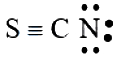
Calculate the formal charge on the $C$ atom in the thiocyanate ion $(SCN^-)$ as shown in the structure.
A
$-1$
B
$0$
C
$+1$
D
$+2$
Solution
(B) The formal charge $(FC)$ of an atom in a molecule or ion is calculated using the formula:
$FC = V - L - \frac{B}{2}$
Where:
$V$ = Total number of valence electrons in the free atom.
$L$ = Total number of non-bonding (lone pair) electrons.
$B$ = Total number of bonding (shared) electrons.
For the Carbon $(C)$ atom in the given structure of $SCN^-$ $(S \equiv C - N:)$:
$V = 4$ (Carbon is in group $14$)
$L = 0$ (Carbon has no lone pairs)
$B = 8$ (Carbon forms $3$ bonds with $S$ and $1$ bond with $N$,total $4$ bonds = $8$ electrons)
$FC = 4 - 0 - \frac{8}{2} = 4 - 4 = 0$.
Thus,the formal charge on the $C$ atom is $0$.
$FC = V - L - \frac{B}{2}$
Where:
$V$ = Total number of valence electrons in the free atom.
$L$ = Total number of non-bonding (lone pair) electrons.
$B$ = Total number of bonding (shared) electrons.
For the Carbon $(C)$ atom in the given structure of $SCN^-$ $(S \equiv C - N:)$:
$V = 4$ (Carbon is in group $14$)
$L = 0$ (Carbon has no lone pairs)
$B = 8$ (Carbon forms $3$ bonds with $S$ and $1$ bond with $N$,total $4$ bonds = $8$ electrons)
$FC = 4 - 0 - \frac{8}{2} = 4 - 4 = 0$.
Thus,the formal charge on the $C$ atom is $0$.
0 likes
View Solution394
MediumMCQ
What is the formal charge on the $N$ atom in the $[S-C \equiv N:]^-$ ion?
A
zero
B
$3$
C
$-2$
D
$2$
Solution
(A) The formal charge $(FC)$ is calculated using the formula: $FC = V - L - \frac{B}{2}$.
For the nitrogen $(N)$ atom in the $[S-C \equiv N:]^-$ ion:
Valence electrons $(V)$ of $N = 5$.
Lone pair electrons $(L)$ on $N = 2$.
Bonding electrons $(B)$ for $N = 6$ (due to the triple bond).
$FC = 5 - 2 - \frac{6}{2} = 5 - 2 - 3 = 0$.
For the nitrogen $(N)$ atom in the $[S-C \equiv N:]^-$ ion:
Valence electrons $(V)$ of $N = 5$.
Lone pair electrons $(L)$ on $N = 2$.
Bonding electrons $(B)$ for $N = 6$ (due to the triple bond).
$FC = 5 - 2 - \frac{6}{2} = 5 - 2 - 3 = 0$.
0 likes
View Solution395
EasyMCQ
The number of $\pi-$bonds present in a benzoic acid molecule is:
A
$5$
B
$4$
C
$3$
D
$6$
Solution
(B) The structure of benzoic acid $(C_6H_5COOH)$ consists of a benzene ring attached to a carboxylic acid group.
In the benzene ring,there are $3$ $\pi-$bonds due to the alternating double bonds.
In the carboxylic acid group $(-COOH)$,there is one $C=O$ double bond,which contains $1$ $\pi-$bond.
Therefore,the total number of $\pi-$bonds in a benzoic acid molecule is $3 + 1 = 4$.
In the benzene ring,there are $3$ $\pi-$bonds due to the alternating double bonds.
In the carboxylic acid group $(-COOH)$,there is one $C=O$ double bond,which contains $1$ $\pi-$bond.
Therefore,the total number of $\pi-$bonds in a benzoic acid molecule is $3 + 1 = 4$.
0 likes
View Solution396
EasyMCQ
What are the different types of bonds formed by sulphur with oxygen in thiosulfuric acid $(H_2S_2O_3)$?
A
One double bond and two single bonds
B
One double bond and one single bond
C
Two double bonds and two single bonds
D
Two double bonds and one single bond
Solution
(C) The chemical formula for thiosulfuric acid is $H_2S_2O_3$.
In its structure,the central sulfur atom is bonded to another sulfur atom via a double bond $(S=S)$.
The central sulfur atom is also bonded to two hydroxyl groups $(-OH)$ via single bonds and one oxygen atom via a double bond $(S=O)$.
Thus,the bonds formed by the central sulfur with oxygen atoms are two $S=O$ double bonds and two $S-OH$ single bonds.
However,considering the standard representation of $H_2S_2O_3$ as $O=S(OH)_2=S$,the central sulfur atom forms two double bonds with oxygen/sulfur and two single bonds with oxygen atoms.
Therefore,the correct description is two double bonds and two single bonds.
In its structure,the central sulfur atom is bonded to another sulfur atom via a double bond $(S=S)$.
The central sulfur atom is also bonded to two hydroxyl groups $(-OH)$ via single bonds and one oxygen atom via a double bond $(S=O)$.
Thus,the bonds formed by the central sulfur with oxygen atoms are two $S=O$ double bonds and two $S-OH$ single bonds.
However,considering the standard representation of $H_2S_2O_3$ as $O=S(OH)_2=S$,the central sulfur atom forms two double bonds with oxygen/sulfur and two single bonds with oxygen atoms.
Therefore,the correct description is two double bonds and two single bonds.
0 likes
View Solution397
EasyMCQ
What is the number of electrons around sulfur in $H_2SO_4$ molecule?
A
$4$
B
$6$
C
$10$
D
$12$
Solution
(D) In the $H_2SO_4$ molecule,the sulfur atom is bonded to four oxygen atoms.
There are two single bonds with two $-OH$ groups and two double bonds with two oxygen atoms.
Each single bond contributes $2$ electrons and each double bond contributes $4$ electrons to the valence shell of sulfur.
Total electrons around sulfur = $(2 \times 2) + (2 \times 4) = 4 + 8 = 12$ electrons.
There are two single bonds with two $-OH$ groups and two double bonds with two oxygen atoms.
Each single bond contributes $2$ electrons and each double bond contributes $4$ electrons to the valence shell of sulfur.
Total electrons around sulfur = $(2 \times 2) + (2 \times 4) = 4 + 8 = 12$ electrons.
0 likes
View Solution398
EasyMCQ
Which one of the following contains ionic,covalent,and coordinate bonds?
A
$NaCl$
B
$NaCN$
C
$NaNC$
D
$NaOH$
Solution
(C) The compound $NaNC$ (sodium isocyanide) contains the following bonds:
$1$. Ionic bond: Between $Na^+$ and $[NC]^-$ ions.
$2$. Covalent bond: Between $N$ and $C$ atoms (triple bond).
$3$. Coordinate bond: The lone pair of electrons on $N$ is donated to $C$ to form the triple bond structure in the isocyanide ion $[N \equiv C]^-$.
Thus,$NaNC$ contains all three types of bonds.
$1$. Ionic bond: Between $Na^+$ and $[NC]^-$ ions.
$2$. Covalent bond: Between $N$ and $C$ atoms (triple bond).
$3$. Coordinate bond: The lone pair of electrons on $N$ is donated to $C$ to form the triple bond structure in the isocyanide ion $[N \equiv C]^-$.
Thus,$NaNC$ contains all three types of bonds.
0 likes
View Solution399
EasyMCQ
Among the following,the compound that contains ionic,covalent,and coordinate linkage is:
A
$NH_3$
B
$NH_4Cl$
C
$NaCl$
D
$CaO$
Solution
(B) The compound $NH_4Cl$ (ammonium chloride) consists of an ammonium ion $(NH_4^+)$ and a chloride ion $(Cl^-)$.
$1$. The bond between $NH_4^+$ and $Cl^-$ is an ionic bond.
$2$. Within the $NH_4^+$ ion,there are three $N-H$ covalent bonds.
$3$. The fourth $N-H$ bond is formed by the donation of a lone pair of electrons from the nitrogen atom to the $H^+$ ion,which is a coordinate (dative) covalent bond.
Therefore,$NH_4Cl$ contains all three types of linkages.
$1$. The bond between $NH_4^+$ and $Cl^-$ is an ionic bond.
$2$. Within the $NH_4^+$ ion,there are three $N-H$ covalent bonds.
$3$. The fourth $N-H$ bond is formed by the donation of a lone pair of electrons from the nitrogen atom to the $H^+$ ion,which is a coordinate (dative) covalent bond.
Therefore,$NH_4Cl$ contains all three types of linkages.
0 likes
View Solution400
MediumMCQ
During the formation of a chemical bond,
A
electron-electron repulsion becomes more than the nucleus-electron attraction
B
energy of the system does not change
C
energy increases
D
energy decreases
Solution
(D) During the formation of a chemical bond,the system moves to a state of lower potential energy to achieve stability. Therefore,the energy of the system decreases as the atoms approach each other and form a bond.
0 likes
View SolutionChemical Bonding and Molecular Structure — Mix Examples-Chemical Bonding · Frequently Asked Questions
1Are these Chemical Bonding and Molecular Structure questions useful for JEE and NEET?
Yes. All questions in this section are mapped to JEE Main and NEET exam patterns. Previous year questions from JEE Main, NEET, GUJCET and state-level exams are included with full solutions.
2Can I switch to Hindi or Gujarati for these questions?
Yes. Use the language tabs in the hero section or the sidebar to view the same questions and solutions in English, Hindi or Gujarati.
3How do I generate a question paper from this subtopic?
Use the Vedclass Exam Paper Generator — select the chapter and subtopic, set difficulty, and generate Sets A, B, C, D automatically. First 3 chapters of every subject are free.
Vedclass Products
For Students
Vedclass Test Series
Mock tests in real JEE/NEET style with performance analysis. 5-day free trial.
Start Free TrialFor Teachers
Exam Paper Generator
Generate Set A/B/C/D papers from this chapter in 2 minutes. 3 chapters free.
Try FreeFor Institutes
Online Exam Module
Live online exams with unlimited students, 360° analytics & white-label branding.
See DemoFor Teachers & Institutes
Generate a Chemical Bonding and Molecular Structure Exam Paper in 2 Minutes
Select subtopic & difficulty — Sets A, B, C, D auto-generated with No Repeat logic.
First 3 chapters of every subject are free — no payment required.