
A English
Mix Examples-Chemical Bonding Questions in English
Class 11 Chemistry · Chemical Bonding and Molecular Structure · Mix Examples-Chemical Bonding
489+
Questions
English
Language
100%
With Solutions
Showing 29 of 489 questions in English
451
MediumMCQ
Compound $X$ is the anhydride of sulphuric acid. The number of $\sigma$-bonds and the number of $\pi$-bonds present in $X$ are,respectively:
A
$3, 3$
B
$4, 2$
C
$2, 4$
D
$4, 3$
Solution
(A) The anhydride of sulphuric acid $(H_2SO_4)$ is sulphur trioxide $(SO_3)$.
In the structure of $SO_3$,there are three $S=O$ double bonds.
Each double bond consists of one $\sigma$-bond and one $\pi$-bond.
Therefore,the total number of $\sigma$-bonds is $3$ and the total number of $\pi$-bonds is $3$.
In the structure of $SO_3$,there are three $S=O$ double bonds.
Each double bond consists of one $\sigma$-bond and one $\pi$-bond.
Therefore,the total number of $\sigma$-bonds is $3$ and the total number of $\pi$-bonds is $3$.
0 likes
View Solution452
EasyMCQ
The pair of molecules/ions with the same geometry but central atoms in different states of hybridization is:
A
$SnCl_2, H_2O$
B
$SF_4, XeF_4$
C
$NH_4^{+}, CO_3^{2-}$
D
$PF_5, BrF_5$
Solution
(A) Both $SnCl_2$ and $H_2O$ have a bent geometry.
In $SnCl_2$,the central atom $Sn$ has $2$ bond pairs and $1$ lone pair,resulting in $sp^2$ hybridization.
In $H_2O$,the central atom $O$ has $2$ bond pairs and $2$ lone pairs,resulting in $sp^3$ hybridization.
Since both have a bent geometry but different hybridization states,the correct pair is $SnCl_2$ and $H_2O$.
In $SnCl_2$,the central atom $Sn$ has $2$ bond pairs and $1$ lone pair,resulting in $sp^2$ hybridization.
In $H_2O$,the central atom $O$ has $2$ bond pairs and $2$ lone pairs,resulting in $sp^3$ hybridization.
Since both have a bent geometry but different hybridization states,the correct pair is $SnCl_2$ and $H_2O$.
0 likes
View Solution453
EasyMCQ
The ratio of lone pair of electrons to bond pair of electrons in an ozone $(O_3)$ molecule is
A
$2:1$
B
$3:2$
C
$2:3$
D
$1:2$
Solution
(A) In the resonance structure of ozone $(O_3)$:
$1$. The central oxygen atom has $1$ lone pair.
$2$. The terminal oxygen atom with the double bond has $2$ lone pairs.
$3$. The terminal oxygen atom with the single bond has $3$ lone pairs.
Total number of lone pairs $= 1 + 2 + 3 = 6$.
Total number of bond pairs (counting each bond as one pair) $= 3$ (one double bond counts as $2$ bond pairs and one single bond counts as $1$ bond pair).
Ratio of lone pairs to bond pairs $= 6:3 = 2:1$.
$1$. The central oxygen atom has $1$ lone pair.
$2$. The terminal oxygen atom with the double bond has $2$ lone pairs.
$3$. The terminal oxygen atom with the single bond has $3$ lone pairs.
Total number of lone pairs $= 1 + 2 + 3 = 6$.
Total number of bond pairs (counting each bond as one pair) $= 3$ (one double bond counts as $2$ bond pairs and one single bond counts as $1$ bond pair).
Ratio of lone pairs to bond pairs $= 6:3 = 2:1$.
0 likes
View Solution454
EasyMCQ
Identify the pair that is not isostructural.
A
$PCl_5, BrF_5$
B
$CH_4, SiCl_4$
C
$CO_3^{2-}, NO_3^{-}$
D
$AlF_6^{3-}, SF_6$
Solution
(A) Isostructural species have the same shape and hybridization.
$PCl_5$ and $BrF_5$ are not isostructural.
$PCl_5$: The central atom $P$ has $5$ bond pairs and $0$ lone pairs,resulting in $sp^3d$ hybridization and a trigonal bipyramidal shape.
$BrF_5$: The central atom $Br$ has $5$ bond pairs and $1$ lone pair,resulting in $sp^3d^2$ hybridization and a square pyramidal shape.
Other pairs like $(CH_4, SiCl_4)$,$(CO_3^{2-}, NO_3^{-})$,and $(AlF_6^{3-}, SF_6)$ are isostructural as they have the same hybridization and geometry.
$PCl_5$ and $BrF_5$ are not isostructural.
$PCl_5$: The central atom $P$ has $5$ bond pairs and $0$ lone pairs,resulting in $sp^3d$ hybridization and a trigonal bipyramidal shape.
$BrF_5$: The central atom $Br$ has $5$ bond pairs and $1$ lone pair,resulting in $sp^3d^2$ hybridization and a square pyramidal shape.
Other pairs like $(CH_4, SiCl_4)$,$(CO_3^{2-}, NO_3^{-})$,and $(AlF_6^{3-}, SF_6)$ are isostructural as they have the same hybridization and geometry.
0 likes
View Solution455
MediumMCQ
The formal charges of $C$ and $O$ atoms in $CO_2$ $(\ddot{O}=C=\ddot{O})$ are,respectively:
A
$1, -1$
B
$-1, 1$
C
$2, -2$
D
$0, 0$
Solution
(D) The formal charge $(FC)$ is calculated using the formula: $FC = V - L - \frac{1}{2} B$,where $V$ is the number of valence electrons,$L$ is the number of lone pair electrons,and $B$ is the number of bonding electrons.
For the $CO_2$ molecule with the structure $\ddot{O}=C=\ddot{O}$:
For the $O$ atom: $V = 6$,$L = 4$,$B = 4$. Thus,$FC = 6 - 4 - \frac{1}{2}(4) = 0$.
For the $C$ atom: $V = 4$,$L = 0$,$B = 8$. Thus,$FC = 4 - 0 - \frac{1}{2}(8) = 0$.
Therefore,the formal charges of $C$ and $O$ atoms are $0$ and $0$,respectively.
For the $CO_2$ molecule with the structure $\ddot{O}=C=\ddot{O}$:
For the $O$ atom: $V = 6$,$L = 4$,$B = 4$. Thus,$FC = 6 - 4 - \frac{1}{2}(4) = 0$.
For the $C$ atom: $V = 4$,$L = 0$,$B = 8$. Thus,$FC = 4 - 0 - \frac{1}{2}(8) = 0$.
Therefore,the formal charges of $C$ and $O$ atoms are $0$ and $0$,respectively.
0 likes
View Solution456
MediumMCQ
The formal charges of $N_{(1)}$,$N_{(2)}$,and $O$ atoms in the structure $N_{(1)} = N_{(2)} = O$ are respectively:
A
$+1, -1, 0$
B
$-1, +1, 0$
C
$+1, +1, 0$
D
$-1, -1, 0$
Solution
(B) The formal charge $(FC)$ is calculated as: $FC = (\text{Total valence electrons}) - (\text{Non-bonding electrons}) - \frac{1}{2}(\text{Bonding electrons})$.
For $N_{(1)}$ (terminal nitrogen with $4$ non-bonding electrons and $2$ bonding electrons from a double bond): $FC = 5 - 4 - \frac{1}{2}(4) = -1$.
For $N_{(2)}$ (central nitrogen with $0$ non-bonding electrons and $8$ bonding electrons from two double bonds): $FC = 5 - 0 - \frac{1}{2}(8) = +1$.
For $O$ (oxygen with $4$ non-bonding electrons and $4$ bonding electrons from a double bond): $FC = 6 - 4 - \frac{1}{2}(4) = 0$.
Thus,the formal charges are $-1, +1, 0$.
For $N_{(1)}$ (terminal nitrogen with $4$ non-bonding electrons and $2$ bonding electrons from a double bond): $FC = 5 - 4 - \frac{1}{2}(4) = -1$.
For $N_{(2)}$ (central nitrogen with $0$ non-bonding electrons and $8$ bonding electrons from two double bonds): $FC = 5 - 0 - \frac{1}{2}(8) = +1$.
For $O$ (oxygen with $4$ non-bonding electrons and $4$ bonding electrons from a double bond): $FC = 6 - 4 - \frac{1}{2}(4) = 0$.
Thus,the formal charges are $-1, +1, 0$.
0 likes
View Solution457
MediumMCQ
Match the following molecules in Column $I$ with the number of lone pairs on their central atom in Column $II$.
| Column $I$ (Molecules) | Column $II$ (Number of lone pairs on central atom) |
|---|---|
| $A. \ NH_3$ | $1. \ \text{Two}$ |
| $B. \ H_2O$ | $2. \ \text{Three}$ |
| $C. \ XeF_2$ | $3. \ \text{Zero}$ |
| $D. \ CH_4$ | $4. \ \text{Four}$ |
| $5. \ \text{One}$ |
A
$A-5, B-1, C-2, D-3$
B
$A-3, B-1, C-2, D-5$
C
$A-5, B-1, C-2, D-3$
D
$A-1, B-5, C-3, D-4$
Solution
(A) To determine the number of lone pairs on the central atom,we use the formula: $\text{Lone pairs} = \frac{V - M}{2}$,where $V$ is the number of valence electrons of the central atom and $M$ is the number of monovalent atoms bonded to it.
$A. \ NH_3$: Central atom $N$ has $5$ valence electrons. It is bonded to $3$ $H$ atoms. $\text{Lone pairs} = \frac{5-3}{2} = 1$ (Option $5$).
$B. \ H_2O$: Central atom $O$ has $6$ valence electrons. It is bonded to $2$ $H$ atoms. $\text{Lone pairs} = \frac{6-2}{2} = 2$ (Option $1$).
$C. \ XeF_2$: Central atom $Xe$ has $8$ valence electrons. It is bonded to $2$ $F$ atoms. $\text{Lone pairs} = \frac{8-2}{2} = 3$ (Option $2$).
$D. \ CH_4$: Central atom $C$ has $4$ valence electrons. It is bonded to $4$ $H$ atoms. $\text{Lone pairs} = \frac{4-4}{2} = 0$ (Option $3$).
Therefore,the correct matching is $A-5, B-1, C-2, D-3$.
$A. \ NH_3$: Central atom $N$ has $5$ valence electrons. It is bonded to $3$ $H$ atoms. $\text{Lone pairs} = \frac{5-3}{2} = 1$ (Option $5$).
$B. \ H_2O$: Central atom $O$ has $6$ valence electrons. It is bonded to $2$ $H$ atoms. $\text{Lone pairs} = \frac{6-2}{2} = 2$ (Option $1$).
$C. \ XeF_2$: Central atom $Xe$ has $8$ valence electrons. It is bonded to $2$ $F$ atoms. $\text{Lone pairs} = \frac{8-2}{2} = 3$ (Option $2$).
$D. \ CH_4$: Central atom $C$ has $4$ valence electrons. It is bonded to $4$ $H$ atoms. $\text{Lone pairs} = \frac{4-4}{2} = 0$ (Option $3$).
Therefore,the correct matching is $A-5, B-1, C-2, D-3$.
0 likes
View Solution458
EasyMCQ
Which one of the following is a correct set?
A
$H_2O, sp^3$,angular
B
$BCl_3, sp^3$,angular
C
$NH_4^{+}, dsp^2$,square planar
D
$CH_4, dsp^2$,tetrahedral
Solution
(A) To determine the correct set,we analyze the hybridization and geometry of each molecule:
Comparing the options with the table:
$A$. $H_2O$ has $sp^3$ hybridization and an angular shape. This is correct.
$B$. $BCl_3$ has $sp^2$ hybridization and trigonal planar shape.
$C$. $NH_4^{+}$ has $sp^3$ hybridization and tetrahedral shape.
$D$. $CH_4$ has $sp^3$ hybridization and tetrahedral shape.
Therefore,the correct set is $A$.
| Molecule | $bp + lp$ | Hybridisation | Shape |
| $H_2O$ | $2 + 2$ | $sp^3$ | angular |
| $BCl_3$ | $3 + 0$ | $sp^2$ | trigonal planar |
| $NH_4^{+}$ | $4 + 0$ | $sp^3$ | tetrahedral |
| $CH_4$ | $4 + 0$ | $sp^3$ | tetrahedral |
Comparing the options with the table:
$A$. $H_2O$ has $sp^3$ hybridization and an angular shape. This is correct.
$B$. $BCl_3$ has $sp^2$ hybridization and trigonal planar shape.
$C$. $NH_4^{+}$ has $sp^3$ hybridization and tetrahedral shape.
$D$. $CH_4$ has $sp^3$ hybridization and tetrahedral shape.
Therefore,the correct set is $A$.
0 likes
View Solution459
MediumMCQ
Which of the following statements is correct?
A
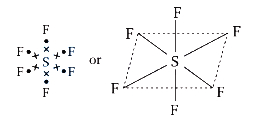
The number of electrons present in the valence shell of $S$ in $SF_6$ is $12$.
B
The rates of ionic reactions are very slow.
C
According to $VSEPR$ theory,$SnCl_2$ is a linear molecule.
D
The correct order of ability to form ionic compounds among $Na^{+}$,$Mg^{2+}$ and $Al^{3+}$ is $Al^{3+} > Mg^{2+} > Na^{+}$.
Solution
(A) Option $A$ is correct because in $SF_6$,the sulfur atom forms $6$ covalent bonds with $6$ fluorine atoms,resulting in $12$ electrons in its valence shell,which violates the octet rule.
Option $B$ is incorrect because ionic reactions occur almost instantaneously due to the presence of free ions in solution.
Option $C$ is incorrect because $SnCl_2$ has a bent geometry due to the presence of one lone pair on the $Sn$ atom.
Option $D$ is incorrect because according to Fajan's rule,the ability to form ionic compounds decreases as the charge density increases. Thus,the correct order of ionic character is $Na^{+} > Mg^{2+} > Al^{3+}$.
Option $B$ is incorrect because ionic reactions occur almost instantaneously due to the presence of free ions in solution.
Option $C$ is incorrect because $SnCl_2$ has a bent geometry due to the presence of one lone pair on the $Sn$ atom.
Option $D$ is incorrect because according to Fajan's rule,the ability to form ionic compounds decreases as the charge density increases. Thus,the correct order of ionic character is $Na^{+} > Mg^{2+} > Al^{3+}$.
0 likes
View Solution460
MediumMCQ
Which of the following statements is true?
A
Hybridisation of the central atom in $NH_3$ is $sp^2$
B
$BeCl_2$ has $V$ shape while $SO_2$ is linear
C
$SF_6$ is octahedral and $F-S-F$ bond angle is $90^{\circ}$
D
$CO_2$ has a dipole moment
Solution
(C) $NH_3$ has $sp^3$ hybridisation with a trigonal pyramidal shape.
$BeCl_2$ is linear and $SO_2$ is bent ($V$-shaped).
$SF_6$ has $sp^3d^2$ hybridisation,resulting in an octahedral geometry where all $F-S-F$ bond angles are $90^{\circ}$.
$CO_2$ is a linear molecule with a net dipole moment of zero.
$BeCl_2$ is linear and $SO_2$ is bent ($V$-shaped).
$SF_6$ has $sp^3d^2$ hybridisation,resulting in an octahedral geometry where all $F-S-F$ bond angles are $90^{\circ}$.
$CO_2$ is a linear molecule with a net dipole moment of zero.
0 likes
View Solution461
EasyMCQ
The order of the average bond length of the given bonds is
A
$C=O < C=N < C \equiv C < N-O$
B
$C \equiv C < C=O < C=N < N-O$
C
$C \equiv C < C=O < N-O < C=N$
D
$C=N < C=O < N-O < C \equiv C$
Solution
(B) The bond length depends on the bond order (multiplicity) and the atomic radii of the bonded atoms.
Bond length is inversely proportional to bond order: $Triple \ bond < Double \ bond < Single \ bond$.
Comparing the given bonds:
$1. C \equiv C$ (Bond order $3$)
$2. C=O$ (Bond order $2$)
$3. C=N$ (Bond order $2$)
$4. N-O$ (Bond order $1$)
Since $C=O$ has a higher bond polarity and smaller atomic radii compared to $C=N$,the $C=O$ bond is shorter than $C=N$.
Thus,the order of bond length is $C \equiv C < C=O < C=N < N-O$.
Bond length is inversely proportional to bond order: $Triple \ bond < Double \ bond < Single \ bond$.
Comparing the given bonds:
$1. C \equiv C$ (Bond order $3$)
$2. C=O$ (Bond order $2$)
$3. C=N$ (Bond order $2$)
$4. N-O$ (Bond order $1$)
Since $C=O$ has a higher bond polarity and smaller atomic radii compared to $C=N$,the $C=O$ bond is shorter than $C=N$.
Thus,the order of bond length is $C \equiv C < C=O < C=N < N-O$.
0 likes
View Solution462
MediumMCQ
Which one of the following molecules contains both ionic and covalent bonds?
A
$CH_2Cl_2$
B
$K_2SO_4$
C
$BeCl_2$
D
$SO_2$
Solution
(B) An ionic bond is formed by the electrostatic attraction between oppositely charged ions,while a covalent bond is formed by the sharing of electrons between atoms.
In $K_2SO_4$ (potassium sulfate),the compound consists of $K^+$ ions and $SO_4^{2-}$ polyatomic ions,which are held together by ionic bonds.
Within the sulfate ion $(SO_4^{2-})$,the sulfur atom is covalently bonded to the four oxygen atoms.
Therefore,$K_2SO_4$ contains both ionic bonds (between $K^+$ and $SO_4^{2-}$) and covalent bonds (within the $SO_4^{2-}$ ion).
In $K_2SO_4$ (potassium sulfate),the compound consists of $K^+$ ions and $SO_4^{2-}$ polyatomic ions,which are held together by ionic bonds.
Within the sulfate ion $(SO_4^{2-})$,the sulfur atom is covalently bonded to the four oxygen atoms.
Therefore,$K_2SO_4$ contains both ionic bonds (between $K^+$ and $SO_4^{2-}$) and covalent bonds (within the $SO_4^{2-}$ ion).
0 likes
View Solution463
EasyMCQ
Consider the following pairs:
Which of the above pairs are correctly matched?
| Order | Property |
|---|---|
| $(A)$ $NO_2 > O_3 > H_2O$ | Bond angle |
| $(B)$ $H_2O > HF > NH_3$ | Dipole moment |
| $(C)$ $I_2 > F_2 > N_2$ | Bond length |
Which of the above pairs are correctly matched?
A
$(A), (B) \& (C)$
B
$(B) \& (C)$ only
C
$(A) \& (C)$ only
D
$(A) \& (B)$ only
Solution
(A) Let us analyze each pair:
$(A)$ Bond angle: The bond angles are $NO_2$ $(134^{\circ})$,$O_3$ $(116.8^{\circ})$,and $H_2O$ $(104.5^{\circ})$. Thus,the order $NO_2 > O_3 > H_2O$ is correct.
$(B)$ Dipole moment: The dipole moments are $H_2O$ $(1.85 \ D)$,$HF$ $(1.78 \ D)$,and $NH_3$ $(1.47 \ D)$. Thus,the order $H_2O > HF > NH_3$ is correct.
$(C)$ Bond length: $I_2$ has a single bond with a large atomic size,$F_2$ has a single bond with a smaller atomic size,and $N_2$ has a triple bond with a very small atomic size. Bond length order is $I_2 > F_2 > N_2$. This is correct.
Therefore,all three pairs $(A), (B),$ and $(C)$ are correctly matched.
$(A)$ Bond angle: The bond angles are $NO_2$ $(134^{\circ})$,$O_3$ $(116.8^{\circ})$,and $H_2O$ $(104.5^{\circ})$. Thus,the order $NO_2 > O_3 > H_2O$ is correct.
$(B)$ Dipole moment: The dipole moments are $H_2O$ $(1.85 \ D)$,$HF$ $(1.78 \ D)$,and $NH_3$ $(1.47 \ D)$. Thus,the order $H_2O > HF > NH_3$ is correct.
$(C)$ Bond length: $I_2$ has a single bond with a large atomic size,$F_2$ has a single bond with a smaller atomic size,and $N_2$ has a triple bond with a very small atomic size. Bond length order is $I_2 > F_2 > N_2$. This is correct.
Therefore,all three pairs $(A), (B),$ and $(C)$ are correctly matched.
0 likes
View Solution464
EasyMCQ
Statement $(A)$ $CO_2$ has no dipole moment,whereas $SO_2$ and $H_2O$ have dipole moment.
Statement $(B)$ $SnCl_2$ is ionic,whereas $SnCl_4$ is covalent.
Which of the following is correct?
Statement $(B)$ $SnCl_2$ is ionic,whereas $SnCl_4$ is covalent.
Which of the following is correct?
A
Both $(A)$ and $(B)$ are not correct
B
$(A)$ is correct but $(B)$ is not correct
C
Both $(A)$ and $(B)$ are correct
D
$(A)$ is not correct but $(B)$ is correct
Solution
(C) Statement $(A)$: $CO_2$ has a linear geometry,so the bond dipoles cancel each other,resulting in a net dipole moment of $0$. $SO_2$ has a bent geometry due to the presence of a lone pair on $S$,and $H_2O$ has a bent geometry due to two lone pairs on $O$,so both have a non-zero net dipole moment. Thus,Statement $(A)$ is correct.
Statement $(B)$: According to Fajan's rule,the polarizing power of a cation increases with its charge. $Sn^{4+}$ has a higher charge than $Sn^{2+}$,so $SnCl_4$ exhibits significant covalent character,whereas $SnCl_2$ is predominantly ionic. Thus,Statement $(B)$ is correct.
Statement $(B)$: According to Fajan's rule,the polarizing power of a cation increases with its charge. $Sn^{4+}$ has a higher charge than $Sn^{2+}$,so $SnCl_4$ exhibits significant covalent character,whereas $SnCl_2$ is predominantly ionic. Thus,Statement $(B)$ is correct.
0 likes
View Solution465
EasyMCQ
The bond length $(pm)$ of $F_2$, $H_2$, $Cl_2$ and $I_2$, respectively is
A
$144, 74, 199, 267$
B
$74, 144, 199, 267$
C
$74, 267, 199, 144$
D
$144, 74, 267, 199$
Solution
(A) The bond lengths for the given molecules are as follows:
$H_2 = 74 \ pm$
$F_2 = 144 \ pm$
$Cl_2 = 199 \ pm$
$I_2 = 267 \ pm$
Therefore, the order for $F_2, H_2, Cl_2, I_2$ is $144, 74, 199, 267 \ pm$.
Thus, the correct option is $A$.
$H_2 = 74 \ pm$
$F_2 = 144 \ pm$
$Cl_2 = 199 \ pm$
$I_2 = 267 \ pm$
Therefore, the order for $F_2, H_2, Cl_2, I_2$ is $144, 74, 199, 267 \ pm$.
Thus, the correct option is $A$.
0 likes
View Solution466
MediumMCQ
The number of electrons in the valence shell of the central atom of a molecule is $8$. The molecule is
A
$BCl_3$
B
$BeH_2$
C
$SCl_2$
D
$SF_6$
Solution
(C) To determine the number of electrons in the valence shell,we calculate the total number of bonding and lone pairs around the central atom.
In $SCl_2$,the central atom is $S$ (Sulfur).
Sulfur has $6$ valence electrons.
It forms $2$ single bonds with $Cl$ atoms,using $2$ electrons.
Number of lone pairs on $S = \frac{6 - 2}{2} = 2$.
Total electron pairs around $S = 2 \text{ (bonding pairs)} + 2 \text{ (lone pairs)} = 4 \text{ pairs}$.
Total electrons in the valence shell $= 4 \times 2 = 8$ electrons.
Thus,$SCl_2$ follows the octet rule.
In $SCl_2$,the central atom is $S$ (Sulfur).
Sulfur has $6$ valence electrons.
It forms $2$ single bonds with $Cl$ atoms,using $2$ electrons.
Number of lone pairs on $S = \frac{6 - 2}{2} = 2$.
Total electron pairs around $S = 2 \text{ (bonding pairs)} + 2 \text{ (lone pairs)} = 4 \text{ pairs}$.
Total electrons in the valence shell $= 4 \times 2 = 8$ electrons.
Thus,$SCl_2$ follows the octet rule.
0 likes
View Solution467
EasyMCQ
Observe the following species:
$(i)$ $NH_3$
$(ii)$ $AlCl_3$
$(iii)$ $SnCl_4$
$(iv)$ $CO_2$
$(v)$ $Ag^{+}$
$(vi)$ $HSO_4^{-}$
How many of the above species act as Lewis acids?
$(i)$ $NH_3$
$(ii)$ $AlCl_3$
$(iii)$ $SnCl_4$
$(iv)$ $CO_2$
$(v)$ $Ag^{+}$
$(vi)$ $HSO_4^{-}$
How many of the above species act as Lewis acids?
A
$5$
B
$3$
C
$4$
D
$2$
Solution
(C) Lewis acid is an electron-pair acceptor.
$(i)$ $NH_3$: Has a lone pair on $N$,acts as a Lewis base.
$(ii)$ $AlCl_3$: $Al$ has an incomplete octet ($6$ electrons),acts as a Lewis acid.
$(iii)$ $SnCl_4$: $Sn$ has vacant $d$-orbitals and can expand its octet,acts as a Lewis acid.
$(iv)$ $CO_2$: The $C$ atom is electron-deficient due to the high electronegativity of oxygen atoms,acts as a Lewis acid.
$(v)$ $Ag^{+}$: $A$ metal cation with vacant orbitals,acts as a Lewis acid.
$(vi)$ $HSO_4^{-}$: Can act as a Lewis base (due to lone pairs on $O$) or a Brønsted-Lowry acid,but is not typically classified as a Lewis acid in this context.
Therefore,$AlCl_3$,$SnCl_4$,$CO_2$,and $Ag^{+}$ act as Lewis acids.
The total count is $4$.
$(i)$ $NH_3$: Has a lone pair on $N$,acts as a Lewis base.
$(ii)$ $AlCl_3$: $Al$ has an incomplete octet ($6$ electrons),acts as a Lewis acid.
$(iii)$ $SnCl_4$: $Sn$ has vacant $d$-orbitals and can expand its octet,acts as a Lewis acid.
$(iv)$ $CO_2$: The $C$ atom is electron-deficient due to the high electronegativity of oxygen atoms,acts as a Lewis acid.
$(v)$ $Ag^{+}$: $A$ metal cation with vacant orbitals,acts as a Lewis acid.
$(vi)$ $HSO_4^{-}$: Can act as a Lewis base (due to lone pairs on $O$) or a Brønsted-Lowry acid,but is not typically classified as a Lewis acid in this context.
Therefore,$AlCl_3$,$SnCl_4$,$CO_2$,and $Ag^{+}$ act as Lewis acids.
The total count is $4$.
0 likes
View Solution468
MediumMCQ
The oxidation state $(n)$,coordination number $(CN)$ of $Al$,and the number of valence electrons around $Al$ $(N)$ in $Al_2Cl_6$ are respectively:
A
$3, 3, 6$
B
$3, 4, 8$
C
$4, 4, 8$
D
$3, 4, 6$
Solution
(B) The structure of $Al_2Cl_6$ is a dimer where each $Al$ atom is bonded to $4$ chlorine atoms (two terminal and two bridging).
$(I)$ Oxidation state $(n)$ of $Al$ in $Al_2Cl_6$: $2x + 6(-1) = 0 \implies 2x = 6 \implies x = +3$.
$(II)$ Coordination number $(CN)$ of $Al$: Each $Al$ atom is surrounded by $4$ chlorine atoms,so $CN = 4$.
$(III)$ Number of valence electrons $(N)$ around $Al$: Since each $Al$ atom is bonded to $4$ chlorine atoms by covalent bonds (including coordinate bonds),it shares $4$ electron pairs,resulting in $4 \times 2 = 8$ valence electrons around each $Al$ atom.
Therefore,the values are $3, 4, 8$. The correct option is $(B)$.
$(I)$ Oxidation state $(n)$ of $Al$ in $Al_2Cl_6$: $2x + 6(-1) = 0 \implies 2x = 6 \implies x = +3$.
$(II)$ Coordination number $(CN)$ of $Al$: Each $Al$ atom is surrounded by $4$ chlorine atoms,so $CN = 4$.
$(III)$ Number of valence electrons $(N)$ around $Al$: Since each $Al$ atom is bonded to $4$ chlorine atoms by covalent bonds (including coordinate bonds),it shares $4$ electron pairs,resulting in $4 \times 2 = 8$ valence electrons around each $Al$ atom.
Therefore,the values are $3, 4, 8$. The correct option is $(B)$.
0 likes
View Solution469
MediumMCQ
The number of sigma $(\sigma)$ and pi $(\pi)$ bonds in peroxodisulphuric acid are,respectively:
A
$9$ and $4$
B
$11$ and $4$
C
$4$ and $8$
D
$4$ and $9$
Solution
(B) The chemical formula of peroxodisulphuric acid (Marshall's acid) is $H_2S_2O_8$.
Its structure consists of two $SO_3$ groups linked by a peroxide linkage $(-O-O-)$.
In the structure:
- There are $2$ $S=O$ double bonds per sulfur atom,contributing $2$ $\pi$ bonds each,totaling $4$ $\pi$ bonds.
- Counting the $\sigma$ bonds: $4$ $S=O$ bonds,$2$ $S-OH$ bonds,$2$ $O-H$ bonds,$2$ $S-O$ bonds (to peroxide oxygen),and $1$ $O-O$ bond.
- Total $\sigma$ bonds = $4 + 2 + 2 + 2 + 1 = 11$.
- Total $\pi$ bonds = $4$.
Thus,the number of $\sigma$ and $\pi$ bonds are $11$ and $4$ respectively.
Its structure consists of two $SO_3$ groups linked by a peroxide linkage $(-O-O-)$.
In the structure:
- There are $2$ $S=O$ double bonds per sulfur atom,contributing $2$ $\pi$ bonds each,totaling $4$ $\pi$ bonds.
- Counting the $\sigma$ bonds: $4$ $S=O$ bonds,$2$ $S-OH$ bonds,$2$ $O-H$ bonds,$2$ $S-O$ bonds (to peroxide oxygen),and $1$ $O-O$ bond.
- Total $\sigma$ bonds = $4 + 2 + 2 + 2 + 1 = 11$.
- Total $\pi$ bonds = $4$.
Thus,the number of $\sigma$ and $\pi$ bonds are $11$ and $4$ respectively.
0 likes
View Solution470
MediumMCQ
The decreasing order of bond dissociation energies of $C-C$,$C-H$,and $H-H$ bonds is:
A
$H-H > C-H > C-C$
B
$C-C > C-H > H-H$
C
$C-H > C-C > H-H$
D
$C-C > H-H > C-H$
Solution
(A) The bond dissociation energies are determined by the strength of the bond,which is related to the overlap of orbitals and bond length.
The bond dissociation energies are approximately:
$H-H \approx 436 \ kJ/mol$
$C-H \approx 413 \ kJ/mol$
$C-C \approx 348 \ kJ/mol$
Therefore,the decreasing order is $H-H > C-H > C-C$.
The bond dissociation energies are approximately:
$H-H \approx 436 \ kJ/mol$
$C-H \approx 413 \ kJ/mol$
$C-C \approx 348 \ kJ/mol$
Therefore,the decreasing order is $H-H > C-H > C-C$.
0 likes
View Solution471
EasyMCQ
The maximum number of atoms that can be in one plane in the molecule $p$-nitrobenzonitrile are
A
$6$
B
$12$
C
$13$
D
$15$
Solution
(D) The molecular formula of $p$-nitrobenzonitrile is $C_{7}H_{4}N_{2}O_{2}$.
In this molecule,the benzene ring is planar ($sp^{2}$ hybridized carbons).
The nitro group $(-NO_{2})$ is attached to the benzene ring,and due to resonance,it tends to lie in the same plane as the benzene ring.
The cyano group $(-CN)$ is linear ($sp$ hybridized carbon) and is also in the same plane as the benzene ring.
Therefore,all $15$ atoms ($7$ carbons,$4$ hydrogens,$2$ nitrogens,and $2$ oxygens) lie in the same plane.
In this molecule,the benzene ring is planar ($sp^{2}$ hybridized carbons).
The nitro group $(-NO_{2})$ is attached to the benzene ring,and due to resonance,it tends to lie in the same plane as the benzene ring.
The cyano group $(-CN)$ is linear ($sp$ hybridized carbon) and is also in the same plane as the benzene ring.
Therefore,all $15$ atoms ($7$ carbons,$4$ hydrogens,$2$ nitrogens,and $2$ oxygens) lie in the same plane.
0 likes
View Solution472
MediumMCQ
In the following electron-dot structure,calculate the formal charge from left to right for the nitrogen atoms: $: \ddot{N} = N = \ddot{N} :$
A
$-1, +1, -1$
B
$-1, -1, +1$
C
$+1, -1, -1$
D
$+1, -1, +1$
Solution
(A) The formula for formal charge is: $\text{Formal charge} = \text{Valence electrons} - (\frac{1}{2} \times \text{Bonding electrons} + \text{Non-bonding electrons})$.
For the structure $: \ddot{N}_1 = N_2 = \ddot{N}_3 :$
For $N_1$ (left nitrogen): $\text{Valence electrons} = 5$,$\text{Bonding electrons} = 4$,$\text{Non-bonding electrons} = 4$.
$\text{Formal charge} = 5 - (\frac{1}{2} \times 4 + 4) = 5 - (2 + 4) = -1$.
For $N_2$ (middle nitrogen): $\text{Valence electrons} = 5$,$\text{Bonding electrons} = 8$,$\text{Non-bonding electrons} = 0$.
$\text{Formal charge} = 5 - (\frac{1}{2} \times 8 + 0) = 5 - 4 = +1$.
For $N_3$ (right nitrogen): $\text{Valence electrons} = 5$,$\text{Bonding electrons} = 4$,$\text{Non-bonding electrons} = 4$.
$\text{Formal charge} = 5 - (\frac{1}{2} \times 4 + 4) = 5 - (2 + 4) = -1$.
Thus,the formal charges are $-1, +1, -1$.
For the structure $: \ddot{N}_1 = N_2 = \ddot{N}_3 :$
For $N_1$ (left nitrogen): $\text{Valence electrons} = 5$,$\text{Bonding electrons} = 4$,$\text{Non-bonding electrons} = 4$.
$\text{Formal charge} = 5 - (\frac{1}{2} \times 4 + 4) = 5 - (2 + 4) = -1$.
For $N_2$ (middle nitrogen): $\text{Valence electrons} = 5$,$\text{Bonding electrons} = 8$,$\text{Non-bonding electrons} = 0$.
$\text{Formal charge} = 5 - (\frac{1}{2} \times 8 + 0) = 5 - 4 = +1$.
For $N_3$ (right nitrogen): $\text{Valence electrons} = 5$,$\text{Bonding electrons} = 4$,$\text{Non-bonding electrons} = 4$.
$\text{Formal charge} = 5 - (\frac{1}{2} \times 4 + 4) = 5 - (2 + 4) = -1$.
Thus,the formal charges are $-1, +1, -1$.
0 likes
View Solution473
EasyMCQ
The correct order of $O-O$ bond length in $O_{2}$,$H_{2}O_{2}$ and $O_{3}$ is
A
$O_{2} > O_{3} > H_{2}O_{2}$
B
$H_{2}O_{2} > O_{3} > O_{2}$
C
$O_{3} > O_{2} > H_{2}O_{2}$
D
$O_{3} > H_{2}O_{2} > O_{2}$
Solution
(B) The bond length is inversely proportional to the bond order.
$1$. In $O_{2}$,the bond order is $2$.
$2$. In $O_{3}$,the bond order is $1.5$ due to resonance.
$3$. In $H_{2}O_{2}$,the $O-O$ bond is a single bond with a bond order of $1$.
Comparing the bond orders: $O_{2} (2) > O_{3} (1.5) > H_{2}O_{2} (1)$.
Therefore,the order of bond length is $H_{2}O_{2} > O_{3} > O_{2}$.
$1$. In $O_{2}$,the bond order is $2$.
$2$. In $O_{3}$,the bond order is $1.5$ due to resonance.
$3$. In $H_{2}O_{2}$,the $O-O$ bond is a single bond with a bond order of $1$.
Comparing the bond orders: $O_{2} (2) > O_{3} (1.5) > H_{2}O_{2} (1)$.
Therefore,the order of bond length is $H_{2}O_{2} > O_{3} > O_{2}$.
0 likes
View Solution474
DifficultMCQ
Given below are statements about some molecules/ions. Identify the $CORRECT$ statements.
$A$. The dipole moment value of $NF_3$ is higher than that of $NH_3$.
$B$. The dipole moment value of $BeH_2$ is zero.
$C$. The bond order of $O_2^{2-}$ and $F_2$ is same.
$D$. The formal charge on the central oxygen atom of ozone is $-1$.
$E$. In $NO_2$,all the three atoms satisfy the octet rule,hence it is very stable.
Choose the correct answer from the options given below:
$A$. The dipole moment value of $NF_3$ is higher than that of $NH_3$.
$B$. The dipole moment value of $BeH_2$ is zero.
$C$. The bond order of $O_2^{2-}$ and $F_2$ is same.
$D$. The formal charge on the central oxygen atom of ozone is $-1$.
$E$. In $NO_2$,all the three atoms satisfy the octet rule,hence it is very stable.
Choose the correct answer from the options given below:
A
$A, B, C, D$ & $E$
B
$B$ & $C$ only
C
$B, C$ & $D$ only
D
$A, C$ & $D$ only
Solution
(B) Dipole moment: $NF_3 (0.24 \ D) < NH_3 (1.47 \ D)$. Statement $A$ is incorrect.
$(B)$ $BeH_2$ is $sp$ hybridized and linear,so its dipole moment is $0$. Statement $B$ is correct.
$(C)$ Bond order of $O_2^{2-}$ is $\frac{10-8}{2} = 1$. Bond order of $F_2$ is $\frac{8-6}{2} = 1$. Statement $C$ is correct.
$(D)$ In $O_3$,the central oxygen atom has a formal charge of $+1$. Statement $D$ is incorrect.
$(E)$ In $NO_2$,nitrogen has an odd number of electrons ($7$ valence electrons),so it does not follow the octet rule. Statement $E$ is incorrect.
Therefore,only $B$ and $C$ are correct.
$(B)$ $BeH_2$ is $sp$ hybridized and linear,so its dipole moment is $0$. Statement $B$ is correct.
$(C)$ Bond order of $O_2^{2-}$ is $\frac{10-8}{2} = 1$. Bond order of $F_2$ is $\frac{8-6}{2} = 1$. Statement $C$ is correct.
$(D)$ In $O_3$,the central oxygen atom has a formal charge of $+1$. Statement $D$ is incorrect.
$(E)$ In $NO_2$,nitrogen has an odd number of electrons ($7$ valence electrons),so it does not follow the octet rule. Statement $E$ is incorrect.
Therefore,only $B$ and $C$ are correct.
0 likes
View Solution475
DifficultMCQ
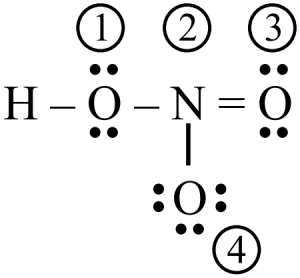
The formal charges on the atoms marked as $(1)$ to $(4)$ in the Lewis representation of $HNO_3$ molecule respectively are
A
$+1, 0, 0, -1$
B
$0, -1, 0, +1$
C
$0, +1, 0, -1$
D
$0, 0, -1, +1$
Solution
(C) The formula for formal charge is: $\text{Formal charge} = \text{Valence electrons} - \text{Non-bonding electrons} - \frac{1}{2}(\text{Bonding electrons})$.
For atom $(1)$ (Oxygen): Valence $e^- = 6$,Non-bonding $e^- = 4$,Bonding $e^- = 4$. $\text{FC} = 6 - 4 - \frac{4}{2} = 0$.
For atom $(2)$ (Nitrogen): Valence $e^- = 5$,Non-bonding $e^- = 0$,Bonding $e^- = 8$. $\text{FC} = 5 - 0 - \frac{8}{2} = +1$.
For atom $(3)$ (Oxygen): Valence $e^- = 6$,Non-bonding $e^- = 4$,Bonding $e^- = 4$. $\text{FC} = 6 - 4 - \frac{4}{2} = 0$.
For atom $(4)$ (Oxygen): Valence $e^- = 6$,Non-bonding $e^- = 6$,Bonding $e^- = 2$. $\text{FC} = 6 - 6 - \frac{2}{2} = -1$.
Thus,the formal charges are $0, +1, 0, -1$.
For atom $(1)$ (Oxygen): Valence $e^- = 6$,Non-bonding $e^- = 4$,Bonding $e^- = 4$. $\text{FC} = 6 - 4 - \frac{4}{2} = 0$.
For atom $(2)$ (Nitrogen): Valence $e^- = 5$,Non-bonding $e^- = 0$,Bonding $e^- = 8$. $\text{FC} = 5 - 0 - \frac{8}{2} = +1$.
For atom $(3)$ (Oxygen): Valence $e^- = 6$,Non-bonding $e^- = 4$,Bonding $e^- = 4$. $\text{FC} = 6 - 4 - \frac{4}{2} = 0$.
For atom $(4)$ (Oxygen): Valence $e^- = 6$,Non-bonding $e^- = 6$,Bonding $e^- = 2$. $\text{FC} = 6 - 6 - \frac{2}{2} = -1$.
Thus,the formal charges are $0, +1, 0, -1$.
0 likes
View Solution476
MediumMCQ
The pairs among $A = [SO_3^{2-}, CO_3^{2-}]$,$B = [O_2^{2-}, F_2]$,$C = [CN^-, CO]$,$D = [NH_3, H_3O^+]$ and $E = [MnO_4^{2-}, CrO_4^{2-}]$ that do not have similar Lewis dot structures are:
A
$A, B$ and $E$
B
$A$ and $E$
C
$B, C$ and $D$
D
$C$ and $D$
Solution
(B) To determine if the species have similar Lewis dot structures,we analyze their valence electrons and geometry:
$A: SO_3^{2-}$ has $26$ valence electrons and a trigonal pyramidal geometry. $CO_3^{2-}$ has $24$ valence electrons and a trigonal planar geometry. These are not similar.
$B: O_2^{2-}$ has $14$ valence electrons $(:O-O:)$ and $F_2$ has $14$ valence electrons $(:F-F:)$. These are isoelectronic and have similar structures.
$C: CN^-$ has $10$ valence electrons $([:C \equiv N:]^-)$ and $CO$ has $10$ valence electrons $(:C \equiv O:)$. These are isoelectronic and have similar structures.
$D: NH_3$ has $8$ valence electrons and a trigonal pyramidal geometry. $H_3O^+$ has $8$ valence electrons and a trigonal pyramidal geometry. These are similar.
$E: MnO_4^{2-}$ and $CrO_4^{2-}$ are both $d^0$ transition metal oxoanions with a tetrahedral geometry. These are similar.
Therefore,only pair $A$ does not have similar structures.
$A: SO_3^{2-}$ has $26$ valence electrons and a trigonal pyramidal geometry. $CO_3^{2-}$ has $24$ valence electrons and a trigonal planar geometry. These are not similar.
$B: O_2^{2-}$ has $14$ valence electrons $(:O-O:)$ and $F_2$ has $14$ valence electrons $(:F-F:)$. These are isoelectronic and have similar structures.
$C: CN^-$ has $10$ valence electrons $([:C \equiv N:]^-)$ and $CO$ has $10$ valence electrons $(:C \equiv O:)$. These are isoelectronic and have similar structures.
$D: NH_3$ has $8$ valence electrons and a trigonal pyramidal geometry. $H_3O^+$ has $8$ valence electrons and a trigonal pyramidal geometry. These are similar.
$E: MnO_4^{2-}$ and $CrO_4^{2-}$ are both $d^0$ transition metal oxoanions with a tetrahedral geometry. These are similar.
Therefore,only pair $A$ does not have similar structures.
0 likes
View Solution477
MediumMCQ
Given below are two statements:
Statement $I$: $F_2O < H_2O < Cl_2O$ is the correct trend in terms of bond angle.
Statement $II$: $SiF_4, SnF_4$ and $PbF_4$ are ionic in nature.
Statement $I$: $F_2O < H_2O < Cl_2O$ is the correct trend in terms of bond angle.
Statement $II$: $SiF_4, SnF_4$ and $PbF_4$ are ionic in nature.
A
Both Statement $I$ and Statement $II$ are true
B
Both Statement $I$ and Statement $II$ are false
C
Statement $I$ is true but Statement $II$ is false
D
Statement $I$ is false but Statement $II$ is true
Solution
(C) Statement $I$: The bond angles are $F_2O (103^\circ) < H_2O (104.5^\circ) < Cl_2O (111^\circ)$. This trend is correct because in $Cl_2O$,the large size of $Cl$ atoms leads to steric repulsion,increasing the bond angle.
Statement $II$: $SiF_4$ is a covalent molecule due to the small size and high electronegativity of $Si$. While $SnF_4$ and $PbF_4$ exhibit significant ionic character,classifying all three as ionic is incorrect. Therefore,Statement $II$ is false.
Statement $II$: $SiF_4$ is a covalent molecule due to the small size and high electronegativity of $Si$. While $SnF_4$ and $PbF_4$ exhibit significant ionic character,classifying all three as ionic is incorrect. Therefore,Statement $II$ is false.
0 likes
View Solution478
MediumMCQ
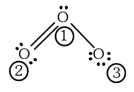
The correct formal charges on oxygen atoms numbered $2$,$1$ and $3$ respectively are:
A
$0, 0, 0$
B
$-1, 0, +1$
C
$+1, 0, -1$
D
$0, +1, -1$
Solution
(D) The formula for formal charge is: $\text{Formal charge} = (\text{Valence electrons}) - (\text{Non-bonding electrons}) - \frac{1}{2}(\text{Bonding electrons})$.
For oxygen atom $2$ (terminal oxygen with double bond): Valence electrons = $6$,Non-bonding electrons = $4$,Bonding electrons = $4$. Formal charge = $6 - 4 - \frac{1}{2}(4) = 6 - 4 - 2 = 0$.
For oxygen atom $1$ (central oxygen): Valence electrons = $6$,Non-bonding electrons = $2$,Bonding electrons = $6$. Formal charge = $6 - 2 - \frac{1}{2}(6) = 6 - 2 - 3 = +1$.
For oxygen atom $3$ (terminal oxygen with single bond): Valence electrons = $6$,Non-bonding electrons = $6$,Bonding electrons = $2$. Formal charge = $6 - 6 - \frac{1}{2}(2) = 6 - 6 - 1 = -1$.
Thus,the formal charges on oxygen atoms $2, 1$ and $3$ are $0, +1$ and $-1$ respectively.
For oxygen atom $2$ (terminal oxygen with double bond): Valence electrons = $6$,Non-bonding electrons = $4$,Bonding electrons = $4$. Formal charge = $6 - 4 - \frac{1}{2}(4) = 6 - 4 - 2 = 0$.
For oxygen atom $1$ (central oxygen): Valence electrons = $6$,Non-bonding electrons = $2$,Bonding electrons = $6$. Formal charge = $6 - 2 - \frac{1}{2}(6) = 6 - 2 - 3 = +1$.
For oxygen atom $3$ (terminal oxygen with single bond): Valence electrons = $6$,Non-bonding electrons = $6$,Bonding electrons = $2$. Formal charge = $6 - 6 - \frac{1}{2}(2) = 6 - 6 - 1 = -1$.
Thus,the formal charges on oxygen atoms $2, 1$ and $3$ are $0, +1$ and $-1$ respectively.
0 likes
View Solution479
DifficultMCQ
Match List-$I$ with List-$II$ :
Choose the correct answer from the options given below :
| List-$I$ | List-$II$ |
| $(A)$ $C_{2}H_{4}$ | $(I)$ $3\sigma$ bonds,$2\pi$ bonds |
| $(B)$ $C_{2}H_{2}$ | $(II)$ $3\sigma$ bonds,$1$ lone pair |
| $(C)$ $CH_{4}$ | $(III)$ $4\sigma$ bonds |
| $(D)$ $NH_{3}$ | $(IV)$ $5\sigma$ bonds,$1\pi$ bond |
Choose the correct answer from the options given below :
A
$A-IV, B-I, C-III, D-II$
B
$A-III, B-IV, C-I, D-II$
C
$A-II, B-III, C-I, D-IV$
D
$A-I, B-II, C-IV, D-III$
Solution
(A) The bonding in the given molecules is as follows:
$(A)$ $C_{2}H_{4}$ (Ethene): Structure is $CH_{2}=CH_{2}$. It contains $5\sigma$ bonds and $1\pi$ bond.
$(B)$ $C_{2}H_{2}$ (Ethyne): Structure is $CH \equiv CH$. It contains $3\sigma$ bonds and $2\pi$ bonds.
$(C)$ $CH_{4}$ (Methane): Structure is $CH_{4}$ with $sp^{3}$ hybridization. It contains $4\sigma$ bonds.
$(D)$ $NH_{3}$ (Ammonia): Structure is $NH_{3}$ with $sp^{3}$ hybridization. It contains $3\sigma$ bonds and $1$ lone pair on the nitrogen atom.
Therefore,the correct matching is: $A-IV, B-I, C-III, D-II$.
$(A)$ $C_{2}H_{4}$ (Ethene): Structure is $CH_{2}=CH_{2}$. It contains $5\sigma$ bonds and $1\pi$ bond.
$(B)$ $C_{2}H_{2}$ (Ethyne): Structure is $CH \equiv CH$. It contains $3\sigma$ bonds and $2\pi$ bonds.
$(C)$ $CH_{4}$ (Methane): Structure is $CH_{4}$ with $sp^{3}$ hybridization. It contains $4\sigma$ bonds.
$(D)$ $NH_{3}$ (Ammonia): Structure is $NH_{3}$ with $sp^{3}$ hybridization. It contains $3\sigma$ bonds and $1$ lone pair on the nitrogen atom.
Therefore,the correct matching is: $A-IV, B-I, C-III, D-II$.
0 likes
View SolutionChemical Bonding and Molecular Structure — Mix Examples-Chemical Bonding · Frequently Asked Questions
1Are these Chemical Bonding and Molecular Structure questions useful for JEE and NEET?
Yes. All questions in this section are mapped to JEE Main and NEET exam patterns. Previous year questions from JEE Main, NEET, GUJCET and state-level exams are included with full solutions.
2Can I switch to Hindi or Gujarati for these questions?
Yes. Use the language tabs in the hero section or the sidebar to view the same questions and solutions in English, Hindi or Gujarati.
3How do I generate a question paper from this subtopic?
Use the Vedclass Exam Paper Generator — select the chapter and subtopic, set difficulty, and generate Sets A, B, C, D automatically. First 3 chapters of every subject are free.
Vedclass Products
For Students
Vedclass Test Series
Mock tests in real JEE/NEET style with performance analysis. 5-day free trial.
Start Free TrialFor Teachers
Exam Paper Generator
Generate Set A/B/C/D papers from this chapter in 2 minutes. 3 chapters free.
Try FreeFor Institutes
Online Exam Module
Live online exams with unlimited students, 360° analytics & white-label branding.
See DemoFor Teachers & Institutes
Generate a Chemical Bonding and Molecular Structure Exam Paper in 2 Minutes
Select subtopic & difficulty — Sets A, B, C, D auto-generated with No Repeat logic.
First 3 chapters of every subject are free — no payment required.